Monthly Archives: March 2013

“Friedman Friday” Milton Friedman remembered at 100 years from his birth (Part 2)

Testing Milton Friedman – Preview

Uploaded by on Feb 21, 2012

2012 is the 100th anniversary of Milton Friedman’s birth. His work and ideas continue to make the world a better place. As part of Milton Friedman’s Century, a revival of the ideas featured in the landmark television series Free To Choose are being revisited in a new 3-part PBS broadcast.

To learn more visit: miltonfriedmanscentury(dot)org

Or: freetochoose(dot)net/media/broadcast/testing_milton_friedman/

______________________

Thinking Things Over       May 28, 2012

Volume II, Number 21: Remembering Milton Friedman in the Torpor of 1980  

By John L. Chapman, Ph.D.         Washington, D.C.

Amidst continuing nervousness about the Eurozone and slower global growth, political debate in the U.S. is centered around the best path forward to return to sustainable prosperity.  The Wall Street Journal reminded us this past weekend of similar tough times 32 years ago, and the group of economic advisors led by 1976 Nobel Laureate Milton Friedman who steeled a new President’s nerves to “stay the course” on a pro-growth and pro-investment policy mix — exactly what needs to happen again today.

The Global Backdrop Compared to 1980

This past week the continuing stream of data about the global economy was not good around the globe but, we hasten to add, “not bad” for the United States.  Manufacturing is contracting in the Eurozone and in China (for the seventh straight month in the latter), and slowing in the U.S., along with orders for durable goods including aircraft, computers, and heavy machinery (though still all positive growth here).  Both the OECD and IMF have cut their 2012 forecast for global growth, now below the 3.9% seen in 2011.  The Morgan Stanley MSCI Index for global equities is off 9% since mid-March, and the price of crude oil, the leading globally-traded industrial commodity – and hence indicator of commercial appetites – is down 15% since the beginning of May alone. Worries about Greece and its possible-to-likely exit (or forced eviction) from the Eurozone after its June 17 elections have only added to investor nervousness on a global scale: Greece is of course a small country, but its Euro-exit and debt repudiation could be a harbinger for the other heavily-indebted member states in the Eurozone, beginning with the 4th largest economy in the union, Spain, whose banking system is increasingly stressed.

Thus, Greece has an outsized influence on global markets as we head into June.  While in more “normal” times a Greek default and currency reconstruction would be absorbed in a global economy with $60 trillion in GDP, these are not normal times:  in the current environment, the play-out of tragedy in Greece sends out echoes to Italy, Portugal, Spain, and elsewhere, threatening a general depression if devalued currency warfare stunts global trade, as per its potential.

The economy in the United States continues to show amazing resilience, even as equity markets traded flat last week and are down 7% since peaking in April.  Indeed some of the performance metrics in the U.S. are nothing short of outstanding: retail sales are now up for 21 of the previous 22 months, during a 26-month span when 4.2 million private sector jobs have been created since the unemployment peak.  Consumer spending is up 4% in real terms from a year ago, exemplified by a preferred leading indicator for us, auto sales, up 10% year-on-year to a new annual run rate of 14.3 million vehicles.

Work hours are continuing a two-year rise as well, and business (nonresidential fixed) investment, while still way off its 2006 peak and well-below long term trend, is recovering smartly as well, up 12% year-on-year.

Meanwhile data out in the past week reinforces the positive “spin” on the U.S., even in the case of declining durable goods orders mentioned above.  New single-family home sales increased 3.3% in April, to a 343,000 annual rate (up nearly 10% from a year earlier), continuing a three year recovery that is on track to double from existing production levels in the next four years based on demographic needs (in contrast to Japan and most all of Europe, the United States is actually getting younger).  Sales were up in the Northeast, West, and Midwest, as the supply of new homes fell to 5.1 months’ inventory from 5.2 the prior month.  Further, the median price of new homes sold was $235,700 in April, up 4.9% from a year ago; the average price was $282,600, up 5.1% from 2011; this is very positive data that casts doubt on the recent gloom contained in the Case-Shiller data (all homes’ pricing is also up, by 2.7% from year-earlier levels).

Data on existing home sales matched that of new product: volumes of existing home sales rose 3.4% in April, to an annual rate of 4.62 million units; sales of these homes are also up 10.0% versus a year ago, and are up in all four regions of the U.S. including the South. Median prices for existing homes are up 10.1% from a year ago, with average prices up 7.4% in that time.  New orders for durable goods were positive, too: they increased 0.2% in April, and are up 6.9% year on year (and orders excluding the volatile transport sector are still up 6.3%).  While there was a severe decline in core capital goods production (viz., excluding aircraft and defense-related), the continuing rise in capacity utilization (nearing 80% for the first time in four years) and home-building should lead to a rebound in capital equipment production of all types in the months ahead.

What Reagan Faced

Considering the turmoil elsewhere, as well as the uncertainty around near term conditions here in the U.S., the continuing relative buoyancy here, and intrepid resourcefulness of American producers, is nothing short of astounding.  And related to this, how heartening it was, too, to see the reprint of portions of a famous memo on economic growth strategy appearing in the Wall Street Journal this past weekend. Written to then President-Elect Reagan within two weeks of his election victory, the memo, signed by a committee including George Schultz, Milton Friedman, William E. Simon, and the incoming Chair of the Council of Economic Advisors Murray Weidenbaum, outlined the serious challenges facing the U.S. economy, and the priorities to meet them.

The committee did not mince words at a time of nearly 8% unemployment, 13% inflation, and 21% interest rates. The core concepts of a new plan, indeed, governing paradigm, for sustainable growth, included the following:

You have identified in the campaign the key issues and lines of policy necessary to restore hope and confidence in a better economic future:

• Reestablish stability in the purchasing power of the dollar.

• Achieve a widely-shared prosperity through real growth in jobs, investment, and productivity.

• Devote the resources needed for a strong defense, and accomplish the goal of releasing the creative forces of entrepreneurship, management, and labor by:

• Restraining government spending.

Reducing the burden of taxation and regulation.

• Conducting monetary policy in a steady manner, directed toward eliminating inflation.

This amounts to emphasis on fundamentals for the full four years, as the key to a flourishing economy.

Reading the document in its entirety is an eerie experience because the solutions proffered mirror almost precisely what needs to happen today.  The leading influence in the memo’s production, which was itself a compendium of several economic policy position papers developed during the campaign, was Milton Friedman.  Professor Friedman, born 100 years ago this summer, went on to serve all eight years on President Reagan’s economic policy advisory committee, later joined by such luminaries as Thomas Sowell — it was a group Mr. Reagan described in his memoirs as enjoying immensely throughout his two terms, and a group whose 6-8 meetings per year he never missed.  Indeed, in one of the understated circumstances of history, it was this group that provided encouragement to Mr. Reagan to steel his courage to “stay the course” on this 1981 Economic Recovery and Tax Act, which in the horrible economy of 1982 he was repeatedly encouraged to abandon — by his own people.  In spite of electoral thrashing that November, he did exactly that, and engendered the 1983-89 seven year boom, with three million new jobs per year and a steadily declining debt-to-GDP ratio across his term.

The entire document is worth reading, but for our purposes, it is fascinating to see the items for action listed — and their priority in emphasis — as laid out by Professor Friedman.  At the top of the list was restoring a sound dollar, followed by the need to promote productivity-enhancing investment.  This was followed by building up the national defense in conjunction with a roll-back in spending and burdensome regulations.  The Committee knew that growth in the public sector — in both taxes and spending — had led to a fiscal “crowding out” of resources available for the private sector, including defense spending.  The committee advised the incoming President that his tax cuts, lessened government spending, and fewer regulations would unleash an entrepreneurial boom, and ignite the U.S. economy’s natural propensity for being the global drive-train of growth.   21 million jobs soon followed.

For those old enough to remember, it will be recalled that 1979-80 were miserable times in the U.S.: gas lines, high unemployment, stagnant real wages, increasing global trade tensions, high inflation, and an era of diminshed expectations as encouraged by the incumbent President.  Mr. Reagan would have none of it, and encouraged by Milton Friedman and his confreres, applied the wisdom of Adam Smith to that era’s troubles.  The resulting 25-year boom, in which the U.S. economy effectively added new growth the size of the German economy, can be re-ignited once again, and indeed could be transposed around the world to all troubled economies, including that of Greece.  To do so only requires the will to implement anew the policies followed then.

For information on Alhambra Investment Partners’ money management services and global portfolio approach to capital preservation, John Chapman can be reached at john.chapman@alhambrapartners.com. The views expressed here are solely those of the author, and do not necessarily reflect that of colleagues at Alhambra Partners or any of its affiliates.

“Friedman Friday” :“A Nobel Laureate on the American Economy” VTR: 5/31/77 Transcript and video clip (Part 4)

Milton Friedman on the American Economy (4 of 6)   Uploaded by donotswallow on Aug 9, 2009 THE OPEN MIND Host: Richard D. Heffner Guest: Milton Friedman Title: A Nobel Laureate on the American Economy VTR: 5/31/77 _____________________________________ Below is a transcipt from a portion of an interview that Milton Friedman gave on 5-31-77: Friedman: […]

Obama promotes food stamps but Milton Friedman had a better suggestion

Milton Friedman’s negative income tax explained by Friedman in 1968: We need to cut back on the Food Stamp program and not try to increase it. What really upsets me is that when the government gets involved in welfare there is a welfare trap created for those who become dependent on the program. Once they […]

“Friedman Friday” :“A Nobel Laureate on the American Economy” VTR: 5/31/77 Transcript and video clip (Part 3)

Milton Friedman on the American Economy (3 of 6) Uploaded by donotswallow on Aug 9, 2009 THE OPEN MIND Host: Richard D. Heffner Guest: Milton Friedman Title: A Nobel Laureate on the American Economy VTR: 5/31/77 _____________________________________ Below is a transcipt from a portion of an interview that Milton Friedman gave on 5-31-77: Friedman: Now […]

“The Power of the Market” episode of Free to Choose in 1990 by Milton Friedman (Part 5)

Milton Friedman The Power of the Market 5-5 How can we have personal freedom without economic freedom? That is why I don’t understand why socialists who value individual freedoms want to take away our economic freedoms.  I wanted to share this info below with you from Milton Friedman who has influenced me greatly over the […]

“The Power of the Market” episode of Free to Choose in 1990 by Milton Friedman (Part 4)

Milton Friedman The Power of the Market 4-5 How can we have personal freedom without economic freedom? That is why I don’t understand why socialists who value individual freedoms want to take away our economic freedoms.  I wanted to share this info below with you from Milton Friedman who has influenced me greatly over the […]

Obama’s solution to our healthcare problems: MORE FEDERAL OVERSIGHT!!!

A Taxing Distinction for ObamaCare Published on Jun 28, 2012 by catoinstitutevideo http://www.cato.org/publications/commentary/it-now-falls-congress http://www.cato.org/publications/commentary/taxing-decision http://www.cato-at-liberty.org/supreme-court-unlawfully-rewrites-obamacare-to… http://www.cato-at-liberty.org/congress-its-not-a-tax-scotus-yes-it-is/ The Cato Institute’s Roger Pilon, Ilya Shapiro, Michael F. Cannon, Michael D. Tanner and Trevor Burrus evaluate today’s ruling on ObamaCare at the Supreme Court. Video produced by Caleb O. Brown and Austin Bragg. ____________ When I think about […]

“Friedman Friday”:“A Nobel Laureate on the American Economy” VTR: 5/31/77 Transcript and video clip (Part 2)

Milton Friedman on the American Economy (2 of 6) Uploaded by donotswallow on Aug 9, 2009 THE OPEN MIND Host: Richard D. Heffner Guest: Milton Friedman Title: A Nobel Laureate on the American Economy VTR: 5/31/77 _____________________________________ Below is a transcipt from a portion of an interview that Milton Friedman gave on 5-31-77: Friedman: General […]

“The Power of the Market” episode of Free to Choose in 1990 by Milton Friedman (Part 3)

Milton Friedman The Power of the Market 3-5 How can we have personal freedom without economic freedom? That is why I don’t understand why socialists who value individual freedoms want to take away our economic freedoms.  I wanted to share this info below with you from Milton Friedman who has influenced me greatly over the […]

“The Power of the Market” episode of Free to Choose in 1990 by Milton Friedman (Part 2)

Milton Friedman The Power of the Market 2-5 How can we have personal freedom without economic freedom? That is why I don’t understand why socialists who value individual freedoms want to take away our economic freedoms.  I wanted to share this info below with you from Milton Friedman who has influenced me greatly over the […]

“Friedman Friday” :“A Nobel Laureate on the American Economy” VTR: 5/31/77 Transcript and video clip (Part 1)

Milton Friedman on the American Economy (1 of 6) Uploaded by donotswallow on Aug 9, 2009 THE OPEN MIND Host: Richard D. Heffner Guest: Milton Friedman Title: A Nobel Laureate on the American Economy VTR: 5/31/77 _____________________________________ Below is a transcipt from a portion of an interview that Milton Friedman gave on 5-31-77: THE OPEN […]

“The Power of the Market” episode of Free to Choose in 1990 by Milton Friedman (Part 1)

Milton Friedman The Power of the Market 1-5 How can we have personal freedom without economic freedom? That is why I don’t understand why socialists who value individual freedoms want to take away our economic freedoms.  I wanted to share this info below with you from Milton Friedman who has influenced me greatly over the […]

Milton Friedman’s best 10 quotes

Milton Friedman – Public Housing Uploaded by LibertyPen on May 6, 2011 Professor Friedman looks at the destination of another road paved with good intentions. _______________ 10 great quotes from Milton Friedman below: Nov 29, 2011 10 Of The Best Economics Quotes From Milton Friedman John Hawkins John Hawkins is a professional blogger who runs […]

Myth:Conservative Herbert Hoover responsible for Depression?

Myth:Conservative Herbert Hoover responsible for Depression When I grew up I always heard that the conservative Herbert Hoover was responsible for the depression. Is that true? The Hoover Myth Marches On Posted by David Boaz In the New York Times today,  columnist Joseph Nocera quotes a book published in 1940 on Herbert Hoover and the Great Depression: […]

“The Failure of Socialism” episode of Free to Choose in 1990 by Milton Friedman (Part 5)

Milton Friedman: Free To Choose – The Failure Of Socialism With Ronald Reagan (Full) Published on Mar 19, 2012 by NoNationalityNeeded Milton Friedman’s writings affected me greatly when I first discovered them and I wanted to share with you. Abstract: Ronald Reagan introduces this program, and traces a line from Adam Smith’s “The Wealth of […]

Case Study on Chelsea Clinton:Can equality of results be acheived best by punishing those who were born rich? “Friedman Friday”

Milton Friedman – Redistribution of Wealth Uploaded by LibertyPen on Feb 12, 2010 Milton Friedman clears up misconceptions about wealth redistribution, in general, and inheritance tax, in particular. http://www.LibertyPen.com _______________________________ Many times in the past our government has tried to even the playing field but the rich and poor will always be with us as […]

By Everette Hatcher III | Also posted in Current Events, spending out of control, Taxes | Edit | Comments (0)

Michael Cannon of Cato Institute speaks to Arkansas Senators (Part 3 includes editorial cartoon)

Jacque Martin asks CATO Institute Michael Cannon about Obamacare

Published on Mar 19, 2013

The CATO Institute’s Michael Cannon spoke at the Arkansas Conservative Caucus on Tuesday March 19th. Several conservatives were present. Cannon talked about how to defeat Obamacare in Arkansas & how the states can stop Obamacare on a national level.

Jacque Martin of the Cleburne County Tea Party based in Heber Springs, Arkansas asked Michael Cannon about Obamacare.

__________________

The Arkansas Democrat Gazette story below:

Fight exchanges, lawmakers told

Cato Institute says state shouldn’t help run insurance markets

By Sarah D. Wire

This article was published today at 12:46 a.m.

Give up any control of online health-insurance markets required by federal law and refuse to help the federal government build them, the Health Policy Studies director of a Washington, D.C., think tank told Arkansas lawmakers Tuesday.

Michael Cannon with the Cato Institute told members of the Senate Insurance and Commerce Committee on Tuesday that states should challenge implementation of the 2010 Patient Protectionand Affordable Care Act, either through legislation or lawsuits.

“Refusing to create an exchange is going to force Congress to reopen this law,” Cannon said.

In January, Arkansas received the OK to partner with the federal government in running a health-insurance exchange.

Insurance exchanges are designed to be competitive marketplaces where mostly uninsured people can shop for coverage, either online or with the help of consumer guides.

States can choose to operate exchanges completely on their own, enter into a partnership or let the federal government operate the exchange on its own.

Gov. Mike Beebe initially pushed for a state-run exchange, but after resistance from Republican lawmakers, he ordered the state Insurance Department to apply for a partnership so Arkansas could have some say in how the exchange should be run.

Some members, including Committee Chairman Sen.

Jason Rapert, R-Bigelow, have questioned whether the state should choose to create and control its own exchange after the U.S. Supreme Court’s June decision to uphold the federal health-care law.

Under the federal Patient Protection and Affordable Care Act, companies with 50 employees or more face fines from the Internal Revenue Service ranging from $2,000 to $3,000 for most employees who gain coverage on the exchange either because their companies don’t offer insur-ance or it’s deemed too expensive by the law. Such employees would apply for a tax credit.

Cannon told lawmakers that his group’s understanding of the law is that if a state doesn’t create its own exchange, the federal government cannot assess the fines or award the tax credits.

“The law is actually very clear on this point,” Cannon said. “It wasn’t a glitch, Congress intended to do that. It was an incentive they created to encourage states to establish exchanges.”

He said Arkansas should wait to see whether a federal court finds that the Internal Revenue Service cannot fine businesses for not offering insurance or people for not having insurance in states where the federal government runs the insurance markets.

Oklahoma challenged the federal government over the fines in January 2011. U.S. District Judge Ronald White has not ruled whether Oklahoma even has standing to bring the case.

Annabelle Imber Tuck, co-chairman of the Plan Management Committee which is helping set up the state’s role inthe exchange, said it’s impossible to know how or when a court will rule. Tuck is a former state Supreme Court justice.

She said the law isn’t as clear about the tax subsidies and penalties as Cannon told lawmakers.

“This argument has been going on since last July between legal scholars. There is only one lawsuit on the table. How the court will rule is anyone’s guess,” she said. “So the question is, what do the people of the state of Arkansas do in the meanwhile?”

Rapert said he doesn’t know what Arkansas would gain from handing over all responsibility for the exchange to the federal government.

“At the end of the day, if no one stops the IRS from imposing the penalties, I don’t know what we gained from just opposing. At the end of the day, if the federal government is still going to impose penalties regardless of whether or not it was in the [Affordable Care Act] or not, you still have the same effect,” Rapert said. “His [Cannon’s] comments were crafted in order to help bring about opening up the legislation again by Congress, which literally we have no power to do. Only Congress can decide they are going to do that.”

Arkansas, Pages 9 on 03/20/2013

Print Headline: Fight exchanges, lawmakers told

<!–Arkansas 9

Michael Cannon said they opposed Romneycare at the Cato Institute and this article below proves it.


That’s a trick question, of course, as illustrated by this biting Henry Payne cartoon.

But let’s look at one of the commonalities of Romneycare and Obamacare – higher premiums, thanks to mandates and third-party payer.

Here’s a quick look at what’s been happening to premiums in Massachusetts.

Romneycare Premiums

The same thing is already happening with Obamacare, as explained in a Wall Street Journal column by Merrill Matthews and Mark Litow.

The congressional Democrats who crafted the legislation ignored virtually every actuarial principle governing rational insurance pricing. Premiums will soon reflect that disregard—indeed, premiums are already reflecting it. …Guaranteed issue incentivizes people to forgo buying a policy until they get sick and need coverage (and then drop the policy after they get well). While ObamaCare imposes a financial penalty—or is it a tax?—to discourage people from gaming the system, it is too low to be a real disincentive. The result will be insurance pools that are smaller and sicker, and therefore more expensive.

How bad will it be? Well…

Many actuaries, such as those in the international consulting firm Oliver Wyman, are now predicting an average increase of roughly 50% in premiums for some in the individual market for the same coverage. …Arizona, Arkansas, Georgia, Idaho, Iowa, Kentucky, Missouri, Ohio, Oklahoma, Tennessee, Utah, Wyoming and Virginia will likely see the largest increases—somewhere between 65% and 100%. Another 18 states, including Texas and Michigan, could see their rates rise between 35% and 65%.

Which is why 2014 is the “Year of the Snake” in more places than just China.

Obamacare Snake Cartoon

If you like Ramirez cartoons, you can see some of my favorites here, here, here, here, and here.

–>

Related posts:

Max Brantley of the Ark Times takes on Michael Cannon of the Cato Institute today concerning Obamacare

Max Brantley of the Ark Times takes on Michael Cannon of the Cato Institute today concerning Obamacare. I have posted many links to Cannon’s articles in the past on my blog and on the Arkansas Times liberal blog. The finest article written in my estimation was written on Nov 20, 2012 and here is a […]

Is Michael Cannon of the Cato Institute right about states blocking Obamacare, factchecker says he is wrong.

Cato’s Michael F. Cannon Discusses ObamaCare’s Individual Mandate Is Michael Cannon of the Cato Institute right about states blocking Obamacare, factchecker says he is wrong. I Have Been False* Posted by Michael F. Cannon *According to PolitiFact. In an unconscious parody of everything that’s wrong with the “fact-checker” movement in journalism, PolitiFact Georgia (a project of […]

An ObamaCare Debate Challenge by Michael F. Cannon (editorial cartoon)

Obamacare is a poorly written and because of that the majority of states may never have to put into practice.   February 28, 2013 2:13PM ObamaCare Debate Challenge: Lawrence Wasden Edition By Michael F. Cannon Share Tweet Like Google+1 Congress empowered states to block major provisions of ObamaCare, including its subsidies and employer mandate. All […]

Open letter to President Obama (Part 249)

Is Washington Bankrupting America? Uploaded by BankruptingAmerica on Apr 20, 2010 Be first to receive our videos and other timely info about economic policy. Subscribe at http://www.bankruptingamerica.org ————————- According to a recent poll, 74 percent of likely voters are extremely or very concerned about the current level of government spending. And 58 percent think the […]

The real truth about Obamacare can be seen on the www.thedailyhatch.org

Michael Cannon on Medicare and Healthcare You want to know the real truth about Obamacare then check out these videos and articles linked below: American people do not want Obamacare and the regulations that go with it March 7, 2012 – 8:02 am In this article below you will see that the American people do not […]

The primary cause of higher hospital care and education costs in the USA is?

Is Washington Bankrupting America? Uploaded by BankruptingAmerica on Apr 20, 2010 Be first to receive our videos and other timely info about economic policy. Subscribe at http://www.bankruptingamerica.org ————————- According to a recent poll, 74 percent of likely voters are extremely or very concerned about the current level of government spending. And 58 percent think the […]


After visit to Arkansas Cato’s Michael Cannon puts out new article


After a visit to Arkansas on March 19, 2013 the Cato Institute’s Michael Cannon published another article claiming that “To date, 34 states, accounting for roughly two-thirds of the U.S. population, have refused to create Exchanges. Under the statute, this shields employers in those states from a $2,000 per worker tax that will apply in states that are creating Exchanges (e.g., California, Colorado, New York). Those 34 states have exempted at least 8 million residents from taxes as high as $2,085 on families of four earning as little as $24,000. They have also reduced federal deficits by hundreds of billions of dollars.”

Here is the whole article below:

50 Vetoes: How States Can Stop the Obama Health Care Law

Despite surviving a number of threats, President Obama’s health care law remains harmful, unstable, and unpopular. It also remains vulnerable to repeal, largely because Congress and the Supreme Court have granted each state the power to veto major provisions of the law before they take effect in 2014.

The Patient Protection and Affordable Care Act (PPACA) itself empowers states to block the employer mandate, to exempt many of their low- and middle-income taxpayers from the individual mandate, and to reduce federal deficit spending, simply by not establishing a health insurance “exchange.” Supporters of the law do not care for this feature, yet they adopted it because they had no choice. The bill would not have become law without it.

To date, 34 states, accounting for roughly two-thirds of the U.S. population, have refused to create Exchanges. Under the statute, this shields employers in those states from a $2,000 per worker tax that will apply in states that are creating Exchanges (e.g., California, Colorado, New York). Those 34 states have exempted at least 8 million residents from taxes as high as $2,085 on families of four earning as little as $24,000. They have also reduced federal deficits by hundreds of billions of dollars.

The Obama administration is nevertheless attempting to tax those employers and individuals, contrary to the plain language of the PPACA and congressional intent, and to deny millions of Americans the opportunity to purchase low-cost, high-deductible coverage. Employers, consumers, and even state officials in those 34 states can challenge those illegal taxes in court, as Oklahoma has done. States can also block those illegal taxes—and even stop the federal government from operating an Exchange—by approving a strengthened version of the Health Care Freedom Act.

The PPACA’s Medicaid expansion, which would cost individual states up to $53 billion over its first 10 years, is now optional for states, thanks to the Supreme Court’s ruling in NFIB v. Sebelius. Some 16 states have announced they will not expand their programs, while half of the states remain undecided. Yet the Obama administration is trying to coerce states into implementing parts of the expansion that the Court rendered optional. States can replicate Maine’s lawsuit challenging this arbitrary attempt to limit the Court’s ruling.

Collectively, states can shield all employers and at least 12 million taxpayers from the law’s new taxes, and still reduce federal deficits by $1.7 trillion, simply by refusing to establish Exchanges or expand Medicaid.

Congress and President Obama have already repealed the third new entitlement program the PPACA created—the Community Living Assistance Services and Supports Act, or CLASS Act—as well as funding for the “co-op” plans meant to serve as an alternative to a “public option.” A critical mass of states exercising their vetoes over Exchanges and the Medicaid expansion can force Congress to reconsider, and hopefully repeal, the rest of this counterproductive law. Real health care reform is impossible until that happens.


Related posts:

Michael Cannon of Cato Institute speaks to Arkansas Senators (Part 2 includes editorial cartoon)

Representative Doug House asks CATO Institute Michael Cannon about Obamacare Published on Mar 19, 2013 The CATO Institute’s Michael Cannon spoke at the Arkansas Conservative Caucus on Tuesday March 19th. Several conservatives were present. Cannon talked about how to defeat Obamacare in Arkansas & how the states can stop Obamacare on a national level. Representative […]

Michael Cannon on Obamacare (editorial cartoons on Judge Roberts and Obamacare)

Representative Bollinger asks CATO Institute Michael Cannon about Obamacare Published on Mar 19, 2013 The CATO Institute’s Michael Cannon spoke at the Arkansas Conservative Caucus on Tuesday March 19th. Several conservatives were present. Cannon talked about how to defeat Obamacare in Arkansas & how the states can stop Obamacare on a national level. Representative Bollinger […]

Michael Cannon of Cato Institute speaks to Arkansas Senators (Part 1, includes editorial cartoon)

An ObamaCare Debate Challenge (Michael F. Cannon) CATO Institute Michael Cannon at the Arkansas Conservative Caucus Published on Mar 19, 2013 The CATO Institute’s Michael Cannon spoke at the Arkansas Conservative Caucus on Tuesday March 19th. Several conservatives were present. Cannon talked about how to defeat Obamacare in Arkansas & how the states can stop […]

Max Brantley of the Ark Times takes on Michael Cannon of the Cato Institute today concerning Obamacare

Max Brantley of the Ark Times takes on Michael Cannon of the Cato Institute today concerning Obamacare. I have posted many links to Cannon’s articles in the past on my blog and on the Arkansas Times liberal blog. The finest article written in my estimation was written on Nov 20, 2012 and here is a […]

Is Michael Cannon of the Cato Institute right about states blocking Obamacare, factchecker says he is wrong.

Cato’s Michael F. Cannon Discusses ObamaCare’s Individual Mandate Is Michael Cannon of the Cato Institute right about states blocking Obamacare, factchecker says he is wrong. I Have Been False* Posted by Michael F. Cannon *According to PolitiFact. In an unconscious parody of everything that’s wrong with the “fact-checker” movement in journalism, PolitiFact Georgia (a project of […]

An ObamaCare Debate Challenge by Michael F. Cannon (editorial cartoon)

Obamacare is a poorly written and because of that the majority of states may never have to put into practice.   February 28, 2013 2:13PM ObamaCare Debate Challenge: Lawrence Wasden Edition By Michael F. Cannon Share Tweet Like Google+1 Congress empowered states to block major provisions of ObamaCare, including its subsidies and employer mandate. All […]

Open letter to President Obama (Part 249)

Is Washington Bankrupting America

Charles Darwin’s slide toward agnosticism

Francis Schaeffer gave a great talk on Charles Darwin’s slide toward agnosticism. I will see if I can dig up the notes from Schaeffer’s talk. I have talked about evolution a lot in the past on this blog. Here are some of the same points that Schaeffer made below in this article by Dr. John Morris.

“Natural” Selection versus “Supernatural” Design

by John D. Morris, Ph.D.

Few Christians realize the extent to which the evolutionary world view conflicts with the Biblical world view. While many attempt to keep a foot in each camp, acknowledging Christ as Savior yet holding evolution to be a fact of history, Christianity and evolution cannot both be true. Evolution is, at its very essence, an atheistic explanation of the world around us. Not all adherents of evolution are atheists, but certainly the leading proponents of evolution recognize that the concept leaves no room for the workings of God in nature.

Consider the following oft-repeated quote from Sir Julian Huxley, who, until his recent death, was perhaps the world’s leading spokesperson for evolution and who, from his position as head of UNESCO at the United Nations, did much to unite the world under an evolutionary, humanistic banner.

Darwin pointed out that no supernatural designer was needed; since natural selection could account for any known form of life, there was no room for a supernatural agency in its evolution … we can dismiss entirely all ideas of a supernatural overriding mind being responsible for the evolutionary process.[1]

On the other hand, Scripture, in many places and in many ways, identifies God as Creator, and claims that His creation was an act of forethought, of planning, of design. Supernatural processes were used to accomplish this design, not just natural processes. “The heavens declare the glory of God, and the firmament showeth His handiwork” (Psalm 19:1). “Thou art worthy, O Lord, to receive glory and honor and power; for thou hast created all things, and for thy pleasure they are and were created” (Revelation 4:11).

These two concepts, supernatural design versus natural processes operating by chance, represent the two views of origins, and are opposite. They cannot both be true. Nobel Prize-winning zoologist Jacques Monod said it this way:

” … it necessarily follows that chance alone is at the source of every innovation…. Pure chance, absolutely free but blind, at the very root of the stupendous edifice of evolution.”[2]

The recent edition of the authoritative Encyclopaedia Britannica informs us that:

Darwin did two things: He showed that evolution was a fact contradicting literal interpretations of Scriptural legends of creation and that its cause, natural selection, was automatic with no room for divine guidance or design.[3]

Many Christians believe in evolution, but they must come to realize that the evolutionary way of thinking, conflicting as it does with the facts of science, is a logical necessity, if, and only if, there has been no supernatural input in nature.

Furthermore, if evolution is true, the entire Christian faith is a sham. Dr. William Provine, Professor of History and Biology at Cornell University and author of many anti-creation articles, wrote recently that Darwin recognized:

… if natural selection explained adaptations, and evolution by descent were true, then the argument from design was dead and all that went with it, namely: 1) the existence of a personal God, 2) free will, 3) life after death, 4) immutable moral laws, and 5) ultimate meaning in life.[4]

But evolution is not a fact! Evolution is not even in a category of things that could ever be a scientific fact! It is a world view about the past — an historical reconstruction. It is a way to interpret scientific data, such as rocks, fossils, and complex living systems which exist in the present. It is a potential answer to the question, “What happened in the unobserved past to make the present get to be this way?”

As we have seen, this answer encompasses far more than merely a scientific proposal. As currently understood by leading evolutionists, it embraces strict naturalism, an anti-God philosophy, and results in a denial of the major doctrines of Scripture.

Darwin, in his writings, letters, and memoirs, promoted natural selection as a means by which the incredible design obvious in every living system could be derived through purely mechanistic, naturalistic processes. He devoted great energy to refuting the writings of William Paley, in which Paley reasoned that one can infer from the functional complexity of a system that intelligence was necessary in its formation. Just as a complex watch necessarily implies a watchmaker, so living systems, much more complex than a watch, demand that a Creator was involved in their origin. His position was eminently logical, but necessarily implied a Creator-God.

And this helps explain why Darwin and his modern disciples combat the concept of design with such vigor. If such a Creator exists, He has the authority to set the rules for His creation, and the authority to set the rules for breaking His rules. Accountability for our actions to a holy, Creator-God is not easily accepted by the natural man.

Jesus told Nicodemus, “And this is the condemnation, that light is come into the world, and men loved darkness rather than light, because their deeds were evil” (John 3:19).

If no supernatural agency has been at work throughout history, then creation is dead. But if evolutionists even allow a spark of supernatural design in history, then evolution is dead, for evolution necessarily relies on solely natural processes.

But design in living things is obvious. Even the single-celled organism is complex beyond the ability of scientists to understand, let alone duplicate. All of life is governed by the marvelously complex genetic code, which contains not only design and order, but what is equivalent to written information. This DNA code must not only be written correctly, the rest of the cell must be able to read it and follow its instructions, if the cell is to metabolize its food, carry out the myriad of enzyme reactions, and, especially, to reproduce. This code had to be present at the origin of life. How could it have written itself? And how could all the various organelles learn how to read and obey it?

Carl Sagan, the modern-day evolutionary spokesperson has admitted:

The information content of a simple cell has been established as around 1012 bits, comparable to about a hundred million pages of the Encyclopaedia Britannica.[5]

And yet he believes the code wrote itself, by purely random, natural processes, as non-living chemicals sprang to life!

Is this view really credible? Is it really scientific to ascribe to natural processes functions and products which clearly are the result of intelligent design? The Bible tells us that even “the invisible things of Him from the creation of the world are clearly seen, being understood by the things that are made, even His eternal power and Godhead; so that they are without excuse” (Romans 1:20).

A favorite example of obvious design has always been the human eye. With its many functioning parts — the lens, cornea, iris, etc., the controlling muscles, the sensitive rods and cones which translate light energy into chemical signals, the optic nerve which speeds these signals to a decoding center in the brain — and on and on. The eye was unquestionably designed by an incredibly intelligent Designer who had a complete grasp of optical physics.

Darwin was frustrated by the eye’s complexity, even though he knew only a fraction of what scientists have now discovered about the eye. In his book, Origin of Species, he included a section entitled, “Organs of Extreme Perfection and Complication,” in which he declared:

To suppose that the eye, with all its inimitable contrivances for adjusting the focus to different amounts of light, and for the correction of spherical and chromatic aberration, could have been formed by natural selection, seems, I freely confess, absurd in the highest degree.[6]

Yet in the next several pages, he discussed how he thought it might have happened.

One may wonder why Darwin was forced to adopt and defend what he admitted was an absurd conclusion. His reasoning is made plain in the following quote. Keep in mind that Darwin was raised in a nominally religious home, but whose extended family had a well-established anti-Christian perspective. Darwin, himself, studied for the ministry, as was common in those days for individuals of a scholarly bent, but eventually rejected the Christian faith.

In a May 22, 1860 letter to Professor Asa Gray of Harvard, propagator of evolution on the American continent, Darwin wrote, evidently to answer Gray’s advocacy of “theistic” evolution:

I had no intention to write atheistically. But I own that I cannot see as plainly as others do, and as I should wish to do, evidence of design and beneficence (or goodness) on all sides of us. There seems to me to be too much misery in the world. I cannot persuade myself that a beneficent and omnipotent God would have designedly created the ichneumonidae (parasites) with the express intention of their feeding within the living bodies of caterpillars, or that a cat should play with mice. Not believing this, I see no necessity in the belief that the eye was expressly designed [parenthesis added].

Notice that Darwin was not looking at the eye and concluding an evolutionary origin. He looked at the pain, suffering, misery, and death in the world, and concluded that there must not be a God as revealed in the Bible. If there was such a God, He wouldn’t have created the world as we encounter it.

You see, Darwin had a theological problem. He had rejected the Biblical doctrine of the entrance of death into the world as the result of sin. Adam and Eve had rebelled against the Creator’s authority, resulting in the distortion of God’s original, deathless, “very good” creation. Darwin rejected the doctrine that the Creator had, Himself, died to pay sin’s penalty, and had conquered death by rising from the dead, one day to abolish pain and suffering and misery and death forever.

Having rejected the God of the Bible and the possibility of supernatural input into the universe, all Darwin had to work with were natural processes. These led to admittedly absurd conclusions, but if there is no God, there remains no other choice.

The existence of suffering and death has led many to abandon the concept of God. But to one who accepts the Bible’s teachings on these foundational issues, there is no need to embrace solely natural processes as creator.

— References —

  1. 1] Julian Huxley, in Issues in Evolution, Sol Tax, ed. (University of Chicago Press, 1960) p. 45.
  2. 2] Jacques Monod, Chance and Necessity (New York: Alfred A. Knopf, 1971), pp. 112-113.
  3. [3] The New Encyclopaedia Britannica, 15th Edition, “The Theory of Evolution,” 1986, Vol. 18, p. 996.
  4. [4] William Provine, in First Things, (“Responses to Phillip Johnson’s article, `Evolution as Dogma: The Establishment of Naturalism,'” October 1990), p. 23.
  5. [5] Carl Sagan, The New Encyclopaedia Britannica, 15th Edition, “Life,” 1986, Vol. 22, p. 987.
  6. [6] Charles Darwin, Origin of Species, 1859 (Sixth Edition, 1872) (New York, Mentor Books, 1958), p. 133.
    * Dr. Morris is President of the Institute for Creation Research.

_________________

Doug Linder wrote in 2004:

There is a hint in Darwin’s autobiography that he recognizes that a natural world governed solely by fixed laws loses some of its magic.  He quoted how, in the journal he wrote while on the Beagle’s voyage, he had described the grandeur of a Brazilian rainforest: “It is not possible to give an adequate idea of the higher feelings of wonder, admiration, and devotion which fill and elevate the mind.” (CD, 91)  Darwin remembered being filled with “conviction that there is more in man than the mere breath of his body.”  His understanding of natural selection and the passing years emptied this feeling.  “But now,” he lamented, “the grandest scenes would not cause any such convictions and feelings to rise in the my mind.  It may truly be said that I am like a man who has become color-blind, and the universal belief by men of the existence of redness makes my present loss of perception of not the least value as evidence.”  (CD, 91)

Darwin’s theory, by implication, suggested that evolution might also explain morality.  Indeed, he saw in animals the types of empathy that underlie moral systems.  (R&L, 41) A belief in God, he speculated, is “perhaps an inherited effect on [children’s] brains” and that it “would be as difficult for them to throw off their belief in God as for a monkey to throw off its instinctive fear and hatred of the snake.”  (CD, 93)  When Charles Darwin’s son, Frank, edited his father’s autobiography in 1885, the quoted portion of preceding line was one that prompted a concerned letter from Darwin’s wife, Emma Darwin, who had reviewed Frank’s compilation.  She called it “the one sentence in the Autobiography which I very much wish to omit.”  In part, she acknowledged, she objected to it because “your father’s opinion that all morality has grown up by evolution is painful to me.”  She complained that the sentence “gives one a sort of shock” and worried how readers might react to the equating of spiritual beliefs and “the fear of monkeys toward snakes.”  (CD, 93n2)  The sentence that so shocked his wife, is also, it turns out, one that goes to the heart of a controversy that remains heated to this day: Is there something in our epistemological make-up that makes us ask the God Question?

Charles Darwin understood better than anyone how his theory on the origin of new species threatened prevailing religious beliefs.  He referred to himself as “the Devil’s Chaplain” and complained that publishing the theory felt “like confessing a murder.”  He knew especially well how his ideas troubled his pious wife.  (BB, 388)

Darwin’s view left no place for God–or so it seemed to those who would take up the fight against evolution.  Morality, his religious critics would maintain, had to have a transcendent source or all was lost.  (SP, 52)  Not only would Darwin’s naturalizing of the mind attract the fire of Fundamentalists, but also many other religious leaders who accepted other aspects of his theory.

_________

Related posts:

Review of Carl Sagan book (Part 4 of series on Evolution)

Review of Carl Sagan book (Part 4 of series on Evolution) The Long War against God-Henry Morris, part 5 of 6 Uploaded by FLIPWORLDUPSIDEDOWN3 on Aug 30, 2010 http://www.icr.org/ http://store.icr.org/prodinfo.asp?number=BLOWA2 http://store.icr.org/prodinfo.asp?number=BLOWASG http://www.fliptheworldupsidedown.com/blog _______________________ I got this from a blogger in April of 2008 concerning candidate Obama’s view on evolution: Q: York County was recently in the news […]

Review of Carl Sagan book (Part 3 of series on Evolution)

Review of Carl Sagan book (Part 3 of series on Evolution) The Long War against God-Henry Morris, part 4 of 6 Uploaded by FLIPWORLDUPSIDEDOWN3 on Aug 30, 2010 http://www.icr.org/ http://store.icr.org/prodinfo.asp?number=BLOWA2 http://store.icr.org/prodinfo.asp?number=BLOWASG http://www.fliptheworldupsidedown.com/blog ______________________________________ I got this from a blogger in April of 2008 concerning candidate Obama’s view on evolution: Q: York County was recently in the news […]

Dr. Bergman: “Evolution teaches that the living world has no plan or purpose except survival”(Section B of Part 2 of series on Evolution)

Dr. Bergman: “Evolution teaches that the living world has no plan or purpose except survival”(Section B of Part 2 of series on Evolution) The Long War against God-Henry Morris, part 3 of 6 Uploaded by FLIPWORLDUPSIDEDOWN3 on Aug 30, 2010 http://www.icr.org/ http://store.icr.org/prodinfo.asp?number=BLOWA2 http://store.icr.org/prodinfo.asp?number=BLOWASG http://www.fliptheworldupsidedown.com/blog ________________________________________ I got this from a blogger in April of 2008 concerning candidate […]

Dr. Bergman: “Evolution teaches that the living world has no plan or purpose except survival”(Section A of Part 2 of series on Evolution)

Dr. Bergman: “Evolution teaches that the living world has no plan or purpose except survival”(Section A of Part 2 of series on Evolution) The Long War against God-Henry Morris, part 2 of 6 Uploaded by FLIPWORLDUPSIDEDOWN3 on Aug 30, 2010 http://www.icr.org/ http://store.icr.org/prodinfo.asp?number=BLOWA2 http://store.icr.org/prodinfo.asp?number=BLOWASG http://www.fliptheworldupsidedown.com/blog ____________ I got this from a blogger in April of 2008 concerning candidate […]

THREE TELLING ARGUMENTS AGAINST EVOLUTION by Adrian Rogers (Part 1 of series on Evolution)

THREE TELLING ARGUMENTS AGAINST EVOLUTION by Adrian Rogers (Part 1 of series on Evolution) The Long War against God-Henry Morris, part 1 of 6 Uploaded by FLIPWORLDUPSIDEDOWN3 on Aug 30, 2010 http://www.icr.org/ http://store.icr.org/prodinfo.asp?number=BLOWA2 http://store.icr.org/prodinfo.asp?number=BLOWASG http://www.fliptheworldupsidedown.com/blog _____________________________________ I got this from a blogger in April of 2008 concerning candidate Obama’s view on evolution: Q: York County was recently […]

RC Sproul and Stephen C. Meyer discuss evolution

RC Sproul Interviews Stephen Meyer, Part 1 of 5 Uploaded by LigonierMinistries on Mar 2, 2010 RC Sproul sits down with Stephen Meyer, author of the book, “Signature in the Cell”, and they discuss philosophy, evolution, education, Intelligent Design, and more.   Below is more on the bio of Stephen C. Meyer: Dr. Stephen C. […]

RC Sproul and Ben Stein discuss evolution

A very interesting discussion of Ben Stein’s movie “Expelled” and the issue of evolution.   Review by Movie Guide: Content: (BBB, CC, L, V) Very strong Judeo-Christian worldview with positive proof of God and refutation of Darwinism and atheism and the false philosophies of our age, with positive references to God and Jesus Christ, but more […]

Dear Senator Pryor, here are some spending cut suggestions (“Thirsty Thursday”, Open letter to Senator Pryor, cartoon included)

Senator Pryor pictured below:

 Why do I keep writing and email Senator Pryor suggestions on how to cut our budget? I gave him hundreds of ideas about how to cut spending and as far as I can tell he has taken none of my suggestions. You can find some of my suggestions here, here, here, here, here, here, here, here, here, here, here, here, here, here, here, here, here, here, here,  here, and  here, and they all were emailed to him. In fact, I have written 13 posts pointing out reasons why I believe Senator Pryor’s re-election attempt will be unsuccessful. HERE I GO AGAIN WITH ANOTHER EMAIL I JUST SENT TO SENATOR PRYOR!!!

Dear Senator Pryor,

Why not pass the Balanced  Budget amendment? As you know that federal deficit is at all time high (1.6 trillion deficit with revenues of 2.2 trillion and spending at 3.8 trillion).

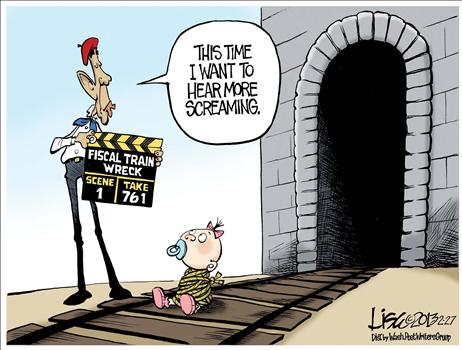
On my blog www.thedailyhatch.org . I took you at your word and sent you over 100 emails with specific spending cut ideas. (Actually there were over 160 emails with specific spending cut suggestions.) However, I did not see any of them in the recent debt deal that Congress adopted although you did respond to me several times. Now I am trying another approach. Every week from now on I will send you an email explaining different reasons why we need the Balanced Budget Amendment. It will appear on my blog on “Thirsty Thursday” because the government is always thirsty for more money to spend. Today I actually have included a great article below from the Heritage Foundation concerning an area of our federal budget that needs to be cut down to size. The funny thing about the Sequester and the 2.4% of cuts in future increases is that President Obama set these up and then he acted like the sky was falling in as the cartoons indicate in the newspapers.

IF YOU TRULY WANT TO CUT THE BUDGET AND BALANCE THE BUDGET THEN SUBMIT THESE POTENTIAL BUDGET CUTS PRESENTED BELOW!!

T. Elliot Gaiser and M. Christian McNally

February 28, 2013 at 5:30 pm

ROGER L. WOLLENBERG/UPI/Newscom

The Environmental Protection Agency (EPA) announced plans to furlough all of its employees and shut down for three days this year to absorb sequestration’s spending cuts. But the sequester cuts do not have to lead to shutdowns.

The Heritage Foundation recently pointed out that prioritized cuts at the National Institutes of Health and Transportation Security Administration would target blatantly wasteful spending and unnecessary and duplicative programs. The same is true for the EPA.

Heritage has highlighted the EPA’s track record of wasting taxpayer dollars on projects ranging from the ineffective to the absurd in its Federal Spending by the Numbers 2012 report. For example, the EPA:

  • Awarded a $141,450 grant under the Clean Air Act to fund a Chinese study on pig manure;
  • Funded a $67,926 poster contest at just one college, Syracuse University, that yielded fewer than 10 entries; and
  • Gave $1.2 million to the United Nations for the “promotion” of so-called clean fuels.

If only the waste ended there. In 2012 the EPA spent nearly $3.7 million on 20 conferences with price tags above $100,000—an average of $182,847 per conference. Further, a recent Inspector General report revealed that the EPA has 430,000 square feet of underutilized space, which costs taxpayers more than $20 million annually.

Such examples are low-hanging fruit, but more costly agency initiatives could be eliminated, too. For example, the EPA awarded $1.5 billion in federal grants for cellulosic ethanol producers (fuel made out of wood chips and grass clippings) and issued a production mandate of 500 million gallons of this fuel by 2012.

Demand for ethanol is contrived; it exists only because Congress and the President have mandated its use. And because government created the demand—not the market—taxpayers must subsidize its production. Such subsidies waste taxpayer money and distort market activity.

Heritage experts Jack Spencer, Nicolas Loris, and Katie Tubb argue instead for freedom-based reforms, writing that Congress should:

  • Prohibit the EPA from regulating carbon dioxide, saving families who rely on the 82 percent of the energy used in the United States that produce greenhouse gases;
  • Stop the EPA’s regulatory overreach, which is artificially driving the cost of energy higher, harming job creation, and providing little to no environmental benefit; and
  • Repeal the EPA’s energy efficiency initiatives, which drive up gas prices and restrict consumer choice.

Such reforms would save taxpayers money by reducing the scope of the EPA’s ever-expanding mission, and they would also serve the needs of the economy by lightening the heavy regulatory burden on America’s businesses.

In the meantime, given the tremendous harm that the EPA’s overreaching agenda has on job creation and the economy, if its plans to furlough employees for a few days come to pass, the entire country just might actually be better off.

__________

From Dan Mitchell’s blog:

Last but not least, Lisa Benson makes fun of Obama for his never-ending efforts to instill panic.

Sequester Cartoon Benson 3

Let’s keep our fingers crossed that the sequester happens on March 1. Then, even if the Obama Administration deliberately tries to cause inconvenience for the American people, we’ll see that the world doesn’t come to an end.

Who knows, maybe that will even lead lawmakers to think they can impose some real fiscal restraint, as we’ve recently seen in countries like Estonia and in the 1990s by nations such as Canada and New Zealand.

______________

The Balanced Budget Amendment is the only thing I can think of that would force Washington to cut spending. We have only a handful of balanced budgets in the last 60 years, so obviously what we are doing is not working. We are passing along this debt to the next generation. YOUR APPROACH HAS BEEN TO REJECT THE BALANCED BUDGET “BECAUSE WE SHOULD CUT THE BUDGET OURSELF,” WELL THEN HERE IS YOUR CHANCE!!!! SUBMIT THESE CUTS!!!!

Thank you for this opportunity to share my ideas with you.

Sincerely,

Everette Hatcher, lowcostsqueegees@yahoo.com www.thedailyhatch.org, 13900 Cottontail Lane, Alexander, AR 72002, ph 501-920-5733

Related posts:

Mark Pryor responds to me concerning Debt Ceiling email (Part 1)

The problem with the debt ceiling is very clear to me. We need to get serious about cutting federal spending. I am so upset about it that I have emailed over 100 emails to Senator Pryor concerning specific spending suggestions. I get emails from back from Senator Pryor like the one below. This means that […]

Senator Pryor asks for Spending Cut Suggestions! Here are a few!(Part 164)

Senator Pryor asks for Spending Cut Suggestions! Here are a few!(Part 164) Senator Mark Pryor wants our ideas on how to cut federal spending. Take a look at this video clip below: Senator Pryor has asked us to send our ideas to him at cutspending@pryor.senate.gov and I have done so in the past and will continue to […]

Senator Pryor asks for Spending Cut Suggestions! Here are a few!(Part 163)

Senator Pryor asks for Spending Cut Suggestions! Here are a few!(Part 163) Senator Mark Pryor wants our ideas on how to cut federal spending. Take a look at this video clip below: Senator Pryor has asked us to send our ideas to him at cutspending@pryor.senate.gov and I have done so in the past and will continue to […]

Senator Pryor asks for Spending Cut Suggestions! Here are a few!(Part 162)

Senator Pryor asks for Spending Cut Suggestions! Here are a few!(Part 162) Senator Mark Pryor wants our ideas on how to cut federal spending. Take a look at this video clip below: Senator Pryor has asked us to send our ideas to him at cutspending@pryor.senate.gov and I have done so in the past and will continue to […]

Capitol Tours with Senator Mark Pryor

Three very good video tours below from Senator Mark Pryor. Published on Jun 13, 2012 by SenatorPryor Episode 1: Arkansans in the Capitol Published on Jul 9, 2012 by SenatorPryor Episode 2: The Crypt and the Old Supreme Court Published on Aug 20, 2012 by SenatorPryor Episode 3: The Senate Chamber If you want to […]

Senator Pryor asks for Spending Cut Suggestions! Here are a few!(Part 161)

Senator Pryor asks for Spending Cut Suggestions! Here are a few!(Part 161) Senator Mark Pryor wants our ideas on how to cut federal spending. Take a look at this video clip below: Senator Pryor has asked us to send our ideas to him at cutspending@pryor.senate.gov and I have done so in the past and will continue to […]

Senator Mark Pryor responds to my email

Senator Mark Pryor wants our ideas on how to cut federal spending and I sent them to him but he didn’t take any of my suggestions. However, he did take time to get back to me today, but I am not too impressed with Senator Pryor’s response. I gave him hundreds of ideas about how […]

Senator Pryor asks for Spending Cut Suggestions! Here are a few!(Part 160)

Senator Pryor asks for Spending Cut Suggestions! Here are a few!(Part 160) Senator Mark Pryor wants our ideas on how to cut federal spending. Take a look at this video clip below: Senator Pryor has asked us to send our ideas to him at cutspending@pryor.senate.gov and I have done so in the past and will continue to […]

Senator Pryor asks for Spending Cut Suggestions! Here are a few!(Part 159)

Senator Pryor asks for Spending Cut Suggestions! Here are a few!(Part 159) Senator Mark Pryor wants our ideas on how to cut federal spending. Take a look at this video clip below: Senator Pryor has asked us to send our ideas to him at cutspending@pryor.senate.gov and I have done so in the past and will continue to […]

Senator Pryor asks for Spending Cut Suggestions! Here are a few!(Part 158)

Senator Mark Pryor wants our ideas on how to cut federal spending. Take a look at this video clip below: Senator Pryor has asked us to send our ideas to him at cutspending@pryor.senate.gov and I have done so in the past and will continue to do so in the future. On May 11, 2011,  I emailed to […]

Dear Senator Pryor, why not pass the Balanced Budget Amendment? (“Thirsty Thursday”, Open letter to Senator Pryor)

Office of the Majority Whip | Balanced Budget Amendment Video In 1995, Congress nearly passed a constitutional amendment mandating a balanced budget. The Balanced Budget Amendment would have forced the federal government to live within its means. This Balanced Budget Amendment failed by one vote. 16 years later, Congress has the chance to get it […]

Dear Senator Pryor, why not pass the Balanced Budget Amendment? (“Thirsty Thursday”, Open letter to Senator Pryor)

Sadly Senator Pryor has voted against the Balanced Budget Amendment over and over in his long time in the Senate. Senator Pryor: “There are a lot of people who think a balanced-budget amendment solves all the fiscal problems. I completely disagree.” (Peter Urban, Pryor Tilts Balanced Budget, Southwest Times Record, 11/17/11) Dear Senator Pryor, Why […]

Dear Senator Pryor, why not pass the Balanced Budget Amendment? (“Thirsty Thursday”, Open letter to Senator Pryor)

Mark Levin and Senator Hatch discuss the balanced budget amendment and it’s importance. Uploaded by loveconstitution on Jan 28, 2011 Mark Levin interviews Senator Hatch 1/27/2011 about the balanced budget amendment. Mark is very excited about the balanced budget amendment being proposed by Senator Orin Hatch and John Cornyn and he discusses the amendment with […]

Will Senator Pryor be re-elected in 2014? (Part 4)(Royal Wedding Part 5)

Dr. Jay Barth with Hendrix College comments on our latest poll results on Arkansas politics (clip from Talkbusiness) Talk Business reported today in the article “Poll Shows Beebe Strength, Pryor Shaky,” the following: A new Talk Business-Hendrix College Poll shows Gov. Mike Beebe (D) maintaining his high job approval rating, while Sen. Mark Pryor (D) […]

Will Senator Pryor be re-elected in 2014? Part 3 (The Conspirator Part 16)

U.S. Sen. Mark Pryor at the 2009 Democratic Party Jefferson Jackson Dinner, Arkansas’s largest annual political event. Mark Pryor is up for re-election to the Senate in 2014. It is my opinion that the only reason he did not have an opponent in 2008 was because the Republicans in Arkansas did not want to go […]

Will Senator Pryor be re-elected or not? (Part 3)

Michael Tanner, a senior fellow at the CATO institute, explains that the rate of return on social security will be much lower for todays youth. Steve Brawner wrote in his article “Tiptoeing toward the third rail,” (Arkansas News Bureau, Jan 9,): Social Security has long been considered the “third rail” for American politicians, meaning it’s […]

Will Senator Pryor be re-elected or not? Part 2

HALT:HaltingArkansasLiberalswithTruth.com   CBS — October 19, 2010 — New York Times’ Jeff Zeleny talks to Jan Crawford about the state of Democrats in the South… Are they a dying species? In the article “Southern Democrat much closer to extinction after GOP wave,” (Washington Times, Nov 4, 2010), Ben Evans notes: After this week’s elections, the […]

Will Senator Pryor be re-elected or not? Part 1

HALT:HaltingArkansasLiberalswithTruth.com Roland Martin appears on Rick’s List with Rick Sanchez and the Best Political Team on television (Candy Crowley, John King, Jeffery Toobin, Ed Rollins, Gloria Borger and Victoria Toensing) to discuss day two of the Elena Kagan Supreme Court confirmation hearings. During the analysis, Senator Graham and Elena Kagan had an interesting exchange over […]


Michael Cannon of Cato Institute speaks to Arkansas Senators (Part 2 includes editorial cartoon)

Representative Doug House asks CATO Institute Michael Cannon about Obamacare

Published on Mar 19, 2013

The CATO Institute’s Michael Cannon spoke at the Arkansas Conservative Caucus on Tuesday March 19th. Several conservatives were present. Cannon talked about how to defeat Obamacare in Arkansas & how the states can stop Obamacare on a national level.

Representative Doug House talks about Arkansas Healthcare Exchange attempts in Arkansas. The Liberal Governor Mike Beebe, Jay Bradford, and former Soros Employee Cindi Crone are attempting to implement a portion of Obama’s Government takeover of Healthcare.

___________

The Arkansas Times article on the visit from Michael Cannon is below:

Arkansas Blog

Archives | RSS

Tuesday, March 19, 2013

Michael Cannon calls “private option” crony capitalism

Posted by on Tue, Mar 19, 2013 at 6:07 PM

Michael Cannon image

  • Michael Cannon

As we previewed last week, Michael Cannon — health-care point man for libertarian think tank the Cato Institute — was invited to testify today before the Senate Insurance committee. Cannon is a diehard opponent of the Affordable Care Act, and there were hints on American For Prosperity (AFP)’s website that Cannon might raise objections to the “private option.” Instead, his testimony today was exclusively focused on the decision about whether the state should run its own exchange or opt out and let the feds run the exchange (currently, Arkansas has a state-federal partnership). However, Cannon told reporters afterward that the “private option” was even worse in his view than Medicaid expansion, labeling it “crony capitalism.”

Cannon has a number of arguments against state-run exchanges. The flashiest one is that he is hoping that a legal challenge to the operation of federally run exchanges has the potential to dismantle the entire law. We’ve covered his lawsuit before and won’t get in to the weeds here but you can read about the legal challenge here, and read Cannon’s legal argument in full here.

Sen. Joyce Elliot asked Cannon, “Is your position overall that you want to stop the healthcare law or are you just giving us advice on how to proceed with exchange?”

Cannon’s response: “Both.”

I asked Cannon afterwards why he hadn’t touched on the “private option” for expansion. “This was a hearing on exchanges, I was invited to speak about exchanges,” he said. “I’ll be speaking to some legislators later and I’m sure the Medicaid expansion will come up.”

The “private option” issue is in fact relevant to the exchange question in various ways, the largest being the $20-million-per-year revenue stream from a 2.5 percent state fee on insurances sold on the exchange. Cannon said that he knew of no legal restriction on states imposing the fee even if they opted out of running the exchange, though this seems politically implausible.

In any case, as policy, Cannon thinks the “private option” framework stinks. He already thinks that Medicaid expansion is too expensive and he argued that the “private option” would be even costlier. (I should say that Cannon prefers “Beebe proposal” to “private option.” Pretty surprised he didn’t call it BeebeCare!)

Cannon relied on the CBO numbers we’ve heard, which likely are not applicable to Arkansas. Cannon had not yet seen the DHS study released yesterday but expressed deep skepticism about their findings.

Okay, but who cares what someone from the Cato Institute thinks about what Arkansas should do? I would argue that Cannon’s position may represent one pole of a possible split within the Arkansas GOP on the “private option” between establishment Republicans and the anti-Obamacare base. As I heard one Tea Party member in attendance at the meeting say of the new framework, “if you put lipstick on a pig, it’s still a pig.”

Here’s Cannon:

It’s odd that this is considered a compromise proposal. We’ll compromise by making an unaffordable entitlement program even more unaffordable. It’s also interesting because Congress considered this…amendments were offered and voted down by Democrats who said no we can’t put the Medicaid expansion population in the exchanges because it would be too expensive. So you have to ask the question, if Congress rejected this idea, what on earth are Gov. Beebe and Sec. Sebelius doing talking about an idea that would increase federal and state spending that Congress expressly rejected? 

I gotta hand it to Gov. Beebe and Kathleen Sebelius, they know that there’s this crony capitalism streak among Republicans. If you say, we’re going to increase government spending, they say ‘no that’s bad.’ But if you say ‘we’re going to give the subsidies to private industry,’ they say, ‘hey, I like private industry, that’s good.’ So they’re really playing to that crony capitalist streak in order to get Republicans to implement Obamacare.

They’re drawn to the idea because Republicans hear private coverage and think that’s better than public coverage but really what matters is who’s paying the piper. If it’s government money that you’re spending, it’s going to be government insurance even if you hang the word ‘private’ on it.

Though I support expansion, I think Cannon’s arguments about the “private option” make sense: if you don’t like Obamacare, it follows that you wouldn’t like an alternative that’s likely to cost at least a little more, particularly if that additional spending seems to be in defiance of Congressional intent. Will we hear more arguments along these lines from Republican lawmakers? We’ll see.

Thus far outside conservative groups haven’t made too much noise about the “private option” but I suspect that will change. While Cannon spoke with reporters, an AFP official was standing next to him. I asked her — as I’ve asked Teresa Crossland-Oelke, AFP’s Arkansas state director — whether AFP has a position on the “private option.” They’ve been cagey so far. Republican lawmakers working on the “private option” have told me that their focus is on the policy but have acknowledged that it will be politically important if AFP decides to speak out one way or the other.

In addition to his testimony today, Cannon was also AFP’s guest speaker at the Conservative Caucus Luncheon at the Capitol. Based on tweets from the event, it sounds like Cannon offered the same strong message against the “private option.”

_____________________

While he was in Arkansas Michael Cannon mentioned that the Cato Institute has been way out front on this issue and they were against Obamacare back when it was Romneycare.

I’m delighted that Mitt Romney is floundering because of the government-run healthcare scheme he imposed on Massachusetts. Not only did it pave the way for Obamacare, but it’s also a good indicator of the awful, statist, big-government policies he would impose on all of us if he ever entered the White House.

This cartoon from the Detroit News is a pretty good summary of Mitt’s self-inflicted (and much-deserved) political problem.

Related posts:

Max Brantley of the Ark Times takes on Michael Cannon of the Cato Institute today concerning Obamacare

Max Brantley of the Ark Times takes on Michael Cannon of the Cato Institute today concerning Obamacare. I have posted many links to Cannon’s articles in the past on my blog and on the Arkansas Times liberal blog. The finest article written in my estimation was written on Nov 20, 2012 and here is a […]

Is Michael Cannon of the Cato Institute right about states blocking Obamacare, factchecker says he is wrong.

Cato’s Michael F. Cannon Discusses ObamaCare’s Individual Mandate Is Michael Cannon of the Cato Institute right about states blocking Obamacare, factchecker says he is wrong. I Have Been False* Posted by Michael F. Cannon *According to PolitiFact. In an unconscious parody of everything that’s wrong with the “fact-checker” movement in journalism, PolitiFact Georgia (a project of […]

An ObamaCare Debate Challenge by Michael F. Cannon (editorial cartoon)

Obamacare is a poorly written and because of that the majority of states may never have to put into practice.   February 28, 2013 2:13PM ObamaCare Debate Challenge: Lawrence Wasden Edition By Michael F. Cannon Share Tweet Like Google+1 Congress empowered states to block major provisions of ObamaCare, including its subsidies and employer mandate. All […]

Open letter to President Obama (Part 249)

Is Washington Bankrupting America? Uploaded by BankruptingAmerica on Apr 20, 2010 Be first to receive our videos and other timely info about economic policy. Subscribe at http://www.bankruptingamerica.org ————————- According to a recent poll, 74 percent of likely voters are extremely or very concerned about the current level of government spending. And 58 percent think the […]

The real truth about Obamacare can be seen on the www.thedailyhatch.org

Michael Cannon on Medicare and Healthcare You want to know the real truth about Obamacare then check out these videos and articles linked below: American people do not want Obamacare and the regulations that go with it March 7, 2012 – 8:02 am In this article below you will see that the American people do not […]

The primary cause of higher hospital care and education costs in the USA is?

Is Washington Bankrupting America? Uploaded by BankruptingAmerica on Apr 20, 2010 Be first to receive our videos and other timely info about economic policy. Subscribe at http://www.bankruptingamerica.org ————————- According to a recent poll, 74 percent of likely voters are extremely or very concerned about the current level of government spending. And 58 percent think the […]


Open letter to President Obama (Part 273)

Ronald Reagan Describes Milton Friedman

Uploaded by on Oct 2, 2011

_____________

President Obama c/o The White House
1600 Pennsylvania Avenue NW
Washington, DC 20500

Dear Mr. President,

I know that you receive 20,000 letters a day and that you actually read 10 of them every day. I really do respect you for trying to get a pulse on what is going on out here.

My hero Milton Friedman was a big supporter of the Balanced Budget Amendment and in an article on this subject in 1983 he wrote:

“The key problem is not deficits but the size of government spending. […] I have never supported an amendment directed solely at a balanced budget. I have written repeatedly that while I would prefer that the budget be balanced, I would rather have government spend $500 billion and run a deficit of $100 billion than have it spend $800 billion with a balanced budget. It matters greatly how the budget is balanced, whether by cutting spending or by raising taxes.”

A Balanced Budget Amendment Should Make Tax & Debt Increases Difficult

As a member of the Conservative Action Project, CEO Susan Carleson and leaders of 28 other organizations, representing a broad cross section of the conservative movement, are united in supporting a Balanced Budget Amendment that actually reins in national spending and increasing our national debt – without raising taxes.

MEMO FOR THE MOVEMENT: A Balanced Budget Amendment — in addition to balancing the budget — should make it difficult to raise taxes, tough to increase the debt, and prohibit any court from ordering a tax increase or deciding budget priorities.

“I wish it were possible to obtain a single amendment to our Constitution. I would be willing to depend on that alone for the reduction of the administration of our government; I mean an additional article taking from the Federal Government the power of borrowing.”
Thomas Jefferson, 1798

RE: In accordance with the Budget Control Act of 2011, sometime between October 1 and December 31, 2011 both houses of Congress must vote on a balanced budget amendment (BBA) to the U.S. Constitution. It is important that any such amendment must protect taxpayers by not forcing automatic tax increases to keep revenues in line with rising expenditures. Our fiscal problems are caused not by under taxation–but by over-spending.

ISSUE-IN-BRIEF: Not all balanced budget Amendments were created equal. The most comprehensive BBA proposed is S.J. Resolution 10 co-sponsored by all 47 Republican members of the United States Senate. It caps spending at 18% of GDP; requires a 2/3 vote of congress to raise taxes; requires a 3/5 vote of congress to increase the debt ceiling; and prohibits any court from ordering an increase in taxes. Proposed BBA’s that do less can have the unintended effect of managing a tax increase instead of limiting spending and would be counter-productive and must be opposed.

A STRONG BBA MUST BE EASY TO UNDERSTAND AND NOT HAVE LOOPHOLES:

  • Require a Balanced Budget every year: The federal debt is on track to consume our country’s entire Gross Domestic Product. The BBA would force Washington to live within its means.
  • Prohibit Perpetual Deficit Spending: Deficit spending is a tax on future earnings.
  • A debt ceiling will actually be a ceiling: The debt ceiling has been raised 11 times in the past decade. S.J. 10–co-sponsored by 47 members of the U.S. Senate– would require a three-fifths majority in both chambers to raise the debt ceiling. This is also an important provision to prevent cheating and other budget gimmicks because actual spending cannot exceed actual revenue for long without hitting the debt limit.
  • Congress may waive BBA requirement by simple majority if a declaration of war is in effect; and it would require a three-fifths majority to waive if the country is engaged in a military conflict that causes an imminent and serious military threat to our national security.
  • Courts setting any budget priorities would be a problem. Court-ordered military cuts or activist “declaratory judgments” requiring increased welfare spending would also be intolerable. S.J. 10 can be improved with an explicit ban on courts exercising jurisdiction on any of these essential political questions.

A “Weak” BBA will increase the size of Government and pave the way for Tax Increases:

  • Unlike other proposals, such as a “Weak” BBA, not only should a BBA have a supermajority requirement to raise taxes, there should be no loopholes for creative accounting.
  • Without a limitation on tax increases and a specific prohibition on courts ordering revenue increases a “Weak” BBA would allow judges the power to implement higher taxes to bring the budget into balance.
  • A “Weak” BBA would allow a simple majority of Members of Congress to raise the federal debt ceiling and continue to borrow against future generations. That’s why there is a three-fifths majority requirement to raise the debt ceiling in S.J. 10

Why the Tax Hike Limitation Component is Important to any BBA:

As Milton Friedman wrote in defense of the Balanced Budget Amendment in 1983 in response to skepticism from the Wall Street Journal editorial board: http://www.theatlantic.com/magazine/archive/1983/02/washington-less-red-ink/5450/

“The key problem is not deficits but the size of government spending. […] I have never supported an amendment directed solely at a balanced budget. I have written repeatedly that while I would prefer that the budget be balanced, I would rather have government spend $500 billion and run a deficit of $100 billion than have it spend $800 billion with a balanced budget. It matters greatly how the budget is balanced, whether by cutting spending or by raising taxes.”

Americans Support a Balanced Budget Amendment:

Americans have always overwhelmingly support a balanced budget amendment. A Fox News poll (June 30), shows support is 72-20.

On Message, Inc., on behalf of Let Freedom Ring, shows 81% of the American people (including 74% of Democrats) support Congress balancing their budget every year. In addition 66% of Americans favor capping federal spending at the historically average 18% of GDP.

“Of course, the best way to permanently reduce spending would be to enact a balanced-budget amendment to the Constitution requiring a supermajority in both houses of Congress to run an annual deficit, raise tax rates, or increase the debit ceiling.”
James A. Baker III, Ronald Reagan’s Secretary of the Treasury from 1985-1988

_____________

Thank you so much for your time. I know how valuable it is. I also appreciate the fine family that you have and your commitment as a father and a husband.

Sincerely,

Everette Hatcher III, 13900 Cottontail Lane, Alexander, AR 72002, ph 501-920-5733, lowcostsqueegees@yahoo.com

Answers to historical problems in the Book of Daniel (Part 3)

The Bible and Archaeology (2/5)

Here is some more evidence that indicates the Book of Daniel was written in the 6th century B.C.

For many more archaeological evidences in support of the Bible, see Archaeology and the Bible . (There are some great posts on this too at the bottom of this post.)

Till Is Batting Around .250 on Daniel
by Everette Hatcher III

1999 / March-April

Is there any direct textual evidence that indicates that the writer of Daniel knew Babylon fell to Persia? Till stated:

Hatcher cited (p. 2, TSR Vol. 9.2) Porteous’s commentary on Daniel from The Old Testament Library (Westminster Press, 1965) in an attempt to make a dubious pun in Daniel 5:28 imply that the writer of Daniel knew that Persia conquered Babylon. In other words, Hatcher’s case is so tenuous that he can’t produce direct textual evidence that the writer of Daniel knew that Babylon fell to Persia; he has to resort to claiming that the writer of Daniel `punningly’ implied it (TSR, Vol. 9.2, p. 7).

There is plenty of good textual evidence that the writer of Daniel knew that Babylon fell to a combined empire made of the Medes and Persians. However, the critics cannot afford to accept this evidence because they would have to admit there has been real prophecy. For instance, many critics will admit that peres in Daniel 5:28 is a possible pun for Persia. Arthur Jeffery states, “Moreover, since prs could also be pointed to mean `Persians,’ it can refer to the giving of the kingdom to the Persians; indeed, Bauer’s suggestion allows him to give Daniel’s interpretation as `He has numbered! He has weighed! He has divided! The Persians!'” (Jeffery, p. 432).

The critic James A. Montgomery noted:

Here a balanced phrase is obtained by finding a double paranomasia [sic] in the mystic word, i. e., division and Persia. Were these ominous words first assembled and applied by our narrator; or did he take them from some source and adapt them to his interpretation (so Bev.)? It is to be noted that the play of words gives `Persia,’ not `Media,’ despite the fact that in immediate sequence it is Darius the Mede who destroys the kingdom; the enigma is based on the correct historical tradition of Cyrus’ conquest” (p. 263).

Therefore, several critics will admit that Daniel 5:28 could be implying that the division of Babylon would be done by the Persian armies (Porteous, p. 81). Nevertheless, the critics usually give an alternative interpretation based on the work of Clermont-Ganneau in 1886 (Owens, p. 410; Collins, pp. 250-252; Montgomery, p. 263, Jeffery, p. 432; Porteous, p. 81; Hartman, pp. 189-190; Driver, p. 69). The critic Robert A. Anderson commented:

Clermont-Ganneau advanced the thesis that the terms are measurements of weight, namely, mina, tekel (the Aramaic equivalent of shekel), and peres. By this means the motif of successful kingdoms already encountered in chapter 2, and which features so prominently in the second half of the book, could be applied to the inscription, albeit in a modified form. The subjects could be the last kings of the neo-Babylonian empire. It must be admitted that all this is in the area of speculation. Fuller treatment is given in the commentaries of Hartman and Lacocque. When we turn to the explanation in vv. 26-28 we are at least on firm ground (p. 61).

Thus Anderson admits that the theory put forth by Clermont-Ganneau is “speculation.” The critic W. H. Brownlee goes even further. He observes, “There is one fatal weakness to this method of interpreting the handwriting on the wall: It is not so interpreted in the Book of Daniel itself” (Brownlee, p. 41)! Most critics don’t want to admit the possibility that the author of Daniel correctly thought that Babylon was conquered by a combined kingdom of the Medes and the Persians. Therefore, they have to avoid taking Daniel 5:28 to its logical conclusion. The conservative Gleason Archer stated:

The author of Daniel believed that Belshazzar was conquered by a coalition of Medes and Persians; in Daniel 5:28 the whole point of the word play is that the Persians were about to take over the kingdom directly from the Babylonians: “Peres: Your kingdom is divided [prisat, from the verb pras, `separate’] and given to the Medes and Persians [paras]” (5:28). It is quite apparent that only the Persians fit into this word play (P-R-S are the three consonants involved in all three: PeReS, PeRiSat, PaRaS). The reason the Medes are mentioned first in the phrase “the Medes and Persians” here is that historically the Persians had earlier been subject to the Medes, until Cyrus defeated his uncle King Astyages of the Median Empire back in 550 B.C. (“Daniel,” Expositor’s Bible Commentary, Grand Rapids: Zondervan, 1985, pp. 16-17).

The passage that destroys the critical view completely is Daniel 8:1-20. The critic Raymond Hammer admits that verse 3 “indicates a knowledge of the combined Medo-Persian Empire, although elsewhere we have seen a tendency to think of Median and Persian empires as separate entities” (Hammer, p. 84; Driver, p. 29). In Daniel 8:20 the ram with two horns is “the kings of Media Persia.” The critics do not want to admit there are many parallels between the bear in chapter seven and the ram in chapter eight. Persia arose to be stronger than Media in the alliance, and that is symbolized by both the bear and the ram being unbalanced (7:51, 8:3). Media-Persia’s three major victories were over Babylon (539 B. C.), Lydia (546 B. C.), and Egypt (525 B. C.). This is pictured by the three ribs in the bear’s mouth (7:5b) while the ram ran off in three directions to do battle (8:4a). The critics simply have no idea what the three ribs symbolize (Jeffery, p. 454; Collins, p. 298; Driver, p. 82; Porteous, p. 105; R.A. Anderson, p. 79). L. F. Hartman comments that “the effort of commentators to explain why `three ribs should be in the mouth of a beast’ have proved futile” (p. 205). Hartman and his fellow critics have come up empty because they insist on making the bear a symbol of the Median empire. There is no textual evidence to support this view. In a letter dated October 23, 1998, the conservative William Shea commented:

It is interesting to note that all of these arguments on the Daniel of the 2nd century B. C. go back to the Neo-Platonist philosopher Porphyry in the 5th century A. D. Porphyry, however, saw clearly that there was no separate Median kingdom, so his sequence was Babylon, Medo-Persia, Greece I and Greece II. He had to shorten the sequence to get it to end up with Greece and not Rome. The adaptation of dividing Media from Persia is a modern phenomenon, worked out in the 18th and 19th centuries.

There is plenty of direct textual evidence in the book of Daniel that indicates that Babylon fell to a combined Medo-Persian empire. Therefore, critics would be wise to stop insisting that Daniel envisions a separate rule by the Medes.

Another area of textual evidence that supports the Maccabean thesis according to the critics is the late date “objective” scholars attribute to the languages used in the Book of Daniel. Till stated:

In the very first paragraph of the introduction to his commentary, Porteous said, “The linguistic evidence and the fact that the visions reveal a vague knowledge of the Babylonian and Persian periods and an increasingly accurate knowledge of the Greek period up to and including the reign of Antiochus Epiphanes, with the exception of the closing events of that reign, suggest a date for the book shortly before 164 B. C. (March/April 1998, pp. 7,16, emphasis added).

I wish Till would specifically indicate which linguistic evidence he would put forth as significant. Earlier he cited the Aramaic (TSR, Vol. 4.3, p.13), but I dealt with that in my previous article (March/April 1998, p. 3).

Gerhard F. Hasel noted that “several recent historical-critical commentaries have dropped the argument from the Hebrew language for the late dating of the book of Daniel” (D. S. Russell, A. Lacocque, J. J. Collins, W.S. Towner, and others; “Establishing a Date for the Book of Daniel,” Symposium on Daniel, ed., Frank B. Holbrook, Washington, D. C.: Biblical Research Institute, 1986, p. 140).

William Shea has commented on Till’s view concerning the date of authorship of the Book of Daniel:

Till is behind the times in his view of the Aramaic in Daniel as Maccabean. No reputable scholar that I know of at the present time holds that opinion. The reason for it is twofold. First, the discovery of more and more Aramaic texts from Qumran. These have pushed the date of Daniel backward, earlier, because Daniel writes a kind of Aramaic that is earlier than Qumran’s earliest Aramaic text, the Job Targum.

Second, more and more Aramaic inscriptions have been found and published and these have been helpful in pulling Daniel’s Aramaic earlier. So that now it is admitted that Daniel’s Aramaic is Imperial, not Maccabean. But that still leaves a range from the 7th to the 4th century B. C. It does, however, rule out Till’s late date (Letter dated October 23, 1998).

Therefore, many of the most respected Bible critics have moved to the position that only the last six chapters definitely originated during the time of the Maccabees, and they hold that the previous chapters initially were written during the Persian period.

The critic Philip R. Davies observed:

The progress of research on the book of Daniel in recent years has been marked by the appearance of several major commentaries as well as articles and, especially, one very important study. While these studies illustrate a variety of approaches to the book, they all accept what has become a universally recognized distinction, namely between the two parts of the book which contain respectively tales and visions. According to nearly every modern commentator, the tales of chapters 1-6 are originally products of a Jewish community in a Gentile environment, whose concerns were rather different from those of Jews who read these tales in Palestine in the Maccabean period (The most recent and detailed treatments are W. Lee Humphreys, “A Life Style for Diaspora: A Study of the Tales of Esther and Daniel,” Journal of Biblical Literature, Vol. 92, 1973, pp. 211-223; J. J. Collins, “The Court Tales in Daniel and the Development of Jewish Apocalyptic, Journal of Biblical Literature, Vol. 94, 1975, pp. 218-234; H. P. Muller, “Marchen, Legende und Enderwartung,” Vetus Testamentum, Vol. 26, 1976, pp. 338-350); the visions, which were written during this period are of a different genre, “apocalyptic….” We can be reasonably confident that the stories about Daniel and his friends in chapters 1-6 were in existence before the visions were composed. To begin with, the attitude to Gentiles and Gentile monarchs in particular hardly reflects a Maccabean context (Philip R. Davies, “Eschatology in the Book of Daniel,” Journal for the Study of the Old Testament, Vol. 17, 1980, p. 33).

Therefore, it appears that Till is out of step with most of the modern critical scholarship concerning the date of authorship of the first six chapters of Daniel because Till believes all of Daniel was written during the Maccabean period. In “Convenient Coincidences in the Book of Daniel,” (September/October 1998, p. 1), Till makes the case that Daniel chapter one belongs to the Maccabean period because “it’s hard to believe that a book actually written in the 6th century B. C. would have very conveniently contained a story so clearly parallel to a religious dietary crisis that would happen four centuries later.” According to Till, chapter three is late because it is a story “that 2nd-century B. C. Jews suffering such persecution would have easily related to” (p. 1), and chapter five is late because it involves the desecration of sacred vessels. Till stated:

Such convenient coincidences as these in the story of a 6th-century B. C. captive who, choosing to serve Yahweh faithfully, was rewarded with a position of prominence in the kingdom of his captors complements the mountain of other evidence that indicates the author of this book was actually a 2nd-century writer who wanted his contemporaries to believe that a prophet living long ago in another difficult period of Jewish history had foreseen their sufferings and predicted that they would triumph over oppression (p.1, 16).

I have clearly demonstrated that there is no mountain of legitimate “evidence that indicates the author of this book [Daniel] was actually a 2nd-century writer.” In Till’s provocative article “Primary Colors of the Bible” (July/August 1998, pp. 1, 5) he asserted, “In past issues of TSR, fundamentalist views about the authorship of the books of Jeremiah and Daniel have been challenged by documentation from the works of reputable scholars….” Till’s article argues that linguistic evidence should not be underrated. Yet Till has not offered any specific linguistic evidence concerning Daniel in our current debate!! Instead, much of Till’s focus is on attacking my methods of writing. For instance, Till observed:

When I received the article, my first inclination was not to publish it because it is little more than one appeal to authority after the other strung out over two and a half pages. In other words, Hatcher basically argued throughout his article that the 2nd-century B. C. dating of the book of Daniel is wrong and the 6th-century B. C. dating correct, because certain scholars say so. In so doing, he pieced together various quotations, obviously lifted unchecked from fundamentalist sources, and paraded them before us as if quoting a “scholar” necessarily proves anything. I have said many times in TSR and its Internet list that anyone committed to a religious position can always find books published by authors who share that belief, so if quoting “scholars” constituted proof of one’s position, anyone could prove any belief to be true…. There is much more to biblical apologetics than just citing “scholars,” but apparently Hatcher does not realize this (March/April 1998, pp. 4-5).

I am not an archaeologist or a linguist, but that doesn’t stop me from discussing archaeology or linguistics. I must quote experts in these fields, and in this sense I must use authorities in my articles. Also many times other scholars articulate things in such a clear way that I would rather quote them directly than put it in my own words. The real issue Till is getting at concerns the strength of one’s argument. Is there credible evidence to back up an argument or not? Here I agree that one should not appeal to authority without having a credible argument. However, my arguments are credible. Go back and closely examine the evidence I provided for these following arguments: (1) Daniel does not picture the intermediate Median empire that Till claims exists in the book of Daniel. (2) The Aramaic of Daniel does not point to a 2nd-century date of authorship. (3) Daniel did not necessarily err when he referred to Belshazzar as Nebuchadnezzar’s son because in the Near East the word son could also mean successor.

I wish I had space to respond to Till’s accusation concerning the apparent dating problems found in Daniel 1:1-5. Also I wish I could spend more time on the archaeological evidence that supports the 6th-century view. Today there is greater evidence than ever before that the author of Daniel was an eyewitness of the events of the 6th-century B. C. Nevertheless, two hundred years ago sufficient evidence existed that caused the critic Thomas Paine to note, “Are they [the books of Ezekiel and Daniel] genuine? I am more inclined to believe that they were than that they were not… in the manner which the books ascribed to Ezekiel and Daniel are written agrees with the condition these men were in at the time of writing them” (The Age of Reason, Secaucus, N. J.: Citadel Press, reprint, 1974, p. 150, emphasis added). Of course, Paine denied there was any clarity concerning the prophecies in Daniel, but this is why I enjoyed Till’s last article so much (“Good History in the Book of Daniel,” September/October 1998, pp. 9-11, 16). Till correctly observed that Daniel chapter eleven contains many references to actual events that took place during the Greek period.

Comments like that brought Till’s batting average up to .250 on Daniel. However, .250 is nothing to brag about in the area of biblical interpretation.

(Everette Hatcher III, P. O. Box 23416, Little Rock, AR 72221)

__________________

Is the Bible historically accurate? Here are some of the posts I have done in the past on the subject:


1. 
The Babylonian Chronicle
of Nebuchadnezzars Siege of Jerusalem

This clay tablet is a Babylonian chronicle recording events from 605-594BC. It was first translated in 1956 and is now in the British Museum. The cuneiform text on this clay tablet tells, among other things, 3 main events: 1. The Battle of Carchemish (famous battle for world supremacy where Nebuchadnezzar of Babylon defeated Pharoah Necho of Egypt, 605 BC.), 2. The accession to the throne of Nebuchadnezzar II, the Chaldean, and 3. The capture of Jerusalem on the 16th of March, 598 BC.

2. Hezekiah’s Siloam Tunnel Inscription.

King Hezekiah of Judah ruled from 721 to 686 BC. Fearing a siege by the Assyrian king, Sennacherib, Hezekiah preserved Jerusalem’s water supply by cutting a tunnel through 1,750 feet of solid rock from the Gihon Spring to the Pool of Siloam inside the city walls (2 Kings 20; 2 Chron. 32). At the Siloam end of the tunnel, an inscription, presently in the archaeological museum at Istanbul, Turkey, celebrates this remarkable accomplishment.

3. Taylor Prism (Sennacherib Hexagonal Prism)

It contains the victories of Sennacherib himself, the Assyrian king who had besieged Jerusalem in 701 BC during the reign of king Hezekiah, it never mentions any defeats. On the prism Sennacherib boasts that he shut up “Hezekiah the Judahite” within Jerusalem his own royal city “like a caged bird.” This prism is among the three accounts discovered so far which have been left by the Assyrian king Sennacherib of his campaign against Israel and Judah.

4. Biblical Cities Attested Archaeologically.

In addition to Jericho, places such as Haran, Hazor, Dan, Megiddo, Shechem, Samaria, Shiloh, Gezer, Gibeah, Beth Shemesh, Beth Shean, Beersheba, Lachish, and many other urban sites have been excavated, quite apart from such larger and obvious locations as Jerusalem or Babylon. Such geographical markers are extremely significant in demonstrating that fact, not fantasy, is intended in the Old Testament historical narratives;

5. The Discovery of the Hittites

Most doubting scholars back then said that the Hittites were just a “mythical people that are only mentioned in the Bible.” Some skeptics pointed to the fact that the Bible pictures the Hittites as a very big nation that was worthy of being coalition partners with Egypt (II Kings 7:6), and these bible critics would assert that surely we would have found records of this great nation of Hittites.  The ironic thing is that when the Hittite nation was discovered, a vast amount of Hittite documents were found. Among those documents was the treaty between Ramesses II and the Hittite King.

6.Shishak Smiting His Captives

The Bible mentions that Shishak marched his troops into the land of Judah and plundered a host of cities including Jerusalem,  this has been confirmed by archaeologists. Shishak’s own record of his campaign is inscribed on the south wall of the Great Temple of Amon at Karnak in Egypt. In his campaign he presents 156 cities of Judea to his god Amon.

7. Moabite Stone

The Moabite Stone also known as the Mesha Stele is an interesting story. The Bible says in 2 Kings 3:5 that Mesha the king of Moab stopped paying tribute to Israel and rebelled and fought against Israel and later he recorded this event. This record from Mesha has been discovered.

8Black Obelisk of Shalmaneser III

The tribute of Jehu, son of Omri, silver, gold, bowls of gold, chalices of gold, cups of gold, vases of gold, lead, a sceptre for the king, and spear-shafts, I have received.”

View from the dome of the Capitol!9A Verification of places in Gospel of John and Book of Acts.

Sir William Ramsay, famed archaeologist, began a study of Asia Minor with little regard for the book of Acts. He later wrote:

I found myself brought into contact with the Book of Acts as an authority for the topography, antiquities and society of Asia Minor. It was gradually borne upon me that in various details the narrative showed marvelous truth.

9B Discovery of Ebla TabletsWhen I think of discoveries like the Ebla Tablets that verify  names like Adam, Eve, Ishmael, David and Saul were in common usage when the Bible said they were, it makes me think of what amazing confirmation that is of the historical accuracy of the Bible.

10. Cyrus Cylinder

There is a well preserved cylinder seal in the Yale University Library from Cyrus which contains his commands to resettle the captive nations.

11. Puru “The lot of Yahali” 9th Century B.C.E.

This cube is inscribed with the name and titles of Yahali and a prayer: “In his year assigned to him by lot (puru) may the harvest of the land of Assyria prosper and thrive, in front of the gods Assur and Adad may his lot (puru) fall.”  It provides a prototype (the only one ever recovered) for the lots (purim) cast by Haman to fix a date for the destruction of the Jews of the Persian Empire, ostensibly in the fifth century B.C.E. (Esther 3:7; cf. 9:26).

12. The Uzziah Tablet Inscription

The Bible mentions Uzziah or Azariah as the king of the southern kingdom of Judah in 2 Kings 15. The Uzziah Tablet Inscription is a stone tablet (35 cm high x 34 cm wide x 6 cm deep) with letters inscribed in ancient Hebrew text with an Aramaic style of writing, which dates to around 30-70 AD. The text reveals the burial site of Uzziah of Judah, who died in 747 BC.

13. The Pilate Inscription

The Pilate Inscription is the only known occurrence of the name Pontius Pilate in any ancient inscription. Visitors to the Caesarea theater today see a replica, the original is in the Israel Museum in Jerusalem. There have been a few bronze coins found that were struck form 29-32 AD by Pontius Pilate

14. Caiaphas Ossuary

This beautifully decorated ossuary found in the ruins of Jerusalem, contained the bones of Caiaphas, the first century AD. high priest during the time of Jesus.

14 B Pontius Pilate Part 2      

In June 1961 Italian archaeologists led by Dr. Frova were excavating an ancient Roman amphitheatre near Caesarea-on-the-Sea (Maritima) and uncovered this interesting limestone block. On the face is a monumental inscription which is part of a larger dedication to Tiberius Caesar which clearly says that it was from “Pontius Pilate, Prefect of Judea.”

14c. Three greatest American Archaeologists moved to accept Bible’s accuracy through archaeology.

Despite their liberal training, it was archaeological research that bolstered their confidence in the biblical text:Albright said of himself, “I must admit that I tried to be rational and empirical in my approach [but] we all have presuppositions of a philosophical order.” The same statement could be applied as easily to Gleuck and Wright, for all three were deeply imbued with the theological perceptions which infused their work.

Remembering Dr. C. Everett Koop with pictures and quotes Part 18 (includes editorial cartoon)

MemFormer Surgeon General C.Everett Koop © A Genuine G-Shot.wmv

Pictured with Ronald Reagan above.

On 2-25-13 we lost a great man when we lost Dr. C. Everett Koop. I have written over and over the last few years quoting Dr. C. Everett Koop and his good friend Francis Schaeffer. They both came together for the first time in 1973 when Dr. Koop operated on Schaeffer’s daughter and as a result they became close friends. That led to their involvement together in the book and film series “WHATEVER HAPPENED TO THE HUMAN RACE?” in 1979.

Dr. C. Everett Koop is pictured above.

Francis Schaeffer: “Whatever Happened to the Human Race” (Episode 1) ABORTION OF THE HUMAN RACE

Published on Oct 6, 2012 by

Medical Ethics and the Stewardship of Life

Many people believe that what is legal is right. An interview with C. Everett Koop.
Interview by Cheryl Forbes
[ posted 2/26/2013 8:49AM ]

This article originally appeared in the December 15, 1978, issue of Christianity Today, three years before Koop, who died yesterday, was nominated to serve as U.S. Surgeon General.

C Everett Koop, chief surgeon of Children’s Hospital in Philadelphia, received much publicity in 1974 as head of the surgical team to successfully separate Siamese twins. Recently, in another operation on Siamese twins, he had to decide which twin should live and which should die; both would have died if they had remained attached. Such pressures are not unusual.

Koop gets up at six A.M. to have his daily devotions. He drives to the hospital, arriving at about 7:20. He checks the files of the patients that he will be operating on that day and begins surgery at 8; three days a Week he finishes by 10:30 or 11. By then he has performed or six operations. He sees ten to fifteen patients after that, usually with a medical student, teaching him as he examines patients. Koop carries a load of administrative as well as teaching duties—committee meetings with staff, rounds, and conferences with students. After he leaves the hospital at 6:30, he still has about three hours of paper work to do. Koop’s schedule has changed somewhat in the last few years. He now avoids long, tension-producing operations, leaving them to his younger colleagues, though he reserves Wednesday for his big cases.

When he first came to Chi1dren’s Hospital in 1946, Koop had to convince people that the surgery he wanted to do on children would work. He almost lived at the hospital, leaving “my remarkable wife” to carry much of the weight of raising their children. The divorce rate among surgeons, explains Koop, is astronomical.

Assistant editor Cheryl Forbes interviewed Dr. Koop in his office at Children’s Hospital. The following is an edited version of the transcript.

If you hold that the sanctity of life is more important than the problem, how do you choose between two lives? Which life then becomes more important to save?

Everybody has his own reasons for coming to a decision like that and remember that bona fide choices like that are exceedingly rare. If I were an obstetrician, which I am not, and you were my patient and you were pregnant, I would think that my major obligation was to you. It would be a tough moral decision if it ever had to be made. But even the director of Planned Parenthood—world population, the late Dr. Allen Gutttmacher, very proabortion, said that there is almost nothing mentally or physically that obstetricians cannot handle in reference to the pregnant mother. Therefore there is seldom need to sacrifice the fetus to save the mother’s life.

What are some other areas of concern in pregnancy ethics?

I have a great concern about the future, with the use of prostaglandins. Prostaglandins are substances that initiate the whole physiologic process of labor. They are used now and are available to hospitals and abortion clinics, marketed only by Upjohn. In the green sheet published for pharmacologists, prostin-E is listed ask an abortion-inducer. If we now have prostaglandins available for use by physicians to initiate labor, how long will it be before another variety of prostaglandin is marketed as a menses-inducer? It would be possible, for example, to purchase vaginal tampons for a woman to use once a month on the date that she expected to have her period. She would never know whether she was having a normal period or whether she was having a prostaglandin abortion. It could eliminate the whole problem of abortion as we discuss it now, because it would never be anything but a very private affair between a woman and her vaginal tampon.

In your book you cited statistics from other countries that show that rather than reducing the number of abortions, the availability of abortion increases it.

If you don’t have a last-ditch therapy such as abortion, then people pay a little bit more attention to their techniques of contraception. In places like Czechoslovakia, Poland, and Japan people have gotten less and less careful about true contraception because they know that if they do get pregnant they always have a way out in abortion.

How dangerous is abortion? A dilatation and curettage, which is sometimes used for abortion, is not dangerous.

A D&C is one type of abortion, and the one that’s used in the first trimester of pregnancy. Theoretically, if you want to be very erudite, when you are using that technique to extract a fetus, you call it a D&E, because it’s a dilatation and evacuation. The pregnant uterus presents more of a hazard than a nonpregnant uterus, if you are going to scrape its wall. The D&C so called has also been substituted by the suction machine. It sucks out the embryo by negative pressure rather than bringing it out with a little hoe. Statistics in this country about this form of abortion are hard to come by. Free-standing abortion clinics are not under the same kind of control and regulation as is a hospital. Our best comparative statistics come from another Anglo-Saxon country, namely England, where under their national medical service they have kept careful records. After a woman has had an abortion there is an increase in the incidence of sterility, of premature deliveries, of ectopic pregnancies, and of the inability to carry a pregnancy to term because of an incompetent cervix. All of these things increase after a woman has had an abortion. Dr. Matthew Bulfin in Ft. Lauderdale, Florida, finds that very few women who have abortions have been counseled on what some of the subsequent dangers are.

What should you tell a woman who is contemplating abortion?

She should be shown photographs of exactly what she is aborting. She also needs some spiritual guidance. Many women early on in pregnancy go through a time of depression when they do not want the child. If they have only one kind of counseling available—to abort—women may live to regret it.

What about an unmarried, pregnant Christian?

That’s where we Christians are reprehensible. I’ve been involved for a long time and was instrumental in founding the Evangelical Child and Family service in Philadelphia largely because of my concern for Christian unwed mothers. One would expect that evangelical Christians, having understood the grace of God, would be most gracious under these circumstances. They are not. They are judgmental and it’s to our detriment that this can be said of us. My son and his wife took to live with them a Christian girl who was pregnant and carried her child to term. She knew she couldn’t raise the child, so I made arrangements for it to be adopted by a Christian couple who were on cloud nine at the prospect. I knew of another unwed pregnant woman who joined a very conservative, fundamentalist, independent church in the suburbs because she wanted to be in a Christian community when her child was born. I was afraid that the poor girl would get the cold shoulder. To my absolute amazement and delight, that congregation rallied around her. They provided her with babysitting and child care until she could finish her education to become a teacher. She is now raising that child herself. It could not have been possible without that church. Unfortunately, such experiences are exceptions.

Would you always recommend adoption?

In general, yes. There just aren’t many babies around to adopt these days. People are willing to adopt racially different babies, ethnically different babies, even handicapped children. I don’t think having a single parent is nearly as good for a child as the usual arrangement.

That might be a blessing sprung from the curse.

Oh, it’s a blessing, but many childless couples will not be able to have it. I wrote the introduction for a book published by Good News Press called Chosen Children. It’s the trials and tribulations of parents who adopted handicapped children and made it work. The outstanding emotional experiences in my pediatric surgical career have been to get to know parents who went out of their way to adopt handicapped children.

Explain the difference between birth control and contraception.

Birth control is a big umbrella that covers any kind of plan or procedure that prevents birth. Contraception is a form of birth control; abortion is a form of birth control. Many people use the terms contraception and birth control as if they were synonyms; they’re not. The morning-after pill is not a contraceptive, but it is a birth control medication. An IUD is not a contraceptive; it is something that’s effective in birth control.

And you would not approve of those two methods.

I would not. They affect the already fertilized egg.

Is there a problem with the use of the word fetus?

Fetus is a perfectly good Latin word for an unborn baby. It was used primarily in medical circles. I am convinced that we are using certain words to depersonalize the unborn baby. It doesn’t pose such a problem when you decide to kill it. It’s easier to kill a fetus than an unborn baby.

What other language problems are there?

You never see the term unborn baby used in proabortion circles. The most flagrant semantic fraud that has been carried out is one by obstetricians who changed the definition of pregnancy. The definition of pregnancy when I went to medical school and when you were born was that period of time between fertilization of the egg, or conception, and delivery of the baby. Now, pregnancy is called that period of time between implantation of the fertilized egg in the uterine wall and the delivery of the baby. If pregnancy doesn’t begin until implantation, and you prevent implantation as with an IUD, the patient doesn’t have to face the fact that she is destroying a fertilized egg that could have become a baby. The IUD used to be called IUCD, interuterine contraceptive device, but the word contraceptive was removed long ago, because IUDs aren’t contraceptive. An IUD acts after the egg is fertilized by a sperm. The IUD sits in the uterus and prevents the egg from nestling onto the wall and getting its blood supply.

Are medical students different today?

In talking on rounds to medical students who have never known medicine when abortion was illegal, I find that they have an entirely different concept of the worth of human life—it’ cheap.

What do you tell these medical students?

I tell them that when I was in their place the very word abortionist was a loathsome thing; now the abortionist is likely to be the professor of obstetrics in the medical school. There was a time when everybody believed that it was wrong to destroy an unborn baby. Now a great many people feel that it is right to do that. Many people believe that what is legal is right. There are thousands of women who would never have an abortion, I am sure, if the law said it’s wrong.

What would you consider extreme measures to save an infant’s life?

Let’s say that a newborn has a situation where so much of his intestine is destroyed that there is not enough left to support life. It would be possible to put that child on total intravenous nutrition and keep him alive for many months but with the ultimate understanding that eventually one would run out of veins and the child would eventually die because you could no longer provide nutrition. To use that type of nutrition would be to me in that circumstance extraordinary care that I would elect not to use. Knowing that the situation was hopeless anyway, I would provide just the usual (not extraordinary) care and the youngster would therefore not live as long. However, no active step would be taken to shorten the child’s life and he would be treated with all the love and care and compassion that we had.

Do you differentiate between certain extraordinary means and others, then?

I’m best known for a series of operations on newborn babies, children born without a rectum, with intestinal obstruction, with no connection between throat and stomach, with their abdominal organs in the umbilical cord. It would not be possible for me to have achieved the survival statistics I have if I didn’t use extraordinary care. But even in that category there are patients that I know are not going to make it and in them I would taper the extraordinary care. There are three things that I must know to make a decision. I must know the patient, his disease, and how the patient responds to the disease. I’ve never killed anyone, but I have frequently been relieved when a child under my care has died. I have told the family that this is a blessing in disguise. But that doesn’t entitle me to distribute showers of blessings to other people by destroying their children, even though they have big hardships ahead of them.

How do you know when you go to a doctor that he is trustworthy?

When I retire I plan to write a book called How to Find Good Medical Care. You’ll need to wait till then for an answer.


You’re working on a film with Francis Schaeffer. What’s it about?

Francis Schaeffer and I have been working for about a year and a half now on a project called “Whatever Happened to the Human Race?” There is a book manuscript written and we have already filmed forty-five-minute documentary movies. The first three of these cover the subject of abortion, infanticide, and euthanasia. The last two are Schaeffer’s alone and in them he presents his own Christian base and presents some authoritative answers based upon the Word of God to the problems we raise. We plan to take these films in the form of a two-day seminar in twenty cities in America, beginning in Philadelphia in the fall of 1979.


Dr. Koop.

C. Everett Koop

We take up for the prisoners that are tortured but what about unborn babies?

Related posts:

Remembering Dr. C. Everett Koop with pictures and quotes Part 4 (funny editorial cartoon too)

Dr. Koop Gary Brookings of the Richmond Times Dispatch did a very funny editorial cartoon about the time in 1988 when Dr. C. Everett Koop sent the unapproved mail  piece out to millions of homes about AIDS. There were many such cartoons at the time since everyone knew Dr. Koop got the mail piece out […]

Remembering Dr. C. Everett Koop with pictures and quotes Part 3 ( three more editorial cartoons too)

Dr. Koop with Hillary Clinton In 1980 I really was influenced at my highschool by a teacher of mine named Mark Brink. He introduced me to the film series “Whatever happened to the human race?” by Francis Schaeffer and Dr. C. Everett Koop. In this  film series that came out in 1979 they dealt with […]

Remembering Dr. C. Everett Koop with pictures and quotes Part 2 (Doonesbury cartoon by Gary Trudeau included)

Dr. Koop On 2-25-13 we lost a great man when we lost Dr. C. Everett Koop. I have written over and over the last few years quoting Dr. C. Everett Koop and his good friend Francis Schaeffer. They both came together for the first time in 1973 when Dr. Koop operated on Schaeffer’s daughter and […]

Remembering Dr. C. Everett Koop with pictures and quotes Part 1

Dr. C. Everett Koop is pictured above. Francis Schaeffer: “Whatever Happened to the Human Race” (Episode 1) ABORTION OF THE HUMAN RACE Published on Oct 6, 2012 by AdamMetropolis Dr. Koop On 2-25-13 we lost a great man when we lost Dr. C. Everett Koop. I have written over and over the last few years […]


Open letter to President Obama (Part 232 B) Dr. C. Everett Koop and Reagan pictured together

Dr. C. Everett Koop with Ronald Reagan. Dr. Koop was delayed in his confirmation by Ted Kennedy because of his film Whatever Happened to the Human Race? President Obama c/o The White House 1600 Pennsylvania Avenue NW Washington, DC 20500 Dear Mr. President, I know that you receive 20,000 letters a day and that you […]

“Sanctity of Life Saturday” Francis Schaeffer and Dr. C. Everett Koop asked Reagan to issue pro-life proclamation in 1983 (includes video ABORTION OF THE HUMAN RACE)

In the film series “WHATEVER HAPPENED TO THE HUMAN RACE?” the arguments are presented  against abortion (Episode 1),  infanticide (Episode 2),   euthenasia (Episode 3), and then there is a discussion of the Christian versus Humanist worldview concerning the issue of “the basis for human dignity” in Episode 4 and then in the last episode a close […]

Dr. C. Everett Koop on abortion’s 1973 Roe v. Wade impact on child abuse

Dr. C. Everett Koop with Ronald Reagan. Dr. Koop was delayed in his confirmation by Ted Kennedy because of his film Whatever Happened to the Human Race? Watch the film below starting at the 19 minute mark and that will lead into a powerful question from Dr. C. Everett Koop. This 1979 film is WHATEVER […]

Open letter to President Obama (Part 221 B) Dr. C. Everett Koop and Francis Schaeffer rightly called abortion “the watershed issue of our era”

 Dr. Koop was delayed in his confirmation by Ted Kennedy because of his film Whatever Happened to the Human Race? Francis Schaeffer February 21, 1982 (Part 1) Uploaded by DeBunker7 on Feb 21, 2008 READ THIS FIRST: In decline of all civilizations we first see a war against the freedom of ideas. Discussion is limited […]

Francis Schaeffer and C. Everette Koop on the Hippocratic oath (March for Life January 20, 2013)

Dr. C. Everett Koop was appointed to the Reagan administration but was held up in the Senate in his confirmation hearings by Ted Kennedy because of his work in pro-life causes. I was thinking about the March for Life that is coming up on Jan 20, 2013  and that is why I posted this today […]

Ronald Wilson Reagan pictured with Dr. C. Everett Koop

High resolution version (11,426,583 Bytes) Description: The photograph is signed by President Ronald Reagan with the inscription “To Chick Koop, With Best Wishes.” Chick, from chicken coop, was the nickname Koop gained will attending Dartmouth College in the mid-1930s. Koop maintained a cordial relationship with President Reagan, despite his disappointment over Reagan’s refusal to address […]

Francis Schaeffer and C. Everett Koop were prophetic (jh29)

Francis Schaeffer and C. Everett Koop were prophetic (jh29) What Ever Happened to the Human Race? I recently heard this Breakpoint Commentary by Chuck Colson and it just reminded me of how prophetic Francis Schaeffer and C. Everett Koop were in the late 1970′s with their book and film series “Whatever happened to the human […]

Should Michele Bachmann be punished for taking pro-life views from Schaeffer and Koop? (March for Life January 20, 2013)

  Dr. C. Everett Koop I was thinking about the March for Life that is coming up on Jan 20, 2013  and that is why I posted this today Secular leaps of faith 39 Comments Written by Janie B. Cheaney August 15, 2011, 2:17 PM I’m willing to cut Ryan Lizza some slack. His profile […]

“Schaeffer Sundays” Francis Schaeffer’s own words concerning humanism and its bad results

Francis Schaeffer: “Whatever Happened to the Human Race?” (Episode 2) SLAUGHTER OF THE INNOCENTS Published on Oct 6, 2012 by AdamMetropolis The 45 minute video above is from the film series created from Francis Schaeffer’s book “Whatever Happened to the Human Race?” with Dr. C. Everett Koop. This book  really helped develop my political views concerning […]

“Sanctity of Life Saturday”:Derek Melleby’s review of the book “Francis Schaeffer: An Authentic Life” (includes film THE BASIS FOR HUMAN DIGNITY)

  I truly believe that many of the problems we have today in the USA are due to the advancement of humanism in the last few decades in our society. Ronald Reagan appointed the evangelical Dr. C. Everett Koop to the position of Surgeon General in his administration. He partnered with Dr. Francis Schaeffer in making […]

Taking on Ark Times bloggers about abortion on the 40th anniversary date of Roe v. Wade (Part 5) “Slavery issue compared to rights of unborn child”

The best pro-life film I have ever seen below by Francis Schaeffer and Dr. C. Everett Koop “Whatever happened to the human race?” Over the years I have taken on the Ark Times liberal bloggers over and over and over concerning the issue of abortion. I asked over and over again for one liberal blogger […]

Taking on Ark Times bloggers about abortion on the 40th anniversary date of Roe v. Wade (Part 4) “How do pro-lifers react to the movie THE CIDER HOUSE RULES?”

Francis Schaeffer pictured above._________ The best pro-life film I have ever seen below by Francis Schaeffer and Dr. C. Everett Koop “Whatever happened to the human race?” Over the years I have taken on the Ark Times liberal bloggers over and over and over concerning the issue of abortion. I asked over and over again […]

Taking on Ark Times bloggers about abortion on the 40th anniversary date of Roe v. Wade (Part 3) “What should be the punishment for abortion doctors?”

The best pro-life film I have ever seen below by Francis Schaeffer and Dr. C. Everett Koop “Whatever happened to the human race?” On 1-24-13 I took on the child abuse argument put forth by Ark Times Blogger “Deathbyinches,” and the day before I pointed out that because the unborn baby has all the genetic code […]

Taking on Ark Times bloggers about abortion on the 40th anniversary date of Roe v. Wade (Part 2) “The pro-abortion child abuse argument destroyed here”

PHOTO BY STATON BREIDENTHAL from Pro-life march in Little Rock on 1-20-13. Tim Tebow on pro-life super bowl commercial. Over the years I have taken on the Ark Times liberal bloggers over and over and over concerning the issue of abortion. Here is another encounter below. On January 22, 2013 (on the 40th anniversary of the […]

Taking on Ark Times bloggers about abortion on the 40th anniversary date of Roe v. Wade (Part 6) For many pro-abortionists ” …the problem is not determining when actual human life begins, but when the value of that life begins to out weigh other considerations”

The best pro-life film I have ever seen below by Francis Schaeffer and Dr. C. Everett Koop “Whatever happened to the human race?” Francis Schaeffer pictured above._________ The 45 minute video above is from the film series created from Francis Schaeffer’s book “Whatever Happened to the Human Race?” with Dr. C. Everett Koop. This book  really […]

Taking on Ark Times bloggers about abortion on the 40th anniversary date of Roe v. Wade (Part 7) “Poverty not good reason for abortion, why not give up for adoption?”

Dr Richard Land discusses abortion and slavery – 10/14/2004 – part 3 The best pro-life film I have ever seen below by Francis Schaeffer and Dr. C. Everett Koop “Whatever happened to the human race?” Over the years I have taken on the Ark Times liberal bloggers over and over and over concerning the issue […]

Taking on Ark Times bloggers about abortion on the 40th anniversary date of Roe v. Wade (Part 1)

Dr Richard Land discusses abortion and slavery – 10/14/2004 – part 3 The best pro-life film I have ever seen below by Francis Schaeffer and Dr. C. Everett Koop “Whatever happened to the human race?” Over the years I have taken on the Ark Times liberal bloggers over and over and over concerning the issue […]

Paul Greenberg became pro-life because we are all “endowed with certain unalienable rights”

On January 20, 2013 I heard Paul Greenberg talk about the words of Thomas Jefferson that we are all “endowed with certain unalienable rights” and the most important one is the right to life. He mentioned this also in this speech below from 2011: Paul Greenberg Dinner Speech 2011 Fall 2011 Issue Some of you […]

How Pulitzer Prize-winning Paul Greenberg, one of the most respected and honored commentators in America, changed his mind about abortion and endorses now the pro-life view

It is not possible to know where the pro-life evangelicals are coming from unless you look at the work of the person who inspired them the most. That person was Francis Schaeffer.  I do care about economic issues but the pro-life issue is the most important to me. Several years ago Adrian Rogers (past president of […]

Lots of reasons to still oppose Obamacare (includes editorial cartoon)

Here is a great article I read on November9, 2012 in the National Review:

November 9, 2012 4:00 A.M.

Obamacare Is Still Vulnerable
Now is not the time to go wobbly.

By Michael F. Cannon

President Obama has won reelection, and his administration has asked state officials to decide by Friday, November 16, whether their state will create one of Obamacare’s health-insurance “exchanges.” States also have to decide whether to implement the law’s massive expansion of Medicaid. The correct answer to both questions remains a resounding no.

State-created exchanges mean higher taxes, fewer jobs, and less protection of religious freedom. States are better off defaulting to a federal exchange. The Medicaid expansion is likewise too costly and risky a proposition. Republican Governors Association chairman Bob McDonnell (R.,Va.) agrees, and has announced that Virginia will implement neither provision.

There are many arguments against creating exchanges. 

First, states are under no obligation to create one.

Second, operating an Obamacare exchange would be illegal in 14 states. Alabama, Arizona, Georgia, Idaho, Indiana, Kansas, Louisiana, Missouri, Montana, Ohio, Oklahoma, Tennessee, Utah, and Virginia have enacted either statutes or constitutional amendments (or both) forbidding state employees to participate in an essential exchange function: implementing Obamacare’s individual and employer mandates. 

Third, each exchange would cost its state an estimated $10 million to $100 million per year, necessitating tax increases. 

Fourth, the November 16 deadline is no more real than the “deadlines” for implementing REAL ID, which have been pushed back repeatedly since 2008.

Fifth, states can always create an exchange later if they choose. 


Sixth, a state-created exchange is not a state-controlled exchange. All exchanges will be controlled by Washington.


Seventh, Congress authorized no funds for federal “fallback” exchanges. So Washington may not be able to impose exchanges on states at all.

Eighth, the Obama administration has yet to provide crucial information that states need before they can make an informed decision.

Ninth, creating an exchange sets state officials up to take the blame when Obamacare increases insurance premiums and denies care to the sick. State officials won’t want their names on this disastrous mess.

Tenth, creating an exchange would be assisting in the creation of a “public option” that would drive domestic health-insurance carriers out of business through unfair competition.

Eleventh, Obamacare remains unpopular. The latest Kaiser Family Foundation poll found that only 38 percent of the public supports it.

Twelfth, defaulting to a federal exchange exempts a state’s employers from the employer mandate — a tax of $2,000 per worker per year (the tax applies to companies with more than 50 employees, but for such companies that tax applies after the 30th employee, not the 50th). If all states did so, that would also exempt 18 million Americans from the individual mandate’s tax of $2,085 per family of four. Avoiding those taxes improves a state’s prospects for job creation, and protects the conscience rights of employers and individuals whom the Obama administration is forcing to purchase contraceptives coverage.

Finally, rejecting an exchange reduces the federal deficit. Obamacare offers its deficit-financed subsidies to private health insurers only through state-created exchanges. If all states declined, federal deficits would fall by roughly $700 billion over ten years.

For similar reasons, states should decline to implement Obamacare’s Medicaid expansion. The Supreme Court gave states that option. All states should exercise it. 

Medicaid is rife with waste and fraud. It increases the cost of private health care and insurance, crowds out private health insurance and long-term-care insurance, and discourages enrollees from climbing the economic ladder. There is scant reliable evidence that Medicaid improves health outcomes, and no evidence that it is a cost-effective way of doing so. 

My colleague Jagadeesh Gokhale estimates that expanding Medicaid will cost individual states up to $53 billion over the first ten years. That’s before an emboldened President Obama follows through on his threats to shift more Medicaid costs to states.

Neither the states nor the federal government have the money to expand Medicaid. If all states politely decline, federal deficits will shrink by another $900 billion.

Now is not the time to go wobbly. Obamacare is still harmful and still unpopular. The presidential election was hardly a referendum, as it pitted the first person to enact Obamacare against the second person to enact it. Since the election, many state officials are reaffirming their opposition to both implementing exchanges and expanding Medicaid.

If enough states do so, Congress will have no choice but to reopen Obamacare. With a GOP-controlled House, opponents will be in a much stronger position than they were when this harmful law was enacted.

— Michael F. Cannon is director of health policy studies at the Cato Institute and co-editor of Replacing ObamaCare (Cato, 2012).

_____________

Which is why 2014 is the “Year of the Snake” in more places than just China.

Obamacare Snake Cartoon

If you like Ramirez cartoons, you can see some of my favorites here, here, here, here, and here.