Monthly Archives: March 2013

Bill Clinton gets the Cato Institute’s seal of approval on cutting spending

____

Hillary-Clinton-and-Bill-Clinton

Will Rogers has a great quote that I love. He noted, “Lord, the money we do spend on Government and it’s not one bit better than the government we got for one-third the money twenty years ago”(Paula McSpadden Love, The Will Rogers Book, (1972) p. 20.)

It is hard for some liberals to believe but the Cato Institute on March 14, 2013 released an article praising Bill Clinton as the best at cutting spending.

March 14, 2013 4:42PM

And the King of the Fiscal Squeeze Is…Bill Clinton?

When Congressman Paul Ryan takes the stage at CPAC Friday morning, he will, of course, tout his new budget as a solution to America’s spending problem. The 2014 Ryan plan does aim to balance the budget in 10 years. That said, it would leave government spending, as a percent of GDP, at a hefty 19% – as my colleague, Daniel J. Mitchell, points out in his recent blog.

Proposals like the Ryan budget are all well and good, but they are ultimately just that – proposals. If Congressman Ryan really wants to get serious about cutting spending, he should look to the one U.S. President who has squeezed the federal budget, and squeezed hard.

So, who can Congressman Ryan look to for inspiration on how to actually cut spending? None other than President Bill Clinton.

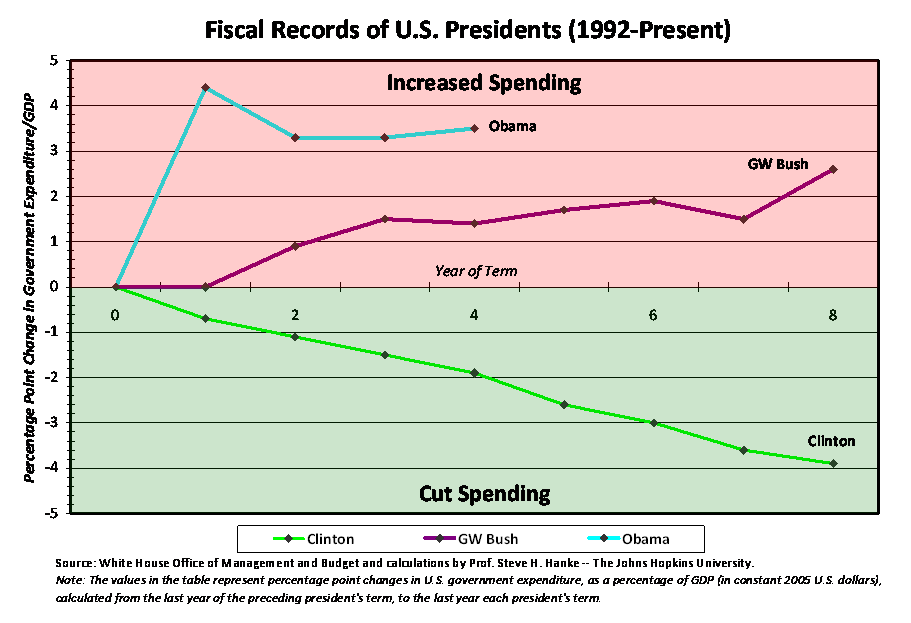
How can this be? To even say such a thing verges on CPAC blasphemy. Well, as usual, the data don’t lie. Let’s see how Clinton stacks up against Presidents Barack Obama and George W. Bush. As the accompanying chart shows, Clinton was the king of the fiscal squeeze.

Yes, Bill Clinton cut government’s share of GDP by a whopping 3.9 percentage points over his eight years in office. But, what about President Ronald Reagan? Surely the great champion of small government took a bite out of spending during his two terms, right? Well, yes, he did. But let’s put Reagan and Clinton head to head – a little fiscal discipline show-down, if you will (see the accompanying chart).

And the winner is….Bill Clinton. While Reagan did lop off four-tenths of a percentage point of government spending, as a percent of GDP, it simply does not match up to the Clinton fiscal squeeze. When President Clinton took office in 1993, government expenditures accounted for 22.1% of GDP. At the end of his second term, President Clinton’s big squeeze left the size of government, as a percent of GDP, at 18.2%. Since 1952, no other president has even come close.

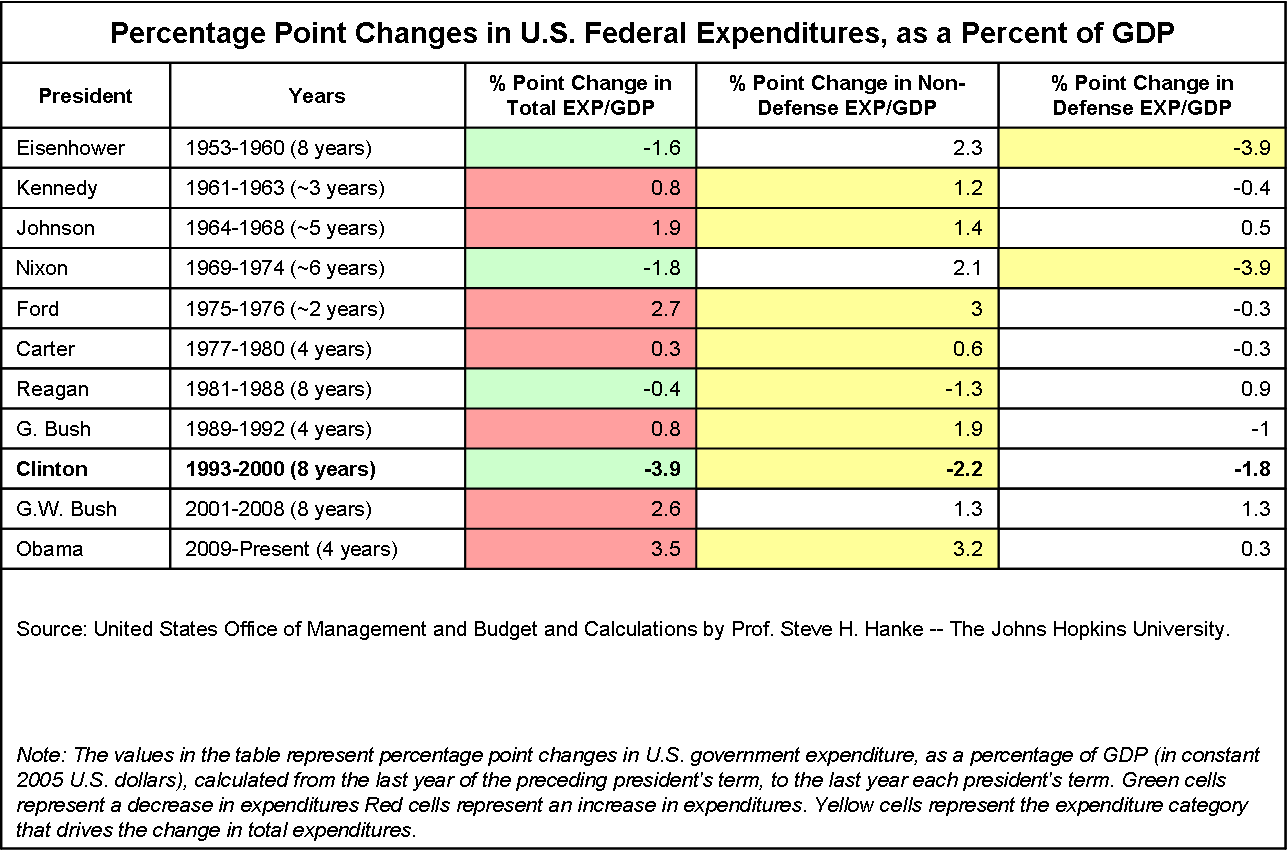
Some might argue that Clinton was the beneficiary of the so-called “peace dividend,” whereby the post-Cold-War military drawdown led to a reduction in defense expenditures. The problem with this explanation is that the majority of Clinton’s cuts came from non-defense expenditures (see the accompanying table).

Admittedly, Clinton did benefit from the peace dividend, but the defense drawdown simply doesn’t match up to the cuts in non-defense expenditures that we saw under Clinton. Of course, it should be noted that the driving force behind many of these non-defense cuts came from the other side of the aisle, under the leadership of Speaker Gingrich.

The jury is still out on whether Ryan (or Boehner) will prove to be a Gingrich – or Obama, a Clinton. But, at the end of the day, the presidential scoreboard is clear – Clinton is the king of the fiscal squeeze.

So, when Congressman Ryan rallies the troops at CPAC with a call for cutting government spending, perhaps the crowd ought accompany a standing ovation for the Congressman with a chant of “Bring Back Bill!”

You can follow Prof. Hanke on Twitter at: @Steve_Hanke

Bobby Jindal’s plan to abolish will change our nation in 20 years

Will Taxing the Rich Fix the Deficit?

Published on Jul 2, 2012

The government’s budget deficit in 2009 was $1.5 trillion. Many have suggested raising taxes on the rich to cover the difference between what the government collected in revenue and what it spent. Is that a realistic solution? Economics professor Antony Davies uses data to demonstrate why taxing the rich will not be sufficient to make the budget deficit disappear. He says, “The budget deficit is so large that there simply aren’t enough rich people to tax to raise enough to balance the budget.” Instead, it’s time to work on legitimate solutions, like cutting spending.

____________

I got to hear Bobby Jindal speak a few months ago in Hot Springs and he is the real deal. It is my view that if he is able to abolish the income tax in Louisiana then he will be able to grow the economy so much that other states will follow his lead and it will transform our nation.

Two months ago exactly, I appeared on TV to talk about the concept of eliminating the personal and corporate income tax in Louisiana.

Now Governor Jindal has unveiled a specific proposal.

The plan will eliminate two major tax types: personal income tax and corporate income and franchise tax. Eliminating income taxes in a revenue-neutral manner and improving sales tax administration will dramatically simplify Louisiana’s tax system and reduce administrative problems for families and small businesses. The effective start date of the program is January 1, 2014. …The plan will ensure revenue neutrality by…[b]roadening the state sales tax base and raising the state rate to 5.88%.

This is a superb plan.

Of all the possible ways for a state to generate revenue, the income tax is the most destructive.

My new man crush

That’s why researchers consistently have found that states without this punitive levy grow faster and create more jobs.

It’s also worth noting that jurisdictions such as Monaco, Bermuda, and the Cayman Islands manage to be very prosperous in the absence of an income tax, though the incredible wealth of these places is partly a function of bad policy elsewhere, so the comparison isn’t perfect.

Anyhow, Gov. Jindal expands on this research with some very powerful data.

Over the last ten years, more than 60 percent of the three million new jobs in American were created by the nine states without an income tax. Every year for the past 40 years, states without an income tax had faster growth than states with the highest income taxes.  Economic growth in the nine states without income taxes was 50 percent faster than in the nine states with the highest top income tax rates.  Over the past decade, states without income taxes have seen nearly 60 percent higher population growth than the national average. …While we have reversed the more than two-decade problem of out-migration, we can do more to keep people here. Here are a couple of staggering statistics. Between 1995 and 2010, according to IRS data, Louisiana lost $3 billion in adjusted gross income to Texas.

Amen.

I particularly like that he recognizes the power of tax competition as an argument for better tax policy. Taxpayers win when Texas and Louisiana compete to have less oppressive tax systems.

Indeed, this should help explain why I am so fixated on the importance of making governments compete with each other. Simply stated, governments are very prone to over-tax and over-spend if they think taxpayers have no escape options.

So let’s keep our fingers crossed that Gov. Jindal’s proposal gets a friendly reception from the state legislature.

If he succeeds, I imagine he will vault himself to the top tier of Republicans looking to replace Obama.

And, who knows, maybe he can reinvigorate the argument that we can replace the corrupt internal revenue code with a national sales tax?

P.S. Jindal is good on more than just tax policy. He’s already implemented some good school choice reform, notwithstanding wretched and predictable opposition from the state’s teachers’ union.

States response to Obamacare and Medicaid expansion

Great article from Heritage Foundation:

T. Elliot Gaiser

March 13, 2013 at 5:30 pm


«Expanding Medicaid will be costly for most states. The authors of The Patient Protection and Affordable Care Act of 2010 (Obamacare) threatened to strip all federal funding for states’ Medicaid programs if they refused to expand the entitlement.

But 27 states filed suit over Obamacare and the Supreme Court struck down this threat as coercive, making the Medicaid expansion optional for states. Now, governors and state legislatures are debating whether to expand or not, as the above presentation shows. As Nina Owcharenko notes, Medicaid needs reform, not expansion.

Of course, states are tempted by the offer of new federal dollars. But, as Heritage expert Drew Gonshorowski writes:

The Medicaid expansion represents a massive increase in federal and state spending. Although some claim that states could experience savings, it is clear that this is the exception, not the rule. Expanding Medicaid will ultimately cost states in the long run.

For a breakdown of state-by-state costs, click here.

Controlling spending is the way to a balanced budget (includes editorial cartoons)

Does Government Have a Revenue or Spending Problem?

People say the government has a debt problem. Debt is caused by deficits, which is the difference between what the government collects in tax revenue and the amount of government spending. Every time the government runs a deficit, the government debt increases. So what’s to blame: too much spending, or too little tax revenue? Economics professor Antony Davies examines the data and concludes that the root cause of the debt is too much government spending.

______________

So many times politicians tell us that we have to raise taxes in order to balance the budget but the only way to balance the budget is to control spending. That is exactly what happened between 1994 and 1998.

I wrote about the Ryan budget two days ago, praising it for complying with Mitchell’s Golden Rule and reforming Medicare and Medicaid.

But I believe in being honest and nonpartisan, so I also groused that it wasn’t as good as the 2011 and 2012 versions.

Now it’s time to give the same neutral and dispassionate treatment to the budget proposed by Patty Murray, the Washington Democrat who chairs the Senate Budget Committee.

But I’m going to focus on a theme rather than numbers.

One part of her budget got me particularly excited. Her Committee’s “Foundation for Growth” blueprint makes a very strong assertion about the fiscal and economic history of the Clinton years.

The work done in the 1990s helped grow the economy, create jobs, balance the budget, and put our government on track to eliminate the national debt.

As elaborated in this passage, the 42nd President delivered very good results.

President Bill Clinton entered office in 1993 at a time when the country was facing serious deficit and debt problems. The year before, the federal government was taking in revenue equal 17.5 percent of GDP, but spending was 22.1 percent of the economy—a deficit of 4.7 percent. …The unemployment rate went from 7 percent at the beginning of 1993 to 3.9 percent at the end of 2000. Between 1993 and 2001, our economy gained more than 22 million jobs and experienced the longest economic expansion in our history.

And the Senate Democrats even identified one of the key reasons why economic and fiscal policy was so successful during the 1990s.

…federal spending dropped from 22.1 percent of GDP to 18.2 percent of GDP.

I fully agree with every word reprinted above. That’s the good news.

So what, then, is the bad news?

Well, Senator Murray may have reached the right conclusion, but she was wildly wrong in her analysis. For all intents and purposes, she claims that the 1993 tax hike produced most of the good results.

President Clinton’s 1993 tax deal…brought in new revenue from the wealthiest Americans and…our country created 22 million new jobs and achieved a balanced budget. President Clinton’s tax policies were not the only driver of economic growth, but our leaders’ ability to agree on a fiscally sustainable and economically sound path provided valuable certainty for American families and businesses.

First, let’s dispense with the myth that the 1993 tax hike balanced the budget. I obtained the fiscal forecasts that were produced by both the Congressional Budget Office and the Office of Management and Budget in early 1995 because I wanted to see whether a balanced budget was predicted.

As you can see in the chart, both of those forecasts showed perpetual deficits of about $200 billion. And these forecasts were made nearly 18 months after the Clinton tax hike was implemented.

So if even the White House’s own forecast from OMB didn’t foresee a balanced budget, what caused the actual fiscal situation to be much better than the estimates?

The simple answer is that spending was restrained. You can give credit to Bill Clinton. You can give credit to the GOP Congress that took power in early 1995. You can give the credit to both.

But regardless of who gets the credit, the period of spending restraint that began at that time was the change that produced a budget surplus, not the tax hike that was imposed 18 months earlier and which was associated with perpetual red ink.

But spending restraint tells only part of the story. With the exception of the 1993 tax hike, the Clinton years were a period of shrinking government and free market reform.

Clinton RecordTake a look at my homemade bar chart to compare the good policies of the 1990s with the bad policies. It’s not even close.

You may be thinking that my comparison is completely unscientific, and you’re right. I probably overlooked some good policies and some bad policies.

And my assumptions about weighting are very simplistic. Everything is equally important, with a big exception in that I made the government spending variable three times as important as everything else.

Why? Well, I think reducing the burden of government spending during the Clinton years was a major achievement.

But maybe we shouldn’t rely on my gut instincts. So let’s set aside my created-at-the-spur-of-the-moment bar chart and look at something that is scientific.

This chart is taken directly from Economic Freedom of the World, which uses dozens of variables to measure the overall burden of government.

As you can see, the United States score improved significantly during the Clinton years, showing that economic freedom was expanding and the size and scope of government was shrinking.

In other words, Patty Murray is correct. She is absolutely right to claim that Bill Clinton’s policies “helped grow the economy, create jobs, balance the budget.”

Now she needs to realize that those policies were small government and free markets.

Let me start this post by stating that George W. Bush was a bigger spender than Barack Obama (though the numbers are somewhat distorted by TARP, which caused a big increase in the burden of spending during Bush’s last fiscal year and artificially dampened outlays in Obama’s first fiscal year since repayments from the banks counted as negative spending).

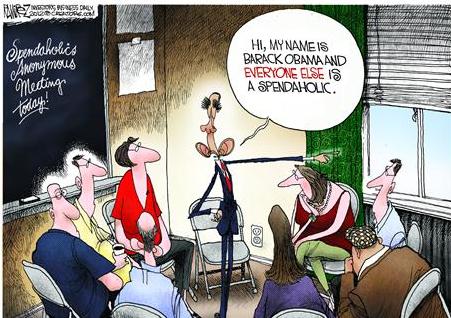
So I’m not trying to make a partisan point by sharing these cartoons. I don’t like it when Democrats increase the burden of government spending and I’m equally dismayed when Republicans engage in same type of profligacy.

That being said, I was a big dumbfounded when President Obama recently claimed that there’s not a spending problem in Washington.

We know that the United States has a huge long-run problem with deficits and debt according to both the Bank for International Settlements and the Organization for Economic Cooperation and Development.

We also know that tax revenues, measured as a share of GDP, will soon be above their post-World War II average and that the tax burden is expected to increase in coming decades.

So a person would have to be in serious denial to claim that spending isn’t a problem.

Which is the point Eric Allie makes in this cartoon.

Spending Problem Cartoon 1

And the point Robert Ariail makes in this cartoon.

Spending Problem Cartoon 2

Ditto for Bob Gorrell.

Spending Problem Cartoon 3

And Gary Varvel.

Spending Problem Cartoon 4

Last but not least, the great Michael Ramirez.

Spending Problem Cartoon 5.jpg

Gee, it’s almost like we’re seeing a pattern.

And if you like this spendaholic-in-denial theme, you can click here and here for further amusement.

P.S. Oh, by the way, if anybody’s actually interested in how to solve the spending problem (you know, the one that doesn’t exist), we do know the answer.

P.P.S. Remember when Obama claimed the private sector was doing fine? Well, here’s how cartoonists mocked him for that absurd comment.

Remembering Dr. C. Everett Koop with pictures and quotes Part 13 (includes editorial cartoon)

Dr. C. Everett Koop is pictured above.

Francis Schaeffer: “Whatever Happened to the Human Race” (Episode 1) ABORTION OF THE HUMAN RACE

Published on Oct 6, 2012 by

Newsmaker Interview with Surgeon General C. Everett Koop

Published on Feb 25, 2013

The PBS NewsHour interviewed former Surgeon General, Dr. C. Everett Koop, on the anniversary of the first surgeon general’s report on smoking. Jim Lehrer interviewed Koop for a newsmaker conversation for the The MacNeil/Lehrer NewsHour from the surgeon general’s office in Washington on Jan. 11, 1989. Koop died Monday at the age of 96.

Dr. Koop

On 2-25-13 we lost a great man when we lost Dr. C. Everett Koop. I have written over and over the last few years quoting Dr. C. Everett Koop and his good friend Francis Schaeffer. They both came together for the first time in 1973 when Dr. Koop operated on Schaeffer’s daughter and as a result they became close friends. That led to their involvement together in the book and film series “WHATEVER HAPPENED TO THE HUMAN RACE?” in 1979.

In the film series “WHATEVER HAPPENED TO THE HUMAN RACE?” the arguments are presented  against abortion (Episode 1),  infanticide (Episode 2),   euthenasia (Episode 3), and then there is a discussion of the Christian versus Humanist worldview concerning the issue of “the basis for human dignity” in Episode 4 and then in the last episode a close look at the truth claims of the Bible

In this 1979 film series they dealt with the big social issues and predicted what social problems we have in the future because of humanism. For instance, they knew that the Jack Kevorkians of the world would be coming down the pike. They predicted that there was a slippery slope from abortion to infanticide to youth euthanasia brought on by the materialistic worldview.

A young Dr. Koop below

Koop, who transformed surgeon general post, dies

APNews | 11 hours ago

Koop, who transformed surgeon general post, dies

With his striking beard and starched uniform, former Surgeon General Dr. C. Everett Koop became one of the most recognizable figures of the Reagan era — and one of the most unexpectedly enduring.

His nomination in 1981 met a wall of opposition from women’s groups and liberal politicians, who complained President Ronald Reagan selected Koop, a pediatric surgeon and evangelical Christian from Philadelphia, only because of his conservative views, especially his staunch opposition to abortion.

Soon, though, he was a hero to AIDS activists, who chanted “Koop, Koop” at his appearances but booed other officials. And when he left his post in 1989, he left behind a landscape where AIDS was a top research and educational priority, smoking was considered a public health hazard, and access to abortion remained largely intact.

Koop, who turned his once-obscure post into a bully pulpit for seven years during the Reagan and George H.W. Bush administrations and who surprised both ends of the political spectrum by setting aside his conservative personal views on issues such as homosexuality and abortion to keep his focus sharply medical, died Monday at his home in Hanover, N.H. He was 96.

An assistant at Koop’s Dartmouth College institute, Susan Wills, confirmed his death but didn’t disclose its cause.

Dr. Richard Carmona, who served as surgeon general a decade ago under President George W. Bush, said Koop was a mentor to him and preached the importance of staying true to the science even if it made politicians uncomfortable.

“He set the bar high for all who followed in his footsteps,” Carmona said.

Although the surgeon general has no real authority to set government policy, Koop described himself as “the health conscience of the country” and said modestly just before leaving his post that “my only influence was through moral suasion.”

A former pipe smoker, Koop carried out a crusade to end smoking in the United States; his goal had been to do so by 2000. He said cigarettes were as addictive as heroin and cocaine. And he shocked his conservative supporters when he endorsed condoms and sex education to stop the spread of AIDS.

Chris Collins, a vice president of amFAR, the Foundation for AIDS Research, said many people don’t realize what an important role Koop played in the beginning of the AIDS epidemic.

“At the time, he really changed the national conversation, and he showed real courage in pursuing the duties of his job,” Collins said.

Even after leaving office, Koop continued to promote public health causes, from preventing childhood accidents to better training for doctors.

“I will use the written word, the spoken word and whatever I can in the electronic media to deliver health messages to this country as long as people will listen,” he promised.

In 1996, he rapped Republican presidential hopeful Bob Dole for suggesting that tobacco was not invariably addictive, saying Dole’s comments “either exposed his abysmal lack of knowledge of nicotine addiction or his blind support of the tobacco industry.”

Although Koop eventually won wide respect with his blend of old-fashioned values, pragmatism and empathy, his nomination met staunch opposition.

Foes noted that Koop traveled the country in 1979 and 1980 giving speeches that predicted a progression “from liberalized abortion to infanticide to passive euthanasia to active euthanasia, indeed to the very beginnings of the political climate that led to Auschwitz, Dachau and Belsen.”

But Koop, a devout Presbyterian, was confirmed after he told a Senate panel he would not use the surgeon general’s post to promote his religious ideology. He kept his word.

In 1986, he issued a frank report on AIDS, urging the use of condoms for “safe sex” and advocating sex education as early as third grade.

He also maneuvered around uncooperative Reagan administration officials in 1988 to send an educational AIDS pamphlet to more than 100 million U.S. households, the largest public health mailing ever.

Koop personally opposed homosexuality and believed sex should be saved for marriage. But he insisted that Americans, especially young people, must not die because they were deprived of explicit information about how HIV was transmitted.

Koop further angered conservatives by refusing to issue a report requested by the Reagan White House, saying he could not find enough scientific evidence to determine whether abortion has harmful psychological effects on women.

Koop maintained his personal opposition to abortion, however. After he left office, he told medical students it violated their Hippocratic oath. In 2009, he wrote to Senate Majority Leader Harry Reid, urging that health care legislation include a provision to ensure doctors and medical students would not be forced to perform abortions. The letter briefly set off a security scare because it was hand delivered.

Koop served as chairman of the National Safe Kids Campaign and as an adviser to President Bill Clinton’s health care reform plan.

At a congressional hearing in 2007, Koop spoke about political pressure on the surgeon general post. He said Reagan was pressed to fire him every day, but Reagan would not interfere.

Koop, worried that medicine had lost old-fashioned caring and personal relationships between doctors and patients, opened his institute at Dartmouth to teach medical students basic values and ethics. He also was a part-owner of a short-lived venture, drkoop.com, to provide consumer health care information via the Internet.

Koop was born in the New York City borough of Brooklyn, the only son of a Manhattan banker and the nephew of a doctor. He said by age 5 he knew he wanted to be a surgeon and at age 13 he practiced his skills on neighborhood cats.

He attended Dartmouth, where he received the nickname Chick, short for “chicken Koop.” It stuck for life.

Koop received his medical degree at Cornell Medical College, choosing pediatric surgery because so few surgeons practiced it.

In 1938, he married Elizabeth Flanagan, the daughter of a Connecticut doctor. They had four children, one of whom died in a mountain climbing accident when he was 20.

Koop was appointed surgeon-in-chief at Children’s Hospital in Philadelphia and served as a professor at the University of Pennsylvania School of Medicine.

He pioneered surgery on newborns and successfully separated three sets of conjoined twins. He won national acclaim by reconstructing the chest of a baby born with the heart outside the body.

Although raised as a Baptist, he was drawn to a Presbyterian church near the hospital, where he developed an abiding faith. He began praying at the bedside of his young patients — ignoring the snickers of some of his colleagues.

Koop’s wife died in 2007, and he married Cora Hogue in 2010.

He was by far the best-known surgeon general and for decades afterward was still a recognized personality.

“I was walking down the street with him one time” about five years ago, recalled Dr. George Wohlreich, director of the College of Physicians of Philadelphia, a medical society with which Koop had longstanding ties. “People were yelling out, ‘There goes Dr. Koop!’ You’d have thought he was a rock star.”

___

Ring reported from Montpelier, Vt. Cass reported from Washington. AP Medical Writers Lauran Neergaard in Washington and Mike Stobbe in New York contributed to this report.

_________

Dr. Koop with Francis Schaeffer in their film WHATEVER HAPPENED TO THE HUMAN RACE? made it clear that unborn babies have the right to life. That point is made well in this political cartoon about abortion:

Related posts:

Open letter to President Obama (Part 232 B) Dr. C. Everett Koop and Reagan pictured together

Dr. C. Everett Koop with Ronald Reagan. Dr. Koop was delayed in his confirmation by Ted Kennedy because of his film Whatever Happened to the Human Race? President Obama c/o The White House 1600 Pennsylvania Avenue NW Washington, DC 20500 Dear Mr. President, I know that you receive 20,000 letters a day and that you […]

“Sanctity of Life Saturday” Francis Schaeffer and Dr. C. Everett Koop asked Reagan to issue pro-life proclamation in 1983 (includes video ABORTION OF THE HUMAN RACE)

In the film series “WHATEVER HAPPENED TO THE HUMAN RACE?” the arguments are presented  against abortion (Episode 1),  infanticide (Episode 2),   euthenasia (Episode 3), and then there is a discussion of the Christian versus Humanist worldview concerning the issue of “the basis for human dignity” in Episode 4 and then in the last episode a close […]

Dr. C. Everett Koop on abortion’s 1973 Roe v. Wade impact on child abuse

Dr. C. Everett Koop with Ronald Reagan. Dr. Koop was delayed in his confirmation by Ted Kennedy because of his film Whatever Happened to the Human Race? Watch the film below starting at the 19 minute mark and that will lead into a powerful question from Dr. C. Everett Koop. This 1979 film is WHATEVER […]

Open letter to President Obama (Part 221 B) Dr. C. Everett Koop and Francis Schaeffer rightly called abortion “the watershed issue of our era”

 Dr. Koop was delayed in his confirmation by Ted Kennedy because of his film Whatever Happened to the Human Race? Francis Schaeffer February 21, 1982 (Part 1) Uploaded by DeBunker7 on Feb 21, 2008 READ THIS FIRST: In decline of all civilizations we first see a war against the freedom of ideas. Discussion is limited […]

Francis Schaeffer and C. Everette Koop on the Hippocratic oath (March for Life January 20, 2013)

Dr. C. Everett Koop was appointed to the Reagan administration but was held up in the Senate in his confirmation hearings by Ted Kennedy because of his work in pro-life causes. I was thinking about the March for Life that is coming up on Jan 20, 2013  and that is why I posted this today […]

Ronald Wilson Reagan pictured with Dr. C. Everett Koop

High resolution version (11,426,583 Bytes) Description: The photograph is signed by President Ronald Reagan with the inscription “To Chick Koop, With Best Wishes.” Chick, from chicken coop, was the nickname Koop gained will attending Dartmouth College in the mid-1930s. Koop maintained a cordial relationship with President Reagan, despite his disappointment over Reagan’s refusal to address […]

Francis Schaeffer and C. Everett Koop were prophetic (jh29)

Francis Schaeffer and C. Everett Koop were prophetic (jh29) What Ever Happened to the Human Race? I recently heard this Breakpoint Commentary by Chuck Colson and it just reminded me of how prophetic Francis Schaeffer and C. Everett Koop were in the late 1970′s with their book and film series “Whatever happened to the human […]

Should Michele Bachmann be punished for taking pro-life views from Schaeffer and Koop? (March for Life January 20, 2013)

  Dr. C. Everett Koop I was thinking about the March for Life that is coming up on Jan 20, 2013  and that is why I posted this today Secular leaps of faith 39 Comments Written by Janie B. Cheaney August 15, 2011, 2:17 PM I’m willing to cut Ryan Lizza some slack. His profile […]

“Schaeffer Sundays” Francis Schaeffer’s own words concerning humanism and its bad results

Francis Schaeffer: “Whatever Happened to the Human Race?” (Episode 2) SLAUGHTER OF THE INNOCENTS Published on Oct 6, 2012 by AdamMetropolis The 45 minute video above is from the film series created from Francis Schaeffer’s book “Whatever Happened to the Human Race?” with Dr. C. Everett Koop. This book  really helped develop my political views concerning […]

“Sanctity of Life Saturday”:Derek Melleby’s review of the book “Francis Schaeffer: An Authentic Life” (includes film THE BASIS FOR HUMAN DIGNITY)

  I truly believe that many of the problems we have today in the USA are due to the advancement of humanism in the last few decades in our society. Ronald Reagan appointed the evangelical Dr. C. Everett Koop to the position of Surgeon General in his administration. He partnered with Dr. Francis Schaeffer in making […]

Taking on Ark Times bloggers about abortion on the 40th anniversary date of Roe v. Wade (Part 5) “Slavery issue compared to rights of unborn child”

The best pro-life film I have ever seen below by Francis Schaeffer and Dr. C. Everett Koop “Whatever happened to the human race?” Over the years I have taken on the Ark Times liberal bloggers over and over and over concerning the issue of abortion. I asked over and over again for one liberal blogger […]

Taking on Ark Times bloggers about abortion on the 40th anniversary date of Roe v. Wade (Part 4) “How do pro-lifers react to the movie THE CIDER HOUSE RULES?”

Francis Schaeffer pictured above._________ The best pro-life film I have ever seen below by Francis Schaeffer and Dr. C. Everett Koop “Whatever happened to the human race?” Over the years I have taken on the Ark Times liberal bloggers over and over and over concerning the issue of abortion. I asked over and over again […]

Taking on Ark Times bloggers about abortion on the 40th anniversary date of Roe v. Wade (Part 3) “What should be the punishment for abortion doctors?”

The best pro-life film I have ever seen below by Francis Schaeffer and Dr. C. Everett Koop “Whatever happened to the human race?” On 1-24-13 I took on the child abuse argument put forth by Ark Times Blogger “Deathbyinches,” and the day before I pointed out that because the unborn baby has all the genetic code […]

Taking on Ark Times bloggers about abortion on the 40th anniversary date of Roe v. Wade (Part 2) “The pro-abortion child abuse argument destroyed here”

PHOTO BY STATON BREIDENTHAL from Pro-life march in Little Rock on 1-20-13. Tim Tebow on pro-life super bowl commercial. Over the years I have taken on the Ark Times liberal bloggers over and over and over concerning the issue of abortion. Here is another encounter below. On January 22, 2013 (on the 40th anniversary of the […]

Taking on Ark Times bloggers about abortion on the 40th anniversary date of Roe v. Wade (Part 6) For many pro-abortionists ” …the problem is not determining when actual human life begins, but when the value of that life begins to out weigh other considerations”

The best pro-life film I have ever seen below by Francis Schaeffer and Dr. C. Everett Koop “Whatever happened to the human race?” Francis Schaeffer pictured above._________ The 45 minute video above is from the film series created from Francis Schaeffer’s book “Whatever Happened to the Human Race?” with Dr. C. Everett Koop. This book  really […]

Taking on Ark Times bloggers about abortion on the 40th anniversary date of Roe v. Wade (Part 7) “Poverty not good reason for abortion, why not give up for adoption?”

Dr Richard Land discusses abortion and slavery – 10/14/2004 – part 3 The best pro-life film I have ever seen below by Francis Schaeffer and Dr. C. Everett Koop “Whatever happened to the human race?” Over the years I have taken on the Ark Times liberal bloggers over and over and over concerning the issue […]

Taking on Ark Times bloggers about abortion on the 40th anniversary date of Roe v. Wade (Part 1)

Dr Richard Land discusses abortion and slavery – 10/14/2004 – part 3 The best pro-life film I have ever seen below by Francis Schaeffer and Dr. C. Everett Koop “Whatever happened to the human race?” Over the years I have taken on the Ark Times liberal bloggers over and over and over concerning the issue […]

Paul Greenberg became pro-life because we are all “endowed with certain unalienable rights”

On January 20, 2013 I heard Paul Greenberg talk about the words of Thomas Jefferson that we are all “endowed with certain unalienable rights” and the most important one is the right to life. He mentioned this also in this speech below from 2011: Paul Greenberg Dinner Speech 2011 Fall 2011 Issue Some of you […]

How Pulitzer Prize-winning Paul Greenberg, one of the most respected and honored commentators in America, changed his mind about abortion and endorses now the pro-life view

It is not possible to know where the pro-life evangelicals are coming from unless you look at the work of the person who inspired them the most. That person was Francis Schaeffer.  I do care about economic issues but the pro-life issue is the most important to me. Several years ago Adrian Rogers (past president of […]


Scholars react to President Obama’s 2013 State of the Union Speech Part 7 “Balance” in Obamaspeak

State of the Union 2013

Published on Feb 13, 2013

Cato Institute scholars Michael Tanner, Alex Nowrasteh, Julian Sanchez, Simon Lester, John Samples, Pat Michaels, Jagadeesh Gokhale, Michael F. Cannon, Jim Harper, Malou Innocent, Juan Carlos Hidalgo, Ilya Shapiro, Trevor Burrus and Neal McCluskey respond to President Obama’s 2013 State of the Union Address.

Video produced by Caleb O. Brown, Austin Bragg and Lester Romero.

_______________

In the past I have written the White House on several issues such as abortion, medicare, welfare,  Greece, healthcare, and what the founding fathers had to say about welfare programs,   and have got several responses from the White House concerning issues such as Obamacare, Social Security, welfare,  and excessive government spending

Today I am taking a look at the response of the scholars of the Heritage Foundation and the Cato Institute scholars to the 2013 State of the Union Address.

Amy Payne

February 13, 2013 at 8:22 am

“Balance” in Obamaspeak

Tonight’s State of the Union address reflected President Obama’s liberal ideology: Everything starts with government. His proposals for new “investments” in manufacturing, infrastructure, and so on rest on the false belief that only government can figure out how to make the economy grow. Hence his “Fix-it-First” program, and his Partnership to Rebuild America. If government doesn’t do it, it won’t happen.

When he claims his new spending proposals won’t add to the deficit, it proves he just doesn’t get it. The deficit is a symptom of excess spending; it’s spending that has to be controlled.

With the government drowning in red ink, Obama offers a life preserver made of lead: more spending. He has already pocketed a $618 billion tax increase in the fiscal cliff deal (in addition to $1 trillion in new Obamacare taxes). He needs to accept that true “balance” has two sides—and start cutting spending.

Patrick Louis Knudsen, Grover M. Hermann Senior Fellow in Federal Budgetary Affairs, Thomas A. Roe Institute for Economic Policy Studies

Related posts:

President Obama responds to Heritage Foundation critics on welfare reform waivers

Is President Obama gutting the welfare reform that Bill Clinton signed into law? Morning Bell: Obama Denies Gutting Welfare Reform Amy Payne August 8, 2012 at 9:15 am The Obama Administration came out swinging against its critics on welfare reform yesterday, with Press Secretary Jay Carney saying the charge that the Administration gutted the successful […]

HERITAGE FOUNDATION INTERVIEW:Senator Blunt Vows to Keep Pressure on President Obama Over Contraceptive Mandate

Senator Blunt Vows to Keep Pressure on President Obama Over Contraceptive Mandate Uploaded by HeritageFoundation on Feb 13, 2012 http://blog.heritage.org/2012/02/13/sen-blunt-vows-to-keep-pressure-on-obama-… | Sen. Roy Blunt (R-MO) introduced legislation to protect religious organizations from Obamacare’s overreach last summer. Now, as President Obama presses forward with his anti-conscience mandate, Blunt is prepared to keep the pressure on the […]

Cartoons from Dan Mitchell’s blog that demonstrate what Obama is doing to our economy Part 2

Max Brantley is wrong about Tom Cotton’s accusation concerning the rise of welfare spending under President Obama. Actually welfare spending has been increasing for the last 12 years and Obama did nothing during his first four years to slow down the rate of increase of welfare spending. Rachel Sheffield of the Heritage Foundation has noted: […]

Heritage Foundation Videos and Interviews are displayed on www.thedailyhatch.org

Sen. Mitch McConnell: Americans Don’t Approve of Anything Obama Has Done Uploaded by HeritageFoundation on Dec 8, 2011 In an exclusive interview at The Heritage Foundation, Senate Minority Leader Mitch McConnell (R-KY) sharply criticized President Obama for engaging in class warfare and accused him of shifting the focus away from his own failed policies in […]

Did Obama prolong the recession with the auto baleout?

Obamanomics: A Legacy of Wasteful Spending Published on Aug 12, 2012 by CFPEcon101 This mini-documentary from the Center for Freedom and Prosperity Foundation highlights egregious examples of wasteful spending from the so-called stimulus legislation and explains why government spending hurts economic performance. **Links to additional reading material** Thomas Sowell, “Stimulus or Sedative?” http://www.realclearpolitics.com/articles/2010/03/09/stimulus_or_sedative_104… Veronique de […]

Open letter to President Obama (Part 222)

  President Obama c/o The White House 1600 Pennsylvania Avenue NW Washington, DC 20500 Dear Mr. President, I know that you receive 20,000 letters a day and that you actually read 10 of them every day. I really do respect you for trying to get a pulse on what is going on out here. Is […]

Open letter to President Obama (Part 221)

  President Obama c/o The White House 1600 Pennsylvania Avenue NW Washington, DC 20500 Dear Mr. President, I know that you receive 20,000 letters a day and that you actually read 10 of them every day. I really do respect you for trying to get a pulse on what is going on out here. The […]

Open letter to President Obama (Part 216)

Thomas Sowell (This letter was mailed before September 1, 2012) President Obama c/o The White House 1600 Pennsylvania Avenue NW Washington, DC 20500 Dear Mr. President, I know that you receive 20,000 letters a day and that you actually read 10 of them every day. I really do respect you for trying to get a […]

Open letters to President Obama displayed here on www.thedailyhatch.org

I have been writing letters to President Obama almost all of 2012. I have received several responses from the White House but none of the responses have been personal responses from the President. Below is a letter I wrote to the President and a form letter response that I got followed by links to other […]

Coldplay the documentary with pictures and videos (Part 6 )

Coldplay Max Masters – Part 7 of 7

Chris Martin revealed in his interview with Howard Stern that he was rasied an evangelical Christian but he has left the church. I believe that many words that he puts in his songs today are generated from the deep seated Christian beliefs from his childhood that find their way out in his life. His belief in being generous with charities, and the fact Coldplay’s songs  deal so much with death and the search for meaning and purpose of life (similar to Solomon’s search in Ecclesiastes), that our actions are being watched, and Chris describes different ways God tries to reveal himself to us, and many songs deal with trying to find a way to an afterlife and heaven, and he stills uses Christian terms like being “blessed” and “grateful.”

Up to this point many people may be saying that this is all based on some pretty flimsy evidence. However, one of the most revealing things came out when Chris wrote the song “Viva La Vida.” He had previously said he left Christianity because of the biblical view of eternal damnation but what does Chris do with the evil king in the song “Viva La Vida?”  Q Magazine asked Chris Martin about the lyric in this song “I know Saint Peter won’t call my name.” Martin said,  “It’s about…You’re not on the list… Its always fascinated me that idea of finishing your life and then being analyzed on it…That is the most frightening thing you could possibly say to somebody. Eternal damnation.  I know it. It’s mildly terrifying to me. And this is serious.”

Maybe we have heard the last of this journey from Chris?

Coldplay – Viva La Vida

I am glad that Chris believes in being generous with charities with his own personal funds, but he also supported President Obama who wanted to increase the welfare state. Take a look at these articles below. 

The Moral Basis for Economic Liberty

By
July 13, 2010


The modern welfare state is simply incapable of making the kinds of distinctions that Saint Paul insists are necessary in administering charity. The centralized state, by its nature, administers programs on the assumption that people are identical and can be shaped according to an inflexible central plan. Private charity may not be able to do all the work that is necessary, but where and when it is allowed to work, it does a better job than the public sector. It is also based on the principle of voluntary action as opposed to state coercion, which gives it a morally superior status.

____________________________

Seeking the Welfare of the City

By
May 1, 2012


Conservatives are often portrayed as selfish scrooges who only care about their own bottom lines. But when it comes to truly meeting people’s needs, they’re the leaders of the pack.

Star Parker knew poverty personally. As a young drug addict in southern California, she lacked money, employment and hope. At one point, she was arrested for helping to rob a liquor store, and over the span of a few years, she had four abortions—all paid for by the government. Parker survived on welfare checks and free medical-care stickers, which she would sell to purchase illegal drugs.

The scriptural call to care for people such as Parker is clear: Loving our neighbor entails helping those in dire straits and working for the common good of their community.

In the biblical sense, seeking welfare has to do with promoting circumstances that allow people to flourish. It means helping people thrive in their homes, workplaces, neighborhoods, economies and political communities. This goal characterizes a true conservative political framework.

Now the president of a social policy research center focused on poverty issues, Parker testifies that a biblical view of human flourishing is at home in a conservative agenda—one focused on basic human dignity, strong families, a vibrant civil society, prosperous free markets and limited government.

Who Cares?

Many conservatives—and especially those motivated by faith—are on the front lines of caring for the poor. They’re the “street saints” who work quietly but tirelessly in the trenches, providing critical services in education, health, drug rehabilitation, prisoner re-entry, job training and disaster relief.

In fact, research shows conservatives actually give more to the poor than liberals. Syracuse University professor Arthur Brooks compiled this body of research in his 2006 book Who Really Cares: The Surprising Truth about Compassionate Conservatism. Brooks found that conservative-headed households tend to give about 30 percent more money to charity than liberal-headed households, even though liberal families earn an average of 6 percent more each year than conservative families. Conservatives also tend to volunteer more time and give more blood than do liberals.

Despite such data, conventional wisdom portrays liberals as being the ones intent on fighting poverty and conservatives as selfish scrooges. Sadly, the promotion of free markets and limited government is often mistakenly equated with a disregard for people in need. Meanwhile, support for government redistribution programs functions as a kind of litmus test for genuine care and compassion. (Never mind the paradoxical fact that, according to Brooks, Americans who favor income-redistribution policies are significantly less likely to behave charitably than those who do not.)

True compassion, though, isn’t measured by how much money the federal government spends. The real question is which approach actually helps people escape poverty and flourish over the long-run. Conservatives tend to answer that question differently than liberals, although they both share the goal of “seeking the welfare of the city.”

_________________

By Michael Tanner

 Replacing Welfare with Private Charity

Private efforts have been much more successful than the federal government’s failed attempt at charity. America is the most generous nation on earth. Americans already contribute more than $125 billion annually to charity. In fact, more than 85 percent of all adult Americans make some charitable contribution each year. In addition, about half of all American adults perform volunteer work; more than 20 billion hours were worked in 1991. The dollar value of that volunteer work was more than $176 billion. Volunteer work and cash donations combined bring American charitable contributions to more than $300 billion per year, not counting the countless dollars and time given informally to family members, neighbors, and others outside the formal charity system.

Private charities have been more successful than government welfare for several reasons. First, private charities are able to individualize their approach to the circumstances of poor people in ways that governments can never do. Government regulations must be designed to treat all similarly situated recipients alike. Glenn C. Loury of Boston University explains the difference between welfare and private charities on that point. “Because citizens have due process rights which cannot be fully abrogated . . . public judgments must be made in a manner that can be defended after the fact, sometimes even in court.” The result is that most government programs rely on the simple provision of cash or other goods and services without any attempt to differentiate between the needs of recipients.

Take, for example, the case of a poor person who has a job offer. But she can’t get to the job because her car battery is dead. A government welfare program can do nothing but tell her to wait two weeks until her welfare check arrives. Of course, by that time the job will be gone. A private charity can simply go out and buy a car battery (or even jump-start the dead battery).

The sheer size of government programs works against individualization. As one welfare case worker lamented, “With 125 cases it’s hard to remember that they’re all human beings. Sometimes they’re just a number.” Bureaucracy is a major factor in government welfare programs. For example, a report on welfare in Illinois found procedures requiring “nine forms to process an address change, at least six forms to add or delete a member of a household, and a minimum of six forms to report a change in earnings or employment.” All that for just one program.

In her excellent book Tyranny of Kindness, Theresa Funiciello, a former welfare mother, describes the dehumanizing world of the government welfare system–a system in which regulations and bureaucracy rule all else. It is a system in which illiterate homeless people with mental illnesses are handed 17-page forms to fill out, women nine months pregnant are told to verify their pregnancies, a woman who was raped is told she is ineligible for benefits because she can’t list the baby’s father on the required form. It is a world totally unable to adjust to the slightest deviation from the bureaucratic norm.

In addition to being better able to target individual needs, private charities are much better able to target assistance to those who really need help. Because eligibility requirements for government welfare programs are arbitrary and cannot be changed to fit individual circumstances, many people in genuine need do not receive assistance, while benefits often go to people who do not really need them. More than 40 percent of all families living below the poverty level receive no government assistance. Yet more than half of the families receiving means-tested benefits are not poor. Thus, a student may receive food stamps, while a homeless man with no mailing address goes without. Private charities are not bound by such bureaucratic restrictions.

Private charity also has a better record of actually delivering aid to recipients. Surprisingly little of the money being spent on federal and state social welfare programs actually reaches recipients. In 1965, 70 cents of every dollar spent by the government to fight poverty went directly to poor people. Today, 70 cents of every dollar goes, not to poor people, but to government bureaucrats and others who serve the poor. Few private charities have the bureaucratic overhead and inefficiency of government programs.


Chris Martin

Rare picture: Elusive couple Gwyneth Paltrow and Chris Martin are photographed together at a beach party in the Hamptons

Elusive

Chris Martin

ee

.

Related posts:

Chris Martin of Coldplay unknowingly lives out his childhood Christian beliefs (Part 8 of notes from June 23, 2012 Dallas Coldplay Concert)

Coldplay 6-22-12 Dallas, TX Best Opening.MOV Published on Jun 23, 2012 by jaimenolga 1 of Don’t miss the second song of this clip!! It was incredible! (One eye watching you song was great.) Coldplay brought confetti, lights and thousands of fans to the American Airlines Center; see photos from their colorful show Photo Gallery News […]

Chris Martin of Coldplay unknowingly lives out his childhood Christian beliefs (Part 7 of notes from June 23, 2012 Dallas Coldplay Concert)

Coldplay Live in Dallas – Lover’s in Japan Ball Drop Published on Jun 23, 2012 by TheRyanj64 Live From the American Airlines Center in Dallas Texas June 22, 2012 Coldplay – Lover’s in Japan Ball Drop Coldplay brought confetti, lights and thousands of fans to the American Airlines Center; see photos from their colorful show […]

Chris Martin of Coldplay unknowingly lives out his childhood Christian beliefs (Part 6 of notes from June 23, 2012 Dallas Coldplay Concert)

Coldplay – Yellow (Live) @ American Airlines Center Published on Jun 23, 2012 by Crwdickerson Coldplay Performing Yellow @ American Airlines Center Dallas June 22, 2012 Coldplay brought confetti, lights and thousands of fans to the American Airlines Center; see photos from their colorful show Photo Gallery News Sports Lifestyles Comments (0)   3/11 Chris […]

Chris Martin of Coldplay unknowingly lives out his childhood Christian beliefs (Part 5 of notes from June 23, 2012 Dallas Coldplay Concert)

Coldplay “paradise” Dallas Texas 6/22/12 ( Floor View ) Published on Jun 23, 2012 by ccam cher Awesome concert Coldplay brought confetti, lights and thousands of fans to the American Airlines Center; see photos from their colorful show Photo Gallery News Sports Lifestyles   Comments (0)   9/11 Chris Martin was brought up as an […]

Chris Martin of Coldplay unknowingly lives out his childhood Christian beliefs (Part 4 of notes from June 23, 2012 Dallas Coldplay Concert)

Coldplay – In My Place (Live in Dallas) June 22 2012 Published on Jun 24, 2012 by maimiaa Coldplay performing at American Airlines Center in Dallas, TX Coldplay brought confetti, lights and thousands of fans to the American Airlines Center; see photos from their colorful show Photo Gallery News Sports Lifestyles   Comments (0)   […]

Chris Martin of Coldplay unknowingly lives out his childhood Christian beliefs (Part 3 of notes from June 23, 2012 Dallas Coldplay Concert, Martin left Christianity because of teaching on hell then he writes bestselling song that teaches hell exists)

Viva La Vida Published on Jun 23, 2012 by TheRyanj64 Coldplay’s Viva La Vida at American Airlines Center in Dallas on June 22, 2012 __________ Coldplay brought confetti, lights and thousands of fans to the American Airlines Center; see photos from their colorful show Photo Gallery News Sports Lifestyles   Comments (0)   5/11 Chris […]

Chris Martin of Coldplay unknowingly lives out his childhood Christian beliefs (Part 2 of notes from June 23, 2012 Dallas Coldplay Concert)

Coldplay – Mylo Xyloto/Hurts Like Heaven (Live) @ American Airlines Center Coldplay brought confetti, lights and thousands of fans to the American Airlines Center; see photos from their colorful show Photo Gallery News Sports Lifestyles   Comments (0)   2/11   Published on Jun 24, 2012 by Crwdickerson Coldplay Performing Mylo Xyloto/Hurts Like Heaven @ […]

Chris Martin of Coldplay unknowingly lives out his childhood Christian beliefs (Part 1 of notes from June 23, 2012 Dallas Coldplay Concert)

Coldplay-DALLAS-2012-”Opening, Mylo Xyloto, and Hurts like Heaven!” Published on Jun 24, 2012 by ColdplayDALLAS2012 1:10 is where the concert starts! Sorry for the shaking and sound audio! It was really loud! AND AWESOME! Please THUMB UP and COMMENT if u went to this coldplay concert! And I also hope that this will get a few […]

“Music Monday” Video interviews of Gwyneth Paltrow and Chris Martin (Part 4)

As far as I know they have never done an interview together. Therefore, I have included separate interviews that they have done below and I have some links to past posts I have done on them too. Shane Warne – Chris Martin Interview (Part 1) Uploaded by HandyAndy136 on Nov 24, 2010 Originally broadcast on […]

“Music Monday” Video interviews of Gwyneth Paltrow and Chris Martin (Part 3)

As far as I know they have never done an interview together. Therefore, I have included separate interviews that they have done below and I have some links to past posts I have done on them too. Ellen Catches Up with Gwyneth Paltrow Uploaded by TheEllenShow on Oct 14, 2010 It’s been several years since […]

“Music Monday” Video interviews of Gwyneth Paltrow and Chris Martin (Part 2)

As far as I know they have never done an interview together. Therefore, I have included separate interviews that they have done below and I have some links to past posts I have done on them too. Gwyneth Paltrow & Robert Downey Jr. on Jonathan Ross 2010.04.23 (Part 1) Coldplay: Chris Martin and Jonny Buckland […]

Open letter to Gwyneth Paltrow and Chris Martin concerning their choice to raise their kids in the Jewish Faith (part 12)

The Arab Israeli Conflict – part 5 : Suez Crisis 1956 & Tripartite attack on Egypt I have posted before about the religious views of Gwyneth Paltrow and Chris Martin. Now it appears they have rejected their agnostic statements of the past and have decided to raise their children in the Jewish faith. Here is […]

“Music Monday” Video interviews of Gwyneth Paltrow and Chris Martin (Part 1)

As far as I know they have never done an interview together. Therefore, I have included separate interviews that they have done below and I have some links to past posts I have done on them too. Ellen Catches Up with Gwyneth Paltrow Uploaded by TheEllenShow on Oct 14, 2010 It’s been several years since […]

Open letter to Gwyneth Paltrow and Chris Martin concerning their choice to raise their kids in the Jewish Faith (part 11)

The Arab Israeli Conflict – part 4: Egyptian Revolution 1952 I have posted before about the religious views of Gwyneth Paltrow and Chris Martin. Now it appears they have rejected their agnostic statements of the past and have decided to raise their children in the Jewish faith. Here is a post from the Huffington Post: […]

Open letter to Gwyneth Paltrow and Chris Martin concerning their choice to raise their kids in the Jewish Faith (part 10)

The Arab Israeli Conflict – part 3 I have posted before about the religious views of Gwyneth Paltrow and Chris Martin. Now it appears they have rejected their agnostic statements of the past and have decided to raise their children in the Jewish faith. Here is a post from the Huffington Post: After appearing on […]

Open letter to Gwyneth Paltrow and Chris Martin concerning their choice to raise their kids in the Jewish Faith (part 9)

The 6 Day War Of 1967 Part 1 I have posted before about the religious views of Gwyneth Paltrow and Chris Martin. Now it appears they have rejected their agnostic statements of the past and have decided to raise their children in the Jewish faith. Here is a post from the Huffington Post: After appearing […]

Open letter to Gwyneth Paltrow and Chris Martin concerning their choice to raise their kids in the Jewish Faith (part 8)

… The Birth Of Israel (2008) – Part 8/8 I have posted before about the religious views of Gwyneth Paltrow and Chris Martin. Now it appears they have rejected their agnostic statements of the past and have decided to raise their children in the Jewish faith. Here is a post from the Huffington Post: After […]

Open letter to Gwyneth Paltrow and Chris Martin concerning their choice to raise their kids in the Jewish Faith (part 7)

The Birth Of Israel (2008) – Part 7/8 I have posted before about the religious views of Gwyneth Paltrow and Chris Martin. Now it appears they have rejected their agnostic statements of the past and have decided to raise their children in the Jewish faith. Here is a post from the Huffington Post: After appearing […]

Open letter to Gwyneth Paltrow and Chris Martin concerning their choice to raise their kids in the Jewish Faith (part 6)

The Birth Of Israel (2008) – Part 6/8 I have posted before about the religious views of Gwyneth Paltrow and Chris Martin. Now it appears they have rejected their agnostic statements of the past and have decided to raise their children in the Jewish faith. Here is a post from the Huffington Post: After appearing […]

Open letter to Gwyneth Paltrow and Chris Martin concerning their choice to raise their kids in the Jewish Faith (part 5)

The Birth Of Israel (2008) – Part 5/8 I have posted before about the religious views of Gwyneth Paltrow and Chris Martin. Now it appears they have rejected their agnostic statements of the past and have decided to raise their children in the Jewish faith. Here is a post from the Huffington Post: After appearing […]

Open letter to Gwyneth Paltrow and Chris Martin concerning their choice to raise their kids in the Jewish Faith (part 4)

  The Birth Of Israel (2008) – Part 4/8 I have posted before about the religious views of Gwyneth Paltrow and Chris Martin. Now it appears they have rejected their agnostic statements of the past and have decided to raise their children in the Jewish faith. Here is a post from the Huffington Post: After […]

Open letter to Gwyneth Paltrow and Chris Martin concerning their choice to raise their kids in the Jewish Faith (part 3)

The Birth Of Israel (2008) – Part 3/8 I have posted before about the religious views of Gwyneth Paltrow and Chris Martin. Now it appears they have rejected their agnostic statements of the past and have decided to raise their children in the Jewish faith. Here is a post from the Huffington Post: After appearing […]

Open letter to Gwyneth Paltrow and Chris Martin concerning their choice to raise their kids in the Jewish Faith (part 2)

The Birth Of Israel (2008) – Part 2/8 I have posted before about the religious views of Gwyneth Paltrow and Chris Martin. Now it appears they have rejected their agnostic statements of the past and have decided to raise their children in the Jewish faith. Here is a post from the Huffington Post: After appearing […]

Open letter to Gwyneth Paltrow and Chris Martin concerning their choice to raise their kids in the Jewish Faith (part 1)

The Birth Of Israel (2008) – Part 1/8 I have posted before about the religious views of Gwyneth Paltrow and Chris Martin. Now it appears they have rejected their agnostic statements of the past and have decided to raise their children in the Jewish faith. Here is a post from the Huffington Post: After appearing […]


Answers to historical problems in the Book of Daniel (Part 1)

(Part 5 of 5 film series on archaeology)

https://youtu.be/YfxFjNRSzH8

Critics claim that there are historical problems with the Book of Daniel, but is that so?

For many more archaeological evidences in support of the Bible, see Archaeology and the Bible . (There are some great posts on this too at the bottom of this post.)

Till Is Batting Around .250 on Daniel
by Everette Hatcher III

1999 / March-April

Home-run hitters are always the strike-out kings too, and Farrell Till seems to have missed the mark around 75% of the time in his series of articles on Daniel. However, Till did connect some of the time. For instance, he made some good points in his article “Good History in the Book of Daniel” (September/October 1998, pp. 9-11, 16). I agree with the majority of what Till said, and it is obvious that he has studied long and hard concerning the historical events mentioned in Daniel chapter eleven.

I have also noticed that no one in the field of biblical errancy can hold a candle to Till. I was amused when I read some of the peculiar errors of interpretation made by Dennis McKinsey. For instance, concerning Daniel 9:24-25 McKinsey stated that “the weeks referred to are real weeks of seven days, not years” (Encyclopedia of Biblical Errancy, Prometheus Books, 1995, p. 164), but even those who hold the critical view accept that the author of Daniel was speaking of years (Robert A. Anderson, Signs and Wonders, International Theological Commentary, Eerdmans, 1984, pp. 111-115; Isaac Asimov, “The Book of Daniel,” Asimov’s Guide to the Bible, Doubleday, 1969, p. 613; John J. Collins, Daniel, Fortress, 1994, pp. 352-356; Samuel Driver, The Book of Daniel: Cambridge Bible for Schools and Colleges, University Press, 1900, p. 135; John Goldingay, Daniel: Word Biblical Commentaries, Word, 1989, p. 262; Louis F. Hartman and Alexander A. DiLella, The Book of Daniel, Anchor Bible, 1978, p. 250; Arthur Jeffery, “The Book of Daniel,” Interpreter’s Bible, 1956, p. 493; Andre Lacocque, The Book of Daniel, John Knox, 1979, p. 191; James A. Montgomery, A Critical and Exegetical Commentary on the Book of Daniel, International Critical Commentary, T. and T. Clark, 1927, reprint, 1979, p. 376; John Joseph Owens, “Daniel,” Broadman Bible Commentary, 1971, p. 439; Norman Porteous, Daniel, Old Testament Library, 1965, p. 141; W. Sibley Towner, Daniel, Interpretation: A Bible Commentary for Teaching and Preaching, 1984, p. 143; Daniel L. Smith-Christopher, “The Book of Daniel,” The New Interpreter’s Bible, Vol. 7, 1996, p. 128; Brodrick D. Shepherd, Beasts, Horns, and the Anti-Christ, 1994, p. 78; Frank Zindler, “Daniel in the Debunker’s Den,” American Atheist, October 1986, p. 59).

For instance, the critic Jeffery states:

Its substance is that the seventy weeks are to be understood as seventy hebdomads or weeks of years; i.e., they represent 490 years, the conclusion of which will see the coming of the end.

Seventy weeks of years: Lit., seventy weeks, which the sequel shows means weeks of years. The Greeks and Romans had a similar idea of a week-year (Aristotle, Politics, VII.16; Attic Nights, III.10). It is commonly thought that the writer derived this from Lev. 25:2; 26:18-35 (Jeffery, p. 493).

When I examine Till’s view concerning inerrancy, I must give him this compliment: I admire his logic. Till found himself “on an irreversible trajectory toward agnosticism” (Edward T. Babinski, Leaving the Fold, Prometheus Books, 1995, p. 294) when he no longer believed in the doctrine of inerrancy. Now I believe that Till is incorrect in his conclusion concerning inerrancy, but I cannot fault his logic. It amazes me that so many professing Christians accept this idea that the Book of Daniel is a fraud, but they still worship the God of the Bible. Many Christian scholars (e.g., DiLella, pp. 53-54; Smith-Christopher, p. 22; Owens, p. 377; Towner, pp. 44-46; Collins, p. 56) claim that a forgery may be used to teach great moral lessons. If I ever became convinced that the Bible contained fraud and false prophecies, I would leave my Christianity behind just as Till did.

I do find it strange that Till has avoided criticizing these liberal Christian scholars for not carrying their views on Daniel to their logical conclusions. Maybe it is because Till has been pre-occupied in criticizing those in the religious right for their inconsistencies. I have noticed that Till has constantly been pointing out misrepresentations and misquotes used by many inerrantists that he has debated. I agree that many in the religious right have been guilty in this area, and I have attempted to confront dozens of these leaders myself concerning this (“Questionable Quotes,” The Freedom Writer, May/June 1997, pp. 8-9; “Fake Quotes,” letter to the editor, Skeptic Magazine, Vol. 5, No. 4, 1997, p. 39; “The Bible Code,” letter to the editor, The Skeptical Inquirer, March/April 1998, p. 65). However, Till was incorrect when he accused me of misrepresenting and misquoting the scholars who hold to the 2nd-century B. C. view (“The Inerrantist Way of Misrepresenting `Critics,'” March/April 1998, pp. 4-7, 16). Till stated, “Available space will not allow me to discuss all of Hatcher’s distorted and misrepresented sources in a single article, and so I will follow this one with at least two more…” (March/April 1998, p. 16).

Nowhere did I indicate that the critic Norman Porteous was “a proponent of the inerrantist view of the 6th-century authorship” (p. 7). Yet Till repeatedly accuses me of misrepresenting several critics in just this fashion (March/April, p. 7; May/June, p. 2; July/August, p. 14), but I made it clear in the second paragraph that I was examining the views of critics “who hold to the “Maccabean thesis” (“The Critics’ Admissions Concerning Daniel,” March/April, p. 2). I have always tried to confront those who have been guilty of misquotations and misrepresentations. Therefore it was especially painful to endure the titles Till chose: “The Inerrantist Way of Misrepresenting `Critics,'” (March/April 1998, p. 4); “Deliberate Misrepresentation After All,” (May/June 1998, p. 2). Neither did I misquote any of these critics. Till commented:

A familiar type of inerrantist distortion results from the omission of a qualifying but that follows a fragmented quotation. The first part of the quotation appears to favor the inerrantist view until the qualifying but statement is read. By eliminating the buts and howevers, inerrantists try to leave the impression that certain scientists and scholars agree with them. Hatcher did this in response to my claim that the writer of Daniel obviously “considered the Median and Persian kingdoms to be separate empires.” He quoted Dr. Samuel Driver as having admitted, “In the book of Daniel the `Medes and Persians’ are, it is true, sometimes represented as united” (March/ April 1998, p. 2). I had seen this inerrantist tactic enough to know that even without having read Driver’s work, the parenthetical “it is true” indicated that a qualifying but statement followed the fragment that Hatcher had quoted. When I was finally able to check the context of the quotation, I found that I was right (May/June, p. 2).

Till implied that I left out essential information that distorts Driver’s quote. However, the operative word sometimes is included in the quotation I used. The word sometimes does not mean always, and I in no way implied that I thought that Driver was admitting that the author of Daniel always represented the Medes and Persians as united. In fact, I listed the only five scriptures that Driver considered as picturing a combined empire (Daniel 5:28; 6:8,12,15; cf. 8:20), and then I pointed out that this admission contradicts the critical position that Driver still held. I did not imply that Driver expressed agreement with my view that “the second empire in Nebuchadnezzar’s vision was a combined Medo-Persian empire” (May/June, p. 2), but I was merely observing that this admission was fatal to Driver’s position.

I cannot see how giving the full text of Driver’s quotation would adjust the meaning at all. My whole argument involved showing that the textual evidence in Daniel clearly points to a combined kingdom being pictured and even a critic like Driver had to admit that some verses indicated that.

Evidently Till realized the importance of this point because twice he quoted a passage from the critic H. H. Rowley that addressed this very issue:

For [sic] a sixth-century person, who not only lived through the events of the period, but took a leading part in them, could not have made so gross an error as our author made in introducing Darius the Mede between Belshazzar and Cyrus. Nor could he have supposed that a Median empire stood between the Babylonian and the Persian (University of Wales Press, 1935, p. 175, quoted in TSR, March/April 1998, p. 5) & September/October 1998, p. 9).

Till commented that “this critical opinion of Daniel has become the underpinning of the Maccabean view of its authorship” (September/October 1998, p. 9). I would agree that many critics have taken the position that the author of Daniel mistakenly had Babylon falling to a Median empire (Anderson, pp. 22-23; Asimov, p. 602; Collins, pp. 166-167; Philip R. Davies, Daniel, Sheffield: JSOT Press, 1985, p.26; Driver, p. 52 of introduction; Raymond Hammer, The Book of Daniel, Cambridge University Press, 1976, p. 8; Hartman and DiLella, p. 50; Jeffery, pp. 387-388; Pamela J. Milne, “The Book of Daniel,” Harper Collins Study Bible, ed. Wayne A. Meeks, 1993, p. 1318; Robert H. Pfeiffer, Introduction to the Old Testament, 1948, p. 757; Porteous, p. 47; H. H. Rowley, Darius the Mede and the Four world Empires in the Book of Daniel, 1935; p. 175; Daniel L. Smith-Christopher, p. 88; Towner, p. 70; Zindler, p. 58). These critics realize that if it can be demonstrated that the writer of Daniel envisioned a rule by the Medes, then these critics can point to all the final “prophetic” fulfillments in the Greek period since Greece would be the fourth kingdom. Moreover, they can also accuse Daniel of a gross historical error. However, traditionalists claim some of the prophecies refer to events that go past the Greek period, and there is only the problem of the missing person, “Darius the Mede” and not a missing empire.

Traditionalists take the view that the author of the book of Daniel knew very well there was no intermediate rule by the Medes. The conservative Stephen Miller correctly noted:

To suggest that any semi-educated Jew of the Maccabean period could be ignorant of the fact that it was Cyrus the Persian who conquered the great Babylonian Empire and allowed the Jewish captives to return to their homeland is not reasonable. Moreover, the Book of Ezra (cf. 1:1 ff.), which undoubtedly was at the writer’s disposal, specifically declares that Cyrus released the Jews from captivity in Babylon. It also understands Darius I to have ruled Persia long after Cyrus (Ezra 4-5) (Daniel: The New American Commentary, Broadman and Holman Publishers, 1994, p. 174).

The critics want us to believe that Daniel was written in the 2nd-century B. C., and that is the reason it has inaccuracies concerning 6th-century B. C. events. However, any educated Jew in the 2nd century would have known that Cyrus the Persian defeated Babylon.

Let me address three of the historical situations that Till spends a great deal of time discussing:

(1) Did the author of Daniel suppose that Darius Hystaspis preceded Cyrus? Till commented:

In 9:1, the writer of Daniel described the mysterious “Darius the Mede” as the “son of Ahasuerus, of the seed of the Medes,” but Ahasuerus, (better known as Xerxes) was king of Persia from 485-465 B. C., so it isn’t at all possible that “Darius the Mede,” who allegedly reigned in Babylon in 539 B.C., was the son of someone who had not yet been born. Ahasuerus was the Persian king who allegedly made Esther his queen in the book named after this Jewish heroine. Since his father was Darius the Great, the writer of Daniel may have confused his Dariuses and anachronistically made a son of Darius the Great the king who had captured Babylon. At any rate, he made a historical mistake that would be understandable for an author writing four centuries later, but it is not a mistake that we could reasonably expect an important contemporary official of Babylon to make (July/August 1998, p. 8; Rowley, pp. 57-58; DiLella, p. 36).

The critic John Goldingay admits that “Ahasuerus” probably is a title and not a personal name (p. 239). Daniel 9:1 also discusses Darius the Mede, and many believe that “Darius the Mede” is not a personal name but a title. This will be touched on later.

I would agree that if the author of Daniel made the historical blunder concerning the intermediate reign by the Medes, in such a case, he could not be “an important contemporary official of Babylon” (July/August 1998, p. 8). However, I would go one step further and insist that he could not have been familiar with the other Old Testament books like Ezra. Remember that the Dead Sea Scrolls include portions of both Daniel and Ezra. This indicates that the critics who claim that the author of the book of Daniel had a Hasidic origin have a lot of explaining to do (Towner, p. 7; DiLella, p. 45). DiLella states, “It is generally admitted that the Essenes had their origin in the Hasidic movements that flourished in early 2nd-century B. C. Judaism” (p. 45). These Essenes copied the Dead Sea Scrolls, and that indicates that they had access to copies of the Old Testament scriptures for many generations. J.J. Collins comments, “Fragments of eight mss of Daniel have been identified. The oldest of these, 4QDan. is dated by Frank Cross to `the late 2nd-century’ B. C. E., `no more than about a half century younger than the autograph'” (Collins, p. 2).

This presents two problems for the critics. How could the Qumran community accept Daniel as Scripture if it incorrectly pictured Darius Hystaspis preceding Cyrus? Copies of Ezra they possessed contradicted this. Also how could the Qumran community accept Daniel as Scripture only fifty years after its composition? It is for this very reason that many of the canonical psalms found there were redated.

The critic W. H. Brownlee asserted: “It would seem that we should abandon the idea of any of the canonical psalms being of Maccabean date, for each song had to win its way in the esteem of the people before it could be included in the sacred compilation of the Psalter. Immediate entree for any of them is highly improbable” (The Meaning of the Qumran Scrolls for the Bible, Oxford University Press, 1964, p. 30). Yet concerning Daniel, Brownlee accepts the Maccabean date (p.36). The obvious question is: How can one theory push the date of a psalm back 200 years, but this same theory, when applied to Daniel, allow only 50 years? The answer is that Brownlee was firmly committed to the critical assumption that Daniel could not have been written before 164 B. C. His naturalistic presuppositions were getting in the way of his ability to give the objective analysis.

_____________________

Is the Bible historically accurate? Here are some of the posts I have done in the past on the subject:


1. 
The Babylonian Chronicle
of Nebuchadnezzars Siege of Jerusalem

This clay tablet is a Babylonian chronicle recording events from 605-594BC. It was first translated in 1956 and is now in the British Museum. The cuneiform text on this clay tablet tells, among other things, 3 main events: 1. The Battle of Carchemish (famous battle for world supremacy where Nebuchadnezzar of Babylon defeated Pharoah Necho of Egypt, 605 BC.), 2. The accession to the throne of Nebuchadnezzar II, the Chaldean, and 3. The capture of Jerusalem on the 16th of March, 598 BC.

2. Hezekiah’s Siloam Tunnel Inscription.

King Hezekiah of Judah ruled from 721 to 686 BC. Fearing a siege by the Assyrian king, Sennacherib, Hezekiah preserved Jerusalem’s water supply by cutting a tunnel through 1,750 feet of solid rock from the Gihon Spring to the Pool of Siloam inside the city walls (2 Kings 20; 2 Chron. 32). At the Siloam end of the tunnel, an inscription, presently in the archaeological museum at Istanbul, Turkey, celebrates this remarkable accomplishment.

3. Taylor Prism (Sennacherib Hexagonal Prism)

It contains the victories of Sennacherib himself, the Assyrian king who had besieged Jerusalem in 701 BC during the reign of king Hezekiah, it never mentions any defeats. On the prism Sennacherib boasts that he shut up “Hezekiah the Judahite” within Jerusalem his own royal city “like a caged bird.” This prism is among the three accounts discovered so far which have been left by the Assyrian king Sennacherib of his campaign against Israel and Judah.

4. Biblical Cities Attested Archaeologically.

In addition to Jericho, places such as Haran, Hazor, Dan, Megiddo, Shechem, Samaria, Shiloh, Gezer, Gibeah, Beth Shemesh, Beth Shean, Beersheba, Lachish, and many other urban sites have been excavated, quite apart from such larger and obvious locations as Jerusalem or Babylon. Such geographical markers are extremely significant in demonstrating that fact, not fantasy, is intended in the Old Testament historical narratives;

5. The Discovery of the Hittites

Most doubting scholars back then said that the Hittites were just a “mythical people that are only mentioned in the Bible.” Some skeptics pointed to the fact that the Bible pictures the Hittites as a very big nation that was worthy of being coalition partners with Egypt (II Kings 7:6), and these bible critics would assert that surely we would have found records of this great nation of Hittites.  The ironic thing is that when the Hittite nation was discovered, a vast amount of Hittite documents were found. Among those documents was the treaty between Ramesses II and the Hittite King.

6.Shishak Smiting His Captives

The Bible mentions that Shishak marched his troops into the land of Judah and plundered a host of cities including Jerusalem,  this has been confirmed by archaeologists. Shishak’s own record of his campaign is inscribed on the south wall of the Great Temple of Amon at Karnak in Egypt. In his campaign he presents 156 cities of Judea to his god Amon.

7. Moabite Stone

The Moabite Stone also known as the Mesha Stele is an interesting story. The Bible says in 2 Kings 3:5 that Mesha the king of Moab stopped paying tribute to Israel and rebelled and fought against Israel and later he recorded this event. This record from Mesha has been discovered.

8Black Obelisk of Shalmaneser III

The tribute of Jehu, son of Omri, silver, gold, bowls of gold, chalices of gold, cups of gold, vases of gold, lead, a sceptre for the king, and spear-shafts, I have received.”

View from the dome of the Capitol!9A Verification of places in Gospel of John and Book of Acts.

Sir William Ramsay, famed archaeologist, began a study of Asia Minor with little regard for the book of Acts. He later wrote:

I found myself brought into contact with the Book of Acts as an authority for the topography, antiquities and society of Asia Minor. It was gradually borne upon me that in various details the narrative showed marvelous truth.

9B Discovery of Ebla TabletsWhen I think of discoveries like the Ebla Tablets that verify  names like Adam, Eve, Ishmael, David and Saul were in common usage when the Bible said they were, it makes me think of what amazing confirmation that is of the historical accuracy of the Bible.

10. Cyrus Cylinder

There is a well preserved cylinder seal in the Yale University Library from Cyrus which contains his commands to resettle the captive nations.

11. Puru “The lot of Yahali” 9th Century B.C.E.

This cube is inscribed with the name and titles of Yahali and a prayer: “In his year assigned to him by lot (puru) may the harvest of the land of Assyria prosper and thrive, in front of the gods Assur and Adad may his lot (puru) fall.”  It provides a prototype (the only one ever recovered) for the lots (purim) cast by Haman to fix a date for the destruction of the Jews of the Persian Empire, ostensibly in the fifth century B.C.E. (Esther 3:7; cf. 9:26).

12. The Uzziah Tablet Inscription

The Bible mentions Uzziah or Azariah as the king of the southern kingdom of Judah in 2 Kings 15. The Uzziah Tablet Inscription is a stone tablet (35 cm high x 34 cm wide x 6 cm deep) with letters inscribed in ancient Hebrew text with an Aramaic style of writing, which dates to around 30-70 AD. The text reveals the burial site of Uzziah of Judah, who died in 747 BC.

13. The Pilate Inscription

The Pilate Inscription is the only known occurrence of the name Pontius Pilate in any ancient inscription. Visitors to the Caesarea theater today see a replica, the original is in the Israel Museum in Jerusalem. There have been a few bronze coins found that were struck form 29-32 AD by Pontius Pilate

14. Caiaphas Ossuary

This beautifully decorated ossuary found in the ruins of Jerusalem, contained the bones of Caiaphas, the first century AD. high priest during the time of Jesus.

14 B Pontius Pilate Part 2      

In June 1961 Italian archaeologists led by Dr. Frova were excavating an ancient Roman amphitheatre near Caesarea-on-the-Sea (Maritima) and uncovered this interesting limestone block. On the face is a monumental inscription which is part of a larger dedication to Tiberius Caesar which clearly says that it was from “Pontius Pilate, Prefect of Judea.”

14c. Three greatest American Archaeologists moved to accept Bible’s accuracy through archaeology.

Despite their liberal training, it was archaeological research that bolstered their confidence in the biblical text:Albright said of himself, “I must admit that I tried to be rational and empirical in my approach [but] we all have presuppositions of a philosophical order.” The same statement could be applied as easily to Gleuck and Wright, for all three were deeply imbued with the theological perceptions which infused their work.

Dear Senator Pryor, here are some spending cut suggestions (“Thirsty Thursday”, Open letter to Senator Pryor, cartoon included)

Senator Pryor pictured below:

 Why do I keep writing and email Senator Pryor suggestions on how to cut our budget? I gave him hundreds of ideas about how to cut spending and as far as I can tell he has taken none of my suggestions. You can find some of my suggestions here, here, here, here, here, here, here, here, here, here, here, here, here, here, here, here, here, here, here,  here, and  here, and they all were emailed to him. In fact, I have written 13 posts pointing out reasons why I believe Senator Pryor’s re-election attempt will be unsuccessful. HERE I GO AGAIN WITH ANOTHER EMAIL I JUST SENT TO SENATOR PRYOR!!!

Dear Senator Pryor,

Why not pass the Balanced  Budget amendment? As you know that federal deficit is at all time high (1.6 trillion deficit with revenues of 2.2 trillion and spending at 3.8 trillion).

On my blog www.thedailyhatch.org . I took you at your word and sent you over 100 emails with specific spending cut ideas. (Actually there were over 160 emails with specific spending cut suggestions.) However, I did not see any of them in the recent debt deal that Congress adopted although you did respond to me several times. Now I am trying another approach. Every week from now on I will send you an email explaining different reasons why we need the Balanced Budget Amendment. It will appear on my blog on “Thirsty Thursday” because the government is always thirsty for more money to spend. Today I actually have included a great article below from the Heritage Foundation concerning an area of our federal budget that needs to be cut down to size. The funny thing about the Sequester and the 2.4% of cuts in future increases is that President Obama set these up and then he acted like the sky was falling in as the cartoons indicate in the newspapers.

IF YOU TRULY WANT TO CUT THE BUDGET AND BALANCE THE BUDGET THEN SUBMIT THESE POTENTIAL BUDGET CUTS PRESENTED BELOW!!

T. Elliot Gaiser and Jason Lloyd

February 25, 2013 at 4:40 pm

Photo credit: Newscom

If sequestration spending cuts go into effect, President Obama claims that “[o]ur ability to teach our kids the skills they’ll need for the jobs of the future would be put at risk…70,000 young children would be kicked off Head Start, 10,000 teacher jobs would be put at risk, and funding for up to 7,200 special education teachers, aides, and staff could be cut.”

The Obama Administration incorrectly argues that any cuts to the education budget would come at the expense of teacher jobs or special needs funding. That is incorrect. No federal education program operated by the Department of Education directly funds teacher salaries—this is a state and local responsibility. Further, there are a multitude of ineffective and duplicative programs that could—and should—be cut, saving billions of dollars annually and restoring state and local education decision-making authority.

One program—Head Start— is not working. Taxpayers have spent more than $180 billion on this program since it began in 1965; it currently costs $8 billion a year. According to a recent evaluation by the Department of Health and Human Services (HHS), taxpayers’ return on that “investment” is nothing to applaud. This and previous studies found that Head Start:

  • Had “little to no effect on cognitive, social-emotional, health, or parenting outcomes” for participating children that reach the third grade;
  • Failed to have an effect on 69 out of 71 socio-emotional, health, and parenting outcomes for participating four-year-olds; and
  • Failed to have an effect on 66 of the 71 socio-emotional, health, and parenting outcomes for participating three-year-olds.

Fraud and abuse also taint the program. The Government Accountability Office (GAO) conducted  undercover tests of the program’s registration process; in eight of the 15 tests, the GAO found staff that misrepresented information, such as family income, in order to enroll students.

While it’s time to begin phasing out Head Start, the least that policymakers should do, as Heritage Foundation expert Lindsey Burke writes, is “allow states to make their Head Start dollars portable, following children to a private preschool provider of choice.”

Head Start is just one federal education program that has failed the children it was created to help. The House Education and Workforce Committee reported on a laundry list of duplicative or ineffective education programs that could be cut, such as:

  • Native Hawaiian Education Program, $34 million annually;
  • Alaska Native Education Equity Program, $33 million annually;
  • Foreign Language Assistance Program, $26.9 million annually; and
  • High School Graduation Initiative (Dropout Prevention) Program, $50 million annually.

These are only four of the ineffective, wasteful, or redundant initiatives that could be cut; as Burke notes, there are 150 federal education programs. In fiscal year 2011, for example, the federal government spent $25 billion on over 80 grant programs that actively burdened school-level management with costly, time-consuming application and reporting requirements. In addition, onerous guidelines and regulations created by No Child Left Behind “increased state and local education agencies’ annual paperwork burden by 6.7 million hours, at a cost of $141 million” (emphasis added) in 2006 according to some estimates.

Washington has not spent federal taxpayer money judiciously on education. Real education reform would save billions of dollars, while improving children’s educational opportunities by empowering states and parents.

T. Elliot Gaiser and Jason Lloyd are currently members of the Young Leaders Program at The Heritage Foundation. For more information on interning at Heritage, please click here.

________

I shared a couple of amusing sequester cartoons the other day, and I’ve previously written about the absurdity of anti-sequester hysteria in Washington when all it means is that the federal budget will grow by $2.4 trillion over the next 10 years rather than $2.5 trillion.

This Nate Beeler cartoon effectively captures the mindset of Washington’s big spenders.

sequester Cartoon Beeler

Let’s take a serious look at this topic.

George Will is appropriately disgusted by the antics of the political class. Here’s some of his column on the topic.

The sequester has forced liberals to clarify their conviction that whatever the government’s size is at any moment, it is the bare minimum necessary to forestall intolerable suffering. At his unintentionally hilarious hysteria session Tuesday, Obama said: The sequester’s “meat-cleaver approach” of “severe,” “arbitrary” and “brutal” cuts will “eviscerate” education, energy and medical research spending. “And already, the threat of these cuts has forced the Navy to delay an aircraft carrier that was supposed to deploy to the Persian Gulf.”

Will elaborates on the Navy’s shameful  stunt.

“Forced”? The Navy did indeed cite the sequester when delaying deployment of the USS Truman. …the Navy is saying it cannot find cuts to programs or deployments less essential than the Truman deployment. The Navy’s participation in the political campaign to pressure Congress into unraveling the sequester is crude, obvious and shameful, and it should earn the Navy’s budget especially skeptical scrutiny by Congress. The Defense Department’s civilian employment has grown 17 percent since 2002. In 2012, defense spending on civilian personnel was 21 percent higher than in 2002. And the Truman must stay in Norfolk? This is, strictly speaking, unbelievable.

Will also comments on the Keynesian economic theory being used to fight against sequestration.

Obama, who believes government spends money more constructively than do those who earn it, warns that the sequester’s budgetary nicks, amounting to one-half of 1 percent of gross domestic product, will derail the economy. A similar jeremiad was heard in 1943 when economist Paul Samuelson, whose Keynesian assumptions have trickled down to Obama, said postwar cuts in government would mean “the greatest period of unemployment and industrial dislocation which any economy has ever faced.” Federal spending did indeed shrink an enormous 40 percent in one year. And the economy boomed.

Amen. I’ve already cited a Cato study on this topic, which shows that the Keynesians were wildly wrong in their predictions of post-war economic collapse.

And the Wall Street Journal also has opined on this topic, showing not only that lawmakers wisely rejected another round of Keynesian foolishness, but also that post-war tax cuts were one of the reasons why the economy quickly rebounded.

Let’s close with some more mockery of the clowns in Washington.

This Gary Varvel cartoon shows what’s happening, though I’ve would have drawn Chicken Little to resemble Obama.

Sequester Cartoon Varvel

But what about the second frame of the cartoon? If the sequester happens, will the statists be forced to admit that they were creating false fears in hopes of protecting their spots at the federal trough?

As reported in the Washington Post, one of them is very worried about this possible outcome.

“…The bad news is, the world doesn’t end March 2,” said Emily Holubowich, a Washington health-care lobbyist who leads a coalition of 3,000 nonprofit groups fighting the cuts. “The worst-case scenario for us is the sequester hits and nothing bad really happens. And Republicans say: See, that wasn’t so bad.”

Since the sequester takes effect on March 1, we’ll soon find out.

Some bureaucracies will deliberately try to make the sequester as inconvenient and painful as possible for the American people. As I said in this Larry Kudlow interview, the heads of those agencies should be fired.

Of course, Obama will probably try to reward them, but those who favor responsible fiscal policy should do everything possible to expose the shameful game being played by these political hacks.

_______________

The Balanced Budget Amendment is the only thing I can think of that would force Washington to cut spending. We have only a handful of balanced budgets in the last 60 years, so obviously what we are doing is not working. We are passing along this debt to the next generation. YOUR APPROACH HAS BEEN TO REJECT THE BALANCED BUDGET “BECAUSE WE SHOULD CUT THE BUDGET OURSELF,” WELL THEN HERE IS YOUR CHANCE!!!! SUBMIT THESE CUTS!!!!

Thank you for this opportunity to share my ideas with you.

Sincerely,

Everette Hatcher, lowcostsqueegees@yahoo.com www.thedailyhatch.org, 13900 Cottontail Lane, Alexander, AR 72002, ph 501-920-5733

Related posts:

Mark Pryor responds to me concerning Debt Ceiling email (Part 1)

The problem with the debt ceiling is very clear to me. We need to get serious about cutting federal spending. I am so upset about it that I have emailed over 100 emails to Senator Pryor concerning specific spending suggestions. I get emails from back from Senator Pryor like the one below. This means that […]

Senator Pryor asks for Spending Cut Suggestions! Here are a few!(Part 164)

Senator Pryor asks for Spending Cut Suggestions! Here are a few!(Part 164) Senator Mark Pryor wants our ideas on how to cut federal spending. Take a look at this video clip below: Senator Pryor has asked us to send our ideas to him at cutspending@pryor.senate.gov and I have done so in the past and will continue to […]

Senator Pryor asks for Spending Cut Suggestions! Here are a few!(Part 163)

Senator Pryor asks for Spending Cut Suggestions! Here are a few!(Part 163) Senator Mark Pryor wants our ideas on how to cut federal spending. Take a look at this video clip below: Senator Pryor has asked us to send our ideas to him at cutspending@pryor.senate.gov and I have done so in the past and will continue to […]

Senator Pryor asks for Spending Cut Suggestions! Here are a few!(Part 162)

Senator Pryor asks for Spending Cut Suggestions! Here are a few!(Part 162) Senator Mark Pryor wants our ideas on how to cut federal spending. Take a look at this video clip below: Senator Pryor has asked us to send our ideas to him at cutspending@pryor.senate.gov and I have done so in the past and will continue to […]

Capitol Tours with Senator Mark Pryor

Three very good video tours below from Senator Mark Pryor. Published on Jun 13, 2012 by SenatorPryor Episode 1: Arkansans in the Capitol Published on Jul 9, 2012 by SenatorPryor Episode 2: The Crypt and the Old Supreme Court Published on Aug 20, 2012 by SenatorPryor Episode 3: The Senate Chamber If you want to […]

Senator Pryor asks for Spending Cut Suggestions! Here are a few!(Part 161)

Senator Pryor asks for Spending Cut Suggestions! Here are a few!(Part 161) Senator Mark Pryor wants our ideas on how to cut federal spending. Take a look at this video clip below: Senator Pryor has asked us to send our ideas to him at cutspending@pryor.senate.gov and I have done so in the past and will continue to […]

Senator Mark Pryor responds to my email

Senator Mark Pryor wants our ideas on how to cut federal spending and I sent them to him but he didn’t take any of my suggestions. However, he did take time to get back to me today, but I am not too impressed with Senator Pryor’s response. I gave him hundreds of ideas about how […]

Senator Pryor asks for Spending Cut Suggestions! Here are a few!(Part 160)

Senator Pryor asks for Spending Cut Suggestions! Here are a few!(Part 160) Senator Mark Pryor wants our ideas on how to cut federal spending. Take a look at this video clip below: Senator Pryor has asked us to send our ideas to him at cutspending@pryor.senate.gov and I have done so in the past and will continue to […]

Senator Pryor asks for Spending Cut Suggestions! Here are a few!(Part 159)

Senator Pryor asks for Spending Cut Suggestions! Here are a few!(Part 159) Senator Mark Pryor wants our ideas on how to cut federal spending. Take a look at this video clip below: Senator Pryor has asked us to send our ideas to him at cutspending@pryor.senate.gov and I have done so in the past and will continue to […]

Senator Pryor asks for Spending Cut Suggestions! Here are a few!(Part 158)

Senator Mark Pryor wants our ideas on how to cut federal spending. Take a look at this video clip below: Senator Pryor has asked us to send our ideas to him at cutspending@pryor.senate.gov and I have done so in the past and will continue to do so in the future. On May 11, 2011,  I emailed to […]

Dear Senator Pryor, why not pass the Balanced Budget Amendment? (“Thirsty Thursday”, Open letter to Senator Pryor)

Office of the Majority Whip | Balanced Budget Amendment Video In 1995, Congress nearly passed a constitutional amendment mandating a balanced budget. The Balanced Budget Amendment would have forced the federal government to live within its means. This Balanced Budget Amendment failed by one vote. 16 years later, Congress has the chance to get it […]

Dear Senator Pryor, why not pass the Balanced Budget Amendment? (“Thirsty Thursday”, Open letter to Senator Pryor)

Sadly Senator Pryor has voted against the Balanced Budget Amendment over and over in his long time in the Senate. Senator Pryor: “There are a lot of people who think a balanced-budget amendment solves all the fiscal problems. I completely disagree.” (Peter Urban, Pryor Tilts Balanced Budget, Southwest Times Record, 11/17/11) Dear Senator Pryor, Why […]

Dear Senator Pryor, why not pass the Balanced Budget Amendment? (“Thirsty Thursday”, Open letter to Senator Pryor)

Mark Levin and Senator Hatch discuss the balanced budget amendment and it’s importance. Uploaded by loveconstitution on Jan 28, 2011 Mark Levin interviews Senator Hatch 1/27/2011 about the balanced budget amendment. Mark is very excited about the balanced budget amendment being proposed by Senator Orin Hatch and John Cornyn and he discusses the amendment with […]

Will Senator Pryor be re-elected in 2014? (Part 4)(Royal Wedding Part 5)

Dr. Jay Barth with Hendrix College comments on our latest poll results on Arkansas politics (clip from Talkbusiness) Talk Business reported today in the article “Poll Shows Beebe Strength, Pryor Shaky,” the following: A new Talk Business-Hendrix College Poll shows Gov. Mike Beebe (D) maintaining his high job approval rating, while Sen. Mark Pryor (D) […]

Will Senator Pryor be re-elected in 2014? Part 3 (The Conspirator Part 16)

U.S. Sen. Mark Pryor at the 2009 Democratic Party Jefferson Jackson Dinner, Arkansas’s largest annual political event. Mark Pryor is up for re-election to the Senate in 2014. It is my opinion that the only reason he did not have an opponent in 2008 was because the Republicans in Arkansas did not want to go […]

Will Senator Pryor be re-elected or not? (Part 3)

Michael Tanner, a senior fellow at the CATO institute, explains that the rate of return on social security will be much lower for todays youth. Steve Brawner wrote in his article “Tiptoeing toward the third rail,” (Arkansas News Bureau, Jan 9,): Social Security has long been considered the “third rail” for American politicians, meaning it’s […]

Will Senator Pryor be re-elected or not? Part 2

HALT:HaltingArkansasLiberalswithTruth.com   CBS — October 19, 2010 — New York Times’ Jeff Zeleny talks to Jan Crawford about the state of Democrats in the South… Are they a dying species? In the article “Southern Democrat much closer to extinction after GOP wave,” (Washington Times, Nov 4, 2010), Ben Evans notes: After this week’s elections, the […]

Will Senator Pryor be re-elected or not? Part 1

HALT:HaltingArkansasLiberalswithTruth.com Roland Martin appears on Rick’s List with Rick Sanchez and the Best Political Team on television (Candy Crowley, John King, Jeffery Toobin, Ed Rollins, Gloria Borger and Victoria Toensing) to discuss day two of the Elena Kagan Supreme Court confirmation hearings. During the analysis, Senator Graham and Elena Kagan had an interesting exchange over […]


Open letter to President Obama (Part 266)

Dan Mitchell Discussing Fake Austerity in Europe on Fox Business

Published on May 9, 2012 by

No description available.

______________

(This letter was mailed before October 1, 2012)

President Obama c/o The White House
1600 Pennsylvania Avenue NW
Washington, DC 20500

Dear Mr. President,

I know that you receive 20,000 letters a day and that you actually read 10 of them every day. I really do respect you for trying to get a pulse on what is going on out here.

Raising taxes just has not worked in England. Why would anyone think it would work here in the USA?

If you live in America and believe in free markets and small government, it’s easy to get depressed. We suffered through eight years of wasteful spending and misguided intervention under Bush, and now we’re enduring four years of additional spending and red tape under Obama.

Moreover, it’s not clear things will get any better in the next four years, regardless of what happens on November 6.

But whenever I begin to feel sorry for myself, I remind myself of how bad things could be if I lived in the United Kingdom.

The burden of government spending in the U.K. rose from 36.5 percent of economic output in 2000 up to 48.7 percent of GDP today. This mostly happened under Labor Party rule, but the coalition of so-called Conservatives and Liberal Democrats that took power in 2010 hasn’t done much to restrain government spending.

To augment the damage, taxes also have been increasing. The feckless Gordon Brown of the Labor Party boosted the top tax rate to 50 percent (a disaster from a Laffer-Curve perspective) before getting evicted by voters.

The Tory-Lib Dem coalition is similarly bad. In recent years, the capital gains tax has been increased (see these amusing posters to understand why this was a foolish idea), along with a big hike in the value-added tax (though, to be fair, the corporate rate has been slightly reduced and part of Gordon Brown’s higher income tax rate has been repealed).

But the Tories and Lib Dems aren’t through with their assault on the economy’s productive sector.

Both Prime Minster David Cameron and one of his deputies have argued that people have a moral obligation to turn more of their income over to the government.

And now the leader of the Lib Dems, Nick Clegg, is proposing a wealth tax. He says it will be a temporary measure until the fiscal emergency ends, but I would be shocked if politicians changed its mind after getting their hands on a new source of revenue (just look, for instance, how British politicians went crazy after first imposing an airline ticket tax).

Here are some illuminating excerpts from a column in the UK-based Telegraph.

“Let them eat cake”

…from what can be gleaned, the Deputy Prime Minister seemed to be suggesting a one-off or short term tax hike rather than a permanent change in the way the wealthiest are taxed. He described it as a “time limited contribution” to the “national effort” – since it was becoming clear, he said, that the country was embarked not on a “short economic battle” but a “longer economic war”. Mr Clegg said it would be “people of considerable wealth” who would be asked to make such a contribution.

It doesn’t appear that this plan will get the necessary support from the Tories, but it’s remarkable that it has been proposed. Like the death tax, the wealth tax is a turbo-charged form of double taxation.

P.S. One of the leading Lib Dem politicians got caught dodging taxes, making him the British version of America’s tax-cheating Treasury Secretary. I generally don’t object when people try to protect their income from greedy and incompetent government, but when they also are the same people proposing higher taxes on everyone else, they deserve special scorn.

P.P.S. This post is describing the current dismal fiscal situation, but the title references “a miserable and hopeless fiscal outlook.” That’s because I see no hope of good fiscal policy in the remaining years of the current government, and I suspect the statist failures of the Tory-Lib Dem coalition government will pave the way for a new Labor Party government. Needless to say, that will be – at best – jumping from one frying pan to another. Incidentally, I’m also worried about the United States for the same reason.

________________

Thank you so much for your time. I know how valuable it is. I also appreciate the fine family that you have and your commitment as a father and a husband.

Sincerely,

Everette Hatcher III, 13900 Cottontail Lane, Alexander, AR 72002, ph 501-920-5733, lowcostsqueegees@yahoo.com