Category Archives: Woody Allen

FRANCIS SCHAEFFER ANALYZES ART AND CULTURE Part 20 Woody Allen and Materialistic Humanism: The World-View of Our Era (Feature on artist Ida Applebroog)

___________________________________________________________________________
Francis Schaeffer “BASIS FOR HUMAN DIGNITY” Whatever…HTTHR

___________________

Woody Allen on Ingmar Bergman and the death.

Woody Allen et Marshall McLuhan

Woody Allen et Marshall McLuhan : « If life were only like this! »

Diane Keaton et Woody Allen dans "Annie Hall"

Diane Keaton et Woody Allen

What Makes Life Worth Living?

_______________________________________________________________________________________________________________

How Should We then Live Episode 7 small (Age of Nonreason)

How Should We Then Live? (Promo Clip) Dr. Francis Schaeffer

10 Worldview and Truth

Two Minute Warning: How Then Should We Live?: Francis Schaeffer at 100

Francis Schaeffer Whatever Happened to the Human Race (Episode 1) ABORTION

Francis Schaeffer “BASIS FOR HUMAN DIGNITY” Whatever…HTTHR

_________________

Diane Keaton et Woody Allen dans "Annie Hall"

Woody Allen – Sleeper (final scene)

_________________

I have spent alot of time talking about Woody Allen films on this blog and looking at his worldview. He has a hopelessmeaningless, nihilistic worldview that believes we are going to turn to dust and there is no afterlife. Even though he has this view he has taken the opportunity to look at the weaknesses of his own secular view. I salute him for doing that. That is why I have returned to his work over and over and presented my own Christian worldview as an alternative.

My interest in Woody Allen is so great that I have a “Woody Wednesday” on my blog www.thedailyhatch.org every week. Also I have done over 30 posts on the historical characters mentioned in his film “Midnight in Paris.” (Salvador DaliErnest Hemingway,T.S.Elliot,  Cole Porter,Paul Gauguin,  Luis Bunuel, and Pablo Picassowere just a few of the characters.) Francis Schaeffer also discussed Woody Allen several times in his writings on modern culture. Here is a section that again mentions the nihilistic conclusions that Schaeffer says that Woody Allen has come to and Schaeffer salutes Allen for being consistent with his Godless worldview unlike many of the optimistic humanists that I have encountered.

Materialistic Humanism: The World-View of Our Era
What has produced the inhumanity we have been considering in the previous chapters is that society in the West has adopted a world-view which says that all reality is made up only of matter. This view is sometimes referred to as philosophic materialism, because it holds that only matter exists; sometimes it is called naturalism, because it says that no supernatural exists. Humanism which begins from man alone and makes man the measure of all things usually is materialistic in its philosophy. Whatever the label, this is the underlying world-view of our society today. In this view the universe did not get here because it was created by a “supernatural” God. Rather, the universe has existed forever in some form, and its present form just happened as a result of chance events way back in time.
Society in the West has largely rested on the base that God exists and that the Bible is true. In all sorts of ways this view affected the society. The materialistic or naturalistic or humanistic world-view almost always takes a superior attitude toward Christianity. Those who hold such a view have argued that Christianity is unscientific, that it cannot be proved, that it belongs simply to the realm of “faith.” Christianity, they say, rests only on faith, while humanism rests on facts.
Professor Edmund R. Leach of Cambridge University expressed this view clearly:
Our idea of God is a product of history. What I now believe about the supernatural is derived from what I was taught by my parents, and what they taught me was derived from what they were taught, and so on. But such beliefs are justified by faith alone, never by reason, and the true believer is expected to go on reaffirming his faith in the same verbal formula even if the passage of history and the growth of scientific knowledge should have turned the words into plain nonsense.78
So some humanists act as if they have a great advantage over Christians. They act as if the advance of science and technology and a better understanding of history (through such concepts as the evolutionary theory) have all made the idea of God and Creation quite ridiculous.
This superior attitude, however, is strange because one of the most striking developments in the last half-century is the growth of a profound pessimism among both the well-educated and less-educated people. The thinkers in our society have been admitting for a long time that they have no final answers at all.

_________________________________________________________________________
Take Woody Allen, for example. Most people know his as a comedian, but he has thought through where mankind stands after the “religious answers” have been abandoned. In an article in Esquire (May 1977), he says that man is left with:
… alienation, loneliness [and] emptiness verging on madness…. The fundamental thing behind all motivation and all activity is the constant struggle against annihilation and against death. It’s absolutely stupefying in its terror, and it renders anyone’s accomplishments meaningless. As Camus wrote, it’s not only that he (the individual) dies, or that man (as a whole) dies, but that you struggle to do a work of art that will last and then you realize that the universe itself is not going to exist after a period of time. Until those issues are resolved within each person – religiously or psychologically or existentially – the social and political issues will never be resolved, except in a slapdash way.
Allen sums up his view in his film Annie Hall with these words: “Life is divided into the horrible and the miserable.”
Many would like to dismiss this sort of statement as coming from one who is merely a pessimist by temperament, one who sees life without the benefit of a sense of humor. Woody Allen does not allow us that luxury. He speaks as a human being who has simply looked life in the face and has the courage to say what he sees. If there is no personal God, nothing beyond what our eyes can see and our hands can touch, then Woody Allen is right: life is both meaningless and terrifying. As the famous artist Paul Gauguin wrote on his last painting shortly before he tried to commit suicide: “Whence come we? What are we? Whither do we go?” The answers are nowhere, nothing, and nowhere.

___________________________________________________________________________

The humanist H. J. Blackham has expressed this with a dramatic illustration:
On humanist assumptions, life leads to nothing, and every pretense that it does not is a deceit. If there is a bridge over a gorge which spans only half the distance and ends in mid-air, and if the bridge is crowded with human beings pressing on, one after the other they fall into the abyss. The bridge leads nowhere, and those who are pressing forward to cross it are going nowhere….It does not matter where they think they are going, what preparations for the journey they may have made, how much they may be enjoying it all. The objection merely points out objectively that such a situation is a model of futility.79
One does not have to be highly educated to understand this. It follows directly from the starting point of the humanists’ position, namely, that everything is just matter. That is, that which has existed forever and ever is only some form of matter or energy, and everything in our world now is this and only this in a more or less complex form. Thus, Jacob Bronowski says in The Identity of Man (1965): “Man is a part of nature, in the same sense that a stone is, or a cactus, or a camel.” In this view, men and women are by chance more complex, but not unique.
Within this world-view there is no room for believing that a human being has any final distinct value above that of an animal or of nonliving matter. People are merely a different arrangement of molecules. There are two points, therefore, that need to be made about the humanist world-view. First, the superior attitude toward Christianity – as if Christianity had all the problems and humanism had all the answers – is quite unjustified. The humanists of the Enlightenment two centuries ago thought they were going to find all the answers, but as time has passed, this optimistic hope has been proved wrong. It is their own descendants, those who share their materialistic world-view, who have been saying louder and louder as the years have passed, “There are no final answers.”
Second, this humanist world-view has also brought us to the present devaluation of human life – not technology and not overcrowding, although these have played a part. And this same world-view has given us no limits to prevent us from sliding into an even worse devaluation of human life in the future.
So it is naive and irresponsible to imagine that this world-view will reverse the direction in the future. A well-meaning commitment to “do what is right” will not be sufficient. Without a firm set of principles that flows out of a world-view that gives adequate reason for a unique value to all human life, there cannot be and will not be any substantial resistance to the present evil brought on by the low view of human life we have been considering in previous chapters. It was the materialistic world-view that brought in the inhumanity; it must be a different world-view that drives it out.
An emotional uneasiness about abortion, infanticide, euthanasia, and the abuse of genetic knowledge is not enough. To stand against the present devaluation of human life, a significant percentage of people within our society must adopt and live by a world-view which not only hopes or intends to give a basis for human dignity but which really does. The radical movements of the sixties were right to hope for a better world; they were right to protest against the shallowness and falseness of our plastic society. But their radicalness lasted only during the life span of the adolescence of their members. Although these movements claimed to be radical, they lacked a sufficient root. Their world-view was incapable of giving life to the aspirations of its adherents. Why? Because it, too – like the society they were condemning – had no sufficient base. So protests are not enough. Having the right ideals is not enough. Even those with a very short memory, those who can look back only to the sixties, can see that there must be more than that. A truly radical alternative has to be found.
But where? And how?

______________

Francis Schaeffer has written extensively on art and culture spanning the last 2000 years and here are some posts I have done on this subject before : Francis Schaeffer’s “How should we then live?” Video and outline of episode 10 “Final Choices” episode 9 “The Age of Personal Peace and Affluence”episode 8 “The Age of Fragmentation”episode 7 “The Age of Non-Reason” episode 6 “The Scientific Age” episode 5 “The Revolutionary Age” ,  episode 4 “The Reformation” episode 3 “The Renaissance”episode 2 “The Middle Ages,”, and  episode 1 “The Roman Age,” . My favorite episodes are number 7 and 8 since they deal with modern art and culture primarily.(Joe Carter rightly noted, “Schaefferwho always claimed to be an evangelist and not a philosopher—was often criticized for the way his work oversimplified intellectual history and philosophy.” To those critics I say take a chill pill because Schaeffer was introducing millions into the fields of art and culture!!!! !!! More people need to read his works and blog about them because they show how people’s worldviews affect their lives!

J.I.PACKER WROTE OF SCHAEFFER, “His communicative style was not thaof a cautious academiwho labors foexhaustive coverage and dispassionate objectivity. It was rather that of an impassioned thinker who paints his vision of eternal truth in bold strokes and stark contrasts.Yet it is a fact that MANY YOUNG THINKERS AND ARTISTS…HAVE FOUND SCHAEFFER’S ANALYSES A LIFELINE TO SANITY WITHOUT WHICH THEY COULD NOT HAVE GONE ON LIVING.”

Francis Schaeffer’s works  are the basis for a large portion of my blog posts and they have stood the test of time. In fact, many people would say that many of the things he wrote in the 1960’s  were right on  in the sense he saw where our western society was heading and he knew that abortion, infanticide and youth enthansia were  moral boundaries we would be crossing  in the coming decades because of humanism and these are the discussions we are having now!)

Francis Schaeffer in Art and the Bible noted, “Many modern artists, it seems to me, have forgotten the value that art has in itself. Much modern art is far too intellectual to be great art. Many modern artists seem not to see the distinction between man and non-man, and it is a part of the lostness of modern man that they no longer see value in the work of art as a work of art.” 

Many modern artists are left in this point of desperation that Schaeffer points out and it reminds me of the despair that Solomon speaks of in Ecclesiastes.  Christian scholar Ravi Zacharias has noted, “The key to understanding the Book of Ecclesiastes is the term ‘under the sun.’ What that literally means is you lock God out of a closed system, and you are left with only this world of time plus chance plus matter.” THIS IS EXACT POINT SCHAEFFER SAYS SECULAR ARTISTS ARE PAINTING FROM TODAY BECAUSE THEY BELIEVED ARE A RESULT OF MINDLESS CHANCE.

_________________________

Francis Schaeffer pictured below:

__________

God and Carpeting: The Theology of Woody Allen by David Mishkin of Jews for Jesus

March 1, 1993

This is an archived article. It originally appeared on March 1, 1993. Some information may be outdated.

A red-haired boy sits next to his mother in the psychiatrist’s office. She is describing her son’s problems and expressing her disappointment in him. Why is he always depressed? Why can’t he be like other boys his age? The doctor turns to the boy and asks why he is depressed. In a hopeless daze the boy replies, “The universe is expanding, and if the universe is everything…and if it’s expanding…someday it will break apart and that’s the end of everything…what’s the point?”

His mother leans over, slaps the kid and scolds: “What is that your business!”

This scene from Annie Hall typifies Woody Allen’s quest for understanding! Allen touches on various topics and themes in all his cinematic works, but three subjects continually resurface: the existence of God, the fear of death and the nature of morality. These are all Jewish questions or at least theological issues. Woody Allen is a seeker who wants answers to the Ultimate Questions. His movie characters differ, yet they are all, in some way, asking these questions he wants answered. They are all “Woody Allens” wrestling with the same issues. He explains:

Maybe it’s because I’m depressed so often that I’m drawn to writers like Kafka, Dostoevski and to a filmmaker like Bergman. I think I have all the symptoms and problems that their characters are occupied with: an obsession with death, an obsession with God or the lack of God, the question of why we are here. Almost all of my work is autobiographical—exaggerated but true.1

But Woody Allen does not allow himself to dwell too long on these universal problems. The mother’s response to her red-haired son’s angst is typical of the comedic lid the filmmaker presses over his depressing outlook to close the issue. True, Woody Allen has made his mark by asking big questions. But it is the absence of satisfactory answers to those questions that causes much of the angst—and humor—we see on the screen. Off screen we see little difference.

Allen’s (authorized) biography, published in 1991, sheds some light on his life and times. Woody Allen, whose given name was Allan Konigsberg, was born and raised in Brooklyn, New York. Allen describes his Jewish family and neighborhood as being from “the heart of the old world, their values are God and carpeting.”2 While he did not embrace the religion of his youth, his Jewishness is ever present in his characters, plots and dialogue. Jewish thought is intrinsic to his life and work.

__________________________

________________________

One can see this in the 1977 film Annie Hall, where Allen’s character, Alvy, is put in contrast to his Midwestern, gentile girlfriend. In one scene he is visiting Annie’s parents. Her grandmother stares at him, picturing him as a stereotypical Chasidic Jew with side locks, black hat and a long coat. The screen splits as Alvy imagines his family on the right and hers on the left. Her parents ask what his parents will be doing for “the holidays”:

“We fast, to atone for our sins,” his mother explains.

Annie’s mother is confused. “What sins? I don’t understand.”

Alvy’s father responds with a shrug: “To tell you the truth, neither do we.”

Nothing worth knowing can be understood by the mind.3

Allen suggests that the greatest thinkers in history died knowing no more than he does now.

In Crimes and Misdemeanors Woody Allen tackles the issue of morality on a much more serious level. Wealthy ophthalmologist Judah Rosenthal has been having an extramarital affair for two years. When he attempts to end his illicit relationship, his mistress threatens to tell his wife. When backed into an impossible corner and offered an easy way out, Judah finds himself thinking the unthinkable.

Judah’s moral confusion is presented against a backdrop of the religion of his youth. Though he has long since rejected the Jewish religion, he is continually confronted with memories that activate his conscience. He remembers the words of his childhood rabbi:

“The eyes of God are on us always.”

Judah later speaks with another rabbi, a contemporary of his. The rabbi remarks on their contrasting worldviews:

“You see it [the world] as harsh and empty of values and pitiless. And I couldn’t go on living if I didn’t feel with all my heart a moral structure with real meaning and forgiveness and some kind of higher power and a reason to live. Otherwise there is no basis to know how to live.”

These words are ultimately pushed aside, as Judah succumbs to the simple solution of hiring a hit-man to murder his demanding lady in waiting. After the crime, Judah experiences gut-wrenching guilt. Judah Rosenthal finds the case for morality so strong that after the murder he blurts out:

“Without God, life is a cesspool!”

His conscience pushes him to great despair as, again, he examines the situation from a past vantage point. He envisions a Passover seder from his childhood. The conversation becomes a family debate over the importance of the celebration. Some of the relatives don’t believe in God and consider the ritual a foolish waste of time. The head of the extended family stoutly defends his faith, saying, “If necessary, I will always choose God over truth.”

Perhaps this is why Judah rejected his religion—he could not see faith as anything other than some sort of noble delusion for those who refuse to accept life’s ugly truths. As Judah continues to dwell on his crime, he has another vision in which his rabbi friend challenges him with the question: “You don’t think God sees?”

“God is a luxury I can’t afford,” Judah replies. There is a final ring to the statement as Judah decides to put the entire incident behind him.

Judah almost turns himself in; however, the price is too high and so he chooses denial, the most common escape. “In reality,” he says in the last scene, “we rationalize, we deny or else we couldn’t go on living.”

Another character, Professor Levy, speaks on morality in one of the film’s subplots. Levy is an aging philosopher much admired by the character played by Woody Allen, a filmmaker. The filmmaker is planning a documentary based on Levy’s life, and we first see the professor on videotape, discussing the paradox of the ancient Israelites:

“They created a God who cares but who also demands that you behave morally. This God asks Abraham to sacrifice his son, who is beloved to him.…After 5,000 years we have not succeeded to create a really and entirely loving image of God.”

Levy eventually commits suicide. Despite his great learning, his final note discloses nothing more than the obvious: “I’ve gone out the window.”

Professor Levy’s suicide leaves Allen’s character stunned. Still, his humor ameliorates the situation as the filmmaker protests,

“When I grew up in Brooklyn, nobody committed suicide; everyone was too unhappy.”

The final comment on Levy’s suicide is a surprising departure from Allen’s security blanket of humor:

“No matter how elaborate a philosophical system you work out, in the end it’s gotta be incomplete.”

Remember, all of the dialogue is written by Woody Allen. Though his own character supplies comic relief to this dark film, his conclusions are just as bleak. Everyone is guilty of something whether it’s considered a crime or a misdemeanor.

Yet, Allen’s theological questions rarely address the nature of that guilt. The word “sin” is reserved for the grossest offenses—the ones that make the evening news—or would, if they were discovered. Judah Rosenthal’s crime is easily recognizable as sin, while various other infidelities and compromises are mere misdemeanors.

Sin against God is not something Allen appears to take seriously in any of his films. When evangelist Billy Graham was a guest on one of Allen’s 1960s television specials, the comedian was asked (not by Graham) to name his greatest sin. He responded:

“I once had impure thoughts about Art Linkletter.”24

However, when he distances himself from the personal nature of sin and looks to crimes or sins against humanity, Allen speaks with a passion.

In Hannah and Her Sisters the viewer is introduced to the character of Frederick, an angry, isolated artist who is disgusted with the conditions of the world. Of Auschwitz, Frederick remarks to his girlfriend:

“The real question is: ‘Given what people are, why doesn’t it happen more often?’ Of course, it does, in subtler forms.…”

In Allen’s theology, all have fallen short to a greater or lesser degree, but ironically, his view of human imperfection never appears in the same discussion as his thoughts about God.

He does admit to being disconnected with the universe:

“I am two with nature.”25

But he doesn’t mention a connection with a personal God because he doesn’t see a correlation between human failures and the question of connectedness to God.

While Allen is a unique thinker, he seems to be pedestrian when it comes to wrestling with problems of immorality and even inhumanity. While he calls the existence of God into question, he does not deal with our responsibility in acknowledging God if he does exist.

It is simple to analyze sin on a human level. The more people get hurt, the bigger the sin. But the biblical perspective is quite different: Any and all sin causes separation from God. One cannot view such a cosmic separation as large or small based on degrees of sin. Ironically, one of Allen’s short stories underscores the foolishness of comparison degrees of sin:

“Astronomers talk of an inhabited planet named Quelm, so distant from earth that a man traveling at the speed of light would take six million years to get there, although they are planning a new express route that will cut two hours off the trip.”26

The biblical perspective of separation from God is similar. Having “better morals” than the drug pusher, the rapist or the ax murderer makes a big difference—in our society. We should all strive to be the best people we can be, if only to improve the overall quality of life. But in terms of a relationship with God, doing the best one can is like being two hours closer to Quelm. God is so removed from any unrighteousness that the difference between “a little unrighteous” and a lot is irrelevant.

The question his films and essays never ask is: Could being alienated from God be the root cause of our alienation from one another…and even our alienation from our own selves?

“It’s hard to get your heart and your head to agree in life. In my case they’re not even friendly.”27

Woody Allen has a unique way of expressing the uneasy terms on which many people find their heads and their hearts. Perhaps that is why he has received 14 Academy Award nominations. Allen will shoot a scene as many as twenty times, hoping to capture the actors and scenery perfectly. His biographer says “he doesn’t like to go to the next thing until what he’s working on is perfect—a process that guarantees self-defeat.”28

Is filmmaking Woody Allen’s escape from the world at large? His biographer notes, “He assigns himself mental tasks throughout the day with the intent that not a moment will pass without his mind being occupied and therefore insulated from the dilemma of eschatology.”29

It is a continual process—writing takes his mind off of the ultimate questions, yet the characters he creates are always obsessed with those very same questions. Allen determines their fate, occasionally handing out a happy ending. And he seems painfully aware that he will have little to say about the ending of his own script.

There is much to be appreciated and enjoyed in Woody Allen’s humor, but it also seems as if he uses jokes to avoid taking the possibility of God’s existence very seriously. Maybe Woody Allen is afraid to find that God doesn’t exist, or on the other hand maybe he’s afraid to find that he does. In either case, he seems to need to add a comic edge to questions about God to prove that he is not wholehearted in his hope for answers.

Will Woody Allen tackle the problem of his own halfhearted search for God in a serious way in some future film or essay? Maybe, but if the Bible can be believed, it’s an issue that God has already dealt with. The prophet Jeremiah quotes the Creator as saying: “You will seek me and find me when you seek me with all your heart.” (Jer. 29:13).

____________________________________

Endnotes

  1. Eric Lax, Woody Allen, (New York: Knopf Publishing, 1991), p. 179.
  2. Ibid., p. 166.
  3. Manhattan, 1979.
  4. Lax, p. 141.
  5. Stardust Memories, 1980.
  6. Lax, p. 150.
  7. Sleeper, 1973.
  8. Hannah and Her Sisters, 1986.
  9. Woody Allen, “My Speech to the Graduates,” Side Effects, (New York: Random House Publ., 1980), p. 82.
  10. Sleeper.
  11. Lax, p. 183.
  12. Woody Allen, “Death (A Play),” Without Feathers, (New York: Random House Publ., 1975), p. 106.
  13. Woody Allen, “My Philosophy,” Getting Even, (New York: Warner Books, 1971), p. 25.
  14. Allen, “Early Essays,” Without Feathers, p. 108.
  15. Allen, “Selections From the Allen Notebook,” Without Feathers, p. 10.
  16. Allen, “My Apology,” Side Effects, p. 54.
  17. Stardust Memories.
  18. Allen, “My Speech to the Graduates,” Side Effects, p. 82.
  19. Sleeper.
  20. Allen, “Selections From the Allen Notebook,” Without Feathers, p. 8.
  21. Allen, “Examining Psychic Phenomena,” Without Feathers, p. 11.
  22. Lax, p. 41.
  23. Love and Death, 1975.
  24. Lax, p. 132.
  25. Ibid., p. 39.
  26. Allen, “Fabulous Tales and Mythical Beasts,” Without Feathers, p. 194.
  27. Crimes and Misdemeanors, 1989.
  28. Lax, p. 322.
  29. Ibid., p. 183.

Earlier I wrote a post about the “golden age fallacy” that Woody Allen destroys in his film MIDNIGHT IN PARIS. The thinking that things would be better if we lived in a different time or a different place. However, Allen is still searching for meaning in life and deep down he knows in his heart that God made him for a special reason and not to just live a life without any lasting meaning. That is the reason he keeps bringing up these issues in his films.

Here I wanted to make three further suggestions to Mr. Allen myself: 


1. You may not have as much resources as  Solomon but you can still start on a spiritual search for the afterlife. .
 So, go to the Grand Canyon and see if you can deny the outward witness of God’s handiwork. That leads me to the scripture in Ecclesiastes 3:11, “…{God} has planted eternity in the human heart…”


2. Read John 3:1-21 and see what happened when Jesus spoke to a true seeking skeptic of his day named Nicodemus. .
John 3:1-21

1 There was a man named Nicodemus, a Jewish religious leader who was a Pharisee. 2 After dark one evening, he came to speak with Jesus. “Rabbi,” he said, “we all know that God has sent you to teach us. Your miraculous signs are evidence that God is with you.”  3 Jesus replied, “I tell you the truth, unless you are born again,[a] you cannot see the Kingdom of God.”  4 “What do you mean?” exclaimed Nicodemus. “How can an old man go back into his mother’s womb and be born again?”  5 Jesus replied, “I assure you, no one can enter the Kingdom of God without being born of water and the Spirit.[b] 6 Humans can reproduce only human life, but the Holy Spirit gives birth to spiritual life.[c] 7 So don’t be surprised when I say, ‘You[d] must be born again.’ 8 The wind blows wherever it wants. Just as you can hear the wind but can’t tell where it comes from or where it is going, so you can’t explain how people are born of the Spirit.”  9 “How are these things possible?” Nicodemus asked.  10 Jesus replied, “You are a respected Jewish teacher, and yet you don’t understand these things? 11 I assure you, we tell you what we know and have seen, and yet you won’t believe our testimony. 12 But if you don’t believe me when I tell you about earthly things, how can you possibly believe if I tell you about heavenly things? 13 No one has ever gone to heaven and returned. But the Son of Man[e] has come down from heaven. 14 And as Moses lifted up the bronze snake on a pole in the wilderness, so the Son of Man must be lifted up, 15 so that everyone who believes in him will have eternal life.[f]  16 “For God loved the world so much that he gave his one and only Son, so that everyone who believes in him will not perish but have eternal life. 17 God sent his Son into the world not to judge the world, but to save the world through him.  18 “There is no judgment against anyone who believes in him. But anyone who does not believe in him has already been judged for not believing in God’s one and only Son. 19 And the judgment is based on this fact: God’s light came into the world, but people loved the darkness more than the light, for their actions were evil. 20 All who do evil hate the light and refuse to go near it for fear their sins will be exposed. 21 But those who do what is right come to the light so others can see that they are doing what God wants.[g]

3. Search for yourself and see if the Old Testament prophecies were fulfilled in history. There is evidence that points to the fact that the Bible is historically true as Schaeffer pointed out in episode 5 of WHATEVER HAPPENED TO THE HUMAN RACEThere is a basis then for faith in Christ alone for our eternal hope. This link shows how to do that.

Sir William Ramsay

William Mitchell Ramsay was born on March 15, 1851 in Glasgow, Scotland. His father was a lawyer, but died when William was just six. Through the hard work of other family members, William attended the University of Aberdeen, achieving honors. Through means of a scholarship, he was then able to go to Oxford University and attend the college there named for St. John. His family resource also allowed him to study abroad, notably in Germany. It was under one of his professors that his love of history began. After receiving a new scholarship from another college at Oxford, he traveled to Asia Minor.

William, however, is most noted for beliefs pertaining to the Bible, not his early life. Originally, he labeled it as a ‘Book of Fables,’ having only third-hand knowledge. He neither read nor studied it, skeptically believing it to be of fiction and not historical fact. His interest in history would lead him on a search that would radically redefine his thoughts on that Ancient Book…

Some argue that Ramsay was originally just a product of his time. For example, the general consensus on the Acts of the Apostles (and its alleged writer Luke) was almost humouress:

“… [A]bout 1880 to 1890 the book of the Acts was regarded as the weakest part of the New Testament. No one that had any regard for his reputation as a scholar cared to say a word in its defence. The most conservative of theological scholars, as a rule, thought the wisest plan of defence for the New Testament as a whole was to say as little as possible about the Acts.”[1]

It was his dislike for Acts that launched him into a Mid-East adventure. With Bible-in-hand, he made a trip to the Holy Land. What William found, however, was not what he expected…

As it turns out, ‘ole Willy’ changed his mind. After his extensive study he concluded that Luke was one of the world’s greatest historians:

The more I have studied the narrative of the Acts, and the more I have learned year after year about Graeco-Roman society and thoughts and fashions, and organization in those provinces, the more I admire and the better I understand. I set out to look for truth on the borderland where Greece and Asia meet, and found it here [in the Book of Acts—KB]. You may press the words of Luke in a degree beyond any other historian’s, and they stand the keenest scrutiny and the hardest treatment, provided always that the critic knows the subject and does not go beyond the limits of science and of justice.[2]

Skeptics were strikingly shocked. In ‘Evidence that Demands a Verdict’ Josh Mcdowell writes,

“The book caused a furor of dismay among the skeptics of the world. Its attitude was utterly unexpected because it was contrary to the announced intention of the author years before…. for twenty years more, book after book from the same author came from the press, each filled with additional evidence of the exact, minute truthfulness of the whole New Testament as tested by the spade on the spot. The evidence was so overwhelming that many infidels announced their repudiation of their former unbelief and accepted Christianity. And these books have stood the test of time, not one having been refuted, nor have I found even any attempt to refute them.”[3]

The Bible has always stood the test of time. Renowned archaeologist Nelson Glueck put it like this:

“It may be stated categorically that no archaeological discovery has ever controverted a Biblical reference. Scores of archaeological findings have been made which conform in clear outline or exact detail historical statements in the Bible.”[4]

1) The Bearing of Recent Discovery on the Trustworthiness of the New Testament (1915)
2) Ibid
3) See page 366
4) See page 31 of: Rivers in the Desert: A History of the Negev (1959)

_____________________________________

Related posts:

Francis Schaeffer’s “How should we then live?” Video and outline of episode 10 “Final Choices” (Schaeffer Sundays)

E P I S O D E 1 0   Dr. Francis Schaeffer – Episode X – Final Choices 27 min FINAL CHOICES I. Authoritarianism the Only Humanistic Social Option One man or an elite giving authoritative arbitrary absolutes. A. Society is sole absolute in absence of other absolutes. B. But society has to be […]

Francis Schaeffer’s “How should we then live?” Video and outline of episode 9 “The Age of Personal Peace and Affluence” (Schaeffer Sundays)

E P I S O D E 9 Dr. Francis Schaeffer – Episode IX – The Age of Personal Peace and Affluence 27 min T h e Age of Personal Peace and Afflunce I. By the Early 1960s People Were Bombarded From Every Side by Modern Man’s Humanistic Thought II. Modern Form of Humanistic Thought Leads […]

Francis Schaeffer’s “How should we then live?” Video and outline of episode 8 “The Age of Fragmentation” (Schaeffer Sundays)

E P I S O D E 8 Dr. Francis Schaeffer – Episode VIII – The Age of Fragmentation 27 min I saw this film series in 1979 and it had a major impact on me. T h e Age of FRAGMENTATION I. Art As a Vehicle Of Modern Thought A. Impressionism (Monet, Renoir, Pissarro, Sisley, […]

Francis Schaeffer’s “How should we then live?” Video and outline of episode 7 “The Age of Non-Reason” (Schaeffer Sundays)

E P I S O D E 7 Dr. Francis Schaeffer – Episode VII – The Age of Non Reason I am thrilled to get this film series with you. I saw it first in 1979 and it had such a big impact on me. Today’s episode is where we see modern humanist man act […]

Francis Schaeffer’s “How should we then live?” Video and outline of episode 6 “The Scientific Age” (Schaeffer Sundays)

E P I S O D E 6 How Should We Then Live 6#1 Uploaded by NoMirrorHDDHrorriMoN on Oct 3, 2011 How Should We Then Live? Episode 6 of 12 ________ I am sharing with you a film series that I saw in 1979. In this film Francis Schaeffer asserted that was a shift in […]

Francis Schaeffer’s “How should we then live?” Video and outline of episode 5 “The Revolutionary Age” (Schaeffer Sundays)

E P I S O D E 5 How Should We Then Live? Episode 5: The Revolutionary Age I was impacted by this film series by Francis Schaeffer back in the 1970′s and I wanted to share it with you. Francis Schaeffer noted, “Reformation Did Not Bring Perfection. But gradually on basis of biblical teaching there […]

Francis Schaeffer’s “How should we then live?” Video and outline of episode 4 “The Reformation” (Schaeffer Sundays)

Dr. Francis Schaeffer – Episode IV – The Reformation 27 min I was impacted by this film series by Francis Schaeffer back in the 1970′s and I wanted to share it with you. Schaeffer makes three key points concerning the Reformation: “1. Erasmian Christian humanism rejected by Farel. 2. Bible gives needed answers not only as to […]

“Schaeffer Sundays” Francis Schaeffer’s “How should we then live?” Video and outline of episode 3 “The Renaissance”

Francis Schaeffer’s “How should we then live?” Video and outline of episode 3 “The Renaissance” Francis Schaeffer: “How Should We Then Live?” (Episode 3) THE RENAISSANCE I was impacted by this film series by Francis Schaeffer back in the 1970′s and I wanted to share it with you. Schaeffer really shows why we have so […]

Francis Schaeffer’s “How should we then live?” Video and outline of episode 2 “The Middle Ages” (Schaeffer Sundays)

  Francis Schaeffer: “How Should We Then Live?” (Episode 2) THE MIDDLE AGES I was impacted by this film series by Francis Schaeffer back in the 1970′s and I wanted to share it with you. Schaeffer points out that during this time period unfortunately we have the “Church’s deviation from early church’s teaching in regard […]

Francis Schaeffer’s “How should we then live?” Video and outline of episode 1 “The Roman Age” (Schaeffer Sundays)

Francis Schaeffer: “How Should We Then Live?” (Episode 1) THE ROMAN AGE   Today I am starting a series that really had a big impact on my life back in the 1970′s when I first saw it. There are ten parts and today is the first. Francis Schaeffer takes a look at Rome and why […]

By Everette Hatcher III | Posted in Francis Schaeffer | Edit | Comments (0)

________________

Today’s featured artist is Ida Applebroog

Ida Applebroog is a good choice since she has focused her work on much of the evil and pain and suffering we find in the world today and that seems to be the emphasis of Woody Allen’s films too (especially my favorite film CRIMES AND MISDEMEANORS).

Ida Applebroog has said, “My work has always been about fragmentation even the work is not comfortable work…I do a lot of work on murders, and rapes and age-ism and sexism and AIDS and child abuse. I live in this world. This is what is going on around me and I can’t change that.”

_____________________________

Ida Applebroog is pictured below.

____________

Ida Applebroog | Art21 | Preview from Season 3 of “Art in the Twenty-First Century” (2005)

Uploaded on May 21, 2008

Ida Applebroog propels her paintings and drawings into the realm of installation by arranging and stacking canvases in space, exploding the frame-by-frame logic of comic-book and film narrative into three-dimensional environments. Strong themes in her work include gender and sexual identity, power struggles, and the pernicious role of mass media in desensitizing the public to violence.

Ida Applebroog is featured in the Season 3 episode “Power” of the Art21 series “Art in the Twenty-First Century”.

Learn more about Ida Applebroog: http://www.art21.org/artists/ida-appl…

© 2005-2008 Art21, Inc. All Rights Reserved.

_____________

You’re rat food:

<br />”You’re rat food” (1986)” />

Ida Applebroog
“You’re rat food” (1986)

Elizabeth Hess art critic also in this clip

Ida Applebroog (excerpt, ART/new york no. 36)

Uploaded on Feb 21, 2011

This program features the work of Ida Applebroog at the Ronald Feldman Gallery in New York City. Applebroog paints stark images of everyday people engaged in the ordinary and often painful and trying business of survival in the 90’s. She uses generic images, multiple canvases and unusual techniques to create unique and powerfully haunting work. Interviews are with IDA APPLEBROOG, ELIZABETH HESS, art critic for the Village Voice and RONALD FELDMAN, her dealer.

_________________

Ida Applebroog: Inspiration | Art21 “Exclusive”

Uploaded on Jul 9, 2009

Episode #064: Ida Applebroog discusses her life as an “image scavenger” in her New York studio, while working on her “Photogenetics” series—a blend of photography, sculpture, painting and digital media.

Ida Applebroog propels her paintings and drawings into the realm of installation by arranging and stacking canvases in space, exploding the frame-by-frame logic of comic-book and film narrative into three-dimensional environments. Strong themes in her work include gender and sexual identity, power struggles, and the pernicious role of mass media in desensitizing the public to violence.

Learn more about Ida Applebroog: http://www.art21.org/artists/ida-appl…

VIDEO | Producer: Wesley Miller & Nick Ravich. Interview: Susan Sollins. Camera & Sound: Mead Hunt and Merce Williams. Editor: Mary Ann Toman . Artwork Courtesy: Ida Applebroog.

_________________

New in ARTstor from UArts Visual Resources: Ida Applebroog

“ooze/whose” 1991

Ida Applebroog is an American artist. Born in New York in 1929 and educated in Chicago, her work became well known in the 1970s. Her success has continued since then and she is still currently producing art. She has received several awards and has had her work displayed in some of the most prominent museums in the U.S.

“Now Then” (detail) 1980

Her artworks have very powerful connotations, which address issues of feminism, morality and social consciousness, and she often juxtaposes cartoonish images with far more serious subject matters.

If you would like to see more works by Ida Applebroog, click on an image to be taken directly to ARTstor. For more information about the artist, please visit Grove Art Online.

“Marginalia (Isaac Stern) 1992

This entry was posted in UArts Visual Resources and tagged . Bookmark the permalink.
________________________
___________________

Death and nonreason rule in her short books.

Nobody ever dies of it: The artists’ books of Ida Applebroog

by Anne Evenhaugen

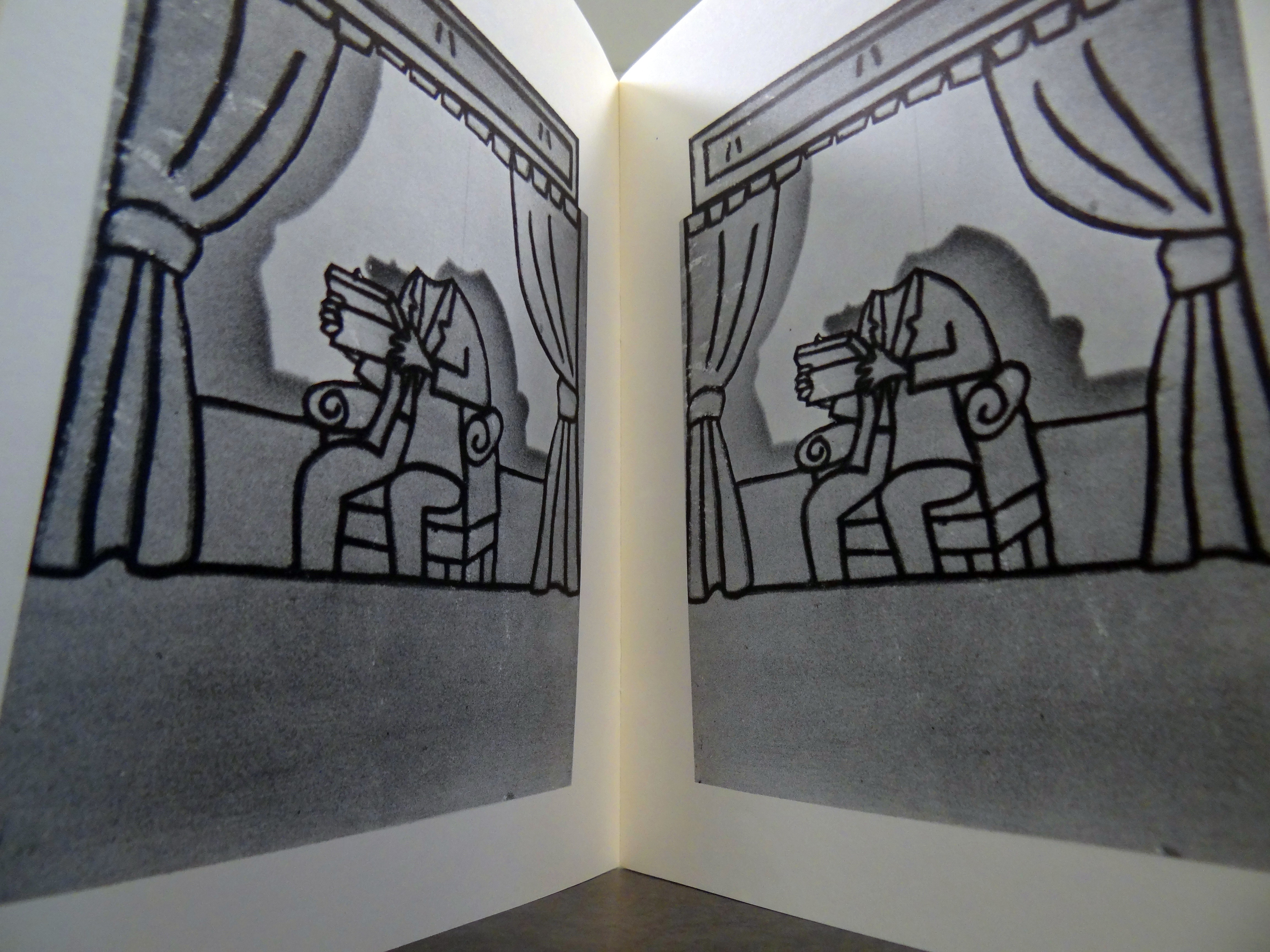
Ida Applebroog’s artists’ books have a way of making you feel slightly uncomfortable without really knowing why. At least that is the effect her small books have on me. My first encounter with them had me feeling generally uncertain, thinking not only “What are these things?” but also “Why are these things?” Even after reading several of her books, I still did not understand exactly what her images represented. I had to read about Applebroog’s books to better understand.
Ida Applebroog “It is my lunch hour”

The Smithsonian American Art/Portrait Gallery Library has a dozen of Applebroog’s artists’ books in the collection. Applebroog self-published her series of cheap, black and white books in the 1970s.  They were printed in large runs of 400-500, though the idea behind each book originated from a unique art work in which she drew on and cut vellum panels of images and text. Applebroog mailed her books to friends, acquaintances and to other artists whose work she admired. In the 1960s and 70s, mail art, performance art and artists’ books were all becoming more popular means of creating and sharing art, and Applebroog took elements from each and combined them in her works. She has said she received a lot of hate mail from her books, and just as many people asking her to stop sending them as others requesting to be added to her mailing list.

Most consist of just a few pages stapled together, with the same simple cartoon-like image repeated several times, sometimes interspersed with inexplicable blank pages, sometimes with just a few words. They resemble flip books or film stills initially, but it is difficult to determine which part of the story is being portrayed. She gave each book the subtitle of “A Performance,” lending to the sense that the characters in her images were acting.

Applebroog’s “It doesn’t sound right”

For example, the book “It Doesn’t Sound Right” shows a woman standing by a bed hugging herself, framed by a picture window. This image repeats nine times, interrupted on one page with the sentence “she says ‘YOU ARE KILLING ME’” and then again with “it doesn’t sound right” followed a few pages later by the final sentence in bold capital letters “NOBODY EVER DIES OF IT”. Who is “she” and which part doesn’t sound right, and nobody ever dies of what?!?

The window frame puts the reader in the position of voyeur, looking into a woman’s bedroom, but we don’t know who is talking or whom they are addressing. The stage feels like a hospital setting, but I realize that I may only be interpreting it as such after reading the last sentence. The images, though they are the same throughout each book, seem to take on new meaning after reading Applebroog’s inserted phrases.

Applebroog's "It doesn't sound right"

Applebroog’s “It doesn’t sound right”

Applebroog’s “Say Something”

Another example is “Say Something” in which a couple, a headless man and a nude woman, crouch on the floor, seen through a similar window frame. The image repeats over the pages of the book, broken up first by the question “Don’t you want me?” and later “Say something”. Characteristic of Ida Applebroog’s artists’ books, what the couple is doing is unclear and the narrator is again unknown.

And like so many of the artist’s other works, the action and words seem to fit perfectly, if uncomfortably, together.________________________________

Biography « previous artist | next artist »
Ida Applebroog was born in the Bronx, New York in 1929, and lives and works in New York. She attended the School of the Art Institute of Chicago and received an honorary doctorate from New School University/Parsons School of Design. Applebroog has been making pointed social commentary in the form of beguiling comic-like images for nearly half a century. She has developed an instantly recognizable style of simplified human forms with bold outlines. Anonymous ‘everyman’ figures, anthropomorphized animals, and half human-half creature characters are featured players in the uncanny theater of her work. Applebroog propels her paintings and drawings into the realm of installation by arranging and stacking canvases in space, exploding the frame-by-frame logic of comic-book and film narrative into three-dimensional environments. In her most characteristic work, she combines popular imagery from everyday urban and domestic scenes, sometimes paired with curt texts, to skew otherwise banal images into anxious scenarios infused with a sense of irony and black humor. Strong themes in her work include gender and sexual identity, power struggles both political and personal, and the pernicious role of mass media in desensitizing the public to violence. In addition to paintings, Applebroog has also created sculptures; artist’s books; several films (including a collaboration with her daughter, the artist Beth B); and animated shorts that appeared on the side of a moving truck and on a giant screen in Times Square. Applebroog has received many awards, including a John D. and Catherine T. MacArthur Foundation Achievement Award and a Lifetime Achievement Award from the College Art Association. Her work has been shown in many one-person exhibitions in the United States and abroad, including the Corcoran Gallery of Art, Washington, DC; Whitney Museum of American Art, New York; the Contemporary Arts Museum, Houston; and the High Museum of Art, Atlanta, among others.For additional biographic & bibliographic information:
Ida Applebroog’s Web Site  |  Hauser & Wirth
Ida Applebroog on the Art21 blog

_________

Ida Applebroog has said, “I do a lot of work on murders, and rapes and age-ism and sexism and AIDS and child abuse. I live in this world. This is what is going on around me and I can’t change that.”

Ida can not change the world around her but she can understand why there is evil in the world today because the Bible tells us why.

Many have asked during this tough time: How can a good God allow evil and suffering?

Their thinking is that either God is not powerful enough to prevent evil or else God is not good. He is often blamed for tragedy. “Where was God when I went through this, or when that happened.”  God is blamed for natural disasters, Even my insurance company describes them as “acts of God.” How to handle this one-  (O.N.E.) a. Origin of evil— man’s choice- God created a perfect world… b. Nature of God—He forgives, I John 1:9—He uses tragedy to bring us to Himself, C.S. Lewis, “God whispers to us in our pleasures, speaks in our conscience, but shouts in our pains:  it is His megaphone to arouse a deaf world.” c. End of it all—Bible teaches that God will one day put an end to all evil, and pain and death. “God will wipe away every tear from their eyes; there shall be no more death, nor sorrow, nor crying.  There shall be no more pain, for the former things have passed away” (Rev. 21:4).As Christians we have this hope of Heaven and eternity. Share how it has made a tremendous difference in your life and that you know for sure that when you die you are going to spend eternity in Heaven. Ask the person, “May I ask you a question? Do you have this hope? Do you know for certain that when you die you are going to Heaven, or is that something you would say you’re still working on?”How could a loving God send people to Hell? (O.N.E.) a. Origin of hell—never intended for people. Created for Satan and his demons. Jesus said, “Depart from Me, you cursed, into everlasting fire prepared for the devil and his angels” (Matt 25:41). Man chooses to sin and ignore God. The penalty is death (eternal separation from God) and, yes, Hell. But God doesn’t send anyone to Hell, we choose it by refusing or ignoring God in attitude and action. b. Nature of God—“ God is not willing that any should perish, but that all should come to repentance” (2 Peter 3:9). He is so loving that He sent His own Son to die and pay the penalty for our sin so that we could avoid Hell and have the assurance of Heaven. No one in Hell will be able to blame God. He doesn’t send people there, it’s our own choice. We must choose to repent, to stop ignoring God in attitude and action, accepting His salvation and yielding to His leadership.c. End of it all—Bible teaches that God will one day put an end to all evil, pain, death, and penalty of Hell. “God will wipe away every tear from their eyes; there shall be no more death, nor sorrow, nor crying.  There shall be no more pain, for the former things have passed away” (Rev. 21:4).As Christians , we need not worry about Hell. The Bible says, “these things have been written . . . so that you may know you have eternal life” (1 John 5:13).  I have complete confidence that when I die, I’m going to Heaven.  May I ask you a question?___________________________-
____________

WOODY WEDNESDAY Review of Woody Allen’s latest movie “Blue Jasmine” Part 20


I have spent alot of time talking about Woody Allen films on this blog and looking at his worldview. He has a hopelessmeaningless, nihilistic worldview that believes we are going to turn to dust and there is no afterlife. Even though he has this view he has taken the opportunity to look at the weaknesses of his own secular view. I salute him for doing that. That is why I have returned to his work over and over and presented my own Christian worldview as an alternative.

My interest in Woody Allen is so great that I have a “Woody Wednesday” on my blog www.thedailyhatch.org every week. Also I have done over 30 posts on the historical characters mentioned in his film “Midnight in Paris.” (Salvador Dali, Ernest Hemingway,T.S.Elliot,  Cole Porter,Paul Gauguin,  Luis Bunuel, and Pablo Picasso were just a few of the characters.)

Today we are looking at a review of Woody Allen’s latest movie Blue Jasmine.

CATE BLANCHETT TALKS ‘BLUE JASMINE’

Published on Jul 23, 2013

Cate Blanchett talks about her role as a woman in crisis, in Woody Allen’s latest film Blue Jasmine (July 23)

___________________________

_____________

Review: A compelling ‘Blue Jasmine’

By Charlie McCollum

cmccollum@mercurynews.com

POSTED:   07/29/2013 03:00:00 PM PDT | UPDATED:   ABOUT 8 HOURS AGO

Woody Allen’s last few films have been romantic comedies set in such picturesque locales as Paris and Rome. Now with his new film, “Blue Jasmine,” Allen is back in the United States (San Francisco and New York specifically), and romantic comedy is the furthest thing from his mind.

When we first meet Jasmine French (Cate Blanchett), she is on flight to SFO, ensconced in first class, chatting merrily with the older woman sitting next to her, having a cocktail and looking every inch the fashionable, wealthy Manhattanite.

It is not until she gets to her destination that this picture of a woman of the One Percent starts to dissolve. Her seatmate (Bay Area theater veteran Joy Carlin) has no idea who Jasmine is and

is dismissive of her chatter. When her monogrammed luggage comes up on the carousel, she initially has no idea what to do with it — as if waiting for a limo driver to suddenly appear and handle everything.

She arrives at her sister’s “house” in San Francisco, only to discover it is a nondescript apartment building in the Mission. Standing alone on the sidewalk, Jasmine looks completely lost and more than a bit frightened.

“Where am I, exactly?” Jasmine asks plaintively at one point.

And thus begins the story of Jasmine, a morality play of fractured trickle-down economics that explores, often brilliantly, the worlds of haves and have-nots and what happens when the elite find that their status can be transitory. Allen’s best movie in some years and certainly his finest drama with comedy since 2005’s “Match Point,” it is a tale of wealth, greed and corruption — and the shock waves that occur when crimes lead to punishment.

Certainly, Jasmine’s story is a familiar one inspired by our modern times, a spin on the story of Bernie Madoff and, more specifically, on the story of Madoff’s wife, Ruth. Jasmine’s husband Hal (a pitch-perfect Alec Baldwin) is an investment king whose world is made up of pyramid schemes and offshore accounts. He is a charming man but also a soulless human being who, when Jasmine’s working-class sister Ginger (Sally Hawkins) and brother-in-law Augie (a very effective Andrew Dice Clay) hit the lottery, bilks them of their money. That he also cheats on Jasmine with regularity plays a part in the tale.

When the government catches on to Hal’s schemes, he’s off to jail — and his (and Jasmine’s) money is seized by the feds. She has to give up the Manhattan apartment and the house in the Hamptons and (horrors of horrors) move to Brooklyn. Soon, she’s down to the designer clothes on her back and those monogrammed suitcases. She’s popping Xanax, living on Stoli vodka and wondering where all her socialite friends have gone.

Eventually,

the state of affairs drives her to San Francisco and her sister’s apartment, which Jasmine finds unappealing. The good-hearted Ginger (Hawkins plays the role beautifully) loves Jasmine but is appalled by her excesses. Their verbal battle over why Jasmine flew first class when she has no money is a priceless bit of writing.

Not that Ginger doesn’t have problems of her own. In the wake of Hal losing their money, Augie has split, and Ginger is now spending time with the hunky but quick-tempered mechanic Chili (the always-watchable Bobby Cannavale).

For a time, though, Ginger and Jasmine have a bit of happiness. Jasmine gets a taste of her old life back when she goes to a party in Marin and meets a diplomat (Peter Sarsgaard) who thinks she would be the perfect wife for his career. Ginger meets a seemingly sweet salesman (Louis C.K.).

Allen’s writing and direction is sharp, thoughtful and emotionally charged — although Bay Area audiences may be disappointed that the ability he has shown to capture a sense of place isn’t in evidence when it comes to San Francisco. Much of the film (in flashback) is set in New York, and the local scenes really could have been set in any major city.

The heart and soul of “Blue Jasmine” is Blanchett, who has done some extraordinary acting in film (an Oscar for 2004’s “The Aviator”) and on stage. (In 2009, she did a critically acclaimed turn as Blanche in “A Streetcar Named Desire” — a role that has a lot in common with Jasmine.) But this is her finest piece of work, and she makes the often dislikable Jasmine into a compelling, complex character whose grand delusions are eventually her downfall. Her ability to portray both Jasmine’s high moments and her low points makes for an extraordinary character study.

In lesser hands, the final scenes of “Blue Jasmine” might have gone for redemption and the possibility of a better future. Instead, it comes down to one last wrenching moment, one last bit of extraordinary acting by Blanchett.

For this former princess of the One Percent, a happy ending is elusive.

For film news and more, follow Charlie McCollum at Twitter.com/charlie_mccollu.

‘BLUE JASMINE’

* * * 1/2

Rating: PG-13 (for thematic material, language and sexual content)
Cast: Cate Blanchett, Alec Baldwin, Sally Hawkins and Bobby Cannavale
Director: Woody Allen
Running time: 1 hour, 38 minutes

Related posts:

I love the movie “Midnight in Paris” by Woody Allen and I have done over 30 posts on the historical characters mentioned in the film. Take a look below:

“Midnight in Paris” one of Woody Allen’s biggest movie hits in recent years, July 18, 2011 – 6:00 am

(Part 32, Jean-Paul Sartre)July 10, 2011 – 5:53 am

 (Part 29, Pablo Picasso) July 7, 2011 – 4:33 am

(Part 28,Van Gogh) July 6, 2011 – 4:03 am

(Part 27, Man Ray) July 5, 2011 – 4:49 am

(Part 26,James Joyce) July 4, 2011 – 5:55 am

(Part 25, T.S.Elliot) July 3, 2011 – 4:46 am

(Part 24, Djuna Barnes) July 2, 2011 – 7:28 am

(Part 23,Adriana, fictional mistress of Picasso) July 1, 2011 – 12:28 am

(Part 22, Silvia Beach and the Shakespeare and Company Bookstore) June 30, 2011 – 12:58 am

(Part 21,Versailles and the French Revolution) June 29, 2011 – 5:34 am

(Part 16, Josephine Baker) June 24, 2011 – 5:18 am

(Part 15, Luis Bunuel) June 23, 2011 – 5:37 am

(Part 1 William Faulkner) June 13, 2011 – 3:19 pm

I love Woody Allen’s latest movie “Midnight in Paris”, June 12, 2011 – 11:52 pm

Review of Woody Allen’s latest movie “Blue Jasmine” Part 6

Review of Woody Allen’s latest movie “Blue Jasmine” Part 6 I have spent alot of time talking about Woody Allen films on this blog and looking at his worldview. He has a hopeless, meaningless, nihilistic worldview that believes we are going to turn to dust and there is no afterlife. Even though he has this view he […]

Review of Woody Allen’s latest movie “Blue Jasmine” Part 5

Review of Woody Allen’s latest movie “Blue Jasmine” Part 5 I have spent alot of time talking about Woody Allen films on this blog and looking at his worldview. He has a hopeless, meaningless, nihilistic worldview that believes we are going to turn to dust and there is no afterlife. Even though he has this view he […]

Review of Woody Allen’s latest movie “Blue Jasmine” Part 4

Review of Woody Allen’s latest movie “Blue Jasmine” Part 4 I have spent alot of time talking about Woody Allen films on this blog and looking at his worldview. He has a hopeless, meaningless, nihilistic worldview that believes we are going to turn to dust and there is no afterlife. Even though he has this view he […]

Blue Jasmine has huge opening for Woody Allen film but I doubt it will top “Midnight in Paris” overall performance!!!!!!

Blue Jasmine — Movie Review Published on Jul 25, 2013 Blue Jasmine directed by Woody Allen and starring Cate Blanchett , Alex Baldwin, and Louis C.K. is reviewed by Ben Mankiewicz (host of Turner Classic Movies), Grae Drake (Senior Editor of Rotten Tomatoes), Alonso Duralde (TheWrap.com and Linoleum Knife podcast) and Christy Lemire (Movie critic). ___________________ […]

Review of Woody Allen’s latest movie “Blue Jasmine” Part 3

Review of Woody Allen’s latest movie “Blue Jasmine” Part 3 I have spent alot of time talking about Woody Allen films on this blog and looking at his worldview. He has a hopeless, meaningless, nihilistic worldview that believes we are going to turn to dust and there is no afterlife. Even though he has this view he […]

Review of Woody Allen’s latest movie “Blue Jasmine” Part 2

I have spent alot of time talking about Woody Allen films on this blog and looking at his worldview. He has a hopeless, meaningless, nihilistic worldview that believes we are going to turn to dust and there is no afterlife. Even though he has this view he has taken the opportunity to look at the weaknesses of […]

Review of Woody Allen’s latest movie “Blue Jasmine” Part 1

Review of Woody Allen’s latest movie “Blue Jasmine” Part 1 I have spent alot of time talking about Woody Allen films on this blog and looking at his worldview. He has a hopeless, meaningless, nihilistic worldview that believes we are going to turn to dust and there is no afterlife. Even though he has this view he […]


“Woody Wednesday” A 2010 review of Woody Allen’s Annie Hall

I have spent alot of time talking about Woody Allen films on this blog and looking at his worldview. He has a hopeless, meaningless, nihilistic worldview that believes we are going to turn to dust and there is no afterlife. Even though he has this view he has taken the opportunity to look at the weaknesses of […]

“Woody Wednesday” In 2009 interview Woody Allen talks about the lack of meaning of life and the allure of younger women

I have spent alot of time talking about Woody Allen films on this blog and looking at his worldview. He has a hopeless, meaningless, nihilistic worldview that believes we are going to turn to dust and there is no afterlife. Even though he has this view he has taken the opportunity to look at the weaknesses of […]

Woody Allen video interview in France talk about making movies in Paris vs NY and other subjects like God, etc

Woody Allen video interview in France Related posts: “Woody Wednesdays” Woody Allen on God and Death June 6, 2012 – 6:00 am Good website on Woody Allen How can I believe in God when just last week I got my tongue caught in the roller of an electric typewriter? If Jesus Christ came back today and […]

“Woody Wednesday” Woody Allen on the Emptiness of Life by Toby Simmons

I have spent alot of time talking about Woody Allen films on this blog and looking at his worldview. He has a hopeless, meaningless, nihilistic worldview that believes we are going to turn to dust and there is no afterlife. Even though he has this view he has taken the opportunity to look at the weaknesses of […]

Woody Allen interviews Billy Graham (Woody Wednesday)

A surprisingly civil discussion between evangelical Billy Graham and agnostic comedian Woody Allen. Skip to 2:00 in the video to hear Graham discuss premarital sex, to 4:30 to hear him respond to Allen’s question about the worst sin and to 7:55 for the comparison between accepting Christ and taking LSD. ___________________ The Christian Post > […]

“Woody Allen Wednesdays” can be seen on the www.thedailyhatch.org

Crimes and Misdemeanors: A Discussion: Part 1 If you like Woody Allen films as much as I do then join me every Wednesday for another look the man and his movies. Below are some of the posts from the past: “Woody Wednesday” How Allen’s film “Crimes and Misdemeanors makes the point that hell is necessary […]

“Woody Wednesday” Great Documentary on Woody Allen

I really enjoyed this documentary on Woody Allen from PBS. Woody Allen: A Documentary, Part 1 Published on Mar 26, 2012 by NewVideoDigital Beginning with Allen’s childhood and his first professional gigs as a teen – furnishing jokes for comics and publicists – WOODY ALLEN: A DOCUMENTARY chronicles the trajectory and longevity of Allen’s career: […]

“Woody Wednesday” Discussion of Woody Allen’s 1989 movie “Crimes and Misdemeanors” (Part 6)

Crimes and Misdemeanors: A Discussion: Part 3 Uploaded by camdiscussion on Sep 23, 2007 Part 3 of 3: ‘Is Woody Allen A Romantic Or A Realist?’ A discussion of Woody Allen’s 1989 movie, Crimes and Misdemeanors, perhaps his finest. By Anton Scamvougeras. http://camdiscussion.blogspot.com/ antons@mail.ubc.ca ______________ One of my favorite Woody Allen movies and I reviewed […]

“Woody Wednesday” Discussion of Woody Allen’s 1989 movie “Crimes and Misdemeanors” (Part 5)

Crimes and Misdemeanors: A Discussion: Part 2 Uploaded by camdiscussion on Sep 23, 2007 Part 2 of 3: ‘What Does The Movie Tell Us About Ourselves?’ A discussion of Woody Allen’s 1989 movie, perhaps his finest. By Anton Scamvougeras. http://camdiscussion.blogspot.com/ antons@mail.ubc.ca _________________- One of my favorite Woody Allen movies and I reviewed it earlier but […]

In 2009 interview Woody Allen talks about the lack of meaning of life and the allure of younger women

I have spent alot of time talking about Woody Allen films on this blog and looking at his worldview. He has a hopeless, meaningless, nihilistic worldview that believes we are going to turn to dust and there is no afterlife. Even though he has this view he has taken the opportunity to look at the weaknesses of […]

“Woody Allen Wednesdays” can be seen on the www.thedailyhatch.org

Crimes and Misdemeanors: A Discussion: Part 1 If you like Woody Allen films as much as I do then join me every Wednesday for another look the man and his movies. Below are some of the posts from the past: “Woody Wednesday” How Allen’s film “Crimes and Misdemeanors makes the point that hell is necessary […]

Woody Allen on the Emptiness of Life by Toby Simmons

I have spent alot of time talking about Woody Allen films on this blog and looking at his worldview. He has a hopeless, meaningless, nihilistic worldview that believes we are going to turn to dust and there is no afterlife. Even though he has this view he has taken the opportunity to look at the weaknesses of […]

“Woody Wednesday” Discussion of Woody Allen’s 1989 movie “Crimes and Misdemeanors” (Part 4)

Crimes and Misdemeanors: A Discussion: Part 1 Uploaded by camdiscussion on Sep 23, 2007 Part 1 of 3: ‘What Does Judah Believe?’ A discussion of Woody Allen’s 1989 movie, perhaps his finest. By Anton Scamvougeras. http://camdiscussion.blogspot.com/ antons@mail.ubc.ca _____________ One of my favorite films is this gem by Woody Allen “Crimes and Misdemeanors”: Film Review By […]

“Woody Wednesday” Discussion of Woody Allen’s 1989 movie “Crimes and Misdemeanors” (Part 3)

Crimes and Misdemeanors: A Discussion: Part 3 Uploaded by camdiscussion on Sep 23, 2007 Part 3 of 3: ‘Is Woody Allen A Romantic Or A Realist?’ A discussion of Woody Allen’s 1989 movie, Crimes and Misdemeanors, perhaps his finest. By Anton Scamvougeras. http://camdiscussion.blogspot.com/ antons@mail.ubc.ca ______________ One of my favorite Woody Allen movies and I reviewed […]

“Woody Wednesday” Discussion of Woody Allen’s 1989 movie “Crimes and Misdemeanors” (Part 2)

Crimes and Misdemeanors: A Discussion: Part 2 Uploaded by camdiscussion on Sep 23, 2007 Part 2 of 3: ‘What Does The Movie Tell Us About Ourselves?’ A discussion of Woody Allen’s 1989 movie, perhaps his finest. By Anton Scamvougeras. http://camdiscussion.blogspot.com/ antons@mail.ubc.ca _________________- One of my favorite Woody Allen movies and I reviewed it earlier but […]

“Woody Wednesday” Discussion of Woody Allen’s 1989 movie “Crimes and Misdemeanors” (Part 1)

Crimes and Misdemeanors: A Discussion: Part 1 Uploaded by camdiscussion on Sep 23, 2007 Part 1 of 3: ‘What Does Judah Believe?’ A discussion of Woody Allen’s 1989 movie, perhaps his finest. By Anton Scamvougeras. http://camdiscussion.blogspot.com/ antons@mail.ubc.ca _____________ Today I am starting a discusssion of the movie “Crimes and Misdemeanors” by Woody Allen. This 1989 […]

By Everette Hatcher III | Posted in Current Events | Edit | Comments (0)

WOODY WEDNESDAY Review of Woody Allen’s latest movie “Blue Jasmine” Part 19

Review of Woody Allen’s latest movie “Blue Jasmine” Part 19

I have spent alot of time talking about Woody Allen films on this blog and looking at his worldview. He has a hopelessmeaningless, nihilistic worldview that believes we are going to turn to dust and there is no afterlife. Even though he has this view he has taken the opportunity to look at the weaknesses of his own secular view. I salute him for doing that. That is why I have returned to his work over and over and presented my own Christian worldview as an alternative.

My interest in Woody Allen is so great that I have a “Woody Wednesday” on my blog www.thedailyhatch.org every week. Also I have done over 30 posts on the historical characters mentioned in his film “Midnight in Paris.” (Salvador Dali, Ernest Hemingway,T.S.Elliot,  Cole Porter,Paul Gauguin,  Luis Bunuel, and Pablo Picasso were just a few of the characters.)

Today we are looking at a review of Woody Allen’s latest movie Blue Jasmine.

Richard Roeper’s Reviews : Blue Jasmine Review

__________________


__________________

Review: Blue Jasmine

This review was originally published in my column at Towleroad

Cate Blanchett can’t shut up in Blue Jasmine, Woody Allen’s latest dramedy which added more cities this weekend for its platform rollout. We join Jasmine (real name “Jeanette”) in medias res on a flight to San Francisco as she’s chattering away with, no, at an older companion. She goes on and on (and on some more!) about her love affair with her husband Hal (Alec Baldwin) all the way through to baggage claim.

But Jasmine is a liar or at least a half truth-teller. We will immediately discover that her great love affair ended in ruin. Hal was a criminal, a financial con artist who pampered Jasmine with other people’s fortunes and ruined everyone including Jasmine. She’s moving in with her estranged adopted sister Ginger (Sally Hawkins), also ruined by Hal’s crimes, now that she’s destitute. Jasmine hasn’t adjusted to her new facts, though, treating her cabbie from the airport like a personal chauffeur, and leaving him a big tip considering she’s supposed to be penniless.Jasmine isn’t always “in the now” as it were. She never is actually, talking or bragging or obsessing over the past. [More…]

Jasmine & Ginger hit a party

When she’s not downing xanax like breath mints she’s dreaming of the future which looks suspiciously like the past with socioeconomic status restored and rich husband (albeit a new one) to care for her. Once Jasmine is living with Ginger, and bristling at her sister’s low class digs (pretty spacious and nice for a check-out girl’s salary!) and her unsophisticated boyfriend Chili (Bobby Cannavale), the mashup of A Streetcar Named Desire and the Bernie Madoff scandal becomes apparent.

Woody is a smart enough screenwriter to avoid direct this equals that correlations, though. A Streetcar Named Desire is untouchable and the basic template is a solid enough melody to riff jazzily on. Cannavale, for instance, has the “Stanley Kowalski” macho-crybaby role minus the danger. The “Mitch” role has a few suitors but none of them ever quite work. As for Blanchett’s own “Blanche”, well Jasmine’s fall is less innocent and poetic but she’s no less of a mess than that Southern Belle once she hits bottom.

If your protagonist is going to babble incessantly for 98 minutes –as Jasmine does, to herself and to others — you can’t do much better than casting Cate Blanchett. Her voice has always been her greatest asset as a star actress, full of affect, sure (and that suits Jasmine who is always putting on airs), but melodious and extremely flexible to character. Her chords can hit you with delicate tremors of feeling or tectonic shifts in tone that level whole scenes.The cacophony of her chatter peaks with hilariously inappropriate life-lessons for her dumbfounded nephews:

“There’s only so much trauma a person can withstand before they take to the streets and start screaming.”

But the most inspired beat in her angry self-pitying performance may well be a silent one.[Spoiler Alert] While shopping with her new boyfriend Dwight (Peter Sarsgaard), Jasmine is confronted by a figure from her past who exposes her myriad lies and mentions her son Danny (Alden Ehrenreich) whom she has conveniently denied existed. Blanchett goes dead silent for a moment in the space where she’d usually be lying, lost not in the humiliation of exposure — she doesn’t even seem to register Dwight’s outrage –but shocked into temporary bracing present tense reality. [/Spoiler]

Blue Jasmine is fleet and vivid at 98 minutes and funny, too, despite its tragic nature. Yet it’s also in some ineffable way kind of blurry, a half success which never quite comes into focus or shakes off its duller sideshow impulses. It hasn’t worked out what to do with Ginger, underusing the excellent Sally Hawkins by saddling her with both reductive Hollywood tropes (As in Titanic and many other films “the poor” are exotically adaptable creatures, freer and happier than the upper-classes) and with a half-hearted subplot with Louis CK that never truly connects to the movie. The pressing question the movie fails to answer: If Ginger is a convenience and crutch for Jasmine, what exactly is Jasmine to Ginger? Hannah and Her Sisters is probably untoppable in this regard but couldn’t the sibling relationship be clearer?

The problem may be that the movie has ceded all of itself to Hurricane Blanchett who doesn’t share the scenes so much as spin madly at their center (less a flaw of performance than the nature of Jasmine’s psychology). Just days later it’s difficult to recall individual moments, not because they’re repetitive (less a flaw of filmmaking than the nature of Jasmine’s psychology) but because the past keeps intruding on the present and entirely overwhelming it.

In some troubling way, Blue Jasmine begins as a bastard progeny of Streetcar but morphs into a sour sibling of Midnight in Paris. Woody Allen, like Jasmine, may well be lost in conversation with himself now. Gil in Midnight in Paris managed to see delusional nostalgia for the trap it is and wrestle free, but Jasmine (and maybe Woody?) is weaker, less aware of her own culpability in her ruts and troubles. In the merciless finale, Jasmine only sees the past leaving little hope that she has any kind of future.

Grade: B
WANT MORE BLUE JASMINE? Try the spoilery Podcast
Oscar Chances: It’s the hot topic among awards aficionados at the moment but can this film survive six months of scrutiny? Cate Blanchett has a shot at gold in Best Actress though it’s far too early to declare anything or anyone a lock when 80% of the competitive field is still unseen. If the film does stay alive in conversation (and at the box office a la Midnight in Paris) more nominations are possible starting with Original Screenplay (28% of his screenplays get nominated… though there are weird misses like Vicky Cristina Barcelona even when people like the film) and ending with longshots in both Supporting Actress and Picture.

Related posts:

I love the movie “Midnight in Paris” by Woody Allen and I have done over 30 posts on the historical characters mentioned in the film. Take a look below:

“Midnight in Paris” one of Woody Allen’s biggest movie hits in recent years, July 18, 2011 – 6:00 am

(Part 32, Jean-Paul Sartre)July 10, 2011 – 5:53 am

 (Part 29, Pablo Picasso) July 7, 2011 – 4:33 am

(Part 28,Van Gogh) July 6, 2011 – 4:03 am

(Part 27, Man Ray) July 5, 2011 – 4:49 am

(Part 26,James Joyce) July 4, 2011 – 5:55 am

(Part 25, T.S.Elliot) July 3, 2011 – 4:46 am

(Part 24, Djuna Barnes) July 2, 2011 – 7:28 am

(Part 23,Adriana, fictional mistress of Picasso) July 1, 2011 – 12:28 am

(Part 22, Silvia Beach and the Shakespeare and Company Bookstore) June 30, 2011 – 12:58 am

(Part 21,Versailles and the French Revolution) June 29, 2011 – 5:34 am

(Part 16, Josephine Baker) June 24, 2011 – 5:18 am

(Part 15, Luis Bunuel) June 23, 2011 – 5:37 am

(Part 1 William Faulkner) June 13, 2011 – 3:19 pm

I love Woody Allen’s latest movie “Midnight in Paris”, June 12, 2011 – 11:52 pm

Review of Woody Allen’s latest movie “Blue Jasmine” Part 6

Review of Woody Allen’s latest movie “Blue Jasmine” Part 6 I have spent alot of time talking about Woody Allen films on this blog and looking at his worldview. He has a hopeless, meaningless, nihilistic worldview that believes we are going to turn to dust and there is no afterlife. Even though he has this view he […]

Review of Woody Allen’s latest movie “Blue Jasmine” Part 5

Review of Woody Allen’s latest movie “Blue Jasmine” Part 5 I have spent alot of time talking about Woody Allen films on this blog and looking at his worldview. He has a hopeless, meaningless, nihilistic worldview that believes we are going to turn to dust and there is no afterlife. Even though he has this view he […]

Review of Woody Allen’s latest movie “Blue Jasmine” Part 4

Review of Woody Allen’s latest movie “Blue Jasmine” Part 4 I have spent alot of time talking about Woody Allen films on this blog and looking at his worldview. He has a hopeless, meaningless, nihilistic worldview that believes we are going to turn to dust and there is no afterlife. Even though he has this view he […]

Blue Jasmine has huge opening for Woody Allen film but I doubt it will top “Midnight in Paris” overall performance!!!!!!

Blue Jasmine — Movie Review Published on Jul 25, 2013 Blue Jasmine directed by Woody Allen and starring Cate Blanchett , Alex Baldwin, and Louis C.K. is reviewed by Ben Mankiewicz (host of Turner Classic Movies), Grae Drake (Senior Editor of Rotten Tomatoes), Alonso Duralde (TheWrap.com and Linoleum Knife podcast) and Christy Lemire (Movie critic). ___________________ […]

Review of Woody Allen’s latest movie “Blue Jasmine” Part 3

Review of Woody Allen’s latest movie “Blue Jasmine” Part 3 I have spent alot of time talking about Woody Allen films on this blog and looking at his worldview. He has a hopeless, meaningless, nihilistic worldview that believes we are going to turn to dust and there is no afterlife. Even though he has this view he […]

Review of Woody Allen’s latest movie “Blue Jasmine” Part 2

I have spent alot of time talking about Woody Allen films on this blog and looking at his worldview. He has a hopeless, meaningless, nihilistic worldview that believes we are going to turn to dust and there is no afterlife. Even though he has this view he has taken the opportunity to look at the weaknesses of […]

Review of Woody Allen’s latest movie “Blue Jasmine” Part 1

Review of Woody Allen’s latest movie “Blue Jasmine” Part 1 I have spent alot of time talking about Woody Allen films on this blog and looking at his worldview. He has a hopeless, meaningless, nihilistic worldview that believes we are going to turn to dust and there is no afterlife. Even though he has this view he […]


“Woody Wednesday” A 2010 review of Woody Allen’s Annie Hall

I have spent alot of time talking about Woody Allen films on this blog and looking at his worldview. He has a hopeless, meaningless, nihilistic worldview that believes we are going to turn to dust and there is no afterlife. Even though he has this view he has taken the opportunity to look at the weaknesses of […]

“Woody Wednesday” In 2009 interview Woody Allen talks about the lack of meaning of life and the allure of younger women

I have spent alot of time talking about Woody Allen films on this blog and looking at his worldview. He has a hopeless, meaningless, nihilistic worldview that believes we are going to turn to dust and there is no afterlife. Even though he has this view he has taken the opportunity to look at the weaknesses of […]

Woody Allen video interview in France talk about making movies in Paris vs NY and other subjects like God, etc

Woody Allen video interview in France Related posts: “Woody Wednesdays” Woody Allen on God and Death June 6, 2012 – 6:00 am Good website on Woody Allen How can I believe in God when just last week I got my tongue caught in the roller of an electric typewriter? If Jesus Christ came back today and […]

“Woody Wednesday” Woody Allen on the Emptiness of Life by Toby Simmons

I have spent alot of time talking about Woody Allen films on this blog and looking at his worldview. He has a hopeless, meaningless, nihilistic worldview that believes we are going to turn to dust and there is no afterlife. Even though he has this view he has taken the opportunity to look at the weaknesses of […]

Woody Allen interviews Billy Graham (Woody Wednesday)

A surprisingly civil discussion between evangelical Billy Graham and agnostic comedian Woody Allen. Skip to 2:00 in the video to hear Graham discuss premarital sex, to 4:30 to hear him respond to Allen’s question about the worst sin and to 7:55 for the comparison between accepting Christ and taking LSD. ___________________ The Christian Post > […]

“Woody Allen Wednesdays” can be seen on the www.thedailyhatch.org

Crimes and Misdemeanors: A Discussion: Part 1 If you like Woody Allen films as much as I do then join me every Wednesday for another look the man and his movies. Below are some of the posts from the past: “Woody Wednesday” How Allen’s film “Crimes and Misdemeanors makes the point that hell is necessary […]

“Woody Wednesday” Great Documentary on Woody Allen

I really enjoyed this documentary on Woody Allen from PBS. Woody Allen: A Documentary, Part 1 Published on Mar 26, 2012 by NewVideoDigital Beginning with Allen’s childhood and his first professional gigs as a teen – furnishing jokes for comics and publicists – WOODY ALLEN: A DOCUMENTARY chronicles the trajectory and longevity of Allen’s career: […]

“Woody Wednesday” Discussion of Woody Allen’s 1989 movie “Crimes and Misdemeanors” (Part 6)

Crimes and Misdemeanors: A Discussion: Part 3 Uploaded by camdiscussion on Sep 23, 2007 Part 3 of 3: ‘Is Woody Allen A Romantic Or A Realist?’ A discussion of Woody Allen’s 1989 movie, Crimes and Misdemeanors, perhaps his finest. By Anton Scamvougeras. http://camdiscussion.blogspot.com/ antons@mail.ubc.ca ______________ One of my favorite Woody Allen movies and I reviewed […]

“Woody Wednesday” Discussion of Woody Allen’s 1989 movie “Crimes and Misdemeanors” (Part 5)

Crimes and Misdemeanors: A Discussion: Part 2 Uploaded by camdiscussion on Sep 23, 2007 Part 2 of 3: ‘What Does The Movie Tell Us About Ourselves?’ A discussion of Woody Allen’s 1989 movie, perhaps his finest. By Anton Scamvougeras. http://camdiscussion.blogspot.com/ antons@mail.ubc.ca _________________- One of my favorite Woody Allen movies and I reviewed it earlier but […]

In 2009 interview Woody Allen talks about the lack of meaning of life and the allure of younger women

I have spent alot of time talking about Woody Allen films on this blog and looking at his worldview. He has a hopeless, meaningless, nihilistic worldview that believes we are going to turn to dust and there is no afterlife. Even though he has this view he has taken the opportunity to look at the weaknesses of […]

“Woody Allen Wednesdays” can be seen on the www.thedailyhatch.org

Crimes and Misdemeanors: A Discussion: Part 1 If you like Woody Allen films as much as I do then join me every Wednesday for another look the man and his movies. Below are some of the posts from the past: “Woody Wednesday” How Allen’s film “Crimes and Misdemeanors makes the point that hell is necessary […]

Woody Allen on the Emptiness of Life by Toby Simmons

I have spent alot of time talking about Woody Allen films on this blog and looking at his worldview. He has a hopeless, meaningless, nihilistic worldview that believes we are going to turn to dust and there is no afterlife. Even though he has this view he has taken the opportunity to look at the weaknesses of […]

“Woody Wednesday” Discussion of Woody Allen’s 1989 movie “Crimes and Misdemeanors” (Part 4)

Crimes and Misdemeanors: A Discussion: Part 1 Uploaded by camdiscussion on Sep 23, 2007 Part 1 of 3: ‘What Does Judah Believe?’ A discussion of Woody Allen’s 1989 movie, perhaps his finest. By Anton Scamvougeras. http://camdiscussion.blogspot.com/ antons@mail.ubc.ca _____________ One of my favorite films is this gem by Woody Allen “Crimes and Misdemeanors”: Film Review By […]

“Woody Wednesday” Discussion of Woody Allen’s 1989 movie “Crimes and Misdemeanors” (Part 3)

Crimes and Misdemeanors: A Discussion: Part 3 Uploaded by camdiscussion on Sep 23, 2007 Part 3 of 3: ‘Is Woody Allen A Romantic Or A Realist?’ A discussion of Woody Allen’s 1989 movie, Crimes and Misdemeanors, perhaps his finest. By Anton Scamvougeras. http://camdiscussion.blogspot.com/ antons@mail.ubc.ca ______________ One of my favorite Woody Allen movies and I reviewed […]

“Woody Wednesday” Discussion of Woody Allen’s 1989 movie “Crimes and Misdemeanors” (Part 2)

Crimes and Misdemeanors: A Discussion: Part 2 Uploaded by camdiscussion on Sep 23, 2007 Part 2 of 3: ‘What Does The Movie Tell Us About Ourselves?’ A discussion of Woody Allen’s 1989 movie, perhaps his finest. By Anton Scamvougeras. http://camdiscussion.blogspot.com/ antons@mail.ubc.ca _________________- One of my favorite Woody Allen movies and I reviewed it earlier but […]

“Woody Wednesday” Discussion of Woody Allen’s 1989 movie “Crimes and Misdemeanors” (Part 1)

Crimes and Misdemeanors: A Discussion: Part 1 Uploaded by camdiscussion on Sep 23, 2007 Part 1 of 3: ‘What Does Judah Believe?’ A discussion of Woody Allen’s 1989 movie, perhaps his finest. By Anton Scamvougeras. http://camdiscussion.blogspot.com/ antons@mail.ubc.ca _____________ Today I am starting a discusssion of the movie “Crimes and Misdemeanors” by Woody Allen. This 1989 […]

By Everette Hatcher III | Posted in Current Events | Edit | Comments (0)

WOODY WEDNESDAY Review of Woody Allen’s latest movie “Blue Jasmine” Part 18


I have spent alot of time talking about Woody Allen films on this blog and looking at his worldview. He has a hopelessmeaningless, nihilistic worldview that believes we are going to turn to dust and there is no afterlife. Even though he has this view he has taken the opportunity to look at the weaknesses of his own secular view. I salute him for doing that. That is why I have returned to his work over and over and presented my own Christian worldview as an alternative.

My interest in Woody Allen is so great that I have a “Woody Wednesday” on my blog www.thedailyhatch.org every week. Also I have done over 30 posts on the historical characters mentioned in his film “Midnight in Paris.” (Salvador Dali, Ernest Hemingway,T.S.Elliot,  Cole Porter,Paul Gauguin,  Luis Bunuel, and Pablo Picasso were just a few of the characters.)

Today we are looking at a review of Woody Allen’s latest movie Blue Jasmine.

Blue Jasmin Movie Review

Published on Jul 26, 2013

Blue Jasmine (2013) movie review. Starring Cate Blanchett, Alec Baldwin and Sally Hawkins. Directed by Woody Allen. A woman reconnects with her sister after a mid-life crisis.

__________________________

____________

‘Blue Jasmine’: Woody Allen on regrets – He’s had a few

Ahead of the release of his new movie, ‘Blue Jasmine,’ Woody Allen ponders choices made and their consequences, in his characters’ lives and his own.

Woody Allen on regret: Yes, he's had a few

“I never trust people who say, ‘I have no regrets. If I lived my life again, I’d do it exactly the same way,’ said filmmaker Woody Allen, 77. “I wouldn’t.” (Carolyn Cole / Los Angeles Times)

NEW YORK — Does Woody Allen have regrets?

His new film, “Blue Jasmine,” amplifies the air of concentrated self-examination that has long been a hallmark of his work. Though marked by buoyant moments of wry humor, the film is devastating in its intense survey of a life in the free fall of mental and emotional collapse. Cate Blanchett gives a tour-de-force performance as a wealthy New Yorker who discovers that her husband has built their fortune through fraud. After losing everything, she winds up with her decidedly more downscale sister in San Francisco, left to sift through the remains of her life.

Opening July 26, “Blue Jasmine” finds Allen further exploring a thematic conceit that has been percolating through his recent movies since at least the dual stories of 2005’s “Melinda and Melinda,” as in film after film he has been pondering a series of existential what-ifs.

PHOTOS: The many movies of Woody Allen

In 2010’s “You Will Meet a Tall Dark Stranger,” Josh Brolin played an unhappily married man who became obsessed with what his life would be like with a woman in the apartment across the way. In the 2011 smash hit “Midnight In Paris” — for which Allen won the Oscar for original screenplay, his fourth — Owen Wilson stepped from modern day into the Jazz Age, imagining it as better than his own time. In “To Rome With Love,” Alec Baldwin played a man who seems to meet a younger version of himself in Jesse Eisenberg.

Whether in a comedic or dramatic mode, these films are all structured around a reflective, ruminative mood, as if Allen has been looking back on his celebrated, knotty life and examining the forks in the road.

“I would say, I’ve lived 77 years now, and there have been things in my life that I regret that if I could do over, I would do different,” Allen said in a recent interview that found him in a warm mood on a cold, late-spring afternoon. “Many things that I think with the perspective of having done them and having time that I would do differently. Maybe even choice of profession. Many things.

“But I think if you ask anybody that’s honest about it, there has to be a number of choices they’ve made in their life that they wished they’d made the other choice. They wished they had bought the house or didn’t buy the house, or didn’t marry the girl or did. So I have plenty of regrets. And I never trust people who say, ‘I have no regrets. If I lived my life again, I’d do it exactly the same way.’ I wouldn’t.”

Allen has worked for nearly 40 years in a modest suite of rooms on the ground floor of the type of politely upscale Upper East Side apartment building many know only from Woody Allen movies.

PHOTOS: Hollywood backlot moments

Off a bustling thoroughfare, past two doormen and down a tastefully appointed hallway, one finds a nondescript door with a small, unremarkable sign. Through that door is a rather cramped anteroom filled with cardboard boxes and a second, slightly shabbier door. Through there is a cluttered workroom with doors leading off in various directions. Somewhere behind there is Woody Allen. He is looking for a cough drop.

It is in this former bridge club that Allen casts his films and edits them, seeing to the unglamorous workaday details of moviemaking. He recalled when he once visited the offices of Martin Scorsese, just a few blocks away, “You would have thought that it was the law firm of Scorsese and John Foster Dulles” by comparison with his own “sleazy little operation.” He is quick to add, “I really don’t need anything more.”

Allen has maintained a startling work rate, making in essence one film a year for going on 35 years. At times it can be frustrating to keep up with his output, and there can be something haphazard about his prolificacy. This may be why “You Will Meet a Tall Dark Stranger” struggles to make $3 million in the U.S. one year and “Midnight in Paris” brings in nearly $57 million the next.

Allen’s relentless pace, his craftsman’s regularity rob his films of the event feeling a new work by a Scorsese or Spielberg are often met with, as if he is purposefully trying to lower expectations. Films that seem undercooked on first glance gain resonance over time, while other films lose their initial impact. Though never to be counted out entirely, Allen makes it easy to overlook any single film for the ongoing rush. In a way, it can be as if he doesn’t entirely get them all either.

“I don’t know why they like one and not another,” he said of the surprise audience response to “Midnight” compared with his other recent films. “If I could figure it out, I might be able to get rich.”

“Blue Jasmine” is, by Allen’s own speculation, less likely to find such a broad audience due to its serious, dramatic nature. The film’s structure finds Blanchett’s character reflecting upon moments from her past, looking for clues to her own downfall, creating a deep emotional resonance. She gives in some sense two performances, one as the fine society lady and the other as someone at moments akin to a babbling street crazy in a Chanel jacket.

PHOTOS: Celebrities by The Times

The film also has Allen’s typical deep bench of supporting performers, with strong turns by Baldwin, Sally Hawkins, Peter Sarsgaard, Bobby Cannavale, Louis C.K. and Andrew Dice Clay. No character is quite as they first seem, some revealing themselves to be deeper and more emotionally sensitive while others turn out shallow and self-serving.

The in-built joke of casting the rough-hewn Clay in a heady Woody Allen film, and in a pivotal, dramatic role no less, was certainly not lost on the actor. Clay recalled that when his manager first let him know Allen had reached out, his response was, “Woody Allen’s calling for me? That’s the last guy I ever thought would call for me. I thought it was like an April Fool’s joke.”

The film will likely draw comparisons to the story of Ruth Madoff, wife of disgraced financier Bernard Madoff. Though Allen downplays the connection, Blanchett did do some research into their story, as well as other society doyens deposed by the economic collapse.

“I followed that story in the paper like everyone else, but it was not an influence in any way on the movie,” Allen said of the Madoff story, while noting that he was inspired by something his wife, Soon-Yi Previn, told him of a high-society woman who had to take a job after losing her wealth.

Perhaps what drew him to the idea was an opportunity to look at the all-too-human weakness for self-delusion, the ways in which we all often have to convince ourselves of lies big and small to make it through the day and press on with our lives.

Though the two never did have a conversation regarding the big ideas of the film, Blanchett picked up a clue from an off-the-cuff comment by Allen.

On the phone from Sydney, Australia, where she has been appearing onstage in Jean Genet’s “The Maids,” Blanchett recalled, “He wouldn’t even remember saying it, but he said something along the lines of, ‘We all know the same truth, and that our lives consist of how we choose to distort it.'”

Allen prefers not to think of his work as some sort of veiled autobiography or a series of extended notes on the human condition. Perhaps belying his roots as a teenage joke-writer and early work as a nightclub comedian, he sees his goals as far more modest.

“I’m thinking of entertaining,” he says of what motivates his writing. “That I feel is my first obligation. Then, if you can also say something, make a statement or elucidate a character or create emotions in people where they’re sad or laughing, that’s all extra. But to make a social point or a psychological point without being entertaining is homework. That’s lecturing.”

PHOTOS: The many movies of Woody Allen

While his recent films have seen him traipsing across Europe, shooting in London, Barcelona, Paris and Rome – and he has just begun production on a film in the South of France – Allen saw “Blue Jasmine” as a distinctly American story. New York was an obvious location for a film touching on a financial scandal, but his choice of San Francisco as the film’s second location, home to the character of Blanchett’s sister played by Hawkins, came down to where he thought he could spend a comfortable summer.

“Her sister could have lived anyplace and it would have been fine. I couldn’t live anyplace, that was the problem,” he said.

Allen is notoriously hands-off as a director, with apocryphal stories of his meeting performers for only a few minutes during casting and then barely speaking to them during production. Yet having directed six Oscar-winning performances, he must be doing something right. As far as his leading lady, he said, “I mean, she’s Cate Blanchett, what can you do? You hire her and get out of the way.”

Though he is prone to referencing old-guard art house stalwarts such as Bergman, Fellini or Kurosawa, Blanchett compares him to filmmakers she has worked with such as David Fincher, Jim Jarmusch, Wes Anderson or Steven Soderbergh, framing him as a contemporary working filmmaker in a way his legend often precludes. Since Blanchett and Allen had never worked together, part of her preparation was to speak with other actors who had worked with him and to study the 2011 “American Masters” documentary on him.

“Frankly, I thought he thought I was awful for the bulk of the film,” Blanchett admitted, noting that for her the breakthrough came when she realized it wasn’t her, it was him.

“Once you realize that Woody is never pleased, he is never satisfied, that’s why he makes a film a year, that’s why he’s so prolific as a filmmaker,” she said. “You realize he is actually in some exquisite agony and it’s horrific for him often to hear what he’s written. It’s as much to do with himself as the actors and once you don’t take that personally, I really relished the frankness.”

Allen acknowledged one unintended consequence of his prolific output is that his films almost exist in some way outside of his control. Likening the process to a series of sessions of psychoanalysis, he said, unconsciously recurrent themes emerge over years of work.

With its structure that teeters between the problems of the past and the struggles of the present, “Blue Jasmine” grapples directly with the twined difficulties of looking back and moving forward, and how we can all become an unreliable narrator to ourselves.

“I think I was always reflective,” he noted, “I think that may have been a strength and a weakness. Early on, going as far back as ‘Annie Hall,’ there are all these cerebral characters talking about life, thinking about death, thinking about the meaning of life, thinking about why relationships didn’t work, always thinking and verbalizing their thoughts, always reflecting.

“I think I’m no more reflective now,” he added with a slight giggle, “at death’s door. But you do get conscious of it. But I was conscious of aging at 14.”

So if he could go back, by the way, what other profession might he have chosen?

“I might have been happier if I was a novelist,” he replied. “So instead of having to raise millions of dollars to put on these stories, the novelist sits at home; you write, if you don’t like it you throw it away. If I throw something away, I’m throwing away $100,000 every time I take a scene out. So that might have been a better thing. Or music might have been a better thing.”

He seemed to be opening up now, genuinely taking stock of his life and career and looking down roads not taken.

“If I really can go back, early, early, early in my life” — and here he clasped his hands together and pulled them back as the windup to one final curveball — “maybe a ballet dancer.”

Woody Allen — perhaps joking, perhaps not — exists, you might say, at the very intersection of the two, a playful showman amid uncompromising self-examination. As supporting evidence for either case, he added, “I was a very athletic kid.”

mark.olsen@latimes.com

Related posts:

I love the movie “Midnight in Paris” by Woody Allen and I have done over 30 posts on the historical characters mentioned in the film. Take a look below:

“Midnight in Paris” one of Woody Allen’s biggest movie hits in recent years, July 18, 2011 – 6:00 am

(Part 32, Jean-Paul Sartre)July 10, 2011 – 5:53 am

 (Part 29, Pablo Picasso) July 7, 2011 – 4:33 am

(Part 28,Van Gogh) July 6, 2011 – 4:03 am

(Part 27, Man Ray) July 5, 2011 – 4:49 am

(Part 26,James Joyce) July 4, 2011 – 5:55 am

(Part 25, T.S.Elliot) July 3, 2011 – 4:46 am

(Part 24, Djuna Barnes) July 2, 2011 – 7:28 am

(Part 23,Adriana, fictional mistress of Picasso) July 1, 2011 – 12:28 am

(Part 22, Silvia Beach and the Shakespeare and Company Bookstore) June 30, 2011 – 12:58 am

(Part 21,Versailles and the French Revolution) June 29, 2011 – 5:34 am

(Part 16, Josephine Baker) June 24, 2011 – 5:18 am

(Part 15, Luis Bunuel) June 23, 2011 – 5:37 am

(Part 1 William Faulkner) June 13, 2011 – 3:19 pm

I love Woody Allen’s latest movie “Midnight in Paris”, June 12, 2011 – 11:52 pm

Review of Woody Allen’s latest movie “Blue Jasmine” Part 6

Review of Woody Allen’s latest movie “Blue Jasmine” Part 6 I have spent alot of time talking about Woody Allen films on this blog and looking at his worldview. He has a hopeless, meaningless, nihilistic worldview that believes we are going to turn to dust and there is no afterlife. Even though he has this view he […]

Review of Woody Allen’s latest movie “Blue Jasmine” Part 5

Review of Woody Allen’s latest movie “Blue Jasmine” Part 5 I have spent alot of time talking about Woody Allen films on this blog and looking at his worldview. He has a hopeless, meaningless, nihilistic worldview that believes we are going to turn to dust and there is no afterlife. Even though he has this view he […]

Review of Woody Allen’s latest movie “Blue Jasmine” Part 4

Review of Woody Allen’s latest movie “Blue Jasmine” Part 4 I have spent alot of time talking about Woody Allen films on this blog and looking at his worldview. He has a hopeless, meaningless, nihilistic worldview that believes we are going to turn to dust and there is no afterlife. Even though he has this view he […]

Blue Jasmine has huge opening for Woody Allen film but I doubt it will top “Midnight in Paris” overall performance!!!!!!

Blue Jasmine — Movie Review Published on Jul 25, 2013 Blue Jasmine directed by Woody Allen and starring Cate Blanchett , Alex Baldwin, and Louis C.K. is reviewed by Ben Mankiewicz (host of Turner Classic Movies), Grae Drake (Senior Editor of Rotten Tomatoes), Alonso Duralde (TheWrap.com and Linoleum Knife podcast) and Christy Lemire (Movie critic). ___________________ […]

Review of Woody Allen’s latest movie “Blue Jasmine” Part 3

Review of Woody Allen’s latest movie “Blue Jasmine” Part 3 I have spent alot of time talking about Woody Allen films on this blog and looking at his worldview. He has a hopeless, meaningless, nihilistic worldview that believes we are going to turn to dust and there is no afterlife. Even though he has this view he […]

Review of Woody Allen’s latest movie “Blue Jasmine” Part 2

I have spent alot of time talking about Woody Allen films on this blog and looking at his worldview. He has a hopeless, meaningless, nihilistic worldview that believes we are going to turn to dust and there is no afterlife. Even though he has this view he has taken the opportunity to look at the weaknesses of […]

Review of Woody Allen’s latest movie “Blue Jasmine” Part 1

Review of Woody Allen’s latest movie “Blue Jasmine” Part 1 I have spent alot of time talking about Woody Allen films on this blog and looking at his worldview. He has a hopeless, meaningless, nihilistic worldview that believes we are going to turn to dust and there is no afterlife. Even though he has this view he […]


“Woody Wednesday” A 2010 review of Woody Allen’s Annie Hall

I have spent alot of time talking about Woody Allen films on this blog and looking at his worldview. He has a hopeless, meaningless, nihilistic worldview that believes we are going to turn to dust and there is no afterlife. Even though he has this view he has taken the opportunity to look at the weaknesses of […]

“Woody Wednesday” In 2009 interview Woody Allen talks about the lack of meaning of life and the allure of younger women

I have spent alot of time talking about Woody Allen films on this blog and looking at his worldview. He has a hopeless, meaningless, nihilistic worldview that believes we are going to turn to dust and there is no afterlife. Even though he has this view he has taken the opportunity to look at the weaknesses of […]

Woody Allen video interview in France talk about making movies in Paris vs NY and other subjects like God, etc

Woody Allen video interview in France Related posts: “Woody Wednesdays” Woody Allen on God and Death June 6, 2012 – 6:00 am Good website on Woody Allen How can I believe in God when just last week I got my tongue caught in the roller of an electric typewriter? If Jesus Christ came back today and […]

“Woody Wednesday” Woody Allen on the Emptiness of Life by Toby Simmons

I have spent alot of time talking about Woody Allen films on this blog and looking at his worldview. He has a hopeless, meaningless, nihilistic worldview that believes we are going to turn to dust and there is no afterlife. Even though he has this view he has taken the opportunity to look at the weaknesses of […]

Woody Allen interviews Billy Graham (Woody Wednesday)

A surprisingly civil discussion between evangelical Billy Graham and agnostic comedian Woody Allen. Skip to 2:00 in the video to hear Graham discuss premarital sex, to 4:30 to hear him respond to Allen’s question about the worst sin and to 7:55 for the comparison between accepting Christ and taking LSD. ___________________ The Christian Post > […]

“Woody Allen Wednesdays” can be seen on the www.thedailyhatch.org

Crimes and Misdemeanors: A Discussion: Part 1 If you like Woody Allen films as much as I do then join me every Wednesday for another look the man and his movies. Below are some of the posts from the past: “Woody Wednesday” How Allen’s film “Crimes and Misdemeanors makes the point that hell is necessary […]

“Woody Wednesday” Great Documentary on Woody Allen

I really enjoyed this documentary on Woody Allen from PBS. Woody Allen: A Documentary, Part 1 Published on Mar 26, 2012 by NewVideoDigital Beginning with Allen’s childhood and his first professional gigs as a teen – furnishing jokes for comics and publicists – WOODY ALLEN: A DOCUMENTARY chronicles the trajectory and longevity of Allen’s career: […]

“Woody Wednesday” Discussion of Woody Allen’s 1989 movie “Crimes and Misdemeanors” (Part 6)

Crimes and Misdemeanors: A Discussion: Part 3 Uploaded by camdiscussion on Sep 23, 2007 Part 3 of 3: ‘Is Woody Allen A Romantic Or A Realist?’ A discussion of Woody Allen’s 1989 movie, Crimes and Misdemeanors, perhaps his finest. By Anton Scamvougeras. http://camdiscussion.blogspot.com/ antons@mail.ubc.ca ______________ One of my favorite Woody Allen movies and I reviewed […]

“Woody Wednesday” Discussion of Woody Allen’s 1989 movie “Crimes and Misdemeanors” (Part 5)

Crimes and Misdemeanors: A Discussion: Part 2 Uploaded by camdiscussion on Sep 23, 2007 Part 2 of 3: ‘What Does The Movie Tell Us About Ourselves?’ A discussion of Woody Allen’s 1989 movie, perhaps his finest. By Anton Scamvougeras. http://camdiscussion.blogspot.com/ antons@mail.ubc.ca _________________- One of my favorite Woody Allen movies and I reviewed it earlier but […]

In 2009 interview Woody Allen talks about the lack of meaning of life and the allure of younger women

I have spent alot of time talking about Woody Allen films on this blog and looking at his worldview. He has a hopeless, meaningless, nihilistic worldview that believes we are going to turn to dust and there is no afterlife. Even though he has this view he has taken the opportunity to look at the weaknesses of […]

“Woody Allen Wednesdays” can be seen on the www.thedailyhatch.org

Crimes and Misdemeanors: A Discussion: Part 1 If you like Woody Allen films as much as I do then join me every Wednesday for another look the man and his movies. Below are some of the posts from the past: “Woody Wednesday” How Allen’s film “Crimes and Misdemeanors makes the point that hell is necessary […]

Woody Allen on the Emptiness of Life by Toby Simmons

I have spent alot of time talking about Woody Allen films on this blog and looking at his worldview. He has a hopeless, meaningless, nihilistic worldview that believes we are going to turn to dust and there is no afterlife. Even though he has this view he has taken the opportunity to look at the weaknesses of […]

“Woody Wednesday” Discussion of Woody Allen’s 1989 movie “Crimes and Misdemeanors” (Part 4)

Crimes and Misdemeanors: A Discussion: Part 1 Uploaded by camdiscussion on Sep 23, 2007 Part 1 of 3: ‘What Does Judah Believe?’ A discussion of Woody Allen’s 1989 movie, perhaps his finest. By Anton Scamvougeras. http://camdiscussion.blogspot.com/ antons@mail.ubc.ca _____________ One of my favorite films is this gem by Woody Allen “Crimes and Misdemeanors”: Film Review By […]

“Woody Wednesday” Discussion of Woody Allen’s 1989 movie “Crimes and Misdemeanors” (Part 3)

Crimes and Misdemeanors: A Discussion: Part 3 Uploaded by camdiscussion on Sep 23, 2007 Part 3 of 3: ‘Is Woody Allen A Romantic Or A Realist?’ A discussion of Woody Allen’s 1989 movie, Crimes and Misdemeanors, perhaps his finest. By Anton Scamvougeras. http://camdiscussion.blogspot.com/ antons@mail.ubc.ca ______________ One of my favorite Woody Allen movies and I reviewed […]

“Woody Wednesday” Discussion of Woody Allen’s 1989 movie “Crimes and Misdemeanors” (Part 2)

Crimes and Misdemeanors: A Discussion: Part 2 Uploaded by camdiscussion on Sep 23, 2007 Part 2 of 3: ‘What Does The Movie Tell Us About Ourselves?’ A discussion of Woody Allen’s 1989 movie, perhaps his finest. By Anton Scamvougeras. http://camdiscussion.blogspot.com/ antons@mail.ubc.ca _________________- One of my favorite Woody Allen movies and I reviewed it earlier but […]

“Woody Wednesday” Discussion of Woody Allen’s 1989 movie “Crimes and Misdemeanors” (Part 1)

Crimes and Misdemeanors: A Discussion: Part 1 Uploaded by camdiscussion on Sep 23, 2007 Part 1 of 3: ‘What Does Judah Believe?’ A discussion of Woody Allen’s 1989 movie, perhaps his finest. By Anton Scamvougeras. http://camdiscussion.blogspot.com/ antons@mail.ubc.ca _____________ Today I am starting a discusssion of the movie “Crimes and Misdemeanors” by Woody Allen. This 1989 […]

By Everette Hatcher III | Posted in Current Events | Edit | Comments (0)

WOODY WEDNESDAY Review of Woody Allen’s latest movie “Blue Jasmine” Part 17


I have spent alot of time talking about Woody Allen films on this blog and looking at his worldview. He has a hopelessmeaningless, nihilistic worldview that believes we are going to turn to dust and there is no afterlife. Even though he has this view he has taken the opportunity to look at the weaknesses of his own secular view. I salute him for doing that. That is why I have returned to his work over and over and presented my own Christian worldview as an alternative.

My interest in Woody Allen is so great that I have a “Woody Wednesday” on my blog www.thedailyhatch.org every week. Also I have done over 30 posts on the historical characters mentioned in his film “Midnight in Paris.” (Salvador Dali, Ernest Hemingway,T.S.Elliot,  Cole Porter,Paul Gauguin,  Luis Bunuel, and Pablo Picasso were just a few of the characters.)

Today we are looking at a review of Woody Allen’s latest movie Blue Jasmine.

Blue Jasmine – Official Trailer (HD) Cate Blanchett, Alec Baldwin

Published on Jun 7, 2013

http://www.joblo.com – “Blue Jasmine” – Official Trailer

A New York housewife struggles through a life crisis.

Director: Woody Allen

Writer: Woody Allen

Stars: Cate Blanchett, Alec Baldwin, Peter Sarsgaard, Louis C.K.

In theaters: July 26, 2013

_____________________________

star number 1star number 2star number 3star number 4star number 5

Late period Woody Allen movies have tended to arrive on the understanding that, though they may offer flashes of the wit, pathos and psychological acuity of his early work, they’ll never match up to Manhattan or Annie Hall.Blue Jasmine is proof that Allen’s powers are merely fluctuating, not in terminal decline: it’s his most assured, affecting work in years.

There’s no shaking the overtones of Tennessee Williams’ A Streetcar Named Desire in the opening scenes, as Jasmine (Cate Blanchett) – a broke but snooty New York socialite, still flying first class – arrives at her sister Ginger’s modest apartment in San Francisco, parks her vast collection of Louis Vuitton luggage in the tiny sitting room, and hits the nearest bottle.

Recently recovered from a breakdown, she teeters on the edge of sanity. In flashbacks, we see her enjoying the gilded Park Avenue existence afforded by her husband Hal’s fortune, until it becomes clear that the cash comes from rampant, white-collar criminality. Meanwhile, in her post-downfall present, she half-strives, half-refuses to accept her predicament, relying on Ginger, yet disdaining her lower-class lifestyle.

Blanchett has played Williams’ Blanche Dubois to raves on Broadway, and she’s magnificent as Jasmine: by turns monstrous and pitiable, never aiming for cheap sympathy or an easy laugh, though she earns some laughs all the same. Hers will be the performance to beat come awards season, and she is surrounded by Allen’s customarily excellent supporting cast.

As Ginger, the wonderful Sally Hawkins is the trusting heart of the tale, while Alec Baldwin is a sleek fit for the despicable Hal. Bobby Cannavale is winning as Chili, Ginger’s loudmouth, sub-Stanley Kowalski mechanic boyfriend, who remains morally intact despite Jasmine’s avowed disgust.

It’s telling that Chili and Ginger’s ex, Augie (Andrew Dice Clay), are not only the most conspicuously working-class characters in the film, but also the most noble. While the simplicity of his satire of the social divide may be deliberate, neither Allen’s portrayal of the super-rich, nor of the working class, rings entirely true.

The honourable grease-monkey, the Martini-sloshing socialite, the linen-suited diplomat: Allen appears to have been living in a romantic Manhattanite bubble long enough to become almost as divorced from reality as Jasmine – or as the protagonist of his last good movie, Midnight in Paris, whose idea of the world was nothing but an outdated hallucination. Blue Jasmine is unmistakably a film of 2013, but by a great filmmaker from another time.

Related posts:

I love the movie “Midnight in Paris” by Woody Allen and I have done over 30 posts on the historical characters mentioned in the film. Take a look below:

“Midnight in Paris” one of Woody Allen’s biggest movie hits in recent years, July 18, 2011 – 6:00 am

(Part 32, Jean-Paul Sartre)July 10, 2011 – 5:53 am

 (Part 29, Pablo Picasso) July 7, 2011 – 4:33 am

(Part 28,Van Gogh) July 6, 2011 – 4:03 am

(Part 27, Man Ray) July 5, 2011 – 4:49 am

(Part 26,James Joyce) July 4, 2011 – 5:55 am

(Part 25, T.S.Elliot) July 3, 2011 – 4:46 am

(Part 24, Djuna Barnes) July 2, 2011 – 7:28 am

(Part 23,Adriana, fictional mistress of Picasso) July 1, 2011 – 12:28 am

(Part 22, Silvia Beach and the Shakespeare and Company Bookstore) June 30, 2011 – 12:58 am

(Part 21,Versailles and the French Revolution) June 29, 2011 – 5:34 am

(Part 16, Josephine Baker) June 24, 2011 – 5:18 am

(Part 15, Luis Bunuel) June 23, 2011 – 5:37 am

(Part 1 William Faulkner) June 13, 2011 – 3:19 pm

I love Woody Allen’s latest movie “Midnight in Paris”, June 12, 2011 – 11:52 pm

Review of Woody Allen’s latest movie “Blue Jasmine” Part 6

Review of Woody Allen’s latest movie “Blue Jasmine” Part 6 I have spent alot of time talking about Woody Allen films on this blog and looking at his worldview. He has a hopeless, meaningless, nihilistic worldview that believes we are going to turn to dust and there is no afterlife. Even though he has this view he […]

Review of Woody Allen’s latest movie “Blue Jasmine” Part 5

Review of Woody Allen’s latest movie “Blue Jasmine” Part 5 I have spent alot of time talking about Woody Allen films on this blog and looking at his worldview. He has a hopeless, meaningless, nihilistic worldview that believes we are going to turn to dust and there is no afterlife. Even though he has this view he […]

Review of Woody Allen’s latest movie “Blue Jasmine” Part 4

Review of Woody Allen’s latest movie “Blue Jasmine” Part 4 I have spent alot of time talking about Woody Allen films on this blog and looking at his worldview. He has a hopeless, meaningless, nihilistic worldview that believes we are going to turn to dust and there is no afterlife. Even though he has this view he […]

Blue Jasmine has huge opening for Woody Allen film but I doubt it will top “Midnight in Paris” overall performance!!!!!!

Blue Jasmine — Movie Review Published on Jul 25, 2013 Blue Jasmine directed by Woody Allen and starring Cate Blanchett , Alex Baldwin, and Louis C.K. is reviewed by Ben Mankiewicz (host of Turner Classic Movies), Grae Drake (Senior Editor of Rotten Tomatoes), Alonso Duralde (TheWrap.com and Linoleum Knife podcast) and Christy Lemire (Movie critic). ___________________ […]

Review of Woody Allen’s latest movie “Blue Jasmine” Part 3

Review of Woody Allen’s latest movie “Blue Jasmine” Part 3 I have spent alot of time talking about Woody Allen films on this blog and looking at his worldview. He has a hopeless, meaningless, nihilistic worldview that believes we are going to turn to dust and there is no afterlife. Even though he has this view he […]

Review of Woody Allen’s latest movie “Blue Jasmine” Part 2

I have spent alot of time talking about Woody Allen films on this blog and looking at his worldview. He has a hopeless, meaningless, nihilistic worldview that believes we are going to turn to dust and there is no afterlife. Even though he has this view he has taken the opportunity to look at the weaknesses of […]

Review of Woody Allen’s latest movie “Blue Jasmine” Part 1

Review of Woody Allen’s latest movie “Blue Jasmine” Part 1 I have spent alot of time talking about Woody Allen films on this blog and looking at his worldview. He has a hopeless, meaningless, nihilistic worldview that believes we are going to turn to dust and there is no afterlife. Even though he has this view he […]


“Woody Wednesday” A 2010 review of Woody Allen’s Annie Hall

I have spent alot of time talking about Woody Allen films on this blog and looking at his worldview. He has a hopeless, meaningless, nihilistic worldview that believes we are going to turn to dust and there is no afterlife. Even though he has this view he has taken the opportunity to look at the weaknesses of […]

“Woody Wednesday” In 2009 interview Woody Allen talks about the lack of meaning of life and the allure of younger women

I have spent alot of time talking about Woody Allen films on this blog and looking at his worldview. He has a hopeless, meaningless, nihilistic worldview that believes we are going to turn to dust and there is no afterlife. Even though he has this view he has taken the opportunity to look at the weaknesses of […]

Woody Allen video interview in France talk about making movies in Paris vs NY and other subjects like God, etc

Woody Allen video interview in France Related posts: “Woody Wednesdays” Woody Allen on God and Death June 6, 2012 – 6:00 am Good website on Woody Allen How can I believe in God when just last week I got my tongue caught in the roller of an electric typewriter? If Jesus Christ came back today and […]

“Woody Wednesday” Woody Allen on the Emptiness of Life by Toby Simmons

I have spent alot of time talking about Woody Allen films on this blog and looking at his worldview. He has a hopeless, meaningless, nihilistic worldview that believes we are going to turn to dust and there is no afterlife. Even though he has this view he has taken the opportunity to look at the weaknesses of […]

Woody Allen interviews Billy Graham (Woody Wednesday)

A surprisingly civil discussion between evangelical Billy Graham and agnostic comedian Woody Allen. Skip to 2:00 in the video to hear Graham discuss premarital sex, to 4:30 to hear him respond to Allen’s question about the worst sin and to 7:55 for the comparison between accepting Christ and taking LSD. ___________________ The Christian Post > […]

“Woody Allen Wednesdays” can be seen on the www.thedailyhatch.org

Crimes and Misdemeanors: A Discussion: Part 1 If you like Woody Allen films as much as I do then join me every Wednesday for another look the man and his movies. Below are some of the posts from the past: “Woody Wednesday” How Allen’s film “Crimes and Misdemeanors makes the point that hell is necessary […]

“Woody Wednesday” Great Documentary on Woody Allen

I really enjoyed this documentary on Woody Allen from PBS. Woody Allen: A Documentary, Part 1 Published on Mar 26, 2012 by NewVideoDigital Beginning with Allen’s childhood and his first professional gigs as a teen – furnishing jokes for comics and publicists – WOODY ALLEN: A DOCUMENTARY chronicles the trajectory and longevity of Allen’s career: […]

“Woody Wednesday” Discussion of Woody Allen’s 1989 movie “Crimes and Misdemeanors” (Part 6)

Crimes and Misdemeanors: A Discussion: Part 3 Uploaded by camdiscussion on Sep 23, 2007 Part 3 of 3: ‘Is Woody Allen A Romantic Or A Realist?’ A discussion of Woody Allen’s 1989 movie, Crimes and Misdemeanors, perhaps his finest. By Anton Scamvougeras. http://camdiscussion.blogspot.com/ antons@mail.ubc.ca ______________ One of my favorite Woody Allen movies and I reviewed […]

“Woody Wednesday” Discussion of Woody Allen’s 1989 movie “Crimes and Misdemeanors” (Part 5)

Crimes and Misdemeanors: A Discussion: Part 2 Uploaded by camdiscussion on Sep 23, 2007 Part 2 of 3: ‘What Does The Movie Tell Us About Ourselves?’ A discussion of Woody Allen’s 1989 movie, perhaps his finest. By Anton Scamvougeras. http://camdiscussion.blogspot.com/ antons@mail.ubc.ca _________________- One of my favorite Woody Allen movies and I reviewed it earlier but […]

In 2009 interview Woody Allen talks about the lack of meaning of life and the allure of younger women

I have spent alot of time talking about Woody Allen films on this blog and looking at his worldview. He has a hopeless, meaningless, nihilistic worldview that believes we are going to turn to dust and there is no afterlife. Even though he has this view he has taken the opportunity to look at the weaknesses of […]

“Woody Allen Wednesdays” can be seen on the www.thedailyhatch.org

Crimes and Misdemeanors: A Discussion: Part 1 If you like Woody Allen films as much as I do then join me every Wednesday for another look the man and his movies. Below are some of the posts from the past: “Woody Wednesday” How Allen’s film “Crimes and Misdemeanors makes the point that hell is necessary […]

Woody Allen on the Emptiness of Life by Toby Simmons

I have spent alot of time talking about Woody Allen films on this blog and looking at his worldview. He has a hopeless, meaningless, nihilistic worldview that believes we are going to turn to dust and there is no afterlife. Even though he has this view he has taken the opportunity to look at the weaknesses of […]

“Woody Wednesday” Discussion of Woody Allen’s 1989 movie “Crimes and Misdemeanors” (Part 4)

Crimes and Misdemeanors: A Discussion: Part 1 Uploaded by camdiscussion on Sep 23, 2007 Part 1 of 3: ‘What Does Judah Believe?’ A discussion of Woody Allen’s 1989 movie, perhaps his finest. By Anton Scamvougeras. http://camdiscussion.blogspot.com/ antons@mail.ubc.ca _____________ One of my favorite films is this gem by Woody Allen “Crimes and Misdemeanors”: Film Review By […]

“Woody Wednesday” Discussion of Woody Allen’s 1989 movie “Crimes and Misdemeanors” (Part 3)

Crimes and Misdemeanors: A Discussion: Part 3 Uploaded by camdiscussion on Sep 23, 2007 Part 3 of 3: ‘Is Woody Allen A Romantic Or A Realist?’ A discussion of Woody Allen’s 1989 movie, Crimes and Misdemeanors, perhaps his finest. By Anton Scamvougeras. http://camdiscussion.blogspot.com/ antons@mail.ubc.ca ______________ One of my favorite Woody Allen movies and I reviewed […]

“Woody Wednesday” Discussion of Woody Allen’s 1989 movie “Crimes and Misdemeanors” (Part 2)

Crimes and Misdemeanors: A Discussion: Part 2 Uploaded by camdiscussion on Sep 23, 2007 Part 2 of 3: ‘What Does The Movie Tell Us About Ourselves?’ A discussion of Woody Allen’s 1989 movie, perhaps his finest. By Anton Scamvougeras. http://camdiscussion.blogspot.com/ antons@mail.ubc.ca _________________- One of my favorite Woody Allen movies and I reviewed it earlier but […]

“Woody Wednesday” Discussion of Woody Allen’s 1989 movie “Crimes and Misdemeanors” (Part 1)

Crimes and Misdemeanors: A Discussion: Part 1 Uploaded by camdiscussion on Sep 23, 2007 Part 1 of 3: ‘What Does Judah Believe?’ A discussion of Woody Allen’s 1989 movie, perhaps his finest. By Anton Scamvougeras. http://camdiscussion.blogspot.com/ antons@mail.ubc.ca _____________ Today I am starting a discusssion of the movie “Crimes and Misdemeanors” by Woody Allen. This 1989 […]

By Everette Hatcher III | Posted in Current Events | Edit | Comments (0)

Answering my Humanist Friends concerning the Problem of Evil (Plus Atheist Ricky Gervais says he embraces the Golden Rule)

Josh Wilson – Before The Morning (Official Music Video)

One of my favorite songs  is called “Before the Morning” and it is by  the Christian singer Josh Wilson. The lyrics start out: “Why do you have to feel the things that hurt you? If there’s a God who loves you where is He now?” Over the years I have corresponded with several atheists and many times they confront me on this  very issue such as this letter did from Dr. Brian Charlesworth, Dept of Ecology and Evolution, University of Chicago in letter dated May 10, 1994:

Thank you for your various communications. I am afraid that I formed the view many years ago that there is no foundation for any belief in a benevolent creator of the world. For me, there is too much suffering in the world to be compatible with the existence of such a being. 

Let me make three points concerning the problem of evil and suffering. First, the problem of evil and suffering hit this world in a big way because of Adam and what happened in Genesis Chapter 3. Second, if there is no God then there is no way to distinguish good from evil and there will be no ultimate punishment for Hitler and Josef Mengele. Third. Christ came and suffered and will destroy all evil from this world eventually forever.

Recently I went to see the movie GOD’S NOT DEAD in a local theater and that prompted me to read the book of the same name by Rice Broocks. In the movie the problem of evil and suffering is discussed just like it is in the book  and would love to interact further with anyone who would like to see the film is a big hit in theaters this year. On page 5 on the book you will find these words:
Atheists claim that the universe isn’t what you would expect
if a supernatural God existed. All this death and suffering, they say,
are plain evidence that a loving, intelligent God could not be behind
it all. The truth is that God has created a world where free moral
agents are able to have real choices to do good or evil. If God had
created a world without that fundamental choice and option to do
evil, then we wouldn’t be having this discussion. God made a world
where choices are real and humanity is affected by the choices of
other humans. Drunk drivers kill innocent people. Some murder
and steal from their fellow men. Though God gave clear com-
mandments to humanity, we have for the most part ignored these
directives. The mess that results is not God’s fault. It’s ours.
We are called to follow God and love Him with all our hearts
and minds. This means we have to think and investigate. Truth
is another word for reality. When something is true it’s true
everywhere. The multiplication tables are just as true in China
as they are in America. Gravity works in Africa the way it does
in Asia. The fact that there are moral truths that are true every-
where points to a transcendent morality that we did not invent
and from which we cannot escape (C.S.Lewis, MERE CHRISTIANITY,[1952:
New York: Harper Collins, 2001], p. 35).
As Creator, God has placed not only natural laws in the earth
but also spiritual laws. For instance, lying is wrong everywhere.
So is stealing. Cruelty to children is wrong regardless of what
culture you’re in or country you’re from. When these laws are
broken, people are broken. Not only does violating these spiritual
laws separate us from God, but it causes pain in our lives and
in the lives of those around us. The big question becomes, what
can be done about our condition? When we break these spiritual
laws, whom can we call for help? How can we be reconciled to
God as well as break free from this cycle of pain and dysfunction?

Francis Schaeffer in his fine book about modern man ESCAPE FROM REASON  states,

“the True Christian position is that, in space and time and history, there was an unprogrammed man who made a choice, and actually rebelled against God…without Christianity’s answer that God made a significant man in a significant history with evil being the result of Satan’s and then man’s historic space-time revolt, there is no answer but to accept Baudelaire’s answer [‘If there is a God, He is the devil’] with tears. Once the historic Christian answer is put away, all we can do is to leap upstairs and say that against all reason God is good.”(pg. 81)

Someone I knew in 1985 grew up in Germany and was part of the Hitler Youth Program, Was he wrong in his beliefs? 

On what basis does the atheist have to say “Hitler was wrong!!!”

Early in his career Hitler was popular and many of the German people bought into his anti-semetic views. Does the atheist have an intellectual basis to condemn Hitler’s actions?

____________________________________

My friend who grew up in Germany  believed until his dying day that Hitler was right. I had a basis for knowing that Hitler was wrong and here it is below.
It is my view that according the Bible all men are created by God and are valuable.  However, the atheist has no basis for coming to this same conclusion. Francis Schaeffer put it this way:
We cannot deal with people like human beings, we cannot deal with them on the high level of true humanity, unless we really know their origin—who they are. God tells man who he is. God tells us that He created man in His image. So man is some- thing wonderful.
In 1972 Schaeffer wrote the book “He is There and He is Not Silent.” Here is the statement that sums up that book:

One of philosophy’s biggest problems is that anything exists at all and has the form that it does. Another is that man exists as a personal being and makes true choices and has moral responsibility. The Bible gives sufficient answers to these problems. In fact, the only sufficient answer is that the infinite-personal triune God is there and He is not silent. He has spoken to man in the Bible.

In the movie CRIMES AND MISDEMEANORS the basic question Woody Allen is presenting to his own agnostic humanistic worldview is: If you really believe there is no God there to punish you in an afterlife, then why not murder if you can get away with it?   The secular humanist worldview that modern man has adopted does not work in the real world that God has created. God “has planted eternity in the human heart…” (Ecclesiastes 3:11). This is a direct result of our God-given conscience. The apostle Paul said it best in Romans 1:19, “For that which is known about God is evident to them and made plain in their inner consciousness, because God  has shown it to them” (Amplified Version).

It’s no wonder, then, that one of Allen’s fellow humanists would comment, “Certain moral truths — such as do not kill, do not steal, and do not lie — do have a special status of being not just ‘mere opinion’ but bulwarks of humanitarian action. I have no intention of saying, ‘I think Hitler was wrong.’ Hitler WAS wrong.” (Gloria Leitner, “A Perspective on Belief,” The Humanist, May/June 1997, pp.38-39). Here Leitner is reasoning from her God-given conscience and not from humanist philosophy. It wasn’t long before she received criticism.

Humanist Abigail Ann Martin responded, “Neither am I an advocate of Hitler; however, by whose criteria is he evil?” (The Humanist, September/October 1997, p. 2.). Humanists don’t really have an intellectual basis for saying that Hitler was wrong, but their God-given conscience tells them that they are wrong on this issue.

Here is fine film by Francis Schaeffer and Dr. C. Everett Koop that makes the case for human dignity.

Francis Schaeffer “BASIS FOR HUMAN DIGNITY” Whatever…HTTHR

Also here is the link for  another fine article on this same issue by Chuck Colson.

Crimes? What Crimes?

The Grand ‘Sez Who’

Let us take a close look at how you are going to come up with morality as an atheist. When you think about it there is no way around the final conclusion that it is just your opinion against mine concerning morality. There is no final answers. However, if God does exist and he has imparted final answers to us then everything changes.

Take a look at a portion of this paper by Greg Koukl. In this article he points out that atheists don’t even have a basis for saying that Hitler was wrong:

What doesn’t make sense is to look at the existence of evil and question the existence of God. The reason is that atheism turns out being a self-defeating philosophic solution to this problem of evil. Think of what evil is for a minute when we make this kind of objection. Evil is a value judgment that must be measured against a morally perfect standard in order to be meaningful. In other words, something is evil in that it departs from a perfect standard of good. C.S. Lewis made the point, “My argument against God was that the universe seemed so cruel and unjust. But how had I got this idea of just and unjust? A man does not call something crooked unless he has some idea of a straight line.”] He also goes on to point out that a portrait is a good or a bad likeness depending on how it compares with the “perfect” original. So to talk about evil, which is a departure from good, actually presumes something that exists that is absolutely good. If there is no God there’s no perfect standard, no absolute right or wrong, and therefore no departure from that standard. So if there is no God, there can’t be any evil, only personal likes and dislikes–what I prefer morally and what I don’t prefer morally.

This is the big problem with moral relativism as a moral point of view when talking about the problem of evil. If morality is ultimately a matter of personal taste–that’s what most people hold nowadays–then it’s just your opinion what’s good or bad, but it might not be my opinion. Everybody has their own view of morality and if it’s just a matter of personal taste–like preferring steak over broccoli or Brussels sprouts–the objection against the existence of God based on evil actually vanishes because the objection depends on the fact that some things are intrinsically evil–that evil isn’t just a matter of my personal taste, my personal definition. But that evil has absolute existence and the problem for most people today is that there is no thing that is absolutely wrong. Premarital sex? If it’s right for you. Abortion? It’s an individual choice. Killing? It depends on the circumstances. Stealing? Not if it’s from a corporation.

The fact is that most people are drowning in a sea of moral relativism. If everything is allowed then nothing is disallowed. Then nothing is wrong. Then nothing is ultimately evil. What I’m saying is that if moral relativism is true, which it seems like most people seem to believe–even those that object against evil in the world, then the talk of objective evil as a philosophical problem is nonsense. To put it another way, if there is no God, then morals are all relative. And if moral relativism is true, then something like true moral evil can’t exist because evil becomes a relative thing.

An excellent illustration of this point comes from the movie The Quarrel . In this movie, a rabbi and a Jewish secularist meet again after the Second World War after they had been separated. They had gotten into a quarrel as young men, separated on bad terms, and then had their village and their family and everything destroyed through the Second World War, both thinking the other was dead. They meet serendipitously in Toronto, Canada in a park and renew their friendship and renew their old quarrel.divider

Rabbi Hersch says to the secularist Jew Chiam, “If a person does not have the Almighty to turn to, if there’s nothing in the universe that’s higher than human beings, then what’s morality? Well, it’s a matter of opinion. I like milk; you like meat. Hitler likes to kill people; I like to save them. Who’s to say which is better? Do you begin to see the horror of this? If there is no Master of the universe then who’s to say that Hitler did anything wrong? If there is no God then the people that murdered your wife and kids did nothing wrong.”

That is a very, very compelling point coming from the rabbi. In other words, to argue against the existence of God based on the existence of evil forces us into saying something like this: Evil exists, therefore there is no God. If there is no God then good and evil are relative and not absolute, so true evil doesn’t exist, contradicting the first point. Simply put, there cannot be a world in which it makes any sense to say that evil is real and at the same time say that God doesn’t exist. If there is no God then nothing is ultimately bad, deplorable, tragic or worthy of blame. The converse, by the way, is also true. This is the other hard part about this, it cuts both ways. Nothing is ultimately good, honorable, noble or worthy of praise. Everything is ultimately lost in a twilight zone of moral nothingness. To paraphrase the late Dr. Francis Schaeffer, the person who argues against the existence of God based on the existence of evil in the world has both feet firmly planted in mid-air.

_____________

Ricky Gervais in a You Tube clip from the show Piers Morgan Tonight on  1-20-2011 said that he embraced the golden rule because it made sense to him to be good to others so they would be good to you. However, how would that work if there is no ultimate lawmaker that also is our final judge? Rabbi Hersch’s argument to the secularist Jew Chiam seems to point out that without God in the picture it really does come to : “If a person does not have the Almighty to turn to, if there’s nothing in the universe that’s higher than human beings, then what’s morality? Well, it’s a matter of opinion. I like milk; you like meat. Hitler likes to kill people; I like to save them. Who’s to say which is better?”

Francis Schaeffer

Francis Schaeffer pictured above.

_______

Many crime victims feel forsaken by God. So do many divorced people, war prisoners, and starving refugees. But this young man’s cry of desperation carried added significance because of its historical allusion.
The words had appeared about a thousand years earlier in a song written by a king. The details of the song are remarkably similar to the suffering the young man endured. It said, “All who see me mock me; they hurl insults, shaking their heads …. They have pierced my hands and my feet…. They divide my garments among them and cast lots for my clothing.”{2}
Historians record precisely this behavior during the young man’s execution.{3} It was as if a divine drama were unfolding as the man slipped into death.
Researchers have uncovered more than 300 predictions or prophesies literally fulfilled in the life and death of this unique individual. Many of these statements written hundreds of years before his birth-were beyond his human control. One correctly foretold the place of his birth. {4} Another said he would be born of a virgin. {5} He would be preceded by a messenger who would prepare the way for his work, {6} He would enter the capital city as a king but riding on a donkeys back {7} He would be betrayed for thirty pieces of Silver, {8} pierced, {9} executed among thieves, {10} and yet, though wounded, {11} he would suffer no broken bones.{12}
Peter Stoner, a California mathematics professor, calculated the chance probability of just eight of these 300 prophecies coming true in one person. Using conservative estimates, Stoner concluded that the probability is 1 in 10 to the 17th power that those eight could be fulfilled by a fluke.
He says 1017silver dollars would cover the state of Texas two feet deep. Mark one coin with red fingernail polish. Stir the whole batch thoroughly. What chance would a blindfolded person have of picking the marked coin on the first try? One in 1017, the same chance that just eight of the 300 prophecies “just happened” to come true in this man, Jesus. {13}
In his dying cry from the cross Jesus reminded His hearers that His life and death precisely fulfilled God’s previously stated plan. According to the biblical perspective, at the moment of death Jesus experienced the equivalent of eternal separation from God in our place so that we might be forgiven and find new life.
He took the penalty due for all the crime, injustice, evil, sin, and shortcomings of the world-including yours and mine.
Though sinless Himself, He likely felt guilty and abandoned. Then-again in fulfillment of prophecy{14} and contrary to natural law-He came back to life. As somewhat of a skeptic I investigated the evidence for Christ’s resurrection and found it to be one of the best-attested facts in history. {15} To the seeker Jesus Christ offers true inner peace, forgiveness, purpose, and strength for contented living.

SO WHAT?

“OK, great,” you might say, “but what hope does this give the crime or divorce victim, the hungry and bleeding refugee, the citizen paralyzed by a world gone bad?” Will Jesus prevent every crime, reconcile every troubled marriage, restore every refugee, stop every war? No. God has given us free will. Suffering–even unjust suffering–is a necessary consequence of sin.
Sometimes God does intervene to change circumstances. (I’m glad my assailant became nervous and left.) Other times God gives those who believe in Him strength to endure and confidence that He will see them through. In the process, believers mature.
Most significantly we can hope in what He has told us about the future. Seeing how God has fulfilled prophecies in the past gives us confidence to believe those not yet fulfilled. Jesus promises eternal life to all who trust Him for it: “Whoever hears my word and believes him who sent me has eternal life and will not be condemned; he has crossed over from death to life.”{16}
He promised He would return to rescue people from this dying planet.{17}
He will judge all evil.{18}
Finally justice will prevail. Those who have chosen to place their faith in Him will know true joy: “He shall wipe away every tear from their eyes; and there shall no longer be any death; there shall no longer be any mourning, or crying, or pain.”{19}
Does God intend that we ignore temporal evil and mentally float off into unrealistic ethereal bliss? Nor at all. God is in the business of working through people to turn hearts to Him, resolve conflicts, make peace. After my assailant went to prison, I felt motivated to tell him that I forgave him because of Christ. He apologized, saying he, too, has now come to believe in Jesus.
But through every trial, every injustice you suffer, you can know that God is your friend and that one day He will set things right. You can know that He is still on the throne of the universe and that He cares for you. You can know this because His Son was born (Christmas is, of course, a celebration of His birth), lived, died, and came back to life in fulfillment of prophecy. Because of Jesus, if you personally receive His free gift of forgiveness, you can have hope!
Will you trust Him?
Notes
1. Matthew 27:46.
2. Psalm 22.
3. Matthew 27:35-44; John 20:25.
4. Micah 5:2; Matthew 2:1.
5. Isaiah 7:14; Matthew 1:18, 24-25; Luke 1:26-35.
6. Malachi 3:1; Isaiah 40:3; Matthew 3:1-2.
7. Zechariah 9:9; John 12:15; Matthew 21: 1-9.
8. Zechariah 11:12; Matthew 26:15.
9. Zechariah 12:10; John 19:34, 37.
10. Isaiah 53:12.
11. Matthew 27:38; Isaiah 53:5; Zechariah 13:6; Matthew 27:26.
12. Psalm 34:20; John 19:33, 36.
13. Peter Stoner, Science Speaks, pp. 99-112.
14. Psalm 6:10; Acts 2:31-32.
15. Josh McDowell, Evidence That Demands a Verdict, pp. 185-273.
16. John 5:24.
17. 1 Thessalonians 4:13-18.
18. Revelation 20:10-15.
19. Revelation 21:4 NAS.
©1994 Rusty Wright. Used by permission. All rights reserved.
Reprinted with permission from Pursuit magazine (© 1994, Vol. III, No. 3)

About the Author
Rusty Wright, former associate speaker and writer with Probe Ministries, is an international lecturer, award-winning author, and journalist who has spoken on six continents. He holds Bachelor of Science (psychology) and Master of Theology degrees from Duke and Oxford universities, respectively. http://www.rustywright.com/

The Bible and Archaeology (1/5)

The Bible and Archaeology (2/5)

God Is A Luxury I Can’t Afford – From Crimes And Misdemeanors

___________________

Related posts:

Richard Dawkins, Alister McGrath, D. James Kennedy. Francis Schaeffer and Ravi Zacharias discuss the problem of evil!!!

______ 115. Filosofia: Richard Dawkins Vs Alister McGrath Published on Dec 21, 2012 Neste vídeo: Richard Dawkins Vs Alister McGrath Curta nossa página no facebook: https://www.facebook.com/multiversosp&#8230; ____________________ At the 40 minute mark Richard Dawkins and Alister McGrath discuss Deena Burnett’s assertion that her husband Tom was an instrument carrying out God’s will in stopping the plane […]

Evil, Evangelism and Ecclesiastes by Melvin Tinker

I have written on the Book of Ecclesiastes and the subject of the meaning of our lives on several occasions on this blog. In this series on Ecclesiastes I hope to show how secular humanist man can not hope to find a lasting meaning to his life in a closed system without bringing God back […]

Taking on Ark Times Bloggers on the “Absurdity of Life without God!!” Part 14 ( You can’t identify evil without revealed truth from the infinite personal God)

The Fruits of Atheism (Part 4) Uploaded on Apr 10, 2009 Examining the Creation/Evolution Controversy in Light of Reason and Revelation Evolutionary Hoaxes (Part 1/4) Uploaded on Apr 10, 2009 Examining the Creation/Evolution Controversy in Light of Reason and Revelation ___________________ Evolutionary Hoaxes (Part 2/4) Uploaded on Apr 10, 2009 Examining the Creation/Evolution Controversy in Light of Reason […]

Hitler’s last few hours before entering hell (never before released photos)

Below are several never released before pictures of Hitler’s bunker. These are the sights that Hitler took in last before entering hell. How do I know he entered hell? Read below and you will see why I can say that with confidence. LIFE: Hitler’s Bunker On Monday, April 30, on the anniversary of the day […]

Former atheist Antony Flew pointed out that natural selection can’t explain the origin of first life and in every other case, information necessarily points to an intelligent source!

______________ Does God Exist? Thomas Warren vs. Antony Flew Published on Jan 2, 2014 Date: September 20-23, 1976 Location: North Texas State University Christian debater: Thomas B. Warren Atheist debater: Antony G.N. Flew For Thomas Warren: http://www.warrenapologeticscenter.org/ ______________________ Antony Flew and his conversion to theism Uploaded on Aug 12, 2011 Antony Flew, a well known spokesperson […]

DARWINISM RECONSIDERED article from 2005 quotes Antony Flew, Richard Dawkins, Jonathan Miller, and Phillip Johnson

______________ William Lane Craig versus Eddie Tabash Debate Uploaded on Feb 6, 2012 Secular Humanism versus Christianity, Lawyer versus Theologian. Evangelical Christian apologist William Lane Craig debates humanist atheist lawyer Eddie Tabash at Pepperdine University, February 8, 1999. Visithttp://www.Infidels.org and http://www.WilliamLaneCraig.com ________________ Antony Flew on God and Atheism Published on Feb 11, 2013 Lee Strobel […]

Antony Flew interviewed by Benjamin Wiker and the two reasons Flew left atheism!!!

_______________________ Discussion (1 of 3): Antony Flew, N.T. Wright, and Gary Habermas Uploaded on Sep 22, 2010 A discussion with Antony Flew, N.T. Wright, and Gary Habermas. This was held at Westminster Chapel March, 2008 Debate – William Lane Craig vs Christopher Hitchens – Does God Exist? Uploaded on Jan 27, 2011 April 4, 2009 – Craig […]

Kyle Butt notes that Antony Flew left Atheism but fell short of making a profession of faith during his lifetime

_________________ Antony Flew – World’s Most Famous Atheist Accepts Existence of God Uploaded on Nov 28, 2008 Has Science Discovered God? A half-century ago, in 1955, Professor Antony Flew set the agenda for modern atheism with his Theology and Falsification, a paper presented in a debate with C.S. Lewis. This work became the most widely […]

Gary Habermas explains the reasons for Antony Flew’s change of mind

_____________   Antony Flew on God and Atheism Published on Feb 11, 2013 Lee Strobel interviews philosopher and scholar Antony Flew on his conversion from atheism to deism. Much of it has to do with intelligent design. Flew was considered one of the most influential and important thinker for atheism during his time before his […]

The finest article on Antony Flew’s long path from Atheism to Theism!!

___________________    This is the finest article yet I have read that traces Antony Flew’s long path from atheism to theism. How Anthony Flew – Flew to God Among the world’s atheists there was hardly any with the intellectual stature of Anthony Flew.  He was a contemporary with C.S. Lewis and has been a thorn in […]

Antony Flew incorrectly wrote that George Wald later abandoned atheism!!!

  Making Sense of Faith and Science Uploaded on May 16, 2008 Dr. H. Fritz Schaefer confronts the assertion that one cannot believe in God and be a credible scientist. He explains that the theistic world view of Bacon, Kepler, Pascal, Boyle, Newton, Faraday and Maxwell was instrumental in the rise of modern science itself. Presented […]

Antony Flew opened himself up to the possibility of accepting Christian teachings although never making a public profession of faith

Discussion (2 of 3): Antony Flew, N.T. Wright, and Gary Habermas ______________ Atheist Lawrence Krauss loses debate to wiser Christian Published on Sep 13, 2013 http://www.reasonablefaith.org More of this here The Bible and Science (Part 02) The Kalam Cosmological Argument (Scientific Evidence) (Henry Schaefer, PhD) Published on Jun 11, 2012 Scientist Dr. Henry “Fritz” Schaefer gives a lecture […]

Part of the reason Antony Flew left atheism can be found in this Paul Davies’ quote “Science can proceed only if the scientist adopts an essentially theological worldview!”

  Conversation with John Barrow Published on Jun 16, 2012 Templeton Prize 2006, Gifford Lectures 1988 British Academy, 1 June 2012 _______ Many Christians are involved in science and John D. Barrow is one of the leaders of science today. Here is his bio: John D Barrow John D. Barrow was born in London in […]

Antony Flew, “I was particularly impressed with Gerry Schroeder’s point-by-point refutation of what I call the MONKEY THEOREM” or the “the possibility of life arising by chance using the analogy of a multitude of monkeys banging away on computer keyboards and eventually ending up writing a Shakespearean sonnet!”

____________   Discussion (1 of 3): Antony Flew, N.T. Wright, and Gary Habermas Uploaded on Sep 22, 2010 A discussion with Antony Flew, N.T. Wright, and Gary Habermas. This was held at Westminster Chapel March, 2008 ___________   __________ Antony Flew, “I was particularly impressed with Gerry Schroeder’s point-by-point refutation of what I call the MONKEY […]

WOODY WEDNESDAY Review of Woody Allen’s latest movie “Blue Jasmine” Part 16


I have spent a lot of time talking about Woody Allen films on this blog and looking at his worldview. He has a hopelessmeaningless, nihilistic worldview that believes we are going to turn to dust and there is no afterlife. Even though he has this view he has taken the opportunity to look at the weaknesses of his own secular view. I salute him for doing that. That is why I have returned to his work over and over and presented my own Christian worldview as an alternative.

My interest in Woody Allen is so great that I have a “Woody Wednesday” on my blog www.thedailyhatch.org every week. Also I have done over 30 posts on the historical characters mentioned in his film “Midnight in Paris.” (Salvador Dali, Ernest Hemingway,T.S.Elliot,  Cole Porter,Paul Gauguin,  Luis Bunuel, and Pablo Picasso were just a few of the characters.)

Today we are looking at a review of Woody Allen’s latest movie Blue Jasmine.

4 Reasons Cate Blanchett Can Expect a Blue Jasmine Oscar Nod | POPSUGAR News

Published on Jul 26, 2013

If history is any indication, Cate Blanchett can expect an Oscar nomination for her leading role in Woody Allen’s new movie Blue Jasmine — and those four reasons are named Penélope Cruz, Dianne Wiest, Diane Keaton, and Mira Sorvino! We’re looking back at Woody’s winning habit of getting Oscar gold for his leading ladies.

_______________________________________

____________________

‘Blue Jasmine’ Review: Cate Blanchett Excels in Woody Allen’s Uneven New Film as a Woman on the Verge of a Nervous Breakdown (TRAILER)

Cate Blanchett in “Blue Jasmine”

Woody Allen’s “Blue Jasmine” features a knock-down, drag-out performance by Cate Blanchett as an emotionally frayed housewife who, through a series of trying betrayals, is all washed up. The film itself doesn’t match Blanchett’s stunning commitment — which is a pity, because in various ways it is one of Allen’s more unusual works in years.

Jasmine (Blanchett) has come to live with her sister, Ginger (Sally Hawkins), in San Francisco for a temporary amount of time while she gets back on her feet. As we learn in flashback structure, Jasmine was previously married to an exorbitantly wealthy businessman, Hal (Alec Baldwin), living a life of elegant finery, before Hal’s fraudulent business schemes were found out by the FBI and he was sent to prison, leaving Jasmine and Hal’s now estranged son (Alden Ehrenreich) penniless.

Jasmine, a tall, regal blonde, and Ginger, a cute, pint-sized brunette, are adopted sisters, which explains their physical dissimilarities. Their class differences are explained by a turning point in their adolescences: Ginger was less liked by their adoptive mother, and ran away at an early age, eking out her own living.

In San Francisco, Ginger waffles back and forth between staying with her meathead fiance, Chili (Bobby Cannavale). And Jasmine must get a job and reluctantly takes a position in a dental office, as she harbors ambitions of becoming an interior decorator. She eventually meets Dwight (Peter Sarsgaard), a cultured diplomat living in the Bay Area, and through a few well-intentioned fibs that balloon into full-on lies, convinces him she’s a successful interior designer.

Oh, and one more thing: Jasmine is completely mentally unstable. Blanchett gives a ferociously unvarnished performance, deftly capturing the jittering, rambling, free-wheelingly self-absorbed fluctuations of an entitled woman on the verge — hell, in the midst — of a nervous breakdown. Jasmine’s M.O. is that she’ll begin a seemingly innocuous story — necessarily about her past life — that at a certain point will take a hairpin turn into the depths of her frittered subconscious.

She’ll be staring directly at her sister, but suddenly speaking to a Manhattan housewife she used to know, trembling and thrusting her voice into a low, lethal rumble. Like Blanche DuBois of “A Streetcar Named Desire” before her, she can move from lucidity to delusion at breakneck speed, sometimes within a scene, sometimes between scenes, a vertiginous pace that Blanchett keeps up believably.

The flashback structure of “Blue Jasmine” thus emerges both as a storytelling technique but also as a glitch in Jasmine’s ability to cope with the present. In that vein, this is a remarkably formally elegant film. Allen returns to cinematographer Javier Aguirresarobe, who gave “Vicky Christina Barcelona” its rich visual sense of warmth and intimacy.

“Blue Jasmine” also acts as a class critique, which is where the film falters. Allen knows the Manhattan upper-class scene like the back of his hand. The flashback sequences with Blanchett and Baldwin as beautiful socialites have a sharp, observant authenticity. The scenes set in present-day San Francisco, however, are oddly off.

Allen’s characterization of working-class people plays as mildly exploitative. Ginger’s first husband, Augie (Andrew Dice Clay), is a Jersey Boy type, while Cannavale as her current boyfriend Chili is a more hyperbolic, stereotypical version of Augie. Slicked hair, tight t-shirts, artificially tanned skin and New Yawkuh accents for both of these characters reveal a lack of imagination on Allen’s part but also a strangely off-kilter sense of place. Both Augie and Chili are coded as East Coast — uncultured meatheads played for laughs — yet they’re Bay Area residents.

Meanwhile, Ginger is a divorced single mother, and grocery bagger, living in a sprawling San Francisco apartment. No matter how often Jasmine glares down her nose at her sister’s supposedly squalid abode, we aren’t convinced that the bohemian-chic and spacious flat is the home of someone struggling to make ends meet.

These aspects ultimately seem careless in a film that in many ways is impressively dark and nuanced. In his later films, Allen struggles with supporting roles. A lead character — such as Blanchett here — is fleshed out, three-dimensional and often winningly rich with the signature neuroses and insecurities that Allen has made a lifelong obsession. Yet smaller characters are tossed off and inconsistent — both the talented Michael Stuhlbarg and Louis C.K. are given fairly thankless roles in the film — while observations about cultural environments have a tourist-like superficiality.

Blanchett’s wonderfully unwieldy character in “Blue Jasmine” has tasted the highs and lows of what life has to offer, and simmers with volatile frustration and pathos. I can’t help but share a bit of her frustration. Much of “Blue Jasmine” is very good — why must it be so uneven?

“Blue Jasmine” hits theaters July 26, via Sony Pictures Classics.

Related posts:

I love the movie “Midnight in Paris” by Woody Allen and I have done over 30 posts on the historical characters mentioned in the film. Take a look below:

“Midnight in Paris” one of Woody Allen’s biggest movie hits in recent years, July 18, 2011 – 6:00 am

(Part 32, Jean-Paul Sartre)July 10, 2011 – 5:53 am

 (Part 29, Pablo Picasso) July 7, 2011 – 4:33 am

(Part 28,Van Gogh) July 6, 2011 – 4:03 am

(Part 27, Man Ray) July 5, 2011 – 4:49 am

(Part 26,James Joyce) July 4, 2011 – 5:55 am

(Part 25, T.S.Elliot) July 3, 2011 – 4:46 am

(Part 24, Djuna Barnes) July 2, 2011 – 7:28 am

(Part 23,Adriana, fictional mistress of Picasso) July 1, 2011 – 12:28 am

(Part 22, Silvia Beach and the Shakespeare and Company Bookstore) June 30, 2011 – 12:58 am

(Part 21,Versailles and the French Revolution) June 29, 2011 – 5:34 am

(Part 16, Josephine Baker) June 24, 2011 – 5:18 am

(Part 15, Luis Bunuel) June 23, 2011 – 5:37 am

“Woody Wednesday” A 2010 review of Woody Allen’s Annie Hall

I have spent alot of time talking about Woody Allen films on this blog and looking at his worldview. He has a hopeless, meaningless, nihilistic worldview that believes we are going to turn to dust and there is no afterlife. Even though he has this view he has taken the opportunity to look at the weaknesses of […]

“Woody Wednesday” In 2009 interview Woody Allen talks about the lack of meaning of life and the allure of younger women

I have spent alot of time talking about Woody Allen films on this blog and looking at his worldview. He has a hopeless, meaningless, nihilistic worldview that believes we are going to turn to dust and there is no afterlife. Even though he has this view he has taken the opportunity to look at the weaknesses of […]

Woody Allen video interview in France talk about making movies in Paris vs NY and other subjects like God, etc

Woody Allen video interview in France Related posts: “Woody Wednesdays” Woody Allen on God and Death June 6, 2012 – 6:00 am Good website on Woody Allen How can I believe in God when just last week I got my tongue caught in the roller of an electric typewriter? If Jesus Christ came back today and […]

“Woody Wednesday” Woody Allen on the Emptiness of Life by Toby Simmons

I have spent alot of time talking about Woody Allen films on this blog and looking at his worldview. He has a hopeless, meaningless, nihilistic worldview that believes we are going to turn to dust and there is no afterlife. Even though he has this view he has taken the opportunity to look at the weaknesses of […]

Woody Allen interviews Billy Graham (Woody Wednesday)

A surprisingly civil discussion between evangelical Billy Graham and agnostic comedian Woody Allen. Skip to 2:00 in the video to hear Graham discuss premarital sex, to 4:30 to hear him respond to Allen’s question about the worst sin and to 7:55 for the comparison between accepting Christ and taking LSD. ___________________ The Christian Post > […]

“Woody Allen Wednesdays” can be seen on the www.thedailyhatch.org

Crimes and Misdemeanors: A Discussion: Part 1 If you like Woody Allen films as much as I do then join me every Wednesday for another look the man and his movies. Below are some of the posts from the past: “Woody Wednesday” How Allen’s film “Crimes and Misdemeanors makes the point that hell is necessary […]

“Woody Wednesday” Great Documentary on Woody Allen

I really enjoyed this documentary on Woody Allen from PBS. Woody Allen: A Documentary, Part 1 Published on Mar 26, 2012 by NewVideoDigital Beginning with Allen’s childhood and his first professional gigs as a teen – furnishing jokes for comics and publicists – WOODY ALLEN: A DOCUMENTARY chronicles the trajectory and longevity of Allen’s career: […]

“Woody Wednesday” Discussion of Woody Allen’s 1989 movie “Crimes and Misdemeanors” (Part 6)

Crimes and Misdemeanors: A Discussion: Part 3 Uploaded by camdiscussion on Sep 23, 2007 Part 3 of 3: ‘Is Woody Allen A Romantic Or A Realist?’ A discussion of Woody Allen’s 1989 movie, Crimes and Misdemeanors, perhaps his finest. By Anton Scamvougeras. http://camdiscussion.blogspot.com/ antons@mail.ubc.ca ______________ One of my favorite Woody Allen movies and I reviewed […]

“Woody Wednesday” Discussion of Woody Allen’s 1989 movie “Crimes and Misdemeanors” (Part 5)

Crimes and Misdemeanors: A Discussion: Part 2 Uploaded by camdiscussion on Sep 23, 2007 Part 2 of 3: ‘What Does The Movie Tell Us About Ourselves?’ A discussion of Woody Allen’s 1989 movie, perhaps his finest. By Anton Scamvougeras. http://camdiscussion.blogspot.com/ antons@mail.ubc.ca _________________- One of my favorite Woody Allen movies and I reviewed it earlier but […]

In 2009 interview Woody Allen talks about the lack of meaning of life and the allure of younger women

I have spent alot of time talking about Woody Allen films on this blog and looking at his worldview. He has a hopeless, meaningless, nihilistic worldview that believes we are going to turn to dust and there is no afterlife. Even though he has this view he has taken the opportunity to look at the weaknesses of […]

“Woody Allen Wednesdays” can be seen on the www.thedailyhatch.org

Crimes and Misdemeanors: A Discussion: Part 1 If you like Woody Allen films as much as I do then join me every Wednesday for another look the man and his movies. Below are some of the posts from the past: “Woody Wednesday” How Allen’s film “Crimes and Misdemeanors makes the point that hell is necessary […]

Woody Allen on the Emptiness of Life by Toby Simmons

I have spent alot of time talking about Woody Allen films on this blog and looking at his worldview. He has a hopeless, meaningless, nihilistic worldview that believes we are going to turn to dust and there is no afterlife. Even though he has this view he has taken the opportunity to look at the weaknesses of […]

“Woody Wednesday” Discussion of Woody Allen’s 1989 movie “Crimes and Misdemeanors” (Part 4)

Crimes and Misdemeanors: A Discussion: Part 1 Uploaded by camdiscussion on Sep 23, 2007 Part 1 of 3: ‘What Does Judah Believe?’ A discussion of Woody Allen’s 1989 movie, perhaps his finest. By Anton Scamvougeras. http://camdiscussion.blogspot.com/ antons@mail.ubc.ca _____________ One of my favorite films is this gem by Woody Allen “Crimes and Misdemeanors”: Film Review By […]

“Woody Wednesday” Discussion of Woody Allen’s 1989 movie “Crimes and Misdemeanors” (Part 3)

Crimes and Misdemeanors: A Discussion: Part 3 Uploaded by camdiscussion on Sep 23, 2007 Part 3 of 3: ‘Is Woody Allen A Romantic Or A Realist?’ A discussion of Woody Allen’s 1989 movie, Crimes and Misdemeanors, perhaps his finest. By Anton Scamvougeras. http://camdiscussion.blogspot.com/ antons@mail.ubc.ca ______________ One of my favorite Woody Allen movies and I reviewed […]

“Woody Wednesday” Discussion of Woody Allen’s 1989 movie “Crimes and Misdemeanors” (Part 2)

Crimes and Misdemeanors: A Discussion: Part 2 Uploaded by camdiscussion on Sep 23, 2007 Part 2 of 3: ‘What Does The Movie Tell Us About Ourselves?’ A discussion of Woody Allen’s 1989 movie, perhaps his finest. By Anton Scamvougeras. http://camdiscussion.blogspot.com/ antons@mail.ubc.ca _________________- One of my favorite Woody Allen movies and I reviewed it earlier but […]

“Woody Wednesday” Discussion of Woody Allen’s 1989 movie “Crimes and Misdemeanors” (Part 1)

Crimes and Misdemeanors: A Discussion: Part 1 Uploaded by camdiscussion on Sep 23, 2007 Part 1 of 3: ‘What Does Judah Believe?’ A discussion of Woody Allen’s 1989 movie, perhaps his finest. By Anton Scamvougeras. http://camdiscussion.blogspot.com/ antons@mail.ubc.ca _____________ Today I am starting a discusssion of the movie “Crimes and Misdemeanors” by Woody Allen. This 1989 […]

By Everette Hatcher III | Posted in Current Events | Edit | Comments (0)

WOODY WEDNESDAY Review of Woody Allen’s latest movie “Blue Jasmine” Part 15

I have spent a lot of time talking about Woody Allen films on this blog and looking at his worldview. He has a hopelessmeaningless, nihilistic worldview that believes we are going to turn to dust and there is no afterlife. Even though he has this view he has taken the opportunity to look at the weaknesses of his own secular view. I salute him for doing that. That is why I have returned to his work over and over and presented my own Christian worldview as an alternative.

My interest in Woody Allen is so great that I have a “Woody Wednesday” on my blog www.thedailyhatch.org every week. Also I have done over 30 posts on the historical characters mentioned in his film “Midnight in Paris.” (Salvador Dali, Ernest Hemingway,T.S.Elliot,  Cole Porter,Paul Gauguin,  Luis Bunuel, and Pablo Picasso were just a few of the characters.)

Today we are looking at a review of Woody Allen’s latest movie Blue Jasmine.

Andrew Dice Clay Teams Up With Woody Allen for ‘Blue Jasmine’

______________-

Review: Woody Allen’s ‘Blue Jasmine’ Riffs on the Madoff Scandal

July 25, 2013

Money is better than poverty,” Woody Allen once wrote, “if only for financial reasons.” His new film, Blue Jasmine, concerns a woman, Jasmine, who learns this lesson when her husband is revealed to be a Bernie Madoff-like con man. Money wouldn’t solve Jasmine’s problems, but it would have bought her a hotel room, at least, so she wouldn’t have to crash with her broke sister and her sister’s needy boyfriend and kids.

Blanchett stars as Jasmine, a Ruth Madoff figureLisa Maree Williams/Getty ImagesBlanchett stars as Jasmine, a Ruth Madoff figure

Jasmine, played by Cate Blanchett, arrives on a first-class flight from New York with a suite of Louis Vuitton luggage and a fistful of Xanax, headed to the San Francisco home of her sister, Ginger, played by the wonderful Sally Hawkins. Jasmine hates the neighborhood, the apartment, the kids, and Ginger’s boyfriend, Chili, even though he’s played by Bobby Cannavale (Third WatchBoardwalk Empire), our generation’s greatest lovable lughead. Jasmine isn’t just a woman on the verge of a nervous breakdown; she’s in free fall, clinging to delusions of privilege while talking to herself and to visions of her long-gone husband, Hal, a slick Wall Street crook played by Alec Baldwin.

Baldwin’s white-collar cretin, a satire of Bernie Madoff, is only a minor flashback figure—less a character than a symbol of the excess Jasmine once enjoyed. The film is all about Blanchett’s Jasmine, and continually comes back to Allen’s most abiding obsessions: wealth and women. Blue Jasmine is a return to Allen’s Bergman-influenced female films, including Interiors and Hannah and Her Sisters. It’s emotionally grounded in a way that his work hasn’t been since, perhaps, 1992’s Husbands and Wives. That film was about the men, while here the stage is cleared for Blanchett to deliver a performance bristling with raw nerves and destined for Oscar consideration.

The script isn’t showy, and there’s an uncharacteristic absence of existential zingers. Some lines are on-the-nose, and that seems to be the intent. When Jasmine says, “I’m thinking about going back to school” for the fifth time, you begin to pity her. There are terrific smaller performances by Louis C.K. and, more surprisingly, Andrew Dice Clay. As a desperate dentist, Michael Stuhlbarg is as pathetic as he is creepy. As a doomed love interest, Peter Sarsgaard is tragic.

Blanchett’s Jasmine may be a narcissistic motormouth, but she’s never just a punch line. Instead, she’s a lonely woman whose every coping mechanism—remodeling, lunch with the girls, charity events, spa treatments—comes with a price tag she can no longer afford. She’s a 1 Percenter ripe for mockery, but all Allen and her sister give her is empathy. Bereft of the support and comfort of her husband’s wealth, Jasmine has gotten lost in her pain. Ginger feels this, and through Hawkins’s pitying eyes, so do we.

It’s easy enough to mock Allen’s personal life, his predilection for young things, and his rose-colored vision of wealthy New York. But films like Blue Jasmine prove the 77-year-old is perceptive about the women he fetishizes, too. We hear very little about figures such as Ruth Madoff who get caught in the wake of powerful men’s crimes. When we do, the wife’s happiness or unhappiness is almost always explained away by the man’s transgression. Allen gives Jasmine more respect than that. She’s more than collateral damage. Even if she found a million bucks, it wouldn’t save her. In Allen’s fatalistic worldview, life is chaos and no one thing—religion, love, work—is intrinsically meaningful, not even money.

Hill is a Bloomberg Businessweek contributor.

__________________

Related posts:

I love the movie “Midnight in Paris” by Woody Allen and I have done over 30 posts on the historical characters mentioned in the film. Take a look below:

“Midnight in Paris” one of Woody Allen’s biggest movie hits in recent years, July 18, 2011 – 6:00 am

(Part 32, Jean-Paul Sartre)July 10, 2011 – 5:53 am

 (Part 29, Pablo Picasso) July 7, 2011 – 4:33 am

(Part 28,Van Gogh) July 6, 2011 – 4:03 am

(Part 27, Man Ray) July 5, 2011 – 4:49 am

(Part 26,James Joyce) July 4, 2011 – 5:55 am

(Part 25, T.S.Elliot) July 3, 2011 – 4:46 am

(Part 24, Djuna Barnes) July 2, 2011 – 7:28 am

(Part 23,Adriana, fictional mistress of Picasso) July 1, 2011 – 12:28 am

(Part 22, Silvia Beach and the Shakespeare and Company Bookstore) June 30, 2011 – 12:58 am

(Part 21,Versailles and the French Revolution) June 29, 2011 – 5:34 am

(Part 16, Josephine Baker) June 24, 2011 – 5:18 am

(Part 15, Luis Bunuel) June 23, 2011 – 5:37 am

“Woody Wednesday” A 2010 review of Woody Allen’s Annie Hall

I have spent alot of time talking about Woody Allen films on this blog and looking at his worldview. He has a hopeless, meaningless, nihilistic worldview that believes we are going to turn to dust and there is no afterlife. Even though he has this view he has taken the opportunity to look at the weaknesses of […]

“Woody Wednesday” In 2009 interview Woody Allen talks about the lack of meaning of life and the allure of younger women

I have spent alot of time talking about Woody Allen films on this blog and looking at his worldview. He has a hopeless, meaningless, nihilistic worldview that believes we are going to turn to dust and there is no afterlife. Even though he has this view he has taken the opportunity to look at the weaknesses of […]

Woody Allen video interview in France talk about making movies in Paris vs NY and other subjects like God, etc

Woody Allen video interview in France Related posts: “Woody Wednesdays” Woody Allen on God and Death June 6, 2012 – 6:00 am Good website on Woody Allen How can I believe in God when just last week I got my tongue caught in the roller of an electric typewriter? If Jesus Christ came back today and […]

“Woody Wednesday” Woody Allen on the Emptiness of Life by Toby Simmons

I have spent alot of time talking about Woody Allen films on this blog and looking at his worldview. He has a hopeless, meaningless, nihilistic worldview that believes we are going to turn to dust and there is no afterlife. Even though he has this view he has taken the opportunity to look at the weaknesses of […]

Woody Allen interviews Billy Graham (Woody Wednesday)

A surprisingly civil discussion between evangelical Billy Graham and agnostic comedian Woody Allen. Skip to 2:00 in the video to hear Graham discuss premarital sex, to 4:30 to hear him respond to Allen’s question about the worst sin and to 7:55 for the comparison between accepting Christ and taking LSD. ___________________ The Christian Post > […]

“Woody Allen Wednesdays” can be seen on the www.thedailyhatch.org

Crimes and Misdemeanors: A Discussion: Part 1 If you like Woody Allen films as much as I do then join me every Wednesday for another look the man and his movies. Below are some of the posts from the past: “Woody Wednesday” How Allen’s film “Crimes and Misdemeanors makes the point that hell is necessary […]

“Woody Wednesday” Great Documentary on Woody Allen

I really enjoyed this documentary on Woody Allen from PBS. Woody Allen: A Documentary, Part 1 Published on Mar 26, 2012 by NewVideoDigital Beginning with Allen’s childhood and his first professional gigs as a teen – furnishing jokes for comics and publicists – WOODY ALLEN: A DOCUMENTARY chronicles the trajectory and longevity of Allen’s career: […]

“Woody Wednesday” Discussion of Woody Allen’s 1989 movie “Crimes and Misdemeanors” (Part 6)

Crimes and Misdemeanors: A Discussion: Part 3 Uploaded by camdiscussion on Sep 23, 2007 Part 3 of 3: ‘Is Woody Allen A Romantic Or A Realist?’ A discussion of Woody Allen’s 1989 movie, Crimes and Misdemeanors, perhaps his finest. By Anton Scamvougeras. http://camdiscussion.blogspot.com/ antons@mail.ubc.ca ______________ One of my favorite Woody Allen movies and I reviewed […]

“Woody Wednesday” Discussion of Woody Allen’s 1989 movie “Crimes and Misdemeanors” (Part 5)

Crimes and Misdemeanors: A Discussion: Part 2 Uploaded by camdiscussion on Sep 23, 2007 Part 2 of 3: ‘What Does The Movie Tell Us About Ourselves?’ A discussion of Woody Allen’s 1989 movie, perhaps his finest. By Anton Scamvougeras. http://camdiscussion.blogspot.com/ antons@mail.ubc.ca _________________- One of my favorite Woody Allen movies and I reviewed it earlier but […]

In 2009 interview Woody Allen talks about the lack of meaning of life and the allure of younger women

I have spent alot of time talking about Woody Allen films on this blog and looking at his worldview. He has a hopeless, meaningless, nihilistic worldview that believes we are going to turn to dust and there is no afterlife. Even though he has this view he has taken the opportunity to look at the weaknesses of […]

“Woody Allen Wednesdays” can be seen on the www.thedailyhatch.org

Crimes and Misdemeanors: A Discussion: Part 1 If you like Woody Allen films as much as I do then join me every Wednesday for another look the man and his movies. Below are some of the posts from the past: “Woody Wednesday” How Allen’s film “Crimes and Misdemeanors makes the point that hell is necessary […]

Woody Allen on the Emptiness of Life by Toby Simmons

I have spent alot of time talking about Woody Allen films on this blog and looking at his worldview. He has a hopeless, meaningless, nihilistic worldview that believes we are going to turn to dust and there is no afterlife. Even though he has this view he has taken the opportunity to look at the weaknesses of […]

“Woody Wednesday” Discussion of Woody Allen’s 1989 movie “Crimes and Misdemeanors” (Part 4)

Crimes and Misdemeanors: A Discussion: Part 1 Uploaded by camdiscussion on Sep 23, 2007 Part 1 of 3: ‘What Does Judah Believe?’ A discussion of Woody Allen’s 1989 movie, perhaps his finest. By Anton Scamvougeras. http://camdiscussion.blogspot.com/ antons@mail.ubc.ca _____________ One of my favorite films is this gem by Woody Allen “Crimes and Misdemeanors”: Film Review By […]

“Woody Wednesday” Discussion of Woody Allen’s 1989 movie “Crimes and Misdemeanors” (Part 3)

Crimes and Misdemeanors: A Discussion: Part 3 Uploaded by camdiscussion on Sep 23, 2007 Part 3 of 3: ‘Is Woody Allen A Romantic Or A Realist?’ A discussion of Woody Allen’s 1989 movie, Crimes and Misdemeanors, perhaps his finest. By Anton Scamvougeras. http://camdiscussion.blogspot.com/ antons@mail.ubc.ca ______________ One of my favorite Woody Allen movies and I reviewed […]

“Woody Wednesday” Discussion of Woody Allen’s 1989 movie “Crimes and Misdemeanors” (Part 2)

Crimes and Misdemeanors: A Discussion: Part 2 Uploaded by camdiscussion on Sep 23, 2007 Part 2 of 3: ‘What Does The Movie Tell Us About Ourselves?’ A discussion of Woody Allen’s 1989 movie, perhaps his finest. By Anton Scamvougeras. http://camdiscussion.blogspot.com/ antons@mail.ubc.ca _________________- One of my favorite Woody Allen movies and I reviewed it earlier but […]

“Woody Wednesday” Discussion of Woody Allen’s 1989 movie “Crimes and Misdemeanors” (Part 1)

Crimes and Misdemeanors: A Discussion: Part 1 Uploaded by camdiscussion on Sep 23, 2007 Part 1 of 3: ‘What Does Judah Believe?’ A discussion of Woody Allen’s 1989 movie, perhaps his finest. By Anton Scamvougeras. http://camdiscussion.blogspot.com/ antons@mail.ubc.ca _____________ Today I am starting a discusssion of the movie “Crimes and Misdemeanors” by Woody Allen. This 1989 […]

By Everette Hatcher III | Posted in Current Events | Edit | Comments (0)

WOODY WEDNESDAY Review of Woody Allen’s latest movie “Blue Jasmine” Part 14

I have spent a lot of time talking about Woody Allen films on this blog and looking at his worldview. He has a hopelessmeaningless, nihilistic worldview that believes we are going to turn to dust and there is no afterlife. Even though he has this view he has taken the opportunity to look at the weaknesses of his own secular view. I salute him for doing that. That is why I have returned to his work over and over and presented my own Christian worldview as an alternative.

My interest in Woody Allen is so great that I have a “Woody Wednesday” on my blog www.thedailyhatch.org every week. Also I have done over 30 posts on the historical characters mentioned in his film “Midnight in Paris.” (Salvador Dali, Ernest Hemingway,T.S.Elliot,  Cole Porter,Paul Gauguin,  Luis Bunuel, and Pablo Picasso were just a few of the characters.)

Today we are looking at a review of Woody Allen’s latest movie Blue Jasmine.

Cate Blanchett Interviewed by Michael Vazquez

Film Review: ‘Blue Jasmine’

Reviewed at Sony Studios, Culver City, Calif., July 16, 2013. MPAA Rating: PG-13. Running time: 98 MIN.

Production

A Sony Pictures Classics release and presentation in association with Gravier Prods. of a Perdid production. Produced by Letty Aronson, Stephen Tenenbaum, Edward Walson. Executive producers, Leroy Schecter, Adam B. Stern. Co-producer, Helen Robin. Co-executive producer, Jack Rollins.

Crew

Directed, written by Woody Allen. Camera (color, widescreen), Javier Aguierresarobe; editor, Alisa Lepselter; production designer, Santo Loquasto; art directors, Michael Goldman (San Francisco), Douglas Huszti (New York); set decorators, Kris Boxell (San Francisco), Regina Graves (New York); costume designer, Suzy Benzinger; sound (Dolby Digital), Nelson Stoll (San Francisco), Thomas Varga (New York); supervising sound editor, Robert Hein; re-recording mixers, Lee Dichter, Hein; visual effects supervisor, Jake Braver; visual effects, Phosphene, Prime Focus, Method Studios; assistant director, John M. Morse; casting, Juliet Taylor, Patricia DiCerto.

With

Alec Baldwin, Cate Blanchett, Louis C.K., Bobby Cannavale, Andrew Dice Clay, Sally Hawkins, Peter Sarsgaard, Michael Stuhlbarg, Tammy Blanchard, Max Casella, Alden Ehrenreich.

Related posts:

I love the movie “Midnight in Paris” by Woody Allen and I have done over 30 posts on the historical characters mentioned in the film. Take a look below:

“Midnight in Paris” one of Woody Allen’s biggest movie hits in recent years, July 18, 2011 – 6:00 am

(Part 32, Jean-Paul Sartre)July 10, 2011 – 5:53 am

 (Part 29, Pablo Picasso) July 7, 2011 – 4:33 am

(Part 28,Van Gogh) July 6, 2011 – 4:03 am

(Part 27, Man Ray) July 5, 2011 – 4:49 am

(Part 26,James Joyce) July 4, 2011 – 5:55 am

(Part 25, T.S.Elliot) July 3, 2011 – 4:46 am

(Part 24, Djuna Barnes) July 2, 2011 – 7:28 am

(Part 23,Adriana, fictional mistress of Picasso) July 1, 2011 – 12:28 am

(Part 22, Silvia Beach and the Shakespeare and Company Bookstore) June 30, 2011 – 12:58 am

(Part 21,Versailles and the French Revolution) June 29, 2011 – 5:34 am

(Part 16, Josephine Baker) June 24, 2011 – 5:18 am

(Part 15, Luis Bunuel) June 23, 2011 – 5:37 am

“Woody Wednesday” A 2010 review of Woody Allen’s Annie Hall

I have spent alot of time talking about Woody Allen films on this blog and looking at his worldview. He has a hopeless, meaningless, nihilistic worldview that believes we are going to turn to dust and there is no afterlife. Even though he has this view he has taken the opportunity to look at the weaknesses of […]

“Woody Wednesday” In 2009 interview Woody Allen talks about the lack of meaning of life and the allure of younger women

I have spent alot of time talking about Woody Allen films on this blog and looking at his worldview. He has a hopeless, meaningless, nihilistic worldview that believes we are going to turn to dust and there is no afterlife. Even though he has this view he has taken the opportunity to look at the weaknesses of […]

Woody Allen video interview in France talk about making movies in Paris vs NY and other subjects like God, etc

Woody Allen video interview in France Related posts: “Woody Wednesdays” Woody Allen on God and Death June 6, 2012 – 6:00 am Good website on Woody Allen How can I believe in God when just last week I got my tongue caught in the roller of an electric typewriter? If Jesus Christ came back today and […]

“Woody Wednesday” Woody Allen on the Emptiness of Life by Toby Simmons

I have spent alot of time talking about Woody Allen films on this blog and looking at his worldview. He has a hopeless, meaningless, nihilistic worldview that believes we are going to turn to dust and there is no afterlife. Even though he has this view he has taken the opportunity to look at the weaknesses of […]

Woody Allen interviews Billy Graham (Woody Wednesday)

A surprisingly civil discussion between evangelical Billy Graham and agnostic comedian Woody Allen. Skip to 2:00 in the video to hear Graham discuss premarital sex, to 4:30 to hear him respond to Allen’s question about the worst sin and to 7:55 for the comparison between accepting Christ and taking LSD. ___________________ The Christian Post > […]

“Woody Allen Wednesdays” can be seen on the www.thedailyhatch.org

Crimes and Misdemeanors: A Discussion: Part 1 If you like Woody Allen films as much as I do then join me every Wednesday for another look the man and his movies. Below are some of the posts from the past: “Woody Wednesday” How Allen’s film “Crimes and Misdemeanors makes the point that hell is necessary […]

“Woody Wednesday” Great Documentary on Woody Allen

I really enjoyed this documentary on Woody Allen from PBS. Woody Allen: A Documentary, Part 1 Published on Mar 26, 2012 by NewVideoDigital Beginning with Allen’s childhood and his first professional gigs as a teen – furnishing jokes for comics and publicists – WOODY ALLEN: A DOCUMENTARY chronicles the trajectory and longevity of Allen’s career: […]

“Woody Wednesday” Discussion of Woody Allen’s 1989 movie “Crimes and Misdemeanors” (Part 6)

Crimes and Misdemeanors: A Discussion: Part 3 Uploaded by camdiscussion on Sep 23, 2007 Part 3 of 3: ‘Is Woody Allen A Romantic Or A Realist?’ A discussion of Woody Allen’s 1989 movie, Crimes and Misdemeanors, perhaps his finest. By Anton Scamvougeras. http://camdiscussion.blogspot.com/ antons@mail.ubc.ca ______________ One of my favorite Woody Allen movies and I reviewed […]

“Woody Wednesday” Discussion of Woody Allen’s 1989 movie “Crimes and Misdemeanors” (Part 5)

Crimes and Misdemeanors: A Discussion: Part 2 Uploaded by camdiscussion on Sep 23, 2007 Part 2 of 3: ‘What Does The Movie Tell Us About Ourselves?’ A discussion of Woody Allen’s 1989 movie, perhaps his finest. By Anton Scamvougeras. http://camdiscussion.blogspot.com/ antons@mail.ubc.ca _________________- One of my favorite Woody Allen movies and I reviewed it earlier but […]

In 2009 interview Woody Allen talks about the lack of meaning of life and the allure of younger women

I have spent alot of time talking about Woody Allen films on this blog and looking at his worldview. He has a hopeless, meaningless, nihilistic worldview that believes we are going to turn to dust and there is no afterlife. Even though he has this view he has taken the opportunity to look at the weaknesses of […]

“Woody Allen Wednesdays” can be seen on the www.thedailyhatch.org

Crimes and Misdemeanors: A Discussion: Part 1 If you like Woody Allen films as much as I do then join me every Wednesday for another look the man and his movies. Below are some of the posts from the past: “Woody Wednesday” How Allen’s film “Crimes and Misdemeanors makes the point that hell is necessary […]

Woody Allen on the Emptiness of Life by Toby Simmons

I have spent alot of time talking about Woody Allen films on this blog and looking at his worldview. He has a hopeless, meaningless, nihilistic worldview that believes we are going to turn to dust and there is no afterlife. Even though he has this view he has taken the opportunity to look at the weaknesses of […]

“Woody Wednesday” Discussion of Woody Allen’s 1989 movie “Crimes and Misdemeanors” (Part 4)

Crimes and Misdemeanors: A Discussion: Part 1 Uploaded by camdiscussion on Sep 23, 2007 Part 1 of 3: ‘What Does Judah Believe?’ A discussion of Woody Allen’s 1989 movie, perhaps his finest. By Anton Scamvougeras. http://camdiscussion.blogspot.com/ antons@mail.ubc.ca _____________ One of my favorite films is this gem by Woody Allen “Crimes and Misdemeanors”: Film Review By […]

“Woody Wednesday” Discussion of Woody Allen’s 1989 movie “Crimes and Misdemeanors” (Part 3)

Crimes and Misdemeanors: A Discussion: Part 3 Uploaded by camdiscussion on Sep 23, 2007 Part 3 of 3: ‘Is Woody Allen A Romantic Or A Realist?’ A discussion of Woody Allen’s 1989 movie, Crimes and Misdemeanors, perhaps his finest. By Anton Scamvougeras. http://camdiscussion.blogspot.com/ antons@mail.ubc.ca ______________ One of my favorite Woody Allen movies and I reviewed […]

“Woody Wednesday” Discussion of Woody Allen’s 1989 movie “Crimes and Misdemeanors” (Part 2)

Crimes and Misdemeanors: A Discussion: Part 2 Uploaded by camdiscussion on Sep 23, 2007 Part 2 of 3: ‘What Does The Movie Tell Us About Ourselves?’ A discussion of Woody Allen’s 1989 movie, perhaps his finest. By Anton Scamvougeras. http://camdiscussion.blogspot.com/ antons@mail.ubc.ca _________________- One of my favorite Woody Allen movies and I reviewed it earlier but […]

“Woody Wednesday” Discussion of Woody Allen’s 1989 movie “Crimes and Misdemeanors” (Part 1)

Crimes and Misdemeanors: A Discussion: Part 1 Uploaded by camdiscussion on Sep 23, 2007 Part 1 of 3: ‘What Does Judah Believe?’ A discussion of Woody Allen’s 1989 movie, perhaps his finest. By Anton Scamvougeras. http://camdiscussion.blogspot.com/ antons@mail.ubc.ca _____________ Today I am starting a discusssion of the movie “Crimes and Misdemeanors” by Woody Allen. This 1989 […]

By Everette Hatcher III | Posted in Current Events | Edit | Comments (0)

WOODY WEDNESDAY Review of Woody Allen’s latest movie “Blue Jasmine” Part 13

I have spent a lot of time talking about Woody Allen films on this blog and looking at his worldview. He has a hopelessmeaningless, nihilistic worldview that believes we are going to turn to dust and there is no afterlife. Even though he has this view he has taken the opportunity to look at the weaknesses of his own secular view. I salute him for doing that. That is why I have returned to his work over and over and presented my own Christian worldview as an alternative.

My interest in Woody Allen is so great that I have a “Woody Wednesday” on my blog www.thedailyhatch.org every week. Also I have done over 30 posts on the historical characters mentioned in his film “Midnight in Paris.” (Salvador Dali, Ernest Hemingway,T.S.Elliot,  Cole Porter,Paul Gauguin,  Luis Bunuel, and Pablo Picasso were just a few of the characters.)

Today we are looking at a review of Woody Allen’s latest movie Blue Jasmine.

_________________________

Ali Fedotowsky Interview at “Blue Jasmine” LA Premiere – First Movie Role and New Boyfriend

Film Review: ‘Blue Jasmine’

Film Review: ‘Blue Jasmine’

JULY 17, 2013 | 10:00AM PT

Cate Blanchett plays a neurotic Woody Allen heroine for the ages in this serious-minded but ruefully funny work.

Senior Film Critic@JustinCChang

San Francisco has been good to Woody Allen, from his 1969 directing debut with “Take the Money and Run” to his lead turn in 1972′s “Play It Again, Sam,” and a long-overdue return visit provides just the shot of artistic adrenaline he needs in “Blue Jasmine.” It doesn’t hurt that this serious-minded but ruefully funny work is centered around a mesmerizing performance by Cate Blanchett as a neurotic Allen heroine for the ages, a desperate New York socialite who heads West after losing her husband and their ill-gotten fortune. Probing the allure of romantic fulfillment and upward mobility with rigor, emotional generosity and a pleasing sense of dramatic balance, this Sony Classics release won’t do “Midnight in Paris”-sized numbers, but solid critical response should pull in more than just the Woodman faithful.

SEE MORE: From the July 23, 2013 issue of Variety

Following the frivolities of “Midnight in Paris” and “To Rome With Love,” Allen makes an invigorating return to American soil with a meaty, fully realized drama that cleverly functions as both an update of “A Streetcar Named Desire” and a satire on One Percent excess. And while “Blue Jasmine” is rather less idyllic than the writer-director’s previous creative high point, “Vicky Cristina Barcelona,” it superficially recalls that 2008 comedy in charting the fortunes of two women, a blonde and a brunette, pursuing their very different goals in life. Yet Blanchett’s performance is so dominant in terms of screentime and emotional impact that the film succeeds as not only a virtuoso ensemble piece, but also an unflinchingly intimate study of the character in the title.

The fact that Jasmine sometimes still uses her birth name, Jeanette, provides an early clue that this is a woman with a talent for self-invention — someone who can’t help but delude herself and others, and who doesn’t mind turning a blind eye to those inconvenient realities that might threaten her life of privilege. That privilege has been yanked away from Jasmine as she arrives in San Francisco, evidently broke and single, and moves in with her sister, Ginger (Sally Hawkins).

That the girls were adopted from different sets of biological parents explains their lack of resemblance, in looks and temperament. While laid-back, free-spirited Ginger works at a supermarket, has two rowdy kids from a previous marriage, and is engaged to a macho, greasy-haired tough named Chili (Bobby Cannavale), Jasmine is clearly made of classier stuff, or so she thinks. Regular flashbacks reveal her life of luxury in the Hamptons with her businessman husband, Hal (Alec Baldwin), who turned out to be as chronically unfaithful to her as he was to his investors. Among the many victims of his Madoff-like schemes were Ginger and her then-husband, Augie (actor-comedian Andrew Dice Clay), who made the mistake of entrusting Hal with $200,000 in lottery winnings.

The contrast between past and present begins to feel almost unbearably cruel as Jasmine is forced to pull herself up by her bootstraps, not an easy task for someone accustomed to Jimmy Choos. Eventually she begins working as a receptionist for a lecherous dentist (Michael Stuhlbarg) and taking computer classes, the first steps toward a highly improbable career in interior design. Yet far from humbling or inspiring her, hard work seems to make her only more pinched, whiny and abrasive, and as she compulsively mixes martinis and Xanax, she becomes ever more critical of the easily contented Ginger and her “loser” boyfriend.

While the New York flashbacks occasionally veer toward overstatement, they convey more than mere backstory, providing a psychological entry point as Jasmine becomes more and more unglued with every painful reminder of what she’s lost. Quivering with barely repressed rage, at times muttering to herself as she stares blankly into the void, Jasmine instantly takes her place among the most dynamic female protagonists in the Allen oeuvre, which is no small feat. It’s a brilliantly bipolar piece of acting, bringing an almost Method rawness to the writer’s typically refined dialogue, and what gives Blanchett’s performance such force is how expertly she modulates her character’s mood swings: One minute she’s a pill-popping, bleary-eyed wreck, the next she’s a vision of radiant, sylphlike elegance (especially in an array of stunning outfits designed by Suzy Benzinger), cozying up to a handsome diplomat (Peter Sarsgaard) who may hold the key to her future.

It becomes clear that while Jasmine scarcely deserves her fantasy world of effortless, extravagant wealth, it’s a world she absolutely belongs to and thrives in. Our sympathies are artfully scrambled; we begin to root for this over-entitled, self-destructive shrew to find love and lucre in spite of herself, lending the story a certain train-wreck fascination as it barrels toward its bitterly ironic conclusion.

The script takes a similarly complex view of its secondary characters, and what gives “Blue Jasmine” its particular integrity is its acknowledgment that, despite their obvious differences in sophistication, taste and socioeconomic background, every one of these folks may have a point. Allen’s sense of class stratification here isn’t exactly nuanced, but his sympathies are more evenly distributed than usual, and he happily reveals more than one side to every personality, a strategy that helps bring out the best in a very fine cast.

Inclined as one might be to condescend to coarse, working-class Joes like Chili and Augie (the names here are especially pungent and evocative), the film duly acknowledges that these dudes are far more admirable than their upscale counterparts, a point that Cannavale and Clay (an especially offbeat and rewarding casting choice) underscore with their mouthy, big-hearted performances. The other male roles have been cast with similar care: Baldwin, back for more after “To Rome With Love,” is almost too persuasive as a Wall Street sleaze; Louis C.K. is likable as a guy who takes a particularly randy interest in Ginger; and Alden Ehrenreich makes a welcome appearance as Hal’s Ivy Leaguer son. But besides Blanchett, it’s Hawkins who leaves the strongest impression as the sensitive and sensible Ginger, deflecting her sister’s attacks with endless patience and the occasional well-deserved telling-off. It’s the less flashy of the two roles, but Hawkins inhabits it with a graceful, unshowy depth of feeling.

While Allen displays more interest than usual in the particulars of lower-income living and even deigns to usher some of his characters into the computer age, the result can’t help but feel at times like a somewhat cushy, elevated Woody-world fantasy of workaday existence. Even Ginger’s Mission District apartment, meant to seem cramped in comparison to Jasmine’s beachside estate, looks relatively spacious considering the location. Along similar lines, Javier Aguierresarobe’s sun-dappled lensing can’t help but show off San Francisco to great advantage, as the film makes time for a walk along Ocean Beach, an amble through Chinatown, and a brief, obligatory shot of the Golden Gate Bridge. The old jazz standard “Blue Moon” makes a poignant main theme for this tale of romantic longing.

Related posts:

I love the movie “Midnight in Paris” by Woody Allen and I have done over 30 posts on the historical characters mentioned in the film. Take a look below:

“Midnight in Paris” one of Woody Allen’s biggest movie hits in recent years, July 18, 2011 – 6:00 am

(Part 32, Jean-Paul Sartre)July 10, 2011 – 5:53 am

 (Part 29, Pablo Picasso) July 7, 2011 – 4:33 am

(Part 28,Van Gogh) July 6, 2011 – 4:03 am

(Part 27, Man Ray) July 5, 2011 – 4:49 am

(Part 26,James Joyce) July 4, 2011 – 5:55 am

(Part 25, T.S.Elliot) July 3, 2011 – 4:46 am

(Part 24, Djuna Barnes) July 2, 2011 – 7:28 am

(Part 23,Adriana, fictional mistress of Picasso) July 1, 2011 – 12:28 am

(Part 22, Silvia Beach and the Shakespeare and Company Bookstore) June 30, 2011 – 12:58 am

(Part 21,Versailles and the French Revolution) June 29, 2011 – 5:34 am

(Part 16, Josephine Baker) June 24, 2011 – 5:18 am

(Part 15, Luis Bunuel) June 23, 2011 – 5:37 am

“Woody Wednesday” A 2010 review of Woody Allen’s Annie Hall

I have spent alot of time talking about Woody Allen films on this blog and looking at his worldview. He has a hopeless, meaningless, nihilistic worldview that believes we are going to turn to dust and there is no afterlife. Even though he has this view he has taken the opportunity to look at the weaknesses of […]

“Woody Wednesday” In 2009 interview Woody Allen talks about the lack of meaning of life and the allure of younger women

I have spent alot of time talking about Woody Allen films on this blog and looking at his worldview. He has a hopeless, meaningless, nihilistic worldview that believes we are going to turn to dust and there is no afterlife. Even though he has this view he has taken the opportunity to look at the weaknesses of […]

Woody Allen video interview in France talk about making movies in Paris vs NY and other subjects like God, etc

Woody Allen video interview in France Related posts: “Woody Wednesdays” Woody Allen on God and Death June 6, 2012 – 6:00 am Good website on Woody Allen How can I believe in God when just last week I got my tongue caught in the roller of an electric typewriter? If Jesus Christ came back today and […]

“Woody Wednesday” Woody Allen on the Emptiness of Life by Toby Simmons

I have spent alot of time talking about Woody Allen films on this blog and looking at his worldview. He has a hopeless, meaningless, nihilistic worldview that believes we are going to turn to dust and there is no afterlife. Even though he has this view he has taken the opportunity to look at the weaknesses of […]

Woody Allen interviews Billy Graham (Woody Wednesday)

A surprisingly civil discussion between evangelical Billy Graham and agnostic comedian Woody Allen. Skip to 2:00 in the video to hear Graham discuss premarital sex, to 4:30 to hear him respond to Allen’s question about the worst sin and to 7:55 for the comparison between accepting Christ and taking LSD. ___________________ The Christian Post > […]

“Woody Allen Wednesdays” can be seen on the www.thedailyhatch.org

Crimes and Misdemeanors: A Discussion: Part 1 If you like Woody Allen films as much as I do then join me every Wednesday for another look the man and his movies. Below are some of the posts from the past: “Woody Wednesday” How Allen’s film “Crimes and Misdemeanors makes the point that hell is necessary […]

“Woody Wednesday” Great Documentary on Woody Allen

I really enjoyed this documentary on Woody Allen from PBS. Woody Allen: A Documentary, Part 1 Published on Mar 26, 2012 by NewVideoDigital Beginning with Allen’s childhood and his first professional gigs as a teen – furnishing jokes for comics and publicists – WOODY ALLEN: A DOCUMENTARY chronicles the trajectory and longevity of Allen’s career: […]

“Woody Wednesday” Discussion of Woody Allen’s 1989 movie “Crimes and Misdemeanors” (Part 6)

Crimes and Misdemeanors: A Discussion: Part 3 Uploaded by camdiscussion on Sep 23, 2007 Part 3 of 3: ‘Is Woody Allen A Romantic Or A Realist?’ A discussion of Woody Allen’s 1989 movie, Crimes and Misdemeanors, perhaps his finest. By Anton Scamvougeras. http://camdiscussion.blogspot.com/ antons@mail.ubc.ca ______________ One of my favorite Woody Allen movies and I reviewed […]

“Woody Wednesday” Discussion of Woody Allen’s 1989 movie “Crimes and Misdemeanors” (Part 5)

Crimes and Misdemeanors: A Discussion: Part 2 Uploaded by camdiscussion on Sep 23, 2007 Part 2 of 3: ‘What Does The Movie Tell Us About Ourselves?’ A discussion of Woody Allen’s 1989 movie, perhaps his finest. By Anton Scamvougeras. http://camdiscussion.blogspot.com/ antons@mail.ubc.ca _________________- One of my favorite Woody Allen movies and I reviewed it earlier but […]

In 2009 interview Woody Allen talks about the lack of meaning of life and the allure of younger women

I have spent alot of time talking about Woody Allen films on this blog and looking at his worldview. He has a hopeless, meaningless, nihilistic worldview that believes we are going to turn to dust and there is no afterlife. Even though he has this view he has taken the opportunity to look at the weaknesses of […]

“Woody Allen Wednesdays” can be seen on the www.thedailyhatch.org

Crimes and Misdemeanors: A Discussion: Part 1 If you like Woody Allen films as much as I do then join me every Wednesday for another look the man and his movies. Below are some of the posts from the past: “Woody Wednesday” How Allen’s film “Crimes and Misdemeanors makes the point that hell is necessary […]

Woody Allen on the Emptiness of Life by Toby Simmons

I have spent alot of time talking about Woody Allen films on this blog and looking at his worldview. He has a hopeless, meaningless, nihilistic worldview that believes we are going to turn to dust and there is no afterlife. Even though he has this view he has taken the opportunity to look at the weaknesses of […]

“Woody Wednesday” Discussion of Woody Allen’s 1989 movie “Crimes and Misdemeanors” (Part 4)

Crimes and Misdemeanors: A Discussion: Part 1 Uploaded by camdiscussion on Sep 23, 2007 Part 1 of 3: ‘What Does Judah Believe?’ A discussion of Woody Allen’s 1989 movie, perhaps his finest. By Anton Scamvougeras. http://camdiscussion.blogspot.com/ antons@mail.ubc.ca _____________ One of my favorite films is this gem by Woody Allen “Crimes and Misdemeanors”: Film Review By […]

“Woody Wednesday” Discussion of Woody Allen’s 1989 movie “Crimes and Misdemeanors” (Part 3)

Crimes and Misdemeanors: A Discussion: Part 3 Uploaded by camdiscussion on Sep 23, 2007 Part 3 of 3: ‘Is Woody Allen A Romantic Or A Realist?’ A discussion of Woody Allen’s 1989 movie, Crimes and Misdemeanors, perhaps his finest. By Anton Scamvougeras. http://camdiscussion.blogspot.com/ antons@mail.ubc.ca ______________ One of my favorite Woody Allen movies and I reviewed […]

“Woody Wednesday” Discussion of Woody Allen’s 1989 movie “Crimes and Misdemeanors” (Part 2)

Crimes and Misdemeanors: A Discussion: Part 2 Uploaded by camdiscussion on Sep 23, 2007 Part 2 of 3: ‘What Does The Movie Tell Us About Ourselves?’ A discussion of Woody Allen’s 1989 movie, perhaps his finest. By Anton Scamvougeras. http://camdiscussion.blogspot.com/ antons@mail.ubc.ca _________________- One of my favorite Woody Allen movies and I reviewed it earlier but […]

“Woody Wednesday” Discussion of Woody Allen’s 1989 movie “Crimes and Misdemeanors” (Part 1)

Crimes and Misdemeanors: A Discussion: Part 1 Uploaded by camdiscussion on Sep 23, 2007 Part 1 of 3: ‘What Does Judah Believe?’ A discussion of Woody Allen’s 1989 movie, perhaps his finest. By Anton Scamvougeras. http://camdiscussion.blogspot.com/ antons@mail.ubc.ca _____________ Today I am starting a discusssion of the movie “Crimes and Misdemeanors” by Woody Allen. This 1989 […]

By Everette Hatcher III | Posted in Current Events | Edit | Comments (0)