The U.S. Supreme Court indicated it had no interest in intervening in any election result challenge by President Donald Trump’s campaign before the constitutionally mandated swearing-in date, giving Pennsylvania officials until two days after Joe Biden’s scheduled inauguration to respond to the latest lawsuit.
The court has turned away other challenges – such as one out of Texas and joined by 17 other states – on procedural grounds such as “standing,” or the claim of harm. The most recent case out of Pennsylvania disputed Pennsylvania’s Secretary of State’s Kathy Boockvar’s decisions – upheld by the state Supreme Court – that loosened state law with regards to signature verification, canvassing observations and voter requirements on ballots.
“As described above, non-legislative officials, oftentimes at the instigation of partisan third parties, ignored or significantly altered and thereby violated state election law, including, most tremblingly, laws enacted to minimize the risk of fraud in mail voting and thereby protect the integrity of the election process,” the Trump campaign lawsuit reads.
“The decisions of the Pennsylvania Supreme Court, an elected body, also raised serious concerns whether these were partisan attempts to assist the Democratic candidate whose campaign strategy of utilizing mail ballots was well publicized, in comparison to President’s Trump’s well-known strategy to encourage in-person voting.”
The U.S. Supreme Court split 4-4 in October on whether to block another ruling by the Pennsylvania Supreme Court regarding late mail-in ballots, allowing for the Pennsylvania court’s ruling to stand.
The Trump campaign had asked the U.S. Supreme Court to make Boockvar and others named in the latest suit respond by Wednesday and issue a ruling by Jan. 6, the date Congress is set to vote on whether to certify the Electoral College results.
Supporters of the president gather Friday outside the Supreme Court, which later declined to hear a case seeking to overturn the election results in four states. (Photo: Stefani Reynolds/Getty Images)
In a dramatic blow to President Donald Trump’s attempts to challenge the unofficial election results, the Supreme Court on Friday evening rejected a Texas lawsuit seeking to overturn the outcome in four battleground states.
The high court’s one-page opinion said Texas did not have standing to sue over election procedures in Georgia, Michigan, Pennsylvania, and Wisconsin, four closely contested states that Trump won in 2016 but that his Democratic challenger, former Vice President Joe Biden, appeared to win five weeks ago.
Justices Clarence Thomas and Samuel Alito made a nominal dissent in holding that any state has the standing to sue another state, but made clear that doesn’t mean they would rule in favor of Texas.
The left is actively working to undermine the integrity of our elections. Read the plan to stop them now. Learn more now >>
The Trump campaign had filed multiple lawsuits challenging the outcome in the four states as well as in Nevada and Arizona.
By Friday, 18 other states had joined Texas’ lawsuit through friend-of-the-court briefs filed at the Supreme Court. The Trump campaign also supported Texas, as did House Minority Leader Kevin McCarthy, R-Calif., and at least 120 other House Republicans.
In an unsigned opinion, the high court said:
The State of Texas’s motion for leave to file a bill of complaint is denied for lack of standing under Article III of the Constitution. Texas has not demonstrated a judicially cognizable interest in the manner in which another state conducts its elections. All other pending motions are dismissed as moot.
Alito issued a statement, which Thomas joined:
In my view, we do not have discretion to deny the filing of a bill of complaint in a case that falls within our original jurisdiction. See Arizona v. California, 589 U. S. ___ (Feb. 24, 2020) (Thomas, J., dissenting). I would therefore grant the motion to file the bill of complaint but would not grant other relief, and I express no view on any other issue.
Texas Attorney General Ken Paxton, a Republican, announced Tuesday that his state was seeking to take the four states to the Supreme Court. Each of the four went for Trump in 2016.
The 18 states that joined Texas in the case include Alabama, Arizona, Arkansas, Florida, Indiana, Kansas, Louisiana, Mississippi, Missouri, Montana, Nebraska, North Dakota, Oklahoma, South Carolina, South Dakota, Tennessee, Utah, and West Virginia.
Earlier Friday, Trump had tweeted about the case.
The Texas-led lawsuit was an attempt to “disregard the will of the people” and “tear at the fabric of our Constitution,” Michigan Attorney General Dana Nessel, Pennsylvania Attorney General Josh Shapiro, and Wisconsin Attorney General Josh Kaul, all Democrats, said in a joint statement.
Texas alleged that Georgia, Michigan, Pennsylvania, and Wisconsin violated the rights of Texas voters when they changed election ruleswithout authorization by their respective state legislatures.
The suit argued that each of the four states violated the Electors Clause of the Constitution (Article II, Section 1, Clause 2), which Texas argued vests “state legislatures with plenary authority regarding the appointment of presidential electors.”
The lawsuit asked the Supreme Court for a declaratory judgment that Pennsylvania, Michigan, Georgia, and Wisconsin violated election law and thus their electoral votes—as they currently stand—should not be counted.
TITUSVILLE, FL – Placing three justices on the U.S. Supreme Court is among President Trump’s greatest accomplishments during his first term in office, according to Father Frank Pavone, National Director of Priests for Life.
“Tonight’s confirmation of Justice Amy Coney Barrett was a highlight of the most successful four years in office for any U.S. president,” Father Pavone said. “Justice Barrett is a brilliant scholar and will be another vital originalist voice on the Court.”
Father Pavone said that after the confirmation of President Trump’s second nominee, Justice Brett Kavanaugh, in 2018, the name that came up most frequently among pro-life Americans for candidates they would like to see nominated to fill the next vacancy on the court was Amy Coney Barrett.
“Justice Barrett is literally a dream that today became a reality,” he said.
Priests for Life (EndAbortion.US) is the world’s largest Catholic pro-life organization dedicated exclusively to ending abortion.
The issue of Abortion is a very central one in our culture today and I will do a series of posts on my correspondence with Carl Sagan concerning this issue.
Unplanned Official Trailer – In Theaters March 29
___________
I wrote Carl Sagan a letter on 8-30-95 about abortion and he responded by sending me a copy of his article on abortion. In my letter I included this article below by Greg Koukl.
What makes a person a person? Does a fetus qualify?
I’m asking for people just to work hard to get some clarity on this issue. It’s not that hard. If I’ve heard this once, I’ve heard it a dozen times: “This is a difficult issue. It’s a confusing issue. It’s hard to come to a real, proper understanding.” The abortion issue is not a difficult issue. It is not a confusing issue. It is a very simple issue when it comes to the facts themselves. And I’m trying to urge people to have some clarity based on what is true here and what is moral and right; not based on what we want for ourselves. That’s what makes these kind of issues complicated. The truth is self-evident but we don’t like what is true because it makes a moral demand upon us, and that moral demand frequently is uncomfortable and inconveniencing. When we face discomfort and inconvenience, then we want to change the rules; and we try to change the rules by using contorted, disfigured arguments and we claim that it’s a difficult issue. It’s not difficult at all.
I talked with a young lady last night who made the point that she
thinks that. She used the illustration of snapshots. If you took a photo
of the developing fetus at every stage of development you would see
something different; therefore the fetus is a different thing at each
different stage of development. Well, that’s an idea, I guess. That’s a
way of looking at it but it doesn’t make any sense whatsoever. It
doesn’t mean because you can take a picture of me at six, and ten, and
twelve, and twenty-four, and forty-four that I am somehow a different
being. I’m the same being talking on this show right now that graduated
from Simon Greenleaf University two weeks ago, and graduated from York
High School in 1968, even though I don’t look the same as I did back
then. I still have my girlish figure, but I look different.
Does that mean I’m a different person? I’m a different being? All
these gradualism arguments fail because they don’t have a clear fix on
what it means for a thing to be a thing. It sounds like double talk, but
it’s not double talk at all. It’s very simple. A thing is itself and
not something else, and it remains itself as long as it exists.
I am Greg Koukl. I was Greg Koukl when I was born, and I’ll be Greg
Koukl when I die. I am Greg Koukl from beginning to end. I am Greg Koukl
the whole time through even though my body changes form. Beings don’t
transform into different beings. They are what they are.
When does an acorn become an oak? Well, no one knows for sure. Of course we do! An acorn never becomes an oak. An acorn is
an oak. Period. That’s what an acorn is. It’s an oak in immature form.
It can become a mature oak tree. But young or old, it’s an oak. This is
not a matter of opinion, folks. When we get down to it, acorn doesn’t
describe what a thing is, in a sense; it describes the stage of
development of that particular thing. It’s kind of like asking what is a
teenager? Well, a teenager isn’t a particular thing, like there is a
being called teenager. What a teenager is a description of the stage of
development of the human being. It is a human at a certain age. An acorn
is an oak at a certain age. And a fetus is a human being at a certain
age.
Now some people try to get around this by saying, “Okay, I’ll give
in. An unborn child is a human being, but it’s not a person.” And I have
a very simple Columbo for you in that situation. It’s very, very easy
to use. When someone lays this on you, ask them a very fair question:
What’s the difference? They will say absolutely nothing. There will be a
long, embarrassing silence and don’t you dare open your mouth because
what this person has just said is that they are willing to sacrifice the
life of a human child because it’s not a person, yet they are not in
any position whatsoever to tell you the difference between the two.
It’s kind of like saying why are you killing those children? “Well, it’s because they don’t have a high enough I.Q.” Well, how high of an I.Q. do you have to have to live? “Frankly, I don’t have the faintest idea, but I know these kids are pretty dumb.” What is that? That is exactly what this response implies. Nonpersons shouldn’t be allowed to live. What’s a nonperson? “I don’t know, but they’re not one of them.” If a person is willing to sacrifice the life of a child based on its nonpersonhood, it seems to me they ought to have a fairly clear idea of what personhood actually is. But of course nobody does in a clear fashion. It becomes arbitrary at that point.
(Frank Beckwith has written many good pro-life articles)
The fact is that human beings are persons. They are personal kinds of beings whether they are in an early stage of development or a later stage of development. That’s what a human is and it remains itself from the beginning to end. It’s very simple. It’s not hard. It’s not complex. We’ve known it for ages. This personhood argument is only 10-20 years old, since Roe vs. Wade, Frank Beckwithsays. Before then there was never a personhood argument. It was introduced after Roe v. Wade to make the decision to have an abortion a little more palatable. The same thing happened with Dred Scott. He’s not a person, he’s black. He’s not a person, though he’s a human technically; but that’s just a little detail. It’s not significant.
For the complete text, including illustrations, introductory quote,
footnotes, and commentary on the reaction to the originally published
article see Billions and Billions.
The issue had been decided years ago. The court had chosen the middle
ground. You’d think the fight was over. Instead, there are mass
rallies, bombings and intimidation, murders of workers at abortion
clinics, arrests, intense lobbying, legislative drama, Congressional
hearings, Supreme Court decisions, major political parties almost
defining themselves on the issue, and clerics threatening politicians
with perdition. Partisans fling accusations of hypocrisy and murder. The
intent of the Constitution and the will of God are equally invoked.
Doubtful arguments are trotted out as certitudes. The contending
factions call on science to bolster their positions. Families are
divided, husbands and wives agree not to discuss it, old friends are no
longer speaking. Politicians check the latest polls to discover the
dictates of their consciences. Amid all the shouting, it is hard for the
adversaries to hear one another. Opinions are polarized. Minds are
closed.
Is it wrong to abort a pregnancy? Always? Sometimes? Never? How do we
decide? We wrote this article to understand better what the contending
views are and to see if we ourselves could find a position that would
satisfy us both. Is there no middle ground? We had to weigh the
arguments of both sides for consistency and to pose test cases, some of
which are purely hypothetical. If in some of these tests we seem to go
too far, we ask the reader to be patient with us–we’re trying to stress
the various positions to the breaking point to see their weaknesses and
where they fail.
In contemplative moments, nearly everyone recognizes that the issue
is not wholly one-sided. Many partisans of differing views, we find,
feel some disquiet, some unease when confronting what’s behind the
opposing arguments. (This is partly why such confrontations are
avoided.) And the issue surely touches on deep questions: What are our
responses to one another? Should we permit the state to intrude into the
most intimate and personal aspects of our lives? Where are the
boundaries of freedom? What does it mean to be human?
Of the many actual points of view, it is widely held–especially in
the media, which rarely have the time or the inclination to make fine
distinctions–that there are only two: “pro-choice” and “pro-life.” This
is what the two principal warring camps like to call themselves, and
that’s what we’ll call them here. In the simplest characterization, a
pro-choicer would hold that the decision to abort a pregnancy is to be
made only by the woman; the state has no right to interfere. And a
pro-lifer would hold that, from the moment of conception, the embryo or
fetus is alive; that this life imposes on us a moral obligation to
preserve it; and that abortion is tantamount to murder. Both
names–pro-choice and pro-life–were picked with an eye toward influencing
those whose minds are not yet made up: Few people wish to be counted
either as being against freedom of choice or as opposed to life. Indeed,
freedom and life are two of our most cherished values, and here they
seem to be in fundamental conflict.
Let’s consider these two absolutist positions in turn. A newborn baby
is surely the same being it was just before birth. There ‘s good
evidence that a late-term fetus responds to sound–including music, but
especially its mother’s voice. It can suck its thumb or do a somersault.
Occasionally, it generates adult brain-wave patterns. Some people claim
to remember being born, or even the uterine environment. Perhaps there
is thought in the womb. It’s hard to maintain that a transformation to
full personhood happens abruptly at the moment of birth. Why, then,
should it be murder to kill an infant the day after it was born but not
the day before?
As a practical matter, this isn’t very important: Less than 1 percent
of all tabulated abortions in the United States are listed in the last
three months of pregnancy (and, on closer investigation, most such
reports turn out to be due to miscarriage or miscalculation). But
third-trimester abortions provide a test of the limits of the pro-choice
point of view. Does a woman’s “innate right to control her own body”
encompass the right to kill a near-term fetus who is, for all intents
and purposes, identical to a newborn child?
We believe that many supporters of reproductive freedom are troubled
at least occasionally by this question. But they are reluctant to raise
it because it is the beginning of a slippery slope. If it is
impermissible to abort a pregnancy in the ninth month, what about the
eighth, seventh, sixth … ? Once we acknowledge that the state can
interfere at any time in the pregnancy, doesn’t it follow that the state can interfere at all times?
This conjures up the specter of predominantly male, predominantly
affluent legislators telling poor women they must bear and raise alone
children they cannot afford to bring up; forcing teenagers to bear
children they are not emotionally prepared to deal with; saying to women
who wish for a career that they must give up their dreams, stay home,
and bring up babies; and, worst of all, condemning victims of rape and
incest to carry and nurture the offspring of their assailants.
Legislative prohibitions on abortion arouse the suspicion that their
real intent is to control the independence and sexuality of women…
And yet, by consensus, all of us think it proper that there be
prohibitions against, and penalties exacted for, murder. It would be a
flimsy defense if the murderer pleads that this is just between him and
his victim and none of the government’s business. If killing a fetus is
truly killing a human being, is it not the duty of the state to prevent it? Indeed, one of the chief functions of government is to protect the weak from the strong.
If we do not oppose abortion at some stage of pregnancy, is
there not a danger of dismissing an entire category of human beings as
unworthy of our protection and respect? And isn’t that dismissal the
hallmark of sexism, racism, nationalism, and religious fanaticism?
Shouldn’t those dedicated to fighting such injustices be scrupulously
careful not to embrace another?
For the complete text, including illustrations, introductory quote,
footnotes, and commentary on the reaction to the originally published
article see Billions and Billions.
There is no right to life in any society on Earth today, nor has
there been at any former time… : We raise farm animals for slaughter;
destroy forests; pollute rivers and lakes until no fish can live there;
kill deer and elk for sport, leopards for the pelts, and whales for
fertilizer; entrap dolphins, gasping and writhing, in great tuna nets;
club seal pups to death; and render a species extinct every day. All
these beasts and vegetables are as alive as we. What is (allegedly)
protected is not life, but human life.
And even with that protection, casual murder is an urban commonplace,
and we wage “conventional” wars with tolls so terrible that we are,
most of us, afraid to consider them very deeply… That protection, that
right to life, eludes the 40,000 children under five who die on our
planet each day from preventable starvation, dehydration, disease, and
neglect.
Those who assert a “right to life” are for (at most) not just any
kind of life, but for–particularly and uniquely—human life. So they too,
like pro-choicers, must decide what distinguishes a human being from
other animals and when, during gestation, the uniquely human
qualities–whatever they are–emerge.
Despite many claims to the contrary, life does not begin at
conception: It is an unbroken chain that stretches back nearly to the
origin of the Earth, 4.6 billion years ago. Nor does human life
begin at conception: It is an unbroken chain dating back to the origin
of our species, hundreds of thousands of years ago. Every human sperm
and egg is, beyond the shadow of a doubt, alive. They are not human
beings, of course. However, it could be argued that neither is a
fertilized egg.
In some animals, an egg develops into a healthy adult without benefit
of a sperm cell. But not, so far as we know, among humans. A sperm and
an unfertilized egg jointly comprise the full genetic blueprint for a
human being. Under certain circumstances, after fertilization, they can
develop into a baby. But most fertilized eggs are spontaneously
miscarried. Development into a baby is by no means guaranteed. Neither a
sperm and egg separately, nor a fertilized egg, is more than a potential baby or a potential adult.
So if a sperm and egg are as human as the fertilized egg produced by
their union, and if it is murder to destroy a fertilized egg–despite the
fact that it’s only potentially a baby–why isn’t it murder to destroy a sperm or an egg?
Hundreds of millions of sperm cells (top speed with tails lashing:
five inches per hour) are produced in an average human ejaculation. A
healthy young man can produce in a week or two enough spermatozoa to
double the human population of the Earth. So is masturbation mass
murder? How about nocturnal emissions or just plain sex? When the
unfertilized egg is expelled each month, has someone died? Should we
mourn all those spontaneous miscarriages? Many lower animals can be
grown in a laboratory from a single body cell. Human cells can be
cloned… In light of such cloning technology, would we be committing mass
murder by destroying any potentially clonable cells? By shedding a drop
of blood?
All human sperm and eggs are genetic halves of “potential” human
beings. Should heroic efforts be made to save and preserve all of them,
everywhere, because of this “potential”? Is failure to do so immoral or
criminal? Of course, there’s a difference between taking a life and
failing to save it. And there’s a big difference between the probability
of survival of a sperm cell and that of a fertilized egg. But the
absurdity of a corps of high-minded semen-preservers moves us to wonder
whether a fertilized egg’s mere “potential” to become a baby really does
make destroying it murder.
Opponents of abortion worry that, once abortion is permissible
immediately after conception, no argument will restrict it at any later
time in the pregnancy. Then, they fear, one day it will be permissible
to murder a fetus that is unambiguously a human being. Both pro-choicers
and pro-lifers (at least some of them) are pushed toward absolutist
positions by parallel fears of the slippery slope.
Another slippery slope is reached by those pro-lifers who are willing
to make an exception in the agonizing case of a pregnancy resulting
from rape or incest. But why should the right to live depend on the
circumstances of conception? If the same child were to result, can the
state ordain life for the offspring of a lawful union but death for one
conceived by force or coercion? How can this be just? And if exceptions
are extended to such a fetus, why should they be withheld from any other
fetus? This is part of the reason some pro-lifers adopt what many
others consider the outrageous posture of opposing abortions under any
and all circumstances–only excepting, perhaps, when the life of the
mother is in danger.
By far the most common reason for abortion worldwide is birth
control. So shouldn’t opponents of abortion be handing out
contraceptives and teaching school children how to use them? That would
be an effective way to reduce the number of abortions. Instead, the
United States is far behind other nations in the development of safe and
effective methods of birth control–and, in many cases, opposition to
such research (and to sex education) has come from the same people who
oppose abortions.continue on to Part 3
For the complete text, including illustrations, introductory quote,
footnotes, and commentary on the reaction to the originally published
article see Billions and Billions.
The attempt to find an ethically sound and unambiguous judgment on
when, if ever, abortion is permissible has deep historical roots. Often,
especially in Christian tradition, such attempts were connected with
the question of when the soul enters the body–a matter not readily
amenable to scientific investigation and an issue of controversy even
among learned theologians. Ensoulment has been asserted to occur in the
sperm before conception, at conception, at the time of “quickening”
(when the mother is first able to feel the fetus stirring within her),
and at birth. Or even later.
Different religions have different teachings. Among hunter-gatherers,
there are usually no prohibitions against abortion, and it was common
in ancient Greece and Rome. In contrast, the more severe Assyrians
impaled women on stakes for attempting abortion. The Jewish Talmud
teaches that the fetus is not a person and has no rights. The Old and
New Testaments–rich in astonishingly detailed prohibitions on dress,
diet, and permissible words–contain not a word specifically prohibiting
abortion. The only passage that’s remotely relevant (Exodus 21:22)
decrees that if there’s a fight and a woman bystander should
accidentally be injured and made to miscarry, the assailant must pay a
fine.
Neither St. Augustine nor St. Thomas Aquinas considered early-term
abortion to be homicide (the latter on the grounds that the embryo
doesn’t look human). This view was embraced by the Church in
the Council of Vienne in 1312, and has never been repudiated. The
Catholic Church’s first and long-standing collection of canon law
(according to the leading historian of the Church’s teaching on
abortion, John Connery, S.J.) held that abortion was homicide only after
the fetus was already “formed”–roughly, the end of the first trimester.
But when sperm cells were examined in the seventeenth century by the
first microscopes, they were thought to show a fully formed human being.
An old idea of the homunculus was resuscitated–in which within each
sperm cell was a fully formed tiny human, within whose testes were
innumerable other homunculi, etc., ad infinitum. In part
through this misinterpretation of scientific data, in 1869 abortion at
any time for any reason became grounds for excommunication. It is
surprising to most Catholics and others to discover that the date was
not much earlier.
From colonial times to the nineteenth century, the choice in the
United States was the woman’s until “quickening.” An abortion in the
first or even second trimester was at worst a misdemeanor. Convictions
were rarely sought and almost impossible to obtain, because they
depended entirely on the woman’s own testimony of whether she had felt
quickening, and because of the jury’s distaste for prosecuting a woman
for exercising her right to choose. In 1800 there was not, so far as is
known, a single statute in the United States concerning abortion.
Advertisements for drugs to induce abortion could be found in virtually
every newspaper and even in many church publications–although the
language used was suitably euphemistic, if widely understood.
But by 1900, abortion had been banned at any time in pregnancy by
every state in the Union, except when necessary to save the woman’s
life. What happened to bring about so striking a reversal? Religion had
little to do with it. Drastic economic and social conversions were
turning this country from an agrarian to an urban-industrial society.
America was in the process of changing from having one of the highest
birthrates in the world to one of the lowest. Abortion certainly played a
role and stimulated forces to suppress it.
One of the most significant of these forces was the medical
profession. Up to the mid-nineteenth century, medicine was an
uncertified, unsupervised business. Anyone could hang up a shingle and
call himself (or herself) a doctor. With the rise of a new,
university-educated medical elite, anxious to enhance the status and
influence of physicians, the American Medical Association was formed. In
its first decade, the AMA began lobbying against abortions performed by
anyone except licensed physicians. New knowledge of embryology, the
physicians said, had shown the fetus to be human even before quickening.
Their assault on abortion was motivated not by concern for the health
of the woman but, they claimed, for the welfare of the fetus. You had
to be a physician to know when abortion was morally justified, because
the question depended on scientific and medical facts understood only by
physicians. At the same time, women were effectively excluded from the
medical schools, where such arcane knowledge could be acquired. So, as
things worked out, women had almost nothing to say about terminating
their own pregnancies. It was also up to the physician to decide if the
pregnancy posed a threat to the woman, and it was entirely at his
discretion to determine what was and was not a threat. For the rich
woman, the threat might be a threat to her emotional tranquillity or
even to her lifestyle. The poor woman was often forced to resort to the
back alley or the coat hanger.
This was the law until the 1960s, when a coalition of individuals and
organizations, the AMA now among them, sought to overturn it and to
reinstate the more traditional values that were to be embodied in Roe v. Wade.continue on to Part 4
If you deliberately kill a human being, it’s called murder. If you
deliberately kill a chimpanzee–biologically, our closest relative,
sharing 99.6 percent of our active genes–whatever else it is, it’s not
murder. To date, murder uniquely applies to killing human beings.
Therefore, the question of when personhood (or, if we like, ensoulment)
arises is key to the abortion debate. When does the fetus become human?
When do distinct and characteristic human qualities emerge?
We recognize that specifying a precise moment will overlook
individual differences. Therefore, if we must draw a line, it ought to
be drawn conservatively–that is, on the early side. There are people who
object to having to set some numerical limit, and we share their
disquiet; but if there is to be a law on this matter, and it is to
effect some useful compromise between the two absolutist positions, it
must specify, at least roughly, a time of transition to personhood.
Every one of us began from a dot. A fertilized egg is roughly the
size of the period at the end of this sentence. The momentous meeting of
sperm and egg generally occurs in one of the two fallopian tubes. One
cell becomes two, two become four, and so on—an exponentiation of base-2
arithmetic. By the tenth day the fertilized egg has become a kind of
hollow sphere wandering off to another realm: the womb. It destroys
tissue in its path. It sucks blood from capillaries. It bathes itself in
maternal blood, from which it extracts oxygen and nutrients. It
establishes itself as a kind of parasite on the walls of the uterus.By
the third week, around the time of the first missed menstrual period,
the forming embryo is about 2 millimeters long and is developing various
body parts. Only at this stage does it begin to be dependent on a
rudimentary placenta. It looks a little like a segmented worm.By the end
of the fourth week, it’s about 5 millimeters (about 1/5 inch) long.
It’s recognizable now as a vertebrate, its tube-shaped heart is
beginning to beat, something like the gill arches of a fish or an
amphibian become conspicuous, and there is a pronounced tail. It looks
rather like a newt or a tadpole. This is the end of the first month
after conception.By the fifth week, the gross divisions of the brain can
be distinguished. What will later develop into eyes are apparent, and
little buds appear—on their way to becoming arms and legs.By the sixth
week, the embryo is 13 millimeteres (about ½ inch) long. The eyes are
still on the side of the head, as in most animals, and the reptilian
face has connected slits where the mouth and nose eventually will be.By
the end of the seventh week, the tail is almost gone, and sexual
characteristics can be discerned (although both sexes look female). The
face is mammalian but somewhat piglike.By the end of the eighth week,
the face resembles that of a primate but is still not quite human. Most
of the human body parts are present in their essentials. Some lower
brain anatomy is well-developed. The fetus shows some reflex response to
delicate stimulation.By the tenth week, the face has an unmistakably
human cast. It is beginning to be possible to distinguish males from
females. Nails and major bone structures are not apparent until the
third month.By the fourth month, you can tell the face of one fetus from
that of another. Quickening is most commonly felt in the fifth month.
The bronchioles of the lungs do not begin developing until approximately
the sixth month, the alveoli still later.
So, if only a person can be murdered, when does the fetus attain
personhood? When its face becomes distinctly human, near the end of the
first trimester? When the fetus becomes responsive to stimuli–again, at
the end of the first trimester? When it becomes active enough to be felt
as quickening, typically in the middle of the second trimester? When
the lungs have reached a stage of development sufficient that the fetus
might, just conceivably, be able to breathe on its own in the outside
air?
The trouble with these particular developmental milestones is not
just that they’re arbitrary. More troubling is the fact that none of
them involves uniquely humancharacteristics–apart from the
superficial matter of facial appearance. All animals respond to stimuli
and move of their own volition. Large numbers are able to breathe. But
that doesn’t stop us from slaughtering them by the billions. Reflexes
and motion are not what make us human.
Other animals have advantages over us–in speed, strength, endurance,
climbing or burrowing skills, camouflage, sight or smell or hearing,
mastery of the air or water. Our one great advantage, the secret of our
success, is thought–characteristically human thought. We are able to
think things through, imagine events yet to occur, figure things out.
That’s how we invented agriculture and civilization. Thought is our
blessing and our curse, and it makes us who we are.
Thinking occurs, of course, in the brain–principally in the top
layers of the convoluted “gray matter” called the cerebral cortex. The
roughly 100 billion neurons in the brain constitute the material basis
of thought. The neurons are connected to each other, and their linkups
play a major role in what we experience as thinking. But large-scale
linking up of neurons doesn’t begin until the 24th to 27th week of
pregnancy–the sixth month.
By placing harmless electrodes on a subject’s head, scientists can
measure the electrical activity produced by the network of neurons
inside the skull. Different kinds of mental activity show different
kinds of brain waves. But brain waves with regular patterns typical of
adult human brains do not appear in the fetus until about the 30th week
of pregnancy–near the beginning of the third trimester. Fetuses younger
than this–however alive and active they may be–lack the necessary brain
architecture. They cannot yet think.
Acquiescing in the killing of any living creature, especially one
that might later become a baby, is troublesome and painful. But we’ve
rejected the extremes of “always” and “never,” and this puts us–like it
or not–on the slippery slope. If we are forced to choose a developmental
criterion, then this is where we draw the line: when the beginning of
characteristically human thinking becomes barely possible.
It is, in fact, a very conservative definition: Regular brain waves
are rarely found in fetuses. More research would help… If we wanted to
make the criterion still more stringent, to allow for occasional
precocious fetal brain development, we might draw the line at six
months. This, it so happens, is where the Supreme Court drew it in
1973–although for completely different reasons.
Its decision in the case of Roe v. Wade changed American law
on abortion. It permits abortion at the request of the woman without
restriction in the first trimester and, with some restrictions intended
to protect her health, in the second trimester. It allows states to
forbid abortion in the third trimester, except when there’s a serious
threat to the life or health of the woman. In the 1989 Webster decision,
the Supreme Court declined explicitly to overturn Roe v. Wade but in effect invited the 50 state legislatures to decide for themselves.
What was the reasoning in Roe v. Wade? There was no legal
weight given to what happens to the children once they are born, or to
the family. Instead, a woman’s right to reproductive freedom is
protected, the court ruled, by constitutional guarantees of privacy. But
that right is not unqualified. The woman’s guarantee of privacy and the
fetus’s right to life must be weighed–and when the court did the
weighing’ priority was given to privacy in the first trimester and to
life in the third. The transition was decided not from any of the
considerations we have been dealing with so far…–not when “ensoulment”
occurs, not when the fetus takes on sufficient human characteristics to
be protected by laws against murder. Instead, the criterion adopted was
whether the fetus could live outside the mother. This is called
“viability” and depends in part on the ability to breathe. The lungs are
simply not developed, and the fetus cannot breathe–no matter how
advanced an artificial lung it might be placed in—until about the 24th
week, near the start of the sixth month. This is why Roe v. Wade permits the states to prohibit abortions in the last trimester. It’s a very pragmatic criterion.
If the fetus at a certain stage of gestation would be viable outside
the womb, the argument goes, then the right of the fetus to life
overrides the right of the woman to privacy. But just what does “viable”
mean? Even a full-term newborn is not viable without a great deal of
care and love. There was a time before incubators, only a few decades
ago, when babies in their seventh month were unlikely to be viable.
Would aborting in the seventh month have been permissible then? After
the invention of incubators, did aborting pregnancies in the seventh
month suddenly become immoral? What happens if, in the future, a new
technology develops so that an artificial womb can sustain a fetus even
before the sixth month by delivering oxygen and nutrients through the
blood–as the mother does through the placenta and into the fetal blood
system? We grant that this technology is unlikely to be developed soon
or become available to many. But if it were available, does it
then become immoral to abort earlier than the sixth month, when
previously it was moral? A morality that depends on, and changes with,
technology is a fragile morality; for some, it is also an unacceptable
morality.
And why, exactly, should breathing (or kidney function, or the
ability to resist disease) justify legal protection? If a fetus can be
shown to think and feel but not be able to breathe, would it be all
right to kill it? Do we value breathing more than thinking and feeling?
Viability arguments cannot, it seems to us, coherently determine when
abortions are permissible. Some other criterion is needed. Again, we
offer for consideration the earliest onset of human thinking as that
criterion.
Since, on average, fetal thinking occurs even later than fetal lung development, we find Roe v. Wade to be a good and prudent decision addressing a complex and difficult issue. With prohibitions on abortion in the last trimester–except in cases of grave medical necessity–it strikes a fair balance between the conflicting claims of freedom and life.What do you think? What have others said about Carl Sagan’s thoughts on
___________________ ______________ Katha Pollitt gives it her
best try to portray abortion in a positive light while Scott Klusendorf
has pointed that “…when the pro-life debate has faltered, it’s because
the focus has been shifted from the real issue: What is the unborn?”
Katha Pollitt “Pro: Reclaiming Abortion Rights” Published on Nov 4, 2014
http://www.politics-prose.com/event/b… […]
By Everette Hatcher III
|
Posted in Francis Schaeffer
|
Edit
|
Comments (0)
SGT. PEPPER’S had a lot of sad stories on it and many of the
stories including people addicted to drugs and alcohol. Who are the
alcoholics on the cover of Sgt. Pepper’s Lonely Hearts Club Band Album
cover? James Joyce, W.C. Fields, and Tony Curtis are three we can start
off with. W.C.Fields’ said, “I only have […]
By Everette Hatcher III
|
Posted in Current Events
|
Edit
|
Comments (0)
I just wanted to note that I have spoken on the phone several
times and corresponded with Dr. Paul D. Simmons who is very much
pro-choice. (He is quoted in the article below.) He actually helped me
write an article to submit to Americans United for the Separation of
Church and State back in the […]
Office of Barack and Michelle Obama P.O. Box 91000 Washington, DC 20066
Dear President Obama,
I wrote you over 700 letters while you were President and I mailed them to the White House and also published them on my blog http://www.thedailyhatch.org .I received several letters back from your staff and I wanted to thank you for those letters.
I have been reading your autobiography A PROMISED LAND and I have been enjoying it.
Let me make a few comments on it, and here is the first quote of yours I want to comment on:
There were other considerations that made Sotomayor a compelling choice. She’d be the first Latina—and only the third woman—to serve on the Supreme Court. And she’d already been confirmed twice by the Senate, once unanimously, making it harder for Republicans to argue that she was an unacceptable choice. Given my high regard for Kagan and Wood, I was still undecided when Judge Sotomayor came to the Oval Office for a get-to-know-you session. She had a broad, kind face and a ready smile. Her manner was formal and she chose her words carefully, though her years at Ivy League schools and on the federal bench hadn’t sanded away the Bronx accent. I’d been warned by my team not to ask candidates their positions on specific legal controversies like abortion (Republicans on the committee were sure to ask about any conversation between me and a nominee to see if I had applied a “litmus test” in making my choice). Instead, the judge and I talked about her family, her work as a prosecutor, and her broad judicial philosophy.
Nat Hentoff is an atheist, but he became a pro-life activist because of the scientific evidence that shows that the unborn child is a distinct and separate human being and even has a separate DNA. His perspective is a very intriguing one that I thought you would be interested in. I have shared before many cases (Bernard Nathanson, Donald Trump, Paul Greenberg, Kathy Ireland) when other high profile pro-choiceleaders have changed their views and this is just another case like those. I have contacted the White House over and over concerning this issue and have even received responses. I am hopeful that people will stop and look even in a secular way (if they are not believers) at this abortion debate and see that the unborn child is deserving of our protection.That is why the writings of Nat Hentoff of the Cato Institute are so crucial.
by Nat Hentoff The Washington Post, October 29, 1994
For years, women who identify themselves as pro-choice have told me with absolute assurance that it is impossible for a woman to be both pro-life and a feminist. Yet, in various parts of the country, I keep meeting women who indeed are both.
Some of them like to quote a heroine of the women’s liberation movement, Elizabeth Cady Stanton, who organized the first women’s rights meeting in 1848. “When we consider that women are treated as property,” Stanton said, “it is degrading to women that we should treat our children as property to be disposed of as we see fit.”
Pro-life feminism has finally achieved mainstream attention in Glamour magazine. Glamour had asked to hear from readers who are pro-life. Three thousand women answered, and as indicated in the February 1994 issue, many of them are feminists who resent the stereotypes of pro-lifers by journalists. Said one of them: “We are painted as fanatical zealots, usually male, and often hung up about sexual matters.”
Also often part of that stereotype is that they are poorly educated. Answering Glamour’s invitation were pro-life women university professors, legal analysts and an organizer of Science Students for Life.
One, a middle-school counselor is “a non-practicing Catholic … who disagrees with her church’s stand against birth control, premarital sex, homosexuality and women as clergy.” She contributes to Amnesty International.
Another voted a straight Democratic ticket until Bill Clinton appeared on the presidential line. (So did a good many pro-choice people I know.) The former Democrat emphasizes that ” abortion denies civil rights to unborn children.”
A woman who became pregnant after being raped at knife point brought the pregnancy to term and then gave the child up for adoption. “It is not a sin to be raped,” she told the magazine, “but it is a sin to kill your child. Killing your child doesn’t help you get over the rape.”
This disdain for self-deception in matters of life and death became familiar to me years ago as I got to know the liveliest group of pro-life feminists in the country — Feminists for Life of America, now headquartered in Washington. Most of those I met in the 1980s were veterans of the civil rights and antiwar movements. One had been arrested 11 times — demonstrating at missile bases and in front of abortion clinics.
With chapters throughout the United States and Canada, Feminists for Life belong to — among other antiviolence organizations — the National Coalition to Abolish the Death Penalty. A few years ago, the Minnesota chapter blocked a death penalty measure in that state’s legislature. (And polls have indicated that a majority of pro-lifers at large are against the death penalty.) The credo of Feminists for Life — which hardly fits the media’s coverage of pro-lifers — is: “We oppose all forms of violence, including abortion, euthanasia and capital punishment, as they are inconsistent with the core feminist principles of justice, non-violence and non-discrimination.”
In their characteristically pungent magazine, the American Feminist, they further define themselves: “We believe in a woman’s right to control her body, and she deserves this right no matter where she lives, even if she’s still living inside her mother’s womb.”
Earlier this year, Feminists for Life joined in an unprecedented coalition with such long-established pro-choice groups as Planned Parenthood, the National Organization for Women, the National Abortion and Reproductive Rights Action League and the ACLU to fight the “child exclusion provision” in the Clinton welfare plan. The provision allows states to cut off any additional benefits to women who have more children while receiving welfare.
NARAL points out that “putting women into circumstances where they are forced to choose abortion is every bit as wrong as denying women access to abortion services.” Speaking from the pro-life position, Serrin Foster, executive director of Feminists for Life, says that the Clinton welfare plan “would force mothers to chose between aborting pregnancies and accepting further impoverishment for their children.”
While this coalition may form again on matters of urgent common ground, the fundamental differences will remain. In a recent issue of the American Feminist, Barbara Newman makes that division clear: “If it is wrong to kill with guns, bombs, or poison, with the electric chair or the noose, it is most tragically wrong to kill with the physician’s tools.”
But is abortion killing? Newman answers: “Euphemism kills.”
I truly believe that many of the problems we have today in the USA are due to the advancement of humanism in the last few decades in our society. Ronald Reagan appointed the evangelical Dr. C. Everett Koop to the position of Surgeon General in his administration. He partnered with Dr. Francis Schaeffer in making the video below. It is very valuable information for Christians to have. Actually I have included a video below that includes comments from him on this subject.
Sincerely,
Everette Hatcher III, 13900 Cottontail Lane, Alexander, AR 72002, ph 501-920-5733 everettehatcher@gmail.com
President Obama c/o The White House 1600 Pennsylvania Avenue NW Washington, DC 20500 Dear Mr. President, I know that you receive 20,000 letters a day and that you actually read 10 of them every day. I really do respect you for trying to get a pulse on what is going on out here. There have […]By Everette Hatcher III | Posted in David Barton, Founding Fathers, President Obama | Edit |Comments (0)
There have been many articles written by evangelicals like me who fear that our founding fathers would not recognize our country today because secular humanism has rid our nation of spiritual roots. I am deeply troubled by the secular agenda of those who are at war with religion in our public life. Lillian Kwon quoted somebody […]By Everette Hatcher III | Posted in David Barton, Founding Fathers | Edit | Comments (0)
There have been many articles written by evangelicals like me who fear that our founding fathers would not recognize our country today because secular humanism has rid our nation of spiritual roots. I am deeply troubled by the secular agenda of those who are at war with religion in our public life. Lillian Kwon quoted somebody […]By Everette Hatcher III | Posted in David Barton, Founding Fathers | Edit | Comments (0)
There have been many articles written by evangelicals like me who fear that our founding fathers would not recognize our country today because secular humanism has rid our nation of spiritual roots. I am deeply troubled by the secular agenda of those who are at war with religion in our public life. Lillian Kwon quoted somebody […]By Everette Hatcher III | Posted in David Barton, Founding Fathers | Edit | Comments (0)
There have been many articles written by evangelicals like me who fear that our founding fathers would not recognize our country today because secular humanism has rid our nation of spiritual roots. I am deeply troubled by the secular agenda of those who are at war with religion in our public life. Lillian Kwon quoted somebody […]By Everette Hatcher III | Posted in David Barton, Founding Fathers | Edit | Comments (0)
There have been many articles written by evangelicals like me who fear that our founding fathers would not recognize our country today because secular humanism has rid our nation of spiritual roots. I am deeply troubled by the secular agenda of those who are at war with religion in our public life. Lillian Kwon quoted somebody […]By Everette Hatcher III | Posted in Founding Fathers | Edit | Comments (0)
President Obama Speaks at The Ohio State University Commencement Ceremony Published on May 5, 2013 President Obama delivers the commencement address at The Ohio State University. May 5, 2013. You can learn a lot about what President Obama thinks the founding fathers were all about from his recent speech at Ohio State. May 7, 2013, […]By Everette Hatcher III | Posted in Founding Fathers, President Obama | Edit | Comments (0)
Dr. C. Everett Koop with Bill Graham. Francis Schaeffer: “Whatever Happened to the Human Race” (Episode 4) THE BASIS FOR HUMAN DIGNITY Published on Oct 7, 2012 by AdamMetropolis The 45 minute video above is from the film series created from Francis Schaeffer’s book “Whatever Happened to the Human Race?” with Dr. C. Everett Koop. This […]By Everette Hatcher III | Posted in Founding Fathers, Francis Schaeffer, Prolife | Edit |Comments (1)
America’s Founding Fathers Deist or Christian? – David Barton 4/6 There have been many articles written by evangelicals like me who fear that our founding fathers would not recognize our country today because secular humanism has rid our nation of spiritual roots. I am deeply troubled by the secular agenda of those who are at […]By Everette Hatcher III | Posted in David Barton, Founding Fathers | Tagged governor of connecticut, john witherspoon, jonathan trumbull | Edit | Comments (1)
3 Of 5 / The Bible’s Influence In America / American Heritage Series / David Barton There were 55 gentlemen who put together the constitution and their church affliation is of public record. Greg Koukl notes: Members of the Constitutional Convention, the most influential group of men shaping the political foundations of our nation, were […]By Everette Hatcher III | Posted in Founding Fathers | Edit | Comments (0)
I do not think that John Quincy Adams was a founding father in the same sense that his father was. However, I do think he was involved in the early days of our government working with many of the founding fathers. Michele Bachmann got into another history-related tussle on ABC’s “Good Morning America” today, standing […]By Everette Hatcher III | Posted in David Barton, Founding Fathers | Edit | Comments (0)
I have gone back and forth and back and forth with many liberals on the Arkansas Times Blog on many issues such as abortion, human rights, welfare, poverty, gun control and issues dealing with popular culture. Here is another exchange I had with them a while back. My username at the Ark Times Blog is Saline […]By Everette Hatcher III | Posted in Arkansas Times, Francis Schaeffer, Prolife | Edit |Comments (0)
I truly believe that many of the problems we have today in the USA are due to the advancement of humanism in the last few decades in our society. Ronald Reagan appointed the evangelical Dr. C. Everett Koop to the position of Surgeon General in his administration. He partnered with Dr. Francis Schaeffer in making the […]By Everette Hatcher III | Posted in Adrian Rogers, Francis Schaeffer | Edit | Comments (0)
Francis Schaeffer: “Whatever Happened to the Human Race” (Episode 4) THE BASIS FOR HUMAN DIGNITY Published on Oct 7, 2012 by AdamMetropolis ____________ The 45 minute video above is from the film series created from Francis Schaeffer’s book “Whatever Happened to the Human Race?” with Dr. C. Everett Koop. This book really helped develop my political […]By Everette Hatcher III | Posted in Francis Schaeffer | Edit | Comments (0)
Francis and Edith Schaeffer at their home in Switzerland with some visiting friends
__
November 10, 2017
Richard Dawkins c/o Richard Dawkins Foundation, Washington, DC 20005
Dear Mr. Dawkins,I noticed that you love the Book of Ecclesiastes!! Did you know that EcclesiastesChapter 1 has some highly advanced scientific knowledge in it concerning hydrology? Take a look at a quote from John MacArthur’s sermon that can be seen on You Tube under the following title, “Biblical Inspiration Validated By Science, Part 2 (Selected Scriptures):”QUOTE FROM JOHN MACARTHUR:Christians believe that God is there and as Francis Schaeffer says…and He is not silent. He has spoken throughout His creation…Let us take some simple categories and look at them. First of all, hydrology…hydrology. This deals with the subject of water…of water, the waters of the earth. You can get all the way in to the seventeenth century, the sixteen hundreds, and you will find scientists puzzled about the source of water, talking about subterranean reservoirs where water is held down in the belly of the earth and comes up from there. But in the seventeenth century, scientists such as Edmé Mariotte, Pierre Perrault, and Edmond Halley, all three in the seventeenth century, opened up the modern understanding of hydrological motion, or the hydrological cycle, how there is only an original mass of water. It is always the same, it always has been the same, it always will be the same. This is the first law of thermodynamics. This same mass of water, this same cycle of the combination of H2O moves continually through a process of evaporation, transportation, precipitation and irrigation, and then run off back to start the process all over again. The Bible is absolutely accurate in the way it presents the hydrological cycle. Listen to the language of Isaiah 55 and verse 10. “For as the rain and snow come down from heaven and do not return there without watering the earth and making it bear and sprout and furnish seed to the sower and bread to the eater, so shall My Word be which goes forth from My mouth. It shall not return to Me empty without accomplishing what I desire and without succeeding in the matter for which I said it.” Now the point of that statement by the prophet is to show that the Word of God always accomplishes its purposes as God sends it forth. But the analogy, and the Bible isn’t a book trying to teach you science, but when it uses a scientific analogy it is an accurate one. It’s as the rain comes down from heaven and returns there but only after its watered the earth that you see the hydrological cycle.If you turn with me for a moment to Ecclesiastes chapter 1, you find again a reference to this. In verse 6 it talks about how the sun rises, the sun sets, hastening to its place. It rises there again, blowing toward the south and turning toward the north. The wind continues swirling along. Talks about wind currents as well. And on its circular courses the wind returns, the wind runs in circles. This is before they knew the earth was a circle. But the wind is running the circle of the earth. You have in verse 7 hydrology, all the rivers flow into the sea yet the sea is not full, or the sea does not overflow. Why? Because when all the water flows into the sea, it evaporates back out of the sea up to the heavens where it is retained in the clouds and then deposited again on the earth and runs the same cycle again and again.In Job, perhaps the first book ever written, talking about the same time as the Pentateuch would be written, you have this in Job 36 verses 27 and 28, “For He draws up the drops of water, He draws them up, they distill rain from the midst which the clouds pour down. They drip upon man abundantly.” Now it’s starting to put together the rain and the snow come out of the sky, they come down, they irrigate the earth, they go into the rivers and the streams, they flow into the sea, the sea never overflows because the water is drawn up and distilled in the clouds. The clouds move over the land and they drip upon man abundantly and the cycle goes on. Psalm 135:7, “He causes the vapors to ascend to the ends of the earth. He makes lightnings for the rain.” There you have all of those elements of evaporation, transportation, precipitation, irrigation and run off and the cycle goes on again.And Scripture speaks about this not infrequently, but quite frequently. Just a couple of other passages that show this. The twenty-sixth chapter of Job verse 8, “He wraps up the waters in His clouds and the cloud does not burst under them.” God collects the evaporated water in the clouds and the clouds as…as thin as they are, as seemingly weak as they are…hold the water. They hold massive, massive amounts of water as we well know who have lived through severe storms when those clouds bring that water, collecting it off the sea as they go and bursting upon the land even to the degree of hurricanes and their horrific deluges.There is in Psalm 33:7, and I don’t want to go to every passage, I’ll skip a few. Psalm 33:7, “He gathers the waters of the sea together as a heap.” This pictures the great ocean reservoir. “He lays up the deeps in storehouses.” God’s storehouse for the water is the deep, is the ocean. In Job 38:22 it says, “Have you entered the storehouses of the snow? Or have you seen the storehouses of the hail?” That is to say, have you ever ascended into heaven and gone into a cloud?Water is an amazing thing. I was reading this week about a mole…m-o-l-e…. It is a collection of molecules and in one mole of water which is 18 grams of water, you have six-hundred-billion-trillion molecules. It is a staggering amount of material in one mole of water. And this massive amount of water moves in this continual cycle that God has designed and simply explained in Scripture not as a scientific explanation but almost in each case either to show the ignorance of man and the inability of man to ascend into the place where God dwells, or to use as an illustration of some spiritual truth.You can see that we evangelicals do actually have evidence to back up the claim that the Bible is both historically and scientifically accurate. Let me quote from Adrian Rogers who was my pastor when I was growing up at Bellevue Baptist Church in Memphis, Tennessee in the 1970’s and you can hear the whole message on You Tube under the title, “Adrian Rogers: How You Can Be Certain the Bible Is the Word of God [#1725] (Audio).”QUOTE FROM ADRIAN ROGERS:Skeptics seem to think that the Bible is full of scientific errors. However, before an individual can make that assertion, they had better make sure they know both science and Scripture. You see, I have heard unbelievers state that the Bible is not a book of science, but a book of religion, which is basically true. It is not written to teach us about science, but to teach us about God. But the God of salvation and the God of creation are the same. Science doesn’t take God by surprise. A close look at Scripture reveals that it is scientifically accurate.Every now and then science may disagree with the Bible, but usually science just needs time to catch up. For example, in 1861 a French scientific academy printed a brochure offering 51 incontrovertible facts that proved the Bible in error. Today there is not a single reputable scientist who would support those supposed “facts,” because modern science has disproved them all!The ancients believed the earth was held up by Atlas, or resting on pillars, or even seated on the backs of elephants. But today we know the earth is suspended in space, a fact the Word of God records in Job 26:7: “He . . . hangeth the earth upon nothing.” God revealed the facts of cosmology long before man had any idea of the truth.For centuries man believed the earth was flat, but now we know the earth is a globe. The prophet Isaiah, writing 750 years before the birth of Christ, revealed that “God sitteth upon the circle of the earth” (Isaiah 40:22). The word translated here as “circle” was more commonly translated “sphere.” In other words, Isaiah explained that the earth was a globe centuries before science discovered it.When Ptolemy charted the heavens, he counted 1026 stars in the sky. But with the invention of the telescope man discovered millions and millions of stars, something that Jeremiah 33:22 revealed nearly three thousand years ago: “The host of heaven cannot be numbered.” How did these men of God know the truth of science long before the rest of the world discovered it? They were moved by the Holy Spirit to write the truth. God’s Word is not filled with errors. It is filled with facts, even scientific facts.When the black plague was killing one quarter of Europe’s population in the fourteenth century, it was the church, not science, that helped overcome the dread disease. The leaders in the church noticed the instructions given by the Lord to Moses in Leviticus 13:46: “All the days wherein the plague shall be in him he shall be defiled; he is unclean: he shall dwell alone; without the camp shall his habitation be.” These early believers did not know microbiology or understand what germs were, but they could understand a clear teaching to quarantine someone who was sick. So they followed the Biblical dictum, quarantined those sick with the plague, and stopped it from spreading. The Bible had its science correct even before man discovered the truth! Don’t accept the charge that the Bible is filled with scientific errors. Modern science seems determined to explain God away, and refuses to acknowledge any evidence of the supernatural. But the science of Scripture is one reason to accept the Bible as God’s word. Sincerely,Everette Hatcher, everettehatcher@gmail.com, cell ph 501-920-5733, P.O. Box 23416, Little Rock, AR 72221
Schaeffer with his wife Edith in Switzerland.
Richard Dawkins and John Lennox
_
_
_
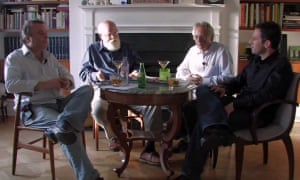
Dawkins, Hitchens, Dennett, Harris
Canary Islands 2014: Harold Kroto and Richard Dawkins
__
Francis Schaeffer pictured below:
—
The Basis of Human Dignity by Francis Schaeffer
Richard Dawkins, founder of the Richard Dawkins Foundation for Reason and Science. Credit: Don Arnold Getty Images
—
Francis Schaeffer in 1984
Christian Manifesto by Francis Schaeffer
Francis Schaeffer in 1982
—-
Whatever Happened to the Human Race? Episode 1
—
—
–
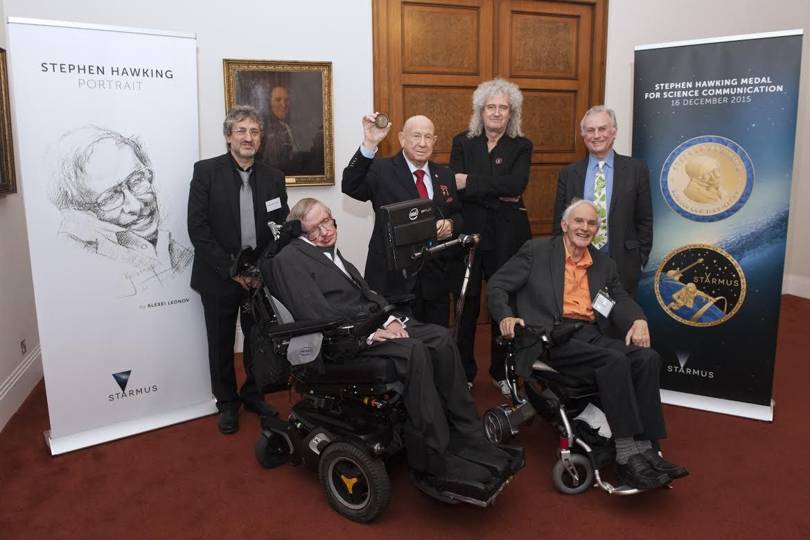
Garik Israelian, Stephen Hawking, Alexey Leonov, Brian May, Richard Dawkins and Harry Kroto
—-
—-
—-
—-
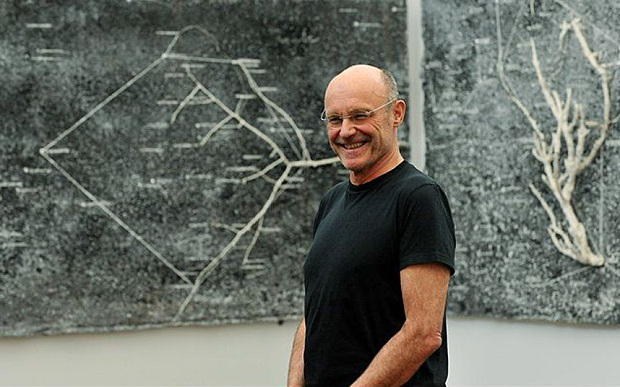
Featured artist is Anselm Kiefer
Anselm Kiefer is a German painter and sculptor. He studied during the 1970s.
His works incorporate mix-media. Anselm Kiefer developed themes of German history and the horror of the Holocaust, the spiritual concepts of Kabbalah. Anselm Kiefer argues with the past and addresses controversial issues from recent histories, like themes from Nazi rule. His works reflect the willingness to confront his culture’s dark past, and unrealized potential. His work has signatures and/or names of people of historical importance, legendary figures or historical places. Anselm Kiefer seeks to process the past, being linked with the movements of New Symbolism and Neo-Expressionism.
On November 21, 2014 I received a letter from Nobel Laureate Harry Kroto and it said: …Please click on this URL http://vimeo.com/26991975 and you will hear what far smarter people than I have to say on this matter. I agree with them. Harry Kroto _________________ Below you have picture of 1996 Chemistry Nobel Prize Winner […]
The Beatles were “inspired by the musique concrète of German composer and early electronic music pioneer Karlheinz Stockhausen…” as SCOTT THILL has asserted. Francis Schaeffer noted that ideas of “Non-resolution” and “Fragmentation” came down German and French streams with the influence of Beethoven’s last Quartets and then the influence of Debussy and later Schoenberg’s non-resolution which is in total contrast […]
_______ On November 21, 2014 I received a letter from Nobel Laureate Harry Kroto and it said: …Please click on this URL http://vimeo.com/26991975 and you will hear what far smarter people than I have to say on this matter. I agree with them. Harry Kroto _________________ Below you have picture of 1996 Chemistry Nobel Prize […]
On November 21, 2014 I received a letter from Nobel Laureate Harry Kroto and it said: …Please click on this URL http://vimeo.com/26991975 and you will hear what far smarter people than I have to say on this matter. I agree with them. Harry Kroto ____________________ Below you have picture of 1996 Chemistry Nobel Prize Winner Dr. […]
Office of Barack and Michelle Obama P.O. Box 91000 Washington, DC 20066
Dear President Obama,
I wrote you over 700 letters while you were President and I mailed them to the White House and also published them on my blog http://www.thedailyhatch.org .I received several letters back from your staff and I wanted to thank you for those letters.
I have been reading your autobiography A PROMISED LAND and I have been enjoying it.
Let me make a few comments on it, and here is the first quote of yours I want to comment on:
MICHELLE WAS HARDLY oblivious to what was happening. At first she simply ignored the fuss. She stopped watching political news shows and waved off all the overeager questions from friends and co-workers about whether I planned to run. When one evening at home I mentioned the conversation I’d had with Harry, she just shrugged, and I did not press the issue. As the summer wore on, though, the chatter began to seep through the cracks and crevices of our home life. Our evenings and weekends appeared normal so long as Malia and Sasha were swirling about, but I felt the tension whenever Michelle and I were alone. Finally, one night after the girls were asleep, I came into the den where she was watching TV and muted the sound. “You know I didn’t plan any of this,” I said, sitting down next to her on the couch. Michelle stared at the silent screen. “I know,” she said. “I realize we’ve barely had time to catch our breath. And until a few months ago, the idea of me running seemed crazy.” “Yep.” “But given everything that’s happened, I feel like we have to give the idea a serious look. I’ve asked the team to put together a presentation. What a campaign schedule would look like. Whether we could win. How it might affect the family. I mean, if we were ever going to do this—” Michelle cut me off, her voice choked with emotion. “Did you say we?” she said. “You mean you, Barack. Not we. This is your thing. I’ve supported you the whole time, because I believe in you, even though I hate politics. I hate the way it exposes our family. You know that. And now, finally, we have some stability…even if it’s still not normal, not the way I’d choose for us to live…and now you tell me you’re going to run for president?” I reached for her hand. “I didn’t say I am running, honey. I just said we can’t dismiss the possibility. But I can only consider it if you’re on board.” I paused, seeing that none of her anger was dissipating. “If you don’t think we should, then we won’t. Simple as that. You get the final say.” Michelle lifted her eyebrows as if to suggest she didn’t believe me. “If that’s really true, then the answer is no,” she said. “I don’t want you to run for president, at least not now.” She gave me a hard look and got up from the couch. “God, Barack…When is it going to be enough?” Before I could answer, she’d gone into the bedroom and closed the door. How could I blame her for feeling this way? By even suggesting the possibility of a run, by involving my staff before I’d asked for her blessing, I had put her in an impossible spot. For years now, I’d asked Michelle for fortitude and forbearance when it came to my political endeavors, and she’d given it—reluctantly but with love. And then each time I’d come back again, asking for more. Why would I put her through this? Was it just vanity? Or perhaps something darker—a raw hunger, a blind ambition wrapped in the gauzy language of service? Or was I still trying to prove myself worthy to a father who had abandoned me, live up to my mother’s starry-eyed expectations of her only son, and resolve whatever self-doubt remained from being born a child of mixed race? “It’s like you have a hole to fill,” Michelle had told me early in our marriage, after a stretch in which she’d watched me work myself to near exhaustion. “That’s why you can’t slow down.” In truth, I thought I’d resolved those issues long ago, finding affirmation in my work, security and love in my family. But I wondered now if I could ever really escape whatever it was in me that needed healing, whatever kept me reaching for more. Maybe it was impossible to disentangle one’s motives. I recalled a sermon by Dr. Martin Luther King, Jr., called “The Drum Major Instinct.” In it, he talks about how, deep down, we all want to be first, celebrated for our greatness; we all want “to lead the parade.” He goes on to point out that such selfish impulses can be reconciled by aligning that quest for greatness with more selfless aims. You can strive to be first in service, first in love. For me, it seemed a satisfying way to square the circle when it came to one’s baser and higher instincts. Except now I was also confronting the obvious fact that the sacrifices were never mine alone. Family got dragged along for the ride, put in the line of fire. Dr. King’s cause, and his gifts, might have justified such sacrifice. But could mine?
—-
MLK was one of the finest speakers of all time and I have found his sermons based on the truths in the Bible. The problems in the world can easily be traced to the fact that people are sinners and need a savior and MLK preached the good news that Jesus had come to forgive sinners!
I went and listened to this famous sermon and I too found it very inspirational!! Here is the final few moments of that sermon:
Nineteen centuries have come and gone and today he stands as the most influential figure that ever entered human history. All of the armies that ever marched, all the navies that ever sailed, all the parliaments that ever sat, and all the kings that ever reigned put together (Yes) have not affected the life of man on this earth (Amen) as much as that one solitary life. His name may be a familiar one. (Jesus) But today I can hear them talking about him. Every now and then somebody says, “He’s King of Kings.” (Yes) And again I can hear somebody saying, “He’s Lord of Lords.” Somewhere else I can hear somebody saying, “In Christ there is no East nor West.” (Yes) And then they go on and talk about, “In Him there’s no North and South, but one great Fellowship of Love throughout the whole wide world.” He didn’t have anything. (Amen) He just went around serving and doing good.
This morning, you can be on his right hand and his left hand if you serve. (Amen) It’s the only way in.
Every now and then I guess we all think realistically (Yes, sir) about that day when we will be victimized with what is life’s final common denominator—that something that we call death. We all think about it. And every now and then I think about my own death and I think about my own funeral. And I don’t think of it in a morbid sense. And every now and then I ask myself, “What is it that I would want said?” And I leave the word to you this morning.
If any of you are around when I have to meet my day, I don’t want a long funeral. And if you get somebody to deliver the eulogy, tell them not to talk too long. (Yes) And every now and then I wonder what I want them to say. Tell them not to mention that I have a Nobel Peace Prize—that isn’t important. Tell them not to mention that I have three or four hundred other awards—that’s not important. Tell them not to mention where I went to school. (Yes)
I’d like somebody to mention that day that Martin Luther King, Jr., tried to give his life serving others. (Yes)
I’d like for somebody to say that day that Martin Luther King, Jr., tried to love somebody.
I want you to say that day that I tried to be right on the war question. (Amen)
I want you to be able to say that day that I did try to feed the hungry. (Yes)
And I want you to be able to say that day that I did try in my life to clothe those who were naked. (Yes)
I want you to say on that day that I did try in my life to visit those who were in prison. (Lord)
I want you to say that I tried to love and serve humanity. (Yes)
Yes, if you want to say that I was a drum major, say that I was a drum major for justice. (Amen) Say that I was a drum major for peace. (Yes) I was a drum major for righteousness. And all of the other shallow things will not matter. (Yes) I won’t have any money to leave behind. I won’t have the fine and luxurious things of life to leave behind. But I just want to leave a committed life behind. (Amen) And that’s all I want to say.
If I can help somebody as I pass along, If I can cheer somebody with a word or song, If I can show somebody he’s traveling wrong, Then my living will not be in vain. If I can do my duty as a Christian ought, If I can bring salvation to a world once wrought, If I can spread the message as the master taught, Then my living will not be in vain.
—
Let me make a few comments about these 3 lines from MLK’s sermon:
The Book of Ecclesiastes is my favorite book in the Bible because it shows that humanist man can not find any lasting meaning for his life UNDER THE SUN and finally Solomon in the last chapter let’s God back into the picture and he gives the solution to the whole problem and it is the solution of repentance and salvation that MLK also taught in his sermon and without that it is all vanity!!!
—
In 1978 I heard the song “Dust in the Wind” by Kansas when it rose to #6 on the charts. That song told me that Kerry Livgren the writer of that song and a member of Kansas had come to the same conclusion that Solomon had. I remember mentioning to my friends at church that we may soon see some members of Kansas become Christians because their search for the meaning of life had obviously come up empty even though they had risen from being an unknown band to the top of the music business and had all the wealth and fame that came with that. Furthermore, Solomon realized death comes to everyone and there must be something more.
Livgren wrote:
“All we do, crumbles to the ground though we refuse to see, Dust in the Wind, All we are is dust in the wind, Don’t hang on, Nothing lasts forever but the Earth and Sky, It slips away, And all your money won’t another minute buy.”
Take a minute and compare Kerry Livgren’s words to that of the late British humanist H.J. Blackham:
“On humanist assumptions, life leads to nothing, and every pretense that it does not is a deceit. If there is a bridge over a gorge which spans only half the distance and ends in mid-air, and if the bridge is crowded with human beings pressing on, one after the other they fall into the abyss. The bridge leads nowhere, and those who are pressing forward to cross it are going nowhere….It does not matter where they think they are going, what preparations for the journey they may have made, how much they may be enjoying it all. The objection merely points out objectively that such a situation is a model of futility“( H. J. Blackham, et al., Objections to Humanism (Riverside, Connecticut: Greenwood Press, 1967).
_____________________________________
Both Kerry Livgren and the bass player DAVE HOPE of Kansas became Christians eventually. Kerry Livgren first tried Eastern Religions and DAVE HOPE had to come out of a heavy drug addiction. I was shocked and elated to see their personal testimony on The 700 Club in 1981 and that same interview can be seen on youtube today. Livgren lives in Topeka, Kansas today where he teaches “Diggers,” a Sunday school class at Topeka Bible Church. DAVE HOPE is the head of Worship, Evangelism and Outreach at Immanuel Anglican Church in Destin, Florida.
Those who reject God must accept three realities of their life UNDER THE SUN. FIRST, death is the end and SECOND, chance and time are the only guiding forces in this life. FINALLY, power reigns in this life and the scales are never balanced. In contrast, Dave Hope and Kerry Livgren believe death is not the end and the Christian can face death and also confront the world knowing that it is not determined by chance and time alone and finally there is a judge who will balance the scales.
Solomon’s experiment was a search for meaning to life “under the sun.” Then in last few words in the Book of Ecclesiastes he looks above the sun and brings God back into the picture: “The conclusion, when all has been heard, is: Fear God and keep His commandments, because this applies to every person. For God will bring every act to judgment, everything which is hidden, whether it is good or evil.”
Kansas, circa 1973 (Phil Ehart, Kerry Livgren, Steve Walsh, Rich Williams, Robby Steinhardt, Dave Hope) (photo credit: DON HUNSTEIN)
____________
You can hear DAVE HOPE and Kerry Livgren’s stories from this youtube link:
(part 1 ten minutes)
Kerry Livgren
—
—
Sincerely,
Everette Hatcher III, 13900 Cottontail Lane, Alexander, AR 72002, ph 501-920-5733 everettehatcher@gmail.com
President Obama c/o The White House 1600 Pennsylvania Avenue NW Washington, DC 20500 Dear Mr. President, I know that you receive 20,000 letters a day and that you actually read 10 of them every day. I really do respect you for trying to get a pulse on what is going on out here. There have […]By Everette Hatcher III | Posted in David Barton, Founding Fathers, President Obama | Edit |Comments (0)
There have been many articles written by evangelicals like me who fear that our founding fathers would not recognize our country today because secular humanism has rid our nation of spiritual roots. I am deeply troubled by the secular agenda of those who are at war with religion in our public life. Lillian Kwon quoted somebody […]By Everette Hatcher III | Posted in David Barton, Founding Fathers | Edit | Comments (0)
There have been many articles written by evangelicals like me who fear that our founding fathers would not recognize our country today because secular humanism has rid our nation of spiritual roots. I am deeply troubled by the secular agenda of those who are at war with religion in our public life. Lillian Kwon quoted somebody […]By Everette Hatcher III | Posted in David Barton, Founding Fathers | Edit | Comments (0)
There have been many articles written by evangelicals like me who fear that our founding fathers would not recognize our country today because secular humanism has rid our nation of spiritual roots. I am deeply troubled by the secular agenda of those who are at war with religion in our public life. Lillian Kwon quoted somebody […]By Everette Hatcher III | Posted in David Barton, Founding Fathers | Edit | Comments (0)
There have been many articles written by evangelicals like me who fear that our founding fathers would not recognize our country today because secular humanism has rid our nation of spiritual roots. I am deeply troubled by the secular agenda of those who are at war with religion in our public life. Lillian Kwon quoted somebody […]By Everette Hatcher III | Posted in David Barton, Founding Fathers | Edit | Comments (0)
There have been many articles written by evangelicals like me who fear that our founding fathers would not recognize our country today because secular humanism has rid our nation of spiritual roots. I am deeply troubled by the secular agenda of those who are at war with religion in our public life. Lillian Kwon quoted somebody […]By Everette Hatcher III | Posted in Founding Fathers | Edit | Comments (0)
President Obama Speaks at The Ohio State University Commencement Ceremony Published on May 5, 2013 President Obama delivers the commencement address at The Ohio State University. May 5, 2013. You can learn a lot about what President Obama thinks the founding fathers were all about from his recent speech at Ohio State. May 7, 2013, […]By Everette Hatcher III | Posted in Founding Fathers, President Obama | Edit | Comments (0)
Dr. C. Everett Koop with Bill Graham. Francis Schaeffer: “Whatever Happened to the Human Race” (Episode 4) THE BASIS FOR HUMAN DIGNITY Published on Oct 7, 2012 by AdamMetropolis The 45 minute video above is from the film series created from Francis Schaeffer’s book “Whatever Happened to the Human Race?” with Dr. C. Everett Koop. This […]By Everette Hatcher III | Posted in Founding Fathers, Francis Schaeffer, Prolife | Edit |Comments (1)
America’s Founding Fathers Deist or Christian? – David Barton 4/6 There have been many articles written by evangelicals like me who fear that our founding fathers would not recognize our country today because secular humanism has rid our nation of spiritual roots. I am deeply troubled by the secular agenda of those who are at […]By Everette Hatcher III | Posted in David Barton, Founding Fathers | Tagged governor of connecticut, john witherspoon, jonathan trumbull | Edit | Comments (1)
3 Of 5 / The Bible’s Influence In America / American Heritage Series / David Barton There were 55 gentlemen who put together the constitution and their church affliation is of public record. Greg Koukl notes: Members of the Constitutional Convention, the most influential group of men shaping the political foundations of our nation, were […]By Everette Hatcher III | Posted in Founding Fathers | Edit | Comments (0)
I do not think that John Quincy Adams was a founding father in the same sense that his father was. However, I do think he was involved in the early days of our government working with many of the founding fathers. Michele Bachmann got into another history-related tussle on ABC’s “Good Morning America” today, standing […]By Everette Hatcher III | Posted in David Barton, Founding Fathers | Edit | Comments (0)
I have gone back and forth and back and forth with many liberals on the Arkansas Times Blog on many issues such as abortion, human rights, welfare, poverty, gun control and issues dealing with popular culture. Here is another exchange I had with them a while back. My username at the Ark Times Blog is Saline […]By Everette Hatcher III | Posted in Arkansas Times, Francis Schaeffer, Prolife | Edit |Comments (0)
I truly believe that many of the problems we have today in the USA are due to the advancement of humanism in the last few decades in our society. Ronald Reagan appointed the evangelical Dr. C. Everett Koop to the position of Surgeon General in his administration. He partnered with Dr. Francis Schaeffer in making the […]By Everette Hatcher III | Posted in Adrian Rogers, Francis Schaeffer | Edit | Comments (0)
Francis Schaeffer: “Whatever Happened to the Human Race” (Episode 4) THE BASIS FOR HUMAN DIGNITY Published on Oct 7, 2012 by AdamMetropolis ____________ The 45 minute video above is from the film series created from Francis Schaeffer’s book “Whatever Happened to the Human Race?” with Dr. C. Everett Koop. This book really helped develop my political […]By Everette Hatcher III | Posted in Francis Schaeffer | Edit | Comments (0)
Office of Barack and Michelle Obama P.O. Box 91000 Washington, DC 20066
Dear President Obama,
I wrote you over 700 letters while you were President and I mailed them to the White House and also published them on my blog http://www.thedailyhatch.org .I received several letters back from your staff and I wanted to thank you for those letters.
I have been reading your autobiography A PROMISED LAND and I have been enjoying it.
Let me make a few comments on it, and here is the first quote of yours I want to comment on:
And when the United States Conference of Catholic Bishops announced that it couldn’t support the bill (convinced that the bill’s language prohibiting the use of federal subsidies for abortion services wasn’t explicit enough), an unlikely ally arrived in the form of Sister Carol Keehan, a soft-spoken, perpetually cheerful nun who headed up the nation’s Catholic hospitals. Not only did the sixty-six-year-old Daughter of Charity break with the bishops by insisting that passage of the bill was vital to fulfilling her organization’s mission of caring for the sick; she inspired the leaders of Catholic women’s orders and organizations representing more than fifty thousand American nuns to sign a public letter endorsing the bill. “I love nuns,” I told Phil and Nancy-Ann.
ObamaCare requires every American to purchase health insurance, it requires every state to establish health insurance exchanges, and it dramatically expands Medicaid. Each of these – private health insurances programs, exchanges, and Medicaid – can, and in some case are required to, provide coverage for abortion. The result is hundreds of millions of dollars being funneled to the abortion industry every year and the greatest expansion of abortion since Roe v. Wade.
I know that you don’t agree with my pro-life views but I wanted to challenge you as a fellow Christian to re-examine your pro-choice view. Although we are both Christians and have the Bible as the basis for our moral views, I did want you to take a close look at the views of the pro-life atheist Nat Hentoff too. Hentoff became convinced of the pro-life view because of secular evidence that shows that the unborn child is human. I would ask you to consider his evidence and then of course reverse your views on abortion.
___________________
Nat Hentoff is an atheist, but he became a pro-life activist because of the scientific evidence that shows that the unborn child is a distinct and separate human being and even has a separate DNA. His perspective is a very intriguing one that I thought you would be interested in. I have shared before many cases (Bernard Nathanson, Donald Trump, Paul Greenberg, Kathy Ireland) when other high profile pro-choiceleaders have changed their views and this is just another case like those. I have contacted the White House over and over concerning this issue and have even received responses. I am hopeful that people will stop and look even in a secular way (if they are not believers) at this abortion debate and see that the unborn child is deserving of our protection.That is why the writings of Nat Hentoff of the Cato Institute are so crucial.
The Maryland abortion bill that was passed and signed into law in February was generally described as a “moderate” measure ensuring the women of the state the same rights as Roe v. Wade should that decision be overturned by the Supreme Court.
Another provision of the measure was parental notification before minors can get an abortion. This was a scam, however. The person deciding whether the notification is to be given will be the doctor about to perform the abortion.
There is something quite startling in the law that will gladden the hearts of eugenicists, who are considerable in number — though many are still in the closet. The section on Abortion [Restrictions] Procedures declares that the state is not permitted to interfere — at any stage — in a woman’s decision to terminate a pregnancy if “the fetus is affected by genetic defect or serious deformity or abnormality.”
This means that a viable fetus can be destroyed if he or she has any genetic defect. Although the qualifier, “serious,” precedes “deformity or abnormality,” there is no such restriction on performing an abortion because of “genetic defect.”
Last July, much to the celebration of many disabled people, the president signed the Americans with Disabilities Act. Although it is now unlawful to discriminate against the disabled in many areas of life, the Maryland statute permits the ultimate discrimination against them before they are born.
As the Human Genome Project finds out more and more about how to detect genetic defects, the reasons for this kind of abortion on viable fetuses will accumulate. Even now, with increasingly sophisticated prenatal tests, it is possible to discern a considerable number of genetic defects in a fetus.
As law professor Robert Destro points out, by the letter of the Maryland law, a mother could put to death a fetus diagnosed as having myopia. (There are parents who do want perfect children.) And others might well return a fetus marked with cystic fibrosis or sickle cell anemia.
I expected some strong protests from disability rights groups about this enshrinement of eugenics — particularly since I have heard fears of the brave new world of the genome at disability rights meetings. But so far as I know, there has been silence among these usually forthright activists.
One reason may be that disability rights groups are ambivalent about abortion. Some of the members are pro-choice; others have no firm opinion but do not want to be identified with so controversial a movement and one that often gets a bad press. They figure they have enough problems of their own.
Some of the key disability groups, however, have been willing to oppose euthanasia (as in the Cruzan case) and to support the rights of Baby Does — severely handicapped infants whose parents want to let them slide into eternity. The disabled know that as it becomes easier for society to get rid of expensively imperfect people, they themselves may eventually not be safe from lethal mercy.
One disability rights activist — the feminist writer Anne Finger, herself disabled — is aware of the return of eugenics and the dangers it brings. In an article in the Disability Rag, she tells of having joined an abortion rights group and of offering to speak at a meeting about disability and reproductive rights.
“When I started talking about how the reproductive rights movement was sometimes guilty of exploiting fears about disability when it argued for abortion because of fetal defect, things got really strained. I expected lip service, condescension, liberalism — but certainly not hostility.”
Also at that meeting was a Harvard biology professor, Ruth Hubbard, who has since retired. She was not hostile: “My problems with prenatal screening stem mostly from my concern about how it’s creating eugenic thinking. We act as if we can look at a gene and say, ‘Ah-ha, this gene causes this … disability,’ when in fact the interactions between the gene and the environment are enormously complex. It moves our focus from the environmental causes of disabilities — which are terrifying and increasing daily — to individual genetic ones.”
The pro-choice forces, however, are so intent on removing all obstacles to abortion that eugenics is no specter to them.
Anne Finger remembers the initial, stunning triumph of eugenics in the hospitals and mental institutions of Germany, where so many “defectives” were killed before the beginning of the concentration camps. She is still pro-choice, but she also knows what certain choices can lead to.
I truly believe that many of the problems we have today in the USA are due to the advancement of humanism in the last few decades in our society. Ronald Reagan appointed the evangelical Dr. C. Everett Koop to the position of Surgeon General in his administration. He partnered with Dr. Francis Schaeffer in making the video below. It is very valuable information for Christians to have. Actually I have included a video below that includes comments from him on this subject.
Sincerely,
Everette Hatcher III, 13900 Cottontail Lane, Alexander, AR 72002, ph 501-920-5733 everettehatcher@gmail.com
President Obama c/o The White House 1600 Pennsylvania Avenue NW Washington, DC 20500 Dear Mr. President, I know that you receive 20,000 letters a day and that you actually read 10 of them every day. I really do respect you for trying to get a pulse on what is going on out here. There have […]By Everette Hatcher III | Posted in David Barton, Founding Fathers, President Obama | Edit |Comments (0)
There have been many articles written by evangelicals like me who fear that our founding fathers would not recognize our country today because secular humanism has rid our nation of spiritual roots. I am deeply troubled by the secular agenda of those who are at war with religion in our public life. Lillian Kwon quoted somebody […]By Everette Hatcher III | Posted in David Barton, Founding Fathers | Edit | Comments (0)
There have been many articles written by evangelicals like me who fear that our founding fathers would not recognize our country today because secular humanism has rid our nation of spiritual roots. I am deeply troubled by the secular agenda of those who are at war with religion in our public life. Lillian Kwon quoted somebody […]By Everette Hatcher III | Posted in David Barton, Founding Fathers | Edit | Comments (0)
There have been many articles written by evangelicals like me who fear that our founding fathers would not recognize our country today because secular humanism has rid our nation of spiritual roots. I am deeply troubled by the secular agenda of those who are at war with religion in our public life. Lillian Kwon quoted somebody […]By Everette Hatcher III | Posted in David Barton, Founding Fathers | Edit | Comments (0)
There have been many articles written by evangelicals like me who fear that our founding fathers would not recognize our country today because secular humanism has rid our nation of spiritual roots. I am deeply troubled by the secular agenda of those who are at war with religion in our public life. Lillian Kwon quoted somebody […]By Everette Hatcher III | Posted in David Barton, Founding Fathers | Edit | Comments (0)
There have been many articles written by evangelicals like me who fear that our founding fathers would not recognize our country today because secular humanism has rid our nation of spiritual roots. I am deeply troubled by the secular agenda of those who are at war with religion in our public life. Lillian Kwon quoted somebody […]By Everette Hatcher III | Posted in Founding Fathers | Edit | Comments (0)
President Obama Speaks at The Ohio State University Commencement Ceremony Published on May 5, 2013 President Obama delivers the commencement address at The Ohio State University. May 5, 2013. You can learn a lot about what President Obama thinks the founding fathers were all about from his recent speech at Ohio State. May 7, 2013, […]By Everette Hatcher III | Posted in Founding Fathers, President Obama | Edit | Comments (0)
Dr. C. Everett Koop with Bill Graham. Francis Schaeffer: “Whatever Happened to the Human Race” (Episode 4) THE BASIS FOR HUMAN DIGNITY Published on Oct 7, 2012 by AdamMetropolis The 45 minute video above is from the film series created from Francis Schaeffer’s book “Whatever Happened to the Human Race?” with Dr. C. Everett Koop. This […]By Everette Hatcher III | Posted in Founding Fathers, Francis Schaeffer, Prolife | Edit |Comments (1)
America’s Founding Fathers Deist or Christian? – David Barton 4/6 There have been many articles written by evangelicals like me who fear that our founding fathers would not recognize our country today because secular humanism has rid our nation of spiritual roots. I am deeply troubled by the secular agenda of those who are at […]By Everette Hatcher III | Posted in David Barton, Founding Fathers | Tagged governor of connecticut, john witherspoon, jonathan trumbull | Edit | Comments (1)
3 Of 5 / The Bible’s Influence In America / American Heritage Series / David Barton There were 55 gentlemen who put together the constitution and their church affliation is of public record. Greg Koukl notes: Members of the Constitutional Convention, the most influential group of men shaping the political foundations of our nation, were […]By Everette Hatcher III | Posted in Founding Fathers | Edit | Comments (0)
I do not think that John Quincy Adams was a founding father in the same sense that his father was. However, I do think he was involved in the early days of our government working with many of the founding fathers. Michele Bachmann got into another history-related tussle on ABC’s “Good Morning America” today, standing […]By Everette Hatcher III | Posted in David Barton, Founding Fathers | Edit | Comments (0)
I have gone back and forth and back and forth with many liberals on the Arkansas Times Blog on many issues such as abortion, human rights, welfare, poverty, gun control and issues dealing with popular culture. Here is another exchange I had with them a while back. My username at the Ark Times Blog is Saline […]By Everette Hatcher III | Posted in Arkansas Times, Francis Schaeffer, Prolife | Edit |Comments (0)
I truly believe that many of the problems we have today in the USA are due to the advancement of humanism in the last few decades in our society. Ronald Reagan appointed the evangelical Dr. C. Everett Koop to the position of Surgeon General in his administration. He partnered with Dr. Francis Schaeffer in making the […]By Everette Hatcher III | Posted in Adrian Rogers, Francis Schaeffer | Edit | Comments (0)
Francis Schaeffer: “Whatever Happened to the Human Race” (Episode 4) THE BASIS FOR HUMAN DIGNITY Published on Oct 7, 2012 by AdamMetropolis ____________ The 45 minute video above is from the film series created from Francis Schaeffer’s book “Whatever Happened to the Human Race?” with Dr. C. Everett Koop. This book really helped develop my political […]By Everette Hatcher III | Posted in Francis Schaeffer | Edit | Comments (0)
Planned Parenthood is hoping to advance its abortion agenda in a prospective administration of Joe Biden, seen here at a campaign event in Milwaukee on Oct. 30. (Photo: Jim Watson/Agence France-Presse/Getty Images)
Planned Parenthood is preparing its wish list for former Vice President Joe Biden’s prospective administration, but pro-life forces are gearing up for a fight.
In a Roll Call interview, Planned Parenthood Action Fund President and CEO Alexis McGill Johnson said her organization’s top goal in 2021 is abolishing the Hyde Amendment, which for 40 years has prohibited federal funding for most abortions.
“A lot of, I think, the public conversation has to be around how a policy like Hyde, which discriminates against low-income people largely and people of color, you know, is in a moment where those same people are being disproportionately affected by a pandemic and access to health care broadly,” McGill Johnson told Roll Call.
“I think you can send a different message, that the very things that we’re trying to address, like racism, are also baked into our various policies,” she said.
The left is actively working to undermine the integrity of our elections. Read the plan to stop them now. Learn more now >>
The Hyde Amendment is named for the late Rep. Henry Hyde, R-Ill., who sponsored the amendment, first adopted in 1976.
McGill Johnson’s effort already has support in Congress, as the incoming chairman of the House Appropriations Committee, Rep. Rosa DeLauro, D-Conn., has said she also wants to do away with the Hyde Amendment.
In a statement to The Daily Signal, Jeanne Mancini, president of March for Life, said she is concerned about the obvious pro-abortion trajectory of a Biden administration.
“Despite his pledge of unity, it is truly heartbreaking that Joe Biden is taking his policy direction from our nation’s largest abortion business, Planned Parenthood, a group under investigation for waste, abuse, and potential fraud, not to mention the trafficking of baby body parts,” Mancini said, adding:
Joe Biden would do well to review where the majority of Americans stand on the radical policy goals pushed by Planned Parenthood, including eliminating the Hyde Amendment, a move that would quickly cement his role as the most pro-abortion president in history.
Melanie Israel, a research associate in the DeVos Center for Religion and Civil Society at The Heritage Foundation, told The Daily Signal that a Biden administration will remove life-affirming policies set in place by the Trump administration.
“The abortion lobby, along with its allies in Congress, is committed to [rolling] back the pro-life movement’s progress,” Israel said, adding:
From forcing taxpayers to fund elective abortions both at home and overseas to rolling back conscience and religious freedom protections, pro-abortion actors are eager to remove critical guardrails through both legislative and administrative action.
Pro-life policymakers will, without a doubt, have their work cut out for them. Regardless of who is in control of Congress and the administration, the pro-life movement will continue its crucial work serving women, children, and their families.
As far back as January, CNBC reported that Planned Parenthood was gearing up to support pro-abortion candidates for elective office, reporting that the abortion provider would spend $45 million in the 2020 elections to help its chosen candidates win.
Dean Nelson, executive director of Human Coalition Action, told The Daily Signal that Planned Parenthood’s agenda is clear.
“It’s plain to see that Planned Parenthood’s top priority is not protecting women’s health—as they want the public to believe—but in promoting abortions,” he said, adding:
In recent days, they’ve even tried to paint the Hyde Amendment as racist, when in fact the Hyde Amendment restrains the racist exploitation of minority and impoverished communities by the abortion industry.
Kristan Hawkins, president of Students for Life of America and Students for Life Action, told The Daily Signal that taxpayer funding for abortions isn’t as popular among the public as Planned Parenthood would like it to be.
“Given all the interviews Planned Parenthood leadership is giving, with their shopping list for taxpayers, it’s clear that they expect some real payback for what they spent during the election,” Hawkins said, adding:
But one thing that is consistently bipartisan is that people don’t want to pay for abortion here at home or around the world. The majority of Americans, pro-lifers, will be calling for the Hyde Amendment to stay in place and for Planned Parenthood to quit picking the pocket of taxpayers.
Their ‘choice’ to ending preborn lives to make money doesn’t mean we should pay them to do it.
NATIONAL MICAIAH BILGER NOV 20, 2020 | 10:57AM WASHINGTON, DC
Detroit Archbishop Allen Vigneron will lead a new committee of Catholic leaders to respond to Joe Biden’s pro-abortion agenda, should he be confirmed president of the United States.
Biden has “given us reason to believe that he will support policies that attack some fundamental values we hold dear as Catholics,” said Archbishop José Gomez of Los Angeles, the president of the USCCB.
According to the Detroit Free Press, Gomez appointed Vigneron to lead the committee to address Biden’s conflicting statements about his faith and public policy.
“These policies include the repeal of the Hyde amendment and the preservation of Roe v. Wade,” Gomez said. “Both of these policies undermine our ‘preeminent priority’ of the elimination of abortion. These policies also include restoration of the HHS (Health and Human Services) mandate, the passage of the Equality Act, and the unequal treatment of Catholic schools.”
While Gomez said Biden supports “some good policies” relating to immigration reform, poverty, the death penalty, the environment and racism, he said Biden’s pro-abortion policies “pose a serious threat to the common good.”
“We have long opposed these policies strongly, and we will continue to do so. But when politicians who profess the Catholic faith support them, there are additional problems. Among other things, it creates confusion with the faithful about what the Church actually teaches on these questions,” he continued.
“This is a difficult and complex situation,” Gomez said. “In order to help us navigate it, I have decided to appoint a Working Group, Chaired by Archbishop Vigneron, and consisting of the Chairmen of the Committees responsible for the policy areas at stake, as well as Doctrine and Communications.”
Vigneron has spoken out against Biden’s pro-abortion policies in the past.
He also warned Americans in 2009 about Obama’s pro-abortion agenda.
“I share the concern of all of the bishops of the United States that the [Obama] administration has, at least prior to the election, given us indications that they are going to rescind some of the protections of the unborn,” Vigneron said at the time. “And I am very disappointed in that. We are going to have to represent our opposition as forcefully as we can and try to build coalitions to dissuade the administration from moving to that.”
More recently, leftists criticized the archbishop for attending a pro-life fundraiser in September where former White House Press Secretary Sarah Huckabee Sanders spoke and some people endorsed President Donald Trump, according to the Free Press.
Biden is being celebrated as the second Catholic to be elected as president of the United States, though votes are still being certified and President Donald Trump filed lawsuits in several states.
Biden’s pro-abortion agenda includes advocating for abortions without limits and forcing taxpayers to fund them. He also opposes religious freedom measures that protect Catholic charities like the Little Sisters of the Poor, which serves the poor and elderly.
Biden said he plans to codify Roe v. Wade into federal law and appoint U.S. Supreme Court justices who will support abortion on demand. He also said he would fight to end the Hyde Amendment and force taxpayers to pay for elective abortions – which could lead to 60,000 more unborn babies’ deaths to abortion each year.
If you really want to know how Carl Sagan thought then it can be summed up with the word humanism. In fact, Sagan was the Humanist of the year in 1981!!!
___________
Richard Dawkins
Carl Sagan
I mailed a letter to Carl Sagan on August 30, 1995 and it included a letter that I had published that very day in the Democrat-Gazette. Here is the letter below:
My letter to the editor to the Arkansas Democrat-Gazette was published on August 30, 1995 and appeared under the title THE HUMANIST WORLD VIEW. Here below is the published letter:
George Foehringer (Voices, August 1) is critical of those fundamentalist Christians who use the Bible as their basis for morals, and he praises the “enlightenment brought about by scientists and humanists.”
The Christian philosopher Francis Schaeffer best to this charge when he said, “First, the superior attitude toward Christianity–as if Christianity had all the problems and humanism had all the answers–is quite unjustified.
“The humanists of the enlightenment two centuries ago thought they were going to find all the answers, but as time has passed, this optimistic hope has been proved wrong.
“Second, this humanist world view has also brought us the present devaluation of human life.”
Schaeffer is referring to the humanist view toward abortion and infanticide.
Adrian Rogers, a former president of the Southern Baptist Convention, has rightly said, “Secular Humanism and so-called abortion rights are inseparably linked together.”
The pro-abortion movement in America has benefited from support from such humanists as Lester R. Brown, James Farmer, Sol Gordon, Matthew Ies Spetter, Richard Dawkins, Kendrick Frazier, Gordon Stein and Gerald R. Larue.
Likewise, the infanticide movement was given a lift in 1978 when Francis Crick, a Nobel Laureate and a humanist, said that no newborn infant should be declared human until it has passed certain tests regarding its genetic endowment and that if it fails these tests, it forfeits the right to live. The humanist world view does devalue life.
Everette Hatcher III, Little Rock, Arkansas
In a letter from Carl Sagan dated December 5, 1995, Sagan disagreed with me concerning the close relationship between atheistic evolutionists and the abortion movement. I know this was true of skeptics such as Sean Carroll, Michael Shermer, Noam Chomsky, Jonathan Haidt, Daniel Dennett, Alan M. Dershowitz, Jared Diamond, Bart D. Ehrman, Melvin Konner, Lawrence Krauss, Colin McGinn, Leonard Mlodinow, P.Z. Myers, Massimo Pigliucci, Steven Pinker, Lisa Randall, Neil deGrasse Tyson, Craig Venter, James D. Watson, Frank Wilczek, Steven Weinberg, and Edward O. Wilson.
Thanks for your recent letter about evolution and abortion. The correlation is hardly one to one; there are evolutionists who are anti-abortion and anti-evolutionists who are pro-abortion.
This most recent presidential election does seem to disprove Sagan’s point since it was the prolife evangelical vote that pushed Trump over the finish line.
Richard Dawkins was the 1997 Humanist of the Year and his pro-abortion views are well known. Moreover, on March 13, 2013, Dawkins tweeted,
With respect to those meanings of “human” that are relevant to the morality of abortion, any fetus is less human than an adult pig.
I know how Dawkins and his humanist friends think. Since 1994 I have tried to read the works of humanists and then correspond with them. In fact, some of them have been past Humanists of the Year such as Steven Pinker 2007, Daniel Dennett 2005, Edward O. Wilson 2000, Lloyd Morain 1995, and Albert Ellis 1972.
Since Carl Sagan was the 1982 Humanist of the Year himself, I thought it would be obvious to him too that humanists are radically pro-abortion.
The following is an excerpt from Roy Speckhardt’s Creating Change Through Humanism (Humanist Press, 2015):
In the 1960s, the AHA was active in challenging the illegality of abortion. It was the first national membership organization to support abortion rights, even before Planned Parenthood expanded to address the issue. Humanists were instrumental in the founding of leading pro-choice organizations such as the Religious Coalition for Reproductive Choice and NARAL Pro-Choice America. These organizations continue to defend and support elective abortion rights.
I truly believe that many of the problems we have today in the USA are due to the advancement of humanism in the last few decades in our society. Ronald Reagan appointed the evangelical Dr. C. Everett Koop to the position of Surgeon General in his administration. He partnered with Dr. Francis Schaeffer in making the video below. It is very valuable information for Christians to have. Actually I have included a video below that includes comments from him on this subject.
Carl Sagan wrote to me:
You argue that God exists because otherwise we could not understand the world in our consciousness. But if you think God is necessary to understand the world, then why do you not ask the next question of where God came from? And if you say “God was always here,” why not say that the universe was always here?
Quote from Roy J. Glauber:
“I have never had any feeling toward the intelligent designer approach. The one thing that is clear is that it takes one great deal of intelligence to figure out what is going on and I think there are more than a few people having figured some of this out feel they are somehow getting down to the same processes that went on in creating it. That doesn’t mean a thing to me.
Glauber says that he has no feelings towards the intelligent designer approach to science but he says that it takes a great deal of intelligence to figure the big questions out. He says that we have only scratched the surface of knowledge in the world on evolution but that we have accomplished rather more in the world of physics than in the world of evolution. We now have an explanation for everything that explains chemistry and chemistry underlies all living things. We have it all, he says and we are simply going on to explore other worlds. We have the basic tools without question. It is true he says that it is becoming more and more difficult to explore sub-atomic particles for the reason that it is enormously expensive. He says that what has been discovered is enormously interesting but it tells us nothing about intelligent design and certainly nothing at all about life.
____________________
I have more articles posted on my blog about the last few yearsof Antony Flew’s life than any other website in the world probably. The reason is very simple. I had the opportunity to correspond with Antony Flew back in the middle 90’s and he said that he had the opportunity to listen to several of the cassette tapes that I sent him with messages from Adrian Rogers and he also responded to several of the points I put in my letters that I got from Francis Schaeffer’s materials. The ironic thing was that I purchased the sermon IS THE BIBLE TRUE? originally from the Bellevue Baptist Church Bookstore in 1992 and in the same bookstore in 2008 I bought the book THERE IS A GOD by Antony Flew. Back in 1993 I decided to contact some of the top secular thinkers of our time and I got my initial list of individuals from those scholars that were mentioned in the works of both Francis Schaeffer and Adrian Rogers. Schaeffer had quoted Flew in his book ESCAPE FROM REASON. It was my opinion after reviewing the evidence that Antony Flew was the most influential atheistic philosopher of the 20th century.
__________
The Fine Tuning Argument for the Existence of God fromAntony Flew!
Imagine entering a hotel room on your next vacation. The CD player on the bedside table is softly playing a track from your favorite recording. The framed print over the bed is identical to the image that hangs over the fireplace at home. The room is scented with your favorite fragrance…You step over to the minibar, open the door, and stare in wonder at the contents. Your favorite beverage. Your favorite cookies and candy. Even the brand of bottled water you prefer…You notice the book on the desk: it’s the latest volume by your favorite author…
Chances are, with each new discovery about your hospitable new environment, you would be less inclined to think it has all a mere coincidence, right? You might wonder how the hotel managers acquired such detailed information about you. You might marvel at their meticulous preparation. You might even double-check what all this is going to cost you. But you would certainly be inclined to believe that someone knew you were coming. There Is A God (2007) p.113-4
Pt 1 of 2 Listen to this Important Message by Francis Schaeffer
Published on Sep 30, 2013
This message “A Christian Manifesto” was given in 1982 by the late Christian Philosopher Francis Schaeffer when he was age 70 at D. James Kennedy’s Corral Ridge Presbyterian Church. Listen to this important message where Dr. Schaeffer says it is the duty of Christians to disobey the government when it comes in conflict with God’s laws. So many have misinterpreted Romans 13 to mean unconditional obedience to the state. When the state promotes an evil agenda and anti-Christian statues we must obey God rather than men. Acts I use to watch James Kennedy preach from his TV pulpit with great delight in the 1980’s. Both of these men are gone to be with the Lord now. We need new Christian leaders to rise up in their stead. To view Part 2 See Francis Schaeffer Lecture- Christian Manifesto Pt 2 of 2 video The religious and political freedom’s we enjoy as Americans was based on the Bible and the legacy of the Reformation according to Francis Schaeffer. These freedoms will continue to diminish as we cast off the authority of Holy Scripture. In public schools there is no other view of reality but that final reality is shaped by chance. Likewise, public television gives us many things that we like culturally but so much of it is mere propaganda shaped by a humanistic world and life view.
_____________________________ I was able to watch Francis Schaeffer deliver a speech on a book he wrote called “A Christian Manifesto” and I heard him in several interviews on it in 1981 and 1982. I listened with great interest since I also read that book over and over again. Below is a portion of one of Schaeffer’s talks on a crucial subject that is very important today too.
A Christian Manifesto by Dr. Francis A. Schaeffer The following address was delivered by the late Dr. Schaeffer in 1982 at the Coral Ridge Presbyterian Church, Fort Lauderdale, Florida. It is based on one of his books, which bears the same title.
Christians, in the last 80 years or so, have only been seeing things as bits and pieces which have gradually begun to trouble them and others, instead of understanding that they are the natural outcome of a change from a Christian World View to a Humanistic one; things such as over permissiveness, pornography, the problem of the public schools, the breakdown of the family, abortion, infanticide (the killing of newborn babies), increased emphasis upon the euthanasia of the old and many, many other things.
All of these things and many more are only the results. We may be troubled with the individual thing, but in reality we are missing the whole thing if we do not see each of these things and many more as only symptoms of the deeper problem. And that is the change in our society, a change in our country, a change in the Western world from a Judeo-Christian consensus to a Humanistic one. That is, instead of the final reality that exists being the infinite creator God; instead of that which is the basis of all reality being such a creator God, now largely, all else is seen as only material or energy which has existed forever in some form, shaped into its present complex form only by pure chance.
I want to say to you, those of you who are Christians or even if you are not a Christian and you are troubled about the direction that our society is going in, that we must not concentrate merely on the bits and pieces. But we must understand that all of these dilemmas come on the basis of moving from the Judeo-Christian world view — that the final reality is an infinite creator God — over into this other reality which is that the final reality is only energy or material in some mixture or form which has existed forever and which has taken its present shape by pure chance.
The word Humanism should be carefully defined. We should not just use it as a flag, or what younger people might call a “buzz” word. We must understand what we are talking about when we use the word Humanism. Humanism means that the man is the measure of all things. Man is the measure of all things. If this other final reality of material or energy shaped by pure chance is the final reality, it gives no meaning to life. It gives no value system. It gives no basis for law, and therefore, in this case, man must be the measure of all things. So, Humanism properly defined, in contrast, let us say, to the humanities or humanitarianism, (which is something entirely different and which Christians should be in favor of) being the measure of all things, comes naturally, mathematically, inevitably, certainly. If indeed the final reality is silent about these values, then man must generate them from himself.
So, Humanism is the absolute certain result, if we choose this other final reality and say that is what it is. You must realize that when we speak of man being the measure of all things under the Humanist label, the first thing is that man has only knowledge from himself. That he, being finite, limited, very faulty in his observation of many things, yet nevertheless, has no possible source of knowledge except what man, beginning from himself, can find out from his own observation. Specifically, in this view, there is no place for any knowledge from God.
But it is not only that man must start from himself in the area of knowledge and learning, but any value system must come arbitrarily from man himself by arbitrary choice. More frightening still, in our country, at our own moment of history, is the fact that any basis of law then becomes arbitrary — merely certain people making decisions as to what is for the good of society at the given moment.
Now this is the real reason for the breakdown in morals in our country. It’s the real reason for the breakdown in values in our country, and it is the reason that our Supreme Court now functions so thoroughly upon the fact of arbitrary law. They have no basis for law that is fixed, therefore, like the young person who decides to live hedonistically upon their own chosen arbitrary values, society is now doing the same thing legally. Certain few people come together and decide what they arbitrarily believe is for the good of society at the given moment, and that becomes law.
The world view that the final reality is only material or energy shaped by pure chance, inevitably, (that’s the next word I would bring to you ) mathematically — with mathematical certainty — brings forth all these other results which are in our country and in our society which have led to the breakdown in the country — in society — and which are its present sorrows. So, if you hold this other world view, you must realize that it is inevitable that we will come to the very sorrows of relativity and all these other things that are so represented in our country at this moment of history.
It should be noticed that this new dominant world view is a view which is exactly opposite from that of the founding fathers of this country. Now, not all the founding fathers were individually, personally, Christians. That certainly is true. But, nevertheless, they founded the country on the base that there is a God who is the Creator (now I come to the next central phrase) who gave the inalienable rights.
We must understand something very thoroughly. If society — if the state gives the rights, it can take them away — they’re not inalienable. If the states give the rights, they can change them and manipulate them. But this was not the view of the founding fathers of this country. They believed, although not all of them were individual Christians, that there was a Creator and that this Creator gave the inalienable rights — this upon which our country was founded and which has given us the freedoms which we still have — even the freedoms which are being used now to destroy the freedoms.
The reason that these freedoms were there is because they believed there was somebody who gave the inalienable rights. But if we have the view that the final reality is material or energy which has existed forever in some form, we must understand that this view never, never, never would have given the rights which we now know and which, unhappily, I say to you (those of you who are Christians) that too often you take all too much for granted. You forget that the freedoms which we have in northern Europe after the Reformation (and the United States is an extension of that, as would be Australia or Canada, New Zealand, etc.) are absolutely unique in the world.
Occasionally, some of you who have gone to universities have been taught that these freedoms are rooted in the Greek city-states. That is not the truth. All you have to do is read Plato’s Republic and you understand that the Greek city-states never had any concept of the freedoms that we have. Go back into history. The freedoms which we have (the form / freedom balance of government) are unique in history and they are also unique in the world at this day.
A fairly recent poll of the 150 some countries that now constitute the world shows that only 25 of these countries have any freedoms at all. What we have, and take so poorly for granted, is unique. It was brought forth by a specific world view and that specific world view was the Judeo-Christian world view especially as it was refined in the Reformation, putting the authority indeed at a central point — not in the Church and the state and the Word of God, but rather the Word of God alone. All the benefits which we know — I would repeat — which we have taken so easily and so much for granted, are unique. They have been grounded on the certain world view that there was a Creator there to give inalienable rights. And this other view over here, which has become increasingly dominant, of the material-energy final world view (shaped by pure chance) never would have, could not, has, no basis of values, in order to give such a balance of freedom that we have known so easily and which we unhappily, if we are not careful, take so for granted.
We are now losing those freedoms and we can expect to continue to lose them if this other world view continues to take increased force and power in our county. We can be sure of this. I would say it again — inevitably, mathematically, all of these things will come forth. There is no possible way to heal the relativistic thinking of our own day, if indeed all there is is a universe out there that is silent about any values. None, whatsoever! It is not possible. It is a loss of values and it is a loss of freedom which we may be sure will continually grow.
A good illustration is in the public schools. This view is taught in our public schools exclusively — by law. There is no other view that can be taught. I’ll mention it a bit later, but by law there is no other view that can be taught. By law, in the public schools, the United States of America in 1982, legally there is only one view of reality that can be taught. I’ll mention it a bit later, but there is only one view of reality that can be taught, and that is that the final reality is only material or energy shaped by pure chance.
It is the same with the television programs. Public television gives us many things that many of us like culturally, but is also completely committed to a propaganda position that the last reality is only material / energy shaped by pure chance. Clark’s Civilization, Brunowski, The Ascent of Man, Carl Sagan’s Cosmos — they all say it. There is only one final view of reality that’s possible and that is that the final reality is material or energy shaped by pure chance.
It is about us on every side, and especially the government and the courts have become the vehicle to force this anti-God view on the total population. It’s exactly where we are.
The abortion ruling is a very clear one. The abortion ruling, of course, is also a natural result of this other world view because with this other world view, human life — your individual life — has no intrinsic value. You are a wart upon the face of an absolutely impersonal universe. Your aspirations have no fulfillment in the “what-isness” of what is. Your aspirations damn you. Many of the young people who come to us understand this very well because their aspirations as Humanists have no fulfillment, if indeed the final reality is only material or energy shaped by pure chance.
The universe cannot fulfill anything that you say when you say, “It is beautiful”; “I love”; “It is right”; “It is wrong.” These words are meaningless words against the backdrop of this other world view. So what we find is that the abortion case should not have been a surprise because it boiled up out of, quite naturally, (I would use the word again) mathematically, this other world view. In this case, human life has no distinct value whatsoever, and we find this Supreme Court in one ruling overthrew the abortion laws of all 50 states, and they made this form of killing human life (because that’s what it is) the law. The law declared that this form of killing human life was to be accepted, and for many people, because they had no set ethic, when the Supreme Court said that it was legal, in the intervening years, it has become ethical.
The courts of this country have forced this view and its results on the total population. What we find is that as the courts have done this, without any longer that which the founding fathers comprehended of law (A man like Blackstone, with his Commentaries, understood, and the other lawgivers in this country in the beginning): That there is a law of God which gives foundation. It becomes quite natural then, that they would also cut themselves loose from a strict constructionism concerning the Constitution.
Everything is relative. So as you cut yourself loose from the Law of God, in any concept whatsoever, you also soon are cutting yourself loose from a strict constructionism and each ruling is to be seen as an arbitrary choice by a group of people as to what they may honestly think is for the sociological good of the community, of the country, for the given moment.
Now, along with that is the fact that the courts are increasingly making law and thus we find that the legislatures’ powers are increasingly diminished in relationship to the power of the courts. Now the pro-abortion people have been very wise about this in the last, say, 10 years, and Christians very silly. I wonder sometimes where we’ve been because the pro-abortion people have used the courts for their end rather than the legislatures — because the courts are not subject to the people’s thinking, nor their will, either by election nor by a re-election. Consequently, the courts have been the vehicle used to bring this whole view and to force it on our total population. It has not been largely the legislatures. It has been rather, the courts.
The result is a relativistic value system. A lack of a final meaning to life — that’s first. Why does human life have any value at all, if that is all that reality is? Not only are you going to die individually, but the whole human race is going to die, someday. It may not take the falling of the atom bombs, but someday the world will grow too hot, too cold. That’s what we are told on this other final reality, and someday all you people not only will be individually dead, but the whole conscious life on this world will be dead, and nobody will see the birds fly. And there’s no meaning to life.
As you know, I don’t speak academically, shut off in some scholastic cubicle, as it were. I have lots of young people and older ones come to us from the ends of the earth. And as they come to us, they have gone to the end of this logically and they are not living in a romantic setting. They realize what the situation is. They can’t find any meaning to life. It’s the meaning to the black poetry. It’s the meaning of the black plays. It’s the meaning of all this. It’s the meaning of the words “punk rock.” And I must say, that on the basis of what they are being taught in school, that the final reality is only this material thing, they are not wrong. They’re right! On this other basis there is no meaning to life and not only is there no meaning to life, but there is no value system that is fixed, and we find that the law is based then only on a relativistic basis and that law becomes purely arbitrary.
And this is brought to bear, specifically, and perhaps most clearly, in the public schools (I’ll come to that now) in this country. In the courts of this country, they are saying that it’s absolutely illegal, from the lowest grades up through university, for the public schools of this country to teach any other world view except this world view of final material or energy. Now this is done, no matter what the parents may wish. This is done regardless of what those who pay the taxes for their schools may wish. I’m giving you an illustration, as well as making a point. The way the courts force their view, and this false view of reality on the total population, no matter what the total population wants.
We find that in the January 18 — just recently — Time magazine, there was an article that said there was a poll that pointed out that about 76% of the people in this country thought it would be a good idea to have both creation and evolution taught in the public schools. I don’t know if the poll was accurate, but assuming that the poll was accurate, what does it mean? It means that your public schools are told by the courts that they cannot teach this, even though 76% of the people in the United States want it taught. I’ll give you a word. It’s TYRANNY. There is no other word that fits at such a point.
And at the same time we find the medical profession has radically changed. Dr. Koop, in our seminars for Whatever Happened to the Human Race, often said that (speaking for himself), “When I graduated from medical school, the idea was ‘how can I save this life?’ But for a great number of the medical students now, it’s not, ‘How can I save this life?’, but ‘Should I save this life?’”
Believe me, it’s everywhere. It isn’t just abortion. It’s infanticide. It’s allowing the babies to starve to death after they are born. If they do not come up to some doctor’s concept of a quality of life worth living. I’ll just say in passing — and never forget it – it takes about 15 days, often, for these babies to starve to death. And I’d say something else that we haven’t stressed enough. In abortion itself, there is no abortion method that is not painful to the child — just as painful that month before birth as the baby you see a month after birth in one of these cribs down here that I passed — just as painful.
So what we find then, is that the medical profession has largely changed — not all doctors. I’m sure there are doctors here in the audience who feel very, very differently, who feel indeed that human life is important and you wouldn’t take it, easily, wantonly. But, in general, we must say (and all you have to do is look at the TV programs), all you have to do is hear about the increased talk about allowing the Mongoloid child — the child with Down’s Syndrome — to starve to death if it’s born this way. Increasingly, we find on every side the medical profession has changed its views. The view now is, “Is this life worth saving?”
I look at you… You’re an older congregation than I am usually used to speaking to. You’d better think, because — this — means — you! It does not stop with abortion and infanticide. It stops at the question, “What about the old person? Is he worth hanging on to?” Should we, as they are doing in England in this awful organization, EXIT, teach older people to commit suicide? Should we help them get rid of them because they are an economic burden, a nuisance? I want to tell you, once you begin chipping away the medical profession… The intrinsic value of the human life is founded upon the Judeo-Christian concept that man is unique because he is made in the image of God, and not because he is well, strong, a consumer, a sex object or any other thing. That is where whatever compassion this country has is, and certainly it is far from perfect and has never been perfect. Nor out of the Reformation has there been a Golden Age, but whatever compassion there has ever been, it is rooted in the fact that our culture knows that man is unique, is made in the image of God. Take it away, and I just say gently, the stopper is out of the bathtub for all human life.
The January 11 Newsweek has an article about the baby in the womb. The first 5 or 6 pages are marvelous. If you haven’t seen it, you should see if you can get that issue. It’s January 11 and about the first 5 or 6 pages show conclusively what every biologist has known all along, and that is that human life begins at conception. There is no other time for human life to begin, except at conception. Monkey life begins at conception. Donkey life begins at conception. And human life begins at conception. Biologically, there is no discussion — never should have been — from a scientific viewpoint. I am not speaking of religion now. And this 5 or 6 pages very carefully goes into the fact that human life begins at conception. But you flip the page and there is this big black headline, “But is it a person?” And I’ll read the last sentence, “The problem is not determining when actual human life begins, but when the value of that life begins to out weigh other considerations, such as the health or even the happiness of the mother.”
We are not just talking about the health of the mother (it’s a propaganda line), or even the happiness of the mother. Listen! Spell that out! It means that the mother, for her own hedonistic happiness — selfish happiness — can take human life by her choice, by law. Do you understand what I have said? By law, on the basis of her individual choice of what makes her happy. She can take what has been declared to be, in the first five pages [of the article], without any question, human life. In other words, they acknowledge that human life is there, but it is an open question as to whether it is not right to kill that human life if it makes the mother happy.
And basically that is no different than Stalin, Mao, or Hitler, killing who they killed for what they conceived to be the good of society. There is absolutely no line between the two statements — no absolute line, whatsoever. One follows along: Once that it is acknowledged that it is human life that is involved (and as I said, this issue of Newsweek shows conclusively that it is) the acceptance of death of human life in babies born or unborn, opens the door to the arbitrary taking of any human life. From then on, it’s purely arbitrary.
It was this view that opened the door to all that followed in Germany prior to Hitler. It’s an interesting fact here that the only Supreme Court in the Western World that has ruled against easy abortion is the West German Court. The reason they did it is because they knew, and it’s clear history, that this view of human life in the medical profession and the legal profession combined, before Hitler came on the scene, is what opened the way for everything that happened in Hitler’s Germany. And so, the German Supreme Court has voted against easy abortion because they know — they know very well where it leads.
I want to say something tonight. Not many of you are black in this audience. I can’t tell if you are Puerto Rican. But if I were in the minority group in this country, tonight, I would be afraid. I’ve had big gorgeous blacks stand up in our seminars and ask, “Sir, do you think there is a racial twist to all this?” And I have to say, “Right on! You’ve hit it right on the head!” Once this door is opened, there is something to be afraid of. Christians should be deeply concerned, and I cannot understand why the liberal lawyer of the Civil Liberties Union is not scared to death by this open door towards human life. Everyone ought to be frightened who knows anything about history — anything about the history of law, anything about the history of medicine. This is a terrifying door that is open.
Abortion itself would be worth spending much of our lifetimes to fight against, because it is the killing of human life, but it’s only a symptom of the total. What we are facing is Humanism: Man, the measure of all things — viewing final reality being only material or energy shaped by chance — therefore, human life having no intrinsic value — therefore, the keeping of any individual life or any groups of human life, being purely an arbitrary choice by society at the given moment.
The flood doors are wide open. I fear both they, and too often the Christians, do not have just relativistic values (because, unhappily, Christians can live with relativistic values) but, I fear, that often such people as the liberal lawyers of the Civil Liberties Union and Christians, are just plain stupid in regard to the lessons of history. Nobody who knows his history could fail to be shaken at the corner we have turned in our culture. Remember why: because of the shift in the concept of the basic reality!
Now, we cannot be at all surprised when the liberal theologians support these things, because liberal theology is only Humanism using theological terms, and that’s all it ever was, all the way back into Germany right after the Enlightenment. So when they come down on the side of easy abortion and infanticide, as some of these liberal denominations as well as theologians are doing, we shouldn’t be surprised. It follows as night after day.
I have a question to ask you, and that is: Where have the Bible-believing Christians been in the last 40 years? All of this that I am talking about has only come in the last 80 years (I’m 70… I just had my birthday, so just 10 years older than I am). None of this was true in the United States. None of it! And the climax has all come within the last 40 years, which falls within the intelligent scope of many of you sitting in this room. Where have the Bible-believing Christians been? We shouldn’t be surprised the liberal theologians have been no help — but where have we been as we have changed to this other consensus and all the horrors and stupidity of the present moment has come down on out culture? We must recognize that this country is close to being lost. Not, first of all , because of the Humanist conspiracy — I believe that there are those who conspire, but that is not the reason this country is almost lost. This country is almost lost because the Bible-believing Christians, in the last 40 years, who have said that they know that the final reality is this infinite-personal God who is the Creator and all the rest, have done nothing about it as the consensus has changed. There has been a vast silence!
Christians of this country have simply been silent. Much of the Evangelical leadership has not raised a voice. As a matter of fact, it was almost like sticking pins into the Evangelical constituency in most places to get them interested in the issue of human life while Dr. Koop and Franky and I worked on Whatever Happened to the Human Race, a vast, vast silence.
I wonder what God has to say to us? All these freedoms we have. All the secondary blessings we’ve had out of the preaching of the Gospel and we have let it slip through our fingers in the lifetime of most of you here. Not a hundred years ago — it has been in our lifetime in the last 40 years that these things have happened.
It’s not only the Christian leaders. Where have the Christian lawyers been? Why haven’t they been challenging this change in the view of what the First Amendment means, which I’ll deal with in a second. Where have the Christian doctors been — speaking out against the rise of the abortion clinics and all the other things? Where have the Christian businessmen been — to put their lives and their work on the line concerning these things which they would say as Christians are central to them? Where have the Christian educators been — as we have lost our educational system? Where have we been? Where have each of you been? What’s happened in the last 40 years?
This country was founded on a Christian base with all its freedom for everybody. Let me stress that. This country was founded on a Christian base with all its freedom for everybody, not just Christians, but all its freedom for everyone. And now, this is being largely lost. We live not ten years from now, but tonight, in a Humanistic culture and we are rapidly moving at express train speed into a totally Humanistic culture. We’re close to it. We are in a Humanistic culture, as I point out in the public schools and these other things, but we are moving toward a TOTALLY Humanistic culture and moving very quickly.
I would repeat at this place about our public schools because it’s worth saying. Most people don’t realize something. Communism, you know, is not basically an economic theory. It’s materialistic communism, which means that at the very heart of the Marx, Engels, Lenin kind of communism (because you have to put all three together to really understand) is the materialistic concept of the final reality. That is the base for all that occurs in the communist countries.
I am wearing a Solidarity pin — in case you wonder what this is on my lapel. We had two young men from L’Abri take in an 8 ton truck of food into Poland — very bad weather — they almost were killed on the roads. They got in just three days before the crackdown. We, of L’Abri, have taken care of small numbers of each successive wave of Europeans who have been persecuted in the communist nations, the Hungarians, Czechoslovakians, now the Poles. A dear wonderful Christian schoolteacher that we love very much (she’s a wonderful, wonderful Christian young woman, brilliant as brilliant, and she studied at L’Abri for a long time and she was one of the contact points for the destination of the food) — thought that the crackdown might come. So she sent me out this Solidarity pin. This wasn’t made in Newark! This came from Poland. I have a hope. I hope I can wear it until I can hand it back to her and she can wear it again in Poland. That’s my hope! But all the oppression you have ever heard of in Mao’s China, Stalin’s day, Poland, Czechoslovakia — any place that you can name it — Afghanistan — all the oppression is the automatic, the mechanical certainty, that comes from having this other world view of the final reality only being material or energy shaped by pure chance. That’s where it comes from.
And what about our schools? I think I should stress again! By law, you are no more allowed to teach religious values and religious views in our public schools than you are in the schools of Russia tonight. We don’t teach Marxism over here in most of our schools, but as far as all religious teaching (except the religion of Humanism, which is a different kind of a thing) it is just as banned by law from our schools, and our schools are just as secular as the schools in Soviet Russia — just exactly! Not ten years from now. Tonight!
Congress opens with prayer. Why? Because Congress always is opened with prayer. Back there, the founding fathers didn’t consider the 13 provincial congresses that sent representatives to form our country in Philadelphia really open until there was prayer. The Congress in Washington, where Edith and I have just been, speaking to various men in political areas and circles — that Congress is not open until there is prayer. It’s illegal, in many places, for youngsters to merely meet and pray on the geographical location of the public schools. I would repeat, we are not only immoral, we’re stupid. I mean that. I don’t know which is the worst: being immoral or stupid on such an issue. We are not only immoral, we are stupid for the place we have allowed ourselves to come to without noticing.
I would now repeat again the word I used before. There is no other word we can use for our present situation that I have just been describing, except the word TYRANNY! TYRANNY! That’s what we face! We face a world view which never would have given us our freedoms. It has been forced upon us by the courts and the government — the men holding this other world view, whether we want it or not, even though it’s destroying the very freedoms which give the freedoms for the excesses and for the things which are wrong.
We, who are Christians, and others who love liberty, should be acting in our day as the founding fathers acted in their day. Those who founded this country believed that they were facing tyranny. All you have to do is read their writings. That’s why the war was fought. That’s why this country was founded. They believed that God never, never, never wanted people to be under tyrannical governments. They did it not as a pragmatic or economic thing, though that was involved too, I guess, but for principle. They were against tyranny, and if the founding fathers stood against tyranny, we ought to recognize, in this year 1982, if they were back here and one of them was standing right here, he would say the same thing — what you are facing is tyranny. The very kind of tyranny we fought, he would say, in order that we might escape.
And we face a very hidden censorship. Every once in a while, as soon as we begin to talk about the need of re-entering Christian values into the discussion, someone shouts “Khomeni.” Someone says that what you are after is theocracy. Absolutely not! We must make absolutely plain, we are not in favor of theocracy, in name or in fact. But, having said that, nevertheless, we must realize that we already face a hidden censorship — a hidden censorship in which it is impossible to get the other world view presented in something like public television. It’s absolutely impossible.
I could give you a couple of examples. I’ll give you one because it’s so close to me. And that is, that after we made Whatever Happened to the Human Race, Franky made an 80 minute cutting for TV of the first 3 episodes (and people who know television say that it’s one of the best television films they have ever seen technically, so that’s not a problem). Their representative presented it to a director of public television, and as soon as she heard (It happened to be a woman. I’m sure that’s incidental.) that it was against abortion, she said, “We can’t show that. We only shoe things that give both sides.” And, at exactly the same time, they were showing that abominable Hard Choices, which is just straight propaganda for abortion. As I point out, the study guide that went with it (as I quote it in Christian Manifesto [the book] with a long quote) was even worse. It was saying that the only possible view of reality was this material thing — this material reality. They spelled it out in that study guide more clearly than I have tonight as to what the issue is. They said, “that’s it!” What do you call that? That’s hidden censorship.
Dr. Koop, one of the great surgeons of the world, when he was nominated as Surgeon General, much of the press (printed) great swelling things against him — a lot of them not true, a lot of them twisted. Certainly though, lots of space was made for trying to not get his nomination accepted. When it was accepted though, I looked like mad in some of the papers, and in most of them what I found was about one inch on the third page that said that Dr. Koop had been accepted. What do you call that? Just one thing: hidden censorship.
You must realize that this other view is totally intolerant. It is totally intolerant. I do not think we are going to get another opportunity if we do not take it now in this country. I would repeat, we are a long way down the road. I do not think we are going to get another opportunity. If the Christians, specifically, but others also, who love liberty, do not do something about it now, I don’t believe your grandchildren are going to get a chance. In the present so-called conservative swing in the last election, we have an opportunity, but we must remember this, and I would really brand this into your thinking: A conservative Humanism is no better than a liberal Humanism. It’s the Humanism that is wrong, not merely the coloration. And therefore, at the present moment, what we must insist on, to people in our government who represent us, is that we do not just end with words. We must see, at the present opportunity, if it continues, a real change. We mustn’t allow it to just drift off into mere words.
Now I want to say something with great force, right here. What I have been talking about, whether you know it or not, is true spirituality. This is true spirituality. Spirituality, after you are a Christian and have accepted Christ as your Savior, means that Christ is the Lord of ALL your life — not just your religious life, and if you make a dichotomy in these things, you are denying your Lord His proper place. I don’t care how many butterflies you have in your stomach, you are poor spiritually. True spirituality means that the Lord Jesus Christ is the Lord of all of life, and except for the things that He has specifically told us in the Bible are sinful and we’ve set them aside — all of life is spiritual and all of life is equally spiritual. That includes (as our forefathers did) standing for these things of freedom and standing for these things of human life and all these other matters that are so crucial, if indeed, this living God does exist as we know that He does exist.
We have forgotten our heritage. A lot of the evangelical complex like to talk about the old revivals and they tell us we ought to have another revival. We nee[d] another revival — you and I need revival. We need another revival in our hearts. But they have forgotten something. Most of the Christians have forgotten and most of the pastors have forgotten something. That is the factor that every single revival that has ever been a real revival, whether it was the great awakening before the American Revolution; whether it was the great revivals of Scandinavia; whether it was Wesley and Whitefield; wherever you have found a great revival, it’s always had three parts. First, it has called for the individual to accept Christ as Savior, and thankfully, in all of these that I have named, thousands have been saved. Then, it has called upon the Christians to bow their hearts to God and really let the Holy Spirit have His place in fullness in their life. But there has always been, in every revival, a third element. It has always brought SOCIAL CHANGE!
Cambridge historians who aren’t Christians would tell you that if it wasn’t for the Wesley revival and the social change that Wesley’s revival had brought, England would have had its own form of the French Revolution. It was Wesley saying people must be treated correctly and dealing down into the social needs of the day that made it possible for England to have its bloodless revolution in contrast to France’s bloody revolution.
The Wall Street Journal, not too long ago, and I quote it again in A Christian Manifesto, pointed out that it was the Great Awakening, that great revival prior to the founding of the United States, that opened the way and prepared for the founding of the United States. Every one of the great revivals had tremendous social implications. What I am saying is, that I am afraid that we have forgotten our heritage, and we must go on even when the cost is high.
I think the Church has failed to meet its obligation in these last 40 years for two specific reasons. The first is this false, truncated view of spirituality that doesn’t see true spirituality touching all of life. The other thing is that too many Christians, whether they are doctors, lawyers, pastors, evangelists — whatever they are — too many of them are afraid to really speak out because they did not want to rock the boat for their own project. I am convinced that these two reasons, both of which are a tragedy and really horrible for the Christian, are an explanation of why we have walked the road we have walked in the last 40 years.
We must understand, it’s going to cost you to take a stand on these things. There are doctors who are going to get kicked out of hospitals because they refuse to perform abortions; there are nurses that see a little sign on a crib that says, “Do not feed,” and they feed and they are fired. There’s a cost, but I’d ask you, what is loyalty to Christ worth to you? How much do you believe this is true? Why are you a Christian? Are you a Christian for some lesser reason, or are you a Christian because you know that this is the truth of reality? And then, how much do you love the Lord Jesus Christ? How much are you willing to pay the price for loyalty to the Lord Jesus?
We must absolutely set out to smash the lie of the new and novel concept of the separation of religion from the state which most people now hold and which Christians have just bought a bill of goods. This is new and this is novel. It has no relationship to the meaning of the First Amendment. The First Amendment was that the state would never interfere with religion. THAT’S ALL THE MEANING THERE WAS TO THE FIRST AMENDMENT. Just read Madison and the Spectator Papers if you don’t think so. That’s all it was!
Now we have turned it over and we have put it on its head and what we must do is absolutely insist that we return to what the First Amendment meant in the first place — not that religion can’t have an influence into society and into the state — not that. But we must insist that there’s a freedom that the First Amendment really gave. Now with this we must emphasize, and I said it, but let me say it again, we do not want a theocracy! I personally am opposed to a theocracy. On this side of the New Testament I do not believe there is a place for a theocracy ’till Jesus the King comes back. But that’s a very different thing while saying clearly we are not in favor of a theocracy in name or in fact, from where we are now, where all religious influence is shut out of the processes of the state and the public schools. We are only asking for one thing. We are asking for the freedom that the First Amendment guaranteed. That’s what we should be standing for. All we ask for is what the founding fathers of this country stood and fought and died for, and at the same time, very crucial in all this is standing absolutely for a high view of human life against the snowballing low view of human life of which I have been talking. This thing has been presented under the hypocritical name of choice. What does choice equal? Choice, as I have already shown, means the right to kill for your own selfish desires. To kill human life! That’s what the choice is that we’re being presented with on this other basis.
Now, I come toward the close, and that is that we must recognize something from the Scriptures, and that’s why I had that Scripture read that I had read tonight. When the government negates the law of God, it abrogates its authority. God has given certain offices to restrain chaos in this fallen world, but it does not mean that these offices are autonomous, and when a government commands that which is contrary to the Law of God, it abrogates its authority.
Throughout the whole history of the Christian Church, (and again I wish people knew their history. In A Christian Manifesto I stress what happened in the Reformation in reference to all this) at a certain point, it is not only the privilege but it is the duty of the Christian to disobey the government. Now that’s what the founding fathers did when they founded this country. That’s what the early Church did. That’s what Peter said. You heard it from the Scripture: “Should we obey man?… rather than God?” That’s what the early Christians did.
Occasionally — no, often, people say to me, “But the early Church didn’t practice civil disobedience.” Didn’t they? You don’t know your history again. When those Christians that we all talk about so much allowed themselves to be thrown into the arena, when they did that, from their view it was a religious thing. They would not worship anything except the living God. But you must recognize from the side of the Roman state, there was nothing religious about it at all — it was purely civil. The Roman Empire had disintegrated until the only unity it had was its worship of Caesar. You could be an atheist; you could worship the Zoroastrian religion… You could do anything. They didn’t care. It was a civil matter, and when those Christians stood up there and refused to worship Caesar, from the side of the state, they were rebels. They were in civil disobedience and they were thrown to the beasts. They were involved in civil disobedience, as much as your brothers and sisters in the Soviet Union are. When the Soviet Union says that, by law, they cannot tell their children, even in their home about Jesus Christ, they must disobey and they get sent off to the mental ward or to Siberia. It’s exactly the same kind of civil disobedience that’s represented in a very real way by the thing I am wearing on my lapel tonight.
Every appropriate legal and political governmental means must be used. “The final bottom line”– I have invented this term in A Christian Manifesto. I hope the Christians across this country and across the world will really understand what the Bible truly teaches: The final bottom line! The early Christians, every one of the reformers (and again, I’ll say in A Christian Manifesto I go through country after country and show that there was not a single place with the possible exception of England, where the Reformation was successful, where there wasn’t civil disobedience and disobedience to the state), the people of the Reformation, the founding fathers of this country, faced and acted in the realization that if there is no place for disobeying the government, that government has been put in the place of the living God. In such a case, the government has been made a false god. If there is no place for disobeying a human government, [t]hat government has been made GOD.
Caesar, under some name, thinking of the early Church, has been put upon the final throne. The Bible’s answer is NO! Caesar is not to be put in the place of God and we as Christians, in the name of the Lordship of Christ, and all of life, must so think and act on the appropriate level. It should always be on the appropriate level. We have lots of room to move yet with our court cases, with the people we elect — all the things that we can do in this country. If, unhappily, we come to that place, the appropriate level must also include a disobedience to the state.
If you are not doing that, you haven’t thought it through. Jesus is not really on the throne. God is not central. You have made a false god central. Christ must be the final Lord and not society and not Caesar.
May I repeat the final sentence again? CHRIST MUST BE THE FINAL LORD AND NOT CAESAR AND NOT SOCIETY.
May we pray together?
Our heavenly Father, we come together, and we have no illusions that these things are serious, but have no illusions, either, that they were serious to the early Church when they watched their loved ones dragged off and thrown to their death when all they had to do was say that they worshipped Caesar.
We have no illusions that it was easy for Peter to stand and say that he would obey God rather than the Sanhedrin. We have no illusion that for our Reformation forefathers who won the liberties that we have, not only in the church but in state, that it was easy for them in those hard and difficult days.
And, our heavenly Father, we would ask tonight that you will forgive the Christians of the United States. May we be repentant for the silence of the last forty years, when we have denied what we say we believe by our silence.
We ask Thee, that you will stir the Church of the Lord Jesus, across this country, across northern Europe, across other places. Give us that which, our heavenly Father, Wesley really understood, and Finney, the evangelist that most people know in this country and Whitefield and many of the others. A call for the individual to accept Christ as Savior and come under the shed blood of Christ and pass from death to life. A call for those of us who are Christians, oh God, to bow our hearts more completely and not let other things get in the way — to let the Holy Spirit have His place under the teaching of Scripture and within the circle of the teaching of Scripture, and then, Heavenly Father, to realize that everything belongs to the Lord Jesus. That He died not only to take our souls to heaven — but that our bodies will be raised one day from the dead.
The one day, as Peter said, just right after His ascension, “He’s going to heaven until He comes back to restore all things.” That His death there on Calvary’s cross is for us individually, but it’s not egotistically individualistic. Our individual salvation will one day be a portion of the restoration of all things. It is our calling until He comes back again that happy day, to do all we can — while it won’t be perfect as when He comes back — to see substantial healing in every area that He will then perfectly heal, and that Wesley did understand. Finney understood. Men like Blanchard, who founded Wheaton College, understood that if there is a true preaching of the Gospel, it carries with it then an action out into the social life around us into the world. That the Church is to preach the Gospel, but it is also to live the Good News — that there are answers to these horrendous questions, and that we might see a turning back from the absolute tragedy and tyranny which we face in our Western culture and in this country tonight. Help us! Forgive us! Use us!
And Father, as we just think of the number of people sitting here from so many backgrounds and different churches and different levels of life: If only these things were carried out into something in the power of the Holy Spirit… into the totality of life, as salt and light… that we might make a change and save this country from utter tragedy. Help Thou us, so we ask, and we ask it in no lesser name than the Lord Jesus Christ, our Lamb and our God.
(Carl Sagan (President and founder of The Planetary Society), Raúl Colomb (former director of the Instituto Argentino de Radioastronomía) and Paul Horowitz (Harvard University) during The Planetary Society SETI Conference, held in Toronto in October 7-8, 1988, where the agreement for the construction of META II was established.)
850 × 667Images may be subject to copyright. Learn More
Francis Schaeffer talked quite a lot about the works of Carl Sagan and that is why I think Carl Sagan took the time to write me back.
Carl Sagan on C-Span
_
_
_
_
Carl Sagan and other participants of SETI conference in 1971
503 × 336Images may be subject to copyright. Learn More
(Conference on Extraterrestrial Civilizations and Problems of Contact with Them, held on September 6-11, 1971, in Byurakan, Armenia, Ed. Carl Sagan,)
Thanks for your recent letter about evolution and abortion. The correlation is hardly one to one; there are evolutionists who are anti-abortion and anti-evolutionists who are pro-abortion.You argue that God exists because otherwise we could not understand the world in our consciousness. But if you think God is necessary to understand the world, then why do you not ask the next question of where God came from? And if you say “God was always here,” why not say that the universe was always here? On abortion, my views are contained in the enclosed article (Sagan, Carl and Ann Druyan {1990}, “The Question of Abortion,” Parade Magazine, April 22.)
898 × 324Images may be subject to copyright. Learn More
I mentioned earlier that I was blessed with the opportunity to correspond with Dr. Sagan. In his December 5, 1995 letter Dr. Sagan went on to tell me that he was enclosing his article “The Question of Abortion: A Search for Answers”by Carl Sagan and Ann Druyan. I am going to respond to several points made in that article. Here is a portion of Sagan’s article (here is a link to the whole article):
Carl Sagan and Ann Druyan pictured above
Astronomer Carl Sagan Speaks at a news conference where NASA made available the last pictures taken by Voyager 1, which show the solar system as viewed from the outside.
For the complete text, including illustrations, introductory quote, footnotes, and commentary on the reaction to the originally published article see Billions and Billions.
The issue had been decided years ago. The court had chosen the middle ground. You’d think the fight was over. Instead, there are mass rallies, bombings and intimidation, murders of workers at abortion clinics, arrests, intense lobbying, legislative drama, Congressional hearings, Supreme Court decisions, major political parties almost defining themselves on the issue, and clerics threatening politicians with perdition. Partisans fling accusations of hypocrisy and murder. The intent of the Constitution and the will of God are equally invoked. Doubtful arguments are trotted out as certitudes. The contending factions call on science to bolster their positions. Families are divided, husbands and wives agree not to discuss it, old friends are no longer speaking. Politicians check the latest polls to discover the dictates of their consciences. Amid all the shouting, it is hard for the adversaries to hear one another. Opinions are polarized. Minds are closed.
Is it wrong to abort a pregnancy? Always? Sometimes? Never? How do we decide? We wrote this article to understand better what the contending views are and to see if we ourselves could find a position that would satisfy us both. Is there no middle ground? We had to weigh the arguments of both sides for consistency and to pose test cases, some of which are purely hypothetical. If in some of these tests we seem to go too far, we ask the reader to be patient with us–we’re trying to stress the various positions to the breaking point to see their weaknesses and where they fail.
In contemplative moments, nearly everyone recognizes that the issue is not wholly one-sided. Many partisans of differing views, we find, feel some disquiet, some unease when confronting what’s behind the opposing arguments. (This is partly why such confrontations are avoided.) And the issue surely touches on deep questions: What are our responses to one another? Should we permit the state to intrude into the most intimate and personal aspects of our lives? Where are the boundaries of freedom? What does it mean to be human?
Of the many actual points of view, it is widely held–especially in the media, which rarely have the time or the inclination to make fine distinctions–that there are only two: “pro-choice” and “pro-life.” This is what the two principal warring camps like to call themselves, and that’s what we’ll call them here. In the simplest characterization, a pro-choicer would hold that the decision to abort a pregnancy is to be made only by the woman; the state has no right to interfere. And a pro-lifer would hold that, from the moment of conception, the embryo or fetus is alive; that this life imposes on us a moral obligation to preserve it; and that abortion is tantamount to murder. Both names–pro-choice and pro-life–were picked with an eye toward influencing those whose minds are not yet made up: Few people wish to be counted either as being against freedom of choice or as opposed to life. Indeed, freedom and life are two of our most cherished values, and here they seem to be in fundamental conflict.
Let’s consider these two absolutist positions in turn. A newborn baby is surely the same being it was just before birth. There ‘s good evidence that a late-term fetus responds to sound–including music, but especially its mother’s voice. It can suck its thumb or do a somersault. Occasionally, it generates adult brain-wave patterns. Some people claim to remember being born, or even the uterine environment. Perhaps there is thought in the womb. It’s hard to maintain that a transformation to full personhood happens abruptly at the moment of birth. Why, then, should it be murder to kill an infant the day after it was born but not the day before?
As a practical matter, this isn’t very important: Less than 1 percent of all tabulated abortions in the United States are listed in the last three months of pregnancy (and, on closer investigation, most such reports turn out to be due to miscarriage or miscalculation). But third-trimester abortions provide a test of the limits of the pro-choice point of view. Does a woman’s “innate right to control her own body” encompass the right to kill a near-term fetus who is, for all intents and purposes, identical to a newborn child?
We believe that many supporters of reproductive freedom are troubled at least occasionally by this question. But they are reluctant to raise it because it is the beginning of a slippery slope. If it is impermissible to abort a pregnancy in the ninth month, what about the eighth, seventh, sixth … ? Once we acknowledge that the state can interfere at any time in the pregnancy, doesn’t it follow that the state can interfere at all times?
Abortion and the slippery slope argument above
This conjures up the specter of predominantly male, predominantly affluent legislators telling poor women they must bear and raise alone children they cannot afford to bring up; forcing teenagers to bear children they are not emotionally prepared to deal with; saying to women who wish for a career that they must give up their dreams, stay home, and bring up babies; and, worst of all, condemning victims of rape and incest to carry and nurture the offspring of their assailants. Legislative prohibitions on abortion arouse the suspicion that their real intent is to control the independence and sexuality of women…
And yet, by consensus, all of us think it proper that there be prohibitions against, and penalties exacted for, murder. It would be a flimsy defense if the murderer pleads that this is just between him and his victim and none of the government’s business. If killing a fetus is truly killing a human being, is it not the duty of the state to prevent it? Indeed, one of the chief functions of government is to protect the weak from the strong.
If we do not oppose abortion at some stage of pregnancy, is there not a danger of dismissing an entire category of human beings as unworthy of our protection and respect? And isn’t that dismissal the hallmark of sexism, racism, nationalism, and religious fanaticism? Shouldn’t those dedicated to fighting such injustices be scrupulously careful not to embrace another?
(Adrian Rogers pictured above in his youth)
Adrian Rogers’ sermon on animal rights refutes Sagan here
There is no right to life in any society on Earth today, nor has there been at any former time… : We raise farm animals for slaughter; destroy forests; pollute rivers and lakes until no fish can live there; kill deer and elk for sport, leopards for the pelts, and whales for fertilizer; entrap dolphins, gasping and writhing, in great tuna nets; club seal pups to death; and render a species extinct every day. All these beasts and vegetables are as alive as we. What is (allegedly) protected is not life, but human life.
Genesis 3 defines being human
And even with that protection, casual murder is an urban commonplace, and we wage “conventional” wars with tolls so terrible that we are, most of us, afraid to consider them very deeply… That protection, that right to life, eludes the 40,000 children under five who die on our planet each day from preventable starvation, dehydration, disease, and neglect.
Those who assert a “right to life” are for (at most) not just any kind of life, but for–particularly and uniquely—human life. So they too, like pro-choicers, must decide what distinguishes a human being from other animals and when, during gestation, the uniquely human qualities–whatever they are–emerge.
The Bible talks about the differences between humans and animals
Despite many claims to the contrary, life does not begin at conception: It is an unbroken chain that stretches back nearly to the origin of the Earth, 4.6 billion years ago. Nor does human life begin at conception: It is an unbroken chain dating back to the origin of our species, hundreds of thousands of years ago. Every human sperm and egg is, beyond the shadow of a doubt, alive. They are not human beings, of course. However, it could be argued that neither is a fertilized egg.
In some animals, an egg develops into a healthy adult without benefit of a sperm cell. But not, so far as we know, among humans. A sperm and an unfertilized egg jointly comprise the full genetic blueprint for a human being. Under certain circumstances, after fertilization, they can develop into a baby. But most fertilized eggs are spontaneously miscarried. Development into a baby is by no means guaranteed. Neither a sperm and egg separately, nor a fertilized egg, is more than a potential baby or a potential adult. So if a sperm and egg are as human as the fertilized egg produced by their union, and if it is murder to destroy a fertilized egg–despite the fact that it’s only potentially a baby–why isn’t it murder to destroy a sperm or an egg?
Hundreds of millions of sperm cells (top speed with tails lashing: five inches per hour) are produced in an average human ejaculation. A healthy young man can produce in a week or two enough spermatozoa to double the human population of the Earth. So is masturbation mass murder? How about nocturnal emissions or just plain sex? When the unfertilized egg is expelled each month, has someone died? Should we mourn all those spontaneous miscarriages? Many lower animals can be grown in a laboratory from a single body cell. Human cells can be cloned… In light of such cloning technology, would we be committing mass murder by destroying any potentially clonable cells? By shedding a drop of blood?
All human sperm and eggs are genetic halves of “potential” human beings. Should heroic efforts be made to save and preserve all of them, everywhere, because of this “potential”? Is failure to do so immoral or criminal? Of course, there’s a difference between taking a life and failing to save it. And there’s a big difference between the probability of survival of a sperm cell and that of a fertilized egg. But the absurdity of a corps of high-minded semen-preservers moves us to wonder whether a fertilized egg’s mere “potential” to become a baby really does make destroying it murder.
Opponents of abortion worry that, once abortion is permissible immediately after conception, no argument will restrict it at any later time in the pregnancy. Then, they fear, one day it will be permissible to murder a fetus that is unambiguously a human being. Both pro-choicers and pro-lifers (at least some of them) are pushed toward absolutist positions by parallel fears of the slippery slope.
(Gerard Kuiper and Carl Sagan)
Another slippery slope is reached by those pro-lifers who are willing to make an exception in the agonizing case of a pregnancy resulting from rape or incest. But why should the right to live depend on the circumstances of conception? If the same child were to result, can the state ordain life for the offspring of a lawful union but death for one conceived by force or coercion? How can this be just? And if exceptions are extended to such a fetus, why should they be withheld from any other fetus? This is part of the reason some pro-lifers adopt what many others consider the outrageous posture of opposing abortions under any and all circumstances–only excepting, perhaps, when the life of the mother is in danger.
By far the most common reason for abortion worldwide is birth control. So shouldn’t opponents of abortion be handing out contraceptives and teaching school children how to use them? That would be an effective way to reduce the number of abortions. Instead, the United States is far behind other nations in the development of safe and effective methods of birth control–and, in many cases, opposition to such research (and to sex education) has come from the same people who oppose abortions.continue on to Part 3
(Carl Sagan on set filming a documentary about Mars for NASA)
850 × 682Images may be subject to copyright.Learn More
For the complete text, including illustrations, introductory quote, footnotes, and commentary on the reaction to the originally published article see Billions and Billions.
The attempt to find an ethically sound and unambiguous judgment on when, if ever, abortion is permissible has deep historical roots. Often, especially in Christian tradition, such attempts were connected with the question of when the soul enters the body–a matter not readily amenable to scientific investigation and an issue of controversy even among learned theologians. Ensoulment has been asserted to occur in the sperm before conception, at conception, at the time of “quickening” (when the mother is first able to feel the fetus stirring within her), and at birth. Or even later.
Different religions have different teachings. Among hunter-gatherers, there are usually no prohibitions against abortion, and it was common in ancient Greece and Rome. In contrast, the more severe Assyrians impaled women on stakes for attempting abortion. The Jewish Talmud teaches that the fetus is not a person and has no rights. The Old and New Testaments–rich in astonishingly detailed prohibitions on dress, diet, and permissible words–contain not a word specifically prohibiting abortion. The only passage that’s remotely relevant (Exodus 21:22) decrees that if there’s a fight and a woman bystander should accidentally be injured and made to miscarry, the assailant must pay a fine.
Neither St. Augustine nor St. Thomas Aquinas considered early-term abortion to be homicide (the latter on the grounds that the embryo doesn’t look human). This view was embraced by the Church in the Council of Vienne in 1312, and has never been repudiated. The Catholic Church’s first and long-standing collection of canon law (according to the leading historian of the Church’s teaching on abortion, John Connery, S.J.) held that abortion was homicide only after the fetus was already “formed”–roughly, the end of the first trimester.
But when sperm cells were examined in the seventeenth century by the first microscopes, they were thought to show a fully formed human being. An old idea of the homunculus was resuscitated–in which within each sperm cell was a fully formed tiny human, within whose testes were innumerable other homunculi, etc., ad infinitum. In part through this misinterpretation of scientific data, in 1869 abortion at any time for any reason became grounds for excommunication. It is surprising to most Catholics and others to discover that the date was not much earlier.
(Here is a previously unpublished photo that shows Carl Sagan, Ray Bradbury, and a third person (whose name is unknown to me, but is, I believe, a network reporter) at a press conference on the occasion of the Viking Mars Landing in July 1976. The original 35 mm Ektachrome image was taken by Mr. Richard A. Sweetsir, a gifted teacher and science writer in his own right.)
800 × 543Images may be subject to copyright.Learn More
From colonial times to the nineteenth century, the choice in the United States was the woman’s until “quickening.” An abortion in the first or even second trimester was at worst a misdemeanor. Convictions were rarely sought and almost impossible to obtain, because they depended entirely on the woman’s own testimony of whether she had felt quickening, and because of the jury’s distaste for prosecuting a woman for exercising her right to choose. In 1800 there was not, so far as is known, a single statute in the United States concerning abortion. Advertisements for drugs to induce abortion could be found in virtually every newspaper and even in many church publications–although the language used was suitably euphemistic, if widely understood.
But by 1900, abortion had been banned at any time in pregnancy by every state in the Union, except when necessary to save the woman’s life. What happened to bring about so striking a reversal? Religion had little to do with it.Drastic economic and social conversions were turning this country from an agrarian to an urban-industrial society. America was in the process of changing from having one of the highest birthrates in the world to one of the lowest. Abortion certainly played a role and stimulated forces to suppress it.
One of the most significant of these forces was the medical profession. Up to the mid-nineteenth century, medicine was an uncertified, unsupervised business. Anyone could hang up a shingle and call himself (or herself) a doctor. With the rise of a new, university-educated medical elite, anxious to enhance the status and influence of physicians, the American Medical Association was formed. In its first decade, the AMA began lobbying against abortions performed by anyone except licensed physicians. New knowledge of embryology, the physicians said, had shown the fetus to be human even before quickening.
Their assault on abortion was motivated not by concern for the health of the woman but, they claimed, for the welfare of the fetus. You had to be a physician to know when abortion was morally justified, because the question depended on scientific and medical facts understood only by physicians. At the same time, women were effectively excluded from the medical schools, where such arcane knowledge could be acquired. So, as things worked out, women had almost nothing to say about terminating their own pregnancies. It was also up to the physician to decide if the pregnancy posed a threat to the woman, and it was entirely at his discretion to determine what was and was not a threat. For the rich woman, the threat might be a threat to her emotional tranquillity or even to her lifestyle. The poor woman was often forced to resort to the back alley or the coathanger.
This was the law until the 1960s, when a coalition of individuals and organizations, the AMA now among them, sought to overturn it and to reinstate the more traditional values that were to be embodied in Roe v. Wade.continue on to Part 4
If you deliberately kill a human being, it’s called murder. If you deliberately kill a chimpanzee–biologically, our closest relative, sharing 99.6 percent of our active genes–whatever else it is, it’s not murder. To date, murder uniquely applies to killing human beings. Therefore, the question of when personhood (or, if we like, ensoulment) arises is key to the abortion debate. When does the fetus become human? When do distinct and characteristic human qualities emerge?
Section 8 Sperm journey to becoming Human
We recognize that specifying a precise moment will overlook individual differences. Therefore, if we must draw a line, it ought to be drawn conservatively–that is, on the early side. There are people who object to having to set some numerical limit, and we share their disquiet; but if there is to be a law on this matter, and it is to effect some useful compromise between the two absolutist positions, it must specify, at least roughly, a time of transition to personhood.
Every one of us began from a dot. A fertilized egg is roughly the size of the period at the end of this sentence. The momentous meeting of sperm and egg generally occurs in one of the two fallopian tubes. One cell becomes two, two become four, and so on—an exponentiation of base-2 arithmetic. By the tenth day the fertilized egg has become a kind of hollow sphere wandering off to another realm: the womb. It destroys tissue in its path. It sucks blood from capillaries. It bathes itself in maternal blood, from which it extracts oxygen and nutrients. It establishes itself as a kind of parasite on the walls of the uterus.By the third week, around the time of the first missed menstrual period, the forming embryo is about 2 millimeters long and is developing various body parts. Only at this stage does it begin to be dependent on a rudimentary placenta. It looks a little like a segmented worm.By the end of the fourth week, it’s about 5 millimeters (about 1/5 inch) long. It’s recognizable now as a vertebrate, its tube-shaped heart is beginning to beat, something like the gill arches of a fish or an amphibian become conspicuous, and there is a pronounced tail. It looks rather like a newt or a tadpole. This is the end of the first month after conception.By the fifth week, the gross divisions of the brain can be distinguished. What will later develop into eyes are apparent, and little buds appear—on their way to becoming arms and legs.By the sixth week, the embryo is 13 millimeteres (about ½ inch) long. The eyes are still on the side of the head, as in most animals, and the reptilian face has connected slits where the mouth and nose eventually will be.By the end of the seventh week, the tail is almost gone, and sexual characteristics can be discerned (although both sexes look female). The face is mammalian but somewhat piglike.By the end of the eighth week, the face resembles that of a primate but is still not quite human. Most of the human body parts are present in their essentials. Some lower brain anatomy is well-developed. The fetus shows some reflex response to delicate stimulation.By the tenth week, the face has an unmistakably human cast. It is beginning to be possible to distinguish males from females. Nails and major bone structures are not apparent until the third month.By the fourth month, you can tell the face of one fetus from that of another. Quickening is most commonly felt in the fifth month. The bronchioles of the lungs do not begin developing until approximately the sixth month, the alveoli still later.
So, if only a person can be murdered, when does the fetus attain personhood? When its face becomes distinctly human, near the end of the first trimester? When the fetus becomes responsive to stimuli–again, at the end of the first trimester? When it becomes active enough to be felt as quickening, typically in the middle of the second trimester? When the lungs have reached a stage of development sufficient that the fetus might, just conceivably, be able to breathe on its own in the outside air?
The trouble with these particular developmental milestones is not just that they’re arbitrary. More troubling is the fact that none of them involves uniquely humancharacteristics–apart from the superficial matter of facial appearance. All animals respond to stimuli and move of their own volition. Large numbers are able to breathe. But that doesn’t stop us from slaughtering them by the billions. Reflexes and motion are not what make us human.
Sagan’s conclusion based on arbitrary choice of the presence of thought by unborn baby
Other animals have advantages over us–in speed, strength, endurance, climbing or burrowing skills, camouflage, sight or smell or hearing, mastery of the air or water. Our one great advantage, the secret of our success, is thought–characteristically human thought. We are able to think things through, imagine events yet to occur, figure things out. That’s how we invented agriculture and civilization. Thought is our blessing and our curse, and it makes us who we are.
Thinking occurs, of course, in the brain–principally in the top layers of the convoluted “gray matter” called the cerebral cortex. The roughly 100 billion neurons in the brain constitute the material basis of thought. The neurons are connected to each other, and their linkups play a major role in what we experience as thinking. But large-scale linking up of neurons doesn’t begin until the 24th to 27th week of pregnancy–the sixth month.
By placing harmless electrodes on a subject’s head, scientists can measure the electrical activity produced by the network of neurons inside the skull. Different kinds of mental activity show different kinds of brain waves. But brain waves with regular patterns typical of adult human brains do not appear in the fetus until about the 30th week of pregnancy–near the beginning of the third trimester. Fetuses younger than this–however alive and active they may be–lack the necessary brain architecture. They cannot yet think.
Acquiescing in the killing of any living creature, especially one that might later become a baby, is troublesome and painful. But we’ve rejected the extremes of “always” and “never,” and this puts us–like it or not–on the slippery slope. If we are forced to choose a developmental criterion, then this is where we draw the line: when the beginning of characteristically human thinking becomes barely possible.
It is, in fact, a very conservative definition: Regular brain waves are rarely found in fetuses. More research would help… If we wanted to make the criterion still more stringent, to allow for occasional precocious fetal brain development, we might draw the line at six months. This, it so happens, is where the Supreme Court drew it in 1973–although for completely different reasons.
Its decision in the case of Roe v. Wade changed American law on abortion. It permits abortion at the request of the woman without restriction in the first trimester and, with some restrictions intended to protect her health, in the second trimester. It allows states to forbid abortion in the third trimester, except when there’s a serious threat to the life or health of the woman. In the 1989 Webster decision, the Supreme Court declined explicitly to overturn Roe v. Wade but in effect invited the 50 state legislatures to decide for themselves.
What was the reasoning in Roe v. Wade? There was no legal weight given to what happens to the children once they are born, or to the family. Instead, a woman’s right to reproductive freedom is protected, the court ruled, by constitutional guarantees of privacy. But that right is not unqualified. The woman’s guarantee of privacy and the fetus’s right to life must be weighed–and when the court did the weighing’ priority was given to privacy in the first trimester and to life in the third. The transition was decided not from any of the considerations we have been dealing with so far…–not when “ensoulment” occurs, not when the fetus takes on sufficient human characteristics to be protected by laws against murder. Instead, the criterion adopted was whether the fetus could live outside the mother. This is called “viability” and depends in part on the ability to breathe. The lungs are simply not developed, and the fetus cannot breathe–no matter how advanced an artificial lung it might be placed in—until about the 24th week, near the start of the sixth month. This is why Roe v. Wade permits the states to prohibit abortions in the last trimester. It’s a very pragmatic criterion.
If the fetus at a certain stage of gestation would be viable outside the womb, the argument goes, then the right of the fetus to life overrides the right of the woman to privacy. But just what does “viable” mean? Even a full-term newborn is not viable without a great deal of care and love. There was a time before incubators, only a few decades ago, when babies in their seventh month were unlikely to be viable. Would aborting in the seventh month have been permissible then? After the invention of incubators, did aborting pregnancies in the seventh month suddenly become immoral? What happens if, in the future, a new technology develops so that an artificial womb can sustain a fetus even before the sixth month by delivering oxygen and nutrients through the blood–as the mother does through the placenta and into the fetal blood system? We grant that this technology is unlikely to be developed soon or become available to many. But if it were available, does it then become immoral to abort earlier than the sixth month, when previously it was moral? A morality that depends on, and changes with, technology is a fragile morality; for some, it is also an unacceptable morality.
And why, exactly, should breathing (or kidney function, or the ability to resist disease) justify legal protection? If a fetus can be shown to think and feel but not be able to breathe, would it be all right to kill it? Do we value breathing more than thinking and feeling? Viability arguments cannot, it seems to us, coherently determine when abortions are permissible. Some other criterion is needed. Again, we offer for consideration the earliest onset of human thinking as that criterion.
Since, on average, fetal thinking occurs even later than fetal lung development, we find Roe v. Wade to be a good and prudent decision addressing a complex and difficult issue. With prohibitions on abortion in the last trimester–except in cases of grave medical necessity–it strikes a fair balance between the conflicting claims of freedom and life.What do you think? What have others said about Carl Sagan’s thoughts on
END OF SAGAN’S ARTICLE
Carl Sagan with his wife Ann in the 1990’s
I grew up in Memphis as a member of Bellevue Baptist Church under our pastor Adrian Rogers and attended ECS High School where the books and films of Francis Schaeffer were taught. Both men dealt with current issues in the culture such as the film series COSMOS by Carl Sagan. I personally read several of Sagan’s books. (Francis and Edith Schaeffer pictured below in their home at L’ Abri in Switzerland where Francis taught students for 3 decades.
630 × 414Images may be subject to copyright.
Xxxxxxxxxxxxx
576 × 576Images may be subject to copyright.Learn More
I have gone back and forth and back and forth with many liberals on the Arkansas Times Blog on many issues such as abortion, human rights, welfare, poverty, gun control and issues dealing with popular culture. Here is another exchange I had with them a while back. My username at the Ark Times Blog is Saline […] By Everette Hatcher III | Posted in Francis Schaeffer, Prolife | Edit | Comments (0)
On March 17, 2013 at our worship service at Fellowship Bible Church, Ben Parkinson who is one of our teaching pastors spoke on Genesis 1. He spoke about an issue that I was very interested in. Ben started the sermon by reading the following scripture: Genesis 1-2:3 English Standard Version (ESV) The Creation of the […] By Everette Hatcher III | Posted in Adrian Rogers, Atheists Confronted, Current Events | TaggedBen Parkinson, Carl Sagan | Edit | Comments (0)
Georgia Secretary of State Brad Raffensperger, seen here speaking at a Martin Luther King Jr. commemorative service on Jan. 20 in Atlanta, has drawn the wrath of many fellow Republicans for his handling of the 2020 election. (Photo: Paras Griffin/Getty Images)
Fifteen House Republicans are seeking a briefing with Georgia Secretary of State Brad Raffensperger over suspected election irregularities in the state.
The GOP members of the House Oversight and Reform Committee, in a letter sent late Tuesday, raised concerns in the aftermath of the disputed 2020 presidential election, but also ahead of two special U.S. Senate runoffs in Georgia set for Jan. 5.
The outcomes of the two Senate races in Georgia will determine which party controls the upper chamber.
Changes must be made to ensure the results are fair and accurate before the Senate runoff voting, said Rep. Jody Hice, R-Ga., the oversight committee member who drafted the letter signed by his colleagues.
The left is actively working to undermine the integrity of our elections. Read the plan to stop them now. Learn more now >>
“There is no question the Nov. 3 election was a disaster. The Secretary of State’s Office sent out request forms for absentee ballots. We have been asking the secretary of state for better signature verification,” Hice told The Daily Signal, adding:
We want more hands on deck for the Senate [runoff] elections—4,000 GOP poll watchers. And we want more transparency. We have heard crickets, really.
On Monday, Raffensperger, a fellow Republican, announced his office was launching a statewide audit for signature matches on absentee ballots from the Nov. 3 election.
“Election integrity has been a top priority since Day One of my administration,” Raffensperger said in a public statement.
Though the outcome of the [presidential] race in Georgia will not change, conducting this audit follows in the footsteps of the audit-triggered hand recount we conducted in November to provide further confidence in the accuracy, security, and reliability of the vote in Georgia.
Georgia certified that former Vice President Joe Biden won the state’s 16 electoral votes. Raffensperger has since been on defense against members of his own party, and Hice still has questions.
“The secretary of state has been on a media tour, talking about how this has been the most secure election ever,” Hice said. “At the same time, he says there are 250 open investigations for wrongdoing.”
Biden is the first Democratic presidential candidate to carry the Peach State since Bill Clinton in 1992, but Hice is not convinced that’s the legitimate outcome.
“I’ve seen and heard about issues all over the state,” he said. “I do not believe Georgia is a blue state. The state loves President [Donald] Trump.”
The letter was also signed by Oversight and Reform Committee members Reps. Glenn Grothman, R-Wis.; Michael Cloud and Chip Roy, both R-Texas; Mark Green, R-Tenn.; Jim Jordan, R-Ohio; Paul Gosar, R-Ariz.; Thomas Massie, R-Ky.; Gary Palmer, R-Ala.; Bob Gibbs, R-Ohio; Clay Higgins, R-La.; Ralph Norman, R-S.C.; Kelly Armstrong, R-N.D.; Greg Steube, R-Fla.; and James Comer, R-Ky.
“The sanctity of the ballot box and the maxim ‘one person, one vote’ are paramount in a democratic society,” the Republican letter to the secretary of state says. “Yet in the aftermath of the 2020 election, our constituents have genuine concerns that their vote may have been diluted by fraud, ballots that failed to comply with applicable elections laws, and ballots cast by ineligible voters. This is particularly the case for voters in Georgia.”
The letter goes on to say:
Fraud and illegality cannot be tolerated, whether or not the outcome would be affected.
Moreover, it is far from clear that the outcome in this case was unaffected, as the candidates in the presidential race in Georgia are separated by less than 13,000 votes out of almost 5 million cast in the state.
The number of absentee ballot rejections for signature issues increased by about 350% in the November 2020 election, compared with the 2018 election. That’s consistent with the rate of increase in the total number of absentee ballots accepted, according to the Secretary of State’s Office.
In all, 2,011 absentee ballots were rejected in the November 2020 election for missing or non-matching signatures out of 1.3 million absentee ballots cast. In November 2018, the state rejected 454 absentee ballots for missing or non-matching signatures out of 284,393 absentee ballots cast.
According to the Secretary of State’s Office, counties will have to strictly ensure residency in Georgia before registering voters. That comes after some liberal activists have advocated for people to move into the state just to vote in the Senate races.
Further, according to the office, about 48,000 new registrations have occurred since Nov. 4, and the bulk of those came from people getting their driver’s licenses, rather than voter registration drives.
When Georgians request absentee ballots, the application must be signed. County election offices review the signatures on the applications, comparing them against signatures of the same voter on file in the voter registration files, according to the Georgia Secretary of State’s Office.
If the signature is consistent with previous signatures, then the application is accepted and an absentee ballot packet is mailed to the voter. However, the signature need not be an exact match, according to the secretary’s office.
For the Secretary of State’s Absentee Ballot Online Portal, the applicant must provide his or her date of birth and driver’s license number to verify his or her identity when applying for the absentee ballot. If the information matches the voter registration information, the voter need not provide a signature, and the absentee ballot packet is mailed to the voter.
Voters must sign the oath on the outside of the outer envelope. When the ballot is returned to the county, the first thing the county must do is compare the signature against the absentee ballot application, unless the application was made online, according to the Secretary of State’s Office.
The county election offices also compare the ballot envelope signature against the signature of the voter from the voter registration system. Similarly, though, the Secretary of State’s Office said it does not have to be an exact match.
If a ballot is missing a signature or not consistent with the signatures on file, the county office rejects the ballot, but contacts the voter and sends a “cure affidavit” for the voter to provide a signature and a copy of their ID to confirm that it is actually the registered voter who voted and returned the ballot, according to the Secretary of State’s Office.
If the voter fails to provide that information within three days after the election, the ballot isn’t counted.
Chris Harvey, director of the elections division for the Secretary of State’s Office, sent a letter to county election offices on Dec. 9 reminding them that the signature verification process should be transparent.
Harvey cited Georgia law that states, “[a]ll proceedings at the tabulating center and precincts shall be open to the view of the public, but no person except one employed and designated for the purpose by the superintendent or the superintendent’s authorized deputy shall touch any ballot or ballot container.”
But he told the election officials, “The fact that the signature verification process is public under Georgia law does not mean that public observers should be allowed to see confidential information or to interfere in the process.”
Supporters of the president gather Friday outside the Supreme Court, which later declined to hear a case seeking to overturn the election results in four states. (Photo: Stefani Reynolds/Getty Images)
In a dramatic blow to President Donald Trump’s attempts to challenge the unofficial election results, the Supreme Court on Friday evening rejected a Texas lawsuit seeking to overturn the outcome in four battleground states.
The high court’s one-page opinion said Texas did not have standing to sue over election procedures in Georgia, Michigan, Pennsylvania, and Wisconsin, four closely contested states that Trump won in 2016 but that his Democratic challenger, former Vice President Joe Biden, appeared to win five weeks ago.
Justices Clarence Thomas and Samuel Alito made a nominal dissent in holding that any state has the standing to sue another state, but made clear that doesn’t mean they would rule in favor of Texas.
The left is actively working to undermine the integrity of our elections. Read the plan to stop them now. Learn more now >>
The Trump campaign had filed multiple lawsuits challenging the outcome in the four states as well as in Nevada and Arizona.
By Friday, 18 other states had joined Texas’ lawsuit through friend-of-the-court briefs filed at the Supreme Court. The Trump campaign also supported Texas, as did House Minority Leader Kevin McCarthy, R-Calif., and at least 120 other House Republicans.
In an unsigned opinion, the high court said:
The State of Texas’s motion for leave to file a bill of complaint is denied for lack of standing under Article III of the Constitution. Texas has not demonstrated a judicially cognizable interest in the manner in which another state conducts its elections. All other pending motions are dismissed as moot.
Alito issued a statement, which Thomas joined:
In my view, we do not have discretion to deny the filing of a bill of complaint in a case that falls within our original jurisdiction. See Arizona v. California, 589 U. S. ___ (Feb. 24, 2020) (Thomas, J., dissenting). I would therefore grant the motion to file the bill of complaint but would not grant other relief, and I express no view on any other issue.
Texas Attorney General Ken Paxton, a Republican, announced Tuesday that his state was seeking to take the four states to the Supreme Court. Each of the four went for Trump in 2016.
The 18 states that joined Texas in the case include Alabama, Arizona, Arkansas, Florida, Indiana, Kansas, Louisiana, Mississippi, Missouri, Montana, Nebraska, North Dakota, Oklahoma, South Carolina, South Dakota, Tennessee, Utah, and West Virginia.
Earlier Friday, Trump had tweeted about the case.
The Texas-led lawsuit was an attempt to “disregard the will of the people” and “tear at the fabric of our Constitution,” Michigan Attorney General Dana Nessel, Pennsylvania Attorney General Josh Shapiro, and Wisconsin Attorney General Josh Kaul, all Democrats, said in a joint statement.
Texas alleged that Georgia, Michigan, Pennsylvania, and Wisconsin violated the rights of Texas voters when they changed election ruleswithout authorization by their respective state legislatures.
The suit argued that each of the four states violated the Electors Clause of the Constitution (Article II, Section 1, Clause 2), which Texas argued vests “state legislatures with plenary authority regarding the appointment of presidential electors.”
The lawsuit asked the Supreme Court for a declaratory judgment that Pennsylvania, Michigan, Georgia, and Wisconsin violated election law and thus their electoral votes—as they currently stand—should not be counted.
TITUSVILLE, FL – Placing three justices on the U.S. Supreme Court is among President Trump’s greatest accomplishments during his first term in office, according to Father Frank Pavone, National Director of Priests for Life.
“Tonight’s confirmation of Justice Amy Coney Barrett was a highlight of the most successful four years in office for any U.S. president,” Father Pavone said. “Justice Barrett is a brilliant scholar and will be another vital originalist voice on the Court.”
Father Pavone said that after the confirmation of President Trump’s second nominee, Justice Brett Kavanaugh, in 2018, the name that came up most frequently among pro-life Americans for candidates they would like to see nominated to fill the next vacancy on the court was Amy Coney Barrett.
“Justice Barrett is literally a dream that today became a reality,” he said.
Priests for Life (EndAbortion.US) is the world’s largest Catholic pro-life organization dedicated exclusively to ending abortion.
The issue of Abortion is a very central one in our culture today and I will do a series of posts on my correspondence with Carl Sagan concerning this issue.
Unplanned Official Trailer – In Theaters March 29
___________
I wrote Carl Sagan a letter on 8-30-95 about abortion and he responded by sending me a copy of his article on abortion. In my letter I included this article below by Greg Koukl.
What makes a person a person? Does a fetus qualify?
I’m asking for people just to work hard to get some clarity on this issue. It’s not that hard. If I’ve heard this once, I’ve heard it a dozen times: “This is a difficult issue. It’s a confusing issue. It’s hard to come to a real, proper understanding.” The abortion issue is not a difficult issue. It is not a confusing issue. It is a very simple issue when it comes to the facts themselves. And I’m trying to urge people to have some clarity based on what is true here and what is moral and right; not based on what we want for ourselves. That’s what makes these kind of issues complicated. The truth is self-evident but we don’t like what is true because it makes a moral demand upon us, and that moral demand frequently is uncomfortable and inconveniencing. When we face discomfort and inconvenience, then we want to change the rules; and we try to change the rules by using contorted, disfigured arguments and we claim that it’s a difficult issue. It’s not difficult at all.
I talked with a young lady last night who made the point that she
thinks that. She used the illustration of snapshots. If you took a photo
of the developing fetus at every stage of development you would see
something different; therefore the fetus is a different thing at each
different stage of development. Well, that’s an idea, I guess. That’s a
way of looking at it but it doesn’t make any sense whatsoever. It
doesn’t mean because you can take a picture of me at six, and ten, and
twelve, and twenty-four, and forty-four that I am somehow a different
being. I’m the same being talking on this show right now that graduated
from Simon Greenleaf University two weeks ago, and graduated from York
High School in 1968, even though I don’t look the same as I did back
then. I still have my girlish figure, but I look different.
Does that mean I’m a different person? I’m a different being? All
these gradualism arguments fail because they don’t have a clear fix on
what it means for a thing to be a thing. It sounds like double talk, but
it’s not double talk at all. It’s very simple. A thing is itself and
not something else, and it remains itself as long as it exists.
I am Greg Koukl. I was Greg Koukl when I was born, and I’ll be Greg
Koukl when I die. I am Greg Koukl from beginning to end. I am Greg Koukl
the whole time through even though my body changes form. Beings don’t
transform into different beings. They are what they are.
When does an acorn become an oak? Well, no one knows for sure. Of course we do! An acorn never becomes an oak. An acorn is
an oak. Period. That’s what an acorn is. It’s an oak in immature form.
It can become a mature oak tree. But young or old, it’s an oak. This is
not a matter of opinion, folks. When we get down to it, acorn doesn’t
describe what a thing is, in a sense; it describes the stage of
development of that particular thing. It’s kind of like asking what is a
teenager? Well, a teenager isn’t a particular thing, like there is a
being called teenager. What a teenager is a description of the stage of
development of the human being. It is a human at a certain age. An acorn
is an oak at a certain age. And a fetus is a human being at a certain
age.
Now some people try to get around this by saying, “Okay, I’ll give
in. An unborn child is a human being, but it’s not a person.” And I have
a very simple Columbo for you in that situation. It’s very, very easy
to use. When someone lays this on you, ask them a very fair question:
What’s the difference? They will say absolutely nothing. There will be a
long, embarrassing silence and don’t you dare open your mouth because
what this person has just said is that they are willing to sacrifice the
life of a human child because it’s not a person, yet they are not in
any position whatsoever to tell you the difference between the two.
It’s kind of like saying why are you killing those children? “Well, it’s because they don’t have a high enough I.Q.” Well, how high of an I.Q. do you have to have to live? “Frankly, I don’t have the faintest idea, but I know these kids are pretty dumb.” What is that? That is exactly what this response implies. Nonpersons shouldn’t be allowed to live. What’s a nonperson? “I don’t know, but they’re not one of them.” If a person is willing to sacrifice the life of a child based on its nonpersonhood, it seems to me they ought to have a fairly clear idea of what personhood actually is. But of course nobody does in a clear fashion. It becomes arbitrary at that point.
(Frank Beckwith has written many good pro-life articles)
The fact is that human beings are persons. They are personal kinds of beings whether they are in an early stage of development or a later stage of development. That’s what a human is and it remains itself from the beginning to end. It’s very simple. It’s not hard. It’s not complex. We’ve known it for ages. This personhood argument is only 10-20 years old, since Roe vs. Wade, Frank Beckwithsays. Before then there was never a personhood argument. It was introduced after Roe v. Wade to make the decision to have an abortion a little more palatable. The same thing happened with Dred Scott. He’s not a person, he’s black. He’s not a person, though he’s a human technically; but that’s just a little detail. It’s not significant.
For the complete text, including illustrations, introductory quote,
footnotes, and commentary on the reaction to the originally published
article see Billions and Billions.
The issue had been decided years ago. The court had chosen the middle
ground. You’d think the fight was over. Instead, there are mass
rallies, bombings and intimidation, murders of workers at abortion
clinics, arrests, intense lobbying, legislative drama, Congressional
hearings, Supreme Court decisions, major political parties almost
defining themselves on the issue, and clerics threatening politicians
with perdition. Partisans fling accusations of hypocrisy and murder. The
intent of the Constitution and the will of God are equally invoked.
Doubtful arguments are trotted out as certitudes. The contending
factions call on science to bolster their positions. Families are
divided, husbands and wives agree not to discuss it, old friends are no
longer speaking. Politicians check the latest polls to discover the
dictates of their consciences. Amid all the shouting, it is hard for the
adversaries to hear one another. Opinions are polarized. Minds are
closed.
Is it wrong to abort a pregnancy? Always? Sometimes? Never? How do we
decide? We wrote this article to understand better what the contending
views are and to see if we ourselves could find a position that would
satisfy us both. Is there no middle ground? We had to weigh the
arguments of both sides for consistency and to pose test cases, some of
which are purely hypothetical. If in some of these tests we seem to go
too far, we ask the reader to be patient with us–we’re trying to stress
the various positions to the breaking point to see their weaknesses and
where they fail.
In contemplative moments, nearly everyone recognizes that the issue
is not wholly one-sided. Many partisans of differing views, we find,
feel some disquiet, some unease when confronting what’s behind the
opposing arguments. (This is partly why such confrontations are
avoided.) And the issue surely touches on deep questions: What are our
responses to one another? Should we permit the state to intrude into the
most intimate and personal aspects of our lives? Where are the
boundaries of freedom? What does it mean to be human?
Of the many actual points of view, it is widely held–especially in
the media, which rarely have the time or the inclination to make fine
distinctions–that there are only two: “pro-choice” and “pro-life.” This
is what the two principal warring camps like to call themselves, and
that’s what we’ll call them here. In the simplest characterization, a
pro-choicer would hold that the decision to abort a pregnancy is to be
made only by the woman; the state has no right to interfere. And a
pro-lifer would hold that, from the moment of conception, the embryo or
fetus is alive; that this life imposes on us a moral obligation to
preserve it; and that abortion is tantamount to murder. Both
names–pro-choice and pro-life–were picked with an eye toward influencing
those whose minds are not yet made up: Few people wish to be counted
either as being against freedom of choice or as opposed to life. Indeed,
freedom and life are two of our most cherished values, and here they
seem to be in fundamental conflict.
Let’s consider these two absolutist positions in turn. A newborn baby
is surely the same being it was just before birth. There ‘s good
evidence that a late-term fetus responds to sound–including music, but
especially its mother’s voice. It can suck its thumb or do a somersault.
Occasionally, it generates adult brain-wave patterns. Some people claim
to remember being born, or even the uterine environment. Perhaps there
is thought in the womb. It’s hard to maintain that a transformation to
full personhood happens abruptly at the moment of birth. Why, then,
should it be murder to kill an infant the day after it was born but not
the day before?
As a practical matter, this isn’t very important: Less than 1 percent
of all tabulated abortions in the United States are listed in the last
three months of pregnancy (and, on closer investigation, most such
reports turn out to be due to miscarriage or miscalculation). But
third-trimester abortions provide a test of the limits of the pro-choice
point of view. Does a woman’s “innate right to control her own body”
encompass the right to kill a near-term fetus who is, for all intents
and purposes, identical to a newborn child?
We believe that many supporters of reproductive freedom are troubled
at least occasionally by this question. But they are reluctant to raise
it because it is the beginning of a slippery slope. If it is
impermissible to abort a pregnancy in the ninth month, what about the
eighth, seventh, sixth … ? Once we acknowledge that the state can
interfere at any time in the pregnancy, doesn’t it follow that the state can interfere at all times?
This conjures up the specter of predominantly male, predominantly
affluent legislators telling poor women they must bear and raise alone
children they cannot afford to bring up; forcing teenagers to bear
children they are not emotionally prepared to deal with; saying to women
who wish for a career that they must give up their dreams, stay home,
and bring up babies; and, worst of all, condemning victims of rape and
incest to carry and nurture the offspring of their assailants.
Legislative prohibitions on abortion arouse the suspicion that their
real intent is to control the independence and sexuality of women…
And yet, by consensus, all of us think it proper that there be
prohibitions against, and penalties exacted for, murder. It would be a
flimsy defense if the murderer pleads that this is just between him and
his victim and none of the government’s business. If killing a fetus is
truly killing a human being, is it not the duty of the state to prevent it? Indeed, one of the chief functions of government is to protect the weak from the strong.
If we do not oppose abortion at some stage of pregnancy, is
there not a danger of dismissing an entire category of human beings as
unworthy of our protection and respect? And isn’t that dismissal the
hallmark of sexism, racism, nationalism, and religious fanaticism?
Shouldn’t those dedicated to fighting such injustices be scrupulously
careful not to embrace another?
For the complete text, including illustrations, introductory quote,
footnotes, and commentary on the reaction to the originally published
article see Billions and Billions.
There is no right to life in any society on Earth today, nor has
there been at any former time… : We raise farm animals for slaughter;
destroy forests; pollute rivers and lakes until no fish can live there;
kill deer and elk for sport, leopards for the pelts, and whales for
fertilizer; entrap dolphins, gasping and writhing, in great tuna nets;
club seal pups to death; and render a species extinct every day. All
these beasts and vegetables are as alive as we. What is (allegedly)
protected is not life, but human life.
And even with that protection, casual murder is an urban commonplace,
and we wage “conventional” wars with tolls so terrible that we are,
most of us, afraid to consider them very deeply… That protection, that
right to life, eludes the 40,000 children under five who die on our
planet each day from preventable starvation, dehydration, disease, and
neglect.
Those who assert a “right to life” are for (at most) not just any
kind of life, but for–particularly and uniquely—human life. So they too,
like pro-choicers, must decide what distinguishes a human being from
other animals and when, during gestation, the uniquely human
qualities–whatever they are–emerge.
Despite many claims to the contrary, life does not begin at
conception: It is an unbroken chain that stretches back nearly to the
origin of the Earth, 4.6 billion years ago. Nor does human life
begin at conception: It is an unbroken chain dating back to the origin
of our species, hundreds of thousands of years ago. Every human sperm
and egg is, beyond the shadow of a doubt, alive. They are not human
beings, of course. However, it could be argued that neither is a
fertilized egg.
In some animals, an egg develops into a healthy adult without benefit
of a sperm cell. But not, so far as we know, among humans. A sperm and
an unfertilized egg jointly comprise the full genetic blueprint for a
human being. Under certain circumstances, after fertilization, they can
develop into a baby. But most fertilized eggs are spontaneously
miscarried. Development into a baby is by no means guaranteed. Neither a
sperm and egg separately, nor a fertilized egg, is more than a potential baby or a potential adult.
So if a sperm and egg are as human as the fertilized egg produced by
their union, and if it is murder to destroy a fertilized egg–despite the
fact that it’s only potentially a baby–why isn’t it murder to destroy a sperm or an egg?
Hundreds of millions of sperm cells (top speed with tails lashing:
five inches per hour) are produced in an average human ejaculation. A
healthy young man can produce in a week or two enough spermatozoa to
double the human population of the Earth. So is masturbation mass
murder? How about nocturnal emissions or just plain sex? When the
unfertilized egg is expelled each month, has someone died? Should we
mourn all those spontaneous miscarriages? Many lower animals can be
grown in a laboratory from a single body cell. Human cells can be
cloned… In light of such cloning technology, would we be committing mass
murder by destroying any potentially clonable cells? By shedding a drop
of blood?
All human sperm and eggs are genetic halves of “potential” human
beings. Should heroic efforts be made to save and preserve all of them,
everywhere, because of this “potential”? Is failure to do so immoral or
criminal? Of course, there’s a difference between taking a life and
failing to save it. And there’s a big difference between the probability
of survival of a sperm cell and that of a fertilized egg. But the
absurdity of a corps of high-minded semen-preservers moves us to wonder
whether a fertilized egg’s mere “potential” to become a baby really does
make destroying it murder.
Opponents of abortion worry that, once abortion is permissible
immediately after conception, no argument will restrict it at any later
time in the pregnancy. Then, they fear, one day it will be permissible
to murder a fetus that is unambiguously a human being. Both pro-choicers
and pro-lifers (at least some of them) are pushed toward absolutist
positions by parallel fears of the slippery slope.
Another slippery slope is reached by those pro-lifers who are willing
to make an exception in the agonizing case of a pregnancy resulting
from rape or incest. But why should the right to live depend on the
circumstances of conception? If the same child were to result, can the
state ordain life for the offspring of a lawful union but death for one
conceived by force or coercion? How can this be just? And if exceptions
are extended to such a fetus, why should they be withheld from any other
fetus? This is part of the reason some pro-lifers adopt what many
others consider the outrageous posture of opposing abortions under any
and all circumstances–only excepting, perhaps, when the life of the
mother is in danger.
By far the most common reason for abortion worldwide is birth
control. So shouldn’t opponents of abortion be handing out
contraceptives and teaching school children how to use them? That would
be an effective way to reduce the number of abortions. Instead, the
United States is far behind other nations in the development of safe and
effective methods of birth control–and, in many cases, opposition to
such research (and to sex education) has come from the same people who
oppose abortions.continue on to Part 3
For the complete text, including illustrations, introductory quote,
footnotes, and commentary on the reaction to the originally published
article see Billions and Billions.
The attempt to find an ethically sound and unambiguous judgment on
when, if ever, abortion is permissible has deep historical roots. Often,
especially in Christian tradition, such attempts were connected with
the question of when the soul enters the body–a matter not readily
amenable to scientific investigation and an issue of controversy even
among learned theologians. Ensoulment has been asserted to occur in the
sperm before conception, at conception, at the time of “quickening”
(when the mother is first able to feel the fetus stirring within her),
and at birth. Or even later.
Different religions have different teachings. Among hunter-gatherers,
there are usually no prohibitions against abortion, and it was common
in ancient Greece and Rome. In contrast, the more severe Assyrians
impaled women on stakes for attempting abortion. The Jewish Talmud
teaches that the fetus is not a person and has no rights. The Old and
New Testaments–rich in astonishingly detailed prohibitions on dress,
diet, and permissible words–contain not a word specifically prohibiting
abortion. The only passage that’s remotely relevant (Exodus 21:22)
decrees that if there’s a fight and a woman bystander should
accidentally be injured and made to miscarry, the assailant must pay a
fine.
Neither St. Augustine nor St. Thomas Aquinas considered early-term
abortion to be homicide (the latter on the grounds that the embryo
doesn’t look human). This view was embraced by the Church in
the Council of Vienne in 1312, and has never been repudiated. The
Catholic Church’s first and long-standing collection of canon law
(according to the leading historian of the Church’s teaching on
abortion, John Connery, S.J.) held that abortion was homicide only after
the fetus was already “formed”–roughly, the end of the first trimester.
But when sperm cells were examined in the seventeenth century by the
first microscopes, they were thought to show a fully formed human being.
An old idea of the homunculus was resuscitated–in which within each
sperm cell was a fully formed tiny human, within whose testes were
innumerable other homunculi, etc., ad infinitum. In part
through this misinterpretation of scientific data, in 1869 abortion at
any time for any reason became grounds for excommunication. It is
surprising to most Catholics and others to discover that the date was
not much earlier.
From colonial times to the nineteenth century, the choice in the
United States was the woman’s until “quickening.” An abortion in the
first or even second trimester was at worst a misdemeanor. Convictions
were rarely sought and almost impossible to obtain, because they
depended entirely on the woman’s own testimony of whether she had felt
quickening, and because of the jury’s distaste for prosecuting a woman
for exercising her right to choose. In 1800 there was not, so far as is
known, a single statute in the United States concerning abortion.
Advertisements for drugs to induce abortion could be found in virtually
every newspaper and even in many church publications–although the
language used was suitably euphemistic, if widely understood.
But by 1900, abortion had been banned at any time in pregnancy by
every state in the Union, except when necessary to save the woman’s
life. What happened to bring about so striking a reversal? Religion had
little to do with it. Drastic economic and social conversions were
turning this country from an agrarian to an urban-industrial society.
America was in the process of changing from having one of the highest
birthrates in the world to one of the lowest. Abortion certainly played a
role and stimulated forces to suppress it.
One of the most significant of these forces was the medical
profession. Up to the mid-nineteenth century, medicine was an
uncertified, unsupervised business. Anyone could hang up a shingle and
call himself (or herself) a doctor. With the rise of a new,
university-educated medical elite, anxious to enhance the status and
influence of physicians, the American Medical Association was formed. In
its first decade, the AMA began lobbying against abortions performed by
anyone except licensed physicians. New knowledge of embryology, the
physicians said, had shown the fetus to be human even before quickening.
Their assault on abortion was motivated not by concern for the health
of the woman but, they claimed, for the welfare of the fetus. You had
to be a physician to know when abortion was morally justified, because
the question depended on scientific and medical facts understood only by
physicians. At the same time, women were effectively excluded from the
medical schools, where such arcane knowledge could be acquired. So, as
things worked out, women had almost nothing to say about terminating
their own pregnancies. It was also up to the physician to decide if the
pregnancy posed a threat to the woman, and it was entirely at his
discretion to determine what was and was not a threat. For the rich
woman, the threat might be a threat to her emotional tranquillity or
even to her lifestyle. The poor woman was often forced to resort to the
back alley or the coat hanger.
This was the law until the 1960s, when a coalition of individuals and
organizations, the AMA now among them, sought to overturn it and to
reinstate the more traditional values that were to be embodied in Roe v. Wade.continue on to Part 4
If you deliberately kill a human being, it’s called murder. If you
deliberately kill a chimpanzee–biologically, our closest relative,
sharing 99.6 percent of our active genes–whatever else it is, it’s not
murder. To date, murder uniquely applies to killing human beings.
Therefore, the question of when personhood (or, if we like, ensoulment)
arises is key to the abortion debate. When does the fetus become human?
When do distinct and characteristic human qualities emerge?
We recognize that specifying a precise moment will overlook
individual differences. Therefore, if we must draw a line, it ought to
be drawn conservatively–that is, on the early side. There are people who
object to having to set some numerical limit, and we share their
disquiet; but if there is to be a law on this matter, and it is to
effect some useful compromise between the two absolutist positions, it
must specify, at least roughly, a time of transition to personhood.
Every one of us began from a dot. A fertilized egg is roughly the
size of the period at the end of this sentence. The momentous meeting of
sperm and egg generally occurs in one of the two fallopian tubes. One
cell becomes two, two become four, and so on—an exponentiation of base-2
arithmetic. By the tenth day the fertilized egg has become a kind of
hollow sphere wandering off to another realm: the womb. It destroys
tissue in its path. It sucks blood from capillaries. It bathes itself in
maternal blood, from which it extracts oxygen and nutrients. It
establishes itself as a kind of parasite on the walls of the uterus.By
the third week, around the time of the first missed menstrual period,
the forming embryo is about 2 millimeters long and is developing various
body parts. Only at this stage does it begin to be dependent on a
rudimentary placenta. It looks a little like a segmented worm.By the end
of the fourth week, it’s about 5 millimeters (about 1/5 inch) long.
It’s recognizable now as a vertebrate, its tube-shaped heart is
beginning to beat, something like the gill arches of a fish or an
amphibian become conspicuous, and there is a pronounced tail. It looks
rather like a newt or a tadpole. This is the end of the first month
after conception.By the fifth week, the gross divisions of the brain can
be distinguished. What will later develop into eyes are apparent, and
little buds appear—on their way to becoming arms and legs.By the sixth
week, the embryo is 13 millimeteres (about ½ inch) long. The eyes are
still on the side of the head, as in most animals, and the reptilian
face has connected slits where the mouth and nose eventually will be.By
the end of the seventh week, the tail is almost gone, and sexual
characteristics can be discerned (although both sexes look female). The
face is mammalian but somewhat piglike.By the end of the eighth week,
the face resembles that of a primate but is still not quite human. Most
of the human body parts are present in their essentials. Some lower
brain anatomy is well-developed. The fetus shows some reflex response to
delicate stimulation.By the tenth week, the face has an unmistakably
human cast. It is beginning to be possible to distinguish males from
females. Nails and major bone structures are not apparent until the
third month.By the fourth month, you can tell the face of one fetus from
that of another. Quickening is most commonly felt in the fifth month.
The bronchioles of the lungs do not begin developing until approximately
the sixth month, the alveoli still later.
So, if only a person can be murdered, when does the fetus attain
personhood? When its face becomes distinctly human, near the end of the
first trimester? When the fetus becomes responsive to stimuli–again, at
the end of the first trimester? When it becomes active enough to be felt
as quickening, typically in the middle of the second trimester? When
the lungs have reached a stage of development sufficient that the fetus
might, just conceivably, be able to breathe on its own in the outside
air?
The trouble with these particular developmental milestones is not
just that they’re arbitrary. More troubling is the fact that none of
them involves uniquely humancharacteristics–apart from the
superficial matter of facial appearance. All animals respond to stimuli
and move of their own volition. Large numbers are able to breathe. But
that doesn’t stop us from slaughtering them by the billions. Reflexes
and motion are not what make us human.
Other animals have advantages over us–in speed, strength, endurance,
climbing or burrowing skills, camouflage, sight or smell or hearing,
mastery of the air or water. Our one great advantage, the secret of our
success, is thought–characteristically human thought. We are able to
think things through, imagine events yet to occur, figure things out.
That’s how we invented agriculture and civilization. Thought is our
blessing and our curse, and it makes us who we are.
Thinking occurs, of course, in the brain–principally in the top
layers of the convoluted “gray matter” called the cerebral cortex. The
roughly 100 billion neurons in the brain constitute the material basis
of thought. The neurons are connected to each other, and their linkups
play a major role in what we experience as thinking. But large-scale
linking up of neurons doesn’t begin until the 24th to 27th week of
pregnancy–the sixth month.
By placing harmless electrodes on a subject’s head, scientists can
measure the electrical activity produced by the network of neurons
inside the skull. Different kinds of mental activity show different
kinds of brain waves. But brain waves with regular patterns typical of
adult human brains do not appear in the fetus until about the 30th week
of pregnancy–near the beginning of the third trimester. Fetuses younger
than this–however alive and active they may be–lack the necessary brain
architecture. They cannot yet think.
Acquiescing in the killing of any living creature, especially one
that might later become a baby, is troublesome and painful. But we’ve
rejected the extremes of “always” and “never,” and this puts us–like it
or not–on the slippery slope. If we are forced to choose a developmental
criterion, then this is where we draw the line: when the beginning of
characteristically human thinking becomes barely possible.
It is, in fact, a very conservative definition: Regular brain waves
are rarely found in fetuses. More research would help… If we wanted to
make the criterion still more stringent, to allow for occasional
precocious fetal brain development, we might draw the line at six
months. This, it so happens, is where the Supreme Court drew it in
1973–although for completely different reasons.
Its decision in the case of Roe v. Wade changed American law
on abortion. It permits abortion at the request of the woman without
restriction in the first trimester and, with some restrictions intended
to protect her health, in the second trimester. It allows states to
forbid abortion in the third trimester, except when there’s a serious
threat to the life or health of the woman. In the 1989 Webster decision,
the Supreme Court declined explicitly to overturn Roe v. Wade but in effect invited the 50 state legislatures to decide for themselves.
What was the reasoning in Roe v. Wade? There was no legal
weight given to what happens to the children once they are born, or to
the family. Instead, a woman’s right to reproductive freedom is
protected, the court ruled, by constitutional guarantees of privacy. But
that right is not unqualified. The woman’s guarantee of privacy and the
fetus’s right to life must be weighed–and when the court did the
weighing’ priority was given to privacy in the first trimester and to
life in the third. The transition was decided not from any of the
considerations we have been dealing with so far…–not when “ensoulment”
occurs, not when the fetus takes on sufficient human characteristics to
be protected by laws against murder. Instead, the criterion adopted was
whether the fetus could live outside the mother. This is called
“viability” and depends in part on the ability to breathe. The lungs are
simply not developed, and the fetus cannot breathe–no matter how
advanced an artificial lung it might be placed in—until about the 24th
week, near the start of the sixth month. This is why Roe v. Wade permits the states to prohibit abortions in the last trimester. It’s a very pragmatic criterion.
If the fetus at a certain stage of gestation would be viable outside
the womb, the argument goes, then the right of the fetus to life
overrides the right of the woman to privacy. But just what does “viable”
mean? Even a full-term newborn is not viable without a great deal of
care and love. There was a time before incubators, only a few decades
ago, when babies in their seventh month were unlikely to be viable.
Would aborting in the seventh month have been permissible then? After
the invention of incubators, did aborting pregnancies in the seventh
month suddenly become immoral? What happens if, in the future, a new
technology develops so that an artificial womb can sustain a fetus even
before the sixth month by delivering oxygen and nutrients through the
blood–as the mother does through the placenta and into the fetal blood
system? We grant that this technology is unlikely to be developed soon
or become available to many. But if it were available, does it
then become immoral to abort earlier than the sixth month, when
previously it was moral? A morality that depends on, and changes with,
technology is a fragile morality; for some, it is also an unacceptable
morality.
And why, exactly, should breathing (or kidney function, or the
ability to resist disease) justify legal protection? If a fetus can be
shown to think and feel but not be able to breathe, would it be all
right to kill it? Do we value breathing more than thinking and feeling?
Viability arguments cannot, it seems to us, coherently determine when
abortions are permissible. Some other criterion is needed. Again, we
offer for consideration the earliest onset of human thinking as that
criterion.
Since, on average, fetal thinking occurs even later than fetal lung development, we find Roe v. Wade to be a good and prudent decision addressing a complex and difficult issue. With prohibitions on abortion in the last trimester–except in cases of grave medical necessity–it strikes a fair balance between the conflicting claims of freedom and life.What do you think? What have others said about Carl Sagan’s thoughts on
___________________ ______________ Katha Pollitt gives it her
best try to portray abortion in a positive light while Scott Klusendorf
has pointed that “…when the pro-life debate has faltered, it’s because
the focus has been shifted from the real issue: What is the unborn?”
Katha Pollitt “Pro: Reclaiming Abortion Rights” Published on Nov 4, 2014
http://www.politics-prose.com/event/b… […]
By Everette Hatcher III
|
Posted in Francis Schaeffer
|
Edit
|
Comments (0)
SGT. PEPPER’S had a lot of sad stories on it and many of the
stories including people addicted to drugs and alcohol. Who are the
alcoholics on the cover of Sgt. Pepper’s Lonely Hearts Club Band Album
cover? James Joyce, W.C. Fields, and Tony Curtis are three we can start
off with. W.C.Fields’ said, “I only have […]
By Everette Hatcher III
|
Posted in Current Events
|
Edit
|
Comments (0)
I just wanted to note that I have spoken on the phone several
times and corresponded with Dr. Paul D. Simmons who is very much
pro-choice. (He is quoted in the article below.) He actually helped me
write an article to submit to Americans United for the Separation of
Church and State back in the […]
Office of Barack and Michelle Obama P.O. Box 91000 Washington, DC 20066
Dear President Obama,
I wrote you over 700 letters while you were President and I mailed them to the White House and also published them on my blog http://www.thedailyhatch.org .I received several letters back from your staff and I wanted to thank you for those letters.
I have been reading your autobiography A PROMISED LAND and I have been enjoying it.
Let me make a few comments on it, and here is the first quote of yours I want to comment on:
“Perhaps most troubling of all, our democracy seems to be teetering on the brink of crisis. A crisis rooted in a fundamental contest between two opposing visions of what America is and what it should be; a crisis that has left the body politic divided, angry, and mistrustful, and has allowed for an ongoing breach of institutional norms, procedural safeguards, and the adherence to basic facts that both Republicans and Democrats once took for granted.”
Francis Schaeffer called abortion the watershed issue of our time and that is really true!
Nathanson quotes Dr. Louis Lasagna from Johns Hopkins:
Most especially must I tread with care in matters of life and death. If it is given to me to save a life, all thanks. But it may also be within my power to take a life [italics added]: this awesome responsibility must be faced with great humbleness and awareness of my own frailty. Above all, I must not play at God. p. 50.
“There were perhaps three hundred or so deaths from criminal abortions annually in the United States in the sixties, but NARAL in its press releases claimed to have data that supported a figure of five thousand.” p. 90. The NARAL numbers were a lie.
Nathanson quotes Machiavellian strategy in advancing abortion, “There is nothing more difficult to take in hand, more perilous to conduct or more uncertain in its success than to take the lead in the introduction of a new order of things.” p. 90.
Nathanson quotes Napoleon, “L’audace, toujours l’audace” (“Boldness, always boldness”). p. 90.
Nathanson was counted himself at one time, “a Reform Jew or atheist.” p. 107.
“Robert Lifton, a psychiatrist, examined the behavior of Nazi doctors who presided over the mass slaughter in the camps and then returned to ordinary family life at the end of the working day. He termed this phenomenon “doubling,” the division of the self into two functioning wholes. The [abortion] physicians I [employed] were…mercifully unburdened with ethical or moral baggage.” p.107.
“I had come to the conclusion that there was no reason for an abortion at any time; this person in the womb is a living human being, and we could not continue to wage war against the most defenseless of human beings. Having looked at the ultrasound, I could no longer go on as before.” p.128
Sincerely,
Everette Hatcher III, 13900 Cottontail Lane, Alexander, AR 72002, ph 501-920-5733 everettehatcher@gmail.com
President Obama c/o The White House 1600 Pennsylvania Avenue NW Washington, DC 20500 Dear Mr. President, I know that you receive 20,000 letters a day and that you actually read 10 of them every day. I really do respect you for trying to get a pulse on what is going on out here. There have […]By Everette Hatcher III | Posted in David Barton, Founding Fathers, President Obama | Edit |Comments (0)
There have been many articles written by evangelicals like me who fear that our founding fathers would not recognize our country today because secular humanism has rid our nation of spiritual roots. I am deeply troubled by the secular agenda of those who are at war with religion in our public life. Lillian Kwon quoted somebody […]By Everette Hatcher III | Posted in David Barton, Founding Fathers | Edit | Comments (0)
There have been many articles written by evangelicals like me who fear that our founding fathers would not recognize our country today because secular humanism has rid our nation of spiritual roots. I am deeply troubled by the secular agenda of those who are at war with religion in our public life. Lillian Kwon quoted somebody […]By Everette Hatcher III | Posted in David Barton, Founding Fathers | Edit | Comments (0)
There have been many articles written by evangelicals like me who fear that our founding fathers would not recognize our country today because secular humanism has rid our nation of spiritual roots. I am deeply troubled by the secular agenda of those who are at war with religion in our public life. Lillian Kwon quoted somebody […]By Everette Hatcher III | Posted in David Barton, Founding Fathers | Edit | Comments (0)
There have been many articles written by evangelicals like me who fear that our founding fathers would not recognize our country today because secular humanism has rid our nation of spiritual roots. I am deeply troubled by the secular agenda of those who are at war with religion in our public life. Lillian Kwon quoted somebody […]By Everette Hatcher III | Posted in David Barton, Founding Fathers | Edit | Comments (0)
There have been many articles written by evangelicals like me who fear that our founding fathers would not recognize our country today because secular humanism has rid our nation of spiritual roots. I am deeply troubled by the secular agenda of those who are at war with religion in our public life. Lillian Kwon quoted somebody […]By Everette Hatcher III | Posted in Founding Fathers | Edit | Comments (0)
President Obama Speaks at The Ohio State University Commencement Ceremony Published on May 5, 2013 President Obama delivers the commencement address at The Ohio State University. May 5, 2013. You can learn a lot about what President Obama thinks the founding fathers were all about from his recent speech at Ohio State. May 7, 2013, […]By Everette Hatcher III | Posted in Founding Fathers, President Obama | Edit | Comments (0)
Dr. C. Everett Koop with Bill Graham. Francis Schaeffer: “Whatever Happened to the Human Race” (Episode 4) THE BASIS FOR HUMAN DIGNITY Published on Oct 7, 2012 by AdamMetropolis The 45 minute video above is from the film series created from Francis Schaeffer’s book “Whatever Happened to the Human Race?” with Dr. C. Everett Koop. This […]By Everette Hatcher III | Posted in Founding Fathers, Francis Schaeffer, Prolife | Edit |Comments (1)
America’s Founding Fathers Deist or Christian? – David Barton 4/6 There have been many articles written by evangelicals like me who fear that our founding fathers would not recognize our country today because secular humanism has rid our nation of spiritual roots. I am deeply troubled by the secular agenda of those who are at […]By Everette Hatcher III | Posted in David Barton, Founding Fathers | Tagged governor of connecticut, john witherspoon, jonathan trumbull | Edit | Comments (1)
3 Of 5 / The Bible’s Influence In America / American Heritage Series / David Barton There were 55 gentlemen who put together the constitution and their church affliation is of public record. Greg Koukl notes: Members of the Constitutional Convention, the most influential group of men shaping the political foundations of our nation, were […]By Everette Hatcher III | Posted in Founding Fathers | Edit | Comments (0)
I do not think that John Quincy Adams was a founding father in the same sense that his father was. However, I do think he was involved in the early days of our government working with many of the founding fathers. Michele Bachmann got into another history-related tussle on ABC’s “Good Morning America” today, standing […]By Everette Hatcher III | Posted in David Barton, Founding Fathers | Edit | Comments (0)
I have gone back and forth and back and forth with many liberals on the Arkansas Times Blog on many issues such as abortion, human rights, welfare, poverty, gun control and issues dealing with popular culture. Here is another exchange I had with them a while back. My username at the Ark Times Blog is Saline […]By Everette Hatcher III | Posted in Arkansas Times, Francis Schaeffer, Prolife | Edit |Comments (0)
I truly believe that many of the problems we have today in the USA are due to the advancement of humanism in the last few decades in our society. Ronald Reagan appointed the evangelical Dr. C. Everett Koop to the position of Surgeon General in his administration. He partnered with Dr. Francis Schaeffer in making the […]By Everette Hatcher III | Posted in Adrian Rogers, Francis Schaeffer | Edit | Comments (0)
Francis Schaeffer: “Whatever Happened to the Human Race” (Episode 4) THE BASIS FOR HUMAN DIGNITY Published on Oct 7, 2012 by AdamMetropolis ____________ The 45 minute video above is from the film series created from Francis Schaeffer’s book “Whatever Happened to the Human Race?” with Dr. C. Everett Koop. This book really helped develop my political […]By Everette Hatcher III | Posted in Francis Schaeffer | Edit | Comments (0)
Office of Barack and Michelle Obama P.O. Box 91000 Washington, DC 20066
Dear President Obama,
I wrote you over 700 letters while you were President and I mailed them to the White House and also published them on my blog http://www.thedailyhatch.org .I received several letters back from your staff and I wanted to thank you for those letters.
I have been reading your autobiography A PROMISED LAND and I have been enjoying it.
Let me make a few comments on it, and here is the first quote of yours I want to comment on:
It turned out that Supreme Court justices made law all the time. Over the years, the press and the public started paying more attention to Court decisions and, by extension, to the process of confirming justices. In 1955, southern Democrats—in a fit of pique over the Brown decision—institutionalized the practice of having Supreme Court nominees appear before the Senate Judiciary Committee to be grilled on their legal views. The 1973 Roe v. Wade decision focused further attention on Court appointments, with every nomination from that point on triggering a pitched battle between pro-choice and anti-abortion forces. The high-profile rejection of Robert Bork’s nomination in the late 1980s and the Clarence Thomas–Anita Hill hearings in the early 1990s—in which the nominee was accused of sexual harassment—proved to be irresistible TV drama. All of which meant that when it came time for me to replace Justice Souter, identifying a well-qualified candidate was the easy part. The hard part would be getting that person confirmed while avoiding a political circus that could sidetrack our other business. We already had a team of lawyers in place to manage the process of filling scores of lower court vacancies, and they immediately began compiling an exhaustive list of possible Supreme Court candidates. In less than a week, we’d narrowed it down to a few finalists, who would be asked to submit to an FBI background check and come to the White House for an interview. The short list included former Harvard Law School dean and current solicitor general Elena Kagan and Seventh Circuit appellate judge Diane Wood, both first-rate legal scholars whom I knew from my time teaching constitutional law at the University of Chicago. But as I read through the fat briefing books my team had prepared on each candidate, it was someone I’d never met, Second Circuit appellate judge Sonia Sotomayor, who most piqued my interest. A Puerto Rican from the Bronx, she’d been raised mostly by her mom, a telephone operator who eventually earned her nurse’s license, after her father—a tradesman with a third-grade education—died when Sonia was just nine years old. Despite speaking mostly Spanish at home, Sonia had excelled in parochial school and won a scholarship to Princeton. There, her experiences echoed what Michelle would encounter at the university a decade later: an initial sense of uncertainty and displacement that came with being just one of a handful of women of color on campus; the need to sometimes put in extra work to compensate for the gaps in knowledge that more privileged kids took for granted; the comfort of finding community among other Black students and supportive professors; and the realization over time that she was as smart as any of her peers. Sotomayor graduated from Yale Law School and went on to do standout work as a prosecutor in the Manhattan district attorney’s office, which helped catapult her to the federal bench. Over the course of nearly seventeen years as a judge, she’d developed a reputation for thoroughness, fairness, and restraint, ultimately leading the American Bar Association to give her its highest rating. Still, when word leaked that Sotomayor was among the finalists I was considering, some in the legal priesthood suggested that her credentials were inferior to those of Kagan or Wood, and a number of left-leaning interest groups questioned whether she had the intellectual heft to go toe-to-toe with conservative ideologues like Justice Antonin Scalia. Maybe because of my own background in legal and academic circles—where I’d met my share of highly credentialed, high-IQ morons and had witnessed firsthand the tendency to move the goalposts when it came to promoting women and people of color—I was quick to dismiss such concerns. Not only were Judge Sotomayor’s academic credentials outstanding, but I understood the kind of intelligence, grit, and adaptability required of someone of her background to get to where she was. A breadth of experience, familiarity with the vagaries of life, the combination of brains and heart—that, I thought, was where wisdom came from. When asked during the campaign what qualities I’d look for in a Supreme Court nominee, I had talked not only about legal qualifications but also about empathy. Conservative commentators had scoffed at my answer, citing it as evidence that I planned to load up the Court with woolly-headed, social-engineering liberals who cared nothing about the “objective” application of the law. But as far as I was concerned, they had it upside down: It was precisely the ability of a judge to understand the context of his or her decisions, to know what life was like for a pregnant teen as well as for a Catholic priest, a self-made tycoon as well as an assembly-line worker, the minority as well as the majority, that was the wellspring of objectivity. There were other considerations that made Sotomayor a compelling choice. She’d be the first Latina—and only the third woman—to serve on the Supreme Court. And she’d already been confirmed twice by the Senate, once unanimously, making it harder for Republicans to argue that she was an unacceptable choice. Given my high regard for Kagan and Wood, I was still undecided when Judge Sotomayor came to the Oval Office for a get-to-know-you session. She had a broad, kind face and a ready smile. Her manner was formal and she chose her words carefully, though her years at Ivy League schools and on the federal bench hadn’t sanded away the Bronx accent. I’d been warned by my team not to ask candidates their positions on specific legal controversies like abortion (Republicans on the committee were sure to ask about any conversation between me and a nominee to see if I had applied a “litmus test” in making my choice). Instead, the judge and I talked about her family, her work as a prosecutor, and her broad judicial philosophy. By the end of the interview, I was convinced that Sotomayor had what I was looking for, although I didn’t say so on the spot. I did mention that there was one aspect of her résumé that I found troubling. “What’s that, Mr. President?” she asked. “You’re a Yankees fan,” I said. “But since you grew up in the Bronx and were brainwashed early in life, I’m inclined to overlook it.” A few days later, I announced my selection of Sonia Sotomayor as a Supreme Court nominee. The news was positively received, and in the run-up to her appearance before the Senate Judiciary Committee, I was happy to see that Republicans had trouble identifying anything in the judge’s written opinions or conduct on the bench that might derail her confirmation. Instead, they fastened on two race-related issues to justify their opposition. The first involved a 2008 case in New Haven, Connecticut, in which Sotomayor joined the majority in ruling against a group of primarily white firefighters who’d filed a “reverse discrimination” claim. The second issue concerned a 2001 speech Sotomayor had delivered at the University of California, Berkeley, in which she’d argued that female and minority judges added a much-needed perspective to the federal courts, triggering charges from conservatives that she was incapable of impartiality on the bench. Despite the temporary dustup, the confirmation hearings proved anticlimactic. Justice Sotomayor was confirmed by a Senate vote of 68–31, with nine Republicans joining all the Democrats except for Teddy Kennedy, who was undergoing treatment for his cancer—about as much support as any nominee was likely to get, given the polarized environment we were operating in. Michelle and I hosted a reception for Justice Sotomayor and her family at the White House in August, after she was sworn in. The new justice’s mother was there, and I was moved to think what must be going through the mind of this elderly woman who’d grown up on a distant island, who’d barely spoken English when she had signed up for the Women’s Army Corps during World War II, and who, despite the odds stacked against her, had insisted that somehow her kids would count for something. It made me think of my own mother, and Toot and Gramps, and I felt a flash of sorrow that none of them had ever had a day like this, that they were gone before they’d seen what their dreams for me had come to. Tamping down my emotions as the justice spoke to the audience, I looked over at a pair of handsome young Korean American boys—Sotomayor’s adopted nephews—squirming in their Sunday best. They would take for granted that their aunt was on the U.S. Supreme Court, shaping the life of a nation—as would kids across the country. Which was fine. That’s what progress looks like.
Acquiescing in the killing of any living creature, especially one that might later become a baby, is troublesome and painful. But we’ve rejected the extremes of “always” and “never,” and this puts us–like it or not–on the slippery slope. If we are forced to choose a developmental criterion, then this is where we draw the line: when the beginning of characteristically human thinking becomes barely possible.
This article by Sagan was also published in his last bookBILLIONS AND BILLIONS:Thoughts on Life and Death at the Brink of the Millennium and I had the privilege of reviewing that book for the magazine PERSPECTIVES ON SCIENCE AND CHRISTIAN FAITH (Volume 50, Number 3, September 1996). Sagan assumes this takes place in the fetus during the thirtieth week of pregnancy–near the beginning of the third trimester. It is amazing that Sagan can come to this arbitrary and reckless decision after making the following assertions: “If it is impermissible to abort a pregnancy in the ninth month, what about the eighth, seventh, sixth…?” (p. 165). “We recognize that specifying a precise moment will overlook individual differences. Therefore, if we must draw a line, it ought to be drawn conservatively–that is, on the early side” (p. 171). “A morality that depends on, and changes with technology is a fragile morality…” (p. 178).
Lastly Sagan concludes “ROE v WADE is a good and prudent decision” (p. 178) and he admits he is “on the slippery slope” (p. 176) but he fails to realize how far that slope goes down. Francis Schaeffer and Dr. C. Everett Koop in their book WHATEVER HAPPENED TO THE HUMAN RACE? noted:
...when the United States Supreme Court made its ruling about abortion on January 22, 1973, Mr. Justice Blackmun delivered the opinion of the court. The first section of his opinion was entitled “Ancient Attitudes.” In it he referred back to pre-Christian law. He said, “Greek and Roman law afforded little protection to the unborn. If abortion was prosecuted in some places, it seems to have been based on a concept of a violation of the father’s right to his offspring. Ancient religion did not bar abortion.” Thus, as his first point, Mr. Justice Blackmun based his opinion on the practice of pre-Christian Greek and Roman law. Most people who read this did not realize the logical result concerning babies after their birth. Roman law permitted not only abortion but also infanticide. As we think this over, we ask ourselves, “Now that this door is open, how long will it be before infanticide is socially accepted and perhaps legalized?”
Sincerely,
Everette Hatcher III, 13900 Cottontail Lane, Alexander, AR 72002, ph 501-920-5733 everettehatcher@gmail.com
President Obama c/o The White House 1600 Pennsylvania Avenue NW Washington, DC 20500 Dear Mr. President, I know that you receive 20,000 letters a day and that you actually read 10 of them every day. I really do respect you for trying to get a pulse on what is going on out here. There have […]By Everette Hatcher III | Posted in David Barton, Founding Fathers, President Obama | Edit |Comments (0)
There have been many articles written by evangelicals like me who fear that our founding fathers would not recognize our country today because secular humanism has rid our nation of spiritual roots. I am deeply troubled by the secular agenda of those who are at war with religion in our public life. Lillian Kwon quoted somebody […]By Everette Hatcher III | Posted in David Barton, Founding Fathers | Edit | Comments (0)
There have been many articles written by evangelicals like me who fear that our founding fathers would not recognize our country today because secular humanism has rid our nation of spiritual roots. I am deeply troubled by the secular agenda of those who are at war with religion in our public life. Lillian Kwon quoted somebody […]By Everette Hatcher III | Posted in David Barton, Founding Fathers | Edit | Comments (0)
There have been many articles written by evangelicals like me who fear that our founding fathers would not recognize our country today because secular humanism has rid our nation of spiritual roots. I am deeply troubled by the secular agenda of those who are at war with religion in our public life. Lillian Kwon quoted somebody […]By Everette Hatcher III | Posted in David Barton, Founding Fathers | Edit | Comments (0)
There have been many articles written by evangelicals like me who fear that our founding fathers would not recognize our country today because secular humanism has rid our nation of spiritual roots. I am deeply troubled by the secular agenda of those who are at war with religion in our public life. Lillian Kwon quoted somebody […]By Everette Hatcher III | Posted in David Barton, Founding Fathers | Edit | Comments (0)
There have been many articles written by evangelicals like me who fear that our founding fathers would not recognize our country today because secular humanism has rid our nation of spiritual roots. I am deeply troubled by the secular agenda of those who are at war with religion in our public life. Lillian Kwon quoted somebody […]By Everette Hatcher III | Posted in Founding Fathers | Edit | Comments (0)
President Obama Speaks at The Ohio State University Commencement Ceremony Published on May 5, 2013 President Obama delivers the commencement address at The Ohio State University. May 5, 2013. You can learn a lot about what President Obama thinks the founding fathers were all about from his recent speech at Ohio State. May 7, 2013, […]By Everette Hatcher III | Posted in Founding Fathers, President Obama | Edit | Comments (0)
Dr. C. Everett Koop with Bill Graham. Francis Schaeffer: “Whatever Happened to the Human Race” (Episode 4) THE BASIS FOR HUMAN DIGNITY Published on Oct 7, 2012 by AdamMetropolis The 45 minute video above is from the film series created from Francis Schaeffer’s book “Whatever Happened to the Human Race?” with Dr. C. Everett Koop. This […]By Everette Hatcher III | Posted in Founding Fathers, Francis Schaeffer, Prolife | Edit |Comments (1)
America’s Founding Fathers Deist or Christian? – David Barton 4/6 There have been many articles written by evangelicals like me who fear that our founding fathers would not recognize our country today because secular humanism has rid our nation of spiritual roots. I am deeply troubled by the secular agenda of those who are at […]By Everette Hatcher III | Posted in David Barton, Founding Fathers | Tagged governor of connecticut, john witherspoon, jonathan trumbull | Edit | Comments (1)
3 Of 5 / The Bible’s Influence In America / American Heritage Series / David Barton There were 55 gentlemen who put together the constitution and their church affliation is of public record. Greg Koukl notes: Members of the Constitutional Convention, the most influential group of men shaping the political foundations of our nation, were […]By Everette Hatcher III | Posted in Founding Fathers | Edit | Comments (0)
I do not think that John Quincy Adams was a founding father in the same sense that his father was. However, I do think he was involved in the early days of our government working with many of the founding fathers. Michele Bachmann got into another history-related tussle on ABC’s “Good Morning America” today, standing […]By Everette Hatcher III | Posted in David Barton, Founding Fathers | Edit | Comments (0)
I have gone back and forth and back and forth with many liberals on the Arkansas Times Blog on many issues such as abortion, human rights, welfare, poverty, gun control and issues dealing with popular culture. Here is another exchange I had with them a while back. My username at the Ark Times Blog is Saline […]By Everette Hatcher III | Posted in Arkansas Times, Francis Schaeffer, Prolife | Edit |Comments (0)
I truly believe that many of the problems we have today in the USA are due to the advancement of humanism in the last few decades in our society. Ronald Reagan appointed the evangelical Dr. C. Everett Koop to the position of Surgeon General in his administration. He partnered with Dr. Francis Schaeffer in making the […]By Everette Hatcher III | Posted in Adrian Rogers, Francis Schaeffer | Edit | Comments (0)
Francis Schaeffer: “Whatever Happened to the Human Race” (Episode 4) THE BASIS FOR HUMAN DIGNITY Published on Oct 7, 2012 by AdamMetropolis ____________ The 45 minute video above is from the film series created from Francis Schaeffer’s book “Whatever Happened to the Human Race?” with Dr. C. Everett Koop. This book really helped develop my political […]By Everette Hatcher III | Posted in Francis Schaeffer | Edit | Comments (0)
Office of Barack and Michelle Obama P.O. Box 91000 Washington, DC 20066
Dear President Obama,
I wrote you over 700 letters while you were President and I mailed them to the White House and also published them on my blog http://www.thedailyhatch.org .I received several letters back from your staff and I wanted to thank you for those letters.
I have been reading your autobiography A PROMISED LAND and I have been enjoying it.
Let me make a few comments on it, and here is the first quote of yours I want to comment on:
MICHELLE WAS HARDLY oblivious to what was happening. At first she simply ignored the fuss. She stopped watching political news shows and waved off all the overeager questions from friends and co-workers about whether I planned to run. When one evening at home I mentioned the conversation I’d had with Harry, she just shrugged, and I did not press the issue. As the summer wore on, though, the chatter began to seep through the cracks and crevices of our home life. Our evenings and weekends appeared normal so long as Malia and Sasha were swirling about, but I felt the tension whenever Michelle and I were alone. Finally, one night after the girls were asleep, I came into the den where she was watching TV and muted the sound. “You know I didn’t plan any of this,” I said, sitting down next to her on the couch. Michelle stared at the silent screen. “I know,” she said. “I realize we’ve barely had time to catch our breath. And until a few months ago, the idea of me running seemed crazy.” “Yep.” “But given everything that’s happened, I feel like we have to give the idea a serious look. I’ve asked the team to put together a presentation. What a campaign schedule would look like. Whether we could win. How it might affect the family. I mean, if we were ever going to do this—” Michelle cut me off, her voice choked with emotion. “Did you say we?” she said. “You mean you, Barack. Not we. This is your thing. I’ve supported you the whole time, because I believe in you, even though I hate politics. I hate the way it exposes our family. You know that. And now, finally, we have some stability…even if it’s still not normal, not the way I’d choose for us to live…and now you tell me you’re going to run for president?” I reached for her hand. “I didn’t say I am running, honey. I just said we can’t dismiss the possibility. But I can only consider it if you’re on board.” I paused, seeing that none of her anger was dissipating. “If you don’t think we should, then we won’t. Simple as that. You get the final say.” Michelle lifted her eyebrows as if to suggest she didn’t believe me. “If that’s really true, then the answer is no,” she said. “I don’t want you to run for president, at least not now.” She gave me a hard look and got up from the couch. “God, Barack…When is it going to be enough?” Before I could answer, she’d gone into the bedroom and closed the door. How could I blame her for feeling this way? By even suggesting the possibility of a run, by involving my staff before I’d asked for her blessing, I had put her in an impossible spot. For years now, I’d asked Michelle for fortitude and forbearance when it came to my political endeavors, and she’d given it—reluctantly but with love. And then each time I’d come back again, asking for more. Why would I put her through this? Was it just vanity? Or perhaps something darker—a raw hunger, a blind ambition wrapped in the gauzy language of service?Or was I still trying to prove myself worthy to a father who had abandoned me, live up to my mother’s starry-eyed expectations of her only son, and resolve whatever self-doubt remained from being born a child of mixed race? “It’s like you have a hole to fill,” Michelle had told me early in our marriage, after a stretch in which she’d watched me work myself to near exhaustion. “That’s why you can’t slow down.” In truth, I thought I’d resolved those issues long ago, finding affirmation in my work, security and love in my family. But I wondered now if I could ever really escape whatever it was in me that needed healing, whatever kept me reaching for more. Maybe it was impossible to disentangle one’s motives. I recalled a sermon by Dr. Martin Luther King, Jr., called “The Drum Major Instinct.” In it, he talks about how, deep down, we all want to be first, celebrated for our greatness; we all want “to lead the parade.” He goes on to point out that such selfish impulses can be reconciled by aligning that quest for greatness with more selfless aims. You can strive to be first in service, first in love. For me, it seemed a satisfying way to square the circle when it came to one’s baser and higher instincts. Except now I was also confronting the obvious fact that the sacrifices were never mine alone. Family got dragged along for the ride, put in the line of fire. Dr. King’s cause, and his gifts, might have justified such sacrifice. But could mine? I didn’t know. Whatever the nature of my faith, I couldn’t take refuge in the notion of God calling me to run for president. I couldn’t pretend to be simply responding to some invisible pull of the universe. I couldn’t claim I was indispensable to the cause of freedom and justice, or deny responsibility for the burden I’d be placing on my family. Circumstances may have opened the door to a presidential race, but nothing during these months had prevented me from closing it. I could easily close the door still. And the fact that I hadn’t, that instead I had allowed the door to open wider, was all Michelle needed to know. If one of the qualifications of running for the most powerful office in the world was megalomania, it appeared I was passing the test.
—
LET ME COMMENT ON THESE WORDS OF YOURS BELOW:
How could I blame her for feeling this way? By even suggesting the possibility of a run, by involving my staff before I’d asked for her blessing, I had put her in an impossible spot…Why would I put her through this? Was it just vanity?
WAS IT JUST VANITY? Solomon wrote in ECCLESIASTES 2:11:
Then I considered all that my hands had done and the toil I had expended in doing it, and behold, all was VANITY and a striving after wind, and there was nothing to be gained under the sun.
Ultimately nothing lasts forever unless it is done for eternal purposes and the author of DUST IN THE WIND by Kerry Livgren of the rock group KANSAS demonstrates that:
“All we do, crumbles to the ground though we refuse to see, Dust in the Wind, All we are is dust in the wind, Don’t hang on, Nothing lasts forever but the Earth and Sky, It slips away, And all your money won’t another minute buy.”
More on Kerry Livgren later. The Beatles were always searching during the 1960’s for a meaning for their lives. Cynthia Lennon said of John, “HE WAS ALWAYS SEARCHING. JOHN ALWAYS LOOKING FOR THE TRUTH, AN IDEAL, A DREAM.”
No truer words were ever spoken. John in 1967 when the album Sergeant Pepper’s Lonely Hearts Club Band was about to come out was in the middle of some big changes in his life. He was searching for meaning in life in what I call the 6 big L words just like King Solomon did in the Book of Ecclesiastes. He looked into learning (1:16-18), laughter, ladies, luxuries, and liquor (2:1-3, 8, 10, 11), and labor (2:4-6, 18-20).
In college in 1980, my professor, Dr. Blake, talked a lot about the Beatles. He asked students to speak up because he was a big fan of rock music in the 1960’s when he lost a lot of his hearing. He pointed out that the lyrics in rock music are not always consistent. He noted that the Beatles hit “Money (That’s What I Want)” was followed by the later hit “Can’t Buy Me Love.”
Ecclesiastes 2:4-11English Standard Version (ESV)
4 I made great works. I built houses and planted vineyards for myself. 5 I made myself gardens and parks, and planted in them all kinds of fruit trees. 6 I made myself pools from which to water the forest of growing trees. 7 I bought male and female slaves, and had slaves who were born in my house. I had also great possessions of herds and flocks, more than any who had been before me in Jerusalem. 8I also gathered for myself silver and gold and the treasure of kings and provinces. I got singers, both men and women, and many concubines,[a]the delight of the sons of man.
9 So I became great and surpassed all who were before me in Jerusalem. Also my wisdom remained with me. 10 And whatever my eyes desired I did not keep from them. I kept my heart from no pleasure, for my heart found pleasure in all my toil, and this was my reward for all my toil. 11 Then I considered all that my hands had done and the toil I had expended in doing it, and behold, all was vanity and a striving after wind, and there was nothing to be gained under the sun.
John Lennon later wrote the song “Watching the Wheels” that indicated he did not care that people thought he was crazy for dropping out of the money-making music business in 1976 to help raise his son. That demonstrated to me that Lennon had discovered how empty a pursuit of building wealth is while ignoring your family.In the article “Alistair Begg on The Beatles,” April 1, 2003, Begg noted:
The Beatles first said money was everything (in the song “Money“), then they said that love could give you anything you want on “From Me to You“, and then they record “Can’t Buy Me Love“. What do you see in this progression?
(Francis Schaeffer pictured below)
Francis Schaeffer noted that Solomon in the Book of Ecclesiastes took a look at the meaning of life on the basis of human life standing alone between birth and death “under the sun.” This phrase UNDER THE SUN appears over and over in Ecclesiastes. The Christian Scholar Ravi Zacharias noted, “The key to understanding the Book of Ecclesiastes is the term UNDER THE SUN — What that literally means is you lock God out of a closed system and you are left with only this world of Time plus Chance plus matter.”
If you are an atheist then you have a naturalistic materialistic worldview, and this short book of Ecclesiastes should interest you because the wisest man who ever lived in the position of King of Israel came to THREE CONCLUSIONS that will affect you.
FIRST, chance and time have determined the past, and they will determine the future. (Ecclesiastes 9:11-13)
These two verses below take the 3 elements mentioned in a naturalistic materialistic worldview (time, chance and matter) and so that is all the unbeliever can find “under the sun” without God in the picture. You will notice that these are the three elements that evolutionists point to also.
Ecclesiastes 9:11-12 is following: I have seen something else under the sun: The race is not to the swift or the battle to the strong, nor does food come to the wise or wealth to the brilliant or favor to the learned; but time and chance happen to them all. Moreover, no one knows when their hour will come: As fish are caught in a cruel net, or birds are taken in a snare, so people are trapped by evil times that fall unexpectedly upon them.
SECOND, Death is the great equalizer (Eccl 3:20, “All go to the same place; all come from dust, and to dust all return.”)
THIRD, Power reigns in this life, and the scales are not balanced(Eccl 4:1, 8:15)
Ecclesiastes 4:1-2: “Next I turned my attention to all the outrageous violence that takes place on this planet—the tears of the victims, no one to comfort them; the iron grip of oppressors, no one to rescue the victims from them.” Ecclesiastes 8:14; “Here’s something that happens all the time and makes no sense at all: Good people get what’s coming to the wicked, and bad people get what’s coming to the good. I tell you, this makes no sense. It’s smoke.”
Solomon had all the resources (and luxuries) in the world and he found himself still searching for meaning in life and trying to come up with answers concerning the afterlife. However, it seems every door he tries to open is locked. Today men try to find satisfaction in learning, liquor, ladies, luxuries, laughter, and labor and that is exactly what Solomon tried to do too. None of those were able to “fill the God-sized vacuum in his heart” (quote from famous mathematician and philosopher Blaise Pascal). You have to wait to the last chapter in Ecclesiastes to find what Solomon’s final conclusion is.
In 1978 I heard the song “Dust in the Wind” by Kansas when it rose to #6 on the charts. That song told me that Kerry Livgren the writer of that song and a member of Kansas had come to the same conclusion that Solomon had. I remember mentioning to my friends at church that we may soon see some members of Kansas become Christians because their search for the meaning of life had obviously come up empty even though they had risen from being an unknown band to the top of the music business and had all the wealth and fame that came with that. Furthermore, Solomon realized death comes to everyone and there must be something more.
Livgren wrote:
“All we do, crumbles to the ground though we refuse to see, Dust in the Wind, All we are is dust in the wind, Don’t hang on, Nothing lasts forever but the Earth and Sky, It slips away, And all your money won’t another minute buy.”
Take a minute and compare Kerry Livgren’s words to that of the late British humanist H.J. Blackham:
“On humanist assumptions, life leads to nothing, and every pretense that it does not is a deceit. If there is a bridge over a gorge which spans only half the distance and ends in mid-air, and if the bridge is crowded with human beings pressing on, one after the other they fall into the abyss. The bridge leads nowhere, and those who are pressing forward to cross it are going nowhere….It does not matter where they think they are going, what preparations for the journey they may have made, how much they may be enjoying it all. The objection merely points out objectively that such a situation is a model of futility“( H. J. Blackham, et al., Objections to Humanism (Riverside, Connecticut: Greenwood Press, 1967).
_____________________________________
Both Kerry Livgren and the bass player DAVE HOPE of Kansas became Christians eventually. Kerry Livgren first tried Eastern Religions and DAVE HOPE had to come out of a heavy drug addiction. I was shocked and elated to see their personal testimony on The 700 Club in 1981 and that same interview can be seen on youtube today. Livgren lives in Topeka, Kansas today where he teaches “Diggers,” a Sunday school class at Topeka Bible Church. DAVE HOPE is the head of Worship, Evangelism and Outreach at Immanuel Anglican Church in Destin, Florida.
Those who reject God must accept three realities of their life UNDER THE SUN. FIRST, death is the end and SECOND, chance and time are the only guiding forces in this life. FINALLY, power reigns in this life and the scales are never balanced. In contrast, Dave Hope and Kerry Livgren believe death is not the end and the Christian can face death and also confront the world knowing that it is not determined by chance and time alone and finally there is a judge who will balance the scales.
Solomon’s experiment was a search for meaning to life “under the sun.” Then in last few words in the Book of Ecclesiastes he looks above the sun and brings God back into the picture: “The conclusion, when all has been heard, is: Fear God and keep His commandments, because this applies to every person. For God will bring every act to judgment, everything which is hidden, whether it is good or evil.”
Kansas, circa 1973 (Phil Ehart, Kerry Livgren, Steve Walsh, Rich Williams, Robby Steinhardt, Dave Hope) (photo credit: DON HUNSTEIN)
____________
You can hear DAVE HOPE and Kerry Livgren’s stories from this youtube link:
(part 1 ten minutes)
Kerry Livgren
—
—
Sincerely,
Everette Hatcher III, 13900 Cottontail Lane, Alexander, AR 72002, ph 501-920-5733 everettehatcher@gmail.com
President Obama c/o The White House 1600 Pennsylvania Avenue NW Washington, DC 20500 Dear Mr. President, I know that you receive 20,000 letters a day and that you actually read 10 of them every day. I really do respect you for trying to get a pulse on what is going on out here. There have […]By Everette Hatcher III | Posted in David Barton, Founding Fathers, President Obama | Edit |Comments (0)
There have been many articles written by evangelicals like me who fear that our founding fathers would not recognize our country today because secular humanism has rid our nation of spiritual roots. I am deeply troubled by the secular agenda of those who are at war with religion in our public life. Lillian Kwon quoted somebody […]By Everette Hatcher III | Posted in David Barton, Founding Fathers | Edit | Comments (0)
There have been many articles written by evangelicals like me who fear that our founding fathers would not recognize our country today because secular humanism has rid our nation of spiritual roots. I am deeply troubled by the secular agenda of those who are at war with religion in our public life. Lillian Kwon quoted somebody […]By Everette Hatcher III | Posted in David Barton, Founding Fathers | Edit | Comments (0)
There have been many articles written by evangelicals like me who fear that our founding fathers would not recognize our country today because secular humanism has rid our nation of spiritual roots. I am deeply troubled by the secular agenda of those who are at war with religion in our public life. Lillian Kwon quoted somebody […]By Everette Hatcher III | Posted in David Barton, Founding Fathers | Edit | Comments (0)
There have been many articles written by evangelicals like me who fear that our founding fathers would not recognize our country today because secular humanism has rid our nation of spiritual roots. I am deeply troubled by the secular agenda of those who are at war with religion in our public life. Lillian Kwon quoted somebody […]By Everette Hatcher III | Posted in David Barton, Founding Fathers | Edit | Comments (0)
There have been many articles written by evangelicals like me who fear that our founding fathers would not recognize our country today because secular humanism has rid our nation of spiritual roots. I am deeply troubled by the secular agenda of those who are at war with religion in our public life. Lillian Kwon quoted somebody […]By Everette Hatcher III | Posted in Founding Fathers | Edit | Comments (0)
President Obama Speaks at The Ohio State University Commencement Ceremony Published on May 5, 2013 President Obama delivers the commencement address at The Ohio State University. May 5, 2013. You can learn a lot about what President Obama thinks the founding fathers were all about from his recent speech at Ohio State. May 7, 2013, […]By Everette Hatcher III | Posted in Founding Fathers, President Obama | Edit | Comments (0)
Dr. C. Everett Koop with Bill Graham. Francis Schaeffer: “Whatever Happened to the Human Race” (Episode 4) THE BASIS FOR HUMAN DIGNITY Published on Oct 7, 2012 by AdamMetropolis The 45 minute video above is from the film series created from Francis Schaeffer’s book “Whatever Happened to the Human Race?” with Dr. C. Everett Koop. This […]By Everette Hatcher III | Posted in Founding Fathers, Francis Schaeffer, Prolife | Edit |Comments (1)
America’s Founding Fathers Deist or Christian? – David Barton 4/6 There have been many articles written by evangelicals like me who fear that our founding fathers would not recognize our country today because secular humanism has rid our nation of spiritual roots. I am deeply troubled by the secular agenda of those who are at […]By Everette Hatcher III | Posted in David Barton, Founding Fathers | Tagged governor of connecticut, john witherspoon, jonathan trumbull | Edit | Comments (1)
3 Of 5 / The Bible’s Influence In America / American Heritage Series / David Barton There were 55 gentlemen who put together the constitution and their church affliation is of public record. Greg Koukl notes: Members of the Constitutional Convention, the most influential group of men shaping the political foundations of our nation, were […]By Everette Hatcher III | Posted in Founding Fathers | Edit | Comments (0)
I do not think that John Quincy Adams was a founding father in the same sense that his father was. However, I do think he was involved in the early days of our government working with many of the founding fathers. Michele Bachmann got into another history-related tussle on ABC’s “Good Morning America” today, standing […]By Everette Hatcher III | Posted in David Barton, Founding Fathers | Edit | Comments (0)
I have gone back and forth and back and forth with many liberals on the Arkansas Times Blog on many issues such as abortion, human rights, welfare, poverty, gun control and issues dealing with popular culture. Here is another exchange I had with them a while back. My username at the Ark Times Blog is Saline […]By Everette Hatcher III | Posted in Arkansas Times, Francis Schaeffer, Prolife | Edit |Comments (0)
I truly believe that many of the problems we have today in the USA are due to the advancement of humanism in the last few decades in our society. Ronald Reagan appointed the evangelical Dr. C. Everett Koop to the position of Surgeon General in his administration. He partnered with Dr. Francis Schaeffer in making the […]By Everette Hatcher III | Posted in Adrian Rogers, Francis Schaeffer | Edit | Comments (0)
Francis Schaeffer: “Whatever Happened to the Human Race” (Episode 4) THE BASIS FOR HUMAN DIGNITY Published on Oct 7, 2012 by AdamMetropolis ____________ The 45 minute video above is from the film series created from Francis Schaeffer’s book “Whatever Happened to the Human Race?” with Dr. C. Everett Koop. This book really helped develop my political […]By Everette Hatcher III | Posted in Francis Schaeffer | Edit | Comments (0)