Category Archives: Taxes

Open letter to President Obama (Part 470) (If Republicans raise taxes then they are dumb includes several cartoons)

Open letter to President Obama (Part 470)

(Emailed to White House on 4-9-13.)

President Obama c/o The White House 1600 Pennsylvania Avenue NW Washington, DC 20500

Dear Mr. President,

I know that you receive 20,000 letters a day and that you actually read 10 of them every day. I really do respect you for trying to get a pulse on what is going on out here.

___________

How Raising Taxes Will Not Balance the Budget: More Evidence

Published on Nov 15, 2012

Although it may seem counterintuitive, raising taxes on the rich does not actually increase the amount of taxes the government collects. How could this possibly be the case? According to Professor Antony Davies, it is because the many loopholes in federal income taxes, capital gains taxes, and many other taxes, enable people to partially avoid these taxes. Perhaps instead of discussing how to raise tax revenues, we should spend our energy simplifying the tax code. This would make it more difficult for people to avoid taxes and, Davies says, “The less time and money we spend trying to work around a complex tax code, the more time and money we will have available to put to more productive uses.”

Do you think that the tax code is too complicated? Let us know in the comments!

__________

Republicans falling for that “balanced approach” ploy again? WHY DO YOU THINK RAISING TAXES IS THE ANSWER MR PRESIDENT?

Okay, I’ll admit the title of this post doesn’t really say anything. My toaster is smarter than most Republicans.

But let’s focus specifically on the budget and tax negotiations. As I explained the other day, we basically have a situation where the President wants to trick GOPers into jumping out of the “fiscal cliff” frying pan and into the Obama class-warfare fire.

The frying pan is not a good option since it means a return of Clinton-era tax rates (but unfortunately not a return to Clinton-era levels of spending and regulation), but at least there would also be “sequestration,” which is budget-wonk term for automatic reductions in the growth of government spending.

Obama’s class-warfare fire, by contrast, is nothing but bad news. The tax increases might not be as large in the short run, but they would be designed to impose maximum damage on the economy. And the sequester would disappear. Indeed, Obama’s actually demanding more Keynesian stimulus!

The President says (with a straight face, so he does have acting talent) that he also wants “spending cuts” as part of his “balanced approach.”

Gullible Republicans seem to think this is just peachy keen, but here is the work of some cartoonists with a more realistic assessment. We’ll start with my favorite, from Robert Ariail, if for no other reason than it builds upon a cartoon I created for this 2011 post.

Cartoon Fiscal Cliff 3

Here are two cartoons about that share the same theme, putting Obama in the role of Wimpy from the Popeye series. If that’s not a familiar cultural reference (i.e., if you’re not as old as me), watch this YouTube clip.

Cartoon Fiscal Cliff 2

Cartoon Fiscal Cliff 6

And here’s the cartoon version of a post I wrote back in 2011.

Cartoon Fiscal Cliff 4

Here’s one from the great Michael Ramirez, acknowledging the President’s willingness to meet his opponents halfway.

Cartoon Fiscal Cliff 5

Let’s now close with two really good additions to this collection. Here’s one mocking Republicans for their naiveté.

Cartoon fiscal cliff 1

Last but not least, here’s one showing that Obama prefers the European version of a “balanced approach” rather than the version I put together.

Cartoon Fiscal Cliff 7

By the way, here’s another original bit of Dan Mitchell humor – the very simple two-line Barack Obama flat tax.

________________

Thank you so much for your time. I know how valuable it is. I also appreciate the fine family that you have and your commitment as a father and a husband.

Sincerely,

Everette Hatcher III, 13900 Cottontail Lane, Alexander, AR 72002, ph 501-920-5733, lowcostsqueegees@yahoo.com

Related posts:

Cartoons from Dan Mitchell’s blog that demonstrate what Obama is doing to our economy Part 2

Max Brantley is wrong about Tom Cotton’s accusation concerning the rise of welfare spending under President Obama. Actually welfare spending has been increasing for the last 12 years and Obama did nothing during his first four years to slow down the rate of increase of welfare spending. Rachel Sheffield of the Heritage Foundation has noted: […]

Cartoons from Dan Mitchell’s blog that demonstrate what Obama is doing to our economy Part 1

  I have put up lots of cartoons from Dan Mitchell’s blog before and they have got lots of hits before. Many of them have dealt with the economy, eternal unemployment benefits, socialism,  Greece,  welfare state or on gun control. I think Max Brantley of the Arkansas Times Blog was right to point out on 2-6-13 that Hillary […]

Great cartoon from Dan Mitchell’s blog on government moochers

I thought it was great when the Republican Congress and Bill Clinton put in welfare reform but now that has been done away with and no one has to work anymore it seems. In fact, over 40% of the USA is now on the government dole. What is going to happen when that figure gets over […]

Gun Control cartoon hits the internet

Again we have another shooting and the gun control bloggers are out again calling for more laws. I have written about this subject below  and on May 23, 2012, I even got a letter back from President Obama on the subject. Now some very interesting statistics below and a cartoon follows. (Since this just hit the […]

“You-Didn’t-Build-That” comment pictured in cartoons!!!

watch?v=llQUrko0Gqw] The federal government spends about 10% on roads and public goods but with the other money in the budget a lot of harm is done including excessive regulations on business. That makes Obama’s comment the other day look very silly. A Funny Look at Obama’s You-Didn’t-Build-That Comment July 28, 2012 by Dan Mitchell I made […]

Cartoons about Obama’s class warfare

I have written a lot about this in the past and sometimes you just have to sit back and laugh. Laughing at Obama’s Bumbling Class Warfare Agenda July 13, 2012 by Dan Mitchell We know that President Obama’s class-warfare agenda is bad economic policy. We know high tax rates undermine competitiveness. And we know tax increases […]

Cartoons on Obama’s budget math

Dan Mitchell Discussing Dishonest Budget Numbers with John Stossel Uploaded by danmitchellcato on Feb 11, 2012 No description available. ______________ Dan Mitchell of the Cato Institute has shown before how excessive spending at the federal level has increased in recent years. A Humorous Look at Obama’s Screwy Budget Math May 31, 2012 by Dan Mitchell I’ve […]

Funny cartoon from Dan Mitchell’s blog on Greece

Sometimes it is so crazy that you just have to laugh a little. The European Mess, Captured by a Cartoon June 22, 2012 by Dan Mitchell The self-inflicted economic crisis in Europe has generated some good humor, as you can see from these cartoons by Michael Ramirez and Chuck Asay. But for pure laughter, I don’t […]

Obama on creating jobs!!!!(Funny Cartoon)

Another great cartoon on President Obama’s efforts to create jobs!!! A Simple Lesson about Job Creation for Barack Obama December 7, 2011 by Dan Mitchell Even though leftist economists such as Paul Krugman and Larry Summers have admitted that unemployment insurance benefits are a recipe for more joblessness, the White House is arguing that Congress should […]

Get people off of government support and get them in the private market place!!!!(great cartoon too)

Dan Mitchell hits the nail on the head and sometimes it gets so sad that you just have to laugh at it like Conan does. In order to correct this mess we got to get people off of government support and get them in the private market place!!!! Chuck Asay’s New Cartoon Nicely Captures Mentality […]

2 cartoons illustrate the fate of socialism from the Cato Institute

Cato Institute scholar Dan Mitchell is right about Greece and the fate of socialism: Two Pictures that Perfectly Capture the Rise and Fall of the Welfare State July 15, 2011 by Dan Mitchell In my speeches, especially when talking about the fiscal crisis in Europe (or the future fiscal crisis in America), I often warn that […]

Cartoon demonstrates that guns deter criminals

John Stossel report “Myth: Gun Control Reduces Crime Sheriff Tommy Robinson tried what he called “Robinson roulette” from 1980 to 1984 in Central Arkansas where he would put some of his men in some stores in the back room with guns and the number of robberies in stores sank. I got this from Dan Mitchell’s […]

Gun control posters from Dan Mitchell’s blog Part 2

I have put up lots of cartons and posters from Dan Mitchell’s blog before and they have got lots of hits before. Many of them have dealt with the economy, eternal unemployment benefits, socialism,  Greece,  welfare state or on gun control. Amusing Gun Control Picture – Circa 1999 April 3, 2010 by Dan Mitchell Dug this gem out […]

We got to cut spending and stop raising the debt ceiling!!!

  We got to cut spending and stop raising the debt ceiling!!! When Governments Cut Spending Uploaded on Sep 28, 2011 Do governments ever cut spending? According to Dr. Stephen Davies, there are historical examples of government spending cuts in Canada, New Zealand, Sweden, and America. In these cases, despite popular belief, the government spending […]

Gun control posters from Dan Mitchell’s blog Part 1

I have put up lots of cartons and posters from Dan Mitchell’s blog before and they have got lots of hits before. Many of them have dealt with the economy, eternal unemployment benefits, socialism,  Greece,  welfare state or on gun control. On 2-6-13 the Arkansas Times Blogger “Sound Policy” suggested,  “All churches that wish to allow concealed […]

Taking on Ark Times bloggers on the issue of “gun control” (Part 3) “Did Hitler advocate gun control?”

Gun Free Zones???? Stalin and gun control On 1-31-13 ”Arkie” on the Arkansas Times Blog the following: “Remember that the biggest gun control advocate was Hitler and every other tyrant that every lived.” Except that under Hitler, Germany liberalized its gun control laws. __________ After reading the link  from Wikipedia that Arkie provided then I responded: […]

Taking on Ark Times bloggers on the issue of “gun control” (Part 2) “Did Hitler advocate gun control?”

On 1-31-13 I posted on the Arkansas Times Blog the following: I like the poster of the lady holding the rifle and next to her are these words: I am compensating for being smaller and weaker than more violent criminals. __________ Then I gave a link to this poster below: On 1-31-13 also I posted […]

Letter to Senator John Boozman about Sequester Negotiations (PLEASE KEEP SEQUESTER!!!!)

________________________

Senator John Boozman, 320 Hart Senate Office Building Washington, DC 20510 Phone: (202) 224-4843 Fax: (202) 228-1371
Dear Senator Boozman,

I want to thank you for taking the time out of your busy day to respond to my earlier letter to you on this same subject. I have always TRIED TO CONTACT THE REPRESENTATIVES AND SENATORS ABOUT THEIR RESPONSIBILITY TO BALANCE OUR BUDGET AND CUT SPENDING WHENEVER POSSIBLE.

It is obvious to me that if President Obama gets his hands on more money then he will continue to spend away our children’s future. He has already taken the national debt from 11 trillion to 17 trillion in just 5 years. Over, and over, and over, and over, and over and over I have written Speaker Boehner and  every Republican that represents Arkansans in Arkansas before. I am happy to report that both in 2009 and since then GriffinWomackCrawford, have been contacted by me  and you  Senator Boozman were the first one to respond, concerning these issues involved with cutting spending. I am hoping they will stand up against this reckless spending that our federal government has done and will continue to do if given the chance. NOW THE DEMOCRATS AND REPUBLICANS ARE ATTEMPTING TO ELIMINATE THE SEQUESTER EVEN THOUGH IT HAS BEEN SUCCESSFUL AT SLOWING DOWN THE GROWTH IN FEDERAL SPENDING RECENTLY.

Take a close look at what Dan Mitchell of the Cato Institute had to say about the Sequester Negotiations going on currently between the Democrats and Republicans.

__________________

There’s a saying in the sports world about how last-minute comebacks are examples of “snatching victory from the jaws of defeat.”

I don’t like that phrase because it reminds me of the painful way my belovedGeorgia Bulldogs were defeated a couple of weeks ago by Auburn.

But I also don’t like the saying because it describes what Obama and other advocates of big government must be thinking now that Republicans apparently are about to do the opposite and “snatch defeat from the jaws of victory.”

More specifically, the GOP appears willing to give away the sequester’s real and meaningful spending restraint and replace that fiscal discipline with a package of gimmicks and new revenues.

I warned last month that something bad might happen to the sequester, but even a pessimist like me didn’t envision such a big defeat for fiscal responsibility.

You may be thinking to yourself that even the “stupid party” couldn’t be foolish enough to save Obama from his biggest defeat, but check out these excerpts from Wall Street Journal report.

Sen. Patty Murray (D., Wash.) and Rep. Paul Ryan (R., Wis.), chief negotiators for their parties, are closing in on a deal… At issue are efforts to craft a compromise that would ease across-the-board spending cuts due to take effect in January, known as the sequester, and replace them with a mix of increased fees and cuts in mandatory spending programs.

But the supposed cuts wouldn’t include any genuine entitlement reform. And there would be back-door tax hikes.

Officials familiar with the talks say negotiators are stitching together a package of offsets to the planned sequester cuts that would include none of the major cuts in Medicare or other entitlement programs that Mr. Ryan has wanted… Instead, it would include more targeted and arcane measures, such as increased fees for airport-security and federal guarantees of private pensions.

But the package may get even worse before the ink is dry.

Democrats on Thursday stepped up their demands in advance of the closing days of negotiations between Ms. Murray and Mr. Ryan. House Democratic Leader Nancy Pelosi (D., Calif.) brought a fresh demand to the table by saying she wouldn’t support any budget deal unless in included or was accompanied by an agreement to renew expanded unemployment benefits that expire before the end of the year—which would be a major threat to any deal.

Gee, wouldn’t that be wonderful. Not only may GOPers surrender the sequester and acquiesce to some tax hikes, but they might also condemn unemployed people to further joblessness and despair.

That’s even worse than the part of the plan that would increase taxes on airline travel to further subsidize the Keystone Cops of the TSA.

But look at the bright side…at least for DC insiders. If the sequester is gutted, that will be a big victory for lobbyists. That means they’ll get larger bonuses, which means their kids will have even more presents under the Christmas tree.

As for the rest of the nation? Well, you can’t make an omelet without scrambling a few eggs.

P.S. I suppose we should consider ourselves lucky that this looming agreement isn’t as bad as some past budget deals, such as the read-my-lips fiasco of 1990.

________

This is very much the same case as raising the debt ceiling in my view. It seems that the Republicans keep allowing the Democrats to raise that too. Why don’t the Republicans  just vote no on the next increase to the debt ceiling limit and ALSO REFUSE TO DROP THE SEQUESTER REQUIREMENTS!!!!!!!. I have praised over and over and over the 66 House Republicans that voted no on the debt ceiling increase . If they did not raise the debt ceiling then we would have a balanced budget instantly and at least if we kept the sequester in place it would slow down the growth in federal spending.  I agree that the Tea Party has made a difference and I have personally posted 49 posts on my blog on different Tea Party heroes of mine.

I have written and emailed Senator Mark Pryor over, and over again with spending cut suggestions but he has ignored all of these good ideas in favor of keeping the printing presses going as we plunge our future generations further in debt. I am convinced if he does not change his liberal voting record that he will no longer be our senator in 2014.

I have written hundreds of letters and emails to President Obama and I must say that I have been impressed that he has had the White House staff answer so many of my letters. The White House answered concerning Social Security (two times), Green Technologieswelfaresmall businessesObamacare (twice),  federal overspendingexpanding unemployment benefits to 99 weeks,  gun controlnational debtabortionjumpstarting the economy, and various other  issues.   However, his policies have not changed, and by the way the White House after answering over 50 of my letters before November of 2012 has not answered one since.   President Obama is committed to cutting nothing from the budget that I can tell.

TRY BORROWING AT A BANK WITH A FINANCIAL CONDITION LIKE THE USA HAS:

The problem in Washington is not lack of revenue but our lack of spending restraint. This video below makes that point. WASHINGTON IS A SPENDING ADDICT!!!

Thank you for your time.

Sincerely,

Everette Hatcher, 13900 Cottontail Lane, Alexander, AR 72002, cell ph 501-920-5733, lowcostsqueegees@yahoo.comwww.thedailyhatch.org

PS: I named my son Wilson Daniel Hatcher after my favorite president Ronald Wilson Reagan. I got to see Reagan when he spoke in Little Rock in November of 1984 and he waved at my wife Jill and I at a corner where we stood alone when his car drove by. I wish we had more statesmen in Congress like him today and the 66 Brave Republicans who have stood up to Obama’s big government power grab! I have only a few heroes that I look up to and Adrian Rogers, Billy Graham, Francis Schaeffer, Dr. C. Everett Koop, Milton Friedman and George Washington are a few of them that come to mind. We need more men like them today but only Billy Graham is still alive out of that group.

https://i0.wp.com/www.reagan.utexas.edu/archives/photographs/large/C508-22A.jpgPresident Reagan and Nancy Reagan greeting Billy Graham at the National Prayer Breakfast held at the Washington Hilton Hotel. 2/5/81.

Related posts:

Sixty Six who resisted “Sugar-coated Satan Sandwich” Debt Deal (Part 49)

Sixty Six who resisted “Sugar-coated Satan Sandwich” Debt Deal (Part 49) This post today is a part of a series I am doing on the 66 Republican Tea Party favorites that resisted eating the “Sugar-coated Satan Sandwich” Debt Deal. Actually that name did not originate from a representative who agrees with the Tea Party, but […]

Sixty Six who resisted “Sugar-coated Satan Sandwich” Debt Deal (Part 48)

Sixty Six who resisted “Sugar-coated Satan Sandwich” Debt Deal (Part 48) This post today is a part of a series I am doing on the 66 Republican Tea Party favorites that resisted eating the “Sugar-coated Satan Sandwich” Debt Deal. Actually that name did not originate from a representative who agrees with the Tea Party, but […]

Sixty Six who resisted “Sugar-coated Satan Sandwich” Debt Deal (Part 47)

Sixty Six who resisted “Sugar-coated Satan Sandwich” Debt Deal (Part 47) This post today is a part of a series I am doing on the 66 Republican Tea Party favorites that resisted eating the “Sugar-coated Satan Sandwich” Debt Deal. Actually that name did not originate from a representative who agrees with the Tea Party, but […]

Sixty Six who resisted “Sugar-coated Satan Sandwich” Debt Deal (Part 46)

  Sixty Six who resisted “Sugar-coated Satan Sandwich” Debt Deal (Part 46) This post today is a part of a series I am doing on the 66 Republican Tea Party favorites that resisted eating the “Sugar-coated Satan Sandwich” Debt Deal. Actually that name did not originate from a representative who agrees with the Tea Party, […]

Sixty Six who resisted “Sugar-coated Satan Sandwich” Debt Deal (Part 45)

Sixty Six who resisted “Sugar-coated Satan Sandwich” Debt Deal (Part 45) This post today is a part of a series I am doing on the 66 Republican Tea Party favorites that resisted eating the “Sugar-coated Satan Sandwich” Debt Deal. Actually that name did not originate from a representative who agrees with the Tea Party, but […]

Sixty Six who resisted “Sugar-coated Satan Sandwich” Debt Deal (Part 44)

Sixty Six who resisted “Sugar-coated Satan Sandwich” Debt Deal (Part 44) This post today is a part of a series I am doing on the 66 Republican Tea Party favorites that resisted eating the “Sugar-coated Satan Sandwich” Debt Deal. Actually that name did not originate from a representative who agrees with the Tea Party, but […]

Sixty Six who resisted “Sugar-coated Satan Sandwich” Debt Deal (Part 43)

Sixty Six who resisted “Sugar-coated Satan Sandwich” Debt Deal (Part 43) This post today is a part of a series I am doing on the 66 Republican Tea Party favorites that resisted eating the “Sugar-coated Satan Sandwich” Debt Deal. Actually that name did not originate from a representative who agrees with the Tea Party, but […]

Sixty Six who resisted “Sugar-coated Satan Sandwich” Debt Deal (Part 42)

Sixty Six who resisted “Sugar-coated Satan Sandwich” Debt Deal (Part 42) This post today is a part of a series I am doing on the 66 Republican Tea Party favorites that resisted eating the “Sugar-coated Satan Sandwich” Debt Deal. Actually that name did not originate from a representative who agrees with the Tea Party, but […]

Sixty Six who resisted “Sugar-coated Satan Sandwich” Debt Deal (Part 41)

Sixty Six who resisted “Sugar-coated Satan Sandwich” Debt Deal (Part 41) This post today is a part of a series I am doing on the 66 Republican Tea Party favorites that resisted eating the “Sugar-coated Satan Sandwich” Debt Deal. Actually that name did not originate from a representative who agrees with the Tea Party, but […]

Sixty Six who resisted “Sugar-coated Satan Sandwich” Debt Deal (Part 40)

Sixty Six who resisted “Sugar-coated Satan Sandwich” Debt Deal (Part 40) This post today is a part of a series I am doing on the 66 Republican Tea Party favorites that resisted eating the “Sugar-coated Satan Sandwich” Debt Deal. Actually that name did not originate from a representative who agrees with the Tea Party, but […]

Sixty Six who resisted “Sugar-coated Satan Sandwich” Debt Deal (Part 39)

Sixty Six who resisted “Sugar-coated Satan Sandwich” Debt Deal (Part 39) This post today is a part of a series I am doing on the 66 Republican Tea Party favorites that resisted eating the “Sugar-coated Satan Sandwich” Debt Deal. Actually that name did not originate from a representative who agrees with the Tea Party, but […]

Sixty Six who resisted “Sugar-coated Satan Sandwich” Debt Deal (Part 38)

Sixty Six who resisted “Sugar-coated Satan Sandwich” Debt Deal (Part 38) This post today is a part of a series I am doing on the 66 Republican Tea Party favorites that resisted eating the “Sugar-coated Satan Sandwich” Debt Deal. Actually that name did not originate from a representative who agrees with the Tea Party, but […]

Sixty Six who resisted “Sugar-coated Satan Sandwich” Debt Deal (Part 37)

Sixty Six who resisted “Sugar-coated Satan Sandwich” Debt Deal (Part 37) This post today is a part of a series I am doing on the 66 Republican Tea Party favorites that resisted eating the “Sugar-coated Satan Sandwich” Debt Deal. Actually that name did not originate from a representative who agrees with the Tea Party, but […]

Sixty Six who resisted “Sugar-coated Satan Sandwich” Debt Deal (Part 36)

Sixty Six who resisted “Sugar-coated Satan Sandwich” Debt Deal (Part 36) This post today is a part of a series I am doing on the 66 Republican Tea Party favorites that resisted eating the “Sugar-coated Satan Sandwich” Debt Deal. Actually that name did not originate from a representative who agrees with the Tea Party, but […]

Sixty Six who resisted “Sugar-coated Satan Sandwich” Debt Deal (Part 35)

Sixty Six who resisted “Sugar-coated Satan Sandwich” Debt Deal (Part 35) This post today is a part of a series I am doing on the 66 Republican Tea Party favorites that resisted eating the “Sugar-coated Satan Sandwich” Debt Deal. Actually that name did not originate from a representative who agrees with the Tea Party, but […]

Sixty Six who resisted “Sugar-coated Satan Sandwich” Debt Deal (Part 34)

Sixty Six who resisted “Sugar-coated Satan Sandwich” Debt Deal (Part 34) This post today is a part of a series I am doing on the 66 Republican Tea Party favorites that resisted eating the “Sugar-coated Satan Sandwich” Debt Deal. Actually that name did not originate from a representative who agrees with the Tea Party, but […]

Sixty Six who resisted “Sugar-coated Satan Sandwich” Debt Deal (Part 33)

Sixty Six who resisted “Sugar-coated Satan Sandwich” Debt Deal (Part 33) This post today is a part of a series I am doing on the 66 Republican Tea Party favorites that resisted eating the “Sugar-coated Satan Sandwich” Debt Deal. Actually that name did not originate from a representative who agrees with the Tea Party, but […]

Sixty Six who resisted “Sugar-coated Satan Sandwich” Debt Deal (Part 32)

Sixty Six who resisted “Sugar-coated Satan Sandwich” Debt Deal (Part 32) This post today is a part of a series I am doing on the 66 Republican Tea Party favorites that resisted eating the “Sugar-coated Satan Sandwich” Debt Deal. Actually that name did not originate from a representative who agrees with the Tea Party, but […]

Sixty Six who resisted “Sugar-coated Satan Sandwich” Debt Deal (Part 31)

Congressmen Tim Huelskamp on the debt ceiling Sixty Six who resisted “Sugar-coated Satan Sandwich” Debt Deal (Part 31) This post today is a part of a series I am doing on the 66 Republican Tea Party favorites that resisted eating the “Sugar-coated Satan Sandwich” Debt Deal. Actually that name did not originate from a representative […]

Sixty Six who resisted “Sugar-coated Satan Sandwich” Debt Deal (Part 30)

Sixty Six who resisted “Sugar-coated Satan Sandwich” Debt Deal (Part 30) This post today is a part of a series I am doing on the 66 Republican Tea Party favorites that resisted eating the “Sugar-coated Satan Sandwich” Debt Deal. Actually that name did not originate from a representative who agrees with the Tea Party, but […]

The Sixty Six who resisted “Sugar-coated Satan Sandwich” Debt Deal (Part 29)

 Sixty Six who resisted “Sugar-coated Satan Sandwich” Debt Deal (Part 29) This post today is a part of a series I am doing on the 66 Republican Tea Party favorites that resisted eating the “Sugar-coated Satan Sandwich” Debt Deal. Actually that name did not originate from a representative who agrees with the Tea Party, but […]

The Sixty Six who resisted “Sugar-coated Satan Sandwich” Debt Deal (Part 28)

The Sixty Six who resisted “Sugar-coated Satan Sandwich” Debt Deal (Part 28) This post today is a part of a series I am doing on the 66 Republican Tea Party favorites that resisted eating the “Sugar-coated Satan Sandwich” Debt Deal. Actually that name did not originate from a representative who agrees with the Tea Party, […]

The Sixty Six who resisted “Sugar-coated Satan Sandwich” Debt Deal (Part 27)

The Sixty Six who resisted “Sugar-coated Satan Sandwich” Debt Deal (Part 27) This post today is a part of a series I am doing on the 66 Republican Tea Party favorites that resisted eating the “Sugar-coated Satan Sandwich” Debt Deal. Actually that name did not originate from a representative who agrees with the Tea Party, […]

The Sixty Six who resisted “Sugar-coated Satan Sandwich” Debt Deal (Part 26)

The Sixty Six who resisted “Sugar-coated Satan Sandwich” Debt Deal (Part 26) This post today is a part of a series I am doing on the 66 Republican Tea Party favorites that resisted eating the “Sugar-coated Satan Sandwich” Debt Deal. Actually that name did not originate from a representative who agrees with the Tea Party, […]

The Sixty Six who resisted “Sugar-coated Satan Sandwich” Debt Deal (Part 25)

Uploaded by RepJoeWalsh on Jun 14, 2011 Our country’s debt continues to grow — it’s eating away at the American Dream. We need to make real cuts now. We need Cut, Cap, and Balance. The Sixty Six who resisted “Sugar-coated Satan Sandwich” Debt Deal (Part 25) This post today is a part of a series […]

The Sixty Six who resisted “Sugar-coated Satan Sandwich” Debt Deal (Part 23)

The Sixty Six who resisted “Sugar-coated Satan Sandwich” Debt Deal (Part 23) This post today is a part of a series I am doing on the 66 Republican Tea Party favorites that resisted eating the “Sugar-coated Satan Sandwich” Debt Deal. Actually that name did not originate from a representative who agrees with the Tea Party, […]

The Sixty Six who resisted “Sugar-coated Satan Sandwich” Debt Deal (Part 22)

The Sixty Six who resisted “Sugar-coated Satan Sandwich” Debt Deal (Part 22) This post today is a part of a series I am doing on the 66 Republican Tea Party favorites that resisted eating the “Sugar-coated Satan Sandwich” Debt Deal. Actually that name did not originate from a representative who agrees with the Tea Party, […]

The Sixty Six who resisted “Sugar-coated Satan Sandwich” Debt Deal (Part 21)

The Sixty Six who resisted “Sugar-coated Satan Sandwich” Debt Deal (Part 21) This post today is a part of a series I am doing on the 66 Republican Tea Party favorites that resisted eating the “Sugar-coated Satan Sandwich” Debt Deal. Actually that name did not originate from a representative who agrees with the Tea Party, […]

The Sixty Six who resisted “Sugar-coated Satan Sandwich” Debt Deal (Part 20)

The Sixty Six who resisted “Sugar-coated Satan Sandwich” Debt Deal (Part 20) This post today is a part of a series I am doing on the 66 Republican Tea Party favorites that resisted eating the “Sugar-coated Satan Sandwich” Debt Deal. Actually that name did not originate from a representative who agrees with the Tea Party, […]

The Sixty Six who resisted “Sugar-coated Satan Sandwich” Debt Deal (Part 19)

The Sixty Six who resisted “Sugar-coated Satan Sandwich” Debt Deal (Part 19) This post today is a part of a series I am doing on the 66 Republican Tea Party favorites that resisted eating the “Sugar-coated Satan Sandwich” Debt Deal. Actually that name did not originate from a representative who agrees with the Tea Party, […]

The Sixty Six who resisted “Sugar-coated Satan Sandwich” Debt Deal (Part 18)

The Sixty Six who resisted “Sugar-coated Satan Sandwich” Debt Deal (Part 18) This post today is a part of a series I am doing on the 66 Republican Tea Party favorites that resisted eating the “Sugar-coated Satan Sandwich” Debt Deal. Actually that name did not originate from a representative who agrees with the Tea Party, […]

The Sixty Six who resisted “Sugar-coated Satan Sandwich” Debt Deal (Part 17)

The Sixty Six who resisted “Sugar-coated Satan Sandwich” Debt Deal (Part 17) This post today is a part of a series I am doing on the 66 Republican Tea Party favorites that resisted eating the “Sugar-coated Satan Sandwich” Debt Deal. Actually that name did not originate from a representative who agrees with the Tea Party, […]

The Sixty Six who resisted “Sugar-coated Satan Sandwich” Debt Deal (Part 16)

The Sixty Six who resisted “Sugar-coated Satan Sandwich” Debt Deal (Part 16) This post today is a part of a series I am doing on the 66 Republican Tea Party favorites that resisted eating the “Sugar-coated Satan Sandwich” Debt Deal. Actually that name did not originate from a representative who agrees with the Tea Party, […]

The Sixty Six who resisted “Sugar-coated Satan Sandwich” Debt Deal (Part 15)

Sen Obama in 2006 Against Raising Debt Ceiling The Sixty Six who resisted “Sugar-coated Satan Sandwich” Debt Deal (Part 15) This post today is a part of a series I am doing on the 66 Republican Tea Party favorites that resisted eating the “Sugar-coated Satan Sandwich” Debt Deal. Actually that name did not originate from […]

“The Sixty Six who resisted “Sugar-coated Satan Sandwich” Debt Deal (Part 14),”

This post today is a part of a series I am doing on the 66 Republican Tea Party favorites that resisted eating the “Sugar-coated Satan Sandwich” Debt Deal. Actually that name did not originate from a representative who agrees with the Tea Party, but from a liberal. Rep. Emanuel Clever (D-Mo.) called the newly agreed-upon […]

The Sixty Six who resisted “Sugar-coated Satan Sandwich” Debt Deal (Part 13) (Dick Powell, Famous Arkansan)

  This post today is a part of a series I am doing on the 66 Republican Tea Party favorites that resisted eating the “Sugar-coated Satan Sandwich” Debt Deal. Actually that name did not originate from a representative who agrees with the Tea Party, but from a liberal. Rep. Emanuel Clever (D-Mo.) called the newly […]

The Sixty Six who resisted “Sugar-coated Satan Sandwich” Debt Deal (Part 12)

This post today is a part of a series I am doing on the 66 Republican Tea Party favorites that resisted eating the “Sugar-coated Satan Sandwich” Debt Deal. Actually that name did not originate from a representative who agrees with the Tea Party, but from a liberal. Rep. Emanuel Clever (D-Mo.) called the newly agreed-upon […]

The Sixty Six who resisted “Sugar-coated Satan Sandwich” Debt Deal (Part 10)

The Sixty Six who resisted “Sugar-coated Satan Sandwich” Debt Deal (Part 10)   This post today is a part of a series I am doing on the 66 Republican Tea Party favorites that resisted eating the “Sugar-coated Satan Sandwich” Debt Deal. Actually that name did not originate from a representative who agrees with the Tea […]

The Sixty Six who resisted “Sugar-coated Satan Sandwich” Debt Deal (Part 9)

The Sixty Six who resisted “Sugar-coated Satan Sandwich” Debt Deal (Part 9) This post today is a part of a series I am doing on the 66 Republican Tea Party favorites that resisted eating the “Sugar-coated Satan Sandwich” Debt Deal. Actually that name did not originate from a representative who agrees with the Tea Party, […]

The Sixty Six who resisted “Sugar-coated Satan Sandwich” Debt Deal (Part 8)

The Sixty Six who resisted “Sugar-coated Satan Sandwich” Debt Deal (Part 8) This post today is a part of a series I am doing on the 66 Republican Tea Party favorites that resisted eating the “Sugar-coated Satan Sandwich” Debt Deal. Actually that name did not originate from a representative who agrees with the Tea Party, […]

The Sixty Six who resisted “Sugar-coated Satan Sandwich” Debt Deal (Part 7)

Duncan Hunter at San Diego Eagle Forum.MP4 The Sixty Six who resisted “Sugar-coated Satan Sandwich” Debt Deal (Part 7) This post today is a part of a series I am doing on the 66 Republican Tea Party favorites that resisted eating the “Sugar-coated Satan Sandwich” Debt Deal. Actually that name did not originate from a […]

The Sixty Six who resisted “Sugar-coated Satan Sandwich” Debt Deal (Part 6)

Rep Himes and Rep Schweikert Discuss the Debt and Budget Deal The Sixty Six who resisted “Sugar-coated Satan Sandwich” Debt Deal (Part 6) This post today is a part of a series I am doing on the 66 Republican Tea Party favorites that resisted eating the “Sugar-coated Satan Sandwich” Debt Deal. Actually that name did […]

The Sixty Six who resisted “Sugar-coated Satan Sandwich” Debt Deal (Part 5)

Rep. Quayle on Fox News with Neil Cavuto The Sixty Six who resisted “Sugar-coated Satan Sandwich” Debt Deal (Part 5) This post today is a part of a series I am doing on the 66 Republican Tea Party favorites that resisted eating the “Sugar-coated Satan Sandwich” Debt Deal. Actually that name did not originate from […]

________________-

“Friedman Friday” Friedman on BBA part 2

Mark Levin “I feel that we can do great things.”

Uploaded by on Mar 26, 2011

Mark Levin “I feel that we can do great things.” Mark is excited by the proposed Balanced Budget Amendment. He states that this would be a great thing for America to pass. He believes the Balanced Budget Amendment will help bring the nation back to it’s Constitutional roots. Mark explains what the amendment is and how it will work. In his February 1983 classic essay, Nobel Prize-winning economist Milton Friedman gives his opinion on a balanced budget amendment that requires a super majority to raise taxes. Friedman states, “The purpose of the balanced-budget-and-tax-limitation amendment is to limit the government in order to free the people—this time from excessive taxation. Its passage would go a long way to remedy the defect that has developed in our budgetary process.” Part #1 3-25-2011

___________________

The best article I have ever read on the Balanced Budget Amendment was written by my favorite economist Milton Friedman. Here is the second portion below:

Washington: Less Red Ink

I have been much more surprised, and dismayed, by the criticism that has been expressed by persons who share my basic outlook about the importance of limiting government in order to preserve and expand individual freedom—for example, the editors of The Wall Street Journal and a former editor and current columnist, Vermont Royster. They do not question the objectives of the amendment, but they doubt its necessity and potential effectiveness.

Those doubts are presumably shared by many other thoughtful citizens of all shades of political opinion who are united by concern about the growth of government spending and deficits. Here, for their consideration, are my answers to the principal objections to the proposed amendment that I have come across, other than those that arise from a desire to have a still-bigger government:

1. The amendment is unnecessary. Congress and the President have the power to limit spending and balance the budget.

Taken seriously, this is an argument for scrapping most of the Constitution. Congress and the President have the power to preserve freedom of the press and of speech without the First Amendment. Does that make the First Amendment unnecessary? Not surprisingly, I know of no one who has criticized the balanced-budget amendment as unnecessary—however caustic his comments on congressional hypocrisy—who would draw the conclusion that the First Amendment should be scrapped.

It is essential to look not only at the power of Congress but at the incentives of its members—to act in such a way as to be re-elected. As Phil Gramm, a Democratic congressman from Texas, has said: Every time you vote on every issue, all the people who want the program are looking over your right shoulder and nobody’s looking over your left shoulder….In being fiscally responsible under such circumstances, we’re asking more of people than the Lord asks.”

Under present arrangements, Congress will not in fact balance the budget. Similarly, a President will not produce a balanced budget by using the kind of vetoes that would be required. The function of the amendment is to remedy the defect in our legislative procedure that distorts the will of the people as it is filtered through their representatives. The amendment process is the only effective way the public can treat the budget as a whole. That is the function of the First Amendment, as well—it treats free speech as a bundle. In its absence, Congress would consider each case “on its merits.” It is not hard to envisage the way unpopular groups and views would fare.

2. The President and Congress are guilty of hypocrisy in voting simultaneously for a large current deficit and for a constitutional amendment to prevent future deficits.

Of course, I have long believed that congressional hypocrisy and shortsightedness are the only reasons there is a ghost of a chance of getting Congress to pass an amendment limiting itself. Most members of Congress will do anything to postpone the problems they face by a couple of years—only Wall Street has a shorter perspective. If the hypocrisy did not exist, if Congress behaved “responsibly,” there would be no need for the amendment. Congress’s irresponsibility is the reason we need an amendment and at the same time the reason that there is a chance of getting one.

Hypocrisy may eventually lead to the passing of the amendment. But hypocrisy will not prevent the amendment from having important effects three or four years down the line—and from casting its shadow on events even earlier. Congress will not violate the Constitution lightly. Members of Congress will wriggle and squirm; they will seek, and no doubt find, subterfuges and evasions. But their actions will be significantly affected by the existence of the amendment. The experience of several states that have passed similar tax-limitation amendments provides ample evidence of that.

3. The amendment is substantive, not procedural and the Constitution should be limited to procedural matters. The fate of the Prohibition amendment is a cautionary tale that should give us pause in enacting substantive amendments.

If this amendment is substantive, so is the income-tax (sixteenth) amendment and so are many specific provisions of the Constitution. The income-tax amendment does not specify the rate of tax. It leaves that to Congress. Similarly, this amendment does not specify the size of the budget. It simply outlines a procedure for approving it: the same as now exists if total legislated outlays do not exceed an amount determined by prior events (the prior budget and the prior growth in national income); and by a majority of 60 percent if total legislated outlays do exceed that amount. The requirement of a supernormal majority is neither substantive nor undemocratic nor unprecedented. Witness the two-thirds majority necessary to override a presidential veto or to approve a treaty.

The prohibition amendment was incompatible with the basic aim of the Constitution, because it was not directed at limiting government. On the contrary, it limited the people and freed government to control them. The balanced-budget-tax-limitation amendment is thoroughly compatible with the basic role of the Constitution, because it seeks to improve the ability of the public to limit government.

4. The amendment is unduly rigid because it requires an annually balanced budget.

This is a misconception. Section 1 of the amendment prohibits a planned budget deficit unless it is explicitly approved by three fifths of the members of the House and Senate. It further requires the Congress and the President to “ensure that actual outlays do not exceed the outlays set forth in [the budget] statement.” But it does not require that actual receipts equal or exceed statement receipts. A deficit that emerged because a recession produced a reduction in tax receipts would not be in violation of the amendment, provided that outlays were no greater than statement outlays. This is a sensible arrangement: outlays can be controlled more readily over short periods than receipts.

I have never been willing to support an amendment calling for an annually balanced budget. I do support this one, because it has the necessary flexibility.

5. The amendment will be ineffective because (a) it requires estimates of receipts and outlays which can be fudged; (b) its language is fuzzy; (c) the Congress can find loopholes to evade it; (d) it contains no specific provisions for enforcement.

(a) It will be possible to evade the amendment by overestimating receipts—but only once, for the first year the amendment is effective. Thereafter, section 2 of the amendment limits each year’s statement receipts to the prior year’s statement receipts plus the prior rate of increase of national income. No further estimates of budget receipts are called for. This is one of the overlooked subtleties in the amendment.

Any further fudging would have to be of the national-income estimates. That is possible but both unlikely and not easy. What matters is not the level of national income but the percentage change in national income. Alterations of the definition of national income that affect levels are likely to have far less effect on percentage changes. Moreover, making the change in income artificially high in one year will tend to make it artificially low the next. All in all, I do not believe that this is a serious problem.

(b) The language is not fuzzy. The only undefined technical term is “national income.” The amendment also refers to “receipts” and “outlays,” terms of long-standing usage in government accounting; in section 4, total receipts and total outlays are defined explicitly.

Nor is the amendment a hastily drawn gimmick designed to provide a fig leaf to hide Congress’s sins. On the contrary, it is a sophisticated product, developed over a period of years, that reflects the combined wisdom of the many persons who participated in its development.

(c) Loopholes are a more serious problem. One obvious loophole—off-budget outlays—has been closed by phrasing the amendment in terms of total outlays and defining them to include “all outlays of the United States except those for repayment of debt principal.” But other, less obvious, loopholes have not been closed. Two are particularly worrisome: government credit guarantees, and mandating private expenditures for public purposes (e. g., antipollution devices on automobiles). These loopholes now exist and are now being resorted to. I wish there were some way to close them. No doubt the amendment would provide an incentive to make greater use of them. Yet I find it hard to believe that they are such attractive alternatives to direct government spending that they would render the amendment useless.

(d) No constitutional provision will be enforced unless it has widespread public support. That has certainly been demonstrated. However, if a provision does have widespread support—as public-opinion polls have clearly shown that this one does—legislators are not likely to flout it, which brings us back to the loopholes.

Equally important, legislators will find it in their own interest to confer an aura of inviolability on the amendment. This point has been impressed on me by the experience of legislators in states that have adopted amendments limiting state spending. Prior to the amendments, they had no effective defense against lobbyists urging spending programs—all of them, of course, for good purposes. Now they do. They can say: Your program is an excellent one; I would like to support it, but the total amount we can spend is fixed. To get funds for your program, we shall have to cut elsewhere. Where should we cut?” The effect is to force lobbyists to compete against one another rather than form a coalition against the general taxpayer.

That is the purpose of constitutional rules: to establish arrangements under which private interest coincides with the public interest. This amendment passes that test with flying colors.

6. The key problem is not deficits but the size of government spending.

My sentiments exactly. Which is why I have never supported an amendment directed solely at a balanced budget. I have written repeatedly that while I would prefer that the budget be balanced, I would rather have government spend $500 billion and run a deficit of $100 billion than have it spend $800 billion with a balanced budget. It matters greatly how the budget is balanced, whether by cutting spending or by raising taxes.

In my eyes, the chief merit of the amendment recommended by the Senate Judiciary Committee is precisely that it does limit spending. Section 1 requires that statement outlays be no greater than statement receipts; section 2 limits the maximum increase in statement receipts; the two together effectively limit statement outlays. Moreover, if in any year Congress manages to keep statement receipts and outlays below the maximum level, the effect is to lower the maximum level for future years, thus fostering a gradual ratcheting down of spending relative to national income.

A further strength of the amendment is the provision for approving an exceptional increase in statement receipts (hence in statement outlays). The spending-limitation amendment that was drafted by the National Tax Limitation Committee required a two-thirds majority of both houses in order to justify an exceptional increase in outlays. The amendment passed by the Senate requires only “a majority of the whole number of both houses of Congress.” However, the majority must vote for an explicit tax increase. I submit that it is far easier to get a two-thirds majority of Congress to approve an exceptional increase in spending than to get a simple majority to approve an explicit increase in taxes. So this is a stronger, not a weaker, amendment.

Section 6 proposed by Senator Armstrong in the course of Senate debate, makes the debt ceiling permanent and requires a supermajority vote to raise it. That provision was approved by a narrow majority composed of a coalition of right-wing Republicans and left-wing Democrats—the one group demonstrating its hardcore conservatism, the other seeking to reduce the chances of adoption of the basic amendment.

I do not favor the debt-limit provision. Its objective—to strengthen pressure on Congress to balance the budget—is fine, and it may be that it would do little harm. But it seems to me both unnecessary and potentially harmful. I trust that it will be eliminated if and when the amendment is finally approved by Congress. I shall favor the amendment even if the debt-limit provision is left in, but less enthusiastically.

7. The amendment introduces a near economic theory into the Constitution.

It does nothing of the kind—unless the idea that there should be some connection between receipts and outlays is a new economic theory. The amendment does not even change the present budget process, if Congress enacts a balanced budget that rises by no greater a percentage than does national income. But it does significantly stiffen the requirement for passing a budget that is in deficit or for raising the fraction of our income spent on our behalf by the government.

The amendment recommended by the Senate Judiciary Committee deserves the wholehearted backing of every believer in a limited government and maximum freedom for the individual.

Milton Friedman received the Nobel Prize in economics in 1976. He is the Paul Snowden Russell Distinguished Service Professor Emeritus of Economics at the University of Chicago and a senior research fellow at the Hoover Institution at Stanford University.

“Friedman Friday” Friedman on BBA

Mark Levin “I feel that we can do great things.”

Uploaded by on Mar 26, 2011

Mark Levin “I feel that we can do great things.” Mark is excited by the proposed Balanced Budget Amendment. He states that this would be a great thing for America to pass. He believes the Balanced Budget Amendment will help bring the nation back to it’s Constitutional roots. Mark explains what the amendment is and how it will work. In his February 1983 classic essay, Nobel Prize-winning economist Milton Friedman gives his opinion on a balanced budget amendment that requires a super majority to raise taxes. Friedman states, “The purpose of the balanced-budget-and-tax-limitation amendment is to limit the government in order to free the people—this time from excessive taxation. Its passage would go a long way to remedy the defect that has developed in our budgetary process.” Part #1 3-25-2011

The best article I have ever read on the Balanced Budget Amendment was written by my favorite economist Milton Friedman. Here is the first portion below:

Washington: Less Red Ink

An argument that the balanced-budget amendment would be a rare merging of public and private interests.

Our elected representatives in Congress have been voting larger expenditures year after year—larger not only in dollars but as a fraction of the national income. Tax revenue has been rising as well, but nothing like so rapidly. As a result, deficits have grown and grown.

At the same time, the public has demonstrated increasing resistance to higher spending, higher taxes, and higher deficits. Every survey of public opinion shows a large majority that believes that government is spending too much money, and that the government budget should be balanced.

How is it that a government of the majority produces results that the majority opposes?

The paradox reflects a defect in our political structure. We are ruled by a majority—but it is a majority composed of a coalition of minorities representing special interests. A particular minority may lose more from programs benefiting other minorities than it gains from programs benefiting itself. It might be willing to give up its own programs as part of a package deal eliminating all programs—but, currently, there is no way it can express that preference.

Similarly, it is not in the interest of a legislator to vote against a particular appropriation bill if that vote would create strong enemies while a vote in its favor would alienate few supporters. That is why simply electing the right people is not a solution. Each of us will be favorably inclined toward a legislator who has voted for a bill that confers a large benefit on us, as we perceive it. Yet who among us will oppose a legislator because he has voted for a measure that, while requiring a large expenditure, will increase the taxes on each of us by a few cents or a few dollars? When we are among the few who benefit, it pays us to keep track of the vote. When we are among the many who bear the cost, it does not pay us even to read about it.

The result is a major defect in the legislative procedure whereby a budget is enacted: each measure is considered separately, and the final budget is the sum of the separate items, limited by no effective, overriding total. That defect will not be remedied by Congress itself—as the failure of one attempt after another at reforming the budget process has demonstrated. It simply is not in the self-interest of legislators to remedy it—at least not as they have perceived their self-interest.

Dissatisfaction with ever-increasing spending and taxes first took the form of pressure on legislators to discipline themselves. When it became clear that they could not or would not do so, the dissatisfaction took the form of a drive for constitutional amendments at both the state and the federal levels. The drive captured national attention when Proposition 13, reducing property taxes, was passed in California; it has held public attention since, scoring successes in state after state. The constitutional route remains the only one by which the general interest of the public can be expressed, by which package deals, as it were, can be realized.

Two national organizations have led this drive: the National Tax Limitation Committee (NTLC), founded in 1975 as a single-issue, nonpartisan organization to serve as a clearinghouse for information on attempts to limit taxes at a local, state, or federal level, and to assist such attempts; and the National Taxpayers Union (NTU), which led the drive to persuade state legislatures to pass resolutions calling for a constitutional convention to enact an amendment requiring the federal government to balance its budget. Thirty-one states have already passed resolutions calling for a convention. If three more pass similar resolutions, the Constitution requires Congress to call such a convention—a major reason Congress has been active in producing its own amendment.

The amendment that was passed by the Senate last August 4, by a vote of 69 to 31 (two more than the two thirds required for approval of a constitutional amendment), had its origin in 1973 in a California proposition that failed at the time but passed in 1979 in improved form (not Proposition 13). A drafting committee organized by the NTLC produced a draft amendment applicable to the federal government in late 1978. The NTU contributed its own version. The Senate Judiciary Committee approved a final version on May 19, 1981, after lengthy hearings and with the cooperation of all the major contributors to the earlier work. In my opinion, the committee’s final version was better than any earlier draft. That version was adopted by the Senate except for the addition of section 6, proposed by Senator William Armstrong, of Colorado, a Republican. Approval by the Senate, like the sponsorship of the amendment, was bipartisan: forty-seven Republicans, twenty-one Democrats, and one Independent voted for the amendment.

The House Democratic leadership tried to prevent a vote on the amendment in the House before last November’s elections. However, a discharge petition forced a vote on it on October 1, the last full day of the regular session. The amendment was approved by a majority (236 to 187), but not by the necessary two thirds. Again, the majority was bipartisan: 167 Republicans, 69 Democrats. In view of its near passage and the widespread public support for it, the amendment is sure to be reintroduced in the current session of Congress. Hence it remains a very live issue.

The amendment as adopted by the Senate would achieve two related objectives: first, it would increase the likelihood that the federal budget would be brought into balance, not by prohibiting an unbalanced budget but by making it more difficult to enact a budget calling for a deficit; second, it would check the growth of government spending—again, not by prohibiting such growth but by making it more difficult.

The amendment is very much in the spirit of the first ten amendments—the Bill of Rights. Their purpose was to limit the government in order to free the people. Similarly, the purpose of the balanced-budget-and-tax-limitation amendment is to limit the government in order to free the people—this time from excessive taxation. Its passage would go a long way to remedy the defect that has developed in our budgetary process. By the same token, it would make it more difficult for supporters of ever-bigger government to attain their goals.

It is no surprise, therefore, that a torrent of criticism has been loosed against the proposed amendment by people who believe that our problems arise not from excessive government but from our failure to give government enough power, enough control over us as individuals. It is no surprise that Tip O’Neill and his fellow advocates of big government tried to prevent a vote in the House on the amendment, and used all the pressure at their command to prevent its receiving a two-thirds majority.

It is no surprise, either, that when the amendment did come to a vote in the House, a substantial majority voted for it. After all, in repeated opinion polls, more than three quarters of the public have favored such an amendment. Their representatives do not find it easy to disregard that sentiment in an open vote—which is why Democratic leaders tried to prevent the amendment from coming to a vote. When their hand was forced, they quickly introduced a meaningless substitute that was overwhelmingly defeated (346 to 77) but gave some representatives an opportunity to cast a recorded vote for a token budget-balancing amendment while at the same time voting against the real thing.

Milton Friedman received the Nobel Prize in economics in 1976. He is the Paul Snowden Russell Distinguished Service Professor Emeritus of Economics at the University of Chicago and a senior research fellow at the Hoover Institution at Stanford University.

Simpson-Bowles commission plan wants to expand the federal government by raising taxes!!!

Dan Mitchell Commenting on Obama’s Failure to Propose a Fiscal Plan

Published on Aug 16, 2012 by

No description available.

________________

For the first 150 years our federal government lived on about 4% of our GDP  (except in wartime) but now federal spending has risen to over 24%. We need to lower spending now and not raise taxes. The problem isn’t that we don’t have enough taxes, but it is that we spend too much.

Many people want to believe in Unicorns, the Loch Ness Monster, and Bigfoot. I think those people are rational and reasonable compared to the folks in Washington that spend their days dreaming of “bipartisan” and “balanced” plans to fix the budget mess.

Here are the two things you should understand. First, you need to grab your Washingtonese-to-English dictionary so you can learn that “bipartisan” and “balanced” are almost always code words for “higher taxes.” Second, budget deals with higher taxes (as the New York Times accidentally admitted) don’t “fix” anything.

The Simpson-Bowles budget plan is a good example of why taxpayers should be quite skeptical. Put together by a former Republican Senator from Wyoming and Bill Clinton’s former Chief of Staff as part of President Obama’s Fiscal Commission, the Simpson-Bowles proposal is viewed by the inside-the-beltway crowd as fiscal Nirvana.

Unsurprisingly, Simpson and Bowles are quite fond of their plan. Here’s their key assertion from a column they recently wrote for USA Today.

The Simpson-Bowles commission offered a reasonable, responsible, comprehensive and bipartisan solution that won the support of a majority of Democrats and Republicans on the commission. Most importantly, it would reduce the deficit by $4 trillion over the next decade — enough to put the debt on a clear downward path relative to the economy.

Gee, sounds nice, but let’s look at the details, all of which can be seen by downloading their report.

A main problem is that Simpson and Bowles misdiagnose the problem. I think it’s fair to say that their focus, as they explicitly state in their report, is to “…stabilize and then reduce the national debt.” But as I explain in this video, the real problem is a federal government that is too big and spending too much. Red ink is just a symptom of that problem.

Moreover, the report even includes Keynesian policy, stating that “…budget cuts should start gradually so they don’t interfere with the ongoing economic recovery.”

But let’s set aside rhetorical sins and grade the plan.

Restraining Spending: C+

The plan does impose some restraint on the budget, but the plan – even after being in place for 10 years – assumes that the federal government should grow by about $1.5 trillion and consume nearly 22 percent of economic output. This is far above the 18.2 percent of GDP when Clinton left office, which should be the minimum target for policymakers.

But the components of the plan make me think they won’t even achieve the plan’s anemic targets.

Eliminating Departments and Programs: D

  • The Simpson-Bowles plan does not call for shutting down a single program, agency, or department. Not even cesspools of waste and inefficiency such as the Department of Education or Department of Housing and Urban Development.

Reforming Entitlements: C-

Reducing Bureaucratic Bloat: B

  • In terms of controlling spending, this is the part of the report that is most admirable. It calls for a three-year freeze on excessive compensation and urges reductions in bureaucratic bloat – albeit only through attrition.

Controlling the Tax Burden and Reforming the Tax Code: C-

The best policy, needless to say, is getting rid of the corrupt tax system and replacing it with a simple and fair flat tax. That obviously wasn’t what Simpson and Bowles decided to propose, but the flat tax is a benchmark that allows us to judge the components of their plan.

They basically get two policies right and two policies wrong. If they were major league baseball players, a .500 average would make them superstars. In Dan Mitchell’s policy world, they’re below average.

Lowering Tax Rates: A-

  • This is the best feature of all the revenue provisions. The Simpson-Bowles report proposes a top tax rate of between 23 percent-28 percent, significantly below the current top rate of 35 percent (and well below the 39.6 percent top rate that is part of President Obama’s class-warfare proposal). The corporate tax rate also would be reduced.

Reducing Double Taxation: D

  • The plan would increase the double taxation of dividends and capital gains. The U.S. already has a very anti-competitive system and this would be a step in the wrong direction (though ameliorated by a lower corporate tax rate).

Limiting the Tax Burden: D-

  • The plan assumes that laws should be changed to increase the federal tax burden to 21 percent of GDP from the long-run average of 18 percent of economic output. That’s unfortunate, but it’s even worse than it seems since the tax burden already is scheduled to rise to record levels because of what’s called “real bracket creep.” The Simpson-Bowles tax hikes would be an additional burden on taxpayers.

Eliminating Corrupt Loopholes: B

  • The good news is that some deductions are curtailed and a few are eliminated. The best components are the repeal of the deduction for state and local income and property taxes. So no more indirect preferences that reward profligate states such as California and Illinois. The healthcare exclusion also is capped, which would be a nice step on the long – but important – task of dealing with the third-party payer crisis in the healthcare sector.

I’m not a fan of the Simpson-Bowles plan, but I do give them credit. They decided to focus on the wrong variable and they have some bad policies, but at least it’s a real proposal.

It’s not anywhere close to the Ryan budget, but it’s a heck of a lot better than what the Senate Democrats have produced (nothing) and what the President has proposed (kicking the can down the road).

But doing a better job than the remedial students is damning with faint praise. Just in case you’re tempted to grade them on a curve, just remember that balancing the budget without tax increases doesn’t require any heavy lifting. All policymakers have to do is limit the growth of spending so it grows by an average of 2.5 percent annually over the next decade.

Other nations, such as New Zealand and Canada, got great results when imposing multi-year periods of fiscal restraint. Certainly it’s not asking too much to expect American lawmakers to exercise similar levels of prudence?

Open letter to President Obama (Part 453) (Laughing at Obama’s Fumbled Attempt to Extort More Taxes with FAA Flight Delays)

Open letter to President Obama (Part 453)

(Emailed to White House on 5-4-13.)

President Obama c/o The White House 1600 Pennsylvania Avenue NW Washington, DC 20500

Dear Mr. President,

I know that you receive 20,000 letters a day and that you actually read 10 of them every day. I really do respect you for trying to get a pulse on what is going on out here.

______________

When Governments Cut Spending

Uploaded on Sep 28, 2011

Do governments ever cut spending? According to Dr. Stephen Davies, there are historical examples of government spending cuts in Canada, New Zealand, Sweden, and America. In these cases, despite popular belief, the government spending cuts did not cause economic stagnation. In fact, the spending cuts often accelerated economic growth by freeing up resources for the private sector.

_________________________

Why did you act like the Sequester cuts would bring the world to an end!!! It clearly hasn’t.

You don’t enjoy many victories when you fight for liberty, so I’m not averse to spiking the football on those rare occasions when we win.

That’s why I shared this very funny cartoon last week to celebrate Obama’s belly flop on gun control.

Now we have another cartoon, this one by Henry Payne, mocking the Administration’s shameful effort to force a tax increase by deliberately making air travel less convenient.

Sequester Tax FAA

No wonder the President is behaving in such a petulant fashion. The sequester is an embarrassing defeat for Obama and other proponents of bigger government.

He thought he could bully Republicans into a class-warfare tax hike. Now he’s resorting to pathetic gimmicks.

And he lost on that issue now that Congress has made explicit that the FAA has authority to reallocate funds.

Let’s not just spike the football. Let’s do a dance in the end zone.

_______________________

Thank you so much for your time. I know how valuable it is. I also appreciate the fine family that you have and your commitment as a father and a husband.

Sincerely,

Everette Hatcher III, 13900 Cottontail Lane, Alexander, AR 72002, ph 501-920-5733, lowcostsqueegees@yahoo.com

Related posts:

Sequester did not hurt job growth!!!!!

If you blame the Sequester for blaming job growth then you don’t have a good grasp on economics. The Overlooked Jobs Tragedy April 9, 2013 by Dan Mitchell When the monthly job numbers are released, most people focus on the unemployment rate. On many occasions, I’ve cited that number, usually to point out that the unemployment […]

Sequester not so bad after all (includes cartoons)

I have put up lots of cartoons from Dan Mitchell’s blog before and they have got lots of hits before. Many of them have dealt with the economy, eternal unemployment benefits, socialism,  Greece,  welfare state or on gun control. Sequester was not so bad after all. Since the Sequester Has Been in Place for More than One […]

Another funny sequester cartoon from Dan Mitchell’s blog

I have put up lots of cartoons from Dan Mitchell’s blog before and they have got lots of hits before. Many of them have dealt with the economy, eternal unemployment benefits, socialism,  Greece,  welfare state or on gun control. As Humorously Explained by Henry Payne, the World Amazingly Didn’t End When Uncle Sam Got Put on a […]

Sequester Cartoons from Dan Mitchell’s blog Part 4

I have put up lots of cartoons from Dan Mitchell’s blog before and they have got lots of hits before. Many of them have dealt with the economy, eternal unemployment benefits, socialism,  Greece,  welfare state or on gun control. These sequester cartoons from Dan Mitchell’s blog have been great but today he has about 4 cartoons that are […]

Sequester Cartoons from Dan Mitchell’s blog Part 3

I have put up lots of cartoons from Dan Mitchell’s blog before and they have got lots of hits before. Many of them have dealt with the economy, eternal unemployment benefits, socialism,  Greece,  welfare state or on gun control. These sequester cartoons from Dan Mitchell’s blog have been great but today he has about 1/2 cartoons that […]

Sequester Cartoons from Dan Mitchell’s blog Part 2

I have put up lots of cartoons from Dan Mitchell’s blog before and they have got lots of hits before. Many of them have dealt with the economy, eternal unemployment benefits, socialism,  Greece,  welfare state or on gun control. What a bunch of wimps we have on Capitol Hill. They can’t even cut 2% out of this […]

Sequester Cartoons from Dan Mitchell’s blog Part 1

I have put up lots of cartoons from Dan Mitchell’s blog before and they have got lots of hits before. Many of them have dealt with the economy, eternal unemployment benefits, socialism,  Greece,  welfare state or on gun control. Here is a couple of cartoons below I thought you would enjoy. Debunking Sequester Hysteria from the Big […]

We got to cut the budget and not just pretend to cut the budget

We got to cut the budget and not just pretend to cut the budget. Reid Suggests Exploiting Budget Gimmicks for Sequestration Romina Boccia April 25, 2013 at 3:30 pm     Senate Majority Leader Harry Reid (D–NV) is proposing not one but two old budget gimmicks to spend $85 billion more in 2013 than allowed […]

White House’s political motivated chicanery with the FAA

Obama is up to his old tricks again and here comes the White House’s political motivated chicanery with the FAA Privatization Is the Best Response to the FAA’s Deliberate Attempt to Inconvenience Air Passengers April 24, 2013 by Dan Mitchell In an interview with Neil Cavuto earlier this month, I mocked proponents of big government for […]

A closer look at the Boston Marathon terrorists

Sad case indeed. Immigration, Terrorism, and Welfare Tourism April 24, 2013 by Dan Mitchell So we’ve now learned that the Boston Marathon terrorists were welfare bums. Why am I not surprised? “Thanks for the handouts, suckers!” Heck, it was only a couple of days ago that I announced the Moocher Hall of Fame and included terrorists from theUnited Kingdom and Australia (and […]

Open letter to President Obama (Part 450) Economist Antony Davies’ video “Will Higher Tax Rates Balance the Budget?” (includes editorial cartoon)


(Emailed to White House on 3-20-13.)

President Obama c/o The White House
1600 Pennsylvania Avenue NW
Washington, DC 20500

Dear Mr. President,

I know that you receive 20,000 letters a day and that you actually read 10 of them every day. I really do respect you for trying to get a pulse on what is going on out here.

I don’t think we should keep raising taxes.

Will Higher Tax Rates Balance the Budget?

Published on Apr 11, 2012

As the U.S. debt and deficit grows, some politicians and economist have called for higher tax rates in order to balance the budget. The question becomes: when the government raises taxes, does it actually collect a larger portion of the US economy?

Professor Antony Davies examines 50 years of economic data and finds that regardless of tax rates, the percentage of GDP that the government collects has remained relatively constant. In other words, no matter how high government sets tax rates, the government gets about the same portion. According to Davies, if we’re concerned about balancing the budget, we should worry less about raising tax revenue and more about growing the economy. The recipe for growth? Lower tax rates and a simplified tax code.

_____________

We are taxed too high and raising taxes at this point will not help.

I suppose I should write something serious about Obama’s class-warfare agenda, but I’m in Iceland and it’s almost time to head into Reykjavik for dinner. So let’s simply enjoy some humor that gets across the points I would make anyhow.

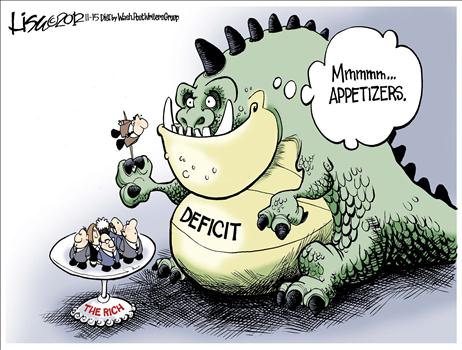
We’ll start with this great cartoon from Lisa Benson. In a perfect world, this monster would be named “Big Government.” But I’m not complaining too much since the obvious implication of the cartoon is that the soak-the-rich tax hikes will make the deficit worse – which implies that politicians will spend the money and/or that there will be a Laffer Curve response leading to less revenue than politicians predict.

You can see some of my favorite Benson cartoons here, herehereherehereherehere, hereherehere, and here.

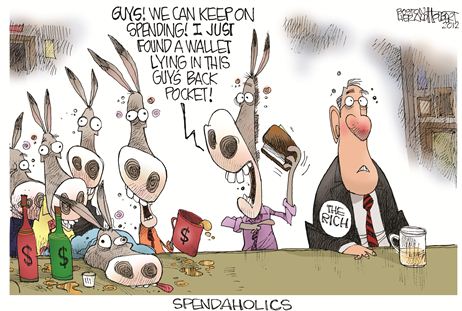
Here’s a similar cartoon. But instead of feeding a deficit monster, it shows that a tax hike will enable a bunch of politicians to continue their binging at our expense.

Holbert is relatively new to me. The only other cartoon of his that I’ve used (at least than I can remember) can be seen here.

Our final cartoon isn’t about Obama’s class-warfare proposal, but it does show where we’re going if we allow the politicians to continue down the path of tax-and-spend dependency.

You can see two additional Glenn Foden cartoons by clicking here and here.

I especially like the “spa” comment in the basket cartoon. Sort of reminds me of the “frog” story showing how it would be impossible to impose statism in one fell swoop. People would recognize the danger and immediately revolt, much as a frog would immediately hop out if you tried to drop it in boiling water. But just as you can lure a frog into danger by putting it in lukewarm water and slowing turning up the heat until it’s been too weakened to escape, you can also slowly but surely hook people on dependency by creating little programs and eventually turning them into big programs.

That’s sort of where we are today. The burden of government spending has exploded and will get even worse if we don’t enact serious entitlement reform. But too many people now can’t envision a world other than the status quo and they are fearful of change – even though inaction eventually means a Greek-style fiscal crisis.

P.S. Given the theme of this post, you will probably enjoy this Chuck Asay cartoon and this Henry Payne cartoon. Or perhaps you won’t enjoy them if you stop and think about what they’re really saying. But they are both gems, so try to focus only on the humor.

____________

Thank you so much for your time. I know how valuable it is. I also appreciate the fine family that you have and your commitment as a father and a husband.

Sincerely,

Everette Hatcher III, 13900 Cottontail Lane, Alexander, AR 72002, ph 501-920-5733, lowcostsqueegees@yahoo.com


Government interference has not allowed the USA to experience low price candy and it has cost the American consumer more and more and that program costs American taxpayers about $1.4 billion each year!!!

______________

Government interference has not allowed the USA to experience low price candy and it has cost the American consumer more and more and that program costs American taxpayers about $1.4 billion each year.

Happy Halloween: Candy-Crushing Cronyism

October 30, 2013 at 10:00 am

candy

Newscom

This Halloween, millions of Americans will, as every year, be handing out candy. But this year, the real trick could be finding treats made in the U.S.A. Because of government cronyism aimed at protecting big sugar producers, much of the candy in your child’s bag will come from overseas.

According to the U.S. Department of Agriculture, in 2012, the price of raw sugar was 40 percent higher in the United States than in the rest of the world. And, while an international sugar glut is expected to send prices tumbling everywhere else later this year, U.S. prices will remain about the same. That’s because of a U.S. government program that guarantees sugar processors a minimum price.

That program costs American taxpayers about $1.4 billion each year, while directly benefitting fewer than 5,000 beet and sugar cane farmers. Most of them, like most big farmers, are fairly well off to begin with. Meanwhile, the U.S. Commerce Department’s International Trade Administration says that U.S. consumers pay an extra $826,000 for each sugar-production job saved.

According to the U.S. International Trade Commission (yes, there is an International Trade Administration and an International Trade Commission), the sugar program imposes a $49 million net cost on the economy. That’s enough to buy 8.8 million five-pound bags of sugar. A study commissioned by the Sweetener Users Association sets the direct price even higher: between $2.9 billion to $3.5 billion per year.

The sugar program costs jobs as well.

The Hershey chocolate company has cut 1,500 jobs. Atkinson Candy Co. now makes 80 percent of its peppermint-flavored products at a factory in Guatemala that opened in 2010.

According to a 2006 U.S. Department of Commerce report, the U.S. has lost more than 10,000 candy-making jobs since 1997. The report adds that three candy-making jobs are lost for each sugar-growing and processing job saved by higher domestic sugar prices. “As long as the government has the ability to hand out favors to some industries and punish others, resources will be diverted away from productive private-sector activities to fund lobbying campaigns in Washington, D.C.,” notes Heritage’s Bryan Riley. “This Depression-era program, which was supposed to end in 1940, has outlived its intended lifespan by 72 years. It should be abolished.”

Until it is, the trick’s on American food consumers.

Related posts:

Open letter to President Obama (Part 432) A suggestion to cut some wasteful spending out of the government Part 2 (includes editorial cartoon)

(Emailed to White House on 3-15-13.) President Obama c/o The White House 1600 Pennsylvania Avenue NW Washington, DC 20500 Dear Mr. President, I know that you receive 20,000 letters a day and that you actually read 10 of them every day. I really do respect you for trying to get a pulse on what is […]

Dear Senator Pryor, here are some spending cut suggestions (“Thirsty Thursday”, Open letter to Senator Pryor)

Senator Pryor pictured below:  Why do I keep writing and email Senator Pryor suggestions on how to cut our budget? I gave him hundreds of ideas about how to cut spending and as far as I can tell he has taken none of my suggestions. You can find some of my suggestions here, here, here, here, here, here, here, here, here, here, here, here, here, here, here, here, here, here, here,  here, and  here, and they […]

Open letter to President Obama (Part 430) A suggestion to cut some wasteful spending out of the government Part 1 (includes editorial cartoon)

(Emailed to White House on 3-15-13.) President Obama c/o The White House 1600 Pennsylvania Avenue NW Washington, DC 20500 Dear Mr. President, I know that you receive 20,000 letters a day and that you actually read 10 of them every day. I really do respect you for trying to get a pulse on what is […]

The Dysfunction in Washington is Republicans and Democrats that are unwilling to cut spending in order to vote for more programs (Democrats want more food stamps etc but Republicans vote for their pet programs and wars too like No Child Left Behind Act, the Iraq war, the prescription drug entitlement, and the TARP bailout).

The Dysfunction in Washington is Republicans and Democrats that are unwilling to cut spending in order to vote for more programs (Democrats want more food stamps etc but Republicans vote for their pet programs and wars too like No Child Left Behind Act, the Iraq war, the prescription drug entitlement, and the TARP bailout). If […]

Dear Senator Pryor, here are some spending cut suggestions (“Thirsty Thursday”, Open letter to Senator Pryor)

Senator Pryor pictured below:  Why do I keep writing and email Senator Pryor suggestions on how to cut our budget? I gave him hundreds of ideas about how to cut spending and as far as I can tell he has taken none of my suggestions. You can find some of my suggestions here, here, here, here, here, here, here, here, here, here, here, here, here, here, here, here, here, here, here,  here, and  here, and they […]

If you want to cut wasteful spending then the disability program must be reformed radically!!!

If you want to cut wasteful spending then the disability program must be reformed radically!!! October 7, 2013 1:19PM 60 Minutes Disability Investigation By Chris Edwards Share The abuse and overspending in government disability programs is so bad that even National Public Radio and 60 Minutes have taken notice. On the heels of this excellent […]

If you really want to cut wasteful spending then why not shut down Dept of Housing and Urban Development, Dept of Education and SBA?

If you really want to cut wasteful spending then why not shut down Dept of Housing and Urban Development, Dept of Education and SBA? There are many other areas that should be cut but these should be shut down!!!   October 7, 2013 4:57PM Close Washington to Dismantle the Welfare-Warfare State By Doug Bandow Share […]

Dear Senator Pryor, here are some spending cut suggestions (“Thirsty Thursday”, Open letter to Senator Pryor)

Senator Pryor pictured below:  Why do I keep writing and email Senator Pryor suggestions on how to cut our budget? I gave him hundreds of ideas about how to cut spending and as far as I can tell he has taken none of my suggestions. You can find some of my suggestions here, here, here, here, here, here, here, here, here, here, here, here, here, here, here, here, here, here, here,  here, and  here, and they […]

We need to stop wasteful government spending by privatizing the post office!!

We need to stop wasteful government spending by privatizing the post office!! Postal Service Won’t Shut Down but Will Default on Its Debt James Gattuso October 1, 2013 at 9:30 am Newscom The U.S. Postal Service (USPS) defaulted on its debt last night. No, it has nothing to do with the partial shutdown of the […]

We need to stop the stupid spending by Bureaucrats!!!

We need to stop the stupid spending by Bureaucrats!!!   Bureaucrats Gone Wild: Government Spends Recklessly as Fiscal Year Ends Rob Bluey September 29, 2013 at 1:55 pm Credit: Tetra Images/Newscom Washington’s reckless spending is driving America into debt — and yet federal bureaucrats continue their wasteful and frivolous ways. The latest example comes courtesy […]

By Everette Hatcher III | Posted in spending out of control | Edit | Comments (0)

If you want to cut Welfare fraud then go to Flat Tax!!!

________

If you want to cut Welfare fraud then go to Flat Tax!!!

One of my missions in life is fundamental tax reform. I would like to replace the corrupt internal revenue code with a simple and fair flat tax.

Though what I really want is a tax system that minimizes the damage of extracting money from the productive sector of the economy, so I’ll take any system with a low rate, no double taxation, and no distortionary loopholes.

The national sales tax, for instance, also would be a good option if we can first repeal the 16th Amendment so there’s no risk that politicians would pull a bait and switch and saddle us with both an income tax and a sales tax (and in my ultimate fantasy world, we would shrink the federal government to the size envisioned by the Founding Fathers, in which case we probably wouldn’t need any broad-based tax at all).

While I normally make the economic case for tax reform, there are many reasons to fix our broken tax code.

Many Americans, for instance, are rightfully upset that the tax code is a 76.000-page monstrosity that enables the politically well connected to benefit from special provisions.

So we don’t know if the rich are paying an appropriate amount. Some of them are paying too much because of high rates and double taxation, while some of them are paying too little because they have clever lawyers, lobbyists, and accountants.

In an ideal world, if someone like Bill Gates earns 10,000 times as much as I do, then he should pay 10,000 times as much in tax. That’s a core principle of the flat tax.

But this post isn’t about why we need tax reform to promote economic growth or fairness. Instead, I want to focus on tax reform as a way of reducing welfare fraud. The Treasury Department just released a report acknowledging that the IRS made more than $100 billion of improper “earned income credit” payments over the past decade and that about one-fourth of all such payments are in error.

This Fox News article is a good summary. Here are the key details.

The Internal Revenue Service paid out more than $110 billion in tax credits over the past decade to people who didn’t qualify for them, according to a Treasury report released Tuesday. …IRS inspector general J. Russell George said more than one-fifth of all credits paid under the program went to people who didn’t qualify. …George said in a statement. “Unfortunately, it is still distributing more than $11 billion in improper EITC payments each year and that is disturbing.” …The agency said it prevents “nearly $4 billion in improper claims each year and is committed to continuing to work to reduce improper claims.” The EITC is one of the nation’s largest anti-poverty programs. In 2011, more than 27 million families received nearly $62 billion in credits.

Now some background. The “earned income credit” or “earned income tax credit” is actually an income redistribution scheme operated by the IRS. It’s basically a wage subsidy. If someone earns money (the “earned income” part), the law says the IRS should augment that money with a payment from the government (the “credit” or “tax credit” part).

The key thing to understand, though, is that the EITC is “refundable,” which is the government’s term for payments to people who don’t earn enough to owe any income tax. That’s why it’s primarily an income redistribution program. Only it’s operated by the IRS rather than the Department of Health and Human Service or some other welfare agency.

And when government is giving away other people’s money, there are those who will try to abuse the program. That’s true for corporate welfare, and it’s true for traditional welfare like food stamps. And, as we see from the Treasury report, it’s true for the EITC.

That’s the bad news.

The good news is that the EITC has a redeeming feature. Some lawmakers realized traditional welfare programs were very destructive because they paid people not to work. The EITC supposedly offsets that perverse incentive because you get the money only because you earn some income.

But now let’s share some additional bad news. The government takes away the EITC once your income reaches a certain level, and this is equivalent to a big increase in the marginal tax rate on earning additional income.

And when you combine the EITC with all the other redistribution programs operated by government, you create a huge dependency trap. Indeed, the chart shows that many of these programs can be larger than the EITC (which is called “negative income tax”).

So let’s adopt a flat tax and get rid of all the bad features of the tax system, including the EITC. Welfare and income redistribution are not proper roles of the federal government.

We’re far more likely to get good results – both for poor people and taxpayers – if we let state and local governments experiment and learn from each other on what actually helps people climb out of poverty.

P.S. I can’t overlook an opportunity to point out that today’s complicated and convoluted tax code is the reason why we have a powerful and intrusive Internal Revenue Service. And never forget that the IRS has a long record of abusive actions.

Related posts:

Open letter to President Obama (Part 432) A suggestion to cut some wasteful spending out of the government Part 2 (includes editorial cartoon)

(Emailed to White House on 3-15-13.) President Obama c/o The White House 1600 Pennsylvania Avenue NW Washington, DC 20500 Dear Mr. President, I know that you receive 20,000 letters a day and that you actually read 10 of them every day. I really do respect you for trying to get a pulse on what is […]

Dear Senator Pryor, here are some spending cut suggestions (“Thirsty Thursday”, Open letter to Senator Pryor)

Senator Pryor pictured below:  Why do I keep writing and email Senator Pryor suggestions on how to cut our budget? I gave him hundreds of ideas about how to cut spending and as far as I can tell he has taken none of my suggestions. You can find some of my suggestions here, here, here, here, here, here, here, here, here, here, here, here, here, here, here, here, here, here, here,  here, and  here, and they […]

Open letter to President Obama (Part 430) A suggestion to cut some wasteful spending out of the government Part 1 (includes editorial cartoon)

(Emailed to White House on 3-15-13.) President Obama c/o The White House 1600 Pennsylvania Avenue NW Washington, DC 20500 Dear Mr. President, I know that you receive 20,000 letters a day and that you actually read 10 of them every day. I really do respect you for trying to get a pulse on what is […]

The Dysfunction in Washington is Republicans and Democrats that are unwilling to cut spending in order to vote for more programs (Democrats want more food stamps etc but Republicans vote for their pet programs and wars too like No Child Left Behind Act, the Iraq war, the prescription drug entitlement, and the TARP bailout).

The Dysfunction in Washington is Republicans and Democrats that are unwilling to cut spending in order to vote for more programs (Democrats want more food stamps etc but Republicans vote for their pet programs and wars too like No Child Left Behind Act, the Iraq war, the prescription drug entitlement, and the TARP bailout). If […]

Dear Senator Pryor, here are some spending cut suggestions (“Thirsty Thursday”, Open letter to Senator Pryor)

Senator Pryor pictured below:  Why do I keep writing and email Senator Pryor suggestions on how to cut our budget? I gave him hundreds of ideas about how to cut spending and as far as I can tell he has taken none of my suggestions. You can find some of my suggestions here, here, here, here, here, here, here, here, here, here, here, here, here, here, here, here, here, here, here,  here, and  here, and they […]

If you want to cut wasteful spending then the disability program must be reformed radically!!!

If you want to cut wasteful spending then the disability program must be reformed radically!!! October 7, 2013 1:19PM 60 Minutes Disability Investigation By Chris Edwards Share The abuse and overspending in government disability programs is so bad that even National Public Radio and 60 Minutes have taken notice. On the heels of this excellent […]

If you really want to cut wasteful spending then why not shut down Dept of Housing and Urban Development, Dept of Education and SBA?

If you really want to cut wasteful spending then why not shut down Dept of Housing and Urban Development, Dept of Education and SBA? There are many other areas that should be cut but these should be shut down!!!   October 7, 2013 4:57PM Close Washington to Dismantle the Welfare-Warfare State By Doug Bandow Share […]

Dear Senator Pryor, here are some spending cut suggestions (“Thirsty Thursday”, Open letter to Senator Pryor)

Senator Pryor pictured below:  Why do I keep writing and email Senator Pryor suggestions on how to cut our budget? I gave him hundreds of ideas about how to cut spending and as far as I can tell he has taken none of my suggestions. You can find some of my suggestions here, here, here, here, here, here, here, here, here, here, here, here, here, here, here, here, here, here, here,  here, and  here, and they […]

We need to stop wasteful government spending by privatizing the post office!!

We need to stop wasteful government spending by privatizing the post office!! Postal Service Won’t Shut Down but Will Default on Its Debt James Gattuso October 1, 2013 at 9:30 am Newscom The U.S. Postal Service (USPS) defaulted on its debt last night. No, it has nothing to do with the partial shutdown of the […]

We need to stop the stupid spending by Bureaucrats!!!

We need to stop the stupid spending by Bureaucrats!!!   Bureaucrats Gone Wild: Government Spends Recklessly as Fiscal Year Ends Rob Bluey September 29, 2013 at 1:55 pm Credit: Tetra Images/Newscom Washington’s reckless spending is driving America into debt — and yet federal bureaucrats continue their wasteful and frivolous ways. The latest example comes courtesy […]

Open letter to President Obama (Part 420) Bailouts are legal corruption

(Emailed to White House on 1-14-13.)

President Obama c/o The White House
1600 Pennsylvania Avenue NW
Washington, DC 20500

Dear Mr. President,

I know that you receive 20,000 letters a day and that you actually read 10 of them every day. I really do respect you for trying to get a pulse on what is going on out here.

There is no free money out there. Somebody has to always pay.

Bailout Nation

January 13, 2013 by Dan Mitchell

I have a serious question for readers. What’s worse, bailouts for government or bailouts for the private sector?

Yes, both are bad, but is it worse to bail out a bankrupt entitlement program, such as Social Security, or it is worse to bail out an industry, such as the financial sector?

Bailout gravy train cartoonTo bail out the housing sector, or to bail out Medicare? Fannie and Freddie, or GM and Chrysler?

All these examples involve huge amounts of money, and both private-sector and public-sector bailouts have perverse long-run effects, but which is worse?

And don’t forget there are lots of other bailouts in our future, as discussed on this interview for Fox Business News.

The interview took place before Christmas, but the topic is even more relevant today since the budget season is about to begin.

Most of the discussion was about government agencies and programs that may get more handouts, though bailouts for the Federal Housing Administration and the Pension Benefit Guaranty Corporation would be indirect bailouts for big business and housing.

So we’d get the worst of all worlds, more government spending and more cronyism.

Or, as they call it in Washington, a win-win situation.

But I call it legal corruption.

Thank you so much for your time. I know how valuable it is. I also appreciate the fine family that you have and your commitment as a father and a husband.

Sincerely,

Everette Hatcher III, 13900 Cottontail Lane, Alexander, AR 72002, ph 501-920-5733, lowcostsqueegees@yahoo.com