Does Government Have a Revenue or Spending Problem?
People say the government has a debt problem. Debt is caused by deficits, which is the difference between what the government collects in tax revenue and the amount of government spending. Every time the government runs a deficit, the government debt increases. So what’s to blame: too much spending, or too little tax revenue? Economics professor Antony Davies examines the data and concludes that the root cause of the debt is too much government spending.
______________
We got to cut wasteful spending out of the government and here is another fine suggestion from the Heritage Foundation.
The massive spending bill, or continuing resolution, released by the Senate this week continues spending on programs which are inappropriate or wasteful and fails to adopt good policies in many areas. Here’s a rundown of some of the worst offenders in the Senate bill:
Head Start. Increasing Head Start funding is the antithesis of good early childhood education policy. The Senate CR provides $33.5 million in new funding for one of the most ineffective federal education programs in existence today: Head Start. While the new funding is earmarked for the Obama Administration’s plan to make the worst-performing Head Start centers re-compete for funds, it represents new spending on a program the federal government has deemed totally ineffective at meeting the needs of poor children.
In December, the Department of Health and Human Services (HHS) released its long-overdue evaluation of Head Start. The agency’s scientifically rigorous evaluation of more than 5,000 Head Start children from the time they entered the program through third grade revealed that the $8 billion per year federal program had little to no impact on cognitive, social-emotional, health, or parenting practices of participants. On a few measures, access to Head Start had negative effects on children.
In addition to the evidence presented by HHS of Head Start’s ineffectiveness, in 2010 the Government Accountability Office (GAO) reported widespread fraud at Head Start centers. GAO sent undercover investigators into Head Start centers in various states, and in half they found fraudulent activity, such as Head Start employees counseling families to underreport their income in order to appear eligible for services.
Since 1965, taxpayers have expended some $180 billion on Head Start yet have not received a return on that “investment.” And now, in the wake of an objective report by HHS demonstrating that Head Start is failing the poor children it was designed to serve, the Senate CR would increase spending and eschew any suggestion of eliminating or reforming the Great Society relic.
Head Start should be eliminated. At a minimum, it should be reformed to allow states to make their Head Start dollars portable, following low-income children to a private preschool provider of choice, instead of relegating them to underperforming Head Start centers.
Interest payments on U.S. government debt are three times spending in the Iraq and Afghanistan wars already, and that is with the lowest interest rate we have seen since the 1960s. A rise in interest rates would increase interest payments dramatically. What can the U.S. government do today to prevent a crisis from happening when interest rates go up?
______________
We got to cut wasteful spending out of the government and here is another fine suggestion from the Heritage Foundation.
The massive spending bill, or continuing resolution, released by the Senate this week continues spending on programs which are inappropriate or wasteful and fails to adopt good policies in many areas. Here’s a rundown of some of the worst offenders in the Senate bill:
Obamacare. The CR fails to stop the massive spending in Obamacare. Obamacare obligates an estimated $1.2 trillion for subsidies to individuals for purchasing coverage through the government exchanges and $638 billion for states agreeing to expand their Medicaid programs. Congress should eliminate the exchange subsidies and the enhanced federal match for the Medicaid expansion. Stopping these provisions would save the federal government more than $1.8 trillion over the next 10 years. Nor does it take steps to defund implementation of Obamacare.
—Nina Owcharenko, Director, Center for Health Policy Studies and Preston A. Wells, Jr. Fellow
More than two years ago, I explained in a TV interview that the looters and moochers should be careful that they don’t kill the geese that lay the golden eggs. After all, parasites need a healthy host.
The central economic selling point of the Obama reelection team is that the president saved the U.S. auto industry. That such a contestable proposition serves as the administration’s economic headline does more to underscore its abysmal record than to inspire confidence in its continued economic stewardship.
The administration didn’t save the auto industry. The stronger case is that it damaged the auto industry along with several important institutions vital to capitalism’s proper functioning. However, it should be granted that President Obama’s commandeering of GM’s and Chrysler’s bankruptcy process saved jobs at those companies and elsewhere in their supply chains (and provided an opportunity to dole out spoils for politically favored interests). How many jobs were saved is impossible to determine because it’s not clear what would have happened to GM’s and Chrysler’s assets had a normal, non-political bankruptcy process been allowed to unfold.
Yes, jobs were saved for the time being in Michigan, Ohio, and a few other industrial states in the Midwest. That is what can be seen. And politicians are hardwired to tout the benefits—and only the benefits—of their policies.
But an informed citizenry should insist on a proper accounting of the costs of those policies, as well—not just the losses put on the taxpayers’ tab (right now taxpayers’ “investment” in GM is $27 billion, but the public’s 500 million shares of GM stock is worth only $10 billion), but the unseen costs.
Sure some jobs were preserved in some locations, but what about the less visible consequences and ripple effects? What isn’t so easily seen, but is every bit as important to assessing the auto interventions is the effects on the other auto companies and their workers (i.e., the majority of the U.S. auto industry). Will the public remember or know enough to attribute layoffs of American workers at Ford or Toyota or Kia during the next downturn in auto demand to the fact that a necessary reckoning on the supply side was precluded by the interventions of 2009?
The auto industry is plagued with overcapacity, which is a problem that demands a thinning of the herd. GM and Chrysler, through their own relatively poor decisions with respect to labor relations, product offerings, and quality management were failing by the market’s judgment and were the rightful candidates to be thinned. But that process was forestalled. In 2013, auto workers in Alabama, Tennessee, South Carolina, Indiana, and even Michigan and Ohio may lose their jobs because GM and Chrysler workers’ jobs were spared in 2009.
That is only one of the many unseen or under-rug-swept costs of the auto bailouts. The following passage from congressional testimony I gave last year identifies several others:
It is galling to hear administration officials characterize the auto bailouts as “successful.” The word should be off-limits when describing this unfortunate chapter in U.S. economic history. At most, bailout proponents and apologists might respectfully argue — and still be wrong, however — that the bailouts were necessary evils undertaken to avert greater calamity.
But calling the bailouts “successful” is to whitewash the diversion of funds from the Troubled Assets Relief Program by two administrations for purposes unauthorized by Congress; the looting and redistribution of claims against GM’s and Chrysler’s assets from shareholders and debt-holders to pensioners; the use of questionable tactics to bully stakeholders into accepting terms to facilitate politically desirable outcomes; the unprecedented encroachment by the executive branch into the finest details of the bankruptcy process to orchestrate what bankruptcy law experts describe as “Sham” sales of Old Chrysler to New Chrysler and Old GM to New GM; the costs of denying Ford and the other more deserving automakers the spoils of competition; the costs of insulating irresponsible actors, such as the United Autoworkers, from the outcomes of an apolitical bankruptcy proceeding; the diminution of U.S. moral authority to counsel foreign governments against similar market interventions; and the lingering uncertainty about the direction of policy under the current administration that pervades the business environment to this very day.
In addition to the above, there is the fact that taxpayers are still short tens of billions of dollars on account of the GM bailout without serious prospects for ever being made whole. Thus, acceptance of the administration’s pronouncement of auto bailout success demands profound gullibility or willful ignorance. Sure, GM has experienced recent profits and Chrysler has repaid much of its debt to the Treasury. But if proper judgment is to be passed, then all of the bailout’s costs and benefits must be considered. Otherwise, calling the bailout a success is like applauding the recovery of a drunken driver after an accident, while ignoring the condition of the family he severely maimed.
Thank you so much for your time. I know how valuable it is. I also appreciate the fine family that you have and your commitment as a father and a husband.
Sincerely,
Everette Hatcher III, 13900 Cottontail Lane, Alexander, AR 72002, ph 501-920-5733, lowcostsqueegees@yahoo.com
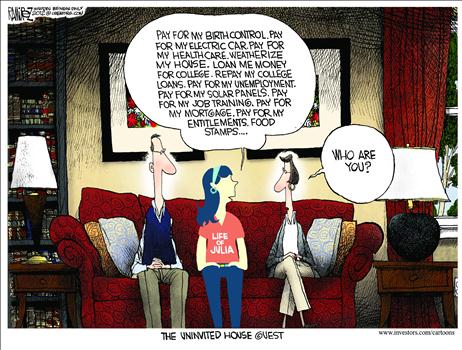
This video from the Center for Freedom and Prosperity Foundation contrasts the dependency mentality in the President’s “Life of Julia” campaign with the traditional American approach of self reliance and individual achievement.
Back in 2010, I posted a “Moocher Index” showing the states with the most dependency. But that was based on numbers and lacked any human-interest angle.
So let’s create a Moocher Hall of Fame for the individuals who best exemplify the culture of loafing, laziness, and dependency that is being subsidized by our vote-buying political class.
But you don’t receive this honor simply by accepting other people’s money. Membership in the Moocher Hall of Fame is reserved for deadbeats who demonstrate some special characteristic that warrants their induction.
* Leroy entered the Hall of Fame after it was reported that he won $2 million from the lottery, but somehow is still collecting food stamps.
* A welfare mother with 11 kids in the United Kingdom was invited into the Hall of Fame after one of her sons was arrested for looting and she said “the riots are because the government does “f*** all” for children.”
* If the Hall of Fame had an award for going above and beyond the call of loafing, then Hans from Austria would be an obvious choice. He cut off his own foot to ensure continued handouts.
* We also have a husband-wife team in the Hall of Fame. Alicia and Matthew were unanimous inductees after it was revealed that they tried to impregnate a 12-year old girl to increase their welfare payments.
* Speaking of husband-wife duos, let’s not forget Danny and Gina, who bragged that it didn’t make sense for them to work when the government was providing them with enough loot to enjoy an apartment, a big flat-screen TV, and 40 daily cigarettes.
* Abdul from Australia is an esteemed member of the Hall of Fame’s terror wing, having received 19 years of welfare while plotting to kill the people who were paying for his life of leisure.
* Last but not least, we have Natalijia, a Lithuanian woman who in now enjoying foreign holidays and designer clothes thanks to the generosity of British taxpayers, but nonetheless complained that she wasn’t getting a taxpayer-financed nanny.
Quite a collection of scroungers.
But I don’t think they’re very bright. They wanted to invite Julia to be the speaker at this year’s induction ceremony, apparently not realizing that she was a make-believe cartoon character created by the Obama campaign to celebrate dependency.
But I’m digressing. The purpose of this post is to announce the newest member of the Moocher Hall of Fame.
Our proud new bum comes from Denmark. Known as “Lazy Robert,” he’s been mooching off the taxpayers for 12 years and he’s very proud of his lifestyle. Here are some inspirational details from a New York Times report.
Robert Nielsen, 45, made headlines last September when he was interviewed on television, admitting that he had basically been on welfare since 2001. Mr. Nielsen said he was able-bodied but had no intention of taking a demeaning job, like working at a fast-food restaurant. He made do quite well on welfare, he said. He even owns his own co-op apartment. …Mr. Nielsen, called “Lazy Robert” by the news media, seems to be enjoying the attention. He says that he is greeted warmly on the street all the time. “Luckily, I am born and live in Denmark, where the government is willing to support my life,” he said.
The story also mentions another Danish moocher. Her story is worth sharing because it shows how the folks riding in the wagon enjoy higher living standards than many of those pulling the wagon.
Visit a single mother of two on welfare, a liberal member of Parliament goaded a skeptical political opponent, see for yourself how hard it is. It turned out, however, that life on welfare was not so hard. The 36-year-old single mother, given the pseudonym “Carina” in the news media, had more money to spend than many of the country’s full-time workers. All told, she was getting about $2,700 a month, and she had been on welfare since she was 16.
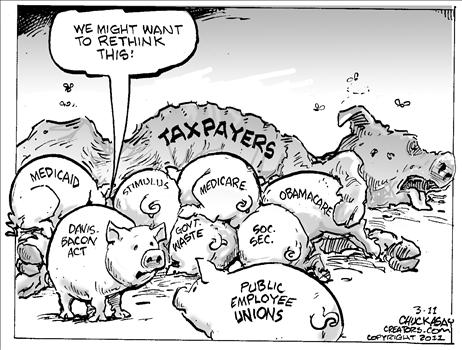
This probably doesn’t bode well for Denmark’s future. As illustrated by this famous set of cartoons, this kind of system creates very perverse incentives.
By the way, I decided that Carina didn’t deserve membership in the Hall of Fame because at least she has the decency to be ashamed. Or at least that’s one I’m assuming since the story says she “will no longer give interviews.”
But there are some people who genuinely deserve something, and those folks are the taxpayers of Denmark. They deserve our sympathy. They have one of the world’s most oppressive tax systems, thanks in part to a welfare system that provides a comfortable hammock for Robert and Carina.
I have posted stories on welfare before and here is another one. Another Horrifying and Depressing Look at the Human Cost of the Welfare State March 22, 2013 by Dan Mitchell When we think of Julia, the mythical moocher created by the Obama campaign, our first instinct is probably to grab our wallets and purses. After […]
The best way to destroy the welfare trap is to put in Milton Friedman’s negative income tax. A Picture of How Redistribution Programs Trap the Less Fortunate in Lives of Dependency I wrote last year about the way in which welfare programs lead to very high implicit marginal tax rates on low-income people. More specifically, they […]
Real Time with Bill Maher March 16 2012 – Alexandra Pelosi Interviews Welfare Recipients in NYC Published on Mar 18, 2012 by vclubscenedotcom Real Time with Bill Maher March 16 2012 – Alexandra Pelosi Interviews Welfare Recipients It is truly sad to me that we have got to such a low point in our country […]
President Obama c/o The White House 1600 Pennsylvania Avenue NW Washington, DC 20500 Dear Mr. President, I know that you receive 20,000 letters a day and that you actually read 10 of them every day. I really do respect you for trying to get a pulse on what is going on out here. On […]
State of the Union 2013 Published on Feb 13, 2013 Cato Institute scholars Michael Tanner, Alex Nowrasteh, Julian Sanchez, Simon Lester, John Samples, Pat Michaels, Jagadeesh Gokhale, Michael F. Cannon, Jim Harper, Malou Innocent, Juan Carlos Hidalgo, Ilya Shapiro, Trevor Burrus and Neal McCluskey respond to President Obama’s 2013 State of the Union Address. Video […]
I have put up lots of cartoons from Dan Mitchell’s blog before and they have got lots of hits before. Many of them have dealt with the economy, eternal unemployment benefits, socialism, Greece, welfare state or on gun control. President Obama’s “You-Didn’t-Build-That” comment misses the mark because only 10% of the federal budget pays for public goods when the […]
State of the Union 2013 Published on Feb 13, 2013 Cato Institute scholars Michael Tanner, Alex Nowrasteh, Julian Sanchez, Simon Lester, John Samples, Pat Michaels, Jagadeesh Gokhale, Michael F. Cannon, Jim Harper, Malou Innocent, Juan Carlos Hidalgo, Ilya Shapiro, Trevor Burrus and Neal McCluskey respond to President Obama’s 2013 State of the Union Address. Video […]
State of the Union 2013 Published on Feb 13, 2013 Cato Institute scholars Michael Tanner, Alex Nowrasteh, Julian Sanchez, Simon Lester, John Samples, Pat Michaels, Jagadeesh Gokhale, Michael F. Cannon, Jim Harper, Malou Innocent, Juan Carlos Hidalgo, Ilya Shapiro, Trevor Burrus and Neal McCluskey respond to President Obama’s 2013 State of the Union Address. Video […]
If America does not get welfare reform under control, it will bankrupt America. But the Heritage Foundation’s Robert Rector has a five-step plan to reform welfare while protecting our most vulnerable.
__________________________
We got to slow down the growth of Food Stamps. One way to do it is to tell the 48 million food stamps users to eat more broccoli!!!!
The federal food stamp program—now called SNAP—is attracting a lot of media coverage. One reason for this is that the program’s costs have exploded—spending more than quadrupled during the Bush-Obama years to $82 billion in 2013 (see here and here p. 16). The Clinton, Bush, and Obama administrations all took steps to loosen the purse strings on food stamp eligibility, and those changes have led to the ballooning costs of recent years during the stagnant economy.
Aside from the rising costs, two other aspects of SNAP have garnered interest. One is food stamp fraud. The other is the program’s “Twinkie problem”: taxpayers are paying for billions of dollars of junk food, which seems like a huge waste of money to most people.
These two issues have come together in a high-profile effort by a group of media organizations that is demanding greater transparency in SNAP operations. The organizations—led by the Association of Health Care Journalists (AHCJ)—have sent a letter to Agriculture Secretary Tom Vilsack (whose agency oversees SNAP) asking for full disclosure about where food stamps are being spent and what they are being spent on. The Daily Caller reports on the issue here.
Let’s look at the fraud issue. The government claims that the food stamp trafficking rate is just 1 percent and the general overpayment rate is just 4 percent. I suspect that the real rates are much higher, for three reasons: First, the overall costs of SNAP and the number of beneficiaries have skyrocketed. Second, SNAP is ideally suited for abuse: the USDA has few investigators to police the roughly 200,000 SNAP retailers, any of whom could be scamming the system. Third, overpayment rates on other federal subsidy programs are often around 10 percent. Medicare and Medicaid overpayments are in that range, for example, and overpayments have long been around 20 percent in the EITC program.
The AHCJ-led effort is asking the USDA to release data on food stamp purchases by retail outlet. This would be a very useful resource for investigators across the nation to help the government reduce waste and fraud. Are food stamps being cashed in at liquor stores? Which corner stores have unusually high food stamp usage? Let’s get detailed SNAP data on the Internet and allow journalists and the public to help answer these questions. After all, scandal after scandal illustrate that the federal government is lousy at policing programs itself.
The journalists are also asking the USDA to provide detailed breakdowns of the types of food being purchased with SNAP money. It’s remarkable that in an era of Bloomberg-style efforts to restrict private food choices, the government itself runs a giant $82 billion program that subsidizes junk food. How much junk food? We don’t know, and that’s what many journalists want to find out.
Food stamps can be used to purchase just about any edible item other than alcohol, hot food, restaurant meals, and live animals. The USDA explains the rules here and specifically notes that “soft drinks, candy, cookies, snack crackers, and ice cream” are allowed.
Many health experts would like to ban junk food purchases in the food stamp program because they want Americans to eat more nutritious food. I’m a libertarian, so I don’t want the government telling people what to eat. But I think banning junk food in SNAP would be a good step for a different reason: it would greatly reduce demand for the program and thus cut taxpayer costs. If we told the 48 million users of food stamps that they could only use their electronic subsidy cards to buy items like spinach and broccoli, a lot fewer people would use the program and they would buy less stuff.
Why has the USDA been stonewalling journalists on providing SNAP program data? I’m guessing that federal officials don’t want to be embarrassed about: 1) how much taxpayer money goes toward junk food, and 2) the endless series of stories about SNAP fraud that would likely be generated if journalists could explore the program’s operational details.
Optimally, SNAP should be terminated altogether and food subsidy activities left to the states—or better, to private charities. But until that reform happens, the current effort to pry open the workings of this giant hand-out program would be big step in the right direction.
Some links of interest:
A leaked database of food stamp usage in Massachusetts. This is the type of data that should be released nationally by the USDA.
A study on the corporate lobbying surrounding food stamps. This liberal group doesn’t want to cut spending, but it provides an excellent summary of the junk food issue, transparency, and the benefits of SNAP to the banking industry.
Eight Reasons Why Big Government Hurts Economic Growth __________________ We got to cut spending and we must first start with food stamp program and we need some Senators that are willing to make the tough cuts. Food Stamp Republicans Posted by Chris Edwards Newt Gingrich had fun calling President Obama the “food stamp president,” but […]
Milton Friedman’s negative income tax explained by Friedman in 1968: We need to cut back on the Food Stamp program and not try to increase it. What really upsets me is that when the government gets involved in welfare there is a welfare trap created for those who become dependent on the program. Once they […]
Welfare Can And Must Be Reformed Uploaded by HeritageFoundation on Jun 29, 2010 If America does not get welfare reform under control, it will bankrupt America. But the Heritage Foundation’s Robert Rector has a five-step plan to reform welfare while protecting our most vulnerable. __________________________ If welfare increases as much as it has in the […]
I am glad that my state of Arkansas is not the leader in food stamps!!! Mirror, Mirror, on the Wall, Which State Has the Highest Food Stamp Usage of All? March 19, 2013 by Dan Mitchell The food stamp program seems to be a breeding ground of waste, fraud, and abuse. Some of the horror stories […]
Uploaded by oversightandreform on Mar 6, 2012 Learn More at http://oversight.house.gov The Oversight Committee is examining reports of food stamp merchants previously disqualified who continue to defraud the program. According to a Scripps Howard News Service report, food stamp fraud costs taxpayers hundreds of millions every year. Watch the Oversight hearing live tomorrow at 930 […]
Testing Milton Friedman – Preview Uploaded by FreeToChooseNetwork on Feb 21, 2012 2012 is the 100th anniversary of Milton Friedman’s birth. His work and ideas continue to make the world a better place. As part of Milton Friedman’s Century, a revival of the ideas featured in the landmark television series Free To Choose are being […]
I ran across this very interesting article about Milton Friedman from 2002: Friedman: Market offers poor better learningBy Tamara Henry, USA TODAY By Doug Mills, AP President Bush honors influential economist Milton Friedman for his 90th birthday earlier this month. About an economist Name:Milton FriedmanAge: 90Background: Winner of the 1976 Nobel Prize for economic science; […]
Testing Milton Friedman – Preview Uploaded by FreeToChooseNetwork on Feb 21, 2012 2012 is the 100th anniversary of Milton Friedman’s birth. His work and ideas continue to make the world a better place. As part of Milton Friedman’s Century, a revival of the ideas featured in the landmark television series Free To Choose are being […]
According to the 2012 Index of Economic Freedom, a joint publication of The Heritage Foundation and The Wall Street Journal, global economic freedom has declined over the past year. But what does this mean for America and the world?
Economic freedom empowers ordinary people with greater opportunity and individual choice, and it lets people decide for themselves how best to achieve their highest aspirations. From the amount a government spends, to the individual property rights extended to its citizens, a nation’s economic freedom is closely tied to key values like the elimination of poverty and freedom from corruption.
To learn more about economic freedom and view the 2012 Index country rankings, visit us online at heritage.org/Index
___________
President Obama c/o The White House
1600 Pennsylvania Avenue NW
Washington, DC 20500
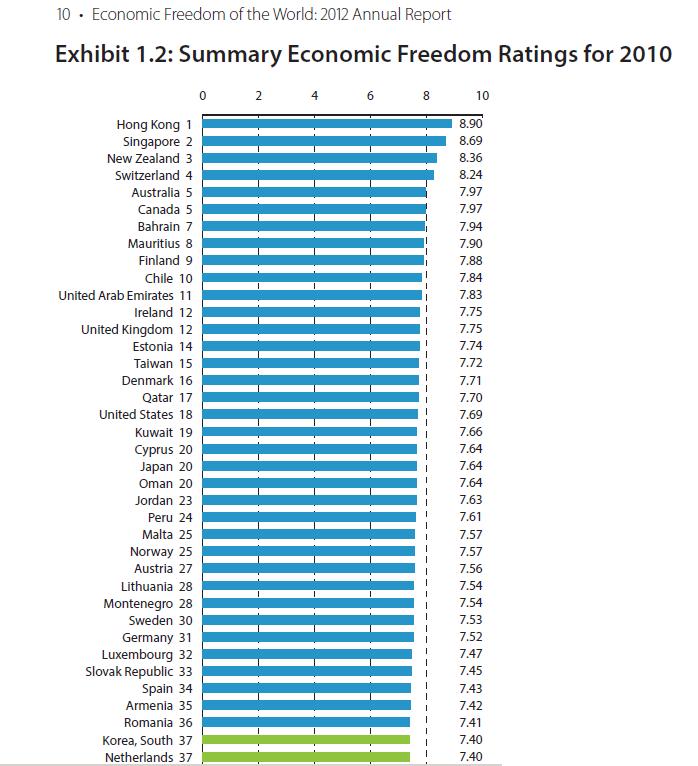
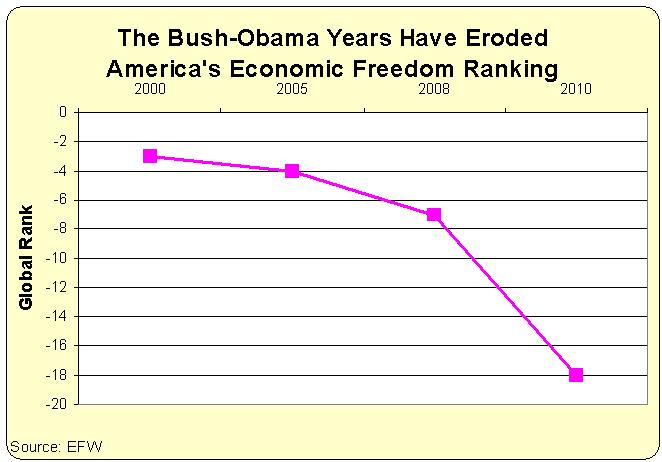
But I’m somewhat shocked to learn that we fell from 10th last year all the way down to 18th this year, as can be seen on the chart (click to enlarge).
Last year, the U.S. fell from 7th to 10th, and I though dropping three spots was bad. But falling by eight spots this past year is a stunning decline.
Who would have thought that Scandinavian welfare states such as Denmark and Finland would rank higher than the United States? Or that Ireland, with all its problems, would be above America?
American politicians, by contrast, deserve scorn. Let’s update the chart I posted when last year’s report was issued.
As you can see, it’s an understatement to say that the United States is heading in the wrong direction. We’re still considerably ahead of interventionist welfare states such as France and Italy, though I’m afraid to think about what the U.S. score will be five years from now.
The United States, long considered the standard bearer for economic freedom among large industrial nations, has experienced a substantial decline in economic freedom during the past decade. From 1980 to 2000, the United States was generally rated the third freest economy in the world, ranking behind only Hong Kong and Singapore. After increasing steadily during the period from 1980 to 2000, the chainlinked EFW rating of the United States fell from 8.65 in 2000 to 8.21 in 2005 and 7.70 in 2010. The chain-linked ranking of the United States has fallen precipitously from second in 2000 to eighth in 2005 and 19th in 2010 (unadjusted ranking of 18th).
For those interested in why the United States has dropped, the “size of government” score has fallen from 8.65 in 2000 to 7.70 in the latest report. That’s not a surprise since the burden of government spending has exploded during the Bush-Obama years.
But the trade score also dropped significantly over the same period, from 8.78 to 7.65. So the protectionists should be happy, even though the rest of us have less prosperity.
The most dramatic decline, though, was the in the “legal system and property rights” category, where the U.S. plummeted from 9.23 in 2000 down to 7.12 in the new report. We’re not quite Argentina (3.76!), to be sure, but the trend is very troubling.
__________
Thank you so much for your time. I know how valuable it is. I also appreciate the fine family that you have and your commitment as a father and a husband.
Sincerely,
Everette Hatcher III, 13900 Cottontail Lane, Alexander, AR 72002, ph 501-920-5733, lowcostsqueegees@yahoo.com
President Obama is from Illinois and he is running our nation like the politicians of Illinois run their state with lots of wasteful spending and too many high taxes.
That’s because we have reachedTax Freedom Day, meaning that – in the aggregate – we have finally earned enough money to pay for all the federal, state, and local taxes that will be imposed on us this year by our political masters.
But we’re not collectivists, so aggregate measures don’t really matter. Our individual tax burdens can vary considerably depending on the level and composition of our income, as well as the state in which we live.
Speaking of that, the good folks of North Dakota are the only ones actually celebrating Tax Freedom Day on this exact date. If you look at the map, Tax Freedom Day is as early as late March for residents of Louisiana and Mississippi, and as late as May for the unfortunate residents of New York, Connecticut, and New Jersey.
You’ll notice, by the way, that Tax Freedom Day is correlated with average state income. That’s one of the reasons why low-income states tend to get better scores. Simply stated, it’s hard to collect a lot of revenue from people who don’t have much money.
And a state that historically has been wealthy, like Connecticut, will probably collect a lot of revenue even if it has a good tax system (though, for the record, Connecticut hasveered dramatically in the wrong directionin the past couple of decades).
So if you want to measure whether a state has a good or bad tax system, I recommend the “fiscal” and “tax burden” categories in the “Freedom Index” from the Mercatus Center. Using that measure,South Dakota gets the best score(compared to the 6th-best score using Tax Freedom Day).
P.S. If you like maps, here are some interesting ones, starting with some international comparisons.
Dan Mitchell explains what happened in Cyprus. What Really Happened in Cyprus? April 14, 2013 by Dan Mitchell Did Cyprus become an economic basket case because it is a tax haven, as some leftists have implied? Did it get in trouble because the government overspent, which I have suggested? The answers to those questions are […]
Some very good points by Dan Mitchell of the Cato Institute on Obamacare: Why We Should Be Optimistic about Repealing Obamacare and Fixing the Healthcare System April 10, 2013 by Dan Mitchell I’m going to make an assertion that seems utterly absurd. The enactment of Obamacare may have been good news. Before sending a team of medical […]
I have put up lots of cartoons from Dan Mitchell’s blog before and they have got lots of hits before. Many of them have dealt with the economy, eternal unemployment benefits, socialism, Greece, welfare state or on gun control. I’ve Obtained a Secret Pre-Release Copy of Obama’s Budget April 9, 2013 by Dan Mitchell The President is supposed to release […]
Very well said by Dan Mitchell. A Tribute to Margaret Thatcher April 8, 2013 by Dan Mitchell The woman who saved the United Kingdom has died. A Great Woman I got to meet Margaret Thatcher a couple of times and felt lucky each time that I was in the presence of someone who put her nation’s […]
I like Milton Friedman’s comments on this issue of immigration and Ron Paul and Dan Mitchell do well on the issue too. Question of the Week: What’s Your Take on the Immigration Debate? April 7, 2013 by Dan Mitchell A reader from overseas wonders about my views on immigration, particularly amnesty. I confess that this is one of […]
We should lower federal taxes because jobs are going to states like Texas that have low taxes. What Can We Learn by Comparing the Employment Situation in Texas vs. California? April 3, 2013 by Dan Mitchell One of the great things about federalism, above and beyond the fact that it both constrains the power of governments […]
Third-Party Payer is the Biggest Economic Problem With America’s Health Care System Published on Jul 10, 2012 This mini-documentary from the Center for Freedom and Prosperity Foundation explains that “third-party payer” is the main problem with America’s health care system. This is why undoing Obamacare, while desirable, is just a small first step if we […]
I have put up lots of cartoons from Dan Mitchell’s blog before and they have got lots of hits before. Many of them have dealt with the economy, eternal unemployment benefits, socialism, Greece, welfare state or on gun control. The funniest cartoon is the one with “Nurse Sebelius” stuffing the huge capsule down the kid’s throat!!! Obamacare […]
I have put up lots of cartoons from Dan Mitchell’s blog before and they have got lots of hits before. Many of them have dealt with the sequester, economy, eternal unemployment benefits, socialism, minimum wage laws, tax increases, social security, high taxes in California, Obamacare, Greece, welfare state or on gun control. President Obama’s favorite state must be California because […]
You want a suggestion on how to cut the government then start at HUD. I would prefer to eliminate all of it. Here are Dan Mitchell’s thoughts below: Sequestration’s Impact on HUD: Just 358 More Days and Mission Accomplished March 12, 2013 by Dan Mitchell As part of my “Question of the Week” series, I had […]
Will Rogers has a great quote that I love. He noted, “Lord, the money we do spend on Government and it’s not one bit better than the government we got for one-third the money twenty years ago”(Paula McSpadden Love,The Will Rogers Book,(1972) p. 20.)
Why do I keep writing and email Senator Pryor suggestions on how to cut our budget? I gave him hundreds of ideas about how to cut spending and as far as I can tell he has taken none of my suggestions. You can find some of my suggestions here, here, here, here, here, here, here, here, here, here, here, here, here, here, here, here, here, here, here, here, and here, and they all were emailed to him. In fact, I have written 13 posts pointing out reasons why I believe Senator Pryor’s re-election attempt will be unsuccessful. HERE I GO AGAIN WITH ANOTHER EMAIL I JUST SENT TO SENATOR PRYOR!!!
Dear Senator Pryor,
Why not pass the Balanced Budget amendment? As you know that federal deficit is at all time high (1.6 trillion deficit with revenues of 2.2 trillion and spending at 3.8 trillion).
On my blog www.thedailyhatch.org . I took you at your word and sent you over 100 emails with specific spending cut ideas. (Actually there were over 160 emails with specific spending cut suggestions.) However, I did not see any of them in the recent debt deal that Congress adopted although you did respond to me several times. Now I am trying another approach. Every week from now on I will send you an email explaining different reasons why we need the Balanced Budget Amendment. It will appear on my blog on “Thirsty Thursday” because the government is always thirsty for more money to spend. Today I actually have included a great article below from the Heritage Foundation concerning an area of our federal budget that needs to be cut down to size. The funny thing about the Sequester and the 2.4% of cuts in future increases is that President Obama set these up and then he acted like the sky was falling in as the cartoons indicate in the newspapers.
IF YOU TRULY WANT TO CUT THE BUDGET AND BALANCE THE BUDGET THEN SUBMIT THESE POTENTIAL BUDGET CUTS PRESENTED BELOW!!
The White House warns that sequestration “would reduce loan guarantees to small businesses by up to $902 million”—loans that it claims are “investments that are helping grow our economy.” Setting this flawed Keynesian line of thinking aside, it’s worth investigating whether or not there is room to reduce spending at the Small Business Administration (SBA), which issues these loans.
No surprise, there is. The Waste Book 2012, from the office of Senator Tom Coburn (R–OK), found that cupcake shop owners across the country received $2 million in SBA loans in 2012. While these cupcakes may be delicious, propping up such small businesses with federal tax dollars is not a proper, much less critical, function of the federal government.
Access to capital is crucial for starting a small business, but private banks and venture capitalist firms—not the federal government acting as a bank—should be in the business of giving loans to entrepreneurs. They allocate capital more efficiently than the federal government, and they don’t leave taxpayers on the hook should a company fail. Taxpayers have seen Exhibits A through Z of what happens when the federal government picks winners and losers, in the slew of failed green energy companies that were financed with their tax dollars.
The Government Accountability Office has also identified waste at the SBA. It noted that the SBA is one of four federal agencies that run 80 economic development programs. Translation: significant overlap, duplication, and wasteful spending.
The Heritage Foundation has explained how the SBA “unnecessarily intervenes in free markets,” and thus should be eliminated entirely. Alternatively, Senator Coburn outlined in a 2011 report on budget reforms several ideas to programmatically reform the SBA that could save taxpayers several billion dollars over a decade.
Lawmakers should not force taxpayers to financially back small businesses through the SBA. Instead, they should allow the private sector to fulfill this role entirely—as it will if Washington would stop its overburdening meddling— while they focus on more pressing matters, such as cutting spending and reforming entitlements, to put the country on a path to balancing the budget in 10 years.
Christian McNally is currently a member of the Young Leaders Program at The Heritage Foundation. For more information on interning at Heritage, please click here.
So I guess it was only a matter of time before we got some cartoons about sequestration.
But I don’t like most of them because they imply sequestration is a bad thing.
But this Lisa Benson cartoon is worth sharing if for no other reason that it calls attention to the fact that people are myopically fixating on a very small sequester while ignoring a giant long-run entitlement problem.
The good news, for what it’s worth, is that the House of Representatives voted for good entitlement reform in 2011 and 2012. So it’s theoretically possible that we may deal with that meteor before it causes a Greek-style meltdown at some point in the future.
I also like this next cartoon, produced by Jerry Holbert, because it shows Uncle Sam as a big fat slob.
The problem, of course, is that the sequester is too small. But at least this cartoon suggests that the problem is too much government spending and that Uncle Sam needs to lose some weight.
The Balanced Budget Amendment is the only thing I can think of that would force Washington to cut spending. We have only a handful of balanced budgets in the last 60 years, so obviously what we are doing is not working. We are passing along this debt to the next generation. YOUR APPROACH HAS BEEN TO REJECT THE BALANCED BUDGET “BECAUSE WE SHOULD CUT THE BUDGET OURSELF,” WELL THEN HERE IS YOUR CHANCE!!!! SUBMIT THESE CUTS!!!!
Thank you for this opportunity to share my ideas with you.
The problem with the debt ceiling is very clear to me. We need to get serious about cutting federal spending. I am so upset about it that I have emailed over 100 emails to Senator Pryor concerning specific spending suggestions. I get emails from back from Senator Pryor like the one below. This means that […]
Senator Pryor asks for Spending Cut Suggestions! Here are a few!(Part 164) Senator Mark Pryor wants our ideas on how to cut federal spending. Take a look at this video clip below: Senator Pryor has asked us to send our ideas to him at cutspending@pryor.senate.gov and I have done so in the past and will continue to […]
Senator Pryor asks for Spending Cut Suggestions! Here are a few!(Part 163) Senator Mark Pryor wants our ideas on how to cut federal spending. Take a look at this video clip below: Senator Pryor has asked us to send our ideas to him at cutspending@pryor.senate.gov and I have done so in the past and will continue to […]
Senator Pryor asks for Spending Cut Suggestions! Here are a few!(Part 162) Senator Mark Pryor wants our ideas on how to cut federal spending. Take a look at this video clip below: Senator Pryor has asked us to send our ideas to him at cutspending@pryor.senate.gov and I have done so in the past and will continue to […]
Three very good video tours below from Senator Mark Pryor. Published on Jun 13, 2012 by SenatorPryor Episode 1: Arkansans in the Capitol Published on Jul 9, 2012 by SenatorPryor Episode 2: The Crypt and the Old Supreme Court Published on Aug 20, 2012 by SenatorPryor Episode 3: The Senate Chamber If you want to […]
Senator Pryor asks for Spending Cut Suggestions! Here are a few!(Part 161) Senator Mark Pryor wants our ideas on how to cut federal spending. Take a look at this video clip below: Senator Pryor has asked us to send our ideas to him at cutspending@pryor.senate.gov and I have done so in the past and will continue to […]
Senator Mark Pryor wants our ideas on how to cut federal spending and I sent them to him but he didn’t take any of my suggestions. However, he did take time to get back to me today, but I am not too impressed with Senator Pryor’s response. I gave him hundreds of ideas about how […]
Senator Pryor asks for Spending Cut Suggestions! Here are a few!(Part 160) Senator Mark Pryor wants our ideas on how to cut federal spending. Take a look at this video clip below: Senator Pryor has asked us to send our ideas to him at cutspending@pryor.senate.gov and I have done so in the past and will continue to […]
Senator Pryor asks for Spending Cut Suggestions! Here are a few!(Part 159) Senator Mark Pryor wants our ideas on how to cut federal spending. Take a look at this video clip below: Senator Pryor has asked us to send our ideas to him at cutspending@pryor.senate.gov and I have done so in the past and will continue to […]
Senator Mark Pryor wants our ideas on how to cut federal spending. Take a look at this video clip below: Senator Pryor has asked us to send our ideas to him at cutspending@pryor.senate.gov and I have done so in the past and will continue to do so in the future. On May 11, 2011, I emailed to […]
Office of the Majority Whip | Balanced Budget Amendment Video In 1995, Congress nearly passed a constitutional amendment mandating a balanced budget. The Balanced Budget Amendment would have forced the federal government to live within its means. This Balanced Budget Amendment failed by one vote. 16 years later, Congress has the chance to get it […]
Sadly Senator Pryor has voted against the Balanced Budget Amendment over and over in his long time in the Senate. Senator Pryor: “There are a lot of people who think a balanced-budget amendment solves all the fiscal problems. I completely disagree.” (Peter Urban, Pryor Tilts Balanced Budget, Southwest Times Record, 11/17/11) Dear Senator Pryor, Why […]
Mark Levin and Senator Hatch discuss the balanced budget amendment and it’s importance. Uploaded by loveconstitution on Jan 28, 2011 Mark Levin interviews Senator Hatch 1/27/2011 about the balanced budget amendment. Mark is very excited about the balanced budget amendment being proposed by Senator Orin Hatch and John Cornyn and he discusses the amendment with […]
Dr. Jay Barth with Hendrix College comments on our latest poll results on Arkansas politics (clip from Talkbusiness) Talk Business reported today in the article “Poll Shows Beebe Strength, Pryor Shaky,” the following: A new Talk Business-Hendrix College Poll shows Gov. Mike Beebe (D) maintaining his high job approval rating, while Sen. Mark Pryor (D) […]
U.S. Sen. Mark Pryor at the 2009 Democratic Party Jefferson Jackson Dinner, Arkansas’s largest annual political event. Mark Pryor is up for re-election to the Senate in 2014. It is my opinion that the only reason he did not have an opponent in 2008 was because the Republicans in Arkansas did not want to go […]
Michael Tanner, a senior fellow at the CATO institute, explains that the rate of return on social security will be much lower for todays youth. Steve Brawner wrote in his article “Tiptoeing toward the third rail,” (Arkansas News Bureau, Jan 9,): Social Security has long been considered the “third rail” for American politicians, meaning it’s […]
HALT:HaltingArkansasLiberalswithTruth.com CBS — October 19, 2010 — New York Times’ Jeff Zeleny talks to Jan Crawford about the state of Democrats in the South… Are they a dying species? In the article “Southern Democrat much closer to extinction after GOP wave,” (Washington Times, Nov 4, 2010), Ben Evans notes: After this week’s elections, the […]
HALT:HaltingArkansasLiberalswithTruth.com Roland Martin appears on Rick’s List with Rick Sanchez and the Best Political Team on television (Candy Crowley, John King, Jeffery Toobin, Ed Rollins, Gloria Borger and Victoria Toensing) to discuss day two of the Elena Kagan Supreme Court confirmation hearings. During the analysis, Senator Graham and Elena Kagan had an interesting exchange over […]
On 2-25-13 we lost a great man when we lost Dr. C. Everett Koop. I have written over and over the last few years quoting Dr. C. Everett Koop and his good friend Francis Schaeffer. They both came together for the first time in 1973 when Dr. Koop operated on Schaeffer’s daughter and as a result they became close friends. That led to their involvement together in the book and film series “WHATEVER HAPPENED TO THE HUMAN RACE?” in 1979.
In the 1970’s we had many of Francis Schaeffer’s books in our house but in 1979 Schaeffer teamed up with Dr. Koop. Alan R Crippen II noted their work together “detailed the social and political consequences of skepticism and relativism. Abortion, infanticide, and euthanasia were the consequence of a dehumanizing secularism. In these works, Schaeffer argued that Reformation Christianity was essential to maintaining political freedom and just order. According to Schaeffer, the republican democratic tradition was cradled in the Reformation. Ideals of human rights, dignity, and freedom were grounded in a Bible-based culture. The perpetuation of these democratic values could only be assured by a return to Christian culture.”
Lifespan: (1912–1984)
A Protestant missionary and apologist and leading intellectual figure behind the public resurgence of evangelicalism during the late twentieth century, Francis Schaeffer, with his wife Edith, founded and directed L’Abri Fellowship, an international study center and caring community in the Swiss Alps. From this remote sanctuary, the American-born Presbyterian minister offered a critique of secular culture from a Christian perspective. Schaeffer was especially effective in tracing the decline of Western civilization across a variety of disciplines, including art and architecture, philosophy, science, and religion. The consequence of Schaeffer’s life and work was to compel many evangelicals toward greater involvement in American politics and culture. As the Roman Catholic theologian Richard John Neuhaus has observed, “For many Evangelicals, Schaeffer, an astonishing autodidact, made accessible a large part of Western thought construed to his distinctive Christian vision.”
In 1960, Time magazine featured Schaeffer as an eccentric, goateed, knickers-clad “missionary to intellectuals” who readily welcomed existentialists, beatniks, and other spiritual seekers to his alpine chalet. Over the course of nearly three decades thousands of students and seekers stayed at L’Abri to pray, study, and converse with Schaeffer. One student at L’Abri was President Gerald Ford’s son Michael, who ultimately led the Schaeffers to a private White House dinner party with the first family.
Schaeffer’s influence was greatly extended through his writings and international public lectures. In 1971, he was introduced to Rep. Jack Kemp and his wife, Joanne. This meeting opened the door to a wider circle of Washington officials. The Kemps hosted a discussion group for ten years that studied the writings of Schaeffer. By 1982, Newsweek reported Schaeffer to be the “guru of fundamentalism,” the “folk- philosopher” intellectual behind a phenomenal reemergence of religious conservatives in American public life. His thought and writings influenced a number of leading evangelical thinkers and activists, including Charles Colson, Kenneth Connor, James C. Dobson, Jerry Falwell, Os Guinness, C. Everett Koop, Tim and Beverly LaHaye, Richard Land, Pat Robertson, Randall Terry, and Cal Thomas.
Schaeffer’s twenty-four books have sold more than three million copies in twenty languages. His early works—The God Who Is There (1968) and Escape from Reason (1968)—traced the decline of Western humanistic culture to its skepticism of universal truths and moral absolutes. Arguing that the triumph of relativism had robbed the world of meaning and purpose, Schaeffer thought the West to be in cultural despair. A window to this despair could be seen in the films of Bergman and Fellini, in the writings of Camus, Sartre, and Heidegger, in the poetry of Dylan Thomas, in the art of Salvador Dalí and Picasso, and in the music of the Beatles, Bob Dylan, and John Cage.
Schaeffer’s later writings, such as How Should We Then Live (1976), Whatever Happened to the Human Race (1979), coauthored by C. Everett Koop, and A Christian Manifesto (1981), detailed the social and political consequences of skepticism and relativism. Abortion, infanticide, and euthanasia were the consequence of a dehumanizing secularism. In these works, Schaeffer argued that Reformation Christianity was essential to maintaining political freedom and just order. According to Schaeffer, the republican democratic tradition was cradled in the Reformation. Ideals of human rights, dignity, and freedom were grounded in a Bible-based culture. The perpetuation of these democratic values could only be assured by a return to Christian culture.
Further Reading
Burson, Scott R., and Jerry L. Walls. C. S. Lewis & Francis Schaeffer. Downers Grove, Ill.: InterVarsity Press, 1998.
Dennis, Lane T., ed. Francis A. Schaeffer: Portraits of the Man and His Work. Westchester, Ill.: Crossway Books, 1986.
Ruegsegger, Ronald W., ed. Reflections on Francis Schaeffer. Grand Rapids, Mich.: Zondervaan, 1986.
Schaeffer, Francis A. The Complete Works of Francis A. Schaeffer: A Christian Worldview. 2nd ed. Westchester, Ill.: Crossway Books, 1995.
Dr. C. Everett Koop on Baby Doe, euthanasia, abortion Uploaded on Nov 3, 2008 Dr. Koop answers questions on Baby Doe, euthanasia and abortion during interview at Wheaton College, Wheaton, IL http://www.christianethics.org Dr. Koop On 2-25-13 we lost a great man when we lost Dr. C. Everett Koop. I have written over and over […]
Newsmaker Interview with Surgeon General C. Everett Koop Published on Feb 25, 2013 The PBS NewsHour interviewed former Surgeon General, Dr. C. Everett Koop, on the anniversary of the first surgeon general’s report on smoking. Jim Lehrer interviewed Koop for a newsmaker conversation for the The MacNeil/Lehrer NewsHour from the surgeon general’s office in Washington […]
Dr. C. Everett Koop on Baby Doe, euthanasia, abortion Uploaded on Nov 3, 2008 Dr. Koop answers questions on Baby Doe, euthanasia and abortion during interview at Wheaton College, Wheaton, IL http://www.christianethics.org Dr. Koop Joycelyn Elders was the first black Surgeon General of the USA and I have a picture of her with Dr. C. […]
Newsmaker Interview with Surgeon General C. Everett Koop Published on Feb 25, 2013 The PBS NewsHour interviewed former Surgeon General, Dr. C. Everett Koop, on the anniversary of the first surgeon general’s report on smoking. Jim Lehrer interviewed Koop for a newsmaker conversation for the The MacNeil/Lehrer NewsHour from the surgeon general’s office in Washington […]
Dr. C. Everett Koop on Baby Doe, euthanasia, abortion Uploaded on Nov 3, 2008 Dr. Koop answers questions on Baby Doe, euthanasia and abortion during interview at Wheaton College, Wheaton, IL http://www.christianethics.org Dr. Koop. C. Everett Koop On June 8, 1988 Ralph Dunagin of the LA Times came out with the funniest editorial cartoon I […]
Dr. Koop Gary Brookings of the Richmond Times Dispatch did a very funny editorial cartoon about the time in 1988 when Dr. C. Everett Koop sent the unapproved mail piece out to millions of homes about AIDS. There were many such cartoons at the time since everyone knew Dr. Koop got the mail piece out […]
Dr. Koop with Hillary Clinton In 1980 I really was influenced at my highschool by a teacher of mine named Mark Brink. He introduced me to the film series “Whatever happened to the human race?” by Francis Schaeffer and Dr. C. Everett Koop. In this film series that came out in 1979 they dealt with […]
Dr. Koop On 2-25-13 we lost a great man when we lost Dr. C. Everett Koop. I have written over and over the last few years quoting Dr. C. Everett Koop and his good friend Francis Schaeffer. They both came together for the first time in 1973 when Dr. Koop operated on Schaeffer’s daughter and […]
Dr. C. Everett Koop is pictured above. Francis Schaeffer: “Whatever Happened to the Human Race” (Episode 1) ABORTION OF THE HUMAN RACE Published on Oct 6, 2012 by AdamMetropolis Dr. Koop On 2-25-13 we lost a great man when we lost Dr. C. Everett Koop. I have written over and over the last few years […]
Dr. C. Everett Koop with Ronald Reagan. Dr. Koop was delayed in his confirmation by Ted Kennedy because of his film Whatever Happened to the Human Race? President Obama c/o The White House 1600 Pennsylvania Avenue NW Washington, DC 20500 Dear Mr. President, I know that you receive 20,000 letters a day and that you […]
In the film series “WHATEVER HAPPENED TO THE HUMAN RACE?” the arguments are presented against abortion (Episode 1), infanticide (Episode 2), euthenasia (Episode 3), and then there is a discussion of the Christian versus Humanist worldview concerning the issue of “the basis for human dignity” in Episode 4 and then in the last episode a close […]
Dr. C. Everett Koop with Ronald Reagan. Dr. Koop was delayed in his confirmation by Ted Kennedy because of his film Whatever Happened to the Human Race? Watch the film below starting at the 19 minute mark and that will lead into a powerful question from Dr. C. Everett Koop. This 1979 film is WHATEVER […]
Dr. Koop was delayed in his confirmation by Ted Kennedy because of his film Whatever Happened to the Human Race? Francis Schaeffer February 21, 1982 (Part 1) Uploaded by DeBunker7 on Feb 21, 2008 READ THIS FIRST: In decline of all civilizations we first see a war against the freedom of ideas. Discussion is limited […]
Dr. C. Everett Koop was appointed to the Reagan administration but was held up in the Senate in his confirmation hearings by Ted Kennedy because of his work in pro-life causes. I was thinking about the March for Life that is coming up on Jan 20, 2013 and that is why I posted this today […]
High resolution version (11,426,583 Bytes) Description: The photograph is signed by President Ronald Reagan with the inscription “To Chick Koop, With Best Wishes.” Chick, from chicken coop, was the nickname Koop gained will attending Dartmouth College in the mid-1930s. Koop maintained a cordial relationship with President Reagan, despite his disappointment over Reagan’s refusal to address […]
Francis Schaeffer and C. Everett Koop were prophetic (jh29) What Ever Happened to the Human Race? I recently heard this Breakpoint Commentary by Chuck Colson and it just reminded me of how prophetic Francis Schaeffer and C. Everett Koop were in the late 1970′s with their book and film series “Whatever happened to the human […]
Dr. C. Everett Koop I was thinking about the March for Life that is coming up on Jan 20, 2013 and that is why I posted this today Secular leaps of faith 39 Comments Written by Janie B. Cheaney August 15, 2011, 2:17 PM I’m willing to cut Ryan Lizza some slack. His profile […]
Francis Schaeffer: “Whatever Happened to the Human Race?” (Episode 2) SLAUGHTER OF THE INNOCENTS Published on Oct 6, 2012 by AdamMetropolis The 45 minute video above is from the film series created from Francis Schaeffer’s book “Whatever Happened to the Human Race?” with Dr. C. Everett Koop. This book really helped develop my political views concerning […]
I truly believe that many of the problems we have today in the USA are due to the advancement of humanism in the last few decades in our society. Ronald Reagan appointed the evangelical Dr. C. Everett Koop to the position of Surgeon General in his administration. He partnered with Dr. Francis Schaeffer in making […]
The best pro-life film I have ever seen below by Francis Schaeffer and Dr. C. Everett Koop “Whatever happened to the human race?” Over the years I have taken on the Ark Times liberal bloggers over and over and over concerning the issue of abortion. I asked over and over again for one liberal blogger […]
Francis Schaeffer pictured above._________ The best pro-life film I have ever seen below by Francis Schaeffer and Dr. C. Everett Koop “Whatever happened to the human race?” Over the years I have taken on the Ark Times liberal bloggers over and over and over concerning the issue of abortion. I asked over and over again […]
The best pro-life film I have ever seen below by Francis Schaeffer and Dr. C. Everett Koop “Whatever happened to the human race?” On 1-24-13 I took on the child abuse argument put forth by Ark Times Blogger “Deathbyinches,” and the day before I pointed out that because the unborn baby has all the genetic code […]
PHOTO BY STATON BREIDENTHAL from Pro-life march in Little Rock on 1-20-13. Tim Tebow on pro-life super bowl commercial. Over the years I have taken on the Ark Times liberal bloggers over and over and over concerning the issue of abortion. Here is another encounter below. On January 22, 2013 (on the 40th anniversary of the […]
The best pro-life film I have ever seen below by Francis Schaeffer and Dr. C. Everett Koop “Whatever happened to the human race?” Francis Schaeffer pictured above._________ The 45 minute video above is from the film series created from Francis Schaeffer’s book “Whatever Happened to the Human Race?” with Dr. C. Everett Koop. This book really […]
Dr Richard Land discusses abortion and slavery – 10/14/2004 – part 3 The best pro-life film I have ever seen below by Francis Schaeffer and Dr. C. Everett Koop “Whatever happened to the human race?” Over the years I have taken on the Ark Times liberal bloggers over and over and over concerning the issue […]
Dr Richard Land discusses abortion and slavery – 10/14/2004 – part 3 The best pro-life film I have ever seen below by Francis Schaeffer and Dr. C. Everett Koop “Whatever happened to the human race?” Over the years I have taken on the Ark Times liberal bloggers over and over and over concerning the issue […]
On January 20, 2013 I heard Paul Greenberg talk about the words of Thomas Jefferson that we are all “endowed with certain unalienable rights” and the most important one is the right to life. He mentioned this also in this speech below from 2011: Paul Greenberg Dinner Speech 2011 Fall 2011 Issue Some of you […]
It is not possible to know where the pro-life evangelicals are coming from unless you look at the work of the person who inspired them the most. That person was Francis Schaeffer. I do care about economic issues but the pro-life issue is the most important to me. Several years ago Adrian Rogers (past president of […]
Ronald Reagan said, “We will never compromise our principles and standards.”
Are the Republicans in Arkansas true Tea Party Ronald Reagan Republicans?
According to Americans for Prosperity in the last 5 years Arkansas’ current Medicaid program has run a deficit of a billion dollars. Why expand it willingly with Obama? The “Do Nothing” expansion plan increases spending by 5.9 billion with 158,000 new recipients when the Gov. Beebe Expansion plan increases spending by 21.99 billion with 247,000 new recipients.
Let me give you several reasons that Max Brantley of the Arkansas Times Blog may be right about the Arkansas Republicans giving in and expanding the failed medicaid program in Arkansas.
1. The Arkansas Republicans are becoming convinced that if you expand a failed program then it will work better.
Milton Friedman puts it this way:
Suppose a private group undertakes the project. Suppose it starts to lose money. The only way that they can keep it going is by digging into their own pockets. They have to bear the costs. That enterprise will not last long; people will shut it down. They will go on to something else.
Suppose government undertakes the same project and its initial experience is the same: it starts to lose money. What happens? The government officials could shut it down, but they have a very different alternative. With the best of intentions, they can believe that the only reason it has not done well is because it has not been operating on a large enough scale. They do not have to dig into their own pockets to finance an expansion. They can dig into the pockets of the taxpayers.
Indeed, financing an expansion will enable them to keep lucrative jobs. All they need to do is to persuade the taxpayer, or the legislators who control the purse that their project is a good one. And they are generally able to do so because, in turn, the people who vote on the expansion are not voting their own money; they are spending somebody else’s money. And nobody spends somebody else’s money as carefully as he spends his own.
The end result is that when a private enterprise fails, it is closed down; when a government enterprise fails, it is expanded.
Did I fail to mention that the current Medicaid program is running a deficit of a billion dollars in Arkansas, and some lawmakers in Arkansas want to expand this program?
2. The Arkansas Republicans came into office to cut the size of government but now they are joining all the 49 Democrats in the House in thinking that spending Washington’s money is spending someone else’s money when it really is expanding government and sticking it to the taxpayer ultimately.
Milton Friedman observed, “Nobody spends somebody else’s money as carefully as he spends his own.”
3. If the Arkansas Republicans line up with the Democrats and vote for expansion today then they have bought into the socialist policies the Democrats are pushing but ultimately this expansion of socialism will come crashing down and we will not even be able to meet the obligations to the sick and most vulnerable that we already are serving.
Milton Friedman’s final conclusion in this speech below is this, “There’s a general rule in government and bureaucratic enterprises: the more you put in, the less you get out.”
When John Fund of the Wall Street Journal came to Little Rock on 4-27-11 to speak he quoted Ronald Reagan in a speech to his campaign workers in 1976. Reagan said concerning socialism, “Whenever and wherever liberalism has been tried, it has always failed.”
This expansion of socialism in Arkansas is supported by the Democrats in Arkansas 100%. I never thought I would see the day that Republicans in Arkansas would consider expanding government with “somebody else’s money.” The sad fact is that is the taxpayer’s money!!!!!
By any reasonable measure, the United States today is a little over fifty percent socialist. That is to say, more than fifty percent of the total resources in the country, of the total input, is directly or indirectly controlled by governmental institutions at all levels-federal, state, and local. Yet we in the United States have the highest standard of living of any country in the world. We are a very rich and prosperous country. It is an extraordinary tribute to the productivity of the market system that, with less than fifty percent of the resources, it can produce the kind of standard of living and the kind of society we have.
You are working from January 1 to close to June 30, or maybe somewhere after June 30, to pay for the direct and indirect cost of government. What fraction of your well-being comes from those government-controlled expenditures? Is it anything like fifty percent? I doubt very much that many of you would say it is.
The question that my puzzle raises is why is it that private enterprises are successful and government enterprises are not? One common answer is that the difference is in the incentive, that somehow the incentive of profit is stronger than the incentive of public service. In one sense, that’s night; but in another, it’s wrong.
The people who run our private enterprises and the people who run our government enterprises have exactly the same incentive. In both cases, they want to promote their private interests. The people who go into our government, who operate our government, are the same kind of people as those who are in the private sector. They are just as smart, in general. They have just as much integrity. They have just as many altruistic and selfless interests. There is no difference in that way. But as Armen Alchian, an economist at UCLA, once put it, “The one thing you can depend on everybody to do is to put his interest above yours.” That is a very insightful comment. The Chinese who are on the mainland are not different people from the Chinese who are in Hong Kong. Yet, the Mainland is a morass of poverty and Hong Kong has been an oasis of relative well being. The people who occupied West Germany and East Germany before they were reunited had the same background, the same culture. They were the same people, but the results were drastically different.
The problem is not in the kind of people who run our governmental institutions versus those who run our private institutions. The trouble, as the Marxists used to say, is in the system. The system is what is at fault.
The difference is that the private interest of people is served in a different way in the private and the governmental spheres. Consider the bottom line they face.
Here’s a project that might be suggested, to begin with, by somebody in the private sector or by somebody in the government sphere, and appears equally promising in either case. However, all good ideas are conjectures; they are experiments. Most are going to fail. What happens? Suppose a private group undertakes the project. Suppose it starts to lose money. The only way that they can keep it going is by digging into their own pockets. They have to bear the costs. That enterprise will not last long; people will shut it down. They will go on to something else.
Suppose government undertakes the same project and its initial experience is the same: it starts to lose money. What happens? The government officials could shut it down, but they have a very different alternative. With the best of intentions, they can believe that the only reason it has not done well is because it has not been operating on a large enough scale. They do not have to dig into their own pockets to finance an expansion. They can dig into the pockets of the taxpayers.
Indeed, financing an expansion will enable them to keep lucrative jobs. All they need to do is to persuade the taxpayer, or the legislators who control the purse that their project is a good one. And they are generally able to do so because, in turn, the people who vote on the expansion are not voting their own money; they are spending somebody else’s money. And nobody spends somebody else’s money as carefully as he spends his own.
The end result is that when a private enterprise fails, it is closed down; when a government enterprise fails, it is expanded. Isn’t that exactly what has been happening with drugs? With schooling? With medical care?
We are all aware of the deterioration in schooling. But are you aware that we are now spending per pupil, on the average, three times as much as we were thirty years ago, after adjustment for inflation? There’s a general rule in government and bureaucratic enterprises: the more you put in, the less you get out.
CATO Institute Michael Cannon on the OReilly Factor Published on Mar 19, 2013 The CATO Institute’s Michael Cannon spoke at the Arkansas Conservative Caucus on Tuesday March 19th. Several conservatives were present. Cannon talked about how to defeat Obamacare in Arkansas & how the states can stop Obamacare on a national level. __________________ CATO Institute […]
Jacque Martin asks CATO Institute Michael Cannon about Obamacare Published on Mar 19, 2013 The CATO Institute’s Michael Cannon spoke at the Arkansas Conservative Caucus on Tuesday March 19th. Several conservatives were present. Cannon talked about how to defeat Obamacare in Arkansas & how the states can stop Obamacare on a national level. Jacque Martin […]
After a visit to Arkansas on March 19, 2013 the Cato Institute’s Michael Cannon published another article claiming that “To date, 34 states, accounting for roughly two-thirds of the U.S. population, have refused to create Exchanges. Under the statute, this shields employers in those states from a $2,000 per worker tax that will apply […]
Representative Doug House asks CATO Institute Michael Cannon about Obamacare Published on Mar 19, 2013 The CATO Institute’s Michael Cannon spoke at the Arkansas Conservative Caucus on Tuesday March 19th. Several conservatives were present. Cannon talked about how to defeat Obamacare in Arkansas & how the states can stop Obamacare on a national level. Representative […]
Representative Bollinger asks CATO Institute Michael Cannon about Obamacare Published on Mar 19, 2013 The CATO Institute’s Michael Cannon spoke at the Arkansas Conservative Caucus on Tuesday March 19th. Several conservatives were present. Cannon talked about how to defeat Obamacare in Arkansas & how the states can stop Obamacare on a national level. Representative Bollinger […]
An ObamaCare Debate Challenge (Michael F. Cannon) CATO Institute Michael Cannon at the Arkansas Conservative Caucus Published on Mar 19, 2013 The CATO Institute’s Michael Cannon spoke at the Arkansas Conservative Caucus on Tuesday March 19th. Several conservatives were present. Cannon talked about how to defeat Obamacare in Arkansas & how the states can stop […]
Max Brantley of the Ark Times takes on Michael Cannon of the Cato Institute today concerning Obamacare. I have posted many links to Cannon’s articles in the past on my blog and on the Arkansas Times liberal blog. The finest article written in my estimation was written on Nov 20, 2012 and here is a […]
Cato’s Michael F. Cannon Discusses ObamaCare’s Individual Mandate Is Michael Cannon of the Cato Institute right about states blocking Obamacare, factchecker says he is wrong. I Have Been False* Posted by Michael F. Cannon *According to PolitiFact. In an unconscious parody of everything that’s wrong with the “fact-checker” movement in journalism, PolitiFact Georgia (a project of […]
Obamacare is a poorly written and because of that the majority of states may never have to put into practice. February 28, 2013 2:13PM ObamaCare Debate Challenge: Lawrence Wasden Edition By Michael F. Cannon Share Tweet Like Google+1 Congress empowered states to block major provisions of ObamaCare, including its subsidies and employer mandate. All […]
I was glad to see that the true Tea Party Conservatives won the first round in the medicaid expansion debate. According to AFP in the last 5 years Arkansas’ current Medicaid program has run a deficit of a billion dollars. Why expand it willingly with Obama? The “Do Nothing” expansion plan increases spending by […]
Sanders v Greenberg on KARN Published on Apr 12, 2013 Sen. David Sanders takes on former Rep. Dan Greenberg on the private option health care plan – audio from KARN Newsradio 102.9 FM in Little Rock ____________ Here is what Jason Tolbert had to say about it. If you missed KARN’s Dave Elswick Show on Friday […]
Some very good points by Dan Mitchell of the Cato Institute on Obamacare: Why We Should Be Optimistic about Repealing Obamacare and Fixing the Healthcare System April 10, 2013 by Dan Mitchell I’m going to make an assertion that seems utterly absurd. The enactment of Obamacare may have been good news. Before sending a team of medical […]
CATO Institute Michael Cannon on the OReilly Factor Published on Mar 19, 2013 The CATO Institute’s Michael Cannon spoke at the Arkansas Conservative Caucus on Tuesday March 19th. Several conservatives were present. Cannon talked about how to defeat Obamacare in Arkansas & how the states can stop Obamacare on a national level. Max Brantley of […]
Nic Horton Medicaid Expansion will “Cost Almost Double than Doing Nothing” part II _______ I am hopeful that the Arkansas Republican state lawmakers will not expand the broken medicaid program. Evidently Congressman Rick Crawford feels strongly about this too. Crawford: Even With Arkansas Plan, ObamaCare Is Unaffordable Crawford urges state legislators to reject ObamaCare, because […]
Mike Maharrey talks AR Medicaid Expansion on the PHP ______________ This article from the Heritage Foundation mentions that the lawmakers in Arkansas are getting ready to make a big mistake if they think they will get flexibility from Obamacare on Medicaid expansion. Administration Rules Out “Deals” on Medicaid Expansion Edmund Haislmaier April 3, 2013 at […]
Medicaid Expansion in AR Nic Horton Talks on Paul Harrell Program Chicago style politics from the Obama administration. If I was an Arkansas lawmaker I would not believe a word out of his mouth. March 27, 2013 10:15AM Issa: IRS Is Violating ObamaCare by Illegally Taxing Employers in 33 States By Michael F. Cannon […]
Nic Horton Medicaid Expansion will “Cost Almost Double than Doing Nothing” part I It is amazing to me that Repubican lawmakers are considering taking President Obama’s advice on anything in light of this article below. March 25, 2013 4:26PM Here’s Your Free Health Care. Would You Care to Vote? By Michael F. Cannon Share Tweet […]
Nic Horton Medicaid Expansion will “Cost Almost Double than Doing Nothing” part II ______________ I am hoping that Arkansas lawmakers don’t fall into Obama’s trap and believe any of his empty promises, and I really think that the Republicans are making a mistake if they think a failed government program that doesn’t work should […]
A Red-Ink Train Wreck: The Real Fiscal Cost of Government-Run Healthcare Uploaded on Nov 9, 2009 This CF&P Foundation video explains why healthcare proposals in Washington will result in bloated government and higher deficits. This mini-documentary exposes the pervasive inaccuracy of congressional forecasts and succinctly lists 12 reasons why Obamacare will be a budget […]
A Red-Ink Train Wreck: The Real Fiscal Cost of Government-Run Healthcare Uploaded on Nov 9, 2009 This CF&P Foundation video explains why healthcare proposals in Washington will result in bloated government and higher deficits. This mini-documentary exposes the pervasive inaccuracy of congressional forecasts and succinctly lists 12 reasons why Obamacare will be a budget buster. […]
A Red-Ink Train Wreck: The Real Fiscal Cost of Government-Run Healthcare Uploaded on Nov 9, 2009 This CF&P Foundation video explains why healthcare proposals in Washington will result in bloated government and higher deficits. This mini-documentary exposes the pervasive inaccuracy of congressional forecasts and succinctly lists 12 reasons why Obamacare will be a budget buster. […]
Enlarge image Credit Nathan Vandiver / KUAR Michael Cannon of the Cato Institute told lawmakers March 19, 2013 that abandoning plans to partner with the federal government on a health insurance exchange would both benefit the state and reduce the power of the Affordable Care Act. __________________ I am very pleased with the Republican lawmakers in […]












 The Daily Hatch