Category Archives: spending out of control

Open letter to President Obama (Part 321)

Government Must Cut Spending

Uploaded by on Dec 2, 2010

The government can cut roughly $343 billion from the federal budget and they can do so immediately.

__________


President Obama c/o The White House
1600 Pennsylvania Avenue NW
Washington, DC 20500

Dear Mr. President,

I know that you receive 20,000 letters a day and that you actually read 10 of them every day. I really do respect you for trying to get a pulse on what is going on out here.

For the first 150 years our federal government lived on about 4% of our GDP  (except in wartime) but now federal spending has risen to over 24%. We need to lower spending now and not raise taxes. The problem isn’t that we don’t have enough taxes, but it is that we spend too much.

We are becoming a country filled with people that dependent on the federal government when we should be growing our economy by lowering taxes and putting people back to work. Why not cancel the foodstamp program and let the churches step in? Some of the greatest churches in the world are in your hometown of Chicago. D.L. Moody pastored there for many years too.

Rachel Sheffield

September 5, 2012 at 5:06 pm

One in seven Americans is on food stamps. According to the left, this high rate of participation is part of what makes America exceptional. So boasts liberal political commentator Alan Colmes in Monday’s Wall Street Journal op-ed “How Democrats Made America Exceptional.”

Since the food stamps program began in the 1960s, the participation rate has soared from roughly one in 20 Americans to where it is today. Apparently, this is the liberal idea of progress.

And so anxious are they to make even greater strides that the Department of Agriculture was busily working to recruit more participants.

Today, the food stamps program is one of the largest and the fastest growing of the roughly 80 welfare programs funded by the federal government. Since 2000, spending has nearly quadrupled, with much of the growth taking place over the last four years. Since President Obama came to office, food stamps spending doubled from roughly $39 billion in 2008 to an estimated $85 billion in 2012.

As Heritage Foundation’s Robert Rector and Kiki Bradley explain, part of the recent growth is due to policies that make it easier for individuals to enroll in food stamps. “Application loopholes that permit food stamp recipients to bypass income and asset tests” boost participation rates. The program “discourages work, rewards idleness, and promotes long-term dependence.”

Removing work requirements from the few welfare programs that contain them seems to be the Obama Administration’s method of operation. President Obama’s 2009 stimulus suspended the food stamps work requirement through September 2010, and his next two budgets attempted to maintain the suspension. Then, on July 12 his Administration announced it would begin waiving the work requirements that were the heart of the successful 1996 welfare reform law.

Personal responsibility and work are key American principles. Food stamps and other welfare programs should promote these principles by requiring all able-bodied recipients to work, prepare for work, or at least look for a job in order to receive assistance.

__________

Thank you so much for your time. I know how valuable it is. I also appreciate the fine family that you have and your commitment as a father and a husband.

Sincerely,

Everette Hatcher III, 13900 Cottontail Lane, Alexander, AR 72002, ph 501-920-5733, lowcostsqueegees@yahoo.com

Dear Senator Pryor, why not pass the Balanced Budget Amendment? (“Thirsty Thursday”, Open letter to Senator Pryor)

Dear Senator Pryor,

Why not pass the Balanced  Budget Amendment? As you know that federal deficit is at all time high (1.6 trillion deficit with revenues of 2.2 trillion and spending at 3.8 trillion).

On my blog www.HaltingArkansasLiberalswithTruth.com I took you at your word and sent you over 100 emails with specific spending cut ideas. However, I did not see any of them in the recent debt deal that Congress adopted. Now I am trying another approach. Every week from now on I will send you an email explaining different reasons why we need the Balanced Budget Amendment. It will appear on my blog on “Thirsty Thursday” because the government is always thirsty for more money to spend.

There’s nothing nutty about a balanced-budget amendment
In fact, it makes a lot of sense
Thursday, July 21, 2011
By Dick Thornburgh

A late entry in the budget deficit-debt ceiling talkathon in Washington is increasing support for a constitutional requirement that the federal budget be balanced each and every year.

Doctrinaire liberals will no doubt characterize this proposal as a nutty one, but careful scrutiny of such an amendment to our Constitution demonstrates its potential to prevent future train wrecks in the budgeting process.

Coupled with a presidential line-item veto and separate capital budgeting (which differentiates investments from current outlays), a constitutional budget-balancing requirement makes sense. These tools already are available to most governors and state legislatures. And they work.

The current debate in the Congress will likely include the following arguments usually raised against a balanced-budget amendment.

First, it will be argued that the amendment would “clutter up” our basic document in a way contrary to the intention of the founding fathers.

This is clearly wrong. The framers of the Constitution contemplated that amendments would be necessary to keep it abreast of the times. It already has been amended on 27 occasions.

Moreover, at the time of the Constitutional Convention, one of the major preoccupations was how to liquidate the Revolutionary War debts of the states. Certainly, it would have been unthinkable to the framers that the federal government itself would systematically run at a deficit, decade after decade. Indeed, the Treasury did not begin to follow such a practice until the mid-1930s.

Second, critics will argue that the adoption of a balanced-budget amendment would not solve the deficit problem overnight.

This is correct, but begs the issue. Serious supporters of the amendment recognize that a phasing-in period of five or 10 years would be required to reach a zero deficit. During this interim period, however, budget makers would be disciplined to meet declining deficit targets in order to reach a balanced budget by the established deadline.

As pointed out by former Commerce Secretary Peter G. Peterson, such “steady progress toward eliminating the deficit will maintain investor confidence, keep long-term interest rates headed down and keep our economy growing.”

Third, it will be argued that such an amendment would require vast cuts in social services and entitlements or defense expenditures.

Not necessarily. True, these programs would have to be paid for on a current basis rather than heaped on the backs of upcoming generations. Certainly, difficult choices would have to be made about priorities and levels of program funding. But the very purpose of the amendment is to discipline the executive and legislative branches actually to debate these choices and not to propose or perpetuate vast spending programs without providing the revenues to fund them.

The amendment would, in effect, make the president and Congress fully accountable for their spending and taxing decisions, as they should be.

Fourth, critics will say that a balanced-budget amendment would prevent or hinder our capacity to respond to national defense or economic emergencies.

This concern is easy to counter. Any sensible amendment proposal would feature a “safety valve” to exempt deficits incurred in response to such emergencies, requiring, for example, a three-fifths “super majority” in both houses of Congress. Such action should, of course, be based on a finding that such an emergency actually exists.

Fifth, it will be said that a balanced-budget amendment would be “more loophole than law” and might be easily circumvented.

The experience of the states suggests otherwise. Balanced-budget requirements are now in effect in all but one of the 50 states and have served them well.

Moreover, the line-item veto, available to 43 governors, would assure that any specific congressional overruns (or loophole end-runs) could be dealt with by the president. The public’s outcry, the elective process and the courts would also provide backup restraint on any tendency to simply ignore a constitutional directive.

In the final analysis, most of the excuses raised for not enacting a constitutional mandate to balance the budget rest on a stated or implied preference for solving our deficit dilemma through the “political process” — that is to say, through responsible action by the president and Congress.

But that has been tried and found wanting, again and again.

Surely, this country is ready for a simple, clear and supreme directive that its elected officials fulfill their fiscal responsibilities. A constitutional amendment is the only instrument that will meet this need effectively. Years of experience at the state level argue persuasively in favor of such a step. Years of debate have produced no persuasive arguments against it.

Perhaps Thomas Jefferson put it best:

“To preserve our independence, we must not let our rulers load us down with perpetual debt.”

That is the aim of a balanced-budget amendment. Reform-minded members of Congress should choose to support such an amendment to our Constitution as a means of resolving future legislative crises and ending “credit card” government once and for all.

A nutty idea? Not by a long shot.

Dick Thornburgh, of counsel to the Pittsburgh law firm K&L Gates, is a former U.S. attorney general and governor of Pennsylvania.
First published on July 21, 2011 at 12:00 am

Open letter to President Obama (Part 320)

Dan Mitchell Commenting on Obama’s Failure to Propose a Fiscal Plan

Published on Aug 16, 2012 by

No description available.

________________


President Obama c/o The White House
1600 Pennsylvania Avenue NW
Washington, DC 20500

Dear Mr. President,

I know that you receive 20,000 letters a day and that you actually read 10 of them every day. I really do respect you for trying to get a pulse on what is going on out here.

For the first 150 years our federal government lived on about 4% of our GDP  (except in wartime) but now federal spending has risen to over 24%. We need to lower spending now and not raise taxes. The problem isn’t that we don’t have enough taxes, but it is that we spend too much.

Many people want to believe in Unicorns, the Loch Ness Monster, and Bigfoot. I think those people are rational and reasonable compared to the folks in Washington that spend their days dreaming of “bipartisan” and “balanced” plans to fix the budget mess.

Here are the two things you should understand. First, you need to grab your Washingtonese-to-English dictionary so you can learn that “bipartisan” and “balanced” are almost always code words for “higher taxes.” Second, budget deals with higher taxes (as the New York Times accidentally admitted) don’t “fix” anything.

The Simpson-Bowles budget plan is a good example of why taxpayers should be quite skeptical. Put together by a former Republican Senator from Wyoming and Bill Clinton’s former Chief of Staff as part of President Obama’s Fiscal Commission, the Simpson-Bowles proposal is viewed by the inside-the-beltway crowd as fiscal Nirvana.

Unsurprisingly, Simpson and Bowles are quite fond of their plan. Here’s their key assertion from a column they recently wrote for USA Today.

The Simpson-Bowles commission offered a reasonable, responsible, comprehensive and bipartisan solution that won the support of a majority of Democrats and Republicans on the commission. Most importantly, it would reduce the deficit by $4 trillion over the next decade — enough to put the debt on a clear downward path relative to the economy.

Gee, sounds nice, but let’s look at the details, all of which can be seen by downloading their report.

A main problem is that Simpson and Bowles misdiagnose the problem. I think it’s fair to say that their focus, as they explicitly state in their report, is to “…stabilize and then reduce the national debt.” But as I explain in this video, the real problem is a federal government that is too big and spending too much. Red ink is just a symptom of that problem.

Moreover, the report even includes Keynesian policy, stating that “…budget cuts should start gradually so they don’t interfere with the ongoing economic recovery.”

But let’s set aside rhetorical sins and grade the plan.

Restraining Spending: C+

The plan does impose some restraint on the budget, but the plan – even after being in place for 10 years – assumes that the federal government should grow by about $1.5 trillion and consume nearly 22 percent of economic output. This is far above the 18.2 percent of GDP when Clinton left office, which should be the minimum target for policymakers.

But the components of the plan make me think they won’t even achieve the plan’s anemic targets.

Eliminating Departments and Programs: D

  • The Simpson-Bowles plan does not call for shutting down a single program, agency, or department. Not even cesspools of waste and inefficiency such as the Department of Education or Department of Housing and Urban Development.

Reforming Entitlements: C-

Reducing Bureaucratic Bloat: B

  • In terms of controlling spending, this is the part of the report that is most admirable. It calls for a three-year freeze on excessive compensation and urges reductions in bureaucratic bloat – albeit only through attrition.

Controlling the Tax Burden and Reforming the Tax Code: C-

The best policy, needless to say, is getting rid of the corrupt tax system and replacing it with a simple and fair flat tax. That obviously wasn’t what Simpson and Bowles decided to propose, but the flat tax is a benchmark that allows us to judge the components of their plan.

They basically get two policies right and two policies wrong. If they were major league baseball players, a .500 average would make them superstars. In Dan Mitchell’s policy world, they’re below average.

Lowering Tax Rates: A-

  • This is the best feature of all the revenue provisions. The Simpson-Bowles report proposes a top tax rate of between 23 percent-28 percent, significantly below the current top rate of 35 percent (and well below the 39.6 percent top rate that is part of President Obama’s class-warfare proposal). The corporate tax rate also would be reduced.

Reducing Double Taxation: D

  • The plan would increase the double taxation of dividends and capital gains. The U.S. already has a very anti-competitive system and this would be a step in the wrong direction (though ameliorated by a lower corporate tax rate).

Limiting the Tax Burden: D-

  • The plan assumes that laws should be changed to increase the federal tax burden to 21 percent of GDP from the long-run average of 18 percent of economic output. That’s unfortunate, but it’s even worse than it seems since the tax burden already is scheduled to rise to record levels because of what’s called “real bracket creep.” The Simpson-Bowles tax hikes would be an additional burden on taxpayers.

Eliminating Corrupt Loopholes: B

  • The good news is that some deductions are curtailed and a few are eliminated. The best components are the repeal of the deduction for state and local income and property taxes. So no more indirect preferences that reward profligate states such as California and Illinois. The healthcare exclusion also is capped, which would be a nice step on the long – but important – task of dealing with the third-party payer crisis in the healthcare sector.

I’m not a fan of the Simpson-Bowles plan, but I do give them credit. They decided to focus on the wrong variable and they have some bad policies, but at least it’s a real proposal.

It’s not anywhere close to the Ryan budget, but it’s a heck of a lot better than what the Senate Democrats have produced (nothing) and what the President has proposed (kicking the can down the road).

But doing a better job than the remedial students is damning with faint praise. Just in case you’re tempted to grade them on a curve, just remember that balancing the budget without tax increases doesn’t require any heavy lifting. All policymakers have to do is limit the growth of spending so it grows by an average of 2.5 percent annually over the next decade.

Other nations, such as New Zealand and Canada, got great results when imposing multi-year periods of fiscal restraint. Certainly it’s not asking too much to expect American lawmakers to exercise similar levels of prudence?

___________

Thank you so much for your time. I know how valuable it is. I also appreciate the fine family that you have and your commitment as a father and a husband.

Sincerely,

Everette Hatcher III, 13900 Cottontail Lane, Alexander, AR 72002, ph 501-920-5733, lowcostsqueegees@yahoo.com

Open letter to President Obama (Part 318)

Government Must Cut Spending

Uploaded by on Dec 2, 2010

The government can cut roughly $343 billion from the federal budget and they can do so immediately.

__________

President Obama c/o The White House
1600 Pennsylvania Avenue NW
Washington, DC 20500

Dear Mr. President,

I know that you receive 20,000 letters a day and that you actually read 10 of them every day. I really do respect you for trying to get a pulse on what is going on out here.

The stimulus program did not help, but getting government out of the way would!!!! Take a look at this great article that goes over several examples through history.

The great Ronald Reagan famously said (and I am paraphrasing, since I do not remember the exact phrase) that the most dangerous words in the English language were “I am from Washington and I am here to help you.”

Those are very wise words, especially when we think of the damage politicians have done because of their impulse to “do something” when the economy stumbles. The problem is not that there is nothing that needs to be fixed. The problem is that the crowd in Washington is far more likely to make things worse rather than better.

And who better to explain this than Thomas Sowell.

Sowell starts his most recent column by explaining that politicians who want to “do something” almost always want to expand the burden of government spending, but he notes that this approach has meant deeper recessions and more economic suffering. And he cites Warren Harding as an example of a President who rejected the notion that bigger government was some sort of economic elixir.

…you might think that the economy requires government intervention to revive and create jobs. It is Beltway dogma that the government has to “do something.” History tells a different story. For the first 150 years of this country’s existence, the federal government felt no great need to “do something” when the economy turned down. Over that long span of time, the economic downturns were neither as deep nor as long lasting as they have been since the federal government decided that it had to “do something” in the wake of the stock market crash of 1929, which set a new precedent. One of the last of the “do nothing” presidents was Warren G. Harding. In 1921, under President Harding, unemployment hit 11.7 percent — higher than it has been under President Obama. Harding did nothing to get the economy stimulated. Far from spending more money to try to “jump start” the economy, President Harding actually reduced government spending.

Can we learn any lessons from Harding’s anti-Keynesian approach? Assuming we want more growth and less unemployment, the answer is yes (and we can also learn the lesson that Hoover was a moronic statist from the very beginning).

President Harding deliberately rejected the urging of his own Secretary of Commerce, Herbert Hoover, to intervene. The 11.7 percent unemployment rate in 1921 fell to 6.7 percent in 1922, and then to 2.4 percent in 1923. It is hard to think of any government intervention in the economy that produced such a sharp and swift reduction in unemployment as was produced by just staying out of the way and letting the economy rebound on its own. Bill Clinton loudly proclaimed to the delegates to the Democratic National Convention that no president could have gotten us out of the recession in just one term. But history shows that the economy rebounded out of a worse unemployment situation in just two years under Harding, who simply let the market revive on its own, as it had done before, time and time again for more than a century.

Allow me to actually quibble with what Sowell wrote. Harding didn’t “let the market revive on its own.” He helped the economy grow faster by shrinking the federal budget. As Jim Powell explained in National Review, “Federal spending was cut from $6.3 billion in 1920 to $5 billion in 1921 and $3.2 billion in 1922.”

That’s a stunning statistic, akin to cutting more than $1.5 trillion from today’s bloated federal budget.

Sowell  also cites the achievements of the Gipper. Since I’ve posted some powerful comparisons of Reaganomics and Obamanomics, this is music to my ears.

Something similar happened under Ronald Reagan. Unemployment peaked at 9.7 percent early in the Reagan administration. Like Harding and earlier presidents, Reagan did nothing, despite outraged outcries in the media. The economy once again revived on its own. Three years later, unemployment was down to 7.2 percent — and it kept on falling, as the country experienced twenty years of economic growth with low inflation and low unemployment. The Obama party line is that all the bad things are due to what he inherited from Bush, and the few signs of recovery are due to Obama’s policies beginning to pay off. But, if the economy has been rebounding on its own for more than 150 years, the question is why it has been so slow to recover under the Obama administration.

By the way, Sowell also could have mentioned what happened in the United States immediately after World War II. The Keynesians were predicting a return to depression because of big reductions in government spending and the demobilization of millions of troops. But as Richard Vedder and Jason Taylor explained for the Cato Institute, the economy quickly adjusted and rebounded precisely because politicians didn’t revive the New Deal (and, as you can see from this video, President Reagan understood this bit of economic history).

Sowell also explains how FDR made a bad situation worse in the 1930s.

A great myth has grown up that President Franklin D. Roosevelt saved the American economy with his interventions during the Great Depression of the 1930s. But a 2004 economic study concluded that government interventions had prolonged the Great Depression by several years. Obama is repeating policies that failed under FDR.

In previous posts, I have cited both Sowell and the Wall Street Journal to make this very point, but I also call your attention to this post referencing the seminal work of Robert Higgs, as well as this video on the pernicious role of government intervention in the 1930s.

Last but not least, check out this video to understand more about FDR and his malignant views.

P.S. Fans of Professor Sowell can read more of his work here, here, here, here, here, hereherehereherehereherehereherehereherehere, and here. And you can see him in action here.

______

Thank you so much for your time. I know how valuable it is. I also appreciate the fine family that you have and your commitment as a father and a husband.

Sincerely,

Everette Hatcher III, 13900 Cottontail Lane, Alexander, AR 72002, ph 501-920-5733, lowcostsqueegees@yahoo.com

Congress needs to remove subsidies from the farm bill, not expand them

Congress needs to remove subsidies from the farm bill, not expand them

May 13, 2013 at 11:27 am

Design Pics / Dave Reede/Dave Reede/Newscom

Design Pics / Dave Reede/Dave Reede/Newscom

Slapping the word rural in front of a bunch of green subsidies does not mean they’re not subsidies. But that’s exactly what the Rural Energy Investment Act section of the Senate version of the farm bill legislation does.

The legislation includes direct handouts and loan guarantees for advanced biofuels and bio-refineries, renewable chemicals, and bio-based product manufacturers. It would also reauthorize the Rural Energy for America Program, which “provides grants for energy audits and renewable energy development assistance. It also provides funds to agricultural producers and rural small businesses to purchase and install renewable energy systems and make energy efficiency improvements.”

The Rural Energy Self-Sufficiency Program includes grants “to assess energy use in a rural community, evaluate ideas for reducing energy use, and develop and install integrated renewable energy systems.”

In other words, more wasteful green subsidies. These handouts come on top of a number of policies that already provide preferential treatment to biofuels and renewable energy—including the Renewable Fuel Standard (RFS), which mandates the use of biofuels—and a number of targeted tax credits incentivizing production of renewable energy generation.

Businesses do not need public investment to improve efficiency and cut costs; they make those investments regularly with their own money. Integrating more renewable energy will make economic sense for rural communities when it’s not artificially driven by politicians.

The Rural Energy Investment Act section also includes a biodiesel fuel education program that would spend $1 million a year for “competitive grants to nonprofit organizations that educate governmental and private entities operating vehicle fleets, and educates the public about the benefits of biodiesel fuel use.”

Well, here’s a free education lesson: The Environmental Protection Agency’s (EPA) biodiesel program is bad for both the economy and the environment. The EPA has acknowledged that its target of 1.28 billion gallons of commercial biodiesel for 2013 will increase soybean prices, which is good for soybean growers but bad for the rest of us.

For only 2013 and just for the biodiesel component of the RFS, net costs of the rule are projected to be between $263 million and $425 million.

The environmental benefit of more biodiesel production is nowhere to be found; in fact, it’s quite the opposite. Sofie Miller, policy analyst in the George Washington University Regulatory Studies Center, points out:

The EPA also estimates that this standard will cause up to $52 million in environmental costs from reductions in air quality, and will have modest but “directionally negative” effects on water quality, water use, wetlands, ecosystems, and wildlife habitats.

Also included in the bill are the Biomass Research and Development Initiative and the Biomass Crop Assistance Program (BCAP). The Department of Agriculture emphasizes that BCAP’s goals are to lower financial risk and solve the classic chicken-and-egg situation in which the government provides subsidies for commercial-scale production and consumption, because one won’t be successful without the other.

First, it is not the role of the government to lower financial risk. Markets take on risks all the time. Government involvement only privatizes the gains and socializes the losses. Second, good economic ideas overcome the chicken-and-egg situation all the time without government assistance. We have gas stations and gas-powered cars, cell phones and cell towers. No big government programs were necessary to make that happen.

Congress needs to remove subsidies from the farm bill, not expand them. Eliminating all of the programs in the Rural Energy Investment Act section is a good place to start.

Related posts:

Dear Senator Pryor, here are some spending cut suggestions (“Thirsty Thursday”, Open letter to Senator Pryor, cartoons included)

Senator Pryor pictured below: Why do I keep writing and email Senator Pryor suggestions on how to cut our budget? I gave him hundreds of ideas about how to cut spending and as far as I can tell he has taken none of my suggestions. You can find some of my suggestions here, here, here, […]

Dear Senator Pryor, here are some spending cut suggestions (“Thirsty Thursday”, Open letter to Senator Pryor, cartoon included)

Senator Pryor pictured below:  Why do I keep writing and email Senator Pryor suggestions on how to cut our budget? I gave him hundreds of ideas about how to cut spending and as far as I can tell he has taken none of my suggestions. You can find some of my suggestions here, here, here, […]

Dear Senator Pryor, here are some spending cut suggestions (“Thirsty Thursday”, Open letter to Senator Pryor, cartoon included)

Senator Pryor pictured below:  Why do I keep writing and email Senator Pryor suggestions on how to cut our budget? I gave him hundreds of ideas about how to cut spending and as far as I can tell he has taken none of my suggestions. You can find some of my suggestions here, here, here, […]

Dear Senator Pryor, here are some spending cut suggestions (“Thirsty Thursday”, Open letter to Senator Pryor, cartoon included)

Senator Pryor pictured below:  Why do I keep writing and email Senator Pryor suggestions on how to cut our budget? I gave him hundreds of ideas about how to cut spending and as far as I can tell he has taken none of my suggestions. You can find some of my suggestions here, here, here, […]

Dear Senator Pryor, here are some spending cut suggestions (“Thirsty Thursday”, Open letter to Senator Pryor, cartoon included)

Senator Pryor pictured below:  Why do I keep writing and email Senator Pryor suggestions on how to cut our budget? I gave him hundreds of ideas about how to cut spending and as far as I can tell he has taken none of my suggestions. You can find some of my suggestions here, here, here, […]

Dear Senator Pryor, why not pass the Balanced Budget Amendment? (“Thirsty Thursday”, Open letter to Senator Pryor, quotes Milton Friedman)

Broun Introduces Balanced Budget Amendment Uploaded by RepPaulBroun on Feb 23, 2010 No description available. _______________ Dear Senator Pryor, Why not pass the Balanced  Budget Amendment? As you know that federal deficit is at all time high (1.6 trillion deficit with revenues of 2.2 trillion and spending at 3.8 trillion). On my blog http://www.HaltingArkansasLiberalswithTruth.com I took […]

Senator Pryor asks for Spending Cut Suggestions! Here are a few!(Part 165)

Senator Pryor asks for Spending Cut Suggestions! Here are a few!(Part 165) Senator Mark Pryor wants our ideas on how to cut federal spending. Take a look at this video clip below: Senator Pryor has asked us to send our ideas to him at cutspending@pryor.senate.gov and I have done so in the past and will continue to […]

Mark Pryor responds to me concerning Debt Ceiling email (Part 1)

The problem with the debt ceiling is very clear to me. We need to get serious about cutting federal spending. I am so upset about it that I have emailed over 100 emails to Senator Pryor concerning specific spending suggestions. I get emails from back from Senator Pryor like the one below. This means that […]

Senator Pryor asks for Spending Cut Suggestions! Here are a few!(Part 164)

Senator Pryor asks for Spending Cut Suggestions! Here are a few!(Part 164) Senator Mark Pryor wants our ideas on how to cut federal spending. Take a look at this video clip below: Senator Pryor has asked us to send our ideas to him at cutspending@pryor.senate.gov and I have done so in the past and will continue to […]

Senator Pryor asks for Spending Cut Suggestions! Here are a few!(Part 163)

Senator Pryor asks for Spending Cut Suggestions! Here are a few!(Part 163) Senator Mark Pryor wants our ideas on how to cut federal spending. Take a look at this video clip below: Senator Pryor has asked us to send our ideas to him at cutspending@pryor.senate.gov and I have done so in the past and will continue to […]

Washington is lecturing us about eating too much when they are spending addicts!!!!

Washington is lecturing us about eating too much when they are spending addicts!!!!

Whenever someone proposes that we need more intervention from the federal government, I always go to the Constitution and check Article I, Section VIII.

This is because I’m old fashioned and I actually think the Founding Fathers weren’t joking when they granted only a few enumerated powers to the federal government.

And when I check that list, I don’t see anything about steroid investigations,housing, or disaster relief. Nor do I see anything about childhood obesity.

Which is what makes this cartoon from Ken Catalino amusing. At least in a morbid way.

Cartoon Obese Government

I would have labeled the guy “Washington” instead of “Congress,” but that’s nitpicking. The point I’m trying to make is that we have a bloated federal government that is sapping the economy’s vitality and undermining social capital.

We should be trying to rein in that behemoth, not allowing it to get involved in other areas of life.

This doesn’t mean we don’t have a problem with overweight children. It simply means that it’s absurd to think the answer will come from a bunch of politicians and bureaucrats in Washington.

P.S. I very much enjoy cartoon that portray Washington as a flat slob. For other examples, see herehere,here, here, here and here.

P.P.S. Here’s another Ken Catalino cartoon that I like, even though it perpetuates an inaccurate portrayal of Robin Hood as a redistributionist.

Related posts:

Open letter to President Obama (Part 316)

  President Obama c/o The White House 1600 Pennsylvania Avenue NW Washington, DC 20500 Dear Mr. President, I know that you receive 20,000 letters a day and that you actually read 10 of them every day. I really do respect you for trying to get a pulse on what is going on out here. I […]

Open letter to President Obama (Part 315)

President Obama c/o The White House 1600 Pennsylvania Avenue NW Washington, DC 20500 Dear Mr. President, I know that you receive 20,000 letters a day and that you actually read 10 of them every day. I really do respect you for trying to get a pulse on what is going on out here. Class warfare […]

Obama is condemned by his own words from 2008 by encouraging housing loans to unworthy credit borrowers

Obama is condemned by his own words from 2008 by encouraging housing loans to unworthy credit borrowers. Housing Finance Nominee: Expect Big Government Housing Policies Doomed to Fail John Ligon May 3, 2013 at 10:00 am Polaris/Newscom President Obama nominated Representative Mel Watt (D–NC) as new chief regulator to the Federal Housing Finance Agency (FHFA), […]

A suggestion to cut some wasteful spending out of the government Part 8 (includes editorial cartoon)

Does Government Have a Revenue or Spending Problem? People say the government has a debt problem. Debt is caused by deficits, which is the difference between what the government collects in tax revenue and the amount of government spending. Every time the government runs a deficit, the government debt increases. So what’s to blame: too […]

Open letter to President Obama (Part 314)

Milton Friedman – Public Schools / Voucher System (Q&A) Part 2 Published on May 7, 2012 by BasicEconomics __________ President Obama c/o The White House 1600 Pennsylvania Avenue NW Washington, DC 20500 Dear Mr. President, I know that you receive 20,000 letters a day and that you actually read 10 of them every day. I […]

A suggestion to cut some wasteful spending out of the government Part 7 (includes editorial cartoon)

What Are the Dangers of Too Much Debt? Published on Mar 20, 2012 Interest payments on U.S. government debt are three times spending in the Iraq and Afghanistan wars already, and that is with the lowest interest rate we have seen since the 1960s. A rise in interest rates would increase interest payments dramatically. What […]

Dying laughing at Obamacare

When our government is spending over a trillion dollars they don’t have and then they put in another big government program then watch out. Costs will go through the roof because the government will run Obamacare about as good as it runs the post office. Sometimes things get so sad that you just have to […]

A suggestion to cut some wasteful spending out of the government Part 6 (includes editorial cartoon)

Funding Government by the Minute Published on Mar 28, 2012 At the rate the federal government spends, it runs out of money on July 31. What programs should be cut to balance the budget and fund the government for the remaining five months of the year? Cutting NASA might buy two days; cutting the Navy […]

If we want to cut back on the size of government then we have to cut our spending and not grow our spending

Does Government Have a Revenue or Spending Problem? People say the government has a debt problem. Debt is caused by deficits, which is the difference between what the government collects in tax revenue and the amount of government spending. Every time the government runs a deficit, the government debt increases. So what’s to blame: too […]

A suggestion to cut some wasteful spending out of the government Part 5 (includes editorial cartoon)

Does Government Have a Revenue or Spending Problem? People say the government has a debt problem. Debt is caused by deficits, which is the difference between what the government collects in tax revenue and the amount of government spending. Every time the government runs a deficit, the government debt increases. So what’s to blame: too […]

Agriculture Dept is bloated

Agriculture: Downsizing The Federal Government

Uploaded on Dec 19, 2008

Agriculture is easily the most distorted sector, with high tariffs and, in developed countries at least, large amounts of government subsidies through price supports and direct payments. On the other hand, developing countries, who have a comparative advantage in these products, cannot afford to subsidize their agriculture sector and face prohibitive tariffs for their products abroad. The powerful agriculture lobby groups, particularly in the large developed countries, make reform politically difficult. Chris Edwards, Sallie James and Dan Ikenson discuss the inequities of American farm policies.

____________________

We got to stop spending money on the dumb farm programs.

May 8, 2013 at 11:00 am

Federico Gambarini/dpa/picture-alliance/Newscom

Newscom

Every five years or so, Congress reauthorizes recurring legislation known as the “Farm Bill.” The Senate and House Agriculture Committees are expected to mark up new farm bill legislation this week and next week, respectively. As Congress develops a new farm bill, here are a few things it should keep in mind:

1) Central planning is just as bad with agriculture as it is with any other industry. Some in Washington may think, for example, that they can take on the impossible tasks of determining the perfect price for soybeans or the proper supply of sugar. Only the free market, and not centrally planned economic systems, can allocate resources in the most productive manner. Agriculture is an extremely complicated sector, and those who advocate for limited government and free-market principles in all other aspects of the economy shouldn’t create a special exception for agriculture.

2) Respect farmers and the agriculture sector. Farming is a sophisticated business and there are endless innovations within the field. Farmers are just as capable of handling the challenges and risks associated with their work as any other business leaders, as evidenced by record high net farm income. They don’t need subsidies upon subsidies, and they especially don’t need taxpayer dollars to try and eliminate virtually all of their risk. Just like with other business leaders, they can minimize their risk through private means and sound risk management. The myriad different farm policies can also hurt farmers, such as through quotas that limit the amount of a crop that can be placed in commerce and conservation restrictions that tie the hands of farmers when it comes to how they can utilize their own property.

3) Stop paying farmers to not grow crops. Under the direct payment program, farmers are paid regardless of whether they grow crops. According to a 2012 Government Accountability Office report, from 2003 to 2011, $10.6 billion (about 25 percent of all direct payments) went to farmers who did not grow any of the crops for which they were being allocated money in a given year.

4) Don’t forget about taxpayers and family farms. If the existing farm bill programs continue as is, it would likely cost about $1 trillion from 2014 to 2023. That’s not the federal government’s money, that’s taxpayer money. At a minimum, Congress should represent the interests of taxpayers by, among other things, placing a cap on all premium subsidies that farmers can receive through the crop insurance program, setting caps on total subsidies received, and setting strict income eligibility limits for receipt of any subsidies.

There’s a misconception that the purpose of the farm programs is to assist small family farms. While family farms receive significant subsidies, the large farms are the primary beneficiaries of subsidies. As stated in a recent Heritage report, “Nearly 80 percent of farms with gross cash farm income of $250,000–$999,999 receive government payments, compared to 24 percent of farms with gross cash farm income of $10,000–$249,999.” Ironically, as large farms receive massive subsidies, they are better able to compete against smaller farms and keep out any new competition.

5) No shell games: There needs to be a significant net reduction in subsidy costs. Last year, the Senate passed a farm bill that would have repealed costly programs, including direct payments. The House Agriculture Committee did the same thing. The problem is that the Senate and the House Agriculture Committee would have just replaced the direct payment program with programs that would have been as costly, or even costlier, than the direct payment program. Eliminating one program only to replace it with another is just a shell game that can’t hide the fact that taxpayers will continue to bear the large financial burden of massive farm subsidies.

6) Subsidies hurt consumers. The cost of subsidies is not just limited to the burden on taxpayers. Consumers are also harmed because of higher prices that result from artificial attempts to drive up prices, such as through quotas and tariffs. The sugar program, for example, which is essentially one big anti-consumer market distortion, has led to American sugar prices being two to four times greater than world sugar prices.

The farm bill is one of the most important pieces of legislation that Congress will consider this year. As it does so, these six principles would serve as a useful framework for providing direction in developing sound agriculture policy.

Related posts:

Agriculture dept continues to grow as the number of people at farms has decreased

Agriculture: Downsizing The Federal Government I got this info below from Cato Institute website: Uploaded by catoinstitutevideo on Dec 19, 2008 Agriculture is easily the most distorted sector, with high tariffs and, in developed countries at least, large amounts of government subsidies through price supports and direct payments. On the other hand, developing countries, who […]

We need more brave souls that will vote against Washington welfare programs

We need to cut Food Stamp program and not extend it. However, it seems that people tell the taxpayers back home they are going to Washington and cut government spending but once they get up there they just fall in line with  everyone else that keeps spending our money. I am glad that at least […]

Open letter to President Obama (Part 117.4)

President Obama c/o The White House 1600 Pennsylvania Avenue NW Washington, DC 20500 Dear Mr. President, I know that you receive 20,000 letters a day and that you actually read 10 of them every day. I really do respect you for trying to get a pulse on what is going on out here. We need […]

Rick Crawford again makes conservatives mad

Earlier I posted about Rick Crawford’s mistake where he said he agree to tax increases if the Democrats tried to balance the budget. Now he has allowed a bloated bill that includes Food Stamps to get out of committee and it has angered the conservative Cato Institute. GOP Freshmen Vote to Move Farm Bill Out […]

Senator Pryor asks for Spending Cut Suggestions! Here are a few!(Part 155)

Senator Mark Pryor wants our ideas on how to cut federal spending. Take a look at this video clip below: Senator Pryor has asked us to send our ideas to him at cutspending@pryor.senate.gov and I have done so in the past and will continue to do so in the future. On May 11, 2011,  I emailed to […]

Senator Pryor asks for Spending Cut Suggestions! Here are a few!(Part 137)

Senator Mark Pryor wants our ideas on how to cut federal spending. Take a look at this video clip below: Senator Pryor has asked us to send our ideas to him at cutspending@pryor.senate.gov and I have done so in the past and will continue to do so in the future. On May 11, 2011,  I emailed to […]

Senator Pryor asks for Spending Cut Suggestions! Here are a few!(Part 133)

  Senator Mark Pryor wants our ideas on how to cut federal spending. Take a look at this video clip below: Senator Pryor has asked us to send our ideas to him at cutspending@pryor.senate.gov and I have done so in the past and will continue to do so in the future. On May 11, 2011,  I emailed […]

Senator Pryor asks for Spending Cut Suggestions! Here are a few!(Part 103)

Senator Mark Pryor wants our ideas on how to cut federal spending. Take a look at this video clip below: Senator Pryor has asked us to send our ideas to him at cutspending@pryor.senate.gov and I have done so in the past and will continue to do so in the future. On May 11, 2011,  I […]

Senator Pryor asks for Spending Cut Suggestions! Here are a few!(Part 98)

  Senator Mark Pryor wants our ideas on how to cut federal spending. Take a look at this video clip below: Senator Pryor has asked us to send our ideas to him at cutspending@pryor.senate.gov and I have done so in the past and will continue to do so in the future. On May 11, 2011, […]

Senator Pryor asks for Spending Cut Suggestions! Here are a few!(Part 80)

Senator Mark Pryor wants our ideas on how to cut federal spending. Take a look at this video clip below: Senator Pryor has asked us to send our ideas to him at cutspending@pryor.senate.gov and I have done so in the past and will continue to do so in the future. On May 11, 2011,  I […]

Open letter to President Obama (Part 316)


President Obama c/o The White House
1600 Pennsylvania Avenue NW
Washington, DC 20500

Dear Mr. President,

I know that you receive 20,000 letters a day and that you actually read 10 of them every day. I really do respect you for trying to get a pulse on what is going on out here.

I wish Romney had reworded his comment on the 47%. It is true that our country is getting too dependent on the government, but it could have been handled differently. I don’t think he meant it like you said he did either!!!

Mitt Romney is catching a lot of flak for his surreptitiously recorded remarks about 47 percent of voters automatically being in the Obama column because they don’t pay federal income tax and thus see themselves as beneficiaries of big government.

Since I’ve warned about dependency and raised the alarm that we risk becoming another Greece unless entitlements are reformed, one might think I agree with the former Massachusetts governor.

Not quite. I think Romney raised an important issue, but he cited the wrong statistic and drew an unwarranted conclusion.

Here’s what I said to Neil Cavuto about the controversy.

Dan Mitchell Analyzing the 47 Percent Dependency Controversy

Published on Sep 21, 2012 by

No description available.

___________

To augment on those remarks, here’s where Romney was wrong.

Yes, we have almost half of households not paying federal income tax, and I recognize that there’s a risk on an unhealthy political dynamic if people begin to think they get government for free, but those people are not necessarily looking for freebies from government. Far from it. Many of them have private sector jobs and believe in self reliance and individual responsibility. Or they’re students, retirees, or others who don’t happen to have enough income to pay taxes, but definitely don’t see themselves as wards of the state.

If Romney wanted to be more accurate, he should have cited the share of households receiving goodies from the government. That number also is approaching 50 percent and it probably is much more correlated with the group of people in the country who see the state as a means of living off their fellow citizens. But even that correlation is likely to be very imprecise since some government beneficiaries – such as Social Security recipients – spent their lives in the private sector and are taking benefits simply because they had no choice but to participate in the system.

Moreover, there are some people who pay tax and don’t receive programmatic benefits, yet are part of the proverbial moocher class. Many government bureaucrats obviously would be on that list, as would some union members, trial lawyers, etc.

However, even though Romney picked the wrong statistic and overstated the implications, he indirectly stumbled on a key issue. As seen in both BIS and OECD data, the U.S. is at risk of Greek-style fiscal chaos at some point in the not-too-distant future because of a rising burden of government spending.

I have no idea what share of the population today actually is part of the dependency class that Mitt Romney inarticulately described, but I don’t think I’m going out on limb to say that it has grown during the Bush-Obama years and it will continue to expand.

If we want to maintain American exceptionalism (both in theory and reality), it would be a very good idea to figure out how to avoid having more people trapped in lives of government dependency.

P.S. Here are two amusing cartoons about the dependency mindset, a great Chuck Asay cartoon showing what happens when there’s nothing left to steal, as well as the famous riding-in-the-wagon cartoons produced by a former Cato intern.

____________

Thank you so much for your time. I know how valuable it is. I also appreciate the fine family that you have and your commitment as a father and a husband.

Sincerely,

Everette Hatcher III, 13900 Cottontail Lane, Alexander, AR 72002, ph 501-920-5733, lowcostsqueegees@yahoo.com

Dear Senator Pryor, why not pass the Balanced Budget Amendment? (“Thirsty Thursday”, Open letter to Senator Pryor)

Dear Senator Pryor,

Why not pass the Balanced  Budget Amendment? As you know that federal deficit is at all time high (1.6 trillion deficit with revenues of 2.2 trillion and spending at 3.8 trillion).

On my blog www.HaltingArkansasLiberalswithTruth.com I took you at your word and sent you over 100 emails with specific spending cut ideas. However, I did not see any of them in the recent debt deal that Congress adopted. Now I am trying another approach. Every week from now on I will send you an email explaining different reasons why we need the Balanced Budget Amendment. It will appear on my blog on “Thirsty Thursday” because the government is always thirsty for more money to spend.

Balanced Budget Suddenly Looks More Appealing: Edward Glaeser

By Edward Glaeser Aug 1, 2011 7:00 PM CT 8 Comments

Q

About Edward Glaeser

Edward Glaeser, a professor of economics at Harvard, is the author of “Triumph of the City: How Our Greatest Invention Makes Us Richer, Smarter, Greener, Healthier and Happier.”

More about Edward Glaeser

Aug. 1 (Bloomberg) — Under the current political compromise the U.S. debt ceiling will eventually be raised by $2.1 to $2.4 trillion dollars says Bloomberg Government analyst Scott Anchin. The cuts will only lower the nation’s debt to GDP ratio to 76.2% by 2020 says Bloomberg Government analyst Christopher Payne. (Source: Bloomberg)

We have stared hard into the abyss of a national default, and the close call with financial Armageddon is starting to make a balanced-budget amendment look good.

A stringent restriction on public borrowing, if properly crafted, offers the hope for more fiscal responsibility, less wasteful spending and a slightly less terrifying budgetary process. Yet while a well-crafted amendment looks a little better, there are enormous challenges in creating a sensible measure that balances fiscal restraint with the ability to adapt to new circumstances.

Balanced-budget amendments have been in circulation for decades; Minnesota Representative Harold Knutson proposed a constitutional limit on borrowing back in 1936. In 1982, the Senate approved an amendment requiring that “prior to each fiscal year, the Congress shall adopt a statement of receipts and outlays for that year in which total outlays are no greater than total receipts,” but that proposal died in the House. In 1995, the House passed an amendment requiring that “total outlays for any fiscal year shall not exceed total receipts for that fiscal year;” it failed in the Senate.

The possibility of a balanced-budget amendment is back, and the case today seems a lot stronger than it did in the 1980s and 1990s. I rarely favor changing the Constitution, which can lead to fits of folly like the 18th Amendment that brought about prohibition. Moreover, Congress can run a balanced budget any time it wants simply by cutting spending and raising taxes.

Broken Process

Throughout most of my life, the debt has seemed manageable and the budgetary process seemed to work, more or less. The robust deficits of the Reagan era were reduced with a bipartisan deal signed by President George H.W. Bush. During the Clinton years, the combination of a centrist Democrat who cared about bond markets and an empowered Republican House led to budget surpluses.

During those years, it seemed clear that deficits were rarely the real enemy. The big social costs from big government came from wasteful spending, not from financing that spending with taxes today or tomorrow. If you spend $100 million on a bridge to nowhere, it doesn’t much matter if that bridge is paid for with taxes or debt.

The best argument for balanced budgets is that forcing governments to pay for their spending with current taxes will produce less wasteful spending. The past decade has done much to illustrate the allure of spending without taxation in Washington. The rotation of the parties was supposed to cycle gently back and forth between Democratic generosity and Republican thrift, but that model disappeared in the 1980s. Instead, Democratic taxing and spending is succeeded by Republican spending and not taxing.

Political Pandering

And it’s hard to give any government much credit for cutting taxes without cutting spending. That’s not political courage; it’s pandering.

If we were confident that federal spending was delivering great bang for the buck and that the U.S. was going to be much richer in the future, then perhaps high interest payments could be accepted as the cost of a better tomorrow. But there is plenty of federal spending that could be cut, such as agricultural subsidies, new highway construction and subsidies for homebuilding inTexas. Surely, not every dollar of defense procurement is absolutely necessary.

State Beneficiaries

Another reason to favor more federal fiscal restraint is that we could use a better balance between state and federal spending. Over the past 50 years, the federal government has become heavily involved in financing infrastructure, even when those projects overwhelmingly serve in-state users and could be funded with user fees. Why is it so obvious that the federal government has a role in funding rail between Tampa and Orlando, or a big tunnel in Boston?

Washington’s prominence is explained primarily by the federal government’s ability to borrow, and not by any inherent edge it has in infrastructure development. Federalizing expenditures breaks the connection between the projects’ funders and the projects’ users. Any instance when we’re spending other people’s money is an invitation for waste.

States and localities saddled with balanced-budget rules are relatively parsimonious and spend a fair amount of time debating even relatively modest public investments. That’s far more desirable than the federal government’s freedom to distribute billions without imposing taxes on voters.

Responding to Downturns

The current system’s pathologies should leave us open to the possibility of a new budgeting procedure, but the literature on state balanced-budget rules teaches us that the devil is in the details. In many cases, the state rules have weak teeth, and do little. When they do work, they can seriously constrain a state’s ability to respond to downturns.

During the recent collapse, the federal ability to borrow has thrown a lifeline to local governments, leading to greater preservation of important local services, such as education. Although the federal government could benefit from a little less budgetary freedom, the states either need more ability to borrow during downturns or more investment in rainy-day funds.

Any federal balanced-budget amendment should allow the government to spend more than it collects in taxes during wars and recessions, with the understanding that it will spend less during peaceful times of plenty. If the budget is to be balanced, it should be balanced over the business cycle, not year by year.

State of Emergency

But the crafting of such an amendment won’t be easy. The most natural out, perhaps, is to allow Congress to declare an economic emergency, which would temporarily eliminate the budgetary straightjacket. But then what’s to prevent lawmakers from declaring a perpetual state of emergency?

Another worry is that freezing the federal ability to borrow will create more pseudo-borrowing through semi-public entities, such as the mortgage lenders Fannie Mae and Freddie Mac.

I dreaded the prospect of default and would love to see a system that ensures the books are regularly balanced except during extreme times. A balanced-budget amendment might make that happen, but it would have to be done right. It would be far better if we could just count on Congress to live within its means, but the fiscal experience of the last decade has made such optimism untenable.

(Edward Glaeser, an economics professor at Harvard University, is a Bloomberg View columnist. He is the author of “Triumph of the City.” The opinions expressed are his own.)

To contact the writer of this article: Edward L. Glaeser at eglaeser@harvard.edu.

To contact the editor responsible for this article: Max Berley at mberley@bloomberg.net.

Obama is condemned by his own words from 2008 by encouraging housing loans to unworthy credit borrowers

Obama is condemned by his own words from 2008 by encouraging housing loans to unworthy credit borrowers.

May 3, 2013 at 10:00 am

Polaris/Newscom

Polaris/Newscom

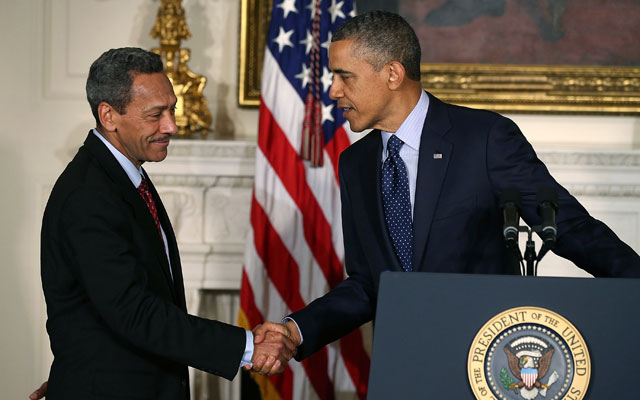
President Obama nominated Representative Mel Watt (D–NC) as new chief regulator to the Federal Housing Finance Agency (FHFA), replacing the current acting director Edward DeMarco. Watt has strong support from liberals in both the House and the Senate as a longtime member of the House Financial Services Committee and advocate of federal affordable housing and homeownership subsidies.

Liberals have mounted pressure on acting director DeMarco to resign because of his “cold indifference” to “work[ing] with families struggling to save their homes,” as Senator Elizabeth Warren (D–MA) recently stated. She was referencing DeMarco’s continued stance on regulation requirements toward principal write down on mortgages and rules prohibiting foreclosed homes from being resold to their original owners.

DeMarco has rightly defended his position against these policy programs as protecting taxpayers and reducing any moral hazard these policies would create.

But Watt takes a different view, and has been a leading proponent of increased intervention in housing. Notably, Watt has a 20-year record of supporting big government housing policies (ranging from home foreclosure assistance programs to down payment requirements on federally insured home mortgages). Since the housing collapse in 2007 and 2008, he has consistently remained a supporter of using Fannie Mae and Freddie Mac to extend federal interference in the housing markets.

In 2008, Watt voted in support of, among other items, permitting the federal government’s intervention in state purchases of foreclosed homes. Moreover, he voted in support of housing legislation that increased the conforming limits for Fannie Mae and Freddie Mac (up to $801,905 for a 4-family residence in 2008 and adjusted annually), thus increasing the portion of the market that the two government-sponsored enterprises could cover, directly contributing to their expansive market share and exposing taxpayers and financial markets to even further risk.

Since 2009, Watt has consistently voted against legislative efforts that would reduce or end continued federal mortgage bailouts, most of which would have reduced the exposure of Fannie Mae, Freddie Mac, and the Federal Housing Administration in the U.S. mortgage market. These bailout-type policies did little to heal the housing market or help homeowners.

Watt also played a pivotal role in shaping the 2010 Dodd–Frank regulation act, particularly components that create a new, unaccountable agency to regulate consumer loans and mortgage lending practices. Regulations in Dodd–Frank hurt consumers with:

  • Higher fees to financial services,
  • Increased costs to homeowners with regulations that make mortgages and home loans costlier, and
  • Rules that will reduce liquidity and private capital available for investment in U.S. financial markets.

Watt’s long-standing support of these federal programs to low-income and moderate-income homeowners is laudable in and of itself. It is also a completely misplaced policy to use large private institutions like Fannie and Freddie to achieve broad political ends related to the low-income and moderate-income homeownership goals he has long supported. These affordable housing goals underscored the deterioration of lending standards, leading to the recent sub-prime mortgage crisis and ultimately undermined the financial viability of Fannie Mae and Freddie Mac and the broader mortgage system.

In short, Watt has consistently voted in favor of a large and growing government presence in the housing market, including support for the kinds of activities that precipitated and prolonged the housing crisis.

Here is the transcript:

HARWOOD: A lot of people look at the housing mess and say, what happened. When you think about it, is it principally a problem of speculators, or do you think that government may have played a role by elevating the goal of homeownership too broadly beyond the capacity of large numbers of people to handle it?

Sen. OBAMA: Well, I think that there were a combination of forces. Obviously, we’ve had very low interest rates for a long time, and rising, as a consequence, rising housing prices for a long time, which made people feel that housing prices can only go up and only–and never go down. And then that made everybody, consumers, lenders, all feel a little bit too complacent. We had a fundamental failure, though, in government regulation, and I think that was a real problem. We had a government that was not paying attention to loans that were being made on assets that were shaky. You know, you had mortgage lenders engaging in practices that were not sound but because they could immediately sell off those loans and bundle them, and you know, nobody was minding the store. The government should have, at a certain point, stepped in and said, `We’ve got to tighten up these lending standards or we’re going to be building a house of cards.’ And that sort of transparency and accountability in the marketplace, that’s not anti-market, that’s pro-market. One of the things that’s always worked for us, it’s been one of our competitive advantages, is people can trust that if they invest in our markets, that they know what they’re getting. And in the housing market in this situation, that–our government didn’t do its job.

I have put up lots of cartoons from Dan Mitchell’s blog before and they have got lots of hits before. Many of them have dealt with the economy, eternal unemployment benefits, socialism,  Greece,  welfare state or on gun control.

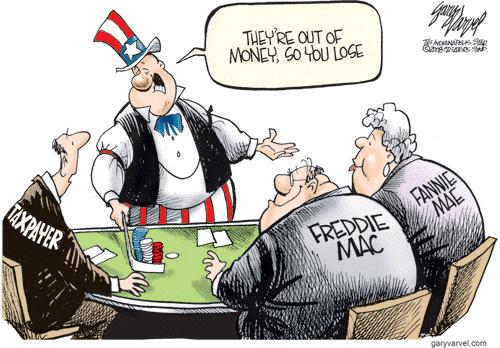
This cartoon is not new, but it succinctly captures what happened with that part of the TARP bailout. The only thing missing is some way of showing the government officials and political insiders who received undeserved wealth while the Fannie-Freddie scam was operating.

_________

Related posts:

Cartoons from Dan Mitchell’s blog that demonstrate what Obama is doing to our economy Part 2

Max Brantley is wrong about Tom Cotton’s accusation concerning the rise of welfare spending under President Obama. Actually welfare spending has been increasing for the last 12 years and Obama did nothing during his first four years to slow down the rate of increase of welfare spending. Rachel Sheffield of the Heritage Foundation has noted: […]

Cartoons from Dan Mitchell’s blog that demonstrate what Obama is doing to our economy Part 1

  I have put up lots of cartoons from Dan Mitchell’s blog before and they have got lots of hits before. Many of them have dealt with the economy, eternal unemployment benefits, socialism,  Greece,  welfare state or on gun control. I think Max Brantley of the Arkansas Times Blog was right to point out on 2-6-13 that Hillary […]

Great cartoon from Dan Mitchell’s blog on government moochers

I thought it was great when the Republican Congress and Bill Clinton put in welfare reform but now that has been done away with and no one has to work anymore it seems. In fact, over 40% of the USA is now on the government dole. What is going to happen when that figure gets over […]

Gun Control cartoon hits the internet

Again we have another shooting and the gun control bloggers are out again calling for more laws. I have written about this subject below  and on May 23, 2012, I even got a letter back from President Obama on the subject. Now some very interesting statistics below and a cartoon follows. (Since this just hit the […]

“You-Didn’t-Build-That” comment pictured in cartoons!!!

watch?v=llQUrko0Gqw] The federal government spends about 10% on roads and public goods but with the other money in the budget a lot of harm is done including excessive regulations on business. That makes Obama’s comment the other day look very silly. A Funny Look at Obama’s You-Didn’t-Build-That Comment July 28, 2012 by Dan Mitchell I made […]

Cartoons about Obama’s class warfare

I have written a lot about this in the past and sometimes you just have to sit back and laugh. Laughing at Obama’s Bumbling Class Warfare Agenda July 13, 2012 by Dan Mitchell We know that President Obama’s class-warfare agenda is bad economic policy. We know high tax rates undermine competitiveness. And we know tax increases […]

Cartoons on Obama’s budget math

Dan Mitchell Discussing Dishonest Budget Numbers with John Stossel Uploaded by danmitchellcato on Feb 11, 2012 No description available. ______________ Dan Mitchell of the Cato Institute has shown before how excessive spending at the federal level has increased in recent years. A Humorous Look at Obama’s Screwy Budget Math May 31, 2012 by Dan Mitchell I’ve […]

Funny cartoon from Dan Mitchell’s blog on Greece

Sometimes it is so crazy that you just have to laugh a little. The European Mess, Captured by a Cartoon June 22, 2012 by Dan Mitchell The self-inflicted economic crisis in Europe has generated some good humor, as you can see from these cartoons by Michael Ramirez and Chuck Asay. But for pure laughter, I don’t […]

Obama on creating jobs!!!!(Funny Cartoon)

Another great cartoon on President Obama’s efforts to create jobs!!! A Simple Lesson about Job Creation for Barack Obama December 7, 2011 by Dan Mitchell Even though leftist economists such as Paul Krugman and Larry Summers have admitted that unemployment insurance benefits are a recipe for more joblessness, the White House is arguing that Congress should […]

Get people off of government support and get them in the private market place!!!!(great cartoon too)

Dan Mitchell hits the nail on the head and sometimes it gets so sad that you just have to laugh at it like Conan does. In order to correct this mess we got to get people off of government support and get them in the private market place!!!! Chuck Asay’s New Cartoon Nicely Captures Mentality […]

2 cartoons illustrate the fate of socialism from the Cato Institute

Cato Institute scholar Dan Mitchell is right about Greece and the fate of socialism: Two Pictures that Perfectly Capture the Rise and Fall of the Welfare State July 15, 2011 by Dan Mitchell In my speeches, especially when talking about the fiscal crisis in Europe (or the future fiscal crisis in America), I often warn that […]

Cartoon demonstrates that guns deter criminals

John Stossel report “Myth: Gun Control Reduces Crime Sheriff Tommy Robinson tried what he called “Robinson roulette” from 1980 to 1984 in Central Arkansas where he would put some of his men in some stores in the back room with guns and the number of robberies in stores sank. I got this from Dan Mitchell’s […]

Gun control posters from Dan Mitchell’s blog Part 2

I have put up lots of cartons and posters from Dan Mitchell’s blog before and they have got lots of hits before. Many of them have dealt with the economy, eternal unemployment benefits, socialism,  Greece,  welfare state or on gun control. Amusing Gun Control Picture – Circa 1999 April 3, 2010 by Dan Mitchell Dug this gem out […]

We got to cut spending and stop raising the debt ceiling!!!

  We got to cut spending and stop raising the debt ceiling!!! When Governments Cut Spending Uploaded on Sep 28, 2011 Do governments ever cut spending? According to Dr. Stephen Davies, there are historical examples of government spending cuts in Canada, New Zealand, Sweden, and America. In these cases, despite popular belief, the government spending […]

Gun control posters from Dan Mitchell’s blog Part 1

I have put up lots of cartons and posters from Dan Mitchell’s blog before and they have got lots of hits before. Many of them have dealt with the economy, eternal unemployment benefits, socialism,  Greece,  welfare state or on gun control. On 2-6-13 the Arkansas Times Blogger “Sound Policy” suggested,  “All churches that wish to allow concealed […]

Taking on Ark Times bloggers on the issue of “gun control” (Part 3) “Did Hitler advocate gun control?”

Gun Free Zones???? Stalin and gun control On 1-31-13 ”Arkie” on the Arkansas Times Blog the following: “Remember that the biggest gun control advocate was Hitler and every other tyrant that every lived.” Except that under Hitler, Germany liberalized its gun control laws. __________ After reading the link  from Wikipedia that Arkie provided then I responded: […]

Taking on Ark Times bloggers on the issue of “gun control” (Part 2) “Did Hitler advocate gun control?”

On 1-31-13 I posted on the Arkansas Times Blog the following: I like the poster of the lady holding the rifle and next to her are these words: I am compensating for being smaller and weaker than more violent criminals. __________ Then I gave a link to this poster below: On 1-31-13 also I posted […]