It’s not something I should admit since I work at a think tank, which is based on the idea that substantive analysis can impact public policy, but I sometimes think humor and anecdotes are very effective in helping people understand issues.
On the topic of unemployment insurance, for instance, I wouldn’t be surprised to learn that this Michael Ramirez cartoon and this Wizard-of-Id parody have been effective in helping folks grasp the unintended consequences of excessive government benefits.
And I bet this story from Michigan and this example from Ohio will ring a bell with many people because they have some relative or buddy who also has used government benefits as an excuse to stay unemployed.
So when I went on Fox to discuss the issue, I mentioned that I had a couple of friends who goofed off instead of looking for work because they got unemployment benefits…
Thank you so much for your time. I know how valuable it is. I also appreciate the fine family that you have and your commitment as a father and a husband.
Sincerely,
Everette Hatcher III, 13900 Cottontail Lane, Alexander, AR 72002, ph 501-920-5733, lowcostsqueegees@yahoo.com
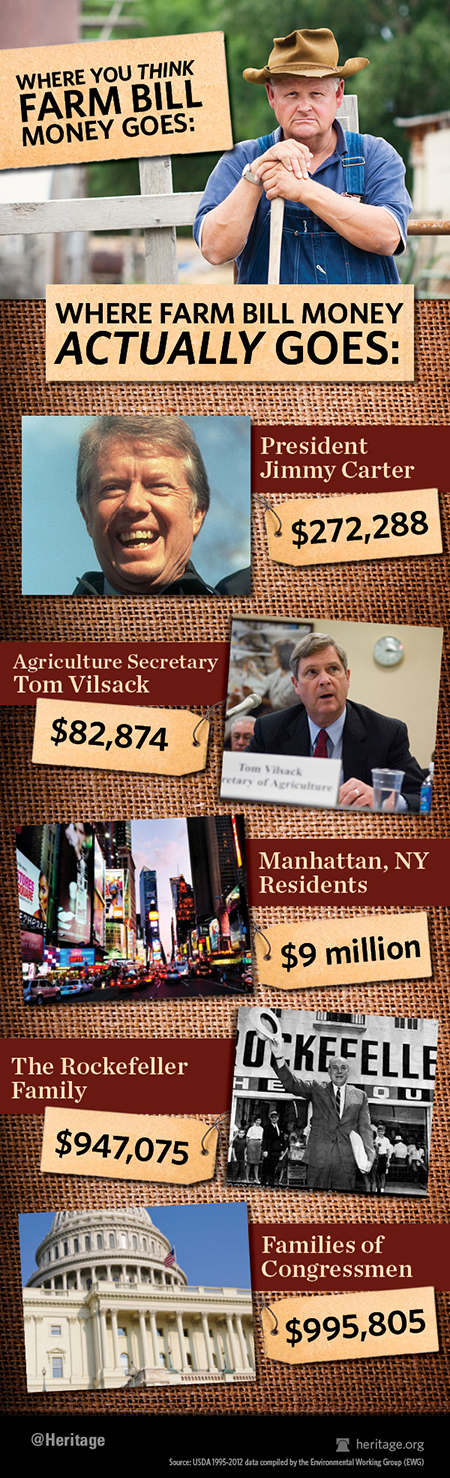
Whenever Congress throws too much into one bill, special interests profit. The massive farm bill—which is already 80 percent food stamps—is no exception.
So what about the rest of the bill—the farm-related part? Heritage’s Diane Katz reports that it includes subsidies for more than a few surprising recipients. SHARE our infographic to spread the word.
Read the Morning Bell and more en español every day at Heritage Libertad.
Congress needs to remove subsidies from the farm bill, not expand them Farm Bill Wastes More Taxpayer Money on Green Subsidies Nicolas Loris May 13, 2013 at 11:27 am Design Pics / Dave Reede/Dave Reede/Newscom Slapping the word rural in front of a bunch of green subsidies does not mean they’re not subsidies. But that’s […]
If the increase in food stamps was just because of the recession then why did the spending go from $19.8 billion in 2000 to $37.9 billion in 2007? The Facts about Food Stamps Everyone Should Hear Rachel Sheffield and T. Elliot Gaiser May 27, 2013 at 12:00 pm (7) Newscom A recent US News & […]
The sad fact is that Food stamp spending has doubled under the Obama Administration. A Bumper Crop of Food Stamps Amy Payne May 21, 2013 at 7:01 am Tweet this Where do food stamps come from? They come from taxpayers—certainly not from family farms. Yet the “farm” bill, a recurring subsidy-fest in Congress, is actually […]
Agriculture: Downsizing The Federal Government Uploaded on Dec 19, 2008 Agriculture is easily the most distorted sector, with high tariffs and, in developed countries at least, large amounts of government subsidies through price supports and direct payments. On the other hand, developing countries, who have a comparative advantage in these products, cannot afford to subsidize […]
I am glad that my state of Arkansas is not the leader in food stamps!!! Mirror, Mirror, on the Wall, Which State Has the Highest Food Stamp Usage of All? March 19, 2013 by Dan Mitchell The food stamp program seems to be a breeding ground of waste, fraud, and abuse. Some of the horror stories […]
Government Must Cut Spending Uploaded by HeritageFoundation on Dec 2, 2010 The government can cut roughly $343 billion from the federal budget and they can do so immediately. __________ President Obama c/o The White House 1600 Pennsylvania Avenue NW Washington, DC 20500 Dear Mr. President, I know that you receive 20,000 letters a day […]
_________________ President Ronald Reagan wisely said: “The federal government has taken too much tax money from the people, too much authority from the states, and too much liberty with the Constitution.” You would think that the Republicans who talk so much of cutting spending would try to get a plan that cuts spending 3 […]
I recently wrote an open letter to Congressman Rick Crawford and I put it on his facebook page. I personally do not have a facebook page so I used my son Wilson’s facebook page and here is what Congressman Crawford said: Wilson- I agree with you that we have a spending problem and not […]
If America does not get welfare reform under control, it will bankrupt America. But the Heritage Foundation’s Robert Rector has a five-step plan to reform welfare while protecting our most vulnerable.
_________
(This letter was emailed to White House on 12-1-12.)
President Obama c/o The White House
1600 Pennsylvania Avenue NW
Washington, DC 20500
Fortunately, Professor Casey Mulligan of the University of Chicago has done some very solid work on this issue, some of which he recently wrote about in the New York Times.
The social safety net became more generous under Presidents George W. Bush and Barack Obama, and as a result massively altered employment patterns in the labor market. …public moneys have recently been used to help the unemployed, the poor and the financially distressed endure the recession, but at the same time have dramatically eroded incentives for people to maintain their own living standards by seeking, accepting and retaining jobs, as well as incentives for employers to create jobs that are attractive to workers.
This makes sense to me. After all, Bush was a reckless big spender, just like Obama. And we also know that if you make work less attractive and idleness more attractive, bad things will happen.
But Prof. Mulligan actually measures the net impact.
As a result of more than a dozen significant changes in subsidy program rules, the average middle-class non-elderly household head or spouse saw her or his marginal tax rate increase from about 40 percent in 2007 to 48 percent only two years later. Marginal tax rates came down in late 2010 and 2011 as provisions of the American Recovery and Reinvestment Act expired, but still remain elevated – at least 44 percent. …A few households even saw their marginal tax rates jump beyond 100 percent – meaning they would have more disposable income by working less. …work incentives were eroded about 20 percent for unmarried household heads…in the middle of the skill distribution, while they were eroded about 12 percent among married heads and spouses…with the same level of skill.
So what’s the bottom line? Well, Prof. Mulligan concludes that government policy hurt everybody, but it did the most damage for those least able to endure hardship, the low-skilled and unmarried.
The fact that marginal tax rates rose so differently for various groups means not only that redistributive public policy depressed the labor market but has also sharply, and arbitrarily, altered the composition of the work force in the direction of people who are married and more skilled.
This final point is worth contemplating for those who are still in post-election-analysis mode. Welfare state programs trap people in dependency. People in that situation naturally worry about who will take care of them, which makes them easily susceptible to snake-oil politicians who promise endless handouts financed by taxes on the so-called rich.
Some otherwise sensible politicians are reluctant to say no when asked to expand the welfare state because they fear it will hurt them at the polls. That’s definitely a possibility, but creating more dependency is a guaranteed way of making it harder to win future elections.
Second moral of the story: Entitlement reform is good policy…and good politics.
______–
Thank you so much for your time. I know how valuable it is. I also appreciate the fine family that you have and your commitment as a father and a husband.
Sincerely,
Everette Hatcher III, 13900 Cottontail Lane, Alexander, AR 72002, ph 501-920-5733, lowcostsqueegees@yahoo.com
Mr. President you went to Columbia and Harvard for your education and I know how smart you are. Don’t you understand that we must do something now about entitlement reform?
http://www.aei.org/topic/nation-of-takers
In “A Nation of Takers,” author Nicholas Eberstadt of the American Enterprise Institute draws on an impressive array of data to detail the exponential growth in America’s entitlement spending, which today accounts for a full two-thirds of the federal budget. Eberstadt shows in unflinching detail how this runaway spending is having a very real, long-lasting, negative impact on the character of our citizens.
___________________
In a new video parodying Dr. Seuss’s whimsical style, the American Enterprise Institute puts the problem of growing entitlement program spending in a form elementary school kids can understand.
It’s a good thing, too, because their generation will be burdened with paying for this skyrocketing spending if Congress and the President don’t start getting serious about structural entitlement program reforms now.
The video tells the tale of the “makers,” who were once “makering all kinds of neat things, Make-dads and Make-pads and mighty Make-dings.” Then the federal government stepped in, imposing an endless slew of taxes and cultivating an entitlement state. This developed into both a moral and fiscal problem, as it bred a culture of dependency and threatened to bankrupt their country.
America is a land of makers. Despite the current economic downturn, we have a history marked by prosperity, and today we enjoy widespread liberty and economic opportunity. Yet rising government spending, a sign of an expanding government, threatens that economic health and freedom. Specifically, spending on the entitlement programs—Medicare, Medicaid, and Social Security being the largest—is driving future deficits and debt to unsustainable levels.
Already, 62 percent of the federal budget goes to entitlement programs—double the amount 50 years ago. Entitlement program spending is projected to nearly double from 10.3 percent of the economy in 2010 to 19 percent in 2050. Such staggering figures are the result of millions of baby boomers beginning to retire and health care costs that keep rising. (continues below chart)
The number of workers paying for the benefits of retirees has also fallen, making Social Security and Medicare structurally unsustainable. For example, in 1965, the ratio of workers to Medicare beneficiaries was nearly five to one, meaning five workers were paying for the benefits of each retiree. In 2011, that ratio had fallen to three to one, and by 2030 there will be just two workers shouldering the responsibility for each beneficiary.
Government-centric Obamacare will only exacerbate the increasing health care costs in both the public and private sectors and send Medicaid spending upward. As the video suggests, this is a “fiscal nightmare.”
It is possible to structurally reform the entitlement programs in a way that ensures that they are a safety net for Americans who truly need them now—and for today’s children when they retire. Doing so requires political will on the part of Congress and the President to make tough choices now.
The Heritage Foundation has a plan that does just that. It gets our spending and debt under control and preserves the freedoms that allow America’s makers to keep “makering” and succeed.
_____________
Thank you so much for your time. I know how valuable it is. I also appreciate the fine family that you have and your commitment as a father and a husband.
Sincerely,
Everette Hatcher III, 13900 Cottontail Lane, Alexander, AR 72002, ph 501-920-5733, lowcostsqueegees@yahoo.com
Some people doubt that Ronald Reagan conservatism still works today like it did in the 1980’s and that those kind of conservatives can still win today but they can!!!!
Among the right-leaning policy wonks and intellectuals in Washington, there’s a lot of attention being given to the something called “reform conservatism.”
Underlying this school of thought is the notion that the Reagan-era message no longer works since Republicans have lost the popular vote in five out of the last six elections.
But before digging into his column, I think that some of the angst on the right is misplaced. Why blame a Reagan-era message for GOP electoral problems when all the Republicans presidential nominees in recent years have favored big government? Does anybody really think thatBush 41, Dole, Bush 43, McCain, and Romney were Reaganites?!?
Could any of those candidates havegiven these remarks, at least with any credibility?
President Reagan on Big Government and Personal Freedom
Uploaded onDec 23, 2010
The surge in nostalgia for President Reagan over the past two years is no surprise. When the American people are faced with tyrannical government, arrogant leadership, and failed policies, they tend to cling to good memories (along with their guns and religion). They also tend to take action, hence the Tea Party movement and the 2010 revolution. Watch this clip from 1982 and remember.
The Founding Fathers fought tyranny, we must come together to fight again. Ronald Reagan believed that it was individual freedom that made America great
___________________________
It’s much more plausible to say that Republicans have lagged because they didn’t have candidates with a Reagan-style message.
But let’s assume, for the sake of argument, that Republicans would have fared poorly even if Reaganites had been nominated. Does “reform conservatism” offer a path to electoral salvation.
Here’s what Douthat identifies as the “two major premises” of reform conservatism.
1. First, he writes that the “core economic challenge facing the American experiment is not income inequality per se, but rather stratification and stagnation — weak mobility from the bottom of the income ladder and wage stagnation for the middle class.” Conservatives, he says, should strive to make “family life more affordable, upward mobility more likely, and employment easier to find.”
2. Second, he warns that the “existing welfare-state institutions we’ve inherited from the New Deal and the Great Society, however, often make these tasks harder rather than easier: Their exploding costs crowd out every other form of spending, require middle class tax increases and threaten to drag on economic growth.”
I’m not an expert on income mobility, so I’m not sure I would identify stratification and stagnation as the nation’s core economic challenge, but he may be right. Regardless, it’s definitely a good idea to have more mobility.
And I definitely agree that thewelfare state hinders upward mobility by creating dependency. And he’s right that this is a drag on growth. That being said, I disagree with his assertion that rising entitlement expenditurescrowd out other spendingand lead to middle class tax hikes. Those things may happen at some point, particularly once we get into the peak years for retiring baby boomers, but they haven’t happened yet.
The more important question, at least to me, is what sort of policies do reform conservatives embrace? Here’s Douthat’s list, bolded, followed by my thoughts.
a.A tax reform that caps deductions and lowers rates, butalsoreduces the burden on working parents and the lower middle class, whether through an expanded child tax credit or some other means of reducing payroll tax liability.I obviously like the idea of lowering rates and reducing deductions since that moves the system closer to aflat tax. That being said, it’s difficult to reduce the tax burden on the lower middle class since they pay very little income tax under the current system (see accompanying table from CBO). But I like the idea of addressing the payroll tax, though I disagree with their approach (see section “c” below).
b.A repeal or revision of Obamacare that aims to ease us toward a system of near-universal catastrophic health insurance, and includes some kind of flat tax credit or voucher explicitly designed for that purpose. I fully agree withrepeal of Obamacare, and I think an unfettered marketplace would evolve into a system of near-universal catastrophic insurance, but I don’t want the federal government subsidizing or coercing that approach (though current healthcare policy has far more subsidies and coercion, so Douthat’s plan would be a big improvement over the status quo).
c.A Medicare reform along the lines of the Wyden-Ryan premium support proposal, and a Social Security reform focused on means testing and extending work lives rather than a renewed push for private accounts. I’m glad they embraceMedicare reform, but I’m puzzled by the hostility topersonal retirement accounts. If you increase the retirement age and/or means test, youforce people to pay more and get less, yet Social Security already is a bad deal for younger workers. So why make it worse? How can that be good for those with low mobility? Personal accounts would be akin to a tax cut for such workers since the payroll tax would be transformed into something much closer to deferred compensation.
d.An immigration reform that tilts much more toward Canadian-style recruitment of high-skilled workers, and that doesn’t necessarily seek to accelerate the pace of low-skilled immigration. AsI noted in this interview, I very much favor bringing more high-skilled people into the country.
e.A “market monetarist” monetary policy as an alternative both to further fiscal stimulus and to the tight money/fiscal austerity combination advanced by many Republicans today. I try to avoid monetary policy. That being said, I’m a bit skeptical of “market monetarism.” No nation has ever tried this system, so it’s uncharted territory, and I’m reluctant to embrace an approach which is premised on the notion that bubbles can’t exist (what about the tech bubble of the late 1990s or the housing bubble last decade?!?). I’m also suspicious of a system which requires an activist central bank. Watchthis George Selgin videoif you want to know why.
f.An attack not only on explicit subsidies for powerful incumbents (farm subsidies, etc.) but also other protections and implicit guarantees, in arenas ranging from copyright law to the problem of “Too Big To Fail.”Amen. I fully agree.
Since I’m a tax policy wonk, let me address in greater detail some of the tax reform proposals put forward by reform conservatives.
Jim Pethokoukis of the American Enterprise Institute is identified in the column as a reform conservative, and he recently expressed skepticism about the flat tax in acolumn for National Review.
It’s an elegant, compelling model that might work splendidly if you were creating a tax code ex nihilo. …America, however, is in a much different place. Millions of individuals and businesses have made long-term plans based on expectations that the tax code will remain more or less the same. Half the nation, thanks to all those deductions and credits, pays no income tax. …it’s unlikely the U.S. can keep spending down at historical levels of 20 percent to 21 percent of GDP while also maintaining a floor for defense spending at 4 percent of output. The best a group of AEI scholars could manage was limiting spending to 23 percent of GDP by 2035.
Pethokoukis also says the flat tax is politically unrealistic. SinceI’m not expecting a flat tax in my lifetime, I obviously can’t argue with that statement. But he then proposes another plan that would be far less popular – and far more dangerous.
One solution is to take the essentially flat consumption tax devised by economists Robert Hall and Alvin Rabushka and give it a progressive rate structure. Or we could combine a consumption tax with a flat income tax on wealthier Americans, as suggested by Yale’s Michael Graetz.
So we should keep the income tax as a vehicle for class warfare andaugment it with a VAT?!? Yeah, good luck trying to sell that idea. And Heaven help us if it ever succeeded since politicians would haveanother major source of tax revenue.
Another plan, which Douthat explicitly cites in his paper, wasput together by Robert Stein, a former Bush Treasury official. He thinks traditional supply-side policies today are either irrelevant or unpopular.
Lowering tax rates today could still enhance the incentives to invest, particularly in the corporate sector. But the distortions caused by marginal tax rates are not nearly as great as they were in 1980. And attempts to solve other problems caused by the tax code itself — like the biases in favor of consumption over saving, or home building over business investment — could never in themselves garner the public support necessary for a major overhaul.
As I noted, I’m not holding my breath for a flat tax, so I can’t disagree with Stein’s prognostication.
He also has a very novel way of defining the problem we should be trying to fix.
…it is time to rethink how the tax code treats parents. …raising children is hardly just another pastime: It is one of the most important services any American can perform for our country. …even as Social Security and Medicare depend on large numbers of future workers, they have created an enormous fiscal bias against procreation, undermining an important motive for raising children: to safeguard against poverty in old age. ……our system of taxes and entitlements not only fails to reward parents — it actively discourages Americans from having children. …Recent studies (especially work by Michele Boldrin, Mariacristina De Nardi, and Larry Jones and by Isaac Ehrlich and Jinyoung Kim) show that Social Security and Medicare actually reduce the fertility rate by about 0.5 children per woman. In European countries, where retirement systems are larger, the effect is closer to one child per woman.
As a libertarian, the beginning section of that passage grated on me. My children are individuals, not a “service” to prop up entitlement programs. I agree with Stein that these programs are a problem, but thesolution is to reform entitlements, not to rejigger the tax code in hopes of pumping out more taxpayers.
Stein disagrees.
Unfortunately, these negative effects on fertility cannot be cured simply by converting old-age entitlement programs into mandatory savings programs, as the Bush administration proposed for Social Security in 2005. After all, requiring workers to save for retirement through private financial instruments would also crowd out the traditional motive to raise kids.
Instead, he wants to change the tax system based on the notion that today’s kids are tomorrow’s taxpayers.
…the present value of future Social Security and Medicare contributions for a typical worker born today is about $150,000. Rewarding parents for creating these future contributions suggests annual tax relief of about $8,500 per child. To correct for this inadequate treatment of households with children, the existing dependent exemption for children, the child credit, the child-care credit, and the adoption credit should be replaced with one new $4,000 credit per child that can be used to offset both income and payroll taxes. (This amount is set much closer to the $3,250 figure than the $8,500 one mostly to reduce the plan’s negative impact on federal revenue.)
I have no philosophical objection to some form of exemption – or even credit – based on family size. Almost all flat tax systems, for instance, have some sort of family allowance.
And Stein, unfortunately, would “pay” for his credits by raising marginal tax rates on a significant share of taxpayers.
Some of these costs would be offset by eliminating itemized deductions (other than mortgage interest and charitable contributions). The rest would have to be offset by allowing the top rate of 35% to touch more taxpayers than it currently affects. …who pays more? Primarily high-income workers, but also upper-middle-class taxpayers who do not have children in the home (either because they have decided not to raise children at all, or because their children have already turned 18). To be blunt, the plan is a tax hike on the rich and makes the tax code even more progressive than it is today.
To be fair, Stein also proposes some good policies such as AMT repeal and reductions indouble taxation, so he’s definitely not in theObama class-warfare camp. But it’s also fair to say that his plan won’t do much for growth. Some tax rates are lowered but others are increased.
Yet if you really want families to be in stronger shape, more growth is the only long-run solution.
Moreover, it’s not clear that Stein’s agenda would be terribly popular. Though I confess that’s just a guess since no politician has latched onto the idea in the years since the proposal was unveiled.
Returning to the broader issue of “reform conservatism,” it’s difficult to assign an overall grade to the movement since I’m not sure whether we’re supposed to interpret it as a political strategy or an economic plan.
Regardless, I guess I’m generally sympathetic. I assume the RCers want government to be smaller than it is today and I don’t think you have to be a 100 percent libertarian to be my ally in the fight torestrain excessive government. And I also think it’s a good idea for people to be thinking of how to best articulate a message of smaller government. Heck, I do that every time I go on TV or give a speech.
So I reserve the right to object to any of the specific proposals that reform conservatives put forward (such as the tax plans discussed above), but I like the project.
Ronald Reagan said, “We will never compromise our principles and standards.” Are the Republicans in Arkansas true Tea Party Ronald Reagan Republicans? According to Americans for Prosperity in the last 5 years Arkansas’ current Medicaid program has run a deficit of a billion dollars. Why expand it willingly with Obama? The “Do Nothing” expansion plan increases […]
Barack Obama would lose badly to Ronald Reagan!!! The Spirit of Reagan Is Still With Us: The Gipper Crushes Obama in Hypothetical Matchup April 13, 2013 by Dan Mitchell Barack Obama has stated that he wants to be like Reagan, at least in the sense of wanting to be a transformational figure. But almost certainly he has […]
Below is a discussion from Milton Friedman on Bill Clinton and Ronald Reagan. February 10, 1999 | Recorded on February 10, 1999 audio, video, and blogs » uncommon knowledge PRESIDENTIAL REPORT CARD: Milton Friedman on the State of the Union with guest Milton Friedman Milton Friedman, Senior Research Fellow, Hoover Institution and Nobel Laureate in […]
Below is a discussion from Milton Friedman on Bill Clinton and Ronald Reagan. February 10, 1999 | Recorded on February 10, 1999 audio, video, and blogs » uncommon knowledge PRESIDENTIAL REPORT CARD: Milton Friedman on the State of the Union with guest Milton Friedman Milton Friedman, Senior Research Fellow, Hoover Institution and Nobel Laureate in […]
I really enjoyed this article. A Constitutional President: Ronald Reagan and the Founding By Edwin Meese III , Lee Edwards, Ph.D. , James C. Miller III and Steven Hayward January 26, 2012 Abstract: Throughout his presidency, Ronald Reagan was guided by the principles of the American founding, especially the idea of ordered liberty. In the opening of his first inaugural address in 1981, […]
Ronald Reagan was the greatest pro-life president ever. He appointed Dr. C. Everett Koop to his administration and Dr. Koop was responsible for this outstanding pro-life film below: I was thinking about the March for Life that is coming up on Jan 20, 2013 in Little Rock and that is why I posted this today. […]
1/30/84 Part 1 of a speech to the National Religious Broadcasters. June 10, 2004, 10:30 a.m. Abortion and the Conscience of the Nation Ronald Reagan’s pro-life tract. EDITOR’S NOTE: While president, Ronald Reagan penned this article for The Human Life Review, unsolicited. It ran in the Review‘s Spring 1983, issue and is reprinted here with permission. The case […]
President Reagan, Nancy Reagan, Bill Clinton and Hillary Clinton attending the Dinner Honoring the Nation’s Governors. 2/22/87. Ronald Reagan is my favorite president and I have devoted several hundred looking at his ideas. Take a look at these links below: President Reagan and Nancy Reagan attending “All Star Tribute to Dutch Reagan” at NBC Studios(from […]
Ronald Reagan Talks About Balancing the Budget on “The Tonight Show” Uploaded by johnnycarson on Jul 30, 2011 Ronald Reagan talks about balancing the budget on “The Tonight Show” in 1975. _____________ Ronald Reagan was one of my favorite presidents. Mike Lee is one of my favorite lawmakers of today!!! Look at what he says about […]
Remarks at a Rally Supporting the Proposed Constitutional Amendment for a Balanced Federal Budget For more information on the ongoing works of President Reagan’s Foundation, please visit http://www.reaganfoundation.org _______________ Ronald Reagan was a firm believer in the Balanced Budget Amendment and Milton Friedman was a key advisor to Reagan. Friedman’s 1980 film series taught the […]
House and Senate farm subsidy supporters are pushing to enact the first big farm bill since 2008. Democratic and Republican supporters say that this year’s legislation will be a reform bill that cuts spending. Hogwash.
Last year, House farm subsidy supporters proposed a bill that would spend $950 billion over the next 10 years, while the Senate proposed a bill that would spend $963 billion. By contrast, when the 2008 farm bill passed, it was projected to spend $640 billion over 10 years. Thus, the proposed House bill would represent a 48 percent spending increase over the last farm bill, while the Senate bill would represent a 50 percent increase.
A new estimate of the House bill finds that it would spend $940 billion over 10 years, which would be a 47 percent increase over the 2008 farm bill. This new estimate is shown in the chart alongside the estimate of the 2008 farm bill.
Since the 2008 farm bill, we’ve had five years of moderate inflation, which has eroded the value of dollars by about 8 percent. Thus, the 2013 House farm bill would increase real spending by 39 percent compared to the 2008 farm bill.
The Republican-controlled House Agriculture Committee says that its bill “saves taxpayer’s money,” “reduces deficit spending,” and “repeals outdated government programs.” That sounds good, and the GOP bill is officially scored to “save” $33 billion over 10 years. But that savings is against the CBO baseline of $973 billion in farm bill spending over 10 years, so the House bill can be said to “cut” spending by 3 percent.
Given today’s huge federal deficits, a 3 percent “cut” by Republicans is a joke in itself. But that’s only a cut against baseline, and since baseline spending has soared in recent years it’s no cut at all.
Consider, for example, that in 2008 CBO estimated that farm bill spending in 2014 would be $67 billion. But CBO is now estimating that farm bill spending in 2014 will be $99 billion. Thus, spending in this single year is $32 billion or 48 percent higher than the politicians promised it would be back in 2008. So you can see that the proposed GOP “cut” of $33 billion over 10 years is incredibly lame.
Despite the fact that politicians are claiming that the proposed new farm bill cuts spending, it’s just a mirage created by rising baselines. The truth is that the House farm bill would spend 47 percent more over 10 years than the last farm bill, or 39 percent more in inflation-adjusted dollars.
For background, see this new study by Sallie James and this essay on the history and failures of farm subsidies. Also note that three-quarters of “farm bill” spending is for food subsidies, which you can read about here. And if you’re in D.C., come and hear about the farm bill at our Capitol Hill event at noon Thursday.
States should vote down federal spending on farm bill and return more control to states!!!! Some say here in Arkansas that we have to do whatever it takes to support Riceland Foods, but in other states they try to protect federal government handouts to their biggest companies. We need politicians to stop looking out for […]
Congress needs to remove subsidies from the farm bill, not expand them Farm Bill Wastes More Taxpayer Money on Green Subsidies Nicolas Loris May 13, 2013 at 11:27 am Design Pics / Dave Reede/Dave Reede/Newscom Slapping the word rural in front of a bunch of green subsidies does not mean they’re not subsidies. But that’s […]
If the increase in food stamps was just because of the recession then why did the spending go from $19.8 billion in 2000 to $37.9 billion in 2007? The Facts about Food Stamps Everyone Should Hear Rachel Sheffield and T. Elliot Gaiser May 27, 2013 at 12:00 pm (7) Newscom A recent US News & […]
Memphis Tigers John Calipari Interview 2008 Basketball Final Kansas vs. Memphis – 2008 NCAA Title Game Highlights (HD) Knoxnews.com reported: Calipari (and Kentucky) get Kansas again for title NANCY ARMOUR – AP National Writer (AP) Posted April 1, 2012 at 12:18 a.m., updated April 1, 2012 at 3:04 a.m NEW ORLEANS (AP) — Well, this […]
I certainly hope there are some alternatives to the Fayetteville Finger out there. Jason Tolbert reported that there seems to be an impasse. As predicted, the House State Agencies rejected both the Senate compromise map (linked here) passed yesterday with 20 votes and the so called “Luker Amendment” (linked here) named after its author Sen. […]
The sad fact is that Food stamp spending has doubled under the Obama Administration. A Bumper Crop of Food Stamps Amy Payne May 21, 2013 at 7:01 am Tweet this Where do food stamps come from? They come from taxpayers—certainly not from family farms. Yet the “farm” bill, a recurring subsidy-fest in Congress, is actually […]
Agriculture: Downsizing The Federal Government Uploaded on Dec 19, 2008 Agriculture is easily the most distorted sector, with high tariffs and, in developed countries at least, large amounts of government subsidies through price supports and direct payments. On the other hand, developing countries, who have a comparative advantage in these products, cannot afford to subsidize […]
I am glad that my state of Arkansas is not the leader in food stamps!!! Mirror, Mirror, on the Wall, Which State Has the Highest Food Stamp Usage of All? March 19, 2013 by Dan Mitchell The food stamp program seems to be a breeding ground of waste, fraud, and abuse. Some of the horror stories […]
Government Must Cut Spending Uploaded by HeritageFoundation on Dec 2, 2010 The government can cut roughly $343 billion from the federal budget and they can do so immediately. __________ President Obama c/o The White House 1600 Pennsylvania Avenue NW Washington, DC 20500 Dear Mr. President, I know that you receive 20,000 letters a day […]
I want a smallerburden of government spending, so you can only imagine how frustrating it is for me to observe the fight in Europe.
On one side of the debate you have pro-spenders, who call themselves “growth” advocates, but are really just Keynesians. On the other side of the debate, you have pro-taxers, who claim to favor “austerity,” but actually just want big government financed by taxes rather than borrowing.
Last but not least, I express some optimism about the possibility ofgenuine entitlement reform, though I should have acknowledged that nothing good will happen while Obama is in office.
USTV-GOP Address: Spending Crisis Still Looms Uploaded by AssociatedPress on Apr 9, 2011 In the Saturday Republican radio address, House Budget Committee Chairman Paul Ryan, R-Wis., warns of a coming crisis. (April 9) __________- Raising taxes is not the answer but cutting spending is. Looking at Austerity in Portugal Posted by Juan Carlos Hidalgo Portugal […]
Senator Marco Rubio Talks Cuba, Budget and Obamacare Published on Mar 22, 2012 by HeritageFoundation http://blog.heritage.org/2012/03/22/exclusive-interview-sen-marco-rubio-talks… | Pope Benedict XVI will visit the communist island of Cuba next week. But while there, the Catholic leader has no plans to visit Cuban dissidents who are fighting for freedom from the Castro regime. Sen. Marco Rubio (R-FL), […]
Max Brantley and Paul Krugman are constantly being critical of the austerity in Europe but in most cases in Europe what we have is tax increases and fake spending cuts. Instead of destroying economic growth with tax increases the right method would be real spending cuts. We need some austerity in the USA and I […]
Uploaded by danmitchellcato on Feb 26, 2012 I wish we would put in real spending cuts in the USA instead of fake ones like the ones in the United Kingdom. Looking at ‘Austerity’ in Britain Posted by Juan Carlos Hidalgo I’m going to jump into the debate about austerity in Europe because it is being […]
The medicine for the sickness of spending is real budget cuts but no one in liberal europe wants to hear that. Sadly we are on the same road in the USA. Liberals (like my blogger opponent “the Outlier” and others) love to say that austerity has been tried in Europe and it doesn’t work but the truth […]
Max Brantley on the Arkansas Times Blog today asserted: Politico notes that Democratic Sen. Harry Reid’s budget plan cuts spending more than Republican John Boehner’s plan. Boehner’s two-step plan is calculated on providing a highly politicized two-step plan for raising the debt ceiling. ____________________ After a closer look at Harry Reid’s plan, it is evident […]
Since Europe is struggling more than the USA then why are we copying European Socialism? Helping Workers…to the Unemployment Line May 24, 2013 by Dan Mitchell Several European nations are suffering from a fiscal crisis. But that’s just part of the story. They also have significantly lower incomes than the United States, with living standards about […]
I have blogged about Dr. Kevorkian many times in the past and today I have included another post about him. Most of the articles dealt with moral issues and included the works of Dr. C. Everett Koop and Francis Schaeffer and the film series “Whatever happened to the Human Race?” However, I have mentioned in […]
No surprise but the world has now discovered what we conservatives knew all along: Government spending undermines economic growth. New European Central Bank Study Finds that Government Spending Undermines Growth April 25, 2013 by Dan Mitchell The fiscal policy debate often drives me crazy because far too many people focus on deficits. The Keynesians argue that deficits […]
The Role of Economic Freedom Uploaded by HeritageFoundation on Jan 6, 2012 According to the 2012 Index of Economic Freedom, a joint publication of The Heritage Foundation and The Wall Street Journal, global economic freedom has declined over the past year. But what does this mean for America and the world? Economic freedom empowers ordinary […]
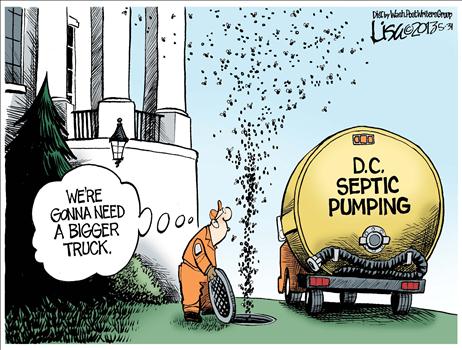
We’ve gotten to the point where you need a guide-book to keep track of all the scandals in Washington.
As a fiscal policy wonk, I focus mostly onthe sleaze at the IRS, but I also recognize that the other scandals are equally troubling.
So I’m amused by Lisa Benson’s portrayal of the…um…plumbing problems at the White House.
But there’s a theme to all the scandals, regardless of whether they’re happening now under Obama or whether they happened under Bush or during the reign of previous Presidents: Many of them take place solely because government is large, bloated, and involved in areas where it doesn’t belong.
Here’s my video explaining why corruption is much more common when government is bigger.
Want Less Corruption? Shrink the Size of Government
Uploaded onApr 21, 2009
Washington is riddled with corruption, much of which actually is legal. The politicians and other insiders claim that more ethics laws and lobbying rules are the solution. Some even say the only answer is campaign finance laws that restrict 1st Amendment rights to fully participate in the political process. This Center for Freedom and Prosperity video explores a different hypothesis and concludes that big government is inherently corrupting. http://www.freedomandprosperity.org
There is no free money out there. Somebody has to always pay. Bailout Nation January 13, 2013 by Dan Mitchell I have a serious question for readers. What’s worse, bailouts for government or bailouts for the private sector? Yes, both are bad, but is it worse to bail out a bankrupt entitlement program, such as Social […]
Obamanomics: A Legacy of Wasteful Spending Published on Aug 12, 2012 by CFPEcon101 This mini-documentary from the Center for Freedom and Prosperity Foundation highlights egregious examples of wasteful spending from the so-called stimulus legislation and explains why government spending hurts economic performance. **Links to additional reading material** Thomas Sowell, “Stimulus or Sedative?” http://www.realclearpolitics.com/articles/2010/03/09/stimulus_or_sedative_104… Veronique de […]
Federal Spending by the Numbers Uploaded by HeritageFoundation on Jun 10, 2010 http://blog.heritage.org/2010/06/10/new-video-federal-spending-by-the-numbers The Federal Government is addicted to spending. Watch this video from the Heritage Foundation to learn about the trouble we are in and where to find solutions. _______ President Obama c/o The White House 1600 Pennsylvania Avenue NW Washington, DC 20500 […]
President Obama c/o The White House 1600 Pennsylvania Avenue NW Washington, DC 20500 Dear Mr. President, I know that you receive 20,000 letters a day and that you actually read 10 of them every day. I really do respect you for trying to get a pulse on what is going on out here. Not […]
Federal Spending by the Numbers Uploaded by HeritageFoundation on Jun 10, 2010 http://blog.heritage.org/2010/06/10/new-video-federal-spending-by-the-numbers The Federal Government is addicted to spending. Watch this video from the Heritage Foundation to learn about the trouble we are in and where to find solutions. _______ Greece going broke before the USA? We got to control the entitlement mentality. Almost […]
Obamanomics: A Legacy of Wasteful Spending Published on Aug 12, 2012 by CFPEcon101 This mini-documentary from the Center for Freedom and Prosperity Foundation highlights egregious examples of wasteful spending from the so-called stimulus legislation and explains why government spending hurts economic performance. **Links to additional reading material** Thomas Sowell, “Stimulus or Sedative?” http://www.realclearpolitics.com/articles/2010/03/09/stimulus_or_sedative_104… Veronique de […]
Not many people know the truth about Robin Hood. Robin Hood was not a left-wing hero who stole from the rich and redistributed to the poor. Stop Maligning Robin Hood! August 20, 2012 by Dan Mitchell When I was a kid, I was a big fan of Robin Hood. I remember reading at least two books […]
Nassim Taleb: Time to Nationalize US Banking System? President Obama c/o The White House 1600 Pennsylvania Avenue NW Washington, DC 20500 Dear Mr. President, I know that you receive 20,000 letters a day and that you actually read 10 of them every day. I really do respect you for trying to get a pulse on […]
Nassim Taleb: Time to Nationalize US Banking System? President Obama’s liberal agenda has not worked out too good in the last four years. Next Career Move for President Obama: Becoming a Movie Star! May 9, 2012 by Dan Mitchell Most people know that Ronald Reagan was an actor before he became a great President. So I […]
This video explains the relationship between tax rates, taxable income, and tax revenue. The key lesson is that the Laffer Curve is not an all-or-nothing proposition, where we have to choose between the exaggerated claim that “all tax cuts pay for themselves” and the equally silly assumption that tax policy doesn’t effect the economy and there is never any revenue feedback. From http://www.freedomandprosperity.org 202-285-0244
Now let’s add two more cartoons to the mix, both with a Thanksgiving theme.
The first one makes fun of Obama for his deliberate ignorance about the budget. Honest leftists admit that we need real entitlement reform, but Obama wants us to believe that the nation’s fiscal problems can be solved by targeting the rich.
The next cartoon comes from the irreplaceable Michael Ramirez.
I like the multiple messages. He’s nailing Obama for engaging in envy, but I also think he’s helping people understand that it doesn’t make sense to rape and pillage the so-called rich if that means less future production.
Max Brantley is wrong about Tom Cotton’s accusation concerning the rise of welfare spending under President Obama. Actually welfare spending has been increasing for the last 12 years and Obama did nothing during his first four years to slow down the rate of increase of welfare spending. Rachel Sheffield of the Heritage Foundation has noted: […]
I have put up lots of cartoons from Dan Mitchell’s blog before and they have got lots of hits before. Many of them have dealt with the economy, eternal unemployment benefits, socialism, Greece, welfare state or on gun control. I think Max Brantley of the Arkansas Times Blog was right to point out on 2-6-13 that Hillary […]
I thought it was great when the Republican Congress and Bill Clinton put in welfare reform but now that has been done away with and no one has to work anymore it seems. In fact, over 40% of the USA is now on the government dole. What is going to happen when that figure gets over […]
Again we have another shooting and the gun control bloggers are out again calling for more laws. I have written about this subject below and on May 23, 2012, I even got a letter back from President Obama on the subject. Now some very interesting statistics below and a cartoon follows. (Since this just hit the […]
watch?v=llQUrko0Gqw] The federal government spends about 10% on roads and public goods but with the other money in the budget a lot of harm is done including excessive regulations on business. That makes Obama’s comment the other day look very silly. A Funny Look at Obama’s You-Didn’t-Build-That Comment July 28, 2012 by Dan Mitchell I made […]
I have written a lot about this in the past and sometimes you just have to sit back and laugh. Laughing at Obama’s Bumbling Class Warfare Agenda July 13, 2012 by Dan Mitchell We know that President Obama’s class-warfare agenda is bad economic policy. We know high tax rates undermine competitiveness. And we know tax increases […]
Dan Mitchell Discussing Dishonest Budget Numbers with John Stossel Uploaded by danmitchellcato on Feb 11, 2012 No description available. ______________ Dan Mitchell of the Cato Institute has shown before how excessive spending at the federal level has increased in recent years. A Humorous Look at Obama’s Screwy Budget Math May 31, 2012 by Dan Mitchell I’ve […]
Sometimes it is so crazy that you just have to laugh a little. The European Mess, Captured by a Cartoon June 22, 2012 by Dan Mitchell The self-inflicted economic crisis in Europe has generated some good humor, as you can see from these cartoons by Michael Ramirez and Chuck Asay. But for pure laughter, I don’t […]
Another great cartoon on President Obama’s efforts to create jobs!!! A Simple Lesson about Job Creation for Barack Obama December 7, 2011 by Dan Mitchell Even though leftist economists such as Paul Krugman and Larry Summers have admitted that unemployment insurance benefits are a recipe for more joblessness, the White House is arguing that Congress should […]
Dan Mitchell hits the nail on the head and sometimes it gets so sad that you just have to laugh at it like Conan does. In order to correct this mess we got to get people off of government support and get them in the private market place!!!! Chuck Asay’s New Cartoon Nicely Captures Mentality […]
Cato Institute scholar Dan Mitchell is right about Greece and the fate of socialism: Two Pictures that Perfectly Capture the Rise and Fall of the Welfare State July 15, 2011 by Dan Mitchell In my speeches, especially when talking about the fiscal crisis in Europe (or the future fiscal crisis in America), I often warn that […]
John Stossel report “Myth: Gun Control Reduces Crime Sheriff Tommy Robinson tried what he called “Robinson roulette” from 1980 to 1984 in Central Arkansas where he would put some of his men in some stores in the back room with guns and the number of robberies in stores sank. I got this from Dan Mitchell’s […]
I have put up lots of cartons and posters from Dan Mitchell’s blog before and they have got lots of hits before. Many of them have dealt with the economy, eternal unemployment benefits, socialism, Greece, welfare state or on gun control. Amusing Gun Control Picture – Circa 1999 April 3, 2010 by Dan Mitchell Dug this gem out […]
We got to cut spending and stop raising the debt ceiling!!! When Governments Cut Spending Uploaded on Sep 28, 2011 Do governments ever cut spending? According to Dr. Stephen Davies, there are historical examples of government spending cuts in Canada, New Zealand, Sweden, and America. In these cases, despite popular belief, the government spending […]
I have put up lots of cartons and posters from Dan Mitchell’s blog before and they have got lots of hits before. Many of them have dealt with the economy, eternal unemployment benefits, socialism, Greece, welfare state or on gun control. On 2-6-13 the Arkansas Times Blogger “Sound Policy” suggested, “All churches that wish to allow concealed […]
Gun Free Zones???? Stalin and gun control On 1-31-13 ”Arkie” on the Arkansas Times Blog the following: “Remember that the biggest gun control advocate was Hitler and every other tyrant that every lived.” Except that under Hitler, Germany liberalized its gun control laws. __________ After reading the link from Wikipedia that Arkie provided then I responded: […]
On 1-31-13 I posted on the Arkansas Times Blog the following: I like the poster of the lady holding the rifle and next to her are these words: I am compensating for being smaller and weaker than more violent criminals. __________ Then I gave a link to this poster below: On 1-31-13 also I posted […]
States should vote down federal spending on farm bill and return more control to states!!!!
Some say here in Arkansas that we have to do whatever it takes to support Riceland Foods, but in other states they try to protect federal government handouts to their biggest companies. We need politicians to stop looking out for just their states selfishness wants and vote for what is good for the country. It is in the best interest of all 50 states that we cut back on excessive federal spending and return more dollars to the local states for them to spend. Ronald Reagan rightly pointed out that the founding fathers favored more local control and a more limited federal government for good reason.
Congress is considering the renewal of massive agriculture subsidies that proponents characterize as a crucial “safety net” for struggling family farms. In fact, most of the taxpayer support is actually pocketed by the well-to-do, including former President Jimmy Carter, the current Secretary of the U.S. Department of Agriculture (USDA), and the families of members currently serving on the House and Senate Agriculture Committees.
Subsidies flowing to the likes of Carter, USDA Secretary Tom Vilsack, and other relatively wealthy farm owners demonstrate just how incoherent the subsidy regime has become. New legislation in both the House and the Senate would eliminate some long-standing “direct” payments, but both bills would also establish new, potentially more costly revenue and price “protections.”
Despite record-high farm income and record-low debt, farm-state politicians and agriculture lobbyists insist that taxpayers continue to forfeit their earnings to highly successful agricultural enterprises such as Carter’s Farms, Inc., of Plains, Georgia. According to government data compiled by the Environmental Working Group (EWG), the farm owned by former President Carter and his family collected $272,288 in subsidy payments from 1995 through 2012.
During that same period, Vilsack received $82,874 in USDA benefits for his 592-acre farm in Davis County, Iowa. And USDA Under Secretary Michael T. Scuse owns 20.8 percent of a farm in New Castle County, Delaware, upon which taxpayers have lavished $1,051,107 from 1995 through 2012.
There are no farms in Manhattan, but residents there have collected subsidies totaling nearly $9 million in the past seven years. Recipients also include Mark F. Rockefeller ($356,018) and David Rockefeller ($591,057). Yes, the Rockefeller family (Standard Oil, Chase Manhattan Bank, etc.).
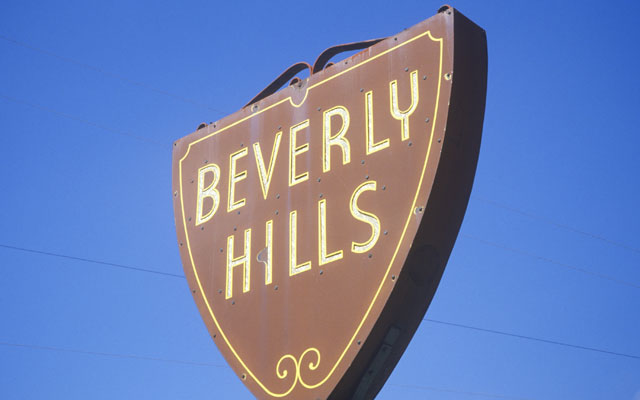
Over on the West Coast, in Beverly Hills 90210, the estate of comedian Jack Benny has collected $18,120 for a farm in Madera County, California, while $142,933 was paid to Mary Ann Mobley (Miss America of 1959) for a farm in Madison County, Mississippi.
These examples are not exceptions but the norm. The USDA’s Economic Research Service reports that two-thirds of the farms with income exceeding $1 million annually received government payments averaging $54,745 in 2011. Meanwhile, just 27 percent of farms with income of less than $100,000 received payments—averaging just $4,420 in 2011.
The top recipient of subsidies in the EWG data base is Riceland Foods, Inc., self-described as “the world’s largest miller and marketer of rice.” It collected $554,343,039 between 1995 and 2012. According to news reports, Riceland reported sales of $1.16 billion during 2011–2012, the fifth consecutive year of billion-plus revenues for the company.
The subsidies collected by large enterprises make it more difficult for small farms to stay in business. The flow of free dollars to big farms increases demand for farmland, which, in turn, raises the price of property. Smaller players and newcomers are priced out or left to compete in niche markets.
Members of Congress and their families routinely collect subsidies as well. For example, Lynda L. Lucas, the wife of House Agriculture Committee chairman Frank Lucas (R–OK), collected $40,613 in payments for their farm in Roger Mills County, Oklahoma. (Lucas has served on the Agriculture Committee since he was first elected in 1994. He became chairman in 2011. Lynda Lucas has received four payments between 1999 and 2003, a fifth in 2007, a sixth in 2011, and a seventh in 2012.)
Likewise, the Iowa family farm of Senator Charles Grassley (R–IA) has collected $955,192 in taxpayer subsidies from 1995 through 2012. (Grassley served on the Agriculture Committee since 1992. The Grassley farm has received payments each year from 1995 to 2012, according to the EWG.)
The payments have proved irresistible even to environmental groups that openly criticize the impact of subsidies on land use. For example, the Nature Conservancy accumulated a whopping $4,795,786 from 1995 through 2012 despite its own findings that such payments promote the conversion of natural habitat to cropland—threatening wildlife in the process. The National Audubon Society collected $932,801 from 1995 through 2012, according to the EWG.
Serious reform is obviously needed, and the time for an overhaul is ripe. The USDA forecasts that net farm income will reach $128.2 billion this year, the highest level in four decades. At the same time, farmers’ debt levels have dropped to historic lows. This means agriculture is well insulated against the risks associated with commodity production, including adverse weather and economic fluctuations.
There are a host of nongovernmental methods with which farmers can manage risk, including futures contracts and hedging, crop diversification, credit reserves, and private insurance. Given the enormous burdens already shouldered by taxpayers, there is no justification for robbing millions of middle-class Peters to subsidize Jimmy, Tom, David, and all the other hugely successful owners of farmland.
Congress needs to remove subsidies from the farm bill, not expand them Farm Bill Wastes More Taxpayer Money on Green Subsidies Nicolas Loris May 13, 2013 at 11:27 am Design Pics / Dave Reede/Dave Reede/Newscom Slapping the word rural in front of a bunch of green subsidies does not mean they’re not subsidies. But that’s […]
If the increase in food stamps was just because of the recession then why did the spending go from $19.8 billion in 2000 to $37.9 billion in 2007? The Facts about Food Stamps Everyone Should Hear Rachel Sheffield and T. Elliot Gaiser May 27, 2013 at 12:00 pm (7) Newscom A recent US News & […]
The sad fact is that Food stamp spending has doubled under the Obama Administration. A Bumper Crop of Food Stamps Amy Payne May 21, 2013 at 7:01 am Tweet this Where do food stamps come from? They come from taxpayers—certainly not from family farms. Yet the “farm” bill, a recurring subsidy-fest in Congress, is actually […]
Agriculture: Downsizing The Federal Government Uploaded on Dec 19, 2008 Agriculture is easily the most distorted sector, with high tariffs and, in developed countries at least, large amounts of government subsidies through price supports and direct payments. On the other hand, developing countries, who have a comparative advantage in these products, cannot afford to subsidize […]
I am glad that my state of Arkansas is not the leader in food stamps!!! Mirror, Mirror, on the Wall, Which State Has the Highest Food Stamp Usage of All? March 19, 2013 by Dan Mitchell The food stamp program seems to be a breeding ground of waste, fraud, and abuse. Some of the horror stories […]
Government Must Cut Spending Uploaded by HeritageFoundation on Dec 2, 2010 The government can cut roughly $343 billion from the federal budget and they can do so immediately. __________ President Obama c/o The White House 1600 Pennsylvania Avenue NW Washington, DC 20500 Dear Mr. President, I know that you receive 20,000 letters a day […]
_________________ President Ronald Reagan wisely said: “The federal government has taken too much tax money from the people, too much authority from the states, and too much liberty with the Constitution.” You would think that the Republicans who talk so much of cutting spending would try to get a plan that cuts spending 3 […]
I recently wrote an open letter to Congressman Rick Crawford and I put it on his facebook page. I personally do not have a facebook page so I used my son Wilson’s facebook page and here is what Congressman Crawford said: Wilson- I agree with you that we have a spending problem and not […]







 The Daily Hatch