Category Archives: President Obama

Dan Mitchell: The Simple (but Definitely not Easy) Way to Avert America’s Fiscal Crisis


The Simple (but Definitely not Easy) Way to Avert America’s Fiscal Crisis

Every six months or so, the Congressional Budget Office produces a 10-year forecast and most fiscal experts focus on the projections for deficit and debt.

Those are important (and worrisome) numbers, but I first look at the data showing what will happen to taxes and spending.

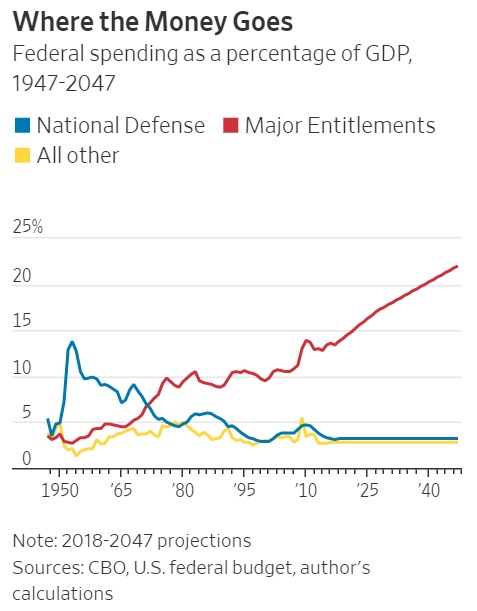
And you can see from this chart that the fiscal burden of the federal government is projected to grow at a very rapid pace over the next decade.
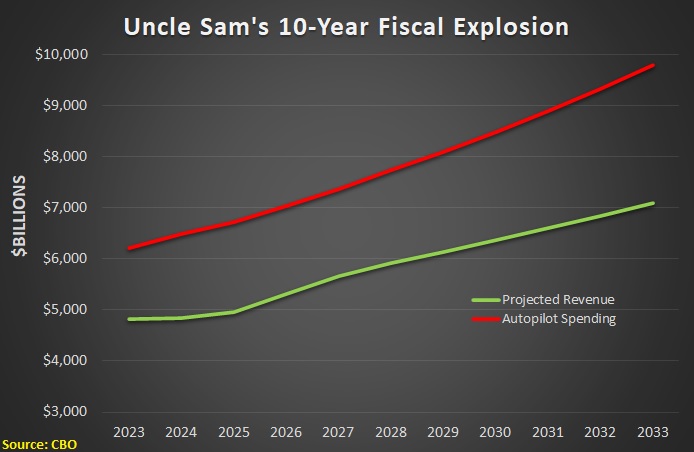
Other fiscal experts fret that deficits and debt are increasing between now and 2033, but the above chart shows that the real problem is that the spending burden is rising faster than the tax burden.

The real fiscal fight in Washington is how to close the gap between the red spending line and the green revenue line (supporters of Modern Monetary Theory say we can just print money to finance big government, but let’s ignore them for purposes of today’s column).

Since I think Washington is spending far too much, I want to close the gap by restraining the growth of government.

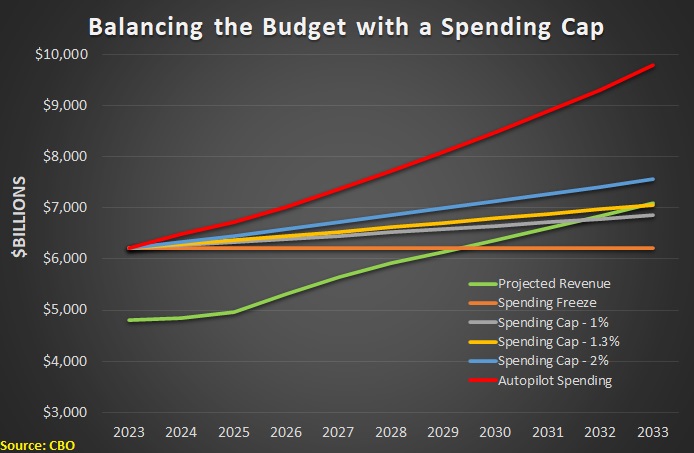
So here’s a second chart illustrating what would happen if there was some sort of spending cap. As you can see, a spending freeze (like we had from 2009-2014) would balance the budget by 2030.

And spending would have to be limited to 1.3 percent annual growth if the goal is to balance the budget within 10 years,
We can solve the problem. That’s the good news.

The bad news is that politicians don’t want to restrain spending.

And, even if they did want to do the right thing, adhering to a 1.3 percent spending cap would require serious entitlement reform. So don’t hold your breath hoping for immediate progress.

P.S. The numbers are out of date, but here’s a videothat explains how spending restraint is the key to fiscal balance. And here’s a video on how some other nations made enormous progress with multi-year spending restraint.


The Simple (but Definitely not Easy) Way to Avert America’s Fiscal Crisis

Every six months or so, the Congressional Budget Office produces a 10-year forecast and most fiscal experts focus on the projections for deficit and debt.

Those are important (and worrisome) numbers, but I first look at the data showing what will happen to taxes and spending.

And you can see from this chart that the fiscal burden of the federal government is projected to grow at a very rapid pace over the next decade.

Other fiscal experts fret that deficits and debt are increasing between now and 2033, but the above chart shows that the real problem is that the spending burden is rising faster than the tax burden.

The real fiscal fight in Washington is how to close the gap between the red spending line and the green revenue line (supporters of Modern Monetary Theory say we can just print money to finance big government, but let’s ignore them for purposes of today’s column).

Since I think Washington is spending far too much, I want to close the gap by restraining the growth of government.

So here’s a second chart illustrating what would happen if there was some sort of spending cap. As you can see, a spending freeze (like we had from 2009-2014) would balance the budget by 2030.

And spending would have to be limited to 1.3 percent annual growth if the goal is to balance the budget within 10 years,

We can solve the problem. That’s the good news.

The bad news is that politicians don’t want to restrain spending.

And, even if they did want to do the right thing, adhering to a 1.3 percent spending cap would require serious entitlement reform. So don’t hold your breath hoping for immediate progress.

P.S. The numbers are out of date, but here’s a videothat explains how spending restraint is the key to fiscal balance. And here’s a video on how some other nations made enormous progress with multi-year spending restraint.

An Overdue Wake-Up Call for New York Democrats?

The economic outlook in New York (both the stateand the city) has been very depressing in recent years.

  • New York is ranked #50 in the Economic Freedom of North America.
  • New York is ranked #48 in the State Business Tax Climate Index.
  • New York is ranked #50 in the Freedom in the 50 States.
  • New York is next-to-last in measures of inbound migration.
  • New York is ranked #50 in the State Soft Tyranny Index.

That’s a very depressing list. New York’s low rankings are rivaled only by a few other outlier states such as California and New Jersey.

But maybe a turnaround is possible.

There are two recent signs of rationality, one in New York City and one in Albany (the state’s capital).

Let’s start with this tweet from Phil Kerpen, which features some comments from Mayor Adams of New York City.

Remarkably, the Mayor understands it is not a good idea if the geese with the golden eggs fly away.

“To continually attack high income earners when 51% of our taxes are paid by 2% of New Yorkers — this blows my mind when I hear people say ‘so what if they leave.’ No you leave! I want my high income earners right here in this city!”

I don’t know if the Mayor’s comments will actually translate into better policy, but it certainly seems like he has a better understanding of reality than his predecessor.

Now let’s shift to the state level.

The Wall Street Journal opines about a potential outbreak of rationality by the state’s governor.

’Tis the season for epiphanies, and what do you know? It’s finally dawning on some New York Democrats that the state’s steep income tax rates are driving away top earners who fund essential public services. …miracles of miracles, Gov. Kathy Hochul last week ruled out tax increases and said she planned to hold the line on spending next year. “I don’t believe that raising taxes…makes sense,” she said. …A New York City Independent Budget Office report this month showed that the number of taxpayers who earned between $1 million and $5 million plunged 11% in 2020 from the prior year. …The culprits are high taxes and Covid lockdowns. According to IRS data, New York County lost $14.5 billion in adjusted gross income from out-migration between 2019 and 2020. And this was before Democrats in Albany last spring raised income taxes on individuals making more than $1 million, jacking up the combined state and New York City top rate to 14.8% from 12.7%. Even New York Comptroller Thomas DiNapoli, who is no moderate, told Bloomberg News last week that the exodus of taxpayers at the upper end “should be a concern for everybody.” He added that “we might be getting near that tipping point where we do make it economically unsustainable for enough of those folks to stay here.”

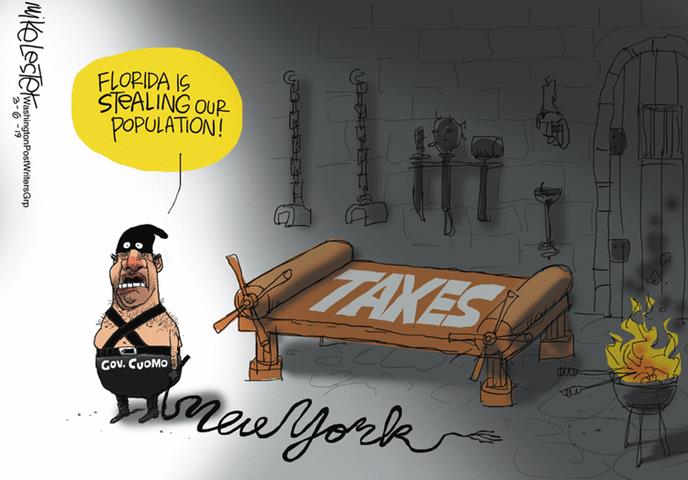
For what it’s worth, I think New York already passed the tipping point. Thousand and thousands of well-to-do taxpayers have already escaped and moved to zero-income-tax Florida.

That means New York’s parasitical politicians have lost billions and billions of tax revenue. And I suspect that’s why we are seeing some semi-sensible comments from the Mayor and the Governor.

Let’s close with a depressing observation. The reason the comments from the Mayor and Governor are “semi-sensible” is that they are only saying there should be no more tax increases.

That’s not the same as saying that there should be tax cuts. Or TABOR-style spending caps.

In other words, the “good news” from New York is that politicians want to freeze the current (very bad) policy in place. That’s better than galloping faster in the wrong direction, of course, but a far cry from what’s needed.

Especially when many other states are seizing opportunities to become more competitive.


Dan Mitchell does a great job explaining the Laffer Curve

Free-market economics meets free-market policies at The Heritage Foundation’s Tenth Anniversary dinner in 1983. Nobel Laureate Milton Friedman and his wife Rose with President Ronald Reagan and Heritage President Ed Feulner.

Free-market economics meets free-market policies at The Heritage Foundation’s Tenth Anniversary dinner in 1983. Nobel Laureate Milton Friedman and his wife Rose with President Ronald Reagan and Heritage President Ed Feulner.

Since the passing of Milton Friedman who was my favorite economist, I have been reading the works of Daniel Mitchell and he quotes Milton Friedman a lot, and you can reach Dan’s website here.

Mitchell in February 2011.
Wikipedia noted concerning Dan:


Mitchell’s career as an economist began in the United States Senate, working for Oregon Senator Bob Packwood and the Senate Finance Committee. He also served on the transition team of President-Elect Bush and Vice President-Elect Quayle in 1988. In 1990, he began work at the Heritage Foundation. At Heritage, Mitchell worked on tax policy issues and began advocating for income tax reform.[1]

In 2007, Mitchell left the Heritage Foundation, and joined the Cato Institute as a Senior Fellow. Mitchell continues to work in tax policy, and deals with issues such as the flat tax and international tax competition.[2]

In addition to his Cato Institute responsibilities, Mitchell co-founded the Center for Freedom and Prosperity, an organization formed to protect international tax competition.[1]

President Biden c/o The White House
1600 Pennsylvania Avenue NW
Washington, DC 20500

Dear Mr. President,

I enjoyed this article below because it demonstrates that the Laffer Curve has been working for almost 100 years now when it is put to the test in the USA. I actually got to hear Arthur Laffer speak in person in 1981 and he told us in advance what was going to happen the 1980’s and it all came about as he said it would when Ronald Reagan’s tax cuts took place. I wish we would lower taxes now instead of looking for more revenue through raised taxes. We have to grow the economy:

What Mitt Romney Said Last Night About Tax Cuts And The Deficit Was Absolutely Right. And What Obama Said Was Absolutely Wrong.

Mitt Romney repeatedly said last night that he would not allow tax cuts to add to the deficit.  He repeatedly said it because over and over again Obama blathered the liberal talking point that cutting taxes necessarily increased deficits.

Romney’s exact words: “I want to underline that — no tax cut that adds to the deficit.”

Meanwhile, Obama has promised to cut the deficit in half during his first four years – but instead gave America the highest deficits in the history of the entire human race.

I’ve written about this before.  Let’s replay what has happened every single time we’ve ever cut the income tax rate.

The fact of the matter is that we can go back to Calvin Coolidge who said very nearly THE EXACT SAME THING to his treasury secretary: he too would not allow any tax cuts that added to the debt.  Andrew Mellon – quite possibly the most brilliant economic mind of his day – did a great deal of research and determined what he believed was the best tax rate.  And the Coolidge administration DID cut income taxes and MASSIVELY increased revenues.  Coolidge and Mellon cut the income tax rate 67.12 percent (from 73 to 24 percent); and revenues not only did not go down, but they went UP by at least 42.86 percent (from $700 billion to over $1 billion).

That’s something called a documented fact.  But that wasn’t all that happened: another incredible thing was that the taxes and percentage of taxes paid actually went UP for the rich.  Because as they were allowed to keep more of the profits that they earned by investing in successful business, they significantly increased their investments and therefore paid more in taxes than they otherwise would have had they continued sheltering their money to protect themselves from the higher tax rates.  Liberals ignore reality, but it is simply true.  It is a fact.  It happened.

Then FDR came along and raised the tax rates again and the opposite happened: we collected less and less revenue while the burden of taxation fell increasingly on the poor and middle class again.  Which is exactly what Obama wants to do.

People don’t realize that John F. Kennedy, one of the greatest Democrat presidents, was a TAX CUTTER who believed the conservative economic philosophy that cutting tax rates would in fact increase tax revenues.  He too cut taxes, and he too increased tax revenues.

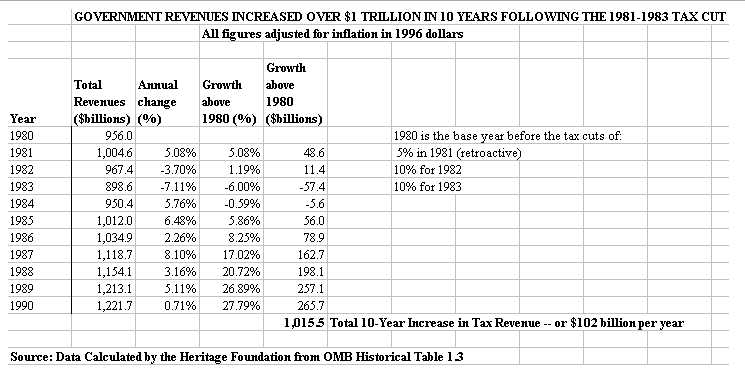
So we get to Ronald Reagan, who famously cut taxes.  And again, we find that Reagan cut that godawful liberal tax rate during an incredibly godawful liberal-caused economic recession, and he increased tax revenue by 20.71 percent (with revenues increasing from $956 billion to $1.154 trillion).  And again, the taxes were paid primarily by the rich:

“The share of the income tax burden borne by the top 10 percent of taxpayers increased from 48.0 percent in 1981 to 57.2 percent in 1988. Meanwhile, the share of income taxes paid by the bottom 50 percent of taxpayers dropped from 7.5 percent in 1981 to 5.7 percent in 1988.”

So we get to George Bush and the Bush tax cuts that liberals and in particular Obama have just demonized up one side and demagogued down the other.  And I can simply quote the New York Times AT the time:

Sharp Rise in Tax Revenue to Pare U.S. Deficit By EDMUND L. ANDREWS Published: July 13, 2005

WASHINGTON, July 12 – For the first time since President Bush took office, an unexpected leap in tax revenue is about to shrink the federal budget deficit this year, by nearly $100 billion.

A Jump in Corporate Payments On Wednesday, White House officials plan to announce that the deficit for the 2005 fiscal year, which ends in September, will be far smaller than the $427 billion they estimated in February.

Mr. Bush plans to hail the improvement at a cabinet meeting and to cite it as validation of his argument that tax cuts would stimulate the economy and ultimately help pay for themselves.

Based on revenue and spending data through June, the budget deficit for the first nine months of the fiscal year was $251 billion, $76 billion lower than the $327 billion gap recorded at the corresponding point a year earlier.

The Congressional Budget Office estimated last week that the deficit for the full fiscal year, which reached $412 billion in 2004, could be “significantly less than $350 billion, perhaps below $325 billion.”

The big surprise has been in tax revenue, which is running nearly 15 percent higher than in 2004. Corporate tax revenue has soared about 40 percent, after languishing for four years, and individual tax revenue is up as well
.

And of course the New York Times, as reliable liberals, use the adjective whenever something good happens under conservative policies and whenever something bad happens under liberal policies: ”unexpected.”   But it WASN’T ”unexpected.”  It was EXACTLY what Republicans had said would happen and in fact it was exactly what HAD IN FACT HAPPENED every single time we’ve EVER cut income tax rates.

The truth is that conservative tax policy has a perfect track record: every single time it has ever been tried, we have INCREASED tax revenues while not only exploding economic activity and creating more jobs, but encouraging the wealthy to pay more in taxes as well.  And liberals simply dishonestly refuse to acknowledge documented history.

Meanwhile, liberals also have a perfect record … of FAILUREThey keep raising taxes and keep not understanding why they don’t get the revenues they predicted.

The following is a section from my article, “Tax Cuts INCREASE Revenues; They Have ALWAYS Increased Revenues“, where I document every single thing I said above:

The Falsehood That Tax Cuts Increase The Deficit

Now let’s take a look at the utterly fallacious view that tax cuts in general create higher deficits.

Let’s take a trip back in time, starting with the 1920s.  From Burton Folsom’s book, New Deal or Raw Deal?:

In 1921, President Harding asked the sixty-five-year-old [Andrew] Mellon to be secretary of the treasury; the national debt [resulting from WWI] had surpassed $20 billion and unemployment had reached 11.7 percent, one of the highest rates in U.S. history.  Harding invited Mellon to tinker with tax rates to encourage investment without incurring more debt. Mellon studied the problem carefully; his solution was what is today called “supply side economics,” the idea of cutting taxes to stimulate investment.  High income tax rates, Mellon argued, “inevitably put pressure upon the taxpayer to withdraw this capital from productive business and invest it in tax-exempt securities. . . . The result is that the sources of taxation are drying up, wealth is failing to carry its share of the tax burden; and capital is being diverted into channels which yield neither revenue to the Government nor profit to the people” (page 128).

Mellon wrote, “It seems difficult for some to understand that high rates of taxation do not necessarily mean large revenue to the Government, and that more revenue may often be obtained by lower taxes.”  And he compared the government setting tax rates on incomes to a businessman setting prices on products: “If a price is fixed too high, sales drop off and with them profits.”

And what happened?

“As secretary of the treasury, Mellon promoted, and Harding and Coolidge backed, a plan that eventually cut taxes on large incomes from 73 to 24 percent and on smaller incomes from 4 to 1/2 of 1 percent.  These tax cuts helped produce an outpouring of economic development – from air conditioning to refrigerators to zippers, Scotch tape to radios and talking movies.  Investors took more risks when they were allowed to keep more of their gains.  President Coolidge, during his six years in office, averaged only 3.3 percent unemployment and 1 percent inflation – the lowest misery index of any president in the twentieth century.

Furthermore, Mellon was also vindicated in his astonishing predictions that cutting taxes across the board would generate more revenue.  In the early 1920s, when the highest tax rate was 73 percent, the total income tax revenue to the U.S. government was a little over $700 million.  In 1928 and 1929, when the top tax rate was slashed to 25 and 24 percent, the total revenue topped the $1 billion mark.  Also remarkable, as Table 3 indicates, is that the burden of paying these taxes fell increasingly upon the wealthy” (page 129-130).

Now, that is incredible upon its face, but it becomes even more incredible when contrasted with FDR’s antibusiness and confiscatory tax policies, which both dramatically shrunk in terms of actual income tax revenues (from $1.096 billion in 1929 to $527 million in 1935), and dramatically shifted the tax burden to the backs of the poor by imposing huge new excise taxes (from $540 million in 1929 to $1.364 billion in 1935).  See Table 1 on page 125 of New Deal or Raw Deal for that information.

FDR both collected far less taxes from the rich, while imposing a far more onerous tax burden upon the poor.

It is simply a matter of empirical fact that tax cuts create increased revenue, and that those [Democrats] who have refused to pay attention to that fact have ended up reducing government revenues even as they increased the burdens on the poorest whom they falsely claim to help.

Let’s move on to John F. Kennedy, one of the most popular Democrat presidents ever.  Few realize that he was also a supply-side tax cutter.

Kennedy said:

“It is a paradoxical truth that tax rates are too high and tax revenues are too low and the soundest way to raise the revenues in the long run is to cut the rates now … Cutting taxes now is not to incur a budget deficit, but to achieve the more prosperous, expanding economy which can bring a budget surplus.”

– John F. Kennedy, Nov. 20, 1962, president’s news conference


“Lower rates of taxation will stimulate economic activity and so raise the levels of personal and corporate income as to yield within a few years an increased – not a reduced – flow of revenues to the federal government.”

– John F. Kennedy, Jan. 17, 1963, annual budget message to the Congress, fiscal year 1964

“In today’s economy, fiscal prudence and responsibility call for tax reduction even if it temporarily enlarges the federal deficit – why reducing taxes is the best way open to us to increase revenues.”

– John F. Kennedy, Jan. 21, 1963, annual message to the Congress: “The Economic Report Of The President”


“It is no contradiction – the most important single thing we can do to stimulate investment in today’s economy is to raise consumption by major reduction of individual income tax rates.”

– John F. Kennedy, Jan. 21, 1963, annual message to the Congress: “The Economic Report Of The President”


“Our tax system still siphons out of the private economy too large a share of personal and business purchasing power and reduces the incentive for risk, investment and effort – thereby aborting our recoveries and stifling our national growth rate.”

– John F. Kennedy, Jan. 24, 1963, message to Congress on tax reduction and reform, House Doc. 43, 88th Congress, 1st Session.


“A tax cut means higher family income and higher business profits and a balanced federal budget. Every taxpayer and his family will have more money left over after taxes for a new car, a new home, new conveniences, education and investment. Every businessman can keep a higher percentage of his profits in his cash register or put it to work expanding or improving his business, and as the national income grows, the federal government will ultimately end up with more revenues.”

– John F. Kennedy, Sept. 18, 1963, radio and television address to the nation on tax-reduction bill

Which is to say that modern Democrats are essentially calling one of their greatest presidents a liar when they demonize tax cuts as a means of increasing government revenues.

So let’s move on to Ronald Reagan.  Reagan had two major tax cutting policies implemented: the Economic Recovery Tax Act (ERTA) of 1981, which was retroactive to 1981, and the Tax Reform Act of 1986.

Did Reagan’s tax cuts decrease federal revenues?  Hardly:

We find that 8 of the following 10 years there was a surplus of revenue from 1980, prior to the Reagan tax cuts.  And, following the Tax Reform Act of 1986, there was a MASSIVE INCREASEof revenue.

So Reagan’s tax cuts increased revenue.  But who paid the increased tax revenue?  The poor?  Opponents of the Reagan tax cuts argued that his policy was a giveaway to the rich (ever heard that one before?) because their tax payments would fall.  But that was exactly wrong.  In reality:

“The share of the income tax burden borne by the top 10 percent of taxpayers increased from 48.0 percent in 1981 to 57.2 percent in 1988. Meanwhile, the share of income taxes paid by the bottom 50 percent of taxpayers dropped from 7.5 percent in 1981 to 5.7 percent in 1988.”

So Ronald Reagan a) collected more total revenue, b) collected more revenue from the rich, while c) reducing revenue collected by the bottom half of taxpayers, and d) generated an economic powerhouse that lasted – with only minor hiccups – for nearly three decades.  Pretty good achievement considering that his predecessor was forced to describe his own economy as a “malaise,” suffering due to a “crisis of confidence.” Pretty good considering that President Jimmy Carter responded to a reporter’s question as to what he would do about the problem of inflation by answering, “It would be misleading for me to tell any of you that there is a solution to it.”

Reagan whipped inflation.  Just as he whipped that malaise and that crisis of confidence.

________

Thank you so much for your time. I know how valuable it is. I also appreciate the fine family that you have and your commitment as a father and a husband.

Sincerely,

Everette Hatcher III, 13900 Cottontail Lane, Alexander, AR 72002, ph 501-920-5733

________

The Laffer Curve, Part III: Dynamic Scoring

Related posts:

Milton Friedman’s Free to Choose (1980), episode 3 – Anatomy of a Crisis. part 1

“The Power of the Market” episode of Free to Choose in 1990 by Milton Friedman (Part 5)

Milton Friedman The Power of the Market 5-5 How can we have personal freedom without economic freedom? That is why I don’t understand why socialists who value individual freedoms want to take away our economic freedoms.  I wanted to share this info below with you from Milton Friedman who has influenced me greatly over the […]

“The Power of the Market” episode of Free to Choose in 1990 by Milton Friedman (Part 4)

Milton Friedman The Power of the Market 4-5 How can we have personal freedom without economic freedom? That is why I don’t understand why socialists who value individual freedoms want to take away our economic freedoms.  I wanted to share this info below with you from Milton Friedman who has influenced me greatly over the […]

“The Power of the Market” episode of Free to Choose in 1990 by Milton Friedman (Part 3)

Milton Friedman The Power of the Market 3-5 How can we have personal freedom without economic freedom? That is why I don’t understand why socialists who value individual freedoms want to take away our economic freedoms.  I wanted to share this info below with you from Milton Friedman who has influenced me greatly over the […]

“The Power of the Market” episode of Free to Choose in 1990 by Milton Friedman (Part 2)

Milton Friedman The Power of the Market 2-5 How can we have personal freedom without economic freedom? That is why I don’t understand why socialists who value individual freedoms want to take away our economic freedoms.  I wanted to share this info below with you from Milton Friedman who has influenced me greatly over the […]

“The Power of the Market” episode of Free to Choose in 1990 by Milton Friedman (Part 1)

Milton Friedman The Power of the Market 1-5 How can we have personal freedom without economic freedom? That is why I don’t understand why socialists who value individual freedoms want to take away our economic freedoms.  I wanted to share this info below with you from Milton Friedman who has influenced me greatly over the […]

Open letter to President Obama (Part 282, How the Laffer Curve worked in the 20th century over and over again!!!)

Dan Mitchell does a great job explaining the Laffer Curve President Obama c/o The White House 1600 Pennsylvania Avenue NW Washington, DC 20500 Dear Mr. President, I know that you receive 20,000 letters a day and that you actually read 10 of them every day. I really do respect you for trying to get a […]

President Obama ignores warnings about Laffer Curve

The Laffer Curve – Explained Uploaded by Eddie Stannard on Nov 14, 2011 This video explains the relationship between tax rates, taxable income, and tax revenue. The key lesson is that the Laffer Curve is not an all-or-nothing proposition, where we have to choose between the exaggerated claim that “all tax cuts pay for themselves” […]

The Laffer Curve Wreaks Havoc in the United Kingdom

I got to hear Arthur Laffer speak back in 1981 and he predicted what would happen in the next few years with the Reagan tax cuts and he was right with every prediction. The Laffer Curve Wreaks Havoc in the United Kingdom July 1, 2012 by Dan Mitchell Back in 2010, I excoriated the new […]

Open letter to President Obama (Part 197)

  President Obama c/o The White House 1600 Pennsylvania Avenue NW Washington, DC 20500 Dear Mr. President, I know that you receive 20,000 letters a day and that you actually read 10 of them every day. I really do respect you for trying to get a pulse on what is going on out here. David […]

Open letter to President Obama (Part 123)

President Obama c/o The White House 1600 Pennsylvania Avenue NW Washington, DC 20500 Dear Mr. President, I know that you receive 20,000 letters a day and that you actually read 10 of them every day. I really do respect you for trying to get a pulse on what is going on out here. I got […]

Open letter to President Obama (Part 111)

President Obama c/o The White House 1600 Pennsylvania Avenue NW Washington, DC 20500 Dear Mr. President, I know that you receive 20,000 letters a day and that you actually read 10 of them every day. I really do respect you for trying to get a pulse on what is going on out here. If our […]

Open letter to President Obama (Part 103)

President Obama c/o The White House 1600 Pennsylvania Avenue NW Washington, DC 20500 Dear Mr. President, I know that you receive 20,000 letters a day and that you actually read 10 of them every day. I really do respect you for trying to get a pulse on what is going on out here. I personally […]

High taxes are self-defeating

We got to lower taxes in order to encourage job growth and if we go down the road of higher taxes then we will go further into a recession. Debating Whether States Should Impose Class-Warfare Tax Policy June 4, 2012 by Dan Mitchell I wrote last week about the destructive and self-defeating impact of high state […]

California has forgotten the lessons of Ronald Reagan

If our country is the grow the economy and get our budget balanced it will not be by raising taxes!!! The recipe for success was followed by Ronald Reagan in the 1980′s when he cut taxes and limited spending. As far as limiting spending goes only Bill Clinton (with his Republican Congress) were ability to […]

Some liberal economics want top tax rate above 70% but economy would be crushed

I got to see Arthur Laffer speak in 1981 in Memphis and he predicted what would happen the next few years with tax revenue as a result of the Reagan Tax Cuts and he was right on every prediction. Alan Reynolds Dismantles the Silly Claim that Top Tax Rates Should be 70 Percent (or Higher!) May […]

Spain raises tax rates and revenues fall!!!!

The way to grow the economy is to cut taxes. Last night in the State of the Union address President Obama said he wanted to close tax loopholes which is another way of saying that he is not through raising taxes yet. The Laffer Curve Strikes Again: Revenues Falling in Spite of (or Perhaps Because […]

Ronald Wilson Reagan Part 13

President Reagan and Nancy Reagan greeting Billy Graham at the National Prayer Breakfast held at the Washington Hilton Hotel. 2/5/81. HALT:HaltingArkansasLiberalswithTruth.com Recently on my series on Ronald Reagan (part 10), a gentleman by the name of Elwood who a regular on the Ark Times Blog site, rightly noted, “Ray-gun created the highest unemployment rate we […]

DAN Mitchell: A Case Study on Corporate Tax and Competitiveness

A Case Study on Corporate Tax and Competitiveness

Last year’s three-part series on corporate tax rates (here, here, and here) primarily focused on the case for low rates in the United States.

Today, we’re going to look at why the United Kingdom should have a low corporate tax rate.

Though the arguments don’t change simply because we cross the Atlantic Ocean.

A low corporate tax rate is a good idea because it means more investment, higher productivity, and better wages.

That’s true in the U.S., it’s true in the U.K., and its true in every other nation.

If you want evidence, Phil Radford’s article for CapXexplains why the U.K.’s pharmaceutical industry has contracted while Ireland’s has expanded.

AstraZeneca’s plan to build a $350m pharmaceuticals factory in Ireland rather than the UK was 100% predictable. …the long-term failure of UK pharma highlights how UK policy discussion is light years behind our competitors when it comes to understanding what drives prosperity. …The trend kicked off back in 2011, when US-based Pfizer shifted its Viagra-making plant from Sandwich in Kent to Ringaskiddy, near Cork. This event marked the start of a five-year plunge in UK pharma manufacturing and exports…According to ONS, output in UK pharma manufacturing declined by roughly one-third from 2010 to 2015. Gross value added actually halved. Where did the manufacturing go? Ireland… What’s caused this malady? In a word: taxation. …corporate taxation levels appear to exert a dominating effect on where pharmaceuticals companies locate their factories. …Ireland’s corporate tax rate fell from 40% in 1996 to 12.5%n 2003, and it has stayed at that level for the past 19 years. Meanwhile, the UK’s corporate taxation rate was 30% 20 years ago, and from 2008 it began a gentle drift downwards to 19% where it will remain until April this year, when it will increase to 25%. This means, from AstraZeneca’s point of view, the investment equation is a no-brainer. Even if Ireland is forced to raise its rate to 15%, the country will shortly regain its general comparative level of between one-half and two-thirds the UK rate.

The data in Radford’s article is a damning indictment of the supposedly conservative government in the United Kingdom.

A few years ago, the corporate tax rate was 19 percent and expected to drop to 17 percent. Now, thanks to an unwillingness to control spending, the rate is jumping to 25 percent.

And, as noted in the article, the U.K. lost a $350 million factory. As well as all the jobs and taxable income that it would have generated.

Politicians are winning and people are losing.

P.S. Biden wants to make the same mistake.

The Unavoidable Choice: Entitlement Reform or Massive Middle-Class Tax Increases

I worry about big tax increases because of America’s grim long-run fiscal outlook.

The video clip is less than two minutes (taken from this longer discussion with Fergus Hodgson), but I can summarize my key point in just one very important sentence

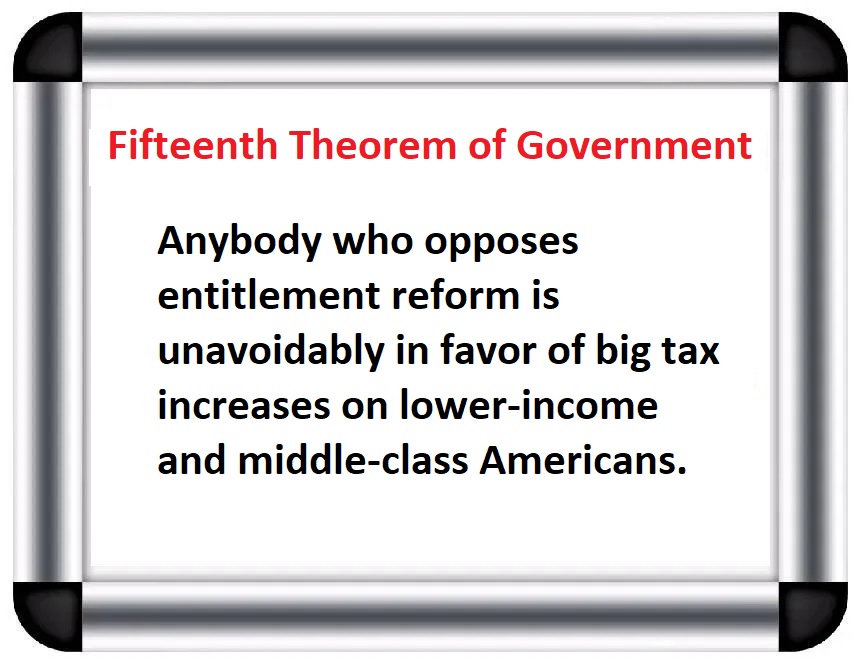
Anybody who opposes entitlement reform is unavoidably in favor of big tax increases on lower-income and middle-class Americans.

There are three reasons for this bold (and bolded) statement.

  1. The burden of spending in the United States is going to dramatically expand in coming decades because of demographic change combined with poorly designed entitlement programs.
  2. There presumably is a limit to how much of this future spending burden can be financed by borrowing from the private sector (or with printing money by the Federal Reserve).
  3. Many politicians claim that future spending on entitlements (as well spending on new entitlements!) can be financed with class-warfare taxes, but there are not enough rich people.

My left-leaning friends almost surely would agree with the first two points. But some of them (particularly the ones who don’t understand budget numbers) might argue with the third point.

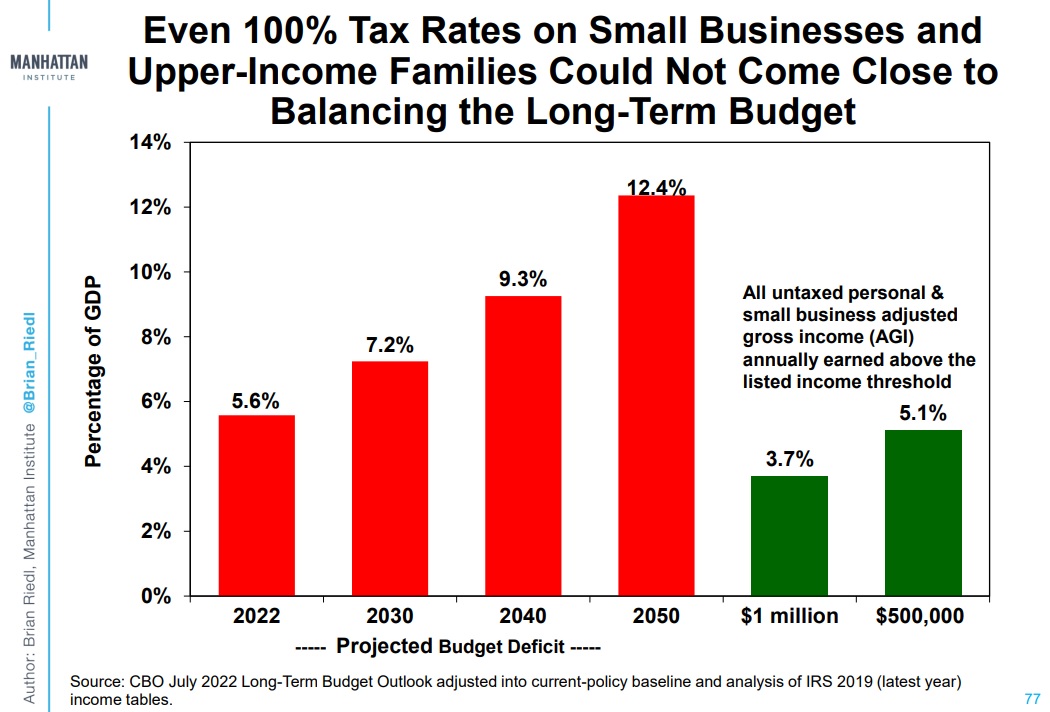
To confirm the accuracy of the argument, let’s look at this chart from Brian Riedl’s famous Chartbook.

As you can see, even confiscatory 100-percent taxes on the rich (which obviously would cripple the economy) would not be nearly enough to eliminate America’s medium-term fiscal gap.

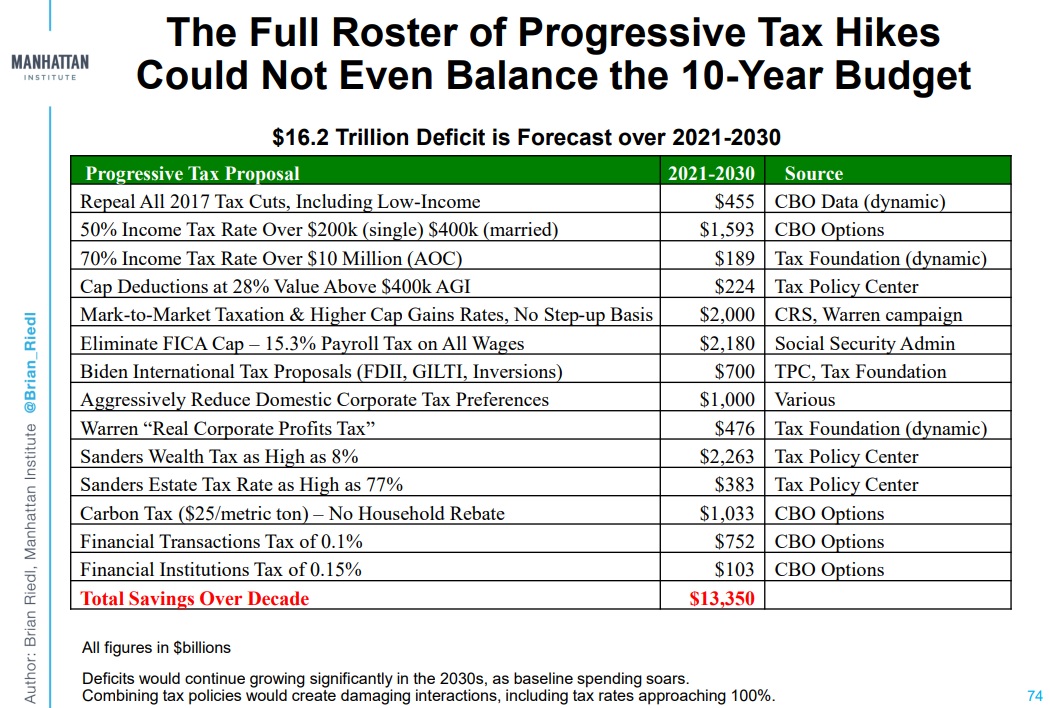
Heck, even if we look at just the next 10 years and include every possible tax hike, it’s obvious that a class-warfare agenda (which also would have negative economic effects) would not be enough to finance all the spending that is currently in the pipeline.

Here’s another Riedl chart (which even includes some proposals that would hit the middle class).

I’ll conclude with two further observations.

  • First, there are plenty of honest leftists (the ones who understand budget numbers, including Paul Krugman) who openly admit that big tax increases will be needed if the burden of government spending is allowed to increase.
  • Second, there are plenty of disingenuous (or perhaps naive) folks on the right who oppose entitlement reform while not admitting that their approach means massive tax increases on lower-income and middle-class taxpayers.

Needless to say, genuine entitlement reform would be far preferable to any type of tax increase.

P.S. In the absence of entitlement reform, politicians will first choose class warfare taxes, of course, but that simply will be a precursor to higher taxes on the rest of us.

P.P.S. The bottom line is that you can’t have European-sized government without European-style taxes. Including a money-siphoning value-added tax.

If our country is the grow the economy and get our budget balanced it will not be by raising taxes!!! The recipe for success was followed by Ronald Reagan in the 1980’s when he cut taxes and limited spending. As far as limiting spending goes only Bill Clinton (with his Republican Congress) were ability to control the growth of government better than Reagan.

I had the pleasure of hearing Arthur Laffer speak in 1981 and he predicted all the economic growth that we would see because of the Reagan tax cuts and he was right. Unfortunately in California today they have forgotten all of those lessons!!!

President Obama’s fiscal policy is a dismal mixture. On spending, he wants a European-style welfare state. On taxes, he is fixated on class-warfare tax policy.

If we want to know the consequences of that approach, we can look at the ongoing collapse of Greece. Or, if we don’t like overseas examples, we can look at California.

If the (formerly) Golden State is any example, it turns out that having high tax rates doesn’t necessarily translate into high tax revenues. Here’s a blurb from an editorial in today’s Wall Street Journal.

California Controller John Chiang reported last week that April tax collections were a gigantic 20.2%, or $2.44 billion, below 2012-13 budget projections. …Among the biggest surprises is a 21.5% or nearly $2 billion decline in personal income tax payments from what Governor Jerry Brown had anticipated. This reinforces the point that when states rely too heavily on the top 1% of taxpayers to pay the bills, fiscal policy is a roller coaster ride. California is suffering this tax drought even as most other states enjoy a revenue rebound. State tax collections were up nationally by 8.9% last year, according to the Census Bureau, and this year revenues are up by double digits in many states. The state comptroller reports that Texas is enjoying 10.9% growth in its sales taxes (it has no income tax), while California can’t seem to keep up despite one of the highest tax rates in the land.

The WSJ editorial suggests a supply-side response, but you won’t be surprised to learn that the state’s kleptomaniac governor is pushing an Obama-style soak-the-rich tax hike.

This would seem to suggest that California should try cutting tax rates to keep more people and business in the state, but Sacramento is intent on raising them again. Governor Brown and the public-employee unions are sponsoring a ballot initiative in November to raise the state sales tax by a quarter point to 7.5% and to raise the top marginal income-tax rate to 13.3% from 10.3%. This will make the state even more reliant on the fickle revenue streams provided by the rich. Meanwhile, an analysis by Joseph Vranich, who studies migration of businesses from one state to another, finds that since 2009 the flight of businesses out of California “has increased fivefold due to high taxes and regulatory costs.”

I’ll be very curious to see what happens this November when the people of California vote in the referendum. Will they be like the morons in Oregon, who approved a class-warfare tax hike? Or will they be like the voters of Switzerland and reject class warfare?

Sadly, I suspect Oregon will be their role model – even though that decision hurt the Beaver State’s economy.

But while voters can impose higher taxes, they can’t repeal the laws of economics. So if California voters do the wrong thing, they will learn a hard lesson about the Laffer Curve.

And then, as this cartoon demonstrates, they’ll learn the ultimate lesson about not biting the hand that you mooch from.

The Laffer Curve, Part III: Dynamic Scoring

Dan Mitchell: Michigan Shows the Wrong Way to Cut Taxes

The economics of tax policy is largely the economics of incentives. When governments impose high tax rates on something, you get less of that thing.

My left-leaning friends acknowledge this is true, but only selectively. They openly agitate for higher taxes on things like tobacco (or sugar, or energy) and they correctly argue that higher tax rates will lead to less smoking.

As a libertarian, I don’t want to control other people’s lives, so I’m not a big fan of such taxes, but the underlying economic analysis is correct.

Unfortunately, my friends on the left often forget economic analysis when looking at tax rates on productive behaviors such as work, saving, investment, and entrepreneurship.

It is also important to realize that not all taxes are created equal. Whether politicians are cutting taxes or increasing taxes, the economic consequences will vary depending on the details.

For instance, even though I just stated that I don’t favor higher “sin taxes,” raising the tax burden on things like cigarettes will do less economic damage than increasing marginal tax rates on labor and capital.

There are also good and not-so-good ways of lowering taxes, and we have an example of this from Michigan.

As reported by Craig Mauger and Candice Williams of the Detroit News, there’s a big budget surplus in Michigan and politicians are debating whether to reduce the rate of the state’s flat tax or to give one-time tax rebates. Here are some excerpts from the story.

Michigan Gov. Gretchen Whitmer and the Democratic leaders of the Legislature are preparing a sweeping tax relief proposal they say will reduce tax bills by more than $1 billion and include rebate checks that could be issued directly to residents. The Friday agreement focuses on a plan to ease taxes on retirement income, boost a tax credit for low-wage workers and issue “inflation relief checks” in place of a potential cut in the state’s personal income tax, which was expected to be triggered by growing revenues, according to a source familiar with the plan.…as the state sits on a surplus of more than $9 billion, Republicans in the House and Senate have called for a broad tax cut for Michiganians and the preservation of the potential automatic drop in the personal income tax rate, which is being caused by language in a 2015 law. That policy tied the income tax, currently at 4.25%, to revenues for the state’s general fund. …based on preliminary fiscal year 2022 revenue figures, the revenue trigger would be activated and lower the income tax rate for the 2023 tax year from 4.25% to 4.05%. …“The Democrats’ proposal is a head fake intended to hide their attempt to rob Michigan taxpayers of an income tax cut in favor of funding a corporate welfare slush fund — prioritizing big corporations over Michigan families,” said Sarah Anderson, executive director of the Michigan Freedom Fund.

Michigan Democrats want more than rebates. They also favor “an exemption for public pensions” and “economic development subsidies for businesses.”

At the risk of stating the obvious, a lower rate for the flat tax will be far more beneficial to the state than one-time rebates and special favors for bureaucrats (who already enjoy higher compensation than workers in the private sector).

And a lower rate on the flat tax also would be far preferable to special handouts for businesses (which inevitably translates into corrupt cronyism).

I’ll close with a final point about overall fiscal policy. The Michigan tax fight is also a spending fight. Democrats are focusing on tax rebates in part because they are a one-off event. They’ll return some money to taxpayers this year, but there are no long-run savings.

By contrast, a cut in the state’s flat tax produces long-run savings for people. As the story noted, “Rebates are typically one-time spending bursts, while cuts in the income tax rate usually are kept in place for multiple years.”

Needless to say, politicians who want to spend more money prefer one-time rebates over permanent tax cuts.

P.S. Pursuing sub-optimal tax policy is not just a left-wing problem. Some folks on the right favor things such as child credits. That kind of tax cut will reduce tax liabilities for families, but those families quite likely would be better off in the long run with growth-oriented reductions in marginal tax rates on labor and capital.

Michigan Shows the Wrong Way to Cut Taxes

The economics of tax policy is largely the economics of incentives. When governments impose high tax rates on something, you get less of that thing.

My left-leaning friends acknowledge this is true, but only selectively. They openly agitate for higher taxes on things like tobacco (or sugar, or energy) and they correctly argue that higher tax rates will lead to less smoking.

As a libertarian, I don’t want to control other people’s lives, so I’m not a big fan of such taxes, but the underlying economic analysis is correct.

Unfortunately, my friends on the left often forget economic analysis when looking at tax rates on productive behaviors such as work, saving, investment, and entrepreneurship.

It is also important to realize that not all taxes are created equal. Whether politicians are cutting taxes or increasing taxes, the economic consequences will vary depending on the details.

For instance, even though I just stated that I don’t favor higher “sin taxes,” raising the tax burden on things like cigarettes will do less economic damage than increasing marginal tax rates on labor and capital.

There are also good and not-so-good ways of lowering taxes, and we have an example of this from Michigan.

As reported by Craig Mauger and Candice Williams of the Detroit News, there’s a big budget surplus in Michigan and politicians are debating whether to reduce the rate of the state’s flat tax or to give one-time tax rebates. Here are some excerpts from the story.

Michigan Gov. Gretchen Whitmer and the Democratic leaders of the Legislature are preparing a sweeping tax relief proposal they say will reduce tax bills by more than $1 billion and include rebate checks that could be issued directly to residents. The Friday agreement focuses on a plan to ease taxes on retirement income, boost a tax credit for low-wage workers and issue “inflation relief checks” in place of a potential cut in the state’s personal income tax, which was expected to be triggered by growing revenues, according to a source familiar with the plan.…as the state sits on a surplus of more than $9 billion, Republicans in the House and Senate have called for a broad tax cut for Michiganians and the preservation of the potential automatic drop in the personal income tax rate, which is being caused by language in a 2015 law. That policy tied the income tax, currently at 4.25%, to revenues for the state’s general fund. …based on preliminary fiscal year 2022 revenue figures, the revenue trigger would be activated and lower the income tax rate for the 2023 tax year from 4.25% to 4.05%. …“The Democrats’ proposal is a head fake intended to hide their attempt to rob Michigan taxpayers of an income tax cut in favor of funding a corporate welfare slush fund — prioritizing big corporations over Michigan families,” said Sarah Anderson, executive director of the Michigan Freedom Fund.

Michigan Democrats want more than rebates. They also favor “an exemption for public pensions” and “economic development subsidies for businesses.”

At the risk of stating the obvious, a lower rate for the flat tax will be far more beneficial to the state than one-time rebates and special favors for bureaucrats (who already enjoy higher compensation than workers in the private sector).

And a lower rate on the flat tax also would be far preferable to special handouts for businesses (which inevitably translates into corrupt cronyism).

I’ll close with a final point about overall fiscal policy. The Michigan tax fight is also a spending fight. Democrats are focusing on tax rebates in part because they are a one-off event. They’ll return some money to taxpayers this year, but there are no long-run savings.

By contrast, a cut in the state’s flat tax produces long-run savings for people. As the story noted, “Rebates are typically one-time spending bursts, while cuts in the income tax rate usually are kept in place for multiple years.”

Needless to say, politicians who want to spend more money prefer one-time rebates over permanent tax cuts.

P.S. Pursuing sub-optimal tax policy is not just a left-wing problem. Some folks on the right favor things such as child credits. That kind of tax cut will reduce tax liabilities for families, but those families quite likely would be better off in the long run with growth-oriented reductions in marginal tax rates on labor and capital.


Another Victory for Tax Competition

I’m a big fan of tax competition.

Why? Because politicians are far more likely to keep tax rates low when they are afraid that jobs and investment can move to countries (or states) with better tax system.

It also explains why tax rates fell dramatically around the world after Ronald Reagan and Margaret Thatcher triggered a virtuous cycle of jurisdictional competition.

And it explains why politicians are fighting to curtail tax competition. They want taxpayers to be akin to captive customers. When that happens, they can push tax rates back up.

Given my cheerleading for tax competition, you won’t be surprised to learn that I get a jolt of pleasure anytime I read about a government being pressured to lower tax rates.

Which is why I’m going to share some excerpts from a story in the New York Times.

Dubai started the new year by suspending its 30 percent tax on alcohol, a move that could help the Gulf emirate attract more tourists and businesses amid growing regional competition. Dubai removed the tax on Sunday, along with the fee for a license that individuals need to buy alcohol, local beverage distributors said. …Offering significantly cheaper liquor is likely to bolster Dubai’s position as the Middle East’s center for tourism and business at a time when economists are warning of a global economic slowdown that could dent spending on travel and leisure. …The changes are likely to give a boost to the local hospitality industry… The decision was the latest in a series of measures that appear to be designed to cement Dubai’s position as the dominant hub for tourism and investment in the Middle East. …Dubai is facing increasing competition from Qatar and Saudi Arabia.

I’ve been to Dubai a few times, but never Qatar or Saudi Arabia, so I can’t personally comment on the relative attractiveness of the three jurisdictions.

But I’m glad that they feel pressure to compete with each other. The net result is more liberty.

P.S. I can’t resist pointing out that our leftist friends should not be overly upset about tax competition. After all, even data from the OECD shows that governments are collecting more money now that tax rates have significantly dropped. Though that data may not be very convincing if folks on the left are motivated by something other than greed for more tax revenue.


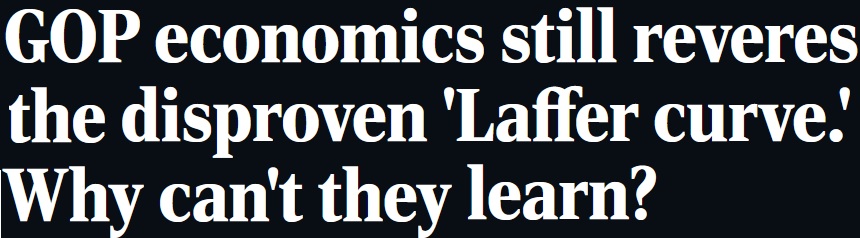
Defending the (Prudent Understanding of the) Laffer Curve

I’ve written dozens of articles about the Laffer Curveand most of that verbiage can be summarized in these five points.

  • The Laffer Curve helps to illustrate that excessive tax rates result in less taxable activity.
  • All public finance economists – even those on the left – agree there is a Laffer Curve.
  • The Laffer Curve does not mean tax cuts are self-financing or that tax increases lose revenue.
  • Different types of taxes produce different responses, so there is more than one Laffer Curve.
  • There is a real debate about the shape of the Laffer Curve and the ideal point on the curve.

The fifth point recognizes that well-meaning and knowledgeable people can vigorously disagree.

Do changes in tax policy have big effects or small effects on the economy? How much revenue feedback will occur if there is a change in tax rates?

Just a couple of examples of questions that I have endlessly debated with reasonable folks on the left.

But let’s focus today on the unreasonable left. Or, to be more specific, let’s look at an editorial from the St. Louis Post-Dispatch.

Here are some portions of that newspaper’s simplistic screed.

…the deficit explosion…effectively disproved his theory that cutting taxes on the rich would increase government tax revenue. …Laffer continues to be unchastened…, even as Britain reels from a leadership shuffle caused by the catastrophic application of his very theories. Hand it to Laffer: Seldom does someone who is so often proven wrong have the gumption to maintain he’s right…His famous “Laffer curve” presumes to prove that tax cuts for the rich will spur economic investment, causing such strong economic growth that the government’s tax revenue would actually rise instead of falling. …Yes, the economy was robust in the 1980s after Reagan’s historic tax cuts. But that’s also when the era of big budget deficits began. …congressional Republicans and President Donald Trump in 2017 slashed corporate taxes in what they claimed was a necessary economy-booster… Then-Treasury Secretary Stephen Mnuchin’s famous vow that the tax-cut plan would “pay for itself” in growth — the very definition of Laffer’s theory — has since been exposed as the voodoo it always was.

Almost every sentence in the above excerpt cries out for correction.

For instance, Reagan and his team never claimed that the 1981 tax cuts would be self-financing (though IRS data shows that lower tax rates on the rich did produce more revenue).

There were big deficits because of the 1980-1982 double-dip recession, and that spike in red ink mostly took place before Reagan’s tax cuts went into effect.

And it’s absurd to blame the United Kingdom’s political instability on tax cuts that never occurred.

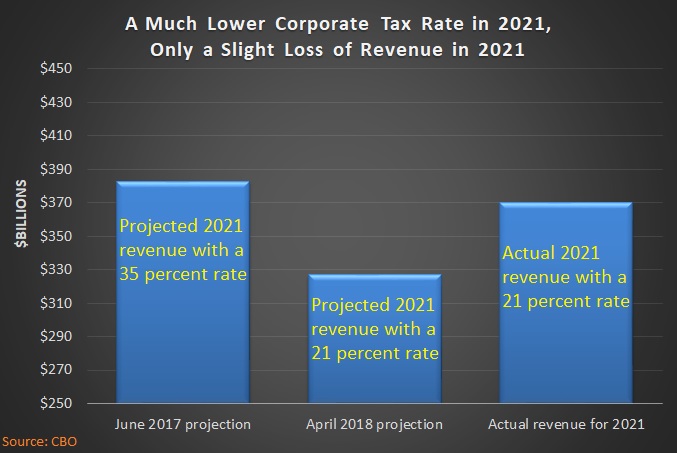
If Secretary Mnunchin claimed the entire tax cut would pay for itself, he clearly deserves to be mocked, but it’s worth noting that the lower corporate tax rate from the 2017 reform is very close to being self-financing.

Not that we should be surprised. Both the IMF and OECD have research showing that lower corporate tax rates do not necessarily lead to lower corporate tax revenues.

The bottom line is that the editorial board of the St. Louis Post-Dispatch obviously puts ideology above accuracy.

P.S. I can’t resist sharing one other excerpt from the editorial.

“The Kansas Experiment,” was a debacle. The state’s economy didn’t skyrocket, but the deficit did, forcing deep cuts to education before the legislature finally acknowledged defeat and reversed the tax cuts.

Once again, the editors are showing that ideology trumps accuracy. Here’s what really happened in Kansas. I hope we can have more defeats like that! Though I’ll be the first to admit that North Carolina is a much better role model.

Corporate Tax Rates and Taxable Income

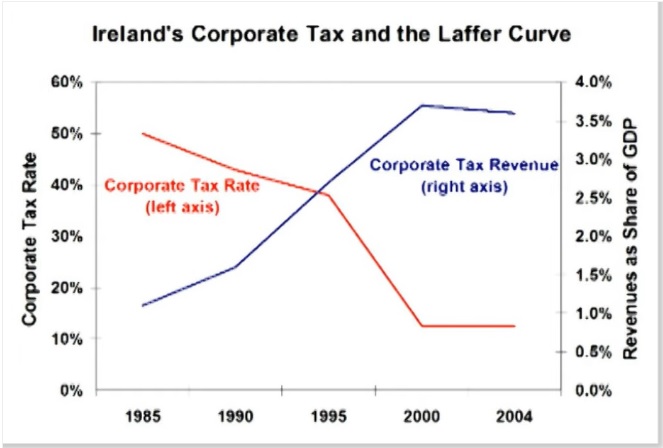
In the case of business taxation, the most visually powerful evidence for the Laffer Curve is what happened to corporate tax revenue in Ireland after the corporate tax rate was slashed from 50 percent to 12.5 percent.

Tax revenue increased dramatically. Not just in nominal terms. Not just in inflation-adjusted terms.

Corporate receipts actually climbed as a share of GDP.

And this was during the decades when economic output was rapidly expanding.

In other words, the Irish government got a much bigger slice of a much bigger pie after tax rates were dramatically lowered.

Now let’s look at some evidence from a new study. Three professors from the University of Utah (Jeffrey Coles, Elena Patel, and Nather Seegert), and a Treasury Department economist (Matthew Smith) estimated what happens to taxable income for U.S. companies when there is a change in the corporate tax rate.

In response to a 10% increase in the expected marginal tax rate, private U.S. firms decrease taxable income by 9.1%, which indicates a discernibly more elastic response than prevailing estimates. This response reflects a decrease in taxable income of 3.0%arising from real economic responses to a firm’s scale of operations and 6.1% arising from accounting transactions via (for example) revenue and expense timing. Responsiveness to the corporate tax rate is more elastic if a firm uses cash (9.9%) rather than accrual accounting (7.4%), if the firm is small (9.9%) rather than large (8.6%), and if the firm discounts future cash flows at a lower rate.

The paper is filled with equation, graphs, and jargon, but the above excerpt tells us everything we need to know.

When tax rates go up, taxable income goes down (both because there is less economic activity and because companies have more incentive to manipulate the tax code).

Thus confirming what I wrote back in 2016 about taxable income being the key variable.

By the way, this does not mean that lower tax rates lead to more revenue. Or that higher tax rate produce less revenue.

Such big swings only happen in rare circumstances.

But it does mean that politicians will not grab as much money as they hope when they increase tax rates. And that they won’t lose as much revenue as they fear when they lower tax rates (and we saw that most recently with the 2017 tax reform).

I’ll close by noting that this is additional evidence for why we should be thankful that Biden’s proposal for higher corporate tax rates was not enacted.

P.S. The chart at the beginning of this column may be the most visually powerful evidence for the corporate Laffer Curve. The most empirically powerful evidence, however, comes from very unlikely sources – the pro-tax IMF and the pro-tax OECD.

March 3, 2021

President Biden c/o The White House
1600 Pennsylvania Avenue NW
Washington, DC 20500

Dear Mr. President,

______________________________

Dan Mitchell shows how ignoring the Laffer Curve is like running a stop sign!!!!

I’m thinking of inventing a game, sort of a fiscal version of Pin the Tail on the Donkey.

Only the way it will work is that there will be a map of the world and the winner will be the blindfolded person who puts their pin closest to a nation such asAustralia or Switzerland that has a relatively low risk of long-run fiscal collapse.

That won’t be an easy game to win since we have data from the BISOECD, and IMF showing that government is growing far too fast in the vast majority of nations.

We also know that many states and cities suffer from the same problems.

A handful of local governments already have hit the fiscal brick wall, with many of them (gee, what a surprise) from California.

The most spectacular mess, though, is about to happen in Michigan.

The Washington Post reports that Detroit is on the verge of fiscal collapse.

After decades of sad and spectacular decline, it has come to this for Detroit: The city is $19 billion in debt and on the edge of becoming the nation’s largest municipal bankruptcy. An emergency manager says the city can make good on only a sliver of what it owes — in many cases just pennies on the dollar.

This is a dog-bites-man story. Detroit’s problems are the completely predictable result of excessive government. Just as statism explains the problems of Greece. And the problems of California. And the problems of Cyprus. And theproblems of Illinois.

I could continue with a long list of profligate governments, but you get the idea. Some of these governments are collapsing at a quicker pace and some at a slower pace. But all of them are in deep trouble because they don’t follow my Golden Rule about restraining the burden of government spending so that it grows slower than the private sector.

Detroit obviously is an example of a government that is collapsing sooner rather than later.

Why? Simply stated, as the size and scope of the public sector increased, that created very destructive economic and political dynamics.

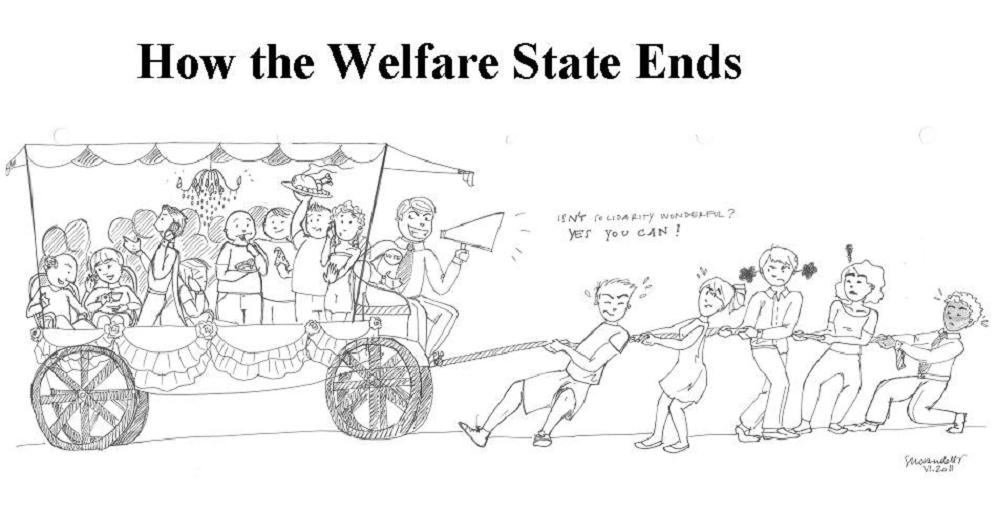
More and more people got lured into the wagon of government dependency, which puts an ever-increasing burden on a shrinking pool of producers.

Meanwhile, organized interest groups such as government bureaucrats used their political muscle to extract absurdly excessive compensation packages, putting an even larger burden of the dwindling supply of taxpayers.

But that’s not the main focus of this post. Instead, I want to highlight a particular excerpt from the article and make a point about how too many people are blindly – perhaps willfully – ignorant of the Laffer Curve.

Check out this sentence.

Property tax collections are down 20 percent and income tax collections are down by more than a third in just the past five years — despite some of the highest tax rates in the state.

This is a classic “Fox Butterfield mistake,” which occurs when someone fails to recognize a cause-effect relationship. In this case, the reporter should have recognized that tax collections are down because Detroit has very high tax rates.

The city has a lot more problems than just high tax rates, of course, but can there be any doubt that productive people have very little incentive to earn and report taxable income in Detroit?

And that’s the essential insight of the Laffer Curve. Politicians can’t – or at least shouldn’t – assume that a 20 percent increase in tax rates will lead to a 20 percent increase in tax revenue. They also have to consider the degree to which a higher tax rate will cause a change in taxable income.

In some cases, higher tax rates will discourage people from earning more taxable income.

In some cases, higher tax rates will discourage people from reporting all the income they earn.

In some cases, higher tax rates will encourage people to utilize tax loopholes to shrink their taxable income.

In some cases, higher tax rates will encourage migration, thus causing taxable income to disappear.

Here’s my three-part video series on the Laffer Curve. Much of this is common sense, though it needs to be mandatory viewing for elected officials (as well as the bureaucrats at the Joint Committee on Taxation).

The Laffer Curve, Part I: Understanding the Theory

Uploaded by  on Jan 28, 2008

The Laffer Curve charts a relationship between tax rates and tax revenue. While the theory behind the Laffer Curve is widely accepted, the concept has become very controversial because politicians on both sides of the debate exaggerate. This video shows the middle ground between those who claim “all tax cuts pay for themselves” and those who claim tax policy has no impact on economic performance. This video, focusing on the theory of the Laffer Curve, is Part I of a three-part series. Part II reviews evidence of Laffer-Curve responses. Part III discusses how the revenue-estimating process in Washington can be improved. For more information please visit the Center for Freedom and Prosperity’s web site: http://www.freedomandprosperity.org

Part 2

Part 3

P.S. Just in case it’s not clear from the videos, we don’t want to be at the revenue-maximizing point on the Laffer Curve.

P.P.S. Amazingly, even the bureaucrats at the IMF recognize that there’s a point when taxes are so onerous that further increases don’t generate revenue.

P.P.P.S. At least CPAs understand the Laffer Curve, probably because they help their clients reduce their tax exposure to greedy governments.

P.P.P.P.S. I offered a Laffer Curve lesson to President Obama, but I doubt it had any impact.

___________________________

Thank you so much for your time. I know how valuable it is. I also appreciate the fine family that you have and your commitment as a father and a husband.

Sincerely,

Everette Hatcher III, 13900 Cottontail Lane, Alexander, AR 72002, ph 501-920-5733,

Williams with Sowell – Minimum Wage

Thomas Sowell

Thomas Sowell – Reducing Black Unemployment

By WALTER WILLIAMS

—-

Ronald Reagan with Milton Friedman
Milton Friedman The Power of the Market 2-5

Related posts:

Dan Mitchell: Question of the Week: Has the European Fiscal Crisis Ended?

We got to cut spending or we will be in a fiscal crisis like Greece!!! Question of the Week: Has the European Fiscal Crisis Ended? January 12, 2013 by Dan Mitchell I’ve frequently commented on Europe’s fiscal mess and argued that excessive government spending is responsible for both the sovereign debt crisis and the economic stagnation […]

Taxes made simple by Dan Mitchell of the Cato Institute

The Flat Tax: How it Works and Why it is Good for America Uploaded by afq2007 on Mar 29, 2010 This Center for Freedom and Prosperity Foundation video shows how the flat tax would benefit families and businesses, and also explains how this simple and fair system would boost economic growth and eliminate the special-interest […]

Cartoons from Dan Mitchell’s blog that demonstrate what Obama is doing to our economy (Obama’s out of control spending not helped by raising taxes on rich)

I have put up lots of cartoons from Dan Mitchell’s blog before and they have got lots of hits before. Many of them have dealt with the economy, eternal unemployment benefits, socialism,  Greece,  welfare state or on gun control. President Obama really does think that all his answers lie in raising taxes on the rich when the […]

Dan Mitchell of the Cato Institute gives overview of economic policy and he praises Clinton and Reagan

__________ President Reagan, Nancy Reagan, Tom Selleck, Dudley Moore, Lucille Ball at a Tribute to Bob Hope’s 80th birthday at the Kennedy Center. 5/20/83. __________________________ Dan Mitchell is very good at giving speeches and making it very simple to understand economic policy and how it affects a nation. Mitchell also talks about slowing the growth […]

Cartoons from Dan Mitchell’s blog that demonstrate what Obama is doing to our economy (cartoon on entitlements)

The Laffer Curve – Explained Uploaded by Eddie Stannard on Nov 14, 2011 This video explains the relationship between tax rates, taxable income, and tax revenue. The key lesson is that the Laffer Curve is not an all-or-nothing proposition, where we have to choose between the exaggerated claim that “all tax cuts pay for themselves” […]

Open letter to President Obama (Part 296) (Laffer curve strikes again!!)

President Obama c/o The White House 1600 Pennsylvania Avenue NW Washington, DC 20500 Dear Mr. President, I know that you receive 20,000 letters a day and that you actually read 10 of them every day. I really do respect you for trying to get a pulse on what is going on out here. The way […]

Open letter to President Obama (Part 282, How the Laffer Curve worked in the 20th century over and over again!!!)

Dan Mitchell does a great job explaining the Laffer Curve President Obama c/o The White House 1600 Pennsylvania Avenue NW Washington, DC 20500 Dear Mr. President, I know that you receive 20,000 letters a day and that you actually read 10 of them every day. I really do respect you for trying to get a […]

Laffer curve hits tax hikers pretty hard (includes cartoon)

I have put up lots of cartoons from Dan Mitchell’s blog before and they have got lots of hits before. Many of them have dealt with the economy, eternal unemployment benefits, socialism,  Greece,  welfare state or on gun control. Today’s cartoon deals with the Laffer curve. Revenge of the Laffer Curve…Again and Again and Again March 27, 2013 […]

Editorial cartoon from Dan Mitchell’s blog on California’s sorry state of affairs

I have put up lots of cartoons from Dan Mitchell’s blog before and they have got lots of hits before. Many of them have dealt with the sequester, economy, eternal unemployment benefits, socialism,  minimum wage laws, tax increases, social security, high taxes in California, Obamacare,  Greece,  welfare state or on gun control. President Obama’s favorite state must be California because […]

Portugal and the Laffer Curve

Class Warfare just don’t pay it seems. Why can’t we learn from other countries’ mistakes? Class Warfare Tax Policy Causes Portugal to Crash on the Laffer Curve, but Will Obama Learn from this Mistake? December 31, 2012 by Dan Mitchell Back in mid-2010, I wrote that Portugal was going to exacerbate its fiscal problems by raising […]

Political arguments against higher taxes from Dan Mitchell

Republicans would be stupid to raise taxes. Don’t Get Bamboozled by the Fiscal Cliff: Five Policy Reasons and Five Political Reasons Why Republicans Should Keep their No-Tax-Hike Promises December 6, 2012 by Dan Mitchell The politicians claim that they are negotiating about how best to reduce the deficit. That irks me because our fiscal problem is […]

President Obama ignores warnings about Laffer Curve

The Laffer Curve – Explained Uploaded by Eddie Stannard on Nov 14, 2011 This video explains the relationship between tax rates, taxable income, and tax revenue. The key lesson is that the Laffer Curve is not an all-or-nothing proposition, where we have to choose between the exaggerated claim that “all tax cuts pay for themselves” […]

Dan Mitchell looks at Obama’s tax record

Dan Mitchell’s article and the video from his organization takes a hard look at President Obama’s tax record. Dissecting Obama’s Record on Tax Policy October 30, 2012 by Dan Mitchell The folks at the Center for Freedom and Prosperity have been on a roll in the past few months, putting out an excellent series of videos […]

Dan Mitchell: “Romney is Right that You Can Lower Tax Rates and Reduce Tax Preferences without Hurting the Middle Class”

The Laffer Curve, Part I: Understanding the Theory Uploaded by afq2007 on Jan 28, 2008 The Laffer Curve charts a relationship between tax rates and tax revenue. While the theory behind the Laffer Curve is widely accepted, the concept has become very controversial because politicians on both sides of the debate exaggerate. This video shows […]

The Laffer Curve Wreaks Havoc in the United Kingdom

I got to hear Arthur Laffer speak back in 1981 and he predicted what would happen in the next few years with the Reagan tax cuts and he was right with every prediction. The Laffer Curve Wreaks Havoc in the United Kingdom July 1, 2012 by Dan Mitchell Back in 2010, I excoriated the new […]

By Everette Hatcher III | Posted in Cato Institute | Tagged  | Edit | Comments (0)

Dan Mitchell: Maryland to Texas, but Not Okay to Move from the United States to Singapore?

You can’t blame someone for leaving one state for another if they have a better an opportunity to make money. Maryland to Texas, but Not Okay to Move from the United States to Singapore? July 12, 2012 by Dan Mitchell I’ve commented before about entrepreneurs, investors, and small business owners migrating from high tax states such […]

Liberals act like the Laffer Curve does not exist.

Raising taxes will not work. Liberals act like the Laffer Curve does not exist. The Laffer Curve Shows that Tax Increases Are a Very Bad Idea – even if They Generate More Tax Revenue April 10, 2012 by Dan Mitchell The Laffer Curve is a graphical representation of the relationship between tax rates, tax revenue, and […]

Dan Mitchell shows why soak-the-rich tax policy does not work

Dan Mitchell of the Cato Institute shows why Obama’s plan to tax the rich will not solve our deficit problem.   Explaining in the New York Post Why Obama’s Soak-the-Rich Tax Policy Is Doomed to Failure April 17, 2012 by Dan Mitchell I think high tax rates on certain classes of citizens are immoral and discriminatory. If the […]

Dan Mitchell of the Cato Institute takes on liberals on PBS

You want the rich to pay more? Dan Mitchell observed:I explained that “rich” taxpayers declared much more income and paid much higher taxes after Reagan reduced the top tax rate from 70 percent to 28 percent. Liberals don’t understand good tax policies. Against 3-1 Odds, Promoting Good Tax Policy on Government TV April 12, 2012 by […]

Dan Mitchell of the Cato Institute takes on the Buffett Rule

Class warfare again from President Obama.  Rejecting the Buffett Rule and Fighting Obama’s Class Warfare on CNBC April 10, 2012 by Dan Mitchell I’ve already explained why Warren Buffett is either dishonest or clueless about tax policy. Today, on CNBC, I got to debate the tax scheme that President Obama has named after the Omaha investor. […]

By Everette Hatcher III | Posted in Cato InstituteTaxes | Edit | Comments (0)

Michigan State Shooter Had Prior Felony Gun Charge Dismissed By Progressive Prosecutor

Michigan State Shooter Had Prior Felony Gun Charge Dismissed By Progressive Prosecutor

JOSH CHRISTENSONFEB 14, 2023 12:35 PM

A gunman who killed three and wounded five others at Michigan State University on Monday would have been barred from owning a firearm at the time of the shooting had he not had felony gun charges dismissed by a progressive prosecutor.

Anthony McRae was charged in June 2019 with illegally carrying a concealed handgun without a permit, but later had those charges dismissed by the office of Ingham County district attorney Carol Siemon (D.). Her office instead let McRae plead guilty to a lesser misdemeanor gun charge, and he served a little more than a year on probation, which ended May 2021. He initially faced up to five years in prison for the felony charge, the Detroit News reported.

Siemon retired from the district attorney’s office at the start of this year after facing criticism from judges and law enforcement officials for her soft-on-crime policies. The same year that McRae was released, ​​Ingham County sheriff Scott Wriggelsworth pushed East Lansing’s city council “to reconsider her internal felony firearm charging policy,” which he said “does not hold people properly criminally accountable, and increases the likelihood of additional gun violence.”

Siemon made it her office’s official policy in August 2021 to drop mandatory prison sentences for felony firearms charges. She said the sentencing enhancement led to “dramatic racial inequity” and was “not in any way linked to the goal that we share of keeping the public safe.”

Siemon is part of George Soros’s vast public safety network. She has participated in international criminal justice reform junketswith other “reform-minded” prosecutors like Philadelphia’s Larry Krasner (D.), Chicago’s Kim Foxx (D.), and Los Angeles’s George Gascón. She also backed radical San Francisco prosecutor Chesa Boudin (D.) ahead of a recall campaign that eventually ousted him from office last year.

The Ingham County Prosecutor’s Office said in a statement that McRae’s 2019 offense would not have received “the legal maximum” prison sentence, even if they had pursued it.

“Even if he were convicted by a jury of the original charge, Anthony McRae would not have been recommended for a jail or prison sentence,” the office said. “The sentencing guideline score would have been the same if he had been convicted of either the original charge (Carrying a Concealed Weapon) or the offense for which he was convicted (carrying a firearm in a vehicle).”

McRae was later found dead from a self-inflicted gunshot wound.

According to Jason Johnson, president of the Law Enforcement Legal Defense Fund, “progressive prosecutors such as Ms. Siemon continue to value reducing the incarcerated population over their duty to protect the public by enforcing the law.”

In 2021, the Vera Institute for Justice, a think tank funded by Soros’s Open Society Foundations, also praised Siemon and other reform prosecutors who pledged to reduce racial disparities in prosecution. Siemon boasted about the changes she made in her office when she announced her retirement in November.

“I believe we have made substantial progress to reform the justice system and provide for a proportionate response to criminal charges,” she said. “We have changed the prosecutors’ office’s charging and sentencing practices, to provide a greater range of options to hold people accountable for the harm they cause while reducing incarceration, and continuing to serve victims and to expand their services and support.”

But a Michigan circuit court judge called her out weeks earlier for making Lansing less safe with her policies. “She is not a legislator, she is not a judge, and she is making our community unsafe,” Judge Rosemarie Aquilina said.

Siemon’s successor, John Dewane, has already set about toughening up charges for repeat offenders, according to an interview he did with WKAR.

“My number one goal, and I put out some policies with regard to this issue, is the increase in gun violence in our community, specifically the Lansing area,” he said.

Dewane told the Free Beacon after publication that “McRae would not have been able to legally purchase, own, or possess a firearm” if he had “been convicted of carrying a concealed weapon.”

Update 3:44 p.m.: This piece has been updated with additional information.

Abortion: When Does Life Begin? – R.C. Sproul

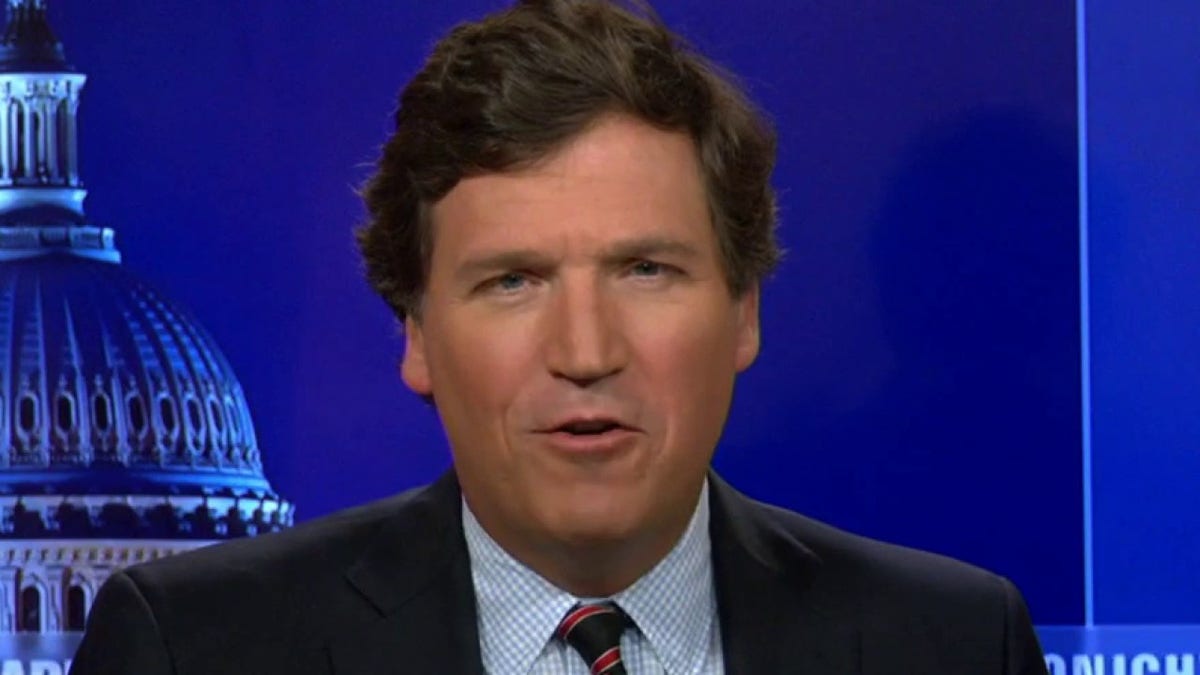
TUCKER CARLSON: In 2022, whether you’re considered dangerous or not depends on who you voted for

Oct 10, 2022 | 11:06 PM


Dr. Francis schaeffer – The flow of Materialism(from Part 4 of Whatever happened to human race? Co-authored by Francis Schaeffer and Dr. C. Everett Koop)

C. Everett Koop
C. Everett Koop, 1980s.jpg
13th Surgeon General of the United States
In office
January 21, 1982 – October 1, 1989

Abortion: What About Those Who Demand Their Rights? – R.C. Sproul

Whatever Happened To The Human Race? | Episode 1 | Abortion of the Human Race (2010)

Standing Strong Under Fire: Popular Abortion Arguments and Why They Fail

Whatever Happened To The Human Race? | Episode 2 | Slaughter of the Innocents (2010)

Ben Shapiro Obliterates Every Pro-Abortion Argument

Whatever Happened To The Human Race? | Episode 3 | Death by Someone’s Choice (2010)

Adrian Rogers: Innocent Blood [#1004] (Audio)

Whatever Happened To The Human Race? | Episode 5 | Truth and History (20…

Abortion: What Is Your Verdict? – R.C. Sproul

John MacArthur Abortion and the Campaign for Immorality (Selected Scriptures)

John MacArthur on Romans 13

Image<img class=”i-amphtml-blurry-placeholder” src=”data:;base64,Edith Schaeffer with her husband, Francis Schaeffer, in 1970 in Switzerland, where they founded L’Abri, a Christian commune.

________________

______________________

September 25, 2021

President Biden  c/o The White House 1600 Pennsylvania Avenue NW Washington, DC 20500

Dear Mr. President,

I really do respect you for trying to get a pulse on what is going on out here. I know that you don’t agree with my pro-life views but I wanted to challenge you as a fellow Christian to re-examine your pro-choice view.

In the past I have spent most of my time looking at this issue from the spiritual side. In the film series “WHATEVER HAPPENED TO THE HUMAN RACE?” the arguments are presented  against abortion (Episode 1),  infanticide (Episode 2),   euthanasia (Episode 3), and then there is a discussion of the Christian versus Humanist worldview concerning the issue of “the basis for human dignity” in Episode 4 and then in the last episode a close look at the truth claims of the Bible.

Francis Schaeffer

__________________________

I truly believe that many of the problems we have today in the USA are due to the advancement of humanism in the last few decades in our society. Ronald Reagan appointed the evangelical Dr. C. Everett Koop to the position of Surgeon General in his administration. He partnered with Dr. Francis Schaeffer in making the video WHATEVER HAPPENED TO THE HUMAN RACE? which can be found on You Tube. It is very valuable information for Christians to have.

Today I want to respond to your letter to me on July 9, 2021. Here it is below:

THE WHITE HOUSE

WASHINGTON

July 9, 2021

Mr. Everette Hatcher III

Alexander, AR

Dear Mr. Hatcher,

Thank you for taking your time to share your thoughts on abortion. Hearing from passionate individuals like me inspires me every day, and I welcome the opportunity to respond to your letter

Our country faces many challenges, and the road we will travel together will be one of the most difficult in our history. Despite these tough times, I have never been more optimistic for the future of America. I believe we are better positioned than any country in the world to lead in the 21st century not just by the example of our power but by the power of our example.

As we move forward to address the complex issues of our time, I encourage you to remain an active participant in helping write the next great chapter of the American story. We need your courage and dedication at this critical time, and we must meet this moment together as the United States of America. If we do that, I believe that our best days still lie ahead.

Sincerely

Joe Biden

Mr. President, my wife was born in JEFFERSON MEMORIAL HOSPITAL in Pine Bluff, Arkansas and Adrian Rogers tells a story about another lady that was born in that same hospital: “They took that grocery sack and Maria home and one hour passed and two hours passed and that baby was still crying and panting for his life in that grocery sack. They took that little baby down to the hospital there in Pine Bluff, Arkansas, and they called an obstetrician and he called a pediatrician and they called nurses and they began to work on that little baby. Today that baby is alive and well and healthy, that little mass of protoplasm. That little thing that wasn’t a human being is alive and well. I want to tell you they spent $150,000 to save the life of that baby. NOW CAN YOU EXPLAIN TO ME HOW THEY CAN SPEND $150,000 TO SAVE THE LIFE OF SOMETHING THAT SOMEBODY WAS PAYING ANOTHER DOCTOR TO TAKE THE LIFE OF?”

_________________

Carl Sagan pictured below:

Image result for carl sagan

_________

_

Recently I have been revisiting my correspondence in 1995 with the famous astronomer Carl Sagan who I had the privilege to correspond with in 1994, 1995 and 1996. In 1996 I had a chance to respond to his December 5, 1995letter on January 10, 1996 and I never heard back from him again since his cancer returned and he passed away later in 1996. Below is what Carl Sagan wrote to me in his December 5, 1995 letter:

Thanks for your recent letter about evolution and abortion. The correlation is hardly one to one; there are evolutionists who are anti-abortion and anti-evolutionists who are pro-abortion.You argue that God exists because otherwise we could not understand the world in our consciousness. But if you think God is necessary to understand the world, then why do you not ask the next question of where God came from? And if you say “God was always here,” why not say that the universe was always here? On abortion, my views are contained in the enclosed article (Sagan, Carl and Ann Druyan {1990}, “The Question of Abortion,” Parade Magazine, April 22.)

I was introduced to when reading a book by Francis Schaeffer called HE IS THERE AND HE IS NOT SILENT written in 1968.

Image result for francis schaeffer

Francis Schaeffer

I was blessed with the opportunity to correspond with Dr. Sagan, and in his December 5, 1995 letter Dr. Sagan went on to tell me that he was enclosing his article “The Question of Abortion: A Search for Answers”by Carl Sagan and Ann Druyan. I am going to respond to several points made in that article. Here is a portion of Sagan’s article (here is a link to the whole article):

Image result for adrian rogers
(both Adrian Rogers and Francis Schaeffer mentioned Carl Sagan in their books and that prompted me to write Sagan and expose him to their views.

Image result for Ann Druyan

Carl Sagan and Ann Druyan pictured above

Related image

 “The Question of Abortion: A Search for Answers”

by Carl Sagan and Ann Druyan

For the complete text, including illustrations, introductory quote, footnotes, and commentary on the reaction to the originally published article see Billions and Billions.

The issue had been decided years ago. The court had chosen the middle ground. You’d think the fight was over. Instead, there are mass rallies, bombings and intimidation, murders of workers at abortion clinics, arrests, intense lobbying, legislative drama, Congressional hearings, Supreme Court decisions, major political parties almost defining themselves on the issue, and clerics threatening politicians with perdition. Partisans fling accusations of hypocrisy and murder. The intent of the Constitution and the will of God are equally invoked. Doubtful arguments are trotted out as certitudes. The contending factions call on science to bolster their positions. Families are divided, husbands and wives agree not to discuss it, old friends are no longer speaking. Politicians check the latest polls to discover the dictates of their consciences. Amid all the shouting, it is hard for the adversaries to hear one another. Opinions are polarized. Minds are closed.

Is it wrong to abort a pregnancy? Always? Sometimes? Never? How do we decide? We wrote this article to understand better what the contending views are and to see if we ourselves could find a position that would satisfy us both. Is there no middle ground? We had to weigh the arguments of both sides for consistency and to pose test cases, some of which are purely hypothetical. If in some of these tests we seem to go too far, we ask the reader to be patient with us–we’re trying to stress the various positions to the breaking point to see their weaknesses and where they fail.

In contemplative moments, nearly everyone recognizes that the issue is not wholly one-sided. Many partisans of differing views, we find, feel some disquiet, some unease when confronting what’s behind the opposing arguments. (This is partly why such confrontations are avoided.) And the issue surely touches on deep questions: What are our responses to one another? Should we permit the state to intrude into the most intimate and personal aspects of our lives? Where are the boundaries of freedom? What does it mean to be human?

Of the many actual points of view, it is widely held–especially in the media, which rarely have the time or the inclination to make fine distinctions–that there are only two: “pro-choice” and “pro-life.” This is what the two principal warring camps like to call themselves, and that’s what we’ll call them here. In the simplest characterization, a pro-choicer would hold that the decision to abort a pregnancy is to be made only by the woman; the state has no right to interfere. And a pro-lifer would hold that, from the moment of conception, the embryo or fetus is alive; that this life imposes on us a moral obligation to preserve it; and that abortion is tantamount to murder. Both names–pro-choice and pro-life–were picked with an eye toward influencing those whose minds are not yet made up: Few people wish to be counted either as being against freedom of choice or as opposed to life. Indeed, freedom and life are two of our most cherished values, and here they seem to be in fundamental conflict.

Let’s consider these two absolutist positions in turn. A newborn baby is surely the same being it was just before birth. There ‘s good evidence that a late-term fetus responds to sound–including music, but especially its mother’s voice. It can suck its thumb or do a somersault. Occasionally, it generates adult brain-wave patterns. Some people claim to remember being born, or even the uterine environment. Perhaps there is thought in the womb. It’s hard to maintain that a transformation to full personhood happens abruptly at the moment of birth. Why, then, should it be murder to kill an infant the day after it was born but not the day before?

As a practical matter, this isn’t very important: Less than 1 percent of all tabulated abortions in the United States are listed in the last three months of pregnancy (and, on closer investigation, most such reports turn out to be due to miscarriage or miscalculation). But third-trimester abortions provide a test of the limits of the pro-choice point of view. Does a woman’s “innate right to control her own body” encompass the right to kill a near-term fetus who is, for all intents and purposes, identical to a newborn child?

——-

End of Sagan Excerpt

When I was in high school the book and film series named WHATEVER HAPPENED TO THE HUMAN RACE? came out and it featured Doctor C. Everett Koop and Francis Schaeffer and they looked at the issues of abortion, infanticide, and youth euthanasia and they looked at comments from such scholars as Peter Singer and James D. Watson.

Image result for c. everett koop


C. Everett Koop pictured above and Peter Singer below

Peter Singer, an endowed chair at Princeton’s Center for Human Values, said, “Killing a disabled infant is not morally equivalent to killing a person. Very often it is not wrong at all.”

James D.Watson

In May 1973, James D. Watson, the Nobel Prize laureate who discovered the double helix of DNA, granted an interview to Prism magazine, then a publication of the American Medical Association. Time later reported the interview to the general public, quoting Watson as having said, “If a child were not declared alive until three days after birth, then all parents could be allowed the choice only a few are given under the present system. The doctor could allow the child to die if the parents so choose and save a lot of misery and suffering. I believe this view is the only rational, compassionate attitude to have.”

Carl Sagan

On August 30, 1995 I mailed a letter to Carl Sagan that probably prompted this discussion on abortion and it enclosed a lengthy story from Adrian Rogers about an abortion case in Pine Bluff, Arkansas that almost became an infanticide case:

An excerpt from the Sunday morning message (11-6-83) by Adrian Rogers in Memphis, TN.

I want to tell you that secular humanism and so-called abortion rights are inseparably linked together. We have been taught that our bodies and our children are the products of the evolutionary process, and so therefore human life may not be all that valuable to begin with. We have come today to where it is legal and even considered to be a good thing to put little babies to death…15 million little babies put to death since 1973 because of this philosophy of Secular Humanism.

How did the court make that type of decision? You would think it would be so obvious. You can’t do that! You can’t kill little babies! Why? Because the Bible says! Friend, they don’t give a hoot what the Bible says! There used to be a time when they talked about what the Bible says because there was a time that we as a nation had a constitution that was based in the Judeo-Christian ethic, but today if we say “The Bible says” or “God says “Separation of Church and State. Don’t tell us what the Bible says or what God says. We will tell you what we think!” Therefore, they look at the situation and they decide if it is right or wrong purely on the humanistic philosophy that right and wrong are relative and the situation says what is right or what is wrong.

This little girl just 19 years old went into the doctor’s office and he examined her. He said, “We can take take of you.” He gave her an injection in her arm that was to cause her to go into labor and to get rid of that protoplasm, that feud, that little mass that was in her, but she wasn’t prepared for the sound she was about to hear. It was a little baby crying. That little baby weighed 13 ounces. His hand the size of my thumbnail. You know what the doctor did. The doctor put that little baby in a grocery sack and gave it to Maria’s two friends who were with her in that doctor office and Said, “It will stop making those noises after a while.”

Image result for adrian rogers

(Adrian Rogers pictured above)

Image result for pine bluff arkansas 1983
Pine Bluff, Arkansas
Image result for jefferson county hospital, pine bluff, arkansas
My wife was born in main hospital in Pine Bluff, Arkansas

They took that grocery sack and Maria home and one hour passed and two hours passed and that baby was still crying and panting for his life in that grocery sack. They took that little baby down to the hospital there in Pine Bluff, Arkansas, and they called an obstetrician and he called a pediatrician and they called nurses and they began to work on that little baby. Today that baby is alive and well and healthy, that little mass of protoplasm. That little thing that wasn’t a human being is alive and well. I want to tell you they spent $150,000 to save the life of that baby. NOW CAN YOU EXPLAIN TO ME HOW THEY CAN SPEND $150,000 TO SAVE THE LIFE OF SOMETHING THAT SOMEBODY WAS PAYING ANOTHER DOCTOR TO TAKE THE LIFE OF? The same life!!! Are you going to tell me that is not a baby? Are you going to tell me that if that baby had been put to death it would not have been murder? You will never convince me of that. What has happened to us in America? We have been sold a bill of goods by the Secular Humanists!

Image result for carl sagan humanist of the year 1982
Carl Sagan was elected the HUMANIST OF THE YEAR in 1982 by the AMERICAN HUMANIST ASSOCIATION

Carl Sagan asked, “Does a woman’s “innate right to control her own body” encompass the right to kill a near-term fetus who is, for all intents and purposes, identical to a newborn child?”

This message “A Christian Manifesto” was given in 1982 by the late Christian Philosopher Francis Schaeffer when he was age 70 at D. James Kennedy’s Corral Ridge Presbyterian Church.
Listen to this important message where Dr. Schaeffer says it is the duty of Christians to disobey the government when it comes in conflict with God’s laws. So many have misinterpreted Romans 13 to mean unconditional obedience to the state. When the state promotes an evil agenda and anti-Christian statues we must obey God rather than men. Acts
I use to watch James Kennedy preach from his TV pulpit with great delight in the 1980’s. Both of these men are gone to be with the Lord now. We need new Christian leaders to rise up in their stead.
To view Part 2 See Francis Schaeffer Lecture- Christian Manifesto Pt 2 of 2 video
The religious and political freedom’s we enjoy as Americans was based on the Bible and the legacy of the Reformation according to Francis Schaeffer. These freedoms will continue to diminish as we cast off the authority of Holy Scripture.
In public schools there is no other view of reality but that final reality is shaped by chance.
Likewise, public television gives us many things that we like culturally but so much of it is mere propaganda shaped by a humanistic world and life view.

_____________________________

I was able to watch Francis Schaeffer deliver a speech on a book he wrote called “A Christian Manifesto” and I heard him in several interviews on it in 1981 and 1982. I listened with great interest since I also read that book over and over again. Below is a portion of one of Schaeffer’s talks  on a crucial subject that is very important today too.

A great talk by Francis Schaeffer:A Christian Manifesto
by Dr. Francis A. SchaefferThis address was delivered by the late Dr. Schaeffer in 1982 at the Coral Ridge Presbyterian Church, Fort Lauderdale, Florida. It is based on one of his books, which bears the same title._________

Infanticide and youth enthansia ———So what we find then, is that the medical profession has largely changed — not all doctors. I’m sure there are doctors here in the audience who feel very, very differently, who feel indeed that human life is important and you wouldn’t take it, easily, wantonly. But, in general, we must say (and all you have to do is look at the TV programs), all you have to do is hear about the increased talk about allowing the Mongoloid child — the child with Down’s Syndrome — to starve to death if it’s born this way. Increasingly, we find on every side the medical profession has changed its views.

Image result for Mongoloid child -- the child with Down's Syndrome  FRANCIS SCHAEFFER

The view now is, “Is this life worth saving?”I look at you… You’re an older congregation than I am usually used to speaking to. You’d better think, because — this — means — you! It does not stop with abortion and infanticide. It stops at the question, “What about the old person? Is he worth hanging on to?” Should we, as they are doing in England in this awful organization, EXIT, teach older people to commit suicide? Should we help them get rid of them because they are an economic burden, a nuisance? I want to tell you, once you begin chipping away the medical profession…

The intrinsic value of the human life is founded upon the Judeo-Christian concept that man is unique because he is made in the image of God, and not because he is well, strong, a consumer, a sex object or any other thing. That is where whatever compassion this country has is, and certainly it is far from perfect and has never been perfect. Nor out of the Reformation has there been a Golden Age, but whatever compassion there has ever been, it is rooted in the fact that our culture knows that man is unique, is made in the image of God. Take it away, and I just say gently, the stopper is out of the bathtub for all human life.

Image result for Mongoloid child -- the child with Down's Syndrome  FRANCIS SCHAEFFER

______________________________________

Thank you so much for your time. I know how valuable it is. I also appreciate the fine family that you have and your commitment as a father and a husband. Now I wanted to make some comments concerning our shared Christian faith.  I  respect you for putting your faith in Christ for your eternal life. I am pleading to you on the basis of the Bible to please review your religious views concerning abortion. It was the Bible that caused the abolition movement of the 1800’s and it also was the basis for Martin Luther King’s movement for civil rights and it also is the basis for recognizing the unborn children.

Sincerely,

Everette Hatcher III, 13900 Cottontail Lane, Alexander, AR 72002, ph 501-920-5733,

Related posts:

Al Mohler on Kermit Gosnell’s abortion practice

Francis Schaeffer: “Whatever Happened to the Human Race” (Episode 1) ABORTION OF THE HUMAN RACE Published on Oct 6, 2012 by AdamMetropolis ________________ Picture of Francis Schaeffer and his wife Edith from the 1930′s above. I was sad to read about Edith passing away on Easter weekend in 2013. I wanted to pass along this fine […]

A man of pro-life convictions: Bernard Nathanson (part4)

ABORTION – THE SILENT SCREAM 1 / Extended, High-Resolution Version (with permission from APF). Republished with Permission from Roy Tidwell of American Portrait Films as long as the following credits are shown: VHS/DVDs Available American Portrait Films Call 1-800-736-4567 http://www.amport.com The Hand of God-Selected Quotes from Bernard N. Nathanson, M.D., Unjust laws exist. Shall we […]

Abortionist Bernard Nathanson turned pro-life activist (part 11)

ABORTION – THE SILENT SCREAM 1 / Extended, High-Resolution Version (with permission from APF). Republished with Permission from Roy Tidwell of American Portrait Films as long as the following credits are shown: VHS/DVDs Available American Portrait Films Call 1-800-736-4567 http://www.amport.com The Hand of God-Selected Quotes from Bernard N. Nathanson, M.D., Unjust laws exist. Shall we […]

Abortionist Bernard Nathanson turned pro-life activist (part 9)(Donald Trump changes to pro-life view)

When I think of the things that make me sad concerning this country, the first thing that pops into my mind is our treatment of unborn children. Donald Trump is probably going to run for president of the United States. Tony Perkins of the Family Research Council recently had a conversation with him concerning the […]

Taking on Ark Times Bloggers on various issues Part U “Do men have a say in the abortion debate?” (includes the film SLAUGHTER OF THE INNOCENTS and editorial cartoon)

I have gone back and forth and back and forth with many liberals on the Arkansas Times Blog on many issues such as abortion, human rights, welfare, poverty, gun control  and issues dealing with popular culture. Here is another exchange I had with them a while back. My username at the Ark Times Blog is Saline […]

Taking on Ark Times Bloggers on various issues Part T “Abortion is a dirty business” (includes video “Truth and History” and editorial cartoon)

I have gone back and forth and back and forth with many liberals on the Arkansas Times Blog on many issues such as abortion, human rights, welfare, poverty, gun control  and issues dealing with popular culture. Here is another exchange I had with them a while back. My username at the Ark Times Blog is Saline […]

“Sanctity of Life Saturday” Abortion supporters lying in order to further their clause? Window to the Womb (includes video ABORTION OF THE HUMAN RACE)

It is truly sad to me that liberals will lie in order to attack good Christian people like state senator Jason Rapert of Conway, Arkansas because he headed a group of pro-life senators that got a pro-life bill through the Arkansas State Senate the last week of January in 2013. I have gone back and […]

Taking on Ark Times Bloggers on various issues Part D “If you can’t afford a child can you abort?”Francis Schaeffer Quotes part 4 includes the film ABORTION OF THE HUMAN RACE) (editorial cartoon)

I have gone back and forth and back and forth with many liberals on the Arkansas Times Blog on many issues such as abortion, human rights, welfare, poverty, gun control  and issues dealing with popular culture. Here is another exchange I had with them a while back. My username at the Ark Times Blog is Saline […]
Taking on Ark Times Bloggers on various issues Part C “Abortion” (Francis Schaeffer Quotes part 3 includes the film SLAUGHTER OF THE INNOCENTS) (editorial cartoon)

I have gone back and forth and back and forth with many liberals on the Arkansas Times Blog on many issues such as abortion, human rights, welfare, poverty, gun control  and issues dealing with popular culture. Here is another exchange I had with them a while back. My username at the Ark Times Blog is Saline […]

Taking on Ark Times Bloggers on various issues Part B “Gendercide” (Francis Schaeffer Quotes Part 2 includes the film ABORTION OF THE HUMAN RACE) (editorial cartoon)

I have gone back and forth and back and forth with many liberals on the Arkansas Times Blog on many issues such as abortion, human rights, welfare, poverty, gun control  and issues dealing with popular culture. Here is another exchange I had with them a while back. My username at the Ark Times Blog is Saline […]

SANCTITY OF LIFE SATURDAY “AngryOldWoman” blogger argues that she has no regrets about past abortion

Sometimes you can see evidences in someone’s life of how content they really are. I saw  something like that on 2-8-13 when I confronted a blogger that goes by the name “AngryOldWoman” on the Arkansas Times Blog. See below. Leadership Crisis in America Published on Jul 11, 2012 Picture of Adrian Rogers above from 1970′s […]

“Sanctity of Life Saturday” The Church Awakens: Whatever Happened to the Human Race? (includes the video ABORTION OF THE HUMAN RACE)

In the film series “WHATEVER HAPPENED TO THE HUMAN RACE?” the arguments are presented  against abortion (Episode 1),  infanticide (Episode 2),   euthenasia (Episode 3), and then there is a discussion of the Christian versus Humanist worldview concerning the issue of “the basis for human dignity” in Episode 4 and then in the last episode a close […]

Taking on Ark Times Bloggers on various issues Part H “Are humans special?” includes film ABORTION OF THE HUMAN RACE) Reagan: ” To diminish the value of one category of human life is to diminish us all”

I have gone back and forth and back and forth with many liberals on the Arkansas Times Blog on many issues such as abortion, human rights, welfare, poverty, gun control  and issues dealing with popular culture. Here is another exchange I had with them a while back. My username at the Ark Times Blog is Saline […]

Taking on Ark Times Bloggers on various issues Part G “How do moral nonabsolutists come up with what is right?” includes the film “ABORTION OF THE HUMAN RACE”)

I have gone back and forth and back and forth with many liberals on the Arkansas Times Blog on many issues such as abortion, human rights, welfare, poverty, gun control  and issues dealing with popular culture. Here is another exchange I had with them a while back. My username at the Ark Times Blog is Saline […]

Taking on Ark Times Bloggers on various issues Part E “Moral absolutes and abortion” Francis Schaeffer Quotes part 5(includes the film SLAUGHTER OF THE INNOCENTS) (editorial cartoon)

I have gone back and forth and back and forth with many liberals on the Arkansas Times Blog on many issues such as abortion, human rights, welfare, poverty, gun control  and issues dealing with popular culture. Here is another exchange I had with them a while back. My username at the Ark Times Blog is Saline […]

Francis Schaeffer’s “How should we then live?” Video and outline of episode 10 “Final Choices” (Schaeffer Sundays)

E P I S O D E 1 0   Dr. Francis Schaeffer – Episode X – Final Choices 27 min FINAL CHOICES I. Authoritarianism the Only Humanistic Social Option One man or an elite giving authoritative arbitrary absolutes. A. Society is sole absolute in absence of other absolutes. B. But society has to be […]

Francis Schaeffer’s “How should we then live?” Video and outline of episode 9 “The Age of Personal Peace and Affluence” (Schaeffer Sundays)

E P I S O D E 9 Dr. Francis Schaeffer – Episode IX – The Age of Personal Peace and Affluence 27 min T h e Age of Personal Peace and Afflunce I. By the Early 1960s People Were Bombarded From Every Side by Modern Man’s Humanistic Thought II. Modern Form of Humanistic Thought Leads […]

Francis Schaeffer’s “How should we then live?” Video and outline of episode 8 “The Age of Fragmentation” (Schaeffer Sundays)

E P I S O D E 8 Dr. Francis Schaeffer – Episode VIII – The Age of Fragmentation 27 min I saw this film series in 1979 and it had a major impact on me. T h e Age of FRAGMENTATION I. Art As a Vehicle Of Modern Thought A. Impressionism (Monet, Renoir, Pissarro, Sisley, […]

Francis Schaeffer’s “How should we then live?” Video and outline of episode 7 “The Age of Non-Reason” (Schaeffer Sundays)

E P I S O D E 7 Dr. Francis Schaeffer – Episode VII – The Age of Non Reason I am thrilled to get this film series with you. I saw it first in 1979 and it had such a big impact on me. Today’s episode is where we see modern humanist man act […]

Francis Schaeffer’s “How should we then live?” Video and outline of episode 6 “The Scientific Age” (Schaeffer Sundays)

E P I S O D E 6 How Should We Then Live 6#1 Uploaded by NoMirrorHDDHrorriMoN on Oct 3, 2011 How Should We Then Live? Episode 6 of 12 ________ I am sharing with you a film series that I saw in 1979. In this film Francis Schaeffer asserted that was a shift in […]

Francis Schaeffer’s “How should we then live?” Video and outline of episode 5 “The Revolutionary Age” (Schaeffer Sundays)

E P I S O D E 5 How Should We Then Live? Episode 5: The Revolutionary Age I was impacted by this film series by Francis Schaeffer back in the 1970′s and I wanted to share it with you. Francis Schaeffer noted, “Reformation Did Not Bring Perfection. But gradually on basis of biblical teaching there […]

Francis Schaeffer’s “How should we then live?” Video and outline of episode 4 “The Reformation” (Schaeffer Sundays)

Dr. Francis Schaeffer – Episode IV – The Reformation 27 min I was impacted by this film series by Francis Schaeffer back in the 1970′s and I wanted to share it with you. Schaeffer makes three key points concerning the Reformation: “1. Erasmian Christian humanism rejected by Farel. 2. Bible gives needed answers not only as to […]

“Schaeffer Sundays” Francis Schaeffer’s “How should we then live?” Video and outline of episode 3 “The Renaissance”

Francis Schaeffer’s “How should we then live?” Video and outline of episode 3 “The Renaissance” Francis Schaeffer: “How Should We Then Live?” (Episode 3) THE RENAISSANCE I was impacted by this film series by Francis Schaeffer back in the 1970′s and I wanted to share it with you. Schaeffer really shows why we have so […]

Francis Schaeffer’s “How should we then live?” Video and outline of episode 2 “The Middle Ages” (Schaeffer Sundays)

  Francis Schaeffer: “How Should We Then Live?” (Episode 2) THE MIDDLE AGES I was impacted by this film series by Francis Schaeffer back in the 1970′s and I wanted to share it with you. Schaeffer points out that during this time period unfortunately we have the “Church’s deviation from early church’s teaching in regard […]

Francis Schaeffer’s “How should we then live?” Video and outline of episode 1 “The Roman Age” (Schaeffer Sundays)

Francis Schaeffer: “How Should We Then Live?” (Episode 1) THE ROMAN AGE   Today I am starting a series that really had a big impact on my life back in the 1970′s when I first saw it. There are ten parts and today is the first. Francis Schaeffer takes a look at Rome and why […]

By Everette Hatcher III | Posted in Francis Schaeffer | Edit | Comments (0)

US Debt by President: By Dollar and Percentage

——

Milton Friedman – Deficits and Government Spending

————-

A.F. Branco for Oct 21, 2021

US Debt by President: By Dollar and Percentage

Who increased the U.S. debt the most? That depends on how you measure it.

US President Barack Obama (L) former President Bill Clinton (C) and former President George W. Bush (R) walk to the Rose Garden
PHOTO:MARK WILSON/STAFF/GETTY IMAGES

What’s the best way to determine how much each president has contributed to our nation’s $31 trillion in U.S. debt? The most popular ways to measure involve comparing the debt level from when a president enters office to the debt level when they leave. It’s also good to compare the debt as a percentage of economic output, which takes into account the size of the economy at the time the administration accumulated the debt.1

Drawback of Measuring Debt by President

Neither of the techniques mentioned above is a very accurate way to measure each president’s impact on the national debtbecause the president doesn’t have much control over the national debt during their first year in office.

For example, President Donald Trump took office in January 2017. He submitted his first budget in May. It covered the 2018 fiscal year, which didn’t begin until October 1, 2017. Trump operated the first part of his term under President Barack Obama’s budget for fiscal year 2017, which ended on Sept. 30, 2017.2

fusing, Congress intentionally sets it up this way. An advantage of the federal fiscal year is that it gives the new president time to put together their budget during their first months in office.

The Best Way to Measure Debt by President

The best way to measure a president’s debt is to add up their budget deficits and compare that total to the debt level when they took office. A president’s budget reveals their administration’s priorities.

Note

Though they sound similar, deficit and debt are two different things. A deficit is a budget shortfall, whereas debt is the running total of all deficits and surpluses. Deficits add to the debt, while surpluses reduce it.

Top 5 Presidents Who Contributed to the Debt by Percentage

Franklin D. Roosevelt (1933-1945)

President Roosevelt added the largest percentage increase to the national debt. Although he only added $236 billion, this was an increase of about 1,048% from the $22.5 billion debt level left by President Herbert Hoover before him. The Great Depression and the New Deal contributed to FDR’s yearly deficits, but the biggest cost was World War II—it added $186.3 billion to the debt between 1942 and 1945.3

Woodrow Wilson (1913-1921)

President Wilson was the second-largest contributor to the debt, percentage-wise. He added about $21 billion, which was a 723% increase over the $2.9 billion debt of his predecessor. World War I contributed to the deficits that raised the national debt.3

Ronald Reagan (1981-1989)

President Reagan increased the debt by $1.86 trillion, or by 186%. Reagan’s supply-side economics didn’t grow the economy enough to offset the lost revenue from its tax cuts. Reagan also increased the defense budget by 35%.4

George W. Bush (2001-2009)

President Bush added $5.85 trillion to the national debt. That’s a 101% increase, putting him in fourth. Bush launched the War on Terror in response to the 9/11 attacks, which led to multi-trillion-dollar spending on the War in Afghanistan and the War in Iraq. Bush also dealt with the 2001 recession and the 2008 financial crisis.5

Barack Obama (2009-2017)

Under President Obama, the national debt grew the most in dollar terms ($8.6 trillion) and was fifth by percentage at 74%. Obama fought the Great Recession with an $831 billion economic stimulus package and added $858 billion through tax cuts. Even though the fiscal year 2009 budget was set by President Bush, Obama added to it with the Economic Stimulus Act in 2009.657

US Debt Increase by President Per Fiscal Year

The U.S. Treasury Department has historical tables that report the annual U.S. debt for each fiscal year (FY) since 1790. We’ve compiled this data from that source to create the figures used below.81

Joe Biden

In January 2023, the nation hit the $31.4 trillion debt limit Congress passed in 2021.9Republican lawmakers control the House of Representatives and said they won’t raise the debt limit unless Democrats, who control the Senate, agree to budget cuts.

On Oct. 1, 2021, at the end of fiscal year 2021, the national debt was $28.4 trillion. Between the end of fiscal year 2020 and the end of fiscal year 2021, the national debt grew $1.5 trillion, a 5.6% increase year over year. For fiscal year 2022, President Joe Biden’s budget included a deficit of $1.84 trillion, and by August 2022, the national debt had grown to $30.8 trillion.110

When Biden took office, the economy and household finances were still reeling from the pandemic, and Biden continued his predecessor’s policy of spending heavily to keep households afloat. In March 2021, Biden signed the American Rescue Plan, which showered taxpayers with pandemic relief cash in the form of stimulus checks and extra unemployment payments, and temporarily expanded child tax credits, plus other help. It all came with a cost to future budgets: The bill would add $1.9 trillion to the national debt by 2031, the Congressional Budget Office estimated.11

The bipartisan infrastructure bill, signed by Biden in November 2021, which provided new funding for highways, railways, broadband Internet expansion and other projects, added to the debt too, with estimates on its 10-year impact ranging from $374 billion to $400 billion, depending on how it’s calculated.1213

Some of Biden’s actions cut the other way. In August 2022, Biden signed the Inflation Reduction Act, an anti-climate change bill that spent money on new green energy programs and tax credits as well as to make drugs cheaper for patients, and paid for it by raising taxes on corporations and the ultra-wealthy. The bill should reduce the national debt by $102 billion by 2031, the CBO estimated.14

Biden followed up this bill with an executive action that forgave up to $10,000 of federal student loan debt per borrower, and $20,000 for those who received Pell Grants. He also proposed a new, cheaper income-driven student loan repayment program for future borrowers. However, he also announced that student loan interest and required payments, both of which had been frozen since the pandemic hit, would resume in January 2023.15

In August 2022, the government did not have an official estimate for how these measures would impact the national debt. One piece of it—forgiving $10,000 of debt per student loan borrower—would cost $329.7 billion over 10 years, according to an estimate by the Wharton School of Business.16

Donald Trump

At the end of fiscal year 2020, the debt was $26.9 trillion. Trump added $6.7 trillion to the debt between fiscal year 2017 and fiscal year 2020, a 33.1% increase, largely due to the effects of the coronavirus pandemic and 2020 recession.

In his FY 2021 budget, Trump’s budget included a $966 billion deficit.17 However, the national debt actually grew by $1.5 trillion between October 1, 2020, and October 1, 2021.

  • FY 2021: $1.5 trillion
  • FY 2020: $4.2 trillion
  • FY 2019: $1.2 trillion
  • FY 2018: $1.3 trillion

Barack Obama

President Obama added about $8.6 trillion, about a 74% increase, to the national debt at the end of President Bush’s last budget in 2009.

  • FY 2017: $671 billion
  • FY 2016: $1.42 trillion
  • FY 2015: $326 billion
  • FY 2014: $1.09 trillion
  • FY 2013: $672 billion
  • FY 2012: $1.28 trillion
  • FY 2011: $1.23 trillion
  • FY 2010: $1.65 trillion
  • FY 2009: $253 billion (Congress passed the Economic Stimulus Act, which spent $253 billion)18

George W. Bush

President Bush added $5.85 trillion to the national debt, a 101% increase from the $5.8 trillion debt at the end of Clinton’s last budget for fiscal year 2001.

  • FY 2009: $1.63 trillion (this was Bush’s deficit without the impact of the Economic Stimulus Act)
  • FY 2008: $1.02 trillion
  • FY 2007: $501 billion
  • FY 2006: $574 billion
  • FY 2005: $553 billion
  • FY 2004: $596 billion
  • FY 2003: $555 billion
  • FY 2002: $421 billion

Bill Clinton

President Clinton increased the national debt by almost $1.4 trillion, almost a 32% increase from the $4.4 trillion debt at the end of President H.W. Bush’s last budget.54

  • FY 2001: $133 billion
  • FY 2000: $18 billion
  • FY 1999: $130 billion
  • FY 1998: $113 billion
  • FY 1997: $189 billion
  • FY 1996: $251 billion
  • FY 1995: $281 billion
  • FY 1994: $281 billion

George H.W. Bush

President H.W. Bush added $1.55 trillion to the debt, a 54% increase from the $2.857 trillion debt at the end of Reagan’s last budget.4

  • FY 1993: $347 billion
  • FY 1992: $399 billion
  • FY 1991: $432 billion
  • FY 1990: $376 billion

Ronald Reagan

President Regan added $1.86 trillion to the national debt, a 186% increase from the $997.8 billion debt at the end of Carter’s last budget.4

  • FY 1989: $255 billion
  • FY 1988: $252 billion
  • FY 1987: $225 billion
  • FY 1986: $302 billion
  • FY 1985: $251 billion
  • FY 1984: $195 billion
  • FY 1983: $235 billion
  • FY 1982: $145 billion

Jimmy Carter

President Carter added $299 billion to the debt, a 42.7% increase from the $698.8 billion debt at the end of Ford’s last budget.4

  • FY 1981: $90.1 billion
  • FY 1980: $81.1 billion
  • FY 1979: $54.9 billion
  • FY 1978: $72.7 billion

Gerald Ford

President Ford added $223.7 billion to the debt.4

  • FY 1977: $78.4 billion
  • FY 1976: $87.2 billion
  • FY 1975: $58.1 billion

Richard Nixon

President Nixon added $121.1 billion to the national debt, a 34% increase from the $353.7 billion debt at the end of President Johnson’s last budget.4

  • FY 1974: $16.9 billion
  • FY 1973: $30.8 billion
  • FY 1972: $29.1 billion
  • FY 1971: $27.2 billion
  • FY 1970: $17.1 billion

Lyndon B. Johnson

President Johnson added $41.8 billion to the national debt, just a small 13% increase from the $312 billion debt at the end of President Kennedy’s time in office in 1964.4

  • FY 1969: $6.1 billion
  • FY 1968: $21.3 billion
  • FY 1967: $6.3 billion
  • FY 1966: $2.6 billion
  • FY 1965: $5.5 billion

John F. Kennedy

President Kennedy added $22.6 billion to the national debt.4

  • FY 1964: $5.8 billion
  • FY 1963: $7.6 billion
  • FY 1962: $9.2 billion

Dwight Eisenhower

President Eisenhower added $22.8 billion to the national debt.4

  • FY 1961: $2.6 billion
  • FY 1960: $1.6 billion
  • FY 1959: $8.3 billion
  • FY 1958: $5.8 billion
  • FY 1957: $2.2 billion surplus
  • FY 1956: $1.6 billion surplus
  • FY 1955: $3.1 billion
  • FY 1954: $5.1 billion

Harry Truman

President Truman added $7.3 billion to the national debt.43

  • FY 1953: $6.9 billion
  • FY 1952: $3.8 billion
  • FY 1951: $2.1 billion surplus
  • FY 1950: $4.5 billion
  • FY 1949: $478 million surplus
  • FY 1948: $6 billion surplus
  • FY 1947: $11 billion surplus
  • FY 1946: $10.7 billion

Franklin D. Roosevelt

President Roosevelt increased the national debt by $236 billion, a 1,048% increase from the $22.5 billion debt at the end of Hoover’s last budget.3

  • FY 1945: $57.7 billion
  • FY 1944: $64.3 billion
  • FY 1943: $64.2 billion
  • FY 1942: $23.5 billion
  • FY 1941: $6 billion
  • FY 1940: $2.5 billion
  • FY 1939: $3.2 billion
  • FY 1938: $740 million
  • FY 1937: $2.6 billion
  • FY 1936: $5 billion
  • FY 1935: $1.6 billion
  • FY 1934: $4.5 billion

Herbert Hoover

President Hoover added about $5.7 billion to the national debt.3

  • FY 1933: $3 billion
  • FY 1932: $2.8 billion
  • FY 1931: $616 million
  • FY 1930: $746 million surplus

Calvin Coolidge

President Coolidge reduced the national debt by about $5.3 billion.3

  • FY 1929: $673 million surplus
  • FY 1928: $907 million surplus
  • FY 1927: $1.1 billion surplus
  • FY 1926: $873 million surplus
  • FY 1925: $734.6 million surplus
  • FY 1924: $1 billion surplus

Warren G. Harding

President Harding reduced the national debt by about $1.6 billion thanks to budget surpluses.3

  • FY 1923: $614 million surplus
  • FY 1922: $1 billion surplus

Woodrow Wilson

President Wilson added about $21 billion to the national debt, a 723% increase from the $2.9 billion debt at the end of Taft’s last budget for fiscal year 1913.3

  • FY 1921: $1.9 billion surplus
  • FY 1920: $1.4 billion surplus
  • FY 1919: $12.8 billion
  • FY 1918: $9.8 billion
  • FY 1917: $2.1 billion
  • FY 1916: $551 million
  • FY 1915: $146 million
  • FY 1914: $0 (slight surplus)

Note

All presidents from 1790 to 1913 added a total of $2.8 billion to the national debt.8

Frequently Asked Questions (FAQ)

Which president has put the United States the most in debt?

President Joe Biden is on track to add the most to the budget deficit, largely due to the costs associated with continuing to battle the coronavirus pandemic. In late 2021, Congress voted to raise the debt ceiling.

Why does the United States owe so much debt?

Continued decreases in the amount of taxes paid by corporations and the wealthiest Americans have resulted in less money coming in. At the same time, spending on pandemic relief and the military continues to increase.

March 31, 2021

President Biden  c/o The White House
1600 Pennsylvania Avenue NW
Washington, DC 20500

Dear Mr. President,

Please explain to me if you ever do plan to balance the budget while you are President? I have written these things below about you and I really do think that you don’t want to cut spending in order to balance the budget. It seems you ever are daring the Congress to stop you from spending more.

President Barack Obama speaks about the debt limit in the East Room of the White House in Washington. | AP Photo

“The credit of the United States ‘is not a bargaining chip,’ Obama said on 1-14-13. However, President Obama keeps getting our country’s credit rating downgraded as he raises the debt ceiling higher and higher!!!!

Washington Could Learn a Lot from a Drug Addict

Just spend more, don’t know how to cut!!! Really!!! That is not living in the real world is it?

Making more dependent on government is not the way to go!!

Why is our government in over 16 trillion dollars in debt? There are many reasons for this but the biggest reason is people say “Let’s spend someone else’s money to solve our problems.” Liberals like Max Brantley have talked this way for years. Brantley will say that conservatives are being harsh when they don’t want the government out encouraging people to be dependent on the government. The Obama adminstration has even promoted a plan for young people to follow like Julia the Moocher.  

David Ramsey demonstrates in his Arkansas Times Blog post of 1-14-13 that very point:

Arkansas Politics / Health Care Arkansas’s share of Medicaid expansion and the national debt

Posted by on Mon, Jan 14, 2013 at 1:02 PM

Baby carrot Arkansas Medicaid expansion image

Imagine standing a baby carrot up next to the 25-story Stephens building in Little Rock. That gives you a picture of the impact on the national debt that federal spending in Arkansas on Medicaid expansion would have, while here at home expansion would give coverage to more than 200,000 of our neediest citizens, create jobs, and save money for the state.

Here’s the thing: while more than a billion dollars a year in federal spending would represent a big-time stimulus for Arkansas, it’s not even a drop in the bucket when it comes to the national debt.

Currently, the national debt is around $16.4 trillion. In fiscal year 2015, the federal government would spend somewhere in the neighborhood of $1.2 billion to fund Medicaid expansion in Arkansas if we say yes. That’s about 1/13,700th of the debt.

It’s hard to get a handle on numbers that big, so to put that in perspective, let’s get back to the baby carrot. Imagine that the height of the Stephens building (365 feet) is the $16 trillion national debt. That $1.2 billion would be the length of a ladybug. Of course, we’re not just talking about one year if we expand. Between now and 2021, the federal government projects to contribute around $10 billion. The federal debt is projected to be around $25 trillion by then, so we’re talking about 1/2,500th of the debt. Compared to the Stephens building? That’s a baby carrot.

______________

Here is how it will all end if everyone feels they should be allowed to have their “baby carrot.”

How sad it is that liberals just don’t get this reality.

Here is what the Founding Fathers had to say about welfare. David Weinberger noted:

While living in Europe in the 1760s, Franklin observed: “in different countries … the more public provisions were made for the poor, the less they provided for themselves, and of course became poorer. And, on the contrary, the less was done for them, the more they did for themselves, and became richer.”

Alexander Fraser Tytler, Lord Woodhouselee (15 October 1747 – 5 January 1813) was a Scottish lawyer, writer, and professor. Tytler was also a historian, and he noted, “A democracy cannot exist as a permanent form of government. It can only exist until the majority discovers it can vote itself largess out of the public treasury. After that, the majority always votes for the candidate promising the most benefits with the result the democracy collapses because of the loose fiscal policy ensuing, always to be followed by a dictatorship, then a monarchy.”

Thomas Jefferson to Joseph Milligan

April 6, 1816

[Jefferson affirms that the main purpose of society is to enable human beings to keep the fruits of their labor. — TGW]

To take from one, because it is thought that his own industry and that of his fathers has acquired too much, in order to spare to others, who, or whose fathers have not exercised equal industry and skill, is to violate arbitrarily the first principle of association, “the guarantee to every one of a free exercise of his industry, and the fruits acquired by it.” If the overgrown wealth of an individual be deemed dangerous to the State, the best corrective is the law of equal inheritance to all in equal degree; and the better, as this enforces a law of nature, while extra taxation violates it.

[From Writings of Thomas Jefferson, ed. Albert E. Bergh (Washington: Thomas Jefferson Memorial Association, 1904), 14:466.]

_______

Jefferson pointed out that to take from the rich and give to the poor through government is just wrong. Franklin knew the poor would have a better path upward without government welfare coming their way. Milton Friedman’s negative income tax is the best method for doing that and by taking away all welfare programs and letting them go to the churches for charity.

_____________

_________

Thank you so much for your time. I know how valuable it is. I also appreciate the fine family that you have and your commitment as a father and a husband.

Sincerely,

Everette Hatcher III, 13900 Cottontail Lane, Alexander, AR 72002, ph 501-920-5733

Williams with Sowell – Minimum Wage

Thomas Sowell

Thomas Sowell – Reducing Black Unemployment

By WALTER WILLIAMS

—-

Ronald Reagan with Milton Friedman
Milton Friedman The Power of the Market 2-5

Related posts:

Welfare Spending Shattering All-Time Highs

  We got to act fast and get off this path of socialism. Morning Bell: Welfare Spending Shattering All-Time Highs Robert Rector and Amy Payne October 18, 2012 at 9:03 am It’s been a pretty big year for welfare—and a new report shows welfare is bigger than ever. The Obama Administration turned a giant spotlight […]

We need more brave souls that will vote against Washington welfare programs

We need to cut Food Stamp program and not extend it. However, it seems that people tell the taxpayers back home they are going to Washington and cut government spending but once they get up there they just fall in line with  everyone else that keeps spending our money. I am glad that at least […]

Welfare programs are not the answer for the poor

Government Must Cut Spending Uploaded by HeritageFoundation on Dec 2, 2010 The government can cut roughly $343 billion from the federal budget and they can do so immediately. __________ Liberals argue that the poor need more welfare programs, but I have always argued that these programs enslave the poor to the government. Food Stamps Growth […]

Private charities are best solution and not government welfare

Milton Friedman – The Negative Income Tax Published on May 11, 2012 by LibertyPen In this 1968 interview, Milton Friedman explained the negative income tax, a proposal that at minimum would save taxpayers the 72 percent of our current welfare budget spent on administration. http://www.LibertyPen.com Source: Firing Line with William F Buckley Jr. ________________ Milton […]

The book “After the Welfare State”

Dan Mitchell Commenting on Obama’s Failure to Propose a Fiscal Plan Published on Aug 16, 2012 by danmitchellcato No description available. ___________ After the Welfare State Posted by David Boaz Cato senior fellow Tom G. Palmer, who is lecturing about freedom in Slovenia and Tbilisi this week, asked me to post this announcement of his […]

President Obama responds to Heritage Foundation critics on welfare reform waivers

Is President Obama gutting the welfare reform that Bill Clinton signed into law? Morning Bell: Obama Denies Gutting Welfare Reform Amy Payne August 8, 2012 at 9:15 am The Obama Administration came out swinging against its critics on welfare reform yesterday, with Press Secretary Jay Carney saying the charge that the Administration gutted the successful […]

Welfare reform part 3

Thomas Sowell – Welfare Welfare reform was working so good. Why did we have to abandon it? Look at this article from 2003. The Continuing Good News About Welfare Reform By Robert Rector and Patrick Fagan, Ph.D. February 6, 2003 Six years ago, President Bill Clinton signed legislation overhauling part of the nation’s welfare system. […]

Welfare reform part 2

Uploaded by ForaTv on May 29, 2009 Complete video at: http://fora.tv/2009/05/18/James_Bartholomew_The_Welfare_State_Were_In Author James Bartholomew argues that welfare benefits actually increase government handouts by ‘ruining’ ambition. He compares welfare to a humane mousetrap. —– Welfare reform was working so good. Why did we have to abandon it? Look at this article from 2003. In the controversial […]

Why did Obama stop the Welfare Reform that Clinton put in?

Thomas Sowell If the welfare reform law was successful then why change it? Wasn’t Bill Clinton the president that signed into law? Obama Guts Welfare Reform Robert Rector and Kiki Bradley July 12, 2012 at 4:10 pm Today, the Obama Department of Health and Human Services (HHS) released an official policy directive rewriting the welfare […]

“Feedback Friday” Letter to White House generated form letter response July 10,2012 on welfare, etc (part 14)

I have been writing President Obama letters and have not received a personal response yet.  (He reads 10 letters a day personally and responds to each of them.) However, I did receive a form letter in the form of an email on July 10, 2012. I don’t know which letter of mine generated this response so I have […]

Radical Activists Illegally Protest Outside Amy Coney Barrett’s Home

Abortion: When Does Life Begin? – R.C. Sproul

Radical Activists Illegally Protest Outside Amy Coney Barrett’s Home

Far-left activists sang, cursed, and shouted as they protested numerous political causes outside the home of Supreme Court Justice Amy Coney Barrett. (Screenshot: The Daily Signal)

FAIRFAX, Virginia — Far-left activists sang, cursed, and shouted as they protested numerous political causes outside the home of Supreme Court Justice Amy Coney Barrett.

Activists with Our Rights DC marched into the Barrett family’s quiet Virginia neighborhood on Sunday evening, despite a federal law (18 U.S. Code 1507) that forbids picketing or parading “in or near a building or residence occupied or used by such judge, juror, witness, or court officer” with the intent of intimidating or influencing that person.

“Cut her time short,” they chanted as they processed. First they shouted (presumably to Barrett) about the death of Tyre Nichols and racial justice.

“Say his name!” they chanted.

Then they quickly moved on to abortion.

“My body my choice, my body belongs to me,” they sang into megaphones, as one of the activists beat a drum.

WATCH:

The Daily Signal repeatedly asked the activists, without response, why they were protesting in the Barrett’s neighborhood. The activists similarly would not address questions about the protest’s effect on Barrett’s seven children (there are many other children who reside in the neighborhood as well).

The activists have been protesting outside the homes of the justices for almost nine months, since the May leak of the draft opinion indicating Roe v. Wade would be overturned. Frequent protesters include Sadie Kuhns, Melissa Barlow, Nikki Enfield, and Nadine Seiler.

Many of these protesters have ties to ShutDownDC and Ruth Sent Us, organizations that have posted the addresses of the Supreme Court justices online, offered bounties for sightings of the justices, and called for continued protesting intended to make the justices uncomfortable with overturning Roe v. Wade.

Only last weekend, The Daily Signal covered a protest at Supreme Court Justice Brett Kavanaugh’s home in Chevy Chase, Maryland. As has been the case in recent months, Kavanaugh’s home was heavily guarded by U.S. Marshals standing between the protesters, who were on the sidewalk, and the house.

Conversely, Barrett’s home did not have U.S. Marshals stationed in front of the house (perhaps because the demonstrations at Barrett’s home are typically smaller than that at Kavanaugh’s). The Daily Signal observed two or three policemen as well as two U.S. Marshals on Sunday. The authorities did not stand in front of the house but largely stood by their vehicles.

After processing around the neighborhood several times, the protesters marched back to their meeting place, a middle school parking lot.

Both Republican Virginia Gov. Glenn Youngkin and former Republican Maryland Gov. Larry Hogan begged the Department of Justice in May to enforce the federal law protecting Supreme Court justices.

The DOJ did not fully respond to the request until June 8—the same day that authorities arrested Nicholas Roske and charged him with attempting to kill Justice Brett Kavanaugh—but refused to discuss whether the protesters had broken the law citing “longstanding policy.”

“We thought there would be more urgency,” Michael Ricci, who served as former Republican Maryland Gov. Larry Hogan’s spokesman, shared with The Daily Signal in a Wednesday phone interview. “In this climate, there are any number of threats, both specific and vague, against public officials. And we thought there would be more urgency about protecting the perimeter of the justices’ homes, and by extension, their neighborhoods.”

Laws in both Maryland and Virginia also prohibit picketing to disrupt or threaten to disrupt that individual’s “tranquility in his home.” The Maryland Attorney General’s Office has reportedly disputed the constitutionality of the state’s law.

And in Virginia, Fairfax County Board of Supervisors Chairman Jeffrey McKay denied Virginia Gov. Glenn Youngkin’s request to establish an expanded security perimeter around the homes of three Supreme Court justices who live in Fairfax County.

Hogan’s office began coordination calls with law enforcement after the governors sent their letter to the DOJ, according to Ricci. That coordination included state law enforcement, Montgomery County law enforcement, and then Supreme Court law enforcement.

“To the extent that federal law enforcement was involved, they were more focused on getting the justices to and from their homes, and weren’t as focused on the immediate community,” he explained. “So it was clear to us we were not going to get a lot of backup, in terms of protecting the area and keeping the peace on the streets, so to speak. So that really became a state, county operation.”

On July 2, the Supreme Court’s chief security officer, Gail Curley, asked top Maryland and Virginia officials to enforce their laws protecting the justices. Since then, law enforcement have continued to stand outside the justices’ homes as the protests take place.

Youngkin’s office continues to monitor the situation and has directed Virginia State Police to be at the ready and in “constant coordination” with local authorities, spokesman Christian Martinez told The Daily Signal on Tuesday.

“Governor Youngkin will continue to push for every resource of federal law enforcement, including the U.S. Marshals, to be involved while the Justices continue to be denied the right to live peacefully in their homes,” he said.

And until now, Maryland has used county statues and laws on disorderly conduct and noise ordinances to keep the peace.

Have an opinion about this article? To sound off, please email letters@DailySignal.com and we’ll consider publishing your edited remarks in our regular “We Hear You” feature. Remember to include the url or headline of the article plus your name and town and/or state.


Dr. Francis schaeffer – The flow of Materialism(from Part 4 of Whatever happened to human race? Co-authored by Francis Schaeffer and Dr. C. Everett Koop)

C. Everett Koop
C. Everett Koop, 1980s.jpg
13th Surgeon General of the United States
In office
January 21, 1982 – October 1, 1989

Abortion: What About Those Who Demand Their Rights? – R.C. Sproul

Whatever Happened To The Human Race? | Episode 1 | Abortion of the Human Race (2010)

Standing Strong Under Fire: Popular Abortion Arguments and Why They Fail

Whatever Happened To The Human Race? | Episode 2 | Slaughter of the Innocents (2010)

Ben Shapiro Obliterates Every Pro-Abortion Argument

Whatever Happened To The Human Race? | Episode 3 | Death by Someone’s Choice (2010)

Adrian Rogers: Innocent Blood [#1004] (Audio)

Whatever Happened To The Human Race? | Episode 5 | Truth and History (20…

Abortion: What Is Your Verdict? – R.C. Sproul

John MacArthur Abortion and the Campaign for Immorality (Selected Scriptures)

Arizona Dem gov nominee Katie Hobbs appears to support abortion up to birth

Hobbs accused her Republican opponent Kari Lake of misconstruing her position on late-term abortion, saying the procedure is ‘extremely rare’

Democratic Arizona gubernatorial candidate Katie Hobbs, during a Sunday appearance on CBS’ “Face the Nation,” appeared to suggest that she was in favor of no limits on abortion.

Host Major Garrett noted that her Republican opponent Kari Lake has labeled Hobbs as an “extremist” for her view on abortion. He asked Hobbs whether she supported the current 15-week ban in Arizona or would seek a higher limit as governor.

Hobbs, who currently serves as Arizona’s Secretary of State, said Lake had misconstrued her position and said late-term abortion is “extremely rare.”

FILE: Arizona Secretary of State Katie Hobbs speaks at a roundtable event in Phoenix, Monday, Sept. 19, 2022.

FILE: Arizona Secretary of State Katie Hobbs speaks at a roundtable event in Phoenix, Monday, Sept. 19, 2022. (AP Photo/Ross D. Franklin)

“If it’s being talked about, it’s because something has gone incredibly wrong in the pregnancy. A doctor’s not going to perform an abortion late in pregnancy just because somebody decided they want one. That is ridiculous,” Hobbs said before suggesting that Arizonans would have “government-mandated forced births that risk women’s lives” under a Kari Lake administration.

Asked what her administration’s week limit for abortion access would be, Hobbs evaded answering directly saying that abortion “is a very personal decision that belongs between a woman and her doctor.”

“The government and politicians don’t belong in that decision,” Hobbs said. “We need to let doctors perform the care that they are trained and take an oath to perform.”

DEM GUBERNATORIAL NOMINEE KATIE HOBBS FUMBLES QUESTION ON LATINO COMMUNITY IN HARD-TO-WATCH INTERVIEW

“So, if an Arizona voter were to conclude from your previous answer that you do not favor any specific week limit on abortion, would they be correct?” Garrett asked.

Hobbs repeated her initial answer: “I support leaving the decision between a woman and her doctor and leaving politicians entirely out of it.”

Fox News Digital has reached out to Hobbs’ campaign for comment.

Arizona gubernatorial candidates Katie Hobbs (D), left, and Kari Lake (R), right.

Arizona gubernatorial candidates Katie Hobbs (D), left, and Kari Lake (R), right. (Reuters)

Arizona doctors stopped performing abortions late last month after a judge in Tucson ruled that prosecutors can enforce a law dating to 1864 that bans abortion unless it’s necessary to save a woman’s life. Arizona also has a law passed this year that bans abortion after 15 weeks, creating speculation about what’s allowed.

Democrats have seized on the ruling, which revived the issue ahead of next month’s midterm elections. Democratic lawmakers sent a letter on Tuesday asking Republican Gov. Doug Ducey to call a special session of the Legislature to repeal the 1864 abortion ban.

CLICK HERE TO GET THE FOX NEWS APP

Lake has spoken positively of Arizona’s total ban on abortion, which she called “a great law that’s already on the books.” She has called abortion “the ultimate sin,” said abortion pills should be illegal and that she would sign a bill banning abortion as soon as fetal cardiac activity can be detected, usually around six weeks gestational age and before many women know they’re pregnant.

The Associated Press contributed to this report. 

John MacArthur on Romans 13

Image<img class=”i-amphtml-blurry-placeholder” src=”data:;base64,Edith Schaeffer with her husband, Francis Schaeffer, in 1970 in Switzerland, where they founded L’Abri, a Christian commune.

________________

______________________

September 25, 2021

President Biden  c/o The White House 1600 Pennsylvania Avenue NW Washington, DC 20500

Dear Mr. President,

I really do respect you for trying to get a pulse on what is going on out here. I know that you don’t agree with my pro-life views but I wanted to challenge you as a fellow Christian to re-examine your pro-choice view.

In the past I have spent most of my time looking at this issue from the spiritual side. In the film series “WHATEVER HAPPENED TO THE HUMAN RACE?” the arguments are presented  against abortion (Episode 1),  infanticide (Episode 2),   euthanasia (Episode 3), and then there is a discussion of the Christian versus Humanist worldview concerning the issue of “the basis for human dignity” in Episode 4 and then in the last episode a close look at the truth claims of the Bible.

Francis Schaeffer

__________________________

I truly believe that many of the problems we have today in the USA are due to the advancement of humanism in the last few decades in our society. Ronald Reagan appointed the evangelical Dr. C. Everett Koop to the position of Surgeon General in his administration. He partnered with Dr. Francis Schaeffer in making the video WHATEVER HAPPENED TO THE HUMAN RACE? which can be found on You Tube. It is very valuable information for Christians to have.

Today I want to respond to your letter to me on July 9, 2021. Here it is below:

THE WHITE HOUSE

WASHINGTON

July 9, 2021

Mr. Everette Hatcher III

Alexander, AR

Dear Mr. Hatcher,

Thank you for taking your time to share your thoughts on abortion. Hearing from passionate individuals like me inspires me every day, and I welcome the opportunity to respond to your letter

Our country faces many challenges, and the road we will travel together will be one of the most difficult in our history. Despite these tough times, I have never been more optimistic for the future of America. I believe we are better positioned than any country in the world to lead in the 21st century not just by the example of our power but by the power of our example.

As we move forward to address the complex issues of our time, I encourage you to remain an active participant in helping write the next great chapter of the American story. We need your courage and dedication at this critical time, and we must meet this moment together as the United States of America. If we do that, I believe that our best days still lie ahead.

Sincerely

Joe Biden

Mr. President, my wife was born in JEFFERSON MEMORIAL HOSPITAL in Pine Bluff, Arkansas and Adrian Rogers tells a story about another lady that was born in that same hospital: “They took that grocery sack and Maria home and one hour passed and two hours passed and that baby was still crying and panting for his life in that grocery sack. They took that little baby down to the hospital there in Pine Bluff, Arkansas, and they called an obstetrician and he called a pediatrician and they called nurses and they began to work on that little baby. Today that baby is alive and well and healthy, that little mass of protoplasm. That little thing that wasn’t a human being is alive and well. I want to tell you they spent $150,000 to save the life of that baby. NOW CAN YOU EXPLAIN TO ME HOW THEY CAN SPEND $150,000 TO SAVE THE LIFE OF SOMETHING THAT SOMEBODY WAS PAYING ANOTHER DOCTOR TO TAKE THE LIFE OF?”

_________________

Carl Sagan pictured below:

Image result for carl sagan

_________

_

Recently I have been revisiting my correspondence in 1995 with the famous astronomer Carl Sagan who I had the privilege to correspond with in 1994, 1995 and 1996. In 1996 I had a chance to respond to his December 5, 1995letter on January 10, 1996 and I never heard back from him again since his cancer returned and he passed away later in 1996. Below is what Carl Sagan wrote to me in his December 5, 1995 letter:

Thanks for your recent letter about evolution and abortion. The correlation is hardly one to one; there are evolutionists who are anti-abortion and anti-evolutionists who are pro-abortion.You argue that God exists because otherwise we could not understand the world in our consciousness. But if you think God is necessary to understand the world, then why do you not ask the next question of where God came from? And if you say “God was always here,” why not say that the universe was always here? On abortion, my views are contained in the enclosed article (Sagan, Carl and Ann Druyan {1990}, “The Question of Abortion,” Parade Magazine, April 22.)

I was introduced to when reading a book by Francis Schaeffer called HE IS THERE AND HE IS NOT SILENT written in 1968.

Image result for francis schaeffer

Francis Schaeffer

I was blessed with the opportunity to correspond with Dr. Sagan, and in his December 5, 1995 letter Dr. Sagan went on to tell me that he was enclosing his article “The Question of Abortion: A Search for Answers”by Carl Sagan and Ann Druyan. I am going to respond to several points made in that article. Here is a portion of Sagan’s article (here is a link to the whole article):

Image result for adrian rogers
(both Adrian Rogers and Francis Schaeffer mentioned Carl Sagan in their books and that prompted me to write Sagan and expose him to their views.

Image result for Ann Druyan

Carl Sagan and Ann Druyan pictured above

Related image

 “The Question of Abortion: A Search for Answers”

by Carl Sagan and Ann Druyan

For the complete text, including illustrations, introductory quote, footnotes, and commentary on the reaction to the originally published article see Billions and Billions.

The issue had been decided years ago. The court had chosen the middle ground. You’d think the fight was over. Instead, there are mass rallies, bombings and intimidation, murders of workers at abortion clinics, arrests, intense lobbying, legislative drama, Congressional hearings, Supreme Court decisions, major political parties almost defining themselves on the issue, and clerics threatening politicians with perdition. Partisans fling accusations of hypocrisy and murder. The intent of the Constitution and the will of God are equally invoked. Doubtful arguments are trotted out as certitudes. The contending factions call on science to bolster their positions. Families are divided, husbands and wives agree not to discuss it, old friends are no longer speaking. Politicians check the latest polls to discover the dictates of their consciences. Amid all the shouting, it is hard for the adversaries to hear one another. Opinions are polarized. Minds are closed.

Is it wrong to abort a pregnancy? Always? Sometimes? Never? How do we decide? We wrote this article to understand better what the contending views are and to see if we ourselves could find a position that would satisfy us both. Is there no middle ground? We had to weigh the arguments of both sides for consistency and to pose test cases, some of which are purely hypothetical. If in some of these tests we seem to go too far, we ask the reader to be patient with us–we’re trying to stress the various positions to the breaking point to see their weaknesses and where they fail.

In contemplative moments, nearly everyone recognizes that the issue is not wholly one-sided. Many partisans of differing views, we find, feel some disquiet, some unease when confronting what’s behind the opposing arguments. (This is partly why such confrontations are avoided.) And the issue surely touches on deep questions: What are our responses to one another? Should we permit the state to intrude into the most intimate and personal aspects of our lives? Where are the boundaries of freedom? What does it mean to be human?

Of the many actual points of view, it is widely held–especially in the media, which rarely have the time or the inclination to make fine distinctions–that there are only two: “pro-choice” and “pro-life.” This is what the two principal warring camps like to call themselves, and that’s what we’ll call them here. In the simplest characterization, a pro-choicer would hold that the decision to abort a pregnancy is to be made only by the woman; the state has no right to interfere. And a pro-lifer would hold that, from the moment of conception, the embryo or fetus is alive; that this life imposes on us a moral obligation to preserve it; and that abortion is tantamount to murder. Both names–pro-choice and pro-life–were picked with an eye toward influencing those whose minds are not yet made up: Few people wish to be counted either as being against freedom of choice or as opposed to life. Indeed, freedom and life are two of our most cherished values, and here they seem to be in fundamental conflict.

Let’s consider these two absolutist positions in turn. A newborn baby is surely the same being it was just before birth. There ‘s good evidence that a late-term fetus responds to sound–including music, but especially its mother’s voice. It can suck its thumb or do a somersault. Occasionally, it generates adult brain-wave patterns. Some people claim to remember being born, or even the uterine environment. Perhaps there is thought in the womb. It’s hard to maintain that a transformation to full personhood happens abruptly at the moment of birth. Why, then, should it be murder to kill an infant the day after it was born but not the day before?

As a practical matter, this isn’t very important: Less than 1 percent of all tabulated abortions in the United States are listed in the last three months of pregnancy (and, on closer investigation, most such reports turn out to be due to miscarriage or miscalculation). But third-trimester abortions provide a test of the limits of the pro-choice point of view. Does a woman’s “innate right to control her own body” encompass the right to kill a near-term fetus who is, for all intents and purposes, identical to a newborn child?

——-

End of Sagan Excerpt

When I was in high school the book and film series named WHATEVER HAPPENED TO THE HUMAN RACE? came out and it featured Doctor C. Everett Koop and Francis Schaeffer and they looked at the issues of abortion, infanticide, and youth euthanasia and they looked at comments from such scholars as Peter Singer and James D. Watson.

Image result for c. everett koop


C. Everett Koop pictured above and Peter Singer below

Peter Singer, an endowed chair at Princeton’s Center for Human Values, said, “Killing a disabled infant is not morally equivalent to killing a person. Very often it is not wrong at all.”

James D.Watson

In May 1973, James D. Watson, the Nobel Prize laureate who discovered the double helix of DNA, granted an interview to Prism magazine, then a publication of the American Medical Association. Time later reported the interview to the general public, quoting Watson as having said, “If a child were not declared alive until three days after birth, then all parents could be allowed the choice only a few are given under the present system. The doctor could allow the child to die if the parents so choose and save a lot of misery and suffering. I believe this view is the only rational, compassionate attitude to have.”

Carl Sagan

On August 30, 1995 I mailed a letter to Carl Sagan that probably prompted this discussion on abortion and it enclosed a lengthy story from Adrian Rogers about an abortion case in Pine Bluff, Arkansas that almost became an infanticide case:

An excerpt from the Sunday morning message (11-6-83) by Adrian Rogers in Memphis, TN.

I want to tell you that secular humanism and so-called abortion rights are inseparably linked together. We have been taught that our bodies and our children are the products of the evolutionary process, and so therefore human life may not be all that valuable to begin with. We have come today to where it is legal and even considered to be a good thing to put little babies to death…15 million little babies put to death since 1973 because of this philosophy of Secular Humanism.

How did the court make that type of decision? You would think it would be so obvious. You can’t do that! You can’t kill little babies! Why? Because the Bible says! Friend, they don’t give a hoot what the Bible says! There used to be a time when they talked about what the Bible says because there was a time that we as a nation had a constitution that was based in the Judeo-Christian ethic, but today if we say “The Bible says” or “God says “Separation of Church and State. Don’t tell us what the Bible says or what God says. We will tell you what we think!” Therefore, they look at the situation and they decide if it is right or wrong purely on the humanistic philosophy that right and wrong are relative and the situation says what is right or what is wrong.

This little girl just 19 years old went into the doctor’s office and he examined her. He said, “We can take take of you.” He gave her an injection in her arm that was to cause her to go into labor and to get rid of that protoplasm, that feud, that little mass that was in her, but she wasn’t prepared for the sound she was about to hear. It was a little baby crying. That little baby weighed 13 ounces. His hand the size of my thumbnail. You know what the doctor did. The doctor put that little baby in a grocery sack and gave it to Maria’s two friends who were with her in that doctor office and Said, “It will stop making those noises after a while.”

Image result for adrian rogers

(Adrian Rogers pictured above)

Image result for pine bluff arkansas 1983
Pine Bluff, Arkansas
Image result for jefferson county hospital, pine bluff, arkansas
My wife was born in main hospital in Pine Bluff, Arkansas

They took that grocery sack and Maria home and one hour passed and two hours passed and that baby was still crying and panting for his life in that grocery sack. They took that little baby down to the hospital there in Pine Bluff, Arkansas, and they called an obstetrician and he called a pediatrician and they called nurses and they began to work on that little baby. Today that baby is alive and well and healthy, that little mass of protoplasm. That little thing that wasn’t a human being is alive and well. I want to tell you they spent $150,000 to save the life of that baby. NOW CAN YOU EXPLAIN TO ME HOW THEY CAN SPEND $150,000 TO SAVE THE LIFE OF SOMETHING THAT SOMEBODY WAS PAYING ANOTHER DOCTOR TO TAKE THE LIFE OF? The same life!!! Are you going to tell me that is not a baby? Are you going to tell me that if that baby had been put to death it would not have been murder? You will never convince me of that. What has happened to us in America? We have been sold a bill of goods by the Secular Humanists!

Image result for carl sagan humanist of the year 1982
Carl Sagan was elected the HUMANIST OF THE YEAR in 1982 by the AMERICAN HUMANIST ASSOCIATION

Carl Sagan asked, “Does a woman’s “innate right to control her own body” encompass the right to kill a near-term fetus who is, for all intents and purposes, identical to a newborn child?”

This message “A Christian Manifesto” was given in 1982 by the late Christian Philosopher Francis Schaeffer when he was age 70 at D. James Kennedy’s Corral Ridge Presbyterian Church.
Listen to this important message where Dr. Schaeffer says it is the duty of Christians to disobey the government when it comes in conflict with God’s laws. So many have misinterpreted Romans 13 to mean unconditional obedience to the state. When the state promotes an evil agenda and anti-Christian statues we must obey God rather than men. Acts
I use to watch James Kennedy preach from his TV pulpit with great delight in the 1980’s. Both of these men are gone to be with the Lord now. We need new Christian leaders to rise up in their stead.
To view Part 2 See Francis Schaeffer Lecture- Christian Manifesto Pt 2 of 2 video
The religious and political freedom’s we enjoy as Americans was based on the Bible and the legacy of the Reformation according to Francis Schaeffer. These freedoms will continue to diminish as we cast off the authority of Holy Scripture.
In public schools there is no other view of reality but that final reality is shaped by chance.
Likewise, public television gives us many things that we like culturally but so much of it is mere propaganda shaped by a humanistic world and life view.

_____________________________

I was able to watch Francis Schaeffer deliver a speech on a book he wrote called “A Christian Manifesto” and I heard him in several interviews on it in 1981 and 1982. I listened with great interest since I also read that book over and over again. Below is a portion of one of Schaeffer’s talks  on a crucial subject that is very important today too.

A great talk by Francis Schaeffer:A Christian Manifesto
by Dr. Francis A. SchaefferThis address was delivered by the late Dr. Schaeffer in 1982 at the Coral Ridge Presbyterian Church, Fort Lauderdale, Florida. It is based on one of his books, which bears the same title._________

Infanticide and youth enthansia ———So what we find then, is that the medical profession has largely changed — not all doctors. I’m sure there are doctors here in the audience who feel very, very differently, who feel indeed that human life is important and you wouldn’t take it, easily, wantonly. But, in general, we must say (and all you have to do is look at the TV programs), all you have to do is hear about the increased talk about allowing the Mongoloid child — the child with Down’s Syndrome — to starve to death if it’s born this way. Increasingly, we find on every side the medical profession has changed its views.

Image result for Mongoloid child -- the child with Down's Syndrome  FRANCIS SCHAEFFER

The view now is, “Is this life worth saving?”I look at you… You’re an older congregation than I am usually used to speaking to. You’d better think, because — this — means — you! It does not stop with abortion and infanticide. It stops at the question, “What about the old person? Is he worth hanging on to?” Should we, as they are doing in England in this awful organization, EXIT, teach older people to commit suicide? Should we help them get rid of them because they are an economic burden, a nuisance? I want to tell you, once you begin chipping away the medical profession…

The intrinsic value of the human life is founded upon the Judeo-Christian concept that man is unique because he is made in the image of God, and not because he is well, strong, a consumer, a sex object or any other thing. That is where whatever compassion this country has is, and certainly it is far from perfect and has never been perfect. Nor out of the Reformation has there been a Golden Age, but whatever compassion there has ever been, it is rooted in the fact that our culture knows that man is unique, is made in the image of God. Take it away, and I just say gently, the stopper is out of the bathtub for all human life.

Image result for Mongoloid child -- the child with Down's Syndrome  FRANCIS SCHAEFFER

______________________________________

Thank you so much for your time. I know how valuable it is. I also appreciate the fine family that you have and your commitment as a father and a husband. Now I wanted to make some comments concerning our shared Christian faith.  I  respect you for putting your faith in Christ for your eternal life. I am pleading to you on the basis of the Bible to please review your religious views concerning abortion. It was the Bible that caused the abolition movement of the 1800’s and it also was the basis for Martin Luther King’s movement for civil rights and it also is the basis for recognizing the unborn children.

Sincerely,

Everette Hatcher III, 13900 Cottontail Lane, Alexander, AR 72002, ph 501-920-5733,

Related posts:

Al Mohler on Kermit Gosnell’s abortion practice

Francis Schaeffer: “Whatever Happened to the Human Race” (Episode 1) ABORTION OF THE HUMAN RACE Published on Oct 6, 2012 by AdamMetropolis ________________ Picture of Francis Schaeffer and his wife Edith from the 1930′s above. I was sad to read about Edith passing away on Easter weekend in 2013. I wanted to pass along this fine […]

A man of pro-life convictions: Bernard Nathanson (part4)

ABORTION – THE SILENT SCREAM 1 / Extended, High-Resolution Version (with permission from APF). Republished with Permission from Roy Tidwell of American Portrait Films as long as the following credits are shown: VHS/DVDs Available American Portrait Films Call 1-800-736-4567 http://www.amport.com The Hand of God-Selected Quotes from Bernard N. Nathanson, M.D., Unjust laws exist. Shall we […]

Abortionist Bernard Nathanson turned pro-life activist (part 11)

ABORTION – THE SILENT SCREAM 1 / Extended, High-Resolution Version (with permission from APF). Republished with Permission from Roy Tidwell of American Portrait Films as long as the following credits are shown: VHS/DVDs Available American Portrait Films Call 1-800-736-4567 http://www.amport.com The Hand of God-Selected Quotes from Bernard N. Nathanson, M.D., Unjust laws exist. Shall we […]

Abortionist Bernard Nathanson turned pro-life activist (part 9)(Donald Trump changes to pro-life view)

When I think of the things that make me sad concerning this country, the first thing that pops into my mind is our treatment of unborn children. Donald Trump is probably going to run for president of the United States. Tony Perkins of the Family Research Council recently had a conversation with him concerning the […]

Taking on Ark Times Bloggers on various issues Part U “Do men have a say in the abortion debate?” (includes the film SLAUGHTER OF THE INNOCENTS and editorial cartoon)

I have gone back and forth and back and forth with many liberals on the Arkansas Times Blog on many issues such as abortion, human rights, welfare, poverty, gun control  and issues dealing with popular culture. Here is another exchange I had with them a while back. My username at the Ark Times Blog is Saline […]

Taking on Ark Times Bloggers on various issues Part T “Abortion is a dirty business” (includes video “Truth and History” and editorial cartoon)

I have gone back and forth and back and forth with many liberals on the Arkansas Times Blog on many issues such as abortion, human rights, welfare, poverty, gun control  and issues dealing with popular culture. Here is another exchange I had with them a while back. My username at the Ark Times Blog is Saline […]

“Sanctity of Life Saturday” Abortion supporters lying in order to further their clause? Window to the Womb (includes video ABORTION OF THE HUMAN RACE)

It is truly sad to me that liberals will lie in order to attack good Christian people like state senator Jason Rapert of Conway, Arkansas because he headed a group of pro-life senators that got a pro-life bill through the Arkansas State Senate the last week of January in 2013. I have gone back and […]

Taking on Ark Times Bloggers on various issues Part D “If you can’t afford a child can you abort?”Francis Schaeffer Quotes part 4 includes the film ABORTION OF THE HUMAN RACE) (editorial cartoon)

I have gone back and forth and back and forth with many liberals on the Arkansas Times Blog on many issues such as abortion, human rights, welfare, poverty, gun control  and issues dealing with popular culture. Here is another exchange I had with them a while back. My username at the Ark Times Blog is Saline […]

Taking on Ark Times Bloggers on various issues Part C “Abortion” (Francis Schaeffer Quotes part 3 includes the film SLAUGHTER OF THE INNOCENTS) (editorial cartoon)

I have gone back and forth and back and forth with many liberals on the Arkansas Times Blog on many issues such as abortion, human rights, welfare, poverty, gun control  and issues dealing with popular culture. Here is another exchange I had with them a while back. My username at the Ark Times Blog is Saline […]

Taking on Ark Times Bloggers on various issues Part B “Gendercide” (Francis Schaeffer Quotes Part 2 includes the film ABORTION OF THE HUMAN RACE) (editorial cartoon)

I have gone back and forth and back and forth with many liberals on the Arkansas Times Blog on many issues such as abortion, human rights, welfare, poverty, gun control  and issues dealing with popular culture. Here is another exchange I had with them a while back. My username at the Ark Times Blog is Saline […]

SANCTITY OF LIFE SATURDAY “AngryOldWoman” blogger argues that she has no regrets about past abortion

Sometimes you can see evidences in someone’s life of how content they really are. I saw  something like that on 2-8-13 when I confronted a blogger that goes by the name “AngryOldWoman” on the Arkansas Times Blog. See below. Leadership Crisis in America Published on Jul 11, 2012 Picture of Adrian Rogers above from 1970′s […]

“Sanctity of Life Saturday” The Church Awakens: Whatever Happened to the Human Race? (includes the video ABORTION OF THE HUMAN RACE)

In the film series “WHATEVER HAPPENED TO THE HUMAN RACE?” the arguments are presented  against abortion (Episode 1),  infanticide (Episode 2),   euthenasia (Episode 3), and then there is a discussion of the Christian versus Humanist worldview concerning the issue of “the basis for human dignity” in Episode 4 and then in the last episode a close […]

Taking on Ark Times Bloggers on various issues Part H “Are humans special?” includes film ABORTION OF THE HUMAN RACE) Reagan: ” To diminish the value of one category of human life is to diminish us all”

I have gone back and forth and back and forth with many liberals on the Arkansas Times Blog on many issues such as abortion, human rights, welfare, poverty, gun control  and issues dealing with popular culture. Here is another exchange I had with them a while back. My username at the Ark Times Blog is Saline […]

Taking on Ark Times Bloggers on various issues Part G “How do moral nonabsolutists come up with what is right?” includes the film “ABORTION OF THE HUMAN RACE”)

I have gone back and forth and back and forth with many liberals on the Arkansas Times Blog on many issues such as abortion, human rights, welfare, poverty, gun control  and issues dealing with popular culture. Here is another exchange I had with them a while back. My username at the Ark Times Blog is Saline […]

Taking on Ark Times Bloggers on various issues Part E “Moral absolutes and abortion” Francis Schaeffer Quotes part 5(includes the film SLAUGHTER OF THE INNOCENTS) (editorial cartoon)

I have gone back and forth and back and forth with many liberals on the Arkansas Times Blog on many issues such as abortion, human rights, welfare, poverty, gun control  and issues dealing with popular culture. Here is another exchange I had with them a while back. My username at the Ark Times Blog is Saline […]

Francis Schaeffer’s “How should we then live?” Video and outline of episode 10 “Final Choices” (Schaeffer Sundays)

E P I S O D E 1 0   Dr. Francis Schaeffer – Episode X – Final Choices 27 min FINAL CHOICES I. Authoritarianism the Only Humanistic Social Option One man or an elite giving authoritative arbitrary absolutes. A. Society is sole absolute in absence of other absolutes. B. But society has to be […]

Francis Schaeffer’s “How should we then live?” Video and outline of episode 9 “The Age of Personal Peace and Affluence” (Schaeffer Sundays)

E P I S O D E 9 Dr. Francis Schaeffer – Episode IX – The Age of Personal Peace and Affluence 27 min T h e Age of Personal Peace and Afflunce I. By the Early 1960s People Were Bombarded From Every Side by Modern Man’s Humanistic Thought II. Modern Form of Humanistic Thought Leads […]

Francis Schaeffer’s “How should we then live?” Video and outline of episode 8 “The Age of Fragmentation” (Schaeffer Sundays)

E P I S O D E 8 Dr. Francis Schaeffer – Episode VIII – The Age of Fragmentation 27 min I saw this film series in 1979 and it had a major impact on me. T h e Age of FRAGMENTATION I. Art As a Vehicle Of Modern Thought A. Impressionism (Monet, Renoir, Pissarro, Sisley, […]

Francis Schaeffer’s “How should we then live?” Video and outline of episode 7 “The Age of Non-Reason” (Schaeffer Sundays)

E P I S O D E 7 Dr. Francis Schaeffer – Episode VII – The Age of Non Reason I am thrilled to get this film series with you. I saw it first in 1979 and it had such a big impact on me. Today’s episode is where we see modern humanist man act […]

Francis Schaeffer’s “How should we then live?” Video and outline of episode 6 “The Scientific Age” (Schaeffer Sundays)

E P I S O D E 6 How Should We Then Live 6#1 Uploaded by NoMirrorHDDHrorriMoN on Oct 3, 2011 How Should We Then Live? Episode 6 of 12 ________ I am sharing with you a film series that I saw in 1979. In this film Francis Schaeffer asserted that was a shift in […]

Francis Schaeffer’s “How should we then live?” Video and outline of episode 5 “The Revolutionary Age” (Schaeffer Sundays)

E P I S O D E 5 How Should We Then Live? Episode 5: The Revolutionary Age I was impacted by this film series by Francis Schaeffer back in the 1970′s and I wanted to share it with you. Francis Schaeffer noted, “Reformation Did Not Bring Perfection. But gradually on basis of biblical teaching there […]

Francis Schaeffer’s “How should we then live?” Video and outline of episode 4 “The Reformation” (Schaeffer Sundays)

Dr. Francis Schaeffer – Episode IV – The Reformation 27 min I was impacted by this film series by Francis Schaeffer back in the 1970′s and I wanted to share it with you. Schaeffer makes three key points concerning the Reformation: “1. Erasmian Christian humanism rejected by Farel. 2. Bible gives needed answers not only as to […]

“Schaeffer Sundays” Francis Schaeffer’s “How should we then live?” Video and outline of episode 3 “The Renaissance”

Francis Schaeffer’s “How should we then live?” Video and outline of episode 3 “The Renaissance” Francis Schaeffer: “How Should We Then Live?” (Episode 3) THE RENAISSANCE I was impacted by this film series by Francis Schaeffer back in the 1970′s and I wanted to share it with you. Schaeffer really shows why we have so […]

Francis Schaeffer’s “How should we then live?” Video and outline of episode 2 “The Middle Ages” (Schaeffer Sundays)

  Francis Schaeffer: “How Should We Then Live?” (Episode 2) THE MIDDLE AGES I was impacted by this film series by Francis Schaeffer back in the 1970′s and I wanted to share it with you. Schaeffer points out that during this time period unfortunately we have the “Church’s deviation from early church’s teaching in regard […]

Francis Schaeffer’s “How should we then live?” Video and outline of episode 1 “The Roman Age” (Schaeffer Sundays)

Francis Schaeffer: “How Should We Then Live?” (Episode 1) THE ROMAN AGE   Today I am starting a series that really had a big impact on my life back in the 1970′s when I first saw it. There are ten parts and today is the first. Francis Schaeffer takes a look at Rome and why […]

By Everette Hatcher III | Posted in Francis Schaeffer | Edit | Comments (0)

What Jerry Seinfeld’s ‘Black Card’ Can Teach Lawmakers About Debt Limit

17 Reasons the large national debt is a big deal!!!

We got to stop spending so much money and start paying off our national debt or the future of our children and grandchildren will be very sad indeed. Everyone knows that entitlement spending must be cut but it seems we are not brave enough to do it. I have contacted my Congressmen and Senators over and over but nothing is getting done!!! At least there are 66 conservative Republicans in the House that have stood up  and voted against raising the debt ceiling.

Comedian Jerry Seinfeld waits for the next scene to be filmed for an episode of the program “Comedians in Cars Getting Coffee” near the Capitol in Washington on Dec. 6, 2015. All too many lawmakers under the Capitol dome think they have a no-spending-limits credit card of the sort Seinfeld joked about. (Photo: Matt McClain/The Washington Post/Getty Images)

As members of Congress debate the debt limit, some seem to think the government has an American Express “Black Card.”

In a 2018 episode of “Comedians in Cars Getting Coffee,” Jerry Seinfeld explained his version of how the Black Card came to be:

I was waiting for [the crew] to move some cameras, and the crew guy comes up to me, he says, ‘You got the Black Card?’ And I go, ‘No, what’s the Black Card?’ He says, ‘There’s only three in the world. The Sultan of Brunei has one, the president of American Express has one, and I thought you would have the third one.’ Next morning, I call the president of American Express. I go, ‘Is there a Black Card?’ He says, ‘It’s just a rumor. It doesn’t exist.’ He said, ‘But you know what? It’s not a bad idea.’ And so they developed it, and they gave me the first one.

The so-called Black Card—formally, the Centurion Card—is an exclusive, “no spending limit” credit card, available by invite only. While other companies also have their own versions of “no spending limit” credit cards, the reality is that none offers a blank check on spending.

The cards may have no preset spending limit, but they all limit cardholders’ purchasing power based on a rolling assessment of their creditworthiness and ability to repay.

And that makes sense because neither the Sultan of Brunei, nor Jerry Seinfeld, nor American politicians should be given a limitless line of credit.

America’s debt limit exists as a checkpoint, meant to protect Americans from the reckless accumulation of debt in their names, and those of their children and grandchildren. That’s why a majority of Americans oppose raising the debt limit unless policymakers also reduce spending.

Already, the U.S. has accumulated $31.4 trillion in federal debt—the equivalent of $242,000 per household.

If the federal government’s borrowing were subject to the same constraints as ordinary households, and it actually had to repay its borrowing, every household in America would suddenly have two mortgage or rent payments each month, instead of just one. (At $220,000 in 2021, average mortgage debt was slightly lower than each household’s share of the federal debt.)

But unlike ordinary households—and unlike even exclusive Black Card holders—the federal government can simply vote to raise or temporarily waive its debt limits.

Over the past decade, policymakers have frequently given lip service to the debt limit, choosing to “suspend” the debt limit for periods of time, instead of setting dollar limits, and usually failing to include meaningful measures to alter unsustainable federal spending.

The proof is in the pudding in the case against Congress granting itself unlimited spending periods. Over the course of 74 years, from the establishment of the first debt limit in 1939 (an amount equal to $968 billion in today’s dollars) to 2013, policymakers raised the debt limit by about $15.4 trillion.

In 2013, policymakers began the practice of “suspending” the debt limit instead of setting dollar limits and the consequence was $12 trillion in new debt over the following eight years, through 2021. That’s seven times the inflation-adjusted rate of expansion prior to the reckless practice of suspending the debt limit.

And the federal government blew through Democrats’ $2.5 trillion debt-limit increase enacted in December 2021, adding $19,200 in debt per household over the past 13 months.

>>> Combat the Inflation Reduction Act’s Central Planning

Imposing an actual debt limit and enacting meaningful spending reforms is crucial, because if politicians don’t set their own limits, they’ll face the market’s limits.

At some point, investors will become unwilling to continue lending to the U.S. government at reasonable interest rates, and recent years of reckless spending have pushed us closer to that point. The consequences of a market-imposed federal debt limit will be far more severe than the short-term effects of modest fiscal restraints that should accompany any debt-limit increase.

For example, if markets soured on U.S. debt in 2025, balancing the federal budget in that year alone would require policymakers to take an extra $10,000 per household across the U.S.

If, however, policymakers were to agree to meaningful spending reductions and pro-growth policy reforms in exchange for a specified increase in the debt limit, they could help avoid a fiscal crisis and start reducing the second-mortgage equivalent of federal debt that looms over every household in America.

They might even start to get us out of the red—and into the black.

COPYRIGHT 2023 TRIBUNE CONTENT AGENCY LLC

Have an opinion about this article? To sound off, please email letters@DailySignal.com and we’ll consider publishing your edited remarks in our regular “We Hear You” feature. Remember to include the url or headline of the article plus your name and town and/or state.

June 17, 2013 at 7:13 am

GO-Debt-Denial-rev_600

Remember the debt? That $17 trillion problem? Some in Washington seem to think it’s gone away.

The Washington Post reported that “the national debt is no longer growing out of control.” Lawmakers and liberal inside-the-Beltway organizations are floating the notion that it’s not a high priority any more.

We beg to differ, so we came up with 17 reasons that $17 trillion in debt is still a big, bad deal.

1. $53,769 – Your share of the national debt.  

As Washington continues to spend more than it can afford, every American will be on the hook for this massive debt burden.

willrogers_450

SHARE this graphic.

2. Personal income will be lower.

The skyrocketing debt could cause families to lose up to $11,000 on their income every year. That’s enough to send the kids to a state college or move to a nicer neighborhood.

3. Fewer jobs and lower salaries.

High government spending with no accountability eliminates opportunities for career advancement, paralyzes job creation, and lowers wages and salaries.

4. Higher interest rates.

Some families and businesses won’t be able to borrow money because of high interest rates on mortgages, car loans, and more – the dream of starting a business could be out of reach.

5. High debt and high spending won’t help the economy.

Journalists should check with both sides before committing pen to paper, especially those at respectable outlets like The Washington Post and The New York Times. A $17 trillion debt only hurts the economy.

6. What economic growth?

High-debt economies similar to America’s current state grew by one-third less  than their low-debt counterparts.

7. Eventually, someone has to pay the nation’s $17 trillion credit card bill, and Washington has nominated your family.

It’s wildly irresponsible to never reduce expenses, yet Washington continues to spend, refusing to acknowledge the repercussions.

>>>Watch this video to see how scary $17 trillion really is for your family.

8. Jeopardizes the stability of Medicare, Social Security, and Medicaid.

Millions of people depend on Medicare, Medicaid, and Social Security, but these programs are also the main drivers of the growing debt. Congress has yet to take the steps needed to make these programs affordable and sustainable to preserve benefits for those who need them the most.

9. Washington collects a lot, and then spends a ton. Where are your tax dollars going?

In 2012, Washington collected $2.4 trillion in taxes—more than $20,000 per household. But it wasn’t enough for Washington’s spending habits. The federal government actually spent $3.5 trillion.

>>> Reality check: See where your tax dollars really went.

10. Young people face a diminished future.

College students from all over the country got together in February at a “Millennial Meetup” to talk about how the national debt impacts their generation.

>>>Shorter version: They’re not happy. Watch now.

11. Without cutting spending and reducing the debt, big-government corruption and special interests only get bigger.

The national debt is an uphill battle in a city where politicians too often refuse to relinquish power, to the detriment of America.

12. Harmful effects are permanent.

Astronomical debt lowers incomes and well-being permanently, not just temporarily. A one-time major increase in government debt is typically a permanent addition, and the dragging effects on the economy are long-lasting.

13. The biggest threat to U.S. security.

Even President Obama’s former Chairman of the Joint Chiefs of Staff thinks so:

Mullen_450

SHARE this graphic.

14. Makes us more vulnerable to the next economic crisis.

According to the Congressional Budget Office’s 2012 Long-Term Budget Outlook, “growing federal debt also would increase the probability of a sudden fiscal crisis.”

15. Washington racked up $300 billion in more debt in less than four months.

Our nation is on a dangerous fiscal course, and it’s time for lawmakers to steer us out of the coming debt storm.

16. High debt makes America weaker.

Even Britain’s Liam Fox warns America: Fix the debt problem now, or suffer the consequences of less power on the world stage.

17. High debt crowds out the valuable functions of government.

By disregarding the limits on government in the Constitution, Congress thwarts the foundation of our freedoms.

Read the Morning Bell and more en español every day at Heritage Libertad.

Related posts:

Let’s spend someone else’s money to solve our problems!!! That is the number one reason we have a national debt so high!!!

“The credit of the United States ‘is not a bargaining chip,’ Obama said on 1-14-13. However, President Obama keeps getting our country’s credit rating downgraded as he raises the debt ceiling higher and higher!!!! Washington Could Learn a Lot from a Drug Addict Just spend more, don’t know how to cut!!! Really!!! That is not […]

New Video shows how Obama has run up the national debt

We got to stop all the red ink. New Video Is a Strong Indictment of Obama’s Dismal Record on Spending August 13, 2012 by Dan Mitchell The burden of federal spending in the United States was down to 18.2 percent of gross domestic product when Bill Clinton left office. But this progress didn’t last long. Thanks […]

In One Year, Spending on Interest on the National Debt Is Greater Than Funding for Most Programs

In One Year, Spending on Interest on the National Debt Is Greater Than Funding for Most Programs Everyone wants to know more about the budget and here is some key information with a chart from the Heritage Foundation and a video from the Cato Institute. In 2010, the U.S. spent more on interest on the national debt than […]

National Debt Set to Skyrocket

National Debt Set to Skyrocket Everyone wants to know more about the budget and here is some key information with a chart from the Heritage Foundation and a video from the Cato Institute. In the past, wars and the Great Depression contributed to rapid but temporary increases in the national debt. Over the next few decades, runaway spending […]

Each American’s Share of National Debt Is Growing

Each American’s Share of National Debt Is Growing Everyone wants to know more about the budget and here is some key information with a chart from the Heritage Foundation and a video from the Cato Institute. As Washington continues to spend more than it can afford, future generations of taxpayers will be on the hook for increasing levels […]

“Feedback Friday” Letter to White House generated form letter response (on spending and national debt) May 9, 2012 (part 6)

I have been writing President Obama letters and have not received a personal response yet.  (He reads 10 letters a day personally and responds to each of them.) However, I did receive a form letter in the form of an email on May 9, 2012. I don’t know which letter of mine generated this response so I have […]

How can the Federal Reserve buy trillions dollars of our national debt without any money?

Uploaded by PBS on Jan 4, 2008 Thousands of media outlets descended on Iowa, erecting a powerful wall of TV cameras and reporters between the voters and candidates. Bill Moyers talks with Ron Paul who knows well the power of the press to set expectations and transform the agenda. ____________________________ We should not be running […]

An open letter to President Obama (Part 58) “Our national debt threatens our security”

Liam Fox Issues a Warning to America Uploaded by HeritageFoundation on Feb 28, 2012 Britain’s Liam Fox has a warning for America: Fix the debt problem now or suffer the consequences of less power on the world stage. The former U.K. secretary of state for defense visited Heritage to explain why the America’s debt is […]

USA’s biggest defense problem is our national debt

Liam Fox Issues a Warning to America Uploaded by HeritageFoundation on Feb 28, 2012 Britain’s Liam Fox has a warning for America: Fix the debt problem now or suffer the consequences of less power on the world stage. The former U.K. secretary of state for defense visited Heritage to explain why the America’s debt is […]

Each American’s Share of National Debt Is Growing

Each American’s Share of National Debt Is Growing Everyone wants to know more about the budget and here is some key information with a chart from the Heritage Foundation and a video from the Cato Institute. As Washington continues to spend more than it can afford, future generations of taxpayers will be on the hook for increasing levels […]

MUSIC MONDAY California Sun by THE RIVIERAS

——

California Dream Could Become a Nightmare

California lawmakers have voted to ban the sale of gas-powered cars by 2035. Journalist Dan Walters asks: “Is California willing to build the hundreds of thousands of recharging stations a complete conversion to battery-powered cars would require?” (Photo: GDMatt66/Getty Images)

“Well, they’re out there a-having fun In that warm California sun.”

—1964 song by The Rivieras

California has become an example of what a state looks like when it is controlled by a single party—in this case Democrats—who are trying to impose a green energy secular religion on their people.

State officials have banned the sale of gas-powered cars by 2035, but a preview of the nightmare that could occur in the near future is happening now.

There are approximately 29 million cars, light trucks and motorcycles in the state. By some estimates it will take fifteen years to fully transition to all electric vehicles. Currently, reports the Associated Press, California has about 80,000 re-charging stations in public places, “far short of the 250,000 it wants by 2025.”

CalMatters columnist Dan Walters gets to the heart of the problem for electric car enthusiasts:

Let’s say someone living in San Francisco wanted to drive to Lake Tahoe for skiing? A 150-mile range would not even cover a one-way trip. The solution might be lots of recharging stations along interregional highways, but whereas a fill-up of gasoline might take 10 minutes, recharging electric cars now takes much longer.

Is California willing to build the hundreds of thousands of recharging stations a complete conversion to battery-powered cars would require? Could Californians drive their mandated ZEVs into other states without running out of juice?

There are other concerns, such as the cost of EVs, the life of batteries and the high cost of replacing them, the source of lithium from countries that are poor practitioners of human rights, as well as where all the required new electricity will come from (mainly fossil fuels now, though greenies think costly and ugly windmills, wind and solar sources can produce sufficient power, which is unlikely).

There is little consideration for increasing the availability of nuclear power, again because of the left’s antipathy toward that clean energy source.

Then there is the premise on which “climate change” is based. It is more theoretical than scientific (remember “global cooling”?); more political than logical.

With China and India still producing the most CO2, will electric cars in America address the perceived problem? Not according to David Kelly, academic director of the Master of Science in Sustainable Business Program at the University of Miami: “You have to think about what is the lowest cost way to get where we want to go. So, if the goal is to reduce carbon emissions or other pollutants, then electric vehicles are unlikely to be that.” Kelly drives a Tesla.

California is ordering its people to abandon choice when it comes to transportation in favor of expensive electric vehicles that are unlikely to provide the freedom they now enjoy with their gasoline-powered cars, all because of a secular faith that claims to know best what is good for us.

COPYRIGHT 2022 TRIBUNE CONTENT AGENCY

The Daily Signal publishes a variety of perspectives. Nothing written here is to be construed as representing the views of The Heritage Foundation.

Have an opinion about this article? To sound off, please email letters@DailySignal.com and we’ll consider publishing your edited remarks in our regular “We Hear You” feature. Remember to include the url or headline of the article plus your name and town and/or state.

Want to keep up with the 24/7 news cycle? Want to know the most important stories of the day for conservatives? Need news you can trust? Subscribe to The Daily Signal’s email newsletter. Learn more >>

—-

The climate-change hustle

John Stossel: Through 50 years of reporting on scares, only COVID proved true

I hear that climate change will destroy much of the world.

“There will be irreversible damage to the planet!” warns a CNN anchor.

Joe Biden says he’ll spend $500 billion a year to fight what his website calls an “existential threat to life.”

Really?

I’m a consumer reporter. Over the years, alarmed scientists have passionately warned me about many things they thought were about to kill Americans.

Asbestos in hair dryers, coffee, computer terminals, electric power lines, microwave ovens, cellphones (brain tumors!), electric blankets, herbicides, plastic residue, etc., are causing “America’s cancer epidemic”!

If those things don’t get us, “West Nile Virus will!” Or SARS, Bird Flu, Ebola, flesh-eating bacteria or “killer bees.”

Experts told me millions would die on Jan. 1, 2000, because computers couldn’t handle the switch from 1999. Machines would fail; planes would crash.

The scientists were well-informed specialists in their fields. They were sincerely alarmed. The more knowledge you have about a threat, the more alarmed you get.

Yet, mass death didn’t happen. COVID-19 has been the only time in my 50 years of reporting that a scare proved true.

Maybe you accepted the phrase I used above: “America’s cancer epidemic.” But there is no cancer epidemic. Cancer rates are down. We simply live long enough to get diseases like cancer. But people think there’s a cancer epidemic.

The opposite is true. As we’ve been exposed to more plastics, pesticides, mysterious chemicals, food additives and new technologies, we live longer than ever!

That’s why I’m skeptical when I’m told: Climate change is a crisis!

Climate change is real. It’s a problem, but I doubt that it’s “an existential threat.”

Saying that makes alarmists mad.

When Marc Morano says it, activists try to prevent him from speaking.

“They do not want dissent,” says Morano, founder of ClimateDepot.com, a website that rebuts much of what climate activists teach in schools.

“It’s an indoctrination that’s so complete that by the time (kids) get to high school, they’re not even aware that there’s any scientific dissent.”

Morano’s new movie, “Climate Hustle 2,” presents that dissent. My new video this week features his movie.

Morano argues that politicians use fear of global warming to gain power.

“Climate Hustle 2” features Sen. Chuck Schumer shouting: “If we would do more on climate change, we’d have fewer of these hurricanes and other types of storms! Everyone knows that!”

But everyone doesn’t know that. Many scientists refute it. Congress’ own hearings include testimony about how our warmer climate has not caused increases in the number of hurricanes or tornadoes. “Climate Hustle 2” includes many examples like that.

“Why should we believe you?” I ask Morano. “You’re getting money from the fossil fuel industry.” After all, Daily Kos calls him “Evil Personified” and says ExxonMobil funds him.

“Not at all,” he replies. “I’m paid by about 90% individual contributions from around the country. Why would ExxonMobil give me money (when) they want to appear green?”

Morano’s movie frustrates climate activists by pointing out how hypocritical some are.

Actor Leonardo DiCaprio says he lives a “green lifestyle … (using) energy-efficient appliances. I drive a hybrid car.”

Then he flies to Europe to attend a party.

I like watching Morano point out celebrities’ hypocrisy, but think one claim in his movie goes too far.

“Stopping climate change is not about saving the planet,” says narrator Kevin Sorbo. “It’s about climate elites trying to convince us to accept a future where they call all the shots.”

I push back at Morano: “I think they are genuinely concerned, and they want to save us.”

“Their vision of saving us is putting them in charge,” he replies.

And if they’re in charge, he says, they will destroy capitalism.

—-
State of the Union 2013

Published on Feb 13, 2013

Cato Institute scholars Michael Tanner, Alex Nowrasteh, Julian Sanchez, Simon Lester, John Samples, Pat Michaels, Jagadeesh Gokhale, Michael F. Cannon, Jim Harper, Malou Innocent, Juan Carlos Hidalgo, Ilya Shapiro, Trevor Burrus and Neal McCluskey respond to President Obama’s 2013 State of the Union Address.

Video produced by Caleb O. Brown, Austin Bragg and Lester Romero.

_______________

In the past I have written the White House on several issues such as abortion, medicare, welfare,  Greece, healthcare, and what the founding fathers had to say about welfare programs,   and have got several responses from the White House concerning issues such as Obamacare, Social Security, welfare,  and excessive government spending.

Today I am taking a look at the response of the scholars of the Heritage Foundation and the Cato Institute scholars to the 2013 State of the Union Address.

Amy Payne

February 13, 2013 at 8:22 am

State of the…Climate?

Swept into office four years ago based, in part, on promises to slow sea-level rise, President Obama initiated a radical climate agenda. It seems we are seeing a rerun in 2013. It is worth asking what is different four years after his first State of the Union Address?

There have been four more years of no global warming. In 2010, there had been no significant world temperature increase for over a decade. The streak is now 16 years long. We have four years of costly lessons on the waste and inefficiency of green-energy subsidies.

The scientific basis for catastrophic climate change gets weaker and weaker. The economic argument for green subsidies has already collapsed. It is time for the administration to quit using both arguments to justify a regulatory and fiscal power grab.

David W. Kreutzer, PhD, research fellow in energy economics and climate change, Center for Data Analysis

Related posts:

President Obama responds to Heritage Foundation critics on welfare reform waivers

Is President Obama gutting the welfare reform that Bill Clinton signed into law? Morning Bell: Obama Denies Gutting Welfare Reform Amy Payne August 8, 2012 at 9:15 am The Obama Administration came out swinging against its critics on welfare reform yesterday, with Press Secretary Jay Carney saying the charge that the Administration gutted the successful […]

HERITAGE FOUNDATION INTERVIEW:Senator Blunt Vows to Keep Pressure on President Obama Over Contraceptive Mandate

Senator Blunt Vows to Keep Pressure on President Obama Over Contraceptive Mandate Uploaded by HeritageFoundation on Feb 13, 2012 http://blog.heritage.org/2012/02/13/sen-blunt-vows-to-keep-pressure-on-obama-&#8230; | Sen. Roy Blunt (R-MO) introduced legislation to protect religious organizations from Obamacare’s overreach last summer. Now, as President Obama presses forward with his anti-conscience mandate, Blunt is prepared to keep the pressure on the […]

Cartoons from Dan Mitchell’s blog that demonstrate what Obama is doing to our economy Part 2

Max Brantley is wrong about Tom Cotton’s accusation concerning the rise of welfare spending under President Obama. Actually welfare spending has been increasing for the last 12 years and Obama did nothing during his first four years to slow down the rate of increase of welfare spending. Rachel Sheffield of the Heritage Foundation has noted: […]

Heritage Foundation Videos and Interviews are displayed on www.thedailyhatch.org

Sen. Mitch McConnell: Americans Don’t Approve of Anything Obama Has Done Uploaded by HeritageFoundation on Dec 8, 2011 In an exclusive interview at The Heritage Foundation, Senate Minority Leader Mitch McConnell (R-KY) sharply criticized President Obama for engaging in class warfare and accused him of shifting the focus away from his own failed policies in […]

Did Obama prolong the recession with the auto baleout?

Obamanomics: A Legacy of Wasteful Spending Published on Aug 12, 2012 by CFPEcon101 This mini-documentary from the Center for Freedom and Prosperity Foundation highlights egregious examples of wasteful spending from the so-called stimulus legislation and explains why government spending hurts economic performance. **Links to additional reading material** Thomas Sowell, “Stimulus or Sedative?” http://www.realclearpolitics.com/articles/2010/03/09/stimulus_or_sedative_104&#8230; Veronique de […]

Open letter to President Obama (Part 222)

  President Obama c/o The White House 1600 Pennsylvania Avenue NW Washington, DC 20500 Dear Mr. President, I know that you receive 20,000 letters a day and that you actually read 10 of them every day. I really do respect you for trying to get a pulse on what is going on out here. Is […]

Open letter to President Obama (Part 221)

  President Obama c/o The White House 1600 Pennsylvania Avenue NW Washington, DC 20500 Dear Mr. President, I know that you receive 20,000 letters a day and that you actually read 10 of them every day. I really do respect you for trying to get a pulse on what is going on out here. The […]

Open letter to President Obama (Part 216)

Thomas Sowell (This letter was mailed before September 1, 2012) President Obama c/o The White House 1600 Pennsylvania Avenue NW Washington, DC 20500 Dear Mr. President, I know that you receive 20,000 letters a day and that you actually read 10 of them every day. I really do respect you for trying to get a […]

Open letters to President Obama displayed here on www.thedailyhatch.org

I have been writing letters to President Obama almost all of 2012. I have received several responses from the White House but none of the responses have been personal responses from the President. Below is a letter I wrote to the President and a form letter response that I got followed by links to other […]

Dan Mitchell: Trump embraced huge tax increases by default. He told congressional Republicans to ignore America’s slow-motion crisis of entitlement spending.

Donald Trump Supports Massive Tax Increases on Middle-Class Americans

Copying some self-styled national conservatives, Donald Trump this week endorsed major tax increases on lower-income and middle-class Americans.

But he embraced huge tax increases in an indirect fashion.

  • He did not say “let’s adopt money-siphoning value-added taxes” like they have in Europe.
  • Nor did he say “let’s impose very high income tax rates on ordinary people” like they do in Europe.
  • And he didn’t say “let’s have much higher payroll tax rates” like they have in Europe.

Instead, Trump embraced huge tax increases by default. He told congressional Republicans to ignore America’s slow-motion crisis of entitlement spending.

For all intents and purposes, that is the same as embracing huge tax increases.

To be more specific, if you endorse European-style government spending, you are necessarily and unavoidably endorsing European-style tax policy.

And that’s what Trump did. Here are some excerpts from a report in the Hill by Brett Samuels.

Former President Trump on Friday urged Republicans in Congress not to cut “a single penny” from Medicare or Social Security…“Under no circumstances should Republicans vote to cut a single penny from Medicare or Social Security…,” Trump said in a recorded video statement posted to Truth Social. …The former president’s message about protecting Social Security and Medicare is consistent with his previous comments on the issue as a candidate in 2016.

For what it’s worth, I’m not surprised at what Trump said.

He favored big government as a candidate in 2016and he expanded the burden of spending when he was President.

But some of us don’t want to surrender and doom the United States to European-style economic stagnation.

Which is why I’ve decided to take a sentence I wrote last month and turn it into the 15th Theorem of Government.

Here’s the bottom line: Genuine patriots recognize America has a problem and they have the courage to advocate reforms that will actually solve the problem.

It will be interesting to see how many Republicans fit that definition.

P.S. I’m not a never-Trumper or anti-Trumper. For instance, I praised his tax policy and said nice things about his record on regulation. But I’m loyal to ideas, not to people, so I don’t hesitate to criticize any politician who pushes ideas that are bad for America.

P.P.S. Here are the other 14 Theorems of Government.

  • The “First Theorem” explains how Washington really operates.
  • The “Second Theorem” explains why it is so important to block the creation of new programs.
  • The “Third Theorem” explains why centralized programs inevitably waste money.
  • The “Fourth Theorem” explains that good policy can be good politics.
  • The “Fifth Theorem” explains how good ideas on paper become bad ideas in reality.
  • The “Sixth Theorem” explains an under-appreciated benefit of a flat tax.
  • The “Seventh Theorem” explains how bigger governments are less competent.
  • The “Eighth Theorem” explains the motives of those who focus on inequality.
  • The “Ninth Theorem” explains how politics often trumps principles.
  • The “Tenth Theorem” explains how politicians manufacture/exploit crises.
  • The “Eleventh Theorem” explains why big business is often anti-free market.
  • The “Twelfth Theorem” explains you can’t have European-sized government without pillaging the middle class.
  • The “Thirteenth Theorem” explains that people are unwilling to pay for bloated government.
  • The “Fourteenth Theorem” explains how poor people are hurt by big government.

Open letter to President Obama (Part 522)

(Emailed to White House on 5-3-13.)

President Obama c/o The White House 1600 Pennsylvania Avenue NW Washington, DC 20500

Dear Mr. President,

I know that you receive 20,000 letters a day and that you actually read 10 of them every day. I really do respect you for trying to get a pulse on what is going on out here.

______________________

Welfare Can And Must Be Reformed

            Uploaded on Jun 29, 2010

If America does not get welfare reform under control, it will bankrupt America. But the Heritage Foundation’s Robert Rector has a five-step plan to reform welfare while protecting our most vulnerable.

__________________________

We got to get a hold on entitlement spending!!!

If America descends into Greek-style fiscal chaos, there’s no doubt that entitlement programs will be the main factor. Social Security, Medicare, Medicaid, and Disability are all fiscal train wrecks today, and the long-run outlook for these programs is frightful.

Just look at these numbers from the Bank for International Settlements and OECD to see how our fiscal future is bleaker than many of Europe’s welfare states.

If we don’t implement the right kind of entitlement reform, our children and grandchildren at some point will curse our memory.

But that doesn’t mean we shouldn’t worry about other parts of the budget, including the so-called discretionary programs that also have been getting bigger and bigger budgets over time.

That’s why I was a bit perturbed to read Veronique de Rugy’s piece in National Review Online, which implies that these programs are “shrinking” and being subject to a “Big Squeeze.”

…there is another number to look at in that budget. It’s the shrinking share of the budget consumed by discretionary spending (spending on things like defense and infrastructure) to make space for mandatory spending and interest. This is the Big Squeeze. …in FY 2014 mandatory spending plus interest will eat up 67 percent of the budget, leaving discretionary spending with 33 percent of the budget (down from 36 percent in FY 2012). Now by FY 2023, mandatory and interest spending will consume 77 percent of the total budget. Discretionary spending will be left with 23 percent of the budget.

But all that’s really happening here is that entitlement outlays are growing faster than discretionary spending.

Here’s some data from the Historical Tables of the Budget, showing what is happening to spending for both defense discretionary and domestic discretionary. And these are inflation-adjusted numbers, so the we’re looking at genuine increases in spending.

Discretionary Spending FY62-14

As you can see, defense outlays have climbed by about $100 billion over the past 50 years, while outlays for domestic discretionary programs have more than tripled.

If that’s a “Big Squeeze,” I’m hoping that my household budget experiences a similar degree of “shrinking”!

To be fair, Veronique obviously understands these numbers and is simply making the point that politicians presumably should have an incentive to restrain entitlement programs so they have more leeway to also buy votes with discretionary spending.

But I’d hate to think that an uninformed reader would jump to the wrong conclusion and decide we need more discretionary spending.

Particularly since the federal government shouldn’t be spending even one penny for many of the programs and department that are part of the domestic discretionary category. Should there be a federal Department of Transportation? A federal Department of Housing and Urban Development? A federal Department of Agriculture?

No, NO, and Hell NO. I could continue, but you get the idea.

The burden of federal government spending in the United States is far too high and it should be reduced. That includes discretionary spending and entitlement spending.

P.S. Since I don’t want to get on Veronique’s bad side, let me take this opportunity to call attention to her good work on properly defining austerity,. And if you watch her testimony to a congressional committee, it’s also quite obvious that she also understands that the real problem is bloated and wasteful government spending.

P.P.S. For those who don’t have the misfortune of following the federal budget, “entitlements” are programs that are “permanently appropriated,” which simply means that spending automatically changes in response to factors such as eligibility rules, demographic shifts, inflation, and program expansions. Sometimes these programs (such as Social Security, Medicare, Medicaid, etc) are referred to as “mandatory spending.”

The other big part of the budget is “discretionary spending” or “appropriations.” These are programs funded by annual spending bills from the Appropriations Committees, often divided into the two big categories of “defense discretionary” and “nondefense discretionary.”

_____________

Thank you so much for your time. I know how valuable it is. I also appreciate the fine family that you have and your commitment as a father and a husband.

Sincerely,

Everette Hatcher III, 13900 Cottontail Lane, Alexander, AR 72002, ph 501-920-5733, lowcostsqueegees@yahoo.com

Related posts:

Dan Mitchell on Obamacare (includes cartoons on Obamacare)

Some very good points by Dan Mitchell of the Cato Institute on Obamacare: Why We Should Be Optimistic about Repealing Obamacare and Fixing the Healthcare System April 10, 2013 by Dan Mitchell I’m going to make an assertion that seems utterly absurd. The enactment of Obamacare may have been good news. Before sending a team of medical […]

Dan Mitchell’s blog has great cartoon that demonstrates what President Obama has been doing the last 4 years!!!

I have put up lots of cartoons from Dan Mitchell’s blog before and they have got lots of hits before. Many of them have dealt with the economy, eternal unemployment benefits, socialism,  Greece,  welfare state or on gun control.     I’ve Obtained a Secret Pre-Release Copy of Obama’s Budget April 9, 2013 by Dan Mitchell The President is supposed to release […]

Dan Mitchell’s tribute to Margaret Thatcher

Very well said by Dan Mitchell. A Tribute to Margaret Thatcher April 8, 2013 by Dan Mitchell The woman who saved the United Kingdom has died. A Great Woman I got to meet Margaret Thatcher a couple of times and felt lucky each time that I was in the presence of someone who put her nation’s […]

Dan Mitchell, Ron Paul, and Milton Friedman on Immigration Debate (includes editorial cartoon)

I like Milton Friedman’s comments on this issue of immigration   and Ron Paul and Dan Mitchell do well on the issue too. Question of the Week: What’s Your Take on the Immigration Debate? April 7, 2013 by Dan Mitchell A reader from overseas wonders about my views on immigration, particularly amnesty. I confess that this is one of […]

Dan Mitchell on Texas v. California (includes editorial cartoon)

We should lower federal taxes because jobs are going to states like Texas that have low taxes. What Can We Learn by Comparing the Employment Situation in Texas vs. California? April 3, 2013 by Dan Mitchell One of the great things about federalism, above and beyond the fact that it both constrains the power of governments […]

Cartoons from Dan Mitchell’s blog on Obamacare

Third-Party Payer is the Biggest Economic Problem With America’s Health Care System Published on Jul 10, 2012 This mini-documentary from the Center for Freedom and Prosperity Foundation explains that “third-party payer” is the main problem with America’s health care system. This is why undoing Obamacare, while desirable, is just a small first step if we […]

Obamacare cartoons from Dan Mitchell’s blog

I have put up lots of cartoons from Dan Mitchell’s blog before and they have got lots of hits before. Many of them have dealt with the economy, eternal unemployment benefits, socialism,  Greece,  welfare state or on gun control. The funniest cartoon is the one with “Nurse Sebelius” stuffing the huge capsule down the kid’s throat!!! Obamacare […]

Editorial cartoon from Dan Mitchell’s blog on California’s sorry state of affairs

I have put up lots of cartoons from Dan Mitchell’s blog before and they have got lots of hits before. Many of them have dealt with the sequester, economy, eternal unemployment benefits, socialism,  minimum wage laws, tax increases, social security, high taxes in California, Obamacare,  Greece,  welfare state or on gun control. President Obama’s favorite state must be California because […]

Dan Mitchell of the Cato Institute:HUD has to go!!!! (includes political cartoon)

You want a suggestion on how to cut the government then start at HUD. I would prefer to eliminate all of it. Here are Dan Mitchell’s thoughts below: Sequestration’s Impact on HUD: Just 358 More Days and Mission Accomplished March 12, 2013 by Dan Mitchell As part of my “Question of the Week” series, I had […]

Dan Mitchell: Cartoonists React to the Senate Democratic Budget

I read that President Obama in his meetings with the Republicans would not even say that a balanced budget was a goal. According to the budget presented by the Democratic Senate he is in agreement with their approach. Cartoonists have taken the opportunity to poke fun at that below. I  have put up lots of cartoons […]

Dan Mitchell: I’m not a big fan of the Internal Revenue Service, but our awful (and anti-growth) tax system is mostly the fault of politicians!

______

Addressing IRS Dysfunction

I’m not a big fan of the Internal Revenue Service, but our awful (and anti-growth) tax system is mostly the fault of politicians.

Ever since that dark day in 1913 when the income tax was enacted, presidents and members of Congress have been making the system more and more complicated.

The net result is that we now have a tax system that – according to the IRS website – requires more than 2,700 separate forms, instructions, or publications (a huge increase over the past two decades).

In my fantasy world, we would throw all those forms in the trash and replace today’s convoluted tax system with a simple and fair flat tax.

Instead of 2,700-plus forms, we would have one simple postcard-sized tax return for households and another simple postcard-sized tax form for businesses.

Yes, there would be a few other forms for instructions and things like that, but compliance costs would drop by more than 90 percent.

Seems like a win-win approach, but the Washington Post has a different perspective, editorializing instead in favor of simply giving the IRS more money and power.

For the past three years, the IRS has failed to do its most basic job: processing tax returns in a timely manner. There are many reasons. The pandemic upended almost everything for a while. …Ancient computer systems hampered operations. And Congress kept asking the IRS to do more: implement the sweeping 2017 GOP tax code overhaul, then send stimulus checks — three times — to the vast majority of Americans during the pandemic. …Yet House Republicans made it their first priority this year to pass legislation slashing IRS funding, which would worsen the agency’s problems — and the service it provides Americans. …Congress’s priority should be modernizing the IRS and getting it back to full functionality. That’s why Democrats passed $80 billion in extra funding for the agency… This isn’t the time to cut. It’s the time to resuscitate.

By the way, “slashing” is a very inaccurate wordwhen describing the GOP plan to cancel a giant budget increase for the IRS. Indeed, the IRS budget (adjusted for inflation) has dramatically expanded in recent decades.

But we should expect misleading analysis from the Washington Post.

So let’s conclude by instead asking a fundamental question: Is it better to continue on the current path (an ever-more-complex tax system requiring ever-more-money for the IRS) or is it better to have a clean tax system?

The answer should be obvious.

P.S. I’m sure that not every additional form on the IRS website represents additional complexity. But I’m also sure that the tax code is far worse than it was in the past. Perhaps the most compelling evidence is the huge increase in the number of pages needed for the instruction manual for the 1040 tax form.

P.P.S. Also keep in mind that there is a lot of evidence that tax complexity is a major source of political corruption.

P.P.P.S. If you like gallows humor, click here.

April 15 is usually the worst day of the year, giving Americans ample reasons to both laugh and cry.*

Because of a holiday in Washington, D.C., however, tax returns this year are due on April 18.

So let’s celebrate (or commiserate) this awful day by wading into the debate about whether the Internal Revenue Service should have a bigger budget.

Proponents usually claim the IRS is under-funded by comparing today’s budget to how much the bureaucracy received in 2011.

But that was a one-year spike because of all the money in Obama’s failed stimulus package. If you review long-run data, you can see that the IRS’s budget has increased significantly.

And these numbers are adjusted for inflation.

But perhaps proponents are right, even if they use deceptive numbers.

The Washington Post has a new editorial on this topic, arguing that the bureaucracy needs more money.

The IRS is currently limping along without enough staff or funding. Congress, especially Republicans, needs to face up to reality. …It’s not a mystery how the IRS deteriorated. …the core problem is that Republicans slashed the IRS budget about 18 percent in the past decade. That’s not belt-tightening, it’s gutting an agency. …The Biden administration is rightly asking for a big increase for 2023 (a request of $14.1 billion). This isn’t some Democratic wish list item; it’s about restoring the basic functions of America’s tax collection agency.

When this topic was being debated last year, Ryan Ellis explained that the IRS will target small businesses if it gets a bigger budget.

Here are some excerpts from his piece in National Review.

…the idea is that if taxpayers fund the IRS to the tune of $40 billion over the next decade, the IRS will step up audits and collect an additional $100 billion in tax revenue, penalties, and interest. This is lauded as a good because of the supposed “tax gap,”… Apparently, it doesn’t occur to anyone that the IRS, which is seeking this extra $40 billion in taxpayer funding, has every incentive in the world to exaggerate this “tax gap” and to make wild promises about the new money that additional enforcement will yield for the Treasury. …Giving money to IRS bureaucrats to conduct fishing expedition audits on millions of honest self-employed people? The same IRS behind the Lois Lerner scandal a decade ago, when the IRS inappropriately targeted conservative political groups during the 2012 election season, when Obama was running for reelection?

Ryan is right to point out that the IRS is undeserving because of bad behavior.

He mentions the Lois Lerner/Tea Party scandal. I think the recent leak of taxpayer data is equally reprehensible.

Advocates of more funding will argue that the bureaucracy’s malfeasance is a separate issue and that more employees and more audits are needed regardless of whether criminals at the IRS are caught and punished.

But this brings us to another important topic, which is whether it would be best to fix the underlying tax laws instead of throwing more money at the IRS.

In a column for the Louisville Courier-Times, we get this point of view from Richard Williams of George Mason University’s Mercatus Center.

…money won’t fix this problem. …Another approach would be drastically reducing the complexity of federal taxes. …The Tax Foundation estimates that we give up 3.24 billion hours and $37 billion to comply with federal taxes each year. Given the headaches and anxiety that come with this, Americans don’t need more IRS workers. We need a leaner agency…individual filers and small businesses represent a huge proportion of the public who would gain from simplification. …There is no need to hire more people to oversee a reformed system. What’s not to like?

Amen.

When proponents say the IRS needs more money, they implicitly are arguing for the current, convoluted tax system.

They want the IRS to be in the business of collecting revenue. But that’s just one role.

And that’s just a brief list of the things that the IRS now does in addition to generating revenue.

Get rid of these added roles, ideally as part of a total replacement of the tax code with a flat tax, and the discussion would be about how much money could be saved by reducing the IRS’s budget.

But that means less power for politicians, so don’t hold your breath waiting for genuine tax reform.

That being said, supporters of good policy should feel no obligation to help prop up the current system by shoveling more money to the IRS.

An underfunded corrupt IRS administering a bad tax code is better than a well-funded corrupt IRS administering a bad tax code.

*April 15 may be the worst day of the year, but there’s an argument to be made that October 3 is the worst day in history.

P.S. From my archives, here are some examples of the bureaucrats who will benefit from a bigger IRS budget.

P.P.P.S. And since we’re recycling some oldies but goodies, here’s my collection of IRS humor, including a new Obama 1040 form, a death tax cartoon, a list of tax day tips from David Letterman, a cartoon of how GPS would work if operated by the IRS, an IRS-designed pencil sharpener, two Obamacare/IRS cartoons (here and here), a sale on 1040-form toilet paper (a real product), a song about the tax agency, the IRS’s version of the quadratic formula, and (my favorite) a joke about a Rabbi and an IRS agent.

IRS not only hated Tea Party but also the Constitution!!!

SEPTEMBER 23, 2014 11:57AM

Targeting the Constitution

[Cross-posted from The Volokh Conspiracy]

It is now well known that the IRS targeted tea party organizations. What is less well known, but perhaps even more scandalous, is that the IRS also targeted those who would educate their fellow citizens about the United States Constitution.

According to the inspector general’s report (pp. 30 & 38), this particular IRS targeting commenced on Jan. 25, 2012 — the beginning of the election year for President Obama’s second campaign. On that date: “the BOLO [‘be on the lookout’] criteria were again updated.” The revised criteria included “political action type organizations involved in … educating on the Constitution and Bill of Rights.”

Grass-roots organizations around the country, such as the Linchpins of Liberty (Tennessee), the Spirit of Freedom Institute (Wyoming), and the Constitutional Organization of Liberty (Pennsylvania), allege that they were singled out for special scrutiny at least in part for their work in constitutional education. There may have been many more.

The tea party is viewed with general suspicion in some quarters, and it is not difficult, alas, to imagine the mindset of the officials who decided to target tea party organizations for special scrutiny. But federal officers swear an oath to “support and defend the Constitution of the United States against all enemies, foreign and domestic.” It is chilling to think that these same officials who are suspicious of the tea party are equally suspicious of the Constitution itself.

What is most corrosive about this IRS tripwire is that it is triggered by a particular point of view; it is not, as First Amendment scholars say, viewpoint-neutral. It does not includeobfuscating or denigrating the Constitution; only those “involved in … educating on the Constitution” are captured by this criterion. This viewpoint targeting potentially skews every national debate about politics or government. And the skew in not strictly liberal; indeed, it should trouble liberals as much as conservatives. The ultimate checks on executive power are to be found in the United States Constitution. Insidiously, then, suppressing those “involved in … educating on the Constitution” actually skews national debate in favor of unchecked executive power.

For example, this IRS tripwire would not be triggered by arguing that the NSA should collect the phone records of every American citizen. But it would be triggered by teaching that the Fourth Amendment forbids “unreasonable searches and seizures.” This tripwire would not be triggered by arguing that the president should unilaterally suspend politically inconvenient provisions of federal law, like ObamaCare. But it would be triggered by teaching that, under Article II, section 3, the president “shall take care that the laws be faithfully executed.” This tripwire would not be triggered by arguing that the president should appoint NLRB members unilaterally. But it would be triggered by teaching that, under Article II, section 2, such appointments require “the Advice and Consent of the Senate.” This tripwire would not be triggered by arguing that the president should target and kill U.S. citizens abroad. But it would be triggered by teaching that, per the Fifth Amendment, no person shall “be deprived of life … without due process of law.” This tripwire would not be triggered by arguing that the president should declare war unilaterally. But it would be triggered by teaching that, under Article I, section 8, “Congress shall have Power … To declare War.” In short, the IRS was “on the lookout,” not for those who preach unlimited executive power, but for those who would teach about constitutional constraints.

Even more to the point, perhaps, this IRS tripwire would not be triggered by arguing that the IRS should discriminate against the tea party. But it would be triggered by teaching that such discrimination constitutes unfaithful execution of the tax laws. And thus, alas, there is a perverse logic to targeting constitutional educators alongside tea party organizations. Political discrimination in the administration of the tax laws is not merely “outrageous,” as President Obama has said; it is an assault on our constitutional structure itself. For an official who has chosen to go down this road and target the tea party, there is an Orwellian logic to targeting constitutional educators as well. After all, they are the ones who might shed light on this very point.

This is a new low for American government — targeting those who would teach others about its founding document. Forty years ago, President Richard Nixon went to great lengths to try to conceal the facts of his constitutional violations, but it never occurred to him to conceal the meaning of the Constitution itself, by targeting its teachers. Politicians have always been tempted to try to censor their political adversaries; but none has been so bold as to try to suppress constitutional education directly. Presidents have always sought to push against the constitutional limits of their power; but never have they targeted those who merely teach about such limits. In short, never before has the federal government singled out for special scrutiny those who would teach their fellow citizens about our magnificent Constitution. This is the new innovation of Obama’s IRS.

“We the People” do not yet know who first decided to target “political action type organizations involved in … educating on the Constitution and Bill of Rights.” But there is at least one person who does know. Ironically, though, Lois Lerner, former director of the Exempt Organizations Division of the IRS, is making full use of her own constitutional education: “I have been advised by my counsel to assert my constitutional right not to testify …. One of the basic functions of the Fifth Amendment is to protect innocent individuals, and that is the protection I’m invoking today.”

Five years ago, President Obama, our constitutional law professor-in-chief, presented his first, ringing Constitution Day proclamation: “To succeed, the democracy established in our Constitution requires the active participation of its citizenry. Each of us has a responsibility to learn about our Constitution and teach younger generations about its contents and history.” Quite so. Perhaps this year, Obama could explain why his IRS would target those who answered this call.

Related posts:

Open letter to President Obama (Part 440) A suggestion to cut some wasteful spending out of the government Part 6 (includes editorial cartoon)

(Emailed to White House on 3-15-13.) President Obama c/o The White House 1600 Pennsylvania Avenue NW Washington, DC 20500 Dear Mr. President, I know that you receive 20,000 letters a day and that you actually read 10 of them every day. I really do respect you for trying to get a pulse on what is […]

Open letter to President Obama (Part 438) A suggestion to cut some wasteful spending out of the government Part 5 (includes editorial cartoon)

(Emailed to White House on 3-15-13.) President Obama c/o The White House 1600 Pennsylvania Avenue NW Washington, DC 20500 Dear Mr. President, I know that you receive 20,000 letters a day and that you actually read 10 of them every day. I really do respect you for trying to get a pulse on what is […]

Open letter to President Obama (Part 436) A suggestion to cut some wasteful spending out of the government Part 4 (includes editorial cartoon)

(Emailed to White House on 3-15-13.) President Obama c/o The White House 1600 Pennsylvania Avenue NW Washington, DC 20500 Dear Mr. President, I know that you receive 20,000 letters a day and that you actually read 10 of them every day. I really do respect you for trying to get a pulse on what is […]

Open letter to President Obama (Part 434) A suggestion to cut some wasteful spending out of the government Part 3 (includes editorial cartoon)

(Emailed to White House on 3-15-13.) President Obama c/o The White House 1600 Pennsylvania Avenue NW Washington, DC 20500 Dear Mr. President, I know that you receive 20,000 letters a day and that you actually read 10 of them every day. I really do respect you for trying to get a pulse on what is […]

Open letter to President Obama (Part 432) A suggestion to cut some wasteful spending out of the government Part 2 (includes editorial cartoon)

(Emailed to White House on 3-15-13.) President Obama c/o The White House 1600 Pennsylvania Avenue NW Washington, DC 20500 Dear Mr. President, I know that you receive 20,000 letters a day and that you actually read 10 of them every day. I really do respect you for trying to get a pulse on what is […]

Open letter to President Obama (Part 430) A suggestion to cut some wasteful spending out of the government Part 1 (includes editorial cartoon)

(Emailed to White House on 3-15-13.) President Obama c/o The White House 1600 Pennsylvania Avenue NW Washington, DC 20500 Dear Mr. President, I know that you receive 20,000 letters a day and that you actually read 10 of them every day. I really do respect you for trying to get a pulse on what is […]

Dear Senator Pryor, here are some spending cut suggestions (“Thirsty Thursday”, Open letter to Senator Pryor)

_ Dear Senator Pryor, here are some spending cut suggestions (“Thirsty Thursday”, Open letter to Senator Pryor) __________________ Senator Pryor pictured below: Why do I keep writing and emailing Senator Pryor suggestions on how to cut our budget? I gave him hundreds of ideas about how to cut spending and as far as I can […]

Open letter to President Obama (Part 644) Why the IRS persecuted the Tea Party

Open letter to President Obama (Part 644) (Emailed to White House on 6-10-13.) President Obama c/o The White House 1600 Pennsylvania Avenue NW Washington, DC 20500 Dear Mr. President, I know that you receive 20,000 letters a day and that you actually read 10 of them every day. I really do respect you for trying to get […]

Dear Senator Pryor, here are some spending cut suggestions (“Thirsty Thursday”, Open letter to Senator Pryor)

___________________ Senator Pryor pictured below: Why do I keep writing and emailing Senator Pryor suggestions on how to cut our budget? I gave him hundreds of ideas about how to cut spending and as far as I can tell he has taken none of my suggestions. You can find some of my suggestions here, here, here, here, here, here, here, here, here, here, here, here, here, here, here, here, here, here, here,  here, and  here, and […]

Open letter to President Obama (Part 637 1/2) Abolish the Dept of Transportation and return the responsibility to the States!!!

________ ________________ Pres Obama talking to a youngster outside Arthur Bryant’s BBQ tonight in KC on July 29, 2013. What It’s Like To Get Invited By Obama For Dinner President Obama spends the night in downtown Kansas City Kansas City is ready to host President Obama President Obama has dinner at Arthur Bryant’s Raw: Obama […]