Category Archives: President Obama

Open letter to President Obama (Part 282, How the Laffer Curve worked in the 20th century over and over again!!!)

Dan Mitchell does a great job explaining the Laffer Curve

President Obama c/o The White House
1600 Pennsylvania Avenue NW
Washington, DC 20500

Dear Mr. President,

I know that you receive 20,000 letters a day and that you actually read 10 of them every day. I really do respect you for trying to get a pulse on what is going on out here.

 I enjoyed this article below because it demonstrates that the Laffer Curve has been working for almost 100 years now when it is put to the test in the USA. I actually got to hear Arthur Laffer speak in person in 1981 and he told us in advance what was going to happen the 1980’s and it all came about as he said it would when Ronald Reagan’s tax cuts took place. I wish we would lower taxes now instead of looking for more revenue through raised taxes. We have to grow the economy:

What Mitt Romney Said Last Night About Tax Cuts And The Deficit Was Absolutely Right. And What Obama Said Was Absolutely Wrong.

Mitt Romney repeatedly said last night that he would not allow tax cuts to add to the deficit.  He repeatedly said it because over and over again Obama blathered the liberal talking point that cutting taxes necessarily increased deficits.

Romney’s exact words: “I want to underline that — no tax cut that adds to the deficit.”

Meanwhile, Obama has promised to cut the deficit in half during his first four years – but instead gave America the highest deficits in the history of the entire human race.

I’ve written about this before.  Let’s replay what has happened every single time we’ve ever cut the income tax rate.

The fact of the matter is that we can go back to Calvin Coolidge who said very nearly THE EXACT SAME THING to his treasury secretary: he too would not allow any tax cuts that added to the debt.  Andrew Mellon – quite possibly the most brilliant economic mind of his day – did a great deal of research and determined what he believed was the best tax rate.  And the Coolidge administration DID cut income taxes and MASSIVELY increased revenues.  Coolidge and Mellon cut the income tax rate 67.12 percent (from 73 to 24 percent); and revenues not only did not go down, but they went UP by at least 42.86 percent (from $700 billion to over $1 billion).

That’s something called a documented fact.  But that wasn’t all that happened: another incredible thing was that the taxes and percentage of taxes paid actually went UP for the rich.  Because as they were allowed to keep more of the profits that they earned by investing in successful business, they significantly increased their investments and therefore paid more in taxes than they otherwise would have had they continued sheltering their money to protect themselves from the higher tax rates.  Liberals ignore reality, but it is simply true.  It is a fact.  It happened.

Then FDR came along and raised the tax rates again and the opposite happened: we collected less and less revenue while the burden of taxation fell increasingly on the poor and middle class again.  Which is exactly what Obama wants to do.

People don’t realize that John F. Kennedy, one of the greatest Democrat presidents, was a TAX CUTTER who believed the conservative economic philosophy that cutting tax rates would in fact increase tax revenues.  He too cut taxes, and he too increased tax revenues.

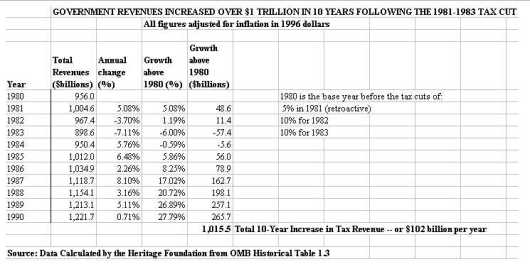
So we get to Ronald Reagan, who famously cut taxes.  And again, we find that Reagan cut that godawful liberal tax rate during an incredibly godawful liberal-caused economic recession, and he increased tax revenue by 20.71 percent (with revenues increasing from $956 billion to $1.154 trillion).  And again, the taxes were paid primarily by the rich:

“The share of the income tax burden borne by the top 10 percent of taxpayers increased from 48.0 percent in 1981 to 57.2 percent in 1988. Meanwhile, the share of income taxes paid by the bottom 50 percent of taxpayers dropped from 7.5 percent in 1981 to 5.7 percent in 1988.”

So we get to George Bush and the Bush tax cuts that liberals and in particular Obama have just demonized up one side and demagogued down the other.  And I can simply quote the New York Times AT the time:

Sharp Rise in Tax Revenue to Pare U.S. Deficit By EDMUND L. ANDREWS Published: July 13, 2005

WASHINGTON, July 12 – For the first time since President Bush took office, an unexpected leap in tax revenue is about to shrink the federal budget deficit this year, by nearly $100 billion.

A Jump in Corporate Payments On Wednesday, White House officials plan to announce that the deficit for the 2005 fiscal year, which ends in September, will be far smaller than the $427 billion they estimated in February.

Mr. Bush plans to hail the improvement at a cabinet meeting and to cite it as validation of his argument that tax cuts would stimulate the economy and ultimately help pay for themselves.

Based on revenue and spending data through June, the budget deficit for the first nine months of the fiscal year was $251 billion, $76 billion lower than the $327 billion gap recorded at the corresponding point a year earlier.

The Congressional Budget Office estimated last week that the deficit for the full fiscal year, which reached $412 billion in 2004, could be “significantly less than $350 billion, perhaps below $325 billion.”

The big surprise has been in tax revenue, which is running nearly 15 percent higher than in 2004. Corporate tax revenue has soared about 40 percent, after languishing for four years, and individual tax revenue is up as well
.

And of course the New York Times, as reliable liberals, use the adjective whenever something good happens under conservative policies and whenever something bad happens under liberal policies: ”unexpected.”   But it WASN’T ”unexpected.”  It was EXACTLY what Republicans had said would happen and in fact it was exactly what HAD IN FACT HAPPENED every single time we’ve EVER cut income tax rates.

The truth is that conservative tax policy has a perfect track record: every single time it has ever been tried, we have INCREASED tax revenues while not only exploding economic activity and creating more jobs, but encouraging the wealthy to pay more in taxes as well.  And liberals simply dishonestly refuse to acknowledge documented history.

Meanwhile, liberals also have a perfect record … of FAILUREThey keep raising taxes and keep not understanding why they don’t get the revenues they predicted.

The following is a section from my article, “Tax Cuts INCREASE Revenues; They Have ALWAYS Increased Revenues“, where I document every single thing I said above:

The Falsehood That Tax Cuts Increase The Deficit

Now let’s take a look at the utterly fallacious view that tax cuts in general create higher deficits.

Let’s take a trip back in time, starting with the 1920s.  From Burton Folsom’s book, New Deal or Raw Deal?:

In 1921, President Harding asked the sixty-five-year-old [Andrew] Mellon to be secretary of the treasury; the national debt [resulting from WWI] had surpassed $20 billion and unemployment had reached 11.7 percent, one of the highest rates in U.S. history.  Harding invited Mellon to tinker with tax rates to encourage investment without incurring more debt. Mellon studied the problem carefully; his solution was what is today called “supply side economics,” the idea of cutting taxes to stimulate investment.  High income tax rates, Mellon argued, “inevitably put pressure upon the taxpayer to withdraw this capital from productive business and invest it in tax-exempt securities. . . . The result is that the sources of taxation are drying up, wealth is failing to carry its share of the tax burden; and capital is being diverted into channels which yield neither revenue to the Government nor profit to the people” (page 128).

Mellon wrote, “It seems difficult for some to understand that high rates of taxation do not necessarily mean large revenue to the Government, and that more revenue may often be obtained by lower taxes.”  And he compared the government setting tax rates on incomes to a businessman setting prices on products: “If a price is fixed too high, sales drop off and with them profits.”

And what happened?

“As secretary of the treasury, Mellon promoted, and Harding and Coolidge backed, a plan that eventually cut taxes on large incomes from 73 to 24 percent and on smaller incomes from 4 to 1/2 of 1 percent.  These tax cuts helped produce an outpouring of economic development – from air conditioning to refrigerators to zippers, Scotch tape to radios and talking movies.  Investors took more risks when they were allowed to keep more of their gains.  President Coolidge, during his six years in office, averaged only 3.3 percent unemployment and 1 percent inflation – the lowest misery index of any president in the twentieth century.

Furthermore, Mellon was also vindicated in his astonishing predictions that cutting taxes across the board would generate more revenue.  In the early 1920s, when the highest tax rate was 73 percent, the total income tax revenue to the U.S. government was a little over $700 million.  In 1928 and 1929, when the top tax rate was slashed to 25 and 24 percent, the total revenue topped the $1 billion mark.  Also remarkable, as Table 3 indicates, is that the burden of paying these taxes fell increasingly upon the wealthy” (page 129-130).

Now, that is incredible upon its face, but it becomes even more incredible when contrasted with FDR’s antibusiness and confiscatory tax policies, which both dramatically shrunk in terms of actual income tax revenues (from $1.096 billion in 1929 to $527 million in 1935), and dramatically shifted the tax burden to the backs of the poor by imposing huge new excise taxes (from $540 million in 1929 to $1.364 billion in 1935).  See Table 1 on page 125 of New Deal or Raw Deal for that information.

FDR both collected far less taxes from the rich, while imposing a far more onerous tax burden upon the poor.

It is simply a matter of empirical fact that tax cuts create increased revenue, and that those [Democrats] who have refused to pay attention to that fact have ended up reducing government revenues even as they increased the burdens on the poorest whom they falsely claim to help.

Let’s move on to John F. Kennedy, one of the most popular Democrat presidents ever.  Few realize that he was also a supply-side tax cutter.

Kennedy said:

“It is a paradoxical truth that tax rates are too high and tax revenues are too low and the soundest way to raise the revenues in the long run is to cut the rates now … Cutting taxes now is not to incur a budget deficit, but to achieve the more prosperous, expanding economy which can bring a budget surplus.”

– John F. Kennedy, Nov. 20, 1962, president’s news conference


“Lower rates of taxation will stimulate economic activity and so raise the levels of personal and corporate income as to yield within a few years an increased – not a reduced – flow of revenues to the federal government.”

– John F. Kennedy, Jan. 17, 1963, annual budget message to the Congress, fiscal year 1964

“In today’s economy, fiscal prudence and responsibility call for tax reduction even if it temporarily enlarges the federal deficit – why reducing taxes is the best way open to us to increase revenues.”

– John F. Kennedy, Jan. 21, 1963, annual message to the Congress: “The Economic Report Of The President”


“It is no contradiction – the most important single thing we can do to stimulate investment in today’s economy is to raise consumption by major reduction of individual income tax rates.”

– John F. Kennedy, Jan. 21, 1963, annual message to the Congress: “The Economic Report Of The President”


“Our tax system still siphons out of the private economy too large a share of personal and business purchasing power and reduces the incentive for risk, investment and effort – thereby aborting our recoveries and stifling our national growth rate.”

– John F. Kennedy, Jan. 24, 1963, message to Congress on tax reduction and reform, House Doc. 43, 88th Congress, 1st Session.


“A tax cut means higher family income and higher business profits and a balanced federal budget. Every taxpayer and his family will have more money left over after taxes for a new car, a new home, new conveniences, education and investment. Every businessman can keep a higher percentage of his profits in his cash register or put it to work expanding or improving his business, and as the national income grows, the federal government will ultimately end up with more revenues.”

– John F. Kennedy, Sept. 18, 1963, radio and television address to the nation on tax-reduction bill

Which is to say that modern Democrats are essentially calling one of their greatest presidents a liar when they demonize tax cuts as a means of increasing government revenues.

So let’s move on to Ronald Reagan.  Reagan had two major tax cutting policies implemented: the Economic Recovery Tax Act (ERTA) of 1981, which was retroactive to 1981, and the Tax Reform Act of 1986.

Did Reagan’s tax cuts decrease federal revenues?  Hardly:

We find that 8 of the following 10 years there was a surplus of revenue from 1980, prior to the Reagan tax cuts.  And, following the Tax Reform Act of 1986, there was a MASSIVE INCREASEof revenue.

So Reagan’s tax cuts increased revenue.  But who paid the increased tax revenue?  The poor?  Opponents of the Reagan tax cuts argued that his policy was a giveaway to the rich (ever heard that one before?) because their tax payments would fall.  But that was exactly wrong.  In reality:

“The share of the income tax burden borne by the top 10 percent of taxpayers increased from 48.0 percent in 1981 to 57.2 percent in 1988. Meanwhile, the share of income taxes paid by the bottom 50 percent of taxpayers dropped from 7.5 percent in 1981 to 5.7 percent in 1988.”

So Ronald Reagan a) collected more total revenue, b) collected more revenue from the rich, while c) reducing revenue collected by the bottom half of taxpayers, and d) generated an economic powerhouse that lasted – with only minor hiccups – for nearly three decades.  Pretty good achievement considering that his predecessor was forced to describe his own economy as a “malaise,” suffering due to a “crisis of confidence.” Pretty good considering that President Jimmy Carter responded to a reporter’s question as to what he would do about the problem of inflation by answering, “It would be misleading for me to tell any of you that there is a solution to it.”

Reagan whipped inflation.  Just as he whipped that malaise and that crisis of confidence.

________

Thank you so much for your time. I know how valuable it is. I also appreciate the fine family that you have and your commitment as a father and a husband.

Sincerely,

Everette Hatcher III, 13900 Cottontail Lane, Alexander, AR 72002, ph 501-920-5733, lowcostsqueegees@yahoo.com

________

The Laffer Curve, Part III: Dynamic Scoring

Related posts:

Open letter to President Obama (Part 282, How the Laffer Curve worked in the 20th century over and over again!!!)

Dan Mitchell does a great job explaining the Laffer Curve President Obama c/o The White House 1600 Pennsylvania Avenue NW Washington, DC 20500 Dear Mr. President, I know that you receive 20,000 letters a day and that you actually read 10 of them every day. I really do respect you for trying to get a […]

President Obama ignores warnings about Laffer Curve

The Laffer Curve – Explained Uploaded by Eddie Stannard on Nov 14, 2011 This video explains the relationship between tax rates, taxable income, and tax revenue. The key lesson is that the Laffer Curve is not an all-or-nothing proposition, where we have to choose between the exaggerated claim that “all tax cuts pay for themselves” […]

The Laffer Curve Wreaks Havoc in the United Kingdom

I got to hear Arthur Laffer speak back in 1981 and he predicted what would happen in the next few years with the Reagan tax cuts and he was right with every prediction. The Laffer Curve Wreaks Havoc in the United Kingdom July 1, 2012 by Dan Mitchell Back in 2010, I excoriated the new […]

Open letter to President Obama (Part 197)

  President Obama c/o The White House 1600 Pennsylvania Avenue NW Washington, DC 20500 Dear Mr. President, I know that you receive 20,000 letters a day and that you actually read 10 of them every day. I really do respect you for trying to get a pulse on what is going on out here. David […]

Open letter to President Obama (Part 123)

President Obama c/o The White House 1600 Pennsylvania Avenue NW Washington, DC 20500 Dear Mr. President, I know that you receive 20,000 letters a day and that you actually read 10 of them every day. I really do respect you for trying to get a pulse on what is going on out here. I got […]

Open letter to President Obama (Part 111)

President Obama c/o The White House 1600 Pennsylvania Avenue NW Washington, DC 20500 Dear Mr. President, I know that you receive 20,000 letters a day and that you actually read 10 of them every day. I really do respect you for trying to get a pulse on what is going on out here. If our […]

Open letter to President Obama (Part 103)

President Obama c/o The White House 1600 Pennsylvania Avenue NW Washington, DC 20500 Dear Mr. President, I know that you receive 20,000 letters a day and that you actually read 10 of them every day. I really do respect you for trying to get a pulse on what is going on out here. I personally […]

High taxes are self-defeating

We got to lower taxes in order to encourage job growth and if we go down the road of higher taxes then we will go further into a recession. Debating Whether States Should Impose Class-Warfare Tax Policy June 4, 2012 by Dan Mitchell I wrote last week about the destructive and self-defeating impact of high state […]

California has forgotten the lessons of Ronald Reagan

If our country is the grow the economy and get our budget balanced it will not be by raising taxes!!! The recipe for success was followed by Ronald Reagan in the 1980′s when he cut taxes and limited spending. As far as limiting spending goes only Bill Clinton (with his Republican Congress) were ability to […]

Some liberal economics want top tax rate above 70% but economy would be crushed

I got to see Arthur Laffer speak in 1981 in Memphis and he predicted what would happen the next few years with tax revenue as a result of the Reagan Tax Cuts and he was right on every prediction. Alan Reynolds Dismantles the Silly Claim that Top Tax Rates Should be 70 Percent (or Higher!) May […]

Spain raises tax rates and revenues fall!!!!

The way to grow the economy is to cut taxes. Last night in the State of the Union address President Obama said he wanted to close tax loopholes which is another way of saying that he is not through raising taxes yet. The Laffer Curve Strikes Again: Revenues Falling in Spite of (or Perhaps Because […]

Ronald Wilson Reagan Part 13

President Reagan and Nancy Reagan greeting Billy Graham at the National Prayer Breakfast held at the Washington Hilton Hotel. 2/5/81. HALT:HaltingArkansasLiberalswithTruth.com Recently on my series on Ronald Reagan (part 10), a gentleman by the name of Elwood who a regular on the Ark Times Blog site, rightly noted, “Ray-gun created the highest unemployment rate we […]

Open letter to President Obama (Part 281)

Ronald Reagan – States’ Rights

Published on Sep 12, 2012 by

In 1967, newly elected California governor Ronald Reagan sat down with William F. Buckley Jr to discuss states’ rights.

___________


President Obama c/o The White House
1600 Pennsylvania Avenue NW
Washington, DC 20500

Dear Mr. President,

I know that you receive 20,000 letters a day and that you actually read 10 of them every day. I really do respect you for trying to get a pulse on what is going on out here.

People should pay attention to the writings of Milton Friedman did. Ronald Reagan owes a lot of his success to the beliefs of Friedman. Reagan followed Friedman’s plan on curbing inflation and was able to bring inflation down from 12% in 1980 and came close to eliminating inflation altogether.

Mitt Romney rightly noted, “Milton Friedman understood what, frankly, our president, President Obama, I don’t think has learned even after three years and hundreds of billions of dollars in federal spending,” Mr. Romney said. “And that is: Government does not create prosperity. Free markets and free people create prosperity.”

Here is a fine paper written on Milton Friedman by Stephen Moore:

Stephen Moore: The Man Who Saved Capitalism

Milton Friedman, who would have turned 100 on Tuesday, helped to make free markets popular again in the 20th century. His ideas are even more important today.

By STEPHEN MOORE

It’s a tragedy that Milton Friedman—born 100 years ago on July 31—did not live long enough to combat the big-government ideas that have formed the core of Obamanomics. It’s perhaps more tragic that our current president, who attended the University of Chicago where Friedman taught for decades, never fell under the influence of the world’s greatest champion of the free market. Imagine how much better things would have turned out, for Mr. Obama and the country.

Friedman was a constant presence on these pages until his death in 2006 at age 94. If he could, he would surely be skewering today’s $5 trillion expansion of spending and debt to create growth—and exposing the confederacy of economic dunces urging more of it.

In the 1960s, Friedman famously explained that “there’s no such thing as a free lunch.” If the government spends a dollar, that dollar has to come from producers and workers in the private economy. There is no magical “multiplier effect” by taking from productive Peter and giving to unproductive Paul. As obvious as that insight seems, it keeps being put to the test. Obamanomics may be the most expensive failed experiment in free-lunch economics in American history.

Equally illogical is the superstition that government can create prosperity by having Federal Reserve Chairman Ben Bernanke print more dollars. In the very short term, Friedman proved, excess money fools people with an illusion of prosperity. But the market quickly catches on, and there is no boost in output, just higher prices.

Next to Ronald Reagan, in the second half of the 20th century there was no more influential voice for economic freedom world-wide than Milton Friedman. Small in stature but a giant intellect, he was the economist who saved capitalism by dismembering the ideas of central planning when most of academia was mesmerized by the creed of government as savior.

Friedman was awarded the Nobel Prize in economics for 1976—at a time when almost all the previous prizes had gone to socialists. This marked the first sign of the intellectual comeback of free-market economics since the 1930s, when John Maynard Keynes hijacked the profession. Friedman’s 1963 book “A Monetary History of the United States,” written with Anna Schwartz (who died on June 21), was a masterpiece and changed the way we think about the role of money.

More influential than Friedman’s scholarly writings was his singular talent for communicating the virtues of the free market to a mass audience. His two best-selling books, “Capitalism and Freedom” (1962) and “Free to Choose” (1980), are still wildly popular. His videos on YouTube on issues like the morality of capitalism are brilliant and timeless.

In the early 1990s, Friedman visited poverty-stricken Mexico City for a Cato Institute forum. I remember the swirling controversy ginned up by the media and Mexico’s intelligentsia: How dare this apostle of free-market economics be given a public forum to speak to Mexican citizens about his “outdated” ideas? Yet when Milton arrived in Mexico he received a hero’s welcome as thousands of business owners, students and citizen activists hungry for his message encircled him everywhere he went, much like crowds for a modern rock star.

Once in the early 1960s, Friedman wrote the then-U.S. ambassador to New Delhi, John Kenneth Galbraith, that he would be lecturing in India. By all means come, the witty but often wrong Galbraith replied: “I can think of nowhere your free-market ideas can do less harm than in India.” As fate would have it, India did begin to embrace Friedmanism in the 1990s, and the economy began to soar. China finally caught on too.

Friedman stood unfailingly and heroically with the little guy against the state. He used to marvel that the intellectual left, which claims to espouse “power to the people,” so often cheers as states suppress individual rights.

While he questioned almost every statist orthodoxy, he fearlessly gored sacred cows of both political parties. He was the first scholar to sound the alarm on the rotten deal of Social Security for young workers—forced to pay into a system that will never give back as much as they could have accumulated on their own. He questioned the need for occupational licenses—which he lambasted as barriers to entry—for everything from driving a cab to passing the bar to be an attorney, or getting an M.D. to practice medicine.

He loved turning the intellectual tables on liberals by making the case that regulation often does more harm than good. His favorite example was the Food and Drug Administration, whose regulations routinely delay the introduction of lifesaving drugs. “When the FDA boasts a new drug will save 10,000 lives a year,” he would ask, “how many lives were lost because it didn’t let the drug on the market last year?”

He supported drug legalization (much to the dismay of supporters on the right) and was particularly proud to be an influential voice in ending the military draft in the 1970s. When his critics argued that he favored a military of mercenaries, he would retort: “If you insist on calling our volunteer soldiers ‘mercenaries,’ I will call those who you want drafted into service involuntarily ‘slaves.'”

By the way, he rarely got angry and even when he was intellectually slicing and dicing his sparring partners he almost always did it with a smile. It used to be said that over the decades at the University of Chicago and across the globe, the only one who ever defeated him in a debate was his beloved wife and co-author Rose Friedman.

CorbisMilton and Rose Friedman

The issue he devoted most of his later years to was school choice for all parents, and his Friedman Foundation for Educational Choice is dedicated to that cause. He used to lament that “we allow the market, consumer choice and competition to work in nearly every industry except for the one that may matter most: education.”

As for congressional Republicans who are at risk of getting suckered into a tax-hike budget deal, they may want to remember another Milton Friedman adage: “Higher taxes never reduce the deficit. Governments spend whatever they take in and then whatever they can get away with.”

No doubt because of his continued popularity, the left has tried to tie Friedman and his principles of free trade, low tax rates and deregulation to the global financial meltdown in 2008. Economist Joseph Stiglitz charged that Friedman’s “Chicago School bears the blame for providing a seeming intellectual foundation” for the “idea that markets are self-adjusting and the best role for government is to do nothing.” Occupy Wall Street protesters were often seen wearing T-shirts which read: “Milton Friedman: Proud Father of Global Misery.”

The opposite is true: Friedman opposed the government spending spree in the 2000s. He hated the government-sponsored enterprises like housing lenders Fannie Mae and Freddie Mac.

In a recent tribute to Friedman in the Journal of Economic Literature, Harvard’s Andrei Shleifer describes 1980-2005 as “The Age of Milton Friedman,” an era that “witnessed remarkable progress of mankind. As the world embraced free-market policies, living standards rose sharply while life expectancy, educational attainment, and democracy improved and absolute poverty declined.”

Well over 200 million were liberated from poverty thanks to the rediscovery of the free market. And now as the world teeters close to another recession, leaders need to urgently rediscover Friedman’s ideas.

I remember asking Milton, a year or so before his death, during one of our semiannual dinners in downtown San Francisco: What can we do to make America more prosperous? “Three things,” he replied instantly. “Promote free trade, school choice for all children, and cut government spending.”

How much should we cut? “As much as possible.”

Mr. Moore is a member of the Journal’s editorial board.

Corrections & Amplifications
“A Monetary History of the United States, 1867-1960” by Milton Friedman and Anna Schwartz was first published in 1963. A previous version of this article said the publication date was 1971.

__________

Thank you so much for your time. I know how valuable it is. I also appreciate the fine family that you have and your commitment as a father and a husband.

Sincerely,

Everette Hatcher III, 13900 Cottontail Lane, Alexander, AR 72002, ph 501-920-5733, lowcostsqueegees@yahoo.com

Open letter to President Obama (Part 280)

Dan Mitchell discusses tax hikes on FOX

Uploaded by on Jul 14, 2009

7-13-09

_________


President Obama c/o The White House
1600 Pennsylvania Avenue NW
Washington, DC 20500

Dear Mr. President,

I know that you receive 20,000 letters a day and that you actually read 10 of them every day. I really do respect you for trying to get a pulse on what is going on out here.

I am a firm believer that our country was built on the ideas of limited government, self-reliance and personal responsibility. I hope these values win out. Ronald Reagan believed in growing the economy and putting people to work. I think we need to cut government spending and end the welfare trap but requiring work out of those who recieve like Bill Clinton believed. We must change the direction the our country is heading (which is to Greece).

I’m part of a just-posted online Debate Club sponsored by U.S. News & World Report which asks “Is the United States a Nation of ‘Makers and Takers?’”

My contribution to the discussion is basically a reworked version of what I wrote last week about Romney and the infamous 47 percent remark, so there’s no need to regurgitate those remarks. Suffice to say that I gave an answer of “No” because Americans don’t (yet!) share the European belief that it is government’s responsibility to provide the basics of life.

What’s interesting is that the two other participants in the debate (Phil Kerpen and Scott Winship) who are closest to my views answered “Yes,” while the three leftists sided with me and voted “No.”

But not because the leftists agreed with me on policy, or because I disagreed with Phil or Scott. I think the strange divergence is a result of me being very literal (some would say pedantic) about the question that was asked while the rest of the participants addressed the broader issue of whether there’s too much or too little means-tested redistribution.

So allow me to take a moment to elaborate on my remarks. My answer was driven by my belief that American exceptionalism – limited government, self reliance, and personal responsibility – is still real. I linked above to one poll comparing American and European attitudes, but I also invite you to review very important polling data here and here.

But I’m not under any illusions that this is a permanent feature of the U.S. political landscape. People can be lulled into dependency. Indeed, some leftists are very honest about admitting their desire to turn more and more Americans into wards of the state. Bill Clinton’s pollster wrote a book in the 1990s in which he explicitly acknowledged that part of the debate over Hillarycare was about the degree to which the middle class would have to rely on the federal government.

And a recording of Barack Obama from 1998 has recently surfaced, and it reveals both an ideological and a political desire to expand government dependency. Here’s an excerpt from the Daily Caller.

The Daily Caller has obtained a complete audio recording of the October 19, 1998 Loyola College forum on community organizing and policymaking during which a future President Barack Obama said he favored the government redistribution of wealth. …Obama also said he viewed welfare recipients and “the working poor” as “a majority coalition” that could be mobilized to help advance progressive policies and elect their champions. …The full recording reveals that Obama saw welfare recipients and the working poor in Chicago as a “majority coalition” who could be leveraged politically.“What I think will re-engage people in politics is if we’re doing significant, serious policy work around what I will label the ‘working poor,’” he said… “They are struggling. And to the extent that we are doing research figuring out what kinds of government action would successfully make their lives better, we are then putting together a potential majority coalition to move those agendas forward.”

Set aside the policy arguments here about redistribution undermining progress in the fight against poverty and making it difficult for the less fortunate to climb the economic ladder.

What’s significant is the extent to which Clinton’s pollster and Obama both explicitly talk about redistribution as a political tool. Take money from a minority (i.e., class-warfare tax policy) and give it to enough voters to create a political majority.

I hate to admit it, but the evidence from Europe shows this can be a successful political strategy.

The only downside – as shown in this parable about beer and this great Chuck Asay cartoon – is that the scam only works so long as there are people willing to get fleeced.

I once argued on TV that leftists should be careful not to be too greedy because it doesn’t make sense for parasites to kill their host animals. And Michael Barone made the same point in a more eloquent fashion.

But I think this analysis is flawed. The Greek politicians who created the welfare state were very successful in buying votes. They’re now out of office, either dead or retired with fat pensions, as the house of cards is collapsing.

So if you’re Obama or some other current-day politician (and assuming you don’t care about the future), what’s the downside of expanding the burden of government spending?

P.S. You can vote for who had the best Debate Club argument, so please don’t hesitate to click the up arrow. Presumably thanks to readers of International Liberty, I’ve prevailed in previous debates on double taxation, European fiscal policy, flat tax, Internet taxation, and Obamanomics.

_______

Thank you so much for your time. I know how valuable it is. I also appreciate the fine family that you have and your commitment as a father and a husband.

Sincerely,

Everette Hatcher III, 13900 Cottontail Lane, Alexander, AR 72002, ph 501-920-5733, lowcostsqueegees@yahoo.com

Open letter to President Obama (Part 279)

Ronald Reagan Describes Milton Friedman

Uploaded by on Oct 2, 2011

_________


President Obama c/o The White House
1600 Pennsylvania Avenue NW
Washington, DC 20500

Dear Mr. President,

I know that you receive 20,000 letters a day and that you actually read 10 of them every day. I really do respect you for trying to get a pulse on what is going on out here.

Stephen Moore in the Wall Street Journal rightly noted:

In the 1960s, Friedman famously explained that “there’s no such thing as a free lunch.” If the government spends a dollar, that dollar has to come from producers and workers in the private economy.

Milton Friedman was my favorite economist and Ronald Reagan was my favorite President. I wish people would grasp the fact that there is no free lunch today. Here is a great article that described Milton Friedman. Ronald Reagan sought to put Friedman’s philosophy into practice in his eight years in office and as a result we had the biggest great in our economy in the history of our country. If you attempt to cut back on government spending and cut everyone’s taxes then you will be very successful too.

The Genius of Milton Friedman — Capitalism Preserved

Milton & Rose Friedman / Photo: Corbis

Four days ago, The Wall Street Journal published an outstanding article by Stephen Moore titled, The Man Who Saved Capitalism. One of the reasons President Reagan’s economic policies were so successful was because he relied upon the advice and wisdom of Milton Friedman. The entire article is worth reading. I am convinced liberals will never understand the genius of Friedman. If you ever want to have some fun, look up the numerous YouTubes of Friedman eviscerating the brightest of liberals. Here are some excerpts of Moore’s excellent article (also, see a great video at the WSJ URL):

It’s a tragedy that Milton Friedman—born 100 years ago on July 31—did not live long enough to combat the big-government ideas that have formed the core of Obamanomics. It’s perhaps more tragic that our current president, who attended the University of Chicago where Friedman taught for decades, never fell under the influence of the world’s greatest champion of the free market. Imagine how much better things would have turned out, for Mr. Obama and the country.

Friedman was a constant presence on these pages until his death in 2006 at age 94. If he could, he would surely be skewering today’s $5 trillion expansion of spending and debt to create growth—and exposing the confederacy of economic dunces urging more of it.

In the 1960s, Friedman famously explained that “there’s no such thing as a free lunch.” If the government spends a dollar, that dollar has to come from producers and workers in the private economy. There is no magical “multiplier effect” by taking from productive Peter and giving to unproductive Paul. As obvious as that insight seems, it keeps being put to the test. Obamanomics may be the most expensive failed experiment in free-lunch economics in American history.

Equally illogical is the superstition that government can create prosperity by having Federal Reserve Chairman Ben Bernanke print more dollars. In the very short term, Friedman proved, excess money fools people with an illusion of prosperity. But the market quickly catches on, and there is no boost in output, just higher prices.

. Small in stature but a giant intellect, he was the economist who saved capitalism by dismembering the ideas of central planning when most of academia was mesmerized by the creed of government as savior.
[…]
More influential than Friedman’s scholarly writings was his singular talent for communicating the virtues of the free market to a mass audience. His two best-selling books, “Capitalism and Freedom” (1962) and “Free to Choose” (1980), are still wildly popular. His videos on YouTube on issues like the morality of capitalism are brilliant and timeless.

In the early 1990s, Friedman visited poverty-stricken Mexico City for a Cato Institute forum. I remember the swirling controversy ginned up by the media and Mexico’s intelligentsia: How dare this apostle of free-market economics be given a public forum to speak to Mexican citizens about his “outdated” ideas? Yet when Milton arrived in Mexico he received a hero’s welcome as thousands of business owners, students and citizen activists hungry for his message encircled him everywhere he went, much like crowds for a modern rock star.

Once in the early 1960s, Friedman wrote the then-U.S. ambassador to New Delhi, John Kenneth Galbraith, that he would be lecturing in India. By all means come, the witty but often wrong Galbraith replied: “I can think of nowhere your free-market ideas can do less harm than in India.” As fate would have it, India did begin to embrace Friedmanism in the 1990s, and the economy began to soar. China finally caught on too.

Friedman stood unfailingly and heroically with the little guy against the state. He used to marvel that the intellectual left, which claims to espouse “power to the people,” so often cheers as states suppress individual rights.
[…]
He loved turning the intellectual tables on liberals by making the case that regulation often does more harm than good. His favorite example was the Food and Drug Administration, whose regulations routinely delay the introduction of lifesaving drugs. “When the FDA boasts a new drug will save 10,000 lives a year,” he would ask, “how many lives were lost because it didn’t let the drug on the market last year?”

He supported drug legalization (much to the dismay of supporters on the right) and was particularly proud to be an influential voice in ending the military draft in the 1970s. When his critics argued that he favored a military of mercenaries, he would retort: “If you insist on calling our volunteer soldiers ‘mercenaries,’ I will call those who you want drafted into service involuntarily ‘slaves.'”

By the way, he rarely got angry and even when he was intellectually slicing and dicing his sparring partners he almost always did it with a smile. It used to be said that over the decades at the University of Chicago and across the globe, the only one who ever defeated him in a debate was his beloved wife and co-author Rose Friedman.

The issue he devoted most of his later years to was school choice for all parents, and his Friedman Foundation for Educational Choice is dedicated to that cause. He used to lament that “we allow the market, consumer choice and competition to work in nearly every industry except for the one that may matter most: education.”

As for congressional Republicans who are at risk of getting suckered into a tax-hike budget deal, they may want to remember another Milton Friedman adage: “Higher taxes never reduce the deficit. Governments spend whatever they take in and then whatever they can get away with.”

No doubt because of his continued popularity, the left has tried to tie Friedman and his principles of free trade, low tax rates and deregulation to the global financial meltdown in 2008. Economist Joseph Stiglitz charged that Friedman’s “Chicago School bears the blame for providing a seeming intellectual foundation” for the “idea that markets are self-adjusting and the best role for government is to do nothing.” Occupy Wall Street protesters were often seen wearing T-shirts which read: “Milton Friedman: Proud Father of Global Misery.”

The opposite is true: Friedman opposed the government spending spree in the 2000s. He hated the government-sponsored enterprises like housing lenders Fannie Mae and Freddie Mac.

In a recent tribute to Friedman in the Journal of Economic Literature, Harvard’s Andrei Shleifer describes 1980-2005 as “The Age of Milton Friedman,” an era that “witnessed remarkable progress of mankind. As the world embraced free-market policies, living standards rose sharply while life expectancy, educational attainment, and democracy improved and absolute poverty declined.”

Well over 200 million were liberated from poverty thanks to the rediscovery of the free market. And now as the world teeters close to another recession, leaders need to urgently rediscover Friedman’s ideas.

I remember asking Milton, a year or so before his death, during one of our semiannual dinners in downtown San Francisco: What can we do to make America more prosperous? “Three things,” he replied instantly. “Promote free trade, school choice for all children, and cut government spending.”

How much should we cut? “As much as possible.”

_________

Thank you so much for your time. I know how valuable it is. I also appreciate the fine family that you have and your commitment as a father and a husband.

Sincerely,

Everette Hatcher III, 13900 Cottontail Lane, Alexander, AR 72002, ph 501-920-5733, lowcostsqueegees@yahoo.com

The spending cliff is what we have to worry about

The spending cliff is what we have to worry about.

The Spending Cliff

Twenty-three point nine trillion dollars.

That will be our national debt in 2022 under the fiscal-cliff bill that just passed Congress. That’s nearly $4 trillion more than the current-law baseline, and while most of that comes from making the Bush tax cuts permanent for most Americans without offsetting the loss of revenue through spending cuts, at least $330 billion of the new debt results from the increased spending that was part of the deal. Our government debt will amount to more than 118 percent of GDP.

So the deal not only fails to cut spending, it also simply tosses more money on top of the spending increases that were already built into future budgets. Now the federal government will spend $5.5 trillion in 2022, compared with $3.5 trillion this year. We will be spending $2 trillion more per year and facing $1.5 trillion more in debt than if federal spending were to rise commensurate with population growth plus inflation over the next ten years.

And this is only going to get worse after 2022, as entitlements, still unreformed after the cliff deal, explode. By 2050, our national debt will top $58 trillion in today’s dollars. That’s more than double what it would be if the increase in federal spending were limited to inflation plus population growth.

“Republicans focused on taxes, and lost on spending, too.”

How did we end up with this epic failure? In part, it was because Republicans’ fixation on cutting taxes blinded them to the real threat to economic growth and freedom — the growing size of the federal government.

I would be among the first to agree that raising taxes is bad. Tax hikes take more money out of the productive sector of the economy and redistribute it to the non-productive governmental sector, slowing economic growth. The distortions in economic decision-making brought about by those taxes will slow growth and reduce prosperity even further. But even more important, taxes appropriate the property that an individual has justly earned through his labor or ingenuity. Every dollar that the government takes from an individual is one less dollar that he or she can save, invest, or spend as he or she sees fit.

But simply paying for big government through debt rather than taxes is not an appreciable improvement. As Harvard’s Robert Barro points out, there is a “significantly negative relation between the growth of real GDP and the growth of the government share of GDP.” And, of course, our liberty is further constrained as a growing government takes up more and more space that once belonged to individuals and their choices.

Yet during the fiscal-cliff negotiations, Republicans were all too willing to forgo spending cuts as long as they were able to retain some additional tax cuts.

Republicans claim that, having disposed of the tax issue, they will now devote all their attention to securing spending reductions as part of the continuing-resolution and debt-ceiling negotiations to come. But President Obama is already laying the political groundwork for this debate, warning that Republicans will risk throwing the country into default over the debt ceiling in order to cut Social Security and Medicare. Will the GOP have the courage to insist on making the deep and painful cuts that will be required to restore us to fiscal sanity?

Forgive me for being skeptical, but not only did the last debt-ceiling agreement fail to actually cut spending (federal spending rose by $61.5 billion in the twelve months following that deal), the fiscal-cliff agreement undid two months’ worth, or $24 billion, of the sequestration cuts resulting from the debt-ceiling compromise. Indeed, congressional negotiators will spend the next two months looking for ways to undo the rest of the sequester.

“God put the Republican Party on earth to cut taxes,” the late columnist Robert Novak once noted. “If they can’t do that, they have no useful purpose.” Perhaps. But unless Republicans are willing to see that spending is every bit as big a threat to liberty and prosperity as taxes are, America is well on its way to becoming Greece.

________

Does Government Have a Revenue or Spending Problem?

People say the government has a debt problem. Debt is caused by deficits, which is the difference between what the government collects in tax revenue and the amount of government spending. Every time the government runs a deficit, the government debt increases. So what’s to blame: too much spending, or too little tax revenue? Economics professor Antony Davies examines the data and concludes that the root cause of the debt is too much government spending.

Where is our country headed with our debt?

TRY BORROWING AT A BANK WITH A FINANCIAL CONDITION LIKE THE USA HAS:

The problem in Washington is not lack of revenue but our lack of spending restraint. This video below makes that point. WASHINGTON IS A SPENDING ADDICT!!!

I love reading this blog by Dan Mitchell. No two people agree on everything but I sure do agree with most everything Dan writes on this blog of his. However, I disagree silently with something he has written today. I think it is encouraging that the Republicans in the House have been able to accomplish some things in slowing down the growth in spending by Obama. I know Dan would agree that more needs to be done. For instance, why don’t they just vote no on the next increase to the debt ceiling limit. I have praised over and over and over the 66 House Republicans that voted no on that before. If they did not raise the debt ceiling then we would have a balanced budget instantly.  I agree that the Tea Party has made a difference and I have personally posted 49 posts on my blog on different Tea Party heroes of mine.

What would happen if the debt ceiling was not increased? Yes President Obama would probably cancel White House tours and he would try to stop mail service or something else to get on our nerves but that is what the Republicans need to do.

I have written hundreds of letters and emails to President Obama and I must say that I have been impressed that he has had the White House staff answer so many of my letters. However, his policies have not changed, and by the way the White House after answering over 50 of my letters before November of 2012 has not answered one since.  President Obama committed to cutting nothing from the budget that I can tell. Republicans must take the next step now and vote no on the debt ceiling increase!!!

In recent months, people have asked me why I’m acting all giddy and optimistic. Am I hooked on cocaine? Have I fallen in love? Did I inherit several million dollars?

These questions started after I said the fiscal cliff was a smaller loss than I expected. Then people wondered what was going on when I wrote that we should celebrate the sequester victory. The questions got more intense when I opined that the Tea Party had made a positive difference. And people were even more nonplussed when I wrote that we should enjoy a win over the IMF.

But I’m not the only person thinking that things may be heading in the right direction.

Conn Carroll explains his optimism in the Washington Examiner. He starts by noting how bad Congress was back in 2009 and 2010.

…its liberal predecessor passed a trillion-dollar stimulus, enacted a government takeover of health care and institutionalized the power of Wall Street’s Too Big To Fail banks by passing the Dodd-Frank financial regulation law.

Then he explains that the new Tea Party Congress has changed the fiscal outlook.

…if you look at the hard numbers — if you look at the tax-and-spending trajectory that the United States was on before the 112th Congress was sworn into office, and then look at the path the U.S. is on now — you’d see that Republicans in Congress have made tremendous progress in shrinking the size and scope of the federal government.

But is there any proof?

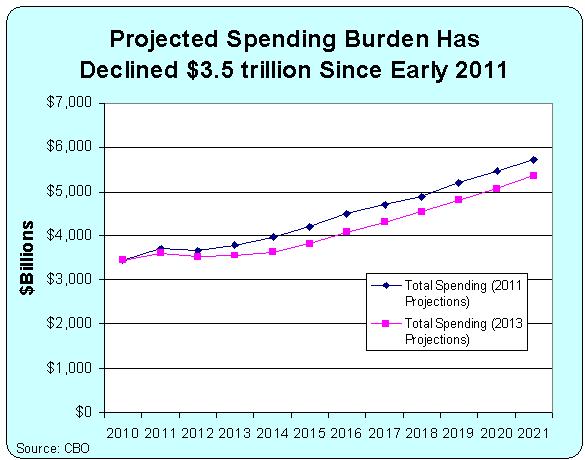
Conn points out that the CBO “baselines” from early 2011 showed government growing very rapidly.

…the nonpartisan Congressional Budget Office released its annual Budget and Economic Outlook for fiscal years 2011 through 2021. That document showed the federal government was on track to spend…a total of almost $50 trillion ($49.8 trillion to be exact) through 2021. At the same time, tax revenues were set to rise from just 14.8 percent of GDP in 2011 to 20.8 percent in 2021.

The same estimates from early this year, by contrast, show government growing at a slower pace.

The CBO’s Budget and Economic Outlook for fiscal years 2013 through 2023 shows just how much House Republicans have actually accomplished. The federal government is now on track to spend just $46.2 trillion through 2021. That is a $3.6 trillion spending cut. And instead of taxes eating up 21 percent of the U.S. economy in 2021, now the government is set to take in just 18.9 percent.

Here are the respective baselines from those CBO publications. Let’s start by looking at how spending is projected to grow at a slower pace for the rest of the decade.

2011-2013 Spending Projections

That’s $3.5 trillion of savings. Not genuine spending cuts, of course, but it’s real progress if government doesn’t grow as fast.

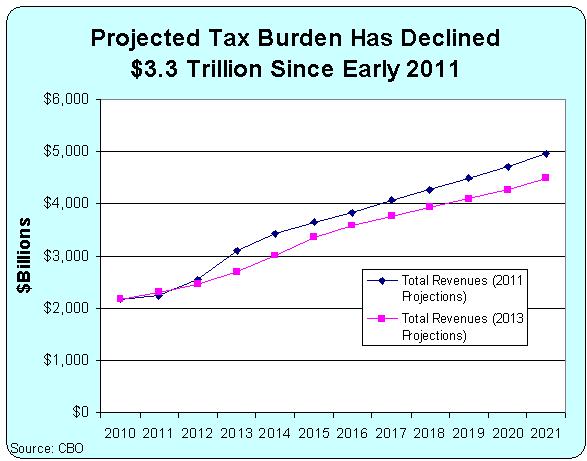
Here are the revenue numbers.

2011-2013 Revenue Projections

This data basically shows that the tax burden will be much smaller than projected because about 98 percent of the Bush tax cuts were made permanent as part of the fiscal cliff deal.

And if you believe in the Starve-the-Beast theory (and you should), this will make it harder for politicians to increase the burden of government spending in the future.

Conn also notes that the unemployment rate has fallen.

Despite all of this supposedly economy-killing “austerity,” unemployment has steadily fallen, too. When Republicans took control of the House in 2011, the nation’s unemployment rate was 9 percent. Today, it has fallen to 7.7 percent.

If this seems like a familiar point, it’s because I share his assessment. I wrote back in February of last year that gridlock was a positive thing for the economy since it reduced the likelihood of new bad policies.

What’s remarkable about these developments, as Conn notes, is that folks were expecting Obama to have momentum as his second term began.

Just three months ago, many in Washington were predicting Obama would steamroll Republicans into accepting higher taxes for millions of earners, undoing the sequester and maybe even passing new stimulus spending. Instead, Republicans have stayed unified, outfoxed Obama, preserved and made permanent most of last decade’s tax cuts (including permanent indexing of the Alternative Minimum Tax) and let the sequester cuts occur on schedule. As a result, Obama’s approval ratings have tumbled, and his entire second-term agenda is in jeopardy.

The final sentence in that excerpt explains why I’m feeling semi-optimistic. Obama’s agenda of more taxes and more spending is being thwarted.

To be sure, that doesn’t mean we’re seeing good policies of tax reform and fiscal restraint. And we still face a very dour fiscal future unless entitlements are reformed.

But we’re going in the wrong direction at a slower pace, and that beats the alternative.

__________

Related posts:

Sixty Six who resisted “Sugar-coated Satan Sandwich” Debt Deal (Part 49)

Sixty Six who resisted “Sugar-coated Satan Sandwich” Debt Deal (Part 49) This post today is a part of a series I am doing on the 66 Republican Tea Party favorites that resisted eating the “Sugar-coated Satan Sandwich” Debt Deal. Actually that name did not originate from a representative who agrees with the Tea Party, but […]

Sixty Six who resisted “Sugar-coated Satan Sandwich” Debt Deal (Part 48)

Sixty Six who resisted “Sugar-coated Satan Sandwich” Debt Deal (Part 48) This post today is a part of a series I am doing on the 66 Republican Tea Party favorites that resisted eating the “Sugar-coated Satan Sandwich” Debt Deal. Actually that name did not originate from a representative who agrees with the Tea Party, but […]

Sixty Six who resisted “Sugar-coated Satan Sandwich” Debt Deal (Part 47)

Sixty Six who resisted “Sugar-coated Satan Sandwich” Debt Deal (Part 47) This post today is a part of a series I am doing on the 66 Republican Tea Party favorites that resisted eating the “Sugar-coated Satan Sandwich” Debt Deal. Actually that name did not originate from a representative who agrees with the Tea Party, but […]

Sixty Six who resisted “Sugar-coated Satan Sandwich” Debt Deal (Part 46)

  Sixty Six who resisted “Sugar-coated Satan Sandwich” Debt Deal (Part 46) This post today is a part of a series I am doing on the 66 Republican Tea Party favorites that resisted eating the “Sugar-coated Satan Sandwich” Debt Deal. Actually that name did not originate from a representative who agrees with the Tea Party, […]

Sixty Six who resisted “Sugar-coated Satan Sandwich” Debt Deal (Part 45)

Sixty Six who resisted “Sugar-coated Satan Sandwich” Debt Deal (Part 45) This post today is a part of a series I am doing on the 66 Republican Tea Party favorites that resisted eating the “Sugar-coated Satan Sandwich” Debt Deal. Actually that name did not originate from a representative who agrees with the Tea Party, but […]

Sixty Six who resisted “Sugar-coated Satan Sandwich” Debt Deal (Part 44)

Sixty Six who resisted “Sugar-coated Satan Sandwich” Debt Deal (Part 44) This post today is a part of a series I am doing on the 66 Republican Tea Party favorites that resisted eating the “Sugar-coated Satan Sandwich” Debt Deal. Actually that name did not originate from a representative who agrees with the Tea Party, but […]

Sixty Six who resisted “Sugar-coated Satan Sandwich” Debt Deal (Part 43)

Sixty Six who resisted “Sugar-coated Satan Sandwich” Debt Deal (Part 43) This post today is a part of a series I am doing on the 66 Republican Tea Party favorites that resisted eating the “Sugar-coated Satan Sandwich” Debt Deal. Actually that name did not originate from a representative who agrees with the Tea Party, but […]

Sixty Six who resisted “Sugar-coated Satan Sandwich” Debt Deal (Part 42)

Sixty Six who resisted “Sugar-coated Satan Sandwich” Debt Deal (Part 42) This post today is a part of a series I am doing on the 66 Republican Tea Party favorites that resisted eating the “Sugar-coated Satan Sandwich” Debt Deal. Actually that name did not originate from a representative who agrees with the Tea Party, but […]

Sixty Six who resisted “Sugar-coated Satan Sandwich” Debt Deal (Part 41)

Sixty Six who resisted “Sugar-coated Satan Sandwich” Debt Deal (Part 41) This post today is a part of a series I am doing on the 66 Republican Tea Party favorites that resisted eating the “Sugar-coated Satan Sandwich” Debt Deal. Actually that name did not originate from a representative who agrees with the Tea Party, but […]

Sixty Six who resisted “Sugar-coated Satan Sandwich” Debt Deal (Part 40)

Sixty Six who resisted “Sugar-coated Satan Sandwich” Debt Deal (Part 40) This post today is a part of a series I am doing on the 66 Republican Tea Party favorites that resisted eating the “Sugar-coated Satan Sandwich” Debt Deal. Actually that name did not originate from a representative who agrees with the Tea Party, but […]

Sixty Six who resisted “Sugar-coated Satan Sandwich” Debt Deal (Part 39)

Sixty Six who resisted “Sugar-coated Satan Sandwich” Debt Deal (Part 39) This post today is a part of a series I am doing on the 66 Republican Tea Party favorites that resisted eating the “Sugar-coated Satan Sandwich” Debt Deal. Actually that name did not originate from a representative who agrees with the Tea Party, but […]

Sixty Six who resisted “Sugar-coated Satan Sandwich” Debt Deal (Part 38)

Sixty Six who resisted “Sugar-coated Satan Sandwich” Debt Deal (Part 38) This post today is a part of a series I am doing on the 66 Republican Tea Party favorites that resisted eating the “Sugar-coated Satan Sandwich” Debt Deal. Actually that name did not originate from a representative who agrees with the Tea Party, but […]

Sixty Six who resisted “Sugar-coated Satan Sandwich” Debt Deal (Part 37)

Sixty Six who resisted “Sugar-coated Satan Sandwich” Debt Deal (Part 37) This post today is a part of a series I am doing on the 66 Republican Tea Party favorites that resisted eating the “Sugar-coated Satan Sandwich” Debt Deal. Actually that name did not originate from a representative who agrees with the Tea Party, but […]

Sixty Six who resisted “Sugar-coated Satan Sandwich” Debt Deal (Part 36)

Sixty Six who resisted “Sugar-coated Satan Sandwich” Debt Deal (Part 36) This post today is a part of a series I am doing on the 66 Republican Tea Party favorites that resisted eating the “Sugar-coated Satan Sandwich” Debt Deal. Actually that name did not originate from a representative who agrees with the Tea Party, but […]

Sixty Six who resisted “Sugar-coated Satan Sandwich” Debt Deal (Part 35)

Sixty Six who resisted “Sugar-coated Satan Sandwich” Debt Deal (Part 35) This post today is a part of a series I am doing on the 66 Republican Tea Party favorites that resisted eating the “Sugar-coated Satan Sandwich” Debt Deal. Actually that name did not originate from a representative who agrees with the Tea Party, but […]

Sixty Six who resisted “Sugar-coated Satan Sandwich” Debt Deal (Part 34)

Sixty Six who resisted “Sugar-coated Satan Sandwich” Debt Deal (Part 34) This post today is a part of a series I am doing on the 66 Republican Tea Party favorites that resisted eating the “Sugar-coated Satan Sandwich” Debt Deal. Actually that name did not originate from a representative who agrees with the Tea Party, but […]

Sixty Six who resisted “Sugar-coated Satan Sandwich” Debt Deal (Part 33)

Sixty Six who resisted “Sugar-coated Satan Sandwich” Debt Deal (Part 33) This post today is a part of a series I am doing on the 66 Republican Tea Party favorites that resisted eating the “Sugar-coated Satan Sandwich” Debt Deal. Actually that name did not originate from a representative who agrees with the Tea Party, but […]

Sixty Six who resisted “Sugar-coated Satan Sandwich” Debt Deal (Part 32)

Sixty Six who resisted “Sugar-coated Satan Sandwich” Debt Deal (Part 32) This post today is a part of a series I am doing on the 66 Republican Tea Party favorites that resisted eating the “Sugar-coated Satan Sandwich” Debt Deal. Actually that name did not originate from a representative who agrees with the Tea Party, but […]

Sixty Six who resisted “Sugar-coated Satan Sandwich” Debt Deal (Part 31)

Congressmen Tim Huelskamp on the debt ceiling Sixty Six who resisted “Sugar-coated Satan Sandwich” Debt Deal (Part 31) This post today is a part of a series I am doing on the 66 Republican Tea Party favorites that resisted eating the “Sugar-coated Satan Sandwich” Debt Deal. Actually that name did not originate from a representative […]

Sixty Six who resisted “Sugar-coated Satan Sandwich” Debt Deal (Part 30)

Sixty Six who resisted “Sugar-coated Satan Sandwich” Debt Deal (Part 30) This post today is a part of a series I am doing on the 66 Republican Tea Party favorites that resisted eating the “Sugar-coated Satan Sandwich” Debt Deal. Actually that name did not originate from a representative who agrees with the Tea Party, but […]

The Sixty Six who resisted “Sugar-coated Satan Sandwich” Debt Deal (Part 29)

 Sixty Six who resisted “Sugar-coated Satan Sandwich” Debt Deal (Part 29) This post today is a part of a series I am doing on the 66 Republican Tea Party favorites that resisted eating the “Sugar-coated Satan Sandwich” Debt Deal. Actually that name did not originate from a representative who agrees with the Tea Party, but […]

The Sixty Six who resisted “Sugar-coated Satan Sandwich” Debt Deal (Part 28)

The Sixty Six who resisted “Sugar-coated Satan Sandwich” Debt Deal (Part 28) This post today is a part of a series I am doing on the 66 Republican Tea Party favorites that resisted eating the “Sugar-coated Satan Sandwich” Debt Deal. Actually that name did not originate from a representative who agrees with the Tea Party, […]

The Sixty Six who resisted “Sugar-coated Satan Sandwich” Debt Deal (Part 27)

The Sixty Six who resisted “Sugar-coated Satan Sandwich” Debt Deal (Part 27) This post today is a part of a series I am doing on the 66 Republican Tea Party favorites that resisted eating the “Sugar-coated Satan Sandwich” Debt Deal. Actually that name did not originate from a representative who agrees with the Tea Party, […]


Open letter to President Obama (Part 278)

Five Key Reasons to Reject Class-Warfare Tax Policy

Uploaded by on Jun 15, 2009

President Obama and other politicians are advocating higher taxes, with a particular emphasis on class-warfare taxes targeting the so-called rich. This Center for Freedom and Prosperity Foundation video explains why fiscal policy based on hate and envy is fundamentally misguided. For more information please visit our web page: http://www.freedomandprosperity.org.

_________


President Obama c/o The White House
1600 Pennsylvania Avenue NW
Washington, DC 20500

Dear Mr. President,

I know that you receive 20,000 letters a day and that you actually read 10 of them every day. I really do respect you for trying to get a pulse on what is going on out here.

We got to lower tax rates so we can grow our economy and if the tax rates are raised on the wealthy then we are punishing the job creators in our country and will hurt economic growth. We have to resist class warfare and lower taxes for everyone in order to grow our economy.

Hillary and Barack: Two Peas in a Class-Warfare Pod

October 8, 2012 by Dan Mitchell

Every so often, I come across some statement by President Obama that is either jaw-droppingly misguided or unintentionally revealing, and I place it in my is-this-the-worst-thing-he-ever-said file.

His “spread the wealth” comment to Joe the Plumber is the most famous example, but that was before I started this blog. Previous entries on my list include.

But our Secretary of State also likes saying odd things.

Now we have another Hillary Clinton quote, as reported by the Guardian.

There are rich people everywhere, and yet they do not contribute to their growth of their own countries.

Wow, that’s remarkable. She’s actually claiming that rich people somehow get a lot of money without boosting growth, even though they obviously provided some value and benefit in order get people to voluntarily pay money for whatever it is that made the person wealthy.

But that’s not the most offensive part of her statement. What really stuns me is the assertion that growth will be enhanced if these successful people give a greater share of their money to a corrupt and venal political class.

For all intents and purposes, she is asserting that government in these nations is too small, even though the evidence from western nations shows that small governments were very conducive to growth. Moreover, we’re supposed to believe that high tax rates won’t discourage productive economic behavior.

Which leads me to ask a simple question: Can anybody show me a poor nation that became a rich nation while imposing high tax rates and having a bloated public sector?

P.S. Even though Mrs. Clinton wasn’t making any distinction, allow me to stipulate that there are some rich people who got money dishonestly. I addressed this issue in a post last year and I suspect that some politicians think rich people are sleazy crooks because the rich people they hang out with are sleazy crooks.

P.P.S. Click here to get the answer to the question about nations that became rich with high tax rates and big government.

_________

Thank you so much for your time. I know how valuable it is. I also appreciate the fine family that you have and your commitment as a father and a husband.

Sincerely,

Everette Hatcher III, 13900 Cottontail Lane, Alexander, AR 72002, ph 501-920-5733, lowcostsqueegees@yahoo.com

Cartoons about Obama’s postponing reforms until fiscal crisis

I have put up lots of cartoons from Dan Mitchell’s blog before and they have got lots of hits before. Many of them have dealt with the sequester, economy, eternal unemployment benefits, socialism,  minimum wage laws, tax increasessocial security, high taxes in California, Obamacare,  Greece,  welfare state or on gun control.

I’m a bit of a nag on getting people to realize that deficits are not the nation’s main fiscal problem. Government borrowing isn’t desirable, to be sure, but our real concern should be a government that is too big and spending too much.

I even created a Bob Dole Award to chastise people who mistakenly focus on red ink when they should be worried about the overall burden of government spending.

But I may have to give myself the award because I very much enjoyed these two cartoons.

Here’s one from Jerry Holbert, showing Obama blithely unconcerned about the looming debt catastrophe.

Cartoon Debt Zombie

Except it’s really an entitlement problem, which is why I would have given the zombies names like Medicare, Medicaid, and Social Security.

And this Ken Catalino cartoon sort of makes the same point, but focusing specifically on the fiscal boondoggle known as Obamacare.

Cartoon Obamacare Debt

For those who don’t get the “mint” reference, it comes from a disgustingly amusing scene in a Monty Python movie.

And since I’ve already linked to scenes in another Monty Python movie, that gives you an idea of the type of humor I appreciate.

But the serious point to this post is that we will face a fiscal crisis at some point if government isn’t put on a diet.

Waiting for the crises to actually occur is a recipe for wretched consequences, as we can see from Greece, Italy, Spain, etc.


Related posts:

Cartoons from Dan Mitchell’s blog that demonstrate what Obama is doing to our economy Part 2

Max Brantley is wrong about Tom Cotton’s accusation concerning the rise of welfare spending under President Obama. Actually welfare spending has been increasing for the last 12 years and Obama did nothing during his first four years to slow down the rate of increase of welfare spending. Rachel Sheffield of the Heritage Foundation has noted: […]

Cartoons from Dan Mitchell’s blog that demonstrate what Obama is doing to our economy Part 1

  I have put up lots of cartoons from Dan Mitchell’s blog before and they have got lots of hits before. Many of them have dealt with the economy, eternal unemployment benefits, socialism,  Greece,  welfare state or on gun control. I think Max Brantley of the Arkansas Times Blog was right to point out on 2-6-13 that Hillary […]

Great cartoon from Dan Mitchell’s blog on government moochers

I thought it was great when the Republican Congress and Bill Clinton put in welfare reform but now that has been done away with and no one has to work anymore it seems. In fact, over 40% of the USA is now on the government dole. What is going to happen when that figure gets over […]

Gun Control cartoon hits the internet

Again we have another shooting and the gun control bloggers are out again calling for more laws. I have written about this subject below  and on May 23, 2012, I even got a letter back from President Obama on the subject. Now some very interesting statistics below and a cartoon follows. (Since this just hit the […]

“You-Didn’t-Build-That” comment pictured in cartoons!!!

watch?v=llQUrko0Gqw] The federal government spends about 10% on roads and public goods but with the other money in the budget a lot of harm is done including excessive regulations on business. That makes Obama’s comment the other day look very silly. A Funny Look at Obama’s You-Didn’t-Build-That Comment July 28, 2012 by Dan Mitchell I made […]

Cartoons about Obama’s class warfare

I have written a lot about this in the past and sometimes you just have to sit back and laugh. Laughing at Obama’s Bumbling Class Warfare Agenda July 13, 2012 by Dan Mitchell We know that President Obama’s class-warfare agenda is bad economic policy. We know high tax rates undermine competitiveness. And we know tax increases […]

Cartoons on Obama’s budget math

Dan Mitchell Discussing Dishonest Budget Numbers with John Stossel Uploaded by danmitchellcato on Feb 11, 2012 No description available. ______________ Dan Mitchell of the Cato Institute has shown before how excessive spending at the federal level has increased in recent years. A Humorous Look at Obama’s Screwy Budget Math May 31, 2012 by Dan Mitchell I’ve […]

Funny cartoon from Dan Mitchell’s blog on Greece

Sometimes it is so crazy that you just have to laugh a little. The European Mess, Captured by a Cartoon June 22, 2012 by Dan Mitchell The self-inflicted economic crisis in Europe has generated some good humor, as you can see from these cartoons by Michael Ramirez and Chuck Asay. But for pure laughter, I don’t […]

Obama on creating jobs!!!!(Funny Cartoon)

Another great cartoon on President Obama’s efforts to create jobs!!! A Simple Lesson about Job Creation for Barack Obama December 7, 2011 by Dan Mitchell Even though leftist economists such as Paul Krugman and Larry Summers have admitted that unemployment insurance benefits are a recipe for more joblessness, the White House is arguing that Congress should […]

Get people off of government support and get them in the private market place!!!!(great cartoon too)

Dan Mitchell hits the nail on the head and sometimes it gets so sad that you just have to laugh at it like Conan does. In order to correct this mess we got to get people off of government support and get them in the private market place!!!! Chuck Asay’s New Cartoon Nicely Captures Mentality […]

2 cartoons illustrate the fate of socialism from the Cato Institute

Cato Institute scholar Dan Mitchell is right about Greece and the fate of socialism: Two Pictures that Perfectly Capture the Rise and Fall of the Welfare State July 15, 2011 by Dan Mitchell In my speeches, especially when talking about the fiscal crisis in Europe (or the future fiscal crisis in America), I often warn that […]

Cartoon demonstrates that guns deter criminals

John Stossel report “Myth: Gun Control Reduces Crime Sheriff Tommy Robinson tried what he called “Robinson roulette” from 1980 to 1984 in Central Arkansas where he would put some of his men in some stores in the back room with guns and the number of robberies in stores sank. I got this from Dan Mitchell’s […]

Gun control posters from Dan Mitchell’s blog Part 2

I have put up lots of cartons and posters from Dan Mitchell’s blog before and they have got lots of hits before. Many of them have dealt with the economy, eternal unemployment benefits, socialism,  Greece,  welfare state or on gun control. Amusing Gun Control Picture – Circa 1999 April 3, 2010 by Dan Mitchell Dug this gem out […]

We got to cut spending and stop raising the debt ceiling!!!

  We got to cut spending and stop raising the debt ceiling!!! When Governments Cut Spending Uploaded on Sep 28, 2011 Do governments ever cut spending? According to Dr. Stephen Davies, there are historical examples of government spending cuts in Canada, New Zealand, Sweden, and America. In these cases, despite popular belief, the government spending […]

Gun control posters from Dan Mitchell’s blog Part 1

I have put up lots of cartons and posters from Dan Mitchell’s blog before and they have got lots of hits before. Many of them have dealt with the economy, eternal unemployment benefits, socialism,  Greece,  welfare state or on gun control. On 2-6-13 the Arkansas Times Blogger “Sound Policy” suggested,  “All churches that wish to allow concealed […]

Taking on Ark Times bloggers on the issue of “gun control” (Part 3) “Did Hitler advocate gun control?”

Gun Free Zones???? Stalin and gun control On 1-31-13 ”Arkie” on the Arkansas Times Blog the following: “Remember that the biggest gun control advocate was Hitler and every other tyrant that every lived.” Except that under Hitler, Germany liberalized its gun control laws. __________ After reading the link  from Wikipedia that Arkie provided then I responded: […]

Taking on Ark Times bloggers on the issue of “gun control” (Part 2) “Did Hitler advocate gun control?”

On 1-31-13 I posted on the Arkansas Times Blog the following: I like the poster of the lady holding the rifle and next to her are these words: I am compensating for being smaller and weaker than more violent criminals. __________ Then I gave a link to this poster below: On 1-31-13 also I posted […]


Open letter to President Obama (Part 277)

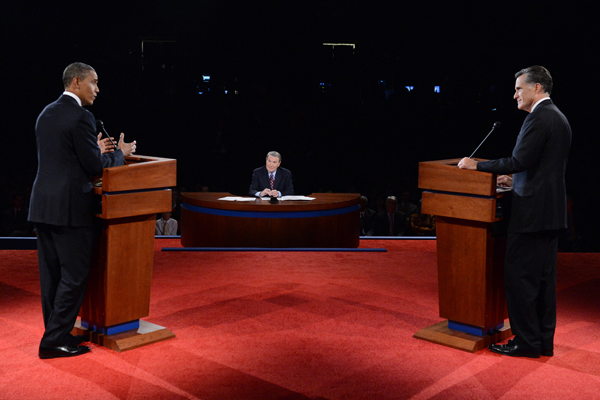
FIRST PRESIDENTIAL DEBATE – Barack Obama VS Mitt Romney (Part 5)

Published on Oct 3, 2012 by

Barack Obama & Mitt Romney Full Presidential Debate

__________


President Obama c/o The White House
1600 Pennsylvania Avenue NW
Washington, DC 20500

Dear Mr. President,

I know that you receive 20,000 letters a day and that you actually read 10 of them every day. I really do respect you for trying to get a pulse on what is going on out here.

Setting the record straight on the first presidential debate is very easy if you are a reader of the Heritage Foundation website!!! Here are some examples below taken from Romina Boccia‘s excellent article from October 4, 2012:

Romina Boccia

October 4, 2012 at 5:41 pm

During last night’s presidential debate, claims were flying fast and furious. Some of these claims were true, others false. Here are the top 10—see which ones you can guess as either true or false.


7.      Natural gas production is up in spite of Obama’s policies, not because of them.

Romney: “[T]he President pointed out correctly that production of oil and gas in the U.S. is up. But not due to his policies. In spite of his policies. Mr. President, all of the increase in natural gas and oil has happened on private land, not on government land.”

True.Much of the increased oil and gas production is on private lands, over which the Administration has no control. According to a recent report from the Energy Information Administration, energy production decreased 13 percent on federal lands in fiscal year (FY) 2011 compared to FY 2010.

8.      Businesses can take a deduction for moving jobs overseas.

Obama: “I also want to close those loopholes that are giving incentives for companies that are shipping jobs overseas.”

False.President Obama falsely claimed businesses can take a deduction for moving jobs overseas. No such deduction exists. Moreover, President Obama demonstrates a fundamental misunderstanding of how the global economy works by suggesting that companies investing overseas destroy jobs at home. A U.S. business investing abroad is good for the U.S. economy because it makes the company more competitive at home and abroad in selling products into global markets, which often creates more jobs for Americans.

9.      America’s corporate tax rate is uncompetitive.

Obama: “When it comes to our tax code, Governor Romney and I both agree that our corporate tax rate is too high, so I want to lower it, particularly for manufacturing, taking it down to 25 percent.”

True. At over 39 percent, the U.S. has the highest corporate tax rate among industrialized nations. The average of all industrialized countries in the Organization for Economic Co-operation and Development (OECD), including the U.S. rate, is about 25 percent. To regain standing compared to competing nations, Congress should lower the rate so it is on par with the current OECD average. Despite this, President Obama has proposed to raise taxes on those firms with multinational operations. This would not insource jobs, but outsource ownership of U.S. firms.

10.  Social Security is structurally sound.

Obama: “Social Security is structurally sound. It’s going to have to be tweaked, [but] the basic structure is sound.”

False. Social Security is running permanent and growing deficits, threatening a 25 percent cut in Social Security benefits in 21 years. The Congressional Budget Office (CBO) recently confirmed that Social Security has been running deficits of about 4 percent for two years in a row and that these will only get worse over time. CBO projects that Social Security’s deficits will average 10 percent over the next decade and then exceed 20 percent by 2030 as more baby boomers retire.

_______

Thank you so much for your time. I know how valuable it is. I also appreciate the fine family that you have and your commitment as a father and a husband.

Sincerely,

Everette Hatcher III, 13900 Cottontail Lane, Alexander, AR 72002, ph 501-920-5733, lowcostsqueegees@yahoo.com

FIRST PRESIDENTIAL DEBATE – Barack Obama VS Mitt Romney (Part 7)

Published on Oct 3, 2012 by

Barack Obama & Mitt Romney Full Presidential Debate

__________

Obama should own bad economy

Is it time for Obama to own this economy?

I agree that Obama inherited a crappy economy, and I think it is silly to assert that he bears any responsibility for the severity of the 2007-2009 recession.

But it is very fair to hold him responsible for what’s happened since the recession ended. I’ve cited data from the Minneapolis Federal Reserve on both employment and gross domestic product to show that Obama has presided over the weakest recovery in the post-World War II period.

And I think it is fair to blame Obama for the economy’s anemic performance during that time, largely because his agenda of faux stimulus and Obamacare exacerbated the statist policies of Bush. In other words, he promised “hope” and “change,” but delivered more of the same.

Well, now that the election is over, even the Washington Post is willing to admit that Obama’s economic performance is dismal. Here’s a remarkable chart showing that growth is far below the average.

There are actually two very important conclusions to draw from this chart.

  • First, the economy has not recovered the lost output from the recession, which is a point made by Nobel laureate Robert Lucas. That’s bad news.
  • Second, it appears that the economy is now a lower-growth trend line. That’s worse news.

Indeed, I fear permanently lower growth is the legacy of the Bush-Obama years. We now have a substantially bigger burden of government spending, and things will get worse rather than better in the absence of real entitlement reform.

And we have a lot more cronyism and interventionism, which undermines economic efficiency. To make matters worse, Obama wants higher tax rates and more double taxation of saving and investment.

To be blunt, those are not the policies that create jobs and wealth.

Last century, a good rule of thumb was that the United States was about halfway between the high-growth, small-government economics such as Hong Kong and Singapore and the low-growth, big-government economies of Europe.

But as we move closer and closer to European-style economic policy, it should be no surprise that we get anemic European-style economic performance.

We know the recipe for growth and prosperity. But the political elite is oblivious or doesn’t care.