Category Archives: President Obama

Americans for Prosperity against expanding Medicaid in Arkansas


A Red-Ink Train Wreck: The Real Fiscal Cost of Government-Run Healthcare

Uploaded on Nov 9, 2009

This CF&P Foundation video explains why healthcare proposals in Washington will result in bloated government and higher deficits. This mini-documentary exposes the pervasive inaccuracy of congressional forecasts and succinctly lists 12 reasons why Obamacare will be a budget buster. For more information: http://www.freedomandprosperity.org


I really wonder if Obamacare will overburden the states if the states choose to put in the exchanges?

I was very happy to read this from the Arkansas Times Blog on 4-3-13:

The Kochs have spoken. Their Americans for Prosperity chapter in Arkansas has formally announced opposition to the legislature approving the Obamacare-provided expansion of health care coverage under the Medicaid program. The AFP spent at least a million bucks, and related parties spent much more in other ways, influencing election of the majority-Republican legislature. So the announcement presumably has some influence.

LITTLE ROCK — After three and a half years of issue education on the President’s health care law, AFP-Arkansas announced its opposition to the proposed Arkansas Private Option Medicaid Expansion. 

“As an organization that advocates for the states to be the innovators of reform, AFP has waited as legislators worked to try and change a broken Medicaid program,” stated Teresa Oelke, Arkansas State Director. “During these last five days we have seen numbers, details in actual legislation, and memos from the administration. It is clear that President Obama’s administration is not interested in reforming a broken program. They are interested only in expanding a broken program.”

“We applaud legislators efforts to try and overhaul a failed system that supplies poor access to health care and ran a billion dollar deficit over the last five years. However, passing a broken program onto 70,000 additional Arkansans is not the solution. Doing so with a price tag of $14.5 billion over ten years paid for by hardworking taxpayers only exacerbates our country’s problems.”

I got this article from www.heritage.org:

Medicaid Expansion and State Health Exchanges: A Risky Proposition for the States

By and
December 12, 2012

Recent decisions by the Obama Administration concerning the health care exchanges and Medicaid expansion underscore what a risky proposition the Patient Protection and Affordable Care Act (PPACA) is for the states. Congress presumed in PPACA (Obamacare) that the states would agree to build and run exchanges and could be forced to expand Medicaid. The Supreme Court, however, ruled the Medicaid expansion voluntary, which has made states increasingly concerned over new burdens related to costs, control, and coverage—in both the exchanges and Medicaid.

State Health Care Exchanges

Cost. Proponents deflect attention from the true cost of the exchanges by focusing on the PPACA grants to fund states establishing them. However, unlike past federal-state policy ventures, like Medicaid or even the State Children’s Health Insurance Program (SCHIP), there will be no steady flow of federal dollars to the states. The law specifies that starting in 2015, any state implementing a state exchange must develop its own revenue source to fund the exchange’s annual operations. That puts the long-term costs squarely on the states.

Moreover, the recent announcement by the Department of Health and Human Services (HHS) that it will levy a 3.5 percent administrative fee on coverage sold through the federally run exchanges indicates there are significant costs if a state agrees to run its own exchange.[1]

Just this week a Maryland panel recommended to that state’s governor and legislature new taxes and fees to fund its state exchange.[2] The Maryland report projects annual administrative costs for the state’s exchange of $201 per enrollee in 2015, declining to $152 per enrollee in 2017.

In contrast, applying the 3.5 percent fee set by HHS to the $2,770 national average per-capita premium for all commercial group and individual major medical insurance sold in 2011 yields a projected annual administrative cost for exchanges of $97 per enrollee. The much higher Maryland figures are significant as they reflect thorough and detailed work by the state most committed to implementing a state Obamacare exchange.[3]

Control. Some argue that states should establish exchanges as a means to maintain control of their markets. However, in all matters not otherwise preempted by federal law, the states still regulate insurers (including those participating in the exchanges) regardless of who operates the exchange. States can also regulate exchange “navigators” through state professional licensure statutes to ensure a level playing field with existing insurance agents, regardless of who operates the exchange.

Furthermore, regulations promulgated by HHS allow states no meaningful flexibility or advantage by operating their own exchanges, relative to a federal exchange. Those states would simply be acting as vendors to HHS.

Coverage. Proponents point to the exchange as essential to expanding coverage. However, the law also created a federal default for states declining to establish exchanges. Therefore, the responsibility shifts to the federal government. With more Americans still opposed to the law than supporting it, the innumerable technical challenges to implementation, and large and uncertain future costs, there is a significant risk that the whole law could unravel, or even collapse, before fully taking effect. Given those prospects, states that agree to run exchanges could face significant fallout from failures at the federal level over which they have no control. Instead, a state should focus on creating a viable market for their citizens in the event that the law breaks down.

Medicaid Expansion

Cost. As proponents attempt to convince states that the cost of the Medicaid expansion will be covered by the federal government, the facts remain the same. To start with, the enhanced match is only for the expansion population, not the existing Medicaid population. In addition, it does not apply to administrative costs, which add about 5 percent to benefit payments. Finally, the full 100 percent enhanced match is temporary, with states picking up 10 percent of the new costs in 2020 and thereafter. At a time when Medicaid is already overwhelming current state budgets, it would be counterproductive for states to voluntarily add to those liabilities.

In addition, there are numerous other cost pressures states need to consider when assessing the expansion.[4] First, states will see increased enrollment among the non-expansion population as the law also expands eligibility by changing how income is measured and corrals those eligible, but not enrolled, into the program.

Second, states will face pressure from their hospitals to backfill $18 billion in federal payment cuts for uncompensated care. Third, the PPACA lifts Medicaid reimbursement for primary care physicians to Medicare levels, with federal funding of the difference—but only for two years. Once the federal funding expires, states will face pressure to maintain those levels and to increase payments to other physicians accepting Medicaid.

Moreover, regardless of HHS’s recent claim that it has backed away from previous proposals to shift Medicaid funding to a blended rate, the fiscal challenges facing Medicaid at the state and federal level make future financing adjustments to Medicaid unavoidable.

Control. While the HHS Secretary has touted offering flexibility to the states, the law and HHS regulations offer states no meaningful policy discretion. Specifically, the law extends the maintenance of effort (MOE) restriction from the stimulus law that prevents states from making key changes to their Medicaid programs. Moreover, the recent HHS decision to eliminate any possibility of a state expanding its Medicaid program short of the 138 percent federal poverty level (FPL) further underscores that flexibility was more talk than action.

Coverage. As with the exchanges, proponents stress the importance of Medicaid in expanding coverage. Unlike the federal default in the exchange, there is no federal default for the Medicaid expansion. However, rather than throwing more people into a broken program, states should focus on improving the current program and developing sustainable alternatives for meeting the needs of the proposed expansion population.

Fighting Back to Minimize the Damage of Bad Decisions

Sometimes opposing bad policy—such as by declining to run exchanges or expand Medicaid— while important, is not enough. In those instances, lawmakers need to work to minimize the impact of bad policies that they are unable to fully reverse. They also need to insist on transparency, accountability, and a level playing field, so as to create public awareness of the true consequences of bad policies and build support for future reforms.

Still a Risky Proposition for the States

Enormous uncertainty still surrounds the health care law. With less than one year remaining before the major provisions of Obamacare take effect, it is no surprise that barely more than one-fifth of states have publically agreed to both establish a state exchange and expand their Medicaid programs. The other states would be wise to decline those risky steps and instead prepare better alternatives for health care reform.

Nina Owcharenko is Director of the Center for Health Policy Studies and Preston A. Wells, Jr., Fellow at The Heritage Foundation. Edmund F. Haislmaier is Senior Research Fellow in the Center for Health Policy Studies at The Heritage Foundation.

__________

Another great cartoon from Dan Mitchell’s blog:

Next we have a Lisa Benson cartoon, showing the very unhealthy meal we’re expected to digest. Where’s Mayor Bloomberg when we actually need him?!?
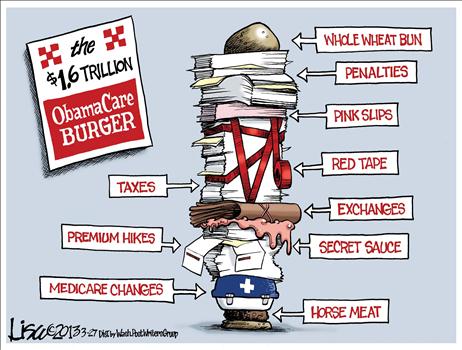
Obamacare Cartoon 2

Both Benson and Payne were part of the political cartoonist contest, so you can see their best work by clicking here.

Related posts:

Michael Cannon of Cato Institute speaks to Arkansas Senators (Part 3 includes editorial cartoon)

Jacque Martin asks CATO Institute Michael Cannon about Obamacare Published on Mar 19, 2013 The CATO Institute’s Michael Cannon spoke at the Arkansas Conservative Caucus on Tuesday March 19th. Several conservatives were present. Cannon talked about how to defeat Obamacare in Arkansas & how the states can stop Obamacare on a national level. Jacque Martin […]

After visit to Arkansas Cato’s Michael Cannon puts out new article

  After a visit to Arkansas on March 19, 2013 the Cato Institute’s Michael Cannon published another article claiming that “To date, 34 states, accounting for roughly two-thirds of the U.S. population, have refused to create Exchanges. Under the statute, this shields employers in those states from a $2,000 per worker tax that will apply […]

Michael Cannon of Cato Institute speaks to Arkansas Senators (Part 2 includes editorial cartoon)

Representative Doug House asks CATO Institute Michael Cannon about Obamacare Published on Mar 19, 2013 The CATO Institute’s Michael Cannon spoke at the Arkansas Conservative Caucus on Tuesday March 19th. Several conservatives were present. Cannon talked about how to defeat Obamacare in Arkansas & how the states can stop Obamacare on a national level. Representative […]

Michael Cannon on Obamacare (editorial cartoons on Judge Roberts and Obamacare)

Representative Bollinger asks CATO Institute Michael Cannon about Obamacare Published on Mar 19, 2013 The CATO Institute’s Michael Cannon spoke at the Arkansas Conservative Caucus on Tuesday March 19th. Several conservatives were present. Cannon talked about how to defeat Obamacare in Arkansas & how the states can stop Obamacare on a national level. Representative Bollinger […]

Michael Cannon of Cato Institute speaks to Arkansas Senators (Part 1, includes editorial cartoon)

An ObamaCare Debate Challenge (Michael F. Cannon) CATO Institute Michael Cannon at the Arkansas Conservative Caucus Published on Mar 19, 2013 The CATO Institute’s Michael Cannon spoke at the Arkansas Conservative Caucus on Tuesday March 19th. Several conservatives were present. Cannon talked about how to defeat Obamacare in Arkansas & how the states can stop […]

Max Brantley of the Ark Times takes on Michael Cannon of the Cato Institute today concerning Obamacare

Max Brantley of the Ark Times takes on Michael Cannon of the Cato Institute today concerning Obamacare. I have posted many links to Cannon’s articles in the past on my blog and on the Arkansas Times liberal blog. The finest article written in my estimation was written on Nov 20, 2012 and here is a […]

Is Michael Cannon of the Cato Institute right about states blocking Obamacare, factchecker says he is wrong.

Cato’s Michael F. Cannon Discusses ObamaCare’s Individual Mandate Is Michael Cannon of the Cato Institute right about states blocking Obamacare, factchecker says he is wrong. I Have Been False* Posted by Michael F. Cannon *According to PolitiFact. In an unconscious parody of everything that’s wrong with the “fact-checker” movement in journalism, PolitiFact Georgia (a project of […]

An ObamaCare Debate Challenge by Michael F. Cannon (editorial cartoon)

Obamacare is a poorly written and because of that the majority of states may never have to put into practice.   February 28, 2013 2:13PM ObamaCare Debate Challenge: Lawrence Wasden Edition By Michael F. Cannon Share Tweet Like Google+1 Congress empowered states to block major provisions of ObamaCare, including its subsidies and employer mandate. All […]
 

Open letter to President Obama (Part 288)

(This letter was mailed before October 15, 2012.)

President Obama c/o The White House
1600 Pennsylvania Avenue NW
Washington, DC 20500

Dear Mr. President,

I know that you receive 20,000 letters a day and that you actually read 10 of them every day. I really do respect you for trying to get a pulse on what is going on out here. 

There have been many articles written by evangelicals like me who fear that our founding fathers would not recognize our country today because secular humanism has rid our nation of spiritual roots. I am deeply troubled by the secular agenda of those who are at war with religion in our public life.

Lillian Kwon quoted somebody that I respect a lot  in her article, “Christianity losing out to Secular Humanism?” :

“Most of the founding fathers of this nation … built the worldview of this nation on the authority of the Word of God,” Ken Ham said. “Because of that, there have been reminders in this culture concerning God’s Word, the God of creation.”

At the time I started this series I was in Boston, MA which was the home of John Adams. I have toured his home and found it very interesting.

David Barton, 05-2008

A Few Declarations of Founding Fathers and  early Statesmen on Jesus Christianity and the Bible

Today we look at John Quincy Adams

John Quincy Adams 

SIXTH PRESIDENT OF THE UNITED STATES; DIPLOMAT; SECRETARY OF STATE; U. S. SENATOR; U. S. REPRESENTATIVE; “OLD MAN ELOQUENT”; “HELL-HOUND OF ABOLITION” 

My hopes of a future life are all founded upon the Gospel of Christ and I cannot cavil or quibble away [evade or object to]. . . . the whole tenor of His conduct by which He sometimes positively asserted and at others countenances [permits] His disciples in asserting that He was God.7

The hope of a Christian is inseparable from his faith. Whoever believes in the Divine inspiration of the Holy Scriptures must hope that the religion of Jesus shall prevail throughout the earth. Never since the foundation of the world have the prospects of mankind been more encouraging to that hope than they appear to be at the present time. And may the associated distribution of the Bible proceed and prosper till the Lord shall have made “bare His holy arm in the eyes of all the nations, and all the ends of the earth shall see the salvation of our God” [Isaiah 52:10].8

In the chain of human events, the birthday of the nation is indissolubly linked with the birthday of the Savior. The Declaration of Independence laid the cornerstone of human government upon the first precepts of Christianity.9

This makes me think of this story I read from CBN:

The U.S. Senate is marking the 68th anniversary of D-Day. Ohio Sen. Rob Portman and Connecticut Sen. Joe Lieberman will be reciting a famous prayer on the floor of the Senate.

As American and Allied troops invaded Nazi-occupied France on June 6, 1944, President Franklin Roosevelt asked the nation to join him in prayer.

Roosevelt offered that prayer in a national radio broadcast, saying, “Almighty God, our sons, pride of our nation, this day they set upon a mighty endeavor, a struggle to preserve our republic, our religion, and our civilization, and to set free a suffering humanity.”

“Lead them straight and true, give strengths to their arms, stoutness to their hearts, steadfastness in their faith,” he prayed.

Portman and Lieberman are also sponsoring legislation to add an inscription of FDR’s prayer to the World War II Memorial in Washington.

A companion bill that passed the House calls for the plaque or inscription to be paid for with private donations.

___________

Thank you so much for your time. I know how valuable it is. I also appreciate the fine family that you have and your commitment as a father and a husband.

Sincerely,

Everette Hatcher III, 13900 Cottontail Lane, Alexander, AR 72002, ph 501-920-5733, lowcostsqueegees@yahoo.com

Open letter to President Obama (Part 287) (on vouchers)

(This letter was mailed before Oct 25, 2012.)

President Obama c/o The White House
1600 Pennsylvania Avenue NW
Washington, DC 20500

Dear Mr. President,

I know that you receive 20,000 letters a day and that you actually read 10 of them every day. I really do respect you for trying to get a pulse on what is going on out here.

Why don’t you support the voucher system for the poor people that live in the same town that your town daughters live in? Is that fair that they attend a top quality private school while at the same time you shut down the voucher system that was in place for poor kids in D.C.?

Introducing the ‘Obama Rule’

Posted by Neal McCluskey

In his latest weekly radio address, President Obama featured what will no doubt be a mainstay of his reelection campaign: the “Buffett Rule,” which says that rich people should pay at least the same tax rate as middle-class folks. It’s named after mega-investor Warren Buffett, who famously declared that he pays a lower tax rate than his secretary. President Obama and his supporters have run with that, and are employing it to convince the public that such is the norm for the despised “rich.”

Of course that’s not the norm: Buffett is the rare taxpayer who makes almost all his income through investments, and top earners have much higher tax rates than people earning $200,000 and below. So this is clearly not about fairness — it’s about politics.

Two, though, can play at this game. If the President can engage in class warfare he’s also a fair target of it. So why not implement something called the “Obama Rule,” which demands that lower-income people get at least the same educational options as the President? That only seems fair, right, like the Buffett Rule? Indeed, the President himself noted in his weekly address that “ we…have to pay for investments that will help our economy grow and keep our country safe [such as] education.” So why, then, does the President’s 2013 budget zero-out funding for the DC Opportunity Scholarship Program while his daughters go to Sidwell Friends? Shouldn’t other kids in Washington have access to the same excellent private schools as the President’s daughters?

Class envy is hardly the right reason to demand school choice — the right reasons are freedom, competition, innovation, and specialization – but of course all kids should have the same options as President Obama’s daughters! As the President concluded in his weekly address (though, obviously, he wasn’t talking about school choice): “That’s how we’ll make this country a little fairer, a little more just, and a whole lot stronger.” So let’s invoke the Obama Rule, and give lower-income families the same educational choices as the President! It’s simply the fair thing to do.

Here is the video clip and transcript of the film series FREE TO CHOOSE episode “What is wrong with our schools?” Part 1 of 6.

Volume 6 – What’s Wrong with our Schools
Transcript:
Friedman: These youngsters are beginning another day at one of America’s public schools, Hyde Park High School in Boston. What happens when they pass through those doors is a vivid illustration of some of the problems facing America’s schools.
They have to pass through metal detectors. They are faced by security guards looking for hidden weapons. They are watched over by armed police. Isn’t that awful. What a way for kids to have to go to school, through metal detectors and to be searched. What can they conceivably learn under such circumstances. Nobody is happy with this kind of education. The taxpayers surely aren’t. This isn’t cheap education. After all, those uniformed policemen, those metal detectors have to be paid for.
What about the broken windows, the torn school books, and the smashed school equipment. The teachers who teach here don’t like this kind of situation. The students don’t like to come here to go to school, and most of all, the parents __ they are the ones who get the worst deal __ they pay taxes like the rest of us and they are just as concerned about the kind of education that their kids get as the rest of us are. They know their kids are getting a bad education but they feel trapped. Many of them can see no alternative but to continue sending their kids to schools like this.
To go back to the beginning, it all started with the fine idea that every child should have a chance to learn his three R’s. Sometimes in June when it gets hot, the kids come out in the yard to do their lessons, all 15 of them, ages 5 to 13, along with their teacher. This is the last one-room schoolhouse still operating in the state of Vermont. That is the way it used to be. Parental control, parents choosing the teacher, parents monitoring the schooling, parents even getting together and chipping in to paint the schoolhouse as they did here just a few weeks ago. Parental concern is still here as much in the slums of the big cities as in Bucolic, Vermont. But control by parents over the schooling of their children is today the exception, not the rule.
Increasingly, schools have come under the control of centralized administration, professional educators deciding what shall be taught, who shall do the teaching, and even what children shall go to what school. The people who lose most from this system are the poor and the disadvantaged in the large cities. They are simply stuck. They have no alternative.
Of course, if you are well off you do have a choice. You can send your child to a private school or you can move to an area where the public schools are excellent, as the parents of many of these students have done. These students are graduating from Weston High School in one of Boston’s wealthier suburbs. Their parents pay taxes instead of tuition and they certainly get better value for their money than do the parents in Hyde Park. That is partly because they have kept a good deal of control over the local schools, and in the process, they have managed to retain many of the virtues of the one-room schoolhouse.
Students here, like Barbara King, get the equivalent of a private education. They have excellent recreational facilities. They have a teaching staff that is dedicated and responsive to parents and students. There is an atmosphere which encourages learning, yet the cost per pupil here is no higher than in many of our inner city schools. The difference is that at Weston, it all goes for education that the parents still retain a good deal of control.
Unfortunately, most parents have lost control over how their tax money in spent. Avabelle goes to Hyde Park High. Her parents too want her to have a good education, but many of the students here are not interested in schooling, and the teachers, however dedicated, soon lose heart in an atmosphere like this. Avabelle’s parents are certainly not getting value for their tax money.
Caroline Bell, Parent: I think it is a shame, really, that parents are being ripped off like we are. I am talking about parents like me that work every day, scuffle to try to make ends meet. We send our kids to school hoping that they will receive something that will benefit them in the future for when they go out here and compete in the job market. Unfortunately, none of that is taking place at Hyde Park.
Friedman: Children like Ava are being shortchanged by a system that was designed to help. But there are ways to help give parents more say over their children’s schooling.
This is a fundraising evening for a school supported by a voluntary organization, New York’s Inner City Scholarship Fund. The prints that have brought people here have been loaned by wealthy Japanese industrialist. Events like this have helped raise two million dollars to finance Catholic parochial schools in New York. The people here are part of a long American tradition. The results of their private voluntary activities have been remarkable.
This is one of the poorest neighborhoods in New York City: the Bronx. Yet this parochial school, supported by the fund, is a joy to visit. The youngsters here from poor families are at Saint John Christians because their parents have picked this school and their parents are paying some of the costs from their own pockets. The children are well behaved, eager to learn, the teachers are dedicated. The cost per pupil here is far less than in the public schools, yet on the average the children are two grades ahead. That is because teachers and parents are free to choose how the children shall be taught. Private money has replaced the tax money and so control has been taken away from the bureaucrats and put back where it belongs.
This doesn’t work just for younger children. In the 60’s, Harlem was devastated by riots. It was a hot bed of trouble. Many teenagers dropped out of school.
_______
You need to take 45 minutes and watch the remainder of this program by Milton Friedman on the voucher system.

Thank you so much for your time. I know how valuable it is. I also appreciate the fine family that you have and your commitment as a father and a husband.

Sincerely,

Everette Hatcher III, 13900 Cottontail Lane, Alexander, AR 72002, ph 501-920-5733, lowcostsqueegees@yahoo.com

Free to Choose by Milton Friedman: Episode “What is wrong with our schools?” (Part 1 of transcript and video)

Here is the video clip and transcript of the film series FREE TO CHOOSE episode “What is wrong with our schools?” Part 1 of 6.   Volume 6 – What’s Wrong with our Schools Transcript: Friedman: These youngsters are beginning another day at one of America’s public schools, Hyde Park High School in Boston. What happens when […]

Free to Choose by Milton Friedman: Episode “What is wrong with our schools?” (Part 4 of transcript and video)

Free to Choose by Milton Friedman: Episode “What is wrong with our schools?” (Part 4 of transcript and video) Here is the video clip and transcript of the film series FREE TO CHOOSE episode “What is wrong with our schools?” Part 4 of 6.   Volume 6 – What’s Wrong with our Schools Transcript: It seems to me […]

Free to Choose by Milton Friedman: Episode “What is wrong with our schools?” (Part 3 of transcript and video) Here is the video clip and transcript of the film series FREE TO CHOOSE episode “What is wrong with our schools?” Part 3 of 6.   Volume 6 – What’s Wrong with our Schools Transcript: If it doesn’t, they […]

Free to Choose by Milton Friedman: Episode “What is wrong with our schools?” (Part 2 of transcript and video)

Free to Choose by Milton Friedman: Episode “What is wrong with our schools?” (Part 2 of transcript and video) Here is the video clip and transcript of the film series FREE TO CHOOSE episode “What is wrong with our schools?” Part 2 of 6.   Volume 6 – What’s Wrong with our Schools Transcript: Groups of concerned parents […]

Free to Choose by Milton Friedman: Episode “What is wrong with our schools?” (Part 6 of transcript and video)

Here is the video clip and transcript of the film series FREE TO CHOOSE episode “What is wrong with our schools?” Part 6 of 6.   Volume 6 – What’s Wrong with our Schools Transcript: FRIEDMAN: But I personally think it’s a good thing. But I don’t see that any reason whatsoever why I shouldn’t have been required […]

Free to Choose by Milton Friedman: Episode “What is wrong with our schools?” (Part 5 of transcript and video)

Here is the video clip and transcript of the film series FREE TO CHOOSE episode “What is wrong with our schools?” Part 5 of 6.   Volume 6 – What’s Wrong with our Schools Transcript: Are your voucher schools  going to accept these tough children? COONS: You bet they are. (Several talking at once.) COONS: May I answer […]

Open letter to President Obama (Part 286)

(This letter was mailed before October 15, 2012.)

President Obama c/o The White House
1600 Pennsylvania Avenue NW
Washington, DC 20500

Dear Mr. President,

I know that you receive 20,000 letters a day and that you actually read 10 of them every day. I really do respect you for trying to get a pulse on what is going on out here. 

There have been many articles written by evangelicals like me who fear that our founding fathers would not recognize our country today because secular humanism has rid our nation of spiritual roots. I am deeply troubled by the secular agenda of those who are at war with religion in our public life.

Lillian Kwon quoted somebody that I respect a lot  in her article, “Christianity losing out to Secular Humanism?” :

“Most of the founding fathers of this nation … built the worldview of this nation on the authority of the Word of God,” Ken Ham said. “Because of that, there have been reminders in this culture concerning God’s Word, the God of creation.”

At the time I started this series I was in Boston, MA which was the home of John Adams. I have toured his home and found it very interesting.

David Barton, 05-2008

A Few Declarations of Founding Fathers and  early Statesmen on Jesus Christianity and the Bible

Today we look at John Adams:

John Adams

 JOHN ADAMS:

SIGNER OF THE DECLARATION OF INDEPENDENCE; JUDGE; DIPLOMAT; ONE OF TWO SIGNERS OF THE BILL OF RIGHTS; SECOND PRESIDENT OF THE UNITED STATES 

The general principles on which the fathers achieved independence were the general principles of Christianity. I will avow that I then believed, and now believe, that those general principles of Christianity are as eternal and immutable as the existence and attributes of God.1

The Holy Ghost carries on the whole Christian system in this earth. Not a baptism, not a marriage, not a sacrament can be administered but by the Holy Ghost. . . . There is no authority, civil or religious – there can be no legitimate government but what is administered by this Holy Ghost. There can be no salvation without it. All without it is rebellion and perdition, or in more orthodox words damnation.2

Without religion, this world would be something not fit to be mentioned in polite company: I mean hell.3

The Christian religion is, above all the religions that ever prevailed or existed in ancient or modern times, the religion of wisdom, virtue, equity and humanity.4

Suppose a nation in some distant region should take the Bible for their only law book and every member should regulate his conduct by the precepts there exhibited. . . . What a Eutopia – what a Paradise would this region be!5

I have examined all religions, and the result is that the Bible is the best book in the world.6

___________

Thank you so much for your time. I know how valuable it is. I also appreciate the fine family that you have and your commitment as a father and a husband.

Sincerely,

Everette Hatcher III, 13900 Cottontail Lane, Alexander, AR 72002, ph 501-920-5733, lowcostsqueegees@yahoo.com

Open letter to President Obama (Part 285)


President Obama c/o The White House
1600 Pennsylvania Avenue NW
Washington, DC 20500

Dear Mr. President,

I know that you receive 20,000 letters a day and that you actually read 10 of them every day. I really do respect you for trying to get a pulse on what is going on out here.

It my view  that liberals like you are hostile to these ideas that have made us prosperous. Take a look at these comments below from John Stossel: 

Exclusive Interview: John Stossel Says Government Can’t Solve Our Problems

Rob Bluey and Brandon Stewart

April 12, 2012 at 11:51 am

John Stossel on Government, Free Enterprise, and Media

Published on Apr 12, 2012 by

http://blog.heritage.org/2012/04/12/exclusive-interview-john-stossel-says-gov… | John Stossel’s skepticism of government and his storytelling approach about free-market economics have made him a rock star in conservative and libertarian circles.

He spoke at The Heritage Foundation on Wednesday about his new book, “No, They Can’t: Why Government Fails—But Individuals Succeed.” It is Stossel’s latest attempt to debunk the myths that government can solve America’s problems. He tackles everything from crony capitalism and federal regulations to teachers’ unions and gun control.

______________________

John Stossel’s skepticism of government and his storytelling approach about free-market economics have made him a rock star in conservative and libertarian circles.

He spoke at The Heritage Foundation on Wednesday about his new book, “No, They Can’t: Why Government Fails—But Individuals Succeed.” It is Stossel’s latest attempt to debunk the myths that government can solve America’s problems. He tackles everything from crony capitalism and federal regulations to teachers’ unions and gun control.

“Our instinct is to believe in the central planners,” Stossel said in the interview. “It was nuts in the Obama election. It was like he was a magic politician who was going to do these things.”

Yet despite government’s failures, the left never retreats. President Obama’s class-warfare rhetoric, Stossel conceded, is a current example of how liberals shape the narrative.

“I live in the shallow media world,” Stossel said, “and on a subject like that, shallow wins.”

In the interview, Stossel didn’t mince words when asked why he left ABC News in 2009: “Because it sucked there.”

He currently hosts “Stossel,” a one-hour weekly Fox Business Network show and other specials on Fox News. The book reveals his rift with ABC and why Stossel approached Fox for a job.

Here’s what he told us:

They were hostile to these ideas that have made us prosperous and I consider so important. I mean, they tolerated me for years. I got good ratings, so they put the stuff on. They sort of held their nose and put it on. But by the end, they were saying, ‘Ah, you’re predictable Stossel. You use libertarian economics all the time. I don’t want to watch that.’ … I was not offered a job by Fox. I went over and begged, ‘Please, hire me, I cannot stand it anymore.’

The interview runs about five minutes. Hosted by Rob Bluey and produced by Brandon Stewart. For more videos from Heritage, subscribe to our YouTube channel.

____________
 

Thank you so much for your time. I know how valuable it is. I also appreciate the fine family that you have and your commitment as a father and a husband.

Sincerely,

Everette Hatcher III, 13900 Cottontail Lane, Alexander, AR 72002, ph 501-920-5733, lowcostsqueegees@yahoo.com

Great article by Michael Cannon on Arkansas Medicaid expansion plan

CATO Institute Michael Cannon on the OReilly Factor

Published on Mar 19, 2013

The CATO Institute’s Michael Cannon spoke at the Arkansas Conservative Caucus on Tuesday March 19th. Several conservatives were present. Cannon talked about how to defeat Obamacare in Arkansas & how the states can stop Obamacare on a national level.

__________________

CATO Institute Michael Cannon at the Arkansas Conservative Caucus 2

Published on Mar 19, 2013

The CATO Institute’s Michael Cannon spoke at the Arkansas Conservative Caucus on Tuesday March 19th. Several conservatives were present. Cannon talked about how to defeat Obamacare in Arkansas & how the states can stop Obamacare on a national level.

Great article by Michael Cannon on Arkansas Medicaid expansion plan, and sure enough the Republicans in Arkansas are guilty of going along it seems at this point.

April 1, 2013 11:24AM

Roy: “The Arkansas-Obamacare Medicaid Deal: Far Less Than It First Appeared”

At Forbes.com’s Apothecary blog, the Manhattan Institute’s Avik Roy is cool to the idea of states implementing ObamaCare’s Medicaid expansion by putting those new enrollees in ObamaCare’s health insurance “exchanges”: 

When Arkansas Gov. Mike Beebe (D.) first announced that he had reached a deal with the Obama administration to use the Affordable Care Act’s private insurance exchanges to expand coverage to poor Arkansans, it seemed like an important, and potentially transformative, development. The myriad ways in which the traditional Medicaid program harms the poor have been well-documented, and it looked like Beebe had come up with an attractive—albeit expensive—way to provide the poor with higher-quality private insurance. A Good Friday memo from the U.S. Department of Health and Human Services, however, splashes cold water on that aspiration. It’s now clear that the Beebe-HHS deal applies a kind of private-sector window dressing on the dysfunctional Medicaid program, and it’s not obvious that the Arkansas legislature should go along.

The first reason states should not pursue the Beebe plan is that, like a straight Medicaid expansion, it would inhibit the pursuit of low-cost health care for the poor. 

The second reason is that it would cost even more than putting those new enrollees in the traditional Medicaid program. Economist Jagadeesh Gokhale, who advises the Social Security program on how to make these sorts of projections, estimates a straight Medicaid expansion would cost Florida, Illinois, and Texas about $20 billion in the first 10 years. And that’s in the wildly unrealistic event that the feds honor their committment to cover 90 percent of the cost. President Obama has already proposed abandoning that committment. Congressional Budget Office projections suggest the “Beebe plan” would increase the cost of the expansion by 50 percent. That too should be enough reason to reject the Beebe plan. Neither the state nor the federal government have the money to expand Medicaid at all. Volunteering to make the expansion even more expensive is lunacy. 

The Beebe administration is trying to make its plan seem no more expensive than a straight Medicaid expansion. How? By simply assuming state officials would voluntarily make a straight Medicaid expansion so expensive that the Beebe plan wouldn’t cost a penny extra. The illogic goes like this. If Arkansas were to expand traditional Medicaid, the state would likely need to increase Medicaid payments to doctors and hospitals in order to secure adequate access to care for new enrollees. That would make a straight Medicaid expansion so expensive that the Beebe plan would be no more costly, and might even cost less. 

It’s true, states that implement ObamaCare’s Medicaid expansion would have to increase provider payments to give new eligibles decent access to care. The problem is that Medicaid never does that. Medicaid is notorious for paying providers so little that it access to care is lousy. Medicaid does so year after year, even if people sometimes die as a result. The Beebe administration simply assumed that state officials would magically change such behavior, increase provider payments, and thereby volunteer to make an already-expensive Medicaid expansion even more unaffordable. In that fantasy world, the Beebe plan would be no more expensive. As an indication of how implausible that assumption is, no one had been talking about combining a straight Medicaid expansion with higher provider payments until the Beebe administration needed to make the governor’s plan seem slightly less unaffordable. 

Roy has soured on Beebe-style plans since reading some of the terms and conditions the Obama administration issued on Friday. Yet he still imagines there might be free-market-friendly ways to implement a massive expansion of the entitlement state. Thus he counsels states only to expand Medicaid in exchange for real reforms. We’ve heard that song and dance before. Republicans said the State Children’s Health Insurance Program and Medicare Part D – two Republican initiatives – would lead to Medicaid and Medicare reform. Instead, government got bigger and reform went nowhere. Lucy is going to pull the football here, too. If it is Medicaid reform you seek, the only free-market Medicaid reforms are Medicaid cuts. Roy’s criticisms of the Beebe plan are welcome, though it’s odd to find him to the left of officials in the 15 or more states that are flatly rejecting the expansion.

Related posts:

Michael Cannon of Cato Institute speaks to Arkansas Senators (Part 3 includes editorial cartoon)

Jacque Martin asks CATO Institute Michael Cannon about Obamacare Published on Mar 19, 2013 The CATO Institute’s Michael Cannon spoke at the Arkansas Conservative Caucus on Tuesday March 19th. Several conservatives were present. Cannon talked about how to defeat Obamacare in Arkansas & how the states can stop Obamacare on a national level. Jacque Martin […]

After visit to Arkansas Cato’s Michael Cannon puts out new article

  After a visit to Arkansas on March 19, 2013 the Cato Institute’s Michael Cannon published another article claiming that “To date, 34 states, accounting for roughly two-thirds of the U.S. population, have refused to create Exchanges. Under the statute, this shields employers in those states from a $2,000 per worker tax that will apply […]

Michael Cannon of Cato Institute speaks to Arkansas Senators (Part 2 includes editorial cartoon)

Representative Doug House asks CATO Institute Michael Cannon about Obamacare Published on Mar 19, 2013 The CATO Institute’s Michael Cannon spoke at the Arkansas Conservative Caucus on Tuesday March 19th. Several conservatives were present. Cannon talked about how to defeat Obamacare in Arkansas & how the states can stop Obamacare on a national level. Representative […]

Michael Cannon on Obamacare (editorial cartoons on Judge Roberts and Obamacare)

Representative Bollinger asks CATO Institute Michael Cannon about Obamacare Published on Mar 19, 2013 The CATO Institute’s Michael Cannon spoke at the Arkansas Conservative Caucus on Tuesday March 19th. Several conservatives were present. Cannon talked about how to defeat Obamacare in Arkansas & how the states can stop Obamacare on a national level. Representative Bollinger […]

Michael Cannon of Cato Institute speaks to Arkansas Senators (Part 1, includes editorial cartoon)

An ObamaCare Debate Challenge (Michael F. Cannon) CATO Institute Michael Cannon at the Arkansas Conservative Caucus Published on Mar 19, 2013 The CATO Institute’s Michael Cannon spoke at the Arkansas Conservative Caucus on Tuesday March 19th. Several conservatives were present. Cannon talked about how to defeat Obamacare in Arkansas & how the states can stop […]

Max Brantley of the Ark Times takes on Michael Cannon of the Cato Institute today concerning Obamacare

Max Brantley of the Ark Times takes on Michael Cannon of the Cato Institute today concerning Obamacare. I have posted many links to Cannon’s articles in the past on my blog and on the Arkansas Times liberal blog. The finest article written in my estimation was written on Nov 20, 2012 and here is a […]

Is Michael Cannon of the Cato Institute right about states blocking Obamacare, factchecker says he is wrong.

Cato’s Michael F. Cannon Discusses ObamaCare’s Individual Mandate Is Michael Cannon of the Cato Institute right about states blocking Obamacare, factchecker says he is wrong. I Have Been False* Posted by Michael F. Cannon *According to PolitiFact. In an unconscious parody of everything that’s wrong with the “fact-checker” movement in journalism, PolitiFact Georgia (a project of […]

An ObamaCare Debate Challenge by Michael F. Cannon (editorial cartoon)

Obamacare is a poorly written and because of that the majority of states may never have to put into practice.   February 28, 2013 2:13PM ObamaCare Debate Challenge: Lawrence Wasden Edition By Michael F. Cannon Share Tweet Like Google+1 Congress empowered states to block major provisions of ObamaCare, including its subsidies and employer mandate. All […]


Open letter to President Obama (Part 284)


President Obama c/o The White House
1600 Pennsylvania Avenue NW
Washington, DC 20500

Dear Mr. President,

I know that you receive 20,000 letters a day and that you actually read 10 of them every day. I really do respect you for trying to get a pulse on what is going on out here.

On October 15, 1992 in the Presidential Debate this question was asked:

The focus of my work as a domestic mediator is meeting the needs of the children that I work with, by way of their parents, and not the wants of their parents. And I ask the three of you, how can we, as symbolically the children of the future president, expect the two of you, the three of you to meet our needs, the needs in housing and in crime and you name it, as opposed to the wants of your political spin doctors and your political parties?

I wish one of the three candidates would have  given a blunt answer. We don’t need more government but we need less. Why does anyone think that the government should try meet everyone’s needs? Why does anyone think that equality at the finish line is what we are seeking? We need the federal government to stop spending almost 25% of GDP. The people should be allowed to spend more of their own money.

Take a look at this fine article below and the great quote by Barry Goldwater:

In this modern era where we’re all supposed to share our innermost thoughts, I’ve openly discussed my fantasies.

I confessed to the world, for instance, that I have a fantasy that involves about one-half of the adults in America. And I’ve also admitted to a fantasy involving Gov. Rick Perry of Texas.

Now I’m fantasizing about something new, and it’s all the fault of the Cato Institute. In a violation of the Constitution’s prohibition against cruel and unusual punishment, I have to watch tonight’s presidential debate in order to add my two cents to Cato’s live-blogging of the clash between Obama and Romney.

That got me thinking about some of my least-favorite episodes from past debates, and this moment from 1992 is high on my list (I had to watch that debate because my then-wife worked for the Bush Administration and I had to offer some insincere moral support).

The clip is a bit over three minutes, but it will only take a minute or so to see why this was such an unpleasant segment.

Here’s my latest fantasy. If there’s a similar question tonight, I hope either Romney or Obama gives the following response:

I’m not your daddy and you’re not my child. I’m running to be the President of the United States in order to oversee the legitimate executive branch responsibilities of the federal government. And I hope to reduce the burden of government to give you opportunities, not to take care of your needs. You’re an able-bodied adult. Take responsibility for your own life and provide for your own needs.

But I don’t expect my fantasy to get fulfilled. If a question like this is asked, both Obama and Romney almost surely will express sympathy and support.

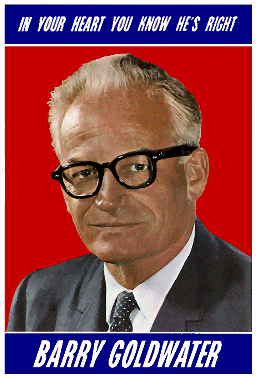
The good news is that there have been a few politicians in American’s history who have been willing to say the right thing. Here’s a quote from Barry Goldwater that warms my heart.

I have little interest in streamlining government or in making it more efficient, for I mean to reduce its size. I do not undertake to promote welfare, for I propose to extend freedom. My aim is not to pass laws, but to repeal them. …I will not attempt to discover whether legislation is “needed” before I have first determined whether it is constitutionally permissible. And if I should later be attacked for neglecting my constituents’ “interests,” I shall reply that I was informed that their main interest is liberty and that in that cause I am doing the very best I can.

The bad news is that he got his you-know-what kicked in the 1964 election.

On the other hand, America did elect a President who said during his inauguration that “government is not the solution to our problem, government is the problem.”

And a 2011 poll showed that Americans – unlike their European counterparts – do not believe it is government’s job to guarantee that “nobody is in need.”

In other words, Julia, the fictional moocher woman created by the Obama campaign, is not representative of America. At least not yet.

____________

Thank you so much for your time. I know how valuable it is. I also appreciate the fine family that you have and your commitment as a father and a husband.

Sincerely,

Everette Hatcher III, 13900 Cottontail Lane, Alexander, AR 72002, ph 501-920-5733, lowcostsqueegees@yahoo.com

Open letter to President Obama (Part 283)

Bob Chitester Discusses Milton Friedman and ‘Free to Choose’

Published on Jul 30, 2012 by

“There are very few people over the generations who have ideas that are sufficiently original to materially alter the direction of civilization. Milton is one of those very few people.”

That is how former Federal Reserve Chairman Alan Greenspan described the Nobel laureate economist Milton Friedman. But it is not for his technical work in monetary economics that Friedman is best known. Like mathematician Jacob Bronowski and astronomer Carl Sagan, Friedman had a gift for communicating complex ideas to a general audience.

It was this gift that brought him to the attention of filmmaker Bob Chitester. At Chitester’s urging, Friedman agreed to make a 10 part documentary series explaining the power of economic freedom. It was called “Free to Choose,” and became one of the most watched documentaries in history.

The series not only reached audiences in liberal democracies, but was smuggled behind the iron curtain where it played, in secret, to large audiences. Reflecting on its impact, Czech president Vaclav Klaus has said: “For us, who lived in the communist world, Milton Friedman was the greatest champion of freedom, of limited and unobtrusive government and of free markets. Because of him I became a true believer in the unrestricted market economy.”

July 31st, 2012 is the 100th anniversary of Friedman’s birth. To commemorate that occasion, we’d like to share an interview with “Free to Choose” producer Bob Chitester. Like this interview, the entire series can now be viewed on-line at no cost at http://www.freetochoose.tv/, thanks to the incredible technological progress brought about by the economic freedom that Milton Friedman celebrated.

Produced by Andrew Coulson, Caleb O. Brown, Austin Bragg, and Lou Richards, with help from the Free to Choose Network.

_____________


President Obama c/o The White House
1600 Pennsylvania Avenue NW
Washington, DC 20500

Dear Mr. President,

I know that you receive 20,000 letters a day and that you actually read 10 of them every day. I really do respect you for trying to get a pulse on what is going on out here.

We got to stop spending so much money on the federal level. It will bankrupt us. I remember back in 1980 when I really started getting into the material of Milton Friedman as a result of reading his articles in Newsweek and reading his book “Free to Choose,” I really did get facts and figures to back on the view that we need more freedom giving back to us and the government needs to spend less.

As a result of Friedman’s writings I was able to discuss these issues with my fellow students at the university and by the time the 1980 election came around I had been attending political rallies and went out and worked hard for Ronald Reagan’s election. In this article below Dr. Thomas Sowell (who was featured twice in the film “Free to Choose”) notes how much influence Milton Friedman had on the election outcome in 1980:

Milton Friedman at 90

by Thomas Sowell

Thomas Sowell is a senior fellow at the Hoover Institute in Stanford, California.

Added to cato.org on July 25, 2002

This article originally appeared on TownHall.com, July 25, 2002.

Milton Friedman’s 90th birthday on July 31st provides an occasion to think back on his role as the pre-eminent economist of the 20th century. To those of us who were privileged to be his students, he also stands out as a great teacher.

When I was a graduate student at the University of Chicago, back in 1959, one day I was waiting outside Professor Friedman’s office when another graduate student passed by. He noticed my exam paper on my lap and exclaimed: “You got a B?”

“Yes,” I said. “Is that bad?”

Thomas Sowell is a senior fellow at the Hoover Institute in Stanford, California.


“There were only two B’s in the whole class,” he replied.

“How many A’s?” I asked.

“There were no A’s!”

Today, this kind of grading might be considered to represent a “tough love” philosophy of teaching. I don’t know about love, but it was certainly tough.

Professor Friedman also did not let students arrive late at his lectures and distract the class by their entrance. Once I arrived a couple of minutes late for class and had to turn around and go back to the dormitory.

All the way back, I thought about the fact that I would be held responsible for what was said in that lecture, even though I never heard it. Thereafter, I was always in my seat when Milton Friedman walked in to give his lecture.

On a term paper, I wrote that either (a) this would happen or (b) that would happen. Professor Friedman wrote in the margin: “Or (c) your analysis is wrong.”

“Where was my analysis wrong?” I asked him.

“I didn’t say your analysis was wrong,” he replied. “I just wanted you to keep that possibility in mind.”

Perhaps the best way to summarize all this is to say that Milton Friedman is a wonderful human being — especially outside the classroom. It has been a much greater pleasure to listen to his lectures in later years, after I was no longer going to be quizzed on them, and a special pleasure to appear on a couple of television programs with him and to meet him on social occasions.

Milton Friedman’s enduring legacy will long outlast the memories of his students and extends beyond the field of economics. John Maynard Keynes was the reigning demi-god among economists when Friedman’s career began, and Friedman himself was at first a follower of Keynesian doctrines and liberal politics.

Yet no one did more to dismantle both Keynesian economics and liberal welfare-state thinking. As late as the 1950s, those with the prevailing Keynesian orthodoxy were still able to depict Milton Friedman as a fringe figure, clinging to an outmoded way of thinking. But the intellectual power of his ideas, the fortitude with which he persevered, and the ever more apparent failures of Keynesian analyses and policies, began to change all that, even before Professor Friedman was awarded the Nobel Prize in economics in 1976.

A towering intellect seldom goes together with practical wisdom, or perhaps even common sense. However, Milton Friedman not only excelled in the scholarly journals but also on the television screen, presenting the basics of economics in a way that the general public could understand.

His mini-series “Free to Choose” was a classic that made economic principles clear to all with living examples. His good nature and good humor also came through in a way that attracted and held an audience.

Although Friedrich Hayek launched the first major challenge to the prevailing thinking behind the welfare state and socialism with his 1944 book “The Road to Serfdom,” Milton Friedman became the dominant intellectual force among those who turned back the leftward tide in what had seemed to be the wave of the future.

Without Milton Friedman’s role in changing the minds of so many Americans, it is hard to imagine how Ronald Reagan could have been elected president.

Nor was Friedman’s influence confined to the United States. His ideas reached around the world, not only among economists, but also in political circles which began to understand why left-wing ideas that sounded so good produced results that were so bad.

Milton Friedman rates a 21-gun salute on his birthday. Or perhaps a 90-gun salute would be more appropriate.

________

Thank you so much for your time. I know how valuable it is. I also appreciate the fine family that you have and your commitment as a father and a husband.

Sincerely,

Everette Hatcher III, 13900 Cottontail Lane, Alexander, AR 72002, ph 501-920-5733, lowcostsqueegees@yahoo.com

James Madison: “If men were angels, no government would be necessary”

1 Of 5 / The Bible’s Influence In America / American Heritage Series / David Barton

_________________

Our founding fathers had some wise things to say about government. They realized that angels don’t govern us.

Because Angels Don’t Govern Us

by Michael D. Tanner

Michael Tanner is a senior fellow at the Cato Institute and author of Leviathan on the Right: How Big-Government Conservatism Brought Down the Republican Revolution.

Added to cato.org on May 2, 2012

This article appeared in National Review (Online) on May 2, 2012.

Now that the first round of spin has passed, we can take a second look at the lessons to be learned from the recent GSA and Secret Service scandals.

First, it really is a bit unfair to blame them on President Obama. The president is not directly involved in the day-to-day management of these agencies. Nor should he be. Moreover, misbehavior by government employees predates the Obama administration by quite a bit. In 460b.c., for example, the Greek Delian League put nine government administrators to death for misusing public funds.

However, none of that lets President Obama entirely off the hook.

Too many on both the left and the right believe that government intervention in the economy or in the lives of individual citizens is necessary because only government can see the larger picture and act in a disinterested way for the benefit of the greater good. Businesses can be corrupt or self-seeking, and individuals may be myopic or make choices that others see as either morally or economically wrong. No doubt this view is correct, at least in some cases. In one way or another, we are all imperfect.

The Obama administration persists in believing that government is wiser than and morally superior to the average American.

President Obama believes that government is different.

Given our flaws as individuals, the Obama administration believes that government should run our health-care system. Left to our own devices, we might fail to buy health insurance or buy insurance that doesn’t include the right package of benefits. Government needs to subsidize “green energy,” because we might decide to buy fuel-inefficient cars. Government needs to oversee the banking industry and housing markets, because banks made loans to people who couldn’t afford to pay them back.

People are prejudiced and selfish. Government is altruistic and “fair.” Markets fail, but not government. As President Obama sees it, government can make us better and lead us to the promised land.

But, as the GSA and Secret Service scandals should remind us, government is made up not of philosopher-economist-saints but of men and women like the rest of us — afflicted by failures, corruption, short-sightedness, and self-interest. The difference is that government gives those imperfect individuals the power to impose their views and desires on the rest of us.

The Founding Fathers understood this. They knew that some government is necessary to protect our rights to “life, liberty, and the pursuit of happiness.” For this reason, they noted in the Declaration of Independence, “governments are instituted among men.” But they also understood that government needs to be carefully limited in its scope and power.

As James Madison wrote in Federalist 51:

If men were angels, no government would be necessary. If angels were to govern men, neither external nor internal controls on government would be necessary. In framing a government which is to be administered by men over men, the great difficulty lies in this: you must first enable the government to control the governed; and in the next place oblige it to control itself.

Indeed, the damage that government can do is far greater than the damage that can be done by business or individuals, because ultimately the state holds a monopoly on the use of force. If I make a mistake, it affects my life and perhaps the lives of my family and a few others. If a business makes a mistake, it can affect thousands more. But if government makes a mistake, it can affect everyone. That is what makes the growing reach of government so dangerous.

That means that, necessary though some restraint on the freedom of individuals and businesses may be, it is even more important to have internal and external controls on the power of government.

The Obama administration’s failure, therefore, is not that it neglected to micromanage the GSA’s expenses or that it couldn’t keep Secret Service agents out of brothels. It is that it wants the practical equivalent of GSA employees and Secret Service agents to run our lives. The Obama administration persists in believing that government is wiser than and morally superior to the average American.

That is a real scandal.

On Spending Cuts, Politicians Prefer Gimmicks by Tad DeHaven plus my efforts to get spending cut on federal level

Recently we had Michael Cannon of the Cato Institute come and speak to our Republican lawmakers here in Arkansas and I have contacted many of them personally to try and get them to stop this expansion of Medicaid in Arkansas. Now I am looking at this issue of overspending that is happening on the federal level.

It is obvious to me that if President Obama gets his hands on more money then he will continue to spend away our children’s future. He has already taken the national debt from 11 trillion to 16 trillion in just 4 years. Over, and over, and over, and over, and over and over I have written Speaker Boehner and written every Republican that represents Arkansans in Arkansas before (Griffin, Womack, Crawford, and only Senator Boozman got a chance to respond) concerning this. I am hoping they will stand up against this reckless spending that our federal government has done and will continue to do if given the chance.

Why don’t the Republicans  just vote no on the next increase to the debt ceiling limit. I have praised over and over and over the 66 House Republicans that voted no on that before. If they did not raise the debt ceiling then we would have a balanced budget instantly.  I agree that the Tea Party has made a difference and I have personally posted 49 posts on my blog on different Tea Party heroes of mine.

What would happen if the debt ceiling was not increased? Yes President Obama would probably cancel White House tours and he would try to stop mail service or something else to get on our nerves but that is what the Republicans need to do.

I have written and emailed Senator Pryor over, and over again with spending cut suggestions but he has ignored all of these good ideas in favor of keeping the printing presses going as we plunge our future generations further in debt. I am convinced if he does not change his liberal voting record that he will no longer be our senator in 2014.

I have written hundreds of letters and emails to President Obama and I must say that I have been impressed that he has had the White House staff answer so many of my letters. However, his policies have not changed, and by the way the White House after answering over 50 of my letters before November of 2012 has not answered one since.  President Obama committed to cutting nothing from the budget that I can tell.

 I have praised over and over and over the 66 House Republicans that voted no on that before. If they did not raise the debt ceiling then we would have a balanced budget instantly.  I agree that the Tea Party has made a difference and I have personally posted 49 posts on my blog on different Tea Party heroes of mine.

TRY BORROWING AT A BANK WITH A FINANCIAL CONDITION LIKE THE USA HAS:

The problem in Washington is not lack of revenue but our lack of spending restraint. This video below makes that point. WASHINGTON IS A SPENDING ADDICT!!!


March 29, 2013 3:25PM

On Spending Cuts, Politicians Prefer Gimmicks

The latest report by the Washington Post’s David Fahrenthold on Beltway tomfoolery tells of what happened when both Democrats and Republicans asked government workers and the public for suggestions on how to reduce government spending. Apparently neither party had much interest in the responses.

Fahrenthold first looks at the Obama White House’s effort:

After President Obama set up a national online suggestion box asking federal workers for new ways to cut the budget, 86,000 ideas came in Some, inevitably, were a little odd. 

…But many others were more serious, sent in by people who had seen real government waste close up: stop the “use it or lose it” budgeting policy, which leads agencies to blow taxpayer money at year’s end; stop giving paper calendars to workers who already have online calendars; stop letting every armed service design its own camouflage. 

In the end, none of those things happened. Instead, those suggestions became a little-known part of the maddening story of Washington’s budget wars. 

…Obama, for instance, chose 67 suggestions out of those 86,000. While some produced results, many seemed unambitious. Often, the administration picked ideas that applauded what it was already doing, instead of forcing it to start new reforms. Still, the White House considers that a win. 

Of course it does

Fahrenthold then turns his attention to the GOP’s “YouCut” website. Created in 2010 and run by House Majority Leader Eric Cantor, regular Americans were to be given menus of potential spending cuts, and they were asked to vote for one. Winning ideas were then supposed to go to the House floor for a vote. In the end, only two of the 36 winning ideas became law. No bill was introduced for nine of the winning ideas, and 12 were “introduced only,” which means that they never even made it to the floor for a vote. 

Like the administration and its online suggestion box, Cantor’s office claims that YouCut was a success: 

“The purpose of the YouCut program was to change the culture of Washington,” Rory Cooper, a spokesman for Cantor, said in an e-mail. “Today, as is evident to anyone paying attention, that culture has been changed.” 

Of course it has

And now that the “culture has been changed,” it appears that the people’s input on spending cuts is no longer needed: 

YouCut appears to be dead. No new votes have been held in the current Congress. Cantor’s spokespeople did not respond to questions about the program’s status this week. 

Note: For more on the awesomeness of the GOP’s YouCut endeavor, see commentary from Chris Edwards and me here, here, here, and here

_______________

Related posts:

Sixty Six who resisted “Sugar-coated Satan Sandwich” Debt Deal (Part 49)

Sixty Six who resisted “Sugar-coated Satan Sandwich” Debt Deal (Part 49) This post today is a part of a series I am doing on the 66 Republican Tea Party favorites that resisted eating the “Sugar-coated Satan Sandwich” Debt Deal. Actually that name did not originate from a representative who agrees with the Tea Party, but […]

Sixty Six who resisted “Sugar-coated Satan Sandwich” Debt Deal (Part 48)

Sixty Six who resisted “Sugar-coated Satan Sandwich” Debt Deal (Part 48) This post today is a part of a series I am doing on the 66 Republican Tea Party favorites that resisted eating the “Sugar-coated Satan Sandwich” Debt Deal. Actually that name did not originate from a representative who agrees with the Tea Party, but […]

Sixty Six who resisted “Sugar-coated Satan Sandwich” Debt Deal (Part 47)

Sixty Six who resisted “Sugar-coated Satan Sandwich” Debt Deal (Part 47) This post today is a part of a series I am doing on the 66 Republican Tea Party favorites that resisted eating the “Sugar-coated Satan Sandwich” Debt Deal. Actually that name did not originate from a representative who agrees with the Tea Party, but […]

Sixty Six who resisted “Sugar-coated Satan Sandwich” Debt Deal (Part 46)

  Sixty Six who resisted “Sugar-coated Satan Sandwich” Debt Deal (Part 46) This post today is a part of a series I am doing on the 66 Republican Tea Party favorites that resisted eating the “Sugar-coated Satan Sandwich” Debt Deal. Actually that name did not originate from a representative who agrees with the Tea Party, […]

Sixty Six who resisted “Sugar-coated Satan Sandwich” Debt Deal (Part 45)

Sixty Six who resisted “Sugar-coated Satan Sandwich” Debt Deal (Part 45) This post today is a part of a series I am doing on the 66 Republican Tea Party favorites that resisted eating the “Sugar-coated Satan Sandwich” Debt Deal. Actually that name did not originate from a representative who agrees with the Tea Party, but […]

Sixty Six who resisted “Sugar-coated Satan Sandwich” Debt Deal (Part 44)

Sixty Six who resisted “Sugar-coated Satan Sandwich” Debt Deal (Part 44) This post today is a part of a series I am doing on the 66 Republican Tea Party favorites that resisted eating the “Sugar-coated Satan Sandwich” Debt Deal. Actually that name did not originate from a representative who agrees with the Tea Party, but […]

Sixty Six who resisted “Sugar-coated Satan Sandwich” Debt Deal (Part 43)

Sixty Six who resisted “Sugar-coated Satan Sandwich” Debt Deal (Part 43) This post today is a part of a series I am doing on the 66 Republican Tea Party favorites that resisted eating the “Sugar-coated Satan Sandwich” Debt Deal. Actually that name did not originate from a representative who agrees with the Tea Party, but […]

Sixty Six who resisted “Sugar-coated Satan Sandwich” Debt Deal (Part 42)

Sixty Six who resisted “Sugar-coated Satan Sandwich” Debt Deal (Part 42) This post today is a part of a series I am doing on the 66 Republican Tea Party favorites that resisted eating the “Sugar-coated Satan Sandwich” Debt Deal. Actually that name did not originate from a representative who agrees with the Tea Party, but […]

Sixty Six who resisted “Sugar-coated Satan Sandwich” Debt Deal (Part 41)

Sixty Six who resisted “Sugar-coated Satan Sandwich” Debt Deal (Part 41) This post today is a part of a series I am doing on the 66 Republican Tea Party favorites that resisted eating the “Sugar-coated Satan Sandwich” Debt Deal. Actually that name did not originate from a representative who agrees with the Tea Party, but […]

Sixty Six who resisted “Sugar-coated Satan Sandwich” Debt Deal (Part 40)

Sixty Six who resisted “Sugar-coated Satan Sandwich” Debt Deal (Part 40) This post today is a part of a series I am doing on the 66 Republican Tea Party favorites that resisted eating the “Sugar-coated Satan Sandwich” Debt Deal. Actually that name did not originate from a representative who agrees with the Tea Party, but […]

Sixty Six who resisted “Sugar-coated Satan Sandwich” Debt Deal (Part 39)

Sixty Six who resisted “Sugar-coated Satan Sandwich” Debt Deal (Part 39) This post today is a part of a series I am doing on the 66 Republican Tea Party favorites that resisted eating the “Sugar-coated Satan Sandwich” Debt Deal. Actually that name did not originate from a representative who agrees with the Tea Party, but […]

Sixty Six who resisted “Sugar-coated Satan Sandwich” Debt Deal (Part 38)

Sixty Six who resisted “Sugar-coated Satan Sandwich” Debt Deal (Part 38) This post today is a part of a series I am doing on the 66 Republican Tea Party favorites that resisted eating the “Sugar-coated Satan Sandwich” Debt Deal. Actually that name did not originate from a representative who agrees with the Tea Party, but […]

Sixty Six who resisted “Sugar-coated Satan Sandwich” Debt Deal (Part 37)

Sixty Six who resisted “Sugar-coated Satan Sandwich” Debt Deal (Part 37) This post today is a part of a series I am doing on the 66 Republican Tea Party favorites that resisted eating the “Sugar-coated Satan Sandwich” Debt Deal. Actually that name did not originate from a representative who agrees with the Tea Party, but […]

Sixty Six who resisted “Sugar-coated Satan Sandwich” Debt Deal (Part 36)

Sixty Six who resisted “Sugar-coated Satan Sandwich” Debt Deal (Part 36) This post today is a part of a series I am doing on the 66 Republican Tea Party favorites that resisted eating the “Sugar-coated Satan Sandwich” Debt Deal. Actually that name did not originate from a representative who agrees with the Tea Party, but […]

Sixty Six who resisted “Sugar-coated Satan Sandwich” Debt Deal (Part 35)

Sixty Six who resisted “Sugar-coated Satan Sandwich” Debt Deal (Part 35) This post today is a part of a series I am doing on the 66 Republican Tea Party favorites that resisted eating the “Sugar-coated Satan Sandwich” Debt Deal. Actually that name did not originate from a representative who agrees with the Tea Party, but […]

Sixty Six who resisted “Sugar-coated Satan Sandwich” Debt Deal (Part 34)

Sixty Six who resisted “Sugar-coated Satan Sandwich” Debt Deal (Part 34) This post today is a part of a series I am doing on the 66 Republican Tea Party favorites that resisted eating the “Sugar-coated Satan Sandwich” Debt Deal. Actually that name did not originate from a representative who agrees with the Tea Party, but […]

Sixty Six who resisted “Sugar-coated Satan Sandwich” Debt Deal (Part 33)

Sixty Six who resisted “Sugar-coated Satan Sandwich” Debt Deal (Part 33) This post today is a part of a series I am doing on the 66 Republican Tea Party favorites that resisted eating the “Sugar-coated Satan Sandwich” Debt Deal. Actually that name did not originate from a representative who agrees with the Tea Party, but […]

Sixty Six who resisted “Sugar-coated Satan Sandwich” Debt Deal (Part 32)

Sixty Six who resisted “Sugar-coated Satan Sandwich” Debt Deal (Part 32) This post today is a part of a series I am doing on the 66 Republican Tea Party favorites that resisted eating the “Sugar-coated Satan Sandwich” Debt Deal. Actually that name did not originate from a representative who agrees with the Tea Party, but […]

Sixty Six who resisted “Sugar-coated Satan Sandwich” Debt Deal (Part 31)

Congressmen Tim Huelskamp on the debt ceiling Sixty Six who resisted “Sugar-coated Satan Sandwich” Debt Deal (Part 31) This post today is a part of a series I am doing on the 66 Republican Tea Party favorites that resisted eating the “Sugar-coated Satan Sandwich” Debt Deal. Actually that name did not originate from a representative […]

Sixty Six who resisted “Sugar-coated Satan Sandwich” Debt Deal (Part 30)

Sixty Six who resisted “Sugar-coated Satan Sandwich” Debt Deal (Part 30) This post today is a part of a series I am doing on the 66 Republican Tea Party favorites that resisted eating the “Sugar-coated Satan Sandwich” Debt Deal. Actually that name did not originate from a representative who agrees with the Tea Party, but […]

The Sixty Six who resisted “Sugar-coated Satan Sandwich” Debt Deal (Part 29)

 Sixty Six who resisted “Sugar-coated Satan Sandwich” Debt Deal (Part 29) This post today is a part of a series I am doing on the 66 Republican Tea Party favorites that resisted eating the “Sugar-coated Satan Sandwich” Debt Deal. Actually that name did not originate from a representative who agrees with the Tea Party, but […]

The Sixty Six who resisted “Sugar-coated Satan Sandwich” Debt Deal (Part 28)

The Sixty Six who resisted “Sugar-coated Satan Sandwich” Debt Deal (Part 28) This post today is a part of a series I am doing on the 66 Republican Tea Party favorites that resisted eating the “Sugar-coated Satan Sandwich” Debt Deal. Actually that name did not originate from a representative who agrees with the Tea Party, […]

The Sixty Six who resisted “Sugar-coated Satan Sandwich” Debt Deal (Part 27)

The Sixty Six who resisted “Sugar-coated Satan Sandwich” Debt Deal (Part 27) This post today is a part of a series I am doing on the 66 Republican Tea Party favorites that resisted eating the “Sugar-coated Satan Sandwich” Debt Deal. Actually that name did not originate from a representative who agrees with the Tea Party, […]

The Sixty Six who resisted “Sugar-coated Satan Sandwich” Debt Deal (Part 26)

The Sixty Six who resisted “Sugar-coated Satan Sandwich” Debt Deal (Part 26) This post today is a part of a series I am doing on the 66 Republican Tea Party favorites that resisted eating the “Sugar-coated Satan Sandwich” Debt Deal. Actually that name did not originate from a representative who agrees with the Tea Party, […]

The Sixty Six who resisted “Sugar-coated Satan Sandwich” Debt Deal (Part 25)

Uploaded by RepJoeWalsh on Jun 14, 2011 Our country’s debt continues to grow — it’s eating away at the American Dream. We need to make real cuts now. We need Cut, Cap, and Balance. The Sixty Six who resisted “Sugar-coated Satan Sandwich” Debt Deal (Part 25) This post today is a part of a series […]

The Sixty Six who resisted “Sugar-coated Satan Sandwich” Debt Deal (Part 23)

The Sixty Six who resisted “Sugar-coated Satan Sandwich” Debt Deal (Part 23) This post today is a part of a series I am doing on the 66 Republican Tea Party favorites that resisted eating the “Sugar-coated Satan Sandwich” Debt Deal. Actually that name did not originate from a representative who agrees with the Tea Party, […]

The Sixty Six who resisted “Sugar-coated Satan Sandwich” Debt Deal (Part 22)

The Sixty Six who resisted “Sugar-coated Satan Sandwich” Debt Deal (Part 22) This post today is a part of a series I am doing on the 66 Republican Tea Party favorites that resisted eating the “Sugar-coated Satan Sandwich” Debt Deal. Actually that name did not originate from a representative who agrees with the Tea Party, […]

The Sixty Six who resisted “Sugar-coated Satan Sandwich” Debt Deal (Part 21)

The Sixty Six who resisted “Sugar-coated Satan Sandwich” Debt Deal (Part 21) This post today is a part of a series I am doing on the 66 Republican Tea Party favorites that resisted eating the “Sugar-coated Satan Sandwich” Debt Deal. Actually that name did not originate from a representative who agrees with the Tea Party, […]

The Sixty Six who resisted “Sugar-coated Satan Sandwich” Debt Deal (Part 20)

The Sixty Six who resisted “Sugar-coated Satan Sandwich” Debt Deal (Part 20) This post today is a part of a series I am doing on the 66 Republican Tea Party favorites that resisted eating the “Sugar-coated Satan Sandwich” Debt Deal. Actually that name did not originate from a representative who agrees with the Tea Party, […]

The Sixty Six who resisted “Sugar-coated Satan Sandwich” Debt Deal (Part 19)

The Sixty Six who resisted “Sugar-coated Satan Sandwich” Debt Deal (Part 19) This post today is a part of a series I am doing on the 66 Republican Tea Party favorites that resisted eating the “Sugar-coated Satan Sandwich” Debt Deal. Actually that name did not originate from a representative who agrees with the Tea Party, […]

The Sixty Six who resisted “Sugar-coated Satan Sandwich” Debt Deal (Part 18)

The Sixty Six who resisted “Sugar-coated Satan Sandwich” Debt Deal (Part 18) This post today is a part of a series I am doing on the 66 Republican Tea Party favorites that resisted eating the “Sugar-coated Satan Sandwich” Debt Deal. Actually that name did not originate from a representative who agrees with the Tea Party, […]

The Sixty Six who resisted “Sugar-coated Satan Sandwich” Debt Deal (Part 17)

The Sixty Six who resisted “Sugar-coated Satan Sandwich” Debt Deal (Part 17) This post today is a part of a series I am doing on the 66 Republican Tea Party favorites that resisted eating the “Sugar-coated Satan Sandwich” Debt Deal. Actually that name did not originate from a representative who agrees with the Tea Party, […]

The Sixty Six who resisted “Sugar-coated Satan Sandwich” Debt Deal (Part 16)

The Sixty Six who resisted “Sugar-coated Satan Sandwich” Debt Deal (Part 16) This post today is a part of a series I am doing on the 66 Republican Tea Party favorites that resisted eating the “Sugar-coated Satan Sandwich” Debt Deal. Actually that name did not originate from a representative who agrees with the Tea Party, […]