Category Archives: Economist Dan Mitchell

New Evidence Shows States with No Income Tax Grow Faster and Create More Jobs

Will Taxing the Rich Fix the Deficit?

Published on Jul 2, 2012

The government’s budget deficit in 2009 was $1.5 trillion. Many have suggested raising taxes on the rich to cover the difference between what the government collected in revenue and what it spent. Is that a realistic solution? Economics professor Antony Davies uses data to demonstrate why taxing the rich will not be sufficient to make the budget deficit disappear. He says, “The budget deficit is so large that there simply aren’t enough rich people to tax to raise enough to balance the budget.” Instead, it’s time to work on legitimate solutions, like cutting spending.

_______

There are many states that really go after the rich in a big way with their state income tax. Evidently that is not the way to go if you want your economy to grow.

New Evidence Shows States with No Income Tax Grow Faster and Create More Jobs

December 15, 2012 by Dan Mitchell

One of the key ways of controlling state and local tax burdens, according to this map from the Tax Foundation, is to not have an income tax.

But that’s not too surprising. States have just a couple of ways of generating significant tax revenue, so it stands to reason that states without an income tax would have relatively low tax burdens.

Light-blue states have no broad-based income tax

The more important question is whether this approach leads to better economic performance. The evidence is pretty clear that zero-income-tax states grow faster and create more jobs.

I’ve already shared some important research on this topic, including this review of research in the Cato Journal by Richard Rahn, as well as this summary of similar analysis in Rich States, Poor States by Art Laffer and Steve Moore.

There’s even some evidence that people in low-tax states are happier than those in high-tax states, though I’m not sure that I trust that kind of subjective research since there’s also a study showing people are happier in high-tax nations.  (at least, unlike Brazil, nobody in the U.S. is talking about making happiness a responsibility of government).

Let’s return to the more substantive topic of taxes and economic performance. There’s a column examining this issue in today’s Wall Street Journal. Authored by two experts from the Kansas Policy Institute, it finds that states with no income tax have a lower burden of government spending.

In the midst of a dismal recovery where every job counts, one fact stands out: States that tax less achieve better economic performance. …The secret to having low taxes is controlling spending, and that’s exactly what low-tax-burden states do. States with an income tax spent 42% more per resident in 2011 than the nine states without an income tax. …Every state has public schools, social-service programs, prisons, etc. Some just find ways to provide essentially the same basket of services at lower prices.

They also reveal that lower taxes and lower spending translate into more growth and prosperity.

States that allow taxpayers and employers to keep more of their earnings are reaping the benefits. States without an income tax have significantly better growth in private sector GDP (59% versus 42%) over the last 10 years. They increased the number of jobs by 4.9% while jobs in the rest of the states declined by 2.6%. States without an income tax gained population (+5.5%) from domestic migration (U.S. residents moving in and out of states) while all other states as a whole lost 1.3% of population between 2000 and 2009.

The migration data is particularly powerful, and it’s one of the reasons why California’s class-warfare tax policy is so suicidal and why Texas is growing so rapidly. As I’ve said many times before, tax competition is a critical way of disciplining profligate governments and rewarding jurisdictions with more responsible fiscal policy.

Last but not least, if you want a powerful example of why income taxes are economic poison, read this research showing how Connecticut’s economic performance dropped after imposing a state income tax about 20 years ago.

P.S. Here’s a list of America’s greediest state and local governments, as measured by top income tax rates and most onerous sales tax systems.

P.P.S. Here’s the famous Moocher Index of state dependency, and you’ll notice that states with no income tax are more likely to be near the bottom of the list (with Alaska being a notable – but not surprising – exception).

P.P.P.S. And if you like state fiscal data, the Cato Institute’s Fiscal Policy Report Card on America’s Governors shows which states are moving in the wrong direction and right direction.

P.P.P.P.S. According to this map from a left-wing group, it also seems that states with no income tax do a better job of controlling welfare spending.
Dan Mitchell on the minimum wage law (includes two editorial cartoons)


It seems that everything President Obama does to help the economy actually does the opposite.

Should the federal government make life more difficult for low-skilled workers?

I hope everyone will emphatically say “NO!”

Heck, most people understandably will think you’re crazy for even asking such a preposterous question.

Minimum Wage Cartoon 2But some of those people will also think that it’s a good idea for politicians in Washington to make low-skilled workers less attractive to employers by raising the minimum wage.

I often ask such people whether they are more likely to buy a Big Mac if McDonald’s raises the price by 24 percent. They say they are less likely.

I then ask them if they are more likely to buy a car if GM increases the price of a Buick by 24 percent. They say less likely, of course.

But they seem to have a blind spot when I ask them whether employers will be more likely or less likely to hire low-skilled workers when the government increases the cost of those workers by 24 percent.

I explain further in this interview for Yahoo! Finance.

The interviewer, by the way, seems to be economically illiterate.

He apparently believes that we can reduce inequality by pricing poor people out of the job market. He also blames companies for sitting on piles of cash, presumably unaware that firms only will invest if there are profitable opportunities.

Minimum Wage CartoonAt one point, I delicately state that one of his questions “betrays a certain lack of historical knowledge,” which is a polite way of saying “you’re either lying or you have no idea what you’re talking about.”

Ultimately, I try to help him understand by comparing fast-growing economies such Hong Kong and Singapore, which have relatively low burdens of government, with slow-growth economies such as France and Italy, where politicians ostensibly seek to “help” people with various forms of intervention.

I’m not sure I made any progress, so feel free to suggest other ways of convincing skeptics that freedom is better than statism.

Anyway, for those who want more information, this video explains the underlying economics of the minimum wage. We also have plenty of evidence (see here and here) that unemployment rose following the most recent hike in the minimum wage.


Related posts:

Why do the liberals want to increase unemployment more by increasing minimum wage?

Williams with Sowell – Minimum Wage Why do the liberals want to increase unemployment more by increasing minimum wage? With Unemployment Already High, Why Are Leftists Pushing for an Increase in the Minimum Wage? September 3, 2012 by Dan Mitchell The unemployment rate has been stuck above 8 percent ever since Obama pushed through his ill-fated […]

Minimum wage could be eliminating jobs

Minimum wage could be eliminating jobs Liberals just don’t have a clue. The Job-Killing Impact of Minimum Wage Laws Uploaded by CFPEcon101 on Jun 14, 2010 Minimum wage laws seem like a good idea, but arbitrarily mandating a certain wage can have terrible consequences. This CF&P Foundation mini-documentary reveals that business are not charities, so if the […]

Minimum wage could be eliminating jobs

Minimum wage could be eliminating jobs Liberals just don’t have a clue. The Job-Killing Impact of Minimum Wage Laws Uploaded by CFPEcon101 on Jun 14, 2010 Minimum wage laws seem like a good idea, but arbitrarily mandating a certain wage can have terrible consequences. This CF&P Foundation mini-documentary reveals that business are not charities, so […]

President Obama and Alternative Minimum Tax

President Obama and Alternative Minimum Tax Dan Mitchell does it again. He is always right on the mark. CPAs Celebrate as Obama Proposes to Create a Turbo-Charged Alternative Minimum Tax Posted by Daniel J. Mitchell Wow, this is remarkable. The alternative minimum tax (AMT) is one of the most-hated features of the tax code. It […]

President Obama and Alternative Minimum Tax

President Obama and Alternative Minimum Tax Dan Mitchell does it again. He is always right on the mark. CPAs Celebrate as Obama Proposes to Create a Turbo-Charged Alternative Minimum Tax Posted by Daniel J. Mitchell Wow, this is remarkable. The alternative minimum tax (AMT) is one of the most-hated features of the tax code. It […]

Video clips of Jonah Goldberg and an interview about his book “Liberal Fascism” (Part 3)

Liberal Fascism (5) – Jonah Goldberg ** UNEDITED **   Uploaded by TylerNull on Feb 17, 2008 PLAYLIST: http://www.youtube.com/view_play_list?p=C20E954A7632DCFD Jonah Goldberg discusses his new book, “Liberal Fascism: The Secret History of the American Left, From Mussolini to the Politics of Meaning”, at The Heritage Foundation on C-SPAN2. 09 JAN 08. ____ Below is  a portion […]

Open letter to President Obama (Part 245)

Williams with Sowell – Minimum Wage President Obama c/o The White House 1600 Pennsylvania Avenue NW Washington, DC 20500 Dear Mr. President, I know that you receive 20,000 letters a day and that you actually read 10 of them every day. I really do respect you for trying to get a pulse on what is […]

Ark Times blogger claims California is better than Texas but facts don’t bear that out (3 great political cartoons)

I got on the Arkansas Times Blog and noticed that a person on there was bragging about the high minimum wage law in San Francisco and how everything was going so well there. On 2-15-13 on the Arkansas Times Blog I posted: Couldn’t be better (the person using the username “Couldn’t be better)  is bragging […]


Obama makes me long for the good ole days when the economy was expanding (includes editorial cartoon)

President Obama makes me long for the good ole days when the economy was expanding.

Triggered by an appearance on Canadian TV, I asked yesterday why we should believe anti-sequester Keynesians. They want us to think that a very modest reduction in the growth of government spending will hurt the economy, yet Canada enjoyed rapid growth in the mid-1990s during a period of substantial budget restraint.

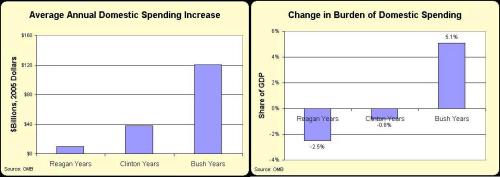
I make a similar point in this debate with Robert Reich, noting that  the burden of government spending was reduced as a share of economic output during the relatively prosperous Reagan years and Clinton years.

Dan Mitchell Debating Robert Reich on Keynesian Sequester Hysteria

Being a magnanimous person, I even told Robert he should take credit for the Clinton years since he was in the cabinet as Labor Secretary. Amazingly, he didn’t take me up on my offer.

Anyhow, these two charts show the stark contrast between the fiscal policy of Reagan and Clinton compared to Bush..

Reagan-Clinton-Bush Domestic Spending

And there’s lots of additional information comparing the fiscal performance of various presidents here, here, and here.

For more information on Reagan and Clinton, this video has the details.

Which brings us back to the original issue.

The Keynesians fear that a modest reduction in the growth of government (under the sequester, the federal government will grow $2.4 trillion over the next 10 years rather than $2.5 trillion) will somehow hurt the economy.

But government spending grew much slower under Reagan and Clinton than it has during the Bush-Obama years, yet I don’t think anybody would claim the economy in recent years has been more robust than it was in the 1980s and 1990s.

And if somebody does make that claim, just show them this remarkable chart (if they want to laugh, this Michael Ramirez cartoon makes the same point).

So perhaps the only logical conclusion to reach is that government is too big and that Keynesian economics is wrong.

I don’t think I’ll every convince Robert Reich, but hopefully the rest of the world can be persuaded by real-world evidence.

I shared a remarkable chart last year exposing Obama’s terrible record on job creation.

It showed that the economy enjoyed big employment increases during the Reagan and Clinton years, but it also revealed anemic data for the Obama years.

That’s not a surprise since Reagan was the most pro-freedom President since World War II and Clinton almost surely comes in second place.

Yes, Clinton did raise tax rates in his first year, but he put together a very strong record in subsequent years. He was particularly good about restraining the burden of government spending and overall economic freedom expanded during his reign.

He was no Reagan, to be sure, and the anti-government Congress that took power after the 1994 elections may deserve much of the credit for the good news during the Clinton years. Regardless, we had good economic performance during that period – unlike what we’ve seen during the Obama years.

Which makes this Michael Ramirez cartoon both amusing (in a tragic way) and economically accurate.

Obama v Reagan + Clinton

Since we’ve had relatively weak numbers for both jobs and growth this entire century, it would have been even better if the cartoon showed Bush and Obama both trying to raise the bar.

The real lesson is that big government is bad for jobs and growth, regardless of whether politicians have an “R” or “D” after their names.

P.S. Interestingly, now that the election is over, even the Washington Post is willing to publish charts confirming that Obama’s economic track record is miserable.

Related posts:

Ronald Reagan and the Founding Fathers

I really enjoyed this article. A Constitutional President: Ronald Reagan and the Founding By Edwin Meese III , Lee Edwards, Ph.D. , James C. Miller III and Steven Hayward January 26, 2012 Abstract: Throughout his presidency, Ronald Reagan was guided by the principles of the American founding, especially the idea of ordered liberty. In the opening of his first inaugural address in 1981, […]

March for Life March in Little Rock on Jan 20, 2013!!!Ronald Reagan’s videos and pictures displayed here on the www.thedailyhatch.org

Ronald Reagan was the greatest pro-life president ever. He appointed Dr. C. Everett Koop to his administration and Dr. Koop was responsible for this outstanding pro-life film below: I was thinking about the March for Life that is coming up on Jan 20, 2013 in Little Rock and that is why I posted this today. […]

Ronald Reagan’s pro-life tract

1/30/84 Part 1 of a speech to the National Religious Broadcasters. June 10, 2004, 10:30 a.m. Abortion and the Conscience of the Nation Ronald Reagan’s pro-life tract. EDITOR’S NOTE: While president, Ronald Reagan penned this article for The Human Life Review, unsolicited. It ran in the Review‘s Spring 1983, issue and is reprinted here with permission. The case […]

Ronald Reagan’s videos and pictures displayed here on the www.thedailyhatch.org

President Reagan, Nancy Reagan, Bill Clinton and Hillary Clinton attending the Dinner Honoring the Nation’s Governors. 2/22/87. Ronald Reagan is my favorite president and I have devoted several hundred looking at his ideas. Take a look at these links below: President Reagan and Nancy Reagan attending “All Star Tribute to Dutch Reagan” at NBC Studios(from […]

Ronald Reagan and Johnny Carson discussing Balanced Budget Amendment on “Tonight Show”

Ronald Reagan Talks About Balancing the Budget on “The Tonight Show” Uploaded by johnnycarson on Jul 30, 2011 Ronald Reagan talks about balancing the budget on “The Tonight Show” in 1975. _____________ Ronald Reagan was one of my favorite presidents. Mike Lee is one of my favorite lawmakers of today!!! Look at what he says about […]

Robert Bork and Ronald Reagan

I always liked both Robert Bork and Ronald Reagan. They had a lot in common. Lee Edwards noted concerning Bork and Reagan: Reagan’s most dramatic defeat came in 1987 when he nominated Judge Robert Bork to the Supreme Court.[xli] Bork’s confirmation became an ugly battle against liberal organizations like the American Civil Liberties Union, the […]

Ronald Reagan’s videos and pictures displayed here on the www.thedailyhatch.org

President Reagan, Nancy Reagan, Bill Clinton and Hillary Clinton attending the Dinner Honoring the Nation’s Governors. 2/22/87. Ronald Reagan is my favorite president and I have devoted several hundred looking at his ideas. Take a look at these links below: President Reagan and Nancy Reagan attending “All Star Tribute to Dutch Reagan” at NBC Studios(from […]

Abortion and the Conscience of the Nation:Ronald Reagan’s pro-life tract

Obama finds himself answering for a vote he made back in the Illinois state Senate. See Barack Obama’s exclusive interview with CBN New’s David Brody, and what he says about his views on abortion and the Born Alive Infant Protection Act. June 10, 2004, 10:30 a.m. Abortion and the Conscience of the Nation Ronald Reagan’s […]

Ronald Reagan Quotes

    Secret Service agents react after President Reagan is shot as he exits a side doorway of the Washington Hilton on March 30, 1981. A great moment in modern conservatism. 1980 Republican National Convention speech by Ronald Reagan. But there are advantages to being elected President. The day after I was elected, I had […]

100 years of the federal income tax

How Raising Taxes Will Not Balance the Budget: More Evidence

Published on Nov 15, 2012

Although it may seem counterintuitive, raising taxes on the rich does not actually increase the amount of taxes the government collects. How could this possibly be the case? According to Professor Antony Davies, it is because the many loopholes in federal income taxes, capital gains taxes, and many other taxes, enable people to partially avoid these taxes. Perhaps instead of discussing how to raise tax revenues, we should spend our energy simplifying the tax code. This would make it more difficult for people to avoid taxes and, Davies says, “The less time and money we spend trying to work around a complex tax code, the more time and money we will have available to put to more productive uses.”

Do you think that the tax code is too complicated? Let us know in the comments!

________________________

Sad day indeed 100 years ago.

What’s the worst thing about Delaware?

No, not Joe Biden. He’s just a harmless clown and the butt of some good jokes.

Instead, the so-called First State is actually the Worst State because 100 years ago, on this very day, Delaware made the personal income tax possible by ratifying the 16th Amendment.

Though, to be fair, I suppose the 35 states that already had ratified the Amendment were more despicable since they were even more anxious to enable this noxious levy (and Alabama was first in line, which is a further sign that Georgia deserved to win the Southeastern Conference Championship Game, but I digress).

Let’s not get bogged down in details. The purpose of this post is not to re-hash history, but to instead ask what lessons we can learn from the adoption of the income tax.

The most obvious lesson is that politicians can’t be trusted with additional powers. The first income tax had a top tax rate of just 7 percent and the entire tax code was 400 pages long. Now we have a top tax rate of 39.6 percent (even higher if you include additional levies for Medicare and Obamacare) and the tax code has become a 72,000-page monstrosity.

But the main lesson I want to discuss today is that giving politicians a new source of money inevitably leads to much higher spending.

Here’s a chart, based on data from the Office of Management and Budget, showing the burden of federal spending since 1789.

Since OMB only provides aggregate spending data for the 1789-1849 and 1850-190 periods, which would mean completely flat lines on my chart, I took some wild guesses about how much was spent during the War of 1812 and the Civil War in order to make the chart look a bit more realistic.

But that’s not very important. What I want people to notice is that we enjoyed a very tiny federal government for much of our nation’s history. Federal spending would jump during wars, but then it would quickly shrink back to a very modest level – averaging at most 3 percent of economic output.

Federal Spending 1789-2012

So what’s the lesson to learn from this data? Well, you’ll notice that the normal pattern of government shrinking back to its proper size after a war came to an end once the income tax was adopted.

In the pre-income tax days, the federal government had to rely on tariffs and excise taxes, and those revenues were incapable of generating much revenue for the government, both because of political resistance (tariffs were quite unpopular in agricultural states) and Laffer Curve reasons (high tariffs and excise taxes led to smuggling and noncompliance).

But once the politicians had a new source of revenue, they couldn’t resist the temptation to grab more money. And then we got a ratchet effect, with government growing during wartime, but then never shrinking back to its pre-war level once hostilities ended (Robert Higgs wrote a book about this unfortunate phenomenon).

The same thing happened in Europe. The burden of government spending used to be quite modest on the other side of the Atlantic, with outlays consuming only about 10 percent of economic output.

Once European politicians got the income tax, however, that also enabled a big increase is the size of the state.

But Europe also gives us a very good warning about the dangers of giving politicians a second major source of revenue.

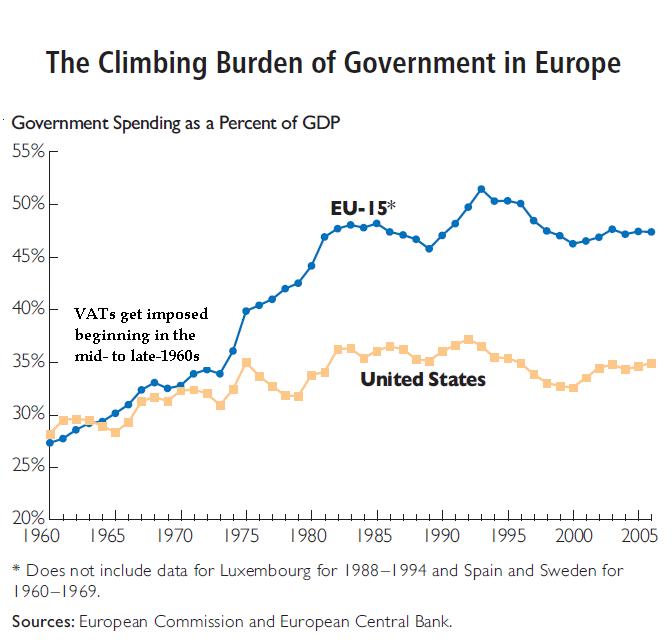
Here’s a chart I prepared for a study published when I was at the Heritage Foundation. You’ll notice from 1960-1970 that the overall burden of government spending in Europe was not that different than it was in the United States.

That’s about the time, however, that the European governments began to impose value-added taxes.

The rest, as they say, is history.

VAT and Govt Spending in EU

I’m not claiming, by the way, that the VAT is the only reason why the burden of government spending expanded in Europe. The Europeans also impose harsher payroll taxes and higher energy taxes. And their income taxes tend to be much more onerous for middle-income households.

But I am arguing that the VAT helped enable bigger government in Europe, just like the income tax decades earlier also enabled bigger government in both Europe and the United States.

So ask yourself a simple question: If we allow politicians in Washington to impose a VAT on top of the income tax, do you think they’ll use the money to expand the size and scope of government?

If it takes more than three seconds to answer that question, I suggest you emigrate to France as quickly as possible.

P.S. You probably won’t be surprised to learn that the crazy bureaucrats at the Paris-based OECD think the VAT is good for growth and jobs. Sort of makes you wonder why we’re subsidizing those statists with American tax dollars.

Sequester Cartoons from Dan Mitchell’s blog Part 4

I have put up lots of cartoons from Dan Mitchell’s blog before and they have got lots of hits before. Many of them have dealt with the economy, eternal unemployment benefits, socialism,  Greece,  welfare state or on gun control.

These sequester cartoons from Dan Mitchell’s blog have been great but today he has about 4 cartoons that are much more funny than the past ones. Obama’s scare tactics make for real funny cartoons.

Public finance experts are quite familiar with the budgetary shenanigans of cossetted government bureaucracies.

They even have terms to describe how agencies and departments try to manipulate outcomes by claiming that any requirement for fiscal restraint will necessitate cuts to the most politically popular parts of the budget.

  • The “fireman first principle” – Describes how local government bodies (often coordinating with local politicians) will claim that firemen will have to be laid off and/or firehouses will have to close if there is any budgetary discipline. You can replace firefighters with cops or teachers if you want. The key point is to divert attention from the countless ways that local governments waste money by focusing on the few things that voters actually care about.
  • The “Washington Monument syndrome” – Based on a real-world example during the 1970s of the National Park Service claiming it would have to shut down tourist access to popular Washington-area sites if it was subject to fiscal restraint, the modern-day equivalent is President Obama scaring people with hysterical assertions about threats to food safety and airline operations.

Thomas Sowell clearly understands this racket.

Back in my teaching days, many years ago, one of the things I liked to ask the class to consider was this: Imagine a government agency with only two tasks: (1) building statues of Benedict Arnold and (2) providing life-saving medications to children. If this agency’s budget were cut, what would it do? The answer, of course, is that it would cut back on the medications for children. Why? Because that would be what was most likely to get the budget cuts restored. If they cut back on building statues of Benedict Arnold, people might ask why they were building statues of Benedict Arnold in the first place.

Bingo. Bulls-eye. A perfect analysis of bureaucratic incentives and public-choice economics.

Sowell then describes what’s now happening in Washington.

The Obama administration is following the same pattern. The Department of Homeland Security, for example, released thousands of illegal aliens from prisons to save money — and create alarm. The Federal Aviation Administration says it is planning to cut back on the number of air traffic controllers, which would, at a minimum, create delays for airline passengers, in addition to fears for safety that can create more public alarm. …it serves Obama’s interest to maximize the damage and the public alarm, which he can direct against Republicans. President Obama has said that he would veto legislation to let him choose what to cut. That should tell us everything we need to know about the utter cynicism of this glib man.

The political cartoonists also are having a field day making fun of Obama’s silly demagoguery.

Let’s start with Michael Ramirez. You can see why he’s currently leading in the best-cartoonist poll.

Sequester Cartoon Ramirez 4

Nate Beeler also has a good contribution to the debate. The President is acting like the world is going to end because spending is going to be “slashed” by 1.2 percent, which means – gasp! – that spending will “only” grow by $2.4 trillion over the next 10 years.

Yet somehow Armageddon has not occurred.

Sequester Cartoon Beeler 4

Indeed, the worst possible outcome for Obama and the other statists is that people notice zero negative impact when spending is restrained.

This Steve Kelley cartoon is very appealing to me because it shows the President going after the sequester when the real problem is an excessive burden of government spending.

Sequester Cartoon Kelley 4

Last but not least, we have a very good Scott Stantis cartoon.

Sequester Cartoon Stantis 4

The Stantis cartoon is particularly insightful because the GOP has won the battle, but the war is not over.

As I noted yesterday, Obama will have several additional opportunities to undo the sequester savings.

Thomas Jefferson was right when he warned that “eternal vigilance is the price of liberty.”

P.S. You can enjoy more sequester cartoons here, here, and here.


Related posts:

Cartoons from Dan Mitchell’s blog that demonstrate what Obama is doing to our economy Part 2

Max Brantley is wrong about Tom Cotton’s accusation concerning the rise of welfare spending under President Obama. Actually welfare spending has been increasing for the last 12 years and Obama did nothing during his first four years to slow down the rate of increase of welfare spending. Rachel Sheffield of the Heritage Foundation has noted: […]

Cartoons from Dan Mitchell’s blog that demonstrate what Obama is doing to our economy Part 1

  I have put up lots of cartoons from Dan Mitchell’s blog before and they have got lots of hits before. Many of them have dealt with the economy, eternal unemployment benefits, socialism,  Greece,  welfare state or on gun control. I think Max Brantley of the Arkansas Times Blog was right to point out on 2-6-13 that Hillary […]

Great cartoon from Dan Mitchell’s blog on government moochers

I thought it was great when the Republican Congress and Bill Clinton put in welfare reform but now that has been done away with and no one has to work anymore it seems. In fact, over 40% of the USA is now on the government dole. What is going to happen when that figure gets over […]

Gun Control cartoon hits the internet

Again we have another shooting and the gun control bloggers are out again calling for more laws. I have written about this subject below  and on May 23, 2012, I even got a letter back from President Obama on the subject. Now some very interesting statistics below and a cartoon follows. (Since this just hit the […]

“You-Didn’t-Build-That” comment pictured in cartoons!!!

watch?v=llQUrko0Gqw] The federal government spends about 10% on roads and public goods but with the other money in the budget a lot of harm is done including excessive regulations on business. That makes Obama’s comment the other day look very silly. A Funny Look at Obama’s You-Didn’t-Build-That Comment July 28, 2012 by Dan Mitchell I made […]

Cartoons about Obama’s class warfare

I have written a lot about this in the past and sometimes you just have to sit back and laugh. Laughing at Obama’s Bumbling Class Warfare Agenda July 13, 2012 by Dan Mitchell We know that President Obama’s class-warfare agenda is bad economic policy. We know high tax rates undermine competitiveness. And we know tax increases […]

Cartoons on Obama’s budget math

Dan Mitchell Discussing Dishonest Budget Numbers with John Stossel Uploaded by danmitchellcato on Feb 11, 2012 No description available. ______________ Dan Mitchell of the Cato Institute has shown before how excessive spending at the federal level has increased in recent years. A Humorous Look at Obama’s Screwy Budget Math May 31, 2012 by Dan Mitchell I’ve […]

Funny cartoon from Dan Mitchell’s blog on Greece

Sometimes it is so crazy that you just have to laugh a little. The European Mess, Captured by a Cartoon June 22, 2012 by Dan Mitchell The self-inflicted economic crisis in Europe has generated some good humor, as you can see from these cartoons by Michael Ramirez and Chuck Asay. But for pure laughter, I don’t […]

Obama on creating jobs!!!!(Funny Cartoon)

Another great cartoon on President Obama’s efforts to create jobs!!! A Simple Lesson about Job Creation for Barack Obama December 7, 2011 by Dan Mitchell Even though leftist economists such as Paul Krugman and Larry Summers have admitted that unemployment insurance benefits are a recipe for more joblessness, the White House is arguing that Congress should […]

Get people off of government support and get them in the private market place!!!!(great cartoon too)

Dan Mitchell hits the nail on the head and sometimes it gets so sad that you just have to laugh at it like Conan does. In order to correct this mess we got to get people off of government support and get them in the private market place!!!! Chuck Asay’s New Cartoon Nicely Captures Mentality […]

2 cartoons illustrate the fate of socialism from the Cato Institute

Cato Institute scholar Dan Mitchell is right about Greece and the fate of socialism: Two Pictures that Perfectly Capture the Rise and Fall of the Welfare State July 15, 2011 by Dan Mitchell In my speeches, especially when talking about the fiscal crisis in Europe (or the future fiscal crisis in America), I often warn that […]

Cartoon demonstrates that guns deter criminals

John Stossel report “Myth: Gun Control Reduces Crime Sheriff Tommy Robinson tried what he called “Robinson roulette” from 1980 to 1984 in Central Arkansas where he would put some of his men in some stores in the back room with guns and the number of robberies in stores sank. I got this from Dan Mitchell’s […]

Gun control posters from Dan Mitchell’s blog Part 2

I have put up lots of cartons and posters from Dan Mitchell’s blog before and they have got lots of hits before. Many of them have dealt with the economy, eternal unemployment benefits, socialism,  Greece,  welfare state or on gun control. Amusing Gun Control Picture – Circa 1999 April 3, 2010 by Dan Mitchell Dug this gem out […]

We got to cut spending and stop raising the debt ceiling!!!

  We got to cut spending and stop raising the debt ceiling!!! When Governments Cut Spending Uploaded on Sep 28, 2011 Do governments ever cut spending? According to Dr. Stephen Davies, there are historical examples of government spending cuts in Canada, New Zealand, Sweden, and America. In these cases, despite popular belief, the government spending […]

Gun control posters from Dan Mitchell’s blog Part 1

I have put up lots of cartons and posters from Dan Mitchell’s blog before and they have got lots of hits before. Many of them have dealt with the economy, eternal unemployment benefits, socialism,  Greece,  welfare state or on gun control. On 2-6-13 the Arkansas Times Blogger “Sound Policy” suggested,  “All churches that wish to allow concealed […]

Taking on Ark Times bloggers on the issue of “gun control” (Part 3) “Did Hitler advocate gun control?”

Gun Free Zones???? Stalin and gun control On 1-31-13 ”Arkie” on the Arkansas Times Blog the following: “Remember that the biggest gun control advocate was Hitler and every other tyrant that every lived.” Except that under Hitler, Germany liberalized its gun control laws. __________ After reading the link  from Wikipedia that Arkie provided then I responded: […]

Taking on Ark Times bloggers on the issue of “gun control” (Part 2) “Did Hitler advocate gun control?”

On 1-31-13 I posted on the Arkansas Times Blog the following: I like the poster of the lady holding the rifle and next to her are these words: I am compensating for being smaller and weaker than more violent criminals. __________ Then I gave a link to this poster below: On 1-31-13 also I posted […]


Heritage Foundation says Arkansas would be “net payer” while NY would be “net saver” with medicaid expansion (editiorial cartoon included)

New York is the real winner in medicaid expansion  while Arkansas would lose out in the long run. The Arkansas Times has reported that Republican lawmakers were warming up to the idea of expansion recently.

The representatives and senators in Arkansas need to take a close look at both this article below and this editorial cartoon from Dan Mitchell’s blog.

_______________

Which is why 2014 is the “Year of the Snake” in more places than just China.

Obamacare Snake Cartoon

If you like Ramirez cartoons, you can see some of my favorites here, here, here, here, and here.

___________________

Drew Gonshorowski

March 5, 2013 at 1:28 pm

(0) 

The Medicaid expansion is touted by proponents of Obamacare as a “no-brainer.” While it is true that some states may see projected savings, it is erroneous to claim that this experience applies to every state.

Proponents predict that by expanding Medicaid states will be able to reduce payments to health care providers, such as hospitals, for uncompensated care. As a matter of fact, nationally, the opposite is true:

  • 40 of 50 states are projected to see increases in costs due to the Medicaid expansion.
  • The majority of states see costs exceed savings when the federal match rate is lowered after the first three years. From there, state costs continue to climb, dwarfing any projected savings.
  • State savings are concentrated in large states. New York is estimated to see $33 billion in savings, while Massachusetts is estimated to save $6 billion over 10 years. Because of the design of their current programs, these states have a unique opportunity to restructure their programs and transfer significant cost to the federal ledger. (continues below chart)

Of course, even these savings are highly speculative. They assume that uncompensated care costs actually decrease under a Medicaid expansion. Analysis of other states shows that this is not always the case. In fact, in Maine, uncompensated care continued to grow.

Furthermore, the assumed reductions in state supplemental payments to providers for uncompensated care are conditional on state lawmakers enacting explicit payment cuts. Depending on policies adopted by state lawmakers, those reductions could be higher or lower—or even zero—if a state does not enact payment cuts.

As Heritage analyst Ed Haislmaier points out:

Under Obamacare, it is even more implausible to assume states would be able to cut uncompensated care funding. That’s because any state payment cuts would have to be imposed on top of Obamacare’s federal payment cuts. Obamacare cuts federal Medicaid “Disproportionate Share Hospital” (DSH) funding by $18.1 billion and Medicare DSH funding by $22.1 billion over the years 2014–2020.

Therefore, Haislmaier predicts, “governors and state legislators should expect their state’s hospitals and clinics to lobby them for more—not less—state funding to replace cuts in federal DSH payments.”

The Medicaid expansion represents a massive increase in federal and state spending. Although some claim that states could experience savings, it is clear that this is the exception, not the rule. Expanding Medicaid will ultimately cost states in the long run.

See the breakdown for each of the 50 states and the District of Columbia here:

Methodology

A Kaiser Foundation/Urban Institute study from November 2012 projected the cost and coverage effects of the Medicaid expansion over the first nine years (2014–2022). Of particular interest to state lawmakers are the study’s projected changes in state expenditures associated with each state adopting the Medicaid expansion. However, the Kaiser/Urban study reports only the net effects for each state on a cumulative basis.

The Heritage microsimulation model was used to replicate the Kaiser/Urban study—applying the same assumptions and using the same data sources—but reported the results in disaggregated form.

Consistent with the Kaiser/Urban methodology:

  • Growth paths are estimated contingent on model-estimated enrollment growth for all 50 states. These growth paths are then benchmarked to the Urban/Kaiser aggregate results.
  • We model that adults between 100 percent and 138 percent of the federal poverty level already enrolled in Medicaid as part of an optional population are funded by the enhanced federal match rates for the expansion population. Additionally, states that currently provide limited Medicaid benefits to adults in the same income range also receive the expansion match rates for providing full Medicaid coverage to those adults. As a result of these assumptions, states with already low uninsured rates among the expansion population are projected to be “winners” under the Medicaid expansion.
  • We apply to state supplemental payments to providers for uncompensated care the Kaiser/Urban assumptions that state funding accounts for 30 percent of total funding and that state funding is eventually reduced by one-third.

It is important to note that the assumed reductions in state supplemental payments to providers for uncompensated care are not automatic but are conditional on state lawmakers enacting explicit payment cuts.

The estimates also do not reflect the fact that many states could achieve additional savings by reducing Medicaid income eligibility for adults to federally mandated minimum levels, thus making the affected individuals eligible instead for federally subsidized exchange coverage.

Both provider payment cuts and changes to income eligibility require separate policy decisions by state lawmakers. Furthermore, state lawmakers could make changes to either or both policies regardless of whether they elect to implement the Medicaid expansion.

Like the Urban Institute’s Health Insurance Policy Simulation Model, which was used to produce the original study, Heritage’s microsimulation model is comprised of data from the Current Population Survey and Medical Expenditure Panel Survey.

We got to starve the beast and not increase taxes (includes editorial cartoon)

Does Government Have a Revenue or Spending Problem?

People say the government has a debt problem. Debt is caused by deficits, which is the difference between what the government collects in tax revenue and the amount of government spending. Every time the government runs a deficit, the government debt increases. So what’s to blame: too much spending, or too little tax revenue? Economics professor Antony Davies examines the data and concludes that the root cause of the debt is too much government spending.

____________

We got to starve the beast and not increase taxes.

The statist agenda of ever-growing government requires more money going to Washington, which is why I think that proponents of limited government should do everything they can to block tax increases.

This is the “starve the beast” theory, and I’ve previously explained why I think it is a necessary part of any long-run strategy to restrain the burden of government spending.

He would never admit it, but Obama seems to agree, which is why he is dogmatically fixated on doing everything he can to seduce Republicans into supporting higher taxes.

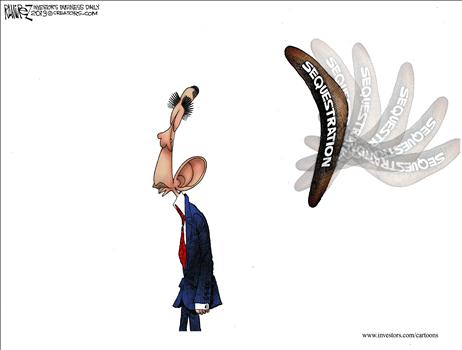
Obama Sequester Boomerang CartoonBut he miscalculated in thinking that the fiscal cliff tax hike somehow meant that he had permanently neutered the GOP, and he definitely goofed when he tried to use the sequester as a weapon to bully Republicans into another tax hike.

Ignoring the President’s hyperbole about the supposed catastrophic effects of a very modest reduction in the growth of the federal budget, Republicans have held firm.

And the President has suffered a painful political and policy defeat.

Here’s some of what was reported in The Hill about the President’s attitude.

The first months of President Obama’s second term are being built around a simple premise: No caving. …Obama is in an ultra-assertive mood, practically daring Republicans to defy his wishes. …Obama’s attitude is more akin to that of a general leading his forces into battle, confident that he can decimate the enemy. …On the sequester, for instance, Obama did little more than pay lip-service to the idea of a last-minute compromise to avert the package of cuts.

Well, Republicans did “defy his wishes” and it’s the worst possible outcome for the President. The growth of spending is being slowed and taxes are not going up.

Democrats on Capitol Hill also thought that the fiscal cliff tax hike would be a precedent for lots of future tax hikes. As reported by Politico, their analysis was misguided.

Democrats toasted the New Year’s fiscal cliff deal with the belief that they had set a crucial new precedent: Tax hikes would be part of any future deficit reduction package. Two months later, the champagne buzz is wearing off. …the exuberance expressed by many Democrats at the beginning of the year was misplaced. Efforts to avert the sequester never achieved liftoff, and Democrats are realizing that new tax revenues are off the table for the immediate future. …“We’ve tried everything we can,” Senate Majority Leader Harry Reid (D-Nev.) told reporters Thursday. “They will not budge on anything dealing with revenue.”

Byron York has the best analysis, explaining in his Washington Examiner column that Obama gambled and (at least so far) lost.

Nine months ago, Barack Obama likened his Republican opposition to an illness. If he could just defeat Mitt Romney, Obama said, then the illness might subside. “I believe that if we’re successful in this election — when we’re successful in this election — that the fever may break,” Obama told a fundraiser in Minneapolis last June. After Obama won re-election, there was extensive discussion among his supporters about whether the Republican “fever” would, in fact, break.

But this strategy appears to have boomeranged. Byron thinks that the White House is now in a weak position.

There was little speculation about whether something quite different might happen: Would determined GOP opposition break Obama’s fever?  That is, could Republicans weaken the president’s resolve to defeat the GOP and further raise taxes? That appears to be what has occurred, at least for the moment. …Friday morning, Obama seemed resigned to the possibility that he cannot win the further tax increases he seeks, and that after enlisting his entire administration in a campaign to frighten Americans about sequestration, the cuts have become a reality that he has to acknowledge.

While I’m glad the President goofed, I’m not under any illusion that winning a battle is the same thing as winning a war.

It’s quite possible that the modest sequester savings will be undone as part of the “continuing resolution” legislation to fund the federal government between March 27 and the rest of the fiscal year.

There will also be a debt limit fight later in the Spring, which will give proponents of bigger government another bite at the apple (though it’s a double-edged sword since advocates of limited government also can use the debt limit as a vehicle for reform).

And the President obviously won’t give up on his campaign for higher taxes. I worry that he’ll trick gullible GOPers into a tax hike at some point, either as part of a Trojan Horse tax reform or as part of a budget summit that produces something like Bowles-Simposon, a package of real tax hikes and illusory entitlement reforms.

But we can fight those battles down the road. Today, let’s enjoy the sweet smell of victory.

Sequester Cartoons from Dan Mitchell’s blog Part 3

I have put up lots of cartoons from Dan Mitchell’s blog before and they have got lots of hits before. Many of them have dealt with the economy, eternal unemployment benefits, socialism,  Greece,  welfare state or on gun control.

These sequester cartoons from Dan Mitchell’s blog have been great but today he has about 1/2 cartoons that are much more funny than the past ones. Obama’s scare tactics make for real funny cartoons.

I shared some sequester cartoons last month, but I didn’t think they hit the nail on the head.

As regular readers know, I want the message to be focused.

  1. The problem is spending, not deficits.
  2. Government is too big.
  3. The sequester is a good thing, albeit too small.
  4. Obama and the other politicians are engaging in hysterical hyperbole to protect special-interest spending.

I think that message is slowly sinking in, which is why I was much happier about the next batch of sequester cartoons.

Now we have an embarrassment of riches. Enjoy (and widely share) this set of cartoons.

We’ll start with Michael Ramirez, who uses pie charts to show how much bigger government is today and how the sequester is just crumbs.

Sequester Cartoon Ramirez 3

And here’s one from Ed Gamble showing the President engaging in fear tactics, though both Ramirez and Gamble are wrong about the “cuts.” The sequester cuts $85 billion of “budget authority,” but that translates into only $44 billion of “budget outlays.”

That’s just 1.2 percent of FY2013 spending. And remember that this means spending will still go up compared to FY2012 – as I explained in my most recent interview.

Sequester Cartoon Gamble 3

Here’s a cartoon from Gary Varvel, which is quite similar to an excellent cartoon he produced last year.

Sequester Cartoon Varvel 3

Here’s one from Glenn McCoy, poking fun at Obama for taking everything in stride…except when something happens to threaten the amount of waste in Washington.

Sequester Cartoon McCoy 3

I’m especially fond of this Glenn Foden cartoon since I’m sick and tired of the absurd hyperbole from the interest groups in DC.

Makes me wish I could bop a few Chicken Little characters on the head.

Sequester Cartoon Foden 3

Here’s one from A.F. Branco, which I also like because it simultaneously mocks Obama’s Keynesian mindset while showing that the real danger is an ever-rising burden of government spending.

Sequester Cartoon Branco 3

Last but not least, Lisa Benson makes fun of Obama for his never-ending efforts to instill panic.

Sequester Cartoon Benson 3

Let’s keep our fingers crossed that the sequester happens on March 1. Then, even if the Obama Administration deliberately tries to cause inconvenience for the American people, we’ll see that the world doesn’t come to an end.

Who knows, maybe that will even lead lawmakers to think they can impose some real fiscal restraint, as we’ve recently seen in countries like Estonia and in the 1990s by nations such as Canada and New Zealand.

Related posts:

Cartoons from Dan Mitchell’s blog that demonstrate what Obama is doing to our economy Part 2

Max Brantley is wrong about Tom Cotton’s accusation concerning the rise of welfare spending under President Obama. Actually welfare spending has been increasing for the last 12 years and Obama did nothing during his first four years to slow down the rate of increase of welfare spending. Rachel Sheffield of the Heritage Foundation has noted: […]

Cartoons from Dan Mitchell’s blog that demonstrate what Obama is doing to our economy Part 1

  I have put up lots of cartoons from Dan Mitchell’s blog before and they have got lots of hits before. Many of them have dealt with the economy, eternal unemployment benefits, socialism,  Greece,  welfare state or on gun control. I think Max Brantley of the Arkansas Times Blog was right to point out on 2-6-13 that Hillary […]

Great cartoon from Dan Mitchell’s blog on government moochers

I thought it was great when the Republican Congress and Bill Clinton put in welfare reform but now that has been done away with and no one has to work anymore it seems. In fact, over 40% of the USA is now on the government dole. What is going to happen when that figure gets over […]

Gun Control cartoon hits the internet

Again we have another shooting and the gun control bloggers are out again calling for more laws. I have written about this subject below  and on May 23, 2012, I even got a letter back from President Obama on the subject. Now some very interesting statistics below and a cartoon follows. (Since this just hit the […]

“You-Didn’t-Build-That” comment pictured in cartoons!!!

watch?v=llQUrko0Gqw] The federal government spends about 10% on roads and public goods but with the other money in the budget a lot of harm is done including excessive regulations on business. That makes Obama’s comment the other day look very silly. A Funny Look at Obama’s You-Didn’t-Build-That Comment July 28, 2012 by Dan Mitchell I made […]

Cartoons about Obama’s class warfare

I have written a lot about this in the past and sometimes you just have to sit back and laugh. Laughing at Obama’s Bumbling Class Warfare Agenda July 13, 2012 by Dan Mitchell We know that President Obama’s class-warfare agenda is bad economic policy. We know high tax rates undermine competitiveness. And we know tax increases […]

Cartoons on Obama’s budget math

Dan Mitchell Discussing Dishonest Budget Numbers with John Stossel Uploaded by danmitchellcato on Feb 11, 2012 No description available. ______________ Dan Mitchell of the Cato Institute has shown before how excessive spending at the federal level has increased in recent years. A Humorous Look at Obama’s Screwy Budget Math May 31, 2012 by Dan Mitchell I’ve […]

Funny cartoon from Dan Mitchell’s blog on Greece

Sometimes it is so crazy that you just have to laugh a little. The European Mess, Captured by a Cartoon June 22, 2012 by Dan Mitchell The self-inflicted economic crisis in Europe has generated some good humor, as you can see from these cartoons by Michael Ramirez and Chuck Asay. But for pure laughter, I don’t […]

Obama on creating jobs!!!!(Funny Cartoon)

Another great cartoon on President Obama’s efforts to create jobs!!! A Simple Lesson about Job Creation for Barack Obama December 7, 2011 by Dan Mitchell Even though leftist economists such as Paul Krugman and Larry Summers have admitted that unemployment insurance benefits are a recipe for more joblessness, the White House is arguing that Congress should […]

Get people off of government support and get them in the private market place!!!!(great cartoon too)

Dan Mitchell hits the nail on the head and sometimes it gets so sad that you just have to laugh at it like Conan does. In order to correct this mess we got to get people off of government support and get them in the private market place!!!! Chuck Asay’s New Cartoon Nicely Captures Mentality […]

2 cartoons illustrate the fate of socialism from the Cato Institute

Cato Institute scholar Dan Mitchell is right about Greece and the fate of socialism: Two Pictures that Perfectly Capture the Rise and Fall of the Welfare State July 15, 2011 by Dan Mitchell In my speeches, especially when talking about the fiscal crisis in Europe (or the future fiscal crisis in America), I often warn that […]

Cartoon demonstrates that guns deter criminals

John Stossel report “Myth: Gun Control Reduces Crime Sheriff Tommy Robinson tried what he called “Robinson roulette” from 1980 to 1984 in Central Arkansas where he would put some of his men in some stores in the back room with guns and the number of robberies in stores sank. I got this from Dan Mitchell’s […]

Gun control posters from Dan Mitchell’s blog Part 2

I have put up lots of cartons and posters from Dan Mitchell’s blog before and they have got lots of hits before. Many of them have dealt with the economy, eternal unemployment benefits, socialism,  Greece,  welfare state or on gun control. Amusing Gun Control Picture – Circa 1999 April 3, 2010 by Dan Mitchell Dug this gem out […]

We got to cut spending and stop raising the debt ceiling!!!

  We got to cut spending and stop raising the debt ceiling!!! When Governments Cut Spending Uploaded on Sep 28, 2011 Do governments ever cut spending? According to Dr. Stephen Davies, there are historical examples of government spending cuts in Canada, New Zealand, Sweden, and America. In these cases, despite popular belief, the government spending […]

Gun control posters from Dan Mitchell’s blog Part 1

I have put up lots of cartons and posters from Dan Mitchell’s blog before and they have got lots of hits before. Many of them have dealt with the economy, eternal unemployment benefits, socialism,  Greece,  welfare state or on gun control. On 2-6-13 the Arkansas Times Blogger “Sound Policy” suggested,  “All churches that wish to allow concealed […]

Taking on Ark Times bloggers on the issue of “gun control” (Part 3) “Did Hitler advocate gun control?”

Gun Free Zones???? Stalin and gun control On 1-31-13 ”Arkie” on the Arkansas Times Blog the following: “Remember that the biggest gun control advocate was Hitler and every other tyrant that every lived.” Except that under Hitler, Germany liberalized its gun control laws. __________ After reading the link  from Wikipedia that Arkie provided then I responded: […]

Taking on Ark Times bloggers on the issue of “gun control” (Part 2) “Did Hitler advocate gun control?”

On 1-31-13 I posted on the Arkansas Times Blog the following: I like the poster of the lady holding the rifle and next to her are these words: I am compensating for being smaller and weaker than more violent criminals. __________ Then I gave a link to this poster below: On 1-31-13 also I posted […]


Can the USA be saved?

I hope the USA can pull out of this debt trap we are in.

Since I routinely spread a message of doom and gloom about the ever-expanding welfare state and warn about the potential for European-style fiscal collapse, I guess I shouldn’t be surprised that I’ve received several emails asking me variants of this question: “Do you think the United States can be rescued?”

Or sometimes, I get questions that I think are somewhat related, such as “Doesn’t Washington drive you crazy” or “Why haven’t you given up?”

I’m not sure I’m good at introspection, but I’ll try to answer, and we’ll start with the main question and then deal with the secondary queries.

To be blunt, if I had to place a bet on the outcome, I think the United States will become a failed European-style welfare state. The burden of government spending already is far too high and our long-run outlook is terrible, as shown by these OECD and BIS numbers, and I don’t think the callow politicians in Washington will fix the problems because they rarely think past the next election cycle.

This doesn’t necessarily mean that we’ll have a Greek-style fiscal collapse. Perhaps we’ll simply descend into permanent stagnation, with anemic growth (at best) and widespread dependency and joblessness.

That being said, even though I would bet on a bad outcome, I think there’s a genuine opportunity to save the country.

My job: Putting my finger in the dyke, trying to hold back the flood of big government

No, I’m not talking about creating a libertarian Nirvana, with the federal government consuming only three percent of economic output. But I think we can at least hold the line and prevent government from becoming bigger than it is today. Sort of a watered-down version of Mitchell’s Golden Rule.

The key is the right kind of entitlement reform. Our long-run fiscal nightmare is entirely the result of programs such as Social Security, Medicare, and Medicaid, so the solution is obvious.

But is it achievable?

As I’ve already indicated, I wouldn’t bet on it. We definitely know there won’t be any good reforms for the next four years, but let me give you a plausible scenario for what might happen beginning in 2017.

We’ll start with the fact that the House of Representatives already voted for Medicaid reform and Medicare reform as part of the Ryan budget in 2011 and 2012. We also know that Republicans retained the House in the most recent election and there seems to be a political consensus that voting to fix the healthcare entitlements was not a political liability.

There was no Social Security reform in Ryan’s budget, but we also know that George W. Bush (for all his other faults) supported personal accounts in 2000 and 2004 and didn’t suffer any political backlash. Indeed, personal accounts still seem to be reasonably popular.

With this in mind, I think it may be possible to fix entitlement programs in 2017 assuming that the 2014 and 2016 elections lead to pro-reform lawmakers in the House, Senate, and White House.

That may not be likely, but it’s definitely possible.

My job, simply stated, is to help inform and educate people so that the climate is favorable to reform.

Which brings me to the secondary questions about whether Washington drives me crazy and whether I should give up.

The short answer is that I’m intellectually pessimistic but operationally optimistic.

In other words, my brain tells me that things will probably deteriorate but my heart tells me that this is a battle worth fighting.

So, yes, Washington does drive me crazy. It is both an immoral town and an amoral town, pervasively corrupt and filled with people who seem to think that it is perfectly okay to steal so long as it happens through the legislative or regulatory process.

And, yes, I may decide to give up if something really horrible happens, such as adoption of a value-added tax. Giving politicians a big new source of revenue, after all, would cripple any incentive for fiscal restraint.

But until that happens, I think I’m very lucky that I get to wake up every day and be part of the Cato Institute’s fight to preserve (and restore) American exceptionalism.

P.S. This is the second “Question of the Week” in two days, but I neglected to answer a question last week, so I had to catch up and get back on track. Yesterday’s question and answer generated a lot of interest, so I hope this one is equally thought-provoking.

Gun control posters from Dan Mitchell’s blog Part 5

Bath School

The rear of the Bath School after the May 18, 1927 bombing.
Wikimedia Commons

___________

I have put up lots of cartoons and posters from Dan Mitchell’s blog before and they have got lots of hits before. Many of them have dealt with the economy, eternal unemployment benefits, socialism,  Greece,  welfare state or on gun control.

Did you know the biggest killing in school history was in 1927, at an elementary school in Bath, Mich. A school board member named Andrew Kehoe wired the building with dynamite and set it off in the morning of May 18. Kehoe’s actions killed 45 people, 38 of whom were children. The method of killing was not a gun but gun control is popular as ever these days.

I asked yesterday for readers to weigh in on why they support (or don’t support) the Second Amendment. The poll is getting lots of responses, though some folks have complained that I should have included more answers, such as “To protect the rights of hunters.”

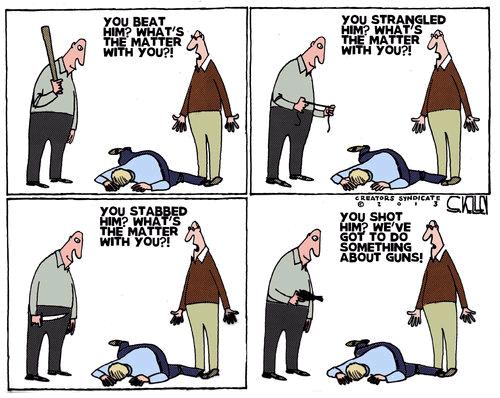
Gun Control cartoon club knifeAnd I even had a few left-wing friends tell me I should have included more options for them, such as “The Second Amendment doesn’t mean military-style weapons” or “The Second Amendment doesn’t guarantee individual gun ownership.”

Speaking of our friends on the left, Vice President Joe Biden is overseeing an Administration effort to concoct new gun laws. In the interests of being helpful, I suggest the Veep’s team look at these four videos.

Related posts:

Taking on Ark Times bloggers on the issue of “gun control” (Part 3) “Did Hitler advocate gun control?”

Gun Free Zones???? Stalin and gun control On 1-31-13 ”Arkie” on the Arkansas Times Blog the following: “Remember that the biggest gun control advocate was Hitler and every other tyrant that every lived.” Except that under Hitler, Germany liberalized its gun control laws. __________ After reading the link  from Wikipedia that Arkie provided then I responded: […]

Taking on Ark Times bloggers on the issue of “gun control” (Part 2) “Did Hitler advocate gun control?”

On 1-31-13 I posted on the Arkansas Times Blog the following: I like the poster of the lady holding the rifle and next to her are these words: I am compensating for being smaller and weaker than more violent criminals. __________ Then I gave a link to this poster below: On 1-31-13 also I posted […]

Taking on Ark Times bloggers on the issue of “gun control” (Part 1) “Bill Clinton responsible some for Ft Hood gun control policy?”

Will “CARRYING HANDGUN IS PROHIBITED” poster work? Dan Mitchell of the Cato Institute on gun control On 1-13-13 on the Arkansas Times Blog the person with the username “ArkDemocrat” stated, “I visited a church in another state that allows guns, and there was a sign similar to the “No Smoking” signs (i.e. smoking cigarette with […]

Great gun control posters from Dan Mitchell’s blog

Poster for November 2008 benefit for Pressly family, held at Peabody Hotel in Little Rock. ______________ Max Brantley of the Ark Times Blog often attacks those on my side of the gun control debate and that makes me argue even harder for the 2nd amendment. Several months ago Lindsey Miller and Max Brantley were talking […]

Funny gun control posters!!!

I have posted some cartoons featured on Dan Mitchell’s blog before and they are very funny. An Amusing Look at Gun-Free Zones September 26, 2012 by Dan Mitchell I’ve shared a very clever Chuck Asay cartoon about gun-free zones, so let’s now enjoy four posters on the topic. Let’s begin with a good jab at one […]

There is no safety crisis in schools as far as mass shootings go!!!

The recent killing by a mad gunman in CT is not indicating a trend. School killings have gone down and probably peaked in 1929. Nick Gillespie reported in the below video, “Across the board, schools are less dangerous than they used be. Over the past 20 years, the rate of theft per 1,000 students dropped […]

The Atlantic’s Jeffrey Goldberg abandons his liberal friends on gun control.

Pretty shocking admissions from the liberal Jeffrey Goldberg on gun control. An Honest Liberal Writes about Gun Control December 16, 2012 by Dan Mitchell I wrote earlier this month about an honest liberal who acknowledged the problems created by government dependency. Well, it happened again. First, some background. Like every other decent person, I was horrified […]

Gun control does not make since unless you suspend your reasoning ability

Despite what Max Brantley of the Arkansas Times Blog (1-9-13) would have you believe gun control does not make since unless you suspend your reasoning ability. There are so many examples that show how silly gun control is. Mocking Gun Control Fanatics October 18, 2012 by Dan Mitchell Last month, I shared some very amusing images […]

Gun control arguments very logical?

It seems to me that most of the gun control arguments I have heard are not very logical. Deciphering How Statists Think about Gun Control September 9, 2012 by Dan Mitchell Even though I don’t own that many guns, I’m an unyielding supporter of the 2nd Amendment. Indeed, I use gun control as a quick and […]

Charlie Collins versus Max Brantley on Gun Control

John Stossel report “Myth: Gun Control Reduces Crime After this horrible shooting in the school the other day it seems the gun control debate has fired up again.  Max Brantley of the Arkansas Times jumped on Charlie Collins concerning his position on concealed weapons but I think that would lower gun crimes and not raise […]