Category Archives: Economist Dan Mitchell

Dan Mitchell article Bigger Government Will Reduce Living Standards According to New CBO Research

Bigger Government Will Reduce Living Standards According to New CBO Research

I’ve been warning that the United States should not copy Europe’s fiscal policy, largely because living standards are significantly lower in nations with large welfare states.

That’s true if you look at average levels of consumption in different nations, but the most compelling data is the fact that lower-income people in the United States generally enjoy living standards that are equal to or even higher than those for middle-class people in most European countries.

A bigger burden of government is not just a theoretical concern. President Biden has already pushed through a $1.9 trillion spending bill that includes some temporary provisions – such as per-child handouts – that, if made permanent, could add several trillion dollars to the burden of government spending.

And the White House has signaled support for $3 trillion of additional spending for items such as infrastructure, green energy, and other boondoggles.

This doesn’t even count the cost of other schemes, such as the “public option” that would strangle private health insurance and force more people to rely on an already-costly-and-and bankrupt government program.

So what will it mean for America if our medium-sized welfare state morphs into a European-style large welfare state?

The answer to that question is rather unpleasant, at least if some new research from the Congressional Budget Office is any indication. The study, authored by Jaeger Nelson and Kerk Phillips, considers the impact on growth based on six different scenarios (based on how much the spending burden increases and what taxes are increased).

If permanent spending is financed by new or increased taxes, then those taxes influence people’s decisions about how much to work and save. Those decisions then affect how much the economy produces and businesses invest and, ultimately, how much people can consume. Different types of taxes have different economic effects. Taxes on labor income reduce after-tax wages, so they reduce the return on each additional hour worked. …Higher taxes on capital income, such as dividends and capital gains, lower the average after-tax rate of return on private wealth holdings (or the return on investment), which reduces the incentive to save and invest and leads to reductions in saving, investment, and the capital stock. …we compare the effects of raising additional revenues through three illustrative tax policies: a flat tax on labor income, a flat tax on all income (including both labor and capital income), and a progressive tax on all income. The additional revenues generated by these policies are in addition to the revenues raised by taxes that already exist and are used to finance two specific increases in government spending. The two increases in government spending are set to 5 percent and 10 percent of GDP in 2020.

Here are some of the key results, as illustrated by the chart.

The least-worst result (the blue line) is a decline in GDP of about 3 percent, and that happens if the spending burden expand by 5-percentage points of GDP and is financed by a flat tax.

The worst-worst result (dashed red line) is a staggering decline in GDP of about 10 percent, and that happens if the spending burden climbs by 10-percentage points and is financed by a progressive tax.
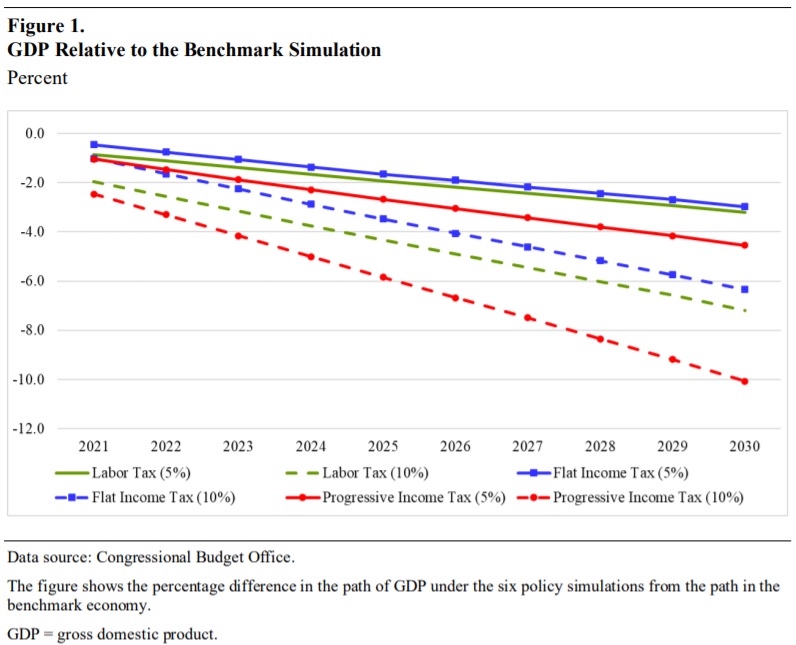
Here’s some additional analysis, including a description of why progressive taxes impose the most damage.

This paper shows that flat labor and flat income tax policies have similar effects on output; labor taxes reduce the labor supply more, and income taxes reduce the capital stock more. For all three policies, the decline in income contracts the tax base considerably over time. As a result, to continuously generate enough revenues to finance the increase in government spending in each year, tax rates must steadily increase over time to account for the decline in the tax base. Moreover, labor and capital taxes put upward pressure on interest rates by reducing the capital-to-labor ratio over time… The largest declines in economic activity among the financing methods considered occur with the progressive tax on all income. Those declines occur because high-productivity workers reduce their hours worked and because higher taxes on asset income reduce the incentive to save and invest relatively more than under the two flat taxes.

There’s lots of additional information in the study, but I definitely want to draw attention to Table 4 because it shows that lower-income people will suffer big reductions in living standards if there’s an increase in the burden of government spending (circled in red).
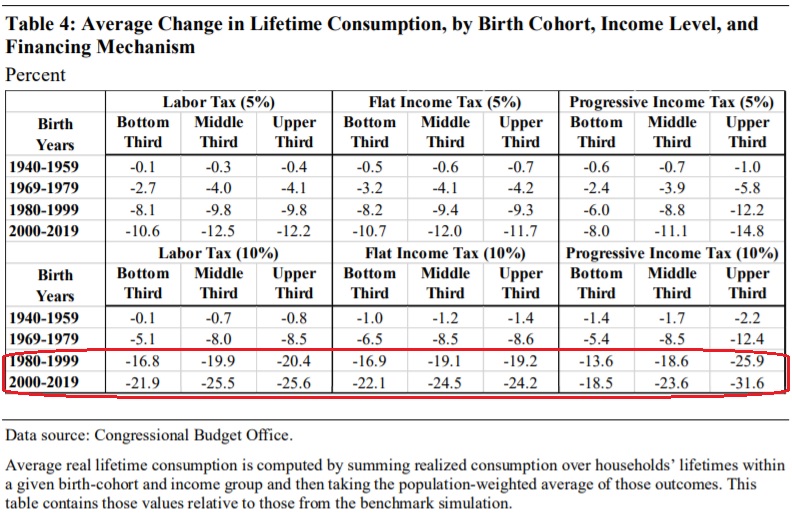
What makes these results especially remarkable is that the authors only look at the damage caused by higher taxes.

Yet we know from other research that the economy also will suffer because of the higher spending burden. This is because of the various ways that growth is reduced when resources are diverted from the productive sector to the government.

For background, here’s a video on the theoretical reasons why government spending hinders growth.

 —

P.S. The CBO study also points out that financing new spending with a value-added tax wouldn’t avert economic damage.

…by reducing the cost of time spent not working for pay relative to other goods, a consumption tax could reduce hours worked through a channel like that of a tax on labor.

For what it’s worth, even the pro-tax International Monetary Fund agrees with this observation.

P.P.S. It’s worth noting that the CBO study also shows that young people will suffer much more than older people.

…older cohorts, on average, experience smaller declines in lifetime consumption than younger cohorts

Which raises an interesting question of why millennials and Gen-Zers don’t appreciate capitalism and instead are sympathetic to the dirigiste ideology that will make their lives more difficult.

In One Image, Everything You Need to Know about Government Intervention

While I freely self-identify as a libertarian, I don’t think of myself as a philosophical ideologue.

Instead, I’m someone who likes digging into data to determine the impact of government policy. And because I’ve repeatedly noticed that more government almost always leads to worse outcomes, I’ve become a practical ideologue.

In other words, when looking at at an issue, I now have a default assumption that government is going to be the problem, not the solution.

I think more people will share my viewpoint if they peruse this chart from Mark Perry.

It shows changes in prices for selected goods and services over the past 21 years, and the inescapable conclusion (as I noted when writing about the 2014 version of his chart) is that we get higher relative prices in sectors where there’s the most government intervention.

Especially healthcare and higher education.
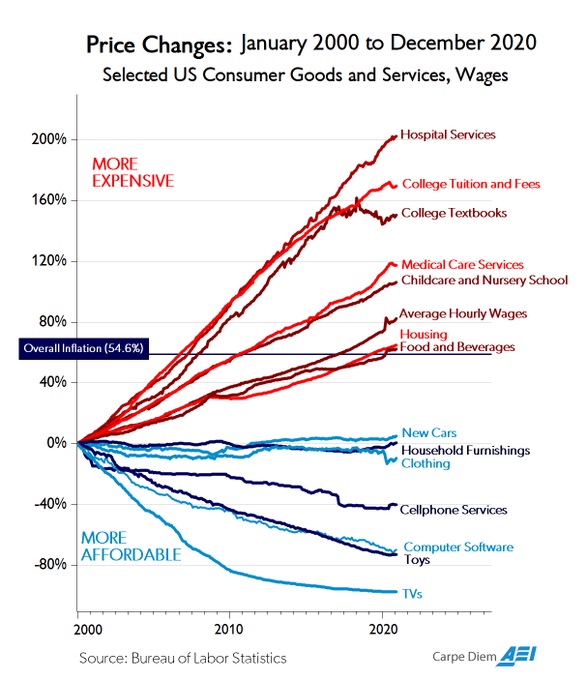
By contrast, we see falling relative prices (and sometimes falling absolute prices!) in sectors where there is little or no government intervention.

Here’s some of Mark’s description of what we can learn from his chart.

I’ve updated the chart above with price changes through the end of last year. During the most recent 21-year period from January 2000 to December 2020, the CPI for All Items increased by 54.6% and the chart displays the relative price increases over that time period for 14 selected consumer goods and services, and for average hourly wages.…Various observations that have been made about the huge divergence in price patterns over the last several decades… The greater (lower) the degree of government involvement in the provision of a good or service the greater (lower) the price increases (decreases) over time, e.g., hospital and medical costs, college tuition, childcare with both large degrees of government funding/regulation and large price increases vs. software, electronics, toys, cars and clothing with both relatively less government funding/regulation and falling prices.

By the way, I can’t resist also calling attention to Mark’s data on what’s happened over time to prices for various health care services and procedures.

We find that prices have skyrocketed in areas of the healthcare sector where government plays a big role, especially hospital care.

By contrast, prices have been steady (or even falling!) in areas of the healthcare sector where competitive markets are allowed to operate, most notably for cosmetic procedures.

It’s almost as if it makes sense to have a default assumption that government is the problem rather than the solution.

P.S. While the data in Mark’s chart tell a depressing story about the harmful effect of government intervention, he shares one bit of good news in his article.

The annual increase in college tuition and fees of only 1.4% last year was the smallest annual increase in the history of the CPI for college tuition and fees going back to 1978, and the only annual increase ever below 2%. That increase is far below the average annual increase in college tuition of nearly 7% over the last 42 years. So perhaps the “higher education bubble” is finally starting to show signs of deflating?

I hope he’s right, but worry he’s wrong.

P.P.S. Sadly (but predictably), some people seem to thinkgovernment-caused price increases are a reason to support more government intervention.

How are we going to attack the healthcare costs in this country? 1st, we raise deductibles and 2nd, we attack the “Third Party” payment party.

If people have to pay directly for a large part of their healthcare costs then they will be more frugal when they can.

The 4 Ways to Spend Money by Milton Friedman

Uploaded by on Aug 26, 2006

1. You spend your own money on yourself.
2. You spend your own money on someone else.
3. You spend someone else’s money on yourself.
4. You spend someone else’s money on someone else.

___________

Milton Friedman on the four ways you can spend money

Jason Fried

Jason Fried wrote this on / 43 comments

  1. You can spend your own money on yourself. When you do that, why then you really watch out what you’re doing, and you try to get the most for your money.
  2. You can spend your own money on somebody else. For example, I buy a birthday present for someone. Well, then I’m not so careful about the content of the present, but I’m very careful about the cost.
  3. I can spend somebody else’s money on myself. And if I spend somebody else’s money on myself, then I’m sure going to have a good lunch!
  4. I can spend somebody else’s money on somebody else. And if I spend somebody else’s money on somebody else, I’m not concerned about how much it is, and I’m not concerned about what I get.

Via Joshua Kaufman.

Jason Fried wrote this on Mar 03 2010 There are 43 comments.

Jason Fried

About Jason Fried

Jason co-founded 37signals back in 1999. He also co-authored REWORK, the New York Times bestselling book on running a “right-sized” business. Co-founded, co-authored… Can he do anything on his own?

Read all of Jason Fried’s posts, and follow Jason Fried on Twitter.

_______________

I like to think that very few people despise Obamacare more than me.

I don’t like Obamacare because it’s a fiscal boondoggle.

I don’t like Obamacare because it’s bad healthcare policy.

I don’t like Obamacare because it generated an embarrassingly bad decision by the Supreme Court.

I don’t like Obamacare because it is driving people out of the labor force and into government dependency.

I don’t like Obamacare because it has increased corruption in Washington.

And I don’t like Obamacare because it further enriches and empowers Washington’s political class.

But I also like being honest and that means I’m willing to acknowledge that there’s one small part of Obamacare that will have a positive impact.

More specifically, the so-called Cadillac tax on expensive employer-provided health plans will slightly reduce the distortion in the tax code that encourages over-insurance and exacerbates the healthcare system’s pervasive third-party payer problem.

Indeed, we’re seeing some signs of this already, even though the tax preference isn’t capped until 2018. Here are some excerpts from a story published by Fox News, starting with a description of the law.

…companies desperate to avoid a 40 percent ObamaCare “Cadillac tax” are finding ways to shift the costs to workers. The so-called “Cadillac tax,” now four years away, will affect health plans that spend more than $10,200 per worker. “The excise tax, when it hits in 2018, will affect both employers and employees,”said Brian Marcotte, president of the National Business Group on Health.

Allow me to make an important correction before sharing other parts of the story.

Companies aren’t shifting costs to workers. The money currently spent on health insurance policies is part of total employee compensation.

Think of it this way. If a company hires you for a salary of $50,000 and also includes a $10,000 health insurance policy, what’s your total compensation?

If you give an answer other than $60,000, you’re either very bad at math or you have the logic skills of a politician.

So the story should have stated that the Cadillac tax is merely making workers more aware of costs that already exist.

Thanks for letting me vent. Now back to our main point, which is that the Cadillac tax discourages overinsurance, and this is already leading to some positive changes in the marketplace.

Employees will get incentives to reduce costs through such arrangements as wellness programs, including losing weight or stopping smoking. Meanwhile, employers are shifting workers into plans with higher deductibles, just as ObamaCare does in the health care exchanges, and using health savings accounts to help defray the costs.

I’m particularly happy that employers and employees are shifting to plans with higher deductibles. As I’ve explained before, health insurance should cover large, unanticipated costs, such as the onset of cancer or getting injured in a car wreck.

But it shouldn’t cover annual checkups, elective surgery, and other routine and/or predictable expenses.

And we have one other bit of good news. The tax isn’t going to raise nearly as much money as the politicians wanted!

The “Cadillac tax” was originally intended to take effect sooner, but unions and other groups convinced officials to delay it until 2018, reducing the anticipated income from $137 billion to $80 billion over ten years. But many analysts predict it will be far less than that. Henry Aaron of the Brookings Institution said, before then, it’s expected that most of the businesses that offer that form of insurance will back off and make the insurance less generous, so the tax won’t bite.” …if employers are able to avoid it and less than expected is collected, ObamaCare could fall tens of billions short in paying for itself as promised.

I should hasten to add, by the way, that I’m glad that Obamacare isn’t paying for itself since that simply means lots of taxes to accompany all the additional spending.

I’d be even happier, of course, if we could figure out how to get rid of all the spending as well.

Just in case folks are thinking I’ve gone soft, let’s close today’s post with some humor directed at the rest of Obamacare.

Since the IRS is a big part of Obamacare, here’s a particularly good bumper sticker that shares a line with the above poster.
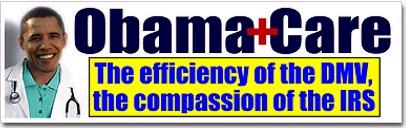
Here’s a poster mocking the delightful fiscal impact of the law.

Though whoever put this together should have been careful of using The Joker.

I like this next poster since it highlights how politicians have exempted themselves from the law.

Last but not least, here’s Dr. Obama making a cameo appearance.

Ah, the IRS shows up again. Do you sense a theme?

And don’t forget the IRS bureaucrats want to be exempt from the law as well.

P.S. If you’re a glass-one-tenth-full person, here’s some other good news about Obamacare.

________________

To be fair here is the opposite point of view from the Huffington Post:

Finally, A Senator In A Tough Re-Election Fight Bets On Obamacare

The Affordable Care Act, in its brief time on this earth, has endured its share of storm and stress. The bungled rollout of the federal online interface cost proponents lots of political capital. There have been high-wire legal challenges to surmount. While public approval of the law’s ends remains steadily high, the popularity of the law itself is often recorded as lacking. There have been uneasy periods for Obamacare’s chief proponents as they’ve waited for enrollment milestones to be reached and rate-hike hysteria to be put to bed. (There’s recent news on that front, actually.) And as the law promises so much, over such a long time frame, there will be more uneasy periods to endure for the lawmakers who put their stamp on the reform.

But the simple fact is that some lawmakers voted for Obamacare and some voted against it, and there’s only so far any of them can run from their decision. That’s why I’ve had the occasion to talk about “the Obamacare bet.” The bill’s opponents have largely settled on a claim: The law is going to fail and their admonitions against it will be proven wise and correct. The bill’s supporters should go ahead and stake the opposite claim. Many of those who supported the bill, however, have been reluctant to go “all in” on the decision they made. Especially among those who voted for the law and have since found themselves in a tough electoral race.

Today, however, comes a change. As Greg Sargent reports over at The Plum Line, Sen. Mark Pryor (D-Ark.) — currently in a tough re-election race against his Republican opponent, Rep. Tom Cotton — is up with a new ad in which he heralds his yes vote on the Affordable Care Act. You can watch the spot and read the transcript below. While Pryor doesn’t exactly go “all in,” he lays more of his chips on the felt.

DAVID: When Mark was diagnosed with cancer, we thought we might lose him.

MARK: My family and my faith helped me through the rough times.

DAVID: But you know what? Mark’s insurance company didn’t want to pay for the treatment that ultimately saved his life.

MARK: No one should be fighting an insurance company while you’re fighting for your life. That’s why I helped pass a law that prevents insurance companies from canceling your policy if you get sick or denying coverage for pre-existing conditions.

(David, by the way, is Mark’s dad as well as a former senator from and governor of Arkansas.)

Now Mark Pryor’s ad could have been a bit bolder. You’ll note that nowhere does he say the words “Obamacare” or “Affordable Care Act,” just that he “pass[ed] a law.” Of course, he does make mention of the law’s most popular features — it prevents people from getting kicked off plans when the time comes to avail themselves of their coverage, and it ends the practice of denying coverage for pre-existing conditions. It’s hard to imagine voters tolerating a return to the status quo ante, which is one of the reasons that it’s been so devilish for the law’s opponents to craft an alternative.

Pryor may have buried the lead in this ad, in fact. As Gallup reported earlier this month, Arkansas leads “all other states in the sharpest reductions in their uninsured rate among adult residents since the healthcare law’s requirement to have insurance took effect at the beginning of the year.”

Per Sargent:

Republicans will undoubtedly cast this as an acknowledgment that their attacks on Pryor over the law are working and could no longer be ignored. They’ll argue Pryor is, in desperation, using his faith and personal experience as a shield against those attacks. But this misses what’s really going on here. This ad is actually coming at a point where there are signs the anti-Obamacare fires are cooling somewhat. GOP advertising against the law has fallen off sharply, and is surprisingly low in Arkansas.

This is correct. As Bloomberg News’ Heidi Pryzbyla reported earlier this week, Republicans have cut way back on on ads that attack Obamacare, in “a sign that the party’s favorite attack against Democrats is losing its punch.” Pryzbyla continues:

The shift — also taking place in competitive states such as Arkansas and Louisiana — shows Republicans are easing off their strategy of criticizing Democrats over the Affordable Care Act now that many Americans are benefiting from the law and the measure is unlikely to be repealed.

“The Republican Party is realizing you can’t really hang your hat on it,” said Andrew Taylor, a political science professor at North Carolina State University. “It just isn’t the kind of issue it was.”

There is a good reason for this shift. As Matt Yglesias pointed out back in June, the “phony Obamacare debate” — the one that broadly alleged that death panels existed, that the fubar launch of the federal website was the law’s death knell, that enrollment numbers would be way off target — has run its course, leaving only the most fundamental debate of all:

[Obamacare] is a large-scale effort to improve living standards for people in the bottom half of the income distribution by giving them additional economic resources. One of America’s political parties doesn’t like that idea in any non-health context and they don’t like it for health care either. They think the money it costs to provide those subsidies should be taken away, and it should be given to high-income households in the form of tax cuts.

This is an excellent and important policy debate to have. One of the great ideological issues not just of our time and place, but of democratic politics across eras and countries. Should economic resources be distributed more equally or less equally?

Since Yglesias wrote that piece, we’ve seen a brief return to the “phony” debate, thanks to a pair of judges on the D.C. Circuit appeals court, who issued a ruling in the Halbig v. Burwell case contending that (to quote Simon Maloy in Salon) “a single poorly worded snippet of the Affordable Care Act invalidates subsidies for people who purchased health coverage through the federal exchanges.” As Maloy inventively points out, this is a hilariously bad-faith argument to make, akin to George Costanza’s “Moops” argument in “Seinfeld”:

Beyond that, however, we are ultimately left with the discussion that Yglesias mentions as the real underlying debate: whether it is right and proper to redistribute money from the top to the bottom so that those on the lower rungs of the economic ladder can live and work longer without going into catastrophic debt.

This argument’s signature virtue is that — unlike all the “death panels” and doom-saying — it is, legitimately, a good-faith argument. Which may cause one to wonder: Why has it taken so long to burn off all the bad-faith arguments and get down to the real bone of contention? I’d posit that arguing that poor people aren’t morally fit enough to deserve health insurance lacks a certain salability outside the Ayn Rand set.

With that in mind, you might think it’s strange that so many of Obamacare’s proponents have seemed reluctant to take “the Obamacare bet.” I agree! It’s strange. From my perspective, the die has long been cast, so lawmakers who affirmed the bill with their vote may as well own it. Pryor’s ad suggests that perhaps those lawmakers long deemed to be vulnerable due to their votes on the Affordable Care Act may be coming around to this position.

None of this should cause you to expect some sort of sea change in the overall fundamentals of the 2014 election. The GOP is still in great shape for the midterms, and they may even discover that they don’t need an anti-Obamacare blitz to win in November. But that’s really just an even better reason for vulnerable lawmakers who supported the Affordable Care Act to put some sustained ballyhoo behind their decision to vote for the law. Win or lose, may as well remind people where you stood. Pryor’s effort is a lot bolder than most.

[Would you like to follow me on Twitter? Because why not?]

Related posts:

Michael F. Cannon of the Cato Institute takes a look at Obamacare and the Halbig v. Burwell decision!!!

___________ Halbig, King and ObamaCare (Michael F. Cannon) Published on Jul 22, 2014 Two federal circuit courts have now ruled on ObamaCare’s health insurance exchanges and have arrived at different conclusions. Michael Cannon, one of the chief architects of this legal challenge, explains what the rulings mean and what’s in store for the future health […]

The best video I have ever seen on Obamacare’s lies about Medicaid!!!!

Arkansas’ own Nick Horton featured on Dan Mitchell’s blog!!! Below is the best video I have ever seen on Obamacare’s lies about Medicaid!!!! An Under-Appreciated Victory over Obamacare July 14, 2014 by Dan Mitchell Let’s enjoy some semi-good news today. We’ve discussed many times why Obamacare is bad news, whether we’re looking at it from […]

Obamacare increased government spending by expanding Medicaid and big subsidies for private insurance and it will bankrupt country eventually!!!

_______________ Obamacare increased government spending by expanding Medicaid and big subsidies for private insurance and it will bankrupt country eventually!!! The Hidden Economic Damage of Obamacare June 25, 2014 by Dan Mitchell Obamacare resulted in big increases in the fiscal burden of government (ironically, it would be even worse if Obama hadn’t unilaterally suspended parts of […]

Obamacare will explode the budget and we must eliminate it!!!

________ Obamacare will explode the budget and we must eliminate it!!! Obamacare is Bad News for Your Wallet Today and Worse News for Your Wallet Tomorrow July 8, 2014 by Dan Mitchell I wrote a few weeks ago about the hidden economic damage of Obamacare, particularly the harm to the job market. Today, let’s get further […]

Obama keeps putting off Obamacare like he was a king!!!!

_________ Obama keeps putting off Obamacare like he was a king!!!! Some of the cartoons below point this out. Dan Mitchell always has great posts about the issues that I care about and he does a good job of picking out editorial cartoons that are very funny too. I really do miss Milton Friedman but […]

Will Republicans defeat Obamacare in Arkansas?

  ________ Will Republicans defeat Obamacare in Arkansas? February 21, 2014 4:24PM Spending Restraint in Arkansas By Nicole Kaeding Share For the fourth day in a row, the Arkansas House of Representatives has refused to approve the yearly appropriation for its Medicaid program, dubbed the “private-option.” If the legislature continues this refusal and reverses its […]

Open letter to President Obama (Part 520) (Should Politicians Be Allowed to Exempt Themselves and their Staff from Obamacare?)

Open letter to President Obama (Part 520) (Emailed to White House on 5-3-13.) President Obama c/o The White House 1600 Pennsylvania Avenue NW Washington, DC 20500 Dear Mr. President, I know that you receive 20,000 letters a day and that you actually read 10 of them every day. I really do respect you for trying to get […]
Obama just made the 18th executive branch’s unilateral change to Obamacare but who will challenge him on it?

__________ Obama just made the 18th executive branch’s unilateral change to Obamacare but who will challenge him on it? Obamacare and the Corruption of the Rule of Law February 11, 2014 by Dan Mitchell We’ve reached the stage where Obamacare is the punchline to a bad joke. The law has been a disaster, both for the economy […]

Obamacare Death Panels Kills Jobs more often than people!!!

____________ Obamacare Death Panels Kills Jobs more often than people!!! Crying about Obamacare, but also Laughing at Obamacare February 8, 2014 by Dan Mitchell I asked back in September whether all the bad news about Obamacare meant it was time to feel sorry for President Obama and other statists. Some people apparently didn’t realize I was […]

Open letter to President Obama (Part 514) (Why We Should Be Optimistic about Repealing Obamacare and Fixing the Healthcare System)

Open letter to President Obama (Part 514) (Emailed to White House on 4-15-13.) President Obama c/o The White House 1600 Pennsylvania Avenue NW Washington, DC 20500 Dear Mr. President, I know that you receive 20,000 letters a day and that you actually read 10 of them every day. I really do respect you for trying to get […]
Dan Mitchell article What Biden’s Corporate Tax Increase Means for American Competitiveness

What Biden’s Corporate Tax Increase Means for American Competitiveness

Thanks to globalization (as opposed to globalism), jobs and investment are now very mobile. This means the costs of bad policy are higher than ever before, and it also means the benefits of good policy are higher than ever before.

Which is why it’s very useful to look at various competitiveness rankings, most notably the ones that are comprehensive (most notably Economic Freedom of the World and the Index of Economic Freedom).

But since my specialty is public finance, I’m also interested in measures of fiscal competitiveness (best tax system, worst tax system, costliest welfare state, etc).

Today, let’s narrow our focus and look at business tax competitiveness. This is an area where the United States traditionally has lagged, both because we used to have one of the world’s highest corporate tax rates and because onerous tax rules put U.S.-based companies at an added disadvantage.

Trump lowered the federal corporate tax rate from 35 percent to 21 percent, which definitely helped, but now Biden wants to push the rate back up to 28 percent.

What will that mean for U.S. competitiveness?

It’s not good news.

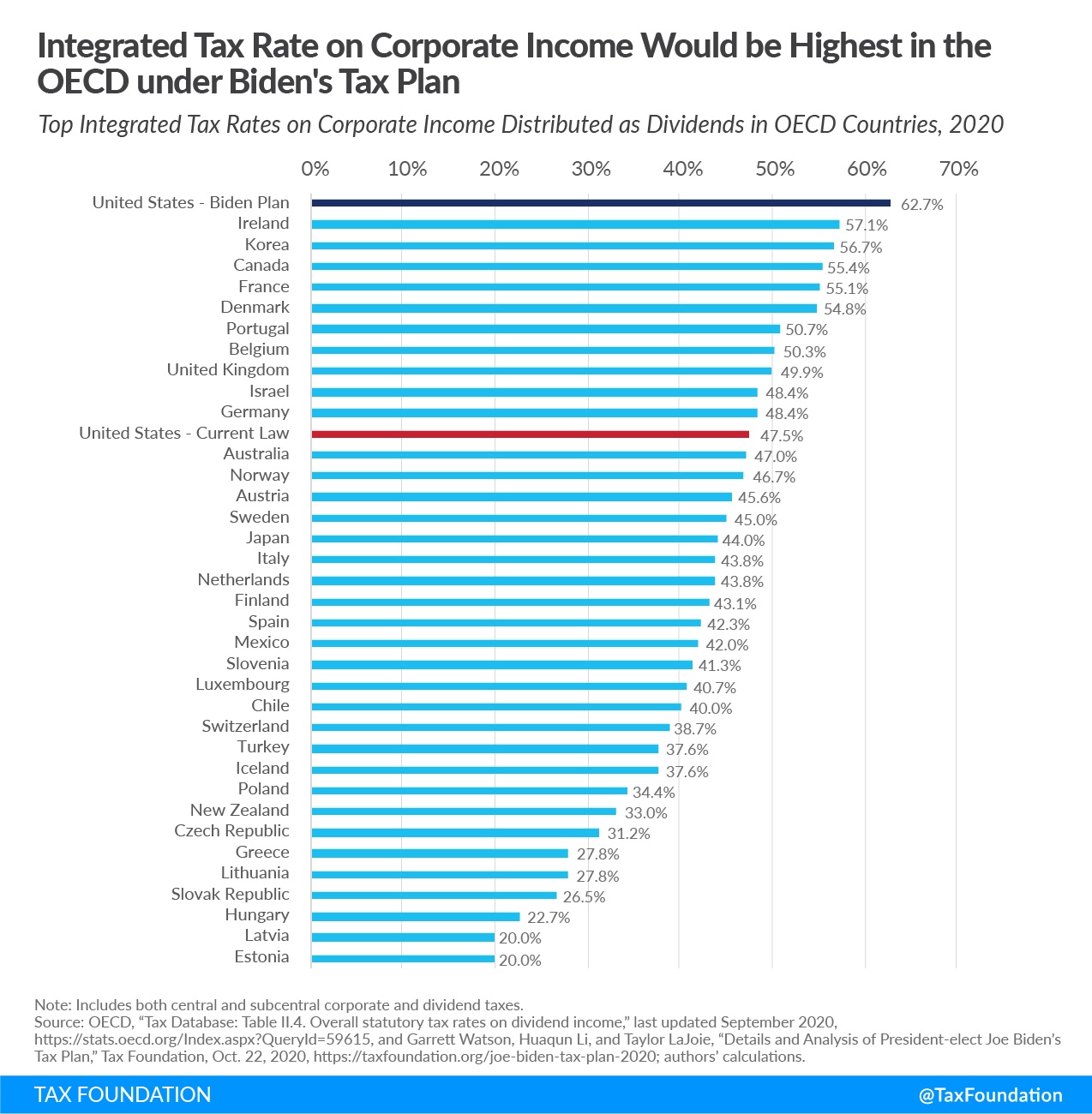
The Tax Foundation calculated the combined tax rate on business income (including the double tax on dividends) for various developed nations.

As you can see, America will have the most onerous tax regime if Biden is successful.

What if we look only at the corporate tax rate? And what if we consider every jurisdiction in the world?

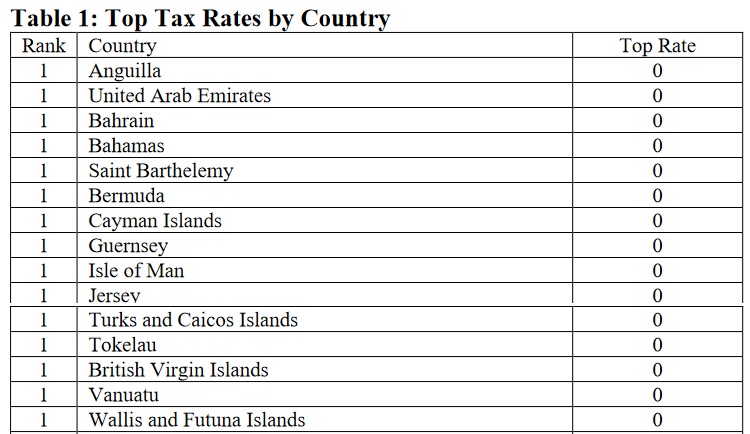
Professor Robert McGee pulled together all the numbers and ranked nations from #1 to #223.

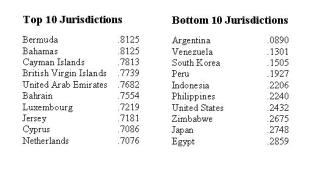
The United States currently is in the bottom half, which isn’t good since we’re below average. But you can see from these two tables that Biden will drop America to the bottom 10 percent.

Needless to say, it’s not good to rank below France.

But let’s think of the glass as being 1/10th full rather than 9/10ths empty. At least the U.S. beats Venezuela!

The bottom line is that it will not be good news if Biden’s plan is enacted.

P.S. From Professor McGee’s study, here are the jurisdictions tied for 1st place.

P.P.S. Needless to say, politicians from high-tax nations resent the 15 jurisdictions that don’t have a corporate income tax.

Indeed, that’s why many of those politicians are pushing the “global minimum tax” that I wrote about yesterday.

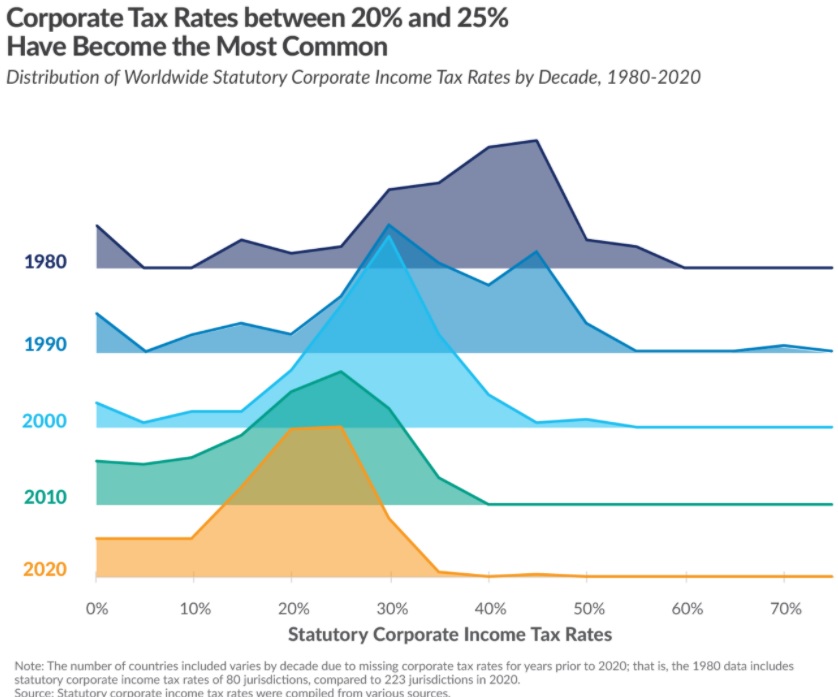
Those politicians basically want to turn back the clock and reverse the progress depicted in this set of charts from the Tax Foundation.

P.P.S. This is why it’s important to defend the liberalizing process of tax competition.

March 16, 2021

President Biden c/o The White House
1600 Pennsylvania Avenue NW
Washington, DC 20500

Dear Mr. President,

Is our country learning from history? California keeps raising their taxes on the wealthy and people keep moving from California to Texas. What does our federal government do? They also have been raising taxes on the wealthy lately. Take a look at this excellent video below and then read a great article by Dan Mitchell of the Cato Institute on what is happening in California right now.

Will Higher Tax Rates Balance the Budget?

Published on Apr 11, 2012

As the U.S. debt and deficit grows, some politicians and economist have called for higher tax rates in order to balance the budget. The question becomes: when the government raises taxes, does it actually collect a larger portion of the US economy?

Professor Antony Davies examines 50 years of economic data and finds that regardless of tax rates, the percentage of GDP that the government collects has remained relatively constant. In other words, no matter how high government sets tax rates, the government gets about the same portion. According to Davies, if we’re concerned about balancing the budget, we should worry less about raising tax revenue and more about growing the economy. The recipe for growth? Lower tax rates and a simplified tax code.

Like most people, I’m a sucker for a heartwarming story around the holidays.

Sometimes, you get that nice feeling when good things happen to good people, like you find at the end of a classic movie like “It’s a Wonderful Life.”

But since I’m a bit of a curmudgeon, I also feel all warm and fuzzy when bad things happen to bad people.

That’s why I always smile when I read stories about taxpayers moving across borders, thus preventing greedy tax-hiking politicians from collecting more revenue.

“Where’s our tax revenue?!?”

I’m glad when that happens to French politicians. I’m glad when it happens to Italian politicians. I’m glad when it happens to Illinois politicians. And British politicians. And Spanish politicians. And Maryland politicians. I could continue, but I think you get the point.

I’m even glad when it happens to the politicians in Washington.

I smile because I envision the moment when some budget geek tells these sleazy politicians that projected revenues aren’t materializing and they don’t have more money to spend.

So I wish I could be a fly on the wall when this moment of truth happens to California politicians. They convinced voters in the state to enact Prop 30, a huge tax increase targeting those evil, awful, bad rich people.

Governor Brown and his fellow kleptocrats in Sacramento doubtlessly are salivating at the thought of more money to waste.

But notwithstanding a satirical suggestion from Walter Williams, there aren’t guard towers and barbed-wire fences surrounding the state. Productive people can leave, and that’s happening every day. And they take their taxable income with them.

Usually in ways that don’t attract attention. But sometimes a bunch of them leave at the same times, and that is newsworthy. Here’s an example of that happening, as reported by the San Francisco Chronicle.

Chevron Corp. will move up to 800 jobs – about a quarter of its current headquarters staff – from the Bay Area to Houston over the next two years but will remain based in San Ramon, the oil company told employees Thursday. …The company already employs far more people in Houston – about 9,000 full-time employees and contractors – than it does in San Ramon.

We don’t know a lot of details, but these were positions at the company’s headquarters and they were “technical positions dealing with information and advanced energy technologies…tied to Chevron’s worldwide oil exploration and production business.”

Let’s assume these highly skilled employees earn an average of $250,000. I imagine that’s a low-ball estimate, but this is just for purposes of a thought experiment. Now multiply that average salary by 800 workers and you get $200 million of income.

And every penny of that $200 million no longer will be subject to tax by the kleptocrats in the state’s capital.

In other words, we’re seeing the Laffer Curve in action.

Politicians can raise tax rates all day long, but that doesn’t automatically translate into more tax revenue. Politicians keep forgetting that taxable income is not a fixed variable.

What’s happening in a big way with Chevron is happening in small ways every single day with investors, entrepreneurs, small business owners, and other “rich’ people.

That’s good for the people escaping. And it also will warm my heart when California’s despicable politicians discover next year that there’s an “unexpected” revenue shortfall.

P.S. It’s just an anecdote that the Chevron jobs are going to Texas. But when you add together a bunch of anecdotes, you get data. And according to the data, Texas is kicking the you-know-what out of California. Maybe there’s a lesson to be learned?

__________

___________

Thank you so much for your time. I know how valuable it is. I also appreciate the fine family that you have and your commitment as a father and a husband.

Sincerely,

Everette Hatcher III, 13900 Cottontail Lane, Alexander, AR 72002, ph 501-920-5733

Williams with Sowell – Minimum Wage

Thomas Sowell

Thomas Sowell – Reducing Black Unemployment

By WALTER WILLIAMS

—-

Ronald Reagan with Milton Friedman
Milton Friedman The Power of the Market 2-5
Related posts:

Open letter to President Obama (Part 201)Tea Party favorite Representative links article “Prescott and Ohanian: Taxes Are Much Higher Than You Think”

    (Emailed to White House on 12-21-12.) President Obama c/o The White House 1600 Pennsylvania Avenue NW Washington, DC 20500 Dear Mr. President, I know that you receive 20,000 letters a day and that you actually read 10 of them every day. I really do respect you for trying to get a pulse on […]

Open letter to President Obama (Part 200.2)Tea Party Republican Representative takes on the President concerning fiscal cliff

(Emailed to White House on 12-21-12.) President Obama c/o The White House 1600 Pennsylvania Avenue NW Washington, DC 20500 Dear Mr. President, I know that you receive 20,000 letters a day and that you actually read 10 of them every day. I really do respect you for trying to get a pulse on what is […]

Open letter to President Obama (Part 200.1)Tea Party favorite Representative shares link on facebook

(Emailed to White House on 12-21-12) President Obama c/o The White House 1600 Pennsylvania Avenue NW Washington, DC 20500 Dear Mr. President, I know that you receive 20,000 letters a day and that you actually read 10 of them every day. I really do respect you for trying to get a pulse on what is […]

Open letter to President Obama (Part 199) Tea Party favorite takes on President

  The federal government has a spending problem and Milton Friedman came up with the negative income tax to help poor people get out of the welfare trap. It seems that the government screws up about everything. Then why is President Obama wanting more taxes? _______________ Milton Friedman – The Negative Income Tax Published on […]

Tea Party Heroes Rep. David Schweikert (R-AZ),Justin Amash (R-MI), Tim Huelskamp (R-KS) have been punished by Boehner

I was sad to read that the Speaker John Boehner has been involved in punishing tea  party republicans. Actually I have written letters to several of these same tea party heroes telling them that I have emailed Boehner encouraging him to listen to them. Rep. David Schweikert (R-AZ),Justin Amash (R-MI), and Tim Huelskamp (R-KS). have been contacted […]

Some Tea Party heroes (Part 10)

Michael Tanner of the Cato Institute in his article, “Hitting the Ceiling,” National Review Online, March 7, 2012 noted: After all, despite all the sturm und drang about spending cuts as part of last year’s debt-ceiling deal, federal spending not only increased from 2011 to 2012, it rose faster than inflation and population growth combined. […]

Some Tea Party heroes (Part 9)

Michael Tanner of the Cato Institute in his article, “Hitting the Ceiling,” National Review Online, March 7, 2012 noted: After all, despite all the sturm und drang about spending cuts as part of last year’s debt-ceiling deal, federal spending not only increased from 2011 to 2012, it rose faster than inflation and population growth combined. […]

49 posts on Tea Party heroes of mine

Some of the heroes are Mo Brooks, Martha Roby, Jeff Flake, Trent Franks, Duncan Hunter, Tom Mcclintock, Devin Nunes, Scott Tipton, Bill Posey, Steve Southerland and those others below in the following posts. THEY VOTED AGAINST THE DEBT CEILING INCREASE IN 2011 AND WE NEED THAT TYPE OF LEADERSHIP NOW SINCE PRESIDENT OBAMA HAS BEEN […]

Some Tea Party Republicans win and some lose

I hated to see that Allen West may be on the way out. ABC News reported: Nov 7, 2012 7:20am What Happened to the Tea Party (and the Blue Dogs?) Some of the Republican Party‘s most controversial House members are clinging to narrow leads in races where only a few votes are left to count. […]

Some Tea Party heroes (Part 8)

Rep Himes and Rep Schweikert Discuss the Debt and Budget Deal Michael Tanner of the Cato Institute in his article, “Hitting the Ceiling,” National Review Online, March 7, 2012 noted: After all, despite all the sturm und drang about spending cuts as part of last year’s debt-ceiling deal, federal spending not only increased from 2011 […]

Waiving PAYGO on $1.9T ‘Stimulus’ Is Reckless. There Are Better Ways to Go.

Waiving PAYGO on $1.9T ‘Stimulus’ Is Reckless. There Are Better Ways to Go.

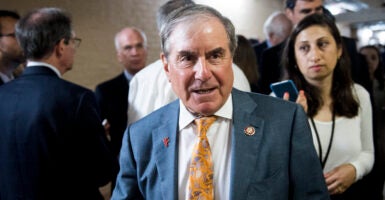
Rep. John Yarmuth, D-Ky., seen here July 10, 2019, is calling for pretending that the deficit-financed spending spree for special interests in the $1.9 trillion so-called American Rescue Plan never occurred for PAYGO purposes. (Photo: Bill Clark/CQ-Roll Call/Getty Images)

President Joe Biden’s $1.9 trillion “American Rescue Plan” was passed under the guise of responding to COVID-19. In reality, less than 10% of the bill was for public health.

The massive “stimulus” package was stuffed with partisan special-interest payoffs for liberal priorities and other wasteful spending.

Significantly, the law will spend nearly $1.9 trillion without a plan to pay for it. That means that, unless Congress passes new laws with equal or greater reductions in spending by the end of the year, statutory pay-as-you-go (aka “PAYGO”) enforcement will kick in.

The basic premise of statutory PAYGO is straightforward. In the words of former President Barack Obama, who championed the policy and signed it into law, it tells Congress: “You can’t spend a dollar unless you cut a dollar elsewhere.”

Want to keep up with the 24/7 news cycle? Want to know the most important stories of the day for conservatives? Need news you can trust? Subscribe to The Daily Signal’s email newsletter. Learn more >>

If, over the course of a year, laws are enacted that are projected to increase the deficit, statutory PAYGO requires that deficit increase to be paid for by automatic spending reductions (known as sequestration) over the next several years.

However, most spending accounts and programs are exempt from sequestration.

The law has fairly significant flaws, and it would be better to replace it with a more robust fiscal rule that more effectively restrains excessive spending. Politicians of both parties have abused loopholes, adding higher spending without paying for it.

The Congressional Budget Office estimated that because of the large amount of spending in the stimulus law, statutory PAYGO would require a sequestration order to reduce spending by $381 billion next January.

That actually exceeds the total amount of the spending accounts that are subject to sequestration because most major programs are exempted or are capped.

Now that Democrats have enacted their $1.9 trillion spending binge, they do not want to pay for it.

Rep. John Yarmuth, D-Ky., chairman of the House Budget Committee, has introduced a bill that would declare that the stimulus bill “shall not be counted” on the PAYGO scorecard. In effect, it would attempt to pretend that the deficit-financed spending spree for special interests never occurred.

The bill is pitched as a “legislative fix to avert sequestration.” It isn’t a “fix.” It is fiscal recklessness.

Yarmuth said, “If Republicans play political games and don’t do their jobs, Medicare and the seniors that depend on it will pay the price.”

Of course, nothing could be further from the truth.

The CBO estimates that the sequestration order could reduce total Medicare payments to providers and insurance companies by just 4% of the $943 billion that will be spent on Medicarenext year.

Not a single Republican voted for the stimulus. The limited reductions in Medicare spending as a result of the Democrats’ overspending would be enforced by the terms of Obama’s statutory PAYGO law and carried out by Biden’s director of the Office of Management and Budget.

Members of Congress who voted against the irresponsible $1.9 trillion spending bill should not feel pressured to excuse that fiscal recklessness by voting to waive statutory PAYGO enforcement. Simply waiving it retroactively would be just as irresponsible as the spending bill itself.

The potential of sequestration does, however, present an opportunity to implement much-needed fiscal responsibility in a more thoughtful way.

There are a number of smart policy alternatives to achieve spending reductions of equal or greater amounts of savings over time than would the blunt instrument of a sequestration order:

It’s vital that policymakers start to turn the tide against overspending. Even before the outbreak of COVID-19, the federal budget was on an unsustainable path due to the growth of spending outpacing the growth of the economy.

The CBO’s “Long-Term Budget Outlook” showsthat even though tax revenues are projected to rise above normal historical levels, spending will continue to grow out of control.

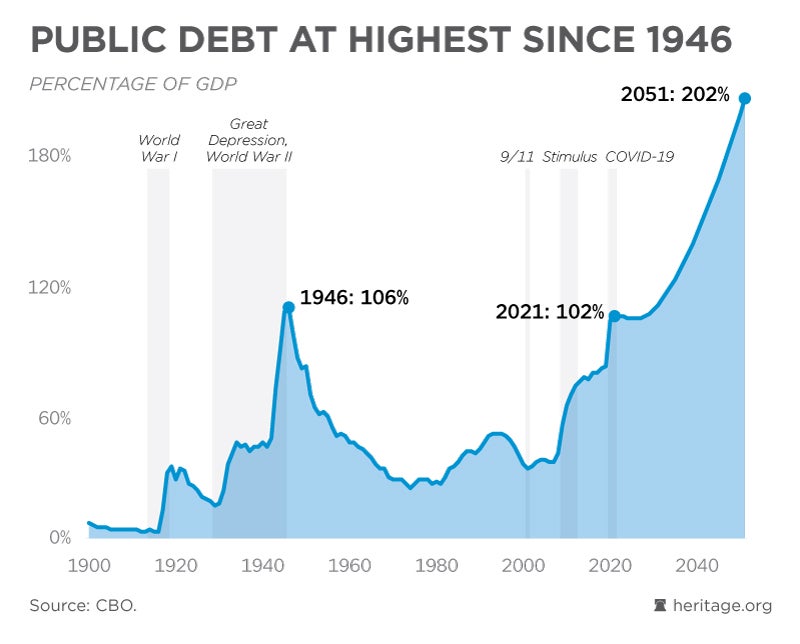
The national debt has skyrocketed to $28 trillion, about $225,000 per American household. The public debt is already at its highest level relative to the national economy since World War II, but unlike the postwar period when spending fell back to more normal levels, spending and debt are projected to only continue rising.

The CBO says that the current fiscal trajectory would “reduce business investment and slow the growth of economic output,” and would “increase the risk of a fiscal crisis.” But more important are the negative consequences of government that grow too large and burdensome for families and communities.

When the federal government grows beyond its proper limits, and spends and taxes too much, it stifles prosperity, infringes on liberty, and makes it more difficult to live the American dream.

Given all that is at stake, pretending the $1.9 trillion spending bill never happened and retroactively waiving statutory PAYGO enforcement would be beyond irresponsible. However, Congress can and should take advantage of the opportunity to implement thoughtful fiscal responsibility.

Have an opinion about this article? To sound off, please email letters@DailySignal.com and we will consider publishing your remarks in our regular “We Hear You” feature.

March 31, 2021

President Biden  c/o The White House
1600 Pennsylvania Avenue NW
Washington, DC 20500

Dear Mr. President,

Please explain to me if you ever do plan to balance the budget while you are President? I have written these things below about you and I really do think that you don’t want to cut spending in order to balance the budget. It seems you ever are daring the Congress to stop you from spending more.

President Barack Obama speaks about the debt limit in the East Room of the White House in Washington. | AP Photo

“The credit of the United States ‘is not a bargaining chip,’ Obama said on 1-14-13. However, President Obama keeps getting our country’s credit rating downgraded as he raises the debt ceiling higher and higher!!!!

Washington Could Learn a Lot from a Drug Addict

Just spend more, don’t know how to cut!!! Really!!! That is not living in the real world is it?

Making more dependent on government is not the way to go!!

Why is our government in over 16 trillion dollars in debt? There are many reasons for this but the biggest reason is people say “Let’s spend someone else’s money to solve our problems.” Liberals like Max Brantley have talked this way for years. Brantley will say that conservatives are being harsh when they don’t want the government out encouraging people to be dependent on the government. The Obama adminstration has even promoted a plan for young people to follow like Julia the Moocher.  

David Ramsey demonstrates in his Arkansas Times Blog post of 1-14-13 that very point:

Arkansas Politics / Health Care Arkansas’s share of Medicaid expansion and the national debt

Posted by on Mon, Jan 14, 2013 at 1:02 PM

Baby carrot Arkansas Medicaid expansion image

Imagine standing a baby carrot up next to the 25-story Stephens building in Little Rock. That gives you a picture of the impact on the national debt that federal spending in Arkansas on Medicaid expansion would have, while here at home expansion would give coverage to more than 200,000 of our neediest citizens, create jobs, and save money for the state.

Here’s the thing: while more than a billion dollars a year in federal spending would represent a big-time stimulus for Arkansas, it’s not even a drop in the bucket when it comes to the national debt.

Currently, the national debt is around $16.4 trillion. In fiscal year 2015, the federal government would spend somewhere in the neighborhood of $1.2 billion to fund Medicaid expansion in Arkansas if we say yes. That’s about 1/13,700th of the debt.

It’s hard to get a handle on numbers that big, so to put that in perspective, let’s get back to the baby carrot. Imagine that the height of the Stephens building (365 feet) is the $16 trillion national debt. That $1.2 billion would be the length of a ladybug. Of course, we’re not just talking about one year if we expand. Between now and 2021, the federal government projects to contribute around $10 billion. The federal debt is projected to be around $25 trillion by then, so we’re talking about 1/2,500th of the debt. Compared to the Stephens building? That’s a baby carrot.

______________

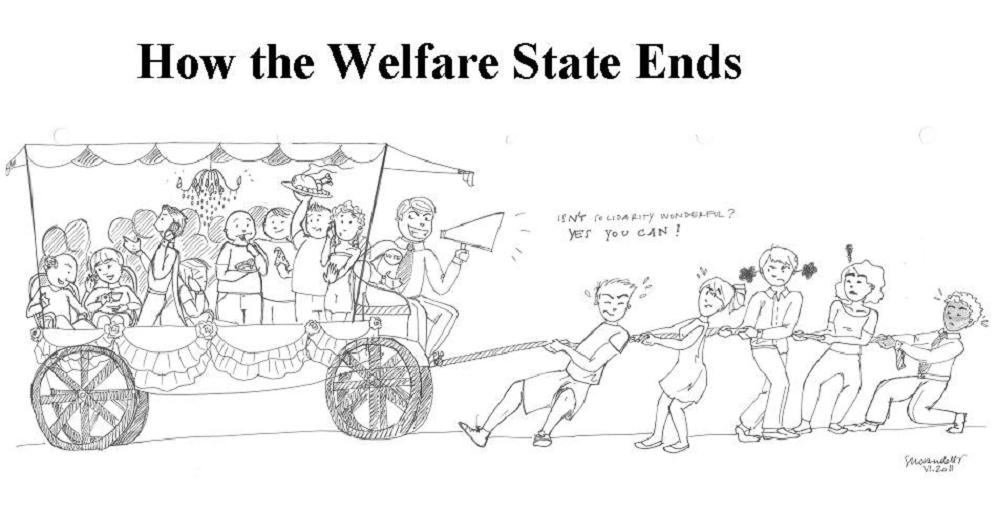
Here is how it will all end if everyone feels they should be allowed to have their “baby carrot.”

How sad it is that liberals just don’t get this reality.

Here is what the Founding Fathers had to say about welfare. David Weinberger noted:

While living in Europe in the 1760s, Franklin observed: “in different countries … the more public provisions were made for the poor, the less they provided for themselves, and of course became poorer. And, on the contrary, the less was done for them, the more they did for themselves, and became richer.”

Alexander Fraser Tytler, Lord Woodhouselee (15 October 1747 – 5 January 1813) was a Scottish lawyer, writer, and professor. Tytler was also a historian, and he noted, “A democracy cannot exist as a permanent form of government. It can only exist until the majority discovers it can vote itself largess out of the public treasury. After that, the majority always votes for the candidate promising the most benefits with the result the democracy collapses because of the loose fiscal policy ensuing, always to be followed by a dictatorship, then a monarchy.”

Thomas Jefferson to Joseph Milligan

April 6, 1816

[Jefferson affirms that the main purpose of society is to enable human beings to keep the fruits of their labor. — TGW]

To take from one, because it is thought that his own industry and that of his fathers has acquired too much, in order to spare to others, who, or whose fathers have not exercised equal industry and skill, is to violate arbitrarily the first principle of association, “the guarantee to every one of a free exercise of his industry, and the fruits acquired by it.” If the overgrown wealth of an individual be deemed dangerous to the State, the best corrective is the law of equal inheritance to all in equal degree; and the better, as this enforces a law of nature, while extra taxation violates it.

[From Writings of Thomas Jefferson, ed. Albert E. Bergh (Washington: Thomas Jefferson Memorial Association, 1904), 14:466.]

_______

Jefferson pointed out that to take from the rich and give to the poor through government is just wrong. Franklin knew the poor would have a better path upward without government welfare coming their way. Milton Friedman’s negative income tax is the best method for doing that and by taking away all welfare programs and letting them go to the churches for charity.

_____________

_________

Thank you so much for your time. I know how valuable it is. I also appreciate the fine family that you have and your commitment as a father and a husband.

Sincerely,

Everette Hatcher III, 13900 Cottontail Lane, Alexander, AR 72002, ph 501-920-5733

Williams with Sowell – Minimum Wage

Thomas Sowell

Thomas Sowell – Reducing Black Unemployment

By WALTER WILLIAMS

—-

Ronald Reagan with Milton Friedman
Milton Friedman The Power of the Market 2-5

Related posts:

Welfare Spending Shattering All-Time Highs

  We got to act fast and get off this path of socialism. Morning Bell: Welfare Spending Shattering All-Time Highs Robert Rector and Amy Payne October 18, 2012 at 9:03 am It’s been a pretty big year for welfare—and a new report shows welfare is bigger than ever. The Obama Administration turned a giant spotlight […]

We need more brave souls that will vote against Washington welfare programs

We need to cut Food Stamp program and not extend it. However, it seems that people tell the taxpayers back home they are going to Washington and cut government spending but once they get up there they just fall in line with  everyone else that keeps spending our money. I am glad that at least […]

Welfare programs are not the answer for the poor

Government Must Cut Spending Uploaded by HeritageFoundation on Dec 2, 2010 The government can cut roughly $343 billion from the federal budget and they can do so immediately. __________ Liberals argue that the poor need more welfare programs, but I have always argued that these programs enslave the poor to the government. Food Stamps Growth […]

Private charities are best solution and not government welfare

Milton Friedman – The Negative Income Tax Published on May 11, 2012 by LibertyPen In this 1968 interview, Milton Friedman explained the negative income tax, a proposal that at minimum would save taxpayers the 72 percent of our current welfare budget spent on administration. http://www.LibertyPen.com Source: Firing Line with William F Buckley Jr. ________________ Milton […]

The book “After the Welfare State”

Dan Mitchell Commenting on Obama’s Failure to Propose a Fiscal Plan Published on Aug 16, 2012 by danmitchellcato No description available. ___________ After the Welfare State Posted by David Boaz Cato senior fellow Tom G. Palmer, who is lecturing about freedom in Slovenia and Tbilisi this week, asked me to post this announcement of his […]

President Obama responds to Heritage Foundation critics on welfare reform waivers

Is President Obama gutting the welfare reform that Bill Clinton signed into law? Morning Bell: Obama Denies Gutting Welfare Reform Amy Payne August 8, 2012 at 9:15 am The Obama Administration came out swinging against its critics on welfare reform yesterday, with Press Secretary Jay Carney saying the charge that the Administration gutted the successful […]

Welfare reform part 3

Thomas Sowell – Welfare Welfare reform was working so good. Why did we have to abandon it? Look at this article from 2003. The Continuing Good News About Welfare Reform By Robert Rector and Patrick Fagan, Ph.D. February 6, 2003 Six years ago, President Bill Clinton signed legislation overhauling part of the nation’s welfare system. […]

Welfare reform part 2

Uploaded by ForaTv on May 29, 2009 Complete video at: http://fora.tv/2009/05/18/James_Bartholomew_The_Welfare_State_Were_In Author James Bartholomew argues that welfare benefits actually increase government handouts by ‘ruining’ ambition. He compares welfare to a humane mousetrap. —– Welfare reform was working so good. Why did we have to abandon it? Look at this article from 2003. In the controversial […]

Why did Obama stop the Welfare Reform that Clinton put in?

Thomas Sowell If the welfare reform law was successful then why change it? Wasn’t Bill Clinton the president that signed into law? Obama Guts Welfare Reform Robert Rector and Kiki Bradley July 12, 2012 at 4:10 pm Today, the Obama Department of Health and Human Services (HHS) released an official policy directive rewriting the welfare […]

“Feedback Friday” Letter to White House generated form letter response July 10,2012 on welfare, etc (part 14)

I have been writing President Obama letters and have not received a personal response yet.  (He reads 10 letters a day personally and responds to each of them.) However, I did receive a form letter in the form of an email on July 10, 2012. I don’t know which letter of mine generated this response so I have […]

5 Charts Show Why Congress Must Stop Adding to National Debt

Debt Stimulus Package

An enormous “stimulus” package was signed into law on Thursday, which is expected to bring government spending for this year to $6.9 trillion. This will add dramatically add to the national debt, which is currently at $28 trillion. Pictured: Speaker of the House Nancy Pelosi, D-Calif., conducts a news conference on the on the stimulus bill on Tuesday. (Photo: Tom Williams/CQ-Roll Call, Inc./Getty Images)

President Joe Biden signed into law an enormous, debt-financed “stimulus” package on Thursday. This was the final step in a multi-month process to pass a heavily flawed piece of legislation.

We might be tempted to hope that this will finally sate the left’s appetite for big government. After all, the size and scope of government will expand more than 54%—from $4.5 trillion of annual spending in 2019 to about $6.9 trillion this year—once the new spending bill is factored in, based on calculations by experts at The Heritage Foundation.

Washington added $4.5 trillion to the national debt over the last year alone. This brings the total debt level to $28 trillion, or roughly $225,000 per U.S. household.

Unfortunately, even that might not be enough to get congressional leaders and the Biden administration to pump the brakes on the spending spree. A planned infrastructure spending package could top $2 trillion, and there is little appetite to pay for it.

Want to keep up with the 24/7 news cycle? Want to know the most important stories of the day for conservatives? Need news you can trust? Subscribe to The Daily Signal’s email newsletter. Learn more >>

There are plenty of reasons why Congress should avoid another bloated spending deal. The nonpartisan Congressional Budget Office issued a report last week detailing one of the most important reasons: our nation’s finances are rapidly heading into dangerous territory.

While the numbers involved can seem incomprehensibly large, these charts can help to visualize the looming disaster.

The federal government amassed a record-setting amount of debt during the Great Depression and World War II. When the war was over, federal spending was adjusted from 41% of the economy in 1945 to 11.4% in 1948.

A combination of lower spending and rapid revenue increases from the post-war economic boom meant that the national debt shrank dramatically relative to the economy.

Unfortunately, such rapid debt reduction would be almost impossible to duplicate today.

Even the most optimistic growth forecasts fall well short of what was seen after World War II. More importantly, because most federal spending goes towards established benefit programs like Social Security and Medicare, it would be extremely difficult to cut spending at a similar pace.

However, policies to boost economic growth and restrain spending are still the best way to prevent the national debt from reaching crisis proportions.

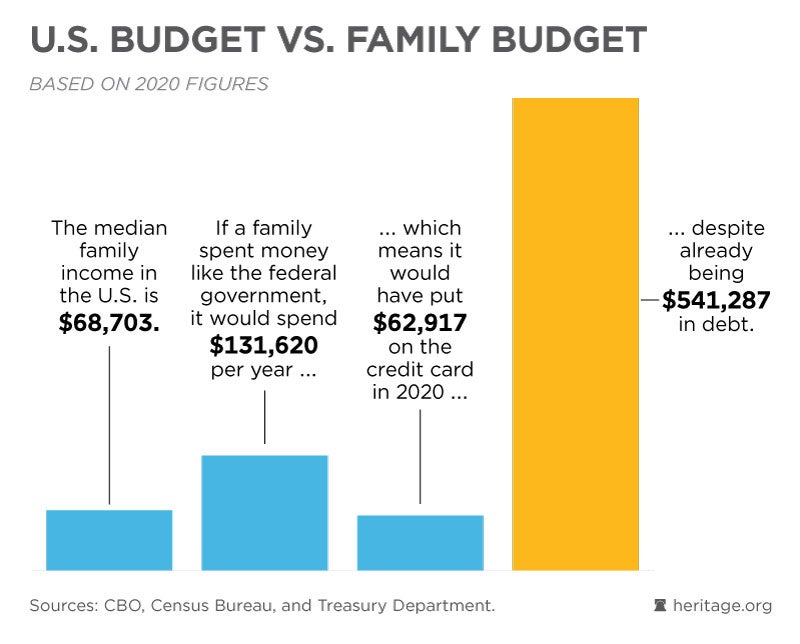
In 2020, the federal government spent almost twice as much as it took in from taxes. The new legislative package means that this year’s deficit will likely be even bigger than last year’s.

These sky-high deficits add to an even larger total debt.

Uncle Sam has benefitted from a run of low interest rates over the last several years, blunting the cost of the escalating debt. Yet we can’t assume that this will last forever.

If you went to a bank for a big loan, you would expect them to ask some tough questions about your finances. The same holds true for the global financial system, which we count on to buy our debt.

While short-term federal bonds are still considered a safe investment, markets are demanding much higher yields for longer-term debt. Credit rating agencies have recently warnedthat our credit rating could be downgraded unless steps are taken to address overspending and the debt.

They have also cautioned us that interest rates will rise. This signals that our days of cheap creditcould be coming to an end sooner than we would want. If that happens, America will pay a steep price.

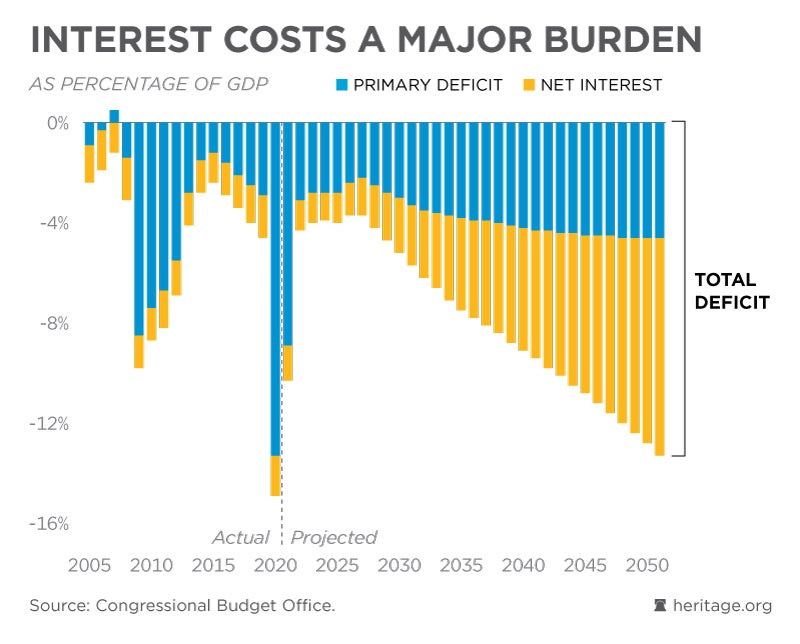
That “steep price” is not metaphorical. The Congressional Budget Office’s new report shows that the cost of servicing the national debt was already set to explode before the stimulus package passed.

Right now, interest on the debt is a burden the economy can handle. However, even a modest interest rate increase—coupled with continued irresponsibility from Washington—will cause interest costs to increase more than five-fold in the next few decades.

This would be an anchor around the neck for the economy, and would make the growth and prosperity we take for granted next to impossible for future generations to experience.

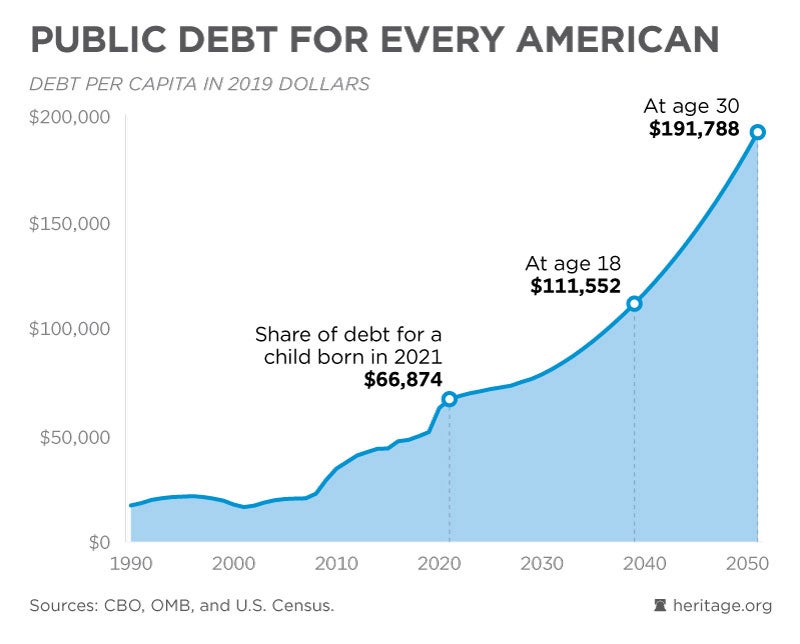
In the not-so-distant past—specifically, the year 2018—the amount of public debt per person was just under $50,000. Today, it stands at nearly $67,000 for every American, including children.

It only gets worse from there. A baby born tomorrow is expected to have over $111,000 in debt to their name when they turn 18, and nearly $192,000 by age 30.

Those numbers do not account for the new stimulus bill, a potential infrastructure package, or expanded benefit programs. Instead, the main reason why debt will skyrocket over the coming years is because federal spending is being allowed to grow without limits.

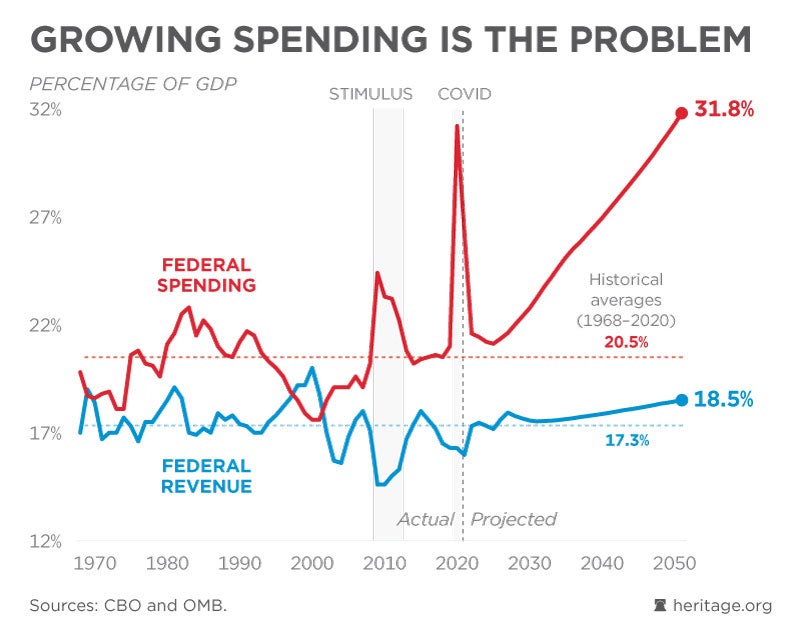
While some on the left blame the 2017 tax cuts for deficits, this chart makes it clear that the culprit for our long-term financial gap is an explosion in federal spending.

Spending was already above the historical average in 2019, and will grow much faster than the economy from 2022 onwards. Meanwhile, revenue will soon return to normal levels.

Why do we expect such a rapid increase in federal spending? A handful of programs, primarily Social Security, Medicare, and Medicaid, have been set up in an unsustainable way. Reforming these programs by balancing the needs of both retirees and future generations would be a tremendous breakthrough.

However, Congress has consistently avoided the issue of unsustainable programs, and has even made things worse by expanding benefits. The longer Washington waits to confront this problem, the more drastic the remedies will have to be.

Experts from The Heritage Foundation have provided legislators with the policy tools they need to address this mounting crisis, meaning members of Congress can’t plead ignorance.

Those in positions of leadership have a responsibility to do the right thing for present and future Americans, and the public must hold them accountable if they do not.

Have an opinion about this article? To sound off, please email letters@DailySignal.com and we will consider publishing your remarks in our regular “We Hear You” feature.

—-

March 31, 2021

President Biden  c/o The White House
1600 Pennsylvania Avenue NW
Washington, DC 20500

Dear Mr. President,

Please explain to me if you ever do plan to balance the budget while you are President? I have written these things below about you and I really do think that you don’t want to cut spending in order to balance the budget. It seems you ever are daring the Congress to stop you from spending more.

President Barack Obama speaks about the debt limit in the East Room of the White House in Washington. | AP Photo

“The credit of the United States ‘is not a bargaining chip,’ Obama said on 1-14-13. However, President Obama keeps getting our country’s credit rating downgraded as he raises the debt ceiling higher and higher!!!!

Washington Could Learn a Lot from a Drug Addict

Just spend more, don’t know how to cut!!! Really!!! That is not living in the real world is it?

Making more dependent on government is not the way to go!!

Why is our government in over 16 trillion dollars in debt? There are many reasons for this but the biggest reason is people say “Let’s spend someone else’s money to solve our problems.” Liberals like Max Brantley have talked this way for years. Brantley will say that conservatives are being harsh when they don’t want the government out encouraging people to be dependent on the government. The Obama adminstration has even promoted a plan for young people to follow like Julia the Moocher.  

David Ramsey demonstrates in his Arkansas Times Blog post of 1-14-13 that very point:

Arkansas Politics / Health Care Arkansas’s share of Medicaid expansion and the national debt

Posted by on Mon, Jan 14, 2013 at 1:02 PM

Baby carrot Arkansas Medicaid expansion image

Imagine standing a baby carrot up next to the 25-story Stephens building in Little Rock. That gives you a picture of the impact on the national debt that federal spending in Arkansas on Medicaid expansion would have, while here at home expansion would give coverage to more than 200,000 of our neediest citizens, create jobs, and save money for the state.

Here’s the thing: while more than a billion dollars a year in federal spending would represent a big-time stimulus for Arkansas, it’s not even a drop in the bucket when it comes to the national debt.

Currently, the national debt is around $16.4 trillion. In fiscal year 2015, the federal government would spend somewhere in the neighborhood of $1.2 billion to fund Medicaid expansion in Arkansas if we say yes. That’s about 1/13,700th of the debt.

It’s hard to get a handle on numbers that big, so to put that in perspective, let’s get back to the baby carrot. Imagine that the height of the Stephens building (365 feet) is the $16 trillion national debt. That $1.2 billion would be the length of a ladybug. Of course, we’re not just talking about one year if we expand. Between now and 2021, the federal government projects to contribute around $10 billion. The federal debt is projected to be around $25 trillion by then, so we’re talking about 1/2,500th of the debt. Compared to the Stephens building? That’s a baby carrot.

______________

Here is how it will all end if everyone feels they should be allowed to have their “baby carrot.”

How sad it is that liberals just don’t get this reality.

Here is what the Founding Fathers had to say about welfare. David Weinberger noted:

While living in Europe in the 1760s, Franklin observed: “in different countries … the more public provisions were made for the poor, the less they provided for themselves, and of course became poorer. And, on the contrary, the less was done for them, the more they did for themselves, and became richer.”

Alexander Fraser Tytler, Lord Woodhouselee (15 October 1747 – 5 January 1813) was a Scottish lawyer, writer, and professor. Tytler was also a historian, and he noted, “A democracy cannot exist as a permanent form of government. It can only exist until the majority discovers it can vote itself largess out of the public treasury. After that, the majority always votes for the candidate promising the most benefits with the result the democracy collapses because of the loose fiscal policy ensuing, always to be followed by a dictatorship, then a monarchy.”

Thomas Jefferson to Joseph Milligan

April 6, 1816

[Jefferson affirms that the main purpose of society is to enable human beings to keep the fruits of their labor. — TGW]

To take from one, because it is thought that his own industry and that of his fathers has acquired too much, in order to spare to others, who, or whose fathers have not exercised equal industry and skill, is to violate arbitrarily the first principle of association, “the guarantee to every one of a free exercise of his industry, and the fruits acquired by it.” If the overgrown wealth of an individual be deemed dangerous to the State, the best corrective is the law of equal inheritance to all in equal degree; and the better, as this enforces a law of nature, while extra taxation violates it.

[From Writings of Thomas Jefferson, ed. Albert E. Bergh (Washington: Thomas Jefferson Memorial Association, 1904), 14:466.]

_______

Jefferson pointed out that to take from the rich and give to the poor through government is just wrong. Franklin knew the poor would have a better path upward without government welfare coming their way. Milton Friedman’s negative income tax is the best method for doing that and by taking away all welfare programs and letting them go to the churches for charity.

_____________

_________

Thank you so much for your time. I know how valuable it is. I also appreciate the fine family that you have and your commitment as a father and a husband.

Sincerely,

Everette Hatcher III, 13900 Cottontail Lane, Alexander, AR 72002, ph 501-920-5733

Williams with Sowell – Minimum Wage

Thomas Sowell

Thomas Sowell – Reducing Black Unemployment

By WALTER WILLIAMS

—-

Ronald Reagan with Milton Friedman
Milton Friedman The Power of the Market 2-5

Related posts:

Welfare Spending Shattering All-Time Highs

  We got to act fast and get off this path of socialism. Morning Bell: Welfare Spending Shattering All-Time Highs Robert Rector and Amy Payne October 18, 2012 at 9:03 am It’s been a pretty big year for welfare—and a new report shows welfare is bigger than ever. The Obama Administration turned a giant spotlight […]

We need more brave souls that will vote against Washington welfare programs

We need to cut Food Stamp program and not extend it. However, it seems that people tell the taxpayers back home they are going to Washington and cut government spending but once they get up there they just fall in line with  everyone else that keeps spending our money. I am glad that at least […]

Welfare programs are not the answer for the poor

Government Must Cut Spending Uploaded by HeritageFoundation on Dec 2, 2010 The government can cut roughly $343 billion from the federal budget and they can do so immediately. __________ Liberals argue that the poor need more welfare programs, but I have always argued that these programs enslave the poor to the government. Food Stamps Growth […]

Private charities are best solution and not government welfare

Milton Friedman – The Negative Income Tax Published on May 11, 2012 by LibertyPen In this 1968 interview, Milton Friedman explained the negative income tax, a proposal that at minimum would save taxpayers the 72 percent of our current welfare budget spent on administration. http://www.LibertyPen.com Source: Firing Line with William F Buckley Jr. ________________ Milton […]

The book “After the Welfare State”

Dan Mitchell Commenting on Obama’s Failure to Propose a Fiscal Plan Published on Aug 16, 2012 by danmitchellcato No description available. ___________ After the Welfare State Posted by David Boaz Cato senior fellow Tom G. Palmer, who is lecturing about freedom in Slovenia and Tbilisi this week, asked me to post this announcement of his […]

President Obama responds to Heritage Foundation critics on welfare reform waivers

Is President Obama gutting the welfare reform that Bill Clinton signed into law? Morning Bell: Obama Denies Gutting Welfare Reform Amy Payne August 8, 2012 at 9:15 am The Obama Administration came out swinging against its critics on welfare reform yesterday, with Press Secretary Jay Carney saying the charge that the Administration gutted the successful […]

Welfare reform part 3

Thomas Sowell – Welfare Welfare reform was working so good. Why did we have to abandon it? Look at this article from 2003. The Continuing Good News About Welfare Reform By Robert Rector and Patrick Fagan, Ph.D. February 6, 2003 Six years ago, President Bill Clinton signed legislation overhauling part of the nation’s welfare system. […]

Welfare reform part 2

Uploaded by ForaTv on May 29, 2009 Complete video at: http://fora.tv/2009/05/18/James_Bartholomew_The_Welfare_State_Were_In Author James Bartholomew argues that welfare benefits actually increase government handouts by ‘ruining’ ambition. He compares welfare to a humane mousetrap. —– Welfare reform was working so good. Why did we have to abandon it? Look at this article from 2003. In the controversial […]

Why did Obama stop the Welfare Reform that Clinton put in?

Thomas Sowell If the welfare reform law was successful then why change it? Wasn’t Bill Clinton the president that signed into law? Obama Guts Welfare Reform Robert Rector and Kiki Bradley July 12, 2012 at 4:10 pm Today, the Obama Department of Health and Human Services (HHS) released an official policy directive rewriting the welfare […]

“Feedback Friday” Letter to White House generated form letter response July 10,2012 on welfare, etc (part 14)

I have been writing President Obama letters and have not received a personal response yet.  (He reads 10 letters a day personally and responds to each of them.) However, I did receive a form letter in the form of an email on July 10, 2012. I don’t know which letter of mine generated this response so I have […]

Dan Mitchell’s article The World’s Most Politically Illiterate Statement

The World’s Most Politically Illiterate Statement

Exactly one month ago, I declared that Congresswoman Ayanna Pressley deserved an award for the “world’s most economically illiterate statement” because of her claim that “poverty is not naturally occurring.”

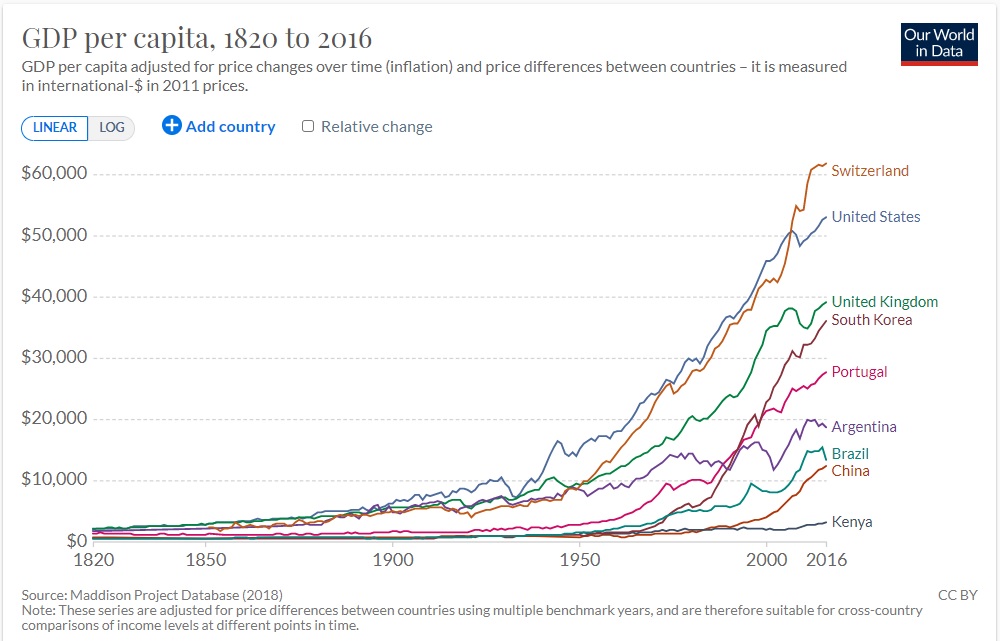
In reality, poverty has been the norm throughout history. As documented by Professors Deirdre McCloskey and Don Boudreaux, it was only the development of capitalism (starting a few hundred years ago in Europe) that enabled humanity to enjoy amazing and unprecedented increases in living standards.

Moreover, Ms. Pressely was trying to argue that redistribution was the proper way to address poverty, and I concluded my column by noting “that part of her statement also is wrong, according to both U.S. data and global data.”

Today, I want to debunk another preposterous assertion.

David Smith of the U.K.-based Guardian wrote a columnyesterday claiming that Biden’s so-called stimulus should be celebrated since it marks an end to forty years of Reaganomics.

…he will…be on a mission to restore faith in government. Confidence in it “has been plummeting since the late 60s to what it is now”, Biden noted in his remarks last week. His legislation, called the American Rescue Plan, can correct that with the biggest expansion of the welfare state in decades. …Biden knows better than anyone what that means. When he was born, in 1942, the president was Franklin Roosevelt, architect of the New Deal… When Biden was a student at the University of Delaware, Lyndon Johnson embarked on his project of the “Great Society”… Then came Ronald Reagan and his famous quip: “The nine most terrifying words in the English language are: I’m from the government and I’m here to help.” …He described Johnson’s “Great Society” as a fundamental wrong turn and set about dismantling it. …This orthodoxy held and dominated the political centre ground. …Biden’s could hardly be more of a polar opposite. …All the more reason to enjoy his victory lap and celebrate that four decades of Reaganism and “trickle down” economics are at an end.

Some of that political analysis is reasonable. FDR’s failed New Deal did expand government, as did LBJ’s failed War on Poverty.

And it’s also true that Reagan challenged their big-government orthodoxy and was somewhat successful in reining in the welfare state (“dismantling it” is a huge exaggeration, however).

But the author’s claim that there were “four decades of Reaganism” is breathtaking nonsense.

  • George H.W. Bush expanded the burden of government.
  • George W. Bush expanded the burden of government.
  • Barack Obama expanded the burden of government.
  • Donald Trump expanded the burden of government.

That’s 24 years of statist policies after Reagan left office.

If Mr. Smith actually knew the subject matter and wanted to write an honest article, he could have made an argument about16 years of Reaganism because we also benefited from a net reduction in the burden of government during Clinton’s eight years in office.

But the 21st century has been nothing but bad news for proponents of free markets. If you peruse Economic Freedom of the World, you’ll find that America’s level of economic freedom peaked in 2000 with a score of 8.67 (on a 1-10 scale).

Now the score for the United States has dropped to 8.22.

By the way, that’s not catastrophically bad. There’s no immediate risk of America becoming another Greece. And we’ll presumably never turn into Venezuela, no matter how hard Biden tries (it wouldn’t even happen if Vice President Harris took over).

That being said, what we’ve endured over the past two decades definitely is not Reaganism. The “Washington Consensus” is just a distant memory.

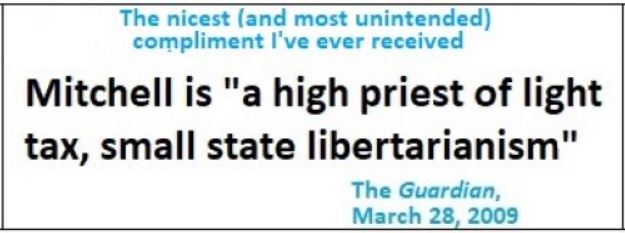
P.S. David Smith’s article is an example of sloppy journalism at a left-wing newspaper, but I’ll always have a bit of fondness for the Guardian because of the unintended compliment it bestowed upon me back in 2009.

P.P.S. For younger readers who did not experience the Reagan years, here’s my assessment of his record and here are some videos of some of his iconic remarks (and here’s a bonus video).

Rand Paul questions if US borrowing puts country on path to become Venezuela

Paul’s comments came just a day after the Senate passed President Biden’s $1.9 trillion COVID-19 relief bill

Sen. Rand Paul, one of the most outspoken Republicans about government spending, took to Twitter Sunday to ask if Congress’ borrowing is putting the U.S. economy on the same path as Venezuela’s.

“New 1,000,000 bolivar note in Venezuela worth 53 cents,” Paul tweeted, while linking to a Bloomberg report on hyperinflation in Caracas. “Will US be the next Venezuela with Congress borrowing over $6 trillion in one year?”

Paul’s comments came just a day after the Senate passed President Biden’s $1.9 trillion COVID-19 relief bill in a 50-49 vote. Sen. Mitt Romney, R-Utah, also expressed dismay over some of what he identified as wasteful spending in the bill, including providing billions in financial assistance to states that do not need it.

“We’re going to be asking the American people to allow us to borrow money from China and others, pass that on to our kids and grandkids so that we can send money to states like California and mine that don’t need the money,” Romney said. “That doesn’t make any sense at all.”

GET THE FOX NEWS APP

Venezuela’s economy has deteriorated due to, oil prices, the coronavirus and years of hyperinflation, according to Reuters. Its central bank issued a new banknote worth 1 million bolivars that will be worth 52 cents. The report said that many Venezuelans use U.S. currency to complete transactions.

March 31, 2021

President Biden  c/o The White House
1600 Pennsylvania Avenue NW
Washington, DC 20500

Dear Mr. President,

Please explain to me if you ever do plan to balance the budget while you are President? I have written these things below about you and I really do think that you don’t want to cut spending in order to balance the budget. It seems you ever are daring the Congress to stop you from spending more.

President Barack Obama speaks about the debt limit in the East Room of the White House in Washington. | AP Photo

“The credit of the United States ‘is not a bargaining chip,’ Obama said on 1-14-13. However, President Obama keeps getting our country’s credit rating downgraded as he raises the debt ceiling higher and higher!!!!

Washington Could Learn a Lot from a Drug Addict

Just spend more, don’t know how to cut!!! Really!!! That is not living in the real world is it?

Making more dependent on government is not the way to go!!

Why is our government in over 16 trillion dollars in debt? There are many reasons for this but the biggest reason is people say “Let’s spend someone else’s money to solve our problems.” Liberals like Max Brantley have talked this way for years. Brantley will say that conservatives are being harsh when they don’t want the government out encouraging people to be dependent on the government. The Obama adminstration has even promoted a plan for young people to follow like Julia the Moocher.  

David Ramsey demonstrates in his Arkansas Times Blog post of 1-14-13 that very point:

Arkansas Politics / Health Care Arkansas’s share of Medicaid expansion and the national debt

Posted by on Mon, Jan 14, 2013 at 1:02 PM

Baby carrot Arkansas Medicaid expansion image

Imagine standing a baby carrot up next to the 25-story Stephens building in Little Rock. That gives you a picture of the impact on the national debt that federal spending in Arkansas on Medicaid expansion would have, while here at home expansion would give coverage to more than 200,000 of our neediest citizens, create jobs, and save money for the state.

Here’s the thing: while more than a billion dollars a year in federal spending would represent a big-time stimulus for Arkansas, it’s not even a drop in the bucket when it comes to the national debt.

Currently, the national debt is around $16.4 trillion. In fiscal year 2015, the federal government would spend somewhere in the neighborhood of $1.2 billion to fund Medicaid expansion in Arkansas if we say yes. That’s about 1/13,700th of the debt.

It’s hard to get a handle on numbers that big, so to put that in perspective, let’s get back to the baby carrot. Imagine that the height of the Stephens building (365 feet) is the $16 trillion national debt. That $1.2 billion would be the length of a ladybug. Of course, we’re not just talking about one year if we expand. Between now and 2021, the federal government projects to contribute around $10 billion. The federal debt is projected to be around $25 trillion by then, so we’re talking about 1/2,500th of the debt. Compared to the Stephens building? That’s a baby carrot.

______________

Here is how it will all end if everyone feels they should be allowed to have their “baby carrot.”

How sad it is that liberals just don’t get this reality.

Here is what the Founding Fathers had to say about welfare. David Weinberger noted:

While living in Europe in the 1760s, Franklin observed: “in different countries … the more public provisions were made for the poor, the less they provided for themselves, and of course became poorer. And, on the contrary, the less was done for them, the more they did for themselves, and became richer.”

Alexander Fraser Tytler, Lord Woodhouselee (15 October 1747 – 5 January 1813) was a Scottish lawyer, writer, and professor. Tytler was also a historian, and he noted, “A democracy cannot exist as a permanent form of government. It can only exist until the majority discovers it can vote itself largess out of the public treasury. After that, the majority always votes for the candidate promising the most benefits with the result the democracy collapses because of the loose fiscal policy ensuing, always to be followed by a dictatorship, then a monarchy.”

Thomas Jefferson to Joseph Milligan

April 6, 1816

[Jefferson affirms that the main purpose of society is to enable human beings to keep the fruits of their labor. — TGW]

To take from one, because it is thought that his own industry and that of his fathers has acquired too much, in order to spare to others, who, or whose fathers have not exercised equal industry and skill, is to violate arbitrarily the first principle of association, “the guarantee to every one of a free exercise of his industry, and the fruits acquired by it.” If the overgrown wealth of an individual be deemed dangerous to the State, the best corrective is the law of equal inheritance to all in equal degree; and the better, as this enforces a law of nature, while extra taxation violates it.

[From Writings of Thomas Jefferson, ed. Albert E. Bergh (Washington: Thomas Jefferson Memorial Association, 1904), 14:466.]

_______

Jefferson pointed out that to take from the rich and give to the poor through government is just wrong. Franklin knew the poor would have a better path upward without government welfare coming their way. Milton Friedman’s negative income tax is the best method for doing that and by taking away all welfare programs and letting them go to the churches for charity.

_____________

_________

Thank you so much for your time. I know how valuable it is. I also appreciate the fine family that you have and your commitment as a father and a husband.

Sincerely,

Everette Hatcher III, 13900 Cottontail Lane, Alexander, AR 72002, ph 501-920-5733

Williams with Sowell – Minimum Wage

Thomas Sowell

Thomas Sowell – Reducing Black Unemployment

By WALTER WILLIAMS

—-

Ronald Reagan with Milton Friedman
Milton Friedman The Power of the Market 2-5

Related posts:

Welfare Spending Shattering All-Time Highs

  We got to act fast and get off this path of socialism. Morning Bell: Welfare Spending Shattering All-Time Highs Robert Rector and Amy Payne October 18, 2012 at 9:03 am It’s been a pretty big year for welfare—and a new report shows welfare is bigger than ever. The Obama Administration turned a giant spotlight […]

We need more brave souls that will vote against Washington welfare programs

We need to cut Food Stamp program and not extend it. However, it seems that people tell the taxpayers back home they are going to Washington and cut government spending but once they get up there they just fall in line with  everyone else that keeps spending our money. I am glad that at least […]

Welfare programs are not the answer for the poor

Government Must Cut Spending Uploaded by HeritageFoundation on Dec 2, 2010 The government can cut roughly $343 billion from the federal budget and they can do so immediately. __________ Liberals argue that the poor need more welfare programs, but I have always argued that these programs enslave the poor to the government. Food Stamps Growth […]

Private charities are best solution and not government welfare

Milton Friedman – The Negative Income Tax Published on May 11, 2012 by LibertyPen In this 1968 interview, Milton Friedman explained the negative income tax, a proposal that at minimum would save taxpayers the 72 percent of our current welfare budget spent on administration. http://www.LibertyPen.com Source: Firing Line with William F Buckley Jr. ________________ Milton […]

The book “After the Welfare State”

Dan Mitchell Commenting on Obama’s Failure to Propose a Fiscal Plan Published on Aug 16, 2012 by danmitchellcato No description available. ___________ After the Welfare State Posted by David Boaz Cato senior fellow Tom G. Palmer, who is lecturing about freedom in Slovenia and Tbilisi this week, asked me to post this announcement of his […]

President Obama responds to Heritage Foundation critics on welfare reform waivers

Is President Obama gutting the welfare reform that Bill Clinton signed into law? Morning Bell: Obama Denies Gutting Welfare Reform Amy Payne August 8, 2012 at 9:15 am The Obama Administration came out swinging against its critics on welfare reform yesterday, with Press Secretary Jay Carney saying the charge that the Administration gutted the successful […]

Welfare reform part 3

Thomas Sowell – Welfare Welfare reform was working so good. Why did we have to abandon it? Look at this article from 2003. The Continuing Good News About Welfare Reform By Robert Rector and Patrick Fagan, Ph.D. February 6, 2003 Six years ago, President Bill Clinton signed legislation overhauling part of the nation’s welfare system. […]

Welfare reform part 2

Uploaded by ForaTv on May 29, 2009 Complete video at: http://fora.tv/2009/05/18/James_Bartholomew_The_Welfare_State_Were_In Author James Bartholomew argues that welfare benefits actually increase government handouts by ‘ruining’ ambition. He compares welfare to a humane mousetrap. —– Welfare reform was working so good. Why did we have to abandon it? Look at this article from 2003. In the controversial […]

Why did Obama stop the Welfare Reform that Clinton put in?

Thomas Sowell If the welfare reform law was successful then why change it? Wasn’t Bill Clinton the president that signed into law? Obama Guts Welfare Reform Robert Rector and Kiki Bradley July 12, 2012 at 4:10 pm Today, the Obama Department of Health and Human Services (HHS) released an official policy directive rewriting the welfare […]

“Feedback Friday” Letter to White House generated form letter response July 10,2012 on welfare, etc (part 14)

I have been writing President Obama letters and have not received a personal response yet.  (He reads 10 letters a day personally and responds to each of them.) However, I did receive a form letter in the form of an email on July 10, 2012. I don’t know which letter of mine generated this response so I have […]

Rand Paul questions if US borrowing puts country on path to become Venezuela

Rand Paul questions if US borrowing puts country on path to become Venezuela

Paul’s comments came just a day after the Senate passed President Biden’s $1.9 trillion COVID-19 relief bill

Sen. Rand Paul, one of the most outspoken Republicans about government spending, took to Twitter Sunday to ask if Congress’ borrowing is putting the U.S. economy on the same path as Venezuela’s.

“New 1,000,000 bolivar note in Venezuela worth 53 cents,” Paul tweeted, while linking to a Bloomberg report on hyperinflation in Caracas. “Will US be the next Venezuela with Congress borrowing over $6 trillion in one year?”

Paul’s comments came just a day after the Senate passed President Biden’s $1.9 trillion COVID-19 relief bill in a 50-49 vote. Sen. Mitt Romney, R-Utah, also expressed dismay over some of what he identified as wasteful spending in the bill, including providing billions in financial assistance to states that do not need it.

“We’re going to be asking the American people to allow us to borrow money from China and others, pass that on to our kids and grandkids so that we can send money to states like California and mine that don’t need the money,” Romney said. “That doesn’t make any sense at all.”

GET THE FOX NEWS APP

Venezuela’s economy has deteriorated due to, oil prices, the coronavirus and years of hyperinflation, according to Reuters. Its central bank issued a new banknote worth 1 million bolivars that will be worth 52 cents. The report said that many Venezuelans use U.S. currency to complete transactions.

March 31, 2021

President Biden  c/o The White House
1600 Pennsylvania Avenue NW
Washington, DC 20500

Dear Mr. President,

Please explain to me if you ever do plan to balance the budget while you are President? I have written these things below about you and I really do think that you don’t want to cut spending in order to balance the budget. It seems you ever are daring the Congress to stop you from spending more.

President Barack Obama speaks about the debt limit in the East Room of the White House in Washington. | AP Photo

“The credit of the United States ‘is not a bargaining chip,’ Obama said on 1-14-13. However, President Obama keeps getting our country’s credit rating downgraded as he raises the debt ceiling higher and higher!!!!

Washington Could Learn a Lot from a Drug Addict

Just spend more, don’t know how to cut!!! Really!!! That is not living in the real world is it?

Making more dependent on government is not the way to go!!

Why is our government in over 16 trillion dollars in debt? There are many reasons for this but the biggest reason is people say “Let’s spend someone else’s money to solve our problems.” Liberals like Max Brantley have talked this way for years. Brantley will say that conservatives are being harsh when they don’t want the government out encouraging people to be dependent on the government. The Obama adminstration has even promoted a plan for young people to follow like Julia the Moocher.  

David Ramsey demonstrates in his Arkansas Times Blog post of 1-14-13 that very point:

Arkansas Politics / Health Care Arkansas’s share of Medicaid expansion and the national debt

Posted by on Mon, Jan 14, 2013 at 1:02 PM

Baby carrot Arkansas Medicaid expansion image

Imagine standing a baby carrot up next to the 25-story Stephens building in Little Rock. That gives you a picture of the impact on the national debt that federal spending in Arkansas on Medicaid expansion would have, while here at home expansion would give coverage to more than 200,000 of our neediest citizens, create jobs, and save money for the state.

Here’s the thing: while more than a billion dollars a year in federal spending would represent a big-time stimulus for Arkansas, it’s not even a drop in the bucket when it comes to the national debt.

Currently, the national debt is around $16.4 trillion. In fiscal year 2015, the federal government would spend somewhere in the neighborhood of $1.2 billion to fund Medicaid expansion in Arkansas if we say yes. That’s about 1/13,700th of the debt.

It’s hard to get a handle on numbers that big, so to put that in perspective, let’s get back to the baby carrot. Imagine that the height of the Stephens building (365 feet) is the $16 trillion national debt. That $1.2 billion would be the length of a ladybug. Of course, we’re not just talking about one year if we expand. Between now and 2021, the federal government projects to contribute around $10 billion. The federal debt is projected to be around $25 trillion by then, so we’re talking about 1/2,500th of the debt. Compared to the Stephens building? That’s a baby carrot.

______________

Here is how it will all end if everyone feels they should be allowed to have their “baby carrot.”

How sad it is that liberals just don’t get this reality.

Here is what the Founding Fathers had to say about welfare. David Weinberger noted:

While living in Europe in the 1760s, Franklin observed: “in different countries … the more public provisions were made for the poor, the less they provided for themselves, and of course became poorer. And, on the contrary, the less was done for them, the more they did for themselves, and became richer.”

Alexander Fraser Tytler, Lord Woodhouselee (15 October 1747 – 5 January 1813) was a Scottish lawyer, writer, and professor. Tytler was also a historian, and he noted, “A democracy cannot exist as a permanent form of government. It can only exist until the majority discovers it can vote itself largess out of the public treasury. After that, the majority always votes for the candidate promising the most benefits with the result the democracy collapses because of the loose fiscal policy ensuing, always to be followed by a dictatorship, then a monarchy.”

Thomas Jefferson to Joseph Milligan

April 6, 1816

[Jefferson affirms that the main purpose of society is to enable human beings to keep the fruits of their labor. — TGW]

To take from one, because it is thought that his own industry and that of his fathers has acquired too much, in order to spare to others, who, or whose fathers have not exercised equal industry and skill, is to violate arbitrarily the first principle of association, “the guarantee to every one of a free exercise of his industry, and the fruits acquired by it.” If the overgrown wealth of an individual be deemed dangerous to the State, the best corrective is the law of equal inheritance to all in equal degree; and the better, as this enforces a law of nature, while extra taxation violates it.

[From Writings of Thomas Jefferson, ed. Albert E. Bergh (Washington: Thomas Jefferson Memorial Association, 1904), 14:466.]

_______

Jefferson pointed out that to take from the rich and give to the poor through government is just wrong. Franklin knew the poor would have a better path upward without government welfare coming their way. Milton Friedman’s negative income tax is the best method for doing that and by taking away all welfare programs and letting them go to the churches for charity.

_____________

_________

Thank you so much for your time. I know how valuable it is. I also appreciate the fine family that you have and your commitment as a father and a husband.

Sincerely,

Everette Hatcher III, 13900 Cottontail Lane, Alexander, AR 72002, ph 501-920-5733

Williams with Sowell – Minimum Wage

Thomas Sowell

Thomas Sowell – Reducing Black Unemployment

By WALTER WILLIAMS

—-

Ronald Reagan with Milton Friedman
Milton Friedman The Power of the Market 2-5

Related posts:

Welfare Spending Shattering All-Time Highs

  We got to act fast and get off this path of socialism. Morning Bell: Welfare Spending Shattering All-Time Highs Robert Rector and Amy Payne October 18, 2012 at 9:03 am It’s been a pretty big year for welfare—and a new report shows welfare is bigger than ever. The Obama Administration turned a giant spotlight […]

We need more brave souls that will vote against Washington welfare programs

We need to cut Food Stamp program and not extend it. However, it seems that people tell the taxpayers back home they are going to Washington and cut government spending but once they get up there they just fall in line with  everyone else that keeps spending our money. I am glad that at least […]

Welfare programs are not the answer for the poor

Government Must Cut Spending Uploaded by HeritageFoundation on Dec 2, 2010 The government can cut roughly $343 billion from the federal budget and they can do so immediately. __________ Liberals argue that the poor need more welfare programs, but I have always argued that these programs enslave the poor to the government. Food Stamps Growth […]

Private charities are best solution and not government welfare

Milton Friedman – The Negative Income Tax Published on May 11, 2012 by LibertyPen In this 1968 interview, Milton Friedman explained the negative income tax, a proposal that at minimum would save taxpayers the 72 percent of our current welfare budget spent on administration. http://www.LibertyPen.com Source: Firing Line with William F Buckley Jr. ________________ Milton […]

The book “After the Welfare State”

Dan Mitchell Commenting on Obama’s Failure to Propose a Fiscal Plan Published on Aug 16, 2012 by danmitchellcato No description available. ___________ After the Welfare State Posted by David Boaz Cato senior fellow Tom G. Palmer, who is lecturing about freedom in Slovenia and Tbilisi this week, asked me to post this announcement of his […]

President Obama responds to Heritage Foundation critics on welfare reform waivers

Is President Obama gutting the welfare reform that Bill Clinton signed into law? Morning Bell: Obama Denies Gutting Welfare Reform Amy Payne August 8, 2012 at 9:15 am The Obama Administration came out swinging against its critics on welfare reform yesterday, with Press Secretary Jay Carney saying the charge that the Administration gutted the successful […]

Welfare reform part 3

Thomas Sowell – Welfare Welfare reform was working so good. Why did we have to abandon it? Look at this article from 2003. The Continuing Good News About Welfare Reform By Robert Rector and Patrick Fagan, Ph.D. February 6, 2003 Six years ago, President Bill Clinton signed legislation overhauling part of the nation’s welfare system. […]

Welfare reform part 2

Uploaded by ForaTv on May 29, 2009 Complete video at: http://fora.tv/2009/05/18/James_Bartholomew_The_Welfare_State_Were_In Author James Bartholomew argues that welfare benefits actually increase government handouts by ‘ruining’ ambition. He compares welfare to a humane mousetrap. —– Welfare reform was working so good. Why did we have to abandon it? Look at this article from 2003. In the controversial […]

Why did Obama stop the Welfare Reform that Clinton put in?

Thomas Sowell If the welfare reform law was successful then why change it? Wasn’t Bill Clinton the president that signed into law? Obama Guts Welfare Reform Robert Rector and Kiki Bradley July 12, 2012 at 4:10 pm Today, the Obama Department of Health and Human Services (HHS) released an official policy directive rewriting the welfare […]

“Feedback Friday” Letter to White House generated form letter response July 10,2012 on welfare, etc (part 14)

I have been writing President Obama letters and have not received a personal response yet.  (He reads 10 letters a day personally and responds to each of them.) However, I did receive a form letter in the form of an email on July 10, 2012. I don’t know which letter of mine generated this response so I have […]

Time to Start Talking About America’s Coming Bankruptcy

Our federal debt now amounts to more than $81,000 for every single person in the country. (Photo: Pavlo Conchar/SOPA Images/LightRocket/Getty Images)

Did you know America is going bankrupt? Most people don’t. Maybe the saddest part about our country’s state of affairs is that all our vitriol and dysfunction has come at a time when we aren’t even addressing our biggest problems.

It would be one thing if America collectively decided we have to be honest about where we are as a country and we were in the middle of a charged debate about how to fix it. Instead, we are fighting about trivial things while pretty much everyone in the country, on all sides of the political spectrum, has decided our real problems are so bad we may as well ignore them.

Have you ever had a friend who’s had some horrible, embarrassing event in their life? The last thing you want to do is mention it. That’s America and our debt problem. It’s so bad that we don’t talk about it anymore.

It was a full 10 years ago that we were so focused on our debt that then-President Barack Obama was forced to set up a national commission to deal with it.

Want to keep up with the 24/7 news cycle? Want to know the most important stories of the day for conservatives? Need news you can trust? Subscribe to The Daily Signal’s email newsletter. Learn more >>

The bipartisan commission led by former Bill Clinton chief of staff Erskine Bowles and former Republican Sen. Alan Simpson came up with a series of recommendations, including tax hikes and reforms to our entitlement programs. They were attacked by both the right and left, and none of the solutions were enacted into law, but at least we were trying.

When the Bowles-Simpson commission was formed, America was about $13 trillion in debt. Today, we owe more than double that, more than $26 trillion.

Those numbers are so big nobody understands them. To put it in perspective, our entire economic output in 2020 was $21 trillion. If America could magically not spend a dime—nobody bought anything, including food or other staples—and we put it all toward paying off our federal debt for an entire year, we still wouldn’t pay it off.

In more personal terms, our federal debt now amounts to more than $81,000 for every single person in the country, or over $227,000 for the average household in America.

If the problem is twice as bad as it was 10 years ago, why don’t we even discuss it anymore? It’s as if we are so close to the iceberg that it’s too late to avoid it. Let’s just keep the band playing and enjoy things while we can. It’s all going to be our kids’ problem.

This is, of course, a fundamentally anti-American sentiment. The goal of leaving things better for your kids is as American as apple pie. We are certainly not doing that anymore.

Our national desire to wish our problems away is so severe that we have even come up with an intellectual framework for it. Modern Monetary Theory, or MMT, is the belief that deficits and debt don’t really matter for a sovereign country that can print its own currency. Need more money? You just keep printing more. It’s like magic. The bill never comes due.

MMT proponents ignore or explain away the downside to the constant printing of money and issuance of debt, including our creditors losing faith and no longer buying our bonds, hyperinflation, and the consequences for the dollar as an exchange traded currency. Despite these huge flaws, it’s amazing the extent to which MMT has caught on as a convenient political excuse to continue ignoring our imminent debt disaster.

What will happen in a debt crisis; why are we ignoring this obvious and impending catastrophe; and what should we do about it?

At some point, as we continue to borrow money, the interest we pay on our debt will be so high we will not be able to afford the rest of our budget. The solution will be to borrow more.

As the borrowing binge grows, those buying our bonds will grow worried and demand a higher return. This, in turn, will create a vicious debt cycle, which has already happened in many countries around the world. The result is catastrophic reductions in spending and increases in taxes to try to satisfy creditors to keep the money flowing.

The only reason we haven’t seen it yet in America is we are such an economically powerful country that our creditors have not yet lost faith in our ability to pay it off. If that day comes—and unless we make changes, it eventually will—the crisis is going to hurt all Americans.

We are ignoring our looming debt crisis because it’s not a winner politically. Both parties contributed to the problem.

The Bush, Obama, Trump, and Biden administrations will all be to blame. Republicans, traditionally the party of fiscal responsibility, have lost all credibility on the issue. After shutting down the government over spending under Obama, they spent happily at record levels under President Donald Trump.

It’s attractive for politicians to keep taxes low and spending high. Each of our last four presidential administrations has benefited from this dynamic.

Wall Street and global business, which dominates Washington policymaking, have also benefited greatly. These corporate actors care about their next financial quarter a lot more than our country’s state of affairs 10 or more years down the road.

This period will be looked upon by historians as the saddest time in our history: a once great country behaving so selfishly and with such short-term interests that they sold their children’s futures away with barely any debate.

The biggest cop-out in Washington is the presidential commission. It rarely accomplishes anything. Yet our situation is so bad that another bipartisan commission may be our best bet.

The commission should include both corporatists and populists. As much of a cop-out as this is, we are not prepared to begin debating real solutions (which will involve some pain). Shining a light back on the problem may be all we can accomplish today. We should start.

March 31, 2021

President Biden  c/o The White House
1600 Pennsylvania Avenue NW
Washington, DC 20500

Dear Mr. President,

Please explain to me if you ever do plan to balance the budget while you are President? I have written these things below about you and I really do think that you don’t want to cut spending in order to balance the budget. It seems you ever are daring the Congress to stop you from spending more.

President Barack Obama speaks about the debt limit in the East Room of the White House in Washington. | AP Photo

“The credit of the United States ‘is not a bargaining chip,’ Obama said on 1-14-13. However, President Obama keeps getting our country’s credit rating downgraded as he raises the debt ceiling higher and higher!!!!

Washington Could Learn a Lot from a Drug Addict

Just spend more, don’t know how to cut!!! Really!!! That is not living in the real world is it?

Making more dependent on government is not the way to go!!

Why is our government in over 16 trillion dollars in debt? There are many reasons for this but the biggest reason is people say “Let’s spend someone else’s money to solve our problems.” Liberals like Max Brantley have talked this way for years. Brantley will say that conservatives are being harsh when they don’t want the government out encouraging people to be dependent on the government. The Obama adminstration has even promoted a plan for young people to follow like Julia the Moocher.  

David Ramsey demonstrates in his Arkansas Times Blog post of 1-14-13 that very point:

Arkansas Politics / Health Care Arkansas’s share of Medicaid expansion and the national debt

Posted by on Mon, Jan 14, 2013 at 1:02 PM

Baby carrot Arkansas Medicaid expansion image

Imagine standing a baby carrot up next to the 25-story Stephens building in Little Rock. That gives you a picture of the impact on the national debt that federal spending in Arkansas on Medicaid expansion would have, while here at home expansion would give coverage to more than 200,000 of our neediest citizens, create jobs, and save money for the state.

Here’s the thing: while more than a billion dollars a year in federal spending would represent a big-time stimulus for Arkansas, it’s not even a drop in the bucket when it comes to the national debt.

Currently, the national debt is around $16.4 trillion. In fiscal year 2015, the federal government would spend somewhere in the neighborhood of $1.2 billion to fund Medicaid expansion in Arkansas if we say yes. That’s about 1/13,700th of the debt.

It’s hard to get a handle on numbers that big, so to put that in perspective, let’s get back to the baby carrot. Imagine that the height of the Stephens building (365 feet) is the $16 trillion national debt. That $1.2 billion would be the length of a ladybug. Of course, we’re not just talking about one year if we expand. Between now and 2021, the federal government projects to contribute around $10 billion. The federal debt is projected to be around $25 trillion by then, so we’re talking about 1/2,500th of the debt. Compared to the Stephens building? That’s a baby carrot.

______________

Here is how it will all end if everyone feels they should be allowed to have their “baby carrot.”

How sad it is that liberals just don’t get this reality.

Here is what the Founding Fathers had to say about welfare. David Weinberger noted:

While living in Europe in the 1760s, Franklin observed: “in different countries … the more public provisions were made for the poor, the less they provided for themselves, and of course became poorer. And, on the contrary, the less was done for them, the more they did for themselves, and became richer.”

Alexander Fraser Tytler, Lord Woodhouselee (15 October 1747 – 5 January 1813) was a Scottish lawyer, writer, and professor. Tytler was also a historian, and he noted, “A democracy cannot exist as a permanent form of government. It can only exist until the majority discovers it can vote itself largess out of the public treasury. After that, the majority always votes for the candidate promising the most benefits with the result the democracy collapses because of the loose fiscal policy ensuing, always to be followed by a dictatorship, then a monarchy.”

Thomas Jefferson to Joseph Milligan

April 6, 1816

[Jefferson affirms that the main purpose of society is to enable human beings to keep the fruits of their labor. — TGW]

To take from one, because it is thought that his own industry and that of his fathers has acquired too much, in order to spare to others, who, or whose fathers have not exercised equal industry and skill, is to violate arbitrarily the first principle of association, “the guarantee to every one of a free exercise of his industry, and the fruits acquired by it.” If the overgrown wealth of an individual be deemed dangerous to the State, the best corrective is the law of equal inheritance to all in equal degree; and the better, as this enforces a law of nature, while extra taxation violates it.

[From Writings of Thomas Jefferson, ed. Albert E. Bergh (Washington: Thomas Jefferson Memorial Association, 1904), 14:466.]

_______

Jefferson pointed out that to take from the rich and give to the poor through government is just wrong. Franklin knew the poor would have a better path upward without government welfare coming their way. Milton Friedman’s negative income tax is the best method for doing that and by taking away all welfare programs and letting them go to the churches for charity.

_____________

_________

Thank you so much for your time. I know how valuable it is. I also appreciate the fine family that you have and your commitment as a father and a husband.

Sincerely,

Everette Hatcher III, 13900 Cottontail Lane, Alexander, AR 72002, ph 501-920-5733

Williams with Sowell – Minimum Wage

Thomas Sowell

Thomas Sowell – Reducing Black Unemployment

By WALTER WILLIAMS

—-

Ronald Reagan with Milton Friedman
Milton Friedman The Power of the Market 2-5

Related posts:

Welfare Spending Shattering All-Time Highs

  We got to act fast and get off this path of socialism. Morning Bell: Welfare Spending Shattering All-Time Highs Robert Rector and Amy Payne October 18, 2012 at 9:03 am It’s been a pretty big year for welfare—and a new report shows welfare is bigger than ever. The Obama Administration turned a giant spotlight […]

We need more brave souls that will vote against Washington welfare programs

We need to cut Food Stamp program and not extend it. However, it seems that people tell the taxpayers back home they are going to Washington and cut government spending but once they get up there they just fall in line with  everyone else that keeps spending our money. I am glad that at least […]

Welfare programs are not the answer for the poor

Government Must Cut Spending Uploaded by HeritageFoundation on Dec 2, 2010 The government can cut roughly $343 billion from the federal budget and they can do so immediately. __________ Liberals argue that the poor need more welfare programs, but I have always argued that these programs enslave the poor to the government. Food Stamps Growth […]

Private charities are best solution and not government welfare

Milton Friedman – The Negative Income Tax Published on May 11, 2012 by LibertyPen In this 1968 interview, Milton Friedman explained the negative income tax, a proposal that at minimum would save taxpayers the 72 percent of our current welfare budget spent on administration. http://www.LibertyPen.com Source: Firing Line with William F Buckley Jr. ________________ Milton […]

The book “After the Welfare State”

Dan Mitchell Commenting on Obama’s Failure to Propose a Fiscal Plan Published on Aug 16, 2012 by danmitchellcato No description available. ___________ After the Welfare State Posted by David Boaz Cato senior fellow Tom G. Palmer, who is lecturing about freedom in Slovenia and Tbilisi this week, asked me to post this announcement of his […]

President Obama responds to Heritage Foundation critics on welfare reform waivers

Is President Obama gutting the welfare reform that Bill Clinton signed into law? Morning Bell: Obama Denies Gutting Welfare Reform Amy Payne August 8, 2012 at 9:15 am The Obama Administration came out swinging against its critics on welfare reform yesterday, with Press Secretary Jay Carney saying the charge that the Administration gutted the successful […]

Welfare reform part 3

Thomas Sowell – Welfare Welfare reform was working so good. Why did we have to abandon it? Look at this article from 2003. The Continuing Good News About Welfare Reform By Robert Rector and Patrick Fagan, Ph.D. February 6, 2003 Six years ago, President Bill Clinton signed legislation overhauling part of the nation’s welfare system. […]

Welfare reform part 2

Uploaded by ForaTv on May 29, 2009 Complete video at: http://fora.tv/2009/05/18/James_Bartholomew_The_Welfare_State_Were_In Author James Bartholomew argues that welfare benefits actually increase government handouts by ‘ruining’ ambition. He compares welfare to a humane mousetrap. —– Welfare reform was working so good. Why did we have to abandon it? Look at this article from 2003. In the controversial […]

Why did Obama stop the Welfare Reform that Clinton put in?

Thomas Sowell If the welfare reform law was successful then why change it? Wasn’t Bill Clinton the president that signed into law? Obama Guts Welfare Reform Robert Rector and Kiki Bradley July 12, 2012 at 4:10 pm Today, the Obama Department of Health and Human Services (HHS) released an official policy directive rewriting the welfare […]

“Feedback Friday” Letter to White House generated form letter response July 10,2012 on welfare, etc (part 14)

I have been writing President Obama letters and have not received a personal response yet.  (He reads 10 letters a day personally and responds to each of them.) However, I did receive a form letter in the form of an email on July 10, 2012. I don’t know which letter of mine generated this response so I have […]

DAN MITCHELL article “Everything You Need to Know about Teacher Unions”

Everything You Need to Know about Teacher Unions

Other than some clever examples of gallows humor, the only silver lining to coronavirus pandemic is that more people now understand that teacher unions are an obstacle to quality education.

This video hopefully will make that lesson apparent to everyone.

What a reprehensible person.

Needless to say, I don’t blame Mr. Meyer for putting his kid in a private preschool. And I won’t blame him if he then sends her to a private elementary school and a private high school.

After all, teachers in government schools presumably are very awarethat private schools do a much better job than government schools.

But it’s total hypocrisy for him to take advantage of in-person schooling for his daughter while fighting to deny that option for parents who have no choice but to rely on government schools.

Sort of like Joe Biden or Hillary Clinton wanting higher taxes on the rest of us while coming up with a clever tax strategies to protect their money from the IRS.

But I’m digressing (which is understandable since our friends on the left can be very hypocritical).

Let’s get back to our main topic. The Daily Caller has an articleabout Mr. Meyer’s despicable hypocrisy.

Viral video footage shows a California teachers union president who led school closures dropping his daughter off at a private school. …“Meet Matt Meyer. White man with dreads and president of the local teachers’ union,”the group tweeted Saturday. “He’s been saying it is unsafe for *your kid* to be back at school, all the while dropping his kid off at private school.” …The video was filmed by Berkeley area parents who did not give their names out of fear of retaliation… The video sparked a backlash among parents who want their children to return to in-person learning as soon as possible.

A total hypocrite.

Just like Gregory Hutchings. Just like Elizabeth Warren. Just like Barack Obama. Just like Dan McCready. Just like Arne Duncan. Just like…well, you get the point.

Again, there is absolutely nothing wrong with all of them opting to send their kids to private schools. Indeed, it’s what they should be doing given the subpar track record of government schools.

But it’s disgusting that they want to deny that same opportunityfor parents who don’t have the same financial resources. Especially since minority children are the ones who suffer most.

P.S. It’s worth pointing out that this column is an attack on teacher unions, not teachers. For what it’s worth, the main argument for school choice is that it would be better for students. That being said, good teachers also would prosper in a choice-based system.

—-

I have put up lots of cartoons from Dan Mitchell’s blog before and they have got lots of hits before. Many of them have dealt with the economy, eternal unemployment benefits, socialism,  Greece,  welfare state or on gun control.

President Obama has always strongly supported the unions but these teacher unions don’t give a hoot about the kids.

As a general rule, I’m completely neutral about private-sector unions. As I argued in this interview, the federal government should not take sides or tilt the playing field when unions and management squabble.

I have a more skeptical view of unionized bureaucrats, though, because politicians (acting as “management”) have no incentive to be frugal since they’re spending our money and there’s no competitive pressure to be efficient.

Which is why this cartoon is the best summary of “negotiations” between politicians and union bosses, and this video is damning proof that bureaucrats are wildly over-compensated.

So it’s no surprise that I’m unsympathetic to the striking teachers in Chicago. They earn more money than the taxpayers of the city, yet they do a terrible job of educating students.

Here are some good cartoons, beginning with a gem from Michael Ramirez.

You can see some of my favorite Ramirez cartoons here, here, here, here, here, here, here, here, here, herehereherehereherehere, and here.

Here’s another cartoon. Instead of mocking teachers for doing a crummy job, it zings them for insatiable greed (similar to this cartoon).

Lisa Benson did this cartoon, and you can review some of her best work herehereherehereherehere,here, herehere, and here.

Last but not least, I’m not even sure what we’re supposed to learn from this cartoon. But it implies thuggish tactics in Chicago, so let’s add it to the list.

Sort of reminds me of this cartoon about Wisconsin.

The best outcome of the strike, by the way, is to junk the government education monopoly and implement a sweeping school choice program.  Chile has reformed its education system with vouchers, as have Sweden and the Netherlands. So why shouldn’t kids in Chicago get the same opportunity?

The answer, of course, is that there’s a corrupt and symbiotic relationship between unions and local politicians. The kids are nothing more than collateral damage.

Related posts:

Cartoons from Dan Mitchell’s blog that demonstrate what Obama is doing to our economy Part 2

Max Brantley is wrong about Tom Cotton’s accusation concerning the rise of welfare spending under President Obama. Actually welfare spending has been increasing for the last 12 years and Obama did nothing during his first four years to slow down the rate of increase of welfare spending. Rachel Sheffield of the Heritage Foundation has noted: […]

Cartoons from Dan Mitchell’s blog that demonstrate what Obama is doing to our economy Part 1

  I have put up lots of cartoons from Dan Mitchell’s blog before and they have got lots of hits before. Many of them have dealt with the economy, eternal unemployment benefits, socialism,  Greece,  welfare state or on gun control. I think Max Brantley of the Arkansas Times Blog was right to point out on 2-6-13 that Hillary […]

Great cartoon from Dan Mitchell’s blog on government moochers

I thought it was great when the Republican Congress and Bill Clinton put in welfare reform but now that has been done away with and no one has to work anymore it seems. In fact, over 40% of the USA is now on the government dole. What is going to happen when that figure gets over […]

Gun Control cartoon hits the internet

Again we have another shooting and the gun control bloggers are out again calling for more laws. I have written about this subject below  and on May 23, 2012, I even got a letter back from President Obama on the subject. Now some very interesting statistics below and a cartoon follows. (Since this just hit the […]

“You-Didn’t-Build-That” comment pictured in cartoons!!!

watch?v=llQUrko0Gqw] The federal government spends about 10% on roads and public goods but with the other money in the budget a lot of harm is done including excessive regulations on business. That makes Obama’s comment the other day look very silly. A Funny Look at Obama’s You-Didn’t-Build-That Comment July 28, 2012 by Dan Mitchell I made […]

Cartoons about Obama’s class warfare

I have written a lot about this in the past and sometimes you just have to sit back and laugh. Laughing at Obama’s Bumbling Class Warfare Agenda July 13, 2012 by Dan Mitchell We know that President Obama’s class-warfare agenda is bad economic policy. We know high tax rates undermine competitiveness. And we know tax increases […]

Cartoons on Obama’s budget math

Dan Mitchell Discussing Dishonest Budget Numbers with John Stossel Uploaded by danmitchellcato on Feb 11, 2012 No description available. ______________ Dan Mitchell of the Cato Institute has shown before how excessive spending at the federal level has increased in recent years. A Humorous Look at Obama’s Screwy Budget Math May 31, 2012 by Dan Mitchell I’ve […]

Funny cartoon from Dan Mitchell’s blog on Greece

Sometimes it is so crazy that you just have to laugh a little. The European Mess, Captured by a Cartoon June 22, 2012 by Dan Mitchell The self-inflicted economic crisis in Europe has generated some good humor, as you can see from these cartoons by Michael Ramirez and Chuck Asay. But for pure laughter, I don’t […]

Obama on creating jobs!!!!(Funny Cartoon)

Another great cartoon on President Obama’s efforts to create jobs!!! A Simple Lesson about Job Creation for Barack Obama December 7, 2011 by Dan Mitchell Even though leftist economists such as Paul Krugman and Larry Summers have admitted that unemployment insurance benefits are a recipe for more joblessness, the White House is arguing that Congress should […]

Get people off of government support and get them in the private market place!!!!(great cartoon too)

Dan Mitchell hits the nail on the head and sometimes it gets so sad that you just have to laugh at it like Conan does. In order to correct this mess we got to get people off of government support and get them in the private market place!!!! Chuck Asay’s New Cartoon Nicely Captures Mentality […]

2 cartoons illustrate the fate of socialism from the Cato Institute

Cato Institute scholar Dan Mitchell is right about Greece and the fate of socialism: Two Pictures that Perfectly Capture the Rise and Fall of the Welfare State July 15, 2011 by Dan Mitchell In my speeches, especially when talking about the fiscal crisis in Europe (or the future fiscal crisis in America), I often warn that […]

Cartoon demonstrates that guns deter criminals

John Stossel report “Myth: Gun Control Reduces Crime Sheriff Tommy Robinson tried what he called “Robinson roulette” from 1980 to 1984 in Central Arkansas where he would put some of his men in some stores in the back room with guns and the number of robberies in stores sank. I got this from Dan Mitchell’s […]

Gun control posters from Dan Mitchell’s blog Part 2

I have put up lots of cartons and posters from Dan Mitchell’s blog before and they have got lots of hits before. Many of them have dealt with the economy, eternal unemployment benefits, socialism,  Greece,  welfare state or on gun control. Amusing Gun Control Picture – Circa 1999 April 3, 2010 by Dan Mitchell Dug this gem out […]

We got to cut spending and stop raising the debt ceiling!!!

  We got to cut spending and stop raising the debt ceiling!!! When Governments Cut Spending Uploaded on Sep 28, 2011 Do governments ever cut spending? According to Dr. Stephen Davies, there are historical examples of government spending cuts in Canada, New Zealand, Sweden, and America. In these cases, despite popular belief, the government spending […]

Gun control posters from Dan Mitchell’s blog Part 1

I have put up lots of cartons and posters from Dan Mitchell’s blog before and they have got lots of hits before. Many of them have dealt with the economy, eternal unemployment benefits, socialism,  Greece,  welfare state or on gun control. On 2-6-13 the Arkansas Times Blogger “Sound Policy” suggested,  “All churches that wish to allow concealed […]

Taking on Ark Times bloggers on the issue of “gun control” (Part 3) “Did Hitler advocate gun control?”

Gun Free Zones???? Stalin and gun control On 1-31-13 ”Arkie” on the Arkansas Times Blog the following: “Remember that the biggest gun control advocate was Hitler and every other tyrant that every lived.” Except that under Hitler, Germany liberalized its gun control laws. __________ After reading the link  from Wikipedia that Arkie provided then I responded: […]

Taking on Ark Times bloggers on the issue of “gun control” (Part 2) “Did Hitler advocate gun control?”

On 1-31-13 I posted on the Arkansas Times Blog the following: I like the poster of the lady holding the rifle and next to her are these words: I am compensating for being smaller and weaker than more violent criminals. __________ Then I gave a link to this poster below: On 1-31-13 also I posted […]

Dan Mitchell article Everything You Need to Know about Fixing the Budget Mess in Washington

Everything You Need to Know about Fixing the Budget Mess in Washington

The 21st century has been bad news for proponents of limited government. Bush was a big spender, Obama was a big spender, Trump was a big spender, and now Biden also wants to buy votes with other people’s money.

That’s the bad news.

The good news is that there is still a simple solution to America’s fiscal problems. According to the just-released Budget and Economic Outlook from the Congressional Budget Office, tax revenues will grow by an average of 4.2 percent over the next decade. So we can make progress, as illustrated by this chart, if there’s some sort of spending cap so that outlays grow at a slower pace.

The ideal fiscal goal should be reducing the size of government, ideally down to the level envisioned by America’s Founders.

But even if we have more modest aspirations (avoiding future tax increases, avoiding a future debt crisis), it’s worth noting how modest spending restraint generates powerful results in a short period of time. And the figures in the chart assume the spending restraint doesn’t even start until the 2023 fiscal year.

The main takeaway is that the budget could be balanced by 2031 if spending grows by 1.5 percent per year.

But progress is possible so long as the cap limits spending so that it grows by less than 4.2 percent annually. The greater the restraint, of course, the quicker the progress.

In other words, there’s no need to capitulate to tax increases (which, in any event, almost certainly would make a bad situation worse).

P.S. The solution to our fiscal problem is simple, but that doesn’t mean it will be easy. Long-run spending restraint inevitably will require genuine reform to deal with the entitlement crisis. Given the insights of “public choice” theory, it will be a challenge to find politicians willing to save the nation.

P.P.S. Here are real-world examples of nations that made rapid progress with spending restraint.

P.P.P.S. Switzerland and Hong Kong (as well as Colorado) have constitutional spending caps, which would be the ideal approach.

Schumer Is Wrong About Debt. Congress Must Take Debt Danger Seriously, Not Spend Recklessly.

Debt

Calling for stimulus spending in response to COVID-19, Majority Leader Charles Schumer, D-N.Y., stated on Jan. 28, “The dangers of undershooting our response are far greater than overshooting it.” (Photo: Tom Williams/CQ-Roll Call, Inc./Getty Images)

The combination of unified control of the federal government along with the COVID-19 pandemic has seemingly caused some elected officials to think there are no consequences to new spending proposals. However, they must wake up to the dangers posed by recklessly adding to the national debt.

On Thursday, Majority Leader Charles Schumer, D-N.Y., exemplified this mindset by saying, “The dangers of undershooting our response are far greater than overshooting it. We should have learned the lesson, from 2008 and 2009, when Congress was too timid and constrained in its response to the global financial crisis.”

>>> What’s the best way for America to reopen and return to business? The National Coronavirus Recovery Commission, a project of The Heritage Foundation, assembled America’s top thinkers to figure that out. So far, it has made more than 260 recommendations. Learn more here.

This is wrong on several fronts.

The Left has declared war on our culture, but we should never back down, nor compromise our principles. Learn more now >>

First, the stimulus spending that took place in the wake of the Great Recession was ineffective at creating jobs, and in some ways slowed the economy by creating perverse incentives and crowding out private activity.

Second, despite the difficulties associated with the pandemic, the economy is currently in much better shape than it was during the last recession.

The national unemployment rate hit 10% in October 2009 and stayed above 8% through August 2012. In contrast, the COVID-19 recession caused unemployment to spike to 14.8% in April 2020, but it fell below 7% by October.

Third, Congress has already approved over $4 trillion in response to the pandemic, much of which is still available or in the process of being distributed. The idea that Congress has been “undershooting” the response is ridiculous.

Most importantly, Schumer and other leftists in Congress are ignoring the very real danger posed by adding to the $27.8 trillion federal debt, which is over $210,000 for every U.S. household.

Even after the pandemic is over and the economy returns to normal, we will face serious problems as a result of the federal government’s broken finances.

Over $21 trillion worth of federal debt obligations are traded on the open market. While interest rates are low today, Congress has no control over what those rates will be as the debt turns over and requires refinancing.

Credit rating agencies are growing concernedabout the sustainability of America’s finances. If demand for our debt goes down, that will force the Treasury to offer higher interest rates.

Higher interest rates on so much debt would add up very quickly, which makes this a serious risk to economic growth and future prosperity. That means we need to put an end to massive deficits and eventually shrink the debt, either in absolute terms or in relation to the size of the economy, to reduce the risk to current and future generations.

This will be impossible unless legislators address the driving force behind long-term debt and deficits: unsustainable benefit programs such as Social Security and Medicare.

Major trust funds will run dry all too soon. Medicare Part A (hospital insurance) goes broke in 2024, Social Security Disability Insurance in 2026, and the Social Security retirement fund in 2031. These are programs that tens of millions of people rely on, and trust fund insolvency would cause serious upheaval, especially for Social Security.

Annual deficits for the federal government and these major benefit programs are too large to close overnight. Deficits were already high during the years of strong economic growth prior to the pandemic, and then exploded in 2020.

Reforms aiming to slow the growth of spending on Social Security and Medicare can have a significant effect, but only if those reforms are in place several years before the trust funds run out. The longer we wait, the more drastic the necessary changes become.

Besides reforming large benefit programs, there are many other ways for Congress to improve the nation’s financial health. These include refocusing the federal government on core priorities, eliminating wasteful spending, returning to a regular budget process, and strengthening economic growth.

What would not help this massive and growing problem is spending trillions of dollars we don’t have on more “relief” legislation that would do little to help the economy. Hopefully Congress will come to its senses and recognize that it has a responsibility to use taxpayer dollars wisely.

Have an opinion about this article? To sound off, please email letters@DailySignal.com and we will consider publishing your remarks in our regular “We Hear You” feature.

—-

March 31, 2021

President Biden  c/o The White House
1600 Pennsylvania Avenue NW
Washington, DC 20500

Dear Mr. President,

Please explain to me if you ever do plan to balance the budget while you are President? I have written these things below about you and I really do think that you don’t want to cut spending in order to balance the budget. It seems you ever are daring the Congress to stop you from spending more.

President Barack Obama speaks about the debt limit in the East Room of the White House in Washington. | AP Photo

“The credit of the United States ‘is not a bargaining chip,’ Obama said on 1-14-13. However, President Obama keeps getting our country’s credit rating downgraded as he raises the debt ceiling higher and higher!!!!

Washington Could Learn a Lot from a Drug Addict

Just spend more, don’t know how to cut!!! Really!!! That is not living in the real world is it?

Making more dependent on government is not the way to go!!

Why is our government in over 16 trillion dollars in debt? There are many reasons for this but the biggest reason is people say “Let’s spend someone else’s money to solve our problems.” Liberals like Max Brantley have talked this way for years. Brantley will say that conservatives are being harsh when they don’t want the government out encouraging people to be dependent on the government. The Obama adminstration has even promoted a plan for young people to follow like Julia the Moocher.  

David Ramsey demonstrates in his Arkansas Times Blog post of 1-14-13 that very point:

Arkansas Politics / Health Care Arkansas’s share of Medicaid expansion and the national debt

Posted by on Mon, Jan 14, 2013 at 1:02 PM

Baby carrot Arkansas Medicaid expansion image

Imagine standing a baby carrot up next to the 25-story Stephens building in Little Rock. That gives you a picture of the impact on the national debt that federal spending in Arkansas on Medicaid expansion would have, while here at home expansion would give coverage to more than 200,000 of our neediest citizens, create jobs, and save money for the state.

Here’s the thing: while more than a billion dollars a year in federal spending would represent a big-time stimulus for Arkansas, it’s not even a drop in the bucket when it comes to the national debt.

Currently, the national debt is around $16.4 trillion. In fiscal year 2015, the federal government would spend somewhere in the neighborhood of $1.2 billion to fund Medicaid expansion in Arkansas if we say yes. That’s about 1/13,700th of the debt.

It’s hard to get a handle on numbers that big, so to put that in perspective, let’s get back to the baby carrot. Imagine that the height of the Stephens building (365 feet) is the $16 trillion national debt. That $1.2 billion would be the length of a ladybug. Of course, we’re not just talking about one year if we expand. Between now and 2021, the federal government projects to contribute around $10 billion. The federal debt is projected to be around $25 trillion by then, so we’re talking about 1/2,500th of the debt. Compared to the Stephens building? That’s a baby carrot.

______________

Here is how it will all end if everyone feels they should be allowed to have their “baby carrot.”

How sad it is that liberals just don’t get this reality.

Here is what the Founding Fathers had to say about welfare. David Weinberger noted:

While living in Europe in the 1760s, Franklin observed: “in different countries … the more public provisions were made for the poor, the less they provided for themselves, and of course became poorer. And, on the contrary, the less was done for them, the more they did for themselves, and became richer.”

Alexander Fraser Tytler, Lord Woodhouselee (15 October 1747 – 5 January 1813) was a Scottish lawyer, writer, and professor. Tytler was also a historian, and he noted, “A democracy cannot exist as a permanent form of government. It can only exist until the majority discovers it can vote itself largess out of the public treasury. After that, the majority always votes for the candidate promising the most benefits with the result the democracy collapses because of the loose fiscal policy ensuing, always to be followed by a dictatorship, then a monarchy.”

Thomas Jefferson to Joseph Milligan

April 6, 1816

[Jefferson affirms that the main purpose of society is to enable human beings to keep the fruits of their labor. — TGW]

To take from one, because it is thought that his own industry and that of his fathers has acquired too much, in order to spare to others, who, or whose fathers have not exercised equal industry and skill, is to violate arbitrarily the first principle of association, “the guarantee to every one of a free exercise of his industry, and the fruits acquired by it.” If the overgrown wealth of an individual be deemed dangerous to the State, the best corrective is the law of equal inheritance to all in equal degree; and the better, as this enforces a law of nature, while extra taxation violates it.

[From Writings of Thomas Jefferson, ed. Albert E. Bergh (Washington: Thomas Jefferson Memorial Association, 1904), 14:466.]

_______

Jefferson pointed out that to take from the rich and give to the poor through government is just wrong. Franklin knew the poor would have a better path upward without government welfare coming their way. Milton Friedman’s negative income tax is the best method for doing that and by taking away all welfare programs and letting them go to the churches for charity.

_____________

_________

Thank you so much for your time. I know how valuable it is. I also appreciate the fine family that you have and your commitment as a father and a husband.

Sincerely,

Everette Hatcher III, 13900 Cottontail Lane, Alexander, AR 72002, ph 501-920-5733

Williams with Sowell – Minimum Wage

Thomas Sowell

Thomas Sowell – Reducing Black Unemployment

By WALTER WILLIAMS

—-

Ronald Reagan with Milton Friedman
Milton Friedman The Power of the Market 2-5

Related posts:

Welfare Spending Shattering All-Time Highs

  We got to act fast and get off this path of socialism. Morning Bell: Welfare Spending Shattering All-Time Highs Robert Rector and Amy Payne October 18, 2012 at 9:03 am It’s been a pretty big year for welfare—and a new report shows welfare is bigger than ever. The Obama Administration turned a giant spotlight […]

We need more brave souls that will vote against Washington welfare programs

We need to cut Food Stamp program and not extend it. However, it seems that people tell the taxpayers back home they are going to Washington and cut government spending but once they get up there they just fall in line with  everyone else that keeps spending our money. I am glad that at least […]

Welfare programs are not the answer for the poor

Government Must Cut Spending Uploaded by HeritageFoundation on Dec 2, 2010 The government can cut roughly $343 billion from the federal budget and they can do so immediately. __________ Liberals argue that the poor need more welfare programs, but I have always argued that these programs enslave the poor to the government. Food Stamps Growth […]

Private charities are best solution and not government welfare

Milton Friedman – The Negative Income Tax Published on May 11, 2012 by LibertyPen In this 1968 interview, Milton Friedman explained the negative income tax, a proposal that at minimum would save taxpayers the 72 percent of our current welfare budget spent on administration. http://www.LibertyPen.com Source: Firing Line with William F Buckley Jr. ________________ Milton […]

The book “After the Welfare State”

Dan Mitchell Commenting on Obama’s Failure to Propose a Fiscal Plan Published on Aug 16, 2012 by danmitchellcato No description available. ___________ After the Welfare State Posted by David Boaz Cato senior fellow Tom G. Palmer, who is lecturing about freedom in Slovenia and Tbilisi this week, asked me to post this announcement of his […]

President Obama responds to Heritage Foundation critics on welfare reform waivers

Is President Obama gutting the welfare reform that Bill Clinton signed into law? Morning Bell: Obama Denies Gutting Welfare Reform Amy Payne August 8, 2012 at 9:15 am The Obama Administration came out swinging against its critics on welfare reform yesterday, with Press Secretary Jay Carney saying the charge that the Administration gutted the successful […]

Welfare reform part 3

Thomas Sowell – Welfare Welfare reform was working so good. Why did we have to abandon it? Look at this article from 2003. The Continuing Good News About Welfare Reform By Robert Rector and Patrick Fagan, Ph.D. February 6, 2003 Six years ago, President Bill Clinton signed legislation overhauling part of the nation’s welfare system. […]

Welfare reform part 2

Uploaded by ForaTv on May 29, 2009 Complete video at: http://fora.tv/2009/05/18/James_Bartholomew_The_Welfare_State_Were_In Author James Bartholomew argues that welfare benefits actually increase government handouts by ‘ruining’ ambition. He compares welfare to a humane mousetrap. —– Welfare reform was working so good. Why did we have to abandon it? Look at this article from 2003. In the controversial […]

Why did Obama stop the Welfare Reform that Clinton put in?

Thomas Sowell If the welfare reform law was successful then why change it? Wasn’t Bill Clinton the president that signed into law? Obama Guts Welfare Reform Robert Rector and Kiki Bradley July 12, 2012 at 4:10 pm Today, the Obama Department of Health and Human Services (HHS) released an official policy directive rewriting the welfare […]

“Feedback Friday” Letter to White House generated form letter response July 10,2012 on welfare, etc (part 14)

I have been writing President Obama letters and have not received a personal response yet.  (He reads 10 letters a day personally and responds to each of them.) However, I did receive a form letter in the form of an email on July 10, 2012. I don’t know which letter of mine generated this response so I have […]

DID GOVERNMENT BRING DOWN THE PRICE OF HEALTHCARE AND HIGHER EDUCATION? Dan Mitchell says NO!!!’

In One Image, Everything You Need to Know about Government Intervention

While I freely self-identify as a libertarian, I don’t think of myself as a philosophical ideologue.

Instead, I’m someone who likes digging into data to determine the impact of government policy. And because I’ve repeatedly noticed that more government almost always leads to worse outcomes, I’ve become a practical ideologue.

In other words, when looking at at an issue, I now have a default assumption that government is going to be the problem, not the solution.

I think more people will share my viewpoint if they peruse this chart from Mark Perry.

It shows changes in prices for selected goods and services over the past 21 years, and the inescapable conclusion (as I noted when writing about the 2014 version of his chart) is that we get higher relative prices in sectors where there’s the most government intervention.

Especially healthcare and higher education.

By contrast, we see falling relative prices (and sometimes falling absolute prices!) in sectors where there is little or no government intervention.

Here’s some of Mark’s description of what we can learn from his chart.

I’ve updated the chart above with price changes through the end of last year. During the most recent 21-year period from January 2000 to December 2020, the CPI for All Items increased by 54.6% and the chart displays the relative price increases over that time period for 14 selected consumer goods and services, and for average hourly wages.…Various observations that have been made about the huge divergence in price patterns over the last several decades… The greater (lower) the degree of government involvement in the provision of a good or service the greater (lower) the price increases (decreases) over time, e.g., hospital and medical costs, college tuition, childcare with both large degrees of government funding/regulation and large price increases vs. software, electronics, toys, cars and clothing with both relatively less government funding/regulation and falling prices.

By the way, I can’t resist also calling attention to Mark’s data on what’s happened over time to prices for various health care services and procedures.

We find that prices have skyrocketed in areas of the healthcare sector where government plays a big role, especially hospital care.

By contrast, prices have been steady (or even falling!) in areas of the healthcare sector where competitive markets are allowed to operate, most notably for cosmetic procedures.

It’s almost as if it makes sense to have a default assumption that government is the problem rather than the solution.

P.S. While the data in Mark’s chart tell a depressing story about the harmful effect of government intervention, he shares one bit of good news in his article.

The annual increase in college tuition and fees of only 1.4% last year was the smallest annual increase in the history of the CPI for college tuition and fees going back to 1978, and the only annual increase ever below 2%. That increase is far below the average annual increase in college tuition of nearly 7% over the last 42 years. So perhaps the “higher education bubble” is finally starting to show signs of deflating?

I hope he’s right, but worry he’s wrong.

P.P.S. Sadly (but predictably), some people seem to thinkgovernment-caused price increases are a reason to support more government intervention.

How are we going to attack the healthcare costs in this country? 1st, we raise deductibles and 2nd, we attack the “Third Party” payment party.

If people have to pay directly for a large part of their healthcare costs then they will be more frugal when they can.

The 4 Ways to Spend Money by Milton Friedman

Uploaded by on Aug 26, 2006

1. You spend your own money on yourself.
2. You spend your own money on someone else.
3. You spend someone else’s money on yourself.
4. You spend someone else’s money on someone else.

___________

Milton Friedman on the four ways you can spend money

Jason Fried

Jason Fried wrote this on / 43 comments

  1. You can spend your own money on yourself. When you do that, why then you really watch out what you’re doing, and you try to get the most for your money.
  2. You can spend your own money on somebody else. For example, I buy a birthday present for someone. Well, then I’m not so careful about the content of the present, but I’m very careful about the cost.
  3. I can spend somebody else’s money on myself. And if I spend somebody else’s money on myself, then I’m sure going to have a good lunch!
  4. I can spend somebody else’s money on somebody else. And if I spend somebody else’s money on somebody else, I’m not concerned about how much it is, and I’m not concerned about what I get.

Via Joshua Kaufman.

Jason Fried wrote this on Mar 03 2010 There are 43 comments.

Jason Fried

About Jason Fried

Jason co-founded 37signals back in 1999. He also co-authored REWORK, the New York Times bestselling book on running a “right-sized” business. Co-founded, co-authored… Can he do anything on his own?

Read all of Jason Fried’s posts, and follow Jason Fried on Twitter.

_______________

I like to think that very few people despise Obamacare more than me.

I don’t like Obamacare because it’s a fiscal boondoggle.

I don’t like Obamacare because it’s bad healthcare policy.

I don’t like Obamacare because it generated an embarrassingly bad decision by the Supreme Court.

I don’t like Obamacare because it is driving people out of the labor force and into government dependency.

I don’t like Obamacare because it has increased corruption in Washington.

And I don’t like Obamacare because it further enriches and empowers Washington’s political class.

But I also like being honest and that means I’m willing to acknowledge that there’s one small part of Obamacare that will have a positive impact.

More specifically, the so-called Cadillac tax on expensive employer-provided health plans will slightly reduce the distortion in the tax code that encourages over-insurance and exacerbates the healthcare system’s pervasive third-party payer problem.

Indeed, we’re seeing some signs of this already, even though the tax preference isn’t capped until 2018. Here are some excerpts from a story published by Fox News, starting with a description of the law.

…companies desperate to avoid a 40 percent ObamaCare “Cadillac tax” are finding ways to shift the costs to workers. The so-called “Cadillac tax,” now four years away, will affect health plans that spend more than $10,200 per worker. “The excise tax, when it hits in 2018, will affect both employers and employees,”said Brian Marcotte, president of the National Business Group on Health.

Allow me to make an important correction before sharing other parts of the story.

Companies aren’t shifting costs to workers. The money currently spent on health insurance policies is part of total employee compensation.

Think of it this way. If a company hires you for a salary of $50,000 and also includes a $10,000 health insurance policy, what’s your total compensation?

If you give an answer other than $60,000, you’re either very bad at math or you have the logic skills of a politician.

So the story should have stated that the Cadillac tax is merely making workers more aware of costs that already exist.

Thanks for letting me vent. Now back to our main point, which is that the Cadillac tax discourages overinsurance, and this is already leading to some positive changes in the marketplace.

Employees will get incentives to reduce costs through such arrangements as wellness programs, including losing weight or stopping smoking. Meanwhile, employers are shifting workers into plans with higher deductibles, just as ObamaCare does in the health care exchanges, and using health savings accounts to help defray the costs.

I’m particularly happy that employers and employees are shifting to plans with higher deductibles. As I’ve explained before, health insurance should cover large, unanticipated costs, such as the onset of cancer or getting injured in a car wreck.

But it shouldn’t cover annual checkups, elective surgery, and other routine and/or predictable expenses.

And we have one other bit of good news. The tax isn’t going to raise nearly as much money as the politicians wanted!

The “Cadillac tax” was originally intended to take effect sooner, but unions and other groups convinced officials to delay it until 2018, reducing the anticipated income from $137 billion to $80 billion over ten years. But many analysts predict it will be far less than that. Henry Aaron of the Brookings Institution said, before then, it’s expected that most of the businesses that offer that form of insurance will back off and make the insurance less generous, so the tax won’t bite.” …if employers are able to avoid it and less than expected is collected, ObamaCare could fall tens of billions short in paying for itself as promised.

I should hasten to add, by the way, that I’m glad that Obamacare isn’t paying for itself since that simply means lots of taxes to accompany all the additional spending.

I’d be even happier, of course, if we could figure out how to get rid of all the spending as well.

Just in case folks are thinking I’ve gone soft, let’s close today’s post with some humor directed at the rest of Obamacare.

Since the IRS is a big part of Obamacare, here’s a particularly good bumper sticker that shares a line with the above poster.

Here’s a poster mocking the delightful fiscal impact of the law.

Though whoever put this together should have been careful of using The Joker.

I like this next poster since it highlights how politicians have exempted themselves from the law.

Last but not least, here’s Dr. Obama making a cameo appearance.

Ah, the IRS shows up again. Do you sense a theme?

And don’t forget the IRS bureaucrats want to be exempt from the law as well.

P.S. If you’re a glass-one-tenth-full person, here’s some other good news about Obamacare.

________________

To be fair here is the opposite point of view from the Huffington Post:

Finally, A Senator In A Tough Re-Election Fight Bets On Obamacare

The Affordable Care Act, in its brief time on this earth, has endured its share of storm and stress. The bungled rollout of the federal online interface cost proponents lots of political capital. There have been high-wire legal challenges to surmount. While public approval of the law’s ends remains steadily high, the popularity of the law itself is often recorded as lacking. There have been uneasy periods for Obamacare’s chief proponents as they’ve waited for enrollment milestones to be reached and rate-hike hysteria to be put to bed. (There’s recent news on that front, actually.) And as the law promises so much, over such a long time frame, there will be more uneasy periods to endure for the lawmakers who put their stamp on the reform.

But the simple fact is that some lawmakers voted for Obamacare and some voted against it, and there’s only so far any of them can run from their decision. That’s why I’ve had the occasion to talk about “the Obamacare bet.” The bill’s opponents have largely settled on a claim: The law is going to fail and their admonitions against it will be proven wise and correct. The bill’s supporters should go ahead and stake the opposite claim. Many of those who supported the bill, however, have been reluctant to go “all in” on the decision they made. Especially among those who voted for the law and have since found themselves in a tough electoral race.

Today, however, comes a change. As Greg Sargent reports over at The Plum Line, Sen. Mark Pryor (D-Ark.) — currently in a tough re-election race against his Republican opponent, Rep. Tom Cotton — is up with a new ad in which he heralds his yes vote on the Affordable Care Act. You can watch the spot and read the transcript below. While Pryor doesn’t exactly go “all in,” he lays more of his chips on the felt.

DAVID: When Mark was diagnosed with cancer, we thought we might lose him.

MARK: My family and my faith helped me through the rough times.

DAVID: But you know what? Mark’s insurance company didn’t want to pay for the treatment that ultimately saved his life.

MARK: No one should be fighting an insurance company while you’re fighting for your life. That’s why I helped pass a law that prevents insurance companies from canceling your policy if you get sick or denying coverage for pre-existing conditions.

(David, by the way, is Mark’s dad as well as a former senator from and governor of Arkansas.)

Now Mark Pryor’s ad could have been a bit bolder. You’ll note that nowhere does he say the words “Obamacare” or “Affordable Care Act,” just that he “pass[ed] a law.” Of course, he does make mention of the law’s most popular features — it prevents people from getting kicked off plans when the time comes to avail themselves of their coverage, and it ends the practice of denying coverage for pre-existing conditions. It’s hard to imagine voters tolerating a return to the status quo ante, which is one of the reasons that it’s been so devilish for the law’s opponents to craft an alternative.

Pryor may have buried the lead in this ad, in fact. As Gallup reported earlier this month, Arkansas leads “all other states in the sharpest reductions in their uninsured rate among adult residents since the healthcare law’s requirement to have insurance took effect at the beginning of the year.”

Per Sargent:

Republicans will undoubtedly cast this as an acknowledgment that their attacks on Pryor over the law are working and could no longer be ignored. They’ll argue Pryor is, in desperation, using his faith and personal experience as a shield against those attacks. But this misses what’s really going on here. This ad is actually coming at a point where there are signs the anti-Obamacare fires are cooling somewhat. GOP advertising against the law has fallen off sharply, and is surprisingly low in Arkansas.

This is correct. As Bloomberg News’ Heidi Pryzbyla reported earlier this week, Republicans have cut way back on on ads that attack Obamacare, in “a sign that the party’s favorite attack against Democrats is losing its punch.” Pryzbyla continues:

The shift — also taking place in competitive states such as Arkansas and Louisiana — shows Republicans are easing off their strategy of criticizing Democrats over the Affordable Care Act now that many Americans are benefiting from the law and the measure is unlikely to be repealed.

“The Republican Party is realizing you can’t really hang your hat on it,” said Andrew Taylor, a political science professor at North Carolina State University. “It just isn’t the kind of issue it was.”

There is a good reason for this shift. As Matt Yglesias pointed out back in June, the “phony Obamacare debate” — the one that broadly alleged that death panels existed, that the fubar launch of the federal website was the law’s death knell, that enrollment numbers would be way off target — has run its course, leaving only the most fundamental debate of all:

[Obamacare] is a large-scale effort to improve living standards for people in the bottom half of the income distribution by giving them additional economic resources. One of America’s political parties doesn’t like that idea in any non-health context and they don’t like it for health care either. They think the money it costs to provide those subsidies should be taken away, and it should be given to high-income households in the form of tax cuts.

This is an excellent and important policy debate to have. One of the great ideological issues not just of our time and place, but of democratic politics across eras and countries. Should economic resources be distributed more equally or less equally?

Since Yglesias wrote that piece, we’ve seen a brief return to the “phony” debate, thanks to a pair of judges on the D.C. Circuit appeals court, who issued a ruling in the Halbig v. Burwell case contending that (to quote Simon Maloy in Salon) “a single poorly worded snippet of the Affordable Care Act invalidates subsidies for people who purchased health coverage through the federal exchanges.” As Maloy inventively points out, this is a hilariously bad-faith argument to make, akin to George Costanza’s “Moops” argument in “Seinfeld”:

Beyond that, however, we are ultimately left with the discussion that Yglesias mentions as the real underlying debate: whether it is right and proper to redistribute money from the top to the bottom so that those on the lower rungs of the economic ladder can live and work longer without going into catastrophic debt.

This argument’s signature virtue is that — unlike all the “death panels” and doom-saying — it is, legitimately, a good-faith argument. Which may cause one to wonder: Why has it taken so long to burn off all the bad-faith arguments and get down to the real bone of contention? I’d posit that arguing that poor people aren’t morally fit enough to deserve health insurance lacks a certain salability outside the Ayn Rand set.

With that in mind, you might think it’s strange that so many of Obamacare’s proponents have seemed reluctant to take “the Obamacare bet.” I agree! It’s strange. From my perspective, the die has long been cast, so lawmakers who affirmed the bill with their vote may as well own it. Pryor’s ad suggests that perhaps those lawmakers long deemed to be vulnerable due to their votes on the Affordable Care Act may be coming around to this position.

None of this should cause you to expect some sort of sea change in the overall fundamentals of the 2014 election. The GOP is still in great shape for the midterms, and they may even discover that they don’t need an anti-Obamacare blitz to win in November. But that’s really just an even better reason for vulnerable lawmakers who supported the Affordable Care Act to put some sustained ballyhoo behind their decision to vote for the law. Win or lose, may as well remind people where you stood. Pryor’s effort is a lot bolder than most.

[Would you like to follow me on Twitter? Because why not?]

Related posts:

Michael F. Cannon of the Cato Institute takes a look at Obamacare and the Halbig v. Burwell decision!!!

___________ Halbig, King and ObamaCare (Michael F. Cannon) Published on Jul 22, 2014 Two federal circuit courts have now ruled on ObamaCare’s health insurance exchanges and have arrived at different conclusions. Michael Cannon, one of the chief architects of this legal challenge, explains what the rulings mean and what’s in store for the future health […]

The best video I have ever seen on Obamacare’s lies about Medicaid!!!!

Arkansas’ own Nick Horton featured on Dan Mitchell’s blog!!! Below is the best video I have ever seen on Obamacare’s lies about Medicaid!!!! An Under-Appreciated Victory over Obamacare July 14, 2014 by Dan Mitchell Let’s enjoy some semi-good news today. We’ve discussed many times why Obamacare is bad news, whether we’re looking at it from […]

Obamacare increased government spending by expanding Medicaid and big subsidies for private insurance and it will bankrupt country eventually!!!

_______________ Obamacare increased government spending by expanding Medicaid and big subsidies for private insurance and it will bankrupt country eventually!!! The Hidden Economic Damage of Obamacare June 25, 2014 by Dan Mitchell Obamacare resulted in big increases in the fiscal burden of government (ironically, it would be even worse if Obama hadn’t unilaterally suspended parts of […]

Obamacare will explode the budget and we must eliminate it!!!

________ Obamacare will explode the budget and we must eliminate it!!! Obamacare is Bad News for Your Wallet Today and Worse News for Your Wallet Tomorrow July 8, 2014 by Dan Mitchell I wrote a few weeks ago about the hidden economic damage of Obamacare, particularly the harm to the job market. Today, let’s get further […]

Obama keeps putting off Obamacare like he was a king!!!!

_________ Obama keeps putting off Obamacare like he was a king!!!! Some of the cartoons below point this out. Dan Mitchell always has great posts about the issues that I care about and he does a good job of picking out editorial cartoons that are very funny too. I really do miss Milton Friedman but […]

Will Republicans defeat Obamacare in Arkansas?

  ________ Will Republicans defeat Obamacare in Arkansas? February 21, 2014 4:24PM Spending Restraint in Arkansas By Nicole Kaeding Share For the fourth day in a row, the Arkansas House of Representatives has refused to approve the yearly appropriation for its Medicaid program, dubbed the “private-option.” If the legislature continues this refusal and reverses its […]

Open letter to President Obama (Part 520) (Should Politicians Be Allowed to Exempt Themselves and their Staff from Obamacare?)

Open letter to President Obama (Part 520) (Emailed to White House on 5-3-13.) President Obama c/o The White House 1600 Pennsylvania Avenue NW Washington, DC 20500 Dear Mr. President, I know that you receive 20,000 letters a day and that you actually read 10 of them every day. I really do respect you for trying to get […]
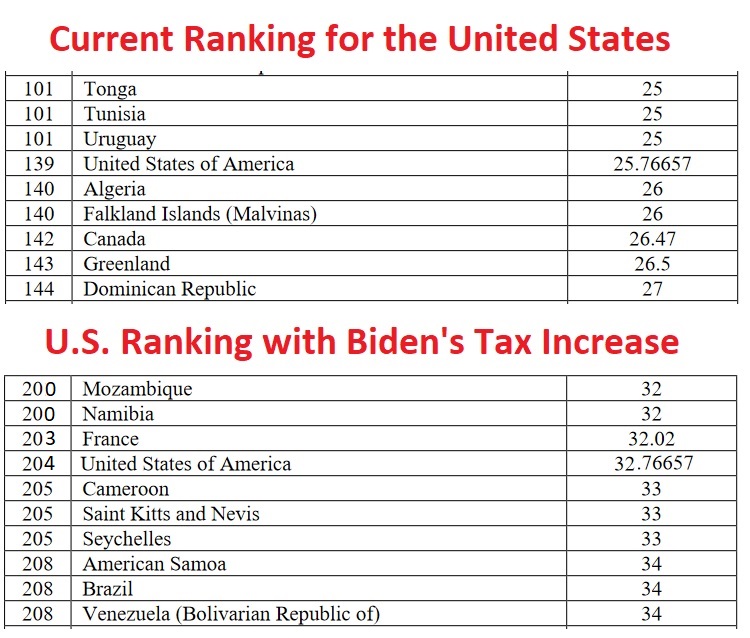
Obama just made the 18th executive branch’s unilateral change to Obamacare but who will challenge him on it?

__________ Obama just made the 18th executive branch’s unilateral change to Obamacare but who will challenge him on it? Obamacare and the Corruption of the Rule of Law February 11, 2014 by Dan Mitchell We’ve reached the stage where Obamacare is the punchline to a bad joke. The law has been a disaster, both for the economy […]

Obamacare Death Panels Kills Jobs more often than people!!!

____________ Obamacare Death Panels Kills Jobs more often than people!!! Crying about Obamacare, but also Laughing at Obamacare February 8, 2014 by Dan Mitchell I asked back in September whether all the bad news about Obamacare meant it was time to feel sorry for President Obama and other statists. Some people apparently didn’t realize I was […]

Open letter to President Obama (Part 514) (Why We Should Be Optimistic about Repealing Obamacare and Fixing the Healthcare System)

Open letter to President Obama (Part 514) (Emailed to White House on 4-15-13.) President Obama c/o The White House 1600 Pennsylvania Avenue NW Washington, DC 20500 Dear Mr. President, I know that you receive 20,000 letters a day and that you actually read 10 of them every day. I really do respect you for trying to get […]