Category Archives: Cato Institute

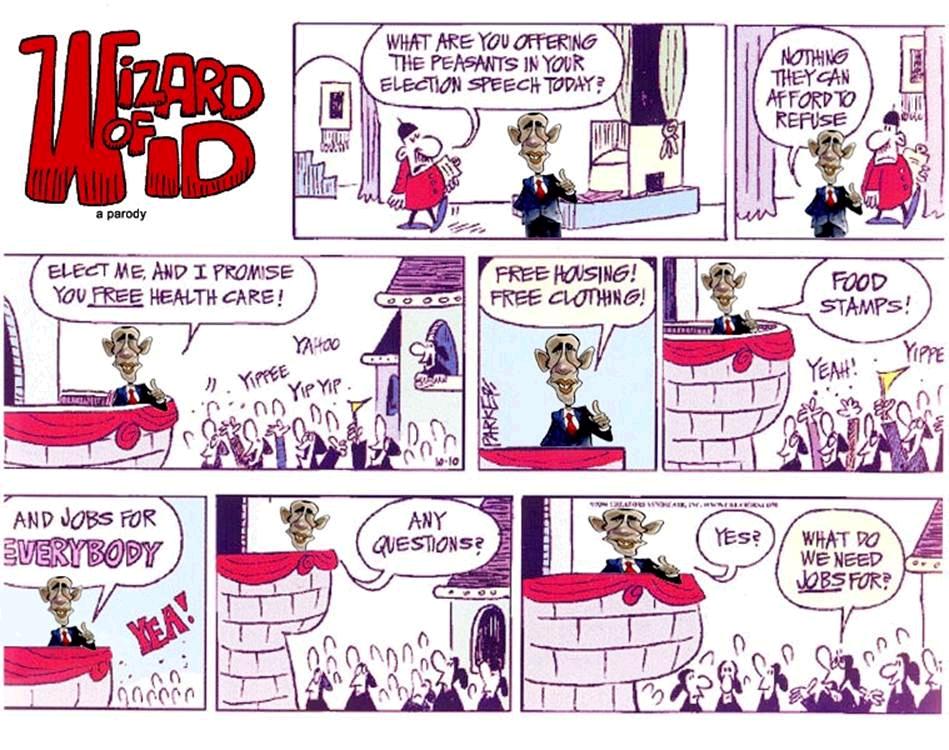
Open letter to President Obama (Part 488) (Between 1988 and 2011, the amount of the U.S. population that receives assistance from the federal government grew by 62 percent, includes cartoon)

Open letter to President Obama (Part 488)

(Emailed to White House on 4-9-13.)

President Obama c/o The White House 1600 Pennsylvania Avenue NW Washington, DC 20500

Dear Mr. President,

I know that you receive 20,000 letters a day and that you actually read 10 of them every day. I really do respect you for trying to get a pulse on what is going on out here.

___________

Big government will destroy the human spirit. We got to cut spending in the federal government Mr. President!!!!

After the poll I shared the other day, this cartoon seems appropriate.

Maybe the better lesson to be learned, thought, isn’t that we should fear big government (though we should, as this t-shirt makes clear), but that statism destroys the human spirit.

If we don’t have entitlement reform soon then we will see the programs go bankrupt in the next couple of decades. Here is a first step that we can take below. Watch this great video below:

Social Security vs. Private Retirement

Is Social Security a good retirement plan? Economics professor Antony Davies shows that Americans stand to earn significantly less and assume more risk with Social Security than other investment options. According to Davies, taxpayers would be better off both in terms of financial security and return on investment by investing their money privately. Social security is extremely expensive, soon to be insolvent, and doesn’t even offer taxpayers the most bang for their buck. For those reasons, Prof. Davies argues that it is time for the government to phase out Social Security. Davies’ solution: the government should honor its obligations to current retirees while giving Americans the freedom to invest their money as they see fit.

_____________________________

U.S. Government Increases National Debt—and Keeps 128 Million People on Government Programs

By and
January 8, 2013

Abstract: Between 1988 and 2011, the amount of the U.S. population that receives assistance from the federal government grew by 62 percent. That means that more than 41 percent of the U.S. population is enrolled in at least one federal assistance program. To make matters worse, per capita expenditures on recipients are rising as well. In 2010, over 70 percent of all federal spending went to dependence-creating programs. That growth is unsustainable, as baby boomers are now retiring every day and their entitlements cost more each year. The publicly held federal debt will exceed 100 percent of GDP in 2024. Such a high level of debt always hurts an economy—and the people who live in it. The time for Congress to reform dependence-creating government programs is now.

The number of people receiving benefits from the federal government in the United States has grown from under 94 million people in 2000 to more than 128 million people in 2011. That means that 41.3 percent of the U.S. population is now on a federal government program. The 128 million is an estimate based on the recently released March 2011 U.S. Census Bureau Current Population Survey (CPS), which, due to the survey methodology, most likely undercounts the actual number.

Heritage Foundation calculations using the March 2011 CPS found the number of people who receive assistance from at least one federal program to be 128.8 million. Using the Census Bureau number for the U.S. population in July 2011, which was 311,591,917, at least 41.34 percent are federal government program beneficiaries.[1] While very few Americans would deny that the federal government should play a role in aiding those in need, this number doubtless qualifies as far too large, indicating that taxpayer dollars are going to those not in need as well.

Many of those who receive benefits from the federal government could live well without them, so they do not count as truly dependent on the federal government.[2] Warren Buffett is the beneficiary of a federal program—Social Security—but, since he does not rely on that income for his livelihood, he should not be considered dependent on government programs. Others depend on the programs for nearly all of their income, housing, health care, food, and other needs and so fall under the classification of truly dependent on the government. Still others are somewhere in between, depending on government financing for, say, college, but little else. Consequently, it is important to note that stating that 128.8 million people receive benefits from a government program does not mean that all of them are dependent on the government.

The Numbers

In the CPS, the Census Bureau surveys thousands of U.S. citizens and non-citizens living in the U.S. in randomly drawn monthly phone surveys. Together, the roughly 60,000 households surveyed are a representative cross section of the U.S. population. While the CPS is conducted each month, the March survey has the most detailed questions. Only the March CPS survey format contains a sufficient level of detail to count federal government program participants.

The responses to the March 2011 CPS have now been released, and these individual responses were sorted for this report. All of the data were examined for responses by individuals who answered affirmatively that they were receiving benefits at the time of the survey. Based on their responses, Heritage created a new dataset from those who responded that they receive financial or in-kind benefits from at least one government program. By counting the individuals in that dataset, and using a weight assigned by the Census Bureau to each individual, the weighted number of people who depend on government programs was found.

The new dataset of people on government programs can then be further sorted to find out how many people say they are on a particular program. Here are some of the resulting numbers:

  • 128,818,142 people are enrolled in at least one government program.
  • 48,580,105 people are on Medicaid.
  • 35,770,301 people receive their retirement income from Social Security.
  • 43,834,566 people are on Medicare.
  • 39,030,579 people are living in a household where at least one person accepts food stamps.
  • 6,984,783 people are living in subsidized rental housing.
  • 2,047,149 people are receiving a higher-education subsidy.

It is important to note that the above categories overlap; for example an individual may receive both subsidized rental housing and food stamps. The total number—128,818,142 people on at least one government program does not double count individuals, however.

The 128,818,142 figure for people enrolled in at least one program is surely an undercount: The CPS responses are well known to undercount those receiving Medicaid, Medicare, Social Security, State Children’s Health Insurance, higher-education support, and Temporary Assistance for Needy Families.[3]

The undercount in higher-education subsidies may be the most important, because recipients of education subsidies are generally younger and not likely to be enrolled in other programs. Sorting the March 2011 CPS data shows that, of the two million people in the survey who responded that they receive higher-education subsidies, fewer than one half of 1 percent relied on Social Security retirement income; only 1.5 percent were also on Medicare; and only 16 percent received food stamps. The 2 million people who stated they receive higher-education subsidies are assuredly much fewer than the actual number, since the number of people receiving Pell Grants alone in 2011 was 9.7 million.[4] It is not known why the undercount in education subsidies is so large, but it is likely related to the weights the CPS uses to represent college students. Therefore, even counting only Pell Grant recipients would add millions to the lowball estimate of 128.8 million total people who receive assistance from a government program.

Housing subsidies are also most likely undercounted. According to the March 2011 CPS, only 6,984,783 individuals live in subsidized rental housing. Other government data puts the number at 4,952,191 households in 2010, not individuals.[5] Again, the weights used in the survey may contribute to the shortfall.

Growth in Number of People on Government Programs Over Time

The rate of growth in the number of people who are enrolled in a federal program far outpaces general population growth. (See chart.) In fact, an analysis of the March 2011 CPS responses going back to 1988 reveals that the number in March 2011 (128,818,142) is 62 percent higher than it was in March 1988 (79,592,924). Meanwhile, the U.S. population has grown only 27 percent since that year. In other words, the number of people who are enrolled in at least one federal program has grown more than two times faster than has the U.S. population. That growth is unsustainable as baby boomers are now retiring every day, and their entitlements cost more each year. The publicly held federal debt will exceed 100 percent of gross domestic product (GDP) by 2024.[6] Such a high level of debt always slows an economy.[7] One need look no further than the current situations in Greece, Italy, or Spain to see what high levels of national debt do to a country’s economic health. The European Union now faces a recession because of the debt its members owe. Shrinking economies are bad for everyone who lives in them, but they especially hurt the young, who have much higher rates of unemployment than older workers.[8] Shrinking economies make it even harder for young workers to find jobs. Their very futures are the ones in peril because of that debt.

While the number of people on a federal program has grown too fast, the average amount spent per capita has greatly outpaced even that level. (See chart.) The Heritage Foundation’s Index of Dependence on Government has been released annually since 2002. It tracks the amount of money that is spent on federal-assistance programs.[9] The data is in constant 2005 dollars, meaning that the amount spent increases or decreases due to government policies, not inflation. Between 1988 and 2011, spending on dependence-creating federal government programs has increased 180 percent.[10] versus “only” a 62 percent increase in the number of people who are enrolled in federal government programs, and a 27 percent increase in the population. Not only are more people enrolled in government programs than ever before, but more U.S. taxpayer dollars are being spent on each recipient every year.

What the Numbers Mean

What these alarming numbers mean is that a large proportion of the people in the United States have two kinds of income: (1) money that they or their family have earned, and (2) money transferred to them from U.S. taxpayers through the vehicle of a federal government program. Those consuming the second kind count for over 128.8 million individuals—41.3 percent of the population. According to Wall Street Journal research, when counting the number of people who live in a household where at least one person is on a government program, the dangerous tipping point of half of all Americans is nearly reached.[11] at 49.1 percent.

If one person in a household receives federal assistance, it is often the case that all members of that household do. This is certainly the case for food stamps: If a family shares meals and one of the relatives accepts food stamps, all members of that household are using those food stamps for part of their food.[12] If one person in a household receives a rent subsidy, everyone who lives in the home is a recipient.

The Clock is Ticking

The time to reform dependence-creating government programs is now. In 2010, over 70 percent of all federal spending went to dependence-creating programs.[13] It went to subsidize the living expenses of over 128.8 million individuals in the U.S. in 2011, which was more than 41 percent of the U.S. population. When the percentage of those living in a household where at least one person is subsidized is calculated, the number tops 49 percent. The problem is too much government subsidizing, and too much transfer of wealth from taxpayers to those who pay fewer and fewer taxes. After all, government does not create wealth by spreading it around.

Congress would do well to remember that there are no free subsidies and benefits. The government today is borrowing from future taxpayers to pay the current government program enrollees. The game will soon be up as debt approaches 100 percent of GDP. The United States should not owe 100 percent of all the goods and services produced in a year to its debtors. It is time for across-the-board entitlement reform so that the red ink does not drown America’s babies as they grow older and seek out their vision of the American dream. It is time for elected officials to restore America’s future for kids today who deserve to live in the great land of opportunity that America has been for the generations that came before them—instead of being bound to pay off a mountain of debt that they had no part in creating and that they should not have to face.[14]

Patrick D. Tyrrell is Research Coordinator in the Center for Data Analysis, and William W. Beach is Director of the Center for Data Analysis, and Lazof Family Fellow in Economics, at The Heritage Foundation.


___________________

Thank you so much for your time. I know how valuable it is. I also appreciate the fine family that you have and your commitment as a father and a husband.

Sincerely,

Everette Hatcher III, 13900 Cottontail Lane, Alexander, AR 72002, ph 501-920-5733, lowcostsqueegees@yahoo.com
Are guns or governments more responsible for killing people?

_____________________

Are guns or governments more responsible for killing people?

Nope, the answer isn’t smoking. Or fatty food. Or 16 oz. sodas.

And it’s not alcohol, driving too fast, or standing between politicians and a TV camera.

Che Mercedes

Why is murder “chic” for some people?

In the past 100 years or so, the biggest cause of premature death has been government.

Back in 2011, while criticizing the Baltimore Symphony for using the Soviet hammer and sickle in a promotion, I linked to a website showing how many millions of people were murdered by the dictators who ruled the Soviet Union.

You’ll find similar data in this video, as well as some equally shocking numbers for other examples of democide (death by government).

______________

Gun Control Works

Published on Jan 3, 2013

Gun Free Zones Work

______________________

I don’t know if all the numbers in the video are right. I don’t even know if the government bought 1.6 billion hollow point bullets. And I certainly hope our tax dollars didn’t help finance Pol Pot’s democide in Cambodia.

But I fully agree that government is the greatest killer of all time.

This doesn’t mean, by the way, that I think all governments are equally evil. I wouldn’t even make the claim that there’s a link between big government and democide (though that’s probably true given the track record of National Socialists in Germany and Soviet Socialists in China and the Soviet Union).

Instead, I’ll simply regurgitate some of what I wrote back in August.

…be thankful that there are some libertarians willing to raise a stink about government even if the rest of the world thinks we’re a bit odd. As we’ve seen dozens of times, most recently with the IRS and NSA, bureaucrats and politicians have a compulsive tendency to grab more power and make government more intrusive. …I’ll end today’s post by mentioning the fable of the frog that gets put in a pot of water and doesn’t jump out because the temperature feels comfortable. But then the heat is slowly raised and the frog no longer has the energy to escape when he finally figures out he’s being cooked. Well, libertarians are the ones who loudly complain when the government puts us into pots.

In other words, governments are less likely to do really awful things if there are some of us fighting when they do mildly bad things.

Don’t forget that when enough mildly bad things occur and you get economic stagnation, one result is the kind of social chaos and rioting that has occurred in some European nations.

And those are the conditions that sometimes lead to takeovers by the types of governments that do really awful things.

Let’s close with two bits of satire. First, here’s something I saw on Twitter. It’s for the statists who claim that communism is a good theory, but that it hasn’t been properly implemented.

Needless to say, I can’t see the appeal of a theory that says we are slaves to each other. But the point of this poster is that real-world communism is always about murder and oppression.

Communism in Real Life

Second, this is a good opportunity to emphasize one of the messages from the end of the video.

A common trait of dictators is that they want the citizenry disarmed.

This poster is the fourth-most viewed post I’ve ever produced. But not because I said anything clever.

Instead, people like this poster and share it with their friends because it makes a very important point about the dangers of unlimited state power.

So what’s the moral of the story? I guess the message is that small government is tolerable. Medium-sized government is bad. And unlimited government is horrible.

Actually, George Washington said the same thing with much greater clarity: “Government is not reason; it is not eloquent; it is force. Like fire, it is a dangerous servant and a fearful master.”

P.S. I suppose this shouldn’t be a joking matter, but here’s an amusing look at communist efficiency from the Beijing Olympics.

P.P.S. And the fourth video at this link has some great examples of Reagan’s use of humor against communism.


______________

Related posts:

If you want to cut government waste then stop allowing people to get addicted to government programs!!!!

______________ If you want to cut government waste then stop allowing people  to get addicted to government programs!!!! November 3, 2013 1:07PM Lindbeck’s Law: The Self-Destructive Nature of Expanding Government Benefits By Alan Reynolds Share Relevant foresight from Swedish economist Assar Lindbeck, “Hazardous Welfare State Dynamics,” American Economic Review, May 1995: The basic dilemma of […]

We got to shutdown government waste now!!!

We got to shutdown government waste now!!! October 2, 2013 11:16AM Shutdown Could Shut Down Waste By Chris Edwards Share A benefit of the government shutdown may be that it slows the stream of waste and bad behavior flowing from the federal bureaucracy. Catching up on my reading, I noticed these items in just the […]

Open letter to President Obama (Part 440) A suggestion to cut some wasteful spending out of the government Part 6 (includes editorial cartoon)

(Emailed to White House on 3-15-13.) President Obama c/o The White House 1600 Pennsylvania Avenue NW Washington, DC 20500 Dear Mr. President, I know that you receive 20,000 letters a day and that you actually read 10 of them every day. I really do respect you for trying to get a pulse on what is […]

Open letter to President Obama (Part 438) A suggestion to cut some wasteful spending out of the government Part 5 (includes editorial cartoon)

(Emailed to White House on 3-15-13.) President Obama c/o The White House 1600 Pennsylvania Avenue NW Washington, DC 20500 Dear Mr. President, I know that you receive 20,000 letters a day and that you actually read 10 of them every day. I really do respect you for trying to get a pulse on what is […]

Open letter to President Obama (Part 436) A suggestion to cut some wasteful spending out of the government Part 4 (includes editorial cartoon)

(Emailed to White House on 3-15-13.) President Obama c/o The White House 1600 Pennsylvania Avenue NW Washington, DC 20500 Dear Mr. President, I know that you receive 20,000 letters a day and that you actually read 10 of them every day. I really do respect you for trying to get a pulse on what is […]

Open letter to President Obama (Part 434) A suggestion to cut some wasteful spending out of the government Part 3 (includes editorial cartoon)

(Emailed to White House on 3-15-13.) President Obama c/o The White House 1600 Pennsylvania Avenue NW Washington, DC 20500 Dear Mr. President, I know that you receive 20,000 letters a day and that you actually read 10 of them every day. I really do respect you for trying to get a pulse on what is […]

Open letter to President Obama (Part 432) A suggestion to cut some wasteful spending out of the government Part 2 (includes editorial cartoon)

(Emailed to White House on 3-15-13.) President Obama c/o The White House 1600 Pennsylvania Avenue NW Washington, DC 20500 Dear Mr. President, I know that you receive 20,000 letters a day and that you actually read 10 of them every day. I really do respect you for trying to get a pulse on what is […]

Open letter to President Obama (Part 430) A suggestion to cut some wasteful spending out of the government Part 1 (includes editorial cartoon)

(Emailed to White House on 3-15-13.) President Obama c/o The White House 1600 Pennsylvania Avenue NW Washington, DC 20500 Dear Mr. President, I know that you receive 20,000 letters a day and that you actually read 10 of them every day. I really do respect you for trying to get a pulse on what is […]

We need to stop wasteful government spending by privatizing the post office!!

We need to stop wasteful government spending by privatizing the post office!! Postal Service Won’t Shut Down but Will Default on Its Debt James Gattuso October 1, 2013 at 9:30 am Newscom The U.S. Postal Service (USPS) defaulted on its debt last night. No, it has nothing to do with the partial shutdown of the […]

President Obama and government spending (GSA Govt waste tip of iceberg)

I wish President Obama would try to cut spending instead of increasing spending and our debt. Two Very Good GSA Waste Cartoons April 21, 2012 by Dan Mitchell One of my first blog posts back in 2009 featured a column about the Social Security Administration squandering $750,000 on a “conference” at a fancy golf resort in […]

________________

“Schaeffer Sunday” Francis Schaeffer and C. Everette Koop on the Hippocratic oath (March for Life January 2014)

This was originally posted before the March for Life in 2013.

Dr. C. Everett Koop was appointed to the Reagan administration but was held up in the Senate in his confirmation hearings by Ted Kennedy because of his work in pro-life causes.

I was thinking about the March for Life that is coming up on Jan 20, 2013  and that is why I posted this today

Francis Schaeffer Whatever Happened to the Human Race (Episode 1) ABORTION

Francis Schaeffer: What Ever Happened to the Human Race? (Full-Length Documentary)


Part 1 on abortion runs from 00:00 to 39:50, Part 2 on Infanticide runs from 39:50 to 1:21:30, Part 3 on Youth Euthanasia runs from 1:21:30 to 1:45:40, Part 4 on the basis of human dignity runs from 1:45:40 to 2:24:45 and Part 5 on the basis of truth runs from 2:24:45 to 3:00:04

Take a look at episode 3 above of WHATEVER HAPPENED TO THE HUMAN RACE? (It discusses Youth Euthanasia) and then read the post below.

One of my favorite economists is Dan Mitchell and recently he noted, “Wow. I guess doctors in the UK don’t have to take the Hippocratic Oath! A society like this is not going to last very long at all. The rot is pervasive and terminal.”

This comment by Mitchell was on his blog where the subject of infanticide came up and Mitchell was surprised that many of his readers jumped on the infanticide bandwagon. There are several reasons for this but the main reason is that many of Mitchell’s readers hold a mechanistic view of man. Man is the product not of creation by a personal God like our founding fathers believed but a product of the impersonal chance driven evolutionary process. I have discussed this with many people in the past and I just blogged about it today on the Arkansas Times Blog.

Schaeffer and Koop in their film series took the first three episodes to look where a mechanistic view of life leads. 1. Abortion, 2. Infanticide and 3. Youth Euthanasia. What is acceptable killing after all?  Was Hitler wrong or not?  Was Jack Kevorkian right or not? (Kevorkian could have taken on that problem of lack of funding for social security and solved it fast!!!)

Here is an article below that discusses what Francis Schaefffer and Dr. C. Everette Koop had to say about the Hippocratic oath and how it is being used in modern times. (Schaeffer and Koop really did look at what was happening in the 1970’s and correctly predicted what measures medical science would take the future concerning these crucial issues.) Actually  Francis Schaeffer actually predicted that men like Jack Kevorkian would come long ago.  Take a look at this article below.

Right to Life vs. Sanctity of Life

Perhaps the most basic right that a human being possesses under the law of an organized society is the right to be born and to continue living. Much attention in recent times has been given to the right of a fetus (Latin for “little one”) to exist until the time of birth. One writer who should be commended for addressing some of the philosophical and theological issues pertaining to people with disabilities is Dr. Francis A. Schaeffer. However, his prime foci in the book he co-authored with Dr. C. Everett Koop, Whatever Happened to the Human Race?, were abortion, infanticide, and euthanasia and not issues specifically related to disability.

Within the scdpe of the abortion issue lies the matter of terminating a pregnancy if some irregularity is discovered in the fetus, thereby warding off the possibility of “burdening the parents and society” with a child with disabilities. The authors remind us that. . .

the graduates of American medical schools have traditionally taken the Hippocratic oath, which goes back more than two thousand years at the time of their commencement. The Declaration of Geneva (adopted in September 1948 by the General Assembly of the World Medical Organization and modeled closely on the Hippocratic oath) became used as the graduation oath by more and more medical schools. It includes, “I will maintain the utmost respect for human life; from the time of conception.” This concept for the preservation of human life has been the basis of the medical profession and society in general. It is significant that, when the University of Pittsburgh changed from the Hippocratic oath to the Declaration of Geneva in 1971, the students deleted “from the time of conception” from the clause beginning “I will maintain the utmost respect for human life.” The University of Toronto School of Medicine has also removed the phrase “from the time of conception” from the form of oath it now uses.4

Therefore it is not difficult for some to take the step from dismissing a fetus as being a viable life to destroying a fetus that has some irregularity. This may be done in the name of humaneness, believing that by destroying a,”nonlife” you have preserved the quality of other “valid” lives – in particular the quality of life of the parents and siblings. Furthermore, the argument may continue, “ought not the population at large be spared the financial burden of providing care for those potentially disabled children?”

Thus the question is posed: Does a child with disabilities have a right to life? Furthermore, does a fetus, for which medical experts have declared the possibility of being disabled, have any right to be protected from being killed? Necessarily, the law must address any issue pertaining to “rights;” but theologically if we debate the questions at hand on the grounds of our intrinsic or civil rights, we are approaching this subject from a wrong perspective. If we fight this battle on the grounds of rights, then what about the right of the mother to control what happens in her own body or the right of the family not to be unduly restricted by the (perhaps) relentless burden of daily care of a child with disabilities? Then what about the right of the population not to be encumbered with a heavier tax burden, higher insurance premiums, and the extra expense of architectural adjustments in its public buildings in order to accommodate the special needs of certain groups? When “your rights” infringe upon “my rights,” then the battle is truly engaged!

Theologically, the so-called “right to life” terminology is a misnomer. Who, pray tell, has a right to life? I don’t. You don’t. And neither does a person with disabilities. The Scriptures, rather, teach the sanctity of life in that all life is God-given. Life is a gift from God. Job declared, . . . the breath of the Almighty gives me life. (Job 33:4). The writer of Ecclesiastes wrote that all the days of life that a man lives. . . God has given him. . . (Ecclesiastes 5:18, 8:15). Deuteronomy 30:20 reads, For the Lord is your life, and he will give you many years in the land. . . Acts 17:28 says, For in him we live and move and have our being. Colossians 1:17 teaches that all things are held together by Him. James 4:14,15 gives us to understand that the continuance or end of our lives is subject to God’s will.

All life, then, being God-given, God-sustained, and ultimately God-terminated, belongs strictly to the province of God’s authority. If God has chosen to give life, to a person with disabilities or to a fetus who has possible disabilities, then who BUT GOD shall dare to take unto herself or himself the authority to end that life? Life, human life-all human life-belongs to God. In a sense He loans it as a trust, a sacred trust. He alone has the authority to give, withhold, sustain, and withdraw life. And so we address this issue of life on the grounds of its sacredness. not on rights, at least as far as theology is concerned.

Related posts:

Francis Schaeffer affected pro-life movement (Part 3) “Schaeffer Sunday”

On the Arkansas Times blog in the comment section the person using username “Hackett” asserted: Life begins when the fetus is viable outside the womb, prior to that it is parasitical and lives at the discretion of the host. I responded with this post: It seems to me the real argument lies in the personhood […]

Open letter to Republican Presidential Candidate Mitt Romney on our pro-life views (Part 3)

To Mitt Romney, Box 96994, Washington, DC 20077-7556  From Everette Hatcher of http://www.thedailyhatch.org 13900 Cottontail Lane, Alexander, AR 72002 Did we forgive George Bush in 1988 for being pro-choice originally in 1980? We sure did. In fact, my former pastor, Adrian Rogers, had a chance to visit with Bush several times. He told him that the […]

Does human life begin at birth or conception?

On the Arkansas Times blog in the comment section the person using username “Hackett” asserted: Life begins when the fetus is viable outside the womb, prior to that it is parasitical and lives at the discretion of the host. I responded with this post today: It seems to me the real argument lies in the […]

A man of pro-life convictions: Bernard Nathanson (part 2)

“Jane Roe” or Roe v Wade is now a prolife Christian. She’s recently has done a commercial about it. _______________________________ I have often wondered why we got to this point in our country’s life and we allow abortion. The answer is found in the words of Schaffer. Philosopher and Theologian, Francis A. Schaeffer has argued, […]

A man of pro-life convictions: Bernard Nathanson (part 1)

This is such a great video series “The Silent Scream.” I have never seen it until now and I wish I had seen it 30 years ago.  Take a look at the video clip below. I wanted to pass along a portion of the excellent article “Bernard Nathanson: A Life Transformed by the Truth about […]

Pro-abortion Ark Times article refuted here (Part 1)jh52

The Arkansas Times article, “Putting the fetus first: Pro-lifers keep up attack on access, but pro-choice advocates fend off the end to abortion right” by Leslie Newell Peacock is very lengthy but I want to deal with all of it in this new series.   click to enlarge ROSE MIMMS: Arkansas Right to Life director unswayed by […]

Abortionist Bernard Nathanson turned pro-life activist (part 7) Have you wondered why we have abortion in the USA?

“Jane Roe” or Roe v Wade is now a prolife Christian. She’s recently has done a commercial about it.   _______________________________ I have often wondered why we got to this point in our country’s life and we allow abortion. The answer is found in the words of Schaffer. Philosopher and Theologian, Francis A. Schaeffer has […]

Francis Schaeffer’s prayer for us in USA

 Francis Schaeffer: “Whatever Happened to the Human Race” (Episode 1) ABORTION OF THE HUMAN RACE Published on Oct 6, 2012 by AdamMetropolis The 45 minute video above is from the film series created from Francis Schaeffer’s book “Whatever Happened to the Human Race?” with Dr. C. Everett Koop. This book  really helped develop my political views […]

Francis Schaeffer’s “How should we then live?” Video and outline of episode 10 “Final Choices” (Schaeffer Sundays)

E P I S O D E 1 0   Dr. Francis Schaeffer – Episode X – Final Choices 27 min FINAL CHOICES I. Authoritarianism the Only Humanistic Social Option One man or an elite giving authoritative arbitrary absolutes. A. Society is sole absolute in absence of other absolutes. B. But society has to be […]

Francis Schaeffer’s “How should we then live?” Video and outline of episode 9 “The Age of Personal Peace and Affluence” (Schaeffer Sundays)

E P I S O D E 9 Dr. Francis Schaeffer – Episode IX – The Age of Personal Peace and Affluence 27 min T h e Age of Personal Peace and Afflunce I. By the Early 1960s People Were Bombarded From Every Side by Modern Man’s Humanistic Thought II. Modern Form of Humanistic Thought Leads […]

Francis Schaeffer’s “How should we then live?” Video and outline of episode 8 “The Age of Fragmentation” (Schaeffer Sundays)

E P I S O D E 8 Dr. Francis Schaeffer – Episode VIII – The Age of Fragmentation 27 min I saw this film series in 1979 and it had a major impact on me. T h e Age of FRAGMENTATION I. Art As a Vehicle Of Modern Thought A. Impressionism (Monet, Renoir, Pissarro, Sisley, […]

Francis Schaeffer’s “How should we then live?” Video and outline of episode 7 “The Age of Non-Reason” (Schaeffer Sundays)

E P I S O D E 7 Dr. Francis Schaeffer – Episode VII – The Age of Non Reason I am thrilled to get this film series with you. I saw it first in 1979 and it had such a big impact on me. Today’s episode is where we see modern humanist man act […]

Francis Schaeffer’s “How should we then live?” Video and outline of episode 6 “The Scientific Age” (Schaeffer Sundays)

E P I S O D E 6 How Should We Then Live 6#1 Uploaded by NoMirrorHDDHrorriMoN on Oct 3, 2011 How Should We Then Live? Episode 6 of 12 ________ I am sharing with you a film series that I saw in 1979. In this film Francis Schaeffer asserted that was a shift in […]

Francis Schaeffer’s “How should we then live?” Video and outline of episode 5 “The Revolutionary Age” (Schaeffer Sundays)

E P I S O D E 5 How Should We Then Live? Episode 5: The Revolutionary Age I was impacted by this film series by Francis Schaeffer back in the 1970′s and I wanted to share it with you. Francis Schaeffer noted, “Reformation Did Not Bring Perfection. But gradually on basis of biblical teaching there […]

Francis Schaeffer’s “How should we then live?” Video and outline of episode 4 “The Reformation” (Schaeffer Sundays)

Dr. Francis Schaeffer – Episode IV – The Reformation 27 min I was impacted by this film series by Francis Schaeffer back in the 1970′s and I wanted to share it with you. Schaeffer makes three key points concerning the Reformation: “1. Erasmian Christian humanism rejected by Farel. 2. Bible gives needed answers not only as to […]

“Schaeffer Sundays” Francis Schaeffer’s “How should we then live?” Video and outline of episode 3 “The Renaissance”

Francis Schaeffer’s “How should we then live?” Video and outline of episode 3 “The Renaissance” Francis Schaeffer: “How Should We Then Live?” (Episode 3) THE RENAISSANCE I was impacted by this film series by Francis Schaeffer back in the 1970′s and I wanted to share it with you. Schaeffer really shows why we have so […]

Francis Schaeffer’s “How should we then live?” Video and outline of episode 2 “The Middle Ages” (Schaeffer Sundays)

  Francis Schaeffer: “How Should We Then Live?” (Episode 2) THE MIDDLE AGES I was impacted by this film series by Francis Schaeffer back in the 1970′s and I wanted to share it with you. Schaeffer points out that during this time period unfortunately we have the “Church’s deviation from early church’s teaching in regard […]

Francis Schaeffer’s “How should we then live?” Video and outline of episode 1 “The Roman Age” (Schaeffer Sundays)

Francis Schaeffer: “How Should We Then Live?” (Episode 1) THE ROMAN AGE   Today I am starting a series that really had a big impact on my life back in the 1970′s when I first saw it. There are ten parts and today is the first. Francis Schaeffer takes a look at Rome and why […]

Francis Schaeffer: “Whatever Happened to the Human Race” (Episode 5) TRUTH AND HISTORY

Francis Schaeffer: “Whatever Happened to the Human Race” (Episode 5) TRUTH AND HISTORY Published on Oct 7, 2012 by AdamMetropolis This crucial series is narrated by the late Dr. Francis Schaeffer and former Surgeon General Dr. C. Everett Koop. Today, choices are being made that undermine human rights at their most basic level. Practices once […]

Francis Schaeffer: “Whatever Happened to the Human Race” (Episode 4) THE BASIS FOR HUMAN DIGNITY

The opening song at the beginning of this episode is very insightful. Francis Schaeffer: “Whatever Happened to the Human Race” (Episode 4) THE BASIS FOR HUMAN DIGNITY Published on Oct 7, 2012 by AdamMetropolis This crucial series is narrated by the late Dr. Francis Schaeffer and former Surgeon General Dr. C. Everett Koop. Today, choices […]

Francis Schaeffer: “Whatever Happened to the Human Race” (Episode 3) DEATH BY SOMEONE’S CHOICE

Francis Schaeffer: “Whatever Happened to the Human Race” (Episode 3) DEATH BY SOMEONE’S CHOICE Published on Oct 6, 2012 by AdamMetropolis This crucial series is narrated by the late Dr. Francis Schaeffer and former Surgeon General Dr. C. Everett Koop. Today, choices are being made that undermine human rights at their most basic level. Practices […]

Francis Schaeffer: “Whatever Happened to the Human Race?” (Episode 2) SLAUGHTER OF THE INNOCENTS

Francis Schaeffer: “Whatever Happened to the Human Race?” (Episode 2) SLAUGHTER OF THE INNOCENTS Published on Oct 6, 2012 by AdamMetropolis This crucial series is narrated by the late Dr. Francis Schaeffer and former Surgeon General Dr. C. Everett Koop. Today, choices are being made that undermine human rights at their most basic level. Practices […]

Francis Schaeffer: “Whatever Happened to the Human Race” (Episode 1) ABORTION OF THE HUMAN RACE

It is not possible to know where the pro-life evangelicals are coming from unless you look at the work of the person who inspired them the most. That person was Francis Schaeffer.  I do care about economic issues but the pro-life issue is the most important to me. Several years ago Adrian Rogers (past president of […]

The following essay explores the role that Francis Schaeffer played in the rise of the pro-life movement. It examines the place of How Should We Then Live?, Whatever Happened to the Human Race?, and A Christian Manifesto in that process.

This essay below is worth the read. Schaeffer, Francis – “Francis Schaeffer and the Pro-Life Movement” [How Should We Then Live?, Whatever Happened to the Human Race?, A Christian Manifesto] Editor note: <p> </p> [The following essay explores the role that Francis Schaeffer played in the rise of the pro-life movement.  It examines the place of […]

Who was Francis Schaeffer? by Udo Middelmann

Great article on Schaeffer. Who was Dr. Francis A. Schaeffer? By Francis Schaeffer The unique contribution of Dr. Francis Schaeffer on a whole generation was the ability to communicate the truth of historic Biblical Christianity in a way that combined intellectual integrity with practical, loving care. This grew out of his extensive understanding of the Bible […]

Open letter to President Obama (Part 483) (A closer look at Boston Marathon terrorists)

(Emailed to White House on 5-6-13)

President Obama c/o The White House
1600 Pennsylvania Avenue NW
Washington, DC 20500

Dear Mr. President,

I know that you receive 20,000 letters a day and that you actually read 10 of them every day. I really do respect you for trying to get a pulse on what is going on out here.

___________

Sad case indeed.

So we’ve now learned that the Boston Marathon terrorists were welfare bums. Why am I not surprised?

“Thanks for the handouts, suckers!”

Heck, it was only a couple of days ago that I announced the Moocher Hall of Fame and included terrorists from theUnited Kingdom and Australia (and I could have included a taxpayer-subsidized terrorist from France as well).

I’m tempted to joke about al Qaeda including welfare applications in their training manuals, but I’m worried that might give them new ideas.

Anyhow, here are some of the predictable details from a story in the Boston Herald.

Marathon bombings mastermind Tamerlan Tsarnaev was living on taxpayer-funded state welfare benefits even as he was delving deep into the world of radical anti-American Islamism, the Herald has learned. State officials confirmed last night that Tsarnaev, slain in a raging gun battle with police last Friday, was receiving benefits along with his wife, Katherine Russell Tsarnaev, and their 3-year-old daughter. The state’s Executive Office of Health and Human Services said those benefits ended in 2012… In addition, both of Tsarnaev’s parents received benefits, and accused brother bombers Dzhokhar and Tamerlan were recipients through their parents when they were younger, according to the state.

All this raises a broader point about why the United States has a policy of letting people in the country who are not self supporting?

This is the point I made in my Fox Business News debate about immigration. Like most other libertarians, I’m very sympathetic to immigration, but I want people with initiative and ambition, not welfare tourists.

Speaking of welfare tourism, even Europeans realize it’s a problem when people come for handouts rather than opportunity. Here’s a blurb from a Daily Telegraph report.

Theresa May, the Home Secretary, has convinced her counterparts in Germany, Austria and the Netherlands to campaign for tighter restrictions to migrants’ access to welfare handouts and other state-funded services. In a joint letter, the countries have warned that migrants from EU members states are putting “considerable strain” on schools, healthcare and the welfare state…David Cameron has said he wants to restrict migrants’ access to housing benefit, legal aid and the NHS. The letter sent by the four countries warns that the EU free movement directive must not be “unconditional” and that major towns and cities “are under a considerable strain by certain immigrants from other member states”.

Of course, it’s hard to have much sympathy for the politicians in the UK, Germany, Austria, and the Netherlands. After all, they certainly have the power to reduce their overly generous welfare systems.

But instead of taking that sensible step, they want to restrict immigration.

Which brings us back to Milton Friedman’s warning about the incompatibility of opens borders and the welfare state.

But the real reason to pare back the welfare state is that dependency is bad for poor people, regardless of whether they’re native born or immigrants. Even some honest liberals have acknowledged this problem.

If we want to help the less fortunate, economic growth is the best approach. That means free markets and small government.

And the combination of more growth and less welfare will ease concerns about immigration, so it’s a win-win-win situation. What’s not to love?

P.S. Better economic policy is desirable for many reasons, but I’m not under any illusion it will stop terrorism. As I wrote recently, there’s no way to create a risk-free society, particularly when there are people motivated by anti-modernity.

___________

Thank you so much for your time. I know how valuable it is. I also appreciate the fine family that you have and your commitment as a father and a husband.

Sincerely,

Everette Hatcher III, 13900 Cottontail Lane, Alexander, AR 72002, ph 501-920-5733, lowcostsqueegees@yahoo.com

Related posts:

Dan Mitchell explains what happened in Cyprus

Dan Mitchell explains what happened in Cyprus.   What Really Happened in Cyprus? April 14, 2013 by Dan Mitchell Did Cyprus become an economic basket case because it is a tax haven, as some leftists have implied? Did it get in trouble because the government overspent, which I have suggested? The answers to those questions are […]

Dan Mitchell on Obamacare (includes cartoons on Obamacare)

Some very good points by Dan Mitchell of the Cato Institute on Obamacare: Why We Should Be Optimistic about Repealing Obamacare and Fixing the Healthcare System April 10, 2013 by Dan Mitchell I’m going to make an assertion that seems utterly absurd. The enactment of Obamacare may have been good news. Before sending a team of medical […]

Dan Mitchell’s blog has great cartoon that demonstrates what President Obama has been doing the last 4 years!!!

I have put up lots of cartoons from Dan Mitchell’s blog before and they have got lots of hits before. Many of them have dealt with the economy, eternal unemployment benefits, socialism,  Greece,  welfare state or on gun control.     I’ve Obtained a Secret Pre-Release Copy of Obama’s Budget April 9, 2013 by Dan Mitchell The President is supposed to release […]

Dan Mitchell’s tribute to Margaret Thatcher

Very well said by Dan Mitchell. A Tribute to Margaret Thatcher April 8, 2013 by Dan Mitchell The woman who saved the United Kingdom has died. A Great Woman I got to meet Margaret Thatcher a couple of times and felt lucky each time that I was in the presence of someone who put her nation’s […]

Dan Mitchell, Ron Paul, and Milton Friedman on Immigration Debate (includes editorial cartoon)

I like Milton Friedman’s comments on this issue of immigration   and Ron Paul and Dan Mitchell do well on the issue too. Question of the Week: What’s Your Take on the Immigration Debate? April 7, 2013 by Dan Mitchell A reader from overseas wonders about my views on immigration, particularly amnesty. I confess that this is one of […]

Dan Mitchell on Texas v. California (includes editorial cartoon)

We should lower federal taxes because jobs are going to states like Texas that have low taxes. What Can We Learn by Comparing the Employment Situation in Texas vs. California? April 3, 2013 by Dan Mitchell One of the great things about federalism, above and beyond the fact that it both constrains the power of governments […]

Cartoons from Dan Mitchell’s blog on Obamacare

Third-Party Payer is the Biggest Economic Problem With America’s Health Care System Published on Jul 10, 2012 This mini-documentary from the Center for Freedom and Prosperity Foundation explains that “third-party payer” is the main problem with America’s health care system. This is why undoing Obamacare, while desirable, is just a small first step if we […]

Obamacare cartoons from Dan Mitchell’s blog

I have put up lots of cartoons from Dan Mitchell’s blog before and they have got lots of hits before. Many of them have dealt with the economy, eternal unemployment benefits, socialism,  Greece,  welfare state or on gun control. The funniest cartoon is the one with “Nurse Sebelius” stuffing the huge capsule down the kid’s throat!!! Obamacare […]

Editorial cartoon from Dan Mitchell’s blog on California’s sorry state of affairs

I have put up lots of cartoons from Dan Mitchell’s blog before and they have got lots of hits before. Many of them have dealt with the sequester, economy, eternal unemployment benefits, socialism,  minimum wage laws, tax increases, social security, high taxes in California, Obamacare,  Greece,  welfare state or on gun control. President Obama’s favorite state must be California because […]

Dan Mitchell of the Cato Institute:HUD has to go!!!! (includes political cartoon)

You want a suggestion on how to cut the government then start at HUD. I would prefer to eliminate all of it. Here are Dan Mitchell’s thoughts below: Sequestration’s Impact on HUD: Just 358 More Days and Mission Accomplished March 12, 2013 by Dan Mitchell As part of my “Question of the Week” series, I had […]

By Everette Hatcher III | Posted in Cato Institute, Economist Dan Mitchell, spending out of control | Edit | Comments (0

Atheist Nat Hentoff USED TO THINK that abortion is part of a woman’s fundamental right to privacy

Nat Hentoff is an atheist, but he became a pro-life activist because of the scientific evidence that shows that the unborn child is a distinct and separate human being and even has a separate DNA. His perspective is a very intriguing one that I thought you would be interested in. I have shared before many   cases (Bernard Nathanson, Donald Trump, Paul Greenberg, Kathy Ireland)    when other high profile pro-choice leaders have changed their views and this is just another case like those. I have contacted the White House over and over concerning this issue and have even received responses. I am hopeful that people will stop and look even in a secular way (if they are not believers) at this abortion debate and see that the unborn child is deserving of our protection.That is why the writings of Nat Hentoff of the Cato Institute are so crucial.

In the past I have spent most of my time looking at this issue from the spiritual side. In the film series “WHATEVER HAPPENED TO THE HUMAN RACE?” the arguments are presented  against abortion (Episode 1),  infanticide (Episode 2),   euthanasia (Episode 3), and then there is a discussion of the Christian versus Humanist worldview concerning the issue of “the basis for human dignity” in Episode 4 and then in the last episode a close look at the truth claims of the Bible.

Francis Schaeffer

__________________________

I truly believe that many of the problems we have today in the USA are due to the advancement of humanism in the last few decades in our society. Ronald Reagan appointed the evangelical Dr. C. Everett Koop to the position of Surgeon General in his administration. He partnered with Dr. Francis Schaeffer in making the video below. It is very valuable information for Christians to have.  Actually I have included a video below that includes comments from him on this subject.


Francis Schaeffer Whatever Happened to the Human Race (Episode 1) ABORTION

Francis Schaeffer: What Ever Happened to the Human Race? (Full-Length Documentary)


Part 1 on abortion runs from 00:00 to 39:50, Part 2 on Infanticide runs from 39:50 to 1:21:30, Part 3 on Youth Euthanasia runs from 1:21:30 to 1:45:40, Part 4 on the basis of human dignity runs from 1:45:40 to 2:24:45 and Part 5 on the basis of truth runs from 2:24:45 to 3:00:04

________________

To be liberal and pro-life
NAT HENTOFF, CHAMPION OF ‘INCONVENIENT LIFE’

by Cathryn Donohoe; THE WASHINGTON TIMES
November 6, 1989, Monday, Final Edition, November 6, 1989NEW YORK — Until 1984, he had not given much thought to abortion, he says. He had accepted the view of all the women he knew, including his wife, that the right to an abortion is part of a woman’s fundamental right to privacy, one that allows her control over her body and, by extension, her life.

Then came the case of Baby Jane Doe. She was a Long Island infant born with spina bifida (a condition in which the spinal cord is unprotected because the spinal column does not close properly before birth) and hydrocephalus (excess fluid in the cranium).

With surgery, spina-bifida babies can grow up to be bright, productive adults who might need braces to walk, Mr. Hentoff insists. Yet Baby Jane’s parents, on their doctors’ advice, had refused both surgery to close her spine and a shunt to drain the fluid from her brain. In resisting the federal government’s attempt to enforce treatment, the parents pleaded privacy.

What first piqued Mr. Hentoff’s curiosity was not so much the case itself but the press coverage. All the papers and the networks were using the same words to say the same thing, he says.

“Whenever I see that kind of story, where everybody agrees, I know there’s something wrong,” he says. “I finally figured out they were listening to the [parents’] lawyer.”

He went after the story, later publishing it in The Atlantic as “The Awful Privacy of Baby Doe.” In running it down, he found himself digging into the notorious, 2-year-old case of the first Infant Doe. That Bloomington, Ind., Down’s syndrome baby died of starvation over six days when his parents, who did not want a retarded child, refused surgery for his deformed esophagus.

Then Mr. Hentoff came across the published reports of experiments in what doctors at Yale-New Haven Hospital called “early death as a management option” for infants “considered to have little or no hope of achieving meaningful ‘humanhood.’ ” He talked with happy handicapped adults whose parents could have killed them but didn’t. It changed him.

But as he was fretting over Baby Jane, he says, civil libertarians, liberal congressmen and old ACLU friends were trying to steer him away.

“They were saying, ‘What’s the big fuss about? If the parents had known she was going to come in this way, they would have had an abortion. So why don’t youconsider it a late abortion and go on to something else?’

“Here were liberals, decent people, fully convinced themselves that they were for individual rights and liberties but willing to send into eternity these infants because they were imperfect, inconvenient, costly. I saw the same attitude on the part of the same kinds of people toward abortion, and I thought it was pretty horrifying.”

Mr. Hentoff has a pet phrase he draws from novelist William Burroughs. The moment of truth comes, he says, “when you see the naked lunch at the end of the fork.” Once he heard the phrase, “late abortion,” he knew what was at the end of the fork.

“The ‘slippery slope’ business began to make sense to me then,” he says. “From there it was ineluctable – not just abortion, but euthanasia as well.”

The Washington Times

Related posts:

Al Mohler on Kermit Gosnell’s abortion practice

Francis Schaeffer: “Whatever Happened to the Human Race” (Episode 1) ABORTION OF THE HUMAN RACE Published on Oct 6, 2012 by AdamMetropolis ________________ Picture of Francis Schaeffer and his wife Edith from the 1930′s above. I was sad to read about Edith passing away on Easter weekend in 2013. I wanted to pass along this fine […]

A man of pro-life convictions: Bernard Nathanson (part4)

ABORTION – THE SILENT SCREAM 1 / Extended, High-Resolution Version (with permission from APF). Republished with Permission from Roy Tidwell of American Portrait Films as long as the following credits are shown: VHS/DVDs Available American Portrait Films Call 1-800-736-4567 http://www.amport.com The Hand of God-Selected Quotes from Bernard N. Nathanson, M.D., Unjust laws exist. Shall we […]

Abortionist Bernard Nathanson turned pro-life activist (part 11)

ABORTION – THE SILENT SCREAM 1 / Extended, High-Resolution Version (with permission from APF). Republished with Permission from Roy Tidwell of American Portrait Films as long as the following credits are shown: VHS/DVDs Available American Portrait Films Call 1-800-736-4567 http://www.amport.com The Hand of God-Selected Quotes from Bernard N. Nathanson, M.D., Unjust laws exist. Shall we […]

Abortionist Bernard Nathanson turned pro-life activist (part 9)(Donald Trump changes to pro-life view)

When I think of the things that make me sad concerning this country, the first thing that pops into my mind is our treatment of unborn children. Donald Trump is probably going to run for president of the United States. Tony Perkins of the Family Research Council recently had a conversation with him concerning the […]

Taking on Ark Times Bloggers on various issues Part U “Do men have a say in the abortion debate?” (includes the film SLAUGHTER OF THE INNOCENTS and editorial cartoon)

I have gone back and forth and back and forth with many liberals on the Arkansas Times Blog on many issues such as abortion, human rights, welfare, poverty, gun control  and issues dealing with popular culture. Here is another exchange I had with them a while back. My username at the Ark Times Blog is Saline […]

Taking on Ark Times Bloggers on various issues Part T “Abortion is a dirty business” (includes video “Truth and History” and editorial cartoon)

I have gone back and forth and back and forth with many liberals on the Arkansas Times Blog on many issues such as abortion, human rights, welfare, poverty, gun control  and issues dealing with popular culture. Here is another exchange I had with them a while back. My username at the Ark Times Blog is Saline […]

“Sanctity of Life Saturday” Abortion supporters lying in order to further their clause? Window to the Womb (includes video ABORTION OF THE HUMAN RACE)

It is truly sad to me that liberals will lie in order to attack good Christian people like state senator Jason Rapert of Conway, Arkansas because he headed a group of pro-life senators that got a pro-life bill through the Arkansas State Senate the last week of January in 2013. I have gone back and […]

Taking on Ark Times Bloggers on various issues Part D “If you can’t afford a child can you abort?”Francis Schaeffer Quotes part 4 includes the film ABORTION OF THE HUMAN RACE) (editorial cartoon)

I have gone back and forth and back and forth with many liberals on the Arkansas Times Blog on many issues such as abortion, human rights, welfare, poverty, gun control  and issues dealing with popular culture. Here is another exchange I had with them a while back. My username at the Ark Times Blog is Saline […]

Taking on Ark Times Bloggers on various issues Part C “Abortion” (Francis Schaeffer Quotes part 3 includes the film SLAUGHTER OF THE INNOCENTS) (editorial cartoon)

I have gone back and forth and back and forth with many liberals on the Arkansas Times Blog on many issues such as abortion, human rights, welfare, poverty, gun control  and issues dealing with popular culture. Here is another exchange I had with them a while back. My username at the Ark Times Blog is Saline […]

Taking on Ark Times Bloggers on various issues Part B “Gendercide” (Francis Schaeffer Quotes Part 2 includes the film ABORTION OF THE HUMAN RACE) (editorial cartoon)

I have gone back and forth and back and forth with many liberals on the Arkansas Times Blog on many issues such as abortion, human rights, welfare, poverty, gun control  and issues dealing with popular culture. Here is another exchange I had with them a while back. My username at the Ark Times Blog is Saline […]

SANCTITY OF LIFE SATURDAY “AngryOldWoman” blogger argues that she has no regrets about past abortion

Sometimes you can see evidences in someone’s life of how content they really are. I saw  something like that on 2-8-13 when I confronted a blogger that goes by the name “AngryOldWoman” on the Arkansas Times Blog. See below. Leadership Crisis in America Published on Jul 11, 2012 Picture of Adrian Rogers above from 1970′s […]

“Sanctity of Life Saturday” The Church Awakens: Whatever Happened to the Human Race? (includes the video ABORTION OF THE HUMAN RACE)

In the film series “WHATEVER HAPPENED TO THE HUMAN RACE?” the arguments are presented  against abortion (Episode 1),  infanticide (Episode 2),   euthenasia (Episode 3), and then there is a discussion of the Christian versus Humanist worldview concerning the issue of “the basis for human dignity” in Episode 4 and then in the last episode a close […]

Taking on Ark Times Bloggers on various issues Part H “Are humans special?” includes film ABORTION OF THE HUMAN RACE) Reagan: ” To diminish the value of one category of human life is to diminish us all”

I have gone back and forth and back and forth with many liberals on the Arkansas Times Blog on many issues such as abortion, human rights, welfare, poverty, gun control  and issues dealing with popular culture. Here is another exchange I had with them a while back. My username at the Ark Times Blog is Saline […]

Taking on Ark Times Bloggers on various issues Part G “How do moral nonabsolutists come up with what is right?” includes the film “ABORTION OF THE HUMAN RACE”)

I have gone back and forth and back and forth with many liberals on the Arkansas Times Blog on many issues such as abortion, human rights, welfare, poverty, gun control  and issues dealing with popular culture. Here is another exchange I had with them a while back. My username at the Ark Times Blog is Saline […]

Taking on Ark Times Bloggers on various issues Part E “Moral absolutes and abortion” Francis Schaeffer Quotes part 5(includes the film SLAUGHTER OF THE INNOCENTS) (editorial cartoon)

I have gone back and forth and back and forth with many liberals on the Arkansas Times Blog on many issues such as abortion, human rights, welfare, poverty, gun control  and issues dealing with popular culture. Here is another exchange I had with them a while back. My username at the Ark Times Blog is Saline […]

Francis Schaeffer’s “How should we then live?” Video and outline of episode 10 “Final Choices” (Schaeffer Sundays)

E P I S O D E 1 0   Dr. Francis Schaeffer – Episode X – Final Choices 27 min FINAL CHOICES I. Authoritarianism the Only Humanistic Social Option One man or an elite giving authoritative arbitrary absolutes. A. Society is sole absolute in absence of other absolutes. B. But society has to be […]

Francis Schaeffer’s “How should we then live?” Video and outline of episode 9 “The Age of Personal Peace and Affluence” (Schaeffer Sundays)

E P I S O D E 9 Dr. Francis Schaeffer – Episode IX – The Age of Personal Peace and Affluence 27 min T h e Age of Personal Peace and Afflunce I. By the Early 1960s People Were Bombarded From Every Side by Modern Man’s Humanistic Thought II. Modern Form of Humanistic Thought Leads […]

Francis Schaeffer’s “How should we then live?” Video and outline of episode 8 “The Age of Fragmentation” (Schaeffer Sundays)

E P I S O D E 8 Dr. Francis Schaeffer – Episode VIII – The Age of Fragmentation 27 min I saw this film series in 1979 and it had a major impact on me. T h e Age of FRAGMENTATION I. Art As a Vehicle Of Modern Thought A. Impressionism (Monet, Renoir, Pissarro, Sisley, […]

Francis Schaeffer’s “How should we then live?” Video and outline of episode 7 “The Age of Non-Reason” (Schaeffer Sundays)

E P I S O D E 7 Dr. Francis Schaeffer – Episode VII – The Age of Non Reason I am thrilled to get this film series with you. I saw it first in 1979 and it had such a big impact on me. Today’s episode is where we see modern humanist man act […]

Francis Schaeffer’s “How should we then live?” Video and outline of episode 6 “The Scientific Age” (Schaeffer Sundays)

E P I S O D E 6 How Should We Then Live 6#1 Uploaded by NoMirrorHDDHrorriMoN on Oct 3, 2011 How Should We Then Live? Episode 6 of 12 ________ I am sharing with you a film series that I saw in 1979. In this film Francis Schaeffer asserted that was a shift in […]

Francis Schaeffer’s “How should we then live?” Video and outline of episode 5 “The Revolutionary Age” (Schaeffer Sundays)

E P I S O D E 5 How Should We Then Live? Episode 5: The Revolutionary Age I was impacted by this film series by Francis Schaeffer back in the 1970′s and I wanted to share it with you. Francis Schaeffer noted, “Reformation Did Not Bring Perfection. But gradually on basis of biblical teaching there […]

Francis Schaeffer’s “How should we then live?” Video and outline of episode 4 “The Reformation” (Schaeffer Sundays)

Dr. Francis Schaeffer – Episode IV – The Reformation 27 min I was impacted by this film series by Francis Schaeffer back in the 1970′s and I wanted to share it with you. Schaeffer makes three key points concerning the Reformation: “1. Erasmian Christian humanism rejected by Farel. 2. Bible gives needed answers not only as to […]

“Schaeffer Sundays” Francis Schaeffer’s “How should we then live?” Video and outline of episode 3 “The Renaissance”

Francis Schaeffer’s “How should we then live?” Video and outline of episode 3 “The Renaissance” Francis Schaeffer: “How Should We Then Live?” (Episode 3) THE RENAISSANCE I was impacted by this film series by Francis Schaeffer back in the 1970′s and I wanted to share it with you. Schaeffer really shows why we have so […]

Francis Schaeffer’s “How should we then live?” Video and outline of episode 2 “The Middle Ages” (Schaeffer Sundays)

  Francis Schaeffer: “How Should We Then Live?” (Episode 2) THE MIDDLE AGES I was impacted by this film series by Francis Schaeffer back in the 1970′s and I wanted to share it with you. Schaeffer points out that during this time period unfortunately we have the “Church’s deviation from early church’s teaching in regard […]

Francis Schaeffer’s “How should we then live?” Video and outline of episode 1 “The Roman Age” (Schaeffer Sundays)

Francis Schaeffer: “How Should We Then Live?” (Episode 1) THE ROMAN AGE   Today I am starting a series that really had a big impact on my life back in the 1970′s when I first saw it. There are ten parts and today is the first. Francis Schaeffer takes a look at Rome and why […]

By Everette Hatcher III | Posted in Francis Schaeffer | Edit | Comments (0)

Open letter to President Obama (Part 481) (Powerful Evidence for School Choice)

Open letter to President Obama (Part 481)

(Emailed to White House on 5-4-13.)

President Obama c/o The White House 1600 Pennsylvania Avenue NW Washington, DC 20500

Dear Mr. President,

I know that you receive 20,000 letters a day and that you actually read 10 of them every day. I really do respect you for trying to get a pulse on what is going on out here.

______________

Public schools need more competition and vouchers is the answer.

Related posts:

I expressed pessimism a few days ago about the possibility of replacing the corrupt internal revenue code with a flat tax. Either now or in the future.

But that’s an exception to my general feeling that we’re moving in the right direction on public policy. I’ve shared a list of reasons to be optimistic, even on issues such as  Obamacare and the Laffer Curve.

Education is another area where we should be hopeful. Simply stated, it’s increasingly difficult for defenders of the status quo to rationalize pouring more money into the failed government education monopoly. To paraphrase Winston Churchill, never has so much been spent so recklessly with such meager results.

That’s true regardless of whether Democrats are throwing good money after bad or whether Republicans are throwing good money after bad.

Fortunately, a growing number of people are realizing that the answer is markets and competition. School Choice CartoonThat’s one of the reasons why we’re seeing progress all over the country. Policy makers have implemented varying degrees of school choice in states such as Indiana, Louisiana, Wisconsin, Colorado, Florida, Arizona, and even California.

Is this having a positive impact on educational outcomes and other key variables? The answer, not surprisingly, is yes.

Here are some of the details from a new study published by the Friedman Foundation for Educational Choice.

This report surveys the empirical research on school choice. …the empirical evidence consistently shows that choice improves academic outcomes for participants and public schools, saves taxpayer money, moves students into more integrated classrooms, and strengthens the shared civic values and practices essential to American democracy.

The data on academic outcomes surely is the most important bit of information, so let’s specifically review those findings.

Twelve empirical studies have examined academic outcomes for school choice participants using random assignment, the “gold standard” of social science. Of these, 11 find that choice improves student outcomes—six that all students benefit and five that some benefit and some are not affected. One study finds no visible impact. No empirical study has found a negative impact.

And since I want to reduce the burden of government spending, let’s see whether school choice is good news for taxpayers.

Six empirical studies have examined school choice’s fiscal impact on taxpayers. All six find that school choice saves money for taxpayers. No empirical study has found a negative fiscal impact.

Here’s the breakdown of the studies for all the variables.

School Choice Studies

As you can see, it’s a slam dunk, much as a survey of tax research found that nearly 90 percent of academic studies concluded that class-warfare tax policy is destructive.

Some of the tax research was inconclusive, but not a single study supported the notion that higher tax rates are good for growth, much as this new research from the Friedman Foundation didn’t uncover a single study that found negative results from school choice.

So with lots of positive research and no negative research, why would anybody oppose school choice? Unfortunately, politicians like Barack Obama and groups such as the NAACP side with teacher unions, putting political power ahead of progress and opportunity for kids.

P.S. Here’s a video explaining why school choice is better than a government-run monopoly.

P.P.S. There’s also strong evidence for school choice from nations such as Sweden, Chile, and the Netherlands.

_______________________

Thank you so much for your time. I know how valuable it is. I also appreciate the fine family that you have and your commitment as a father and a husband.

Sincerely,

Everette Hatcher III, 13900 Cottontail Lane, Alexander, AR 72002, ph 501-920-5733, lowcostsqueegees@yahoo.com

Related posts:

Open letter to Republican Presidential Candidate Mitt Romney on school vouchers

The Machine: The Truth Behind Teachers Unions Published on Sep 4, 2012 by ReasonTV America’s public education system is failing. We’re spending more money on education but not getting better results for our children. That’s because the machine that runs the K-12 education system isn’t designed to produce better schools. It’s designed to produce more […]

Brummett still resistant to vouchers because he wants us to save public schools at all cost

John Brummett in his article, “A new civil rights struggle in Little Rock?” Arkansas News Burea, August 25, 2011, asserted the main role vouchers should have is  “providing new models for regular public schools to emulate, not about replacing regular public schools.” The Heritage Foundation cares nothing about saving the public schools. If the public […]

The Empirical Evidence on School Choice

Milton Friedman on School Vouchers _______________ Just the facts Mam. APRIL 18, 2013 5:17PM School Choice Works By  JASON BEDRICK SHARE The evidence is in: school choice works. Yesterday, the Friedman Foundation for Educational Choice released their third edition of their report “A Win-Win Solution: The Empirical Evidence on School Choice.” The report provides a literature […]

Open letter to President Obama (Part 290) (Vouchers)

Milton Friedman – Public Schools / Voucher System Published on May 9, 2012 by BasicEconomics The Machine: The Truth Behind Teachers Unions Published on Sep 4, 2012 by ReasonTV America’s public education system is failing. We’re spending more money on education but not getting better results for our children. That’s because the machine that runs […]

Open letter to President Obama (Part 287) (on vouchers)

(This letter was mailed before Oct 25, 2012.) President Obama c/o The White House 1600 Pennsylvania Avenue NW Washington, DC 20500 Dear Mr. President, I know that you receive 20,000 letters a day and that you actually read 10 of them every day. I really do respect you for trying to get a pulse on […]

Open letter to President Obama (Part 254) (on vouchers)

The Machine: The Truth Behind Teachers Unions Published on Sep 4, 2012 by ReasonTV America’s public education system is failing. We’re spending more money on education but not getting better results for our children. That’s because the machine that runs the K-12 education system isn’t designed to produce better schools. It’s designed to produce more […]

Listing of transcripts and videos of Free to Choose by Milton Friedman: Episode “What is wrong with our schools?” on www.theDailyHatch.org

Everywhere school vouchers have been tried they have been met with great success. Why do you think President Obama got rid of them in Washington D.C.? It was a political disaster for him because the school unions had always opposed them and their success made Obama’s allies look bad. In 1980 when I first sat […]

Public school staffing has skyrocketed, we must turn to voucher system

Milton Friedman – Public Schools / Voucher System (Q&A) Part 2 Published on May 7, 2012 by BasicEconomics __________ Max Brantley of the Arkansas Times Blog is always critical of the voucher system but has he taken a closer look at what has been going on in the public schools the last few decades with […]

Why doesn’t the President have any more respect for the Constitution?

Why doesn’t the President have any more respect for the Constitution?
December 9, 2013 10:41AM

Obamacare’s Top 10 Constitutional Violations

Two years ago this week, I published an op-ed called “President Obama’s Top 10 Constitutional Violations.” Although it didn’t go into depth about any particular issue, it struck a chord (note to aspiring pundits: readers and media bookers like lists, particularly at year’s end).

There’s so much material to choose from for an updated piece on which I’m long overdue, but in the meantime the House Judiciary Committee had an important hearing last week on the president’s constitutional duty “to take care that the laws be faithfully executed.” My colleagues Michael Cannon and Nicholas Quinn Rosenkranz testified, as did GW law professor Jonathan Turley (who voted for Obama in 2008 and is not known to be libertarian or conservative), and their devastating testimony is a collective tour de force regarding this administration’s incredible and unconstitutional power grab. (My friend and frequent sparring partner Simon Lazarus of the Constitutional Accountability Center also testified, on the other side, offering a valiant if ultimately insufficient defense.)

Given the state of current affairs, the hearing focused on Obamacare, whose problematic rollout should have come as no surprise to those who follow this blog. Quite apart from the healthcare.gov fiasco – incompetent, sure, but it’s not unconstitutional to have a bad website – you simply cannot require expansive health “insurance” for all without regard to preexisting conditions and expect insurers not to cancel nonconforming policies or increase premiums. (Forget never running a business or caring about the Constitution; has nobody in the White House ever taken an economics class?)

After watching snippets of the hearing and reading the written testimony, I thought maybe I should start my “top 10 constitutional violations” update with the Affordable Care Act alone. But it seems that I’m not the only one thinking along these lines. Hot off the presses, at 10am today, the office of Senator Ted Cruz (R-TX) released its second report on “The Obama Administration’s Attempts to Expand Federal Power” – the first was on the Supreme Court’s unanimous rejection of the Justice Department’s more outlandish positions, a trend I’ve written about as well – titled “The Administration’s Lawless Acts on Obamacare and Continued Court Challenges to Obamacare.”

Here are the seven items the new Cruz report highlights:

Category One: Implementation Contrary to Statutory Text

  1. Unilateral grant of a one-year delay on all Obamacare health insurance requirements.
  2. Unilateral delay of the employer mandate.
  3. Unilateral delay of out-pocket caps.
  4. Allowing congressional staff to continue on government-subsidized health care.

Category Two : Pending Court Challenges

  1. Violates the Origination Clause because it’s a revenue-raising bill that originated in the Senate.
  2. Contraception/abortifacient mandate violates religious liberties.
  3. Expansion of employer mandate’s penalty through IRS regulation.

Add to those the individual mandate (which the Supreme Court struck down before Chief Justice Roberts rewrote and upheld the provision as a tax), the coerced expansion of Medicaid (which the Court made voluntary), and the Independent Payment Advisory Board (litigation ongoing), and you’ve got an even ten. And that’s without straining to find the constitutional defects buried in thousands of pages of legislation and hundreds of thousands of pages of regulations.

Forget PPACA, ACA, and Obamacare; what people really ought to call the healthcare law is the “Constitutional Scholar Full Employment Act.”


Related posts:

10 Ways to cut spending in Washington suggested by the Cato Institute!!!

____________ 10 Ways to cut spending in Washington suggested by the Cato Institute!!! A MESSAGE FROM THE CATO INSTITUTEON SPENDING: NO SACRED COWS We face another budget crisis and possible government shutdown as early as January, unless Congress can come together on a bipartisan basis to cut spending. The Affordable Care Act is far from […]

The Dysfunction in Washington is Republicans and Democrats that are unwilling to cut spending in order to vote for more programs (Democrats want more food stamps etc but Republicans vote for their pet programs and wars too like No Child Left Behind Act, the Iraq war, the prescription drug entitlement, and the TARP bailout).

The Dysfunction in Washington is Republicans and Democrats that are unwilling to cut spending in order to vote for more programs (Democrats want more food stamps etc but Republicans vote for their pet programs and wars too like No Child Left Behind Act, the Iraq war, the prescription drug entitlement, and the TARP bailout). If […]

Washington better wake up and cut spending or the USA will end up bankrupt like Detroit!!!

Washington better wake up and cut spending or the USA will end up bankrupt like Detroit!!! Atlas Shrugs in Detroit July 25, 2013 by Dan Mitchell About two weeks ago, while making an important point about the Laffer Curve, here’s what I wrote about the fiscal disaster in Detroit. Detroit’s problems are the completely predictable result […]

Lessons from Canada:CUT SPENDING AND LOWER TAXES AND GIVE MORE CONTROL BACK TO THE LOCAL GOVERNMENTS!!!!

When Governments Cut Spending Uploaded on Sep 28, 2011 Do governments ever cut spending? According to Dr. Stephen Davies, there are historical examples of government spending cuts in Canada, New Zealand, Sweden, and America. In these cases, despite popular belief, the government spending cuts did not cause economic stagnation. In fact, the spending cuts often […]

We got to cut spending and this farm bill is the perfect place to start!!!

We got to cut spending and this farm bill is the perfect place to start!!! May 29, 2013 12:33PM Farm Bill Would Increase Spending 47% By Chris Edwards Share House and Senate farm subsidy supporters are pushing to enact the first big farm bill since 2008. Democratic and Republican supporters say that this year’s legislation […]

President Obama will not cut spending ever it appears

President Obama will not cut spending ever it appears. Early Details Show Obama Will Propose a Bait-and-Switch Budget Plan Containing Higher Taxes and More Spending April 5, 2013 by Dan Mitchell Are we about to see a new kinder-and-gentler Obama? Has the tax-and-spend President of the past four years been replaced by a fiscal moderate? That’s […]

We got to cut spending and stop raising the debt ceiling!!!

  We got to cut spending and stop raising the debt ceiling!!! When Governments Cut Spending Uploaded on Sep 28, 2011 Do governments ever cut spending? According to Dr. Stephen Davies, there are historical examples of government spending cuts in Canada, New Zealand, Sweden, and America. In these cases, despite popular belief, the government spending […]

To save the USA from Greece’s fate we must cut spending

Maybe Romney will focus on cutting spending now that Ryan is on board. Is the American Electorate that Dumb? Posted by Roger Pilon Today POLITICO Arena asks: Can Ryan boost Romney’s poll numbers? My response: Ryan is the shot in the arm that Romney needed. If last night’s “60 Minutes” interview of the two is […]

The USA must cut spending and balance budget or end up like Greece

Why can’t we learn the lesson from Europe that we must start to cut spending and balance our budget or we will end up like Greece? Europe’s Crisis Is Because of Too Much Government, Not the Euro Currency July 19, 2012 by Dan Mitchell The mess in Europe has been rather frustrating, largely because almost everybody […]

An award to the person who cut spending by our federal governement the most ($47)

A funny carton. Finally, Some Government Workers Who Want to Cut Spending April 23, 2012 by Dan Mitchell In recent years, taxpayers have been victimized by huge expansions in the burden of government spending. Among the highlights (lowlights would be a much better word): A corrupt bailout of politically connected Wall Street insiders. A bloated healthcare […]

By Everette Hatcher III | Posted in Current Events, spending out of control | Edit | Comments (0)

Pro-life Atheists?

Nat Hentoff is an atheist, but he became a pro-life activist because of the scientific evidence that shows that the unborn child is a distinct and separate human being and even has a separate DNA. His perspective is a very intriguing one that I thought you would be interested in. I have shared before many   cases (Bernard Nathanson, Donald Trump, Paul Greenberg, Kathy Ireland)    when other high profile pro-choice leaders have changed their views and this is just another case like those. I have contacted the White House over and over concerning this issue and have even received responses. I am hopeful that people will stop and look even in a secular way (if they are not believers) at this abortion debate and see that the unborn child is deserving of our protection.That is why the writings of Nat Hentoff of the Cato Institute are so crucial.

In the film series “WHATEVER HAPPENED TO THE HUMAN RACE?” the arguments are presented  against abortion (Episode 1),  infanticide (Episode 2),   euthanasia (Episode 3), and then there is a discussion of the Christian versus Humanist worldview concerning the issue of “the basis for human dignity” in Episode 4 and then in the last episode a close look at the truth claims of the Bible.

Francis Schaeffer

__________________________

I truly believe that many of the problems we have today in the USA are due to the advancement of humanism in the last few decades in our society. Ronald Reagan appointed the evangelical Dr. C. Everett Koop to the position of Surgeon General in his administration. He partnered with Dr. Francis Schaeffer in making the video below. It is very valuable information for Christians to have.  Actually I have included a video below that includes comments from him on this subject.

Francis Schaeffer Whatever Happened to the Human Race (Episode 1) ABORTION

Francis Schaeffer: What Ever Happened to the Human Race? (Full-Length Documentary)


Part 1 on abortion runs from 00:00 to 39:50, Part 2 on Infanticide runs from 39:50 to 1:21:30, Part 3 on Youth Euthanasia runs from 1:21:30 to 1:45:40, Part 4 on the basis of human dignity runs from 1:45:40 to 2:24:45 and Part 5 on the basis of truth runs from 2:24:45 to 3:00:04

________________

January 24, 2013
Non-religious pro-lifers contend you don’t have to believe in God to know the unborn have rights.
Secular ProLife founder Kelsey Hazzard, left, carries a sign at the 2012 March for Life in Washington, DC.

“Could it be true?” Marco Rossi asks in the September/October 2012 issue of The Humanist. “Is there really such a thing as a pro-life atheist? What’s next, Intelligent Design Agnostics? How about Secularists for Sharia Law?”

Although Rossi seems to think his analogies are comical and highly effective, they are actually inapt. Pro-life atheists do not claim God created prenatal children, that he endowed them with souls, or that he even exists. Instead, pro-life atheists, agnostics, and secular people argue that prenatal children are human beings who have rights, and that to abort them is wrong.

Kelsey Hazzard is a 24-year-old, pro-life University of Miami alumna and recent graduate of the University of Virginia School of Law. She was raised in the United Methodist Church, but as an adult began having doubts about God.

“I took a break from religion for a while, and soon realized that it had no impact whatsoever on my morals,” she said. She now describes herself as an “apatheist,” meaning she does not care whether God exists or not, although she says she finds God’s existence “highly unlikely.”

“I was pro-life the instant I learned what abortion was,” said Hazzard, who is a legal fellow at Americans United for Life. “But my position became much stronger in college, when I took a course on prenatal development.”

In 2009, Hazzard founded Secular ProLife (SPL), a group whose vision is “a world in which abortion is unthinkable, for people of every faith and no faith.” Hazzard, SPL’s president, created the group in part to attract non-religious people to the pro-life movement.

“The first time I attended a March for Life, I was struck by all the religious imagery,” she explained. “I thought ‘Wow, if this were an atheist’s first impression of the pro-life movement, she would never come back!’ And from there, it was a case of ‘build it and they will come.’”

Hazzard points to opinion polls showing the US becoming less religious but more pro-life as compelling reasons to use secular arguments to support the pro-life position. SPL, with a membership made up predominately of college-aged students, has participated in the annual March for Life and the Students for Life of America Conference. Last year, SPL attended the American Atheist Convention in Washington, DC, which included Richard Dawkins among the attendees. SPL also sent a representative to the Texas Freethought Convention last year.

According to SPL member Julie Thielen, who identifies as a gnostic antitheist atheist, the best ways to reach secular people with the pro-life message are through biology and an appeal to human rights.

“When the sperm meets the egg, a genetically complete human being is formed, and all that is required for maturation is time and nutrition,” Thielen said. “As complete human beings in the most vulnerable stages, there should be protections afforded. As a society we are judged by how we treat the most vulnerable—the young, the aged, the infirm, those who can’t speak for themselves. The unborn belong here.”

For many, the historical argument for human equality is the strongest secular argument in favor of life.

“History has many lessons about human beings who were not legal ‘persons,’” said Hazzard. “What seems like common sense to one generation—‘Of course Negroes aren’t real people’—is horrific to the next. What criteria can we set that will prevent this from happening? Every criterion proposed to exclude the unborn can also be used to exclude others. Consciousness? Then it’s fine to kill someone in a temporary coma; they merely have ‘potential.’ Physical independence? So much for conjoined twins. Human appearance? Discrimination based on appearance has been some of the most insidious of all. Birth? Totally arbitrary; there is no ‘personhood fairy’ residing in the birth canal, conferring rights upon exit. At the end of the day, human rights are for all humans. If we don’t protect them for the weakest among us, they’re rather worthless.”

Some pro-choice atheists have expressed skepticism about Secular ProLife, pointing to an old article in the Miami Hurricane, the University of Miami’s college newspaper, in which the student pro-life group was featured and Hazzard misidentified as Catholic. “I understand their skepticism, but I’m not Catholic and never have been,” Hazzard said.

The idea of a pro-life atheist is not new, as Doris Gordon’s story proves. For Gordon, a Jewish, atheist libertarian and former elementary school teacher, it all began in 1959 when she read Atlas Shrugged by Ayn Rand. Ironically, although Rand and her associates were adamantly pro-abortion, reading Rand set Gordon on the path to becoming a fervent pro-lifer. This novel introduced her to Rand’s philosophy, objectivism. Interested by what she read, Gordon was eager to learn more. In 1960, she took the 20-lecture course “The Basic Principles of Objectivism” by Rand’s then-closest associate, Nathaniel Branden.

Things began to unravel in 1967, however, when Gordon attended a talk titled “Certainty v. Omniscience” at an objectivism conference. The talk was given by Leonard Peikoff, a member of Rand’s inner circle and the sole heir to her estate when she died.

“Following the talk, during a Q&A period, a questioner angrily challenged [Peikoff] about abortion, and a big debate broke out among the audience and the conference speakers on the topic. One point of disagreement was on when the new human being begins to exist,” Gordon said.

“That word ‘exist’ really struck me,” she continued. “Rand’s philosophy begins with the axiom ‘existence exists’; A is A. Nothing can pre-exist existence. I am something concrete; I didn’t exist 100 years ago but today I do. When did my existence begin?”

“Well, Rand taught us to think for ourselves, so when I went home, I began to do so. My studying objectivism taught me something about logical reasoning,” Gordon said.

She asked herself if there was any essential difference between the moment before she was born and the moment immediately after. She could not think of any. What about at the junction between the eighth and ninth months? No. From there, she worked her way back, month by month, to see if she could find any essential difference. She could not, until she got to the point of fertilization, where something essentially different occurs: the sperm meets the oocyte, then growth and development can begin.

“It has long been settled by science that in sexual reproduction, the new human organism, a human being, begins to exist and to grow and mature into an adult. On the other hand, individually, neither a sperm nor an oocyte has the capacity to do the same. Logically, therefore, the human zygote is already a living human being,” she said.

Gordon went on to wonder whether the new human being has rights. Though Rand and Gordon have different ideas on the definition of “human being,” Gordon came to conclude, “If all human beings have rights, as Ayn Rand held, then so must this new human being.”

But there was a problem: “What about the mother’s right to control her own body, her unalienable right to liberty?” The child’s right not to be killed seemed to conflict with the mother’s right to control her own body. In 1973, Gordon wrote a letter that was published in Reason, which stated that unwanted pregnancy presented an insoluble conflict of rights between woman and child. She argued that “the unfortunate child was unaware of what was happening, and after all, the mother was in existence first.”  For nine years, Gordon remained on the “abortion-choice” side of the debate.

Then one day she thought back on an article by Branden she read in The Objectivist Newsletter, titled, “What are the respective obligations of parents to children, and children to parents?” In a response to a reader’s question, Branden stated that, like it or not, parents have the obligation to take care of their children. “The key to understanding the nature of parental obligation,” he wrote, “lies in the moral principle that human beings must assume responsibility for the consequences of their actions.” He insisted that the basic necessities of food, clothing, and so forth are the child’s “by right.” This helped Gordon begin to see why there is no conflict of rights between mother and child.

“A woman’s right to control her own body does not trump a child’s right not to be killed,” she said. “Given parental obligation, even in unwanted pregnancy, it is the child’s right to parental support and protection from harm that is trump. Parents have no right to intentionally or negligently destroy their children, nor do they have a right to evict their children from the crib or the womb and let them die.”

In an article she wrote years later, “Abortion and Rights: Applying Libertarian Principles Correctly,” Gordon reasoned: “A child’s creation and presence in the womb are caused by biological forces independent and beyond the control of the child; they are brought into play by the acts of the parents. The cause and effect relationship between heterosexual intercourse and pregnancy is well-known.”

“The parent-child situation is unique,” she continues. “It is the only human relationship that begins by one side bringing the other into existence. This fact of parental agency refutes any assertion that the child is a trespasser, a parasite, or an aggressor of any sort. Prenatal children have the right under justice to be in the mother’s body, and both parents owe them support and protection from harm.”

Gordon understood Branden’s argument for parental obligation was about born children only, but she wrote to him to ask whether it could apply, in principle, to children before they are born. He wrote back saying it can’t because they are not yet human beings. She wrote back to Branden asking him for his definition of “human being,” but he never replied.

Gordon, a member of the Association of Libertarian Feminists (ALF), agreed to handle publicity for a panel discussion the group was planning for the 1976 Libertarian Convention. By the time the convention rolled around, Gordon had become a pro-lifer, and tried to talk about abortion and her move to the “other side” to Sharon Presley, one of ALF’s founders and a pro-choicer. Presley, who was setting up an exhibit table, brushed Gordon off, claiming she was tired and had not given much thought to the debate, which shocked Gordon. Presley suggested Gordon talk to her expert on the topic, Lucinda Cisler, who was one of the organizers of the New York chapter of NARAL, originally the National Association for the Repeal of Abortion Laws. “That was Strike One,” Gordon said.

Then Gordon saw Branden at the convention, approached him, and mentioned her letters to him. “I asked him again how he would define ‘human being,’” she remembers. “Instead of defining the term, he said, ‘How would you feel if your 15-year-old daughter got pregnant?’ He evaded my question. One of the most evil things you can do in objectivism is evade the question. And he added further remarks that made me feel as if he had taken everything he had taught me and thrown it out the window. That was Strike Two.”

Later that day, Gordon attended an ALF panel at which Cisler defended unrestricted abortion. Gordon recalls: “When it ended, I ran after her and asked if she could please answer one question for me. She stopped and turned to me. ‘Is a fetus a human being?’ I asked. She said, ‘Yes,’ and walked on. Strike Three.”

The experience inspired Gordon to join with other like-minded libertarians to form Libertarians for Life (LFL). “LFL was different from other pro-life organizations in that we seemed to be alone in focusing on why the so-called woman’s right to control her own body is false,” she said of her group.

Another person who proves that being pro-life is not just for the religious is Nat Hentoff. Hentoff, a Jewish, atheist liberal, is a veteran journalist of 60 years, having written for the Village Voice and the Washington Post. He changed his mind about abortion while writing a news story many years ago.

“I was doing a story about a very young child in Long Island who had spina bifida, and the parents decided they would not treat her anymore, because she would not recognize them and would never be able to communicate with them,” he said.

The ACLU and the prominent media figures agreed with the parents’ decision not to allow further surgeries for the child or use shunts to drain fluid from her brain so she could continue living. “I said, ‘Wait a minute. Anytime everyone agrees with something, I am automatically suspicious,’” Hentoff remembers. He found several doctors who were neonatal experts on spina bifida, and they told him,“No, it will take care, but the worst thing that would happen is she would need a wheelchair,” and that spina bifida “would not affect the brain.”

Hentoff said he read books by physicians who treat babies and their mothers at the same time and—although they did not specifically use the term “pro-life”—it was clear the authors held that a living human organism should be recognized as a human being.

“That made me pro-life,” he says.

Hentoff encourages anyone who wants to find secular information to support the pro-life argument to read works written by doctors who operate on babies in utero. “Read them in terms of what they do—surgeons who deal with the child before the child is actually a child, according to the law,” he said.

Being an atheist pro-lifer often can have its costs. Hentoff has lost lecture-circuit jobs and the opportunity to have a journalism school named after him and was delayed in getting a Lifetime Achievement Award from the National Press Foundation because of his pro-life views. “Being pro-life has cost me a lot, but these are losses I am proud of,” he said.

According to some atheist and secular pro-lifers on the Internet, not all Christians have welcomed their collaboration. Some believers have even urged them to “go get their own events.” This type of response does not help advance the cause of the pro-life movement, according to Dr. Francis Beckwith, who teaches philosophy and church-state studies at Baylor University. In 2007, Beckwith wrote Defending Life: A Moral and Legal Case Against Abortion Choice, which is widely regarded as one of the strongest books defending the pro-life position.  According to Beckwith, Christians should work with all people of goodwill who are pro-life.

“We are instructed by the Church, and by Scripture, to advance the good of our neighbor. The fact that we are not in ecclesial communion with those who want to cooperate with us in advancing that good should not matter,” explained Beckwith. “This is so commonsensical that it is a mystery why we would even have to ask the question when it comes to the sanctity of life. Consider an example outside of the abortion debate. Suppose you discovered that the chef who prepares the food for the soup kitchen is an atheist. Would it even cross your mind not to take the food he prepares? Of course not.”

Beckwith said there are three reasons using secular arguments to defend the pro-life position is important. “First, we want to show respect for those who do not share our faith. One way of doing that is to try to persuade based on reasoning that those outside of our communities are more apt to find convincing. Second, these rational and secular arguments are part of the reservoir of the Church’s intellectual tradition, which maintains that faith and reason are not rival understandings, but complimentary ways of acquiring truth. So, when we are employing these arguments we are actually being good Catholics, as well as setting an example to those within the Church and the wider pro-life community on how to engage those with whom we disagree. And third, because these arguments are good arguments, we have an obligation to use them.”

This is not to say we cannot make appeals to religion or Church teaching. “Having said that, there is nothing wrong in principle with employing religious arguments,” Beckwith said. “But we have to know our audience. Take, for example, St. Paul’s encounter with his Gentile and Jewish critics on Mars Hill (Acts 17). When dealing with the Greeks and the Romans, St. Paul did not appeal to the Torah. On the other hand, when St. Paul engaged his Hebrew audience, he did not cite Roman and Greek philosophers.”

Beckwith added, “The Church has a long and noble history of supporting its views by appealing to the deliverances of rational argument.”

Related posts:

Al Mohler on Kermit Gosnell’s abortion practice

Francis Schaeffer: “Whatever Happened to the Human Race” (Episode 1) ABORTION OF THE HUMAN RACE Published on Oct 6, 2012 by AdamMetropolis ________________ Picture of Francis Schaeffer and his wife Edith from the 1930′s above. I was sad to read about Edith passing away on Easter weekend in 2013. I wanted to pass along this fine […]

Taking on Ark Times Bloggers on various issues Part U “Do men have a say in the abortion debate?” (includes the film SLAUGHTER OF THE INNOCENTS and editorial cartoon)

I have gone back and forth and back and forth with many liberals on the Arkansas Times Blog on many issues such as abortion, human rights, welfare, poverty, gun control  and issues dealing with popular culture. Here is another exchange I had with them a while back. My username at the Ark Times Blog is Saline […]

Taking on Ark Times Bloggers on various issues Part T “Abortion is a dirty business” (includes video “Truth and History” and editorial cartoon)

I have gone back and forth and back and forth with many liberals on the Arkansas Times Blog on many issues such as abortion, human rights, welfare, poverty, gun control  and issues dealing with popular culture. Here is another exchange I had with them a while back. My username at the Ark Times Blog is Saline […]

“Sanctity of Life Saturday” Abortion supporters lying in order to further their clause? Window to the Womb (includes video ABORTION OF THE HUMAN RACE)

It is truly sad to me that liberals will lie in order to attack good Christian people like state senator Jason Rapert of Conway, Arkansas because he headed a group of pro-life senators that got a pro-life bill through the Arkansas State Senate the last week of January in 2013. I have gone back and […]

Taking on Ark Times Bloggers on various issues Part D “If you can’t afford a child can you abort?”Francis Schaeffer Quotes part 4 includes the film ABORTION OF THE HUMAN RACE) (editorial cartoon)

I have gone back and forth and back and forth with many liberals on the Arkansas Times Blog on many issues such as abortion, human rights, welfare, poverty, gun control  and issues dealing with popular culture. Here is another exchange I had with them a while back. My username at the Ark Times Blog is Saline […]

Taking on Ark Times Bloggers on various issues Part C “Abortion” (Francis Schaeffer Quotes part 3 includes the film SLAUGHTER OF THE INNOCENTS) (editorial cartoon)

I have gone back and forth and back and forth with many liberals on the Arkansas Times Blog on many issues such as abortion, human rights, welfare, poverty, gun control  and issues dealing with popular culture. Here is another exchange I had with them a while back. My username at the Ark Times Blog is Saline […]

Taking on Ark Times Bloggers on various issues Part B “Gendercide” (Francis Schaeffer Quotes Part 2 includes the film ABORTION OF THE HUMAN RACE) (editorial cartoon)

I have gone back and forth and back and forth with many liberals on the Arkansas Times Blog on many issues such as abortion, human rights, welfare, poverty, gun control  and issues dealing with popular culture. Here is another exchange I had with them a while back. My username at the Ark Times Blog is Saline […]

SANCTITY OF LIFE SATURDAY “AngryOldWoman” blogger argues that she has no regrets about past abortion

Sometimes you can see evidences in someone’s life of how content they really are. I saw  something like that on 2-8-13 when I confronted a blogger that goes by the name “AngryOldWoman” on the Arkansas Times Blog. See below. Leadership Crisis in America Published on Jul 11, 2012 Picture of Adrian Rogers above from 1970′s […]

“Sanctity of Life Saturday” The Church Awakens: Whatever Happened to the Human Race? (includes the video ABORTION OF THE HUMAN RACE)

In the film series “WHATEVER HAPPENED TO THE HUMAN RACE?” the arguments are presented  against abortion (Episode 1),  infanticide (Episode 2),   euthenasia (Episode 3), and then there is a discussion of the Christian versus Humanist worldview concerning the issue of “the basis for human dignity” in Episode 4 and then in the last episode a close […]

Taking on Ark Times Bloggers on various issues Part H “Are humans special?” includes film ABORTION OF THE HUMAN RACE) Reagan: ” To diminish the value of one category of human life is to diminish us all”

I have gone back and forth and back and forth with many liberals on the Arkansas Times Blog on many issues such as abortion, human rights, welfare, poverty, gun control  and issues dealing with popular culture. Here is another exchange I had with them a while back. My username at the Ark Times Blog is Saline […]

Taking on Ark Times Bloggers on various issues Part G “How do moral nonabsolutists come up with what is right?” includes the film “ABORTION OF THE HUMAN RACE”)

I have gone back and forth and back and forth with many liberals on the Arkansas Times Blog on many issues such as abortion, human rights, welfare, poverty, gun control  and issues dealing with popular culture. Here is another exchange I had with them a while back. My username at the Ark Times Blog is Saline […]

Taking on Ark Times Bloggers on various issues Part E “Moral absolutes and abortion” Francis Schaeffer Quotes part 5(includes the film SLAUGHTER OF THE INNOCENTS) (editorial cartoon)

I have gone back and forth and back and forth with many liberals on the Arkansas Times Blog on many issues such as abortion, human rights, welfare, poverty, gun control  and issues dealing with popular culture. Here is another exchange I had with them a while back. My username at the Ark Times Blog is Saline […]

Francis Schaeffer’s “How should we then live?” Video and outline of episode 10 “Final Choices” (Schaeffer Sundays)

E P I S O D E 1 0   Dr. Francis Schaeffer – Episode X – Final Choices 27 min FINAL CHOICES I. Authoritarianism the Only Humanistic Social Option One man or an elite giving authoritative arbitrary absolutes. A. Society is sole absolute in absence of other absolutes. B. But society has to be […]

Francis Schaeffer’s “How should we then live?” Video and outline of episode 9 “The Age of Personal Peace and Affluence” (Schaeffer Sundays)

E P I S O D E 9 Dr. Francis Schaeffer – Episode IX – The Age of Personal Peace and Affluence 27 min T h e Age of Personal Peace and Afflunce I. By the Early 1960s People Were Bombarded From Every Side by Modern Man’s Humanistic Thought II. Modern Form of Humanistic Thought Leads […]

Francis Schaeffer’s “How should we then live?” Video and outline of episode 8 “The Age of Fragmentation” (Schaeffer Sundays)

E P I S O D E 8 Dr. Francis Schaeffer – Episode VIII – The Age of Fragmentation 27 min I saw this film series in 1979 and it had a major impact on me. T h e Age of FRAGMENTATION I. Art As a Vehicle Of Modern Thought A. Impressionism (Monet, Renoir, Pissarro, Sisley, […]

Francis Schaeffer’s “How should we then live?” Video and outline of episode 7 “The Age of Non-Reason” (Schaeffer Sundays)

E P I S O D E 7 Dr. Francis Schaeffer – Episode VII – The Age of Non Reason I am thrilled to get this film series with you. I saw it first in 1979 and it had such a big impact on me. Today’s episode is where we see modern humanist man act […]

Francis Schaeffer’s “How should we then live?” Video and outline of episode 6 “The Scientific Age” (Schaeffer Sundays)

E P I S O D E 6 How Should We Then Live 6#1 Uploaded by NoMirrorHDDHrorriMoN on Oct 3, 2011 How Should We Then Live? Episode 6 of 12 ________ I am sharing with you a film series that I saw in 1979. In this film Francis Schaeffer asserted that was a shift in […]

Francis Schaeffer’s “How should we then live?” Video and outline of episode 5 “The Revolutionary Age” (Schaeffer Sundays)

E P I S O D E 5 How Should We Then Live? Episode 5: The Revolutionary Age I was impacted by this film series by Francis Schaeffer back in the 1970′s and I wanted to share it with you. Francis Schaeffer noted, “Reformation Did Not Bring Perfection. But gradually on basis of biblical teaching there […]

Francis Schaeffer’s “How should we then live?” Video and outline of episode 4 “The Reformation” (Schaeffer Sundays)

Dr. Francis Schaeffer – Episode IV – The Reformation 27 min I was impacted by this film series by Francis Schaeffer back in the 1970′s and I wanted to share it with you. Schaeffer makes three key points concerning the Reformation: “1. Erasmian Christian humanism rejected by Farel. 2. Bible gives needed answers not only as to […]

“Schaeffer Sundays” Francis Schaeffer’s “How should we then live?” Video and outline of episode 3 “The Renaissance”

Francis Schaeffer’s “How should we then live?” Video and outline of episode 3 “The Renaissance” Francis Schaeffer: “How Should We Then Live?” (Episode 3) THE RENAISSANCE I was impacted by this film series by Francis Schaeffer back in the 1970′s and I wanted to share it with you. Schaeffer really shows why we have so […]

Francis Schaeffer’s “How should we then live?” Video and outline of episode 2 “The Middle Ages” (Schaeffer Sundays)

  Francis Schaeffer: “How Should We Then Live?” (Episode 2) THE MIDDLE AGES I was impacted by this film series by Francis Schaeffer back in the 1970′s and I wanted to share it with you. Schaeffer points out that during this time period unfortunately we have the “Church’s deviation from early church’s teaching in regard […]

Francis Schaeffer’s “How should we then live?” Video and outline of episode 1 “The Roman Age” (Schaeffer Sundays)

Francis Schaeffer: “How Should We Then Live?” (Episode 1) THE ROMAN AGE   Today I am starting a series that really had a big impact on my life back in the 1970′s when I first saw it. There are ten parts and today is the first. Francis Schaeffer takes a look at Rome and why […]

By Everette Hatcher III | Posted in Francis Schaeffer | Edit | Comments (0)

Open letter to President Obama (Part 477) (Uncle Sam Wants You… on Food Stamps?)

Open letter to President Obama (Part 477)

(Emailed to White House on 5-4-13.)

President Obama c/o The White House 1600 Pennsylvania Avenue NW Washington, DC 20500

Dear Mr. President,

I know that you receive 20,000 letters a day and that you actually read 10 of them every day. I really do respect you for trying to get a pulse on what is going on out here.

______________

Does Government Have a Revenue or Spending Problem?

People say the government has a debt problem. Debt is caused by deficits, which is the difference between what the government collects in tax revenue and the amount of government spending. Every time the government runs a deficit, the government debt increases. So what’s to blame: too much spending, or too little tax revenue? Economics professor Antony Davies examines the data and concludes that the root cause of the debt is too much government spending.

_______________

If we want to cut back on the size of government then we have to cut our spending and not  grow our spending. Look at what is happening right now in the federal government with the foodstamp program.

April 30, 2013 at 12:45 pm

Joseph Sohm/Visions of America/Newscom

Joseph Sohm/Visions of America/Newscom

Across the country, states are courting participants for food stamps (now known as the Supplemental Nutrition Assistance Program, or SNAP). The U.S. Department of Agriculture (USDA) even has a webpage dedicated to helping states create “SNAP Outreach Plans.”

The argument from the USDA is that “Food Stamps Make America Stronger” by stimulating states’ economies. States are responding to the call. According to The Washington Post: “Rhode Island hosts SNAP-themed bingo games for the elderly. Alabama hands out fliers that read: ‘Be a patriot. Bring your food stamp money home.’ Three states in the Midwest throw food-stamp parties where new recipients sign up en masse.” And Florida even employs recruiters.

The recruiter profiled in the Post’s story, Dillie Nerios, is required to get “at least 150 seniors” to enroll in “food stamps each month, a quota she usually exceeds.”

“Help is available. You deserve it. So, yes or no?” she tells prospective food stamp recipients. “State-issued training manuals” even provides responses she can use when individuals protest.

Not surprisingly, food stamp enrollment in Florida has swelled in the past four years, rising from 1.45 million in 2008 to 3.35 million in 2012.

Policy changes over the years have also helped swell the numbers. For example, in 2000, the Clinton Administration broadened food stamp eligibility by allowing states to weaken income limits and waive asset limits. Then, in 2009, President Obama suspended food stamp work requirements for able-bodied adults. This was to be a temporary change, but he’s continued to allow states to waive work requirements.

The underlying mentality of all of this is one that completely overlooks helping individuals achieve self-sufficiency, instead promoting government dependence.

The U.S. welfare system—which today includes roughly 80 means-tested welfare programs that provide food, housing, cash, medical care, and social services—has operated under this mentality since the War on Poverty began in the 1960s. For decades now, welfare has failed to promote individual independence through addressing the causes of poverty, instead growing ever larger to merely band-aid the symptoms.

Americans are a generous people and want to help their neighbors—but they also know that work is the best way out of poverty. And helping individuals out of poverty should be the goal.

Said Senator Jeff Sessions (R–AL) in February of this year, “No longer can we measure compassion by how much we spend on poverty, but [instead we should measure it by] how many people we help to lift out of poverty.”

In my speeches, especially when talking about the fiscal crisis in Europe (or the future fiscal crisis in America), I often warn that the welfare state reaches a point-of-no-return when the number of people riding in the wagon begins to outnumber the number of people pulling the wagon.

To be more specific, if more than 50 percent of the population is dependent on government (employed in the bureaucracy, living off welfare, receiving pensions, etc), it becomes rather difficult to form a coalition to fix the mess. This may explain why Greek politicians have resisted significant reforms, even though the nation faces a fiscal death spiral.

But you don’t need me to explain this relationship. One of our Cato interns, Silvia Morandotti, used her artistic skills to create two images (click pictures for better resolution) that show what a welfare state looks like when it first begins and what it eventually becomes.

These images are remarkably accurate. The welfare state starts with small programs targeted at a handful of genuinely needy people. But as  politicians figure out the electoral benefits of expanding programs and people figure out the that they can let others work on their behalf, the ratio of producers to consumers begins to worsen.

Eventually, even though the moochers and looters should realize that it is not in their interest to over-burden the people pulling the wagon, the entire system breaks down.

Then things get really interesting. Small nations such as Greece can rely on permanent bailouts from bigger countries and the IMF, but sooner or later, as larger nations begin to go bankrupt, that approach won’t be feasible.

I often conclude my speeches by joking with the audience that it’s time to stock up on canned goods, bottled water, and ammo. Many people, I’m finding, don’t think that line very funny.

If you spend too much then people won’t want to work anymore.

Economists often do a crummy job of teaching people about the impact of fiscal policy on the labor force, largely because we put people to sleep with boring discussions about “labor supply” decisions (my blog post from last year perhaps being an example of this tendency).

From now on, I will try to remember to use this cartoon. It’s a parody of Obama’s policies, but the last slide (or is it a panel?) is a great teaching tool about what happens when politicians turn the safety net into a hammock.

_________

Bipartisan cliff cartoon

_______________________

Thank you so much for your time. I know how valuable it is. I also appreciate the fine family that you have and your commitment as a father and a husband.

Sincerely,

Everette Hatcher III, 13900 Cottontail Lane, Alexander, AR 72002, ph 501-920-5733, lowcostsqueegees@yahoo.com

Related posts:

Tell the 48 million food stamps users to eat more broccoli!!!!

Welfare Can And Must Be Reformed             Uploaded on Jun 29, 2010 If America does not get welfare reform under control, it will bankrupt America. But the Heritage Foundation’s Robert Rector has a five-step plan to reform welfare while protecting our most vulnerable. __________________________ We got to slow down the growth of Food Stamps. One […]

Republicans for more food stamps?

Eight Reasons Why Big Government Hurts Economic Growth __________________ We got to cut spending and we must first start with food stamp program and we need some Senators that are willing to make the tough cuts. Food Stamp Republicans Posted by Chris Edwards Newt Gingrich had fun calling President Obama the “food stamp president,” but […]

Obama promotes food stamps but Milton Friedman had a better suggestion

Milton Friedman’s negative income tax explained by Friedman in 1968: We need to cut back on the Food Stamp program and not try to increase it. What really upsets me is that when the government gets involved in welfare there is a welfare trap created for those who become dependent on the program. Once they […]

400% increase in food stamps since 2000

Welfare Can And Must Be Reformed Uploaded by HeritageFoundation on Jun 29, 2010 If America does not get welfare reform under control, it will bankrupt America. But the Heritage Foundation’s Robert Rector has a five-step plan to reform welfare while protecting our most vulnerable. __________________________ If welfare increases as much as it has in the […]

Which states are the leaders in food stamp consumption?

I am glad that my state of Arkansas is not the leader in food stamps!!! Mirror, Mirror, on the Wall, Which State Has the Highest Food Stamp Usage of All? March 19, 2013 by Dan Mitchell The food stamp program seems to be a breeding ground of waste, fraud, and abuse. Some of the horror stories […]

Why not cancel the foodstamp program and let the churches step in?

Government Must Cut Spending Uploaded by HeritageFoundation on Dec 2, 2010 The government can cut roughly $343 billion from the federal budget and they can do so immediately. __________ We are becoming a country filled with people that dependent on the federal government when we should be growing our economy by lowering taxes and putting […]

Food Stamp Program is constantly ripped off and should be discontinued

Uploaded by oversightandreform on Mar 6, 2012 Learn More at http://oversight.house.gov The Oversight Committee is examining reports of food stamp merchants previously disqualified who continue to defraud the program. According to a Scripps Howard News Service report, food stamp fraud costs taxpayers hundreds of millions every year. Watch the Oversight hearing live tomorrow at 930 […]

Why are despicable people sometimes subsidized by taxpayers?

  Why are despicable people sometimes subsidized by taxpayers? Are You Happy that Your Tax Dollars Subsidized the Tsarnaev Family? April 28, 2013 by Dan Mitchell The bad news is that there are despicable and evil people seeking to kill innocents. The worse news is that some of these pathetic excuses for protoplasm are subsidized by […]

We got to stop encouraging people to stay on welfare

  We got to stop encouraging people to stay on welfare. How the Welfare State Erodes Social Capital, as Illustrated by a Chuck Asay Cartoon April 26, 2013 by Dan Mitchell I’m a big fan of Chuck Asay’s political cartoons. My favorite is his nothing-left-to-steal masterpiece. And his tractor cartoon and his regime-uncertainty cartoon are brilliant indictments […]

Moocher’s Hall of Fame is a hall of shame

  The Dangers of Government Dependency   Published on Jun 10, 2012 This video from the Center for Freedom and Prosperity Foundation contrasts the dependency mentality in the President’s “Life of Julia” campaign with the traditional American approach of self reliance and individual achievement. _____________________ Moocher’s Hall of Fame is a hall of shame. The Moocher […]

Open letter to President Obama (Part 475) (Putting up to 12% of your income away for private social security system is Australia’s plan.)

Open letter to President Obama (Part 475)

(Emailed to White House on 5-4-13.)

President Obama c/o The White House 1600 Pennsylvania Avenue NW Washington, DC 20500

Dear Mr. President,

I know that you receive 20,000 letters a day and that you actually read 10 of them every day. I really do respect you for trying to get a pulse on what is going on out here.

______________

Putting up to 12% of your income away for private social security system is Australia’s plan.

Unexpected Praise for Australia’s Private Social Security System

April 21, 2013 by Dan Mitchell

As part of my “Question of the Week” series, I said that Australia probably would be the best option if the United States suffered some sort of Greek-style fiscal meltdown that led to a societal collapse.*

One reason I’m so bullish on Australia is that the nation has a privatized Social Security system called “Superannuation,” with workers setting aside 9 percent of their income in personal retirement accounts (rising to 12 percent by 2020).

Established almost 30 years ago, and made virtually universal about 20 years ago, this system is far superior to the actuarially bankrupt Social Security system in the United States.

Probably the most sobering comparison is to look at a chart of how much private wealth has been created in Superannuation accounts and then look at a chart of the debt that we face for Social Security.

To be blunt, the Aussies are kicking our butts. Their system gets stronger every day and our system generates more red ink every day.

And their system is earning praise from unexpected places. The Center for Retirement Research at Boston College, led by a former Clinton Administration official, is not a right-wing bastion. So it’s noteworthy when it publishes a study praising Superannuation.

Australia’s retirement income system is regarded by some as among the best in the world. It has achieved high individual saving rates and broad coverage at reasonably low cost to the government.

Since I wrote my dissertation on Australia’s system, I can say with confidence that the author is not exaggerating. It’s a very good role model, for reasons I’ve previously discussed.

Here’s more from the Boston College study.

The program requires employers to contribute 9 percent of earnings, rising to 12 percent by 2020, to a tax-advantaged retirement plan for each employee age 18 to 70 who earns more than a specified minimum amount. …Over 90 percent of employed Australians have savings in a Superannuation account, and the total assets in these accounts now exceed Australia’s Gross Domestic Product. …Australia has been extremely effective in achieving key goals of any retirement income system. …Its Superannuation Guarantee program has generated high and rising levels of saving by essentially the entire active workforce.

The study does include some criticisms, some of which are warranted. The system can be gamed by those who want to take advantage of the safety net retirement system maintained by the government.

Australia’s means-tested Age Pension creates incentives to reduce one’s “means” in order to collect a higher means-tested benefit. This can be done by spending down one’s savings and/or investing these savings in assets excluded from the Age Pension means test. What makes this situation especially problematic is that workers can currently access their Superannuation savings at age 55, ten years before becoming eligible for Age Pension benefits at 65. This ability creates an incentive to retire early, live on these savings until eligible for an Age Pension, and collect a higher benefit, sometimes referred to as “double dipping.”

Though I admit dealing with this issue may require a bit of paternalism. Should individuals be forced to turn their retirement accounts into an income stream (called annuitization) once they reach retirement age?

I’m torn on this issue. Paternalists sometimes do have good ideas, but shouldn’t people have the freedom to make their own decisions, even if they make mistakes? But does the answer to that question change when mistakes mean that those people will be taking money from taxpayers?

Fortunately, I don’t need to be wishy-washy on the other criticism in the study.

Australia’s system does have shortcomings. It is heavily dependent on defined contribution plans and is vulnerable to weaknesses in such programs.

I strongly disagree. A “defined contribution” account is something to applaud, not a shortcoming.

The author presumably is worried that a “DC” account leaves a worker vulnerable to the ups and downs of the market, whereas a “defined benefit” account promises a specific payment and removes that uncertainty. Sounds great, but the problem with “DB” accounts is that they almost inevitably seem to promise more than they can deliver. And that seems to be the case whether they’re supposedly based on real savings (like company retirement plans or pension funds for state and local bureaucrats) or based on pay-as-you-go taxation (like Social Security).

*Since I’m somewhat optimistic that America can be saved, I’m not recommending you head Down Under just yet.

P.S. I’m also a huge fan of Chile’s system of private accounts. At the risk of oversimplifying, Chile’s system is sort of like universal IRAs and Australia’s system is sort of like universal 401(k)s.

P.P.S. There’s much to admire about Australia, but its government is plenty capable of boneheaded policy. Heck, the government even provides workers’ compensation payments to people who get injured while having sex after work hours, simply because they were on a business-related trip. Talk about double dipping!

P.P.P.S. Here’s my video explaining why we should implement personal retirement accounts in the United States.

___________________

Saving Social Security with Personal Retirement Accounts

            Uploaded on Jan 10, 2011

There are two crises facing Social Security. First the program has a gigantic unfunded liability, largely thanks to demographics. Second, the program is a very bad deal for younger workers, making them pay record amounts of tax in exchange for comparatively meager benefits. This video explains how personal accounts can solve both problems, and also notes that nations as varied as Australia, Chile, Sweden, and Hong Kong have implemented this pro-growth reform.   http://www.freedomandprosperity.org

___________________
P.P.P.S. The death tax has been abolished in Australia, so there’s more to admire than just personal retirement accounts.

Two Social Security Cartoons

April 27, 2012 by Dan Mitchell

Since we recently learned Social Security is even more financially decrepit than previously estimated, let’s cheer ourselves up with a couple of cartoons.

This first one is a pretty good assessment of what’s going to happen in a few years if we don’t see reform. Think about what’s happening in Europe, if you don’t have a good imagination.

This cartoon covers the same topic, but looks at how an aging population is going to create unsustainable fiscal demands.

There are solutions, of course, but don’t hold your breath waiting for them to be implemented.

Incidentally, you may recognize the artistic style in the second cartoon. It’s by Ramirez. Here are links to some of his other cartoons that I found especially worthwhile: Here, hereherehereherehereherehere, and here.

_________________

Thank you so much for your time. I know how valuable it is. I also appreciate the fine family that you have and your commitment as a father and a husband.

Sincerely,

Everette Hatcher III, 13900 Cottontail Lane, Alexander, AR 72002, ph 501-920-5733, lowcostsqueegees@yahoo.com

Related posts:

Cartoons from Dan Mitchell’s blog that demonstrate what Obama is doing to our economy Part 3.2  (Two Social Security Cartoons)

I have put up lots of cartoons from Dan Mitchell’s blog before and they have got lots of hits before. Many of them have dealt with the economy, eternal unemployment benefits, socialism,  Greece,  welfare state or on gun control.   Two Social Security Cartoons April 27, 2012 by Dan Mitchell Since we recently learned Social Security is even […]

We got to reform Social Security now!!!

We got to reform Social Security now!!! Yes, We Should “Reform” Payroll Taxes, but only if that Means Personal Retirement Accounts January 2, 2013 by Dan Mitchell Washington is filled with debate and discussion about the economic burden of the federal income tax, which collected $1.13 trillion in FY2012 ($1.37 trillion if you include the corporate […]

“Feedback Friday” Letter to White House generated form letter response July 30,2012 on Social Security (part 16)

I have been writing President Obama letters and have not received a personal response yet.  (He reads 10 letters a day personally and responds to each of them.) However, I did receive a form letter in the form of an email on July 30, 2012. I don’t know which letter of mine generated this response so I have […]