Monthly Archives: March 2021

OPEN LETTER ABOUT SENATOR’S 2017 PRAISE OF FILIBUSTER!!! ALSO WHY DON’T YOU SUPPORT THE RIGHTS OF UNBORN LITTLE GIRLS? Senator Jeanne Shaheen of New Hampshire

March 17, 2021

Office of Senator Jeanne Shaheen
United States Senate
Washington, D.C. 20510

Dear Senator Shaheen,

I noticed that you signed a 2017 letter strongly supporting the filibuster.
Why are you thinking about abandoning that view now?

Does your change of view have anything to do with Biden now being in office?


Democrats distance themselves from previous pro-filibuster stance, citing GOP obstruction

More than half of current Senate Democrats and VP Harris signed 2017 letter supporting filibuster when GOP was in control

Tyler Olson

By Tyler Olson | Fox News

As progressives push hard for Democrats to eliminate the legislative filibuster after gaining control of the Senate, House and the presidency, many Democratic senators are distancing themselves from a letter they signed in 2017 backing the procedure.

Sens. Susan Collins, R-Maine, and Chris Coons, D-Del., led a letter in 2017 that asked Republican Leader Mitch McConnell, R-Ky., and Democratic Leader Chuck Schumer, D-N.Y., to preserve the legislative filibuster. As it’s existed for decades, the filibuster requires 60 votes in order to end debate on a bill and proceed to a final vote.

“We are writing to urge you to support our efforts to preserve existing rules, practices, and traditions” on the filibuster, the letter said.

Besides Collins and Coons, 59 other senators joined on the letter. Of that group, 27 Democratic signatories still hold federal elected office. Twenty-six still hold their Senate seats, and Vice President Harris assumed her new job on Jan. 20, vacating her former California Senate seat.
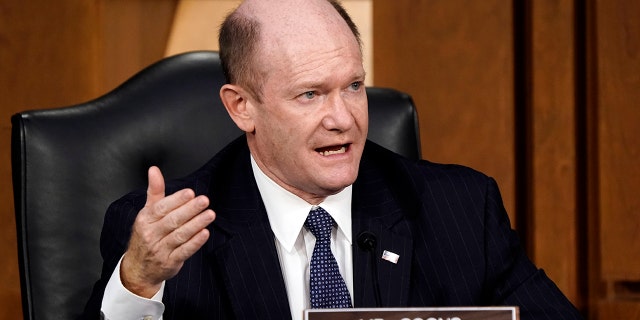
Sen. Chris Coons, D-Del., speaks as the Senate Judiciary Committee hears from legal experts on the final day of the confirmation hearing for Supreme Court nominee Amy Coney Barrett, on Capitol Hill in Washington, Thursday, Oct. 15, 2020. Coons has softened his support for the legislative filibuster in recent years after leading an effort to protect it in 2017. (AP Photo/J. Scott Applewhite)

Sen. Chris Coons, D-Del., speaks as the Senate Judiciary Committee hears from legal experts on the final day of the confirmation hearing for Supreme Court nominee Amy Coney Barrett, on Capitol Hill in Washington, Thursday, Oct. 15, 2020. Coons has softened his support for the legislative filibuster in recent years after leading an effort to protect it in 2017. (AP Photo/J. Scott Applewhite)

But now, the momentum among Senate Democrats is for either full abolition of the filibuster or significantly weakening it. President Biden endorsed the latter idea Tuesday, announcing his support for a “talking filibuster.”

KAMALA HARRIS SUPPORTS CHANGE TO FILIBUSTER IN SENATE TO LIMIT MINORITY PARTY POWER

“I don’t think that you have to eliminate the filibuster, you have to do it what it used to be when I first got to the Senate back in the old days,” Biden told ABC. “You had to stand up and command the floor, you had to keep talking.”

The legislative filibuster has been a 60-vote threshold for what is called a “cloture vote” — or a vote to end debate on a bill — meaning that any 41 senators could prevent a bill from getting to a final vote. If there are not 60 votes, the bill cannot proceed.

The “talking filibuster” — as it was most recently seriously articulated by Sen. Jeff Merkley, D-Ore., in 2012 — would allow 41 senators to prevent a final vote by talking incessantly, around-the-clock, on the Senate floor. But once those senators stop talking, the threshold for a cloture vote is lowered to 51.

Harris’ office confirmed to Fox News Wednesday that she is now aligned with Biden on the filibuster issue. She’d previously taken an even more hostile position to the filibuster, saying she would fully “get rid” of it “to pass a Green New Deal” at a CNN town hall in 2019.

The legislative filibuster has been a 60-vote threshold for what is called a “cloture vote” — or a vote to end debate on a bill — meaning that any 41 senators could prevent a bill from getting to a final vote. If there are not 60 votes, the bill cannot proceed.

The “talking filibuster” — as it was most recently seriously articulated by Sen. Jeff Merkley, D-Ore., in 2012 — would allow 41 senators to prevent a final vote by talking incessantly, around-the-clock, on the Senate floor. But once those senators stop talking, the threshold for a cloture vote is lowered to 51.

Harris’ office confirmed to Fox News Wednesday that she is now aligned with Biden on the filibuster issue. She’d previously taken an even more hostile position to the filibuster, saying she would fully “get rid” of it “to pass a Green New Deal” at a CNN town hall in 2019.

Coons, who led the 2017 letter along with Collins, has also distanced himself from his previous stance.
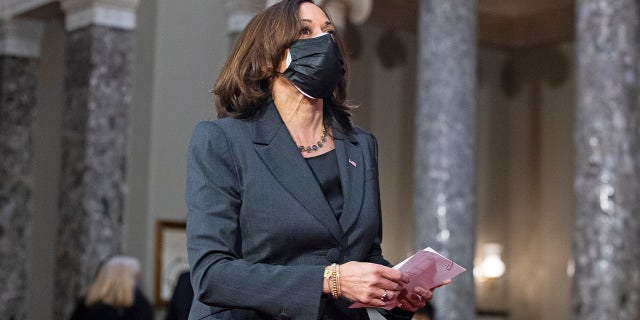
Vice President Kamala Harris attends a ceremonial swearing-in for Sen. Patrick Leahy, D-Vt., as President Pro Tempore of the Senate on Capitol Hill in Washington, Thursday, Feb. 4, 2021. Harris has changed her stance on the legislative filibuster since signing a letter in 2017 backing it. (Michael Reynolds/Pool via AP)

Vice President Kamala Harris attends a ceremonial swearing-in for Sen. Patrick Leahy, D-Vt., as President Pro Tempore of the Senate on Capitol Hill in Washington, Thursday, Feb. 4, 2021. Harris has changed her stance on the legislative filibuster since signing a letter in 2017 backing it. (Michael Reynolds/Pool via AP) (AP)

BIDEN SUPPORTS CHANGING SENATE FILIBUSTER 

“I’m going to try my hardest, first, to work across the aisle,” he said in September when asked about ending the filibuster. “Then, if, tragically, Republicans don’t change the tune or their behavior at all, I would.”

Fox News reached out to all of the other 26 Democratic signatories of the 2017 letter, and they all either distanced themselves from that position or did not respond to Fox News’ inquiry.

“Less than four years ago, when Donald Trump was President and Mitch McConnell was the Majority Leader, 61 Senators, including more than 25 Democrats, signed their names in opposition to any efforts that would curtail the filibuster,” a GOP aide told Fox News. “Other than the occupant of the White House, and the balance of power in the Senate, what’s changed?”

“I’m interested in getting results for the American people, and I hope we will find common ground to advance key priorities,” Sen. Tim Kaine. D-Va., said in a statement. “If Republicans try to use arcane rules to block us from getting results for the American people, then we’ll have a conversation at that time.”

Added Sen. Mark Warner, D-Va: “I am still hopeful that the Senate can work together in a bipartisan way to address the enormous challenges facing the country. But when it comes to fundamental issues like protecting Americans from draconian efforts attacking their constitutional right to vote, it would be a mistake to take any option off the table.”

“Senator Stabenow understands the urgency of passing important legislation, including voting rights, and thinks it warrants a discussion about the filibuster if Republicans refuse to work across the aisle,” Robyn Bryan, a spokesperson for Sen. Debbie Stabenow, D-Mich., said.
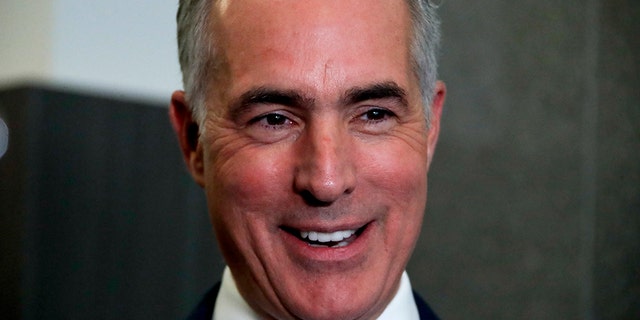
FILE - In this Oct. 26, 2018, file photo, Sen.Bob Casey, D-Pa., speaks to reporters in the studio of KDKA-TV in Pittsburgh. Casey has reversed his stance on the legislative filibuster since signing a 2017 letter in support of it. (AP Photo/Gene J. Puskar, File)

FILE – In this Oct. 26, 2018, file photo, Sen.Bob Casey, D-Pa., speaks to reporters in the studio of KDKA-TV in Pittsburgh. Casey has reversed his stance on the legislative filibuster since signing a 2017 letter in support of it. (AP Photo/Gene J. Puskar, File)

Representatives for Sen. Bob Casey, D-Pa., pointed to recent comments he made on MSNBC.

“Yes, absolutely,” Casey said when asked if he would support a “talking filibuster” or something similar. “Major changes to the filibuster for someone like me would not have been on the agenda even a few years ago. But the Senate does not work like it used to.”

MCCONNELL SAYS SENATE WILL BE ‘100-CAR PILEUP’ IF DEMS NUKE FILIBUSTER

“I hope any Democratic senator who’s not currently in support of changing the rules or altering them substantially, I hope they would change their minds,” Casey added.

Representatives for Sen. Angus King, I-Vt., who caucuses with Democrats, meanwhile, references a Bangor Daily News editorial that said King was completely against the filibuster in 2012 but now believes it’s helpful in stopping bad legislation. It said, however, that King is open to “modifications” similar to a talking filibuster.

The senators who did not respond to questions on their 2017 support of the filibuster were Sens. Joe Manchin. D-W.Va.; Patrick Leahy, D-Vt.; Amy Klobuchar, D-Minn.; Jeanne Shaheen, D-N.H.; Michael Bennet, D-Colo.; Martin Heinrich, D-N.M.; Sherrod Brown, D-Ohio; Dianne Feinstein, D-Calif.; Kirsten Gillibrand, D-N.Y.; Brian Schatz, D-Hawaii; Cory Booker, D-N.J.; Maria Cantwell, D-Wash.; Maize Hirono, D-Hawaii; John Tester, D-Mont.; Tom Carper, D-Del.; Maggie Hassan, D-N.H.; Tammy Duckworth, D-Ill.; Jack Reed, D-R-I.; Ed Markey, D-Mass.; Sheldon Whitehouse, D-R.I.; and Bob Menendez, D-N.J.

Some of these senators, however, have addressed the filibuster in other recent comments.

Sen. Dianne Feinstein, D-Calif., on Wednesday was asked if she supported changing the filibuster threshold by CNN and said she is still opposed to the idea. “Not at this time,” Feinstein said.
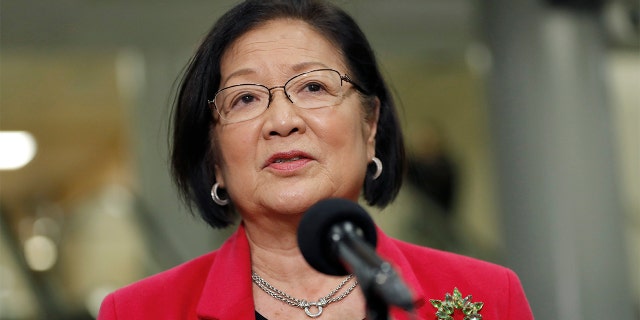
Sen. Mazie Hirono, D-Hawaii, speaks to reporters on Capitol Hill in Washington, Thursday, Jan. 30, 2020, during the impeachment trial of President Donald Trump on charges of abuse of power and obstruction of Congress. Hirono has changed her opinion on the legislative filibuster since signing a 2017 letter supporting it. (AP Photo/Julio Cortez)

Sen. Mazie Hirono, D-Hawaii, speaks to reporters on Capitol Hill in Washington, Thursday, Jan. 30, 2020, during the impeachment trial of President Donald Trump on charges of abuse of power and obstruction of Congress. Hirono has changed her opinion on the legislative filibuster since signing a 2017 letter supporting it. (AP Photo/Julio Cortez)

Sen. Maize Hirono, D-Hawaii, meanwhile said last week she is already for getting rid of the current 60-vote threshold and thinks other Democrats will sign on soon.

“If Mitch McConnell continues to be totally an obstructionist, and he wants to use the 60 votes to stymie everything that President Biden wants to do and that we Democrats want to do that will actually help people,” Hirono said, “then I think the recognition will be among the Democrats that we’re gonna need to.”

The most recent talk about either removing or significantly weakening the filibuster was spurred by comments from Manchin that appeared to indicate he would be open to a talking filibuster. He said filibustering a bill should be more “painful” for a minority.

Manchin appeared to walk back any talk of a talking filibuster on Wednesday, however.

“You know where my position is,” he said. “There’s no little bit of this and a little bit — there’s no little bit here. You either protect the Senate, you protect the institution and you protect democracy or you don’t.”

Manchin and Sen. Kyrsten Sinema, D-Ariz., both committed to supporting the current form of the filibuster earlier this year. Sinema was not in the Senate in 2017.

Senate Minority Mitch McConnell, R-Ky., said their comments gave him the reassurance he needed to drop a demand that Senate Majority Leader Chuck Schumer, D-N.Y., put filibuster protections into the Senate’s organizing resolution.

But with Manchin seeming to flake at least in the eyes of some, other Democrats are beginning to push harder for filibuster changes.

—-

Senator I wanted to tell you about an opportunity I had back in 1995 and it dealt with corresponding with Carl Sagan about the issue of abortion. I know this is an issue that you care deeply about.

I read this about you!!!

Jeanne Shaheen is a fierce advocate for women. Throughout her career, she has done whatever it takes to protect a woman’s access to a full range of health care services. In the Senate, she has worked across the aisle to bolster women’s rights and helped lead opposition to partisan efforts aimed at overturning Roe vs. Wade.

Carl Sagan pictured below:

Image result for carl sagan

_________

_

Recently I have been revisiting my correspondence in 1995 with the famous astronomer Carl Sagan who I had the privilege to correspond with in 1994, 1995 and 1996. In 1996 I had a chance to respond to his December 5, 1995letter on January 10, 1996 and I never heard back from him again since his cancer returned and he passed away later in 1996. Below is what Carl Sagan wrote to me in his December 5, 1995 letter:

Thanks for your recent letter about evolution and abortion. The correlation is hardly one to one; there are evolutionists who are anti-abortion and anti-evolutionists who are pro-abortion.You argue that God exists because otherwise we could not understand the world in our consciousness. But if you think God is necessary to understand the world, then why do you not ask the next question of where God came from? And if you say “God was always here,” why not say that the universe was always here? On abortion, my views are contained in the enclosed article (Sagan, Carl and Ann Druyan {1990}, “The Question of Abortion,” Parade Magazine, April 22.)

I was introduced to when reading a book by Francis Schaeffer called HE IS THERE AND HE IS NOT SILENT written in 1968. 

Image result for francis schaeffer

Francis Schaeffer

I was blessed with the opportunity to correspond with Dr. Sagan, and in his December 5, 1995 letter Dr. Sagan went on to tell me that he was enclosing his article “The Question of Abortion: A Search for Answers”by Carl Sagan and Ann Druyan. I am going to respond to several points made in that article. Here is a portion of Sagan’s article (here is a link to the whole article):

Image result for adrian rogers
(both Adrian Rogers and Francis Schaeffer mentioned Carl Sagan in their books and that prompted me to write Sagan and expose him to their views.


Image result for Ann Druyan

Carl Sagan and Ann Druyan pictured above

Related image

 “The Question of Abortion: A Search for Answers”

by Carl Sagan and Ann Druyan

For the complete text, including illustrations, introductory quote, footnotes, and commentary on the reaction to the originally published article see Billions and Billions.

The issue had been decided years ago. The court had chosen the middle ground. You’d think the fight was over. Instead, there are mass rallies, bombings and intimidation, murders of workers at abortion clinics, arrests, intense lobbying, legislative drama, Congressional hearings, Supreme Court decisions, major political parties almost defining themselves on the issue, and clerics threatening politicians with perdition. Partisans fling accusations of hypocrisy and murder. The intent of the Constitution and the will of God are equally invoked. Doubtful arguments are trotted out as certitudes. The contending factions call on science to bolster their positions. Families are divided, husbands and wives agree not to discuss it, old friends are no longer speaking. Politicians check the latest polls to discover the dictates of their consciences. Amid all the shouting, it is hard for the adversaries to hear one another. Opinions are polarized. Minds are closed.

Is it wrong to abort a pregnancy? Always? Sometimes? Never? How do we decide? We wrote this article to understand better what the contending views are and to see if we ourselves could find a position that would satisfy us both. Is there no middle ground? We had to weigh the arguments of both sides for consistency and to pose test cases, some of which are purely hypothetical. If in some of these tests we seem to go too far, we ask the reader to be patient with us–we’re trying to stress the various positions to the breaking point to see their weaknesses and where they fail.

In contemplative moments, nearly everyone recognizes that the issue is not wholly one-sided. Many partisans of differing views, we find, feel some disquiet, some unease when confronting what’s behind the opposing arguments. (This is partly why such confrontations are avoided.) And the issue surely touches on deep questions: What are our responses to one another? Should we permit the state to intrude into the most intimate and personal aspects of our lives? Where are the boundaries of freedom? What does it mean to be human?

Of the many actual points of view, it is widely held–especially in the media, which rarely have the time or the inclination to make fine distinctions–that there are only two: “pro-choice” and “pro-life.” This is what the two principal warring camps like to call themselves, and that’s what we’ll call them here. In the simplest characterization, a pro-choicer would hold that the decision to abort a pregnancy is to be made only by the woman; the state has no right to interfere. And a pro-lifer would hold that, from the moment of conception, the embryo or fetus is alive; that this life imposes on us a moral obligation to preserve it; and that abortion is tantamount to murder. Both names–pro-choice and pro-life–were picked with an eye toward influencing those whose minds are not yet made up: Few people wish to be counted either as being against freedom of choice or as opposed to life. Indeed, freedom and life are two of our most cherished values, and here they seem to be in fundamental conflict.

Let’s consider these two absolutist positions in turn. A newborn baby is surely the same being it was just before birth. There ‘s good evidence that a late-term fetus responds to sound–including music, but especially its mother’s voice. It can suck its thumb or do a somersault. Occasionally, it generates adult brain-wave patterns. Some people claim to remember being born, or even the uterine environment. Perhaps there is thought in the womb. It’s hard to maintain that a transformation to full personhood happens abruptly at the moment of birth. Why, then, should it be murder to kill an infant the day after it was born but not the day before?

As a practical matter, this isn’t very important: Less than 1 percent of all tabulated abortions in the United States are listed in the last three months of pregnancy (and, on closer investigation, most such reports turn out to be due to miscarriage or miscalculation). But third-trimester abortions provide a test of the limits of the pro-choice point of view. Does a woman’s “innate right to control her own body” encompass the right to kill a near-term fetus who is, for all intents and purposes, identical to a newborn child?

——-

End of Sagan Excerpt 

When I was in high school the book and film series named WHATEVER HAPPENED TO THE HUMAN RACE? came out and it featured Doctor C. Everett Koop and Francis Schaeffer and they looked at the issues of abortion, infanticide, and youth euthanasia and they looked at comments from such scholars as Peter Singer and James D. Watson. 

Image result for c. everett koop


C. Everett Koop pictured above and Peter Singer below


Peter Singer, an endowed chair at Princeton’s Center for Human Values, said, “Killing a disabled infant is not morally equivalent to killing a person. Very often it is not wrong at all.”

James D.Watson


In May 1973, James D. Watson, the Nobel Prize laureate who discovered the double helix of DNA, granted an interview to Prism magazine, then a publication of the American Medical Association. Time later reported the interview to the general public, quoting Watson as having said, “If a child were not declared alive until three days after birth, then all parents could be allowed the choice only a few are given under the present system. The doctor could allow the child to die if the parents so choose and save a lot of misery and suffering. I believe this view is the only rational, compassionate attitude to have.”

Carl Sagan

On August 30, 1995 I mailed a letter to Carl Sagan that probably prompted this discussion on abortion and it enclosed a lengthy story from Adrian Rogers about an abortion case in Pine Bluff, Arkansas that almost became an infanticide case:

An excerpt from the Sunday morning message (11-6-83) by Adrian Rogers in Memphis, TN. 

I want to tell you that secular humanism and so-called abortion rights are inseparably linked together. We have been taught that our bodies and our children are the products of the evolutionary process, and so therefore human life may not be all that valuable to begin with. We have come today to where it is legal and even considered to be a good thing to put little babies to death…15 million little babies put to death since 1973 because of this philosophy of Secular Humanism. 

How did the court make that type of decision? You would think it would be so obvious. You can’t do that! You can’t kill little babies! Why? Because the Bible says! Friend, they don’t give a hoot what the Bible says! There used to be a time when they talked about what the Bible says because there was a time that we as a nation had a constitution that was based in the Judeo-Christian ethic, but today if we say “The Bible says” or “God says “Separation of Church and State. Don’t tell us what the Bible says or what God says. We will tell you what we think!” Therefore, they look at the situation and they decide if it is right or wrong purely on the humanistic philosophy that right and wrong are relative and the situation says what is right or what is wrong. 

This little girl just 19 years old went into the doctor’s office and he examined her. He said, “We can take take of you.” He gave her an injection in her arm that was to cause her to go into labor and to get rid of that protoplasm, that feud, that little mass that was in her, but she wasn’t prepared for the sound she was about to hear. It was a little baby crying. That little baby weighed 13 ounces. His hand the size of my thumbnail. You know what the doctor did. The doctor put that little baby in a grocery sack and gave it to Maria’s two friends who were with her in that doctor office and Said, “It will stop making those noises after a while.” 

Image result for adrian rogers

(Adrian Rogers pictured above)

Image result for pine bluff arkansas 1983
Pine Bluff, Arkansas
Image result for jefferson county hospital, pine bluff, arkansas
My wife was born in main hospital in Pine Bluff, Arkansas

They took that grocery sack and Maria home and one hour passed and two hours passed and that baby was still crying and panting for his life in that grocery sack. They took that little baby down to the hospital there in Pine Bluff, Arkansas, and they called an obstetrician and he called a pediatrician and they called nurses and they began to work on that little baby. Today that baby is alive and well and healthy, that little mass of protoplasm. That little thing that wasn’t a human being is alive and well. I want to tell you they spent $150,000 to save the life of that baby. NOW CAN YOU EXPLAIN TO ME HOW THEY CAN SPEND $150,000 TO SAVE THE LIFE OF SOMETHING THAT SOMEBODY WAS PAYING ANOTHER DOCTOR TO TAKE THE LIFE OF? The same life!!! Are you going to tell me that is not a baby? Are you going to tell me that if that baby had been put to death it would not have been murder? You will never convince me of that. What has happened to us in America? We have been sold a bill of goods by the Secular Humanists!

Image result for carl sagan humanist of the year 1982
Carl Sagan was elected the HUMANIST OF THE YEAR in 1982 by the AMERICAN HUMANIST ASSOCIATION

Carl Sagan asked, “Does a woman’s “innate right to control her own body” encompass the right to kill a near-term fetus who is, for all intents and purposes, identical to a newborn child?”

Sincerely, 

Everette Hatcher III, 13900 Cottontail Lane, Alexander, AR 72002, ph 501-920-5733 everettehatcher@gmail.com

Related posts:

Open letter to President Obama (Part 201)Tea Party favorite Representative links article “Prescott and Ohanian: Taxes Are Much Higher Than You Think”

December 21, 2012 – 9:47 am

    (Emailed to White House on 12-21-12.) President Obama c/o The White House 1600 Pennsylvania Avenue NW Washington, DC 20500 Dear Mr. President, I know that you receive 20,000 letters a day and that you actually read 10 of them every day. I really do respect you for trying to get a pulse on […]By Everette Hatcher III | Posted in Milton FriedmanPresident Obamaspending out of controlTaxes | Edit | Comments (0)

Open letter to President Obama (Part 200.2)Tea Party Republican Representative takes on the President concerning fiscal cliff

December 21, 2012 – 9:37 am

(Emailed to White House on 12-21-12.) President Obama c/o The White House 1600 Pennsylvania Avenue NW Washington, DC 20500 Dear Mr. President, I know that you receive 20,000 letters a day and that you actually read 10 of them every day. I really do respect you for trying to get a pulse on what is […]By Everette Hatcher III | Posted in Milton FriedmanPresident ObamaRonald Reaganspending out of controlTaxes | Edit | Comments (0)

Open letter to President Obama (Part 200.1)Tea Party favorite Representative shares link on facebook

December 21, 2012 – 5:10 am

(Emailed to White House on 12-21-12) President Obama c/o The White House 1600 Pennsylvania Avenue NW Washington, DC 20500 Dear Mr. President, I know that you receive 20,000 letters a day and that you actually read 10 of them every day. I really do respect you for trying to get a pulse on what is […]By Everette Hatcher III | Posted in President ObamaRonald Reaganspending out of controlTaxes | Edit | Comments (0)

Open letter to President Obama (Part 199) Tea Party favorite takes on President

December 20, 2012 – 3:09 pm

  The federal government has a spending problem and Milton Friedman came up with the negative income tax to help poor people get out of the welfare trap. It seems that the government screws up about everything. Then why is President Obama wanting more taxes? _______________ Milton Friedman – The Negative Income Tax Published on […]By Everette Hatcher III | Posted in President Obamaspending out of controlTaxes | Edit | Comments (0)

Tea Party Heroes Rep. David Schweikert (R-AZ),Justin Amash (R-MI), Tim Huelskamp (R-KS) have been punished by Boehner

December 6, 2012 – 8:55 am

I was sad to read that the Speaker John Boehner has been involved in punishing tea  party republicans. Actually I have written letters to several of these same tea party heroes telling them that I have emailed Boehner encouraging him to listen to them. Rep. David Schweikert (R-AZ),Justin Amash (R-MI), and Tim Huelskamp (R-KS). have been contacted […]By Everette Hatcher III | Posted in Current EventsSpeaker of the House John Boehnerspending out of control | Edit | Comments (0)

Some Tea Party heroes (Part 10)

November 9, 2012 – 7:47 am

Michael Tanner of the Cato Institute in his article, “Hitting the Ceiling,” National Review Online, March 7, 2012 noted: After all, despite all the sturm und drang about spending cuts as part of last year’s debt-ceiling deal, federal spending not only increased from 2011 to 2012, it rose faster than inflation and population growth combined. […]By Everette Hatcher III | Posted in spending out of controlTaxesEdit | Comments (0)

Some Tea Party heroes (Part 9)

November 9, 2012 – 7:42 am

Michael Tanner of the Cato Institute in his article, “Hitting the Ceiling,” National Review Online, March 7, 2012 noted: After all, despite all the sturm und drang about spending cuts as part of last year’s debt-ceiling deal, federal spending not only increased from 2011 to 2012, it rose faster than inflation and population growth combined. […]By Everette Hatcher III | Posted in spending out of controlTaxesEdit | Comments (0)

49 posts on Tea Party heroes of mine

November 9, 2012 – 7:33 am

Some of the heroes are Mo Brooks, Martha Roby, Jeff Flake, Trent Franks, Duncan Hunter, Tom Mcclintock, Devin Nunes, Scott Tipton, Bill Posey, Steve Southerland and those others below in the following posts. THEY VOTED AGAINST THE DEBT CEILING INCREASE IN 2011 AND WE NEED THAT TYPE OF LEADERSHIP NOW SINCE PRESIDENT OBAMA HAS BEEN […]By Everette Hatcher III | Posted in spending out of controlTaxesEdit | Comments (0)

Some Tea Party Republicans win and some lose

November 7, 2012 – 8:39 am

I hated to see that Allen West may be on the way out. ABC News reported: Nov 7, 2012 7:20am What Happened to the Tea Party (and the Blue Dogs?) Some of the Republican Party‘s most controversial House members are clinging to narrow leads in races where only a few votes are left to count. […]By Everette Hatcher III | Posted in Current Events | Edit | Comments (0)

Some Tea Party heroes (Part 8)

November 6, 2012 – 7:59 am

Rep Himes and Rep Schweikert Discuss the Debt and Budget Deal Michael Tanner of the Cato Institute in his article, “Hitting the Ceiling,” National Review Online, March 7, 2012 noted: After all, despite all the sturm und drang about spending cuts as part of last year’s debt-ceiling deal, federal spending not only increased from 2011 […]By Everette Hatcher III | Posted in spending out of controlTaxesEdit | Comments (0)

Democrats distance themselves from previous pro-filibuster stance, citing GOP obstruction

Democrats distance themselves from previous pro-filibuster stance, citing GOP obstruction

More than half of current Senate Democrats and VP Harris signed 2017 letter supporting filibuster when GOP was in control

As progressives push hard for Democrats to eliminate the legislative filibuster after gaining control of the Senate, House and the presidency, many Democratic senators are distancing themselves from a letter they signed in 2017 backing the procedure.

Sens. Susan Collins, R-Maine, and Chris Coons, D-Del., led a letter in 2017 that asked Republican Leader Mitch McConnell, R-Ky., and Democratic Leader Chuck Schumer, D-N.Y., to preserve the legislative filibuster. As it’s existed for decades, the filibuster requires 60 votes in order to end debate on a bill and proceed to a final vote.

“We are writing to urge you to support our efforts to preserve existing rules, practices, and traditions” on the filibuster, the letter said.

Besides Collins and Coons, 59 other senators joined on the letter. Of that group, 27 Democratic signatories still hold federal elected office. Twenty-six still hold their Senate seats, and Vice President Harris assumed her new job on Jan. 20, vacating her former California Senate seat.

Sen. Chris Coons, D-Del., speaks as the Senate Judiciary Committee hears from legal experts on the final day of the confirmation hearing for Supreme Court nominee Amy Coney Barrett, on Capitol Hill in Washington, Thursday, Oct. 15, 2020. Coons has softened his support for the legislative filibuster in recent years after leading an effort to protect it in 2017. (AP Photo/J. Scott Applewhite)

Sen. Chris Coons, D-Del., speaks as the Senate Judiciary Committee hears from legal experts on the final day of the confirmation hearing for Supreme Court nominee Amy Coney Barrett, on Capitol Hill in Washington, Thursday, Oct. 15, 2020. Coons has softened his support for the legislative filibuster in recent years after leading an effort to protect it in 2017. (AP Photo/J. Scott Applewhite)

But now, the momentum among Senate Democrats is for either full abolition of the filibuster or significantly weakening it. President Biden endorsed the latter idea Tuesday, announcing his support for a “talking filibuster.”

KAMALA HARRIS SUPPORTS CHANGE TO FILIBUSTER IN SENATE TO LIMIT MINORITY PARTY POWER

“I don’t think that you have to eliminate the filibuster, you have to do it what it used to be when I first got to the Senate back in the old days,” Biden told ABC. “You had to stand up and command the floor, you had to keep talking.”

The legislative filibuster has been a 60-vote threshold for what is called a “cloture vote” — or a vote to end debate on a bill — meaning that any 41 senators could prevent a bill from getting to a final vote. If there are not 60 votes, the bill cannot proceed.

The “talking filibuster” — as it was most recently seriously articulated by Sen. Jeff Merkley, D-Ore., in 2012 — would allow 41 senators to prevent a final vote by talking incessantly, around-the-clock, on the Senate floor. But once those senators stop talking, the threshold for a cloture vote is lowered to 51.

Harris’ office confirmed to Fox News Wednesday that she is now aligned with Biden on the filibuster issue. She’d previously taken an even more hostile position to the filibuster, saying she would fully “get rid” of it “to pass a Green New Deal” at a CNN town hall in 2019.

The legislative filibuster has been a 60-vote threshold for what is called a “cloture vote” — or a vote to end debate on a bill — meaning that any 41 senators could prevent a bill from getting to a final vote. If there are not 60 votes, the bill cannot proceed.

The “talking filibuster” — as it was most recently seriously articulated by Sen. Jeff Merkley, D-Ore., in 2012 — would allow 41 senators to prevent a final vote by talking incessantly, around-the-clock, on the Senate floor. But once those senators stop talking, the threshold for a cloture vote is lowered to 51.

Harris’ office confirmed to Fox News Wednesday that she is now aligned with Biden on the filibuster issue. She’d previously taken an even more hostile position to the filibuster, saying she would fully “get rid” of it “to pass a Green New Deal” at a CNN town hall in 2019.

Coons, who led the 2017 letter along with Collins, has also distanced himself from his previous stance.

Vice President Kamala Harris attends a ceremonial swearing-in for Sen. Patrick Leahy, D-Vt., as President Pro Tempore of the Senate on Capitol Hill in Washington, Thursday, Feb. 4, 2021. Harris has changed her stance on the legislative filibuster since signing a letter in 2017 backing it. (Michael Reynolds/Pool via AP)

Vice President Kamala Harris attends a ceremonial swearing-in for Sen. Patrick Leahy, D-Vt., as President Pro Tempore of the Senate on Capitol Hill in Washington, Thursday, Feb. 4, 2021. Harris has changed her stance on the legislative filibuster since signing a letter in 2017 backing it. (Michael Reynolds/Pool via AP) (AP)

BIDEN SUPPORTS CHANGING SENATE FILIBUSTER 

“I’m going to try my hardest, first, to work across the aisle,” he said in September when asked about ending the filibuster. “Then, if, tragically, Republicans don’t change the tune or their behavior at all, I would.”

Fox News reached out to all of the other 26 Democratic signatories of the 2017 letter, and they all either distanced themselves from that position or did not respond to Fox News’ inquiry.

“Less than four years ago, when Donald Trump was President and Mitch McConnell was the Majority Leader, 61 Senators, including more than 25 Democrats, signed their names in opposition to any efforts that would curtail the filibuster,” a GOP aide told Fox News. “Other than the occupant of the White House, and the balance of power in the Senate, what’s changed?”

“I’m interested in getting results for the American people, and I hope we will find common ground to advance key priorities,” Sen. Tim Kaine. D-Va., said in a statement. “If Republicans try to use arcane rules to block us from getting results for the American people, then we’ll have a conversation at that time.”

Added Sen. Mark Warner, D-Va: “I am still hopeful that the Senate can work together in a bipartisan way to address the enormous challenges facing the country. But when it comes to fundamental issues like protecting Americans from draconian efforts attacking their constitutional right to vote, it would be a mistake to take any option off the table.”

“Senator Stabenow understands the urgency of passing important legislation, including voting rights, and thinks it warrants a discussion about the filibuster if Republicans refuse to work across the aisle,” Robyn Bryan, a spokesperson for Sen. Debbie Stabenow, D-Mich., said.

FILE - In this Oct. 26, 2018, file photo, Sen.Bob Casey, D-Pa., speaks to reporters in the studio of KDKA-TV in Pittsburgh. Casey has reversed his stance on the legislative filibuster since signing a 2017 letter in support of it. (AP Photo/Gene J. Puskar, File)

FILE – In this Oct. 26, 2018, file photo, Sen.Bob Casey, D-Pa., speaks to reporters in the studio of KDKA-TV in Pittsburgh. Casey has reversed his stance on the legislative filibuster since signing a 2017 letter in support of it. (AP Photo/Gene J. Puskar, File)

Representatives for Sen. Bob Casey, D-Pa., pointed to recent comments he made on MSNBC.

“Yes, absolutely,” Casey said when asked if he would support a “talking filibuster” or something similar. “Major changes to the filibuster for someone like me would not have been on the agenda even a few years ago. But the Senate does not work like it used to.”

MCCONNELL SAYS SENATE WILL BE ‘100-CAR PILEUP’ IF DEMS NUKE FILIBUSTER

“I hope any Democratic senator who’s not currently in support of changing the rules or altering them substantially, I hope they would change their minds,” Casey added.

Representatives for Sen. Angus King, I-Vt., who caucuses with Democrats, meanwhile, references a Bangor Daily News editorial that said King was completely against the filibuster in 2012 but now believes it’s helpful in stopping bad legislation. It said, however, that King is open to “modifications” similar to a talking filibuster.

The senators who did not respond to questions on their 2017 support of the filibuster were Sens. Joe Manchin. D-W.Va.; Patrick Leahy, D-Vt.; Amy Klobuchar, D-Minn.; Jeanne Shaheen, D-N.H.; Michael Bennet, D-Colo.; Martin Heinrich, D-N.M.; Sherrod Brown, D-Ohio; Dianne Feinstein, D-Calif.; Kirsten Gillibrand, D-N.Y.; Brian Schatz, D-Hawaii; Cory Booker, D-N.J.; Maria Cantwell, D-Wash.; Maize Hirono, D-Hawaii; John Tester, D-Mont.; Tom Carper, D-Del.; Maggie Hassan, D-N.H.; Tammy Duckworth, D-Ill.; Jack Reed, D-R-I.; Ed Markey, D-Mass.; Sheldon Whitehouse, D-R.I.; and Bob Menendez, D-N.J.

Some of these senators, however, have addressed the filibuster in other recent comments.

Sen. Dianne Feinstein, D-Calif., on Wednesday was asked if she supported changing the filibuster threshold by CNN and said she is still opposed to the idea. “Not at this time,” Feinstein said.

Sen. Mazie Hirono, D-Hawaii, speaks to reporters on Capitol Hill in Washington, Thursday, Jan. 30, 2020, during the impeachment trial of President Donald Trump on charges of abuse of power and obstruction of Congress. Hirono has changed her opinion on the legislative filibuster since signing a 2017 letter supporting it. (AP Photo/Julio Cortez)

Sen. Mazie Hirono, D-Hawaii, speaks to reporters on Capitol Hill in Washington, Thursday, Jan. 30, 2020, during the impeachment trial of President Donald Trump on charges of abuse of power and obstruction of Congress. Hirono has changed her opinion on the legislative filibuster since signing a 2017 letter supporting it. (AP Photo/Julio Cortez)

Sen. Maize Hirono, D-Hawaii, meanwhile said last week she is already for getting rid of the current 60-vote threshold and thinks other Democrats will sign on soon.

“If Mitch McConnell continues to be totally an obstructionist, and he wants to use the 60 votes to stymie everything that President Biden wants to do and that we Democrats want to do that will actually help people,” Hirono said, “then I think the recognition will be among the Democrats that we’re gonna need to.”

The most recent talk about either removing or significantly weakening the filibuster was spurred by comments from Manchin that appeared to indicate he would be open to a talking filibuster. He said filibustering a bill should be more “painful” for a minority.

Manchin appeared to walk back any talk of a talking filibuster on Wednesday, however.

“You know where my position is,” he said. “There’s no little bit of this and a little bit — there’s no little bit here. You either protect the Senate, you protect the institution and you protect democracy or you don’t.”

Manchin and Sen. Kyrsten Sinema, D-Ariz., both committed to supporting the current form of the filibuster earlier this year. Sinema was not in the Senate in 2017.

Senate Minority Mitch McConnell, R-Ky., said their comments gave him the reassurance he needed to drop a demand that Senate Majority Leader Chuck Schumer, D-N.Y., put filibuster protections into the Senate’s organizing resolution.

But with Manchin seeming to flake at least in the eyes of some, other Democrats are beginning to push harder for filibuster changes.

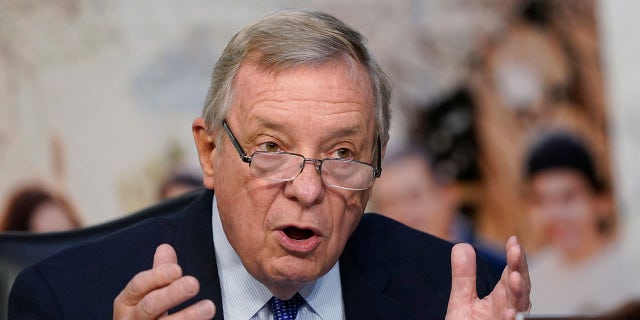
Sen. Dick Durbin, D-Ill., speaks during the confirmation hearing for Supreme Court nominee Amy Coney Barrett, before the Senate Judiciary Committee, Wednesday, Oct. 14, 2020, on Capitol Hill in Washington. Durbin was not among those who signed a 2017 letter supporting the legislative filibuster. This week he gave a Senate floor speech supporting a version of a talking filibuster, which would weaken the precedent in its current form. (AP Photo/Susan Walsh, Pool)

Sen. Dick Durbin, D-Ill., speaks during the confirmation hearing for Supreme Court nominee Amy Coney Barrett, before the Senate Judiciary Committee, Wednesday, Oct. 14, 2020, on Capitol Hill in Washington. Durbin was not among those who signed a 2017 letter supporting the legislative filibuster. This week he gave a Senate floor speech supporting a version of a talking filibuster, which would weaken the precedent in its current form. (AP Photo/Susan Walsh, Pool)

“Today, nearly 65 years after Strom Thurmond’s marathon defense of Jim Crow, the filibuster is still making a mockery of American democracy. The filibuster is still being misused by some Senators to block legislation urgently needed and supported by strong majorities of the American people,” Senate Majority Whip Dick Durbin, D-Ill., said Monday.

He added: “I have been long open to changing the Senate’s rules to restore the ‘standing filibuster.’ If a Senator insists on blocking the will of the Senate, he [or she] should have to pay some minimal price of being present. No more phoning it in.”

Republicans, meanwhile, are warning that Democrats will regret it if they kneecap the filibuster.

“The legislative filibuster defines the Senate as the world’s greatest deliberative body.  It would be tragic if it were removed,” Sen. Susan Collins, R-Maine, said recently. “And I believe the Democrats would rue the day eventually should they pursue that route.”

CLICK HERE TO GET THE FOX NEWS APP

McConnell, meanwhile, was more explicit in his threats.

“So let me say this very clearly for all 99 of my colleagues. Nobody serving in this chamber can even begin to imagine what a completely scorched-earth Senate would look like,” he said on the Senate floor Tuesday. “I want our colleagues to imagine a world where every single task, every one of them, requires a physical quorum.”

Nevertheless, Schumer has refused to take getting rid of the filibuster off the table as Democrats aim to pass more major progressive bills with their razor-thin majorities in the House and Senate.

“Failure is not an option, everything is on the table,” Schumer told reporters Wednesday.

Fox News’ Jason Donner and Sally Persons contributed to this report

January 26, 2021 10:36AM

Government Spending Could Top $9 Trillion

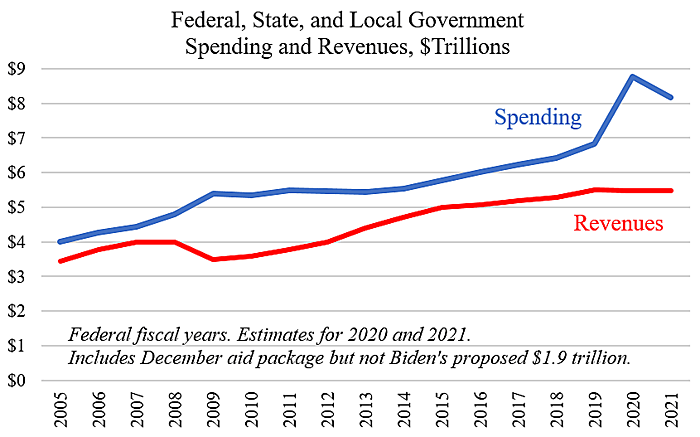
President Biden’s push to spend another $1.9 trillion on economic relief is surreal given that government budgets are vastly ballooned already. Total federal, state, and local government spending soared from $6.8 trillion in 2019 to $8.8 trillion in 2020. That is $68,000 in government spending for every household in the nation.

We have already imposed $6 trillion in new debt on future taxpayers in just two years. More spending would be reckless and extremely unfair as young people will have their own costs and crises to deal with down the road. Vaccinate people, repeal shutdown mandates, and the economy will recover by itself. That’s what market economies do. The government has already spent far too much.

The chart shows federal, state, and local government spending, with estimates for 2020 and 2021. It includes the almost $900 billion in relief spending passed in December, but does not include Biden’s proposed $1.9 trillion in new aid. If Biden’s plan passes, spending will easily top $9 trillion in 2021. Data are for federal fiscal years.

c

The patterns of spending and revenues in the current downturn differ from the Great Recession a decade ago. Back then, state‐​local government revenues dipped and federal revenues plunged. In the current downturn, overall government revenues are fairly stable.

During the Great Recession, total government spending rose about $1 trillion, and then flatlined for a few years before rising again. This time, spending jumped about $2 trillion.

Even without a Biden stimulus bill, spending will be about $8.2 trillion in 2021, up $1.4 trillion from 2019. Even if one believes that deficit spending helps the economy, there will already be about $2.6 trillion of it in 2021 without a Biden bill.

Data Notes

The data for 2005 to 2019 are from Table 14.1 and 14.2 here. Federal spending and revenues for 2020 are here. For 2021 federal spending, I assumed CBO’s baseline plus $875 billion from the December aid bill. For federal revenues, I assumed 2021 will be the same as 2020. State and local spending and revenues for 2020 are calculated from BEA quarterly data in Table 3.3 here, and 2021 is assumed to be the same.

Barack Obama new book "A Promised Land"

Republican presidents besides Reagan have done a bad job of slowing the growth of spending.

President Obama wrote in his autobiography on page 415 in A PROMISED LAND:

There was a reason I told Valerie, why Republicans tended to do the opposite—why Ronald Reagan could preside over huge increases in the federal budget, and federal workforce and still be lionized by the GOP faithful as the guy who successfully shrank the federal government.

Take a look at Daniel Mitchell analysis of Presidents’ spending restraints!!!


Spending Restraint, Part I: Lessons from Ronald Reagan and Bill Clinton

Uploaded by on Feb 14, 2011

Ronald Reagan and Bill Clinton both reduced the relative burden of government, largely because they were able to restrain the growth of domestic spending. The mini-documentary from the Center for Freedom and Prosperity uses data from the Historical Tables of the Budget to show how Reagan and Clinton succeeded and compares their record to the fiscal profligacy of the Bush-Obama years.

___________________

Ronald Reagan was my hero and he did slow the growth of federal spending. In this post I did want to admit that Republicans have spent way too much in the past too, but we do have some spending cut heroes too. I have a lot of respect for Tea Party heroes like Tim Huelskamp and Justin Amash who are willing to propose deep spending cuts so we can eventually balance our budget.

Look at how things have been going the last four years and no matter how anyone tries to spin it, we are going down the financial drain fast. We got to balance the budget as soon as possible. Dan Mitchell of the Cato Institute showed in an article that I posted earlier about how much spending has exploded the last four years.

John Brummett wrote in the online addition of the Arkansas Democrat-Gazette on May 30, 2012:

Obama did indeed run up the deficit with a stimulus measure to keep the economy from collapsing as he entered office…But in regard to budgets that he actually has proposed as president, beginning with the one for the fiscal year starting nearly a year after his election, Obama has raised spending at a slower rate than Clinton…

Republicans simply are more effective than Democrats at declaring a simple untruth loudly and repetitively through a pliable and powerful echo chamber of talk radio and cable news, thus embedding that untruth beneath the superficial consciousness of people otherwise disengaged.

__________

Now the truth of the matter is that Obama has spent around 25% of GDP when Clinton and most of the other presidents spent 20% or less. This fact allow disproves Brummett’s assertions listed above, but I will admit the Republicans have been guilty of spending too much also.

Dan Mitchell of the Cato Institute sets the record straight concerning the Republican’s spending which has been excessive too at times:

In a post last week, I explained that Obama has been a big spender, but noted his profligacy is disguised because TARP outlays caused a spike in spending during Bush’s last fiscal year (FY2009, which began October 1, 2008). Meanwhile, repayments from banks in subsequent years count as “negative spending,” further hiding the underlying trend in outlays.

When you strip away those one-time factors, it turns out that Obama has allowed domestic spending to increase at the fastest rate since Richard Nixon.

I then did another post yesterday, where I looked at total spending (other than interest payments and bailout costs) and showed that Obama has presided over the biggest spending increases since Lyndon Johnson.

Looking at the charts, it’s also rather obvious that party labels don’t mean much. Bill Clinton presided during a period of spending restraint, while every Republican other than Reagan has a dismal track record.

President George W. Bush, for instance, scores below both Clinton and Jimmy Carter, regardless of whether defense outlays are included in the calculations. That’s not a fiscally conservative record, even if you’re grading on a generous curve.

This leads Jonah Goldberg to offer some sage advice to the GOP.

Here’s a simple suggestion for Mitt Romney: Admit that the Democrats have a point. Right before the Memorial Day weekend, Washington was consumed by a debate over how much Barack Obama has spent as president, and it looks like it’s picking up again. …all of these numbers are a sideshow: Republicans in Washington helped create the problem, and Romney should concede the point. Focused on fighting a war, Bush — never a tightwad to begin with — handed the keys to the Treasury to Tom DeLay and Denny Hastert, and they spent enough money to burn a wet mule. On Bush’s watch, education spending more than doubled, the government enacted the biggest expansion in entitlements since the Great Society (Medicare Part D), and we created a vast new government agency (the Department of Homeland Security). …Nearly every problem with spending and debt associated with the Bush years was made far worse under Obama. The man campaigned as an outsider who was going to change course before we went over a fiscal cliff. Instead, when he got behind the wheel, as it were, he hit the gas instead of the brakes — and yet has the temerity to claim that all of the forward momentum is Bush’s fault. …Romney is under no obligation to defend the Republican performance during the Bush years. Indeed, if he’s serious about fixing what’s wrong with Washington, he has an obligation not to defend it. This is an argument that the Tea Party — which famously dealt Obama’s party a shellacking in 2010 — and independents alike are entirely open to. Voters don’t want a president to rein in runaway Democratic spending; they want one to rein in runaway Washington spending.

Jonah’s point about “fixing what’s wrong with Washington” is not a throwaway line. Romney has pledged to voters that he won’t raise taxes. He also has promised to bring the burden of federal spending down to 20 percent of GDP by the end of a first term.

But even those modest commitments will be difficult to achieve if he isn’t willing to gain credibility with the American people by admitting that Republicans helped create the fiscal mess in Washington. Especially since today’s GOP leaders in the House and Senate were all in office last decade and voted for Bush’s wasteful spending.

It actually doesn’t even take much to move fiscal policy in the right direction. All that’s required is to restrain spending so that is grows more slowly than the private sector (with the kind of humility you only find in Washington, I call this “Mitchell’s Golden Rule“). The entitlement reforms in the Ryan budget would be a good start, along with some much-needed pruning of discretionary spending.

And if you address the underlying problem by limiting spending growth to about 2 percent annually, you can balance the budget in about 10 years. No need for higher taxes, notwithstanding the rhetoric of the fiscal frauds in Washington who salivate at the thought of another failed 1990s-style tax hike deal.

Dan Mitchell article What Biden’s Corporate Tax Increase Means for American Competitiveness

What Biden’s Corporate Tax Increase Means for American Competitiveness

Thanks to globalization (as opposed to globalism), jobs and investment are now very mobile. This means the costs of bad policy are higher than ever before, and it also means the benefits of good policy are higher than ever before.

Which is why it’s very useful to look at various competitiveness rankings, most notably the ones that are comprehensive (most notably Economic Freedom of the World and the Index of Economic Freedom).

But since my specialty is public finance, I’m also interested in measures of fiscal competitiveness (best tax system, worst tax system, costliest welfare state, etc).

Today, let’s narrow our focus and look at business tax competitiveness. This is an area where the United States traditionally has lagged, both because we used to have one of the world’s highest corporate tax rates and because onerous tax rules put U.S.-based companies at an added disadvantage.

Trump lowered the federal corporate tax rate from 35 percent to 21 percent, which definitely helped, but now Biden wants to push the rate back up to 28 percent.

What will that mean for U.S. competitiveness?

It’s not good news.

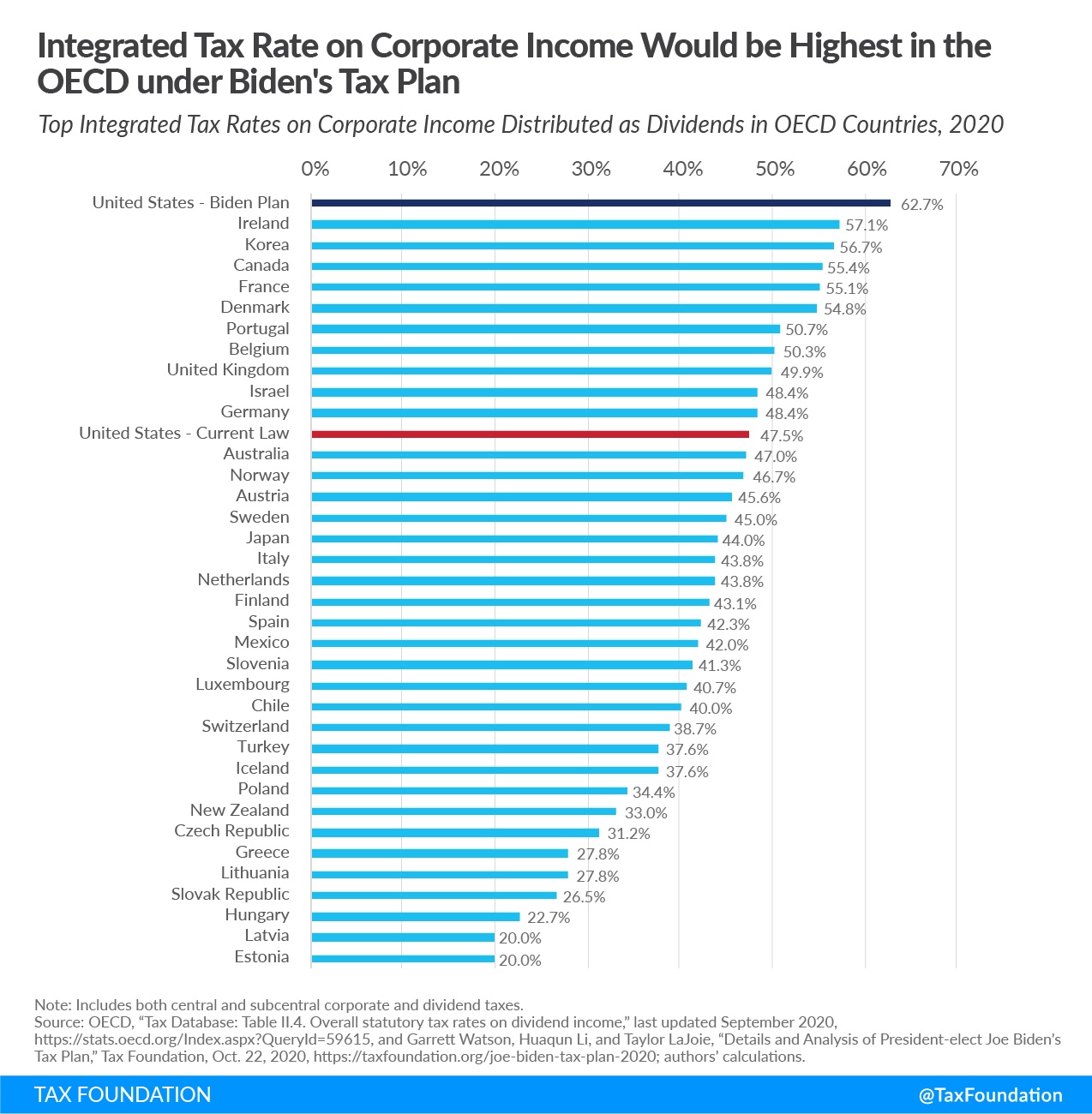
The Tax Foundation calculated the combined tax rate on business income (including the double tax on dividends) for various developed nations.

As you can see, America will have the most onerous tax regime if Biden is successful.

What if we look only at the corporate tax rate? And what if we consider every jurisdiction in the world?

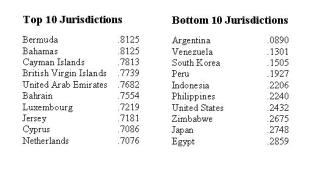
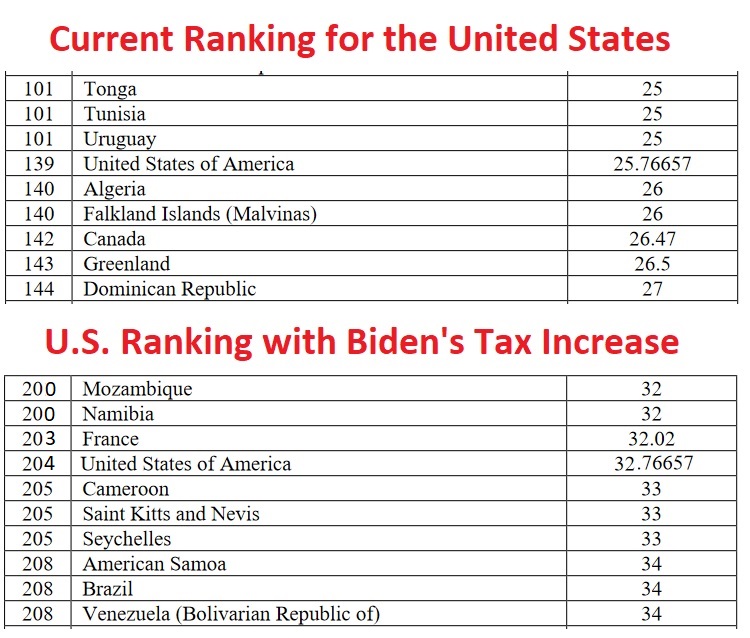
Professor Robert McGee pulled together all the numbers and ranked nations from #1 to #223.

The United States currently is in the bottom half, which isn’t good since we’re below average. But you can see from these two tables that Biden will drop America to the bottom 10 percent.

Needless to say, it’s not good to rank below France.

But let’s think of the glass as being 1/10th full rather than 9/10ths empty. At least the U.S. beats Venezuela!

The bottom line is that it will not be good news if Biden’s plan is enacted.

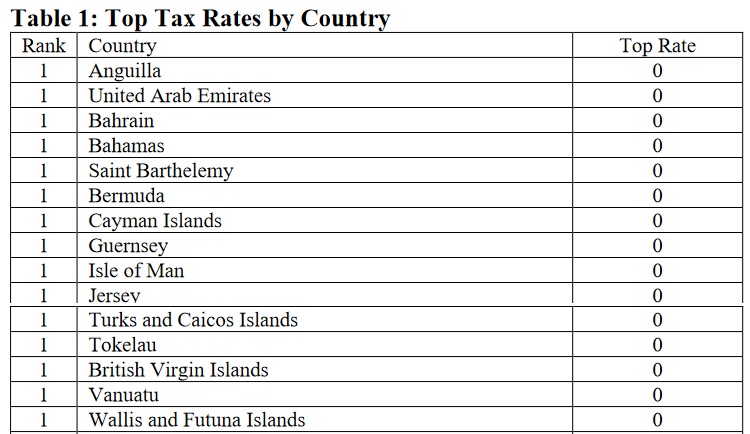
P.S. From Professor McGee’s study, here are the jurisdictions tied for 1st place.

P.P.S. Needless to say, politicians from high-tax nations resent the 15 jurisdictions that don’t have a corporate income tax.

Indeed, that’s why many of those politicians are pushing the “global minimum tax” that I wrote about yesterday.

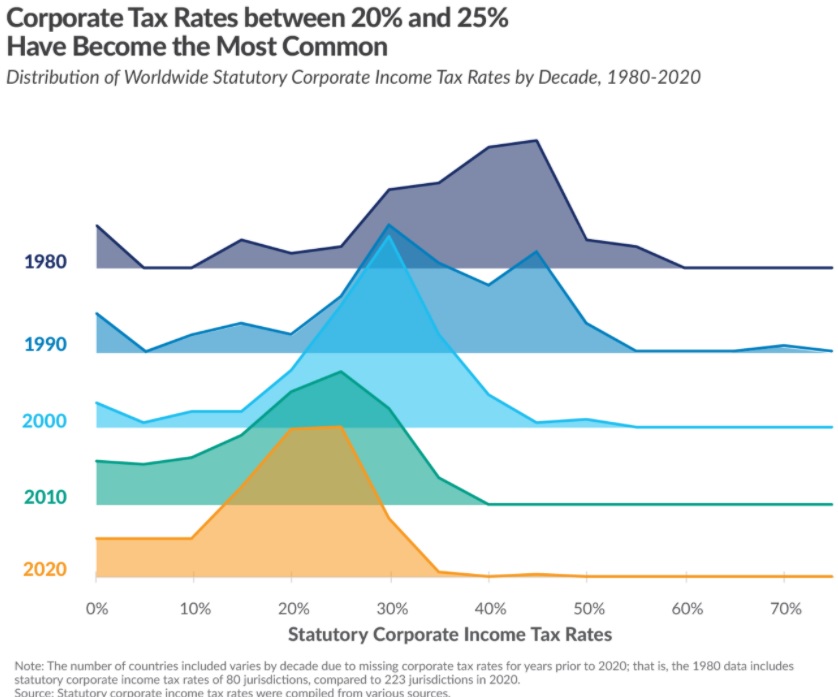
Those politicians basically want to turn back the clock and reverse the progress depicted in this set of charts from the Tax Foundation.

P.P.S. This is why it’s important to defend the liberalizing process of tax competition.

March 16, 2021

President Biden c/o The White House
1600 Pennsylvania Avenue NW
Washington, DC 20500

Dear Mr. President,

Is our country learning from history? California keeps raising their taxes on the wealthy and people keep moving from California to Texas. What does our federal government do? They also have been raising taxes on the wealthy lately. Take a look at this excellent video below and then read a great article by Dan Mitchell of the Cato Institute on what is happening in California right now.

Will Higher Tax Rates Balance the Budget?

Published on Apr 11, 2012

As the U.S. debt and deficit grows, some politicians and economist have called for higher tax rates in order to balance the budget. The question becomes: when the government raises taxes, does it actually collect a larger portion of the US economy?

Professor Antony Davies examines 50 years of economic data and finds that regardless of tax rates, the percentage of GDP that the government collects has remained relatively constant. In other words, no matter how high government sets tax rates, the government gets about the same portion. According to Davies, if we’re concerned about balancing the budget, we should worry less about raising tax revenue and more about growing the economy. The recipe for growth? Lower tax rates and a simplified tax code.

Like most people, I’m a sucker for a heartwarming story around the holidays.

Sometimes, you get that nice feeling when good things happen to good people, like you find at the end of a classic movie like “It’s a Wonderful Life.”

But since I’m a bit of a curmudgeon, I also feel all warm and fuzzy when bad things happen to bad people.

That’s why I always smile when I read stories about taxpayers moving across borders, thus preventing greedy tax-hiking politicians from collecting more revenue.

“Where’s our tax revenue?!?”

I’m glad when that happens to French politicians. I’m glad when it happens to Italian politicians. I’m glad when it happens to Illinois politicians. And British politicians. And Spanish politicians. And Maryland politicians. I could continue, but I think you get the point.

I’m even glad when it happens to the politicians in Washington.

I smile because I envision the moment when some budget geek tells these sleazy politicians that projected revenues aren’t materializing and they don’t have more money to spend.

So I wish I could be a fly on the wall when this moment of truth happens to California politicians. They convinced voters in the state to enact Prop 30, a huge tax increase targeting those evil, awful, bad rich people.

Governor Brown and his fellow kleptocrats in Sacramento doubtlessly are salivating at the thought of more money to waste.

But notwithstanding a satirical suggestion from Walter Williams, there aren’t guard towers and barbed-wire fences surrounding the state. Productive people can leave, and that’s happening every day. And they take their taxable income with them.

Usually in ways that don’t attract attention. But sometimes a bunch of them leave at the same times, and that is newsworthy. Here’s an example of that happening, as reported by the San Francisco Chronicle.

Chevron Corp. will move up to 800 jobs – about a quarter of its current headquarters staff – from the Bay Area to Houston over the next two years but will remain based in San Ramon, the oil company told employees Thursday. …The company already employs far more people in Houston – about 9,000 full-time employees and contractors – than it does in San Ramon.

We don’t know a lot of details, but these were positions at the company’s headquarters and they were “technical positions dealing with information and advanced energy technologies…tied to Chevron’s worldwide oil exploration and production business.”

Let’s assume these highly skilled employees earn an average of $250,000. I imagine that’s a low-ball estimate, but this is just for purposes of a thought experiment. Now multiply that average salary by 800 workers and you get $200 million of income.

And every penny of that $200 million no longer will be subject to tax by the kleptocrats in the state’s capital.

In other words, we’re seeing the Laffer Curve in action.

Politicians can raise tax rates all day long, but that doesn’t automatically translate into more tax revenue. Politicians keep forgetting that taxable income is not a fixed variable.

What’s happening in a big way with Chevron is happening in small ways every single day with investors, entrepreneurs, small business owners, and other “rich’ people.

That’s good for the people escaping. And it also will warm my heart when California’s despicable politicians discover next year that there’s an “unexpected” revenue shortfall.

P.S. It’s just an anecdote that the Chevron jobs are going to Texas. But when you add together a bunch of anecdotes, you get data. And according to the data, Texas is kicking the you-know-what out of California. Maybe there’s a lesson to be learned?

__________

___________

Thank you so much for your time. I know how valuable it is. I also appreciate the fine family that you have and your commitment as a father and a husband.

Sincerely,

Everette Hatcher III, 13900 Cottontail Lane, Alexander, AR 72002, ph 501-920-5733

Williams with Sowell – Minimum Wage

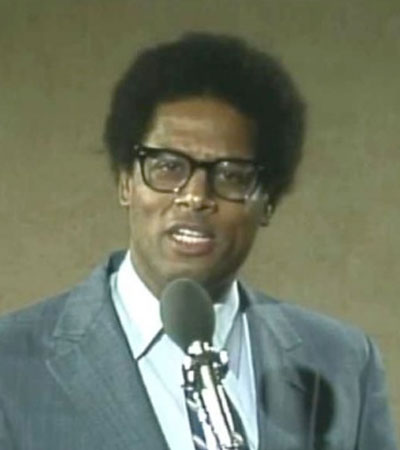
Thomas Sowell

Thomas Sowell – Reducing Black Unemployment

By WALTER WILLIAMS

—-

Ronald Reagan with Milton Friedman
Milton Friedman The Power of the Market 2-5

Related posts:

Open letter to President Obama (Part 201)Tea Party favorite Representative links article “Prescott and Ohanian: Taxes Are Much Higher Than You Think”

    (Emailed to White House on 12-21-12.) President Obama c/o The White House 1600 Pennsylvania Avenue NW Washington, DC 20500 Dear Mr. President, I know that you receive 20,000 letters a day and that you actually read 10 of them every day. I really do respect you for trying to get a pulse on […]

Open letter to President Obama (Part 200.2)Tea Party Republican Representative takes on the President concerning fiscal cliff

(Emailed to White House on 12-21-12.) President Obama c/o The White House 1600 Pennsylvania Avenue NW Washington, DC 20500 Dear Mr. President, I know that you receive 20,000 letters a day and that you actually read 10 of them every day. I really do respect you for trying to get a pulse on what is […]

Open letter to President Obama (Part 200.1)Tea Party favorite Representative shares link on facebook

(Emailed to White House on 12-21-12) President Obama c/o The White House 1600 Pennsylvania Avenue NW Washington, DC 20500 Dear Mr. President, I know that you receive 20,000 letters a day and that you actually read 10 of them every day. I really do respect you for trying to get a pulse on what is […]

Open letter to President Obama (Part 199) Tea Party favorite takes on President

  The federal government has a spending problem and Milton Friedman came up with the negative income tax to help poor people get out of the welfare trap. It seems that the government screws up about everything. Then why is President Obama wanting more taxes? _______________ Milton Friedman – The Negative Income Tax Published on […]

Tea Party Heroes Rep. David Schweikert (R-AZ),Justin Amash (R-MI), Tim Huelskamp (R-KS) have been punished by Boehner

I was sad to read that the Speaker John Boehner has been involved in punishing tea  party republicans. Actually I have written letters to several of these same tea party heroes telling them that I have emailed Boehner encouraging him to listen to them. Rep. David Schweikert (R-AZ),Justin Amash (R-MI), and Tim Huelskamp (R-KS). have been contacted […]

Some Tea Party heroes (Part 10)

Michael Tanner of the Cato Institute in his article, “Hitting the Ceiling,” National Review Online, March 7, 2012 noted: After all, despite all the sturm und drang about spending cuts as part of last year’s debt-ceiling deal, federal spending not only increased from 2011 to 2012, it rose faster than inflation and population growth combined. […]

Some Tea Party heroes (Part 9)

Michael Tanner of the Cato Institute in his article, “Hitting the Ceiling,” National Review Online, March 7, 2012 noted: After all, despite all the sturm und drang about spending cuts as part of last year’s debt-ceiling deal, federal spending not only increased from 2011 to 2012, it rose faster than inflation and population growth combined. […]

49 posts on Tea Party heroes of mine

Some of the heroes are Mo Brooks, Martha Roby, Jeff Flake, Trent Franks, Duncan Hunter, Tom Mcclintock, Devin Nunes, Scott Tipton, Bill Posey, Steve Southerland and those others below in the following posts. THEY VOTED AGAINST THE DEBT CEILING INCREASE IN 2011 AND WE NEED THAT TYPE OF LEADERSHIP NOW SINCE PRESIDENT OBAMA HAS BEEN […]

Some Tea Party Republicans win and some lose

I hated to see that Allen West may be on the way out. ABC News reported: Nov 7, 2012 7:20am What Happened to the Tea Party (and the Blue Dogs?) Some of the Republican Party‘s most controversial House members are clinging to narrow leads in races where only a few votes are left to count. […]

Some Tea Party heroes (Part 8)

Rep Himes and Rep Schweikert Discuss the Debt and Budget Deal Michael Tanner of the Cato Institute in his article, “Hitting the Ceiling,” National Review Online, March 7, 2012 noted: After all, despite all the sturm und drang about spending cuts as part of last year’s debt-ceiling deal, federal spending not only increased from 2011 […]

Waiving PAYGO on $1.9T ‘Stimulus’ Is Reckless. There Are Better Ways to Go.

Waiving PAYGO on $1.9T ‘Stimulus’ Is Reckless. There Are Better Ways to Go.

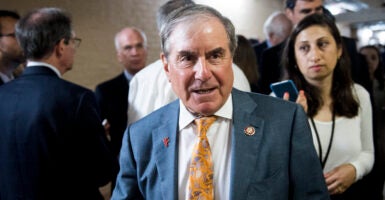
Rep. John Yarmuth, D-Ky., seen here July 10, 2019, is calling for pretending that the deficit-financed spending spree for special interests in the $1.9 trillion so-called American Rescue Plan never occurred for PAYGO purposes. (Photo: Bill Clark/CQ-Roll Call/Getty Images)

President Joe Biden’s $1.9 trillion “American Rescue Plan” was passed under the guise of responding to COVID-19. In reality, less than 10% of the bill was for public health.

The massive “stimulus” package was stuffed with partisan special-interest payoffs for liberal priorities and other wasteful spending.

Significantly, the law will spend nearly $1.9 trillion without a plan to pay for it. That means that, unless Congress passes new laws with equal or greater reductions in spending by the end of the year, statutory pay-as-you-go (aka “PAYGO”) enforcement will kick in.

The basic premise of statutory PAYGO is straightforward. In the words of former President Barack Obama, who championed the policy and signed it into law, it tells Congress: “You can’t spend a dollar unless you cut a dollar elsewhere.”

Want to keep up with the 24/7 news cycle? Want to know the most important stories of the day for conservatives? Need news you can trust? Subscribe to The Daily Signal’s email newsletter. Learn more >>

If, over the course of a year, laws are enacted that are projected to increase the deficit, statutory PAYGO requires that deficit increase to be paid for by automatic spending reductions (known as sequestration) over the next several years.

However, most spending accounts and programs are exempt from sequestration.

The law has fairly significant flaws, and it would be better to replace it with a more robust fiscal rule that more effectively restrains excessive spending. Politicians of both parties have abused loopholes, adding higher spending without paying for it.

The Congressional Budget Office estimated that because of the large amount of spending in the stimulus law, statutory PAYGO would require a sequestration order to reduce spending by $381 billion next January.

That actually exceeds the total amount of the spending accounts that are subject to sequestration because most major programs are exempted or are capped.

Now that Democrats have enacted their $1.9 trillion spending binge, they do not want to pay for it.

Rep. John Yarmuth, D-Ky., chairman of the House Budget Committee, has introduced a bill that would declare that the stimulus bill “shall not be counted” on the PAYGO scorecard. In effect, it would attempt to pretend that the deficit-financed spending spree for special interests never occurred.

The bill is pitched as a “legislative fix to avert sequestration.” It isn’t a “fix.” It is fiscal recklessness.

Yarmuth said, “If Republicans play political games and don’t do their jobs, Medicare and the seniors that depend on it will pay the price.”

Of course, nothing could be further from the truth.

The CBO estimates that the sequestration order could reduce total Medicare payments to providers and insurance companies by just 4% of the $943 billion that will be spent on Medicarenext year.

Not a single Republican voted for the stimulus. The limited reductions in Medicare spending as a result of the Democrats’ overspending would be enforced by the terms of Obama’s statutory PAYGO law and carried out by Biden’s director of the Office of Management and Budget.

Members of Congress who voted against the irresponsible $1.9 trillion spending bill should not feel pressured to excuse that fiscal recklessness by voting to waive statutory PAYGO enforcement. Simply waiving it retroactively would be just as irresponsible as the spending bill itself.

The potential of sequestration does, however, present an opportunity to implement much-needed fiscal responsibility in a more thoughtful way.

There are a number of smart policy alternatives to achieve spending reductions of equal or greater amounts of savings over time than would the blunt instrument of a sequestration order:

It’s vital that policymakers start to turn the tide against overspending. Even before the outbreak of COVID-19, the federal budget was on an unsustainable path due to the growth of spending outpacing the growth of the economy.

The CBO’s “Long-Term Budget Outlook” showsthat even though tax revenues are projected to rise above normal historical levels, spending will continue to grow out of control.

The national debt has skyrocketed to $28 trillion, about $225,000 per American household. The public debt is already at its highest level relative to the national economy since World War II, but unlike the postwar period when spending fell back to more normal levels, spending and debt are projected to only continue rising.

The CBO says that the current fiscal trajectory would “reduce business investment and slow the growth of economic output,” and would “increase the risk of a fiscal crisis.” But more important are the negative consequences of government that grow too large and burdensome for families and communities.

When the federal government grows beyond its proper limits, and spends and taxes too much, it stifles prosperity, infringes on liberty, and makes it more difficult to live the American dream.

Given all that is at stake, pretending the $1.9 trillion spending bill never happened and retroactively waiving statutory PAYGO enforcement would be beyond irresponsible. However, Congress can and should take advantage of the opportunity to implement thoughtful fiscal responsibility.

Have an opinion about this article? To sound off, please email letters@DailySignal.com and we will consider publishing your remarks in our regular “We Hear You” feature.

https://youtu.be/-978MiDt_Ww

March 31, 2021

President Biden  c/o The White House
1600 Pennsylvania Avenue NW
Washington, DC 20500

Dear Mr. President,

Please explain to me if you ever do plan to balance the budget while you are President? I have written these things below about you and I really do think that you don’t want to cut spending in order to balance the budget. It seems you ever are daring the Congress to stop you from spending more.

President Barack Obama speaks about the debt limit in the East Room of the White House in Washington. | AP Photo

“The credit of the United States ‘is not a bargaining chip,’ Obama said on 1-14-13. However, President Obama keeps getting our country’s credit rating downgraded as he raises the debt ceiling higher and higher!!!!

Washington Could Learn a Lot from a Drug Addict

Just spend more, don’t know how to cut!!! Really!!! That is not living in the real world is it?

Making more dependent on government is not the way to go!!

Why is our government in over 16 trillion dollars in debt? There are many reasons for this but the biggest reason is people say “Let’s spend someone else’s money to solve our problems.” Liberals like Max Brantley have talked this way for years. Brantley will say that conservatives are being harsh when they don’t want the government out encouraging people to be dependent on the government. The Obama adminstration has even promoted a plan for young people to follow like Julia the Moocher.  

David Ramsey demonstrates in his Arkansas Times Blog post of 1-14-13 that very point:

Arkansas Politics / Health Care Arkansas’s share of Medicaid expansion and the national debt

Posted by on Mon, Jan 14, 2013 at 1:02 PM

Baby carrot Arkansas Medicaid expansion image

Imagine standing a baby carrot up next to the 25-story Stephens building in Little Rock. That gives you a picture of the impact on the national debt that federal spending in Arkansas on Medicaid expansion would have, while here at home expansion would give coverage to more than 200,000 of our neediest citizens, create jobs, and save money for the state.

Here’s the thing: while more than a billion dollars a year in federal spending would represent a big-time stimulus for Arkansas, it’s not even a drop in the bucket when it comes to the national debt.

Currently, the national debt is around $16.4 trillion. In fiscal year 2015, the federal government would spend somewhere in the neighborhood of $1.2 billion to fund Medicaid expansion in Arkansas if we say yes. That’s about 1/13,700th of the debt.

It’s hard to get a handle on numbers that big, so to put that in perspective, let’s get back to the baby carrot. Imagine that the height of the Stephens building (365 feet) is the $16 trillion national debt. That $1.2 billion would be the length of a ladybug. Of course, we’re not just talking about one year if we expand. Between now and 2021, the federal government projects to contribute around $10 billion. The federal debt is projected to be around $25 trillion by then, so we’re talking about 1/2,500th of the debt. Compared to the Stephens building? That’s a baby carrot.

______________

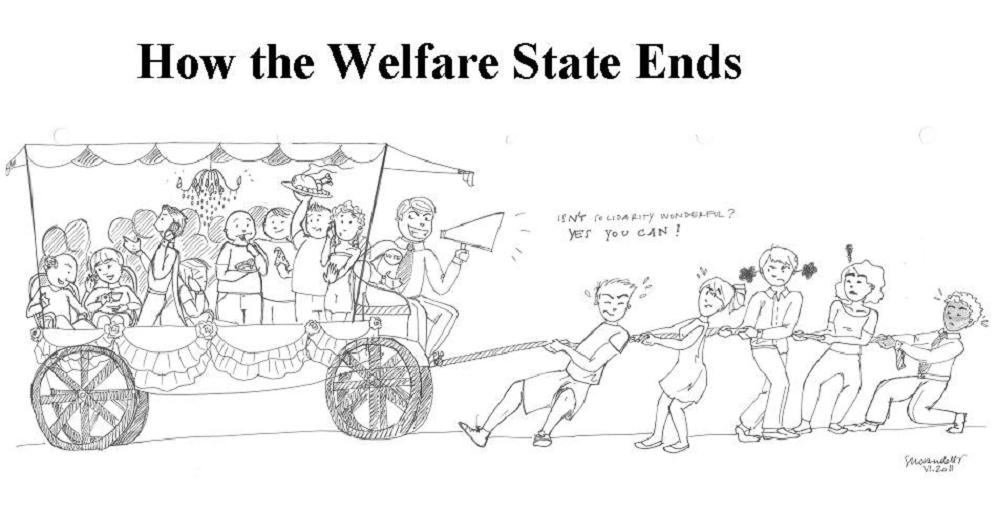
Here is how it will all end if everyone feels they should be allowed to have their “baby carrot.”

How sad it is that liberals just don’t get this reality.

Here is what the Founding Fathers had to say about welfare. David Weinberger noted:

While living in Europe in the 1760s, Franklin observed: “in different countries … the more public provisions were made for the poor, the less they provided for themselves, and of course became poorer. And, on the contrary, the less was done for them, the more they did for themselves, and became richer.”

Alexander Fraser Tytler, Lord Woodhouselee (15 October 1747 – 5 January 1813) was a Scottish lawyer, writer, and professor. Tytler was also a historian, and he noted, “A democracy cannot exist as a permanent form of government. It can only exist until the majority discovers it can vote itself largess out of the public treasury. After that, the majority always votes for the candidate promising the most benefits with the result the democracy collapses because of the loose fiscal policy ensuing, always to be followed by a dictatorship, then a monarchy.”

Thomas Jefferson to Joseph Milligan

April 6, 1816

[Jefferson affirms that the main purpose of society is to enable human beings to keep the fruits of their labor. — TGW]

To take from one, because it is thought that his own industry and that of his fathers has acquired too much, in order to spare to others, who, or whose fathers have not exercised equal industry and skill, is to violate arbitrarily the first principle of association, “the guarantee to every one of a free exercise of his industry, and the fruits acquired by it.” If the overgrown wealth of an individual be deemed dangerous to the State, the best corrective is the law of equal inheritance to all in equal degree; and the better, as this enforces a law of nature, while extra taxation violates it.

[From Writings of Thomas Jefferson, ed. Albert E. Bergh (Washington: Thomas Jefferson Memorial Association, 1904), 14:466.]

_______

Jefferson pointed out that to take from the rich and give to the poor through government is just wrong. Franklin knew the poor would have a better path upward without government welfare coming their way. Milton Friedman’s negative income tax is the best method for doing that and by taking away all welfare programs and letting them go to the churches for charity.

_____________

_________

Thank you so much for your time. I know how valuable it is. I also appreciate the fine family that you have and your commitment as a father and a husband.

Sincerely,

Everette Hatcher III, 13900 Cottontail Lane, Alexander, AR 72002, ph 501-920-5733

Williams with Sowell – Minimum Wage

Thomas Sowell

Thomas Sowell – Reducing Black Unemployment

By WALTER WILLIAMS

—-

Ronald Reagan with Milton Friedman
Milton Friedman The Power of the Market 2-5

Related posts:

Welfare Spending Shattering All-Time Highs

  We got to act fast and get off this path of socialism. Morning Bell: Welfare Spending Shattering All-Time Highs Robert Rector and Amy Payne October 18, 2012 at 9:03 am It’s been a pretty big year for welfare—and a new report shows welfare is bigger than ever. The Obama Administration turned a giant spotlight […]

We need more brave souls that will vote against Washington welfare programs

We need to cut Food Stamp program and not extend it. However, it seems that people tell the taxpayers back home they are going to Washington and cut government spending but once they get up there they just fall in line with  everyone else that keeps spending our money. I am glad that at least […]

Welfare programs are not the answer for the poor

Government Must Cut Spending Uploaded by HeritageFoundation on Dec 2, 2010 The government can cut roughly $343 billion from the federal budget and they can do so immediately. __________ Liberals argue that the poor need more welfare programs, but I have always argued that these programs enslave the poor to the government. Food Stamps Growth […]

Private charities are best solution and not government welfare

Milton Friedman – The Negative Income Tax Published on May 11, 2012 by LibertyPen In this 1968 interview, Milton Friedman explained the negative income tax, a proposal that at minimum would save taxpayers the 72 percent of our current welfare budget spent on administration. http://www.LibertyPen.com Source: Firing Line with William F Buckley Jr. ________________ Milton […]

The book “After the Welfare State”

Dan Mitchell Commenting on Obama’s Failure to Propose a Fiscal Plan Published on Aug 16, 2012 by danmitchellcato No description available. ___________ After the Welfare State Posted by David Boaz Cato senior fellow Tom G. Palmer, who is lecturing about freedom in Slovenia and Tbilisi this week, asked me to post this announcement of his […]

President Obama responds to Heritage Foundation critics on welfare reform waivers

Is President Obama gutting the welfare reform that Bill Clinton signed into law? Morning Bell: Obama Denies Gutting Welfare Reform Amy Payne August 8, 2012 at 9:15 am The Obama Administration came out swinging against its critics on welfare reform yesterday, with Press Secretary Jay Carney saying the charge that the Administration gutted the successful […]

Welfare reform part 3

Thomas Sowell – Welfare Welfare reform was working so good. Why did we have to abandon it? Look at this article from 2003. The Continuing Good News About Welfare Reform By Robert Rector and Patrick Fagan, Ph.D. February 6, 2003 Six years ago, President Bill Clinton signed legislation overhauling part of the nation’s welfare system. […]

Welfare reform part 2

Uploaded by ForaTv on May 29, 2009 Complete video at: http://fora.tv/2009/05/18/James_Bartholomew_The_Welfare_State_Were_In Author James Bartholomew argues that welfare benefits actually increase government handouts by ‘ruining’ ambition. He compares welfare to a humane mousetrap. —– Welfare reform was working so good. Why did we have to abandon it? Look at this article from 2003. In the controversial […]

Why did Obama stop the Welfare Reform that Clinton put in?

Thomas Sowell If the welfare reform law was successful then why change it? Wasn’t Bill Clinton the president that signed into law? Obama Guts Welfare Reform Robert Rector and Kiki Bradley July 12, 2012 at 4:10 pm Today, the Obama Department of Health and Human Services (HHS) released an official policy directive rewriting the welfare […]

“Feedback Friday” Letter to White House generated form letter response July 10,2012 on welfare, etc (part 14)

I have been writing President Obama letters and have not received a personal response yet.  (He reads 10 letters a day personally and responds to each of them.) However, I did receive a form letter in the form of an email on July 10, 2012. I don’t know which letter of mine generated this response so I have […]

Dan Mitchell article Blame Washington for the Great Depression

___________

Blame Washington for the Great Depression

There are several false narratives about economic history, involving topics ranging from the recent financial crisis to 19th-century sweatshops.

But probably the biggest falsehood, as explained in this video by Prof. Lee Ohanian, is the notion that big government saved us from the Great Depression.

The only shortcoming of Ohanian’s video is that he’s analyzing just one of President Roosevelt’s mistakes.

Yes, it is very important to explain why FDR’s corporatism was profoundly misguided, but we also should recognize that he had terrible fiscal policy as well.

Roosevelt had two competing camps of advisers on the budget, one of which wanted to borrow and spend, while the other wanted to tax and spend. Sadly, both groups enjoyed plenty of victories.

With so many policy mistakes, we shouldn’t be surprised that the economy remained mired in a depression for an entire decade.

What’s tragic is that most of that suffering could have been avoided if FDR and his appointees simply remembered how President Harding a dozen years earlier had cut taxes and spending to rescue the economy from a deep downturn.

Let’s look at some additional analysis.

Writing for CapX, Tim Worstall explains how FDR’s blundering made things worse, especially compared to what happened in the United Kingdom.

…what caused the Great Depression was a series of bad political choices… The British…government cut spending and things turned out rather better than that in the US. …the much worse American experience was a direct result of the huge expansion of government. Far from saving the US economy, Roosevelt’s various interventions actually prolonged the agony. …The Depression was over in the UK by 1934. …the American disaster toiled on rather longer. So, what were the big differences? …the UK cut state spending… FDR boosted the role of the federal government in many ways. …the National Recovery Administration, which was a disastrous attempt at managing prices. …the imposition of cartels upon both business and agriculture. This suite of ill-advised measures delayed the recovery.

The only good news is that we didn’t get a resuscitation of those policies after World War II, which meant the economy had a chance to finally recover.

So what’s the moral of the story?

As Larry Reed wrote for the Foundation for Economic Education, the Great Depression was caused by a series of foolish interventions by politicians in Washington, and we need to remember that lesson so we don’t repeat the mistakes of history.

The history of the Great Crash and subsequent Depression provides a sad litany of policy blunders in Washington. Altogether, they needlessly caused and prolonged the pain; roller coaster monetary policy, sky-high tariff hikes, massive tax increases, government-supervised destruction of foodstuffs, gold seizures, price-fixing regulations, soaring deficits and debt, special favors to organized labor that stifled investment and boosted unemployment. …myths and misconceptions about our most calamitous economic episode abound. Fortunately, recent scholarship is slowly changing that. The simplistic, error-filled assumption that free markets failed and government rescued us—once conventional “wisdom”—no longer gets by unquestioned.

For further information on the Great Depression and bad government policy, you can watch other videos here and here.

P.S. Walter Williams and Thomas Sowell both have written on the issue as well.

P.P.S. With regards to economic policy, FDR was an awful president. And he would have been even worse had he succeeded in pushing through his plan for a 100 percent top tax rate and his proposal for a so-called economic bill of rights.


Free to Choose Part 3: Anatomy of a Crisis (Featuring Milton Friedman)

Uploaded on Dec 20, 2010

Government spending did not get us out of the great depression but screwing up the money supply got us into it as Milton Friedman has stated!!!

JANUARY 14, 2009 7:09PM

Did the New Deal ‘Help’?

While Barack Obama’s economics team hammers out its $800 billion fiscal stimulus plan, the commentariat is battling over the effectiveness of what some consider the prototype stimulus package, the New Deal.* The suppressed (and problematic) conclusion to all this punditry seems to be: Because government spending under the New Deal helped/didn’t helpto end the Great Depression, the Obama stimulus plan will/won’t help to end the current recession.

One of the opening salvos was this exchange between George Will (anti-New Deal) and Paul Krugman (pro). More recently, New York Times editorial board member Adam Cohen (pro) wrote this column, responding to an op-ed by former Business Week bureau chief Andrew Wilson (anti) in the Wall Street Journal.

So who’s right? Did New Deal government spending “help,” as Cohen puts it?

To answer that, we first have to define Cohen’s term — what would it mean to say that government spending under the New Deal “helped”? Two possibilities come to mind:

  • New Deal spending boosted consumption, thereby increasing production, reducing unemployment, and ending the Depression.
  • New Deal spending aided people who would have otherwise been destitute during the Depression.

The first sense considers the New Deal as a stimulus program to revive the economy; the second considers it as a welfare program to aid the poor. The two notions are far from equivalent. My reading of the literature suggests that the New Deal did little as an economic stimulus, but it did provide welfare benefits.

The figure below sketches U.S. GDP and government spending (all levels) for the Great Depression era. The wildly fluctuating GDP line clearly marks the Great Contraction of 1929-1932, the Recession within the Depression of 1937–1938, and the return of GDP to pre-crash levels in 1940. In contrast, government spending has only a very mild upward slope over the period (until the 1941 ramping-up for World War II). In 1930, the second year of Herbert Hoover’s administration, government spending totaled $10 billion; at the height of the New Deal spending boom in 1936, government spending reached $13.1 billion. (In comparison, that rate of government spending growth is just below the average for the entire post-WWII era.) This raises the question of whether there was much New Deal fiscal stimulus at all.

figure-14

We get a somewhat different view if we consider the federal budget surplus/deficit. Much of the benefit of fiscal stimulus is supposed to come from the fact that it’s deficit spending. In essence, government borrowing moves future consumption to the present and hopefully boosts the economy to a permanently higher level. As the figure below shows, the federal government dramatically ramped up deficit spending in the last year of Hoover’s administration, as tax receipts sagged and Hoover enacted his own emergency programs. FDR continued the borrowing to fund components of the New Deal.

However, this borrowing was not dramatic by today’s standards. As a share of GDP, the New Deal deficit peaked at 5.4 percent of GDP ($3.6 billion) in 1934; in dollar terms, it peaked at $5.1 billion (4.3 percent of GDP) in 1936. In contrast, President-elect Obama recently announced that he expects “trillion-dollar deficits for years to come,” even without the $800 billion stimulus package that his administration is preparing. With a U.S. GDP of roughly $13.8 trillion, the Obama-projected deficit (not counting the stimulus package) represents 7.2 percent of GDP.

Does the New Deal experience thus suggest that, when it comes to fiscal stimulus, just a little bit can have large effects? Interestingly, economic research suggests the opposite. Long before she was named chair of Obama’s Council of Economic Advisers, Christina Romer wrote a short paper for the Journal of Economic History titled “What Ended the Great Depression?” The paper provides empirical evidence that FDR’s fiscal policy provided little stimulus during the Great Depression. As shown in the figure below (reproduced from Romer’s article), the results of the New Deal’s fiscal stimulus (solid line) were little different from what she projects would have resulted from “normal fiscal policy” (dotted line). Both the deficit spending and the multiplier effect from that spending were too small to budge GDP.

What did end the Great Depression? Romer argues that another FDR policy — doubling the fixed exchange rate for the dollar relative to gold — did the trick, though the New Dealers seem to have lucked into that result rather than planned it. The rate change worked as a monetary stimulus, inducing large gold flows into the United States, where they could now buy twice as many dollars. That buttressed bank deposits and increased bank willingness to lend, encouraging investment. The lending resulted in a sharp increase in the money supply, pushing against the Depression’s price deflation and encouraging consumption. From the moment the exchange rate changed, the United States began to climb out of the Depression — albeit slowly; more slowly than many other countries.

Romer’s explanation dovetails with Milton Friedman and Anna Schwartz’s work on the root cause of the Depression: the Federal Reserve’s sharp reduction of the money supply in the late 1920s, in order to moderate the stock market boom and return the United States to the pre-WWI dollar-gold exchange rate. It also dovetails with evidence that other nations’ recoveries from the Great Contraction began soon after they abandoned efforts to return their currencies to pre-war gold exchange rates. My reading of the economic literature indicates that the “monetary policy did it” thesis has been generally accepted by economic historians (contra Cohen’s graf 9).

So it was FDR’s monetary policy that ended the Great Depression, not such New Deal initiatives as the WPA, the CCC, NIRA, and the rest of the alphabet soup. This follows the findings of a later paper that Romer co-authored with husband David Romer on U.S. recessions in the post-WWII era, which found that monetary stimulus proved superior to discretionary fiscal stimulus in restoring the economy.

What, then, to make of our warring pundits? In the fight between Krugman and Will over the stimulatory effects of the New Deal, it seems that opposing sides can both be wrong. Will was incorrect to argue that economic conditions grew worse during the New Deal era — conditions did improve, albeit slowly, and were temporarily reversed by the Recession within the Depression. Krugman, on the other hand, was wrong to argue that FDR’s fiscal stimulus helped to remedy the Depression and that only the large fiscal stimulus of WWII ended the Depression — in fact, GDP had returned to pre-Crash trend (as calculated by Romer) by 1940. And both mischaracterize the 1937–1938 Recession in the Depression. Although federal deficit spending did decrease along with the economy, the recession appears to have been largely the product of onerous new banking regulations that weakened the monetary stimulus (a point that today’s eager-to-regulate Congress should bear in mind).

Concerning Wilson and Cohen, Wilson goes too far in claiming that FDR (and Hoover) “were jointly responsible for turning a panic into the worst depression of modern times.” If anyone merits that distinction, it is the Federal Reserve for its pre-Crash contractionary monetary policy. Cohen is wrong to claim that “as a matter of economics … F.D.R’s spending programs did help the economy.” However, he does have a point that the various New Deal jobs programs provided income for many people who would have otherwise been destitute. As indicated in the figure below, at their height, the programs provided “emergency jobs” to just over 40 percent of laborers who likely would have otherwise been jobless. As state unemployment insurance and federal safety net programs largely did not exist at the time of the Crash, the New Deal jobs programs were likely a godsend for those who got the jobs (though they did little for the millions more who didn’t). Today, however, several government programs provide income and other benefits to the jobless and the poor, so the welfare benefits of the New Deal do not need to be replicated.

Where does all of this leave us in evaluating policy responses to the current recession?

First, the economic history of the New Deal and the rest of the 20th century raises serious doubts about the effectiveness of discretionary fiscal stimulus packages in reversing an economic downturn. Monetary stimulus has a far better track record (which is not to say that we shouldn’t have concerns about such policy — but that is a discussion for another blog post). And though there is no longer a fixed gold exchange rate for the dollar and the Fed has dropped nominal short-term interest rates to near zero, the Fed has other monetary weapons that it can use to fight this recession. Second, the helpful welfare benefits of the New Deal are now carried out automatically by other government programs.

This leaves us with an important question that has so far gone unasked by the commentariat: Given the above, is $800 billion in new government deficit spending worthwhile?

* As Tyler Cowen points out, it’s wrong to think of the New Deal as a comprehensive, unified set of fiscal initiatives; FDR tried many different policies, and sometimes changed approaches, to fight the Depression.

Related posts:

Milton Friedman rightly pointed out that the crisis of the Great Depression was not a failure of the free market system but of government and Dan Mitchell concurs!!!

___________ Milton Friedman rightly pointed out that the crisis of the Great Depression was  not a failure of the free market system but of government and Dan Mitchell concurs!!! Statist Policy and the Great Depression September 17, 2014 by Dan Mitchell It’s difficult to promote good economic policy when some policy makers have a deeply flawed […]

“Friedman Friday” Milton Friedman: Great Depression was not produced by private enterprise

Milton Friedman – The Great Depression Myth Uploaded by LibertyPen on Mar 25, 2010 Milton Friedman explodes the myth that the Great Depression was produced by a failure of private enterprise. _______________ Milton Friedman is right about the cause of the Great Depression. Ivan Pongracic Jr. The Great Depression According to Milton Friedman The Great […]

FRIEDMAN FRIDAY “The Tyranny of Control” in Milton Friedman’s FREE TO CHOOSE Part 3 of 7 (Transcript and Video) “When anyone complains about unfair competition, consumers beware, That is really a cry for special privilege always at the expense of the consumer”

In 1980 I read the book FREE TO CHOOSE by Milton Friedman and it really enlightened me a tremendous amount.  I suggest checking out these episodes and transcripts of Milton Friedman’s film series FREE TO CHOOSE: “The Failure of Socialism” and “What is wrong with our schools?”  and “Created Equal”  and  From Cradle to Grave, […]

Open letter to President Obama (Part 693) “How to Cure Inflation” in Milton Friedman’s FREE TO CHOOSE Part 3 of 7 “Inflation is just like alcoholism, in both cases when you start drinking or when you start printing too much money, the good effects come first, the bad effects only come later”

Open letter to President Obama (Part 693) (Emailed to White House on July 29, 2013) President Obama c/o The White House 1600 Pennsylvania Avenue NW Washington, DC 20500 Dear Mr. President, I know that you receive 20,000 letters a day and that you actually read 10 of them every day. I really do respect you […]

Open letter to President Obama (Part 692) “How to Cure Inflation” in Milton Friedman’s FREE TO CHOOSE Part 2 of 7 “Many a political leader has been tempted to turn to wage and price controls despite their repeated failure in practice. On this subject they never seem to learn. But some lessons may be learned”

Open letter to President Obama (Part 692) (Emailed to White House on July 29, 2013) President Obama c/o The White House 1600 Pennsylvania Avenue NW Washington, DC 20500 Dear Mr. President, I know that you receive 20,000 letters a day and that you actually read 10 of them every day. I really do respect you […]

FRIEDMAN FRIDAY “The Tyranny of Control” in Milton Friedman’s FREE TO CHOOSE Part 2 of 7 (Transcript and Video) “As always, economic freedom promotes human freedom”

In 1980 I read the book FREE TO CHOOSE by Milton Friedman and it really enlightened me a tremendous amount.  I suggest checking out these episodes and transcripts of Milton Friedman’s film series FREE TO CHOOSE: “The Failure of Socialism” and “What is wrong with our schools?”  and “Created Equal”  and  From Cradle to Grave, […]

Open letter to President Obama (Part 688) “How to Cure Inflation” in Milton Friedman’s FREE TO CHOOSE Part 1 of 7 Taxation without representation: Getting knocked up to higher tax brackets because of inflation!!!!

Open letter to President Obama (Part 688) (Emailed to White House on July 29, 2013) President Obama c/o The White House 1600 Pennsylvania Avenue NW Washington, DC 20500 Dear Mr. President, I know that you receive 20,000 letters a day and that you actually read 10 of them every day. I really do respect you […]

FRIEDMAN FRIDAY “The Tyranny of Control” Milton Friedman’s FREE TO CHOOSE Part 1 of 7 (Transcript and Video) “Adam Smith’s… key idea was that self-interest could produce an orderly society benefiting everybody, It was as though there were an invisible hand at work”

In 1980 I read the book FREE TO CHOOSE by Milton Friedman and it really enlightened me a tremendous amount.  I suggest checking out these episodes and transcripts of Milton Friedman’s film series FREE TO CHOOSE: “The Failure of Socialism” and “What is wrong with our schools?”  and “Created Equal”  and  From Cradle to Grave, […]

Open letter to President Obama (Part 684) “How to Stay Free” in Milton Friedman’s FREE TO CHOOSE Part 7 of 7 “I believe that there is a strong enough component of freedom in our society that we will be able to preserve it, that we’re going to turn this trend back, that we are going to cut government down to size, we’re going to lay the ground work for a resurgence for a, a flowering, of that diversity which has been the real product of our free society”

Open letter to President Obama (Part 684) (Emailed to White House on July 29, 2013) President Obama c/o The White House 1600 Pennsylvania Avenue NW Washington, DC 20500 Dear Mr. President, I know that you receive 20,000 letters a day and that you actually read 10 of them every day. I really do respect you […]

Open letter to President Obama (Part 680) “How to Stay Free” in Milton Friedman’s FREE TO CHOOSE Part 6 of 7 “If you compare the conditions of people in a place like Singapore with the conditions of people in a place like Red China, or for that matter, Indonesia, you will see that the economic freedom is a very important component of total freedom”

Open letter to President Obama (Part 680) (Emailed to White House on July 29, 2013) President Obama c/o The White House 1600 Pennsylvania Avenue NW Washington, DC 20500 Dear Mr. President, I know that you receive 20,000 letters a day and that you actually read 10 of them every day. I really do respect you […]

Seventh Circuit Ban On Parental Consent For Underage Abortions Tees Up Supreme Court Review


Seventh Circuit Ban On Parental Consent For Underage Abortions Tees Up Supreme Court Review

Seventh Circuit Ban On Parental Consent For Underage Abortions Tees Up Supreme Court Review

The Seventh Circuit’s decision in Planned Parenthood v. Box II is wrong, but also providential because it provides a perfect vehicle for the Supreme Court to revisit its abortion jurisprudence.By Margot Cleveland

On Friday in a split 2-1 decision, a federal appellate court declared unconstitutional Indiana’s parental notification law for minors seeking abortions. The Seventh Circuit’s majority decision in Planned Parenthood v. Box II is wrong, but also providential because it provides a perfect vehicle for the Supreme Court to revisit its abortion jurisprudence.

At issue in Box II—named after Kristina Box, the commissioner of Indiana’s Department of Health—was a 2017 amendment to Indiana’s judicial-bypass process for minors seeking abortions without parental consent. The judicial-bypass process in the Hoosier state allows a minor to obtain an abortion if a state judge concludes either that the minor is sufficiently mature to make her own decision or that an abortion is in the minor’s “best interests.”

Prior to the amendment, if a state court judge approved an abortion for a minor, her parents were not notified of that decision. Under the 2017 amendment, notification must be given to the minor’s parents of the court-approved abortion unless the court finds such notice is not in the minor’s best interests. In other words, if the court authorizes an abortion based on a minor’s apparent maturity, her parents receive notice of the court’s decision and of the intended abortion.

Last week, the Seventh Circuit declared the parental notification requirements of the 2017 amendment unconstitutional. That decision represents the second time a panel of the Chicago-based appellate court struck Indiana’s parental notification law.

Judge David Hamilton, a Barack Obama appointee, authored the first opinion in 2019, with Judge Ilana Rovner, a George H.W. Bush appointee who votes consistently with the leftist wing of the federal court, joining in the majority opinion. Ronald Reagan appointee Judge Michael Kanne dissented from the original decision and voted for the case to be reheard by the full 11-judge appellate court. However, in a 6-5 vote, the Seventh Circuit refused to rehear the case en banc, leaving Indiana to seek review before the U.S. Supreme Court.

Last year, the U.S. Supreme Court granted Indiana’s petition for a writ of certiorari, a preliminary step for the court to consider the case, and vacated the opinion in Box I. Then the Supreme Court remanded the case to the Seventh Circuit for further consideration in light of the high court’s decision in June Medical Serv. LLC v. Russo. In Russo, the Supreme Court struck a Louisiana law that required doctors performing abortions to maintain admitting privileges at nearby hospitals.

The Russo decision, however, was fractured, with no majority opinion. Instead, Justice Stephen Breyer penned the plurality opinion joined by Justices Sonia Sotomayor and Elena Kagan and the now-late Justice Ruth Bader Ginsburg, with Justice John Roberts concurring in the judgment. Justices Clarence Thomas, Samuel Alito, Neil Gorsuch, and Brett Kavanaugh all filed separate dissents.

On remand from the Supreme Court, in Friday’s opinion in Box II, Judge Hamilton, joined again by Judge Rovner, analyzed the Russo decision in depth and concluded that nothing had changed. Of significance: the Box II opinion concluded that in assessing the constitutionality of the parental-notification provisions, “courts consider the burdens a law imposes on abortion access together with the benefits those laws confer,” and then “must balance these interests.” Applying that balancing test, the majority in Box II concluded that the parental-notification provisions created an undue burden on minors, in light of the absence of benefits flowing from the law.

In a stellar dissent, Judge Kanne exposed two fundamental flaws to the court’s decision. First, the majority in Box II failed to faithfully consider the June Medical decision. Because that case failed to garner a majority opinion, lower courts must apply “the narrowest common ground supporting the judgment.” In other words, the Seventh Circuit (and other courts) must determine the narrowest common ground between the four-justice plurality and Justice Roberts’ concurrence in June Medical.

As Judge Kanne explained, the narrowest common ground in June Medical between the plurality and concurrence concerned the conclusion that the regulation of abortion providers in that case constituted “a substantial obstacle” to a woman (or here a girl) obtaining an abortion. Thus, the court in Box II should have asked whether parental notification constituted a “substantial obstacle” to a minor obtaining an abortion, and the majority erred in undertaking a balancing test, which weighed the supposed burdens on the minor against the benefits of Indiana’s law.

Second, Kanne explained that the majority erred in holding that the parental notification requirement constituted a substantial obstacle to a minor obtaining an abortion. As Judge Kanne noted: “The other reasons for my prior dissent remain unchanged. The Supreme Court has confirmed that parental-notification requirements are constitutional time and again. And Planned Parenthood has failed to show that requiring mature minors to notify their parents that they intend to have an abortion (where a judge has found that avoiding notification is not in their best interests) constitutes an undue burden under Casey.”

Indiana will inevitably seek review of the Box II decision from the Supreme Court. Given the fractured opinion in June Medical, and the split that now exists in the circuit courts on how to interpret that decision—another point Kanne stressed—certiorari seems assured.

When the case returns to the Supreme Court a second time, the stalemate of June Medical will be irrelevant because there is now a new justice in town. So, the question will no longer be how to interpret that opinion, but what standard to apply when judging the constitutionality of abortion regulations.

The answer from a Justice Amy Coney Barrett may differ greatly from that Ginsburg gave—and if so, prolife Americans can thank Judge Hamilton for his intransigence.Margot Cleveland is a senior contributor to The Federalist. Cleveland served nearly 25 years as a permanent law clerk to a federal appellate judge and is a former full-time faculty member and adjunct instructor at the college of business at the University of Notre Dame. The views expressed here are those of Cleveland in her private capacity.

Democrats say new revelations show Supreme Court nominee will end access to abortion

Marisa Schultz

By Marisa Schultz | Fox News


Amy Coney Barrett signed 2006 statement calling to end ‘barbaric’ Roe v. Wade legacy

Democrats say new revelations show Supreme Court nominee will end access to abortion

Marisa Schultz

 By Marisa Schultz | Fox News

Supreme Court nominee Amy Coney Barrett signed onto a two-page newspaper ad in 2006 calling for the overturning of Roe v. Wade and slamming the landmark abortion rights case as “barbaric.”

The open letter was published in the South Bend Tribune in the form of full-page advertisements sponsored by the St. Joseph County Right to Life, an anti-abortion group, according to reports from the Guardian and the Daily Beast.

Barrett, then a law professor at Notre Dame, and her husband, Jesse, joined hundreds of people from the border region of northern Indiana and southwest Michigan known as Michiana who signed their names to the statement calling for an end to abortion and to protect the rights of the unborn.

“We, the following citizens of Michiana, oppose abortion on demand and defend the right to life from fertilization to natural death,” the letter states. “Please continue to pray to end abortion.”

The accompanying ad condemned Roe v. Wade as “an exercise of raw judicial power” and mourned the “more than 47 million children dead and counting” from abortions.

“It’s time to put an end to the barbaric legacy of Roe v. Wade and restore laws that protect the lives of unborn children,” the statement concluded.

The ad, which wasn’t included in the reams of documents Barrett turned over to the Senate for her confirmation, brings into clearer focus the jurist’s personal pro-life beliefs.

Barrett, who has the support of anti-abortion and conservative groups, was on Capitol Hill Thursday to continue meeting with senators before her confirmation hearing. She was asked by a reporter about the “barbaric” statement, but she declined to answer.

Democrats and activists who want to preserve abortion rights pounced on the newspaper ad as more evidence that Barrett will overturn Roe v. Wade if confirmed to the high court.

“This is as clear a position as you’ll ever see from a judicial nominee,” tweeted Brian Fallon, executive director of the Demand Justice progressive group that opposes Barrett’s nomination.

—-

—-

Amy Coney Barrett Opened Up about Adoption, Pregnancy in 2019 D.C. Talk

By TOBIAS HOONHOUTSeptember 22, 2020 2:41 PM

While she hasn’t explicitly challenged the precedent established by Roe v. Wade in her capacity as a judge, Amy Coney Barrett — pegged by some as the odds-on favorite to be President Trump’s Supreme Court nominee — has more than demonstrated her commitment to life in the way that she’s formed her family.

While serving as a judge on the Seventh Circuit, Barrett has not questioned Roe’soverall precedent in two separate cases involving abortion. But her legal credentials and personal background — Barrett is a mother of seven, including two adopted children from Haiti and a biological son with Down syndrome — have drawn rave reviews from conservatives and pro-life activists

Marjorie Dannenfelser, the president of the Susan B. Anthony List, told the New York Times that Barrett is “the perfect combination of brilliant jurist and a woman who brings the argument to the court that is potentially the contrary to the views of the sitting women justices.”

A Senate GOP aide said that “the consensus view” among Republicans is that Barrett “would be rock solid” on pro-life issues, according to Politico.

Further proof of Barrett’s strong pro-life credentials comes from the judge herself.

Judge Patrick J. Schiltz, a mentor of Barrett’s, told the Times that Barrett learned of her youngest’s diagnosis in prenatal testing, and chose to keep the pregnancy (the Times later added a correction noting that this was incorrect). And in an interview hosted last year by the Notre Dame alumni club of Washington, D.C., Barrett described how in 2009, she and her husband Jesse — despite having four kids at home already — were trying to adopt a second child from Haiti, a process that seemed destined for failure.

“It looked like it wasn’t going to happen, and then they told us it wasn’t going to happen — paperwork things had just gone south. And so mentally and emotionally, we had closed that door,” Barrett recalled. “ . . . It was right around December and I thought to myself, ‘we should just cut that paperwork, just pull it out and bring it to a close, because they told us that it’s not happening, so we might as well just not have that loose end hanging out there.’ But Christmas came and we didn’t do anything about it.”

After the horrific 7.0 magnitude earthquake that rocked Haiti in January 2010, however, the U.S. State Department eased some adoption requirements to expedite the process, and the Barretts’s case was allowed to proceed.

And as Jesse was figuring out how to pick up their new son in Florida, Barrett suddenly learned that she was pregnant — despite thinking at the time that “for a variety of reasons, we weren’t sure that would happen” — turning everything back on its head.

“We had an intense three-hour period where we had to decide were we going to go forward with going to get John Peter in Florida, because we discovered that Juliette was going to be coming that year too,” Barrett said, recalling the disbelief from adding one child to the family to suddenly having an additional one.

“I walked up to the cemetery on campus and I just sat down on one of the benches and I just thought ‘okay, well if life’s really hard, at least it’s short,’” Barrett recalled joking to herself. “But I thought, ‘what, what greater thing can you do than raise children? That’s where you have your greatest impact on the world.’”

Jesse Barrett ultimately went to Florida and brought home John Peter.

Editor’s Note: This piece has been updated with additional information.

Amy Coney Barrett (born January 28, 1972)[1][2] is an American lawyer, jurist, and academic who serves as a circuit judge on the U.S. Court of Appeals for the Seventh Circuit. Barrett considers herself a public-meaning originalist; her judicial philosophy has been likened to that of her mentor and former boss, Antonin Scalia.[3] Barrett’s scholarship focuses on originalism.

Amy Coney Barrett
Barrett in 2018
Judge of the United States Court of Appeals for the Seventh Circuit
Incumbent
Assumed office 
November 2, 2017
Appointed byDonald Trump
Preceded byJohn Daniel Tinder
Personal details
BornJanuary 28, 1972(age 48)
New OrleansLouisiana, U.S.
Spouse(s)Jesse Barrett
EducationRhodes College (BA)
University of Notre Dame(JD)
Academic background
Academic work
DisciplineJurisprudence
InstitutionsNotre Dame Law School
WebsiteNotre Dame Law Biography

Barrett was nominated to the Seventh Circuit Court of Appeals by President Donald Trump on May 8, 2017 and confirmed by the Senate on October 31, 2017. While serving on the federal bench, she was a professor of law at Notre Dame Law School, where she has taught civil procedure, constitutional law, and statutory interpretation.[4][2][5][6] Shortly after her confirmation to the Seventh Circuit Court of Appeals in 2017, Barrett was added to President Trump’s list of potential Supreme Court nominees.[7]Trump reportedly intends to nominate her to succeed Ruth Bader Ginsburg on the United States Supreme Court.[8]

Early life and education

Barrett was born in New Orleans, Louisiana, in 1972.[2] She is the eldest of seven children, with five sisters and a brother. Her father Michael Coney worked as an attorney for Shell Oil Company, and her mother Linda was a homemaker. Barrett grew up in Metairie, a suburb of New Orleans, and graduated from St. Mary’s Dominican High School in 1990.[9]

Barrett studied English literature at Rhodes College, graduating in 1994 with a Bachelor of Arts magna cum laude and Phi Beta Kappa membership.[10] She then studied law at Notre Dame Law School on a full-tuition scholarship. She served as an executive editor of the Notre Dame Law Review[11] and graduated first in her class in 1997 with a Juris Doctor summa cum laude.[12]

Career

Clerkships and private practice

After law school Barrett spent two years as a judicial law clerk, first for Judge Laurence Silberman of the U.S. Court of Appeals for the D.C. Circuit from 1997 to 1998,[13] then for Justice Antonin Scalia of the U.S. Supreme Court from 1998 to 1999.[13]

From 1999 to 2002, she practiced law at Miller, Cassidy, Larroca & Lewin in Washington, D.C.[11][14]

Teaching and scholarship

Barrett served as a visiting associate professor and John M. Olin Fellow in Law at George Washington University Law School for a year before returning to her alma mater, Notre Dame Law School in 2002.[15]At Notre Dame she taught federal courts, constitutional law, and statutory interpretation. Barrett was named a Professor of Law in 2010, and from 2014 to 2017 held the Diane and M.O. Miller Research Chair of Law.[16] Her scholarship focuses on constitutional law, originalism, statutory interpretation, and stare decisis.[12] Her academic work has been published in journals such as the ColumbiaCornellVirginiaNotre Dame, and TexasLaw Reviews.[15] Some of her most significant publications are Suspension and Delegation, 99 Cornell L. Rev. 251 (2014), Precedent and Jurisprudential Disagreement, 91 Tex. L. Rev. 1711 (2013), The Supervisory Power of the Supreme Court, 106 Colum. L. Rev. 101 (2006), and Stare Decisis and Due Process, 74 U. Colo. L. Rev. 1011 (2003).

At Notre Dame, Barrett received the “Distinguished Professor of the Year” award three times.[15] She taught Constitutional Law, Civil Procedure, Evidence, Federal Courts, Constitutional Theory Seminar, and Statutory Interpretation Seminar.[15] Barrett has continued to teach seminars as a sitting judge.[17]

Federal judicial service

Nomination and confirmation

President Donald Trump nominated Barrett on May 8, 2017, to serve as a United States Circuit Judge of the United States Court of Appeals for the Seventh Circuit, to the seat vacated by Judge John Daniel Tinder, who took senior status on February 18, 2015.[18][19]Judge Laurence Silberman, for whom Barrett first clerked after law school, swearing her in at her investiture as a judge on the Seventh Circuit.

A hearing on Barrett’s nomination before the Senate Judiciary Committee was held on September 6, 2017.[20] During the hearing, Senator Dianne Feinstein questioned Barrett about a law review article Barrett co-wrote in 1998 with Professor John H. Garvey in which she argued that Catholic judges should in some cases recuse themselves from death penalty cases due to their moral objections to the death penalty. The article concluded that the trial judge should recuse herself instead of entering the order. Asked to “elaborate on the statements and discuss how you view the issue of faith versus fulfilling the responsibility as a judge today,” Barrett said that she had participated in many death-penalty appeals while serving as law clerk to Scalia, adding, “My personal church affiliation or my religious belief would not bear on the discharge of my duties as a judge”[21][22] and “It is never appropriate for a judge to impose that judge’s personal convictions, whether they arise from faith or anywhere else, on the law.”[23] Worried that Barrett would not uphold Roe v. Wade given her Catholic beliefs, Feinstein followed Barrett’s response by saying, “the dogma lives loudly within you, and that is a concern.”[24][25][26] The hearing made Barrett popular with religious conservatives,[11] and in response, the conservative Judicial Crisis Network began to sell mugs with Barrett’s photo and Feinstein’s “dogma” remark.[27]Feinstein’s and other senators’ questioning was criticized by some Republicans and other observers, such as university presidents John I. Jenkins and Christopher Eisgruber, as improper inquiry into a nominee’s religious belief that employed an unconstitutional “religious test” for office;[23][28][29]others, such as Nan Aron, defended Feinstein’s line of questioning.[29]

Lambda Legal, an LGBT civil rights organization, co-signed a letter with 26 other gay rights organizations opposing Barrett’s nomination. The letter expressed doubts about her ability to separate faith from her rulings on LGBT matters.[30][31] During her Senate confirmation hearing, Barrett was questioned about landmark LGBTQ legal precedents such as Obergefell v. HodgesUnited States v. Windsor, and Lawrence v. Texas. Barrett said these cases are “binding precedents” that she intended to “faithfully follow if confirmed” to the appeals court, as required by law.[30] The letter co-signed by Lambda Legal said “Simply repeating that she would be bound by Supreme Court precedent does not illuminate—indeed, it obfuscates—how Professor Barrett would interpret and apply precedent when faced with the sorts of dilemmas that, in her view, ‘put Catholic judges in a bind.'”[30] Carrie Severino of the Judicial Crisis Network later said that warnings from LGBT advocacy groups about shortlisted nominees to replace Justice Anthony Kennedy, including Barrett, were “very much overblown” and called them “mostly scare tactics.”[30]

In 2015, Barrett signed a letter in support of the Ordinary Synod of Bishops on the Family that endorsed the Catholic Church’s teachings on human sexuality and its definition of marriage as between one man and one woman. When asked about the letter, she testified that the Church’s definition of marriage is legally irrelevant.[32][33]

Barrett’s nomination was supported by every law clerk she had worked with and all of her 49 faculty colleagues at Notre Dame Law school. 450 former students signed a letter to the Senate Judiciary Committee supporting Barrett’s nomination.[34][35]

On October 5, 2017, the Senate Judiciary Committee voted 11–9 on party lines to recommend Barrett and report her nomination to the full Senate.[36][37] On October 30, the Senate invoked cloture by a vote of 54–42.[38] It confirmed her by a vote of 55–43 on October 31, with three Democrats—Joe DonnellyTim Kaine, and Joe Manchin—voting for her.[10] She received her commission two days later.[2] Barrett is the first and to date only woman to occupy an Indiana seat on the Seventh Circuit.[39]

Notable cases

Title IX

In Doe v. Purdue University, 928 F.3d 652 (7th Cir. 2019), the court, in a unanimous decision written by Barrett, reinstated a suit brought by a male Purdue University student (John Doe) who had been found guilty of sexual assault by Purdue University, which resulted in a one-year suspension, loss of his Navy ROTC scholarship, and expulsion from the ROTC affecting his ability to pursue his chosen career in the Navy.[40] Doe alleged the school’s Advisory Committee on Equity discriminated against him on the basis of his sex and violated his rights to due process by not interviewing the alleged victim, not allowing him to present evidence in his defense, including an erroneous statement that he confessed to some of the alleged assault, and appearing to believe the victim instead of the accused without hearing from either party or having even read the investigation report. The court found that Doe had adequately alleged that the university deprived him of his occupational liberty without due process in violation of the Fourteenth Amendment and had violated his Title IX rights “by imposing a punishment infected by sex bias,” and remanded to the District Court for further proceedings.[41][42][43]

Title VII

In EEOC v. AutoZone, the Seventh Circuit considered the federal government’s appeal from a ruling in a suit brought by the Equal Employment Opportunity Commission against AutoZone; the EEOC argued that the retailer’s assignment of employees to different stores based on race (e.g., “sending African American employees to stores in heavily African American neighborhoods”) violated Title VII of the Civil Rights Act. The panel, which did not include Barrett, ruled in favor of AutoZone. An unsuccessful petition for rehearing en banc was filed. Three judges—Chief Judge Diane Wood and Judges Ilana Rovner and David Hamilton—voted to grant rehearing, and criticized the panel decision as upholding a “separate-but-equal arrangement”; Barrett and four other judges voted to deny rehearing.[11]

Immigration

In Cook County v. Wolf, 962 F.3d 208 (7th Cir. 2020), Barrett wrote a 40-page dissent from the majority’s decision to uphold a preliminary injunction on the Trump administration’s controversial “public charge rule“, which heightened the standard for obtaining a green card. In her dissent, she argued that any noncitizens who disenrolled from government benefits because of the rule did so due to confusion about the rule itself rather than from its application, writing that the vast majority of the people subject to the rule are not eligible for government benefits in the first place. On the merits, Barrett departed from her colleagues Wood and Rovner, who held that DHS’s interpretation of that provision was unreasonable under Chevron Step Two. Barrett would have held that the new rule fell within the broad scope of discretion granted to the Executive by Congress through the Immigration and Nationality Act.[44][45][46] The public charge issue is the subject of a circuit split.[44][46][47]

In Yafai v. Pompeo, 924 F.3d 969 (7th Cir. 2019), the court considered a case brought by a Yemeni citizen, Ahmad, and her husband, a U.S. citizen, who challenged a consular officer’s decision to twice deny Ahmad’s visa application under the Immigration and Nationality Act. Yafai, the U.S. citizen, argued that the denial of his wife’s visa application violated his constitutional right to live in the United States with his spouse.[48] In an 2-1 majority opinion authored by Barrett, the court held that the plaintiff’s claim was properly dismissed under the doctrine of consular nonreviewability. She declined to address whether Yafai had been denied a constitutional right (or whether a constitutional right to live in the United States with his spouse existed) because even if a constitutional right was implicated, the court lacked authority to disturb the consular officer’s decision to deny Ahmad’s visa application because that decision was facially legitimate and bona fide. Following the panel’s decision, Yafai filed a petition for rehearing en banc; the petition was denied, with eight judges voting against rehearing and three in favor, Wood, Rovner and Hamilton. Barrett and Judge Joel Flaumconcurred in the denial of rehearing.[48][49]

Second Amendment

In Kanter v. Barr, 919 F.3d 437 (7th Cir. 2019), Barrett dissented when the court upheld a law prohibiting convicted nonviolent felons from possessing firearms. The plaintiffs had been convicted of mail fraud. The majority upheld the felony dispossession statutes as “substantially related to an important government interest in preventing gun violence.” In her dissent, Barrett argued that while the government has a legitimate interest in denying gun possession to felons convicted of violent crimes, there is no evidence that denying guns to nonviolent felons promotes this interest, and that the law violates the Second Amendment.[50][51]

Fourth Amendment

In Rainsberger v. Benner, 913 F.3d 640 (7th Cir. 2019), the panel, in an opinion by Barrett, affirmed the district court’s ruling denying the defendant’s motion for summary judgment and qualified immunity in a 42 U.S.C. § 1983 case. The defendant, Benner, was a police detective who knowingly provided false and misleading information in a probable cause affidavit that was used to obtain an arrest warrant against Rainsberger. (The charges were later dropped and Rainsberger was released.) The court found the defendant’s lies and omissions violated “clearly established law” and thus Benner was not shielded by qualified immunity.[52]

The case United States v. Watson, 900 F.3d 892 (7th Cir. 2018) involved police responding to an anonymous tip that people were “playing with guns” in a parking lot. The police arrived and searched the defendant’s vehicle, taking possession of two firearms; the defendant was later charged with being a felon in possession of a firearm. The district court denied the defendant’s motion to suppress. On appeal, the Seventh Circuit, in a decision by Barrett, vacated and remanded, determining that the police lacked probable cause to search the vehicle based solely upon the tip, when no crime was alleged. Barrett distinguished Navarette v. California and wrote, “the police were right to respond to the anonymous call by coming to the parking lot to determine what was happening. But determining what was happening and immediately seizing people upon arrival are two different things, and the latter was premature…Watson’s case presents a close call. But this one falls on the wrong side of the Fourth Amendment.”[53]

In a 2013 Texas Law Review article, Barrett included as one of only seven Supreme Court “superprecedents“, Mapp vs Ohio (1961); the seminal case where the court found through the doctrine of selective incorporation that the 4th Amendment’s protections against unreasonable searches and seizures was binding on state and local authorities in the same way it historically applied to the federal government.

Civil procedure and standing

In Casillas v. Madison Ave. Associates, Inc., 926 F.3d 329 (7th Cir. 2019), the plaintiff brought a class-action lawsuit against Madison Avenue, alleging that the company violated the Fair Debt Collection Practices Act (FDCPA) when it sent her a debt-collection letter that described the FDCPA process for verifying a debt but failed to specify that she was required to respond in writing to trigger the FDCPA protections. Casillas did not allege that she had tried to verify her debt and trigger the statutory protections under the FDCPA, or that the amount owed was in any doubt. In a decision written by Barrett, the panel, citing the Supreme Court’s decision in Spokeo, Inc. v. Robins, found that the plaintiff’s allegation of receiving incorrect or incomplete information was a “bare procedural violation” that was insufficiently concrete to satisfy the Article III‘s injury-in-fact requirement. Wood dissented from the denial of rehearing en banc. The issue created a circuit split.[54][55][56]

Judicial philosophy and political views

Barrett considers herself an originalist. She is a constitutional scholar with expertise in statutory interpretation.[10] Reuters described Barrett as a “a favorite among religious conservatives,” and said that she has supported expansive gun rights and voted in favor of one of the Trump administration’s anti-immigration policies.[57]

Barrett was one of Justice Antonin Scalia‘s law clerks. She has spoken and written of her admiration of his close attention to the text of statutes. She has also praised his adherence to originalism.[58]

In 2013, Barrett wrote a Texas Law Review article on the doctrine of stare decisis wherein she listed seven cases that should be considered “superprecedents”—cases that the court would never consider overturning. The list included Brown v. Board of Education but specifically excluded Roe v. Wade. In explaining why it was not included, Barrett referenced scholarship agreeing that in order to qualify as “superprecedent” a decision must enjoy widespread support from not only jurists but politicians and the public at large to the extent of becoming immune to reversal or challenge. She argued the people must trust the validity of a ruling to such an extent the matter has been taken “off of the court’s agenda,” with lower courts no longer taking challenges to them seriously. Barrett pointed to Planned Parenthood v. Casey as specific evidence Roe had not yet attained this status.[59] The article did not include any pro-Second Amendment or pro-LGBT cases as “Super-Precedent”.[30][31] When asked during her confirmation hearings why she did not include any pro-LGBT cases as “superprecedent”, Barrett explained that the list contained in the article was collected from other scholars and not a product of her own independent analysis on the subject.[32][33]

Barrett has never ruled directly on a case pertaining to abortion rights, but she did vote to rehear a successful challenge to Indiana’s parental notification law in 2019. In 2018, Barrett voted against striking down another Indiana law requiring burial or cremation of fetal remains. In both cases, Barrett voted with the minority. The Supreme Court later reinstated the fetal remains law and in July 2020 it ordered a rehearing in the parental notification case.[57] At a 2013 event reflecting on the 40th anniversary of Roe v. Wade, she described the decision—in Notre Dame Magazine‘s paraphrase—as “creating through judicial fiat a framework of abortion on demand.”[60][61] She also remarked that it was “very unlikely” the court would overturn the core of Roe v. Wade: “The fundamental element, that the woman has a right to choose abortion, will probably stand. The controversy right now is about funding. It’s a question of whether abortions will be publicly or privately funded.”[62][63] NPR said that those statements were made before the election of Donald Trump and the changing composition of the Supreme Court to the right subsequent to his election, which could make Barrett’s vote pivotal in overturning Roe v. Wade.[64]

Barrett was critical of Chief Justice John Roberts’opinion in the 5–4 decision that upheld the constitutionality of the central provision in the Affordable Care Act (Obamacare) in NFIB vs. Sebelius. Roberts’s opinion defended the constitutionality of the individual mandate of the Affordable Care Act by characterizing it as a “tax.” Barrett disapproved of this approach, saying Roberts pushed the ACA “beyond it’s plausible limit to save it.”[64][65][66][67] She criticized the Obama administration for providing employees of religious institutions the option of obtaining birth controlwithout having the religious institutions pay for it.[65]

Potential Supreme Court nomination

Barrett has been on President Trump’s list of potential Supreme Court nominees since 2017, almost immediately after her court of appeals confirmation. In July 2018, after Anthony Kennedy‘s retirement announcement, she was reportedly one of three finalists Trump considered, along with Judge Raymond Kethledge and Judge Brett Kavanaugh.[16][68] Trump chose Kavanaugh.[69]Reportedly, although Trump liked Barrett, he was concerned about her lack of experience on the bench.[70] In the Republican Party, Barrett was favored by social conservatives.[70]

After Kavanaugh’s selection, Barrett was viewed as a possible Trump nominee for a future Supreme Court vacancy.[71] Trump was reportedly “saving” Ruth Bader Ginsburg‘s seat for Barrett if Ginsburg retired or died during his presidency.[72] Ginsburg died on September 18, 2020, and Barrett has been widely mentioned as the front-runner to succeed her.[73][74][75][76]

Personal life

Judge Barrett with her husband, Jesse

Since 1999, Barrett has been married to fellow Notre Dame Law graduate Jesse M. Barrett, a partner at SouthBank Legal in South BendIndiana. Previously, Jesse Barrett worked as an Assistant U.S. Attorneyfor the Northern District of Indiana for 13 years.[77][78][79] They live in South Bend and have seven children, ranging in age from 8-19.[80] Two of the Barrett children are adopted from Haiti. Their youngest biological child has special needs.[79][2][81]Barrett is a practicing Catholic.[82][83]

In September 2017, The New York Times reported that Barrett was an active member of a small, tightly knit Charismatic Christian group called People of Praise.[84][85] Founded in South Bend, the group is associated with the Catholic Charismatic Renewalmovement; it is ecumenical and not formally affiliated with the Catholic Church, but about 90% of its members are Catholic.[85][86]

Affiliations and recognition

From 2010 to 2016, Barrett served by appointment of the Chief Justice on the Advisory Committee for the Federal Rules of Appellate Procedure.[15]

Barrett was a member of the Federalist Society from 2005 to 2006 and from 2014 to 2017.[25][10][11] She is a member of the American Law Institute.[87]

Selected publications

See also

References

—-

​Amy Coney Barrett was appointed to the U.S. Court of Appeals for the Seventh Circuit in November 2017. She serves on the faculty of the Notre Dame Law School, teaching on constitutional law, federal courts, and statutory interpretation, and previously served on the Advisory Committee for the Federal Rules of Appellate Procedure. She earned her bachelor’s degree from Rhodes College in 1994 and her J.D. from Notre Dame Law School in 1997. Following law school, Barrett clerked for Judge Laurence Silberman of the U.S. Court of Appeals for the D.C. Circuit and for Associate Justice Antonin Scalia of the U.S. Supreme Court. She also practiced law with Washington, D.C. law firm Miller, Cassidy, Larroca & Lewin.

—-

—-


—-Related posts:

Taking on Ark Times Bloggers on various issues Part P “Freedom of speech lives on Ark Times Blog” (includes the video ABORTION OF THE HUMAN RACE) (editorial cartoon)

April 25, 2013 – 6:49 am

I have gone back and forth and back and forth with many liberals on the Arkansas Times Blog on many issues such as abortion, human rights, welfare, poverty, gun control  and issues dealing with popular culture. Here is another exchange I had with them a while back. My username at the Ark Times Blog is Saline […]By Everette Hatcher III | Posted in Francis SchaefferProlife | Edit | Comments (0)

Taking on Ark Times Bloggers on various issues Part O “Without God in the picture there can not be lasting meaning to our lives” (includes film ABORTION OF THE HUMAN RACE)

April 23, 2013 – 7:04 am

I have gone back and forth and back and forth with many liberals on the Arkansas Times Blog on many issues such as abortion, human rights, welfare, poverty, gun control  and issues dealing with popular culture. Here is another exchange I had with them a while back. My username at the Ark Times Blog is Saline […]By Everette Hatcher III | Posted in Francis SchaefferPresident ObamaProlife | Edit | Comments (0)

Taking on Ark Times Bloggers on various issues Part K “On what basis do you say murder is wrong?”Part 1 (includes film ABORTION OF THE HUMAN RACE)

April 16, 2013 – 5:49 am

I have gone back and forth and back and forth with many liberals on the Arkansas Times Blog on many issues such as abortion, human rights, welfare, poverty, gun control  and issues dealing with popular culture. Here is another exchange I had with them a while back. My username at the Ark Times Blog is Saline […]By Everette Hatcher III | Posted in Francis SchaefferPresident ObamaProlife | Edit | Comments (0)

Taking on Ark Times Bloggers on various issues Part J “Can atheists find lasting meaning to their lives?” (includes film ABORTION OF THE HUMAN RACE)

April 15, 2013 – 7:48 am

I have gone back and forth and back and forth with many liberals on the Arkansas Times Blog on many issues such as abortion, human rights, welfare, poverty, gun control  and issues dealing with popular culture. Here is another exchange I had with them a while back. My username at the Ark Times Blog is Saline […]By Everette Hatcher III | Posted in Francis SchaefferProlife | Edit | Comments (0)

Taking on Ark Times Bloggers on various issues Part H “Are humans special?” includes film ABORTION OF THE HUMAN RACE) Reagan: ” To diminish the value of one category of human life is to diminish us all”

April 10, 2013 – 6:43 am

I have gone back and forth and back and forth with many liberals on the Arkansas Times Blog on many issues such as abortion, human rights, welfare, poverty, gun control  and issues dealing with popular culture. Here is another exchange I had with them a while back. My username at the Ark Times Blog is Saline […]By Everette Hatcher III | Posted in Francis SchaefferProlife | Edit | Comments (0)

Taking on Ark Times Bloggers on various issues Part G “How do moral nonabsolutists come up with what is right?” includes the film “ABORTION OF THE HUMAN RACE”)

April 9, 2013 – 6:36 am

I have gone back and forth and back and forth with many liberals on the Arkansas Times Blog on many issues such as abortion, human rights, welfare, poverty, gun control  and issues dealing with popular culture. Here is another exchange I had with them a while back. My username at the Ark Times Blog is Saline […]By Everette Hatcher III | Posted in Francis SchaefferProlife | Edit | Comments (3)

Taking on Ark Times Bloggers on various issues Part E “Moral absolutes and abortion” Francis Schaeffer Quotes part 5(includes the film SLAUGHTER OF THE INNOCENTS) (editorial cartoon)

April 7, 2013 – 6:25 am

I have gone back and forth and back and forth with many liberals on the Arkansas Times Blog on many issues such as abortion, human rights, welfare, poverty, gun control  and issues dealing with popular culture. Here is another exchange I had with them a while back. My username at the Ark Times Blog is Saline […]By Everette Hatcher III | Posted in Francis SchaefferProlife | Edit | Comments (2)

“Sanctity of Life Saturday” Abortion supporters lying in order to further their clause? Window to the Womb (includes video ABORTION OF THE HUMAN RACE)

April 6, 2013 – 12:01 am

It is truly sad to me that liberals will lie in order to attack good Christian people like state senator Jason Rapert of Conway, Arkansas because he headed a group of pro-life senators that got a pro-life bill through the Arkansas State Senate the last week of January in 2013. I have gone back and […]By Everette Hatcher III | Posted in Arkansas TimesFrancis SchaefferMax BrantleyProlife | Edit | Comments (0)

Taking on Ark Times Bloggers on various issues Part D “If you can’t afford a child can you abort?”Francis Schaeffer Quotes part 4 includes the film ABORTION OF THE HUMAN RACE) (editorial cartoon)

April 5, 2013 – 6:30 am

I have gone back and forth and back and forth with many liberals on the Arkansas Times Blog on many issues such as abortion, human rights, welfare, poverty, gun control  and issues dealing with popular culture. Here is another exchange I had with them a while back. My username at the Ark Times Blog is Saline […]By Everette Hatcher III | Posted in Francis SchaefferProlife | Edit | Comments (0)

Pelosi Defends Push To Overturn Iowa House Race GOP Won: ‘Well, It Was Six Votes’

—-

Pelosi Defends Push To Overturn Iowa House Race GOP Won: ‘Well, It Was Six Votes’

Pelosi Defends Push To Overturn Iowa House Race GOP Won: ‘Well, It Was Six Votes’

House Speaker Nancy Pelosi defended Democrats moving forward to overturn an Iowa congressional race captured by Republicans after recounts decided the contest by six votes.

Iowa freshman GOP Rep. Mariannette Miller-Meeks won the close contest, which was certified by state election officials. She was seated in the House of Representatives in January. Her failed Democrat opponent, Rita Hart, however, bypassed state avenues for appeal and triggered a congressional mechanism to contest the results directly in the U.S. House controlled by her own party.

“The votes were counted, re-counted, certified by the state, but the House Administration Committee began a process this week that could lead to unseating the congresswoman,” ABC’s George Stephanopoulos said on “This Week” Sunday. “Why investigate an election that was certified by the state?”

“Well, it was six votes,” Pelosi said on the flagship Sunday political program, dismissing the democratic process and those voters’ civil rights. “It was six votes and our candidate, Rita Hart… asked for this process to begin. What the committee did, the House Administration Committee, was very narrow to take the process to the next step and see where it goes from there.”

Pelosi said at an afternoon press conference last Thursday that the House speaker presiding over the slimmest majority of her congressional career could see a scenario play out, governed by Democrats, where Hart could take a seat in the lower chamber. Pelosi currently holds a nine-vote advantage over Republicans, raising the stakes of the Iowa contest to offer the House speaker more room to control her caucus.

“I respect the committee … We’ll see where that takes us,” Pelosi said.

Miller-Meeks railed against Democrats’ efforts to undermine the voters in Iowa’s 2nd congressional district on Fox News Friday.

“There is no doubt in my mind, and there is no doubt in the bipartisan executive council who has certified me the winner. So it was not only the secretary of state, it was a bipartisan executive council,” Miller-Meeks said of the likelihood she won the race fairly. “Iowa law is what determines what our election process is, how the ballots are included, and all of that was done. What my opponent wants to do is to violate Iowa law, to go against Iowa law, and go against the representation of the voters of Iowa, and disenfranchise 400,000 voters.”

Hart’s challenge rests upon 22 ballots the Democrat’s campaign alleges were improperly rejected. Hart’s campaign argues had they been counted, the Democratic candidate would have won the race by a nine-vote margin.

Tristan Justice is a staff writer at The Federalist focusing on the 2020 presidential campaigns. Follow him on Twitter at @JusticeTristan or contact him at Tristan@thefederalist.com.

Zuckerberg Grant Allowed Outsider to Infiltrate Presidential Election in Wisconsin

Emails and other documents show that grant money from left-leaning groups funded by Facebook CEO Mark Zuckerberg led to Democrats’ infiltrating the presidential election in Wisconsin’s five largest cities. Pictured: A voter casts his ballot last April 7 in a primary election at Journey Church in Kenosha, Wisconsin. (Photo: Kamil Krzacznski/Getty Images)

MADISON, Wis.—When Facebook CEO Mark Zuckerberg and his wife handed out hundreds of millions of dollars last year for a national safe-voting initiative, the “donation” was heralded as vital support to “protect American elections” and to “bolster democracy during the pandemic.”

But what the grant money really purchased in battleground states such as Wisconsin was infiltration of the November presidential elections by liberal groups and Democratic activists, according to hundreds of pages of emails and other documents obtained by Wisconsin Spotlight.

In the city of Green Bay, which received a total of $1.6 million in grant funding from the Zuckerberg-funded Center for Tech and Civic Life, a “grant mentor” who has worked for several Democratic Party candidates, was given access to boxes of absentee ballots before the election.

Michael Spitzer-Rubenstein, Wisconsin state leader for the National Vote at Home Institute, in many ways became the de facto city elections chief.

Want to keep up with the 24/7 news cycle? Want to know the most important stories of the day for conservatives? Need news you can trust? Subscribe to The Daily Signal’s email newsletter. Learn more >>

The emails show Green Bay’s highly partisan Mayor Eric Genrich, a Democrat, and his staff usurping City Clerk Kris Teske’s authority and letting the Zuckerberg-funded “grant team” take over—a clear violation of Wisconsin election statutes, say election law experts.

And the liberal groups were improperly insinuating themselves into the election system and coordinating with what became known as the “Wisconsin 5,” the state’s five largest communities that split more than $6 million in Zuckerberg money.

The emails expose the dangers of handing over the administrative keys to private “fair election” groups with a clear political agenda.

In final official results in Wisconsin, Democrat nominee Joe Biden defeated President Donald Trump by 49.6% to 48.9% of the vote, flipping a state that Trump won in 2016.

State Rep. Janel Brandtjen, R-Menomonee Falls, who chairs the Wisconsin State Assembly’s Campaigns and Elections Committee, said the Green Bay emails, first obtained by state Rep. Shae Sortwell, R-Two Rivers, through an open records request, was to be front and center Wednesday at a hearing before the elections committee.

“Going forward, if we don’t address them, I think we have a breakdown in Wisconsin’s political system,” Brandtjen said.

Outside Help

In July, the Center for Tech and Civic Life announced it was awarding grants totaling $6.3 million to the state’s five largest cities. Green Bay received nearly $1.1 million, and then picked up another half-million dollars in a supplemental grant.

The money ostensibly was to be used to “support election administration in the midst of the COVID-19 pandemic.” The “Wisconsin 5,” heavy Democratic strongholds, worked together to secure the funding.

The grants were thanks to the $250 million “gift” from the CEO of Facebook, the social network giant that has silenced conservative speech. Zuckerberg would drop another $100 million on his “safe elections” agenda before the pivotal November presidential election.

It was clear early on that the grant would come with a side of politics.

“I’ve been reading things on Facebook about people complaining where the million [-dollar grant] is coming from. I think it might get political,” Teske, then-Green Bay city clerk, wrote in a July 14 email to Diana Ellenbecker, the city’s finance director and Teske’s boss.

Teske wrote that Celestine Jeffreys, the mayor’s chief of staff, “talked about having advisers from the organization giving the grant who will be ‘helping us’ with the election and I don’t know anything about that.”

Eventually, the advisers would play an extensive role in “helping” administer Green Bay’s election.

“We are really excited to put the funds to work to make sure that every Green Bay resident has the opportunity to vote safely and securely in August and November,” Genrich said in a press release announcing the grant.

The mayor championed the grant and the Green Bay City Council approved the funding—with conditions from the grant provider.

“CTCL said, if you don’t follow our requirements, we get the money back,” said Erick Kaardal, an appellate law attorney representing the Wisconsin Voters Alliance, which challenged the constitutionality of election procedures in Arizona, Michigan, Pennsylvania, and Wisconsin following the election. “The city had to report to CTCL how it was spending the grant money, then [CTCL] introduced all of the nonprofits.”

Can We Help?

One of the key players involved was Spitzer-Rubenstein, the state leader for election security for the National Vote at Home Institute.

The institute, one of many left-leaning subcontractors in the “election support” network, is tied at the hip to the Center for Tech and Civil Life. CTCL’s founder and executive director is in the “Circle of Advisers” for the National Vote at Home Institute.

Spitzer-Rubenstein, who was tapped as point man for his organization’s efforts in Wisconsin, has a history of working for Democratic campaigns, according to his resume. In 2012, he interned for Melissa Mark-Viverito, a “fiercely liberal” Democrat and former speaker of the New York City Council.

Spitzer-Rubenstein sought to assist Green Bay elections officials correct or “cure” absentee ballots returned to the city clerk.

“Can we help with curing absentee ballots that are missing a signature or witness signature address?” he wrote to Teske, the city clerk, in an Oct. 7 email.

Although the Wisconsin Elections Commission permitted clerks to fix absentee ballot errors or omissions, it didn’t say former Democratic Party operatives could “help.”

The city clerk declined Spitzer-Rubenstein’s offer.

The mayor’s office applied pressure.

“The grant mentors would like to meet with you to discuss, further, the ballot curing process. Please let them know when you’re available,” Jeffreys, Genrich’s chief of staff, demanded of Teske.

Spitzer-Rubenstein assured the clerk that the National Vote at Home Institute had done the same for others.

“We have a process map that we’ve worked out with Milwaukee for their process,” he wrote. “We can also adapt the letter we’re sending out with rejected absentee ballots along with a call script alerting voters (We can also get people to make the calls, too, so you don’t need to worry about it.).”

Jeffreys told Wisconsin Spotlight that she hadn’t seen the emails (though she sent them), so she couldn’t comment on them. She said she probably wouldn’t have time to review them, even if they were sent to her.

Too Much ‘Help’

Teske was losing her patience—and control of her office. Several emails show the city clerk’s growing frustration with the mayor, his chief of staff, the city’s ad hoc elections committee, and the nonprofit interlopers who were making themselves at home in Green Bay election administration.

“As you know I am very frustrated, along with the Clerk’s Office. I don’t know what to do anymore,” the city clerk wrote in late August to Ellenbecker, her boss as finance director. “I am trying to explain the process but it isn’t heard. I don’t feel I can talk to the mayor after the last meeting you, me, Celestine, and the mayor had even though the door is supposedly open. I don’t understand how people who don’t have knowledge of the process can tell us how to manage the election.”

On Oct. 22, things apparently reached a boiling point. Teske told Ellenbecker that two members of the clerk’s staff wanted to quit, and another was looking for a new job. They were being ignored or bullied by the mayor’s office.

“They call me crying or they say they went home crying,” the clerk said.

Teske wondered if the grant team consultants understood Wisconsin election law.

“I also asked when these people from the grant give us advisers who is go [sic] to be determining if there [sic] opinion is legal or not,” she wrote July 9 in an email to Ellenbecker. “Every state has different election laws. And this group is from Illinois. They already should have pointed out that additional in-person early voting sites can’t happen because the deadline has passed.”

Eventually, Teske could take no more. On Oct. 22, she wrote in an email that she was taking a leave of absence. By the end of the year, she officially had resigned to take a similar position with the nearby community of Ashwaubenon.

Teske did not return Wisconsin Spotlight’s requests for comment.

Keys to the Election

In Teske’s absence, it appears that Spitzer-Rubenstein and his team ramped up their involvement in the upcoming election. The state leader for the National Vote at Home Institute seemed to be everywhere, leading just about every aspect of Green Bay’s election administration.

“Are the ballots going to be in trays/boxes within the bin? I’m at KI now, trying to figure out whether we’ll need to move the bins throughout the day or if we can just stick them along the wall and use trays or something similar to move the ballots between stations,” Spitzer-Rubenstein wrote in an email to city liaison Amaad Rivera two days before the election.

The KI Convention Center at Green Bay’s Hyatt Regency was where the election team decided to locate the city’s Central Count and where the absentee ballots were stored, late in the game.

Central Count originally was to be at City Hall, but space limitations and COVID-19 concerns forced the move to the convention center. At one point, a city official, after talking with a representative from the National Vote at Home Institute, was “brainstorming” about how the city could livestream Central Count at City Hall “so that [election observers] do not enter the building.”

Spitzer-Rubenstein was given the keys to the room where the absentee ballots were stored. A Hyatt Regency checklist instructed staff: “DO NOT UNLOCK GRAND BALLROOM UNTIL Michael Spitzer-Rubenstein IS WITH SECURITY WHEN UNLOCKING THE GRAND BALLROOM DOORS.”

Sandy Juno, who retired from the post of Brown County clerk in early January, said the contract stipulated that Spitzer-Rubenstein would have four of the five keys to the KI Center’s ballroom “several days before the election.”

The city of Green Bay literally gave the keys to the election to a Democratic Party operative from New York.

Green Bay Goes Rogue

Juno raised concerns about how the election was conducted in Green Bay. She told the Wisconsin Elections Commission that she believed the Central Count location was “tainted by the influence of a person working for an outside organization affecting the election.”

Nathan Judnic, Elections Commission staff attorney, said nothing prohibited the city from working with the groups, but “the inspectors and the absentee board of canvassers working the location are the individuals that are to be making decisions, not the consultants.”

It’s clear by the emails, though, that Spitzer-Rubenstein and crew were calling a lot of the shots.

Juno said Green Bay city officials, led by the mayor’s office, broke off communications with the Brown County clerk’s office long before the election.

“We had one municipality in Brown County that really went rogue,” she said. “In 2020, Green Bay was just on their own.”

Although the city may not have been communicating with the county, it was communicating and coordinating with the “WI-5,” particularly Milwaukee elections officials, the emails show.

Kaardal, the lawyer for the Wisconsin Voters Alliance, asserts that the liberal nonprofit groups worked with the mayor’s office, the Green Bay City Council, and the ad hoc election committee to usurp the city clerk’s authority.

Wisconsin election law clearly spells out that municipal clerks are in charge of administering elections. Kaardal said Center for Tech and Civic Life’s election security funding came with conditions that bound the city to give these left-leaning actors power they could not legally take.

The mayor and his team, as well as the City Council, had no legal right to limit the city clerk’s role in the elections, or take them over.

Kaardal said the question isn’t about election fraud; it’s about the laws broken by the third-party groups and the city, leaving doubt about the integrity of the election system.

“What’s critical to understand is how legally unauthorized all of this is,” said the lawyer, who also is special counsel for the Thomas More Society.

A top official for the Center for Tech and Civic Life did not return Wisconsin Spotlight’s request for comment.

Brandtjen, chairman of the Assembly’s Campaigns and Elections Committee, said liberal voters would have the same concerns if the shoe were on the other foot.

“I would liken it to if someone had the tea party running the elections in [Republican] Waukesha County,” the lawmaker said.

The Republican-controlled Legislature recently has introduced several reform bills, a response to myriad election integrity concerns leading up to and through the heated presidential election.

The package of bills includes legislation prohibiting clerks and election officials from curing ballots, returning to the original intent of the law that electors and witnesses for absentee voters fix mistakes or omissions.

Another reform measure would require private funding to go through the state, which would divide the money among more than just Wisconsin’s largest, most liberal cities.

“My constituents have had a lot of concerns about the 2020 elections. What we’ve seen in the back and forth of these emails in Green Bay legitimizes their concerns,” Brandtjen said.

Have an opinion about this article? To sound off, please email letters@DailySignal.com and we will consider publishing your remarks in our regular “We Hear You” feature.

7 Ways the 2005 Carter-Baker Report Could Have Averted Problems With 2020 Election

Continue reading

MUSIC MONDAY Beatles Anthology Special Features

You may be interested in links to the other posts I have done on the Beatles and you can click on the link below: FRANCIS SCHAEFFER ANALYZES ART AND CULTURE PART 288, LINKS TO 3 YEARS OF BEATLES POSTS (March of 2015 to Feb of 2018) Featured artist is Mark Dion

Beatles Anthology (1/12) – Special Features

Golden Slumbers
I know it was an old song. Isn’t it?
When did you write it? – It’s not my lyrics… it’s an old…
It’s ancient… it’s like an old lullaby
Trad arranged by McCartney. Trad arranged, with tune…
I put the tune to it-it’s my tune
It was at my dad’s house – we put the traditional drums on it –
and there was some sheet music for learning piano…
and I just liked the lyrics
I couldn’t read the music so I started doing my tune to it
Which album is this? – This was on Abbey Road
You’re George, this is Paul… – No.1 Beatle expert, George Harrison!
Bass and piano so far
Carry That Weight – It goes into Carry That Weight
I don’t think you are on it – Who’s playing bass?
It wasn’t you, was it? – Unless it was over-dubbed
Why would you over-dub a take 1?
Because he was playing the piano
Are you playing bass? Who’s playing piano? – I think I am
So who was playing bass? – He is
I think I over-dubbed it – You can’t play them at the same time
He over-dubbed it. You can hear the sound of it-it’s like direct inject
But then, he played on 17 takes. This is take 1
He was keen! – It’s been over-dubbed by somebody
Maybe I played bass. I played bass on some…
with that 6-string Fender – Sounds like him
It was definitely Paul playing piano – You should be able to tell…
because you’d know how you’d have done it
There’s lots of false starts and breakdowns. That was take 1
So, are you saying the bass couldn’t be over-dubbed because it’s on every take?
It was live – OK, it must have been me or John playing it
Obviously… – It could have been Ringo
We had a 6-string bass, a right-handed bass…
for these kind of conditions
One of the great things about the way this studio was set up…
they were set up for Mrs Mills, Daniel Barenboim, Russ Conway, Peter Sellers…
so they always had all the instruments – grand pianos, harpsichords…
They’ve ended up at my studio ‘cos they were trying to get rid of them here
Neil and Mal would be over here – I thought it was over here
This is where everyone disagrees – They moved them round so much
And my bit on…
Up the cable! Up the cable! was through that door
He’s talking about Yellow Submarine, I think
That’s all it was-natural echo… just in that door there
At that time there was a little board – the desk-up there
The console was just about this big with four faders on it
There was one speaker right in the middle
For a mix it would be funny because everybody would get a fader each…
and have full bass and full treble and one speaker… and that was it
When they invented stereo I thought “What do you want two speakers for?”
Because it ruined the sound from our point of view
When everything came out of two speakers it sounded very naked
Finally someone said, well, you can move things
So everything from then on got panned like mad, you know
But to mix the drums and bass in the middle, you know…
it used to be over on the side
I remember talking to someone at a party at Brian’s house…
and saying “This is a great bit, listen to the drums”…
and it wasn’t on that speaker
We put it on again and had to go to the other speaker to hear the drums
John had a tape with a rough mix of the backing track to I’m Only Sleeping
By the time he got home-he didn’t realise the tape was tails out –
He put it on his tape machine and threaded the tail in forward…
That’s when he came in the next day and said oh, yeah, backwards…
We made him turn the tape over and play it backwards…
and then John and I, or Paul and I played guitars, just random notes…
and then we reversed the tape…
and that was the first time we had a backwards solo
It became easier to do experiments because we’d had a few hits
That was the key – we’d had success
Then it was “Oh, great. Come in lads…”
And as we got more and more success…
we were more able to try some far out ideas
They’d also give us more time
Then you’d have success with a “far out” idea…
and people would say “Wow, this is great!”
We’d come back again and George would be keen to try other ideas
So it became like a free house –
whatever idea we wanted, we’d try it
Can we have Tomorrow Never Knows?
Which take? – All of them
There’s only three – The first take is really weird
Listen to this. It’s like the drums and a guitar at half speed
There’s only two basic takes…
which is 1 and 3
All that… underwater stuff
We should speed that up and see what it was
Listen to the drum part, it’s great
That’s the guitar slowed down at the top
So is that just on it’s own? – That’s his voice
That’s good. With a bit of drums – And a bit of loop
There’s nothing on there – So we have no loops on this tape?
This was just the first run through
He wanted his voice to sound like the Dalai Lama chanting from a hilltop
I said it’s a bit expensive going to Tibet, can we do it here?
I spoke to Geoff Emerick and he had a good idea
He said let’s try putting his voice through a Leslie speaker…
and back again and re-recording it – no one had done that before
That’s how we got the special-effect on his voice
The other things were the tambura drone and Ringo’s drumming
It’s like doing a rhumba
It’s great, I like it
How is he doing that? – What’s that underwater sound?
How’s that drummer doing that, George? – He had to be very brilliant!
There’s no tambura on this
What’s that with the drums?
Sounds like some kind of resonance on the drums
Some residue!
You then changed it afterwards – So that was the first take
John just had the song…
The song was very much influenced by… you know, in those days…
the Indian music had come into our lives…
and Indian music was all in one key – it didn’t modulate
He wanted to try a tune like that – that didn’t change chords
And also because of some of the other influences
He had that Timothy Leary book…
I think it was called Psychedelic Experience…
and some stuff that related to the Tibetan Book of the Dead
And he wrote those words…
and did a kind of… monotone… kind of thing
And also… you know, Paul and…
there were different things going on, different influences…
one of them being avant garde, you know, Stockhausen…
There were a number of experimental things…
that all came together on the one song
Now we’re talking!
Serious music now
So what have we got there? – You’ve got the rhythm on 1
You’ve got the voice on 3… 4 rather
And on tracks 2 and 3 are the various tape loops, guitar and tambura
On that one I brought in some tape loops that I’d done at home…
I just made a lot of little loops and brought them all in –
literally, little pieces of looped tape in a plastic bag –
and we got them all on eight or so machines…
with everyone holding a loop and a pencil…
and got them all running, fed them all into the desk…
and made the little mix that you heard before
All those seagull noises – it’s all sped-up tapes and loops
So that was another little ingredient in that
That wasn’t used, was it?
Bring Phil Collins in!
That one’s really good
I don’t suppose you remember what that loop was made of?
Guitar probably
When we made that record, it would be impossible to reproduce it again…
because the way we made it was the actual mix…
and all over this building, in different rooms…
were tape machines, with loops on them…
and people holding the loops in place with a bit of pencil…
going all the time, being fed to different faders on our control panel…
and we could bring up the sound, like an organ, at any time
So the mix we did was random – it could never be done again
The double-tracked voice is straight and that one has the wobble on it
That’s the best bit – We are gathered here today…!
That’s that piano down… – Is that you?
I don’t know. It sounds like you – It could be me
Sounds like you
Well, there you go – That’s how we did it, really

Beatles Anthology (3/12) – Special Features

The Anthology was originally called The Long And Winding Road
George Martin Producer The boys were to tell their own story rather than entrust it to somebody else
After all, they knew better than anybody what had been going on
And somebody thought it would be a good idea to have an audio equivalent
But it’s no good just doing a soundtrack of a film…
because an awful lot is missing – the vision takes over
So what we’re providing is a complement to it
Something that runs parallel but is pure sound
The main gist of it is, with the music…
to find the most ancient Beatle music possible
To come in chronological order through our various records…
and bring it up to date
We lead the CD with the new song, Free As A Bird…
which we figure is what people are waiting to hear
Then what we do is flash back
Also, as the documentary starts and then goes backwards –
There’s a bit in the opening where it says “Let’s go back, back, back…”
and it backs up until Ringo is about six months old
And then the record, we thought, could work in that respect
There’s a lot of stuff from old tape recorders…
of George, Paul and John singing and playing guitars…
before I was in the band
Then we go into old recordings from when we were about 14 or 15…
which we haven’t heard for ever, you know… things in my front room
These are interesting because…
they include a track where Stuart Sutcliffe was playing
The bass guitar is not very good but it’s historic
We’re talking about a historical thing now
And I, for one, don’t mind it being old and scratchy…
because most of the music I buy is old and scratchy
You know, music that was recorded in the early ’20s and ’30s
I like a bit of tape hiss, personally
It’s not the quality you’re listening to, it’s the story
You see our development happening
We hear some of the stuff at EMI from when I first met them in 1962
There are a couple of tracks… the very early version of Love Me Do…
with Pete Best on drums – which no one’s heard
No tapes exist of that
He found it on an acetate, because they’d cut it onto disc
He found that and it’s been copied onto tape
When I was asked to do this project…
I said there’s no way I’m going to mix this on a modern digital machine…
because it wouldn’t be what people did in those days…
and I’m dealing with old tapes
So I asked EMI if they could find me an old desk
One of their engineers had this one…
and they brought it in and it’s a marvellous machine
This was in number 2 studio, Abbey Road
It was state-of-the-art then, but now it looks so old-fashioned
But it’s appropriate that we use this because it makes a different sound…
so we’re getting right back to the old days in doing this stuff…
and it sounds all the better for it
I’m staying in the old-fashioned mode until the very last moment…
until it goes onto CD so that we keep the authenticity of it
A lot of the tapes we’re working on are 2-track, 4-track, up to 8-track
We still have the old tapes – this is an old box
They’re 1-inch tapes – the 4-track machine is modern…
but it is still the old vintage tapes of 32 years ago
We’re halfway through that CD before I enter the picture
There’s a lot of very early years that hasn’t been heard
Television or radio shows from Sweden…
and various things from the Command Performance
Things shown once on television
We managed to get the soundtracks to some variety show we did
There isn’t a lot of live stuff out so it was a pleasure to hear it…
because they were a great little band
We’ve been listening to every take of every song we’ve done
And we’ve discovered some interesting stuff
Some of the early takes of most numbers are interesting
Seeing how the songs developed and changed
Sometimes they started quite differently to the masters everybody knows
Then we get into cross-fading, like take 1 to take 4
On some of them where we were just working the song out…
We always ran through the song – we very seldom sat around
We’d say let’s do this and that and, like, run it down
And so the attitude from the beginning to 7 takes later…
was like… a mile
It’s not like “Oh, we’ve changed a note”…
We’ve changed the whole thing – working on it and changing it

GEORGE MARTIN:
One of the strengths of the Beatles was that they had eternal curiosity –
an eternal quest for something new
They were always saying “What new sound can we have?”
“What other instruments do you know? Give me a different sound”
They were not content with what they had yesterday

PAUL MCCARTNEY:
One interesting thing was that
we always thought that people like the Supremes made “a good record”
But then the next one was sort of the same record
It was the Supremes sound, the Motown sound
So we really liked the first one, the second one was not so good…
and it paled a bit, you know
So I think we tried not to repeat ourselves

RINGO:
Our song-writing and our playing got better and it all just grew

GEORGE HARRISON:
The music was always there in the background…
reflecting our feelings and our desires…
and all the various things we’d experienced
It goes in leaps and bounds… and it’s pretty interesting

GEORGE MARTIN:
I thought we’d listen to an old recording we’ve been working on
This doesn’t require a great deal of balancing
It was made on the 19th of January, 1967…
and doesn’t require much balancing because it only has 2 tracks
This was the very first time we heard A Day In The Life in the studio
This was the first version – the master came a bit later
This is the version without Paul’s middle bit…
and without the orchestra
John is just singing it, really, for himself
I think it’s charming. OK, Paul, let’s have a listen
I think that early take of John is so natural

Beatles Anthology (4/12) – Special Features

GEORGE MARTIN
He wasn’t expecting people 32 years later to be listening to it

PAUL MCCARTNEY
Sometimes after 19 takes, no matter how professional you are…
the boredom creeps in-you can hear it. It goes perfect…
but on early takes it’s “God, sounds like they’re really enjoying it”
That’s what I like about it

GEORGE HARRISON
As it gets into all the other stuff we found different out-takes…
or maybe a version of something with different vocals to the master…
so what we’ve done is present the alternate version

PAUL MCCARTNEY
You hear the songs for what they are
I know George Martin was wondering why we had to do them again
We said it’s probably a case of “Maybe we can get it a bit better…
“if we put a bit of drums on… or maybe a banjo…”
You’re always trying to get better

GEORGE MARTIN
Normally I don’t think back on the past at all but I’ve had to…
and it’s been a strange experience. Paul actually said to me:
“Hearing ourselves as we were 30 years ago, 25 years ago…
“and hearing us chatting away, it’s a strange experience
“It’s like looking into an old scrapbook – but coming to life”

________________
I think it was the early ’70s, ’70l71…
Neil Aspinall Executive Producer I collected all the footage I could find from around the world…
and we put a documentary together, a film together…
without the Beatles being interviewed or anything like that
It was about an hour and three quarters long…
and I put it on the shelf for 20 years
And it was an extremely interesting story
Derek Taylor Series Consultant But it was very close to the breakup…
so it wasn’t done with that long perspective
It was there on the shelf but I didn’t really think about it
It was a question of getting a lot of other business things together…
and getting control, if we could, of various elements…
of Beatle business, if you like
And when we were in that position, it was easier to do
It was easier to do… than not
I really thought it would happen when Neil said…
there’s going to be an anthology, we’re going to do the whole story
The fellows have agreed and it would be on
And I was very interested in a detached sort of way
I think I mentioned it to everybody in 1990 or ’91…
or something like that
And then we started doing it
I got the production team together… and we started doing it
I’d worked with the three of them before…
Geoff Wonfor Director when I was directing McCartney’s Oratorio for Liverpool
He phoned me up and said he’d had a chat with a mate of mine
I said who do you mean, and he said George Harrison
He said “I didn’t know you’d worked with George”
I said, yeah… He said well he didn’t know you’d worked with me
Andy Matthews Editor I was on my way to the Montreux Jazz Festival
I’d arranged to work on that…
and Geoff rang me out of the blue and told me about it
He said “You’ve got to make your mind up. Are you coming or not?”
The rest is history – Geoff and I arrived down here to empty rooms
Chips Chipperfield Producer I was working at EMllPMI, making television programmes
Geoff was a director who’d worked there
We’d both worked with Paul on the Oratorio and things…
and he’d been asked to do this and nobody had asked me
I said “Why haven’t you asked me, I’d love to do this”
He said “I didn’t think you’d want to, you have a proper job”
A full time job. And Geoff… seemed very happy…
spoke to Neil Aspinall, spoke to Paul…
and I went and talked to Neil and got the job
I was on holiday when the rest of the guys started
Bob Smeaton Series Director & Writer I thought, “bad timing” and I expected to come back…
and find myself surplus to requirements
So I phoned Apple: “I’m Bob Smeaton, I’m going to be working on this job”
They said “Yeah, come down whenever you’re ready”
When I came in we had to really start to think about making the programme
There’s been a phenomenal amount of work done by a very small team
Basically, the whole production has been done by ten people…
including research and everything
We’ve used between 9-10,000 pieces of footage and music
All that’s had to be cleared and logged – it’s been a phenomenal job
I’m useful to have around if the Beatles are being discussed…
but I’m no use on some of the minutiae in detail
I’m not good on things like the mechanics of making a documentary
But on perspectives and insights I can be handy to turn to
And I’m extremely generous with my time… and views
And I get along with them and with Neil
I realise that the one thing we had that nobody else had…
no third party had…
was the surviving Beatles, the three of them…
and all John’s interviews with Yoko’s consent
And so what I decided right from the beginning…
not just now, but 20 years ago when I did the original one…
was not to have some mid-Atlantic voice commentator…
telling the Beatles’ story
It was better for them to tell their own story
and to do that they had to be interviewed
It was months of looking and listening before we put anything together
Also, they’re not the easiest of people to get hold of
It took another three months trying to get hold of them to do an interview
That was the other thing – to get an interviewer
Not a David Frost type who would put everybody on their guard…
but another musician, and that’s how Jules Holland got involved
Jools Holland Interviewer My job was to interview them and ask them about their history…
from their small beginnings right up to the end of it
Some of it was quite hard to talk about, the later parts
There were unhappy moments, and laughter and tears, of course
Because I’m a pianist and a musician more than a hard-nosed interviewer…
I think they found it easier to relax
And so Jules tended to ask questions…
that a trained interviewer wouldn’t ask
With the Elvis episode, he asked if Priscilla was there, which is fine…
but a regular interviewer wouldn’t have asked what was she wearing
It’s not an “in-depth” question, is it?
Do you remember how Priscilla was dressed?
She had a long thing on… and a tiara
I’ve got this picture of her like… as a sort of Barbie doll
with kind of purple gingham and a gingham bow in her very beehive hair
Do you remember seeing Mrs Presley?
No, I don’t
I spent most of the party trying to suss out from his gang…
if anybody had any reefer!
We’d want to know what each programme was going to be
I’d write the main areas and say we’ve got to hit all these bases
Once we knew what we wanted in there…
we had to get that information from the Beatles to make the programme
By the time they got to the third interview-it’s noticeable –
you’ll find that if you ask one of them a question…
if they don’t know the answer, it’s maybe Paul, Ringo or George knows…
so you cut to the other individual, who doesn’t know the answer anyway…
and he’ll say maybe someone else knows the answer
That came from watching what they’d done in their first interviews…
and seeing if you don’t know the answer, pass it on to the next guy…
and then you’ve got quite a nice little cut…
so we gradually got into making this thing
We were always aware that John wasn’t with us to get a quote from him…
but the researchers did such a thorough job…
that you’d need a quote from John and you’d get six or seven
And because he was so succinct in all his interviews…
if you ask him a question, he gives you the answer
We looked through hours of footage of everything we have on John…
and just sort of used…
He’s represented mainly in slow motion because he can’t be talking
Wherever he’s appeared in archive saying anything, we’ve tried to use it
We’ve used all that stuff, you know…
and tried to give them all equal billing
They’ve all seen it and approved it…
so they all agree with what’s in it
If there’s something that somebody wants to change…
or doesn’t like, then we would change it
They left us alone, basically, for three years
There were no major things to change
These are Paul’s Programme 1 changes. There aren’t very many
“Sack the crew!”
They came in occasionally
The three of them came in together, which was fantastic…
to have them in here looking at various parts of it
They have been, in many ways, a joy to work with
They’re still the Beatles…
but I’ve had more problems with a new band making a five grand video
They’ve all been, I think, completely honest and frank…
to the point where some of the things they say aren’t…
You know, if you were doing a safe interview about yourself…
you might not say
But I think they feel the story should be told pretty much as it is
The truth should be known even if sometimes it’s a bit painful
So they talk and that’s what I was…
I was pleased that it wasn’t a show-biz cover-up
The position taken by Apple and by us during the making of it…
has been “This may never be released. That’s why we can’t talk about it”
For a while there was very much a sense of that
I can’t think of any particular moment when we felt it wouldn’t be released
But you always got the sense…
from the phone calls you were getting…
the broadcasters that were phoning up…
people asking questions about it –
you got a sense of what it would be like when it was finished
Now you’ve got to decide what to leave out, what to leave in…
you’ve got a deadline to meet…
getting the music together for a film, getting the rights together…
whatever those rights are-master-use licences, publishing licences…
permission for someone’s name and likeness that you’ve used
If they won’t give it to you or you can’t get a particular song…
then you’ve got to change that bit
It’s the finishing process that –
under pressure because you’ve got a deadline –
that, for me, is always the… what’s the word for it?
It’s the most traumatic time
What’s interesting about this Anthology now…
is that they’ve had a long time to think about it…
to get used to not minding having been Beatles
It’s no longer an embarrassment to them…
and it’s time to, as the clichô goes, reclaim their own history
When I joined, Paul was the only one who’d sleep with me
Well, there was actually a reason for that…
I was never very prejudiced!
When you joined, and you were the new fellow…
and I thought if I hang out with you, they’ll all be like… you know…
so I thought… – Put Paul with him!
Yeah, because it would be all right then
But then it changed – it would be with anybody
It just sort of went on through the different tours
I enjoyed it because it wasn’t the kind of thing we’d done much
As kids, we’d hitch-hiked…
and me and George would end up sleeping in the same bed at some B&B
I hadn’t been away from home much when we started
I hadn’t done any of it ‘cos I’m an only child
At Butlin’s, almost… – Yeah, but I still slept on my own
So it was kind of good, you know…
It was great. Staying in a room with a friend and seeing his habits
You stayed up late didn’t you? You couldn’t sleep
You’d always have the light on… – I was frightened of the dark!
He’d have the light on and you’d have to sleep this way
But it was good. You get to know people that way
You know, my hair… I’m still trying to make it go back…
I’ve got some mousse you can use! …but naturally it just goes forward
We used to use really thick Vaseline to just get it back, like that…
and I remember we went to the swimming baths in Hamburg
We were walking back to the Reeperbahn and it dried and it was all like that
By the evening we saw our friends, Jurgen and Astrid…
and I remember them saying leave it like it is, it’s really good
It was kind of like that and everybody at that time was starting to just…
If they’d said it was naff we’d have changed it…
but because they liked it, we liked it
We didn’t really go with it in a major way, we still…
I remember when John and I went to… He had his 21st…
and he got a hundred quid off his uncle who was a dentist in Edinburgh
Very elevated stuff, that –
we’d never known the likes of anyone who had a relative who was a dentist
Or a hundred quid!
To this day no one has ever given me that-a hundred smackers!
And then, as you can imagine, that was like an inheritance
But John got this hundred quid and said what shall we do?
So we decided to go to Spain to spend the û100
We got as far as Paris – we hitch-hiked –
and decided we’d maybe go to Spain later in the week as we liked Paris
We bumped into Jurgen, our friend – Astrid, Jurgen and Klaus –
and said “Your hair’s nice. Could you do ours like that?”
He said are you sure you want this?
I said yeah, go on, we’re on holiday and all that
We arrived back in Liverpool with this funny hair, forward, as you say…
and everyone was a bit dubious about it but it just fell into the thing then…
and we kept it forward
You did yours but Ringo always had a big grey shock under there
It’s still there – He had to do it to join the band
It’s the only way I could join
But when it came forward you didn’t see his grey bit
He had a beard too – “Shave the beard, keep the sideburns”
We’d got a look going here
I looked like this actually, just before I joined you guys
Only with a suit
We actually saw a London band in Hamburg…
and one of them wore boots with a pointy toe and a Cuban heel…
and we thought “Hmm… they’re good!
“Where did you get those?”
He said in London at Anello & Davide’s
We went to Anello & Davide’s and bought those boots
Then we thought hey, they make them – we’ll get our own made
So the one that became the “Beatle boot” were ones we had made
but the original one… Remember, he had that elastic down the side…
It was a ballet shop – Anello & Davide made ballet stuff-tutus and shoes
It’s where all the little girls went
We’d be getting our Beatle boots made and there’d be these children, you know
No, you had the tutu. I never had one of them
It was Ringo who had his feet bandaged wasn’t it?
To fit those little ballet shoes – I was going to China!
And then later we started realising you could get whatever you wanted
At first they were all the same but then…
We could have them in our size! – I had a cord suit…
What’ll go…? I know… cord boots. Just give them the same fabric
Then we had ankle ones, calf ones, knee high… all kinds
Then there was this one that went…
It was one of the first ones…
It was a cinema commercial for Link furniture…
called Thinking Of Linking – we were at the pictures
Good Intro – Good Intro, yeah
There’s no second verse
Cost 75 quid, my first car – That was a good car
Was it off Johnny Hutch? – What colour was it?
Red and white-hand painted. Painted by hand!
You had a green Anglia – Blue
That was much later though – I took you to get that car
Did you? – I took you up to… – Warrington
And as we were coming home, you were speeding and I was speeding…
We were close to each other and you overtook this car…
I was ready to overtake and just as I got right up his arse…
a dog ran out out in front of him so he slammed on his brakes…
I smashed right into him, broke the fuck out of my car…
It was lucky it was by a garage –
we pushed it into the garage – because I had no licence or insurance
Did I stop? – You just kept going
You just didn’t give a damn! – To this day I never knew about that
Couldn’t we do Blue Moon Of Kentucky?
Just a short version
Did you ever meet Elvis again?
I’ve felt I’ve met him several times – You’ve felt him?
We’ll know when we stand up! – How do you mean, you’ve felt him?
I have some memories that I’ve met him several times
Maybe it was just the one night and I kept bumping into him!
It’s called flashbacks, I think
Did you meet him again? – No. I met him just once
I met him in Madison Square Garden…
a couple of years before the end – it was a bit sad, really
Rhinestone cowboy
He had all them squawking girl singers and trumpet players…
but he had a great rhythm section – James Burton and all that gang
And I just wanted to say get your jeans on…
get your guitar and just do That’s Alright Mama
I saw him in Vegas in the ’70s… …and bugger all that other crap
after the er…
You saw him in Vegas? – Yeah
I only met him that once-that night
When I saw him, I was like, a hippy with all this denim on and long hair
It was in the early ’70s, I went backstage to meet him…
and, you know those big dressing rooms and miles of toilets and stuff…
I was sitting talking to the guys and he was nowhere to be seen…
then finally he came round the corner in that big white outfit with gold things…
and he looked like Ringo-all his beard was… was varnished
All his hair was black and he was all tanned and stuff…
and he seemed like… I thought I was meeting Vishnu or Krishna or somebody…
it was just like… wow! And I just felt like this snotty, grubby little…
“Hello, Elvis, how are you?” and he’s like…”Hi”
And I just wanted to say why don’t you just do That’s Alright Mama…
and get rid of all those chick singers
It was sad, but he did a couple of good tunes
Did you ever meet him again? – Not after that day
But he was great when he was great
This has been a really nice day – It’s been a pleasure for me too
Cool. We won’t have to see you for the next 40 years!
That should end the series – we could end on this note
I think it was Candlestick Park – No, it wasn’t, it was…
This is Candlestick Park
It’s been a very nice day, thanks for having us, George
It’s been really beautiful… I like hanging out with you guys
Little choochie face!
When I went on tour, journalists asked me if the Beatles are getting back together
I had to have some kind of answer for that…
so I said maybe the three of us would do some incidental music…
maybe an instrumental for this new Beatles thing, the Anthology documentary
We were going to just get there and play and see what happened
That seemed OK, but then we thought why not do some new music?
We always had a thing between the three of us –
or the four of us at that time – that if any one of us wasn’t in it…
we weren’t going to get… you know… Roger Waters, and go out as the Beatles
Or Dave Gilmour… We were gonna…
So therefore the only other person who could be in it was John
We kept hitting that wall because this is a documentary on the Beatles
It’s not on Paul, George and Ringo
If we were to do something – the three of us –
as interesting as it may be and as nice as we could make it…
to have John in it is the obvious thing
So, I believe it was Paul who asked Yoko…
is there anything of John’s that never came out? Maybe we could work with it
She sent us these tapes and that’s how it came about
In fact, we didn’t know as much as most Lennon fans…
who already knew about Free As A Bird and Real Love
They’d heard them-we hadn’t
It was really emotional
Just hearing the tape that was sent was pretty emotional
And then we got to the studio and it was difficult for a while
You know, he’s not here – we’re all here, where’s John?
Of course, John’s in heaven
But we had to get over that
We got over it by feeling that he’d gone to lunch or for a cup of tea…
because all the time we were making records…
we weren’t all in the room, all the time, and sometimes we would split
And so we dealt with it in that way – at least that’s how I dealt with it
So when we got in the studio we had a cassette of Free As A Bird
It was very bad quality, it was just a mono cassette…
with John and the piano locked in on one track –
which nobody would normally have to deal with
But Jeff Lynne, the producer, overcame those technical difficulties
It wasn’t easy because they were mono tapes…
Jeff Lynne Co-Producer with John singing and playing, so you couldn’t separate anything
John plays piano on the records too, you know…
which is great because it kept the integrity of that
It wasn’t just his voice, he was doing a performance at the same time
Technically it was virtually impossible but we really worked at it very hard
So, after that, we did a basic track with all these gaps in it…
and then we had to fill in the song… which is what happened
What we did was remake the song –
we changed chords and stuff
Well, I vote for the E suspended. What do you think, audience?
We changed arrangements, we added parts and we wrote lyrics
Then we made the multi-track tape of the song…
and then took John’s voice and laid him into the track
When it started taking shape and John was in there singing…
I think everybody said wow, this really works
I was really thrilled because I’d spent a long, long time on it…
making the vocals fit exactly
And once that happened we were all…
yeah, this is really good, and it’s not doing John a disservice
It’s actually a really good record
I listened to it and I thought it sounds just like them
I’d taken myself away from it for so long it was like listening to it as an outsider
It sounds just like them – it’s brilliant
When George and I were doing the harmonies, it was, like Ringo said…
“It sounds just like the Beatles!”
It wasn’t surprising to me because I went there to work with the Beatles
I always assumed, in my naivety…
that it was going to sound like a Beatles record
It’s going to sound like them if it is them
It sounds like them now. That’s what I think
The first choice was Free As A Bird and we did that in February ’94
And then we didn’t do much except put together the Anthology, recording-wise…
until February ’95 when we went back to my studio with Real Love
Real Love is more of a poppy song
It was more difficult, actually, because we’d already done it
Now we’re doing it again…
so for me, I felt it was more difficult to turn it into a real Beatle track
The thing for me that was not quite as much fun with Real Love…
was it was finished – it had all the words and music
So I didn’t really get to input like we had on Free As A Bird…
which made it more like a Beatles session
This was more like we were side men to John…
which was… joyful and good fun – and I think we did a good job
It was like, better than being a fly on the wall-this was great!
It was beyond my wildest dreams to have actually sat with the three of them
Very few people have, I think
And to be making records with them was just astonishing
It brought back memories, hanging out with Paul and George again
We hadn’t done that in a while
We work well together – that’s the truth of it, you know
That’s a very special thing when you find someone you can talk to
If you find someone you can play music with, that’s really something
I think we had so much of the same background…
you know, our musical background, where we came from…
and what we listened to, you know, in common…
and then all those years we played together
Somehow it’s made a very deep groove in our memories
It doesn’t take much to lock in
Originally we were going to have a bird in the piece…
and you follow the bird as it flies through history –
Joe Pytka Director a bird that takes you through the history of the songs…
visiting the places that inspired the pieces
The bird flies through the Beatles’ lyrics…
through Penny Lane and Helter Skelter
Then Neil said not to use a bird…
because no one could agree on what kind of bird it should be
You never see the bird – the camera is the bird
We made the sound of the wings so the rest of the piece would make sense
We have the loud flapping at the beginning…
so later on you’ll know that it’s a bird taking you through these places
We went back and forth between the guys
We had to send our notes back to the surviving Beatles and Yoko…
for their approval of the ideas
Derek Taylor was incredibly helpful
When we presented a sketch of the idea, he sent us a note back…
which was a beautiful piece of poetry…
which not only reaffirmed the potential of the idea…
but gave us a lot of attitude toward the way the material should be approached
We tried to shoot at all the authentic locations
We shot in Penny Lane and had the Art Department rebuild it as close as possible
We shot the Liver Birds from a helicopter over Liverpool
We shot near the docks which is a reference to John’s father
I’m the poppy girl from Penny Lane
We had huge casting sessions, we had hundreds of people on tape
We went through the tapes in London, Liverpool and Manchester
Almost all the people were local with maybe a few actors from London
Paperback Writer, I think, was an actor from London
But most of them were basically local people
Got it? OK, can you do that?
We’re going to do a banquet of piggies based on the… Sgt Peppercover…
with all the celebrities, all these people having dinner
This will probably have to be done digitally after the production phase
The art director found these fabulous little piggy masks
And instead of this really complicated banquet scene…
we just had these masked children skipping down a lane in Liverpool…
which was much more in keeping with the spirit of the Beatles at that time
We story-boarded all the ideas…
but ignored them completely once we saw things in practicality
There’s nothing story-boarded about the idea at all
You couldn’t story-board because of the way the camera flowed
One shot in particular, the Lotus crashing…
was story-boarded from above so the bird sees from above it
We shot it like that for hours…
and then at the last minute I had the Steadicam operator do some low shots…
and with the flow of the piece, it was much more interesting that way
Much more interesting
The shot from above looked nice on a story board and was clever…
but it was better to bring the bird down…
to see the emotion, the car, the smoke and the people
The video’s made up of referenced archival footage…
footage that we filmed live…
and then bits and pieces were put in at various places…
which were shot on a green screen stage, which is a way to marry –
almost everybody knows what that means now-which marries…
other elements into a live background to enhance it
A couple of shots would be the dog in the Eleanor Rigby cemetery…
The elephant in the hotel was put in in post-production
When Ringo saw the rough cut he wanted this elephant
We hadn’t shot the elephant as part of the piece
Neil called and said Ringo wants an elephant
He says he likes everything but misses his elephant
George wanted a sitar and Ringo wanted an elephant
So we got an elephant and shot it on green screen…
and snuck it in that procession in the ballroom
We used a Russian Akela crane which gives these big sweeping moves
The end shot at Abbey Road couldn’t have been done with a Louma crane
That was the star of the piece
Then we used the Louma crane for more precise shots, smaller shots…
and a Steadicam operator
We also had a tiny remote-controlled helicopter…
with a video camera on it to do intricate shots
The thing that I’m most happy with is the seamlessness of the piece
The transition between scenes isn’t obvious
Many of them are invisible even to people in the industry
So the seamlessness of everything, marrying all these bits and pieces –
archival footage, new footage, green screen, live production footage –
I’m very happy
We were given this piece that represents something incredibly precious…
to untold numbers of people around the world… and we had to protect it
In addition, we had to inspire people, so there was a duality there
One, we want to do something very creative and functional…
and do the job as a professional piece
On the other hand, we had to respect everything that had gone before
I felt that we succeeded in respecting the tradition…
and bringing it forward and inspiring it…
and looking at it in an unusual way…
which even reflects how the song was created
One of the things that’s a little bit heart-breaking…
is the ukelele player at the end
George wanted to play that part and I resisted the idea
I didn’t think we wanted to see contemporary Beatles in the piece
Thinking that they had sampled an archival piece of music…
and it turns out that George had actually performed that on the song…
Had I known that, I would have had him do it
I’m heart-broken about that piece – especially now, more than ever

Joe Biden Signs COVID Bill With the Greatest Expansion of Abortion Funding in a Decade

Joe Biden Signs COVID Bill With the Greatest Expansion of Abortion Funding in a Decade

NATIONAL   STEVEN ERTELT   MAR 11, 2021   |   4:59PM    WASHINGTON, DC 

Share this story:https://www.facebook.com/v2.6/plugins/share_button.php?app_id=172525162793917&channel=https%3A%2F%2Fstaticxx.facebook.com%2Fx%2Fconnect%2Fxd_arbiter%2F%3Fversion%3D46%23cb%3Df3e89f2c1f35cee%26domain%3Dwww.lifenews.com%26origin%3Dhttps%253A%252F%252Fwww.lifenews.com%252Ff12984aafd2427%26relation%3Dparent.parent&container_width=0&href=https%3A%2F%2Fwww.lifenews.com%2F2021%2F03%2F11%2Fjoe-biden-signs-covid-bill-with-the-greatest-expansion-of-abortion-funding-in-a-decade%2F&layout=button_count&locale=en_US&sdk=joeyhttps://platform.twitter.com/widgets/tweet_button.0edc1ef9f8b82d9b79c6115bda79f63f.en.html#dnt=false&id=twitter-widget-1&lang=en&original_referer=https%3A%2F%2Fwww.lifenews.com%2F2021%2F03%2F11%2Fjoe-biden-signs-covid-bill-with-the-greatest-expansion-of-abortion-funding-in-a-decade%2F&size=m&text=Joe%20Biden%20Signs%20COVID%20Bill%20With%20the%20Greatest%20Expansion%20of%20Abortion%20Funding%20in%20a%20Decade&time=1615776366791&type=share&url=https%3A%2F%2Fwww.lifenews.com%2F2021%2F03%2F11%2Fjoe-biden-signs-covid-bill-with-the-greatest-expansion-of-abortion-funding-in-a-decade%2F%23.YE7KbrQHlz8.twitter

Joe Biden today signed the so-called COVID relief bill that is the greatest expansion of abortion in a decade. Although he claims to be a “devout Catholic,” Biden just signed a bill that forces Americans to fund abortions and the Planned Parenthood abortion business. It is the largest expansion of abortion funding since 2010, when Democrats passed Obamacare.

The COVID relief bill that spends all but 9% on COVID relief and will spend tens of millions, perhaps over $100 million on funding abortions and the Planned Parenthood abortion corporation.

In the Senate, Democrats defeated a pro-life amendment that would have stopped the COVID relief bill from using tens of millions and perhaps hundreds of millions of dollars to fund killing babies in abortions. Democrat Senators Joe Manchin and Bob Casey, who both claim to be pro-life, voted for the abortion-funding legislation after the amendment was defeated.

The Senate voted 52-47 to defeat the pro-life amendment offered by Senator James Lankford of Oklahoma to apply the Hyde Amendment to the COVID bill. Every Republican voted for the amendment along with Democrat senators Bob Casey of Pennsylvania, Tim Kaine of Virginia, and Joe Manchin of West Virginia. Senator Sullivan of Alaska did not vote. despite voting for the amendemnt to stop abortion funding, Casey and Manchin eventually voted for the abortion-funding bill.

The amendment failed because it did not reach the 60-vote threshold needed to waive budget rules associated with the legislation. Without the 3/5 majority necessary, the amendment fails and the COVID bill will fund abortions.

Yesterday, the nation’s Catholic bishops slammed Democrats for passing the bill without any protections against abortion funding.

It is “unconscionable” that Congress passed the bill “without critical protections needed to ensure that billions of taxpayer dollars are used for life-affirming health care and not for abortion,” wrote the bishops in a statement.

“Unlike previous COVID [coronavirus] relief bills, sponsors of the American Rescue Plan Act refused to include the longstanding, bi-partisan consensus policy to prohibit taxpayer dollars from funding abortions domestically and internationally,” the bishops declared.

The policy was needed, they continued, “because this bill includes many general references to healthcare that, absent the express exclusion of abortion, have consistently been interpreted by federal courts not only to allow, but to compel, the provision of abortion without meaningful limit.”

“The many important, life-saving provisions in the American Rescue Plan Act have been undermined because it facilitates and funds the destruction of life, which is antithetical to its aim of protecting the most vulnerable Americans in a time of crisis,” they state.

The $350 billion state bailout funds are particularly problematic as the bill doesn’t prevent states and localities from using taxpayer funds to pay for abortions. Under the current guidelines, liberal states like New York and California, which are likely going to receive the lion’s share of the bailout, can funnel millions to abortion giants like Planned Parenthood if they choose.

Please follow LifeNews.com on Gabfor the latest pro-life news and info, free from social media censorship.

The Family Research Council released a lengthy analysis of the funds in the bill that could be used to pay for abortions:

The American Rescue Plan Act lacks key abortion funding restrictions on over $459 billion, breaking decades of congressional precedent on restricting federal funding for abortion.

1. Funds that Can Directly Pay for Abortions (Up To $386.7 Billion):

  • $350 billion in funding for state and local governments with little to no guardrails against funding abortions. The funding formula is tilted towards blue states like California and New York who are more likely to abuse this money to fund abortions directly and bail out Planned Parenthood the abortion industry.
  • $8.5 billion for the Provider Relief Fund, which could be used to directly finance abortions as well as to bail out abortion businesses like Planned Parenthood
  • $7.66 billion for public health workers
  • $7.6 billion for community health centers
  • $800 million for National Health Service Corps
  • $750 million for global health activities under the Center for Disease Control
  • $500 million for rural health clinics
  • $330 million for Teaching Health Centers that operate Graduate Medical Education
  • $200 million for medical reserve corps
  • $200 million for the nurse corps
  • $200 million for programs related to sexual assault and domestic violence
  • Amounts of $10 billion for COVID medical supplies that remain after September 2022 are allowed to be spent on other public health-related activities which can include abortion.

2. Funds that Can Subsidize Abortion ($704 Million) and Abortion Lobbying ($10 Billion) Overseas:

  • $10 billion in foreign assistance funds not subject to the Siljander Amendment, allowing these funds to be used for international abortion lobbying.
  • Of these funds, $500 million in humanitarian response activities for migrants and refugees by the United Nations also lack Helms Amendment protections to prevent the UN from using these funds to pay for abortions.
  • Of these funds, $204 million for State Department Activities also lack Helms Amendment protections, allowing these funds to be used for abortions abroad.
  • Of these funds $8.7 billioncan be spent on contraception and sterilization procedures overseas and are likely to go to the major abortion business like International Planned Parenthood and MSI Reproductive Choices that provide these services.

3. Major Subsidies for Health Plans that Cover Abortion ($81.7 Billion): 

  • For 2021 and 2022, vastly expands Obamacare’s premium tax credits and cost sharing reduction payments, which subsidizes plans that cover abortion. The Joint Committee on Taxation (JCT) estimatesthese subsidies to cost $45.624 billion.
  • Those under 150% of federal poverty level (FPL) would receive a 100% taxpayer subsidy to enroll in silver plans.
  • Those unemployed of any income level (for 2021) would receive a 100% taxpayer subsidy to enroll in a silver plan, and enhanced cost-sharing reduction payments.
  • Those between 150% and 400% FPL would receive a much more generous subsidy than current law.
  • Middle class taxpayers above 400% FPL, ineligible under current law, would become newly eligible for a significant subsidy so that the benchmark silver premium doesn’t exceed 8.5% of household income.
  • For six months, subsidizes 100% of the cost of COBRA continuation coverage. This subsidy covers the cost of health care premiums for the newly unemployed to remain on their employer sponsored health plans, which includes many plans that cover abortion. JCT estimates these subsidies to cost $35.095 billion.

4. Bailout for Abortion Businesses ($50 Million)

  • $50 million for the Title X family planning program – The Biden administration will likely direct these funds to Planned Parenthood and other abortion businesses that withdrew from Title X over pro-life changes that were made by the Trump administration. Longstanding requirements on political lobbying, encouraging parental involvement, and reporting sexual abuse are not included.

The pro-life group SBA List wrote to senators ahead of the Senate vote urging them to adopt pro-life amendments to curb abortion funding.

“While prior bipartisan COVID relief packages have included Hyde protections on funding streams that fall outside of existing limits on abortion funding, this bill departs from the status quo by leaving funds open to use for abortion. COVID relief money should be used for life-affirming purposes… we strongly support and will score in favor of amendments to mitigate the funding of abortion, abortion coverage, or abortion providers,” it wrote.

SBA List President Marjorie Dannenfelser added: “Pro-abortion forces emboldened by Joe Biden and Kamala Harris are shamelessly exploiting the COVID-19 crisis to expand abortion on demand, paid for by taxpayers. By failing to include Hyde Amendment protections and forcing taxpayers to bail out the abortion industry, their so-called ‘rescue plan’ abandons some of the most vulnerable Americans – unborn children and their mothers. Their agenda will divide, rather than unite our nation as this administration promised.”

Tom McClusky, president of March for Life Action also told LifeNews that the pro-life group opposes the bill without pro-life amendments to stop abortion funding.

“The current COVID-19 relief package has the potential to be the largest expansion of abortion funding since Obamacare. Less than 10% of the ‘relief’ actually goes towards combatting the pandemic. Instead, pro-abortion politicians are using this bill to open the floodgates to abortion funding, with billions of dollars unprotected from being used for the life-ending practice both here in the U.S. and abroad. This is radically out of step with the majority of Americans who oppose their tax dollars funding it. Americans who have been suffering from the effects of the pandemic deserve authentic relief, not this pro-abortion bonanza,” he said.

Follow LifeNews on the Parler social media network for the latest pro-life news!

Fortunately one of the abortion funding provisions was removed from the bill prior the Senate vote.

Senator Rand Paul has forced Democrats to remove a pro-abortion provision in their massive $1.9 trillion COVID bill that would have allowed every Planned Parenthood across America to receive free money through the Paycheck Protection Program. Last year, the Planned Parenthood abortion business improperly applied for and received $80 million in federal funds meant to support small businesses as they battle the economic fallout from the coronavirus.

That is despite the fact that the rules and regulations associated with the program specifically prohibited affiliates of larger organizations with more than 500 employees from applying. That covers Planned Parenthood as Planned Parenthood Federation of America (PFFA) alone has had more than 600 employees.

Shockingly, only 9% of the bill’s funding will go to public health issues, and almost half of the funding, not including the proposed stimulus checks, won’t be distributed until 2022 at the earliest.

Recent Marist polling, though, shows Americans overwhelmingly oppose taxpayer funding of abortion overseas. The survey reveals 77 percent of Americans reject the idea of taxpayer dollars funding abortion abroad while a majority of Democrats—55 percent—also oppose taxpayer funding of abortion abroad.

Share this story:https://www.facebook.com/v2.6/plugins/share_button.php?app_id=172525162793917&channel=https%3A%2F%2Fstaticxx.facebook.com%2Fx%2Fconnect%2Fxd_arbiter%2F%3Fversion%3D46%23cb%3Df164e6197e72f68%26domain%3Dwww.lifenews.com%26origin%3Dhttps%253A%252F%252Fwww.lifenews.com%252Ff12984aafd2427%26relation%3Dparent.parent&container_width=0&href=https%3A%2F%2Fwww.lifenews.com%2F2021%2F03%2F11%2Fjoe-biden-signs-covid-bill-with-the-greatest-expansion-of-abortion-funding-in-a-decade%2F&layout=button_count&locale=en_US&sdk=joeyhttps://platform.twitter.com/widgets/tweet_button.0edc1ef9f8b82d9b79c6115bda79f63f.en.html#dnt=false&id=twitter-widget-2&lang=en&original_referer=https%3A%2F%2Fwww.lifenews.com%2F2021%2F03%2F11%2Fjoe-biden-signs-covid-bill-with-the-greatest-expansion-of-abortion-funding-in-a-decade%2F&size=m&text=Joe%20Biden%20Signs%20COVID%20Bill%20With%20the%20Greatest%20Expansion%20of%20Abortion%20Funding%20in%20a%20Decade&time=1615776366792&type=share&url=https%3A%2F%2Fwww.lifenews.com%2F2021%2F03%2F11%2Fjoe-biden-signs-covid-bill-with-the-greatest-expansion-of-abortion-funding-in-a-decade%2F%23.YE7KbotmJ2E.twitter

March 1, 2021

Office of Barack and Michelle Obama
P.O. Box 91000
Washington, DC 20066

Dear President Obama,

I wrote you over 700 letters while you were President and I mailed them to the White House and also published them on my blog http://www.thedailyhatch.org .I received several letters back from your staff and I wanted to thank you for those letters. 

I have been reading your autobiography A PROMISED LAND and I have been enjoying it. 

Let me make a few comments on it, and here is the first quote of yours I want to comment on:


The 1973 Roe v. Wade decision focused further attention on Court appointments with every nomination from that point on triggering a pitched battle between pro-choice and anti-abortion forces. 

I know that you are a professing Christian but I wonder how you the view the Bible? Do you believe like evangelicals that the Bible is the inerrant word of God and is historically accurate? Tony Dungy is an evangelical and like me he is pro-life. Take a look at this article below:

—-

Ex-NFL coach Tony Dungy skeptical about Warnock’s faith after ‘pro-choice pastor’ tweet

DECEMBER 11, 2020 BY RYAN GAYDOS

Former NFL coach Tony Dungy is a man who takes his Christian faith very seriously, and when it comes to Rev. Raphael Warnock, who is running for U.S. Senate in Georgia, he wasn’t so sure about him.

Warnock, a Democrat and pastor at Ebenezer Baptist Church, is in the middle of a runoff election against Sen. Kelly Loeffler, R-Ga.

Warnock tweeted Tuesday he was a “pro-choice pastor,” which inherently goes against the pro-life views of most Christians.

WARNOCK COMPARED AMERICA TO COMMUNIST CUBA, SAID FIDEL CASTRO HAD ‘COMPLEX’ LEGACY IN RESURFACED VIDEO

When a Twitter user pointed out on Wednesday that “pro-choice pastors” do exist, the Super Bowl champion head coach appeared skeptical.

“Rev Warner may be a pastor. My question would be ‘Is he a Christian?’  That is, does he follow the teachings of Jesus and does he believe that the Bible is the absolute word of God?” tweeted, who is a football commentaror for NBC.

He added: “I would think it would be difficult for someone who believes that God sees us when we are in the womb (Psalm 139:13-16) to think that it is OK to choose not to bring that life to fruition.”

On Thursday, another Twitter user said being pro-choice didn’t mean that a person was pro-abortion. Dungy replied, “Please read Psalm 139:13-16.  Then tell me if you think God puts babies in the womb or man does?  If you believe they randomly get there then I have no argument. But if you believe God puts them there, then how does anyone have a right to ‘choose’ which ones survive?”

LOEFFLER AD BLITZ TARGETS WARNOCK’S ALLEGED PAST DISMISSALS OF CRITIQUES ON SOCIALISM

He then clarified his position in another way.

“What if I was advocating for the right to kill someone who was already born? Would that be morally OK?  Of course not. The only question in this debate is what we think of the unborn baby? Is it a life or is it not?”

CLICK HERE FOR MORE SPORTS COVERAGE ON FOXNEWS.COM

Dungy is not one to shy away from his faith. In 2006, it was noted that Dungy nearly put his football career on pause to join the prison ministry. And over the course of his career he worked in community service organizations and was a public speaker for the Fellowship of Christian Athletes.

Sincerely,

Everette Hatcher III, 13900 Cottontail Lane, Alexander, AR 72002, ph 501-920-5733 everettehatcher@gmail.com

Related posts:

Open letter to President Obama (Part 293) (Founding Fathers’ view on Christianity, Elbridge Gerry of MA)

April 10, 2013 – 7:02 am

President Obama c/o The White House 1600 Pennsylvania Avenue NW Washington, DC 20500 Dear Mr. President, I know that you receive 20,000 letters a day and that you actually read 10 of them every day. I really do respect you for trying to get a pulse on what is going on out here. There have […]By Everette Hatcher III | Posted in David BartonFounding FathersPresident Obama | Edit |Comments (0)

The Founding Fathers views concerning Jesus, Christianity and the Bible (Part 5, John Hancock)

May 8, 2012 – 1:48 am

There have been many articles written by evangelicals like me who fear that our founding fathers would not recognize our country today because secular humanism has rid our nation of spiritual roots. I am deeply troubled by the secular agenda of those who are at war with religion in our public life. Lillian Kwon quoted somebody […]By Everette Hatcher III | Posted in David BartonFounding Fathers | Edit | Comments (0)

The Founding Fathers views concerning Jesus, Christianity and the Bible (Part 4, Elbridge Gerry)

May 7, 2012 – 1:46 am

There have been many articles written by evangelicals like me who fear that our founding fathers would not recognize our country today because secular humanism has rid our nation of spiritual roots. I am deeply troubled by the secular agenda of those who are at war with religion in our public life. Lillian Kwon quoted somebody […]By Everette Hatcher III | Posted in David BartonFounding Fathers | Edit | Comments (0)

The Founding Fathers views concerning Jesus, Christianity and the Bible (Part 3, Samuel Adams)

May 4, 2012 – 1:45 am

There have been many articles written by evangelicals like me who fear that our founding fathers would not recognize our country today because secular humanism has rid our nation of spiritual roots. I am deeply troubled by the secular agenda of those who are at war with religion in our public life. Lillian Kwon quoted somebody […]By Everette Hatcher III | Posted in David BartonFounding Fathers | Edit | Comments (0)

The Founding Fathers views concerning Jesus, Christianity and the Bible (Part 2, John Quincy Adams)

May 3, 2012 – 1:42 am

There have been many articles written by evangelicals like me who fear that our founding fathers would not recognize our country today because secular humanism has rid our nation of spiritual roots. I am deeply troubled by the secular agenda of those who are at war with religion in our public life. Lillian Kwon quoted somebody […]By Everette Hatcher III | Posted in David BartonFounding Fathers | Edit | Comments (0)

The Founding Fathers views concerning Jesus, Christianity and the Bible (Part 1, John Adams)

May 2, 2012 – 1:13 am

There have been many articles written by evangelicals like me who fear that our founding fathers would not recognize our country today because secular humanism has rid our nation of spiritual roots. I am deeply troubled by the secular agenda of those who are at war with religion in our public life. Lillian Kwon quoted somebody […]By Everette Hatcher III | Posted in Founding Fathers | Edit | Comments (0)

President Obama and the Founding Fathers

May 8, 2013 – 9:20 am

President Obama Speaks at The Ohio State University Commencement Ceremony Published on May 5, 2013 President Obama delivers the commencement address at The Ohio State University. May 5, 2013. You can learn a lot about what President Obama thinks the founding fathers were all about from his recent speech at Ohio State. May 7, 2013, […]By Everette Hatcher III | Posted in Founding FathersPresident Obama | Edit | Comments (0)

Francis Schaeffer’s own words concerning the founding fathers and their belief in inalienable rights

December 5, 2012 – 12:38 am

Dr. C. Everett Koop with Bill Graham. Francis Schaeffer: “Whatever Happened to the Human Race” (Episode 4) THE BASIS FOR HUMAN DIGNITY Published on Oct 7, 2012 by AdamMetropolis The 45 minute video above is from the film series created from Francis Schaeffer’s book “Whatever Happened to the Human Race?” with Dr. C. Everett Koop. This […]By Everette Hatcher III | Posted in Founding FathersFrancis SchaefferProlife | Edit |Comments (1)

David Barton: In their words, did the Founding Fathers put their faith in Christ? (Part 4)

May 30, 2012 – 1:35 am

America’s Founding Fathers Deist or Christian? – David Barton 4/6 There have been many articles written by evangelicals like me who fear that our founding fathers would not recognize our country today because secular humanism has rid our nation of spiritual roots. I am deeply troubled by the secular agenda of those who are at […]By Everette Hatcher III | Posted in David BartonFounding Fathers | Tagged governor of connecticutjohn witherspoonjonathan trumbull | Edit | Comments (1)

Were the founding fathers christian?

May 23, 2012 – 7:04 am

3 Of 5 / The Bible’s Influence In America / American Heritage Series / David Barton There were 55 gentlemen who put together the constitution and their church affliation is of public record. Greg Koukl notes: Members of the Constitutional Convention, the most influential group of men shaping the political foundations of our nation, were […]By Everette Hatcher III | Posted in Founding Fathers | Edit | Comments (0)

John Quincy Adams a founding father?

June 29, 2011 – 3:58 pm

I do  not think that John Quincy Adams was a founding father in the same sense that his  father was. However, I do think he was involved in the  early days of our government working with many of the founding fathers. Michele Bachmann got into another history-related tussle on ABC’s “Good  Morning America” today, standing […]By Everette Hatcher III | Posted in David BartonFounding Fathers | Edit | Comments (0)

“Sanctity of Life Saturday” Taking on Ark Times Bloggers on various issues Part E “Moral absolutes and abortion” Francis Schaeffer Quotes part 5(includes the film SLAUGHTER OF THE INNOCENTS) (editorial cartoon)

July 6, 2013 – 1:26 am

I have gone back and forth and back and forth with many liberals on the Arkansas Times Blog on many issues such as abortion, human rights, welfare, poverty, gun control  and issues dealing with popular culture. Here is another exchange I had with them a while back. My username at the Ark Times Blog is Saline […]By Everette Hatcher III | Posted in Arkansas TimesFrancis SchaefferProlife | Edit |Comments (0)

Article from Adrian Rogers, “Bring back the glory”

June 11, 2013 – 12:34 am

I truly believe that many of the problems we have today in the USA are due to the advancement of humanism in the last few decades in our society. Ronald Reagan appointed the evangelical Dr. C. Everett Koop to the position of Surgeon General in his administration. He partnered with Dr. Francis Schaeffer in making the […]By Everette Hatcher III | Posted in Adrian RogersFrancis Schaeffer | Edit | Comments (0)

“Schaeffer Sundays” Francis Schaeffer’s own words concerning the possibility that minorities may be mistreated under 51% rule

June 9, 2013 – 1:21 am

Francis Schaeffer: “Whatever Happened to the Human Race” (Episode 4) THE BASIS FOR HUMAN DIGNITY Published on Oct 7, 2012 by AdamMetropolis ____________ The 45 minute video above is from the film series created from Francis Schaeffer’s book “Whatever Happened to the Human Race?” with Dr. C. Everett Koop. This book  really helped develop my political […]By Everette Hatcher III | Posted in Francis Schaeffer | Edit | Comments (0)

—-

Courts Repeatedly Refused To Consider Trump’s Election Claims On The Merits

—-

Courts Repeatedly Refused To Consider Trump’s Election Claims On The Merits

The losing side needed to know that a fair shake was given, and that justice prevailed, even if it wasn’t the outcome they wanted. That did not happen after Nov. 3.

On Monday, without comment, the Supreme Court ended the last of the 2020 election cases, rejecting Trump v. Wisconsin Election Commission in a one-line order. It was a quiet ending to a tumultuous election season, but like a football game with a contentious call at the end, the debate over who really won will likely go on much longer.

The courts have always served as a pressure-relief valve on our internal disagreements. From the battle with an unscrupulous car dealer to a nasty divorce that requires discernment over how to split everything from the antique Corvette to the kids, wise judges can help to bring peace and healing. Surely, for a nation reeling after a tempestuous presidential election filled with strange occurrences, the courts were needed to bring us together.

We needed the steady hand of impartial jurists. Most of all, the losing side needed to know that a fair shake was given, and that justice prevailed, even if it wasn’t the outcome they wanted. That did not happen after Nov. 3. Despite a stack of cases that worked their way through the legal system, we remain bitterly divided.

A Rasmussen survey last month found that 61 percent of Republicans say Joe Biden did not win the election fairly. That number hasn’t changed much since early January, when 69 percent of GOP voters voiced the same concern. That 34 percent of all voters and 36 percent of independents agree with them is a strong signal that something went terribly amiss in the maelstrom of election cases.

The election is over. There has been an inauguration. So why did ABC’s George Stephanopoulos feel the need to berate a U.S. senator and his audience with the demand, “Can’t you just say the words: This election was not stolen?” Why must he shout, “There were 86 challenges filed by President Trump and his allies in court. All were dismissed!”

Perhaps, the answer lies in the details of those cases, as much in how they were adjudicated as in the final rulings.

Taking Stock of the 2020 Election Case List

Let’s start with some clarity: The list of more than 80 cases includes both the same cases that were appealed through various courts and many that had no direct tie to the president’s legal team or the Republican Party. In reality, there were 28 unique cases filed across the six contested states by President Trump or others on his behalf.

Twelve were filed in Pennsylvania, six in Georgia, and two or three in each of the other states. Of course, there was also the lawsuit filed by the state of Texas against the state of Pennsylvania that had the potential to change the outcome. So let’s call it 29.

To be sure, that is still a lot of cases. Yet to understand why there is still widespread unease with the election, would it not be better to stop demanding conformity and instead dig deeper to see what the courts told us in those cases, and what they did not? A review of them shows that, contrary to a common narrative, few were ever considered on the merits.

Death by Technicalities

First of all, we can recognize that many of the cases produced no useful information relative to election integrity. We learned nothing from a lawsuit dismissed by a state judge in Georgia (Boland v. Raffensperger) on the basis thatthe plaintiff had sued an “improper party” rather than hearing the merits of why the ballot rejection rate allegedly dropped from 1.53 percent in 2018 to 0.15 percent in the 2020 general election.

Also, did 20,000 people vote who do not live in the state, when Georgia’s electoral votes were allotted by an approximately 12,000 margin to Biden? We never learned the answers to those questions nor even examined the evidence, because Georgia Secretary of State Brad Raffensperger was not a candidate for office nor the election superintendent who conducted the election, and therefore per state law, was not liable.

Similarly, a Trump lawsuit in Michigan (Donald J. Trump for President, Inc. v. Benson) alleging state law was violated by the failure to allow access by observers, and seeking to stop counting, was ruled moot since it was not filed until 4:00 p.m. on Nov. 4, after votes were counted. The judge simultaneously relieved the secretary of state of responsibility for any wrongdoing because she had issued guidance requiring admission of credentialed challengers.

So we are left with the memory of the videos of vote counters clapping as Republican observers were evicted and of covers being placed over windows. The judge on this case also said Michigan Secretary of State Jocelyn Benson bore no legal responsibility for video monitoring of drop boxes nor of making video from such surveillance available, despite a recently passed law requiring surveillance of all drop boxes installed after Oct. 1.

A lawsuit in Pennsylvania, Metcalfe v. Wolf, claimed “approximately 144,000 to 288,000 completed mail-in and/or absentee ballots” in Pennsylvania may have been illegal based on testimony from a U.S. Postal Service contractor. The contractor said he was hired to haul a truck of what he believed to be this many completed mail-in ballots from New York to Pennsylvania. The complaint also alleged there was “evidence” of ballots that were backdated at a postal facility in Erie.

The judge tossed it since the state’s Election Code required their request to be filed within 20 days of the alleged violation, which was Nov. 23. They filed Dec. 4. We’ll never know if that truck brought in pallets of completed ballots—an amount sufficient to overturn the state’s Electoral College vote.

In Wisconsin, the Trump v. Evers suit allegedthat violations of state election law had occurred in Milwaukee and Dane Counties as municipal clerks issued absentee ballots without the required written application, that they illegally completed missing info on ballots, that absentee ballots were wrongly cast by voters claiming “Indefinite Confinement” status (and for which no ID was provided), and that Madison’s “Democracy in the Park” event violated election laws.

A divided Wisconsin Supreme Court refused to hear the lawsuit, sidestepping a decision on the merits of the claims and instead ruling the case must first wind its way through lower courts—an effective death sentence given the timing.

Absurdities: When ‘Shall’ Doesn’t Mean Shall

At times, judges resorted to Clintonian wordsmithing to relieve a word of its recognized meaning. A state Supreme Court judge in Pennsylvania was tasked with reviewing the eligibility of 2,349 mail-in ballots that were purportedly defective according to the state Election Code (Ziccarelli v. Allegheny County Board of Elections).

In the court’s decision, he noted “We agree with the Campaign’s observation that…the General Assembly set forth the requirements for how a qualified elector may cast a valid absentee or mail-in ballot … We further agree that these sections of the Election Code specifically provide that each voter ‘shall(emphasis added) fill out, date, and sign’ the declaration on the outside envelope. We do not agree with the Campaign’s contention, however, that because the General Assembly used the word ‘shall’ in this context, it is of necessity that the directive is a mandatory one …”

Indeed. Why even write laws? Perhaps the Pennsylvania Supreme Court would feel differently if their rulings were subjected to such an open interpretation.

A federal lawsuit in the same state (Donald J. Trump for President, Inc. v. Boockvar) included a claim that some Democrat counties implemented a “notice and cure” policy, allowing defective ballots to be fixed and counted, while Republican counties did not, thereby creating an equal protection issue.

The judge found that two individual plaintiffs had indeed been harmed by the denial of their votes, but that they lacked standing since the defendant (Democrat) counties “had nothing to do with the denial of Individual Plaintiff’s ability to vote” as their “ballots were rejected by Lancaster and Fayette [Republican] Counties, neither of which is a party to this case.”

So the judge effectively created a legal “Catch 22” in which one must show direct harm from an unrelated party in order to prevail. Logically, under this standard, no equal protection claim could ever be substantiated.

In a Nov. 5 filing (Donald J. Trump for President, Inc. v. Philadelphia County Board of Elections), Republicans alleged that the Philadelphia County Board was “intentionally refusing to allow any representatives and poll watchers for President Trump and the Republican Party … [and] continuing to count ballots, without any observation” by Republican poll watchers. The Commonwealth Court agreed on appeal that observers be allowed within six feet of vote counting while complying with COVID-19 protocols.

However, the state Supreme Court reversedthat ruling, finding that the Election Code allows the board to make rules “for protecting its workers’ safety from COVID-19 and physical assault,” and that the only requirement is that “one authorized representative of each candidate in an election and one representative from each political party shall be permitted to remain in the room”— not necessarily within close-enough range to observe vote-counting (emphasis original in court decision). So what is the point of an observer who cannot observe anything?

In the case of Ward v. Jackson et al. in Arizona, an issue over election observers was ruled as “untimely” since “the observation procedures for the November general election were materially the same as for the August primary election, and any objection to them should have been brought at a time when any legal deficiencies could have been cured.” Lacking in that statement was an explanation as to why any Republican observers would have been needed in a Democrat-only party primary.

Judicial Blindness: See No Evil

In the same lawsuit (Ward v. Jackson et al.) the judge also rejected a claim of improper signature verification after allowing a review of 100 sample ballots. Plaintiff and defense experts found 6 and 11 percent of signatures, respectively, to be “inconclusive.”

On the same page of his opinion, the judge noted that out of the total 1.9 million mail-in ballots, only approximately 20,000 had been identified as having a signature issue, or 1 percent. There was no explanation as to why poll workers found six times fewer issues with signatures. The math would suggest either a bias to accept, despite signature issues, or that the sample examined was statistically invalid.

Further mystifying, he wrote that “there is no evidence that the manner in which signatures were reviewed was designed to benefit one candidate or another.” But surely fraud can easily benefit the offender alone, even with use of a uniform vote-count procedure. Fill out 1,000 ballots consisting of 500 for Trump and 500 for Biden, then mix in 100 more that are fraudulent for Biden and count them using any method. Who wins? It’s not a hard possibility to imagine, but the judge ignored it.

He also concluded “the evidence does not show illegal votes”—in a state in which an estimated 419,000 illegally present foreign citizensreside, and which went to Biden by a margin of just more than 10,000 votes out of a total of more than 3.2 million.

Importantly, the judge noted at the outset that “the Plaintiff in an election contest has a high burden of proof and the actions of election officials are presumed to be free from fraud and misconduct.” It’s a fair statement of the law. It’s also an indication of the difficulty in prevailing, even when issues exist. Every case across the nation was evaluated under a similar high hurdle, with the status quo treated as sacrosanct.

Too Early and Too Late

Republicans also often found themselves in an impossible “damned if you do, damned if you don’t” situation on the timing of challenges to election laws.

In Georgia Republican Party, Inc. et al. v. Raffensperger et al, candidates Kelly Loeffler and David Perdue sued prior to their U.S. Senate run-offs, alleging harm would occur from unconstitutional election procedures. Their counsel noted (on appeal) that the court “dismissed the case for lack of standing, reasoning that ‘the Supreme Court instructs that a theory of future injury is too speculative to satisfy the well-established requirement that threatened injury must be certainly impending.’” Filed too early.

In the same state, a federal judge dismissed Sidney Powell’s lawsuit (Pearson v. Kemp), in part citing that it was filed too late—it should have been filed before the election. As another example, in Trump v. Wisconsin Elections Commission, a judge dismissed the president’s suit saying it involved “issues he plainly could have raised before the vote occurred.”

Together, it demonstrated the hurdle that many election cases faced—denied before the election as “speculative,” or afterward as too late.

The Clock Ran Out: January 6

Several lawsuits were resolved not by a weighing of merits, but as a practical consequence of the electoral vote on Jan. 6 that certified Biden as the winner of the presidency.

Trump had filed suit on Dec. 4 in Georgia (Trump v. Raffensperger) alleging violations of state election law and the inclusion of specific ineligible votes: 66,247 underage votes, 2,423 persons not registered, 15,700 who had changed address, 1,043 who illegally listed a P.O. box address as their address, 8,718 who died prior to their votes being cast, 92 absentee ballots counted prior to the date those voters requested a ballot, 217 ballots shown as applied for and sent out and received on the same day, and 2,560 votes from felons with uncompleted sentences. These were significant numbers in an election that was decided by fewer than 12,000 votes.

The suit had also noted that 305,701 had applied for an absentee ballot more than 180 days prior to election, thereby violating state law.

The suit had also noted that 305,701 had applied for an absentee ballot more than 180 days prior to election, thereby violating state law. Importantly, it also took issue with the secretary of state’s Consent Decree with Democrats, which allowed signature matching on envelopes and applications, but not versus registration rolls. And it cited the low 0.34 percent rejection rate of mail-in ballots, a tenth of the rate of prior elections, despite a six-fold increase in number of such ballots cast.

The suit was withdrawn on Jan. 7, with none of the issues resolved, the day after Congress met and the matter was rendered moot.

Another Georgia suit (Still v. Raffensperger) alleged that Coffee County Board had been unable to replicate electronic recount results, and that the error was sufficient to put the outcome of that county in doubt, with a potentially similar issue in others across the state. It noted that Raffensperger had forced an arbitrary Dec. 4 deadline to certify the results despite the county’s letter of the same date saying the results “should not be used.”

The legal battle continued, and the state’s counsel eventually demanded in a Jan. 3 letterthat all lawsuits against Kemp, Raffensperger, and the State Elections Board be dropped in order to “cooperatively share information.” Otherwise, they would remain in a “litigation posture”—quite a telling comment. Why was cooperation ever resisted?

Trump’s counsel accepted the offer of dismissal to get information they had requested, but it came as the timeframe to use it ended on Jan. 6. The suit was withdrawn on Jan. 7.

The Supreme Court Punted

The nation’s highest court showed some early inclination for involvement in the brewing election issues, such as Justice Samuel Alito’s order to separate certain late ballots in Pennsylvania in Republican Party of Pennsylvania v. Boockvar. Yet it soon took a different tone. A petition to expedite a hearing was denied and later the court refused the case.

In December, the court rejected a key lawsuit filed by the state of Texas (Texas v. Pennsylvania), and joined by 18 other state attorneys general, alleging that Pennsylvania, Georgia, Michigan, and Wisconsin violated the U.S. Constitution by changing election procedures through non-legislative means. The justices ruled that Texas lacked standing under Article III of the Constitution to challenge the results of the election held by another state.

The court could have held these claims up to the objective light of justice, and either exposed it all as painfully true or wildly false, but it didn’t.

In Kelly v. Pennsylvania, Rep. Mike Kelly claimed that the recently enacted Act 77 to expand mail-in balloting violated the state constitution, as amended in 1967, that “allowed for absentee ballots to be cast in the four (4) exclusive circumstances authorized under Article VII, Section 14.”

He also noted that “the legislature first recognized their constitutional constraints and the need to amend the constitution in order to enact mail-in voting, sought to amend the constitution to lawfully allow for the legislation they intended to pass, and subsequently abandoned their efforts to comply with the constitution and instead enacted Act 77 irrespective of their actual knowledge that they lacked the legal authority to do so unless and until the proposed constitutional amendment was ratified by approval of a majority of the electors …”

A Commonwealth Court judge agreed on Nov. 25 and ordered that any action to certify the election be stopped, pending an evidentiary hearing two days later. However, on Nov. 28, the Supreme Court of Pennsylvania reversed that decision, saying the “Petitioners sought to invalidate the ballots of the millions of Pennsylvania voters who utilized the mail-in voting procedures established by Act 77 and count only those ballots that Petitioners deem to be ‘legal votes.’”

Yes, that is exactly what the plaintiffs sought—the counting of only legal votes. But again, like many other courts, this one relied on a philosophy that excluding any ballots would disenfranchise voters. So they set aside the state constitution for their own preference.

The U.S. Supreme Court refused to expedite an appeal on this case when it would have mattered, then recently refused to hear it at all, a decision Justice Clarence Thomas called “inexplicable” in his dissent.

The Supreme Court also refused to hear any of Sidney Powell’s cases—in Arizona, Wisconsin, and Michigan—and in doing so, deprived Americans of the chance to hear evidence for and against very serious claims that electronic voting machines could be manipulated. Of all of the allegations, perhaps none more so instilled fear into voters as the possibility that our votes could be tampered with and changed, thwarting democracy itself.

Did the machines really show decimal totals for votes rather than integers? Were they designed to flip votes, and in such a way that no audit could trace it? Were these machines connected to the internet on election night, and did data show that foreign actors accessed it? Voters will never know. The court could have held these claims up to the objective light of justice, and either exposed it all as painfully true or wildly false, but it didn’t.

When most needed, the court that once took the time to render a decision on whether a tomato is a fruit or vegetable chose to punt on each of the key presidential election cases. American voters are worse off for it as confidence in elections erodes.

Lessons Learned

President Trump always had a very uphill climb to prevail. This wasn’t a one-state battle as in the George W. Bush versus Al Gore contest. Trump was effectively required to play six-dimensional chess, in six states, all in the span of a few months.

Trump was effectively required to play six-dimensional chess, in six states, all in the span of a few months.

As Andy McCarthy noted, “a brutally tight time frame took effect [upon contesting the election], imposed by state and federal deadlines. It is a drastic departure from the normal litigation pace of investigation, legal research, and the formulation of cognizable claims.” Indeed, it was a nearly impossible task. It was even harder when Trump’s attorneys were influenced and threatened.

In the end, should we be surprised that voters retain a strong sense of skepticism over the outcome of the presidential election? That a man who largely campaigned from his basement, who exhibited signs of age-related mental decline, could handily defeat a vigorous incumbent who drew immense crowds is naturally hard to believe.

The election of 2020, which included more than 155 million votes, was decided by approximately 300,000 votes in six states, or 0.2 percent of the electorate, all of which came by an unnatural flip of results late on election night. Despite judges’ repeated hand-wringing that any court action would disenfranchise millions of voters, the reality is that millions of others may have been disenfranchised, and they instinctively suspect so.

The one thing many voters seem to have learned through the legal chaos is that it’s easier to commit election violations than to stop them. So the electorate remains divided—even after “86 election cases.”

Bob Anderson is a partner and CFO of a hotel development company and a former aerospace engineer who worked on the International Space Station and interned in Reagan’s Strategic Defense Initiative Organization (SDIO) at the Pentagon. He is also a licensed commercial pilot.

7 Ways the 2005 Carter-Baker Report Could Have Averted Problems With 2020 Election

Continue reading