
Sir Bertrand Russell

On November 21, 2014 I received a letter from Nobel Laureate Harry Kroto and it said:
…Please click on this URL http://vimeo.com/26991975
and you will hear what far smarter people than I have to say on this matter. I agree with them.
Harry Kroto
__
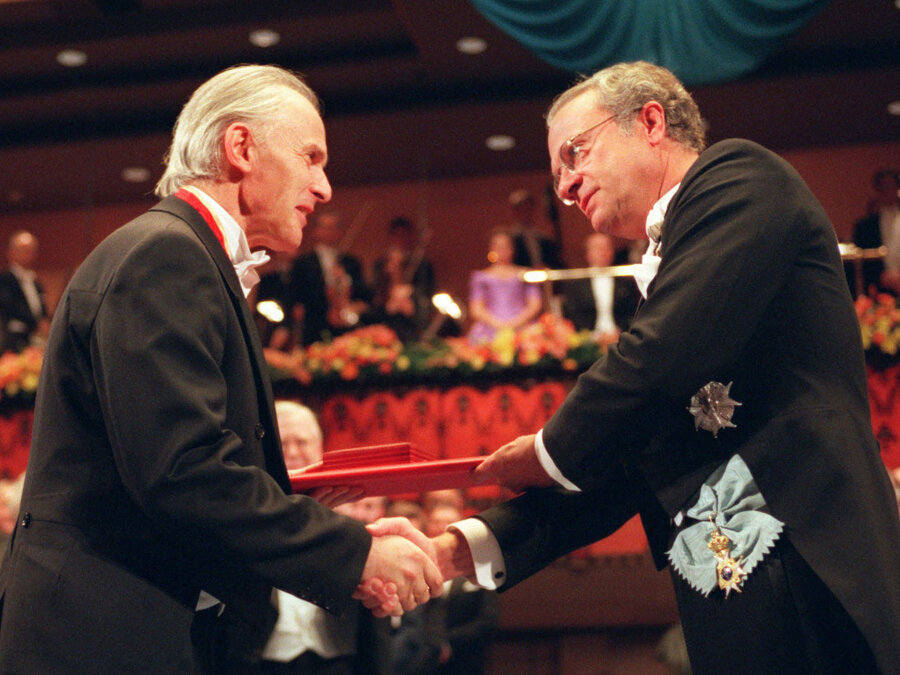
Harold W. Kroto (left) receives the Nobel Prize in chemistry from Swedish King Carl XVI Gustaf in Stockholm, in 1996.
Soren Andersson/AP
__
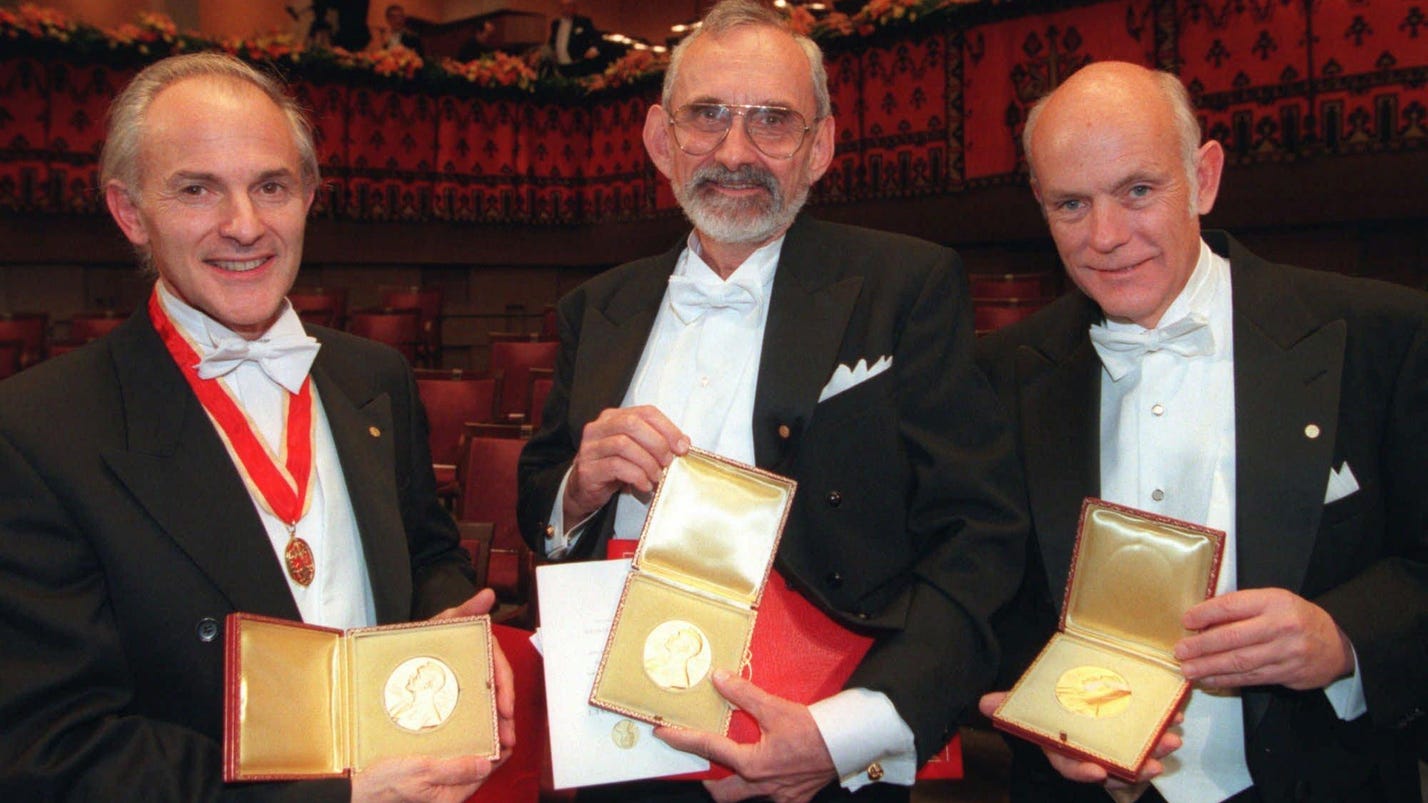
I have attempted to respond to all of Dr. Kroto’s friends arguments and I have posted my responses one per week for over a year now. Here are some of my earlier posts:
Arif Ahmed, Sir David Attenborough, Mark Balaguer, Horace Barlow, Michael Bate, Patricia Churchland, Aaron Ciechanover, Noam Chomsky,Alan Dershowitz, Hubert Dreyfus, Bart Ehrman, Stephan Feuchtwang, David Friend, Riccardo Giacconi, Ivar Giaever , Roy Glauber, Rebecca Goldstein, David J. Gross, Brian Greene, Susan Greenfield, Stephen F Gudeman, Alan Guth, Jonathan Haidt, Theodor W. Hänsch, Brian Harrison, Hermann Hauser, Roald Hoffmann, Bruce Hood, Herbert Huppert, Gareth Stedman Jones, Steve Jones, Shelly Kagan, Michio Kaku, Stuart Kauffman, Lawrence Krauss, Harry Kroto, George Lakoff, Elizabeth Loftus, Alan Macfarlane, Peter Millican, Marvin Minsky, Leonard Mlodinow, Yujin Nagasawa, Alva Noe, Douglas Osheroff, Jonathan Parry, Saul Perlmutter, Herman Philipse, Carolyn Porco, Robert M. Price, Lisa Randall, Lord Martin Rees, Oliver Sacks, John Searle, Marcus du Sautoy, Simon Schaffer, J. L. Schellenberg, Lee Silver, Peter Singer, Walter Sinnott-Armstrong, Ronald de Sousa, Victor Stenger, Barry Supple, Leonard Susskind, Raymond Tallis, Neil deGrasse Tyson, .Alexander Vilenkin, Sir John Walker, Frank Wilczek, Steven Weinberg, and Lewis Wolpert,
_
In the first video below in the 14th clip in this series are his words and I will be responding to them in the next few weeks since Sir Bertrand Russell is probably the most quoted skeptic of our time, unless it was someone like Carl Sagan or Antony Flew.
50 Renowned Academics Speaking About God (Part 1)
Another 50 Renowned Academics Speaking About God (Part 2)
A Further 50 Renowned Academics Speaking About God (Part 3)
__
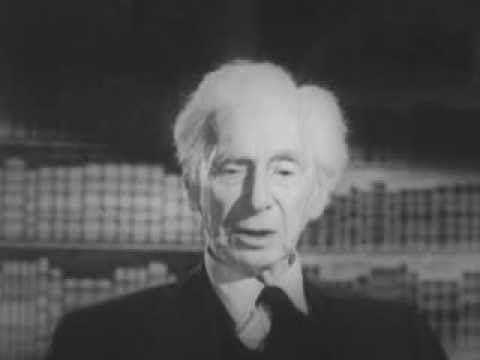
Quote from Bertrand Russell:
Q: Why are you not a Christian?
Russell: Because I see no evidence whatever for any of the Christian dogmas. I’ve examined all the stock arguments in favor of the existence of God, and none of them seem to me to be logically valid.
Q: Do you think there’s a practical reason for having a religious belief, for many people?
Russell: Well, there can’t be a practical reason for believing what isn’t true. That’s quite… at least, I rule it out as impossible. Either the thing is true, or it isn’t. If it is true, you should believe it, and if it isn’t, you shouldn’t. And if you can’t find out whether it’s true or whether it isn’t, you should suspend judgment. But you can’t… it seems to me a fundamental dishonesty and a fundamental treachery to intellectual integrity to hold a belief because you think it’s useful, and not because you think it’s true._
_
Francis Schaeffer noted that Bertrand Russell was obsessed with the possibility that nuclear war may destroy the human race and for Russell that is the only value left that was worth anything. You can see from this extensive interview further below from 1965 that subject keeps coming up.
Schaeffer noted:
In his lecture at Acapulco, George Wald finished with only one final value. It was the same one with which English philosopher Bertrand Russell (1872-1970) was left. For Wald and Russell and for many other modern thinkers, the final value is the biological continuity of the human race. If this is the only final value, one is left wondering why this then has importance.
Bertrand Russell: Playboy Interview
March 1963
If the long and stormy life of Bertrand Arthur William Russell can be said to possess any unifying thread, it is an enduring attitude of passionate skepticism, a lifelong refusal to accept any truth as immutable, any law as infallible or any faith as sacred. During the nine decades of his dedication to dissent, the erudite Earl Russell, a member of the House of Lords, has been awarded the Nobel Prize for literature in recognition of his pioneering research in mathematical philosophy and symbolic logic and honored with Britain’s distinguished Order of Merit for service to his country. But he has also been reviled as an enemy of religion and the flag; jailed for his ring-leadership of passively nonviolent demonstrations against nuclear armament; and variously extolled and execrated for his contentious convictions on free love, women’s suffrage, sex education, pacifism and preventive war.
As the London Times wrote last May on the occasion of Lord Russell’s 90th birthday, “For everyone who grasps even the outline of his contribution to mathematical logic, 10,000 wear the little button that he wears.” The button is the badge of the Campaign for Nuclear Disarmament, a militantly antimilitary movement of which he is the combative champion. As spiritual leader of the famed Committee of 100, a ban-the-bomb group that commands widespread popular support in Britain, he has also earned international eminence—and a brief prison term for civil disobedience—as the most articulate agitator for the controversial cause of unilateral disarmament. In October 1957, he published an open appeal to the great powers for a cessation of nuclear testing which won worldwide headlines when both Nikita Khrushchev and John Foster Dulles responded with public reassurance. Russell unexpectedly became an active intermediary between East and West at a critical moment during the recent Cuban crisis when Premier Khrushchev, in a personal reply to a cabled appeal from Russell, gave the first public indication of his intention to avoid rash action in responding to the American arms blockade.
After a conversation with Russell four decades before this momentous intervention, T.S. Eliot described how “his dry and passionate talk devoured the afternoon.” And so it did early this winter in a three-hour interview with Playboy at his secluded home in the mountains of North Wales. The venerable philosopher discussed his fears and hopes for the world with the luminous lucidity that inspired one reporter to write, “He is all flame and no ash. He has a brain that burns when you come near it.” Puffing determinedly on a blackened briar, cleaving the air with energetic gestures and pounding his chair arm periodically with an emphatic fist—his deeply creased, hawklike visage animated with intense conviction beneath the familiar shock of unruly white hair—he spoke with ominous eloquence and a final ray of hope of the nightmare of atomic annihilation that has haunted his waking thoughts and commandeered his considerable energies since the explosion of the first hydrogen bomb at Eniwetok. In October 1961—after a decade of mounting personal outcry against the unabating arms race—Russell warned his uneasy listeners at a ban-the-bomb rally in London’s Trafalgar Square that they would be lucky if any of them were alive in a year’s time. That year has passed, and nuclear holocaust has not yet overtaken us. We began our interview by reminding Lord Russell of this prophetic miscalculation.
PLAYBOY: Inasmuch as the world has successfully survived the year since your Trafalgar Square address, Lord Russell, would you care to revise your estimate of the likelihood of an atomic war?
RUSSELL: I said at Trafalgar Square that we would need luck as things were, and we have been extremely lucky so far. But I don’t see any reason to be optimistic. I still feel that the human race may well become extinct before the end of the present century. Speaking as a mathematician, I should say that the odds are about three to one against survival. The risk of war by accident—an unintended war triggered by an explosive situation such as that in Cuba—remains and indeed grows greater all the time. For every day we continue to live, remain able to act, we must be profoundly grateful.
PLAYBOY: In a scathing reference to President Kennedy, Premier Khrushchev and Prime Minister Macmillan, you said in 1961 that “they are the wickedest people who have ever lived in the history of man, and it is our duty to do what we can against them.” Did you actually mean to say that Kennedy, Khrushchev and Macmillan are the worst of a gallery of villains which includes Hitler and Attila?
RUSSELL: That was an arithmetical statement. Just as it is a wicked thing for one man to murder another, it is ten times as wicked to murder ten others, and 1,000,000 times more wicked to be responsible for the death of 1,000,000 men. No man in history has ever had the chance to murder on such a scale. In the past there have been long and bitter wars that caused appalling destruction, but at the end there were still people who could build again. Today we face the prospect of total obliteration in a single day. If mankind is to survive at all, intelligent people must learn to think and act in a less provocative manner than in former times.
PLAYBOY: Did not the avoidance of nuclear war over Cuba last October reassure you about the prudence and restraint of both Kennedy and Khrushchev?
RUSSELL: There are signs that the politicians are beginning to realize the implications of the power they wield. But they have not fully assimilated them. So much seems to depend on very personal factors with politicians—even on what they have had for breakfast and whether they have indigestion when they have to make some important decision. What I am saying is this: When two great powers disagree about anything—it doesn’t matter what—they must find a way to settle it somehow by arbitration or by negotiation, not by war or threat of war. We know only too well that if you threaten someone with war and he doesn’t give way, then you may find yourself committed either to war or to backing down—and that choice has almost always been resolved by war. The Berlin crisis is a case in point. Here the Russians have been somewhat aggressive. They are trying to secure a change in the status of West Berlin by what amounts to threats of war. In the case of the Cuban crisis, on the other hand, Khrushchev has shown himself to be less belligerent than Kennedy, and in effect, at a crucial moment last October, was responsible for avoiding a war of nuclear devastation. Full credit must be given to him for this. He acted with great restraint in a crisis of the first magnitude. I hope it may presage similar responses should the Berlin question reach a comparable peak of crisis. The essential thing to understand is that no conceivable solution to any problem is worse than a nuclear war. It is necessary to realize before it is too late that any act—whatever its motive or rationale—is to be considered wicked if the consequence is an atomic holocaust.
PLAYBOY: What do you believe was the effect of your own personal intervention with Khrushchev—via your much publicized cable appealing for Russian prudence in responding to the American blockade of Cuba?
RUSSELL: He carried out the promise he made in the letter replying to my cable — the promise to do nothing rash that would risk conflict. Within hours of my communication, 12 Soviet ships had turned back from their Cuban destination and Khrushchev had stopped further shipment. This left Cuba illegally blockaded in violation of international law. I believe that if a blockade is defensible when applied to Cuba, then the precedent can be applied also to Berlin and even to Britain, which is an advanced American nuclear base. America should remember the War of 1812 when the United States would not tolerate a British blockade. This is the very heart of what I have been saying for years: If nuclear bases are intolerable in Cuba, then they are intolerable anywhere in the world. Nuclear bases threaten the survival of mankind and the Cuban crisis has shown us how very close we are to annihilation.
PLAYBOY: Do you think the Russian position on Berlin may bring us closer still?
RUSSELL: I can’t tell. There are all these different possibilities. There is intended war, resorted to when one side really thinks it can win. That is the least likely cause in this case. Then there is escalation—a little war growing into a big one. There is also threat and counterthreat, where each side hopes the other will give way—a course inevitably bringing such dangerous factors as prestige and national pride into play. But what is most likely in Berlin or elsewhere is simply war by misinterpretation. You may get a meteor or something like that showing up on a radar screen, and someone will press the button. There is no time to consider. It could so easily happen, in a day, in a moment….
PLAYBOY: Can you make any estimate of the destructive consequences of such a disastrous “misinterpretation”?
RUSSELL: This is a question for experts, though all experts are biased. For an uninformed person such as me, it is very difficult to make any precise forecast. But I could give you a minimum estimate. I believe you must generally estimate that, at the very least, the price of nuclear war would be that half the population of both America and Russia, plus the whole of the population of Western Europe and Britain, would be wiped out.
PLAYBOY: You are the outspoken advocate of unilateral disarmament for Britain. Is this cause, as some critics have asserted, simply a means whereby Britain can escape the destruction of nuclear war through neutrality?
RUSSELL: By no means. I regard it as a means to rid Britain of a very awkward commitment. Authorities feel that Britain adds absolutely nothing to the military strength of America, that America would be better off without us. I agree. It would not weaken NATO one atom. What I want to see is a concerted attempt by the neutral nations to achieve an accommodation between East and West. The influence of the neutrals would be immensely strengthened if Britain were one of them. We have a very long political experience. With the exception of the Scandinavian countries, we are perhaps more sensible politically than others. We could play a very great part. But I don’t see much chance that we shall. In any case, I do not advocate unilateralism solely for Britain; I see it as a step toward wider disarmament. Fear is very much a part of the incentive for armaments. If the fear were removed, each side would be more reasonable. I think that if the West were to voluntarily divest itself of nuclear weapons as a token of its peaceful intentions, this would greatly impress the Russians. They would then feel that they had nothing to fear and that they could enormously reduce their own expenditure on armaments. They would spend their money on consumer goods instead.
PLAYBOY: Does your disarmament plan involve also the abandonment of conventional weapons?
RUSSELL: We should not interfere with conventional weapons unless there is general nuclear disarmament. We would then discard all but a very small number of conventional weapons.
PLAYBOY: It has been said by some political observers that this eventuality will remain entirely academic as long as the U.S. continues to insist on inspection without disarmament, and the U.S.S.R. on disarmament without inspection. Would you agree or disagree with this appraisal?
RUSSELL: It does rather look that way. One side says that America is to blame for the stalemate and the other says Russia is responsible. You get the same sort of explanation in both countries. That, roughly speaking, has been the excuse for not reaching agreement. But I think the true explanation lies deeper than that. Neither side wants agreement, and they have to have something plausible to disagree about. You must realize that in both countries there are political and military factions—lobbies, if you like—which exert powerful pressure for extremist policies. On both sides they consist of people with interests in armaments and all the apparatus of preparation for war. There are military commanders in power on both sides, and their vested interest is in exercising that power. In fact, military people carry much more weight in the making of policy than does public opinion.
PLAYBOY: Would you say, then, considering this climate of opinion within, as well as between Russia and America, that there is any realistic hope of drafting a global disarmament plan which would be acceptable to both sides?
RUSSELL: No, not at present. There is no possibility of attaining or sustaining general disarmament until East-West tension has lessened.
PLAYBOY: In 1957 you wrote in The New Statesman, the liberal British journal, an appeal to Premier Khrushchev and then-President Eisenhower for just such a lessening of world tension, to which both the Russian leader and John Foster Dulles responded with public reassurances. Six years have elapsed since then without a noticeable decline in global strife and division. At this critical moment in the cold war, would you care to make another such appeal—perhaps suggesting specific ways in which relations can be improved—to Khrushchev and President Kennedy?
RUSSELL: If I were to make another such appeal, I would have to begin by repeating what I said in 1957. I should say simply to both men: “You seem anxious to destroy the world, to create vast misery and total destruction. All this preparation for war is childish—and suicidal. If you could only begin to tolerate each other, you would be perfectly happy.” I would go on to suggest that the overridingly urgent necessity is to come to an agreement. This is far more important than the precise form the agreement takes. Last summer, I sent a message to Moscow in which I expressed the wish that in all negotiations between East and West, the negotiator for the Communists should begin by saying that the universal victory of capitalism would be less disastrous than nuclear war. At the same time, the Western spokesman should start by admitting that the universal victory of communism would be preferable to the destruction of mankind. In a speech last July, Khrushchev singled out this suggestion and said that he entirely agreed. I was rather pleased. I would suggest further that the likelihood of war could be lessened immeasurably if both sides would place a great deal more emphasis on the ghastly destructiveness of war. At present, the major organs of publicity in both East and West are inclined to make the public believe that nuclear war wouldn’t really be so terrible after all. That is why I am opposed to Civil Defense preparations. They are diabolical inventions calculated to tell lies and to deceive. Everyone who knows anything knows that. People may think themselves safe in their deep shelters—but they will roast. Governments must be made to give up the habit of lying in order to persuade people to die quietly. Thirdly, I would strongly recommend an agreement on both sides not to teach that the other side is wicked. For Americans, communism is the Devil; for the Russians, capitalism is the Devil. The truth is that neither is wickeder than the other. They are both wicked.
PLAYBOY: Do you see no difference between the moral positions of America and Russia?
RUSSELL: No. They both have abominable systems. I am inclined to prefer the American system, but only because it is more allied with what I am used to. If I had been born a Russian, probably I should prefer the Russian system.
PLAYBOY: Have your views changed since you returned from a trip to Russia in 1920 to write one of the earliest and sharpest criticisms of the Soviet regime?
RUSSELL: I still take exactly the same view. Up to the time of Stalin’s death, it was really quite horrible. Since then, I think, things have not been quite so bad—though I still don’t care for the Soviet system at all. I just don’t happen to like the American system either. The Americans tell you they stand for freedom: What they mean is that you must be quite willing to perish in order to be free in hell. In Russia, they punish you if you espouse capitalism. In America, they punish you if you espouse communism. What is the difference? But it is not worthwhile for us to go into the question of whether Russia or America has the better system. There are merits and demerits on both sides. The only important matter is to find some way of compromise between them, which will avoid war. At present, each has an entirely melodramatic conception of the other, and I think that the Russian government, in particular, encourages this view by not allowing Russian tourists to visit other countries except in small, organized groups. The same applies to Western visitors in Russia. This is a great pity. But there also seems to be some kind of fear in the West that if you get to know Communists, you will begin to admire them and finally be won over by them. Not a bit of it. There is simply no other way to achieve on each side an understanding of the real nature of the other. I would suggest—finally, in my appeal—that both Kennedy and Khrushchev consider the merits of a plan whereby the neutral nations would appoint a small, permanent body, well-informed on world affairs, which would investigate every dispute—such as Berlin, India or Cuba—and give an objective opinion on how it should be settled without favoritism to either side. Each settlement proposed, of course, would have to be, as far as possible, one that will be acceptable to the public in the countries concerned. Perhaps it could then develop into a permanent organization composed of three different groups: East, West and neutral. It seems to me that whichever side was more reasonable would win the support of the neutrals. Something of this sort has got to develop if we hope to reduce the deadly danger of war. Such a three-pronged body could be a step toward truly effective world government. But of course, that won’t be for a long time. At first, it would be merely advisory. After a century of advice, it might begin to acquire a measure of authority.
PLAYBOY: Do you consider it possible to strive for these same aims without waiting a century—by relying on the UN?
RUSSELL: It can’t be done through the UN as it is now, because the UN does not embrace China. Its exclusion is a colossal stupidity. The veto also is an absurdity. Some nations, moreover, are very much more powerful and more populous than others—and you cannot invest a little nation with the same weight as a big nation. What you will have to do is divide the world into regions. You might, for example, have North America as one group, Europe as another, Russia as a third, China as a fourth and so on. You would have to work it out with a view to making it more or less equally balanced in population. And the various regions ought to be so constituted that their internal relations would be foremost in importance, and their relations to the outer world secondary in importance. I would leave each region complete autonomy for its own affairs. The world government would become involved only when there were contests or disputes with other regions. We shall not long survive without some such system.
PLAYBOY: On a personal level, why have you chosen to adopt a policy of civil disobedience as a means of promoting the cause of peace?
RUSSELL: Purely to get attention. All the major organs of publicity are against us. It was extremely difficult to get any attention at all until we resorted to it. I have no views in principle, either for or against civil disobedience. It has always been practiced at different times and places. With me, it is purely a practical question of whether to do it or not, a method of propaganda.
PLAYBOY: Do you feel that the authorities have the moral right to prosecute and imprison those involved in such non-violent demonstrations for peace—as they have done to you?
RUSSELL: I have no right to complain about being punished for breaking the law. I complain only if I am not permitted to break it. I recognize that if you go outside the law you cannot complain if it is made a little awkward for you, but it ought to be possible to do so. If I suddenly took it into my head that I wanted to assassinate the Queen, then I should expect to be punished. You do that sort of thing with full foreknowledge of the consequences.
PLAYBOY: You were recently threatened with expulsion from the Labor Party for urging Western representatives to attend a Moscow “peace” conference and state their views. Aren’t such occasions always turned to their own advantage by the Communists?
RUSSELL: On the contrary. Members of the Committee of 100 went to Moscow last summer and presented their point of view very effectively indeed. They got publicity both inside and outside of Russia. Many Americans have asked me why I don’t preach my ideas to the Russians as well as to the West, and the answer is that I do. Certainly the Russians disagree with much of what I say, but I have found it just as easy—or as difficult—to get publicity for my views in the Soviet press as in the English press. The question I wondered about was whether they had bowdlerized what I said. I have taken the trouble to get translations of what they printed and found that they have been completely faithful. They have not altered a scrap.
PLAYBOY: In addition to disseminating your views personally on both sides of the Iron Curtain, you were the initiator of a series of peace conferences, of which the first was held in Pugwash, Nova Scotia, between groups of scientists from East and West. What positive results do you feel have emerged from these symposia?
RUSSELL: They have made a contribution toward informed opinion. For one thing, as a result, the test-ban negotiations came closer to success than they would otherwise have done. But the Pugwash meetings have not accomplished as much as one might have hoped. There was a lack of effective publicity. The public won’t listen to informed opinion. They want uninformed opinion.
PLAYBOY: In 1916, you were fined £100 by the Lord Mayor of London for circulating a pacifistic leaflet, which the law deemed “likely to prejudice the recruiting and discipline of His Majesty’s Forces.” Your intention, you said then, “was to procure, if possible, a change in the law, or failing that, to secure a change in administration.” Does the same intention motivate your current antiwar activities?
RUSSELL: Yes. Then, of course, I was defending the rights of conscientious objectors in World War I. I do not wholly share their views, but I felt, and still feel, that one should respect their convictions. They believe what I do not believe—that it is wicked to take part in any war, however righteous the cause. I supported the war against Hitler, and have become a pacifist today largely because of the destructiveness of nuclear warfare.
PLAYBOY: Speaking of this destructiveness in psychological terms, you have said that Kennedy, Khrushchev, Macmillan and other world leaders “are driven irrationally into policies which may effectively end human life on this planet.” If their judgment is so irrational, Lord Russell, what is the point of your attempts to dissuade them on rational grounds from precipitating war?
RUSSELL: Even less is to be gained, I think, by the West’s continuing campaign to remake the East in its own image, and by the East’s unrelenting efforts to do the same with the West. The change—an attitude of mutual concession in an atmosphere of mutual understanding—has got to come from within each country, from within each individual. It is to this end that I persist in my appeal. When I made such an appeal to Khrushchev last October, the Cuban situation had changed the world situation very much for the worse, and I felt it necessary to make a last effort. His response was more than I could have hoped for. He showed himself willing to act cautiously in very difficult circumstances. I will continue to maintain communication with him for the purpose of facilitating a settlement.
PLAYBOY: Even if a nuclear conflict is avoided, either through disarmament or a continuing balance of power, Khrushchev has made it clear that future “peaceful coexistence” will entail a continuing nonviolent struggle on the ideological front and an intensified campaign of economic competition, which he predicts will eventually “bury” us. What posture do you feel the West should adopt in combating this threat?
RUSSELL: Neither of these conflicting interests will be arbitrated equitably and amicably until we have a truly representative and authoritative world government. In the absence of one, it will be a tug-of-war, a question of who is stronger. A continued program of economic and educational aid to underdeveloped countries, meanwhile, would be a significant means of strengthening the Western position. It would be better, of course, if such aid were given cooperatively by both sides, but I don’t think that this is practical politics at the moment. In either case, it should be given not on cold war grounds, but simply because these people need help.
PLAYBOY: Do you share the apprehension of leading sociologists and economists concerning the implications of unchecked population growth in such overcrowded and underproductive areas as Africa, China, India and parts of Latin America?
RUSSELL: The population problem has, in my opinion, been rather exaggerated. It can be solved by adequate birth control, and I don’t think that Catholic objections will prevent the increasingly widespread use and acceptance of contraceptives. After all, Roman Catholics represent only a small segment of the world’s population. India and China are the really big problem areas, and both are inclined to favor birth control.
PLAYBOY: Do you agree with many historians and social scientists who foresee that the next century will witness “an inexorable economic and societal evolution,” as one commentator has expressed it, “from the tradition of individual enterprise to the psychology of mass man?”
RUSSELL: Societies comprised of small farmers, merchants and artisans will soon be anachronistic. Almost everybody is already part of something big. If we are to preserve individual liberty in this new world of huge firms and institutions, we must begin thinking in different terms from the tenets of classical liberalism. We will be able to deal with the “curse of bigness,” as Justice Brandeis called it, only by democratizing industry. I would like, for example, to see rules providing for the popular election of directors and managers in each industry. The important thing is to ensure the limitation and equitable division of power. At present economic power is too much concentrated in the hands of a few big men who control the lives of others to an undesirable degree. The Russians—in fact, socialists of all countries—make the cardinal error of believing that if you have a democratic state running industry, then it automatically follows that the industries themselves will be democratic. But to put state officials in place of capitalist officials changes nothing; they are still men, still wielding the same power. Unless state officials are made responsible to all us underlings, nothing will ever be achieved by nationalization.
PLAYBOY: So far we have been talking mainly of the issues which have preoccupied you during the last half-dozen years. But your life’s work has encompassed a multitude of causes. Which of them has mattered most to you?
RUSSELL: Though they have mattered differently at different times, the question of international peace certainly transcends any I have ever been concerned with or any issue that previously excited me. But I have derived great satisfaction from many of my interests—matters of the mind more than anything else. Mathematical logic has been the source of perhaps my deepest intellectual gratification. It has given me very great pleasure to feel, in an important field of human knowledge, that I may have made some lasting contribution to man’s understanding of things that were once beyond his grasp, but which can now be comprehended and manipulated. I am also pleased with the aftermath of my campaign for women’s suffrage and my efforts to secure a more enlightened sexual morality and behavior. They have gone almost as well as I would have liked them to go. When I was young, one talked to a woman in a different language than when talking to a man. There was a cultivated unreality in intercourse between men and women, which I thought was very bad indeed. Today things are utterly different. Young people don’t realize how much change there has been. But we still need much more freedom and frankness in sexual instruction. Another matter to which I have always attached great importance in education is that schools ought not to teach nationalism. Every school, with hardly any exception, has as one of its objects the deception of children. They teach them patriotism, to salute the flag. But the flag is a murder symbol, and the state is a pirate ship, a gang of murderers who have come together. When they salute the flag, they salute the symbol of bloody murder. All this is perfectly clear, valid psychology.
PLAYBOY: On the occasion of your 90th birthday, Lord Russell, you said, “In old age, one becomes aware of what has, and of what has not been achieved.” Did you mean this observation to apply to the fruits of your own efforts in behalf of the various causes you’ve espoused?
RUSSELL: Let me reply this way. Contrary to the customary pattern, I have gradually become more and more of a rebel as I have grown older. Since boyhood, my life has been devoted to two different objectives, which for a long time remained separate. It’s only in comparatively recent years that they have come together. One has been to discover whether anything could actually be known; this was a matter of philosophical inquiry. The other has been to do whatever I could to help create a happier world. I cannot claim that what I have written, said and done about social and political problems has had any great importance. It is easy to have an immense effect if you dogmatically preach a precise gospel such as communism. But I do not believe that mankind needs anything dogmatic. I think it essential to teach a certain hesitancy about dogma. Whatever you believe, you must have reservations. You must envisage the possibility that you may be wrong. I want to see individuals retain the kind of personal flexibility and initiative that they ought to have. This means that they cannot, and must not, be forced into a rigid mold. In my lifetime, freedom—which once seemed to be gaining ground—has come to be regarded as weakness. When I was young, I thought the battle for tolerance had been won. But more recently we have reverted back to the intolerance of the great religious wars. And when I was young, I set out with the belief that love—free and courageous love—could conquer the world. I perhaps thought that the road to a free and happy world would be shorter than it has turned out to be.
PLAYBOY: Do you feel now that this dream of a free and happy world was perhaps little more than the kind of utopian vision which has always inspired man in youth—and so often disenchanted him in maturity?
RUSSELL: It is something more. There is not anything to stop it from coming to pass except our own silliness—a silliness forced upon us by an education that teaches us that our country is vastly better than any other, and that in all respects it is always in the right. It would not be difficult to build a peaceful world if people really wanted it. It is certainly worthwhile to live and act and do what one can to bring it about. I haven’t changed my earlier views in that respect. I still believe exactly what I said when I was 80, when people were asking me much the same question. I have lived in the pursuit of a vision, both personal and social. Personal, to care for what is noble, for what is beautiful, for what is gentle, to allow moments of insight to impart wisdom in mundane times. Social, to envision in imagination, an attainable society in which the individual can grow freely, in which hate and greed and envy will die because there is nothing to nourish them. These things I still believe. So you can see that the world, for all its horrors, has left me unshaken.
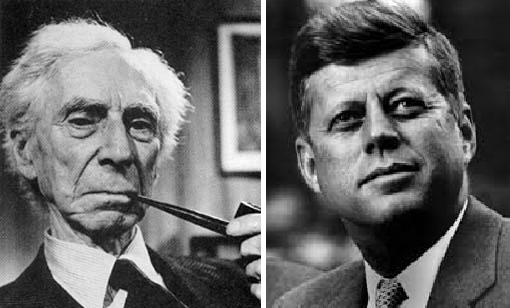
Bertrand Russell pictured above and Francis Schaeffer below:
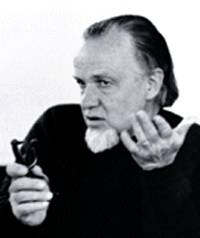
Francis Schaeffer noted in his book HOW SHOULD WE THEN LIVE? (p. 182 in Vol 5 of Complete Works) in the chapter The Breakdown in Philosophy and Science:
In his lecture at Acapulco, George Wald finished with only one final value. It was the same one with which English philosopher Bertrand Russell (1872-1970) was left. For Wald and Russell and for many other modern thinkers, the final value is the biological continuity of the human race. If this is the only final value, one is left wondering why this then has importance.
Now having traveled from the pride of man in the High Renaissance and the Enlightenment down to the present despair, we can understand where modern people are. They have no place for a personal God. But equally they have no place for man as man, or for love, or for freedom, or for significance. This brings a crucial problem. Beginning only from man himself, people affirm that man is only a machine. But those who hold this position cannot live like machines! If they could, there would have been no tensions in their intellectual position or in their lives. But even people who believe they are machines cannot live like machines, and thus they must “leap upstairs” against their reason and try to find something which gives meaning to life, even though to do so they have to deny their reason.
Francis Schaeffer in another place worded it like this:
The universe was created by an infinite personal God and He brought it into existence by spoken word and made man in His own image. When man tries to reduce [philosophically in a materialistic point of view] himself to less than this [less than being made in the image of God] he will always fail and he will always be willing to make these impossible leaps into the area of nonreason even though they don’t give an answer simply because that isn’t what he is. He himself testifies that this infinite personal God, the God of the Old and New Testament is there.
We all know deep down that God exists and even atheists have to grapple with that knowledge.
Solomon wisely noted in Ecclesiastes 3:11 “God has planted eternity in the heart of men…” (Living Bible). No wonder Bertrand Russell wrote in his autobiography, “It is odd, isn’t it? I feel passionately for this world and many things and people in it, and yet…what is it all? There must be something more important, one feels, though I don’t believe there is. I am haunted. Some ghosts, for some extra mundane regions, seem always trying to tell me something that I am to repeat to the world, but I cannot understand that message.”
Take a look at this 7th episode from Schaeffer’s series “HOW SHOULD WE THEN LIVE? The Age of Nonreason”:
How Should We Then Live – Episode Seven – 07 – Portuguese Subtitles
_
Instead of making a leap into the area of nonreason the better choice would be to investigate the claims that the Bible is a historically accurate book and that God created the universe and reached out to humankind with the Bible.
The Bible and Archaeology – Is the Bible from God? (Kyle Butt 42 min)
You want some evidence that indicates that the Bible is true? Here is a good place to start and that is taking a closer look at the archaeology of the Old Testament times. Is the Bible historically accurate? Here are some of the posts I have done in the past on the subject: 1. The Babylonian Chronicle, of Nebuchadnezzars Siege of Jerusalem, 2. Hezekiah’s Siloam Tunnel Inscription. 3. Taylor Prism (Sennacherib Hexagonal Prism), 4. Biblical Cities Attested Archaeologically. 5. The Discovery of the Hittites, 6.Shishak Smiting His Captives, 7. Moabite Stone, 8. Black Obelisk of Shalmaneser III, 9A Verification of places in Gospel of John and Book of Acts., 9B Discovery of Ebla Tablets. 10. Cyrus Cylinder, 11. Puru “The lot of Yahali” 9th Century B.C.E., 12. The Uzziah Tablet Inscription, 13. The Pilate Inscription, 14. Caiaphas Ossuary, 14 B Pontius Pilate Part 2, 14c. Three greatest American Archaeologists moved to accept Bible’s accuracy through archaeology.,
____
Related posts:
WOODY WEDNESDAY John Piippo makes the case that Bertrand Russell would have loved Woody Allen because they both were atheists who don’t deny the ramifications of atheism!!!
Top 10 Woody Allen Movies __________ John Piippo makes the case that Bertrand Russell would have loved Woody Allen because they both were atheists who don’t deny the ramifications of atheism!!! Monday, August 06, 2012 (More On) Woody Allen’s Atheism As I wrote in a previous post, I like Woody Allen. I have long admired his […]
John Piippo makes the case that Bertrand Russell would have loved Woody Allen because they both were two atheists who don’t deny the ramifications of atheism!!!
______ Top 10 Woody Allen Movies PBS American Masters – Woody Allen A Documentary 01 PBS American Masters – Woody Allen A Documentary 02 __________ John Piippo makes the case that Bertrand Russell would have loved Woody Allen because they both were two atheists who don’t deny the ramifications of atheism!!! Monday, August 06, 2012 […]
Bertrand Russell v. Frederick Copleston debate transcript (Part 4)
THE MORAL ARGUMENT BERTRAND RUSSELL But aren’t you now saying in effect, I mean by God whatever is good or the sum total of what is good — the system of what is good, and, therefore, when a young man loves anything that is good he is loving God. Is that what you’re […]
Bertrand Russell v. Frederick Copleston debate transcript (Part 3)
Great debate Fr. Frederick C. Copleston vs Bertrand Russell – Part 1 Uploaded by riversonthemoon on Jul 15, 2009 BBC Radio Third Programme Recording January 28, 1948. BBC Recording number T7324W. This is an excerpt from the full broadcast from cassette tape A303/5 Open University Course, Problems of Philosophy Units 7-8. Older than 50 years, […]
Bertrand Russell v. Frederick Copleston debate transcript and audio (Part 2)
Uploaded by riversonthemoon on Jul 15, 2009 BBC Radio Third Programme Recording January 28, 1948. BBC Recording number T7324W. This is an excerpt from the full broadcast from cassette tape A303/5 Open University Course, Problems of Philosophy Units 7-8. Older than 50 years, out of UK/BBC copyright. Pardon the hissy audio. It was recorded 51 […]
Bertrand Russell v. Frederick Copleston debate transcript and audio (Part 1)
Fr. Frederick C. Copleston vs Bertrand Russell – Part 1 Uploaded by riversonthemoon on Jul 15, 2009 BBC Radio Third Programme Recording January 28, 1948. BBC Recording number T7324W. This is an excerpt from the full broadcast from cassette tape A303/5 Open University Course, Problems of Philosophy Units 7-8. Older than 50 years, out of […]
Bertrand Russell v. Frederick Copleston debate transcript (Part 4)
THE MORAL ARGUMENT BERTRAND RUSSELL But aren’t you now saying in effect, I mean by God whatever is good or the sum total of what is good — the system of what is good, and, therefore, when a young man loves anything that is good he is loving God. Is that what you’re […]
Bertrand Russell v. Frederick Copleston debate transcript (Part 3)
Fr. Frederick C. Copleston vs Bertrand Russell – Part 1 Uploaded by riversonthemoon on Jul 15, 2009 BBC Radio Third Programme Recording January 28, 1948. BBC Recording number T7324W. This is an excerpt from the full broadcast from cassette tape A303/5 Open University Course, Problems of Philosophy Units 7-8. Older than 50 years, out of […]


 The Daily Hatch