
_

On November 21, 2014 I received a letter from Nobel Laureate Harry Kroto and it said:
…Please click on this URL http://vimeo.com/26991975
and you will hear what far smarter people than I have to say on this matter. I agree with them.
Harry Kroto
__
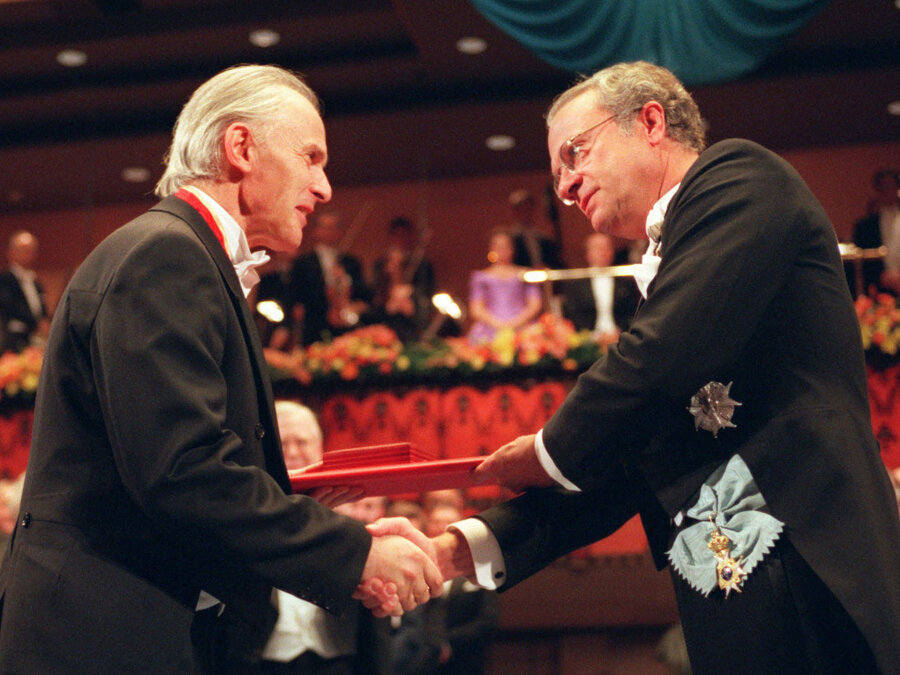
Harold W. Kroto (left) receives the Nobel Prize in chemistry from Swedish King Carl XVI Gustaf in Stockholm, in 1996.
Soren Andersson/AP
__
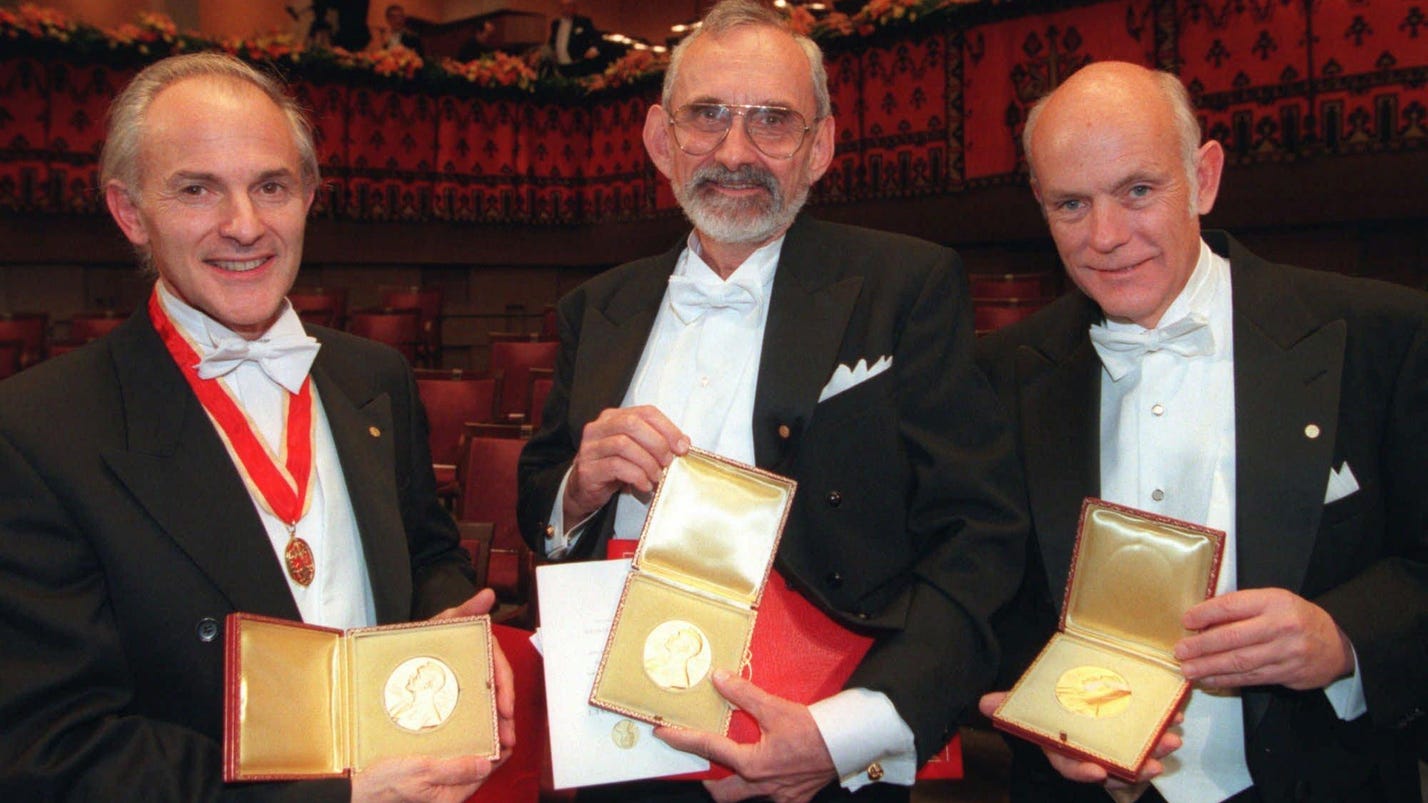
I have attempted to respond to all of Dr. Kroto’s friends arguments and I have posted my responses one per week for over a year now. Here are some of my earlier posts:
Arif Ahmed, Sir David Attenborough, Mark Balaguer, Horace Barlow, Michael Bate, Patricia Churchland, Aaron Ciechanover, Noam Chomsky,Alan Dershowitz, Hubert Dreyfus, Bart Ehrman, Stephan Feuchtwang, David Friend, Riccardo Giacconi, Ivar Giaever , Roy Glauber, Rebecca Goldstein, David J. Gross, Brian Greene, Susan Greenfield, Stephen F Gudeman, Alan Guth, Jonathan Haidt, Theodor W. Hänsch, Brian Harrison, Hermann Hauser, Roald Hoffmann, Bruce Hood, Herbert Huppert, Gareth Stedman Jones, Steve Jones, Shelly Kagan, Michio Kaku, Stuart Kauffman, Lawrence Krauss, Harry Kroto, George Lakoff, Elizabeth Loftus, Alan Macfarlane, Peter Millican, Marvin Minsky, Leonard Mlodinow, Yujin Nagasawa, Alva Noe, Douglas Osheroff, Jonathan Parry, Saul Perlmutter, Herman Philipse, Carolyn Porco, Robert M. Price, Lisa Randall, Lord Martin Rees, Oliver Sacks, John Searle, Marcus du Sautoy, Simon Schaffer, J. L. Schellenberg, Lee Silver, Peter Singer, Walter Sinnott-Armstrong, Ronald de Sousa, Victor Stenger, Barry Supple, Leonard Susskind, Raymond Tallis, Neil deGrasse Tyson, .Alexander Vilenkin, Sir John Walker, Frank Wilczek, Steven Weinberg, and Lewis Wolpert,
_
Birthplace: England
Star Sign: Taurus
Profession: Mathematician
Died: February 2, 1970
Bertrand Russell was a British philosopher, mathematician, logician, social activist, writer, critic, pacifist, and intellectual. He owned a huge fame for his works on analytical philosophy, mathematical logic, linguistics, anti-imperialism, human rights and so on. In the academic fields of mathematics and logic, he is famous for his great works including ‘Principia Mathematica’.
Bertrand Russell born on May 18, 1872, in Monmouthshire, UK. He got an influential and intellectual family by birth. His parents, Lord and Lady Amberly supported Birth control when many people thought it as blasphemous. Lord Amberly was an atheist, which influenced child Russell very much. Russell lost his parents at childhood. After that, his grandmother started to look after Russell and his two siblings; Frank and Rachel. Russell’s education started at home with the help of his brother, Frank and some tutors. Frank taught him euclidean geometry, which changed his life.

Russell went to Trinity College of Cambridge University in 1890. In 1895, he became wrangler and obtained a first class with distinction in philosophy. The college authority elected him as a fellow. After leaving college, he worked as an attache in the British embassy in France. Later he worked as an academician and lecturer in different Universities in Europe. He also America including Cambridge and Harvard.
Russell’s early works began with his affection on mathematics and logic. Although his outlook towards social and political theories led him to publish ‘German Social Democracy’. He wrote many articles on logic and foundation of mathematics, such as ‘An Essay on the foundations of Geometry’, ‘The Principles of Mathematics’, ‘An introduction to the Mathematical Philosophy’, ‘Mysticism and logic’, ‘Our Knowledge about External World’ and so on. His later works were on political and social activism, which led him to swim against the current of traditional belief systems. ‘Marriage and Morals’, ‘Why I am not a Christian’, ‘war crimes in Vietnam’, ‘Unarmed Victory’, ‘Religion and Science’, ‘Theory and Practice of Bolshevism in Russia’, ‘Problems of China’ are his renowned works. He also achieved Nobel prize in literature in 1950.
Russell married four times. His first wife was Alys Pearsall Smith. Dora Russell, Patricia Spence, and Edith Finch Russell were his wives in his later part of life. Bertrand Russell died on February 2 in 1970. The present world still recognizes him as one of the greatest thinkers of the modern time.
- Profile
- Family
- External Links
Born: May 18, 1872, Trellech, United Kingdom
Died: February 2, 1970, Penrhyndeudraeth, United Kingdom
Influenced: Sidney Hook, Noam Chomsky, Isaac Asimov, More
In the first video below in the 14th clip in this series are his words and I will be responding to them in the next few weeks since Sir Bertrand Russell is probably the most quoted skeptic of our time, unless it was someone like Carl Sagan or Antony Flew.
50 Renowned Academics Speaking About God (Part 1)
Another 50 Renowned Academics Speaking About God (Part 2)
A Further 50 Renowned Academics Speaking About God (Part 3)
__
Quote from Bertrand Russell:
Q: Why are you not a Christian?
Russell: Because I see no evidence whatever for any of the Christian dogmas. I’ve examined all the stock arguments in favor of the existence of God, and none of them seem to me to be logically valid.
Q: Do you think there’s a practical reason for having a religious belief, for many people?
Russell: Well, there can’t be a practical reason for believing what isn’t true. That’s quite… at least, I rule it out as impossible. Either the thing is true, or it isn’t. If it is true, you should believe it, and if it isn’t, you shouldn’t. And if you can’t find out whether it’s true or whether it isn’t, you should suspend judgment. But you can’t… it seems to me a fundamental dishonesty and a fundamental treachery to intellectual integrity to hold a belief because you think it’s useful, and not because you think it’s true._
Bertrand Russell’s View of Jesus Christ
From the first century up to the present day, the Sonship and divinity of Jesus have been attacked with amazingly and seemingly unending vigor and venom. One of the modern-day leaders in this attack against Christianity would certainly be Bertrand Russell, who was one of the most influential, and often outspoken, philosophers of the twentieth century. He was born in England in 1872 and continued to write and lecture in both Europe and the United States until not long before his death in 1970. His parents were freethinkers and close friends with John Stuart Mill, a pioneer in modern scientific thinking who devised rules for inductive scientific reasoning and was a leader of ethical utilitarianism (“Russell” 235). For the purposes of this article, Russell and his criticisms will be used as a model for skeptics in general. First, it will be succinctly shown that this discussion is still relevant and important as popular culture continues to disseminate false information concerning Christ and Christianity. Second, Russell’s arguments presented in Why I Am Not A Christian will be examined and then exposed as being untenable and false. Third, some basic proofs and evidences will be given in support of the claim that Jesus is divine.
Even while Jesus walked this Earth, many of His contemporaries refused to acknowledge the fact that He was divine. Consider, for example, the account of the blind man who was given his sight by Jesus (cf. John 9). The attitude displayed by the Pharisees is quite remarkable. For some, their first reaction upon hearing about the miracle was disbelief (John 9:16, 18). They had reached agreement that anyone confessing Jesus to be the Christ would be put out of the synagogue (John 9:22). Even after the man’s parents confirmed the fact that he was indeed born blind they still refused to believe. They even went so far at to attack his character as they claimed to “know” that Jesus was a sinner (John 9:24, 29).
The attitudes displayed by the Pharisees in the first century can be easily seen and readily recognized as attitudes that are popular today. Take for example the commotion stirred up by the book by Simcha Jacobovici and the subsequent film on the Discovery Channel by James Cameron. In The Jesus Family Tomb: The Discovery, the Investigation, and the Evidence that Could Change History, the claim is made that a tomb in Jerusalem has been found that not only contains the bones of Jesus, but also proves that He was married and had children. If such were to be the case, Christianity would be a sham to be avoided. As evidence to the contrary is presented, showing the tomb to be a hoax, the scholars who appeared in the film are backing off of the strong comments they made (Habermas). Then there is Dan Brown and his best-seller The DaVinci Code. Among other claims, such as Christ being married to Mary Magdalene, it is asserted that the Council of Nicea in AD 325 was used to invent the reality that Jesus was divine. It is further stated that everyone knew Jesus was just a “great and powerful man” at this point and it took a vote by contemporaries of Constantine to “make” Jesus the Son of God (Brown 253). Though damage has been done, scores of books and papers have been written which clearly refute the erroneous claims made by Brown (cf. “Truth”).
Skeptics such as Brown and Jacobovici stand in a long line of those seeking to discredit the claims that Jesus was divine. Eighty years ago, Bertrand Russell mounted a head-on attack of the existence of God and the divinity of Jesus in his speech that was later published under the title, Why I Am Not A Christian. This lecture was delivered on March 6, 1927, at Battersea Town Hall, under the auspices of the South London Branch of the National Secular Society (Egner 585). This particular work has been highly influential since the day it was presented and continues to be so. Proof of its continued influence is found in the numerous websites that persist in lauding the efforts of Russell as they discuss the merits of his work. Typing, “Bertrand Russell, Why I Am Not A Christian” on any internet search engine will literally return hundreds of thousands of hits. From research papers to personal blogs, this important work remains a serious topic for discussion and consideration.
The lecture/essay by the famous skeptic is divided into two parts: first, an attack against God and second, an attack against Jesus. Russell begins by giving his own definition of a Christian. He contends that to be a Christian one must believe in God and immortality and then also have some kind of belief about Christ (Egner 585). This two-part definition for a Christian leads Russell to say, “Therefore I take it that when I tell you why I am not a Christian I have to tell you two different things; first, why I do not believe in God and in immortality; and, secondly, why I do not think that Christ was the best and wisest of men, although I grant Him a very high degree of moral goodness” (586).
Discussion about the traditional arguments for the existence of God (cosmological, teleological, et. al.) and Russell’s attack on them is outside the scope of this article. Our task is limited to Jesus being the Christ. Specifically concerning Jesus, Russell attacks two things: His teaching and His moral character. It is easy to see how Russell, just like the Pharisees of John 9, has chosen to be blind to the evidence and available information. For example:
. . . I do not believe that one can grant either the superlative wisdom or the superlative goodness of Christ as depicted in the Gospels; and here I may say that one is not concerned with the historical question. Historically it is quite doubtful whether Christ ever existed at all, and if He did we do not know anything about Him, so that I am not concerned with the historical question, which is a very difficult one. I am concerned with Christ as He appears in the Gospels, taking the Gospel narrative as it stands, and there one does find some things that do not seem to be very wise. (qtd. in Egner 592)
It seems hard to believe that a man as intelligent as Russell, with all of his academic credentials and obvious ability to do research, would choose to be blind to the overwhelming facts. He believes the “historical question” is difficult to answer and that Christ probably never existed. What about the testimony of ancient writers who were antagonistic to the Christian faith such as Pliny, Tacitus, Suetonius, Cerinthus, Celsus, Porphyry, Thallaus, and Josephus (just to name a few)? Each of these men, in different ways and for different reasons, all offer proof that Jesus was a real man and an historical figure. Often they were attempting to prove that Christ was not divine, but in so doing, proved that He was historical. How could Russell have missed such compelling evidence? Obviously, if he can be wrong about the historicity of Christ, he can be wrong about the divinity of Christ.
First, Russell attacks the wisdom and teaching of Christ. Russell contends that Jesus taught that the Second Coming would “occur in clouds of glory before the death of all the people who were living at that time” (593). In fact, Jesus explicitly said that no one knew the time of His coming back (Matthew 24:36; Acts 1:7). Thus, it is contrary to His very teaching to understand Him as telling an audience when He would return.
By saying Jesus predicted He would return within forty years (one generation) indicates at least two major problems. One, Jesus was ignorant (not superlatively wise). Two, Jesus was a false teacher. Neither one of these ideas is compatible with the idea that Jesus was God on Earth (John 1:1, 14; Matthew 1:23; etc.). On the contrary, the Bible portrays Jesus as one who was omniscient by such statements as He, “needed not that any should testify of man: for He knew what was in man” (John 2:25). Even the Samaritan woman recognized His amazing knowledge when she proclaimed, “Come, see a man, who told me all things that ever I did. Could this be the Christ?” (John 4:29). And, being God on Earth, it would be impossible for Jesus to tell a lie (Titus 1:2; Hebrews 6:18).
One major factor contributing to the misunderstanding is that Russell confuses the coming of the kingdom (the church) with the second coming and judgment. Only a basic understanding of the Bible is needed to clearly see Russell’s blunder. Just prior to His death on the cross, Jesus stated that His kingdom, the church, would be established very soon. “And I also say to you that you art Peter, and on this rock I will build My church, and the gates of Hades shall not prevail against it” (Matthew 16:18). To which He further stated, “And He said to them, ‘Assuredly, I say to you that there are some standing here who will not taste death, till they see the kingdom of God present with power’” (Mark 9:1). These statements are completely and perfectly fulfilled on the first Pentecost after the ascension of Jesus into heaven, “[P]raising God, and having favor with all the people. And the Lord added to the church daily those who were being saved” (Acts 2:47). Thus Christ was predicting that the church would be established in the very near future, not when He would return.
To claim the Christ had a “defect” in his teaching is quite disturbing. Some Bible scholars have studied the available evidence and come to the conclusion that Jesus was unmatched and should be considered the greatest teacher of all time. Consider the thoughts of Thomas B. Warren who wrote that Jesus was the incomparable teacher because:
1. The circumstances of His teaching.
2. His perfect knowledge of the subject matter He taught.
3. He had perfect knowledge of the people whom He taught.
4. His methods were clear and concrete.
5. The overall purpose of His mission to the Earth.
6. He practiced perfectly what He taught.
7. His attitude toward truth.
8. The breadth of His vision.
9. No teacher could ever compare with Jesus in the moral standard He set out.
10. No teacher ever taught a message which could have as far-reaching effects for good as that taught by Jesus.
11. No one ever loved his students as Jesus loved His.
12. He spoke with incomparable authority. (108-13)
Warren concludes the section of Jesus as a teacher by saying, “Jesus was the incomparable teacher. This fact is compelling evidence in favor of the conclusion that He is the Son of the only true God. He was so marvelously unique as a teacher that He simply could not have been merely a human being. We are driven to the conclusion that He was Divine” (114).
Second, Russell attacks the morality and character of Christ. He says, “There is one very serious defect to my mind in Christ’s moral character, and that is that He believed in hell” (Egner 593). Does belief in hell constitute a moral defect? Note the comparison between Hell and the Jewish holocaust by Norman Geisler who said, “The fact that Jesus believed in hell does not make him any more inhumane than someone who believes in the Jewish holocaust. Certainly, if the holocaust happened, then it is not inhumane to believe in it. Likewise, if hell is real, then one is not inhumane for believing it is real. The question is one of truth, not of humanity” (679).
Russell feels that no humane individual can believe in everlasting punishment, but how can one who advocates moral relativity make such a claim? When the standard of authority is subjective in nature (feelings, emotions, majority, situations, et. al.) it is very easy to say, “I don’t see how such a thing as hell could be possible.” Subjectivity leads to inconsistency and Russell had an inconsistent view of sin. He denied its validity, reducing everything to the desirable or undesirable. Yet he seemed to have no doubt that belief in hell was really and truly cruel, unmerciful, and inhumane. Such are moral absolutist positions. If morality is merely the desirable or undesirable, then there are no real moral grounds to say anything is cruel or wrong. It is counter intuitive to say that God is unjust in punishing the unjust. Thus one can see that when the standard of authority comes from outside of your personal beliefs or feelings, the situation is much different. The basis for religious knowledge is stated as such: (1) If God exists, (2) The Bible is the inspired word of God, (3) The Bible teaches that there is a place of eternal life as well as a place of eternal punishment, then (4) I can know that there is a place of eternal punishment (cf. Matthew 25:46; 2 Timothy 3:16-17; 2 Peter 1:3; John 8:31-32; et al.).
R. C. Oliver has made note of the fact that both friends and enemies alike attested to the perfect moral character of Jesus: “The character of Jesus is revealed in the first four books of the New Testament by: (1) what he did, (2) what he said, and (3) what others said about him. And in all of this evidence not the least flaw can be found against him. Even the testimony by his enemies, by which they were hoping to show a fault, revealed instead a virtue, one example of which is their accusation that Jesus was ‘a friend of publicans and sinners’ (Luke 7:34)” (5).
A logical inconsistency arises from one saying about Jesus on the one hand, “I grant Him a very high degree of moral goodness,” but on the other hand, “There is one very serious defect to my mind in Christ’s moral character.” Can both statements be rationally made? It would appear to be illogical to say someone held a high degree of moral goodness if they claimed to be the Son of God when, in fact, they were not the Son of God. Jesus certainly made such claims (Matthew 26:64; Mark 14:61-2). As Josh McDowell has written, “You cannot put him on the shelf as a great moral teacher. That is not a valid option. He is either a liar, a lunatic, or Lord and God. You must make a choice” (34). Echoing the thoughts of McDowell, Peter Kreeft has written:
Nearly every non-Christian who ever lived has believed that Jesus was neither God nor a bad man but just a good man. But just a good man is the one thing he could not possibly have been. If he was the God he claimed to be, then he was not just a good man but more than a man. And if he was not the God he claimed to be, then he was not a good man at all but a bad man. A man who claims to be God and is not cannot be called “a good man.” He is either insane (if he believes that he is God) or a blasphemous liar (if he does not believe he is God but claims that he is). (229)
Russell also accuses Jesus of being vindictive and intolerant (Egner 593). Did Christ simply wish for the punishment and destruction of any and all who would not listen to Him and accept His teaching? Yes, according to Russell. No, according to the Bible. “. ..God our Savior, who desires all men to be saved and to come to the knowledge of the truth. For there is one God and one mediator between God and men, the Man Christ Jesus, who gave Himself a ransom for all, to be testified in due time” (1 Timothy 2:3-6). Jesus specifically taught His followers not to be vindictive (Matthew 5:39, 44). What objective student of the Bible could describe the attitude displayed on the cross as vindictive? After a brutal beating and cruel mocking, Jesus still displayed amazing love and mercy from the cross. Notice the Scriptures say, “And when they had come to the place called Calvary, there they crucified Him, and the criminals, one on the right hand and the other on the left. Then Jesus said, ‘Father, forgive them, for they do not know what they do.’ And they divided His garments and cast lots” (Luke 23:33-34). It broke Jesus’ heart when His audiences would refuse to hear the truth (Matthew 23:37; Mark 6:34). He wanted their loving obedience. He drew no pleasure from the punishment of others.
Russell further accuses Jesus of using fear tactics to force people into following him. Referring to Hell and the sin against the Holy Spirit, he said, “I really do not think that a person with a proper degree of kindliness in his nature would have put fears and terrors of that sort into the world” (qtd. in Egner 594). Is the person who warns the residents of a seacoast town that a hurricane is coming guilty of using fear tactics? The key lies in the truth of the statement. Fear can be perfectly rational if the thing to be feared is real. If hell is real, as Jesus says that it is
(Matthew 25:41), then the only loving and kind thing to do would be to warn others of its existence so that all who listen might avoid such a destination.
Almost in passing, Russell mentions the account of demons being cast into swine and that of Jesus cursing the fig tree as further evidence of character flaws (594). These biblical accounts are found in Matthew 8:28-34; Mark 5:1-17; Luke 8:27-34 and Matthew 21:18-20; Mark 11:12-22,
respectively. What is significant about these stories? Was Jesus unkind to animals? Was Jesus unkind to the tree and the environment? Of course not. As God, Jesus was sovereign over all life. He created it, and He had the right to take it (Deuteronomy 32:39; Job 1:21). The key is to look for the lesson being taught. The fig tree illustrates the fact that Israel’s rejection of the Messiah will lead to disaster. Casting the demons into the swine proved that Jesus was more powerful than Satan and his angels.
Finally, some basic proofs and evidences will be given in support of the claim that Jesus is Divine. If the particular characteristics of the person and work of Jesus Christ are such as to be beyond those of mere men, then Jesus is the Son of God and those like Russell will have been defeated. Such will be proven when it is shown that Jesus fulfilled prophecy, performed miracles, and was raised from the dead (Gardner 55-70).
First, Jesus uniquely fulfilled Old Testament prophecy.
From Genesis through Malachi, the history of Jesus is foretold in minute detail. Bible critics who wish to disprove Christ’s deity must refute fulfilled prophecy. To accomplish this, one would have to contend that Jesus did not fulfill the prophecies genuinely; rather, He only appeared to fulfill them. Yet with over 300 prophecies relating to Christ–none of which can be dismissed flippantly–this is an impossible task. (Thompson 254-55)
Just a few of the more notable fulfilled prophecies would be: the Messiah would be conceived of a virgin and called Immanuel (Isaiah 7:14; Matthew 1:18-23); He would be born in Bethlehem (Micah 5:2; Matthew 2.1); would be buried in a rich man’s tomb (Isaiah 53:9; Matthew 27:57-60); would be betrayed for thirty pieces of silver (Zechariah 11:12; Matthew 26:15); and His side would be pierced (Zechariah 12:10; John 19:34, 37).
Second, Jesus proved He was the Son of God by the miracles He performed. This is exactly the point Peter was driving home to the Jewish audience in Acts 2:22, “Ye men of Israel, hear these words; Jesus of Nazareth, a man approved of God among you by miracles and wonders and signs, which God did by Him in the midst of you, as ye yourselves also know.” The evidence that Jesus authenticated His claim to being God by performing miracles can be demonstrated through six points: (1) the reliability of the New Testament, (2) the inclusion of historical details lends credibility, (3) Jewish leaders and Jesus’ opponents admitted He performed miracles, (4) antagonistic sources outside the Bible confirm Jesus’ miracles, (5) the miraculous resurrection is one of the best-attested events in the ancient world, and (6) alternative explanations fall short (Zacharias 89-93). Jim McGuiggan has suggested three positive reasons for holding that the miracles of Jesus Christ really happened: 1) the reputation of Jesus Christ, 2) the powerful testimony of history, and 3) the subsequent miracles of the apostolic group (63-73).
Third, Jesus proved He was the Son of God when He walked out of the tomb on the third day after He was nailed to the cross. John Stott points out that this event was both dateable and physical (46-8). In other words, it was testable. It was a dateable historical event and actually
involved the body of Jesus. In The Case for Christ, Lee Strobel records Craig’s affirmative case for the empty tomb:
1. The empty tomb is definitely implicit in the early tradition that is passed along by Paul in 1 Corinthians 15, which is a very old and reliable source of historical information about Jesus.
2. The site of Jesus’ tomb was known to Christian and Jew alike.
3. We can tell from the language, grammar, and style that Mark got His empty tomb story from an earlier source.
4. The simplicity of the empty tomb story in Mark.
5. The unanimous testimony that the empty tomb was discovered by women argues for the authenticity of the story, because this would have been embarrassing for the disciples to admit and most certainly would have been covered up if this were a legend.
6. The earliest Jewish polemic presupposes the historicity of the empty tomb. (220-21)
Thus it has been shown that Jesus fulfilled prophecy, performed miracles, and was raised from the dead. Based upon the evidence, it is therefore clear that the particular characteristics of the person and work of Jesus Christ are such as to be beyond those of mere men. Therefore, Jesus is the Son of God.
Whether it be the Pharisees, Dan Brown, or Bertrand Russell, one can see that from AD 30 to the present day, the divinity of Jesus has been attacked repeatedly. However, time and time again the biblical claims are vindicated. Jesus is always proven to be the Divine Son of God. Such is the case because we have the evidence upon which to build our faith and can be assured that Jesus is who He claimed to be (Hebrews 11:1; Titus 2:11-12; 1 Timothy 2:3-5; 1 Thessalonians 5:11; 1 Peter 3:15). Shall we choose to be blind or shall we choose to see clearly (cf. John 9:35-39)?
Works Cited
Brown, Dan. The DaVinci Code. New York: Anchor, 2003.
Egner, Robert E. and Lester E. Denonn, eds. The Basic Writings of Bertrand Russell. New York: Touchstone, 1961.
Gardner, Lynn. Christianity Stands True: A Common Sense Look at the Evidence. Joplin: College, 1994.
Geisler, Norman L. Baker Encyclopedia of Christian Apologetics. Grand Rapids: Baker, 1999.
Habermas, Gary. “12 Major Problems for the ‘Jesus Tomb’ Theory.” GaryHabermas.com 20 June 207. Web. 19 April 2010.
Jacobovici, Simcha and Charles Pellegrino. The Jesus Family Tomb: The Discovery, the Investigation, and the Evidence that Could Change History. San Francisco: Harper, 2007.
Kreeft, Peter. “Why I Believe Jesus is the Son of God.” Why I Am A Christian: Leading Thinkers Explain Why They Believe. Eds. Norman L. Geisler and Paul K. Hoffman. Grand Rapids: Baker, 2001.
McDowell, Josh. More Than A Carpenter. Wheaton: Living, 1985.
McDowell, Josh and Bart Larson. Jesus: A Biblical Defense of His Deity. San Bernardino: Here’s Life, 1983.
McGuiggan, Jim. If God Came. Lubbock: Montex, 1980.
Oliver, R. C. “The Perfect Character of Christ.” The Spiritual Sword 1.3 (1970): 4-8.
“Russell, Bertrand Arthur William.” The Encyclopedia of Philosophy. Vol. 7. New York: Macmillan, 1972.
Stott, John R. W. The Authentic Jesus: The Certainty of Christ in a Skeptical World. Downers Grove: InterVarsity, 1985.
Strobel, Lee. The Case For Christ. Grand Rapids: Zondervan, 1998.
Thompson, Bert. Rock-Solid Faith: How to Build it. Montgomery: Apologetics Press, 2000.
Truth About DaVinci.com. 20 June 2007 < http://www.thetruthaboutdavinci.com/resources/>.
Warren, Thomas B. Jesus: The Lamb Who Is a Lion. Jonesboro: National Christian, 1988.
Zacharias, Ravi and Norman Geisler, eds. Who Made God? Grand Rapids: Zondervan, 2003.
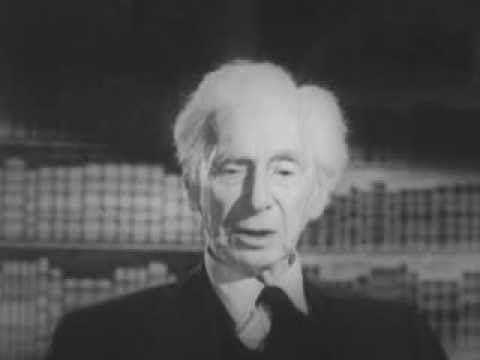
Bertrand Russell pictured above and Francis Schaeffer below:
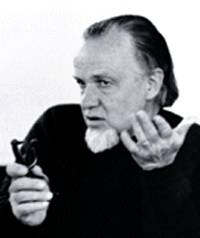
Francis Schaeffer noted in his book HOW SHOULD WE THEN LIVE? (p. 182 in Vol 5 of Complete Works) in the chapter The Breakdown in Philosophy and Science:
In his lecture at Acapulco, George Wald finished with only one final value. It was the same one with which English philosopher Bertrand Russell (1872-1970) was left. For Wald and Russell and for many other modern thinkers, the final value is the biological continuity of the human race. If this is the only final value, one is left wondering why this then has importance.
Now having traveled from the pride of man in the High Renaissance and the Enlightenment down to the present despair, we can understand where modern people are. They have no place for a personal God. But equally they have no place for man as man, or for love, or for freedom, or for significance. This brings a crucial problem. Beginning only from man himself, people affirm that man is only a machine. But those who hold this position cannot live like machines! If they could, there would have been no tensions in their intellectual position or in their lives. But even people who believe they are machines cannot live like machines, and thus they must “leap upstairs” against their reason and try to find something which gives meaning to life, even though to do so they have to deny their reason.
Francis Schaeffer in another place worded it like this:
The universe was created by an infinite personal God and He brought it into existence by spoken word and made man in His own image. When man tries to reduce [philosophically in a materialistic point of view] himself to less than this [less than being made in the image of God] he will always fail and he will always be willing to make these impossible leaps into the area of nonreason even though they don’t give an answer simply because that isn’t what he is. He himself testifies that this infinite personal God, the God of the Old and New Testament is there.
Instead of making a leap into the area of nonreason the better choice would be to investigate the claims that the Bible is a historically accurate book and that God created the universe and reached out to humankind with the Bible.
The Bible and Archaeology – Is the Bible from God? (Kyle Butt 42 min)
You want some evidence that indicates that the Bible is true? Here is a good place to start and that is taking a closer look at the archaeology of the Old Testament times. Is the Bible historically accurate? Here are some of the posts I have done in the past on the subject: 1. The Babylonian Chronicle, of Nebuchadnezzars Siege of Jerusalem, 2. Hezekiah’s Siloam Tunnel Inscription. 3. Taylor Prism (Sennacherib Hexagonal Prism), 4. Biblical Cities Attested Archaeologically. 5. The Discovery of the Hittites, 6.Shishak Smiting His Captives, 7. Moabite Stone, 8. Black Obelisk of Shalmaneser III, 9A Verification of places in Gospel of John and Book of Acts., 9B Discovery of Ebla Tablets. 10. Cyrus Cylinder, 11. Puru “The lot of Yahali” 9th Century B.C.E., 12. The Uzziah Tablet Inscription, 13. The Pilate Inscription, 14. Caiaphas Ossuary, 14 B Pontius Pilate Part 2, 14c. Three greatest American Archaeologists moved to accept Bible’s accuracy through archaeology.,
____
Related posts:
WOODY WEDNESDAY John Piippo makes the case that Bertrand Russell would have loved Woody Allen because they both were atheists who don’t deny the ramifications of atheism!!!
Top 10 Woody Allen Movies __________ John Piippo makes the case that Bertrand Russell would have loved Woody Allen because they both were atheists who don’t deny the ramifications of atheism!!! Monday, August 06, 2012 (More On) Woody Allen’s Atheism As I wrote in a previous post, I like Woody Allen. I have long admired his […]
John Piippo makes the case that Bertrand Russell would have loved Woody Allen because they both were two atheists who don’t deny the ramifications of atheism!!!
______ Top 10 Woody Allen Movies PBS American Masters – Woody Allen A Documentary 01 PBS American Masters – Woody Allen A Documentary 02 __________ John Piippo makes the case that Bertrand Russell would have loved Woody Allen because they both were two atheists who don’t deny the ramifications of atheism!!! Monday, August 06, 2012 […]
Bertrand Russell v. Frederick Copleston debate transcript (Part 4)
THE MORAL ARGUMENT BERTRAND RUSSELL But aren’t you now saying in effect, I mean by God whatever is good or the sum total of what is good — the system of what is good, and, therefore, when a young man loves anything that is good he is loving God. Is that what you’re […]
Bertrand Russell v. Frederick Copleston debate transcript (Part 3)
Great debate Fr. Frederick C. Copleston vs Bertrand Russell – Part 1 Uploaded by riversonthemoon on Jul 15, 2009 BBC Radio Third Programme Recording January 28, 1948. BBC Recording number T7324W. This is an excerpt from the full broadcast from cassette tape A303/5 Open University Course, Problems of Philosophy Units 7-8. Older than 50 years, […]
Bertrand Russell v. Frederick Copleston debate transcript and audio (Part 2)
Uploaded by riversonthemoon on Jul 15, 2009 BBC Radio Third Programme Recording January 28, 1948. BBC Recording number T7324W. This is an excerpt from the full broadcast from cassette tape A303/5 Open University Course, Problems of Philosophy Units 7-8. Older than 50 years, out of UK/BBC copyright. Pardon the hissy audio. It was recorded 51 […]
Bertrand Russell v. Frederick Copleston debate transcript and audio (Part 1)
Fr. Frederick C. Copleston vs Bertrand Russell – Part 1 Uploaded by riversonthemoon on Jul 15, 2009 BBC Radio Third Programme Recording January 28, 1948. BBC Recording number T7324W. This is an excerpt from the full broadcast from cassette tape A303/5 Open University Course, Problems of Philosophy Units 7-8. Older than 50 years, out of […]
Bertrand Russell v. Frederick Copleston debate transcript (Part 4)
THE MORAL ARGUMENT BERTRAND RUSSELL But aren’t you now saying in effect, I mean by God whatever is good or the sum total of what is good — the system of what is good, and, therefore, when a young man loves anything that is good he is loving God. Is that what you’re […]
Bertrand Russell v. Frederick Copleston debate transcript (Part 3)
Fr. Frederick C. Copleston vs Bertrand Russell – Part 1 Uploaded by riversonthemoon on Jul 15, 2009 BBC Radio Third Programme Recording January 28, 1948. BBC Recording number T7324W. This is an excerpt from the full broadcast from cassette tape A303/5 Open University Course, Problems of Philosophy Units 7-8. Older than 50 years, out of […]


 The Daily Hatch