With a target-rich environment of waste, fraud, and abuse in Washington, that wasn’t an easy question to answer. But I decided to pick the Department of Housing and Urban Development, and I had some good reasons for that choice.
Well, thanks to the sequester, we can say that we’ve achieved 1.9 percent of our goal. Here are some blurbs from a Reuters report.
The U.S. Department of Housing and Urban Development on Monday said it plans to shut its doors for a total of seven days between May and September due to budget cuts and will furlough more than 9,000 employees on those days. …The agency will determine the exact shutdown dates at a later time.
The motto of special interests
This is what I call a good start.
You won’t be surprised to learn, though, that the bureaucracy is whining that these tiny cutbacks will have horrible effects.
In cataloging the impact of sequestration to a Senate panel last month, HUD Secretary Shaun Donovan warned lawmakers that the government spending cuts would have harsh consequences for housing programs and could threaten Superstorm Sandy recovery efforts in the U.S. Northeast. “The ripple effects are enormous because of how central housing is to our economy,” Donovan told lawmakers.
Well, I hope that the “cuts” will have “harsh consequences for housing programs.” I’ve read Article I, Section VIII, of the Constitution, and nowhere does it say that housing is a function of the federal government.
This week, House Republican freshmen Members held a press conference to discuss the importance of passing a balanced budget amendment to the United States Constitution and how now is the time for a permanent solution to our nation’s spending-driven debt crisis. We need a balanced budget amendment to ensure a prosperous future for our children and grandchildren. It’s the right thing to do.
______________
President Obama c/o The White House
1600 Pennsylvania Avenue NW
Washington, DC 20500
Over and over in the past Milton Friedman pleaded for restraint in our federal spending. Below you will see a fine article supporting the Balanced Budget Amendment and it points out that Friedman favored this mechanism to control our spending.
The question is how to solve our problem of unsustainable debt.
The United States of America is on the road to bankruptcy, with a federal debt of more than $14.2 trillion, almost half of which is owned by foreign countries. (Communist China alone owns fully a quarter of the foreign-held portion). The problem is so well known that it almost came as an anticlimax when Standard & Poor’s recently downgraded U.S. debt from its coveted AAA rating to an unheard-of AA+. As for the budget deficit, it is expected to total $1.3 trillion for this year alone, with tax revenues of about $2.3 trillion and total expenditures of about $3.6 trillion. If a household ran its budget like that, we would say it was headed for a rude shock.
Making matters worse is that our debt is structural rather than cyclical: the federal budget is in deficit both in good economic times and bad. When George W. Bush took office in 2001, the gross federal debt was $5.76 trillion. When he left eight years later, the debt was up to $10.626 trillion, an increase of $607 billion a year. During Barack Obama’s presidency it has risen by $1.7 trillion a year and now almost 40 percent higher than when he took office. Deficits of this size are quite simply unsustainable.
The only way to fix this mess is to radically cut federal spending, cap the budget with pay-as-you-go spending rules, and then enact a balanced budget amendment (BBA).
The most important point is that we need to cut spending, not raise taxes. Total federal spending as a percentage of Gross Domestic Product (GDP) has skyrocketed from around 18 percent, when George W. Bush became president, to more than 25 percent today. This shows that our current deficit problem is entirely due to overspending. If tomorrow we cut spending back to the levels of January 20, 2001, when Bush took office, the deficit would almost disappear.
Then we need to cap and balance the budget, once we’ve cut overall spending back to 2001 levels. To do this effectively, we need to enact a federal BBA to the U.S. Constitution. This amendment should have several features.
First, it should require that the president submit to Congress each year a balanced federal budget with no fiscal gimmicks. Presidential failure to do so would be an impeachable offense. Congress should be constitutionally required to hold a vote in both houses on the president’s proposed budget within three months, with the president and Congress having up to six months to adopt a final budget in any given calendar year (this requirement should be waivable during any time of declared war for up to two years). If they fail to do that, all federal spending except for payments on the debt should be frozen at levels 10 percent lower than in the preceding fiscal year. To help impose this, any one of the several states should have standing to sue in the Supreme Court’s original jurisdiction for enforcement of this requirement.
Second, the BBA should cap federal spending at 18 percent of GDP. A spending cap of this proportion would keep the federal government at the size it was under President Bill Clinton — hardly onerous or severe. The amendment should require a two-thirds vote of both houses of Congress to enact any new taxes or to raise tax rates. Votes to raise the national debt limit should also require a two-thirds majority. These provisions are essential to prevent a BBA from becoming just an excuse to raise taxes.
THE USUAL RESPONSE to calls for such an amendment is that we ought not tamper with the Constitution. Critics of a BBA also claim it is not needed since a majority of Congress could balance the budget today if it really wanted to. There are at least five reasons why those critics are dead wrong.
First, it is a core principle of American constitutionalism that there be no taxation without representation. The American Revolution was fought in part to prevent taxation by a British Parliament in which Americans were not represented. When Congress borrows 40 cents of every dollar it spends, as it is doing today, it passes the burden of paying for current spending on to our children and grandchildren who cannot vote right now — nothing less than taxation without representation.
Second, a core purpose of the Constitution is to protect fundamental principles like freedom of speech and of the press from being whittled away during moments of legislative passion. Exactly the same argument holds true with respect to spending more money than the government collects in tax revenue. Constitutionalizing the balanced budget requirement is as necessary as constitutionalizing the protection of freedom of speech and of the press. This is an argument that was first made more than 30 years ago by Noble Prize laureate Milton Friedman. It is just as true today as it was then.
Third, there is an economic reason why it is easier to assemble lobbies for government spending than it is to assemble a nationwide lobby for a balanced budget. Consider the farm lobby that argues for agricultural price supports, or the AARP that lobbies for benefits for the elderly. It is cheaper and easier for small groups with a shared common interest to lobby Congress than for a large, diffuse majority of the American population to do the same. That’s why the silent majority is silent. A BBA in the Constitution would prevent the special interests from ripping off the children and grandchildren of the silent majority. James Madison wrote in The Federalist No. 51 that the secret of constitutional government was to make ambition counteract ambition. The way to check and balance over-spending is to constitutionalize a pay-as-you-go rule while making tax increases hard to enact.
Fourth, yet another economic reason for a BBA is that it would reduce risk and thereby promote investment. When people are looking for a place to invest, one of their first questions is how risky is the investment and how large is the potential reward. Foreign and American investors since World War II have invested in the U.S. and in its debt because our Constitution of checks and balances makes it hard to do crazy things like nationalize industries or set up a single payer health insurance monopoly.
A BBA would reduce further the risk of investing in the U. S., and that would promote investment and economic growth by constitutionally committing itself not to overspend. The risk of inflationary devaluation of the dollar would thus go way down. This in turn would bolster the dollar as the world’s reserve currency. It would also prevent federal borrowing from crowding out private sector borrowing in the U.S. This would free up a capital for investment in job-creating ventures.
A fifth argument for the BBA paradoxically grows out of one of the arguments commonly made against it: it would be purely symbolic. Or as James Madison would have said, “a mere parchment barrier” against overspending.
This criticism fails for many reasons. A BBA of the kind I argue for would have enforcement teeth. Presidential failure to submit a good-faith balanced budget would be a specific ground for impeachment. Then too, if Congress failed to enact a balanced budget, state governments could sue for an across theboard spending cut of 10 percent.
But suppose Congress wimps out and enacts a BBA without teeth. Would such a symbolic victory be worth anything? The answer again is clearly yes. Almost every state has some form of a balanced budget requirement in its constitution or law. The fact is that balanced budget requirements actually do work at the state level. This strongly suggests they would work at the federal level as well.
CONSTITUTIONAL PROVISIONS, even symbolic ones, set the agenda of political debate. The Second and Tenth Amendments clearly do that in the U.S. today, even though the federal courts almost never enforce them. A BBA would work very much the same way.
The case for a BBA is so powerful that Germany and Switzerland — both models of fiscal sobriety — actually require a balanced budget in their own constitutions. And now Germany and France have actually proposed requiring that all Eurozone countries amend their national constitutions to require a balanced budget. What is good enough for almost every state in the Union and for many countries of Europe is certainly worth trying at the federal level here.
So what harm could come from enacting a BBA to the U.S. Constitution? Is there any argument against such an amendment that outweighs the arguments in favor of it?
One concern conservatives have is that it might lead to tax increases. I share that concern and therefore would couple it with a super-majority requirement for tax increases. That should make a BBA clearly appealing to conservatives of all stripes. But what if such an amendment gets ratified that does not protect against tax increases? Would we then be worse off?
I think the answer is no. It is harder politically for Congress to tax real people living today than it is to borrow money from the children and grandchildren of the silent majority. People living today will mobilize in many ways against tax increases. The correct solution is to cut, cap, and balance, but I would not let concerns about tax increases stop us from doing what virtually every state constitution does.
Another real concern for conservatives is that a BBA could lead to dangerous cuts in spending on national defense. This concern I share. The U.S. is a world leader and the greatest force for liberty and economic opportunity in history. We must always be ready to defend liberty worldwide.
The problem is, however, that current levels of deficit spending — almost half of which is financed by foreign countries — is itself a threat to U.S. global might. We simply cannot defend liberty in Asia, for example, if we continue to borrow massively from the Chinese. We cannot defend freedom in Arab countries while being so dependent on Saudi Arabia and others for imported oil and purchases of our debt. The status quo is at least as threatening to America’s military might as is living under a BBA, for the status quo is not sustainable.
Finally, some conservatives argue that the solution to congressional deficit spending is a line item veto amendment giving the president the same power over spending enjoyed by a majority of state governors. I am quite skeptical about such an amendment because of the enormous power it would shift from Congress to the president. Imagine for a moment that President Obama could threaten senators or representatives with line item vetoes of locally important spending projects unless they voted his way on socialized medicine. Or on a card check law reform making it easy to fraudulently form a union. Do we really want to cede that much power from Congress to the president? I do not think so.
In sum, we need to cut, cap, and balance. To do that permanently, we must enact a BBA. Nothing less than the future of government of the people, by the people, and for the people is at stake.
____________
Thank you so much for your time. I know how valuable it is. I also appreciate the fine family that you have and your commitment as a father and a husband.
Sincerely,
Everette Hatcher III, 13900 Cottontail Lane, Alexander, AR 72002, ph 501-920-5733, lowcostsqueegees@yahoo.com
Dr. Koop shares his journey to becoming Surgeon General in Part 1 of this interview at Wheaton College, IL. http://www.christianethics.org
___________________
Dr.Koop
On 2-25-13 we lost a great man when we lost Dr. C. Everett Koop. I have written over and over the last few years quoting Dr. C. Everett Koop and his good friend Francis Schaeffer. They both came together for the first time in 1973 when Dr. Koop operated on Schaeffer’s daughter and as a result they became close friends. That led to their involvement together in the book and film series “WHATEVER HAPPENED TO THE HUMAN RACE?” in 1979.
Editor’s note: Former Surgeon General C. Everett Koop—known for his medical advocacy and his evangelical Christian faith—died today at age 96.
My mother was 87 when she died of uterine cancer. She was in a coma, during which people actually asked me if I wanted to put her on dialysis. That would have been ridiculous for personal, spiritual, and economic reasons.
I do not believe—and have never taught—that every patient should be kept alive for the longest time possible. Nor have I said every patient has to have the last bit of high-tech heroic treatment available. I do believe in the right of the patient to say, “I have lived my life,” and to choose his or her own treatment. But that question becomes complicated when we consider the decisions people make for others who are not cognitive and have not made their final wishes known.
Right now, I am 70 years old and in excellent health. If my kidneys shut down tomorrow, let’s say, after a severe infection, I don’t know how long I would want to be on dialysis. It would be foolish and a waste of resources for me to have a kidney transplant at my age. I would probably opt to clean up my affairs, say goodbye to my family, and drift out in uremia.
The important point is that my wife and I know exactly how each of us feels about the end of life. This will be crucial if the time comes to make such a decision and I’m not then able to do so.
Of course, all such talk has different connotations for the Christian than for the non-Christian. My wife knows I do not believe in being ushered out of this life with a lethal injection. I want to hang around long enough to be sure my family is taken care of. But after that, I don’t want my life prolonged in great discomfort when it is fruitless.
I don’t look forward to the manner in which I am going to die. But I do not fear death. Indeed, the way in which we face death is a matter of faith. For the Christian, it is not the end.
This article first appeared in the March 6, 1987, issue of Christianity Today. At the time C. Everett Koop was surgeon general of the United States. He died February 25, 2013, at age 96.
It requires only modest exaggeration to say that C. Everett Koop, the distinguished surgeon general (and Dartmouth alumnus) who died on February 25, was responsible for the emergence of the religious right. As much as anyone else, Koop persuaded American evangelicals in the late 1970s that opposition to abortion was a matter worthy of their votes.
Although televangelists like Pat Robertson and Jerry Falwell frequently asserted that it was the Supreme Court’s Roe v. Wade decision of 1973 that galvanized politically conservative evangelicals into a voting bloc, that claim collapses in the face of historical scrutiny:
The Southern Baptist Convention called for the legalization of abortion at its gathering in St. Louis in 1971. It reaffirmed the resolution in 1974 and again in 1976.
The United Methodist Church passed a similar resolution in 1972.
It was a different court decision, Green v. Connally, that prompted evangelical leaders to organize. That 1971 ruling by the District Court of the District of Columbia upheld the Internal Revenue Service in its opinion that any institution that retains racially discriminatory policies is not—by definition—a charitable organization and therefore is not entitled to tax-exempt status.
When the IRS rescinded the tax exemption of Bob Jones University on January 19, 1976, evangelical leaders howled in protest. Ignoring the crucial fact that tax exemption amounts to public subsidy, they insisted that the federal government was meddling in the affairs of religious organizations. With the encouragement of conservative activists like Paul Weyrich and Richard Viguerie, these leaders of what became the religious right began to organize.
But the movement still needed an issue that would energize evangelicals at the grassroots. The 1978 elections persuaded Weyrich that abortion could be that issue. On the Sunday before the election, pro-lifers in Iowa and Minnesota leafleted church parking lots. Two days later, they defeated a popular incumbent Democratic senator in Iowa, and in Minnesota they captured the governorship and both Senate seats.
What Weyrich still lacked was a way to alert grassroots evangelicals to the scourge of abortion, and here is where C. Everett Koop figures into the story. Koop, a distinguished pediatric surgeon, had long opposed abortion, but in 1978 he teamed up with Francis A. Schaeffer, a goateed, knicker-wearing evangelical philosopher, to produce a film series called Whatever Happened to the Human Race?
Schaeffer had long excoriated what he called “secular humanism” and warned that the legalization of abortion would soon lead to infanticide and euthanasia. Koop’s sterling reputation as a physician added credibility to the argument. As the film series toured American cities in 1979, the term “secular humanism” entered the political lexicon—and Falwell, Weyrich and other leaders of the religious right harvested popular anger over abortion. They adroitly mobilized politically conservative evangelicals into a potent voting bloc in time for the 1980 election.
The rest, as they say, is history. The religious right settled on Ronald Reagan as their champion and standard-bearer, despite the fact that as governor of California Reagan had signed into law the most liberal abortion bill in the nation. They supported him instead of his evangelical opponent with a longer record of opposing abortion, incumbent Jimmy Carter.
The religious right’s reward was the appointment of Koop as surgeon general of the United States. But Koop proved to be his own man:
He called attention to the burgeoning AIDS crisis, even though others in the Reagan administration preferred to ignore it.
He advocated for sex education and the use of condoms, which pitted him against other leaders of the religious right, especially Phyllis Schlafly.
He quashed a specious, politically motivated report that asserted that women who had abortions suffered adverse psychological effects.
He called attention to the deleterious effects of both smoking and second-hand smoke in restaurants and bars and on airplanes.
All in all, a distinguished career: physician, public-health advocate and (wittingly or not) political organizer. Besides, not many surgeons general of the United States have a rock song written about them (Frank Zappa’s “Promiscuous”).
Our weekly feature Then and Now harnesses the expertise of American religious historians who care about the cities of God and the cities of humans. It’s edited by Edward J. Blum.
Dr. C. Everett Koop on Baby Doe, euthanasia, abortion Uploaded on Nov 3, 2008 Dr. Koop answers questions on Baby Doe, euthanasia and abortion during interview at Wheaton College, Wheaton, IL http://www.christianethics.org Dr. Koop On 2-25-13 we lost a great man when we lost Dr. C. Everett Koop. I have written over and over […]
Newsmaker Interview with Surgeon General C. Everett Koop Published on Feb 25, 2013 The PBS NewsHour interviewed former Surgeon General, Dr. C. Everett Koop, on the anniversary of the first surgeon general’s report on smoking. Jim Lehrer interviewed Koop for a newsmaker conversation for the The MacNeil/Lehrer NewsHour from the surgeon general’s office in Washington […]
Dr. C. Everett Koop on Baby Doe, euthanasia, abortion Uploaded on Nov 3, 2008 Dr. Koop answers questions on Baby Doe, euthanasia and abortion during interview at Wheaton College, Wheaton, IL http://www.christianethics.org Dr. Koop Joycelyn Elders was the first black Surgeon General of the USA and I have a picture of her with Dr. C. […]
Newsmaker Interview with Surgeon General C. Everett Koop Published on Feb 25, 2013 The PBS NewsHour interviewed former Surgeon General, Dr. C. Everett Koop, on the anniversary of the first surgeon general’s report on smoking. Jim Lehrer interviewed Koop for a newsmaker conversation for the The MacNeil/Lehrer NewsHour from the surgeon general’s office in Washington […]
Dr. C. Everett Koop on Baby Doe, euthanasia, abortion Uploaded on Nov 3, 2008 Dr. Koop answers questions on Baby Doe, euthanasia and abortion during interview at Wheaton College, Wheaton, IL http://www.christianethics.org Dr. Koop. C. Everett Koop On June 8, 1988 Ralph Dunagin of the LA Times came out with the funniest editorial cartoon I […]
Dr. Koop Gary Brookings of the Richmond Times Dispatch did a very funny editorial cartoon about the time in 1988 when Dr. C. Everett Koop sent the unapproved mail piece out to millions of homes about AIDS. There were many such cartoons at the time since everyone knew Dr. Koop got the mail piece out […]
Dr. Koop with Hillary Clinton In 1980 I really was influenced at my highschool by a teacher of mine named Mark Brink. He introduced me to the film series “Whatever happened to the human race?” by Francis Schaeffer and Dr. C. Everett Koop. In this film series that came out in 1979 they dealt with […]
Dr. Koop On 2-25-13 we lost a great man when we lost Dr. C. Everett Koop. I have written over and over the last few years quoting Dr. C. Everett Koop and his good friend Francis Schaeffer. They both came together for the first time in 1973 when Dr. Koop operated on Schaeffer’s daughter and […]
Dr. C. Everett Koop is pictured above. Francis Schaeffer: “Whatever Happened to the Human Race” (Episode 1) ABORTION OF THE HUMAN RACE Published on Oct 6, 2012 by AdamMetropolis Dr. Koop On 2-25-13 we lost a great man when we lost Dr. C. Everett Koop. I have written over and over the last few years […]
Dr. C. Everett Koop with Ronald Reagan. Dr. Koop was delayed in his confirmation by Ted Kennedy because of his film Whatever Happened to the Human Race? President Obama c/o The White House 1600 Pennsylvania Avenue NW Washington, DC 20500 Dear Mr. President, I know that you receive 20,000 letters a day and that you […]
In the film series “WHATEVER HAPPENED TO THE HUMAN RACE?” the arguments are presented against abortion (Episode 1), infanticide (Episode 2), euthenasia (Episode 3), and then there is a discussion of the Christian versus Humanist worldview concerning the issue of “the basis for human dignity” in Episode 4 and then in the last episode a close […]
Dr. C. Everett Koop with Ronald Reagan. Dr. Koop was delayed in his confirmation by Ted Kennedy because of his film Whatever Happened to the Human Race? Watch the film below starting at the 19 minute mark and that will lead into a powerful question from Dr. C. Everett Koop. This 1979 film is WHATEVER […]
Dr. Koop was delayed in his confirmation by Ted Kennedy because of his film Whatever Happened to the Human Race? Francis Schaeffer February 21, 1982 (Part 1) Uploaded by DeBunker7 on Feb 21, 2008 READ THIS FIRST: In decline of all civilizations we first see a war against the freedom of ideas. Discussion is limited […]
Dr. C. Everett Koop was appointed to the Reagan administration but was held up in the Senate in his confirmation hearings by Ted Kennedy because of his work in pro-life causes. I was thinking about the March for Life that is coming up on Jan 20, 2013 and that is why I posted this today […]
High resolution version (11,426,583 Bytes) Description: The photograph is signed by President Ronald Reagan with the inscription “To Chick Koop, With Best Wishes.” Chick, from chicken coop, was the nickname Koop gained will attending Dartmouth College in the mid-1930s. Koop maintained a cordial relationship with President Reagan, despite his disappointment over Reagan’s refusal to address […]
Francis Schaeffer and C. Everett Koop were prophetic (jh29) What Ever Happened to the Human Race? I recently heard this Breakpoint Commentary by Chuck Colson and it just reminded me of how prophetic Francis Schaeffer and C. Everett Koop were in the late 1970′s with their book and film series “Whatever happened to the human […]
Dr. C. Everett Koop I was thinking about the March for Life that is coming up on Jan 20, 2013 and that is why I posted this today Secular leaps of faith 39 Comments Written by Janie B. Cheaney August 15, 2011, 2:17 PM I’m willing to cut Ryan Lizza some slack. His profile […]
Francis Schaeffer: “Whatever Happened to the Human Race?” (Episode 2) SLAUGHTER OF THE INNOCENTS Published on Oct 6, 2012 by AdamMetropolis The 45 minute video above is from the film series created from Francis Schaeffer’s book “Whatever Happened to the Human Race?” with Dr. C. Everett Koop. This book really helped develop my political views concerning […]
I truly believe that many of the problems we have today in the USA are due to the advancement of humanism in the last few decades in our society. Ronald Reagan appointed the evangelical Dr. C. Everett Koop to the position of Surgeon General in his administration. He partnered with Dr. Francis Schaeffer in making […]
The best pro-life film I have ever seen below by Francis Schaeffer and Dr. C. Everett Koop “Whatever happened to the human race?” Over the years I have taken on the Ark Times liberal bloggers over and over and over concerning the issue of abortion. I asked over and over again for one liberal blogger […]
Francis Schaeffer pictured above._________ The best pro-life film I have ever seen below by Francis Schaeffer and Dr. C. Everett Koop “Whatever happened to the human race?” Over the years I have taken on the Ark Times liberal bloggers over and over and over concerning the issue of abortion. I asked over and over again […]
The best pro-life film I have ever seen below by Francis Schaeffer and Dr. C. Everett Koop “Whatever happened to the human race?” On 1-24-13 I took on the child abuse argument put forth by Ark Times Blogger “Deathbyinches,” and the day before I pointed out that because the unborn baby has all the genetic code […]
PHOTO BY STATON BREIDENTHAL from Pro-life march in Little Rock on 1-20-13. Tim Tebow on pro-life super bowl commercial. Over the years I have taken on the Ark Times liberal bloggers over and over and over concerning the issue of abortion. Here is another encounter below. On January 22, 2013 (on the 40th anniversary of the […]
The best pro-life film I have ever seen below by Francis Schaeffer and Dr. C. Everett Koop “Whatever happened to the human race?” Francis Schaeffer pictured above._________ The 45 minute video above is from the film series created from Francis Schaeffer’s book “Whatever Happened to the Human Race?” with Dr. C. Everett Koop. This book really […]
Dr Richard Land discusses abortion and slavery – 10/14/2004 – part 3 The best pro-life film I have ever seen below by Francis Schaeffer and Dr. C. Everett Koop “Whatever happened to the human race?” Over the years I have taken on the Ark Times liberal bloggers over and over and over concerning the issue […]
Dr Richard Land discusses abortion and slavery – 10/14/2004 – part 3 The best pro-life film I have ever seen below by Francis Schaeffer and Dr. C. Everett Koop “Whatever happened to the human race?” Over the years I have taken on the Ark Times liberal bloggers over and over and over concerning the issue […]
On January 20, 2013 I heard Paul Greenberg talk about the words of Thomas Jefferson that we are all “endowed with certain unalienable rights” and the most important one is the right to life. He mentioned this also in this speech below from 2011: Paul Greenberg Dinner Speech 2011 Fall 2011 Issue Some of you […]
It is not possible to know where the pro-life evangelicals are coming from unless you look at the work of the person who inspired them the most. That person was Francis Schaeffer. I do care about economic issues but the pro-life issue is the most important to me. Several years ago Adrian Rogers (past president of […]
For many more archaeological evidences in support of the Bible, see Archaeology and the Bible . (There are some great posts on this too at the bottom of this post.)
Let me address three of the historical situations that Till spends a great deal of time discussing. (Last time I covered the first of these questions: “Did the author of Daniel suppose that Darius Hystaspis preceded Cyrus?”)
(2) Is there a possible answer to the identity of “Darius the Mede”? Till wrongly assumed that I hold the view that Darius was a governor appointed by Cyrus (May/June 1998, p. 2). While I don’t dismiss that possibility, I do favor a different view. I do not claim dogmatically that this view is true, but it certainly is a realistic possibility. Many evangelicals have put forth the theory that Darius is a title for Cyrus (D. J. Wiseman, “Some Historical Problems in the Book of Daniel,” Notes on Some Problems in the Book of Daniel, Tyndale, 1970, pp. 9-16; J.M. Bulman, “The Identification of Darius the Mede,” Westminster Theological Journal, Volume 35, 1973, pp. 247-267; J.G. Baldwin, Daniel, Tyndale Old Testament Commentaries, InterVarsity, 1978, pp. 26-28, 127). Dual titles were not uncommon. Daniel and his friends had dual names. Kings were known by two names at times. For instance, 1 Chronicles 5:26 reads, “So the God of Israel stirred up the spirit of Pul King of Assyria, even [Hebrew conjunction waw] the spirit of Tiglath-Pileser King of Assyria.” We now know that Assyrian records indicate that Pul was Tiglath-Pileser’s native name (James B. Pritchard [ed.], Ancient Near Eastern Texts Relating to the Old Testament, Princeton University Press, 1950, p. 272). Likewise, Wiseman translates Daniel 6:28, “Daniel prospered in the reign of Darius, even [Aramaic conjunction waw] the reign of Cyrus the Persian” (Wiseman, p. 12). If Wiseman is correct on this translation, then it may be a good explanation for this missing person case. The critic Isaac Asimov did note that Cyrus was “indeed about 62 years old at this time” (p. 608), and Daniel 5:31 says that Darius was 62.
The conservative Stephen Miller stated:
Bulman reasonably suggests that the author preferred the title Darius the Mede because it had particular significance for the Jews (Bulman, p. 263). Both Isaiah (13:17) and Jeremiah (51:11, 28) had predicted the downfall of Babylon to the Medes, and Daniel employed the title to emphasize the fulfillment of these prophecies. Yet Daniel also used the title Cyrus the Persian in order to explain the king’s relationship to the world of that day he was ruler over the whole Medo-Persian Empire. “The author may have assumed that 6:28 would make the identification clear enough for the circle addressed” (Bulman, p. 252; Miller, pp. 175-176).
In fact, the critic Brian E. Colless concluded, “Everything seems to point to the same conclusion: Darius the Mede is synonymous with Cyrus the Persian in the Book of Daniel” (“Cyrus the Persian as Darius the Mede in the Book of Daniel,” Journal for the Study of the Old Testament, Vol. 56, 1992, pp. 113-126).
I must admit that the argument concerning “Darius the Mede” is the most difficult problem remaining for the inerrantist to resolve. However, this problem involves only the identity of “Darius the Mede,” and it does not concern the incorrect view that the Medes reigned between the Babylonians and Persians. Also I must point out that Till himself admits that appealing “to historical silence is considered a weak type of argumentation” (July/August 1998, p. 8). Yet Till considers this type of evidence concerning Daniel “very compelling” partly because Ezekiel makes no “unequivocal” reference to Daniel. Till asserted:
Ezekiel did mention the name Daniel three times, but these were in contexts where this person was associated with ancient biblical heroes like Noah and Job (14:14, 20; 28:3). Since the name is spelled “Danel” in some texts, this Daniel is thought to be the “Danel” of Ugaritic legend found on clay tablets excavated at Ras Shamra, so it seems rather strange that Ezekiel would have written 48 chapters without once referring to a captive who had become a prominent Babylonian official (July/August 1998, pp. 8, 10).
Till dismissed the three times Ezekiel mentions Daniel because Ezekiel is speaking of a Daniel spelled “Danel” referred to in Ugaritic literature around the 14th century B. C. Other critics agree (e.g., Hammer, p. 3; Owens, p. 374). However, the context in Ezekiel seems to contradict this view. Ezekiel 14 is a message against the idolatrous elders. The conservative H. Dressler asks, “Is it conceivable that the same prophet would choose a Phoenician-Canaanite devotee of Baal as his outstanding example of righteousness? Within the context of Ezekiel this seems to be a preposterous suggestion” (H. H. P. Dressler, “The Identification of the Ugaritic Dnil with the Daniel of Ezekiel,” Vetus Testamentum, Vol. 29, 1979, p. 159). Furthermore, even the critic John Day admits “there are no linguistic objections to the equation of the Daniel of Ezekiel XIV:14,20 and the hero of the book of Daniel. Ezekiel simply spells the name without the vowel letter yodh.” Day made these comments in an article maintaining the critical conclusion that Ezekiel is referring to the Ugaritic Danel (“The Daniel of Ugarit and Ezekiel and the Hero of the Book of Daniel,” Vetus Testamentum, Vol. 30, 1980, pp. 174-184).
Critics seem never to learn. Earlier there was “very compelling” evidence from silence that Belshazzar never existed. The conservative scholar Alan Millard stated:
Nebuchadnezzar had, of course, ruled over Babylon, but Belshazzar’s name was nowhere to be found outside the Biblical text. The Greek chroniclers who had preserved lists of ancient kings identified Nabonidus, a successor to Nebuchadnezzar, as the last native ruler of Babylon; Belshazzar was not even mentioned. Belshazzar, declared one commentator named Ferdinand Hitzig in 1850, was “obviously a figment of the Jewish writer’s imagination” (Ferdinand Hitzig, Das Buch Daniel, Leipzig: Weidman, 1850, p. 75, as quoted by Millard, “Daniel and Belshazzar in History,” Biblical Archaeology Review, May/June 1985, pp. 74-75).
It was in this atmosphere that Albert Barnes finished his commentary on December 26, 1851. He could have put his faith in the current evidence of the day or the unchangeable word of God. His choice was clear. He asserted:
The testimony of Daniel in the book before us should not be set aside by the statement of Berosus, or by the other confused accounts which have come down to us. For anything that appears to the contrary, the authority of Daniel is as good as that of Berosus, and he is as worthy of belief. Living in Babylon and through a great part of the reigns of this dynasty; present at the taking of Babylon, and intimate at court; honoured by some of these princes more than any other man in the realm, there is no reason why he should not have had access to the means of information on the subject, and no reason why it should not be supposed that he has given a fair record of what actually occurred” (Notes, Critical, Illustrative, and Practical on the Book of Daniel, Leavitt and Allen, 1858, p. 237).
Barnes considered God’s unchangeable word more reliable than historians, and Alan Millard pointed out that historians soon after made some changes:
Then, in 1854, a British consul named J. G. Taylor explored some ruins in southern Iraq on behalf of the British Museum. He dug into a great mud-brick tower that was part of the temple of the moon god that dominated the city. Taylor found several small clay cylinders buried in the brickwork, each about four inches long, inscribed with 60 or 50 lines of cuneiform writing. When Taylor took the cylinders back to Baghdad, he showed them to his colleagues (see E. Sollberger, “Mr. Taylor in Chaldaea,” Anatolian Studies, Vol. 22, 1972, pp. 129-139). Fortunately, his senior colleague was Sir Henry Rawlinson, who was one of those who had deciphered the Babylonian cuneiform script. Rawlinson was able to read the writing on the clay cylinders.
The inscriptions had been written at the command of Nabonidus, king of Babylon from 555 to 539 B.C. The king had repaired the temple tower, and the clay cylinders commemorated that fact. The inscriptions proved that the ruined tower was the temple of the city of Ur. The words were a prayer for the long life and good health of Nabonidus and for his eldest son. The name of that son, clearly written, was Belshazzar!
Here was clear proof that an important person named Belshazzar lived in Babylon during the last years of the city’s independence. So Belshazzar was not an entirely imaginary figure (pp. 74-75).
Therefore, since the critics have been routed concerning the existence of Belshazzar, they have decided to turn to other arguments concerning Belshazzar. Till picked up on one of the weaker arguments when he commented:
If Daniel achieved such prominence in Nebuchadnezzar’s kingdom, he would have surely been familiar with the king’s family, but in chapter five, the writer of the story referred to Nebuchadnezzar five times as the “father” of Belshazzar….
Hatcher no doubt will parrot the inerrantist line and contend that the words father and son were not being used literally in this story but only figuratively in the sense of “ancestor” and “descendant,” as when Abraham was referred to as the “father” of all Jews (Isaiah 51:2), and as Jesus was called the “son of David” (Matt. 1:1). The examples are hardly parallel, however, because Abraham was separated by centuries from the Jews of Isaiah’s time, as Jesus was separated in time from David sufficiently for readers of such texts as these to know beyond reasonable doubt that father and son were being used figuratively (July/August 1998, p. 7).
Till is unaware of two biblical facts: (1) There is no word for grandfather in Hebrew or Aramaic. The word father could refer to a grandfather as in the case of Abraham and Jacob (Gen. 28:13; 32:9) or even to a great, great grandfather as in the case of David and Asa (1 Kings 15:10-13). (2) The term son can also mean successor. It is used this way in the Bible (1 Kings 20:35; 2 Kings 2:12; Robert Dick Wilson, Studies in the Book of Daniel, Grand Rapids: Baker, reprint, 1979, Vol. 1, pp. 117-118). Also it is used this way in the “Black Obelisk” of Shalmaneser III (c. 830 B.C.) when Jehu is called the “son of Omri” even though they were not related (James B. Pritchard [ed.], Ancient Near Eastern Texts Relating to the Old Testament, 2nd ed. Princeton University Press, 1955, p. 281). Similar usage in Egypt has been found. In the Westcar Papyrus (dating from the Hyksos period), King Keb-ka of the Third Dynasty is referred to as the father of King Khufu of the Fourth Dy nasty, a full century later. Daniel also followed this ancient custom of the time which was to recognize the king of Babylon as the “son” (or successor) of Nebuchadnezzar. No wonder the critic Philip R. Davies concluded, “The literal meaning of `son’ should not be pressed…” (Davies, Daniel, p. 31).
(Everette Hatcher III, P. O. Box 23416, Little Rock, AR 72221)
Is the Bible historically accurate? Here are some of the posts I have done in the past on the subject:
This clay tablet is a Babylonian chronicle recording events from 605-594BC. It was first translated in 1956 and is now in the British Museum. The cuneiform text on this clay tablet tells, among other things, 3 main events: 1. The Battle of Carchemish (famous battle for world supremacy where Nebuchadnezzar of Babylon defeated Pharoah Necho of Egypt, 605 BC.), 2. The accession to the throne of Nebuchadnezzar II, the Chaldean, and 3. The capture of Jerusalem on the 16th of March, 598 BC.
King Hezekiah of Judah ruled from 721 to 686 BC. Fearing a siege by the Assyrian king, Sennacherib, Hezekiah preserved Jerusalem’s water supply by cutting a tunnel through 1,750 feet of solid rock from the Gihon Spring to the Pool of Siloam inside the city walls (2 Kings 20; 2 Chron. 32). At the Siloam end of the tunnel, an inscription, presently in the archaeological museum at Istanbul, Turkey, celebrates this remarkable accomplishment.
It contains the victories of Sennacherib himself, the Assyrian king who had besieged Jerusalem in 701 BC during the reign of king Hezekiah, it never mentions any defeats. On the prism Sennacherib boasts that he shut up “Hezekiah the Judahite” within Jerusalem his own royal city “like a caged bird.” This prism is among the three accounts discovered so far which have been left by the Assyrian king Sennacherib of his campaign against Israel and Judah.
In addition to Jericho, places such as Haran, Hazor, Dan, Megiddo, Shechem, Samaria, Shiloh, Gezer, Gibeah, Beth Shemesh, Beth Shean, Beersheba, Lachish, and many other urban sites have been excavated, quite apart from such larger and obvious locations as Jerusalem or Babylon. Such geographical markers are extremely significant in demonstrating that fact, not fantasy, is intended in the Old Testament historical narratives;
Most doubting scholars back then said that the Hittites were just a “mythical people that are only mentioned in the Bible.” Some skeptics pointed to the fact that the Bible pictures the Hittites as a very big nation that was worthy of being coalition partners with Egypt (II Kings 7:6), and these bible critics would assert that surely we would have found records of this great nation of Hittites. The ironic thing is that when the Hittite nation was discovered, a vast amount of Hittite documents were found. Among those documents was the treaty between Ramesses II and the Hittite King.
The Bible mentions that Shishak marched his troops into the land of Judah and plundered a host of cities including Jerusalem, this has been confirmed by archaeologists. Shishak’s own record of his campaign is inscribed on the south wall of the Great Temple of Amon at Karnak in Egypt. In his campaign he presents 156 cities of Judea to his god Amon.
The Moabite Stone also known as the Mesha Stele is an interesting story. The Bible says in 2 Kings 3:5 that Mesha the king of Moab stopped paying tribute to Israel and rebelled and fought against Israel and later he recorded this event. This record from Mesha has been discovered.
The tribute of Jehu, son of Omri, silver, gold, bowls of gold, chalices of gold, cups of gold, vases of gold, lead, a sceptre for the king, and spear-shafts, I have received.”
Sir William Ramsay, famed archaeologist, began a study of Asia Minor with little regard for the book of Acts. He later wrote:
I found myself brought into contact with the Book of Acts as an authority for the topography, antiquities and society of Asia Minor. It was gradually borne upon me that in various details the narrative showed marvelous truth.
9B Discovery of Ebla Tablets. When I think of discoveries like the Ebla Tablets that verify names like Adam, Eve, Ishmael, David and Saul were in common usage when the Bible said they were, it makes me think of what amazing confirmation that is of the historical accuracy of the Bible.
This cube is inscribed with the name and titles of Yahali and a prayer: “In his year assigned to him by lot (puru) may the harvest of the land of Assyria prosper and thrive, in front of the gods Assur and Adad may his lot (puru) fall.” It provides a prototype (the only one ever recovered) for the lots (purim) cast by Haman to fix a date for the destruction of the Jews of the Persian Empire, ostensibly in the fifth century B.C.E. (Esther 3:7; cf. 9:26).
The Bible mentions Uzziah or Azariah as the king of the southern kingdom of Judah in 2 Kings 15. The Uzziah Tablet Inscription is a stone tablet (35 cm high x 34 cm wide x 6 cm deep) with letters inscribed in ancient Hebrew text with an Aramaic style of writing, which dates to around 30-70 AD. The text reveals the burial site of Uzziah of Judah, who died in 747 BC.
The Pilate Inscription is the only known occurrence of the name Pontius Pilate in any ancient inscription. Visitors to the Caesarea theater today see a replica, the original is in the Israel Museum in Jerusalem. There have been a few bronze coins found that were struck form 29-32 AD by Pontius Pilate
This beautifully decorated ossuary found in the ruins of Jerusalem, contained the bones of Caiaphas, the first century AD. high priest during the time of Jesus.
In June 1961 Italian archaeologists led by Dr. Frova were excavating an ancient Roman amphitheatre near Caesarea-on-the-Sea (Maritima) and uncovered this interesting limestone block. On the face is a monumental inscription which is part of a larger dedication to Tiberius Caesar which clearly says that it was from “Pontius Pilate, Prefect of Judea.”
Despite their liberal training, it was archaeological research that bolstered their confidence in the biblical text:Albright said of himself, “I must admit that I tried to be rational and empirical in my approach [but] we all have presuppositions of a philosophical order.” The same statement could be applied as easily to Gleuck and Wright, for all three were deeply imbued with the theological perceptions which infused their work.
Prophecy–The Biblical Prophesy About Tyre.mp4 Uploaded by TruthIsLife7 on Dec 5, 2010 A short summary of the prophecy about Tyre and it’s precise fulfillment. Go to this link and watch the whole series for the amazing fulfillment from secular sources. http://www.youtube.com/watch?v=qvt4mDZUefo ________________ John MacArthur on the amazing fulfilled prophecy on Tyre and how it was fulfilled […]
The Book of Mormon vs The Bible, Part 6 of an indepth study of Latter Day Saints Archeology The Book of Mormon verses The Bible, Part 6 of an indepth study With the great vast amounts of evidence we find in the Bible through archeology, why is there no evidence for anything writte in the Book […]
The Book of Mormon vs The Bible, Part 5 of an indepth study of Latter Day Saints Archeology The Book of Mormon verses The Bible, Part 5 of an indepth study With the great vast amounts of evidence we find in the Bible through archeology, why is there no evidence for anything writte in the […]
The Book of Mormon vs The Bible, Part 3 of an indepth study of Latter Day Saints Archeology The Book of Mormon verses The Bible, Part 1 of an indepth study With the great vast amounts of evidence we find in the Bible through archeology, why is there no evidence for anything writte in the […]
Denver quarterback Tim Tebow reacts after Broncos running back Lance Ball scored a touchdown against the New England Patriots on Sunday, Dec. 18, 2011. (Associated Press/Jack Dempsey) I think Tebow is fine Christian man who believes in telling others about Christ and he lives a morally pure life unlike many others in our society. Therefore, […]
I was saddened that SNL proclaimed Mormonism true in a skit Saturday. The archaeological record is obvious that Joseph Smith was wrong in many of the details he put in the Book of Mormon and he assumed that the Indians in the North America had the same surroundings that the Jews did in the middle east 2000 years […]
I knew this day would come soon. I was asked this morning if I thought God was pulling for the Broncos and I responded, “No I do not. Many think that and for them it will be said that that devil Tom Brady brings the Tebow winning streak to a halt.” Sure enough New England […]
Another good article I read on Tebow: By PATTON DODD On a brisk Thursday evening in mid-November, I sat high in the stands at a Denver Broncos home game, covering the ears of my 4-year-old son as the fans around us launched f-bombs at Tim Tebow, the Broncos’ struggling second-year quarterback. Mr. Tebow was ineffective […]
Everyone is wondering if this amazing fourth quarter comeback streak will end for the Denver Broncos and their quarterback Tim Tebow. At the December 11, 2011 early service at Fellowship Bible Church, pastor Mark Henry noted: How many of you have been watching the drama behind Tim Tebow. Tim Tebow is the starting quarterback for […]
I do love Michael Moore’s movie “Canadian Bacon” and I have blogged about it before. However, I am not a big Michael Moore fan. Take a look at this excellent article by Trevor Burrus of the Cato Institute on Moore’s latest stupid claim.
This week, Michael Moore took to his blog to ask someone to publish the assuredly horrific pictures of the Sandy Hook Elementary School crime scene. Like the horrific pictures of 1955 lynching victim Emmett Till, whose mom wanted the photographs published, or the heart-wrenching images of the Vietnam War, Moore believes that the pictures will finally galvanize people to meaningful gun control. He writes:
I believe someone in Newtown, Connecticut—a grieving parent, an upset law enforcement officer, a citizen who has seen enough of this carnage in our country—somebody, someday soon, is going to leak the crime scene photos of the Sandy Hook Elementary School massacre. And when the American people see what bullets from an assault rifle fired at close range do to a little child’s body, that’s the day the jig will be up for the NRA. It will be the day the debate on gun control will come to an end. There will be nothing left to argue over. It will just be over. And every sane American will demand action.
This is a horrible suggestion, obviously. I do, however, have some pictures for Michael Moore:
The first picture is of Sgt. Lisa Castellano. Two days after the Newtown tragedy, Sgt. Castellano was off-duty and working security at a movie theater. A gunman walked in and began firing. She stopped the gunman after he had shot one man.
The second picture is of Jeanne Assam. In 2007, Assam stopped what could easily have been the largest mass shooting in U.S. history at the New Life Church in Colorado Springs. A severely deranged man, who had already killed two people at a youth mission in northern Denver the night before, entered the church with the same armament as Newtown killer Adam Lanza and began shooting. At the time, approximately 7,000 people were in the church. Assam stopped him after he had killed two and wounded three.
These are the people we should be remembering, not the Adam Lanzas of the world, whose name we should all try hard to forget. But, as the saying goes, reporters don’t cover buildings that don’t burn down. After these incidents there were no Piers Morgan specials, “national conversations,” or Michael Moore blogposts. And these incidents are just two of the many times mass shooters have been stopped by responsible gun carriers, in addition to the many times responsible gun users stop more typical criminal activity. (Check out Cato’s study on defensive gun use, Tough Targets, as well as our ongoing interactive map of defensive gun use.)
In his post, Michael Moore reminds us that “2,600 Americans have been killed by guns since Newtown.” I’d like to remind him that, using the lowest estimates of the number of defensive gun uses per year, guns have averted between 27,000 and 207,500 crimes in the three months since Newtown.
This is why “gun-free” zones are stupid at best and more likely to create dangerous environments. If you’re a vile, evil, or crazy person, that’s where you’ll go because nobody can shoot back.
This great Chuck Asay cartoon makes this point, celebrating a recent Colorado Court decision (you can see more of his cartoons here, here, here, here, and here).
Gun Free Zones???? Stalin and gun control On 1-31-13 ”Arkie” on the Arkansas Times Blog the following: “Remember that the biggest gun control advocate was Hitler and every other tyrant that every lived.” Except that under Hitler, Germany liberalized its gun control laws. __________ After reading the link from Wikipedia that Arkie provided then I responded: […]
On 1-31-13 I posted on the Arkansas Times Blog the following: I like the poster of the lady holding the rifle and next to her are these words: I am compensating for being smaller and weaker than more violent criminals. __________ Then I gave a link to this poster below: On 1-31-13 also I posted […]
Will “CARRYING HANDGUN IS PROHIBITED” poster work? Dan Mitchell of the Cato Institute on gun control On 1-13-13 on the Arkansas Times Blog the person with the username “ArkDemocrat” stated, “I visited a church in another state that allows guns, and there was a sign similar to the “No Smoking” signs (i.e. smoking cigarette with […]
Poster for November 2008 benefit for Pressly family, held at Peabody Hotel in Little Rock. ______________ Max Brantley of the Ark Times Blog often attacks those on my side of the gun control debate and that makes me argue even harder for the 2nd amendment. Several months ago Lindsey Miller and Max Brantley were talking […]
I have posted some cartoons featured on Dan Mitchell’s blog before and they are very funny. An Amusing Look at Gun-Free Zones September 26, 2012 by Dan Mitchell I’ve shared a very clever Chuck Asay cartoon about gun-free zones, so let’s now enjoy four posters on the topic. Let’s begin with a good jab at one […]
The recent killing by a mad gunman in CT is not indicating a trend. School killings have gone down and probably peaked in 1929. Nick Gillespie reported in the below video, “Across the board, schools are less dangerous than they used be. Over the past 20 years, the rate of theft per 1,000 students dropped […]
Pretty shocking admissions from the liberal Jeffrey Goldberg on gun control. An Honest Liberal Writes about Gun Control December 16, 2012 by Dan Mitchell I wrote earlier this month about an honest liberal who acknowledged the problems created by government dependency. Well, it happened again. First, some background. Like every other decent person, I was horrified […]
Despite what Max Brantley of the Arkansas Times Blog (1-9-13) would have you believe gun control does not make since unless you suspend your reasoning ability. There are so many examples that show how silly gun control is. Mocking Gun Control Fanatics October 18, 2012 by Dan Mitchell Last month, I shared some very amusing images […]
It seems to me that most of the gun control arguments I have heard are not very logical. Deciphering How Statists Think about Gun Control September 9, 2012 by Dan Mitchell Even though I don’t own that many guns, I’m an unyielding supporter of the 2nd Amendment. Indeed, I use gun control as a quick and […]
John Stossel report “Myth: Gun Control Reduces Crime After this horrible shooting in the school the other day it seems the gun control debate has fired up again. Max Brantley of the Arkansas Times jumped on Charlie Collins concerning his position on concealed weapons but I think that would lower gun crimes and not raise […]
THE SCOPES TRIAL by Don Nardo. San Diego, CA: Lucent Books, 1997. 96 pages, bibliography, illustrations, index. Hardcover; $16.95.
Nardo has written over seventy books; his works include biographies of Charles Darwin, Thomas Jefferson, and H. G. Wells. The Scopes Trial gives the reader a glance at the overall trial and it includes annotated bibliographies, a thorough list of works consulted, and a comprehensive index. Moreover, the purpose of this book is to give the big picture of the trial and to provide sources for further research.
Even though The Scopes Trial is only 96 pages in length, it gives many of the little known details of the trial. For instance, the prosecution team included a local attorney named Sue Hicks (the original Boy named Sue of the Johnny Cash hit song) who had been named for his mother (p. 29). The trial was the first to be broadcast on radio, and Judge Raulston declared, My gavel will be heard around the world (p. 43). Loudspeakers were set up on the courthouse lawn Afor the crowds who were unable to squeeze into the courtroom (p. 46). Ironically, when the jurors were asked to step out of the courthouse, they still heard the testimony (p. 46). Just before William Jennings Bryan took the stand, cracks appeared in the ceiling of the courthouse; as a result, court reconvened on the front lawn (pp. 66-7).
After reading The Scopes Trial, I felt like I had actually been there in Dayton in 1925. This was due in part to Nardo’s excellent choice of over 40 pictures and his discussion of the events of the trial. Nardo writes:
Under Darrow’s relentless and skillful stream of questions, Bryan had revealed his nearly complete ignorance of world history. After more than an hour on the stand, Bryan showed not only that he was ignorant of history, but that he knew practically nothing of the established and universally accepted facts of archaeology, geology, astronomy, and other scholarly disciplines. The man who had so vigorously advocated limiting the teaching of science in the schools had just demonstrated that he had not the foggiest notion of what science was all about (p. 74).
The Scopes Trial does have a weakness though. Nardo fails to mention that much of the evidence presented by the scientists at the trial was later proven faulty. Judge Raulston ruled that all testimony bearing on the meaning of evolution or its truth or falsity had nothing to do with whether John Scopes had broken the law and should therefore be excluded from the trial (p. 59). But the Judge did allow the defense to read some of the expert testimony into the record while the jury was excused (p. 66). Part of that testimony read into the record included the two popular biological arguments for evolution embryonic recapitulation and vestigial structures. Medical science has since disproved both of these views. Furthermore, the evolution of the horse was called conclusive and the Piltdown fossils were said to be supporting evidence for evolution. Needless to say, these two pieces of evolution are no longer presented by evolutionists. In fact, evidence surfaced recently that indicates who the Piltdown hoaxer was (Henry Gee, Box of Bones `Clinches’ Identity of Piltdown Paleontology Hoaxer, Nature, 381 [1996]: 261-2).
On the other hand, creationists too have been guilty Of mistakes. John George, the author of They Never Said It!, pointed out that many creationists have mistakenly attributed these words to Clarence Darrow: “For God’s sake, let the children have their minds kept open! Close no doors to their knowledge; shut no door to them. Let them have both evolution and creation! The truth will win out in the end.” Actually it was Darrow’s co-counsel, Dudley Field Malone, who was the speaker. And what Malone said was rather different: “Make the distinction between theology and science. Let them both be taught.” Nardo states, The speech was so eloquent and passionate that the audience, even including many of the fundamentalists who supported Bryan, gave Malone a long and respectful ovation (p. 63).
In sum, The Scopes Trial is well researched and well written. I highly recommend it to the readers of PSCF.
Reviewed by Everette Hatcher III, P.O. Box 23416, Little Rock, AR 72221.
On March 17, 2013 at our worship service at Fellowship Bible Church, Ben Parkinson who is one of our teaching pastors spoke on Genesis 1. He spoke about an issue that I was very interested in.
Ben started the sermon by reading the following scripture:
Genesis 1-2:3
English Standard Version (ESV)
The Creation of the World
1 In the (A)beginning, God created the heavens and the earth. 2 The earth was (B)without form and void, and darkness was over the face of the deep. And the Spirit of God was hovering over the face of the waters.
3 And God said, (C)“Let there be light,” and there was light. 4 And God saw that the light was good. And God separated the light from the darkness. 5 God called the light Day, and the darkness he called Night. And there was evening and there was morning, the first day.
6 And God said, (D)“Let there be an expanse[a] in the midst of the waters, and let it separate the waters from the waters.” 7 And God made[b] the expanse and (E)separated the waters that were under the expanse from the waters that were (F)above the expanse. And it was so. 8 And God called the expanse Heaven.[c] And there was evening and there was morning, the second day.
9 And God said, (G)“Let the waters under the heavens be gathered together into one place, and let the dry land appear.” And it was so. 10 God called the dry land Earth,[d] and the waters that were gathered together he called Seas. And God saw that it was good.
11 And God said, (H)“Let the earth sprout vegetation, plants[e] yielding seed, and fruit trees bearing fruit in which is their seed, each according to its kind, on the earth.” And it was so. 12 The earth brought forth vegetation, plants yielding seed according to their own kinds, and trees bearing fruit in which is their seed, each according to its kind. And God saw that it was good. 13 And there was evening and there was morning, the third day.
14 And God said, “Let there be lights in the expanse of the heavens to separate the day from the night. And let them be for (I)signs and for (J)seasons,[f] and for days and years, 15 and let them be lights in the expanse of the heavens to give light upon the earth.” And it was so. 16 And God (K)made the two great lights—the greater light to rule the day and the lesser light to rule the night—and the stars. 17 And God set them in the expanse of the heavens to give light on the earth, 18 to (L)rule over the day and over the night, and to separate the light from the darkness. And God saw that it was good. 19 And there was evening and there was morning, the fourth day.
20 And God said, “Let the waters swarm with swarms of living creatures, and let birds[g] fly above the earth across the expanse of the heavens.” 21 So (M)God created the great sea creatures and every living creature that moves, with which the waters swarm, according to their kinds, and every winged bird according to its kind. And God saw that it was good. 22 And God blessed them, saying, (N)“Be fruitful and multiply and fill the waters in the seas, and let birds multiply on the earth.” 23 And there was evening and there was morning, the fifth day.
24 And God said, “Let the earth bring forth living creatures according to their kinds—livestock and creeping things and beasts of the earth according to their kinds.” And it was so. 25 And God made the beasts of the earth according to their kinds and the livestock according to their kinds, and everything that creeps on the ground according to its kind. And God saw that it was good.
26 Then God said, (O)“Let us make man[h] in our image, (P)after our likeness. And (Q)let them have dominion over the fish of the sea and over the birds of the heavens and over the livestock and over all the earth and over every creeping thing that creeps on the earth.”
27 So God created man in his own image,
in the image of God he created him; (R)male and female he created them.
28 And God blessed them. And God said to them, (S)“Be fruitful and multiply and fill the earth and subdue it, and have dominion over the fish of the sea and over the birds of the heavens and over every living thing that moves on the earth.” 29 And God said, “Behold, I have given you every plant yielding seed that is on the face of all the earth, and every tree with seed in its fruit. (T)You shall have them for food. 30 And (U)to every beast of the earth and to every bird of the heavens and to everything that creeps on the earth, everything that has the breath of life, I have given every green plant for food.” And it was so. 31 (V)And God saw everything that he had made, and behold, it was very good. And there was evening and there was morning, the sixth day.
The Seventh Day, God Rests
2 Thus the heavens and the earth were finished, and (W)all the host of them. 2 And (X)on the seventh day God finished his work that he had done, and he rested on the seventh day from all his work that he had done. 3 So God blessed the seventh day and made it holy, because on it God rested from all his work that he had done in creation.
___________
Then Ben brought up an age-old question: “Who created God?” The answer is very simple. God has always existed. This reminded me of the time I got to interact with Carl Sagan on this same issue.
I really believe Hebrews 4:12 when it asserts:
For the word of God is living and active and sharper than any two-edged sword, and piercing as far as the division of soul and spirit, of both joints and marrow, and able to judge the thoughts and intentions of the heart.
That verse prompted me in 1992 to start sending a particular cassette tape out to these skeptics such as Carl Sagan. This tape included three messages (“How I know the Bible is the Word of God,” Adrian Rogers, Sept 1972; “The Final Judgement,” Adrian Rogers,Sept 1972; “How to get a pure heart,” Bill Elliff, 1992.)
On Dec 5, 1995 Carl Sagan while suffering from cancer took time to finally answer the 4 letters I had written to him up to that point.(I don’t know if he ever listened to the tapes I had sent him.) Here is his response:
Thanks for your recent letter about evolution and abortion. The correlation is hardly one to one; there are evolutionists who are anti-abortion and anti-evolutionists who are pro-abortion.You argue that God exists because otherwise we could not understand the world in our consciousness. But if you think God is necessary to understand the world, then why do you not ask the next question of where God came from? And if you say “God was always here,” why not say that the universe was always here?On abortion, my views are contained in the enclosed article (Sagan, Carl and Ann Druyan {1990}, “The Question of Abortion,” Parade Magazine, April 22.)
I responded with a two page letter on Jan 10, 1996 and I never heard back again from Dr. Sagan and he died on Dec 20, 1996. His wife Ann Druyan reported that many people of faith reached out to Sagan in last few months of his life, but he never left his agnosticism.
I wish I had heard this message from Ben Parkinson before I wrote Sagan that final letter. One very important point was made by Ben when he quoted from Nancy Pearcey.
If you press any set of ideas back far enough, eventually you reach some starting point. Something has to be taken as self-existent–the ultimate reality and source of everything else. There’s no reason for it to exist; it just “is.” For the materialist, the ultimate reality is matter, and everything is reduced to material constituents. For the pantheist, the ultimate reality is a spiritual force or substratum, and the goal of meditation is to reconnect with that spiritual oneness. For the doctrinaire Darwinist, biology is ultimate, and everything, even religion and morality, is reduced to a product of Darwinian processes. For the empiricist, all knowledge is traceable ultimately to sense data, and anything not known by sensation is unreal.
And so on. Every system of thought begins with some ultimate principle. If it does not begin with God, it will begin with some dimension of creation–This starting assumption has to be accepted by faith, not by prior reasoning… In short, it is not as though Christians have faith, while secularists base their convictions purely on facts and reason. Secularism itself is based on ultimate beliefs, just as much as Christianity is. Some part of creation–usually matter or nature–functions in the role of the divine. So the question is not which view is religious and which is purely rational; the question is which is true and which is false.
Then Ben observed, “Even those who don’t believe in a God believe that something existed forever. Could be matter could be some kind of spiritual force, could be something biological. There is something that has always been there, no matter who you are and no matter how much you want to escape it. The one true story which has been given to us by the one who did exist forever gives us the most beautiful explanation of what that something is. Is a personal existent, eternal, all-powerful, all-knowing, loving, just creator God. That is who that has existed forever and that is who has created everything around us.”
Ben also went on and read the following scriptures:
Psalm 19:1-6
English Standard Version (ESV)
The Law of the Lord Is Perfect
To the choirmaster. A Psalm of David.
19 (A)The heavens declare the glory of God,
and the sky above[a] proclaims his handiwork. 2 Day to day pours out speech,
and night to night reveals knowledge. 3 There is no speech, nor are there words,
whose voice is not heard. 4 (B)Their (C)voice[b] goes out through all the earth,
and their words to the end of the world.
In them he has set a tent for (D)the sun, 5 (E)which comes out like (F)a bridegroom leaving his chamber,
and, like a strong man, runs its course with joy. 6 Its rising is from the end of the heavens,
and its circuit to the end of them,
and there is nothing hidden from its heat.
Romans 1:17-22 (Amplified Bible)
17For in the Gospel a righteousness which God ascribes is revealed, both springing from faith and leading to faith [disclosed through the way of faith that arouses to more faith]. As it is written, The man who through faith is just and upright shall live and shall live by faith.(A)
18For God’s [holy] wrath and indignation are revealed from heaven against all ungodliness and unrighteousness of men, who in their wickedness repress and hinder the truth and make it inoperative.
19For that which is known about God is evident to them and made plain in their inner consciousness, because God [Himself] has shown it to them.
20For ever since the creation of the world His invisible nature and attributes, that is, His eternal power and divinity, have been made intelligible and clearly discernible in and through the things that have been made (His handiwork). So [men] are without excuse [altogether without any defense or justification],(B)
21Because when they knew and recognized Him as God, they did not honor and glorify Him as God or give Him thanks. But instead they became futile and [a]godless in their thinking [with vain imaginings, foolish reasoning, and stupid speculations] and their senseless minds were darkened.
22Claiming to be wise, they became fools [professing to be smart, they made simpletons of themselves].
_____________
This second passage in Romans was one that I actually used in two of my letters to Carl Sagan.
I have read lots of Carl Sagan’s books and written several reviews and papers on his views. I will just leave you with two thoughts.
Sagan observed,”Plainly, there’s something within me that’s ready to believe in life after death…If some good evidence for life after death was announced, I’d be eager to examine it; but it would have to be real scientific data, not mere antedote”(pp 203-204, The DemonHaunted World, 1995).
Sagan said he had taken a look at Old Testament prophecy and it did not impress him because it was too vague. He had taken a look at Christ’s life in the gospels, but said it was unrealistic for God to send a man to communicate for God. Instead, Sagan suggested that God could have written a mathematical formula in the Bible or put a cross in the sky.However, what happens at the conclusion of the movie Contact? This is Sagan’s last message to the world in the form of the movie that appeared shortly after his death. Dr Arroway (Jodie Foster) who is a young atheistic scientist who meets with an alien and this alien takes the form of Dr. Arroway’s father. The alien tells her that they thought this would make it easier for her. In fact, he meets her on a beach that resembles a beach that she grew up near so she would also be comfortable with the surroundings. Carl Sagan when writing this script chose to put the alien in human form so Dr. Arroway could relate to the alien. Christ chose to take our form and come into our world too and still many make up excuses for not believing.
Lastly, Carl Sagan could not rid himself of the “mannishness of man.” Those who have read Francis Schaeffer’s many books know exactly what I am talking about. We are made in God’s image and we are living in God’s world. Therefore, we can not totally suppress the objective truths of our unique humanity. In my letter of Jan 10, 1996 to Dr. Sagan, I really camped out on this point a long time because I had read Sagan’s book Shadows of Forgotten Ancestors and in it Sagan attempts to totally debunk the idea that we are any way special. However, what does Dr. Sagan have Dr. Arroway say at the end of the movie Contact when she is testifying before Congress about the alien that communicated with her? See if you can pick out the one illogical word in her statement: “I was given a vision how tiny, insignificant, rare and precious we all are. We belong to something that is greater than ourselves and none of us are alone.”
Dr Sagan deep down knows that we are special so he could not avoid putting the word “precious” in there. Schaeffer said unbelievers are put in a place of tension when they have to live in the world that God has made because deep down they know they are special because God has put that knowledge in their hearts.We are not the result of survival of the fittest and headed back to the dirt forevermore. This is what Schaeffer calls “taking the roof off” of the unbeliever’s worldview and showing the inconsistency that exists.
I was watching the Ole Miss v Florida SEC Championship game and actually pulling for the underdog rebels until I saw the point guard for Ole Miss do the gator chop in an attempt to rile up the Florida fans. Then I pulled for the gators.
Ole Miss won the game and got the third spot from the SEC in the big dance. I knew Missouri and Florida had already sewed up spots. However, I was shocked that Florida got a 3 seed.
Jimmy Dykes of ESPN said that Tennessee was going to get a spot in the NCAA field too but the committee said that the Vols were not good on the road. I personally think that the way they played the last 10 games should have got them in. They also lost by one point to #2 seeded Georgetown. Those two facts should have been enough to get them in.
Again Arkansas for the last two years did not even qualify for the NIT. Mike Anderson is the right coach for the Hogs but we will have to wait till more recruits get on campus before we make a strong move.
Below is an article that also looks at some of the reasons Tennessee should have got in. I don’t think any other team in the SEC should have got in though.
The NCAA tournament Selection Show concluded Sunday without the Vols splashing across the screen. They now trudge forward to a second straight National Invitational Tournament. Tennessee (20-12), a No. 2 seed, will face seventh-seeded Mercer (23-11) on Wednesday at Thompson-Boling Arena (TV: ESPNU, 8 p.m.).
Instead of the Vols, St. Mary’s, Boise State, La Salle and Middle Tennessee State landed as the last four teams in the NCAA bracket. Ole Miss, a bubble team as of Sunday morning, earned an automatic bid by means of a 66-63 win over Florida in the SEC championship game.
The Rebels gave the SEC a third bid to the NCAA tournament, joining Florida and Missouri. It’s the league’s fewest representatives since 2009 and only the second time since 1990 that less than four conference teams are dancing.
“There are too many good coaches and a caliber of talent in this league that, to get three teams, that’s an embarrassment,” said UT coach
Cuonzo Martin, who is going to his third straight NIT, having brought Missouri State in 2011.
Now UT is preparing for its second straight NIT for the first time since 2003 and 2004. UT snapped a school-record streak of six straight NCAA tournament appearances last year.
“I don’t think it came down to MTSU and Tennessee because at the end of the day, you have to take care of your own business,” Martin said. “I thought we were in position with scheduling. Some games you came up short in. At the end of the day it’s about Tennessee doing what we need to do instead of consuming ourselves with who got in.”
This will be Tennessee’s 13th appearance in the NIT. The Vols (20-12) hold a 13-12 all-time record.
Mercer, a guard-oriented team coming off an Atlantic Sun Conference regular-season title, comes to Thompson-Boling as winners in 11 of its last 13 games. The Bears saw their NCAA tournament hopes dashed in a conference championship game loss to Florida Gulf Coast.
Wednesday’s winner will travel to face the survivor of third-seeded BYU (21-11) and sixth-seeded Washington (18-15). As a No. 2 seed, UT would have hosted a potential second-round NIT game, but Thompson-Boling will be unavailable due to the NCAA women’s basketball tournament.
Upon learning of missing the NCAA tournament, memories of Georgetown, Ole Miss, Georgia and Alabama come to mind.
On Nov. 30, UT held Georgetown to 37 points, its fewest in a game since 1984, and lost by one. The Vols went 3-for-11 from the free-throw line that day. Georgetown ended up as a No. 2 seed in the NCAA tournament.
On Jan. 24, UT led most of the way at Ole Miss, but then watched as Marshall Henderson poured in 24 second-half points to squeeze out a 62-56 win. The Vols committed 21 turnovers and missed four critical free throws in the final minutes.
Georgia upended UT twice, on Feb. 6 in Knoxville and March 2 in Athens. Both were winnable. Both were lost.
Most recently, a loss to Alabama in Friday’s SEC quarterfinals, though, was the ultimate pinprick to the Vols’ bubble.
Any of the above could have shifted Tennessee’s stars.
In a post-Selection Show interview with CBS, Mike Bobinski, the chair of the NCAA tournament selection committee, specifically pointed to the season sweep by Ole Miss as a blockade. He also said UT’s late-season push didn’t include wins over “a lot of very powerful teams” and added that the Vols “struggled to win on the road over the course of the year.”
The latter comments stand as a point of contention for Tennessee. Included in the team’s nine wins in its final 11 games were victories over Florida, Missouri and Kentucky. The Vols finished the year 4-7 on the road and 3-2 in neutral court games.
All told, UT went 3-5 against the NCAA tournament’s 68-team field.
“They said we lost to Ole Miss twice, well Ole Miss is an NCAA tournament team,” Martin quipped.
The 32-team NIT will have to suffice.
Playing as a No. 1 seed in last season’s NIT, the Vols beat Savannah State before falling to Middle Tennessee State.
That same MTSU team snuck into Sunday’s bracket. The Blue Raiders, who finished the season 28-5, including a 19-1 record in the Sun Belt Conference, landed as a No. 11 seed and will face St. Mary’s in a play-in game in Dayton, Ohio.
Brendan F. Quinn covers Tennessee men’s basketball. Follow him at Twitter.com/BFQuinn.
Tennessee guards Jordan McRae, right, and Quinton Chievous react after Alabama defeated Tennessee in an NCAA college basketball game at the Southeastern Conference tournament on Friday, March 15, 2013, in Nashville, Tenn. Alabama won 58-48. (AP Photo/John Bazemore)
Let me just say I love the hospitality but this is an exaggeration. One should suffice. Better safe than — thank you guys so much I’m so honored to be here with you guys to be back — — — I don’t know if you remember maybe — — here three years ago I came here.
When my chances of winning in the US senate were about as much my chances of winning a papal — — — but. I didn’t win and we want thanks all of you and hope you’ve — me your support. Let me tell you why I ran three years ago I ran because I believe this — extraordinarily special and like many of you I believe — — — that was headed in the wrong direction.
And as we gather here today for this — — three years later. I believe that more today than I did just three years ago. And we have to do something about and that’s what we’re here to talk about today.
Now five cents from a lot of people — been talking to was this fear that somehow America’s chains that are people changed. That we reached this point in time and we have too many people in America that want too much from government that made the changes that it happened or irreversible and that will never be the same again. I — understand that that’s not true.
Our people have not changed. The vast majority of the American people are hard working taxpayers. — or to take responsibility for their families.
Go to work every day they pay their mortgage. John — they volunteer the community this is what the vast majority of the American people still are. What’s changed is the world around us.
It’s changed in dramatic — just think how much the world has changed in the last ten years. The global economy is real we don’t live in the national economy anymore. Everything you buy everything you — everything you touch it’s all impacted by things that are happening halfway around the world.
The information age is real — made our lives easier. It’s allowed — right now. Take pictures of your — than we every word I say for — against me.
It’s changed the world and it’s made out like — there it’s also changed our economy. You going to a grocery store today and you’ll find machines doing the job the people wants to do. You find — day and many businesses that one person because of automation can do the work at five people used to do.
It’s the world around us that has changed. And this is had an impact. On our people.
On our hardworking people. Many of — their jobs wiped out jobs they’ve been doing for twenty years disappeared overnight. Many of them and and that many of them do things the right way for example they pay their mortgages on time.
And now when the housing bubble came they were stuck with the bill up for bailing out the banks the cost. For bailing out the people took out mortgages they couldn’t afford to pay. Everywhere they look.
Basic trouble around the they look to Washington DC a that they don’t have enough trouble to begin with. Every week Washington’s creating some sort of man — prices for them to worry about. And they look at the political process whether it’s fair — not.
And what many of them see is they think that one side is fighting for the people — have made any and all the other side does this fight for government policies to protect the people who are struggling. And they don’t want to take anything away from anybody the vast majority of Americans in the hard working middle class. They don’t want to take away from people that have made it they don’t want to hurt the people that are trying.
But they wonder who’s fighting for them. As fighting for the hardworking everyday people of this country who do things right and do not complain that a built this nation and have made an exception. And it’s conservative believers and limited government and free enterprise.
That is both our challenge and our opportunity. To — airport. And by the way I can’t think of a better — Because our hardworking middle class.
Is one of the things that makes America different and special from the rest of the world. Every country in the world — rich people. Unfortunately every country in the world have poor people but few have the kind of vibrant widespread middle class that America does.
A widespread middle class that everyone we have said should have any opportunity to be — part of the middle class or even better. It sets us apart from the world. And in that — you hear all this debate about infighting among conservatives infighting among people that believe in limited government that’s really foolish notion.
People who disagree on all sorts of things in the real world work together all the time on things they do agree. And there has to be — home and a movement in America for people who believe in limited government. Constitutional principles and a free enterprise system and that should be out.
Now in order to work together — people that you disagree with. There has to be mutual respect. That means I respect people to disagree with me on certain things but they have to respect need to.
Just because I believe that states should have the right to define marriage in the traditional way does not make me — — This. Just because we believe that life all life on human. It’s worthy of protection at every stage of its development does not make.
— The people who are actually close minded American politics. Are the people that loved to preach about the certainty about science when regards to our climate. But ignore the absolute fact that science has proven that life begins at conception.
Our challenge is to create an agenda applying our principles. Are principles they still work. Applying our time has the principles to the challenges of today.
And what is an agenda like like that look like. What the government has three things that can do to help. A limited government has three things that it can do to help the first — can make America the best place in the world to create middle class jobs.
That’s why we needed for example to engage in the global economy — fair trade. But we also need to engage in the world — we’re living in a global economy America must be — Eisenhower uses global influence we can’t solve every war. We can’t be involved in every armed conflict but we also can’t be retreating from the world.
And so that balance is critically important for us to strike because we live in the global economy. Beyond that we need to have pro — energy policies including oil and natural gas. Our regulations.
Our regulations — — be the product of a cost benefit analysis you — you go to some of these other countries the government is trying to help the business community. In America business feels like government is there impediment — competitive — and the stock. — — Cannot be used to inflate things — and distort our economy.
The list goes on and now we know about tax policy we need to have a program tax structure not one that’s designed to take from — and give to others. And about and last but not least we believe in solving our debt problem not just — some ideological affinity but because it’s hurting job creation. Jobs are not being created America there are jobs that are not being created in this country because we have sixteen and a half trillion dollar debt.
Only scheduled to get bigger. Have to be solved and you can only solve — the only real approach that — is the combination of fiscal discipline and rapid economic growth there is no. Tax increase in the world that will solve our long term debt problem.
A but secondly. — our government can help with there was help ourselves by acquiring the skills of the 21 century and that’s why I think every parent in America should have been. Opportunity to send their children to this love their — It’s.
Finally. We should encourage Career Education. Not everyone has to go to a four year liberal arts — Yeah.
We still need plumbers. He parked under wire we graduating more kids not to with a high school diploma but — an industry certification and a career a real middle. One afternoon and last — — time last but not least.
Do not underestimate I — this movement does not the impact that the breakdown of the American family is having on our people and their long term future. Now. Government’s role in solving that is limited we have to talk about — — — Government’s role in solving this is limited but ultimately should recognize we do have obligations to each other.
In addition to our individual rights are individual responsibilities to each other but not through government through community. — our churches and through our neighborhoods as parents and neighbors and friends. — of the best ways in which we conserve our fellow Americans.
Through voluntary organizations where every single day Americans from all walks of life. Are literally changing the world one day when life when neighbor at a time. And last but not least the cost of living is real and that’s why we need — Health Care Reform.
But not a Health Care Reform that injects the federal government and a takeover of the world’s highest quality health care industry. But — Health Care Reform that — Americans so they can buy health insurance from any company in America that’s willing to sell — My last point. My last point on cost of living and you’ll hear a lot about — you should be very concerned about student loan that is the next big bubble in America.
I know something about — I graduated with over a 100000 dollars in student loans. And I paid it off last year with the proceeds of my book which is America available on Amazon for 1299 and. Anyway.
We have and let me tell you that really hurts student loans you know that really hurts it hurts the middle class. Because many of them their parents make a little bit too much to qualify for grants. And so they have to rely on the student loans and we have to start solving that problem there are kinds of innovative ideas whether — self directed learning.
Whether — — and empowering people with more information so they know how much they can expect to make it — graduate with a certain degree — how much they can expect. Whatever it may — we have to tackle this issue. It is a major problem for our future and a major problem for the American middle class my time is up to let me close.
Couple things. If you look at our government. You have a right to be pessimistic.
But here’s the good news our government has never been — there. America’s never been our government. America has never been our politicians.
America’s always been our people. With all — bad news out there you can still find the tremendous promise tomorrow in the — stories of our people let me tell you once. There’s this couple that I know there on my sons tackle football team seven.
Missed their sanity — There’s a couple their mayor. She works as a receptionist at a dental office and medical office he loads boxes from trucks at a warehouse. I don’t have to tell you — struck.
— live in a little small apartment they share one car. They want they’re not freeloaders. Are not liberals.
They’re just everyday people who want what everybody else wants. They want a better life they want a better life for themselves and an even better life for their children. And they’re desperate and sometimes when you’re like that let me tell you no matter how.
— maybe you’re susceptible to this argument that maybe government is the only thing. And explain that that’s not true. The first thing they really need is an economy.
— back and vibrant economy that’s creating the kind of middle class jobs that will allow them to get for themselves that better future. The next thing they — skills for those jobs. There are three million jobs available in America there are not filled because aren’t too many of our people don’t have the skills — those jobs.
That’s what they — — for those new jobs so instead of being a receptionist she can be an ultrasound tech. — instead of loading boxes from a truck he can be fixing those trucks. And the third thing they — as a place where their cost of living was affordable.
Where — — paycheck isn’t leading the way. Let me tell you what the stakes are the stakes are not just America. The stakes are bigger than.
Never never in the history of the world’s water and — popular. And — you know. Our — I tell you what I think is at stake a lot bigger than just the American political debate.
As you know yesterday — was the transition in the government trying. Avenue president they have new leaders this — allowed to go around giving speeches where he refers to something called the Chinese the China dream. You missed it what’s the China dream does that mean and — — China dreams.
The China — — the — A book that was written by I think the — the Chinese army colonel let me take — the — — the book it’ll — — the time reading. That China’s goal should be to surpass the United States as the world’s preeminent military and economic — That’s what the China — In fact in the forward avenue rights and other general right to the — percent to should — a race. To see who can become the champion country to lead world progress.
So while we are here victory in this country and arguing about whether which spend more than we take in — government’s role should be. There is a nation trying to — us as the leading power in the world. And you may think — — why that matters some people would say let someone else take the lead for awhile we’re tired of solving the world’s problems and believe me I understand.
I do it’s frustrating. But let me — something first let me explain to — to the Chinese — The Chinese. Provide the people no access to the Internet.
The Chinese Government will — citizens prisoner without any right to recourse the Chinese Government. Courses and tortures people until they get confessions from them. The Chinese Government restricts the ability of people to — some.
If you escape China they actually put pressure on governments to forcibly return. The Chinese Government has coercive birth limitation policy which means that in some cases they are forcing — person abortions and sterilizations. The Chinese Government use of forced labor.
And this is what they — to their own people. Have to be the leading country in the world. Want that to be the leading voice on this planet.
That’s the stakes. That’s what’s at stake in America’s greatness this is not just about national pride. The truth of the matter is don’t take this for granted.
What we have here is different and special and historic. In the vast history of the world and of mankind almost everyone that’s ever been born as poor and disadvantaged with no ability to get ahead. What’s made — different is that here people had a real chance to get a better life no matter where they started out.
And do not underestimate what that is meant for the world. Now Susan down speaking out time but the criticism on the left is — be number one he drank too much water. They didn’t offer any new ideas and there’s the fallacy of it.
We don’t need a new idea there is an idea the idea called America and it’s still work. You want to. You want proof that it’s still work.
You want proof that it still works look around the world today who were they coughing they’re not — the former Soviet Union. They’re not — Russia they’re not even — China they are copying us — every step towards free enterprise. Millions of people all over the world are emerging from poverty millions of people.
The world are emerging from generational poverty because they were inspired by the American idea they may claim to hate us but they sure would like to BS. And the question — in the world that we believe our children. What will be the dominant country in the world what will be the light shining example for the world.
A country like the one I just described to — when China and other places or country like ours. That is what’s at stake. And I believe — I know that — make the right choice because I believe in my heart what I have always believed.
That it would give our people the opportunity. And free enterprises and and and and upward mobility they will do what they’ve always done. They will build and sustain a vibrant middle class and beyond.
In the last 20 minutes of this video below you can see Jim Demint’s speech and you will notice that he quotes Milton Friedman. CPAC 2013 – Presidential Dinner sponsored by Newsmax feat. Jim DeMint Published on Mar 15, 2013 Presidential Dinner sponsored by Newsmax featuring The Heritage Foundation’s President-elect Jim DeMint, Dana Loesch, […]
What a great man Milton Friedman was. The Legacy of Milton Friedman November 18, 2006 Alexander Tabarrok Great economist by day and crusading public intellectual by night, Milton Friedman was my hero. Friedman’s contributions to economics are profound, the permanent income hypothesis, the resurrection of the quantity theory of money, and his magnum opus with […]
Below is a discussion from Milton Friedman on Bill Clinton and Ronald Reagan. February 10, 1999 | Recorded on February 10, 1999 audio, video, and blogs » uncommon knowledge PRESIDENTIAL REPORT CARD: Milton Friedman on the State of the Union with guest Milton Friedman Milton Friedman, Senior Research Fellow, Hoover Institution and Nobel Laureate in […]
Below is a discussion from Milton Friedman on Bill Clinton and Ronald Reagan. February 10, 1999 | Recorded on February 10, 1999 audio, video, and blogs » uncommon knowledge PRESIDENTIAL REPORT CARD: Milton Friedman on the State of the Union with guest Milton Friedman Milton Friedman, Senior Research Fellow, Hoover Institution and Nobel Laureate in […]
Milton Friedman at Hillsdale College 2006 July 2006 Free to Choose: A Conversation with Milton Friedman Milton Friedman Economist Milton Friedman is a senior research fellow at the Hoover Institution at Stanford University and a professor emeritus of economics at the University of Chicago, where he taught from 1946-1976. Dr. Friedman received the Nobel Memorial […]
Stearns Speaks on House Floor in Support of Balanced Budget Amendment Uploaded by RepCliffStearns on Nov 18, 2011 Speaking on House floor in support of Balanced Budget Resolution, 11/18/2011 ___________ Below are some of the main proposals of Milton Friedman. I highly respected his work. David J. Theroux said this about Milton Friedman’s view concerning […]
Milton Friedman at Hillsdale College 2006 July 2006 Free to Choose: A Conversation with Milton Friedman Milton Friedman Economist Milton Friedman is a senior research fellow at the Hoover Institution at Stanford University and a professor emeritus of economics at the University of Chicago, where he taught from 1946-1976. Dr. Friedman received the Nobel Memorial […]
The Machine: The Truth Behind Teachers Unions Published on Sep 4, 2012 by ReasonTV America’s public education system is failing. We’re spending more money on education but not getting better results for our children. That’s because the machine that runs the K-12 education system isn’t designed to produce better schools. It’s designed to produce more […]
Milton Friedman The Power of the Market 5-5 How can we have personal freedom without economic freedom? That is why I don’t understand why socialists who value individual freedoms want to take away our economic freedoms. I wanted to share this info below with you from Milton Friedman who has influenced me greatly over […]
Ronald Reagan Talks About Balancing the Budget on “The Tonight Show” Uploaded by johnnycarson on Jul 30, 2011 Ronald Reagan talks about balancing the budget on “The Tonight Show” in 1975. _____________ Ronald Reagan was one of my favorite presidents. Mike Lee is one of my favorite lawmakers of today!!! Look at what he says about […]
I always liked both Robert Bork and Ronald Reagan. They had a lot in common. Lee Edwards noted concerning Bork and Reagan: Reagan’s most dramatic defeat came in 1987 when he nominated Judge Robert Bork to the Supreme Court.[xli] Bork’s confirmation became an ugly battle against liberal organizations like the American Civil Liberties Union, the […]
President Reagan, Nancy Reagan, Bill Clinton and Hillary Clinton attending the Dinner Honoring the Nation’s Governors. 2/22/87. Ronald Reagan is my favorite president and I have devoted several hundred looking at his ideas. Take a look at these links below: President Reagan and Nancy Reagan attending “All Star Tribute to Dutch Reagan” at NBC Studios(from […]
Obama finds himself answering for a vote he made back in the Illinois state Senate. See Barack Obama’s exclusive interview with CBN New’s David Brody, and what he says about his views on abortion and the Born Alive Infant Protection Act. June 10, 2004, 10:30 a.m. Abortion and the Conscience of the Nation Ronald Reagan’s […]
I read that President Obama in his meetings with the Republicans would not even say that a balanced budget was a goal. According to the budget presented by the Democratic Senate he is in agreement with their approach. Cartoonists have taken the opportunity to poke fun at that below.
As you can imagine, this might be my favorite of the group because I’m a sucker for cartoons portraying government as an obese slob (see here, here, here, and here).
Last but not least, thisJerry Holbert cartoon also is worth sharing.
It will be very interesting to see what we get (from both a substance perspective and humor perspective) when the White House finally decides to issue its budget.
That budget was legally required back on the first Monday in February. Based on what we saw last year and the year before that, I’m not holding my breath expecting anything more than another tax-and-spend blueprint.
Max Brantley is wrong about Tom Cotton’s accusation concerning the rise of welfare spending under President Obama. Actually welfare spending has been increasing for the last 12 years and Obama did nothing during his first four years to slow down the rate of increase of welfare spending. Rachel Sheffield of the Heritage Foundation has noted: […]
I have put up lots of cartoons from Dan Mitchell’s blog before and they have got lots of hits before. Many of them have dealt with the economy, eternal unemployment benefits, socialism, Greece, welfare state or on gun control. I think Max Brantley of the Arkansas Times Blog was right to point out on 2-6-13 that Hillary […]
I thought it was great when the Republican Congress and Bill Clinton put in welfare reform but now that has been done away with and no one has to work anymore it seems. In fact, over 40% of the USA is now on the government dole. What is going to happen when that figure gets over […]
Again we have another shooting and the gun control bloggers are out again calling for more laws. I have written about this subject below and on May 23, 2012, I even got a letter back from President Obama on the subject. Now some very interesting statistics below and a cartoon follows. (Since this just hit the […]
watch?v=llQUrko0Gqw] The federal government spends about 10% on roads and public goods but with the other money in the budget a lot of harm is done including excessive regulations on business. That makes Obama’s comment the other day look very silly. A Funny Look at Obama’s You-Didn’t-Build-That Comment July 28, 2012 by Dan Mitchell I made […]
I have written a lot about this in the past and sometimes you just have to sit back and laugh. Laughing at Obama’s Bumbling Class Warfare Agenda July 13, 2012 by Dan Mitchell We know that President Obama’s class-warfare agenda is bad economic policy. We know high tax rates undermine competitiveness. And we know tax increases […]
Dan Mitchell Discussing Dishonest Budget Numbers with John Stossel Uploaded by danmitchellcato on Feb 11, 2012 No description available. ______________ Dan Mitchell of the Cato Institute has shown before how excessive spending at the federal level has increased in recent years. A Humorous Look at Obama’s Screwy Budget Math May 31, 2012 by Dan Mitchell I’ve […]
Sometimes it is so crazy that you just have to laugh a little. The European Mess, Captured by a Cartoon June 22, 2012 by Dan Mitchell The self-inflicted economic crisis in Europe has generated some good humor, as you can see from these cartoons by Michael Ramirez and Chuck Asay. But for pure laughter, I don’t […]
Another great cartoon on President Obama’s efforts to create jobs!!! A Simple Lesson about Job Creation for Barack Obama December 7, 2011 by Dan Mitchell Even though leftist economists such as Paul Krugman and Larry Summers have admitted that unemployment insurance benefits are a recipe for more joblessness, the White House is arguing that Congress should […]
Dan Mitchell hits the nail on the head and sometimes it gets so sad that you just have to laugh at it like Conan does. In order to correct this mess we got to get people off of government support and get them in the private market place!!!! Chuck Asay’s New Cartoon Nicely Captures Mentality […]
Cato Institute scholar Dan Mitchell is right about Greece and the fate of socialism: Two Pictures that Perfectly Capture the Rise and Fall of the Welfare State July 15, 2011 by Dan Mitchell In my speeches, especially when talking about the fiscal crisis in Europe (or the future fiscal crisis in America), I often warn that […]
John Stossel report “Myth: Gun Control Reduces Crime Sheriff Tommy Robinson tried what he called “Robinson roulette” from 1980 to 1984 in Central Arkansas where he would put some of his men in some stores in the back room with guns and the number of robberies in stores sank. I got this from Dan Mitchell’s […]
I have put up lots of cartons and posters from Dan Mitchell’s blog before and they have got lots of hits before. Many of them have dealt with the economy, eternal unemployment benefits, socialism, Greece, welfare state or on gun control. Amusing Gun Control Picture – Circa 1999 April 3, 2010 by Dan Mitchell Dug this gem out […]
We got to cut spending and stop raising the debt ceiling!!! When Governments Cut Spending Uploaded on Sep 28, 2011 Do governments ever cut spending? According to Dr. Stephen Davies, there are historical examples of government spending cuts in Canada, New Zealand, Sweden, and America. In these cases, despite popular belief, the government spending […]
I have put up lots of cartons and posters from Dan Mitchell’s blog before and they have got lots of hits before. Many of them have dealt with the economy, eternal unemployment benefits, socialism, Greece, welfare state or on gun control. On 2-6-13 the Arkansas Times Blogger “Sound Policy” suggested, “All churches that wish to allow concealed […]
Gun Free Zones???? Stalin and gun control On 1-31-13 ”Arkie” on the Arkansas Times Blog the following: “Remember that the biggest gun control advocate was Hitler and every other tyrant that every lived.” Except that under Hitler, Germany liberalized its gun control laws. __________ After reading the link from Wikipedia that Arkie provided then I responded: […]
On 1-31-13 I posted on the Arkansas Times Blog the following: I like the poster of the lady holding the rifle and next to her are these words: I am compensating for being smaller and weaker than more violent criminals. __________ Then I gave a link to this poster below: On 1-31-13 also I posted […]

 The motto of special interests
 Most worthless department in Washington?





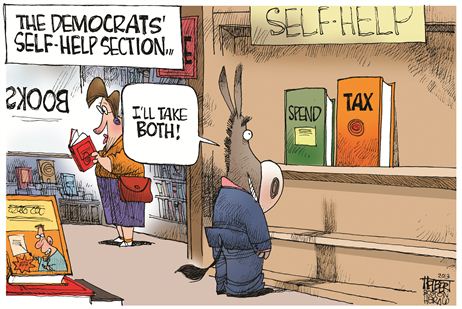


 The Daily Hatch
