Monthly Archives: March 2013

“Friedman Friday” Transcript and video of Milton Friedman on Bill Clinton and Ronald Reagan (Part 2)

Below is a discussion from Milton Friedman on Bill Clinton and Ronald Reagan.

February 10, 1999 | Recorded on February 10, 1999

PRESIDENTIAL REPORT CARD: Milton Friedman on the State of the Union

with guest Milton Friedman
Former Hoover fellow and Nobel laureate Milton Friedman.

Milton Friedman, Senior Research Fellow, Hoover Institution and Nobel Laureate in Economic Sciences grades the achievements of the Clinton administration and evaluates the programs the President proposed in his 1999 State of the Union address.

Milton Friedman vs Bill Clinton (1999)

Published on May 28, 2012 by

ROBINSON Just the last eight years, or would you give high marks to Volcker as well, Greenspan’s predecessor?

FRIEDMAN That’s an interesting case, because you have to give the credit there really to Reagan. There’s no other President who would have stood by while the Fed followed the policy it did. If you remember— you don’t remember that period but if you go back…

ROBINSON I do actually, I had just started at the White House in those days…

FRIEDMAN …if you go back to that period, stopping the inflation that was raging which reached double-digit levels at the end of the ’70s and early ’80s required stepping on the brakes hard and produced a recession. And if you remember, Reagan’s popular ranking went way down in…

ROBINSON Down into the thirties.

FRIEDMAN …thirties, right. No other President would have stood by and said to the Fed, keep doing what you’re doing, you’re doing the right thing. But Reagan did do that. And that’s what enabled Volcker to do what Volcker did.

ROBINSON Back to the present to find out what Milton Friedman thinks of President Clinton’s legislative goals for the rest of his term.

THE SUNSHINE PLOYS

ROBINSON Let me ask you to apply your thinking to the principle points of Bill Clinton’s program for the remaining couple of years in office. The President’s program is intended— we’ll take old folks first— to, I quote now, “Address the challenge of a senior boom by using the budget surplus to help save Social Security.”

FRIEDMAN Well, the proposal, if you look at it in detail, is a complete fake.

ROBINSON A complete fake?

FRIEDMAN Absolutely.

ROBINSON He wants to take sixty percent— a little more than sixty percent of budget surplus over the next fifteen years…

FRIEDMAN Where does that come from? He’s counting that twice. That comes from the proceeds of the payroll taxes that are now in, which, in principle, though not in practice, are supposed to be used for Social Security, but which have indeed been financing every regular event. If he doesn’t do a thing about the surplus, that would still end up in bonds in the hands of the Social Security so-called Trust Fund.

ROBINSON You say he’s guilty of a little bit of a flim-flam game with the books.

FRIEDMAN Absolutely.

ROBINSON Within forty-eight hours of that State of the Union Address in which he made this proposal, Alan Greenspan, whom you have just praised, endorsed the proposal— in general terms, not specific terms, but he endorsed the proposal— and the Republicans in Congress said yep, that’s a good idea, sign us up for that too. How is it that he’s able to get everybody to go for what you call a flim-flam game?

FRIEDMAN Look, do you need to ask that question now after six years of Clinton? How he’s been able to get one flim-flam game after another. How he’s been able to bamboozle the people into thinking that he deserves higher ratings because he lies. Clinton is a superb politician who has a most extraordinary capacity to exude sincerity. He’s an incredible phenomenon. I think he’s a genius. But go back to the Social Security program. The first thing to be said is that all this nonsense about saving something for Social Security is pure fiction. It’s wrong to think that what people are paying into Social Security, what people are paying in the form of wage taxes, is what they’re paying for their own security. [

ROBINSON That’s nonsense.] There is no relationship whatsoever. We have a system under which you have a set of taxes for Social Security— named for Social Security, but it doesn’t matter, they’re payroll taxes, terrible taxes, regressive taxes. Nobody… you could not get a legislature to vote such a tax on its own. Can you imagine proposing a tax that would impose — let’s say sixteen percent tax— on all wages from the first dollar up to the maximum and nothing beyond that. Can you imagine voting that? Similarly, the other side of the picture is that we have made a series of commitments to people like me— I receive Social Security payments…

ROBINSON Oh so, it’s my payroll tax that goes to…

FRIEDMAN Absolutely. Absolutely. It’s not only your payroll tax, it’s your income tax, it’s whatever taxes you pay. I get them. And if you think you’re going to get ’em, you’re kidding yourself.

ROBINSON It is a fundamental deceit hoisted upon the American people and sustained for lo these six decades.

FRIEDMAN Absolutely. If you read the Social Security brochures, they say this is a system under which you are putting aside money now for your retirement.

ROBINSON And that’s nonsense.

FRIEDMAN That is utterly fake. But let’s suppose it were true…

ROBINSON All-right.

FRIEDMAN …for a moment. Why is it that it’s appropriate for government to come and tell me what fraction of my income I should save for my old age? If that’s okay, why can’t it come in and tell me exactly what fraction of my income I have to spend for food, what fraction for housing, what fraction for clothing. Let me show you the absurdity of this.

ROBINSON All-right.

FRIEDMAN Consider a young man of thirty-five who has AIDS for whom the expected length of life is ten years at the most maybe. Maybe there’ll be a cure. But his expected length of life is not very long. Is it really intelligent for him to put aside fifteen percent of his income for retirement at age sixty-five?

ROBINSON It’s outrageous.

FRIEDMAN It’s outrageous.

ROBINSON Outrageous.

FRIEDMAN Exactly. The only word you can give to it. And in my opinion, the whole Social Security system is an outrage.

ROBINSON If Social Security is ‘an outrage,’ what would Milton Friedman do about it? A Bonding Experience

ROBINSON How would you get rid of it?

FRIEDMAN Very simply. Here I am, I’m entire to a certain number of payments in the future. Have the government give me a bond equal to the current present value of— expected value of what I’m entitled to. You have already accumulated some rights. And so have the government give you a bond which will be due when you’re sixty-five which will be the present value of what you’ve already accumulated under the law. And then close the whole thing up.

ROBINSON And just close the books.

FRIEDMAN Everybody gets what he’s entitled to— what he’s been promised. The unfunded debt under Social Security is funded, it’s made open and above-board. There’s not a penny of transition cost, and everybody is… In my world, the payroll tax would be abolished, would be eliminated. It’s the worst tax we have on the books. And everybody would be free to do what he wanted about his own retirement.

ROBINSON Okay.

FRIEDMAN And on the whole he would do very well. Now undoubtedly, people who argue against that say, well what are you going to do about these people who are so careless and so unprudent that they don’t accumulate anything for retirement. That’s a general problem. What do you do about people who are poor, whether for their own fault or not for their own fault? You and I and society in general is not willing to see ’em starve to death.

ROBINSON Correct.

FRIEDMAN Well, I have always been in favor of having a program under which (a negative income tax) under which you will have some income minimum you will provide for people whether they are indigent because they’re wastrels or whether they’re indigent because they’re in bad health…

ROBINSON Even if it’s their own fault, they don’t starve.

FRIEDMAN The problem is, it’s always seemed to me absurd that you make a hundred percent of the people do something in order to make sure that one or two percent of the people don’t behave badly.

ROBINSON Milton, that negative income tax proposal actually started to go someplace, if I remember my history correctly, that actually started to go someplace during the Nixon years, didn’t it? Didn’t Cap Weinberger…

FRIEDMAN Yes, it did… No, Moynihan, Pat Moynihan…

ROBINSON Moynihan. And what happened to it? Why did it die?

FRIEDMAN Because the public pressure was converted into a program that I testified against. It’s what happens in Washington all the time.

ROBINSON Right, right, okay.

ROBINSON Next question. What would Milton Friedman do with the mounting budget surplus?

SAVING PRIVATE EARNING

ROBINSON We’ve got seventy-nine, eighty billion dollars more coming in this year than the government…

FRIEDMAN I am in favor of reducing taxes under any circumstances, for any excuse, with any reason whatsoever because that’s the only way you’re ever going to get effective control over government spending. Sooner or later [

ROBINSON Choke off the supply.] if you don’t reduce taxes to get rid of that surplus, it’s going to be spent. The rule from not only the last few years, hundreds of years, is that governments will spend whatever the tax system will raise plus as much more as they can get away with.

ROBINSON The Republicans are calling for a ten percent…

FRIEDMAN It’s not enough.

ROBINSON …cut. Not enough. What is… Now Dan Quayle, who’s running for President— this is the most extreme- extreme may be the wrong word but this is the most dramatic proposal I’m aware of that’s on the table anywhere at the moment— he’s called for a thirty percent cut. Is that enough?

FRIEDMAN I don’t know. I would cut it as much as you can get away with.

ROBINSON So you’d run the numbers and give back virtually all the surplus.

FRIEDMAN What do you mean give back? Not take.

ROBINSON Excuse me. It’s not take. You’d lower taxes…

FRIEDMAN You know, this idea of giving back, which is a word you use, assumes…

ROBINSON I take back my words, but go ahead and ram them down my throat.

FRIEDMAN …it assumes that every individual is a property of the government and that all of the income that you earn is really the government’s, and it decides how much you can keep and how much it gets. I’ve always said, it treats people as if they were running around with an IBM card on their back which says ‘do not mutilate, punch, or disturb.’

ROBINSON Right. You’ve got more money coming in at the moment than is going out.

FRIEDMAN You ought to reduce taxes by enough to generate…

ROBINSON You don’t want to pay down the debt.

FRIEDMAN Oh no. No, I want to generate a deficit because I want pressure on to get the government to spend less.

ROBINSON You like a federal deficit.

FRIEDMAN No, I don’t like a federal deficit, but I like lower government spending.

ROBINSON All-right. President Clinton has another proposal for using that surplus, and he calls them USA accounts. He’s proposing to use about eleven percent of the surplus over the next fifteen years or so to establish, I quote now from his speech, “universal savings accounts, USA accounts, to give all Americans the means to save,” again quotation here, “with extra help for the least able to save.” Details to follow. You like that idea?

FRIEDMAN No, I think it’s a terrible idea. You know, the idea is saying, I’m going to take your money, but then I’ll give it back to you if you do with it what I tell you to do. Is that a way you have a free society of free, self-reliant individuals who are responsible for themselves? It’s a terrible…

ROBINSON Do you even agree with the premise that the savings rate is too low in this country?

FRIEDMAN I don’t agree with that premise. What is the right savings rate?

ROBINSON Well, gee, you’re the Nobel Prize winner, I thought you’d be able to clue me in.

FRIEDMAN The right savings rate… In a world in which you did not have distortions, in which you did not have government stepping in and distorting the rate at which people save or not, the right saving rate is whatever all the people of the community simply want to save. How much you want to save, how much I want to save. Why shouldn’t people be free to save what they want?

ROBINSON Let’s move to a more theoretical question. Why do we end up with so many stupid government programs when we’re supposed to be so smart in our own private affairs?

THINK LOCALLY, ACT GLOBALLY

ROBINSON How is it, you credit great intelligence, shrewdness, on the part of individuals when they’re spending their own money and managing their own property in the marketplace, how can we all be so dumb when we give up being players in the marketplace and become citizens participating in the political process? We get hoodwinked by Clinton, we go for this crazy sham of Social Security, how can we be so dumb?

FRIEDMAN Because it’s always so attractive to be able to do good at somebody else’s expense. That the real problem of our government. Government is a way by which every individual believes he can live at the expense of everybody else. That’s— I’m just repeating what Bastiat said two centuries ago, more than two centuries ago. You know, the thing that people don’t really understand is that free societies of the kind we’ve been lucky enough to experience for the last hundred-hundred and fifty years are a very rare exception in human history. Most people, most of history, and at any one time, most people at any one time, have lived in tyranny and misery. And it’s only for a brief period, and why? It is precisely because once you get some government program in— may have been a very good idea, it’s always proposed for good reasons— once it gets in, it becomes a special privilege of a small group which has an enormously strong interest to maintain it, and you do not have any comparable group that has the interest to get rid of it. And therefore, the hardest thing in the world is to get rid of any government program, however badly it works. In fact, try to name any government programs that have been eliminated.

ROBINSON The draft. Well, that’s not a…

FRIEDMAN Yes, the draft is an example, it’s one of the rare examples of a program that has been eliminated. One of the others was Postal Savings. It used to be that the postal system had a savings system which became very popular as a result of the Great Depression. But it disappeared. Why? Because by accident when they set it up, they limited the interest they could pay on postal savings to two percent, and when the market rate got higher than that, all the money was taken out of postal savings and postal savings came to an end. But aside from that, can you name programs that have been eliminated because they failed? And so how will we set a limit on government, and keep it coming back, and the only thing I can see on the horizon that offers a real chance are term-limits.

ROBINSON Term limits?

FRIEDMAN Right now, being a politician is a lifetime career. Being a Congressman is a lifetime career.

ROBINSON Do we have any evidence in the states where term-limits apply that it has worked as you would like to see it work? Term-limits have been in effect here in California for about a decade now… They may have been enacted a decade ago, so they’ve been in effect for perhaps six years…

FRIEDMAN It’s a little early. We don’t really have any very good… However, it so happened, I had occasion to have a conversation the other day with a former Governor of Virginia: Allen, George Allen.

ROBINSON Who, everybody says he’s going to be running for the Senate. Against Chuck Robb.

FRIEDMAN Yes, that’s what he intends to do.

ROBINSON He intends to do. All-right.

FRIEDMAN However, he had, Virginia has a one-term four-year term for the Governor. And he said, you know, he said, if we had had a two-year term, if we had had the situation in most states, that you can run for a second term, I would have spent the third and fourth year of my term working for re-election. I would never have been able to get done what I got done. It was the first real hands-on testimonial I’ve seen to a term-limit. It’s not a good idea for being a legislator to be a lifetime profession. The founders of our country had the idea of legislation as a part-time activity. It is in many states today. But at the federal government level, it’s a full-time profession. And that is very unhealthy because the legislature— it’s not a criticism of the individual— but any human being in that position, he’s going to sit in committee meetings, and day after day he’s going to hear arguments, good arguments, worthy arguments for new programs. He’s going to get very few arguments for getting rid of programs. And the evidence is clear: the longer people are in Congress, the more willing they are to vote government spending.

ROBINSON The polls all show the American people are very concerned about our public schools. What does Milton Friedman think of President Clinton’s proposals to improve those public schools? Hire Learning

ROBINSON President Clinton on public schools. According to the White House fact sheet, he wants to, I quote, “raise standards and increase accountability in public schools (I’ve got to take a deep breath to get through this) through proposals to end social promotion, bring high-quality teachers into the classroom, intervene in failing schools, provide school report cards to parents, strengthen our commitment to smaller class-sizes, and boost our efforts for school modernization.” What grade do you give that proposal?

FRIEDMAN F.

ROBINSON F.

FRIEDMAN What does it mean? It means more government control of schools. What do we really need in schools? We need competition. What we have is a monopoly, and like every monopoly, it’s producing a low-quality product at a very high cost. The way to improve that is to have competition, to make it possible for parents to have a choice of the schools their children attend. All high-income people have that choice now. They can choose their residence for a place with good schools, or they can send their children to private schools, pay twice for schooling: once in taxes and once in tuition. But the lower income classes can’t.

ROBINSON They’re stuck. Milton, didn’t public schools used to work?

FRIEDMAN Yes. When I graduated from high-school in 1928, there were 150,000 school districts in this country. Today, there are 15,000 and the population is twice as great. In the early day, you had local control of schools, and there was effective competition between a large number of local areas. But school districts got consolidated. They got run not by local people but by the professional educators. And most important of all, in the 1960s you began to have the emergence of teachers’ unions taking control of the schools. And since 1960, since the teachers’ unions started emerging, you have had on the whole a rather steady decline in the quality of schooling. If you want to improve automobiles, do you have government step in and tell people what brakes to put on, and so on, or do you rely on the fact that General Motors is going to try to beat Ford, is going to try to beat Toyota? Competition is the most effective way to improve quality, whether in computers, in automobiles, in suits, or in schooling.

ROBINSON Let me ask you to close, if I may, with a prediction. It’s 2009, ten years from today. Is the government of the United States bigger, or smaller?

FRIEDMAN Smaller.

ROBINSON Your ideas are winning?

FRIEDMAN No. The Internet is going to make it harder and harder to collect taxes.

ROBINSON How come?

FRIEDMAN Because you’ll be able to evade taxes, you’ll be able to do your deals in the Cayman Islands.

ROBINSON So the Internet…

FRIEDMAN At the moment I see the Internet as the most likely source of the smaller government.

ROBINSON But in your mind it really will have an effect. That’s not speculative…

FRIEDMAN No, no, no. I believe it will and I believe it’s having it now.

ROBINSON I see. Okay. Milton Friedman— Bill Clinton I hope you’re taking notes, we’ll send a tape of this to the White House— Milton Friedman, thank you very much.

FRIEDMAN That’s all-right. I assure you they won’t look at it. Thank you.

ROBINSON Doctor Friedman believes the government should be smaller and that it will become so. Maybe some future President will preside over such a small government that he can shrink up the State of the Union Address enough to get rid of the Teleprompter and deliver the speech from memory. I’m Peter Robinson. Thanks for joining us.
Open letter to President Obama (Part 261)

Cato Institute’s Dan Mitchell on WMAL 07-10-12

Published on Jul 10, 2012 by

INTERVIEW: DAN MITCHELL — Senior Fellow, Cato Institute — discussed the ObamaCare tax vs. penalty rhetoric, the growing number of people on disability, whether America is becoming Europe and President Obama’s tax-the-rich speech yesterday.

ObamaCare: Is It a Tax or a Penalty? Dan examines the messaging.
Obama’s Class Warfare: President Obama Monday proposed a one-year extension of the Bush-era tax cuts for American families earning less than $250,000 a year.
Spain Given Extra Year To Reach Deficit Reduction Targets. Spain is getting another year to meet its deficit-reduction targets. The country was given until 2014 to meet its goals in exchange for budget savings and an aid package for banks. Euro zone ministers were concerned that Spain, their fourth-largest economy, was on the path to a full bailout which they could not afford. Spain has been hit hard with bad debts from the housing crash and worldwide recession.
AEI’s Arthur Brooks writes in the WSJ: “America Already Is Europe: In spending, debt and progressivity of taxes, the U.S. is as much a social-welfare state as Spain.

________________


President Obama c/o The White House
1600 Pennsylvania Avenue NW
Washington, DC 20500

Dear Mr. President,

I know that you receive 20,000 letters a day and that you actually read 10 of them every day. I really do respect you for trying to get a pulse on what is going on out here.

Not as many people are pulling the cart but it seems more are now jumping in the cart!!!

Amy Payne

September 19, 2012 at 9:30 am

The leak of a video featuring former Governor Mitt Romney (R-MA) has sparked debate about government dependency and the number of people in the United States who do not pay federal income tax.

In the video, Romney refers to “47 percent” of Americans and says that they are “dependent upon government” and “pay no income tax.” While these groups are not necessarily one in the same, there is overlap between the two, and the percentages on government dependency and non-tax-paying are very similar.

It is true that nearly half of all tax filers—those who are filing an income form with the IRS—pay no federal income tax. It’s also true that millions of Americans receive direct government support in a host of ways, including income, food, housing, medical care, school lunches, and more.

In 2009, 47 percent of all tax filers paid no federal individual income taxes, and in 2011 that figure was 46 percent. This raises a crucial question, as Heritage’s Alison Fraser points out: “Should nearly 50 percent of Americans really be exempt from funding the most basic constitutional functions of government—along with education, food stamps, energy, welfare, foreign aid, veterans’ benefits, housing, and so forth?”

It stands to reason that those who have skin in the game—who are helping to pay for all of the government programs—will be more concerned about reining in out-of-control government spending, because they see their taxes going up and the country’s credit rating going down.

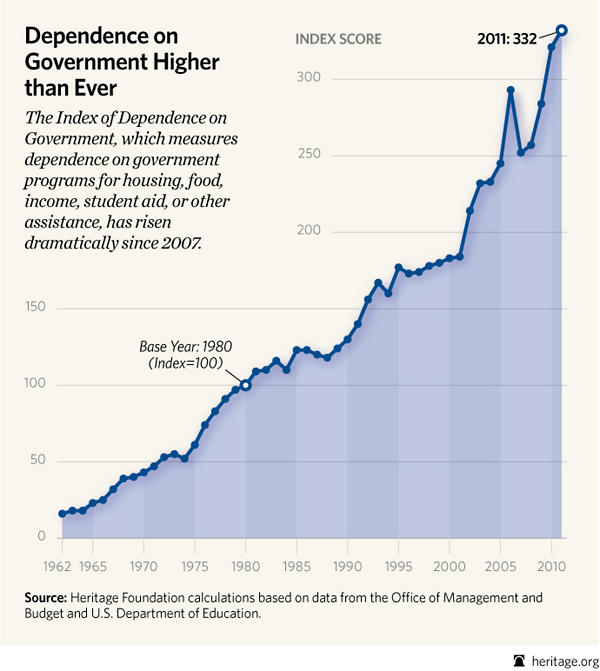
On the other hand, if you are on the receiving end of government benefits, that is likely to color your perception of how taxpayers’ money should be spent. According to the Heritage Foundation’s 2012 Index of Dependence on Government, 63.7 million Americans, or about one in five, is receiving direct government support from Social Security, welfare, or Pell Grants—and that is at its highest level ever. (continues below chart)

These individuals are very likely to be receiving additional benefits from other government programs such as Medicare or Medicaid, food stamps, etc., and the total share of Americans receiving benefits is likely to be even higher when considering benefits available on everything from housing to school lunches. The Wall Street Journal found that in 2011, 49 percent of Americans lived in a household where at least one member of the family received a government benefit.

Heritage has been publishing the Index of Dependence on Government for the past 10 years, and the Center for Data Analysis offered a preview yesterday of what next year’s report will look like, as it updates with the most recent data becoming available for 2011.

The outlook is grim: Government dependency is jumping for the fourth year in a row, and the Index has risen more than 31 percent in that time.

This is bad news for three reasons. First, the economy is so weak that people are going to the government for help. This is a stark repudiation of President Obama’s big-spending, “spread the wealth around” approach, because “giving everyone a shot” does not work unless the “shot” comes at the expense of the taxpayers.

Second, the nation can’t afford to continue increasing spending on these programs, as President Obama has proposed in each of his budgets. Federal spending is exploding—and it is already an eye-popping reality that 70.5 percent of federal spending goes to dependency-creating programs. We are spending more on dependency-creating programs while an ever-shrinking number of taxpayers are paying for them.

But third, and most importantly, it’s bad for Americans. The American Dream is about life, liberty, and the pursuit of happiness, through independence—not dependence on government. Government dependency erodes human dignity and civil society.

These programs were originally designed to help those who fall on hard times and need a safety net. Public policy should head back in that direction. The welfare reform of 1996 helped lift recipients out of poverty and back into jobs by requiring, among other things, that they work. President Obama has undone that requirement. And there are dozens more anti-poverty programs that should be revamped to help those who are able toward self-sufficiency.

At the same time, we must address the looming entitlements crisis: 78 million baby boomers are heading into retirement, and many of them will be entirely dependent on Social Security and Medicare for their income and health care. This dependency is a huge driver of future budget deficits.

We cannot continue on a course of unlimited government spending when fewer and fewer taxpayers are paying for that spending. That is the financial fact. But we also cannot sustain the American Dream on this course—and that is a fact that is intensely personal for every American.

_______________

Thank you so much for your time. I know how valuable it is. I also appreciate the fine family that you have and your commitment as a father and a husband.

Sincerely,

Everette Hatcher III, 13900 Cottontail Lane, Alexander, AR 72002, ph 501-920-5733, lowcostsqueegees@yahoo.com

Dan Mitchell on the minimum wage law (includes two editorial cartoons)


It seems that everything President Obama does to help the economy actually does the opposite.

Should the federal government make life more difficult for low-skilled workers?

I hope everyone will emphatically say “NO!”

Heck, most people understandably will think you’re crazy for even asking such a preposterous question.

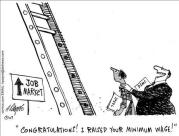
Minimum Wage Cartoon 2But some of those people will also think that it’s a good idea for politicians in Washington to make low-skilled workers less attractive to employers by raising the minimum wage.

I often ask such people whether they are more likely to buy a Big Mac if McDonald’s raises the price by 24 percent. They say they are less likely.

I then ask them if they are more likely to buy a car if GM increases the price of a Buick by 24 percent. They say less likely, of course.

But they seem to have a blind spot when I ask them whether employers will be more likely or less likely to hire low-skilled workers when the government increases the cost of those workers by 24 percent.

I explain further in this interview for Yahoo! Finance.

The interviewer, by the way, seems to be economically illiterate.

He apparently believes that we can reduce inequality by pricing poor people out of the job market. He also blames companies for sitting on piles of cash, presumably unaware that firms only will invest if there are profitable opportunities.

Minimum Wage CartoonAt one point, I delicately state that one of his questions “betrays a certain lack of historical knowledge,” which is a polite way of saying “you’re either lying or you have no idea what you’re talking about.”

Ultimately, I try to help him understand by comparing fast-growing economies such Hong Kong and Singapore, which have relatively low burdens of government, with slow-growth economies such as France and Italy, where politicians ostensibly seek to “help” people with various forms of intervention.

I’m not sure I made any progress, so feel free to suggest other ways of convincing skeptics that freedom is better than statism.

Anyway, for those who want more information, this video explains the underlying economics of the minimum wage. We also have plenty of evidence (see here and here) that unemployment rose following the most recent hike in the minimum wage.


Related posts:

Why do the liberals want to increase unemployment more by increasing minimum wage?

Williams with Sowell – Minimum Wage Why do the liberals want to increase unemployment more by increasing minimum wage? With Unemployment Already High, Why Are Leftists Pushing for an Increase in the Minimum Wage? September 3, 2012 by Dan Mitchell The unemployment rate has been stuck above 8 percent ever since Obama pushed through his ill-fated […]

Minimum wage could be eliminating jobs

Minimum wage could be eliminating jobs Liberals just don’t have a clue. The Job-Killing Impact of Minimum Wage Laws Uploaded by CFPEcon101 on Jun 14, 2010 Minimum wage laws seem like a good idea, but arbitrarily mandating a certain wage can have terrible consequences. This CF&P Foundation mini-documentary reveals that business are not charities, so if the […]

Minimum wage could be eliminating jobs

Minimum wage could be eliminating jobs Liberals just don’t have a clue. The Job-Killing Impact of Minimum Wage Laws Uploaded by CFPEcon101 on Jun 14, 2010 Minimum wage laws seem like a good idea, but arbitrarily mandating a certain wage can have terrible consequences. This CF&P Foundation mini-documentary reveals that business are not charities, so […]

President Obama and Alternative Minimum Tax

President Obama and Alternative Minimum Tax Dan Mitchell does it again. He is always right on the mark. CPAs Celebrate as Obama Proposes to Create a Turbo-Charged Alternative Minimum Tax Posted by Daniel J. Mitchell Wow, this is remarkable. The alternative minimum tax (AMT) is one of the most-hated features of the tax code. It […]

President Obama and Alternative Minimum Tax

President Obama and Alternative Minimum Tax Dan Mitchell does it again. He is always right on the mark. CPAs Celebrate as Obama Proposes to Create a Turbo-Charged Alternative Minimum Tax Posted by Daniel J. Mitchell Wow, this is remarkable. The alternative minimum tax (AMT) is one of the most-hated features of the tax code. It […]

Video clips of Jonah Goldberg and an interview about his book “Liberal Fascism” (Part 3)

Liberal Fascism (5) – Jonah Goldberg ** UNEDITED **   Uploaded by TylerNull on Feb 17, 2008 PLAYLIST: http://www.youtube.com/view_play_list?p=C20E954A7632DCFD Jonah Goldberg discusses his new book, “Liberal Fascism: The Secret History of the American Left, From Mussolini to the Politics of Meaning”, at The Heritage Foundation on C-SPAN2. 09 JAN 08. ____ Below is  a portion […]

Open letter to President Obama (Part 245)

Williams with Sowell – Minimum Wage President Obama c/o The White House 1600 Pennsylvania Avenue NW Washington, DC 20500 Dear Mr. President, I know that you receive 20,000 letters a day and that you actually read 10 of them every day. I really do respect you for trying to get a pulse on what is […]

Ark Times blogger claims California is better than Texas but facts don’t bear that out (3 great political cartoons)

I got on the Arkansas Times Blog and noticed that a person on there was bragging about the high minimum wage law in San Francisco and how everything was going so well there. On 2-15-13 on the Arkansas Times Blog I posted: Couldn’t be better (the person using the username “Couldn’t be better)  is bragging […]


Coldplay the documentary with pictures and videos (Part 1)

Coldplay Max Masters – Part 1 of 7

Uploaded on May 6, 2009

The ASTRA Award winning music documentary – Max Masters Coldplay – was voted MOST OUTSTANDING MUSIC PROGRAM for 2009.

Sarah Linton Productions and The Post Box produced the Max Masters documentary to coincide with the album release of ‘Viva la Vida’.

__________

Chris Martin revealed in his interview with Howard Stern that he was rasied an evangelical Christian but he has left the church. I believe that many words that he puts in his songs today are generated from the deep seated Christian beliefs from his childhood that find their way out in his life. His belief in being generous with charities, and the fact Coldplay’s songs  deal so much with death and the search for meaning and purpose of life (similar to Solomon’s search in Ecclesiastes), that our actions are being watched, and Chris describes different ways God tries to reveal himself to us, and many songs deal with trying to find a way to an afterlife and heaven, and he stills uses Christian terms like being “blessed” and “grateful.”

Up to this point many people may be saying that this is all based on some pretty flimsy evidence. However, one of the most revealing things came out when Chris wrote the song “Viva La Vida.” He had previously said he left Christianity because of the biblical view of eternal damnation but what does Chris do with the evil king in the song “Viva La Vida?”  Q Magazine asked Chris Martin about the lyric in this song “I know Saint Peter won’t call my name.” Martin said,  “It’s about…You’re not on the list… Its always fascinated me that idea of finishing your life and then being analyzed on it…That is the most frightening thing you could possibly say to somebody. Eternal damnation.  I know it. It’s mildly terrifying to me. And this is serious.”

Maybe we have heard the last of this journey from Chris?

In an interview with Irish online magazine Independent.ie, when asked if he was rediscovered God based on Viva La Vida or Death and All His Friendsspiritual content. Martin responded that he was still trying to figure out who “he or she or it is,” admitting he doesn’t know who is right, whether it is, “Jesus, Allah, Mohammad or Zeus Finally in a text message to the magazine’s interviewer, Chris Martin wrote that he is “Alltheist” a word he made up meaning “he believes in everything.”


Chris Martin heartbroken by parents’ split

Bang Showbiz
Thursday, 3 February 2011

Chris Martin is devastated over his parents’ divorce.

The Coldplay frontman is said to be finding it “incredibly difficult emotionally” to come to terms with the end of his mother and father’s 30-year marriage.

His father Anthony, 69, has put the family’s £1.25 million home in Exeter, South West England, on the market after his wife Alison decided to leave.

The family moved there in 1978 when Chris – the eldest of their five children – was just a baby.

Now retired accountant and magistrate Anthony is in a new relationship and Alison, 57, is renting a flat in London where she works as a music therapy teacher.

An insider said: “Chris has always been extremely close to his father, while some of his sisters have had very strong relationships with their mother. But watching his parents split has been heartbreaking for him, and he’s desperate to stay close and in regular contact with both of them.”

Chris, 33, has been visiting both his parents with his wife Gwyneth Paltrow but is finding it hard to see them live apart.

The source added to the Daily Mirror newspaper: “Chris visited his mother’s new place in London around a week ago, which was a strain for him emotionally. One of the most upsetting aspects of the break-up has been their decision to sell their family home. He was less than one year old when his parents moved in, and the house holds a lot of memories for him.”

Chris Martin in Dallas

Chris Martin

Related posts:

Chris Martin of Coldplay unknowingly lives out his childhood Christian beliefs (Part 8 of notes from June 23, 2012 Dallas Coldplay Concert)

Coldplay 6-22-12 Dallas, TX Best Opening.MOV Published on Jun 23, 2012 by jaimenolga 1 of Don’t miss the second song of this clip!! It was incredible! (One eye watching you song was great.) Coldplay brought confetti, lights and thousands of fans to the American Airlines Center; see photos from their colorful show Photo Gallery News […]

Chris Martin of Coldplay unknowingly lives out his childhood Christian beliefs (Part 7 of notes from June 23, 2012 Dallas Coldplay Concert)

Coldplay Live in Dallas – Lover’s in Japan Ball Drop Published on Jun 23, 2012 by TheRyanj64 Live From the American Airlines Center in Dallas Texas June 22, 2012 Coldplay – Lover’s in Japan Ball Drop Coldplay brought confetti, lights and thousands of fans to the American Airlines Center; see photos from their colorful show […]

Chris Martin of Coldplay unknowingly lives out his childhood Christian beliefs (Part 6 of notes from June 23, 2012 Dallas Coldplay Concert)

Coldplay – Yellow (Live) @ American Airlines Center Published on Jun 23, 2012 by Crwdickerson Coldplay Performing Yellow @ American Airlines Center Dallas June 22, 2012 Coldplay brought confetti, lights and thousands of fans to the American Airlines Center; see photos from their colorful show Photo Gallery News Sports Lifestyles Comments (0)   3/11 Chris […]

Chris Martin of Coldplay unknowingly lives out his childhood Christian beliefs (Part 5 of notes from June 23, 2012 Dallas Coldplay Concert)

Coldplay “paradise” Dallas Texas 6/22/12 ( Floor View ) Published on Jun 23, 2012 by ccam cher Awesome concert Coldplay brought confetti, lights and thousands of fans to the American Airlines Center; see photos from their colorful show Photo Gallery News Sports Lifestyles   Comments (0)   9/11 Chris Martin was brought up as an […]

Chris Martin of Coldplay unknowingly lives out his childhood Christian beliefs (Part 4 of notes from June 23, 2012 Dallas Coldplay Concert)

Coldplay – In My Place (Live in Dallas) June 22 2012 Published on Jun 24, 2012 by maimiaa Coldplay performing at American Airlines Center in Dallas, TX Coldplay brought confetti, lights and thousands of fans to the American Airlines Center; see photos from their colorful show Photo Gallery News Sports Lifestyles   Comments (0)   […]

Chris Martin of Coldplay unknowingly lives out his childhood Christian beliefs (Part 3 of notes from June 23, 2012 Dallas Coldplay Concert, Martin left Christianity because of teaching on hell then he writes bestselling song that teaches hell exists)

Viva La Vida Published on Jun 23, 2012 by TheRyanj64 Coldplay’s Viva La Vida at American Airlines Center in Dallas on June 22, 2012 __________ Coldplay brought confetti, lights and thousands of fans to the American Airlines Center; see photos from their colorful show Photo Gallery News Sports Lifestyles   Comments (0)   5/11 Chris […]

Chris Martin of Coldplay unknowingly lives out his childhood Christian beliefs (Part 2 of notes from June 23, 2012 Dallas Coldplay Concert)

Coldplay – Mylo Xyloto/Hurts Like Heaven (Live) @ American Airlines Center Coldplay brought confetti, lights and thousands of fans to the American Airlines Center; see photos from their colorful show Photo Gallery News Sports Lifestyles   Comments (0)   2/11   Published on Jun 24, 2012 by Crwdickerson Coldplay Performing Mylo Xyloto/Hurts Like Heaven @ […]

Chris Martin of Coldplay unknowingly lives out his childhood Christian beliefs (Part 1 of notes from June 23, 2012 Dallas Coldplay Concert)

Coldplay-DALLAS-2012-”Opening, Mylo Xyloto, and Hurts like Heaven!” Published on Jun 24, 2012 by ColdplayDALLAS2012 1:10 is where the concert starts! Sorry for the shaking and sound audio! It was really loud! AND AWESOME! Please THUMB UP and COMMENT if u went to this coldplay concert! And I also hope that this will get a few […]

“Music Monday” Video interviews of Gwyneth Paltrow and Chris Martin (Part 4)

As far as I know they have never done an interview together. Therefore, I have included separate interviews that they have done below and I have some links to past posts I have done on them too. Shane Warne – Chris Martin Interview (Part 1) Uploaded by HandyAndy136 on Nov 24, 2010 Originally broadcast on […]

“Music Monday” Video interviews of Gwyneth Paltrow and Chris Martin (Part 3)

As far as I know they have never done an interview together. Therefore, I have included separate interviews that they have done below and I have some links to past posts I have done on them too. Ellen Catches Up with Gwyneth Paltrow Uploaded by TheEllenShow on Oct 14, 2010 It’s been several years since […]

“Music Monday” Video interviews of Gwyneth Paltrow and Chris Martin (Part 2)

As far as I know they have never done an interview together. Therefore, I have included separate interviews that they have done below and I have some links to past posts I have done on them too. Gwyneth Paltrow & Robert Downey Jr. on Jonathan Ross 2010.04.23 (Part 1) Coldplay: Chris Martin and Jonny Buckland […]

Open letter to Gwyneth Paltrow and Chris Martin concerning their choice to raise their kids in the Jewish Faith (part 12)

The Arab Israeli Conflict – part 5 : Suez Crisis 1956 & Tripartite attack on Egypt I have posted before about the religious views of Gwyneth Paltrow and Chris Martin. Now it appears they have rejected their agnostic statements of the past and have decided to raise their children in the Jewish faith. Here is […]

“Music Monday” Video interviews of Gwyneth Paltrow and Chris Martin (Part 1)

As far as I know they have never done an interview together. Therefore, I have included separate interviews that they have done below and I have some links to past posts I have done on them too. Ellen Catches Up with Gwyneth Paltrow Uploaded by TheEllenShow on Oct 14, 2010 It’s been several years since […]

Open letter to Gwyneth Paltrow and Chris Martin concerning their choice to raise their kids in the Jewish Faith (part 11)

The Arab Israeli Conflict – part 4: Egyptian Revolution 1952 I have posted before about the religious views of Gwyneth Paltrow and Chris Martin. Now it appears they have rejected their agnostic statements of the past and have decided to raise their children in the Jewish faith. Here is a post from the Huffington Post: […]

Open letter to Gwyneth Paltrow and Chris Martin concerning their choice to raise their kids in the Jewish Faith (part 10)

The Arab Israeli Conflict – part 3 I have posted before about the religious views of Gwyneth Paltrow and Chris Martin. Now it appears they have rejected their agnostic statements of the past and have decided to raise their children in the Jewish faith. Here is a post from the Huffington Post: After appearing on […]

Open letter to Gwyneth Paltrow and Chris Martin concerning their choice to raise their kids in the Jewish Faith (part 9)

The 6 Day War Of 1967 Part 1 I have posted before about the religious views of Gwyneth Paltrow and Chris Martin. Now it appears they have rejected their agnostic statements of the past and have decided to raise their children in the Jewish faith. Here is a post from the Huffington Post: After appearing […]

Open letter to Gwyneth Paltrow and Chris Martin concerning their choice to raise their kids in the Jewish Faith (part 8)

… The Birth Of Israel (2008) – Part 8/8 I have posted before about the religious views of Gwyneth Paltrow and Chris Martin. Now it appears they have rejected their agnostic statements of the past and have decided to raise their children in the Jewish faith. Here is a post from the Huffington Post: After […]

Open letter to Gwyneth Paltrow and Chris Martin concerning their choice to raise their kids in the Jewish Faith (part 7)

The Birth Of Israel (2008) – Part 7/8 I have posted before about the religious views of Gwyneth Paltrow and Chris Martin. Now it appears they have rejected their agnostic statements of the past and have decided to raise their children in the Jewish faith. Here is a post from the Huffington Post: After appearing […]

Open letter to Gwyneth Paltrow and Chris Martin concerning their choice to raise their kids in the Jewish Faith (part 6)

The Birth Of Israel (2008) – Part 6/8 I have posted before about the religious views of Gwyneth Paltrow and Chris Martin. Now it appears they have rejected their agnostic statements of the past and have decided to raise their children in the Jewish faith. Here is a post from the Huffington Post: After appearing […]

Open letter to Gwyneth Paltrow and Chris Martin concerning their choice to raise their kids in the Jewish Faith (part 5)

The Birth Of Israel (2008) – Part 5/8 I have posted before about the religious views of Gwyneth Paltrow and Chris Martin. Now it appears they have rejected their agnostic statements of the past and have decided to raise their children in the Jewish faith. Here is a post from the Huffington Post: After appearing […]

Open letter to Gwyneth Paltrow and Chris Martin concerning their choice to raise their kids in the Jewish Faith (part 4)

  The Birth Of Israel (2008) – Part 4/8 I have posted before about the religious views of Gwyneth Paltrow and Chris Martin. Now it appears they have rejected their agnostic statements of the past and have decided to raise their children in the Jewish faith. Here is a post from the Huffington Post: After […]

Open letter to Gwyneth Paltrow and Chris Martin concerning their choice to raise their kids in the Jewish Faith (part 3)

The Birth Of Israel (2008) – Part 3/8 I have posted before about the religious views of Gwyneth Paltrow and Chris Martin. Now it appears they have rejected their agnostic statements of the past and have decided to raise their children in the Jewish faith. Here is a post from the Huffington Post: After appearing […]

Open letter to Gwyneth Paltrow and Chris Martin concerning their choice to raise their kids in the Jewish Faith (part 2)

The Birth Of Israel (2008) – Part 2/8 I have posted before about the religious views of Gwyneth Paltrow and Chris Martin. Now it appears they have rejected their agnostic statements of the past and have decided to raise their children in the Jewish faith. Here is a post from the Huffington Post: After appearing […]

Open letter to Gwyneth Paltrow and Chris Martin concerning their choice to raise their kids in the Jewish Faith (part 1)

The Birth Of Israel (2008) – Part 1/8 I have posted before about the religious views of Gwyneth Paltrow and Chris Martin. Now it appears they have rejected their agnostic statements of the past and have decided to raise their children in the Jewish faith. Here is a post from the Huffington Post: After appearing […]


Remembering Dr. C. Everett Koop with pictures and quotes Part 8 (editorial picture about Surgeon General)

Memorial Tribute Former Surgeon General C.Everett Koop © A Genuine G-Shot.wmv

Dr. Koop.

C. Everett Koop

Before Dr. C. Everett Koop arrived in 1981 as Surgeon General could anybody ever name who the Surgeon General was? Koop also caused lots of editorial cartoons to be drawn about him because of his positions he took on health issues. Today’s cartoon below sums up the issues he tackled.

On 2-25-13 we lost a great man when we lost Dr. C. Everett Koop. I have written over and over the last few years quoting Dr. C. Everett Koop and his good friend Francis Schaeffer. They both came together for the first time in 1973 when Dr. Koop operated on Schaeffer’s daughter and as a result they became close friends. That led to their involvement together in the book and film series “WHATEVER HAPPENED TO THE HUMAN RACE?” in 1979.

In the film series “WHATEVER HAPPENED TO THE HUMAN RACE?” the arguments are presented  against abortion (Episode 1),  infanticide (Episode 2),   euthenasia (Episode 3), and then there is a discussion of the Christian versus Humanist worldview concerning the issue of “the basis for human dignity” in Episode 4 and then in the last episode a close look at the truth claims of the Bible.

In this 1979 film series they dealt with the big social issues and predicted what social problems we have in the future because of humanism. For instance, they knew that the Jack Kevorkians of the world would be coming down the pike. They predicted that there was a slippery slope from abortion to infanticide to youth euthanasia brought on by the materialistic worldview.

Koop exhorted evangelicals to protect unborn

Posted on Feb 26, 2013 | by Diana Chandler

HANOVER, N.H. (BP) — Former U.S. Surgeon General C. Everett Koop, widely credited with energizing evangelicals against abortion, died peacefully Feb. 25 at his home in Hanover, N.H., at age 96.

The trailblazing pediatric surgeon developed a reputation as a preserver of life not only through groundbreaking surgeries and medical procedures, but through a morally, biblically based platform against sexual promiscuity and abortion, most notably before and after his two terms in the 1980s as surgeon general.

Koop also promoted the power of prayer in conjunction with medical science, famously praying at the bedsides of his patients.

In the 1979 book “Whatever Happened to the Human Race?” Koop and the late Frances Schaeffer made a case for the importance of mankind’s intrinsic God-given value in the preservation of humanity.

“If man is not made in the image of God, nothing then stands in the way of inhumanity. There is no good reason why mankind should be perceived as special. Human life is cheapened,” the two wrote. “We can see this in many of the major issues being debated in our society today: abortion, infanticide, euthanasia, the increase of child abuse and violence of all kinds, pornography (and its particular kinds of violence as evidenced in sadomasochism), the routine torture of political prisoners in many parts of the world, the crime explosion, and the random violence which surrounds us.”

Koop and Schaeffer endeavored to “awaken the evangelical world — and anyone else who would listen — to the Christian imperative to do something to reverse the perilous realignment of American values on these life-and-death issues” including abortion and infanticide, Koop reflected in his 1991 autobiography, “Koop: The Memoirs of America’s Family Doctor.”

Southern Baptist ethicist Richard Land has written that “it is difficult to overestimate the incredible impact” Koop and Schaeffer had on evangelicals in the 20th century.

“Everyone devoted to the pro-life cause owes an incalculable debt of gratitude to Francis Schaeffer and to Dr. C. Everett Koop,” Land wrote for National Right to Life in 2003. “First Schaeffer, and then Dr. Koop, helped inform and energize a whole generation of evangelical Christians to engagement with a culture that had veered dangerously off course from its Judeo-Christian foundations. The pro-life movement owes them an enormous debt.”

C. Ben Mitchell, professor of moral philosophy at Union University in Jackson, Tenn., hailed Koop’s legacy.

“We have lost the nation’s doctor,” Mitchell told Baptist Press. “As a gifted physician and faithful Christian, he taught us how to heal both body and soul. As a public servant he helped us navigate some tumultuous waves, even causing a few of his own. As a protector of human dignity and the sanctity of human life he cared for the tiniest and most vulnerable among us.”

After the U.S. legalized abortion, Koop predicted the practice would lead to infanticide, passive and active euthanasia and toward a political climate that, in Nazi Germany, led to Auschwitz and other concentration camps, according to news accounts of his speeches.

Koop, a Presbyterian, vowed during confirmation hearings before the U.S. Senate not to use his post as surgeon general to promote his religious ideology and occasionally angered evangelicals as he worked to keep his pledge.

Koop provoked controversy among evangelicals by encouraging sex education in elementary school, the use of condoms to prevent sexually transmitted diseases and compassionate health care for AIDS patients, who were then overwhelmingly within the homosexual community. Yet personally, he opposed homosexuality and promoted pre-marital sexual abstinence.

Among Koop’s other initiatives were calls for a smoking ban and campaigns promoting healthy eating and physical exercise education.

Melinda Delahoyde, president of the Care Net crisis pregnancy centers which Koop helped found, mourned Koop’s death.

“Dr. Koop took a courageous stand on the issue of life when not many were willing to do the same,” Delahoyde wrote on Care Net’s website. “He truly made a lasting impact, as his legacy lives on today through Care Net’s life-saving work to people facing unplanned pregnancies.”

As surgeon-in-chief at Children’s Hospital in Philadelphia, Koop pioneered surgery on newborns, successfully separating three sets of conjoined twins and reconstructing the chest of a baby born with the heart outside the body.

Koop’s recent outreach includes a letter he wrote in 2009 to Sen. Harry Reid urging that congressional health care legislation include a provision allowing doctors and medical students to opt out of performing abortions.

Koop was born Oct 14, 1916, in Brooklyn, N.Y., and, according to Reuters News, became interested in medicine after being badly injured as a child in a skiing accident and in playing football.

He was preceded in death by his first wife, Elizabeth, and by their son David. He is survived by their children Allen Koop, Norman Koop and Elizabeth Thompson, as well as by his second wife Cora, whom he married in 2010, according to news reports.
–30–
Diana Chandler is Baptist Press’ staff writer. Get Baptist Press headlines and breaking news on Twitter (@BaptistPress), Facebook (Facebook.com/BaptistPress ) and in your email ( baptistpress.com/SubscribeBP.asp).

Dr. C. Everett Koop is pictured above.


In the film series “WHATEVER HAPPENED TO THE HUMAN RACE?” the arguments are presented  against abortion (Episode 1),  infanticide (Episode 2),   euthanasia (Episode 3), and then there is a discussion of the Christian versus Humanist worldview concerning the issue of “the basis for human dignity” in Episode 4 and then in the last episode a close look at the truth claims of the Bible.

Francis Schaeffer: How Should We Then Live? (Full-Length Documentary)

Francis Schaeffer Whatever Happened to the Human Race (Episode 1) ABORTION

Francis Schaeffer: What Ever Happened to the Human Race? (Full-Length Documentary)

Part 1 on abortion runs from 00:00 to 39:50, Part 2 on Infanticide runs from 39:50 to 1:21:30, Part 3 on Youth Euthanasia runs from 1:21:30 to 1:45:40, Part 4 on the basis of human dignity runs from 1:45:40 to 2:24:45 and Part 5 on the basis of truth runs from 2:24:45 to 3:00:04

Dr. Francis schaeffer – The flow of Materialism(from Part 4 of Whatever happened to human race?)

Dr. Francis Schaeffer – The Biblical flow of Truth & History (intro)

Francis Schaeffer – The Biblical Flow of History & Truth (1)

Dr. Francis Schaeffer – The Biblical Flow of Truth & History (part 2)

Related posts:

Open letter to President Obama (Part 232 B) Dr. C. Everett Koop and Reagan pictured together

Dr. C. Everett Koop with Ronald Reagan. Dr. Koop was delayed in his confirmation by Ted Kennedy because of his film Whatever Happened to the Human Race? President Obama c/o The White House 1600 Pennsylvania Avenue NW Washington, DC 20500 Dear Mr. President, I know that you receive 20,000 letters a day and that you […]

“Sanctity of Life Saturday” Francis Schaeffer and Dr. C. Everett Koop asked Reagan to issue pro-life proclamation in 1983 (includes video ABORTION OF THE HUMAN RACE)

In the film series “WHATEVER HAPPENED TO THE HUMAN RACE?” the arguments are presented  against abortion (Episode 1),  infanticide (Episode 2),   euthenasia (Episode 3), and then there is a discussion of the Christian versus Humanist worldview concerning the issue of “the basis for human dignity” in Episode 4 and then in the last episode a close […]

Dr. C. Everett Koop on abortion’s 1973 Roe v. Wade impact on child abuse

Dr. C. Everett Koop with Ronald Reagan. Dr. Koop was delayed in his confirmation by Ted Kennedy because of his film Whatever Happened to the Human Race? Watch the film below starting at the 19 minute mark and that will lead into a powerful question from Dr. C. Everett Koop. This 1979 film is WHATEVER […]

Open letter to President Obama (Part 221 B) Dr. C. Everett Koop and Francis Schaeffer rightly called abortion “the watershed issue of our era”

 Dr. Koop was delayed in his confirmation by Ted Kennedy because of his film Whatever Happened to the Human Race? Francis Schaeffer February 21, 1982 (Part 1) Uploaded by DeBunker7 on Feb 21, 2008 READ THIS FIRST: In decline of all civilizations we first see a war against the freedom of ideas. Discussion is limited […]

Francis Schaeffer and C. Everette Koop on the Hippocratic oath (March for Life January 20, 2013)

Dr. C. Everett Koop was appointed to the Reagan administration but was held up in the Senate in his confirmation hearings by Ted Kennedy because of his work in pro-life causes. I was thinking about the March for Life that is coming up on Jan 20, 2013  and that is why I posted this today […]

Ronald Wilson Reagan pictured with Dr. C. Everett Koop

High resolution version (11,426,583 Bytes) Description: The photograph is signed by President Ronald Reagan with the inscription “To Chick Koop, With Best Wishes.” Chick, from chicken coop, was the nickname Koop gained will attending Dartmouth College in the mid-1930s. Koop maintained a cordial relationship with President Reagan, despite his disappointment over Reagan’s refusal to address […]

Francis Schaeffer and C. Everett Koop were prophetic (jh29)

Francis Schaeffer and C. Everett Koop were prophetic (jh29) What Ever Happened to the Human Race? I recently heard this Breakpoint Commentary by Chuck Colson and it just reminded me of how prophetic Francis Schaeffer and C. Everett Koop were in the late 1970′s with their book and film series “Whatever happened to the human […]

Should Michele Bachmann be punished for taking pro-life views from Schaeffer and Koop? (March for Life January 20, 2013)

  Dr. C. Everett Koop I was thinking about the March for Life that is coming up on Jan 20, 2013  and that is why I posted this today Secular leaps of faith 39 Comments Written by Janie B. Cheaney August 15, 2011, 2:17 PM I’m willing to cut Ryan Lizza some slack. His profile […]

“Schaeffer Sundays” Francis Schaeffer’s own words concerning humanism and its bad results

Francis Schaeffer: “Whatever Happened to the Human Race?” (Episode 2) SLAUGHTER OF THE INNOCENTS Published on Oct 6, 2012 by AdamMetropolis The 45 minute video above is from the film series created from Francis Schaeffer’s book “Whatever Happened to the Human Race?” with Dr. C. Everett Koop. This book  really helped develop my political views concerning […]

“Sanctity of Life Saturday”:Derek Melleby’s review of the book “Francis Schaeffer: An Authentic Life” (includes film THE BASIS FOR HUMAN DIGNITY)

  I truly believe that many of the problems we have today in the USA are due to the advancement of humanism in the last few decades in our society. Ronald Reagan appointed the evangelical Dr. C. Everett Koop to the position of Surgeon General in his administration. He partnered with Dr. Francis Schaeffer in making […]

Taking on Ark Times bloggers about abortion on the 40th anniversary date of Roe v. Wade (Part 5) “Slavery issue compared to rights of unborn child”

The best pro-life film I have ever seen below by Francis Schaeffer and Dr. C. Everett Koop “Whatever happened to the human race?” Over the years I have taken on the Ark Times liberal bloggers over and over and over concerning the issue of abortion. I asked over and over again for one liberal blogger […]

Taking on Ark Times bloggers about abortion on the 40th anniversary date of Roe v. Wade (Part 4) “How do pro-lifers react to the movie THE CIDER HOUSE RULES?”

Francis Schaeffer pictured above._________ The best pro-life film I have ever seen below by Francis Schaeffer and Dr. C. Everett Koop “Whatever happened to the human race?” Over the years I have taken on the Ark Times liberal bloggers over and over and over concerning the issue of abortion. I asked over and over again […]

Taking on Ark Times bloggers about abortion on the 40th anniversary date of Roe v. Wade (Part 3) “What should be the punishment for abortion doctors?”

The best pro-life film I have ever seen below by Francis Schaeffer and Dr. C. Everett Koop “Whatever happened to the human race?” On 1-24-13 I took on the child abuse argument put forth by Ark Times Blogger “Deathbyinches,” and the day before I pointed out that because the unborn baby has all the genetic code […]

Taking on Ark Times bloggers about abortion on the 40th anniversary date of Roe v. Wade (Part 2) “The pro-abortion child abuse argument destroyed here”

PHOTO BY STATON BREIDENTHAL from Pro-life march in Little Rock on 1-20-13. Tim Tebow on pro-life super bowl commercial. Over the years I have taken on the Ark Times liberal bloggers over and over and over concerning the issue of abortion. Here is another encounter below. On January 22, 2013 (on the 40th anniversary of the […]

Taking on Ark Times bloggers about abortion on the 40th anniversary date of Roe v. Wade (Part 6) For many pro-abortionists ” …the problem is not determining when actual human life begins, but when the value of that life begins to out weigh other considerations”

The best pro-life film I have ever seen below by Francis Schaeffer and Dr. C. Everett Koop “Whatever happened to the human race?” Francis Schaeffer pictured above._________ The 45 minute video above is from the film series created from Francis Schaeffer’s book “Whatever Happened to the Human Race?” with Dr. C. Everett Koop. This book  really […]

Taking on Ark Times bloggers about abortion on the 40th anniversary date of Roe v. Wade (Part 7) “Poverty not good reason for abortion, why not give up for adoption?”

Dr Richard Land discusses abortion and slavery – 10/14/2004 – part 3 The best pro-life film I have ever seen below by Francis Schaeffer and Dr. C. Everett Koop “Whatever happened to the human race?” Over the years I have taken on the Ark Times liberal bloggers over and over and over concerning the issue […]

Taking on Ark Times bloggers about abortion on the 40th anniversary date of Roe v. Wade (Part 1)

Dr Richard Land discusses abortion and slavery – 10/14/2004 – part 3 The best pro-life film I have ever seen below by Francis Schaeffer and Dr. C. Everett Koop “Whatever happened to the human race?” Over the years I have taken on the Ark Times liberal bloggers over and over and over concerning the issue […]

Paul Greenberg became pro-life because we are all “endowed with certain unalienable rights”

On January 20, 2013 I heard Paul Greenberg talk about the words of Thomas Jefferson that we are all “endowed with certain unalienable rights” and the most important one is the right to life. He mentioned this also in this speech below from 2011: Paul Greenberg Dinner Speech 2011 Fall 2011 Issue Some of you […]

How Pulitzer Prize-winning Paul Greenberg, one of the most respected and honored commentators in America, changed his mind about abortion and endorses now the pro-life view

It is not possible to know where the pro-life evangelicals are coming from unless you look at the work of the person who inspired them the most. That person was Francis Schaeffer.  I do care about economic issues but the pro-life issue is the most important to me. Several years ago Adrian Rogers (past president of […]

Open letter to President Obama (Part 260)

Published on Sep 3, 2012 by

Obama is citing his bailout of General Motors as proof that other industries should receive bailouts. Is Obama adopting the central planning principles of Joseph Stalin? Find out as Terry Jones of IBD and Doug Altner of the Ayn Rand Center discuss industrial policy and Obama’s plans for American industry.

_______________


President Obama c/o The White House
1600 Pennsylvania Avenue NW
Washington, DC 20500

Dear Mr. President,

I know that you receive 20,000 letters a day and that you actually read 10 of them every day. I really do respect you for trying to get a pulse on what is going on out here.

The federal government needs to get out of the way it seems when it comes to making cars. No one can do any worse in my view.

While I often complain about government waste and stupidity, I’m not even sure what to say about this grim bit of news from Reuters.

General Motors Co sold a record number of Chevrolet Volt sedans in August — but that probably isn’t a good thing for the automaker’s bottom line. Nearly two years after the introduction of the path-breaking plug-in hybrid, GM is still losing as much as $49,000 on each Volt it builds, according to estimates provided to Reuters by industry analysts and manufacturing experts. Cheap Volt lease offers meant to drive more customers to Chevy showrooms this summer may have pushed that loss even higher. There are some Americans paying just $5,050 to drive around for two years in a vehicle that cost as much as $89,000 to produce. …The weak sales are forcing GM to idle the Detroit-Hamtramck assembly plant that makes the Chevrolet Volt for four weeks from September 17, according to plant suppliers and union sources. It is the second time GM has had to call a Volt production halt this year. GM acknowledges the Volt continues to lose money, and suggests it might not reach break even until the next-generation model is launched in about three years.

Gee, it’s almost as if everything that critics have said all along is right.

But not to worry, taxpayers are underwriting the costs. So if bigger subsidies are the price of buying support from the UAW and allowing fat-cat incompetent managers to stay on the job, that just means a bigger tab to pay for the rest of us.

How comforting.

P.S. If you’re a taxpayer and need to be cheered up, these cartoons may help.

P.P.S. This spoof video on the Volt may be even funnier.

P.P.P.S. Last but not least, Government Motors plans to build on the success of the Volt with the Obummer. It was due in 2011, but standard government incompetence has pushed back the release date.

____________

Thank you so much for your time. I know how valuable it is. I also appreciate the fine family that you have and your commitment as a father and a husband.

Sincerely,

Everette Hatcher III, 13900 Cottontail Lane, Alexander, AR 72002, ph 501-920-5733, lowcostsqueegees@yahoo.com

_______

Scholars react to President Obama’s 2013 State of the Union Speech Part 5 Infrastructure “Investments” Don’t Deliver On Promises

State of the Union 2013

Published on Feb 13, 2013

Cato Institute scholars Michael Tanner, Alex Nowrasteh, Julian Sanchez, Simon Lester, John Samples, Pat Michaels, Jagadeesh Gokhale, Michael F. Cannon, Jim Harper, Malou Innocent, Juan Carlos Hidalgo, Ilya Shapiro, Trevor Burrus and Neal McCluskey respond to President Obama’s 2013 State of the Union Address.

Video produced by Caleb O. Brown, Austin Bragg and Lester Romero.

_______________

In the past I have written the White House on several issues such as abortion, medicare, welfare,  Greece, healthcare, and what the founding fathers had to say about welfare programs,   and have got several responses from the White House concerning issues such as Obamacare, Social Security, welfare,  and excessive government spending

Today I am taking a look at the response of the scholars of the Heritage Foundation and the Cato Institute scholars to the 2013 State of the Union Address.

Amy Payne

February 13, 2013 at 8:22 am

Infrastructure “Investments” Don’t Deliver On Promises

President Obama is right to point out that the country’s infrastructure—its ports and waterways, roads, and bridges, are aging and in many cases “badly in need of repair.” Extensive, healthy infrastructure is crucial for commerce and to keep the country economically competitive. His “Fix-It-First” program solution, however, doubles down on failed policies of the past—federal stimulus with no way to pay for it.

He made another bold push for infrastructure investments (read: spending) to achieve his vision of a “smarter government.” Bold—in the irresponsible sense—because such federal stimulus failed to jumpstart the economy following the 2009 stimulus package, and it will fail in future iterations.

The private sector will not join in backing financially unviable projects, a reality from which the government could take a cue. Amazingly, the President insists on revisiting this financing mechanism with his new “Partnership to Rebuild America” initiative.

– Emily Goff, research associate, Thomas A. Roe Institute for Economic Policy Studies

Related posts:

President Obama responds to Heritage Foundation critics on welfare reform waivers

Is President Obama gutting the welfare reform that Bill Clinton signed into law? Morning Bell: Obama Denies Gutting Welfare Reform Amy Payne August 8, 2012 at 9:15 am The Obama Administration came out swinging against its critics on welfare reform yesterday, with Press Secretary Jay Carney saying the charge that the Administration gutted the successful […]

HERITAGE FOUNDATION INTERVIEW:Senator Blunt Vows to Keep Pressure on President Obama Over Contraceptive Mandate

Senator Blunt Vows to Keep Pressure on President Obama Over Contraceptive Mandate Uploaded by HeritageFoundation on Feb 13, 2012 http://blog.heritage.org/2012/02/13/sen-blunt-vows-to-keep-pressure-on-obama-… | Sen. Roy Blunt (R-MO) introduced legislation to protect religious organizations from Obamacare’s overreach last summer. Now, as President Obama presses forward with his anti-conscience mandate, Blunt is prepared to keep the pressure on the […]

Cartoons from Dan Mitchell’s blog that demonstrate what Obama is doing to our economy Part 2

Max Brantley is wrong about Tom Cotton’s accusation concerning the rise of welfare spending under President Obama. Actually welfare spending has been increasing for the last 12 years and Obama did nothing during his first four years to slow down the rate of increase of welfare spending. Rachel Sheffield of the Heritage Foundation has noted: […]

Heritage Foundation Videos and Interviews are displayed on www.thedailyhatch.org

Sen. Mitch McConnell: Americans Don’t Approve of Anything Obama Has Done Uploaded by HeritageFoundation on Dec 8, 2011 In an exclusive interview at The Heritage Foundation, Senate Minority Leader Mitch McConnell (R-KY) sharply criticized President Obama for engaging in class warfare and accused him of shifting the focus away from his own failed policies in […]

Did Obama prolong the recession with the auto baleout?

Obamanomics: A Legacy of Wasteful Spending Published on Aug 12, 2012 by CFPEcon101 This mini-documentary from the Center for Freedom and Prosperity Foundation highlights egregious examples of wasteful spending from the so-called stimulus legislation and explains why government spending hurts economic performance. **Links to additional reading material** Thomas Sowell, “Stimulus or Sedative?” http://www.realclearpolitics.com/articles/2010/03/09/stimulus_or_sedative_104… Veronique de […]

Open letter to President Obama (Part 222)

  President Obama c/o The White House 1600 Pennsylvania Avenue NW Washington, DC 20500 Dear Mr. President, I know that you receive 20,000 letters a day and that you actually read 10 of them every day. I really do respect you for trying to get a pulse on what is going on out here. Is […]

Open letter to President Obama (Part 221)

  President Obama c/o The White House 1600 Pennsylvania Avenue NW Washington, DC 20500 Dear Mr. President, I know that you receive 20,000 letters a day and that you actually read 10 of them every day. I really do respect you for trying to get a pulse on what is going on out here. The […]

Open letter to President Obama (Part 216)

Thomas Sowell (This letter was mailed before September 1, 2012) President Obama c/o The White House 1600 Pennsylvania Avenue NW Washington, DC 20500 Dear Mr. President, I know that you receive 20,000 letters a day and that you actually read 10 of them every day. I really do respect you for trying to get a […]

Open letters to President Obama displayed here on www.thedailyhatch.org

I have been writing letters to President Obama almost all of 2012. I have received several responses from the White House but none of the responses have been personal responses from the President. Below is a letter I wrote to the President and a form letter response that I got followed by links to other […]


Dear Senator Pryor, why not pass the Balanced Budget Amendment? (“Thirsty Thursday”, Open letter to Senator Pryor)

Dear Senator Pryor,

Why not pass the Balanced  Budget Amendment? As you know that federal deficit is at all time high (1.6 trillion deficit with revenues of 2.2 trillion and spending at 3.8 trillion).

On my blog www.HaltingArkansasLiberalswithTruth.com I took you at your word and sent you over 100 emails with specific spending cut ideas. However, I did not see any of them in the recent debt deal that Congress adopted. Now I am trying another approach. Every week from now on I will send you an email explaining different reasons why we need the Balanced Budget Amendment. It will appear on my blog on “Thirsty Thursday” because the government is always thirsty for more money to spend.

____________

(CNSNews.com) – Rep. Louie Gohmert (R-Texas) will not vote for a balanced budget amendment proposal unless it includes a cap on federal spending. However, he is undecided whether the amendment absolutely must require a supermajority of Congress to approve a tax hike for him to support it.

“The most important element is the cap on spending,” Gohmert told CNSNews.com. “If there is no cap on spending, then the balanced budget amendment is a formula for ever- increasing spending and ever-increasing taxing that will just spiral upward and upward again. So there’s got to be included a cap on spending, and best if it’s related to a percentage of GDP. But, absolutely, if there is no cap on spending, I could not vote for it.”

The actual language of the balanced budget amendment that Congress will vote on before the end of the year has not yet been determined. However, many conservatives fear that Republican leaders may agree to vote on a stripped down amendment that requires Congress to balance the budget but does not cap spending as a percentage of GDP or require supermajorities to raise taxes. They fear that an amendment of that nature–which might win the backing of some incumbent congressional liberals–would become a constitutional lever for sustaining big government via ever-escalating federal taxation.

When the Republican-controlled-House approved the cut, cap and balance plan last on July 19 in 234-190 vote, it included a version of the balanced budget amendment to cap federal spending at 19.9 percent of GDP. The GOP originally sought to hold federal spending to 18 percent of GDP.

The version of the balanced budget amendment in the cut, cap and balance plan also required two-thirds majorities in both houses to approve a tax increase. The amendment also would have prohibited deficit spending unless there was a national security emergency or a supermajority of Congress voted for it. On July 22, the Senate voted 51-46 to approve a procedural motion that blocked substantive consideration of the cut, cap and balance bill in that body.

The debt-limit deal reached by President Barack Obama, House Speaker John Boehner (R-Ohio) and Senate Majority Leader Harry Reid (D-Nev.) requires that both houses of Congress give an up or down vote to a balanced budget amendment before the end of the year. However, it does not specify what the language of the amendment would be.

If two-thirds of Congress votes to approve a balanced budget amendment, it would then have to be ratified by 38 states, or three-fourths.

The House passed that debt-limit deal by a 269-161 vote on Aug. 1. Gohmert was one of 66 Republicans who voted against it.

“As far as the supermajority to raise taxes, that’s our preference, but the key element, the most important element is the cap on spending,” Gohmert said. “If there is no supermajority to raise taxes then I’d just have to look at it more closely to see what all was there to see if it was something I could vote for or not.”

Gohmert believes this is a winning issue for Republicans.

“Well, I think it’s like this: We either have a legitimate Balanced Budget Amendment pass with a cap on spending, or I really believe if it does not pass, you will see many of those who voted against it turned out both in the House and Senate in the next election,” Gohmert said. “So I think it’s an either/or. Either people vote for it and it passes, or we have a significant change in the people that are in the House and Senate that voted against it.”

Was Daniel an Eyewitness of 6th-Century B.C. Events? (part 2) (Plus Six Pieces of Archaeological Evidence that Support the 6th Century View and video of John MacArthur on Daniel 4)

The Bible and Archaeology – Is the Bible from God? (Kyle Butt 42 min)


For many more archaeological evidences in support of the Bible, see Archaeology and the Bible . (There are some great posts on this too at the bottom of this post.)

I believe the evidence points to Daniel writing the Book of Daniel in the 6th century B.C. Below is a sermon on Daniel 4 by John MacArthur.

2001 / March-April


5 Did the Book of Daniel err when it presented Belshazzar as the King of Babylon (Dan. 5)?

William Sierichs, Jr., asserted that Belshazzar “was never the king” (TSR, Vol. 9.6, p.2), and Dave Matson made this same point twice (TSR, Vol. 9.6, p. 12, Vol. 10.1, p. 15). Moreover, Sierichs and Matson are not the only ones who hold this view (E.W. Heaton, The Book of Daniel, Torch Bible Commentaries, London: SCM, 1956, p. 63; Brodrick D. Shepherd, Beasts, Horns, and the Anti-Christ, Grassy Creek, NC: Cliffside Publishing House, 1994, p. 23; Russell, p. 83). Earlier I quoted the critic Philip Davies concerning this. Davies noted, “This is still sometimes repeated as a charge against the historicity of Daniel, and resisted by conservative scholars. But it has been clear since 1924 (J. A. Montgomery, Daniel, International Critical Commentary, Edinburgh: T and T Clark, New York: C. Scribner’s Sons, 1927, pp. 66-67) that although Nabonidus was the last king of the Neo-Babylonian dynasty, Belshazzar was effectively ruling Babylon. In this respect, then, Daniel is correct” (Davies, pp. 30-31; TSR, Vol. 9.2, p. 4). Evidently, that didn’t convince Dave Matson and William Sierichs, Jr. Therefore, let us look at the two points of evidence that convinced the critic James A. Montgomery. First, a cuneiform inscription revealed that royal dignity was conferred on Belshazzar (Montgomery, pp. 66-67). The text records: “He entrusted a camp to his eldest, his firstborn son; the troops of the land he sent with him. He freed his hand; he entrusted the kingship (sarrutam) to him” (Sidney Smith, Babylonian Historical Texts, [1924], p. 84ff). Second, Belshazzar’s name was coupled with his father’s in prayers and also in an oath. The late R .P. Dougherty of Yale commented, “There is no other instance in available documents of an oath being sworn in the name of the son of the king…. It appears that he was invested with a degree of royal authority, not only at the close of the reign of his father, but throughout a large part, if not the whole, of the reign of Nabonidus” (Montgomery, p. 67; Pinches, Proceedings of the Society of Biblical Archaeology [1882], pp. 167ff; Dougherty, Records from Erech, Time of Nabonidus [Yale Or. Series], 1920, No. 134; Clay, Miscellaneous Inscriptions in the Yale Babylonian Collection, 1915, No. 39). Daniel recognized Belshazzar as king, and I have a hard time understanding why some critics still have a problem with that. Obviously, the evidence from archaeology seems to confirm the view that Belshazzar was functioning as king.

6. Did the writer of Daniel err when he called the Babylonian king “Nebuchadnezzar” instead of Nebuchadrezzar?

William Sierichs, Jr., said that Daniel used the “biblical, not scholars spelling” (TSR, Vol. 9.6, p. 2, Column 2), and Stephen Van Eck called the “Nebuchadnezzar” spelling “erroneous” (TSR, Vol. 9.6, p. 11). Many critical scholars would agree with these observations (John J. Collins, Daniel, Hermeneia, Minneapolis, Fortress, 1994, p. 133; Samuel Driver, The Book of Daniel: Cambridge Bible for Schools and Colleges: University Press, 1900, p. 3; Heaton, p. 122; Jeffery, p. 362; Montgomery, p. 118; Owens, p. 381). The conservative scholar Dr. Stephen Miller of Mid-America Seminary has noted that “Nebuchadrezzar” is closer to the Babylonian “Nabu-kndurri-usur” (“O Nabu [the god], protect my offspring/boundary”). However, the change of r in Akkadian and Aramaic to n in Hebrew was not erroneous but an accepted philological practice (Daniel, The New American Commentary, Nashville, TN: Broadman, 1994, p. 45 n. 2; Gleason Archer, Jr., Daniel, Expositor’s Bible Commentary, Grand Rapids: Zondervan, 1985, p. 32; D. J. Wiseman, Nebuchadrezzar and Babylon [Oxford: University Press, 1985], pp. 2-3). I don’t know why the critics have chosen this argument in their attempt to late date Daniel, because some other Old Testament books also use “Nebuchadnezzar” (2 Kings, 2 Chronicles, Ezra, Nehemiah, and Esther). This argument is weak indeed.

7. Did King Nebuchadnezzar make a solid gold image 60 cubits tall and six cubits broad?

Till correctly noted that an image that size would have contained 270 cubic yards of gold and it would have surely impoverished the supply of gold in the royal treasury (TSR, Vol. 9.6, p. 1, Column 1). However, critical scholars agree that the Bible suggests the statute was gold-plated only (Montgomery, pp. 195-197; Louis F. Hartman and Alexander A. DiLella, The Book of Daniel, Anchor Bible, Garden City: Doubleday, 1978, pp. 160-161; Jeffery, p. 395). J. J. Collins asserts, “Compare Isaiah 40:19 (‘The idol, a workman casts it, and a goldsmith overlays it with gold’); Jeremiah 10:3-4 and Epistle of Jeremiah 8, 55, 57, which refer to gods of wood, overlaid with silver or gold; Bel and the Serpent 7 (‘This is but clay inside and brass outside’). Compare also the altar overlaid with gold in Exodus 30:3, which can still be referred to as ‘the golden altar’(Driver, p. 35; cf. Also Herodotus 2.129; 182)” (Collins, p. 181). Therefore, Till’s criticism is so weak that it is not shared by any other critical scholar that I have come across, and the biblical evidence clearly contradicts his assertion.

8. If Shadrach, Meshach and Abednego were appointed over the affairs of the province of Babylon (Daniel 2:49), then why haven’t their names been found in the Babylonian archives?

Till asks this question (TSR, Vol. 9.6, p.1, Column 2), and the answer can be found on a 5-sided clay prism found in Babylon, now on display at the Istanbul Museum. Dr. William Shea has identified these three Jews in this list of more than fifty government officials (W.H. Shea, “Daniel 3: Extra-Biblical Texts and the Convocation on the Plain of Dura,” Andrews University Seminary Studies, Vol. 20 [1982]: pp. 37-50; A. L. Oppenheim’s English Translation of the Babylonian text may be found in Ancient Near Eastern Texts, J. B. Pritchard, ed, pp. 307-308). Hananiah is Hanunu (“chief of the royal merchants”); Abednego is Aridi-Nabu (“secretary of the crown prince [i.e., Amel- Marduk]”); and Mishael is Mushallim-Marduk (one of the “overseers of the slave girls”). Two other government officials mentioned both in this list and the Bible are Nabuzeriddinam=Nabuzaradan (2 Kings 25:8, 11; Jer. 39:9-11, 13; 40:01, etc.) and Nergalsharusur (Neriglissar)=Nergal-Sharezer (Jer. 39:3, 13). In Daniel 1:3, we are introduced to Ashpenaz who was an important official in the court of Nebuchadnezzar around 600 B.C. Did this person actually exist in history? The critic Arthur Jeffery asserted: “No satisfactory explanation of the name has been suggested” (p. 364). However, Peter Coxon has noted, “Almost the same consonants (spnz) are found in an Aram incantation bowl from Nippur dated ca. 600 B.C.” (The Anchor Bible Dictionary, 1992, Vol. 1, pp. 491). Till scoffs at the view “that absence of evidence does not constitute evidence of absence” (TSR, Vol. 11.2, p. 2), but as time goes by, the archaeologist continues to unearth evidence that supports the accuracy of the Bible. Nevertheless, when it comes to the Book of Daniel, Till finds the argument from silence very attractive. He states: “If Darius the Mede was a real person, then why didn’t the records of that period mention a ruler of such prominence? We don’t have to wonder if Nebuchadnezzar, Belshazzar, Cyrus, Evil-Merodach, Artaxerxes, Sennacherib, Tiglath-Pileser, and other gentile kings mentioned in the Bible were actual historical persons, because extrabiblical records confirm that they were real, but we are supposed to believe that a king who conquered Babylon, issued edicts, and made extensive administrative reforms during his reign (Dan. 6) went completely unmentioned in the contemporary records of both Babylon and Persia” (TSR, Vol. 11.1, p. 5).

Dr. Wayne A. Brindle of Liberty University e-mailed me on January 14, 2000, concerning these comments of Till. Brindle noted: “Till is arguing out of both sides of his critical mouth. Two hundred years ago, critics commonly said that since most such names in the Bible weren’t found in secular literature/inscriptions, those people never existed. Then when they began to be found ­one at a time­ by slow, deliberate archaeological searching, critics were surprised, and some, like Albright, saw the discoveries almost as providing proof of Biblical accuracy and eyewitness testimony. Now Till says that since so many have already been found, the ones that haven’t yet been found never existed. He obviously hasn’t learned much from the past 200 years.”

In addition, not “all” of the Gentile kings have been found in secular histories/inscriptions. The farther back you go, and the farther from Greek and Roman culture you go, the fewer have been found. For example, as far as I know, none of the kings mentioned in Genesis 14 have been positively identified. The finding of the Gallio inscription (Acts 18) in Delphi was a fluke. A number of the kings of Syria and Philistia mentioned in Samuel/Kings/Chronicles have no secular parallel identifications. The reasons for this lack of information are simply that the sources are scarce and archaeologists have barely touched the surface of what might be available throughout the Near East. Many sites, even in Palestine, have not even been touched. In other words, we are not looking for a missing person, but just a missing nickname. However Till’s argument from silence concerning the names Shadrach, Meshach and Abednego has been completely put to flight, and that is why I ranked it as the weakest of the eight arguments presented by critics in The Skeptical Review, (Vol. 9.2 through Vol. 11.3).

II. Six Pieces of Archaeological Evidence that Support the 6th Century View: Since Daniel was an eyewitness to 6th-century events, he could accurately record historical details. The conservative scholar Dr. Stephen R. Miller notes: “In fact, the author of Daniel exhibited a more extensive knowledge of Sixth Century events than would seem possible for a second-century writer.” R. H. Pfeiffer (who argued that the work contains errors) acknowledged that Daniel reports some amazing historical details: “We shall presumably never know how our author learned that the new Babylon was the creation of Nebuchadnezzar (4:30 [Heb. 4:27]), as the excavations have proved… and that Belshazzar, mentioned only in Babylonian records, in Daniel and Bar. 1:11, which is based on Daniel, was functioning as king when Cyrus took Babylon in 538 [Chap. 5]” (Pfeiffer, “Introduction,” pp. 758-759). Harrison comments that the author “was quite accurate in recording the change from punishment by fire under the Babylonians (Dan. 3:11) to punishment by being thrown to lions under the Persian regime (Dan. 6:7), since fire was sacred to the Zoroastrians of Persia” [R. K. Harrison, Introduction to the Old Testament, Grand Rapids: Eerdmans, 1979, pp. 1120- 1121; cf. A. T. Olmstead, History of the Persian Empire, Chicago: University of Chicago press, 1948, pp. 473-474] (Miller, p. 26).

It is true that there are “some amazing historical details” to be found in Daniel, but also there are some small details throughout the book that support the view that its author lived early in the Persian period. For instance, concerning Daniel 6:8, 12, 15, the conservative Dr. John Whitcomb notes, “the mention of Medes before Persians in the phrase, ‘the law of the Medes and Persians,’ is an evidence of the early date of the book; for in later years, the Persians were usually mentioned before the Medes [Esther 1:3, 14, 18, 19, though not 10:2; cf. I Macc. 6:56] (characteristically, the critics find an anachronism in the fact that Darius the Mede is under the law of the Medes and Persians. Cf. Arthur Jeffery, p. 442)” (John Whitcomb, Darius the Mede, [Grand Rapids: Baker, 1959], p. 55).

Nevertheless, the critic John Joseph Owens still claims this is a sign of later authorship. Owens asserts, “Esther 1:19 gives the proper evolution of the rank in ‘Persians and Medes’ instead of the later view as in Daniel” (p. 415). Conservative scholars point out that the evidence contradicts this assertion (Miller, p. 181, n.54; E. J. Young, The Prophecy of Daniel, [Grand Rapids: Eerdmans, 1949], p. 127).

Daniel 6:8, 12, 15 also states that the laws made by the king could not be altered. The critic Carey Moore disputed this in his commentary on Esther (Anchor Bible, Garden city: Doubleday, 1971, pp. 10-11), but many critics will concede that Daniel was correct about this too (Hartman, p. 199; Driver, p. 7; Collins, pp. 267-268). The critic Lacocque observes: “Diodorus of Sicily (XVII, 30) in fact, reports the case of a man put to death under Darius III (336-330) even though he was known to be perfectly innocent. (Darius III) immediately repented and blamed himself for having committed such a great error, but it was impossible to have undone what had been done by royal authority” (Andre Lacocque, The Book of Daniel, Atlanta: John Knox, 1979, p. 113).

Again, Daniel was correct when he placed Susa in the province of Elam (Dan. 8:2). Dr. Gleason Archer, Jr., notes: “From the Greek and Roman historians, we learn that from Persian times Susa, or Sushan, was the capital of the province of Susiana; and Elam was restricted to the territory east of the Eulaeus River. Nevertheless, we know from cuneiform records that Sushan was part of the territory of Elam back in Chaldean times and before. It is very striking that Daniel 8:2 refers to ‘Susa in the province of Elam’­ an item of information scarcely accessible to a second-century B.C. author” (Archer, p. 19).

Daniel 4:30 quotes Nebuchadnezzar: “Is not this the great Babylon I have built as the royal residence by my mighty power and for the glory of my majesty?” Did Nebuchadnezzar actually say these words? Archaeology seems to indicate that he did make a very similar statement: “The fortifications of Esagila and Babylon I strengthened and established the name of my reign forever” (George A. Barton, Archaeology and the Bible, Philadelphia: American Sunday School Union, 1916, p. 479). Nebuchadnezzar evidently did have a habit of boasting, which indicated that he was very prideful.

How would a Maccabean author know these details? [1] Belshazzar was ruling during the last few years of the Babylonian Empire. [2] The Babylonians executed individuals by casting them into fire, but the Persians threw the condemned to the lions. [3] The practice in the 6th Century was to mention first the Medes, then the Persians. [4] Laws made by Persian kings could not be revoked. [5] In the sixth century B.C., Susa was in the province of Elam (Dan. 8:2). [6] Nebuchadnezzar had a pride problem (Dan. 4:30) and often boasted about his great building projects.

William Sierichs, Jr., dismisses this kind of evidence, and he boldly asserts that archeology has “trashed all claims to historical accuracy for Daniel” (TSR, Vol. 9.6, p. 2, Column 1). In fact, Sierichs claims that the Persian Verse Account is destructive to the biblical view, even though it was this particular piece of evidence that told us Nabonidus entrusted “kingship” to Belshazzar. Earlier critics considered Belshazzar “a figment of the Jewish writer’s imagination” (Ferdinard Hitzig, Das Buch Daniel, Leipzig: Weidman, 1850, p. 75), but archaeology has forced the critics to abandon that position (Alan Millard, “Daniel and Belshazzar in History,” Biblical Archaeology Review, May/June 1985, pp. 74-75). Even a staunch critic like J. J. Collins has admitted: “The fact that Daniel 5 preserved the name of Belshazzar suggests that the underlying tradition had its origin close to the end of the Babylonian era” (p. 33). Nevertheless, Till believes all of Daniel originated during the Maccabean period (TSR, Vol. 9.5, p. 1). However, the evidence from archaeology supports the view that the author came from early in the Persian period.

(Everette Hatcher III, P. O. Box 23416, Little Rock, AR 72221; )

_____________

Is the Bible historically accurate? Here are some of the posts I have done in the past on the subject:


1. 
The Babylonian Chronicle
of Nebuchadnezzars Siege of Jerusalem

This clay tablet is a Babylonian chronicle recording events from 605-594BC. It was first translated in 1956 and is now in the British Museum. The cuneiform text on this clay tablet tells, among other things, 3 main events: 1. The Battle of Carchemish (famous battle for world supremacy where Nebuchadnezzar of Babylon defeated Pharoah Necho of Egypt, 605 BC.), 2. The accession to the throne of Nebuchadnezzar II, the Chaldean, and 3. The capture of Jerusalem on the 16th of March, 598 BC.

2. Hezekiah’s Siloam Tunnel Inscription.

King Hezekiah of Judah ruled from 721 to 686 BC. Fearing a siege by the Assyrian king, Sennacherib, Hezekiah preserved Jerusalem’s water supply by cutting a tunnel through 1,750 feet of solid rock from the Gihon Spring to the Pool of Siloam inside the city walls (2 Kings 20; 2 Chron. 32). At the Siloam end of the tunnel, an inscription, presently in the archaeological museum at Istanbul, Turkey, celebrates this remarkable accomplishment.

3. Taylor Prism (Sennacherib Hexagonal Prism)

It contains the victories of Sennacherib himself, the Assyrian king who had besieged Jerusalem in 701 BC during the reign of king Hezekiah, it never mentions any defeats. On the prism Sennacherib boasts that he shut up “Hezekiah the Judahite” within Jerusalem his own royal city “like a caged bird.” This prism is among the three accounts discovered so far which have been left by the Assyrian king Sennacherib of his campaign against Israel and Judah.

4. Biblical Cities Attested Archaeologically.

In addition to Jericho, places such as Haran, Hazor, Dan, Megiddo, Shechem, Samaria, Shiloh, Gezer, Gibeah, Beth Shemesh, Beth Shean, Beersheba, Lachish, and many other urban sites have been excavated, quite apart from such larger and obvious locations as Jerusalem or Babylon. Such geographical markers are extremely significant in demonstrating that fact, not fantasy, is intended in the Old Testament historical narratives;

5. The Discovery of the Hittites

Most doubting scholars back then said that the Hittites were just a “mythical people that are only mentioned in the Bible.” Some skeptics pointed to the fact that the Bible pictures the Hittites as a very big nation that was worthy of being coalition partners with Egypt (II Kings 7:6), and these bible critics would assert that surely we would have found records of this great nation of Hittites.  The ironic thing is that when the Hittite nation was discovered, a vast amount of Hittite documents were found. Among those documents was the treaty between Ramesses II and the Hittite King.

6.Shishak Smiting His Captives

The Bible mentions that Shishak marched his troops into the land of Judah and plundered a host of cities including Jerusalem,  this has been confirmed by archaeologists. Shishak’s own record of his campaign is inscribed on the south wall of the Great Temple of Amon at Karnak in Egypt. In his campaign he presents 156 cities of Judea to his god Amon.

7. Moabite Stone

The Moabite Stone also known as the Mesha Stele is an interesting story. The Bible says in 2 Kings 3:5 that Mesha the king of Moab stopped paying tribute to Israel and rebelled and fought against Israel and later he recorded this event. This record from Mesha has been discovered.

8Black Obelisk of Shalmaneser III

The tribute of Jehu, son of Omri, silver, gold, bowls of gold, chalices of gold, cups of gold, vases of gold, lead, a sceptre for the king, and spear-shafts, I have received.”

View from the dome of the Capitol!9A Verification of places in Gospel of John and Book of Acts.

Sir William Ramsay, famed archaeologist, began a study of Asia Minor with little regard for the book of Acts. He later wrote:

I found myself brought into contact with the Book of Acts as an authority for the topography, antiquities and society of Asia Minor. It was gradually borne upon me that in various details the narrative showed marvelous truth.

9B Discovery of Ebla TabletsWhen I think of discoveries like the Ebla Tablets that verify  names like Adam, Eve, Ishmael, David and Saul were in common usage when the Bible said they were, it makes me think of what amazing confirmation that is of the historical accuracy of the Bible.

10. Cyrus Cylinder

There is a well preserved cylinder seal in the Yale University Library from Cyrus which contains his commands to resettle the captive nations.

11. Puru “The lot of Yahali” 9th Century B.C.E.

This cube is inscribed with the name and titles of Yahali and a prayer: “In his year assigned to him by lot (puru) may the harvest of the land of Assyria prosper and thrive, in front of the gods Assur and Adad may his lot (puru) fall.”  It provides a prototype (the only one ever recovered) for the lots (purim) cast by Haman to fix a date for the destruction of the Jews of the Persian Empire, ostensibly in the fifth century B.C.E. (Esther 3:7; cf. 9:26).

12. The Uzziah Tablet Inscription

The Bible mentions Uzziah or Azariah as the king of the southern kingdom of Judah in 2 Kings 15. The Uzziah Tablet Inscription is a stone tablet (35 cm high x 34 cm wide x 6 cm deep) with letters inscribed in ancient Hebrew text with an Aramaic style of writing, which dates to around 30-70 AD. The text reveals the burial site of Uzziah of Judah, who died in 747 BC.

13. The Pilate Inscription

The Pilate Inscription is the only known occurrence of the name Pontius Pilate in any ancient inscription. Visitors to the Caesarea theater today see a replica, the original is in the Israel Museum in Jerusalem. There have been a few bronze coins found that were struck form 29-32 AD by Pontius Pilate

14. Caiaphas Ossuary

This beautifully decorated ossuary found in the ruins of Jerusalem, contained the bones of Caiaphas, the first century AD. high priest during the time of Jesus.

14 B Pontius Pilate Part 2      

In June 1961 Italian archaeologists led by Dr. Frova were excavating an ancient Roman amphitheatre near Caesarea-on-the-Sea (Maritima) and uncovered this interesting limestone block. On the face is a monumental inscription which is part of a larger dedication to Tiberius Caesar which clearly says that it was from “Pontius Pilate, Prefect of Judea.”

14c. Three greatest American Archaeologists moved to accept Bible’s accuracy through archaeology.

Despite their liberal training, it was archaeological research that bolstered their confidence in the biblical text:Albright said of himself, “I must admit that I tried to be rational and empirical in my approach [but] we all have presuppositions of a philosophical order.” The same statement could be applied as easily to Gleuck and Wright, for all three were deeply imbued with the theological perceptions which infused their work.

Review and trailer of the movie “Safe Haven”

Safe Haven Trailer Premiere and Live Cast Q&A with trailer

The Shooting of the movie

I went to see this movie with my daughter and we loved it and I went home and told my wife about it and we are going to see it again this weekend.

Here is a movie review from www.movieguide.org:

Movie Review

SAFE HAVEN Add To My Top 10

Marred Uplifting Romance

Content -3
Quality

  None Light Moderate Heavy
Language        
Violence        
Sex        
Nudity        
4


<!–

Find showtimes and tickets: 


–>

Release Date: February 14, 2013

Starring: Julianne Hough, Josh Duhamel, Cobie Smulders, David Lyons, Mimi Kirkland, Noah Lomax

Genre: Romantic Drama

Audience: Teenagers and adults

Rating: PG-13

Runtime: 115 minutes

Address Comments To:

Jesse A. Cohn
Elliott Management
Ryan Kavanaugh, CEO, Relativity Media (Rogue Pictures/Overture Films)
8899 Beverly Blvd., Suite 510
Los Angeles, CA 90048
Phone: (310) 859-1250; Fax: (310) 859-1254
Website: http://www.relativitymediallc.com

Content:

(Pa, RoRo, BB, P, OO, LL, VV, SS, N, AA, M) Mixed or pagan worldview with some strong Romantic content, strong moral elements extolling positive values, patriotic content in Fourth of July scenes with American flags, and strong occult content (a ghost turns out to have played a role in some situations and in helping to get the two main characters together); eight obscenities, three strong profanities, and six light profanities; strong, slightly disturbing violence as husband hits wife and throws her around, man stabbed, man shot after struggle for gun, fire threatens little girl, arson, man tries to strangle woman; strong bedroom scene with fornication and implied intercourse between unmarried couple, but with lengthy depicted passionate kissing, plus technical adultery with extenuating circumstances because husband had abused woman physically; upper male nudity and bare back of woman seen in bedroom scene with implied full nudity, but nothing sexually explicit shown visually; alcohol use and man has a drinking problem, which makes him violent toward his supposed wife; no smoking or drugs; and, lying, policeman has a drinking and rage problem but gets his comeuppance, and policeman files false report without the knowledge of his boss.


Summary:

SAFE HAVEN is a drama about a woman running away from a mysterious past, only to find romance with a widowed business owner with two little children, living in a small town. SAFE HAVEN is very well done, with strong moral elements, but a bedroom scene shows too much and there’s an occult revelation about a ghost influencing some events and some actions.


Review:

SAFE HAVEN is a very well done romance, with a couple interesting mysteries at the center of its plot. Sadly, there’s a lightly depicted extramarital sex scene in the middle. Also, a ghost turns out to have played a role in some situations and events. The ghost also plays a role in helping to get the two main characters together. There’s a lot of good in SAFE HAVEN, but the Romantic, occult content makes it unacceptable, though perhaps not abhorrent, viewing.

Based on a novel by Nicholas Sparks, the movie opens with a distraught woman running away from a house and hopping on a bus. A man’s arm can be seen lying on the floor in the house. (Later on, a flashback will show the woman carrying a bloody knife before leaving.) As the woman gets on the bus, a detective is hot on her trail, but he doesn’t see the bus she took.

On its way to Atlanta, the bus stops at a small seaside town in North Caroline called Southport. The blond-haired woman decides to stay in Southport. She gets a job as a waitress at a small seafood restaurant near the beach. She tells the owner her name is Katie.

Katie rents an isolated rundown cabin in the nearby woods. One day, she finds a young black-haired woman snooping in her windows. The woman introduces herself as Jo and tells Katie that she too has a quiet cabin nearby.

In the town, Katie is eventually drawn to Alex, the town’s widowed grocery store owner and his two young children, especially his cute daughter, Lexie. Jo encourages Katie to let down her guard, and Katie starts falling in love with Alex.

Meanwhile, the detective, Gavin, is still investigating Katie’s mysterious escape. He finally finds which bus she got on and realizes she’s dyed her hair blond and cut it short. So, he puts out a poster saying she’s wanted for murder.

Of course, things come to a head, and the truth about Katie’s past is revealed. The jeopardy increases a hundredfold for Katie. It threatens to destroy Alex and his family in its wake.

SAFE HAVEN is an excellently developed romance and mystery. The characters are well defined, and the performances by the two leads, Julianne Hough and Josh Duhamel, are appealing. Finally, the jeopardy in the third act is very suspenseful.

For the most part, SAFE HAVEN is a relatively clean movie. However, in the middle, there’s a sex scene between Katie and Alex. The movie implies that they’re fully naked under the covers as they passionately kiss one another. This sex scene isn’t crude, but it does show enough to be labeled a depicted sex scene rather than just an implied one.

The extramarital sex is strong enough to give the movie a mixed pagan worldview with strong Romantic elements. In the Romantic worldview created by Jean-Jacques Rousseau and others, traditional Christian, biblical values such as “no sex before marriage” and no adultery or polygamy are stifling rules meant to be broken repeatedly. If it weren’t for the sex scene in the middle of SAFE HAVEN, the movie would have a strong moral worldview, because, otherwise, the movie firmly extols positive values like taking care of children, protecting one’s family, being kind and caring, and finding true love to make a family. In fact, the scenes with Alex’s children are among the most delightful, heartwarming scenes in the entire movie.

The worldview in SAFE HAVEN is also mixed because [possible spoiler] the ghost of Alex’s wife turns out to have influenced some of the events in the plot. She also turns out to have played a role in influencing Alex and Katie to get together. This occult revelation doesn’t negate the story’s strong positive elements. However, when added to the extramarital sex scene, it makes the movie unacceptable viewing according to biblical standards of truth and goodness. SAFE HAVEN is not an abhorrent movie, but it does cross one too many lines.


In Brief:

SAFE HAVEN opens with a distraught woman running away from a house and hopping on a bus. A man’s arm can be seen lying on the floor in the house. The woman, calling herself Katie, sets up residence in a seaside town in North Carolina. She’s eventually drawn to Alex, the town’s widowed grocery store owner and his two young children, especially Alex’s cute daughter, Lexie. As they fall in love, a detective with an ulterior motive comes to town to find Katie. The danger increases a hundredfold for Katie. It threatens to destroy Alex and his family in its wake.

SAFE HAVEN is an excellently developed romance and mystery. The characters are well defined, and the performances of the two leads are appealing. The ending is very suspenseful. Sadly, there’s a bedroom scene between Katie and Alex that reveals too much. The movie’s strong moral elements are also undercut by a revelation that the ghost of Alex’s wife has influenced some of the events and some of the two lovers’ actions. The combination of these negative elements makes SAFE HAVEN unacceptable.

I disagree with these reviewers below: