Arkansas Razorbacks head football coach Bobby Petrino meets with the media before practice concerning his motorcycle accident over the weekend
______
Image by ArkansasRazorbacks.com
Arkansas football coach Bobby Petrino addresses the media Tuesday in his first public appearance since suffering multiple injuries in a motorcycle accident Sunday near Crosses, Ark
Wearing a neck brace and the scars and bruises that came with a Sunday motorcycle accident, Arkansas football coach Bobby Petrino said he feels “very fortunate” to be out of the hospital and back at work.
Petrino was released from the hospital less than 48 hours after the wreck. He was at Razorback Stadium for practice on Tuesday after sustaining a number of injuries including four broken ribs, a cracked vertebrae and a neck sprain.
“I’m very fortunate and feel very lucky to be here and be in good health. It was a situation where I don’t remember a lot about exactly what happened,” Petrino said. “I noticed the sun was going to be in my eyes the rest of the way home and it got to the point where I wasn’t going to be able to maneuver the turn. There was about 15 seconds where I said, ‘Oh no, here I go.’ ”
Petrino landed in a pile of brush about 20 yards from where his Harley Davidson left the road just outside Crosses, Arkansas. He confirmed (as ArkansasSports360.com reported on Monday) that he was not wearing a helmet at the time of the accident.
Before leaving his house in east Fayetteville for a ride that took him past Elkins and southeast of town on Highway 16, Petrino said he considered two helmets. He settled for a hat after deciding one helmet option would be too hot and the other unflattering.
Arkansas law does not require riders over the age of 21 to wear a helmet.
“Obviously bad call,” Petrino joked. “We wouldn’t have converted the third down.”
Throughout an interview that stretched more than 10 minutes, 30 seconds, Petrino cracked several jokes. But there were a number of serious moments as well.
Petrino recalled the moments immediately following the wreck.
Motorists passing by the scene picked up Petrino, he said, helping get him into town where he was handed over to state trooper Lance King, who handles the coach’s security during the season. King transported Petrino to Physician’s Specialty Hospital in Fayetteville where doctors were preparing for treatment.
Petrino said his first call was to team doctor Chris Arnold. Doctors released Petrino from the hospital mid-morning and cleared him for work, but he’ll be in a neck brace for one and maybe two weeks. During his Tuesday press conference Petrino noted he had neck surgery last year.
Arkansas State Police have yet to release an accident report. But Petrino said a blood test was administered and would show he had not consumed alcohol prior to hitting the road on his motorcycle.
“I absolutely had no alcohol in my system,” Petrino said.
Petrino did not dismiss the idea he would ride again. Any future trips, however, would include a helmet, Petrino said.
“It’s something that really puts a scare in you,” Petrino said. “I can’t say I am not going to ride a motorcycle again because I might do that.”
Bobby Petrino Press Conference after accident Uploaded by arkrazorbacks on Apr 3, 2012 Arkansas Razorbacks head football coach Bobby Petrino meets with the media before practice concerning his motorcycle accident over the weekend ______ Image by ArkansasRazorbacks.com Arkansas football coach Bobby Petrino addresses the media Tuesday in his first public appearance since suffering multiple injuries […]
Image by Chris Bahn The site of Bobby Petrino’s motorcycle crash in Madison County, photographed on Monday. The object in the right-center is a lamp from the motorcycle. I have checked several sources this morning (KARK, update from Arkansas Sports 360 as of 9:04 am this morning) From ESPN: Arkansas football coach Bobby Petrino was […]
The other day my son Hunter went into a store with his Murray St shirt on and the person behind the counter said, “Now that Murray St is undefeated and ranked in the top ten in basketball everybody is jumping on the bandwagon now!!” My son replied, “My cousin Davis Sayle is a freshman football […]
I got to know John Thompson when he was the defensive coordinator at Arkansas and he is the real deal. He is also a fine christian man. Below is a story from Hootens (here is a link to a good article by Arkansas Times on Malzahn): ASU names John Thompson as D coordinator by ASU […]
I am glad that Petrino got more defensive players than offensive players but time will tell if he can develop these three star players like he did in 2008 when that class later turned the hogs into a national contender in 2011. Below is an article from http://www.ajc.com Alabama (26): The national champs added to their […]
I know that many of us are disappointed that Dorial Green-Beckham did not sign with the Razorbacks but we just have to move on. I am not interested in reliving the whole thing and going through all the negative things said about the Hogs during the process. That always happens in every recruiting case and […]
I was disappointed that Vandy had a better class than Arkansas but I was glad that we got a chance to get a quality linebacker to switch to the Hogs at the last moment. Otis Kirk’s Recruiting 360: Arkansas’ Peoples Key In Landing Otha Peters by Otis Kirk, Hawgs247.com 2/2/2012 at 1:06pm Arkansas struck late in […]
I really thought that we would get him because of the position that he plays and the fact that Bobby Petrino is the best coach in the USA for players like him. Below is the story from Arkansas Sports 360: Dorial Green-Beckham Chooses Missouri Tigers Over Arkansas Razorbacks by Chris Bahn 2/1/2012 at 8:39am Dorial […]
These are the years that Arkansas finished in the top 8 in a major poll 13 times according to Arkansas Democrat Gazette: Year, Record, Rank, Polls, Coach 64, 11-0, 2, AP/UPI, Broyles 65, 10-1, 2, UPI, Broyles 69, 9-2, 3, UPI, Broyles, 77, 11-1, 3, AP/UPI, Holtz 2011, 11-2, 5, AP/USA, Petrino 62, 9-2, 6, […]
I enjoyed the Little Rock Touchdown Club and have posted a lot about it all fall. I have links below to earlier posts. Yesterday Wally Hall and Steve Sullivan had some good insights. Below are some of the thoughts of Jim Harris that he shared at the lunch. BUILDING THE DEFENSE: How nice it would […]
I remember when USC beat Arkansas 70 to 17 back in 2005. The score was 49 to 7 in the first half and USC could have made it 100 to 7 if they wanted to but they put in their subs in the 3rd quarter. However, Wally Hall said they ran up the score because […]
Earlier I wrote about where I think Arkansas could win a national championship with just two more wins. Below is a portion of an article by Jim Harris of the website Arkansas 360: AND ON BOBBY: Schlabach, on Arkansas’ coach: “I said when he was hired that Bobby Petrino would make Arkansas a contender for […]
A few days ago it looked like we would not have the opportunity to play into the national championship game, but now all that has changed. Life is funny that way sometimes. The Arkansas News Bureau reported: “I think we’ll have the opportunity,” Bequette said. “That’s what I believe.” All we got to do is […]
Wally Hall actually said on his radio program on Nov 22, 2011 that the Arkansas v. LSU game on Nov 25, 2011 is the most significant game in razorback history. I have to respectfully disagree. I will agree that it is in the top 5, but I will start a list today of other games […]
John Calipari’s Kentucky program isn’t just No. 1 in the country. It’s the hottest program since UCLA used to win it all every year.
(Getty Images)
The conventional thinking is that John Calipari won a national title because he went to Kentucky. However, when he left Memphis he had the best recruiting class in the history of mankind coming in to Memphis in 2009 ( Jerry Meyer called the Memphis Tiger 2009 class “arguably the best recruiting class ever”)and his Memphis team of 2009-10 was going to be more talented than any team in the country that year. Furthermore, Xaiver Henry had signed to play with Memphis and his stats were very impressive too. In fact, when Calipari took the Kentucky job, Henry got out of going to Memphis because of the Calipari exception clause (later such clauses were outlawed when the NCAA passed the “John Calipari rule”) and had a great year at Kansas. Below are his stats:
Calipari’s ability to recruit almost anybody he wanted started when Derrick Rose was taken first in the NBA draft after spending one year under Calipari at Memphis.
John Calipari stuggled to recruit top players to Memphis the first 4 years he was there because the “one and done” rule had not been put into place yet and many of the talented recruits of his skipped college and went straight to the NBA. Then everything changed.
Memphis reaped the benefits of the talented recruits Calipari brought to Memphis. In 2008 Derrick Rose led Memphis to the NCAA finals and he was chosen first in the NBA draft. This is where his recruiting really took off. That is why I really do think that Calipari could have had a national title sooner if he stayed at Memphis. We will never know and I do think he will be very successful in the future at Kentucky. Maybe the SEC will win their first ever triple crown this year (national titles in football, basketball and baseball).
Kentucky will have many new faces next season but it’s success shouldn’t change.
(Getty Images)
Kansas vs. Memphis – 2008 NCAA Title Game Highlights (HD) The same matchup as 2008 coming tonight. Is John Calipari truly the villain against Bill Self? Rob Dauster Apr 1, 2012, 3:20 PM EDT Leave a comment Over the coming two days, one of the story lines that will be the most intriguing to follow is […]
Memphis’ epic collapse at the end of the ’08 title game opened the door for a Kansas championship. (AP photo) Kansas vs. Memphis – 2008 NCAA Title Game Highlights (HD) #1 Kansas vs #1 Memphis National Championship 2008 (Part 1) After the collapse in the last 2 minutes of the game by Memphis, Kansas went […]
Memphis Tigers John Calipari Interview 2008 Basketball Final Kansas vs. Memphis – 2008 NCAA Title Game Highlights (HD) Knoxnews.com reported: Calipari (and Kentucky) get Kansas again for title NANCY ARMOUR – AP National Writer (AP) Posted April 1, 2012 at 12:18 a.m., updated April 1, 2012 at 3:04 a.m NEW ORLEANS (AP) — Well, this […]
_____ Kansas vs. Memphis – 2008 NCAA Title Game Highlights (HD) What happened last time Calipari and Self faced each other in a national championship game? KMBC reported: San Antonio, TX — (Sports Network) – Mario Chalmers hit the tying three-pointer with 2.1 seconds left in regulation and Kansas rallied from a nine-point deficit late […]
Kansas vs. Memphis – 2008 NCAA Title Game Highlights (HD) Associated Press breaks down second national championship game between Calipari and Self: NEW ORLEANS (AP) A look at Monday night’s national championship game: KENTUCKY (37-2) vs. KANSAS (32-6) KENTUCKY ROAD TO THE TITLE GAME No. 1 Kentucky beat No. 16 Western Kentucky 81-65; No. 8 […]
Today I read an article that quoted John Calipari using the Buddhist term “karma” and it got me thinking about what his religious views are. Here an excerpt from the Lexington paper that got me thinking this morning: On several occasions this season, Kentucky Coach John Calipari counseled fans not to root against any other […]
Seth Davis discusses the question: “Did Pitino help Calipari get UMass job?” Published on Mar 27, 2012 by CBSSports CBS Sports Network college basketball analyst Seth Davis joined the Tim Brando Show to break down the matchup between Kentucky’s John Calipari and Louisville’s Rick Pitino as they prepare to face off this Saturday in New […]
I Still Haven’t Found What I’m Looking For / U2 The Rolling Stones Satisfaction (rare) If you want to see the path that Kerry Livgren and Dave Hope of the rock group Kansas took to find true satisfaction then listen to their song “Dust in the Wind” and then read their testimony at this link […]
John Calipari Pre-Louisville Press Conference Uploaded by uknationofblue on Mar 27, 2012 Kentucky head basketball coach John Calipari talks about the upcoming game with Louisville in the Final 4. ______ Related posts: Calipari’s been to 4 final fours and his record is 1-3 so far March 26, 2012 – 9:35 am > Kentucky Wildcats head coach […]
Over and over in the 2012 NCAA Tournament the Louisville Cardinals have been counted out. Now John Clay has counted them out again. (Wally Hall of the Arkansas Democrat-Gazette is picking Kentucky.) The tables are now turned. Calipari’s program has the advantage in tradition, fan base and, in this case, talent. To whom much is […]
Uploaded by gwain30 on Jan 29, 2012 A review of the new Liam Neeson film, the grey, as iI say there may be some minor spoilers but nothing too drastic, enjoy and dont forget to comment, rate and subscribe ________________ Uploaded by ClevverMovies on Dec 5, 2011 http://bit.ly/clevvermovies – Click to Subscribe! http://Facebook.com/ClevverMovies – Become […]
(If you want to check out other posts I have done about about Steve Jobs:Some say Steve Jobs was an atheist , Steve Jobs and Adoption , What is the eternal impact of Steve Jobs’ life? ,Steve Jobs versus President Obama: Who created more jobs? ,Steve Jobs’ view of death and what the Bible has to say about it ,8 things you might not know about Steve Jobs ,Steve […]
> Kentucky Wildcats head coach John Calipari celebrated with the team after the University of Kentucky defeated Baylor University in the NCAA South Regional final played in the Georgia Dome in Atlanta, Ga., Sunday, March 25, 2012. This is second half action. UK won 82-70. Charles Bertram | Staff HERALD-LEADER Buy Photo Calipari is going […]
Several members of the 70′s band Kansas became committed Christians after they realized that the world had nothing but meaningless to offer. It seems through the writings of both Woody Allen and Chris Martin of Coldplay that they both are wrestling with the issue of death and what meaning does life bring. Kansas went through […]
We came close to get two in but only Kentucky got in. Calipari’s wife and son can be seen in this picture below: > Kentucky Wildcats head coach John Calipari hugged his son, Bradley, and his wife Ellen after the University of Kentucky defeated Baylor University in the NCAA South Regional final played […]
Coldplay – 42 Live Coldplay perform on the french television channel W9. In 1992 Woody Allen took up with one of his adopted kids and lived in with her. He was given over to the pursuit of pleasure. Actually he has made that a major focus of his life. In the latter part of his […]
Brian’s Blues, Brian Jones on guitar in the early stones years. unreleased track Brian Jones died at age 27 just like Amy Winehouse did. I remember like yesterday when I first heard the song “I can’t get no satisfaction” by the Rolling Stones. I immediately thought about Solomon’s search for satisfaction in the Book of […]
Papa Roach – Last Resort (Censored Version) Amy Winehouse died at the young age of 27 and she had lived a life filled with drug and alcohol addiction. This series on Papa Roach is meant to provide answers to those who feel trapped. Hopefully it will people to avoid troubles like Amy Winehouse experienced. Today I […]
Coldplay seeks to corner the market on earnest and expressive rock music that currently appeals to wide audiences Here is an article I wrote a couple of years ago about Chris Martin’s view of hell. He says he does not believe in it but for some reason he writes a song that teaches that it […]
Dan Mitchell of the Cato Institute rightly has pointed out that President Obama is off base to be critical of Paul Ryan’s budget since it allows the government to grow by over 3% each year and he wished that the Republicans would taking a sharper knife to the budget cuts!!!!
This was followed by an opportunity yesterday evening to debate Jared Bernstein on the PBS NewsHour.
Here’s the interview, though I warn you that excerpts of Obama’s speech take up the first 3:17 of the video, and you won’t get to the debate until about 4:20.
In a blistering attack on the House-Passed Republican budget Tuesday, President Obama called the plan proposed by Rep. Paul Ryan a “Trojan Horse” and “a prescription for decline.” Judy Woodruff, Jared Bernstein of the Center on Budget and Policy Priorities and the CATO Institute’s Daniel Mitchell discuss the GOP budget plan.
__________
A few observations about the interview (other than that I need a haircut).
It irks me that I was introduced as someone who served as a “Republican economist” on Capitol Hill. At the risk of nit-picking, I was an economist who worked for a Republican.
I should have mentioned that Obama is MIA on the budget. The non-serious plan he proposed this year was unanimously rejected by the House of Representatives and the budget he proposed last year was turned down 97-0 by the Senate.
I should have explained that Obama’s status quo approach means that America becomes Greece.
It would have been a good idea to elaborate further on the issue of federalism, but at least I linked Medicaid reform with the success of welfare reform.
Michael Cannon on Medicare and Healthcare You want to know the real truth about Obamacare then check out these videos and articles linked below: American people do not want Obamacare and the regulations that go with it March 7, 2012 – 8:02 am In this article below you will see that the American people do not […]
Dan Mitchell of the Cato Institute has some great videos and I have posted lots of them on my blog. I like to go to Dan’s blog too. Take a look at some of them below and then the links to my blog. It’s Simple to Balance The Budget Without Higher Taxes Uploaded by afq2007 […]
Dan Mitchell always has some great cartoons he posts: Michael Ramirez is a first-rate cartoonist for Investor’s Business Daily. Here are two of his recent gems. As always, humor works when it is based on something true. With that in mind, do you prefer this cartoon, which shows Obama scolding the Founding Fathers for their […]
Tim Sandefur Discusses ObamaCare’s Medicaid Expansion Uploaded by catoinstitutevideo on Mar 26, 2012 http://www.cato.org/event.php?eventid=9074 Tim Sandefur of the Pacific Legal Foundation explains some of the implications of the Affordable Care Act’s Medicaid expansion. ___________________ Great chart from Heritage Foundation on Obamacare: Obamacare expands dependence on government health care DOWNLOAD HIGH-RES (JPG, Color) Slide 1 | […]
Corker Says President’s 2012 Budget Proposal Shows “Lack of Urgency” on Spending Uploaded by senatorcorker on Feb 14, 2011 In remarks on the Senate floor today, U.S. Senator Bob Corker, R-Tenn., expressed disappointment in President Obama’s 2012 budget proposal, saying it displayed a “lack of urgency” to get federal spending under control. Corker has introduced […]
In this article below you will see that the American people do not want Obamacare but yet it is being crammed down their throats and all the regulations that go with that too. Sickening Regulation by Michael D. Tanner Michael Tanner is a senior fellow at the Cato Institute and author of Leviathan on the […]
Gerard Matthews wrote on March 21, 2012 in the Arkansas Times: Children cannot be denied coverage because of a pre-existing condition. Young people can stay on their parents’ health insurance plan until they are 26 years old. Preventive services, which will ultimately help control health care costs, have been added to some plans at no […]
Michael Cannon on Medicare and Healthcare In his article, “Medicaid and the consequences,” Arkansas Democrat-Gazette, March 20, 2012, (paywall), Brummett admits, “Medicaid will break the bank of state government if we don’t do something.” However, he never gets around to saying that Obamacare is going to ruin the state financially. It will expand this failing […]
On March 19, 2012 Jason Tolbert pointed out that the Democrats in Little Rock were using Obama’s talking points concerning Obamacare, but it appears to me that they go down with the ship according to the mood in the country. Take a look at this fine article from the Cato Institute. In this article below […]
Setting Biden Straight on Obamacare’s Anti-Conscience Mandate Uploaded by HeritageFoundation on Mar 3, 2012 Vice President Biden didn’t get the story quite straight. As the Obama Administration reels from the backlash for Obamacare’s anti-conscience mandate that forces religious employers to provide coverage and pay for abortion-inducing drugs, Biden yesterday set out to convince America that […]
It seems that government was in control of the desert then we would have a shortage of sand as Milton Friedman used to quip. You Keep Using the Word ‘Affordable.’ I Do Not Think It Means What You Think It Means. Posted by Michael F. Cannon The federal government gave a $10 million “affordability” prize […]
Uploaded by HarrysRetroArchive on Aug 7, 2010 The stooges join the “Women Haters” club and vow to have nothing to do with the fair sex. Larry marries a girl anyway and attempts to hide the fact from Moe and Curly as they take a train trip. Director: Archie Gottler Cast: Marjorie White, A.R. Haysel, Monte […]
Religious Liberty: Obamacare’s First Casualty Uploaded by HeritageFoundation on Feb 22, 2012 http://blog.heritage.org/2012/02/22/morning-bell-religious-liberty-under-attack/ | The controversy over the Obama Administration’s anti-conscience mandate and the fight for religious liberty only serves to highlight the inherent flaws in Obamacare. This conflict is a natural result of the centralization laid out under Obamacare and will only continue until […]
Religious Liberty: Obamacare’s First Casualty Uploaded by HeritageFoundation on Feb 22, 2012 http://blog.heritage.org/2012/02/22/morning-bell-religious-liberty-under-attack/ | The controversy over the Obama Administration’s anti-conscience mandate and the fight for religious liberty only serves to highlight the inherent flaws in Obamacare. This conflict is a natural result of the centralization laid out under Obamacare and will only continue until […]
Somebody will pay. You can bet on that. Obama’s Political Prophylactic Posted by Roger Pilon “White House compromise still guarantees contraceptive coverage for women,” reads theWashington Post headline coming out of President Obama’s press conference this afternoon. Trying to tamp down the escalating political storm his administration created three weeks ago when it ruled that, under Obamacare, employers with […]
_____________________________________________________ I would like to respond the idea of a single payer healthcare system by quoting from David Hogberg’s article “Free Market Cure – The Myths of Single-Payer Health Care.” He notes: A single-payer health care system is one in which a single-entity — the government — collects almost all of the revenue for and pays almost all of […]
Bacon’s work epitomizes the spirit of twentieth century man—a grasping for meaning and dignity within an environment of dehumanization and meaninglessness. He once said: “Nietzsche forecast our future for us—he was the Cassandra of the nineteenth century—he told us it’s all so meaningless we might as well be extraordinary.”
____________
Below is a portion of an article by Os Guinness
“I come too early. My time has not come yet. This tremendous event is still on its way.” Nietzsche“To be a man means to reach toward being God.” Jean Paul Sartre“In seeking to become angels we may become less than men.” Pascal“True civilization does not lie in gas, nor in steam, nor in turntables. It lies in the reduction of the traces of original sin.” Baudelaire“It is becoming more and more obvious, that it is not starvation, not microbes, not cancer but man himself who is mankind’s greatest danger.” Carl Jung“It is in our hearts that the evil lies, and it is from our hearts that it must be plucked Out.” Bertrand Russell“Oh great gods, how far he lies from his destination!” Fillini, Fellini’s Satyricon1
Western culture is marked at the present moment by a distinct slowing of momentum, or perhaps, more accurately, by a decline in purposefulness and an increase in cultural introspection. This temporary lull, this vacuum in thought and effective action, has been created by the convergence of three cultural trends, each emphasizing a loss of direction. The first is the erosion of the Christian basis of Western culture, an erosion with deep historical causes and clearly visible results. The second is the failure of optimistic humanism to provide an effective alternative in the leadership of the post-Christian culture. And the third is the failure of our generation’s counter culture to demonstrate a credible alternative to either of the other two — Western Christianity and humanism.
The convergence of these three factors in the late sixties marks this period as especially important. What is at stake is nothing less than the direction of Western man. Only a few years ago the dismissal of Christianity was held to be a prerequisite for cultural advance. The decline of Christianity thus represented a cure for man’s problems, not a cause. So with the dawning of optimistic humanism the decline of Christianity was welcomed. Its adherents would be the only losers.
But that was yesterday. And contemporary yesterdays have a habit of suddenly seeming a hundred years ago. Today the cultural memory of traditional values hangs precariously like late autumn leaves, and in the new wintry bleakness optimism itself is greying. Now it appears that all of Western culture may be the loser.
My purpose is first to examine humanism, partially as a movement in itself but even more as a backdrop against which to appreciate the need for an alternative; then to chart the alternative offered by the counter culture with all its kaleidescopic variety; and finally, to present a third way as a more viable option in the light of man’s current situation. The weaknesses in both humanism and the counter culture are pointed out, not to negate much that has been extremely sensitive and intensely human, but to show the inevitability of their failures. The critique at least serves to illustrate certain mistakes that must not be repeated, and it highlights important questions and dilemmas with which further alternatives must grapple.
A third way is desperately necessary because the present options are growing more obviously unacceptable. And, in fact, there is a Third Way — one which is becoming increasingly welcome to a large number of sensitive searchers and free-spirited individuals who make up a major part of those dissatisfied with things as they are. This Third Way holds the promise of realism without despair, involvement without frustration, hope without romanticism. It combines a concern for humanness with intellectual integrity, a love of truth with a love of beauty, conviction with compassion and deep spirituality. But this is running ahead.
The Surfacing of Pessimism
Now we can see an important point more clearly. Optimistic humanism was only one stream of secular humanism. Its reverse was pessimistic humanism, and if the optimism was characteristically strong in academic circles, it is now evident that pessimism was more prevalent in the wider reality of life. Pessimistic humanism was always there, like a subterranean stream, murky in its depths and dark in its apprehension of dilemmas. It is this subterranean stream that is now threatening to surface and usurp the dignity and dominance of optimistic humanism.
Again we must go back in history to realize the full importance of this surfacing pessimism. Its genius was to see that behind the apparent stability of the nineteenth-century world in which modern humanism was born stood a different reality. Both Nietzsche and Kirkegaard were men who lived in passionate revolt against the smugness of the nineteenth century, particularly against the cheapness of its religious faith and the brash confidence of its secular reasoning, or generally against its shallow optimism, wordy idealism and tendency to conform. Such a smug world was not just false but dangerously foolish, if the true nature of reality lay elsewhere.
It is amazing that this subterranean pessimism was not taken more seriously earlier. But it was derided as the “Devil’s Party” — the poets, philosophers and prophets of chaos and catastrophe — and all too easy to dismiss.13 Some were ignored. Their repeated warnings were simply relegated to the status of cultural myth having only an innocuous respectability. In 1832 Hemrich Heine had said, “Do you hear the little bell tinkle? Kneel down — one brings the sacraments for a dying God.”14 Nietzsche’s later cry of the death of God and his searching diagnosis (“Everything lacks meaning. What does nihilism mean? That the highest values devaluate themselves. The goal is lacking; the answer is lacking to our ‘Why?’”)15 were not taken seriously either. After all, wasn’t Heine a poet, and wasn’t Nietzsche later deranged?
Other warnings were dismissed as only to be expected from the theory or temperament of their particular authors. Repeatedly in the 1930s, George Orwell depicted Western intellectuals as men who in blithe ignorance were sawing off the very branch on which they were sitting. Malcolm Muggeridge in his articles lanced open the “death wish of liberalism.” C. S. Lewis carefully made his exposures in “The Funeral of a Great Myth.”16 But the serious disquiet of Orwell, the humorous if testy honesty of Muggeridge and the gentle clarity and utter reasonableness of C. S. Lewis were before their time. They were predictable. They were ignored.
But the rising tide of disquiet cannot now be ignored. It is becoming the accepted mood of much recent judgment, as a hundred illustrations could quickly show. Writing in 1961 specifically on problems of Western culture, Frantz Fanon mocked, “Look at them today, swaying between atomic and spiritual disintegration.”17 In the same context, Jean Paul Sartre challenged, “Let us look at ourselves if we can bear to, and see what is becoming of us. First we must face that unexpected revelation, the strip tease of our humanism.”18 These two men could easily be dismissed as pessimistic, prejudiced politically and philosophically, but the disquiet does not stop there. Coming closer to the heart of humanism and speaking almost as an heir to a distinguished humanist house, Aldous Huxley described himself this way: “I was born wandering between two worlds, one dead and the other powerless to be born, and have made in a curious way the worst of both.”19 From the world of science John Rader Platt, the American biophysicist, said, “The world has now become too dangerous for anything less than Utopia.”20 Norman O. Brown, a man famous for the lyrical romanticism of his visions, admitted, “Today even the survival of humanity is a utopian hope.”21
There can be no stable equilibrium between optimism and pessimism but only an uneasy oscillation between the two. Optimistic humanism is strong in its stress on the aspirations of man but weak in its understanding of his aberrations. Accordingly, it lacks a base for the fulfillment of the former and its solutions to the latter are deficient; thus its ultimate optimism is eternally romantic. Pessimistic humanism, on the other hand, insists on the absurdity of man’s aspirations and speaks to the heart of his aberrations, but the price of its realism is the constant pull toward despair. This clear contrast throws further light on the current crisis.
Four Pillars of Optimistic Humanism
Optimistic humanism is being exposed as idealism without sufficient ideals. More accurately, its ideals are impossible to attain without a sufficient basis in truth, and this is just what its rationalistic premises are unable to provide. This is the key weakness of each of the four central pillars of optimistic humanism.
The first pillar is the belief in reason. Here optimistic humanism is forced to its initial leap of faith… Much of what was called reasoning is now more properly called rationalizing.
Modern philosophy also has reduced the pretentions of reason. For man, speaking from a finite reference point without divine revelation, to claim to have found a “universal” is not just to be mistaken. The claim itself is meaningless. For most modern men, objectivity, universals or absolutes are in a realm beyond the scope of reason; in this realm there is only the existential, non-rational, subjective understanding of truth.
Both psychology and philosophy have thus clipped the proud wings of rationalism and the unlimited usefulness of reason by itself. By rationalism I do not mean “rationalism” as opposed to “empiricism” but rather the hidden premise common to both — the humanist’s leap of faith in which the critical faculty of reason is tacitly made into an absolute and used as a super-tool to marshal particulars and claim meaning which in fact is proper only to the world of universals.
The second pillar is the belief in progress. The orientation toward the future introduced into Western culture by Christian linear teleology was secularized by the Enlightenment. Ostensibly it had been given objective scientific support by the evolutionary theory. It was widely believed that nature was marching forward inevitably to higher and higher views of life (as expressed, for instance, in the philosophy of Herbert Spencer). But this is now being drastically undermined. Many point to evidence of an evolutionary crisis, somewhat tarnishing the comfortable image of inevitable progress with man at the center of the stage controlling his own evolution. Some even predict the extinction of the human species.
The third pillar is the belief in science as the guide to human progress and the provider of an alternative to both religion and morals. If “evolution is good,” then evolution must be allowed to proceed and the very process of change becomes absolutized.
The fourth pillar is the belief in the self-sufficiency of man. A persistent erosion of man’s view of himself is occurring. The fact that man has made so many significant scientific discoveries points strongly to the significance of man, yet the content of these same scientific discoveries underscores his insignificance. Man finds himself dwarfed bodily by the vast stretches of space and belittled temporally by the long reaches of time. Humanists are caught in a strange dilemma. If they affirm the greatness of man, it is only at the expense of ignoring his aberrations. If they regard human aberrations seriously, they have to escape the dilemma raised, either by blaming the situation on God (and how often those most strongly affirming the non-existence of God have a perverse propensity to question his goodness!) or by reducing man to the point of insignificance where his aberrations are no longer a problem. During World War II, Einstein, plagued by the mounting monstrosity of man against man, was heard to mutter to himself, “After all, this is a small star.”23 He escaped the dilemmas of man’s crime and evil but only at the price of undermining man’s significance.
Notes
Friedrich Wilhelm Nietzsche, The Gay Science, 125, in The Portable Nietzsche (New York: The Viking Press, 1954), p. 96; C. G. Jung. “Epilogue,” Modern Man in Search of a Soul (New York: Routledge Books, 1933); Bertrand Russell, Has Man a Future? (Harmondsworth: Penguin Books, 1961), p. 110; Federico Fellini, Fellini’s Satyricon, ed. Darlo Zanelli, trans. Eugene Walters and John Matthews (New York: Ballantine Books, 1970), p. 269.
Quoted in Kenneth Clark, Civilisation (London: John Murray Ltd., 1971), p. 104.
Quoted in ibid., p. 101.
Peter Gay, The Enlightenment: An Interpretation (New York: Alfred A. Knopf, Inc., 1966), p. 44.
Ibid.,p.417.
Michael Harrington, The Accidental Century (Harmondsworth: Penguin Books, 1967), p. 31.
Gordon Childe, Man Makes Himself (New York: Mentor Books, 1951).
Julian Huxley, ed., The Humanist Frame (London: George Allen and Unwin Ltd., 1961), p. 44.
Ibid.,p.7.
Algernon Charles Swinburne, “Hymn of Man.”
J. Huxley, p. 6.
Ibid., p. 26.
Harrington, p. 35.
Heinrich Heine, quoted in WaIter Kaufmann, Nietzsche: Philosopher, Psychologist, Antichrist (New York: Meridian Books, 1956), p. 375.
Nietzsche, The Will to Power, 1-2, quoted in Kaufmann, p. 103.
C. S. Lewis, Christian Reflections (London: Geoffrey Bles Ltd., 1967), p. 82.
Frantz Fanon, The Wretched of the Earth, trans. Constance Farrington (Harmondsworth: Penguin Books, 1967), p. 251.
lbid., p.21.
Letter of Aldous Huxley to Sibylle Bedford quoted in Time, May 4, 1970.
J. R. Platt, The Step to Man (New York: John Wiley & Sons Ltd., 1966), p. 196.
Norman O. Brown, Life Against Death (London: Sphere Books Ltd., 1968), p. 267.
See discussion in Nigel Calder, Technopolis (London: MacGibbon & Kee Ltd., 1969), pp. 98-99.
Arnold Toynbee, “Changing Attitudes towards Death in the Modern Western World” in Arnold Toynbee and others, Man’s Concern with Death (London: Hodder and Stoughton Ltd., 1968), p. 125.
Arthur Koestler, The Ghost in the Machine (London: Hutchinson & Co. Ltd., 1967), p. 15.
Viktor E. Frankl, “Reductionism and Nihilism” in Beyond Reductionism, ed. Arthur Koestler and J. R. Smythies (London: Hutchinson & Co. Ltd., 1969), p. 398.
Mortimer J. Adler, The Difference of Man and the Difference It Makes (London: Holt, Rinehart & Winston Ltd., 1967).
Quoted in T. M. Kitwood, What Is Human? (Downers Grove, Ill.: InterVarsity Press, 1970), p. 49.
Nietzsche, Ecce Homo, IV, 1, as quoted in Kaufmann, pp. 83-84.
Harrington, p. 26.
Koestler, p. 313.
Fanon, pp. 251-52.
Harrington, p. 36.
Sigmund Freud, Civilization and Its Discontents, Standard Works of Freud, 21 (London: The Hogarth Press Ltd., 1961), p. 91-92.
Albert Camus, The Rebel, trans. Anthony Bower (Harmondsworth: Penguin Books, 1962), pp. 243-44.
Nietzsche, The Gay Science, 125.
Quoted in Gay, p. 65.
Quoted in Kitwood, p. 54.
Erich Heller, The Disinherited Mind (Harmondsworth: Penguin Books, 1961), p. 75.
Nietzsche, p. 409.
Nietzsche, Thus Spake Zarathustra, I, 11, in The Portable Nietzsche, p. 160.
Fyodor Dostoevsky, The Possessed (New York: Signet Classics, 1962), pp. 384-85.
Camus, The Rebel, p. 199.
Fyodor Dostoevsky, The Brothers Karamazov (Harmondsworth: Penguin Books, Inc., 1968), p. 733.
Quoted in Camus, The Rebel, p. 58.
Quoted in ibid., p. 62.
Quoted in ibid.
Quoted in ibid.
Heller, p. 76.
Nietzsche, Zarathustra’s Prologue, 4, in The Portable Nietzsche, p. 126.
Jean Paul Sartre, Nausea (Harmondsworth: Penguin Books, 1965), p. 191.
Sartre, Being and Nothingness, trans. Hazel E. Barnes (London: Methuen, 1957), p. 566.
Samuel Beckett, Waiting for Godot (London: Faber and Faber Ltd., 1956).
Samuel Beckett, Krapp’s Last Tape (New York: Grove Press, Inc., 1958).
Yoko Ono, Grapefruit (London: Peter Owen Ltd., 1970).
Paul Simon, The Paul Simon Songbook, C.B.S. 62579.
Jean Luc Godard, La Chinoise, filmed 1967.
Quoted in H. R. Rookmaaker, Modern Art and the Death of a Culture (Downers Grove, Ill.: InterVarsity Press, 1970), p. 174.
Jacques Ellul, The Technological Society, trans. John Wilkinson (New York: Alfred A. Knopf, 1970), p.321.
Chores and Roy Medvedev, A Question of Madness (New York: Alfred A. Knopf, 1971).
“Psychoadaptation, or How to Handle Dissenters,” Time,September 27, 1971, p. 45.
lbid., p.44.
Quoted in Harrison Salisbury, “Introduction,” The Prison Diary of Ho Chi Minh (New York: Bantam Books, 1971), p. ix.
Fyodor Dostoevsky, The Idiot (New York: Bantam Books, 1958), p. 71.
Jerzy Grotowski, Towards a Poor Theatre (New York: Simon and Schuster, 1968), p. 123.
Erich Fromm, The Sane Society (New York: Routledge Books, 1956).
R. D. Laing, The Politics of Experience (Harmondsworth: Penguin Books, 1967), p. 24.
Ibid., p.24.
David Cooper, ed., The Dialectics of Liberation (Harmondsworth: Penguin Books, 1968).
Malcolm Muggeridge, Tread Softly for You Tread on My Jokes (Glasgow: William Collins Sons & Co. Ltd.), p. 28.
Ibid., p. 29.
Christopher Booker, The Neophiliacs (Glasgow: Fontana, 1970), p. 70.
Ibid., p. 44.
Ibid., p. 339.
Ernst Fischer, The Necessity of Art, trans. Anna Bostock (Harmondsworth: Penguin Books, 1963).
Lewis Feuer, “What Is Alienation? The Career of a Concept,” New Politics, Spring 1962, pp. 116-34.
Fischer, p. 80.
Erich Frornm, Marx’s Concept of Man (New York: Frederick Ungar Publishing Co., 1961).
Hermann Dooyeweerd, A New Critique of Theoretical Thought, 4 vols. (Nutley, N.J.: The Presbyterian and Reformed Publishing Co., 1957); The Twilight of Western Thought (Nutley, N.J.: Craig Press, 1960).
Francis A. Schaeffer, The God Who Is There (Downers Grove, Ill.: InterVarsity Press, 1968); Escape from Reason(Downers Grove, III.: InterVarsity Press, 1968).
J. A. Rushdoony, “Preface,” Dooyeweerd, The Twilight of Western Thought, p. 9.
Camus, The Rebel, p. 16.
Nietzsche in a letter to Gersdorff, November 7, 1970, quoted in Erich Heller, p. 70.
Ibid., p.181.
Fromm, Sane Society, p. 360.
Laing, The Politics of Experience, p. 118.
Author
Os Guinness is an Englishman born in China during the war with Japan and educated at the University of London. He has traveled widely in the East and lectured to student groups in Europe, the United States and Canada. His major work was with Francis Schaeffer at L’Abri Fellowship in Switzerland.
Today I read an article in the New York Times, “Son of Evangelical Royalty, turns his back and tells the tale,” August 19, 2011. The liberal Max Brantley of the Arkansas Times Blog called this article by Mark Oppenneimer “the best reading of the morning.” Oppenneimer asserted: Edith Schaeffer also wrote books, and in 1977, Frank, an amateur filmmaker, […]
E P I S O D E 1 0 How Should We Then Live 10#1 FINAL CHOICES I. Authoritarianism the Only Humanistic Social Option One man or an elite giving authoritative arbitrary absolutes. A. Society is sole absolute in absence of other absolutes. B. But society has to be led by an elite: John Kenneth […]
E P I S O D E 9 How Should We Then Live 9#1 T h e Age of Personal Peace and Afflunce I. By the Early 1960s People Were Bombarded From Every Side by Modern Man’s Humanistic Thought II. Modern Form of Humanistic Thought Leads to Pessimism Regarding a Meaning for Life and for Fixed […]
E P I S O D E 8 How Should We Then Live 8#1 I saw this film series in 1979 and it had a major impact on me. T h e Age of FRAGMENTATION I. Art As a Vehicle Of Modern Thought A. Impressionism (Monet, Renoir, Pissarro, Sisley, Degas) and Post-Impressionism (Cézanne, Van Gogh, Gauguin, […]
E P I S O D E 7 How Should We Then Live 7#1 I am thrilled to get this film series with you. I saw it first in 1979 and it had such a big impact on me. Today’s episode is where we see modern humanist man act on his belief that we live […]
I have made it clear from day one when I started this blog that Francis Schaeffer, Milton Friedman, Ronald Reagan and Adrian Rogers had been the biggest influences on my political and religious views. Today I am responding to an unfair attack on Francis Schaeffer’s book “A Christian Manifesto.” As you can see on the […]
E P I S O D E 6 How Should We Then Live 6#1 I am sharing with you a film series that I saw in 1979. In this film Francis Schaeffer asserted that was a shift in Modern Science. A. Change in conviction from earlier modern scientists.B. From an open to a closed natural system: […]
E P I S O D E 5 How Should We Then Live 5-1 I was impacted by this film series by Francis Schaeffer back in the 1970′s and I wanted to share it with you. Francis Schaeffer noted, “Reformation Did Not Bring Perfection. But gradually on basis of biblical teaching there was a unique improvement. A. […]
Dan Mitchell of the Cato Institute has some great videos and I have posted lots of them on my blog. I like to go to Dan’s blog too. Take a look at some of them below and then the links to my blog.
It’s Simple to Balance The Budget Without Higher Taxes
Politicians and interest groups claim higher taxes are necessary because it would be impossible to cut spending by enough to get rid of red ink. This Center for Freedom and Prosperity video shows that these assertions are nonsense. The budget can be balanced very quickly by simply limiting the annual growth of federal spending.
_______
Six Reasons Why the Capital Gains Tax Should Be Abolished
The correct capital gains tax rate is zero because there should be no double taxation of income that is saved and invested. This is why all pro-growth tax reform plans, such as the flat tax and national sales tax, eliminate the capital gains tax. Unfortunately, the President wants to boost the official capital gains tax rate to 20 percent, and that is in addition to the higher tax rate on capital gains included in the government-run healthcare legislation. http://www.freedomandprosperity.org
______________
Keynesian Economics Is Wrong: Bigger Gov’t Is Not Stimulus
Based on a theory known as Keynesianism, politicians are resuscitating the notion that more government spending can stimulate an economy. This mini-documentary produced by the Center for Freedom and Prosperity Foundation examines both theory and evidence and finds that allowing politicians to spend more money is not a recipe for better economic performance.
___________________
Obama’s So-Called Stimulus: Good For Government, Bad For the Economy
President Obama wants Congress to dramatically expand the burden of government spending. This CF&P Foundation mini-documentary explains why such a policy, based on the discredited Keynesian theory of economics, will not be successful. Indeed, the video demonstrates that Obama is proposing – for all intents and purposes – to repeat Bush’s mistakes. Government will be bigger, even though global evidence shows that nations with small governments are more prosperous.
____________
Big Government Is Not Stimulus: Why Keynes Was Wrong (The Condensed Version)
The CF&P Foundation has released a condensed version of our successful mini-documentary explaining why so-called stimulus schemes do not work. Based on a theory known as Keynesianism, politicians are resuscitating the notion that more government spending can stimulate an economy. This mini-documentary produced by the Center for Freedom and Prosperity Foundation examines both theory and evidence and finds that allowing politicians to spend more money is not a recipe for better economic performance.
_________________
Eight Reasons Why Big Government Hurts Economic Growth
This Center for Freedom and Prosperity Foundation video analyzes how excessive government spending undermines economic performance. While acknowledging that a very modest level of government spending on things such as “public goods” can facilitate growth, the video outlines eight different ways that that big government hinders prosperity. This video focuses on theory and will be augmented by a second video looking at the empirical evidence favoring smaller government.
___________________
Now that I have been critical of the Democrat President, I wanted to show that I am not concerned about taking up for Republicans but looking at the facts. President Clinton did increase government spending at a slower rate than many other presidents. Here are two videos that praise both Reagan and Clinton for both accomplished this feat.
Spending Restraint, Part I: Lessons from Ronald Reagan and Bill Clinton
Ronald Reagan and Bill Clinton both reduced the relative burden of government, largely because they were able to restrain the growth of domestic spending. The mini-documentary from the Center for Freedom and Prosperity uses data from the Historical Tables of the Budget to show how Reagan and Clinton succeeded and compares their record to the fiscal profligacy of the Bush-Obama years.
______________
Spending Restraint, Part II: Lessons from Canada, Ireland, Slovakia, and New Zealand
Nations can make remarkable fiscal progress if policy makers simply limit the growth of government spending. This video, which is Part II of a series, uses examples from recent history in Canada, Ireland, Slovakia, and New Zealand to demonstrate how it is possible to achieve rapid improvements in fiscal policy by restraining the burden of government spending. Part I of the series examined how Ronald Reagan and Bill Clinton were successful in controlling government outlays — particularly the burden of domestic spending programs. www.freedomandprosperity.org
Here are some posts that include videos from Dan Mitchell:
In this post I have gathered several videos from the Cato Institute concerning the subject of failed stimulus plans. _____ Government Spending Doesn’t Create Jobs Uploaded by catoinstitutevideo on Sep 7, 2011 Share this on Facebook: http://on.fb.me/qnjkn9 Tweet it: http://tiny.cc/o9v9t In the debate of job creation and how best to pursue it as a policy […]
It’s Simple to Balance The Budget Without Higher Taxes Steve Brawner in his article “Safer roads and balanced budgets,” Arkansas News Bureau, April 13, 2011, noted: The disagreement is over the solutions — on what spending to cut; what taxes to raise (basically none ever, according to Boozman); whether or not to enact a […]
Dan Mitchell did a great article concerning the affect of raising taxes in these two areas and horrible results: How Can Obama Look at these Two Charts and Conclude that America Should Have Higher Double Taxation of Dividends and Capital Gains? Posted by Daniel J. Mitchell As discussed yesterday, the most important number in Obama’s […]
“That was one of my best films, I thought,” Allen has said of the picture, starring himself, Charlotte Rampling, Tony Roberts and Jessica Harper. “It was one of my most stringently criticized films in the United States. They thought that the lead character was me! Not a fictional character, but me, and that I was expressing hostility toward my audience. And, of course, that was in no way the point of the film.”
A Midsummer Night’s Sex Comedy (1982)
Allen played a wacky inventor hosting a weekend party in this comedic love story. It was his first collaboration with Mia Farrow, who ended their decade-long relationship after discovering his affair with their adopted daughter Soon-Yi Previn. He later married Previn in 1997.
Hannah and her Sisters (1986)
Allen directed actresses (from left) Dianne Wiest, Mia Farrow and Barbara Hershey in this film, which was nominated for seven Academy Awards (winning him a statue for best writing). At the time of the film’s release, the director and Farrow had been dating for six years and were raising two adopted children, Moses and Dylan.
Woody Allen, the film writer, director, and actor, has consistently populated his scripts with characters who exchange dialogue concerning meaning and purpose. In Hannah and Her Sisters a character named Mickey says, “Do you realize what a thread were all hanging by? Can you understand how meaningless everything is? Everything. I gotta get some answers.”{7} […]
I have gone to see Woody Allen’s latest movie “Midnight in Paris” three times and taken lots of notes during the films. I have attempted since June 12th when I first started posting to give a historical rundown on every person mentioned in the film. Below are the results of my study. I welcome any […]
Looking at the (sometimes skewed) morality of Woody Allen’s best films. In the late ’60s, Woody Allen left the world of stand-up comedy behind for the movies. Since then, he’s become one of American cinema’s most celebrated filmmakers. Sure, he’s had his stinkers and his private life hasn’t been without controversy. But he’s also crafted […]
In one of his philosophical and melancholy musings Woody Allen once drily observed: “More than any other time in history, mankind faces a crossroads. One path leads to despair and utter hopelessness. The other, to total extinction. Let us pray we have the wisdom to choose correctly.” Life tortures Woody Allen posted by Rod Dreher […]
Midnight in Paris – a delightfully entertaining film of wit, wonder and love Have you ever thought that you were born in the wrong time? Since I was a child, I found my love for MGM musicals set me apart from my friends. Are we really out of place, or is a sense of nostalgia […]
Five favorite Woody Allen classics Add a comment Sean Kernan , Davenport Classic Movies Examiner June 11, 2011 Woody Allen’s new film “Midnight in Paris” starring Owen Wilson, Rachel McAdams and Oscar winner Marion Cotillard opened Friday, June 10th at Rave Motion Pictures in Davenport, Iowa. “Midnight in Paris” stars Owen Wilson as a blocked […]
Government spending can promote economic growth if money is used for core “public goods” such as rule of law and property rights. But the burden of government spending in the United States and other industrialized nations is far higher than needed to finance such activities. Citing scholarly studies, this CF&P Foundation video examines the Rahn Curve, which graphically illustrates the negative impact of excessive government spending. www.freedomandprosperity.org
___________
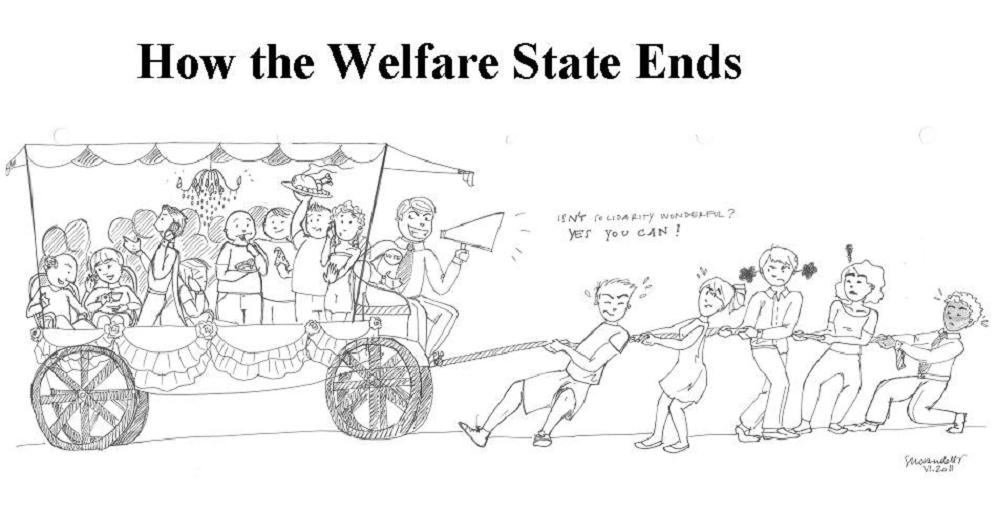
These images are remarkably accurate. The welfare state starts with small programs targeted at a handful of genuinely needy people. But as politicians figure out the electoral benefits of expanding programs and people figure out the that they can let others work on their behalf, the ratio of producers to consumers begins to worsen.
_________
When the government gets so big that it distorts the behavior of the private market then it is too big. The federal government is now spending 24.8% of GDP and traditionally for the first 150 years of our nation’s history we spent under 5% unless in wartime. This massive spending now by the federal encourages people to lie in order to get money for the government too instead of trying to work hard to earn money in the private market.
Why is big government bad for an economy? The easy answer is that big government usually means high tax rates, and this penalizes work, saving, investment, and entrepreneurship. And perhaps some of the spending is financed by borrowing, and this diverts money from private investment.
That’s a correct answer, but it’s only part of the story. In most cases, there is added damage because politicians spend money in ways that further undermine incentives to produce.
For instance, let’s assume a government spends $1 billion on some sort of redistribution program. Extracting that money from the productive sector of the economy obviously will cause some damage, but it’s also important to estimate how the supposed beneficiaries of the money will react. What if they decide to earn less income in order to be eligible for the handouts, as even the statists at the OECD have recognized?
In other words, it hurts the economy when government collects money, and it often hurts the economy when government spends money. Sort of a perverse 2-for-1 special (though “Rahn Curve” analysis does show that some types of spending – on core public goods – is correlated with better economic performance)
Let’s look at an example from Greece, showing how handouts distort behavior and corrupt people. Here are some remarkable tidbits from a Wall Street Journal story.
The Greek health ministry is investigating on Zakynthos after local officials flagged records showing what they said is an implausibly high number of disability claims for blindness. About 1.8% of the island’s population of 39,000 claimed the benefit last year, according to the health ministry. That is around nine times the prevalence of blindness estimated for many European countries in a 2004 study published in a World Health Organization journal. Among those who put in for the blindness benefit on Zakynthos, a local official said, were a taxi driver and a bird hunter. …But the island is hardly alone, according to health ministry officials, who say fraudulent disability claims are a problem across the nation… Zakynthos Mayor Stelios Bozikis on a Greek television talk show said residents angry about the benefits crackdown and other financial overhauls pelted him with yogurt at a recent event.
Let’s go back to the story and look at a rough estimate of how much fraud exists.
In an attempt to root out fraud, the Greek health ministry recently required disability claimants nationwide to register in a centralized database, appearing in person or sending a representative. The registration resulted in 36,000 fewer disability claims than in 2011, the health ministry said. The ministry alleges these dropped claims were fraudulent, in many cases reflecting multiple claims for the same disability or payments in the name of dead beneficiaries. It also alleges that some doctors accepted money for false diagnoses and some local politicians signed off on the benefits to win support, and said it is giving public prosecutors information about areas where it suspects a high level of fraud. Only 190 of the nearly 700 people it says had been collecting the blindness benefit on Zakynthos participated in the registration, the ministry said.
I have no idea if Zakynthos is representative, but that’s an incredibly high fraud rate. And this is just a glimpse at the workings of one government program. Now multiply that by some large number and you’ll begin to understand the damage caused by government.
And America is not immune. When politicians make it easier to ride in the wagon than to pull the wagon (as this cartoon illustrates), society sooner or later gets in trouble.
Friedman: Once all of this was a swamp, covered with forest. The Canarce Indians who lived here traded the 22 square miles of soggy Manhattan Island to the Dutch for $24.00 worth of cloth and trinkets. The newcomers founded a city, New Amsterdam at the edge of an empty continent. In the years that followed, it proved a magnet for millions of people from across the Atlantic; people who were driven by fear and poverty; who were attracted by the promise of freedom and plenty. They fanned out over the continent and built a new nation with their sweat, their enterprise and their vision of a better future.
For the first time in their lives, many were truly free to pursue their own objectives. That freedom released the human energies which created the United States. For the immigrants who were welcomed by this statue, America was truly a land of opportunity.
They poured ashore in their best clothes, eager and expectant, carrying what little they owned. They were poor, but they all had a great deal of hope. Once they arrived, they found, as my parents did, not an easy life, but a very hard life. But for many there were friends and relatives to help them get started __ to help them make a home, get a job, settle down in the new country. There were many rewards for hard work, enterprise and ability. Life was hard, but opportunity was real. There were few government programs to turn to and nobody expected them. But also, there were few rules and regulations. There were no licenses, no permits, no red tape to restrict them. They found in fact, a free market, and most of them thrived on it.
Many people still come to the United States driven by the same pressures and attracted by the same promise. You can find them in places like this. It’s China Town in New York, one of the centers of the garment industry __ a place where hundreds of thousands of newcomers have had their first taste of life in the new country. The people who live and work here are like the early settlers. They want to better their lot and they are prepared to work hard to do so.
Although I haven’t often been in factories like this, it’s all very familiar to me because this is exactly the same kind of a factory that my mother worked in when she came to this country for the first time at the age of 14, almost 90 years ago. And if there had not been factories like this here then at which she could have started to work and earn a little money, she wouldn’t have been able to come. And if I existed at all, I’d be a Russian or Hungarian today, instead of an American. Of course she didn’t stay here a long time, she stayed here while she learned the language, while she developed some feeling for the country, and gradually she was able to make a better life for herself.
Similarly, the people who are here now, they are like my mother. Most of the immigrants from the distant countries __ they came here because they liked it here better and had more opportunities. A place like this gives them a chance to get started. They are not going to stay here very long or forever. On the contrary, they and their children will make a better life for themselves as they take advantage of the opportunities that a free market provides to them.
The irony is that this place violates many of the standards that we now regard as every worker’s right. It is poorly ventilated, it is overcrowded, the workers accept less than union rate __ it breaks every rule in the book. But if it were closed down, who would benefit? Certainly not the people here. Their life may seem pretty tough compared to our own, but that is only because our parents or grandparents went through that stage for us. We have been able to start at a higher point.
Frank Visalli’s father was 12 years old when he arrived all alone in the United States. He had come from Sicily. That was 53 years ago. Frank is a successful dentist with a wife and family. They live in Lexington, Massachusetts. There is no doubt in Frank’s mind what freedom combined with opportunity meant to his father and then to him, or what his Italian grandparents would think if they could see how he lives now.
Frank Visalli: They would not believe what they would see __ that a person could immigrate from a small island and make such success out of their life because to them they were mostly related to the fields, working in the field as a peasant. My father came over, he made something for himself and then he tried to build a family structure. Whatever he did was for his family. It was for a better life for his family. And I can always remember him telling me that the number one thing in life is that you should get an education to become a professional person.
Friedman: The Visalli family, like all of us who live in the United States today, owe much to the climate of freedom we inherited from the founders of our country. The climate that gave full scope to the poor from other lands who came here and were able to make better lives for themselves and their children.
But in the past 50 years, we’ve been squandering that inheritance by allowing government to control more and more of our lives, instead of relying on ourselves. We need to rediscover the old truths that the immigrants knew in their bones; what economic freedom is and the role it plays in preserving personal freedom.
That’s why I came here to the South China Sea. It’s a place where there is an almost laboratory experiment in what happens when government is limited to its proper function and leaves people free to pursue their own objectives. If you want to see how the free market really works this is the place to come. Hong Kong, a place with hardly any natural resources. About the only one you can name is a great harbor, yet the absence of natural resources hasn’t prevented rapid economic development. Ships from all nations come here to trade because there are no duties, no tariffs on imports or exports. The power of the free market has enabled the industrious people of Hong Kong to transform what was once barren rock into one of the most thriving and successful places in Asia.
If you enjoyed that then take a look at the other segments:
PETERSON: Well, let me ask you how you would cope with this problem, Dr. Friedman. The people decided that they wanted cool air, and there was tremendous need, and so we built a huge industry, the air conditioning industry, hundreds of thousands of jobs, tremendous earnings opportunities and nearly all of us now have air […]
Part 5 Milton Friedman: I do not believe it’s proper to put the situation in terms of industrialist versus government. On the contrary, one of the reasons why I am in favor of less government is because when you have more government industrialists take it over, and the two together form a coalition against the ordinary […]
The fundamental principal of the free society is voluntary cooperation. The economic market, buying and selling, is one example. But it’s only one example. Voluntary cooperation is far broader than that. To take an example that at first sight seems about as far away as you can get __ the language we speak; the words […]
_________________________ Pt3 Nowadays there’s a considerable amount of traffic at this border. People cross a little more freely than they use to. Many people from Hong Kong trade in China and the market has helped bring the two countries closer together, but the barriers between them are still very real. On this side […]
Aside from its harbor, the only other important resource of Hong Kong is people __ over 4_ million of them. Like America a century ago, Hong Kong in the past few decades has been a haven for people who sought the freedom to make the most of their own abilities. Many of them are […]
“FREE TO CHOOSE” 1: The Power of the Market (Milton Friedman) Free to Choose ^ | 1980 | Milton Friedman Posted on Monday, July 17, 2006 4:20:46 PM by Choose Ye This Day FREE TO CHOOSE: The Power of the Market Friedman: Once all of this was a swamp, covered with forest. The Canarce Indians […]
Michael Ramirez is a first-rate cartoonist for Investor’s Business Daily. Here are two of his recent gems.
As always, humor works when it is based on something true.
With that in mind, do you prefer this cartoon, which shows Obama scolding the Founding Fathers for their extreme libertarian views?
Or what about this cartoon, which makes the obvious point that growth is rather difficult when the productive sector of the economy is hobbled by too much government.
Obama on Ryan Plan: “It’s Laughable. It Is a Trojan Horse. It’s Thinly-Veiled Social Darwinism.”
Dan Mitchell of the Cato Institute has hit a home run with this post. If Congressman Paul Ryan could get criticized for wanting to bring down our federal spending to around 20% in 11 years and earn the label of “social darwinist” from President Obama then surely President Obama would have thought President Clinton’s effort to cut spending to 18.2 % of GDP in 2001 as extremely devilish.
Actually, Bill Clinton must be something even worse than a social Darwinist. That’s because the title of this post is wrong. Obama said that Paul Ryan’s plan (which allows spending to grow by an average of 3.1 percent per year over the next decade) is a form of “social Darwinism.”
Yet when Bill Clinton left office in 2001, following several years of spending restraint, the federal government was consuming 18.2 percent of economic output.
And by the President’s reasoning, this must make Clinton something worse than a Darwinist. Perhaps Marquis de Sade or Hannibal Lecter.
Mr. Obama’s attack, in a speech during a lunch with editors and reporters from The Associated Press, was part of a broader indictment of the Republican economic blueprint for the nation. The Republican budget, and the philosophy it represents, he said in remarks prepared for delivery, is “antithetical to our entire history as a land of opportunity and upward mobility for everyone who’s willing to work for it.” …“Disguised as a deficit reduction plan, it’s really an attempt to impose a radical vision on our country. It’s nothing but thinly veiled social Darwinism,” Mr. Obama said. “By gutting the very things we need to grow an economy that’s built to last — education and training, research and development — it’s a prescription for decline.”
I’m particularly amused by the President’s demagoguery that Ryan’s plan is “antithetical to our entire history” and “a radical vision.”
Is he really unaware that a small and constrained central government is part of America’s history and vision? Doesn’t he know that the federal government, for two-thirds of our nation’s history, consumed less than 5 percent of GDP?
Of course, that was back in the dark ages when people in Washington actually believed that the Constitution’s list of enumerated powers in Article 1, Section 8, actually enumerated the powers of the federal government. How quaint.




 Proponent of social Darwinism?


 The Daily Hatch