A lot of big-city police chiefs are political appointees who promote gun control, presumably to please their political masters.
They tell citizens that they should passively rely on government rather than take personal responsibility for self defense.
I have no idea if the numbers in this image are correct, but there’s no doubt that a gun is a lot quicker than the cops. Heck, just watch this video and ask yourself whether you would want your daughter armed.
And the cops I know – the ones who actually interact with the public and fight crime – are supportive of the Second Amendment, precisely because they realize they can’t be everywhere and they know there are bad people in the world.
But not all police chiefs and senior cops are mindless bureaucrats. In this video, the Sheriff of Milwaukee County not only acknowledges the right of self defense, but he’s also is willing to help train citizens to resist crime.
This doesn’t necessarily make him a libertarian hero. Indeed, his comments about layoffs and furloughs indicate that he’s also interested in maximizing the size of his staff.
Poster for November 2008 benefit for Pressly family, held at Peabody Hotel in Little Rock. ______________ Max Brantley of the Ark Times Blog often attacks those on my side of the gun control debate and that makes me argue even harder for the 2nd amendment. Several months ago Lindsey Miller and Max Brantley were talking […]
I have posted some cartoons featured on Dan Mitchell’s blog before and they are very funny. An Amusing Look at Gun-Free Zones September 26, 2012 by Dan Mitchell I’ve shared a very clever Chuck Asay cartoon about gun-free zones, so let’s now enjoy four posters on the topic. Let’s begin with a good jab at one […]
The recent killing by a mad gunman in CT is not indicating a trend. School killings have gone down and probably peaked in 1929. Nick Gillespie reported in the below video, “Across the board, schools are less dangerous than they used be. Over the past 20 years, the rate of theft per 1,000 students dropped […]
Pretty shocking admissions from the liberal Jeffrey Goldberg on gun control. An Honest Liberal Writes about Gun Control December 16, 2012 by Dan Mitchell I wrote earlier this month about an honest liberal who acknowledged the problems created by government dependency. Well, it happened again. First, some background. Like every other decent person, I was horrified […]
Despite what Max Brantley of the Arkansas Times Blog (1-9-13) would have you believe gun control does not make since unless you suspend your reasoning ability. There are so many examples that show how silly gun control is. Mocking Gun Control Fanatics October 18, 2012 by Dan Mitchell Last month, I shared some very amusing images […]
It seems to me that most of the gun control arguments I have heard are not very logical. Deciphering How Statists Think about Gun Control September 9, 2012 by Dan Mitchell Even though I don’t own that many guns, I’m an unyielding supporter of the 2nd Amendment. Indeed, I use gun control as a quick and […]
John Stossel report “Myth: Gun Control Reduces Crime After this horrible shooting in the school the other day it seems the gun control debate has fired up again. Max Brantley of the Arkansas Times jumped on Charlie Collins concerning his position on concealed weapons but I think that would lower gun crimes and not raise […]
Liberals love to talk a lot about taking up all the guns and how the world would be such a better place. Even Bob Costas jumped in yesterday and got into the mix. An IQ Test for Criminals and Liberals November 8, 2012 by Dan Mitchell A lot of people say Obama is anti-business, but there’s […]
Abbott and Costello perform the classic “Who’s on first?” baseball sketch in their 1945 film “The Naughty Nineties” first performed as part of their stage act. Still find this really funny
Who’s on First? is a vaudevillecomedy routine made most famous by Abbott and Costello. In Abbott and Costello’s version, the premise of the routine is that Abbott is identifying the players on a baseball team to Costello, but their names and nicknames can be interpreted as non-responsive answers to Costello’s questions. In this context, the first baseman is named “Who”; thus, the utterance “Who’s on first” is ambiguous between the question (“which person is the first baseman?”) and the answer (“The name of the first baseman is ‘Who'”).
“Who’s on First?” is descended from turn-of-the-century burlesque sketches that used plays on words and names. Examples are “The Baker Scene” (the shop is located on Watt Street) and “Who Dyed” (the owner is named Who). In the 1930 movie Cracked Nuts, comedians Bert Wheeler and Robert Woolsey examine a map of a mythical kingdom with dialogue like this: “What is next to Which.” “What is the name of the town next to Which?” “Yes.” In English variety halls (Britain’s equivalent of vaudeville theatres), comedian Will Hay performed a routine in the early 1930s (and possibly earlier) as a schoolmaster interviewing a schoolboy named Howe who came from Ware but now lives in Wye. By the early 1930s, a “Baseball Routine” had become a standard bit for burlesque comics across the United States. Abbott’s wife recalled Bud performing the routine with another comedian before teaming with Costello.[1]
Bud Abbott stated that it was taken from an older routine called “Who’s The Boss?”, a performance of which can be heard in an episode of the radio comedy program It Pays to Be Ignorant from the 1940s.[2] After they formally teamed up in burlesque in 1936, he and Costello continued to hone the sketch. It was a big hit in 1937 when they performed the routine in a touring vaudeville revue called “Hollywood Bandwagon”.[1]
In February 1938, Abbott and Costello joined the cast of The Kate Smith Hour radio program, and the sketch was first performed for a national radio audience that March.[1] The routine may have been further polished before this broadcast by burlesque producer John Grant, who became the team’s writer, and Will Glickman, a staff writer on the radio show.[3] Glickman may have added the nicknames of then-contemporary baseball players like Dizzy and Daffy Dean to set up the routine’s premise. This version, with extensive wordplay based on the fact that most of the fictional baseball team’s players had “strange nicknames” that seemed to be questions, became known as “Who’s on First?” By 1944, Abbott and Costello had the routine copyrighted.
Abbott and Costello performed “Who’s on First?” numerous times in their careers, rarely performing it exactly the same way twice. They did the routine for President Franklin Roosevelt several times. An abridged version was featured in the team’s 1940 film debut, One Night in the Tropics. The duo reprised the bit in their 1945 film The Naughty Nineties, and it is that longer version which is considered their finest recorded rendition. They also performed “Who’s on First?” numerous times on radio and television (notably in The Abbott and Costello Show episode “The Actor’s Home”).
In 1956 a gold record of “Who’s on First?” was placed in the Baseball Hall of Fame museum in Cooperstown, New York. A video (taken from The Naughty Nineties) now plays continuously on screens at the Hall.
Shortstop: I Don’t Care/I Don’t Give a Darn/I Don’t Give a Damn
The name of the shortstop is not given until the very end of the routine, and the right fielder is never identified. In the Selchow and Righter board game, the right fielder’s name is “Nobody”.[5]
At one point in the routine, Costello thinks that Naturally is the first baseman:
Abbott: You throw the ball to first base. Costello: Then who gets it? Abbott: Naturally. Costello: Naturally. Abbott: Now you’ve got it. Costello: I throw the ball to Naturally. Abbott: You don’t! You throw it to Who! Costello: Naturally. Abbott: Well, that’s it—say it that way. Costello: That’s what I said. Abbott: You did not. Costello: I said I throw the ball to Naturally. Abbott: You don’t! You throw it to Who! Costello: Naturally.
Abbott’s explanations leave Costello hopelessly confused and infuriated, until the end of the routine when he finally appears to catch on. “You got a couple of days on your team?” He never quite figures out that the first baseman’s name literally is “Who”. But after all this he announces, “I don’t give a darn!” (“Oh, that’s our shortstop.”) That is the most commonly heard ending, which varied depending on the perceived sensibilities of the audience. The even milder “I Don’t Care” was used in the version seen in the film The Naughty Nineties. A recording of the obvious “I Don’t Give a Damn” has also turned up on occasion.
The skit serves as a climax for an Abbott and Costello radio broadcast which begins with Costello receiving a telegram from Joe DiMaggio asking Costello to take over for him.[6]
I was impacted by this film series by Francis Schaeffer back in the 1970’s and I wanted to share it with you. Schaeffer makes three key points concerning the Reformation: “1. Erasmian Christian humanism rejected by Farel. 2. Bible gives needed answers not only as to how to be right with God, but concerning the meaning of life and what is right and what is wrong, and concerning mankind and nature. 3. The people of the Reformation did not have humanism’s problem, because the Bible gives a unity between God—as the ultimate universal—and the individual things.” What a great difference this made in the world!!!
E P I S O D E 4
T h e
REFORMATION
I. The Reformation as a Reaction Against Medieval Religious Distortions of the Biblical and Early Christian Church’s Teaching
A. Illustration from Luther.
B. Luther—German; Zwingli—Zürich; Thomas Cromwell—England; Calvin—Geneva.
C. Biblical view of salvation (grace only) and its effect on certain aspects of church construction.
D. Real meaning of destruction of artwork in Reformation.
E. The Reformation rejected.
1. Medieval distortion of Church’s having made its authority equal to the authority of the Bible.
2. Medieval distortion of Church’s having added human works to the finished work of Christ for salvation.
3. Medieval distortion introduced by Aquinas: mixture of biblical thinking and pagan thought.
F. Summary of humanistic influence in church.
1. Illustrated by Raphael’s School of Athens and Disputà.
2. Illustrated by Michelangelo’s making pagan prophetesses equal to Old Testament prophets in Sistine Chapel.
G. For William Farel and the other Reformers it was the Scriptures only.
1. Erasmian Christian humanism rejected by Farel.
2. Bible gives needed answers not only as to how to be right with God, but concerning the meaning of life and what is right and what is wrong, and concerning mankind and nature.
3. The people of the Reformation did not have humanism’s problem, because the Bible gives a unity between God—as the ultimate universal—and the individual things.
4. The Reformation was no golden age, but it did aspire to depend on the Bible in all of life.
II. The Reformation and the Arts
A. German Reformation music tradition peaks in Bach.
B. Significance of Cranach’s and Luther’s friendship.
C. Dürer’s identification with Luther evidenced in his diary; significance of his work.
D. Rembrandt’s paintings show that he understood that his sins had sent Christ to the cross, and that Christ is the Lord of all of life.
E. Point is not to romanticize Reformation art but refute view that reformation was either hostile to art and culture, or did not produce art and culture.
F.Wittenberg Gesangbuch , Geneva Psalter, and revival of congregational singing.
III. Comparison of Renaissance and Reformation.
Both sought freedom. In the South license resulted from lack of absolutes; in the North freedom lasted through absolutes.
Questions
1. Can you clearly differentiate between the key ideas of the Renaissance and the Reformation, respectively?
2. “The Reformation is simply the last gasp of medieval Christianity. Once exhausted, the truly modern and humane force of the Renaissance dominated the West.” Comment.
3. “As a man thinketh, so is he”—the renewed emphasis upon the Bible’s teaching in the Reformation had practical results. If some of these results are no longer common among us, how far may this be attributed to a de-emphasis upon biblical teaching today?
I got on the Arkansas Times Blog and noticed that a person on there was bragging about the high minimum wage law in San Francisco and how everything was going so well there.
Couldn’t be better (the person using the username “Couldn’t be better) is bragging on California while Rick Perry just got finished with a recruiting tour of the state because so many California businesses are continuing to leave there for low tax Texas.
It has been a joy to watch Jerry Brown destroy the state with his liberal philosophy. At least he is not a Rino like Arnold. The liberals in California are getting a dose of their own medicine and the Phil Micklesons of the world will be relocating soon. Is that the utopia you are referring to?
Saline, Perry got zero (0) businesses because companies care about their employees also and Gov Goodhair has destroyed the Texas school system which no one thought could be made worse but he showed that there is no level of education that can’t be further destroyed by stupid Republicans.
Taxes aren’t the only reason anyone move but I know that Republicans only care about their money and people really don’t matter. Most Californians actually read and can see what the Tea Pot brains have done to Texas and the only good news is that in 20 years, when they start to rebuild Texas based on no oil or gas, that the Democratic Hispanic majority do care about families and their kid’s education. In the interim, Austin will continue to survive in their Alamo mode.
You are correct that Perry’s recent trip has not produced any immediate results. The Houston local CBS station reported on 2-13-13 that Rick Perry is empty handed so far on this one trip to California where he met with 20 business leaders who had expressed interest in moving to Texas where there are less taxes, and red tape. The fact that these business leaders requested Perry to come is not a good sign for California.
When you try and tax and spend too much then the business community will try and relocate to another state. That is exactly what is happening in California today.
Sometimes I wonder what planet liberals are from. The economy of California was the strongest in the nation in the 1970′s when Ronald Reagan was the governor, but after the green movement and other liberal regulators got a hold of it, things went south fast.
I could give you countless stories about people I know that have told me that their customers are in California, but they build their warehouses in surrounding states and ship their products into California. They tell me that you would have to be crazy to try to build a warehouse in California because of all the red tape you have to put up with.
President Obama has raised taxes on the rich just like California Governor Jerry Brown did. How is that working out for Jerry? Now businesses are leaving California for Texas. How do I know this is true? Look at what Dan Mitchell had to say recently on his blog:
Indeed, in the last five years Texas has gained 400,000 new jobs while California has lost 640,000. The Lone Star State’s rate of job growth was 33 percent higher than California’s last year, even as the Golden State finally pulled out of the recession. …Texas’s legislature has just trimmed its $188 billion two-year budget by 8 percent, and the state may have more revenue than it can legally spend because it is barred from raising outlays more than the rate of economic growth.
_____
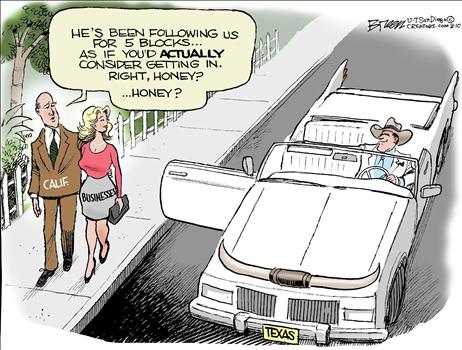
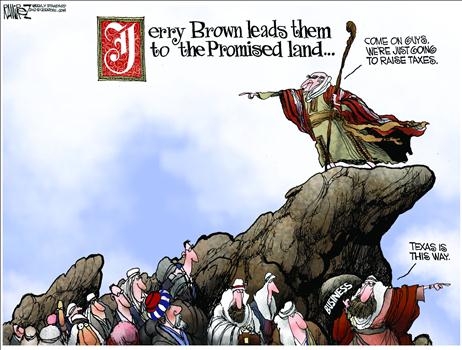
Let me get you something to laugh about. Dan Mitchell posted three funny cartoons about people leaving California for Texas.
So it’s understandable that the Governor of Texas is telling employers in California that his state has a better climate for job creation.
John Fund of National Review opines on this bit of competition between states.
Texas governor Rick Perry knows how to start a rumble. Last week, he spent a mere $24,000 on radio ads in California, urging firms there to move to Texas, with its “zero state income tax, low overall tax burden, sensible regulations, and fair legal system.” …He begins a four-day barnstorming tour of California today, touting Texas’s virtues to business owners. …several observers acknowledged that Perry has gotten the better of the battle.
Indeed, in the last five years Texas has gained 400,000 new jobs while California has lost 640,000. The Lone Star State’s rate of job growth was 33 percent higher than California’s last year, even as the Golden State finally pulled out of the recession. …Texas’s legislature has just trimmed its $188 billion two-year budget by 8 percent, and the state may have more revenue than it can legally spend because it is barred from raising outlays more than the rate of economic growth.
Here’s a very good Steve Breen cartoon about Perry’s fishing trip to the west coast.
Phil Mickelson said he will make “drastic changes” because of federal and California state tax increases. …The 42-year-old golfer said he would talk in more detail about his plans — possibly moving away from California or even retiring from golf… Mickelson said. “I’ll probably talk about it more in depth next week. …There are going to be some drastic changes for me because I happen to be in that zone that has been targeted both federally and by the state and, you know, it doesn’t work for me right now. So I’m going to have to make some changes.” …”If you add up all the federal and you look at the disability and the unemployment and the Social Security and the state, my tax rate’s 62, 63 percent,” said Mickelson, who lives in Rancho Santa Fe. “So I’ve got to make some decisions on what I’m going to do.”
He’s actually overstating his marginal tax rate. I suspect it’s closer to 50 percent.
California politicians got too greedy and now they may get 13.3 percent of nothing
But so what? It’s still outrageous and immoral that government is confiscating one-half of the income he generates.
Heck, medieval serfs were virtually slaves, yet they only had to give at most one-third of their output to the Lord of the Manor.
I hope he’s serious and that he escapes from the Golden State’s fiscal hell-hole.
And if he does, what will it mean for California government finances?
According to one estimate of 2011 earnings (comprising salary, winnings, bonuses, endorsements and appearances) Mickelson was then the second-highest paid athlete in the United States, earning an income of over $62 million, $53 million of which came from endorsements.
Now let’s bend over backwards to make sure we’re not exaggerating. Notwithstanding the Wikipedia estimate, let’s assume his annual taxable income will be only $40 million for 2013 and beyond.
With a 10.3 percent top tax rate, California would collect about $4.12 million per year. And Mickelson apparently thought that was tolerable.
But guess how much the politicians will collect if he leaves the state? I’m tempted to say zero, but they may still get some revenue because of California-based tournaments and other factors.
Find Phil Mickelson
I can say with great confidence, however, that California won’t collect $5.32 million, which is probably what the politicians assumed when they seduced voters into approving the 13.3 percent tax rate.
After all, that assumption only works if Mickelson is willing to be a fiscal slave for Jerry Brown and the rest of the crooks in Sacramento.
As such, I’ll also state with certainty that California’s politicians won’t collect $4 million if Mickelson leaves for another state. Or $3 million. Or $2 million. Or even $1 million.
The best they can hope for is that Mickelson decides to stay in the state while also reducing his taxable income. In that scenario, the politicians might still pocket a couple of million dollars.
Not as much as they collected when the tax rate was 10.3 percent, and far less than what they erroneously assumed they would get with a 13.3 percent rate.
Hopefully we’re all disgusted when insiders rig the system to rip off taxpayers. And I suspect you’re not surprised to see that the worst example on that list comes from California, which is in a race with Illinois to see which state can become the Greece of America.
The numbers are even larger in California, where a state psychiatrist was paid $822,000, a highway patrol officer collected $484,000 in pay and pension benefits and 17 employees got checks of more than $200,000 for unused vacation and leave. The best-paid staff in other states earned far less for the same work, according to the data.
Wow, $822,000 for a state psychiatrist. Not bad for government work. So what is Governor Jerry Brown doing to fix the mess? As you might expect, he’s part of the problem.
…the state’s highest-paid employees make far more than comparable workers elsewhere in almost all job and wage categories, from public safety to health care, base pay to overtime. …California has set a pattern of lax management, inefficient operations and out-of-control costs. …In California, Governor Jerry Brown hasn’t curbed overtime expenses that lead the 12 largest states or limited payments for accumulated vacation time that allowed one employee to collect $609,000 at retirement in 2011. …Last year, Brown waived a cap on accrued leave for prison guards while granting them additional paid days off. California’s liability for the unused leave of its state workers has more than doubled in eight years, to $3.9 billion in 2011, from $1.4 billion in 2003, according to the state’s annual financial reports. …The per-worker costs of delivering services in California vastly exceed those even in New York, New Jersey, Illinois and Ohio.
I suppose the silver lining to that dark cloud is that many bureaucrats now rank as part of the top 1 percent, so they’ll have to recycle some of their loot back to the political vultures in Sacramento.
But the biggest impact of the tax hike – as shown in the Ramirez cartoon – will be to accelerate the shift of entrepreneurs, investors, and small business owners to states that don’t steal as much. Indeed, a study from the Manhattan Institute looks at the exodus to lower-tax states.
The data also reveal the motives that drive individuals and businesses to leave California. One of these, of course, is work. …Taxation also appears to be a factor, especially as it contributes to the business climate and, in turn, jobs. Most of the destination states favored by Californians have lower taxes. States that have gained the most at California’s expense are rated as having better business climates. The data suggest that many cost drivers—taxes, regulations, the high price of housing and commercial real estate, costly electricity, union power, and high labor costs—are prompting businesses to locate outside California, thus helping to drive the exodus.
Does Government Have a Revenue or Spending Problem? People say the government has a debt problem. Debt is caused by deficits, which is the difference between what the government collects in tax revenue and the amount of government spending. Every time the government runs a deficit, the government debt increases. So what’s to blame: too […]
Former California Governor Arnold Schwarzenegger with his family I posted a portion of an article by John Fund of the Wall Street Journal that pointed out that many businesses are leaving California because of all of their government red tape and moving to Texas. My username is SalineRepublican and this is […]
John Fund at Chamber Day, Part 1 Last week I got to attend the first ever “Conservative Lunch Series” presented by KARN and Americans for Prosperity Foundation at the Little Rock Hilton on University Avenue. This monthly luncheon will be held the fourth Wednesday of every month. The speaker for today’s luncheon was John Fund. John […]
Is our country learning from history? California keeps raising their taxes on the wealthy and people keep moving from California to Texas. What does our federal government do? They also have been raising taxes on the wealthy lately. Take a look at this excellent video below and then read a great article by Dan Mitchell […]
You can’t blame someone for leaving one state for another if they have a better an opportunity to make money. Maryland to Texas, but Not Okay to Move from the United States to Singapore? July 12, 2012 by Dan Mitchell I’ve commented before about entrepreneurs, investors, and small business owners migrating from high tax states such […]
If our country is the grow the economy and get our budget balanced it will not be by raising taxes!!! The recipe for success was followed by Ronald Reagan in the 1980′s when he cut taxes and limited spending. As far as limiting spending goes only Bill Clinton (with his Republican Congress) were ability to […]
Gene Stallings used to interview the boys that dated his daughters. He asked his future son-in-laws if they played sports. He wanted to know if they had competed at something. Below is an article on what Stallings thinks about Texas A&M joining SEC. Stallings: SEC best fit for A&M By Troy Schulte Wednesday, September 7, […]
This week I watched on tv the replay of the last game in the series with Texas. It was the 1991 game in Little Rock against Texas. Right before that game Craig O’Neill pulled a prank on the Texas Athletic Dept. Listen to the clip above. The Arkansas Times Blog reported: Craig O’Neill tells all […]
I posted a portion of an article by John Fund of the Wall Street Journal that pointed out that many businesses are leaving California because of all of their government red tape and moving to Texas. My username is SalineRepublican and this is how “Couldn’tBeBetter” responded this morning: Saline, if Texas is so great, don’t […]
I truly believe that many of the problems we have today in the USA are due to the advancement of humanism in the last few decades in our society. Ronald Reagan appointed the evangelical Dr. C. Everett Koop to the position of Surgeon General in his administration. He partnered with Dr. Francis Schaeffer in making the video below. It is very valuable information for Christians to have. Actually I have included a video below that includes comments from him on this subject.
___________
Francis and Edith Schaeffer pictured below.
Francis Schaeffer: “Whatever Happened to the Human Race” (Episode 3) DEATH BY SOMEONE’S CHOICE
Sanctity of Human Life Sunday (SOHLS) will be celebrated in churches across the nation this Sunday, January 20, 2013. In sermons, prayers, and songs, worshipers will acknowledge God as our Creator and affirm our identity as persons made in his image and set apart for his glory and service.Motte Brown wrote this account of the establishment of SOHLS in 2007. It is currently posted on Boundless Line:In 1983, an organization named Christian Action Council (now known as Care Net), founded with the help of Francis Schaeffer and former Surgeon General C. Everett Koop, asked President Ronald Reagan to “create a special day to focus on the intrinsic value of human life.”Sources conflict about whether the initial proclamation was 1983 or 1984, but it was President Ronald Reagan who designated the third Sunday in January as Sanctity of Human Life Day. The third Sunday of January is the closest Sunday to the January 22nd anniversary of the 1973 Roe V. Wade Supreme Court Decision that legalized abortion in the United States.According to Wikipedia, Reagan issued the proclamation annually for the remainder of his Presidency. Both Presidents Bush (George H. and George W.) continued the tradition interrupted by Bill Clinton’s tenure of eight years as President. President Obama has declined proclamation of Sanctity of Human Life day during his presidential tenure to date.The purpose of Sanctity of Human Life Sunday (SOHLS) was articulated by Ronald Reagan as follows:
Since 1973, however, more than 15 million unborn children [that number now stands at more than 50 million] have died in legalized abortions — a tragedy of stunning dimensions that stands in sad contrast to our belief that each life is sacred. These children, over tenfold [now even more] the number of Americans lost in all our Nation’s wars, will never laugh, never sing, never experience the joy of human love; nor will they strive to heal the sick, or feed the poor, or make peace among nations. Abortion has denied them the first and most basic of human rights, and we are infinitely poorer for their loss.
We are poorer not simply for lives not led and for contributions not made, but also for the erosion of our sense of the worth and dignity of every individual. To diminish the value of one category of human life is to diminish us all. Slavery, which treated Blacks as something less than human, to be bought and sold if convenient, cheapened human life and mocked our dedication to the freedom and equality of all men and women. Can we say that abortion — which treats the unborn as something less than human, to be destroyed if convenient — will be less corrosive to the values we hold dear?
Throughout the years since 1983, various individuals and organizations have hoped to accomplish a number of goals through the celebration of SOHLS. In addition to celebrating the intrinsic value of human life, Carenet, a network of pregnancy care centers, sees this important day as “an opportunity for pregnancy centers to share about the work they do to bring life-affirming resources to their communities and to empower women and men to choose life for their unborn children.” SOHLS is a Sunday that highlights the hope and services pregnancy care centers offer. Many churches participate in raising funds by kicking off a baby bottle campaign on this day in their churches for the benefit of community pregnancy care outreach.
SOHLS is an opportunity to educate congregations on life issues. Through special bulletin inserts, special speakers, children’s sermons, and targeted worship resources churches seek to turn the tragic reality of abortion into a focus on the sacred value of human life. Often special events such as a video showing, a pro-life baby shower, special Sunday lessons and sermons, or the ringing of bells, the planting of crosses, or candle vigils help to commemorate the lives lost to abortion.
Remembering Roe: a special day of prayer and fasting. SOHLS is particularly significant in 2013, the 40th year since the Supreme Court ruling in Roe v. Wade and Doe v. Bolton which took place on January 22, 1973 and legalized abortion in our country. In addition to the Sunday celebration a host of pro-life organizations, who together affirm the value, dignity and sanctity of human life, have joined together to organize a special day of prayer and fasting remembering Roe on January 22, 2013. Individuals may register at http://www.rememberingroe.com for web based prayer event, post prayers on the website, send a message to the president, or share personal stories of where they were when abortion was legalized
An Ecumenical prayer service: National Memorial for the Pre-Born and Their Mothers and Fathers. A special commemorative service sponsored by members of the National Pro-Life Religious Council will be held at Constitution Hall in Washington D.C. ( (18th and D St.) on the January 25, 2013. Held just a few hours before the March for Life, the 8:30-10:30 am ecumenical prayer service will include participants from several denominations. Participants will commemorate lives lost to abortion and remember the life of Nellie Gray, founder of the March for Life.
Resources for SOHLS
Worship resources from a distinctly Presbyterian and Reformed perspective are available under the ‘Ministry Equipping’ tab of this website.
Right to Life of Michigan publishes a downloadable Prolife Litany and a Christian Discussion Guide on their website.
Focus on the Family offers videos to show on Sanctity of Human Life Sunday or throughout the month of January to inform about the impact of abortion on our nation.
Lutherans for Life is offering a slightly different focus in their resources for SOHLS in 2013. See their website for a host of materials for “living with Dying.”
Bethany Christian Services provides online resources with a focus on adoption.
Francis Schaeffer: “Whatever Happened to the Human Race” (Episode 1) ABORTION OF THE HUMAN RACE Published on Oct 6, 2012 by AdamMetropolis The 45 minute video above is from the film series created from Francis Schaeffer’s book “Whatever Happened to the Human Race?” with Dr. C. Everett Koop. This book really helped develop my political views […]
E P I S O D E 1 0 Dr. Francis Schaeffer – Episode X – Final Choices 27 min FINAL CHOICES I. Authoritarianism the Only Humanistic Social Option One man or an elite giving authoritative arbitrary absolutes. A. Society is sole absolute in absence of other absolutes. B. But society has to be […]
E P I S O D E 9 Dr. Francis Schaeffer – Episode IX – The Age of Personal Peace and Affluence 27 min T h e Age of Personal Peace and Afflunce I. By the Early 1960s People Were Bombarded From Every Side by Modern Man’s Humanistic Thought II. Modern Form of Humanistic Thought Leads […]
E P I S O D E 8 Dr. Francis Schaeffer – Episode VIII – The Age of Fragmentation 27 min I saw this film series in 1979 and it had a major impact on me. T h e Age of FRAGMENTATION I. Art As a Vehicle Of Modern Thought A. Impressionism (Monet, Renoir, Pissarro, Sisley, […]
E P I S O D E 7 Dr. Francis Schaeffer – Episode VII – The Age of Non Reason I am thrilled to get this film series with you. I saw it first in 1979 and it had such a big impact on me. Today’s episode is where we see modern humanist man act […]
E P I S O D E 6 How Should We Then Live 6#1 Uploaded by NoMirrorHDDHrorriMoN on Oct 3, 2011 How Should We Then Live? Episode 6 of 12 ________ I am sharing with you a film series that I saw in 1979. In this film Francis Schaeffer asserted that was a shift in […]
E P I S O D E 5 How Should We Then Live? Episode 5: The Revolutionary Age I was impacted by this film series by Francis Schaeffer back in the 1970′s and I wanted to share it with you. Francis Schaeffer noted, “Reformation Did Not Bring Perfection. But gradually on basis of biblical teaching there […]
Dr. Francis Schaeffer – Episode IV – The Reformation 27 min I was impacted by this film series by Francis Schaeffer back in the 1970′s and I wanted to share it with you. Schaeffer makes three key points concerning the Reformation: “1. Erasmian Christian humanism rejected by Farel. 2. Bible gives needed answers not only as to […]
Francis Schaeffer’s “How should we then live?” Video and outline of episode 3 “The Renaissance” Francis Schaeffer: “How Should We Then Live?” (Episode 3) THE RENAISSANCE I was impacted by this film series by Francis Schaeffer back in the 1970′s and I wanted to share it with you. Schaeffer really shows why we have so […]
Francis Schaeffer: “How Should We Then Live?” (Episode 2) THE MIDDLE AGES I was impacted by this film series by Francis Schaeffer back in the 1970′s and I wanted to share it with you. Schaeffer points out that during this time period unfortunately we have the “Church’s deviation from early church’s teaching in regard […]
Francis Schaeffer: “How Should We Then Live?” (Episode 1) THE ROMAN AGE Today I am starting a series that really had a big impact on my life back in the 1970′s when I first saw it. There are ten parts and today is the first. Francis Schaeffer takes a look at Rome and why […]
Francis Schaeffer: “Whatever Happened to the Human Race” (Episode 5) TRUTH AND HISTORY Published on Oct 7, 2012 by AdamMetropolis This crucial series is narrated by the late Dr. Francis Schaeffer and former Surgeon General Dr. C. Everett Koop. Today, choices are being made that undermine human rights at their most basic level. Practices once […]
The opening song at the beginning of this episode is very insightful. Francis Schaeffer: “Whatever Happened to the Human Race” (Episode 4) THE BASIS FOR HUMAN DIGNITY Published on Oct 7, 2012 by AdamMetropolis This crucial series is narrated by the late Dr. Francis Schaeffer and former Surgeon General Dr. C. Everett Koop. Today, choices […]
Francis Schaeffer: “Whatever Happened to the Human Race” (Episode 3) DEATH BY SOMEONE’S CHOICE Published on Oct 6, 2012 by AdamMetropolis This crucial series is narrated by the late Dr. Francis Schaeffer and former Surgeon General Dr. C. Everett Koop. Today, choices are being made that undermine human rights at their most basic level. Practices […]
Francis Schaeffer: “Whatever Happened to the Human Race?” (Episode 2) SLAUGHTER OF THE INNOCENTS Published on Oct 6, 2012 by AdamMetropolis This crucial series is narrated by the late Dr. Francis Schaeffer and former Surgeon General Dr. C. Everett Koop. Today, choices are being made that undermine human rights at their most basic level. Practices […]
It is not possible to know where the pro-life evangelicals are coming from unless you look at the work of the person who inspired them the most. That person was Francis Schaeffer. I do care about economic issues but the pro-life issue is the most important to me. Several years ago Adrian Rogers (past president of […]
This essay below is worth the read. Schaeffer, Francis – “Francis Schaeffer and the Pro-Life Movement” [How Should We Then Live?, Whatever Happened to the Human Race?, A Christian Manifesto] Editor note: <p> </p> [The following essay explores the role that Francis Schaeffer played in the rise of the pro-life movement. It examines the place of […]
Great article on Schaeffer. Who was Dr. Francis A. Schaeffer? By Francis Schaeffer The unique contribution of Dr. Francis Schaeffer on a whole generation was the ability to communicate the truth of historic Biblical Christianity in a way that combined intellectual integrity with practical, loving care. This grew out of his extensive understanding of the Bible […]
Valentine’s Day is a happy day but if you look at what President Obama has done for the USA then you can see why she is not that happy to get a Valentine card from him. Dan Mitchell’s blog comes through again with another great cartoon.
This Henry Payne cartoon is satire, but it’s eerie how the “Valentine’s Fairness Act” seems quite similar to the litany of spending, regulation, and intervention we endured as part of the State of the Union address.
Max Brantley is wrong about Tom Cotton’s accusation concerning the rise of welfare spending under President Obama. Actually welfare spending has been increasing for the last 12 years and Obama did nothing during his first four years to slow down the rate of increase of welfare spending. Rachel Sheffield of the Heritage Foundation has noted: […]
I have put up lots of cartoons from Dan Mitchell’s blog before and they have got lots of hits before. Many of them have dealt with the economy, eternal unemployment benefits, socialism, Greece, welfare state or on gun control. I think Max Brantley of the Arkansas Times Blog was right to point out on 2-6-13 that Hillary […]
I thought it was great when the Republican Congress and Bill Clinton put in welfare reform but now that has been done away with and no one has to work anymore it seems. In fact, over 40% of the USA is now on the government dole. What is going to happen when that figure gets over […]
Again we have another shooting and the gun control bloggers are out again calling for more laws. I have written about this subject below and on May 23, 2012, I even got a letter back from President Obama on the subject. Now some very interesting statistics below and a cartoon follows. (Since this just hit the […]
watch?v=llQUrko0Gqw] The federal government spends about 10% on roads and public goods but with the other money in the budget a lot of harm is done including excessive regulations on business. That makes Obama’s comment the other day look very silly. A Funny Look at Obama’s You-Didn’t-Build-That Comment July 28, 2012 by Dan Mitchell I made […]
I have written a lot about this in the past and sometimes you just have to sit back and laugh. Laughing at Obama’s Bumbling Class Warfare Agenda July 13, 2012 by Dan Mitchell We know that President Obama’s class-warfare agenda is bad economic policy. We know high tax rates undermine competitiveness. And we know tax increases […]
Dan Mitchell Discussing Dishonest Budget Numbers with John Stossel Uploaded by danmitchellcato on Feb 11, 2012 No description available. ______________ Dan Mitchell of the Cato Institute has shown before how excessive spending at the federal level has increased in recent years. A Humorous Look at Obama’s Screwy Budget Math May 31, 2012 by Dan Mitchell I’ve […]
Sometimes it is so crazy that you just have to laugh a little. The European Mess, Captured by a Cartoon June 22, 2012 by Dan Mitchell The self-inflicted economic crisis in Europe has generated some good humor, as you can see from these cartoons by Michael Ramirez and Chuck Asay. But for pure laughter, I don’t […]
Another great cartoon on President Obama’s efforts to create jobs!!! A Simple Lesson about Job Creation for Barack Obama December 7, 2011 by Dan Mitchell Even though leftist economists such as Paul Krugman and Larry Summers have admitted that unemployment insurance benefits are a recipe for more joblessness, the White House is arguing that Congress should […]
Dan Mitchell hits the nail on the head and sometimes it gets so sad that you just have to laugh at it like Conan does. In order to correct this mess we got to get people off of government support and get them in the private market place!!!! Chuck Asay’s New Cartoon Nicely Captures Mentality […]
Cato Institute scholar Dan Mitchell is right about Greece and the fate of socialism: Two Pictures that Perfectly Capture the Rise and Fall of the Welfare State July 15, 2011 by Dan Mitchell In my speeches, especially when talking about the fiscal crisis in Europe (or the future fiscal crisis in America), I often warn that […]
John Stossel report “Myth: Gun Control Reduces Crime Sheriff Tommy Robinson tried what he called “Robinson roulette” from 1980 to 1984 in Central Arkansas where he would put some of his men in some stores in the back room with guns and the number of robberies in stores sank. I got this from Dan Mitchell’s […]
I have put up lots of cartons and posters from Dan Mitchell’s blog before and they have got lots of hits before. Many of them have dealt with the economy, eternal unemployment benefits, socialism, Greece, welfare state or on gun control. Amusing Gun Control Picture – Circa 1999 April 3, 2010 by Dan Mitchell Dug this gem out […]
We got to cut spending and stop raising the debt ceiling!!! When Governments Cut Spending Uploaded on Sep 28, 2011 Do governments ever cut spending? According to Dr. Stephen Davies, there are historical examples of government spending cuts in Canada, New Zealand, Sweden, and America. In these cases, despite popular belief, the government spending […]
I have put up lots of cartons and posters from Dan Mitchell’s blog before and they have got lots of hits before. Many of them have dealt with the economy, eternal unemployment benefits, socialism, Greece, welfare state or on gun control. On 2-6-13 the Arkansas Times Blogger “Sound Policy” suggested, “All churches that wish to allow concealed […]
Gun Free Zones???? Stalin and gun control On 1-31-13 ”Arkie” on the Arkansas Times Blog the following: “Remember that the biggest gun control advocate was Hitler and every other tyrant that every lived.” Except that under Hitler, Germany liberalized its gun control laws. __________ After reading the link from Wikipedia that Arkie provided then I responded: […]
On 1-31-13 I posted on the Arkansas Times Blog the following: I like the poster of the lady holding the rifle and next to her are these words: I am compensating for being smaller and weaker than more violent criminals. __________ Then I gave a link to this poster below: On 1-31-13 also I posted […]
Cato Institute scholars Michael Tanner, Alex Nowrasteh, Julian Sanchez, Simon Lester, John Samples, Pat Michaels, Jagadeesh Gokhale, Michael F. Cannon, Jim Harper, Malou Innocent, Juan Carlos Hidalgo, Ilya Shapiro, Trevor Burrus and Neal McCluskey respond to President Obama’s 2013 State of the Union Address.
Video produced by Caleb O. Brown, Austin Bragg and Lester Romero.
Today I am taking a look at the response of the scholars of the Heritage Foundation and the Cato Institute scholars to the 2013 State of the Union Address.
What is wrong with education today? The parents need to have parental control. Too many times in the past we have allowed the federal government to come in here in the last 40 years and try to improve our local education and it has never raised our test grades one bit. If we really wanted to raise our test grades dramatically then we would put in the voucher system and allow the parents the choose any school they wanted to go to. That would truly bring the free market into the situation. President Obama in his State of the Union speech talked about given every student opportunities but he didn’t mean school vouchers. I wish he did.
The Friedman report, authored by Ben Scafidi, PhD, takes an even longer look, demonstrating that since 1950, public school enrollment has increased 96 percent, while the number of teachers has increased 252 percent and the number of non-teaching personnel (administrators and other staff) has increased an astonishing 702 percent. “Put differently,” Scafidi notes, “the rise in non-teaching staff was more than seven times faster than the increase in students”:
National Education Standards: Greater Federal Control of the Classroom
“We need to give every American student opportunities like this. Four years ago, we started Race to the Top – a competition that convinced almost every state to develop smarter curricula and higher standards.”
What the President was talking about was Common Core national education standards. Since coming to Washington, the Obama Administration has been using federal dollars to “convince” states to agree to adopting national education standards. Not only is this a massive federal overreach into the nation’s classrooms, but there are various other reasons states should be concerned about these federally backed standards. The standards are costly. Researchers project that it could amount to a total of $16 billion for states to implement the standards. Additionally, experts have expressed concern about the mediocre quality of the standards. Some states, like Massachusetts, have even been forced to “dumb down” their curriculum.
The Machine: The Truth Behind Teachers Unions Published on Sep 4, 2012 by ReasonTV America’s public education system is failing. We’re spending more money on education but not getting better results for our children. That’s because the machine that runs the K-12 education system isn’t designed to produce better schools. It’s designed to produce more […]
Everywhere school vouchers have been tried they have been met with great success. Why do you think President Obama got rid of them in Washington D.C.? It was a political disaster for him because the school unions had always opposed them and their success made Obama’s allies look bad. In 1980 when I first sat […]
Milton Friedman – Public Schools / Voucher System (Q&A) Part 2 Published on May 7, 2012 by BasicEconomics __________ Max Brantley of the Arkansas Times Blog is always critical of the voucher system but has he taken a closer look at what has been going on in the public schools the last few decades with […]
Is President Obama gutting the welfare reform that Bill Clinton signed into law? Morning Bell: Obama Denies Gutting Welfare Reform Amy Payne August 8, 2012 at 9:15 am The Obama Administration came out swinging against its critics on welfare reform yesterday, with Press Secretary Jay Carney saying the charge that the Administration gutted the successful […]
Senator Blunt Vows to Keep Pressure on President Obama Over Contraceptive Mandate Uploaded by HeritageFoundation on Feb 13, 2012 http://blog.heritage.org/2012/02/13/sen-blunt-vows-to-keep-pressure-on-obama-… | Sen. Roy Blunt (R-MO) introduced legislation to protect religious organizations from Obamacare’s overreach last summer. Now, as President Obama presses forward with his anti-conscience mandate, Blunt is prepared to keep the pressure on the […]
Max Brantley is wrong about Tom Cotton’s accusation concerning the rise of welfare spending under President Obama. Actually welfare spending has been increasing for the last 12 years and Obama did nothing during his first four years to slow down the rate of increase of welfare spending. Rachel Sheffield of the Heritage Foundation has noted: […]
Sen. Mitch McConnell: Americans Don’t Approve of Anything Obama Has Done Uploaded by HeritageFoundation on Dec 8, 2011 In an exclusive interview at The Heritage Foundation, Senate Minority Leader Mitch McConnell (R-KY) sharply criticized President Obama for engaging in class warfare and accused him of shifting the focus away from his own failed policies in […]
Obamanomics: A Legacy of Wasteful Spending Published on Aug 12, 2012 by CFPEcon101 This mini-documentary from the Center for Freedom and Prosperity Foundation highlights egregious examples of wasteful spending from the so-called stimulus legislation and explains why government spending hurts economic performance. **Links to additional reading material** Thomas Sowell, “Stimulus or Sedative?” http://www.realclearpolitics.com/articles/2010/03/09/stimulus_or_sedative_104… Veronique de […]
President Obama c/o The White House 1600 Pennsylvania Avenue NW Washington, DC 20500 Dear Mr. President, I know that you receive 20,000 letters a day and that you actually read 10 of them every day. I really do respect you for trying to get a pulse on what is going on out here. Is […]
President Obama c/o The White House 1600 Pennsylvania Avenue NW Washington, DC 20500 Dear Mr. President, I know that you receive 20,000 letters a day and that you actually read 10 of them every day. I really do respect you for trying to get a pulse on what is going on out here. The […]
Thomas Sowell (This letter was mailed before September 1, 2012) President Obama c/o The White House 1600 Pennsylvania Avenue NW Washington, DC 20500 Dear Mr. President, I know that you receive 20,000 letters a day and that you actually read 10 of them every day. I really do respect you for trying to get a […]
I have been writing letters to President Obama almost all of 2012. I have received several responses from the White House but none of the responses have been personal responses from the President. Below is a letter I wrote to the President and a form letter response that I got followed by links to other […]
But I am downright stunned to learn that America’s high corporate tax rate is such an outlier that companies are even moving to welfare states such as the United Kingdom.
More big U.S. companies are reincorporating abroad despite a 2004 federal law that sought to curb the practice. One big reason: Taxes. Companies cite various reasons for moving, including expanding their operations and their geographic reach. But tax bills remain a primary concern. … Aon plc…relocated to the U.K. in April. Aon has told analysts it expects to reduce its tax rate, which averaged 28% over the past five years, by five percentage points over time, which could boost profits by about $100 million annually. Since 2009, at least 10 U.S. public companies have moved their incorporation address abroad or announced plans to do so, including six in the last year or so, according to a Wall Street Journal analysis of company filings and statements. …Eaton, a 101-year-old Cleveland-based maker of components and electrical equipment, announced in May that it would acquire Cooper Industries PLC, another electrical-equipment maker that had moved to Bermuda in 2002 and then to Ireland in 2009. It plans to maintain factories, offices and other operations in the U.S. while moving its place of incorporation—for now—to the office of an Irish law firm in downtown Dublin. …Eaton’s chief executive, Alexander Cutler, has been a vocal critic of the corporate tax code. “We have too high a domestic rate and we have a thoroughly uncompetitive international tax regime,” Mr. Cutler said on CNBC in January. …In moving from Dallas to the U.K. in 2009, Ensco followed rivals such as Transocean Ltd., Noble Corp. and Weatherford International Ltd. that had relocated outside the U.S. The company said the move would help it achieve “a tax rate comparable to that of some of Ensco’s global competitors.”
Wow. I can understand moving to Ireland, with its 12.5 percent corporate tax rate, but I wouldn’t have thought that the U.K.’s 24 percent rate was overly attractive.
But compared to the punitive 35 percent rate in the United States, I guess 24 percent doesn’t look that bad.
So what’s the solution? The obvious answer is to lower the corporate tax rate. But it also would help to eliminate worldwide taxation, as noted in the article.
Lawmakers of both parties have said the U.S. corporate tax code needs a rewrite and they are aiming to try next year. One shared source of concern is the top corporate tax rate of 35%—the highest among developed economies. By comparison, Ireland’s rate is 12.5%. …Critics of the tax code also say it puts U.S. companies at a disadvantage because it taxes their profits earned abroad. Most developed countries tax only domestic earnings. While executives would welcome a lower tax rate and an end to global taxation, some worry their tax bills could rise under other measures that could be included in a tax-overhaul package.
Both Obama and Romney have said that they favor a slightly lower corporate rate, but I’m skeptical about their true intentions. In any event, neither one of them is talking about a low rate, perhaps 15 percent of below.
For more information, here’s my video on corporate taxation.
And the issue of worldwide taxation may sound arcane, but this video explains why it also is important.
Let’s close by noting that there are two obstacles to pro-growth reform. First, any good reform will deprive politicians of tax revenue. And since they’ve spent the country into a fiscal ditch, that makes it very difficult to enact legislation that – at least on paper – means less money flowing to Washington.
Second, politicians are very reluctant to lower tax rates on groups that can be demagogued, such as “rich people” and “big corporations.” This is the destructive mentality that drives class-warfare tax policy.
So America faces a choice. Jobs, investment, and growth or big government, class warfare, and stagnation. The solution should be obvious…unless you’re a politicians interested in preserving power in Washington.
_________
Thank you so much for your time. I know how valuable it is. I also appreciate the fine family that you have and your commitment as a father and a husband.
Sincerely,
Everette Hatcher III, 13900 Cottontail Lane, Alexander, AR 72002, ph 501-920-5733, lowcostsqueegees@yahoo.com
Milton Friedman is a senior research fellow at the Hoover Institution at Stanford University and a professor emeritus of economics at the University of Chicago, where he taught from 1946-1976. Dr. Friedman received the Nobel Memorial Prize for Economic Science in 1976, and the National Medal of Science and the Presidential Medal of Freedom in 1988. He served as an unofficial adviser to presidential candidate Barry Goldwater and Presidents Nixon and Reagan. He is the author of numerous books, including Two Lucky People (with Rose Friedman).
The following is an edited transcript of a conversation between Hillsdale College President Larry Arnn and Milton Friedman, which took place on May 22, 2006, at the Ritz-Carlton Hotel in San Francisco, California, during a two-day Hillsdale College National Leadership Seminar celebrating the 25th anniversary of Milton and Rose Friedman’s book, Free to Choose: A Personal Statement.
LARRY ARNN: In Free to Choose, in the chapter on “The Tyranny of Controls,” you argue that protectionism and government intervention in general breed conflict and that free markets breed cooperation. How do you reconcile this statement with the fact that we think of free markets as being competitive?
MILTON FRIEDMAN: They are competitive, but they are competitive over a broad range. The question is, how do you make money in a free market? You only make money if you can provide someone with something he or she is willing to pay for. You can’t make money any other way. Therefore, in order to make money, you have to promote cooperation. You have to do something that your customer wants you to do. You don’t do it because he orders you to. You don’t do it because he threatens to hit you over the head if you don’t. You do it because you offer him a better deal than he can get anywhere else. Now that’s promoting cooperation. But there are other people who are trying to sell to him, too. They’re your competitors. So there is competition among sellers, but cooperation between sellers and buyers.
LA: In the chapter on “The Tyranny of Controls,” you seem gloomy about the prospects for India. Why?
MF: I was in India in 1955 on behalf of the American government to serve as an economic adviser to the minister of finance. I concluded then that India had tremendous potential, but none of it was being achieved. That fact underlies the passage you are referring to in Free to Choose. Remember, Free to Choose aired in January 1980, and as of that time there had been no progress in India. The population had grown, but the standard of living was as low as it had been in 1955. Now, in the past ten or fifteen years, there has been movement in India, and maybe those hidden potentials I saw in 1955 will finally be achieved. But, there is still great uncertainty there.
LA: In that same chapter, you wrote the following about China: “Letting the genie of…initiative out of the bottle even to this limited extent will give rise to political problems that, sooner or later, are likely to produce a reaction toward greater authoritarianism. The opposite outcome, the collapse of communism and its replacement by a market system, seems far less likely.” What do you think about that statement today?
MF: I’m much more optimistic about China today than I was then. China has made great progress since that time. It certainly has not achieved complete political freedom, but it has come closer. It certainly has a great deal more economic freedom. I visited China for the first time in 1980 right after the publication of Free to Choose. I had been invited by the government to lecture on how to stop inflation, among other things. China at that time was in a pretty poor state. The hotel we stayed in showed every sign of being run by a communist regime. We returned to China twice, and each time, the changes were tremendous. In 1980, everybody was wearing the dull and drab Mao costume; there were bicycles all over the place and very few cars. Eight years later, we started to see some color in the clothes, there were things available for sale that hadn’t been available before, and free markets were breaking out all over the place. China has continued to grow at a dramatic rate. But in the section of Free to Choose you refer to, I talked about the political conflict that was coming—and that broke out in Tiananmen Square. The final outcome in China will not be decided until there is a showdown between the political tyranny on the one hand and economic freedom on the other—they cannot coexist.
LA: Let me ask you about demographic trends. Columnist Mark Steyn writes that in ten years, 40 percent of young men in the world are going to be living in oppressed Muslim countries. What do you think the effect of that is going to be?
MF: What happens will depend on whether we succeed in bringing some element of greater economic freedom to those Muslim countries. Just as India in 1955 had great but unrealized potential, I think the Middle East is in a similar situation today. In part this is because of the curse of oil. Oil has been a blessing from one point of view, but a curse from another. Almost every country in the Middle East that is rich in oil is a despotism.
LA: Why do you think that is so?
MF: One reason, and one reason only—the oil is owned by the governments in question. If that oil were privately owned and thus someone’s private property, the political outcome would be freedom rather than tyranny. This is why I believe the first step following the 2003 invasion of Iraq should have been the privatization of the oil fields. If the government had given every individual over 21 years of age equal shares in a corporation that had the right and responsibility to make appropriate arrangements with foreign oil companies for the purpose of discovering and developing Iraq’s oil reserves, the oil income would have flowed in the form of dividends to the people—the shareholders—rather than into government coffers. This would have provided an income to the whole people of Iraq and thereby prevented the current disputes over oil between the Sunnis, Shiites and Kurds, because oil income would have been distributed on an individual rather than a group basis.
LA: Many Middle Eastern societies have a kind of tribal or theocratic basis and long-held habits of despotic rule that make it difficult to establish a system of contract between strangers. Is it your view that the introduction of free markets in such places could overcome those obstacles?
MF: Eventually, yes. I think that nothing is so important for freedom as recognizing in the law each individual’s natural right to property, and giving individuals a sense that they own something that they’re responsible for, that they have control over, and that they can dispose of.
LA: Is there an area here in the United States in which we have not been as aggressive as we should in promoting property rights and free markets?
MF: Yes, in the field of medical care. We have a socialist-communist system of distributing medical care. Instead of letting people hire their own physicians and pay them, no one pays his or her own medical bills. Instead, there’s a third party payment system. It is a communist system and it has a communist result. Despite this, we’ve had numerous miracles in medical science. From the discovery of penicillin, to new surgical techniques, to MRIs and CAT scans, the last 30 or 40 years have been a period of miraculous change in medical science. On the other hand, we’ve seen costs skyrocket. Nobody is happy: physicians don’t like it, patients don’t like it. Why? Because none of them are responsible for themselves. You no longer have a situation in which a patient chooses a physician, receives a service, gets charged, and pays for it. There is no direct relation between the patient and the physician. The physician is an employee of an insurance company or an employee of the government. Today, a third party pays the bills. As a result, no one who visits the doctor asks what the charge is going to be—somebody else is going to take care of that. The end result is third party payment and, worst of all, third party treatment.
LA: Following the recent expansion in prescription drug benefits and Medicare, what hope is there for a return to the free market in medical care?
MF: It does seem that markets are on the defensive, but there is hope. The expansion of drug benefits was accompanied by the introduction of health savings accounts—HSAs. That’s the one hopeful sign in the medical area, because it’s a step in the direction of making people responsible for themselves and for their own care. No one spends somebody else’s money as carefully as he spends his own.
LA: On the subject of Social Security, let me read to you a passage from Free to Choose: “As we have gone through the literature on Social Security, we have been shocked at the arguments that have been used to defend the program. Individuals who would not lie to their children, their friends, their colleagues, whom all of us would trust implicitly in the most important personal dealings, have propagated a false view of Social Security. Their intelligence and exposure to contrary views make it hard to believe that they have done so unintentionally and innocently. Apparently they have regarded themselves as an elite group within society that knows what is good for other people better than those people do for themselves.” What do you think of these words today?
MF: I stick by every word there. But there has been progress since then. Let me explain: Free to Choose was produced and shown on television for the first time in January 1980. President Reagan was elected in November 1980. To get a clear picture of what has happened since the publication of Free to Choose, we really need to look at what happened before and after the election of Ronald Reagan. Before Reagan, non-defense government spending—on the federal, state and local levels—as a percentage of national income was rising rapidly. Between the early 1950s and 1980, we were in a period of what I would call galloping socialism that showed no signs of slowing. Following the election of Ronald Reagan, there was an abrupt and immediate halt to this expansion of government. But even under Reagan, government spending as a percentage of national income didn’t come down: It has held constant from that time to now. Although the early years of the current Bush presidency did see spending increases, national income has risen, too. We have achieved some success at our first task: stopping the growth of government. The second task is to shrink government spending and make government smaller. We haven’t done that yet, but we are making some progress. I should also mention as a cautionary tale that, prior to Reagan, the number of pages in the Federal Register was on the rise, but Reagan succeeded in reducing this number substantially. However, once Reagan was out of office, the number of pages in the Register began to rise even more quickly. We have not really succeeded in that area.
There have been real changes in our society since Free to Choose was published. I’m not attributing them to Free to Choose—I’m not saying that’s the reason—but in general, there has been a complete change in public opinion. This change is probably due as much to the collapse of the Soviet Union as it is to what Friedrich Hayek or Milton Friedman or somebody else wrote. Socialism used to mean the ownership and operation of the means of production, but nobody gives it that meaning today. There is no country in the world attempting to be socialist in that sense except North Korea. And perhaps Russia is moving in that direction. Conversely, opinion has not shifted far enough in terms of the dangers of big government and the deleterious effects it can have, and that’s where we’re facing future problems. This clarifies the task facing institutions such as Hillsdale College: We must make clear that the only reason we have our freedom is because government is so inefficient. If the government were efficient in spending the approximately 40 percent of our income that it currently manages, we would enjoy less freedom than we do today.
I’ve never watched Meet the Press, so I obviously didn’t see David Gregory’s pathetic attempt to play gotcha by unveiling a magazine while interviewing someone from the National Rifle Association.
And even when it was revealed that Gregory had broken D.C. law by possessing this supposedly dangerous object (basically a metal box with a spring), I didn’t care.
After all, gun control is a foolish policy (as even some leftists and foreigners are slowly beginning to realize). And surely cops have better things to do, after all, than arrest a callow journalist for something that shouldn’t be against the law in the first place.
But I’m now beginning to change my mind. One of the core principles of a just society is that the law applies equally to all people. Heck, that principle is even etched above the entrance to the Supreme Court.
…unless you’re a member of the beltway elite
If misguided laws were never enforced, I wouldn’t want to target Gregory for discriminatory treatment. But I get very irritated when ordinary folks with no power or connections are persecuted while those with political connections get a free pass.
And that’s exactly what’s happening. Here’s an excerpt from a Washington Times report about a member of the non-elite who ran afoul of the same stupid law that Gregory broke.
Metropolitan Police Chief Cathy L. Lanier’s spokesman refused Monday to respond to whether Mr. Gregory had even been interviewed yet. This is a rather curious departure for a city that has been ruthless in enforcing this particular firearms statute against law-abiding citizens who made an honest mistake. In July, The Washington Times highlighted the plight of former Army Spc. Adam Meckler, who was arrested and jailed for having a few long-forgotten rounds of ordinary ammunition — but no gun — in his backpack in Washington. Mr. Meckler, a veteran of the wars in Afghanistan and Iraq, says he had no idea it was illegal to possess unregistered ammunition in the city. He violated the same section of D.C. law as Mr. Gregory allegedly did, and both offenses carry the same maximum penalty of a $1,000 fine and a year in jail. Mr. Meckler was charged with the crime and was forced to accept a plea deal to avoid the cost and time of a protracted legal fight.
After reading this outrageous story, my first reaction is to want the law repealed. My second reaction is to hope for a judicious and appropriate application of tar and feathers to certain D.C. officials.
But I’m also thinking that the high and mighty – including influential journalists – should be subject to the same bad laws as the rest of us.
…in today’s America there are laws against everything, and any one of us at any time is unknowingly in breach of dozens of them. And in this case NBC were informed by the D.C. police that it would be illegal to show the thing on TV, and they went ahead and did it anyway… David Gregory intended to demonstrate what he regards as the absurdity of America’s lax gun laws. Instead, he’s demonstrating the ever greater absurdity of America’s non-lax laws.
And then he lists examples of innocent people caught in the chainsaw of government harassment and persecution.
Not far away from David Gregory, across the Virginia border, eleven-year-old Skylar Capo made the mistake of rescuing a woodpecker from the jaws of a cat and nursing him back to health for a couple of days. For her pains, a federal Fish & Wildlife gauleiter accompanied by state troopers descended on her house, charged her with illegal transportation of a protected species, issued her a $535 fine, and made her cry.
Or how about this one.
Daniel Brown was detained at LAX while connecting to a Minneapolis flight because traces of gunpowder were found on his footwear. His footwear was combat boots. As the name suggests, the combat boots were returning from combat — eight months of it, in Iraq’s bloody and violent al-Anbar province. Above the boots he was wearing the uniform of a staff sergeant in the USMC Reserve Military Police and was accompanied by all 26 members of his unit, also in uniform. Staff Sergeant Brown doesn’t sound like an “obvious” terrorist. But the TSA put him on the no-fly list anyway. If it’s not “obvious” to the government that a serving member of the military has any legitimate reason for being around ammunition, why should it be “obvious” that a TV host has?
Here’s another outrageous example.
Three days after scofflaw Gregory committed his crime, a bail hearing was held in Massachusetts for Andrew Despres, 20, who’s charged with trespassing and possession of ammunition without a firearms license. Mr. Despres was recently expelled from Fitchburg State University and was returning to campus to pick up his stuff. Hence the trespassing charge. At the time of his arrest, he was wearing a “military-style ammunition belt.” Hence, the firearms charge. …He had no gun.
This next story is amusing, until you think about how the coercive power of government is making life difficult for normal people.
Ernest Hemingway had a six-toed cat. …descendants of his six-toed cat still live at the Hemingway home in Key West. Tourists visit the property. Thus, the Department of Agriculture is insisting that the six-toed cats are an “animal exhibit” like the tigers at the zoo, and therefore come under federal regulation requiring each to be housed in an individual compound with “elevated resting surfaces,” “electric wire,” and a night watchman.
So what’s going to happen with this David Gregory kerfuffle? Well, what should happen is that bad laws should be repealed.
In the corrupt world of Washington, though, we know that Gregory hasn’t been arrested even though he clearly broke the law and there’s obvious evidence of his “criminal” behavior.
My guess is that the matter will get quietly dropped, and Steyn also assumes something like this will happen.
Gregory can call in a favor from some Obama consigliere who’ll lean on the cops to disappear the whole thing. If he does that, he’ll be contributing to the remorseless assault on a bedrock principle of free societies — equality before the law. Laws either apply to all of us or none of us. If they apply only to some, they’re not laws but caprices — and all tyranny is capricious.
The moral of the story (though “immoral” is a better word) is simple.
Laws are for the little people — and little people need lots of little laws, ensnaring them at every turn.

 They tell citizens that they should passively rely on government rather than take personal responsibility for self defense.