The evidence is in: school choice works. Yesterday, the Friedman Foundation for Educational Choice released their third edition of their report “A Win-Win Solution: The Empirical Evidence on School Choice.” The report provides a literature review of dozens of high-quality studies of school choice programs around the country, including studies from scholars at Harvard University, Stanford University, Cornell University, the University of Arkansas, the Brookings Institution, and the Federal Reserve Bank. The studies examine the impact of school choice programs on the academic performance of participants and public school students, the fiscal impact on taxpayers, racial segregation, and civic values.
The report’s key findings included the following:
Twelve empirical studies have examined academic outcomes for school choice participants using random assignment, the “gold standard” of social science. Of these, 11 find that choice improves student outcomes—six that all students benefit and five that some benefit and some are not affected. One study finds no visible impact. No empirical study has found a negative impact.
Twenty-three empirical studies (including all methods) have examined school choice’s impact on academic outcomes in public schools. Of these, 22 find that choice improves public schools and one finds no visible impact. No empirical study has found that choice harms public schools.
Six empirical studies have examined school choice’s fiscal impact on taxpayers. All six find that school choice saves money for taxpayers. No empirical study has found a negative fiscal impact.
Eight empirical studies have examined school choice and racial segregation in schools. Of these, seven find that school choice moves students from more segregated schools into less segregated schools. One finds no net effect on segregation from school choice. No empirical study has found that choice increases racial segregation.
Seven empirical studies have examined school choice’s impact on civic values and practices such as respect for the rights of others and civic knowledge. Of these, five find that school choice improves civic values and practices. Two find no visible impact from school choice. No empirical study has found that school choice has a negative impact on civic values and practices.
On the same day, anew studyfrom researchers at Harvard University and the Brookings Institution found that a school choice program boosted college enrollment among African-American participants by 24 percent.
While many of the findings show only modest improvement, they consistently show that school choice programs produce the same or superior results across a gamut of measures. Moreover, not all the benefits of choice are easily measurable. Some families are looking for a school that better meets a student’s special needs, instills the parents’ values, inspires a lifelong love of learning, or where a student issafe from bullying. These outcomes are sometimes difficult if not impossible to measure in the aggregate, but parents are in the best position to tell the difference for their own children.
The Machine: The Truth Behind Teachers Unions Published on Sep 4, 2012 by ReasonTV America’s public education system is failing. We’re spending more money on education but not getting better results for our children. That’s because the machine that runs the K-12 education system isn’t designed to produce better schools. It’s designed to produce more […]
John Brummett in his article, “A new civil rights struggle in Little Rock?” Arkansas News Burea, August 25, 2011, asserted the main role vouchers should have is “providing new models for regular public schools to emulate, not about replacing regular public schools.” The Heritage Foundation cares nothing about saving the public schools. If the public […]
Milton Friedman – Public Schools / Voucher System Published on May 9, 2012 by BasicEconomics The Machine: The Truth Behind Teachers Unions Published on Sep 4, 2012 by ReasonTV America’s public education system is failing. We’re spending more money on education but not getting better results for our children. That’s because the machine that runs […]
(This letter was mailed before Oct 25, 2012.) President Obama c/o The White House 1600 Pennsylvania Avenue NW Washington, DC 20500 Dear Mr. President, I know that you receive 20,000 letters a day and that you actually read 10 of them every day. I really do respect you for trying to get a pulse on […]
The Machine: The Truth Behind Teachers Unions Published on Sep 4, 2012 by ReasonTV America’s public education system is failing. We’re spending more money on education but not getting better results for our children. That’s because the machine that runs the K-12 education system isn’t designed to produce better schools. It’s designed to produce more […]
Everywhere school vouchers have been tried they have been met with great success. Why do you think President Obama got rid of them in Washington D.C.? It was a political disaster for him because the school unions had always opposed them and their success made Obama’s allies look bad. In 1980 when I first sat […]
Milton Friedman – Public Schools / Voucher System (Q&A) Part 2 Published on May 7, 2012 by BasicEconomics __________ Max Brantley of the Arkansas Times Blog is always critical of the voucher system but has he taken a closer look at what has been going on in the public schools the last few decades with […]
Everywhere school vouchers have been tried they have been met with great success. Why do you think President Obama got rid of them in Washington D.C.? It was a political disaster for him because the school unions had always opposed them and their success made Obama’s allies look bad. In 1980 when I first sat […]
But the Gipper wasn’t the only one to unleash the Laffer Curve. The United Kingdom saw similar dramatic results when Margaret Thatcher lowered the top tax rate from 83 percent to 40 percent. Allister Heath explains.
During the 1970s, when the tax system specialised in inflicting pain, the top one per cent of earners contributed 11pc of income tax. By 1986-87, with the top rate down to 60pc, that had increased to 14pc. After the top rate fell to 40pc in 1988, the top 1pc’s share jumped, reaching 21.3pc by 1999-2000, 24.4pc in 2007-08 and 26.5pc in 2009-10. Lower taxes fuelled a hard-work culture and an entrepreneurial revolution. Combined with globalisation and the much greater rewards available for skilled workers, Britain’s most successful individuals earned a lot and paid a lot in tax.
In other words, Margaret Thatcher’s supply-side tax rate reductions paid big dividends, both for the economy and for the Treasury.
Unfortunately, just as American politicians have forgotten (or decided to ignore) the lessons of the Reagan era, British politicians also have gravitated to a class-warfare approach. Allister points out that this is having a negative impact.
Yet times are changing, and not just because of the recession. HMRC recently slashed its forecasts for revenues from the top 1pc. It now believes the number of people expected to report £500,000 or more in earnings will fall by a tenth this year; those on £2m are set to drop by a third.
Why have the numbers headed in the wrong direction? There are almost certainly lots of factors, but tax policy has moved in the wrong direction and presumably deserves part of the blame. The top income tax rate is now 45 percent. The value-added tax has jumped to 20 percent. Allister provides more details.
Capital gains tax is too high. Luxury homes transactions are falling because of higher stamp duty. Britain is now a high tax economy; this is distorting work and investment decisions, gradually shifting talent and capital overseas. The overwhelming majority of high earners are already contributing disproportionately to the exchequer; tightening the screws further will be disastrously counter-productive. The lesson of the past 30 years is clear: the best way to entice the rich to pay even more tax is to keep rates low and allow them to get even richer.
Here’s my Laffer Curve video, which explains more about the relationship of tax rates, taxable income, and tax revenue.
The ultimate goal, of course, is to shrink the central government so that the legitimate functions of the state can be financed at very low tax rates. Heck, if the United States and the United Kingdom had the kind of limited governments that existed 100 years ago, neither nation would even need a flat tax. A few user fees and excise taxes would suffice. Now that’s hope and change.
P.S. I periodically share two great Reagan videos, which can be seen here and here, but I also have a couple of inspiring videos of Thatcher in action, which can be viewed here and here.
__________
Thank you so much for your time. I know how valuable it is. I also appreciate the fine family that you have and your commitment as a father and a husband.
Sincerely,
Everette Hatcher III, 13900 Cottontail Lane, Alexander, AR 72002, ph 501-920-5733, lowcostsqueegees@yahoo.com
I got to hear Arthur Laffer speak back in 1981 and he predicted what would happen in the next few years with the Reagan tax cuts and he was right with every prediction. The Laffer Curve Wreaks Havoc in the United Kingdom July 1, 2012 by Dan Mitchell Back in 2010, I excoriated the new […]
Raising taxes will not work. Liberals act like the Laffer Curve does not exist. The Laffer Curve Shows that Tax Increases Are a Very Bad Idea – even if They Generate More Tax Revenue April 10, 2012 by Dan Mitchell The Laffer Curve is a graphical representation of the relationship between tax rates, tax revenue, and […]
The Laffer Curve, Part I: Understanding the Theory Uploaded by afq2007 on Jan 28, 2008 The Laffer Curve charts a relationship between tax rates and tax revenue. While the theory behind the Laffer Curve is widely accepted, the concept has become very controversial because politicians on both sides of the debate exaggerate. This video shows […]
If we want the economy to grow then we should look closely at a flat tax. A Primer on the Flat Tax and Fundamental Tax Reform August 11, 2012 by Dan Mitchell In previous posts, I put together tutorials on the Laffer Curve, tax competition, and the economics of government spending. Today, we’re going to look […]
President Obama c/o The White House 1600 Pennsylvania Avenue NW Washington, DC 20500 Dear Mr. President, I know that you receive 20,000 letters a day and that you actually read 10 of them every day. I really do respect you for trying to get a pulse on what is going on out here. I got […]
I have written a lot about this in the past and sometimes you just have to sit back and laugh. Laughing at Obama’s Bumbling Class Warfare Agenda July 13, 2012 by Dan Mitchell We know that President Obama’s class-warfare agenda is bad economic policy. We know high tax rates undermine competitiveness. And we know tax increases […]
President Obama c/o The White House 1600 Pennsylvania Avenue NW Washington, DC 20500 Dear Mr. President, I know that you receive 20,000 letters a day and that you actually read 10 of them every day. I really do respect you for trying to get a pulse on what is going on out here. If our […]
I have gone back and forth and back and forth with many liberals on the Arkansas Times Blog on many issues such as abortion, human rights, welfare, poverty, gun control and issues dealing with popular culture. Here is another exchange I had with them a while back. My username at the Ark Times Blog is Saline Republican.
As promised or threatened (depending on your point of view), I am posting my response to the movie, Crimes And Misdemeanors. Promised to Saline that is. He keeps throwing this movie out at us as some sort of proof that his brand of Christan Fundamentalism is indeed the proper and only true way to look upon the ways of humanity.
I will have to say that I greatly enjoyed the movie and reccommend it highly, though not for the reasons that Saline touts it. Even though I like Woody Allen, in general, I somehow had missed this one.
As Saline points out, this is indeed a morality tale. I would assert that just about any good movie or work of literature is a morality tale, although Woody Allen makes sure that we can’t miss it here. It is a morality tale writ large. The main plot revolves around a successful opthamoligist who has his ex-mistress murdered because she threatens to expose the infidelity as well as some financial indiscretions she is privy to. Before his fateful decision, he consults his rabbi about what he should do and he also solicits advance from his gangster brother. The rabbi suggests that he admit all to his wife with the hope that, with God’s help, over time it will make their marriage stronger. As you would expect, the brother advises that he could get someone to kill the ex-girlfriend thus resolving the whole problem with very little risk of being caught. The Dr. takes the advice of his brother and the deed is done.
There are a couple of subplots in the movie as well, all involving the moral choices we all have to make on some level or another. Like most Woody Allen movies there’s some good laughs and layer upon layer of irony enough to make your head hurt. Allen plays a hapless documentary film maker named Clifford Stern who keeps trying to woo another woman even though Clifford himself is married. She finally totally rejects him and returns his only love letter. He’s flustered by all this and admits that he copied the whole thing from James Joyce and guesses that all the references to Dublin might have confused her.*
Saline’s assertion is, I think, that there is no “enforcement” here without God in the picture. He suggests that the opthamologist gets off scott free here and does not suffer punishment for his crime. His only evidence, seems to me, is that Woody Allen is a known atheist. Allen, in this movie, doesn’t come to that conclusion at all, he just lays it out there for everybody to ponder and come to his own conclusion. The Dr does, in fact, suffer somewhat from his decision. He does suffer from a lot of guilt about what he’s caused. The question though is still there. Is the suffering from the guilt in this life enough? Again, there is no answer to that question in the movie.
Saline would have us to believe that unless the Dr. accepts Jesus Christ as his own personal savior, before he dies, then his soul will indeed be punished. Even if the Dr. repents, it’s highly unlikely that he would convert to Christianity from Judaism. It’s human nature that he won’t. Thus the result would be that he will burn in Hell for all eternity. That’s the same punishment (barring unknown conversions) that Hitler and Carl Sagan are now receiving–according to Saline. It’s sad too because Saline really liked Sagan. Oh Well. And this proves a just and loving God? IMO, that God is a monster and doesn’t deserve worship.
To, admittedly, make a big sweeping generalization here, the whole Fundie Christian viewpoint is all about punishment and very little about love. They’d rather execute 99 innocent people than run the risk of a real murderer getting off. They’d rather arm everybody risking the deaths of lots of innocent bystanders as long as some criminals die as well. They would rather that children starve than risk having somebody cheat on the food stamp program. They’d rather the whole world grow up ignorant than risk somebody questioning the Bible and their authority. They’d rather the woman submit to her husband’s will rather than deciding issues regarding her own welfare for herself.
Saline will probably say that he doesn’t wish for these outcomes. Yet when you try to make public policy guided by the absolute certainty of your religious beliefs, these are the results you can expect.
* Woody Allen’s comedy is not everybody’s cup of tea but I like it. There’s another layer of irony here, which I’m sure wasn’t intended. The would-be girlfriend here is played by Mia Farrow. Clifford also seems to be real close to his teenage niece in the movie.
Olphart, thank you taking the time to get the movie “Crimes and Misdemeanors” by Woody Allen and sitting down and watching it. I have told all my friends that it is one of Woody Allen’s best movies ever. I would say the Allen movie “Midnight in Paris” is a close second to this movie and it also tackles a tough issue which is the “Golden Age Fallacy.” I have actually posted about each one of the historical characters mentioned in that movie and the list includes over 2 dozen writers and painters that spent time in Paris in the 1920’s.
Here is a link to all the postings: https://thedailyhatch.org/2012/02/27/woody-…
After watching such an enjoyable film as “Crimes and Misdemeanors” you admit that the film brings up some very tough questions but then you don’t get around to answering them. Let me refresh your memory concerning some of the big questions.
1. How could Judah have removed his troublesome mistress from his life without killing her and avoid being thrown in jail and losing his marriage?
A reviewer in NY said that just a weekend away with the mistress would have made thing blow over but Allen set up the plot in such a way that a quick polite fix would not be possible.
2. Does Allen have a valid point that a person with a strong belief in the afterlife would have turned himself in but if there is no afterlife then why turn yourself in because you got off “scott free” like Aunt May said in the movie about Hitler?
Woody Allen knew what he was doing in this film and he was showing that without God and an afterlife then there is no reason not to murder!!!!
3. Is there any way to find lasting meaning to our lives if God does not exist?
Professor Levy is a humanist professor who Allen talks about throughout the film because he hopes to put his life together for a PBS special and he even talks to PBS people about this. Levy believes that even though there is no God we may find value in our short unhappy lives. Later in the film Allen is distressed when Professor Levy kills himself and leaves a note that says “I went out the window.”
That reminds me of what the humanist leader H. J. Blackham said, “On humanist assumptions [the assumption that there is no God and life has evolved by time and chance alone], life leads to nothing, and every pretense that it does notis a deceit. If there is a bridge over a gorge which spans only half the distance andends in mid-air, and if the bridge is crowded with human beings pressing on, oneafter another they fall into the abyss. The bridge leads to nowhere, and those who are pressing forward to cross it are going nowhere. . . It does not matter where they think they are going, what preparations for the journey they may have made, how much they may be enjoying it all . . . such a situation is a model of futility (H. J. Blackham et al., Objections to Humanism (Riverside, Connecticut: Greenwood Press, 1967).)
4. Does might make right in an impersonal universe?
Later in the film, Judah reflects on the conversation his religious father had with Judah ‘s unbelieving Aunt May at the dinner table many years ago:
“Come on Sol, open your eyes. Six million Jews burned to death by the Nazis, and they got away with it because might makes right,” says aunt May
Sol replies, “May, how did they get away with it?”
Judah asks, “If a man kills, then what?”
Sol responds to his son, “Then in one way or another he will be punished.”
Aunt May comments, “I say if he can do it and get away with it and he chooses not to be bothered by the ethics, then he is home free.”
Judah ‘s final conclusion was that might did make right. He observed that one day, because of this conclusion, he woke up and the cloud of guilt was gone. He was, as his aunt said, “home free.”
__________
Olphart, thank you for taking time to watch the movie and I welcome anybody that wishes to answer these questions. However, I must point out that I have interacted with many atheists on this during the last 20 years and very few are willing to answer any of these 4 questions because they have no moral system that would be able to reason with Judah because they know that Judah is right that if he could get away with it then that is the best course of action for him since there is no enforcement factor such as an afterlife to worry about.
Martin Landau who played Judah said that several men told him that they were in the same situation as Judah and wished they had taken his path instead of paying the piper.
“…without God and an afterlife then there is no reason not to murder!!!!”—Saline
Saline, anyone who needs the hopes of heaven or fears of hell to not murder is one sick @%$#!
You need to expand your reading to include more than the bible. You could start with evolutionary biology and altruism to start. I’m not going to waste my time pointing to specific articles for you. Everything you read is through the prism of the bible anyway.
Everyone is not a psychopath or even a sociopath. Maybe most xtian fundies are if they can’t behave themselves unless threatened with eternal damnation. Even then, they give themselves an out by allowing for 11th hour come to Jesus confessions.
Saline wouldn’t recognize “God” if she knocked on his door.
Norma and Outier both recognize that, but the guy does push buttons. He has more problems than faith to worry about.
Does anyone want to actually try to answer any of these four questions?
1. How could Judah have removed his troublesome mistress from his life without killing her and avoid being thrown in jail and losing his marriage?
A reviewer in NY said that just a weekend away with the mistress would have made thing blow over but Allen set up the plot in such a way that a quick polite fix would not be possible.
2. Does Allen have a valid point that a person with a strong belief in the afterlife would have turned himself in but if there is no afterlife then why turn yourself in because you got off “scott free” like Aunt May said in the movie about Hitler?
3. Is there any way to find lasting meaning to our lives if God does not exist?
4. Does might make right in an impersonal universe?
So far I have received these thoughtful answers to my four questions:
The outlier, “Saline, anyone who needs the hopes of heaven or fears of hell to not murder is one sick #%$&!”
Verla Sweere, ” Saline has more problems than faith to worry about.”
Norma Bates:
Further, it exposes the hideous worldview of human beings by these hateful, idiotic mouthpieces for “God,” including Huckabee, Robertson, Graham, et al. Turns out they actually believe that without superstitions men and women will “revert” to their “true” state–which is murder, rape and mayhem.
In psychology, that phenomenon is called “projection.”
Maybe that’s true for Saline, Huckabee, Robertson, Graham, et al., but certainly not true of humankind as a whole, by any historic scientific measures.
___________________
Verla Sweere and the outlier both have no moral basis for telling Judah that he should not kill his mistress but deep down they know it is wrong because of their God-given conscience.
The basic question Woody Allen is presenting to his own agnostic humanistic worldview is: If you really believe there is no God there to punish you in an afterlife, then why not murder if you can get away with it? The secular humanist worldview that modern man has adopted does not work in the real world that God has created. God “has planted eternity in the human heart…” (Ecclesiastes 3:11). This is a direct result of our God-given conscience. The apostle Paul said it best in Romans 1:19, “For that which is known about God is evident to them and made plain in their inner consciousness, because God has shown it to them” (Amplified Version).
It’s no wonder, then, that one of Allen’s fellow humanists would comment, “Certain moral truths — such as do not kill, do not steal, and do not lie — do have a special status of being not just ‘mere opinion’ but bulwarks of humanitarian action. I have no intention of saying, ‘I think Hitler was wrong.’ Hitler WAS wrong.” (Gloria Leitner, “A Perspective on Belief,” The Humanist, May/June 1997, pp.38-39). Here Leitner is reasoning from her God-givne conscience and not from humanist philosophy. It wasn’t long before she received criticism. Humanist Abigail Ann Martin responded, “Neither am I an advocate of Hitler; however, by whose criteria is he evil?” (The Humanist, September/October 1997, p. 2.). Humanists don’t really have an intellectual basis for saying that Hitler was wrong, but their God-given conscience tells them that they are wrong on this issue.
“1. How could Judah have removed his troublesome mistress from his life without killing her and avoid being thrown in jail and losing his marriage?”Judah’s rabbi suggested that he confess all to his wife and, with God’s help, his marriage would be made stronger over time. I agree with the rabbi except there will be no help from God. Judah and his wife might have a faith that could help them however. I know you probably disagree with the Rabbi who, obviously, has not been born again. The suggestion is right there in the movie. Why don’t you mention this in your summation of the movie?2. “Does Allen have a valid point that a person with a strong belief in the afterlife would have turned himself in but if there is no afterlife then why turn yourself in because you got off “scott free” like Aunt May said in the movie about Hitler?The question was not answered in the movie. The question was presented overtly as a moral choice. Aunt May gave her answer and Aunt May was not portrayed as being particularly bright. There were other characters in the movie with different viewpoints. I guess the only answer which would have satisfied you would be a depiction of Judah dying, then his soul thrown into Hell and then about an hour of him screaming, gnashing his teeth and begging Jesus for forgiveness. Woody Allen didn’t do it that way, he left the question open. If you don’t like it, make your own movie but leave “Crimes and Misdemeanors” alone. You’ve grossly mis-characterized this movie.
3. “Is there any way to find lasting meaning to our lives if God does not exist? ”
Yes
4. “Does might make right in an impersonal universe?”
No
There, that’s it. I’ve answered all the questions on one page.
Olphart thank you for taking time to watch the movie “Crimes and Misdemeanors” and respond to my four questions.
_____________
THE FIRST QUESTION is to make sure you understand the weight of the dilemma and you do.
“1. How could Judah have removed his troublesome mistress from his life without killing her and avoid being thrown in jail and losing his marriage?”
THE SECOND QUESTION calls for a judgement call on your part and you merely just cast doubt on Aunt May’s intelligence. She actually was a pinko liberal atheist and made a calculated moral judgement about “might being right” if a person has no problems with his conscience (i.e., Hitler). This is where the rubber hits the road because a person either agrees with Judah and Aunt May or they don’t. You do not address this except to say, “There were other characters in the movie with different viewpoints.” You know that you don’t want to answer that because I will ask you on what basis do you condemn Hitler and you don’t want to go there.
You also said, “You’ve grossly mis-characterized this movie.” I have not and you remind me of that reviewer in NY that said Judah could have smoothed thing over with his mistress and all would have been okay. That is a person that “grossly mis-characterized this movie.”
2. “Does Allen have a valid point that a person with a strong belief in the afterlife would have turned himself in but if there is no afterlife then why turn yourself in because you got off “scott free” like Aunt May said in the movie about Hitler?
_____________
YOUR ANSWER TO QUESTION #3 is “yes” and that is acceptable if you can back it up, but frankly with a impersonal cold universe out there I don’t see how any secular person can back their assertion that there is a lasting meaning to their lives if God does not exist. That is the reason no one gets on and tries to even make that assertion. I salute you for doing so because you are one of the few brave people I have come across that will assert what they believe concerning this.
3. “Is there any way to find lasting meaning to our lives if God does not exist? ”
Yes
________
AGAIN THANKS FOR ANSWERING QUESTION NUMBER 4, but I don’t think anyone from a secular point of view can back that answer up.
4. “Does might make right in an impersonal universe?”
No
__________________________
Olphart you are a real gentlemen and I truly do respect your point of view. I recognize that you are a very well educated man that cares deeply about the important issue of our day. We need more people to leave their apathy behind and get involved. Thank you for your attempts to help others find their way.
Francis Schaeffer’s enduring influence upon evangelicals and evangelicalism cannot be overlooked. In great measure, Francis Schaeffer taught evangelicals the value of intellectual engagement. While in Europe, Schaeffer began to see the fault of fundamentalism lying primarily in its strident separatism. As he would interact with young unbelievers who were persuaded by nihilism, atheism, and existentialism, Schaeffer learned that merely attacking liberalism and other evangelicals was less than profitable. He needed to provide a positive response to modern philosophies and thoughtfully interact with opposing ideas on the level of world-view so unbelievers could see the incoherence of their positions and subsequently embrace the truth of Christianity.
Schaeffer’s desire to demonstrate the reasonableness of Christianity to unbelievers led him to begin to think more and more about how world-views had played a significant role in the formation of Western thought and culture. As such, Schaeffer sought to engage with and think critically about past and present culture; not for its own sake, but so he might listen to the voice of those who were drowning in meaninglessness because they had embraced a world-view that erased the existence of a personal God—a world-view that inevitably led to the loss of a sense of humanness and overall purpose.
Schaeffer’s endeavor to wrestle with ancient and contemporary culture, especially in the realm of ideas and world-view, would have a tremendous influence on how Christians thought about and interacted with culture. Ronald Nash summarizes his impact in this area well when he writes,
Francis Schaeffer was the instrument through whom hundreds of thousands of people became conscious of [the] intellectual dimension of the Christian faith, of the importance of philosophy, of the significance of world views and their presuppositions, of the message that ideas have consequences (Parkhurst, 69).
Among these hundreds of thousands to be profoundly influenced by Schaeffer would belong Christian apologists, philosophers and authors. Nancy Pearcy, popular editor and author, tells of her trip to L’Abri and how she was immediately intrigued by Christians who were engaged with the intellectual and cultural world. As she read works by Christian apologists and interacted with Schaeffer and others at L’Abri, Pearcy interacted with many good and sufficient arguments that did much to challenge her unbelief (Nancy Pearcy, Total Truth, 55). Pearcy would eventually embrace Jesus Christ and a biblical world-view.
Pearcy also notes how Schaeffer provided her and other Christians with the apparatus with which to properly enjoy and accurately evaluate culture. She writes,
There is no need to avoid the secular world and hide out behind the walls of an evangelical subculture; instead, Christians can appreciate works of art and culture as products of human creativity expressing the image of God. On the other hand, there is no danger of being naïve or uncritical about false and dangerous messages embedded in secular culture, because a worldview gives the conceptual tools needed to analyze and critique them (Pearcy, 56).
Pearcy here testifies to what Barry Hankins believes was Schaeffer’s “signal achievement and most lasting influence;” namely, the “important task of world-view formation” (Hankins, 227).
On the other hand, we would be remiss if we did not reflect here on what motivated Schaeffer in his whole enterprise. It was not merely an interest in ideas; it was love for people. Bryan Follis guards us from turning Francis Schaeffer into a stuffy, intellectually smug apologist when he writes, “To understand Schaeffer, we need to understand the love he had for the individual person” (Follis, Truth with Love, 53). Love for others appeared to free Schaeffer to engage the surrounding culture for the sake of people’s good and salvation. As Schaeffer traveled to America and shared his message with young evangelicals, his point was unmistakable in this regard. Barry Hankins notes,
…[Schaeffer’s] message to American evangelical college students was that to be effective witnesses they would have to move beyond fundamentalist separation from secular ideas and beyond mere denunciation of liberals. Instead, evangelicals needed to take their ideas seriously and to understand and engage their culture (Hankins, 233).
Schaeffer would not merely seek to understand and exhibit the impotence of unbiblical world-views; he would sympathize with and weep over those who struggled desperately with the essential questions of life—even if their answers came in the form of unbelieving, incoherent philosophy, art, and poetry—and he encouraged following generations of evangelicals to do the same.
I truly believe that many of the problems we have today in the USA are due to the advancement of humanism in the last few decades in our society. Ronald Reagan appointed the evangelical Dr. C. Everett Koop to the position of Surgeon General in his administration. He partnered with Dr. Francis Schaeffer in making the video below. It is very valuable information for Christians to have. Actually I have included a video below that includes comments from him on this subject.
Francis Schaeffer: “Whatever Happened to the Human Race” (Episode 1) ABORTION OF THE HUMAN RACE Published on Oct 6, 2012 by AdamMetropolis The 45 minute video above is from the film series created from Francis Schaeffer’s book “Whatever Happened to the Human Race?” with Dr. C. Everett Koop. This book really helped develop my political views […]
E P I S O D E 1 0 Dr. Francis Schaeffer – Episode X – Final Choices 27 min FINAL CHOICES I. Authoritarianism the Only Humanistic Social Option One man or an elite giving authoritative arbitrary absolutes. A. Society is sole absolute in absence of other absolutes. B. But society has to be […]
E P I S O D E 9 Dr. Francis Schaeffer – Episode IX – The Age of Personal Peace and Affluence 27 min T h e Age of Personal Peace and Afflunce I. By the Early 1960s People Were Bombarded From Every Side by Modern Man’s Humanistic Thought II. Modern Form of Humanistic Thought Leads […]
E P I S O D E 8 Dr. Francis Schaeffer – Episode VIII – The Age of Fragmentation 27 min I saw this film series in 1979 and it had a major impact on me. T h e Age of FRAGMENTATION I. Art As a Vehicle Of Modern Thought A. Impressionism (Monet, Renoir, Pissarro, Sisley, […]
E P I S O D E 7 Dr. Francis Schaeffer – Episode VII – The Age of Non Reason I am thrilled to get this film series with you. I saw it first in 1979 and it had such a big impact on me. Today’s episode is where we see modern humanist man act […]
E P I S O D E 6 How Should We Then Live 6#1 Uploaded by NoMirrorHDDHrorriMoN on Oct 3, 2011 How Should We Then Live? Episode 6 of 12 ________ I am sharing with you a film series that I saw in 1979. In this film Francis Schaeffer asserted that was a shift in […]
E P I S O D E 5 How Should We Then Live? Episode 5: The Revolutionary Age I was impacted by this film series by Francis Schaeffer back in the 1970′s and I wanted to share it with you. Francis Schaeffer noted, “Reformation Did Not Bring Perfection. But gradually on basis of biblical teaching there […]
Dr. Francis Schaeffer – Episode IV – The Reformation 27 min I was impacted by this film series by Francis Schaeffer back in the 1970′s and I wanted to share it with you. Schaeffer makes three key points concerning the Reformation: “1. Erasmian Christian humanism rejected by Farel. 2. Bible gives needed answers not only as to […]
Francis Schaeffer’s “How should we then live?” Video and outline of episode 3 “The Renaissance” Francis Schaeffer: “How Should We Then Live?” (Episode 3) THE RENAISSANCE I was impacted by this film series by Francis Schaeffer back in the 1970′s and I wanted to share it with you. Schaeffer really shows why we have so […]
Francis Schaeffer: “How Should We Then Live?” (Episode 2) THE MIDDLE AGES I was impacted by this film series by Francis Schaeffer back in the 1970′s and I wanted to share it with you. Schaeffer points out that during this time period unfortunately we have the “Church’s deviation from early church’s teaching in regard […]
Francis Schaeffer: “How Should We Then Live?” (Episode 1) THE ROMAN AGE Today I am starting a series that really had a big impact on my life back in the 1970′s when I first saw it. There are ten parts and today is the first. Francis Schaeffer takes a look at Rome and why […]
Francis Schaeffer: “Whatever Happened to the Human Race” (Episode 5) TRUTH AND HISTORY Published on Oct 7, 2012 by AdamMetropolis This crucial series is narrated by the late Dr. Francis Schaeffer and former Surgeon General Dr. C. Everett Koop. Today, choices are being made that undermine human rights at their most basic level. Practices once […]
The opening song at the beginning of this episode is very insightful. Francis Schaeffer: “Whatever Happened to the Human Race” (Episode 4) THE BASIS FOR HUMAN DIGNITY Published on Oct 7, 2012 by AdamMetropolis This crucial series is narrated by the late Dr. Francis Schaeffer and former Surgeon General Dr. C. Everett Koop. Today, choices […]
Francis Schaeffer: “Whatever Happened to the Human Race” (Episode 3) DEATH BY SOMEONE’S CHOICE Published on Oct 6, 2012 by AdamMetropolis This crucial series is narrated by the late Dr. Francis Schaeffer and former Surgeon General Dr. C. Everett Koop. Today, choices are being made that undermine human rights at their most basic level. Practices […]
Francis Schaeffer: “Whatever Happened to the Human Race?” (Episode 2) SLAUGHTER OF THE INNOCENTS Published on Oct 6, 2012 by AdamMetropolis This crucial series is narrated by the late Dr. Francis Schaeffer and former Surgeon General Dr. C. Everett Koop. Today, choices are being made that undermine human rights at their most basic level. Practices […]
It is not possible to know where the pro-life evangelicals are coming from unless you look at the work of the person who inspired them the most. That person was Francis Schaeffer. I do care about economic issues but the pro-life issue is the most important to me. Several years ago Adrian Rogers (past president of […]
This essay below is worth the read. Schaeffer, Francis – “Francis Schaeffer and the Pro-Life Movement” [How Should We Then Live?, Whatever Happened to the Human Race?, A Christian Manifesto] Editor note: <p> </p> [The following essay explores the role that Francis Schaeffer played in the rise of the pro-life movement. It examines the place of […]
Great article on Schaeffer. Who was Dr. Francis A. Schaeffer? By Francis Schaeffer The unique contribution of Dr. Francis Schaeffer on a whole generation was the ability to communicate the truth of historic Biblical Christianity in a way that combined intellectual integrity with practical, loving care. This grew out of his extensive understanding of the Bible […]
If America does not get welfare reform under control, it will bankrupt America. But the Heritage Foundation’s Robert Rector has a five-step plan to reform welfare while protecting our most vulnerable.
__________________________
We got to slow down the growth of Food Stamps. One way to do it is to tell the 48 million food stamps users to eat more broccoli!!!!
The federal food stamp program—now called SNAP—is attracting a lot of media coverage. One reason for this is that the program’s costs have exploded—spending more than quadrupled during the Bush-Obama years to $82 billion in 2013 (see here and here p. 16). The Clinton, Bush, and Obama administrations all took steps to loosen the purse strings on food stamp eligibility, and those changes have led to the ballooning costs of recent years during the stagnant economy.
Aside from the rising costs, two other aspects of SNAP have garnered interest. One is food stamp fraud. The other is the program’s “Twinkie problem”: taxpayers are paying for billions of dollars of junk food, which seems like a huge waste of money to most people.
These two issues have come together in a high-profile effort by a group of media organizations that is demanding greater transparency in SNAP operations. The organizations—led by the Association of Health Care Journalists (AHCJ)—have sent a letter to Agriculture Secretary Tom Vilsack (whose agency oversees SNAP) asking for full disclosure about where food stamps are being spent and what they are being spent on. The Daily Caller reports on the issue here.
Let’s look at the fraud issue. The government claims that the food stamp trafficking rate is just 1 percent and the general overpayment rate is just 4 percent. I suspect that the real rates are much higher, for three reasons: First, the overall costs of SNAP and the number of beneficiaries have skyrocketed. Second, SNAP is ideally suited for abuse: the USDA has few investigators to police the roughly 200,000 SNAP retailers, any of whom could be scamming the system. Third, overpayment rates on other federal subsidy programs are often around 10 percent. Medicare and Medicaid overpayments are in that range, for example, and overpayments have long been around 20 percent in the EITC program.
The AHCJ-led effort is asking the USDA to release data on food stamp purchases by retail outlet. This would be a very useful resource for investigators across the nation to help the government reduce waste and fraud. Are food stamps being cashed in at liquor stores? Which corner stores have unusually high food stamp usage? Let’s get detailed SNAP data on the Internet and allow journalists and the public to help answer these questions. After all, scandal after scandal illustrate that the federal government is lousy at policing programs itself.
The journalists are also asking the USDA to provide detailed breakdowns of the types of food being purchased with SNAP money. It’s remarkable that in an era of Bloomberg-style efforts to restrict private food choices, the government itself runs a giant $82 billion program that subsidizes junk food. How much junk food? We don’t know, and that’s what many journalists want to find out.
Food stamps can be used to purchase just about any edible item other than alcohol, hot food, restaurant meals, and live animals. The USDA explains the rules here and specifically notes that “soft drinks, candy, cookies, snack crackers, and ice cream” are allowed.
Many health experts would like to ban junk food purchases in the food stamp program because they want Americans to eat more nutritious food. I’m a libertarian, so I don’t want the government telling people what to eat. But I think banning junk food in SNAP would be a good step for a different reason: it would greatly reduce demand for the program and thus cut taxpayer costs. If we told the 48 million users of food stamps that they could only use their electronic subsidy cards to buy items like spinach and broccoli, a lot fewer people would use the program and they would buy less stuff.
Why has the USDA been stonewalling journalists on providing SNAP program data? I’m guessing that federal officials don’t want to be embarrassed about: 1) how much taxpayer money goes toward junk food, and 2) the endless series of stories about SNAP fraud that would likely be generated if journalists could explore the program’s operational details.
Optimally, SNAP should be terminated altogether and food subsidy activities left to the states—or better, to private charities. But until that reform happens, the current effort to pry open the workings of this giant hand-out program would be big step in the right direction.
Some links of interest:
A leaked database of food stamp usage in Massachusetts. This is the type of data that should be released nationally by the USDA.
A study on the corporate lobbying surrounding food stamps. This liberal group doesn’t want to cut spending, but it provides an excellent summary of the junk food issue, transparency, and the benefits of SNAP to the banking industry.
Eight Reasons Why Big Government Hurts Economic Growth __________________ We got to cut spending and we must first start with food stamp program and we need some Senators that are willing to make the tough cuts. Food Stamp Republicans Posted by Chris Edwards Newt Gingrich had fun calling President Obama the “food stamp president,” but […]
Milton Friedman’s negative income tax explained by Friedman in 1968: We need to cut back on the Food Stamp program and not try to increase it. What really upsets me is that when the government gets involved in welfare there is a welfare trap created for those who become dependent on the program. Once they […]
Welfare Can And Must Be Reformed Uploaded by HeritageFoundation on Jun 29, 2010 If America does not get welfare reform under control, it will bankrupt America. But the Heritage Foundation’s Robert Rector has a five-step plan to reform welfare while protecting our most vulnerable. __________________________ If welfare increases as much as it has in the […]
I am glad that my state of Arkansas is not the leader in food stamps!!! Mirror, Mirror, on the Wall, Which State Has the Highest Food Stamp Usage of All? March 19, 2013 by Dan Mitchell The food stamp program seems to be a breeding ground of waste, fraud, and abuse. Some of the horror stories […]
Uploaded by oversightandreform on Mar 6, 2012 Learn More at http://oversight.house.gov The Oversight Committee is examining reports of food stamp merchants previously disqualified who continue to defraud the program. According to a Scripps Howard News Service report, food stamp fraud costs taxpayers hundreds of millions every year. Watch the Oversight hearing live tomorrow at 930 […]
Testing Milton Friedman – Preview Uploaded by FreeToChooseNetwork on Feb 21, 2012 2012 is the 100th anniversary of Milton Friedman’s birth. His work and ideas continue to make the world a better place. As part of Milton Friedman’s Century, a revival of the ideas featured in the landmark television series Free To Choose are being […]
I ran across this very interesting article about Milton Friedman from 2002: Friedman: Market offers poor better learningBy Tamara Henry, USA TODAY By Doug Mills, AP President Bush honors influential economist Milton Friedman for his 90th birthday earlier this month. About an economist Name:Milton FriedmanAge: 90Background: Winner of the 1976 Nobel Prize for economic science; […]
Testing Milton Friedman – Preview Uploaded by FreeToChooseNetwork on Feb 21, 2012 2012 is the 100th anniversary of Milton Friedman’s birth. His work and ideas continue to make the world a better place. As part of Milton Friedman’s Century, a revival of the ideas featured in the landmark television series Free To Choose are being […]
Picture of Francis Schaeffer and his wife Edith from the 1930′s above. I was sad to read about Edith passing away on Easter weekend in 2013. I wanted to pass along this fine article below.
Evangelical author and co-founder of L’Abri Fellowship, Edith Shaeffer, died Sunday at the age of 98.
Born Nov. 3, 1914, to Christian missionaries in China, she married Francis Schaeffer in 1935. The two moved to Switzerland with their three daughters in 1948 to serve as missionaries.
A prolific author in her own right, her books include “The Tapestry: The Life and Times of Francis and Edith Schaeffer” and “Christianity is Jewish.”
Her son, Frank Schaeffer, memorialized his mother in a letter entitled, “Goodbye Mom, Edith Schafer 1914 – 2013 RIP.”
“Mom treated everyone she ever met well, spent more time talking to ‘nobodies’ than to the rich and famous, who flocked to her after her books were published and became bestsellers.
“Put it this way: through my experience of being a father (of 3) and grandfather (of 4) I’ve finally been able to test Mom’s life wisdom and spiritual outlook and found out that she was right: Love, Continuity, Beauty, Forgiveness, Art, Life and loving a loving all-forgiving God really are the only things that matter.”
Many will remember Edith Schaeffer for her humanity, humility, and hospitality.
(Francis did a great job in his film series “How Should we then live?” in looking at how humanism has affected art and culture in the Western World in the last 2000 years. My favorite episodes include his study of the Renaissance, the Revolutionary age, the age of Nonreason, and the age of Fragmentation.)
E P I S O D E 1 0 Dr. Francis Schaeffer – Episode X – Final Choices 27 min FINAL CHOICES I. Authoritarianism the Only Humanistic Social Option One man or an elite giving authoritative arbitrary absolutes. A. Society is sole absolute in absence of other absolutes. B. But society has to be […]
E P I S O D E 9 Dr. Francis Schaeffer – Episode IX – The Age of Personal Peace and Affluence 27 min T h e Age of Personal Peace and Afflunce I. By the Early 1960s People Were Bombarded From Every Side by Modern Man’s Humanistic Thought II. Modern Form of Humanistic Thought Leads […]
E P I S O D E 8 Dr. Francis Schaeffer – Episode VIII – The Age of Fragmentation 27 min I saw this film series in 1979 and it had a major impact on me. T h e Age of FRAGMENTATION I. Art As a Vehicle Of Modern Thought A. Impressionism (Monet, Renoir, Pissarro, Sisley, […]
E P I S O D E 7 Dr. Francis Schaeffer – Episode VII – The Age of Non Reason I am thrilled to get this film series with you. I saw it first in 1979 and it had such a big impact on me. Today’s episode is where we see modern humanist man act […]
E P I S O D E 6 How Should We Then Live 6#1 Uploaded by NoMirrorHDDHrorriMoN on Oct 3, 2011 How Should We Then Live? Episode 6 of 12 ________ I am sharing with you a film series that I saw in 1979. In this film Francis Schaeffer asserted that was a shift in […]
E P I S O D E 5 How Should We Then Live? Episode 5: The Revolutionary Age I was impacted by this film series by Francis Schaeffer back in the 1970′s and I wanted to share it with you. Francis Schaeffer noted, “Reformation Did Not Bring Perfection. But gradually on basis of biblical teaching there […]
Dr. Francis Schaeffer – Episode IV – The Reformation 27 min I was impacted by this film series by Francis Schaeffer back in the 1970′s and I wanted to share it with you. Schaeffer makes three key points concerning the Reformation: “1. Erasmian Christian humanism rejected by Farel. 2. Bible gives needed answers not only as to […]
Francis Schaeffer’s “How should we then live?” Video and outline of episode 3 “The Renaissance” Francis Schaeffer: “How Should We Then Live?” (Episode 3) THE RENAISSANCE I was impacted by this film series by Francis Schaeffer back in the 1970′s and I wanted to share it with you. Schaeffer really shows why we have so […]
Francis Schaeffer: “How Should We Then Live?” (Episode 2) THE MIDDLE AGES I was impacted by this film series by Francis Schaeffer back in the 1970′s and I wanted to share it with you. Schaeffer points out that during this time period unfortunately we have the “Church’s deviation from early church’s teaching in regard […]
Francis Schaeffer: “How Should We Then Live?” (Episode 1) THE ROMAN AGE Today I am starting a series that really had a big impact on my life back in the 1970′s when I first saw it. There are ten parts and today is the first. Francis Schaeffer takes a look at Rome and why […]
Chynna Phillips is open about her Christian faith jh31
“Dancing with the Stars” (DWTS) is a very popular show. I have only watched it a little, but I am a big fan of Chynna Phillips. I love a lot of her music.
Actress and singer Chynna Phillips has proven to also be a skilled dancer and a faithful Christian on “Dancing with the Stars” as she has openly expressed her faith live on air.
Formerly a member of Wilson Phillips, she is the daughter of The Mamas and the Papas band members John and Michelle Phillips.
Access Hollywood reported Phillips saying, “I think some people will be surprised that I am doing Christian music.”
The 43-year-old is a born-again Christian, and released a Christian album entitled “One Reason” in 2009.
In an interview with the Christian media source Charisma, Phillips explained her transition after her singing group broke up.
“Although I did accomplish a lot of the things I wanted to… as a member of Wilson Phillips, nothing compares to what I’m doing now. Nothing is more gratifying as a Christian believer than being able to thread my faith and love for Jesus into my music.”
The singer has been married to actor Billy Baldwin since 1995, and the couple share three children together. Phillips told Charisma that she noticed something was missing from her life, and thought: “I know there’s more.”
Writing songs about her faith and love for God has given her “true joy, peace, and fulfillment,” said Phillips.
Appearing on season 13 of “DWTS” Phillips has impressed the judges with her graceful dancing as well as positive attitude. During the second week of performances on “DWTS,” Phillips exclaimed on camera, “Sometimes dancing is so hard, there’s nothing you can do BUT curse!”
Frustrated with learning the quickstep, Phillips added, “Sorry Jesus I have to curse!”
Her performance that week earned her a score of 21.
Frequently mentioning her Christian faith and love for Jesus on the show, Phillips also took to her Twitter account ahead of her third performance on “DWTS” Sunday to thank fans as well as Jesus.
“@wallacejnichols love your work! Thank you Jesus for people like you!” Wrote Phillips, who also said, “@jaydozthegreat hilarious!! I’m here! Sweet dreams- take Jesus!”
During Monday’s dance performance on “DWTS” Phillips and her dance partner Tony Dovolani danced to “Hold On” a song of her own which she claims a strong personal connection to. The elegant Rumba earned her a massive 26 points out of 30.
Phillips and her partner will be dancing the encore performance on Tuesday’s episode of “Dancing with the Stars,” which airs on ABC at 8 p.m. EST.
Johnny Cash was remembered for how his music “sang the faith” in an article published on Sunday in the Italian Bishops’ Conference’s newspaper Avvenire. Without his faith, the article said, “the voice of Cash would not have been the same,” reports Catholic News Agency.
The bishops’ newspaper remembered the man who, though he “knew” prison and nearly died of a drug overdose, “still … at a certain point in his life, took from it a possible Meaning, with a capital letter.” Cash dedicated the last of his songs, the paper noted, “to sorrowful, moving hymns to man, inserted within his own faith in a God that gives horizons and hopes to man.”
Avvenire also looked at Cash’s work by reviewing the album “Ain’t No Grave,” which it called an “ulterior and touching witness of art imbued with faith and humanity.”
Looking at the recently released book “The Man in Black—Commentated Texts”, Avvenire saw Cash as a ” young country singer that was educated to respect the earth and believe that there is Someone that governs it.”
Later, the paper recalled, he became a “spokesperson of the rejects” in playing concerts for and representing those in jail, “interpreting their repentances and hardships.”
Distancing himself from the American dream, the newspaper wrote, he highlights the injustices and tragedies, shedding light on his true personality as a man “for the poor” and “for those who’ve never read or listened to the words that Jesus said.”
Citing the authors of the book, Valter and Francesco Binaghi, who note that Cash’s inheritance for the 21st century man is a “voice, guitar and faith,” Avvenire asserted that “without faith, the voice of Cash would not have been the same and we would have an example less of how much, (when) wanting to do so, even a guitar can help (us) to live.”
Cash, known as the “Man in Black,” died of diabetes-associated complications after a prolific singing and songwriting career in Sept. 2003. In his lifetime, he also released an series called “The Johnny Cash Spoken Word New Testament,” released on cassette in 1989 and later on CD in 2003.
About the spoken word recordings, he wrote that he approached each session “with fear, respect, awe and reverence for the subject matter. I also did it with a great deal of joy, because I love the Word.”
According to the 2012 Index of Economic Freedom, a joint publication of The Heritage Foundation and The Wall Street Journal, global economic freedom has declined over the past year. But what does this mean for America and the world?
Economic freedom empowers ordinary people with greater opportunity and individual choice, and it lets people decide for themselves how best to achieve their highest aspirations. From the amount a government spends, to the individual property rights extended to its citizens, a nation’s economic freedom is closely tied to key values like the elimination of poverty and freedom from corruption.
To learn more about economic freedom and view the 2012 Index country rankings, visit us online at heritage.org/Index
___________
President Obama c/o The White House
1600 Pennsylvania Avenue NW
Washington, DC 20500
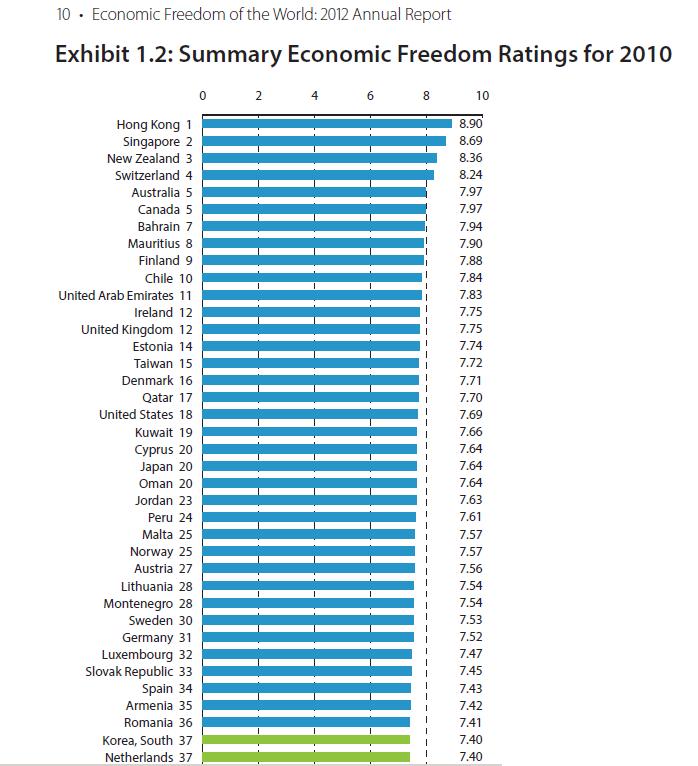
But I’m somewhat shocked to learn that we fell from 10th last year all the way down to 18th this year, as can be seen on the chart (click to enlarge).
Last year, the U.S. fell from 7th to 10th, and I though dropping three spots was bad. But falling by eight spots this past year is a stunning decline.
Who would have thought that Scandinavian welfare states such as Denmark and Finland would rank higher than the United States? Or that Ireland, with all its problems, would be above America?
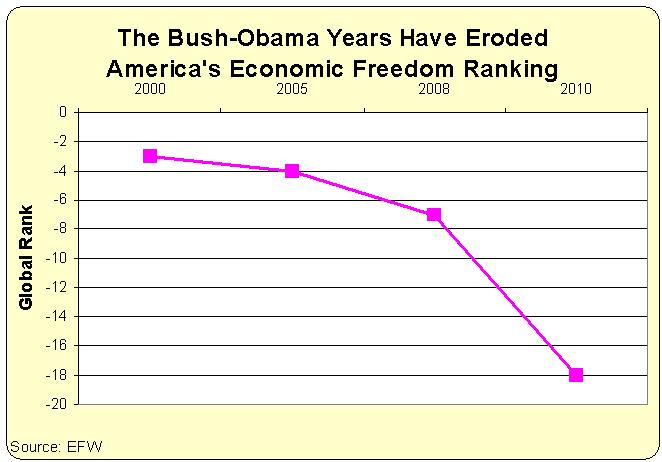
American politicians, by contrast, deserve scorn. Let’s update the chart I posted when last year’s report was issued.
As you can see, it’s an understatement to say that the United States is heading in the wrong direction. We’re still considerably ahead of interventionist welfare states such as France and Italy, though I’m afraid to think about what the U.S. score will be five years from now.
The United States, long considered the standard bearer for economic freedom among large industrial nations, has experienced a substantial decline in economic freedom during the past decade. From 1980 to 2000, the United States was generally rated the third freest economy in the world, ranking behind only Hong Kong and Singapore. After increasing steadily during the period from 1980 to 2000, the chainlinked EFW rating of the United States fell from 8.65 in 2000 to 8.21 in 2005 and 7.70 in 2010. The chain-linked ranking of the United States has fallen precipitously from second in 2000 to eighth in 2005 and 19th in 2010 (unadjusted ranking of 18th).
For those interested in why the United States has dropped, the “size of government” score has fallen from 8.65 in 2000 to 7.70 in the latest report. That’s not a surprise since the burden of government spending has exploded during the Bush-Obama years.
But the trade score also dropped significantly over the same period, from 8.78 to 7.65. So the protectionists should be happy, even though the rest of us have less prosperity.
The most dramatic decline, though, was the in the “legal system and property rights” category, where the U.S. plummeted from 9.23 in 2000 down to 7.12 in the new report. We’re not quite Argentina (3.76!), to be sure, but the trend is very troubling.
__________
Thank you so much for your time. I know how valuable it is. I also appreciate the fine family that you have and your commitment as a father and a husband.
Sincerely,
Everette Hatcher III, 13900 Cottontail Lane, Alexander, AR 72002, ph 501-920-5733, lowcostsqueegees@yahoo.com
The 45 minute video above is from the film series created from Francis Schaeffer’s book “Whatever Happened to the Human Race?” with Dr. C. Everett Koop. This book really helped develop my political views concerning abortion, infanticide, and youth euthanasia, and it gave me a good understanding of those issues.
I was able to watch Francis Schaeffer deliver a speech on a book he wrote called “A Christian Manifesto” and I heard him in several interviews on it in 1981 and 1982. I listened with great interest since I also read that book over and over again. Below is a portion of one of Schaeffer’s talks on a crucial subject that is very important today too.
This address was delivered by the late Dr. Schaeffer in 1982 at the Coral Ridge Presbyterian Church, Fort Lauderdale, Florida. It is based on one of his books, which bears the same title.
——–
USA was founded on Christian base but has humanist dominated public schools
——
This country was founded on a Christian base with all its freedom for everybody. Let me stress that. This country was founded on a Christian base with all its freedom for everybody, not just Christians, but all its freedom for everyone. And now, this is being largely lost. We live not ten years from now, but tonight, in a Humanistic culture and we are rapidly moving at express train speed into a totally Humanistic culture. We’re close to it. We are in a Humanistic culture, as I point out in the public schools and these other things, but we are moving toward a TOTALLY Humanistic culture and moving very quickly.
I would repeat at this place about our public schools because it’s worth saying. Most people don’t realize something. Communism, you know, is not basically an economic theory. It’s materialistic communism, which means that at the very heart of the Marx, Engels, Lenin kind of communism (because you have to put all three together to really understand) is the materialistic concept of the final reality. That is the base for all that occurs in the communist countries.
I am wearing a Solidarity pin — in case you wonder what this is on my lapel. We had two young men from L’Abri take in an 8 ton truck of food into Poland — very bad weather — they almost were killed on the roads. They got in just three days before the crackdown. We, of L’Abri, have taken care of small numbers of each successive wave of Europeans who have been persecuted in the communist nations, the Hungarians, Czechoslovakians, now the Poles. A dear wonderful Christian schoolteacher that we love very much (she’s a wonderful, wonderful Christian young woman, brilliant as brilliant, and she studied at L’Abri for a long time and she was one of the contact points for the destination of the food) — thought that the crackdown might come. So she sent me out this Solidarity pin. This wasn’t made in Newark! This came from Poland. I have a hope. I hope I can wear it until I can hand it back to her and she can wear it again in Poland. That’s my hope! But all the oppression you have ever heard of in Mao’s China, Stalin’s day, Poland, Czechoslovakia — any place that you can name it — Afghanistan — all the oppression is the automatic, the mechanical certainty, that comes from having this other world view of the final reality only being material or energy shaped by pure chance. That’s where it comes from.
And what about our schools? I think I should stress again! By law, you are no more allowed to teach religious values and religious views in our public schools than you are in the schools of Russia tonight. We don’t teach Marxism over here in most of our schools, but as far as all religious teaching (except the religion of Humanism, which is a different kind of a thing) it is just as banned by law from our schools, and our schools are just as secular as the schools in Soviet Russia — just exactly! Not ten years from now. Tonight!
Congress opens with prayer. Why? Because Congress always is opened with prayer. Back there, the founding fathers didn’t consider the 13 provincial congresses that sent representatives to form our country in Philadelphia really open until there was prayer. The Congress in Washington, where Edith and I have just been, speaking to various men in political areas and circles — that Congress is not open until there is prayer. It’s illegal, in many places, for youngsters to merely meet and pray on the geographical location of the public schools. I would repeat, we are not only immoral, we’re stupid. I mean that. I don’t know which is the worst: being immoral or stupid on such an issue. We are not only immoral, we are stupid for the place we have allowed ourselves to come to without noticing.
Francis Schaeffer: “Whatever Happened to the Human Race” (Episode 5) TRUTH AND HISTORY Published on Oct 7, 2012 by AdamMetropolis The 45 minute video above is from the film series created from Francis Schaeffer’s book “Whatever Happened to the Human Race?” with Dr. C. Everett Koop. This book really helped develop my political views concerning abortion, […]
Francis Schaeffer: “Whatever Happened to the Human Race” (Episode 4) THE BASIS FOR HUMAN DIGNITY Published on Oct 7, 2012 by AdamMetropolis ____________ The 45 minute video above is from the film series created from Francis Schaeffer’s book “Whatever Happened to the Human Race?” with Dr. C. Everett Koop. This book really helped develop my political […]
Francis Schaeffer: “Whatever Happened to the Human Race” (Episode 3) DEATH BY SOMEONE’S CHOICE Published on Oct 6, 2012 by AdamMetropolis _________ The 45 minute video above is from the film series created from Francis Schaeffer’s book “Whatever Happened to the Human Race?” with Dr. C. Everett Koop. This book really helped develop my political views […]
Francis Schaeffer: “Whatever Happened to the Human Race?” (Episode 2) SLAUGHTER OF THE INNOCENTS Published on Oct 6, 2012 by AdamMetropolis ___________ The 45 minute video above is from the film series created from Francis Schaeffer’s book “Whatever Happened to the Human Race?” with Dr. C. Everett Koop. This book really helped develop my political views […]
Francis Schaeffer: “Whatever Happened to the Human Race” (Episode 1) ABORTION OF THE HUMAN RACE Published on Oct 6, 2012 by AdamMetropolis ________ The 45 minute video above is from the film series created from Francis Schaeffer’s book “Whatever Happened to the Human Race?” with Dr. C. Everett Koop. This book really helped develop my political […]
Francis Schaeffer: “Whatever Happened to the Human Race” (Episode 5) TRUTH AND HISTORY Published on Oct 7, 2012 by AdamMetropolis The 45 minute video above is from the film series created from Francis Schaeffer’s book “Whatever Happened to the Human Race?” with Dr. C. Everett Koop. This book really helped develop my political views concerning abortion, […]
Francis Schaeffer: “Whatever Happened to the Human Race” (Episode 4) THE BASIS FOR HUMAN DIGNITY Published on Oct 7, 2012 by AdamMetropolis The 45 minute video above is from the film series created from Francis Schaeffer’s book “Whatever Happened to the Human Race?” with Dr. C. Everett Koop. This book really helped develop my political views […]
Francis Schaeffer: “Whatever Happened to the Human Race” (Episode 3) DEATH BY SOMEONE’S CHOICE Published on Oct 6, 2012 by AdamMetropolis The 45 minute video above is from the film series created from Francis Schaeffer’s book “Whatever Happened to the Human Race?” with Dr. C. Everett Koop. This book really helped develop my political views concerning […]
Francis Schaeffer: “Whatever Happened to the Human Race?” (Episode 2) SLAUGHTER OF THE INNOCENTS Published on Oct 6, 2012 by AdamMetropolis The 45 minute video above is from the film series created from Francis Schaeffer’s book “Whatever Happened to the Human Race?” with Dr. C. Everett Koop. This book really helped develop my political views concerning […]
Francis Schaeffer: “Whatever Happened to the Human Race” (Episode 1) ABORTION OF THE HUMAN RACE Published on Oct 6, 2012 by AdamMetropolis The 45 minute video above is from the film series created from Francis Schaeffer’s book “Whatever Happened to the Human Race?” with Dr. C. Everett Koop. This book really helped develop my political views […]
E P I S O D E 1 0 Dr. Francis Schaeffer – Episode X – Final Choices 27 min FINAL CHOICES I. Authoritarianism the Only Humanistic Social Option One man or an elite giving authoritative arbitrary absolutes. A. Society is sole absolute in absence of other absolutes. B. But society has to be […]
E P I S O D E 9 Dr. Francis Schaeffer – Episode IX – The Age of Personal Peace and Affluence 27 min T h e Age of Personal Peace and Afflunce I. By the Early 1960s People Were Bombarded From Every Side by Modern Man’s Humanistic Thought II. Modern Form of Humanistic Thought Leads […]
E P I S O D E 8 Dr. Francis Schaeffer – Episode VIII – The Age of Fragmentation 27 min I saw this film series in 1979 and it had a major impact on me. T h e Age of FRAGMENTATION I. Art As a Vehicle Of Modern Thought A. Impressionism (Monet, Renoir, Pissarro, Sisley, […]
E P I S O D E 7 Dr. Francis Schaeffer – Episode VII – The Age of Non Reason I am thrilled to get this film series with you. I saw it first in 1979 and it had such a big impact on me. Today’s episode is where we see modern humanist man act […]
E P I S O D E 6 How Should We Then Live 6#1 Uploaded by NoMirrorHDDHrorriMoN on Oct 3, 2011 How Should We Then Live? Episode 6 of 12 ________ I am sharing with you a film series that I saw in 1979. In this film Francis Schaeffer asserted that was a shift in […]
E P I S O D E 5 How Should We Then Live? Episode 5: The Revolutionary Age I was impacted by this film series by Francis Schaeffer back in the 1970′s and I wanted to share it with you. Francis Schaeffer noted, “Reformation Did Not Bring Perfection. But gradually on basis of biblical teaching there […]
Dr. Francis Schaeffer – Episode IV – The Reformation 27 min I was impacted by this film series by Francis Schaeffer back in the 1970′s and I wanted to share it with you. Schaeffer makes three key points concerning the Reformation: “1. Erasmian Christian humanism rejected by Farel. 2. Bible gives needed answers not only as to […]
Francis Schaeffer’s “How should we then live?” Video and outline of episode 3 “The Renaissance” Francis Schaeffer: “How Should We Then Live?” (Episode 3) THE RENAISSANCE I was impacted by this film series by Francis Schaeffer back in the 1970′s and I wanted to share it with you. Schaeffer really shows why we have so […]
Francis Schaeffer: “How Should We Then Live?” (Episode 2) THE MIDDLE AGES I was impacted by this film series by Francis Schaeffer back in the 1970′s and I wanted to share it with you. Schaeffer points out that during this time period unfortunately we have the “Church’s deviation from early church’s teaching in regard […]
Francis Schaeffer: “How Should We Then Live?” (Episode 1) THE ROMAN AGE Today I am starting a series that really had a big impact on my life back in the 1970′s when I first saw it. There are ten parts and today is the first. Francis Schaeffer takes a look at Rome and why […]
Francis Schaeffer: “Whatever Happened to the Human Race” (Episode 5) TRUTH AND HISTORY Published on Oct 7, 2012 by AdamMetropolis This crucial series is narrated by the late Dr. Francis Schaeffer and former Surgeon General Dr. C. Everett Koop. Today, choices are being made that undermine human rights at their most basic level. Practices once […]
The opening song at the beginning of this episode is very insightful. Francis Schaeffer: “Whatever Happened to the Human Race” (Episode 4) THE BASIS FOR HUMAN DIGNITY Published on Oct 7, 2012 by AdamMetropolis This crucial series is narrated by the late Dr. Francis Schaeffer and former Surgeon General Dr. C. Everett Koop. Today, choices […]
Francis Schaeffer: “Whatever Happened to the Human Race” (Episode 3) DEATH BY SOMEONE’S CHOICE Published on Oct 6, 2012 by AdamMetropolis This crucial series is narrated by the late Dr. Francis Schaeffer and former Surgeon General Dr. C. Everett Koop. Today, choices are being made that undermine human rights at their most basic level. Practices […]
Francis Schaeffer: “Whatever Happened to the Human Race?” (Episode 2) SLAUGHTER OF THE INNOCENTS Published on Oct 6, 2012 by AdamMetropolis This crucial series is narrated by the late Dr. Francis Schaeffer and former Surgeon General Dr. C. Everett Koop. Today, choices are being made that undermine human rights at their most basic level. Practices […]
It is not possible to know where the pro-life evangelicals are coming from unless you look at the work of the person who inspired them the most. That person was Francis Schaeffer. I do care about economic issues but the pro-life issue is the most important to me. Several years ago Adrian Rogers (past president of […]
This essay below is worth the read. Schaeffer, Francis – “Francis Schaeffer and the Pro-Life Movement” [How Should We Then Live?, Whatever Happened to the Human Race?, A Christian Manifesto] Editor note: <p> </p> [The following essay explores the role that Francis Schaeffer played in the rise of the pro-life movement. It examines the place of […]
Great article on Schaeffer. Who was Dr. Francis A. Schaeffer? By Francis Schaeffer The unique contribution of Dr. Francis Schaeffer on a whole generation was the ability to communicate the truth of historic Biblical Christianity in a way that combined intellectual integrity with practical, loving care. This grew out of his extensive understanding of the Bible […]
Dr. C. Everett Koop on Baby Doe, euthanasia, abortion
Uploaded on Nov 3, 2008
Dr. Koop answers questions on Baby Doe, euthanasia and abortion during interview at Wheaton College, Wheaton, IL http://www.christianethics.org
Dr. Koop
On 2-25-13 we lost a great man when we lost Dr. C. Everett Koop. I have written over and over the last few years quoting Dr. C. Everett Koop and his good friend Francis Schaeffer. They both came together for the first time in 1973 when Dr. Koop operated on Schaeffer’s daughter and as a result they became close friends. That led to their involvement together in the book and film series “WHATEVER HAPPENED TO THE HUMAN RACE?” in 1979.
By Americans United for Life
Tuesday, February 26th, 2013
WASHINGTON, D.C. (02-26-13) Americans United for Life President and CEO Dr. Charmaine Yoest paid tribute to AUL’s former board member Dr. C. Everett Koop who passed away this week, saying he was “a pro-life giant. He saw the issues of abortion and infanticide for what they were, assaults on the civil rights of the most vulnerable of human beings.”
Dr. Yoest made the following statement: “C. Everett Koop, M.D., was a pro-life pioneer in every possible sense of the term. While most publicly known for his service as Surgeon General of the United States under President Ronald Reagan, Dr. Koop’s most enduring legacy is that which he carved in 35 years of practice as the foremost pediatric surgeon in the country, if not the world. He was among the founders of the medical specialty of general pediatric surgery, launched the Journal of Pediatric Surgery as its first editor, and in 1956 established, at the Children’s Hospital of Philadelphia (CHOP), the first neonatal surgical intensive care unit in the nation.
“Dr. Koop joined the Board of Directors of Americans United for Life in the mid-1970s. He published The Right to Live, The Right to Die, in 1976, setting forth his principled beliefs against abortion, infanticide, and medical neglect of handicapped newborns. He took leave from his medical practice to co-produce, with Francis Schaeffer, the groundbreaking film and book, Whatever Happened to the Human Race?
“Importantly, Dr. Koop’s leadership was pivotal in turning the tide against the medical neglect of handicapped newborns. He keynoted the 1981 AUL conference, Infanticide and the Handicapped Newborn. As Surgeon General, he supported development and implementation of the ‘Baby Doe’regulations, promulgated after the much-publicized death of ‘Baby Doe’ in Bloomington, Indiana – an infant born with Downs syndrome whose parents refused to treat correctable esophageal atresia with surgery, ultimately leading to the baby’s needless death. It was no coincidence that Dr. Koop also pioneered the techniques to correct such disorders. Thanks to these regulations, and the Baby Doe Amendments passed by Congress in 1984, such deliberate and lethal medical neglect is prohibited under Federal civil rights laws.
“Dr. Koop’s name became synonymous with CHOP; his residents at that institution became the leaders of their field at hospitals in the United States and internationally. There, he developed surgical techniques that have saved the lives of countless children who otherwise would have died, or been allowed to die, because of their deformities. He invented anesthetic and surgical techniques suited to the small bodies of his patients, developed surgical techniques to correct various forms of atresias, and successfully treated extremely complex cases of conjoined twins.
“There is no doubt that Dr. Koop’s leadership in the field of neonatal and pediatric surgery literally saved thousands of lives, and continues to do so today. His own writings, and his work with Francis Schaeffer, inspired an entire generation of pro-life activists and leaders. His surgical breakthroughs, coupled with his policy leadership, made possible the civil rights protections enjoyed today by handicapped newborns.
“Tragically, his piercing question, ‘whatever happened to the human race?,’ continues to haunt the conscience of a nation where abortion on demand remains the law of the land, and campaigns for assisted suicide and euthanasia continue. He will be greatly missed.”
Dr. C. Everett Koop is pictured above.
Francis Schaeffer: “Whatever Happened to the Human Race” (Episode 1) ABORTION OF THE HUMAN RACE
Dr. C. Everett Koop with Ronald Reagan. Dr. Koop was delayed in his confirmation by Ted Kennedy because of his film Whatever Happened to the Human Race? President Obama c/o The White House 1600 Pennsylvania Avenue NW Washington, DC 20500 Dear Mr. President, I know that you receive 20,000 letters a day and that you […]
In the film series “WHATEVER HAPPENED TO THE HUMAN RACE?” the arguments are presented against abortion (Episode 1), infanticide (Episode 2), euthenasia (Episode 3), and then there is a discussion of the Christian versus Humanist worldview concerning the issue of “the basis for human dignity” in Episode 4 and then in the last episode a close […]
Dr. C. Everett Koop with Ronald Reagan. Dr. Koop was delayed in his confirmation by Ted Kennedy because of his film Whatever Happened to the Human Race? Watch the film below starting at the 19 minute mark and that will lead into a powerful question from Dr. C. Everett Koop. This 1979 film is WHATEVER […]
Dr. Koop was delayed in his confirmation by Ted Kennedy because of his film Whatever Happened to the Human Race? Francis Schaeffer February 21, 1982 (Part 1) Uploaded by DeBunker7 on Feb 21, 2008 READ THIS FIRST: In decline of all civilizations we first see a war against the freedom of ideas. Discussion is limited […]
Dr. C. Everett Koop was appointed to the Reagan administration but was held up in the Senate in his confirmation hearings by Ted Kennedy because of his work in pro-life causes. I was thinking about the March for Life that is coming up on Jan 20, 2013 and that is why I posted this today […]
High resolution version (11,426,583 Bytes) Description: The photograph is signed by President Ronald Reagan with the inscription “To Chick Koop, With Best Wishes.” Chick, from chicken coop, was the nickname Koop gained will attending Dartmouth College in the mid-1930s. Koop maintained a cordial relationship with President Reagan, despite his disappointment over Reagan’s refusal to address […]
Francis Schaeffer and C. Everett Koop were prophetic (jh29) What Ever Happened to the Human Race? I recently heard this Breakpoint Commentary by Chuck Colson and it just reminded me of how prophetic Francis Schaeffer and C. Everett Koop were in the late 1970′s with their book and film series “Whatever happened to the human […]
Dr. C. Everett Koop I was thinking about the March for Life that is coming up on Jan 20, 2013 and that is why I posted this today Secular leaps of faith 39 Comments Written by Janie B. Cheaney August 15, 2011, 2:17 PM I’m willing to cut Ryan Lizza some slack. His profile […]
Francis Schaeffer: “Whatever Happened to the Human Race?” (Episode 2) SLAUGHTER OF THE INNOCENTS Published on Oct 6, 2012 by AdamMetropolis The 45 minute video above is from the film series created from Francis Schaeffer’s book “Whatever Happened to the Human Race?” with Dr. C. Everett Koop. This book really helped develop my political views concerning […]
I truly believe that many of the problems we have today in the USA are due to the advancement of humanism in the last few decades in our society. Ronald Reagan appointed the evangelical Dr. C. Everett Koop to the position of Surgeon General in his administration. He partnered with Dr. Francis Schaeffer in making […]
The best pro-life film I have ever seen below by Francis Schaeffer and Dr. C. Everett Koop “Whatever happened to the human race?” Over the years I have taken on the Ark Times liberal bloggers over and over and over concerning the issue of abortion. I asked over and over again for one liberal blogger […]
Francis Schaeffer pictured above._________ The best pro-life film I have ever seen below by Francis Schaeffer and Dr. C. Everett Koop “Whatever happened to the human race?” Over the years I have taken on the Ark Times liberal bloggers over and over and over concerning the issue of abortion. I asked over and over again […]
The best pro-life film I have ever seen below by Francis Schaeffer and Dr. C. Everett Koop “Whatever happened to the human race?” On 1-24-13 I took on the child abuse argument put forth by Ark Times Blogger “Deathbyinches,” and the day before I pointed out that because the unborn baby has all the genetic code […]
PHOTO BY STATON BREIDENTHAL from Pro-life march in Little Rock on 1-20-13. Tim Tebow on pro-life super bowl commercial. Over the years I have taken on the Ark Times liberal bloggers over and over and over concerning the issue of abortion. Here is another encounter below. On January 22, 2013 (on the 40th anniversary of the […]
The best pro-life film I have ever seen below by Francis Schaeffer and Dr. C. Everett Koop “Whatever happened to the human race?” Francis Schaeffer pictured above._________ The 45 minute video above is from the film series created from Francis Schaeffer’s book “Whatever Happened to the Human Race?” with Dr. C. Everett Koop. This book really […]
Dr Richard Land discusses abortion and slavery – 10/14/2004 – part 3 The best pro-life film I have ever seen below by Francis Schaeffer and Dr. C. Everett Koop “Whatever happened to the human race?” Over the years I have taken on the Ark Times liberal bloggers over and over and over concerning the issue […]
Dr Richard Land discusses abortion and slavery – 10/14/2004 – part 3 The best pro-life film I have ever seen below by Francis Schaeffer and Dr. C. Everett Koop “Whatever happened to the human race?” Over the years I have taken on the Ark Times liberal bloggers over and over and over concerning the issue […]
On January 20, 2013 I heard Paul Greenberg talk about the words of Thomas Jefferson that we are all “endowed with certain unalienable rights” and the most important one is the right to life. He mentioned this also in this speech below from 2011: Paul Greenberg Dinner Speech 2011 Fall 2011 Issue Some of you […]
It is not possible to know where the pro-life evangelicals are coming from unless you look at the work of the person who inspired them the most. That person was Francis Schaeffer. I do care about economic issues but the pro-life issue is the most important to me. Several years ago Adrian Rogers (past president of […]