Open letter to President Obama (Part 405) Francis Schaeffer and Dr. C. Everett Koop asked Reagan to issue pro-life proclamation in 1983 (includes video ABORTION OF THE HUMAN RACE)

(Emailed to White House on 2-1-13.)

President Obama c/o The White House
1600 Pennsylvania Avenue NW
Washington, DC 20500

Dear Mr. President,

I know that you receive 20,000 letters a day and that you actually read 10 of them every day. I really do respect you for trying to get a pulse on what is going on out here.

In the film series “WHATEVER HAPPENED TO THE HUMAN RACE?” the arguments are presented  against abortion (Episode 1),  infanticide (Episode 2),   euthenasia (Episode 3), and then there is a discussion of the Christian versus Humanist worldview concerning the issue of “the basis for human dignity” in Episode 4 and then in the last episode a close look at the truth claims of the Bible.

I truly believe that many of the problems we have today in the USA are due to the advancement of humanism in the last few decades in our society. Ronald Reagan appointed the evangelical Dr. C. Everett Koop to the position of Surgeon General in his administration. He partnered with Dr. Francis Schaeffer in making the video below. It is very valuable information for Christians to have.  Actually I have included a video below that includes comments from him on this subject.

Francis Schaeffer: “Whatever Happened to the Human Race” (Episode 1) ABORTION OF THE HUMAN RACE

Published on Oct 6, 2012 by

Did you know that Francis Schaeffer and Dr. C. Everett Koop asked President Reagan in 1983 to make a pro-life proclamation?

Every Life is Precious

Thus says the LORD, “A voice is heard in Ramah, Lamentation and bitter weeping. Rachel is weeping for her children; She refuses to be comforted for her children, Because they are no more.”

Jeremiah 31:14-16

Sanctity of Human Life Sunday is held on the Sunday in January that falls closest to the day on which the Roe v. Wade and Doe v. Bolton decisions were handed down by the U.S. Supreme Court on January 22, 1973.

Sanctity of Life Sunday began in 1983 when the Christian Action Council (now known as Care Net), founded with the help of Francis Schaeffer and former Surgeon General C. Everett Koop, “asked President Ronald Reagan to create a special day to focus on the intrinsic value of human life.” [Source]

President Reagan issued this proclamation:

Since 1973, however, more than 15 million unborn children have died in legalized abortions — a tragedy of stunning dimensions that stands in sad contrast to our belief that each life is sacred. These children, over tenfold the number of Americans lost in all our Nation’s wars, will never laugh, never sing, never experience the joy of human love; nor will they strive to heal the sick, or feed the poor, or make peace among nations. Abortion has denied them the first and most basic of human rights, and we are infinitely poorer for their loss.

We are poorer not simply for lives not led and for contributions not made, but also for the erosion of our sense of the worth and dignity of every individual. To diminish the value of one category of human life is to diminish us all. Slavery, which treated Blacks as something less than human, to be bought and sold if convenient, cheapened human life and mocked our dedication to the freedom and equality of all men and women. Can we say that abortion — which treats the unborn as something less than human, to be destroyed if convenient — will be less corrosive to the values we hold dear?

It has now been 40 years since the Supreme Court Roe v. Wade decision that made abortion on demand legal in all 50 states. Since that time, the 15 million babies referred to by President Reagan has become 55 million babies.

Abortion is the greatest evil in American history and dwarfs the genocide of many other nations throughout history.

And served their idols,
Which became a snare to them.
They even sacrificed their sons and their daughters to the demons,
And shed innocent blood,
The blood of their sons and their daughters,
Whom they sacrificed to the idols of Canaan;
And the land was polluted with the blood.
Psalm 106:36–38

___________

Thank you so much for your time. I know how valuable it is. I also appreciate the fine family that you have and your commitment as a father and a husband.

Sincerely,

Everette Hatcher III, 13900 Cottontail Lane, Alexander, AR 72002, ph 501-920-5733, lowcostsqueegees@yahoo.com

Related posts:

Francis Schaeffer’s prayer for us in USA

 Francis Schaeffer: “Whatever Happened to the Human Race” (Episode 1) ABORTION OF THE HUMAN RACE Published on Oct 6, 2012 by AdamMetropolis The 45 minute video above is from the film series created from Francis Schaeffer’s book “Whatever Happened to the Human Race?” with Dr. C. Everett Koop. This book  really helped develop my political views […]

Francis Schaeffer’s “How should we then live?” Video and outline of episode 10 “Final Choices” (Schaeffer Sundays)

E P I S O D E 1 0   Dr. Francis Schaeffer – Episode X – Final Choices 27 min FINAL CHOICES I. Authoritarianism the Only Humanistic Social Option One man or an elite giving authoritative arbitrary absolutes. A. Society is sole absolute in absence of other absolutes. B. But society has to be […]

Francis Schaeffer’s “How should we then live?” Video and outline of episode 9 “The Age of Personal Peace and Affluence” (Schaeffer Sundays)

E P I S O D E 9 Dr. Francis Schaeffer – Episode IX – The Age of Personal Peace and Affluence 27 min T h e Age of Personal Peace and Afflunce I. By the Early 1960s People Were Bombarded From Every Side by Modern Man’s Humanistic Thought II. Modern Form of Humanistic Thought Leads […]

Francis Schaeffer’s “How should we then live?” Video and outline of episode 8 “The Age of Fragmentation” (Schaeffer Sundays)

E P I S O D E 8 Dr. Francis Schaeffer – Episode VIII – The Age of Fragmentation 27 min I saw this film series in 1979 and it had a major impact on me. T h e Age of FRAGMENTATION I. Art As a Vehicle Of Modern Thought A. Impressionism (Monet, Renoir, Pissarro, Sisley, […]

Francis Schaeffer’s “How should we then live?” Video and outline of episode 7 “The Age of Non-Reason” (Schaeffer Sundays)

E P I S O D E 7 Dr. Francis Schaeffer – Episode VII – The Age of Non Reason I am thrilled to get this film series with you. I saw it first in 1979 and it had such a big impact on me. Today’s episode is where we see modern humanist man act […]

Francis Schaeffer’s “How should we then live?” Video and outline of episode 6 “The Scientific Age” (Schaeffer Sundays)

E P I S O D E 6 How Should We Then Live 6#1 Uploaded by NoMirrorHDDHrorriMoN on Oct 3, 2011 How Should We Then Live? Episode 6 of 12 ________ I am sharing with you a film series that I saw in 1979. In this film Francis Schaeffer asserted that was a shift in […]

Francis Schaeffer’s “How should we then live?” Video and outline of episode 5 “The Revolutionary Age” (Schaeffer Sundays)

E P I S O D E 5 How Should We Then Live? Episode 5: The Revolutionary Age I was impacted by this film series by Francis Schaeffer back in the 1970′s and I wanted to share it with you. Francis Schaeffer noted, “Reformation Did Not Bring Perfection. But gradually on basis of biblical teaching there […]

Francis Schaeffer’s “How should we then live?” Video and outline of episode 4 “The Reformation” (Schaeffer Sundays)

Dr. Francis Schaeffer – Episode IV – The Reformation 27 min I was impacted by this film series by Francis Schaeffer back in the 1970′s and I wanted to share it with you. Schaeffer makes three key points concerning the Reformation: “1. Erasmian Christian humanism rejected by Farel. 2. Bible gives needed answers not only as to […]

“Schaeffer Sundays” Francis Schaeffer’s “How should we then live?” Video and outline of episode 3 “The Renaissance”

Francis Schaeffer’s “How should we then live?” Video and outline of episode 3 “The Renaissance” Francis Schaeffer: “How Should We Then Live?” (Episode 3) THE RENAISSANCE I was impacted by this film series by Francis Schaeffer back in the 1970′s and I wanted to share it with you. Schaeffer really shows why we have so […]

Francis Schaeffer’s “How should we then live?” Video and outline of episode 2 “The Middle Ages” (Schaeffer Sundays)

  Francis Schaeffer: “How Should We Then Live?” (Episode 2) THE MIDDLE AGES I was impacted by this film series by Francis Schaeffer back in the 1970′s and I wanted to share it with you. Schaeffer points out that during this time period unfortunately we have the “Church’s deviation from early church’s teaching in regard […]

Francis Schaeffer’s “How should we then live?” Video and outline of episode 1 “The Roman Age” (Schaeffer Sundays)

Francis Schaeffer: “How Should We Then Live?” (Episode 1) THE ROMAN AGE   Today I am starting a series that really had a big impact on my life back in the 1970′s when I first saw it. There are ten parts and today is the first. Francis Schaeffer takes a look at Rome and why […]

Francis Schaeffer: “Whatever Happened to the Human Race” (Episode 5) TRUTH AND HISTORY

Francis Schaeffer: “Whatever Happened to the Human Race” (Episode 5) TRUTH AND HISTORY Published on Oct 7, 2012 by AdamMetropolis This crucial series is narrated by the late Dr. Francis Schaeffer and former Surgeon General Dr. C. Everett Koop. Today, choices are being made that undermine human rights at their most basic level. Practices once […]

Francis Schaeffer: “Whatever Happened to the Human Race” (Episode 4) THE BASIS FOR HUMAN DIGNITY

The opening song at the beginning of this episode is very insightful. Francis Schaeffer: “Whatever Happened to the Human Race” (Episode 4) THE BASIS FOR HUMAN DIGNITY Published on Oct 7, 2012 by AdamMetropolis This crucial series is narrated by the late Dr. Francis Schaeffer and former Surgeon General Dr. C. Everett Koop. Today, choices […]

Francis Schaeffer: “Whatever Happened to the Human Race” (Episode 3) DEATH BY SOMEONE’S CHOICE

Francis Schaeffer: “Whatever Happened to the Human Race” (Episode 3) DEATH BY SOMEONE’S CHOICE Published on Oct 6, 2012 by AdamMetropolis This crucial series is narrated by the late Dr. Francis Schaeffer and former Surgeon General Dr. C. Everett Koop. Today, choices are being made that undermine human rights at their most basic level. Practices […]

Francis Schaeffer: “Whatever Happened to the Human Race?” (Episode 2) SLAUGHTER OF THE INNOCENTS

Francis Schaeffer: “Whatever Happened to the Human Race?” (Episode 2) SLAUGHTER OF THE INNOCENTS Published on Oct 6, 2012 by AdamMetropolis This crucial series is narrated by the late Dr. Francis Schaeffer and former Surgeon General Dr. C. Everett Koop. Today, choices are being made that undermine human rights at their most basic level. Practices […]

Francis Schaeffer: “Whatever Happened to the Human Race” (Episode 1) ABORTION OF THE HUMAN RACE

It is not possible to know where the pro-life evangelicals are coming from unless you look at the work of the person who inspired them the most. That person was Francis Schaeffer.  I do care about economic issues but the pro-life issue is the most important to me. Several years ago Adrian Rogers (past president of […]

The following essay explores the role that Francis Schaeffer played in the rise of the pro-life movement. It examines the place of How Should We Then Live?, Whatever Happened to the Human Race?, and A Christian Manifesto in that process.

This essay below is worth the read. Schaeffer, Francis – “Francis Schaeffer and the Pro-Life Movement” [How Should We Then Live?, Whatever Happened to the Human Race?, A Christian Manifesto] Editor note: <p> </p> [The following essay explores the role that Francis Schaeffer played in the rise of the pro-life movement.  It examines the place of […]

Who was Francis Schaeffer? by Udo Middelmann

Great article on Schaeffer. Who was Dr. Francis A. Schaeffer? By Francis Schaeffer The unique contribution of Dr. Francis Schaeffer on a whole generation was the ability to communicate the truth of historic Biblical Christianity in a way that combined intellectual integrity with practical, loving care. This grew out of his extensive understanding of the Bible […]

.

Tom Osborne at the Little Rock Touchdown Club Part 3

Tom Osborne at the Little Rock Touchdown Club Part 3

1997 Orange Bowl #2 Nebraska vs #3 Tennessee Part 1 of 2

Uploaded on Dec 2, 2007

The final collegiate game for Tom Osborne, Peyton Manning, Ahman Green, Grant Wistrom, Jason Peter, Scott Frost. Nebraska thoroughly dominated the Vols on both sides of the ball running for over 400 yards. This is first half action only over 40 clips, second part to be up shortly. Great talent on both sides of the ball Nebraska: Wistrom, Green, Peter, Frost, Rucker, Ralph and Mike Brown, Eric Warfield, Tennesse: Peyton Manning, Jamal Lewis, Peerless Price, Leonard Little, Raynoch Thompson, Jonathan Brown.

___________

On Sept 9, 2013 at the Little Rock Touchdown Club before Tom Osborne got to speak we had the review of what happened last week in the SEC by Rex Nelson and he discussed how Bobby Petrino invented 8 new curse words during the 6 plays in a row where Western Kentucky turned it over 5 times to the Vols. Here are some of the details below:

Sometimes it seems like an offense can’t do anything right.Western Kentucky knows the feeling. The Hilltoppers turned the ball over five times in a span of six plays against Tennessee in a 52-20 loss on Saturday.

Photos of the day

Queen Elizabeth II attends sack race, Miss World contestants, peace vigil for Syria, Japan wins 2020 Olympics bid and more.

That’s right. Five turnovers, six plays.

“I don’t remember that many interceptions and that many turnovers back-to-back-to-back-to-back,” Western Kentucky coach Bobby Petrino said. “It really dug us a hole.”

Ya think?

Western Kentucky’s second through sixth series ended like this: interception, interception, fumble, fumble, interception.

Tennessee converted the turnovers into four touchdowns and a field goal, or 31 points, with Justin Coleman and Cameron Sutton returning picks for TDs.

The Hilltoppers committed two other turnovers, including one the Vols turned into another touchdown in the fourth quarter.

Brandon Doughty threw the five interceptions and was the first Western Kentucky quarterback since 1977 to get picked off that many times in a game.

Tennessee’s seven takeaways were its most since it had that many against Memphis in 1984. The Vols hadn’t intercepted five passes in a game since they did it against Kentucky in 1999.

There are no records kept for most turnovers in fewest number of plays. According to the NCAA, the record for consecutive series ending in a turnover is seven by Florida State against Florida in 1972. That run of bad luck happened on the Seminoles’ first seven possessions.

__________

F
THE LIFE JOURNEY OF A LEGENDAR
Y NEBRASKA COACH AND POLITICIAN
(
Lincoln, NE
)
Tom Osborne
is easily recognized as one of the most respected
coaches in college football history. In his memoir,
Beyond the Final Score:
There’s More to Life Than the Game
(Regal Books, Sept. 2009), Osborne
reflects on observations and experiences in his life as a family man, coach,
congressman, fisherman, ment
or and spiritual servant.
Osborne grew up in Hastings, Nebraska where he attended high school and
college. After college graduation, he spent three seasons in the NFL as a wide
receiver for the Washington Redskins and the San Francisco 49ers. In 1964,
Osborne joined the University of Nebraska Cornhusker coaching staff and
eventually became head coach in 1972, where he remained until 1997. Osborne
became a coaching legend by serving those around him and always placing a
strong emphasis on his spiritual walk. Few colleg
e football coaches have seen the success that
Osborne did (255 wins in 25 seasons). In
Beyond the Final Score
,
Osborne shares some
thoughts on the following:
On Team Unity: “Having a nu
cleus of spiritually committed players and coaches made a
significant difference on our football teams. It
creates the kind of team chemistry that
enables everyone to pull together in one direction.”
On His Political Career: “I ran for office wi
thout money from political action committees
(PAC’s). Personal contributions didn’t exceed
$300 per person so nobody could claim my
allegiance because of donations. I made my
judgments based on my conscience and the
best interests of my constituents.”
On the Economic Downturn: “We’ve become a very materialistic nation. This crisis has
lead Americans to self-examination and a re
alization that we are not in control of
everything, maybe God has a place in our priorities. I hope that we can strengthen our
democracy and never trade it for short term monetary comforts. “
On Mentorship: “Mentoring is not only an inve
stment in the life of one child but also an
investment in the future of our nation
. A mentor demonstrates vision, shows
unconditional care and while prov
iding life-changing affirmation.”
On Returning to the Nebraska Athletic Department: “Morale wasn’t good. Each person
needed to be heard and to know they were
valued. It was from there that the healing
process, which was critical to accomp
lishing our mission, began to occur.”
In 2000, Osborne won a Congressional seat for
Nebraska’s Third Distri
ct. During his three
terms in Congress, he participated in the Iraqi
Women’s Caucus, and served on the Agricultural
Committee, the Education and the Workforce Co
mmittee, and the Transportation Committee.
Osborne’s commitment was to serve the people of
Nebraska despite the downsides of being away
from his family and experiencing the dissention
and struggle for control between both parties.
In 2006, Osborne ran
for Governor of Nebraska, but lost to
his opponent. In 2007, he returned

to the University of Nebraska as Athletic Director

FOR IMMEDIATE RELEASE: Contact:
Pure Publicity
81
8.753.4056 or Purepublicity@aol.com
Osborne also shares thoughts on the many chan
ges in college football over the years. Often
challenges involve the players (“Many carry heavy emotional baggage or have critical parents
pushing them from a young age to succeed”), their performance (“Enhancement seems to have
been too great a temptation for many players and
coaches, and officials let it go on for far too
long”), and the recruitment process (“We often see improper or unrealistic promises being made
to young people”).
In
Beyond the Final Score
, Osborne chronicles personal storie
s that include growing up during
World War II with a father who was overseas serv
ing in the war, discovering his love for fishing
at a young age, yearning to pass his love for fish
ing on to his wife and children (without much
success), learning to fly later in life, and the st
ruggle to keep family a priority over his career.
Through the story of his life, Osborne reminds readers of the principle that he has strived to
maintain in his life, “Many people wander thro
ugh life without thinki
ng deeply about their
purpose or intentions, my personal mission stat
ement has always been to try to serve and honor
God. Sometimes I came close to living up to
this mission and other times I fell far short.”

_____________

Related posts:

Dan Hampton at the Little Rock Touchdown Club Part 4 (Learning a lesson from Hampton’s mistakes)

Dan Hampton at the Little Rock Touchdown Club Part 4 Mike Singletary: Christ Means Everything – CBN.com Uploaded on Aug 25, 2010 Shawn Brown talks to the tough-as-nails coach of the San Francisco 49ers about how he wins in life and in football… The Christian Broadcasting Network CBN http://www.cbn.com __________________________ No one has more respect […]

Dan Hampton at the Little Rock Touchdown Club Part 3

Dan Hampton at the Little Rock Touchdown Club Part 3 Before Dan Hampton got to speak at the touchdown club this week, Rex Nelson got up and spoke and when he talked about Bobby Petrino taking his Western Kentucky team into Knoxville, he asked, “How many of you think Petrino will get a victory in […]

Dan Hampton at the Little Rock Touchdown Club Part 2

Dan Hampton at the Little Rock Touchdown Club Part 2 https://www.youtube.com/watch?v=nCPWDMKzVs4 Dan Hampton told about the  year with the Chicago Bears when they took on the Vikings and they sacked Archie Manning 11 times.  In October on 1984 the Bears beat the Vikings but in the process Dan Hampton got to play against one of […]

Dan Hampton at the Little Rock Touchdown Club Part 1

Dan Hampton at the Little Rock Touchdown Club Part 1  Dan Hampton I really enjoyed the Little Rock Touchdown Club today when Dan Hampton was our speaker. Hampton said that Jimmy Johnson was a great defensive coordinator for him to learn under when he played for Frank Broyles in 1975. Then when Lou Holtz came […]

My favorite past speakers of the Little Rock Touchdown Club and the 2013 lineup (Part 4)

Rex Nelson impersonates Houston Nutt at LRTC 08 27 12 Published on Oct 2, 2012 Little Rock Touchdown Club has Rex Nelson do the stats for the games played that week. Rex does a lot of impersonations of different people but I like his Houston Nutt the best. Video by Popeye Video – Mrpopeyevideo I have […]

My favorite past speakers of the Little Rock Touchdown Club and the 2013 lineup (Part 3) (Vince Dooley did a great job)

I have written about my past visits to the Little Rock Touchdown Club many times and I have been amazed at the quality of the speakers. Frank Broyles was one of my favorites but Phillip Fulmer, Paul Finebaum, Mike Slive, Willie Roaf, Randy White, Howard Schnellenberger, John Robinson, Mark May, Gene Stallings, Bobby Bowden, Lloyd […]

My favorite past speakers of the Little Rock Touchdown Club and the 2013 lineup (Part 2) (Frank Broyles was outstanding!!)

I have written about my past visits to the Little Rock Touchdown Club many times and I have been amazed at the quality of the speakers. (Yesterday I talked about Phillip Fulmer.)Frank Broyles was one of my favorites but Phillip Fulmer, Paul Finebaum, Mike Slive, Willie Roaf, Randy White, Howard Schnellenberger, John Robinson, Mark May, […]

My favorite past speakers of the Little Rock Touchdown Club and the 2013 lineup (Part 1)

Rex Nelson impersonates Houston Nutt at LRTC 08 27 12 Published on Oct 2, 2012 Little Rock Touchdown Club has Rex Nelson do the stats for the games played that week. Rex does a lot of impersonations of different people but I like his Houston Nutt the best. Video by Popeye Video – Mrpopeyevideo ______________ I […]

Gus Malzahn does a great job at Little Rock Touchdown Club (Part 2)

I really enjoyed hearing Gus Malzahn speak at the final Little Rock Touchdown meeting on Nov 19, 2012. He covered several subjects that he covered a few days earlier at a touchdown club in Huntsville. Here are some of his comments from that meeting: But reports that he could be the next coach at Auburn, […]

Atheist Nat Hentoff turned pro-life after reviewing the evidence

Nat Hentoff is an atheist, but he became a pro-life activist because of the scientific evidence that shows that the unborn child is a distinct and separate human being and even has a separate DNA. His perspective is a very intriguing one that I thought you would be interested in. I have shared before many   cases (Bernard Nathanson, Donald Trump, Paul Greenberg, Kathy Ireland)    when other high profile pro-choice leaders have changed their views and this is just another case like those. I have contacted the White House over and over concerning this issue and have even received responses. I am hopeful that people will stop and look even in a secular way (if they are not believers) at this abortion debate and see that the unborn child is deserving of our protection.That is why the writings of Nat Hentoff of the Cato Institute are so crucial.

In the film series “WHATEVER HAPPENED TO THE HUMAN RACE?” the arguments are presented  against abortion (Episode 1),  infanticide (Episode 2),   euthanasia (Episode 3), and then there is a discussion of the Christian versus Humanist worldview concerning the issue of “the basis for human dignity” in Episode 4 and then in the last episode a close look at the truth claims of the Bible.

Francis Schaeffer

__________________________

I truly believe that many of the problems we have today in the USA are due to the advancement of humanism in the last few decades in our society. Ronald Reagan appointed the evangelical Dr. C. Everett Koop to the position of Surgeon General in his administration. He partnered with Dr. Francis Schaeffer in making the video below. It is very valuable information for Christians to have.  Actually I have included a video below that includes comments from him on this subject.

Francis Schaeffer: “Whatever Happened to the Human Race” (Episode 1) ABORTION OF THE HUMAN RACE

Published on Oct 6, 2012 by 

________________

Blackballing Nat Hentoff

By Mark Judge

A couple weeks ago I got a call from Nat Hentoff. Hentoff, 86, is a legendary civil libertarian and journalist. He’s at the point is his career when he should just be sitting back and receiving lifetime achievement awards. But there’s one problem.

Nat Hentoff is pro-life. He had called from New York to thank me for some pro-life columns I had written. I was stunned; Hentoff is one of my favorite writers, and him reaching out is a tremendous honor. I’m a jazz fan and have been reading Hentoff’s columns for 25 years. (The man actually met Duke Ellington!) We talked about our jazz favorites, including my favorite singer Kurt Elling. Hentoff is still mentally sharp, even if he is doing physical therapy for various age-related issues.

Receive news alerts

Mark Judge RealClearReligion
Nat Hentoff Person Communication and Meetings
[+] More

Hentoff’s conversion from pro-choice to pro-life, and the fallout that resulted, is explained in an essay in the new book, The Debate Since Roe: Making the Case Against Abortion 1975-2010. It’s a compendium of essays from the journal Human Life Review.

A famous liberal who was a staple at the Village Voice and who had a column in the Washington Post, in the 1980s Hentoff actually let himself be swayed by evidence about abortion. It happened when Hentoff was reporting on the case of Baby Jane Doe.

Baby Jane Doe was a Long Island infant born with spina bifida and hydrocephalus, which is excess fluid in the cranium. With surgery, spina-bifida babies can grow up to be productive adults. Yet Baby Jane’s parents, on their doctor’s advice, had refused both surgery to close her spine and a shunt to drain the fluid from her brain. In resisting the federal government’s attempt to enforce treatment, the parents pleaded privacy.

As Hentoff told the Washington Times in a 1989 profile, his “curiosity was not so much the case itself but the press coverage.” Everyone on the media was echoing the same talking points about “women’s rights” and “privacy.”

“Whenever I see that kind of story, where everybody agrees, I know there’s something wrong,” Hentoff told the Times. says. “I finally figured out they were listening to the [parents’] lawyer.”

Hentoff dug into the case and the abortion industry at large, and what he found shocked him. He came across the published reports of experiments in what doctors at Yale-New Haven Hospital called “early death as a management option” for infants “considered to have little or no hope of achieving meaningful ‘humanhood.'” He talked with handicapped people who could have been killed by abortion.

Hentoff’s liberal friends didn’t appreciate his conversion: “They were saying, ‘What’s the big fuss about? If the parents had known she was going to come in this way, they would have had an abortion. So why don’t you consider it a late abortion and go on to something else? Here were liberals, decent people, fully convinced themselves that they were for individual rights and liberties but willing to send into eternity these infants because they were imperfect, inconvenient, costly. I saw the same attitude on the part of the same kinds of people toward abortion, and I thought it was pretty horrifying.”

The reaction from America’s corrupt fourth estate was instant. Hentoff, a Guggenheim fellow and author of dozens of books, was a pariah. Several of his colleagues at the Village Voice, which had run his column since the 1950s, stopped talking to him. When the National Press Foundation wanted to give him a lifetime achievement award, there was a bitter debate amongst members whether Hentoff should even be honored (he was). Then they stopped running his columns. You heard his name less and less. In December 2008, the Village Voice officially let him go.

When journalist Dan Rather was revealed to have poor news judgment, if not outright malice, for using fake documents to try and change the course of a presidential election, he was given a new TV show and a book deal — not to mention a guest spot on The Daily Show. The media has even attempted a resuscitation of anti-Semite Helen Thomas, who was recently interviewed in Playboy.

By accepting the truth about abortion, and telling that truth, Nat Hentoff may be met with silence by his peers when he goes to his reward. The shame will be theirs, not his.

Mark Judge is a columnist for RealClearReligion and author, most recently, of A Tremor of Bliss: Sex, Catholicism, and Rock ‘n’ Roll.

Related posts:

Al Mohler on Kermit Gosnell’s abortion practice

Francis Schaeffer: “Whatever Happened to the Human Race” (Episode 1) ABORTION OF THE HUMAN RACE Published on Oct 6, 2012 by AdamMetropolis ________________ Picture of Francis Schaeffer and his wife Edith from the 1930′s above. I was sad to read about Edith passing away on Easter weekend in 2013. I wanted to pass along this fine […]

Taking on Ark Times Bloggers on various issues Part U “Do men have a say in the abortion debate?” (includes the film SLAUGHTER OF THE INNOCENTS and editorial cartoon)

I have gone back and forth and back and forth with many liberals on the Arkansas Times Blog on many issues such as abortion, human rights, welfare, poverty, gun control  and issues dealing with popular culture. Here is another exchange I had with them a while back. My username at the Ark Times Blog is Saline […]

Taking on Ark Times Bloggers on various issues Part T “Abortion is a dirty business” (includes video “Truth and History” and editorial cartoon)

I have gone back and forth and back and forth with many liberals on the Arkansas Times Blog on many issues such as abortion, human rights, welfare, poverty, gun control  and issues dealing with popular culture. Here is another exchange I had with them a while back. My username at the Ark Times Blog is Saline […]

“Sanctity of Life Saturday” Abortion supporters lying in order to further their clause? Window to the Womb (includes video ABORTION OF THE HUMAN RACE)

It is truly sad to me that liberals will lie in order to attack good Christian people like state senator Jason Rapert of Conway, Arkansas because he headed a group of pro-life senators that got a pro-life bill through the Arkansas State Senate the last week of January in 2013. I have gone back and […]

Taking on Ark Times Bloggers on various issues Part D “If you can’t afford a child can you abort?”Francis Schaeffer Quotes part 4 includes the film ABORTION OF THE HUMAN RACE) (editorial cartoon)

I have gone back and forth and back and forth with many liberals on the Arkansas Times Blog on many issues such as abortion, human rights, welfare, poverty, gun control  and issues dealing with popular culture. Here is another exchange I had with them a while back. My username at the Ark Times Blog is Saline […]

Taking on Ark Times Bloggers on various issues Part C “Abortion” (Francis Schaeffer Quotes part 3 includes the film SLAUGHTER OF THE INNOCENTS) (editorial cartoon)

I have gone back and forth and back and forth with many liberals on the Arkansas Times Blog on many issues such as abortion, human rights, welfare, poverty, gun control  and issues dealing with popular culture. Here is another exchange I had with them a while back. My username at the Ark Times Blog is Saline […]

Taking on Ark Times Bloggers on various issues Part B “Gendercide” (Francis Schaeffer Quotes Part 2 includes the film ABORTION OF THE HUMAN RACE) (editorial cartoon)

I have gone back and forth and back and forth with many liberals on the Arkansas Times Blog on many issues such as abortion, human rights, welfare, poverty, gun control  and issues dealing with popular culture. Here is another exchange I had with them a while back. My username at the Ark Times Blog is Saline […]

SANCTITY OF LIFE SATURDAY “AngryOldWoman” blogger argues that she has no regrets about past abortion

Sometimes you can see evidences in someone’s life of how content they really are. I saw  something like that on 2-8-13 when I confronted a blogger that goes by the name “AngryOldWoman” on the Arkansas Times Blog. See below. Leadership Crisis in America Published on Jul 11, 2012 Picture of Adrian Rogers above from 1970′s […]

“Sanctity of Life Saturday” The Church Awakens: Whatever Happened to the Human Race? (includes the video ABORTION OF THE HUMAN RACE)

In the film series “WHATEVER HAPPENED TO THE HUMAN RACE?” the arguments are presented  against abortion (Episode 1),  infanticide (Episode 2),   euthenasia (Episode 3), and then there is a discussion of the Christian versus Humanist worldview concerning the issue of “the basis for human dignity” in Episode 4 and then in the last episode a close […]

Taking on Ark Times Bloggers on various issues Part H “Are humans special?” includes film ABORTION OF THE HUMAN RACE) Reagan: ” To diminish the value of one category of human life is to diminish us all”

I have gone back and forth and back and forth with many liberals on the Arkansas Times Blog on many issues such as abortion, human rights, welfare, poverty, gun control  and issues dealing with popular culture. Here is another exchange I had with them a while back. My username at the Ark Times Blog is Saline […]

Taking on Ark Times Bloggers on various issues Part G “How do moral nonabsolutists come up with what is right?” includes the film “ABORTION OF THE HUMAN RACE”)

I have gone back and forth and back and forth with many liberals on the Arkansas Times Blog on many issues such as abortion, human rights, welfare, poverty, gun control  and issues dealing with popular culture. Here is another exchange I had with them a while back. My username at the Ark Times Blog is Saline […]

Taking on Ark Times Bloggers on various issues Part E “Moral absolutes and abortion” Francis Schaeffer Quotes part 5(includes the film SLAUGHTER OF THE INNOCENTS) (editorial cartoon)

I have gone back and forth and back and forth with many liberals on the Arkansas Times Blog on many issues such as abortion, human rights, welfare, poverty, gun control  and issues dealing with popular culture. Here is another exchange I had with them a while back. My username at the Ark Times Blog is Saline […]

Francis Schaeffer’s “How should we then live?” Video and outline of episode 10 “Final Choices” (Schaeffer Sundays)

E P I S O D E 1 0   Dr. Francis Schaeffer – Episode X – Final Choices 27 min FINAL CHOICES I. Authoritarianism the Only Humanistic Social Option One man or an elite giving authoritative arbitrary absolutes. A. Society is sole absolute in absence of other absolutes. B. But society has to be […]

Francis Schaeffer’s “How should we then live?” Video and outline of episode 9 “The Age of Personal Peace and Affluence” (Schaeffer Sundays)

E P I S O D E 9 Dr. Francis Schaeffer – Episode IX – The Age of Personal Peace and Affluence 27 min T h e Age of Personal Peace and Afflunce I. By the Early 1960s People Were Bombarded From Every Side by Modern Man’s Humanistic Thought II. Modern Form of Humanistic Thought Leads […]

Francis Schaeffer’s “How should we then live?” Video and outline of episode 8 “The Age of Fragmentation” (Schaeffer Sundays)

E P I S O D E 8 Dr. Francis Schaeffer – Episode VIII – The Age of Fragmentation 27 min I saw this film series in 1979 and it had a major impact on me. T h e Age of FRAGMENTATION I. Art As a Vehicle Of Modern Thought A. Impressionism (Monet, Renoir, Pissarro, Sisley, […]

Francis Schaeffer’s “How should we then live?” Video and outline of episode 7 “The Age of Non-Reason” (Schaeffer Sundays)

E P I S O D E 7 Dr. Francis Schaeffer – Episode VII – The Age of Non Reason I am thrilled to get this film series with you. I saw it first in 1979 and it had such a big impact on me. Today’s episode is where we see modern humanist man act […]

Francis Schaeffer’s “How should we then live?” Video and outline of episode 6 “The Scientific Age” (Schaeffer Sundays)

E P I S O D E 6 How Should We Then Live 6#1 Uploaded by NoMirrorHDDHrorriMoN on Oct 3, 2011 How Should We Then Live? Episode 6 of 12 ________ I am sharing with you a film series that I saw in 1979. In this film Francis Schaeffer asserted that was a shift in […]

Francis Schaeffer’s “How should we then live?” Video and outline of episode 5 “The Revolutionary Age” (Schaeffer Sundays)

E P I S O D E 5 How Should We Then Live? Episode 5: The Revolutionary Age I was impacted by this film series by Francis Schaeffer back in the 1970′s and I wanted to share it with you. Francis Schaeffer noted, “Reformation Did Not Bring Perfection. But gradually on basis of biblical teaching there […]

Francis Schaeffer’s “How should we then live?” Video and outline of episode 4 “The Reformation” (Schaeffer Sundays)

Dr. Francis Schaeffer – Episode IV – The Reformation 27 min I was impacted by this film series by Francis Schaeffer back in the 1970′s and I wanted to share it with you. Schaeffer makes three key points concerning the Reformation: “1. Erasmian Christian humanism rejected by Farel. 2. Bible gives needed answers not only as to […]

“Schaeffer Sundays” Francis Schaeffer’s “How should we then live?” Video and outline of episode 3 “The Renaissance”

Francis Schaeffer’s “How should we then live?” Video and outline of episode 3 “The Renaissance” Francis Schaeffer: “How Should We Then Live?” (Episode 3) THE RENAISSANCE I was impacted by this film series by Francis Schaeffer back in the 1970′s and I wanted to share it with you. Schaeffer really shows why we have so […]

Francis Schaeffer’s “How should we then live?” Video and outline of episode 2 “The Middle Ages” (Schaeffer Sundays)

  Francis Schaeffer: “How Should We Then Live?” (Episode 2) THE MIDDLE AGES I was impacted by this film series by Francis Schaeffer back in the 1970′s and I wanted to share it with you. Schaeffer points out that during this time period unfortunately we have the “Church’s deviation from early church’s teaching in regard […]

Francis Schaeffer’s “How should we then live?” Video and outline of episode 1 “The Roman Age” (Schaeffer Sundays)

Francis Schaeffer: “How Should We Then Live?” (Episode 1) THE ROMAN AGE   Today I am starting a series that really had a big impact on my life back in the 1970′s when I first saw it. There are ten parts and today is the first. Francis Schaeffer takes a look at Rome and why […]

By Everette Hatcher III | Posted in Francis Schaeffer | Edit | Comments (0)

Katy Perry and the material from the Prism Album!!!! Part 4

Katy Perry and the material from the Prism Album!!!! Part 4

Katy Perry On Bonnie McKee, John Mayer & New Album, “Prism” in 92.3 NOW Interview

Published on Aug 13, 2013

Katy Perry talks to 92.3 NOW’s Ty Bentli in NYC about her new music, working with Bonnie McKee and not dating Robert Pattinson.

__________________________

_____________________

Katy Perry laments lost childhood under Evangelical parents

Thursday, 5 May 2011, 23:41 (EST)

Katy Perry gives the impression that her childhood growing up under strict evangelical parents was a tad stifling.

In fact, speaking in an interview in Vanity Fair magazine, the E.T. singer goes as far as to say: “I didn’t have a childhood.”

Her upbringing by her evangelist parents Keith and Mary Hudson is a topic Perry has never shied away from.

In her latest interview, Perry describes her youth as one in which she wasn’t allowed to buy non-Christian music and the only book her mother read to her from was the Bible.

“I was always scared I was going to get bombed when I was there,” she said.

Katy Perry was formerly a Christian music artist performing as Katy Hudson but she later went mainstream, departing from the faith of her younger years and making it big with her catchy and sometimes controversial pop songs and hallmark raunchiness.

“I have always been the kid who’s asked ‘Why?’,” she said.

“In my faith, you’re just supposed to have faith. At this point, I’m just kind of a drifter. I’m open to possibility.”

In the past, Perry’s parents have expressed their disapproval of their daughter’s lyrics, particularly to her hit song “I Kissed A Girl”, and her skimpy, low-cut outfits.

Where do they stand now?

“We coexist,” said Perry. “I don’t try to change them anymore, and I don’t think they try to change me. We agree to disagree.”

She also insists upon not trying to change her husband, comedian-turned-actor Russell Brand.

“I come from a very non-accepting family, but I’m very accepting,” she said.

“Russell is into Hinduism, and I’m not really involved in it. He meditates in the morning and the evening and I’m starting to do it more because it really centres me.”

She added: “But I just let him be him, and he lets me be me.”

Related posts:

Katy Perry performs song “Beast of Burden” with Rolling Stones

News/ Katy Perry Sings With Mick Jagger at Rolling Stones Concert—Watch Now by Rebecca Macatee Today 5:45 AM PDT The Rolling Stones & Katy Perry – Beast Of Burden – Live – By Request Published on May 12, 2013 The Rolling Stones and special guest Katy Perry perform ‘Beast Of Burden’ at the Las Vegas […]

“Music Monday” Katy Perry

    Katy Perry Dedicates Song to Tim Tebow at Super Bowl Party Sun, Feb. 05, 2012 Posted: 07:01 PM EDT Flamboyant pop star Katy Perry dedicated suggestive song “Peacock” to evangelical quarterback Tim Tebow at a pre-Super Bowl party Saturday night. Perry, the daughter of Christian ministers, said “This one goes out to Tim […]

“Music Monday” Skillet is a Christian Heavy Metal Band from Memphis Part 1

Skillet – Monster (Video) Uploaded on Oct 2, 2009 © 2009 WMG Monster (Video) A good friend of our family told us back in the 1990′s that her cousin was part of a new group called Skillet and we had no idea that the group would grow into such a big national hit. The song […]

“If you were here” played in the movie 16 Candles

Thompson Twins – If You Were Here (Live in Liverpool) Uploaded on Jul 9, 2006 Live in Liverpool 1983 ____________________ Sixteen Candles Final Scene Movie Ending Video if you were here i could deceive you and if you were here you would believe but would you suspect my emotion wandering, yeah do not want a […]

Phoenix Part 2

Phoenix – Trying To Be Cool (Live on SNL) Bankrupt! (2013)[edit] On April 5, 2011, the band posted a blog update on their website entitled “Songwriting…” that revealed CCTV stills of a studio in which the band was working.[19] The band has stated in interviews that the album is going to be a departure from the pop sounds […]

Lykke Li Part 2

Lykke Li – Tonight Lykke Li – Will You Still Love Me Tomorrow? SEE RANK Lykke Li Soundtrack Official Photos » Trivia: Lykke Li has played sold out shows in Central Park (NYC), throughout the rest of the US Europe and the UK, and has appeared on television in the US and Europe including Jimmy Fallon, Conan […]

Lykke Li Part 1

Lykke Li ”I’m Good, I’m Gone” Uploaded on Jan 30, 2008 Acoustic live version with guests: Robyn, Adam & Bebban (Shout Out Louds), Daniel (The Concretes), Lars (Laakso) and Mikael (Hjalmar). Director: Ted Malmros + Christian Haag Album “Youth Novels” out jan 30 2008. ________________________   Lykke Li – Will You Still Love Me Tomorrow? Wikipedia has […]

The Daylights (Music Group) Part 2

The Daylights (Music Group) Part 2 Uploaded on Mar 23, 2011 Maggie Mae’s on 6th Street in Austin, Texas. _____________________ Ep 8: “The Daylights” on Stripped Down Live with Curt Smith Uploaded on Oct 14, 2010 The Daylights perform live on our Streamin’ Garage stage. Hosted by Curt Smith of Tears for fears, ; Stripped […]

The Daylights (Music Group) Part 1

The Daylights (Music Group) Part 1 Both Ricky and Ran Jackson went to school at Ouachita Baptist in Arkansas and here is a fine story on them at this link. _______________ The Daylights – Guess I Missed You.wmv The Daylights “Terra Firma” Music Video Uploaded on Nov 7, 2007 Music Video for The Daylights and […]

Ray Manzarek, founding member of The Doors, dies at 74, publicist says

I have written a lot in the past about Jim Morrison and the Doors and today there is some more sad news to pass along.  Ray Manzarek, founding member of The Doors, dies at 74, publicist says Published May 21, 2013 Associated Press Read more: http://www.foxnews.com/entertainment/2013/05/20/founding-member-doors-dies-at-74-publicist-says/#ixzz2TwPoC1LN Aug. 16, 2012″ In this file photo, Ray Manzarek […]

Welfare Spending at All-Time High…and Growing (Cartoons)

When Governments Cut Spending

Uploaded on Sep 28, 2011

Do governments ever cut spending? According to Dr. Stephen Davies, there are historical examples of government spending cuts in Canada, New Zealand, Sweden, and America. In these cases, despite popular belief, the government spending cuts did not cause economic stagnation. In fact, the spending cuts often accelerated economic growth by freeing up resources for the private sector.

In the USA we are just increasing welfare spending while a few other countries like the ones mentioned in the video above are cutting it.

Welfare Spending at All-Time High…and Growing

By and
October 22, 2012

Welfare spending has hit a stunning, all-time high. A new Congressional Research Service report confirms what research here at The Heritage Foundation has shown: The government’s means-tested welfare programs now cost taxpayers roughly $1 trillion a year. (This figure does not include either Social Security or Medicare.)

Unlike general government programs, mean-tested welfare programs provide assistance exclusively to poor and low-income individuals.  The federal government runs over 80 means-tested programs providing cash, food, housing, medical care and social services to around 100 million Americans.  That’s a third of the U.S. population.  Combined federal and state expenditures on these programs come to roughly $9,000 per recipient per year.

The size and cost of these programs largely are hidden from public view because government decision makers and the mainstream media invariably discuss welfare one program at a time.  By analyzing each of the 80-plus programs in isolation, they conceal the overall size of the welfare state.   The Congressional Research Service report is a rare departure from this piecemeal approach.

Discussing the welfare state one program at a time is misleading because most recipients will receive aid from several programs at once. Converted into cash, total welfare spending would equal five times the amount needed to eliminate all poverty in the U.S.

Although liberals constantly lament the level of defense spending, annual means-tested welfare spending has exceeded defense spending for nearly two decades.  In the next decade, the U.S. will spend well over $2 on welfare for every $1 it spends on national defense.

Yet somehow $1 trillion a year in means-tested welfare spending isn’t enough for President Obama, on whose watch this spending already has increased by more than a third. This isn’t a temporary increase because of the recession. According to Obama’s budget plans it would continue to grow in the next decade, reaching $1.56 trillion by 2022.

Under the Obama administration’s approach, the welfare system will continue to grow and more Americans will remain dependent on government. Over the summer the administration announced it would waive work requirements in the Temporary Assistance to Needy Families program.  This illegal move puts at risk the successes of the 1996 welfare reform–which created TANF and resulted in major declines in the welfare rolls and higher rates of employment among low-income Americans.

Gutting TANF’s work requirements also means that only two of the nation’s 80-plus welfare programs will require able-bodied recipients to work or prepare for work as a condition of receiving aid.

For liberals, a bigger welfare state and greater dependence on government seems to equate with helping the poor. This view is contrary to President Lyndon Johnson’s original aim in launching the War on Poverty.  Johnson sought to make the poor self-sufficient, not dependent on government.  But after $19 trillion in means-tested welfare spending, our nation is further than ever from that original goal than ever.

Putting ever-greater numbers of Americans on welfare is not a mark of success. Although government spending may artificially prop up living standards, it utterly fails in the real task of building self-sufficiency. The growth of welfare is unsustainable, and is no way to promote the authentic well-being of Americans.

Promisingly, we can take steps to bring this spending under control while helping those in need. Once the unemployment rate declines, total welfare spending should be returned to pre-recession levels and then allowed to grow no faster than the rate of inflation.  This would save taxpayers over $2.5 trillion in the next decade.

In addition,  rather than weakening work requirements, policymakers should expand this crucial element of welfare to other means-tested programs such as food stamps and public housing, building on the success of the 1996 reforms. Contrary to liberal ideology, promoting self-reliance, rather than government dependence, is the way to help the poor and encourage a thriving society.

Robert Rector, senior research fellow in domestic policy at The Heritage Foundation, is author of the recent paper “Obama’s End Run on Welfare Reform, Part Two: Dismantling Workfare.” Rachel Sheffield, research associate in Heritage’s DeVos Center for Religion and Civil Society, is co-author with Rector of the paper “Ending Work for Welfare: An Overview.”

Let me start this post by stating that George W. Bush was a bigger spender than Barack Obama (though the numbers are somewhat distorted by TARP, which caused a big increase in the burden of spending during Bush’s last fiscal year and artificially dampened outlays in Obama’s first fiscal year since repayments from the banks counted as negative spending).

So I’m not trying to make a partisan point by sharing these cartoons. I don’t like it when Democrats increase the burden of government spending and I’m equally dismayed when Republicans engage in same type of profligacy.

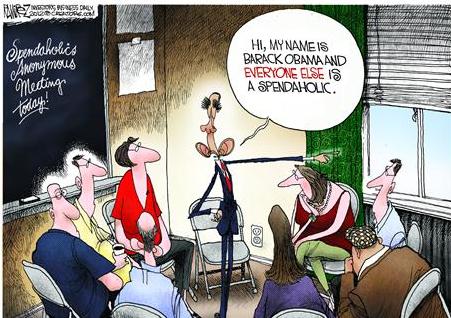
That being said, I was a big dumbfounded when President Obama recently claimed that there’s not a spending problem in Washington.

We know that the United States has a huge long-run problem with deficits and debt according to both the Bank for International Settlements and the Organization for Economic Cooperation and Development.

We also know that tax revenues, measured as a share of GDP, will soon be above their post-World War II average and that the tax burden is expected to increase in coming decades.

So a person would have to be in serious denial to claim that spending isn’t a problem.

Which is the point Eric Allie makes in this cartoon.

Spending Problem Cartoon 1

And the point Robert Ariail makes in this cartoon.

Spending Problem Cartoon 2

Ditto for Bob Gorrell.

Spending Problem Cartoon 3

And Gary Varvel.

Spending Problem Cartoon 4

Last but not least, the great Michael Ramirez.

Spending Problem Cartoon 5.jpg

Gee, it’s almost like we’re seeing a pattern.

And if you like this spendaholic-in-denial theme, you can click here and here for further amusement.

P.S. Oh, by the way, if anybody’s actually interested in how to solve the spending problem (you know, the one that doesn’t exist), we do know the answer.

P.P.S. Remember when Obama claimed the private sector was doing fine? Well, here’s how cartoonists mocked him for that absurd comment.

New Van Gogh identified!!!! (Also a look at the impressionists from a Christian perspective)

New Van Gogh identified!!!! (Also a look at the impressionists from a Christian perspective)

Art of Love – Part 1.flv

Uploaded on Apr 14, 2011

Stars: James Garner, Dick Van Dyke and Elke Sommer ; Paintings & Drawings: Don Cincone; (July 1965) A Struggling artist fakes his own death so his works will increase in value.

____________

Part 3

Part 4

Part 5

I was excited to read about a Van Gogh being found recently. Vincent Van Gogh was broke his whole life and then after he died his paintings sold very well. I love the movie “The Art of Love” which stars: James Garner, Dick Van Dyke and Elke Sommer from  July of 1965 and it is about a struggling artist that fakes his own death so his works will increase in value.  Today I am posting links to all the posts I have done on Van Gogh and posting clips both from the movie “Art of Love” and the film series HOW SHOULD WE THEN LIVE? from Francis Schaeffer that discusses Van Gogh and the other impressionist painters.

Van Gogh Museum: new Van Gogh identified

Museum identifies long-lost Van Gogh painting that lingered in Norwegian attic for decades

  • Dislike

Long-lost painting by Van Gogh is identified
.

View gallery

“Sunset at Montmajour” by Dutch painter Vincent van Gogh is seen during a press conference at the Van Gogh Museum in Amsterdam, Netherlands, Monday Sept. 9, 2013. The museum has identified the long-lost painting which was painted by the Dutch mater in 1888, the discovery is the first full size canvas that has been found since 1928 and will be on display from Sept. 24. (AP Photo/Peter Dejong)

Associated Press

AMSTERDAM (AP) — The first full-size Vincent Van Gogh painting to be discovered in 85 years has been authenticated as a genuine long-lost work of the Dutch master after an odyssey that included lingering for six decades in the attic of a Norwegian industrialist who had been told it was a fake.

“Sunset at Montmajour” depicts a dry landscape of twisting oak trees, bushes and sky, and it was done during the period when Van Gogh was increasingly adopting the thick brush strokes that became typical of his work in the final years of his short life, experts at the Van Gogh Museum in Amsterdam said Monday.

It can be dated to the exact day it was painted because Vincent described it in a letter to his brother, Theo, and said he had painted it the previous day — July 4, 1888.

“At sunset I was on a stony heath where very small, twisted oaks grow, in the background a ruin on the hill and wheat fields in the valley,” Van Gogh wrote.

“It was romantic…the sun was pouring its very yellow rays over the bushes and the ground, absolutely a shower of gold.”

But then Vincent confessed that the painting was “well below what I’d wished to do,” and later he sent it to Theo to keep.

Museum director Axel Rueger, at an unveiling ceremony in the museum, described the discovery as a “once-in-a-lifetime experience”.

“This is a great painting from what many see as the high point of his artistic achievement, his period in Arles, in southern France,” he said. “In the same period he painted works such as ‘Sunflowers,’ ‘The Yellow House’ and ‘The Bedroom’.”

Van Gogh struggled with bouts of mental distress throughout his life, and died of a self-inflicted gun wound in 1890. He sold only one painting while he was alive, though his work was just beginning to win acclaim when he died.

According to a reconstruction published in The Burlington Magazine by three researchers, the painting was recorded as number 180 in Theo’s collection, and given the title “Sun Setting at Arles.” It was sold to French art dealer Maurice Fabre in 1901.

Fabre never recorded selling the work, and the painting disappeared from history until it reappeared in 1970 in the estate of Norwegian industrialist Christian Nicolai Mustad.

The Mustad family said that Christian had purchased the work in 1908 as a young man in one of his first forays into art collecting, but he had soon after been told by the French ambassador to Sweden that it was a fake. Embarrassed, Mustad banished it to the attic.

After Mustad’s death in 1970, art dealer Daniel Wildenstein said he thought the painting was either a fake Van Gogh or possibly the work of a less-known German painter, and the painting was sold to a collector. The museum said it will not disclose who purchased it, or whether it has been resold since then.

In 1991 the museum itself declined to authenticate the painting.

“That may be a painful admission, given that the same museum is now attributing it to Van Gogh, but it is understandable” as experts had no information about what the painting depicted, the Burlington Magazine article said.

Teio Meedendorp, one of three experts who worked on the project, said his predecessors might also have been confused because the painting was done at a “transitional” moment in Van Gogh’s style.

“From then on, Van Gogh increasingly felt the need to paint with more and more impasto (thick strokes using lots of paint) and more and more layers,” he said.

The painting was unsigned. Some parts of the foreground were not “as well-observed as usual.” And part of the right side of the painting used a different style of brush strokes — possibly the same reasons Van Gogh himself considered the painting a failure.

But when the museum took a fresh look at the work in 2011, they had the advantage of a newly edited and published compendium of all Van Gogh’s letters, and were able for the first time to identify the exact location “Sunset” depicts: Monmajour hill, near Arles, France. The ruins of Monmajour abbey can be seen in the background on the left side of the painting.

Van Gogh mentioned the painting in two other letters the same summer.

The number 180 on the back of the canvas was an important clue, and new techniques of chemical analysis of the pigments showing they were identical to others Van Gogh used on his palette at Arles — including typical discolorations.

Meanwhile, an X-ray examination of the canvas showed it was of the same type Van Gogh used on other paintings from the period, such as “The Rocks,” which hangs in Houston’s Museum of Fine Arts.

Rueger described “Sunset” as ambitious, because the canvas is relatively large, at 93.3 by 73.3 centimeters (36.7 by 28.9 inches) — and because Van Gogh himself felt the result didn’t live up to his imagination of what it was meant to be.

The artist made similar remarks about some of his most famous paintings, including the 1889 “Starry Night” that hangs in the Museum of Modern Art in New York.

Meedendorp said that “Sunset” belongs “to a special group of experimental works that Van Gogh at times esteemed of lesser value than we tend to do nowadays.”

Meedendorp said it’s not impossible that another unknown or lost Van Gogh could be found someday. The artist destroyed some works himself when he wasn’t satisfied with the results, but others that are mentioned in his letters or early collection of his work have since disappeared. He is believed to have completed more than 800 works, painting at an accelerating pace before his death aged 37.

The Van Gogh Museum, which houses 140 paintings, receives more than a million visitors annually. Van Gogh paintings are among the most valuable in the world, selling for tens of millions of dollars on the rare occasions one is sold at an auction.

_____

Follow Toby Sterling on Twitter http://www.twitter.com/lbsterling

______________

Here below is episode 8 called “The Age of Fragmentation” from Francis Schaeffer’s film series HOW SHOULD WE THEN LIVE? and it talks about the impressionist painters at the beginning of the episode.

Schaeffer’s film series “How should we then live?  Wikipedia notes, “According to Schaeffer, How Should We Then Live traces Western history from Ancient Rome until the time of writing (1976) along three lines: the philosophic, scientific, and religious.[3] He also makes extensive references to art and architecture as a means of showing how these movements reflected changing patterns of thought through time. Schaeffer’s central premise is: when we base society on the Bible, on the infinite-personal God who is there and has spoken,[4] this provides an absolute by which we can conduct our lives and by which we can judge society.  Here are some posts I have done on this series: Francis Schaeffer’s “How should we then live?” Video and outline of episode 10 “Final Choices” , episode 9 “The Age of Personal Peace and Affluence”, episode 8 “The Age of Fragmentation”, episode 7 “The Age of Non-Reason” , episode 6 “The Scientific Age” ,  episode 5 “The Revolutionary Age” , episode 4 “The Reformation”,  episode 3 “The Renaissance”, episode 2 “The Middle Ages,”, and  episode 1 “The Roman Age,” .

E P I S O D E 8

How Should We Then Live? Episode 8: The Age Of Fragmentation

Published on Jul 24, 2012

Dr. Schaeffer’s sweeping epic on the rise and decline of Western thought and Culture

__________

I saw this film series in 1979 and it had a major impact on me.

T h e Age of FRAGMENTATION

I. Art As a Vehicle Of Modern Thought

A. Impressionism (Monet, Renoir, Pissarro, Sisley, Degas) and Post-Impressionism (Cézanne, Van Gogh, Gauguin, Seurat): appearance and reality.

1. Problem of reality in Impressionism: no universal.

2. Post-Impression seeks the universal behind appearances.

3. Painting expresses an idea in its own terms as a work of art; to discuss the idea in a painting is not to intellectualize art.

4. Parallel search for universal in art and philosophy; Cézanne.

B. Fragmentation.

1. Extremes of ultra-naturalism or abstraction: Wassily Kandinsky.

2. Picasso leads choice for abstraction: relevance of this choice.

3. Failure of Picasso (like Sartre, and for similar reasons) to be fully consistent with his choice.

C. Retreat to absurdity.

1. Dada , and Marcel Duchamp: art as absurd.

2. Art followed philosophy but came sooner to logical end.

3. Chance in his art technique as an art theory impossible to practice: Pollock.

II. Music As a Vehicle of Modern Thought

A. Non-resolution and fragmentation: German and French streams.

1. Influence of Beethoven’s last Quartets.

2. Direction and influence of Debussy.

3. Schoenberg’s non-resolution; contrast with Bach.

4. Stockhausen: electronic music and concern with the element of change.

B. Cage: a case study in confusion.

1. Deliberate chance and confusion in Cage’s music.

2. Cage’s inability to live the philosophy of his music.

C. Contrast of music-by-chance and the world around us.

1. Inconsistency of indulging in expression of chaos when we acknowledge order for practical matters like airplane design.

2. Art as anti-art when it is mere intellectual statement, divorced from reality of who people are and the fullness of what the universe is.

III. General Culture As the Vehicle of Modern Thought

A. Propagation of idea of fragmentation in literature.

1. Effect of Eliot’s Wasteland and Picasso’s Demoiselles d’ Avignon

compared; the drift of general culture.

2. Eliot’s change in his form of writing when he became a Christian.

3. Philosophic popularization by novel: Sartre, Camus, de Beauvoir.

B. Cinema as advanced medium of philosophy.

1. Cinema in the 1960s used to express Man’s destruction: e.g. Blow-up.

2. Cinema and the leap into fantasy:

The Hour of the Wolf, Belle de Jour, Juliet of the Spirits, The Last Year at Marienbad.

3. Bergman’s inability to live out his philosophy (see Cage): Silence and The Hour of the Wolf.

IV. Only on Christian Base Can Reality Be Faced Squarely

Questions

1. Explain what “fragmentation” means, as discussed by Dr. Schaeffer. What does it result from? Give examples of it.

2. Apart from the fact that modern printing and recording processes made the art and music of the past more accessible than ever before, do you think that the preference of many people for the art and music of the past is related to the matters discussed by Dr. Schaeffer? If so, how?

3. “A foolish consistency is the hobgoblin of little minds… With consistency a great soul has simply nothing to do.” Emerson wrote this over a century ago. Debate.

4. How far do you think that the opinion of some Christians that one should have nothing to do with philosophy, art and novels is a manifestation of the very fragmentation which is characteristic of modern secular thought? Discuss.

Key Events and Persons

Beethoven’s last Quartets: 1825-26

Claude Monet: 1840-1926

Poplars at Giverny, Sunrise: 1885

Paul Cézanne: 1839-1906

The Bathers: c.1905

Claude Debussy: 1862-1918

Wassily Kandinsky: 1866-1944

Arnold Schoenberg: 1874-1951

Picasso: 1881-1973

Les Demoiselles d’Avignon: 1906-7

Marcel Duchamp: 1887-1969

Nude Descending a Staircase: 1912

T.S. Eliot: 1888-1965

The Wasteland: 1922

John Cage: 1912-1992

Music for Marcel Duchamp: 1947

Jackson Pollock: 1912-1956

Karlheinz Stockhausen: 1928-

Sartre’s Nausea: 1938

Beauvoir’s L’Invitée: 1943

Camus’ The Stranger: 1942

Camus’ The Plague: 1947

Resnais’ The Last Year at Marienbad: 1961

Bergman’s The Silence: 1963

Fellini’s Juliet of the Spirits: 1965

Antonioni’s Blow-Up: 1966

Bergman’s The Hour of the Wolf: 1967

Buñel’s Belle de Jour: 1967

Further Study

Perhaps you have seen some of the films mentioned. You should try to see them if you haven’t.Watch for them in local art-film festivals, on TV, or in campus film series. They rarely return nowadays to the commercial circuit. The sex and violence which they treated philosophically have now taken over the screen in a more popular and crude form! Easier of access are the philosophic novels of Sartre, Camus and de Beauvoir. Read the titles Dr. Schaeffer mentions. Again, for the artwork and music mentioned, consult libraries and record shops. But spend time here—let the visual images and the musical sounds sink in.

Listening patiently to Cage and Webern, for example, will tell you more than volumes of musicology.

T.S. Eliot, The Wasteland (many editions, usually in collections of his verse).

Joseph Machlis, Introduction to Contemporary Music (1961).

H.R. Rookmaaker, Modern Art and the Death of a Culture (1970).

Donald J. Drew, Images of Man (1974).

Colin Wilson, The Outsider (1956).

_____________

Related posts:

Van Gogh Portrait Purchased for a Mere $3,000

Van Gogh Portrait Purchased for a Mere $3,000   The art world is buzzing after news broke that a British couple reportedly purchased the only full-length Vincent Van Gogh portrait in existence for a mere 1,500 pounds ($3,000). The potentially priceless picture was originally listed on an auction website as simply ‘portrait of a man,’ but after […]

The characters referenced in Woody Allen’s movie “Midnight in Paris” (Part 28,Van Gogh)

I have been going through the characters referenced in Woody Allen’s latest film “Midnight in Paris.” I only have a few characters left. Today is Vincent van Gogh who actually is not mentioned but his painting “The Starry Night” is featured in the poster to promote the movie. The Starry Night Vincent van Gogh (Dutch, […]

Oldest person in the world cursed? Jeanne Calment wasn’t, she lived to 122 yrs and told of meeting Van Gogh

Season 32, episode of Saturday Night Live, December 9th, 2006, Justin Timberlake hosting. During the news segment: Seth Meyers: Elizabeth “Lizzie” Bolden, the world’s oldest person, died Monday in a Memphis nursing home at the age of 116. Man, it’s like that title, “World’s Oldest Person”, is cursed or something. _____________________________________ Jeanne Calment was not […]

Kirk Douglas is turning 95, video clips of movies and interviews

You can’t  get more American than Kirk Douglas who turns 95 on Dec 9, 2011. President Reagan posing with Kirk Douglas and his wife Anne Buydens at a private dinner at Eldorado Country Club in Rancho Mirage, California. 12/30/87. I have a story to tell about Kirk Douglas. A good friend of mine was the […]


Tom Osborne at the Little Rock Touchdown Club Part 2

Tom Osborne at the Little Rock Touchdown Club Part 2

Nebraska Athletics Tribute to Tom Osborne Banquet

Published on Mar 19, 2013

Old rivals, teammates, and friends paid tribute to Coach Tom Osborne at the Century Link Center in Omaha, Nebraska as he retires as Athletic Director for the University of Nebraska-Lincoln.

___________

_______

1998 Orange Bowl – The Nebraska Cornhuskers vs. The Tennessee Volunteers

__________________

I really enjoyed hearing Tom Osborne speak at the Little Rock Touchdown Club on 9-9-13.

Tom Osborne won three national championships (National: (3) – 1994, 1995, 1997).

His last one came in 1997 against Tennessee. In that game there were 3 costly turnovers from Tennessee that put them down 14-0 at halftime and Peyton Manning could not dig himself out of that hole.  Nebraska had been in the national title game many times before but the breaks did not go their way but in this game which was Tom Osborne’s last game the breaks went their way.

Osborne talks athletic improvements, state of college football at Touchdown Club

By David Harten 

This article was published today at 1:03 p.m.

former-nebraska-coach-tom-osborne-signed-autographs-for-fans-at-the-little-rock-touchdown-club-on-monday-afternoon

PHOTO BY DAVID HARTEN

Former Nebraska coach Tom Osborne signed autographs for fans at the Little Rock Touchdown Club on Monday afternoon.

Osborne speaks to LRTD Club

Former Nebraska coach and athletic director Tom Osborne spoke to a crowd of about 300 people at the Little Rock Touchdown Club on Monday afternoon. Among the topics, Osborne spoke about the possibility of players earning some of the revenue in college football, his 13-1-1 record against the SEC and recent rule changes. (By David Harten)
[View Full-Size]

Former University of Nebraska Coach Tom Osborne told the Little Rock Touchdown Club on Monday that while some might say college athletics have deteriorated over time, in some ways they “have never been better.”

The 76-year-old Osborne was head coach at Nebraska for 25 years, winning three national championships in four years from 1994-97. The Hastings, Neb., native spent his entire coaching career with the Cornhuskers, starting as an offensive assistant in 1964, being named offensive coordinator in 1969 and taking over the program in 1973 on his way to 255 career wins.

Osborne entertained the crowd of about 300 with jokes and stories of his national title years with the Cornhuskers, particularly the 1997 Orange Bowl, joking about Peyton Manning and his own team that season.

The coaching great also shared his thoughts on collegiate athletics today, saying that while some “would have you think it’s worse,” in some ways, college sports have improved. For example, Osborne said, he was the only athletic academic counselor for the Cornhuskers while he was an assistant, something that isn’t the case now, with entire staffs on hand to help players academically.

He also noted that today, academics are better policed and athletes have more options toward obtaining degrees.

Osborne added that strength and training in modern college athletics have much improved over his playing and coaching days.

He also talked ethics in the game, noting that the demise of the Southwest Conference was keyed by improper benefits given to players and that those situations have led to tougher sanctions against teams that cheat heavily.

“As far as ethics and honesty, [there have been] tremendous changes,” Osborne said.

Later Osborne added that he doesn’t believe players should be paid, due to the fact that workmen’s compensation issues could arise, but he does believe a portion of the stadium attendance revenues should be included into a player’s scholarship.

But, he said, while hundreds of millions of dollars are in play with college athletics, players still don’t benefit. “The players are left behind so badly,” Osborne said. “…The players are at best, no better off than they were in 1962.”

In addition to the three national titles, Osborne won 13 conference titles in the Big 8 and Big 12, was named Big 8 Coach of the Year seven times and national coach of the year in 1994.

As a player, Osborne was a standout quarterback at Hastings High School and Hastings College before playing three years in the NFL with the San Francisco 49ers and Washington Redskins as a wide receiver.

Read more about this story in tomorrow’s Arkansas Democrat-Gazette.

Related posts:

Dan Hampton at the Little Rock Touchdown Club Part 4 (Learning a lesson from Hampton’s mistakes)

Dan Hampton at the Little Rock Touchdown Club Part 4 Mike Singletary: Christ Means Everything – CBN.com Uploaded on Aug 25, 2010 Shawn Brown talks to the tough-as-nails coach of the San Francisco 49ers about how he wins in life and in football… The Christian Broadcasting Network CBN http://www.cbn.com __________________________ No one has more respect […]

Dan Hampton at the Little Rock Touchdown Club Part 3

Dan Hampton at the Little Rock Touchdown Club Part 3 Before Dan Hampton got to speak at the touchdown club this week, Rex Nelson got up and spoke and when he talked about Bobby Petrino taking his Western Kentucky team into Knoxville, he asked, “How many of you think Petrino will get a victory in […]

Dan Hampton at the Little Rock Touchdown Club Part 2

Dan Hampton at the Little Rock Touchdown Club Part 2 https://www.youtube.com/watch?v=nCPWDMKzVs4 Dan Hampton told about the  year with the Chicago Bears when they took on the Vikings and they sacked Archie Manning 11 times.  In October on 1984 the Bears beat the Vikings but in the process Dan Hampton got to play against one of […]

Dan Hampton at the Little Rock Touchdown Club Part 1

Dan Hampton at the Little Rock Touchdown Club Part 1  Dan Hampton I really enjoyed the Little Rock Touchdown Club today when Dan Hampton was our speaker. Hampton said that Jimmy Johnson was a great defensive coordinator for him to learn under when he played for Frank Broyles in 1975. Then when Lou Holtz came […]

My favorite past speakers of the Little Rock Touchdown Club and the 2013 lineup (Part 4)

Rex Nelson impersonates Houston Nutt at LRTC 08 27 12 Published on Oct 2, 2012 Little Rock Touchdown Club has Rex Nelson do the stats for the games played that week. Rex does a lot of impersonations of different people but I like his Houston Nutt the best. Video by Popeye Video – Mrpopeyevideo I have […]

My favorite past speakers of the Little Rock Touchdown Club and the 2013 lineup (Part 3) (Vince Dooley did a great job)

I have written about my past visits to the Little Rock Touchdown Club many times and I have been amazed at the quality of the speakers. Frank Broyles was one of my favorites but Phillip Fulmer, Paul Finebaum, Mike Slive, Willie Roaf, Randy White, Howard Schnellenberger, John Robinson, Mark May, Gene Stallings, Bobby Bowden, Lloyd […]

My favorite past speakers of the Little Rock Touchdown Club and the 2013 lineup (Part 2) (Frank Broyles was outstanding!!)

I have written about my past visits to the Little Rock Touchdown Club many times and I have been amazed at the quality of the speakers. (Yesterday I talked about Phillip Fulmer.)Frank Broyles was one of my favorites but Phillip Fulmer, Paul Finebaum, Mike Slive, Willie Roaf, Randy White, Howard Schnellenberger, John Robinson, Mark May, […]

My favorite past speakers of the Little Rock Touchdown Club and the 2013 lineup (Part 1)

Rex Nelson impersonates Houston Nutt at LRTC 08 27 12 Published on Oct 2, 2012 Little Rock Touchdown Club has Rex Nelson do the stats for the games played that week. Rex does a lot of impersonations of different people but I like his Houston Nutt the best. Video by Popeye Video – Mrpopeyevideo ______________ I […]

Gus Malzahn does a great job at Little Rock Touchdown Club (Part 2)

I really enjoyed hearing Gus Malzahn speak at the final Little Rock Touchdown meeting on Nov 19, 2012. He covered several subjects that he covered a few days earlier at a touchdown club in Huntsville. Here are some of his comments from that meeting: But reports that he could be the next coach at Auburn, […]

Why Are Republicans Willing to Help Obama Make America More Like Europe When the Welfare State Is Collapsing? (includes cartoons)

Why can’t we learn from history?

Washington frustrates me. The entire town is based on legalized corruption as an unworthy elite figure out new ways of accumulating unearned wealth by skimming money from the nation’s producers.

But one thing that especially irks me is the way people focus on the trees and forget about the forest. Politicians and journalists are now engaged in an inside-baseball game of analyzing every twist and turn of the fiscal cliff negotiations.

That’s all fine and well, but perhaps it would be a good idea to talk about the need to fix the real crisis of excessive spending instead of arguing about how fast we should be traveling in the wrong direction.

And let’s not delude ourselves. In the absence of real entitlement reform, the United States is doomed to repeat Europe’s mistakes.

And how are things going in Europe? Well, I’m glad you ask. Let’s look at some excerpts from an Associated Press report.

Another month, another record unemployment rate for the economy of the 17 European Union countries that use the euro. Figures released Friday by Eurostat, the EU’s statistics office, showed that the recession in the eurozone pushed unemployment up in the currency bloc to 11.7 percent in October, the highest level since the introduction of the euro in 1999. …Eurostat found that 18.7 million people were out of work across the eurozone, an increase of 173,000 on the previous month and 2.2 million higher than the year before. The wider 27-nation EU that includes non-euro countries such as Britain and Poland had an unemployment rate of 10.7 percent in October and a total of 25.9 million out of work. …”Talk of a `lost generation’ of young people now looks like an alarming possibility,” said Andrea Broughton, principal research fellow at the Institute for Employment Studies.

In other words, we may complain about America’s miserable track record on jobs during the Obama years, but at some point in the future we may someday look back on 8 percent unemployment as good news.

Unfortunately, the crowd in Washington doesn’t want to acknowledge that the real problem is spending. And I’m particularly irked (but not surprised) that Republicans now seem willing to go along with Obama even though they won this fight back in 2010 when they didn’t control the House and had fewer seats in the Senate. Here’s what I said to one of the local DC stations.

Dan Mitchell Comments on Washington’s Spending Problem and GOP Appeasement

I realize I’m sounding glum, so let’s close out this post with a couple of amusing cartoons about America’s European future.

I’ve already shared the “European Lemming” cartoon. This one has the same theme.

Cartoon Obama Iceberg

Other Eric Allie cartoons can be enjoyed here, here , here, here, here, and here.

And here another cartoon with the same theme.

Cartoon Obama Cliff

If you like this Bok cartoon, some of my other favorites can be seen here,  here, here, here, here, here, and here.

If you still haven’t cheered up, this bit of Dave Barry humor about the European fiscal crisis is a classic, and I’d also recommend this bit of unintentional satire.

Cole Porter’s song “Love for Sale”

______________

Love For Sale (De-Lovely)

Love for Sale (song)

From Wikipedia, the free encyclopedia
Jump to: navigation, search
“Love for Sale“
Written by Cole Porter
Published 1930
Form Show tune
Recorded by Libby Holman, Fred Waring’s Pennsylvanians, Eartha Kitt, Mel Torme, Dinah Washington, Liza Minnelli, Diane Schuur, Chris Barber, Fine Young Cannibals, Jazz Orchestra of the Delta, Chet Baker, Hal Kemp, Artie Shaw, Erroll Garner, Billie Holiday, Royce Campbell, Ella Fitzgerald, Tony Bennett, Miles Davis, Cannonball Adderley, Dexter Gordon, The Manhattan Transfer, Elvis Costello, Buddy Rich, Julie London, Dr. John, Anita O’Day, Amanda Lear, Frank Sinatra, Jr., Boney M., Martin Smith, Cyrille Aimée
Performed by Kathryn Crawford, Elisabeth Welch, Harvey Fierstein, Aretha Franklin, Martin Smith, Brian Stokes Mitchell, Idina Menzel, Jamie Cullum

“Love for Sale” is a song by Cole Porter, from the musical The New Yorkers which opened on Broadway on December 8, 1930 and closed in May 1931 after 168 performances. The song is written from the viewpoint of a prostitute advertising various kinds of “love for sale”: “Old love, new love, every love but true love“.

The song’s chorus, like many in the Great American Songbook, is written in the A-A-B-A format. However, instead of 32 bars, it has 64, plus an 8-bar tag. The tag is often dropped when the song is performed. The tune, using what is practically a trademark for Porter, shifts between a major and minor feeling.

“Love for Sale” was originally considered in bad taste, even scandalous. In the initial Broadway production, it was performed by Kathryn Crawford, portraying a streetwalker, with three girlfriends (Waring’s Three Girl Friends) as back-up singers, in front of Reuben’s, a popular restaurant of the time. As a response to the criticism, the song was transferred from the white Crawford to the African American singer Elisabeth Welch, who sang with back-up singers in a scene set in front of Harlem‘s Cotton Club.

Despite the fact the song was banned from radio airplay, or perhaps because of it, it became a hit, with Libby Holman‘s version going to #5 and the “Fred Waring’s Pennsylvanians” version going to #14, both in 1931. (All other 1931 recordings of the song were as an instrumental.)

Notable recordings since include Hal Kemp in 1939, Billie Holiday in 1945, Eartha Kitt in the 1950s, Ella Fitzgerald in 1956, and again in 1972 on her Ella Loves Cole album, Tony Bennett in 1957, Miles Davis and Cannonball Adderley for 1958 Miles and Somethin’ Else, Anita O’Day in 1959, Dexter Gordon in 1962, Al Hirt on his 1965 album, Live at Carnegie Hall,[1] The Manhattan Transfer in 1976, the German disco group Boney M in 1977, Donald Byrd on the Love Byrd album in 1981, Elvis Costello live on the remastered Rhino Entertainment CD of his 1981 record Trust. Harvey Fierstein performs a memorable (if interrupted) version in the movie version of his play Torch Song Trilogy. Martin Smith sang the song in the Cole Porter revue A Swell Party – A Celebration of Cole Porter at London’s Vaudeville Theatre in 1992. Simply Red led by Mick Hucknall sang this song at the Montreux Jazz Festival in 1992. Harry Connick, Jr. covered it in 1999 on his album Come by Me. Amanda Lear recorded a version in 2006.

Other vocal versions include Mel Torme‘s, Dinah Washington‘s, Liza Minnelli‘s, Diane Schuur‘s, Dianne Reeves‘, Cyrille Aimée‘s and Fine Young Cannibals‘. The song has become a jazz standard, and is often performed in solely instrumentalist versions. Notable among these is the Arthur Lyman version, which revived the song as a single record in 1963.

The song was also performed during a sequence in a gay night club in the Cole Porter biopic De-Lovely (performed by Vivian Green) and by k.d. Lang during a similar sequence in Brian De Palma‘s The Black Dahlia. A recording by Julie London featured in the film “Enron: The Smartest Guys in the Room” (2005).

Another notable recording of “Love for Sale” was made by Keely Smith at Capitol Studios, LA, for Concord Records in July 2002.[2]

There is another significant recording of “Love for Sale” by Jack Teagarden in 1940. The vocalist was 18 year old Kitty Kallen and, like the other versions of the song, was banned from radio.

Brazilian singer Zizi Possi recorded her own rendition for her album Para Inglês Ver… E Ouvir. Her rendition was picked as part of soap opera Belíssima soundtrack in 2006.

Idina Menzel covered the song on her 2010–2011 Symphony Tour as a mashup with The Police‘s “Roxanne“. The rendition of the mashup can be heard on her live album “Live: Barefoot at the Symphony.”

British Jazz Artist Jamie Cullum also did his own rendition for his album Momentum, entitled “Love For $ale”, featuring Roots Manuva. The allbum came out May 20th, 2013 in the UK, and May 21st, 2013 in the U.S.

See also

References

  1. ^ Al Hirt, Live at Carnegie Hall Retrieved April 11, 2013.
  2. ^ see Concord Records CCD-2138-2

External links

__________

Related posts:

Cole Porter “Let’s Do it, Let’s Fall in Love” in the movie MIDNIGHT IN PARIS

Cole Porter “Let’s Do it, Let’s Fall in Love” in the movie MIDNIGHT IN PARIS Midnight in Paris – Let’s Do It Let’s do it : Cole Porter.( Midnight in Paris ) Celebrate Wikipedia Loves Libraries at your institution in October/November. Let’s Do It, Let’s Fall in Love From Wikipedia, the free encyclopedia Jump to: […]

The Characters referenced in Woody Allen’s “Midnight in Paris” (Part 2 Cole Porter)

The song used in “Midnight in Paris” I am going through the famous characters that Woody Allen presents in his excellent movie “Midnight in Paris.”  By the way, I know that some of you are wondering how many posts I will have before I am finished. Right now I have plans to look at Fitzgerald, Heminingway, Juan […]


Truth Tuesday:Why Francis Schaeffer still matters by John Fischer

Episode 8: The Age Of Fragmentation

Published on Jul 24, 2012

Dr. Schaeffer’s sweeping epic on the rise and decline of Western thought and Culture

_______________________

I love the works of Francis Schaeffer and I have been on the internet reading several blogs that talk about Schaeffer’s work and the work below by John Fischer was really helpful. Schaeffer’s film series “How should we then live?  Wikipedia notes, “According to Schaeffer, How Should We Then Live traces Western history from Ancient Rome until the time of writing (1976) along three lines: the philosophic, scientific, and religious.[3] He also makes extensive references to art and architecture as a means of showing how these movements reflected changing patterns of thought through time. Schaeffer’s central premise is: when we base society on the Bible, on the infinite-personal God who is there and has spoken,[4] this provides an absolute by which we can conduct our lives and by which we can judge society.  Here are some posts I have done on this series: Francis Schaeffer’s “How should we then live?” Video and outline of episode 10 “Final Choices” , episode 9 “The Age of Personal Peace and Affluence”, episode 8 “The Age of Fragmentation”, episode 7 “The Age of Non-Reason” , episode 6 “The Scientific Age” ,  episode 5 “The Revolutionary Age” , episode 4 “The Reformation”,  episode 3 “The Renaissance”, episode 2 “The Middle Ages,”, and  episode 1 “The Roman Age,” .

In the film series “WHATEVER HAPPENED TO THE HUMAN RACE?” the arguments are presented  against abortion (Episode 1),  infanticide (Episode 2),   euthanasia (Episode 3), and then there is a discussion of the Christian versus Humanist worldview concerning the issue of “the basis for human dignity” in Episode 4 and then in the last episode a close look at the truth claims of the Bible.

Francis Schaeffer

__________________________

Here is the link:

Why Francis Schaeffer still matters

A few years ago I wrote an article in Christianity Today about the late Francis Schaeffer. Today’s Catch is edited from that article because I believe the sensitivity he modeled is much needed today in this mean-spirited, take-sides culture that only stands to get worse in America as a Presidential election approaches. True followers of Christ need to avoid joining in the bashing, and here is a good reason why.

He was a small man — barely five feet in his knickers, knee socks, and ballooning white shirts. For two weeks, first as a freshman, and then again as a senior, I sat in my assigned seat at Wheaton College chapel and heard him cry. He was the evangelical conscience at the end of the 20th century, weeping over a world that most of his peers dismissed as not worth saving, except to rescue a few souls in the doomed planet’s waning hours.

Francis Schaeffer was hard to listen to. His voice grated. It was a high-pitched scream, and when mixed with his eastern Pennsylvania accent, resulted in something like Elmer Fudd on speed. As freshmen, unfamiliar with the thought and works of modern man, we thought it was funny. As seniors, it wasn’t funny any more. After we had studied Kant, Hegel, Sartre, and Camus, the voice was now more like an existential shriek. If Edvard Munch’s The Scream had a voice, it would sound like Francis Schaeffer. Schaeffer, who died in 1984, understood the existential cry of a humanity trapped in a prison of its own making.

Schaeffer was the closest thing to a “man of sorrows” I have seen. He could not allow himself to be happy when most of the world was desperately lost and he knew why. He was the first Christian I found who could embrace faith and the despair of a lost humanity all at the same time. Though he had been found, he still knew what it was to be lost.

Schaeffer was the first Christian leader who taught me to weep over the world instead of judging it. Schaeffer modeled a caring and thoughtful engagement in the history of philosophy and its influence through movies, novels, plays, music, and art. Here was Schaeffer, teaching at Wheaton College about the existential dilemma expressed in Michelangelo Antonioni’s 1966 film, Blowup, when movies were still forbidden to students. He didn’t bat an eye. He ignored our legalism and went on teaching because he had been personally gripped by the desperation of such cultural statements.

Schaeffer taught his followers not to sneer at or dismiss the dissonance in modern art. He showed how these artists were merely expressing the outcome of the presuppositions of the modern era that did away with God and put all conclusions on a strictly human, rational level. Instead of shaking our heads at a depressing, dark, abstract work of art, the true Christian reaction should be to weep for the lost person who created it. Schaeffer was a rare Christian leader who advocated understanding and empathizing with non-Christians instead of taking issue with them.

The normal human reaction is to hate what we don’t understand. This is the stuff of prejudice and the cause of hate crimes and escalating culture wars. It is much more Christ-like to identify with those we don’t understand — to discover why people do what they do, because we care about them, even if they are our ideological enemies.

Anyway, Jesus asked us to love our enemies. Part of loving is learning to understand. Too few Christians today seek to understand why their enemies think in ways they find abhorrent. Too many of us are too busy bashing feminists, secular humanists, gay activists, and political liberals to consider why they believe what they do. It’s difficult to sympathize with people you see as threats to your children and your neighborhood. It’s hard to weep over those whom you have declared as your enemies.

Perhaps a good beginning would be to more fully grasp the depravity of our own souls, and the depth to which God’s grace had to go to reach us. I don’t think you can cry over the world if you’ve never cried over yourself.

To be sure, Francis Schaeffer’s influence has declined in recent years,as postmodernism has supplanted the modernity he dissected for so long. Schaeffer is not without critics, even among Christians. But perhaps, in the end, his greatest influence on the church will not be his words as much as his cry. The same things that made Francis Schaeffer cry in his day need to make us cry in ours.

Related posts:

Taking on Ark Times Bloggers on various issues Part A “The Pro-life Issue” (Francis Schaeffer Quotes Part 1 includes the film SLAUGHTER OF THE INNOCENTS) (editorial cartoon)

I have gone back and forth and back and forth with many liberals on the Arkansas Times Blog on many issues such as abortion, human rights, welfare, poverty, gun control  and issues dealing with popular culture. Here is another exchange I had with them a while back. My username at the Ark Times Blog is Saline […]

“Schaeffer Sunday” Francis Schaeffer: “Whatever Happened to the Human Race” (Episode 1) ABORTION OF THE HUMAN RACE

It is not possible to know where the pro-life evangelicals are coming from unless you look at the work of the person who inspired them the most. That person was Francis Schaeffer.  I do care about economic issues but the pro-life issue is the most important to me. Several years ago Adrian Rogers (past president of […]

The movie “Les Miserables” and Francis Schaeffer

I got this off a Christian blog spot. This person makes some good points and quotes my favorite Christian philosopher Francis Schaeffer too. Prostitution, Chaos, and Christian Art The newest theatrical release of Victor Hugo’s 1862 novel “Les Miserables” was released on Christmas, but many Christians are refusing to see the movie. The reason simple — […]

“Schaeffer Sunday” Francis Schaeffer is one of the great evangelical theologians of our modern day

Francis Schaeffer was truly a great man and I enjoyed reading his books. A theologian #2: Rev. Francis Schaeffer Duriez, Colin. Francis Schaeffer: An Authentic Life. Wheaton, IL: Crossway Books, 2008. Pp. 240. Francis Schaeffer is one of the great evangelical theologians of our modern day. I was already familiar with some of his books and his […]

“Schaeffer Sundays” Francis Schaeffer’s own words concerning infanticide and youth enthansia

Francis Schaeffer: “Whatever Happened to the Human Race?” (Episode 2) SLAUGHTER OF THE INNOCENTS Published on Oct 6, 2012 by AdamMetropolis ___________ The 45 minute video above is from the film series created from Francis Schaeffer’s book “Whatever Happened to the Human Race?” with Dr. C. Everett Koop. This book  really helped develop my political views […]

Francis Schaeffer’s wife Edith passes away on Easter weekend 2013 Part 7 (includes pro-life editorial cartoon)

The Francis and Edith Schaeffer Story Pt.1 – Today’s Christian Videos The Francis and Edith Schaeffer Story – Part 3 of 3 Francis Schaeffer: “Whatever Happened to the Human Race” (Episode 1) ABORTION OF THE HUMAN RACE Published on Oct 6, 2012 by AdamMetropolis ________________ Picture of Francis Schaeffer and his wife Edith from the […]

The Mark of the Christian by Francis Schaeffer Part 1

  THE MARK OF A CHRISTIAN – CLASS 1 – Introduction Published on Mar 7, 2012 This is the introductory class on “The Mark Of A Christian” by Francis Schaeffer. The class was originally taught at Redeemer Presbyterian Church in Overland Park, KS by Dan Guinn from FrancisSchaefferStudies.org as part of the adult Sunday School hour […]

“Schaeffer Sundays” Francis Schaeffer’s own words concerning humanist dominated public schools in USA even though country was founded on a Christian base

Francis Schaeffer: “Whatever Happened to the Human Race?” (Episode 2) SLAUGHTER OF THE INNOCENTS Published on Oct 6, 2012 by AdamMetropolis The 45 minute video above is from the film series created from Francis Schaeffer’s book “Whatever Happened to the Human Race?” with Dr. C. Everett Koop. This book  really helped develop my political views concerning […]

“Schaeffer Sundays” Francis Schaeffer’s own words concerning where the Bible-believing Christians been the last few decades

Francis Schaeffer: “Whatever Happened to the Human Race” (Episode 1) ABORTION OF THE HUMAN RACE Published on Oct 6, 2012 by AdamMetropolis The 45 minute video above is from the film series created from Francis Schaeffer’s book “Whatever Happened to the Human Race?” with Dr. C. Everett Koop. This book  really helped develop my political views […]

Taking on Ark Times Bloggers on various issues Part E “Moral absolutes and abortion” Francis Schaeffer Quotes part 5(includes the film SLAUGHTER OF THE INNOCENTS) (editorial cartoon)

I have gone back and forth and back and forth with many liberals on the Arkansas Times Blog on many issues such as abortion, human rights, welfare, poverty, gun control  and issues dealing with popular culture. Here is another exchange I had with them a while back. My username at the Ark Times Blog is Saline […]

“Schaeffer Sundays” Francis Schaeffer’s own words concerning religious liberals and humanists

Francis Schaeffer: “Whatever Happened to the Human Race” (Episode 5) TRUTH AND HISTORY Published on Oct 7, 2012 by AdamMetropolis The 45 minute video above is from the film series created from Francis Schaeffer’s book “Whatever Happened to the Human Race?” with Dr. C. Everett Koop. This book  really helped develop my political views concerning abortion, […]

By Everette Hatcher III | Posted in Francis Schaeffer | Edit | Comments (0)