Open letter to President Obama (Part 409)SOHLS: Remembering 40 Years and over 50 million lives and video DEATH BY SOMEONE’S CHOICE

(Emailed to White House on 2-1-13.)

President Obama c/o The White House
1600 Pennsylvania Avenue NW
Washington, DC 20500

Dear Mr. President,

I know that you receive 20,000 letters a day and that you actually read 10 of them every day. I really do respect you for trying to get a pulse on what is going on out here.

In the film series “WHATEVER HAPPENED TO THE HUMAN RACE?” the arguments are presented  against abortion (Episode 1),  infanticide (Episode 2),   euthenasia (Episode 3), and then there is a discussion of the Christian versus Humanist worldview concerning the issue of “the basis for human dignity” in Episode 4 and then in the last episode a close look at the truth claims of the Bible. 

I truly believe that many of the problems we have today in the USA are due to the advancement of humanism in the last few decades in our society. Ronald Reagan appointed the evangelical Dr. C. Everett Koop to the position of Surgeon General in his administration. He partnered with Dr. Francis Schaeffer in making the video below. It is very valuable information for Christians to have.  Actually I have included a video below that includes comments from him on this subject.

___________

Francis and Edith Schaeffer pictured below.

Francis Schaeffer: “Whatever Happened to the Human Race” (Episode 3) DEATH BY SOMEONE’S CHOICE

Published on Oct 6, 2012 by

SOHLS: Remembering 40 Years and over 50 million lives PDF Print E-mail
Written by Marie Bowen   
Sanctity of Human Life Sunday (SOHLS) will be celebrated in churches across the nation this Sunday, January 20, 2013. In sermons, prayers, and songs, worshipers will acknowledge God as our Creator and affirm our identity as persons made in his image and set apart for his glory and service.Motte Brown wrote this account of the establishment of SOHLS in 2007. It is currently posted on Boundless Line:In 1983, an organization named Christian Action Council (now known as Care Net), founded with the help of Francis Schaeffer and former Surgeon General C. Everett Koop, asked President Ronald Reagan to “create a special day to focus on the intrinsic value of human life.”Sources conflict about whether the initial proclamation was 1983 or 1984, but it was President Ronald Reagan who designated the third Sunday in January as Sanctity of Human Life Day. The third Sunday of January is the closest Sunday to the January 22nd anniversary of the 1973 Roe V. Wade Supreme Court Decision that legalized abortion in the United States.According to Wikipedia, Reagan issued the proclamation annually for the remainder of his Presidency. Both Presidents Bush (George H. and George W.) continued the tradition interrupted by Bill Clinton’s tenure of eight years as President. President Obama has declined proclamation of Sanctity of Human Life day during his presidential tenure to date.The purpose of Sanctity of Human Life Sunday (SOHLS) was articulated by Ronald Reagan as follows:Since 1973, however, more than 15 million unborn children [that number now stands at more than 50 million] have died in legalized abortions — a tragedy of stunning dimensions that stands in sad contrast to our belief that each life is sacred. These children, over tenfold [now even more] the number of Americans lost in all our Nation’s wars, will never laugh, never sing, never experience the joy of human love; nor will they strive to heal the sick, or feed the poor, or make peace among nations. Abortion has denied them the first and most basic of human rights, and we are infinitely poorer for their loss.

We are poorer not simply for lives not led and for contributions not made, but also for the erosion of our sense of the worth and dignity of every individual. To diminish the value of one category of human life is to diminish us all. Slavery, which treated Blacks as something less than human, to be bought and sold if convenient, cheapened human life and mocked our dedication to the freedom and equality of all men and women. Can we say that abortion — which treats the unborn as something less than human, to be destroyed if convenient — will be less corrosive to the values we hold dear?

Throughout the years since 1983, various individuals and organizations have hoped to accomplish a number of goals through the celebration of SOHLS. In addition to celebrating the intrinsic value of human life, Carenet, a network of pregnancy care centers, sees this important day as “an opportunity for pregnancy centers to share about the work they do to bring life-affirming resources to their communities and to empower women and men to choose life for their unborn children.” SOHLS is a Sunday that highlights the hope and services pregnancy care centers offer. Many churches participate in raising funds by kicking off a baby bottle campaign on this day in their churches for the benefit of community pregnancy care outreach.

SOHLS is an opportunity to educate congregations on life issues. Through special bulletin inserts, special speakers, children’s sermons, and targeted worship resources churches seek to turn the tragic reality of abortion into a focus on the sacred value of human life. Often special events such as a video showing, a pro-life baby shower, special Sunday lessons and sermons, or the ringing of bells, the planting of crosses, or candle vigils help to commemorate the lives lost to abortion.

Remembering Roe: a special day of prayer and fasting. SOHLS is particularly significant in 2013, the 40th year since the Supreme Court ruling in Roe v. Wade and Doe v. Bolton which took place on January 22, 1973 and legalized abortion in our country. In addition to the Sunday celebration a host of pro-life organizations, who together affirm the value, dignity and sanctity of human life, have joined together to organize a special day of prayer and fasting remembering Roe on January 22, 2013. Individuals may register at http://www.rememberingroe.com for web based prayer event, post prayers on the website, send a message to the president, or share personal stories of where they were when abortion was legalized

An Ecumenical prayer service: National Memorial for the Pre-Born and Their Mothers and Fathers. A special commemorative service sponsored by members of the National Pro-Life Religious Council will be held at Constitution Hall in Washington D.C. ( (18th and D St.) on the January 25, 2013. Held just a few hours before the March for Life, the 8:30-10:30 am ecumenical prayer service will include participants from several denominations. Participants will commemorate lives lost to abortion and remember the life of Nellie Gray, founder of the March for Life.


Resources for SOHLS

Worship resources from a distinctly Presbyterian and Reformed perspective are available under the ‘Ministry Equipping’ tab of this website.

Right to Life of Michigan publishes a downloadable Prolife Litany and a Christian Discussion Guide on their website.

Focus on the Family offers videos to show on Sanctity of Human Life Sunday or throughout the month of January to inform about the impact of abortion on our nation.

Lutherans for Life is offering a slightly different focus in their resources for SOHLS in 2013. See their website for a host of materials for “living with Dying.”

Bethany Christian Services provides online resources with a focus on adoption.

Thank you so much for your time. I know how valuable it is. I also appreciate the fine family that you have and your commitment as a father and a husband.

Sincerely,

Everette Hatcher III, 13900 Cottontail Lane, Alexander, AR 72002, ph 501-920-5733, lowcostsqueegees@yahoo.com

 
Related posts:

Francis Schaeffer’s prayer for us in USA

 Francis Schaeffer: “Whatever Happened to the Human Race” (Episode 1) ABORTION OF THE HUMAN RACE Published on Oct 6, 2012 by AdamMetropolis The 45 minute video above is from the film series created from Francis Schaeffer’s book “Whatever Happened to the Human Race?” with Dr. C. Everett Koop. This book  really helped develop my political views […]


Francis Schaeffer’s “How should we then live?” Video and outline of episode 10 “Final Choices” (Schaeffer Sundays)

E P I S O D E 1 0   Dr. Francis Schaeffer – Episode X – Final Choices 27 min FINAL CHOICES I. Authoritarianism the Only Humanistic Social Option One man or an elite giving authoritative arbitrary absolutes. A. Society is sole absolute in absence of other absolutes. B. But society has to be […]

Francis Schaeffer’s “How should we then live?” Video and outline of episode 9 “The Age of Personal Peace and Affluence” (Schaeffer Sundays)

E P I S O D E 9 Dr. Francis Schaeffer – Episode IX – The Age of Personal Peace and Affluence 27 min T h e Age of Personal Peace and Afflunce I. By the Early 1960s People Were Bombarded From Every Side by Modern Man’s Humanistic Thought II. Modern Form of Humanistic Thought Leads […]

Francis Schaeffer’s “How should we then live?” Video and outline of episode 8 “The Age of Fragmentation” (Schaeffer Sundays)

E P I S O D E 8 Dr. Francis Schaeffer – Episode VIII – The Age of Fragmentation 27 min I saw this film series in 1979 and it had a major impact on me. T h e Age of FRAGMENTATION I. Art As a Vehicle Of Modern Thought A. Impressionism (Monet, Renoir, Pissarro, Sisley, […]

Francis Schaeffer’s “How should we then live?” Video and outline of episode 7 “The Age of Non-Reason” (Schaeffer Sundays)

E P I S O D E 7 Dr. Francis Schaeffer – Episode VII – The Age of Non Reason I am thrilled to get this film series with you. I saw it first in 1979 and it had such a big impact on me. Today’s episode is where we see modern humanist man act […]

Francis Schaeffer’s “How should we then live?” Video and outline of episode 6 “The Scientific Age” (Schaeffer Sundays)

E P I S O D E 6 How Should We Then Live 6#1 Uploaded by NoMirrorHDDHrorriMoN on Oct 3, 2011 How Should We Then Live? Episode 6 of 12 ________ I am sharing with you a film series that I saw in 1979. In this film Francis Schaeffer asserted that was a shift in […]

Francis Schaeffer’s “How should we then live?” Video and outline of episode 5 “The Revolutionary Age” (Schaeffer Sundays)

E P I S O D E 5 How Should We Then Live? Episode 5: The Revolutionary Age I was impacted by this film series by Francis Schaeffer back in the 1970′s and I wanted to share it with you. Francis Schaeffer noted, “Reformation Did Not Bring Perfection. But gradually on basis of biblical teaching there […]

Francis Schaeffer’s “How should we then live?” Video and outline of episode 4 “The Reformation” (Schaeffer Sundays)

Dr. Francis Schaeffer – Episode IV – The Reformation 27 min I was impacted by this film series by Francis Schaeffer back in the 1970′s and I wanted to share it with you. Schaeffer makes three key points concerning the Reformation: “1. Erasmian Christian humanism rejected by Farel. 2. Bible gives needed answers not only as to […]

“Schaeffer Sundays” Francis Schaeffer’s “How should we then live?” Video and outline of episode 3 “The Renaissance”

Francis Schaeffer’s “How should we then live?” Video and outline of episode 3 “The Renaissance” Francis Schaeffer: “How Should We Then Live?” (Episode 3) THE RENAISSANCE I was impacted by this film series by Francis Schaeffer back in the 1970′s and I wanted to share it with you. Schaeffer really shows why we have so […]

Francis Schaeffer’s “How should we then live?” Video and outline of episode 2 “The Middle Ages” (Schaeffer Sundays)

  Francis Schaeffer: “How Should We Then Live?” (Episode 2) THE MIDDLE AGES I was impacted by this film series by Francis Schaeffer back in the 1970′s and I wanted to share it with you. Schaeffer points out that during this time period unfortunately we have the “Church’s deviation from early church’s teaching in regard […]

Francis Schaeffer’s “How should we then live?” Video and outline of episode 1 “The Roman Age” (Schaeffer Sundays)

Francis Schaeffer: “How Should We Then Live?” (Episode 1) THE ROMAN AGE   Today I am starting a series that really had a big impact on my life back in the 1970′s when I first saw it. There are ten parts and today is the first. Francis Schaeffer takes a look at Rome and why […]

Francis Schaeffer: “Whatever Happened to the Human Race” (Episode 5) TRUTH AND HISTORY

Francis Schaeffer: “Whatever Happened to the Human Race” (Episode 5) TRUTH AND HISTORY Published on Oct 7, 2012 by AdamMetropolis This crucial series is narrated by the late Dr. Francis Schaeffer and former Surgeon General Dr. C. Everett Koop. Today, choices are being made that undermine human rights at their most basic level. Practices once […]

Francis Schaeffer: “Whatever Happened to the Human Race” (Episode 4) THE BASIS FOR HUMAN DIGNITY

The opening song at the beginning of this episode is very insightful. Francis Schaeffer: “Whatever Happened to the Human Race” (Episode 4) THE BASIS FOR HUMAN DIGNITY Published on Oct 7, 2012 by AdamMetropolis This crucial series is narrated by the late Dr. Francis Schaeffer and former Surgeon General Dr. C. Everett Koop. Today, choices […]

Francis Schaeffer: “Whatever Happened to the Human Race” (Episode 3) DEATH BY SOMEONE’S CHOICE

Francis Schaeffer: “Whatever Happened to the Human Race” (Episode 3) DEATH BY SOMEONE’S CHOICE Published on Oct 6, 2012 by AdamMetropolis This crucial series is narrated by the late Dr. Francis Schaeffer and former Surgeon General Dr. C. Everett Koop. Today, choices are being made that undermine human rights at their most basic level. Practices […]

Francis Schaeffer: “Whatever Happened to the Human Race?” (Episode 2) SLAUGHTER OF THE INNOCENTS

Francis Schaeffer: “Whatever Happened to the Human Race?” (Episode 2) SLAUGHTER OF THE INNOCENTS Published on Oct 6, 2012 by AdamMetropolis This crucial series is narrated by the late Dr. Francis Schaeffer and former Surgeon General Dr. C. Everett Koop. Today, choices are being made that undermine human rights at their most basic level. Practices […]


Francis Schaeffer: “Whatever Happened to the Human Race” (Episode 1) ABORTION OF THE HUMAN RACE

It is not possible to know where the pro-life evangelicals are coming from unless you look at the work of the person who inspired them the most. That person was Francis Schaeffer.  I do care about economic issues but the pro-life issue is the most important to me. Several years ago Adrian Rogers (past president of […]

The following essay explores the role that Francis Schaeffer played in the rise of the pro-life movement. It examines the place of How Should We Then Live?, Whatever Happened to the Human Race?, and A Christian Manifesto in that process.

This essay below is worth the read. Schaeffer, Francis – “Francis Schaeffer and the Pro-Life Movement” [How Should We Then Live?, Whatever Happened to the Human Race?, A Christian Manifesto] Editor note: <p> </p> [The following essay explores the role that Francis Schaeffer played in the rise of the pro-life movement.  It examines the place of […]

Who was Francis Schaeffer? by Udo Middelmann

Great article on Schaeffer. Who was Dr. Francis A. Schaeffer? By Francis Schaeffer The unique contribution of Dr. Francis Schaeffer on a whole generation was the ability to communicate the truth of historic Biblical Christianity in a way that combined intellectual integrity with practical, loving care. This grew out of his extensive understanding of the Bible […]

Debt Limit, Spending Bills, and Picking the Right Fight (includes cartoons)

I wish they would not raise the debt ceiling limit and learn to live within their means.

In an ideal world, Congress would not raise the debt limit.

This would force – automatically and immediately – a balanced budget. More important, it would produce a meaningful reduction in the burden of government spending.

Debt Limit FWAnd contrary to hyperbole from defenders of the status quo, it doesn’t mean default since the federal government collects about ten times as much revenue as needed to pay interest on the debt.

But even though that seems like a fantasy outcome for people like me from the Cato Institute, I actually don’t think libertarians, fiscal conservatives, and other advocates of smaller government should make the debt limit a do-or-die battle.

As I say in this interview on Fox Business News, the “continuing resolution” is a much better vehicle.

To elaborate, my concern is that the White House will be able to whip up too much hysteria on the debt limit, particularly since the media will serve as an echo chamber and Bernanke will act as a lackey for the White House.

And if the Fed Chairman is able to rattle Wall Street and cause a big drop in the stock market, it’s quite likely that Republicans will buckle rather than run the risk of being blamed for causing a financial calamity.

But the Obama Administration has less leverage when the “CR” expires on March 27. Like the debt limit, the continuing resolution is a must-pass piece of legislation. Heck, it’s even important since it’s the only way of funding the non-entitlement portions of the federal government for the rest of the 2013 fiscal year.

This is where advocates of small government should draw a line and demand fiscal restraint. They should pass a CR, but only after eliminating some egregious waste from the federal budget.

Yes, the President can object to fiscal reforms. He can even veto such a bill. But the worst thing that happens under a stalemate is a “government shutdown.”

And not even a real shutdown. Things that actually have some value, like the military and the air traffic control system, continue operating. All that happens is that “non-essential” programs, agencies, and department are shuttered. The Department of Housing and Urban Development is a good example.

Let’s now think about leverage. Who will care more about reopening HUD and other non-essential parts of the government? The answer, quite obviously, is that bureaucrats and interest groups are the only ones who will care, and this means the pressure will be on the left.

Indeed, this is exactly what happened in 1995 when Newt Gingrich and Bill Clinton had their famous shutdown battle. The Democrats were anxious to cut a deal to get the gravy train rolling again, and Republicans used that leverage to achieve a significant policy victory.

This doesn’t mean a CR fight and potential government shutdown is free of political risk. Indeed, Newt Gingrich lost popularity as a result of that fight. But that was probably more a reflection of his political style.

In any event, a CR battle definitely has less downside risk than a debt limit battle. So if folks on Capitol Hill actually want to fight to save the country from becoming Greece, why not pick the battle that’s easier to win?

An Amusing Video Medley of Moral Preening on Guns from Piers Morgan

I’ve shared some very powerful videos that help explain why we should respect and celebrate the individual right to keep and bear arms.

Here’s one that’s worth sharing just for entertainment value. It shows a British import desperately trying to gain visibility and ratings by engaging in a series of gun control debates.

I can’t vouch for the veracity of what’s being said by Ventura, Pratt, et al, but they obviously win the overall arguments about the right to self defense, the fight against crime, and having the means to resist tyranny and oppression.

But as much as I like all of these videos, the best arguments for the Second Amendment come from this conservative and this liberal.

Actually, I don’t even know if the author of the first article is a conservative. Or even libertarian. He just makes so much sense that I assume he’s on the side of freedom instead of the state.

understand.

a

Tom Osborne at the Little Rock Touchdown Club Part 7 (Keith Jackson’s heroics against Huskers!!!)

Tom Osborne at the Little Rock Touchdown Club Part 7

Tony Dungy on the Influence of Tom Osborne

Uploaded on Oct 11, 2011

Former Golden Gopher football player and NFL head coach Tony Dungy talks about how as an up-and-coming coach he watched Tom Osborne coach a practice and that day single handedly changed his entire coaching philosophy.

___________

Keith Jackson 88-yard run vs. NU in 1985

Keith Jackson one-handed catch vs. NU in 1986

Uploaded on Sep 28, 2006

This was a 41-yard one-handed catch by Keith Jackson against Nebraska on a cold November night in Lincoln in 1986. It set up a game-winning field goal giving OU an Orange Bowl berth.

Thanks to jimsoklahomasportspage.com!

_____________________________________

Tom Osborne did a great job on 9-9-13 at the Little Rock Touchdown Club. Before he was introduced David Bazzel mentioned that he spoke to Keith Jackson (who was sitting near my table) at the lunch and Keith was quick to point out that he is 4-0 against Nebraska when he played at Oklahoma. I actually spoke to Keith before the lunch and I asked him if Osborne would mention that miracle catch he made in Lincoln in the closing seconds of the game in 1986 which eventually led to a national championship that year. Jackson responded, “I doubt he will even recognize that I am here.” Jackson was actually wrong on that point. Osborne noted Jackson 3 times during his speech. He noted that David was right that he did get up at 4 am to be here today and he would not have done it if he knew that Jackson was going to tell that he was 4-0 against the Huskers. (This line got a laugh.) Secondly, Osborne mentioned the 88 yard reverse that Jackson ran on the Huskers in 1985 for a TD. Third, when it was time for questions he said, “I am ready for anyone to ask me a question except Keith Jackson. (This line got a good laugh too.).

When I was watching the national championship game in January of 1998 between Tennessee and Nebraska the announcer made the statement that both Tom Osborne and Peyton Manning were involved in their last game on that day and only one could win. On that day it turned out to be Tom Osborne who won but Peyton had a great career too.

The middle son of former Ole Miss and NFL star Archie Manning, Peyton Manning was born on March 24, 1976 in New Orleans, Louisiana, where his father Archie played for the Saints. Peyton Manning grew up in the Crescent City and attended Isidore Newman High School where he starred at quarterback, turning the eye of most major colleges. (Peyton Manning’s junior season highlight film.) Most insiders thought that he would attend Ole Miss and follow in his father’s footsteps, but Tennessee’s recruiting efforts, led by offensive coordinator David Cutcliffe, made the difference as Peyton Manning chose to come to Tennessee.

The Tennessee years: 1994-98
Most people, including the Tennessee coaches, thought that Peyton Manning’s freshman season would be led by quarterback Jerry Colquitt, but in the first series of the first game of the season at UCLA Colquitt severely injured his knee, forcing coach Phillip Fulmer and the Vols to give Todd Helton, Manning, and fellow freshman Branndon Stewart shots at playing. Todd Helton got the bulk of the snaps, and became the Tennessee starter until being injured during a loss at Mississippi State. Peyton Manning got the majority of the snaps at that point and became the Vols’ starter for the rest of his career.
Beginning with the next game, a 10-9 homecoming win over Washington State, Peyton Manning went 39-6 over the rest of his career at Tennessee, as the Vols outscored their opponents by an average of 35-18. As part of that prolific offense under Peyton Manning, Tennessee scored 40 or more points a staggering 16 times in his 45 starts, or better than once every three games. Included in that is a memorable night in Birmingham in 1995, when, on October 14, the Vols ended a decade of frustration against Alabama with a 41-14 thumping of the Crimson Tide, which opened with an 80-yard strike from Peyton Manning to Joey Kent on the game’s first play. The win over the hated Tide wasn’t just memorable for the end of the streak, but also for a play that Peyton Manning became known for at Tennessee, a quarterback bootleg that put the Vols up 21-0 in the first quarter.
After racking up numerous awards during his junior campaign, most thought that Peyton Manning would turn pro, but Manning stunned outsiders again and endeared himself to Tennessee fans forever by deciding to remain a Vol for his senior season.
Peyton Manning’s senior season started with a bang, as the Vols’ air attack blasted Texas Tech, 52-17. For the third time in as many tries as a starter, Peyton Manning and the Vols fell to Florida. But unlike previous seasons, Florida stumbled down the stretch while Peyton Manning and the Vols stayed flawless, earning the program’s first SEC East title and a berth in the SEC Championship game. Peyton Manning rallied the Vols in that game, 30-29, but injured his knee in the process. The closer-than-expected win might have been a factor, as were whispers of ESPN promoting a different candidate, but in a stunning move Peyton Manning finished second in the Heisman Trophy balloting that season. Peyton Manning finished his career at Tennessee holding a number of school records, including wins, plays in a game (70, against Florida in 1996), passing yards (game 508 against Kentucky in 1997, season 3,789 in 1997 and career 11,201).

The NFL years: 1998-
Critics used the close win in the SEC Championship game, Peyton Manning’s injury in it, and the Vols’ bowl loss to co-National Champion Nebraska to question whether or not Peyton Manning deserved to be the first pick in the 1998 NFL Draft. Thankfully for the Indianapolis Colts, they chose Peyton Manning first over Ryan Leaf. While Leaf was out of the league and in legal trouble within a matter of years, Peyton Manning helped turn around a floundering Colts franchise.
Peyton Manning’s Colts went 3-13 in his first season, but over the next 11 seasons the team won 138 games, all the more remarkable considering that the team had a 6-10 stumble in the midst of that run. Without that, Peyton Manning’s Colts averaged a 13-win season every year since 1999.
During that time, Peyton Manning broke Dan Marino’s 20-year-old record for touchdowns in a season, with 49 in 2004, as well as well as throwing for close to 55,000 yards and just under 400 touchdowns all told.
The highlight for Peyton Manning and for Colts fans, though, was not his multiple MVP seasons, but when Manning led Indianapolis to the 2007 Super Bowl title after the 2006 season, the first for the franchise since the early days of the Super Bowl era.

Getting to know Tennessee legend, NFL superstar Peyton Manning
Peyton Manning reflects on beating Ole Miss
Colts making Peyton Manning highest paid player
Peyton Manning nears 50,000-yard mark
Coming back to Tennessee never gets old for Peyton Manning
Peyton Manning’s perseverence pays off
Peyton Manning gets his Super Bowl
Peyton Manning’s legacy shows up in kids named for him
Peyton Manning Super at last
Peyton Manning gives UT $1 million
Peyton Manning still fond of Vols
Peyton Manning humbled by jersey retirement
Peyton Manning, family a treat for all SEC fans

Related posts:

Dan Hampton at the Little Rock Touchdown Club Part 4 (Learning a lesson from Hampton’s mistakes)

Dan Hampton at the Little Rock Touchdown Club Part 4 Mike Singletary: Christ Means Everything – CBN.com Uploaded on Aug 25, 2010 Shawn Brown talks to the tough-as-nails coach of the San Francisco 49ers about how he wins in life and in football… The Christian Broadcasting Network CBN http://www.cbn.com __________________________ No one has more respect […]

Dan Hampton at the Little Rock Touchdown Club Part 3

Dan Hampton at the Little Rock Touchdown Club Part 3 Before Dan Hampton got to speak at the touchdown club this week, Rex Nelson got up and spoke and when he talked about Bobby Petrino taking his Western Kentucky team into Knoxville, he asked, “How many of you think Petrino will get a victory in […]

Dan Hampton at the Little Rock Touchdown Club Part 2

Dan Hampton at the Little Rock Touchdown Club Part 2 https://www.youtube.com/watch?v=nCPWDMKzVs4 Dan Hampton told about the  year with the Chicago Bears when they took on the Vikings and they sacked Archie Manning 11 times.  In October on 1984 the Bears beat the Vikings but in the process Dan Hampton got to play against one of […]

Dan Hampton at the Little Rock Touchdown Club Part 1

Dan Hampton at the Little Rock Touchdown Club Part 1  Dan Hampton I really enjoyed the Little Rock Touchdown Club today when Dan Hampton was our speaker. Hampton said that Jimmy Johnson was a great defensive coordinator for him to learn under when he played for Frank Broyles in 1975. Then when Lou Holtz came […]

My favorite past speakers of the Little Rock Touchdown Club and the 2013 lineup (Part 4)

Rex Nelson impersonates Houston Nutt at LRTC 08 27 12 Published on Oct 2, 2012 Little Rock Touchdown Club has Rex Nelson do the stats for the games played that week. Rex does a lot of impersonations of different people but I like his Houston Nutt the best. Video by Popeye Video – Mrpopeyevideo I have […]

My favorite past speakers of the Little Rock Touchdown Club and the 2013 lineup (Part 3) (Vince Dooley did a great job)

I have written about my past visits to the Little Rock Touchdown Club many times and I have been amazed at the quality of the speakers. Frank Broyles was one of my favorites but Phillip Fulmer, Paul Finebaum, Mike Slive, Willie Roaf, Randy White, Howard Schnellenberger, John Robinson, Mark May, Gene Stallings, Bobby Bowden, Lloyd […]

My favorite past speakers of the Little Rock Touchdown Club and the 2013 lineup (Part 2) (Frank Broyles was outstanding!!)

I have written about my past visits to the Little Rock Touchdown Club many times and I have been amazed at the quality of the speakers. (Yesterday I talked about Phillip Fulmer.)Frank Broyles was one of my favorites but Phillip Fulmer, Paul Finebaum, Mike Slive, Willie Roaf, Randy White, Howard Schnellenberger, John Robinson, Mark May, […]

My favorite past speakers of the Little Rock Touchdown Club and the 2013 lineup (Part 1)

Rex Nelson impersonates Houston Nutt at LRTC 08 27 12 Published on Oct 2, 2012 Little Rock Touchdown Club has Rex Nelson do the stats for the games played that week. Rex does a lot of impersonations of different people but I like his Houston Nutt the best. Video by Popeye Video – Mrpopeyevideo ______________ I […]

Gus Malzahn does a great job at Little Rock Touchdown Club (Part 2)

I really enjoyed hearing Gus Malzahn speak at the final Little Rock Touchdown meeting on Nov 19, 2012. He covered several subjects that he covered a few days earlier at a touchdown club in Huntsville. Here are some of his comments from that meeting: But reports that he could be the next coach at Auburn, […]

Tom Osborne at the Little Rock Touchdown Club Part 6

Tom Osborne at the Little Rock Touchdown Club Part 6

Big Ten Icons: Tom Osborne

Uploaded on Oct 31, 2011

Tom Osborne was Nebraska’s head football coach for 25 seasons (1973-1997), the longest tenure in school history. Under Osborne’s direction, the Cornhuskers amassed a 255-49-3 record. (Big Ten Icons)

___________

Jim Rascoe when he introduced Tom Osborne at the Little Rock Touchdown Club on 9-9-13 said that in his last game as head coach of the Nebraska Corn huskers was able to take on a 11-1 Tennessee Vol team with Peyton Manning leading it and early in the 2nd half they took a 35-3 lead. David Bazzel noted that never in the 25 years he coached did he lose over 3 games in a single year and the last 5 years he coached he had a 60-3 record. Take a look at this record:

Head coaching record

Year Team Overall Conference Standing Bowl/playoffs Coaches# AP°
Nebraska Cornhuskers (Big Eight Conference) (1973–1995)
1973[7] Nebraska 9–2–1 4–2–1 T-2nd W Cotton 11T 7
1974 Nebraska 9–3 5–2 T-2nd W Sugar 9 8
1975 Nebraska 10–2 6–1 T-1st L Fiesta 9 9
1976 Nebraska 9–3–1 4–3 T-4th W Bluebonnet 7 9
1977 Nebraska 9–3 5–2 T-2nd W Liberty 10 12
1978 Nebraska 9–3 6–1 T-1st L Orange 8 8
1979 Nebraska 10–2 6–1 2nd L Cotton 7 9
1980[8] Nebraska 10–2 6–1 2nd W Sun 7 7
1981 Nebraska 9–3 7–0 1st L Orange 9 11
1982 Nebraska 12–1 7–0 1st W Orange 3 3
1983 Nebraska 12–1 7–0 1st L Orange 2 2
1984 Nebraska 10–2 6–1 T-1st W Sugar 3 4
1985 Nebraska 9–3 6–1 2nd L Fiesta 10 11
1986 Nebraska 10–2 5–2 3rd W Sugar 4 5
1987 Nebraska 10–2 6–1 2nd L Fiesta 6 6
1988 Nebraska 11–2 7–0 1st L Orange 10 10
1989 Nebraska 10–2 6–1 2nd L Fiesta 12 11
1990[9] Nebraska 9–3 5–2 3rd L Citrus 17T 24
1991 Nebraska 9–2–1 6–0–1 T-1st L Orange 16 15
1992 Nebraska 9–3 6–1 1st L Orange 14 14
1993 Nebraska 11–1 7–0 1st L Orange 3 3
1994 Nebraska 13–0 7–0 1st W Orange 1 1
1995 Nebraska 12–0 7–0 1st W Fiesta 1 1
Nebraska Cornhuskers (Big 12 Conference) (1996–1997)
1996 Nebraska 11–2 8–0 1st (North) W Orange 6 6
1997 Nebraska 13–0 8–0 1st (North) W Orange 1 2
Nebraska: 255–49–3 (.836) 160–23–2 (.870)
Total: 255–49–3 (.836)
      National championship         Conference title         Conference division title

_____

Here is a good story on Osborne’s last game as coach:

Decrease font
Enlarge font
Nebraska beat Peyton Manning and Tennessee to secure the 1997 title, its third in four years.
Bill Frakes/SI

Four years of winning began with a loss. Propelled by an errant kick that went wide left, but struck the Nebraska Cornhuskers square in the gut.

When the Cornhuskers trudged off the field at the Orange Bowl on Jan. 1, 1994, they had just come up a field goal short of winning the 1993 national championship. Despite being 17-point underdogs to a Charlie Ward-led Florida State team, Nebraska had held the lead with less than two minutes to play and nearly pulled off a major upset, losing 18-16.

Something happened that New Year’s night that transformed the Cornhuskers. A resolve was reached. A pact was made by those returning for the following season. Even though the program had a rich history of success, it had been more than two decades since the Cornhuskers had won a national championship. They literally were inches away from changing that in the 1993 season. They were determined to erase that gap entirely in 1994, and beyond.

“Everybody came back to campus about two weeks later, and you could just tell there was this commitment among the team,” recalled Jason Peter, a defensive tackle who was a redshirt freshman in 1994. “You were either getting on the boat that was going 100 miles per hour, or we’re going to leave you behind. That was it. You had to make the decision whether you were going to commit yourself fully.”

That boat roared off and barely slowed down over the next four years. From 1994 through 1997, Nebraska went 49-2 and won three national championships. The 1994 and ’95 titles were won outright, while the ’97 championship in the pre-BCS era was shared with Michigan (the Coaches’ Poll gave the crown to 13-0 Nebraska, but the media went with the 12-0 Wolverines). In 1996 the Cornhuskers had to settle for an 11-2 record and a No. 6 national ranking.

It remains one of the greatest four-year runs in college football history — and one that the Alabama Crimson Tide are threatening to challenge this season. Alabama is 36-4 with two national championships over the past three seasons, and the Tide figure to be in serious contention for a third title this year.

The lack of a three-peat in college football since World War II has been well documented. But winning three national championships in a four-year span is almost as rare. In fact, Nebraska is the only team to have pulled it off. Alabama captured three titles in five years from 1961-65, and Miami did the same from 1987-91. Some of the premier programs in college football — Oklahoma, Ohio State, Texas, USC — have come close. Florida had a chance in 2009 but lost to Alabama in the SEC championship game.

So how were those mid-1990s Cornhuskers able to do it? Former head coach Tom Osborne and several players who were there for all three championships said the 1993 Orange Bowl loss truly was the catalyst for the ensuing four-year run. That game prompted Nebraska to adopt the phrase “Unfinished Business” as its slogan for the ’94 season.

“The Florida State game proved to us that we were capable of taking this thing to another level, and the way we lost it gave everybody the motivation we needed to do it,” offensive tackle Eric Anderson said. “That game was probably about as important to that four-year run as any of them. It essentially laid the foundation for the next four years.”

That foundation was then topped with a degree of commitment and unselfishness by the players that Osborne said was as strong as any he witnessed during his 25 years as the team’s head coach.

“We had very strong team leaders, guys who were willing to sacrifice their personal goals for the team, and the rest of the players followed their lead,” said Osborne, who retired as head coach after the ’97 season and currently is the Nebraska athletic director. “The level of team unity that we had was really exceptional during that stretch. It was probably the best of all the teams I had.”

Osborne helped foster that sense of solidarity by creating a group he called the Unity Council. Each segment of the team (offensive line, running backs, linebackers, etc.) elected two players to represent it on the council. Those 16 players were responsible for a considerable amount of the day-to-day handling of team issues. This amplified the feeling among the players that they were personally accountable for the success or failure of the team.

“Guys took ownership of the program, because Coach Osborne made us feel like it was ours,” said defensive end Grant Wistrom, who won the 1997 Lombardi Award and played in the NFL for nine years. “When you feel like you have a stake in something, you’re going to work a little bit harder for it.

“I fully believe that’s why we had the success that we had, because we felt like it was our team. There’s a whole different level of commitment when you feel like it’s your blood on the line. You’re not just a cog in the wheel. You’re the engine that drives it.”

Even one of the most controversial periods of this four-year stretch could not fracture the Cornhuskers’ feeling of unity. If anything, it might have strengthened it. Early in the 1995 season following a 50-10 thrashing of Michigan State — which, ironically, was led by current Alabama head coach Nick Saban — star running back Lawrence Phillips was arrested for assaulting his ex-girlfriend. Phillips was suspended from the team but Osborne eventually reinstated him, a move that was met with widespread criticism. None of that slowed down the Cornhuskers, who throttled their opponents that season by an average score of 53-15.

“I think the intense scrutiny actually brought the team together more,” Anderson said. “We rallied around that and had an us-against-the-world mentality.”

Of course, being unified doesn’t accomplish much if everybody is doing the same thing incorrectly. The Cornhuskers of the mid 1990s had an almost obsessive desire to work on every minute detail of their game in a never-ending quest for perfection.

“We had over 100 scripted plays that we ran during practice,” offensive guard Jon Zatechka said. “The repetition made it almost second-nature when you were out there during the game. And if you didn’t take a proper step, if you were just 6 inches off, you’d get yelled at. It’s amazing how specific our coaching staff was on how we had to do things and how perfect they wanted us to be. But that paid off during games.”

That sounds a lot like the current coaching staff in Tuscaloosa. Saban is known for being a strict taskmaster who likes to talk about the “process” of building a team. More than once he has screamed at a backup player during the final minutes of a blowout victory, expecting nothing less than the best regardless of the situation on the field. Peter said the Cornhuskers of the mid-’90s had a similar mindset.

“It’s easy to focus on the big things; that will get you eight or nine wins a year,” Peter said. “But to get 13 or 14 of them and win a championship, you have to do the little things right. That’s why Saban has been so successful. He’s a master of the attention to detail. It’s fun to watch those guys. They’re a lot like we were.”

Sure, there was some good fortune along the way. Nebraska did not have many major injuries during those years (though quarterback Tommie Frazier missed much of the 1994 season with a blood clot in his leg). And then there was the famous “kicked ball” game in 1997, in which the Cornhuskers drove 67 yards in the final minute for a tying touchdown that was scored when what appeared to be a game-ending incompletion bounced off the foot of Nebraska’s Shevin Wiggins and was caught in the end zone by Matt Davison. The Cornhuskers won in overtime and went on to beat Tennessee and Peyton Manning for their third championship in four years.

“Good luck plays a role in any championship run, much less three out of four,” Wistrom said. “But there was also something special about those teams. We felt like we had the tools and the determination and the commitment that it didn’t matter what happened, we were going to win.

“Nobody put themselves above the team. Nobody worried about what happened yesterday or what might happen tomorrow. The only thing that mattered was what you’re doing today. If you can get guys to buy into that, then you have something special.
Read More: http://sportsillustrated.cnn.com/2012/football/ncaa/08/23/nebraska-1997/index.html#ixzz2ej5SeoKD

Adams: Mannings a treat to SEC’s fans

My hairline is receding and my hair is graying, so I hardly need ESPN to remind me how old I am.

Yet there I was this spring in a local hotel ballroom being interviewed by a producer from ESPN Classic. The subject was former University of Tennessee quarterback Peyton Manning, the son of a player I once covered.

Peyton is not even 30 and about to become a classic. It makes you wonder if the show will feature Peyton’s brother, Eli, before he’s 25.

The Peyton Manning biography is scheduled to air this month. That’s about 12 years too early for me.

I’m still reflecting on what Archie did.

He made the cover of Sports Illustrated, inspired “The Ballad of Archie Who?,” and played the game with such flair and prowess that even opposing fans sang his praises. Archie’s college football legacy isn’t just about Archie. It’s also about Peyton and Eli, the two sons who combined with their father to make the Mannings the first family of college football.

The first family will be missed this fall. For only the second time in 11 years, Archie Manning’s family won’t be represented by a quarterback on an SEC roster. The family’s college career ended in the Cotton Bowl when Eli played his last game for Ole Miss.

The Mannings’ college statistics are staggering. They passed for 26,073 yards and 201 touchdowns while winning over NFL scouts as well as fans. Archie was the second player taken in the 1971 NFL draft. Peyton (1998) and Eli (this spring) were the first players drafted.

“We’ve been blessed,” Archie said. “I’ve always felt very fortunate to have a chance to play SEC football. Then to have two sons accomplish what they did, I’m pretty shocked.”

The Mannings didn’t just excel in college football. They became legends. It was a matter of talent and timing.

When Archie became the starting quarterback as a sophomore at Ole Miss in 1968, the Rebels were no longer competing for national championships as they did in the late 1950s and early 60s under coach Johnny Vaught. Archie didn’t bring back the glory days, but on certain Saturdays he made Ole Miss as good and exciting as any team in the country.

Peyton’s place in UT lore was assured before his senior season. By then, he was already an All-American and surefire first-round draft pick. But when he chose to postpone his pro career and return for his senior season, he became the most popular player in UT history.

So much was made of Peyton not beating Florida and not winning the Heisman Trophy, it obscured how much he did win. With him at quarterback, the Vols finished in the top 10 for three consecutive seasons for the first time since 1950-52.

Peyton also turned the Alabama rivalry in UT’s favor. After failing to beat Alabama for nine consecutive years, the Vols beat Alabama three consecutive times with Manning at quarterback. Since his freshman season, UT is 8-1 against the Tide.

Peyton finished his career as the SEC’s all-time leader in passing yardage. His brother, Eli, is in third place although he didn’t start until his sophomore season.

Like his father, Eli succeeded in reviving Ole Miss football. Last year, the Rebels won 10 games for the first time in 32 years and came agonizingly close to winning their first West Division title since the conference began divisional play in 1992.

Before he ever won a game, Eli engendered newfound hope and optimism among Ole Miss fans, many of whom were disheartened, even resentful, when Peyton eschewed his father’s alma mater in favor of UT.

“It broke their hearts,” said Bo Ball, a longtime friend of Archie’s who played for the Rebels from 1958-60. “It broke my momma’s heart. They couldn’t believe it. But when Eli went there, the whole thing changed.”

Although it worked out beautifully, Archie had concerns about Eli going to Ole Miss.

“It scared me a little bit because I thought the expectations would be for Eli to go there and do what Peyton did at Tennessee,” Archie said. ” But I was proud of him. I thought it was kind of a courageous move for him to go there.

“Now, five years later, he’s had a wonderful college experience. And I wouldn’t take anything for Peyton’s four years at Tennessee. It doesn’t get any better than that.”

After Peyton went to UT, Archie remained a prominent fundraiser and booster for Ole Miss. With Eli at quarterback, Archie was back in the stands, as the television cameras invariably pointed out the last few years.

“He could have sat in a luxury box,” Ball said. “But he likes to be with the people.”

The people watching at home could see Eli on the field and Archie in the stands. The next day, they could see Peyton playing as well as any quarterback in the NFL.

For those old enough to remember Archie as a player, it was a classic sports weekend.

John Adams may be reached at 865-342-6284 or adamsj@knews.com.

Related posts:

Dan Hampton at the Little Rock Touchdown Club Part 4 (Learning a lesson from Hampton’s mistakes)

Dan Hampton at the Little Rock Touchdown Club Part 4 Mike Singletary: Christ Means Everything – CBN.com Uploaded on Aug 25, 2010 Shawn Brown talks to the tough-as-nails coach of the San Francisco 49ers about how he wins in life and in football… The Christian Broadcasting Network CBN http://www.cbn.com __________________________ No one has more respect […]

Dan Hampton at the Little Rock Touchdown Club Part 3

Dan Hampton at the Little Rock Touchdown Club Part 3 Before Dan Hampton got to speak at the touchdown club this week, Rex Nelson got up and spoke and when he talked about Bobby Petrino taking his Western Kentucky team into Knoxville, he asked, “How many of you think Petrino will get a victory in […]

Dan Hampton at the Little Rock Touchdown Club Part 2

Dan Hampton at the Little Rock Touchdown Club Part 2 https://www.youtube.com/watch?v=nCPWDMKzVs4 Dan Hampton told about the  year with the Chicago Bears when they took on the Vikings and they sacked Archie Manning 11 times.  In October on 1984 the Bears beat the Vikings but in the process Dan Hampton got to play against one of […]

Dan Hampton at the Little Rock Touchdown Club Part 1

Dan Hampton at the Little Rock Touchdown Club Part 1  Dan Hampton I really enjoyed the Little Rock Touchdown Club today when Dan Hampton was our speaker. Hampton said that Jimmy Johnson was a great defensive coordinator for him to learn under when he played for Frank Broyles in 1975. Then when Lou Holtz came […]

My favorite past speakers of the Little Rock Touchdown Club and the 2013 lineup (Part 4)

Rex Nelson impersonates Houston Nutt at LRTC 08 27 12 Published on Oct 2, 2012 Little Rock Touchdown Club has Rex Nelson do the stats for the games played that week. Rex does a lot of impersonations of different people but I like his Houston Nutt the best. Video by Popeye Video – Mrpopeyevideo I have […]

My favorite past speakers of the Little Rock Touchdown Club and the 2013 lineup (Part 3) (Vince Dooley did a great job)

I have written about my past visits to the Little Rock Touchdown Club many times and I have been amazed at the quality of the speakers. Frank Broyles was one of my favorites but Phillip Fulmer, Paul Finebaum, Mike Slive, Willie Roaf, Randy White, Howard Schnellenberger, John Robinson, Mark May, Gene Stallings, Bobby Bowden, Lloyd […]

My favorite past speakers of the Little Rock Touchdown Club and the 2013 lineup (Part 2) (Frank Broyles was outstanding!!)

I have written about my past visits to the Little Rock Touchdown Club many times and I have been amazed at the quality of the speakers. (Yesterday I talked about Phillip Fulmer.)Frank Broyles was one of my favorites but Phillip Fulmer, Paul Finebaum, Mike Slive, Willie Roaf, Randy White, Howard Schnellenberger, John Robinson, Mark May, […]

My favorite past speakers of the Little Rock Touchdown Club and the 2013 lineup (Part 1)

Rex Nelson impersonates Houston Nutt at LRTC 08 27 12 Published on Oct 2, 2012 Little Rock Touchdown Club has Rex Nelson do the stats for the games played that week. Rex does a lot of impersonations of different people but I like his Houston Nutt the best. Video by Popeye Video – Mrpopeyevideo ______________ I […]

Gus Malzahn does a great job at Little Rock Touchdown Club (Part 2)

I really enjoyed hearing Gus Malzahn speak at the final Little Rock Touchdown meeting on Nov 19, 2012. He covered several subjects that he covered a few days earlier at a touchdown club in Huntsville. Here are some of his comments from that meeting: But reports that he could be the next coach at Auburn, […]

“Music Monday” Coldplay the documentary with pictures and videos (Part 3)

Coldplay Max Masters – Part 4 of 7

In Rolling Stone interview in the summer of 2008, “The Jesus of Uncool” Lead Vocals Chris Martin was quoted as saying, “I grew up with the prospect of heaven and hell looming ever large. What I grew up with was, if you even think about boobs, you’re going to hell. It was drilled in: These things are wrong.”

Implying he grew up in a rigid Christian household, Chris at one time feared if he was gay, he would be in trouble. Eventually he realized it wouldn’t matter his sexual identity and was ultimately “swayed by boobs” noting they are “fantastic.” (Rolling Stone: The Jesus of Uncool)

Today, Martin doesn’t practice traditional religion but by evidence of lifestyle falls in line with secular humanism. Organizations like Make Trade Fair and Amnesty International are humanist organizations which like many faith-based and other secular groups are in the business of advocating inalienable rights to the human race.

Martin has been known to use Yoga to relax and meditate. Yoga has its roots in Eastern religion. In addition, he has been admitted to seeing a hypnotist to embolden himself on stage. Chris Martin’s natural demeanor is introverted and shy.

In an interview with Irish online magazine Independent.ie, when asked if he was rediscovered God based on Viva La Vida or Death and All His Friends spiritual content. Martin responded that he was still trying to figure out who “he or she or it is,” admitting he doesn’t know who is right, whether it is, “Jesus, Allah, Mohammad or Zeus Finally in a text message to the magazine’s interviewer, Chris Martin wrote that he is “Alltheist” a word he made up meaning “he believes in everything.”

______

Chris Martin revealed in his interview with Howard Stern that he was rasied an evangelical Christian but he has left the church. I believe that many words that he puts in his songs today are generated from the deep seated Christian beliefs from his childhood that find their way out in his life. His belief in being generous with charities, and the fact Coldplay’s songs  deal so much with death and the search for meaning and purpose of life (similar to Solomon’s search in Ecclesiastes), that our actions are being watched, and Chris describes different ways God tries to reveal himself to us, and many songs deal with trying to find a way to an afterlife and heaven, and he stills uses Christian terms like being “blessed” and “grateful.”

Up to this point many people may be saying that this is all based on some pretty flimsy evidence. However, one of the most revealing things came out when Chris wrote the song “Viva La Vida.” He had previously said he left Christianity because of the biblical view of eternal damnation but what does Chris do with the evil king in the song “Viva La Vida?”  Q Magazine asked Chris Martin about the lyric in this song “I know Saint Peter won’t call my name.” Martin said,  “It’s about…You’re not on the list… Its always fascinated me that idea of finishing your life and then being analyzed on it…That is the most frightening thing you could possibly say to somebody. Eternal damnation.  I know it. It’s mildly terrifying to me. And this is serious.”

Maybe we have heard the last of this journey from Chris?

Coldplay – Viva La Vida

Chris Martin

Chris Martin

Related posts:

Chris Martin of Coldplay unknowingly lives out his childhood Christian beliefs (Part 8 of notes from June 23, 2012 Dallas Coldplay Concert)

Coldplay 6-22-12 Dallas, TX Best Opening.MOV Published on Jun 23, 2012 by jaimenolga 1 of Don’t miss the second song of this clip!! It was incredible! (One eye watching you song was great.) Coldplay brought confetti, lights and thousands of fans to the American Airlines Center; see photos from their colorful show Photo Gallery News […]

Chris Martin of Coldplay unknowingly lives out his childhood Christian beliefs (Part 7 of notes from June 23, 2012 Dallas Coldplay Concert)

Coldplay Live in Dallas – Lover’s in Japan Ball Drop Published on Jun 23, 2012 by TheRyanj64 Live From the American Airlines Center in Dallas Texas June 22, 2012 Coldplay – Lover’s in Japan Ball Drop Coldplay brought confetti, lights and thousands of fans to the American Airlines Center; see photos from their colorful show […]

Chris Martin of Coldplay unknowingly lives out his childhood Christian beliefs (Part 6 of notes from June 23, 2012 Dallas Coldplay Concert)

Coldplay – Yellow (Live) @ American Airlines Center Published on Jun 23, 2012 by Crwdickerson Coldplay Performing Yellow @ American Airlines Center Dallas June 22, 2012 Coldplay brought confetti, lights and thousands of fans to the American Airlines Center; see photos from their colorful show Photo Gallery News Sports Lifestyles Comments (0)   3/11 Chris […]

Chris Martin of Coldplay unknowingly lives out his childhood Christian beliefs (Part 5 of notes from June 23, 2012 Dallas Coldplay Concert)

Coldplay “paradise” Dallas Texas 6/22/12 ( Floor View ) Published on Jun 23, 2012 by ccam cher Awesome concert Coldplay brought confetti, lights and thousands of fans to the American Airlines Center; see photos from their colorful show Photo Gallery News Sports Lifestyles   Comments (0)   9/11 Chris Martin was brought up as an […]

Chris Martin of Coldplay unknowingly lives out his childhood Christian beliefs (Part 4 of notes from June 23, 2012 Dallas Coldplay Concert)

Coldplay – In My Place (Live in Dallas) June 22 2012 Published on Jun 24, 2012 by maimiaa Coldplay performing at American Airlines Center in Dallas, TX Coldplay brought confetti, lights and thousands of fans to the American Airlines Center; see photos from their colorful show Photo Gallery News Sports Lifestyles   Comments (0)   […]

Chris Martin of Coldplay unknowingly lives out his childhood Christian beliefs (Part 3 of notes from June 23, 2012 Dallas Coldplay Concert, Martin left Christianity because of teaching on hell then he writes bestselling song that teaches hell exists)

Viva La Vida Published on Jun 23, 2012 by TheRyanj64 Coldplay’s Viva La Vida at American Airlines Center in Dallas on June 22, 2012 __________ Coldplay brought confetti, lights and thousands of fans to the American Airlines Center; see photos from their colorful show Photo Gallery News Sports Lifestyles   Comments (0)   5/11 Chris […]

Chris Martin of Coldplay unknowingly lives out his childhood Christian beliefs (Part 2 of notes from June 23, 2012 Dallas Coldplay Concert)

Coldplay – Mylo Xyloto/Hurts Like Heaven (Live) @ American Airlines Center Coldplay brought confetti, lights and thousands of fans to the American Airlines Center; see photos from their colorful show Photo Gallery News Sports Lifestyles   Comments (0)   2/11   Published on Jun 24, 2012 by Crwdickerson Coldplay Performing Mylo Xyloto/Hurts Like Heaven @ […]

Chris Martin of Coldplay unknowingly lives out his childhood Christian beliefs (Part 1 of notes from June 23, 2012 Dallas Coldplay Concert)

Coldplay-DALLAS-2012-”Opening, Mylo Xyloto, and Hurts like Heaven!” Published on Jun 24, 2012 by ColdplayDALLAS2012 1:10 is where the concert starts! Sorry for the shaking and sound audio! It was really loud! AND AWESOME! Please THUMB UP and COMMENT if u went to this coldplay concert! And I also hope that this will get a few […]

“Music Monday” Video interviews of Gwyneth Paltrow and Chris Martin (Part 4)

As far as I know they have never done an interview together. Therefore, I have included separate interviews that they have done below and I have some links to past posts I have done on them too. Shane Warne – Chris Martin Interview (Part 1) Uploaded by HandyAndy136 on Nov 24, 2010 Originally broadcast on […]

“Music Monday” Video interviews of Gwyneth Paltrow and Chris Martin (Part 3)

As far as I know they have never done an interview together. Therefore, I have included separate interviews that they have done below and I have some links to past posts I have done on them too. Ellen Catches Up with Gwyneth Paltrow Uploaded by TheEllenShow on Oct 14, 2010 It’s been several years since […]

“Music Monday” Video interviews of Gwyneth Paltrow and Chris Martin (Part 2)

As far as I know they have never done an interview together. Therefore, I have included separate interviews that they have done below and I have some links to past posts I have done on them too. Gwyneth Paltrow & Robert Downey Jr. on Jonathan Ross 2010.04.23 (Part 1) Coldplay: Chris Martin and Jonny Buckland […]

Open letter to Gwyneth Paltrow and Chris Martin concerning their choice to raise their kids in the Jewish Faith (part 12)

The Arab Israeli Conflict – part 5 : Suez Crisis 1956 & Tripartite attack on Egypt I have posted before about the religious views of Gwyneth Paltrow and Chris Martin. Now it appears they have rejected their agnostic statements of the past and have decided to raise their children in the Jewish faith. Here is […]

“Music Monday” Video interviews of Gwyneth Paltrow and Chris Martin (Part 1)

As far as I know they have never done an interview together. Therefore, I have included separate interviews that they have done below and I have some links to past posts I have done on them too. Ellen Catches Up with Gwyneth Paltrow Uploaded by TheEllenShow on Oct 14, 2010 It’s been several years since […]

Open letter to Gwyneth Paltrow and Chris Martin concerning their choice to raise their kids in the Jewish Faith (part 11)

The Arab Israeli Conflict – part 4: Egyptian Revolution 1952 I have posted before about the religious views of Gwyneth Paltrow and Chris Martin. Now it appears they have rejected their agnostic statements of the past and have decided to raise their children in the Jewish faith. Here is a post from the Huffington Post: […]

Open letter to Gwyneth Paltrow and Chris Martin concerning their choice to raise their kids in the Jewish Faith (part 10)

The Arab Israeli Conflict – part 3 I have posted before about the religious views of Gwyneth Paltrow and Chris Martin. Now it appears they have rejected their agnostic statements of the past and have decided to raise their children in the Jewish faith. Here is a post from the Huffington Post: After appearing on […]

Open letter to Gwyneth Paltrow and Chris Martin concerning their choice to raise their kids in the Jewish Faith (part 9)

The 6 Day War Of 1967 Part 1 I have posted before about the religious views of Gwyneth Paltrow and Chris Martin. Now it appears they have rejected their agnostic statements of the past and have decided to raise their children in the Jewish faith. Here is a post from the Huffington Post: After appearing […]

Open letter to Gwyneth Paltrow and Chris Martin concerning their choice to raise their kids in the Jewish Faith (part 8)

… The Birth Of Israel (2008) – Part 8/8 I have posted before about the religious views of Gwyneth Paltrow and Chris Martin. Now it appears they have rejected their agnostic statements of the past and have decided to raise their children in the Jewish faith. Here is a post from the Huffington Post: After […]

Open letter to Gwyneth Paltrow and Chris Martin concerning their choice to raise their kids in the Jewish Faith (part 7)

The Birth Of Israel (2008) – Part 7/8 I have posted before about the religious views of Gwyneth Paltrow and Chris Martin. Now it appears they have rejected their agnostic statements of the past and have decided to raise their children in the Jewish faith. Here is a post from the Huffington Post: After appearing […]

Open letter to Gwyneth Paltrow and Chris Martin concerning their choice to raise their kids in the Jewish Faith (part 6)

The Birth Of Israel (2008) – Part 6/8 I have posted before about the religious views of Gwyneth Paltrow and Chris Martin. Now it appears they have rejected their agnostic statements of the past and have decided to raise their children in the Jewish faith. Here is a post from the Huffington Post: After appearing […]

Open letter to Gwyneth Paltrow and Chris Martin concerning their choice to raise their kids in the Jewish Faith (part 5)

The Birth Of Israel (2008) – Part 5/8 I have posted before about the religious views of Gwyneth Paltrow and Chris Martin. Now it appears they have rejected their agnostic statements of the past and have decided to raise their children in the Jewish faith. Here is a post from the Huffington Post: After appearing […]

Open letter to Gwyneth Paltrow and Chris Martin concerning their choice to raise their kids in the Jewish Faith (part 4)

  The Birth Of Israel (2008) – Part 4/8 I have posted before about the religious views of Gwyneth Paltrow and Chris Martin. Now it appears they have rejected their agnostic statements of the past and have decided to raise their children in the Jewish faith. Here is a post from the Huffington Post: After […]

Open letter to Gwyneth Paltrow and Chris Martin concerning their choice to raise their kids in the Jewish Faith (part 3)

The Birth Of Israel (2008) – Part 3/8 I have posted before about the religious views of Gwyneth Paltrow and Chris Martin. Now it appears they have rejected their agnostic statements of the past and have decided to raise their children in the Jewish faith. Here is a post from the Huffington Post: After appearing […]

Open letter to Gwyneth Paltrow and Chris Martin concerning their choice to raise their kids in the Jewish Faith (part 2)

The Birth Of Israel (2008) – Part 2/8 I have posted before about the religious views of Gwyneth Paltrow and Chris Martin. Now it appears they have rejected their agnostic statements of the past and have decided to raise their children in the Jewish faith. Here is a post from the Huffington Post: After appearing […]

Open letter to Gwyneth Paltrow and Chris Martin concerning their choice to raise their kids in the Jewish Faith (part 1)

The Birth Of Israel (2008) – Part 1/8 I have posted before about the religious views of Gwyneth Paltrow and Chris Martin. Now it appears they have rejected their agnostic statements of the past and have decided to raise their children in the Jewish faith. Here is a post from the Huffington Post: After appearing […]

President Obama knows we can’t lend to credit unworthy potential home-owners but… (includes cartoon)

Obama on the Housing Crisis (3 of 7)

Uploaded on Jun 11, 2008

John Harwood of CNBC interviews Obama – This question is on the housing crisis. June 9, 2008

_________________________

Why can’t we learn from our past mistakes? Here is what you said in 2008 Mr. President about the housing crisis:

Sen. OBAMA: Well, I think that there were a combination of forces. Obviously, we’ve had very low interest rates for a long time, and rising, as a consequence, rising housing prices for a long time, which made people feel that housing prices can only go up and only–and never go down. And then that made everybody, consumers, lenders, all feel a little bit too complacent. We had a fundamental failure, though, in government regulation, and I think that was a real problem. We had a government that was not paying attention to loans that were being made on assets that were shaky. You know, you had mortgage lenders engaging in practices that were not sound but because they could immediately sell off those loans and bundle them, and you know, nobody was minding the store. The government should have, at a certain point, stepped in and said, `We’ve got to tighten up these lending standards or we’re going to be building a house of cards.‘ And that sort of transparency and accountability in the marketplace, that’s not anti-market, that’s pro-market. One of the things that’s always worked for us, it’s been one of our competitive advantages, is people can trust that if they invest in our markets, that they know what they’re getting. And in the housing market in this situation, that–our government didn’t do its job.

April 4, 2013 at 1:31 pm

Newscom

The Obama Administration is reportedly pushing banks to increase mortgage lending to people with relatively weak credit in hopes of boosting home sales. But the very same policy under Presidents Clinton and Bush contributed mightily to the housing bubble that ultimately devastated millions of families in mortgage default.

Credit is indeed tight—a predicament that’s exacerbated by the President’s tax and regulatory policies. Reforms to those policies are needed to prompt housing-sector growth.

Home sales have improved in the past year—but there was no place to go except up. The rebound is largely confined to rental-property investments and established homeowners with exemplary credit. Home sales to younger, first-time buyers—those necessary to a healthy market—remain scant.

Bankers’ current caution is understandable. High unemployment, tepid economic growth, and punishing tax and regulatory burdens have made lending particularly risky and costly.

Nor are borrowers banging on bankers’ doors. Currently, only 58.6 percent of U.S. adults are working, a number that has barely changed since 2009. Young adults have been disproportionately affected. Indeed, the number of individuals age 18 to 30 living with parents or relatives has increased by more than one million above typical levels in recent years, according to research by the Federal Reserve.

At the same time, the regulatory jihad of Dodd–Frank has radically expanded creditors’ liability for mortgage defaults—among countless other new requirements that have made lending too costly for all but the most secure mortgages.

Hundreds of pages of new servicing standards, for example, entangle in red tape the collection of mortgage payments as well as maintenance of escrow accounts, loan modifications, and foreclosures. Other Dodd–Frank provisions dictate virtually every element of the loan process.

Of particular consequence is the Qualified Mortgage rule, which dictates the criteria that determine whether a borrower can repay the loan. Under Dodd–Frank, borrowers have the right to sue lenders for improperly assessing their “ability to repay” a mortgage. Lenders who write loans that do not meet the “qualified mortgage” criteria face a much greater risk of default litigation.

In the past, creditors would balance greater risk by charging a higher interest rate. But Dodd–Frank also punishes lenders who would do so.

The President’s call for (essentially) more subprime lending appears to conflict with these and other regulatory restraints he aggressively advocated. Perhaps the Administration now understands why Dodd–Frank opponents repeatedly warned that such policies would restrict credit.

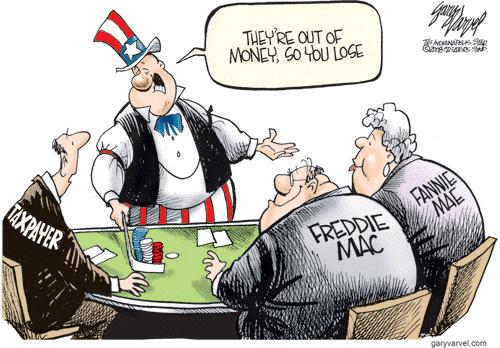
Taxpayers should worry a great deal if the White House, as reported, is promising to cover the inevitable defaults of subprime borrowers. They have already forked over more than $100 billion to bail out the politically driven subprime lending of Fannie Mae and Freddie Mac.

The last thing the President should be doing is pushing banks to extend mortgages to people who cannot afford them. Been there, done that—with disastrous consequences. Credit will flow again on its own if crippling tax and regulatory constraints are lifted.

____________

I have put up lots of cartoons from Dan Mitchell’s blog before and they have got lots of hits before. Many of them have dealt with the economy, eternal unemployment benefits, socialism,  Greece,  welfare state or on gun control.

This cartoon is not new, but it succinctly captures what happened with that part of the TARP bailout. The only thing missing is some way of showing the government officials and political insiders who received undeserved wealth while the Fannie-Freddie scam was operating.

____________

Open letter to President Obama (Part 408) We got to starve the spending beast!!!!

(Emailed to White House on 1-9-13.)

President Obama c/o The White House
1600 Pennsylvania Avenue NW
Washington, DC 20500

Dear Mr. President,

I know that you receive 20,000 letters a day and that you actually read 10 of them every day. I really do respect you for trying to get a pulse on what is going on out here.

Milton and Rose Friedman with President Bush.

Milton Friedman on Donahue 1979 (2/5)

I believe the “no new tax pledge” ultimately will work. Milton Friedman believed we should starve the beast and that is good enough for me. “If taxes are raised in order to keep down the deficit, the result is likely to be a higher norm for government spending.” Milton Friedman

There’s a debate among policy wonks about whether a no-tax-hike policy is an effective way of restraining the burden of government spending.

At the risk of over-simplifying, the folks who support the “starve the beast” theory argue that there are political and/or economic limits to government borrowing, so if you don’t let politicians tax more, you indirectly impose a cap on total spending (outlays = tax revenue + borrowing limit). We’ll call this the STB approach, for obvious reasons.

Critics of the theory, by contrast, say that a low-tax policy creates fiscal illusion by making government spending seem artificially cheap. After all, standard microeconomic analysis tells us that people will demand more of something when the perceived price is low (get a $1 of spending for 80 cents of tax = recipe for higher outlays). We’ll call this the “pay for government” approach, or PFG.

There’s almost surely some truth to both arguments, but the real issue if whether one effect is dominant – particularly in the long run. In other words, should supporters of small government fight tax increases? Or welcome them?

I’ve never studied this issue, but my gut instinct has been on the “STB” side of the debate. Here are a few of the reasons.

  1. The politicians and interest groups that favor bigger government seem especially anxious to convince anti-tax lawmakers to change their minds. If nothing else, that suggests higher taxes would “feed the beast.” I suppose this could be a clever example of reverse psychology, but something tells me that Harry Reid and Nancy Pelosi lack the cleverness and subtlety to pull off that kind of trick.
  2. The people who pay for government generally aren’t the ones who reap the benefits. And if you keep increasing taxes on the “rich,” as Obama proposes, why would that affect the preferences of the rest of the population? Especially the huge chunk of the population that doesn’t pay income tax? Simply stated, the PFG approach incorrectly assumes that payers and payees are the same.
  3. Casual empiricism certainly suggests that higher taxes are associated with more government, not less red ink. We see this, for instance, in the evidence I recently shared from Europe. Taxes have jumped in recent decades, but government debt also has climbed, which implies all additional revenue was spent, and then some.
  4. Just look at the real world, specifically the fiscal crisis in nations such as Greece. At the risk of stating the obvious, the recent events in Europe confirm that there does come a point when governments lose the ability to borrow. So if taxpayers somehow can prevent politicians from seizing more money, there is a de facto limit on government spending.

Seems like the STB approach makes sense, but not everyone thinks my theoretical musings and generic observations are all that’s needed to settle an argument.

Particularly when there are some very sensible people on the other side. The late Bill Niskanen wrote in the 2006 Cato Journal that:

There are three major problems with the starve-the-beast argument: (1) it is not a plausible economic theory; (2) it is inconsistent with the facts; and (3) it has diverted attention away from the political reforms needed to limit government growth.

I fully agree with Bill that there should be much more focus on restraining the growth of government, so there’s no disagreement on his third point. I think he’s wrong on the first point because half the population no longer pays federal income tax and the top 20 percent pay the lion’s share, but that’s a bit of a judgment call.

What about the facts? Bill does some regression analysis for the 1949-2005 period, where he looks at the change in federal spending as a share of GDP and tests its relationship with the level of tax receipts as a share of GDP, the change in the unemployment rate, and the change in interest payments (the latter two variables are there to hopefully wash out the effects of the business cycle and to limit the analysis to the spending that lawmakers actually can control).

Bill crunches the numbers and concludes:

For no extended period did these estimates reveal a significant positive relation between the change in federal spending as a percent of GDP and the level of federal receipts as a percent of GDP, the necessary condition for the starve-the-beast hypothesis to be confirmed.

Moreover, Bill even found evidence for the PFG approach when he looked solely at the 1981-2005 period.

A 1 percentage point increase in current federal receipts as a share of GDP apparently reduces the change in current federal spending as a share of GDP by about one-seventh of 1 percent a year indefinitely.

I don’t doubt that Bill’s numbers are sound. Indeed, Cato Adjunct Scholar Michael New re-crunched the numbers for the Cato Journal in 2009 and produced similar findings, even when looking only at non-defense discretionary spending.

But I don’t find this research very compelling, and it’s not just because I’m from Austrian school, which sometimes has a reputation for being skeptical about empirical analysis.

Here are some reasons why I’m not convinced, and even the biggest quant jocks in the world should share these concerns.

  1. Is 57 years of data (1949-2005) or 25 years of data (1981-2005) really enough to draw any sweeping conclusions, particularly when there could be many other factors involved? We would be very reluctant to jump to conclusions about the demand for Big Macs by interviewing a handful of customers and looking at just three variables.
  2. More important, why didn’t Bill measure changes in spending against legislated tax changes? After all, lawmakers rarely pay attention to tax receipts as a share of GDP, and that variable rarely if ever is part of the lawmaking process. But politicians are acutely aware of whether they are voting to either reduce taxes or increase them.
  3. And why use spending as a share of GDP rather than nominal spending or inflation-adjusted spending, particularly since Congress votes to spend specific amounts of money, not for outlays as a percent of economic output.
  4. Equally perplexing, why didn’t Bill include lags in his research? I’m not aware of any STB proponents who claim that there’s an instantaneous impact. Instead, they argue that long-term limits on revenue can impose long-run restraints on spending.

To be fair, Bill was breaking some new ground. There was not a lot of empirical analysis to that point, so there was no right or wrong way to test the relationship between taxing and spending. Niskanen picked one approach, and it’s the role of subsequent researchers to poke and prod the results and contemplate alternatives.

That’s exactly what Christina Romer and David Romer did in their article that appeared in the 2009 Brookings Papers on Economic Activity. They investigated the data from several angles and decided it made the most sense to look at legislated tax changes and look at the long-run impact on spending. And, in an attempt to test the STB hypothesis, they looked solely at major tax bills designed to reduce government revenue.

That’s the good news. The bad news is that this gave them only four pieces of data – the Revenue Act of 1948, the Kennedy tax cuts, the Reagan tax cuts, and the 2001/2003 Bush tax cuts.

Setting aside this problem of limited data, what did Romer and Romer discover? Their headline results were similar to Niskanen’s.

The results provide no support for the hypothesis that tax cuts restrain government spending.

That sounds like bad news for STB advocates. But if you dig into their findings, you find out that the real problem is that politicians can’t resist the temptation to feed the beast.

…roughly three-quarters of a long-run tax cut is typically undone by legislated tax increases of various sorts within five years. …The fact that policymakers have been able to largely reverse tax cuts helps to explain why the cuts have not reduced spending.

In other words, you can’t starve the beast if you don’t maintain the diet.

Which is basically what other economists concluded when analyzing the work of Romer and Romer. Here’s what Steven Davis of the University of Chicago wrote.

…if it takes 5 years for a new policymaker to reverse a previous tax cut, so that it remains in effect for 10 years rather than 5, the starve-thebeast effect roughly doubles. In the extreme case where tax cuts cannot be reversed, government spending cuts must eventually absorb the entire adjustment. Clearly, then, tax cuts can produce large starve-the-beast effects if they are sufficiently sticky.

And Jeffrey Miron of Harvard University had a similar interpretation.

…concerns over letting children play with matches—that is, giving politicians access to increased tax revenue—are valid. Thus, advocates of small government would seem to have good reason to oppose tax increases.

All things considered, I think that STB is correct.

But I’ll close by returning to one of Bill Niskanen’s points. He warned that the focus on tax limitation was harmful because it “diverted attention away from the political reforms needed to limit government growth.”

I fully agree. Too many politicians focus on the easy – and more politically popular – job of fighting tax increases. But then they fail to support measures to restrain the burden of government spending.

Or, as we saw during the Bush years, they cut taxes and then opened the spigot on the spending side of the fiscal equation. No wonder Romer and Romer found that tax cuts generally are reversed. Tax cuts are difficult to maintain and preserve if they are simply gimmicks put in place by feckless politicians.

P.S. Another interesting tidbit is that Romer and Romer acknowledge the Laffer Curve.

We also find that the overall rebound in revenue exceeds the portion due to legislated changes. The key source of the nonlegislated change in revenue is almost certainly the effect of the tax cut on economic activity.

Too bad Christina Romer didn’t share that insight with the President when she was at the Council of Economic Advisers.

_________

Thank you so much for your time. I know how valuable it is. I also appreciate the fine family that you have and your commitment as a father and a husband.

Sincerely,

Everette Hatcher III, 13900 Cottontail Lane, Alexander, AR 72002, ph 501-920-5733, lowcostsqueegees@yahoo.com

Related posts:

Open letter to President Obama (Part 201)Tea Party favorite Representative links article “Prescott and Ohanian: Taxes Are Much Higher Than You Think”

    (Emailed to White House on 12-21-12.) President Obama c/o The White House 1600 Pennsylvania Avenue NW Washington, DC 20500 Dear Mr. President, I know that you receive 20,000 letters a day and that you actually read 10 of them every day. I really do respect you for trying to get a pulse on […]

Open letter to President Obama (Part 200.2)Tea Party Republican Representative takes on the President concerning fiscal cliff

(Emailed to White House on 12-21-12.) President Obama c/o The White House 1600 Pennsylvania Avenue NW Washington, DC 20500 Dear Mr. President, I know that you receive 20,000 letters a day and that you actually read 10 of them every day. I really do respect you for trying to get a pulse on what is […]

Open letter to President Obama (Part 200.1)Tea Party favorite Representative shares link on facebook

(Emailed to White House on 12-21-12) President Obama c/o The White House 1600 Pennsylvania Avenue NW Washington, DC 20500 Dear Mr. President, I know that you receive 20,000 letters a day and that you actually read 10 of them every day. I really do respect you for trying to get a pulse on what is […]

Open letter to President Obama (Part 199) Tea Party favorite takes on President

  The federal government has a spending problem and Milton Friedman came up with the negative income tax to help poor people get out of the welfare trap. It seems that the government screws up about everything. Then why is President Obama wanting more taxes? _______________ Milton Friedman – The Negative Income Tax Published on […]

Tea Party Heroes Rep. David Schweikert (R-AZ),Justin Amash (R-MI), Tim Huelskamp (R-KS) have been punished by Boehner

I was sad to read that the Speaker John Boehner has been involved in punishing tea  party republicans. Actually I have written letters to several of these same tea party heroes telling them that I have emailed Boehner encouraging him to listen to them. Rep. David Schweikert (R-AZ),Justin Amash (R-MI), and Tim Huelskamp (R-KS). have been contacted […]

Some Tea Party heroes (Part 10)

Michael Tanner of the Cato Institute in his article, “Hitting the Ceiling,” National Review Online, March 7, 2012 noted: After all, despite all the sturm und drang about spending cuts as part of last year’s debt-ceiling deal, federal spending not only increased from 2011 to 2012, it rose faster than inflation and population growth combined. […]

Some Tea Party heroes (Part 9)

Michael Tanner of the Cato Institute in his article, “Hitting the Ceiling,” National Review Online, March 7, 2012 noted: After all, despite all the sturm und drang about spending cuts as part of last year’s debt-ceiling deal, federal spending not only increased from 2011 to 2012, it rose faster than inflation and population growth combined. […]

49 posts on Tea Party heroes of mine

Some of the heroes are Mo Brooks, Martha Roby, Jeff Flake, Trent Franks, Duncan Hunter, Tom Mcclintock, Devin Nunes, Scott Tipton, Bill Posey, Steve Southerland and those others below in the following posts. THEY VOTED AGAINST THE DEBT CEILING INCREASE IN 2011 AND WE NEED THAT TYPE OF LEADERSHIP NOW SINCE PRESIDENT OBAMA HAS BEEN […]

Some Tea Party Republicans win and some lose

I hated to see that Allen West may be on the way out. ABC News reported: Nov 7, 2012 7:20am What Happened to the Tea Party (and the Blue Dogs?) Some of the Republican Party‘s most controversial House members are clinging to narrow leads in races where only a few votes are left to count. […]

Some Tea Party heroes (Part 8)

Rep Himes and Rep Schweikert Discuss the Debt and Budget Deal Michael Tanner of the Cato Institute in his article, “Hitting the Ceiling,” National Review Online, March 7, 2012 noted: After all, despite all the sturm und drang about spending cuts as part of last year’s debt-ceiling deal, federal spending not only increased from 2011 […]

“Schaeffer Sunday” Who was Francis Schaeffer? by Udo Middelmann

Great article on Schaeffer.
Who was Dr. Francis A. Schaeffer?

By Francis Schaeffer

The unique contribution of Dr. Francis Schaeffer on a whole generation was the ability to communicate the truth of historic Biblical Christianity in a way that combined intellectual integrity with practical, loving care. This grew out of his extensive understanding of the Bible from a deep commitment to Jesus Christ as his Lord and Savior and a critical study of the world of man. These two pillars supported his inquisitive and analytical mind on the solid reality of the truth of God’s creation and of his revelation. He understood the roots of modern thinking in its rejection of reality and rationality and pointed out the logical conclusions in a wide range of disciplines and in society.

Dr. Schaeffer understood that what a person believes will influence the way he acts in history and individual situations. There is a relationship between a person’s view of truth and life, between philosophy and practice, between faulty ideas and foolish choices. Dr. Schaeffer discussed the truth of reality with anyone in many settings. This in turn brought students, professionals, scholars and others from around the world to his home to learn from his insights. They returned with them to their own world and applied them to their circle of life amd work. The ideas continue to bear fruit and to stimulate discussions and discoveries through more than 25 books, several films, taped seminars and lectures at leading universities in Europe, the US and abroard. The result has been a profound and enduring impact upon many thousands, who have themselves gone to make their own mark in history.

The central thrust of Dr. Schaeffer’s teaching is that Biblical Christianity is the truth about the real world. The only reason to be a Christian is an ackjnowledgement of what is objectively true about human beings, the real world and the basic human predicaments. The Bible is true in all that it affirms. This emphasis is not so much the summary of academic instructions or doctrinal positions. It is the result of a searching mind, of being exposed to human history, the European culture and art, and of in-depth discussions with knowledgeable people for a life time of study, observation and work.

With the Bible as his base and a profound interest in human beings, Dr. Schaeffer’s insights were developed through the experience of the Rijksmuseum in Amsterdam, the study of Florentine society and art, in lectures followed by tough discussions at modern Cambridge, in rude exposure to the slums of Bombaay and in probing questions of people from a great variety of backgrounds, in abortion protests, in response to life in the wider arena of human need and pervasive intellectual confusion in our world.

– Udo W. Middelmann, President – The Francis A. Schaeffer Foundation

Al Geiberger’s record almost broken!!! (I was there in 1977 following Al)

Memories of the 59

Uploaded on Aug 1, 2008

Al Geiberger (“Mr. 59”) talks about what helped him shoot his record breaking 59 in 1977.

__________________

mr 59

Uploaded on Jul 27, 2011

go to view the website http://www.kxxu.com
signed autograph golf balls for sale 
by Al Geiberger Mr. 59

______________________

In 1977, two huge events made national news at the now titled “Danny Thomas Memphis Classic.” First, President Gerald Ford made a hole-in-one during Wednesday’s Celebrity Pro-Am. That event is now referred to as the “Shot Heard ‘Round the World.” Two days later, Al Geiberger shocked the golf world with his record low round of 59 on Friday of the tournament. The 13-under-par round still stands as a PGA TOUR record. (Chip Beck and David Duval have since tied the mark.)

I had the chance to hear the roar that came from the crowd that day that President Ford hit the hole in one (on hole #5 at Colonial Country Club in Cordova, TN). Just a few holes later I saw Danny Thomas walking around saying with slurred speech, :”This is the ball, this is the ball” while he held up a golf ball. I thought he was going to fall on me as he passed by.

Then just two days later I saw the last 5 holes of Al Geiberger’s 59. He was walking around with this silly grin on his face because almost every putt was going in.

___________________

This picture above is right after the round of 59 and the picture below after he hit the last putt. I was in the crowd watching him and I was standing right behind the green towards the clubhouse.

_________________
____________
_____________
Fast forward to Sept 13, 2013 where another 59 happened:

Valley’s Al Geiberger says sixth member of 59 Club adds ‘credibility’

Sep. 14, 2013   |
0 Comments

Jim Furyk almost made Al Geiberger’s prophecy come true.

Geiberger, the Palm Desert resident and the first player to shoot a 59 on the PGA Tour, has always said some player will be coming down to the last hole needing to birdie the hole to shoot 59, and instead will hole out for an eagle and a 58.

“And he almost did it,” Geiberger said moments after watching Furyk hit an approach shot to just two feet on the last hole, then make the birdie putt to shoot 59 in the second round of the BMW Championship near Chicago on Friday.

Geiberger said he had been getting text messages throughout the afternoon as Furyk made his run at the fabled 59. And the messages were coming in after the round ended, too.

“Here’s one I just got. ‘You’re still the president of the club,’ ” Geiberger laughed.

Furyk birdied two of his last three holes Friday in the BMW Championship to become the sixth player in PGA Tour history to shoot a 59. Needing a birdie on the par-4 ninth hole at Conway Farms, he stuffed a gap wedge into just over 3 feet and calmly knocked it in.

“A very cool card,” Furyk said as he gazed at the scores, which included an eagle when he holed out with a 9-iron.

It was a day he won’t forget, in the same town — the Chicago suburbs, anyway — where he won his lone major at the U.S. Open in 2003.

Standing in the ninth fairway at Conway Farms, 103 yards from a front pin, Furyk didn’t want to let his chance get away from him.

“I said, ‘How many opportunities are you going to have in life to do this again?’ ” he said. “Got to take advantage of it. Tried to knock it in there tight and make it as easy on yourself as you can.”

He made the putt and repeatedly pumped his fist, turning for the gallery in the grandstands to see, and then he hugged caddie Mike “Fluff” Cowan and tapped him on the head.

“I guess the moment kind of struck me the most at No. 9 when I hit it the wedge shot in there close, and the crowd erupted and I started looking around and it just hit me how many people had come over to that side to see the finish,” Furyk said.

There’s work left for the trophy. Furyk was tied on top with Brandt Snedeker, who was nine shots clear of Furyk at the start of the second round.

The six 59s started with Geiberger’s round in the second round of the tour’s Memphis tournament at Colonial Country Club in 1977. Six 59s have also been shot on the Web.com Tour, and Annika Sorenstam is the only golfer to have shot a 59 on the LPGA.

“I always told people there was no room for a bogey in the 59,” Geiberger said of Furyk’s round of 11 birdies, one eagle and one bogey. “This shows that was wrong.”

Throughout the year, Geiberger has watched as a variety of players have made runs at 59, and he admits that the other 59s have brought more attention to his round.

“It’s good. It gives it credibility,” Geiberger said. “I was pulling for Phil (Mickelson) to shoot 59, not necessarily 58, at Phoenix. And Furyk is a good player, so there is credibility.”

Geiberger says he never roots against anyone on the verge of a 59.

“You don’t have any control to start with,” he said. “I didn’t realize it, but once it got past a couple of people, it’s almost been a little better. More and more people have one now. Now they are comparing the rounds, and I know I will win the comparison. Not to be talking, but I know my round stands up.”

Geiberger’s round came on a demanding par-72 course, while other rounds have come on par-72 layouts considered not as tough as Colonial or on par-71 or par-70 courses.

“The first thing my wife said after Furyk’s round was it’s not 13-under and it’s not par-72,” Geiberger joked.