The Affordable Health Care Act and Euthanasia

A very good article.

The Affordable Health Care Act and Euthanasia

Rate This

Quantcast

Well, the title alone probably tells you what I’m thinking in this article, but I’ll embellish anyways. I sense the confluence of several strong forces coming together that will significantly challenge how Christians manage their businesses in the coming years. There will be significant tradeoff choices that will reveal who we are as individuals and what we really value. The Affordable Health Care Act – more commonly known as ObamaCare – is a symptom of a larger problem in our culture, but will be the vehicle through which Christian business owners may be forced to make difficult choices.

In this post, I’ll discuss a long-forgotten work by Francis Schaeffer and C. Everett Koop, then connect their thinking and predictions to what is probably (in my estimation) in Obamacare and then end with an outline of the key challenges that those of us who are disciples of Jesus Christ will likely face. In all honesty, I hope that I’m wrong in the predictive points in this post. But I posit this information as a way for our society to look at ourselves in the mirror and ask if this is what we seriously want our country to be like.

In the revised copy of Schaeffer’s book, Whatever Happened to the Human Race, Koop joins Schaeffer in discussing critical beliefs in America in the early 80′s. Nearly 30 years later, we are dangerously close to reaping the fruits of seeds sown back in the 60′s and 70′s. I’ll quote at length from several sections of their book:

The human life issues will define our own time. For far from being only single issues, abortion, infanticide, and euthanasia strike at the heart of our most basic beliefs about God and man. The way in which we ultimately decide them will determine the future for all of us. As Mother Teresa has said, “If a mother can kill her own children, then what can be next?” Indeed, what can be next for all of us? If we can take one life because it does not measure up to our standards of perfection, what is to stop us from taking any life-simply for our own convenience? Abortion and infanticide are only the beginning steps on a slippery slope that will lead to death for all but the planned and perfect members of our society.

Francis A. Schaeffer;C. Everett Koop. Whatever Happened to the Human Race? (Revised Edition) (Kindle Locations 40-45). Kindle Edition.

Abortion, infanticide, and euthanasia are not only questions for women and other relatives directly involved-nor are they the prerogatives of a few people who have thought through the wider ramifications. They are life-and-death issues that concern the whole human race and should be addressed as such. Putting pressure on the public and on legislators to accept a lower view of human beings, small groups of people often argue their case by using a few extreme examples to gain sympathy for ideas and practices that later are not limited to extreme cases. These then become the common practice of the day. Abortion, for example, has moved from something once considered unusual and now in many cases is an accepted form of “birth control.” Infanticide is following the same pattern. The argument begins with people who have a so-called vegetative existence. There then follows a tendency to expand the indications and eliminate almost any child who is unwanted for some reason. The same movement can be seen with euthanasia. The arguments now being put forward center on the “miserable” person in old age-one dying of cancer, for instance. But once the doors are open, there is no reason why the aged, weak, and infirm will not find that as they become economic burdens they will be eliminated under one pretext or another.

Francis A. Schaeffer;C. Everett Koop. Whatever Happened to the Human Race? (Revised Edition) (Kindle Locations 542-549). Kindle Edition.

The concern about euthanasia and the use of that term in our common vocabulary lead to a degradation of the elderly and, ultimately, to inferior health care for the elderly-as well as encouraging the thought that those who do not want to “shuffle off” quickly are somehow failing in their contribution to society. Economic considerations then creep in, and old folks are made to feel-in this crazy, schizophrenic society of ours-that they are in some way depriving younger and more deserving people of the medical care that is now being provided them at the same cost. For example, one of the undersecretaries of the Department of Health, Education and Welfare suggested in 1977 that the various states that did not enact living-will legislation be penalized by having withdrawn or curtailed the federal funds that would ordinarily supplement state funds allocated for certain major programs.”

Francis A. Schaeffer;C. Everett Koop. Whatever Happened to the Human Race? (Revised Edition) (Kindle Locations 829-834). Kindle Edition.

Now, consider the reporting that questioned whether or not Vice President Dick Cheney should have received his heart transplant, given how old he is. Because ObamaCare will ultimately ration health care based on political factors that try to answer the question about who should receive care relative to age and/or habit, we can be confident that these decisionswill be life and death decisions that are based on political considerations.

I’m telling you now: ObamaCare coupled with our lack of commitment to following God, will lead to euthanasia because old people will be deemed “not worthy” of expensive care because of their diminished utility and value to society. Just like babies are killed in the womb for the convenience of the mother, elderly people who need expensive care to keep living will be cast aside – perhaps nicely – but still cast aside and denied the care they need because it will be deemed too expensive and/or an impairment on the care of someone else who is more useful to society. And God forbid that the care of the elderly inconvenience anyone in this “it’s all about me” age. As costs (predictably) skyrocket for health care once the government is in full control, we’ll find that the concepts of euthanasia will become more and more acceptable to society. It might take another 30 – 50 years, but it will become acceptable.

Add to this the coming wars between the generations as the older folks demand the goodies and benefits from the government that they believe they are entitled to and the younger generation fighting tooth and nail to not have their taxes raised anymore to pay for programs that are obviously going bankrupt.

Folks, I’m not usually a pessimist, but I see significant class, generational and health care warfare
emerging in the county in the coming 30 years. It will not surprise me at all if many in their 40′s and 50′s – including myself – will find ourselves in the middle of a storm as politicians continue to pit groups against each other based on class, income, health care, generational issues and so forth. And the timing and method of the ending of our lives may rest in the hands of a bureaucrat whose job it is to figure out who should and should not receive immediate care due to scarce resources and government mandates.

What does the Bible have to say about all of this? Briefly, in the Scriptures we find that:

  • The younger members of a family should look after the elderly in their family and the church should look after widows who are unable to provide for themselves. The church has allowed itself to neglect clear teaching from the Bible because they have forfeited their responsibility to the government.
  • Retirement is not a Biblical concept. American Christians have bought into the lie that they deserve to spend their final years in the lap of convenience and leisure. Neither is commanded or advocated in the Bible.
  • Personal responsibility is an assumed value and principle behind nearly every command in Scripture. For example, “let him who stole steal no more, but rather, let him work with his hands, so that he will have something to give”. Think about it. You can’t move from being a thief to being a giver without taking personal responsibility both for stealing and for giving. However, if my stealing is classified as a compulsion or is explained by a life of poverty or abuse during my childhood, then I’m no longer responsible for my actions. To the extent that our government and/or society diminishes our responsibility to own our words and actions and the results from our words and actions, to that extent, the Scriptures are being supplanted with human foolishness. Our society is filled with people who honestly believe that the government is responsible to make them happy, to provide for them, to ameliorate their pain and to give them what they lack. We won’t survive as a country if we continue to allow ourselves to grow a dependency class who lack a sense of personal responsibility

What is incredibly frightening is that some of this future rests literally in the hands of one man – one justice of the Supreme Court – who will probably be the deciding vote on whether Obamacare lives or dies. One vote. I don’t think I’m overstating it when I say that the quality of our future rests literally in the hands of a few unelected people who may make a legal judgment based primarily on their own political views. AS our country moves farther and farther from the Lord, our views of God and man continue to deteriorate. The logical conclusion of a society that has jettisoned God is one where government assumes the role of God.

Interestingly enough, Christians alone can change this future – without taking political sides. 2 Chronicles tells us that if we simply forsake our sin, call on God’s name, humble ourselves and pray, He will hear our prayers and will heal our land. This is such a strong promise that I wonder if we honestly believe it can happen. The future that Schaeffer, Koop and I have outlined need not become reality if Christians will simply forsake our sin and call on the Lord in humility.

I’m speaking to Christians now – the rest of you can eavesdrop – are you willing to get on your knees and cry out to God for your sin and the sin of this nation? Are you willing to be inconvenienced in order to help drive healing in this nation? Do you take 2 Chronicles 7.14 seriously?

I’m sure some who have read this will think that my post is over the top – it may be hard to pull your eyes out from under your forehead. I get it. But in the absence of our nation returning to God, I believe it is predictable that we will end up not only killing our unborn for the sake of convenience, but we’ll also (effectively) kill our elderly to save on costs and to not inconvenience ourselves too much should they consume too much health care resources.

Bill English, CEO

Open letter to President Obama (Part 439) Remembering Koop part 6 (includes funniest cartoon ever during Koop’s tenure)

(Emailed to White House on 3-4-13.)

President Obama c/o The White House
1600 Pennsylvania Avenue NW
Washington, DC 20500

Dear Mr. President,

I know that you receive 20,000 letters a day and that you actually read 10 of them every day. I really do respect you for trying to get a pulse on what is going on out here.

I wanted to share with you some about my pro-life perspective.

Dr. C. Everett Koop on Baby Doe, euthanasia, abortion

Uploaded on Nov 3, 2008

Dr. Koop answers questions on Baby Doe, euthanasia and abortion during interview at Wheaton College, Wheaton, IL http://www.christianethics.org

Dr. Koop.

C. Everett Koop

On June 8, 1988 Ralph Dunagin of the LA Times came out with the funniest editorial cartoon I have ever seen about Dr. C. Everett Koop time in office as Surgeon General. It is found below.

On 2-25-13 we lost a great man when we lost Dr. C. Everett Koop. I have written over and over the last few years quoting Dr. C. Everett Koop and his good friend Francis Schaeffer. They both came together for the first time in 1973 when Dr. Koop operated on Schaeffer’s daughter and as a result they became close friends. That led to their involvement together in the book and film series “WHATEVER HAPPENED TO THE HUMAN RACE?” in 1979.

In the film series “WHATEVER HAPPENED TO THE HUMAN RACE?” the arguments are presented  against abortion (Episode 1),  infanticide (Episode 2),   euthenasia (Episode 3), and then there is a discussion of the Christian versus Humanist worldview concerning the issue of “the basis for human dignity” in Episode 4 and then in the last episode a close look at the truth claims of the Bible.

In this 1979 film series they dealt with the big social issues and predicted what social problems we have in the future because of humanism. For instance, they knew that the Jack Kevorkians of the world would be coming down the pike. They predicted that there was a slippery slope from abortion to infanticide to youth euthanasia brought on by the materialistic worldview.

C. Everett Koop dies

February 26, 2013 By 7 Comments

C. Everett Koop, the Surgeon General under President Reagan, has died at age 96.  The mainstream obituaries are hailing his work to battle smoking and the AIDS epidemic.  But he was also a devout Christian and a crusader against abortion.  Koop  collaborated with  Francis Schaeffer on the book and video series Whatever Happened to the Human Race?, a work that helped mobilize Christians for the pro-life cause.

C. Everett Koop '37

From Former Surgeon General C. Everett Koop dies at age 96 – CNN.com:

Former U.S. Surgeon General C. Everett Koop, a pediatric surgeon turned public health advocate, died Monday. He was 96.

Koop served as surgeon general from 1982 to 1989, under Presidents Ronald Reagan and George H.W. Bush.

He was outspoken on controversial public health issues and did much to raise the profile the office of the surgeon general.

He died peacefully at his home in Hanover, New Hampshire, Dartmouth College said in a news release announcing his death.

“Dr. Koop did more than take care of his individual patients — he taught all of us about critical health issues that affect our larger society,” said Dartmouth President Carol L. Folt. “Through that knowledge, he empowered each of us to improve our own well-being and quality of life. Dr. Koop’s commitment to education allowed him to do something most physicians can only dream of: improving the health of millions of people worldwide.”

Koop, called “Chick” by his friends, was perhaps best known for his work around HIV/AIDS. He wrote a brochure about the disease that was sent to 107 million households in the United States in 1988. It was the largest public health mailing ever, according to a biography of Koop on a website of the surgeon general.

He was also well-known for his work around tobacco, calling for a “smoke-free” society. His 1986 surgeon general’s report on the dangers of secondhand smoke was seminal.

“That was the shot heard around the world, and it began to change public policy everywhere,” said John Seffrin, chief executive officer of the American Cancer Society.

The report started the move toward prohibiting smoking on airplanes, restaurants and at workplaces.

“The legacy of C. Everett Koop is how a wonderful, famous pediatric surgeon, who’d already made a name for himself, was willing at a relatively advanced age to do public service and show bold leadership that would have dramatic impact and change the world,” Seffrin said.

Prior to his tenure as surgeon general, Koop was surgeon-in-chief at the Children’s Hospital of Philadelphia, where he was a pioneer in the field of pediatric surgery and helped to establish the country’s first neonatal intensive care nursery. He was also the founding editor-in-chief of the Journal of Pediatric Surgery, Dartmouth said.

Koop was born in Brooklyn, New York, and attended Dartmouth, Weill Cornell Medical College and the Perelman School of Medicine at the University of Pennsylvania.

He was the author of more than 200 articles and books and the recipient of various awards. In 1991, Koop won an Emmy for a five-part series on health care reform, Dartmouth said. He was awarded the Presidential Medal of Freedom in 1995.

Again, this says nothing about his faith or his pro-life influence.  I actually met him, finding myself sitting with him at a banquet.  He projected the bedside manner of a trusted family doctor and played that role for the whole nation.

Title:
If Anything Comes in the Mail from the Surgeon General, Don’t Open It!

(normal size jpg)(high resolution jpg) High resolution version (11,797,840 Bytes)

Description:
Item is a photocopy.
Number of Image Pages:
1 (349,060 Bytes)
Date Supplied:
8 June 1988?
Creator:
Dunagin, Ralph
Los Angeles Times


In the film series “WHATEVER HAPPENED TO THE HUMAN RACE?” the arguments are presented  against abortion (Episode 1),  infanticide (Episode 2),   euthanasia (Episode 3), and then there is a discussion of the Christian versus Humanist worldview concerning the issue of “the basis for human dignity” in Episode 4 and then in the last episode a close look at the truth claims of the Bible.

Francis Schaeffer: How Should We Then Live? (Full-Length Documentary)

Francis Schaeffer Whatever Happened to the Human Race (Episode 1) ABORTION

Francis Schaeffer: What Ever Happened to the Human Race? (Full-Length Documentary)

Part 1 on abortion runs from 00:00 to 39:50, Part 2 on Infanticide runs from 39:50 to 1:21:30, Part 3 on Youth Euthanasia runs from 1:21:30 to 1:45:40, Part 4 on the basis of human dignity runs from 1:45:40 to 2:24:45 and Part 5 on the basis of truth runs from 2:24:45 to 3:00:04

Thank you so much for your time. I know how valuable it is. I also appreciate the fine family that you have and your commitment as a father and a husband.

Sincerely,

Everette Hatcher III, 13900 Cottontail Lane, Alexander, AR 72002, ph 501-920-5733, lowcostsqueegees@yahoo.com

Related posts:

Open letter to President Obama (Part 232 B) Dr. C. Everett Koop and Reagan pictured together

Dr. C. Everett Koop with Ronald Reagan. Dr. Koop was delayed in his confirmation by Ted Kennedy because of his film Whatever Happened to the Human Race? President Obama c/o The White House 1600 Pennsylvania Avenue NW Washington, DC 20500 Dear Mr. President, I know that you receive 20,000 letters a day and that you […]

“Sanctity of Life Saturday” Francis Schaeffer and Dr. C. Everett Koop asked Reagan to issue pro-life proclamation in 1983 (includes video ABORTION OF THE HUMAN RACE)

In the film series “WHATEVER HAPPENED TO THE HUMAN RACE?” the arguments are presented  against abortion (Episode 1),  infanticide (Episode 2),   euthenasia (Episode 3), and then there is a discussion of the Christian versus Humanist worldview concerning the issue of “the basis for human dignity” in Episode 4 and then in the last episode a close […]

Dr. C. Everett Koop on abortion’s 1973 Roe v. Wade impact on child abuse

Dr. C. Everett Koop with Ronald Reagan. Dr. Koop was delayed in his confirmation by Ted Kennedy because of his film Whatever Happened to the Human Race? Watch the film below starting at the 19 minute mark and that will lead into a powerful question from Dr. C. Everett Koop. This 1979 film is WHATEVER […]

Open letter to President Obama (Part 221 B) Dr. C. Everett Koop and Francis Schaeffer rightly called abortion “the watershed issue of our era”

 Dr. Koop was delayed in his confirmation by Ted Kennedy because of his film Whatever Happened to the Human Race? Francis Schaeffer February 21, 1982 (Part 1) Uploaded by DeBunker7 on Feb 21, 2008 READ THIS FIRST: In decline of all civilizations we first see a war against the freedom of ideas. Discussion is limited […]

Francis Schaeffer and C. Everette Koop on the Hippocratic oath (March for Life January 20, 2013)

Dr. C. Everett Koop was appointed to the Reagan administration but was held up in the Senate in his confirmation hearings by Ted Kennedy because of his work in pro-life causes. I was thinking about the March for Life that is coming up on Jan 20, 2013  and that is why I posted this today […]

Ronald Wilson Reagan pictured with Dr. C. Everett Koop

High resolution version (11,426,583 Bytes) Description: The photograph is signed by President Ronald Reagan with the inscription “To Chick Koop, With Best Wishes.” Chick, from chicken coop, was the nickname Koop gained will attending Dartmouth College in the mid-1930s. Koop maintained a cordial relationship with President Reagan, despite his disappointment over Reagan’s refusal to address […]

Francis Schaeffer and C. Everett Koop were prophetic (jh29)

Francis Schaeffer and C. Everett Koop were prophetic (jh29) What Ever Happened to the Human Race? I recently heard this Breakpoint Commentary by Chuck Colson and it just reminded me of how prophetic Francis Schaeffer and C. Everett Koop were in the late 1970′s with their book and film series “Whatever happened to the human […]

Should Michele Bachmann be punished for taking pro-life views from Schaeffer and Koop? (March for Life January 20, 2013)

  Dr. C. Everett Koop I was thinking about the March for Life that is coming up on Jan 20, 2013  and that is why I posted this today Secular leaps of faith 39 Comments Written by Janie B. Cheaney August 15, 2011, 2:17 PM I’m willing to cut Ryan Lizza some slack. His profile […]

“Schaeffer Sundays” Francis Schaeffer’s own words concerning humanism and its bad results

Francis Schaeffer: “Whatever Happened to the Human Race?” (Episode 2) SLAUGHTER OF THE INNOCENTS Published on Oct 6, 2012 by AdamMetropolis The 45 minute video above is from the film series created from Francis Schaeffer’s book “Whatever Happened to the Human Race?” with Dr. C. Everett Koop. This book  really helped develop my political views concerning […]

“Sanctity of Life Saturday”:Derek Melleby’s review of the book “Francis Schaeffer: An Authentic Life” (includes film THE BASIS FOR HUMAN DIGNITY)

  I truly believe that many of the problems we have today in the USA are due to the advancement of humanism in the last few decades in our society. Ronald Reagan appointed the evangelical Dr. C. Everett Koop to the position of Surgeon General in his administration. He partnered with Dr. Francis Schaeffer in making […]

Taking on Ark Times bloggers about abortion on the 40th anniversary date of Roe v. Wade (Part 5) “Slavery issue compared to rights of unborn child”

The best pro-life film I have ever seen below by Francis Schaeffer and Dr. C. Everett Koop “Whatever happened to the human race?” Over the years I have taken on the Ark Times liberal bloggers over and over and over concerning the issue of abortion. I asked over and over again for one liberal blogger […]

Taking on Ark Times bloggers about abortion on the 40th anniversary date of Roe v. Wade (Part 4) “How do pro-lifers react to the movie THE CIDER HOUSE RULES?”

Francis Schaeffer pictured above._________ The best pro-life film I have ever seen below by Francis Schaeffer and Dr. C. Everett Koop “Whatever happened to the human race?” Over the years I have taken on the Ark Times liberal bloggers over and over and over concerning the issue of abortion. I asked over and over again […]

Taking on Ark Times bloggers about abortion on the 40th anniversary date of Roe v. Wade (Part 3) “What should be the punishment for abortion doctors?”

The best pro-life film I have ever seen below by Francis Schaeffer and Dr. C. Everett Koop “Whatever happened to the human race?” On 1-24-13 I took on the child abuse argument put forth by Ark Times Blogger “Deathbyinches,” and the day before I pointed out that because the unborn baby has all the genetic code […]

Taking on Ark Times bloggers about abortion on the 40th anniversary date of Roe v. Wade (Part 2) “The pro-abortion child abuse argument destroyed here”

PHOTO BY STATON BREIDENTHAL from Pro-life march in Little Rock on 1-20-13. Tim Tebow on pro-life super bowl commercial. Over the years I have taken on the Ark Times liberal bloggers over and over and over concerning the issue of abortion. Here is another encounter below. On January 22, 2013 (on the 40th anniversary of the […]

Taking on Ark Times bloggers about abortion on the 40th anniversary date of Roe v. Wade (Part 6) For many pro-abortionists ” …the problem is not determining when actual human life begins, but when the value of that life begins to out weigh other considerations”

The best pro-life film I have ever seen below by Francis Schaeffer and Dr. C. Everett Koop “Whatever happened to the human race?” Francis Schaeffer pictured above._________ The 45 minute video above is from the film series created from Francis Schaeffer’s book “Whatever Happened to the Human Race?” with Dr. C. Everett Koop. This book  really […]

Taking on Ark Times bloggers about abortion on the 40th anniversary date of Roe v. Wade (Part 7) “Poverty not good reason for abortion, why not give up for adoption?”

Dr Richard Land discusses abortion and slavery – 10/14/2004 – part 3 The best pro-life film I have ever seen below by Francis Schaeffer and Dr. C. Everett Koop “Whatever happened to the human race?” Over the years I have taken on the Ark Times liberal bloggers over and over and over concerning the issue […]

Taking on Ark Times bloggers about abortion on the 40th anniversary date of Roe v. Wade (Part 1)

Dr Richard Land discusses abortion and slavery – 10/14/2004 – part 3 The best pro-life film I have ever seen below by Francis Schaeffer and Dr. C. Everett Koop “Whatever happened to the human race?” Over the years I have taken on the Ark Times liberal bloggers over and over and over concerning the issue […]

Paul Greenberg became pro-life because we are all “endowed with certain unalienable rights”

On January 20, 2013 I heard Paul Greenberg talk about the words of Thomas Jefferson that we are all “endowed with certain unalienable rights” and the most important one is the right to life. He mentioned this also in this speech below from 2011: Paul Greenberg Dinner Speech 2011 Fall 2011 Issue Some of you […]

How Pulitzer Prize-winning Paul Greenberg, one of the most respected and honored commentators in America, changed his mind about abortion and endorses now the pro-life view

It is not possible to know where the pro-life evangelicals are coming from unless you look at the work of the person who inspired them the most. That person was Francis Schaeffer.  I do care about economic issues but the pro-life issue is the most important to me. Several years ago Adrian Rogers (past president of […]

“Sanctity of Life Saturday” Francis Schaeffer’s wife Edith passes away on Easter weekend 2013 Part 1 (includes pro-life editorial cartoon)

The Francis and Edith Schaeffer Story Pt.1 – Today’s Christian Videos

The Francis and Edith Schaeffer Story – Part 3 of 3

In the film series “WHATEVER HAPPENED TO THE HUMAN RACE?” the arguments are presented  against abortion (Episode 1),  infanticide (Episode 2),   euthanasia (Episode 3), and then there is a discussion of the Christian versus Humanist worldview concerning the issue of “the basis for human dignity” in Episode 4 and then in the last episode a close look at the truth claims of the Bible.

Francis Schaeffer: How Should We Then Live? (Full-Length Documentary)

Francis Schaeffer Whatever Happened to the Human Race (Episode 1) ABORTION

Francis Schaeffer: What Ever Happened to the Human Race? (Full-Length Documentary)

Part 1 on abortion runs from 00:00 to 39:50, Part 2 on Infanticide runs from 39:50 to 1:21:30, Part 3 on Youth Euthanasia runs from 1:21:30 to 1:45:40, Part 4 on the basis of human dignity runs from 1:45:40 to 2:24:45 and Part 5 on the basis of truth runs from 2:24:45 to 3:00:04

________________

Picture of Francis Schaeffer and his wife Edith from the 1930′s above. I was sad to read about Edith passing away on Easter weekend in 2013. I wanted to pass along this fine article below.

A Tribute to the Life of Edith Schaeffer, 1914-2013

Thousands were led to belief in the importance of prayer by her weekly prayer times with students

Written by Marvin Padgett | Monday, April 1, 2013

As a personal note, no one, aside from my parents, more deeply affected the way I see God, his universe, his people and all people than did the Schaeffers. Their deep and sincere belief that Jesus Christ was Lord of all—all, all—carried me along throughout all my life. It was a deep and gracious thing that the Lord did to all me and mine to know these two great saints personally.
Edith Schaeffer passed into the presence of her Lord and Savior, whom she had served well and tirelessly for many years, on March 30th. Born Edith Rachel Merritt Seville on November 3, 1914, the fourth child of George and Jessie Seville, while her parents were serving in China with the China Inland Mission, her life began and ended as a missionary. She attended Beaver College in Glenside PA. After meeting in a church youth group, the Schaeffers married in 1935. Mrs. Schaeffer has four children, Priscilla, Susan, Deborah, and Frank; fifteen grandchildren, thirty-four great-grandchildren, and two great-great grandchildren.

She was possessed of a love of and zest for life. As a child she saw her father accommodate himself to the local Chinese culture rather than expecting it to accommodate itself to Western ways. This marked her life as the Schaeffers later defended and demonstrated their belief in the dignity of the lives of all human beings. Both firmly believed that all human beings were created in the image of God and were more like God than any other creature or thing in the entire universe.

Mealtimes were not cafeteria style, but served on finely set tables with folded napkins. There is a direct line from this treatment of people to the later controversies over human lives being taken in the horror of abortion. All death was seen as a horror, but hardly ever more so than in abortion.

She gave her life in service to God and all those created in his image. Schedules were never as important as the needs of the people in front of her. Planes missed, dignitaries kept waiting, and artificial imperatives all quailed before the dignity of the person with her at the moment.

Thousands were led to belief in the importance of prayer by her weekly prayer times with students. Prayer, public or private, convenient or inconvenient, came first. She truly believed that she was communicating with her Lord and God. Dr. and Mrs. Schaeffer were “constant in prayer” beyond anyone the writer has known.

Mealtimes were long and full of discussion. While the students were served elegantly, they were expected after the meals to clean up the mess that was made in the work of those who had prepared these feasts. We live after the Fall and before the coming of the Lord. In this time, work has to be done. She saw all godly work was as dignified and necessary. People were always to be treated well.

The ministry of L’Abri, cofounded by the Schaeffers, was the result of conflicts with a mission agency. This led the Schaeffers to begin L’Abri, a residential Christian community, that began in 1955 in a remote Swiss village and became one of the most important Christian works of our time. Beginning without a commitment to an American style growth mentality, the Schaeffers employed prayer for their needs in order to demonstrate to a watching world that the God they served was able to supply all their needs.

Honest answers to honest questions became a by-word at L’Abri. Men and women, young and old, flocked to an obscure Swiss village to find answers to their questions. A hard fought determination to the very concept of Truth and that the Bible was “breathed out by God,” led the Schaeffers to be dogged in their beliefs, and to demonstrate by word and deed that the God of the Bible “is there and is not silent.” All this work was permeated by loving patience for the difficult ones in their midst that they might be won.

Edith Schaeffer wrote nineteen books, many bestsellers, including L’Abri, and her Evangelical Christian Publishers Association Gold Medallion winners, Affliction (This was used by the writer as an important tool in graduate school.) and The Tapestry: the Life and Times of Francis and Edith Schaeffer.

As a personal note, no one, aside from my parents, more deeply affected the way I see God, his universe, his people and all people than did the Schaeffers. Their deep and sincere belief that Jesus Christ was Lord of all—all, all—carried me along throughout all my life. It was a deep and gracious thing that the Lord did to all me and mine to know
these two great saints personally. SDG!

Marvin Padgett is a Teaching Elder in the Presbyterian Church in America. He is currently the Acting Executive Director of Great Commission Publications.

_____________

L’Abri was a community where Francis and Edith Schaeffer got to meet vistors like Michele Bachmann and Timothy Leary and talk to them about the issues of the day. Here is a portion from the PBS website dedicated to the program FRONTLINE:

In his lengthy profile of Republican presidential candidate Michele Bachmann in this week’s New Yorker, Ryan Lizza examines how her religious beliefs have shaped her political philosophy. A key figure is Francis Schaeffer, whom Bachmann described as “a tremendous philosopher” and “very inspirational.”

Who is this influential man, not widely known outside of the conservative evangelical community?

FRONTLINE profiled Schaeffer in episode six of God in America, our co-production with American Experience. The above clip explores his role as a catalyst who inspired evangelicals’ re-entry into American politics in 1970s, including that:

  • He was “an embodiment of the counterculture”: With his long hair, goatee, knickers and knee socks, Schaeffer cut a striking figure. L’Abri (“the shelter”), the spiritual community he founded in the Swiss Alps, attracted “lots of long-haired hippies, coming through with backpacks,” his son Frank, who remembers Timothy Leary coming to L’Abri on a pilgrimage, told us.
  • His documentary films inspired thousands of evangelicals — including Bachmann — to enter the political arena: His first series, How Should We Then Live (watch here) targeted what Schaeffer saw as the culture’s great evil — secular humanism. “Humanism is man putting himself at the center of all things, rather than the creator God,” Schaeffer explains in the film. He goes on to argue that surrendering to humanism would lead to the moral decay of society.
  • He persuaded Jerry Falwell that evangelicals needed to take up the cause of abortion: Falwell and other evangelicals initially viewed Roe v. Wade as “a Catholic issue.” Even Schaeffer himself initially didn’t see abortion as a political cause. He was persuaded to the cause by his son Frank (who, after impregnating his girlfriend at age 17, became a passionate abortion foe) and his good friend Dr. C. Everett Koop. Schaeffer’s second film series Whatever Happened to the Human Race (watch here) is a powerful indictment of abortion, euthanasia and indifference to life: “If in these last decades of the 20th century, the Christian community does not make a determined stand on the issue of each individual to have a right to live and a right to be treated as made in the image of God, rather than a machine, I believe we have failed in the greatest moral challenge of this century. The choice is yours to make.”

__________________________

(Francis did a great job in his film series “How Should we then live?” in looking at how humanism has affected art and culture in the Western World in the last 2000 years. My favorite episodes include his study of the Renaissance, the Revolutionary age, the age of Nonreason, and the age of Fragmentation.)

Planned Parenthood is the largest abortion provider in the USA and this editorial cartoon touches on this issue.

Related posts:

Francis Schaeffer’s “How should we then live?” Video and outline of episode 10 “Final Choices” (Schaeffer Sundays)

E P I S O D E 1 0   Dr. Francis Schaeffer – Episode X – Final Choices 27 min FINAL CHOICES I. Authoritarianism the Only Humanistic Social Option One man or an elite giving authoritative arbitrary absolutes. A. Society is sole absolute in absence of other absolutes. B. But society has to be […]

Francis Schaeffer’s “How should we then live?” Video and outline of episode 9 “The Age of Personal Peace and Affluence” (Schaeffer Sundays)

E P I S O D E 9 Dr. Francis Schaeffer – Episode IX – The Age of Personal Peace and Affluence 27 min T h e Age of Personal Peace and Afflunce I. By the Early 1960s People Were Bombarded From Every Side by Modern Man’s Humanistic Thought II. Modern Form of Humanistic Thought Leads […]

Francis Schaeffer’s “How should we then live?” Video and outline of episode 8 “The Age of Fragmentation” (Schaeffer Sundays)

E P I S O D E 8 Dr. Francis Schaeffer – Episode VIII – The Age of Fragmentation 27 min I saw this film series in 1979 and it had a major impact on me. T h e Age of FRAGMENTATION I. Art As a Vehicle Of Modern Thought A. Impressionism (Monet, Renoir, Pissarro, Sisley, […]

Francis Schaeffer’s “How should we then live?” Video and outline of episode 7 “The Age of Non-Reason” (Schaeffer Sundays)

E P I S O D E 7 Dr. Francis Schaeffer – Episode VII – The Age of Non Reason I am thrilled to get this film series with you. I saw it first in 1979 and it had such a big impact on me. Today’s episode is where we see modern humanist man act […]

Francis Schaeffer’s “How should we then live?” Video and outline of episode 6 “The Scientific Age” (Schaeffer Sundays)

E P I S O D E 6 How Should We Then Live 6#1 Uploaded by NoMirrorHDDHrorriMoN on Oct 3, 2011 How Should We Then Live? Episode 6 of 12 ________ I am sharing with you a film series that I saw in 1979. In this film Francis Schaeffer asserted that was a shift in […]

Francis Schaeffer’s “How should we then live?” Video and outline of episode 5 “The Revolutionary Age” (Schaeffer Sundays)

E P I S O D E 5 How Should We Then Live? Episode 5: The Revolutionary Age I was impacted by this film series by Francis Schaeffer back in the 1970′s and I wanted to share it with you. Francis Schaeffer noted, “Reformation Did Not Bring Perfection. But gradually on basis of biblical teaching there […]

Francis Schaeffer’s “How should we then live?” Video and outline of episode 4 “The Reformation” (Schaeffer Sundays)

Dr. Francis Schaeffer – Episode IV – The Reformation 27 min I was impacted by this film series by Francis Schaeffer back in the 1970′s and I wanted to share it with you. Schaeffer makes three key points concerning the Reformation: “1. Erasmian Christian humanism rejected by Farel. 2. Bible gives needed answers not only as to […]

“Schaeffer Sundays” Francis Schaeffer’s “How should we then live?” Video and outline of episode 3 “The Renaissance”

Francis Schaeffer’s “How should we then live?” Video and outline of episode 3 “The Renaissance” Francis Schaeffer: “How Should We Then Live?” (Episode 3) THE RENAISSANCE I was impacted by this film series by Francis Schaeffer back in the 1970′s and I wanted to share it with you. Schaeffer really shows why we have so […]

Francis Schaeffer’s “How should we then live?” Video and outline of episode 2 “The Middle Ages” (Schaeffer Sundays)

  Francis Schaeffer: “How Should We Then Live?” (Episode 2) THE MIDDLE AGES I was impacted by this film series by Francis Schaeffer back in the 1970′s and I wanted to share it with you. Schaeffer points out that during this time period unfortunately we have the “Church’s deviation from early church’s teaching in regard […]

Francis Schaeffer’s “How should we then live?” Video and outline of episode 1 “The Roman Age” (Schaeffer Sundays)

Francis Schaeffer: “How Should We Then Live?” (Episode 1) THE ROMAN AGE   Today I am starting a series that really had a big impact on my life back in the 1970′s when I first saw it. There are ten parts and today is the first. Francis Schaeffer takes a look at Rome and why […]

The secret the founders knew about how to cut from the budget is limiting spending and allow the economy to grow!!!!

Sen. Mike Lee on Gun Control, Immigration and Internet Sales Tax

Published on Apr 23, 2013

Sen. Mike Lee (R-UT) talks about legislative battles in Congress: gun control, immigration reform, and the Internet sales tax. |

The secret the founders knew about how to cut from the budget is limiting spending and allow the economy to grow!!!! Chris Edwards has looked back in the early days and he concluded, “The success of Jefferson—and his Treasury Secretary Albert Gallatin—in reducing debt stemmed not from cuts to overall spending, but from simply ensuring that revenue increases from a growing economy went toward paying down the debt rather than expanding the government.”

August 14, 2013 3:22PM

Thomas Jefferson’s Sequester

As federal policymakers gear up to battle over federal spending and the budget sequester this Fall, it is interesting to consider past efforts at restraint. President Calvin Coolidge, for example, held the federal budget down to about $3 billion seven years in a row, while cutting taxes and bringing the federal debt down from $22 billion to $17 billion.

President Thomas Jefferson pursued his own rough sequester, and substantially reduced the federal debt that had accumulated under the Federalists. In a 1799 letter to Elbridge Gerry, Jefferson said “I am for a government rigorously frugal and simple, applying all the possible savings of the public revenue to the discharge of the national debt.” Jefferson more or less followed through over his two terms. He kept total federal spending at about $9 to $10 billion, although his downsizing efforts were thrown off by various contingencies.

Figure 1 shows the basic story. Federal spending rose substantially under Presidents George Washington and John Adams, but then flattened under Jefferson between 1801 and 1809. Federal debt fell from $83 million in 1801 to $57 million in 1809. The drop in debt was impressive, especially considering that the government swallowed $13 million of added debt during that period from the Louisiana purchase. The success of Jefferson—and his Treasury Secretary Albert Gallatin—in reducing debt stemmed not from cuts to overall spending, but from simply ensuring that revenue increases from a growing economy went toward paying down the debt rather than expanding the government.

One lesson for today is that all we need to start getting our huge federal debt under control is some modest spending restraint. Large cuts would be better, but even holding overall spending roughly flat for a number of years would start the debt tumbling downward. Looking at CBO’s latest projections, for example, if policymakers held federal spending steady at this year’s $3.5 billion, the rise in revenues in coming years would be enough to balance the budget by 2016.

Let’s take a closer look at Figure 1, where each of the spending spikes tells a story. The spike in 1794-1795 stemmed from military expenses to put down the Whiskey Rebellion. The spike in the late-1790s was the Army and Navy build-up under President Adams. The spike in the middle of Jefferson’s tenure was partly from payments to Britain of about $1 million a year for three years as part of the earlier Jay Treaty. The costs of the Barbary War also added about half a million dollars to spending in both 1804 and 1805.

Looking at revenue, Jefferson and Gallatin enjoyed a gusher from import duties, which generated the bulk of federal receipts. Other federal revenues came from land sales and internal taxes, including whiskey taxes. Jefferson and Gallatin were the first advocates of “starve-the-beast” policies. Jefferson promised that he would repeal all internal taxes if elected, and he followed through in 1802. Internal taxes raised just eight percent of revenue, but Jefferson and Gallatin observed that they required a big bureaucracy to collect, imposed compliance costs on citizens, and abused civil liberties. So the Jefferson-Gallatin policy was to kill the most inefficient and odious type of tax, which is also a good lesson for tax reformers today.

Unfortunately, the War of 1812 sidetracked the Jefferson-Gallatin plans on tax and debt reduction for a number of years. The Embargo Act of 1807 slashed federal revenues, and internal taxes were reimposed in 1813 to help fund the war. However, internal taxes were repealed again under President James Monroe in 1817, and they were not reimposed until the Civil War. So the Jeffersonian tax reform approach did have long-lasting influence.

It’s a similar story with debt. Jefferson and Gallatin hated government debt, but their long-term plan to eliminate it was sidetracked by the war. After reaching a low of $45 million in 1812, federal debt soared to $127 million by 1816. But again, Jeffersonian ideas had lasting influence, and federal debt started falling again under President Monroe. Federal debt was eliminated by 1835, and although it started rising again after that, it remained at low levels until the Civil War. Between 1816 and 1860, the federal budget was balanced 30 out of 45 years.

Figure 2 compares annual average spending under the one term of John Adams and the two terms of Thomas Jefferson. Interest was by far the largest expense, and it was only toward the end of Jefferson’s second term that it started falling as the debt was reduced. The Jefferson-Gallatin spending cuts were mainly focused on the Army and the Navy. The increases to Foreign Affairs and Miscellaneous under Jefferson were mainly due to extraordinary expenses, including the Barbary War and the Jay Treaty payments. The “Civil List” was the basic federal bureaucracy, and it remained fairly flat between the two administrations. Finally, the Indian Department had an increase under Jefferson, which I imagine stemmed from the government continuing to sign new treaties, which usually entailed grabbing Indian land in return for long-term federal aid to the tribes.

Here are some sources of historical budget data and analysis:

Related posts:

Do we need another stimulus?

President Obama wants to do another stimulus, but will that work? A Perfect Holiday Album for the Keynesians on Your Christmas List December 6, 2012 by Dan Mitchell I’m understandably partial to my video debunking Keynesian economics, and I think this Econ 101 video from the Center for Freedom and Prosperity does a great job of […]

Economist Antony Davies’ video “Does Stimulus Spending Work?” (includes editorial cartoon)

  Stimulus spending down in 2009 did not help at all. Does Stimulus Spending Work? After the housing bubble burst, the Bush and Obama administrations turned to stimulus in an effort to “create jobs.” Does such spending lead to economic improvement? Prof. Antony Davies examines the data to see how increases in federal spending relate […]

Cartoons from Dan Mitchell’s blog that demonstrate what Obama is doing to our economy (stimulus cartoon)

I have put up lots of cartoons from Dan Mitchell’s blog before and they have got lots of hits before. Many of them have dealt with the economy, eternal unemployment benefits, socialism,  Greece,  welfare state or on gun control. Classic Cartoon on So-Called Stimulus Is Amusing and Economically Accurate February 6, 2012 by Dan Mitchell People often ask […]

Obama’s stimulus failed according to his own figures

The president wants to raise taxes on the job creators and he thinks he can get more jobs that way. Dan Mitchell brings up some great points about lowering government spending will help us not become Europe. Using the White House’s Own Benchmark, I Give Obamanomics an F on CNBC August 7, 2012 by Dan Mitchell […]

Videos by Cato Institute on failed stimulus plans

In this post I have gathered several videos from the Cato Institute concerning the subject of failed stimulus plans. _____ Government Spending Doesn’t Create Jobs Uploaded by catoinstitutevideo on Sep 7, 2011 Share this on Facebook: http://on.fb.me/qnjkn9 Tweet it: http://tiny.cc/o9v9t In the debate of job creation and how best to pursue it as a policy […]

The stimulus program did not help, but getting government out of the way would!!!!

Government Must Cut Spending Uploaded by HeritageFoundation on Dec 2, 2010 The government can cut roughly $343 billion from the federal budget and they can do so immediately. __________ The stimulus program did not help, but getting government out of the way would!!!! Take a look at this great article that goes over several examples […]

Videos by Cato Institute on failed stimulus plans

In this post I have gathered several videos from the Cato Institute concerning the subject of failed stimulus plans. _____ Government Spending Doesn’t Create Jobs Uploaded by catoinstitutevideo on Sep 7, 2011 Share this on Facebook: http://on.fb.me/qnjkn9 Tweet it: http://tiny.cc/o9v9t In the debate of job creation and how best to pursue it as a policy […]

Open letter to President Obama (Part 438) A suggestion to cut some wasteful spending out of the government Part 5 (includes editorial cartoon)

(Emailed to White House on 3-15-13.)

President Obama c/o The White House
1600 Pennsylvania Avenue NW
Washington, DC 20500

Dear Mr. President,

I know that you receive 20,000 letters a day and that you actually read 10 of them every day. I really do respect you for trying to get a pulse on what is going on out here.

I know that you are looking at cutting spending in order to try and get deficit reduction. I am glad that you have that as your goal and I wanted to pass on a suggestion on where to cut spending.

Does Government Have a Revenue or Spending Problem?

People say the government has a debt problem. Debt is caused by deficits, which is the difference between what the government collects in tax revenue and the amount of government spending. Every time the government runs a deficit, the government debt increases. So what’s to blame: too much spending, or too little tax revenue? Economics professor Antony Davies examines the data and concludes that the root cause of the debt is too much government spending.

_______________

We got to cut wasteful spending out of the government and here is another fine suggestion from the Heritage Foundation.

Todd Thurman

March 12, 2013 at 5:40 pm

Newscom

The massive spending bill, or continuing resolution, released by the Senate this week continues spending on programs which are inappropriate or wasteful and fails to adopt good policies in many areas. Here’s a rundown of some of the worst offenders in the Senate bill:

Supplemental Nutrition Assistance Program (SNAP): $77.2 billion. The recommendation continues record-high food stamp benefits. Food stamp spending has approximately doubled since President Obama came to office. It is one of the largest and fastest growing federal welfare programs. The federal government operates 80 federal welfare programs at a cost of nearly $1 trillion a year. Over 10 of these provide food assistance.

Food stamp spending should be rolled back to pre-recession levels. Able-bodied adults without dependents who receive food stamp benefits should be required to work or prepare for work as a condition of receiving benefits.

—Rachel Sheffield, Research Associate

Job Corps: $30 million added to the funding level already provided under sequestration. This program should be terminated, because a scientifically rigorous impact evaluation of Job Corps participants were less likely to obtain high school degrees, were no more likely to attend or complete college, and earned only $0.22 more in hourly wages than non-participants. Further, the Department of Labor Office of Inspector General estimates each Job Corps participant who is successfully placed into any job costs taxpayers $76,574.

Violence Against Women Act (VAWA) grants: $416.5 million. VAWA grants should be terminated, because these services should be funded locally. Using federal agencies to fund the routine operations of domestic violence programs that state and local governments could provide is a misuse of federal resources and a distraction from concerns that are truly the province of the federal government.

Office of Justice Programs (OJP) grants: $1.1 billion. OJP grants should be terminated, because these grants assign functions to the federal government that fall within the expertise, jurisdiction, and constitutional responsibilities of state and local governments. Further, the Edward Byrne Memorial Justice Assistance Grants ($392 million) within OJP have been used to place criminals on the street without posting bail.

Office of Juvenile Justice and Delinquency Prevention (OJJDP): $279.5 million. OJJDP grants should be terminated, because these grants fund juvenile justice and prevention programs that fall under the unique responsibilities of state and local governments. Further, there is little evidence that these grants are effective at preventing delinquency.

Community Oriented Policing Services (COPS): $225.5 million. COPS grants should be terminated, because these grants assign functions to the federal government that fall within the expertise, jurisdiction, and constitutional responsibilities of state and local governments. Further COPS grants were used to supplant local funds and had little to no effect on reducing crime.

FEMA Fire Grants: $675 million. Fire grants should be terminated. Fire grants, which subsidize the routine operations of local fire departments, are ineffective at reducing fire-related deaths and injuries of firefighters and civilians. Fire grants incorrectly encourage local fire departments to become increasingly dependent on federal funding.

—David B. Muhlhausen, Ph.D., Research Fellow in Empirical Policy Analysis

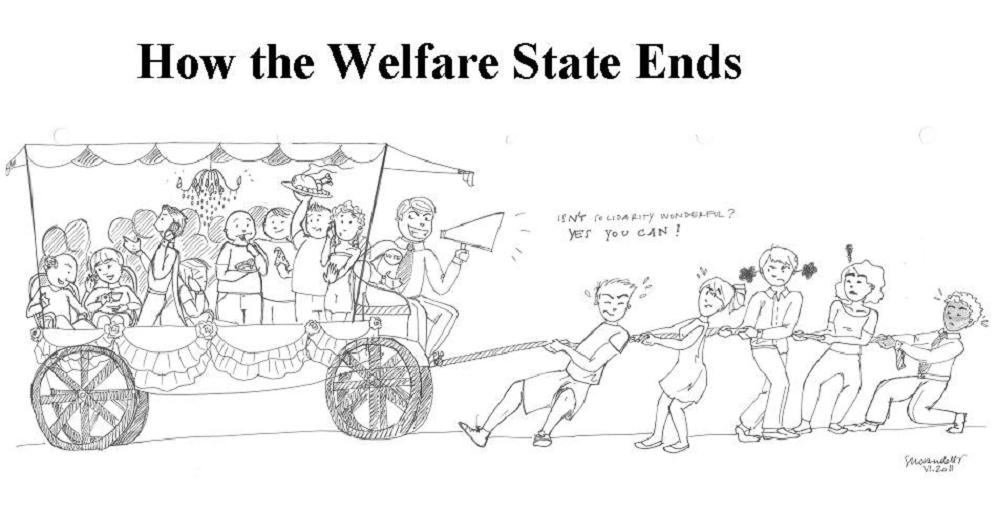
In my speeches, especially when talking about the fiscal crisis in Europe (or the future fiscal crisis in America), I often warn that the welfare state reaches a point-of-no-return when the number of people riding in the wagon begins to outnumber the number of people pulling the wagon.

To be more specific, if more than 50 percent of the population is dependent on government (employed in the bureaucracy, living off welfare, receiving pensions, etc), it becomes rather difficult to form a coalition to fix the mess. This may explain why Greek politicians have resisted significant reforms, even though the nation faces a fiscal death spiral.

But you don’t need me to explain this relationship. One of our Cato interns, Silvia Morandotti, used her artistic skills to create two images (click pictures for better resolution) that show what a welfare state looks like when it first begins and what it eventually becomes.

These images are remarkably accurate. The welfare state starts with small programs targeted at a handful of genuinely needy people. But as  politicians figure out the electoral benefits of expanding programs and people figure out the that they can let others work on their behalf, the ratio of producers to consumers begins to worsen.

Eventually, even though the moochers and looters should realize that it is not in their interest to over-burden the people pulling the wagon, the entire system breaks down.

Then things get really interesting. Small nations such as Greece can rely on permanent bailouts from bigger countries and the IMF, but sooner or later, as larger nations begin to go bankrupt, that approach won’t be feasible.

I often conclude my speeches by joking with the audience that it’s time to stock up on canned goods, bottled water, and ammo. Many people, I’m finding, don’t think that line very funny.

If you spend too much then people won’t want to work anymore.

___________

Thank you so much for your time. I know how valuable it is. I also appreciate the fine family that you have and your commitment as a father and a husband.

Sincerely,

Everette Hatcher III, 13900 Cottontail Lane, Alexander, AR 72002, ph 501-920-5733, lowcostsqueegees@yahoo.com

Great article on Francis Schaeffer

Great article.

Owen Strachan|5:30 AM CT

Everything But the Knickers: The Enduring Significance of Francis Schaeffer

Everything But the Knickers: The Enduring Significance of Francis Schaeffer avatar

In a news cycle driven by the latest quotes from Rick Perry, Barack Obama, and Mitt Romney, you would not expect to see Francis Schaeffer popping up on the daily ticker. The American expatriate, wearer-of-knickers, connoisseur of Swiss cosmopolitanism, and, above all, philosophically minded Calvinist public intellectual once made national headlines, to be sure. But suddenly he has returned, posthumously torturing the public square with supposed plans of a Christian political takeover, a master-strategy foiled in his day yet rising again in the phoenix of Michelle Bachmann’s presidential campaign.

Bad history and considerable ink-spilling aside, all this prompts a question: did Schaeffer ever really leave? A controversy recently erupted in the Twittersphere over this very matter. Alan Jacobs, one of evangelicalism’s most astute scholars, wrote in response to the aforementioned claims of Schaeffer-inspired dominionism, that he could not recall hearing the L’Abri founder’s name mentioned in 25 years of teaching in Christian academic institutions. Once one acknowledged that Schaeffer inspired evangelicals to engage ideas and appreciate art, Jacobs suggested that one had to concede that the man was no longer necessary.

Surely, Jacobs was right to suggest (implicitly) that the idea that Schaeffer’s work even now rouses hordes of evangelicals to attempt political takeover is ridiculous. But was Schaeffer’s influence really as circumscribed as suggested?

The Man and His Work

First things first: Schaeffer is unparalleled in evangelical history. There is no one who prefigures him and no one who now perfectly emulates him. Born in 1912, Schaeffer was raised in a Protestant home and came to faith in 1930. He studied and moved in fundamentalist circles in the 1930s and 40s and was influenced early on by famed controversialist Carl McIntire. Schaeffer moved to Europe in 1948 to conduct missionary work among children. Warming quickly to the physical beauty and intellectual spirit of Switzerland, Schaeffer and his wife, Edith, established L’Abri, a shelter-turned-community-turned-waystation, in 1955.

Through a variety of unusual encounters with spiritual pilgrims, Schaeffer soon earned a reputation as an evangelical guru, one to whom skeptics or struggling Christians could go for all-night conversation that led in many cases to personal transformation. The salon-like discussions were often taped and subsequently distributed throughout the world by Schaeffer devotees as a cycle developed: more guests distributing more tapes led to more guests. Schaeffer became something of an evangelical celebrity, with stories circulating throughout evangelicalism of visits from the son of President Gerald Ford, the children of Billy Graham, and counter-cultural mystic Timothy Leary.

In the mid-50s, Schaeffer began venturing back across the pond to lecture in the United States at schools like Harvard, MIT, Wheaton, Calvin, and many more, electrifying his audiences even as he provoked them. His talks ranged over Western philosophy and theology and held his audiences spellbound. The apologist knew how not to over-conclude, to leave his hearers on the edge of a rhetorical precipice. According to Baylor historian Barry Hankins, in a 1968 Wheaton College address, Schaeffer ended on a dime:

There is death in the city; there’s death in the city; there’s death in the city.

He then sat down. Those who believe in the cultivation of searing oratory will find ample means of growth in the Schaefferian corpus.

Hankins suggests that the two major tenets of Schaeffer’s speaking (and his broader program) were these: (1) Christianity is logically non-contradictory and (2) a system in which one can live consistently. Perhaps we could add a third: the living God reached out to a suffering world to offer it hope and salvation. Amid generous and wide-ranging engagement with major intellectual and cultural voices, Schaeffer propounded these themes in texts like He Is There and Is Not Silent, The God Who Is There, and Escape from Reason. His apologetic approach was presuppositional, but Schaeffer did not believe that this view abnegated understanding of and even affection for the non-Christian world. He practiced a rough-and-ready brand of cultural engagement but famously said that a Christian studies the world “with tears.” For Schaeffer, the intellectual life of the public Christian had intrinsic value even as it was, of necessity, missiological. One studied to understand, then set out to engage and persuade.

Schaeffer in Contemporary Evangelical Life

We cannot fully reconstruct the sweeping events, the great struggles and victories, of the evangelical icon in this piece. Such has been attempted, with a good deal of success, by two recent biographies, the first by British writer Colin Duriez entitled Francis Schaeffer: An Authentic Life (Crossway, 2008), the second by Hankins entitled Francis Schaeffer and the Shaping of Evangelical America (Eerdmans, 2009). These books—one popular, the other academic (but each valuable for either audience)—suggest by way of mere existence that Francis Schaeffer is an important figure for the contemporary evangelical movement. The same goes for prior works by authors including Lane Dennis, Scott Burson and Jerry Walls, and Christopher Catherwood. In 2008, Christianity Today published a cover story on L’Abri, noting by way of title that it was “Not Your Father’s L’Abri.” Whatever one of thinks of him—whether savant or kook—Schaeffer’s name is still on our lips.

Schaeffer’s legacy lives on in institutional form at Covenant Theological Seminary, which houses the Francis A. Schaeffer Institute. Headed by academic Jerram Barrs, a disciple of the apologist, the institute offers an annual lectureship, colloquia, and a fellows program that has drawn some of the brightest evangelical minds. Led by Bruce Little, the L. Russ Bush Center for Faith and Culture at Southeastern Baptist Theological Seminary recently acquired the Schaeffer papers and held a major conference in Schaeffer’s honor. The World Journalism Institute, affiliated with prominent evangelical writer Marvin Olasky, has a Francis Schaeffer Chair of Apologetics.

Prominent evangelical leaders and theologians who count (or counted) themselves deeply influenced by Schaeffer include William Brown, president of Cedarville University; David Wells of Gordon-Conwell Theological Seminary; William Edgar of Westminster Theological Seminary; James Sire of the University of Missouri; Harold O. J. Brown, late of Trinity Evangelical Divinity School; Lane Dennis of Crossway Books; Os Guinness; Udo Middleman; Barrs; Douglas Wilson; and Nancy Pearcey. Schaeffer’s books—and books about Schaeffer—are assigned reading at a wide range of evangelical schools, including TEDS (I read Hankins’s text in a doctoral seminar), The Southern Baptist Theological Seminary (several of Schaeffer’s works were assigned in my systematic theology classes taught by Al Mohler), Covenant Theological Seminary, Biola University, Southeastern Seminary, and many others. L’Abri shelters operate in 11 locations around the world and have grown in the last several decades, even if the movement seems in places to have distanced itself from Schaeffer (there is little about him on the L’Abri website, a quixotic reality).

Though he has won his eternal reward, Schaeffer’s ideas continue to animate Christians adhering to the conservative tradition, whether his defense of inerrancy, his care for the unborn, his love for art, film, and literature, or his belief in “true truth.” His 27 books continue to find an international audience. The “worldview thinking” that Schaeffer and other figures such as Carl F. H. Henry championed and popularized has essentially won the day as the dominant intellectual approach of evangelicalism, whether in the basement of the home-school consortium or the cavernous halls of the top-tier Christian university. Popular speakers and apologists like Chuck Colson, Josh McDowell, James Dobson, and Ravi Zacharias all promote this theocentric integration of intellectual and spiritual concerns, even if none of them has followed true Schaefferian suit and adopted knickers or a walking stick.

Schaeffer’s effect on evangelicalism, whether academic or popular, extends widely enough that it is difficult in the final analysis to quantify his influence. The number of pastors, scholars, missionaries, and other leaders affected by Francis Schaeffer number in the thousands, to be sure. Many of them frequent this site; some of them owe their love for theology and cultural engagement to Schaeffer, and others may credit their very salvation to him.

Conclusion

Was Schaeffer necessary? Is he relevant beyond a basic apprehension of the importance of ideas and art? Does his legacy endure and spread in our day? The answer to all three of these questions seems to be a decisive yes. Schaeffer was not a perfect man to his wife or family. He was not and did not present himself as an academic scholar, so one can find holes or mischaracterizations in his work. H did not seem to have a strong doctrine of the local church. He is not appreciated or even known by all evangelicals. Despite his flaws and the passage of time, however, we can conclude that Francis Schaeffer was a brilliant apologist who helped midcentury evangelicals by pioneering worldview thinking, cultural engagement, and robustly theological outreach to intellectuals, artists, and others whom Christians struggled to evangelize. He is worth studying, reading, and appreciating.

D. A. Carson has engaged the life and thought of Schaeffer with nuance. His work offers a fitting conclusion to our brief tour of the significance of the apologist: “In the aeons to come, there will be hundreds, perhaps thousands, of redeemed men and women who will rise up and call him blessed for helping them to escape from various intellectual and moral quagmires.” May that number only increase.

Owen Strachan is assistant professor of Christian theology and church history at Boyce College and executive director of the Council on Biblical Manhood & Womanhood. He blogs at Thought Life and is the co-author of the The Essential Edwards Collection.

“Friedman Friday” Celebrating Milton Friedman (How “Free to Choose” was put together)

Bob Chitester Discusses Milton Friedman and ‘Free to Choose’

Published on Jul 30, 2012 by

“There are very few people over the generations who have ideas that are sufficiently original to materially alter the direction of civilization. Milton is one of those very few people.”

That is how former Federal Reserve Chairman Alan Greenspan described the Nobel laureate economist Milton Friedman. But it is not for his technical work in monetary economics that Friedman is best known. Like mathematician Jacob Bronowski and astronomer Carl Sagan, Friedman had a gift for communicating complex ideas to a general audience.

It was this gift that brought him to the attention of filmmaker Bob Chitester. At Chitester’s urging, Friedman agreed to make a 10 part documentary series explaining the power of economic freedom. It was called “Free to Choose,” and became one of the most watched documentaries in history.

The series not only reached audiences in liberal democracies, but was smuggled behind the iron curtain where it played, in secret, to large audiences. Reflecting on its impact, Czech president Vaclav Klaus has said: “For us, who lived in the communist world, Milton Friedman was the greatest champion of freedom, of limited and unobtrusive government and of free markets. Because of him I became a true believer in the unrestricted market economy.”

July 31st, 2012 is the 100th anniversary of Friedman’s birth. To commemorate that occasion, we’d like to share an interview with “Free to Choose” producer Bob Chitester. Like this interview, the entire series can now be viewed on-line at no cost at http://www.freetochoose.tv/, thanks to the incredible technological progress brought about by the economic freedom that Milton Friedman celebrated.

Produced by Andrew Coulson, Caleb O. Brown, Austin Bragg, and Lou Richards, with help from the Free to Choose Network

_______________

Celebrating Milton Friedman

by Andrew J. Coulson

Andrew Coulson directs the Cato Institute’s Center for Educational Freedom and is the author of Market Education: The Unknown History.

Added to cato.org on July 31, 2012

This article appeared in Cato.org on July 31, 20

For us, who lived in the communist world, Milton Friedman was the greatest champion of freedom, of limited and unobtrusive government and of free markets. Because of him I became a true believer in the unrestricted market economy.

Those are the words of Czech President Vaclav Klaus. Both Friedman’s writings and his landmark 1980 documentary series “Free to Choose”were smuggled into totalitarian communist states, inspiring a generation of future scholars, activists, and politicians.

July 31st, 2012 is the 100th anniversary of Friedman’s birth. To commemorate that occasion, the Cato Institute has put together a video interview with Bob Chitester, producer of “Free to Choose,” recounting how it came to be, its impact, and what it was like working with Milton Friedman.

Aside from those who lived under communism, there is another group for whom Friedman was and is a colossal figure: advocates of educational freedom. At a time when state-run schooling had been the norm for nearly a century, and had long ceased to be questioned by America’s elites, Friedman offered a modest observation: there was no good reason for the government of a free society to actually run schools and many good reasons for it not to do so.

He made this case in his essay “On the Role of Government in Education,” first published in 1955. The idea had been floated by others, including Adam Smith and Thomas Paine, but Friedman eloquently and powerfully introduced it to the American policy debate. In so doing, he, more than any other individual, can be credited with giving rise to the modern school choice movement.

Not only did Friedman spark the creation of this movement, he helped to fan the flame of educational freedom, writing popular commentaries and book chapters, speaking with and encouraging activists, founding a leading school choice institution, and dedicating the entire sixth episode of “Free to Choose” to this subject.

I had the good fortune to speak and correspond with Milton occasionally, starting in the late 1990s, and what struck me most about him was his personal integrity. He once told me that he never said anything negative about a person in private that he would not be willing to say openly in that person’s presence. So far as I know, he never violated that principle. And while he staunchly defended his conclusions as long as he remained convinced of their correctness, he would amend them if the weight of evidence shifted.

Indeed the rigorous empiricism that Friedman applied in his scholarly work is generally regarded as one of his most influential contributions to the field of economics—for a long time controversial but eventually the norm, at least in principle. His view, published in the 1953 collection Essays in Positive Economics, was that

the ultimate test of the validity of a theory is… the ability to deduce facts that have not yet been observed, that are capable of being contradicted by observation, and that subsequent observation does not contradict. [p. 300]

Equally wise, though not yet as widely accepted, is the long time horizon against which Friedman measured policy outcomes. Economist and philosopher of science James R. Wible notes that Friedman’s greatest contribution “may be his constant reminder not to forget the long run consequences of short run policies.”

In the 1982 edition of his book Capitalism and Freedom, Friedman observed that scholars cannot single-handedly bring about change. Their real role, he wrote, is to “keep the lights on”—to remind us which policies work and which do not, and to show us how to advance our understanding even further. His own unfailing empiricism and concern for the long term remain valuable beacons today, both for advocates of educational freedom and the broader policy community.

_____________

Related posts:

Quotes from Milton Friedman on his 100th birthday

Milton Friedman’s 100th: Exploring His Wisdom for the Ages (Part I: Worldview) by Robert Bradley Jr. July 31, 2012 [Ed. note: Milton Friedman’s views will be further explored in Part II on energy and Part III on political capitalism.] “Our central theme in public advocacy has been the promotion of human freedom … [It] underlies […]

Thomas Sowell remembers his former teacher Milton Friedman 100 years later

I was impacted in 1980 by the film series “Free to Choose” and I was very impressed by the performance by Thomas Sowell. Today he remembers his former teacher Milton Friedman.   Friedman could be a help today     By  Thomas Sowell Creators Syndicate Tuesday July 31, 2012 7:00 AM If Milton Friedman were alive […]

Milton Friedman destroys liberal student challenges

In the video above Milton Friedman takes on some liberal students with their challenges to capitalism.   Secretary of Defense Donald H. Rumsfeld speaking at Tribute to Milton Friedman (transcript) As Delivered by Secretary of Defense Donald H. Rumsfeld, White House, Washington, D.C., Thursday, May 09, 2002 Mr. President (George W. Bush), Rose and Milton […]

Every Friday you need to click on www.theDailyHatch.org for “Friedman Friday”

Every Friday you need to click on http://www.theDailyHatch.org if you would like to see a video clip of Milton Friedman as he shares his common sense conservative economic views. Many of his articles are posted too. I remember growing up and reading those great articles every week in Newsweek. They are just as relevant today as […]

Milton Friedman videos and transcripts Part 12

Milton Friedman videos and transcripts Part 12 On my blog http://www.thedailyhatch.org I have an extensive list of posts that have both videos and transcripts of MiltonFriedman’s interviews and speeches. Here below is just small list of those and more can be accessed by clicking on “Milton Friedman” on the side of this page or searching […]

Chattanooga Times Free Press comments on 100th year since Milton Friedman’s birth

published Tuesday, July 31st, 2012  Chattanooga Times Free Press Milton Friedman at 100   Milton Friedman Photo by Associated Press /Chattanooga Times Free Press.   enlarge photo   One hundred years ago today, the most powerful defender of economic liberty in American history was born in Brooklyn to poor Jewish immigrants. Though he stood barely […]

Milton Friedman’s passion was to make a difference in the lives of young people

No one did more to advance the cause of school vouchers than Milton and Rose Friedman. Friedman made it clear in his film series “Free to Choose” how sad he was that young people who live in the inner cities did not have good education opportunities available to them. Remembering Milton Friedman’s School Choice Legacy […]

Milton Friedman remembered at 100 years from his birth (Part 5)

Testing Milton Friedman – Preview Uploaded by FreeToChooseNetwork on Feb 21, 2012 2012 is the 100th anniversary of Milton Friedman’s birth. His work and ideas continue to make the world a better place. As part of Milton Friedman’s Century, a revival of the ideas featured in the landmark television series Free To Choose are being […]

Defending Milton Friedman

What a great defense of Milton Friedman!!!!   Defaming Milton Friedman by Johan Norberg This article appeared in Reason Online on September 26, 2008  PRINT PAGE  CITE THIS      Sans Serif      Serif Share with your friends: ShareThis In the future, if you tell a student or a journalist that you favor free markets and limited government, there is […]

Milton and Rose Friedman “Two Lucky People”

Milton Friedman on Hayek’s “Road to Serfdom” 1994 Interview 2 of 2 Uploaded by PenguinProseMedia on Oct 26, 2011 2nd half of 1994 interview. ________________ I have a lot of respect for the Friedmans.Two Lucky People by Milton and Rose Friedman reviewed by David Frum — October 1998. However, I liked this review below better. It […]

If you want to cut the size of government then we have to have spending caps!!!

If you want to cut the size of government then we have to have spending caps!!!

Okay, I’ll admit the title of this post is an exaggeration. How to fix the mess at the IRS is a fiscal policy question, and that requires tax reform rather than spending restraint.

But allow me a bit of literary license. We just had a big debt limit battle in Washington and, after a lot of political drama, politicians kicked the can down the road.

So we need to ask ourselves whether that fight accomplished anything?

It did focus attention of the flaws of Obamacare, and I suppose there’s some value in that.

But the debt limit was not a vehicle – as has been the case in the past – for changes in fiscal policy. We didn’t get something good, like the sequester which resulted from the 2011 debt limit legislation. And we didn’t get something bad, like the tax hike in the 1985 debt limit legislation

Some are asking whether we should even have a debt limit. A number of critics have suggested we should get rid of the borrowing cap because it creates the risk of default. I think those concerns are very overblown.

I’m more persuaded by those who argue that the debt limit diverts attention from better options to improve fiscal policy.

Professors Gary Becker and Edward Lazear write in the Wall Street Journal that the debt ceiling is not a very good tool for restraining the growth of government. They look at evidence from the states to warn that fiscal rules that seek to limit borrowing are ineffective.

Many states are required to have “balanced” budgets, but the growth in spending and the size of state governments continues apace. During good times, when tax revenues are high, states “balance” their budgets by spending at the high levels consistent with large revenues. When times get tough, it is difficult if not impossible to eliminate programs that had been initiated during the fat years. Instead, the states resort to budgetary gimmicks, like delaying shortfalls until next year’s “balanced” budget.

Gimmicks are bad, of course, but politicians also respond to fiscal squeezes by raising taxes.

And that can be even worse as the prospect of more revenue leads to a ratchet effect, with periodic tax hikes used to maintain or expand the gravy train of spending. The fiscal mess in Europe is an obvious case study, but if you want a painful example from America, just look at data from Connecticut. The state did quite well without an income tax from the 1600s until 1991.

But then an income tax was imposed, in part to deal with the fiscal shortfall caused by an economic downturn. And, as critics warned, that new tax has produced dismal results. The top rate has jumped from 4.5 percent to 6.5 percent and inflation-adjusted per-capita state government spending has doubled. And there have been zero net private-sector jobs created since the income tax was implemented.

So what’s the answer? Becker and Lazear explain that lawmakers should target the underlying problem of spending rather than the symptom of red ink.

Better than a debt-ceiling rule would be one that controls spending directly, not the debt that results from it. The specifics are less important than the general principle, which is that spending growth should be limited in a way that brings government outlays back down to historic ratios relative to GDP. This would place the attention where it belongs, on spending rather than on the difference between outlays and receipts. Increased spending, coupled with even larger increases in taxes, might bring the deficit down, but it would damage economic growth and well-being.

Well stated. Reducing the overall burden of government spending – measured as a share of economic output – should be the goal of fiscal policy. That’s simply another way of stating my Golden Rule. And there’s a growing body of academic evidence showing that reducing the size of government is a good way of improving economic performance.

I’ve been highlighting the example of Switzerland, which has successfully strengthened its economy and fiscal policy with a spending cap (which, ironically, is called a “debt brake” even though the real effect of the law is to limit how fast spending can increase over time).

Other countries that have limited spending also have achieved some very impressive results. The video at this link looks at evidence from nations such as New Zealand and Canada in the 1990s, and there’s a more recent data about the positive effects of spending restraint in the Baltic nations.

There has been some interest in spending caps on Capitol Hill. Congressman Brady of Texas has proposed a MAP Act that is somewhat similar to Switzerland’s debt brake and Senator Corker of Tennessee has introduced a CAP Act that also would restrain annual spending increases.

Perhaps if some of their colleagues read today’s Becker-Lazear column, they’ll also understand why it’s better to focus on the underlying problem of government spending rather than getting distracted by the symptom of red ink.

John Stossel ~ 17,000,000,000,000 Problems

Related posts:

The Dysfunction in Washington is Republicans and Democrats that are unwilling to cut spending in order to vote for more programs (Democrats want more food stamps etc but Republicans vote for their pet programs and wars too like No Child Left Behind Act, the Iraq war, the prescription drug entitlement, and the TARP bailout).

The Dysfunction in Washington is Republicans and Democrats that are unwilling to cut spending in order to vote for more programs (Democrats want more food stamps etc but Republicans vote for their pet programs and wars too like No Child Left Behind Act, the Iraq war, the prescription drug entitlement, and the TARP bailout). If […]

Washington better wake up and cut spending or the USA will end up bankrupt like Detroit!!!

Washington better wake up and cut spending or the USA will end up bankrupt like Detroit!!! Atlas Shrugs in Detroit July 25, 2013 by Dan Mitchell About two weeks ago, while making an important point about the Laffer Curve, here’s what I wrote about the fiscal disaster in Detroit. Detroit’s problems are the completely predictable result […]

Lessons from Canada:CUT SPENDING AND LOWER TAXES AND GIVE MORE CONTROL BACK TO THE LOCAL GOVERNMENTS!!!!

When Governments Cut Spending Uploaded on Sep 28, 2011 Do governments ever cut spending? According to Dr. Stephen Davies, there are historical examples of government spending cuts in Canada, New Zealand, Sweden, and America. In these cases, despite popular belief, the government spending cuts did not cause economic stagnation. In fact, the spending cuts often […]

We got to cut spending and this farm bill is the perfect place to start!!!

We got to cut spending and this farm bill is the perfect place to start!!! May 29, 2013 12:33PM Farm Bill Would Increase Spending 47% By Chris Edwards Share House and Senate farm subsidy supporters are pushing to enact the first big farm bill since 2008. Democratic and Republican supporters say that this year’s legislation […]

President Obama will not cut spending ever it appears

President Obama will not cut spending ever it appears. Early Details Show Obama Will Propose a Bait-and-Switch Budget Plan Containing Higher Taxes and More Spending April 5, 2013 by Dan Mitchell Are we about to see a new kinder-and-gentler Obama? Has the tax-and-spend President of the past four years been replaced by a fiscal moderate? That’s […]

We got to cut spending and stop raising the debt ceiling!!!

  We got to cut spending and stop raising the debt ceiling!!! When Governments Cut Spending Uploaded on Sep 28, 2011 Do governments ever cut spending? According to Dr. Stephen Davies, there are historical examples of government spending cuts in Canada, New Zealand, Sweden, and America. In these cases, despite popular belief, the government spending […]

To save the USA from Greece’s fate we must cut spending

Maybe Romney will focus on cutting spending now that Ryan is on board. Is the American Electorate that Dumb? Posted by Roger Pilon Today POLITICO Arena asks: Can Ryan boost Romney’s poll numbers? My response: Ryan is the shot in the arm that Romney needed. If last night’s “60 Minutes” interview of the two is […]

The USA must cut spending and balance budget or end up like Greece

Why can’t we learn the lesson from Europe that we must start to cut spending and balance our budget or we will end up like Greece? Europe’s Crisis Is Because of Too Much Government, Not the Euro Currency July 19, 2012 by Dan Mitchell The mess in Europe has been rather frustrating, largely because almost everybody […]

An award to the person who cut spending by our federal governement the most ($47)

A funny carton. Finally, Some Government Workers Who Want to Cut Spending April 23, 2012 by Dan Mitchell In recent years, taxpayers have been victimized by huge expansions in the burden of government spending. Among the highlights (lowlights would be a much better word): A corrupt bailout of politically connected Wall Street insiders. A bloated healthcare […]

Updated version:Rick Crawford falls for Democrats’ trick:raise taxes first and we will cut spending later

RAISE TAXES: Report says Rick Crawford will break from GOP and back millionaires’ tax. The Arkansas Times reported that Congressman Rick Crawford has a plan that includes raising taxes for 5 years if there is an agreement to pass the Balanced Budget Amendment. However, if after 5 years the Balanced Budget Amendment does not get […]

Open letter to President Obama (Part 437) Taking on Ark Times Bloggers on various issues Part E “Moral absolutes and abortion” Francis Schaeffer Quotes part 5(includes the film SLAUGHTER OF THE INNOCENTS) (editorial cartoon)

(Emailed to White House on 3-4-13.)

President Obama c/o The White House
1600 Pennsylvania Avenue NW
Washington, DC 20500

Dear Mr. President,

I know that you receive 20,000 letters a day and that you actually read 10 of them every day. I really do respect you for trying to get a pulse on what is going on out here.

I wanted to share with you some about my pro-life perspective.

I have gone back and forth and back and forth with many liberals on the Arkansas Times Blog on many issues such as abortion, human rights, welfare, poverty, gun control  and issues dealing with popular culture. Here is another exchange I had with them a while back. My username at the Ark Times Blog is Saline Republican.

On 2-21-13 on the Arkansas Times Blog  I asserted: 

Elwood you suggest if prolife people are not willing to pay for poor people’s unwanted babies’ needs then we are not part of the answer.

Hank Hanegraaff noted:

Attacking people rather than arguing principles, ad hominem arguments are a trick designed to distract attention from the real issue — namely, that abortion is the killing of an innocent human being.

On 2-21-13 on the Arkansas Times Blog  the liberal Amy Benton Bradley-Hole observed:

“Instead, it is an attempt to attack character in order to avoid the case against abortion.”

The hell it is. It’s an attempt to make moral absolutists face reality and comprehend the actual results of their misguided actions. But the problem with moral absolutists is they’re too dense to understand this.

On 2-21-13 on the Arkansas Times Blog  I responded:

Francis Schaeffer rightly noted, “If there is no absolute moral standard, then one cannot say in a final sense that anything is right or wrong. By absolute we mean that which always applies, that which provides a final or ultimate standard. There must be an absolute if there are to be morals, and there must be an absolute if there are to be real values. If there is no absolute beyond man’s ideas, then there is no final appeal to judge between individuals and groups whose moral judgements conflict. We are merely left with conflicting opinions.”

That is why I wonder why Amy Bento Bradley-Holes would be critical of moral absolutes. On what basis do moral nonabsolutists have to say that Hitler was wrong?

________________

I truly believe that many of the problems we have today in the USA are due to the advancement of humanism in the last few decades in our society. Ronald Reagan appointed the evangelical Dr. C. Everett Koop to the position of Surgeon General in his administration. He partnered with Dr. Francis Schaeffer in making the video below. It is very valuable information for Christians to have.  Actually I have included a video below that includes comments from him on this subject.

In the film series “WHATEVER HAPPENED TO THE HUMAN RACE?” the arguments are presented  against abortion (Episode 1),  infanticide (Episode 2),   euthenasia (Episode 3), and then there is a discussion of the Christian versus Humanist worldview concerning the issue of “the basis for human dignity” in Episode 4 and then in the last episode a close look at the truth claims of the Bible.

Francis Schaeffer and his wife Edith pictured below.

In the film series “WHATEVER HAPPENED TO THE HUMAN RACE?” the arguments are presented  against abortion (Episode 1),  infanticide (Episode 2),   euthanasia (Episode 3), and then there is a discussion of the Christian versus Humanist worldview concerning the issue of “the basis for human dignity” in Episode 4 and then in the last episode a close look at the truth claims of the Bible.

Francis Schaeffer: How Should We Then Live? (Full-Length Documentary)

Francis Schaeffer Whatever Happened to the Human Race (Episode 1) ABORTION

Francis Schaeffer: What Ever Happened to the Human Race? (Full-Length Documentary)

Part 1 on abortion runs from 00:00 to 39:50, Part 2 on Infanticide runs from 39:50 to 1:21:30, Part 3 on Youth Euthanasia runs from 1:21:30 to 1:45:40, Part 4 on the basis of human dignity runs from 1:45:40 to 2:24:45 and Part 5 on the basis of truth runs from 2:24:45 to 3:00:04

___________

Francis Schaeffer saw the issues that our society would be facing in the future because of humanism and he was right on just about everything. Take a look at some of his quotes below: (By the way one of my favorite quotes is the first one listed below.)

“People today are trying to hang on to the dignity of man, but they do not know how to, because they have lost the truth that man is made in the image of God. . . . We are watching our culture put into effect the fact that when you tell men long enough that they are machines, it soon begins to show in their actions. You see it in our whole culture — in the theater of cruelty, in the violence in the streets, in the death of man in art and life.”
― Francis A. Schaeffer, Escape from Reason: A Penetrating Analysis of Trends in Modern Thought
“When a man comes under the blood of Christ, his whole capacity as a man is refashioned. His soul is saved, yes, but so are his mind and his body. True spirituality means the lordship of Christ over the total man.”
― Francis A. Schaeffer, Art & the Bible
“I am afraid that as evangelicals, we think that a work of art only has value if we reduce it to a tract.”
― Francis A. Schaeffer, Art & the Bible
“As Christians, we must see that just because an artist -even a great artist- portrays a worldview in writing or on canvas, it does not mean that we should automatically accept that worldview. Good art heightens the impact of that worldview, but it does not make it true.”
― Francis A. Schaeffer, Art & the Bible
“Returning to the Moral Majority, we must realize that regardless of whether we think the Moral Majority has always said the right things or whether we do not, or whether we think they have made some mistakes or whether we do not, they have certainly done one thing right: they have used the freedom we still have in the political arena to stand against the other total entity [secular humanism]. They have carried the fact that law is king, law is above the lawmakers, and God is above the law in to this area of life where it always should have been. And this is a part of true spirituality.The Moral Majority has drawn a line between the one total view of reality and the other total view of reality and the results this brings forth in government and law. And if you personally do not like some of the details of what they have done, do it better. But you must understand that all Christians have got to do the same kind of thing or you are simply not showing the Lordship of Christ in the totality of life.”
― Francis A. Schaeffer, A Christian Manifesto and Pollution and the Death of Man
“Christian art is the expression of the whole life of the whole person as a Christian. What a Christian portrays in his art is the totality of life. Art is not to be solely a vehicle for some sort of self-conscious evangelism.”
― Francis A. Schaeffer, Art & the Bible
“Truth carries with it confrontation. Truth demands confrontation; loving confrontation, but confrontation nevertheless.”
― Francis A. Schaeffer, The Great Evangelical Disaster
“We are not being true to the artist as a man if we consider his work “junk”, simply because we differ with his outlook on life. Instead, if the artist’s technical excellence is high, he is to be praised for this even if we differ with his worldview… Yet where his work shows his worldview, it must be judged by its relationship to the Christian worldview.If we stand as Christians before a man’s canvas and recognize that he is a great artist in technical excellence, we have been fair with him as a man. Then we can say that his worldview is wrong. We can judge his views on the same basis as we judge anybody else- philosopher, common man, laborer, business man, or whatever. God’s Word binds the great man and the small, the scientist and the simple, the king and the artist.We should realize that if something untrue or immoral is stated in great art, it can be far more devastating than if it is expressed in poor art. The greater the artistic expression, the more important it is to consciously bring it and it’s worldview under the judgment of Christ and the Bible. The common reaction among many however, is just the opposite. Ordinarily, many seem to feel that the greater the art, the less we ought to be critical of its worldview. This we must reverse.”
― Francis A. Schaeffer
“We should realize that if something untrue or immoral is stated in great art, it can be far more devastating than if it is expressed in poor art. The greater the artistic expression, the more important it is to consciously bring it and it’s worldview under the judgment of Christ and the Bible. The common reaction among many however, is just the opposite. Ordinarily, many seem to feel that the greater the art, the less we ought to be critical of its worldview. This we must reverse.”
― Francis A. Schaeffer, Art & the Bible

Thank you so much for your time. I know how valuable it is. I also appreciate the fine family that you have and your commitment as a father and a husband.

Sincerely,

Everette Hatcher III, 13900 Cottontail Lane, Alexander, AR 72002, ph 501-920-5733, lowcostsqueegees@yahoo.com

Related posts:

Francis Schaeffer’s prayer for us in USA

 Francis Schaeffer: “Whatever Happened to the Human Race” (Episode 1) ABORTION OF THE HUMAN RACE Published on Oct 6, 2012 by AdamMetropolis The 45 minute video above is from the film series created from Francis Schaeffer’s book “Whatever Happened to the Human Race?” with Dr. C. Everett Koop. This book  really helped develop my political views […]

Francis Schaeffer’s “How should we then live?” Video and outline of episode 10 “Final Choices” (Schaeffer Sundays)

E P I S O D E 1 0   Dr. Francis Schaeffer – Episode X – Final Choices 27 min FINAL CHOICES I. Authoritarianism the Only Humanistic Social Option One man or an elite giving authoritative arbitrary absolutes. A. Society is sole absolute in absence of other absolutes. B. But society has to be […]

Francis Schaeffer’s “How should we then live?” Video and outline of episode 9 “The Age of Personal Peace and Affluence” (Schaeffer Sundays)

E P I S O D E 9 Dr. Francis Schaeffer – Episode IX – The Age of Personal Peace and Affluence 27 min T h e Age of Personal Peace and Afflunce I. By the Early 1960s People Were Bombarded From Every Side by Modern Man’s Humanistic Thought II. Modern Form of Humanistic Thought Leads […]

Francis Schaeffer’s “How should we then live?” Video and outline of episode 8 “The Age of Fragmentation” (Schaeffer Sundays)

E P I S O D E 8 Dr. Francis Schaeffer – Episode VIII – The Age of Fragmentation 27 min I saw this film series in 1979 and it had a major impact on me. T h e Age of FRAGMENTATION I. Art As a Vehicle Of Modern Thought A. Impressionism (Monet, Renoir, Pissarro, Sisley, […]

Francis Schaeffer’s “How should we then live?” Video and outline of episode 7 “The Age of Non-Reason” (Schaeffer Sundays)

E P I S O D E 7 Dr. Francis Schaeffer – Episode VII – The Age of Non Reason I am thrilled to get this film series with you. I saw it first in 1979 and it had such a big impact on me. Today’s episode is where we see modern humanist man act […]

Francis Schaeffer’s “How should we then live?” Video and outline of episode 6 “The Scientific Age” (Schaeffer Sundays)

E P I S O D E 6 How Should We Then Live 6#1 Uploaded by NoMirrorHDDHrorriMoN on Oct 3, 2011 How Should We Then Live? Episode 6 of 12 ________ I am sharing with you a film series that I saw in 1979. In this film Francis Schaeffer asserted that was a shift in […]

Francis Schaeffer’s “How should we then live?” Video and outline of episode 5 “The Revolutionary Age” (Schaeffer Sundays)

E P I S O D E 5 How Should We Then Live? Episode 5: The Revolutionary Age I was impacted by this film series by Francis Schaeffer back in the 1970′s and I wanted to share it with you. Francis Schaeffer noted, “Reformation Did Not Bring Perfection. But gradually on basis of biblical teaching there […]

Francis Schaeffer’s “How should we then live?” Video and outline of episode 4 “The Reformation” (Schaeffer Sundays)

Dr. Francis Schaeffer – Episode IV – The Reformation 27 min I was impacted by this film series by Francis Schaeffer back in the 1970′s and I wanted to share it with you. Schaeffer makes three key points concerning the Reformation: “1. Erasmian Christian humanism rejected by Farel. 2. Bible gives needed answers not only as to […]

“Schaeffer Sundays” Francis Schaeffer’s “How should we then live?” Video and outline of episode 3 “The Renaissance”

Francis Schaeffer’s “How should we then live?” Video and outline of episode 3 “The Renaissance” Francis Schaeffer: “How Should We Then Live?” (Episode 3) THE RENAISSANCE I was impacted by this film series by Francis Schaeffer back in the 1970′s and I wanted to share it with you. Schaeffer really shows why we have so […]

Francis Schaeffer’s “How should we then live?” Video and outline of episode 2 “The Middle Ages” (Schaeffer Sundays)

  Francis Schaeffer: “How Should We Then Live?” (Episode 2) THE MIDDLE AGES I was impacted by this film series by Francis Schaeffer back in the 1970′s and I wanted to share it with you. Schaeffer points out that during this time period unfortunately we have the “Church’s deviation from early church’s teaching in regard […]

Francis Schaeffer’s “How should we then live?” Video and outline of episode 1 “The Roman Age” (Schaeffer Sundays)

Francis Schaeffer: “How Should We Then Live?” (Episode 1) THE ROMAN AGE   Today I am starting a series that really had a big impact on my life back in the 1970′s when I first saw it. There are ten parts and today is the first. Francis Schaeffer takes a look at Rome and why […]

Francis Schaeffer: “Whatever Happened to the Human Race” (Episode 5) TRUTH AND HISTORY

Francis Schaeffer: “Whatever Happened to the Human Race” (Episode 5) TRUTH AND HISTORY Published on Oct 7, 2012 by AdamMetropolis This crucial series is narrated by the late Dr. Francis Schaeffer and former Surgeon General Dr. C. Everett Koop. Today, choices are being made that undermine human rights at their most basic level. Practices once […]

Francis Schaeffer: “Whatever Happened to the Human Race” (Episode 4) THE BASIS FOR HUMAN DIGNITY

The opening song at the beginning of this episode is very insightful. Francis Schaeffer: “Whatever Happened to the Human Race” (Episode 4) THE BASIS FOR HUMAN DIGNITY Published on Oct 7, 2012 by AdamMetropolis This crucial series is narrated by the late Dr. Francis Schaeffer and former Surgeon General Dr. C. Everett Koop. Today, choices […]

Francis Schaeffer: “Whatever Happened to the Human Race” (Episode 3) DEATH BY SOMEONE’S CHOICE

Francis Schaeffer: “Whatever Happened to the Human Race” (Episode 3) DEATH BY SOMEONE’S CHOICE Published on Oct 6, 2012 by AdamMetropolis This crucial series is narrated by the late Dr. Francis Schaeffer and former Surgeon General Dr. C. Everett Koop. Today, choices are being made that undermine human rights at their most basic level. Practices […]

Francis Schaeffer: “Whatever Happened to the Human Race?” (Episode 2) SLAUGHTER OF THE INNOCENTS

Francis Schaeffer: “Whatever Happened to the Human Race?” (Episode 2) SLAUGHTER OF THE INNOCENTS Published on Oct 6, 2012 by AdamMetropolis This crucial series is narrated by the late Dr. Francis Schaeffer and former Surgeon General Dr. C. Everett Koop. Today, choices are being made that undermine human rights at their most basic level. Practices […]

Francis Schaeffer: “Whatever Happened to the Human Race” (Episode 1) ABORTION OF THE HUMAN RACE

It is not possible to know where the pro-life evangelicals are coming from unless you look at the work of the person who inspired them the most. That person was Francis Schaeffer.  I do care about economic issues but the pro-life issue is the most important to me. Several years ago Adrian Rogers (past president of […]

The following essay explores the role that Francis Schaeffer played in the rise of the pro-life movement. It examines the place of How Should We Then Live?, Whatever Happened to the Human Race?, and A Christian Manifesto in that process.

This essay below is worth the read. Schaeffer, Francis – “Francis Schaeffer and the Pro-Life Movement” [How Should We Then Live?, Whatever Happened to the Human Race?, A Christian Manifesto] Editor note: <p> </p> [The following essay explores the role that Francis Schaeffer played in the rise of the pro-life movement.  It examines the place of […]

Who was Francis Schaeffer? by Udo Middelmann

Great article on Schaeffer. Who was Dr. Francis A. Schaeffer? By Francis Schaeffer The unique contribution of Dr. Francis Schaeffer on a whole generation was the ability to communicate the truth of historic Biblical Christianity in a way that combined intellectual integrity with practical, loving care. This grew out of his extensive understanding of the Bible […]

FREE TO CHOOSE “Who protects the worker?” Video and Transcript Part 5 of 7 “With a welfare system of the kind we have, you have the problem that people immigrate in order to get welfare, not in order to get employment”

FREE TO CHOOSE “Who protects the worker?” Video and Transcript Part

In 1980 I read the book FREE TO CHOOSE by Milton Friedman and it really enlightened me a tremendous amount.  I suggest checking out these episodes and transcripts of Milton Friedman’s film series FREE TO CHOOSE: “The Failure of Socialism” and “What is wrong with our schools?”  and “Created Equal”  and  From Cradle to Grave, and – Power of the Market. Milton Friedman shows in this episode how the worker is best protected and it is not by the government!!!!!!!

The essence of what Milton Friedman is saying in this episode is found in this statement:

“The situation of immigration restrictions really has to do with the question of a welfare state. As I say in the film, I would favor completely free immigration in a society which does not have a welfare system. With a welfare system of the kind we have, you have the problem that people immigrate in order to get welfare, not in order to get employment. You know, it’s a very interesting thing, if you would ask anybody before 1914 the U.S. had no immigration restrictions whatsoever, I’m exaggerating a little bit, there were some immigration restrictions on orientals, but it was essentially, mainly free. If you ask anybody, any American economic historian was that a good thing for America, everybody will say yes it was a wonderful thing for America that we had free immigration. If you ask anybody today, should we have free immigration today, everybody will __ almost everybody will say no. What’s the difference? I think there’s only one difference and that is that when we had free immigration it was immigration of jobs in which everybody benefited. The people who were already here benefited because they got complementary workers, workers who could work with them, make their productivity better, enable them to develop and use the resources of the country better, but today, if you have a system under which you have essentially a governmental guarantee of relief in case of distress, you have a very, very real problem.”

Pt 5

L. WILLIAMS: Dr. Friedman and Walter Williams go back in history and they take a look at a situation where America was empty, where we didn’t have anything like the sophisticated industrial economy we have today, but had a much more agricultural and rural kind of economy and of course when the __ when the impoverished peasants of Europe, my ancestors and most of our ancestors, except for the slaves, which is another situation, but when these people came from Europe and came to a wide open continent with the most fertile soil then available to anyone in the world, naturally there was progress; and I or any of us would be mad to deny progress. But as that developed and as population increased and as we moved into a much more sophisticated industrial economy, we moved then into the situation in the 1930s, or earlier than that , at the end of the century. As some of the more skilled jobs came along, the labor movement didn’t happen by accident. Didn’t happen because there wasn’t a need there. The results of this development, even with all the wealth available in America, the results of this development was that many working people were not having anything like, by standards of civilization or whatever, anything like their fair share in this progress.

MCKENZIE: Now you’re arguing that in a free market, for labor, everyone benefits. Does that mean that you would favor abolition of all immigration restrictions?

FRIEDMAN: The situation of immigration restrictions really has to do with the question of a welfare state. As I say in the film, I would favor completely free immigration in a society which does not have a welfare system. With a welfare system of the kind we have, you have the problem that people immigrate in order to get welfare, not in order to get employment. You know, it’s a very interesting thing, if you would ask anybody before 1914 the U.S. had no immigration restrictions whatsoever, I’m exaggerating a little bit, there were some immigration restrictions on orientals, but it was essentially, mainly free. If you ask anybody, any American economic historian was that a good thing for America, everybody will say yes it was a wonderful thing for America that we had free immigration. If you ask anybody today, should we have free immigration today, everybody will __ almost everybody will say no. What’s the difference? I think there’s only one difference and that is that when we had free immigration it was immigration of jobs in which everybody benefited. The people who were already here benefited because they got complementary workers, workers who could work with them, make their productivity better, enable them to develop and use the resources of the country better, but today, if you have a system under which you have essentially a governmental guarantee of relief in case of distress, you have a very, very real problem.

MCKENZIE: But this is true of every western industrialized country.

FRIEDMAN: That’s right and that’s why today __

MCKENZIE: Yeah.

FRIEDMAN: __ under current circumstances you cannot, unfortunately have free immigration. Not because there’s anything wrong with free immigration, but because we have other policies which make it impossible to adopt free immigration.

MCKENZIE: Well I’d like other reactions. Is it at all feasible to open the door of the labor market internationally now? Bill Brady?

BRADY: I would __ I would say yes providing they open the door to us. I think that the door to not only the labor market, the door to all markets should be __ should be open. That is the product markets.

W. WILLIAMS: My feelings about the undocumented workers of Mexican-Americans are inscribed at the foot of the Statue of Liberty. I think that the people should have the right to come to this country. Now, those who would say, you know, I hear a number of people saying that, well the immigrants are contributing to our unemployment problem. And I point this out to some people, I said, “look, you know, this is the same rhetoric that the Irish used when the blacks were coming up from the north, ” you know, they’re using blacks as scapegoats. They’re saying, “get those people back where they came from so that our members can get jobs, ” you know. Unions were as well doing this, you know, they called them scabs, strikebreakers, etcetera, etcetera. So I do not wish for Mexican-Americans to become the new scapegoats of our particular national problems. They are not the problem, and our nation benefits to the extent that these people come here and work. And to that extent __ to that extent__ so it’s kind of good for them to remain illegal aliens as opposed to being legal aliens where they’re subject to our welfare programs, so that we don’t want them to come here to __

(Several people talking at once.)

GREEN: I think that this country cannot have a group of workers to remain outside the framework of our laws and our protection. And as long as we have workers who are attracted to the United States because of the standards of living; and I think minimum wages play a part in that as part of that attraction. But it seems to me to have undocumented workers without providing either a means of protection for them and it seems to me that we’ve got to go to the question of providing the amnesty for those generations of workers who have come here over a period of time, now two, three, maybe four generations. We have to see that they have the same rights and protection of all other workers. And as it stands now, large numbers of them live outside the framework of the laws and statutes that we have on the __ on our books.

MCKENZIE: Comment Milton.

FRIEDMAN: They do and the tragedy of the situation, as what Walter Williams point out, that as long as they are undocumented and illegal they are a clear net gain, the nation benefits and they benefit. They wouldn’t be here if they didn’t. The tragedy is that we’ve adopted all these other policies so that if we convert them into legal residents it’s no longer clear that we benefit. They may benefit, but it’s no longer clear that we do. What Lynn Williams said before is again a travesty on what was actually going on. The real boost to the trade union movement came after the Great Depression of the 1930s; that Great Depression was not a failure of capitalism; it was not a failure of the private market system as we pointed out in another one of the programs in this series; it was a failure of government. It was not the case that somehow or other there was a decline in the conditions of the working class that produced a great surge of unionism. On the contrary __ unions have never accounted for more than one out of four or one out of five of American workers. The American worker benefited not out of unions, he benefited in spite of unions. He benefited because there was greater opportunity because there were people who were willing to invest their money because there was an opportunity for people to work, to save, to invest. That’s still the case today. You say, we have to provide them with something or other Ernest. Who are the “we”?

GREEN: We the people.

FRIEDMAN: How do we the people __ but how do we the people do it?

GREEN: And it seems __ we the people provide them the protection by seeing that their safety __

MCKENZIE: You’re talking about the immigration population now.

GREEN: __ and occupational health codes that protects the environment that they work in, see that they have civil rights laws that protect their own person. See that they have civil liberties laws that protect them further. We the people of this country provide that protection.

W. WILLIAMS: Why are they coming here it’s so bad? If they don’t have, you know, you’re kind of painting an image, you know. Why are these people coming? We’re not pulling them here by chains.

GREEN: It’s obvious why people come here; it’s one of the wealthiest nations in the world.

(Several talking at once.)

MCKENZIE: Gentlemen, don’t all talk at once. Lynn, and then __

W. WILLIAMS: So what are you talking about protecting them?

GREEN: Why did you leave Little Rock, Arkansas to go to Philadelphia? It seems to point__

L. WILLIAMS: It seems to me that it’s obvious __

W. WILLIAMS: Would you extend the courtesy to finish. Look, look, first thing, look, let me say the following things: There’s some basic things that we need to know.

L. WILLIAMS: Well now are you going to say the thing I was interrupting and then say five more things. I mean there isn’t all afternoon.

W. WILLIAMS: You know, labor unions, and minimum wages for that case cannot improve the condition of the working people of the country.

L. WILLIAMS: We do it everyday.

W. WILLIAMS: Because if__ are you suggesting __

L. WILLIAMS: We improve the working conditions of working people in countries all around the world, everyday.

W. WILLIAMS: Well you know this __ you know what you’re telling the audience, you’re saying that you can solve the problems in Bangladesh. You can make them a rich country if you tell them to unionize like we are __

L. WILLIAMS: I didn’t say that.

W. WILLIAMS: __and demand high wages.

L. WILLIAMS: No, I didn’t say anything remotely like that.

W. WILLIAMS: It’s productivity that keeps income low.

MCKENZIE: Lynn, let him finish.

BRADY: I come back to my initial question: why are so many leaving the union?

L. WILLIAMS: There aren’t very many leaving the union.

BRADY: Oh, there are too. I’ve given you the statistics.

L. WILLIAMS: Ah, now, do you think I’m __ you grind off some percentages. I live in the labor movement.

BRADY: You __ do you have other percentages?

FRIEDMAN: In or on?

L. WILLIAMS: In, with and on. And of course they pay me, of course, and I don’t have any objection to that at all.

FRIEDMAN: Neither do I.

L. WILLIAMS: At least we got you a few minutes ago __ we got you to get the labor movement up into this century. And I agree with the observation you made __

(Laughter)

L. WILLIAMS: I agree with the observation you made that the industrial union movement __ that there was a union movement came out of the, out of the dirty ’30s and out of the depression and grew and that was essentially and industrial union movement. But I wonder if __ I wonder when I hear your commentary on the film and so on about unions and restricting practices and restricting access to industry and all of this, I really __ I don’t mean it disrespectfully, but I really wonder __

FRIEDMAN: Don’t mind being disrespectful, it’s all right. I’m used to it.

L. WILLIAMS: I really wonder if you, if you do understand how the industrial union movement, which is __ the more recent part of the union, how it really operates. We’re not telling anybody who they have to hire.

FRIEDMAN: (Laughing)

Related posts:

“The Power of the Market” episode of Free to Choose in 1990 by Milton Friedman (Part 1)

Milton Friedman The Power of the Market 1-5 How can we have personal freedom without economic freedom? That is why I don’t understand why socialists who value individual freedoms want to take away our economic freedoms.  I wanted to share this info below with you from Milton Friedman who has influenced me greatly over the […]

“Friedman Friday,” EPISODE “The Failure of Socialism” of Free to Choose in 1990 by Milton Friedman (Part 1)

Milton Friedman: Free To Choose – The Failure Of Socialism With Ronald Reagan (Full) Published on Mar 19, 2012 by NoNationalityNeeded Milton Friedman’s writings affected me greatly when I first discovered them and I wanted to share with you. We must not head down the path of socialism like Greece has done. Abstract: Ronald Reagan […]

________________

“Friedman Friday” (“Free to Choose” episode 3 – Anatomy of a Crisis. part 3 of 7)

Worse still, America’s depression was to become worldwide because of what lies behind these doors. This is the vault of the Federal Reserve Bank of New York. Inside is the largest horde of gold in the world. Because the world was on a gold standard in 1929, these vaults, where the U.S. gold was stored, […]

“Friedman Friday” (Part 16) (“Free to Choose” episode 3 – Anatomy of a Crisis. part 2 of 7)

  George Eccles: Well, then we called all our employees together. And we told them to be at the bank at their place at 8:00 a.m. and just act as if nothing was happening, just have a smile on their face, if they could, and me too. And we have four savings windows and we […]

“Friedman Friday” (“Free to Choose” episode 3 – Anatomy of a Crisis. part 1of 7)

Milton Friedman’s Free to Choose (1980), episode 3 – Anatomy of a Crisis. part 1 FREE TO CHOOSE: Anatomy of Crisis Friedman Delancy Street in New York’s lower east side, hardly one of the city’s best known sites, yet what happened in this street nearly 50 years ago continues to effect all of us today. […]

By Everette Hatcher III | Also posted in Current Events | Edit | Comments (0)

____________________________

_____________


________________________________________________

_____________________________________________

Friedman Friday” Free to Choose by Milton Friedman: Episode “What is wrong with our schools?” (Part 3 of transcript and video)

Friedman Friday” Free to Choose by Milton Friedman: Episode “What is wrong with our schools?” (Part 3 of transcript and video) Here is the video clip and transcript of the film series FREE TO CHOOSE episode “What is wrong with our schools?” Part 3 of 6.   Volume 6 – What’s Wrong with our Schools Transcript: If it […]

Friedman Friday” Free to Choose by Milton Friedman: Episode “What is wrong with our schools?” (Part 2 of transcript and video)

Here is the video clip and transcript of the film series FREE TO CHOOSE episode “What is wrong with our schools?” Part 2 of 6.   Volume 6 – What’s Wrong with our Schools Transcript: Groups of concerned parents and teachers decided to do something about it. They used private funds to take over empty stores and they […]

By Everette Hatcher III | Also posted in Vouchers | Edit | Comments (1)

Friedman Friday” Free to Choose by Milton Friedman: Episode “What is wrong with our schools?” (Part 1 of transcript and video)

Here is the video clip and transcript of the film series FREE TO CHOOSE episode “What is wrong with our schools?” Part 1 of 6.   Volume 6 – What’s Wrong with our Schools Transcript: Friedman: These youngsters are beginning another day at one of America’s public schools, Hyde Park High School in Boston. What happens when […]

By Everette Hatcher III | Also posted in Vouchers | Tagged , , , , | Edit | Comments (0)

Friedman Friday” Free to Choose by Milton Friedman: Episode “Created Equal” (Part 3 of transcript and video)

Friedman Friday” Free to Choose by Milton Friedman: Episode “Created Equal” (Part 3 of transcript and video) Liberals like President Obama want to shoot for an equality of outcome. That system does not work. In fact, our free society allows for the closest gap between the wealthy and the poor. Unlike other countries where free enterprise and other […]

Free to Choose by Milton Friedman: Episode “Created Equal” (Part 2 of transcript and video)

Free to Choose by Milton Friedman: Episode “Created Equal” (Part 2 of transcript and video) Liberals like President Obama want to shoot for an equality of outcome. That system does not work. In fact, our free society allows for the closest gap between the wealthy and the poor. Unlike other countries where free enterprise and other freedoms are […]

Free to Choose by Milton Friedman: Episode “Created Equal” (Part 1 of transcript and video)

 Milton Friedman and Ronald Reagan Liberals like President Obama (and John Brummett) want to shoot for an equality of outcome. That system does not work. In fact, our free society allows for the closest gap between the wealthy and the poor. Unlike other countries where free enterprise and other freedoms are not present.  This is a seven part series. […]

Milton Friedman Friday: (“Free to Choose” episode 4 – From Cradle to Grave, Part 3 of 7)

 I am currently going through his film series “Free to Choose” which is one the most powerful film series I have ever seen. PART 3 OF 7 Worse still, America’s depression was to become worldwide because of what lies behind these doors. This is the vault of the Federal Reserve Bank of New York. Inside […]

By Everette Hatcher III | Edit | Comments (0)

Milton Friedman Friday:(“Free to Choose” episode 4 – From Cradle to Grave, Part 2 of 7)

 I am currently going through his film series “Free to Choose” which is one the most powerful film series I have ever seen. For the past 7 years Maureen Ramsey has had to buy food and clothes for her family out of a government handout. For the whole of that time, her husband, Steve, hasn’t […]

Friedman Friday:(“Free to Choose” episode 4 – From Cradle to Grave, Part 1 of 7)

Friedman Friday:(“Free to Choose” episode 4 – From Cradle to Grave, Part 1 of 7) Volume 4 – From Cradle to Grave Abstract: Since the Depression years of the 1930s, there has been almost continuous expansion of governmental efforts to provide for people’s welfare. First, there was a tremendous expansion of public works. The Social Security Act […]

By Everette Hatcher III | Edit | Comments (0)

“Friedman Friday” (“Free to Choose” episode 1 – Power of the Market. part 3 of 7)

  _________________________   Pt3  Nowadays there’s a considerable amount of traffic at this border. People cross a little more freely than they use to. Many people from Hong Kong trade in China and the market has helped bring the two countries closer together, but the barriers between them are still very real. On this side […]

“Friedman Friday” (“Free to Choose” episode 1 – Power of the Market. part 2 of 7)

  Aside from its harbor, the only other important resource of Hong Kong is people __ over 4_ million of them. Like America a century ago, Hong Kong in the past few decades has been a haven for people who sought the freedom to make the most of their own abilities. Many of them are […]

“Friedman Friday” (“Free to Choose” episode 1 – Power of the Market. part 1of 7)

“FREE TO CHOOSE” 1: The Power of the Market (Milton Friedman) Free to Choose ^ | 1980 | Milton Friedman Posted on Monday, July 17, 2006 4:20:46 PM by Choose Ye This Day FREE TO CHOOSE: The Power of the Market Friedman: Once all of this was a swamp, covered with forest. The Canarce Indians […]

By Everette Hatcher III | Posted in Current Events, Milton Friedman | Edit | Comments (0)

“Friedman Friday,” EPISODE “The Failure of Socialism” of Free to Choose in 1990 by Milton Friedman (Part 1)

Milton Friedman: Free To Choose – The Failure Of Socialism With Ronald Reagan (Full) Published on Mar 19, 2012 by NoNationalityNeeded Milton Friedman’s writings affected me greatly when I first discovered them and I wanted to share with you. We must not head down the path of socialism like Greece has done. Abstract: Ronald Reagan […]

By Everette Hatcher III | Posted in Milton Friedman, President Obama | Edit | Comments (1)

“The Failure of Socialism” episode of Free to Choose in 1990 by Milton Friedman (Part 1)

Milton Friedman: Free To Choose – The Failure Of Socialism With Ronald Reagan (Full) Published on Mar 19, 2012 by NoNationalityNeeded Milton Friedman’s writings affected me greatly when I first discovered them and I wanted to share with you. We must not head down the path of socialism like Greece has done. Abstract: Ronald Reagan […]