The SEC is so tough that you have to forecast half the teams to lose and it is hardly possible to do that. When you think about the fact that Vandy is coming up in the standings then things are really difficult. In the past you could always depend on Vandy, Kentucky and the Mississippi teams to stink!!! However, that is not the case anymore. Miss St has a good group of coaching down there and they have done a great job of getting things going again like Jackie Sherrill did for so many years. Tennessee is on the Bulldogs schedule this year and the Vols have the best receivers in the conference. There have been times that Miss St was good at stopping the run but not the pass. They may have problems with the Vols and the Razorbacks for just that reason.
Reasons Mississippi State football can have a successful 2012 season:
RB:
Yes we lose Vic Ballard and he was a very good back, but this MSU backfield is very deep. JR. Ladarius Perkins, So. Nick Griffen and RFR. Josh Robinson an Derrick Milton form possibly the deepest backfield ever at State. All but Perkins is unknown, but Griffen is a bigger, stronger, slightly faster Ballard and a bruiser. Robinson is a name every household in America will know in the next few years. He shifty and explosive. And at around 220 lbs he runs in the 4.3’s. Milton is a bruiser who will be the 4th back in this rotation, but he’s a power back with good, not great speed. Overall RB will be a strength.
WR:
For one, this is an highly experienced group. SR. Chad Bumphis, SR. Arceto Clark, SR. Chris Smith, SR. Brandon Heavens and JR. Ricco Sanders have taken a lot of snaps in there career and I fully expect SO. Jameon Lewis’s career to take off in 2012. Lewis has electric moves and is very quick on his feet. He can stop and go and cut on an absolute dime. I also expect great things from SO. Robert Johnson before his career is over. RFR. Joe Morrow will be a huge addition to the team this year. This guy may even end up starting pretty soon, because he brings much needed size at 6’4 plus. Can he be the deep threat we need? I think he can be. TE Malcolm Johnson, a SO. is a hybrid type that’s up to 235 pounds now. And we have good depth in SO. Brandon Hill and RFR. Rufus Warren. TE will be a major strength for this 2012 football team.
Whole defense:
This whole defense will be a strength in 2012 and beyond. One thing MSU has done lately is develop major major depth on this side of the ball. Anyone who disagrees with this, is, well blind. Fletcher Cox graduates and will be a top ten pick in the 2012 draft. Normally on most years this would really hurt our program. This year, not so much. The reason why is because of the additions of Junior College All American DE Denico Autry. Autry brings something State has lacked tremendously in the past few years. A speed rusher. He has 1st round NFL potential. In fact, there is NFL potential throughout the whole defensive line. SR. DT Josh Boyd will be the leader of this defense and will play on Sundays. Boyd is a very skilled player. Returning starter at DE, SO. Kaleb Eulls, SO. DT PJ Jones, True FR. Quay Evans, Nick James and AJ Jefferson all have future NFL potential, although I fully expect James and Jefferson to redshirt this year. SR. Shane Mccardell, SO. Preston Smith and RFR. John Harris will provide depth ath the DE positions. SO. Curtis Virges, SR. Devin Jones, SR. Dwayne Cherrington will provide much needed depth at the DT positions. This group is a major strength. Linebacker was suppose to be a major weakness in 2011 and it turned out to be a strength. We return 2 gifted starters, JR. Deonte Skinner and SR. Cam Lawrence, and will be much more talented at LB in 2012 than in 2011 with the additions of RFR. Bernardrick Mcckinney, a healthy Chris Hughes and a whole year of experience from Matt Wells and Fernando Bohanna. IMO, Skinner and McKinney have NFL potential and although Cam may be our best LB right now, I think he’s just a great College LB and not an NFL one. Again, LB will be a strength in 2012 along with the Defensive Line and DB’s. Speaking of DB’s, we are loaded with CB’s. SR’s Darius Slay and Jonathan Banks both will be getting ready for the NFL draft, at this time next year. And IMO Slay may be the better prospect on the next level, of the two. Corey Broomfield has started since a FR. at State, but I expect him to slide from CB to Safety all year this year. SO. Jamerson Love, RFR. Tavez Calhoun and FR. Will Redmond provide depth. Safety’s will be an inexperienced group for the most part with the exception of Nickoe Whitley. He is a stud and big time hitter.The other starter will be SO., Dee Arrington or SO. Jay Hughes. Both have the talent, but not much experience. Look forRFR. Kendrick Market to provide some depth here as well. True FR. Quadry Antoine may not redshirt and provide needed depth here. Overall, this could be one of the best State defenses in a long time and one reason we will be in every game this year.
Question Marks:
The QB position is full of questions. JR. Tyler Russell got tons of experience last year and basically was the starter for the most part. Although he’s immensely talented, probably the most talented QB State has ever seen, he still has a lot to prove. He has all the tools so maybe this is his year. His backup, RFR. Dak Prescott is a star in the making. I fully expect him to step right in his JR. year and be big time. He has the size, tools and ability to be a great QB in Mullen’s system. Like I said, you never know at QB and a great one is hard to come by. I do think we are ok here, but it’s still a question mark.
OL:
As we know we lost a couple of starters on the line, but definitely did not lose a Sherrod this time. This unit will be a whole lot better this year, because a lot of young guys gained valuable experience last year. SO. Blaine Clausell is expected to start at LT and he is a very athletic big man. He’s further ahead at this point in his career than Sherrod was. Junior College transfer, Charles Siddoway, is expected to step in and be an upgrade of Addison Lawrence. Siddoway had a chance to be a good one. At Guard spots we have an All SEC player in JR. Gabe Jackson and a very good talent on the opposite side in SR. Tobias Smith. Smith had to prove he can stay healthy though. At C we return a starter in SO. Dillon Day. He has one heck of a mean streak and could turn into an All SEC caliber player someday himself. If the starting five stay healthy, this combination has a chance to be very good. We do have a little more depth this year in SO. Damien Robinson, JR College transfer Dylan Day, SO. Archie Muniz and RFR. Justin Malone. Overall the O-Line could be the surprise of the team this year, like the LB’s were last year.
Kickers:
We’ve had this problem for a few years now, so maybe it isn’t to big of a concern???
Conclusion:
Call me a homer all you want, tell me I have Maroon & White goggles on or that I’m delusional, but the fact is that Mississippi State University has a football program that’s headed in the right direction. Mullen and his staff have recruited players to fit their system and it’s starting to pay off. They have now pulled in their first top 20 class and I fully expect things to keep getting better. This is a football team that is disciplined, well coached and well conditioned and that’s a pedigree for success every day of the week and twice on Sundays. It’s time for the next step and I fully expect that to happen, beginning in 2012. Thanks & God Bless!
Why not pass the Balanced Budget Amendment? As you know that federal deficit is at all time high (1.6 trillion deficit with revenues of 2.2 trillion and spending at 3.8 trillion).
On my blog www.HaltingArkansasLiberalswithTruth.com I took you at your word and sent you over 100 emails with specific spending cut ideas. However, I did not see any of them in the recent debt deal that Congress adopted. Now I am trying another approach. Every week from now on I will send you an email explaining different reasons why we need the Balanced Budget Amendment. It will appear on my blog on “Thirsty Thursday” because the government is always thirsty for more money to spend.
Abstract:Attempts at passing a balanced budget amendment (BBA) date back to the 1930s, and all have been unsuccessful. Both parties carry some of the blame: The GOP too often has been neglectful of the issue, and the Democratic Left, recognizing a threat to big government, has stalled and obfuscated, attempting to water down any proposals to mandate balanced budgets. On the occasion of the July 2011 vote on a new proposed BBA, former Representative from Oklahoma Ernest Istook presents lessons from history.
A proposed balanced budget amendment (BBA) to the Constitution is set to be considered by Congress this July—the first such vote since 1997.
The BBA is a powerful proposal that attracts great vitriol from the American Left, which recognizes it as an enormous threat to its big-government ways—perhaps the greatest threat. For that reason, the history of Congress’s work on a BBA is full of frustrations, high-profile defections, reversals, and betrayals.
This paper discusses that history. It also describes some of the milktoast versions and amendments that have been offered to gut the BBA while providing political cover for those who are unwilling to support a robust version.
Brief History
Thomas Jefferson wrote in 1798, “I wish it were possible to obtain a single amendment to our Constitution. I would be willing to depend on that alone for the reduction of the administration of our government; I mean an additional article taking from the Federal Government the power of borrowing.”[1] Yet according to the Congressional Research Service,[2] the first balanced budget amendment was not proposed until 1936, when Representative Harold Knutson (R–MN) introduced House Joint Resolution 579, proposing a per capita limit on federal debt.
No BBA measure passed either body of Congress until 1982, when the Senate took 11 days to consider it and mustered the necessary two-thirds majority on the version crafted by Senator Strom Thurmond (R–SC).[3] A companion measure received a vote of 236 to 187 in the House—short of the required two-thirds. Despite opposition from Speaker Thomas “Tip” O’Neill (D–MA), the floor vote was obtained by means of a discharge petition led by Representatives Barber Conable (R–NY) and Ed Jenkins (D–GA).[4]
Subsequently, continuing opposition from Speaker O’Neill and his successor, Jim Wright (D–TX), prompted creative use of discharge petitions to circumvent leadership opposition. Several House votes were held in the early 1990s, when Representative Charles Stenholm (D–TX) led bipartisan coalitions to force Democratic leaders to permit (unsuccessful) floor votes. At the time, even prominent Democrats such as Representative Joseph Kennedy (MA) openly supported the BBA and voted for it. There were multiple House and Senate votes, but all were unsuccessful.[5]
The first and only time the House gave two-thirds approval to a balanced budget amendment was in 1995, when Members voted for the “Contract with America” that helped Republicans win major congressional majorities. That was the last time the House held a floor or committee vote. Since then, the Senate has failed twice—each time by a single vote—to gather the two-thirds needed.[6]
Defections Block BBA Approval
Three Senators were the key defectors who prevented Congress from approving a balanced budget amendment in the 1990s. One actually had never supported it and bucked his party to oppose it. The other two flip-flopped in order to go along with their party in opposing the BBA.
First, in 1995, Senator Mark Hatfield (R–OR) took the heat when he would not join his party in support of a BBA. But Hatfield’s vote would have been unnecessary had Senator Tom Daschle (D–SD) not reversed years of prior support to oppose the BBA at President Bill Clinton’s urging.
Then, in 1997, the measure again failed by a single vote in the Senate when newly elected Senator Robert Torricelli (D–NJ) broke his campaign pledge and refused to support the same BBA that he had supported as a House member.[7]
More recently, many House Democrats who voted for the BBA in 1995 are now saying they will vote no in 2011. Most notable among these is House Democratic Whip Steny Hoyer (D–MD).
Senate Defections
Senator Hatfield called the BBA a “political gimmick,” and his high-profile defection broke GOP party unity. Less noticed was that his opposition could have been a moot point. Then-Senate Majority Leader Bob Dole (R–KS) told The New York Times that Hatfield offered to resign before the vote—a resignation that would have produced a 66-to-33 victory for the BBA—but Dole refused to accept the resignation offer.[8]
Still, with or without Hatfield’s vote or resignation, the BBA would have prevailed in the 1995 Senate vote were it not for Senator Daschle’s reversal. That flip-flop is described in a book about his later ousting from office by the voters:
Although the balanced budget amendment had not been a major issue nationally for several years, it provided a striking contrast between Daschle’s first campaign in 1978 and his early career in Congress, when he consistently promoted the amendment, and his later years in the Senate. During his last competitive Senate bid in 1986, Daschle ran a television ad saying that “in 1979, Tom Daschle saw the damage these deficits could do to our country. His first official act was to sponsor a Constitutional amendment to balance the budget.” In 1992, Daschle’s campaign literature touted the “Daschle Plan,” which included the balanced budget amendment: “In 1979, before it became popular, I was pushing a balanced budget amendment to the Constitution. It was my first official action, and I’ve authored or coauthored one every year.” In 1995, the amendment had the support of sixty-six of the sixty-seven senators needed for passage, but Daschle voted against it because of opposition from the Clinton administration…. When pressed on the amendment in the last [2004] television debate, Daschle said that he had opposed the bill in the 1990s because there were no provisions in the amendment allowing for emergencies such as war. But the record showed that there wasan emergency clause.[9]
In 2011, Daschle has penned several articles denouncing the BBA, complaining that it would make the country’s fiscal crisis even worse and would tie lawmakers’ hands.[10]
The 1997 effort to approve the BBA failed in the Senate by a single vote, just as it had in 1995. This time it was Senator Torricelli doing the political acrobatics. As the New York Daily News described it:
Sen. Robert Torricelli (D–N.J.) yesterday announced he will vote against the balanced budget amendment to the Constitution giving Democrats the one-vote margin they need to kill it. The freshman senator flipped on his campaign pledge to support the amendment and on his own past voting record in the House in favor of similar proposals. “I have struggled with this decision more than any I have ever made in my life,” Torricelli said…
Torricelli acknowledged that he had campaigned in support of the amendment to win his Senate seat last year and had voted three times in favor of similar amendments as a House member. But he said President Clinton’s efforts in bringing down annual budget deficits from $300 billion to $100 billion, and the President’s commitment to a balanced budget by 2002, had relieved the pressure for a constitutional amendment.[11]
Trying to give himself political cover, Torricelli tried but failed to get the Senate to support a loophole-riddled version.
House Reversals
Chief among Representatives who supported a BBA in 1995 but say they will actively oppose it in 2011 is Representative Hoyer. In 1995, he even helped to garner votes for the BBA. As the Baltimore Sun reported at the time, “‘The issue of a balanced budget is not a conservative one or a liberal one, and it is not an easy one,’ said Mr. Hoyer, who said he fears the consequences of a national debt that is headed toward $5 trillion. ‘But it is an essential one.’”[12] Arguing for the BBA on the House floor in 1995, Hoyer said:
[T]his country confronts a critical threat caused by the continuation of large annual deficits…. I am absolutely convinced that the long term consequences of refusing to come to grips with the necessity to balance our budget will be catastrophic…. [T]hose who will pay the highest price for our fiscal irresponsibility, should we fail, will be those least able to protect themselves, and the children of today and the generations of tomorrow.[13]
Hoyer reversed course after rising to high leadership within his party, as did Daschle. Daschle did a turnaround against the same language he previously had supported. Hoyer, however, argued that the latest 2011 version (with tax limitation and size-of-government limits) had gone beyond what he originally supported in 1995:
It would require drastic and harmful cuts to programs like Medicare, Medicaid, and Social Security, programs that form the heart of America’s social compact…. Unlike previous balanced budget amendments, this amendment would mean great pain for ordinary Americans, even as it shielded the most privileged from any comparable sacrifice. It is not a solution to our nation’s pressing fiscal challenges.[14]
It is an open question how other Democrats who supported the 1995 version of the BBA will vote on the tougher 2011 version.[15] They include another member of the current Democratic House leadership, James Clyburn (SC).
The GOP was also guilty of abandoning the BBA—by neglect. The BBA had been the number one item on its Contract with America legislative agenda in 1994, but after the single (and successful) 1995 House vote, House GOP leaders refused all entreaties to bring it up again. No House or Senate vote has been held since Torricelli’s dramatic about-face in 1997.
For part of the time while Republican leaders were dormant on a BBA, the budget was balanced. Rather than spotting an opportunity to cement that condition into a permanent requirement, however, some saw it as proving that a BBA is not needed.
During that time when the federal budget was balanced without a BBA requirement (fiscal years 1998–2001),[16] Congress had political incentives to maintain that balance. However, after 9/11, Washington not only ramped up national security spending, but also let other spending rise significantly. The prevailing notion seemed to be that if the budget was not balanced, then it mattered little just how far out of balance it was.
That experience illustrates not only the need for a proper BBA, but also the need for any national security exceptions to be drafted narrowly, to permit deficits only to the extent necessary to provide for non-routine defense circumstances and not to justify unrelated deficit spending.
Watering Down the BBA
The versions of the BBA to be voted on in 2011 are improvements over the Contract with America. Because of this strengthening, the current versions are described herein as “BBA-plus.”[17]
Simply put, the additional features require a supermajority to raise taxes; create limits on the level of federal spending (as a percentage of the national economy); tighten the permitted and limited exceptions to a balanced budget; and limit the potential for judicially imposed tax increases as a means of enforcement.
According to their strictness, different variations in proposed texts could be considered good, better, and best, with a full-featured BBA-plus being the best. But the greater the strictures, the more difficult passage becomes. Many pro-BBA lawmakers have therefore introduced and supported versions that were not as strong as they prefer but have greater likelihood of adoption.
These variations also create potential for mischief. Because they recognize the huge popular support for the BBA, many opponents have attempted to offer amendments and variations that would water down or emasculate the provisions of the BBA so that they could posture as supporters while justifying their “no” votes. The following is a historical synopsis of those tactics.
Taking Social Security Off-Budget. The most prominently advanced effort to weaken a BBA is a provision to separate Social Security payments and receipts from the requirements for a balanced budget. Amendments to do so were offered in both the House and Senate from 1995 to 1997. Senator Harry Reid (D–NV) was a principal leader of that effort in 1997.
Reid and others argued that removing Social Security from a BBA would protect the program from spending cuts. They argued that its funds do not actually constitute government spending since the program involves a trust fund. This ignored the fact that the entirety of the trust fund has been invested in federal bonds and that all of the borrowed money has been spent. Furthermore, during the 1990s, the Social Security program was producing annual surpluses ranging from $60 billion to $65 billion, which disguised deficit spending elsewhere. Today, Social Security runs an annual deficit.
If Social Security were removed from a BBA’s requirements, Congress would be approving major deficit spending while not counting it as a deficit. Politicians would only be pretending to have balanced the budget. As the Congressional Budget Office reported this past January, “Excluding interest, surpluses for Social Security become deficits of $45 billion in 2011 and $547 billion over the 2012–2021 period.”[18]
The Torricelli Ploy. As previously mentioned, the most transparent ploy to create an excuse for opposing the BBA came in 1997 from newly elected Senator Robert Torricelli. As a House member, he had voted for a substitute version and also voted “yea” on final passage of the Contract with America BBA in 1995. He campaigned for the Senate in 1996 as a BBA supporter.
As heads were counted for the 1997 Senate vote, it was apparent that Torricelli and Senator Mary Landrieu (D–LA), both previous BBA supporters, were the swing votes. If both voted “yea,” the necessary two-thirds would be achieved in the Senate. President Clinton lobbied both Senators to vote “nay.” Landrieu announced that she would vote yes, and Torricelli announced that he would vote no. Reporters openly asked him whether “he drew the short straw.”
In a move that was publicly derided, Torricelli offered an amendment to the BBA on the Senate floor and then announced he would vote no because the amendment failed. Then, minutes later in a news conference, he undercut his own explanation by stating that in the future, he would vote no on all Republican versions of a BBA and yes on all Democratic versions.
Torricelli’s unsuccessful amendment would have waived the balanced budget requirement whenever a simple majority in Congress declared “an imminent and serious military threat” or “a period of economic recession or significant economic hardship” or when Congress chose to approve deficit spending for “investments in major public physical capital that provides long-term economic benefits.”[19] The three-pronged nature of Torricelli’s effort was a lumping together of provisions that were also offered separately in both the House and Senate by others.
Other Diluting Amendments. The following is a sampling of other proposals offered on the House or Senate floors during the 1995–1997 considerations:[20]
Representative Robert Wise (D–WV) offered a multifaceted substitute that would have provided for separate federal capital and operating budgets; would have required that only the operating budget be balanced; would have exempted Social Security from balanced budget calculations; and would have permitted Congress to waive the balanced budget provisions in times of war, military conflict, or recession.
Senator Richard Durbin (D–IL) tried to insert the following languageinto the BBA: “The provisions of this article may be waived for any fiscal year in which there is an economic recession or serious economic emergency in the United States as declared by a joint resolution, adopted by a majority of the whole number of each House, which becomes law.”
Senator Barbara Boxer (D–CA) proposed, “The provisions of this article may be waived for any fiscal year in which there is a declaration made by the President (and a designation by the Congress) that a major disaster or emergency exists, adopted by a majority vote in each House of those present and voting.”
Representative Major Owens (D–NY) wanted “to allow a majority of Congress to waive the balanced budget provisions contained in the joint resolution in any fiscal year that the national unemployment rate exceeds 4 percent.”
Representative John Conyers (D–MI) wanted to require a detailed plan of spending cuts before balance could be required, proposing “to exempt Social Security from balanced budget calculations; and provide that before the constitutional amendment could take effect, Congress would be required to pass legislation showing what the budget will be for the fiscal years 1996 through 2002, containing aggregate levels of new budget authority, outlays, reserves, and the deficit and surplus, as well as new budget authority and outlays on an account-by-account basis.”
Representative David Bonior (D–MI) tried not only to exempt Social Security from the calculations, but also to require only a simple constitutional majority vote (218 in the House, 51 in the Senate) to allow deficit spending.
Additional amendments were more straightforward, such as whether a supermajority would or would not be required to raise taxes under the BBA. The House Rules Committee screened out 38 proposed floor amendments; only six were permitted.
Conclusion
History shows that the potency of a balanced budget amendment attracts fervent efforts to confuse the issues, especially by creating counterfeit versions and exceptions to provide political cover. Proponents of a BBA should prepare accordingly.
If not for high-profile political defections in the mid-1990s, the BBA would have been approved by Congress. Had it then been ratified by the requisite three-fourths of the states, today’s debates over borrowing limits, entitlements, and spending levels would be greatly different, if not absent.
However, the versions considered in the ’90s were notably weaker than both the House and Senate versions of the BBA-plus now being considered. Had an earlier version been adopted, today’s debate might be about efforts by Congress to evade the spirit of the BBA by exploiting loopholes in that earlier version. This is why vigilance is necessary to prevent the insertion of loopholes into the language of a BBA-plus.
Those who do not learn from the failures of history are doomed to repeat them.
—The Honorable Ernest J. Istook, Jr., a former Member of Congress, is Distinguished Fellow in Government Studies in the Department of Government Studies at The Heritage Foundation.
On my blog www.thedailyhatch.org I have an extensive list of posts that have both videos and transcripts of MiltonFriedman’s interviews and speeches. Here below is just small list of those and more can be accessed by clicking on “Milton Friedman” on the side of this page or searching for Milton Friedman also.
Milton Friedman videos and transcripts Part 3 On my blog http://www.thedailyhatch.org I have an extensive list of posts that have both videos and transcripts of MiltonFriedman’s interviews and speeches. Here below is just small list of those and more can be accessed by clicking on “Milton Friedman” on the side of this page or searching […]
Milton Friedman videos and transcripts Part 2 On my blog http://www.thedailyhatch.org I have an extensive list of posts that have both videos and transcripts of MiltonFriedman’s interviews and speeches. Here below is just small list of those and more can be accessed by clicking on “Milton Friedman” on the side of this page or searching […]
Milton Friedman videos and transcripts Part 1 On my blog http://www.thedailyhatch.org I have an extensive list of posts that have both videos and transcripts of MiltonFriedman’s interviews and speeches. Here below is just small list of those and more can be accessed by clicking on “Milton Friedman” on the side of this page or searching […]
Milton Friedman – The Negative Income Tax Published on May 11, 2012 by LibertyPen In this 1968 interview, Milton Friedman explained the negative income tax, a proposal that at minimum would save taxpayers the 72 percent of our current welfare budget spent on administration. http://www.LibertyPen.com Source: Firing Line with William F Buckley Jr. ________________ Milton […]
Milton Friedman – Redistribution of Wealth Uploaded by LibertyPen on Feb 12, 2010 Milton Friedman clears up misconceptions about wealth redistribution, in general, and inheritance tax, in particular. http://www.LibertyPen.com __________________ President Obama c/o The White House 1600 Pennsylvania Avenue NW Washington, DC 20500 Dear Mr. President, I know that you receive 20,000 letters a day […]
What does created equal mean according to Milton Friedman? In his article “A test for first among equals,” Arkansas News Bureau, September 30, 2011, Matthew Pate asserted: Among the most familiar passages in the Declaration of Independence is the section reading, “We hold these truths to be self-evident, that all men are created equal, that […]
If you would like to see the first three episodes on inflation in Milton Friedman’s film series “Free to Choose” then go to a previous post I did. Ep. 9 – How to Cure Inflation [4/7]. Milton Friedman’s Free to Choose (1980) Uploaded by investbligurucom on Jun 16, 2010 While many people have a fairly […]
Milton Friedman – Health Care in a Free Market Milton is so good at addressing these issues. It Just Ain’t So | Arthur E. Foulkes Milton Friedman Is to Blame for Unsafe Food? Krugman’s Cry Understates the Market’s Ability to Provide Food-Quality Assurance October 2007 • Volume: 57 • Issue: 8 re is a “food […]
Below is a very good video along with some commentary that I got off the internet: One of the most prominent economists of the 20th century was the late Milton Friedman, an ardent free market supporter who remained skeptical of government’s ability to correct market failures through interventionist policies. I found the talk below interesting. […]
Milton Friedman – The Proper Role of Government Milton Friedman did a great job of explaining things in a simple way. Capitalism and Freedom(1962) To the free man, the country is the collection of individuals who compose it, not something over and above them.He is proud of a common heritage and loyal to common traditions. […]
Michael Harrington: If you don’t have the expertise, the knowledge technology today, you’re out of the debate. And I think that we have to democratize information and government as well as the economy and society. FRIEDMAN: I am sorry to say Michael Harrington’s solution is not a solution to it. He wants minority rule, I […]
Milton Friedman on the American Economy (5 of 6) Uploaded by donotswallow on Aug 9, 2009 THE OPEN MIND Host: Richard D. Heffner Guest: Milton Friedman Title: A Nobel Laureate on the American Economy VTR: 5/31/77 __________________ Below is a part of the series on an article by Milton Friedman called “Capitalism and the […]
Milton Friedman on the American Economy (5 of 6) Uploaded by donotswallow on Aug 9, 2009 THE OPEN MIND Host: Richard D. Heffner Guest: Milton Friedman Title: A Nobel Laureate on the American Economy VTR: 5/31/77 __________________ Below is a part of the series on an article by Milton Friedman called “Capitalism and the […]
Director Woody Allen reminds secularists that just because God might not be watching, it doesn’t mean it’s time for a chanting of Olly Olly oxen free in the 1991 film Crimes and Misdemeanors. The film explores the validity of the Judeo-Christian God by analyzing the syllogism most often proposed by theist apologetics, such as William Lane Craig does in his essay “There Are Good Reasons to Believe that God exists.” He argues: “1) If God does not exist, objective moral values do not exist, 2) Objective moral values do exist, 3) Therefore, God exists” (Craig 8). Woody Allen’s film mainly concerns itself with the minor premise “Objective moral values do exist.” Through careful scrutiny of spectatorial reaction to characters’ behavior in the film, the commonsense approach often taken with morality is disrupted, creating a chasm to be permeated by ethical debate. Though the movie is a comedy, it manages to thrust together the themes of humanity, theology, and reason, prompting a questioning of morality and the existence of God within the audience.Much can be learned just through the audience’s attitudes regarding the minor character Delores, alone. Though Delores is not a major player in the film, her specter kindles in every scene involving Juah–prior to and following her death. Initially, most audience members feel quite a bit of sympathy for her: she’s devoted, she’s on the brink or past the point of insanity, and she has been mislead by Judah. Strangely, though Judah is by default villainized when we pity Delores, we begin to share his frustration with her as he tries to rationalize with her. In Nietzschean terms, we regard her as contemptible at times because because she exhibits a completely selfless slave morality; completely devoted to Judah, she becomes disgusting at moments. This relationship, even without murder, highlights the complicated status of morality within our own social structures. How can we both pity and despise her? I find it hard to believe that human emotion, essentially automatic bioelectrical impulses, can constitute violations of moral code. How can we simultaneously sympathize with Delores but condemn adultery?We seem to exhibit, as individuals and as societies, two separate moral codes that can be switched on and off depending on circumstance. Though we don’t, I hope, overwhelmingly wish to “eliminate” Delores, why do we still feel disdain for her when she threatens to blackmail Judah, ruining everything he has worked so hard for? This is because morality is not as staid as it must be under strict Western theology. Morality lies in sentiment, not within static conviction. The inconsistent feelings we experience as an audience reveal the macrocosmic reaction of our society to any moral dilemma; we consider circumstance, not concrete code. As evidence of this, we do have laws against murder, but why do we partition this act into the two separate offenses of first degree or second degree? The justice system considers premeditated murder to be drastically worse than an act out of “passion.” What exactly is an act of “passion,” or “temporary insanity”? How could an objective moral code be applied to such subjective questions? Simply put, it cannot be. This attempt at demarkation is the direct result of nuanced morality; it is the incisive synthesis of approximate morality into an idealized morality of precision .Circumstance controls the moral tango that Judah and the audience engage in throughout the film. Adultery is certainly not a character-affirming quality in Judah, but we do not abhor him for it; instead there is a period of forgiveness, and a hope that he does not commit murder. As he rationalizes aloud to multiple characters throughout the film his sexual trysts, we even come to understand. Though boredom in a long marriage is quite the cliché, there is still a socially ordained element of acceptability to affairs. With this sympathy for Judah in mind, there are hopes that he can, indeed, convince Delores to let the relationship die. This attitude of understanding certainly changes after Judah has Delores “eliminated” through his brother’s mafiaties. Why is it that the palate of society can handle an affair, at time savor the erotic forbidden nature of it, but cannot cope with the macabre tang of murder? Perhaps the answer is psychological. It is possible that there is a acquittal from so-called fornication because it is in our evolutionary nature to procreate and perpetuate the species, and maybe it is that murder is unsettling because it is ant-evolutionary. It is anti-human. It seems unacceptable that, though both offenses are carved in the same stone, one outweighs in moral liability.Following the murder, Judah temporarily creates another emotional alliance with the audience as the reality of his acts set in. One of the most potent scenes in the film follows the murder of Delores, in which he stands in the bathroom, gazing at himself in the mirror, confronting the man in the glass that is newly a murderer. For part of the film there is the belief that he will redeem himself both in the eyes of “God” and society through confession, but it is soon clear that he abandons remorse. As he says at the end of the film, “We rationalize; we deny, or we couldn’t go on living.” Again, the relationship between Judah and the audience change. He is a cold-blooded killer, a crooked élite, and hated. Because at various moments Judah’s actions are considered mere misdemeanors, and at others they are crimes, we know there is not an objective morality, but a set of evolving exceptions, circumstance, and pity. There is a flexible system subjectively created by our own societal institutions.
Craig, William L. Ed. Bruce N. Waller. You Decide! Current Debates in Introductory Philosophy. New York: Pearson Longman, 2007.
Crimes and Misdemeanors: A Discussion: Part 1 Uploaded by camdiscussion on Sep 23, 2007 Part 1 of 3: ‘What Does Judah Believe?’ A discussion of Woody Allen’s 1989 movie, perhaps his finest. By Anton Scamvougeras. http://camdiscussion.blogspot.com/antons@mail.ubc.ca _____________ Today I am starting a discusssion of the movie “Crimes and Misdemeanors” by Woody Allen. This 1989 […]
Sleepers (1973) Allen (left) wrote, directed and starred in this oddball love story, set 200 years in the future. It was his first on-screen collaboration with Diane Keaton (second left), who went on to become one of the director’s muses in the early days of his career. ___________ I have written more on […]
Looking at the (sometimes skewed) morality of Woody Allen’s best films. Hannah and Her Sisters (1986) Allen continues the art-as-salvation theme in Hannah and Her Sisters, an ensemble drama about family and infidelity. The film tells three stories, one of which stars Allen as a hypochondriac named Mickey. Terrified of death, Mickey begins a search […]
Viva La Vida Published on Jun 23, 2012 by TheRyanj64 Coldplay’s Viva La Vida at American Airlines Center in Dallas on June 22, 2012 __________ Coldplay brought confetti, lights and thousands of fans to the American Airlines Center; see photos from their colorful show Photo Gallery News Sports Lifestyles Comments (0) 5/11 Chris […]
Good website on Woody Allen How can I believe in God when just last week I got my tongue caught in the roller of an electric typewriter? If Jesus Christ came back today and saw what was being done in his name, he’d never stop throwing up. If only God would give me some clear […]
Francis Schaeffer discussed modern films and how they showed the state of man. That is why I like Woody Allen’s films so much. He knows what the big issues are in life and even though he present the right answers he does grapple with the right questions. Michelangelo Antonioni heavily influenced Allen and below is […]
Jesse Eisenberg – Press Conference “To Rome With Love” Published on Apr 21, 2012 by portugal888 Review: Allen’s ‘Rome’ delivers lackluster love Published: Tuesday, June 19 2012 11:06 a.m. MDT By David Germain View 4 photos » This film image released by Sony Pictures Classics shows, : Alec Baldwin as John, left, and Jesse Eisenberg […]
How To Recover From a Break Up With Greta Gerwig Published on May 16, 2012 by younghollywood Young Hollywood is hanging out in NYC during the Tribeca film festival, where we chat with rising star Greta Gerwig about her hip slice-of-life movie, ‘Lola Versus’. Greta offers up some advice on how to get over a […]
TO ROME WITH LOVE – conferenza stampa con Allen, Benigni e Cruz http://WWW.RBCASTING.COM Published on Apr 18, 2012 by RBcasting http://www.rbcasting.com Conferenza stampa del film “To Rome With Love”, scritto e diretto da Woody Allen. Tra gli interpreti, lo stesso Allen, Alec Baldwin, Roberto Benigni, Penelope Cruz, Judy Davis, Jesse Eisenberg, Ellen Page e Greta […]
I love the movie Crimes and Misdemeanors and have written on it many times in the past. This quote below sums up Woody Allen’s worldview which I disagree with. In fact, the person who said this actually could not live with its conclusions in the movie and committed suicide. Because Allen continues to […]
On April 30, 2012 (67 years after Hitler killed himself) I stated on the Arkansas Times Blog: Hitler’s last few moments of life were filled with anxiety as they should have been. He went on to face his maker and pay dearly for his many sins. When I look at the never before released pictures […]
Several members of the 70′s band Kansas became committed Christians after they realized that the world had nothing but meaningless to offer. It seems through the writings of both Woody Allen and Chris Martin of Coldplay that they both are wrestling with the issue of death and what meaning does life bring. Kansas went through […]
The medicine for the sickness of spending is real budget cuts but no one in liberal europe wants to hear that. Sadly we are on the same road in the USA.
I wrote a detailed blog post yesterday, showing that European governments have been very reluctant to restrain the burden of government spending.
Part of the problem is that the debate in Europe is a no-win exercise, pitting proponents of higher taxes (which is largely how Europe’s political elite defines “austerity”) against proponents of higher spending (notwithstanding a long track record of failure, the Keynesians have come out of woodwork and are claiming that bigger government stimulates “growth”).
Thank you so much for your time. I know how valuable it is. I also appreciate the fine family that you have and your commitment as a father and a husband.
Sincerely,
Everette Hatcher III, 13900 Cottontail Lane, Alexander, AR 72002, ph 501-920-5733, lowcostsqueegees@yahoo.com
Obama’s Budget Worsens Debt Problem, but The Heritage Plan Solves It
Everyone wants to know more about the budget and here is some key information with a chart from the Heritage Foundation and a video from the Cato Institute.
Spending in the President’s budget proposal for 2012 would drive the debt to 87 percent of the economy by 2021. In contrast, Saving the American Dream: The Heritage Plan to Fix the Debt, Cut Spending, and Restore Prosperity solves the debt problem through strong budget reforms, lowering debt to 58 percent of GDP in just 10 years.
DEBT AS A PERCENTAGE OF GDP
Download
Source: President’s Budget: Congressional Budget Office and White House Office of Management and Budget; Heritage Plan: Calculations by the Center for Data Analysis based on current projections, data provided by the Peter G. Peterson Foundation, and CDA policy models.
The charts in this book are based primarily on data available as of March 2011 from the Office of Management and Budget (OMB) and the Congressional Budget Office (CBO). The charts using OMB data display the historical growth of the federal government to 2010 while the charts using CBO data display both historical and projected growth from as early as 1940 to 2084. Projections based on OMB data are taken from the White House Fiscal Year 2012 budget. The charts provide data on an annual basis except… Read More
Authors
Emily GoffResearch Assistant
Thomas A. Roe Institute for Economic Policy StudiesKathryn NixPolicy Analyst
Center for Health Policy StudiesJohn FlemingSenior Data Graphics Editor
On my blog www.thedailyhatch.org I have an extensive list of posts that have both videos and transcripts of MiltonFriedman’s interviews and speeches. Here below is just small list of those and more can be accessed by clicking on “Milton Friedman” on the side of this page or searching for Milton Friedman also.
Milton Friedman videos and transcripts Part 3 On my blog http://www.thedailyhatch.org I have an extensive list of posts that have both videos and transcripts of MiltonFriedman’s interviews and speeches. Here below is just small list of those and more can be accessed by clicking on “Milton Friedman” on the side of this page or searching […]
Milton Friedman videos and transcripts Part 2 On my blog http://www.thedailyhatch.org I have an extensive list of posts that have both videos and transcripts of MiltonFriedman’s interviews and speeches. Here below is just small list of those and more can be accessed by clicking on “Milton Friedman” on the side of this page or searching […]
Milton Friedman videos and transcripts Part 1 On my blog http://www.thedailyhatch.org I have an extensive list of posts that have both videos and transcripts of MiltonFriedman’s interviews and speeches. Here below is just small list of those and more can be accessed by clicking on “Milton Friedman” on the side of this page or searching […]
Milton Friedman served as economic advisor for two American Presidents – Richard Nixon and Ronald Reagan. Although Friedman was inevitably drawn into the national political spotlight, he never held public office. Milton Friedman’s Free to Choose (1980), episode 1 – Power of the Market. part 1 I know that Charlie Collins is a big Milton […]
Milton Friedman: Free To Choose – The Failure Of Socialism With Ronald Reagan (Full) Published on Mar 19, 2012 by NoNationalityNeeded Milton Friedman’s writings affected me greatly when I first discovered them and I wanted to share with you. Abstract: Ronald Reagan introduces this program, and traces a line from Adam Smith’s “The Wealth of […]
Milton Friedman: Free To Choose – The Failure Of Socialism With Ronald Reagan (Full) Published on Mar 19, 2012 by NoNationalityNeeded Milton Friedman’s writings affected me greatly when I first discovered them and I wanted to share with you. We must not head down the path of socialism like Greece has done. Abstract: Ronald Reagan […]
Ep. 9 – How to Cure Inflation [1/7]. Milton Friedman’s Free to Choose (1980) Cochrane’s Kinky Curves Posted by Jim Powell The doctrine that inflation can cure unemployment, implicit in the Obama administration’s spending blowout, goes way back. The modern version originated with William Phillips, a New Zealand-born economist who, in 1958, wrote a paper […]
President Obama c/o The White House 1600 Pennsylvania Avenue NW Washington, DC 20500 Dear Mr. President, I know that you receive 20,000 letters a day and that you actually read 10 of them every day. I really do respect you for trying to get a pulse on what is going on out here. It seems […]
Uploaded by YAFTV on Aug 19, 2009 Nobel Laureate Dr. Milton Friedman discusses the principles of Ronald Reagan during this talk for students at Young America’s Foundation’s 25th annual National Conservative Student Conference MILTON FRIEDMAN ON RONALD REAGAN In Friday’s WSJ, Milton Friedman reflectedon Ronald Reagan’s legacy. (The link should work for a few more […]
Milton Friedman’s illustration of a pencil makes the point in a clear way. Milton Friedman – Lesson of the Pencil Uploaded by LibertyPen on Nov 13, 2009 Milton Friedman uses a pencil to illustrate how the free market price system promotes cooperation and harmony among those with no common interest. _____________ November 21, 2006 Milton […]
Ep. 4 – From Cradle to Grave [7/7]. Milton Friedman’s Free to Choose (1980) With the national debt increasing faster than ever we must make the hard decisions to balance the budget now. If we wait another decade to balance the budget then we will surely risk our economic collapse. The first step is to […]
Ep. 4 – From Cradle to Grave [6/7]. Milton Friedman’s Free to Choose (1980) With the national debt increasing faster than ever we must make the hard decisions to balance the budget now. If we wait another decade to balance the budget then we will surely risk our economic collapse. The first step is to […]
Ep. 4 – From Cradle to Grave [5/7]. Milton Friedman’s Free to Choose (1980) With the national debt increasing faster than ever we must make the hard decisions to balance the budget now. If we wait another decade to balance the budget then we will surely risk our economic collapse. The first step is to […]
Many times as Christians we look at the world and we notice that many of the righteous are suffering and many of the wicked are prospering. It may cause a believer to question that there is a just God. It really gets us back to the basics. What is true success? Is God enough for the believer?
Our pastor Mark Henry brought a fine message to our church from the 73rd chapter of Psalms on July 8, 2012 and here is the outline of it:
MORE THAN ENOUGH
First, Mark talked about the lyrics in the Chris Tomlin song “Enough”
1-5 No doubt about it! God is good— good to good people, good to the good-hearted.
But I nearly missed it,
missed seeing his goodness.
I was looking the other way,
looking up to the people
At the top,
envying the wicked who have it made,
Who have nothing to worry about,
not a care in the whole wide world.
6-10 Pretentious with arrogance,
they wear the latest fashions in violence,
Pampered and overfed,
decked out in silk bows of silliness.
They jeer, using words to kill;
they bully their way with words.
They’re full of hot air,
loudmouths disturbing the peace.
People actually listen to them—can you believe it?
Like thirsty puppies, they lap up their words.
11-14 What’s going on here? Is God out to lunch?
Nobody’s tending the store.
The wicked get by with everything;
they have it made, piling up riches.
I’ve been stupid to play by the rules;
what has it gotten me?
A long run of bad luck, that’s what—
a slap in the face every time I walk out the door.
15-20 If I’d have given in and talked like this,
I would have betrayed your dear children.
Still, when I tried to figure it out,
all I got was a splitting headache . . .
Until I entered the sanctuary of God.
Then I saw the whole picture:
The slippery road you’ve put them on,
with a final crash in a ditch of delusions.
In the blink of an eye, disaster!
A blind curve in the dark, and—nightmare!
We wake up and rub our eyes….Nothing.
There’s nothing to them. And there never was.
21-24 When I was beleaguered and bitter,
totally consumed by envy,
I was totally ignorant, a dumb ox
in your very presence.
I’m still in your presence,
but you’ve taken my hand.
You wisely and tenderly lead me,
and then you bless me.
25-28 You’re all I want in heaven!
You’re all I want on earth!
When my skin sags and my bones get brittle,
God is rock-firm and faithful.
Look! Those who left you are falling apart!
Deserters, they’ll never be heard from again.
But I’m in the very presence of God—
oh, how refreshing it is!
I’ve made Lord God my home.
God, I’m telling the world what you do!
Outline of Sermon:
LIFE QUESTION: “Is God enough?
v25-26 ESV:
(AH)Whom have I in heaven but you?
And there is nothing on earth that I desire besides you. 26 (AI)My flesh and my heart may fail,
but God is (AJ)the strength[b] of my heart and my (AK)portion (AL)forever.
THE PROSPEROUS LIFE OF THE WICKED:
1. Healthy life
v4 EST For they have no pangs until death;
their bodies are fat and sleek.
2. Wealthy Life
v. 12 ESV Behold, these are the wicked;
always at ease, they (N)increase in riches.
3. Happy Life
V 5-10 ESV They are not in trouble as others are;
they are not (G)stricken like the rest of mankind. 6 Therefore pride is (H)their necklace;
violence covers them as (I)a garment. 7 Their (J)eyes swell out through fatness;
their hearts overflow with follies. 8 They scoff and (K)speak with malice;
loftily they threaten oppression. 9 They set their mouths against the heavens,
and their tongue struts through the earth. 10 Therefore his people turn back to them,
and find (L)no fault in them.[a]
THE “SANCTUARY” PERSPECTIVE
1. The ultimate insecurity of the wicked.
v 18 ESV: Truly you set them in (X)slippery places;
you make them fall to ruin.
2. The ability to see himself as he truly was.
v. 21-22 ESV: When my soul was embittered,
when I was pricked in heart, 22 I was (AC)brutish and ignorant;
I was like (AD)a beast toward you.
3. The presence of God is his eternal treasure.
v. 23-28 ESV:
Nevertheless, I am continually with you;
you (AE)hold my right hand. 24 You (AF)guide me with your counsel,
and afterward you will (AG)receive me to glory. 25 (AH)Whom have I in heaven but you?
And there is nothing on earth that I desire besides you. 26 (AI)My flesh and my heart may fail,
but God is (AJ)the strength[b] of my heart and my (AK)portion (AL)forever.
27 For behold, those who are (AM)far from you shall perish;
you put an end to everyone who is (AN)unfaithful to you. 28 But for me it is good to (AO)be near God;
I have made the Lord God my (AP)refuge,
that I may (AQ)tell of all your works.
I Still Haven’t Found What I’m Looking For / U2 The Rolling Stones Satisfaction (rare) If you want to see the path that Kerry Livgren and Dave Hope of the rock group Kansas took to find true satisfaction then listen to their song “Dust in the Wind” and then read their testimony at this link […]
Tom Brady “More than this…” Uploaded by EdenWorshipCenter on Jan 22, 2008 EWC sermon illustration showing a clip from the 2005 Tom Brady 60 minutes interview. To Download this video copy the URL to http://www.vixy.net Below you will see several video clips of both Tom Brady and Tim Tebow. Evidently despite all the super bowl […]
Denver quarterback Tim Tebow reacts after Broncos running back Lance Ball scored a touchdown against the New England Patriots on Sunday, Dec. 18, 2011. (Associated Press/Jack Dempsey) I think Tebow is fine Christian man who believes in telling others about Christ and he lives a morally pure life unlike many others in our society. Therefore, […]
I was saddened that SNL proclaimed Mormonism true in a skit Saturday. The archaeological record is obvious that Joseph Smith was wrong in many of the details he put in the Book of Mormon and he assumed that the Indians in the North America had the same surroundings that the Jews did in the middle east 2000 years […]
I knew this day would come soon. I was asked this morning if I thought God was pulling for the Broncos and I responded, “No I do not. Many think that and for them it will be said that that devil Tom Brady brings the Tebow winning streak to a halt.” Sure enough New England […]
Everyone is wondering if this amazing fourth quarter comeback streak will end for the Denver Broncos and their quarterback Tim Tebow. At the December 11, 2011 early service at Fellowship Bible Church, pastor Mark Henry (who himself was an all conference Arkansas Razorback football player) noted: How many of you have been watching the drama […]
Everybody admits that Bobby Petrino was a great coach. Take a look at this comment from Chris Smith of Forbes:
Petrino has plenty of time to find a new job, and he is likely to receive several offers. Morally repugnant as he might be, Petrino’s on-field performance has been stellar. Through eight seasons as head coach of Louisville and Arkansas, Petrino has amassed a 75-26 record and failed to qualify for a bowl game just once. Many schools will undoubtedly take a pass because of the coach’s character flaws, but at least a few teams will gladly overlook Petrino’s off-field incidents in order to secure his services.
Bobby Petrino was a great babysitter according to my friend in Louisville. He said when Petrino left then all these players got thrown in jail and off the team. Sure enough we have had very few problems at Arkansas during Petrino’s time as Arkansas coach but when he left we had 6 players in trouble with the law in the last few months.
Max Brantley of the Arkansas Times has rightly pointed out that there have been many mistakes made by the Razorbacks in the last few decades. However, nobody has been able to manage their players better than Petrino in my view.
Everybody admits that Bobby Petrino was a great coach. Take a look at this comment from Chris Smith of Forbes: Petrino has plenty of time to find a new job, and he is likely to receive several offers. Morally repugnant as he might be, Petrino’s on-field performance has been stellar. Through eight seasons as head […]
I am a little confused about these rankings below. I don’t know why Auburn slipped in before Tennessee. I understand why the recruiting base put some of the schools in the leader position but I think the tradition should have been weighed more. ESPN’s website had this article below: Ranking the SEC coaching jobs July, 10, […]
Kentucky had some great games against Arkansas in the past. Of course, the 7 overtime game is still an NCAA record. This year I think the Razorbacks should prevail against the Wildcats and even this reviewer from Kentucky below agrees. He has his hopes up that they will win against Georgia and Tennessee and I […]
I think Tyler Wilson is the best quarterback in the SEC but here is what others think: The Southeastern Conference possesses some of college football’s best quarterbacks, and plenty of youngsters ready to emerge. Here are my rankings of the signal callers headed into the season: 1. A.J. McCarron, Alabama, Jr. McCarron tops the list, […]
I think Tyler Wilson is the best quarterback in the SEC, but what do others think? 247 sports notes: First in a series that goes position by position to rate the best players and units in the Southeastern Conference. Today: the quarterbacks. Georgia’s Aaron Murray will be the top rated quarterback in the SEC heading […]
Who is the best qb in the SEC? I think it is Tyler Wilson!!! Below are what some others think. PREV 12 of 14 NEXT Year: Junior 2011 Stats: 238-376 (63.3%) 21 TD, 11 INT It was a promising sophomore season for Franklin, who added 981 yards and 15 touchdowns on the ground to his […]
I was enjoying my lunch at an extended family lunch that included about two dozen relatives from several states. Several of mine relatives have been dating Tennessee fans!!! Can you believe it? I must confess that my relatives themselves are fans of several different teams. Two of my sisters graduated from Ole Miss and one […]
Low blow from CBS on John L. Smith. I think it is probably right to say that Derek Dooley is on the hot seat at Tennessee but to say that John L. Smith is on the hot seat at Arkansas is really silly. John L. Smith is in a great situation because he only has […]
Bobby Petrino and Jessica Dorrell Bobby Petrino always had plans to live in Fayetteville the rest of his life. Why else would he have committed to the 18 million dollar buyout in his contract. He also showed that he had longterm plans to stay in Arkansas because he invested 2.5 million in a home here. […]
Bobby Petrino and Jessica Dorrell I was so happy a few months ago with the Razorbacks’ football future firmly in Bobby Petrino’s hands. Things were going so well. I mentioned to a friend that I was 16 back in 1977 when Lou Holtz led the Razorbacks that season to a 11-1 record and a third […]
You would think, therefore, that Republicans would instinctively recognize that they should hold firm. After all, when your enemy wants you to do something, it’s not because he has your best interests at heart.
But there’s a reason that the GOP is known as the “stupid party” and this year’s tax fight may give them an opportunity to further demonstrate their ineptitude. Especially because Democrats have launched a two-pronged attack in hopes of bullying Republicans into surrender.
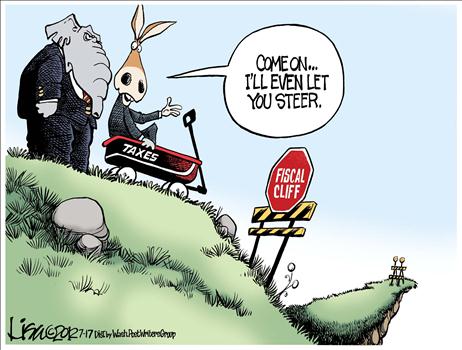
Democrats are saying that there will be automatic cuts to the defense budget (sequestration) unless Republicans agree to raise taxes.
Democrats are saying that they’ll let all the Bush tax cuts expire at the end of the year – thus screwing all taxpayers – unless Republicans agree to Obama’s class-warfare proposals to soak the rich.
As such, let’s deal with the second threat, which is actually a repeat of the fight we had back in 2010. Back then, Republicans said that extending the 2001 and 2003 tax cuts was an all-or-nothing proposition, while Democrats issued their own ultimatum and said that the rich should be hit with higher tax rates.
Republicans won that fight, even though they were heavily outnumbered in both the House and Senate. So why, given that they control the House and have many more seats in the Senate, isn’t this year’s fight an easy win for the GOP?
Beats me, but the Democrats are playing hardball, perhaps because they think a fight over class warfare is a good way of distracting voters from the weak economy.
One of the Senate’s top Democrats, Patty Murray of Washington, has thrown down the gauntlet and stated that her colleagues are willing to push all taxpayers off the fiscal cliff. Here’s some of what the Wall Street Journal opined about her remarks.
Democrats must feel really good about their election chances, because their latest campaign strategy is to say how willing and eager they are to leap off the January tax cliff. They’re all but daring Republicans to make the Democrats’ day by refusing to raise taxes before the election. …In a speech at the Brookings Institution, she declared that if Republicans won’t raise taxes on income above $250,000 before November, Democrats will gladly let all of the Bush tax rates expire at the end of the year—even on the middle class, and no matter the economic consequences.
The editors at the WSJ are mystified as to why Democrats are willing to undermine an already weak economy with an election just a few months away.
The Murray Democrats are the ones holding the middle-class rates hostage to a GOP vote to raise taxes on the affluent. …Mrs. Murray may think she’s putting Republicans on the political spot, but her real hostage is the already weak economy. Growth in the first quarter was a mere 1.9%, and economists have steadily downgraded their expectations for the second. As the tax cliff approaches, the policy uncertainty is already causing businesses to hold off on hiring and investment. Even the Keynesians at the Congressional Budget Office say that if all of the Bush tax rates expire, growth will fall close to recession territory.
Since the Democrats aren’t coming to me for advice, I’m not sure about their motives. Are they so wedded to class-warfare tax policy that they’re willing to sacrifice other goals in hopes of penalizing success?
Or are they playing a clever political game, figuring that a GOP surrender on taxes will generate so much discord on the right that it will more than offset any electoral downside of a weaker economy?
I suspect the answer to both questions is “yes,” but mostly to the second question. Which is why this Lisa Benson cartoon is an appropriate way to conclude this post.


 Obama’s Budget Would Send Federal Debt to Levels Not Seen Since World War II
 Obama’s Budget Would Deepen Already Unprecedented Deficits