Category Archives: Uncategorized

Georgia Democrats who won Senate in 2021 should remember Dan Mitchell’s words, “Politicians such as Alexandria Ocasio-Cortez and Bernie Sanders would like us to believe the answer involves never-ending tax increases. But such an approach is a recipe for more debt because the economy will weaken and governments will spend more money (look at what’s been happening in Europe, for instance)”

—-

Georgia Democrats who won Senate in 2021 should remember Dan Mitchell’s words, “Politicians such as Alexandria Ocasio-Cortez and Bernie Sanders would like us to believe the answer involves never-ending tax increases. But such an approach is a recipe for more debt because the economy will weaken and governments will spend more money (look at what’s been happening in Europe, for instance)”

 Sadly last night the Democrats won control of Senate!

Historical Evidence on Reducing Large Debt Burdens

The long-run fiscal outlook for most developed nations is very grim thanks to demographic change and poorly designed entitlement programs.

For all intents and purposes, we’re all destined to become Greece according to long-run projections from the International Monetary FundBank for International Settlements, and Organization for Economic Cooperation and Development.

Are there any solutions to this “most predictable crisis“?

Politicians such as Alexandria Ocasio-Cortez and Bernie Sanders would like us to believe the answer involves never-ending tax increases. But such an approach is a recipe for more debt because the economy will weaken and governments will spend more money (look at what’s been happening in Europe, for instance).

A more sensible approach is a spending cap. I’ve pointed out, for instance, how Swiss government debt has plummeted ever since voters imposed annual limits on budgetary growth.

We also can learn lessons from history according to new research from the International Monetary Fund.

The report contains some very interesting economic history and the evolution of government finance, including the Bank of England being created and given a monopoly so the government would have a vehicle for borrowing money (as I observed in my video on central banking).

But it mostly tells the story of how governments and public finance simultaneously evolved.

Although the written record points to instances of public borrowing as long as two thousand years ago, recent scholarship points to 1000-1400 A.D. as when borrowing agreements with states were concluded with regularity and debt contracts entered into by sovereigns were standardized.…The supply of loans from city-states and territorial monarchies was driven by the need to finance military campaigns and secure borders. …From the 16th century, Europe’s political geography coalesced into the nation states recognized at the Peace of Westphalia in 1648. In parallel, many European states evolved from absolutist regimes to more limited government. …Fiscal states thus evolved in response to the efforts of rulers to secure borders, expand territory and survive. After 1650, larger, more centralized states increasingly possessed the fiscal machinery to raise revenue in uniform ways and had a veto player, such as a parliament, to monitor and discipline public expenditure.

There’s also lots of information in the report about how some governments, primarily outside of Europe, began to borrow money.

In many cases, this produced bad results, with defaults and economic crisis. As the authors wrote, “Debasement and restructuring also have a long history.”

But the part of the report that caught my eye was the description of how three advanced nations – the United Kingdom, the United States, and France – successfully dealt with large debt burdens before World War I.

…we describe three notable debt consolidation episodes before World War I: Great Britain after the Napoleonic Wars, the United States in the last third of the 19th century, and France in the decades leading up to 1913. While the colorful debt crises and defaults of the first era of globalization have been much discussed, less attention has been paid to these successful consolidation episodes. We focus on these three cases because they involved three of the largest economies of the period, but also because their debt burdens were among the heaviest. British public debt as a share of GDP was higher in the aftermath of the Napoleonic Wars, for example, than Greek public debt in 2018. But in all three cases, high public debts were successfully reduced relative to GDP.

In each case, war-time spending was the cause of the debt buildup.

The Napoleonic Wars, Franco-Prussian War and U.S. Civil War were the three most expensive conflicts of the 19th century. …debt accounted for the single largest share of wartime financing.

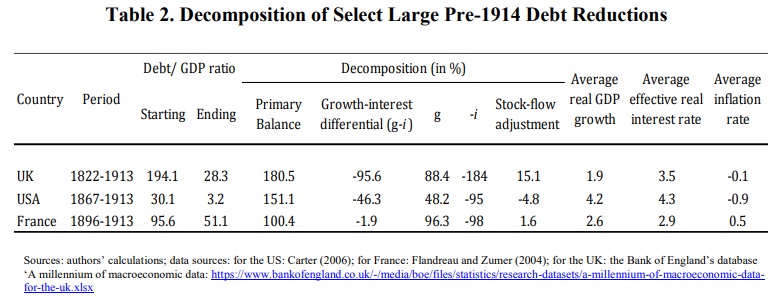
Here’s a table showing that these nations dramatically reduced their debt burdens.
To be sure, there were differences in the three nations.

The reduction in the British debt-GDP ratio was by far the largest and longest: the debt ratio fell from 194 percent in 1822 to 28 percent nine decades later. …The French public-debt-GDP ratio fell from 96 percent in 1896 to 51 percent in 1913… This case ranks second in size but first in pace. U.S. (federal or union) government debt was not as high at the end of the Civil War, and the subsequent consolidation was more leisurely; however, the process is notable for having reduced the debt-GDP ratio to virtually zero by World War I.

When the authors investigated how these nations reduced their debt burdens, they found that limited government was a common answer.

This was true in the United Kingdom.

Britain achieved the impressive feat of maintaining an average primary surplus of 1.6 percent of GDP for nearly a century (the only deficit in Figure 2 is at the time of the Boer War). One of the political legacies of Peel and Gladstone was a fiscal theory or philosophy of “sound finance” emphasizing budget surpluses, low taxes and minimal government expenditure. …demands for spending on welfare relief from the disenfranchised masses were kept in check. In exchange, the self-taxing class of income-tax-paying electors relieved the non-electors from the burden of direct taxation… Budget surpluses then made feasible further reductions in tariffs and taxes, which reduced the cost of living for the working class

It was true in the United States.

In the U.S., primary surpluses were consistently achieved… Southern states opposed an expansive role for the federal government, while entitlements limited to Civil War pensions contained pressure for public spending.

And it was true even in France.

In France, debt reduction was entirely accounted for by primary surpluses. Those surpluses exceeded British levels, reaching 2.5 percent of GDP on average, albeit over a shorter period.

Remember, this was a period when total government spending only consumed about 10 percent of economic output.

And this was a period when there was no welfare state. Redistribution was virtually nonexistent. Not even in France.

So it shouldn’t be a surprise that debt quickly fell in all three countries.
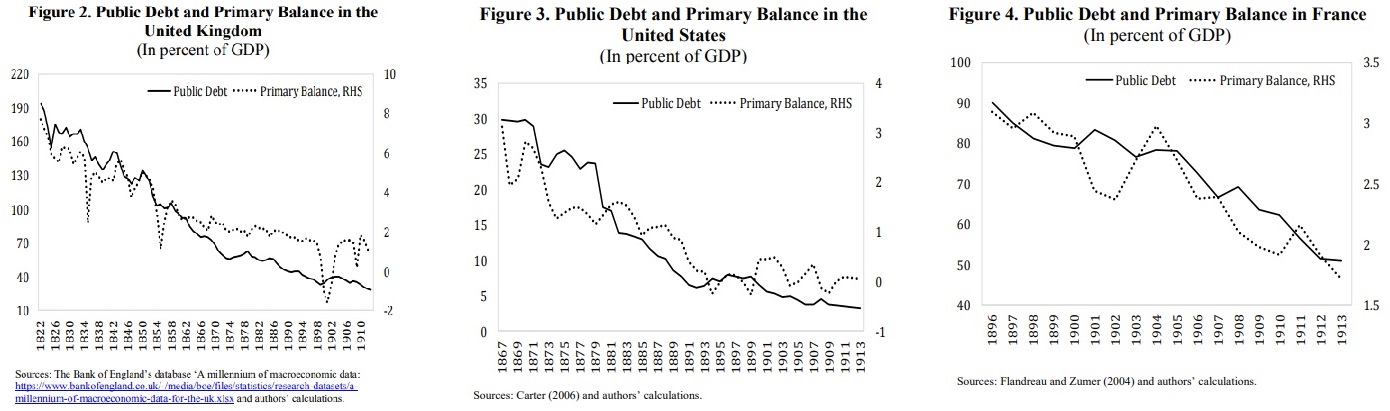
The common thread was small government.

…in all three of these large-scale debt consolidations, governments and societies went to great lengths to service and repay heavy debts. …it reflected prevailing conceptions of the limited functions of government, and limited popular pressure for public programs, entitlements and transfers.

What’s equally important is to note what didn’t happen.

No default. No inflation. No indirect confiscation.

…there was no restructuring or renegotiation of official or privately-held debts in these cases. Nor was there financial repression, i.e., measures artificially depressing interest rates. …Governments for their part did little to bottle up savings at home or to otherwise use regulation and legislation to artificially depress yields. …None of these three governments undertook involuntary restructurings despite the inheritance of heavy debt.

Now let’s shift from the past to the future

The authors point out how debt is rising today because of the welfare state rather than war.

The end of the last century also saw, for the first time, a secular increase in public-debt-to-GDP ratios in a variety of countries in conjunction not with wars and crises but in response to popular demands on governments for pensions, health care, and other often unfunded social services.

Given the demographic changes I mentioned at the beginning of the column, this does not bode well.

So what are the likely implications? As the authors note, there are two ways of dealing with high debt levels.

Countries have pursued two broad approaches to debt reduction. The orthodox approach relies on growth, primary surpluses, and the privatization of government assets. In turn this encourages long debt duration and non-resident holdings. Heterodox approaches, in contrast, include restructuring debt contracts, generating inflation, taxing wealth and repressing private finance.

At the risk of understatement, I fear Robert Higgs is right and that today’s politicians (and today’s voters!) will choose the latter approach.

Given that those policies will make a bad situation even worse, I’m not overflowing with confidence about the future.

—-


Joe Biden: An Incrementalist Version of Bernie Sanders

Hardly anybody noticed because the nation has been focused on protests about police misbehavior, but Joe Biden officially clinched the Democratic nomination this past week.

And he’s now comfortably ahead in the political betting marketsas well as public polling.

If Biden wins in November, what does that mean for the nation’s economic policy?

According to folks on the left, a Biden presidency means bigger government and more statism.

For instance, opining for the New York Times, Jamelle Bouie applauds Biden’s leftist agenda.

…if the goal is to move America to the left…then a Biden candidacy…represents an opportunity. …If Biden goes on to win the White House, there’s real space for the pro-Sanders left to work its will on policy. …It can fulfill some of its goals under the cover of Biden’s moderation, from raising the minimum wage nationally to pushing the American health care system closer to single-payer. …Biden…is a creature of the party. He doesn’t buck the mainstream, he accommodates it. He doesn’t reject the center, he tries to claim it. …the center of the Democratic Party as far left as it’s been since before Ronald Reagan, then Biden is likely to hew to that center, not challenge it.

His colleague at the NYT, Michelle Goldberg, is similarly enthused about the prospects for bigger government under a Biden Administration.
Biden’s proposals go far beyond his call for a $15 federal minimum wage — a demand some saw as radical when Sanders pushed it four years ago. While it’s illegal for companies to fire employees for trying to organize a union, the penalties are toothless. Biden proposes to make those penalties bite and to hold executives personally liable. …should Biden become president, progressives have the opportunity to make generational gains. …To try to unite the party around him, he’s making serious progressive commitments. …he’s moving leftward. Biden recently came out for tuition-free college for students whose families earn less than $125,000. He endorsed Elizabeth Warren’s bankruptcy plan…His climate plan already went beyond any of Barack Obama’s initiatives, and he’s pledged to make it even more robust.

According to (supposedly) neutral analysts, a Biden presidency means bigger government and more statism.

In an article for Newsweek, Steve Friess discusses Biden’s shift to the left.
Being stuck running for the presidency from the basement of his home in Wilmington, Delaware, had given the former vice president a lot of time to think, he told them, and he wanted bigger ideas. Go forth, he urged his financial brain trust, and bring back the boldest, most ambitious proposals they’d ever dreamed of to reshape the U.S. economy…Biden began issuing a raft of new proposals that move his positions closer to the progressive wing of the Democratic Party, with a promise to unveil an even more transformative economic plan this summer. …It’s a yes to adding $200 a month to Social Security benefits and lowering the qualifying age for Medicare from 65 to 60. Yes to trillions in new spending, yes to new regulations on banks and industry, yes to devil-may-care deficits. …the leader he most often invokes—in interviews, in public addresses, on his podcast—is no longer Barack Obama but Franklin Delano Roosevelt. …Biden has already made a series of significant leftward policy shifts since effectively sewing up the nomination in March.

Perry Bacon, in a piece for fivethirtyeight, analyzes Biden’s statist agenda.

…if Biden is elected in November, the left may get a presidency it likes after all…if American politics is moving left, expect Biden to do the same. …Biden’s long record in public office suggests that he is fairly flexible on policy — shifting his positions to whatever is in the mainstream of the Democratic Party at a given moment. …Biden is likely to be a fairly liberal president, no matter how moderate he sounded in the primaries. …Biden’s 2020 primary platform…adopted fairly liberal policies…more liberal than his pre-campaign record suggested. The Democratic Party is more liberal now than it was when Bill Clinton took office, or even when Obama was inaugurated, and Biden’s platform reflects that shift. …Biden and his advisers are now…rolling out more liberal policy plans, speaking in increasingly populist terms and joining forces with the most progressive voices in the party. …“Joe Biden is running on the most progressive platform of any Democratic nominee in recent history. But given the pandemic, he has to look at the New Deal and Great Society traditions in the Democratic Party and go bigger,” said Waleed Shahid, the communications director for Justice Democrats, a left-wing group aligned with Ocasio-Cortez.

Writing for the Washington Post, Sean Sullivan documentsBiden’s leftward drift.

Joe Biden sought to appeal to liberal supporters of Sen. Bernie Sanders on Thursday with a pair of new proposals to expand access to health care and curtail student loan debt. Biden proposed lowering the eligibility age for Medicare coverage from 65 to 60. He also came out in favor of forgiving student loan debt for people who attended public colleges and universities and some private schools and make up to $125,000 a year. …In another peace offering to liberals, Biden proposed paying for his student debt plan by repealing a provision in the recent coronavirus legislation that Congress passed and President Trump enacted. “That tax cut overwhelmingly benefits the richest Americans and is unnecessary for addressing the current COVID-19 economic relief efforts,” he wrote… Biden endorsed a bankruptcy plan put forth by Sen. Elizabeth Warren (D-Mass.), another rival who ran to his left.

And, according to more market-friendly sources, a Biden presidency means bigger government and more statism.

The Wall Street Journal editorialized about Biden’s leftist agenda.
Already Medicare is scheduled to be insolvent by 2026. …In 1970, life expectancy in the U.S. was 70.8. Now it’s about eight years longer. By lowering the age of eligibility instead, Mr. Biden would begin shifting Medicare’s focus from seniors to everybody else.Don’t worry about the funding, he insists, since the extra costs would be “financed out of general revenues.” …Mr. Biden’s new left turn on student loans is equally sharp. …Cancel all federal undergraduate tuition debt for many borrowers who went to public schools, including four-year universities. This forgiveness would be given to anyone who earns $125,000 a year or less. …How much would it cost? There’s no explanation.

Jeff Jacoby analyzed Biden in a column for the Boston Globe.
Biden…is running on a platform far more progressive — i.e., far less moderate — than any Democratic presidential nominee in history. …on issue after issue, Biden has veered sharply from Obama’s path. On health insurance, for example, Obama rejected a public option as part of the Affordable Care Act and repeatedly stressed the importance of maintaining private coverage. But Biden favors a public option open to everyone… Biden supports government-funded health care even for unauthoritzed immigrants, something Obama never came close to proposing. …No Democratic presidential nominee ever endorsed anything like the radical Green New Deal, with its price tag in the tens of trillions of dollars and its goal of eliminating the use of all fossil fuels. But Biden does. No Democratic nominee ever called for a national minimum wage of $15 an hour. But Biden does. …Sanders may not end up on the November ballot, but it will unmistakably reflect his influence. For he and his band of progressives have pushed their party to the left with such success that even the “moderate” in the race would be the most liberal Democrat ever nominated for president.

Here’s some of what Peter Suderman wrote for Reason.
Biden is a moderate compared to Sanders, but he is notably to the left of previous Democratic standard-bearers. …Biden has proposed a significant expansion of the Affordable Care Act that his campaign estimates would cost $750 billion over a decade… Biden has proposed a $1.7 trillion climate planthat is similar in scope to many candidates on his left and a $750 billion education plan… He favors an assault weapons ban and other gun control measures, a national $15 minimum wage, and a raft of subsidies, loans, and other government-granted nudges designed to promote rural economies. Has proposed $3.4 trillion worth of tax hikes—more than double what former Secretary of State Hillary Clinton proposed when she ran in 2016. …Biden’s leftward drift is thus the party’s leftward shift…, a big-government liberal, a candidate whose current incarnation was shaped and informed by progressive politics, if not wholly captured by them.

The Tax Foundation examined the former Vice President’s tax plan and the results are not encouraging.

Former Vice President Joe Biden would enact a number of policies that would raise taxes, including individual income taxes and payroll taxes, on high-income individuals with income above $400,000. …According to the Tax Foundation’s General Equilibrium Model, the Biden tax planwould reduce GDP by 1.51 percent over the long term. …The plan would shrink the capital stock by 3.23 percent and reduce the overall wage rate by 0.98 percent, leading to 585,000 fewer full-time equivalent jobs. …On a dynamic basis, we estimate that Biden’s tax plan would raise about 15 percent less revenue than on a conventional basis over the next decade. …That is because the relatively smaller economy would shrink the tax base for payroll, individual income, and business income taxes. …The plan would lead to lower after-tax income for all income levels.

Here’s a table summarizing the findings.

So what does all this mean?

At the risk of oversimplifying, Biden unquestionably would move tax policy to the left (he actually said higher taxes are patriotic, even though he engages in aggressive tax avoidance), and the same thing would happen on regulatory issues.

His spending agenda is terrible, though it’s worth noting that Democrat presidents usually don’t spend as much as Republicans (with the admirable exception of Reagan).

And, to be fair, there’s no way he could be as bad on trade as Trump.

Let’s close by looking at some hard data. Back in January, I sifted through the vote ratings prepared by the National Taxpayers Union and the Club for Growth and showed that Biden was not a Bill Clinton-style moderate.

I went back to those same sources an put together this comparison of Biden and some other well-known Democrats (scores on a 0-100 scale, with zero being statism and 100 being libertarian).
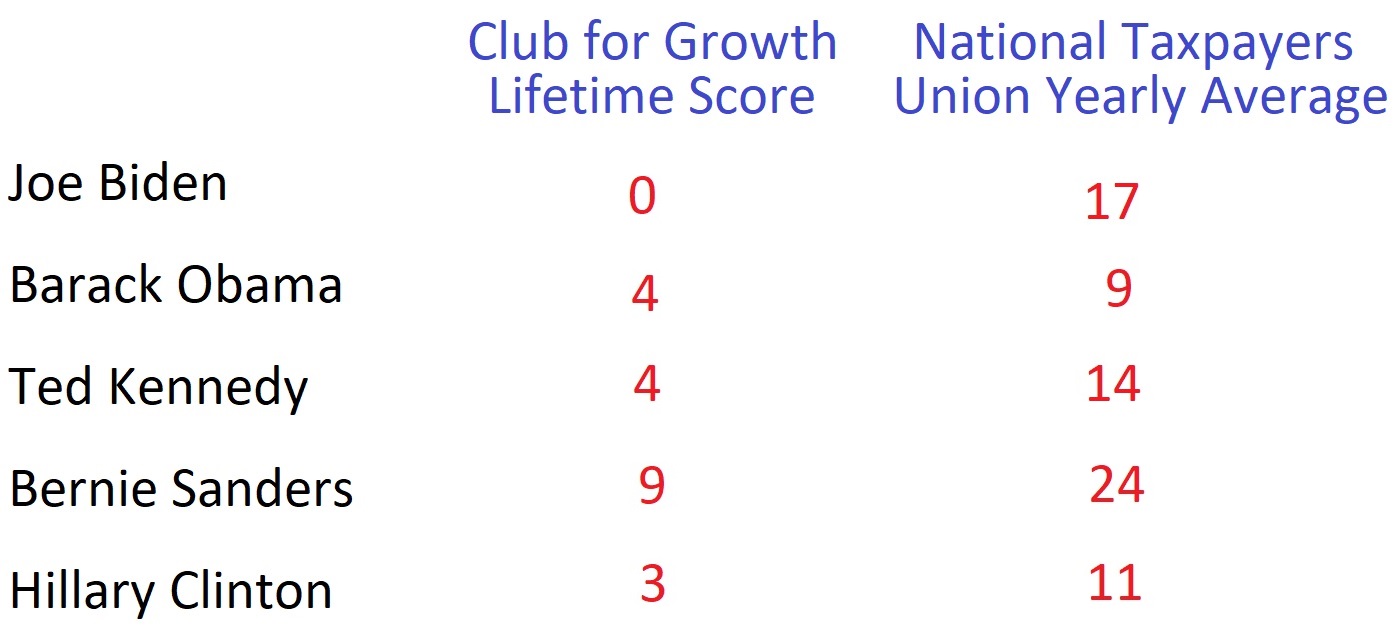
In both measures, he’s worse than Crazy Bernie!

Moreover, a lifetime average of zero from the Club for Growth is rather horrifying. His average from the National Taxpayers Union isn’t quite so bad, but the trend is in the wrong direction. Biden’s post-2000 average was less than 10, while his score for the preceding years averaged more than 23.

That being said, my two cents on this topic is that Biden is a statist, but not overly ideological.

His support for bigger government is largely a strategy of catering to the various interest groups that dominate the Democratic Party.

The good news is that he’s an incrementalist and won’t aggressively push for a horrifying FDR-style agenda if he gets to the White House.

The bad news is that he will probably allow Nancy Pelosi and other statist ideologues to dictate that kind of agenda if he wins the presidency.

P.S. My collection of Biden-oriented humor is rather sparse (see hereherehere, and here), an oversight that I’ll have to address in the near future.

—-

A Victory for Biden, a Defeat for the Left

The day after the election, I wrote that “left-wing goals are now very unlikely” because Republicans almost certainly will retain control of the Senate.

But perhaps I should have been ever bolder and argued that the election was a rejection of the left-wing agenda.

An editorial from the Wall Street Journal points out that voters did not vote for bigger government or more statism.

…the closer we inspect the nationwide election returns, the more the result looks like a defeat…for the progressive agenda. …Democrats lost seats in the House, giving up some of the suburban gains they made in 2018 while continuing to struggle in rural areas. …A GOP Senate may compromise with Mr. Biden around centrist ideas, but the aggressive House agenda of the last two years would die again.This result is all the more remarkable given that Democrats had nearly all of the media, Silicon Valley billionaires, and all of the leading cultural figures and institutions helping them. …The lack of coattails was also evident in the states, where Democrats spent heavily to flip legislatures. …The GOP flipped both legislative bodies in New Hampshire, despite Mr. Trump’s loss in the Granite State, and Republicans protected their advantage nearly everywhere else. …There was no blue wave, and certainly no mandate for progressive change. …in their considerable wisdom, the voters may have elected Mr. Biden but they left his party and its radical ideas behind.

Some readers may think that the Wall Street Journal‘s editors are engaging in spin. In other words, because of their pro-market views, they’re trying to make it seem like a defeat wasn’t really a defeat.

But what about Helaine Olen, a reliably left-wing columnist for the Washington Post, who reached the same conclusion when opining about election results from California.

Proposition 22 — which would allow gig-economy companies such as Uber, Lyft and DoorDash to continue treating drivers as independent contractors — passed handily. On the other hand, Proposition 16, which would have restored affirmative action to California’s public college and university admissions, has gone down in defeat. …Let’s take Proposition 22. Activists have been unhappy with the tech giants of the sharing economy for years, pointing out repeatedly that they are using venture capital to subsidize an unprofitable industry and that, moreover, they offer almost nothing in either the way of labor or consumer protection. The entire business model is designed to get around government regulations. …Voters did not appear particularly concerned that allowing a major employer to override state regulationand effectively set its own working conditions is a terrible precedent — not when a few extra dollars per ride was at stake. When it came down to worker welfare vs. short-term convenience and financial gain, it wasn’t even a contest. …Proposition 16…supporters roundly outspent opponents and hoped the increased attention to issues of systemic racial inequities in the wake of the killing of George Floyd would help them garner support. …The biggest obstacle might have been the traditional antipathy toward affirmative action reasserting itself — a survey last year found that 3 out of 4 Americans opposed using race or ethnicity as a factor in college admissions.

And the New York Times isn’t exactly a bastion of right-wing thinking, yet an article by Thomas Fuller, Shawn Hubler, Tim Arango and Conor Dougherty also acknowledges that the election results were not great for the left.

…the nation’s most populous state put up mammoth numbers for the Democrats. But dig a little deeper into the results and a more complex picture of the Golden State voter emerges, of strong libertarian impulses and resistance to some quintessentially liberal ideas. In a series of referendums, voters in California rejected affirmative action, decisively shot down an expansion of rent control and eviscerated a law that gives greater labor protections for ride-share and delivery drivers, a measure that had the strong backing of labor unions. A measure that would have raised taxes on commercial landlords to raise billions for a state that sorely needs revenue also seemed on track for defeat. …said Bob Shrum, a former Democratic strategist…“California is a very liberal state that is now resistant to higher taxes.” …For all their liberal leanings on issues like the environment, California voters have long been less welcoming to new taxes… Proposition 15, would have removed the Proposition 13 tax limits on commercial properties like office buildings and industrial parks, continuing to shield homeowners while raising an estimated $6.5 billion to $11.5 billion a year for public schools and local governments. The measure was trailing on Thursday.. More than $100 million was also spent on another hot-button measure, rent control. Polls showed that the housing crisis was the No. 1 concern for state voters… And yet voters up and down the state resoundingly rejected efforts to expand tenants’ rights and rent control. …What do voters think about voting for Democrats and at the same time not supporting Democratic-led initiatives? José Legaspi, a Los Angeles resident…voted for Mr. Biden and did not think twice about opposing the measure that would raise taxes on commercial properties. “I truly believe in paying taxes,” he said. “However there is a point at which one should limit how much more in taxes one should personally pay.”

The bottom line is that Joe Biden won the White House (barring some dramatic and unexpected developments), but not because of his statist agenda.

It’s more accurate to say that voters wanted to end the sturm and drang of Trump, but without embracing bigger government.

P.S. I’m not going to pretend that voters are rabid libertarians who are clamoring for my preferred policies (such as shutting down departmentsgenuine entitlement reform, etc). But I also think that it’s safe to say that they don’t want the left’s agenda (class warfareMedicare for allgreen new deal, etc) of bigger government and more dependency

Daniel Mitchell quotes Milton Friedman on minimum wage and contrasts Trump a d Biden approach!

Trump vs. Biden on the Minimum Wage

In another display of selfless masochism, I watched the TrumpBiden debate last night.

The candidates behaved better, for whatever that’s worth, but I was disappointed that there so little time (and even less substance) devoted to economic issues.

One of the few exceptions was the brief tussle regarding the minimum wage. Trump waffled on the issue, so I don’t give him any points, but Biden fully embraced the Bernie Sanders policyof basically doubling the minimum wage to $15 per hour.

This is very bad news for low-skilled workers and very bad news to low-margin businesses.

The economic of this issue are very simple. If a worker generates, say, $9 of revenue per hour, and politicians say that worker can’t be employed for less than $15 per hour, that’s a recipe for unemployment.

Earlier this month, Professor Steven Landsburg on the University of Rochester opined for the Wall Street Journal on Biden’s minimum-wage policy.

It isn’t only that I think Mr. Biden is frequently wrong. It’s that he tends to be wrong in ways that suggest he never cared about being right. He makes no attempt to defend many of his policies with logic or evidence, and he deals with objections by ignoring or misrepresenting them. …Take Mr. Biden’s stance on the federal minimum wage, which he wants to increase to $15 an hour from $7.25. …So why does Mr. Biden want to raise the minimum wage…?He hasn’t said, so I have two guesses, neither of which reflects well on him. Guess No. 1: He’s dissembling about the cost. …The minimum wage…comes directly from employers but indirectly (after firms shrink and prices rise) from consumers. A minimum wage is a stealth tax on eating at McDonald’s or shopping at Walmart. …Mr. Biden should acknowledge the cost of wage hikes and argue for accepting it. Instead he’s silent about the cost, hoping he can foist it on people who won’t realize they’re footing this bill. Guess No. 2: He’s rewarding his friends and punishing his enemies. New York is going to vote for Mr. Biden. The state also has a high cost of living and high wages—so New Yorkers would be largely unaffected by the minimum-wage hike. Alabama is going to vote against Mr. Biden. Alabama has a low cost of living and relatively low wages—so under the Biden plan Alabama firms would shrink, to the benefit of competitors in New York. Alabama workers and consumers would pay a greater price than New Yorkers.

And Mark Perry of the American Enterprise Institute recently highlighted some of the adverse effects for unskilled workers.
It’s an economic reality that workers compete against other workers, not against employers, for jobs, and higher wages in the labor market. And it’s also true that lower-skilled, limited-experience, less-educated workers compete against higher-skilled, more experienced, more educated workers for jobs. …If the minimum wage is increased…, that will…take away from unskilled workers the one advantage they currently have to compete against skilled workers – the ability to offer to work for a significantly lower wage than what skilled workers can command. …Result of a minimum wage hike to $15 an hour? Demand for skilled workers goes up, demand for unskilled workers goes down, and employment opportunities for unskilled workers are reduced.

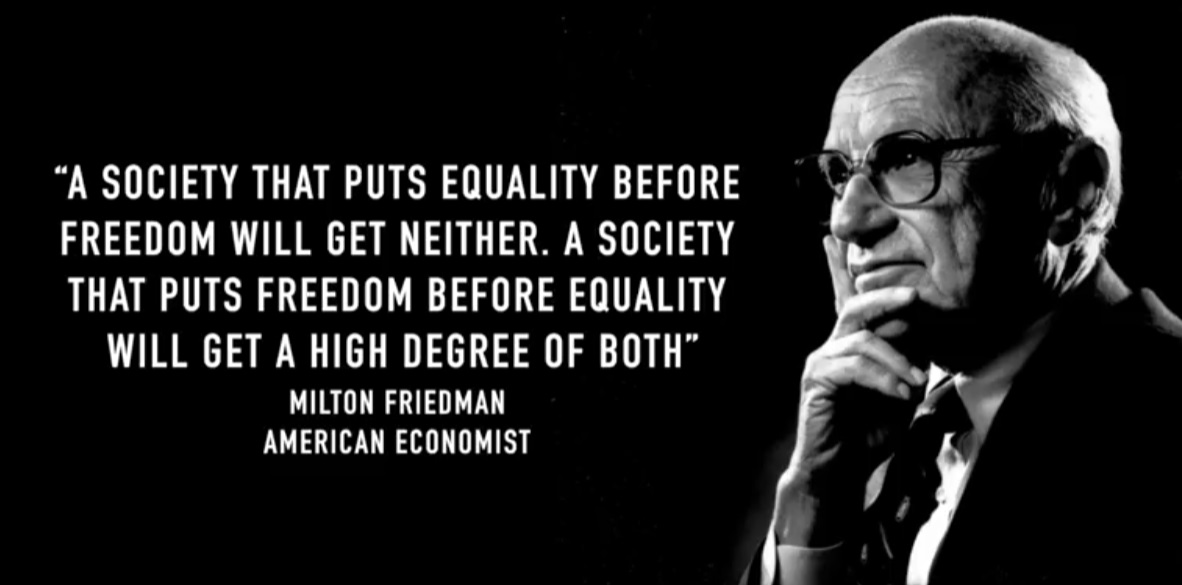
Since I recently shared videos with Milton Friedman’s wisdom on both taxes and spending, here’s what he said about the minimum wage.


Let’s share one last bit of evidence. Mark Perry’s article referenced some new research by Jeffrey Clemens, Lisa Kahn, and Jonathan Meer.

Here’s what those scholars found in a study published by the National Bureau of Economic Research.
We investigate whether changes in firms’ skill requirements are channels through which labor markets respond to minimum wage increases. …Data from the American Community Survey show that recent minimum wage changes resulted in increases in the average age and education of the individuals employed in low-wage jobs. Data on job vacancy postings show that the prevalence of a high school diploma requirement increases at the same time. The shift in skill requirements begins within the first quarter of a minimum wage hike. Further, it results from both within-firm shifts in postings and across-firms shifts towards firms that sought more-skilled workers at baseline. Given the poor labor market outcomes of individuals without high school diplomas, these findings have substantial policy relevance. This possibility was recognized well over a century ago by Smith (1907), who noted that the “enactment of a minimum wage involves the possibility of creating a class prevented by the State from obtaining employment.” Further, negative effects may be exacerbated for minority groups in the presence of labor market discrimination.

So why do politicians push for higher minimum wages, when all the evidence suggests that vulnerable workers bear the heaviest cost?

Part of the answer is that they don’t understand economics and don’t care about evidence.

But there’s also a more reprehensible answer, which is that they do understand, but they want to curry favor with union bosses, and those union bosses push for higher minimum wages as a way of reducing competition from lower-skilled workers.

P.S. Here’s my CNBC debate with Joe Biden’s top economic advisor on this issue.

P.P.S. Here’s a rather frustrating discussion I had on the minimum wage with Yahoo Finance.

P.P.P.S. But if you’re pressed for time, don’t listen to me pontificate. Instead, watch this video.

—-

Milton Friedman on Taxation

October 4, 2020 by Dan Mitchell

Yesterday’s column featured some of Milton Friedman’s wisdom from 50 years ago on how a high level of societal capital (work ethic, spirit of self-reliance, etc) is needed if we want to limit government.

Today, let’s look at what he said back then about that era’s high tax rates.

His core argument is that high marginal tax rates are self-defeating because the affected taxpayers (like Trump and Biden) will change their behavior to protect themselves from being pillaged.

This was in the pre-Reagan era, when the top federal tax rate was 70 percent, and notice that Friedman made a Laffer Curve-type prediction that a flat tax of 19 percent would collect more revenue than the so-called progressive system.

We actually don’t know if that specific prediction would have been accurate, but we do know that Reagan successfully lowered the top tax rate on the rich from 70 percent in 1980 to 28 percent in 1988.

So, by looking at what happened to tax revenues from these taxpayers, we can get a pretty good idea whether Friedman’s prediction was correct.

Well, here’s the IRS data from 1980 and 1988 for taxpayers impacted by the highest tax rate. I’ve circled (in red) the relevant data showing how we got more rich people, more taxable income, and more tax revenue.
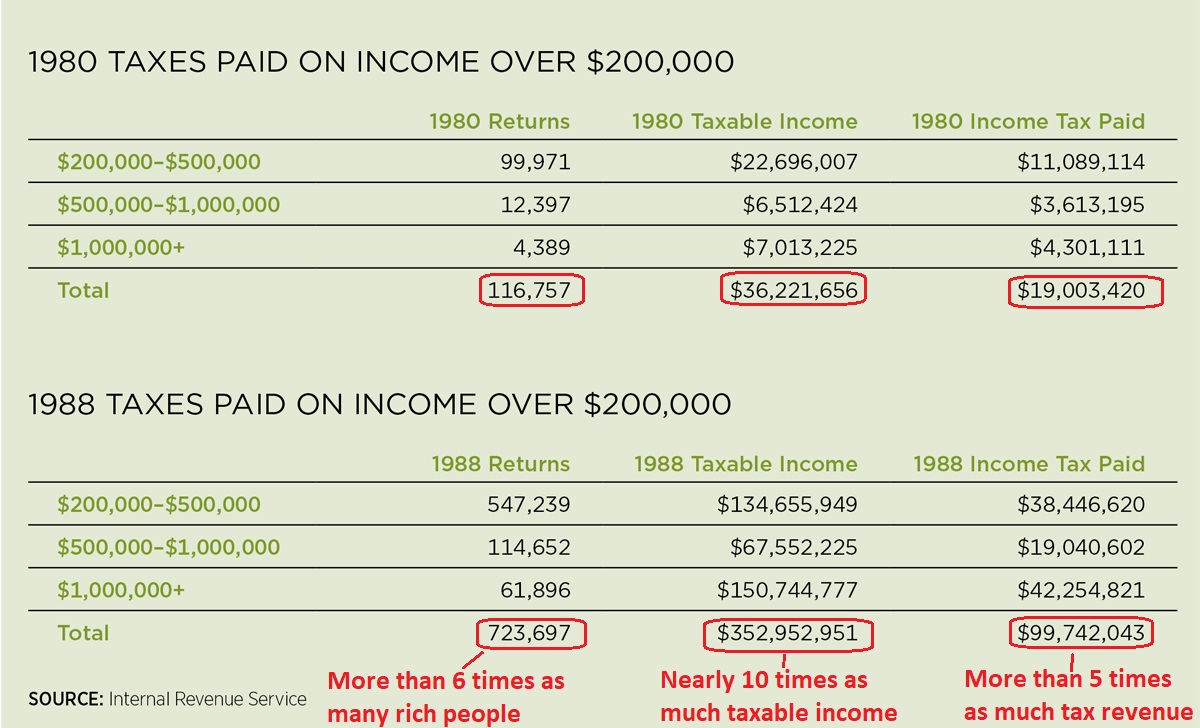
The bottom line is that Friedman was right.

Good tax policy (i.e., lower rates on productive behavior) can be a win-win situation. Taxpayers earn more and keep more, while politicians also wind up with more because the economic pie expands.

Something to keep in mind since some politicians in Washington want a return to confiscatory taxes on work, saving, investment, and entrepreneurship.

—-

Why Milton Friedman Saw School Choice as a First Step, Not a Final One

On his birthday, let’s celebrate Milton Friedman’s vision of enabling parents, not government, to be in control of a child’s education.

Wednesday, July 31, 2019
Kerry McDonald
Kerry McDonald

EducationMilton FriedmanSchool ChoiceSchooling

Libertarians and others are often torn about school choice. They may wish to see the government schooling monopoly weakened, but they may resist supporting choice mechanisms, like vouchers and education savings accounts, because they don’t go far enough. Indeed, most current choice programs continue to rely on taxpayer funding of education and don’t address the underlying compulsory nature of elementary and secondary schooling.

Skeptics may also have legitimate fears that taxpayer-funded education choice programs will lead to over-regulation of previously independent and parochial schooling options, making all schooling mirror compulsory mass schooling, with no substantive variation.

Milton Friedman had these same concerns. The Nobel prize-winning economist is widely considered to be the one to popularize the idea of vouchers and school choice beginning with his 1955 paper, “The Role of Government in Education.” His vision continues to be realized through the important work of EdChoice, formerly the Friedman Foundation for Education Choice, that Friedman and his economist wife, Rose, founded in 1996.

July 31 is Milton Friedman’s birthday. He died in 2006 at the age of 94, but his ideas continue to have an impact, particularly in education policy.

Friedman saw vouchers and other choice programs as half-measures. He recognized the larger problems of taxpayer funding and compulsion, but saw vouchers as an important starting point in allowing parents to regain control of their children’s education. In their popular book, Free To Choose, first published in 1980, the Friedmans wrote:

We regard the voucher plan as a partial solution because it affects neither the financing of schooling nor the compulsory attendance laws. We favor going much farther. (p.161)

They continued:

The compulsory attendance laws are the justification for government control over the standards of private schools. But it is far from clear that there is any justification for the compulsory attendance laws themselves. (p. 162)

The Friedmans admitted that their “own views on this have changed over time,” as they realized that “compulsory attendance at schools is not necessary to achieve that minimum standard of literacy and knowledge,” and that “schooling was well-nigh universal in the United States before either compulsory attendance or government financing of schooling existed. Like most laws, compulsory attendance laws have costs as well as benefits. We no longer believe the benefits justify the costs.” (pp. 162-3)

Still, they felt that vouchers would be the essential starting point toward chipping away at monopoly mass schooling by putting parents back in charge. School choice, in other words, would be a necessary but not sufficient policy approach toward addressing the underlying issue of government control of education.

In their book, the Friedmans presented the potential outcomes of their proposed voucher plan, which would give parents access to some or all of the average per-pupil expenditures of a child enrolled in public school. They believed that vouchers would help create a more competitive education market, encouraging education entrepreneurship. They felt that parents would be more empowered with greater control over their children’s education and have a stronger desire to contribute some of their own money toward education. They asserted that in many places “the public school has fostered residential stratification, by tying the kind and cost of schooling to residential location” and suggested that voucher programs would lead to increased integration and heterogeneity. (pp. 166-7)

To the critics who said, and still say, that school choice programs would destroy the public schools, the Friedmans replied that these critics fail to

explain why, if the public school system is doing such a splendid job, it needs to fear competition from nongovernmental, competitive schools or, if it isn’t, why anyone should object to its “destruction.” (p. 170)

What I appreciate most about the Friedmans discussion of vouchers and the promise of school choice is their unrelenting support of parents. They believed that parents, not government bureaucrats and intellectuals, know what is best for their children’s education and well-being and are fully capable of choosing wisely for their children—when they have the opportunity to do so.

They wrote:

Parents generally have both greater interest in their children’s schooling and more intimate knowledge of their capacities and needs than anyone else. Social reformers, and educational reformers in particular, often self-righteously take for granted that parents, especially those who are poor and have little education themselves, have little interest in their children’s education and no competence to choose for them. That is a gratuitous insult. Such parents have frequently had limited opportunity to choose. However, U.S. history has demonstrated that, given the opportunity, they have often been willing to sacrifice a great deal, and have done so wisely, for their children’s welfare. (p. 160).

Sign-Up: Receive Kerry’s Weekly Parenting and Education Newsletter!

Today, school voucher programs exist in 15 states plus the District of Columbia. These programs have consistently shown that when parents are given the choice to opt-out of an assigned district school, many will take advantage of the opportunity. In Washington, D.C., low-income parents who win a voucher lottery send their children to private schools.

The most recent three-year federal evaluationof voucher program participants found that while student academic achievement was comparable to achievement for non-voucher students remaining in public schools, there were statistically significant improvements in other important areas. For instance, voucher participants had lower rates of chronic absenteeism than the control groups, as well as higher student satisfaction scores. There were also tremendous cost-savings.

In Wisconsin, the Milwaukee Parental Choice Program has served over 28,000 low-income students attending 129 participating private schools.

According to Corey DeAngelis, Director of School Choice at the Reason Foundation and a prolific researcher on the topic, the recent analysis of the D.C. voucher program “reveals that private schools produce the same academic outcomes for only a third of the cost of the public schools. In other words, school choice is a great investment.”

In Wisconsin, the Milwaukee Parental Choice Program was created in 1990 and is the nation’s oldest voucher program. It currently serves over 28,000 low-income students attending 129 participating private schools. Like the D.C. voucher program, data on test scores of Milwaukee voucher students show similar results to public school students, but non-academic results are promising.

Recent research found voucher recipients had lower crime rates and lower incidences of unplanned pregnancies in young adulthood. On his birthday, let’s celebrate Milton Friedman’s vision of enabling parents, not government, to be in control of a child’s education.

According to Howard Fuller, an education professor at Marquette University, founder of the Black Alliance for Educational Options, and one of the developers of the Milwaukee voucher program, the key is parent empowerment—particularly for low-income minority families.

In an interview with NPR, Fuller said: “What I’m saying to you is that there are thousands of black children whose lives are much better today because of the Milwaukee parental choice program,” he says. 
“They were able to access better schools than they would have without a voucher.”

Putting parents back in charge of their child’s education through school choice measures was Milton Friedman’s goal. It was not his ultimate goal, as it would not fully address the funding and compulsion components of government schooling; but it was, and remains, an important first step. As the Friedmans wrote in Free To Choose:

The strong American tradition of voluntary action has provided many excellent examples that demonstrate what can be done when parents have greater choice. (p. 159).

On his birthday, let’s celebrate Milton Friedman’s vision of enabling parents, not government, to be in control of a child’s education.

Kerry McDonald

Milton Friedman

Related posts:


“Friedman Friday” (“Free to Choose” episode 1 – Power of the Market. part 7 of 7)

March 16, 2012 – 12:25 am

  Michael Harrington:  If you don’t have the expertise, the knowledge technology today, you’re out of the debate. And I think that we have to democratize information and government as well as the economy and society. FRIEDMAN: I am sorry to say Michael Harrington’s solution is not a solution to it. He wants minority rule, I […] By Everette Hatcher III | Posted in Current Events, Milton Friedman | Edit | Comments (0)

“Friedman Friday” (“Free to Choose” episode 1 – Power of the Market. part 6 of 7)

March 9, 2012 – 12:29 am

PETERSON: Well, let me ask you how you would cope with this problem, Dr. Friedman. The people decided that they wanted cool air, and there was tremendous need, and so we built a huge industry, the air conditioning industry, hundreds of thousands of jobs, tremendous earnings opportunities and nearly all of us now have air […] By Everette Hatcher III | Posted in Current Events, Milton Friedman | Edit | Comments (0)

“Friedman Friday” (“Free to Choose” episode 1 – Power of the Market. part 5 of 7)

March 2, 2012 – 12:26 am

Part 5 Milton Friedman: I do not believe it’s proper to put the situation in terms of industrialist versus government. On the contrary, one of the reasons why I am in favor of less government is because when you have more government industrialists take it over, and the two together form a coalition against the ordinary […] By Everette Hatcher III | Posted in Current Events, Milton Friedman | Edit | Comments (0)

“Friedman Friday” (“Free to Choose” episode 1 – Power of the Market. part 4 of 7)

February 24, 2012 – 12:21 am

The fundamental principal of the free society is voluntary cooperation. The economic market, buying and selling, is one example. But it’s only one example. Voluntary cooperation is far broader than that. To take an example that at first sight seems about as far away as you can get __ the language we speak; the words […] By Everette Hatcher III | Posted in Current Events, Milton Friedman | Edit | Comments (0)

“Friedman Friday” (“Free to Choose” episode 1 – Power of the Market. part 3 of 7)

February 17, 2012 – 12:12 am

  _________________________   Pt3  Nowadays there’s a considerable amount of traffic at this border. People cross a little more freely than they use to. Many people from Hong Kong trade in China and the market has helped bring the two countries closer together, but the barriers between them are still very real. On this side […] By Everette Hatcher III | Posted in Current Events, Milton Friedman | Edit | Comments (0)

“Friedman Friday” (“Free to Choose” episode 1 – Power of the Market. part 2 of 7)

February 10, 2012 – 12:09 am

  Aside from its harbor, the only other important resource of Hong Kong is people __ over 4_ million of them. Like America a century ago, Hong Kong in the past few decades has been a haven for people who sought the freedom to make the most of their own abilities. Many of them are […] By Everette Hatcher III | Posted in Current Events, Milton Friedman | Edit | Comments (0)

“Friedman Friday” (“Free to Choose” episode 1 – Power of the Market. part 1of 7)

February 3, 2012 – 12:07 am

“FREE TO CHOOSE” 1: The Power of the Market (Milton Friedman) Free to Choose ^ | 1980 | Milton Friedman Posted on Monday, July 17, 2006 4:20:46 PM by Choose Ye This Day FREE TO CHOOSE: The Power of the Market Friedman: Once all of this was a swamp, covered with forest. The Canarce Indians […]

Milton Friedman The Power of the Market 1-5

Debate on Milton Friedman’s cure for inflation

September 29, 2011 – 7:24 am

If you would like to see the first three episodes on inflation in Milton Friedman’s film series “Free to Choose” then go to a previous post I did. Ep. 9 – How to Cure Inflation [4/7]. Milton Friedman’s Free to Choose (1980) Uploaded by investbligurucom on Jun 16, 2010 While many people have a fairly […]

By Everette Hatcher III | Also posted in Current Events | Tagged dr friedman, expansion history, income tax brackets, political courage, www youtube | Edit | Comments (0)

“Friedman Friday” Milton Friedman believed in liberty (Interview by Charlie Rose of Milton Friedman part 1)

April 19, 2013 – 1:14 am

Charlie Rose interview of Milton Friedman My favorite economist: Milton Friedman : A Great Champion of Liberty  by V. Sundaram   Milton Friedman, the Nobel Prize-winning economist who advocated an unfettered free market and had the ear of three US Presidents – Nixon, Ford and Reagan – died last Thursday (16 November, 2006 ) in San Francisco […] By Everette Hatcher III | Posted in Milton Friedman | Edit | Comments (0)

What were the main proposals of Milton Friedman?

February 21, 2013 – 1:01 am

Stearns Speaks on House Floor in Support of Balanced Budget Amendment Uploaded by RepCliffStearns on Nov 18, 2011 Speaking on House floor in support of Balanced Budget Resolution, 11/18/2011 ___________ Below are some of the main proposals of Milton Friedman. I highly respected his work. David J. Theroux said this about Milton Friedman’s view concerning […] By Everette Hatcher III | Posted in Milton Friedman | Edit | Comments (0)

“Friedman Friday,” EPISODE “The Failure of Socialism” of Free to Choose in 1990 by Milton Friedman (Part 1)

December 7, 2012 – 5:55 am

Milton Friedman: Free To Choose – The Failure Of Socialism With Ronald Reagan (Full) Published on Mar 19, 2012 by NoNationalityNeeded Milton Friedman’s writings affected me greatly when I first discovered them and I wanted to share with you. We must not head down the path of socialism like Greece has done. Abstract: Ronald Reagan […] By Everette Hatcher III | Posted in Milton FriedmanPresident Obama | Edit | Comments (1)

Defending Milton Friedman

July 31, 2012 – 6:45 am

What a great defense of Milton Friedman!!!!   Defaming Milton Friedman by Johan Norberg This article appeared in Reason Online on September 26, 2008  PRINT PAGE  CITE THIS      Sans Serif      Serif Share with your friends: ShareThis In the future, if you tell a student or a journalist that you favor free markets and limited government, there is […]

Victorious Georgia Democrats in 2021 should remember Jay Cost wrote: If we think of corruption merely as illegal activity, we’re defining it too narrowly. …the better way to understand it is as JAMES MADISON might have. In Federalist 10, he worried about the “VIOLENCE OF FACTION,” which he defined as a group “united and actuated by some common impulse of passion, or of interest, adversed to the rights of other citizens, or to the permanent and aggregate interests of the community.” This is all too common in public policy. From farm subsidies to Medicare, regulatory policy to the tax code, and highway spending to corporate welfare!

.

————

 Sadly last night the Democrats won control of Senate!
Victorious Georgia Democrats in 2021 should remember Jay Cost wrote: If we think of corruption merely as illegal activity, we’re defining it too narrowly. …the better way to understand it is as JAMES MADISON might have. In Federalist 10, he worried about the “VIOLENCE OF FACTION,” which he defined as a group “united and actuated by some common impulse of passion, or of interest, adversed to the rights of other citizens, or to the permanent and aggregate interests of the community.” This is all too common in public policy. From farm subsidies to Medicare, regulatory policy to the tax code, and highway spending to corporate welfare!

Big Government and Corruption Are Inextricably Intertwined

When I write about the “inbred corruption of Washington” or “Washington’s culture of corruption,” I’m not merely taking pot-shots at the political elite.

I’m trying to make a very serious point about the way in which big government enables immoral behavior by both elected officials and various interest groups.

Heck, in many ways, government has morphed into a racketdesigned to enrich the lobbyists, insiders, contractors, bureaucrats, and politicians.

They play, we pay.

Jay Cost of the Weekly Standard has an entire new book on this topic and he highlights how big government-enabled corruption harms the middle class in a column for National Review.

A comprehensive strategy to boost the middle class has to include an aggressive assault on political corruption. Every year, the government wastes an obscene amount of money through corrupt public policies.

He makes the key point that corruption isn’t just about illegal behavior in Washington.

If we think of corruption merely as illegal activity, we’re defining it too narrowly. …the better way to understand it is as James Madison might have. In Federalist 10, he worried about the “violence of faction,” which he defined as a group “united and actuated by some common impulse of passion, or of interest, adversed to the rights of other citizens, or to the permanent and aggregate interests of the community.” This is all too common in public policy. From farm subsidies to Medicare, regulatory policy to the tax code, and highway spending to corporate welfare, our government does violence to the public interest by rewarding the interest groups that lobby it aggressively.

Cost then explains that this corruption-fueled expansion of government is very damaging for the middle class.

…corruption is a loser for the middle class. Middle-class Americans do not have the money to pay for lobbyists to make sure they are getting a piece of the action. They don’t usually contribute to political candidates, and when they do, it is typically for a presidential candidate whose ideas they think are sound. They do not subsidize the otherwise obscure subcommittee chairman with oversight on a critical policy. And, of course, they cannot offer politicians seven-figure employment opportunities for post-government life. And yet the middle class foots the bill. Average Americans pay higher taxes to subsidize this misbehavior… But beyond  that, corruption distorts the economy and limits the nation’s potential for growth. For instance, any time Congress creates a tax loophole, it shifts the flow of capital from some otherwise productive outlet to the tax-preferred end. And this is true not just of tax policy; any dollar spent by the government corruptly is a dollar better spent somewhere else. There are, in other words, substantial opportunity costs to be paid, mostly by the middle class.

While I definitely agree with the thrust of Cost’s analysis, I might quibble with the last part of this excerpt.

To be sure, I agree that the middle class foots the majority of the overall bill, but I actually wonder whether the poor suffer the most. At least on an individual basis. After all, the people on the bottom rungs of the economic ladder presumably have the most to lose if growth is sluggish or non-existent.

Which also explains why I get so upset about Obama’s class-warfare policies. High tax rates facilitate corruption and it’s the less fortunate who wind up suffering.

But enough nit-picking and digressing.

Cost’s column is right on the mark, particularly his point about properly defining corruption to capture what’s immoral as well as what’s illegal.

That’s one of the main points I made in this video from the Center for Freedom and Prosperity.

Now let’s take this analysis, both from Cost’s article and my video, and apply it to Obama’s new budget.

Professor Jeffrey Dorfman, an economist at the University of Georgia, has a column for Real Clear Markets entitled, “Obama’s Budget Is All About Whom You Know.”

He starts by citing some examples of how Obama wants government to manipulate our choices.

President Obama wants to control everyone’s behavior using the federal government as both his carrot and stick. …the President is in favor of both parents working and either strangers or government employees raising children as much as possible. …The President proposed nothing to help people save for college or to make it more affordable in any manner other than a government handout. …All of these higher education policies suggest government is your friend and personal responsibility is a bad idea.

Dorfman doesn’t explicitly state that this micro-management by big government is corrupt, but what he’s describing fits in perfectly with Cost’s analysis about average people suffering as D.C. insiders keep expanding government and getting more power over our lives.

If you put this all together, the President is clearly stating that increasing government dependence is a priority. People are offered more financial assistance through the government so as to build support for larger government. …President Obama is only interested in helping some Americans, in rewarding the Americans who behave the way he thinks they should. He believes that the government, that he, should have the power to pick winners and losers. His vision is not one in which everyone wins, rather it is one where those he favors gain at the expense of those he seeks to punish for either their success or their actions. …government is now taking sides.

Needless to say, when government is taking sides and picking winners and losers, that is a process that inevitably and necessarily favors the politically well-connected insiders.

That’s good news for Washington parasite class (and their children), but it’s not good for America.

P.S. Some folks in Louisiana have a pretty good suggestion for dealing with political corruption.

P.P.S. By the way, you don’t solve the problem of government-facilitated corruption by restricting the 1st Amendment rights of people to petition their government and participate in the political process.

P.P.P.S. While this column focuses mostly on the immoral corruption of Washington rather than the illegal variety, there’s also plenty of the latter form of corruption in programs such as Medicare, Medicaid, welfare, job training, food stamps, disability, etc.


Free-market economics meets free-market policies at The Heritage Foundation’s Tenth Anniversary dinner in 1983. Nobel Laureate Milton Friedman and his wife Rose with President Ronald Reagan and Heritage President Ed Feulner.

Since the passing of Milton Friedman who was my favorite economist, I have been reading the works of Daniel Mitchell and he quotes Milton Friedman a lot, and you can reach Dan’s website here.

Mitchell in February 2011.
Wikipedia noted concerning Dan:


Mitchell’s career as an economist began in the United States Senate, working for Oregon Senator Bob Packwood and the Senate Finance Committee. He also served on the transition team of President-Elect Bush and Vice President-Elect Quayle in 1988. In 1990, he began work at the Heritage Foundation. At Heritage, Mitchell worked on tax policy issues and began advocating for income tax reform.[1]

In 2007, Mitchell left the Heritage Foundation, and joined the Cato Institute as a Senior Fellow. Mitchell continues to work in tax policy, and deals with issues such as the flat tax and international tax competition.[2]

In addition to his Cato Institute responsibilities, Mitchell co-founded the Center for Freedom and Prosperity, an organization formed to protect international tax competition.[1]

February 16, 2021

President Biden c/o The White House
1600 Pennsylvania Avenue NW
Washington, DC 20500

Dear Mr. President,

The federal government debt is growing so much that it is endangering us because if things keep going like they are now we will not have any money left for the national defense because we are so far in debt as a nation. We have been spending so much on our welfare state through food stamps and other programs that I am worrying that many of our citizens are becoming more dependent on government and in many cases they are losing their incentive to work hard because of the welfare trap the government has put in place. Other nations in Europe have gone down this road and we see what mess this has gotten them in. People really are losing their faith in big government and they want more liberty back. It seems to me we have to get back to the founding  principles that made our country great.  We also need to realize that a big government will encourage waste and corruptionThe recent scandals in our government have proved my point. In fact, the jokes you made at Ohio State about possibly auditing them are not so funny now that reality shows how the IRS was acting more like a monster out of control. Also raising taxes on the job creators is a very bad idea too. The Laffer Curve clearly demonstrates that when the tax rates are raised many individuals will move their investments to places where they will not get taxed as much.

______________________________

Milton Friedman On Charlie Rose (Part One)

The late Milton Friedman discusses economics and otherwise with Charlie Rose.

_________________________________________

Milton Friedman: Life and ideas – Part 01

Milton Friedman: Life and ideas

A brief biography of Milton Friedman

_____________________________________

Stossel – “Free to Choose” (Milton Friedman) 1/6

6-10-10. pt.1 of 6. Stossel discusses Milton Friedman’s 1980 book, “Free to Choose”, which was smuggled in and read widely in Eastern Europe during the Cold War by many countries under Soviet rule. Read and admired the world over by the likes of Margaret Thatcher and Ronald Reagan, this book served as the inspiration for many of the Soviet sattellite countries’ economies once they achieved freedom after the fall of the Soviet Union.

_________________________________________

I first saw Thomas Sowell on the show FREE TO CHOOSE on the debate team that Milton Friedman chose. I suggest checking out these episodes of Milton Friedman’s film series FREE TO CHOOSE: “The Failure of Socialism” and “What is wrong with our schools?”  and “Created Equal”  and  From Cradle to Grave, and – Power of the Market. Below he is the subject of a fine article that shows how our government is wasting so much money on the welfare trap. We should stop trapping people in welfare and let the free market offer them a chance to do better. Obviously what we are doing now is not working. The best way to destroy the welfare trap is to put in Milton Friedman’s negative income tax.  Of course, all welfare programs should be eliminated at the same time.

Thomas Sowell Explains How the Welfare State Hurts the Poor

July 3, 2013 by Dan Mitchell

Political cartoonists like Michael Ramirez and Chuck Asay are effective because they convey so much with images.

But we need more than clever cartoons if we’re going to educate the general population about how government harms the economy and undermines freedom.

He just turned 83, and let’s hope he has another 20 years of columns to write

And that’s why Thomas Sowell is so invaluable. He’s one of the nation’s top economic thinkers, but he also writes for mass audiences and his columns are masterful combinations of logic and persuasion.

His latest column about poverty is a good example. In this first excerpt, he succinctly explains that official poverty is not the same as destitution.

“Poverty” once had some concrete meaning — not enough food to eat or not enough clothing or shelter to protect you from the elements, for example. Today it means whatever the government bureaucrats, who set up the statistical criteria, choose to make it mean. And they have every incentive to define poverty in a way that includes enough people to justify welfare state spending. Most Americans with incomes below the official poverty level have air-conditioning, television, own a motor vehicle and, far from being hungry, are more likely than other Americans to be overweight. But an arbitrary definition of words and numbers gives them access to the taxpayers’ money.

He then makes a very important point about economic incentives.

Even when they have the potential to become productive members of society, the loss of welfare state benefits if they try to do so is an implicit “tax” on what they would earn that often exceeds the explicit tax on a millionaire. If increasing your income by $10,000 would cause you to lose $15,000 in government benefits, would you do it? In short, the political left’s welfare state makes poverty more comfortable, while penalizing attempts to rise out of poverty.

Since columnists are limited to about 800 words, Sowell doesn’t have leeway to give details, but his explanation of how the government traps people in poverty is the rhetorical version of this amazing chart.

He concludes with some powerful observation about who really benefits from the welfare state.

…the left’s agenda is a disservice to [the poor], as well as to society.  …The agenda of the left — promoting envy and a sense of grievance, while making loud demands for “rights” to what other people have produced — is a pattern that has been widespread in countries around the world. This agenda has seldom lifted the poor out of poverty. But it has lifted the left to positions of power and self-aggrandizement, while they promote policies with socially counterproductive results.

But his main message (similar to this video and illustrated by this chart) is that the welfare state hurts the poor even more than it hurts taxpayers.

P.S. As a big fan of Professor Sowell, I’ve cited his columns more than 20 times. My favorite examples of his writing can be viewed hereherehereherehere,hereherehere,hereherehereherehereherehereherehereherehere, and here. And you can see him in action here.

Related posts:Milton Friedman’s “Free to Choose” film transcripts and videos here on http://www.thedailyhatch.org

I have many posts on my blog that include both the transcript and videos of Milton Friedman’s film series “Free to Choose” and here are the episodes that I have posted.

_____________

__________________________

Thank you so much for your time. I know how valuable it is. I also appreciate the fine family that you have and your commitment as a father and a husband.

Sincerely,

Everette Hatcher III, 13900 Cottontail Lane, Alexander, AR 72002, ph 501-920-5733,

Here are the posts and you can find the links in order below this.

The Power of the Market from 1990

The Failure of Socialism from 1990

The Anatomy of a Crisis from 1980

What is wrong with our schools?  from 1980

Created Equal from 1980

From Cradle to Grave from 1980

The Power of the Market 1980

Debate on Inflation from 1980

Milton Friedman is the short one!!!

Milton Friedman’s Free to Choose (1980), episode 3 – Anatomy of a Crisis. part 1

“The Power of the Market” episode of Free to Choose in 1990 by Milton Friedman (Part 5)

Milton Friedman The Power of the Market 5-5 How can we have personal freedom without economic freedom? That is why I don’t understand why socialists who value individual freedoms want to take away our economic freedoms.  I wanted to share this info below with you from Milton Friedman who has influenced me greatly over the […]

“The Power of the Market” episode of Free to Choose in 1990 by Milton Friedman (Part 4)

Milton Friedman The Power of the Market 4-5 How can we have personal freedom without economic freedom? That is why I don’t understand why socialists who value individual freedoms want to take away our economic freedoms.  I wanted to share this info below with you from Milton Friedman who has influenced me greatly over the […]

“The Power of the Market” episode of Free to Choose in 1990 by Milton Friedman (Part 3)

Milton Friedman The Power of the Market 3-5 How can we have personal freedom without economic freedom? That is why I don’t understand why socialists who value individual freedoms want to take away our economic freedoms.  I wanted to share this info below with you from Milton Friedman who has influenced me greatly over the […]

“The Power of the Market” episode of Free to Choose in 1990 by Milton Friedman (Part 2)

Milton Friedman The Power of the Market 2-5 How can we have personal freedom without economic freedom? That is why I don’t understand why socialists who value individual freedoms want to take away our economic freedoms.  I wanted to share this info below with you from Milton Friedman who has influenced me greatly over the […]

“The Power of the Market” episode of Free to Choose in 1990 by Milton Friedman (Part 1)

Milton Friedman The Power of the Market 1-5 How can we have personal freedom without economic freedom? That is why I don’t understand why socialists who value individual freedoms want to take away our economic freedoms.  I wanted to share this info below with you from Milton Friedman who has influenced me greatly over the […]

Milton Friedman’s Free to Choose (1980), episode 3 – Anatomy of a Crisis. part 1

“Friedman Friday” EPISODE “The Failure of Socialism” of Free to Choose in 1990 by Milton Friedman (Part 5)

Milton Friedman: Free To Choose – The Failure Of Socialism With Ronald Reagan (Full) Published on Mar 19, 2012 by NoNationalityNeeded Milton Friedman’s writings affected me greatly when I first discovered them and I wanted to share with you. Abstract: Ronald Reagan introduces this program, and traces a line from Adam Smith’s “The Wealth of […]

“Friedman Friday” EPISODE “The Failure of Socialism” of Free to Choose in 1990 by Milton Friedman (Part 4)

Milton Friedman: Free To Choose – The Failure Of Socialism With Ronald Reagan (Full) Published on Mar 19, 2012 by NoNationalityNeeded Milton Friedman’s writings affected me greatly when I first discovered them and I wanted to share with you. Abstract: Ronald Reagan introduces this program, and traces a line from Adam Smith’s “The Wealth of […]

“Friedman Friday” EPISODE “The Failure of Socialism” of Free to Choose in 1990 by Milton Friedman (Part 3)

Milton Friedman: Free To Choose – The Failure Of Socialism With Ronald Reagan (Full) Published on Mar 19, 2012 by NoNationalityNeeded Milton Friedman’s writings affected me greatly when I first discovered them and I wanted to share with you. Abstract: Ronald Reagan introduces this program, and traces a line from Adam Smith’s “The Wealth of […]

“Friedman Friday” EPISODE “The Failure of Socialism” of Free to Choose in 1990 by Milton Friedman (Part 2)

Milton Friedman: Free To Choose – The Failure Of Socialism With Ronald Reagan (Full) Published on Mar 19, 2012 by NoNationalityNeeded Milton Friedman’s writings affected me greatly when I first discovered them and I wanted to share with you. Abstract: Ronald Reagan introduces this program, and traces a line from Adam Smith’s “The Wealth of […]

“Friedman Friday,” EPISODE “The Failure of Socialism” of Free to Choose in 1990 by Milton Friedman (Part 1)

Milton Friedman: Free To Choose – The Failure Of Socialism With Ronald Reagan (Full) Published on Mar 19, 2012 by NoNationalityNeeded Milton Friedman’s writings affected me greatly when I first discovered them and I wanted to share with you. We must not head down the path of socialism like Greece has done. Abstract: Ronald Reagan […]

________________

“Friedman Friday” (“Free to Choose” episode 3 – Anatomy of a Crisis. part 7of 7)

TEMIN: We don’t think the big capital arose before the government did? VON HOFFMAN: Listen, what are we doing here? I mean __ defending big government is like defending death and taxes. When was the last time you met anybody that was in favor of big government? FRIEDMAN: Today, today I met Bob Lekachman, I […]

By Everette Hatcher III | Also posted in Current Events | Edit | Comments (0)

_

Hope New Democratic Congress in 2021 remember these words these words by Greg Koukl about the Founders distrust of government power! “The Founders were deeply influenced by a biblical view of man and government. With a sober understanding of the fallenness of man, they devised a system of limited authority and checks and balances”

Hope New Democratic Congress in 2021 remember these words these words by Greg Koukl about the Founders distrust of government power!

 Sadly last night the Democrats won control of Senate!

Who Were the Founding Fathers?
Historical proof-texts can be raised on both sides. Certainly there were godless men among the early leadership of our nation, though some of those cited as examples of Founding Fathers turn out to be insignificant players. For example, Thomas Paine and Ethan Allen may have been hostile to evangelical Christianity, but they were firebrands of the Revolution, not intellectual architects of the Constitution. Paine didn’t arrive in this country until 1774 and only stayed a short time.As for others–George Washington, Samuel Adams, James Madison, John Witherspoon, Alexander Hamilton, John Jay, John Adams, Patrick Henry, and even Thomas Jefferson–their personal correspondence, biographies, and public statements are replete with quotations showing that these thinkers had political philosophies deeply influenced by Christianity.The Constitutional ConventionIt’s not necessary to dig through the diaries, however, to determine which faith was the Founder’s guiding light. There’s an easier way to settle the issue.The phrase “Founding Fathers” is a proper noun. It refers to a specific group of men, the 55 delegates to the Constitutional Convention. There were other important players not in attendance, like Jefferson, whose thinking deeply influenced the shaping of our nation. These 55 Founding Fathers, though, made up the core.The denominational affiliations of these men were a matter of public record. Among the delegates were 28 Episcopalians, 8 Presbyterians, 7 Congregationalists, 2 Lutherans, 2 Dutch Reformed, 2 Methodists, 2 Roman Catholics, 1 unknown, and only 3 deists–Williamson, Wilson, and Franklin–this at a time when church membership entailed a sworn public confession of biblical faith.[1]This is a revealing tally. It shows that the members of the Constitutional Convention, the most influential group of men shaping the political foundations of our nation, were almost all Christians, 51 of 55–a full 93%. Indeed, 70% were Calvinists (the Episcopalians, Presbyterians, and the Dutch Reformed), considered by some to be the most extreme and dogmatic form of Christianity….


What Did the Founding Fathers Believe and Value?
When you study the documents of the Revolutionary period, a precise picture comes into focus. Here it is:

Virtually all those involved in the founding enterprise were God-fearing men in the Christian sense; most were Calvinistic Protestants.
The Founders were deeply influenced by a biblical view of man and government. With a sober understanding of the fallenness of man, they devised a system of limited authority and checks and balances.
The Founders understood that fear of God, moral leadership, and a righteous citizenry were necessary for their great experiment to succeed.

Therefore, they structured a political climate that was encouraging to Christianity and accommodating to religion, rather than hostile to it.
Protestant Christianity was the prevailing religious view for the first 150 years of our history.


However…

The Fathers sought to set up a just society, not a Christian theocracy.
They specifically prohibited the establishment of Christianity–or any other faith–as the religion of our nation.

________________


Warnock Professes To Be a Christian, But Look What He Actually Believes

David Closson

David Closson is Director of Christian Ethics and Biblical Worldview at Family Research Council. This article appeared in the Western Journal on December 6, 2020.

The eyes of the political world are on Georgia, where a pair of runoff Senate races will decide control of the U.S. Senate for the 117th Congress.

Republican Sens. David Perdue and Kelly Loeffler are running for re-election against Jon Ossoff and the Rev. Raphael Warnock, respectively.

While both races are important, Warnock’s runoff against Loeffler has injected faith into the contest and prompted voters to look into the pastor’s theological training, sermons and ministry.

What should Christians in Georgia know about Warnock?

Warnock has pastored Ebenezer Baptist Church in Atlanta for the past 15 years and previously pastored churches in New York and Maryland. Ebenezer is the same church where Martin Luther King Sr. served as pastor for 40 years and where his son, Martin Luther King Jr., served before leading the civil rights movement.

Warnock is a graduate of Union Theological Seminary in New York City, where he earned multiple graduate degrees, including a master of divinity, a master of philosophy and a doctorate in philosophy.

Because of the formative nature of theological training, as well as Warnock’s long tenure as a student at the school, it is worth understanding a little bit about the seminary.

Although Union maintains that it is “[g]rounded in the Christian tradition,” the seminary abandoned any semblance of orthodoxy decades ago. In fact, the student population includes Muslims, Buddhists, Hindus, Unitarian Universalists and those who identify as “pagan.”

The school’s liberal-leaning theology is not a recent trend; rather, the seminary has been a bastion for liberal theology for over a century.

In one well-known episode, German pastor Dietrich Bonhoeffer accepted a teaching position at Union Theological Seminary in 1939, but soon left in disgust. “There is no theology here,” he wrote:

“They talk a blue streak without the slightest substantive foundation and with no evidence of any criteria. The students — on the average twenty-five to thirty years old — are completely clueless with respect to what dogmatics [theology] is really about. They are unfamiliar with even the most basic questions. They become intoxicated with liberal and humanistic phrases, laugh at the fundamentalists, and yet basically are not even up to their level.”

In short, the seminary’s progressive worldview is contrary to Scripture, and the school has been known to encourage and participate in heretical practices.

For example, during one chapel service, students confessed to plants.

During another chapel service, a ritual to melting ice was performed.

Christian political engagement, including on the part of pastors, is good and should be encouraged. However, it is critical that pastors and church leaders running for office align their political platforms with a biblical worldview.

Although Warnock is a pastor, his public statements make it clear that his theology and political views are not in step with a biblical worldview.

For example, Scripture is unequivocally clear that the unborn are human persons whom God knows in the womb.

However, when responding to a reporter’s questions about his stance on health care and abortion, Warnock said he believes abortion is a human right. “For me, reproductive justice is consistent with my commitment to that,” he said. “I believe unequivocally in a woman’s right to choose.

Evidently, Warnock places a higher priority on making people feel comfortable than challenged and convicted. Such prioritization is a clear red flag and cause for concern for evangelical Christian voters.

While we are called to love our neighbors (Mark 12:31, Matthew 7:12), including those who disagree with us or hate us (Luke 6:27, 32-33), Scripture also warns us to beware of spiritual teachers who reject sound doctrine in favor of telling people what they want to hear (2 Timothy 4:3-4).

Warnock says that Christian engagement in the public and political context is vital to ensuring the continuation of faith in all facets of society. Of course, Christians should be engaged and participate in public policy. However, we must ensure that our engagement is consistent with sound biblical doctrine.

Who we vote for matters because the leaders we vote into office will influence society and directly affect our daily lives and the lives of our neighbors.

Based on his public statements, Warnock is an example of someone who professes to be a Christian and holds the title of pastor but does not hold or promote a biblical worldview.

—-

MY OPEN LETTER

December 11, 2020 

Dear Reverend Warnock,

We are a coalition of Black Christian ministers who, like you, feel called by God to preach the Bible, advocate for justice and fight against societal evils. We applaud your commendable effortsto share Christ while pursuing political solutions to our most pressing problems today. But precisely because we share so much in common with you, we feel compelled to confront your most recent statements concerning abortion. You have gone on the record saying that you are a “ pro-choice pastor ” who will “always fight for reproductive justice.” You have  publicly expressed your views that abortion is an exercise of “human agency and freedom” that is fully consistent with your role as a shepherd of God’s people.


We believe these statements represent grave errors of judgment and a lapse in pastoral responsibility, and we entreat you to reconsider them. As a Christian pastor and as a Black leader, you have a duty to denounce the evil of abortion, which kills a disproportionate number of Black children. Your open advocacy of abortion is a scandal to the faith and to the Black community.


Abortion is fundamentally in conflict with the plain reading of the Bible. The Bible clearly teaches that human life is created by God beginning at conception. As Psalm 139 proclaims: “You knitted me together in my mother’s womb. I praise you, for I am wonderfully and fearfullymade.” What human being could possibly have the right to blot out an innocent life that God has wonderfully and fearfully made?

Abortion prematurely thwarts God’s providential and loving plan for a promising human life. And by terminating an innocent unborn life in the womb, abortion directly violates the seventh commandment: “Thou shalt not kill.” God demands that every faithful Christian protect and uphold the sanctity of innocent human life, at every stage of life. Supporting abortion represents a serious abdication of and a transgression against that responsibility, just like the disrespect of the poor, the disabled, or the elderly.


Couching abortion in the language of “reproductive justice” may be savvy marketing, but killing an innocent human life has nothing to do either with reproduction or with justice. Do American adults really need another public voice urging them to put their own short-term desires ahead of the needs of their children? As a pastor who speaks for the Christian community, we implore youto speak the plain truth about a practice as barbaric and destructive as abortion.

And then there is the uniquely devastating impact that abortion has on the Black communities you serve. The pro-abortion movement in America has been characterized by racism and white supremacy since its inception. And to this day, abortion continues to unequally and disproportionately harm Black lives, perpetuating systemic racism. Despite making up only 13% of the female population, Black women represent 36% of all abortions, and Black women are almost five times more likely than their white counterparts to receive an abortion. In some cities across the country, more Black children are aborted every year  than are born alive.

 
Can you in good conscience defend abortion, knowing that abortion kills 474 Black babies for every 1000 live births? Abortion decimates Black communities, disrupts Black families and inflicts untold harm on Black women. Black women and Black families need your advocacy; they need your protection, and they need your support. But they do not need Black pastors making excuses for the racism in the abortion industry. Killing Black lives, especially killing unborn Black lives, does nothing but brutalize and scar vulnerable Black communities who are already suffering so much.

For all of the above reasons, we entreat you to reconsider your public advocacy for abortion. Unborn Black, brown and white lives are so much more than clumps of cells, burdensome inconveniences, or health problems. They are sacred human persons endowed by God with inalienable dignity and worth. We implore you to uphold the Biblical defense of life and to fight against the systemic racism of abortion.
 
Sincerely,
 
Bishop Garland HuntFather’s House Norcross, GA
 
Bishop
Wellington BooneFellowship of International ChurchesAtlanta, GA
 
Bishop
 Flynn JohnsonMetro City ChurchAtlanta, GA
 
Bishop Michael PadenGA Metro Ecclesiastical Jurisdiction COGICAtlanta, GA
 
Bishop John ReidJohn Reid MinistriesCumming, GA

pastor
Frankie VegaAwakening Reformation Center Smyrna, GA
 
Pastor Everett Spencer  New Dimensions Church Newnan, GA
 
Pastor Stacy FrisonGrace Christian FellowshipSugar Hill, GA
 
Pastor Arnold MurrayGeorgia
 
 
Pastors Network Cumming, GA
 
Pastor
James Leak Georgia Pastors Network Lawrenceville, GA
 
Evangelist  Alveda KingAlveda King MinistriesAtlanta, GA
 
Rev.
Harriet BradleyDemocrats for LifeAtlanta, GA
 
Gerard HenryFormer Host of BET’s Lift Every VoiceAlpharetta, GA
 
Min.
Catherine DavisRestoration ProjectStone Mountain, GA
 
Min.Michael Lancaster Frederick Douglass Foundation of GASuwanee, GA
 
Bishop
Jim LoweGuiding Light ChurchBirmingham, AL
 
Bishop Aubrey ShinesConservative Clergy of Color Tampa, FL
 
Rev.
 AD Lenoir Westfield Baptist ChurchMiami, FL
 
Rev. Lorenzo Nea New Bethel AME ChurchJackson, MSRev. Dean NelsonHuman Coalition ActionLawrenceville, GARev. Joseph Parker Bethlehem AME ChurchWinona, MSRev. Arnold CulbreathDirector Douglass Leadership InstituteCincinnati, OHRev. Marc LittleCURE America ActionWashington, DCRev. Kevrick McKainDouglass Leadership InstituteGreensboro, NCRev. Walter HoyeIssues 4 LifeUnion City, CABishop Vincent MathewsCOGIC World MissionsMemphis, TNApostle Terrell MurpheyLife Center InternationalMarietta, GADr. Dwayne HardinThe Embassy (church)Atlanta, G

——

Ex-NFL coach Tony Dungy skeptical about Warnock’s faith after ‘pro-choice pastor’ tweet

Former NFL coach Tony Dungy is a man who takes his Christian faith very seriously, and when it comes to Rev. Raphael Warnock, who is running for U.S. Senate in Georgia, he wasn’t so sure about him.

Warnock, a Democrat and pastor at Ebenezer Baptist Church, is in the middle of a runoff election against Sen. Kelly Loeffler, R-Ga.

Warnock tweeted Tuesday he was a “pro-choice pastor,” which inherently goes against the pro-life views of most Christians.

WARNOCK COMPARED AMERICA TO COMMUNIST CUBA, SAID FIDEL CASTRO HAD ‘COMPLEX’ LEGACY IN RESURFACED VIDEO

When a Twitter user pointed out on Wednesday that “pro-choice pastors” do exist, the Super Bowl champion head coach appeared skeptical.

“Rev Warner may be a pastor. My question would be ‘Is he a Christian?’  That is, does he follow the teachings of Jesus and does he believe that the Bible is the absolute word of God?” tweeted, who is a football commentaror for NBC.

He added: “I would think it would be difficult for someone who believes that God sees us when we are in the womb (Psalm 139:13-16) to think that it is OK to choose not to bring that life to fruition.”

On Thursday, another Twitter user said being pro-choice didn’t mean that a person was pro-abortion. Dungy replied, “Please read Psalm 139:13-16.  Then tell me if you think God puts babies in the womb or man does?  If you believe they randomly get there then I have no argument. But if you believe God puts them there, then how does anyone have a right to ‘choose’ which ones survive?”

LOEFFLER AD BLITZ TARGETS WARNOCK’S ALLEGED PAST DISMISSALS OF CRITIQUES ON SOCIALISM

He then clarified his position in another way.

“What if I was advocating for the right to kill someone who was already born? Would that be morally OK?  Of course not. The only question in this debate is what we think of the unborn baby? Is it a life or is it not?”

CLICK HERE FOR MORE SPORTS COVERAGE ON FOXNEWS.COM

Dungy is not one to shy away from his faith. In 2006, it was noted that Dungy nearly put his football career on pause to join the prison ministry. And over the course of his career he worked in community service organizations and was a public speaker for the Fellowship of Christian Athletes.

Everyone has an opportunity to influence others. We all need to lo0k at what kind of impact we are having on those closest to us.(My father got his picture taken with Tony Dungy and Ken Whitten at a golf tournament in Memphis when Dungy spoke to a group at Bellevue Baptist a few years ago.)


May 9, 2012
By JONI B. HANNIGAN
Managing Editor

 
WISDOM Tony Dungy, host of NBC’s “Football Night in America,” and member of Central Baptist Church in Tampa, joins Ken Whitten, senior pastor of Idlewild Baptist Church in Tampa, where he was formerly a member, and Mac Brunsoon, senior pastor of First Baptist Church in Jacksonville, for an Impact for Living men’s conference at First Baptist April 20-21. Photo courtesy Sarah Orgunov/FBC

JACKSONVILLE (FBW)—More than 2,000 men gathered at Jacksonville’s First Baptist Church April 20-21 to hear football coaching legend Tony Dungy and host of “The NFL Today” James Brown talk about how they hope to finish strong—“Living a Legacy of Eternal Impact.”

Another local sport’s personality Tony Boselli, former NFL Jaguar and broadcast analyst, joined the church’s senior pastor, Mac Brunson; Ken Whitten senior pastor of Idlewild Baptist Church in Lutz; Daniel Crews, popular vocalist in residence from First Baptist Church in Atlanta; and others for the two-day Impact for Living conference.

Dungy, a member of Central Tampa Baptist Church and host of NBC’s “Football Night in America,” asked participants, “What is your platform?”

While it might be tempting to wish for a large platform like those of megachurch pastors like Brunson or Whitten, or to be on television like James Brown—or to have a voice like Daniel Crews—Dungy told the men each has a platform.

“Your platform may not be like theirs, but you certainly have one already,” Dungy said, asking who has family, job or friends. “God has given you one.”

Figuring out your own platform is important, he said, as is asking yourself whom you impact and how you impact them. If you are a Christian, your platform is “huge,” he said.

“It really is—God expects big things,” Dungy said.

Quoting from Acts 1:8, Dungy said Jesus was telling the disciples what would happen once He left the earth. “You will receive power when the Holy Spirit comes on you. You will be my witnesses,” Dungy quoted.

The disciples’ platform can be referenced by a modern day comparison to Jerusalem, Judea, Samaria, and the ends of the earth, Dungy said.

Jerusalem for Dungy was his like home. “My father made a tremendous impact on me,” he recalled, describing the older Dungy as an example of James 1. He was slow to get angry and he advised his son to not complain, but instead to solve problems. Dungy said he didn’t know his father was a Tuskeegee Airman until his funeral. “He has a Ph.D in biology, but he seldom talked.”

Dungy said words matter, and told of getting into a debate with a colleague a few years ago who uses profanity. “I agree to disagree on this point,” Dungy said. “When I get mad, I say, ‘You got to be kidding.’”

Dungy recalled an incident when his 11-year-old son was upset about a Hot Wheel car and sputtered, “You’ve GOT to be kidding!”

“I was so pleased. Why did he say that? He thinks that’s what you are supposed to say when you get mad,” Dungy laughed.

Reminiscing about another sweet family moment, Dungy said one of his biggest thrills came after watching his son Eric throw a touchdown pass at the University of Oregon last year. Responding to a newspaper reporter for this school who asked him what was the best thing his dad ever told him about football, Dungy said Eric told the reporter, “What does it profit a man to gain the whole world and forfeit his soul.”

“How well are you doing in Jerusalem, in your home? You have a platform. What will your kids say 40 years from now?” Dungy asked.

Judea is your surrounding area, your neighborhood, Dungy told the men. Naming people in his life who encouraged him when he was raising young children, Dungy said he was too focused on himself earlier in his life, but has since begun teaching a Bible study for couples in his home. “I feel better about what I am doing in Judea right now.”

OPEN LETTER TO BARACK OBAMA ON HIS AUTOBIOGRAPHY “A PROMISED LAND” Part 46 Tom Perriello, a thirty-five-year-old human rights lawyer turned congressman who’d eked out a victory in a majority-Republican district that covered a wide swath of Virginia, spoke for a lot of them when he explained his decision to vote for the bill. “There are things more important,” he told me, “than getting reelected.”

January 6, 2021

Office of Barack and Michelle Obama
P.O. Box 91000
Washington, DC 20066

Dear President Obama,

I wrote you over 700 letters while you were President and I mailed them to the White House and also published them on my blog http://www.thedailyhatch.org .I received several letters back from your staff and I wanted to thank you for those letters. 

I have been reading your autobiography A PROMISED LAND and I have been enjoying it. 

Let me make a few comments on it, and here is the first quote of yours I want to comment on:

Veteran politicians decided to step up despite active opposition in their conservative districts—folks like Baron Hill of southern Indiana, Earl Pomeroy of North Dakota, and Bart Stupak, a devout Catholic from Michigan’s Upper Peninsula who worked with me on getting the abortion funding language to a point where he could vote for it. So did political neophytes like Betsy Markey of Colorado, or John Boccieri of Ohio and Patrick Murphy of Pennsylvania, both young Iraq War vets, all of them seen as rising stars in the party. In fact, it was often those with the most to lose who needed the least convincing. Tom Perriello, a thirty-five-year-old human rights lawyer turned congressman who’d eked out a victory in a majority-Republican district that covered a wide swath of Virginia, spoke for a lot of them when he explained his decision to vote for the bill.
     “There are things more important,” he told me, “than getting reelected.”

Matthew Clark has rightly noted:

ObamaCare requires every American to purchase health insurance, it requires every state to establish health insurance exchanges, and it dramatically expands Medicaid. Each of these – private health insurances programs, exchanges, and Medicaid – can, and in some case are required to, provide coverage for abortion. The result is hundreds of millions of dollars being funneled to the abortion industry every year and the greatest expansion of abortion since Roe v. Wade.

The Hand of God-Selected Quotes from Bernard N. Nathanson, M.D.,

Reasoned Audacity

Bernard Nathanson, M.D.

Silent Scream, The Hand of God is “semi-autobiographical…for the study of…the…demise of one system of morality…and the painful acquisition of another more coherent, more reliable [morality]…[with] the backdrop …of abortion. p. 3.

“We live in an age of fulsome nihilism; an age of death; an age in which, as author Walker Percy (a fellow physician, a pathologist who specializes in autopsying Western civilization) argued, “compassion leads to the gas chamber,” or the abortion clinic, or the euthanist’s office.” p. 4.

“I worked hard to make abortion legal, affordable, and available on demand. In 1968, I was one of the three founders of the National Abortion Rights Action League. I ran the largest abortion clinic …and oversaw tens of thousands of abortions. I have performed thousands myself.” p. 5. 

“The Hippocratic Oath states the following,

I will give no deadly medicine to anyone if asked, nor suggest any such counsel; and in like manner, I will not give to a woman a pessary [a device inserted in the vagina, thought erroneously to initiate an abortion] to produce an abortion.

The oath is unambiguous on these matters.” p. 48.

“The World Medical Association meeting at Geneva, in 1948, in the aftermath of the revelations of the Nazi medical experiments, revised the oath marginally to include the pledge, “I will retain the utmost respect for Human Life from conception.”…in 1964 restated the theme : “The health of my patient will be my first consideration.” p.50. The unborn baby in an abortion procedure is not considered a patient.

Sincerely,

Everette Hatcher III, 13900 Cottontail Lane, Alexander, AR 72002, ph 501-920-5733 everettehatcher@gmail.com

Related posts:

Open letter to President Obama (Part 293) (Founding Fathers’ view on Christianity, Elbridge Gerry of MA)

April 10, 2013 – 7:02 am

President Obama c/o The White House 1600 Pennsylvania Avenue NW Washington, DC 20500 Dear Mr. President, I know that you receive 20,000 letters a day and that you actually read 10 of them every day. I really do respect you for trying to get a pulse on what is going on out here. There have […]By Everette Hatcher III | Posted in David BartonFounding FathersPresident Obama | Edit |Comments (0)

The Founding Fathers views concerning Jesus, Christianity and the Bible (Part 5, John Hancock)

May 8, 2012 – 1:48 am

There have been many articles written by evangelicals like me who fear that our founding fathers would not recognize our country today because secular humanism has rid our nation of spiritual roots. I am deeply troubled by the secular agenda of those who are at war with religion in our public life. Lillian Kwon quoted somebody […]By Everette Hatcher III | Posted in David BartonFounding Fathers | Edit | Comments (0)

The Founding Fathers views concerning Jesus, Christianity and the Bible (Part 4, Elbridge Gerry)

May 7, 2012 – 1:46 am

There have been many articles written by evangelicals like me who fear that our founding fathers would not recognize our country today because secular humanism has rid our nation of spiritual roots. I am deeply troubled by the secular agenda of those who are at war with religion in our public life. Lillian Kwon quoted somebody […]By Everette Hatcher III | Posted in David BartonFounding Fathers | Edit | Comments (0)

The Founding Fathers views concerning Jesus, Christianity and the Bible (Part 3, Samuel Adams)

May 4, 2012 – 1:45 am

There have been many articles written by evangelicals like me who fear that our founding fathers would not recognize our country today because secular humanism has rid our nation of spiritual roots. I am deeply troubled by the secular agenda of those who are at war with religion in our public life. Lillian Kwon quoted somebody […]By Everette Hatcher III | Posted in David BartonFounding Fathers | Edit | Comments (0)

The Founding Fathers views concerning Jesus, Christianity and the Bible (Part 2, John Quincy Adams)

May 3, 2012 – 1:42 am

There have been many articles written by evangelicals like me who fear that our founding fathers would not recognize our country today because secular humanism has rid our nation of spiritual roots. I am deeply troubled by the secular agenda of those who are at war with religion in our public life. Lillian Kwon quoted somebody […]By Everette Hatcher III | Posted in David BartonFounding Fathers | Edit | Comments (0)

The Founding Fathers views concerning Jesus, Christianity and the Bible (Part 1, John Adams)

May 2, 2012 – 1:13 am

There have been many articles written by evangelicals like me who fear that our founding fathers would not recognize our country today because secular humanism has rid our nation of spiritual roots. I am deeply troubled by the secular agenda of those who are at war with religion in our public life. Lillian Kwon quoted somebody […]By Everette Hatcher III | Posted in Founding Fathers | Edit | Comments (0)

President Obama and the Founding Fathers

May 8, 2013 – 9:20 am

President Obama Speaks at The Ohio State University Commencement Ceremony Published on May 5, 2013 President Obama delivers the commencement address at The Ohio State University. May 5, 2013. You can learn a lot about what President Obama thinks the founding fathers were all about from his recent speech at Ohio State. May 7, 2013, […]By Everette Hatcher III | Posted in Founding FathersPresident Obama | Edit | Comments (0)

Francis Schaeffer’s own words concerning the founding fathers and their belief in inalienable rights

December 5, 2012 – 12:38 am

Dr. C. Everett Koop with Bill Graham. Francis Schaeffer: “Whatever Happened to the Human Race” (Episode 4) THE BASIS FOR HUMAN DIGNITY Published on Oct 7, 2012 by AdamMetropolis The 45 minute video above is from the film series created from Francis Schaeffer’s book “Whatever Happened to the Human Race?” with Dr. C. Everett Koop. This […]By Everette Hatcher III | Posted in Founding FathersFrancis SchaefferProlife | Edit |Comments (1)

David Barton: In their words, did the Founding Fathers put their faith in Christ? (Part 4)

May 30, 2012 – 1:35 am

America’s Founding Fathers Deist or Christian? – David Barton 4/6 There have been many articles written by evangelicals like me who fear that our founding fathers would not recognize our country today because secular humanism has rid our nation of spiritual roots. I am deeply troubled by the secular agenda of those who are at […]By Everette Hatcher III | Posted in David BartonFounding Fathers | Tagged governor of connecticutjohn witherspoonjonathan trumbull | Edit | Comments (1)

Were the founding fathers christian?

May 23, 2012 – 7:04 am

3 Of 5 / The Bible’s Influence In America / American Heritage Series / David Barton There were 55 gentlemen who put together the constitution and their church affliation is of public record. Greg Koukl notes: Members of the Constitutional Convention, the most influential group of men shaping the political foundations of our nation, were […]By Everette Hatcher III | Posted in Founding Fathers | Edit | Comments (0)

John Quincy Adams a founding father?

June 29, 2011 – 3:58 pm

I do  not think that John Quincy Adams was a founding father in the same sense that his  father was. However, I do think he was involved in the  early days of our government working with many of the founding fathers. Michele Bachmann got into another history-related tussle on ABC’s “Good  Morning America” today, standing […]By Everette Hatcher III | Posted in David BartonFounding Fathers | Edit | Comments (0)

“Sanctity of Life Saturday” Taking on Ark Times Bloggers on various issues Part E “Moral absolutes and abortion” Francis Schaeffer Quotes part 5(includes the film SLAUGHTER OF THE INNOCENTS) (editorial cartoon)

July 6, 2013 – 1:26 am

I have gone back and forth and back and forth with many liberals on the Arkansas Times Blog on many issues such as abortion, human rights, welfare, poverty, gun control  and issues dealing with popular culture. Here is another exchange I had with them a while back. My username at the Ark Times Blog is Saline […]By Everette Hatcher III | Posted in Arkansas TimesFrancis SchaefferProlife | Edit |Comments (0)

Article from Adrian Rogers, “Bring back the glory”

June 11, 2013 – 12:34 am

I truly believe that many of the problems we have today in the USA are due to the advancement of humanism in the last few decades in our society. Ronald Reagan appointed the evangelical Dr. C. Everett Koop to the position of Surgeon General in his administration. He partnered with Dr. Francis Schaeffer in making the […]By Everette Hatcher III | Posted in Adrian RogersFrancis Schaeffer | Edit | Comments (0)

“Schaeffer Sundays” Francis Schaeffer’s own words concerning the possibility that minorities may be mistreated under 51% rule

June 9, 2013 – 1:21 am

Francis Schaeffer: “Whatever Happened to the Human Race” (Episode 4) THE BASIS FOR HUMAN DIGNITY Published on Oct 7, 2012 by AdamMetropolis ____________ The 45 minute video above is from the film series created from Francis Schaeffer’s book “Whatever Happened to the Human Race?” with Dr. C. Everett Koop. This book  really helped develop my political […]By Everette Hatcher III | Posted in Francis Schaeffer | Edit | Comments (0)

—-

Rev Warnock elected in Georgia!!! (Warnock Professes To Be a Christian, But Look What He Actually Believes)

—-

David Closson is Director of Christian Ethics and Biblical Worldview at Family Research Council. This article appeared in the Western Journal on December 6, 2020.

The eyes of the political world are on Georgia, where a pair of runoff Senate races will decide control of the U.S. Senate for the 117th Congress.

Republican Sens. David Perdue and Kelly Loeffler are running for re-election against Jon Ossoff and the Rev. Raphael Warnock, respectively.

While both races are important, Warnock’s runoff against Loeffler has injected faith into the contest and prompted voters to look into the pastor’s theological training, sermons and ministry.

What should Christians in Georgia know about Warnock?

Warnock has pastored Ebenezer Baptist Church in Atlanta for the past 15 years and previously pastored churches in New York and Maryland. Ebenezer is the same church where Martin Luther King Sr. served as pastor for 40 years and where his son, Martin Luther King Jr., served before leading the civil rights movement.

Warnock is a graduate of Union Theological Seminary in New York City, where he earned multiple graduate degrees, including a master of divinity, a master of philosophy and a doctorate in philosophy.

Because of the formative nature of theological training, as well as Warnock’s long tenure as a student at the school, it is worth understanding a little bit about the seminary.

Although Union maintains that it is “[g]rounded in the Christian tradition,” the seminary abandoned any semblance of orthodoxy decades ago. In fact, the student population includes Muslims, Buddhists, Hindus, Unitarian Universalists and those who identify as “pagan.”

The school’s liberal-leaning theology is not a recent trend; rather, the seminary has been a bastion for liberal theology for over a century.

In one well-known episode, German pastor Dietrich Bonhoeffer accepted a teaching position at Union Theological Seminary in 1939, but soon left in disgust. “There is no theology here,” he wrote:

“They talk a blue streak without the slightest substantive foundation and with no evidence of any criteria. The students — on the average twenty-five to thirty years old — are completely clueless with respect to what dogmatics [theology] is really about. They are unfamiliar with even the most basic questions. They become intoxicated with liberal and humanistic phrases, laugh at the fundamentalists, and yet basically are not even up to their level.”

In short, the seminary’s progressive worldview is contrary to Scripture, and the school has been known to encourage and participate in heretical practices.

For example, during one chapel service, students confessed to plants.

During another chapel service, a ritual to melting ice was performed.

Christian political engagement, including on the part of pastors, is good and should be encouraged. However, it is critical that pastors and church leaders running for office align their political platforms with a biblical worldview.

Although Warnock is a pastor, his public statements make it clear that his theology and political views are not in step with a biblical worldview.

For example, Scripture is unequivocally clear that the unborn are human persons whom God knows in the womb.

However, when responding to a reporter’s questions about his stance on health care and abortion, Warnock said he believes abortion is a human right. “For me, reproductive justice is consistent with my commitment to that,” he said. “I believe unequivocally in a woman’s right to choose.

Evidently, Warnock places a higher priority on making people feel comfortable than challenged and convicted. Such prioritization is a clear red flag and cause for concern for evangelical Christian voters.

While we are called to love our neighbors (Mark 12:31, Matthew 7:12), including those who disagree with us or hate us (Luke 6:27, 32-33), Scripture also warns us to beware of spiritual teachers who reject sound doctrine in favor of telling people what they want to hear (2 Timothy 4:3-4).

Warnock says that Christian engagement in the public and political context is vital to ensuring the continuation of faith in all facets of society. Of course, Christians should be engaged and participate in public policy. However, we must ensure that our engagement is consistent with sound biblical doctrine.

Who we vote for matters because the leaders we vote into office will influence society and directly affect our daily lives and the lives of our neighbors.

Based on his public statements, Warnock is an example of someone who professes to be a Christian and holds the title of pastor but does not hold or promote a biblical worldview.

—-

MY OPEN LETTER

December 11, 2020 

Dear Reverend Warnock,

We are a coalition of Black Christian ministers who, like you, feel called by God to preach the Bible, advocate for justice and fight against societal evils. We applaud your commendable effortsto share Christ while pursuing political solutions to our most pressing problems today. But precisely because we share so much in common with you, we feel compelled to confront your most recent statements concerning abortion. You have gone on the record saying that you are a “ pro-choice pastor ” who will “always fight for reproductive justice.” You have  publicly expressed your views that abortion is an exercise of “human agency and freedom” that is fully consistent with your role as a shepherd of God’s people.


We believe these statements represent grave errors of judgment and a lapse in pastoral responsibility, and we entreat you to reconsider them. As a Christian pastor and as a Black leader, you have a duty to denounce the evil of abortion, which kills a disproportionate number of Black children. Your open advocacy of abortion is a scandal to the faith and to the Black community.


Abortion is fundamentally in conflict with the plain reading of the Bible. The Bible clearly teaches that human life is created by God beginning at conception. As Psalm 139 proclaims: “You knitted me together in my mother’s womb. I praise you, for I am wonderfully and fearfullymade.” What human being could possibly have the right to blot out an innocent life that God has wonderfully and fearfully made?

Abortion prematurely thwarts God’s providential and loving plan for a promising human life. And by terminating an innocent unborn life in the womb, abortion directly violates the seventh commandment: “Thou shalt not kill.” God demands that every faithful Christian protect and uphold the sanctity of innocent human life, at every stage of life. Supporting abortion represents a serious abdication of and a transgression against that responsibility, just like the disrespect of the poor, the disabled, or the elderly.


Couching abortion in the language of “reproductive justice” may be savvy marketing, but killing an innocent human life has nothing to do either with reproduction or with justice. Do American adults really need another public voice urging them to put their own short-term desires ahead of the needs of their children? As a pastor who speaks for the Christian community, we implore youto speak the plain truth about a practice as barbaric and destructive as abortion.

And then there is the uniquely devastating impact that abortion has on the Black communities you serve. The pro-abortion movement in America has been characterized by racism and white supremacy since its inception. And to this day, abortion continues to unequally and disproportionately harm Black lives, perpetuating systemic racism. Despite making up only 13% of the female population, Black women represent 36% of all abortions, and Black women are almost five times more likely than their white counterparts to receive an abortion. In some cities across the country, more Black children are aborted every year  than are born alive.

Can you in good conscience defend abortion, knowing that abortion kills 474 Black babies for every 1000 live births? Abortion decimates Black communities, disrupts Black families and inflicts untold harm on Black women. Black women and Black families need your advocacy; they need your protection, and they need your support. But they do not need Black pastors making excuses for the racism in the abortion industry. Killing Black lives, especially killing unborn Black lives, does nothing but brutalize and scar vulnerable Black communities who are already suffering so much.

For all of the above reasons, we entreat you to reconsider your public advocacy for abortion. Unborn Black, brown and white lives are so much more than clumps of cells, burdensome inconveniences, or health problems. They are sacred human persons endowed by God with inalienable dignity and worth. We implore you to uphold the Biblical defense of life and to fight against the systemic racism of abortion.
Sincerely,
Bishop Garland HuntFather’s House Norcross, GA
Bishop
Wellington BooneFellowship of International ChurchesAtlanta, GA
Bishop
 Flynn JohnsonMetro City ChurchAtlanta, GA
Bishop Michael PadenGA Metro Ecclesiastical Jurisdiction COGICAtlanta, GA
Bishop John ReidJohn Reid MinistriesCumming, GA

pastor
Frankie VegaAwakening Reformation Center Smyrna, GA
Pastor Everett Spencer  New Dimensions Church Newnan, GA
Pastor Stacy FrisonGrace Christian FellowshipSugar Hill, GA
Pastor Arnold MurrayGeorgia
Pastors Network Cumming, GA
Pastor
James Leak Georgia Pastors Network Lawrenceville, GA
Evangelist  Alveda KingAlveda King MinistriesAtlanta, GA
Rev.
Harriet BradleyDemocrats for LifeAtlanta, GA
Gerard HenryFormer Host of BET’s Lift Every VoiceAlpharetta, GA
Min.
Catherine DavisRestoration ProjectStone Mountain, GA
Min.Michael Lancaster Frederick Douglass Foundation of GASuwanee, GA
Bishop
Jim LoweGuiding Light ChurchBirmingham, AL
Bishop Aubrey ShinesConservative Clergy of Color Tampa, FL
Rev.
 AD Lenoir Westfield Baptist ChurchMiami, FL
Rev. Lorenzo Nea New Bethel AME ChurchJackson, MSRev. Dean NelsonHuman Coalition ActionLawrenceville, GARev. Joseph Parker Bethlehem AME ChurchWinona, MSRev. Arnold CulbreathDirector Douglass Leadership InstituteCincinnati, OHRev. Marc LittleCURE America ActionWashington, DCRev. Kevrick McKainDouglass Leadership InstituteGreensboro, NCRev. Walter HoyeIssues 4 LifeUnion City, CABishop Vincent MathewsCOGIC World MissionsMemphis, TNApostle Terrell MurpheyLife Center InternationalMarietta, GADr. Dwayne HardinThe Embassy (church)Atlanta, G

——

Ex-NFL coach Tony Dungy skeptical about Warnock’s faith after ‘pro-choice pastor’ tweet

Former NFL coach Tony Dungy is a man who takes his Christian faith very seriously, and when it comes to Rev. Raphael Warnock, who is running for U.S. Senate in Georgia, he wasn’t so sure about him.

Warnock, a Democrat and pastor at Ebenezer Baptist Church, is in the middle of a runoff election against Sen. Kelly Loeffler, R-Ga.

Warnock tweeted Tuesday he was a “pro-choice pastor,” which inherently goes against the pro-life views of most Christians.

WARNOCK COMPARED AMERICA TO COMMUNIST CUBA, SAID FIDEL CASTRO HAD ‘COMPLEX’ LEGACY IN RESURFACED VIDEO

When a Twitter user pointed out on Wednesday that “pro-choice pastors” do exist, the Super Bowl champion head coach appeared skeptical.

“Rev Warner may be a pastor. My question would be ‘Is he a Christian?’  That is, does he follow the teachings of Jesus and does he believe that the Bible is the absolute word of God?” tweeted, who is a football commentaror for NBC.

He added: “I would think it would be difficult for someone who believes that God sees us when we are in the womb (Psalm 139:13-16) to think that it is OK to choose not to bring that life to fruition.”

On Thursday, another Twitter user said being pro-choice didn’t mean that a person was pro-abortion. Dungy replied, “Please read Psalm 139:13-16.  Then tell me if you think God puts babies in the womb or man does?  If you believe they randomly get there then I have no argument. But if you believe God puts them there, then how does anyone have a right to ‘choose’ which ones survive?”

LOEFFLER AD BLITZ TARGETS WARNOCK’S ALLEGED PAST DISMISSALS OF CRITIQUES ON SOCIALISM

He then clarified his position in another way.

“What if I was advocating for the right to kill someone who was already born? Would that be morally OK?  Of course not. The only question in this debate is what we think of the unborn baby? Is it a life or is it not?”

CLICK HERE FOR MORE SPORTS COVERAGE ON FOXNEWS.COM

Dungy is not one to shy away from his faith. In 2006, it was noted that Dungy nearly put his football career on pause to join the prison ministry. And over the course of his career he worked in community service organizations and was a public speaker for the Fellowship of Christian Athletes.

Everyone has an opportunity to influence others. We all need to lo0k at what kind of impact we are having on those closest to us.(My father got his picture taken with Tony Dungy and Ken Whitten at a golf tournament in Memphis when Dungy spoke to a group at Bellevue Baptist a few years ago.)

May 9, 2012
By JONI B. HANNIGAN
Managing Editor

WISDOM Tony Dungy, host of NBC’s “Football Night in America,” and member of Central Baptist Church in Tampa, joins Ken Whitten, senior pastor of Idlewild Baptist Church in Tampa, where he was formerly a member, and Mac Brunsoon, senior pastor of First Baptist Church in Jacksonville, for an Impact for Living men’s conference at First Baptist April 20-21. Photo courtesy Sarah Orgunov/FBC

JACKSONVILLE (FBW)—More than 2,000 men gathered at Jacksonville’s First Baptist Church April 20-21 to hear football coaching legend Tony Dungy and host of “The NFL Today” James Brown talk about how they hope to finish strong—“Living a Legacy of Eternal Impact.”

Another local sport’s personality Tony Boselli, former NFL Jaguar and broadcast analyst, joined the church’s senior pastor, Mac Brunson; Ken Whitten senior pastor of Idlewild Baptist Church in Lutz; Daniel Crews, popular vocalist in residence from First Baptist Church in Atlanta; and others for the two-day Impact for Living conference.

Dungy, a member of Central Tampa Baptist Church and host of NBC’s “Football Night in America,” asked participants, “What is your platform?”

While it might be tempting to wish for a large platform like those of megachurch pastors like Brunson or Whitten, or to be on television like James Brown—or to have a voice like Daniel Crews—Dungy told the men each has a platform.

“Your platform may not be like theirs, but you certainly have one already,” Dungy said, asking who has family, job or friends. “God has given you one.”

Figuring out your own platform is important, he said, as is asking yourself whom you impact and how you impact them. If you are a Christian, your platform is “huge,” he said.

“It really is—God expects big things,” Dungy said.

Quoting from Acts 1:8, Dungy said Jesus was telling the disciples what would happen once He left the earth. “You will receive power when the Holy Spirit comes on you. You will be my witnesses,” Dungy quoted.

The disciples’ platform can be referenced by a modern day comparison to Jerusalem, Judea, Samaria, and the ends of the earth, Dungy said.

Jerusalem for Dungy was his like home. “My father made a tremendous impact on me,” he recalled, describing the older Dungy as an example of James 1. He was slow to get angry and he advised his son to not complain, but instead to solve problems. Dungy said he didn’t know his father was a Tuskeegee Airman until his funeral. “He has a Ph.D in biology, but he seldom talked.”

Dungy said words matter, and told of getting into a debate with a colleague a few years ago who uses profanity. “I agree to disagree on this point,” Dungy said. “When I get mad, I say, ‘You got to be kidding.’”

Dungy recalled an incident when his 11-year-old son was upset about a Hot Wheel car and sputtered, “You’ve GOT to be kidding!”

“I was so pleased. Why did he say that? He thinks that’s what you are supposed to say when you get mad,” Dungy laughed.

Reminiscing about another sweet family moment, Dungy said one of his biggest thrills came after watching his son Eric throw a touchdown pass at the University of Oregon last year. Responding to a newspaper reporter for this school who asked him what was the best thing his dad ever told him about football, Dungy said Eric told the reporter, “What does it profit a man to gain the whole world and forfeit his soul.”

“How well are you doing in Jerusalem, in your home? You have a platform. What will your kids say 40 years from now?” Dungy asked.

Judea is your surrounding area, your neighborhood, Dungy told the men. Naming people in his life who encouraged him when he was raising young children, Dungy said he was too focused on himself earlier in his life, but has since begun teaching a Bible study for couples in his home. “I feel better about what I am doing in Judea right now.”

Daniel Mitchell OF CENTER FOR FREEDOM AND PROSPERITY article “ Equality, Equity, and Capitalism”

—-

Equality, Equity, and Capitalism

In an ad during last year’s campaign, Kamala Harris assertedthat “equitable treatment means we all end up at the same place.” In other words, lots of class-warfare taxation to finance lots of means-tested redistribution.

Here’s an oft-used meme illustrating this argument that fairness is only possible with “equality of outcomes.”

I admit this is a clever image, but only in theory.

If you look at the societies that actually have followed Marx’s dictum of “From each according to his ability, to each according to his needs,” you find misery and destitution (nations such as CubaNorth Korea, and Venezuela today, and countries such as Maoist China and the Soviet Union in the past).

Sort of like this modified meme.

But the above meme only tells part of the story.

Because here’s a look at what capitalism actually delivers.

In other words, there may be inequality in capitalism, but only in the sense that some people get richer faster than other people get richer.

If we mixed the final two memes, we would get something akin to the right side of this image, which shows equal misery under socialism and unequal prosperity under capitalism (hat tip to Winston Churchill).

The bottom line is that if we care about the well being of the less fortunate, the policy goal should be free markets and limited government.

Which was the entire point of my three-part series (herehere, and here) on poverty and inequality.

P.S. Here’s a story from Sweden about what happens when the ideology of equality produces bizarre choices.

The Case Against Biden’s Class-Warfare Tax Policy, Part II

In Part I of this series, I expressed some optimism that Joe Biden would not aggressively push his class-warfare tax plan, particularly since Republicans almost certainly will wind up controlling the Senate.

But the main goal of that column was to explain that the internal revenue code already is heavily weighted against investors, entrepreneurs, business owners and other upper-income taxpayers.

And to underscore that point, I shared two charts from Brian Riedl’s chartbook to show that the “rich” are now paying a much larger share of the tax burden – notwithstanding the Reagan tax cuts, Bush tax cuts, and Trump tax cuts – than they were 40 years ago.

Not only that, but the United States has a tax system that is more “progressive” than all other developed nations (all of whom also impose heavy tax burdens on upper-income taxpayers, but differ from the United States in that they also pillage lower-income and middle-class residents).

In other words, Biden’s class-warfare tax plan is bad policy.

Today’s column, by contrast, will point out that his tax increases are impractical. Simply stated, they won’t collect much revenue because people change their behavior when incentives to earn and report income are altered.

This is especially true when looking at upper-income taxpayers who – compared to the rest of us – have much greater ability to change the timing, level, and composition of their income.

This helps to explain why rich people paid five times as much tax to the IRS during the 1980s when Reagan slashed the top tax rate from 70 percent to 28 percent.

When writing about this topic, I normally use the Laffer Curve to help people understand why simplistic assumptions about tax policy are wrong (that you can double tax revenue by doubling tax rates, for instance). And I point out that even folks way on the left, such as Paul Krugman, agree with this common-sense view (though it’s also worth noting that some people on the right discredit the concept by making silly assertions that “all tax cuts pay for themselves”).

But instead of showing the curve again, I want to go back to Brian Riedl’s chartbook and review his data on of revenue changes during the eight years of the Obama Administration.

It shows that Obama technically cut taxes by $822 billion (as further explained in the postscript, most of that occurred when some of the Bush tax cuts were made permanent by the “fiscal cliff” deal in 2012) and raised taxes by $1.32 trillion (most of that occurred as a result of the Obamacare legislation).

If we do the math, that means Obama imposed a cumulative net tax increase of about $510 billion during his eight years in office

But, if you look at the red bar on the chart, you’ll see that the government didn’t wind up with more money because of what the number crunchers refer to as “economic and technical reestimates.”

Indeed, those reestimates resulted in more than $3.1 trillion of lost revenue during the Obama years.

don’t want the politicians and bureaucrats in Washington to have more tax revenue, but I obviously don’t like it when tax revenues shrink simply because the economy is stagnant and people have less taxable income.

Yet that’s precisely what we got during the Obama years.

To be sure, it would be inaccurate to assert that revenues declined solely because of Obama’s tax increase. There were many other bad policies that also contributed to taxable income falling short of projections.

Heck, maybe there was simply some bad luck as well.

But even if we add lots of caveats, the inescapable conclusion is that it’s not a good idea to adopt policies – such as class-warfare tax rates – that discourage people from earning and reporting taxable income.

The bottom line is that we should hope Biden’s proposed tax increases die a quick death.

P.S. The “fiscal cliff” was the term used to describe the scheduled expiration of the 2001 and 2003 Bush tax cuts. According to the way budget data is measured in Washington, extending some of those provisions counted as a tax cut even though the practical impact was to protect people from a tax increase.

P.P.S. Even though Biden absurdly asserted that paying higher taxes is “patriotic,” it’s worth pointing out that he engaged in very aggressive tax avoidance to protect his family’s money.

President Joe Biden Will Be Bad, but a President Kamala Harris Would Be Worse

Joe Biden has a very misguided economic agenda. I’m especially disturbed by his class-warfare tax agenda, which will be bad news for American workers and American competitiveness.

The good news, as I wrote earlier this year, is that he probably isn’t serious about some of his worst ideas.

Biden is a statist, but not overly ideological. His support for bigger government is largely a strategy of catering to the various interest groups that dominate the Democratic Party. The good news is that he’s an incrementalist and won’t aggressively push for a horrifying FDR-style agenda if he gets to the White House.

But what if Joe Biden’s health deteriorates and Kamala Harris – sooner or later – winds up in charge?

That’s rather troubling since her agenda was far to the left of Biden’s when they were competing for the Democratic nomination.

And it doesn’t appear that being Biden’s choice for Vice President has led her to moderate her views. Consider this campaign ad, where she openly asserted that “equitable treatment means we all end up at the same place.”

The notion that we should strive for equality of outcomes rather than equality of opportunity is horrifying.

For all intents and purposes,Harris has embraced a harsh version of redistributionism where everyone above average is punished and everyone below average is rewarded.

This goes way beyond a safety net and it’s definitely a recipe for economic misery since people on both sides of the equationhave less incentive to be productive.

I’m not the only one to be taken aback by Harris’ dogmatic leftism.

Robby Soave, writing for Reason, is very critical of her radical outlook.

Harris gives voice to a leftist-progressive narrative about the importance of equity—equal outcomes—rather than mere equality before the law. …Harris contrasted equal treatment—all people getting the same thing—with equitable treatment,which means “we all end up at the same place.” …This may seem like a trivial difference, but when it comes to public policy, the difference matters. A government shouldbe obligated to treat all citizens equally, giving them the same access to civil rights and liberties like voting, marriage, religious freedom, and gun ownership. …A mandate to foster equity, though, would give the government power to violate these rights in order to achieve identical social results for all people. 

And, in a column for National Review, Brad Polumbo expresses similar reservations about her views.

Whether she embraces the label “socialist” or not, Harris’s stated agenda and Senate record both reveal her to be positioned a long way to the left on matters of economic policy. From health care to the environment to housing, Harris thinks the answer to almost every problem we face is simply more government and more taxpayer money — raising taxes and further indebting future generations in the process.…Harris…supports an astounding $40 trillion in new spending over the next decade. In a sign of just how far left the Democratic Party has shifted on economics, Harris backs more than 20 times as much spending as Hillary Clinton proposed in 2016. …And this is not just a matter of spending. During her failed presidential campaign, Harris supported a federal-government takeover of health care… The senator jumped on the “Green New Deal” bandwagon as well. She co-sponsored the Green New Deal resolution in the Senate that called for a “new national, social, industrial, and economic mobilization on a scale not seen since World War II and the New Deal era.” …she supports enacting price controls on housing across the country. …The left-wing group Progressive Punch analyzed Harris’s voting record and found that she is the fourth-most liberal senator, more liberal even than Massachusetts senator Elizabeth Warren. Similarly, the nonpartisan organization GovTrack.us deemed Harris the furthest-left member of the Senate for the 2019 legislative year. (Spoiler alert: If your voting record is to the left of Bernie Sanders, you might be a socialist.)

To be fair, Harris is simply a politician, so we have no idea what she really believes. Her hard-left agenda might simply be her way of appealing to Democratic voters, much as Republicans who run for president suddenly decide they support big tax cuts and sweeping tax reform.

But whether she’s sincere or insincere, it’s troubling that she actually says it’s the role of government to make sure we all “end up at the same place.”

Let’s close with a video clip from Milton Friedman. At the risk of understatement, he has a different perspective than Ms. Harris.

Since we highlighted Harris’ key quote, let’s also highlight the key quote from Friedman.

Amen.

P.S. It appears Republicans will hold the Senate, which presumably (hopefully?) means that any radical proposals would be dead on arrival, regardless of whether they’re proposed by Biden or Harris.

P.P.S. Harris may win the prize for the most economically illiterate proposal of the 2020 campaign.

——

Will Biden’s Class-Warfare Tax Plan Lead to an Exodus of Job Creators?

After Barack Obama took office (and especially after he was reelected), there was a big uptick in the number of rich people who chose to emigrate from the United States. 

There are many reasons wealthy people choose to move from one nation to another, but Obama’s embrace of class-warfare tax policy (including FATCA) was seen as a big factor.

Joe Biden’s tax agenda is significantly more punitive than Obama’s, so we may see something similar happen if he wins the 2020 election.

Given the economic importance of innovatorsentrepreneurs, and inventors, this would be not be good news for the American economy.

The New York Times reported late last year that the United States could be shooting itself in the foot by discouraging wealthy residents.

…a different group of Americans say they are considering leaving — people of both parties who would be hit by the wealth tax… Wealthy Americans often leave high-tax states like New York and California for lower-tax ones like Florida and Texas. But renouncing citizenship is a far more permanent, costly and complicated proposition. …“America’s the most attractive destination for capital, entrepreneurs and people wanting to get a great education,” said Reaz H. Jafri, a partner and head of the immigration practice at Withers, an international law firm. “But in today’s world, when you have other economic centers of excellence — like Singapore, Switzerland and London — people don’t view the U.S. as the only place to be.” …now, the price may be right to leave. While the cost of expatriating varies depending on a person’s assets, the wealthiest are betting that if a Democrat wins…, leaving now means a lower exit tax. …The wealthy who are considering renouncing their citizenship fear a wealth tax less than the possibility that the tax on capital gains could be raised to the ordinary income tax rate, effectively doubling what a wealthy person would pay… When Eduardo Saverin, a founder of Facebook…renounced his United States citizenship shortly before the social network went public, …several estimates said that renouncing his citizenship…saved him $700 million in taxes.

The migratory habits of rich people make a difference in the global economy.

Here are some excerpts from a 2017 Bloomberg story.

Australia is luring increasing numbers of global millionaires, helping make it one of the fastest growing wealthy nations in the world… Over the past decade, total wealth held in Australia has risen by 85 percent compared to 30 percent in the U.S. and 28 percent in the U.K… As a result, the average Australian is now significantly wealthier than the average American or Briton. …Given its relatively small population, Australia also makes an appearance on a list of average wealth per person. This one is, however, dominated by small tax havens.

Here’s one of the charts from the story.

As you can see, Australia is doing very well, though the small tax havens like Monaco are world leaders.

I’m mystified, however, that the Cayman Islands isn’t listed.

But I’m digressing.

Let’s get back to our main topic. It’s worth noting that even Greece is seeking to attract rich foreigners.

The new tax law is aimed at attracting fresh revenues into the country’s state coffers – mainly from foreigners as well as Greeks who are taxed abroad – by relocating their tax domicile to Greece, as it tries to woo “high-net-worth individuals” to the Greek tax register.The non-dom model provides for revenues obtained abroad to be taxed at a flat amount… Having these foreigners stay in Greece for at least 183 days a year, as the law requires, will also entail expenditure on accommodation and everyday costs that will be added to the Greek economy. …most eligible foreigners will be able to considerably lighten their tax burden if they relocate to Greece…nevertheless, the amount of 500,000 euros’ worth of investment in Greece required of foreigners and the annual flat tax of 100,000 euros demanded (plus 20,000 euros per family member) may keep many of them away.

The system is too restrictive, but it will make the beleaguered nation an attractive destination for some rich people. After all, they don’t even have to pay a flat tax, just a flat fee.

Italy has enjoyed some success with a similar regime to entice millionaires.

Last but not least, an article published last year has some fascinating details on the where rich people move and why they move.

The world’s wealthiest people are also the most mobile. High net worth individuals (HNWIs) – persons with wealth over US$1 million – may decide to pick up and move for a number of reasons. In some cases they are attracted by jurisdictions with more favorable tax laws… Unlike the middle class, wealthy citizens have the means to pick up and leave when things start to sideways in their home country. An uptick in HNWI migration from a country can often be a signal of negative economic or societal factors influencing a country. …Time-honored locations – such as Switzerland and the Cayman Islands – continue to attract the world’s wealthy, but no country is experiencing HNWI inflows quite like Australia. …The country has a robust economy, and is perceived as being a safe place to raise a family. Even better, Australia has no inheritance tax

Here’s a map from the article.

The good news is that the United States is attracting more millionaires than it’s losing (perhaps because of the EB-5 program).

The bad news is that this ratio could flip after the election. Indeed, it may already be happening even though recent data on expatriation paints a rosy picture.

The bottom line is that the United States should be competing to attract millionaires, not repel them. Assuming, of course, politicians care about jobs and prosperity for the rest of the population.

P.S. American politicians, copying laws normally imposed by the world’s most loathsome regimes, have imposed an “exit tax” so they can grab extra cash from rich people who choose to become citizens elsewhere.

P.P.S. I’ve argued that Australia is a good place to emigrate even for those of us who aren’t rich.

—-


Question of the Week: Which Department of the Federal Government Should Be the First to Be Abolished?

I was asked last week which entitlement program is most deserving of reform.

While acknowledging that Social Security and Medicare also are in desperate need of modernization, I wrote that Medicaid reformshould be the first priority.

But I’d be happy if we made progress on any type of entitlement reform, so I don’t think there are right or wrong answers to this kind of question.

We have the same type of question this week. A reader sent an email to ask “Which federal department should be abolished first?”

I guess this is what is meant when people talk about a target-rich environment. We have an abundance of candidates:

But if I have to choose, I think the Department of Housing and Urban Development should be first on the chopping block.

Raze the building and put a layer of salt over the earth to make sure it can never spring back to life

I’ve already argued that there should be no federal government involvement in the housing sector and made the same argument on TV. And I’ve also shared some horror stories about HUD waste and incompetence.

Heck, I even made HUD the background image for my video on the bloated and overpaid bureaucracy in Washington.

It’s also worth noting that there’s nothing about housing in Article I, Section VIII, of the Constitution. For those of us who have old-fashioned values about playing by the rules, that means much of what takes place in Washington – including housing handouts – is unconstitutional.

Simply stated, there is no legitimate argument for HUD. And I think there would be the least political resistance.

As with the answer to the question about entitlements, this is a judgment call. I’d be happy to be proven wrong if it meant that politicians were aggressively going after another department. Anything that reduces the burden of government spending is a step in the right direction


Milton Friedman on Spending

October 3, 2020 by Dan Mitchell

I identified four heroes from the “Battle of Ideas” video I shared in late August – Friedrich Hayek, Milton Friedman, Ronald Reagan, and Margaret Thatcher. Here’s one of those heroes, Milton Friedman, explaining what’s needed to control big government.

Why Milton Friedman Saw School Choice as a First Step, Not a Final One

On his birthday, let’s celebrate Milton Friedman’s vision of enabling parents, not government, to be in control of a child’s education.

Wednesday, July 31, 2019
Kerry McDonald
Kerry McDonald

EducationMilton FriedmanSchool ChoiceSchooling

Libertarians and others are often torn about school choice. They may wish to see the government schooling monopoly weakened, but they may resist supporting choice mechanisms, like vouchers and education savings accounts, because they don’t go far enough. Indeed, most current choice programs continue to rely on taxpayer funding of education and don’t address the underlying compulsory nature of elementary and secondary schooling.

Skeptics may also have legitimate fears that taxpayer-funded education choice programs will lead to over-regulation of previously independent and parochial schooling options, making all schooling mirror compulsory mass schooling, with no substantive variation.

Milton Friedman had these same concerns. The Nobel prize-winning economist is widely considered to be the one to popularize the idea of vouchers and school choice beginning with his 1955 paper, “The Role of Government in Education.” His vision continues to be realized through the important work of EdChoice, formerly the Friedman Foundation for Education Choice, that Friedman and his economist wife, Rose, founded in 1996.

July 31 is Milton Friedman’s birthday. He died in 2006 at the age of 94, but his ideas continue to have an impact, particularly in education policy.

Friedman saw vouchers and other choice programs as half-measures. He recognized the larger problems of taxpayer funding and compulsion, but saw vouchers as an important starting point in allowing parents to regain control of their children’s education. In their popular book, Free To Choose, first published in 1980, the Friedmans wrote:

We regard the voucher plan as a partial solution because it affects neither the financing of schooling nor the compulsory attendance laws. We favor going much farther. (p.161)

They continued:

The compulsory attendance laws are the justification for government control over the standards of private schools. But it is far from clear that there is any justification for the compulsory attendance laws themselves. (p. 162)

The Friedmans admitted that their “own views on this have changed over time,” as they realized that “compulsory attendance at schools is not necessary to achieve that minimum standard of literacy and knowledge,” and that “schooling was well-nigh universal in the United States before either compulsory attendance or government financing of schooling existed. Like most laws, compulsory attendance laws have costs as well as benefits. We no longer believe the benefits justify the costs.” (pp. 162-3)

Still, they felt that vouchers would be the essential starting point toward chipping away at monopoly mass schooling by putting parents back in charge. School choice, in other words, would be a necessary but not sufficient policy approach toward addressing the underlying issue of government control of education.

In their book, the Friedmans presented the potential outcomes of their proposed voucher plan, which would give parents access to some or all of the average per-pupil expenditures of a child enrolled in public school. They believed that vouchers would help create a more competitive education market, encouraging education entrepreneurship. They felt that parents would be more empowered with greater control over their children’s education and have a stronger desire to contribute some of their own money toward education. They asserted that in many places “the public school has fostered residential stratification, by tying the kind and cost of schooling to residential location” and suggested that voucher programs would lead to increased integration and heterogeneity. (pp. 166-7)

To the critics who said, and still say, that school choice programs would destroy the public schools, the Friedmans replied that these critics fail to

explain why, if the public school system is doing such a splendid job, it needs to fear competition from nongovernmental, competitive schools or, if it isn’t, why anyone should object to its “destruction.” (p. 170)

What I appreciate most about the Friedmans discussion of vouchers and the promise of school choice is their unrelenting support of parents. They believed that parents, not government bureaucrats and intellectuals, know what is best for their children’s education and well-being and are fully capable of choosing wisely for their children—when they have the opportunity to do so.

They wrote:

Parents generally have both greater interest in their children’s schooling and more intimate knowledge of their capacities and needs than anyone else. Social reformers, and educational reformers in particular, often self-righteously take for granted that parents, especially those who are poor and have little education themselves, have little interest in their children’s education and no competence to choose for them. That is a gratuitous insult. Such parents have frequently had limited opportunity to choose. However, U.S. history has demonstrated that, given the opportunity, they have often been willing to sacrifice a great deal, and have done so wisely, for their children’s welfare. (p. 160).

Sign-Up: Receive Kerry’s Weekly Parenting and Education Newsletter!

Today, school voucher programs exist in 15 states plus the District of Columbia. These programs have consistently shown that when parents are given the choice to opt-out of an assigned district school, many will take advantage of the opportunity. In Washington, D.C., low-income parents who win a voucher lottery send their children to private schools.

The most recent three-year federal evaluationof voucher program participants found that while student academic achievement was comparable to achievement for non-voucher students remaining in public schools, there were statistically significant improvements in other important areas. For instance, voucher participants had lower rates of chronic absenteeism than the control groups, as well as higher student satisfaction scores. There were also tremendous cost-savings.

In Wisconsin, the Milwaukee Parental Choice Program has served over 28,000 low-income students attending 129 participating private schools.

According to Corey DeAngelis, Director of School Choice at the Reason Foundation and a prolific researcher on the topic, the recent analysis of the D.C. voucher program “reveals that private schools produce the same academic outcomes for only a third of the cost of the public schools. In other words, school choice is a great investment.”

In Wisconsin, the Milwaukee Parental Choice Program was created in 1990 and is the nation’s oldest voucher program. It currently serves over 28,000 low-income students attending 129 participating private schools. Like the D.C. voucher program, data on test scores of Milwaukee voucher students show similar results to public school students, but non-academic results are promising.

Recent research found voucher recipients had lower crime rates and lower incidences of unplanned pregnancies in young adulthood. On his birthday, let’s celebrate Milton Friedman’s vision of enabling parents, not government, to be in control of a child’s education.

According to Howard Fuller, an education professor at Marquette University, founder of the Black Alliance for Educational Options, and one of the developers of the Milwaukee voucher program, the key is parent empowerment—particularly for low-income minority families.

In an interview with NPR, Fuller said: “What I’m saying to you is that there are thousands of black children whose lives are much better today because of the Milwaukee parental choice program,” he says. 
“They were able to access better schools than they would have without a voucher.”

Putting parents back in charge of their child’s education through school choice measures was Milton Friedman’s goal. It was not his ultimate goal, as it would not fully address the funding and compulsion components of government schooling; but it was, and remains, an important first step. As the Friedmans wrote in Free To Choose:

The strong American tradition of voluntary action has provided many excellent examples that demonstrate what can be done when parents have greater choice. (p. 159).

On his birthday, let’s celebrate Milton Friedman’s vision of enabling parents, not government, to be in control of a child’s education.

Kerry McDonald

Milton Friedman

Related posts:


“Friedman Friday” (“Free to Choose” episode 1 – Power of the Market. part 7 of 7)

March 16, 2012 – 12:25 am

  Michael Harrington:  If you don’t have the expertise, the knowledge technology today, you’re out of the debate. And I think that we have to democratize information and government as well as the economy and society. FRIEDMAN: I am sorry to say Michael Harrington’s solution is not a solution to it. He wants minority rule, I […] By Everette Hatcher III | Posted in Current Events, Milton Friedman | Edit | Comments (0)

“Friedman Friday” (“Free to Choose” episode 1 – Power of the Market. part 6 of 7)

March 9, 2012 – 12:29 am

PETERSON: Well, let me ask you how you would cope with this problem, Dr. Friedman. The people decided that they wanted cool air, and there was tremendous need, and so we built a huge industry, the air conditioning industry, hundreds of thousands of jobs, tremendous earnings opportunities and nearly all of us now have air […] By Everette Hatcher III | Posted in Current Events, Milton Friedman | Edit | Comments (0)

“Friedman Friday” (“Free to Choose” episode 1 – Power of the Market. part 5 of 7)

March 2, 2012 – 12:26 am

Part 5 Milton Friedman: I do not believe it’s proper to put the situation in terms of industrialist versus government. On the contrary, one of the reasons why I am in favor of less government is because when you have more government industrialists take it over, and the two together form a coalition against the ordinary […] By Everette Hatcher III | Posted in Current Events, Milton Friedman | Edit | Comments (0)

“Friedman Friday” (“Free to Choose” episode 1 – Power of the Market. part 4 of 7)

February 24, 2012 – 12:21 am

The fundamental principal of the free society is voluntary cooperation. The economic market, buying and selling, is one example. But it’s only one example. Voluntary cooperation is far broader than that. To take an example that at first sight seems about as far away as you can get __ the language we speak; the words […] By Everette Hatcher III | Posted in Current Events, Milton Friedman | Edit | Comments (0)

“Friedman Friday” (“Free to Choose” episode 1 – Power of the Market. part 3 of 7)

February 17, 2012 – 12:12 am

  _________________________   Pt3  Nowadays there’s a considerable amount of traffic at this border. People cross a little more freely than they use to. Many people from Hong Kong trade in China and the market has helped bring the two countries closer together, but the barriers between them are still very real. On this side […] By Everette Hatcher III | Posted in Current Events, Milton Friedman | Edit | Comments (0)

“Friedman Friday” (“Free to Choose” episode 1 – Power of the Market. part 2 of 7)

February 10, 2012 – 12:09 am

  Aside from its harbor, the only other important resource of Hong Kong is people __ over 4_ million of them. Like America a century ago, Hong Kong in the past few decades has been a haven for people who sought the freedom to make the most of their own abilities. Many of them are […] By Everette Hatcher III | Posted in Current Events, Milton Friedman | Edit | Comments (0)

“Friedman Friday” (“Free to Choose” episode 1 – Power of the Market. part 1of 7)

February 3, 2012 – 12:07 am

“FREE TO CHOOSE” 1: The Power of the Market (Milton Friedman) Free to Choose ^ | 1980 | Milton Friedman Posted on Monday, July 17, 2006 4:20:46 PM by Choose Ye This Day FREE TO CHOOSE: The Power of the Market Friedman: Once all of this was a swamp, covered with forest. The Canarce Indians […]

Milton Friedman The Power of the Market 1-5

Debate on Milton Friedman’s cure for inflation

September 29, 2011 – 7:24 am

If you would like to see the first three episodes on inflation in Milton Friedman’s film series “Free to Choose” then go to a previous post I did. Ep. 9 – How to Cure Inflation [4/7]. Milton Friedman’s Free to Choose (1980) Uploaded by investbligurucom on Jun 16, 2010 While many people have a fairly […]

By Everette Hatcher III | Also posted in Current Events | Tagged dr friedman, expansion history, income tax brackets, political courage, www youtube | Edit | Comments (0)

“Friedman Friday” Milton Friedman believed in liberty (Interview by Charlie Rose of Milton Friedman part 1)

April 19, 2013 – 1:14 am

Charlie Rose interview of Milton Friedman My favorite economist: Milton Friedman : A Great Champion of Liberty  by V. Sundaram   Milton Friedman, the Nobel Prize-winning economist who advocated an unfettered free market and had the ear of three US Presidents – Nixon, Ford and Reagan – died last Thursday (16 November, 2006 ) in San Francisco […] By Everette Hatcher III | Posted in Milton Friedman | Edit | Comments (0)

What were the main proposals of Milton Friedman?

February 21, 2013 – 1:01 am

Stearns Speaks on House Floor in Support of Balanced Budget Amendment Uploaded by RepCliffStearns on Nov 18, 2011 Speaking on House floor in support of Balanced Budget Resolution, 11/18/2011 ___________ Below are some of the main proposals of Milton Friedman. I highly respected his work. David J. Theroux said this about Milton Friedman’s view concerning […] By Everette Hatcher III | Posted in Milton Friedman | Edit | Comments (0)

“Friedman Friday,” EPISODE “The Failure of Socialism” of Free to Choose in 1990 by Milton Friedman (Part 1)

December 7, 2012 – 5:55 am

Milton Friedman: Free To Choose – The Failure Of Socialism With Ronald Reagan (Full) Published on Mar 19, 2012 by NoNationalityNeeded Milton Friedman’s writings affected me greatly when I first discovered them and I wanted to share with you. We must not head down the path of socialism like Greece has done. Abstract: Ronald Reagan […] By Everette Hatcher III | Posted in Milton FriedmanPresident Obama | Edit | Comments (1)

Defending Milton Friedman

July 31, 2012 – 6:45 am

What a great defense of Milton Friedman!!!!   Defaming Milton Friedman by Johan Norberg This article appeared in Reason Online on September 26, 2008  PRINT PAGE  CITE THIS      Sans Serif      Serif Share with your friends: ShareThis In the future, if you tell a student or a journalist that you favor free markets and limited government, there is […]

3 Keys to Understanding Senators’ Proposal to Audit Presidential Election

Sen. Ted Cruz, R-Texas, pictured Oct. 15 during a Judiciary Committee meeting, says that he and 10 other senators “are acting not to thwart the democratic process, but rather to protect it.” (Photo: Greg Nash/Getty Images)

In a move that isn’t without precedent, 11 Senate Republicans are pushing for a special panel to investigate questions of fraud arising from the presidential election. 

Some conservatives oppose such objections to the election outcome, in which former Vice President Joe Biden, the Democratic nominee, claimed an Electoral College victory of 306 votes to the 232 garnered by President Donald Trump, the Republican nominee. 

Other Republican lawmakers who are Trump’s allies haven’t indicated how they will vote when a joint session of Congress convenes Wednesday to certify the Electoral College totals.

With objections from members of both the House and Senate, the two chambers are required by law to adjourn the joint session and separately debate the objections. Lawmakers potentially could present new evidence of fraud. 

The left is actively working to undermine the integrity of our elections. Read the plan to stop them now. Learn more now >>

Sen. Ted Cruz, R-Texas, and the 10 other GOP senators are asking for an audit of election resultsto be completed by an Electoral Commission in 10 days—which would be Jan. 16, four days before Inauguration Day. If Congress doesn’t agree to an audit, the senators say, they will vote against certifying the election. 

“We are acting not to thwart the democratic process, but rather to protect it,” Cruz and the 10 other senators said in a joint statement released Saturday. “And every one of us should act together to ensure that the election was lawfully conducted under the Constitution and to do everything we can to restore faith in our Democracy.”

Joining Cruz were Wisconsin’s Ron Johnson, Oklahoma’s James  Lankford, Montana’s Steve Daines, Louisiana’s John Kennedy, Tennessee’s Marsha Blackburn and Bill Hagerty, Indiana’s Mike Braun, Wyoming’s Cynthia Lummis, Kansas’ Roger Marshall, and Alabama’s Tommy Tuberville.

Questions of voter fraud, as well as evidence of illegitimate procedures, occurred in Arizona, Georgia, Michigan, Nevada, Pennsylvania, and Wisconsin. 

More than one-third of Americans, or 39%, say they believe the “election was rigged,” according to a Reuters/Ipsos poll. Broken down by party, that’s two-thirds of Republicans surveyed, 17% of Democrats, and almost a third of independent voters. 

Rep. Mo Brooks, R-Ala., is leading a group of House Republicans who intend to object to certifying the Electoral College outcome, in which a total of 270 votes is needed to win the presidency. 

About 140 House Republicans are expected to vote against certifying the results in six contested states for Biden.

Sen. Josh Hawley, R-Mo., announced last weekthat he would sign on to objections from House members. His move guarantees, under the Electoral Count Act of 1887, that the House and Senate will have to debate the objection separately  for two hours, where members intend to present evidence. 

Here are three key points to understand about the proposed audit by an Electoral Commission going into Wednesday’s joint session. 

1. Could an Electoral Commission Overturn the Results?

Whether such a commission would turn the tide in favor of Trump is a big question that isn’t answered by the Republicans asking for the panel. 

The joint statement from the 11 GOP senators says:“Congress should immediately appoint an Electoral Commission, with full investigatory and fact-finding authority, to conduct an emergency 10-day audit of the election returns in the disputed states.”

In the long-shot chance that Congress votes to establish the commission, the earliest it could wrap up a 10-day audit would be just four days before the Jan. 20 inauguration. 

Under their proposal, the findings of the commission would go back to the states, the senators said:

Once completed, individual states would evaluate the Commission’s findings and could convene a special legislative session to certify a change in their vote, if needed. Accordingly, we intend to vote on January 6 to reject the electors from disputed states as not ‘regularly given’ and ‘lawfully certified’ (the statutory requisite), unless and until that emergency 10-day audit is completed.

The Trump legal team and Trump allies have lost several court cases, but many of those losses were on procedural grounds or about standing. 

Sen. Lindsey Graham, R-S.C., usually a Trump ally, tweeted that empaneling an Electoral Commission at this late date could not result in an adequate determination. Graham also said the bar would have to be high for lawmakers to vote against certifying the election. 

Meanwhile, Senate Majority Leader Mitch McConnell, R-Ky., has called Biden “president-elect” after the Electoral College voted. 

2. Is This Uncharted Territory?

As with so many events politicians and pundits call “unprecedented,” there is precedent all around. 

In 1969 and 2005, objections from House and Senate members forced both chambers to debate separately how the Electoral College votes were awarded. 

The 1969 debate was over a technical matter regarding a faithless elector in the 1968 presidential election; the 2005 debate, over Ohio’s electoral votes, had the potential to reverse the results of the 2004 election. 

With regard to the Electoral Commission that Cruz and the other GOP senators seek, the one and only precedent occurred in 1877. It was in the aftermath of the disputed 1876 election between Republican Rutherford B. Hayes and Democrat Samuel Tilden. 

The joint statement from the senators asks that Congress stick with this precedent: 

The most direct precedent on this question arose in 1877, following serious allegations of fraud and illegal conduct in the Hayes-Tilden presidential race. Specifically, the elections in three states—Florida, Louisiana, and South Carolina—were alleged to have been conducted illegally.

In 1877, Congress did not ignore those allegations, nor did the media simply dismiss those raising them as radicals trying to undermine democracy. Instead, Congress appointed an Electoral Commission—consisting of five Senators, five House Members, and five Supreme Court Justices—to consider and resolve the disputed returns.

We should follow that precedent. 

The 11 senators’ statement doesn’t specify whether they are seeking the same makeup for an Electoral Commission, with members from Congress and the Supreme Court, but that seems unlikely at this juncture. 

Congress created the original Electoral Commission, in legislation signed into law by outgoing President Ulysses S. Grant, in late January 1887. In those days, the president wasn’t inaugurated until March 4. That left significantly longer to make a determination. 

The commission voted 8-7 along party lines in favor of Hayes for each of the contested states, and sent their recommendation to Congress to certify the results. 

Although technically an alternative slate of Trump electors met and voted Dec. 14, this is quite different from the 1876 election, noted Tara Ross, a constitutional lawyer and author of the book “The Indispensable Electoral College: How the Founders’ Plan Saves Our Country From Mob Rule.”

“In 1876, there were two slates of electors recognized by state officials and both had claim under the color of law,” Ross told The Daily Signal. “In 2020, the GOP electors met on their own. They can’t claim to be certified by the state. So, Congress would have no grounds in accepting those electors.”

3. What’s the Likelihood of an Audit Being Done?

Even proponents concede that an Electoral Commission to investigate the 2020 election is not likely to happen. 

“We are not naïve. We fully expect most if not all Democrats, and perhaps more than a few Republicans, to vote otherwise,” Cruz and the other senators said in their joint statement. “But support of election integrity should not be a partisan issue.”

“A fair and credible audit—conducted expeditiously and completed well before January 20—would dramatically improve Americans’ faith in our electoral process and would significantly enhance the legitimacy of whoever becomes our next President. We owe that to the People.”

A mix of conservative and centrist Republicans are joining Democrats in objecting to objections in general. 

They include seven House Republicans led by Rep. Chip Roy, R-Texas, who released a joint statement Sunday critical of election procedures but expressing concern about the precedent of Congress doing the deciding.  

“We, like most Americans, are outraged at the significant abuses in our election system resulting from the reckless adoption of mail-in ballots and the lack of safeguards maintained to guarantee that only legitimate votes are cast and counted,” the seven House Republicans said. “… Congress has one job here: to count electoral votes that have in fact been cast by any state, as designated by those authorized to do so under state law.”

The seven lawmakers’ statement continues: 

The elections held in at least six battleground states raise profound questions, and it is a legal, constitutional, and moral imperative that they be answered.

But only the states have authority to appoint electors, in accordance with state law. Congress has only a narrow role in the presidential election process. Its job is to count the electors submitted by the states, not to determine which electors the states should have sent.

The text of the United States Constitution, and the Twelfth Amendment in particular, is clear. With respect to presidential elections, there is no authority for Congress to make value judgments in the abstract regarding any state’s election laws or the manner in which they have been implemented. 

Trump tweeted Monday that Republicans who don’t back him are part of the “surrender caucus” who will “go down in infamy as weak and ineffective.”

The House Republicans’ statement added that state legislatures determine when fraud affects the outcome of an election, and it is their job to send that information to Congress.

Sen. Tom Cotton, R-Ark., called for a commission to investigate the 2020 election, but warned about a risky precedent should Congress intervene now since its power “is limited to counting electoral votes submitted by the states.”

“If Congress purported to overturn the results of the Electoral College, it would not only exceed that power, but also establish unwise precedents,” Cotton said. “First, Congress would take away the power to choose the president from the people, which would essentially end presidential elections and place that power in the hands of whichever party controls Congress.”

Cotton added: 

Second, Congress would imperil the Electoral College, which gives small states like Arkansas a voice in presidential elections. Democrats could achieve their long-standing goal of eliminating the Electoral College in effect by refusing to count electoral votes in the future for a Republican president-elect. Third, Congress would take another big step toward federalizing election law, another long-standing Democratic priority that Republicans have consistently opposed.

Trump also went after Cotton in a tweet, promising a speech and new evidence. The president, who was set to hold a rally Monday evening in Georgia, tweeted: “Republicans have pluses & minuses, but one thing is sure, THEY NEVER FORGET!”

A bipartisan group of 10 Democrats and centrist Republicans in the Senate also asserted that the presidential election was over. 

“All challenges through recounts and appeals have been exhausted. At this point, further attempts to cast doubt on the legitimacy of the 2020 presidential election are contrary to the clearly expressed will of the American people and only serve to undermine Americans’ confidence in the already determined election results,” the senators said in a joint statement.

They include Mitt Romney, R-Utah; Joe Manchin, D-W.V.; Susan Collins, R-Maine; Mark Warner, D-Va.; Bill Cassidy, R-La.; Jeanne Shaheen, D-N.H.; Lisa Murkowski, R-Alaska; Maggie Hassan, D-N.H.; Dick Durbin, D-Il.; and Angus King, I-Maine, who caucuses with Democrats.  

“The voters have spoken, and Congress must now fulfill its responsibility to certify the election results,” the senators added. “In two weeks, we will begin working with our colleagues and the new Administration on bipartisan, commonsense solutions to the enormous challenges facing our country. It is time to move forward.”


Supporters of the president gather Friday outside the Supreme Court, which later declined to hear a case seeking to overturn the election results in four states. (Photo: Stefani Reynolds/Getty Images)

In a dramatic blow to President Donald Trump’s attempts to challenge the unofficial election results, the Supreme Court on Friday evening rejected a Texas lawsuit seeking to overturn the outcome in four battleground states. 

The high court’s one-page opinion said Texas did not have standing to sue over election procedures in Georgia, Michigan, Pennsylvania, and Wisconsin, four closely contested states that Trump won in 2016 but that his Democratic challenger, former Vice President Joe Biden, appeared to win five weeks ago. 

The high court’s decision not to hear the case came only three days before the Electoral College is set to vote to determine a winner.

Justices Clarence Thomas and Samuel Alito made a nominal dissent in holding that any state has the standing to sue another state, but made clear that doesn’t mean they would rule in favor of Texas. 

The left is actively working to undermine the integrity of our elections. Read the plan to stop them now. Learn more now >>

The Trump campaign had filed multiple lawsuits challenging the outcome in the four states as well as in Nevada and Arizona. 

By Friday, 18 other states had joined Texas’ lawsuit through friend-of-the-court briefs filed at the Supreme Court. The Trump campaign also supported Texas, as did House Minority Leader Kevin McCarthy, R-Calif., and at least 120 other House Republicans.

In an unsigned opinion, the high court said:

The State of Texas’s motion for leave to file a bill of complaint is denied for lack of standing under Article III of the Constitution. Texas has not demonstrated a judicially cognizable interest in the manner in which another state conducts its elections. All other pending motions are dismissed as moot.

Alito issued a statement, which Thomas joined: 

In my view, we do not have discretion to deny the filing of a bill of complaint in a case that falls within our original jurisdiction. See Arizona v. California, 589 U. S. ___ (Feb. 24, 2020) (Thomas, J., dissenting). I would therefore grant the motion to file the bill of complaint but would not grant other relief, and I express no view on any other issue.

Texas Attorney General Ken Paxton, a Republican, announced Tuesday that his state was seeking to take the four states to the Supreme Court. Each of the four went for Trump in 2016.

The 18 states that joined Texas in the case include Alabama, Arizona, Arkansas, Florida, Indiana, Kansas, Louisiana, Mississippi, Missouri, Montana, Nebraska, North Dakota, Oklahoma, South Carolina, South Dakota, Tennessee, Utah, and West Virginia.

Earlier Friday, Trump had tweeted about the case. 

The Texas-led lawsuit was an attempt to “disregard the will of the people” and “tear at the fabric of our Constitution,” Michigan Attorney General Dana Nessel, Pennsylvania Attorney General Josh Shapiro, and Wisconsin Attorney General Josh Kaul, all Democrats, said in a joint statement. 

Texas alleged that Georgia, Michigan, Pennsylvania, and Wisconsin violated the rights of Texas voters when they changed election ruleswithout authorization by their respective state legislatures.

The suit argued that each of the four states violated the Electors Clause of the Constitution (Article II, Section 1, Clause 2), which Texas argued vests “state legislatures with plenary authority regarding the appointment of presidential electors.”

The lawsuit asked the Supreme Court for a declaratory judgment that Pennsylvania, Michigan, Georgia, and Wisconsin violated election law and thus their electoral votes—as they currently stand—should not be counted. 


——


  1.  
Priests for Life

October 26, 2020


FOR IMMEDIATE RELEASE                    

Contact:  Leslie Palma – 917-697-7039

TITUSVILLE, FL – Placing three justices on the U.S. Supreme Court is among President Trump’s greatest accomplishments during his first term in office, according to Father Frank Pavone, National Director of Priests for Life.

“Tonight’s confirmation of Justice Amy Coney Barrett was a highlight of the most successful four years in office for any U.S. president,” Father Pavone said. “Justice Barrett is a brilliant scholar and will be another vital originalist voice on the Court.”

Father Pavone said that after the confirmation of President Trump’s second nominee, Justice Brett Kavanaugh, in 2018, the name that came up most frequently among pro-life Americans for candidates they would like to see nominated to fill the next vacancy on the court was Amy Coney Barrett.

“Justice Barrett is literally a dream that today became a reality,” he said.

Priests for Life (EndAbortion.US) is the world’s largest Catholic pro-life organization dedicated exclusively to ending abortion.

The issue of Abortion is a very central one in our culture today and I will do a series of posts on my correspondence with Carl Sagan concerning this issue.

Unplanned Official Trailer – In Theaters March 29

___________

I wrote Carl Sagan a letter on 8-30-95 about abortion and he responded by sending me a copy of his article on abortion. In my letter I included this article below by Greg Koukl.

Image result for greg koukl

h

Fetal Personhood: It’s Simple

What makes a person a person? Does a fetus qualify?

I’m asking for people just to work hard to get some clarity on this issue. It’s not that hard. If I’ve heard this once, I’ve heard it a dozen times: “This is a difficult issue. It’s a confusing issue. It’s hard to come to a real, proper understanding.” The abortion issue is not a difficult issue. It is not a confusing issue. It is a very simple issue when it comes to the facts themselves. And I’m trying to urge people to have some clarity based on what is true here and what is moral and right; not based on what we want for ourselves. That’s what makes these kind of issues complicated. The truth is self-evident but we don’t like what is true because it makes a moral demand upon us, and that moral demand frequently is uncomfortable and inconveniencing. When we face discomfort and inconvenience, then we want to change the rules; and we try to change the rules by using contorted, disfigured arguments and we claim that it’s a difficult issue. It’s not difficult at all.

I talked with a young lady last night who made the point that she thinks that. She used the illustration of snapshots. If you took a photo of the developing fetus at every stage of development you would see something different; therefore the fetus is a different thing at each different stage of development. Well, that’s an idea, I guess. That’s a way of looking at it but it doesn’t make any sense whatsoever. It doesn’t mean because you can take a picture of me at six, and ten, and twelve, and twenty-four, and forty-four that I am somehow a different being. I’m the same being talking on this show right now that graduated from Simon Greenleaf University two weeks ago, and graduated from York High School in 1968, even though I don’t look the same as I did back then. I still have my girlish figure, but I look different.

Does that mean I’m a different person? I’m a different being? All these gradualism arguments fail because they don’t have a clear fix on what it means for a thing to be a thing. It sounds like double talk, but it’s not double talk at all. It’s very simple. A thing is itself and not something else, and it remains itself as long as it exists.

I am Greg Koukl. I was Greg Koukl when I was born, and I’ll be Greg Koukl when I die. I am Greg Koukl from beginning to end. I am Greg Koukl the whole time through even though my body changes form. Beings don’t transform into different beings. They are what they are.

When does an acorn become an oak? Well, no one knows for sure. Of course we do! An acorn never becomes an oak. An acorn is an oak. Period. That’s what an acorn is. It’s an oak in immature form. It can become a mature oak tree. But young or old, it’s an oak. This is not a matter of opinion, folks. When we get down to it, acorn doesn’t describe what a thing is, in a sense; it describes the stage of development of that particular thing. It’s kind of like asking what is a teenager? Well, a teenager isn’t a particular thing, like there is a being called teenager. What a teenager is a description of the stage of development of the human being. It is a human at a certain age. An acorn is an oak at a certain age. And a fetus is a human being at a certain age.

Now some people try to get around this by saying, “Okay, I’ll give in. An unborn child is a human being, but it’s not a person.” And I have a very simple Columbo for you in that situation. It’s very, very easy to use. When someone lays this on you, ask them a very fair question: What’s the difference? They will say absolutely nothing. There will be a long, embarrassing silence and don’t you dare open your mouth because what this person has just said is that they are willing to sacrifice the life of a human child because it’s not a person, yet they are not in any position whatsoever to tell you the difference between the two.

It’s kind of like saying why are you killing those children? “Well, it’s because they don’t have a high enough I.Q.” Well, how high of an I.Q. do you have to have to live? “Frankly, I don’t have the faintest idea, but I know these kids are pretty dumb.” What is that? That is exactly what this response implies. Nonpersons shouldn’t be allowed to live. What’s a nonperson? “I don’t know, but they’re not one of them.” If a person is willing to sacrifice the life of a child based on its nonpersonhood, it seems to me they ought to have a fairly clear idea of what personhood actually is. But of course nobody does in a clear fashion. It becomes arbitrary at that point.

Image result for frank beckwith baylor

(Frank Beckwith has written many good pro-life articles)

https://www.youtube.com/watch?v=-IIZF093cKw

The fact is that human beings are persons. They are personal kinds of beings whether they are in an early stage of development or a later stage of development. That’s what a human is and it remains itself from the beginning to end. It’s very simple. It’s not hard. It’s not complex. We’ve known it for ages. This personhood argument is only 10-20 years old, since Roe vs. Wade, Frank Beckwith says. Before then there was never a personhood argument. It was introduced after Roe v. Wade to make the decision to have an abortion a little more palatable. The same thing happened with Dred Scott. He’s not a person, he’s black. He’s not a person, though he’s a human technically; but that’s just a little detail. It’s not significant.

It’s simple, folks.

Image result for carl sagan

http://www.2think.org/abortion.shtml

“The Question of Abortion: A Search for Answers”

by Carl Sagan and Ann Druyan

For the complete text, including illustrations, introductory quote, footnotes, and commentary on the reaction to the originally published article see Billions and Billions.

The issue had been decided years ago. The court had chosen the middle ground. You’d think the fight was over. Instead, there are mass rallies, bombings and intimidation, murders of workers at abortion clinics, arrests, intense lobbying, legislative drama, Congressional hearings, Supreme Court decisions, major political parties almost defining themselves on the issue, and clerics threatening politicians with perdition. Partisans fling accusations of hypocrisy and murder. The intent of the Constitution and the will of God are equally invoked. Doubtful arguments are trotted out as certitudes. The contending factions call on science to bolster their positions. Families are divided, husbands and wives agree not to discuss it, old friends are no longer speaking. Politicians check the latest polls to discover the dictates of their consciences. Amid all the shouting, it is hard for the adversaries to hear one another. Opinions are polarized. Minds are closed.

Is it wrong to abort a pregnancy? Always? Sometimes? Never? How do we decide? We wrote this article to understand better what the contending views are and to see if we ourselves could find a position that would satisfy us both. Is there no middle ground? We had to weigh the arguments of both sides for consistency and to pose test cases, some of which are purely hypothetical. If in some of these tests we seem to go too far, we ask the reader to be patient with us–we’re trying to stress the various positions to the breaking point to see their weaknesses and where they fail.

In contemplative moments, nearly everyone recognizes that the issue is not wholly one-sided. Many partisans of differing views, we find, feel some disquiet, some unease when confronting what’s behind the opposing arguments. (This is partly why such confrontations are avoided.) And the issue surely touches on deep questions: What are our responses to one another? Should we permit the state to intrude into the most intimate and personal aspects of our lives? Where are the boundaries of freedom? What does it mean to be human?

Of the many actual points of view, it is widely held–especially in the media, which rarely have the time or the inclination to make fine distinctions–that there are only two: “pro-choice” and “pro-life.” This is what the two principal warring camps like to call themselves, and that’s what we’ll call them here. In the simplest characterization, a pro-choicer would hold that the decision to abort a pregnancy is to be made only by the woman; the state has no right to interfere. And a pro-lifer would hold that, from the moment of conception, the embryo or fetus is alive; that this life imposes on us a moral obligation to preserve it; and that abortion is tantamount to murder. Both names–pro-choice and pro-life–were picked with an eye toward influencing those whose minds are not yet made up: Few people wish to be counted either as being against freedom of choice or as opposed to life. Indeed, freedom and life are two of our most cherished values, and here they seem to be in fundamental conflict.

Let’s consider these two absolutist positions in turn. A newborn baby is surely the same being it was just before birth. There ‘s good evidence that a late-term fetus responds to sound–including music, but especially its mother’s voice. It can suck its thumb or do a somersault. Occasionally, it generates adult brain-wave patterns. Some people claim to remember being born, or even the uterine environment. Perhaps there is thought in the womb. It’s hard to maintain that a transformation to full personhood happens abruptly at the moment of birth. Why, then, should it be murder to kill an infant the day after it was born but not the day before?

As a practical matter, this isn’t very important: Less than 1 percent of all tabulated abortions in the United States are listed in the last three months of pregnancy (and, on closer investigation, most such reports turn out to be due to miscarriage or miscalculation). But third-trimester abortions provide a test of the limits of the pro-choice point of view. Does a woman’s “innate right to control her own body” encompass the right to kill a near-term fetus who is, for all intents and purposes, identical to a newborn child?

We believe that many supporters of reproductive freedom are troubled at least occasionally by this question. But they are reluctant to raise it because it is the beginning of a slippery slope. If it is impermissible to abort a pregnancy in the ninth month, what about the eighth, seventh, sixth … ? Once we acknowledge that the state can interfere at any time in the pregnancy, doesn’t it follow that the state can interfere at all times?

This conjures up the specter of predominantly male, predominantly affluent legislators telling poor women they must bear and raise alone children they cannot afford to bring up; forcing teenagers to bear children they are not emotionally prepared to deal with; saying to women who wish for a career that they must give up their dreams, stay home, and bring up babies; and, worst of all, condemning victims of rape and incest to carry and nurture the offspring of their assailants. Legislative prohibitions on abortion arouse the suspicion that their real intent is to control the independence and sexuality of women…

And yet, by consensus, all of us think it proper that there be prohibitions against, and penalties exacted for, murder. It would be a flimsy defense if the murderer pleads that this is just between him and his victim and none of the government’s business. If killing a fetus is truly killing a human being, is it not the duty of the state to prevent it? Indeed, one of the chief functions of government is to protect the weak from the strong.

If we do not oppose abortion at some stage of pregnancy, is there not a danger of dismissing an entire category of human beings as unworthy of our protection and respect? And isn’t that dismissal the hallmark of sexism, racism, nationalism, and religious fanaticism? Shouldn’t those dedicated to fighting such injustices be scrupulously careful not to embrace another?

For the complete text, including illustrations, introductory quote, footnotes, and commentary on the reaction to the originally published article see Billions and Billions.

There is no right to life in any society on Earth today, nor has there been at any former time… : We raise farm animals for slaughter; destroy forests; pollute rivers and lakes until no fish can live there; kill deer and elk for sport, leopards for the pelts, and whales for fertilizer; entrap dolphins, gasping and writhing, in great tuna nets; club seal pups to death; and render a species extinct every day. All these beasts and vegetables are as alive as we. What is (allegedly) protected is not life, but human life.

And even with that protection, casual murder is an urban commonplace, and we wage “conventional” wars with tolls so terrible that we are, most of us, afraid to consider them very deeply… That protection, that right to life, eludes the 40,000 children under five who die on our planet each day from preventable starvation, dehydration, disease, and neglect.

Those who assert a “right to life” are for (at most) not just any kind of life, but for–particularly and uniquely—human life. So they too, like pro-choicers, must decide what distinguishes a human being from other animals and when, during gestation, the uniquely human qualities–whatever they are–emerge.

Despite many claims to the contrary, life does not begin at conception: It is an unbroken chain that stretches back nearly to the origin of the Earth, 4.6 billion years ago. Nor does human life begin at conception: It is an unbroken chain dating back to the origin of our species, hundreds of thousands of years ago. Every human sperm and egg is, beyond the shadow of a doubt, alive. They are not human beings, of course. However, it could be argued that neither is a fertilized egg.

In some animals, an egg develops into a healthy adult without benefit of a sperm cell. But not, so far as we know, among humans. A sperm and an unfertilized egg jointly comprise the full genetic blueprint for a human being. Under certain circumstances, after fertilization, they can develop into a baby. But most fertilized eggs are spontaneously miscarried. Development into a baby is by no means guaranteed. Neither a sperm and egg separately, nor a fertilized egg, is more than a potential baby or a potential adult. So if a sperm and egg are as human as the fertilized egg produced by their union, and if it is murder to destroy a fertilized egg–despite the fact that it’s only potentially a baby–why isn’t it murder to destroy a sperm or an egg?

Hundreds of millions of sperm cells (top speed with tails lashing: five inches per hour) are produced in an average human ejaculation. A healthy young man can produce in a week or two enough spermatozoa to double the human population of the Earth. So is masturbation mass murder? How about nocturnal emissions or just plain sex? When the unfertilized egg is expelled each month, has someone died? Should we mourn all those spontaneous miscarriages? Many lower animals can be grown in a laboratory from a single body cell. Human cells can be cloned… In light of such cloning technology, would we be committing mass murder by destroying any potentially clonable cells? By shedding a drop of blood?

All human sperm and eggs are genetic halves of “potential” human beings. Should heroic efforts be made to save and preserve all of them, everywhere, because of this “potential”? Is failure to do so immoral or criminal? Of course, there’s a difference between taking a life and failing to save it. And there’s a big difference between the probability of survival of a sperm cell and that of a fertilized egg. But the absurdity of a corps of high-minded semen-preservers moves us to wonder whether a fertilized egg’s mere “potential” to become a baby really does make destroying it murder.

Opponents of abortion worry that, once abortion is permissible immediately after conception, no argument will restrict it at any later time in the pregnancy. Then, they fear, one day it will be permissible to murder a fetus that is unambiguously a human being. Both pro-choicers and pro-lifers (at least some of them) are pushed toward absolutist positions by parallel fears of the slippery slope.

Another slippery slope is reached by those pro-lifers who are willing to make an exception in the agonizing case of a pregnancy resulting from rape or incest. But why should the right to live depend on the circumstances of conception? If the same child were to result, can the state ordain life for the offspring of a lawful union but death for one conceived by force or coercion? How can this be just? And if exceptions are extended to such a fetus, why should they be withheld from any other fetus? This is part of the reason some pro-lifers adopt what many others consider the outrageous posture of opposing abortions under any and all circumstances–only excepting, perhaps, when the life of the mother is in danger.

By far the most common reason for abortion worldwide is birth control. So shouldn’t opponents of abortion be handing out contraceptives and teaching school children how to use them? That would be an effective way to reduce the number of abortions. Instead, the United States is far behind other nations in the development of safe and effective methods of birth control–and, in many cases, opposition to such research (and to sex education) has come from the same people who oppose abortions.continue on to Part 3

For the complete text, including illustrations, introductory quote, footnotes, and commentary on the reaction to the originally published article see Billions and Billions.

The attempt to find an ethically sound and unambiguous judgment on when, if ever, abortion is permissible has deep historical roots. Often, especially in Christian tradition, such attempts were connected with the question of when the soul enters the body–a matter not readily amenable to scientific investigation and an issue of controversy even among learned theologians. Ensoulment has been asserted to occur in the sperm before conception, at conception, at the time of “quickening” (when the mother is first able to feel the fetus stirring within her), and at birth. Or even later.

Different religions have different teachings. Among hunter-gatherers, there are usually no prohibitions against abortion, and it was common in ancient Greece and Rome. In contrast, the more severe Assyrians impaled women on stakes for attempting abortion. The Jewish Talmud teaches that the fetus is not a person and has no rights. The Old and New Testaments–rich in astonishingly detailed prohibitions on dress, diet, and permissible words–contain not a word specifically prohibiting abortion. The only passage that’s remotely relevant (Exodus 21:22) decrees that if there’s a fight and a woman bystander should accidentally be injured and made to miscarry, the assailant must pay a fine.

Neither St. Augustine nor St. Thomas Aquinas considered early-term abortion to be homicide (the latter on the grounds that the embryo doesn’t look human). This view was embraced by the Church in the Council of Vienne in 1312, and has never been repudiated. The Catholic Church’s first and long-standing collection of canon law (according to the leading historian of the Church’s teaching on abortion, John Connery, S.J.) held that abortion was homicide only after the fetus was already “formed”–roughly, the end of the first trimester.

But when sperm cells were examined in the seventeenth century by the first microscopes, they were thought to show a fully formed human being. An old idea of the homunculus was resuscitated–in which within each sperm cell was a fully formed tiny human, within whose testes were innumerable other homunculi, etc., ad infinitum. In part through this misinterpretation of scientific data, in 1869 abortion at any time for any reason became grounds for excommunication. It is surprising to most Catholics and others to discover that the date was not much earlier.

From colonial times to the nineteenth century, the choice in the United States was the woman’s until “quickening.” An abortion in the first or even second trimester was at worst a misdemeanor. Convictions were rarely sought and almost impossible to obtain, because they depended entirely on the woman’s own testimony of whether she had felt quickening, and because of the jury’s distaste for prosecuting a woman for exercising her right to choose. In 1800 there was not, so far as is known, a single statute in the United States concerning abortion. Advertisements for drugs to induce abortion could be found in virtually every newspaper and even in many church publications–although the language used was suitably euphemistic, if widely understood.

But by 1900, abortion had been banned at any time in pregnancy by every state in the Union, except when necessary to save the woman’s life. What happened to bring about so striking a reversal? Religion had little to do with it. Drastic economic and social conversions were turning this country from an agrarian to an urban-industrial society. America was in the process of changing from having one of the highest birthrates in the world to one of the lowest. Abortion certainly played a role and stimulated forces to suppress it.

One of the most significant of these forces was the medical profession. Up to the mid-nineteenth century, medicine was an uncertified, unsupervised business. Anyone could hang up a shingle and call himself (or herself) a doctor. With the rise of a new, university-educated medical elite, anxious to enhance the status and influence of physicians, the American Medical Association was formed. In its first decade, the AMA began lobbying against abortions performed by anyone except licensed physicians. New knowledge of embryology, the physicians said, had shown the fetus to be human even before quickening.

Their assault on abortion was motivated not by concern for the health of the woman but, they claimed, for the welfare of the fetus. You had to be a physician to know when abortion was morally justified, because the question depended on scientific and medical facts understood only by physicians. At the same time, women were effectively excluded from the medical schools, where such arcane knowledge could be acquired. So, as things worked out, women had almost nothing to say about terminating their own pregnancies. It was also up to the physician to decide if the pregnancy posed a threat to the woman, and it was entirely at his discretion to determine what was and was not a threat. For the rich woman, the threat might be a threat to her emotional tranquillity or even to her lifestyle. The poor woman was often forced to resort to the back alley or the coat hanger.

This was the law until the 1960s, when a coalition of individuals and organizations, the AMA now among them, sought to overturn it and to reinstate the more traditional values that were to be embodied in Roe v. Wade.continue on to Part 4

If you deliberately kill a human being, it’s called murder. If you deliberately kill a chimpanzee–biologically, our closest relative, sharing 99.6 percent of our active genes–whatever else it is, it’s not murder. To date, murder uniquely applies to killing human beings. Therefore, the question of when personhood (or, if we like, ensoulment) arises is key to the abortion debate. When does the fetus become human? When do distinct and characteristic human qualities emerge?

We recognize that specifying a precise moment will overlook individual differences. Therefore, if we must draw a line, it ought to be drawn conservatively–that is, on the early side. There are people who object to having to set some numerical limit, and we share their disquiet; but if there is to be a law on this matter, and it is to effect some useful compromise between the two absolutist positions, it must specify, at least roughly, a time of transition to personhood.

Every one of us began from a dot. A fertilized egg is roughly the size of the period at the end of this sentence. The momentous meeting of sperm and egg generally occurs in one of the two fallopian tubes. One cell becomes two, two become four, and so on—an exponentiation of base-2 arithmetic. By the tenth day the fertilized egg has become a kind of hollow sphere wandering off to another realm: the womb. It destroys tissue in its path. It sucks blood from capillaries. It bathes itself in maternal blood, from which it extracts oxygen and nutrients. It establishes itself as a kind of parasite on the walls of the uterus.By the third week, around the time of the first missed menstrual period, the forming embryo is about 2 millimeters long and is developing various body parts. Only at this stage does it begin to be dependent on a rudimentary placenta. It looks a little like a segmented worm.By the end of the fourth week, it’s about 5 millimeters (about 1/5 inch) long. It’s recognizable now as a vertebrate, its tube-shaped heart is beginning to beat, something like the gill arches of a fish or an amphibian become conspicuous, and there is a pronounced tail. It looks rather like a newt or a tadpole. This is the end of the first month after conception.By the fifth week, the gross divisions of the brain can be distinguished. What will later develop into eyes are apparent, and little buds appear—on their way to becoming arms and legs.By the sixth week, the embryo is 13 millimeteres (about ½ inch) long. The eyes are still on the side of the head, as in most animals, and the reptilian face has connected slits where the mouth and nose eventually will be.By the end of the seventh week, the tail is almost gone, and sexual characteristics can be discerned (although both sexes look female). The face is mammalian but somewhat piglike.By the end of the eighth week, the face resembles that of a primate but is still not quite human. Most of the human body parts are present in their essentials. Some lower brain anatomy is well-developed. The fetus shows some reflex response to delicate stimulation.By the tenth week, the face has an unmistakably human cast. It is beginning to be possible to distinguish males from females. Nails and major bone structures are not apparent until the third month.By the fourth month, you can tell the face of one fetus from that of another. Quickening is most commonly felt in the fifth month. The bronchioles of the lungs do not begin developing until approximately the sixth month, the alveoli still later.

So, if only a person can be murdered, when does the fetus attain personhood? When its face becomes distinctly human, near the end of the first trimester? When the fetus becomes responsive to stimuli–again, at the end of the first trimester? When it becomes active enough to be felt as quickening, typically in the middle of the second trimester? When the lungs have reached a stage of development sufficient that the fetus might, just conceivably, be able to breathe on its own in the outside air?

The trouble with these particular developmental milestones is not just that they’re arbitrary. More troubling is the fact that none of them involves uniquely humancharacteristics–apart from the superficial matter of facial appearance. All animals respond to stimuli and move of their own volition. Large numbers are able to breathe. But that doesn’t stop us from slaughtering them by the billions. Reflexes and motion are not what make us human.

Other animals have advantages over us–in speed, strength, endurance, climbing or burrowing skills, camouflage, sight or smell or hearing, mastery of the air or water. Our one great advantage, the secret of our success, is thought–characteristically human thought. We are able to think things through, imagine events yet to occur, figure things out. That’s how we invented agriculture and civilization. Thought is our blessing and our curse, and it makes us who we are.

Thinking occurs, of course, in the brain–principally in the top layers of the convoluted “gray matter” called the cerebral cortex. The roughly 100 billion neurons in the brain constitute the material basis of thought. The neurons are connected to each other, and their linkups play a major role in what we experience as thinking. But large-scale linking up of neurons doesn’t begin until the 24th to 27th week of pregnancy–the sixth month.

By placing harmless electrodes on a subject’s head, scientists can measure the electrical activity produced by the network of neurons inside the skull. Different kinds of mental activity show different kinds of brain waves. But brain waves with regular patterns typical of adult human brains do not appear in the fetus until about the 30th week of pregnancy–near the beginning of the third trimester. Fetuses younger than this–however alive and active they may be–lack the necessary brain architecture. They cannot yet think.

Acquiescing in the killing of any living creature, especially one that might later become a baby, is troublesome and painful. But we’ve rejected the extremes of “always” and “never,” and this puts us–like it or not–on the slippery slope. If we are forced to choose a developmental criterion, then this is where we draw the line: when the beginning of characteristically human thinking becomes barely possible.

It is, in fact, a very conservative definition: Regular brain waves are rarely found in fetuses. More research would help… If we wanted to make the criterion still more stringent, to allow for occasional precocious fetal brain development, we might draw the line at six months. This, it so happens, is where the Supreme Court drew it in 1973–although for completely different reasons.

Its decision in the case of Roe v. Wade changed American law on abortion. It permits abortion at the request of the woman without restriction in the first trimester and, with some restrictions intended to protect her health, in the second trimester. It allows states to forbid abortion in the third trimester, except when there’s a serious threat to the life or health of the woman. In the 1989 Webster decision, the Supreme Court declined explicitly to overturn Roe v. Wade but in effect invited the 50 state legislatures to decide for themselves.

What was the reasoning in Roe v. Wade? There was no legal weight given to what happens to the children once they are born, or to the family. Instead, a woman’s right to reproductive freedom is protected, the court ruled, by constitutional guarantees of privacy. But that right is not unqualified. The woman’s guarantee of privacy and the fetus’s right to life must be weighed–and when the court did the weighing’ priority was given to privacy in the first trimester and to life in the third. The transition was decided not from any of the considerations we have been dealing with so far…–not when “ensoulment” occurs, not when the fetus takes on sufficient human characteristics to be protected by laws against murder. Instead, the criterion adopted was whether the fetus could live outside the mother. This is called “viability” and depends in part on the ability to breathe. The lungs are simply not developed, and the fetus cannot breathe–no matter how advanced an artificial lung it might be placed in—until about the 24th week, near the start of the sixth month. This is why Roe v. Wade permits the states to prohibit abortions in the last trimester. It’s a very pragmatic criterion.

If the fetus at a certain stage of gestation would be viable outside the womb, the argument goes, then the right of the fetus to life overrides the right of the woman to privacy. But just what does “viable” mean? Even a full-term newborn is not viable without a great deal of care and love. There was a time before incubators, only a few decades ago, when babies in their seventh month were unlikely to be viable. Would aborting in the seventh month have been permissible then? After the invention of incubators, did aborting pregnancies in the seventh month suddenly become immoral? What happens if, in the future, a new technology develops so that an artificial womb can sustain a fetus even before the sixth month by delivering oxygen and nutrients through the blood–as the mother does through the placenta and into the fetal blood system? We grant that this technology is unlikely to be developed soon or become available to many. But if it were available, does it then become immoral to abort earlier than the sixth month, when previously it was moral? A morality that depends on, and changes with, technology is a fragile morality; for some, it is also an unacceptable morality.

And why, exactly, should breathing (or kidney function, or the ability to resist disease) justify legal protection? If a fetus can be shown to think and feel but not be able to breathe, would it be all right to kill it? Do we value breathing more than thinking and feeling? Viability arguments cannot, it seems to us, coherently determine when abortions are permissible. Some other criterion is needed. Again, we offer for consideration the earliest onset of human thinking as that criterion.

Since, on average, fetal thinking occurs even later than fetal lung development, we find Roe v. Wade to be a good and prudent decision addressing a complex and difficult issue. With prohibitions on abortion in the last trimester–except in cases of grave medical necessity–it strikes a fair balance between the conflicting claims of freedom and life.What do you think? What have others said about Carl Sagan’s thoughts on 

Related posts:

RESPONDING TO HARRY KROTO’S BRILLIANT RENOWNED ACADEMICS!! John Sulston, University of Manchester, “All the religions are in conflict with each other”

April 21, 2016 – 12:10 pm

__ On November 21, 2014 I received a letter from Nobel Laureate Harry Kroto and it said: …Please click on this URL http://vimeo.com/26991975 and you will hear what far smarter people than I have to say on this matter. I agree with them. Harry Kroto I have attempted to respond to all of Dr. Kroto’s friends […] By Everette Hatcher III | Posted in Atheists Confronted | Tagged .Alexander Vilenkin, Aaron Ciechanover, Alan Dershowitz, Alan Guth, Alan Macfarlane, Alva Noe, Arif Ahmed, Barry Supple, Bart Ehrman, Brian Greene, Brian Harrison, Bruce Hood, Carolyn Porco, David Friend, David J. Gross, Douglas Osheroff, Elizabeth Loftus, Frank Wilczek, Gareth Stedman Jones, George Lakoff, Harry Kroto, Herbert Huppert, Herman Philipse, Hermann Hauser, Horace Barlow, Hubert Dreyfus, Ivar Giaever, J. L. Schellenberg, John Searle, Jonathan Haidt, Jonathan Parry, Lawrence Krauss, Lee Silver, Leonard Mlodinow, Leonard Susskind, Lewis Wolpert, Lisa Randall, Lord Martin Rees, Marcus du Sautoy, Mark Balaguer, Marvin Minsky, Michael Bate, Michio Kaku, Neil deGrasse Tyson, Noam Chomsky, Oliver Sacks, Patricia Churchland, Peter Millican, Peter Singer, Raymond Tallis, Rebecca Goldstein, Riccardo Giacconi, Roald Hoffmann, Robert M. Price, Ronald de Sousa, Roy Glauber, Saul Perlmutter, Shelly Kagan, Simon Schaffer, Sir David Attenborough, Sir John Walker, Stephan Feuchtwang, Stephen F Gudeman, Steve Jones, Steven Weinberg, Stuart Kauffman, Susan Greenfield, Theodor W. Hänsch, Victor Stenger, Walter Sinnott-Armstrong, Yujin Nagasawa | Edit | Comments (0)

SCHAEFFER SUNDAY Katha Pollitt versus Scott Klusendorf on abortion rights!!!

March 27, 2016 – 1:24 am

___________________ ______________ Katha Pollitt gives it her best try to portray abortion in a positive light while  Scott Klusendorf has pointed that “…when the pro-life debate has faltered, it’s because the focus has been shifted from the real issue: What is the unborn?” Katha Pollitt “Pro: Reclaiming Abortion Rights” Published on Nov 4, 2014 http://www.politics-prose.com/event/b… […] By Everette Hatcher III | Posted in Francis Schaeffer | Edit | Comments (0)

FRANCIS SCHAEFFER ANALYZES ART AND CULTURE Part 102 BEATLES, Sonny Liston is another sad story featured on SGT PEPPERS COVER (Artist featured Takako Saito )

March 10, 2016 – 1:17 am

SGT. PEPPER’S had a lot of sad stories on it and many of the stories including people addicted to drugs and alcohol. Who are the alcoholics on the cover of Sgt. Pepper’s Lonely Hearts Club Band Album cover? James Joyce, W.C. Fields, and Tony Curtis are three we can start off with.  W.C.Fields’ said,  “I only have […] By Everette Hatcher III | Posted in Current Events | Edit | Comments (0)

10 YEARS AGO ADRIAN ROGERS WENT TO GLORY BUT HIS SERMONS ARE STILL SHARING CHRIST LOVE TODAY!!!

November 16, 2015 – 9:33 am

On 11-15-05 Adrian Rogers passed over to glory and since it is the 10th anniversary of that day I wanted to celebrate his life in two ways. First, I wanted to pass on some of the material from Adrian Rogers’ sermons I have sent to prominent atheists over the last 20 years. Second, I wanted […] By Everette Hatcher III | Posted in Adrian Rogers | Tagged (Paul Kurtz (1925-2012), Albert Ellis (1913-2007), Archie J. Bahm (1907-1996), Aron S “Gil” Martin ( 1910-1997), Barbara Marie Tabler (1915-1996), Bette Chambers (1930-), Brian Charlesworth (1945-), Carl Sagan (1934-1996), Ernest Mayr (1904-2005), Francisco J. Ayala (1934-) Elliott Sober (1948-), George Wald (1906-1997), Gordon Stein (1941-1996), H. J. Eysenck (1916-1997), John Hospers (1918-2011), John J. Shea (1969-), Kevin Padian (1951-), Lloyd Morain (1917-2010), Mary Morain (1911-1999), Matt Cartmill (1943-), Matthew I. Spetter (1921-2012), Michael A. Crawford (1938-), Michael Martin (1932-)., Milton Fingerman (1928-), Milton Friedman (1912-2006), Nicolaas Bloembergen (1920-), Renate Vambery (1916-2005), Robert L. Erdmann (1929-2006), Robert Shapiro (1935-2011), Sol Gordon (1923-2008), Warren Allen Smith (1921-) | Edit | Comments (0)

“Schaeffer Sunday” Liberals at Ark Times can not stand up to Scott Klusendorf’s pro-life arguments (Part 4) Liberal blogger says “…you don’t get to force your beliefs on me (concerning abortion)…”

August 9, 2015 – 12:35 am

I just wanted to note that I have spoken on the phone several times and corresponded with Dr. Paul D. Simmons who is very much pro-choice. (He is quoted in the article below.) He actually helped me write an article to submit to Americans United for the Separation of Church and State back in the […]

OPEN LETTER TO BARACK OBAMA ON HIS AUTOBIOGRAPHY “A PROMISED LAND” Part 45 H.L.Mencken and Representative Emanuel Cleaver and Paul Tillich!!! NOW THIS IS NOT CHRISTIANITY and John Wesley the founder of the Methodist Denomination would agree!

Francis Schaeffer

Francis Schaeffer.jpg

January 5, 2021

Office of Barack and Michelle Obama
P.O. Box 91000
Washington, DC 20066

Dear President Obama,

I wrote you over 700 letters while you were President and I mailed them to the White House and also published them on my blog http://www.thedailyhatch.org .I received several letters back from your staff and I wanted to thank you for those letters. 

I have been reading your autobiography A PROMISED LAND and I have been enjoying it. 

Let me make a few comments on it, and here is the first quote of yours I want to comment on:

On page 286 you talk about speaking at the 2009 National Prayer Breakfast and in fact you spoke at 2 of those in 2009 and one each February you were President!! Let me quote from one of those speeches of yours below!

                                 June 19, 2009
REMARKS BY THE PRESIDENT
AT THE ESPERANZA NATIONAL HISPANIC PRAYER BREAKFAST
J.W. Marriott
Washington, D.C: “At a time when there’s no shortage of challenges to occupy our time, it’s even more important to step back, and to give thanks, and to seek guidance from each other — but most importantly, from God. That’s what we’ve come here to do.”

ARE YOU LOOKING FOR GUIDANCE FROM GOD’S WORD OR FROM OTHER SOURCES LIKE LIBERAL THEOLOGIANS DO?

As a Christian I accept that the Bible is the word of God and inerrant. I understand that you take a much more liberal view of the Bible. Your church denomination includes very liberal theologians and Paul Tillich is probably the most prominent in the past. 

Schaeffer went on to analyze how neo-orthodoxy ultimately gives way to radical mysticism:

Karl Barth opened the door to the existentialistic leap in theology… He has been followed by many more, men like Reinhold Niebuhr, Paul Tillich, Bishop John Robinson, Alan Richardson and all the new theologians. They may differ in details, but their struggle is still the same—it is the struggle of modern man who has given up [rationality]. As far as the theologians are concerned … their new system is not open to verification, it must simply be believed.10

There is evidence that points to the fact that the Bible is historically true as Schaeffer pointed out in episode 5 of WHATEVER HAPPENED TO THE HUMAN RACEThere is a basis then for faith in Christ alone for our eternal hope. This link shows how to do that.

Let me give you an example from January 3, 2021 in a prayer by a good friend of yours from Missouri:


File:Emanuel Cleaver official photo.jpg


Emanuel Cleaver II

LET US PRAY. ETERNAL GOD, WE BOW BEFORE YOUR THROWN OF GRACE AS WE LEAVE BEHIND THE POLITICALLY AND SOCIALLY CLAMOROUS YEAR OF 2020. WE GATHER NOW IN THIS CONSEQUENTIAL CHAMBER TO INAUGURATE ANOTHER CHAPTER IN OUR ROLLER COASTER REPRESENTATIVE GOVERNMENT. CONTROL OUR TRIBAL TENDENCIES AND QUICKEN OUR SPIRITS. THAT WE MAY FEEL THY PRIESTLEY PRESENCE EVEN IN MOMENTS OF HEIGHTENED DISAGREEMENT. MAY WE SO FEEL YOUR PRESENCE THAT OUR SERVICE HERE MAY NOT BE SOILED BY ANY UTTERANCES OR ACTS UNWORTHY OF THIS HIGH OFFICE. INSERT IN OUR SPIRIT A LIGHT SO BRIGHT THAT WE CAN SEE OURSELVES AND OUR POLITICS AS WE REALLY ARE, SOILED BY SELFISHNESS, PERVERTED BY PREJUDICE AND INVAGUELED BY IDEOLOGY. NOW MAY THE GOD WHO CREATE THE WORLD AND EVERYTHING IN IT BLESS US AND KEEP US. MAY THE LORD MAKE HIS FACE TO SHINE UPON US AND BE GRACIOUS UNTO US. MAY THE LORD LIFT UP THE LIGHT OF HIS COUNTNENCE UPON US AND GIVE US PEACE. PEACE IN OUR FAMILY, PEACE ACROSS THIS LAND AND DARE I ASK, O LORD, PEACE EVEN IN THIS CHAMBER. NOW AND EVER MORE. WE ASK IT IN THE NAME OF THE MONOTHEISTIC GOD AND THE GOD KNOWN BY MANY NAMES AND FAITHS. A MAN AND A WOMAN — AMEN AND AWOMAN. 

Bringing in a Hindu name and calling upon that false deity is against everything taught by the Bible and how a Methodist minister can even consider praying to a false deity escapes me. As an Bible believing Christian I reject the liberal views of Paul Tillich and Emanuel Cleaver!!! I wish you would take the time to examine the Bible and it’s historical claims!!

You want some evidence that indicates that the Bible is true? Here is a good place to start and that is taking a closer look at the archaeology of the Old Testament times. Is the Bible historically accurate? Here are some of the posts I have done in the past on the subject: 1. The Babylonian Chronicleof Nebuchadnezzars Siege of Jerusalem, 2. Hezekiah’s Siloam Tunnel Inscription. 3. Taylor Prism (Sennacherib Hexagonal Prism), 4. Biblical Cities Attested Archaeologically. 5. The Discovery of the Hittites, 6.Shishak Smiting His Captives, 7. Moabite Stone, 8. Black Obelisk of Shalmaneser III9A Verification of places in Gospel of John and Book of Acts., 9B Discovery of Ebla Tablets10. Cyrus Cylinder11. Puru “The lot of Yahali” 9th Century B.C.E.12. The Uzziah Tablet Inscription13. The Pilate Inscription14. Caiaphas Ossuary14 B Pontius Pilate Part 214c. Three greatest American Archaeologists moved to accept Bible’s accuracy through archaeology.,

FRANCIS SCHAEFFER RIGHLY NOTED: 

H.L. Mencken died when I was a young man and I read some of the stuff he wrote and he came at just the point of the total collapse of the American consensus back in the 1930’s or a little before. H.L.Mencken was very destructive to the American consensus and he was way out. It is he who said the famous thing about Dr. J. Gresham Machen. Dr. Machen was the man who was fighting the battle for historic Christianity against the liberals in the big denominations and expressly the Presbyterian denomination and the liberals were trying to laugh Machen out of court. But H.L. Mencken said a remarkable thing, “Well, if you really want to be a Christian there is only one kind of Christian to be and that is the Machen kind.” This is wonderful. This is exactly where the battlefield is. When you take Christianity and chip away at it like the liberals wanted to do then you don’t have anything left. This is no halfway war. If you are going to be a Christian you have to be a biblical Christian. Machen and Mencken understood this and this is my position too.  

Sincerely,

Everette Hatcher III, 13900 Cottontail Lane, Alexander, AR 72002, ph 501-920-5733 everettehatcher@gmail.com

Related posts:

Open letter to President Obama (Part 293) (Founding Fathers’ view on Christianity, Elbridge Gerry of MA)

April 10, 2013 – 7:02 am

President Obama c/o The White House 1600 Pennsylvania Avenue NW Washington, DC 20500 Dear Mr. President, I know that you receive 20,000 letters a day and that you actually read 10 of them every day. I really do respect you for trying to get a pulse on what is going on out here. There have […]By Everette Hatcher III | Posted in David BartonFounding FathersPresident Obama | Edit |Comments (0)

The Founding Fathers views concerning Jesus, Christianity and the Bible (Part 5, John Hancock)

May 8, 2012 – 1:48 am

There have been many articles written by evangelicals like me who fear that our founding fathers would not recognize our country today because secular humanism has rid our nation of spiritual roots. I am deeply troubled by the secular agenda of those who are at war with religion in our public life. Lillian Kwon quoted somebody […]By Everette Hatcher III | Posted in David BartonFounding Fathers | Edit | Comments (0)

The Founding Fathers views concerning Jesus, Christianity and the Bible (Part 4, Elbridge Gerry)

May 7, 2012 – 1:46 am

There have been many articles written by evangelicals like me who fear that our founding fathers would not recognize our country today because secular humanism has rid our nation of spiritual roots. I am deeply troubled by the secular agenda of those who are at war with religion in our public life. Lillian Kwon quoted somebody […]By Everette Hatcher III | Posted in David BartonFounding Fathers | Edit | Comments (0)

The Founding Fathers views concerning Jesus, Christianity and the Bible (Part 3, Samuel Adams)

May 4, 2012 – 1:45 am

There have been many articles written by evangelicals like me who fear that our founding fathers would not recognize our country today because secular humanism has rid our nation of spiritual roots. I am deeply troubled by the secular agenda of those who are at war with religion in our public life. Lillian Kwon quoted somebody […]By Everette Hatcher III | Posted in David BartonFounding Fathers | Edit | Comments (0)

The Founding Fathers views concerning Jesus, Christianity and the Bible (Part 2, John Quincy Adams)

May 3, 2012 – 1:42 am

There have been many articles written by evangelicals like me who fear that our founding fathers would not recognize our country today because secular humanism has rid our nation of spiritual roots. I am deeply troubled by the secular agenda of those who are at war with religion in our public life. Lillian Kwon quoted somebody […]By Everette Hatcher III | Posted in David BartonFounding Fathers | Edit | Comments (0)

The Founding Fathers views concerning Jesus, Christianity and the Bible (Part 1, John Adams)

May 2, 2012 – 1:13 am

There have been many articles written by evangelicals like me who fear that our founding fathers would not recognize our country today because secular humanism has rid our nation of spiritual roots. I am deeply troubled by the secular agenda of those who are at war with religion in our public life. Lillian Kwon quoted somebody […]By Everette Hatcher III | Posted in Founding Fathers | Edit | Comments (0)

President Obama and the Founding Fathers

May 8, 2013 – 9:20 am

President Obama Speaks at The Ohio State University Commencement Ceremony Published on May 5, 2013 President Obama delivers the commencement address at The Ohio State University. May 5, 2013. You can learn a lot about what President Obama thinks the founding fathers were all about from his recent speech at Ohio State. May 7, 2013, […]By Everette Hatcher III | Posted in Founding FathersPresident Obama | Edit | Comments (0)

Francis Schaeffer’s own words concerning the founding fathers and their belief in inalienable rights

December 5, 2012 – 12:38 am

Dr. C. Everett Koop with Bill Graham. Francis Schaeffer: “Whatever Happened to the Human Race” (Episode 4) THE BASIS FOR HUMAN DIGNITY Published on Oct 7, 2012 by AdamMetropolis The 45 minute video above is from the film series created from Francis Schaeffer’s book “Whatever Happened to the Human Race?” with Dr. C. Everett Koop. This […]By Everette Hatcher III | Posted in Founding FathersFrancis SchaefferProlife | Edit |Comments (1)

David Barton: In their words, did the Founding Fathers put their faith in Christ? (Part 4)

May 30, 2012 – 1:35 am

America’s Founding Fathers Deist or Christian? – David Barton 4/6 There have been many articles written by evangelicals like me who fear that our founding fathers would not recognize our country today because secular humanism has rid our nation of spiritual roots. I am deeply troubled by the secular agenda of those who are at […]By Everette Hatcher III | Posted in David BartonFounding Fathers | Tagged governor of connecticutjohn witherspoonjonathan trumbull | Edit | Comments (1)

Were the founding fathers christian?

May 23, 2012 – 7:04 am

3 Of 5 / The Bible’s Influence In America / American Heritage Series / David Barton There were 55 gentlemen who put together the constitution and their church affliation is of public record. Greg Koukl notes: Members of the Constitutional Convention, the most influential group of men shaping the political foundations of our nation, were […]By Everette Hatcher III | Posted in Founding Fathers | Edit | Comments (0)

John Quincy Adams a founding father?

June 29, 2011 – 3:58 pm

I do  not think that John Quincy Adams was a founding father in the same sense that his  father was. However, I do think he was involved in the  early days of our government working with many of the founding fathers. Michele Bachmann got into another history-related tussle on ABC’s “Good  Morning America” today, standing […]By Everette Hatcher III | Posted in David BartonFounding Fathers | Edit | Comments (0)

“Sanctity of Life Saturday” Taking on Ark Times Bloggers on various issues Part E “Moral absolutes and abortion” Francis Schaeffer Quotes part 5(includes the film SLAUGHTER OF THE INNOCENTS) (editorial cartoon)

July 6, 2013 – 1:26 am

I have gone back and forth and back and forth with many liberals on the Arkansas Times Blog on many issues such as abortion, human rights, welfare, poverty, gun control  and issues dealing with popular culture. Here is another exchange I had with them a while back. My username at the Ark Times Blog is Saline […]By Everette Hatcher III | Posted in Arkansas TimesFrancis SchaefferProlife | Edit |Comments (0)

Article from Adrian Rogers, “Bring back the glory”

June 11, 2013 – 12:34 am

I truly believe that many of the problems we have today in the USA are due to the advancement of humanism in the last few decades in our society. Ronald Reagan appointed the evangelical Dr. C. Everett Koop to the position of Surgeon General in his administration. He partnered with Dr. Francis Schaeffer in making the […]By Everette Hatcher III | Posted in Adrian RogersFrancis Schaeffer | Edit | Comments (0)

“Schaeffer Sundays” Francis Schaeffer’s own words concerning the possibility that minorities may be mistreated under 51% rule

June 9, 2013 – 1:21 am

Francis Schaeffer: “Whatever Happened to the Human Race” (Episode 4) THE BASIS FOR HUMAN DIGNITY Published on Oct 7, 2012 by AdamMetropolis ____________ The 45 minute video above is from the film series created from Francis Schaeffer’s book “Whatever Happened to the Human Race?” with Dr. C. Everett Koop. This book  really helped develop my political […]By Everette Hatcher III | Posted in Francis Schaeffer | Edit | Comments (0)

—-

MUSIC MONDAY My two favorite songs from Harry Nilsson!!!

_

Harry Nilsson – Everybody’s Talkin’ (1969)

Harry Nilsson – Without You 1972 (HD)

Harry Nilsson

From Wikipedia, the free encyclopedia
For the Swedish footballer, see Harry Nilsson (footballer).
Harry Nilsson
Harry Nilsson (1974) (tall).png

Nilsson in 1974
Background information
Birth name Harry Edward Nilsson III
Also known as Nilsson
Born June 15, 1941
Brooklyn, New York, U.S.
Died January 15, 1994 (aged 52)
Agoura Hills, California, U.S.
Genres Rock, pop[1]
Occupation(s) Singer-songwriter
Instruments Piano, vocals, keyboards,guitar, harmonica
Years active 1958–1994
Labels Tower Records, Musicor,RCA Victor, Mercury Records
Associated acts Perry Botkin, Jr., John Lennon, The Monkees, Van Dyke Parks, Richard Perry,Phil Spector, Ringo Starr,George Tipton, Klaus Voormann

Harry Edward Nilsson III (June 15, 1941 – January 15, 1994[2]), usually credited as Nilsson, was an American singer-songwriter who achieved the peak of his commercial success in the early 1970s. His work is characterized by pioneering overdub experiments, returns to the Great American Songbook, and fusions of Caribbean sounds.[3]

A tenor with a three-and-a-half octave range, Nilsson was one of the few major pop-rock recording artists of his era to achieve significant commercial success without ever performing major public concerts or undertaking regular tours. He is known for the charting singles “Everybody’s Talkin’” (1969), “Without You” (1971), and “Coconut” (1972). Nilsson also wrote the song “One” (1968), made famous by the rock band Three Dog Night.[3]

His honors include Grammy Awards for two of his recordings; Best Contemporary Vocal Performance, Male in 1970 for “Everybody’s Talkin'”, a prominent song in the 1969 film Midnight Cowboy, and Best Pop Vocal Performance, Male in 1973 for “Without You”. In 2015, he was voted No. 62 in Rolling Stone‘s list of “The 100 Greatest Songwriters of All Time”.[4]

Biography[edit]

1941–61: Early life[edit]

Nilsson was born in Bedford Stuyvesant, Brooklyn in 1941. His paternal grandparents were Swedish circus performers and dancers, especially known for their “aerial ballet” (which is the title of one of Nilsson’s albums). His father, Harry Edward Nilsson Jr., abandoned the family when Harry was three years old. An autobiographical reference to this is found in the opening to Nilsson’s song “1941”:

Well, in 1941, the happy father had a son
And in 1944, the father walked right out the door

Nilsson’s “Daddy’s Song” also refers to this period in Nilsson’s childhood.[5] He grew up with his mother Bette and his younger half-sister. His younger half-brother Drake was left with family or friends during their moves betweenCalifornia and New York, sometimes living with a succession of relatives and stepfathers. His uncle, a mechanic in San Bernardino, California, helped Nilsson improve his vocal and musical abilities.[6] As well as his half-brother and a half-sister through his mother he also had three half-sisters and one half-brother through his father.[5]

Because of the poor financial situation of his family, Nilsson worked from an early age, including a job at the Paramount Theatre in Los Angeles. When the theatre closed in 1960, he applied for a job at a bank, falsely claiming he was a high school graduate on his application (he only completed ninth grade).[6] He had an aptitude for computers, which were beginning to be employed by banks at the time. He performed so well the bank retained him even after uncovering his deception regarding being a high school graduate. He worked on bank computers at night, and in the daytime pursued his songwriting and singing career.[6]

1962–66: Musicianship beginnings[edit]

By 1958, Nilsson was intrigued by emerging forms of popular music, especially rhythm and blues artists like Ray Charles. He had made early attempts at performing while he was working at the Paramount, forming a vocal duo with his friend Jerry Smith and singing close harmonies in the style of the Everly Brothers. The manager at a favorite hangout gave Nilsson a plastic ukulele, which he learned to play, and he later learned to play the guitar and piano. In the 2006 documentary Who Is Harry Nilsson (And Why Is Everybody Talkin’ About Him)?, Nilsson recalled that when he could not remember lyrics or parts of the melodies to popular songs, he created his own, which led to writing original songs.

Uncle John’s singing lessons, along with Nilsson’s natural talent, helped when he got a job singing demos for songwriter Scott Turner in 1962. Turner paid Nilsson five dollars for each track they recorded. (When Nilsson became famous, Turner decided to release these early recordings, and contacted Nilsson to work out a fair payment. Nilsson replied that he had already been paid – five dollars a track.).[5]

In 1963, Nilsson began to have some early success as a songwriter, working with John Marascalco on a song for Little Richard. Upon hearing Nilsson sing, Little Richard reportedly remarked: “My! You sing good for a white boy!”[6]Marascalco also financed some independent singles by Nilsson. One, “Baa Baa Blacksheep”, was released under the pseudonym “Bo Pete” to some small local airplay. Another recording, “Donna, I Understand”, convinced Mercury Records to offer Nilsson a contract, and release recordings by him under the name “Johnny Niles.”[6]

In 1964, Nilsson worked with Phil Spector, writing three songs with him. He also established a relationship with songwriter and publisher Perry Botkin, Jr., who began to find a market for Nilsson’s songs. Botkin also gave Nilsson a key to his office, providing another place to write after hours.[5] Through his association with Botkin, Nilsson met and became friends with musician, composer and arranger George Tipton, who was at the time working for Botkin as a music copyist. During 1964 Tipton invested his life savings – $2500 – to finance the recording of four Nilsson songs, which he arranged; they were able to sell the completed recordings to the Tower label, a recently established subsidiary of Capitol Records, and the tracks were subsequently included on Nilsson’s debut album. The fruitful association between Nilsson and Tipton continued after Nilsson signed with RCA Records – Tipton went on to create the arrangements for nearly all of Nilsson’s RCA recordings between 1967 and 1971 but their association ended in the 1970s when the two fell out for unknown reasons. Whatever the cause, it was evidently a source of lingering resentment for Tipton, who was one of the few significant collaborators who refused to participate in the 2010 documentary on Nilsson’s life and career.

Nilsson’s recording contract was picked up by Tower Records, which in 1966 released the first singles actually credited to him by name, as well as the debut album Spotlight on Nilsson. None of Nilsson’s Tower releases charted or gained much critical attention, although his songs were being recorded by Glen Campbell, Fred Astaire, The Shangri-Las, The Yardbirds, and others. Despite his growing success, Nilsson remained on the night shift at the bank.[5]

1967–68: Signing with RCA Records[edit]

Nilsson in 1967

Nilsson signed with RCA Records in 1966 and released an album the following year, Pandemonium Shadow Show, which was a critical (if not commercial) success. Music industry insiders were impressed both with the songwriting and with Nilsson’s pure-toned, multi-octave vocals. One such insider was Beatles press officer Derek Taylor, who bought an entire box of copies of the album to share this new sound with others. With a major-label release, and continued songwriting success (most notably with The Monkees, who had a hit with Nilsson’s “Cuddly Toy”[7] after meeting him through their producer Chip Douglas), Nilsson finally felt secure enough in the music business to quit his job with the bank. Monkees member Micky Dolenz maintained a close friendship until Nilsson’s death in 1994.

Some of the albums from Derek Taylor’s box eventually ended up with the Beatles themselves,[8] who quickly became Nilsson fans. This may have been helped by the track “You Can’t Do That”, in which Nilsson covered one Beatles song but added 22 others in the multi-tracked background vocals. When John Lennon and Paul McCartney held a press conference in 1968 to announce the formation of Apple Corps, Lennon was asked to name his favorite American artist. He replied, “Nilsson”. McCartney was then asked to name his favorite American group. He replied, “Nilsson”.[5]

Aided by the Beatles’ praise, “You Can’t Do That” became a minor hit in the US, and a top 10 hit in Canada.[5]

When RCA had asked if there was anything special he wanted as a signing premium, Nilsson asked for his own office at RCA, being used to working out of one. In the weeks after the Apple press conference, Nilsson’s office phone began ringing constantly, with offers and requests for interviews and inquiries about his performing schedule. Nilsson usually answered the calls himself, surprising the callers, and answered questions candidly. (He recalled years later the flow of a typical conversation: “When did you play last?” “I didn’t.” “Where have you played before?” “I haven’t.” “When will you be playing next?” “I don’t.”) Nilsson acquired a manager, who steered him into a handful of TV guest appearances, and a brief run of stage performances in Europe set up by RCA. He disliked the experiences he had, though, and decided to stick to the recording studio. He later admitted this was a huge mistake on his part.[5]

Once Lennon called and praised Pandemonium Shadow Show, which he had listened to in a 36-hour marathon.[6] McCartney called the following day, also expressing his admiration. Eventually a message came, inviting him to London to meet the Beatles, watch them at work, and possibly sign with Apple Corps.

Pandemonium Shadow Show was followed in 1968 by Aerial Ballet, an album that included Nilsson’s rendition of Fred Neil‘s song “Everybody’s Talkin’“. A minor US hit at the time of release (and a top 40 hit in Canada), the song would become extremely popular a year later when it was featured in the film Midnight Cowboy, and it would earn Nilsson his first Grammy Award.[7] The song would also become Nilsson’s first US top 10 hit, reaching #6, and his first Canadian #1.

Aerial Ballet also contained Nilsson’s version of his own composition “One”, which was later taken to the top 5 of the US charts by Three Dog Night and also successfully covered in Australia by John Farnham. Nilsson was also commissioned at this time to write and perform the theme song for the ABC television series The Courtship of Eddie’s Father. The result, “Best Friend”, was very popular, but Nilsson never released the song on record; the original version of the song (entitled “Girlfriend”) was recorded during the making of Aerial Ballet but not included on that LP, and it eventually appeared on the 1995 Personal Best anthology, and as a bonus track on a later release of Aerial Ballet. Late in 1968, The Monkees‘ notorious experimental film Head premiered, featuring a memorable song-and-dance sequence with Davy Jones and Toni Basil performing Nilsson’s composition “Daddy’s Song.” (This is followed by Frank Zappa‘s cameo as “The Critic,” who dismisses the 1920s-style tune as “pretty white.”)[5]

With the success of Nilsson’s RCA recordings, Tower re-issued or re-packaged many of their early Nilsson recordings in various formats. All of these re-issues failed to chart, including a 1969 single “Good Times”.[5]

1969–72: Chart success[edit]

Nilsson’s next album, Harry (1969), was his first to hit the charts, and also provided a Top 40 single with “I Guess the Lord Must Be in New York City” (written as a contender for the theme to Midnight Cowboy), used in the Sophia Loren movie La Mortadella (1971) (US title: Lady Liberty). While the album still presented Nilsson as primarily a songwriter, his astute choice of cover material included, this time, a song by then-little-known composer Randy Newman, “Simon Smith and the Amazing Dancing Bear“. Nilsson was so impressed with Newman’s talent that he devoted his entire next album to Newman compositions, with Newman himself playing piano behind Nilsson’s multi-tracked vocals.[6] The result, Nilsson Sings Newman (1970), was commercially disappointing but was named Record of the Year by Stereo Review magazine and provided momentum to Newman’s career.[6] The self-produced Nilsson Sings Newman also marked the end of his collaboration with RCA staff producer Rick Jarrard, who recounted in the Nilsson documentary that the partnership was terminated by a telegram from Nilsson, who abruptly informed Jarrard that he wanted to work with other producers, and the two never met or spoke again.[5]

Nilsson’s next project was an animated film, The Point! (aka Oblio), created with animation director Fred Wolf, and broadcast on ABC television on February 2, 1971, as an “ABC Movie of the Week“. Nilsson’s self-produced album of songs from The Point! was well received and it spawned a hit single, “Me and My Arrow”.[5]

Later that year, Nilsson went to England with producer Richard Perry to record what became the most successful album of his career. Nilsson Schmilsson yielded three very stylistically different hit singles. The first was a cover ofBadfinger‘s song “Without You” (by Pete Ham and Tom Evans), featuring a highly emotional arrangement and soaring vocals to match – recorded, according to Perry, in a single take.[5] His superb performance was rewarded with Nilsson’s second Grammy Award.[7]

The second single was “Coconut“, a novelty calypso number featuring four characters (the narrator, the brother, the sister, and the doctor) all sung (at Perry’s suggestion[5]) in different voices by Nilsson. The song is best remembered for its chorus lyric (“Put de lime in de coconut, and drink ’em both up”). Also notable is that the entire song is played using one chord, C7th.

The third single, “Jump into the Fire”, was raucous, screaming rock and roll, including a drum solo by Derek and the DominosJim Gordon and a bass detuning by Herbie Flowers.

Nilsson followed quickly with Son of Schmilsson (1972), released while its predecessor was still in the charts. Besides the problem of competing with himself, Nilsson was by then ignoring most of Perry’s production advice[5] and his decision to give free rein to his bawdiness and bluntness on this release alienated some of his earlier, more conservative fan base. With lyrics like “I sang my balls off for you, baby”, “Roll the world over / And give her a kiss and a feel”, and the notorious “You’re breaking my heart / You’re tearing it apart / So fuck you” (a reference to his ongoing divorce), Nilsson had traveled far afield from his earlier work. The album nevertheless reached #12 on the Billboard200, and the single “Spaceman” was a Top 40 hit in October 1972. The follow-up single “Remember (Christmas)”, however, stalled at #53. A third single, the tongue-in-cheek C&W send up “Joy”, was issued on RCA’s country imprint Green and credited to Buck Earle, but it failed to chart.[5]

1973–79: Maverick[edit]

Nilsson in 1976

Nilsson’s disregard for commercialism in favor of artistic satisfaction showed itself in his next release, A Little Touch of Schmilsson in the Night (1973). Performing a selection of pop standardsby the likes of Berlin, Kalmar and Ruby, Nilsson sang in front of an orchestra arranged and conducted by veteran Gordon Jenkins in sessions produced by Derek Taylor. This musical endeavor did not do well commercially. The session was filmed, and broadcast as a television special by the BBC in the UK.[5]

1973 found Nilsson back in California, and when John Lennon moved there during his separation from Yoko Ono, the two musicians rekindled their earlier friendship. Lennon was intent upon producing Nilsson’s next album, much to Nilsson’s delight. However, their time together in California became known much more for heavy drinking than it did for musical collaboration. In a widely publicized incident, the two were ejected from the Troubadour nightclub in West Hollywood for drunken heckling of the Smothers Brothers.[9] Both men caused property damage during binges, with Lennon trashing a bedroom in Lou Adler‘s house, and Nilsson throwing a bottle through a 30-foot-high hotel window.[citation needed]

To make matters worse, at a late night party and jam session during the recording of the album, attended by Lennon, McCartney, Danny Kortchmar, and other musicians,[10] Nilsson ruptured avocal cord, but he hid the injury for fear that Lennon would call a halt to the production. The resulting album was Pussy Cats. In an effort to clean up, Lennon, Nilsson and Ringo Starr first rented a house together, then Lennon and Nilsson left for New York.[5] After the relative failure of his latest two albums, RCA Records considered dropping Nilsson’s contract. In a show of friendship, Lennon accompanied Nilsson to negotiations, and both intimated to RCA that Lennon and Starr might want to sign with them, once their Apple Records contracts with EMI expired in 1975, but would not be interested if Nilsson were no longer with the label.[6] RCA took the hint and re-signed Nilsson (adding a bonus clause, to apply to each new album completed), but neither Lennon nor Starr signed with RCA.

Nilsson’s voice had mostly recovered by his next release, Duit on Mon Dei (1975), but neither it nor its follow-ups, Sandman and …That’s the Way It Is (both 1976), met with chart success. Finally, Nilsson recorded what he later considered to be his favorite album Knnillssonn (1977). With his voice strong again, and his songs exploring musical territory reminiscent of Harry or The Point!, Nilsson anticipated Knnillssonn to be a comeback album. RCA seemed to agree, and promised Nilsson a substantial marketing campaign for the album. However, the death of Elvis Presley caused RCA to ignore everything except meeting demand for Presley’s back catalog, and the promised marketing push never happened.[11] This, combined with RCA releasing a Nilsson Greatest Hits collection without consulting him, prompted Nilsson to leave the label.[5]

Nilsson’s London flat[edit]

9 Curzon Square, London in 2012; flat on 4th floor, at top right was Nilsson’s, the site of both Cass Elliot‘s and Keith Moon‘s deaths.

Nilsson’s 1970s London flat, at Flat 12, 9 Curzon Street on the edge of Mayfair, was a two-bedroom apartment decorated by the ROR (“Ringo or Robin”) design company owned by Starr and interior designer Robin Cruikshank. Nilsson cumulatively spent several years at the flat, which was located near Apple Records, the Playboy Club, Tramp and the homes of friends and business associates. Nilsson’s work and interests took him to the US for extended periods, and while he was away he lent his place to numerous musician friends. During one of his absences, formerThe Mamas & the Papas singer Cass Elliot and a few members of her tour group stayed at the flat while she performed solo at the London Palladium, headlining with her torch songs and “Don’t Call Me Mama Anymore“. Following a strenuous performance with encores on July 29, 1974, Elliot was discovered in one of the bedrooms, dead of heart failure at 32.[6]

On September 7, 1978, The Who‘s drummer Keith Moon returned to the same room in the flat after a night out, and died at 32 from an overdose of Clomethiazole, a prescribed anti-alcohol drug.[6] Nilsson, distraught over another friend’s death in his flat, and having little need for the property, sold it to Moon’s bandmate Pete Townshend and consolidated his life in Los Angeles.[citation needed]

1980–92: Winding down[edit]

Nilsson’s musical work after leaving RCA Victor was sporadic. He wrote a musical, Zapata, with Perry Botkin Jr. and libretto by Allan Katz, which was produced and directed by longtime friendBert Convy. The show was mounted at the Goodspeed Opera House in East Haddam, Connecticut, but never had another production. He wrote all the songs for Robert Altman‘s movie-musicalPopeye (1980),[6] the score of which met with unfavorable reviews. Nilsson’s Popeye compositions included several songs that were representative of Nilsson’s acclaimed Point era, such as “Everything Is Food” and “Sweethaven”. The song “He Needs Me” featured years later in the film Punch-Drunk Love. Nilsson recorded one more album, Flash Harry, co-produced by Bruce Robb and Steve Cropper, which was released in the UK but not in the US. From this point onward, Nilsson increasingly began referring to himself as a “retired musician”.

Nilsson was profoundly affected by the death of John Lennon on December 8, 1980. He joined the Coalition to Stop Gun Violence and overcame his preference for privacy to make appearances for gun control fundraising. He began to appear at Beatlefest conventions and he would get on stage with the Beatlefest house band “Liverpool” to either sing some of his own songs or “Give Peace a Chance.”[5]

After a long hiatus from the studio, Nilsson started recording sporadically once again in the mid to late 1980s. Most of these recordings were commissioned songs for movies or television shows. One notable exception was his work on a Yoko Ono Lennon tribute album, Every Man Has A Woman (1984) (Polydor); another was a cover of “Zip-A-Dee-Doo-Dah” recorded for Hal Willner‘s 1988 tribute album Stay Awake: Various Interpretations of Music from Vintage Disney Films. Nilsson donated his performance royalties from the song to the Coalition to Stop Gun Violence.[5]

In 1985 Nilsson set up a production company, Hawkeye, to oversee various film, TV and multimedia projects for which he was involved. He appointed his friend, satirist and screenwriter Terry Southern, as one of the principals. They collaborated on a number of screenplays including Obits (a Citizen Kane-style story about a journalist investigating an obituary notice) and The Telephone, a comedy about an unhinged unemployed actor.[5]

The Telephone was virtually the only Hawkeye project that made it to the screen. It had been written with Robin Williams in mind but he turned it down; comedian-actress Whoopi Goldberg then signed on, with Southern’s friend Rip Torn directing, but the project was troubled. Torn battled with Goldberg, who interfered in the production and constantly digressed from the script during shooting, and Torn was forced to plead with her to perform takes that stuck to the screenplay. Torn, Southern and Nilsson put together their own version of the film, which screened at the Sundance Film Festival in early 1988, but it was overtaken by the “official” version from the studio, and this version premiered to poor reviews in late January 1988. The project reportedly had some later success when adapted as a theatre piece in Germany.[12]

In 1990, Hawkeye floundered and Nilsson found himself in a dire financial situation after it was discovered that his financial adviser Cindy Sims had embezzled all the funds he had earned as a recording artist. The Nilssons were left with $300 in the bank and a mountain of debt, while Sims served less than two years and was released from prison in 1994 without making restitution.[13]

In 1991, the Disney CD For Our Children, a compilation of children’s music performed by celebrities to benefit the Elizabeth Glaser Pediatric AIDS Foundation, included Nilsson’s original composition “Blanket for a Sail,” recorded at the Shandaliza Recording Studio in Los Angeles.[5]

Nilsson made his last concert appearance September 1, 1992, when he joined Ringo Starr & His All-Starr Band on stage at Caesar’s Palace in Las Vegas, Nevada to sing “Without You” with Todd Rundgren handling the high notes. Afterwards, an emotional Starr embraced Nilsson on stage.[5]

1993–94: Heart attack and death[edit]

Nilsson suffered a massive heart attack on February 14, 1993.[14] After surviving that, he began pressing his old label, RCA, to release a boxed-set retrospective of his career, and resumed recording, attempting to complete one final album. He finished the vocal tracks for the album with producer Mark Hudson, who has the tapes of that session.[citation needed] Nilsson died of heart failure on January 15, 1994 in his Agoura Hills, California home.[14] In 1995, the 2-CD anthology he worked on with RCA, Personal Best, was released.[5]

Nilsson is interred in Pierce Brothers Valley Oaks Memorial Park.[citation needed]

Personal life[edit]

Nilsson married Sandra McTaggart on October 24, 1964. They divorced in 1966 (one stepson).

Nilsson married Diane Clatworthy on December 31, 1969. They had one son. Nilsson and Clatworthy divorced in 1974.

Nilsson married Una O’Keeffe on August 12, 1976; they remained married until his death on January 15, 1994. They had six children.

Legacy[edit]

Nilsson is the subject of a 2006 documentary, Who Is Harry Nilsson (And Why Is Everybody Talkin’ About Him)? produced by David Leaf and John Schienfeld. The film was screened in 2006 at the Seattle International Film Festivaland the Santa Barbara International Film Festival. In August 2006, the film received its Los Angeles premiere when it was screened at the 7th Annual Mods & Rockers Film Festival followed by a panel discussion about Nilsson featuring the filmmakers and two friends of Nilsson, producer Richard Perry and attorney/executive producer Lee Blackman.[5]

The filmmakers re-edited the film with rare found footage of Nilsson, further interviews, and family photographs, and finally released it on September 17, 2010 at selected theaters in the United States. A DVD, including additional footage not in the theatrical release, was released on October 26, 2010.[5]

Nilsson’s final album, tentatively titled Papa’s Got a Brown New Robe (produced by Mark Hudson) was not released, though several demos from the album were available on promotional CDs and online.[5]

The musical Everyday Rapture features three songs by Nilsson and, similarly, the film A Good Year starring Russell Crowe and Marion Cotillard features “Gotta get up”, “Jump into the fire” and “How can I be sure of you”.

On July 30, 2013, Sony released a definitive box-set of his RCA era albums, The RCA Albums Collection.[15] Each of the albums in the 17-CD set had additional bonus tracks, along with 3 of the 17 discs which contained rarities and outtakes spanning his entire career. Additionally, several weeks later on August 13, Flash Harry was finally issued on CD[16] also featuring additional material. Completing the two CD releases, the first book written about Nilsson was published covering his life story.[17]

Awards and nominations[edit]

Nilsson won two Grammy Awards. He received several more Grammy nominations for the album Nilsson Schmilsson.[18]

The New York Post rated Nilsson’s cover of Fred Neil’s “Everybody’s Talking” #51 on their list of the 100 Best Cover Songs of All Time.[19]

Rolling Stone ranked Nilsson as No. 62 on “The 100 Greatest Songwriters of All Time”.[4]

Discography[edit]

Studio albums

Filmography[edit]

  • I Spy (1965 TV Series) – In 1966 Episode Sparrowhawk “Untitled Composition” sung by Nilsson in background of a conversation scene.
  • Skidoo (1968) songs written and performed, soundtrack music composer, actor (bit role)
  • The Ghost & Mrs. Muir (1969 TV Series) acted and sang – He appeared in the episode “The Music Maker”, and his character name was Tim Seagirt. He sang “Without Her” and “If Only I Could Touch Your Hand.”
  • The Courtship of Eddie’s Father (TV series, 1969–1972) theme song written and performed, incidental music
  • Midnight Cowboy (1969) new version of “Everybody’s Talkin'” performed
  • Jenny (1970) song “Waiting” written and performed
  • The Point! (1971) story, all songs written and performed
  • Son of Dracula (1974) actor (lead role), all songs performed
  • The World’s Greatest Lover (1978) song “Ain’t It Kinda Wonderful” performed
  • In God We Tru$t (1980) new version of “Good For God” performed
  • Popeye (1980) all songs written, except “I’m Popeye the Sailor Man”
  • Handgun (1983) song “Lay Down Your Arms” written and performed
  • First Impressions, (TV series, 1988) theme song co-written, performed
  • Camp Candy (TV series, animated, 1989–1991) theme song written, and performed with John Candy
  • The Fisher King (1991) song “How About You” performed
  • Me, Myself, and I (1992) song “Me, Myself and I” written and performed

When Harry met… John, Paul, George and Ringo: The American Beatle’s 18-month ‘lost weekend’ with Lennon

By ALYN SHIPTON

Read more: http://www.dailymail.co.uk/home/event/article-2382537/The-Beatles-When-Harry-met–John-Paul-George-Ringo-The-American-Beatles-18-month-lost-weekend-Lennon.html#ixzz4B5TCln8C
Follow us: @MailOnline on Twitter | DailyMail on Facebook

Epic brandy binges. Guns in the studio. The famous ‘Lost Weekend’. How Harry Nilsson, the hellraising singer of Without You, befriended and bewitched the Fab Four – and drove himself into an early grave

One long party: During the infamous 'lost weekend' Harry Nilsson with John Lennon and May Pang. Nilsson always slightly hero-worshipped Lennon, and there was a shared love of the outrageous

One long party: During the infamous ‘lost weekend’ Harry Nilsson with John Lennon and May Pang. Nilsson always slightly hero-worshipped Lennon, and there was a shared love of the outrageous

Somewhere between three and four o’clock on a Monday morning in April 1968, the telephone rang in the little office at RCA Records in Los Angeles where an obscure singer-songwriter named Harry Nilsson was keeping his usual nocturnal hours.

‘I was half asleep,’ Nilsson recalled. ‘A voice says: “Hello, Harry. This is John. Man you’re too f***ing much, you’re just great. We’ve got to get together and do something.”

‘I said, “Who is this?”

‘“John Lennon.”

‘I said: “Yeah, right, who is this?”

‘“It’s John Lennon. I’m just trying to say you’re fantastic. Have a good night’s sleep. Speak to you soon. Goodbye.”

‘I thought, “Was that a dream?”’ Not a dream, but the start of an association that would change Nilsson’s life.

The year before, Nilsson recorded The Beatles’ You Can’t Do That, cleverly using quotes from 14 other Beatles songs.

That had led to an invitation to a party at George Harrison’s rented house in the Hollywood Hills.

Harry recalled that the Beatle, ‘in a white windblown robe with a beard and long hair, looking like Christ with a camcorder’, had listened to his songs and been ‘very complimentary’.

Nilsson was described as 'the finest white male singer on the planet', and was an accomplished songwriter who happened to have huge hits with two songs he did not write: Everybody's Talkin' and Without You

Nilsson was described as ‘the finest white male singer on the planet’, and was an accomplished songwriter who happened to have huge hits with two songs he did not write: Everybody’s Talkin’ and Without You

Harrison took Nilsson’s demos away and played them to the other Beatles, who were now calling Harry in the middle of the night.

The Monday after Lennon’s call, Paul McCartney rang. ‘Hello, Harry. Yeah, this is Paul. Just wanted to say you’re great, man! John gave me the album. It’s great; you’re terrific. Look forward to seeing you.’

The next Monday, Nilsson dressed and waited for a four o’clock call from Ringo. It didn’t come. But on May 14, Lennon and McCartney appeared at a press conference in New York.

Asked to name their favourite American artist, Lennon replied ‘Nilsson’. The two gave the same response when asked their favourite group.

Later that day, when a journalist wondered what they thought about American music, Lennon replied, ‘Nilsson! Nilsson for president!’

A unique relationship would form between Nilsson and The Beatles. He would write a song for McCartney, make films and party through the 1970s with Ringo Starr, and record and raise hell with Lennon in the notorious 18-month ‘lost weekend’ period in 1973 and 1974, when John left Yoko Ono for a wild life in Los Angeles.

There was, it should be said, much more to Nilsson than his Beatles associations.

He was described by his producer Richard Perry as ‘the finest white male singer on the planet’, and was an accomplished songwriter who happened to have huge hits with two songs he did not write: Everybody’s Talkin’ and Without You.

Not long after Lennon and McCartney returned from New York, Derek Taylor, The Beatles’ press officer at Apple, made a call to Harry.

‘Derek says: “The lads, the boys, the Fabs would like you to come over and join them at a session,”’ Nilsson remembered. ‘“They’re recording at Abbey Road. They’re dying to see you.”’

Nilsson with Ringo Starr and Lynsey de Paul. 'When he got to make records with John Lennon and be friends with Ringo Starr, his life was complete,' said legendary songwriter Jimmy Webb

Nilsson with Ringo Starr and Lynsey de Paul. ‘When he got to make records with John Lennon and be friends with Ringo Starr, his life was complete,’ said legendary songwriter Jimmy Webb

Within a few days, Nilsson was sitting on a plane crossing the Atlantic.

Arriving at Heathrow, he found that Ringo had kindly left his Daimler limousine at the airport for him.

Suddenly famous, having been endorsed by the world’s biggest band, Nilsson went straight to a reception for his own record, where the other three Beatles were the stars of a guest list that included everybody who was anybody in swinging London.

That afternoon, another limo arrived to take Harry out to Lennon’s home in the Surrey commuter belt.

Nilsson was greeted warmly by Lennon, and a single look between them was the start of a lifelong friendship.

‘We spent the entire night talking until dawn,’ said Nilsson.

‘Yoko ended up like a kitten at John’s feet, curled up. And John and I are on about marriage, life, death, divorce, women. And I’m thinking, “This is it! This is truthful. This is good. This is honest. This is exciting. It’s inspirational.”’

Lennon gave Nilsson an Indian gold braided jacket with fur trim lining he had worn in Magical Mystery Tour.

The following day McCartney announced he was coming over to Nilsson’s hotel, and he ran through rough versions of several of his newly written songs.

Nilsson sent down for a bottle or two of the best wine on the hotel’s room service list, and they carried on singing songs for one another into the small hours, until there was a thunderous banging on the door from the occupants of the room next door: ‘What the hell do you people think you’re doing? Don’t you know some people work for a living? Some people have to get up in the morning!’

Nilsson calmly introduced them to his visitors, and Paul gently apologised. The neighbours were impressed to find that the disturbance had been created by so famous a guest and made no further complaints. The evening ended with McCartney driving Nilsson around London in his Aston Martin.

It laid the groundwork for future collaborations between Nilsson and all four members of the group.

The song Everybody’s Talkin’ had made Nilsson a star in his own right by the time his friendship with Ringo – soon to be one of the cornerstones of Nilsson’s life – blossomed in the early 1970s.

‘Ringo and I spent a thousand hours laughing,’ said Nilsson.

Lennon and Nilsson are thrown out of the Troubador in LA on March 13, 1974, for heckling

Lennon and Nilsson are thrown out of the Troubador in LA on March 13, 1974, for heckling

Ringo, often sporting mirrored sunglasses that disguised the effects of the night before, was at the heart of a social set that enjoyed late nights, exclusive bars, nightclubs and brandy.

Along with Nilsson and Ringo, there would be Marc Bolan of T Rex, Keith Moon, and Graham Chapman of Monty Python.

When in London, they would meet in the afternoon, drinking brandy and swapping yarns, each new arrival dropping in with the catchphrase: ‘I hope I’m not interrupting anything?’

‘We would drink until 9pm,’ Nilsson recalled. ‘That’s six hours of brandy. Then between 9 and 10, we would usually end up at Tramp, the most uproarious, exclusive disco-restaurant in the world.

‘Royalty, movie stars, world champions all frequented the place. It was a ride, meeting luminaries and having blow-outs every night.’

Nilsson was back in Los Angeles by the time of John Lennon’s arrival in the city in the autumn of 1973.

Ever since their time together at Lennon’s home, there had been a strong bond of friendship between the two of them.

However, unlike the camaraderie he enjoyed with Ringo, Nilsson always slightly hero-worshipped Lennon, and there was a shared love of the outrageous. This could, and often did, prove to be a destructive force.

Lennon was at a crossroads. His album Mind Games would be released in October to indifferent reviews, and in June he had split from Yoko. He and Ono’s former personal assistant, May Pang, eloped to the West Coast, where Lennon planned to make an album of rock classics, to be produced by Phil Spector.

Lennon’s drinking was under control in New York, but in Los Angeles, away from Yoko, it increased dramatically as he began socialising with Nilsson.

As she watched Lennon match Nilsson’s intake of brandy and cocaine, May Pang felt powerless: ‘(Nilsson) had charm. We loved him. But he went to extremes.’

Nilsson and Micky Dolenz at the Rainbow

Nilsson and Micky Dolenz at the Rainbow

According to Spector, Nilsson was a hindrance to the sessions, and one of his more extreme pranks involved suggesting holding up a 7-Eleven store.Spector was no less outrageous.

He started arriving at the studio dressed up in various costumes, first as a doctor, then a karate instructor, and finally a cowboy, complete with loaded revolver.

Trying to assert his authority, Spector fired the gun into the air.

Covering his ears, Lennon quipped, ‘Listen Phil, if you’re going to kill me, kill me. But don’t f*** with me ears – I need ’em.’

The sessions broke down, leaving Lennon to spend more time with Nilsson, who introduced him to all his nocturnal haunts.

These included the Rainbow Bar and Grill in Hollywood, where the upstairs room still has a plaque on the wall commemorating their late-night drinking club, ‘the Hollywood Vampires’, which included Micky Dolenz of The Monkees, Keith Moon and Alice Cooper.

On March 13, 1974, Nilsson took his friend to see comedians the Smothers Brothers at the Troubadour club. Lennon proceeded to get seriously drunk on Brandy Alexanders.

The press the next day reported: ‘Customers in the jammed nightclub complained Lennon made sarcastic comments and shouted obscenities during the show.

Said the Smothers’ manager, Ken Fritz: ‘I went over and asked Harry to try to shut up Lennon. Harry said: “I’m trying – don’t blame me!”

‘When Lennon continued, I told him to keep quiet. He swung and hit me in the jaw.’

The bouncers had Lennon out in seconds.

Photographer Brenda Mary Perkins tried to snap him, but the enraged Lennon took a swing and his fist allegedly hit her right eye.

The Nixon administration had tried to have Lennon returned to Britain because of an ancient drug charge. When Perkins filed charges at the sheriff’s office, a Nilsson cover-up and charm campaign quelled an investigation that could have got Lennon deported.

Lennon and Nilsson agreed they had to do something more positive than going out on wild benders. John announced his intention of producing an album for Nilsson, and they decided they and the musicians should rent a beach house close to Santa Monica.

The sessions yielded the disappointing Pussy Cats, but were notable for a rare reunion of the principal Beatles.

Round midnight on the first night, McCartney appeared with Stevie Wonder. Lennon was passing cocaine around, and his offer of a ‘toot’ to Stevie gave the subsequent bootleg album its title: A Toot And A Snore In ’74. It was the last time the two ex-Beatles would ever play together in a studio.

On December 8, 1980, Nilsson was in the studio when he heard Lennon had been shot – it brought his professional life to a complete stop.

He would never make another completed studio album of his own. But by the early 1990s, his weight, his drinking, and the years of cocaine intake had taken a serious toll on his wellbeing.

A business venture resulted in bankruptcy, and Ringo had to step in to provide Harry and his family with a house and spending money. Beset by ill health, Nilsson died on January 15, 1994, aged 52.

In most obituaries, Nilsson’s career was summed up by his two Grammy-winning records, with the suggestion that the rest was an inexorable downturn into self-destruction.

Nilsson seemed to agree: ‘Being relegated to Everybody’s Talkin’ and Without You ain’t exactly what I set out to do.’

‘When he got to make records with John Lennon and be friends with Ringo Starr, his life was complete,’ said close friend and legendary songwriter Jimmy Webb.

‘That’s all he ever wanted. He wanted to know those people, to be admired by them. Everything else was the small print.’

From ‘Nilsson’ by Alyn Shipton,  published by OUP USA, £18.99.

To order at a special price of £14.99 with free p&p, please call the Mail Book Shop on 0844 472 4157 or visit mailbookshop.co.uk

Read more: http://www.dailymail.co.uk/home/event/article-2382537/The-Beatles-When-Harry-met–John-Paul-George-Ringo-The-American-Beatles-18-month-lost-weekend-Lennon.html#ixzz4B5T1h1vJ
Follow us: @MailOnline on Twitter | DailyMail on Facebook

Related posts:

MUSIC MONDAY ‘Apple gave me advice’: Coldplay’s Chris Martin turned to 11-year-old daughter for words of wisdom ahead of Superbowl 50 By DAILYMAIL.COM REPORTER PUBLISHED: 00:58 EST, 2 February 2016

‘Apple gave me advice’: Coldplay’s Chris Martin turned to 11-year-old daughter for words of wisdom ahead of Superbowl 50 By DAILYMAIL.COM REPORTER PUBLISHED: 00:58 EST, 2 February 2016 | UPDATED: 17:20 EST, 2 February 2016 n Facebook They’ve sold 80 million records and been around for 20 years. But Coldplay’s lead singer Chris Martin, 38, […]

MUSIC MONDAY Chris Martin, Lead Singer of Coldplay: 5 Fast Facts You Need to Know Published 3:44 pm EDT, February 7, 2016

__________ Chris Martin, Lead Singer of Coldplay: 5 Fast Facts You Need to Know Published 3:44 pm EDT, February 7, 2016 Updated 3:44 pm EDT, February 7, 2016 Comment By Lauren Weigle 17.6k (Getty) Chris Martin has been the front-man of the band Coldplay for about 20 years, though the band changed its name a […]

MUSIC MONDAY Christian Rock Pioneer Larry Norman’s Songs Part 14

Christian Rock Pioneer Larry Norman’s Songs Part 14 I posted a lot in the past about my favorite Christian musicians such as Keith Green (I enjoyed reading Green’s monthly publications too), and 2nd Chapter of Acts and others. Today I wanted to talk about one of Larry Norman’s songs. David Rogers introduced me to Larry […]

MUSIC MONDAY Christian Rock Pioneer Larry Norman’s Songs Part 13

Christian Rock Pioneer Larry Norman’s Songs Part 13 I posted a lot in the past about my favorite Christian musicians such as Keith Green (I enjoyed reading Green’s monthly publications too), and 2nd Chapter of Acts and others. Today I wanted to talk about one of Larry Norman’s songs. David Rogers introduced me to Larry […]

MUSIC MONDAY Christian Rock Pioneer Larry Norman’s Songs Part 12

Christian Rock Pioneer Larry Norman’s Songs Part 12 I posted a lot in the past about my favorite Christian musicians such as Keith Green (I enjoyed reading Green’s monthly publications too), and 2nd Chapter of Acts and others. Today I wanted to talk about one of Larry Norman’s songs. David Rogers introduced me to Larry […]

MUSIC MONDAY Christian Rock Pioneer Larry Norman’s Songs Part 11

Christian Rock Pioneer Larry Norman’s Songs Part 11 I posted a lot in the past about my favorite Christian musicians such as Keith Green (I enjoyed reading Green’s monthly publications too), and 2nd Chapter of Acts and others. Today I wanted to talk about one of Larry Norman’s songs. David Rogers introduced me to Larry […]

MUSIC MONDAY Christian Rock Pioneer Larry Norman’s Songs Part 10 more on Album “Only Visiting This Planet”

Christian Rock Pioneer Larry Norman’s Songs Part 10 more on Album “Only Visiting This Planet” I posted a lot in the past about my favorite Christian musicians such as Keith Green (I enjoyed reading Green’s monthly publications too), and 2nd Chapter of Acts and others. Today I wanted to talk about one of Larry Norman’s […]

OPEN LETTER TO BARACK OBAMA ON HIS AUTOBIOGRAPHY “A PROMISED LAND” Part 44 “The realignment Johnson foresaw ended up taking longer than he had expected. But steadily, year by year—through through busing, Roe v. Wade, urban crime, and WHITE FLIGHT” Is it WHITE FLIGHT FEOM BAD SCHOOLS OR IS IT EVERYBODY FLIGHT FROM BAD SCHOOLS?

Milton Friedman is on right!!!

Free-market economics meets free-market policies at The Heritage Foundation’s Tenth Anniversary dinner in 1983. Nobel Laureate Milton Friedman and his wife Rose with President Ronald Reagan and Heritage President Ed Feulner.
The

January 4, 2021

Office of Barack and Michelle Obama
P.O. Box 91000
Washington, DC 20066

Dear President Obama,

I wrote you over 700 letters while you were President and I mailed them to the White House and also published them on my blog http://www.thedailyhatch.org .I received several letters back from your staff and I wanted to thank you for those letters. 

I have been reading your autobiography A PROMISED LAND and I have been enjoying it. 

Let me make a few comments on it, and here is the first quote of yours I want to comment on:

The story of how this postwar consensus broke down—starting with LBJ’s signing of the Civil Rights Act of 1964 and his prediction that it would lead to the South’s wholesale abandonment of the Democratic Party—has been told many times beforeThe realignment Johnson foresaw ended up taking longer than he had expected. But steadily, year by year—through Vietnam, riots… and Nixon’s southern strategy; through busing, Roe v. Wade, urban crime, and WHITE FLIGHT: through affirmative action, the Moral Majority, union busting, and Robert Bork; through assault weapons bans and the rise of Newt Gingrich…and the Clinton impeachment—America’s voters and their representatives became more and more polarized.

have put many posts up on my blog about school vouchers and how they would lower the cost of good education and give inner city children the chance to go to better schools since their parents would have real school choice!!! Why do you think inner city schools have the worst schools? The answer is those kids are trapped in schools where those educators know their students are trapped!

Milton Friedman and Margaret Thatcher were two of my heroes and I know that you can learn a great deal from their lives and their economic philosophies. Ronald Reagan and Margaret Thatcher were both were influenced by Milton Friedman. I suggest checking out these episodes of Milton Friedman’s film series FREE TO CHOOSE: “The Failure of Socialism” and “What is wrong with our schools?”  and “Created Equal”  and  From Cradle to Grave, and – Power of the Market.

Is it WHITE FLIGHT FEOM BAD SCHOOLS OR IS IT EVERYBODY FLIGHT FROM BAD SCHOOLS?


Max Brantley stated on the Arkansas Times Blog on March 7, 2011, “Charter school performance is more about demographic makeup of student bodies than educational strategies.” 

I think the real reason that people want to move their children to better schools is that they care about their children. Many black people are upset at inner city schools and are doing just that. For years the Memphis City School officials have claimed they have been victims of white flight. However, it appears the last ten years they have been victims of “everybody flight.” Over and over we have had to listen to all the allegations of racism leveled at those who leave the city limits to take their kids to schools that perform better. Maybe it is not about demographics but about discipline and demanding more of the students? Take a look at this article from the Commercial Appeal:

City officials across DeSoto County on Friday were relishing 2010 Census figures that showed sharp population increases — and signaled economic and service opportunities.

And while the overall growth came as no surprise, analysts at the University of Mississippi said there was one myth-busting figure: “Black flight” was a large factor in countywide growth. African-Americans make up nearly half of DeSoto’s 54,000-person population increase from the last census.

In Hernando, which more than doubled from 6,838 in the 2000 tally to 14,090, city Planning Director Bob Barber said: “The figures aren’t unexpected, but when it all becomes official it takes things out of the realm of speculation.

“By going to 10,000-plus, we register on more radar screens of private investors and developers looking for that threshold. As to the public sector, there now are things that we will be eligible for as a city that we weren’t previously.”

Hernando Mayor Chip Johnson said, “We’re always looking for new opportunities” in grants and enhancements to boost services.”

Southaven soared 69 percent in population to 48,982, and is now Mississippi’s third-largest city after Jackson and Gulfport. Olive Branch grew from 21,054 to 33,484; Horn Lake from 14,099 to 16,066; and rural Walls surged from a 2005 estimate of 452 to 1,162.

As a whole, DeSoto County’s population rose 50 percent, adding more than 54,000 for a total population of 161,252. That moves DeSoto from fifth to the state’s third-largest county, jumping over Rankin and Katrina-battered Jackson counties, said Clifford Holley, interim director of the Center for Population Studies at Ole Miss. Hinds, site of Jackson, is still the largest county, with coastal Harrison second.

But what struck Holley as interesting was that while notions are popular of white outflow from Shelby County feeding DeSoto’s growth, the census figures show that of the 54,000-person growth, 23,050 are listed as black residents.

“In 2000 there were only about 12,000 black people in DeSoto; now the figure nearly triples to 35,266 of the total population,” said Holley. Much of the black share, he said, must come from shifts from Shelby and even within Mississippi — people looking for higher-paying jobs, better schools, a safer place to live.

That makes sense to Hernando Mayor Johnson.

“It’s incredible — the jobs, schools, medical facilities and infrastructure that are such a draw to everyone,” he said. DeSoto’s growth “is just due to high standards that have been set — and people realize that. Here in our city, we really didn’t plan all this growth, we just set out to make Hernando a great place to live.”

HOW DO YOU MAKE SCHOOLS BETTER? The answer is vouchers according to Milton Friedman:

LA: Although you discuss many policy issues in Free to Choose, you have turned much of your attention to education, and to vouchers as a method of education reform. Why is that your focus?

MF: I don’t see how we can maintain a decent society if we have a world split into haves and have-nots, with the haves subsidizing the have-nots. In our current educational system, close to 30 percent of the youngsters who start high school never finish. They are condemned to low-income jobs. They are condemned to a situation in which they are going to be at the bottom. That leads in turn to a divisive society; it leads to a stratified society rather than one of general cooperation and general understanding. The effective literacy rate in the United States today is almost surely less than it was 100 years ago. Before government had any involvement in education, the majority of youngsters were schooled, literate, and able to learn. It is a disgrace that in a country like the United States, 30 percent of youngsters never graduate from high school. And I haven’t even mentioned those who drop out in elementary school. It’s a disgrace that there are so many people who can’t read and write. It’s hard for me to see how we can continue to maintain a decent and free society if a large subsection of that society is condemned to poverty and to handouts.

LA: Do you think the voucher campaign is going well?

MF: No. I think it’s going much too slowly. What success we have had is almost entirely in the area of income-limited vouchers. There are two kinds of vouchers: One is a charity voucher that is limited to people below a certain income level. The other is an education voucher, which, if you think of vouchers as a way of transforming the educational industry, is available to everybody. How can we make vouchers available to everybody? First, education ought to be a state and local matter, not a federal matter. The 1994 Contract with America called for the elimination of the Department of Education. Since then, the budget for the Department of Education has tripled. This trend must be reversed. Next, education ought to be a parental matter. The responsibility for educating children is with parents. But in order to make it a parental matter, we must have a situation in which parents are Free to Choose the schools their children attend. They aren’t free to do that now. Today the schools pick the children. Children are assigned to schools by geography—by where they live. By contrast, I would argue that if the government is going to spend money on education, the money ought to travel with the children. The objective of such an expenditure ought to be educated children, not beautiful buildings. The way to accomplish this is to have a universal voucher. As I said in 1955, we should take the amount of money that we’re now spending on education, divide it by the number of children, and give that amount of money to each parent. After all, that’s what we’re spending now, so we might as well let parents spend it in the form of vouchers.

Sincerely,

Everette Hatcher III, 13900 Cottontail Lane, Alexander, AR 72002, ph 501-920-5733 everettehatcher@gmail.com

Related posts:

Open letter to President Obama (Part 293) (Founding Fathers’ view on Christianity, Elbridge Gerry of MA)

April 10, 2013 – 7:02 am

President Obama c/o The White House 1600 Pennsylvania Avenue NW Washington, DC 20500 Dear Mr. President, I know that you receive 20,000 letters a day and that you actually read 10 of them every day. I really do respect you for trying to get a pulse on what is going on out here. There have […]By Everette Hatcher III | Posted in David BartonFounding FathersPresident Obama | Edit |Comments (0)

The Founding Fathers views concerning Jesus, Christianity and the Bible (Part 5, John Hancock)

May 8, 2012 – 1:48 am

There have been many articles written by evangelicals like me who fear that our founding fathers would not recognize our country today because secular humanism has rid our nation of spiritual roots. I am deeply troubled by the secular agenda of those who are at war with religion in our public life. Lillian Kwon quoted somebody […]By Everette Hatcher III | Posted in David BartonFounding Fathers | Edit | Comments (0)

The Founding Fathers views concerning Jesus, Christianity and the Bible (Part 4, Elbridge Gerry)

May 7, 2012 – 1:46 am

There have been many articles written by evangelicals like me who fear that our founding fathers would not recognize our country today because secular humanism has rid our nation of spiritual roots. I am deeply troubled by the secular agenda of those who are at war with religion in our public life. Lillian Kwon quoted somebody […]By Everette Hatcher III | Posted in David BartonFounding Fathers | Edit | Comments (0)

The Founding Fathers views concerning Jesus, Christianity and the Bible (Part 3, Samuel Adams)

May 4, 2012 – 1:45 am

There have been many articles written by evangelicals like me who fear that our founding fathers would not recognize our country today because secular humanism has rid our nation of spiritual roots. I am deeply troubled by the secular agenda of those who are at war with religion in our public life. Lillian Kwon quoted somebody […]By Everette Hatcher III | Posted in David BartonFounding Fathers | Edit | Comments (0)

The Founding Fathers views concerning Jesus, Christianity and the Bible (Part 2, John Quincy Adams)

May 3, 2012 – 1:42 am

There have been many articles written by evangelicals like me who fear that our founding fathers would not recognize our country today because secular humanism has rid our nation of spiritual roots. I am deeply troubled by the secular agenda of those who are at war with religion in our public life. Lillian Kwon quoted somebody […]By Everette Hatcher III | Posted in David BartonFounding Fathers | Edit | Comments (0)

The Founding Fathers views concerning Jesus, Christianity and the Bible (Part 1, John Adams)

May 2, 2012 – 1:13 am

There have been many articles written by evangelicals like me who fear that our founding fathers would not recognize our country today because secular humanism has rid our nation of spiritual roots. I am deeply troubled by the secular agenda of those who are at war with religion in our public life. Lillian Kwon quoted somebody […]By Everette Hatcher III | Posted in Founding Fathers | Edit | Comments (0)

President Obama and the Founding Fathers

May 8, 2013 – 9:20 am

President Obama Speaks at The Ohio State University Commencement Ceremony Published on May 5, 2013 President Obama delivers the commencement address at The Ohio State University. May 5, 2013. You can learn a lot about what President Obama thinks the founding fathers were all about from his recent speech at Ohio State. May 7, 2013, […]By Everette Hatcher III | Posted in Founding FathersPresident Obama | Edit | Comments (0)

Francis Schaeffer’s own words concerning the founding fathers and their belief in inalienable rights

December 5, 2012 – 12:38 am

Dr. C. Everett Koop with Bill Graham. Francis Schaeffer: “Whatever Happened to the Human Race” (Episode 4) THE BASIS FOR HUMAN DIGNITY Published on Oct 7, 2012 by AdamMetropolis The 45 minute video above is from the film series created from Francis Schaeffer’s book “Whatever Happened to the Human Race?” with Dr. C. Everett Koop. This […]By Everette Hatcher III | Posted in Founding FathersFrancis SchaefferProlife | Edit |Comments (1)

David Barton: In their words, did the Founding Fathers put their faith in Christ? (Part 4)

May 30, 2012 – 1:35 am

America’s Founding Fathers Deist or Christian? – David Barton 4/6 There have been many articles written by evangelicals like me who fear that our founding fathers would not recognize our country today because secular humanism has rid our nation of spiritual roots. I am deeply troubled by the secular agenda of those who are at […]By Everette Hatcher III | Posted in David BartonFounding Fathers | Tagged governor of connecticutjohn witherspoonjonathan trumbull | Edit | Comments (1)

Were the founding fathers christian?

May 23, 2012 – 7:04 am

3 Of 5 / The Bible’s Influence In America / American Heritage Series / David Barton There were 55 gentlemen who put together the constitution and their church affliation is of public record. Greg Koukl notes: Members of the Constitutional Convention, the most influential group of men shaping the political foundations of our nation, were […]By Everette Hatcher III | Posted in Founding Fathers | Edit | Comments (0)

John Quincy Adams a founding father?

June 29, 2011 – 3:58 pm

I do  not think that John Quincy Adams was a founding father in the same sense that his  father was. However, I do think he was involved in the  early days of our government working with many of the founding fathers. Michele Bachmann got into another history-related tussle on ABC’s “Good  Morning America” today, standing […]By Everette Hatcher III | Posted in David BartonFounding Fathers | Edit | Comments (0)

“Sanctity of Life Saturday” Taking on Ark Times Bloggers on various issues Part E “Moral absolutes and abortion” Francis Schaeffer Quotes part 5(includes the film SLAUGHTER OF THE INNOCENTS) (editorial cartoon)

July 6, 2013 – 1:26 am

I have gone back and forth and back and forth with many liberals on the Arkansas Times Blog on many issues such as abortion, human rights, welfare, poverty, gun control  and issues dealing with popular culture. Here is another exchange I had with them a while back. My username at the Ark Times Blog is Saline […]By Everette Hatcher III | Posted in Arkansas TimesFrancis SchaefferProlife | Edit |Comments (0)

Article from Adrian Rogers, “Bring back the glory”

June 11, 2013 – 12:34 am

I truly believe that many of the problems we have today in the USA are due to the advancement of humanism in the last few decades in our society. Ronald Reagan appointed the evangelical Dr. C. Everett Koop to the position of Surgeon General in his administration. He partnered with Dr. Francis Schaeffer in making the […]By Everette Hatcher III | Posted in Adrian RogersFrancis Schaeffer | Edit | Comments (0)

“Schaeffer Sundays” Francis Schaeffer’s own words concerning the possibility that minorities may be mistreated under 51% rule

June 9, 2013 – 1:21 am

Francis Schaeffer: “Whatever Happened to the Human Race” (Episode 4) THE BASIS FOR HUMAN DIGNITY Published on Oct 7, 2012 by AdamMetropolis ____________ The 45 minute video above is from the film series created from Francis Schaeffer’s book “Whatever Happened to the Human Race?” with Dr. C. Everett Koop. This book  really helped develop my political […]By Everette Hatcher III | Posted in Francis Schaeffer | Edit | Comments (0)

—-