Category Archives: Taxes

Conservatives win the first round in the medicaid expansion debate


I was glad to see that the true Tea Party Conservatives won the first round in the medicaid expansion debate. According to AFP in the last 5 years Arkansas’ current Medicaid program has run a deficit of a billion dollars. Why expand it willingly with Obama? The “Do Nothing” expansion plan increases spending by 5.9 billion with 158,000 new recipients when the Gov. Beebe Expansion plan increases spending by 21.99 billion with 247,000 new recipients.

Here is how the individuals in the House of Representatives voted today in Little Rock:

HB1219  –  AN ACT FOR THE DEPARTMENT OF HUMAN SERVICES – DIVISION OF MEDICAL SERVICES APPROPRIATION FOR THE 2013-2014 FISCAL YEAR.


Related posts:


Great article by Michael Cannon on Arkansas Medicaid expansion plan

CATO Institute Michael Cannon on the OReilly Factor Published on Mar 19, 2013 The CATO Institute’s Michael Cannon spoke at the Arkansas Conservative Caucus on Tuesday March 19th. Several conservatives were present. Cannon talked about how to defeat Obamacare in Arkansas & how the states can stop Obamacare on a national level. __________________ CATO Institute […]

Michael Cannon of Cato Institute speaks to Arkansas Senators (Part 3 includes editorial cartoon)

Jacque Martin asks CATO Institute Michael Cannon about Obamacare Published on Mar 19, 2013 The CATO Institute’s Michael Cannon spoke at the Arkansas Conservative Caucus on Tuesday March 19th. Several conservatives were present. Cannon talked about how to defeat Obamacare in Arkansas & how the states can stop Obamacare on a national level. Jacque Martin […]

After visit to Arkansas Cato’s Michael Cannon puts out new article

  After a visit to Arkansas on March 19, 2013 the Cato Institute’s Michael Cannon published another article claiming that “To date, 34 states, accounting for roughly two-thirds of the U.S. population, have refused to create Exchanges. Under the statute, this shields employers in those states from a $2,000 per worker tax that will apply […]

Michael Cannon of Cato Institute speaks to Arkansas Senators (Part 2 includes editorial cartoon)

Representative Doug House asks CATO Institute Michael Cannon about Obamacare Published on Mar 19, 2013 The CATO Institute’s Michael Cannon spoke at the Arkansas Conservative Caucus on Tuesday March 19th. Several conservatives were present. Cannon talked about how to defeat Obamacare in Arkansas & how the states can stop Obamacare on a national level. Representative […]

Michael Cannon on Obamacare (editorial cartoons on Judge Roberts and Obamacare)

Representative Bollinger asks CATO Institute Michael Cannon about Obamacare Published on Mar 19, 2013 The CATO Institute’s Michael Cannon spoke at the Arkansas Conservative Caucus on Tuesday March 19th. Several conservatives were present. Cannon talked about how to defeat Obamacare in Arkansas & how the states can stop Obamacare on a national level. Representative Bollinger […]

Michael Cannon of Cato Institute speaks to Arkansas Senators (Part 1, includes editorial cartoon)

An ObamaCare Debate Challenge (Michael F. Cannon) CATO Institute Michael Cannon at the Arkansas Conservative Caucus Published on Mar 19, 2013 The CATO Institute’s Michael Cannon spoke at the Arkansas Conservative Caucus on Tuesday March 19th. Several conservatives were present. Cannon talked about how to defeat Obamacare in Arkansas & how the states can stop […]

Max Brantley of the Ark Times takes on Michael Cannon of the Cato Institute today concerning Obamacare

Max Brantley of the Ark Times takes on Michael Cannon of the Cato Institute today concerning Obamacare. I have posted many links to Cannon’s articles in the past on my blog and on the Arkansas Times liberal blog. The finest article written in my estimation was written on Nov 20, 2012 and here is a […]

Is Michael Cannon of the Cato Institute right about states blocking Obamacare, factchecker says he is wrong.

Cato’s Michael F. Cannon Discusses ObamaCare’s Individual Mandate Is Michael Cannon of the Cato Institute right about states blocking Obamacare, factchecker says he is wrong. I Have Been False* Posted by Michael F. Cannon *According to PolitiFact. In an unconscious parody of everything that’s wrong with the “fact-checker” movement in journalism, PolitiFact Georgia (a project of […]

An ObamaCare Debate Challenge by Michael F. Cannon (editorial cartoon)

Obamacare is a poorly written and because of that the majority of states may never have to put into practice.   February 28, 2013 2:13PM ObamaCare Debate Challenge: Lawrence Wasden Edition By Michael F. Cannon Share Tweet Like Google+1 Congress empowered states to block major provisions of ObamaCare, including its subsidies and employer mandate. All […]

Sanders v Greenberg on KARN

Sanders v Greenberg on KARN Published on Apr 12, 2013 Sen. David Sanders takes on former Rep. Dan Greenberg on the private option health care plan – audio from KARN Newsradio 102.9 FM in Little Rock ____________ Here is what Jason Tolbert had to say about it. If you missed KARN’s Dave Elswick Show on Friday […]

Open letter to President Obama (Part 297)

Obamanomics: A Legacy of Wasteful Spending

Published on Aug 12, 2012 by

This mini-documentary from the Center for Freedom and Prosperity Foundation highlights egregious examples of wasteful spending from the so-called stimulus legislation and explains why government spending hurts economic performance.

**Links to additional reading material**

Thomas Sowell, “Stimulus or Sedative?”
http://www.realclearpolitics.com/articles/2010/03/09/stimulus_or_sedative_104…

Veronique de Rugy, “Green Energy Loans: Beyond the Solyndra Drama,”
http://www.nationalreview.com/corner/303787/green-energy-loans-beyond-solyndr…

CF&P Economic Lessons Video, “Keynesian Economics is Wrong: Bigger Gov’t Is Not Stimulus,”
http://freedomandprosperity.org/2008/videos/keynesian-economics-is-wrong-bigg…

Doug Bandow, “Federal Spending: Killing the Economy with Government Stimulus,”
http://www.cato.org/publications/commentary/federal-spending-killing-economy-…

Dan Mitchell, “Spending Is Not Stimulus: Bigger Government Did Not Work for bush, and It Will Not Work for Obama,”
http://www.cato.org/pubs/tbb/tbb_0209-53.pdf

CF&P Economic Lessons Video, “Obamas So-Called Stimulus: Good For Government, Bad For the Economy,”
http://freedomandprosperity.org/2009/videos/obamas-so-called-stimulus-good-fo…

Nicolas Loris, “Department of Energy Budget Cuts: Time to End the Hidden Green Stimulus,”
http://www.heritage.org/research/reports/2012/03/department-of-energy-budget-…

Jim Powell, “How Obama’s Last Stimulus Bill Became a Comedy of Errors,”
http://www.cato.org/publications/commentary/how-obamas-last-stimulus-bill-bec…

__________


President Obama c/o The White House
1600 Pennsylvania Avenue NW
Washington, DC 20500

Dear Mr. President,

I know that you receive 20,000 letters a day and that you actually read 10 of them every day. I really do respect you for trying to get a pulse on what is going on out here.

Double taxation is just morally wrong and it should be stopped.

In a violation of the 8th Amendment’s prohibition against cruel and unusual punishment, my brutal overseers at the Cato Institute required me to watch last night’s debate (you can see what Cato scholars said by clicking here).

Tweedle Dee and Tweedle Dum

But I will admit that it was good to see Obama finally put on the defensive, something that almost never happens since the press protects him (with one key exception, as shown in this cartoon).

This doesn’t mean I like Romney, who would probably be another Bush if he got to the White House.

On the specifics, I obviously didn’t like Obama’s predictable push for class warfare tax policy, but I’ve addressed that issue often enough that I don’t have anything new to add.

I was irked, though, by Obama’s illiteracy on the matter of business deductions for corporate jets, oil companies, and firms that “ship jobs overseas.”

Let’s start by reiterating what I wrote last year about how to define corporate income: At the risk of stating the obvious, profit is total revenues minus total costs. Unfortunately, that’s not how the corporate tax system works.

Sometimes the government allows a company to have special tax breaks that reduce tax liabilities (such as the ethanol credit) and sometimes the government makes a company overstate its profits by not allowing it to fully deduct costs.

During the debate, Obama was endorsing policies that would prevent companies from doing the latter.

The irreplaceable Tim Carney explains in today’s Washington Examiner. Let’s start with what he wrote about oil companies.

…the “oil subsidies” Obama points to are broad-based tax deductions that oil companies also happen to get. I wrote last year about Democratic rhetoric on this issue: “tax provisions that treat oil companies like other companies become a ‘giveaway,’…”

I thought Romney’s response about corrupt Solyndra-type preferences was quite strong.

Here’s what Tim wrote about corporate jets.

…there’s no big giveaway to corporate jets. Instead, some jets are depreciated over five years and others are depreciated over seven years. I explained it last year. When it comes to actual corporate welfare for corporate jets, the Obama administration wants to ramp it up — his Export-Import Bank chief has explicitly stated he wants to subsidize more corporate-jet sales.

By the way, depreciation is a penalty against companies, not a preference, since it means they can’t fully deduct costs in the year they are incurred.

On another matter, kudos to Tim for mentioning corrupt Export-Import Bank subsidies. Too bad Romney, like Obama, isn’t on the right side of that issue.

And here’s what Tim wrote about “shipping jobs overseas.”

Obama rolled out the canard about tax breaks for “companies that ship jobs overseas.” Romney was right to fire back that this tax break doesn’t exist. Instead, all ordinary business expenses are deductible — that is, you are only taxed on profits, which are revenues minus expenses.

Tim’s actually too generous in his analysis of this issue, which deals with Obama’s proposal to end “deferral.” I explain in this post how the President’s policy would undermine the ability of American companies to earn market share when competing abroad – and how this would harm American exports and reduce American jobs.

To close on a broader point, I’ve written before about the principles of tax reform and explained that it’s important to have a low tax rate.

But I’ve also noted that it’s equally important to have a non-distortionary tax code so that taxpayers aren’t lured into making economically inefficient choices solely for tax reasons.

That’s why there shouldn’t be double taxation of income that is saved and invested, and it’s also why there shouldn’t be loopholes that favor some forms of economic activity.

Too bad the folks in government have such a hard time even measuring what’s a loophole and what isn’t.

________

Thank you so much for your time. I know how valuable it is. I also appreciate the fine family that you have and your commitment as a father and a husband.

Sincerely,

Everette Hatcher III, 13900 Cottontail Lane, Alexander, AR 72002, ph 501-920-5733, lowcostsqueegees@yahoo.com

Open letter to President Obama (Part 296) (Laffer curve strikes again!!)

President Obama c/o The White House
1600 Pennsylvania Avenue NW
Washington, DC 20500

Dear Mr. President,

I know that you receive 20,000 letters a day and that you actually read 10 of them every day. I really do respect you for trying to get a pulse on what is going on out here.

The way to grow the economy is to cut taxes.

I’ve shared evidence from around the world (England, Italy, the United States, and France) and from various states (IllinoisOregonFlorida,Maryland, and New York) to argue that it is foolish to ignore the Laffer Curve.

Not that it makes any difference. I’m slowly coming the conclusion that my friends on the left will never learn – in large part because they’re more interested in punishing success with class warfare tax policy than they are in collecting extra revenue for government.

But surely there are some statists who are motivated by emotions other than spite, so I refuse to give up. Let’s look at some evidence from Spain to further confirm that high tax rates aren’t necessarily the way to maximize tax revenue (this also is a story showing that tax competition between nations is a good way of disciplining governments that are too greedy, but that’s another issue).

Here are some details from a CNBC report.

Spain’s corporate tax take has tumbled by almost two thirds from pre-crisis levels as small businesses fail and a growing number of big corporations seek profits abroad to compensate for the prolonged downturn at home. …Spain has a headline corporate tax rate of 30 percent, broadly in line with other large European economies. Switzerland, however, has a headline rate of 8.5 percent, and lawyers say deductions can be made to reduce this further. “A fundamental right of EU law is the freedom of establishment. All companies and taxpayers look after their tax affairs, and if they can pay a lower rate somewhere else, it’s better for their business and natural that they would do so,” a global tax lawyer based in Spain said. …Rajoy did eliminate some corporate tax breaks in 2012, a policy he will continue in 2013, and has also brought forward some tax payments, though that could be storing up problems.

Much of the decline in corporate tax revenue can be attributed to Spain’s dismal economy, of course, which has been exacerbated by a bunch of tax hikes imposed by a supposedly right-of-center government.

The one tax rate that hasn’t been increased, though, is the top rate of corporate tax. So how can this be a story about the Laffer Curve?

Well, sometimes standing still is a recipe for defeat. And sometimes moving in the right direction isn’t enough when everybody else is going in the right direction at a faster rate.

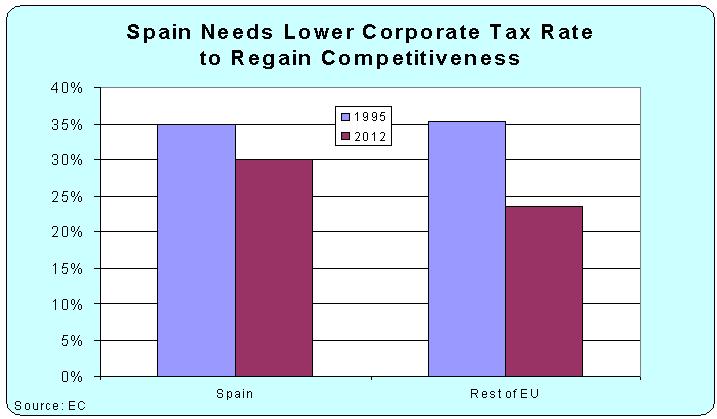
Here’s a chart showing changes in the average EU corporate tax rate compared to Spain’s corporate tax rate.

Spain’s corporate tax rate has dropped by five percentage points. That’s progress, but other nations have moved more rapidly in the right direction. Back in 1995, the Spanish corporate rate was slightly lower than the EU average. Now it’s noticeably higher.

And as the excerpt above notes, there are nations such as Switzerland that have far lower tax rates and much better fiscal policy.

To be sure, Spain’s main challenge is the need to dramatically reduce the burden of government spending. That will help long-run growth because more resources will be allocated by private markets.

But Spain also should seek an immediate boost to growth by reducing tax rates on productive behavior. A lower corporate tax rate should be part of the answer.

It also would be a good idea for the United States.

____________

Thank you so much for your time. I know how valuable it is. I also appreciate the fine family that you have and your commitment as a father and a husband.

Sincerely,

Everette Hatcher III, 13900 Cottontail Lane, Alexander, AR 72002, ph 501-920-5733, lowcostsqueegees@yahoo.com

Related posts:

The Laffer Curve Wreaks Havoc in the United Kingdom

I got to hear Arthur Laffer speak back in 1981 and he predicted what would happen in the next few years with the Reagan tax cuts and he was right with every prediction. The Laffer Curve Wreaks Havoc in the United Kingdom July 1, 2012 by Dan Mitchell Back in 2010, I excoriated the new […]

Liberals act like the Laffer Curve does not exist.

Raising taxes will not work. Liberals act like the Laffer Curve does not exist. The Laffer Curve Shows that Tax Increases Are a Very Bad Idea – even if They Generate More Tax Revenue April 10, 2012 by Dan Mitchell The Laffer Curve is a graphical representation of the relationship between tax rates, tax revenue, and […]

Dan Mitchell: “Romney is Right that You Can Lower Tax Rates and Reduce Tax Preferences without Hurting the Middle Class”

The Laffer Curve, Part I: Understanding the Theory Uploaded by afq2007 on Jan 28, 2008 The Laffer Curve charts a relationship between tax rates and tax revenue. While the theory behind the Laffer Curve is widely accepted, the concept has become very controversial because politicians on both sides of the debate exaggerate. This video shows […]

The flat tax will grow the economy

If we want the economy to grow then we should look closely at a flat tax. A Primer on the Flat Tax and Fundamental Tax Reform August 11, 2012 by Dan Mitchell In previous posts, I put together tutorials on the Laffer Curve, tax competition, and the economics of government spending. Today, we’re going to look […]

Open letter to President Obama (Part 123)

President Obama c/o The White House 1600 Pennsylvania Avenue NW Washington, DC 20500 Dear Mr. President, I know that you receive 20,000 letters a day and that you actually read 10 of them every day. I really do respect you for trying to get a pulse on what is going on out here. I got […]

Cartoons about Obama’s class warfare

I have written a lot about this in the past and sometimes you just have to sit back and laugh. Laughing at Obama’s Bumbling Class Warfare Agenda July 13, 2012 by Dan Mitchell We know that President Obama’s class-warfare agenda is bad economic policy. We know high tax rates undermine competitiveness. And we know tax increases […]

Open letter to President Obama (Part 111)

President Obama c/o The White House 1600 Pennsylvania Avenue NW Washington, DC 20500 Dear Mr. President, I know that you receive 20,000 letters a day and that you actually read 10 of them every day. I really do respect you for trying to get a pulse on what is going on out here. If our […]

Dan Mitchell on Texas v. California (includes editorial cartoon)

We should lower federal taxes because jobs are going to states like Texas that have low taxes. (We should lower state taxes too!!)

One of the great things about federalism, above and beyond the fact that it both constrains the power of governments and is faithful to the Constitution, is that is turns every state into an experiment.

We can learn what works best (though the President seems incapable of learning the right lesson).

We know, for instance, that people are leaving high-tax states and migrating to low-tax states.

We also know that low-tax states grow faster and create more jobs.

I particularly enjoy comparisons between Texas and California. Michael Barone, for instance, documented how the Lone Star State is kicking the you-know-what out of the Golden State in terms of overall economic performance.

I also shared a specific example of high-quality jobs moving from San Francisco to Houston. And I was also greatly amused by this story (and accompanying cartoons) about Texas “poaching” jobs from California.

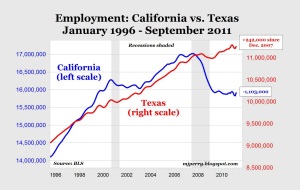
In this discussion with Stuart Varney of Fox News, we discuss how Texas is leading the nation in job creation.

But there’s another part of this discussion that is very much worth highlighting.

As illustrated by the chart, we are enduring the worst overall job performance in any business cycle since the end of World War II.

I note in the interview that Obama inherited a bad economy and that Bush got us in the ditch in the first place with all his wasteful spending and misguided intervention.

But Obama also deserves criticism for doubling down on those failed policies.

His so-called stimulus was a flop. Dodd-Frank is a regulatory nightmare. Obamacare is looking worse and worse every day.

No wonder job creation is so anemic.

The real moral of the story, though, is that the poor are the biggest victims of Obama’s statism. They’re the ones who have been most likely to lose jobs. They’ve been the ones to suffer because of stagnant incomes.

Sort of brings to mind the old joke that leftists must really like poor people because they create more of them whenever they’re in charge.

P.S. Speaking of jokes, here’s an amusing comparison of Texas and California. If you want some California-specific humor, this Chuck Asay cartoon is great. And to maintain balance, here’s a Texas-specific joke on how to respond to an attacker.

P.P.S. To close on a serious point, California would be deteriorating even faster if it wasn’t for the fact that the state and local tax deduction basically means that the rest of the country is subsidizing the high tax rates in the not-so-Golden State. Another good argument for the flat tax.

P.P.P.S. At the bottom of this post, you’ll find a great Kevin Williamson column dismantling some sloppy anti-Texas analysis by Paul Krugman.

________________

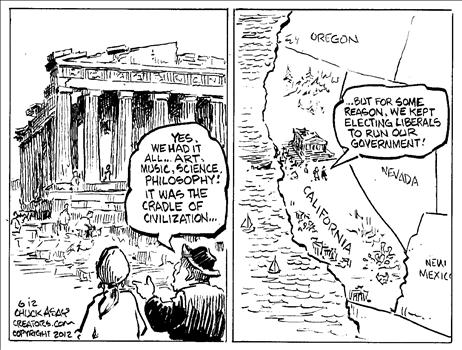
Even though Chuck Asay is one of my favorite cartoonists (see herehereherehere, and here), I was not a big fan of one of his recent two-frame cartoons.

But he has more than made up for that slight transgression with this new gem.

I’m biased, of course, since I’ve already written about California being the Greece of America, but there’s plenty of evidence to justify Asay’s cartoon.

Why does the Obama administration want to get people with bad credit loans? (includes editorial cartoon)

Why does the Obama administration want to get people with bad credit loans?

Let’s assume you didn’t understand how a garbage disposal worked and, for whatever reason, you decided to stick your arm in one and turn it on. You would do some serious injury to your hand.

The rest of us would wonder what motivated you to stick your arm down the drain in the first place, but we would feel sympathy because you didn’t realize bad things would happen.

But if you then told us that you were planning to do the same thing tomorrow, we would think you were crazy. Didn’t you learn anything, we would ask?

Seems like a preposterous scenario, but something very similar is now happening in Washington. The Obama Administration is proposing to once again put the economy at risk by subsidizing banks to give mortgages to people with poor credit.

“Let’s party like it’s 2006!”

Even though we’re still dealing with the economic and fiscal damage caused by the last episode of government housing subsidies!

Here are some of the unbelievable details from a report in the Washington Post.

The Obama administration is engaged in a broad push to make more home loans available to people with weaker credit…officials say they are working to get banks to lend to a wider range of borrowers by taking advantage of taxpayer-backed programs — including those offered by the Federal Housing Administration — that insure home loans against default. Housing officials are urging the Justice Department to provide assurances to banks, which have become increasingly cautious, that they will not face legal or financial recriminations if they make loans to riskier borrowers who meet government standards but later default.

Brings to mind the famous saying from George Santayana that, “Those who cannot remember the past are condemned to repeat it.”

But what’s especially amazing – and distressing – about this latest scheme is that “the past” was only a couple of years ago. Or, to recall my odd analogy, one of our hands is still mangled and bleeding and we’re thinking about putting our other hand in the disposal.

Some people understand this is a nutty idea.

…critics say encouraging banks to lend as broadly as the administration hopes will sow the seeds of another housing disaster and endanger taxpayer dollars. “If that were to come to pass, that would open the floodgates to highly excessive risk and would send us right back on the same path we were just trying to recover from,” said Ed Pinto, a resident fellow at the American Enterprise Institute.

What’s also discouraging is that the government already is deeply involved in the housing market – even though this is an area where there is no legitimate role for the federal intervention.

Deciding which borrowers get loans might seem like something that should be left up to the private market. But since the financial crisis in 2008, the government has shaped most of the housing market, insuring between 80 percent and 90 percent of all new loans, according to the industry publication Inside Mortgage Finance. It has done so primarily through the Federal Housing Administration, which is part of the executive branch, and taxpayer-backed mortgage giants Fannie Mae and Freddie Mac, run by an independent regulator.

So I guess the goal is to have taxpayers on the hook for 100 percent of loans.

“Don’t worry, it’s not our money”

Anybody want to guess whether this will end well?

By the way, this is bad policy even if we somehow avoid a new bubble and big taxpayer losses. Even in a”best case” scenario, the federal government will be distorting the allocation of capital by discouraging business investment and subsidizing residential real estate.

And as shown in this powerful chart, that will have adverse consequences for wages and living standards.

The part of the article that most nauseated me was a quote from the head bureaucrat at the Federal Housing Administration.

“My view is that there are lots of creditworthy borrowers that are below 720 or 700 — all the way down the credit-score spectrum,” Galante said. “It’s important you look at the totality of that borrower’s ability to pay.”

Gee, isn’t that nice that Ms. Galante thinks there are lots of borrowers with good “totality” measures? But here’s an interesting concept. Why doesn’t she put her money at risk instead of making me the involuntary guarantor on these dodgy loans?

I’ve already said on TV that we should dump Fannie Mae and Freddie Mac in the Potomac River. And I’ve  argued that the entire Department of Housing and Urban Development should be razed to the ground.

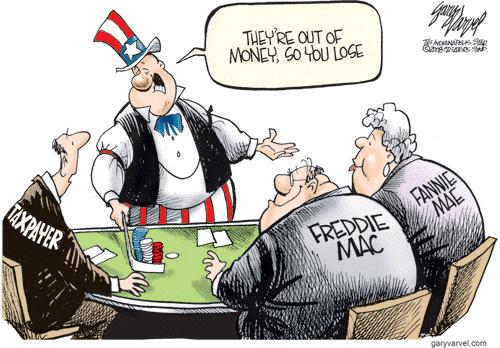
But perhaps this cartoon best shows the consequences of the Obama Administration’s new subsidy scheme.

P.S. We also should get rid of housing preference in the tax code. Our economy should cater to the underlying preferences of consumers, not the electoral interests of politicians.

____________

____________

Here is the transcript:

HARWOOD: A lot of people look at the housing mess and say, what happened. When you think about it, is it principally a problem of speculators, or do you think that government may have played a role by elevating the goal of homeownership too broadly beyond the capacity of large numbers of people to handle it?

Sen. OBAMA: Well, I think that there were a combination of forces. Obviously, we’ve had very low interest rates for a long time, and rising, as a consequence, rising housing prices for a long time, which made people feel that housing prices can only go up and only–and never go down. And then that made everybody, consumers, lenders, all feel a little bit too complacent. We had a fundamental failure, though, in government regulation, and I think that was a real problem. We had a government that was not paying attention to loans that were being made on assets that were shaky. You know, you had mortgage lenders engaging in practices that were not sound but because they could immediately sell off those loans and bundle them, and you know, nobody was minding the store. The government should have, at a certain point, stepped in and said, `We’ve got to tighten up these lending standards or we’re going to be building a house of cards.’ And that sort of transparency and accountability in the marketplace, that’s not anti-market, that’s pro-market. One of the things that’s always worked for us, it’s been one of our competitive advantages, is people can trust that if they invest in our markets, that they know what they’re getting. And in the housing market in this situation, that–our government didn’t do its job.

I have put up lots of cartoons from Dan Mitchell’s blog before and they have got lots of hits before. Many of them have dealt with the economy, eternal unemployment benefits, socialism,  Greece,  welfare state or on gun control.

This cartoon is not new, but it succinctly captures what happened with that part of the TARP bailout. The only thing missing is some way of showing the government officials and political insiders who received undeserved wealth while the Fannie-Freddie scam was operating.

_________

Related posts:

Cartoons from Dan Mitchell’s blog that demonstrate what Obama is doing to our economy Part 2

Max Brantley is wrong about Tom Cotton’s accusation concerning the rise of welfare spending under President Obama. Actually welfare spending has been increasing for the last 12 years and Obama did nothing during his first four years to slow down the rate of increase of welfare spending. Rachel Sheffield of the Heritage Foundation has noted: […]

Cartoons from Dan Mitchell’s blog that demonstrate what Obama is doing to our economy Part 1

  I have put up lots of cartoons from Dan Mitchell’s blog before and they have got lots of hits before. Many of them have dealt with the economy, eternal unemployment benefits, socialism,  Greece,  welfare state or on gun control. I think Max Brantley of the Arkansas Times Blog was right to point out on 2-6-13 that Hillary […]

Great cartoon from Dan Mitchell’s blog on government moochers

I thought it was great when the Republican Congress and Bill Clinton put in welfare reform but now that has been done away with and no one has to work anymore it seems. In fact, over 40% of the USA is now on the government dole. What is going to happen when that figure gets over […]

Gun Control cartoon hits the internet

Again we have another shooting and the gun control bloggers are out again calling for more laws. I have written about this subject below  and on May 23, 2012, I even got a letter back from President Obama on the subject. Now some very interesting statistics below and a cartoon follows. (Since this just hit the […]

“You-Didn’t-Build-That” comment pictured in cartoons!!!

watch?v=llQUrko0Gqw] The federal government spends about 10% on roads and public goods but with the other money in the budget a lot of harm is done including excessive regulations on business. That makes Obama’s comment the other day look very silly. A Funny Look at Obama’s You-Didn’t-Build-That Comment July 28, 2012 by Dan Mitchell I made […]

Cartoons about Obama’s class warfare

I have written a lot about this in the past and sometimes you just have to sit back and laugh. Laughing at Obama’s Bumbling Class Warfare Agenda July 13, 2012 by Dan Mitchell We know that President Obama’s class-warfare agenda is bad economic policy. We know high tax rates undermine competitiveness. And we know tax increases […]

Cartoons on Obama’s budget math

Dan Mitchell Discussing Dishonest Budget Numbers with John Stossel Uploaded by danmitchellcato on Feb 11, 2012 No description available. ______________ Dan Mitchell of the Cato Institute has shown before how excessive spending at the federal level has increased in recent years. A Humorous Look at Obama’s Screwy Budget Math May 31, 2012 by Dan Mitchell I’ve […]

Funny cartoon from Dan Mitchell’s blog on Greece

Sometimes it is so crazy that you just have to laugh a little. The European Mess, Captured by a Cartoon June 22, 2012 by Dan Mitchell The self-inflicted economic crisis in Europe has generated some good humor, as you can see from these cartoons by Michael Ramirez and Chuck Asay. But for pure laughter, I don’t […]

Obama on creating jobs!!!!(Funny Cartoon)

Another great cartoon on President Obama’s efforts to create jobs!!! A Simple Lesson about Job Creation for Barack Obama December 7, 2011 by Dan Mitchell Even though leftist economists such as Paul Krugman and Larry Summers have admitted that unemployment insurance benefits are a recipe for more joblessness, the White House is arguing that Congress should […]

Get people off of government support and get them in the private market place!!!!(great cartoon too)

Dan Mitchell hits the nail on the head and sometimes it gets so sad that you just have to laugh at it like Conan does. In order to correct this mess we got to get people off of government support and get them in the private market place!!!! Chuck Asay’s New Cartoon Nicely Captures Mentality […]

2 cartoons illustrate the fate of socialism from the Cato Institute

Cato Institute scholar Dan Mitchell is right about Greece and the fate of socialism: Two Pictures that Perfectly Capture the Rise and Fall of the Welfare State July 15, 2011 by Dan Mitchell In my speeches, especially when talking about the fiscal crisis in Europe (or the future fiscal crisis in America), I often warn that […]

Cartoon demonstrates that guns deter criminals

John Stossel report “Myth: Gun Control Reduces Crime Sheriff Tommy Robinson tried what he called “Robinson roulette” from 1980 to 1984 in Central Arkansas where he would put some of his men in some stores in the back room with guns and the number of robberies in stores sank. I got this from Dan Mitchell’s […]

Gun control posters from Dan Mitchell’s blog Part 2

I have put up lots of cartons and posters from Dan Mitchell’s blog before and they have got lots of hits before. Many of them have dealt with the economy, eternal unemployment benefits, socialism,  Greece,  welfare state or on gun control. Amusing Gun Control Picture – Circa 1999 April 3, 2010 by Dan Mitchell Dug this gem out […]

We got to cut spending and stop raising the debt ceiling!!!

  We got to cut spending and stop raising the debt ceiling!!! When Governments Cut Spending Uploaded on Sep 28, 2011 Do governments ever cut spending? According to Dr. Stephen Davies, there are historical examples of government spending cuts in Canada, New Zealand, Sweden, and America. In these cases, despite popular belief, the government spending […]

Gun control posters from Dan Mitchell’s blog Part 1

I have put up lots of cartons and posters from Dan Mitchell’s blog before and they have got lots of hits before. Many of them have dealt with the economy, eternal unemployment benefits, socialism,  Greece,  welfare state or on gun control. On 2-6-13 the Arkansas Times Blogger “Sound Policy” suggested,  “All churches that wish to allow concealed […]

Taking on Ark Times bloggers on the issue of “gun control” (Part 3) “Did Hitler advocate gun control?”

Gun Free Zones???? Stalin and gun control On 1-31-13 ”Arkie” on the Arkansas Times Blog the following: “Remember that the biggest gun control advocate was Hitler and every other tyrant that every lived.” Except that under Hitler, Germany liberalized its gun control laws. __________ After reading the link  from Wikipedia that Arkie provided then I responded: […]

Taking on Ark Times bloggers on the issue of “gun control” (Part 2) “Did Hitler advocate gun control?”

On 1-31-13 I posted on the Arkansas Times Blog the following: I like the poster of the lady holding the rifle and next to her are these words: I am compensating for being smaller and weaker than more violent criminals. __________ Then I gave a link to this poster below: On 1-31-13 also I posted […]

Open letter to President Obama (Part 284)


President Obama c/o The White House
1600 Pennsylvania Avenue NW
Washington, DC 20500

Dear Mr. President,

I know that you receive 20,000 letters a day and that you actually read 10 of them every day. I really do respect you for trying to get a pulse on what is going on out here.

On October 15, 1992 in the Presidential Debate this question was asked:

The focus of my work as a domestic mediator is meeting the needs of the children that I work with, by way of their parents, and not the wants of their parents. And I ask the three of you, how can we, as symbolically the children of the future president, expect the two of you, the three of you to meet our needs, the needs in housing and in crime and you name it, as opposed to the wants of your political spin doctors and your political parties?

I wish one of the three candidates would have  given a blunt answer. We don’t need more government but we need less. Why does anyone think that the government should try meet everyone’s needs? Why does anyone think that equality at the finish line is what we are seeking? We need the federal government to stop spending almost 25% of GDP. The people should be allowed to spend more of their own money.

Take a look at this fine article below and the great quote by Barry Goldwater:

In this modern era where we’re all supposed to share our innermost thoughts, I’ve openly discussed my fantasies.

I confessed to the world, for instance, that I have a fantasy that involves about one-half of the adults in America. And I’ve also admitted to a fantasy involving Gov. Rick Perry of Texas.

Now I’m fantasizing about something new, and it’s all the fault of the Cato Institute. In a violation of the Constitution’s prohibition against cruel and unusual punishment, I have to watch tonight’s presidential debate in order to add my two cents to Cato’s live-blogging of the clash between Obama and Romney.

That got me thinking about some of my least-favorite episodes from past debates, and this moment from 1992 is high on my list (I had to watch that debate because my then-wife worked for the Bush Administration and I had to offer some insincere moral support).

The clip is a bit over three minutes, but it will only take a minute or so to see why this was such an unpleasant segment.

Here’s my latest fantasy. If there’s a similar question tonight, I hope either Romney or Obama gives the following response:

I’m not your daddy and you’re not my child. I’m running to be the President of the United States in order to oversee the legitimate executive branch responsibilities of the federal government. And I hope to reduce the burden of government to give you opportunities, not to take care of your needs. You’re an able-bodied adult. Take responsibility for your own life and provide for your own needs.

But I don’t expect my fantasy to get fulfilled. If a question like this is asked, both Obama and Romney almost surely will express sympathy and support.

The good news is that there have been a few politicians in American’s history who have been willing to say the right thing. Here’s a quote from Barry Goldwater that warms my heart.

I have little interest in streamlining government or in making it more efficient, for I mean to reduce its size. I do not undertake to promote welfare, for I propose to extend freedom. My aim is not to pass laws, but to repeal them. …I will not attempt to discover whether legislation is “needed” before I have first determined whether it is constitutionally permissible. And if I should later be attacked for neglecting my constituents’ “interests,” I shall reply that I was informed that their main interest is liberty and that in that cause I am doing the very best I can.

The bad news is that he got his you-know-what kicked in the 1964 election.

On the other hand, America did elect a President who said during his inauguration that “government is not the solution to our problem, government is the problem.”

And a 2011 poll showed that Americans – unlike their European counterparts – do not believe it is government’s job to guarantee that “nobody is in need.”

In other words, Julia, the fictional moocher woman created by the Obama campaign, is not representative of America. At least not yet.

____________

Thank you so much for your time. I know how valuable it is. I also appreciate the fine family that you have and your commitment as a father and a husband.

Sincerely,

Everette Hatcher III, 13900 Cottontail Lane, Alexander, AR 72002, ph 501-920-5733, lowcostsqueegees@yahoo.com

Open letter to President Obama (Part 282, How the Laffer Curve worked in the 20th century over and over again!!!)

Dan Mitchell does a great job explaining the Laffer Curve

President Obama c/o The White House
1600 Pennsylvania Avenue NW
Washington, DC 20500

Dear Mr. President,

I know that you receive 20,000 letters a day and that you actually read 10 of them every day. I really do respect you for trying to get a pulse on what is going on out here.

 I enjoyed this article below because it demonstrates that the Laffer Curve has been working for almost 100 years now when it is put to the test in the USA. I actually got to hear Arthur Laffer speak in person in 1981 and he told us in advance what was going to happen the 1980’s and it all came about as he said it would when Ronald Reagan’s tax cuts took place. I wish we would lower taxes now instead of looking for more revenue through raised taxes. We have to grow the economy:

What Mitt Romney Said Last Night About Tax Cuts And The Deficit Was Absolutely Right. And What Obama Said Was Absolutely Wrong.

Mitt Romney repeatedly said last night that he would not allow tax cuts to add to the deficit.  He repeatedly said it because over and over again Obama blathered the liberal talking point that cutting taxes necessarily increased deficits.

Romney’s exact words: “I want to underline that — no tax cut that adds to the deficit.”

Meanwhile, Obama has promised to cut the deficit in half during his first four years – but instead gave America the highest deficits in the history of the entire human race.

I’ve written about this before.  Let’s replay what has happened every single time we’ve ever cut the income tax rate.

The fact of the matter is that we can go back to Calvin Coolidge who said very nearly THE EXACT SAME THING to his treasury secretary: he too would not allow any tax cuts that added to the debt.  Andrew Mellon – quite possibly the most brilliant economic mind of his day – did a great deal of research and determined what he believed was the best tax rate.  And the Coolidge administration DID cut income taxes and MASSIVELY increased revenues.  Coolidge and Mellon cut the income tax rate 67.12 percent (from 73 to 24 percent); and revenues not only did not go down, but they went UP by at least 42.86 percent (from $700 billion to over $1 billion).

That’s something called a documented fact.  But that wasn’t all that happened: another incredible thing was that the taxes and percentage of taxes paid actually went UP for the rich.  Because as they were allowed to keep more of the profits that they earned by investing in successful business, they significantly increased their investments and therefore paid more in taxes than they otherwise would have had they continued sheltering their money to protect themselves from the higher tax rates.  Liberals ignore reality, but it is simply true.  It is a fact.  It happened.

Then FDR came along and raised the tax rates again and the opposite happened: we collected less and less revenue while the burden of taxation fell increasingly on the poor and middle class again.  Which is exactly what Obama wants to do.

People don’t realize that John F. Kennedy, one of the greatest Democrat presidents, was a TAX CUTTER who believed the conservative economic philosophy that cutting tax rates would in fact increase tax revenues.  He too cut taxes, and he too increased tax revenues.

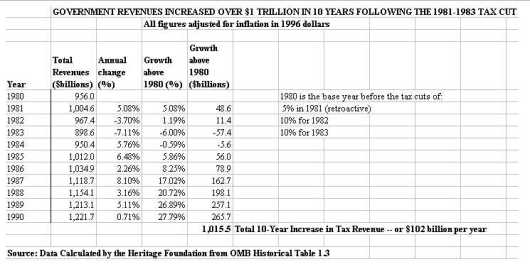
So we get to Ronald Reagan, who famously cut taxes.  And again, we find that Reagan cut that godawful liberal tax rate during an incredibly godawful liberal-caused economic recession, and he increased tax revenue by 20.71 percent (with revenues increasing from $956 billion to $1.154 trillion).  And again, the taxes were paid primarily by the rich:

“The share of the income tax burden borne by the top 10 percent of taxpayers increased from 48.0 percent in 1981 to 57.2 percent in 1988. Meanwhile, the share of income taxes paid by the bottom 50 percent of taxpayers dropped from 7.5 percent in 1981 to 5.7 percent in 1988.”

So we get to George Bush and the Bush tax cuts that liberals and in particular Obama have just demonized up one side and demagogued down the other.  And I can simply quote the New York Times AT the time:

Sharp Rise in Tax Revenue to Pare U.S. Deficit By EDMUND L. ANDREWS Published: July 13, 2005

WASHINGTON, July 12 – For the first time since President Bush took office, an unexpected leap in tax revenue is about to shrink the federal budget deficit this year, by nearly $100 billion.

A Jump in Corporate Payments On Wednesday, White House officials plan to announce that the deficit for the 2005 fiscal year, which ends in September, will be far smaller than the $427 billion they estimated in February.

Mr. Bush plans to hail the improvement at a cabinet meeting and to cite it as validation of his argument that tax cuts would stimulate the economy and ultimately help pay for themselves.

Based on revenue and spending data through June, the budget deficit for the first nine months of the fiscal year was $251 billion, $76 billion lower than the $327 billion gap recorded at the corresponding point a year earlier.

The Congressional Budget Office estimated last week that the deficit for the full fiscal year, which reached $412 billion in 2004, could be “significantly less than $350 billion, perhaps below $325 billion.”

The big surprise has been in tax revenue, which is running nearly 15 percent higher than in 2004. Corporate tax revenue has soared about 40 percent, after languishing for four years, and individual tax revenue is up as well
.

And of course the New York Times, as reliable liberals, use the adjective whenever something good happens under conservative policies and whenever something bad happens under liberal policies: ”unexpected.”   But it WASN’T ”unexpected.”  It was EXACTLY what Republicans had said would happen and in fact it was exactly what HAD IN FACT HAPPENED every single time we’ve EVER cut income tax rates.

The truth is that conservative tax policy has a perfect track record: every single time it has ever been tried, we have INCREASED tax revenues while not only exploding economic activity and creating more jobs, but encouraging the wealthy to pay more in taxes as well.  And liberals simply dishonestly refuse to acknowledge documented history.

Meanwhile, liberals also have a perfect record … of FAILUREThey keep raising taxes and keep not understanding why they don’t get the revenues they predicted.

The following is a section from my article, “Tax Cuts INCREASE Revenues; They Have ALWAYS Increased Revenues“, where I document every single thing I said above:

The Falsehood That Tax Cuts Increase The Deficit

Now let’s take a look at the utterly fallacious view that tax cuts in general create higher deficits.

Let’s take a trip back in time, starting with the 1920s.  From Burton Folsom’s book, New Deal or Raw Deal?:

In 1921, President Harding asked the sixty-five-year-old [Andrew] Mellon to be secretary of the treasury; the national debt [resulting from WWI] had surpassed $20 billion and unemployment had reached 11.7 percent, one of the highest rates in U.S. history.  Harding invited Mellon to tinker with tax rates to encourage investment without incurring more debt. Mellon studied the problem carefully; his solution was what is today called “supply side economics,” the idea of cutting taxes to stimulate investment.  High income tax rates, Mellon argued, “inevitably put pressure upon the taxpayer to withdraw this capital from productive business and invest it in tax-exempt securities. . . . The result is that the sources of taxation are drying up, wealth is failing to carry its share of the tax burden; and capital is being diverted into channels which yield neither revenue to the Government nor profit to the people” (page 128).

Mellon wrote, “It seems difficult for some to understand that high rates of taxation do not necessarily mean large revenue to the Government, and that more revenue may often be obtained by lower taxes.”  And he compared the government setting tax rates on incomes to a businessman setting prices on products: “If a price is fixed too high, sales drop off and with them profits.”

And what happened?

“As secretary of the treasury, Mellon promoted, and Harding and Coolidge backed, a plan that eventually cut taxes on large incomes from 73 to 24 percent and on smaller incomes from 4 to 1/2 of 1 percent.  These tax cuts helped produce an outpouring of economic development – from air conditioning to refrigerators to zippers, Scotch tape to radios and talking movies.  Investors took more risks when they were allowed to keep more of their gains.  President Coolidge, during his six years in office, averaged only 3.3 percent unemployment and 1 percent inflation – the lowest misery index of any president in the twentieth century.

Furthermore, Mellon was also vindicated in his astonishing predictions that cutting taxes across the board would generate more revenue.  In the early 1920s, when the highest tax rate was 73 percent, the total income tax revenue to the U.S. government was a little over $700 million.  In 1928 and 1929, when the top tax rate was slashed to 25 and 24 percent, the total revenue topped the $1 billion mark.  Also remarkable, as Table 3 indicates, is that the burden of paying these taxes fell increasingly upon the wealthy” (page 129-130).

Now, that is incredible upon its face, but it becomes even more incredible when contrasted with FDR’s antibusiness and confiscatory tax policies, which both dramatically shrunk in terms of actual income tax revenues (from $1.096 billion in 1929 to $527 million in 1935), and dramatically shifted the tax burden to the backs of the poor by imposing huge new excise taxes (from $540 million in 1929 to $1.364 billion in 1935).  See Table 1 on page 125 of New Deal or Raw Deal for that information.

FDR both collected far less taxes from the rich, while imposing a far more onerous tax burden upon the poor.

It is simply a matter of empirical fact that tax cuts create increased revenue, and that those [Democrats] who have refused to pay attention to that fact have ended up reducing government revenues even as they increased the burdens on the poorest whom they falsely claim to help.

Let’s move on to John F. Kennedy, one of the most popular Democrat presidents ever.  Few realize that he was also a supply-side tax cutter.

Kennedy said:

“It is a paradoxical truth that tax rates are too high and tax revenues are too low and the soundest way to raise the revenues in the long run is to cut the rates now … Cutting taxes now is not to incur a budget deficit, but to achieve the more prosperous, expanding economy which can bring a budget surplus.”

– John F. Kennedy, Nov. 20, 1962, president’s news conference


“Lower rates of taxation will stimulate economic activity and so raise the levels of personal and corporate income as to yield within a few years an increased – not a reduced – flow of revenues to the federal government.”

– John F. Kennedy, Jan. 17, 1963, annual budget message to the Congress, fiscal year 1964

“In today’s economy, fiscal prudence and responsibility call for tax reduction even if it temporarily enlarges the federal deficit – why reducing taxes is the best way open to us to increase revenues.”

– John F. Kennedy, Jan. 21, 1963, annual message to the Congress: “The Economic Report Of The President”


“It is no contradiction – the most important single thing we can do to stimulate investment in today’s economy is to raise consumption by major reduction of individual income tax rates.”

– John F. Kennedy, Jan. 21, 1963, annual message to the Congress: “The Economic Report Of The President”


“Our tax system still siphons out of the private economy too large a share of personal and business purchasing power and reduces the incentive for risk, investment and effort – thereby aborting our recoveries and stifling our national growth rate.”

– John F. Kennedy, Jan. 24, 1963, message to Congress on tax reduction and reform, House Doc. 43, 88th Congress, 1st Session.


“A tax cut means higher family income and higher business profits and a balanced federal budget. Every taxpayer and his family will have more money left over after taxes for a new car, a new home, new conveniences, education and investment. Every businessman can keep a higher percentage of his profits in his cash register or put it to work expanding or improving his business, and as the national income grows, the federal government will ultimately end up with more revenues.”

– John F. Kennedy, Sept. 18, 1963, radio and television address to the nation on tax-reduction bill

Which is to say that modern Democrats are essentially calling one of their greatest presidents a liar when they demonize tax cuts as a means of increasing government revenues.

So let’s move on to Ronald Reagan.  Reagan had two major tax cutting policies implemented: the Economic Recovery Tax Act (ERTA) of 1981, which was retroactive to 1981, and the Tax Reform Act of 1986.

Did Reagan’s tax cuts decrease federal revenues?  Hardly:

We find that 8 of the following 10 years there was a surplus of revenue from 1980, prior to the Reagan tax cuts.  And, following the Tax Reform Act of 1986, there was a MASSIVE INCREASEof revenue.

So Reagan’s tax cuts increased revenue.  But who paid the increased tax revenue?  The poor?  Opponents of the Reagan tax cuts argued that his policy was a giveaway to the rich (ever heard that one before?) because their tax payments would fall.  But that was exactly wrong.  In reality:

“The share of the income tax burden borne by the top 10 percent of taxpayers increased from 48.0 percent in 1981 to 57.2 percent in 1988. Meanwhile, the share of income taxes paid by the bottom 50 percent of taxpayers dropped from 7.5 percent in 1981 to 5.7 percent in 1988.”

So Ronald Reagan a) collected more total revenue, b) collected more revenue from the rich, while c) reducing revenue collected by the bottom half of taxpayers, and d) generated an economic powerhouse that lasted – with only minor hiccups – for nearly three decades.  Pretty good achievement considering that his predecessor was forced to describe his own economy as a “malaise,” suffering due to a “crisis of confidence.” Pretty good considering that President Jimmy Carter responded to a reporter’s question as to what he would do about the problem of inflation by answering, “It would be misleading for me to tell any of you that there is a solution to it.”

Reagan whipped inflation.  Just as he whipped that malaise and that crisis of confidence.

________

Thank you so much for your time. I know how valuable it is. I also appreciate the fine family that you have and your commitment as a father and a husband.

Sincerely,

Everette Hatcher III, 13900 Cottontail Lane, Alexander, AR 72002, ph 501-920-5733, lowcostsqueegees@yahoo.com

________

The Laffer Curve, Part III: Dynamic Scoring

Related posts:

Open letter to President Obama (Part 282, How the Laffer Curve worked in the 20th century over and over again!!!)

Dan Mitchell does a great job explaining the Laffer Curve President Obama c/o The White House 1600 Pennsylvania Avenue NW Washington, DC 20500 Dear Mr. President, I know that you receive 20,000 letters a day and that you actually read 10 of them every day. I really do respect you for trying to get a […]

President Obama ignores warnings about Laffer Curve

The Laffer Curve – Explained Uploaded by Eddie Stannard on Nov 14, 2011 This video explains the relationship between tax rates, taxable income, and tax revenue. The key lesson is that the Laffer Curve is not an all-or-nothing proposition, where we have to choose between the exaggerated claim that “all tax cuts pay for themselves” […]

The Laffer Curve Wreaks Havoc in the United Kingdom

I got to hear Arthur Laffer speak back in 1981 and he predicted what would happen in the next few years with the Reagan tax cuts and he was right with every prediction. The Laffer Curve Wreaks Havoc in the United Kingdom July 1, 2012 by Dan Mitchell Back in 2010, I excoriated the new […]

Open letter to President Obama (Part 197)

  President Obama c/o The White House 1600 Pennsylvania Avenue NW Washington, DC 20500 Dear Mr. President, I know that you receive 20,000 letters a day and that you actually read 10 of them every day. I really do respect you for trying to get a pulse on what is going on out here. David […]

Open letter to President Obama (Part 123)

President Obama c/o The White House 1600 Pennsylvania Avenue NW Washington, DC 20500 Dear Mr. President, I know that you receive 20,000 letters a day and that you actually read 10 of them every day. I really do respect you for trying to get a pulse on what is going on out here. I got […]

Open letter to President Obama (Part 111)

President Obama c/o The White House 1600 Pennsylvania Avenue NW Washington, DC 20500 Dear Mr. President, I know that you receive 20,000 letters a day and that you actually read 10 of them every day. I really do respect you for trying to get a pulse on what is going on out here. If our […]

Open letter to President Obama (Part 103)

President Obama c/o The White House 1600 Pennsylvania Avenue NW Washington, DC 20500 Dear Mr. President, I know that you receive 20,000 letters a day and that you actually read 10 of them every day. I really do respect you for trying to get a pulse on what is going on out here. I personally […]

High taxes are self-defeating

We got to lower taxes in order to encourage job growth and if we go down the road of higher taxes then we will go further into a recession. Debating Whether States Should Impose Class-Warfare Tax Policy June 4, 2012 by Dan Mitchell I wrote last week about the destructive and self-defeating impact of high state […]

California has forgotten the lessons of Ronald Reagan

If our country is the grow the economy and get our budget balanced it will not be by raising taxes!!! The recipe for success was followed by Ronald Reagan in the 1980′s when he cut taxes and limited spending. As far as limiting spending goes only Bill Clinton (with his Republican Congress) were ability to […]

Some liberal economics want top tax rate above 70% but economy would be crushed

I got to see Arthur Laffer speak in 1981 in Memphis and he predicted what would happen the next few years with tax revenue as a result of the Reagan Tax Cuts and he was right on every prediction. Alan Reynolds Dismantles the Silly Claim that Top Tax Rates Should be 70 Percent (or Higher!) May […]

Spain raises tax rates and revenues fall!!!!

The way to grow the economy is to cut taxes. Last night in the State of the Union address President Obama said he wanted to close tax loopholes which is another way of saying that he is not through raising taxes yet. The Laffer Curve Strikes Again: Revenues Falling in Spite of (or Perhaps Because […]

Ronald Wilson Reagan Part 13

President Reagan and Nancy Reagan greeting Billy Graham at the National Prayer Breakfast held at the Washington Hilton Hotel. 2/5/81. HALT:HaltingArkansasLiberalswithTruth.com Recently on my series on Ronald Reagan (part 10), a gentleman by the name of Elwood who a regular on the Ark Times Blog site, rightly noted, “Ray-gun created the highest unemployment rate we […]

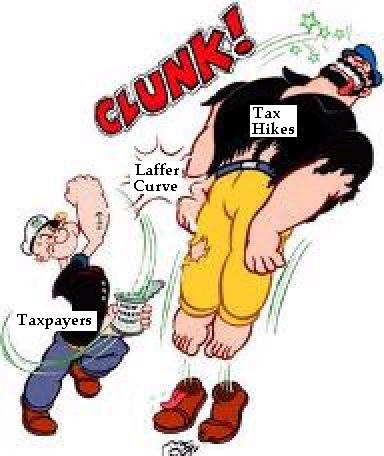
Laffer curve hits tax hikers pretty hard (includes cartoon)

I have put up lots of cartoons from Dan Mitchell’s blog before and they have got lots of hits before. Many of them have dealt with the economy, eternal unemployment benefits, socialism,  Greece,  welfare state or on gun control. Today’s cartoon deals with the Laffer curve.

If I live to be 100 years old, I suspect I’ll still be futilely trying to educate politicians that there’s not a simplistic linear relationship between tax rates and tax revenue.

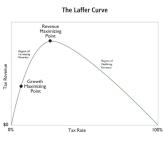
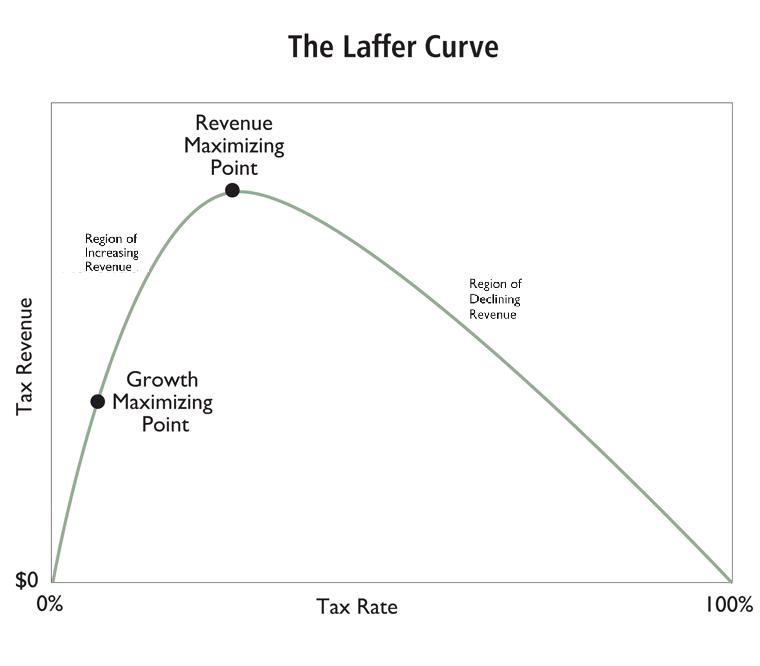
You can’t double tax rates, for instance, and expect to double tax revenue. Simply stated, there’s another variable – called taxable income – that needs to be added to the equation. This simple insight is what gives us the Laffer Curve.

This is common sense in the business community. No restaurant owner would ever be foolish enough to think that revenues will double if all prices increase by 100 percent. People in the real world know that this would mean lower sales.

At best, revenues will rise by much less than 100 percent in that scenario. And if sales drop by enough, revenues may actually fall.

Perhaps because so few of them have business experience, it seems that politicians have a hard time grasping this simple concept.

The latest examples come from Europe, where the never-ending greed for more revenue has resulted in the imposition of financial transaction taxes.

So how’s that working out? Are politicians collecting the revenue they expected?

Hardly. Here are some of the details from a City A.M. column.

…taxes on financial transactions across Europe have devastated market activity and failed to raise as much as politicians hoped, according to new figures out yesterday.

The article cites three powerful examples, starting with Hungary.

Hungary implemented a 0.1 per cent tax at the start of the year. But it raised less than half the revenue the state had hoped for, bringing in 13bn Hungarian Forints (£36m) in January.

Wow, less than 50 percent of the revenue that politicians were expecting. But the politicians probably don’t care about the collateral damage they’re imposing on the economy because they’ll get to buy votes with another 13 billion Forints (about $55 million).

Popeye Laffer CurveNow let’s see how the French are doing.

France forged ahead on its own, introducing a 0.2 per cent tax on sales of shares of major firms. But that only raised €200m (£169.4m) from August to November, well below to €530m expected.

Gee, what a shame, the politicians in Paris are only getting about one-third as much money as they were expecting. That’s even worse than Hungary.

But they’ll surely squander that bit of cash as fast as possible.

Our last example comes from Italy. There are no revenue numbers yet, but the decline in financial activity suggests this tax also will be a flop.

And Italy launched its FTT this month. Figures from TMF Group suggest it has cut trading volumes by 38 per cent already

Though politicians may decide it’s a success since they may get more than 50 percent of what they were originally estimating.

That kind of forecasting error would get somebody fired at any private business, but being a politician means never having to say you’re sorry.

And it certainly never means learning from mistakes. The evidence on the Laffer Curve is ubiquitous, with powerful examples in Ireland, the United Kingdom, Italy, France, Spain, as well as Bulgaria and Romania. Or states such as IllinoisOregonFlorida, Maryland, Washington, DC, and New York.

P.S. Even President Obama has sort of acknowledged the supply-side principles that are the basis of the Laffer Curve.

P.P.S. Remember that the goal of good tax policy is NOT to maximize revenue.

P.P.P.S. I warned the European Union’s Taxation Commissioner about the dangers of a tax on financial transactions last year. Needless to say, my sage counsel appears to have been ignored.

Related posts:

Cartoons from Dan Mitchell’s blog that demonstrate what Obama is doing to our economy Part 2

Max Brantley is wrong about Tom Cotton’s accusation concerning the rise of welfare spending under President Obama. Actually welfare spending has been increasing for the last 12 years and Obama did nothing during his first four years to slow down the rate of increase of welfare spending. Rachel Sheffield of the Heritage Foundation has noted: […]

Cartoons from Dan Mitchell’s blog that demonstrate what Obama is doing to our economy Part 1

  I have put up lots of cartoons from Dan Mitchell’s blog before and they have got lots of hits before. Many of them have dealt with the economy, eternal unemployment benefits, socialism,  Greece,  welfare state or on gun control. I think Max Brantley of the Arkansas Times Blog was right to point out on 2-6-13 that Hillary […]

Great cartoon from Dan Mitchell’s blog on government moochers

I thought it was great when the Republican Congress and Bill Clinton put in welfare reform but now that has been done away with and no one has to work anymore it seems. In fact, over 40% of the USA is now on the government dole. What is going to happen when that figure gets over […]

Gun Control cartoon hits the internet

Again we have another shooting and the gun control bloggers are out again calling for more laws. I have written about this subject below  and on May 23, 2012, I even got a letter back from President Obama on the subject. Now some very interesting statistics below and a cartoon follows. (Since this just hit the […]

“You-Didn’t-Build-That” comment pictured in cartoons!!!

watch?v=llQUrko0Gqw] The federal government spends about 10% on roads and public goods but with the other money in the budget a lot of harm is done including excessive regulations on business. That makes Obama’s comment the other day look very silly. A Funny Look at Obama’s You-Didn’t-Build-That Comment July 28, 2012 by Dan Mitchell I made […]

Cartoons about Obama’s class warfare

I have written a lot about this in the past and sometimes you just have to sit back and laugh. Laughing at Obama’s Bumbling Class Warfare Agenda July 13, 2012 by Dan Mitchell We know that President Obama’s class-warfare agenda is bad economic policy. We know high tax rates undermine competitiveness. And we know tax increases […]

Cartoons on Obama’s budget math

Dan Mitchell Discussing Dishonest Budget Numbers with John Stossel Uploaded by danmitchellcato on Feb 11, 2012 No description available. ______________ Dan Mitchell of the Cato Institute has shown before how excessive spending at the federal level has increased in recent years. A Humorous Look at Obama’s Screwy Budget Math May 31, 2012 by Dan Mitchell I’ve […]

Funny cartoon from Dan Mitchell’s blog on Greece

Sometimes it is so crazy that you just have to laugh a little. The European Mess, Captured by a Cartoon June 22, 2012 by Dan Mitchell The self-inflicted economic crisis in Europe has generated some good humor, as you can see from these cartoons by Michael Ramirez and Chuck Asay. But for pure laughter, I don’t […]

Obama on creating jobs!!!!(Funny Cartoon)

Another great cartoon on President Obama’s efforts to create jobs!!! A Simple Lesson about Job Creation for Barack Obama December 7, 2011 by Dan Mitchell Even though leftist economists such as Paul Krugman and Larry Summers have admitted that unemployment insurance benefits are a recipe for more joblessness, the White House is arguing that Congress should […]

Get people off of government support and get them in the private market place!!!!(great cartoon too)

Dan Mitchell hits the nail on the head and sometimes it gets so sad that you just have to laugh at it like Conan does. In order to correct this mess we got to get people off of government support and get them in the private market place!!!! Chuck Asay’s New Cartoon Nicely Captures Mentality […]

2 cartoons illustrate the fate of socialism from the Cato Institute

Cato Institute scholar Dan Mitchell is right about Greece and the fate of socialism: Two Pictures that Perfectly Capture the Rise and Fall of the Welfare State July 15, 2011 by Dan Mitchell In my speeches, especially when talking about the fiscal crisis in Europe (or the future fiscal crisis in America), I often warn that […]

Cartoon demonstrates that guns deter criminals

John Stossel report “Myth: Gun Control Reduces Crime Sheriff Tommy Robinson tried what he called “Robinson roulette” from 1980 to 1984 in Central Arkansas where he would put some of his men in some stores in the back room with guns and the number of robberies in stores sank. I got this from Dan Mitchell’s […]

Gun control posters from Dan Mitchell’s blog Part 2

I have put up lots of cartons and posters from Dan Mitchell’s blog before and they have got lots of hits before. Many of them have dealt with the economy, eternal unemployment benefits, socialism,  Greece,  welfare state or on gun control. Amusing Gun Control Picture – Circa 1999 April 3, 2010 by Dan Mitchell Dug this gem out […]

We got to cut spending and stop raising the debt ceiling!!!

  We got to cut spending and stop raising the debt ceiling!!! When Governments Cut Spending Uploaded on Sep 28, 2011 Do governments ever cut spending? According to Dr. Stephen Davies, there are historical examples of government spending cuts in Canada, New Zealand, Sweden, and America. In these cases, despite popular belief, the government spending […]

Gun control posters from Dan Mitchell’s blog Part 1

I have put up lots of cartons and posters from Dan Mitchell’s blog before and they have got lots of hits before. Many of them have dealt with the economy, eternal unemployment benefits, socialism,  Greece,  welfare state or on gun control. On 2-6-13 the Arkansas Times Blogger “Sound Policy” suggested,  “All churches that wish to allow concealed […]

Taking on Ark Times bloggers on the issue of “gun control” (Part 3) “Did Hitler advocate gun control?”

Gun Free Zones???? Stalin and gun control On 1-31-13 ”Arkie” on the Arkansas Times Blog the following: “Remember that the biggest gun control advocate was Hitler and every other tyrant that every lived.” Except that under Hitler, Germany liberalized its gun control laws. __________ After reading the link  from Wikipedia that Arkie provided then I responded: […]

Taking on Ark Times bloggers on the issue of “gun control” (Part 2) “Did Hitler advocate gun control?”

On 1-31-13 I posted on the Arkansas Times Blog the following: I like the poster of the lady holding the rifle and next to her are these words: I am compensating for being smaller and weaker than more violent criminals. __________ Then I gave a link to this poster below: On 1-31-13 also I posted […]


Open letter to President Obama (Part 279)

Ronald Reagan Describes Milton Friedman

Uploaded by on Oct 2, 2011

_________


President Obama c/o The White House
1600 Pennsylvania Avenue NW
Washington, DC 20500

Dear Mr. President,

I know that you receive 20,000 letters a day and that you actually read 10 of them every day. I really do respect you for trying to get a pulse on what is going on out here.

Stephen Moore in the Wall Street Journal rightly noted:

In the 1960s, Friedman famously explained that “there’s no such thing as a free lunch.” If the government spends a dollar, that dollar has to come from producers and workers in the private economy.

Milton Friedman was my favorite economist and Ronald Reagan was my favorite President. I wish people would grasp the fact that there is no free lunch today. Here is a great article that described Milton Friedman. Ronald Reagan sought to put Friedman’s philosophy into practice in his eight years in office and as a result we had the biggest great in our economy in the history of our country. If you attempt to cut back on government spending and cut everyone’s taxes then you will be very successful too.

The Genius of Milton Friedman — Capitalism Preserved

Milton & Rose Friedman / Photo: Corbis

Four days ago, The Wall Street Journal published an outstanding article by Stephen Moore titled, The Man Who Saved Capitalism. One of the reasons President Reagan’s economic policies were so successful was because he relied upon the advice and wisdom of Milton Friedman. The entire article is worth reading. I am convinced liberals will never understand the genius of Friedman. If you ever want to have some fun, look up the numerous YouTubes of Friedman eviscerating the brightest of liberals. Here are some excerpts of Moore’s excellent article (also, see a great video at the WSJ URL):

It’s a tragedy that Milton Friedman—born 100 years ago on July 31—did not live long enough to combat the big-government ideas that have formed the core of Obamanomics. It’s perhaps more tragic that our current president, who attended the University of Chicago where Friedman taught for decades, never fell under the influence of the world’s greatest champion of the free market. Imagine how much better things would have turned out, for Mr. Obama and the country.

Friedman was a constant presence on these pages until his death in 2006 at age 94. If he could, he would surely be skewering today’s $5 trillion expansion of spending and debt to create growth—and exposing the confederacy of economic dunces urging more of it.

In the 1960s, Friedman famously explained that “there’s no such thing as a free lunch.” If the government spends a dollar, that dollar has to come from producers and workers in the private economy. There is no magical “multiplier effect” by taking from productive Peter and giving to unproductive Paul. As obvious as that insight seems, it keeps being put to the test. Obamanomics may be the most expensive failed experiment in free-lunch economics in American history.

Equally illogical is the superstition that government can create prosperity by having Federal Reserve Chairman Ben Bernanke print more dollars. In the very short term, Friedman proved, excess money fools people with an illusion of prosperity. But the market quickly catches on, and there is no boost in output, just higher prices.

. Small in stature but a giant intellect, he was the economist who saved capitalism by dismembering the ideas of central planning when most of academia was mesmerized by the creed of government as savior.
[…]
More influential than Friedman’s scholarly writings was his singular talent for communicating the virtues of the free market to a mass audience. His two best-selling books, “Capitalism and Freedom” (1962) and “Free to Choose” (1980), are still wildly popular. His videos on YouTube on issues like the morality of capitalism are brilliant and timeless.

In the early 1990s, Friedman visited poverty-stricken Mexico City for a Cato Institute forum. I remember the swirling controversy ginned up by the media and Mexico’s intelligentsia: How dare this apostle of free-market economics be given a public forum to speak to Mexican citizens about his “outdated” ideas? Yet when Milton arrived in Mexico he received a hero’s welcome as thousands of business owners, students and citizen activists hungry for his message encircled him everywhere he went, much like crowds for a modern rock star.

Once in the early 1960s, Friedman wrote the then-U.S. ambassador to New Delhi, John Kenneth Galbraith, that he would be lecturing in India. By all means come, the witty but often wrong Galbraith replied: “I can think of nowhere your free-market ideas can do less harm than in India.” As fate would have it, India did begin to embrace Friedmanism in the 1990s, and the economy began to soar. China finally caught on too.

Friedman stood unfailingly and heroically with the little guy against the state. He used to marvel that the intellectual left, which claims to espouse “power to the people,” so often cheers as states suppress individual rights.
[…]
He loved turning the intellectual tables on liberals by making the case that regulation often does more harm than good. His favorite example was the Food and Drug Administration, whose regulations routinely delay the introduction of lifesaving drugs. “When the FDA boasts a new drug will save 10,000 lives a year,” he would ask, “how many lives were lost because it didn’t let the drug on the market last year?”

He supported drug legalization (much to the dismay of supporters on the right) and was particularly proud to be an influential voice in ending the military draft in the 1970s. When his critics argued that he favored a military of mercenaries, he would retort: “If you insist on calling our volunteer soldiers ‘mercenaries,’ I will call those who you want drafted into service involuntarily ‘slaves.'”

By the way, he rarely got angry and even when he was intellectually slicing and dicing his sparring partners he almost always did it with a smile. It used to be said that over the decades at the University of Chicago and across the globe, the only one who ever defeated him in a debate was his beloved wife and co-author Rose Friedman.

The issue he devoted most of his later years to was school choice for all parents, and his Friedman Foundation for Educational Choice is dedicated to that cause. He used to lament that “we allow the market, consumer choice and competition to work in nearly every industry except for the one that may matter most: education.”

As for congressional Republicans who are at risk of getting suckered into a tax-hike budget deal, they may want to remember another Milton Friedman adage: “Higher taxes never reduce the deficit. Governments spend whatever they take in and then whatever they can get away with.”

No doubt because of his continued popularity, the left has tried to tie Friedman and his principles of free trade, low tax rates and deregulation to the global financial meltdown in 2008. Economist Joseph Stiglitz charged that Friedman’s “Chicago School bears the blame for providing a seeming intellectual foundation” for the “idea that markets are self-adjusting and the best role for government is to do nothing.” Occupy Wall Street protesters were often seen wearing T-shirts which read: “Milton Friedman: Proud Father of Global Misery.”

The opposite is true: Friedman opposed the government spending spree in the 2000s. He hated the government-sponsored enterprises like housing lenders Fannie Mae and Freddie Mac.

In a recent tribute to Friedman in the Journal of Economic Literature, Harvard’s Andrei Shleifer describes 1980-2005 as “The Age of Milton Friedman,” an era that “witnessed remarkable progress of mankind. As the world embraced free-market policies, living standards rose sharply while life expectancy, educational attainment, and democracy improved and absolute poverty declined.”

Well over 200 million were liberated from poverty thanks to the rediscovery of the free market. And now as the world teeters close to another recession, leaders need to urgently rediscover Friedman’s ideas.

I remember asking Milton, a year or so before his death, during one of our semiannual dinners in downtown San Francisco: What can we do to make America more prosperous? “Three things,” he replied instantly. “Promote free trade, school choice for all children, and cut government spending.”

How much should we cut? “As much as possible.”

_________

Thank you so much for your time. I know how valuable it is. I also appreciate the fine family that you have and your commitment as a father and a husband.

Sincerely,

Everette Hatcher III, 13900 Cottontail Lane, Alexander, AR 72002, ph 501-920-5733, lowcostsqueegees@yahoo.com

The spending cliff is what we have to worry about

The spending cliff is what we have to worry about.

The Spending Cliff

Twenty-three point nine trillion dollars.

That will be our national debt in 2022 under the fiscal-cliff bill that just passed Congress. That’s nearly $4 trillion more than the current-law baseline, and while most of that comes from making the Bush tax cuts permanent for most Americans without offsetting the loss of revenue through spending cuts, at least $330 billion of the new debt results from the increased spending that was part of the deal. Our government debt will amount to more than 118 percent of GDP.

So the deal not only fails to cut spending, it also simply tosses more money on top of the spending increases that were already built into future budgets. Now the federal government will spend $5.5 trillion in 2022, compared with $3.5 trillion this year. We will be spending $2 trillion more per year and facing $1.5 trillion more in debt than if federal spending were to rise commensurate with population growth plus inflation over the next ten years.

And this is only going to get worse after 2022, as entitlements, still unreformed after the cliff deal, explode. By 2050, our national debt will top $58 trillion in today’s dollars. That’s more than double what it would be if the increase in federal spending were limited to inflation plus population growth.

“Republicans focused on taxes, and lost on spending, too.”

How did we end up with this epic failure? In part, it was because Republicans’ fixation on cutting taxes blinded them to the real threat to economic growth and freedom — the growing size of the federal government.

I would be among the first to agree that raising taxes is bad. Tax hikes take more money out of the productive sector of the economy and redistribute it to the non-productive governmental sector, slowing economic growth. The distortions in economic decision-making brought about by those taxes will slow growth and reduce prosperity even further. But even more important, taxes appropriate the property that an individual has justly earned through his labor or ingenuity. Every dollar that the government takes from an individual is one less dollar that he or she can save, invest, or spend as he or she sees fit.

But simply paying for big government through debt rather than taxes is not an appreciable improvement. As Harvard’s Robert Barro points out, there is a “significantly negative relation between the growth of real GDP and the growth of the government share of GDP.” And, of course, our liberty is further constrained as a growing government takes up more and more space that once belonged to individuals and their choices.

Yet during the fiscal-cliff negotiations, Republicans were all too willing to forgo spending cuts as long as they were able to retain some additional tax cuts.

Republicans claim that, having disposed of the tax issue, they will now devote all their attention to securing spending reductions as part of the continuing-resolution and debt-ceiling negotiations to come. But President Obama is already laying the political groundwork for this debate, warning that Republicans will risk throwing the country into default over the debt ceiling in order to cut Social Security and Medicare. Will the GOP have the courage to insist on making the deep and painful cuts that will be required to restore us to fiscal sanity?

Forgive me for being skeptical, but not only did the last debt-ceiling agreement fail to actually cut spending (federal spending rose by $61.5 billion in the twelve months following that deal), the fiscal-cliff agreement undid two months’ worth, or $24 billion, of the sequestration cuts resulting from the debt-ceiling compromise. Indeed, congressional negotiators will spend the next two months looking for ways to undo the rest of the sequester.

“God put the Republican Party on earth to cut taxes,” the late columnist Robert Novak once noted. “If they can’t do that, they have no useful purpose.” Perhaps. But unless Republicans are willing to see that spending is every bit as big a threat to liberty and prosperity as taxes are, America is well on its way to becoming Greece.

________

Does Government Have a Revenue or Spending Problem?

People say the government has a debt problem. Debt is caused by deficits, which is the difference between what the government collects in tax revenue and the amount of government spending. Every time the government runs a deficit, the government debt increases. So what’s to blame: too much spending, or too little tax revenue? Economics professor Antony Davies examines the data and concludes that the root cause of the debt is too much government spending.