This video explains the relationship between tax rates, taxable income, and tax revenue. The key lesson is that the Laffer Curve is not an all-or-nothing proposition, where we have to choose between the exaggerated claim that “all tax cuts pay for themselves” and the equally silly assumption that tax policy doesn’t effect the economy and there is never any revenue feedback. From http://www.freedomandprosperity.org 202-285-0244
____________
(This letter was emailed to White House on 12-1-12.)
President Obama c/o The White House
1600 Pennsylvania Avenue NW
Washington, DC 20500
The good news is that more analysts have joined the fight, explaining that Europe is in trouble because of a failure to address the real problem of excessive government spending.
Here are some excerpts from a column in USA Today by Matthew Melchiorre from the Competitive Enterprise Institute, beginning with a good summary of how Europe has erred by choosing to impose austerity on the private sector.
The folly of “austerity” composed mainly of tax hikes with less in the way of spending reductions has driven the economies of the Old World into the ground. We’re next unless Congress keeps Uncle Sam out of Americans’ wallets and takes a chainsaw to Washington’s budget. …How is this likely to pan out? To get an idea, we can look at Europe, which has followed a similar strategy and has had little success in reviving growth. Spending cuts have been weak. Today, not a single Euro Zone government is spending less as a percentage of GDP than it did in 2007, according to Eurostat data. Tax increases, on the other hand, have been rampant. The average cyclically adjusted total tax burden among Euro Zone countries increased by about 5% from 2007 to 2010, according to European Commission data.
But there are some exceptions to the big-government consensus. Melchiorre notes that Estonia and other Baltic nations decided to impose genuine budget cuts.
Several Baltic countries have broken the European straitjacket of growth-strangling tax “austerity,” and have enjoyed success relative to their peers as a result. Take Estonia, for example. The Estonian government implemented an austerity program in 2009…cutting into public employee wages by 40% and slashing total government spending by a whopping 16% by 2011.
Estonia’s economy…bounced right back with 2 percent growth the following year and has since continued to prosper. For the past two years, Estonian industry has expanded more than twice as fast as that of Germany. …Tax increases don’t bring about prosperity. Shrinking government to live within its means does.
Amen to that, but I think the final point needs to be expanded. It’s not just that tax increases don’t work. It’s that they make matters worse.
The problem in most nations is that government is too big. In a best-case scenario, tax increases are a substitute for spending restraint. More often than not, though, tax hikes lead to higher levels of government spending.
This brings us back to the current fiscal fight in the United States. Obama has dug in his heels and demanded an increase in the top tax rates. He claims that this class-warfare approach is necessary for fiscal responsibility.
But ask yourself a question. We know that America’s long-run fiscal problem is entitlement spending. Will politicians be more likely or less likely to reform those programs if they think tax increases are an option?
If you answered “more likely,” you should move to Greece and see how well your system is working.
______–
Thank you so much for your time. I know how valuable it is. I also appreciate the fine family that you have and your commitment as a father and a husband.
Sincerely,
Everette Hatcher III, 13900 Cottontail Lane, Alexander, AR 72002, ph 501-920-5733, lowcostsqueegees@yahoo.com
Below is a fine article and video from Dan Mitchell.
(R Row, from front to rear) Milton Friedman, George Shultz, Pres. Ronald Reagan, Arthur Burns, William Simon and Walter Wriston & unknown at a meeting of White House economic
But that video is only six minutes long, so I only skim the surface. For those of you who feel that you’re missing out, you can listen to me pontificate on public policy and growth for more than sixty minutes in this video of a class I taught at the Citadel in South Carolina (and if you’re a glutton for punishment, there’s also nearly an hour of Q&A).
Cato Institute Senior Fellow Daniel J. Mitchell
Published on Apr 2, 2012
Cato Institute Senior Fellow Daniel J. Mitchell speaks to cadets economics and conservatism. This is the 10th lecture in the seminar series titled “The Conservative Intellectual Tradition in America.”
_______________
There are two points that are worth some additional attention.
1. In my discussion of regulation, I mention that health and safety rules can actually cause needless deaths by undermining economic performance. Ielaborated on this topic when I waded into the election-season debateabout whether Obama supporters were right to accuse Romney of causing a worker’s premature death.
2. In my discussion of deficits and debt, I criticize the Congressional Budget Office for assuming that government fiscal balance is the key determinant of economic growth. And since CBO assumes you maximize growth by somehow having large surpluses, the bureaucrats actually argue that higher taxes are good for growth andtheir analysis implies that the growth-maximizing tax rate is 100 percent.
P.S. If you prefer much shorter doses of Dan Mitchell, you can watch myone-minute videos on tax reformthat were produced by the Heartland Institute.
What did we learn from the Laffer Curve in the 1980′s? Lowering top tax rate from 70% to 28% from 1980 to 1988 and those earning over $200,000 paid 99 billion in taxes instead of 19 billion!!!! A Lesson on the Laffer Curve for Barack Obama November 6, 2011 by Dan Mitchell One of my frustrating missions […]
Will Rogers has a great quote that I love. He noted, “Lord, the money we do spend on Government and it’s not one bit better than the government we got for one-third the money twenty years ago”(Paula McSpadden Love, The Will Rogers Book, (1972) p. 20.) Dan Mitchell praises Calvin Coolidge for keeping the federal government small. […]
President Obama c/o The White House 1600 Pennsylvania Avenue NW Washington, DC 20500 Dear Mr. President, I know that you receive 20,000 letters a day and that you actually read 10 of them every day. I really do respect you for trying to get a pulse on what is going on out here. The way […]
Dan Mitchell does a great job explaining the Laffer Curve President Obama c/o The White House 1600 Pennsylvania Avenue NW Washington, DC 20500 Dear Mr. President, I know that you receive 20,000 letters a day and that you actually read 10 of them every day. I really do respect you for trying to get a […]
I have put up lots of cartoons from Dan Mitchell’s blog before and they have got lots of hits before. Many of them have dealt with the economy, eternal unemployment benefits, socialism, Greece, welfare state or on gun control. Today’s cartoon deals with the Laffer curve. Revenge of the Laffer Curve…Again and Again and Again March 27, 2013 […]
Class Warfare just don’t pay it seems. Why can’t we learn from other countries’ mistakes? Class Warfare Tax Policy Causes Portugal to Crash on the Laffer Curve, but Will Obama Learn from this Mistake? December 31, 2012 by Dan Mitchell Back in mid-2010, I wrote that Portugal was going to exacerbate its fiscal problems by raising […]
The Laffer Curve – Explained Uploaded by Eddie Stannard on Nov 14, 2011 This video explains the relationship between tax rates, taxable income, and tax revenue. The key lesson is that the Laffer Curve is not an all-or-nothing proposition, where we have to choose between the exaggerated claim that “all tax cuts pay for themselves” […]
I enjoyed this article below because it demonstrates that the Laffer Curve has been working for almost 100 years now when it is put to the test in the USA. I actually got to hear Arthur Laffer speak in person in 1981 and he told us in advance what was going to happen the 1980′s […]
I got to hear Arthur Laffer speak back in 1981 and he predicted what would happen in the next few years with the Reagan tax cuts and he was right with every prediction. The Laffer Curve Wreaks Havoc in the United Kingdom July 1, 2012 by Dan Mitchell Back in 2010, I excoriated the new […]
Raising taxes will not work. Liberals act like the Laffer Curve does not exist. The Laffer Curve Shows that Tax Increases Are a Very Bad Idea – even if They Generate More Tax Revenue April 10, 2012 by Dan Mitchell The Laffer Curve is a graphical representation of the relationship between tax rates, tax revenue, and […]
President Obama should care more about trying to cut taxes and get the economy going instead of chasing the rich around everywhere and threatening them. Robinhood was not up to tricks like that.
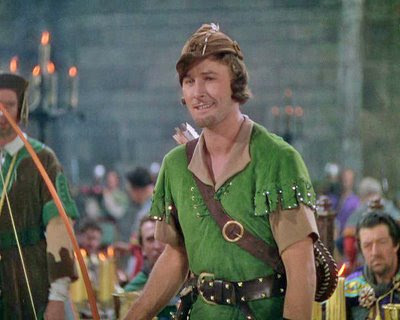
When I was a kid, I was a big fan of Robin Hood. I remember reading at least two books recounting the legend and I watched the Errol Flynn version of the movie several times.
And, as an adult, I saw both the Kevin Costner and Russell Crowe versions of Robin Hood.
“I’m not an occupy-Wall-Street moocher”
None of this makes me an expert, but it does allow me to state with some confidence that Robin Hood was not a left-wing hero who stole from the rich and redistributed to the poor.
Instead, he was a quasi-libertarian tax protestor. Okay, maybe it’s an exaggeration to claim he was a libertarian, but Robin Hood was on the side of ordinary people who were being exploited by incessant tax demands from the ruling class. His main enemies were Prince John and the Sheriff on Nottingham, not the medieval equivalents of Wall Street.
In the Russell Crowe version of the movie, Robin Hood even gives a speech about the importance of liberty.
So you can imagine how irked I get when statists agitate for things such as the “Robin Hood Tax” in this moronic video. But what motivated me today is a story in the Financial Times about a Cesar Chavez wannabee politician from Spain.
For Spain’s ruling politicians he is a criminal; for his supporters he is Robin Hood, stealing from supermarkets and redistributing the food to the poor. Juan Manuel Sánchez Gordillo, the mayor of Marinaleda, a southern town with a population of 2,600, has been catapulted to cult hero status in Spain after setting out this week on an anti-austerity march across Andalucia – occupying banks and stealing food… “We are fighting a war for the poor … going to jail is not important for me, it would be an honour,” Mr Sánchez Gordillo told the Financial Times. “We are going to occupy all of the banks and supermarkets we are able to in Andalucia. The robbers who have caused this crisis must pay the consequences for what they have done.”
But don’t hold your breath waiting for self-awareness from this clown.
Not surprisingly, unions are part of the protest. I’m guessing that Mr. Canamero represents government employees.
On Friday, the marchers, who plan to sleep in the open or in parks, occupied a branch of Banco Santander in the town of Mancha Real in the province of Jaén before leaving later in the day. Diego Canamero, head of the Andalucian Workers Union, was in the branch on Friday. He said critics of the protests were politicians protecting their own interests. “These are symbolic actions against an unsustainable economic situation,” he said. “The bankers rob us, and take our money to tax havens…”
The dig against tax havens is particularly laughable. Ordinary Spaniards should hope and pray that their deposits in the local banks are safely re-deposited in banks based in well-run and honest jurisdictions such as Switzerland, the Cayman Islands, or Singapore.
And if they’re smart, they already cut out the middleman and directly placed their savings in one of these low-tax jurisdictions. That way, they’re not only at much less risk of a bank collapse, but they also have greater ability to protect their assets from the venal and incompetent tax-hungry political elite.
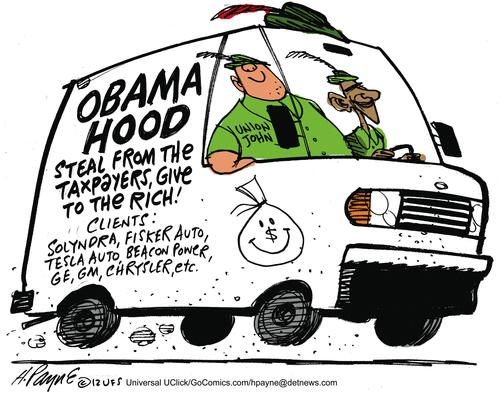
Returning to the mischaracterization of Robin Hood, this Payne cartoon does a good job of capturing my thoughts.
I especially like how Payne shows that the left-wing version of Robin Hood is all about a perniciously corrupt version of redistribution (though he should have included the Export-Import Bank on the side of the van). The genuine poor get crumbs while the well-connected interests make out like bandits.
Max Brantley is wrong about Tom Cotton’s accusation concerning the rise of welfare spending under President Obama. Actually welfare spending has been increasing for the last 12 years and Obama did nothing during his first four years to slow down the rate of increase of welfare spending. Rachel Sheffield of the Heritage Foundation has noted: […]
I have put up lots of cartoons from Dan Mitchell’s blog before and they have got lots of hits before. Many of them have dealt with the economy, eternal unemployment benefits, socialism, Greece, welfare state or on gun control. I think Max Brantley of the Arkansas Times Blog was right to point out on 2-6-13 that Hillary […]
I thought it was great when the Republican Congress and Bill Clinton put in welfare reform but now that has been done away with and no one has to work anymore it seems. In fact, over 40% of the USA is now on the government dole. What is going to happen when that figure gets over […]
Again we have another shooting and the gun control bloggers are out again calling for more laws. I have written about this subject below and on May 23, 2012, I even got a letter back from President Obama on the subject. Now some very interesting statistics below and a cartoon follows. (Since this just hit the […]
watch?v=llQUrko0Gqw] The federal government spends about 10% on roads and public goods but with the other money in the budget a lot of harm is done including excessive regulations on business. That makes Obama’s comment the other day look very silly. A Funny Look at Obama’s You-Didn’t-Build-That Comment July 28, 2012 by Dan Mitchell I made […]
I have written a lot about this in the past and sometimes you just have to sit back and laugh. Laughing at Obama’s Bumbling Class Warfare Agenda July 13, 2012 by Dan Mitchell We know that President Obama’s class-warfare agenda is bad economic policy. We know high tax rates undermine competitiveness. And we know tax increases […]
Dan Mitchell Discussing Dishonest Budget Numbers with John Stossel Uploaded by danmitchellcato on Feb 11, 2012 No description available. ______________ Dan Mitchell of the Cato Institute has shown before how excessive spending at the federal level has increased in recent years. A Humorous Look at Obama’s Screwy Budget Math May 31, 2012 by Dan Mitchell I’ve […]
Sometimes it is so crazy that you just have to laugh a little. The European Mess, Captured by a Cartoon June 22, 2012 by Dan Mitchell The self-inflicted economic crisis in Europe has generated some good humor, as you can see from these cartoons by Michael Ramirez and Chuck Asay. But for pure laughter, I don’t […]
Another great cartoon on President Obama’s efforts to create jobs!!! A Simple Lesson about Job Creation for Barack Obama December 7, 2011 by Dan Mitchell Even though leftist economists such as Paul Krugman and Larry Summers have admitted that unemployment insurance benefits are a recipe for more joblessness, the White House is arguing that Congress should […]
Dan Mitchell hits the nail on the head and sometimes it gets so sad that you just have to laugh at it like Conan does. In order to correct this mess we got to get people off of government support and get them in the private market place!!!! Chuck Asay’s New Cartoon Nicely Captures Mentality […]
Cato Institute scholar Dan Mitchell is right about Greece and the fate of socialism: Two Pictures that Perfectly Capture the Rise and Fall of the Welfare State July 15, 2011 by Dan Mitchell In my speeches, especially when talking about the fiscal crisis in Europe (or the future fiscal crisis in America), I often warn that […]
John Stossel report “Myth: Gun Control Reduces Crime Sheriff Tommy Robinson tried what he called “Robinson roulette” from 1980 to 1984 in Central Arkansas where he would put some of his men in some stores in the back room with guns and the number of robberies in stores sank. I got this from Dan Mitchell’s […]
I have put up lots of cartons and posters from Dan Mitchell’s blog before and they have got lots of hits before. Many of them have dealt with the economy, eternal unemployment benefits, socialism, Greece, welfare state or on gun control. Amusing Gun Control Picture – Circa 1999 April 3, 2010 by Dan Mitchell Dug this gem out […]
We got to cut spending and stop raising the debt ceiling!!! When Governments Cut Spending Uploaded on Sep 28, 2011 Do governments ever cut spending? According to Dr. Stephen Davies, there are historical examples of government spending cuts in Canada, New Zealand, Sweden, and America. In these cases, despite popular belief, the government spending […]
I have put up lots of cartons and posters from Dan Mitchell’s blog before and they have got lots of hits before. Many of them have dealt with the economy, eternal unemployment benefits, socialism, Greece, welfare state or on gun control. On 2-6-13 the Arkansas Times Blogger “Sound Policy” suggested, “All churches that wish to allow concealed […]
Gun Free Zones???? Stalin and gun control On 1-31-13 ”Arkie” on the Arkansas Times Blog the following: “Remember that the biggest gun control advocate was Hitler and every other tyrant that every lived.” Except that under Hitler, Germany liberalized its gun control laws. __________ After reading the link from Wikipedia that Arkie provided then I responded: […]
On 1-31-13 I posted on the Arkansas Times Blog the following: I like the poster of the lady holding the rifle and next to her are these words: I am compensating for being smaller and weaker than more violent criminals. __________ Then I gave a link to this poster below: On 1-31-13 also I posted […]
Some people doubt that Ronald Reagan conservatism still works today like it did in the 1980’s and that those kind of conservatives can still win today but they can!!!!
Among the right-leaning policy wonks and intellectuals in Washington, there’s a lot of attention being given to the something called “reform conservatism.”
Underlying this school of thought is the notion that the Reagan-era message no longer works since Republicans have lost the popular vote in five out of the last six elections.
But before digging into his column, I think that some of the angst on the right is misplaced. Why blame a Reagan-era message for GOP electoral problems when all the Republicans presidential nominees in recent years have favored big government? Does anybody really think thatBush 41, Dole, Bush 43, McCain, and Romney were Reaganites?!?
Could any of those candidates havegiven these remarks, at least with any credibility?
President Reagan on Big Government and Personal Freedom
Uploaded onDec 23, 2010
The surge in nostalgia for President Reagan over the past two years is no surprise. When the American people are faced with tyrannical government, arrogant leadership, and failed policies, they tend to cling to good memories (along with their guns and religion). They also tend to take action, hence the Tea Party movement and the 2010 revolution. Watch this clip from 1982 and remember.
The Founding Fathers fought tyranny, we must come together to fight again. Ronald Reagan believed that it was individual freedom that made America great
___________________________
It’s much more plausible to say that Republicans have lagged because they didn’t have candidates with a Reagan-style message.
But let’s assume, for the sake of argument, that Republicans would have fared poorly even if Reaganites had been nominated. Does “reform conservatism” offer a path to electoral salvation.
Here’s what Douthat identifies as the “two major premises” of reform conservatism.
1. First, he writes that the “core economic challenge facing the American experiment is not income inequality per se, but rather stratification and stagnation — weak mobility from the bottom of the income ladder and wage stagnation for the middle class.” Conservatives, he says, should strive to make “family life more affordable, upward mobility more likely, and employment easier to find.”
2. Second, he warns that the “existing welfare-state institutions we’ve inherited from the New Deal and the Great Society, however, often make these tasks harder rather than easier: Their exploding costs crowd out every other form of spending, require middle class tax increases and threaten to drag on economic growth.”
I’m not an expert on income mobility, so I’m not sure I would identify stratification and stagnation as the nation’s core economic challenge, but he may be right. Regardless, it’s definitely a good idea to have more mobility.
And I definitely agree that thewelfare state hinders upward mobility by creating dependency. And he’s right that this is a drag on growth. That being said, I disagree with his assertion that rising entitlement expenditurescrowd out other spendingand lead to middle class tax hikes. Those things may happen at some point, particularly once we get into the peak years for retiring baby boomers, but they haven’t happened yet.
The more important question, at least to me, is what sort of policies do reform conservatives embrace? Here’s Douthat’s list, bolded, followed by my thoughts.
a.A tax reform that caps deductions and lowers rates, butalsoreduces the burden on working parents and the lower middle class, whether through an expanded child tax credit or some other means of reducing payroll tax liability.I obviously like the idea of lowering rates and reducing deductions since that moves the system closer to aflat tax. That being said, it’s difficult to reduce the tax burden on the lower middle class since they pay very little income tax under the current system (see accompanying table from CBO). But I like the idea of addressing the payroll tax, though I disagree with their approach (see section “c” below).
b.A repeal or revision of Obamacare that aims to ease us toward a system of near-universal catastrophic health insurance, and includes some kind of flat tax credit or voucher explicitly designed for that purpose. I fully agree withrepeal of Obamacare, and I think an unfettered marketplace would evolve into a system of near-universal catastrophic insurance, but I don’t want the federal government subsidizing or coercing that approach (though current healthcare policy has far more subsidies and coercion, so Douthat’s plan would be a big improvement over the status quo).
c.A Medicare reform along the lines of the Wyden-Ryan premium support proposal, and a Social Security reform focused on means testing and extending work lives rather than a renewed push for private accounts. I’m glad they embraceMedicare reform, but I’m puzzled by the hostility topersonal retirement accounts. If you increase the retirement age and/or means test, youforce people to pay more and get less, yet Social Security already is a bad deal for younger workers. So why make it worse? How can that be good for those with low mobility? Personal accounts would be akin to a tax cut for such workers since the payroll tax would be transformed into something much closer to deferred compensation.
d.An immigration reform that tilts much more toward Canadian-style recruitment of high-skilled workers, and that doesn’t necessarily seek to accelerate the pace of low-skilled immigration. AsI noted in this interview, I very much favor bringing more high-skilled people into the country.
e.A “market monetarist” monetary policy as an alternative both to further fiscal stimulus and to the tight money/fiscal austerity combination advanced by many Republicans today. I try to avoid monetary policy. That being said, I’m a bit skeptical of “market monetarism.” No nation has ever tried this system, so it’s uncharted territory, and I’m reluctant to embrace an approach which is premised on the notion that bubbles can’t exist (what about the tech bubble of the late 1990s or the housing bubble last decade?!?). I’m also suspicious of a system which requires an activist central bank. Watchthis George Selgin videoif you want to know why.
f.An attack not only on explicit subsidies for powerful incumbents (farm subsidies, etc.) but also other protections and implicit guarantees, in arenas ranging from copyright law to the problem of “Too Big To Fail.”Amen. I fully agree.
Since I’m a tax policy wonk, let me address in greater detail some of the tax reform proposals put forward by reform conservatives.
Jim Pethokoukis of the American Enterprise Institute is identified in the column as a reform conservative, and he recently expressed skepticism about the flat tax in acolumn for National Review.
It’s an elegant, compelling model that might work splendidly if you were creating a tax code ex nihilo. …America, however, is in a much different place. Millions of individuals and businesses have made long-term plans based on expectations that the tax code will remain more or less the same. Half the nation, thanks to all those deductions and credits, pays no income tax. …it’s unlikely the U.S. can keep spending down at historical levels of 20 percent to 21 percent of GDP while also maintaining a floor for defense spending at 4 percent of output. The best a group of AEI scholars could manage was limiting spending to 23 percent of GDP by 2035.
Pethokoukis also says the flat tax is politically unrealistic. SinceI’m not expecting a flat tax in my lifetime, I obviously can’t argue with that statement. But he then proposes another plan that would be far less popular – and far more dangerous.
One solution is to take the essentially flat consumption tax devised by economists Robert Hall and Alvin Rabushka and give it a progressive rate structure. Or we could combine a consumption tax with a flat income tax on wealthier Americans, as suggested by Yale’s Michael Graetz.
So we should keep the income tax as a vehicle for class warfare andaugment it with a VAT?!? Yeah, good luck trying to sell that idea. And Heaven help us if it ever succeeded since politicians would haveanother major source of tax revenue.
Another plan, which Douthat explicitly cites in his paper, wasput together by Robert Stein, a former Bush Treasury official. He thinks traditional supply-side policies today are either irrelevant or unpopular.
Lowering tax rates today could still enhance the incentives to invest, particularly in the corporate sector. But the distortions caused by marginal tax rates are not nearly as great as they were in 1980. And attempts to solve other problems caused by the tax code itself — like the biases in favor of consumption over saving, or home building over business investment — could never in themselves garner the public support necessary for a major overhaul.
As I noted, I’m not holding my breath for a flat tax, so I can’t disagree with Stein’s prognostication.
He also has a very novel way of defining the problem we should be trying to fix.
…it is time to rethink how the tax code treats parents. …raising children is hardly just another pastime: It is one of the most important services any American can perform for our country. …even as Social Security and Medicare depend on large numbers of future workers, they have created an enormous fiscal bias against procreation, undermining an important motive for raising children: to safeguard against poverty in old age. ……our system of taxes and entitlements not only fails to reward parents — it actively discourages Americans from having children. …Recent studies (especially work by Michele Boldrin, Mariacristina De Nardi, and Larry Jones and by Isaac Ehrlich and Jinyoung Kim) show that Social Security and Medicare actually reduce the fertility rate by about 0.5 children per woman. In European countries, where retirement systems are larger, the effect is closer to one child per woman.
As a libertarian, the beginning section of that passage grated on me. My children are individuals, not a “service” to prop up entitlement programs. I agree with Stein that these programs are a problem, but thesolution is to reform entitlements, not to rejigger the tax code in hopes of pumping out more taxpayers.
Stein disagrees.
Unfortunately, these negative effects on fertility cannot be cured simply by converting old-age entitlement programs into mandatory savings programs, as the Bush administration proposed for Social Security in 2005. After all, requiring workers to save for retirement through private financial instruments would also crowd out the traditional motive to raise kids.
Instead, he wants to change the tax system based on the notion that today’s kids are tomorrow’s taxpayers.
…the present value of future Social Security and Medicare contributions for a typical worker born today is about $150,000. Rewarding parents for creating these future contributions suggests annual tax relief of about $8,500 per child. To correct for this inadequate treatment of households with children, the existing dependent exemption for children, the child credit, the child-care credit, and the adoption credit should be replaced with one new $4,000 credit per child that can be used to offset both income and payroll taxes. (This amount is set much closer to the $3,250 figure than the $8,500 one mostly to reduce the plan’s negative impact on federal revenue.)
I have no philosophical objection to some form of exemption – or even credit – based on family size. Almost all flat tax systems, for instance, have some sort of family allowance.
And Stein, unfortunately, would “pay” for his credits by raising marginal tax rates on a significant share of taxpayers.
Some of these costs would be offset by eliminating itemized deductions (other than mortgage interest and charitable contributions). The rest would have to be offset by allowing the top rate of 35% to touch more taxpayers than it currently affects. …who pays more? Primarily high-income workers, but also upper-middle-class taxpayers who do not have children in the home (either because they have decided not to raise children at all, or because their children have already turned 18). To be blunt, the plan is a tax hike on the rich and makes the tax code even more progressive than it is today.
To be fair, Stein also proposes some good policies such as AMT repeal and reductions indouble taxation, so he’s definitely not in theObama class-warfare camp. But it’s also fair to say that his plan won’t do much for growth. Some tax rates are lowered but others are increased.
Yet if you really want families to be in stronger shape, more growth is the only long-run solution.
Moreover, it’s not clear that Stein’s agenda would be terribly popular. Though I confess that’s just a guess since no politician has latched onto the idea in the years since the proposal was unveiled.
Returning to the broader issue of “reform conservatism,” it’s difficult to assign an overall grade to the movement since I’m not sure whether we’re supposed to interpret it as a political strategy or an economic plan.
Regardless, I guess I’m generally sympathetic. I assume the RCers want government to be smaller than it is today and I don’t think you have to be a 100 percent libertarian to be my ally in the fight torestrain excessive government. And I also think it’s a good idea for people to be thinking of how to best articulate a message of smaller government. Heck, I do that every time I go on TV or give a speech.
So I reserve the right to object to any of the specific proposals that reform conservatives put forward (such as the tax plans discussed above), but I like the project.
Ronald Reagan said, “We will never compromise our principles and standards.” Are the Republicans in Arkansas true Tea Party Ronald Reagan Republicans? According to Americans for Prosperity in the last 5 years Arkansas’ current Medicaid program has run a deficit of a billion dollars. Why expand it willingly with Obama? The “Do Nothing” expansion plan increases […]
Barack Obama would lose badly to Ronald Reagan!!! The Spirit of Reagan Is Still With Us: The Gipper Crushes Obama in Hypothetical Matchup April 13, 2013 by Dan Mitchell Barack Obama has stated that he wants to be like Reagan, at least in the sense of wanting to be a transformational figure. But almost certainly he has […]
Below is a discussion from Milton Friedman on Bill Clinton and Ronald Reagan. February 10, 1999 | Recorded on February 10, 1999 audio, video, and blogs » uncommon knowledge PRESIDENTIAL REPORT CARD: Milton Friedman on the State of the Union with guest Milton Friedman Milton Friedman, Senior Research Fellow, Hoover Institution and Nobel Laureate in […]
Below is a discussion from Milton Friedman on Bill Clinton and Ronald Reagan. February 10, 1999 | Recorded on February 10, 1999 audio, video, and blogs » uncommon knowledge PRESIDENTIAL REPORT CARD: Milton Friedman on the State of the Union with guest Milton Friedman Milton Friedman, Senior Research Fellow, Hoover Institution and Nobel Laureate in […]
I really enjoyed this article. A Constitutional President: Ronald Reagan and the Founding By Edwin Meese III , Lee Edwards, Ph.D. , James C. Miller III and Steven Hayward January 26, 2012 Abstract: Throughout his presidency, Ronald Reagan was guided by the principles of the American founding, especially the idea of ordered liberty. In the opening of his first inaugural address in 1981, […]
Ronald Reagan was the greatest pro-life president ever. He appointed Dr. C. Everett Koop to his administration and Dr. Koop was responsible for this outstanding pro-life film below: I was thinking about the March for Life that is coming up on Jan 20, 2013 in Little Rock and that is why I posted this today. […]
1/30/84 Part 1 of a speech to the National Religious Broadcasters. June 10, 2004, 10:30 a.m. Abortion and the Conscience of the Nation Ronald Reagan’s pro-life tract. EDITOR’S NOTE: While president, Ronald Reagan penned this article for The Human Life Review, unsolicited. It ran in the Review‘s Spring 1983, issue and is reprinted here with permission. The case […]
President Reagan, Nancy Reagan, Bill Clinton and Hillary Clinton attending the Dinner Honoring the Nation’s Governors. 2/22/87. Ronald Reagan is my favorite president and I have devoted several hundred looking at his ideas. Take a look at these links below: President Reagan and Nancy Reagan attending “All Star Tribute to Dutch Reagan” at NBC Studios(from […]
Ronald Reagan Talks About Balancing the Budget on “The Tonight Show” Uploaded by johnnycarson on Jul 30, 2011 Ronald Reagan talks about balancing the budget on “The Tonight Show” in 1975. _____________ Ronald Reagan was one of my favorite presidents. Mike Lee is one of my favorite lawmakers of today!!! Look at what he says about […]
Remarks at a Rally Supporting the Proposed Constitutional Amendment for a Balanced Federal Budget For more information on the ongoing works of President Reagan’s Foundation, please visit http://www.reaganfoundation.org _______________ Ronald Reagan was a firm believer in the Balanced Budget Amendment and Milton Friedman was a key advisor to Reagan. Friedman’s 1980 film series taught the […]
What did we learn from the Laffer Curve in the 1980’s? Lowering top tax rate from 70% to 28% from 1980 to 1988 and those earning over $200,000 paid 99 billion in taxes instead of 19 billion!!!!
This means teaching folks on the left that tax policy affects incentives to earn and report taxable income. As such, I try to explain, this means it is wrong to assume a simplistic linear relationship between tax rates and tax revenue. If you double tax rates, for instance, you won’t double tax revenue.
But it also means teaching folks on the right that it is wildly wrong to claim that “all tax cuts pay for themselves” or that “tax increases always mean less revenue.” Those results occur in rare circumstances, but the real lesson of the Laffer Curve is that some types of tax policy changes will result in changes to taxable income, and those shifts in taxable income will partially offset the impact of changes in tax rates.
However, even though both sides may need some education, it seems that the folks on the left are harder to teach – probably because the Laffer Curve is more of a threat to their core beliefs.
If you explain to a conservative politician that a goofy tax cut (such as a new loophole to help housing) won’t boost the economy and that the static revenue estimate from the bureaucrats at the Joint Committee on Taxation is probably right, they usually understand.
But liberal politicians get very agitated if you tell them that higher marginal tax rates on investors, entrepreneurs, and small business owners probably won’t generate much tax revenue because of incentives (and ability) to reduce taxable income.
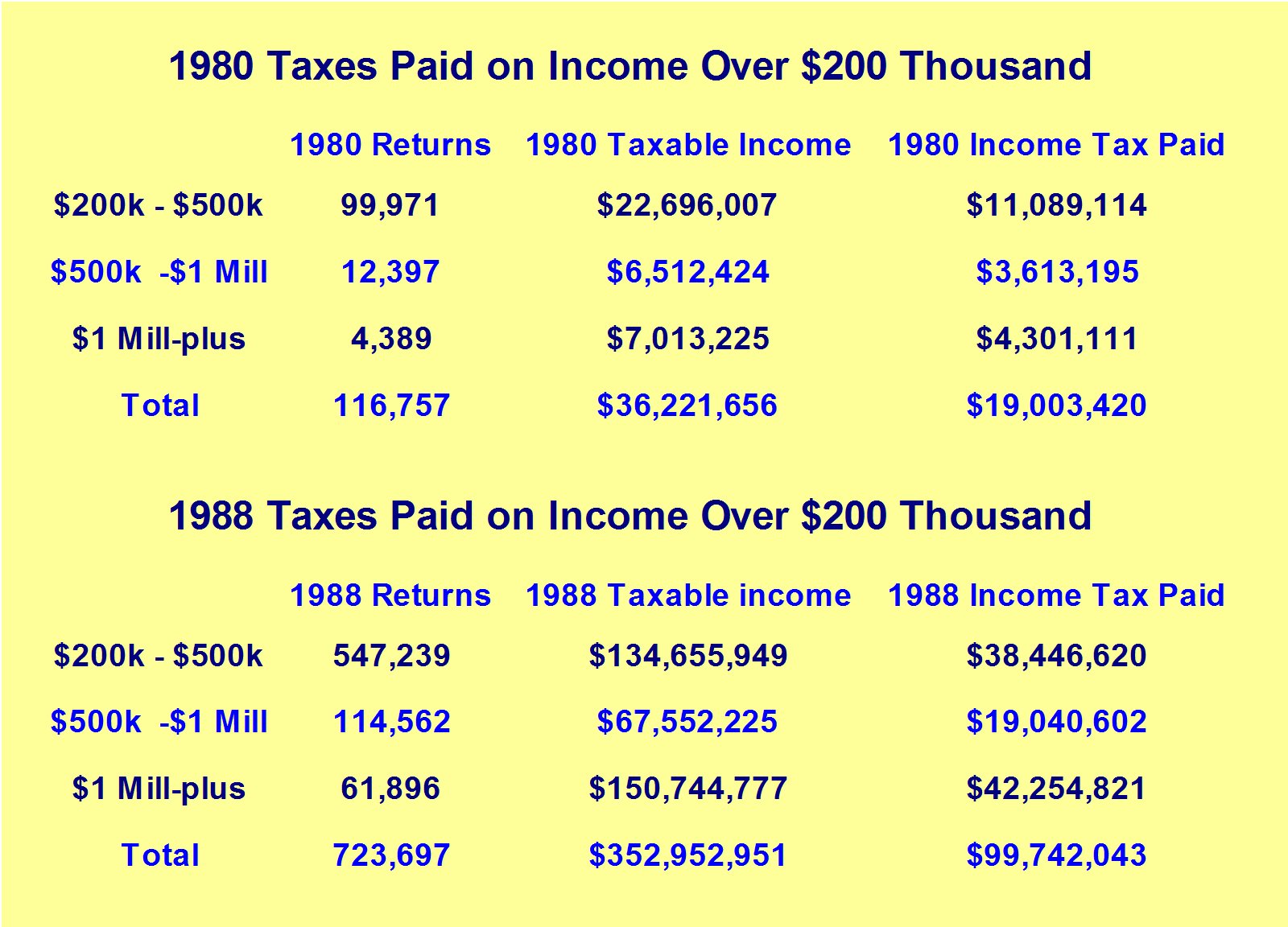
To be fair, though, some folks on the left are open to real-world evidence. And this IRS data from the 1980s is particularly effective at helping them understand the high cost of class-warfare taxation.
There’s lots of data here, but pay close attention to the columns on the right and see how much income tax was collected from the rich in 1980, when the top tax rate was 70 percent, and how much was collected from the rich in 1988, when the top tax rate was 28 percent.
The key takeaway is that the IRS collected fives times as much income tax from the rich when the tax rate was far lower. This isn’t just an example of the Laffer Curve. It’s the Laffer Curve on steroids and it’s one of those rare examples of a tax cut paying for itself.
Folks on the right, however, should be careful about over-interpreting this data. There were lots of factors that presumably helped generate these results, including inflation, population growth, and some of Reagan’s other policies. So we don’t know whether the lower tax rates on the rich caused revenues to double, triple, or quadruple. Ask five economists and you’ll get nine answers.
But we do know that the rich paid much more when the tax rate was much lower.
This is an important lesson because Obama wants to run this experiment in reverse. He hasn’t proposed to push the top tax rate up to 70 percent, thank goodness, but the combined effect of his class-warfare policies would mean a substantial increase in marginal tax rates.
To broaden the understanding of the Laffer Curve, share these three videos with your friends and colleagues.
This first video explains the theory of the Laffer Curve.
The Laffer Curve, Part I: Understanding the Theory
Uploaded on Jan 28, 2008
The Laffer Curve charts a relationship between tax rates and tax revenue. While the theory behind the Laffer Curve is widely accepted, the concept has become very controversial because politicians on both sides of the debate exaggerate. This video shows the middle ground between those who claim “all tax cuts pay for themselves” and those who claim tax policy has no impact on economic performance. This video, focusing on the theory of the Laffer Curve, is Part I of a three-part series. Part II reviews evidence of Laffer-Curve responses. Part III discusses how the revenue-estimating process in Washington can be improved. For more information please visit the Center for Freedom and Prosperity’s web site: http://www.freedomandprosperity.org
This second video reviews some of the real-world evidence.
The Laffer Curve, Part II: Reviewing the Evidence
Uploaded on Feb 24, 2008
This video reviews real-world evidence showing that changes in marginal tax rates can have a significant impact on taxable income, thus leading to substantial amounts of revenue feedback. In a few cases, tax-rate reductions even “pay for themselves,” though the key lesson is the more modest point that pro-growth changes in tax policy will have a positive impact on economic performance and that good tax cuts therefore do not “cost” the government much in terms of foregone tax revenue.
This video is second installment of a three-part series. Part I reviews theoretical relationship between tax rates, taxable income, and tax revenue. Part III discusses how the revenue-estimating process in Washington can be improved. For more information please visit the Center for Freedom and Prosperity’s web site: http://www.freedomandprosperity.org.
___________________
And this video exposes the biased an inaccurate “static scoring” of the Joint Committee on Taxation.
The Laffer Curve, Part III: Dynamic Scoring
Uploaded on May 28, 2008
A video by CF&P Foundation that builds on the discussion of theory in Part I and evidence in Part II, this concluding video in the series on the Laffer Curve explains how the Joint Committee on Taxation’s revenue-estimating process is based on the absurd theory that changes in tax policy – even dramatic reforms such as a flat tax – do not effect economic growth. In other words, the current system assumes the Laffer Curve does not exist. Because of congressional budget rules, this leads to a bias for tax increases and against tax cuts. The video explains that “static scoring” should be replaced with “dynamic scoring” so that lawmakers will have more accurate information when making decisions about tax policy. For more information please visit the Center for Freedom and Prosperity’s web site: http://www.freedomandprosperity.org.
President Obama c/o The White House 1600 Pennsylvania Avenue NW Washington, DC 20500 Dear Mr. President, I know that you receive 20,000 letters a day and that you actually read 10 of them every day. I really do respect you for trying to get a pulse on what is going on out here. The way […]
Dan Mitchell does a great job explaining the Laffer Curve President Obama c/o The White House 1600 Pennsylvania Avenue NW Washington, DC 20500 Dear Mr. President, I know that you receive 20,000 letters a day and that you actually read 10 of them every day. I really do respect you for trying to get a […]
I have put up lots of cartoons from Dan Mitchell’s blog before and they have got lots of hits before. Many of them have dealt with the economy, eternal unemployment benefits, socialism, Greece, welfare state or on gun control. Today’s cartoon deals with the Laffer curve. Revenge of the Laffer Curve…Again and Again and Again March 27, 2013 […]
Class Warfare just don’t pay it seems. Why can’t we learn from other countries’ mistakes? Class Warfare Tax Policy Causes Portugal to Crash on the Laffer Curve, but Will Obama Learn from this Mistake? December 31, 2012 by Dan Mitchell Back in mid-2010, I wrote that Portugal was going to exacerbate its fiscal problems by raising […]
The Laffer Curve – Explained Uploaded by Eddie Stannard on Nov 14, 2011 This video explains the relationship between tax rates, taxable income, and tax revenue. The key lesson is that the Laffer Curve is not an all-or-nothing proposition, where we have to choose between the exaggerated claim that “all tax cuts pay for themselves” […]
I enjoyed this article below because it demonstrates that the Laffer Curve has been working for almost 100 years now when it is put to the test in the USA. I actually got to hear Arthur Laffer speak in person in 1981 and he told us in advance what was going to happen the 1980′s […]
I got to hear Arthur Laffer speak back in 1981 and he predicted what would happen in the next few years with the Reagan tax cuts and he was right with every prediction. The Laffer Curve Wreaks Havoc in the United Kingdom July 1, 2012 by Dan Mitchell Back in 2010, I excoriated the new […]
Raising taxes will not work. Liberals act like the Laffer Curve does not exist. The Laffer Curve Shows that Tax Increases Are a Very Bad Idea – even if They Generate More Tax Revenue April 10, 2012 by Dan Mitchell The Laffer Curve is a graphical representation of the relationship between tax rates, tax revenue, and […]
(This letter was emailed to White House on 11-21-11.) President Obama c/o The White House 1600 Pennsylvania Avenue NW Washington, DC 20500 Dear Mr. President, I know that you receive 20,000 letters a day and that you actually read 10 of them every day. I really do respect you for trying to get a pulse […]
Will Rogers has a great quote that I love. He noted, “Lord, the money we do spend on Government and it’s not one bit better than the government we got for one-third the money twenty years ago”(Paula McSpadden Love, The Will Rogers Book, (1972) p. 20.) Dan Mitchell praises Calvin Coolidge for keeping the federal government small. […]
States should vote down federal spending on farm bill and return more control to states!!!!
Some say here in Arkansas that we have to do whatever it takes to support Riceland Foods, but in other states they try to protect federal government handouts to their biggest companies. We need politicians to stop looking out for just their states selfishness wants and vote for what is good for the country. It is in the best interest of all 50 states that we cut back on excessive federal spending and return more dollars to the local states for them to spend. Ronald Reagan rightly pointed out that the founding fathers favored more local control and a more limited federal government for good reason.
Congress is considering the renewal of massive agriculture subsidies that proponents characterize as a crucial “safety net” for struggling family farms. In fact, most of the taxpayer support is actually pocketed by the well-to-do, including former President Jimmy Carter, the current Secretary of the U.S. Department of Agriculture (USDA), and the families of members currently serving on the House and Senate Agriculture Committees.
Subsidies flowing to the likes of Carter, USDA Secretary Tom Vilsack, and other relatively wealthy farm owners demonstrate just how incoherent the subsidy regime has become. New legislation in both the House and the Senate would eliminate some long-standing “direct” payments, but both bills would also establish new, potentially more costly revenue and price “protections.”
Despite record-high farm income and record-low debt, farm-state politicians and agriculture lobbyists insist that taxpayers continue to forfeit their earnings to highly successful agricultural enterprises such as Carter’s Farms, Inc., of Plains, Georgia. According to government data compiled by the Environmental Working Group (EWG), the farm owned by former President Carter and his family collected $272,288 in subsidy payments from 1995 through 2012.
During that same period, Vilsack received $82,874 in USDA benefits for his 592-acre farm in Davis County, Iowa. And USDA Under Secretary Michael T. Scuse owns 20.8 percent of a farm in New Castle County, Delaware, upon which taxpayers have lavished $1,051,107 from 1995 through 2012.
There are no farms in Manhattan, but residents there have collected subsidies totaling nearly $9 million in the past seven years. Recipients also include Mark F. Rockefeller ($356,018) and David Rockefeller ($591,057). Yes, the Rockefeller family (Standard Oil, Chase Manhattan Bank, etc.).
Over on the West Coast, in Beverly Hills 90210, the estate of comedian Jack Benny has collected $18,120 for a farm in Madera County, California, while $142,933 was paid to Mary Ann Mobley (Miss America of 1959) for a farm in Madison County, Mississippi.
These examples are not exceptions but the norm. The USDA’s Economic Research Service reports that two-thirds of the farms with income exceeding $1 million annually received government payments averaging $54,745 in 2011. Meanwhile, just 27 percent of farms with income of less than $100,000 received payments—averaging just $4,420 in 2011.
The top recipient of subsidies in the EWG data base is Riceland Foods, Inc., self-described as “the world’s largest miller and marketer of rice.” It collected $554,343,039 between 1995 and 2012. According to news reports, Riceland reported sales of $1.16 billion during 2011–2012, the fifth consecutive year of billion-plus revenues for the company.
The subsidies collected by large enterprises make it more difficult for small farms to stay in business. The flow of free dollars to big farms increases demand for farmland, which, in turn, raises the price of property. Smaller players and newcomers are priced out or left to compete in niche markets.
Members of Congress and their families routinely collect subsidies as well. For example, Lynda L. Lucas, the wife of House Agriculture Committee chairman Frank Lucas (R–OK), collected $40,613 in payments for their farm in Roger Mills County, Oklahoma. (Lucas has served on the Agriculture Committee since he was first elected in 1994. He became chairman in 2011. Lynda Lucas has received four payments between 1999 and 2003, a fifth in 2007, a sixth in 2011, and a seventh in 2012.)
Likewise, the Iowa family farm of Senator Charles Grassley (R–IA) has collected $955,192 in taxpayer subsidies from 1995 through 2012. (Grassley served on the Agriculture Committee since 1992. The Grassley farm has received payments each year from 1995 to 2012, according to the EWG.)
The payments have proved irresistible even to environmental groups that openly criticize the impact of subsidies on land use. For example, the Nature Conservancy accumulated a whopping $4,795,786 from 1995 through 2012 despite its own findings that such payments promote the conversion of natural habitat to cropland—threatening wildlife in the process. The National Audubon Society collected $932,801 from 1995 through 2012, according to the EWG.
Serious reform is obviously needed, and the time for an overhaul is ripe. The USDA forecasts that net farm income will reach $128.2 billion this year, the highest level in four decades. At the same time, farmers’ debt levels have dropped to historic lows. This means agriculture is well insulated against the risks associated with commodity production, including adverse weather and economic fluctuations.
There are a host of nongovernmental methods with which farmers can manage risk, including futures contracts and hedging, crop diversification, credit reserves, and private insurance. Given the enormous burdens already shouldered by taxpayers, there is no justification for robbing millions of middle-class Peters to subsidize Jimmy, Tom, David, and all the other hugely successful owners of farmland.
Congress needs to remove subsidies from the farm bill, not expand them Farm Bill Wastes More Taxpayer Money on Green Subsidies Nicolas Loris May 13, 2013 at 11:27 am Design Pics / Dave Reede/Dave Reede/Newscom Slapping the word rural in front of a bunch of green subsidies does not mean they’re not subsidies. But that’s […]
If the increase in food stamps was just because of the recession then why did the spending go from $19.8 billion in 2000 to $37.9 billion in 2007? The Facts about Food Stamps Everyone Should Hear Rachel Sheffield and T. Elliot Gaiser May 27, 2013 at 12:00 pm (7) Newscom A recent US News & […]
The sad fact is that Food stamp spending has doubled under the Obama Administration. A Bumper Crop of Food Stamps Amy Payne May 21, 2013 at 7:01 am Tweet this Where do food stamps come from? They come from taxpayers—certainly not from family farms. Yet the “farm” bill, a recurring subsidy-fest in Congress, is actually […]
Agriculture: Downsizing The Federal Government Uploaded on Dec 19, 2008 Agriculture is easily the most distorted sector, with high tariffs and, in developed countries at least, large amounts of government subsidies through price supports and direct payments. On the other hand, developing countries, who have a comparative advantage in these products, cannot afford to subsidize […]
I am glad that my state of Arkansas is not the leader in food stamps!!! Mirror, Mirror, on the Wall, Which State Has the Highest Food Stamp Usage of All? March 19, 2013 by Dan Mitchell The food stamp program seems to be a breeding ground of waste, fraud, and abuse. Some of the horror stories […]
Government Must Cut Spending Uploaded by HeritageFoundation on Dec 2, 2010 The government can cut roughly $343 billion from the federal budget and they can do so immediately. __________ President Obama c/o The White House 1600 Pennsylvania Avenue NW Washington, DC 20500 Dear Mr. President, I know that you receive 20,000 letters a day […]
_________________ President Ronald Reagan wisely said: “The federal government has taken too much tax money from the people, too much authority from the states, and too much liberty with the Constitution.” You would think that the Republicans who talk so much of cutting spending would try to get a plan that cuts spending 3 […]
I recently wrote an open letter to Congressman Rick Crawford and I put it on his facebook page. I personally do not have a facebook page so I used my son Wilson’s facebook page and here is what Congressman Crawford said: Wilson- I agree with you that we have a spending problem and not […]
Raising taxes on rich does not come close to balancing the budget!!!! Why do you keep acting like it would? The Laffer Curve proves that raising the tax rates on the rich does not mean will see higher revenues from that group but the revenues may even go down.
Dennis Van Roekel, president of the largest teachers union, the National Education Association, failed fifth-grade math last week. The question he failed is: If X (government spending) is growing faster than A (government tax revenue) plus B (new revenue from higher tax rates on “the rich”), when will A plus B equal X?
President Obama met with leaders of left-leaning organizations, including Mr. Van Roekel, to discuss the “fiscal cliff.” After the meeting, Mr. Van Roekel appeared on Neil Cavuto’s Fox News show to discuss the budget deficit. Mr. Van Roekel told Mr. Cavuto that he had recommended taxing the top 2 percent more to deal with the problem. Mr. Cavuto then correctly explained that taxing the top 2 percent could not solve the problem because even with the increase, spending would still be growing far faster than revenues — primarily because of entitlement programs. After some back and forth, Mr. Van Roekel could not identify one item in the budget that he was in favor of cutting and kept insisting the problem could be solved only by taxing the top 2 percent, even though Mr. Cavuto again correctly and clearly explained that even taxing the top 2 percent at a 100 percent rate would not produce enough revenue because entitlements are growing faster than the economy. Mr. Van Roekel appeared to be unable to grasp this rather simple concept.
At the end of last week, Hostess Brands Inc., the company that makes Twinkies and Wonder Bread, asked to be liquidated because the bakery workers and their union bosses could not understand this: If A (workers’ salaries and benefits) is growing faster than B (sales revenue), company H (Hostess) will run out of money and be forced into liquidation. So 18,500 workers are losing their jobs because a bunch of union bosses and many of the workers could not understand elementary school math. (Perhaps their teachers were members of the NEA. Note: There are many fine teachers who are not responsible for the folks who run the NEA, and many fine voters who are not responsible for the actions of our elected officials.)
Richard W. Rahn is a senior fellow at the Cato Institute and chairman of the Institute for Global Economic Growth.
When you first study physics and economics, you learn the difference between constants and variables. You also learn there are very few constants — the speed of light being one. Most everything is a variable, in that most everything is affected by other things or actions. A majority of the leaders and voters in California seem to have missed this basic lesson. They voted for a whole host of new taxes, including increasing the state’s income tax to more than 13 percent. For most of these tax increases, the political leaders made the assumption that people will stay put and pay these taxes — hence, big revenue gains. But how likely is this? Gov. Jerry Brown has, in effect, said that state personal income is a constant rather than a variable. If you multiply a higher tax rate by a constant income you get a bigger number and — voila — more tax revenue. However, state personal income is variable, which Mr. Brown will learn in a painful way. People can move either their personal or economic activity to another state, another country or even cease working in the above-ground economy. California will continue to lose economic market share and its budget problems will only get worse.
Many people (including a few left-wing economists who let their ideology overwhelm their knowledge of math) are arguing that, if taxes are raised on those making more than $250,000 a year, there will be no adverse effects. What theory or empirical evidence supports their assertions?
Most economists refer to themselves as Keynesian, monetarist, classical or Austrian — at least in part. None of these theories advocates increasing tax rates, particularly on labor and capital, during periods of economic stagnation, such as the United States is now experiencing. There is also no empirical evidence to show that a program of increasing the highest marginal tax rates and increasing entitlement spending leads to higher economic growth and employment. Look at what is happening to France, where the high tax-and-spend experiment is well ahead of ours. The laws of supply and demand have not been repealed. If you tax something you will get less of it, and if you subsidize something you will get more of it. If you increase the tax on labor and capital, you will get less — and economic growth requires more labor and capital, not less.
Mr. Obama said last week that he was not going to accept “dynamic scoring” (adjusting the projections to reflect changes in behavior resulting from the tax rate change) in evaluating the Republicans’ tax revenue projections. Thus, he is going to assume that the tax base is a constant rather than a variable. The president and his staff apparently fail to comprehend secondary effects of tax changes, or they are allowing leftist ideology to trump reality. Either way, it is a loss for the American people.
__________-
Thank you so much for your time. I know how valuable it is. I also appreciate the fine family that you have and your commitment as a father and a husband.Sincerely,Everette Hatcher III, 13900 Cottontail Lane, Alexander, AR 72002, ph 501-920-5733, lowcostsqueegees@yahoo.com
If you take a group of Democrats who are also unionized government employees, and put them in charge of policing political speech, it doesn’t matter how professional and well-intentioned they are. The result will be much like the debacle in the Cincinnati office of the IRS. …there’s no reason to even posit evil intent by the IRS officials who formulated, approved or executed the inappropriate guidelines for picking groups to scrutinize most closely. …The public servants figuring out which groups qualified for 501(c)4 “social welfare” non-profit status were mostly Democrats surrounded by mostly Democrats. …In the 2012 election, every donation traceable to this office went to President Obama or liberal Sen. Sherrod Brown. This is an environment where even those trying to be fair could develop a disproportionate distrust of the Tea Party. One IRS worker — a member of NTEU and contributor to its PAC, which gives 96 percent of its money to Democratic candidates — explained it this way: “The reason NTEU mostly supports Democratic candidates for office is because Democratic candidates are mostly more supportive of civil servants/government employees.”
Tim concludes with a wise observation.
As long as we have a civil service workforce that leans Left, and as long as we have an income tax system that requires the IRS to police political speech, conservative groups can always expect special IRS scrutiny.
The real issue is the expansive, expensive bureaucratic state and its inherent threat to any system of limited government, rule of law, and individual liberty. …the broader the government’s authority, the greater its need for revenue, the wider its enforcement power, the more expansive the bureaucracy’s discretion, the increasingly important the battle for political control, and the more bitter the partisan fight, the more likely government officials will abuse their positions, violate rules, laws, and Constitution, and sacrifice people’s liberties. The blame falls squarely on Congress, not the IRS.
…the denizens of Capitol Hill also have created a tax code marked by outrageous complexity, special interest electioneering, and systematic social engineering. Legislators have intentionally created avenues for tax avoidance to win votes, and then complained about widespread tax avoidance to win votes.
So what’s the answer?
The most obvious response to the scandal — beyond punishing anyone who violated the law — is tax reform. Implement a flat tax and you’d still have an IRS, but the income tax would be less complex, there would be fewer “preferences” for the agency to police, and rates would be lower, leaving taxpayers with less incentive for aggressive tax avoidance. …Failing to address the broader underlying factors also would merely set the stage for a repeat performance in some form a few years hence. …More fundamentally, government, and especially the national government, should do less. Efficient social engineering may be slightly better than inefficient social engineering, but no social engineering would be far better.
But here’s the challenge. We know the solution, but it will be almost impossible to implement good policy unless we figure out some way to restrain the spending side of the fiscal ledger.
___________________________
At the risk of over-simplifying, we will never get tax reform unless we figure out how to implement entitlement reform.
Here’s another Foden cartoon, which I like because it has the same theme asthis Jerry Holbert cartoon, showing big government as a destructive and malicious force.
We know the IRS commissioner wasn’t telling the truth in March 2012, when he testified: “There’s absolutely no targeting.”However, Lois Lerner knew different when she misled people with those words. Two important points made by Noonan in the Wall Street Journal in the article below: First, only conservative groups were targeted in this scandal by […]
Ohio Liberty Coalition versus the I.R.S. (Tom Zawistowski) Published on May 20, 2013 The Ohio Liberty Coalition was among tea party groups that received special scrutiny from the I.R.S. Tom Zawistowski says his story is not unique. He argues the kinds of questions the I.R.S. asked his group amounts to little more than “opposition research.” Video […]
Francis Schaeffer: “Whatever Happened to the Human Race?” (Episode 2) SLAUGHTER OF THE INNOCENTS Published on Oct 6, 2012 by AdamMetropolis The 45 minute video above is from the film series created from Francis Schaeffer’s book “Whatever Happened to the Human Race?” with Dr. C. Everett Koop. This book really helped develop my political views concerning […]
We got to lower the size of government so we don’t have these abuses like this in the IRS. Cartoonists v. the IRS May 23, 2013 by Dan Mitchell Call me perverse, but I’m enjoying this IRS scandal. It’s good to see them suffer a tiny fraction of the agony they impose on the American people. I’ve already […]
Dear Senator Pryor, Why not pass the Balanced Budget Amendment? As you know that federal deficit is at all time high (1.6 trillion deficit with revenues of 2.2 trillion and spending at 3.8 trillion). On my blog http://www.HaltingArkansasLiberalswithTruth.com I took you at your word and sent you over 100 emails with specific spending cut ideas. However, […]
Is the irs out of control? Here is the link from cato: MAY 22, 2013 8:47AM Can You Vague That Up for Me? By TREVOR BURRUS SHARE As the IRS scandal thickens, targeted groups are coming out to describe their ordeals in dealing with that most-reviled of government agencies. The Ohio Liberty Coalition was one of […]
Get Ready to Be Reamed May 17, 2013 by Dan Mitchell With so many scandals percolating, there are lots of good cartoons being produced. But I think this Chip Bok gem deserves special praise. It manages to weave together both the costly Obamacare boondoggle with the reprehensible politicization of the IRS. So BOHICA, my friends. If […]
You want to talk about irony then look at President Obama’s speech a few days ago when he joked about a potential audit of Ohio St by the IRS then a few days later the IRS scandal breaks!!!! The I.R.S. Abusing Americans Is Nothing New Published on May 15, 2013 The I.R.S. targeting of tea party […]
Dear Senator Pryor, Why not pass the Balanced Budget Amendment? As you know that federal deficit is at all time high (1.6 trillion deficit with revenues of 2.2 trillion and spending at 3.8 trillion). On my blog http://www.HaltingArkansasLiberalswithTruth.com I took you at your word and sent you over 100 emails with specific spending cut ideas. However, […]
We could put in a flat tax and it would enable us to cut billions out of the IRS budget!!!! May 14, 2013 2:34PM IRS Budget Soars By Chris Edwards Share The revelations of IRS officials targeting conservative and libertarian groups suggest that now is a good time for lawmakers to review a broad range […]
Will Rogers has a great quote that I love. He noted, “Lord, the money we do spend on Government and it’s not one bit better than the government we got for one-third the money twenty years ago”(Paula McSpadden Love,The Will Rogers Book,(1972) p. 20.) Dan Mitchell praises Calvin Coolidge for keeping the federal government small.
I also got to provide some commentary on the book and the lessons that we can learn from the Coolidge era.
I managed to talk for more than 15 minutes, but I could have boiled my remarks down to these two points.
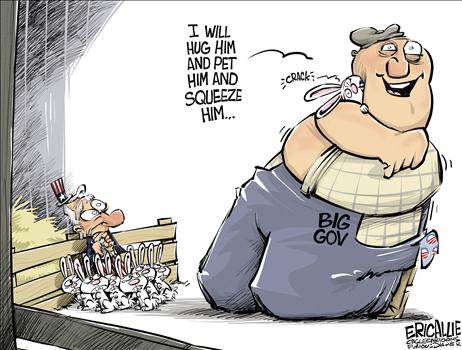
Small government is the best way to achieve competent and effective government. Coolidge and his team were able to monitor government and run it efficiently because the federal budget consumed only about 5 percent of GDP. But when the federal budget is 23 percent of GDP, by contrast, it’s much more difficult to keep tabs on what’s happening – particularly when the federal government operates more than 1,000 programs. Even well-intentioned bureaucrats and politicians are unlikely to do a good job, as illustrated by this Eric Allie cartoon.
Higher tax rates don’t automatically lead to more tax revenue. Coolidge and his Treasury Secretary practiced something called “scientific taxation,” but it’s easier just to call it common sense. Since Amity’s book covered the data from the 1920s, I shared with the audience some amazing data from the 1980s showing that lower tax rates on the “rich” led to big revenue increases.
President Obama c/o The White House 1600 Pennsylvania Avenue NW Washington, DC 20500 Dear Mr. President, I know that you receive 20,000 letters a day and that you actually read 10 of them every day. I really do respect you for trying to get a pulse on what is going on out here. The way […]
Dan Mitchell does a great job explaining the Laffer Curve President Obama c/o The White House 1600 Pennsylvania Avenue NW Washington, DC 20500 Dear Mr. President, I know that you receive 20,000 letters a day and that you actually read 10 of them every day. I really do respect you for trying to get a […]
I have put up lots of cartoons from Dan Mitchell’s blog before and they have got lots of hits before. Many of them have dealt with the economy, eternal unemployment benefits, socialism, Greece, welfare state or on gun control. Today’s cartoon deals with the Laffer curve. Revenge of the Laffer Curve…Again and Again and Again March 27, 2013 […]
Class Warfare just don’t pay it seems. Why can’t we learn from other countries’ mistakes? Class Warfare Tax Policy Causes Portugal to Crash on the Laffer Curve, but Will Obama Learn from this Mistake? December 31, 2012 by Dan Mitchell Back in mid-2010, I wrote that Portugal was going to exacerbate its fiscal problems by raising […]
The Laffer Curve – Explained Uploaded by Eddie Stannard on Nov 14, 2011 This video explains the relationship between tax rates, taxable income, and tax revenue. The key lesson is that the Laffer Curve is not an all-or-nothing proposition, where we have to choose between the exaggerated claim that “all tax cuts pay for themselves” […]
I enjoyed this article below because it demonstrates that the Laffer Curve has been working for almost 100 years now when it is put to the test in the USA. I actually got to hear Arthur Laffer speak in person in 1981 and he told us in advance what was going to happen the 1980′s […]
I got to hear Arthur Laffer speak back in 1981 and he predicted what would happen in the next few years with the Reagan tax cuts and he was right with every prediction. The Laffer Curve Wreaks Havoc in the United Kingdom July 1, 2012 by Dan Mitchell Back in 2010, I excoriated the new […]
Raising taxes will not work. Liberals act like the Laffer Curve does not exist. The Laffer Curve Shows that Tax Increases Are a Very Bad Idea – even if They Generate More Tax Revenue April 10, 2012 by Dan Mitchell The Laffer Curve is a graphical representation of the relationship between tax rates, tax revenue, and […]
I have blogged about Dr. Kevorkian many times in the past and today I have included another post about him. Most of the articles dealt with moral issues and included the works of Dr. C. Everett Koop and Francis Schaeffer and the film series “Whatever happened to the Human Race?” However, I have mentioned in […]
Ronald Reagan wanted to return more power to the states and that is what the Founding Fathers had in mine too. Here is just one example below where the federal government can cut out a lot of waste by returning disaster relief responsibilities back to the states. Instead, today we have politicians like Senator Mark […]
Ohio Liberty Coalition versus the I.R.S. (Tom Zawistowski)
Published on May 20, 2013
The Ohio Liberty Coalition was among tea party groups that received special scrutiny from the I.R.S. Tom Zawistowski says his story is not unique. He argues the kinds of questions the I.R.S. asked his group amounts to little more than “opposition research.”
Video produced by Caleb O. Brown and Austin Bragg.
_______________
A great cartoonist takes on the IRS!!!! Why do people in the IRS think they could take the 5th when the IRS would not be happy with that answer from a taxpayer?
Notwithstanding the title of this post, this is not a story about a taxpayer fighting against the IRS. If you want that kind of story (and if you have a strong stomach), you can read about how an IRS thug named Robert Norlander tried to ruin the life of a guy named Charlie Engle.
Or, on a lighter note, you can read about Evan Mathis and his “encounter” with the IRS. But that’s not today’s topic either.
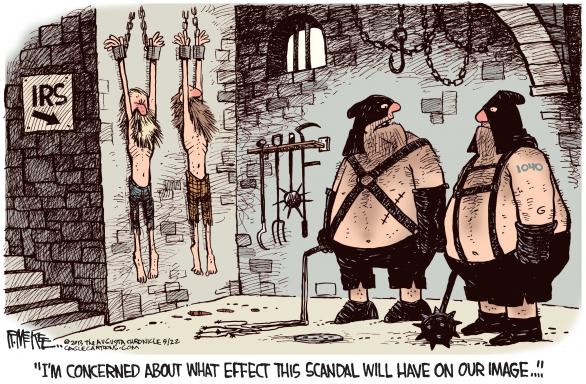
As you can see from these cartoons, I’m very happy to be introduced to Jim McKee, particularly since he’s generating some great material about the IRS scandal. Let’s start with a cartoon he produced that calls attention to the fact that an IRS hack pleaded the fifth even though taxpayers don’t have similar rights when confronted by tax collectors.
By the way, the IRS actually is concerned about its image. This is the bureaucracy, after all, that decided to squander $15 million of our money on a PR campaign.
Anyhow, McKee has given us some very amusing cartoons. But let’s not lose sight of the fact that we have a terrible tax code, which is enforced by some terrible people.
The politicians deserve most of the blame, but you can see from these examples that the IRS bureaucracy deserves scorn.
We got to lower the size of government so we don’t have these abuses like this in the IRS. Cartoonists v. the IRS May 23, 2013 by Dan Mitchell Call me perverse, but I’m enjoying this IRS scandal. It’s good to see them suffer a tiny fraction of the agony they impose on the American people. I’ve already […]
Dear Senator Pryor, Why not pass the Balanced Budget Amendment? As you know that federal deficit is at all time high (1.6 trillion deficit with revenues of 2.2 trillion and spending at 3.8 trillion). On my bloghttp://www.HaltingArkansasLiberalswithTruth.com Itook you at your word and sent you over 100 emails with specific spending cut ideas. However, […]
Is the irs out of control? Here is the link from cato: MAY 22, 2013 8:47AM Can You Vague That Up for Me? By TREVOR BURRUS SHARE As the IRS scandal thickens, targeted groups are coming out to describe their ordeals in dealing with that most-reviled of government agencies. The Ohio Liberty Coalition was one of […]
Get Ready to Be Reamed May 17, 2013 by Dan Mitchell With so many scandals percolating, there are lots of good cartoons being produced. But I think this Chip Bok gem deserves special praise. It manages to weave together both the costly Obamacare boondoggle with the reprehensible politicization of the IRS. So BOHICA, my friends. If […]
You want to talk about irony then look at President Obama’s speech a few days ago when he joked about a potential audit of Ohio St by the IRS then a few days later the IRS scandal breaks!!!! The I.R.S. Abusing Americans Is Nothing New Published on May 15, 2013 The I.R.S. targeting of tea party […]
Dear Senator Pryor, Why not pass the Balanced Budget Amendment? As you know that federal deficit is at all time high (1.6 trillion deficit with revenues of 2.2 trillion and spending at 3.8 trillion). On my bloghttp://www.HaltingArkansasLiberalswithTruth.com Itook you at your word and sent you over 100 emails with specific spending cut ideas. However, […]
We could put in a flat tax and it would enable us to cut billions out of the IRS budget!!!! May 14, 2013 2:34PM IRS Budget Soars By Chris Edwards Share The revelations of IRS officials targeting conservative and libertarian groups suggest that now is a good time for lawmakers to review a broad range […]
The IRS has thuggish employees and the President was right to condemn their latest actions. Let’s Thank President Obama for Reminding Americans that They Should Distrust the IRS May 14, 2013 by Dan Mitchell Last week, while writing about the latest IRS scandal, I noted that the IRS has a long record of abusive actions. It has thieving employees. […]

 The author the chart, Veronique de Rugy of the Mercatus Center, calls this “private sector austerity” and she correctly argues that her home continent is in desperate need of some austerity on the public sector instead.










 The Daily Hatch