Category Archives: spending out of control

Open letter to President Obama (Part 260)

Published on Sep 3, 2012 by

Obama is citing his bailout of General Motors as proof that other industries should receive bailouts. Is Obama adopting the central planning principles of Joseph Stalin? Find out as Terry Jones of IBD and Doug Altner of the Ayn Rand Center discuss industrial policy and Obama’s plans for American industry.

_______________


President Obama c/o The White House
1600 Pennsylvania Avenue NW
Washington, DC 20500

Dear Mr. President,

I know that you receive 20,000 letters a day and that you actually read 10 of them every day. I really do respect you for trying to get a pulse on what is going on out here.

The federal government needs to get out of the way it seems when it comes to making cars. No one can do any worse in my view.

While I often complain about government waste and stupidity, I’m not even sure what to say about this grim bit of news from Reuters.

General Motors Co sold a record number of Chevrolet Volt sedans in August — but that probably isn’t a good thing for the automaker’s bottom line. Nearly two years after the introduction of the path-breaking plug-in hybrid, GM is still losing as much as $49,000 on each Volt it builds, according to estimates provided to Reuters by industry analysts and manufacturing experts. Cheap Volt lease offers meant to drive more customers to Chevy showrooms this summer may have pushed that loss even higher. There are some Americans paying just $5,050 to drive around for two years in a vehicle that cost as much as $89,000 to produce. …The weak sales are forcing GM to idle the Detroit-Hamtramck assembly plant that makes the Chevrolet Volt for four weeks from September 17, according to plant suppliers and union sources. It is the second time GM has had to call a Volt production halt this year. GM acknowledges the Volt continues to lose money, and suggests it might not reach break even until the next-generation model is launched in about three years.

Gee, it’s almost as if everything that critics have said all along is right.

But not to worry, taxpayers are underwriting the costs. So if bigger subsidies are the price of buying support from the UAW and allowing fat-cat incompetent managers to stay on the job, that just means a bigger tab to pay for the rest of us.

How comforting.

P.S. If you’re a taxpayer and need to be cheered up, these cartoons may help.

P.P.S. This spoof video on the Volt may be even funnier.

P.P.P.S. Last but not least, Government Motors plans to build on the success of the Volt with the Obummer. It was due in 2011, but standard government incompetence has pushed back the release date.

____________

Thank you so much for your time. I know how valuable it is. I also appreciate the fine family that you have and your commitment as a father and a husband.

Sincerely,

Everette Hatcher III, 13900 Cottontail Lane, Alexander, AR 72002, ph 501-920-5733, lowcostsqueegees@yahoo.com

_______

Open letter to President Obama (Part 259)

Spending Restraint, Part I: Lessons from Ronald Reagan and Bill Clinton

Uploaded by on Feb 14, 2011

Ronald Reagan and Bill Clinton both reduced the relative burden of government, largely because they were able to restrain the growth of domestic spending. The mini-documentary from the Center for Freedom and Prosperity uses data from the Historical Tables of the Budget to show how Reagan and Clinton succeeded and compares their record to the fiscal profligacy of the Bush-Obama years.

____________


President Obama c/o The White House
1600 Pennsylvania Avenue NW
Washington, DC 20500

Dear Mr. President,

I know that you receive 20,000 letters a day and that you actually read 10 of them every day. I really do respect you for trying to get a pulse on what is going on out here.

Why is it that so many times when Washington runs out of money they instantly think they need to get more from the taxpayers. Did you know that the federal government ran on about 3% of GDP in taxes the first 150 years it existed (excluding wartimes). Maybe the real problem is controlling government spending since we are giving the federal government much more than 3% of our GDP in taxes and they are currently spending about 24% of our GDP in federal dollars every year and running us into debt.

On 9-18-12 I noted on the Arkansaas Times Blog:

The federal government has how much money? Negative 16 trillion I believe. How can they pay for all our medical needs in the future without turning everything around on us at the state level? I guess liberals are the only ones dumb enough to believe Obama’s empty promises. He took over when there was a federal debt of around 10 trillion and now it is over 16 trillion. I guess we could do even better if we gave him his Obamacare and re-elected him. The only alternative is to elect a Republican House and Senate and President and kill Obamacare. I sure that sounds heartless to the liberals. Everything is working so good right now why change course.

Couldn’t be better responded with a good point,  “Interesting, Saline, that Republicans ran up that $10 trillion in the national debt during good times when they should have been paying it down or totally writing it off.”

I totally agree that Republicans have also had a lot to do with running up the debt. They have got us into wars that we have not budgeted for and we continue to pay for Japan and Germany’s defenses when they are wealthy enough to do it on their own.

However, what is the answer to getting us out of this budget mess? Is raising taxes the answer? Let’s see what the Clinton Administration had to say about that. Below is the last portion of an article by Dan Mitchell of the Cato Institute:

Debunking Myth after Myth in Financial Times Column by Former Clinton White House Economist
September 18, 2012 by Dan Mitchell

Even though I have remarked on many occasions that the burden of government was reduced during the Clinton years, that doesn’t mean Bill Clinton was in favor of smaller government. And it definitely doesn’t mean that his appointees believed in economic liberty.

Consider the case of Laura Tyson, who served as Chair of Clinton’s Council of Economic Advisers. She recently penned a column for the UK-based Financial Times that is riddled with disingenuous assertions.

Even though it deserves to be ignored, I can’t resist the temptation to make corrections.

Tyson myth:

The US economy needs efficient and progressive tax reform and it needs more revenues for deficit reduction. Revenue increases have been a significant component of all major deficit-reduction packages enacted over the past 30 years.

Factual correction:

This is remarkable. I assume Ms. Tyson reads the New York Times, so perhaps she overlooked or deliberate forgot the column that inadvertently revealed that the only successful deficit-reduction package in recent memory was the one that cut taxes instead of raising them.

Interestingly, that successful package was implemented during the Clinton years, but only after she left office.

During Tyson’s tenure at CEA, we did get a tax increase rather than a tax cut. But the Clinton Administration admitted 18 months later that the tax hike was a failure and was not going to balance the budget.

Yet she wants to push the same failed class-warfare tax policy today.

_________

Thank you so much for your time. I know how valuable it is. I also appreciate the fine family that you have and your commitment as a father and a husband.

Sincerely,

Everette Hatcher III, 13900 Cottontail Lane, Alexander, AR 72002, ph 501-920-5733, lowcostsqueegees@yahoo.com

_______

Spending Restraint, Part II: Lessons from Canada, Ireland, Slovakia, and New Zealand

Uploaded by on Feb 22, 2011

Nations can make remarkable fiscal progress if policy makers simply limit the growth of government spending. This video, which is Part II of a series, uses examples from recent history in Canada, Ireland, Slovakia, and New Zealand to demonstrate how it is possible to achieve rapid improvements in fiscal policy by restraining the burden of government spending. Part I of the series examined how Ronald Reagan and Bill Clinton were successful in controlling government outlays — particularly the burden of domestic spending programs. http://www.freedomandprosperity.org

Sequester Cartoons from Dan Mitchell’s blog Part 4

I have put up lots of cartoons from Dan Mitchell’s blog before and they have got lots of hits before. Many of them have dealt with the economy, eternal unemployment benefits, socialism,  Greece,  welfare state or on gun control.

These sequester cartoons from Dan Mitchell’s blog have been great but today he has about 4 cartoons that are much more funny than the past ones. Obama’s scare tactics make for real funny cartoons.

Public finance experts are quite familiar with the budgetary shenanigans of cossetted government bureaucracies.

They even have terms to describe how agencies and departments try to manipulate outcomes by claiming that any requirement for fiscal restraint will necessitate cuts to the most politically popular parts of the budget.

  • The “fireman first principle” – Describes how local government bodies (often coordinating with local politicians) will claim that firemen will have to be laid off and/or firehouses will have to close if there is any budgetary discipline. You can replace firefighters with cops or teachers if you want. The key point is to divert attention from the countless ways that local governments waste money by focusing on the few things that voters actually care about.
  • The “Washington Monument syndrome” – Based on a real-world example during the 1970s of the National Park Service claiming it would have to shut down tourist access to popular Washington-area sites if it was subject to fiscal restraint, the modern-day equivalent is President Obama scaring people with hysterical assertions about threats to food safety and airline operations.

Thomas Sowell clearly understands this racket.

Back in my teaching days, many years ago, one of the things I liked to ask the class to consider was this: Imagine a government agency with only two tasks: (1) building statues of Benedict Arnold and (2) providing life-saving medications to children. If this agency’s budget were cut, what would it do? The answer, of course, is that it would cut back on the medications for children. Why? Because that would be what was most likely to get the budget cuts restored. If they cut back on building statues of Benedict Arnold, people might ask why they were building statues of Benedict Arnold in the first place.

Bingo. Bulls-eye. A perfect analysis of bureaucratic incentives and public-choice economics.

Sowell then describes what’s now happening in Washington.

The Obama administration is following the same pattern. The Department of Homeland Security, for example, released thousands of illegal aliens from prisons to save money — and create alarm. The Federal Aviation Administration says it is planning to cut back on the number of air traffic controllers, which would, at a minimum, create delays for airline passengers, in addition to fears for safety that can create more public alarm. …it serves Obama’s interest to maximize the damage and the public alarm, which he can direct against Republicans. President Obama has said that he would veto legislation to let him choose what to cut. That should tell us everything we need to know about the utter cynicism of this glib man.

The political cartoonists also are having a field day making fun of Obama’s silly demagoguery.

Let’s start with Michael Ramirez. You can see why he’s currently leading in the best-cartoonist poll.

Sequester Cartoon Ramirez 4

Nate Beeler also has a good contribution to the debate. The President is acting like the world is going to end because spending is going to be “slashed” by 1.2 percent, which means – gasp! – that spending will “only” grow by $2.4 trillion over the next 10 years.

Yet somehow Armageddon has not occurred.

Sequester Cartoon Beeler 4

Indeed, the worst possible outcome for Obama and the other statists is that people notice zero negative impact when spending is restrained.

This Steve Kelley cartoon is very appealing to me because it shows the President going after the sequester when the real problem is an excessive burden of government spending.

Sequester Cartoon Kelley 4

Last but not least, we have a very good Scott Stantis cartoon.

Sequester Cartoon Stantis 4

The Stantis cartoon is particularly insightful because the GOP has won the battle, but the war is not over.

As I noted yesterday, Obama will have several additional opportunities to undo the sequester savings.

Thomas Jefferson was right when he warned that “eternal vigilance is the price of liberty.”

P.S. You can enjoy more sequester cartoons here, here, and here.


Related posts:

Cartoons from Dan Mitchell’s blog that demonstrate what Obama is doing to our economy Part 2

Max Brantley is wrong about Tom Cotton’s accusation concerning the rise of welfare spending under President Obama. Actually welfare spending has been increasing for the last 12 years and Obama did nothing during his first four years to slow down the rate of increase of welfare spending. Rachel Sheffield of the Heritage Foundation has noted: […]

Cartoons from Dan Mitchell’s blog that demonstrate what Obama is doing to our economy Part 1

  I have put up lots of cartoons from Dan Mitchell’s blog before and they have got lots of hits before. Many of them have dealt with the economy, eternal unemployment benefits, socialism,  Greece,  welfare state or on gun control. I think Max Brantley of the Arkansas Times Blog was right to point out on 2-6-13 that Hillary […]

Great cartoon from Dan Mitchell’s blog on government moochers

I thought it was great when the Republican Congress and Bill Clinton put in welfare reform but now that has been done away with and no one has to work anymore it seems. In fact, over 40% of the USA is now on the government dole. What is going to happen when that figure gets over […]

Gun Control cartoon hits the internet

Again we have another shooting and the gun control bloggers are out again calling for more laws. I have written about this subject below  and on May 23, 2012, I even got a letter back from President Obama on the subject. Now some very interesting statistics below and a cartoon follows. (Since this just hit the […]

“You-Didn’t-Build-That” comment pictured in cartoons!!!

watch?v=llQUrko0Gqw] The federal government spends about 10% on roads and public goods but with the other money in the budget a lot of harm is done including excessive regulations on business. That makes Obama’s comment the other day look very silly. A Funny Look at Obama’s You-Didn’t-Build-That Comment July 28, 2012 by Dan Mitchell I made […]

Cartoons about Obama’s class warfare

I have written a lot about this in the past and sometimes you just have to sit back and laugh. Laughing at Obama’s Bumbling Class Warfare Agenda July 13, 2012 by Dan Mitchell We know that President Obama’s class-warfare agenda is bad economic policy. We know high tax rates undermine competitiveness. And we know tax increases […]

Cartoons on Obama’s budget math

Dan Mitchell Discussing Dishonest Budget Numbers with John Stossel Uploaded by danmitchellcato on Feb 11, 2012 No description available. ______________ Dan Mitchell of the Cato Institute has shown before how excessive spending at the federal level has increased in recent years. A Humorous Look at Obama’s Screwy Budget Math May 31, 2012 by Dan Mitchell I’ve […]

Funny cartoon from Dan Mitchell’s blog on Greece

Sometimes it is so crazy that you just have to laugh a little. The European Mess, Captured by a Cartoon June 22, 2012 by Dan Mitchell The self-inflicted economic crisis in Europe has generated some good humor, as you can see from these cartoons by Michael Ramirez and Chuck Asay. But for pure laughter, I don’t […]

Obama on creating jobs!!!!(Funny Cartoon)

Another great cartoon on President Obama’s efforts to create jobs!!! A Simple Lesson about Job Creation for Barack Obama December 7, 2011 by Dan Mitchell Even though leftist economists such as Paul Krugman and Larry Summers have admitted that unemployment insurance benefits are a recipe for more joblessness, the White House is arguing that Congress should […]

Get people off of government support and get them in the private market place!!!!(great cartoon too)

Dan Mitchell hits the nail on the head and sometimes it gets so sad that you just have to laugh at it like Conan does. In order to correct this mess we got to get people off of government support and get them in the private market place!!!! Chuck Asay’s New Cartoon Nicely Captures Mentality […]

2 cartoons illustrate the fate of socialism from the Cato Institute

Cato Institute scholar Dan Mitchell is right about Greece and the fate of socialism: Two Pictures that Perfectly Capture the Rise and Fall of the Welfare State July 15, 2011 by Dan Mitchell In my speeches, especially when talking about the fiscal crisis in Europe (or the future fiscal crisis in America), I often warn that […]

Cartoon demonstrates that guns deter criminals

John Stossel report “Myth: Gun Control Reduces Crime Sheriff Tommy Robinson tried what he called “Robinson roulette” from 1980 to 1984 in Central Arkansas where he would put some of his men in some stores in the back room with guns and the number of robberies in stores sank. I got this from Dan Mitchell’s […]

Gun control posters from Dan Mitchell’s blog Part 2

I have put up lots of cartons and posters from Dan Mitchell’s blog before and they have got lots of hits before. Many of them have dealt with the economy, eternal unemployment benefits, socialism,  Greece,  welfare state or on gun control. Amusing Gun Control Picture – Circa 1999 April 3, 2010 by Dan Mitchell Dug this gem out […]

We got to cut spending and stop raising the debt ceiling!!!

  We got to cut spending and stop raising the debt ceiling!!! When Governments Cut Spending Uploaded on Sep 28, 2011 Do governments ever cut spending? According to Dr. Stephen Davies, there are historical examples of government spending cuts in Canada, New Zealand, Sweden, and America. In these cases, despite popular belief, the government spending […]

Gun control posters from Dan Mitchell’s blog Part 1

I have put up lots of cartons and posters from Dan Mitchell’s blog before and they have got lots of hits before. Many of them have dealt with the economy, eternal unemployment benefits, socialism,  Greece,  welfare state or on gun control. On 2-6-13 the Arkansas Times Blogger “Sound Policy” suggested,  “All churches that wish to allow concealed […]

Taking on Ark Times bloggers on the issue of “gun control” (Part 3) “Did Hitler advocate gun control?”

Gun Free Zones???? Stalin and gun control On 1-31-13 ”Arkie” on the Arkansas Times Blog the following: “Remember that the biggest gun control advocate was Hitler and every other tyrant that every lived.” Except that under Hitler, Germany liberalized its gun control laws. __________ After reading the link  from Wikipedia that Arkie provided then I responded: […]

Taking on Ark Times bloggers on the issue of “gun control” (Part 2) “Did Hitler advocate gun control?”

On 1-31-13 I posted on the Arkansas Times Blog the following: I like the poster of the lady holding the rifle and next to her are these words: I am compensating for being smaller and weaker than more violent criminals. __________ Then I gave a link to this poster below: On 1-31-13 also I posted […]


We got to starve the beast and not increase taxes (includes editorial cartoon)

Does Government Have a Revenue or Spending Problem?

People say the government has a debt problem. Debt is caused by deficits, which is the difference between what the government collects in tax revenue and the amount of government spending. Every time the government runs a deficit, the government debt increases. So what’s to blame: too much spending, or too little tax revenue? Economics professor Antony Davies examines the data and concludes that the root cause of the debt is too much government spending.

____________

We got to starve the beast and not increase taxes.

The statist agenda of ever-growing government requires more money going to Washington, which is why I think that proponents of limited government should do everything they can to block tax increases.

This is the “starve the beast” theory, and I’ve previously explained why I think it is a necessary part of any long-run strategy to restrain the burden of government spending.

He would never admit it, but Obama seems to agree, which is why he is dogmatically fixated on doing everything he can to seduce Republicans into supporting higher taxes.

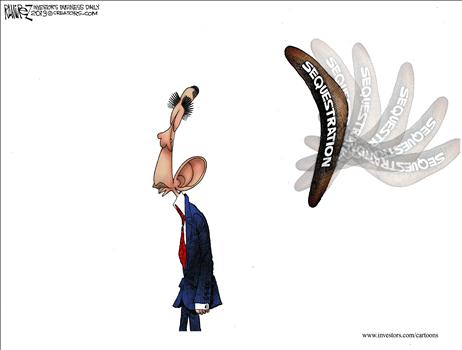
Obama Sequester Boomerang CartoonBut he miscalculated in thinking that the fiscal cliff tax hike somehow meant that he had permanently neutered the GOP, and he definitely goofed when he tried to use the sequester as a weapon to bully Republicans into another tax hike.

Ignoring the President’s hyperbole about the supposed catastrophic effects of a very modest reduction in the growth of the federal budget, Republicans have held firm.

And the President has suffered a painful political and policy defeat.

Here’s some of what was reported in The Hill about the President’s attitude.

The first months of President Obama’s second term are being built around a simple premise: No caving. …Obama is in an ultra-assertive mood, practically daring Republicans to defy his wishes. …Obama’s attitude is more akin to that of a general leading his forces into battle, confident that he can decimate the enemy. …On the sequester, for instance, Obama did little more than pay lip-service to the idea of a last-minute compromise to avert the package of cuts.

Well, Republicans did “defy his wishes” and it’s the worst possible outcome for the President. The growth of spending is being slowed and taxes are not going up.

Democrats on Capitol Hill also thought that the fiscal cliff tax hike would be a precedent for lots of future tax hikes. As reported by Politico, their analysis was misguided.

Democrats toasted the New Year’s fiscal cliff deal with the belief that they had set a crucial new precedent: Tax hikes would be part of any future deficit reduction package. Two months later, the champagne buzz is wearing off. …the exuberance expressed by many Democrats at the beginning of the year was misplaced. Efforts to avert the sequester never achieved liftoff, and Democrats are realizing that new tax revenues are off the table for the immediate future. …“We’ve tried everything we can,” Senate Majority Leader Harry Reid (D-Nev.) told reporters Thursday. “They will not budge on anything dealing with revenue.”

Byron York has the best analysis, explaining in his Washington Examiner column that Obama gambled and (at least so far) lost.

Nine months ago, Barack Obama likened his Republican opposition to an illness. If he could just defeat Mitt Romney, Obama said, then the illness might subside. “I believe that if we’re successful in this election — when we’re successful in this election — that the fever may break,” Obama told a fundraiser in Minneapolis last June. After Obama won re-election, there was extensive discussion among his supporters about whether the Republican “fever” would, in fact, break.

But this strategy appears to have boomeranged. Byron thinks that the White House is now in a weak position.

There was little speculation about whether something quite different might happen: Would determined GOP opposition break Obama’s fever?  That is, could Republicans weaken the president’s resolve to defeat the GOP and further raise taxes? That appears to be what has occurred, at least for the moment. …Friday morning, Obama seemed resigned to the possibility that he cannot win the further tax increases he seeks, and that after enlisting his entire administration in a campaign to frighten Americans about sequestration, the cuts have become a reality that he has to acknowledge.

While I’m glad the President goofed, I’m not under any illusion that winning a battle is the same thing as winning a war.

It’s quite possible that the modest sequester savings will be undone as part of the “continuing resolution” legislation to fund the federal government between March 27 and the rest of the fiscal year.

There will also be a debt limit fight later in the Spring, which will give proponents of bigger government another bite at the apple (though it’s a double-edged sword since advocates of limited government also can use the debt limit as a vehicle for reform).

And the President obviously won’t give up on his campaign for higher taxes. I worry that he’ll trick gullible GOPers into a tax hike at some point, either as part of a Trojan Horse tax reform or as part of a budget summit that produces something like Bowles-Simposon, a package of real tax hikes and illusory entitlement reforms.

But we can fight those battles down the road. Today, let’s enjoy the sweet smell of victory.

Open letter to President Obama (Part 255)

Government Must Cut Spending

Uploaded by on Dec 2, 2010

The government can cut roughly $343 billion from the federal budget and they can do so immediately.

__________


President Obama c/o The White House
1600 Pennsylvania Avenue NW
Washington, DC 20500

Dear Mr. President,

I know that you receive 20,000 letters a day and that you actually read 10 of them every day. I really do respect you for trying to get a pulse on what is going on out here.

Liberals argue that the poor need more welfare programs, but I have always argued that these programs enslave the poor to the government.

Food Stamps Growth Has Bipartisan Roots

Posted by Tad DeHaven

Republicans are jumping on the news that participation in the food stamps program hit a new record of 46.7 million individuals in June (about one in seven Americans). In a sluggish economy, an increase in food stamps participation is to be expected. Thus, it’s fair to hold up the increase in food stamps usage as being emblematic of the Obama administration’s failed economic policies. In addition, the president’s 2009 “stimulus” bill increased benefits and eligibility.

What Republicans don’t want to acknowledge is the role they played in expanding the food stamps program before President Obama ever took office. The 2002 farm bill—passed by a Republican-controlled House and signed by Republican President George W. Bush—expanded the food stamps program. As the Wall Street Journal’s editorial page correctly noted yesterday, “The food-stamp boom began with the George W. Bush Republicans, who expanded benefits in the appalling 2002 farm bill.”

The 2008 farm bill further expanded the program. However, on this the Journal lets the GOP off the hook when it says “But the supercharger was a 2008 bill out of the Pelosi Congress that goosed eligibility and rebranded the program as the Supplemental Nutrition Assistance Program, to reduce the stigma of being on the dole.” Although Bush vetoed that farm bill (he didn’t cite the increase for food stamps in his veto message), congressional Republicans were instrumental in enabling the “Pelosi Congress” to override it. In the House, 99 (out of 195) Republicans joined most Democrats in voting to override the veto. In the Senate, only 12 Republicans voted to sustain Bush’s veto.

One of those Republicans who voted to override Bush’s veto—and who also voted for the 2002 farm bill—is Sen. Jeff Sessions of Alabama. Sessions, who is the ranking member of the Senate Budget Committee, has been a chief critic of the growth in food stamps under President Obama. Sessions has been particularly critical of the administration’s efforts to “recruit” new food stamps recipients. For example, a “Community Outreach Partner Toolkit” produced by the USDA in 2011 that suggests throwing a “great party”:

Host social events where people mix and mingle. Make it fun by having activities, games, food, and entertainment, and provide information about SNAP. Putting SNAP information in a game format like BINGO, crossword puzzles, or even a “true/false” quiz is fun and helps get your message across in a memorable way.

It’s probable, however, that the food stamps outreach is being driven by the bureaucrats at the USDA. To Sessions’s credit, he acknowledges as much in a press release on the USDA’s recent cessation of radio ads designed to attract Spanish-speaking individuals to the program. It’s important to note that these “radio novellas” were produced during the Bush administration. Similarly, a partnership with the Mexican government to make Mexican nationals more aware of U.S. welfare programs—including food stamps—was signed by Bush’s agriculture secretary Ann Veneman in 2004.

The Obama administration certainly deserves to be heavily criticized for the growth in government dependency. But attacks from Republicans (e.g., Newt Gingrich calling President Obama the “food stamps president”) have been too disingenuous. Yes, Republicans are now calling for the food stamps program to be cut, but given their culpability in its growth—and the fact that it’s an election year—it’s hard to view their sudden discovery of religion as anything more than standard politics.

Addendum: Here’s Chris Edwards’ recent chart showing the growth in food stamps spending under presidents Bush and Obama:

_____________

Thank you so much for your time. I know how valuable it is. I also appreciate the fine family that you have and your commitment as a father and a husband.

Sincerely,

Everette Hatcher III, 13900 Cottontail Lane, Alexander, AR 72002, ph 501-920-5733, lowcostsqueegees@yahoo.com

Open letter to President Obama (Part 253)

Dan Mitchell Discussing Fake Austerity in Europe on Fox Business

Published on May 9, 2012 by

No description available.

_________________


President Obama c/o The White House
1600 Pennsylvania Avenue NW
Washington, DC 20500

Dear Mr. President,

I know that you receive 20,000 letters a day and that you actually read 10 of them every day. I really do respect you for trying to get a pulse on what is going on out here.

I think Dan Mitchell is right about France heading the wrong direction. Mr. President you need to watch what happens to France in the next few years. It will not be pretty.

I’m a bad person. I know it’s not nice to take joy in the misery of others, but I can’t help but smile when I see a story about bad news in France.

In my defense, this is not because of hostility to French people, who have always been friendly to me. Instead, France has become the global symbol of statism (particularly since Sweden has been moving in the right direction). The French, for instance, are increasingly infamous for class-warfare tax policy and onerous levels of intervention.

And since it’s my job to promote liberty, I’ll confess that it’s easier for me to convince non-French policy makers that free markets and small government are the right approach when there’s more evidence that statism is failing in France.

So why am I smiling? Well, France wasn’t doing so well under the de facto socialist Nicolas Sarkozy, and it seems that things are looking even worse now that the de jure socialist Francois Hollande is in charge.

Here’s some of what Reuters recently reported.

“It’s always time for a tax hike!”

The French are bleaker about their country’s future than at any time since 2005, a new poll showed on Saturday, with 68 percent saying they are “rather” or “very” pessimistic… Hollande’s government has been reeling from unemployment at a 13-year high and a rash of job cuts in recent weeks at top employers like carmaker Peugeot and retailer Carrefour. The government launched a plan this week to create 150,000 state-sponsored jobs for youth. Only 34 percent of those surveyed were confident in the government’s ability to battle unemployment, and just 20 percent expect the government to be able to improve their buying power. …The poll found that the pessimism extended even to 58 percent of Socialist party supporters.

I’m wondering when the pessimism will spread to investors. France recently lost its triple-A credit rating, but the rating agencies don’t do a good job, so I think it’s much more important to look at the prices of credit default swaps.

In other words, how much does it cost for an investor to insure debt from the French government? According to this CNBC site, France isn’t viewed as being as creditworthy as nations such as Switzerland, Germany, and the United States, but it is closer to those countries than it is to Spain, Italy, or Portugal.

This is just a guess on my part, but I think France is reaching the point where investors are suddenly going to get concerned about the government’s ability to fulfill its promises.

If Hollande follows through on his threat to impose a “patriotic” 75-percent tax rate, for example, that could be the trigger that makes the bond market a lot more skittish. Particularly since it will result in fewer rich people in France.

I’ve already written about French entrepreneurs and investors leaving the country because of Hollande’s class-warfare tax agenda. It’s gotten so bad that even Hollywood types are packing their bags.

Actor Johnny Depp has moved out of France and returned to America because he didn’t want to become a permanent French resident and pay income tax there. …Depp has now moved his family out of France after government officials asked him to become a permanent resident, as he feared he would end up paying tax in both countries. He tells Britain’s The Guardian newspaper, “…France wanted a piece of me. They wanted me to become a permanent resident. Permanent residency status – which changes everything. They just want… Dough. Money… ” Depp goes on to explain that if he spends more than 183 days a year in France he will have to pay income tax in both Europe and America, adding, “So you essentially work for free.”

Wow, complaining that he doesn’t want to “work for free.” What is he, some sort of radical libertarian from the Tea Party?

But he may want to chat with fellow tax-averse actor Jon Lovitz before moving back to America. Obama’s class-warfare agenda isn’t as bad as what Hollande is trying to impose, but it’s not Hong Kong or the Cayman Islands either.

P.S. Here’s a very good Chuck Asay cartoon about the French economy.

P.P.S. In a few areas, France has better policy than the United States.

______________________

Thank you so much for your time. I know how valuable it is. I also appreciate the fine family that you have and your commitment as a father and a husband.

Sincerely,

Everette Hatcher III, 13900 Cottontail Lane, Alexander, AR 72002, ph 501-920-5733, lowcostsqueegees@yahoo.com

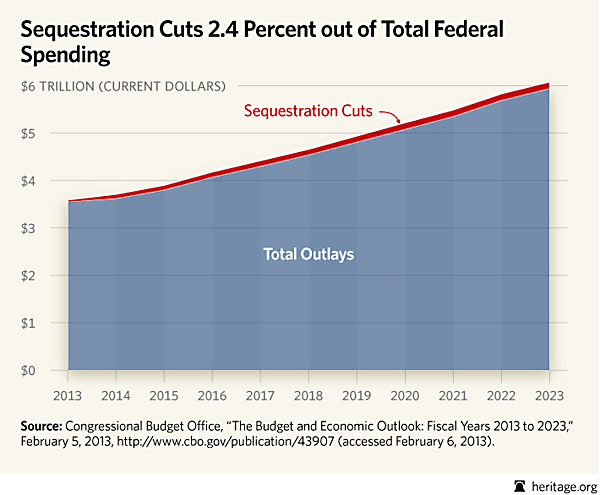
Sequestration only cuts 2.4% of the budget

Sequestration only cuts 2.4% of the budget.

T. Elliot Gaiser

February 24, 2013 at 11:29 am

Federal spending will explode from $3.6 trillion to $6 trillion over the next 10 years, but the much-maligned sequester will cut only 2.4 percent of this spending.

Sequestration represents a relatively small cut in projected spending. So why are so many in Washington wringing their hands over a two-and-a-half percent reduction?

Because sequestration leaves the largest component of federal spending—entitlements—nearly untouched. Instead, it falls most heavily on national defense, with 50 percent of sequestration cuts impacting national security. Thirty-five percent would impact non-defense discretionary spending. Less than 15 percent would fall on mandatory spending, which consumes 62 percent of the federal budget.

Not one of these cuts will address the dominant underlying cause of growth in government spending: entitlements.

Medicare, Medicaid, and Social Security together drain 44 percent of the budget each year—and their share of spending is growing. By midcentury, these programs and Obamacare together will gobble up all of America’s historical tax revenue, leaving everything else—defense, federal law enforcement, transportation, and veteran care, etc.—to be financed on federal borrowing. But sequestration fails to curb this growth in spending.

Tax increases are no solution. President Obama already grabbed $618 billion in tax increases. These tax hikes harmed opportunity for Americans by increasing taxes on investors and job creators, and yet the budget remains out of balance. Washington has a spending problem—not a revenue problem—and only spending cuts can put the budget on a path to balance.

Spending cuts from sequestration and more are necessary. Without them, Americans will suffer even more in the future as economic uncertainty undermines opportunity and as deficits become growth-reducing debt. The good news is that there are smart ways to cut spending to offset sequestration, and at least six bipartisan ways to reform entitlements.

For example, as Heritage experts J. D. Foster and Alison Acosta Fraser write, Congress could:

  • Correct the cost-of-living adjustment (COLA) for Social Security;
  • Raise the Social Security eligibility age to match increases in longevity; and
  • Raise the Medicare eligibility age to match Social Security.

There are many ways to save money now, too. Congress could cut:

  • The Lifeline program. This program spent $2.2 billion to provide telephones and service to low-income individuals. As Heritage expert Patrick Louis Knudsen writes, “Remarkably, 41 percent of ‘customers’ receiving taxpayer-subsidized service from the top five carriers failed to verify their eligibility, according to the Federal Communications Commission.”
  • Community Development Block Grants. Many of the $3 billion in grants from this program go to economically well-off communities that don’t need them.
  • The Job Corps. According to Knudsen, this is $1.7 billion spent on “a demonstrably ineffective program that has failed to match many of its trainees with the jobs they were trained for.”

These are a few suggestions for how to reduce government spending now and correct the drivers in spending growth into the future. Ordinary citizens will see even more economic growth–reducing debt unless Congress reins in federal spending. Instead of panicking over the 2.4 percent cut that is sequestration, lawmakers should tackle entitlement reform and cut other spending to balance the budget in 10 years.

Open letter to President Obama (Part 252)

Dan Mitchell Commenting on Obama’s Failure to Propose a Fiscal Plan

Published on Aug 16, 2012 by

No description available.

___________


President Obama c/o The White House
1600 Pennsylvania Avenue NW
Washington, DC 20500

Dear Mr. President,

I know that you receive 20,000 letters a day and that you actually read 10 of them every day. I really do respect you for trying to get a pulse on what is going on out here.

We have to change the economic direction of our country!!! The Heritage Foundation gives us a plan to get our country on a firm financial basis again.

Amy Payne

August 31, 2012 at 9:09 am

Entering the final stretch of the presidential contest, Americans are facing a monumental choice. The American people will decide the direction of government and its role in their lives for the coming years.

The debate in Tampa this week raised a number of issues, including preserving the American dream of working hard to achieve success. The Heritage Foundation has extensive research and policy prescriptions on each of these issues:

Energy: America needs to end energy subsidies and restore a free market in the energy sector. We can and should develop our domestic energy sources in an environmentally responsible way. Go to Energy & Environment

School choice: America’s education focus should be our students. The best way to serve the needs of a diverse population is to give families the freedom to choose a school—public, private, charter, or home school—that best fits their children’s needs. See where your state stands

Free trade: America needs jobs, and promoting free trade is an excellent way to create high-quality jobs in America. We should have a free flow of goods, services, and investments between democratic nations. Catch up on the U.S. free trade record

The federal budget: Tackling the federal budget is a complex task, but it must be done. Heritage’s Saving the American Dream plan details ideas for reforming major entitlement programs, permanently balancing the budget, and reducing the national debt. See the Heritage plan

Tax reform: America’s families and businesses need tax relief. A tax cut here and there isn’t enough; we need fundamental tax reform. A tax system that is simple and fair would spur economic growth and protect those at the bottom of the income ladder. How it could be done

Repealing Obamacare: Obamacare doesn’t stop with government intrusion into your relationship with your doctor. It also raises taxes, adds to the U.S. deficit, and attacks religious and personal freedoms. Top 5 Reasons to Repeal Obamacare

Reforming Medicare: Medicare reform is not an option—it is a necessity. To keep the program working for those it is designed to help, we should give seniors more control over their health care decisions and guarantee better access to quality care. The way forward for Medicare

Next week, the debate will continue in Charlotte, and more policy issues may enter the mix.

There’s no way to predict how the election will turn out. But as Heritage’s Matt Spalding has written, “it will be a turning point in American history: Either our leaders will guide the country even further along the road to ‘progressivism’ or they will begin a long, slow turn back toward the principles of the American Founding.”

“The federal government has acquired an all but unquestioned dominance over virtually every area of American life,” Spalding says. “It acts without constitutional limits and is restricted only by expediency, political will, and (less and less) budget constraints.”

The Heritage Foundation recently published Changing America’s Course, which gives our political leaders recommendations on how to stay within the limits of the Constitution.

To put America on a path toward preserving and growing freedom, Spalding says, “The first step is to reduce the size and scope of government and unleash the engines of economic productivity and the institutions of cultural renewal.”

It is possible to change America’s course.

_____________

Thank you so much for your time. I know how valuable it is. I also appreciate the fine family that you have and your commitment as a father and a husband.

Sincerely,

Everette Hatcher III, 13900 Cottontail Lane, Alexander, AR 72002, ph 501-920-5733, lowcostsqueegees@yahoo.com

Can the USA be saved?

I hope the USA can pull out of this debt trap we are in.

Since I routinely spread a message of doom and gloom about the ever-expanding welfare state and warn about the potential for European-style fiscal collapse, I guess I shouldn’t be surprised that I’ve received several emails asking me variants of this question: “Do you think the United States can be rescued?”

Or sometimes, I get questions that I think are somewhat related, such as “Doesn’t Washington drive you crazy” or “Why haven’t you given up?”

I’m not sure I’m good at introspection, but I’ll try to answer, and we’ll start with the main question and then deal with the secondary queries.

To be blunt, if I had to place a bet on the outcome, I think the United States will become a failed European-style welfare state. The burden of government spending already is far too high and our long-run outlook is terrible, as shown by these OECD and BIS numbers, and I don’t think the callow politicians in Washington will fix the problems because they rarely think past the next election cycle.

This doesn’t necessarily mean that we’ll have a Greek-style fiscal collapse. Perhaps we’ll simply descend into permanent stagnation, with anemic growth (at best) and widespread dependency and joblessness.

That being said, even though I would bet on a bad outcome, I think there’s a genuine opportunity to save the country.

My job: Putting my finger in the dyke, trying to hold back the flood of big government

No, I’m not talking about creating a libertarian Nirvana, with the federal government consuming only three percent of economic output. But I think we can at least hold the line and prevent government from becoming bigger than it is today. Sort of a watered-down version of Mitchell’s Golden Rule.

The key is the right kind of entitlement reform. Our long-run fiscal nightmare is entirely the result of programs such as Social Security, Medicare, and Medicaid, so the solution is obvious.

But is it achievable?

As I’ve already indicated, I wouldn’t bet on it. We definitely know there won’t be any good reforms for the next four years, but let me give you a plausible scenario for what might happen beginning in 2017.

We’ll start with the fact that the House of Representatives already voted for Medicaid reform and Medicare reform as part of the Ryan budget in 2011 and 2012. We also know that Republicans retained the House in the most recent election and there seems to be a political consensus that voting to fix the healthcare entitlements was not a political liability.

There was no Social Security reform in Ryan’s budget, but we also know that George W. Bush (for all his other faults) supported personal accounts in 2000 and 2004 and didn’t suffer any political backlash. Indeed, personal accounts still seem to be reasonably popular.

With this in mind, I think it may be possible to fix entitlement programs in 2017 assuming that the 2014 and 2016 elections lead to pro-reform lawmakers in the House, Senate, and White House.

That may not be likely, but it’s definitely possible.

My job, simply stated, is to help inform and educate people so that the climate is favorable to reform.

Which brings me to the secondary questions about whether Washington drives me crazy and whether I should give up.

The short answer is that I’m intellectually pessimistic but operationally optimistic.

In other words, my brain tells me that things will probably deteriorate but my heart tells me that this is a battle worth fighting.

So, yes, Washington does drive me crazy. It is both an immoral town and an amoral town, pervasively corrupt and filled with people who seem to think that it is perfectly okay to steal so long as it happens through the legislative or regulatory process.

And, yes, I may decide to give up if something really horrible happens, such as adoption of a value-added tax. Giving politicians a big new source of revenue, after all, would cripple any incentive for fiscal restraint.

But until that happens, I think I’m very lucky that I get to wake up every day and be part of the Cato Institute’s fight to preserve (and restore) American exceptionalism.

P.S. This is the second “Question of the Week” in two days, but I neglected to answer a question last week, so I had to catch up and get back on track. Yesterday’s question and answer generated a lot of interest, so I hope this one is equally thought-provoking.

Senator Mike Lee is trying hard to get Balanced Budget Amendment passed

We need to pass a Balanced Budget Amendment!!!! It is obvious to me that if President Obama gets his hands on more money then he will continue to spend away our children’s future. He has already taken the national debt from 11 trillion to 16 trillion in just 4 years. Over, and over, and over, and over, and over and over I have written Speaker Boehner and the Congressmen (Griffin, Womack, Crawford) in Arkansas concerning this. I am hoping they will stand up against this reckless spending that our federal government has done and will continue to do if given the chance.

I have written and emailed Senator Pryor over, and over again with spending cut suggestions but he has ignored all of these good ideas in favor of keeping the printing presses going as we plunge our future generations further in debt. I am convinced if he does not change his liberal voting record that he will no longer be our senator in 2014.

I have written hundreds of letters and emails to President Obama and I must say that I have been impressed that he has had the White House staff answer so many of my letters. However, his policies have not changed. He is committed to cutting nothing from the budget that I can tell. 

___________

Balanced Budget Amendment introduced in Senate


I know it will be difficult to pass a Balanced Budget Amendment but at least Senator Mike Lee is trying.

By: Audrey Hudson

Sen. Mike Lee (R-Utah) is aiming to force lawmakers to spend within the means of the tax-paying public by introducing a balanced budget amendment to the Constitution that puts strict limits on the ability of Congress to run deficits and increase the national debt.

Introduction of Lee’s bill comes on the heels of House action on Wednesday to suspend the $16.4 trillion debt ceiling until May 19 rather than increasing the level, and in turn requires Congress to pass a budget by April 15 – a task that has not been accomplished in several years.

“Washington’s insatiable need to borrow and spend has put off difficult decisions and threatened the prosperity of future generations,” Lee said. “It is unconscionable and immoral. We have an obligation to correct course and put the country on a responsible path to fiscal sustainability. Families, businesses, and state and local governments are all expected to live within their means, the federal government should do the same.”

RELATED: White House claims victory in debt ceiling

Lee’s bill would also limit spending to 18 percent of the gross national product, and requires a two-thirds vote of Congress to run a deficit, raise taxes, or increase the debt limit.

“All past efforts of Congress to limit spending have utterly failed. None of the existing restraints – the Budget Act, spending caps, the debt limit, the sequester – have gotten spending under control, and we have $16.4 trillion of debt to prove it. Only a balanced budget amendment to the Constitution will permanently bind Congress and force both parties to live within the nation’s means. Anything less will simply maintain our dysfunctional and unsustainable status quo,” Lee said.

Although a popular idea with the public, a balanced budget amendment to the Constitution has failed past legislative attempts by Republican lawmakers.

The closest the bill has come to being law was 15 years ago, when it passed the House with bipartisan support but was defeated in the Senate by one vote.

The last time Congress voted on a balanced budget amendment was in 2011 as part of an agreement to raise the debt ceiling. It was rejected in both the House and Senate. The chances of Lee’s legislation passing in the Democratic-controlled Senate this session look equally slim.