Category Archives: spending out of control

Open letter to President Obama (Part 360)

Will Taxing the Rich Fix the Deficit?

Published on Jul 2, 2012

The government’s budget deficit in 2009 was $1.5 trillion. Many have suggested raising taxes on the rich to cover the difference between what the government collected in revenue and what it spent. Is that a realistic solution? Economics professor Antony Davies uses data to demonstrate why taxing the rich will not be sufficient to make the budget deficit disappear. He says, “The budget deficit is so large that there simply aren’t enough rich people to tax to raise enough to balance the budget.” Instead, it’s time to work on legitimate solutions, like cutting spending.

___________

(This letter was emailed to White House on 12-12-12.)

President Obama c/o The White House
1600 Pennsylvania Avenue NW
Washington, DC 20500

Dear Mr. President,

I know that you receive 20,000 letters a day and that you actually read 10 of them every day. I really do respect you for trying to get a pulse on what is going on out here.

Can you blame the rich for moving when you raise taxes up too high? Milton Friedman rightly noted that people will seek their own self interest. He asked, “Is it really true that political self-interest is nobler somehow than economic self-interest?” The obvious answer is no. Take a look at this exchange between Friedman and Phil Donahue and then look at this article below that discusses what is going on now in France. No wonder that people are fleeing California for Texas too.

Phil Donohue: When you see around the globe the maldistribution of wealth, the desperate plight of millions of people in underdeveloped countries, when you see so few haves and so many have-nots, when you see the greed and the concentration of power, did you ever have a moment of doubt about capitalism? And whether greed is a good idea to run on?Milton Friedman: Well first of all tell me, is there some society you know that doesn’t run on greed? You think Russia doesn’t run on greed? You think China doesn’t run on greed? What is greed? Of course none of us are greedy. It’s only the other fella that’s greedy. The world runs on individuals pursuing their separate interests. The greatest achievements of civilization have not come from government bureaus. Einstein didn’t construct his theory under order from a bureaucrat. Henry Ford didn’t revolutionize the automobile industry that way. In the only cases in which the masses have escaped from the kind of grinding poverty that you are talking about, the only cases in recorded history are where they have had capitalism and largely free trade. If you want to know where the masses are worst off, it’s exactly in the kind of societies that depart from that. So that the record of history is absolutely crystal clear, there is no alternative way, so far discovered, of improving the lot of the ordinary people that can hold a candle to the productive activities that are unleashed by a free enterprise system.

Phil Donohue: Seems to reward not virtue as much as the ability to manipulate the system.

Milton Friedman: And what does reward virtue? You think the Communist commissar rewards virtue? You think a Hitler rewards virtue? Do you think… American presidents reward virtue? Do they choose their appointees on the basis of the virtue of the people appointed or on the basis of political clout? Is it really true that political self-interest is nobler somehow than economic self-interest? You know I think you are taking a lot of things for granted. And just tell me where in the world you find these angels that are going to organize society for us? Well, I don’t even trust you to do that.

Atlas is shrugging and Dan Mitchell is laughing.

I predicted back in May that well-to-do French taxpayers weren’t fools who would meekly sit still while the hyenas in the political class confiscated ever-larger shares of their income.

But the new President of France, Francois Hollande, doesn’t seem overly concerned by economic rationality and decided (Obama must be quite envious) that a top tax rate of 75 percent is fair.” And patriotic as well!

French Prime Minister: “I’m upset that the wildebeest aren’t remaining still for their disembowelment.”

So I was pleased – but not surprised – when the news leaked out that France’s richest man was saying au revoir and moving to Belgium.

But he’s not the only one. The nation’s top actor also decided that he doesn’t want to be a fatted calf. Indeed, it appears that there are entire communities of French tax exiles living just across the border in Belgium.

Best of all, the greedy politicians are throwing temper tantrums that the geese have found a better place for their golden eggs.

France’s Prime Minister seems particularly agitated about this real-world evidence for the Laffer Curve. Here are some excerpts from a story in the UK-based Telegraph.

“No fair!”

France’s prime minister has slammed wealthy citizens fleeing the country’s punitive tax on high incomes as greedy profiteers seeking to “become even richer”. Jean-Marc Ayrault’s outburst came after France’s best-known actor, Gerard Dépardieu, took up legal residence in a small village just over the border in Belgium, alongside hundreds of other wealthy French nationals seeking lower taxes. “Those who are seeking exile abroad are not those who are scared of becoming poor,” the prime minister declared after unveiling sweeping anti-poverty measures to help those hit by the economic crisis. These individuals are leaving “because they want to get even richer,” he said. “We cannot fight poverty if those with the most, and sometimes with a lot, do not show solidarity and a bit of generosity,” he added.

In the interests of accuracy, let’s re-write Monsieur Ayrault’s final quote from the excerpt. What he’s really saying is: “We cannot buy votes and create dependency if those that produce, and sometimes produce a lot, do not act like morons and let us rape and pillage without consequence.”

So what’s going to happen? Well, I wrote in September that France was going to suffer a fiscal crisis, and I followed up in October with a post explaining how a bloated welfare state was a form of economic suicide.

Yet French politicians don’t seem to care. They don’t seem to realize that a high burden of government spending causes economic weakness by misallocating labor and capital. They seem oblivious  to basic tax policy matters, even though there is plenty of evidence that the Laffer Curve works even in France.

So as France gets ever-closer to fiscal collapse, part of me gets a bit of perverse pleasure from the news. Not because of dislike for the French. The people actually are very nice, in my experience, and France is a very pleasant place to visit. And it was even listed as the best place in the world to live, according to one ranking.

But it helps to have bad examples. And just as I’ve used Greece to help educate American lawmakers about the dangers of statism, I’ll also use France as an example of what not to do.

P.S. France actually is much better than the United States in that rich people actually are free to move across the border without getting shaken down with exit taxes that are reminiscent of totalitarian regimes.

P.P.S. This Chuck Asay cartoon seems to capture the mentality of the French government.

_____________

Thank you so much for your time. I know how valuable it is. I also appreciate the fine family that you have and your commitment as a father and a husband.

Sincerely,

Everette Hatcher III, 13900 Cottontail Lane, Alexander, AR 72002, ph 501-920-5733, lowcostsqueegees@yahoo.com

Dear Senator Pryor, here are some spending cut suggestions (“Thirsty Thursday”, Open letter to Senator Pryor, cartoon included)

Senator Pryor pictured below:

Why do I keep writing and email Senator Pryor suggestions on how to cut our budget? I gave him hundreds of ideas about how to cut spending and as far as I can tell he has taken none of my suggestions. You can find some of my suggestions here, here, here, here, here, here, here, here, here, here, here, here, here, here, here, here, here, here, here,  here, and  here, and they all were emailed to him. In fact, I have written 13 posts pointing out reasons why I believe Senator Pryor’s re-election attempt will be unsuccessful. HERE I GO AGAIN WITH ANOTHER EMAIL I JUST SENT TO SENATOR PRYOR!!!

Dear Senator Pryor,

Why not pass the Balanced  Budget amendment? As you know that federal deficit is at all time high (1.6 trillion deficit with revenues of 2.2 trillion and spending at 3.8 trillion).

On my blog www.thedailyhatch.org . I took you at your word and sent you over 100 emails with specific spending cut ideas. (Actually there were over 160 emails with specific spending cut suggestions.) However, I did not see any of them in the recent debt deal that Congress adopted although you did respond to me several times. Now I am trying another approach. Every week from now on I will send you an email explaining different reasons why we need the Balanced Budget Amendment. It will appear on my blog on “Thirsty Thursday” because the government is always thirsty for more money to spend. Today I actually have included a great article below from the Heritage Foundation concerning an area of our federal budget that needs to be cut down to size. The funny thing about the Sequester and the 2.4% of cuts in future increases is that President Obama set these up and then he acted like the sky was falling in as the cartoons indicate in the newspapers.

IF YOU TRULY WANT TO CUT THE BUDGET AND BALANCE THE BUDGET THEN SUBMIT THESE POTENTIAL BUDGET CUTS PRESENTED BELOW!!

_______________

What Can We Cut to Balance the Budget

Published on Oct 16, 2012

If the U.S. government cut all government services except Social Security, Medicare, Medicaid, and payments on the debt, federal spending would still outpace revenues. Prof. Antony Davies argues that there are not specific cuts that will enable government to balance the budget. He says, “Nothing less than a redesign will solve this problem.” That redesign should begin by determining what the proper role of government is.

__________________

We got to cut wasteful spending out of the government and here is another fine suggestion from the Heritage Foundation.

Todd Thurman

March 12, 2013 at 5:40 pm

Newscom

The massive spending bill, or continuing resolution, released by the Senate this week continues spending on programs which are inappropriate or wasteful and fails to adopt good policies in many areas. Here’s a rundown of some of the worst offenders in the Senate bill:

Energy. The Senate CR continues to fund a failed energy policy that empowers Washington bureaucrats instead of American families and businesses. Though it does cut some programs minimally, it does the equivalent of removing a used napkin from a full trash can. There’s much more waste that needs to be removed. For example, section 1203 reduces Department of Energy (DOE) funding by $44 million when more than $5.3 billion could be cut. The $44 million is equivalent to 0.8 percent of what should be cut.

Perhaps most egregious is the meager $11 million cut from the $1.8 billion request for Office of Energy Efficiency and Renewable Energy. In total, the DOE budget funds applied-research programs on conventional fuels, renewable energy sources, and nuclear energy that the private sector should be undertaking. American families and business are far better equipped than government to determine what types of energy technologies work for them. Eliminating these programs alone would save $3 billion in taxpayer money and help to return energy choice back to Americans.

Though the bill cuts $10 million from nuclear energy spending, based on the 2013 request, it would still fund over $150 million for nuclear waste disposal and management programs. None of this funding would go toward Yucca Mountain, the waste repository mandated by the Nuclear Waste Policy Act, as amended. Given the complete lack of any nuclear waste disposal or management policy by the Administration and its insistence on terminating the Yucca project, there is little justification for this spending. Instead, Congress should provide $40 million for the Nuclear Regulatory Commission to finish its review of the DOE’s Yucca Mountain permit application.

—Jack Spencer, Senior Research Fellow, Nuclear Energy, and Nick Loris, Herbert and Joyce Morgan Fellow

Last year, I made fun of the Washington Post for biased reporting when they used the world “slash” to describe a budget proposal that would have trimmed $6 billion out of a giant $3,800 billion budget.

I wrote that this was the budgetary equivalent of “going on a diet by leaving a couple of french fries in the bottom of the bag after bingeing on three Big Mac meals at McDonald’s.” A couple of other bloggers then had some fun by doing the exact calculations of what this would mean.

Now we have a cartoon version of Washington budgeting, authored by Gary Varvel.

Keep in mind, though, that this cartoon actually is inaccurate because it implicitly accepts the dishonest Washington definition of a budget cut (having spending grow, but not as fast as previously planned).

Every budget plan, even the very admirable proposals put forth by Sen. Rand Paul and the House Republican Study Committee, merely restrains the growth of federal spending.

So the cartoon should show Uncle Same with some clippers, simply seeking to keep the weed from growing even faster.

And if we replaced Uncle Sam with Barack Obama, instead of scissors or clippers, he’d be holding fertilizer.

_______________

The Balanced Budget Amendment is the only thing I can think of that would force Washington to cut spending. We have only a handful of balanced budgets in the last 60 years, so obviously what we are doing is not working. We are passing along this debt to the next generation. YOUR APPROACH HAS BEEN TO REJECT THE BALANCED BUDGET “BECAUSE WE SHOULD CUT THE BUDGET OURSELF,” WELL THEN HERE IS YOUR CHANCE!!!! SUBMIT THESE CUTS!!!!

Thank you for this opportunity to share my ideas with you.

Sincerely,

Everette Hatcher, lowcostsqueegees@yahoo.com www.thedailyhatch.org, 13900 Cottontail Lane, Alexander, AR 72002, ph 501-920-5733

Related posts:

Mark Pryor responds to me concerning Debt Ceiling email (Part 1)

The problem with the debt ceiling is very clear to me. We need to get serious about cutting federal spending. I am so upset about it that I have emailed over 100 emails to Senator Pryor concerning specific spending suggestions. I get emails from back from Senator Pryor like the one below. This means that […]

Senator Pryor asks for Spending Cut Suggestions! Here are a few!(Part 164)

Senator Pryor asks for Spending Cut Suggestions! Here are a few!(Part 164) Senator Mark Pryor wants our ideas on how to cut federal spending. Take a look at this video clip below: Senator Pryor has asked us to send our ideas to him at cutspending@pryor.senate.gov and I have done so in the past and will continue to […]

Senator Pryor asks for Spending Cut Suggestions! Here are a few!(Part 163)

Senator Pryor asks for Spending Cut Suggestions! Here are a few!(Part 163) Senator Mark Pryor wants our ideas on how to cut federal spending. Take a look at this video clip below: Senator Pryor has asked us to send our ideas to him at cutspending@pryor.senate.gov and I have done so in the past and will continue to […]

Senator Pryor asks for Spending Cut Suggestions! Here are a few!(Part 162)

Senator Pryor asks for Spending Cut Suggestions! Here are a few!(Part 162) Senator Mark Pryor wants our ideas on how to cut federal spending. Take a look at this video clip below: Senator Pryor has asked us to send our ideas to him at cutspending@pryor.senate.gov and I have done so in the past and will continue to […]

Capitol Tours with Senator Mark Pryor

Three very good video tours below from Senator Mark Pryor. Published on Jun 13, 2012 by SenatorPryor Episode 1: Arkansans in the Capitol Published on Jul 9, 2012 by SenatorPryor Episode 2: The Crypt and the Old Supreme Court Published on Aug 20, 2012 by SenatorPryor Episode 3: The Senate Chamber If you want to […]

Senator Pryor asks for Spending Cut Suggestions! Here are a few!(Part 161)

Senator Pryor asks for Spending Cut Suggestions! Here are a few!(Part 161) Senator Mark Pryor wants our ideas on how to cut federal spending. Take a look at this video clip below: Senator Pryor has asked us to send our ideas to him at cutspending@pryor.senate.gov and I have done so in the past and will continue to […]

Senator Mark Pryor responds to my email

Senator Mark Pryor wants our ideas on how to cut federal spending and I sent them to him but he didn’t take any of my suggestions. However, he did take time to get back to me today, but I am not too impressed with Senator Pryor’s response. I gave him hundreds of ideas about how […]

Senator Pryor asks for Spending Cut Suggestions! Here are a few!(Part 160)

Senator Pryor asks for Spending Cut Suggestions! Here are a few!(Part 160) Senator Mark Pryor wants our ideas on how to cut federal spending. Take a look at this video clip below: Senator Pryor has asked us to send our ideas to him at cutspending@pryor.senate.gov and I have done so in the past and will continue to […]

Senator Pryor asks for Spending Cut Suggestions! Here are a few!(Part 159)

Senator Pryor asks for Spending Cut Suggestions! Here are a few!(Part 159) Senator Mark Pryor wants our ideas on how to cut federal spending. Take a look at this video clip below: Senator Pryor has asked us to send our ideas to him at cutspending@pryor.senate.gov and I have done so in the past and will continue to […]

Senator Pryor asks for Spending Cut Suggestions! Here are a few!(Part 158)

Senator Mark Pryor wants our ideas on how to cut federal spending. Take a look at this video clip below: Senator Pryor has asked us to send our ideas to him at cutspending@pryor.senate.gov and I have done so in the past and will continue to do so in the future. On May 11, 2011,  I emailed to […]

Dear Senator Pryor, why not pass the Balanced Budget Amendment? (“Thirsty Thursday”, Open letter to Senator Pryor)

Office of the Majority Whip | Balanced Budget Amendment Video In 1995, Congress nearly passed a constitutional amendment mandating a balanced budget. The Balanced Budget Amendment would have forced the federal government to live within its means. This Balanced Budget Amendment failed by one vote. 16 years later, Congress has the chance to get it […]

Dear Senator Pryor, why not pass the Balanced Budget Amendment? (“Thirsty Thursday”, Open letter to Senator Pryor)

Sadly Senator Pryor has voted against the Balanced Budget Amendment over and over in his long time in the Senate. Senator Pryor: “There are a lot of people who think a balanced-budget amendment solves all the fiscal problems. I completely disagree.” (Peter Urban, Pryor Tilts Balanced Budget, Southwest Times Record, 11/17/11) Dear Senator Pryor, Why […]

Dear Senator Pryor, why not pass the Balanced Budget Amendment? (“Thirsty Thursday”, Open letter to Senator Pryor)

Mark Levin and Senator Hatch discuss the balanced budget amendment and it’s importance. Uploaded by loveconstitution on Jan 28, 2011 Mark Levin interviews Senator Hatch 1/27/2011 about the balanced budget amendment. Mark is very excited about the balanced budget amendment being proposed by Senator Orin Hatch and John Cornyn and he discusses the amendment with […]

Will Senator Pryor be re-elected in 2014? (Part 4)(Royal Wedding Part 5)

Dr. Jay Barth with Hendrix College comments on our latest poll results on Arkansas politics (clip from Talkbusiness) Talk Business reported today in the article “Poll Shows Beebe Strength, Pryor Shaky,” the following: A new Talk Business-Hendrix College Poll shows Gov. Mike Beebe (D) maintaining his high job approval rating, while Sen. Mark Pryor (D) […]

Will Senator Pryor be re-elected in 2014? Part 3 (The Conspirator Part 16)

U.S. Sen. Mark Pryor at the 2009 Democratic Party Jefferson Jackson Dinner, Arkansas’s largest annual political event. Mark Pryor is up for re-election to the Senate in 2014. It is my opinion that the only reason he did not have an opponent in 2008 was because the Republicans in Arkansas did not want to go […]

Will Senator Pryor be re-elected or not? (Part 3)

Michael Tanner, a senior fellow at the CATO institute, explains that the rate of return on social security will be much lower for todays youth. Steve Brawner wrote in his article “Tiptoeing toward the third rail,” (Arkansas News Bureau, Jan 9,): Social Security has long been considered the “third rail” for American politicians, meaning it’s […]

Will Senator Pryor be re-elected or not? Part 2

HALT:HaltingArkansasLiberalswithTruth.com   CBS — October 19, 2010 — New York Times’ Jeff Zeleny talks to Jan Crawford about the state of Democrats in the South… Are they a dying species? In the article “Southern Democrat much closer to extinction after GOP wave,” (Washington Times, Nov 4, 2010), Ben Evans notes: After this week’s elections, the […]

Will Senator Pryor be re-elected or not? Part 1

HALT:HaltingArkansasLiberalswithTruth.com Roland Martin appears on Rick’s List with Rick Sanchez and the Best Political Team on television (Candy Crowley, John King, Jeffery Toobin, Ed Rollins, Gloria Borger and Victoria Toensing) to discuss day two of the Elena Kagan Supreme Court confirmation hearings. During the analysis, Senator Graham and Elena Kagan had an interesting exchange over […]

John Stossel notes how good intentions lead to bad results when the government is involved

John Stossel notes how good intentions lead to bad results when the government is involved. Why do we keep on giving the government more money when they waste so much? We should be putting more time in staying out of the small businessperson’s way!!!!

Since I’m an out-of-the-closet libertarian, it goes without saying that I’m not favorably disposed to government intervention. As far as I’m concerned, Washington’s an inherently corrupt town filled with people seeking unearned wealth.

But even if I didn’t have any underlying philosophical or moral principles, I think I would still favor small government.

Why? Because just about everything government does turns into a bloody cluster-you-know-what, so there’s also a utilitarian case for libertarianism.

I discuss the reverse Midas touch of government with John Stossel.

The theme of Stossel’s show, by the way, was looking at how good intentions lead to bad results. I actually think that’s too optimistic.

Most government intervention is driven by sordid insider scheming, not good intentions. The politicians merely pretend they have noble-sounding goals when peddling their manure to the public.

But regardless of the goals, the result is still the same.

I point out that if the burden of government spending grows faster than the private economy (sort of Obama’s Golden Rule rather than Mitchell’s Golden Rule), bad things inevitably will happen.

Other points from the interview:

I suppose a more interesting program would be to identify things that the government does intelligently and effectively.

Any suggestions?

P.S. According to Greek mythology, anything Midas touched turned into gold. But since the fable also says that this blessing turned into a curse, perhaps this post should have been titled the “The Midas Touch of Government” rather than “The Reverse Midas Touch of Government.” But since I’m already trying to restore the good name of Robin Hood, I’m going to leave it to others to decide how to characterize Midas.

Cartoons from Dan Mitchell’s blog that demonstrate what Obama is doing to our economy (Big government slows down economic growth)

I have put up lots of cartoon’s from Dan Mitchell’s blog before and they have got lots of hits before. Many of them have dealt with the economy, eternal unemployment benefits, socialism,  Greece,  welfare state or on gun control.

My previous post looked at some Federal Reserve data and suggested some reasons why businesses are keeping money on the sidelines.

But there’s a famous line about how “a picture says a thousand words,” and this cartoon is a good example.

Related posts:

Cartoons on Obama’s budget math

Dan Mitchell Discussing Dishonest Budget Numbers with John Stossel Uploaded by danmitchellcato on Feb 11, 2012 No description available. ______________ Dan Mitchell of the Cato Institute has shown before how excessive spending at the federal level has increased in recent years. A Humorous Look at Obama’s Screwy Budget Math May 31, 2012 by Dan Mitchell I’ve […]

Obama on creating jobs!!!!(Funny Carton)

Another great carton on President Obama’s efforts to create jobs!!! A Simple Lesson about Job Creation for Barack Obama December 7, 2011 by Dan Mitchell Even though leftist economists such as Paul Krugman and Larry Summers have admitted that unemployment insurance benefits are a recipe for more joblessness, the White House is arguing that Congress should […]

Get people off of government support and get them in the private market place!!!!(great carton too)

Dan Mitchell hits the nail on the head and sometimes it gets so sad that you just have to laugh at it like Conan does. In order to correct this mess we got to get people off of government support and get them in the private market place!!!! Chuck Asay’s New Cartoon Nicely Captures Mentality […]

Funny carton from Dan Mitchell’s blog on Greece

Sometimes it is so crazy that you just have to laugh a little. The European Mess, Captured by a Cartoon June 22, 2012 by Dan Mitchell The self-inflicted economic crisis in Europe has generated some good humor, as you can see from these cartoons by Michael Ramirez and Chuck Asay. But for pure laughter, I don’t […]

Cartons on Obama’s budget math

Dan Mitchell Discussing Dishonest Budget Numbers with John Stossel Uploaded by danmitchellcato on Feb 11, 2012 No description available. ______________ Dan Mitchell of the Cato Institute has shown before how excessive spending at the federal level has increased in recent years. A Humorous Look at Obama’s Screwy Budget Math May 31, 2012 by Dan Mitchell I’ve […]

Obama on creating jobs!!!!(Funny Carton)

Another great carton on President Obama’s efforts to create jobs!!! A Simple Lesson about Job Creation for Barack Obama December 7, 2011 by Dan Mitchell Even though leftist economists such as Paul Krugman and Larry Summers have admitted that unemployment insurance benefits are a recipe for more joblessness, the White House is arguing that Congress should […]

2 cartons illustrate the fate of socialism from the Cato Institute

Cato Institute scholar Dan Mitchell is right about Greece and the fate of socialism: Two Pictures that Perfectly Capture the Rise and Fall of the Welfare State July 15, 2011 by Dan Mitchell In my speeches, especially when talking about the fiscal crisis in Europe (or the future fiscal crisis in America), I often warn that […]

2 cartons illustrate the fate of socialism from the Cato Institute

Cato Institute scholar Dan Mitchell is right about Greece and the fate of socialism: Two Pictures that Perfectly Capture the Rise and Fall of the Welfare State July 15, 2011 by Dan Mitchell In my speeches, especially when talking about the fiscal crisis in Europe (or the future fiscal crisis in America), I often warn that […]

Dan Mitchell: Question of the Week: Has the European Fiscal Crisis Ended?

We got to cut spending or we will be in a fiscal crisis like Greece!!!

I’ve frequently commented on Europe’s fiscal mess and argued that excessive government spending is responsible for both the sovereign debt crisis and the economic stagnation that plagues the continent.

But it does seem that things have calmed down, so the readers who have submitted questions about whether the fiscal crisis has ended obviously are paying attention.

I have two responses.

  • My first answer is very mature and thoughtful: HAHAHAHAHAHAHAHAHA, are you ;@($&^#’% kidding me?
  • My second answer is a bit more guarded and circumspect: No. To be more specific, the immediate crisis may have slightly abated, but I have no confidence that the long-run problem has been solved.

But let me start with some good news. Most of the hard-hit European nations have finally begun the cut spending. And when I say cut spending, I mean they actually spent less in 2011 than they did in 2010 (unlike the fake version of spending cuts that you find in the U.S. and U.K., where spending simply grows at a slower pace).

We don’t have data for 2012, but I wouldn’t be surprised if many of the PIIGS nations also cut spending last year as well.

Now for some bad news. Unlike the Baltic nations, the PIIGS dragged their feet and didn’t reduce the burden of government spending until they had no choice.

Moreover, they all imposed crippling tax hikes. Indeed, the tax increases in Greece were so severe that even the International Monetary Fund warned that the country might be past the Laffer Curve revenue-maximizing point.

So while long-overdue reductions in spending meant less money was being diverted from the economy’s productive sector, higher tax rates have discouraged entrepreneurs and investors from creating jobs and wealth.

So what’s the net effect?

From an optimistic perspective, the fiscal situation should stabilize if governments keep spending under control. Some additional spending cuts would be very desirable since government spending consumes 45 percent-50 percent of GDP in these nations, which is at least double  the growth-maximizing level.

“I’m going back in my bottle if you don’t cut spending!”

But even if these nations merely abide by Mitchell’s Golden Rule and restrain spending so that it grows slower than the private sector, that would be progress.

The reason I’m not optimistic, though, is that I don’t sense any commitment to smaller government. I fear governments will let the spending genie out of the bottle at the first opportunity. And we’re talking about a scary genie, not Barbara Eden.

And to make matters worse, Europe faces a demographic nightmare. These charts, reproduced from a Bank for International Settlements study, show that even the supposedly responsible nations in Europe face a tsunami of spending and debt over the next 25-plus years.

So you can understand why I don’t express a lot of optimism about European economic policy in this interview with Canadian TV.

The ostensible topic was European-wide financial regulation, but that topic is really a proxy for the fact that some nations want to bail out their financial sectors. But they’re in such lousy fiscal shape that they can’t borrow the money that would be needed to prop up their dodgy banks.

So I pointed out that European-wide regulation wasn’t the right answer. It wouldn’t make banks safer (since it would be based upon the deeply flawed Basel regulations), but could become a vehicle for nations such as Germany to further subsidize countries such as Spain.

But I hope I got across my main point, which is that these nations are burdened with too much government and their problems won’t be solved with more handouts, regulation, or bureaucracy.

In other words, there’s no substitute for genuine spending cuts implemented by the nation states of Europe.

P.S. Just in case you’re under the impression that only cranky libertarians think government is too big in Europe, I invite you to peruse this research from the European Central Bank, World Bank, and National Bank of Finland.

P.P.S. To close with some European-themed humor, we have three videos: 1) A romantic comedy involving Mr. Greece and Ms. Germany, 2) Hitler learning about the European downgrade, and 3) A Greek perspective on Germany.

P.P.P.S. Heck, I can’t resisting sharing this cartoon, this Dave Barry mockery, and the non-PC map of Europe as well.

Do we need another stimulus?

President Obama wants to do another stimulus, but will that work?

I’m understandably partial to my video debunking Keynesian economics, and I think this Econ 101 video from the Center for Freedom and Prosperity does a great job of showing why consumer spending is a consequence of growth, not the driver.

But for entertainment value, this very funny video from EconStories.tv puts them to shame while also making important points about what causes economic growth.

The video was produced by John Papola, who was one of the creators of the famous Hayek v Keynes rap video, as well as its equally clever sequel.

Economist Antony Davies’ video “Does Stimulus Spending Work?” (includes editorial cartoon)


Stimulus spending down in 2009 did not help at all.

Does Stimulus Spending Work?

After the housing bubble burst, the Bush and Obama administrations turned to stimulus in an effort to “create jobs.” Does such spending lead to economic improvement? Prof. Antony Davies examines the data to see how increases in federal spending relate to economic growth from 1955 to the present. The evidence shows that there is no connection between federal spending and economic improvement; instead, stimulus money only increases government debt. After three years of stimulus spending, the unemployment rate remains at 9 percent. “One thing that has changed,” Davies says, “is that our government is now $4.6 trillion further in debt than it was before the stimulus efforts.”

______________

We have tried it over and over and it never works!!!

People often ask why I put so much political humor on this site. The easy answer is that I like a good joke.

But I also find that some cartoons and jokes do a very good job of helping people understand economics. I’ve always liked this cartoon, for instance, because it cleverly illustrates the impact of government handouts on the labor market. And looking at that cartoon is a lot quicker than taking a class about labor economics.

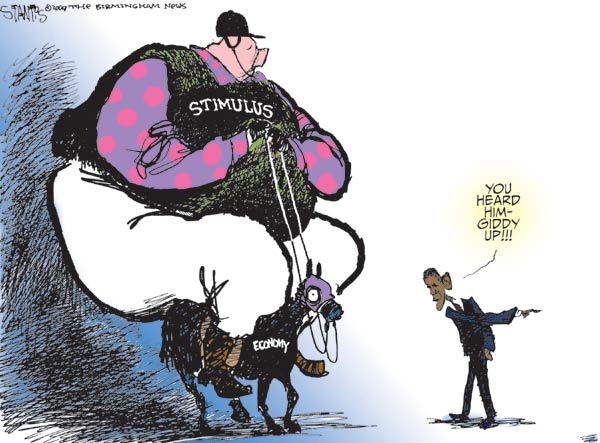
Well, you can also skip the class about public finance. Here’s a cartoon that shows the economic burden of government “stimulus” spending.

Very funny and very intellectually sound. Indeed, the only thing that would have made the cartoon even better would have been showing that the jockey became bloated by eating the horse’s food. But I reckon it’s not easy making multiple points with one picture.

Anyhow, I’m disappointed that I didn’t notice it at Reason.com a couple of years ago when the debate on the faux stimulus was taking place. It probably would have helped more people understand that you don’t boost economic performance by draining resources from the productive sector of the economy to finance a larger government.

By the way, if you want to understand in greater detail why the cartoon is accurate, this video on Keynesian economics is helpful, as is this video explaining the failure of Obama’s $1 trillion boondoggle.

Open letter to President Obama (Part 358)

Funding Government by the Minute

Published on Mar 28, 2012

At the rate the federal government spends, it runs out of money on July 31. What programs should be cut to balance the budget and fund the government for the remaining five months of the year? Cutting NASA might buy two days; cutting the Navy could buy fifteen. It seems that balancing the budget may require more than just cutting government programs. What should be done?

The Debt Limit: Made Simple

(This letter was emailed to White House on 12-12-12.)

President Obama c/o The White House
1600 Pennsylvania Avenue NW
Washington, DC 20500

Dear Mr. President,

I know that you receive 20,000 letters a day and that you actually read 10 of them every day. I really do respect you for trying to get a pulse on what is going on out here.

We got some big problems we got to take care of in this country. Will the liberal plan make things run smooth in the USA? There is no way that is going to happen. We got to take conservative principles and put them into practice in order to grow the economy. Instead, the liberal plan just loads more debt on our children.

Liberal Welfare State in Decline

Rich Tucker

December 10, 2012 at 1:06 pm

Even as the country deals with the crisis of the “fiscal cliff,” there’s another crisis waiting in the wings. “The second act will occur early in 2013 when the federal government will exhaust its ability to issue debt legally,” writes Heritage’s J. D. Foster.

As computer programmers would say, the seemingly endless series of crises isn’t a bug; it’s a feature, a fundamental debate over the future of the country.

With Obamacare in place, the left has finished building its dream: a liberal welfare state. Yet that dream seems likely to turn into a nightmare. Without massive tax increases on the middle class, the welfare state is simply not affordable. “The foundation is falling out from beneath the building just as they have finished construction,” quips Yuval Levin.

That’s why Charles Kesler, editor of the Claremont Review of Books, remains upbeat that the future of the country is conservative.

In a Heritage First Principles essay published before the 2012 election, he wrote:

If the bankruptcy of the entitlement programs were handled just the right way, with world-class cynicism and opportunism, in an emergency demanding quick, painful action lest Grandma descend into an irreversible diabetic coma, then liberalism might succeed in maneuvering America into a Scandinavia-style überwelfare state, fueled by massive and regressive taxes cheerfully accepted by the citizenry.

But all that remains unlikely:

Odds are we stand instead at the twilight of the liberal welfare state. As it sinks, a new, more conservative system will likely rise that will feature some combination of more means-testing of benefits, a switch from defined-benefit to defined-contribution programs, greater devolution of authority to the states and localities, a new budget process that will force welfare expenditures to compete with other national priorities, and the redefinition of the welfare function away from fulfilling socioeconomic “rights” and toward charitably taking care of the truly needy as best the community can afford when private efforts have failed or proved inadequate.

His optimism about the future explains why Kesler’s book I Am the Change is subtitled Barack Obama and the Crisis of Liberalism.

Despite the election results, it’s the left that faces an existential crisis. Conservatives, meanwhile, have detailed plans that can transform entitlement programs, reduce federal spending and debt, and hold the line on taxes. That’s worth remembering—no matter how the fiscal cliff talks end up.

_____________

___________

Thank you so much for your time. I know how valuable it is. I also appreciate the fine family that you have and your commitment as a father and a husband.

Sincerely,

Everette Hatcher III, 13900 Cottontail Lane, Alexander, AR 72002, ph 501-920-5733, lowcostsqueegees@yahoo.com

We don’t need to recruit people to be on food stamps but kick people off!!!

We don’t need to recruit people to be on food stamps but kick people off!!!

Seven Reasons to Reform Food Stamps

July 4, 2013 at 12:00 pm

Newscom

Newscom

Food stamps were a popular topic of conversation last month as Congress debated the farm bill. This decades-old Great Society program is in much need of reform for at least seven reasons:

  1. Food stamp spending has surged. Costs have been climbing since the program began in the 1960s, recession or not. Over roughly the past decade, food stamp spending jumped from $19.8 billion in 2000 to $84.6 billion in 2011.
  2. Food stamp rolls have also been climbing for decades, regardless of the economic situation. Today, food stamp use is at an all-time high, with the most recent data showing that about one in seven people participate in the program. This is a 140 percent increase since 1990.
  3. Government has vastly expanded food stamp eligibility. “Broad-based categorical eligibility,” put in place under the Clinton Administration and heavily pushed by the Obama Administration, loosens income and asset limits. That the number of households receiving food stamps has increased faster than households near the poverty line indicates that changes in food stamp policy helped boost the rolls.
  4. States are spending taxpayer money to “recruit” food stamp participants who might not otherwise choose to use them. From advertisements, aggressive tactics, and enrollment quotas used by recruitment agents, it seems like Uncle Sam wants you on food stamps.
  5. Despite what the left claims, food stamps don’t stimulate the economy. Every dollar spent on food stamps is a dollar that would otherwise be spent elsewhere. Therefore, it simply shuffles resources rather than adding economic growth.
  6. Even in good economic times, many food stamp recipients don’t work. In 2010, among the roughly 10.5 million households receiving food stamps that contained an able-bodied, non-elderly adult, 5.5 million did not perform any work. Of those who did work, 1.5 million to 2 million worked less than 30 hours per week.
  7. Food stamps discourage work and self-sufficiency. “The more income that a person receives when not working, the less is the reward to working,” University of Chicago Professor Casey Mulligan testified before Congress earlier this year. “In such cases, a person might have more resources available to use or save as a consequence of working less.” Because food stamp benefits are reduced by 30 cents for each dollar of net income a recipient earns, the program behaves like an income tax paid by recipients via reduced benefits. Thus, food stamps can often act as a disincentive to work. Mulligan estimates that this disincentive has actually prolonged the weak labor market recovery.

Policymakers should reform food stamps to promote self-sufficiency through work and roll back food stamp spending when employment rates improve. These changes would promote not only fiscal responsibility but, more importantly, personal responsibility and human dignity.

Related posts:

If increase in food stamps was just because of recession then why spending go from $19.8 billion in 2000 to $37.9 billion in 2007?

If the increase in food stamps was just because of the recession then why did the spending go from $19.8 billion in 2000 to $37.9 billion in 2007? The Facts about Food Stamps Everyone Should Hear Rachel Sheffield and T. Elliot Gaiser May 27, 2013 at 12:00 pm (7) Newscom A recent US News & […]

Tell the 48 million food stamps users to eat more broccoli!!!!

Welfare Can And Must Be Reformed             Uploaded on Jun 29, 2010 If America does not get welfare reform under control, it will bankrupt America. But the Heritage Foundation’s Robert Rector has a five-step plan to reform welfare while protecting our most vulnerable. __________________________ We got to slow down the growth of Food Stamps. One […]

Republicans for more food stamps?

Eight Reasons Why Big Government Hurts Economic Growth __________________ We got to cut spending and we must first start with food stamp program and we need some Senators that are willing to make the tough cuts. Food Stamp Republicans Posted by Chris Edwards Newt Gingrich had fun calling President Obama the “food stamp president,” but […]

Obama promotes food stamps but Milton Friedman had a better suggestion

Milton Friedman’s negative income tax explained by Friedman in 1968: We need to cut back on the Food Stamp program and not try to increase it. What really upsets me is that when the government gets involved in welfare there is a welfare trap created for those who become dependent on the program. Once they […]

400% increase in food stamps since 2000

Welfare Can And Must Be Reformed Uploaded by HeritageFoundation on Jun 29, 2010 If America does not get welfare reform under control, it will bankrupt America. But the Heritage Foundation’s Robert Rector has a five-step plan to reform welfare while protecting our most vulnerable. __________________________ If welfare increases as much as it has in the […]

Why can’t we cut the Food Stamp budget?

Why can’t we cut the Food Stamp budget? Should Food Stamps Be in Farm Bill? Congressman Seeks to Split Legislation Kelsey Harris June 17, 2013 at 10:38 pm Bill Clark/Roll Call Photos/Newscom Representative Marlin Stutzman (R-IN), a fourth-generation farmer, is asking his House colleagues to separate the food stamp program from the “farm” bill. Stutzman […]

Food stamp spending has doubled under the Obama Administration

The sad fact is that Food stamp spending has doubled under the Obama Administration. A Bumper Crop of Food Stamps Amy Payne May 21, 2013 at 7:01 am Tweet this Where do food stamps come from? They come from taxpayers—certainly not from family farms. Yet the “farm” bill, a recurring subsidy-fest in Congress, is actually […]

Which states are the leaders in food stamp consumption?

I am glad that my state of Arkansas is not the leader in food stamps!!! Mirror, Mirror, on the Wall, Which State Has the Highest Food Stamp Usage of All? March 19, 2013 by Dan Mitchell The food stamp program seems to be a breeding ground of waste, fraud, and abuse. Some of the horror stories […]

Why not cancel the foodstamp program and let the churches step in?

Government Must Cut Spending Uploaded by HeritageFoundation on Dec 2, 2010 The government can cut roughly $343 billion from the federal budget and they can do so immediately. __________ We are becoming a country filled with people that dependent on the federal government when we should be growing our economy by lowering taxes and putting […]

Food Stamp Program is constantly ripped off and should be discontinued

Uploaded by oversightandreform on Mar 6, 2012 Learn More at http://oversight.house.gov The Oversight Committee is examining reports of food stamp merchants previously disqualified who continue to defraud the program. According to a Scripps Howard News Service report, food stamp fraud costs taxpayers hundreds of millions every year. Watch the Oversight hearing live tomorrow at 930 […]

Taxes made simple by Dan Mitchell of the Cato Institute

The Flat Tax: How it Works and Why it is Good for America

Uploaded by on Mar 29, 2010

This Center for Freedom and Prosperity Foundation video shows how the flat tax would benefit families and businesses, and also explains how this simple and fair system would boost economic growth and eliminate the special-interest corruption of the internal revenue code. www.freedomandprosperity.org

_______________

President Obama wants to engage in classwarfare but the economic facts are on the conservative’s side. In order to get out of this mess, we must lower the taxes of the job creators and lower federal spending at the same time in order to balance the budget before we end up arriving at Greece.

Here is a great article by Dan Mitchell that  makes this issue of taxes very simple:

In my explanations of the Laffer Curve, I’ve shown evidence that high tax rates discourage productive behavior and boost the underground economy.

And if higher tax rates are sufficiently onerous, the resulting reductions in taxable income can completely offset the revenue-generating impact of higher tax rates. Indeed, this is what’s already happened with the “Snooki tax.”

And the same thing happens in reverse. If lower tax rates lead to a big enough increase in taxable income, the government actually collects more revenue – which is exactly what happened when the top tax rate was lowered in the 1980s.

I’ve also tried to explain, shifting from economics to philosophy, that confiscatory tax rates are unfair and immoral. And I’m glad to see that most Americans agree, with 75 percent of all people saying that nobody should ever face a tax rate of more than 30 percent.

Notwithstanding that polling data, though, I fear that many people don’t really understand the economics of taxation. So I’m happy to share this little story that periodically winds up in my inbox.

===============================================

Suppose that every day, ten men go out for beer and the bill for all ten comes to $100. If they paid their bill the way we pay our taxes, it would go something like this…

  • The first four men (the poorest) would pay nothing
  • The fifth would pay $1
  • The sixth would pay $3
  • The seventh would pay $7
  • The eighth would pay $12
  • The ninth would pay $18
  • The tenth man (the richest) would pay $59

So, that’s what they decided to do.

The ten men drank in the bar every day and seemed quite happy with the arrangement, until one day, the owner threw them a curve ball.

“Since you are all such good customers,” he said, “I’m going to reduce the cost of your daily beer by $20″. Drinks for the ten men would now cost just $80.

The group still wanted to pay their bill the way we pay our taxes. So the first four men were unaffected. They would still drink for free. But what about the other six men ? How could they divide the $20 windfall so that everyone would get his fair share?

The bar owner suggested that it would be fair to reduce each man’s bill by a higher percentage the poorer he was, to follow the principle of the tax system they had been using, and he proceeded to work out the amounts he suggested that each should now pay.

  • And so the fifth man, like the first four, now paid nothing (100% saving).
  • The sixth now paid $2 instead of $3 (33% saving).
  • The seventh now paid $5 instead of $7 (28% saving).
  • The eighth now paid $9 instead of $12 (25% saving).
  • The ninth now paid $14 instead of $18 (22% saving).
  • The tenth now paid $49 instead of $59 (16% saving).

Each of the six was better off than before. And the first four continued to drink for free. But, once outside the bar, the men began to compare their savings.

“I only got a dollar out of the $20 saving,” declared the sixth man. He pointed to the tenth man,”but he got $10!”

“Yeah, that’s right,” exclaimed the fifth man. “I only saved a dollar too. It’s unfair that he got ten times more benefit than me!”

“That’s true!” shouted the seventh man. “Why should he get $10 back, when I got only $2? The wealthy get all the breaks!”

“Wait a minute,” yelled the first four men in unison, “we didn’t get anything at all. This new tax system exploits the poor!”

The nine men surrounded the tenth and beat him up.

The next night the tenth man didn’t show up for drinks so the nine sat down and had their beers without him. But when it came time to pay the bill, they discovered something important. They didn’t have enough money between all of them for even half of the bill!

And that, boys and girls, journalists and government ministers, is how our tax system works. The people who already pay the highest taxes will naturally get the most benefit from a tax reduction. Tax them too much, attack them for being wealthy, and they just may not show up anymore. In fact, they might start drinking overseas, where the atmosphere is somewhat friendlier.

===============================================

Very well done. Reminds me of the PC version of the story about the ant and the grasshopper, or perhaps the joke about using two cows to explain various economic and political systems.

And if you like those, you’ll appreciate this modern fable about bureaucracy, featuring an ant and a lion.