Despite what you said on January 21, 2013 our nation is becoming a nation of takers when it used to be mainly makers!!!!!Take a look at this video below:
_____________
Real Time with Bill Maher March 16 2012 – Alexandra Pelosi Interviews Welfare Recipients in NYC
But you probably don’t realize how far America has traveled in the wrong direction.
In today’s Wall Street Journal, Nicholas Eberstadt of the American Enterprise Institute rips apart President Obama’s empty assertion that the welfare state is desirable.
…the president is tired of listening to critics of America’s entitlement programs, and as far as he is concerned, the discussion is now over. It is not over—and won’t be anytime soon, because the country’s social-welfare spending is generating severe and mounting hazards for the nation. These hazards are not only fiscal but moral.
Eberstadt shares a bunch of bullet points that should worry anybody who cares about the future of the nation, starting with an inverse version of Mitchell’s Golden Rule. Handouts have been growing twice as fast as overall personal income!
• Over the 50-plus years since 1960, according to the Bureau of Economic Analysis, entitlement transfers—government payments of cash, goods and services to citizens—have been growing twice as fast as overall personal income. Government transfers now account for nearly 18% of all personal income in America—up from 6% in 1960.
• According to the BEA, America’s myriad social-welfare programs (the federal bureaucracy apparently cannot determine exactly how many of these there are) currently dispense entitlement benefits of more than $2.3 trillion annually. Since those entitlements must be paid for—either through taxes or borrowing—the burden of entitlement spending now amounts to over $7,400 per American man, woman and child.
• According to the latest data from the U.S. Census Bureau, nearly half (49%) of Americans today live in homes receiving one or more government transfer benefits. That percentage is up almost 20 points from the early 1980s. And contrary to what the Obama White House team suggested during the election campaign, this leap is not due to the aging of the population. In fact, only about one-tenth of the increase is due to upticks in old-age pensions and health-care programs for seniors.
A big problem is that many working-age people have decided not to work.
• As entitlement outlays have risen, there has been flight of men from the work force. According to the Bureau of Labor Statistics, the proportion of adult men 20 and older working or seeking work dropped by 13 percentage points between 1948 and 2008. …In December 2012, more than 8.8 million working-age men and women took such disability payments from the government—nearly three times as many as in December 1990. For every 17 people in the labor force, there is now one recipient of Social Security disability program payments.
But that’s just part of the answer. We also need to change the culture. If people decide it is okay to live off the government, even leftists have begun to admit that it is very hard to re-create a system of self reliance.
_______________
Thank you so much for your time. I know how valuable it is. I also appreciate the fine family that you have and your commitment as a father and a husband.
Sincerely,
Everette Hatcher III, 13900 Cottontail Lane, Alexander, AR 72002, ph 501-920-5733, lowcostsqueegees@yahoo.com
A benefit of the government shutdown may be that it slows the stream of waste and bad behavior flowing from the federal bureaucracy. Catching up on my reading, I noticed these items in just the last few days of the Washington Post:
The Department of Commerce has kicked out the National Aquarium from its building after 80 years. There is no bad behavior here, just a sad story since the aquarium is an example of successful privatization. Federal funding was eliminated in 1982, and the aquarium was converted into a nonprofit corporation and supported by admission fees, donations, and volunteer efforts.
The central figure in the IRS scandal, Lois Lerner, was finally pushed out. It is pretty obvious that a political and ideological agenda was at work in the targeting of conservative groups, but it has been very difficult to squeeze even an apology out of IRS officials and the Obama administration. Bart Simpson’s line “I didn’t do it” has long been the approach taken by government officials caught violating the public trust.
A recent Washington Post article by Joe Davidson—the paper’s advocate for federal workers—was headlined “Shutdown Would Corrode Our View of Government.” I don’t think we need a shutdown for that.
What Are the Dangers of Too Much Debt? Published on Mar 20, 2012 Interest payments on U.S. government debt are three times spending in the Iraq and Afghanistan wars already, and that is with the lowest interest rate we have seen since the 1960s. A rise in interest rates would increase interest payments dramatically. What […]
Senator Mark Pryor wants our ideas on how to cut federal spending. Take a look at this video clip below: Senator Pryor has asked us to send our ideas to him at cutspending@pryor.senate.gov and I have done so in the past and will continue to do so in the future. Here are a few more […]
We need to stop wasteful government spending by privatizing the post office!! Postal Service Won’t Shut Down but Will Default on Its Debt James Gattuso October 1, 2013 at 9:30 am Newscom The U.S. Postal Service (USPS) defaulted on its debt last night. No, it has nothing to do with the partial shutdown of the […]
Why do I keep writing and email Senator Pryor suggestions on how to cut our budget? I gave him hundreds of ideas about how to cut spending and as far as I can tell he has taken none of my suggestions. You can find some of my suggestionshere,here,here,here,here,here,here,here,here,here,here,here,here,here,here,here,here,here,here, here, and here, and they all were emailed to him.In fact, I have written 13 postspointing out reasons why I believe Senator Pryor’s re-election attempt will be unsuccessful. HERE I GO AGAIN WITH ANOTHER EMAIL I JUST SENT TO SENATOR PRYOR!!!
Dear Senator Pryor,
Why not pass the Balanced Budget amendment? As you know that federal deficit is at all time high (1.6 trillion deficit with revenues of 2.2 trillion and spending at 3.8 trillion).
On my blogwww.thedailyhatch.org. I took you at your word andsent you over 100 emails with specific spending cut ideas. (Actually there were over160 emails with specific spending cut suggestions.)However, I did not see any of them in the recent debt deal that Congress adopted although you didrespondto meseveral times. Now I am trying another approach. Every week from now on I will send you an email explaining different reasons why we need the Balanced Budget Amendment or I send you specific spending cut suggestions. It will appear on my blog on “Thirsty Thursday” because the government is always thirsty for more money to spend.
IF YOU TRULY WANT TO CUT THE BUDGET AND BALANCE THE BUDGET THEN SUBMIT THESE POTENTIAL BUDGET CUTS PRESENTED BELOW!!
_______________
_______________
What Can We Cut to Balance the Budget
Published on Oct 16, 2012
If the U.S. government cut all government services except Social Security, Medicare, Medicaid, and payments on the debt, federal spending would still outpace revenues. Prof. Antony Davies argues that there are not specific cuts that will enable government to balance the budget. He says, “Nothing less than a redesign will solve this problem.” That redesign should begin by determining what the proper role of government is.
_______________
Sallie James wrote in October 2012:
Policymakers should terminate the Export-Import Bank. The agency does not play a crucial role in international trade, and there is no reason why U.S. exporters deserve favored treatment over U.S. businesses with domestic sales. Rather than fixing market failures, the bank creates economic distortions of its own. U.S. exports have grown impressively over the years, despite only a very small proportion of them being supported by Ex-Im financing.
The federal government should urge other nations to cut their own export subsidies. It may be beneficial to move negotiations on export subsidies from the OECD to the WTO, which has a broader membership and a better system for resolving disputes and enforcing rulings. But U.S. policymakers should not retain the Ex-Im Bank merely because other nations are following misguided subsidy policies.
There are successful trade liberalization episodes that demonstrate the benefits of U.S. reform leadership. The Information Technology Agreement and the agreements on telecommunications and financial services, for example, were all negotiated through the World Trade Organization at the urging of the United States, even though it already had a zero tariff rate for semiconductors and offered only to lock in current levels of openness for telecommunications and financial services. For export credits, too, other countries may follow the United States in repeal because adopting sound policies is in their best interests and because American promises to lock in current practices are considered valuable.
In sum, none of the reasons offered for the Ex-Im Bank’s continued existence are convincing. Private credit markets are far deeper and are more accessible today than when the bank was created in the 1930s. The Ex-Im Bank’s resources are mainly used to assist large corporations that have little trouble obtaining their own private financing. Export subsidies do not increase employment overall, nor do they have any substantial impact on the trade balance. Finally, it is simply not fair for the government to pick and choose certain businesses to subsidize at the expense of other businesses and the broader economy.
The Balanced Budget Amendment is the only thing I can think of that would force Washington to cut spending. We have only a handful of balanced budgets in the last 60 years, so obviously what we are doing is not working. We are passing along this debt to the next generation. YOUR APPROACH HAS BEEN TO REJECT THE BALANCED BUDGET “BECAUSE WE SHOULD CUT THE BUDGET OURSELF,” WELL THEN HERE IS YOUR CHANCE!!!! SUBMIT THESE CUTS!!!!
Thank you for this opportunity to share my ideas with you.
The problem with the debt ceiling is very clear to me. We need to get serious about cutting federal spending. I am so upset about it that I have emailed over 100 emails to Senator Pryor concerning specific spending suggestions. I get emails from back from Senator Pryor like the one below. This means that […]
Senator Pryor asks for Spending Cut Suggestions! Here are a few!(Part 164) Senator Mark Pryor wants our ideas on how to cut federal spending. Take a look at this video clip below: Senator Pryor has asked us to send our ideas to him at cutspending@pryor.senate.gov and I have done so in the past and will continue to […]
Senator Pryor asks for Spending Cut Suggestions! Here are a few!(Part 163) Senator Mark Pryor wants our ideas on how to cut federal spending. Take a look at this video clip below: Senator Pryor has asked us to send our ideas to him at cutspending@pryor.senate.gov and I have done so in the past and will continue to […]
Senator Pryor asks for Spending Cut Suggestions! Here are a few!(Part 162) Senator Mark Pryor wants our ideas on how to cut federal spending. Take a look at this video clip below: Senator Pryor has asked us to send our ideas to him at cutspending@pryor.senate.gov and I have done so in the past and will continue to […]
Three very good video tours below from Senator Mark Pryor. Published on Jun 13, 2012 by SenatorPryor Episode 1: Arkansans in the Capitol Published on Jul 9, 2012 by SenatorPryor Episode 2: The Crypt and the Old Supreme Court Published on Aug 20, 2012 by SenatorPryor Episode 3: The Senate Chamber If you want to […]
Senator Pryor asks for Spending Cut Suggestions! Here are a few!(Part 161) Senator Mark Pryor wants our ideas on how to cut federal spending. Take a look at this video clip below: Senator Pryor has asked us to send our ideas to him at cutspending@pryor.senate.gov and I have done so in the past and will continue to […]
Senator Mark Pryor wants our ideas on how to cut federal spending and I sent them to him but he didn’t take any of my suggestions. However, he did take time to get back to me today, but I am not too impressed with Senator Pryor’s response. I gave him hundreds of ideas about how […]
Senator Pryor asks for Spending Cut Suggestions! Here are a few!(Part 160) Senator Mark Pryor wants our ideas on how to cut federal spending. Take a look at this video clip below: Senator Pryor has asked us to send our ideas to him at cutspending@pryor.senate.gov and I have done so in the past and will continue to […]
Senator Pryor asks for Spending Cut Suggestions! Here are a few!(Part 159) Senator Mark Pryor wants our ideas on how to cut federal spending. Take a look at this video clip below: Senator Pryor has asked us to send our ideas to him at cutspending@pryor.senate.gov and I have done so in the past and will continue to […]
Senator Mark Pryor wants our ideas on how to cut federal spending. Take a look at this video clip below: Senator Pryor has asked us to send our ideas to him at cutspending@pryor.senate.gov and I have done so in the past and will continue to do so in the future. On May 11, 2011, I emailed to […]
Office of the Majority Whip | Balanced Budget Amendment Video In 1995, Congress nearly passed a constitutional amendment mandating a balanced budget. The Balanced Budget Amendment would have forced the federal government to live within its means. This Balanced Budget Amendment failed by one vote. 16 years later, Congress has the chance to get it […]
Sadly Senator Pryor has voted against the Balanced Budget Amendment over and over in his long time in the Senate. Senator Pryor: “There are a lot of people who think a balanced-budget amendment solves all the fiscal problems. I completely disagree.” (Peter Urban, Pryor Tilts Balanced Budget, Southwest Times Record, 11/17/11) Dear Senator Pryor, Why […]
Mark Levin and Senator Hatch discuss the balanced budget amendment and it’s importance. Uploaded by loveconstitution on Jan 28, 2011 Mark Levin interviews Senator Hatch 1/27/2011 about the balanced budget amendment. Mark is very excited about the balanced budget amendment being proposed by Senator Orin Hatch and John Cornyn and he discusses the amendment with […]
Dr. Jay Barth with Hendrix College comments on our latest poll results on Arkansas politics (clip from Talkbusiness) Talk Business reported today in the article “Poll Shows Beebe Strength, Pryor Shaky,” the following: A new Talk Business-Hendrix College Poll shows Gov. Mike Beebe (D) maintaining his high job approval rating, while Sen. Mark Pryor (D) […]
U.S. Sen. Mark Pryor at the 2009 Democratic Party Jefferson Jackson Dinner, Arkansas’s largest annual political event. Mark Pryor is up for re-election to the Senate in 2014. It is my opinion that the only reason he did not have an opponent in 2008 was because the Republicans in Arkansas did not want to go […]
Michael Tanner, a senior fellow at the CATO institute, explains that the rate of return on social security will be much lower for todays youth. Steve Brawner wrote in his article “Tiptoeing toward the third rail,” (Arkansas News Bureau, Jan 9,): Social Security has long been considered the “third rail” for American politicians, meaning it’s […]
HALT:HaltingArkansasLiberalswithTruth.com CBS — October 19, 2010 — New York Times’ Jeff Zeleny talks to Jan Crawford about the state of Democrats in the South… Are they a dying species? In the article “Southern Democrat much closer to extinction after GOP wave,” (Washington Times, Nov 4, 2010), Ben Evans notes: After this week’s elections, the […]
HALT:HaltingArkansasLiberalswithTruth.com Roland Martin appears on Rick’s List with Rick Sanchez and the Best Political Team on television (Candy Crowley, John King, Jeffery Toobin, Ed Rollins, Gloria Borger and Victoria Toensing) to discuss day two of the Elena Kagan Supreme Court confirmation hearings. During the analysis, Senator Graham and Elena Kagan had an interesting exchange over […]
To bail out the housing sector, or to bail out Medicare? Fannie and Freddie, or GM and Chrysler?
All these examples involve huge amounts of money, and both private-sector and public-sector bailouts have perverse long-run effects, but which is worse?
And don’t forget there are lots of other bailouts in our future, as discussed on this interview for Fox Business News.
The interview took place before Christmas, but the topic is even more relevant today since the budget season is about to begin.
Most of the discussion was about government agencies and programs that may get more handouts, though bailouts for the Federal Housing Administration and the Pension Benefit Guaranty Corporation would be indirect bailouts for big business and housing.
So we’d get the worst of all worlds, more government spending and more cronyism.
Or, as they call it in Washington, a win-win situation.
Thank you so much for your time. I know how valuable it is. I also appreciate the fine family that you have and your commitment as a father and a husband.
Sincerely,
Everette Hatcher III, 13900 Cottontail Lane, Alexander, AR 72002, ph 501-920-5733, lowcostsqueegees@yahoo.com
Washington’s reckless spending is driving America into debt — and yet federal bureaucrats continue their wasteful and frivolous ways.
The latest example comes courtesy of today’s Washington Post, which features a story that should infuriate any taxpayer.
As the federal government’s fiscal year draws to a close Monday, agencies are spending wildly on big-ticket items like artwork, office supplies and furniture.
Here are just a few examples of what was happening in Washington last week:
On Monday, VA paid $27,000 for an order of photographs showing sunsets, mountain peaks and country roads. They would go into a new center serving homeless veterans in Los Angeles; a spokeswoman described the art as “motivational and calming, professionally designed to enhance clinical operations.”
On Tuesday, the USDA bought $127,000 worth of toner cartridges (“end of year,” the order explained). VA spent another $220,000 on artwork for its hospitals.
On Wednesday, the Coast Guard paid $178,000 for cubicle furniture, replacing high-walled cubes with low-walled ones to improve the air flow in a large office area.
“Other higher-priority projects were not able to be executed, so they moved [money] to this lower-priority project” before the year’s end, said Coast Guard spokesman Carlos Diaz. “The money was going to be spent anyway.”
On Thursday, VA was buying art again. It spent $216,000 on artwork for a facility in Florida. In all, preliminary data showed that the agency made at least 18 percent of all its art purchases for the year in this one week. One-sixth of the buying in one-52nd of the year.
Accompanying the Washington Post story is an infographic (click below to enlarge) that paints the picture of a government hell-bent on spending money before it’s gone: 19.1 percent of all spending came in the final five weeks of the fiscal year and 15.2 percent of contracts were awarded during that time.
Reckless spending is threatening the American dream for our children and grandchildren. It’s time Washington begins the serious task of cutting spending.
All across America, families are balancing their budgets and paying off debt. If Americans can do it, why can’t our federal government?
I wish President Obama would try to cut spending instead of increasing spending and our debt. Two Very Good GSA Waste Cartoons April 21, 2012 by Dan Mitchell One of my first blog posts back in 2009 featured a column about the Social Security Administration squandering $750,000 on a “conference” at a fancy golf resort in […]
Does Government Have a Revenue or Spending Problem? People say the government has a debt problem. Debt is caused by deficits, which is the difference between what the government collects in tax revenue and the amount of government spending. Every time the government runs a deficit, the government debt increases. So what’s to blame: too […]
What Are the Dangers of Too Much Debt? Published on Mar 20, 2012 Interest payments on U.S. government debt are three times spending in the Iraq and Afghanistan wars already, and that is with the lowest interest rate we have seen since the 1960s. A rise in interest rates would increase interest payments dramatically. What […]
Funding Government by the Minute Published on Mar 28, 2012 At the rate the federal government spends, it runs out of money on July 31. What programs should be cut to balance the budget and fund the government for the remaining five months of the year? Cutting NASA might buy two days; cutting the Navy […]
Does Government Have a Revenue or Spending Problem? People say the government has a debt problem. Debt is caused by deficits, which is the difference between what the government collects in tax revenue and the amount of government spending. Every time the government runs a deficit, the government debt increases. So what’s to blame: too […]
What Are the Dangers of Too Much Debt? Published on Mar 20, 2012 Interest payments on U.S. government debt are three times spending in the Iraq and Afghanistan wars already, and that is with the lowest interest rate we have seen since the 1960s. A rise in interest rates would increase interest payments dramatically. What […]
What Can We Cut to Balance the Budget Published on Oct 16, 2012 Will Rogers has a great quote that I love. He noted, “Lord, the money we do spend on Government and it’s not one bit better than the government we got for one-third the money twenty years ago”(Paula McSpadden Love, The Will Rogers Book, (1972) […]
Does Government Have a Revenue or Spending Problem? People say the government has a debt problem. Debt is caused by deficits, which is the difference between what the government collects in tax revenue and the amount of government spending. Every time the government runs a deficit, the government debt increases. So what’s to blame: too […]
What Are the Dangers of Too Much Debt? Published on Mar 20, 2012 Interest payments on U.S. government debt are three times spending in the Iraq and Afghanistan wars already, and that is with the lowest interest rate we have seen since the 1960s. A rise in interest rates would increase interest payments dramatically. What […]
I wish the federal government would go back to spending less than 5% of GDP like they did the first 150 years of our country’s history. We could cut down on a lot of wasteful spending if we did that. Morning Bell: The Governing Class and Us Mike Brownfield April 19, 2012 at 8:57 am […]
If we don’t have entitlement reform soon then we will see the programs go bankrupt in the next couple of decades. Here is a first step that we can take below. Watch this great video below:
Social Security vs. Private Retirement
Is Social Security a good retirement plan? Economics professor Antony Davies shows that Americans stand to earn significantly less and assume more risk with Social Security than other investment options. According to Davies, taxpayers would be better off both in terms of financial security and return on investment by investing their money privately. Social security is extremely expensive, soon to be insolvent, and doesn’t even offer taxpayers the most bang for their buck. For those reasons, Prof. Davies argues that it is time for the government to phase out Social Security. Davies’ solution: the government should honor its obligations to current retirees while giving Americans the freedom to invest their money as they see fit.
Abstract: Between 1988 and 2011, the amount of the U.S. population that receives assistance from the federal government grew by 62 percent. That means that more than 41 percent of the U.S. population is enrolled in at least one federal assistance program. To make matters worse, per capita expenditures on recipients are rising as well. In 2010, over 70 percent of all federal spending went to dependence-creating programs. That growth is unsustainable, as baby boomers are now retiring every day and their entitlements cost more each year. The publicly held federal debt will exceed 100 percent of GDP in 2024. Such a high level of debt always hurts an economy—and the people who live in it. The time for Congress to reform dependence-creating government programs is now.
The number of people receiving benefits from the federal government in the United States has grown from under 94 million people in 2000 to more than 128 million people in 2011. That means that 41.3 percent of the U.S. population is now on a federal government program. The 128 million is an estimate based on the recently released March 2011 U.S. Census Bureau Current Population Survey (CPS), which, due to the survey methodology, most likely undercounts the actual number.
Heritage Foundation calculations using the March 2011 CPS found the number of people who receive assistance from at least one federal program to be 128.8 million. Using the Census Bureau number for the U.S. population in July 2011, which was 311,591,917, at least 41.34 percent are federal government program beneficiaries.[1] While very few Americans would deny that the federal government should play a role in aiding those in need, this number doubtless qualifies as far too large, indicating that taxpayer dollars are going to those not in need as well.
Many of those who receive benefits from the federal government could live well without them, so they do not count as truly dependent on the federal government.[2] Warren Buffett is the beneficiary of a federal program—Social Security—but, since he does not rely on that income for his livelihood, he should not be considered dependent on government programs. Others depend on the programs for nearly all of their income, housing, health care, food, and other needs and so fall under the classification of truly dependent on the government. Still others are somewhere in between, depending on government financing for, say, college, but little else. Consequently, it is important to note that stating that 128.8 million people receive benefits from a government program does not mean that all of them are dependent on the government.
The Numbers
In the CPS, the Census Bureau surveys thousands of U.S. citizens and non-citizens living in the U.S. in randomly drawn monthly phone surveys. Together, the roughly 60,000 households surveyed are a representative cross section of the U.S. population. While the CPS is conducted each month, the March survey has the most detailed questions. Only the March CPS survey format contains a sufficient level of detail to count federal government program participants.
The responses to the March 2011 CPS have now been released, and these individual responses were sorted for this report. All of the data were examined for responses by individuals who answered affirmatively that they were receiving benefits at the time of the survey. Based on their responses, Heritage created a new dataset from those who responded that they receive financial or in-kind benefits from at least one government program. By counting the individuals in that dataset, and using a weight assigned by the Census Bureau to each individual, the weighted number of people who depend on government programs was found.
The new dataset of people on government programs can then be further sorted to find out how many people say they are on a particular program. Here are some of the resulting numbers:
128,818,142 people are enrolled in at least one government program.
48,580,105 people are on Medicaid.
35,770,301 people receive their retirement income from Social Security.
43,834,566 people are on Medicare.
39,030,579 people are living in a household where at least one person accepts food stamps.
6,984,783 people are living in subsidized rental housing.
2,047,149 people are receiving a higher-education subsidy.
It is important to note that the above categories overlap; for example an individual may receive both subsidized rental housing and food stamps. The total number—128,818,142 people on at least one government program does not double count individuals, however.
The 128,818,142 figure for people enrolled in at least one program is surely an undercount: The CPS responses are well known to undercount those receiving Medicaid, Medicare, Social Security, State Children’s Health Insurance, higher-education support, and Temporary Assistance for Needy Families.[3]
The undercount in higher-education subsidies may be the most important, because recipients of education subsidies are generally younger and not likely to be enrolled in other programs. Sorting the March 2011 CPS data shows that, of the two million people in the survey who responded that they receive higher-education subsidies, fewer than one half of 1 percent relied on Social Security retirement income; only 1.5 percent were also on Medicare; and only 16 percent received food stamps. The 2 million people who stated they receive higher-education subsidies are assuredly much fewer than the actual number, since the number of people receiving Pell Grants alone in 2011 was 9.7 million.[4] It is not known why the undercount in education subsidies is so large, but it is likely related to the weights the CPS uses to represent college students. Therefore, even counting only Pell Grant recipients would add millions to the lowball estimate of 128.8 million total people who receive assistance from a government program.
Housing subsidies are also most likely undercounted. According to the March 2011 CPS, only 6,984,783 individuals live in subsidized rental housing. Other government data puts the number at 4,952,191 households in 2010, not individuals.[5] Again, the weights used in the survey may contribute to the shortfall.
Growth in Number of People on Government Programs Over Time
The rate of growth in the number of people who are enrolled in a federal program far outpaces general population growth. (See chart.) In fact, an analysis of the March2011 CPS responses going back to 1988 reveals that the number in March 2011 (128,818,142) is 62 percent higher than it was in March 1988 (79,592,924). Meanwhile, the U.S. population has grown only 27 percent since that year. In other words, the number of people who are enrolled in at least one federal program has grown more than two times faster than has the U.S. population. That growth is unsustainable as baby boomers are now retiring every day, and their entitlements cost more each year. The publicly held federal debt will exceed 100 percent of gross domestic product (GDP) by 2024.[6] Such a high level of debt always slows an economy.[7] One need look no further than the current situations in Greece, Italy, or Spain to see what high levels of national debt do to a country’s economic health. The European Union now faces a recession because of the debt its members owe. Shrinking economies are bad for everyone who lives in them, but they especially hurt the young, who have much higher rates of unemployment than older workers.[8] Shrinking economies make it even harder for young workers to find jobs. Their very futures are the ones in peril because of that debt.
While the number of people on a federal program has grown too fast, the average amount spent per capita has greatly outpaced even that level. (See chart.) The Heritage Foundation’s Index of Dependence on Government has been released annually since 2002. It tracks the amount of money that is spent on federal-assistance programs.[9] The data is in constant 2005 dollars, meaning that the amount spent increases or decreases due to government policies, not inflation. Between 1988 and 2011, spending on dependence-creating federal government programs has increased 180 percent.[10] versus “only” a 62 percent increase in the number of people who are enrolled in federal government programs, and a 27 percent increase in the population. Not only are more people enrolled in government programs than ever before, but more U.S. taxpayer dollars are being spent on each recipient every year.
What the Numbers Mean
What these alarming numbers mean is that a large proportion of the people in the United States have two kinds of income: (1) money that they or their family have earned, and (2) money transferred to them from U.S. taxpayers through the vehicle of a federal government program. Those consuming the second kind count for over 128.8 million individuals—41.3 percent of the population. According to Wall Street Journal research, when counting the number of people who live in a household where at least one person is on a government program, the dangerous tipping point of half of all Americans is nearly reached.[11] at 49.1 percent.
If one person in a household receives federal assistance, it is often the case that all members of that household do. This is certainly the case for food stamps: If a family shares meals and one of the relatives accepts food stamps, all members of that household are using those food stamps for part of their food.[12] If one person in a household receives a rent subsidy, everyone who lives in the home is a recipient.
The Clock is Ticking
The time to reform dependence-creating government programs is now. In 2010, over 70 percent of all federal spending went to dependence-creating programs.[13] It went to subsidize the living expenses of over 128.8 million individuals in the U.S. in 2011, which was more than 41 percent of the U.S. population. When the percentage of those living in a household where at least one person is subsidized is calculated, the number tops 49 percent. The problem is too much government subsidizing, and too much transfer of wealth from taxpayers to those who pay fewer and fewer taxes. After all, government does not create wealth by spreading it around.
Congress would do well to remember that there are no free subsidies and benefits. The government today is borrowing from future taxpayers to pay the current government program enrollees. The game will soon be up as debt approaches 100 percent of GDP. The United States should not owe 100 percent of all the goods and services produced in a year to its debtors. It is time for across-the-board entitlement reform so that the red inkdoes not drown America’s babies as they grow older and seek out their vision of the American dream. It is time for elected officials to restore America’s future for kids today who deserve to live in the great land of opportunity that America has been for the generations that came before them—instead of being bound to pay off a mountain of debt that they had no part in creating and that they should not have to face.[14]
—Patrick D. Tyrrell is Research Coordinator in the Center for Data Analysis, and William W. Beach is Director of the Center for Data Analysis, and Lazof Family Fellow in Economics, at The Heritage Foundation.
Do governments ever cut spending? According to Dr. Stephen Davies, there are historical examples of government spending cuts in Canada, New Zealand, Sweden, and America. In these cases, despite popular belief, the government spending cuts did not cause economic stagnation. In fact, the spending cuts often accelerated economic growth by freeing up resources for the private sector.
________________
We got to cut our spending or we will end up in Greece. Why can’t we look at successful examples of controlling spending and learn from them and stay away from the examples like Greece.
So I’m not trying to make a partisan point by sharing these cartoons. I don’t like it when Democrats increase the burden of government spending and I’m equally dismayed when Republicans engage in same type of profligacy.
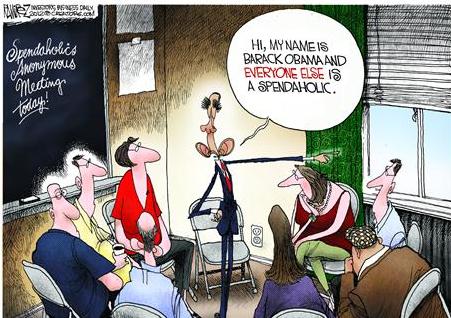
That being said, I was a big dumbfounded when President Obama recently claimed that there’s not a spending problem in Washington.
So a person would have to be in serious denial to claim that spending isn’t a problem.
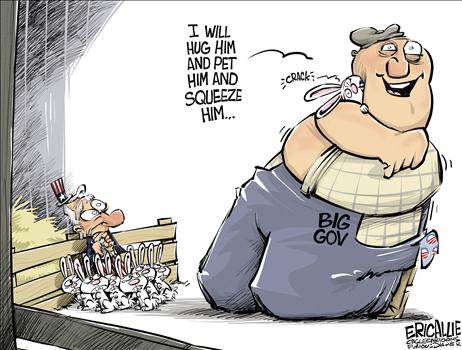
Which is the point Eric Allie makes in this cartoon.
And the point Robert Ariail makes in this cartoon.
Ditto for Bob Gorrell.
And Gary Varvel.
Last but not least, the great Michael Ramirez.
Gee, it’s almost like we’re seeing a pattern.
And if you like this spendaholic-in-denial theme, you can click here and here for further amusement.
P.S. Oh, by the way, if anybody’s actually interested in how to solve the spending problem (you know, the one that doesn’t exist), we do know the answer.
P.P.S. Remember when Obama claimed the private sector was doing fine? Well, here’s how cartoonists mocked him for that absurd comment.
Why do I keep writing and email Senator Pryor suggestions on how to cut our budget? I gave him hundreds of ideas about how to cut spending and as far as I can tell he has taken none of my suggestions. You can find some of my suggestions here, here, here, here, here, here, here, here, here, here, here, here, here, here, here, here, here, here, here, here, and here, and they all were emailed to him. In fact, I have written 13 posts pointing out reasons why I believe Senator Pryor’s re-election attempt will be unsuccessful. HERE I GO AGAIN WITH ANOTHER EMAIL I JUST SENT TO SENATOR PRYOR!!!
Dear Senator Pryor,
Why not pass the Balanced Budget amendment? As you know that federal deficit is at all time high (1.6 trillion deficit with revenues of 2.2 trillion and spending at 3.8 trillion).
On my blog www.thedailyhatch.org . I took you at your word and sent you over 100 emails with specific spending cut ideas. (Actually there were over 160 emails with specific spending cut suggestions.) However, I did not see any of them in the recent debt deal that Congress adopted although you did respond to me several times. Now I am trying another approach. Every week from now on I will send you an email explaining different reasons why we need the Balanced Budget Amendment or I send you specific spending cut suggestions. It will appear on my blog on “Thirsty Thursday” because the government is always thirsty for more money to spend.
IF YOU TRULY WANT TO CUT THE BUDGET AND BALANCE THE BUDGET THEN SUBMIT THESE POTENTIAL BUDGET CUTS PRESENTED BELOW!!
_______________
When Governments Cut Spending
Uploaded on Sep 28, 2011
Do governments ever cut spending? According to Dr. Stephen Davies, there are historical examples of government spending cuts in Canada, New Zealand, Sweden, and America. In these cases, despite popular belief, the government spending cuts did not cause economic stagnation. In fact, the spending cuts often accelerated economic growth by freeing up resources for the private sector.
The Government Accountability Office has released its third annual report on fragmented, overlapping, or duplicative federal programs and activities. Proponents of making the government more efficient view the findings as an opportunity to achieve cost savings. While there’s obviously nothing wrong with the government spending less money than it has to, the goal should be to permanently shut the trains down – not just try to get them to run on time.
Some examples:
The GAO says “Enhanced collaboration between the Small Business Administration and two other agencies could help to limit overlapping export-related services for small businesses.” The federal government shouldn’t be subsidizing export promotion for commercial interests, period. (See here and here.)
The GAO says “Federal agencies providing assistance for higher education should better coordinate to improve program administration and help reduce fragmentation.” The federal government should not be subsidizing higher education, period. (See here.)
The GAO says, “To achieve up to $1.2 billion per year in cost savings in the Federal Crop Insurance program, Congress could consider limiting the subsidy for premiums that an individual farmer can receive each year, reducing the subsidy for all or high-income farmers participating in the program, or some combination of limiting and reducing these subsidies.” Federal crop insurance subsidies and all farm subsidies should be abolished, period. (See here and here.)
The GAO says, “Federal support for wind and solar energy, biofuels, and other renewable energy sources, which has been estimated at several billion dollars per year, is fragmented because 23 agencies implemented hundreds of renewable energy initiatives in fiscal year 2010—the latest year for which GAO developed these original data.” The federal government shouldn’t subsidize renewable energy (or traditional sources of energy), period. (See here.)
There have been numerous attempts to “reinvent government,” “streamline the bureaucracy,” etc, over the decades as the government has expanded in size and scope. Perhaps the GAO report will spur another. But while the initiatives change, the result is always the same: we still end up stuck with a bloated Leviathan that continues to have its snotty nose in every facet of our lives.
As I often point out, waste always comes with government the same way a Happy Meal always comes with a toy and drink. There is duplication and waste in the federal government because it has become massive and there are virtually no limits on what politicians can spend money on.
I’m not suggesting that government waste should be ignored. Indeed, examples of waste should be held up as reasons to terminate entire government agencies and programs. But I believe that a myopic fixation on “eliminating duplication and waste” is itself a waste. That’s because duplication and waste are merely symptoms of the real problem of big government.
The Balanced Budget Amendment is the only thing I can think of that would force Washington to cut spending. We have only a handful of balanced budgets in the last 60 years, so obviously what we are doing is not working. We are passing along this debt to the next generation. YOUR APPROACH HAS BEEN TO REJECT THE BALANCED BUDGET “BECAUSE WE SHOULD CUT THE BUDGET OURSELF,” WELL THEN HERE IS YOUR CHANCE!!!! SUBMIT THESE CUTS!!!!
Thank you for this opportunity to share my ideas with you.
The problem with the debt ceiling is very clear to me. We need to get serious about cutting federal spending. I am so upset about it that I have emailed over 100 emails to Senator Pryor concerning specific spending suggestions. I get emails from back from Senator Pryor like the one below. This means that […]
Senator Pryor asks for Spending Cut Suggestions! Here are a few!(Part 164) Senator Mark Pryor wants our ideas on how to cut federal spending. Take a look at this video clip below: Senator Pryor has asked us to send our ideas to him at cutspending@pryor.senate.gov and I have done so in the past and will continue to […]
Senator Pryor asks for Spending Cut Suggestions! Here are a few!(Part 163) Senator Mark Pryor wants our ideas on how to cut federal spending. Take a look at this video clip below: Senator Pryor has asked us to send our ideas to him at cutspending@pryor.senate.gov and I have done so in the past and will continue to […]
Senator Pryor asks for Spending Cut Suggestions! Here are a few!(Part 162) Senator Mark Pryor wants our ideas on how to cut federal spending. Take a look at this video clip below: Senator Pryor has asked us to send our ideas to him at cutspending@pryor.senate.gov and I have done so in the past and will continue to […]
Three very good video tours below from Senator Mark Pryor. Published on Jun 13, 2012 by SenatorPryor Episode 1: Arkansans in the Capitol Published on Jul 9, 2012 by SenatorPryor Episode 2: The Crypt and the Old Supreme Court Published on Aug 20, 2012 by SenatorPryor Episode 3: The Senate Chamber If you want to […]
Senator Pryor asks for Spending Cut Suggestions! Here are a few!(Part 161) Senator Mark Pryor wants our ideas on how to cut federal spending. Take a look at this video clip below: Senator Pryor has asked us to send our ideas to him at cutspending@pryor.senate.gov and I have done so in the past and will continue to […]
Senator Mark Pryor wants our ideas on how to cut federal spending and I sent them to him but he didn’t take any of my suggestions. However, he did take time to get back to me today, but I am not too impressed with Senator Pryor’s response. I gave him hundreds of ideas about how […]
Senator Pryor asks for Spending Cut Suggestions! Here are a few!(Part 160) Senator Mark Pryor wants our ideas on how to cut federal spending. Take a look at this video clip below: Senator Pryor has asked us to send our ideas to him at cutspending@pryor.senate.gov and I have done so in the past and will continue to […]
Senator Pryor asks for Spending Cut Suggestions! Here are a few!(Part 159) Senator Mark Pryor wants our ideas on how to cut federal spending. Take a look at this video clip below: Senator Pryor has asked us to send our ideas to him at cutspending@pryor.senate.gov and I have done so in the past and will continue to […]
Senator Mark Pryor wants our ideas on how to cut federal spending. Take a look at this video clip below: Senator Pryor has asked us to send our ideas to him at cutspending@pryor.senate.gov and I have done so in the past and will continue to do so in the future. On May 11, 2011, I emailed to […]
Office of the Majority Whip | Balanced Budget Amendment Video In 1995, Congress nearly passed a constitutional amendment mandating a balanced budget. The Balanced Budget Amendment would have forced the federal government to live within its means. This Balanced Budget Amendment failed by one vote. 16 years later, Congress has the chance to get it […]
Sadly Senator Pryor has voted against the Balanced Budget Amendment over and over in his long time in the Senate. Senator Pryor: “There are a lot of people who think a balanced-budget amendment solves all the fiscal problems. I completely disagree.” (Peter Urban, Pryor Tilts Balanced Budget, Southwest Times Record, 11/17/11) Dear Senator Pryor, Why […]
Mark Levin and Senator Hatch discuss the balanced budget amendment and it’s importance. Uploaded by loveconstitution on Jan 28, 2011 Mark Levin interviews Senator Hatch 1/27/2011 about the balanced budget amendment. Mark is very excited about the balanced budget amendment being proposed by Senator Orin Hatch and John Cornyn and he discusses the amendment with […]
Dr. Jay Barth with Hendrix College comments on our latest poll results on Arkansas politics (clip from Talkbusiness) Talk Business reported today in the article “Poll Shows Beebe Strength, Pryor Shaky,” the following: A new Talk Business-Hendrix College Poll shows Gov. Mike Beebe (D) maintaining his high job approval rating, while Sen. Mark Pryor (D) […]
U.S. Sen. Mark Pryor at the 2009 Democratic Party Jefferson Jackson Dinner, Arkansas’s largest annual political event. Mark Pryor is up for re-election to the Senate in 2014. It is my opinion that the only reason he did not have an opponent in 2008 was because the Republicans in Arkansas did not want to go […]
Michael Tanner, a senior fellow at the CATO institute, explains that the rate of return on social security will be much lower for todays youth. Steve Brawner wrote in his article “Tiptoeing toward the third rail,” (Arkansas News Bureau, Jan 9,): Social Security has long been considered the “third rail” for American politicians, meaning it’s […]
HALT:HaltingArkansasLiberalswithTruth.com CBS — October 19, 2010 — New York Times’ Jeff Zeleny talks to Jan Crawford about the state of Democrats in the South… Are they a dying species? In the article “Southern Democrat much closer to extinction after GOP wave,” (Washington Times, Nov 4, 2010), Ben Evans notes: After this week’s elections, the […]
HALT:HaltingArkansasLiberalswithTruth.com Roland Martin appears on Rick’s List with Rick Sanchez and the Best Political Team on television (Candy Crowley, John King, Jeffery Toobin, Ed Rollins, Gloria Borger and Victoria Toensing) to discuss day two of the Elena Kagan Supreme Court confirmation hearings. During the analysis, Senator Graham and Elena Kagan had an interesting exchange over […]
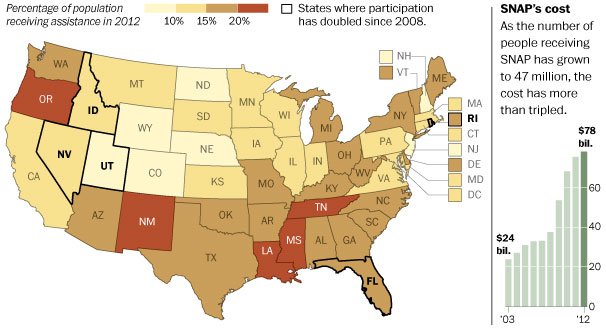
One way of measuring the cost of the program, both to taxpayers and to the people who get trapped in dependency, is to see what share of a state’s population is utilizing the program.
A couple of things stand out. I can understand Mississippi, Louisiana, and New Mexico being among the worst states because they have relatively low average incomes. And that’s sort of an excuse for Tennessee, though it’s worth noting that economically and demographically similar states such as Georgia and Alabama don’t fall into the same dependency trap.
Why such a significant handout culture?
But the state that stands out is Oregon. Based on the state’s income, there’s no reason for more than 20 percent of resident’s to be on the dole. The state does get a “high” ranking on the Moocher Index, so there’s some evidence of an entitlement mentality. And welfare handouts also are above average in the Beaver State as well.
It’s also disappointing to see that food stamp dependency has doubled since 2008 in Florida, Rhode Island, Nevada, Utah, and Idaho. Though it’s a credit to the people of Utah that they’re still in the least-dependent category. But the trend obviously is very bad.
And it’s also depressing to look at the bar chart on the right and see that spending on the program has tripled in the past 10 years. Heck, food stamps were about 70 percent of the cost of a recent Senate “farm bill.”
P.S. A local state legislator asked an official in Richmond why Virginia got such a bad score in the ranking of teachers compared to education bureaucrats. The good news, so to speak, is that Virginia is not as bad as suggested by the official numbers. According to the response sent to this lawmaker, “VDOE has determined that the data it reported on school division personnel and assignments to NCES for 2005-2006 through 2009-2010 through the US Department of Education’s EdFacts Portal were inaccurate.”
The bad news, as you can see from this table, is that there are still more edu-crats than teachers, but the ratio apparently isn’t as bad with this updated data.
P.P.S. I guess I should give the left-wing Washington Post some credit for sharing the map on food stamp dependency. And, to be fair, the paper did reprint this remarkable chart showing how bad Obama’s record is on jobs compared to Reagan and Clinton. And the paper also printed this chart showing how the economy’s performance is way below average under Obama.
Please explain to me if you ever do plan to balance the budget while you are President? I have written these things below about you and I really do think that you don’t want to cut spending in order to balance the budget. It seems you ever are daring the Congress to stop you from spending more.
“The credit of the United States ‘is not a bargaining chip,’ Obama said on 1-14-13. However, President Obama keeps getting our country’s credit rating downgraded as he raises the debt ceiling higher and higher!!!!
Washington Could Learn a Lot from a Drug Addict
Just spend more, don’t know how to cut!!! Really!!! That is not living in the real world is it?
Making more dependent on government is not the way to go!!
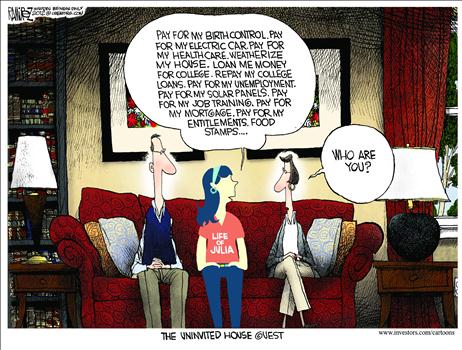
Why is our government in over 16 trillion dollars in debt? There are many reasons for this but the biggest reason is people say “Let’s spend someone else’s money to solve our problems.” Liberals like Max Brantley have talked this way for years. Brantley will say that conservatives are being harsh when they don’t want the government out encouraging people to be dependent on the government. The Obama adminstration has even promoted a plan for young people to follow like Julia the Moocher.
Imagine standing a baby carrot up next to the 25-story Stephens building in Little Rock. That gives you a picture of the impact on the national debt that federal spending in Arkansas on Medicaid expansion would have, while here at home expansion would give coverage to more than 200,000 of our neediest citizens, create jobs, and save money for the state.
Here’s the thing: while more than a billion dollars a year in federal spending would represent a big-time stimulus for Arkansas, it’s not even a drop in the bucket when it comes to the national debt.
Currently, the national debt is around $16.4 trillion. In fiscal year 2015, the federal government would spend somewhere in the neighborhood of $1.2 billion to fund Medicaid expansion in Arkansas if we say yes. That’s about 1/13,700th of the debt.
It’s hard to get a handle on numbers that big, so to put that in perspective, let’s get back to the baby carrot. Imagine that the height of the Stephens building (365 feet) is the $16 trillion national debt. That $1.2 billion would be the length of a ladybug. Of course, we’re not just talking about one year if we expand. Between now and 2021, the federal government projects to contribute around $10 billion. The federal debt is projected to be around $25 trillion by then, so we’re talking about 1/2,500th of the debt. Compared to the Stephens building? That’s a baby carrot.
______________
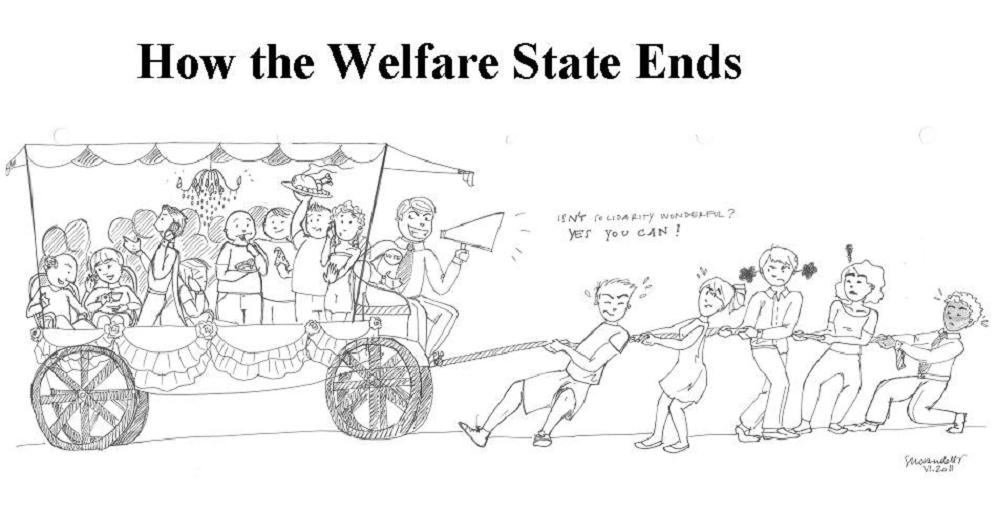
Here is how it will all end if everyone feels they should be allowed to have their “baby carrot.”
How sad it is that liberals just don’t get this reality.
While living in Europe in the 1760s, Franklin observed: “in different countries … the more public provisions were made for the poor, the less they provided for themselves, and of course became poorer. And, on the contrary, the less was done for them, the more they did for themselves, and became richer.”
Alexander Fraser Tytler, Lord Woodhouselee(15 October 1747 – 5 January 1813) was a Scottish lawyer, writer, and professor. Tytler was also a historian, and he noted, “A democracy cannot exist as a permanent form of government. It can only exist until the majority discovers it can vote itself largess out of the public treasury. After that, the majority always votes for the candidate promising the most benefits with the result the democracy collapses because of the loose fiscal policy ensuing, always to be followed by a dictatorship, then a monarchy.”
[Jefferson affirms that the main purpose of society is to enable human beings to keep the fruits of their labor.— TGW]
To take from one, because it is thought that his own industry and that of his fathers has acquired too much, in order to spare to others, who, or whose fathers have not exercised equal industry and skill, is to violate arbitrarily the first principle of association, “the guarantee to every one of a free exercise of his industry, and the fruits acquired by it.” If the overgrown wealth of an individual be deemed dangerous to the State, the best corrective is the law of equal inheritance to all in equal degree; and the better, as this enforces a law of nature, while extra taxation violates it.
[From Writings of Thomas Jefferson, ed. Albert E. Bergh (Washington: Thomas Jefferson Memorial Association, 1904), 14:466.]
_______
Jefferson pointed out that to take from the rich and give to the poor through government is just wrong. Franklin knew the poor would have a better path upward without government welfare coming their way. Milton Friedman’s negative income tax is the best method for doing that and by taking away all welfare programs and letting them go to the churches for charity.
_____________
_________
Thank you so much for your time. I know how valuable it is. I also appreciate the fine family that you have and your commitment as a father and a husband.
Sincerely,
Everette Hatcher III, 13900 Cottontail Lane, Alexander, AR 72002, ph 501-920-5733, lowcostsqueegees@yahoo.com
We got to act fast and get off this path of socialism. Morning Bell: Welfare Spending Shattering All-Time Highs Robert Rector and Amy Payne October 18, 2012 at 9:03 am It’s been a pretty big year for welfare—and a new report shows welfare is bigger than ever. The Obama Administration turned a giant spotlight […]
We need to cut Food Stamp program and not extend it. However, it seems that people tell the taxpayers back home they are going to Washington and cut government spending but once they get up there they just fall in line with everyone else that keeps spending our money. I am glad that at least […]
Government Must Cut Spending Uploaded by HeritageFoundation on Dec 2, 2010 The government can cut roughly $343 billion from the federal budget and they can do so immediately. __________ Liberals argue that the poor need more welfare programs, but I have always argued that these programs enslave the poor to the government. Food Stamps Growth […]
Milton Friedman – The Negative Income Tax Published on May 11, 2012 by LibertyPen In this 1968 interview, Milton Friedman explained the negative income tax, a proposal that at minimum would save taxpayers the 72 percent of our current welfare budget spent on administration. http://www.LibertyPen.com Source: Firing Line with William F Buckley Jr. ________________ Milton […]
Dan Mitchell Commenting on Obama’s Failure to Propose a Fiscal Plan Published on Aug 16, 2012 by danmitchellcato No description available. ___________ After the Welfare State Posted by David Boaz Cato senior fellow Tom G. Palmer, who is lecturing about freedom in Slovenia and Tbilisi this week, asked me to post this announcement of his […]
Is President Obama gutting the welfare reform that Bill Clinton signed into law? Morning Bell: Obama Denies Gutting Welfare Reform Amy Payne August 8, 2012 at 9:15 am The Obama Administration came out swinging against its critics on welfare reform yesterday, with Press Secretary Jay Carney saying the charge that the Administration gutted the successful […]
Thomas Sowell – Welfare Welfare reform was working so good. Why did we have to abandon it? Look at this article from 2003. The Continuing Good News About Welfare Reform By Robert Rector and Patrick Fagan, Ph.D. February 6, 2003 Six years ago, President Bill Clinton signed legislation overhauling part of the nation’s welfare system. […]
Uploaded by ForaTv on May 29, 2009 Complete video at: http://fora.tv/2009/05/18/James_Bartholomew_The_Welfare_State_Were_In Author James Bartholomew argues that welfare benefits actually increase government handouts by ‘ruining’ ambition. He compares welfare to a humane mousetrap. —– Welfare reform was working so good. Why did we have to abandon it? Look at this article from 2003. In the controversial […]
Thomas Sowell If the welfare reform law was successful then why change it? Wasn’t Bill Clinton the president that signed into law? Obama Guts Welfare Reform Robert Rector and Kiki Bradley July 12, 2012 at 4:10 pm Today, the Obama Department of Health and Human Services (HHS) released an official policy directive rewriting the welfare […]
I have been writing President Obama letters and have not received a personal response yet. (He reads 10 letters a day personally and responds to each of them.) However, I did receive a form letter in the form of an email on July 10, 2012. I don’t know which letter of mine generated this response so I have […]

 And even though I’ve written about the 49 percent figure, I had no idea that such a small portion was due to the aging population.





 Why such a significant handout culture?




 The Daily Hatch