Category Archives: spending out of control

It’s time for citizens to hold elected officials accountable about spending – even if that means their favorite government-funded program gets axed

______________

It’s time for citizens to hold elected officials accountable about spending – even if that means their favorite government-funded program gets axed

January 14, 2014 at 9:30 am

Credit: SHAWN THEW/EPA/Newscom

Credit: SHAWN THEW/EPA/Newscom

It’s time for citizens to hold elected officials accountable about spending – even if that means their favorite government-funded program gets axed.

There’s no hint that Washington is starting to take our outrageous spending levels seriously. On the contrary, on Capitol Hill this week, lawmakers are preparing to vote in favor of an omnibus spending bill that totals over one trillion dollars – even though our nation is currently $17 trillion in debt.

After all, very few politicians want to risk cutting a constituent’s favorite program during an election year. Even some of the most egregious examples of wasteful spending – just think of the $98,670 outhouse on a remote road in Alaska – may be well-loved by some constituents.

But if Americans are serious about getting the country’s finances under control and not passing on a huge debt to our children and grandchildren, more than outhouses will have to go. In an October 2013 poll, 88 percent of respondents said Congress should focus on a long-term plan to lower the national debt. Yet last year in a Pew Research Center poll, significantly lower percentages of Americans, when asked which government programs should be cut or reduced, agreed on what programs to cut. While there were 19 options included in the survey, a majority of Republican respondents only supported cuts in two programs, foreign aid and unemployment benefits. Democrats couldn’t identify even one program they would reduce.

I’ve done my own surveys of friends on both sides of the political spectrum. Those on the left say we should get out of all wars, cut defense and make the top one percent of Americans pay more. They don’t think we’ll ever run out of other “rich” people’s money.  But what Margaret Thatcher said of the Labour Party running Great Britain in 1976 remains true, even for today’s liberals: “They always run out of other people’s money.” Even in the prosperous United States, the wealthy simply aren’t wealthy enough to finance all the government programs the left wants, even if the rich were taxed at a higher rate. As it is, the top one percent of taxpayers in the United States pay thirty-five percent of total federal income taxes, according to the Tax Foundation.

Those of us on the right push different ideas. I’d like us to revisit our spending on foreign aid ($24 billion in 2012) and the Corporation for Public Broadcasting ($445 million in 2012). And think of all the money we could save by eliminating the bureaucracies and bureaucrats that spend their time determining what kind of light bulbs we can use and to which schools we should send our children.

Yet the troubling fact is that you could do all these things and still our unsustainable debt would continue to grow. Even ideas that cross ideological lines, such as cutting government wasteand eliminating programs that actually help the wealthy as opposed to the little guy they claim to help (just consider the farm bill which has almost nothing to do with small family farms but is rather a form of corporate welfare for mega-agri-businesses), aren’t enough to solve Washington’s spending benders.

Ultimately, Americans have to address the main driver of our debt: entitlements. Social Security, Medicare, and Medicaid together account for 43 percent of federal spending as of 2012.  And while many Americans are understandably concerned about what changes to Social Security would mean for them, there are common sense solutions such as raising the retirement age and making Social Security a true insurance program instead of a program promising unaffordable benefits to all without regard to need.

The world is full of countries which have kicked the can down the road, increased taxes, tried to avoid the unavoidable, and yes, finally run out of other people’s money. Those nation’s economies are now in shambles. Look at Greece or Portugal. For that matter, look at California and Illinois.

We can’t let the United States go down that path.

So first, let’s elect people to office who believe in limited government and who care more about the next generation than their next election. The reforms we need require lawmakers with courage – something you’re likely to see little of in the “debate” on the Hill this week over the spending bill.

But we also need courageous citizens. Unless we the voters lead and tell our politicians we’ll support spending cuts, even painful ones, we won’t change the culture of spending in Washington. And sooner rather than later, we will run out of other people’s money.

– Genevieve Wood is a Senior Contributor to The Foundry.

Related posts: 

If you want to cut government waste then stop allowing people to get addicted to government programs!!!!

______________ If you want to cut government waste then stop allowing people  to get addicted to government programs!!!! November 3, 2013 1:07PM Lindbeck’s Law: The Self-Destructive Nature of Expanding Government Benefits By Alan Reynolds Share Relevant foresight from Swedish economist Assar Lindbeck, “Hazardous Welfare State Dynamics,” American Economic Review, May 1995: The basic dilemma of […]

Lots of Waste at the Federal Mediation and Conciliation Service!!!!

____________ Lots of Waste at the Federal Mediation and Conciliation Service!!!! November 5, 2013 12:50PM ICYMI: FMCS By Jim Harper Share During the hullaballoo around the government shutdown, the Washington Examiner published a jaw-dropping series of stories about blatant waste in an obscure federal agency called the Federal Mediation and Conciliation Service. These stories shouldn’t […]

Open letter to President Obama (Part 440) A suggestion to cut some wasteful spending out of the government Part 6 (includes editorial cartoon)

(Emailed to White House on 3-15-13.) President Obama c/o The White House 1600 Pennsylvania Avenue NW Washington, DC 20500 Dear Mr. President, I know that you receive 20,000 letters a day and that you actually read 10 of them every day. I really do respect you for trying to get a pulse on what is […]

Dear Senator Pryor, here are some spending cut suggestions (“Thirsty Thursday”, Open letter to Senator Pryor)

Senator Pryor pictured below:

Why do I keep writing and email Senator Pryor suggestions on how to cut our budget? I gave him hundreds of ideas about how to cut spending and as far as I can tell he has taken none of my suggestions. You can find some of my suggestions herehereherehere, hereherehereherehere, herehereherehereherehereherehereherehere,  here, and  here, and they all were emailed to him. In fact, I have written 13 posts pointing out reasons why I believe Senator Pryor’s re-election attempt will be unsuccessful. HERE I GO AGAIN WITH ANOTHER EMAIL I JUST SENT TO SENATOR PRYOR!!!

Dear Senator Pryor,

Why not pass the Balanced  Budget amendment? As you know that federal deficit is at all time high (1.6 trillion deficit with revenues of 2.2 trillion and spending at 3.8 trillion).

On my blog www.thedailyhatch.org . I took you at your word and sent you over 100 emails with specific spending cut ideas. (Actually there were over 160 emails with specific spending cut suggestions.) However, I did not see any of them in the recent debt deal that Congress adopted although you did respond to me several times. Now I am trying another approach. Every week from now on I will send you an email explaining different reasons why we need the Balanced Budget Amendment. It will appear on my blog on “Thirsty Thursday” because the government is always thirsty for more money to spend. Today I actually have included a great article below from the Heritage Foundation concerning an area of our federal budget that needs to be cut down to size. The funny thing about the Sequester and the 2.4% of cuts in future increases is that President Obama set these up and then he acted like the sky was falling in as the cartoons indicate in the newspapers.

IF YOU TRULY WANT TO CUT THE BUDGET AND BALANCE THE BUDGET THEN SUBMIT THESE POTENTIAL BUDGET CUTS PRESENTED BELOW!!

___________

The Farm Bill has too much fat in it!!!

May 31, 2013 3:08PM

Five Reasons to Repeal Farm Subsidies

Cato held a packed forum on Capitol Hill yesterday examining major farm legislation that is moving through Congress. Our panelists included Andrew Moylan of R Street, Josh Sewell of Taxpayers for Common Sense, and Scott Faber of the Environmental Working Group.

I discussed five reasons why farm subsidies make no sense.

1. Unfair Redistribution. Farm programs take from average taxpayers and give to higher-income farm households, which is a reverse Robin Hood scheme. In 2011 average incomes of farm households was $87,289, or 25 percent higher than the $69,677 average of all U.S. households.

2. Economic Distortions. Farm subsidies can induce excess production, an overuse of marginal farmland, and land price inflation. Subsidies can cause less efficient planting, induce excess borrowing by farmers, and cause insufficient attention to cost control. Farm businesses have less incentive to innovate and control their costs because they know that the government will always bail them out.

3. Environmental Damage. Farm subsidies tend to draw marginal farmland into production, lands that might otherwise be used for forests or wetlands. Subsidies can also induce excess use of fertilizers and pesticides in farm production.

4. Farming Not Unique. Why is farming so coddled by the government? It’s a risky business, but not uniquely so. Industries such as high technology, newspapers, and restaurants are very risky, yet they don’t rely on government handouts. Farming faces certain risks such as adverse weather. But high-tech companies are vulnerable to rapid innovations by competitors, and restaurants are vulnerable to changing consumer tastes and intense competition.

Farmers are supposed to be rugged individualists, so is it strange that they don’t feel more guilt and embarrassment about sponging off taxpayers decade after decade. Instead, farm organizations intensely lobby to keep and expand their welfare handouts from the government.

5. Farming Would Thrive Without Subsidies. If farm subsidies were ended, farming would go through a transition period, which would be tough on some farmers. But farmers would adjust by changing their mix of crops, altering their land use, cutting costs, innovating with new crops and new technologies. Some farms would go bankrupt. But a stronger and more innovative agriculture industry would emerge that would be more productive and more resilient in the long run.

Consider New Zealand’s reforms in the 1980s. That country eliminated nearly all its agriculture subsidies, which created challenges for the nation’s farmers. But New Zealand farmers turned out to be great entrepreneurs, and they made impressive changes to survive and thrive in the new free market environment. Today, New Zealand farmers generally don’t want subsidies, and they argue that we would be all better off without them.

More

Photo credit: Sarah Gormley, Cato

_______________

The Balanced Budget Amendment is the only thing I can think of that would force Washington to cut spending. We have only a handful of balanced budgets in the last 60 years, so obviously what we are doing is not working. We are passing along this debt to the next generation. YOUR APPROACH HAS BEEN TO REJECT THE BALANCED BUDGET “BECAUSE WE SHOULD CUT THE BUDGET OURSELF,” WELL THEN HERE IS YOUR CHANCE!!!! SUBMIT THESE CUTS!!!!

Thank you for this opportunity to share my ideas with you.

Sincerely,

Everette Hatcher, lowcostsqueegees@yahoo.com www.thedailyhatch.org, 13900 Cottontail Lane, Alexander, AR 72002, ph 501-920-5733

Related posts:

States should vote down federal spending on farm bill and return more control to states!!!!

States should vote down federal spending on farm bill and return more control to states!!!! Some say here in Arkansas that we have to do whatever it takes to support Riceland Foods, but in other states they try to protect federal government handouts to their biggest companies. We need politicians to stop looking out for […]

Congress needs to remove subsidies from the farm bill, not expand them

Congress needs to remove subsidies from the farm bill, not expand them Farm Bill Wastes More Taxpayer Money on Green Subsidies Nicolas Loris May 13, 2013 at 11:27 am Design Pics / Dave Reede/Dave Reede/Newscom Slapping the word rural in front of a bunch of green subsidies does not mean they’re not subsidies. But that’s […]

If increase in food stamps was just because of recession then why spending go from $19.8 billion in 2000 to $37.9 billion in 2007?

If the increase in food stamps was just because of the recession then why did the spending go from $19.8 billion in 2000 to $37.9 billion in 2007? The Facts about Food Stamps Everyone Should Hear Rachel Sheffield and T. Elliot Gaiser May 27, 2013 at 12:00 pm (7) Newscom A recent US News & […]

John Calipari versus Bill Self for National Title Act 2 (part 3)

Memphis Tigers John Calipari Interview 2008 Basketball Final Kansas vs. Memphis – 2008 NCAA Title Game Highlights (HD) Knoxnews.com reported: Calipari (and Kentucky) get Kansas again for title NANCY ARMOUR – AP National Writer (AP) Posted April 1, 2012 at 12:18 a.m., updated April 1, 2012 at 3:04 a.m NEW ORLEANS (AP) — Well, this […]

Alternatives to Fayetteville Finger out there? (part 16)(Billy Bob Thornton)

I certainly hope there are some alternatives to the Fayetteville Finger out there. Jason Tolbert reported that there seems to be an impasse. As predicted, the House State Agencies rejected both the Senate compromise map (linked here) passed yesterday with 20 votes and the so called “Luker Amendment” (linked here) named after its author Sen. […]

Food stamp spending has doubled under the Obama Administration

The sad fact is that Food stamp spending has doubled under the Obama Administration. A Bumper Crop of Food Stamps Amy Payne May 21, 2013 at 7:01 am Tweet this Where do food stamps come from? They come from taxpayers—certainly not from family farms. Yet the “farm” bill, a recurring subsidy-fest in Congress, is actually […]

Agriculture Dept is bloated

Agriculture: Downsizing The Federal Government Uploaded on Dec 19, 2008 Agriculture is easily the most distorted sector, with high tariffs and, in developed countries at least, large amounts of government subsidies through price supports and direct payments. On the other hand, developing countries, who have a comparative advantage in these products, cannot afford to subsidize […]

Which states are the leaders in food stamp consumption?

I am glad that my state of Arkansas is not the leader in food stamps!!! Mirror, Mirror, on the Wall, Which State Has the Highest Food Stamp Usage of All? March 19, 2013 by Dan Mitchell The food stamp program seems to be a breeding ground of waste, fraud, and abuse. Some of the horror stories […]

Open letter to President Obama (Part 255)

Government Must Cut Spending Uploaded by HeritageFoundation on Dec 2, 2010 The government can cut roughly $343 billion from the federal budget and they can do so immediately. __________   President Obama c/o The White House 1600 Pennsylvania Avenue NW Washington, DC 20500 Dear Mr. President, I know that you receive 20,000 letters a day […]

Mark Pryor responds to me concerning Debt Ceiling email (Part 1)

The problem with the debt ceiling is very clear to me. We need to get serious about cutting federal spending. I am so upset about it that I have emailed over 100 emails to Senator Pryor concerning specific spending suggestions. I get emails from back from Senator Pryor like the one below. This means that […]

Senator Pryor asks for Spending Cut Suggestions! Here are a few!(Part 164)

Senator Pryor asks for Spending Cut Suggestions! Here are a few!(Part 164) Senator Mark Pryor wants our ideas on how to cut federal spending. Take a look at this video clip below: Senator Pryor has asked us to send our ideas to him at cutspending@pryor.senate.gov and I have done so in the past and will continue to […]

Senator Pryor asks for Spending Cut Suggestions! Here are a few!(Part 163)

Senator Pryor asks for Spending Cut Suggestions! Here are a few!(Part 163) Senator Mark Pryor wants our ideas on how to cut federal spending. Take a look at this video clip below: Senator Pryor has asked us to send our ideas to him at cutspending@pryor.senate.gov and I have done so in the past and will continue to […]

Senator Pryor asks for Spending Cut Suggestions! Here are a few!(Part 162)

Senator Pryor asks for Spending Cut Suggestions! Here are a few!(Part 162) Senator Mark Pryor wants our ideas on how to cut federal spending. Take a look at this video clip below: Senator Pryor has asked us to send our ideas to him at cutspending@pryor.senate.gov and I have done so in the past and will continue to […]

Capitol Tours with Senator Mark Pryor

Three very good video tours below from Senator Mark Pryor. Published on Jun 13, 2012 by SenatorPryor Episode 1: Arkansans in the Capitol Published on Jul 9, 2012 by SenatorPryor Episode 2: The Crypt and the Old Supreme Court Published on Aug 20, 2012 by SenatorPryor Episode 3: The Senate Chamber If you want to […]

Senator Pryor asks for Spending Cut Suggestions! Here are a few!(Part 161)

Senator Pryor asks for Spending Cut Suggestions! Here are a few!(Part 161) Senator Mark Pryor wants our ideas on how to cut federal spending. Take a look at this video clip below: Senator Pryor has asked us to send our ideas to him at cutspending@pryor.senate.gov and I have done so in the past and will continue to […]

Senator Mark Pryor responds to my email

Senator Mark Pryor wants our ideas on how to cut federal spending and I sent them to him but he didn’t take any of my suggestions. However, he did take time to get back to me today, but I am not too impressed with Senator Pryor’s response. I gave him hundreds of ideas about how […]

Senator Pryor asks for Spending Cut Suggestions! Here are a few!(Part 160)

Senator Pryor asks for Spending Cut Suggestions! Here are a few!(Part 160) Senator Mark Pryor wants our ideas on how to cut federal spending. Take a look at this video clip below: Senator Pryor has asked us to send our ideas to him at cutspending@pryor.senate.gov and I have done so in the past and will continue to […]

Senator Pryor asks for Spending Cut Suggestions! Here are a few!(Part 159)

Senator Pryor asks for Spending Cut Suggestions! Here are a few!(Part 159) Senator Mark Pryor wants our ideas on how to cut federal spending. Take a look at this video clip below: Senator Pryor has asked us to send our ideas to him at cutspending@pryor.senate.gov and I have done so in the past and will continue to […]

Senator Pryor asks for Spending Cut Suggestions! Here are a few!(Part 158)

Senator Mark Pryor wants our ideas on how to cut federal spending. Take a look at this video clip below: Senator Pryor has asked us to send our ideas to him at cutspending@pryor.senate.gov and I have done so in the past and will continue to do so in the future. On May 11, 2011,  I emailed to […]

Dear Senator Pryor, why not pass the Balanced Budget Amendment? (“Thirsty Thursday”, Open letter to Senator Pryor)

Office of the Majority Whip | Balanced Budget Amendment Video In 1995, Congress nearly passed a constitutional amendment mandating a balanced budget. The Balanced Budget Amendment would have forced the federal government to live within its means. This Balanced Budget Amendment failed by one vote. 16 years later, Congress has the chance to get it […]

Dear Senator Pryor, why not pass the Balanced Budget Amendment? (“Thirsty Thursday”, Open letter to Senator Pryor)

Sadly Senator Pryor has voted against the Balanced Budget Amendment over and over in his long time in the Senate. Senator Pryor: “There are a lot of people who think a balanced-budget amendment solves all the fiscal problems. I completely disagree.” (Peter Urban, Pryor Tilts Balanced Budget, Southwest Times Record, 11/17/11) Dear Senator Pryor, Why […]

Dear Senator Pryor, why not pass the Balanced Budget Amendment? (“Thirsty Thursday”, Open letter to Senator Pryor)

Mark Levin and Senator Hatch discuss the balanced budget amendment and it’s importance. Uploaded by loveconstitution on Jan 28, 2011 Mark Levin interviews Senator Hatch 1/27/2011 about the balanced budget amendment. Mark is very excited about the balanced budget amendment being proposed by Senator Orin Hatch and John Cornyn and he discusses the amendment with […]

Will Senator Pryor be re-elected in 2014? (Part 4)(Royal Wedding Part 5)

Dr. Jay Barth with Hendrix College comments on our latest poll results on Arkansas politics (clip from Talkbusiness) Talk Business reported today in the article “Poll Shows Beebe Strength, Pryor Shaky,” the following: A new Talk Business-Hendrix College Poll shows Gov. Mike Beebe (D) maintaining his high job approval rating, while Sen. Mark Pryor (D) […]

Will Senator Pryor be re-elected in 2014? Part 3 (The Conspirator Part 16)

U.S. Sen. Mark Pryor at the 2009 Democratic Party Jefferson Jackson Dinner, Arkansas’s largest annual political event. Mark Pryor is up for re-election to the Senate in 2014. It is my opinion that the only reason he did not have an opponent in 2008 was because the Republicans in Arkansas did not want to go […]

Will Senator Pryor be re-elected or not? (Part 3)

Michael Tanner, a senior fellow at the CATO institute, explains that the rate of return on social security will be much lower for todays youth. Steve Brawner wrote in his article “Tiptoeing toward the third rail,” (Arkansas News Bureau, Jan 9,): Social Security has long been considered the “third rail” for American politicians, meaning it’s […]

Will Senator Pryor be re-elected or not? Part 2

HALT:HaltingArkansasLiberalswithTruth.com   CBS — October 19, 2010 — New York Times’ Jeff Zeleny talks to Jan Crawford about the state of Democrats in the South… Are they a dying species? In the article “Southern Democrat much closer to extinction after GOP wave,” (Washington Times, Nov 4, 2010), Ben Evans notes: After this week’s elections, the […]

Will Senator Pryor be re-elected or not? Part 1

HALT:HaltingArkansasLiberalswithTruth.com Roland Martin appears on Rick’s List with Rick Sanchez and the Best Political Team on television (Candy Crowley, John King, Jeffery Toobin, Ed Rollins, Gloria Borger and Victoria Toensing) to discuss day two of the Elena Kagan Supreme Court confirmation hearings. During the analysis, Senator Graham and Elena Kagan had an interesting exchange over […]

By Everette Hatcher III | Posted in Arkansas TimesMark PryorMax Brantley | Edit | Comments (0)

Privatizing the TSA is the way to go!!!

______________

Privatizing the TSA is the way to go!!!

JANUARY 10, 2014 1:05PM

Privatize the TSA: Make Americans Safer by Letting Airports Handle Security

Any American who travels deals with the Transportation Safety Administration. The Bush administration made many mistakes in the wake of the September 11, 2001 terrorist attacks; creating a government monopoly to handle air transportation security was one of the worst.

Government’s most important duty is protecting its citizens, but others can share that role. After all, no airport or airline wants a plane hijacking, and no airline (or railroad) passenger wants to die in a terrorist incident.

Unfortunately, the TSA is a costly behemoth that is better at bureaucracy than safety. Created in 2001, the TSA spent $7.9 billion and employed 62,000 employees last year alone. The agency’s main job is to protect the more than 450 commercial airports, and two-thirds of the agency’s budget goes for airport screening.

Unfortunately, as my Cato Institute colleague Chris Edwards has documented in a recentPolicy Analysis, the TSA has lived down to expectations. Notes Edwards: “TSA has often made the news for its poor performance and for abusing the civil liberties of airline passengers. It has had a troubled workforce and has made numerous dubious investments.” For all the agency’s spending and effort, “TSA’s screening performance has been no better, and possibly worse, than the performance of the remaining private screeners at U.S. airports.”

The TSA has had an abundance of problems, as I listed in a Freeman column:

Wasteful spending of all sorts. “Unethical and possibly illegal activities,” according to the agency Inspector General. “Costly, counterintuitive, and poorly executed” operations, according to the House oversight committee. Employee misconduct. Ranking 232 out of 240 federal agencies in job satisfaction.

Worst, though, is the TSA’s failure to do the job for which it was created: secure America’s airports and other transportation hubs. Reported Edwards, “There were 25,000security breaches at U.S. airports during TSA’s first decade, despite the agency’s huge spending and all the inconveniences imposed on passengers.” In tests, the agency failed to catch as much as three-quarters of fake explosives.

The problem is not just operational inefficiency. The TSA doesn’t think strategically, or at least, it does not do so effectively. The agency has been criticized for failing to follow “robust risk assessment methodology” and undertaking “little or no evaluation of” program performance.

No planes have been hijacked since 9/11, but, wrote Edwards, “The safety of travelers in recent years may have more to do with the dearth of terrorists in the United States and other security layers around aviation, than with the performance of TSA airport screeners.”

The alternative to the TSA monopoly is privatization. Entrust airport security to airports, which can integrate screening with other aspects of facility security and adjust to local circumstances. It’s not a leap into the unknown; Canadian and most European airports use private screening.

Even the 2001 legislation setting up the TSA allowed a small out for American airports. Five were allowed to go private, and another 11 have chosen to do so in the intervening 12 years. However, the Reason Foundation’s Robert Poole complained that the TSA “micromanages” even private operations, “thereby making it very difficult for screening companies to innovate.”  Worse, a House oversight committee charged the agency with “a history of intimidating airport operators that express an interest in” effectively firing the TSA.

Shifting security to private operators would not eliminate problems. But expanding airport flexibility and, more important, creating security competition would encourage increased experimentation.

Americans started to innovate on that tragic September day a dozen years ago.  When passengers on the fourth hijacked flight learned what their hijackers had in store, the former ended the mission. Passengers later took down the shoe and underwear bombers.

Obviously, dangers remain. But the best way to protect people would be to end the TSA, limiting Washington to general oversight and tasks such as intelligence activities. Travel would be safer, security would be cheaper, and Americans would be freer.

Related posts:

If you want to cut government waste then stop allowing people to get addicted to government programs!!!!

______________ If you want to cut government waste then stop allowing people  to get addicted to government programs!!!! November 3, 2013 1:07PM Lindbeck’s Law: The Self-Destructive Nature of Expanding Government Benefits By Alan Reynolds Share Relevant foresight from Swedish economist Assar Lindbeck, “Hazardous Welfare State Dynamics,” American Economic Review, May 1995: The basic dilemma of […]

Lots of Waste at the Federal Mediation and Conciliation Service!!!!

____________ Lots of Waste at the Federal Mediation and Conciliation Service!!!! November 5, 2013 12:50PM ICYMI: FMCS By Jim Harper Share During the hullaballoo around the government shutdown, the Washington Examiner published a jaw-dropping series of stories about blatant waste in an obscure federal agency called the Federal Mediation and Conciliation Service. These stories shouldn’t […]

Open letter to President Obama (Part 440) A suggestion to cut some wasteful spending out of the government Part 6 (includes editorial cartoon)

(Emailed to White House on 3-15-13.) President Obama c/o The White House 1600 Pennsylvania Avenue NW Washington, DC 20500 Dear Mr. President, I know that you receive 20,000 letters a day and that you actually read 10 of them every day. I really do respect you for trying to get a pulse on what is […]

More waste out of Washington.

___________

More waste out of Washington.

JANUARY 10, 2014 9:22AM

Washington Big Spenders: Wasteful as Essential

If you live anywhere but Washington, D.C., you probably believe that the federal government spends too much.  Today the national debt is more than $17 trillion.  CBO figured that existing budget plans would add between $6.3 trillion and $8.8 trillion in red ink over the coming decade.

Social Security and Medicare alone account for more than $100 trillion in unfunded liabilities, promised benefits for which no revenues are set.  Counting a multitude of other debts and obligations, American taxpayers are on the hook for more than $220 trillion in unfunded liabilities.

As I point out in my new Forbes online column:

However, denizens of Washington see things very differently.  Policymakers recently approved a bipartisan budget that increased discretionary spending, theoretically the easiest outlay to control, over the next two years.  Legislators ignored so-called entitlement outlays, which threaten to consume the entire federal budget.

It really doesn’t matter which party is in charge in Washington.  Most Republicans have little desire to cut federal outlays.  One man’s waste is another man’s vote-winning special interest hand-out.

Sen. Tom Coburn (R-Ok.) has issued a second “Wastebook” which contains 100 of the dumbest uses of taxpayers’ money.  Explained the Senator:  “While the president and his cabinet issued dire warnings about the cataclysmic impacts of sequestration, taxpayers were not alerted to all of the waste being spared from the budget axe.”

For instance, the National Endowment for the Humanities devoted almost $1 million to the Popular Romance Project to “explore the fascinating, often contradictory origins and influences of popular romance as told in novels, films, comics, advice books, songs, and internet fan fiction, taking a global perspective—while looking back across time as far as the ancient Greeks.”  The National Science Foundation spent a quarter of a million dollars to study “attitudes toward the Senate filibuster among the American public.”

The Army spent nearly $300 million on a blimp for surveillance in Afghanistan—only to drop the project after its inaugural U.S. flight, selling the airship back to its maker for $301,000.  The International Trade Association devoted nearly $300,000 to send Indi Rock music executives on a tour to Brazil.

The National Institutes for Health dropped $335,525 on a study which determined that “marriages that were the happiest were the ones in which the wives were able to calm down quickly during marital conflict.”  The $1.9 million Senate Office of Education and Training provides classes for staffers on such subjects as sleeping well and making small talk.  The National Endowment for the Arts used $10,000 to underwrite the PowerUP Project, which featured choreographed (utility) pole dancing.

Housing and Urban Development used $1.2 million to create an apartment designed for the deaf in Tempe, Arizona, only to then decide that three-quarters of the residences should be occupied by people with normal hearing.  The Agriculture Department gave an Oklahoma winery $200,000 to purchase new equipment.

The Institute of Museum and Library Services gave a New York museum $150,000 to create an exhibit on play.  NSF spent $2.9 million to create sites “where arts and science will be used to educate the public about Indianapolis’s water system.”

The Commerce Department provided Las Vegas with $800,000 to think about economic development.  The U.S. Marshals Service dropped nearly $800,000 on promotional “swag,” including Christmas ornaments.

Sen. Coburn’s 100 programs cost about $30 billion total.  While that’s a lot of money for most anyone except Bill Gates, it is small change for the federal government, less than 1/700thUncle Sam’s current unfunded liabilities.  Even eliminating the many wasteful projects that litter the federal bureaucracy would not balance the budget.

But Congress should start by killing the Coburn 100.  Americans then need to have an adult conversation about the budget.  Too many people expect to live at someone else’s expense through Washington.  Which is why the nation faces financial ruin.

Related posts:

If you want to cut government waste then stop allowing people to get addicted to government programs!!!!

______________ If you want to cut government waste then stop allowing people  to get addicted to government programs!!!! November 3, 2013 1:07PM Lindbeck’s Law: The Self-Destructive Nature of Expanding Government Benefits By Alan Reynolds Share Relevant foresight from Swedish economist Assar Lindbeck, “Hazardous Welfare State Dynamics,” American Economic Review, May 1995: The basic dilemma of […]

Lots of Waste at the Federal Mediation and Conciliation Service!!!!

____________ Lots of Waste at the Federal Mediation and Conciliation Service!!!! November 5, 2013 12:50PM ICYMI: FMCS By Jim Harper Share During the hullaballoo around the government shutdown, the Washington Examiner published a jaw-dropping series of stories about blatant waste in an obscure federal agency called the Federal Mediation and Conciliation Service. These stories shouldn’t […]

Open letter to President Obama (Part 440) A suggestion to cut some wasteful spending out of the government Part 6 (includes editorial cartoon)

(Emailed to White House on 3-15-13.) President Obama c/o The White House 1600 Pennsylvania Avenue NW Washington, DC 20500 Dear Mr. President, I know that you receive 20,000 letters a day and that you actually read 10 of them every day. I really do respect you for trying to get a pulse on what is […]

Many academic studies show that extending unemployment benefits lead to more joblessness!!

_______________

Many  academic studies show that extending unemployment benefits lead to more joblessness!!

Washington is in the middle of another debate about redistributing money.

But that’s hardly newsworthy. Politics, after all, is basically a never-ending racket in which insiders buy votes and accumulate power with other people’s money.

The current debate about extending unemployment benefits is remarkable, though (at least from an economic perspective), because certain politicians want to give people money on the condition that they don’t get a job. Needless to say, that leads to a very perverse incentive structure.

There is a problem with joblessness, to be sure, but it’s misguided to think that extending unemployment benefits is the compassionate response.

Senator Paul and I wrote a column for USA Today about a better way of helping the unemployed. Looking at the empirical evidence, we argue that it’s time to unleash the private sector by reducing the burden of government.

We started with an assessment of the labor market, which has been dismal under Obama’s reign.

The nation is enduring the weakest recovery since the Great Depression, 11 million people remain unemployed, and millions more have dropped out of the labor force. For minorities, it’s even worse. The black unemployment rate is more than twice that of whites. And the weak job market means that even those who are employed are having a hard time climbing the economic ladder.

We explain that more unemployment benefits is a misguided approach.

There’s a lot of talk about helping those down on their luck, but there’s a big divide on the best approach. Our view is that America needs a growth agenda based on reducing the burden of government. The unemployed need a strong job market, not endless handouts that create dependency. …There’s an understandable desire in Washington to “do something,” and extending benefits once again certainly is the easy route for policy makers. But if we are serious about keeping workers out of the long-term unemployment trap, we must have a debate about which policies cause unemployment and which policies create jobs.

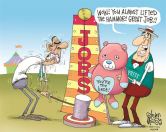
The column cites many of the academic studies showing that unemployment benefits lead to more joblessness.

I’ve made this point during television interviews, and this Michael Ramirez cartoon echoes our thinking in a more entertaining fashion.

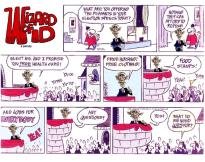
And we definitely can’t overlook this superb Wizard-of-Id parody. It doesn’t focus specifically on unemployment benefits, but it makes a great point about labor supply incentives.

But let’s get back to the column. Our main goal is to identify the types of policies that would generate jobs and growth.

Simply stated, genuine compassion should be defined by helping people get back to work so they don’t need to be wards of the state.

And easing the burden of government is the best way to make that happen. Our column looks at some evidence – from both overseas and here at home – about the policies that are associated with better economic performance.

Big government is responsible for today’s unemployment situation. …Since President Obama was elected, we have spent $560 billion on unemployment benefits. It’s likely many more jobs would have been created had the government not diverted that money from the economy’s productive sector. …Instead of copying stagnant European nations with bigger public sectors, we should learn from countries that have achieved better performance by lowering the burden of government. Singapore and Hong Kong are examples of jurisdictions with small governments and free markets that enjoy strong and sustained growth with very low levels of joblessness. …look at Canada, which has significantly boosted its jobs market with pro-growth reforms, or Switzerland, which has cemented its traditionally strong labor markets with reforms to control the growth of government. This is not a partisan argument. Or at least it shouldn’t be. The United States enjoyed strong levels of job creation during both the Reagan and Clinton years. But in both cases, public policy was largely the same, featuring an increase in economic freedom.

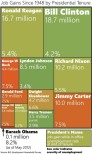
Some people may wonder whether Reagan and Clinton belong in the same category.

Well, as illustrated by this chart, they both presided over periods with impressive job creation.

And they both presided over periods with generally good economic policy.

Reagan moved the country in the right direction on purpose. Clinton, by contrast, may have wanted to move the nation in the other direction, but he was unsuccessful.Indeed, the evidence is very strong that the overall burden of government fell during his tenure.

Whether by accident or design, America needs another period of free markets and shrinking government.

For further details on the recipe for good policy, here’s the video I narrated for the Center for Freedom and Prosperity, which explains the conditions that lead to strong and sustained growth.

Free Markets and Small Government Produce Prosperity

Uploaded on Feb 17, 2009

Now that the so-called stimulus has been enacted, hopefully policy makers will turn their attention to policies that actually improve economic performance. This Center for Freedom and Prosperity Foundation video reviews the key finding in the Fraser Institute’s Economic Freedom of the World and explains that, contrary to the policies of Presidents Bush and Obama, smaller government and free markets are the way to boost economic growth. For more information: http://www.freedomandprosperity.org

__________________

P.S. I’m obviously a fan of Senator Rand Paul. Not only does he choose good people as op-ed partners, he also gave me public credit for a good Obamacare joke.

P.P.S. On a separate topic, I wrote in December 2012 that the strongest evidence for media bias is which stories get covered. A perfect example is that journalists already have given 17 times as much coverage of the Chris Christie “bridgegate” scandal as they gave to the IRS scandal over the past six months

Related posts:

If you want to cut government waste then stop allowing people to get addicted to government programs!!!!

______________ If you want to cut government waste then stop allowing people  to get addicted to government programs!!!! November 3, 2013 1:07PM Lindbeck’s Law: The Self-Destructive Nature of Expanding Government Benefits By Alan Reynolds Share Relevant foresight from Swedish economist Assar Lindbeck, “Hazardous Welfare State Dynamics,” American Economic Review, May 1995: The basic dilemma of […]

Lots of Waste at the Federal Mediation and Conciliation Service!!!!

____________ Lots of Waste at the Federal Mediation and Conciliation Service!!!! November 5, 2013 12:50PM ICYMI: FMCS By Jim Harper Share During the hullaballoo around the government shutdown, the Washington Examiner published a jaw-dropping series of stories about blatant waste in an obscure federal agency called the Federal Mediation and Conciliation Service. These stories shouldn’t […]

Open letter to President Obama (Part 440) A suggestion to cut some wasteful spending out of the government Part 6 (includes editorial cartoon)

(Emailed to White House on 3-15-13.) President Obama c/o The White House 1600 Pennsylvania Avenue NW Washington, DC 20500 Dear Mr. President, I know that you receive 20,000 letters a day and that you actually read 10 of them every day. I really do respect you for trying to get a pulse on what is […]

Open letter to President Obama (Part 495) (Wasting our tax dollars!!!)

Open letter to President Obama (Part 495)

(Emailed to White House on 5-4-13.)

President Obama c/o The White House 1600 Pennsylvania Avenue NW Washington, DC 20500

Dear Mr. President,

I know that you receive 20,000 letters a day and that you actually read 10 of them every day. I really do respect you for trying to get a pulse on what is going on out here.

______________

Sad that the government wastes so much of our money and it wants more from us under President Obama.

Remember the Spending Quiz from 2010, which asked people to guess whether absurd examples of government waste were true or false?

Well, we have a new video on government waste, though bureaucrats and politicians have become so profligate it doesn’t even bother to trick people with fake examples.

Your Tax Dollars at Work

While very well done, I do have two small complaints about the video.

First, it asks whether we should cut spending or raise taxes to deal with the national debt. I think that’s too narrow. We shouldn’t be wasting money even if the budget was balanced and there wasn’t a penny of debt.

In other words, the problem isn’t deficits. Red ink is just a symptom. The real problem is that government is too big.

Second, the video sort of acquiesces to the dishonest Washington terminology by asking whether we should cut spending or raise taxes, implying those are the only two options. I favor genuine spending cuts, of course, but the most accurate way of phrasing the question is to ask whether we should cut spending, restrain spending, or let government grow on auto-pilot.

As I explained earlier this year, we can balance the budget in just 10 years if spending grows “only” 3.4 percent per year. When people understand that detail, there’s almost no support for higher taxes.

But I’m nitpicking. Overall, a very good video.

P.S. If the examples of pork-barrel spending in the video get you angry, you’ll probably have a stroke if you also watch the waste video from the folks at Government Gone Wild.

_______________________

Thank you so much for your time. I know how valuable it is. I also appreciate the fine family that you have and your commitment as a father and a husband.

Sincerely,

Everette Hatcher III, 13900 Cottontail Lane, Alexander, AR 72002, ph 501-920-5733, lowcostsqueegees@yahoo.com

Related posts:

Dan Mitchell explains what happened in Cyprus

Dan Mitchell explains what happened in Cyprus.   What Really Happened in Cyprus? April 14, 2013 by Dan Mitchell Did Cyprus become an economic basket case because it is a tax haven, as some leftists have implied? Did it get in trouble because the government overspent, which I have suggested? The answers to those questions are […]

Dan Mitchell on Obamacare (includes cartoons on Obamacare)

Some very good points by Dan Mitchell of the Cato Institute on Obamacare: Why We Should Be Optimistic about Repealing Obamacare and Fixing the Healthcare System April 10, 2013 by Dan Mitchell I’m going to make an assertion that seems utterly absurd. The enactment of Obamacare may have been good news. Before sending a team of medical […]

Dan Mitchell’s blog has great cartoon that demonstrates what President Obama has been doing the last 4 years!!!

I have put up lots of cartoons from Dan Mitchell’s blog before and they have got lots of hits before. Many of them have dealt with the economy, eternal unemployment benefits, socialism,  Greece,  welfare state or on gun control.     I’ve Obtained a Secret Pre-Release Copy of Obama’s Budget April 9, 2013 by Dan Mitchell The President is supposed to release […]

Dan Mitchell’s tribute to Margaret Thatcher

Very well said by Dan Mitchell. A Tribute to Margaret Thatcher April 8, 2013 by Dan Mitchell The woman who saved the United Kingdom has died. A Great Woman I got to meet Margaret Thatcher a couple of times and felt lucky each time that I was in the presence of someone who put her nation’s […]

Dan Mitchell, Ron Paul, and Milton Friedman on Immigration Debate (includes editorial cartoon)

I like Milton Friedman’s comments on this issue of immigration   and Ron Paul and Dan Mitchell do well on the issue too. Question of the Week: What’s Your Take on the Immigration Debate? April 7, 2013 by Dan Mitchell A reader from overseas wonders about my views on immigration, particularly amnesty. I confess that this is one of […]

Dan Mitchell on Texas v. California (includes editorial cartoon)

We should lower federal taxes because jobs are going to states like Texas that have low taxes. What Can We Learn by Comparing the Employment Situation in Texas vs. California? April 3, 2013 by Dan Mitchell One of the great things about federalism, above and beyond the fact that it both constrains the power of governments […]

Cartoons from Dan Mitchell’s blog on Obamacare

Third-Party Payer is the Biggest Economic Problem With America’s Health Care System Published on Jul 10, 2012 This mini-documentary from the Center for Freedom and Prosperity Foundation explains that “third-party payer” is the main problem with America’s health care system. This is why undoing Obamacare, while desirable, is just a small first step if we […]

Obamacare cartoons from Dan Mitchell’s blog

I have put up lots of cartoons from Dan Mitchell’s blog before and they have got lots of hits before. Many of them have dealt with the economy, eternal unemployment benefits, socialism,  Greece,  welfare state or on gun control. The funniest cartoon is the one with “Nurse Sebelius” stuffing the huge capsule down the kid’s throat!!! Obamacare […]

Editorial cartoon from Dan Mitchell’s blog on California’s sorry state of affairs

I have put up lots of cartoons from Dan Mitchell’s blog before and they have got lots of hits before. Many of them have dealt with the sequester, economy, eternal unemployment benefits, socialism,  minimum wage laws, tax increases, social security, high taxes in California, Obamacare,  Greece,  welfare state or on gun control. President Obama’s favorite state must be California because […]

Dan Mitchell of the Cato Institute:HUD has to go!!!! (includes political cartoon)

You want a suggestion on how to cut the government then start at HUD. I would prefer to eliminate all of it. Here are Dan Mitchell’s thoughts below: Sequestration’s Impact on HUD: Just 358 More Days and Mission Accomplished March 12, 2013 by Dan Mitchell As part of my “Question of the Week” series, I had […]

We need to downsize the Dept of Energy now!!!

_________________

 We need to downsize the Dept of Energy now!!!
January 9, 2014 11:33AM

Downsize the Department of Energy

The Department of Energy spends $29 billion per year on various schemes with a disastrous track record, often with bipartisan support. From regulations that destabilize markets, decrease domestic output and harm consumers, to subsidies that pick and choose winners and losers, this department is a perfect example of a white elephant – an expensive project of little to no useful purpose.

Solyndra is the best example of such waste. The solar panel company received a $535 million loan before filing for bankruptcy in 2011. The federal government will likely recover just $27 million from that loan.

The department can be abolished by relegating security and clean-up-related tasks to the EPA or the Department of Defense and by returning research functions to the private sector. In all, abolishing the Department of Energy would save taxpayers about $7 billion a year. To that end we’ve created a short video which makes these and other points, which you can watch below.

Downsize the Department of Energy

Published on Jan 8, 2014

http://www.downsizinggovernment.org/e…

The Department of Energy oversees nuclear weapons sites and subsidizes conventional and alternative fuels. The department has a history of fiscal and environmental mismanagement. Furthermore, misguided energy regulations have caused large losses to consumers and the broader economy over the decades.

The department spent about $29 billion 2013, or $240 for every U.S. household. It employs 17,000 workers directly and oversees about 100,000 contract workers at research facilities across the nation.

____________________________

Related posts:

We need to repeal Obamacare and get away from third-party payer system and get a genuine free market!!!!

______ We need to repeal Obamacare and get away from third-party payer system and get a genuine free market!!!! The Continuing Obamacare Disaster November 11, 2013 by Dan Mitchell You know things are going poorly for the Obama White House when even the New York Times is writing about the “third world experience” of Obamacare. Heck, […]

The food stamp bill would be more costly than the Obama Stimulus!!!!!

The food stamp bill would be more costly than the Obama Stimulus!!!!! Farm Bills Would Cost More Than Obama Stimulus Daren Bakst October 28, 2013 at 3:56 pm The House and Senate are considering farm bill legislation this week whose costs should raise red flags for all Americans. In fact, the House and Senate versions […]

Dear Senator Pryor, here are some spending cut suggestions (“Thirsty Thursday”, Open letter to Senator Pryor)

Senator Pryor pictured below:  Why do I keep writing and email Senator Pryor suggestions on how to cut our budget? I gave him hundreds of ideas about how to cut spending and as far as I can tell he has taken none of my suggestions. You can find some of my suggestions here, here, here, here, here, here, here, here, here, here, here, here, here, here, here, here, here, here, here,  here, and  here, and they […]

Americans know that we must have work requirements for food stamps!!!!

____________ Americans know that we must have work requirements for food stamps!!!! Americans Support Stronger Work Requirements for Food Stamps Rachel Sheffield October 30, 2013 at 12:02 pm Newscom Nearly three-quarters of Americans believe that the food stamps program should include stronger work requirements, according to the October Food Demand Survey (FooDS) out of Oklahoma […]

Food stamp reform must be done in order to cut bloated spending in Washington!!

Food stamp reform must be done in order to cut bloated spending in Washington!! Farm Bill: A Response to President Obama Daren Bakst October 17, 2013 at 5:31 pm In his recent remarks, President Obama made a push to get a new farm bill enacted by the end of the year. Sound agriculture and food […]

Open letter to President Obama (Part 494) (Does Government Have a Revenue or Spending Problem?)

Open letter to President Obama (Part 494)

(Emailed to White House on 4-10-13.)

President Obama c/o The White House 1600 Pennsylvania Avenue NW Washington, DC 20500

Dear Mr. President,

I know that you receive 20,000 letters a day and that you actually read 10 of them every day. I really do respect you for trying to get a pulse on what is going on out here.

___________________

Does Government Have a Revenue or Spending Problem?

People say the government has a debt problem. Debt is caused by deficits, which is the difference between what the government collects in tax revenue and the amount of government spending. Every time the government runs a deficit, the government debt increases. So what’s to blame: too much spending, or too little tax revenue? Economics professor Antony Davies examines the data and concludes that the root cause of the debt is too much government spending.

______________

So many times politicians tell us that we have to raise taxes in order to balance the budget but the only way to balance the budget is to control spending. That is exactly what happened between 1994 and 1998.

I wrote about the Ryan budget two days ago, praising it for complying with Mitchell’s Golden Rule and reforming Medicare and Medicaid.

But I believe in being honest and nonpartisan, so I also groused that it wasn’t as good as the 2011 and 2012 versions.

Now it’s time to give the same neutral and dispassionate treatment to the budget proposed by Patty Murray, the Washington Democrat who chairs the Senate Budget Committee.

But I’m going to focus on a theme rather than numbers.

One part of her budget got me particularly excited. Her Committee’s “Foundation for Growth” blueprint makes a very strong assertion about the fiscal and economic history of the Clinton years.

The work done in the 1990s helped grow the economy, create jobs, balance the budget, and put our government on track to eliminate the national debt.

As elaborated in this passage, the 42nd President delivered very good results.

President Bill Clinton entered office in 1993 at a time when the country was facing serious deficit and debt problems. The year before, the federal government was taking in revenue equal 17.5 percent of GDP, but spending was 22.1 percent of the economy—a deficit of 4.7 percent. …The unemployment rate went from 7 percent at the beginning of 1993 to 3.9 percent at the end of 2000. Between 1993 and 2001, our economy gained more than 22 million jobs and experienced the longest economic expansion in our history.

And the Senate Democrats even identified one of the key reasons why economic and fiscal policy was so successful during the 1990s.

…federal spending dropped from 22.1 percent of GDP to 18.2 percent of GDP.

I fully agree with every word reprinted above. That’s the good news.

So what, then, is the bad news?

Well, Senator Murray may have reached the right conclusion, but she was wildly wrong in her analysis. For all intents and purposes, she claims that the 1993 tax hike produced most of the good results.

President Clinton’s 1993 tax deal…brought in new revenue from the wealthiest Americans and…our country created 22 million new jobs and achieved a balanced budget. President Clinton’s tax policies were not the only driver of economic growth, but our leaders’ ability to agree on a fiscally sustainable and economically sound path provided valuable certainty for American families and businesses.

First, let’s dispense with the myth that the 1993 tax hike balanced the budget. I obtained the fiscal forecasts that were produced by both the Congressional Budget Office and the Office of Management and Budget in early 1995 because I wanted to see whether a balanced budget was predicted.

As you can see in the chart, both of those forecasts showed perpetual deficits of about $200 billion. And these forecasts were made nearly 18 months after the Clinton tax hike was implemented.

So if even the White House’s own forecast from OMB didn’t foresee a balanced budget, what caused the actual fiscal situation to be much better than the estimates?

The simple answer is that spending was restrained. You can give credit to Bill Clinton. You can give credit to the GOP Congress that took power in early 1995. You can give the credit to both.

But regardless of who gets the credit, the period of spending restraint that began at that time was the change that produced a budget surplus, not the tax hike that was imposed 18 months earlier and which was associated with perpetual red ink.

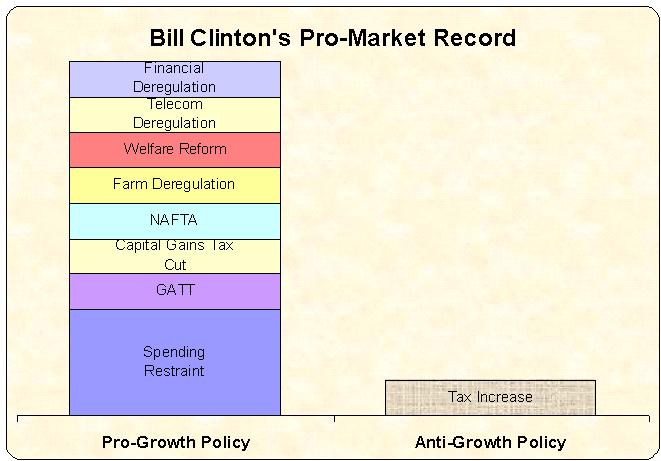
But spending restraint tells only part of the story. With the exception of the 1993 tax hike, the Clinton years were a period of shrinking government and free market reform.

Clinton RecordTake a look at my homemade bar chart to compare the good policies of the 1990s with the bad policies. It’s not even close.

You may be thinking that my comparison is completely unscientific, and you’re right. I probably overlooked some good policies and some bad policies.

And my assumptions about weighting are very simplistic. Everything is equally important, with a big exception in that I made the government spending variable three times as important as everything else.

Why? Well, I think reducing the burden of government spending during the Clinton years was a major achievement.

But maybe we shouldn’t rely on my gut instincts. So let’s set aside my created-at-the-spur-of-the-moment bar chart and look at something that is scientific.

This chart is taken directly from Economic Freedom of the World, which uses dozens of variables to measure the overall burden of government.

As you can see, the United States score improved significantly during the Clinton years, showing that economic freedom was expanding and the size and scope of government was shrinking.

In other words, Patty Murray is correct. She is absolutely right to claim that Bill Clinton’s policies “helped grow the economy, create jobs, balance the budget.”

Now she needs to realize that those policies were small government and free markets.

Let me start this post by stating that George W. Bush was a bigger spender than Barack Obama (though the numbers are somewhat distorted by TARP, which caused a big increase in the burden of spending during Bush’s last fiscal year and artificially dampened outlays in Obama’s first fiscal year since repayments from the banks counted as negative spending).

So I’m not trying to make a partisan point by sharing these cartoons. I don’t like it when Democrats increase the burden of government spending and I’m equally dismayed when Republicans engage in same type of profligacy.

That being said, I was a big dumbfounded when President Obama recently claimed that there’s not a spending problem in Washington.

We know that the United States has a huge long-run problem with deficits and debt according to both the Bank for International Settlements and the Organization for Economic Cooperation and Development.

We also know that tax revenues, measured as a share of GDP, will soon be above their post-World War II average and that the tax burden is expected to increase in coming decades.

So a person would have to be in serious denial to claim that spending isn’t a problem.

Which is the point Eric Allie makes in this cartoon.

Spending Problem Cartoon 1

And the point Robert Ariail makes in this cartoon.

Spending Problem Cartoon 2

Ditto for Bob Gorrell.

Spending Problem Cartoon 3

And Gary Varvel.

Spending Problem Cartoon 4

Last but not least, the great Michael Ramirez.

Spending Problem Cartoon 5.jpg

Gee, it’s almost like we’re seeing a pattern.

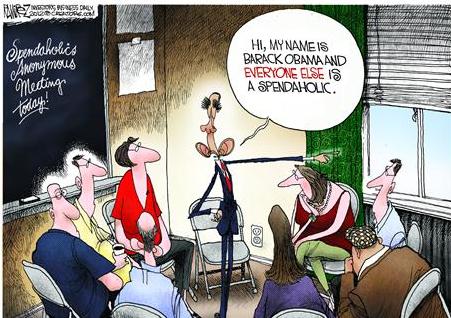
And if you like this spendaholic-in-denial theme, you can click here and here for further amusement.

P.S. Oh, by the way, if anybody’s actually interested in how to solve the spending problem (you know, the one that doesn’t exist), we do know the answer.

P.P.S. Remember when Obama claimed the private sector was doing fine? Well, here’s how cartoonists mocked him for that absurd comment.

______________________

Thank you so much for your time. I know how valuable it is. I also appreciate the fine family that you have and your commitment as a father and a husband.

Sincerely,

Everette Hatcher III, 13900 Cottontail Lane, Alexander, AR 72002, ph 501-920-5733, lowcostsqueegees@yahoo.com

Making people more dependent on the government hurts our society!!!

_______________

Making people more dependent on the government hurts our society!!!

I’ve shared many charts over the years, but two of the most compelling ones deal with poverty.

Poverty Rate DataThe numbers in this chart, which are based on Census Bureau data and scholarly studies (see here, here, here, and here), show that the poverty rate was steadily falling in the United States – until the federal government decided to launch a so-called War on Poverty.

Once Washington got more involved and started spending trillions of dollars, we stopped making progress. The poverty rate has changed a bit with shifts in economic conditions, but it’s stayed remarkably steady between 11 percent and 15 percent of the population.

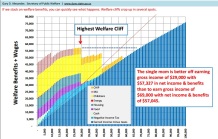
So why have we stopped making progress? This second chart shows how redistribution programs create a dependency trap. The plethora of handouts from government make self-reliance and work comparatively unattractive, particularly since poor people are hit with very high implicit marginal tax rates.

And just as rich people respond logically to incentives, the same is true of poor people.

In a recent debate with a representative of the Center for American Progress, I tried to make these points. I doubt I had any effect on her outlook, but hopefully viewers began to see that the welfare state has been bad news for taxpayers and bad news for poor people.

Dan Mitchell Debating the Federal Government’s War on Poverty

Published on Jan 8, 2014

No description available.

_____________________________________________

Our debate was cut short by the host, but I think it was a fair representation of each side’s views.

And if you want more information on this topic, my former colleague from my days at the Heritage Foundation, Robert Rector, assesses the War on Poverty for today’s Wall Street Journal.

He starts with some very sobering numbers.

Fifty years later, we’re losing that war. Fifteen percent of Americans still live in poverty, according to the official census poverty report for 2012, unchanged since the mid-1960s. Liberals argue that we aren’t spending enough money on poverty-fighting programs, but that’s not the problem. …The federal government currently runs more than 80 means-tested welfare programs that provide cash, food, housing, medical care and targeted social services to poor and low-income Americans. Government spent $916 billion on these programs in 2012 alone, and roughly 100 million Americans received aid from at least one of them, at an average cost of $9,000 per recipient. …Federal and state welfare spending, adjusted for inflation, is 16 times greater than it was in 1964. If converted to cash, current means-tested spending is five times the amount needed to eliminate all official poverty in the U.S.

He then explains that poor people don’t suffer from material deprivation (which may explain why the Obama Administration wants to manipulate the numbers to justify more welfare spending).

…the typical American living below the poverty level in 2013 lives in a house or apartment that is in good repair, equipped with air conditioning and cable TV. His home is larger than the home of the average nonpoor French, German or English man. He has a car, multiple color TVs and a DVD player. More than half the poor have computers and a third have wide, flat-screen TVs. The overwhelming majority of poor Americans are not undernourished and did not suffer from hunger for even one day of the previous year.

Robert then gets to the heart of the issue, explaining that the welfare state has expanded dependency and exacerbated social pathologies.

…consider LBJ’s original aim. He sought to give poor Americans “opportunity not doles,” planning to shrink welfare dependence not expand it.  …By that standard, the war on poverty has been a catastrophe. The root “causes” of poverty have not shrunk but expanded as family structure disintegrated and labor-force participation among men dropped. A large segment of the population is now less capable of self-sufficiency than when the war on poverty began. …In 1963, 6% of American children were born out of wedlock. Today the number stands at 41%. As benefits swelled, welfare increasingly served as a substitute for a bread-winning husband in the home. …children raised in the growing number of single-parent homes are four times more likely to be living in poverty than children reared by married parents of the same education level. …Even in good economic times, a parent in the average poor family works just 800 hours a year, roughly 16 hours weekly, according to census data. Low levels of work mean lower earnings and higher levels of dependence.

Mr. Rector also has some specific suggestions in his column, most of which seem sensible, but this is where I think my idea of sweeping decentralization and federalism is very appropriate.

P.S. Thomas Sowell’s indictment of the welfare state is must reading.

P.P.S. Some honest leftists now acknowledge that big government creates worrisome forms of dependency.

P.P.P.S. If you want to know how dependency varies by state, here’s a map showing welfare payments and another map showing food stamp usage.

P.P.P.P.S. Shifting to a bigger stage, my least favorite international bureaucracy has made the preposterous claim that poverty is a bigger problem in America than it is in basket-case nations such as Greece and Portugal. Not that we should be surprised since the OECD actively urges a bigger welfare state in the United States.

P.P.P.P.P.S. And don’t forget our Moocher Hall of Fame if you want examples of the human cost of the welfare state.


___________

Related posts:


We need to repeal Obamacare and get away from third-party payer system and get a genuine free market!!!!

______ We need to repeal Obamacare and get away from third-party payer system and get a genuine free market!!!! The Continuing Obamacare Disaster November 11, 2013 by Dan Mitchell You know things are going poorly for the Obama White House when even the New York Times is writing about the “third world experience” of Obamacare. Heck, […]

The food stamp bill would be more costly than the Obama Stimulus!!!!!

The food stamp bill would be more costly than the Obama Stimulus!!!!! Farm Bills Would Cost More Than Obama Stimulus Daren Bakst October 28, 2013 at 3:56 pm The House and Senate are considering farm bill legislation this week whose costs should raise red flags for all Americans. In fact, the House and Senate versions […]

Dear Senator Pryor, here are some spending cut suggestions (“Thirsty Thursday”, Open letter to Senator Pryor)

Senator Pryor pictured below:  Why do I keep writing and email Senator Pryor suggestions on how to cut our budget? I gave him hundreds of ideas about how to cut spending and as far as I can tell he has taken none of my suggestions. You can find some of my suggestions here, here, here, here, here, here, here, here, here, here, here, here, here, here, here, here, here, here, here,  here, and  here, and they […]

Americans know that we must have work requirements for food stamps!!!!

____________ Americans know that we must have work requirements for food stamps!!!! Americans Support Stronger Work Requirements for Food Stamps Rachel Sheffield October 30, 2013 at 12:02 pm Newscom Nearly three-quarters of Americans believe that the food stamps program should include stronger work requirements, according to the October Food Demand Survey (FooDS) out of Oklahoma […]

Food stamp reform must be done in order to cut bloated spending in Washington!!

Food stamp reform must be done in order to cut bloated spending in Washington!! Farm Bill: A Response to President Obama Daren Bakst October 17, 2013 at 5:31 pm In his recent remarks, President Obama made a push to get a new farm bill enacted by the end of the year. Sound agriculture and food […]

Dear Senator Pryor, here are some spending cut suggestions (“Thirsty Thursday”, Open letter to Senator Pryor)

Senator Pryor pictured below:

Why do I keep writing and email Senator Pryor suggestions on how to cut our budget? I gave him hundreds of ideas about how to cut spending and as far as I can tell he has taken none of my suggestions. You can find some of my suggestions here, here, here, here, here, here, here, here, here, here, here, here, here, here, here, here, here, here, here,  here, and  here, and they all were emailed to him. In fact, I have written 13 posts pointing out reasons why I believe Senator Pryor’s re-election attempt will be unsuccessful. HERE I GO AGAIN WITH ANOTHER EMAIL I JUST SENT TO SENATOR PRYOR!!!

Dear Senator Pryor,

Why not pass the Balanced  Budget amendment? As you know that federal deficit is at all time high (1.6 trillion deficit with revenues of 2.2 trillion and spending at 3.8 trillion).

On my blog www.thedailyhatch.org . I took you at your word and sent you over 100 emails with specific spending cut ideas. (Actually there were over 160 emails with specific spending cut suggestions.) However, I did not see any of them in the recent debt deal that Congress adopted although you did respond to me several times. Now I am trying another approach. Every week from now on I will send you an email explaining different reasons why we need the Balanced Budget Amendment. It will appear on my blog on “Thirsty Thursday” because the government is always thirsty for more money to spend. Today I actually have included a great article below from the Heritage Foundation concerning an area of our federal budget that needs to be cut down to size. The funny thing about the Sequester and the 2.4% of cuts in future increases is that President Obama set these up and then he acted like the sky was falling in as the cartoons indicate in the newspapers.

IF YOU TRULY WANT TO CUT THE BUDGET AND BALANCE THE BUDGET THEN SUBMIT THESE POTENTIAL BUDGET CUTS PRESENTED BELOW!!

___________

Better

Published on May 28, 2013

No description available.

____________

We could put in a flat tax and it would enable us to cut billions out of the IRS budget!!!!

May 14, 2013 2:34PM

IRS Budget Soars

The revelations of IRS officials targeting conservative and libertarian groups suggest that now is a good time for lawmakers to review a broad range of the agency’s activities. Since the agency’s last overhaul in the IRS Restructuring and Reform Act of 1998, its budget has exploded from $33 billion to a proposed $106 billion in 2013.

Using data from the OMB budget database, I split total IRS outlays into two broad activities: administration and handouts. Administration includes tax return processing, investigations, enforcement, and other bureaucratic functions. Handouts mainly includes spending on “refundable” tax credits such as the EITC.

The chart shows that the IRS has become a huge social welfare agency in recent decades. Handouts have soared from $4.4 billion in 1990 to an estimated $91.1 billion in 2013 (red line). Handouts are down a bit in recent years because some of the refundable credits from “stimulus” legislation have expired. IRS administration costs have grown from $7.7 billion in 1990 to an estimated $15.3 billion in 2013 (blue line).

How should we reform the IRS budget? First, we should terminate the handout programs. That would save taxpayers more than $90 billion annually and cut the IRS budget by 86 percent.

The largest IRS handout is the refundable part of the EITC, which is expected to cost $55 billion in 2013. Many policymakers favor the EITC as a “conservative” handout program because it encourages people to work. But the EITC itself creates a discouragement to increased work over the income range that it is phased-out. It also adds to tax-code complexity and has an error and fraud rate of more than 20 percent.

The EITC is an example of how big government begets more big government. We certainly wouldn’t need the EITC incentive to work if we slashed all the taxes and welfare programs that currently encourage people not to work.

It’s a similar situation with other IRS handout programs, such as the $1 billion “Therapeutic Discovery” grant program. These grants are supposed to “produce new and cost-saving therapies, support jobs and increase U.S. competitiveness.” But it would be better to accomplish those goals by repealing the excise tax on medical devices and slashing the high 40 percent U.S. corporate income tax.

As for the $15 billion in spending on IRS administration, we could dramatically cut that cost with major tax reforms. In particular, a consumption-based flat tax would hugely simplify the code and greatly reduce paperwork costs of the IRS and taxpayers alike.

Looking ahead, the IRS budget is expected to balloon in coming years as the agency plays a key role in implementing ObamaCare. Unless the health care legislation is repealed, IRS outlays are expected to soar from $106 billion this year to $263 billion by 2023.

_______________

The Balanced Budget Amendment is the only thing I can think of that would force Washington to cut spending. We have only a handful of balanced budgets in the last 60 years, so obviously what we are doing is not working. We are passing along this debt to the next generation. YOUR APPROACH HAS BEEN TO REJECT THE BALANCED BUDGET “BECAUSE WE SHOULD CUT THE BUDGET OURSELF,” WELL THEN HERE IS YOUR CHANCE!!!! SUBMIT THESE CUTS!!!!

Thank you for this opportunity to share my ideas with you.

Sincerely,

Everette Hatcher, lowcostsqueegees@yahoo.com www.thedailyhatch.org, 13900 Cottontail Lane, Alexander, AR 72002, ph 501-920-5733

Related posts:

The Flat Tax is the way to go.

The Flat Tax is the way to go. Since Leftists Don’t Like Corporate Loopholes, They Should Support the Flat Tax August 9, 2012 by Dan Mitchell I appeared on CNBC a couple of days ago to discuss a new report which claims that some big U.S. companies “only” paid 9 percent of their income to the […]

Flat Tax would lower the incentive to avoid paying taxes

The Flat Tax would lower the incentive to avoid paying taxes to the government. Then it seems that those who complain about all the  Washington influence-peddling and lobbying  should support the Flat Tax. Max Brantley of the Arkansas Times complains probably the most but there is no way he would favor trying to lesson the problem […]

The flat tax will grow the economy

If we want the economy to grow then we should look closely at a flat tax. A Primer on the Flat Tax and Fundamental Tax Reform August 11, 2012 by Dan Mitchell In previous posts, I put together tutorials on the Laffer Curve, tax competition, and the economics of government spending. Today, we’re going to look […]

A flat tax is the answer

Uploaded by afq2007 on Mar 29, 2010 This Center for Freedom and Prosperity Foundation video shows how the flat tax would benefit families and businesses, and also explains how this simple and fair system would boost economic growth and eliminate the special-interest corruption of the internal revenue code. http://www.freedomandprosperity.org __________________________________ Dan Mitchell hits the nail […]

Flat tax is all the over world but USA still has complicated tax code

It is amazing to me that Reagan put in only 3 levels of taxation before he left office but now we have made it complicated again. Take a look at this video from the Cato Institute. Uploaded by catoinstitutevideo on Apr 13, 2009 This video was produced by Caleb Brown ( http://www.twitter.com/cobrown ) and Austin […]

A flat tax is the answer

Uploaded by afq2007 on Mar 29, 2010 This Center for Freedom and Prosperity Foundation video shows how the flat tax would benefit families and businesses, and also explains how this simple and fair system would boost economic growth and eliminate the special-interest corruption of the internal revenue code. http://www.freedomandprosperity.org __________________________________ Dan Mitchell hits the nail […]

Cato Institute grades Perry’s flat tax

I really like to read Dan Mitchell’s opinions. Grading Perry’s Flat Tax: Some Missing Homework, but a Solid B+ Posted by Daniel J. Mitchell Governor Rick Perry of Texas has announced a plan, which he outlines in the Wall Street Journal, to replace the corrupt and inefficient internal revenue code with a flat tax. Let’s […]

“Friedman Friday” Milton Friedman: “If taxes are raised in order to keep down the deficit, the result is likely to be a higher norm for government spending” (Charlie Rose interview pt 4)

MILTON FRIEDMAN: THE MIND BEHIND THE REPUBLICAN TAX REVOLT Jack Roberts | Jul 22, 2011 | 0 comments The on-going debate over raising the debt ceiling has focused on many areas of disagreement between Democrats and Republicans but none bigger than the Republican determination not to raise taxes.  Many pundits credit this to the political […]

If you want the rich to pay a bigger percentage of the nation’s tax revenues then keep their tax rates low!!!

If you want the rich to pay a bigger percentage of the nation’s tax revenues then keep their tax rates low!!! Evidence from England Shows that If You Want to “Soak the Rich,” Keep Tax Rates Low September 26, 2012 by Dan Mitchell I’ve pulled evidence from IRS publications to show that rich people paid a […]

Use of our tax money is pretty stupid

Sad that the government wastes so much of our money and it wants more from us under President Obama. An Aggravating Reminder of Government Waste on Tax Day April 15, 2013 by Dan Mitchell Remember the Spending Quiz from 2010, which asked people to guess whether absurd examples of government waste were true or false? Well, […]

Mark Pryor responds to me concerning Debt Ceiling email (Part 1)

The problem with the debt ceiling is very clear to me. We need to get serious about cutting federal spending. I am so upset about it that I have emailed over 100 emails to Senator Pryor concerning specific spending suggestions. I get emails from back from Senator Pryor like the one below. This means that […]

Senator Pryor asks for Spending Cut Suggestions! Here are a few!(Part 164)

Senator Pryor asks for Spending Cut Suggestions! Here are a few!(Part 164) Senator Mark Pryor wants our ideas on how to cut federal spending. Take a look at this video clip below: Senator Pryor has asked us to send our ideas to him at cutspending@pryor.senate.gov and I have done so in the past and will continue to […]

Senator Pryor asks for Spending Cut Suggestions! Here are a few!(Part 163)

Senator Pryor asks for Spending Cut Suggestions! Here are a few!(Part 163) Senator Mark Pryor wants our ideas on how to cut federal spending. Take a look at this video clip below: Senator Pryor has asked us to send our ideas to him at cutspending@pryor.senate.gov and I have done so in the past and will continue to […]

Senator Pryor asks for Spending Cut Suggestions! Here are a few!(Part 162)

Senator Pryor asks for Spending Cut Suggestions! Here are a few!(Part 162) Senator Mark Pryor wants our ideas on how to cut federal spending. Take a look at this video clip below: Senator Pryor has asked us to send our ideas to him at cutspending@pryor.senate.gov and I have done so in the past and will continue to […]

Capitol Tours with Senator Mark Pryor

Three very good video tours below from Senator Mark Pryor. Published on Jun 13, 2012 by SenatorPryor Episode 1: Arkansans in the Capitol Published on Jul 9, 2012 by SenatorPryor Episode 2: The Crypt and the Old Supreme Court Published on Aug 20, 2012 by SenatorPryor Episode 3: The Senate Chamber If you want to […]

Senator Pryor asks for Spending Cut Suggestions! Here are a few!(Part 161)

Senator Pryor asks for Spending Cut Suggestions! Here are a few!(Part 161) Senator Mark Pryor wants our ideas on how to cut federal spending. Take a look at this video clip below: Senator Pryor has asked us to send our ideas to him at cutspending@pryor.senate.gov and I have done so in the past and will continue to […]

Senator Mark Pryor responds to my email

Senator Mark Pryor wants our ideas on how to cut federal spending and I sent them to him but he didn’t take any of my suggestions. However, he did take time to get back to me today, but I am not too impressed with Senator Pryor’s response. I gave him hundreds of ideas about how […]

Senator Pryor asks for Spending Cut Suggestions! Here are a few!(Part 160)

Senator Pryor asks for Spending Cut Suggestions! Here are a few!(Part 160) Senator Mark Pryor wants our ideas on how to cut federal spending. Take a look at this video clip below: Senator Pryor has asked us to send our ideas to him at cutspending@pryor.senate.gov and I have done so in the past and will continue to […]

Senator Pryor asks for Spending Cut Suggestions! Here are a few!(Part 159)

Senator Pryor asks for Spending Cut Suggestions! Here are a few!(Part 159) Senator Mark Pryor wants our ideas on how to cut federal spending. Take a look at this video clip below: Senator Pryor has asked us to send our ideas to him at cutspending@pryor.senate.gov and I have done so in the past and will continue to […]

Senator Pryor asks for Spending Cut Suggestions! Here are a few!(Part 158)

Senator Mark Pryor wants our ideas on how to cut federal spending. Take a look at this video clip below: Senator Pryor has asked us to send our ideas to him at cutspending@pryor.senate.gov and I have done so in the past and will continue to do so in the future. On May 11, 2011,  I emailed to […]

Dear Senator Pryor, why not pass the Balanced Budget Amendment? (“Thirsty Thursday”, Open letter to Senator Pryor)

Office of the Majority Whip | Balanced Budget Amendment Video In 1995, Congress nearly passed a constitutional amendment mandating a balanced budget. The Balanced Budget Amendment would have forced the federal government to live within its means. This Balanced Budget Amendment failed by one vote. 16 years later, Congress has the chance to get it […]

Dear Senator Pryor, why not pass the Balanced Budget Amendment? (“Thirsty Thursday”, Open letter to Senator Pryor)

Sadly Senator Pryor has voted against the Balanced Budget Amendment over and over in his long time in the Senate. Senator Pryor: “There are a lot of people who think a balanced-budget amendment solves all the fiscal problems. I completely disagree.” (Peter Urban, Pryor Tilts Balanced Budget, Southwest Times Record, 11/17/11) Dear Senator Pryor, Why […]

Dear Senator Pryor, why not pass the Balanced Budget Amendment? (“Thirsty Thursday”, Open letter to Senator Pryor)

Mark Levin and Senator Hatch discuss the balanced budget amendment and it’s importance. Uploaded by loveconstitution on Jan 28, 2011 Mark Levin interviews Senator Hatch 1/27/2011 about the balanced budget amendment. Mark is very excited about the balanced budget amendment being proposed by Senator Orin Hatch and John Cornyn and he discusses the amendment with […]

Will Senator Pryor be re-elected in 2014? (Part 4)(Royal Wedding Part 5)

Dr. Jay Barth with Hendrix College comments on our latest poll results on Arkansas politics (clip from Talkbusiness) Talk Business reported today in the article “Poll Shows Beebe Strength, Pryor Shaky,” the following: A new Talk Business-Hendrix College Poll shows Gov. Mike Beebe (D) maintaining his high job approval rating, while Sen. Mark Pryor (D) […]

Will Senator Pryor be re-elected in 2014? Part 3 (The Conspirator Part 16)

U.S. Sen. Mark Pryor at the 2009 Democratic Party Jefferson Jackson Dinner, Arkansas’s largest annual political event. Mark Pryor is up for re-election to the Senate in 2014. It is my opinion that the only reason he did not have an opponent in 2008 was because the Republicans in Arkansas did not want to go […]

Will Senator Pryor be re-elected or not? (Part 3)

Michael Tanner, a senior fellow at the CATO institute, explains that the rate of return on social security will be much lower for todays youth. Steve Brawner wrote in his article “Tiptoeing toward the third rail,” (Arkansas News Bureau, Jan 9,): Social Security has long been considered the “third rail” for American politicians, meaning it’s […]

Will Senator Pryor be re-elected or not? Part 2

HALT:HaltingArkansasLiberalswithTruth.com   CBS — October 19, 2010 — New York Times’ Jeff Zeleny talks to Jan Crawford about the state of Democrats in the South… Are they a dying species? In the article “Southern Democrat much closer to extinction after GOP wave,” (Washington Times, Nov 4, 2010), Ben Evans notes: After this week’s elections, the […]

Will Senator Pryor be re-elected or not? Part 1

HALT:HaltingArkansasLiberalswithTruth.com Roland Martin appears on Rick’s List with Rick Sanchez and the Best Political Team on television (Candy Crowley, John King, Jeffery Toobin, Ed Rollins, Gloria Borger and Victoria Toensing) to discuss day two of the Elena Kagan Supreme Court confirmation hearings. During the analysis, Senator Graham and Elena Kagan had an interesting exchange over […]

By Everette Hatcher III | Posted in Arkansas Times, Mark Pryor, Max Brantley | Edit | Comments (0)