Category Archives: President Obama

Open letter to President Obama (Part 486)

Open letter to President Obama (Part 486)

(Emailed to White House on 4-9-13.)

President Obama c/o The White House 1600 Pennsylvania Avenue NW Washington, DC 20500

Dear Mr. President,

I know that you receive 20,000 letters a day and that you actually read 10 of them every day. I really do respect you for trying to get a pulse on what is going on out here. It is truly sad to me that so much of our money is taken by the federal government. Our founding fathers believed in small limited government. It seems that our President wants to play Santa Claus.

___________

Funding Government by the Minute

Published on Mar 28, 2012

At the rate the federal government spends, it runs out of money on July 31. What programs should be cut to balance the budget and fund the government for the remaining five months of the year? Cutting NASA might buy two days; cutting the Navy could buy fifteen. It seems that balancing the budget may require more than just cutting government programs. What should be done?

___________________________

January 11, 2013 9:31AM

How Washington Grows Rich

I see that I’m quoted in Annie Lowrey’s New York Times Magazine story, “Washington’s Economic Boom, Financed by You”:

David Boaz, executive vice president of the Cato Institute, told me: “Washington’s economy is based on the confiscation and transfer of wealth produced elsewhere. Out in the country they’re growing food, building cars and designing software — all these things that raise our standard of living. Here in Washington, everyone is writing memos to each other about how to take some of that money and which special interest should get it.” I asked him if he liked living in the city, which has become undeniably nicer. Boaz sputtered a bit. “I can’t walk to lunch from my office without having to avoid the construction projects!” he said. “For Washington, it does mean better restaurants and better entertainment, and the potholes get filled faster. But for the country as a whole? I don’t think it’s a good thing for America.”

I’m confident I didn’t sputter, but otherwise this sounds right. I’ve been writing about the wealth of the Washington area and where it comes from for years.

In 2005 I wrote about – yes – the construction projects that block my way to lunch in a “big-government building boom.”

In 2006 I leaned on Waymon and Willie to offer some advice to parents:

Mammas, don’t let your babies grow up to be cowboys,

Don’t let ’em make software and sell people trucks,

Make ’em be bureaucrats and fed’rals and such.

Here are a few other links to discussions of Washington’s wealth, starting with the most recent news:

http://www.cato.org/blog/happy-new-year-washington

http://www.cato.org/blog/its-fall-washington-livin-still-good

http://www.cato.org/blog/lobbying-booming-business-politicized-economy

http://www.cato.org/blog/obamas-k-street-recovery-plan

http://www.cato.org/blog/no-recession-washington

http://www.cato.org/blog/washington-booming-bush-obama-years

I focused on why money flows to Washington way back in 1983 in the Wall Street Journal:

Business people know that you have to invest to make money. Businesses invest in factories, labor, research and development, marketing, and all the other processes that bring goods to consumers and, they hope, lead to profits. They also invest in political processes that may yield profits.

If more money can be made by investing in Washington than by drilling another oil well, money will be spent there.

Nobel laureate F.A. Hayek explained the process 40 years ago in his prophetic book The Road to Serfdom: “As the coercive power of the state will alone decide who is to have what, the only power worth having will be a share in the exercise of this directing power.”

As the size and power of government increase, we can expect more of society’s resources to be directed toward influencing government.

And all of this relates to an idea I discussed in Libertarianism: A Primer:

Libertarians developed a pre-Marxist class analysis that divided society into two basic classes: those who produced wealth and those who took it by force from others.  Thomas Paine, for instance, wrote, “There are two distinct classes of men in the nation, those who pay taxes, and those who receive and live upon the taxes.”  Similarly, Jefferson wrote in 1824, “We have more machinery of government than is necessary, too many parasites living on the labor of the industrious.”  Modern libertarians defend the right of productive people to keep what they earn, against a New Class of politicians and bureaucrats who would seize their earnings to transfer them to nonproducers.

Sheldon Richman has more on this libertarian class analysis that focused on “conflict between producers, no matter their station, and the parasitic political classes, both inside and outside the formal state,” or “between the tax-payers and tax-eaters.”

________________

President Obama plays Santa Claus but you played for the presents!!!

During previous Christmas seasons, I’ve shared some holiday humor.

This year, let’s enjoy a bunch of good cartoons.

Lisa Benson start our list, with this recognition of Time’s Man of the year. It’s so nice of the President to give away other’s people’s money.

Cartoon Christmas 1

And since Obama’s currently threatening to take the nation over the fiscal cliff unless he gets some class warfare tax policy, this Lisa Benson holiday cartoon from last year is worth sharing as well.

The second cartoon has the same theme.

Cartoon Christmas 2

The magnificent Chuck Asay offers this gem, with a message similar to one he produced earlier this year.

Cartoon Christmas 3

Asay also did a Christmas-themed cartoon last year.

Jerry Holbert provides this funny – but not so funny if you think about it – cartoon.

Cartoon Christmas 4

Here’s a good one from Glenn McCoy. This cartoon is a pretty good summary of how politics really works.

Cartoon Christmas 5

P.S. Here’s a bonus section. I can’t resist being a proud dad and sharing this family photo. It was taken while we had a meal break during some Christmas shopping.

December 2012

Not a bad brood, if I can offer an unbiased assessment.

My kids have made other appearances on the blog – here, here, here, here, and here.


___________

Thank you so much for your time. I know how valuable it is. I also appreciate the fine family that you have and your commitment as a father and a husband.

Sincerely,

Everette Hatcher III, 13900 Cottontail Lane, Alexander, AR 72002, ph 501-920-5733, lowcostsqueegees@yahoo.com

Open letter to President Obama (Part 485) (We are morally dead and in need of a savior)

Open letter to President Obama (Part 485)

(Emailed to White House on 5-3-13.)

President Obama c/o The White House 1600 Pennsylvania Avenue NW Washington, DC 20500

Dear Mr. President,

I know that you receive 20,000 letters a day and that you actually read 10 of them every day. I really do respect you for trying to get a pulse on what is going on out here. I have a pro-life point of view because I am a Christian and I base my views on an interpretation of the Bible. Francis Schaeffer’s teachings probably influenced me more in this area than any other person. In 1979 he teamed up with Dr. C. Everett Koop and put together the film series WHATEVER HAPPENED TO THE HUMAN RACE? and here is the first episode with covers the issue of abortion. Since you are also a Christian Mr. President I thought would take a great interest in what they had to say.

Francis Schaeffer Whatever Happened to the Human Race (Episode 1) ABORTION

Francis Schaeffer: What Ever Happened to the Human Race? (Full-Length Documentary)


Part 1 on abortion runs from 00:00 to 39:50, Part 2 on Infanticide runs from 39:50 to 1:21:30, Part 3 on Youth Euthanasia runs from 1:21:30 to 1:45:40, Part 4 on the basis of human dignity runs from 1:45:40 to 2:24:45 and Part 5 on the basis of truth runs from 2:24:45 to 3:00:04

Below you will see more about my pro-life views and also Schaeffer’s view that we are morally dead and in need of a savior.

____________________

Episode VII – The Age of Non Reason

____________________

Dr. Schaeffer’s sweeping epic on the rise and decline of Western thought and Culture

_______________________

I love the works of Francis Schaeffer and I have been on the internet reading several blogs that talk about Schaeffer’s work and the work below was really helpful since it talks about making someone realize that we are helplessly dead without a savior. So many people think they are saved when they are just depending on their own works to get them to heaven.Schaeffer’s film series “How should we then live?  Wikipedia notes, “According to Schaeffer, How Should We Then Live traces Western history from Ancient Rome until the time of writing (1976) along three lines: the philosophic, scientific, and religious.[3] He also makes extensive references to art and architecture as a means of showing how these movements reflected changing patterns of thought through time. Schaeffer’s central premise is: when we base society on the Bible, on the infinite-personal God who is there and has spoken,[4] this provides an absolute by which we can conduct our lives and by which we can judge society.  Here are some posts I have done on this series: Francis Schaeffer’s “How should we then live?” Video and outline of episode 10 “Final Choices” , episode 9 “The Age of Personal Peace and Affluence”, episode 8 “The Age of Fragmentation”, episode 7 “The Age of Non-Reason” , episode 6 “The Scientific Age”  episode 5 “The Revolutionary Age” , episode 4 “The Reformation” episode 3 “The Renaissance”, episode 2 “The Middle Ages,”, and  episode 1 “The Roman Age,” .

In the film series “WHATEVER HAPPENED TO THE HUMAN RACE?” the arguments are presented  against abortion (Episode 1),  infanticide (Episode 2),   euthanasia (Episode 3), and then there is a discussion of the Christian versus Humanist worldview concerning the issue of “the basis for human dignity” in Episode 4 and then in the last episode a close look at the truth claims of the Bible.

Francis Schaeffer

__________________________

How Francis Schaeffer Approached Evangelism

Posted on March 15, 2013

Will Metzger shares the following story in Tell The Truth (which I highly recommend for anyone interested in evangelism):

Francis Schaeffer was once asked the question, “What would you do if you met a really modern man on a train and you just had an hour to talk to him about the gospel?” He replied, “I’ve said over and over, I would spend 45-50 minutes on the negative, to really show him his dilemma – that he is morally dead – then I’d take 10-15 minutes to preach the Gospel. I believe that much of our evangelistic and personal work today is not clear simply because we are too anxious to get to the answer without having a man realize the real cause of his sickness, which is true moral guilt (and not just psychological guilt feelings) in the presence of God.”

______________________

Thank you so much for your time. I know how valuable it is. I also appreciate the fine family that you have and your commitment as a father and a husband.

Sincerely,

Everette Hatcher III, 13900 Cottontail Lane, Alexander, AR 72002, ph 501-920-5733, lowcostsqueegees@yahoo.com

Related posts:

Taking on Ark Times bloggers about abortion on the 40th anniversary date of Roe v. Wade (Part 7) “Poverty not good reason for abortion, why not give up for adoption?”

Dr Richard Land discusses abortion and slavery – 10/14/2004 – part 3 The best pro-life film I have ever seen below by Francis Schaeffer and Dr. C. Everett Koop “Whatever happened to the human race?” Over the years I have taken on the Ark Times liberal bloggers over and over and over concerning the issue […]

Taking on Ark Times bloggers about abortion on the 40th anniversary date of Roe v. Wade (Part 6) For many pro-abortionists ” …the problem is not determining when actual human life begins, but when the value of that life begins to out weigh other considerations”

The best pro-life film I have ever seen below by Francis Schaeffer and Dr. C. Everett Koop “Whatever happened to the human race?” Francis Schaeffer pictured above._________ The 45 minute video above is from the film series created from Francis Schaeffer’s book “Whatever Happened to the Human Race?” with Dr. C. Everett Koop. This book  really […]

Taking on Ark Times bloggers about abortion on the 40th anniversary date of Roe v. Wade (Part 5) “Slavery issue compared to rights of unborn child”

The best pro-life film I have ever seen below by Francis Schaeffer and Dr. C. Everett Koop “Whatever happened to the human race?” Over the years I have taken on the Ark Times liberal bloggers over and over and over concerning the issue of abortion. I asked over and over again for one liberal blogger […]

Taking on Ark Times bloggers about abortion on the 40th anniversary date of Roe v. Wade (Part 4) “How do pro-lifers react to the movie THE CIDER HOUSE RULES?”

Francis Schaeffer pictured above._________ The best pro-life film I have ever seen below by Francis Schaeffer and Dr. C. Everett Koop “Whatever happened to the human race?” Over the years I have taken on the Ark Times liberal bloggers over and over and over concerning the issue of abortion. I asked over and over again […]

Taking on Ark Times bloggers about abortion on the 40th anniversary date of Roe v. Wade (Part 3) “What should be the punishment for abortion doctors?”

The best pro-life film I have ever seen below by Francis Schaeffer and Dr. C. Everett Koop “Whatever happened to the human race?” On 1-24-13 I took on the child abuse argument put forth by Ark Times Blogger “Deathbyinches,” and the day before I pointed out that because the unborn baby has all the genetic code […]

Taking on Ark Times bloggers about abortion on the 40th anniversary date of Roe v. Wade (Part 2) “The pro-abortion child abuse argument destroyed here”

PHOTO BY STATON BREIDENTHAL from Pro-life march in Little Rock on 1-20-13. Tim Tebow on pro-life super bowl commercial. Over the years I have taken on the Ark Times liberal bloggers over and over and over concerning the issue of abortion. Here is another encounter below. On January 22, 2013 (on the 40th anniversary of the […]

Taking on Ark Times bloggers about abortion on the 40th anniversary date of Roe v. Wade (Part 1)

Dr Richard Land discusses abortion and slavery – 10/14/2004 – part 3 The best pro-life film I have ever seen below by Francis Schaeffer and Dr. C. Everett Koop “Whatever happened to the human race?” Over the years I have taken on the Ark Times liberal bloggers over and over and over concerning the issue […]

By Everette Hatcher III | Posted in Arkansas Times, Francis Schaeffer, Prolife | Edit | Comments (0)

Open letter to President Obama (Part 484) (We have to cut spending, includes cartoon)

Open letter to President Obama (Part 484)

(Emailed to White House on 4-9-13.)

President Obama c/o The White House 1600 Pennsylvania Avenue NW Washington, DC 20500

Dear Mr. President,

I know that you receive 20,000 letters a day and that you actually read 10 of them every day. I really do respect you for trying to get a pulse on what is going on out here. Mr. President, we need to do some serious cutting of spending.

___________

What Can We Cut to Balance the Budget

Published on Oct 16, 2012

If the U.S. government cut all government services except Social Security, Medicare, Medicaid, and payments on the debt, federal spending would still outpace revenues. Prof. Antony Davies argues that there are not specific cuts that will enable government to balance the budget. He says, “Nothing less than a redesign will solve this problem.” That redesign should begin by determining what the proper role of government is.

__________


Last year, I made fun of the Washington Post for biased reporting when they used the world “slash” to describe a budget proposal that would have trimmed $6 billion out of a giant $3,800 billion budget.

I wrote that this was the budgetary equivalent of “going on a diet by leaving a couple of french fries in the bottom of the bag after bingeing on three Big Mac meals at McDonald’s.” A couple of other bloggers then had some fun by doing the exact calculations of what this would mean.

Now we have a cartoon version of Washington budgeting, authored by Gary Varvel.

Keep in mind, though, that this cartoon actually is inaccurate because it implicitly accepts the dishonest Washington definition of a budget cut (having spending grow, but not as fast as previously planned).

Every budget plan, even the very admirable proposals put forth by Sen. Rand Paul and the House Republican Study Committee, merely restrains the growth of federal spending.

So the cartoon should show Uncle Same with some clippers, simply seeking to keep the weed from growing even faster.

And if we replaced Uncle Sam with Barack Obama, instead of scissors or clippers, he’d be holding fertilizer.


_____________________

Thank you so much for your time. I know how valuable it is. I also appreciate the fine family that you have and your commitment as a father and a husband.

Sincerely,

Everette Hatcher III, 13900 Cottontail Lane, Alexander, AR 72002, ph 501-920-5733, lowcostsqueegees@yahoo.com

Open letter to President Obama (Part 483) (A closer look at Boston Marathon terrorists)

(Emailed to White House on 5-6-13)

President Obama c/o The White House
1600 Pennsylvania Avenue NW
Washington, DC 20500

Dear Mr. President,

I know that you receive 20,000 letters a day and that you actually read 10 of them every day. I really do respect you for trying to get a pulse on what is going on out here.

___________

Sad case indeed.

So we’ve now learned that the Boston Marathon terrorists were welfare bums. Why am I not surprised?

“Thanks for the handouts, suckers!”

Heck, it was only a couple of days ago that I announced the Moocher Hall of Fame and included terrorists from theUnited Kingdom and Australia (and I could have included a taxpayer-subsidized terrorist from France as well).

I’m tempted to joke about al Qaeda including welfare applications in their training manuals, but I’m worried that might give them new ideas.

Anyhow, here are some of the predictable details from a story in the Boston Herald.

Marathon bombings mastermind Tamerlan Tsarnaev was living on taxpayer-funded state welfare benefits even as he was delving deep into the world of radical anti-American Islamism, the Herald has learned. State officials confirmed last night that Tsarnaev, slain in a raging gun battle with police last Friday, was receiving benefits along with his wife, Katherine Russell Tsarnaev, and their 3-year-old daughter. The state’s Executive Office of Health and Human Services said those benefits ended in 2012… In addition, both of Tsarnaev’s parents received benefits, and accused brother bombers Dzhokhar and Tamerlan were recipients through their parents when they were younger, according to the state.

All this raises a broader point about why the United States has a policy of letting people in the country who are not self supporting?

This is the point I made in my Fox Business News debate about immigration. Like most other libertarians, I’m very sympathetic to immigration, but I want people with initiative and ambition, not welfare tourists.

Speaking of welfare tourism, even Europeans realize it’s a problem when people come for handouts rather than opportunity. Here’s a blurb from a Daily Telegraph report.

Theresa May, the Home Secretary, has convinced her counterparts in Germany, Austria and the Netherlands to campaign for tighter restrictions to migrants’ access to welfare handouts and other state-funded services. In a joint letter, the countries have warned that migrants from EU members states are putting “considerable strain” on schools, healthcare and the welfare state…David Cameron has said he wants to restrict migrants’ access to housing benefit, legal aid and the NHS. The letter sent by the four countries warns that the EU free movement directive must not be “unconditional” and that major towns and cities “are under a considerable strain by certain immigrants from other member states”.

Of course, it’s hard to have much sympathy for the politicians in the UK, Germany, Austria, and the Netherlands. After all, they certainly have the power to reduce their overly generous welfare systems.

But instead of taking that sensible step, they want to restrict immigration.

Which brings us back to Milton Friedman’s warning about the incompatibility of opens borders and the welfare state.

But the real reason to pare back the welfare state is that dependency is bad for poor people, regardless of whether they’re native born or immigrants. Even some honest liberals have acknowledged this problem.

If we want to help the less fortunate, economic growth is the best approach. That means free markets and small government.

And the combination of more growth and less welfare will ease concerns about immigration, so it’s a win-win-win situation. What’s not to love?

P.S. Better economic policy is desirable for many reasons, but I’m not under any illusion it will stop terrorism. As I wrote recently, there’s no way to create a risk-free society, particularly when there are people motivated by anti-modernity.

___________

Thank you so much for your time. I know how valuable it is. I also appreciate the fine family that you have and your commitment as a father and a husband.

Sincerely,

Everette Hatcher III, 13900 Cottontail Lane, Alexander, AR 72002, ph 501-920-5733, lowcostsqueegees@yahoo.com

Related posts:

Dan Mitchell explains what happened in Cyprus

Dan Mitchell explains what happened in Cyprus.   What Really Happened in Cyprus? April 14, 2013 by Dan Mitchell Did Cyprus become an economic basket case because it is a tax haven, as some leftists have implied? Did it get in trouble because the government overspent, which I have suggested? The answers to those questions are […]

Dan Mitchell on Obamacare (includes cartoons on Obamacare)

Some very good points by Dan Mitchell of the Cato Institute on Obamacare: Why We Should Be Optimistic about Repealing Obamacare and Fixing the Healthcare System April 10, 2013 by Dan Mitchell I’m going to make an assertion that seems utterly absurd. The enactment of Obamacare may have been good news. Before sending a team of medical […]

Dan Mitchell’s blog has great cartoon that demonstrates what President Obama has been doing the last 4 years!!!

I have put up lots of cartoons from Dan Mitchell’s blog before and they have got lots of hits before. Many of them have dealt with the economy, eternal unemployment benefits, socialism,  Greece,  welfare state or on gun control.     I’ve Obtained a Secret Pre-Release Copy of Obama’s Budget April 9, 2013 by Dan Mitchell The President is supposed to release […]

Dan Mitchell’s tribute to Margaret Thatcher

Very well said by Dan Mitchell. A Tribute to Margaret Thatcher April 8, 2013 by Dan Mitchell The woman who saved the United Kingdom has died. A Great Woman I got to meet Margaret Thatcher a couple of times and felt lucky each time that I was in the presence of someone who put her nation’s […]

Dan Mitchell, Ron Paul, and Milton Friedman on Immigration Debate (includes editorial cartoon)

I like Milton Friedman’s comments on this issue of immigration   and Ron Paul and Dan Mitchell do well on the issue too. Question of the Week: What’s Your Take on the Immigration Debate? April 7, 2013 by Dan Mitchell A reader from overseas wonders about my views on immigration, particularly amnesty. I confess that this is one of […]

Dan Mitchell on Texas v. California (includes editorial cartoon)

We should lower federal taxes because jobs are going to states like Texas that have low taxes. What Can We Learn by Comparing the Employment Situation in Texas vs. California? April 3, 2013 by Dan Mitchell One of the great things about federalism, above and beyond the fact that it both constrains the power of governments […]

Cartoons from Dan Mitchell’s blog on Obamacare

Third-Party Payer is the Biggest Economic Problem With America’s Health Care System Published on Jul 10, 2012 This mini-documentary from the Center for Freedom and Prosperity Foundation explains that “third-party payer” is the main problem with America’s health care system. This is why undoing Obamacare, while desirable, is just a small first step if we […]

Obamacare cartoons from Dan Mitchell’s blog

I have put up lots of cartoons from Dan Mitchell’s blog before and they have got lots of hits before. Many of them have dealt with the economy, eternal unemployment benefits, socialism,  Greece,  welfare state or on gun control. The funniest cartoon is the one with “Nurse Sebelius” stuffing the huge capsule down the kid’s throat!!! Obamacare […]

Editorial cartoon from Dan Mitchell’s blog on California’s sorry state of affairs

I have put up lots of cartoons from Dan Mitchell’s blog before and they have got lots of hits before. Many of them have dealt with the sequester, economy, eternal unemployment benefits, socialism,  minimum wage laws, tax increases, social security, high taxes in California, Obamacare,  Greece,  welfare state or on gun control. President Obama’s favorite state must be California because […]

Dan Mitchell of the Cato Institute:HUD has to go!!!! (includes political cartoon)

You want a suggestion on how to cut the government then start at HUD. I would prefer to eliminate all of it. Here are Dan Mitchell’s thoughts below: Sequestration’s Impact on HUD: Just 358 More Days and Mission Accomplished March 12, 2013 by Dan Mitchell As part of my “Question of the Week” series, I had […]

By Everette Hatcher III | Posted in Cato Institute, Economist Dan Mitchell, spending out of control | Edit | Comments (0

Open letter to President Obama (Part 482) (We can’t lend to credit unworthy potential home-owners but… includes cartoon)

Open letter to President Obama (Part 482)

(Emailed to White House on 4-9-13.)

President Obama c/o The White House 1600 Pennsylvania Avenue NW Washington, DC 20500

Dear Mr. President,

I know that you receive 20,000 letters a day and that you actually read 10 of them every day. I really do respect you for trying to get a pulse on what is going on out here.

___________

Obama on the Housing Crisis (3 of 7)

Uploaded on Jun 11, 2008

John Harwood of CNBC interviews Obama – This question is on the housing crisis. June 9, 2008

_________________________

Why can’t we learn from our past mistakes? Here is what you said in 2008 Mr. President about the housing crisis:

Sen. OBAMA: Well, I think that there were a combination of forces. Obviously, we’ve had very low interest rates for a long time, and rising, as a consequence, rising housing prices for a long time, which made people feel that housing prices can only go up and only–and never go down. And then that made everybody, consumers, lenders, all feel a little bit too complacent. We had a fundamental failure, though, in government regulation, and I think that was a real problem. We had a government that was not paying attention to loans that were being made on assets that were shaky. You know, you had mortgage lenders engaging in practices that were not sound but because they could immediately sell off those loans and bundle them, and you know, nobody was minding the store. The government should have, at a certain point, stepped in and said, `We’ve got to tighten up these lending standards or we’re going to be building a house of cards.‘ And that sort of transparency and accountability in the marketplace, that’s not anti-market, that’s pro-market. One of the things that’s always worked for us, it’s been one of our competitive advantages, is people can trust that if they invest in our markets, that they know what they’re getting. And in the housing market in this situation, that–our government didn’t do its job.

April 4, 2013 at 1:31 pm

Newscom

The Obama Administration is reportedly pushing banks to increase mortgage lending to people with relatively weak credit in hopes of boosting home sales. But the very same policy under Presidents Clinton and Bush contributed mightily to the housing bubble that ultimately devastated millions of families in mortgage default.

Credit is indeed tight—a predicament that’s exacerbated by the President’s tax and regulatory policies. Reforms to those policies are needed to prompt housing-sector growth.

Home sales have improved in the past year—but there was no place to go except up. The rebound is largely confined to rental-property investments and established homeowners with exemplary credit. Home sales to younger, first-time buyers—those necessary to a healthy market—remain scant.

Bankers’ current caution is understandable. High unemployment, tepid economic growth, and punishing tax and regulatory burdens have made lending particularly risky and costly.

Nor are borrowers banging on bankers’ doors. Currently, only 58.6 percent of U.S. adults are working, a number that has barely changed since 2009. Young adults have been disproportionately affected. Indeed, the number of individuals age 18 to 30 living with parents or relatives has increased by more than one million above typical levels in recent years, according to research by the Federal Reserve.

At the same time, the regulatory jihad of Dodd–Frank has radically expanded creditors’ liability for mortgage defaults—among countless other new requirements that have made lending too costly for all but the most secure mortgages.

Hundreds of pages of new servicing standards, for example, entangle in red tape the collection of mortgage payments as well as maintenance of escrow accounts, loan modifications, and foreclosures. Other Dodd–Frank provisions dictate virtually every element of the loan process.

Of particular consequence is the Qualified Mortgage rule, which dictates the criteria that determine whether a borrower can repay the loan. Under Dodd–Frank, borrowers have the right to sue lenders for improperly assessing their “ability to repay” a mortgage. Lenders who write loans that do not meet the “qualified mortgage” criteria face a much greater risk of default litigation.

In the past, creditors would balance greater risk by charging a higher interest rate. But Dodd–Frank also punishes lenders who would do so.

The President’s call for (essentially) more subprime lending appears to conflict with these and other regulatory restraints he aggressively advocated. Perhaps the Administration now understands why Dodd–Frank opponents repeatedly warned that such policies would restrict credit.

Taxpayers should worry a great deal if the White House, as reported, is promising to cover the inevitable defaults of subprime borrowers. They have already forked over more than $100 billion to bail out the politically driven subprime lending of Fannie Mae and Freddie Mac.

The last thing the President should be doing is pushing banks to extend mortgages to people who cannot afford them. Been there, done that—with disastrous consequences. Credit will flow again on its own if crippling tax and regulatory constraints are lifted.

____________

I have put up lots of cartoons from Dan Mitchell’s blog before and they have got lots of hits before. Many of them have dealt with the economy, eternal unemployment benefits, socialism,  Greece,  welfare state or on gun control.

This cartoon is not new, but it succinctly captures what happened with that part of the TARP bailout. The only thing missing is some way of showing the government officials and political insiders who received undeserved wealth while the Fannie-Freddie scam was operating.

____________


_______________

Thank you so much for your time. I know how valuable it is. I also appreciate the fine family that you have and your commitment as a father and a husband.

Sincerely,

Everette Hatcher III, 13900 Cottontail Lane, Alexander, AR 72002, ph 501-920-5733, lowcostsqueegees@yahoo.com
Open letter to President Obama (Part 481) (Powerful Evidence for School Choice)

Open letter to President Obama (Part 481)

(Emailed to White House on 5-4-13.)

President Obama c/o The White House 1600 Pennsylvania Avenue NW Washington, DC 20500

Dear Mr. President,

I know that you receive 20,000 letters a day and that you actually read 10 of them every day. I really do respect you for trying to get a pulse on what is going on out here.

______________

Public schools need more competition and vouchers is the answer.

Related posts:

I expressed pessimism a few days ago about the possibility of replacing the corrupt internal revenue code with a flat tax. Either now or in the future.

But that’s an exception to my general feeling that we’re moving in the right direction on public policy. I’ve shared a list of reasons to be optimistic, even on issues such as  Obamacare and the Laffer Curve.

Education is another area where we should be hopeful. Simply stated, it’s increasingly difficult for defenders of the status quo to rationalize pouring more money into the failed government education monopoly. To paraphrase Winston Churchill, never has so much been spent so recklessly with such meager results.

That’s true regardless of whether Democrats are throwing good money after bad or whether Republicans are throwing good money after bad.

Fortunately, a growing number of people are realizing that the answer is markets and competition. School Choice CartoonThat’s one of the reasons why we’re seeing progress all over the country. Policy makers have implemented varying degrees of school choice in states such as Indiana, Louisiana, Wisconsin, Colorado, Florida, Arizona, and even California.

Is this having a positive impact on educational outcomes and other key variables? The answer, not surprisingly, is yes.

Here are some of the details from a new study published by the Friedman Foundation for Educational Choice.

This report surveys the empirical research on school choice. …the empirical evidence consistently shows that choice improves academic outcomes for participants and public schools, saves taxpayer money, moves students into more integrated classrooms, and strengthens the shared civic values and practices essential to American democracy.

The data on academic outcomes surely is the most important bit of information, so let’s specifically review those findings.

Twelve empirical studies have examined academic outcomes for school choice participants using random assignment, the “gold standard” of social science. Of these, 11 find that choice improves student outcomes—six that all students benefit and five that some benefit and some are not affected. One study finds no visible impact. No empirical study has found a negative impact.

And since I want to reduce the burden of government spending, let’s see whether school choice is good news for taxpayers.

Six empirical studies have examined school choice’s fiscal impact on taxpayers. All six find that school choice saves money for taxpayers. No empirical study has found a negative fiscal impact.

Here’s the breakdown of the studies for all the variables.

School Choice Studies

As you can see, it’s a slam dunk, much as a survey of tax research found that nearly 90 percent of academic studies concluded that class-warfare tax policy is destructive.

Some of the tax research was inconclusive, but not a single study supported the notion that higher tax rates are good for growth, much as this new research from the Friedman Foundation didn’t uncover a single study that found negative results from school choice.

So with lots of positive research and no negative research, why would anybody oppose school choice? Unfortunately, politicians like Barack Obama and groups such as the NAACP side with teacher unions, putting political power ahead of progress and opportunity for kids.

P.S. Here’s a video explaining why school choice is better than a government-run monopoly.

P.P.S. There’s also strong evidence for school choice from nations such as Sweden, Chile, and the Netherlands.

_______________________

Thank you so much for your time. I know how valuable it is. I also appreciate the fine family that you have and your commitment as a father and a husband.

Sincerely,

Everette Hatcher III, 13900 Cottontail Lane, Alexander, AR 72002, ph 501-920-5733, lowcostsqueegees@yahoo.com

Related posts:

Open letter to Republican Presidential Candidate Mitt Romney on school vouchers

The Machine: The Truth Behind Teachers Unions Published on Sep 4, 2012 by ReasonTV America’s public education system is failing. We’re spending more money on education but not getting better results for our children. That’s because the machine that runs the K-12 education system isn’t designed to produce better schools. It’s designed to produce more […]

Brummett still resistant to vouchers because he wants us to save public schools at all cost

John Brummett in his article, “A new civil rights struggle in Little Rock?” Arkansas News Burea, August 25, 2011, asserted the main role vouchers should have is  “providing new models for regular public schools to emulate, not about replacing regular public schools.” The Heritage Foundation cares nothing about saving the public schools. If the public […]

The Empirical Evidence on School Choice

Milton Friedman on School Vouchers _______________ Just the facts Mam. APRIL 18, 2013 5:17PM School Choice Works By  JASON BEDRICK SHARE The evidence is in: school choice works. Yesterday, the Friedman Foundation for Educational Choice released their third edition of their report “A Win-Win Solution: The Empirical Evidence on School Choice.” The report provides a literature […]

Open letter to President Obama (Part 290) (Vouchers)

Milton Friedman – Public Schools / Voucher System Published on May 9, 2012 by BasicEconomics The Machine: The Truth Behind Teachers Unions Published on Sep 4, 2012 by ReasonTV America’s public education system is failing. We’re spending more money on education but not getting better results for our children. That’s because the machine that runs […]

Open letter to President Obama (Part 287) (on vouchers)

(This letter was mailed before Oct 25, 2012.) President Obama c/o The White House 1600 Pennsylvania Avenue NW Washington, DC 20500 Dear Mr. President, I know that you receive 20,000 letters a day and that you actually read 10 of them every day. I really do respect you for trying to get a pulse on […]

Open letter to President Obama (Part 254) (on vouchers)

The Machine: The Truth Behind Teachers Unions Published on Sep 4, 2012 by ReasonTV America’s public education system is failing. We’re spending more money on education but not getting better results for our children. That’s because the machine that runs the K-12 education system isn’t designed to produce better schools. It’s designed to produce more […]

Listing of transcripts and videos of Free to Choose by Milton Friedman: Episode “What is wrong with our schools?” on www.theDailyHatch.org

Everywhere school vouchers have been tried they have been met with great success. Why do you think President Obama got rid of them in Washington D.C.? It was a political disaster for him because the school unions had always opposed them and their success made Obama’s allies look bad. In 1980 when I first sat […]

Public school staffing has skyrocketed, we must turn to voucher system

Milton Friedman – Public Schools / Voucher System (Q&A) Part 2 Published on May 7, 2012 by BasicEconomics __________ Max Brantley of the Arkansas Times Blog is always critical of the voucher system but has he taken a closer look at what has been going on in the public schools the last few decades with […]

Open letter to President Obama (Part 480) (Social Security vs. Private Retirement)

Open letter to President Obama (Part 480)

(Emailed to White House on 4-9-13.)

President Obama c/o The White House 1600 Pennsylvania Avenue NW Washington, DC 20500

Dear Mr. President,

I know that you receive 20,000 letters a day and that you actually read 10 of them every day. I really do respect you for trying to get a pulse on what is going on out here. Why not consider reforming Social Security Mr. President?

___________

Social Security vs. Private Retirement

Is Social Security a good retirement plan? Economics professor Antony Davies shows that Americans stand to earn significantly less and assume more risk with Social Security than other investment options. According to Davies, taxpayers would be better off both in terms of financial security and return on investment by investing their money privately. Social security is extremely expensive, soon to be insolvent, and doesn’t even offer taxpayers the most bang for their buck. For those reasons, Prof. Davies argues that it is time for the government to phase out Social Security. Davies’ solution: the government should honor its obligations to current retirees while giving Americans the freedom to invest their money as they see fit.

__________-

The current Social Security system is a ponzi scheme.

A picture says a thousand words, and this Gary Varvel cartoon definitely exposes the government’s Ponzi system.


________________

Thank you so much for your time. I know how valuable it is. I also appreciate the fine family that you have and your commitment as a father and a husband.

Sincerely,

Everette Hatcher III, 13900 Cottontail Lane, Alexander, AR 72002, ph 501-920-5733, lowcostsqueegees@yahoo.com

Open letter to President Obama (Part 479) (Guest Blog (Bruce Little): An Encounter with Francis Schaeffer)

Open letter to President Obama (Part 479)

(Emailed to White House on 5-3-13.)

President Obama c/o The White House 1600 Pennsylvania Avenue NW Washington, DC 20500

Dear Mr. President,

I know that you receive 20,000 letters a day and that you actually read 10 of them every day. I really do respect you for trying to get a pulse on what is going on out here. I have a pro-life point of view because I am a Christian and I base my views on an interpretation of the Bible. Francis Schaeffer’s teachings probably influenced me more in this area than any other person. In 1979 he teamed up with Dr. C. Everett Koop and put together the film series WHATEVER HAPPENED TO THE HUMAN RACE? and here is the first episode with covers the issue of abortion. Since you are also a Christian Mr. President I thought would take a great interest in what they had to say.

Francis Schaeffer Whatever Happened to the Human Race (Episode 1) ABORTION

Francis Schaeffer: What Ever Happened to the Human Race? (Full-Length Documentary)


Part 1 on abortion runs from 00:00 to 39:50, Part 2 on Infanticide runs from 39:50 to 1:21:30, Part 3 on Youth Euthanasia runs from 1:21:30 to 1:45:40, Part 4 on the basis of human dignity runs from 1:45:40 to 2:24:45 and Part 5 on the basis of truth runs from 2:24:45 to 3:00:04

Below you will see more about my pro-life views and I think you will see where Schaeffer is coming from in his arguments.

____________________

____________________

Episode 8: The Age Of Fragmentation

Published on Jul 24, 2012

Dr. Schaeffer’s sweeping epic on the rise and decline of Western thought and Culture

_______________________

I love the works of Francis Schaeffer and I have been on the internet reading several blogs that talk about Schaeffer’s work by Bruce Little and the work below was really helpful. Schaeffer’s film series “How should we then live?  Wikipedia notes, “According to Schaeffer, How Should We Then Live traces Western history from Ancient Rome until the time of writing (1976) along three lines: the philosophic, scientific, and religious.[3] He also makes extensive references to art and architecture as a means of showing how these movements reflected changing patterns of thought through time. Schaeffer’s central premise is: when we base society on the Bible, on the infinite-personal God who is there and has spoken,[4] this provides an absolute by which we can conduct our lives and by which we can judge society.  Here are some posts I have done on this series: Francis Schaeffer’s “How should we then live?” Video and outline of episode 10 “Final Choices” episode 9 “The Age of Personal Peace and Affluence”episode 8 “The Age of Fragmentation”episode 7 “The Age of Non-Reason” episode 6 “The Scientific Age”  episode 5 “The Revolutionary Age” episode 4 “The Reformation” episode 3 “The Renaissance”episode 2 “The Middle Ages,”, and  episode 1 “The Roman Age,” .

In the film series “WHATEVER HAPPENED TO THE HUMAN RACE?” the arguments are presented  against abortion (Episode 1),  infanticide (Episode 2),   euthanasia (Episode 3), and then there is a discussion of the Christian versus Humanist worldview concerning the issue of “the basis for human dignity” in Episode 4 and then in the last episode a close look at the truth claims of the Bible.

Guest Blog (Bruce Little): An Encounter with Francis Schaeffer

October 20, 2010 by Between the Times

A Personal Encounter with Francis Schaeffer

I remember hearing Francis A. Schaeffer (1912-1984) in person, several weeks before his death, at a large gathering on the campus of a Christian University. Schaeffer was of particular importance to me. At the time, in April 1984, I was attending a graduate seminar on Schaeffer so it was perfect timing. Just a few years before, I had first felt the force of Schaeffer’s thought through reading his books, and now I was having the opportunity to hear him in person as he was on a speaking tour promoting his latest book, The Great Evangelical Disaster. I have vivid memories of that night. I watched as he was helped to the platform and then remained seated even while he spoke. By this time cancer had so weakened him physically that standing was out of the question. In fact, at that time I was told that his diet consisted mainly of milkshakes.

After Schaeffer delivered his lecture, the audience was invited to ask questions. I remember one young man who began his question by reviewing some of what Schaeffer had just noted (and as many young men tend to do, he tried to impress the crowd with his knowledge, struggling to put his mini-speech into the form of a question). And alas, after the young man launched a rather dramatic presentation of his insights, he concluded by picturing the Church in the tenth round, bloody and beaten and on its knees. Then, at last, he asked his question. He wondered if there was any hope the Church could win given his analysis of the situation.

Dr. Schaeffer leaned forward and brought the microphone to his lips. A hush came over the audience as it awaited the response. Then Schaeffer said, “If we do it to win, we have lost already. We do not do it to win, but because our risen Lord has commanded us.” What an answer! I have told this story so many times I embarrass myself, but the power of that response moves me each time I think of it. In fact, I often have been encouraged as well as challenged by those words. And for this, I am forever grateful for that night I heard Dr. Schaeffer. That was 26 years ago, not so long when you think about it, but it has been long enough for the name of Francis Schaeffer to fade from the evangelical memory. My hope is that Francis Schaeffer’s life and ministry will not fade from memory, but will instead remain present to our minds as a model of faithful witness. Perhaps this blogpost will be the catalyst for some of our readers to read Schaeffer’s works and benefit from them.

A Brief Biography of Francis Schaeffer

Schaeffer spent most of his adult life in Europe with his wife Edith and their four children (three girls and one boy). Francis and Edith went to Switzerland shortly after World War II. I once asked his daughter, Deborah, why her dad chose Switzerland. She explained that many people in those days in Europe thought there would be another war and her dad wanted the family to be safe in the event such a concern materialized. For this reason, they chose a remote village in the Swiss Alps where they founded L’Abri Fellowship (only after they were told to leave one little community because Schaeffer was having a religious influence on their predominantly Roman Catholic populace). The story of the L’Abri (the word means Shelter) ministry can be found in Edith Schaeffer’s wonderful book, The Tapestry.

Over the years, hundreds and perhaps thousands of people journeyed to L’Abri (for stays that ranged from days to months) where some found Christ as Savior and others were strengthened in their faith. This was especially true in the 60s and 70s; those of us who lived through those times remember the political and social upheaval as students on both sides of the Atlantic went full throttle into a rebellious mode. Many evangelicals merely condemned the senseless destruction-of course, in one sense it needed to be condemned-while ignoring the questions raised by the rebels. Schaeffer, on the other hand, listened carefully to their questions and helped them to see how historic Christianity answered those questions coherently and consistently. Many of us remember those days and not without some residual anxiety. Many evangelicals responded by entrenching, but Schaeffer chose to engage the young people and the intellectuals (many were existentialist) on their own terms. He showed them that their explanation of the world was inconsistent with and insufficient for the world in which they lived., and that Christianity answered those questions consistently and sufficiently.

Consequently, Schaeffer eventually earned the reputation of having a mission to the European intellectual. In 1960, Time magazine suggested that the mission of Schaeffer was to target the European intellectual. The truth is that the Schaeffers had been sent to war-torn Europe in 1948 by the Presbyterian mission board to work among children, many who had been orphaned by the war. That often comes as a surprise to those not well acquainted with Schaeffer, because by the time he was well-known, it was not for children’s work, but work among young people and intellectuals. Furthermore, Schaeffer became known as an apologist (Some evangelicals loved him but others were suspicious of him, mainly because of the way he dressed!). He defended the faith in a way that challenged traditional categories. For this reason, he is difficult to label. Although some commentators claim that he was a presuppositionalist, Schaeffer tells us that he had no one method apologetically.

A Basic Overview of Schaeffer’s Apologetic

In order to understand Schaeffer’s approach to evangelism and apologetics, one must give attention to the three works that reveal the foundation of his understanding of man, reality, and the Bible. These three books serve as the foundation for all his other books, forming a trilogy: The God Who Is There, Escape from Reason, and He Is There and He Is Not Silent. According to Schaeffer all his other books fit into these as “spokes of the wheel into the hub.” In 1982, Schaeffer himself edited his works, which were published in a five-volume set, including the trilogy in the order in which they were written. This order reveals the development of his thinking apologetically and is essential to understanding Schaeffer and his apologetic method.

In these three books, one learns how Schaeffer’s view of man shaped his apologetic approach (which for him was part and parcel of his evangelism). According to Schaeffer, historic Christianity is creation-centered. Furthermore, central to creation is the truth that God created man in his image. The first apologetic implication of this truth is that man has intrinsic worth which means he is to be treated with respect and love. This truth shaped Schaeffer’s life and ministry as he was motivated and directed by love and compassion for man as a person. Apologetics, he urged, must be “shaped on the basis of love for the person as a person.”

While Schaeffer did not minimize the historic fall recorded in Genesis, he argued that the fall “did not lead to machineness, but to fallen-manness.” There was a greatness to man even though man could also be very cruel. Schaeffer spoke of man being noble, not because of man’s achievements, but because of who he was as a creation of God-man was not a “zero,” to use Schaeffer’s words. Only Christianity, Schaeffer said, could explain both the greatness and the cruelty of man. This truth moved Schaeffer to take all men seriously and to answer the honest questions of fallen man. Furthermore, he argued that the Christian must take care to understand the person by looking carefully at cultural artifacts (especially the arts) to understand the underlying worldviews and presuppositions revealed in them.

According to Schaeffer, the second apologetic implication of creation was the intelligibility of creation. The categories of the mind of man correspond to the structure of the world as God had created both. The result, Schaeffer argued, was that common ground existed between the Christian and the non-Christian. This is not something man put upon the universe; it is simply the way it is. Man lives in a morally structured, rational universe and no matter how he might try to live against the way the universe is, Schaeffer was sure it would push back at him and create tension for his non-Christian presuppositions.

The Christian’s apologetic task, according to Schaeffer, is to show man where the point of tension existed between his presuppositions and the way the world really is. Schaffer’s approach was to push man towards the logic of his position in the area of his own real interests. Schaeffer believed that man builds a sort of philosophical shelter to protect himself from the blows of the real world. The Christian must lovingly remove the shelter and allow man to feel the blows from the real world, both internally and externally.

Of course this was not a game for Schaeffer and he urged the Christian always to give the answer as understood in light of historic Christianity and to do so in a loving and compassionate tone. He was convinced that when speaking to the non-Christian the first truth to present was that of the truth of the real world and the reality of man himself. For Schaeffer, the real point of contact with the modern (and post modern mind) was reality. Regardless what presuppositions a man claims as grounds for his worldview, Schaeffer showed how they can be tested for truthfulness when pressed against the reality in which every person must live.

Schaeffer’s life, ministry, and writings are instructive for evangelicals today. One more than one level, he remains an important apologetic resource for Christians in the 21st century. For this reason, the L. Russ Bush Center at Southeastern Baptist Theological Seminary houses the Francis A. Schaeffer Archives. The Schaeffer Archives includes a voluminous collection of unpublished papers, source materials, correspondence, and recorded discussions of Schaeffer, thanks to the generosity of the Francis A. Schaeffer Foundation.

[Editor’s note: For further reading about the Schaeffer archives, see the articles at the L. Russ Bush Center for Faith and Culture (SEBTS) and the Evangelical Philosophical Society.]

Francis Schaeffer

__________________________

______________________

Thank you so much for your time. I know how valuable it is. I also appreciate the fine family that you have and your commitment as a father and a husband.

Sincerely,

Everette Hatcher III, 13900 Cottontail Lane, Alexander, AR 72002, ph 501-920-5733, lowcostsqueegees@yahoo.com

Related posts:

Taking on Ark Times Bloggers on various issues Part A “The Pro-life Issue” (Francis Schaeffer Quotes Part 1 includes the film SLAUGHTER OF THE INNOCENTS) (editorial cartoon)

I have gone back and forth and back and forth with many liberals on the Arkansas Times Blog on many issues such as abortion, human rights, welfare, poverty, gun control  and issues dealing with popular culture. Here is another exchange I had with them a while back. My username at the Ark Times Blog is Saline […]

“Schaeffer Sunday” Francis Schaeffer: “Whatever Happened to the Human Race” (Episode 1) ABORTION OF THE HUMAN RACE

It is not possible to know where the pro-life evangelicals are coming from unless you look at the work of the person who inspired them the most. That person was Francis Schaeffer.  I do care about economic issues but the pro-life issue is the most important to me. Several years ago Adrian Rogers (past president of […]

The movie “Les Miserables” and Francis Schaeffer

I got this off a Christian blog spot. This person makes some good points and quotes my favorite Christian philosopher Francis Schaeffer too. Prostitution, Chaos, and Christian Art The newest theatrical release of Victor Hugo’s 1862 novel “Les Miserables” was released on Christmas, but many Christians are refusing to see the movie. The reason simple — […]

“Schaeffer Sunday” Francis Schaeffer is one of the great evangelical theologians of our modern day

Francis Schaeffer was truly a great man and I enjoyed reading his books. A theologian #2: Rev. Francis Schaeffer Duriez, Colin. Francis Schaeffer: An Authentic Life. Wheaton, IL: Crossway Books, 2008. Pp. 240. Francis Schaeffer is one of the great evangelical theologians of our modern day. I was already familiar with some of his books and his […]

“Schaeffer Sundays” Francis Schaeffer’s own words concerning infanticide and youth enthansia

Francis Schaeffer: “Whatever Happened to the Human Race?” (Episode 2) SLAUGHTER OF THE INNOCENTS Published on Oct 6, 2012 by AdamMetropolis ___________ The 45 minute video above is from the film series created from Francis Schaeffer’s book “Whatever Happened to the Human Race?” with Dr. C. Everett Koop. This book  really helped develop my political views […]

Francis Schaeffer’s wife Edith passes away on Easter weekend 2013 Part 7 (includes pro-life editorial cartoon)

The Francis and Edith Schaeffer Story Pt.1 – Today’s Christian Videos The Francis and Edith Schaeffer Story – Part 3 of 3 Francis Schaeffer: “Whatever Happened to the Human Race” (Episode 1) ABORTION OF THE HUMAN RACE Published on Oct 6, 2012 by AdamMetropolis ________________ Picture of Francis Schaeffer and his wife Edith from the […]

The Mark of the Christian by Francis Schaeffer Part 1

  THE MARK OF A CHRISTIAN – CLASS 1 – Introduction Published on Mar 7, 2012 This is the introductory class on “The Mark Of A Christian” by Francis Schaeffer. The class was originally taught at Redeemer Presbyterian Church in Overland Park, KS by Dan Guinn from FrancisSchaefferStudies.org as part of the adult Sunday School hour […]

“Schaeffer Sundays” Francis Schaeffer’s own words concerning humanist dominated public schools in USA even though country was founded on a Christian base

Francis Schaeffer: “Whatever Happened to the Human Race?” (Episode 2) SLAUGHTER OF THE INNOCENTS Published on Oct 6, 2012 by AdamMetropolis The 45 minute video above is from the film series created from Francis Schaeffer’s book “Whatever Happened to the Human Race?” with Dr. C. Everett Koop. This book  really helped develop my political views concerning […]

“Schaeffer Sundays” Francis Schaeffer’s own words concerning where the Bible-believing Christians been the last few decades

Francis Schaeffer: “Whatever Happened to the Human Race” (Episode 1) ABORTION OF THE HUMAN RACE Published on Oct 6, 2012 by AdamMetropolis The 45 minute video above is from the film series created from Francis Schaeffer’s book “Whatever Happened to the Human Race?” with Dr. C. Everett Koop. This book  really helped develop my political views […]

Taking on Ark Times Bloggers on various issues Part E “Moral absolutes and abortion” Francis Schaeffer Quotes part 5(includes the film SLAUGHTER OF THE INNOCENTS) (editorial cartoon)

I have gone back and forth and back and forth with many liberals on the Arkansas Times Blog on many issues such as abortion, human rights, welfare, poverty, gun control  and issues dealing with popular culture. Here is another exchange I had with them a while back. My username at the Ark Times Blog is Saline […]

“Schaeffer Sundays” Francis Schaeffer’s own words concerning religious liberals and humanists

Francis Schaeffer: “Whatever Happened to the Human Race” (Episode 5) TRUTH AND HISTORY Published on Oct 7, 2012 by AdamMetropolis The 45 minute video above is from the film series created from Francis Schaeffer’s book “Whatever Happened to the Human Race?” with Dr. C. Everett Koop. This book  really helped develop my political views concerning abortion, […]

By Everette Hatcher III | Posted in Francis Schaeffer | Edit | Comments (0)

Open letter to President Obama (Part 478)(Spending is the problem Mr. President!!! Includes cartoons)

Open letter to President Obama (Part 478)

(Emailed to White House on 4-9-13.)

President Obama c/o The White House 1600 Pennsylvania Avenue NW Washington, DC 20500

Dear Mr. President,

I know that you receive 20,000 letters a day and that you actually read 10 of them every day. I really do respect you for trying to get a pulse on what is going on out here.

Spending is the problem Mr. President!!!

___________

When Governments Cut Spending

Uploaded on Sep 28, 2011

Do governments ever cut spending? According to Dr. Stephen Davies, there are historical examples of government spending cuts in Canada, New Zealand, Sweden, and America. In these cases, despite popular belief, the government spending cuts did not cause economic stagnation. In fact, the spending cuts often accelerated economic growth by freeing up resources for the private sector.

In the USA we are just increasing welfare spending while a few other countries like the ones mentioned in the video above are cutting it.

Welfare Spending at All-Time High…and Growing

By and
October 22, 2012

Welfare spending has hit a stunning, all-time high. A new Congressional Research Service report confirms what research here at The Heritage Foundation has shown: The government’s means-tested welfare programs now cost taxpayers roughly $1 trillion a year. (This figure does not include either Social Security or Medicare.)

Unlike general government programs, mean-tested welfare programs provide assistance exclusively to poor and low-income individuals.  The federal government runs over 80 means-tested programs providing cash, food, housing, medical care and social services to around 100 million Americans.  That’s a third of the U.S. population.  Combined federal and state expenditures on these programs come to roughly $9,000 per recipient per year.

The size and cost of these programs largely are hidden from public view because government decision makers and the mainstream media invariably discuss welfare one program at a time.  By analyzing each of the 80-plus programs in isolation, they conceal the overall size of the welfare state.   The Congressional Research Service report is a rare departure from this piecemeal approach.

Discussing the welfare state one program at a time is misleading because most recipients will receive aid from several programs at once. Converted into cash, total welfare spending would equal five times the amount needed to eliminate all poverty in the U.S.

Although liberals constantly lament the level of defense spending, annual means-tested welfare spending has exceeded defense spending for nearly two decades.  In the next decade, the U.S. will spend well over $2 on welfare for every $1 it spends on national defense.

Yet somehow $1 trillion a year in means-tested welfare spending isn’t enough for President Obama, on whose watch this spending already has increased by more than a third. This isn’t a temporary increase because of the recession. According to Obama’s budget plans it would continue to grow in the next decade, reaching $1.56 trillion by 2022.

Under the Obama administration’s approach, the welfare system will continue to grow and more Americans will remain dependent on government. Over the summer the administration announced it would waive work requirements in the Temporary Assistance to Needy Families program.  This illegal move puts at risk the successes of the 1996 welfare reform–which created TANF and resulted in major declines in the welfare rolls and higher rates of employment among low-income Americans.

Gutting TANF’s work requirements also means that only two of the nation’s 80-plus welfare programs will require able-bodied recipients to work or prepare for work as a condition of receiving aid.

For liberals, a bigger welfare state and greater dependence on government seems to equate with helping the poor. This view is contrary to President Lyndon Johnson’s original aim in launching the War on Poverty.  Johnson sought to make the poor self-sufficient, not dependent on government.  But after $19 trillion in means-tested welfare spending, our nation is further than ever from that original goal than ever.

Putting ever-greater numbers of Americans on welfare is not a mark of success. Although government spending may artificially prop up living standards, it utterly fails in the real task of building self-sufficiency. The growth of welfare is unsustainable, and is no way to promote the authentic well-being of Americans.

Promisingly, we can take steps to bring this spending under control while helping those in need. Once the unemployment rate declines, total welfare spending should be returned to pre-recession levels and then allowed to grow no faster than the rate of inflation.  This would save taxpayers over $2.5 trillion in the next decade.

In addition,  rather than weakening work requirements, policymakers should expand this crucial element of welfare to other means-tested programs such as food stamps and public housing, building on the success of the 1996 reforms. Contrary to liberal ideology, promoting self-reliance, rather than government dependence, is the way to help the poor and encourage a thriving society.

Robert Rector, senior research fellow in domestic policy at The Heritage Foundation, is author of the recent paper “Obama’s End Run on Welfare Reform, Part Two: Dismantling Workfare.” Rachel Sheffield, research associate in Heritage’s DeVos Center for Religion and Civil Society, is co-author with Rector of the paper “Ending Work for Welfare: An Overview.”

Let me start this post by stating that George W. Bush was a bigger spender than Barack Obama (though the numbers are somewhat distorted by TARP, which caused a big increase in the burden of spending during Bush’s last fiscal year and artificially dampened outlays in Obama’s first fiscal year since repayments from the banks counted as negative spending).

So I’m not trying to make a partisan point by sharing these cartoons. I don’t like it when Democrats increase the burden of government spending and I’m equally dismayed when Republicans engage in same type of profligacy.

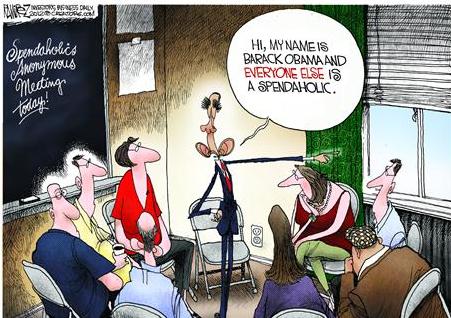
That being said, I was a big dumbfounded when President Obama recently claimed that there’s not a spending problem in Washington.

We know that the United States has a huge long-run problem with deficits and debt according to both the Bank for International Settlements and the Organization for Economic Cooperation and Development.

We also know that tax revenues, measured as a share of GDP, will soon be above their post-World War II average and that the tax burden is expected to increase in coming decades.

So a person would have to be in serious denial to claim that spending isn’t a problem.

Which is the point Eric Allie makes in this cartoon.

Spending Problem Cartoon 1

And the point Robert Ariail makes in this cartoon.

Spending Problem Cartoon 2

Ditto for Bob Gorrell.

Spending Problem Cartoon 3

And Gary Varvel.

Spending Problem Cartoon 4

Last but not least, the great Michael Ramirez.

Spending Problem Cartoon 5.jpg

Gee, it’s almost like we’re seeing a pattern.

And if you like this spendaholic-in-denial theme, you can click here and here for further amusement.

P.S. Oh, by the way, if anybody’s actually interested in how to solve the spending problem (you know, the one that doesn’t exist), we do know the answer.

P.P.S. Remember when Obama claimed the private sector was doing fine? Well, here’s how cartoonists mocked him for that absurd comment.


________________

Thank you so much for your time. I know how valuable it is. I also appreciate the fine family that you have and your commitment as a father and a husband.

Sincerely,

Everette Hatcher III, 13900 Cottontail Lane, Alexander, AR 72002, ph 501-920-5733, lowcostsqueegees@yahoo.com

Open letter to President Obama (Part 477) (Uncle Sam Wants You… on Food Stamps?)

Open letter to President Obama (Part 477)

(Emailed to White House on 5-4-13.)

President Obama c/o The White House 1600 Pennsylvania Avenue NW Washington, DC 20500

Dear Mr. President,

I know that you receive 20,000 letters a day and that you actually read 10 of them every day. I really do respect you for trying to get a pulse on what is going on out here.

______________

Does Government Have a Revenue or Spending Problem?

People say the government has a debt problem. Debt is caused by deficits, which is the difference between what the government collects in tax revenue and the amount of government spending. Every time the government runs a deficit, the government debt increases. So what’s to blame: too much spending, or too little tax revenue? Economics professor Antony Davies examines the data and concludes that the root cause of the debt is too much government spending.

_______________

If we want to cut back on the size of government then we have to cut our spending and not  grow our spending. Look at what is happening right now in the federal government with the foodstamp program.

April 30, 2013 at 12:45 pm

Joseph Sohm/Visions of America/Newscom

Joseph Sohm/Visions of America/Newscom

Across the country, states are courting participants for food stamps (now known as the Supplemental Nutrition Assistance Program, or SNAP). The U.S. Department of Agriculture (USDA) even has a webpage dedicated to helping states create “SNAP Outreach Plans.”

The argument from the USDA is that “Food Stamps Make America Stronger” by stimulating states’ economies. States are responding to the call. According to The Washington Post: “Rhode Island hosts SNAP-themed bingo games for the elderly. Alabama hands out fliers that read: ‘Be a patriot. Bring your food stamp money home.’ Three states in the Midwest throw food-stamp parties where new recipients sign up en masse.” And Florida even employs recruiters.

The recruiter profiled in the Post’s story, Dillie Nerios, is required to get “at least 150 seniors” to enroll in “food stamps each month, a quota she usually exceeds.”

“Help is available. You deserve it. So, yes or no?” she tells prospective food stamp recipients. “State-issued training manuals” even provides responses she can use when individuals protest.

Not surprisingly, food stamp enrollment in Florida has swelled in the past four years, rising from 1.45 million in 2008 to 3.35 million in 2012.

Policy changes over the years have also helped swell the numbers. For example, in 2000, the Clinton Administration broadened food stamp eligibility by allowing states to weaken income limits and waive asset limits. Then, in 2009, President Obama suspended food stamp work requirements for able-bodied adults. This was to be a temporary change, but he’s continued to allow states to waive work requirements.

The underlying mentality of all of this is one that completely overlooks helping individuals achieve self-sufficiency, instead promoting government dependence.

The U.S. welfare system—which today includes roughly 80 means-tested welfare programs that provide food, housing, cash, medical care, and social services—has operated under this mentality since the War on Poverty began in the 1960s. For decades now, welfare has failed to promote individual independence through addressing the causes of poverty, instead growing ever larger to merely band-aid the symptoms.

Americans are a generous people and want to help their neighbors—but they also know that work is the best way out of poverty. And helping individuals out of poverty should be the goal.

Said Senator Jeff Sessions (R–AL) in February of this year, “No longer can we measure compassion by how much we spend on poverty, but [instead we should measure it by] how many people we help to lift out of poverty.”

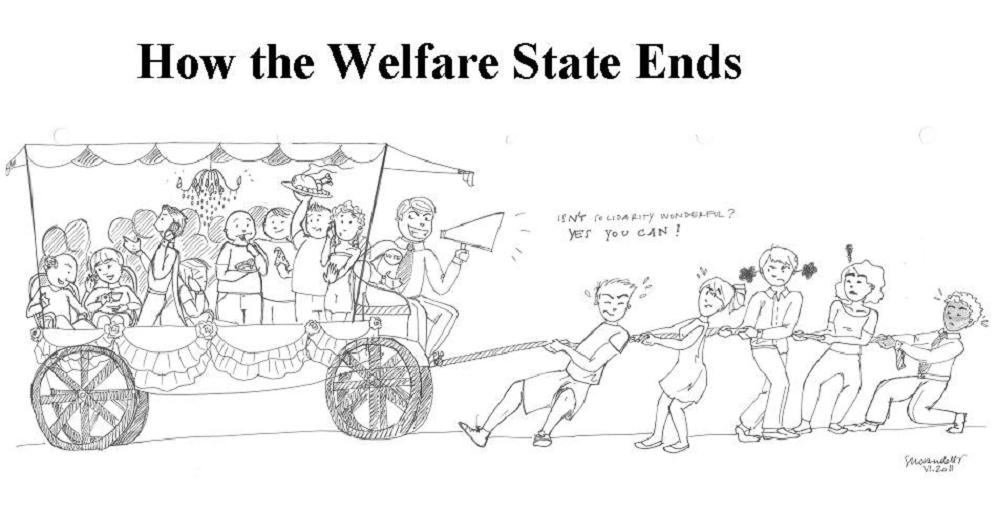
In my speeches, especially when talking about the fiscal crisis in Europe (or the future fiscal crisis in America), I often warn that the welfare state reaches a point-of-no-return when the number of people riding in the wagon begins to outnumber the number of people pulling the wagon.

To be more specific, if more than 50 percent of the population is dependent on government (employed in the bureaucracy, living off welfare, receiving pensions, etc), it becomes rather difficult to form a coalition to fix the mess. This may explain why Greek politicians have resisted significant reforms, even though the nation faces a fiscal death spiral.

But you don’t need me to explain this relationship. One of our Cato interns, Silvia Morandotti, used her artistic skills to create two images (click pictures for better resolution) that show what a welfare state looks like when it first begins and what it eventually becomes.

These images are remarkably accurate. The welfare state starts with small programs targeted at a handful of genuinely needy people. But as  politicians figure out the electoral benefits of expanding programs and people figure out the that they can let others work on their behalf, the ratio of producers to consumers begins to worsen.

Eventually, even though the moochers and looters should realize that it is not in their interest to over-burden the people pulling the wagon, the entire system breaks down.

Then things get really interesting. Small nations such as Greece can rely on permanent bailouts from bigger countries and the IMF, but sooner or later, as larger nations begin to go bankrupt, that approach won’t be feasible.

I often conclude my speeches by joking with the audience that it’s time to stock up on canned goods, bottled water, and ammo. Many people, I’m finding, don’t think that line very funny.

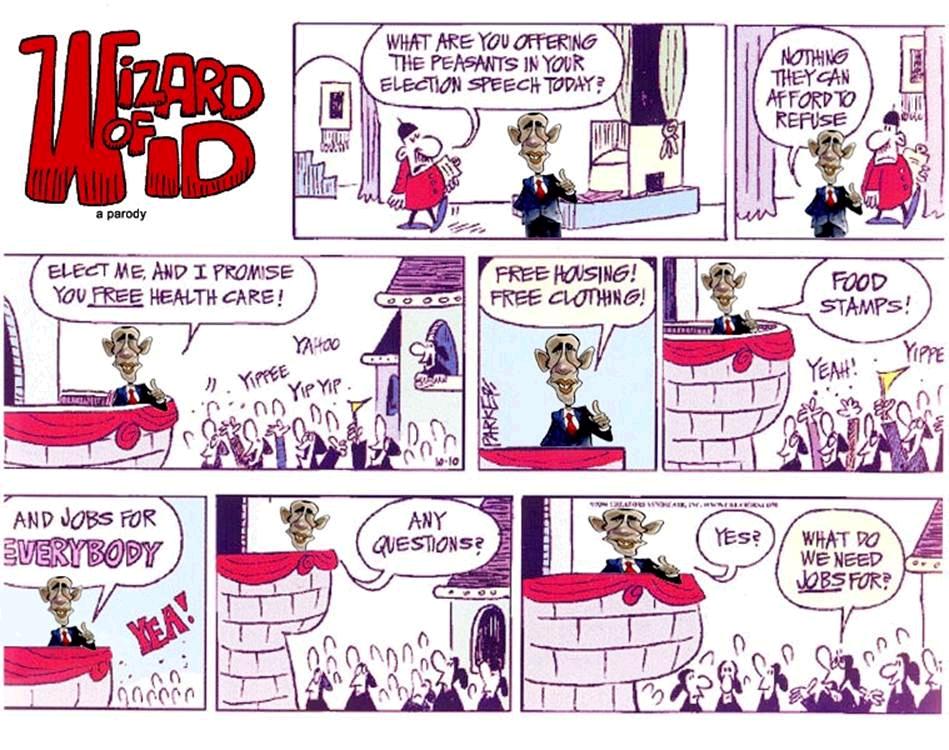
If you spend too much then people won’t want to work anymore.

Economists often do a crummy job of teaching people about the impact of fiscal policy on the labor force, largely because we put people to sleep with boring discussions about “labor supply” decisions (my blog post from last year perhaps being an example of this tendency).

From now on, I will try to remember to use this cartoon. It’s a parody of Obama’s policies, but the last slide (or is it a panel?) is a great teaching tool about what happens when politicians turn the safety net into a hammock.

_________

Bipartisan cliff cartoon

_______________________

Thank you so much for your time. I know how valuable it is. I also appreciate the fine family that you have and your commitment as a father and a husband.

Sincerely,

Everette Hatcher III, 13900 Cottontail Lane, Alexander, AR 72002, ph 501-920-5733, lowcostsqueegees@yahoo.com

Related posts:

Tell the 48 million food stamps users to eat more broccoli!!!!

Welfare Can And Must Be Reformed             Uploaded on Jun 29, 2010 If America does not get welfare reform under control, it will bankrupt America. But the Heritage Foundation’s Robert Rector has a five-step plan to reform welfare while protecting our most vulnerable. __________________________ We got to slow down the growth of Food Stamps. One […]

Republicans for more food stamps?

Eight Reasons Why Big Government Hurts Economic Growth __________________ We got to cut spending and we must first start with food stamp program and we need some Senators that are willing to make the tough cuts. Food Stamp Republicans Posted by Chris Edwards Newt Gingrich had fun calling President Obama the “food stamp president,” but […]

Obama promotes food stamps but Milton Friedman had a better suggestion

Milton Friedman’s negative income tax explained by Friedman in 1968: We need to cut back on the Food Stamp program and not try to increase it. What really upsets me is that when the government gets involved in welfare there is a welfare trap created for those who become dependent on the program. Once they […]

400% increase in food stamps since 2000

Welfare Can And Must Be Reformed Uploaded by HeritageFoundation on Jun 29, 2010 If America does not get welfare reform under control, it will bankrupt America. But the Heritage Foundation’s Robert Rector has a five-step plan to reform welfare while protecting our most vulnerable. __________________________ If welfare increases as much as it has in the […]

Which states are the leaders in food stamp consumption?

I am glad that my state of Arkansas is not the leader in food stamps!!! Mirror, Mirror, on the Wall, Which State Has the Highest Food Stamp Usage of All? March 19, 2013 by Dan Mitchell The food stamp program seems to be a breeding ground of waste, fraud, and abuse. Some of the horror stories […]

Why not cancel the foodstamp program and let the churches step in?

Government Must Cut Spending Uploaded by HeritageFoundation on Dec 2, 2010 The government can cut roughly $343 billion from the federal budget and they can do so immediately. __________ We are becoming a country filled with people that dependent on the federal government when we should be growing our economy by lowering taxes and putting […]

Food Stamp Program is constantly ripped off and should be discontinued

Uploaded by oversightandreform on Mar 6, 2012 Learn More at http://oversight.house.gov The Oversight Committee is examining reports of food stamp merchants previously disqualified who continue to defraud the program. According to a Scripps Howard News Service report, food stamp fraud costs taxpayers hundreds of millions every year. Watch the Oversight hearing live tomorrow at 930 […]

Why are despicable people sometimes subsidized by taxpayers?

  Why are despicable people sometimes subsidized by taxpayers? Are You Happy that Your Tax Dollars Subsidized the Tsarnaev Family? April 28, 2013 by Dan Mitchell The bad news is that there are despicable and evil people seeking to kill innocents. The worse news is that some of these pathetic excuses for protoplasm are subsidized by […]

We got to stop encouraging people to stay on welfare

  We got to stop encouraging people to stay on welfare. How the Welfare State Erodes Social Capital, as Illustrated by a Chuck Asay Cartoon April 26, 2013 by Dan Mitchell I’m a big fan of Chuck Asay’s political cartoons. My favorite is his nothing-left-to-steal masterpiece. And his tractor cartoon and his regime-uncertainty cartoon are brilliant indictments […]

Moocher’s Hall of Fame is a hall of shame

  The Dangers of Government Dependency   Published on Jun 10, 2012 This video from the Center for Freedom and Prosperity Foundation contrasts the dependency mentality in the President’s “Life of Julia” campaign with the traditional American approach of self reliance and individual achievement. _____________________ Moocher’s Hall of Fame is a hall of shame. The Moocher […]