Category Archives: President Obama

Open letter to President Obama (Part 495) (Wasting our tax dollars!!!)

Open letter to President Obama (Part 495)

(Emailed to White House on 5-4-13.)

President Obama c/o The White House 1600 Pennsylvania Avenue NW Washington, DC 20500

Dear Mr. President,

I know that you receive 20,000 letters a day and that you actually read 10 of them every day. I really do respect you for trying to get a pulse on what is going on out here.

______________

Sad that the government wastes so much of our money and it wants more from us under President Obama.

Remember the Spending Quiz from 2010, which asked people to guess whether absurd examples of government waste were true or false?

Well, we have a new video on government waste, though bureaucrats and politicians have become so profligate it doesn’t even bother to trick people with fake examples.

Your Tax Dollars at Work

While very well done, I do have two small complaints about the video.

First, it asks whether we should cut spending or raise taxes to deal with the national debt. I think that’s too narrow. We shouldn’t be wasting money even if the budget was balanced and there wasn’t a penny of debt.

In other words, the problem isn’t deficits. Red ink is just a symptom. The real problem is that government is too big.

Second, the video sort of acquiesces to the dishonest Washington terminology by asking whether we should cut spending or raise taxes, implying those are the only two options. I favor genuine spending cuts, of course, but the most accurate way of phrasing the question is to ask whether we should cut spending, restrain spending, or let government grow on auto-pilot.

As I explained earlier this year, we can balance the budget in just 10 years if spending grows “only” 3.4 percent per year. When people understand that detail, there’s almost no support for higher taxes.

But I’m nitpicking. Overall, a very good video.

P.S. If the examples of pork-barrel spending in the video get you angry, you’ll probably have a stroke if you also watch the waste video from the folks at Government Gone Wild.

_______________________

Thank you so much for your time. I know how valuable it is. I also appreciate the fine family that you have and your commitment as a father and a husband.

Sincerely,

Everette Hatcher III, 13900 Cottontail Lane, Alexander, AR 72002, ph 501-920-5733, lowcostsqueegees@yahoo.com

Related posts:

Dan Mitchell explains what happened in Cyprus

Dan Mitchell explains what happened in Cyprus.   What Really Happened in Cyprus? April 14, 2013 by Dan Mitchell Did Cyprus become an economic basket case because it is a tax haven, as some leftists have implied? Did it get in trouble because the government overspent, which I have suggested? The answers to those questions are […]

Dan Mitchell on Obamacare (includes cartoons on Obamacare)

Some very good points by Dan Mitchell of the Cato Institute on Obamacare: Why We Should Be Optimistic about Repealing Obamacare and Fixing the Healthcare System April 10, 2013 by Dan Mitchell I’m going to make an assertion that seems utterly absurd. The enactment of Obamacare may have been good news. Before sending a team of medical […]

Dan Mitchell’s blog has great cartoon that demonstrates what President Obama has been doing the last 4 years!!!

I have put up lots of cartoons from Dan Mitchell’s blog before and they have got lots of hits before. Many of them have dealt with the economy, eternal unemployment benefits, socialism,  Greece,  welfare state or on gun control.     I’ve Obtained a Secret Pre-Release Copy of Obama’s Budget April 9, 2013 by Dan Mitchell The President is supposed to release […]

Dan Mitchell’s tribute to Margaret Thatcher

Very well said by Dan Mitchell. A Tribute to Margaret Thatcher April 8, 2013 by Dan Mitchell The woman who saved the United Kingdom has died. A Great Woman I got to meet Margaret Thatcher a couple of times and felt lucky each time that I was in the presence of someone who put her nation’s […]

Dan Mitchell, Ron Paul, and Milton Friedman on Immigration Debate (includes editorial cartoon)

I like Milton Friedman’s comments on this issue of immigration   and Ron Paul and Dan Mitchell do well on the issue too. Question of the Week: What’s Your Take on the Immigration Debate? April 7, 2013 by Dan Mitchell A reader from overseas wonders about my views on immigration, particularly amnesty. I confess that this is one of […]

Dan Mitchell on Texas v. California (includes editorial cartoon)

We should lower federal taxes because jobs are going to states like Texas that have low taxes. What Can We Learn by Comparing the Employment Situation in Texas vs. California? April 3, 2013 by Dan Mitchell One of the great things about federalism, above and beyond the fact that it both constrains the power of governments […]

Cartoons from Dan Mitchell’s blog on Obamacare

Third-Party Payer is the Biggest Economic Problem With America’s Health Care System Published on Jul 10, 2012 This mini-documentary from the Center for Freedom and Prosperity Foundation explains that “third-party payer” is the main problem with America’s health care system. This is why undoing Obamacare, while desirable, is just a small first step if we […]

Obamacare cartoons from Dan Mitchell’s blog

I have put up lots of cartoons from Dan Mitchell’s blog before and they have got lots of hits before. Many of them have dealt with the economy, eternal unemployment benefits, socialism,  Greece,  welfare state or on gun control. The funniest cartoon is the one with “Nurse Sebelius” stuffing the huge capsule down the kid’s throat!!! Obamacare […]

Editorial cartoon from Dan Mitchell’s blog on California’s sorry state of affairs

I have put up lots of cartoons from Dan Mitchell’s blog before and they have got lots of hits before. Many of them have dealt with the sequester, economy, eternal unemployment benefits, socialism,  minimum wage laws, tax increases, social security, high taxes in California, Obamacare,  Greece,  welfare state or on gun control. President Obama’s favorite state must be California because […]

Dan Mitchell of the Cato Institute:HUD has to go!!!! (includes political cartoon)

You want a suggestion on how to cut the government then start at HUD. I would prefer to eliminate all of it. Here are Dan Mitchell’s thoughts below: Sequestration’s Impact on HUD: Just 358 More Days and Mission Accomplished March 12, 2013 by Dan Mitchell As part of my “Question of the Week” series, I had […]


Open letter to President Obama (Part 494) (Does Government Have a Revenue or Spending Problem?)

Open letter to President Obama (Part 494)

(Emailed to White House on 4-10-13.)

President Obama c/o The White House 1600 Pennsylvania Avenue NW Washington, DC 20500

Dear Mr. President,

I know that you receive 20,000 letters a day and that you actually read 10 of them every day. I really do respect you for trying to get a pulse on what is going on out here.

___________________

Does Government Have a Revenue or Spending Problem?

People say the government has a debt problem. Debt is caused by deficits, which is the difference between what the government collects in tax revenue and the amount of government spending. Every time the government runs a deficit, the government debt increases. So what’s to blame: too much spending, or too little tax revenue? Economics professor Antony Davies examines the data and concludes that the root cause of the debt is too much government spending.

______________

So many times politicians tell us that we have to raise taxes in order to balance the budget but the only way to balance the budget is to control spending. That is exactly what happened between 1994 and 1998.

I wrote about the Ryan budget two days ago, praising it for complying with Mitchell’s Golden Rule and reforming Medicare and Medicaid.

But I believe in being honest and nonpartisan, so I also groused that it wasn’t as good as the 2011 and 2012 versions.

Now it’s time to give the same neutral and dispassionate treatment to the budget proposed by Patty Murray, the Washington Democrat who chairs the Senate Budget Committee.

But I’m going to focus on a theme rather than numbers.

One part of her budget got me particularly excited. Her Committee’s “Foundation for Growth” blueprint makes a very strong assertion about the fiscal and economic history of the Clinton years.

The work done in the 1990s helped grow the economy, create jobs, balance the budget, and put our government on track to eliminate the national debt.

As elaborated in this passage, the 42nd President delivered very good results.

President Bill Clinton entered office in 1993 at a time when the country was facing serious deficit and debt problems. The year before, the federal government was taking in revenue equal 17.5 percent of GDP, but spending was 22.1 percent of the economy—a deficit of 4.7 percent. …The unemployment rate went from 7 percent at the beginning of 1993 to 3.9 percent at the end of 2000. Between 1993 and 2001, our economy gained more than 22 million jobs and experienced the longest economic expansion in our history.

And the Senate Democrats even identified one of the key reasons why economic and fiscal policy was so successful during the 1990s.

…federal spending dropped from 22.1 percent of GDP to 18.2 percent of GDP.

I fully agree with every word reprinted above. That’s the good news.

So what, then, is the bad news?

Well, Senator Murray may have reached the right conclusion, but she was wildly wrong in her analysis. For all intents and purposes, she claims that the 1993 tax hike produced most of the good results.

President Clinton’s 1993 tax deal…brought in new revenue from the wealthiest Americans and…our country created 22 million new jobs and achieved a balanced budget. President Clinton’s tax policies were not the only driver of economic growth, but our leaders’ ability to agree on a fiscally sustainable and economically sound path provided valuable certainty for American families and businesses.

First, let’s dispense with the myth that the 1993 tax hike balanced the budget. I obtained the fiscal forecasts that were produced by both the Congressional Budget Office and the Office of Management and Budget in early 1995 because I wanted to see whether a balanced budget was predicted.

As you can see in the chart, both of those forecasts showed perpetual deficits of about $200 billion. And these forecasts were made nearly 18 months after the Clinton tax hike was implemented.

So if even the White House’s own forecast from OMB didn’t foresee a balanced budget, what caused the actual fiscal situation to be much better than the estimates?

The simple answer is that spending was restrained. You can give credit to Bill Clinton. You can give credit to the GOP Congress that took power in early 1995. You can give the credit to both.

But regardless of who gets the credit, the period of spending restraint that began at that time was the change that produced a budget surplus, not the tax hike that was imposed 18 months earlier and which was associated with perpetual red ink.

But spending restraint tells only part of the story. With the exception of the 1993 tax hike, the Clinton years were a period of shrinking government and free market reform.

Clinton RecordTake a look at my homemade bar chart to compare the good policies of the 1990s with the bad policies. It’s not even close.

You may be thinking that my comparison is completely unscientific, and you’re right. I probably overlooked some good policies and some bad policies.

And my assumptions about weighting are very simplistic. Everything is equally important, with a big exception in that I made the government spending variable three times as important as everything else.

Why? Well, I think reducing the burden of government spending during the Clinton years was a major achievement.

But maybe we shouldn’t rely on my gut instincts. So let’s set aside my created-at-the-spur-of-the-moment bar chart and look at something that is scientific.

This chart is taken directly from Economic Freedom of the World, which uses dozens of variables to measure the overall burden of government.

As you can see, the United States score improved significantly during the Clinton years, showing that economic freedom was expanding and the size and scope of government was shrinking.

In other words, Patty Murray is correct. She is absolutely right to claim that Bill Clinton’s policies “helped grow the economy, create jobs, balance the budget.”

Now she needs to realize that those policies were small government and free markets.

Let me start this post by stating that George W. Bush was a bigger spender than Barack Obama (though the numbers are somewhat distorted by TARP, which caused a big increase in the burden of spending during Bush’s last fiscal year and artificially dampened outlays in Obama’s first fiscal year since repayments from the banks counted as negative spending).

So I’m not trying to make a partisan point by sharing these cartoons. I don’t like it when Democrats increase the burden of government spending and I’m equally dismayed when Republicans engage in same type of profligacy.

That being said, I was a big dumbfounded when President Obama recently claimed that there’s not a spending problem in Washington.

We know that the United States has a huge long-run problem with deficits and debt according to both the Bank for International Settlements and the Organization for Economic Cooperation and Development.

We also know that tax revenues, measured as a share of GDP, will soon be above their post-World War II average and that the tax burden is expected to increase in coming decades.

So a person would have to be in serious denial to claim that spending isn’t a problem.

Which is the point Eric Allie makes in this cartoon.

Spending Problem Cartoon 1

And the point Robert Ariail makes in this cartoon.

Spending Problem Cartoon 2

Ditto for Bob Gorrell.

Spending Problem Cartoon 3

And Gary Varvel.

Spending Problem Cartoon 4

Last but not least, the great Michael Ramirez.

Spending Problem Cartoon 5.jpg

Gee, it’s almost like we’re seeing a pattern.

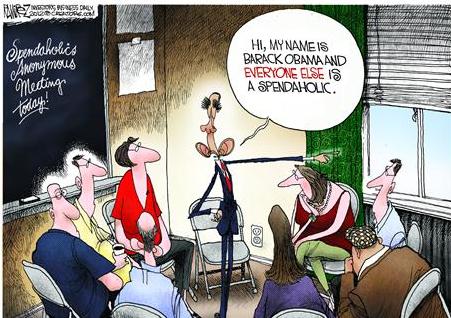
And if you like this spendaholic-in-denial theme, you can click here and here for further amusement.

P.S. Oh, by the way, if anybody’s actually interested in how to solve the spending problem (you know, the one that doesn’t exist), we do know the answer.

P.P.S. Remember when Obama claimed the private sector was doing fine? Well, here’s how cartoonists mocked him for that absurd comment.

______________________

Thank you so much for your time. I know how valuable it is. I also appreciate the fine family that you have and your commitment as a father and a husband.

Sincerely,

Everette Hatcher III, 13900 Cottontail Lane, Alexander, AR 72002, ph 501-920-5733, lowcostsqueegees@yahoo.com

Open letter to President Obama (Part 493) “What does the Bible have to say about abortion?” (includes the film TRUTH AND HISTORY and editorial cartoon)

Open letter to President Obama (Part 493)

(Emailed to White House on 4-24-13.)

President Obama c/o The White House 1600 Pennsylvania Avenue NW Washington, DC 20500

Dear Mr. President,

I know that you receive 20,000 letters a day and that you actually read 10 of them every day. I really do respect you for trying to get a pulse on what is going on out here. I know that you don’t agree with my pro-life views but I wanted to challenge you as a fellow Christian to re-examine your pro-choice view.

___________________

I have debated with Ark Times Bloggers many times in the past on many different subjects. Abortion is probably the most often debated subject and I have noticed that many pro-life individuals are now surfacing on the Arkansas Times Blog.  Here are some examples. Arhogfan501 asserted: This is the beginning of the end for recreational abortion in Arkansas. Songbird777 noted: Babies have a right to live and not be chopped up for someone else’s convenience. The person using the username “baker” commented: Planned Parenthood (PPA) does not nor cannot provide mammograms, indeed no affiliate has the necessary license. PPA is an abortion provider and at some 900 plus killings a day rather prolific.

Here is another debate I got into recently on the Arkansas Times Blog:

The person using the username “DeathByInches” on the Arkansas Times Blog on 3-5-13 wrote:

Saline slips in partial birth abortion, not the subject we’re discussing and something that is very rare in the US. It’s something I never had to face, thank Allah and something I want to know NOTHING about.

You people feed on stories like you copy/pasted and stories about… plays about aborted children dropping from space to have a discussion with the parents who aborted them. Clearly you and I don’t think alike at all.

I also have to say based on evidence on this blog that Saline is unable to choose the right people to read or listen to. He pulls out the damnedest experts, most who are totally discredited by thinking beings on the Internet. I think this goes back to my Republican friends who still believe Obama is a Kenyan Socialist and GWB is a hero…..you get down to it and it’s obvious they don’t know the difference between a good President and a bad one.

I’ll admit I don’t know the difference between a good horse or a bad horse, a good table saw and a bad one or even a good bra from a bad one, but I try not to comment on such things in hopes of keeping my ignorance a secret from my blog family.

…..Saline, you must not really believe in the Bible that teaches many many lessons about the poor and nothing about abortion. I just checked my facts about the Bible and abortion and found nothing credible at all….at all! … This whole abortion debate at this late date of 2013 is sickening and a total waste of our time.

I responded:

DBI you say that the issue of abortion is not addressed in the Bible.
A Biblical argument for life beginning at conception from Psalms 139 from Kerby Anderson of Probe Ministries:

One of the key verses to understand in developing a biblical view of the sanctity of human life is Psalm 139. This psalm is the inspired record of David’s praise for God’s sovereignty in his life. He begins by acknowledging that God is omniscient and knows what David is doing at any given point in time. He goes on to acknowledge that God is aware of David’s thoughts before he expresses them. David adds that wherever he might go, he cannot escape from God, whether he travels to heaven or ventures into Sheol. God is in the remotest part of the sea and even in the darkness. Finally David contemplates the origin of his life and confesses that God was there forming him in the womb:

For you created my inmost being; you knit me together in my mother’s womb. I praise you because I am fearfully and wonderfully made; your works are wonderful, I know that full well. My frame was not hidden from you when I was made in the secret place. When I was woven together in the depths of the earth, your eyes saw my unformed body. All the days ordained for me were written in your book before one of them came to be (vv. 13-16).

Here David speaks of God’s relationship with him while he was growing and developing before birth. Notice that the Bible doesn’t speak of fetal life as mere biochemistry. The description here is not of a piece of protoplasm that becomes David: this is David already being cared for by God while in the womb.

In verse 13, we see that God is the Master Craftsman fashioning David into a living person. In verses 14 and 15, David reflects on the fact that he is a product of God’s creative work within his mother’s womb, and he praises God for how wonderfully God has woven him together.

David draws a parallel between his development in the womb and Adam’s creation from the earth. Using figurative language in verse 15, he refers to his life before birth when “I was made in secret, and skillfully wrought in the depths of the earth.” This poetic allusion harkens back to Genesis 2:7 which says that Adam was made from the dust of the earth.

David also notes that “Thine eyes have seen my unformed substance.” This shows that God knew David even before he was known to others. The term translated unformed substance is a noun derivative of a verb meaning “to roll up.” When David was just forming as a fetus, God’s care and compassion already extended to him. The reference to “God’s eyes” is an Old Testament term used to connotate divine oversight of God in the life of an individual or group of people.

In the film series “WHATEVER HAPPENED TO THE HUMAN RACE?” the arguments are presented  against abortion (Episode 1),  infanticide (Episode 2),   euthenasia (Episode 3), and then there is a discussion of the Christian versus Humanist worldview concerning the issue of “the basis for human dignity” in Episode 4 and then in the last episode a close look at the truth claims of the Bible.

I truly believe that many of the problems we have today in the USA are due to the advancement of humanism in the last few decades in our society. Ronald Reagan appointed the evangelical Dr. C. Everett Koop to the position of Surgeon General in his administration. He partnered with Dr. Francis Schaeffer in making the video below. It is very valuable information for Christians to have.  Actually I have included a video below that includes comments from him on this subject.

___________

Francis Schaeffer Whatever Happened to the Human Race (Episode 1) ABORTION

Francis Schaeffer: What Ever Happened to the Human Race? (Full-Length Documentary)


Part 1 on abortion runs from 00:00 to 39:50, Part 2 on Infanticide runs from 39:50 to 1:21:30, Part 3 on Youth Euthanasia runs from 1:21:30 to 1:45:40, Part 4 on the basis of human dignity runs from 1:45:40 to 2:24:45 and Part 5 on the basis of truth runs from 2:24:45 to 3:00:04


________________

Francis Schaeffer never backed down from his position that the Bible is the inerrant word of God. Dr. Gene Veith, Jr. says: “Schaeffer showed that orthodox Christianity, uncompromised and undiluted, is strong enough to challenge secularist thought in its own territory.” I love taking Schaeffer’s work and applying it to today’s social problems. He knew where humanism would take us. It is not a pretty sight.

Francis A. Schaeffer

In Philadelphia in the late 1920’s, a young teenage boy decided that he didn’t need God. He had tried church, and it didn’t give him the answers he was looking for.

After a time of living as a self-proclaimed agnostic, he decided to read the Bible, beginning with Genesis, and see for himself if God exists. Within six months, he was convinced that God is real and that the Bible is His revealed Word to mankind. In 1930, eighteen-year-old Francis August Schaeffer prayed to receive Christ as his Savior.

From that day, for more than fifty years, Schaeffer was passionately committed to the proclamation and rational defense of the Gospel. One of the foremost Christian thinkers and apologists of this century, he wrote twenty-four books, which have been translated into more than twenty languages. Schaeffer’s basic message is the same – God’s Word is the only guide man needs to interpret his past and solve contemporary problems.

When Schaeffer graduated from Faith Theological Seminary in 1938, the United States faced many perplexing new social and religious problems. The evangelical movement was threatened by encroaching liberal ideologies, which argued that the Bible is not a reliable source of truth. He and his wife Edith, whom he had met at a church theology debate, were both eager for opportunities to speak out in defense of conservative doctrine.

As a pastor of several churches throughout Pennsylvania and Missouri, Schaeffer was grieved at the compromise he saw in many mainline Protestant denominations. Then, in the late 1940’s, he toured Europe on behalf of the American Council of Christian Churches. To his astonishment, he saw even greater needs there and moved to Switzerland to work with youth.

The Schaeffers founded the Children for Christ ministry in 1948 in Lausanne. With three daughters himself already, Schaeffer was familiar with the challenges of teaching young people. In the meantime, he continued touring, lecturing, and studying history and philosophy.

In 1951, Schaeffer’s heart became troubled. He wasn’t sure where God was leading him, and he questioned his convictions. He remembers, “I felt a strong burden to stand for the historical Christian position, and for the purity of the visible church. As I rethought my reasons for being a Christian, I saw again that there were totally sufficient reasons to know that the infinite-personal God does exist and Christianity is true.”

But what was the best way to reach cultures so closed to God’s Word? Schaeffer was convicted to start right where he lived in Switzerland. In 1955, he formally opened his chalet in Huemoz as a “home” for solid Bible teaching, where anyone could come and listen to thought-provoking analysis of Scripture. This haven of spiritual rest and discovery was named L’Abri.

Throughout the remainder of the 1950’s, but especially in the 1960’s when authority and “the establishment” were most severely questioned, L’Abri drew thousands of visitors. How did it keep going? Edith Schaeffer explains: “We prayed that God would bring the people of His choice…send in the needed financial means to care for us all, and open His plan to us.”

Scholar and WJI teacher (2002) Dr. Harold O.J. Brown says, “L’Abri’s initial theological impact was not made institutionally…but indirectly, through individuals whom the Schaeffers came to know and whose lives they changed.”

In 1968, Schaeffer published his first two books – Escape From Reason and The God Who Is There. In these landmark works he explored ways in which other philosophies have failed to adequately come to terms with real-world problems. Gradually, the work that Schaeffer had been developing for years gained recognition, especially in the United States.

It was largely the U. S. Supreme Court’s 1973 Roe vs. Wade decision, which opened the door to legal abortions on demand, that drew Schaeffer’s interest back to America. In the book How Should We Then Live?, Schaeffer addressed the foundational problems which led to this devaluing of human life.

Such a breakdown of values can eventually lead to further violations of human life in the forms of euthanasia and infanticide. With former Surgeon General C. Everett Koop and his son Franky, Schaeffer published Whatever Happened To The Human Race?, which tackled these social issues specifically.

Schaeffer was frequently criticized by non-Christians, but more surprisingly by many Christians who were worried by the explicit stand he took for the bold and consistent application of the Bible.

However, Schaeffer continued to proclaim the message of the inerrant Bible. Dr. Gene Veith, Jr. says: “Schaeffer showed that orthodox Christianity, uncompromised and undiluted, is strong enough to challenge secularist thought in its own territory.”

When Schaeffer was diagnosed with cancer in 1981 and given only six months to live, he did not cease his labor. He had three more years of active teaching and exhorting. His illness, with its long and sometimes debilitating treatments, gave him fresh opportunities to address nationwide medical concerns.

Schaeffer died in his home on May 15, 1984. As President Ronald Reagan said: “It can rarely be said of an individual that his life touched many others and affected them for the better; it will be said of Dr. Francis Schaeffer that his life touched millions of souls and brought them to the truth of their Creator.

IN TOUCH® Copyright © 1995, 1996, 1997, 1998, 1999, 2000, 2001, 2002, 2003, 2004 IN TOUCH MINISTRIES®, ITM, Inc., Atlanta, Georgia, USA, used with permission. All rights reserved.

The Bible held someone responsible if they killed an unborn baby and this editorial cartoon makes a similar point:

______________________

Thank you so much for your time. I know how valuable it is. I also appreciate the fine family that you have and your commitment as a father and a husband. I also respect you for putting your faith in Christ for your eternal life. I am pleading to you on the basis of the Bible to please review your religious views concerning abortion. It was the Bible that caused the abolition movement of the 1800’s and it also was the basis for Martin Luther King’s movement for civil rights and it also is the basis for recognizing the unborn children.

Sincerely,

Everette Hatcher III, 13900 Cottontail Lane, Alexander, AR 72002, ph 501-920-5733, lowcostsqueegees@yahoo.com

Related posts:

Open letter to President Obama (Part 492) (Plagued by Rising Costs and Vulnerable to Fraud, It’s Time to Focus Attention on the Disability Progam)

Open letter to President Obama (Part 492)

(Emailed to White House on 4-15-13.)

President Obama c/o The White House 1600 Pennsylvania Avenue NW Washington, DC 20500

Dear Mr. President,

I know that you receive 20,000 letters a day and that you actually read 10 of them every day. I really do respect you for trying to get a pulse on what is going on out here.

___________________

Your administration has created less jobs than people it has on disability. At least according to this article below.

Plagued by Rising Costs and Vulnerable to Fraud, It’s Time to Focus Attention on the Disability Progam

April 12, 2013 by Dan Mitchell

When I think of the disability program, I think of the bum who is collecting a check so he can be an “adult baby” and indulge his fetish of wearing diapers. Though I guess that’s not as bad as the situation in Greece, where you can get a disability payment for being a pedophile.

But this is a much bigger and more serious issue. Earlier this morning, I took part in a joint Brooking Institution/American Enterprise Institute/Secretary’s Innovation Group conference on the disability insurance program.

I only had a minor role, posing question to Mark Duggan of the University of Pennsylvania and Stephen Goss of the Social Security Administration, but it was a very useful exercise because I was exposed to some sobering details about the program.

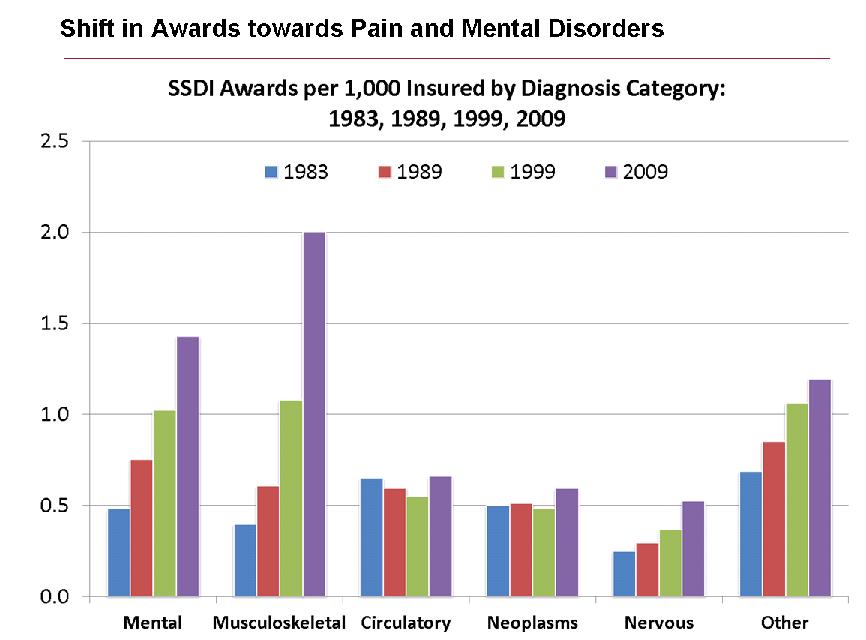
Let’s review a couple of Professor Duggan’s charts, starting with a look at how the disability rate has exploded in the past 22 years.

Disability Slide 2

And here is some very disturbing data showing that much of the increase is in the areas that are most subject to abuse because of subjective judgements about “bad backs” and “depression.”

Disability Slide 1

Hmmm…, I’m a bit depressed about the ever-rising burden of government. Maybe I should get a check from the government!

Joking aside, I briefly touched on this issue in a recent CNBC interview. Here’s the segment dealing with the disability program and the disturbing rise in dependency.

I’m not overly impressed by the counter-argument from Christian Weller. Does he really want us to believe that the service sector jobs of today are more disabling than the manufacturing jobs of 20-plus years ago?

This is a depressing topic, so let’s close with a couple of cartoons, starting with this gem from Chip Bok.

Disability Cartoon 1

It’s amusing, but keep in mind that we have an unusually high joblessness rate right now, but it would be even higher if we counted the people who shifted to this other form of unemployment dependency.

And here’s a Chuck Asay cartoon that I really like because he augments my argument in the interview that it hurts the economy when you lure workers out of the job market and make them wards of the state.

Disability Cartoon 2

Asay takes it one step farther and shows the lifeboat sinking. That’s basically what will happen if we don’t adopt the entitlement reforms that are needed to rein in the welfare state.

P.S. If you want some jokes referencing the disability program, we have the politically correct version of The Little Red Hen, as well as two very similar jokes about Jesus performing miracles and how liberals differ from conservatives and libertarians.

______________________

Thank you so much for your time. I know how valuable it is. I also appreciate the fine family that you have and your commitment as a father and a husband.

Sincerely,

Everette Hatcher III, 13900 Cottontail Lane, Alexander, AR 72002, ph 501-920-5733, lowcostsqueegees@yahoo.com

Related posts:

Dan Mitchell on Obamacare (includes cartoons on Obamacare)

Some very good points by Dan Mitchell of the Cato Institute on Obamacare: Why We Should Be Optimistic about Repealing Obamacare and Fixing the Healthcare System April 10, 2013 by Dan Mitchell I’m going to make an assertion that seems utterly absurd. The enactment of Obamacare may have been good news. Before sending a team of medical […]

Dan Mitchell’s blog has great cartoon that demonstrates what President Obama has been doing the last 4 years!!!

I have put up lots of cartoons from Dan Mitchell’s blog before and they have got lots of hits before. Many of them have dealt with the economy, eternal unemployment benefits, socialism,  Greece,  welfare state or on gun control.     I’ve Obtained a Secret Pre-Release Copy of Obama’s Budget April 9, 2013 by Dan Mitchell The President is supposed to release […]

Dan Mitchell’s tribute to Margaret Thatcher

Very well said by Dan Mitchell. A Tribute to Margaret Thatcher April 8, 2013 by Dan Mitchell The woman who saved the United Kingdom has died. A Great Woman I got to meet Margaret Thatcher a couple of times and felt lucky each time that I was in the presence of someone who put her nation’s […]

Dan Mitchell, Ron Paul, and Milton Friedman on Immigration Debate (includes editorial cartoon)

I like Milton Friedman’s comments on this issue of immigration   and Ron Paul and Dan Mitchell do well on the issue too. Question of the Week: What’s Your Take on the Immigration Debate? April 7, 2013 by Dan Mitchell A reader from overseas wonders about my views on immigration, particularly amnesty. I confess that this is one of […]

Dan Mitchell on Texas v. California (includes editorial cartoon)

We should lower federal taxes because jobs are going to states like Texas that have low taxes. What Can We Learn by Comparing the Employment Situation in Texas vs. California? April 3, 2013 by Dan Mitchell One of the great things about federalism, above and beyond the fact that it both constrains the power of governments […]

Cartoons from Dan Mitchell’s blog on Obamacare

Third-Party Payer is the Biggest Economic Problem With America’s Health Care System Published on Jul 10, 2012 This mini-documentary from the Center for Freedom and Prosperity Foundation explains that “third-party payer” is the main problem with America’s health care system. This is why undoing Obamacare, while desirable, is just a small first step if we […]

Obamacare cartoons from Dan Mitchell’s blog

I have put up lots of cartoons from Dan Mitchell’s blog before and they have got lots of hits before. Many of them have dealt with the economy, eternal unemployment benefits, socialism,  Greece,  welfare state or on gun control. The funniest cartoon is the one with “Nurse Sebelius” stuffing the huge capsule down the kid’s throat!!! Obamacare […]

Editorial cartoon from Dan Mitchell’s blog on California’s sorry state of affairs

I have put up lots of cartoons from Dan Mitchell’s blog before and they have got lots of hits before. Many of them have dealt with the sequester, economy, eternal unemployment benefits, socialism,  minimum wage laws, tax increases, social security, high taxes in California, Obamacare,  Greece,  welfare state or on gun control. President Obama’s favorite state must be California because […]

Dan Mitchell of the Cato Institute:HUD has to go!!!! (includes political cartoon)

You want a suggestion on how to cut the government then start at HUD. I would prefer to eliminate all of it. Here are Dan Mitchell’s thoughts below: Sequestration’s Impact on HUD: Just 358 More Days and Mission Accomplished March 12, 2013 by Dan Mitchell As part of my “Question of the Week” series, I had […]

Dan Mitchell: Cartoonists React to the Senate Democratic Budget

I read that President Obama in his meetings with the Republicans would not even say that a balanced budget was a goal. According to the budget presented by the Democratic Senate he is in agreement with their approach. Cartoonists have taken the opportunity to poke fun at that below. I  have put up lots of cartoons […]

Open letter to President Obama (Part 491) (Review of Francis Schaeffer’s book and film series “How should we then live?” by Douglas Groothuis, Ph.D.)

Open letter to President Obama (Part 491)

(Emailed to White House on 5-3-13.)

President Obama c/o The White House 1600 Pennsylvania Avenue NW Washington, DC 20500

Dear Mr. President,

I know that you receive 20,000 letters a day and that you actually read 10 of them every day. I really do respect you for trying to get a pulse on what is going on out here. I have a pro-life point of view because I am a Christian and I base my views on an interpretation of the Bible. Francis Schaeffer’s teachings probably influenced me more in this area than any other person. In 1979 he teamed up with Dr. C. Everett Koop and put together the film series WHATEVER HAPPENED TO THE HUMAN RACE? and here is the first episode with covers the issue of abortion. Since you are also a Christian Mr. President I thought would take a great interest in what they had to say.

Francis Schaeffer Whatever Happened to the Human Race (Episode 1) ABORTION

Francis Schaeffer: What Ever Happened to the Human Race? (Full-Length Documentary)


Part 1 on abortion runs from 00:00 to 39:50, Part 2 on Infanticide runs from 39:50 to 1:21:30, Part 3 on Youth Euthanasia runs from 1:21:30 to 1:45:40, Part 4 on the basis of human dignity runs from 1:45:40 to 2:24:45 and Part 5 on the basis of truth runs from 2:24:45 to 3:00:04


Below you will see more about my pro-life views.

____________________

Episode VII – The Age of Non Reason

____________________

Episode 8: The Age Of Fragmentation

Published on Jul 24, 2012

Dr. Schaeffer’s sweeping epic on the rise and decline of Western thought and Culture

_______________________

I love the works of Francis Schaeffer and I have been on the internet reading several blogs that talk about Schaeffer’s work and the work below  by Douglas Groothuis was really helpful. Schaeffer’s film series “How should we then live?  Wikipedia notes, “According to Schaeffer, How Should We Then Live traces Western history from Ancient Rome until the time of writing (1976) along three lines: the philosophic, scientific, and religious.[3] He also makes extensive references to art and architecture as a means of showing how these movements reflected changing patterns of thought through time. Schaeffer’s central premise is: when we base society on the Bible, on the infinite-personal God who is there and has spoken,[4] this provides an absolute by which we can conduct our lives and by which we can judge society.  Here are some posts I have done on this series: Francis Schaeffer’s “How should we then live?” Video and outline of episode 10 “Final Choices” episode 9 “The Age of Personal Peace and Affluence”episode 8 “The Age of Fragmentation”episode 7 “The Age of Non-Reason” episode 6 “The Scientific Age”  episode 5 “The Revolutionary Age” episode 4 “The Reformation” episode 3 “The Renaissance”episode 2 “The Middle Ages,”, and  episode 1 “The Roman Age,” .

In the film series “WHATEVER HAPPENED TO THE HUMAN RACE?” the arguments are presented  against abortion (Episode 1),  infanticide (Episode 2),   euthanasia (Episode 3), and then there is a discussion of the Christian versus Humanist worldview concerning the issue of “the basis for human dignity” in Episode 4 and then in the last episode a close look at the truth claims of the Bible.

Probably the most troubling comments below are these:

________________

As Os Guinness put it in The American Hour (Free Press, 1992), post-Christian Western culture is in the throes of a “crisis of moral authority.” Without a transcendent source for meaning and law, societies move into either anarchy or authoritarianism, such as Marxism. In spite of this dire situation, many in the West (including many Christians) opt for pursuing “personal peace and affluence” above any passion for justice and goodness that honor God. Schaeffer thus warns of “sociological law” that is cut off from any stable source of meaning and authority, and instead relies on either the assertion of “arbitrary absolutes” based on a fifty-one percent majority vote or the dictates of a statist government that is unaccountable to either the people or to God. If the state declares the unborn (or anyone else) to possess no rights, their rights are taken away by legal fiat. (Schaeffer elaborated on this point in Whatever Happened to the Human Race, co-authored with C. Everett Koop in 1979.)

Schaeffer also warned that modern culture is susceptible to manipulation through the media, especially through television. “Television manipulates viewers just by its normal way of operating,” because its images seem so compelling. The truth, however, is otherwise because the viewer is not granted a pristine receipt of objective reality, but an “edited symbol or an edited image of the event” (240).

What Schaeffer warned about is happening in our midst today. While America’s Declaration of Independence declares that “all men are created equal” and “endowed by our Creator with certain inalienable rights,” society allows abortion on demand at any stage of pregnancy. In April of 2005, the world watched as a severely disabled but not terminally ill woman, Terry Schiavo, was dehydrated to death—simply because her legal guardian husband and his lawyer did not want her to live.

____________

Francis Schaeffer

Great review:

How Should We Then Live?

  • Francis A. Schaeffer
  • Jun 1, 2005
  • Series: Volume 8 – 2005

Francis A. Schaeffer, How Should We Then Live? The Rise and Decline of Western Thought and Culture. L’Abri 50th Anniversary Edition. Wheaton, IL: Crossway Books, 2005. Original publication, 1976. 288 pages.

We should be grateful to Crossway publishers for recently reissuing several important works by Francis A. Schaeffer (1912-1984). At once an evangelist, apologist, theologian, and social critic, Schaeffer’s work inspired a generation of evangelicals to adopt a robust and well-integrated Christian worldview and to live out its convictions courageously. It is a shame and a scandal that some postmodernist-leaning evangelicals have dismissed Schaeffer as an outmoded “rationalist” or “modernist.” There is, in truth, nothing outmoded about this remarkable man’s passion or vision.

I first encountered Schaeffer’s writings a few months after my conversion in the summer of 1976. At the time I was intellectually adrift, unsure of how my faith related to the world of ideas. By reading The God Who is There (InterVarsity Press, 1968) a new, refreshing, and inviting world unfolded before me. Christianity, Schaeffer explained, is not merely something that is personally meaningful and instructive for individual behavior. Christianity is, rather, “true to what is.” It speaks credibly to all the things that matter most. Nothing should be shunted aside as merely “secular,” since Jesus Christ is Lord of all. The Christian has nothing to fear from the world of ideas because the Christian worldview is sufficient to meet the intellectual challenges posed by secular philosophy or by other religions. Moreover, Christianity offers the world “true truth” (as Schaeffer put it) that cannot be found by any other means. Without this revelation, men and women are lost, both philosophically (they do not know who they are) and morally (they do not know how to live).

Schaeffer’s message was heady stuff to young Christian thinkers in the 1970s and early 1980s. He confidently, but not arrogantly, ranged over literature, music, painting, philosophy, theology, and ethics—and seemed to bring it all together conceptually and historically for Christian critique. He painted with a broad and colorful brush, despite his rather lackluster prose. (In his book In Philosophy and Christian Faith [InterVarsity, 1968], Colin Brown referred to his approach as “swashbuckling.”) Despite his lack of professorial status or an earned doctorate, Schaeffer became one of evangelicalism’s most influential thinkers. To borrow a Quaker phrase, he “spoke to the condition” of many searching people. Furthermore, he lived out his convictions about reaching the lost. He considered himself an evangelist above all. His books, which came later in his life, were forged through conversations with young believers and unbelievers who were trying to make sense of intellectual trends sweeping Europe and the United States, such as existentialism, Marxism, and Eastern thought. These conversations were carried on at a retreat center in the Swiss Alps called L’Abri (meaning “shelter”), founded by Schaeffer and his wife Edith (also an author). The Schaeffers lived out a radical theology of community long before the subject became popular among evangelicals.

In this ambitious book, Schaeffer canvasses nothing less than the history of Western civilization up until the time of his writing. (The book was paired with a film series of the same name that is still available.) On one level, scholars might say that the whole project is pretentious. How could this feat be accomplished in one medium-sized volume, especially when written by someone lacking bona fide academic credentials? But Schaeffer did not attempt an encyclopedic effort, as he makes clear in his “Author’s Note.” He focused on how worldviews affect cultures, beginning with ancient Rome, whose polytheistic worldview could not support its civilization. I first read this volume and saw the films while in college in the middle to late 1970s. Schaeffer was covering wide swaths of ground, but what he claimed made sense, given my knowledge as a philosophy major who had taken Western Civilization. (Since most universities stopped requiring Western Civilization courses some years ago, it becomes all the more imperative for those so deprived to study this volume.) Reading the book recently, I was impressed by its clarity, insights, and its qualifications and lack of grandiosity.

Schaeffer argued that there is a flow to biblical history (see his Joshua and the Flow of Biblical History) and a flow to extra-biblical history. As Schaeffer states it in the opening sentences of the book, “There is a flow to history and culture. This flow is rooted and has its wellspring in the thoughts of people. People are unique in the inner life of the mind—what they are in their thought world determines how they act. This is true of their value systems and it is true of their creativity. It is true of their corporate actions, such as political decisions, and it is true of their personal lives” (19).

Schaeffer spends one chapter each on ancient Rome and the Middle Ages, then moves to the Renaissance, which introduced significant themes into the modern West such as the rediscovery of nature as valuable in itself (seen in its art) and, more auspiciously, the sense of human autonomy from Christian claims on reality as expressed in Scripture. As a man of the Reformation, Schaeffer devotes two chapters to that period, explaining both its history and theological convictions clearly and cogently. He notes that the Reformation worldview was felicitous not only for the church, but for culture as a whole. This is because it challenged ecclesiastical authoritarianism and opened the doors to freedom of religion and representative forms of government—not that this was achieved all at once.

The Enlightenment further developed the Renaissance themes of autonomy from received religious authority and gave anchorage to a more secular worldview. While modern science was inspired by an essentially Christian worldview, which taught that nature was knowable and valuable because created by a good and rational God, secularized science removed God from the picture. This made nature a self-enclosed system, the received view of the institutions of science in the West today. Post-Enlightenment philosophy also lost the sense of unity and purpose given by a Christian worldview and struggled to find any objective meaning in human affairs or the universe as a whole. This was especially evident in existentialism, which heralded the meaninglessness of life as well as the need to assert personal meaning in spite of it all (and for no objective reason whatsoever). While the blush is off the rose of existentialism today, secular postmodernists offer similar answers. They too have escaped from reason into a world of nonsense posing as profundity. (On this see my book, Truth Decay: Defending Christianity Against the Challenges of Postmodernism [InterVarsity, 2000].)

A veteran of the Fundamentalist-Modernist split, Schaeffer also warns of the dangers of theological liberalism, a theology drained of biblical content but replete with traditional theological words. Schaeffer rightly exposes this as little more than naturalism in religious garb. The Bible is not a record of humans groping about in hopes of encountering the unnamable sacred. It is, rather, God’s true and rational propositional revelation. Schaeffer further explores the “breakdown” of modern art and culture in general, never without strong feeling for the “lostness of modern man,” as he put it.

The last three chapters lament that modern Western society has lost its worldview moorings; it has largely forfeited the Reformation base that helped constitute its greatness. As such, it is imperiled. As Os Guinness put it in The American Hour (Free Press, 1992), post-Christian Western culture is in the throes of a “crisis of moral authority.” Without a transcendent source for meaning and law, societies move into either anarchy or authoritarianism, such as Marxism. In spite of this dire situation, many in the West (including many Christians) opt for pursuing “personal peace and affluence” above any passion for justice and goodness that honor God. Schaeffer thus warns of “sociological law” that is cut off from any stable source of meaning and authority, and instead relies on either the assertion of “arbitrary absolutes” based on a fifty-one percent majority vote or the dictates of a statist government that is unaccountable to either the people or to God. If the state declares the unborn (or anyone else) to possess no rights, their rights are taken away by legal fiat. (Schaeffer elaborated on this point in Whatever Happened to the Human Race, co-authored with C. Everett Koop in 1979.)

Schaeffer also warned that modern culture is susceptible to manipulation through the media, especially through television. “Television manipulates viewers just by its normal way of operating,” because its images seem so compelling. The truth, however, is otherwise because the viewer is not granted a pristine receipt of objective reality, but an “edited symbol or an edited image of the event” (240).

What Schaeffer warned about is happening in our midst today. While America’s Declaration of Independence declares that “all men are created equal” and “endowed by our Creator with certain inalienable rights,” society allows abortion on demand at any stage of pregnancy. In April of 2005, the world watched as a severely disabled but not terminally ill woman, Terry Schiavo, was dehydrated to death—simply because her legal guardian husband and his lawyer did not want her to live.

One can take issue with Schaeffer at some points. One who paints with a broad bush may blur some themes and obscure others, but the strengths of this book greatly outnumber its weaknesses. How Should We Then Live remains an incisive and prophetic work that should not be ignored. We need big-picture thinkers (or generalists) to help us orient ourselves historically, theologically, and ethically. Francis Schaeffer was such a thinker. Let us give him the last word. “This book is written in the hope that this generation may turn from the greatest wickedness, the placing of any created thing in the place of the Creator, and that this generation may get its feet out of the paths of death and may live” (258).

Douglas Groothuis, Ph.D.
Professor of Philosophy
Denver Seminary
June 2005

__________________

______________________

Thank you so much for your time. I know how valuable it is. I also appreciate the fine family that you have and your commitment as a father and a husband.

Sincerely,

Everette Hatcher III, 13900 Cottontail Lane, Alexander, AR 72002, ph 501-920-5733, lowcostsqueegees@yahoo.com

Related posts:

Francis Schaeffer’s wife Edith passes away on Easter weekend 2013 Part 7 (includes pro-life editorial cartoon)

The Francis and Edith Schaeffer Story Pt.1 – Today’s Christian Videos The Francis and Edith Schaeffer Story – Part 3 of 3 Francis Schaeffer: “Whatever Happened to the Human Race” (Episode 1) ABORTION OF THE HUMAN RACE Published on Oct 6, 2012 by AdamMetropolis ________________ Picture of Francis Schaeffer and his wife Edith from the […]

The Mark of the Christian by Francis Schaeffer Part 1

  THE MARK OF A CHRISTIAN – CLASS 1 – Introduction Published on Mar 7, 2012 This is the introductory class on “The Mark Of A Christian” by Francis Schaeffer. The class was originally taught at Redeemer Presbyterian Church in Overland Park, KS by Dan Guinn from FrancisSchaefferStudies.org as part of the adult Sunday School hour […]

Francis Schaeffer’s wife Edith passes away on Easter weekend 2013 Part 6 (includes pro-life editorial cartoon and tribute from son-in-law Ranald Macaulay)

The Francis and Edith Schaeffer Story Pt.1 – Today’s Christian Videos The Francis and Edith Schaeffer Story – Part 3 of 3 Francis Schaeffer: “Whatever Happened to the Human Race” (Episode 1) ABORTION OF THE HUMAN RACE Published on Oct 6, 2012 by AdamMetropolis ________________ Picture of Francis Schaeffer and his wife Edith from the […]

Francis Schaeffer’s wife Edith passes away on Easter weekend 2013 Part 5 (includes pro-life editorial cartoon)

The Francis and Edith Schaeffer Story Pt.1 – Today’s Christian Videos The Francis and Edith Schaeffer Story – Part 3 of 3 Francis Schaeffer: “Whatever Happened to the Human Race” (Episode 1) ABORTION OF THE HUMAN RACE Published on Oct 6, 2012 by AdamMetropolis ________________ Picture of Francis Schaeffer and his wife Edith from the […]

Francis Schaeffer’s wife Edith passes away on Easter weekend 2013 Part 4 (includes pro-life editorial cartoon)

The Francis and Edith Schaeffer Story Pt.1 – Today’s Christian Videos The Francis and Edith Schaeffer Story – Part 3 of 3 Francis Schaeffer: “Whatever Happened to the Human Race” (Episode 1) ABORTION OF THE HUMAN RACE Published on Oct 6, 2012 by AdamMetropolis ________________ Picture of Francis Schaeffer and his wife Edith from the […]

Francis Schaeffer’s wife Edith passes away on Easter weekend 2013 Part 3 (includes pro-life editorial cartoon)

The Francis and Edith Schaeffer Story Pt.1 – Today’s Christian Videos The Francis and Edith Schaeffer Story – Part 3 of 3 Francis Schaeffer: “Whatever Happened to the Human Race” (Episode 1) ABORTION OF THE HUMAN RACE Published on Oct 6, 2012 by AdamMetropolis ________________ Picture of Francis Schaeffer and his wife Edith from the […]

“Schaeffer Sundays” Francis Schaeffer’s own words concerning humanist dominated public schools in USA even though country was founded on a Christian base

Francis Schaeffer: “Whatever Happened to the Human Race?” (Episode 2) SLAUGHTER OF THE INNOCENTS Published on Oct 6, 2012 by AdamMetropolis The 45 minute video above is from the film series created from Francis Schaeffer’s book “Whatever Happened to the Human Race?” with Dr. C. Everett Koop. This book  really helped develop my political views concerning […]

“Schaeffer Sundays” Francis Schaeffer’s own words concerning where the Bible-believing Christians been the last few decades

Francis Schaeffer: “Whatever Happened to the Human Race” (Episode 1) ABORTION OF THE HUMAN RACE Published on Oct 6, 2012 by AdamMetropolis The 45 minute video above is from the film series created from Francis Schaeffer’s book “Whatever Happened to the Human Race?” with Dr. C. Everett Koop. This book  really helped develop my political views […]

Taking on Ark Times Bloggers on various issues Part E “Moral absolutes and abortion” Francis Schaeffer Quotes part 5(includes the film SLAUGHTER OF THE INNOCENTS) (editorial cartoon)

I have gone back and forth and back and forth with many liberals on the Arkansas Times Blog on many issues such as abortion, human rights, welfare, poverty, gun control  and issues dealing with popular culture. Here is another exchange I had with them a while back. My username at the Ark Times Blog is Saline […]

“Schaeffer Sundays” Francis Schaeffer’s own words concerning religious liberals and humanists

Francis Schaeffer: “Whatever Happened to the Human Race” (Episode 5) TRUTH AND HISTORY Published on Oct 7, 2012 by AdamMetropolis The 45 minute video above is from the film series created from Francis Schaeffer’s book “Whatever Happened to the Human Race?” with Dr. C. Everett Koop. This book  really helped develop my political views concerning abortion, […]

Open letter to President Obama (Part 490) (includes editorial cartoon)

Open letter to President Obama (Part 490)

(Emailed to White House on 4-15-13.)

President Obama c/o The White House 1600 Pennsylvania Avenue NW Washington, DC 20500

Dear Mr. President,

I know that you receive 20,000 letters a day and that you actually read 10 of them every day. I really do respect you for trying to get a pulse on what is going on out here.

___________________

Why not try and copy the same recipe that Reagan used to get us out of a recession? Reagan cut taxes on the job creators!!!

Barack Obama has stated that he wants to be like Reagan, at least in the sense of wanting to be a transformational figure.

But almost certainly he has failed.

Yes, Obama has increased the burden of government spendingraised tax rates, and created more dependency, but there’s nothing particularly special about Obama’s tenure that makes him different from other statist Presidents such as Nixon, Carter, and Bush.

Nor is there any evidence that he has fundamentally changed the attitudes of the American people.

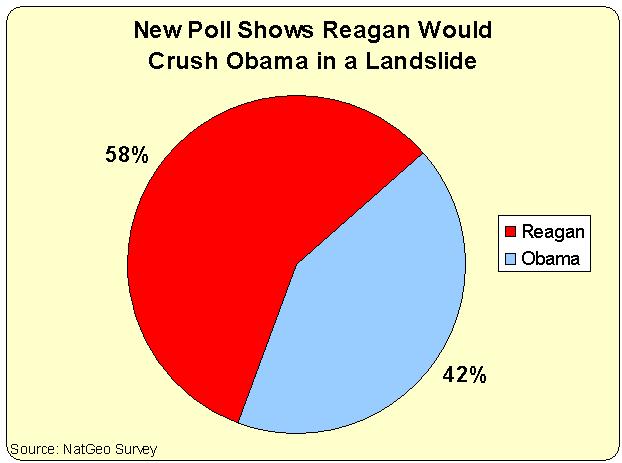
That may sound like a bold – and overly optimistic – assertion, but check out the amazing results from a new poll. According to a survey of 1,000 adults, Reagan would kick the you-know-what out of Obama, winning a hypothetical contest by a staggering 58-42 margin.

Reagan Obama Poll

By the way, the margin might be even bigger than I’m reporting. As you can see from this press excerpt, all we know is that 58 percent of respondents said they would vote for Reagan. I’m assuming that 42 percent would vote for Obama, but it’s possible there was also a “don’t know” or “other” category, so maybe Obama would be under 40 percent!

…just about everything about the era — from the politics, leaders and safety to the music, TV shows and blockbuster movies — are seen as being better than they are today. In fact, 3 in 4 Americans (74%) thought that our country was better off then and even safer (76%). The same amount (76%) believe that government ran better in the 1980s than it does today. And if a presidential election were held today, 58 percent would vote for Ronald Reagan over Barack Obama. Americans ages 18 to 34 were evenly split, with 51 percent favoring Reagan and 49 percent Obama.

Even young people preferred Reagan over Obama, which is remarkable since they didn’t experience the Reagan years and largely have learned about the Gipper from the media and schools, both of which are very hostile to Reagan.

We shouldn’t be too surprised by these polling results. Just take a look at this amazing infographic, which shows Obama’s horrible record on jobs compared to Reagan and other Presidents. Michael Ramirez makes the same point in this very funny cartoon.

Or look at these powerful charts based on Minneapolis Federal Reserve data, which compare the strong results of Reaganomics with the pathetic results of Obamanomics.

In other words, good policy leads to good outcomes, and good outcomes yield political rewards. That simple lesson has been lost on the weak gaggle of big-government GOPers who followed Reagan.

But our hypothetical polling results show that Americans today are still ready to rally behind a candidate who offers a compelling message of freedom and prosperity. That’s yet another reason why I’m still optimistic about the fight for liberty.

P.S. Here’s some snarky humor comparing the Gipper with Obama. And if you liked the story of what happens when you try socialism in the classroom, you’ll also enjoy this video of Reagan schooling Obama.

P.P.S. If you want to be inspired, click here and here to see two short clips of Reagan in action.

______________________

Thank you so much for your time. I know how valuable it is. I also appreciate the fine family that you have and your commitment as a father and a husband.

Sincerely,

Evere

I’ve already posted on Obama’s class-warfare approach to tax policy, and I’ve also posted about the pitfalls of a tax system that exempts 50 percent of the population.

Well, here’s a cartoon that cleverly combines both themes.


tte Hatcher III, 13900 Cottontail Lane, Alexander, AR 72002, ph 501-920-5733, lowcostsqueegees@yahoo.com


Related posts:

“Friedman Friday” Transcript and video of Milton Friedman on Bill Clinton and Ronald Reagan (Part 2)

Below is a discussion from Milton Friedman on Bill Clinton and Ronald Reagan. February 10, 1999 | Recorded on February 10, 1999 audio, video, and blogs » uncommon knowledge PRESIDENTIAL REPORT CARD: Milton Friedman on the State of the Union with guest Milton Friedman Milton Friedman, Senior Research Fellow, Hoover Institution and Nobel Laureate in […]

“Friedman Friday” Transcript and video of Milton Friedman on Bill Clinton and Ronald Reagan (Part 1)

Below is a discussion from Milton Friedman on Bill Clinton and Ronald Reagan. February 10, 1999 | Recorded on February 10, 1999 audio, video, and blogs » uncommon knowledge PRESIDENTIAL REPORT CARD: Milton Friedman on the State of the Union with guest Milton Friedman Milton Friedman, Senior Research Fellow, Hoover Institution and Nobel Laureate in […]

Ronald Reagan and the Founding Fathers

I really enjoyed this article. A Constitutional President: Ronald Reagan and the Founding By Edwin Meese III , Lee Edwards, Ph.D. , James C. Miller III and Steven Hayward January 26, 2012 Abstract: Throughout his presidency, Ronald Reagan was guided by the principles of the American founding, especially the idea of ordered liberty. In the opening of his first inaugural address in 1981, […]

March for Life March in Little Rock on Jan 20, 2013!!!Ronald Reagan’s videos and pictures displayed here on the www.thedailyhatch.org

Ronald Reagan was the greatest pro-life president ever. He appointed Dr. C. Everett Koop to his administration and Dr. Koop was responsible for this outstanding pro-life film below: I was thinking about the March for Life that is coming up on Jan 20, 2013 in Little Rock and that is why I posted this today. […]

Ronald Reagan’s pro-life tract

1/30/84 Part 1 of a speech to the National Religious Broadcasters. June 10, 2004, 10:30 a.m. Abortion and the Conscience of the Nation Ronald Reagan’s pro-life tract. EDITOR’S NOTE: While president, Ronald Reagan penned this article for The Human Life Review, unsolicited. It ran in the Review‘s Spring 1983, issue and is reprinted here with permission. The case […]

Ronald Reagan’s videos and pictures displayed here on the www.thedailyhatch.org

President Reagan, Nancy Reagan, Bill Clinton and Hillary Clinton attending the Dinner Honoring the Nation’s Governors. 2/22/87. Ronald Reagan is my favorite president and I have devoted several hundred looking at his ideas. Take a look at these links below: President Reagan and Nancy Reagan attending “All Star Tribute to Dutch Reagan” at NBC Studios(from […]

Ronald Reagan and Johnny Carson discussing Balanced Budget Amendment on “Tonight Show”

Ronald Reagan Talks About Balancing the Budget on “The Tonight Show” Uploaded by johnnycarson on Jul 30, 2011 Ronald Reagan talks about balancing the budget on “The Tonight Show” in 1975. _____________ Ronald Reagan was one of my favorite presidents. Mike Lee is one of my favorite lawmakers of today!!! Look at what he says about […]

Robert Bork and Ronald Reagan

I always liked both Robert Bork and Ronald Reagan. They had a lot in common. Lee Edwards noted concerning Bork and Reagan: Reagan’s most dramatic defeat came in 1987 when he nominated Judge Robert Bork to the Supreme Court.[xli] Bork’s confirmation became an ugly battle against liberal organizations like the American Civil Liberties Union, the […]

Abortion and the Conscience of the Nation:Ronald Reagan’s pro-life tract

Obama finds himself answering for a vote he made back in the Illinois state Senate. See Barack Obama’s exclusive interview with CBN New’s David Brody, and what he says about his views on abortion and the Born Alive Infant Protection Act. June 10, 2004, 10:30 a.m. Abortion and the Conscience of the Nation Ronald Reagan’s […]

Open letter to President Obama (Part 489) (Obama Suffers a Painful Loss in the First Big Fiscal Battle of His Second Term)

Open letter to President Obama (Part 489)

(Emailed to White House on 5-4-13.)

President Obama c/o The White House 1600 Pennsylvania Avenue NW Washington, DC 20500

Dear Mr. President,

I know that you receive 20,000 letters a day and that you actually read 10 of them every day. I really do respect you for trying to get a pulse on what is going on out here.

______________

Does Government Have a Revenue or Spending Problem?

People say the government has a debt problem. Debt is caused by deficits, which is the difference between what the government collects in tax revenue and the amount of government spending. Every time the government runs a deficit, the government debt increases. So what’s to blame: too much spending, or too little tax revenue? Economics professor Antony Davies examines the data and concludes that the root cause of the debt is too much government spending.

____________

We got to starve the beast and not increase taxes.

The statist agenda of ever-growing government requires more money going to Washington, which is why I think that proponents of limited government should do everything they can to block tax increases.

This is the “starve the beast” theory, and I’ve previously explained why I think it is a necessary part of any long-run strategy to restrain the burden of government spending.

He would never admit it, but Obama seems to agree, which is why he is dogmatically fixated on doing everything he can to seduce Republicans into supporting higher taxes.

Obama Sequester Boomerang CartoonBut he miscalculated in thinking that the fiscal cliff tax hike somehow meant that he had permanently neutered the GOP, and he definitely goofed when he tried to use the sequester as a weapon to bully Republicans into another tax hike.

Ignoring the President’s hyperbole about the supposed catastrophic effects of a very modest reduction in the growth of the federal budget, Republicans have held firm.

And the President has suffered a painful political and policy defeat.

Here’s some of what was reported in The Hill about the President’s attitude.

The first months of President Obama’s second term are being built around a simple premise: No caving. …Obama is in an ultra-assertive mood, practically daring Republicans to defy his wishes. …Obama’s attitude is more akin to that of a general leading his forces into battle, confident that he can decimate the enemy. …On the sequester, for instance, Obama did little more than pay lip-service to the idea of a last-minute compromise to avert the package of cuts.

Well, Republicans did “defy his wishes” and it’s the worst possible outcome for the President. The growth of spending is being slowed and taxes are not going up.

Democrats on Capitol Hill also thought that the fiscal cliff tax hike would be a precedent for lots of future tax hikes. As reported by Politico, their analysis was misguided.

Democrats toasted the New Year’s fiscal cliff deal with the belief that they had set a crucial new precedent: Tax hikes would be part of any future deficit reduction package. Two months later, the champagne buzz is wearing off. …the exuberance expressed by many Democrats at the beginning of the year was misplaced. Efforts to avert the sequester never achieved liftoff, and Democrats are realizing that new tax revenues are off the table for the immediate future. …“We’ve tried everything we can,” Senate Majority Leader Harry Reid (D-Nev.) told reporters Thursday. “They will not budge on anything dealing with revenue.”

Byron York has the best analysis, explaining in his Washington Examiner column that Obama gambled and (at least so far) lost.

Nine months ago, Barack Obama likened his Republican opposition to an illness. If he could just defeat Mitt Romney, Obama said, then the illness might subside. “I believe that if we’re successful in this election — when we’re successful in this election — that the fever may break,” Obama told a fundraiser in Minneapolis last June. After Obama won re-election, there was extensive discussion among his supporters about whether the Republican “fever” would, in fact, break.

But this strategy appears to have boomeranged. Byron thinks that the White House is now in a weak position.

There was little speculation about whether something quite different might happen: Would determined GOP opposition break Obama’s fever?  That is, could Republicans weaken the president’s resolve to defeat the GOP and further raise taxes? That appears to be what has occurred, at least for the moment. …Friday morning, Obama seemed resigned to the possibility that he cannot win the further tax increases he seeks, and that after enlisting his entire administration in a campaign to frighten Americans about sequestration, the cuts have become a reality that he has to acknowledge.

While I’m glad the President goofed, I’m not under any illusion that winning a battle is the same thing as winning a war.

It’s quite possible that the modest sequester savings will be undone as part of the “continuing resolution” legislation to fund the federal government between March 27 and the rest of the fiscal year.

There will also be a debt limit fight later in the Spring, which will give proponents of bigger government another bite at the apple (though it’s a double-edged sword since advocates of limited government also can use the debt limit as a vehicle for reform).

And the President obviously won’t give up on his campaign for higher taxes. I worry that he’ll trick gullible GOPers into a tax hike at some point, either as part of a Trojan Horse tax reform or as part of a budget summit that produces something like Bowles-Simposon, a package of real tax hikes and illusory entitlement reforms.

But we can fight those battles down the road. Today, let’s enjoy the sweet smell of victory.

_______________________

Thank you so much for your time. I know how valuable it is. I also appreciate the fine family that you have and your commitment as a father and a husband.

Sincerely,

Everette Hatcher III, 13900 Cottontail Lane, Alexander, AR 72002, ph 501-920-5733, lowcostsqueegees@yahoo.com

Open letter to President Obama (Part 488) (Between 1988 and 2011, the amount of the U.S. population that receives assistance from the federal government grew by 62 percent, includes cartoon)

Open letter to President Obama (Part 488)

(Emailed to White House on 4-9-13.)

President Obama c/o The White House 1600 Pennsylvania Avenue NW Washington, DC 20500

Dear Mr. President,

I know that you receive 20,000 letters a day and that you actually read 10 of them every day. I really do respect you for trying to get a pulse on what is going on out here.

___________

Big government will destroy the human spirit. We got to cut spending in the federal government Mr. President!!!!

After the poll I shared the other day, this cartoon seems appropriate.

Maybe the better lesson to be learned, thought, isn’t that we should fear big government (though we should, as this t-shirt makes clear), but that statism destroys the human spirit.

If we don’t have entitlement reform soon then we will see the programs go bankrupt in the next couple of decades. Here is a first step that we can take below. Watch this great video below:

Social Security vs. Private Retirement

Is Social Security a good retirement plan? Economics professor Antony Davies shows that Americans stand to earn significantly less and assume more risk with Social Security than other investment options. According to Davies, taxpayers would be better off both in terms of financial security and return on investment by investing their money privately. Social security is extremely expensive, soon to be insolvent, and doesn’t even offer taxpayers the most bang for their buck. For those reasons, Prof. Davies argues that it is time for the government to phase out Social Security. Davies’ solution: the government should honor its obligations to current retirees while giving Americans the freedom to invest their money as they see fit.

_____________________________

U.S. Government Increases National Debt—and Keeps 128 Million People on Government Programs

By and
January 8, 2013

Abstract: Between 1988 and 2011, the amount of the U.S. population that receives assistance from the federal government grew by 62 percent. That means that more than 41 percent of the U.S. population is enrolled in at least one federal assistance program. To make matters worse, per capita expenditures on recipients are rising as well. In 2010, over 70 percent of all federal spending went to dependence-creating programs. That growth is unsustainable, as baby boomers are now retiring every day and their entitlements cost more each year. The publicly held federal debt will exceed 100 percent of GDP in 2024. Such a high level of debt always hurts an economy—and the people who live in it. The time for Congress to reform dependence-creating government programs is now.

The number of people receiving benefits from the federal government in the United States has grown from under 94 million people in 2000 to more than 128 million people in 2011. That means that 41.3 percent of the U.S. population is now on a federal government program. The 128 million is an estimate based on the recently released March 2011 U.S. Census Bureau Current Population Survey (CPS), which, due to the survey methodology, most likely undercounts the actual number.

Heritage Foundation calculations using the March 2011 CPS found the number of people who receive assistance from at least one federal program to be 128.8 million. Using the Census Bureau number for the U.S. population in July 2011, which was 311,591,917, at least 41.34 percent are federal government program beneficiaries.[1] While very few Americans would deny that the federal government should play a role in aiding those in need, this number doubtless qualifies as far too large, indicating that taxpayer dollars are going to those not in need as well.

Many of those who receive benefits from the federal government could live well without them, so they do not count as truly dependent on the federal government.[2] Warren Buffett is the beneficiary of a federal program—Social Security—but, since he does not rely on that income for his livelihood, he should not be considered dependent on government programs. Others depend on the programs for nearly all of their income, housing, health care, food, and other needs and so fall under the classification of truly dependent on the government. Still others are somewhere in between, depending on government financing for, say, college, but little else. Consequently, it is important to note that stating that 128.8 million people receive benefits from a government program does not mean that all of them are dependent on the government.

The Numbers

In the CPS, the Census Bureau surveys thousands of U.S. citizens and non-citizens living in the U.S. in randomly drawn monthly phone surveys. Together, the roughly 60,000 households surveyed are a representative cross section of the U.S. population. While the CPS is conducted each month, the March survey has the most detailed questions. Only the March CPS survey format contains a sufficient level of detail to count federal government program participants.

The responses to the March 2011 CPS have now been released, and these individual responses were sorted for this report. All of the data were examined for responses by individuals who answered affirmatively that they were receiving benefits at the time of the survey. Based on their responses, Heritage created a new dataset from those who responded that they receive financial or in-kind benefits from at least one government program. By counting the individuals in that dataset, and using a weight assigned by the Census Bureau to each individual, the weighted number of people who depend on government programs was found.

The new dataset of people on government programs can then be further sorted to find out how many people say they are on a particular program. Here are some of the resulting numbers:

  • 128,818,142 people are enrolled in at least one government program.
  • 48,580,105 people are on Medicaid.
  • 35,770,301 people receive their retirement income from Social Security.
  • 43,834,566 people are on Medicare.
  • 39,030,579 people are living in a household where at least one person accepts food stamps.
  • 6,984,783 people are living in subsidized rental housing.
  • 2,047,149 people are receiving a higher-education subsidy.

It is important to note that the above categories overlap; for example an individual may receive both subsidized rental housing and food stamps. The total number—128,818,142 people on at least one government program does not double count individuals, however.

The 128,818,142 figure for people enrolled in at least one program is surely an undercount: The CPS responses are well known to undercount those receiving Medicaid, Medicare, Social Security, State Children’s Health Insurance, higher-education support, and Temporary Assistance for Needy Families.[3]

The undercount in higher-education subsidies may be the most important, because recipients of education subsidies are generally younger and not likely to be enrolled in other programs. Sorting the March 2011 CPS data shows that, of the two million people in the survey who responded that they receive higher-education subsidies, fewer than one half of 1 percent relied on Social Security retirement income; only 1.5 percent were also on Medicare; and only 16 percent received food stamps. The 2 million people who stated they receive higher-education subsidies are assuredly much fewer than the actual number, since the number of people receiving Pell Grants alone in 2011 was 9.7 million.[4] It is not known why the undercount in education subsidies is so large, but it is likely related to the weights the CPS uses to represent college students. Therefore, even counting only Pell Grant recipients would add millions to the lowball estimate of 128.8 million total people who receive assistance from a government program.

Housing subsidies are also most likely undercounted. According to the March 2011 CPS, only 6,984,783 individuals live in subsidized rental housing. Other government data puts the number at 4,952,191 households in 2010, not individuals.[5] Again, the weights used in the survey may contribute to the shortfall.

Growth in Number of People on Government Programs Over Time

The rate of growth in the number of people who are enrolled in a federal program far outpaces general population growth. (See chart.) In fact, an analysis of the March 2011 CPS responses going back to 1988 reveals that the number in March 2011 (128,818,142) is 62 percent higher than it was in March 1988 (79,592,924). Meanwhile, the U.S. population has grown only 27 percent since that year. In other words, the number of people who are enrolled in at least one federal program has grown more than two times faster than has the U.S. population. That growth is unsustainable as baby boomers are now retiring every day, and their entitlements cost more each year. The publicly held federal debt will exceed 100 percent of gross domestic product (GDP) by 2024.[6] Such a high level of debt always slows an economy.[7] One need look no further than the current situations in Greece, Italy, or Spain to see what high levels of national debt do to a country’s economic health. The European Union now faces a recession because of the debt its members owe. Shrinking economies are bad for everyone who lives in them, but they especially hurt the young, who have much higher rates of unemployment than older workers.[8] Shrinking economies make it even harder for young workers to find jobs. Their very futures are the ones in peril because of that debt.

While the number of people on a federal program has grown too fast, the average amount spent per capita has greatly outpaced even that level. (See chart.) The Heritage Foundation’s Index of Dependence on Government has been released annually since 2002. It tracks the amount of money that is spent on federal-assistance programs.[9] The data is in constant 2005 dollars, meaning that the amount spent increases or decreases due to government policies, not inflation. Between 1988 and 2011, spending on dependence-creating federal government programs has increased 180 percent.[10] versus “only” a 62 percent increase in the number of people who are enrolled in federal government programs, and a 27 percent increase in the population. Not only are more people enrolled in government programs than ever before, but more U.S. taxpayer dollars are being spent on each recipient every year.

What the Numbers Mean

What these alarming numbers mean is that a large proportion of the people in the United States have two kinds of income: (1) money that they or their family have earned, and (2) money transferred to them from U.S. taxpayers through the vehicle of a federal government program. Those consuming the second kind count for over 128.8 million individuals—41.3 percent of the population. According to Wall Street Journal research, when counting the number of people who live in a household where at least one person is on a government program, the dangerous tipping point of half of all Americans is nearly reached.[11] at 49.1 percent.

If one person in a household receives federal assistance, it is often the case that all members of that household do. This is certainly the case for food stamps: If a family shares meals and one of the relatives accepts food stamps, all members of that household are using those food stamps for part of their food.[12] If one person in a household receives a rent subsidy, everyone who lives in the home is a recipient.

The Clock is Ticking

The time to reform dependence-creating government programs is now. In 2010, over 70 percent of all federal spending went to dependence-creating programs.[13] It went to subsidize the living expenses of over 128.8 million individuals in the U.S. in 2011, which was more than 41 percent of the U.S. population. When the percentage of those living in a household where at least one person is subsidized is calculated, the number tops 49 percent. The problem is too much government subsidizing, and too much transfer of wealth from taxpayers to those who pay fewer and fewer taxes. After all, government does not create wealth by spreading it around.

Congress would do well to remember that there are no free subsidies and benefits. The government today is borrowing from future taxpayers to pay the current government program enrollees. The game will soon be up as debt approaches 100 percent of GDP. The United States should not owe 100 percent of all the goods and services produced in a year to its debtors. It is time for across-the-board entitlement reform so that the red ink does not drown America’s babies as they grow older and seek out their vision of the American dream. It is time for elected officials to restore America’s future for kids today who deserve to live in the great land of opportunity that America has been for the generations that came before them—instead of being bound to pay off a mountain of debt that they had no part in creating and that they should not have to face.[14]

Patrick D. Tyrrell is Research Coordinator in the Center for Data Analysis, and William W. Beach is Director of the Center for Data Analysis, and Lazof Family Fellow in Economics, at The Heritage Foundation.


___________________

Thank you so much for your time. I know how valuable it is. I also appreciate the fine family that you have and your commitment as a father and a husband.

Sincerely,

Everette Hatcher III, 13900 Cottontail Lane, Alexander, AR 72002, ph 501-920-5733, lowcostsqueegees@yahoo.com

Open letter to President Obama (Part 487) “Is abortion a slippery slope to infanticide?”(includes the film DEATH BY SOMEONE’S CHOICE and editorial cartoon)

Open letter to President Obama (Part 487)

(Emailed to White House on 4-24-13.)

President Obama c/o The White House 1600 Pennsylvania Avenue NW Washington, DC 20500

Dear Mr. President,

I know that you receive 20,000 letters a day and that you actually read 10 of them every day. I really do respect you for trying to get a pulse on what is going on out here. I know that you don’t agree with my pro-life views but I wanted to challenge you as a fellow Christian to re-examine your pro-choice view.

___________________

I have debated with Ark Times Bloggers many times in the past on many different subjects. Abortion is probably the most often debated subject and I have noticed that many pro-life individuals are now surfacing on the Arkansas Times Blog.  Here are some examples. Arhogfan501 asserted: This is the beginning of the end for recreational abortion in Arkansas. Songbird777 noted: Babies have a right to live and not be chopped up for someone else’s convenience. The person using the username “baker” commented: Planned Parenthood (PPA) does not nor cannot provide mammograms, indeed no affiliate has the necessary license. PPA is an abortion provider and at some 900 plus killings a day rather prolific.

Here is another debate I got into recently on the Arkansas Times Blog:

The person using the username “the outlier” on the Arkansas Times Blog on 3-5-13 wrote:

A fetus is not a human being. Abortion is not a slippery slope to infanticide and euthanasia.

I responded:

The outlier said “abortion is not a slippery slope to infanticide” however Justice Harry Blaackmun in his Roe v Wade related the two issues.

Abortion was present even in ancient times. Under Roman rule “[n]ot only [was] … abortion permitted; [but also] infanticide. The shriveled remains of exposed babies could be found in every countryside of the [Roman] Empire…” Supreme Court Justice Harry Blackmun referred to this culture in Roe v. Wade: “Greek and Roman law afforded little protection to the unborn … Ancient religion did not bar abortion.”

I truly believe that many of the problems we have today in the USA are due to the advancement of humanism in the last few decades in our society. Ronald Reagan appointed the evangelical Dr. C. Everett Koop to the position of Surgeon General in his administration. He partnered with Dr. Francis Schaeffer in making the video below. It is very valuable information for Christians to have.  Actually I have included a video below that includes comments from him on this subject.

In the film series “WHATEVER HAPPENED TO THE HUMAN RACE?” the arguments are presented  against abortion (Episode 1),  infanticide (Episode 2),   euthenasia (Episode 3), and then there is a discussion of the Christian versus Humanist worldview concerning the issue of “the basis for human dignity” in Episode 4 and then in the last episode a close look at the truth claims of the Bible.

___________

From the website www.jeremiahproject.com:

The Slippery Slope

Once government begins to define life and humanity, there is no end to the possibilities for subjective and selective determination as to who will be allowed to live.

At one time, blacks were not recognized as human beings. This was the rationale behind the slave trade that brought black Africans to the United States. They were transported in slave ships that held them confined in the same manner that livestock is confined when shipped to the slaughter houses. In Nazi Germany, only the Aryan race was considered human, and we know the consequences of that thinking. The treatment of Jews and other non-Aryans was similar to that of animals. And the Nazi genetic experiments remain a source for horror stories even today.

Will a society which has assumed the right to kill infants in the womb – because they are unwanted, imperfect, or merely inconvenient – have difficulty in assuming the right to kill other human beings, especially older adults who are judged unwanted, deemed imperfect physically or mentally, or considered a possible social nuisance?

The next candidates for arbitrary reclassification as non-persons are the elderly. This will become increasingly so as the proportion of the old and weak in relation to the young and strong becomes abnormally large, due to the growing antifamily sentiment, the abortion rate, and medicine’s contribution to the lengthening of the normal life span. The imbalance will cause many of the young to perceive the old as a cramping nuisance in the hedonistic lifestyle they claim as their right. As the demand for affluence continues and the economic crunch gets greater, the amount of compassion that the legislature and the courts will have for the old does not seem likely to be significant considering the precedent of the non-protection given to the unborn and newborn. [Francis Schaeffer, Whatever Happened to the Human Race?]

Euthanasia
Joseph Fletcher, the popularizer of “situational ethics,” in his 1973 discussion of death with dignity gives this argument for euthanasia:

It is ridiculous to give ethical approval to the positive ending of sub-human life in utero as we do in therapeutic abortions for reasons of mercy and compassion but refuse to approve of positively ending a sub-human life in extremis. If we are morally obliged to put an end to a pregnancy when an amniocentesis reveals a terrible defective fetus, we are equally obliged to put an end to a patient’s hopeless misery when a brain scan reveals that a patient with cancer has advanced brain metastases. [Joseph Fletcher, “Ethics and Euthanasia,” American Journal of Nursing, 1973.]

One is reminded of the slave holders who devoutly espoused the theory that slavery was really for the good of the black man and that in the end he would be thankful for the opportunity to share in the white man’s culture, even from the distance of the garden shed. The Nazis also argued that their victims were being sacrificed for the high end of the general good of society. Many well-meaning people are attracted to what might seem to be the beneficial aspects of some sort of euthanasia program, because they think they can be free of the guilt of responsibility.

The “right-to-die” movement is not calling for a right to die, they’re mostly talking about a right to kill. The advocates of euthanasia are asking the government and courts to step aside and allow people who are feeble and elderly to be snuffed out.

Consider the people who were “assisted” in ending their lives by Dr. Jack Kevorkian. He wasn’t killing terminally ill patients – they had Alzheimer’s and were in a lot of pain, but they were alive and walking around. Dr. Kevorkian portrays another basic belief of humanist ideology – the extermination of the old, useless, and the infirm. Kervorkian believes that he has the right to help people out of their pain if they want to die. He claims to render “a medical service,” and his lawyer is clear that “he’s not going to stop … doing the right thing.” Already the suicide doctor has had an impact on our society’s views regarding suicide and euthanasia.

Language is an important tool in convincing others of your position. Euthanasia advocates have been skillful in masking their true intent with slogans like “death with dignity” and “a right to die.” These phrases easily capture people’s attention. Everyone believes in a death with dignity.

Though I’m sure the medical community is well intentioned, it is still a fact that their idea of mercy is increasingly to dehumanize their patients, to disguise the helpless person so that not even their family recognizes them. In time, the family’s love turns to pity, which turns to horror until, to our warped hearts, murder becomes mercy.

But these slogans take on new meaning when they are interpreted by our courts. The right to die may sound wonderful – until we realize that legally it means that you can kill yourself or someone can kill you, even if you don’t want to die. Language is powerful. But when it is interpreted by the courts it becomes much more than mere slogans. It becomes the law of the land, and often that interpretation is not at all what we expected.

  • Daily, senior citizens and accident victims are starved to death because their families have been convinced that even food and water are extraordinary means to preserve their life.
  • Over one-fifth of Medicare expenses are for persons in their last year of life. Thus in fiscal year 1978, $4.9 billion dollars was spent for such persons and if just one-quarter of those expenditures were avoided through adoption of living wills, the savings under Medicare alone would amount to $1.2 billion. [ WASHINGTON POST, June 22, 1977]
  • The drug company, Hoescht AG, has been granted the first patent for a euthanasia drug developed by Michigan State University. The drug is intended for use on animals but the patent is worded to include humans. (Source: UPI)

Critics of the U.S. Supreme Court’ Roe v. Wade decision have long claimed that legalized abortion would lead to legalized euthanasia. Supporters of Roe have often scoffed at the idea, insisting that decisions to eliminate a human fetus in no way devalue the lives of born persons. Yet recent court cases in Michigan and Washington have reversed the debate: Euthanasia supporters are openly citing Roe as precedent for a constitutional right to “rational” suicide. In the case of People v. Kevorkian, a trial judge has relied partly on Roe and the later abortion case, Planned Parenthood v. Casey, to find a consitutional right to assisted suicide. Jack Kevorkian’s attorney, Geoffrey Fieger argues that such a right is even better grounded than a right to abortion, because no unwilling ‘third party’ is involved.

Citing Planned Parenthood vs. Casey, on May 3, 1994, Washington U.S. District Court Judge Barbara Rothstein struck down the Washington state law that banned physician assisted suicide. Judge Rothstein stated that the terminally ill “have the same right to hasten death that they have to choose an abortion…” “Like the abortion decision, the decision of a terminally ill person to end his life involves the most intimate and personal choices a person may make in a lifetime,” the judge wrote in her decision.

Francis Schaeffer Whatever Happened to the Human Race (Episode 1) ABORTION

Francis Schaeffer: What Ever Happened to the Human Race? (Full-Length Documentary)


Part 1 on abortion runs from 00:00 to 39:50, Part 2 on Infanticide runs from 39:50 to 1:21:30, Part 3 on Youth Euthanasia runs from 1:21:30 to 1:45:40, Part 4 on the basis of human dignity runs from 1:45:40 to 2:24:45 and Part 5 on the basis of truth runs from 2:24:45 to 3:00:04


Dr. C. Everett Koop pictured above.

__________

President Obama before appointing a Supreme Court Justice said that he wanted the judge to  be empathic. Pro-life people wanted to know if that judge would care about the smallest in our society? Here is an editorial cartoon that deals with that issue.

______________________

Thank you so much for your time. I know how valuable it is. I also appreciate the fine family that you have and your commitment as a father and a husband. I also respect you for putting your faith in Christ for your eternal life. I am pleading to you on the basis of the Bible to please review your religious views concerning abortion. It was the Bible that caused the abolition movement of the 1800’s and it also was the basis for Martin Luther King’s movement for civil rights and it also is the basis for recognizing the unborn children.

Sincerely,

Everette Hatcher III, 13900 Cottontail Lane, Alexander, AR 72002, ph 501-920-5733, lowcostsqueegees@yahoo.com

Related posts:

Francis Schaeffer’s prayer for us in USA

 Francis Schaeffer: “Whatever Happened to the Human Race” (Episode 1) ABORTION OF THE HUMAN RACE Published on Oct 6, 2012 by AdamMetropolis The 45 minute video above is from the film series created from Francis Schaeffer’s book “Whatever Happened to the Human Race?” with Dr. C. Everett Koop. This book  really helped develop my political views […]

Francis Schaeffer’s “How should we then live?” Video and outline of episode 10 “Final Choices” (Schaeffer Sundays)

E P I S O D E 1 0   Dr. Francis Schaeffer – Episode X – Final Choices 27 min FINAL CHOICES I. Authoritarianism the Only Humanistic Social Option One man or an elite giving authoritative arbitrary absolutes. A. Society is sole absolute in absence of other absolutes. B. But society has to be […]

Francis Schaeffer’s “How should we then live?” Video and outline of episode 9 “The Age of Personal Peace and Affluence” (Schaeffer Sundays)

E P I S O D E 9 Dr. Francis Schaeffer – Episode IX – The Age of Personal Peace and Affluence 27 min T h e Age of Personal Peace and Afflunce I. By the Early 1960s People Were Bombarded From Every Side by Modern Man’s Humanistic Thought II. Modern Form of Humanistic Thought Leads […]

Francis Schaeffer’s “How should we then live?” Video and outline of episode 8 “The Age of Fragmentation” (Schaeffer Sundays)

E P I S O D E 8 Dr. Francis Schaeffer – Episode VIII – The Age of Fragmentation 27 min I saw this film series in 1979 and it had a major impact on me. T h e Age of FRAGMENTATION I. Art As a Vehicle Of Modern Thought A. Impressionism (Monet, Renoir, Pissarro, Sisley, […]

Francis Schaeffer’s “How should we then live?” Video and outline of episode 7 “The Age of Non-Reason” (Schaeffer Sundays)

E P I S O D E 7 Dr. Francis Schaeffer – Episode VII – The Age of Non Reason I am thrilled to get this film series with you. I saw it first in 1979 and it had such a big impact on me. Today’s episode is where we see modern humanist man act […]

Francis Schaeffer’s “How should we then live?” Video and outline of episode 6 “The Scientific Age” (Schaeffer Sundays)

E P I S O D E 6 How Should We Then Live 6#1 Uploaded by NoMirrorHDDHrorriMoN on Oct 3, 2011 How Should We Then Live? Episode 6 of 12 ________ I am sharing with you a film series that I saw in 1979. In this film Francis Schaeffer asserted that was a shift in […]

Francis Schaeffer’s “How should we then live?” Video and outline of episode 5 “The Revolutionary Age” (Schaeffer Sundays)

E P I S O D E 5 How Should We Then Live? Episode 5: The Revolutionary Age I was impacted by this film series by Francis Schaeffer back in the 1970′s and I wanted to share it with you. Francis Schaeffer noted, “Reformation Did Not Bring Perfection. But gradually on basis of biblical teaching there […]

Francis Schaeffer’s “How should we then live?” Video and outline of episode 4 “The Reformation” (Schaeffer Sundays)

Dr. Francis Schaeffer – Episode IV – The Reformation 27 min I was impacted by this film series by Francis Schaeffer back in the 1970′s and I wanted to share it with you. Schaeffer makes three key points concerning the Reformation: “1. Erasmian Christian humanism rejected by Farel. 2. Bible gives needed answers not only as to […]

“Schaeffer Sundays” Francis Schaeffer’s “How should we then live?” Video and outline of episode 3 “The Renaissance”

Francis Schaeffer’s “How should we then live?” Video and outline of episode 3 “The Renaissance” Francis Schaeffer: “How Should We Then Live?” (Episode 3) THE RENAISSANCE I was impacted by this film series by Francis Schaeffer back in the 1970′s and I wanted to share it with you. Schaeffer really shows why we have so […]

Francis Schaeffer’s “How should we then live?” Video and outline of episode 2 “The Middle Ages” (Schaeffer Sundays)

  Francis Schaeffer: “How Should We Then Live?” (Episode 2) THE MIDDLE AGES I was impacted by this film series by Francis Schaeffer back in the 1970′s and I wanted to share it with you. Schaeffer points out that during this time period unfortunately we have the “Church’s deviation from early church’s teaching in regard […]

Francis Schaeffer’s “How should we then live?” Video and outline of episode 1 “The Roman Age” (Schaeffer Sundays)

Francis Schaeffer: “How Should We Then Live?” (Episode 1) THE ROMAN AGE   Today I am starting a series that really had a big impact on my life back in the 1970′s when I first saw it. There are ten parts and today is the first. Francis Schaeffer takes a look at Rome and why […]

Francis Schaeffer: “Whatever Happened to the Human Race” (Episode 5) TRUTH AND HISTORY

Francis Schaeffer: “Whatever Happened to the Human Race” (Episode 5) TRUTH AND HISTORY Published on Oct 7, 2012 by AdamMetropolis This crucial series is narrated by the late Dr. Francis Schaeffer and former Surgeon General Dr. C. Everett Koop. Today, choices are being made that undermine human rights at their most basic level. Practices once […]

Francis Schaeffer: “Whatever Happened to the Human Race” (Episode 4) THE BASIS FOR HUMAN DIGNITY

The opening song at the beginning of this episode is very insightful. Francis Schaeffer: “Whatever Happened to the Human Race” (Episode 4) THE BASIS FOR HUMAN DIGNITY Published on Oct 7, 2012 by AdamMetropolis This crucial series is narrated by the late Dr. Francis Schaeffer and former Surgeon General Dr. C. Everett Koop. Today, choices […]

Francis Schaeffer: “Whatever Happened to the Human Race” (Episode 3) DEATH BY SOMEONE’S CHOICE

Francis Schaeffer: “Whatever Happened to the Human Race” (Episode 3) DEATH BY SOMEONE’S CHOICE Published on Oct 6, 2012 by AdamMetropolis This crucial series is narrated by the late Dr. Francis Schaeffer and former Surgeon General Dr. C. Everett Koop. Today, choices are being made that undermine human rights at their most basic level. Practices […]

Francis Schaeffer: “Whatever Happened to the Human Race?” (Episode 2) SLAUGHTER OF THE INNOCENTS

Francis Schaeffer: “Whatever Happened to the Human Race?” (Episode 2) SLAUGHTER OF THE INNOCENTS Published on Oct 6, 2012 by AdamMetropolis This crucial series is narrated by the late Dr. Francis Schaeffer and former Surgeon General Dr. C. Everett Koop. Today, choices are being made that undermine human rights at their most basic level. Practices […]

Francis Schaeffer: “Whatever Happened to the Human Race” (Episode 1) ABORTION OF THE HUMAN RACE

It is not possible to know where the pro-life evangelicals are coming from unless you look at the work of the person who inspired them the most. That person was Francis Schaeffer.  I do care about economic issues but the pro-life issue is the most important to me. Several years ago Adrian Rogers (past president of […]

The following essay explores the role that Francis Schaeffer played in the rise of the pro-life movement. It examines the place of How Should We Then Live?, Whatever Happened to the Human Race?, and A Christian Manifesto in that process.

This essay below is worth the read. Schaeffer, Francis – “Francis Schaeffer and the Pro-Life Movement” [How Should We Then Live?, Whatever Happened to the Human Race?, A Christian Manifesto] Editor note: <p> </p> [The following essay explores the role that Francis Schaeffer played in the rise of the pro-life movement.  It examines the place of […]

Who was Francis Schaeffer? by Udo Middelmann

Great article on Schaeffer. Who was Dr. Francis A. Schaeffer? By Francis Schaeffer The unique contribution of Dr. Francis Schaeffer on a whole generation was the ability to communicate the truth of historic Biblical Christianity in a way that combined intellectual integrity with practical, loving care. This grew out of his extensive understanding of the Bible […]

“Truth Tuesday”Debating the Founding Fathers with Ark Times Bloggers Part 2

Debating the Founding Fathers with Ark Times Bloggers Part 2

I have gone back and forth and back and forth with many liberals on the Arkansas Times Blog on many issues such as abortionhuman rightswelfarepovertygun control  and issues dealing with popular culture , but the issue of the founding fathers’ views on religion got one of the biggest responses.

It is true that 29 of the signers of the Declaration of Independence had degrees with Bible Colleges or Seminaries and these men we know were God-fearing Protestants. This means they had a biblical view of man with an understanding of our sin nature and this led them to come up with a limited government with many checks and balances. They had a strong belief in the afterlife and in future punishments and rewards. They also encouraged Christianity and were not hostile to religion. However, they did not set up a Christian Theocracy but wanted freedom of religion.

People really are losing their faith in big government and they want more liberty back. It seems to me we have to get back to the founding  principles that made our country great.  We also need to realize that a big government will encourage waste and corruptionThe recent scandals in our government have proved my point. In fact, the jokes President Obama made at Ohio State about possibly auditing them are not so funny now that reality shows how the IRS was acting more like a monster out of control.  Here is a clip discussing the founders and what their religious views were.

David Barton: Declaration and Constitution Are Based Entirely On The Bible

Here is some comments from our debate on the Arkansas Times Blog in July of 2013:

https://thedailyhatch.org/2012/08/12/presid…

David Barton has noted the following:

Contemporary post-modern critics (including President Obama) who assert that America is not a Christian nation always refrain from offering any definition of what the term “Christian nation” means. So what is an accurate definition of that term as demonstrated by the American experience?

Contrary to what critics imply, a Christian nation is not one in which all citizens are Christians, or the laws require everyone to adhere to Christian theology, or all leaders are Christians, or any other such superficial measurement. As Supreme Court Justice David Brewer (1837-1910) explained:

[I]n what sense can [America] be called a Christian nation? Not in the sense that Christianity is the established religion or that the people are in any manner compelled to support it. On the contrary, the Constitution specifically provides that “Congress shall make no law respecting an establishment of religion, or prohibiting the free exercise thereof.” Neither is it Christian in the sense that all its citizens are either in fact or name Christians. On the contrary, all religions have free scope within our borders. Numbers of our people profess other religions, and many reject all. Nor is it Christian in the sense that a profession of Christianity is a condition of holding office or otherwise engaging in public service, or essential to recognition either politically or socially. In fact, the government as a legal organization is independent of all religions. Nevertheless, we constantly speak of this republic as a Christian nation – in fact, as the leading Christian nation of the world. 8

So, if being a Christian nation is not based on any of the above criterion, then what makes America a Christian nation? According to Justice Brewer, America was “of all the nations in the world . . . most justly called a Christian nation” because Christianity “has so largely shaped and molded it.” 9

Constitutional law professor Edward Mansfield (1801-1880) similarly acknowledged:

In every country, the morals of a people – whatever they may be – take their form and spirit from their religion. For example, the marriage of brothers and sisters was permitted among the Egyptians because such had been the precedent set by their gods, Isis and Osiris. So, too, the classic nations celebrated the drunken rites of Bacchus. Thus, too, the Turk has become lazy and inert because dependent upon Fate, as taught by the Koran. And when in recent times there arose a nation [i.e., France] whose philosophers [e.g. Voltaire, Rousseau, Diderot, Helvetius, etc.] discovered there was no God and no religion, the nation was thrown into that dismal case in which there was no law and no morals. . . . In the United States, Christianity is the original, spontaneous, and national religion. 10

Founding Father and U. S. Supreme Court Chief Justice John Marshall agreed:

[W]ith us, Christianity and religion are identified. It would be strange, indeed, if with such a people our institutions did not presuppose Christianity and did not often refer to it and exhibit relations with it. 11

Christianity is the religion that shaped America and made her what she is today. In fact, historically speaking, it can be irrefutably demonstrated that Biblical Christianity in America produced many of the cherished traditions still enjoyed today, including:

A republican rather than a theocratic form of government;
The institutional separation of church and state (as opposed to today’s enforced institutional secularization of church and state);
Protection for religious toleration and the rights of conscience;
A distinction between theology and behavior, thus allowing the incorporation into public policy of religious principles that promote good behavior but which do not enforce theological tenets (examples of this would include religious teachings such as the Good Samaritan, The Golden Rule, the Ten Commandments, the Sermon on the Mount, etc., all of which promote positive civil behavior but do not impose ecclesiastical rites); and
A free-market approach to religion, thus ensuring religious diversity.

Consequently, a Christian nation as demonstrated by the American experience is a nation founded upon Christian and Biblical principles, whose values, society, and institutions have largely been shaped by those principles. This definition was reaffirmed by American legal scholars and historians for generations 12 but is widely ignored by today’s revisionists.

Related posts:

Open letter to President Obama (Part 293) (Founding Fathers’ view on Christianity, Elbridge Gerry of MA)

President Obama c/o The White House 1600 Pennsylvania Avenue NW Washington, DC 20500 Dear Mr. President, I know that you receive 20,000 letters a day and that you actually read 10 of them every day. I really do respect you for trying to get a pulse on what is going on out here. There have […]

The Founding Fathers views concerning Jesus, Christianity and the Bible (Part 5, John Hancock)

There have been many articles written by evangelicals like me who fear that our founding fathers would not recognize our country today because secular humanism has rid our nation of spiritual roots. I am deeply troubled by the secular agenda of those who are at war with religion in our public life. Lillian Kwon quoted somebody […]

The Founding Fathers views concerning Jesus, Christianity and the Bible (Part 4, Elbridge Gerry)

There have been many articles written by evangelicals like me who fear that our founding fathers would not recognize our country today because secular humanism has rid our nation of spiritual roots. I am deeply troubled by the secular agenda of those who are at war with religion in our public life. Lillian Kwon quoted somebody […]

The Founding Fathers views concerning Jesus, Christianity and the Bible (Part 3, Samuel Adams)

There have been many articles written by evangelicals like me who fear that our founding fathers would not recognize our country today because secular humanism has rid our nation of spiritual roots. I am deeply troubled by the secular agenda of those who are at war with religion in our public life. Lillian Kwon quoted somebody […]

The Founding Fathers views concerning Jesus, Christianity and the Bible (Part 2, John Quincy Adams)

There have been many articles written by evangelicals like me who fear that our founding fathers would not recognize our country today because secular humanism has rid our nation of spiritual roots. I am deeply troubled by the secular agenda of those who are at war with religion in our public life. Lillian Kwon quoted somebody […]

The Founding Fathers views concerning Jesus, Christianity and the Bible (Part 1, John Adams)

There have been many articles written by evangelicals like me who fear that our founding fathers would not recognize our country today because secular humanism has rid our nation of spiritual roots. I am deeply troubled by the secular agenda of those who are at war with religion in our public life. Lillian Kwon quoted somebody […]

President Obama and the Founding Fathers

President Obama Speaks at The Ohio State University Commencement Ceremony Published on May 5, 2013 President Obama delivers the commencement address at The Ohio State University. May 5, 2013. You can learn a lot about what President Obama thinks the founding fathers were all about from his recent speech at Ohio State. May 7, 2013, […]

Francis Schaeffer’s own words concerning the founding fathers and their belief in inalienable rights

Dr. C. Everett Koop with Bill Graham. Francis Schaeffer: “Whatever Happened to the Human Race” (Episode 4) THE BASIS FOR HUMAN DIGNITY Published on Oct 7, 2012 by AdamMetropolis The 45 minute video above is from the film series created from Francis Schaeffer’s book “Whatever Happened to the Human Race?” with Dr. C. Everett Koop. This […]

David Barton: In their words, did the Founding Fathers put their faith in Christ? (Part 4)

America’s Founding Fathers Deist or Christian? – David Barton 4/6 There have been many articles written by evangelicals like me who fear that our founding fathers would not recognize our country today because secular humanism has rid our nation of spiritual roots. I am deeply troubled by the secular agenda of those who are at […]

Were the founding fathers christian?

3 Of 5 / The Bible’s Influence In America / American Heritage Series / David Barton There were 55 gentlemen who put together the constitution and their church affliation is of public record. Greg Koukl notes: Members of the Constitutional Convention, the most influential group of men shaping the political foundations of our nation, were […]

John Quincy Adams a founding father?

I do  not think that John Quincy Adams was a founding father in the same sense that his  father was. However, I do think he was involved in the  early days of our government working with many of the founding fathers. Michele Bachmann got into another history-related tussle on ABC’s “Good  Morning America” today, standing […]

“Sanctity of Life Saturday” Taking on Ark Times Bloggers on various issues Part E “Moral absolutes and abortion” Francis Schaeffer Quotes part 5(includes the film SLAUGHTER OF THE INNOCENTS) (editorial cartoon)

I have gone back and forth and back and forth with many liberals on the Arkansas Times Blog on many issues such as abortion, human rights, welfare, poverty, gun control  and issues dealing with popular culture. Here is another exchange I had with them a while back. My username at the Ark Times Blog is Saline […]

Article from Adrian Rogers, “Bring back the glory”

I truly believe that many of the problems we have today in the USA are due to the advancement of humanism in the last few decades in our society. Ronald Reagan appointed the evangelical Dr. C. Everett Koop to the position of Surgeon General in his administration. He partnered with Dr. Francis Schaeffer in making the […]

“Schaeffer Sundays” Francis Schaeffer’s own words concerning the possibility that minorities may be mistreated under 51% rule

Francis Schaeffer: “Whatever Happened to the Human Race” (Episode 4) THE BASIS FOR HUMAN DIGNITY Published on Oct 7, 2012 by AdamMetropolis ____________ The 45 minute video above is from the film series created from Francis Schaeffer’s book “Whatever Happened to the Human Race?” with Dr. C. Everett Koop. This book  really helped develop my political […]