Category Archives: President Obama

Will Biden’s Policies Lead to Job Losses? Here Are Possible Economic Impacts of 4 of Them.

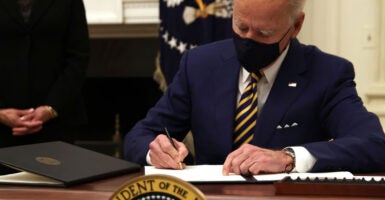
President Joe Biden signed two executive orders Friday in the State Dining Room of the White House. One would raise the minimum wage for federal contractors to $15 per hour. (Photo: Alex Wong/Getty Images)

President Joe Biden’s policies, announced in the first days of his administration, potentially could kill millions of jobs, according to estimates from both government and private studies.

Since taking office Jan. 20, Biden has announced a slew of policies, including executive actions to immediately take effect and legislative proposals.

By his third day in office, Biden took three major actions that “will devastate our economy at a time when we’re already on the brink of recession,” said Alfredo Ortiz, president of the Job Creators Network, a small-business advocacy group.

Ortiz was referring to Biden’s canceling of the Keystone XL pipeline, rejoining the Paris climate accord, and an executive order requiring a $15 an hour minimum wage for federal contractors.

The Left has declared war on our culture, but we should never back down, nor compromise our principles. Learn more now >>

“America’s job creators can lead America’s recovery, but we can’t afford the Biden administration’s left-wing agenda,” Ortiz told The Daily Signal in a statement. “The American people want pro-growth policies and a return to prosperity, not socialism and a deep, long-lasting recession.”

Here’s a look at the impact four of Biden’s policies could have on jobs and the economy.

1. The Keystone XL Pipeline and 11,000 Jobs

In October, TC Energy announced that in 2021, the Keystone XL pipeline would mean 11,000 American jobs.

But, on his first day in office, Biden signed an executive order to block further construction of the pipeline.

The $8 billion pipeline was set to transport hundreds of thousands of barrels of crude oil per day from western Canada to the U.S. Midwest and Gulf Coast. President Barack Obama blocked the project in 2015, but in 2017, President Donald Trump approved it. However, it has been delayed after environmental groups sued.

For Biden, the decision was a clash between two major constituencies, organized labor and the environmental lobby.

“The six contractors will be directly responsible for hiring more than 7,000 union workers in 2021, with special emphasis placed on hiring locally first and giving priority to qualified local and Indigenous-owned businesses,” the Keystone XL press release from October said. “When combined with additional 2021 contracts to be announced later, the total number of American union workers constructing Keystone XL in 2021 will exceed 8,000 and $900 million in gross wages. In total, Keystone XL is expected to employ more than 11,000 Americans in 2021, creating more than $1.6 billion in gross wages.”

In August, the United Association of Union Plumbers and Pipefitters endorsed Biden in the 2020 presidential race. However, just days before Biden’s inauguration, the union expressed disappointment.

“In revoking this permit, the Biden administration has chosen to listen to the voices of fringe activists instead of union members and the American consumer on Day 1,” union President Mark McManus said in a statement. He added:

Let me be very clear: When built with union labor by the men and women of the United Association, pipelines like Keystone XL remain the safest and most efficient modes of energy transportation in the world.

Sadly, the Biden Administration has now put thousands of union workers out of work. For the average American family, it means energy costs will go up and communities will no longer see the local investments that come with pipeline construction.

A Keystone XL spokesman could not be reached Friday after a phone inquiry for this report.

But “green” jobs can fill the void, White House press secretary Jen Psaki insisted on Thursday.

“The message of the president and the White House would be that he is committed. His record will show, shows the American people that he’s committed to clean-energy jobs—to jobs that are not only good, high-paying jobs, union jobs, but ones that are also good for our environment,” Psaki said of Biden. “He thinks it’s possible to do both.”

2. $15 Minimum Wage and 3.7 Million Jobs

Biden supports legislation to increase the federal minimum wage from $7.25 per hour to $15 per hour. Biden can—and intends to—take executive action during his first 100 days to require federal contractors to pay $15 per hour and also bring more federal employees up to that rate.

“President Biden is today directing his administration to start the work that would allow him to issue an Executive Order within the first 100 days that requires federal contractors to pay a $15 minimum wage and provide emergency paid leave to workers,” a White House statement on Friday said.

The statement adds, “The Executive Order directs the Office of Personnel Management to develop recommendations to pay more federal employees at least $15 per hour.”

It would require an act of Congress for such an increase to affect all employers and employees across the country.

One problem is that wages vary across the country, said Rachel Greszler, a research fellow in economics, the budget, and entitlements at The Heritage Foundation.

“Fifteen dollars per hour is not the same in D.C. as in other parts of the country,” Greszler told The Daily Signal.

For instance, Greszler said, $15 per hour is median income in Mississippi now, though the median income is much higher in Washington, D.C., or New York.

More than doubling the minimum wage would mark an unprecedented increase in the federally mandated wage floor, she said.

A July 2019 Congressional Budget Office analysis estimated millions of job losses if the federal minimum wage were hiked to $15 per hour over a five-year period. That estimate came at a time when the U.S. economy was much stronger.

“According to CBO’s median estimate, under the $15 option, 1.3 million workers who would otherwise be employed would be jobless in an average week in 2025. (That would equal a 0.8 percent reduction in the number of employed workers),” the CBO’s 2019 estimate said. “CBO estimates that there is about a two-thirds chance that the change in employment would lie between about zero and a reduction of 3.7 million workers.”

The CBO analysis went onto say a $15 wage would, “Boost workers’ earnings through higher wages, though some of those higher earnings would be offset by higher rates of joblessness.”

The CBO also says it would:

  • “Reduce business income and raise prices as higher labor costs were absorbed by business owners and then passed on to consumers.”
  • “Reduce the nation’s output slightly through the reduction in employment and a corresponding decline in the nation’s stock of capital.”

“On the basis of those effects and CBO’s estimate of the median effect on employment, the $15 option would reduce total real (inflation-adjusted) family income in 2025 by $9 billion, or 0.1 percent,” the CBO says.

However, the economic impact isn’t limited to jobs, said Ryan Young, a senior fellow at the Washington, D.C.-based Competitive Enterprise Institute.

“The biggest trade-off and negative effect would not be job loss, but non-wage pay decrease,” Young told The Daily Signal. “Employers would cut tuition payments, benefits, and it would mean more work for the employees if positions aren’t filled.”

Young added that the economic impact could be harsh, but noted that the average for state minimum-wage laws nationally is “in the neighborhood” of $12 per hour. So, the proposed increase itself for many states would not be more than double.

3. Paris Climate Accord and 3.1 Million Jobs

On his first day in office, Biden rejoined the Paris climate accord that Obama entered into in 2015. In 2017, Trump withdrew from the pact, which includes 174 countries.

According to a report from The Heritage Foundation, the energy regulations accepted by the Obama administration as part of the accord could kill 400,000 American jobs by 2035.

“Based on regulations and emissions-reduction targets set by the Obama administration, Heritage economists estimate that by 2035 there will be: an annual average loss of nearly 400,000 jobs, a total income loss of more than $20,000 for a family of four, and an aggregate [gross domestic product]  loss of over $2.5 trillion—all for a few tenths of a degree Celsius in abated warming,” the April 2016 Heritage report said.

A May 2017 report estimated the terms of the climate agreement could cause 440,000 jobs lost by 2025 and 3.1 million by 2040. The study done by the National Economic Research Associates Economic Consulting was funded by the U.S. Chamber of Commerce and the American Council for Capital Formation.

“A restriction in carbon emissions means that the total cost of fossil fuel increases, leading to higher costs of production. This cost increase leads to the closing of facilities that cannot compete on a cost basis. The increasing stringency of the [greenhouse gas] policy leads to more closure of manufacturing sectors over time, leading to fewer manufacturing jobs,” the report says.

It continues:

In 2025, the manufacturing sector alone could potentially lose 440,000 job-equivalents relative to the baseline jobs and about 3.1 million in 2040. Taking into account the loss in employment in other non-manufacturing sectors, the job-equivalents impact for the overall industrial sector could be about 1.1 million job-equivalents in 2025 and 6.5 million in 2040.

A large share of this job loss occurs in the construction sector, which employs a significant portion of the overall industrial labor force. Total economy-wide employment losses amount to about 2.7 million jobs in 2025.

4. Eliminating Freelance Employment

Biden also backs the Protecting the Right to Organize Act, or PRO Act, which organized labor also supports, prohibiting contract or freelance work—as well as part-time work. Organized labor strongly backs the legislation as a means of increasing union membership.

A similar law in California left many freelancers unemployed. It’s difficult to pinpoint how many jobs would be lost if this law were passed at a federal level.

The Freelancers Union estimates that 1 in 3 workers in the United States participates in independent work. Furthermore, about 10% of workers perform independent work, such as contracting, freelancing, and consulting as their primary job. Fewer than 1 in 10 independent contractors would prefer a traditional work arrangement, according to the Bureau of Labor Statistics.

“It would not just kill jobs, but it would force people into a certain type of job,” Greszler said.

Single parents and disabled people who benefit from flexible jobs would likely be harmed the most, she said. She added the federal proposal is more strict than the California law.

Biden backed the federal legislation as a candidate.

“Biden strongly supports the Protecting the Right to Organize Act’s (PRO Act) provisions instituting financial penalties on companies that interfere with workers’ organizing efforts, including firing or otherwise retaliating against workers,” the Biden campaign website said. “Biden will go beyond the PRO Act by enacting legislation to impose even stiffer penalties on corporations and to hold company executives personally liable when they interfere with organizing efforts, including criminally liable when their interference is intentional.”

Specifically, the federal legislation would broaden the definition of “employee” under the National Labor Relations Act. The new definition would be that an individual performing any service shall be considered—with some exceptions—an employee and not an independent contractor.

The proposal also raises concerns about workers’ privacy, the right to secret ballots in union elections, and invalidating 27 state right-to-work laws against compulsory union membership

With a $15 federal minimum wage, any jobs that don’t produce at least $36,000 per year in goods and services will eventually be eliminated—either because businesses close their doors, outsource their labor, or automate low-skilled jobs. (Photo: Moyo Studio/Getty Images)

President Joe Biden has proposed a nationwide $15 minimum wage as part of his so-called “American Rescue Plan.” Talk about bad timing: Raising labor prices on businesses that are struggling to stay afloat is like throwing them a load of bricks instead of a life preserver.

State and local governments raising their minimum wages is one thing, but to more than double the federal minimum, from $7.25 to $15 per hour?

Nearly one in every five restaurants permanently closed their doors in 2020 as 30 large retail and restaurant companies filed for bankruptcy.

Meanwhile, employment in food services (restaurants and bars) fell 19% in 2020 as retail clothing jobs dropped 24% and accommodations (hotels) jobs plummeted 32%.

The Left has declared war on our culture, but we should never back down, nor compromise our principles. Learn more now >>

Although very few people—only about 1% of all workers and 0.1% of single parents—make the $7.25 minimum wage, a good portion of restaurant, retail, and hotel jobs pay less than $15 per hour.

No one would suggest raising the rent on households who are months behind on their payments, so how could raising labor prices help businesses?

For a restaurant with five full-time workers making minimum wage, a doubling of the federal minimum wage would mean an extra $85,800 in wages and employment taxes. With restaurant profit margins of about 5%, that could require an extra $1.7 million in food sales ($4,700 more per day)—a seemingly impossible feat in normal times, let alone in the middle of a global pandemic.

Higher wages are a great thing—especially when the gains accrue to lower-income workers. But the only way to achieve actual wage increases—that is, lasting wage increases that don’t take jobs and incomes from others—is for workers to become more productive.

To that end, government mandates are powerless. A $15 minimum wage won’t help workers gain education and experience or provide them with technology that will enable them to produce more value and earn larger incomes. In fact, it could cause the opposite, by shifting employers’ resources away from training and investments to wages instead.

Moreover, raising wages by government fiat hurts many workers in the short and long run by cutting off the bottom rungs of the career ladder.

A $15 federal minimum wage translates into over $36,000 per year in wages and mandated taxes and benefits paid by employers. That means that any jobs that don’t produce at least $36,000 per year in goods and services will eventually be eliminated—either because businesses close their doors, outsource their labor, or automate low-skilled jobs.

That’s why even liberal economists and the nonpartisan Congressional Budget Office caution that a $15 federal minimum wage would lead to a survival-of-the-fittest labor market, reduce future incomes, and disproportionately harm African Americans and women.

The former chair of President Barack Obama’s White House Council of Economic Advisers, Alan Krueger, warned in 2015, “Research suggests that a minimum wage set as high as $12 an hour will do more good than harm for low-wage workers, but a $15-an-hour national minimum wage would put us in uncharted waters, and risk undesirable and unintended consequences.”

Those consequences would be unequal across the country. Large cities with high costs of living—many of which already have or are on the path to a $15 minimum wage—may not experience huge consequences. But non-urban areas and places with lower costs of living could be devastated.

Imagine if policymakers were proposing a minimum wage hike to nearly $36—ensuring that all full-time workers earned at least $74,000 per year.

Most people would say that’s too much, realizing that such a high minimum wage would have massive consequences in terms of lost jobs, increased prices, and a complete and utter disruption of the American labor market and economy.

Yet, $15 per hour in Mississippi would be equivalent to $35.74 per hour in D.C., where federal lawmakers seek to impose a national standard across the U.S.

Minimum wages are best left to local governments, where decisions can be made based on economic conditions and the cost of living.

If a local government sets its minimum wage above the market wage, at least workers and business owners who lose their jobs and businesses can move to places where it’s still possible for them to earn a living.

But if policymakers impose an excessively high nationwide minimum wage across 50 very diverse states and more than 3,000 counties, there will be nowhere else for the harmed to go.

Instead of mandating policies that irrefutably harm some people to the benefit of others, policymakers should focus on opening doors to income opportunities for all workers.

Reducing barriers to jobs and income gains is what helped contribute to the 14.6% increase in wages for workers at the 10th percentile of earners (those earning about $10 per hour) between 2016 and 2019.

Lawmakers at all levels should be seeking to help Americans recover and gain new opportunities instead of permanently wiping out existing ones.

©2021 Tribune Content Agency, LLC.

Have an opinion about this article? To sound off, please email letters@DailySignal.com and we will consider publishing your remarks in our regular “We Hear You” feature.

Ep. 4 – From Cradle to Grave [6/7]. Milton Friedman’s Free to Choose (1980)

February 9, 2021

President Biden c/o The White House
1600 Pennsylvania Avenue NW
Washington, DC 20500

Dear Mr. President,

Thank you for taking time to have your office try and get a pulse on what is going on out here in the country.

I read this article on January 15, 2021 about your announcement the previous night concerning your first proposal to Congress. Biden’s $1.9 Trillion COVID Relief Package Includes More Stimulus Checks, State Government Bailout, $15 Federal Minimum Wage

I wanted to let you know what I think about the minimum wage increase you have proposed for the whole country and I wanted to quote Milton Friedman who you are familiar with and you made it clear in July that you didn’t care for his views! Let me challenge you to take a closer look at what he had to say!

Milton Friedman on the minimum wage

All too often, the policy debates of today are simply refights of the battles of yesteryear. As a result, old arguments often retain a striking relevance.

In February 1973, economist Milton Friedman gave an interview to Playboy magazine. It was a wide ranging interview, covering topics from monetary policy to political philosophy. Friedman was an economist with a rare gift for translating technical arguments into clear prose (as you will find in his books Capitalism and Freedom and Free to Choose). His remarks on the minimum wage, as given in that interview, are startlingly contemporary.

PLAYBOY: But you prefer the laissez-faire—free-enterprise—approach.
FRIEDMAN: Generally. Because I think the government solution to a problem is usually as bad as the problem and very often makes the problem worse. Take, for example, the minimum wage, which has the effect of making the poor people at the bottom of the wage scale—those it was designed to help—worse off than before.

PLAYBOY: How so?
FRIEDMAN: If you really want to get a feeling about the minimum wage, there’s nothing more instructive than going to the Congressional documents to read the proposals to raise the minimum wage and see who testifies. You very seldom find poor people testifying in favor of the minimum wage. The people who do are those who receive or pay wages much higher than the minimum. Frequently Northern textile manufacturers. John F. Kennedy, when he was in Congress, said explicitly that he was testifying in favor of a rise in the minimum wage because he wanted protection for the New England textile industry against competition from the so-called cheap labor of the South. But now look at it from the point of that cheap labor. If a high minimum wage makes unfeasible an otherwise feasible venture in the South, are people in the South benefited or harmed? Clearly harmed, because jobs otherwise available for them are no longer available. A minimum-wage law is, in reality, a law that makes it illegal for an employer to hire a person with limited skills.

PLAYBOY: Isn’t it, rather, a law that requires employers to pay a fair and livable wage?
FRIEDMAN: How is a person better off unemployed at a dollar sixty an hour than employed at a dollar fifty? No hours a week at a dollar sixty comes to nothing. Let’s suppose there’s a teenager whom you as an employer would be perfectly willing to hire for a dollar fifty an hour. But the law says, no, it’s illegal for you to hire him at a dollar fifty an hour. You must hire him at a dollar sixty. Now, if you hire him at a dollar sixty, you’re really engaging in an act of charity. You’re paying a dollar fifty for his services and you’re giving him a gift of 10 cents. That’s something few employers, quite naturally, are willing to do or can afford to do without being put out of business by less generous competitors. As a result, the effect of a minimum-wage law is to produce unemployment among people with low skills. And who are the people with low skills? In the main, they tend to be teenagers and blacks, and women who have no special skills or have been out of the labor force and are coming back. This is why there are abnormally high unemployment rates among these groups.

_____________

Thank you so much for your time. I know how valuable it is. I also appreciate the fine family that you have and your commitment as a father and a husband.

Sincerely,

Everette Hatcher III, 13900 Cottontail Lane, Alexander, AR 72002, ph 501-920-5733

Williams with Sowell – Minimum Wage
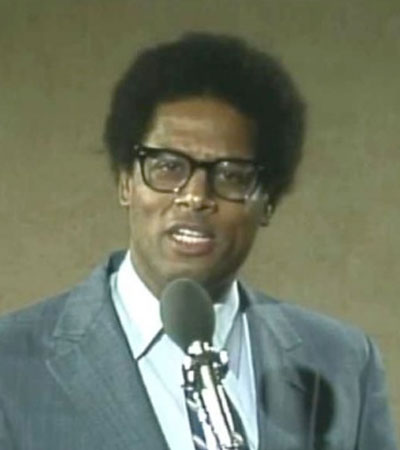
Thomas Sowell

Thomas Sowell – Reducing Black Unemployment

By WALTER WILLIAMS

—-

Ronald Reagan with Milton Friedman
Milton Friedman The Power of the Market 2-5

What Thomas Sowell Can Teach Us About Standing Up to the Mob

What Thomas Sowell Can Teach Us About Standing Up to the Mob

Thomas Sowell

The Biden administration has committed to “advance racial equity” with a host of leftist economic policies. These policies don’t work, says economist Thomas Sowell. (Photo: Free To Choose Media)

Joe Biden says he’ll “advance racial equity” by making “bold investments” in “Affordable Housing,” aiding “businesses owned by Black and Brown people,” establishing an “Equity Commission,” etc.

Gosh, that’ll do it.

Others demand reparations for slavery, more social programs, and defunding the police.

Yet, economist Thomas Sowell says, “I haven’t been able to find a single country in the world where policies advocated for Blacks in the United States lifted any people out of poverty.”

The Left has declared war on our culture, but we should never back down, nor compromise our principles. Learn more now >>

Sowell’s a black man who grew up in poverty. His father died before he was born, and his mother died soon after.

“We were much poorer than the people in Harlem and most anywhere else today,” he reflects. “But in the sense of things you need to get ahead, I was enormously more fortunate than most Black kids today.”

That’s because he discovered the public library. “When you start getting in the habit of reading when you’re 8 years old, it’s a different ballgame!”

Exploring Manhattan, he saw disparities in wealth. “Nothing in the schools or most of the books seemed to deal with that. Marx dealt with that,” says Sowell. He then became a Marxist.

What began to change his beliefs was his first job at the U.S. Department of Labor. He was told to focus on the minimum wage.

At first, he thought the minimum wage was good: “All these people are poor, and they’ll get a little higher income. That’ll be helpful,” he reasoned.

But then he realized: “There’s a downside. They may lose their jobs.”

His colleagues at the Labor Department didn’t want to think about that. “I came up with how we might test this. I was waiting to hear ‘congratulations!’ (but) I could see these people were stunned. They’d say, ‘oh, this idiot has stumbled on something that would ruin us all.’”

Once he saw how government workers often cared more about preserving their turf than actually solving problems, Sowell rethought his assumptions.

He turned away from Marxism and became a free market economist, writing great books like “Basic Economics,” “Race and Culture,” and my favorite title, “The Vision of the Anointed: Self-Congratulation as a Basis for Social Policy.”

Today’s self-anointed leaders talk constantly about how America’s “systemic racism” holds black people back.

“Propaganda,” Sowell calls it. “If you go back into the ’20s, you find that married-couple families were much more prevalent among Blacks. As late as 1930, Blacks have lower unemployment rates than whites.”

But if systemic racism was the cause of inequality, he says, “All these things that we complain about, and attribute to the era of slavery, should’ve been worse in the past than in the present!”

Sowell says the bigger cause of black Americans’ problems today is government welfare initiated in the 1960s. The programs encouraged people to become dependent on handouts.

“You began to have the mindset that goes with the welfare state,” Sowell says. “No stigma any longer attached to being on relief.”

Sowell concludes that government programs that are supposed to help minorities do more harm than good. Affirmative Action, for example.

In 1965, he took a teaching position at Cornell. The college, he said, had lowered admission standards to diversify the student body, and most students admitted under affirmative action did not do well.

“Half of the Black students were on academic probation,” he wrote, later adding, “Something like one-fourth of all the Black students going to MIT do not graduate. [There is] a pool of people whom you are artificially turning into failures by mismatching them with the school.”

Saying such things makes Sowell an outcast in academia, and now most everywhere.

Sowell writes, “If you have always believed that everyone should play by the same rules… that would have gotten you labeled a radical 50 years ago, a liberal 25 years ago, and a racist today.”

Starting next week, you can watch a new documentary on Sowell’s life, “Thomas Sowell: Common Sense in a Senseless World,” online at FreeToChooseNetwork.org.

DISTRIBUTED BY CREATORS.COM

The Daily Signal publishes a variety of perspectives. Nothing written here is to be construed as representing the views of The Heritage Foundation.

Have an opinion about this article? To sound off, please email letters@DailySignal.com and we will consider publishing your remarks in our regular “We Hear You” feature.

March 31, 2021

President Biden  c/o The White House
1600 Pennsylvania Avenue NW
Washington, DC 20500

Dear Mr. President,

Please explain to me if you ever do plan to balance the budget while you are President? I have written these things below about you and I really do think that you don’t want to cut spending in order to balance the budget. It seems you ever are daring the Congress to stop you from spending more.

President Barack Obama speaks about the debt limit in the East Room of the White House in Washington. | AP Photo

“The credit of the United States ‘is not a bargaining chip,’ Obama said on 1-14-13. However, President Obama keeps getting our country’s credit rating downgraded as he raises the debt ceiling higher and higher!!!!

Washington Could Learn a Lot from a Drug Addict

Just spend more, don’t know how to cut!!! Really!!! That is not living in the real world is it?

Making more dependent on government is not the way to go!!

Why is our government in over 16 trillion dollars in debt? There are many reasons for this but the biggest reason is people say “Let’s spend someone else’s money to solve our problems.” Liberals like Max Brantley have talked this way for years. Brantley will say that conservatives are being harsh when they don’t want the government out encouraging people to be dependent on the government. The Obama adminstration has even promoted a plan for young people to follow like Julia the Moocher.  

David Ramsey demonstrates in his Arkansas Times Blog post of 1-14-13 that very point:

Arkansas Politics / Health Care Arkansas’s share of Medicaid expansion and the national debt

Posted by on Mon, Jan 14, 2013 at 1:02 PM

Baby carrot Arkansas Medicaid expansion image

Imagine standing a baby carrot up next to the 25-story Stephens building in Little Rock. That gives you a picture of the impact on the national debt that federal spending in Arkansas on Medicaid expansion would have, while here at home expansion would give coverage to more than 200,000 of our neediest citizens, create jobs, and save money for the state.

Here’s the thing: while more than a billion dollars a year in federal spending would represent a big-time stimulus for Arkansas, it’s not even a drop in the bucket when it comes to the national debt.

Currently, the national debt is around $16.4 trillion. In fiscal year 2015, the federal government would spend somewhere in the neighborhood of $1.2 billion to fund Medicaid expansion in Arkansas if we say yes. That’s about 1/13,700th of the debt.

It’s hard to get a handle on numbers that big, so to put that in perspective, let’s get back to the baby carrot. Imagine that the height of the Stephens building (365 feet) is the $16 trillion national debt. That $1.2 billion would be the length of a ladybug. Of course, we’re not just talking about one year if we expand. Between now and 2021, the federal government projects to contribute around $10 billion. The federal debt is projected to be around $25 trillion by then, so we’re talking about 1/2,500th of the debt. Compared to the Stephens building? That’s a baby carrot.

______________

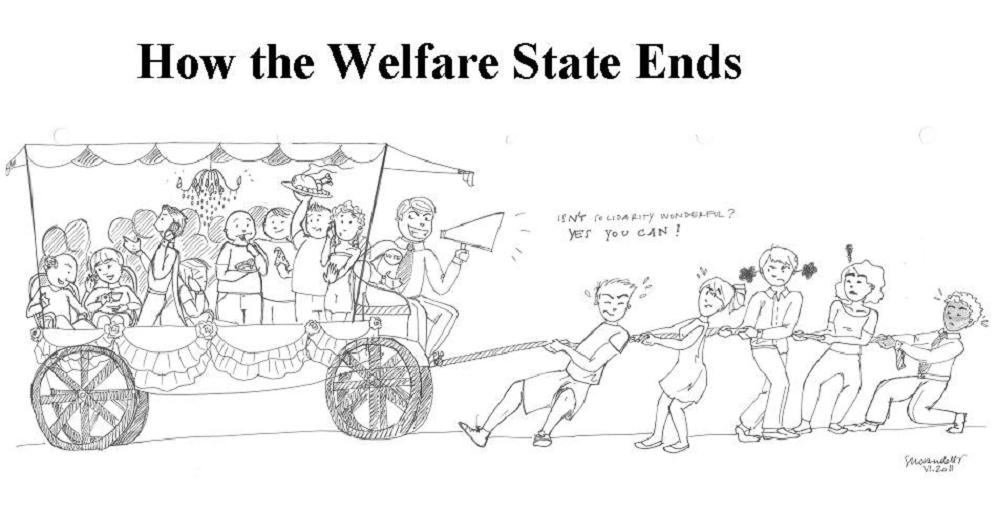
Here is how it will all end if everyone feels they should be allowed to have their “baby carrot.”

How sad it is that liberals just don’t get this reality.

Here is what the Founding Fathers had to say about welfare. David Weinberger noted:

While living in Europe in the 1760s, Franklin observed: “in different countries … the more public provisions were made for the poor, the less they provided for themselves, and of course became poorer. And, on the contrary, the less was done for them, the more they did for themselves, and became richer.”

Alexander Fraser Tytler, Lord Woodhouselee (15 October 1747 – 5 January 1813) was a Scottish lawyer, writer, and professor. Tytler was also a historian, and he noted, “A democracy cannot exist as a permanent form of government. It can only exist until the majority discovers it can vote itself largess out of the public treasury. After that, the majority always votes for the candidate promising the most benefits with the result the democracy collapses because of the loose fiscal policy ensuing, always to be followed by a dictatorship, then a monarchy.”

Thomas Jefferson to Joseph Milligan

April 6, 1816

[Jefferson affirms that the main purpose of society is to enable human beings to keep the fruits of their labor. — TGW]

To take from one, because it is thought that his own industry and that of his fathers has acquired too much, in order to spare to others, who, or whose fathers have not exercised equal industry and skill, is to violate arbitrarily the first principle of association, “the guarantee to every one of a free exercise of his industry, and the fruits acquired by it.” If the overgrown wealth of an individual be deemed dangerous to the State, the best corrective is the law of equal inheritance to all in equal degree; and the better, as this enforces a law of nature, while extra taxation violates it.

[From Writings of Thomas Jefferson, ed. Albert E. Bergh (Washington: Thomas Jefferson Memorial Association, 1904), 14:466.]

_______

Jefferson pointed out that to take from the rich and give to the poor through government is just wrong. Franklin knew the poor would have a better path upward without government welfare coming their way. Milton Friedman’s negative income tax is the best method for doing that and by taking away all welfare programs and letting them go to the churches for charity.

_____________

_________

Thank you so much for your time. I know how valuable it is. I also appreciate the fine family that you have and your commitment as a father and a husband.

Sincerely,

Everette Hatcher III, 13900 Cottontail Lane, Alexander, AR 72002, ph 501-920-5733

Williams with Sowell – Minimum Wage

Thomas Sowell

Thomas Sowell – Reducing Black Unemployment

By WALTER WILLIAMS

—-

Ronald Reagan with Milton Friedman
Milton Friedman The Power of the Market 2-5

Related posts:

Welfare Spending Shattering All-Time Highs

  We got to act fast and get off this path of socialism. Morning Bell: Welfare Spending Shattering All-Time Highs Robert Rector and Amy Payne October 18, 2012 at 9:03 am It’s been a pretty big year for welfare—and a new report shows welfare is bigger than ever. The Obama Administration turned a giant spotlight […]

We need more brave souls that will vote against Washington welfare programs

We need to cut Food Stamp program and not extend it. However, it seems that people tell the taxpayers back home they are going to Washington and cut government spending but once they get up there they just fall in line with  everyone else that keeps spending our money. I am glad that at least […]

Welfare programs are not the answer for the poor

Government Must Cut Spending Uploaded by HeritageFoundation on Dec 2, 2010 The government can cut roughly $343 billion from the federal budget and they can do so immediately. __________ Liberals argue that the poor need more welfare programs, but I have always argued that these programs enslave the poor to the government. Food Stamps Growth […]

Private charities are best solution and not government welfare

Milton Friedman – The Negative Income Tax Published on May 11, 2012 by LibertyPen In this 1968 interview, Milton Friedman explained the negative income tax, a proposal that at minimum would save taxpayers the 72 percent of our current welfare budget spent on administration. http://www.LibertyPen.com Source: Firing Line with William F Buckley Jr. ________________ Milton […]

The book “After the Welfare State”

Dan Mitchell Commenting on Obama’s Failure to Propose a Fiscal Plan Published on Aug 16, 2012 by danmitchellcato No description available. ___________ After the Welfare State Posted by David Boaz Cato senior fellow Tom G. Palmer, who is lecturing about freedom in Slovenia and Tbilisi this week, asked me to post this announcement of his […]

President Obama responds to Heritage Foundation critics on welfare reform waivers

Is President Obama gutting the welfare reform that Bill Clinton signed into law? Morning Bell: Obama Denies Gutting Welfare Reform Amy Payne August 8, 2012 at 9:15 am The Obama Administration came out swinging against its critics on welfare reform yesterday, with Press Secretary Jay Carney saying the charge that the Administration gutted the successful […]

Welfare reform part 3

Thomas Sowell – Welfare Welfare reform was working so good. Why did we have to abandon it? Look at this article from 2003. The Continuing Good News About Welfare Reform By Robert Rector and Patrick Fagan, Ph.D. February 6, 2003 Six years ago, President Bill Clinton signed legislation overhauling part of the nation’s welfare system. […]

Welfare reform part 2

Uploaded by ForaTv on May 29, 2009 Complete video at: http://fora.tv/2009/05/18/James_Bartholomew_The_Welfare_State_Were_In Author James Bartholomew argues that welfare benefits actually increase government handouts by ‘ruining’ ambition. He compares welfare to a humane mousetrap. —– Welfare reform was working so good. Why did we have to abandon it? Look at this article from 2003. In the controversial […]

Why did Obama stop the Welfare Reform that Clinton put in?

Thomas Sowell If the welfare reform law was successful then why change it? Wasn’t Bill Clinton the president that signed into law? Obama Guts Welfare Reform Robert Rector and Kiki Bradley July 12, 2012 at 4:10 pm Today, the Obama Department of Health and Human Services (HHS) released an official policy directive rewriting the welfare […]

“Feedback Friday” Letter to White House generated form letter response July 10,2012 on welfare, etc (part 14)

I have been writing President Obama letters and have not received a personal response yet.  (He reads 10 letters a day personally and responds to each of them.) However, I did receive a form letter in the form of an email on July 10, 2012. I don’t know which letter of mine generated this response so I have […]

$15 Federal Minimum Wage: An Anchor on Struggling Busineases!

With a $15 federal minimum wage, any jobs that don’t produce at least $36,000 per year in goods and services will eventually be eliminated—either because businesses close their doors, outsource their labor, or automate low-skilled jobs. (Photo: Moyo Studio/Getty Images)

President Joe Biden has proposed a nationwide $15 minimum wage as part of his so-called “American Rescue Plan.” Talk about bad timing: Raising labor prices on businesses that are struggling to stay afloat is like throwing them a load of bricks instead of a life preserver.

State and local governments raising their minimum wages is one thing, but to more than double the federal minimum, from $7.25 to $15 per hour?

Nearly one in every five restaurants permanently closed their doors in 2020 as 30 large retail and restaurant companies filed for bankruptcy.

Meanwhile, employment in food services (restaurants and bars) fell 19% in 2020 as retail clothing jobs dropped 24% and accommodations (hotels) jobs plummeted 32%.

The Left has declared war on our culture, but we should never back down, nor compromise our principles. Learn more now >>

Although very few people—only about 1% of all workers and 0.1% of single parents—make the $7.25 minimum wage, a good portion of restaurant, retail, and hotel jobs pay less than $15 per hour.

No one would suggest raising the rent on households who are months behind on their payments, so how could raising labor prices help businesses?

For a restaurant with five full-time workers making minimum wage, a doubling of the federal minimum wage would mean an extra $85,800 in wages and employment taxes. With restaurant profit margins of about 5%, that could require an extra $1.7 million in food sales ($4,700 more per day)—a seemingly impossible feat in normal times, let alone in the middle of a global pandemic.

Higher wages are a great thing—especially when the gains accrue to lower-income workers. But the only way to achieve actual wage increases—that is, lasting wage increases that don’t take jobs and incomes from others—is for workers to become more productive.

To that end, government mandates are powerless. A $15 minimum wage won’t help workers gain education and experience or provide them with technology that will enable them to produce more value and earn larger incomes. In fact, it could cause the opposite, by shifting employers’ resources away from training and investments to wages instead.

Moreover, raising wages by government fiat hurts many workers in the short and long run by cutting off the bottom rungs of the career ladder.

A $15 federal minimum wage translates into over $36,000 per year in wages and mandated taxes and benefits paid by employers. That means that any jobs that don’t produce at least $36,000 per year in goods and services will eventually be eliminated—either because businesses close their doors, outsource their labor, or automate low-skilled jobs.

That’s why even liberal economists and the nonpartisan Congressional Budget Office caution that a $15 federal minimum wage would lead to a survival-of-the-fittest labor market, reduce future incomes, and disproportionately harm African Americans and women.

The former chair of President Barack Obama’s White House Council of Economic Advisers, Alan Krueger, warned in 2015, “Research suggests that a minimum wage set as high as $12 an hour will do more good than harm for low-wage workers, but a $15-an-hour national minimum wage would put us in uncharted waters, and risk undesirable and unintended consequences.”

Those consequences would be unequal across the country. Large cities with high costs of living—many of which already have or are on the path to a $15 minimum wage—may not experience huge consequences. But non-urban areas and places with lower costs of living could be devastated.

Imagine if policymakers were proposing a minimum wage hike to nearly $36—ensuring that all full-time workers earned at least $74,000 per year.

Most people would say that’s too much, realizing that such a high minimum wage would have massive consequences in terms of lost jobs, increased prices, and a complete and utter disruption of the American labor market and economy.

Yet, $15 per hour in Mississippi would be equivalent to $35.74 per hour in D.C., where federal lawmakers seek to impose a national standard across the U.S.

Minimum wages are best left to local governments, where decisions can be made based on economic conditions and the cost of living.

If a local government sets its minimum wage above the market wage, at least workers and business owners who lose their jobs and businesses can move to places where it’s still possible for them to earn a living.

But if policymakers impose an excessively high nationwide minimum wage across 50 very diverse states and more than 3,000 counties, there will be nowhere else for the harmed to go.

Instead of mandating policies that irrefutably harm some people to the benefit of others, policymakers should focus on opening doors to income opportunities for all workers.

Reducing barriers to jobs and income gains is what helped contribute to the 14.6% increase in wages for workers at the 10th percentile of earners (those earning about $10 per hour) between 2016 and 2019.

Lawmakers at all levels should be seeking to help Americans recover and gain new opportunities instead of permanently wiping out existing ones.

©2021 Tribune Content Agency, LLC.

Have an opinion about this article? To sound off, please email letters@DailySignal.com and we will consider publishing your remarks in our regular “We Hear You” feature.

Ep. 4 – From Cradle to Grave [6/7]. Milton Friedman’s Free to Choose (1980)

February 9, 2021

President Biden c/o The White House
1600 Pennsylvania Avenue NW
Washington, DC 20500

Dear Mr. President,

Thank you for taking time to have your office try and get a pulse on what is going on out here in the country.

I read this article on January 15, 2021 about your announcement the previous night concerning your first proposal to Congress. Biden’s $1.9 Trillion COVID Relief Package Includes More Stimulus Checks, State Government Bailout, $15 Federal Minimum Wage

I wanted to let you know what I think about the minimum wage increase you have proposed for the whole country and I wanted to quote Milton Friedman who you are familiar with and you made it clear in July that you didn’t care for his views! Let me challenge you to take a closer look at what he had to say!

Milton Friedman on the minimum wage

All too often, the policy debates of today are simply refights of the battles of yesteryear. As a result, old arguments often retain a striking relevance.

In February 1973, economist Milton Friedman gave an interview to Playboy magazine. It was a wide ranging interview, covering topics from monetary policy to political philosophy. Friedman was an economist with a rare gift for translating technical arguments into clear prose (as you will find in his books Capitalism and Freedom and Free to Choose). His remarks on the minimum wage, as given in that interview, are startlingly contemporary.

PLAYBOY: But you prefer the laissez-faire—free-enterprise—approach.
FRIEDMAN: Generally. Because I think the government solution to a problem is usually as bad as the problem and very often makes the problem worse. Take, for example, the minimum wage, which has the effect of making the poor people at the bottom of the wage scale—those it was designed to help—worse off than before.

PLAYBOY: How so?
FRIEDMAN: If you really want to get a feeling about the minimum wage, there’s nothing more instructive than going to the Congressional documents to read the proposals to raise the minimum wage and see who testifies. You very seldom find poor people testifying in favor of the minimum wage. The people who do are those who receive or pay wages much higher than the minimum. Frequently Northern textile manufacturers. John F. Kennedy, when he was in Congress, said explicitly that he was testifying in favor of a rise in the minimum wage because he wanted protection for the New England textile industry against competition from the so-called cheap labor of the South. But now look at it from the point of that cheap labor. If a high minimum wage makes unfeasible an otherwise feasible venture in the South, are people in the South benefited or harmed? Clearly harmed, because jobs otherwise available for them are no longer available. A minimum-wage law is, in reality, a law that makes it illegal for an employer to hire a person with limited skills.

PLAYBOY: Isn’t it, rather, a law that requires employers to pay a fair and livable wage?
FRIEDMAN: How is a person better off unemployed at a dollar sixty an hour than employed at a dollar fifty? No hours a week at a dollar sixty comes to nothing. Let’s suppose there’s a teenager whom you as an employer would be perfectly willing to hire for a dollar fifty an hour. But the law says, no, it’s illegal for you to hire him at a dollar fifty an hour. You must hire him at a dollar sixty. Now, if you hire him at a dollar sixty, you’re really engaging in an act of charity. You’re paying a dollar fifty for his services and you’re giving him a gift of 10 cents. That’s something few employers, quite naturally, are willing to do or can afford to do without being put out of business by less generous competitors. As a result, the effect of a minimum-wage law is to produce unemployment among people with low skills. And who are the people with low skills? In the main, they tend to be teenagers and blacks, and women who have no special skills or have been out of the labor force and are coming back. This is why there are abnormally high unemployment rates among these groups.

_____________

Thank you so much for your time. I know how valuable it is. I also appreciate the fine family that you have and your commitment as a father and a husband.

Sincerely,

Everette Hatcher III, 13900 Cottontail Lane, Alexander, AR 72002, ph 501-920-5733

Williams with Sowell – Minimum Wage

Thomas Sowell

Thomas Sowell – Reducing Black Unemployment

By WALTER WILLIAMS

—-

Ronald Reagan with Milton Friedman
Milton Friedman The Power of the Market 2-5

Biden Ordering Stopgap Help as Talks Start on Big Aid Plan (RAISING FED MIN.WAGE TO $15) WHAT WOULD HAVE JFK SAID ABOUT THAT?

Biden Ordering Stopgap Help as Talks Start on Big Aid Plan

Friday, 22 Jan 2021 5:56 AM


President Joe Biden plans to take executive action Friday to provide a stopgap measure of financial relief to millions of Americans while Congress begins to consider his much larger $1.9 trillion package to help those affected by the coronavirus pandemic.

The two executive orders that Biden is to sign would increase food aid, protect job seekers on unemployment and clear a path for federal workers and contractors to get a $15 hourly minimum wage.

“The American people cannot afford to wait,” said Brian Deese, director of the White House National Economic Council. “So many are hanging by a thread. They need help, and we’re committed to doing everything we can to provide that help as quickly as possible.”

Deese emphasized that the orders are not substitutes for the additional stimulus that Biden says is needed beyond the $4 trillion in aid that has already been approved, including $900 billion this past December. Several Republican lawmakers have voiced opposition to provisions in Biden’s plan for direct payments to individuals, state and local government aid and a $15 hourly minimum wage nationwide.

Most economists believe the United States can rebound with strength once people are vaccinated from the coronavirus, but the situation is still dire as the disease has closed businesses and schools. Nearly 10 million jobs have been lost since last February, and nearly 30 million households lack secure access to food.

One of Biden’s orders asks the Agriculture Department to consider adjusting the rules for food assistance, so that the government could be obligated to provide more money to the hungry.

Children who are unable to get school meals because of remote learning could receive a 15% increase in food aid, according to a fact sheet provided by the White House. The lowest-income households could qualify for the emergency benefits from the Supplemental Nutrition Assistance Program. And the formula for calculating meal costs could become more generous.

The order also tries to make it easier for people to claim direct payments from prior aid packages and other benefits. In addition, it would create a guarantee that workers could still collect unemployment benefits if they refuse to take a job that could jeopardize their health.

Biden’s second executive order would restore union bargaining rights revoked by the Trump administration, protect the civil service system and promote a $15 hourly minimum wage for all federal workers. The Democratic president also plans to start a 100-day process for the federal government to require its contractors to pay at least $15 an hour and provide emergency paid leave to workers, which could put pressure on other private employers to boost their wages and benefits.

These orders arrive as the Biden White House has declined to provide a timeline for getting its proposed relief package through, saying that officials are beginning to schedule meetings with lawmakers to discuss the proposal.

White House press secretary Jen Psaki said at a Thursday briefing that the proposal has support ranging from democratic socialist Sen. Bernie Sanders to the U.S. Chamber of Commerce.

But not all components of the package are popular among Republicans, and that could delay passage in ways that could injure the economy. Psaki stressed that Biden wants any deal to be bipartisan and that the process of meeting with lawmakers to talk through the plan is just beginning.

Biden must balance the need for immediate aid against the risk of prolonged negotiations. Psaki said that Biden would not take options off the table but later added, “Part of the discussion we’ll be having with members is, what do you want to cut?”

Neil Bradley, chief policy officer at the Chamber, told reporters Thursday that Congress should act fast to approve the roughly $400 billion for national vaccination and reopening schools and other elements of the plan with bipartisan support, rather than drag out negotiations.

“We’re not going to let areas of disagreement prevent progress on areas where we can find common ground,” Bradley said. “We cannot afford six months to get the vaccination process working right. … We can’t even wait six weeks to get vaccinations distributed and schools reopened.”

WHAT WOULD HAVE JFK SAID ABOUT THAT?

Ep. 4 – From Cradle to Grave [6/7]. Milton Friedman’s Free to Choose (1980)

February 9, 2021

President Biden c/o The White House
1600 Pennsylvania Avenue NW
Washington, DC 20500

Dear Mr. President,

Thank you for taking time to have your office try and get a pulse on what is going on out here in the country.

I read this article on January 15, 2021 about your announcement the previous night concerning your first proposal to Congress. Biden’s $1.9 Trillion COVID Relief Package Includes More Stimulus Checks, State Government Bailout, $15 Federal Minimum Wage

I wanted to let you know what I think about the minimum wage increase you have proposed for the whole country and I wanted to quote Milton Friedman who you are familiar with and you made it clear in July that you didn’t care for his views! Let me challenge you to take a closer look at what he had to say!

Milton Friedman on the minimum wage

All too often, the policy debates of today are simply refights of the battles of yesteryear. As a result, old arguments often retain a striking relevance.

In February 1973, economist Milton Friedman gave an interview to Playboy magazine. It was a wide ranging interview, covering topics from monetary policy to political philosophy. Friedman was an economist with a rare gift for translating technical arguments into clear prose (as you will find in his books Capitalism and Freedom and Free to Choose). His remarks on the minimum wage, as given in that interview, are startlingly contemporary.

PLAYBOY: But you prefer the laissez-faire—free-enterprise—approach.
FRIEDMAN: Generally. Because I think the government solution to a problem is usually as bad as the problem and very often makes the problem worse. Take, for example, the minimum wage, which has the effect of making the poor people at the bottom of the wage scale—those it was designed to help—worse off than before.

PLAYBOY: How so?
FRIEDMAN: If you really want to get a feeling about the minimum wage, there’s nothing more instructive than going to the Congressional documents to read the proposals to raise the minimum wage and see who testifies. You very seldom find poor people testifying in favor of the minimum wage. The people who do are those who receive or pay wages much higher than the minimum. Frequently Northern textile manufacturers. John F. Kennedy, when he was in Congress, said explicitly that he was testifying in favor of a rise in the minimum wage because he wanted protection for the New England textile industry against competition from the so-called cheap labor of the South. But now look at it from the point of that cheap labor. If a high minimum wage makes unfeasible an otherwise feasible venture in the South, are people in the South benefited or harmed? Clearly harmed, because jobs otherwise available for them are no longer available. A minimum-wage law is, in reality, a law that makes it illegal for an employer to hire a person with limited skills.

PLAYBOY: Isn’t it, rather, a law that requires employers to pay a fair and livable wage?
FRIEDMAN: How is a person better off unemployed at a dollar sixty an hour than employed at a dollar fifty? No hours a week at a dollar sixty comes to nothing. Let’s suppose there’s a teenager whom you as an employer would be perfectly willing to hire for a dollar fifty an hour. But the law says, no, it’s illegal for you to hire him at a dollar fifty an hour. You must hire him at a dollar sixty. Now, if you hire him at a dollar sixty, you’re really engaging in an act of charity. You’re paying a dollar fifty for his services and you’re giving him a gift of 10 cents. That’s something few employers, quite naturally, are willing to do or can afford to do without being put out of business by less generous competitors. As a result, the effect of a minimum-wage law is to produce unemployment among people with low skills. And who are the people with low skills? In the main, they tend to be teenagers and blacks, and women who have no special skills or have been out of the labor force and are coming back. This is why there are abnormally high unemployment rates among these groups.

_____________

Thank you so much for your time. I know how valuable it is. I also appreciate the fine family that you have and your commitment as a father and a husband.

Sincerely,

Everette Hatcher III, 13900 Cottontail Lane, Alexander, AR 72002, ph 501-920-5733

Williams with Sowell – Minimum Wage

Thomas Sowell

Thomas Sowell – Reducing Black Unemployment

By WALTER WILLIAMS

—-

Ronald Reagan with Milton Friedman
Milton Friedman The Power of the Market 2-5

‘Uncle Tom’ Blacklisted by Hollywood By Larry Elder

ENTARY

‘Uncle Tom’ Blacklisted by Hollywood

Hollywood has blacklisted the documentary “Uncle Tom.” (Photo: AaronP/Bauer-Griffin/GC Images/Getty Images)

Actor Ben Affleck once explained why he found it difficult to watch Republican actors on screen.

“It’s … hard,” explained Affleck, “to get people to suspend disbelief. … When I watch a guy I know is a big Republican, part of me thinks, I probably wouldn’t like this person if I met him, or we would have different opinions. That [expletive] fogs the mind when you should be paying attention and be swept into the illusion.”

This likely explains why “Uncle Tom,” the documentary on which I worked as executive producer, gets no love from the lists of best documentaries of 2020.

A critical and financial success by any measure, the gross earnings of “Uncle Tom,” so far, exceed seven times its cost and counting. It recently became available on iTunes, Amazon Prime, and Walmart online, as well as on store shelves.

The Left has declared war on our culture, but we should never back down, nor compromise our principles. Learn more now >>

Former CBS reporter Sharyl Attkisson recently wrote about the film’s snub with the headline: “Censored: Larry Elder’s ‘Uncle Tom’ film.” But the Hollywood trade publications Variety and Hollywood Reporter? Silence.

The Chicago Tribune’s John Kass, a political writer, wrote a piece headlined “What Frightens the American Left: Larry Elder’s New Documentary ‘Uncle Tom.’” Kass writes:

Is there anything more frightening to the American political left and their high media priests of the woke world than Black Americans who think for themselves and refuse to kneel? … And so, they are demeaned by Democratic politicians and either ignored outright or marginalized as race traitors, sellouts and ‘Uncle Toms.’ It’s a way to humiliate them, shut them up, and cancel them. And the party’s handmaidens of the media play along. But that’s one reason why Larry Elder’s stunning new film, ‘Uncle Tom: An Oral History of the American Black Conservative,’ is so important, especially now.

Each of the following three year-end lists of “best” documentary films of 2020 ignores “Uncle Tom,” despite an IMDb viewer rating higher than any on the lists—in most cases, far higher. (IMDb, the Internet Movie Database website, assigns films a rating, from one to 10, based on viewers’ reviews.)

First, Polygon’s list: 1) “Dick Johnson Is Dead,” 7.5 (IMDb rating); 2) “Bloody Nose, Empty Pockets,” 7.3; 3) “Welcome to Chechnya,” 7.9; 4) “Collective,” 8.4; 5) “You Don’t Nomi,” 6.7; 6) “The Go-Go’s,” 7.5; 7) “Mucho Mucho Amor,” 7.2; 8) “I Am Greta,” 5.2; 9) “Mayor,” 7.5; 10) “City Hall,” 7.3.

Next, Paste Magazine’s top 25 list, listed alphabetically, without rankings, contains some of the same films, but many others are not on the first list. The new additions are: “76 Days,” 7.1; “David Byrne’s American Utopia,” 8.3; “The Annotated Field Guide of Ulysses S. Grant,” N/A; “Boys State,” 7.7; “City So Real,” 7.4; “Crip Camp,” 7.8; “Epicentro,” 6.8; “Feels Good Man,” 7.6; “Fireball: Visitors from Darker Worlds,” 7.0; “The Grand Bizarre,” 6.7; “Heimat Is a Space in Time,” 6.8; “The History of the Seattle Mariners,” N/A; “I Walk on Water,” 6.7; “Malni—Towards the Ocean, Towards the Shore,” 6.2; “The Metamorphosis of Birds,” 7.8; “The Painter and the Thief,” 7.6; “Sunless Shadows,” 7.3; “Time,” 7.2; “Vick,” 7.4.

Finally, there’s IndieWire, an independent film website whose 2020 “best of” list (unranked and listed alphabetically) also ignores “Uncle Tom.” The films on its “best of” but not already listed above include: “All In: The Fight for Democracy,” 6.3; “Athlete A”, 7.7; “Gunda,” 7.4; “The Mole Agent,” 7.6; “The Social Dilemma,” 7.7.

Not a single film on these three lists achieved an IMDb rating of 8.5 or more. Not one. “Collective” registered the highest at 8.4. How did “Uncle Tom,” again, shut out on all three lists, rate on IMBD? 8.9. Not a typo: 8.9.

Finally, of the last 10 Oscar winners for Best Documentary, none has a higher IMDb rating than “Uncle Tom.” None. Only one matched its 8.9 rating. See you at the Academy Awards?

COPYRIGHT 2021 LAURENCE A. ELDER

DISTRIBUTED BY CREATORS.COM

The Daily Signal publishes a variety of perspectives. Nothing written here is to be construed as representing the views of The Heritage Foundation.

Have an opinion about this article? To sound off, please email letters@DailySignal.com and we will consider publishing your remarks in our regular “We Hear You” feature.

It’s Fake News That the 1776 Commission Report Whitewashes America’s Past

The unanimously approved conclusions of the 1776 Commission’s report focus on the historical challenges of two founding documents and civic renewal. Pictured: The Liberty Bell located in downtown Philadelphia. (Photo: Drbueller/Getty Images)

The newly formed President’s Advisory 1776 Commission just released its report. The group was chaired by Churchill historian and Hillsdale College President Larry P. Arnn. The vice chair was Carol M. Swain, a retired professor of political science. (Full disclosure: I was a member of the commission.)

The unanimously approved conclusions focused on the Declaration of Independence, the Constitution, the historical challenges to these founding documents, and the need for civic renewal.

The 16-member commission was diverse in the widest sense of the familiar adjective. It included historians, lawyers, academics, scholars, authors, former elected officials, and past public servants.

>>> Listen to Carol Swain’s interview about the commission on “The Daily Signal Podcast”:

Whether because the report was issued by a Donald Trump-appointed commission, or because the conclusions questioned the controversial and flawed New York Times-sponsored 1619 Project, there was almost immediate criticism from the left.

Yet at any other age than the divisive present, the report would not have been seen as controversial.

First, the commission offered a brief survey of the origins of the Declaration of Independence, published in 1776, and the Constitution, signed in 1787. It emphasized how unusual for the age were the Founders’ commitments to political freedom, personal liberty, and the natural equality endowed by our creator—all the true beginning of the American experiment.

The commission reminded us that the Founders were equally worried about autocracy and chaos. So they drafted checks and balances to protect citizens from both authoritarianism, known so well from the British Crown, and the frenzy of sometimes wild public excess.

The report repeatedly focuses on both the ideals of the American founding and the centuries-long quest to live up to them. It notes the fragility of such a novel experiment in constitutional republicanism, democratic elections, and self-government—especially during late 18th-century era of war and factionalism.

The report does not whitewash the continuance of many injustices after 1776 and 1787—in particular chattel slavery concentrated in the South, and voting reserved only for free males.

Indeed, the commission explains why and how these wrongs were inconsistent with the letter and spirit of our founding documents. So it was natural that these disconnects would be addressed, even fought over, and continually resolved—often over the opposition of powerful interests who sought to reinvent the declaration and the Constitution into something that they were not.

Two of the most widely referenced Americans in the report are Frederick Douglass and Martin Luther King Jr. Both argued, a century apart, for the moral singularity of the U.S. Constitution. Neither wished to replace the Founders’ visions; both instead demanded that they be fully realizedand enforced.

The report details prior ideological and political challenges to the Constitution as we approach America’s 250th birthday. Some were abjectly evil, such as the near-century-long insistence that the enslavement of African Americans was legal—an amorality that eventually led to more than 600,000 Americans being killed during a Civil War to banish it.

Some ideologies, such as fascism and communism, were easily identifiable as inimical to our principles. Both occasionally won adherents in times of economic depression and social strife before they were defeated and discredited abroad.

Perhaps more controversially, the commission identified other challenges, such as continued racism, progressivism, and contemporary identity politics. The report argued how and why all those who insisted that race might become a basis from which to discriminate against entire groups of people were at odds with the logic of the declaration.

Historically, progressivism assumed that human nature is malleable. With enough money and power, Americans supposedly can be improved to accept more paternalistic government, usually to be run by technocrats. Often they sought to curb the liberties of the individual, under the guise of modernist progress and greater efficiency.

The commission was no more sympathetic to the current popularity of identity politics or reparatory racial discrimination. It argued that the efforts to insist that race, ethnicity, sexual preference, and gender define who we are, rather than remain incidental in comparison to our natural and shared humanity, will lead to a dangerous fragmentation of American society.

Finally, the commission offered the unifying remedy of renewed civic education. Specifically, it advocates far more teaching in our schools of the declaration and the Constitution, and other documents surrounding their creation.

It most certainly did not suggest that civic education and American history ignore or contextualize past national shortcomings. Again, the report argued that our lapses should be envisioned as obstacles to fulfilling the aspirations of our founding.

The commission may be short-lived with the change of administrations, given that it was born in the chaos of the divisive present. President Joe Biden reportedly planned to terminate the commission through an executive order.

But any fair critic can see that the report’s unifying message is that we are a people blessed with a singular government and history, that self-critique and moral improvement are innate to the American founding and spirit, and that America never had to be perfect to be both good and far better than the alternatives.

(C)2021 Tribune Content Agency, LLC.

Trump’s 1776 Commission slams ‘destructive scholarship’ in final report

President Trump’s 1776 Commission, formed to promote “patriotic education,” on Monday released a final report touted by the White House as offering “a definitive chronicle of the American founding.”

The 45-page report slams “destructive scholarship” that it says misrepresents the history of slavery and racial discrimination.

“States and school districts should reject any curriculum that promotes one-sided partisan opinions, activist propaganda, or factional ideologies that demean America’s heritage, dishonor our heroes, or deny our principles,” the report says.

Trump created the commission last year to counter denunciations of the Founding Fathers during national anti-police brutality protests. The report was released less than 48 hours before Trump leaves office.

The document says, “Deliberately destructive scholarship shatters the civic bonds that unite all Americans. It silences the discourse essential to a free society by breeding division, distrust, and hatred among citizens. And it is the intellectual force behind so much of the violence in our cities, suppression of free speech in our universities, and defamation of our treasured national statues and symbols.”

Trump established the commission in part in response to a national movement to remove or deface the statues of slaveholders or colonial figures. Trump critics, however, vowed to resist his push to put a rosier spin on US history.

The new report slams the current education of students, saying, “Colleges peddle resentment and contempt for American principles and history alike, in the process and historical truth, shames Americans by highlighting only the sins of their ancestors, and teaches claims of systemic racism that can only be eliminated by more discrimination, is an ideology intended to manipulate opinions more than educate minds,” the report says.

The report says that the US is exceptionable because, “No one is above the law” — a cliche recently applied by President-elect Joe Biden to Trump after his supporters stormed the Capitol and disrupted certification of the election.

“Patriotic education must have at its center a respect for the rule of law, including the Declaration and the Constitution, so that we have what John Adams called ‘a government of laws, and not of men,’” the report says.

The report argues against presenting slavery as an indelible sin of the Founding Fathers.

“The most common charge levelled against the founders, and hence against our country itself, is that they were hypocrites who didn’t believe in their stated principles, and therefore the country they built rests on a lie. This charge is untrue, and has done enormous damage, especially in recent years, with a devastating effect on our civic unity and social fabric,” the report says, adding: “Many Americans labor under the illusion that slavery was somehow a uniquely American evil.”

The report argues that in fact, “The foundation of our Republic planted the seeds of the
death of slavery in America.”

“It is important to remember that, as a question of practical politics, no durable union could have been formed without a compromise among the states on the issue of slavery. Is it reasonable to believe that slavery could have been abolished sooner had the slave states not been in a union with the free? Perhaps. But what is momentous is that a people that included slaveholders founded their nation on the proposition that ‘all men are created equal.; So why did they say that without immediately abolishing slavery? To establish the principle of consent as the ground of all political legitimacy and to check against any possible future drift toward or return to despotism, for sure. But also, in Lincoln’s words, ‘to declare the right, so that the enforcement of it might follow as fast as circumstances should permit,’” the report says.

The commission was chaired by Hillsdale College President Larry Arnn. Retired Vanderbilt University political science professor Carol Swain was co-chair of the initiative and the commission’s executive director was Hillsdale College government professor Matthew Spalding.

David Barton

1 Of 5 / The Bible’s Influence In America / American Heritage Series / David Barton

2 Of 5 / The Bible’s Influence In America / American Heritage Series / David Barton

barton videos

4 Of 5 / The Bible’s Influence In America / American Heritage Series / David Barton

—-

February 10, 2021

President Biden c/o The White House
1600 Pennsylvania Avenue NW
Washington, DC 20500

Dear Mr. President,

There have been many articles written by evangelicals like me who fear that our founding fathers would not recognize our country today because secular humanism has rid our nation of spiritual roots. I am deeply troubled by the secular agenda of those who are at war with religion in our public life.

Lillian Kwon quoted somebody that I respect a lot  in her article, “Christianity losing out to Secular Humanism?” :

“Most of the founding fathers of this nation … built the worldview of this nation on the authority of the Word of God,” Ken Ham said. “Because of that, there have been reminders in this culture concerning God’s Word, the God of creation.”

___________

I have gone back and forth and back and forth with many liberals on the Arkansas Times Blog on many issues such as abortionhuman rightswelfarepovertygun control  and issues dealing with popular culture , but the issue of the founding fathers’ views on religion got one of the biggest responses.

It is true that 29 of the signers of the Declaration of Independence had degrees with Bible Colleges or Seminaries and these men we know were God-fearing Protestants. This means they had a biblical view of man with an understanding of our sin nature and this led them to come up with a limited government with many checks and balances. They had a strong belief in the afterlife and in future punishments and rewards. They also encouraged Christianity and were not hostile to religion. However, they did not set up a Christian Theocracy but wanted freedom of religion.

People really are losing their faith in big government and they want more liberty back. It seems to me we have to get back to the founding  principles that made our country great.  We also need to realize that a big government will encourage waste and corruptionThe recent scandals in our government have proved my point. In fact, the jokes President Obama made at Ohio State about possibly auditing them are not so funny now that reality shows how the IRS was acting more like a monster out of control.  Here is a clip discussing the founders and what their religious views were.

David Barton: Declaration and Constitution Are Based Entirely On The Bible

Here is some comments from our debate on the Arkansas Times Blog in July of 2013:

Olddoc read Jefferson’s own words given 237 years ago:

“We hold these truths to be self-evident, that all men are created equal; that they are endowed by their CREATOR with certain unalienable rights…”

______________

I want to go where the evidence leads. AMERICANS UNITED Rob Boston misled several leaders into believing that David Barton fabricated quotes and attributed them to the founders and when I confronted him about that he just laughed and said he was glad that Barton was experiencing problems because of the article that Boston wrote even though Boston himself admitted to me that he knew that Barton did not fabricate the quotes but just got them from secondary sources.

https://thedailyhatch.org/2012/06/18/did-da…

________________________

In the advertisement from the Freedom from Religion Foundation you have a quote from John Adams but these quotes below were omitted. By the way these quotes were so powerful that I emailed and mailed them to the White House and here is a copy of the letter at this link

https://thedailyhatch.org/2013/04/03/open-l…

JOHN ADAMS:

SIGNER OF THE DECLARATION OF INDEPENDENCE; JUDGE; DIPLOMAT; ONE OF TWO SIGNERS OF THE BILL OF RIGHTS; SECOND PRESIDENT OF THE UNITED STATES

The general principles on which the fathers achieved independence were the general principles of Christianity. I will avow that I then believed, and now believe, that those general principles of Christianity are as eternal and immutable as the existence and attributes of God.1

The Holy Ghost carries on the whole Christian system in this earth. Not a baptism, not a marriage, not a sacrament can be administered but by the Holy Ghost. . . . There is no authority, civil or religious – there can be no legitimate government but what is administered by this Holy Ghost. There can be no salvation without it. All without it is rebellion and perdition, or in more orthodox words damnation.2

Without religion, this world would be something not fit to be mentioned in polite company: I mean hell.3

The Christian religion is, above all the religions that ever prevailed or existed in ancient or modern times, the religion of wisdom, virtue, equity and humanity.4

Suppose a nation in some distant region should take the Bible for their only law book and every member should regulate his conduct by the precepts there exhibited. . . . What a Eutopia – what a Paradise would this region be!5

I have examined all religions, and the result is that the Bible is the best book in the world.6

1.Thomas Jefferson, The Writings of Thomas Jefferson (Washington D. C.: The Thomas Jefferson Memorial Association, 1904), Vol. XIII, p. 292-294. In a letter from John Adams to Thomas Jefferson on June 28, 1813.(Return)

2. John Adams, The Works of John Adams, Second President of the United States, Charles Francis Adams, editor (Boston: Little, Brown and Company, 1856), Vol. X, p. 254, to Thomas Jefferson on April 19, 1817. (Return)

3. John Adams, Works, Vol. III, p. 421, diary entry for July 26, 1796. (Return)

4. John Adams, Works, Vol. II, pp. 6-7, diary entry for February 22, 1756. (Return)

5. John Adams, Works, Vol. X, p. 85, to Thomas Jefferson on December 25, 1813. (Return)

6. John Adams and John Quincy Adams, The Selected Writings of John and John Quincy Adams, Adrienne Koch and William Peden, editors (New York: Alfred A. Knopf, 1946), p. 292, John Quincy Adams to John Adams, January 3, 1817.

________________

Thank you so much for your time. I know how valuable it is. I also appreciate the fine family that you have and your commitment as a father and a husband.

Sincerely,

Everette Hatcher III, 13900 Cottontail Lane, Alexander, AR 72002, ph 501-920-5733

__________________

Related posts:

Open letter to President Obama (Part 293) (Founding Fathers’ view on Christianity, Elbridge Gerry of MA)

President Obama c/o The White House 1600 Pennsylvania Avenue NW Washington, DC 20500 Dear Mr. President, I know that you receive 20,000 letters a day and that you actually read 10 of them every day. I really do respect you for trying to get a pulse on what is going on out here. There have […]

The Founding Fathers views concerning Jesus, Christianity and the Bible (Part 5, John Hancock)

There have been many articles written by evangelicals like me who fear that our founding fathers would not recognize our country today because secular humanism has rid our nation of spiritual roots. I am deeply troubled by the secular agenda of those who are at war with religion in our public life. Lillian Kwon quoted somebody […]

The Founding Fathers views concerning Jesus, Christianity and the Bible (Part 4, Elbridge Gerry)

There have been many articles written by evangelicals like me who fear that our founding fathers would not recognize our country today because secular humanism has rid our nation of spiritual roots. I am deeply troubled by the secular agenda of those who are at war with religion in our public life. Lillian Kwon quoted somebody […]

The Founding Fathers views concerning Jesus, Christianity and the Bible (Part 3, Samuel Adams)

There have been many articles written by evangelicals like me who fear that our founding fathers would not recognize our country today because secular humanism has rid our nation of spiritual roots. I am deeply troubled by the secular agenda of those who are at war with religion in our public life. Lillian Kwon quoted somebody […]

The Founding Fathers views concerning Jesus, Christianity and the Bible (Part 2, John Quincy Adams)

There have been many articles written by evangelicals like me who fear that our founding fathers would not recognize our country today because secular humanism has rid our nation of spiritual roots. I am deeply troubled by the secular agenda of those who are at war with religion in our public life. Lillian Kwon quoted somebody […]

The Founding Fathers views concerning Jesus, Christianity and the Bible (Part 1, John Adams)

There have been many articles written by evangelicals like me who fear that our founding fathers would not recognize our country today because secular humanism has rid our nation of spiritual roots. I am deeply troubled by the secular agenda of those who are at war with religion in our public life. Lillian Kwon quoted somebody […]

President Obama and the Founding Fathers

President Obama Speaks at The Ohio State University Commencement Ceremony Published on May 5, 2013 President Obama delivers the commencement address at The Ohio State University. May 5, 2013. You can learn a lot about what President Obama thinks the founding fathers were all about from his recent speech at Ohio State. May 7, 2013, […]

Francis Schaeffer’s own words concerning the founding fathers and their belief in inalienable rights

Dr. C. Everett Koop with Bill Graham. Francis Schaeffer: “Whatever Happened to the Human Race” (Episode 4) THE BASIS FOR HUMAN DIGNITY Published on Oct 7, 2012 by AdamMetropolis The 45 minute video above is from the film series created from Francis Schaeffer’s book “Whatever Happened to the Human Race?” with Dr. C. Everett Koop. This […]

David Barton: In their words, did the Founding Fathers put their faith in Christ? (Part 4)

America’s Founding Fathers Deist or Christian? – David Barton 4/6 There have been many articles written by evangelicals like me who fear that our founding fathers would not recognize our country today because secular humanism has rid our nation of spiritual roots. I am deeply troubled by the secular agenda of those who are at […]

Were the founding fathers christian?

3 Of 5 / The Bible’s Influence In America / American Heritage Series / David Barton There were 55 gentlemen who put together the constitution and their church affliation is of public record. Greg Koukl notes: Members of the Constitutional Convention, the most influential group of men shaping the political foundations of our nation, were […]

John Quincy Adams a founding father?

I do  not think that John Quincy Adams was a founding father in the same sense that his  father was. However, I do think he was involved in the  early days of our government working with many of the founding fathers. Michele Bachmann got into another history-related tussle on ABC’s “Good  Morning America” today, standing […]

“Sanctity of Life Saturday” Taking on Ark Times Bloggers on various issues Part E “Moral absolutes and abortion” Francis Schaeffer Quotes part 5(includes the film SLAUGHTER OF THE INNOCENTS) (editorial cartoon)

I have gone back and forth and back and forth with many liberals on the Arkansas Times Blog on many issues such as abortion, human rights, welfare, poverty, gun control  and issues dealing with popular culture. Here is another exchange I had with them a while back. My username at the Ark Times Blog is Saline […]

Article from Adrian Rogers, “Bring back the glory”

I truly believe that many of the problems we have today in the USA are due to the advancement of humanism in the last few decades in our society. Ronald Reagan appointed the evangelical Dr. C. Everett Koop to the position of Surgeon General in his administration. He partnered with Dr. Francis Schaeffer in making the […]

“Schaeffer Sundays” Francis Schaeffer’s own words concerning the possibility that minorities may be mistreated under 51% rule

Francis Schaeffer: “Whatever Happened to the Human Race” (Episode 4) THE BASIS FOR HUMAN DIGNITY Published on Oct 7, 2012 by AdamMetropolis ____________ The 45 minute video above is from the film series created from Francis Schaeffer’s book “Whatever Happened to the Human Race?” with Dr. C. Everett Koop. This book  really helped develop my political […]


It’s Fake News That the 1776 Commission Report Whitewashes AMERICA’S PAST

It’s Fake News That the 1776 Commission Report Whitewashes America’s Past

The unanimously approved conclusions of the 1776 Commission’s report focus on the historical challenges of two founding documents and civic renewal. Pictured: The Liberty Bell located in downtown Philadelphia. (Photo: Drbueller/Getty Images)

The newly formed President’s Advisory 1776 Commission just released its report. The group was chaired by Churchill historian and Hillsdale College President Larry P. Arnn. The vice chair was Carol M. Swain, a retired professor of political science. (Full disclosure: I was a member of the commission.)

The unanimously approved conclusions focused on the Declaration of Independence, the Constitution, the historical challenges to these founding documents, and the need for civic renewal.

The 16-member commission was diverse in the widest sense of the familiar adjective. It included historians, lawyers, academics, scholars, authors, former elected officials, and past public servants.

>>> Listen to Carol Swain’s interview about the commission on “The Daily Signal Podcast”:

Whether because the report was issued by a Donald Trump-appointed commission, or because the conclusions questioned the controversial and flawed New York Times-sponsored 1619 Project, there was almost immediate criticism from the left.

Yet at any other age than the divisive present, the report would not have been seen as controversial.

First, the commission offered a brief survey of the origins of the Declaration of Independence, published in 1776, and the Constitution, signed in 1787. It emphasized how unusual for the age were the Founders’ commitments to political freedom, personal liberty, and the natural equality endowed by our creator—all the true beginning of the American experiment.

The commission reminded us that the Founders were equally worried about autocracy and chaos. So they drafted checks and balances to protect citizens from both authoritarianism, known so well from the British Crown, and the frenzy of sometimes wild public excess.

The report repeatedly focuses on both the ideals of the American founding and the centuries-long quest to live up to them. It notes the fragility of such a novel experiment in constitutional republicanism, democratic elections, and self-government—especially during late 18th-century era of war and factionalism.

The report does not whitewash the continuance of many injustices after 1776 and 1787—in particular chattel slavery concentrated in the South, and voting reserved only for free males.

Indeed, the commission explains why and how these wrongs were inconsistent with the letter and spirit of our founding documents. So it was natural that these disconnects would be addressed, even fought over, and continually resolved—often over the opposition of powerful interests who sought to reinvent the declaration and the Constitution into something that they were not.

Two of the most widely referenced Americans in the report are Frederick Douglass and Martin Luther King Jr. Both argued, a century apart, for the moral singularity of the U.S. Constitution. Neither wished to replace the Founders’ visions; both instead demanded that they be fully realizedand enforced.

The report details prior ideological and political challenges to the Constitution as we approach America’s 250th birthday. Some were abjectly evil, such as the near-century-long insistence that the enslavement of African Americans was legal—an amorality that eventually led to more than 600,000 Americans being killed during a Civil War to banish it.

Some ideologies, such as fascism and communism, were easily identifiable as inimical to our principles. Both occasionally won adherents in times of economic depression and social strife before they were defeated and discredited abroad.

Perhaps more controversially, the commission identified other challenges, such as continued racism, progressivism, and contemporary identity politics. The report argued how and why all those who insisted that race might become a basis from which to discriminate against entire groups of people were at odds with the logic of the declaration.

Historically, progressivism assumed that human nature is malleable. With enough money and power, Americans supposedly can be improved to accept more paternalistic government, usually to be run by technocrats. Often they sought to curb the liberties of the individual, under the guise of modernist progress and greater efficiency.

The commission was no more sympathetic to the current popularity of identity politics or reparatory racial discrimination. It argued that the efforts to insist that race, ethnicity, sexual preference, and gender define who we are, rather than remain incidental in comparison to our natural and shared humanity, will lead to a dangerous fragmentation of American society.

Finally, the commission offered the unifying remedy of renewed civic education. Specifically, it advocates far more teaching in our schools of the declaration and the Constitution, and other documents surrounding their creation.

It most certainly did not suggest that civic education and American history ignore or contextualize past national shortcomings. Again, the report argued that our lapses should be envisioned as obstacles to fulfilling the aspirations of our founding.

The commission may be short-lived with the change of administrations, given that it was born in the chaos of the divisive present. President Joe Biden reportedly planned to terminate the commission through an executive order.

But any fair critic can see that the report’s unifying message is that we are a people blessed with a singular government and history, that self-critique and moral improvement are innate to the American founding and spirit, and that America never had to be perfect to be both good and far better than the alternatives.

(C)2021 Tribune Content Agency, LLC.

Trump’s 1776 Commission slams ‘destructive scholarship’ in final report

President Trump’s 1776 Commission, formed to promote “patriotic education,” on Monday released a final report touted by the White House as offering “a definitive chronicle of the American founding.”

The 45-page report slams “destructive scholarship” that it says misrepresents the history of slavery and racial discrimination.

“States and school districts should reject any curriculum that promotes one-sided partisan opinions, activist propaganda, or factional ideologies that demean America’s heritage, dishonor our heroes, or deny our principles,” the report says.

Trump created the commission last year to counter denunciations of the Founding Fathers during national anti-police brutality protests. The report was released less than 48 hours before Trump leaves office.

The document says, “Deliberately destructive scholarship shatters the civic bonds that unite all Americans. It silences the discourse essential to a free society by breeding division, distrust, and hatred among citizens. And it is the intellectual force behind so much of the violence in our cities, suppression of free speech in our universities, and defamation of our treasured national statues and symbols.”

Trump established the commission in part in response to a national movement to remove or deface the statues of slaveholders or colonial figures. Trump critics, however, vowed to resist his push to put a rosier spin on US history.

The new report slams the current education of students, saying, “Colleges peddle resentment and contempt for American principles and history alike, in the process and historical truth, shames Americans by highlighting only the sins of their ancestors, and teaches claims of systemic racism that can only be eliminated by more discrimination, is an ideology intended to manipulate opinions more than educate minds,” the report says.

The report says that the US is exceptionable because, “No one is above the law” — a cliche recently applied by President-elect Joe Biden to Trump after his supporters stormed the Capitol and disrupted certification of the election.

“Patriotic education must have at its center a respect for the rule of law, including the Declaration and the Constitution, so that we have what John Adams called ‘a government of laws, and not of men,’” the report says.

The report argues against presenting slavery as an indelible sin of the Founding Fathers.

“The most common charge levelled against the founders, and hence against our country itself, is that they were hypocrites who didn’t believe in their stated principles, and therefore the country they built rests on a lie. This charge is untrue, and has done enormous damage, especially in recent years, with a devastating effect on our civic unity and social fabric,” the report says, adding: “Many Americans labor under the illusion that slavery was somehow a uniquely American evil.”

The report argues that in fact, “The foundation of our Republic planted the seeds of the
death of slavery in America.”

“It is important to remember that, as a question of practical politics, no durable union could have been formed without a compromise among the states on the issue of slavery. Is it reasonable to believe that slavery could have been abolished sooner had the slave states not been in a union with the free? Perhaps. But what is momentous is that a people that included slaveholders founded their nation on the proposition that ‘all men are created equal.; So why did they say that without immediately abolishing slavery? To establish the principle of consent as the ground of all political legitimacy and to check against any possible future drift toward or return to despotism, for sure. But also, in Lincoln’s words, ‘to declare the right, so that the enforcement of it might follow as fast as circumstances should permit,’” the report says.

The commission was chaired by Hillsdale College President Larry Arnn. Retired Vanderbilt University political science professor Carol Swain was co-chair of the initiative and the commission’s executive director was Hillsdale College government professor Matthew Spalding.

David Barton

1 Of 5 / The Bible’s Influence In America / American Heritage Series / David Barton

2 Of 5 / The Bible’s Influence In America / American Heritage Series / David Barton

barton videos

4 Of 5 / The Bible’s Influence In America / American Heritage Series / David Barton

—-

February 10, 2021

President Biden c/o The White House
1600 Pennsylvania Avenue NW
Washington, DC 20500

Dear Mr. President,

There have been many articles written by evangelicals like me who fear that our founding fathers would not recognize our country today because secular humanism has rid our nation of spiritual roots. I am deeply troubled by the secular agenda of those who are at war with religion in our public life.

Lillian Kwon quoted somebody that I respect a lot  in her article, “Christianity losing out to Secular Humanism?” :

“Most of the founding fathers of this nation … built the worldview of this nation on the authority of the Word of God,” Ken Ham said. “Because of that, there have been reminders in this culture concerning God’s Word, the God of creation.”

___________

I have gone back and forth and back and forth with many liberals on the Arkansas Times Blog on many issues such as abortionhuman rightswelfarepovertygun control  and issues dealing with popular culture , but the issue of the founding fathers’ views on religion got one of the biggest responses.

It is true that 29 of the signers of the Declaration of Independence had degrees with Bible Colleges or Seminaries and these men we know were God-fearing Protestants. This means they had a biblical view of man with an understanding of our sin nature and this led them to come up with a limited government with many checks and balances. They had a strong belief in the afterlife and in future punishments and rewards. They also encouraged Christianity and were not hostile to religion. However, they did not set up a Christian Theocracy but wanted freedom of religion.

People really are losing their faith in big government and they want more liberty back. It seems to me we have to get back to the founding  principles that made our country great.  We also need to realize that a big government will encourage waste and corruptionThe recent scandals in our government have proved my point. In fact, the jokes President Obama made at Ohio State about possibly auditing them are not so funny now that reality shows how the IRS was acting more like a monster out of control.  Here is a clip discussing the founders and what their religious views were.

David Barton: Declaration and Constitution Are Based Entirely On The Bible

Here is some comments from our debate on the Arkansas Times Blog in July of 2013:

Olddoc read Jefferson’s own words given 237 years ago:

“We hold these truths to be self-evident, that all men are created equal; that they are endowed by their CREATOR with certain unalienable rights…”

______________

I want to go where the evidence leads. AMERICANS UNITED Rob Boston misled several leaders into believing that David Barton fabricated quotes and attributed them to the founders and when I confronted him about that he just laughed and said he was glad that Barton was experiencing problems because of the article that Boston wrote even though Boston himself admitted to me that he knew that Barton did not fabricate the quotes but just got them from secondary sources.

https://thedailyhatch.org/2012/06/18/did-da…

________________________

In the advertisement from the Freedom from Religion Foundation you have a quote from John Adams but these quotes below were omitted. By the way these quotes were so powerful that I emailed and mailed them to the White House and here is a copy of the letter at this link

https://thedailyhatch.org/2013/04/03/open-l…

JOHN ADAMS:

SIGNER OF THE DECLARATION OF INDEPENDENCE; JUDGE; DIPLOMAT; ONE OF TWO SIGNERS OF THE BILL OF RIGHTS; SECOND PRESIDENT OF THE UNITED STATES

The general principles on which the fathers achieved independence were the general principles of Christianity. I will avow that I then believed, and now believe, that those general principles of Christianity are as eternal and immutable as the existence and attributes of God.1

The Holy Ghost carries on the whole Christian system in this earth. Not a baptism, not a marriage, not a sacrament can be administered but by the Holy Ghost. . . . There is no authority, civil or religious – there can be no legitimate government but what is administered by this Holy Ghost. There can be no salvation without it. All without it is rebellion and perdition, or in more orthodox words damnation.2

Without religion, this world would be something not fit to be mentioned in polite company: I mean hell.3

The Christian religion is, above all the religions that ever prevailed or existed in ancient or modern times, the religion of wisdom, virtue, equity and humanity.4

Suppose a nation in some distant region should take the Bible for their only law book and every member should regulate his conduct by the precepts there exhibited. . . . What a Eutopia – what a Paradise would this region be!5

I have examined all religions, and the result is that the Bible is the best book in the world.6

1.Thomas Jefferson, The Writings of Thomas Jefferson (Washington D. C.: The Thomas Jefferson Memorial Association, 1904), Vol. XIII, p. 292-294. In a letter from John Adams to Thomas Jefferson on June 28, 1813.(Return)

2. John Adams, The Works of John Adams, Second President of the United States, Charles Francis Adams, editor (Boston: Little, Brown and Company, 1856), Vol. X, p. 254, to Thomas Jefferson on April 19, 1817. (Return)

3. John Adams, Works, Vol. III, p. 421, diary entry for July 26, 1796. (Return)

4. John Adams, Works, Vol. II, pp. 6-7, diary entry for February 22, 1756. (Return)

5. John Adams, Works, Vol. X, p. 85, to Thomas Jefferson on December 25, 1813. (Return)

6. John Adams and John Quincy Adams, The Selected Writings of John and John Quincy Adams, Adrienne Koch and William Peden, editors (New York: Alfred A. Knopf, 1946), p. 292, John Quincy Adams to John Adams, January 3, 1817.

________________

Thank you so much for your time. I know how valuable it is. I also appreciate the fine family that you have and your commitment as a father and a husband.

Sincerely,

Everette Hatcher III, 13900 Cottontail Lane, Alexander, AR 72002, ph 501-920-5733

__________________

Related posts:

Open letter to President Obama (Part 293) (Founding Fathers’ view on Christianity, Elbridge Gerry of MA)

President Obama c/o The White House 1600 Pennsylvania Avenue NW Washington, DC 20500 Dear Mr. President, I know that you receive 20,000 letters a day and that you actually read 10 of them every day. I really do respect you for trying to get a pulse on what is going on out here. There have […]

The Founding Fathers views concerning Jesus, Christianity and the Bible (Part 5, John Hancock)

There have been many articles written by evangelicals like me who fear that our founding fathers would not recognize our country today because secular humanism has rid our nation of spiritual roots. I am deeply troubled by the secular agenda of those who are at war with religion in our public life. Lillian Kwon quoted somebody […]

The Founding Fathers views concerning Jesus, Christianity and the Bible (Part 4, Elbridge Gerry)

There have been many articles written by evangelicals like me who fear that our founding fathers would not recognize our country today because secular humanism has rid our nation of spiritual roots. I am deeply troubled by the secular agenda of those who are at war with religion in our public life. Lillian Kwon quoted somebody […]

The Founding Fathers views concerning Jesus, Christianity and the Bible (Part 3, Samuel Adams)

There have been many articles written by evangelicals like me who fear that our founding fathers would not recognize our country today because secular humanism has rid our nation of spiritual roots. I am deeply troubled by the secular agenda of those who are at war with religion in our public life. Lillian Kwon quoted somebody […]

The Founding Fathers views concerning Jesus, Christianity and the Bible (Part 2, John Quincy Adams)

There have been many articles written by evangelicals like me who fear that our founding fathers would not recognize our country today because secular humanism has rid our nation of spiritual roots. I am deeply troubled by the secular agenda of those who are at war with religion in our public life. Lillian Kwon quoted somebody […]

The Founding Fathers views concerning Jesus, Christianity and the Bible (Part 1, John Adams)

There have been many articles written by evangelicals like me who fear that our founding fathers would not recognize our country today because secular humanism has rid our nation of spiritual roots. I am deeply troubled by the secular agenda of those who are at war with religion in our public life. Lillian Kwon quoted somebody […]

President Obama and the Founding Fathers

President Obama Speaks at The Ohio State University Commencement Ceremony Published on May 5, 2013 President Obama delivers the commencement address at The Ohio State University. May 5, 2013. You can learn a lot about what President Obama thinks the founding fathers were all about from his recent speech at Ohio State. May 7, 2013, […]

Francis Schaeffer’s own words concerning the founding fathers and their belief in inalienable rights

Dr. C. Everett Koop with Bill Graham. Francis Schaeffer: “Whatever Happened to the Human Race” (Episode 4) THE BASIS FOR HUMAN DIGNITY Published on Oct 7, 2012 by AdamMetropolis The 45 minute video above is from the film series created from Francis Schaeffer’s book “Whatever Happened to the Human Race?” with Dr. C. Everett Koop. This […]

David Barton: In their words, did the Founding Fathers put their faith in Christ? (Part 4)

America’s Founding Fathers Deist or Christian? – David Barton 4/6 There have been many articles written by evangelicals like me who fear that our founding fathers would not recognize our country today because secular humanism has rid our nation of spiritual roots. I am deeply troubled by the secular agenda of those who are at […]

Were the founding fathers christian?

3 Of 5 / The Bible’s Influence In America / American Heritage Series / David Barton There were 55 gentlemen who put together the constitution and their church affliation is of public record. Greg Koukl notes: Members of the Constitutional Convention, the most influential group of men shaping the political foundations of our nation, were […]

John Quincy Adams a founding father?

I do  not think that John Quincy Adams was a founding father in the same sense that his  father was. However, I do think he was involved in the  early days of our government working with many of the founding fathers. Michele Bachmann got into another history-related tussle on ABC’s “Good  Morning America” today, standing […]

“Sanctity of Life Saturday” Taking on Ark Times Bloggers on various issues Part E “Moral absolutes and abortion” Francis Schaeffer Quotes part 5(includes the film SLAUGHTER OF THE INNOCENTS) (editorial cartoon)

I have gone back and forth and back and forth with many liberals on the Arkansas Times Blog on many issues such as abortion, human rights, welfare, poverty, gun control  and issues dealing with popular culture. Here is another exchange I had with them a while back. My username at the Ark Times Blog is Saline […]

Article from Adrian Rogers, “Bring back the glory”

I truly believe that many of the problems we have today in the USA are due to the advancement of humanism in the last few decades in our society. Ronald Reagan appointed the evangelical Dr. C. Everett Koop to the position of Surgeon General in his administration. He partnered with Dr. Francis Schaeffer in making the […]

“Schaeffer Sundays” Francis Schaeffer’s own words concerning the possibility that minorities may be mistreated under 51% rule

Francis Schaeffer: “Whatever Happened to the Human Race” (Episode 4) THE BASIS FOR HUMAN DIGNITY Published on Oct 7, 2012 by AdamMetropolis ____________ The 45 minute video above is from the film series created from Francis Schaeffer’s book “Whatever Happened to the Human Race?” with Dr. C. Everett Koop. This book  really helped develop my political […]


In the Last House Race Undecided, the Republican Leads by 29 Votes!

Then-Rep. Claudia Tenney, R-N.Y., answers reporters’ questions on Sept. 6, 2018. She was narrowly defeated for reelection later that year, but is leading in her 2020 rematch, which is still undecided. (Photo: Bill Clark/CQ Roll Call/Getty)

The only remaining congressional race still not certified will have to wait until at least Jan. 27—and even after that, legal appeals will likely ensue.

Republican Claudia Tenney currently leads Democrat Anthony Brindisi by 29 votes in the race in New York’s 22nd Congressional District.

But late Wednesday, a state judge ordered the Oneida County Board of Elections to review more than 1,000 provisional ballots. Of those, about 300 are likely to be counted, Tenney said.

Some 311,695 votes were cast and counted so far. Tenney said Thursday that her campaign expected to “maintain our lead” even with the new count.

The Left has declared war on our culture, but we should never back down, nor compromise our principles. Learn more now >>

“It certainly underscores that there is a problem with elections and the fact that we are not able to come up with a certified winner. We are closing in on February of the following year—and in about a month, we start circulating petitions for [the 2022] primary season in New York,” Tenney told The Daily Signal.

The November contest was a rematch from 2018, when Brindisi won a close race over then-freshman incumbent Tenney in a strong year for Democrats. Brindisi’s first term expired, so the seat is vacant until the election is certified.

As for when the race finally wraps up, said Tenney: “Who knows?”

“There is an appeals process. I’m certain that will probably happen. It’s unfortunate that people in New York’s 22nd District, they do not have a voice in Washington or a representative right now,” she said.

Brindisi’s campaign did not respond to email and phone inquiries for this report.

Earlier this month, Brindisi announced he would be running again for the seat in 2022, regardless of this year’s outcome.

“I am hopeful that I will be certified the winner in this race for New York’s 22nd District,” Brindisi said in a statement after filing with the Federal Election Commission. “And I will get right back to fighting for bipartisan solutions, making Congress work for working families, and standing up to anyone on behalf of this district.

“Serving this community is the honor of a lifetime. I look forward to being reelected and stand ready to continue to serve this community for years to come,” he added.

Most of the problems arose from major legal changes in mail-in voting as well as from the federal “motor voter” law, Tenney said. Also, the state of New York has a more expansive version of that law.

“My case showed that we are continuing to allow votes to be counted for people who technically weren’t registered under New York law or didn’t get their ballots there, weren’t in on time,” Tenney said. “So, here we are looking at ballots from people whose registrations weren’t processed back in November, and we are going to go back and count those votes.”

She added:

Federal law says you have the right to cast a vote. But the question is, you don’t necessarily have the right to have that vote count. If you are not an eligible voter, that vote shouldn’t count. There is no process, it seems, in New York where, if a vote is cast and canvassed, if it’s not legal, how do you take it back?

In August, partly in response to a troubled process in the June primaries, New York Gov. Andrew Cuomo signed executive orders to expand absentee balloting. Cuomo also signed laws he called “sweeping” that would make it easier to vote.

Cuomo and state lawmakers did little to address some of the Empire State’s worst problems, said Hans von Spakovsky, manager of the Election Law Reform Initiative at The Heritage Foundation.

“This is a symptom of the fact that New York has one of the worst-run election systems in the country,” von Spakovsky, a former Federal Election Commission commissioner and member of the Presidential Advisory Commission on Election Integrity, told The Daily Signal. “They lack the basic security protocols, such as voter ID, and no interest in comparing voter registration lists to other states to find out who has moved out. This election just epitomizes all of those problems.”

Local election officials complained they lacked the resources to comply with the new rules. Tenney said she didn’t excuse mistakes by Oneida election officials, but framed their new burdens in the context of a business.

“If you take our optimum week and output, and say you’ve got to do five or 10 times that in the midst of a pandemic with the same people doing the same number of hours with the same equipment and the same facility, we are not going to make the goal,” Tenney said. “And even if we get close to the goal, there are going to be a lot of mistakes made. This is a lot of what happened.”

Late Wednesday, more than two and a half months after the Nov. 3 election, New York state Judge Scott DelConte ordered the Oneida County Board of Elections to review more than 1,000 ballots in the race. That was because the Oneida County Board of Elections failed to process 2,418voter registration forms.

However, many did not meet the legal deadline. So, the judge ordered the county election staff to determine how many of the 1,000 provisional ballots should be counted.

The judge didn’t give either campaign what it was looking for.

Tenney’s campaign legal team argued the court could not retroactively register the voters. Conversely, Brindisi’s lawyers argued the court should count only 69 additional votes they determined belonged to Democrats, but not more than that, according to the Syracuse Post-Standard.

“Both candidates press this Court to disregard either some, or all, of the potentially valid ballots because it is strategically advantageous for them in this election,” the judge wrote, adding, “Both of these arguments ignore the fact that this problem only exists because … the Oneida County Board of Elections failed to comply with [election law] and review its records.”

He gave the county a Jan. 27 deadline to report the results of the review.

Tenney thinks that could be favorable to her campaign.

“We think there is somewhere between 290 [and] 300 of those. Those votes, the judge is going to have recounted next week,” she said, noting the judge rejected the Democrats’ push for a selective count. “There are 140 or so Republicans in that group, along with conservatives. We feel like, in the worst-case scenario, we’re not going to lose any votes. We’ll maintain our lead.”

Have an opinion about this article? To sound off, please email letters@DailySignal.com and we will consider publishing your remarks in our regular “We Hear You” feature.

How Republicans pulled off a big upset and nearly took back the House

<img class=”i-amphtml-blurry-placeholder” src=”data:;base64,

(CNN)There seemed to be one safe bet when it came to the 2020 election results: Democrats would easily hold on to their majority in the House of Representatives. Not only that, but the conventional wisdom held that Democrats would pick up more than the 235 seats they won in the 2018 midterm elections.

While Democrats will have a majority next Congress, Republicans vastly outperformed expectations and nearly pulled off an election shocker.

As of this writing, CNN has projected that Democrats have won in 219 seats. Republicans have been projected the winners in 203 seats. There are 13 races outstanding, per CNN projections.

Of those 13, the Democratic candidates lead in a mere two of them. (One of these 13 is going to a runoff, where the Republicans are heavily favored to win.)

In other words, if every one of those 13 seats went to the party leading in them right now, Democrats would have 221 seats to the Republicans’ 214 seats in the next Congress.

Talk about a fairly close call for Democrats.

Now, Democrats may end up winning a few of the seats where they are currently trailing, but chances are they will end up at or south of 225 seats.

Compare that to what most quantitative forecasters who look at a slew of indicators predicted. Jack Kersting came the closest at 238 seats. FiveThirtyEight clocked in at 239 seats. The Economist modelpredicted that Democrats would win a median of 244 seats in their simulations.

While much attention was paid to the polling misses on the presidential level, they were more accurate by comparison. In the presidential race, the final polling averages got every state right, except for Florida and North Carolina.

Indeed, the forecasts for the presidential race were considerably better than for the House races. The race raters at the Crystal Ball, for example, got every state but North Carolina correct on the presidential level.

Any sort of shy Trump vote was far smaller than a potential shy House Republican vote.

Of course, the value of quantitative forecasts is that they don’t just provide one number. They provide the probability of different outcomes occurring.

In that regard, the Republican performance is even more astounding.

The Economist said there was less than a 1-in-100 chance Democrats would have 221 seats or fewer in the next Congress. The chance they would get 225 seats or fewer was 1-in-100.

FiveThirtyEight’s forecast gave Republicans a realistic, but still fairly low shot of what seems to have happened. The chance Democrats would earn 221 seats or fewer was approximately 1-in-17, while the chance they’d have 225 seats or fewer was approximately 1-in-10.

I should note that 1-in-10 probabilities happen all the time. There’s a reason something is a 1-in-10 chance and not 0%. That said, Republicans simply did better than what folks thought.

A large part of what happened was that the national political environment was more friendly to Republicans than what polls suggested. The final average of generic congressional ballot polls had Democrats ahead by 7 points nationally. Democrats are only ahead by 2 points in the national House vote right now. That may end up closer to 3 points once the votes are all tallied.

A 4- or 5-point miss is considerable.

If Democrats had done 5 points better in every race than they currently are doing, they’d be ahead in 239 seats. That, of course, is right in line with the forecasts.

A lot of these quantitative forecasts also rely upon House ratings from groups like the Cook Political Report, Inside Elections and The Crystal Ball.

These too seemed to undersell Republican chances. Take the Cook Political Report ratings, which have historically been very good.

As of this writing, Republicans are leading in 27 of the 27 seats the Cook Political Report deemed toss-up before the election. They are ahead in all 26 of the seats that were deemed either leaning or likely Republican. Republicans are also leading in 7 of the 36 seats that were either leaning or likely to be taken by the Democrats.

That is, Republicans not only pretty much swept the tossups, but they marched into Democratic territory as well.

The Crystal Ball, which bravely has no tossups in its final rating, had Democrats net gaining 10 House seats. It will actually be the Republicans who will likely net gain 10 seats or more.

The end result of which is that Republicans are much closer to a House majority than we believed they would be after 2020 and have put themselves in a strong position heading into the 2022 midterms.

Where things stand in the House

The Democrats majority is shrinking and three dozen races have yet to be called

House Speaker Nancy Pelosi’s majority has shrunk in House, a shock to Democrats and pollsters who were projecting the California Democrat would expand her caucus after Tuesday’s election.

Democrats were optimistic they could flip roughly 10 seats but their expansion efforts came up short, especially in Texas, and they ended up losing seats in Flordia, Oklahoma, Minnesota and elsewhere.

DEM CAUCUS ERUPTS AS MEMBERS SAY PARTY’S LEFTWARD DRIFT HURT MODERATES IN ELECTION

As of 3 p.m. on Friday, Democrats had won 212 seats compared to Republicans’ 194. Another 29 races have yet to be called. Democrats had a net loss of four seats.

Outstanding races are in New York, California, Pennsylvania, Illinois, Utah, Arizona, and elsewhere. When all those votes are counted, Republicans are optimistic their numbers could swell to 208 and beyond, according to the National Republican Congressional Committee.

What’s known is that Republicans have flipped at least seven seats from blue to red and an eighth seat in Michigan that was most recently occupied by a Libertarian. Here’s a snapshot of the GOP victories:

GOP gains in the House

–In Florida, Republican candidate Carlos Gimenez defeated freshman Democratic Rep. Debbie Mucarsel-Powell in the 26th district. Republican Maria Elvira Salazar defeated freshman Democratic Rep. Donna Shalala in the 27th district.

–In Oklahoma, Republican Stephanie Bice unseated freshman Democratic Rep. Kendra Horn. Horn flipped the seat from red to blue last cycle.

— In South Carolina, freshman congressman Democrat Joe Cunningham was projected to lose his reelection to state GOP Rep. Nancy Mace, flipping South Carolina’s 1st District back to red.

— In Minnesota, Republican Michelle Fischbach ousted longtime Democratic Rep. Collin Peterson, toppling the powerful chairman of the House Agriculture Committee in the most pro-Trump district held by a Democrat.

— In New Mexico, Republican Yvette Herrell defeated freshman Rep. Xochitl Torres Small, a freshman Democrat who flipped the 2nd Congressional seat from red to blue in 2018.

— In Iowa’s First Congressional District, Republican state representative and former TV news anchor Ashley Hinson defeated Democratic incumbent Abby Finkenauer.

– In West Michigan, Republican Peter Meijer, an Iraq war veteran whose grandfather started Meijer superstores, defeated Democrat Hillary Scholten, a former Department of Justice and nonprofit lawyer. The Third Congressional District was open after Rep. Justin Amash, a Republican-turned-Libertarian, did not seek reelection.

CLICK HERE TO VIEW HOUSE RESULTS

Republicans say more victories are on the horizon

.

Party officials are most optimistic about reclaiming two seats in New York that Democrats flipped in 2018. Votes are still being counted but Republican Nicole Malliotakis has a notable lead over freshman Rep. Max Rose in the Staten Island-Brooklyn district. And former GOP Rep. Claudia Tenney was also ahead in the 22nd District seat she lost two years ago to Rep. Anthony Brindisi.

Democrats have gained two open seats in North Carolina thanks to redrawn congressional maps that favored them and will welcome Deborah Ross and Kathy Manning to their caucus in January.

And Democrats flipped Georgia’s 7th Congressional District held by retiring Rep. Rob Woodall, R-Ga. Democrat Carolyn Bourdeaux beat GOP candidate Rich McCormick in the suburban Atlanta district, the Associated Press called on Friday.

That means Democrats so far have a net loss of four seats in the House.

WHERE THINGS STAND: BATTLE FOR THE SENATE

Democrats think they can hold onto many close races that have not been called and have two other possible pick-up opportunities by defeating Rep. Jeff Van Drew in New Jersey and Rep. Mike Garcia in California.

On a call Thursday afternoon with Democratic House members, Rep. Cheri Bustos, head of the Democratic Congressional Campaign Committee (DCCC), expressed frustration with the polling and election forecasts that all pointed to House Democrats expanding their majority.

“I’m furious,” Bustos told her colleagues, according to a source familiar with the call. “Something went wrong here across the entire political world. Our polls, Senate polls, Gov polls, presidential polls, Republican polls, public polls, turnout modeling, and prognosticators all pointed to one political environment – that environment never materialized.”

I have written about the tremendous increase in the food stamp program the last 9 years before and that means that both President Obama and Bush were guilty of not trying to slow down it’s growth. Furthermore, Republicans have been some of the biggest supporters of the food stamp program. Milton Friedman had a good solution to help end the welfare state and wish more people would pay attention to it.   Growing government also encourages waste and hurt growth but more importantly it causes people to become dependent on the government as this article and cartoon below show.

My great fear is that the “social capital” of self reliance in America will slowly disappear and that the United States will turn into a European-style welfare state.

That’s the message in the famous “riding in the wagon” cartoons that went viral and became the most-viewed post on this blog.

Well, this Glenn McCoy cartoon has a similar theme.

Obama Voter Cartoon

The only thing I would change is that the rat would become a “pro-government voter” or “left-wing voter” instead of an “Obama voter.” Just like I wasn’t satisfied with an otherwise very good Chuck Asay cartoon showing the struggle between producers and moochers.

That’s for two reasons. First, I’m not partisan. My goal is to spread a message of liberty, not encourage people to vote for or against any candidate.

Second, I’ve been very critical of Obama, but I was also very critical of Bush. Indeed, Bush was a bigger spender than Obama! And Clinton was quite good, so party labels often don’t matter.

But I’m getting wonky. Enjoy the cartoon and feel free to share it widely.

Eight Reasons Why Big Government Hurts Economic Growth

Uploaded on Aug 17, 2009

This Center for Freedom and Prosperity Foundation video analyzes how excessive government spending undermines economic performance. While acknowledging that a very modest level of government spending on things such as “public goods” can facilitate growth, the video outlines eight different ways that that big government hinders prosperity. This video focuses on theory and will be augmented by a second video looking at the empirical evidence favoring smaller government.

Related posts:

If increase in food stamps was just because of recession then why spending go from $19.8 billion in 2000 to $37.9 billion in 2007?

If the increase in food stamps was just because of the recession then why did the spending go from $19.8 billion in 2000 to $37.9 billion in 2007? The Facts about Food Stamps Everyone Should Hear Rachel Sheffield and T. Elliot Gaiser May 27, 2013 at 12:00 pm (7) Newscom A recent US News & […]

Tell the 48 million food stamps users to eat more broccoli!!!!

Welfare Can And Must Be Reformed             Uploaded on Jun 29, 2010 If America does not get welfare reform under control, it will bankrupt America. But the Heritage Foundation’s Robert Rector has a five-step plan to reform welfare while protecting our most vulnerable. __________________________ We got to slow down the growth of Food Stamps. One […]

Republicans for more food stamps?

Eight Reasons Why Big Government Hurts Economic Growth __________________ We got to cut spending and we must first start with food stamp program and we need some Senators that are willing to make the tough cuts. Food Stamp Republicans Posted by Chris Edwards Newt Gingrich had fun calling President Obama the “food stamp president,” but […]

Obama promotes food stamps but Milton Friedman had a better suggestion

Milton Friedman’s negative income tax explained by Friedman in 1968: We need to cut back on the Food Stamp program and not try to increase it. What really upsets me is that when the government gets involved in welfare there is a welfare trap created for those who become dependent on the program. Once they […]

400% increase in food stamps since 2000

Welfare Can And Must Be Reformed Uploaded by HeritageFoundation on Jun 29, 2010 If America does not get welfare reform under control, it will bankrupt America. But the Heritage Foundation’s Robert Rector has a five-step plan to reform welfare while protecting our most vulnerable. __________________________ If welfare increases as much as it has in the […]

Food stamp spending has doubled under the Obama Administration

The sad fact is that Food stamp spending has doubled under the Obama Administration. A Bumper Crop of Food Stamps Amy Payne May 21, 2013 at 7:01 am Tweet this Where do food stamps come from? They come from taxpayers—certainly not from family farms. Yet the “farm” bill, a recurring subsidy-fest in Congress, is actually […]

Which states are the leaders in food stamp consumption?

I am glad that my state of Arkansas is not the leader in food stamps!!! Mirror, Mirror, on the Wall, Which State Has the Highest Food Stamp Usage of All? March 19, 2013 by Dan Mitchell The food stamp program seems to be a breeding ground of waste, fraud, and abuse. Some of the horror stories […]

Why not cancel the foodstamp program and let the churches step in?

Government Must Cut Spending Uploaded by HeritageFoundation on Dec 2, 2010 The government can cut roughly $343 billion from the federal budget and they can do so immediately. __________ We are becoming a country filled with people that dependent on the federal government when we should be growing our economy by lowering taxes and putting […]

Food Stamp Program is constantly ripped off and should be discontinued

Uploaded by oversightandreform on Mar 6, 2012 Learn More at http://oversight.house.gov The Oversight Committee is examining reports of food stamp merchants previously disqualified who continue to defraud the program. According to a Scripps Howard News Service report, food stamp fraud costs taxpayers hundreds of millions every year. Watch the Oversight hearing live tomorrow at 930 […]


In Abortion Limbo, Foes of Even Modest Curbs Show How Low a Society Can Go

—-

Massachusetts Gov. Charlie Baker, seen here on Dec. 22 in Boston, vetoed a bill that expanded the availability of later-term abortions and permitted minors age 16 and 17 to get an abortion without the consent of a parent or guardian. It was too extreme even for the pro-choice Republican governor, but his veto was overridden. (Photo: Stuart Cahill/MediaNews Group/Boston Herald/Getty Images)

How low can a nation sink?

The history of the past century offers any number of examples.

Radical governments of the right and left have engaged in mass killings of their citizens. Acts of terrorism have taken the lives of innocent men, women, and children—even while they were dancing at weddings, sitting in cafes, visiting a hotel, or enjoying a nightclub.

Such acts are a heinous injustice, and so, too, is the most prosperous country on Earth declaring as a matter of law that the lives of its infant boys and girls are utterly worthless.

The Left has declared war on our culture, but we should never back down, nor compromise our principles. Learn more now >>

That was the news—again—out of Massachusetts over the Christmas break as the Bay State adopted a law that erased the lives of children up to, and likely through, the time of birth.

Massachusetts—founded as a haven of freedom by settlers who committed themselves to “just and equal laws” in the Mayflower Compact—passed a bill that nullifies justice and equality, ignoring all precedents of that great state.

So noxious was the measure that the state’s Republican governor, Charlie Baker, who supports the 1973 Supreme Court abortion ruling in Roe v. Wade, felt compelled to veto it.

In his letter on Christmas Eve, he wrote the Legislature: “I cannot support the sections of this proposal that expand the availability of later-term abortions and permit minors age 16 and 17 to get an abortion without the consent of a parent or guardian.”

Even Baker’s last-minute offer to support alternate language allowing abortion to full term when there is risk to the mother’s mental health was rebuffed.

Essentially, abortion law in Massachusetts now is such that the tiny being in the womb is a legal nullity. That accomplishment is cloaked by its advocates with the euphemisms of “reproductive freedom” and “abortion access.”

But if taking the life of a child days from its birth is “reproductive freedom,” how is taking that same life a day after its birth not also “reproductive freedom”?

If absolute liberty to take life at such a stage is “access” to health care, how is it also not “reproductive freedom” for parents of a newborn to have “access” to a cliff from which to cast their young?

Of course, our nation hasn’t reached this nadir without a long approach. This week, the 48th anniversary of Roe v. Wade will arrive with its toll of more than 62 million lives lost and millions more damaged or destroyed.

The enormity of it all no longer strikes an anguished chord among many Americans. Abortion has seeped its blood-stained reality into every corner of American life.

Over the past 20 months, members of Congress, mostly Republicans, have attempted to awaken the conscience of a nation by marking a limit on when we will accept the killing of the near-born.

These members introduced in Congress the Born-Alive Abortion Survivors Protection Act. Opponents contend they oppose the measure because it isn’t necessary. That’s evident legal and medical nonsense, however. Massachusetts’ draconian new law, joining those of New York, Vermont, and other states, clearly proves that.

So do new data from Texas. The Lone Star State revamped its abortion reporting law in 2013 to require the collection of statistics on infants born alive after abortion. Keep in mind that abortionists, wary of what has been called that “dreaded complication,” take steps to end the baby’s life in the womb so that it cannot be born alive, regardless of his or her health or stage of development.

The new numbers from Texas indicate that 10 infants were born alive after abortion in 2018 and 2019. Texas officials, thankfully, say they are investigating.

There’s even more reason to think tragedies like this are happening in states where, unlike Texas, no legal limits exist on abortion. These horrors are not what our nation is about.

The trampling of the little guy—a boy or girl on the threshold of birth, living, breathing, able to curl a fist, suck his or her thumb, wrinkle a nose, sneeze—is not who the Democratic Party once was.

The Republican Party, said to be home to society’s elite, no longer turns its back on these vulnerable children.

Some 205 members of the House—13 short of the number needed—have signed a discharge petition to force bringing the bill to the House floor.

It’s time that Congress take the next step and tell every baby, rich or poor, black or white, native-born or immigrant, that he or she will not be left on the cold steel of an abortion clinic table. It’s time to join hands across the aisle and make this protection national law.

The Daily Signal publishes a variety of perspectives. Nothing written here is to be construed as representing the views of The Heritage Foundation.


Dr. Francis schaeffer – The flow of Materialism(from Part 4 of Whatever happened to human race? Co-authored by Francis Schaeffer and Dr. C. Everett Koop)

C. Everett Koop
C. Everett Koop, 1980s.jpg
13th Surgeon General of the United States
In office
January 21, 1982 – October 1, 1989

Dr. Francis Schaeffer – The Biblical flow of Truth & History (intro)

Francis Schaeffer – The Biblical Flow of History & Truth (1)

Mr. Hentoff with the clarinetist Edmond Hall in 1948 at the Savoy, a club in Boston.

Dr. Francis Schaeffer – The Biblical Flow of Truth & History (part 2)

Image<img class=”i-amphtml-blurry-placeholder” src=”data:;base64,Edith Schaeffer with her husband, Francis Schaeffer, in 1970 in Switzerland, where they founded L’Abri, a Christian commune.

________________

______________________

March 11, 2021

President Biden, c/o The White House
1600 Pennsylvania Avenue NW
Washington, DC 20500

Dear Mr. President,

In the film series “WHATEVER HAPPENED TO THE HUMAN RACE?” the arguments are presented  against abortion (Episode 1),  infanticide (Episode 2),   euthenasia (Episode 3), and then there is a discussion of the Christian versus Humanist worldview concerning the issue of “the basis for human dignity” in Episode 4 and then in the last episode a close look at the truth claims of the Bible.

I truly believe that many of the problems we have today in the USA are due to the advancement of humanism in the last few decades in our society. Ronald Reagan appointed the evangelical Dr. C. Everett Koop to the position of Surgeon General in his administration. He partnered with Dr. Francis Schaeffer in making the video below. It is very valuable information for Christians to have.  Actually I have included a video below that includes comments from him on this subject.

Francis Schaeffer: “Whatever Happened to the Human Race” (Episode 1) ABORTION OF THE HUMAN RACE


Published on Oct 6, 2012 by

Did you know that Francis Schaeffer and Dr. C. Everett Koop asked President Reagan in 1983 to make a pro-life proclamation?

Every Life is Precious

Thus says the LORD, “A voice is heard in Ramah, Lamentation and bitter weeping. Rachel is weeping for her children; She refuses to be comforted for her children, Because they are no more.”

Jeremiah 31:14-16

Sanctity of Human Life Sunday is held on the Sunday in January that falls closest to the day on which the Roe v. Wade and Doe v. Bolton decisions were handed down by the U.S. Supreme Court on January 22, 1973.

Sanctity of Life Sunday began in 1983 when the Christian Action Council (now known as Care Net), founded with the help of Francis Schaeffer and former Surgeon General C. Everett Koop, “asked President Ronald Reagan to create a special day to focus on the intrinsic value of human life.” [Source]

President Reagan issued this proclamation:

Since 1973, however, more than 15 million unborn children have died in legalized abortions — a tragedy of stunning dimensions that stands in sad contrast to our belief that each life is sacred. These children, over tenfold the number of Americans lost in all our Nation’s wars, will never laugh, never sing, never experience the joy of human love; nor will they strive to heal the sick, or feed the poor, or make peace among nations. Abortion has denied them the first and most basic of human rights, and we are infinitely poorer for their loss.

We are poorer not simply for lives not led and for contributions not made, but also for the erosion of our sense of the worth and dignity of every individual. To diminish the value of one category of human life is to diminish us all. Slavery, which treated Blacks as something less than human, to be bought and sold if convenient, cheapened human life and mocked our dedication to the freedom and equality of all men and women. Can we say that abortion — which treats the unborn as something less than human, to be destroyed if convenient — will be less corrosive to the values we hold dear?

It has now been 40 years since the Supreme Court Roe v. Wade decision that made abortion on demand legal in all 50 states. Since that time, the 15 million babies referred to by President Reagan has become 55 million babies.

Abortion is the greatest evil in American history and dwarfs the genocide of many other nations throughout history.

And served their idols,
Which became a snare to them.
They even sacrificed their sons and their daughters to the demons,
And shed innocent blood,
The blood of their sons and their daughters,
Whom they sacrificed to the idols of Canaan;
And the land was polluted with the blood.
Psalm 106:36–38

___________

Thank you so much for your time. I know how valuable it is. I also appreciate the fine family that you have and your commitment as a father and a husband.

Sincerely,

Everette Hatcher III, 13900 Cottontail Lane, Alexander, AR 72002, ph 501-920-5733

Related posts:

Francis Schaeffer’s prayer for us in USA

 Francis Schaeffer: “Whatever Happened to the Human Race” (Episode 1) ABORTION OF THE HUMAN RACE Published on Oct 6, 2012 by AdamMetropolis The 45 minute video above is from the film series created from Francis Schaeffer’s book “Whatever Happened to the Human Race?” with Dr. C. Everett Koop. This book  really helped develop my political views […]

Francis Schaeffer’s “How should we then live?” Video and outline of episode 10 “Final Choices” (Schaeffer Sundays)

E P I S O D E 1 0   Dr. Francis Schaeffer – Episode X – Final Choices 27 min FINAL CHOICES I. Authoritarianism the Only Humanistic Social Option One man or an elite giving authoritative arbitrary absolutes. A. Society is sole absolute in absence of other absolutes. B. But society has to be […]

Francis Schaeffer’s “How should we then live?” Video and outline of episode 9 “The Age of Personal Peace and Affluence” (Schaeffer Sundays)

E P I S O D E 9 Dr. Francis Schaeffer – Episode IX – The Age of Personal Peace and Affluence 27 min T h e Age of Personal Peace and Afflunce I. By the Early 1960s People Were Bombarded From Every Side by Modern Man’s Humanistic Thought II. Modern Form of Humanistic Thought Leads […]

Francis Schaeffer’s “How should we then live?” Video and outline of episode 8 “The Age of Fragmentation” (Schaeffer Sundays)

E P I S O D E 8 Dr. Francis Schaeffer – Episode VIII – The Age of Fragmentation 27 min I saw this film series in 1979 and it had a major impact on me. T h e Age of FRAGMENTATION I. Art As a Vehicle Of Modern Thought A. Impressionism (Monet, Renoir, Pissarro, Sisley, […]

Francis Schaeffer’s “How should we then live?” Video and outline of episode 7 “The Age of Non-Reason” (Schaeffer Sundays)

E P I S O D E 7 Dr. Francis Schaeffer – Episode VII – The Age of Non Reason I am thrilled to get this film series with you. I saw it first in 1979 and it had such a big impact on me. Today’s episode is where we see modern humanist man act […]

Francis Schaeffer’s “How should we then live?” Video and outline of episode 6 “The Scientific Age” (Schaeffer Sundays)

E P I S O D E 6 How Should We Then Live 6#1 Uploaded by NoMirrorHDDHrorriMoN on Oct 3, 2011 How Should We Then Live? Episode 6 of 12 ________ I am sharing with you a film series that I saw in 1979. In this film Francis Schaeffer asserted that was a shift in […]

Francis Schaeffer’s “How should we then live?” Video and outline of episode 5 “The Revolutionary Age” (Schaeffer Sundays)

E P I S O D E 5 How Should We Then Live? Episode 5: The Revolutionary Age I was impacted by this film series by Francis Schaeffer back in the 1970′s and I wanted to share it with you. Francis Schaeffer noted, “Reformation Did Not Bring Perfection. But gradually on basis of biblical teaching there […]

Francis Schaeffer’s “How should we then live?” Video and outline of episode 4 “The Reformation” (Schaeffer Sundays)

Dr. Francis Schaeffer – Episode IV – The Reformation 27 min I was impacted by this film series by Francis Schaeffer back in the 1970′s and I wanted to share it with you. Schaeffer makes three key points concerning the Reformation: “1. Erasmian Christian humanism rejected by Farel. 2. Bible gives needed answers not only as to […]

“Schaeffer Sundays” Francis Schaeffer’s “How should we then live?” Video and outline of episode 3 “The Renaissance”

Francis Schaeffer’s “How should we then live?” Video and outline of episode 3 “The Renaissance” Francis Schaeffer: “How Should We Then Live?” (Episode 3) THE RENAISSANCE I was impacted by this film series by Francis Schaeffer back in the 1970′s and I wanted to share it with you. Schaeffer really shows why we have so […]

Francis Schaeffer’s “How should we then live?” Video and outline of episode 2 “The Middle Ages” (Schaeffer Sundays)

  Francis Schaeffer: “How Should We Then Live?” (Episode 2) THE MIDDLE AGES I was impacted by this film series by Francis Schaeffer back in the 1970′s and I wanted to share it with you. Schaeffer points out that during this time period unfortunately we have the “Church’s deviation from early church’s teaching in regard […]

Francis Schaeffer’s “How should we then live?” Video and outline of episode 1 “The Roman Age” (Schaeffer Sundays)

Francis Schaeffer: “How Should We Then Live?” (Episode 1) THE ROMAN AGE   Today I am starting a series that really had a big impact on my life back in the 1970′s when I first saw it. There are ten parts and today is the first. Francis Schaeffer takes a look at Rome and why […]

Francis Schaeffer: “Whatever Happened to the Human Race” (Episode 5) TRUTH AND HISTORY

Francis Schaeffer: “Whatever Happened to the Human Race” (Episode 5) TRUTH AND HISTORY Published on Oct 7, 2012 by AdamMetropolis This crucial series is narrated by the late Dr. Francis Schaeffer and former Surgeon General Dr. C. Everett Koop. Today, choices are being made that undermine human rights at their most basic level. Practices once […]

Francis Schaeffer: “Whatever Happened to the Human Race” (Episode 4) THE BASIS FOR HUMAN DIGNITY

The opening song at the beginning of this episode is very insightful. Francis Schaeffer: “Whatever Happened to the Human Race” (Episode 4) THE BASIS FOR HUMAN DIGNITY Published on Oct 7, 2012 by AdamMetropolis This crucial series is narrated by the late Dr. Francis Schaeffer and former Surgeon General Dr. C. Everett Koop. Today, choices […]

Francis Schaeffer: “Whatever Happened to the Human Race” (Episode 3) DEATH BY SOMEONE’S CHOICE

Francis Schaeffer: “Whatever Happened to the Human Race” (Episode 3) DEATH BY SOMEONE’S CHOICE Published on Oct 6, 2012 by AdamMetropolis This crucial series is narrated by the late Dr. Francis Schaeffer and former Surgeon General Dr. C. Everett Koop. Today, choices are being made that undermine human rights at their most basic level. Practices […]

Francis Schaeffer: “Whatever Happened to the Human Race?” (Episode 2) SLAUGHTER OF THE INNOCENTS

Francis Schaeffer: “Whatever Happened to the Human Race?” (Episode 2) SLAUGHTER OF THE INNOCENTS Published on Oct 6, 2012 by AdamMetropolis This crucial series is narrated by the late Dr. Francis Schaeffer and former Surgeon General Dr. C. Everett Koop. Today, choices are being made that undermine human rights at their most basic level. Practices […]

Francis Schaeffer: “Whatever Happened to the Human Race” (Episode 1) ABORTION OF THE HUMAN RACE

It is not possible to know where the pro-life evangelicals are coming from unless you look at the work of the person who inspired them the most. That person was Francis Schaeffer.  I do care about economic issues but the pro-life issue is the most important to me. Several years ago Adrian Rogers (past president of […]

The following essay explores the role that Francis Schaeffer played in the rise of the pro-life movement. It examines the place of How Should We Then Live?, Whatever Happened to the Human Race?, and A Christian Manifesto in that process.

This essay below is worth the read. Schaeffer, Francis – “Francis Schaeffer and the Pro-Life Movement” [How Should We Then Live?, Whatever Happened to the Human Race?, A Christian Manifesto] Editor note: <p> </p> [The following essay explores the role that Francis Schaeffer played in the rise of the pro-life movement.  It examines the place of […]

Who was Francis Schaeffer? by Udo Middelmann

Great article on Schaeffer. Who was Dr. Francis A. Schaeffer? By Francis Schaeffer The unique contribution of Dr. Francis Schaeffer on a whole generation was the ability to communicate the truth of historic Biblical Christianity in a way that combined intellectual integrity with practical, loving care. This grew out of his extensive understanding of the Bible […]

.

In President Biden’s administration, liberalism will be unleashed — and will fail again By Stephen Moore

In President Biden’s administration, liberalism will be unleashed — and will fail again

Victims of progressivism will be the very people who benefited from Trump’s policies: the poor, the working class and minorities

We were all told that 2021 would be a better year for the country, but the first two weeks could hardly have been worse.

The left is out to discredit not just President Trumpand his indefensible behavior since the election but also his ideas.

They are triumphantly saying that free-market conservatism is dead and that the era of big government is back with a vengeance. Not so fast.

I’ve lived through two major Democratic takeovers of Washington in my 35 years inside the Capital Beltway.

The first was in 1993 when Bill Clinton and the “new Democrats” seized complete control of power, and the second was in 2009, with the Barack Obama “hope and change” liberal agenda.

In both cases, Democrats and their liberal allies outran their mandate from voters with “Hillarycare” and then “ObamaCare,” obscenely obese spending bills, and a regulatory vice grip on American businesses large and small.

In both cases, within two years of unchecked liberal mischief, voters had had it and pummeled the Democrats with massive Republican victories from coast to coast from local dogcatcher races to congressional seats and governorships.

My prediction is that this is precisely what Democrats will do.

The dominant far-left wing of the party will feel uncaged. The “squad” in the House, led by Rep. Alexandria Ocasio-Cortez, D-N.Y., will be demanding a take-no-prisoners rush to socialist policies on health care, education, student loans and climate change.

US DEBT SET TO EXCEED NATION’S GDP FOR FIRST TIME SINCE WORLD WAR II, WATCHDOG WARNS

President-elect Joe Biden has already announced that, right out of the gate, the Democrats will ram through a $2 to $3 trillion stimulus bill with the debt careening past the $30 trillion mark.

Yes, they will try to jerry-rig the rules in Washington to sidestep every check and balance that was installed by our Founding Fathers and nearly 230 years of speed bumps to protect the rights of the minority.

This means saying adios to the Senate filibuster and hello to court-packing schemes. The House Democrats have already canceled the “pay as you go” budget rules requiring new spending to be offset with other deficit-reduction measures.

This whole leftist power agenda has a name: the “Great Reset,” which is a repudiation of capitalism and free markets and a grand tilt toward re-empowering the elites and the ruling class.

GET FOX BUSINESS ON THE GO BY CLICKING HERE

The globalists are all for it. So is the pope. Putting America first is to be replaced with globalism.

As sure as the sun rises in the east and sets in the west, Americans will be repulsed by this anti-freedom agenda.

The nation voted against Trump’s antics and his bombastic personality, not his policies — which were a spectacular success, particularly on the economy.

Let’s not forget that right before the November elections, almost 6 of 10 Americans said the country was better off today than four years ago — i.e., the end of the Obama-Biden regime.

Biden promised that the agenda of Ocasio-Cortez and Sen. Bernie Sanders would be kicked to the side of the road, but that’s not where the party in Washington is. That’s not where last year’s most liberal senator, Kamala Harris, is at.

Democrats will concentrate power in Washington and refill the swamp. Most voters still want it drained.

To save the country from socialism — which voters in 2020 said they clearly do NOT want — Republicans need to do what former Rep. Newt Gingrich did in 1993 and 1994 and the “young guns” in the House did in 2009 and 2010: play defense like it’s fourth down on the one-yard line and lay out an alternative vision for America based on opportunity, freedom, free markets, choices and, yes, making America great again.

Conservatives may have lost the reins of power in Washington, but they won nearly everywhere else coast to coast in November.

READ MORE ON FOX BUSINESS BY CLICKING HERE 

Meanwhile, the GOP’s corps of superstar governors, from Ron DeSantis of Florida to Pete Ricketts of Nebraska to Kristi Noem in South Dakota, among others, must show to the country the alternative and superior vision to progressivism.

The Biden-Pelosi-Schumer juggernaut is going to be like tanks streaming over the border. Of course, the victims of progressivism and redistributionism, as always, will be the very people who benefited the most from Trump policies: the poor, the working class and minorities.

Liberalism has been unleashed, but it has also been put on trial in 2021 and 2022.

I’d bet high odds that voters will convict it two years from now.

Stephen Moore is a senior fellow at the Heritage Foundation and an economic consultant with FreedomWorks. He is the co-author of “Trumponomics: Inside the America First Plan to Revive the American Economy.” 

—-

Barack Obama new book "A Promised Land"

Republican presidents besides Reagan have done a bad job of slowing the growth of spending.

President Obama wrote in his autobiography on page 415 in A PROMISED LAND:

There was a reason I told Valerie, why Republicans tended to do the opposite—why Ronald Reagan could preside over huge increases in the federal budget, and federal workforce and still be lionized by the GOP faithful as the guy who successfully shrank the federal government.

Take a look at Daniel Mitchell analysis of Presidents’ spending restraints!!!


Spending Restraint, Part I: Lessons from Ronald Reagan and Bill Clinton

Uploaded by on Feb 14, 2011

Ronald Reagan and Bill Clinton both reduced the relative burden of government, largely because they were able to restrain the growth of domestic spending. The mini-documentary from the Center for Freedom and Prosperity uses data from the Historical Tables of the Budget to show how Reagan and Clinton succeeded and compares their record to the fiscal profligacy of the Bush-Obama years.

___________________

Ronald Reagan was my hero and he did slow the growth of federal spending. In this post I did want to admit that Republicans have spent way too much in the past too, but we do have some spending cut heroes too. I have a lot of respect for Tea Party heroes like Tim Huelskamp and Justin Amash who are willing to propose deep spending cuts so we can eventually balance our budget.

Look at how things have been going the last four years and no matter how anyone tries to spin it, we are going down the financial drain fast. We got to balance the budget as soon as possible. Dan Mitchell of the Cato Institute showed in an article that I posted earlier about how much spending has exploded the last four years.

John Brummett wrote in the online addition of the Arkansas Democrat-Gazette on May 30, 2012:

Obama did indeed run up the deficit with a stimulus measure to keep the economy from collapsing as he entered office…But in regard to budgets that he actually has proposed as president, beginning with the one for the fiscal year starting nearly a year after his election, Obama has raised spending at a slower rate than Clinton…

Republicans simply are more effective than Democrats at declaring a simple untruth loudly and repetitively through a pliable and powerful echo chamber of talk radio and cable news, thus embedding that untruth beneath the superficial consciousness of people otherwise disengaged.

__________

Now the truth of the matter is that Obama has spent around 25% of GDP when Clinton and most of the other presidents spent 20% or less. This fact allow disproves Brummett’s assertions listed above, but I will admit the Republicans have been guilty of spending too much also.

Dan Mitchell of the Cato Institute sets the record straight concerning the Republican’s spending which has been excessive too at times:

In a post last week, I explained that Obama has been a big spender, but noted his profligacy is disguised because TARP outlays caused a spike in spending during Bush’s last fiscal year (FY2009, which began October 1, 2008). Meanwhile, repayments from banks in subsequent years count as “negative spending,” further hiding the underlying trend in outlays.

When you strip away those one-time factors, it turns out that Obama has allowed domestic spending to increase at the fastest rate since Richard Nixon.

I then did another post yesterday, where I looked at total spending (other than interest payments and bailout costs) and showed that Obama has presided over the biggest spending increases since Lyndon Johnson.

Looking at the charts, it’s also rather obvious that party labels don’t mean much. Bill Clinton presided during a period of spending restraint, while every Republican other than Reagan has a dismal track record.

President George W. Bush, for instance, scores below both Clinton and Jimmy Carter, regardless of whether defense outlays are included in the calculations. That’s not a fiscally conservative record, even if you’re grading on a generous curve.

This leads Jonah Goldberg to offer some sage advice to the GOP.

Here’s a simple suggestion for Mitt Romney: Admit that the Democrats have a point. Right before the Memorial Day weekend, Washington was consumed by a debate over how much Barack Obama has spent as president, and it looks like it’s picking up again. …all of these numbers are a sideshow: Republicans in Washington helped create the problem, and Romney should concede the point. Focused on fighting a war, Bush — never a tightwad to begin with — handed the keys to the Treasury to Tom DeLay and Denny Hastert, and they spent enough money to burn a wet mule. On Bush’s watch, education spending more than doubled, the government enacted the biggest expansion in entitlements since the Great Society (Medicare Part D), and we created a vast new government agency (the Department of Homeland Security). …Nearly every problem with spending and debt associated with the Bush years was made far worse under Obama. The man campaigned as an outsider who was going to change course before we went over a fiscal cliff. Instead, when he got behind the wheel, as it were, he hit the gas instead of the brakes — and yet has the temerity to claim that all of the forward momentum is Bush’s fault. …Romney is under no obligation to defend the Republican performance during the Bush years. Indeed, if he’s serious about fixing what’s wrong with Washington, he has an obligation not to defend it. This is an argument that the Tea Party — which famously dealt Obama’s party a shellacking in 2010 — and independents alike are entirely open to. Voters don’t want a president to rein in runaway Democratic spending; they want one to rein in runaway Washington spending.

Jonah’s point about “fixing what’s wrong with Washington” is not a throwaway line. Romney has pledged to voters that he won’t raise taxes. He also has promised to bring the burden of federal spending down to 20 percent of GDP by the end of a first term.

But even those modest commitments will be difficult to achieve if he isn’t willing to gain credibility with the American people by admitting that Republicans helped create the fiscal mess in Washington. Especially since today’s GOP leaders in the House and Senate were all in office last decade and voted for Bush’s wasteful spending.

It actually doesn’t even take much to move fiscal policy in the right direction. All that’s required is to restrain spending so that is grows more slowly than the private sector (with the kind of humility you only find in Washington, I call this “Mitchell’s Golden Rule“). The entitlement reforms in the Ryan budget would be a good start, along with some much-needed pruning of discretionary spending.

And if you address the underlying problem by limiting spending growth to about 2 percent annually, you can balance the budget in about 10 years. No need for higher taxes, notwithstanding the rhetoric of the fiscal frauds in Washington who salivate at the thought of another failed 1990s-style tax hike deal.

My rough draft letter to President Elect Biden that will be mailed on April 2, 2021! (Part 73) Thomas Sowell: Politicians Should Only “Do Something” If that Means Doing Less

Government Must Cut Spending

Uploaded by on Dec 2, 2010

The government can cut roughly $343 billion from the federal budget and they can do so immediately.

__________

April 2, 2021

President Biden c/o The White House
1600 Pennsylvania Avenue NW
Washington, DC 20500

Dear Mr. President,

The stimulus program did not help, but getting government out of the way would!!!! Take a look at this great article that goes over several examples through history.

The great Ronald Reagan famously said (and I am paraphrasing, since I do not remember the exact phrase) that the most dangerous words in the English language were “I am from Washington and I am here to help you.”

Those are very wise words, especially when we think of the damage politicians have done because of their impulse to “do something” when the economy stumbles. The problem is not that there is nothing that needs to be fixed. The problem is that the crowd in Washington is far more likely to make things worse rather than better.

And who better to explain this than Thomas Sowell.

Sowell starts his most recent column by explaining that politicians who want to “do something” almost always want to expand the burden of government spending, but he notes that this approach has meant deeper recessions and more economic suffering. And he cites Warren Harding as an example of a President who rejected the notion that bigger government was some sort of economic elixir.

…you might think that the economy requires government intervention to revive and create jobs. It is Beltway dogma that the government has to “do something.” History tells a different story. For the first 150 years of this country’s existence, the federal government felt no great need to “do something” when the economy turned down. Over that long span of time, the economic downturns were neither as deep nor as long lasting as they have been since the federal government decided that it had to “do something” in the wake of the stock market crash of 1929, which set a new precedent. One of the last of the “do nothing” presidents was Warren G. Harding. In 1921, under President Harding, unemployment hit 11.7 percent — higher than it has been under President Obama. Harding did nothing to get the economy stimulated. Far from spending more money to try to “jump start” the economy, President Harding actually reduced government spending.

Can we learn any lessons from Harding’s anti-Keynesian approach? Assuming we want more growth and less unemployment, the answer is yes (and we can also learn the lesson that Hoover was a moronic statist from the very beginning).

President Harding deliberately rejected the urging of his own Secretary of Commerce, Herbert Hoover, to intervene. The 11.7 percent unemployment rate in 1921 fell to 6.7 percent in 1922, and then to 2.4 percent in 1923. It is hard to think of any government intervention in the economy that produced such a sharp and swift reduction in unemployment as was produced by just staying out of the way and letting the economy rebound on its own. Bill Clinton loudly proclaimed to the delegates to the Democratic National Convention that no president could have gotten us out of the recession in just one term. But history shows that the economy rebounded out of a worse unemployment situation in just two years under Harding, who simply let the market revive on its own, as it had done before, time and time again for more than a century.

Allow me to actually quibble with what Sowell wrote. Harding didn’t “let the market revive on its own.” He helped the economy grow faster by shrinking the federal budget. As Jim Powell explained in National Review, “Federal spending was cut from $6.3 billion in 1920 to $5 billion in 1921 and $3.2 billion in 1922.”

That’s a stunning statistic, akin to cutting more than $1.5 trillion from today’s bloated federal budget.

Sowell  also cites the achievements of the Gipper. Since I’ve posted some powerful comparisons of Reaganomics and Obamanomics, this is music to my ears.

Something similar happened under Ronald Reagan. Unemployment peaked at 9.7 percent early in the Reagan administration. Like Harding and earlier presidents, Reagan did nothing, despite outraged outcries in the media. The economy once again revived on its own. Three years later, unemployment was down to 7.2 percent — and it kept on falling, as the country experienced twenty years of economic growth with low inflation and low unemployment. The Obama party line is that all the bad things are due to what he inherited from Bush, and the few signs of recovery are due to Obama’s policies beginning to pay off. But, if the economy has been rebounding on its own for more than 150 years, the question is why it has been so slow to recover under the Obama administration.

By the way, Sowell also could have mentioned what happened in the United States immediately after World War II. The Keynesians were predicting a return to depression because of big reductions in government spending and the demobilization of millions of troops. But as Richard Vedder and Jason Taylor explained for the Cato Institute, the economy quickly adjusted and rebounded precisely because politicians didn’t revive the New Deal (and, as you can see from this video, President Reagan understood this bit of economic history).

Sowell also explains how FDR made a bad situation worse in the 1930s.

A great myth has grown up that President Franklin D. Roosevelt saved the American economy with his interventions during the Great Depression of the 1930s. But a 2004 economic study concluded that government interventions had prolonged the Great Depression by several years. Obama is repeating policies that failed under FDR.

In previous posts, I have cited both Sowell and the Wall Street Journal to make this very point, but I also call your attention to this post referencing the seminal work of Robert Higgs, as well as this video on the pernicious role of government intervention in the 1930s.

Last but not least, check out this video to understand more about FDR and his malignant views.

P.S. Fans of Professor Sowell can read more of his work here, here, here, here, here, hereherehereherehereherehereherehereherehere, and here. And you can see him in action here.

______

Thank you so much for your time. I know how valuable it is. I also appreciate the fine family that you have and your commitment as a father and a husband.

Sincerely,

Everette Hatcher III, 13900 Cottontail Lane, Alexander, AR 72002, ph 501-920-5733

Williams with Sowell – Minimum Wage

Thomas Sowell

Thomas Sowell – Reducing Black Unemployment

By WALTER WILLIAMS

—-

Ronald Reagan with Milton Friedman
Milton Friedman The Power of the Market 2-5