Category Archives: Milton Friedman

NY GOPer Claudia Tenney declared victor in last lingeriNg House race

NY GOPer Claudia Tenney declared victor in last lingering House race

Republican Claudia Tenney will be declared the winner of her nail-biting rematch against upstate Democratic Rep. Anthony Brindisi following a marathon three-month recount.

It was the only 2020 congressional race in the country that hadn’t been decided.

The recount and reported irregularities has been a black eye on New York’s handling of elections amid the pandemic.

“Every single valid vote that was cast in New York’s 22nd Congressional District has been accounted for, and counted,” wrote state Supreme Court Justice Scott Del Conte, oversee the disputed recount, in a ruling released Friday.

Tenney led Brindisi by 109 votes — 156,099 votes to Brindisi’s 155,989.

Brindisi defeated Tenney in 2018 during the blue wave mid-term congressional elections. But Tenney has reclaimed her seat that covers eight counties — including the Binghamton and Utica regions.

Doug Kellner, co-chairman of the state Board of Elections, confirmed that Tenney will be declared the winner following the court ruling and could be seated as early as Monday after reading the judge’s decision.

“I’m honored to have won this race. It was a hard-fought campaign and I thank Anthony Brindisi for his service. Now that every legal vote has been counted, it’s time for the results to be certified,” Tenney said in a statement.

“The voters need a voice in Congress, and I look forward to getting to work on behalf of New York’s 22nd Congressional District.”

Brindisi is mulling an appeal of the decision but the judge rejected his request to hold off on certifying the election results until his court appeal could be heard.

DelConte, in his nine-page decision, slammed county election officials for
“systemic violations of state and federal election law” that affected both candidates.

He rapped Oneida County’s failure to process more than 2,400 applications from voters who registered through the Department of Motor Vehicles.

But the judge determined that it’s up to the state elections board and Gov. Andrew Cuomo and the Legislature — not the courts — to fix errors.

Del Conte there was no deliberate fraud.

State GOP chairman Nick Langworthy said, “Congratulations to Congresswoman-elect Claudia Tenney and to all of the residents of New York’s 22nd congressional district who will finally have their voices represented in Washington during this critical time for our nation and New York.

“This was a long and frustrating process, but at the end of the day, both candidates were heard in court and every legal vote was counted. It’s time for Anthony Brindisi to concede and for Nancy Pelosi to recall her henchmen back to Washington. The voters and the courts have spoken, and the will of the people must not be delayed or denied any further.”
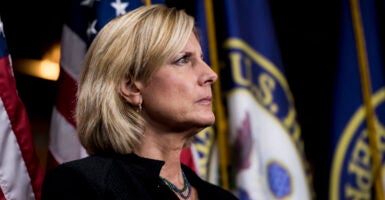
Then-Rep. Claudia Tenney, R-N.Y., answers reporters’ questions on Sept. 6, 2018. She was narrowly defeated for reelection later that year, but is leading in her 2020 rematch, which is still undecided. (Photo: Bill Clark/CQ Roll Call/Getty)

The only remaining congressional race still not certified will have to wait until at least Jan. 27—and even after that, legal appeals will likely ensue.

Republican Claudia Tenney currently leads Democrat Anthony Brindisi by 29 votes in the race in New York’s 22nd Congressional District.

But late Wednesday, a state judge ordered the Oneida County Board of Elections to review more than 1,000 provisional ballots. Of those, about 300 are likely to be counted, Tenney said.

Some 311,695 votes were cast and counted so far. Tenney said Thursday that her campaign expected to “maintain our lead” even with the new count.

The Left has declared war on our culture, but we should never back down, nor compromise our principles. Learn more now >>

“It certainly underscores that there is a problem with elections and the fact that we are not able to come up with a certified winner. We are closing in on February of the following year—and in about a month, we start circulating petitions for [the 2022] primary season in New York,” Tenney told The Daily Signal.

The November contest was a rematch from 2018, when Brindisi won a close race over then-freshman incumbent Tenney in a strong year for Democrats. Brindisi’s first term expired, so the seat is vacant until the election is certified.

As for when the race finally wraps up, said Tenney: “Who knows?”

“There is an appeals process. I’m certain that will probably happen. It’s unfortunate that people in New York’s 22nd District, they do not have a voice in Washington or a representative right now,” she said.

Brindisi’s campaign did not respond to email and phone inquiries for this report.

Earlier this month, Brindisi announced he would be running again for the seat in 2022, regardless of this year’s outcome.

“I am hopeful that I will be certified the winner in this race for New York’s 22nd District,” Brindisi said in a statement after filing with the Federal Election Commission. “And I will get right back to fighting for bipartisan solutions, making Congress work for working families, and standing up to anyone on behalf of this district.

“Serving this community is the honor of a lifetime. I look forward to being reelected and stand ready to continue to serve this community for years to come,” he added.

Most of the problems arose from major legal changes in mail-in voting as well as from the federal “motor voter” law, Tenney said. Also, the state of New York has a more expansive version of that law.

“My case showed that we are continuing to allow votes to be counted for people who technically weren’t registered under New York law or didn’t get their ballots there, weren’t in on time,” Tenney said. “So, here we are looking at ballots from people whose registrations weren’t processed back in November, and we are going to go back and count those votes.”

She added:

Federal law says you have the right to cast a vote. But the question is, you don’t necessarily have the right to have that vote count. If you are not an eligible voter, that vote shouldn’t count. There is no process, it seems, in New York where, if a vote is cast and canvassed, if it’s not legal, how do you take it back?

In August, partly in response to a troubled process in the June primaries, New York Gov. Andrew Cuomo signed executive orders to expand absentee balloting. Cuomo also signed laws he called “sweeping” that would make it easier to vote.

Cuomo and state lawmakers did little to address some of the Empire State’s worst problems, said Hans von Spakovsky, manager of the Election Law Reform Initiative at The Heritage Foundation.

“This is a symptom of the fact that New York has one of the worst-run election systems in the country,” von Spakovsky, a former Federal Election Commission commissioner and member of the Presidential Advisory Commission on Election Integrity, told The Daily Signal. “They lack the basic security protocols, such as voter ID, and no interest in comparing voter registration lists to other states to find out who has moved out. This election just epitomizes all of those problems.”

Local election officials complained they lacked the resources to comply with the new rules. Tenney said she didn’t excuse mistakes by Oneida election officials, but framed their new burdens in the context of a business.

“If you take our optimum week and output, and say you’ve got to do five or 10 times that in the midst of a pandemic with the same people doing the same number of hours with the same equipment and the same facility, we are not going to make the goal,” Tenney said. “And even if we get close to the goal, there are going to be a lot of mistakes made. This is a lot of what happened.”

Late Wednesday, more than two and a half months after the Nov. 3 election, New York state Judge Scott DelConte ordered the Oneida County Board of Elections to review more than 1,000 ballots in the race. That was because the Oneida County Board of Elections failed to process 2,418voter registration forms.

However, many did not meet the legal deadline. So, the judge ordered the county election staff to determine how many of the 1,000 provisional ballots should be counted.

The judge didn’t give either campaign what it was looking for.

Tenney’s campaign legal team argued the court could not retroactively register the voters. Conversely, Brindisi’s lawyers argued the court should count only 69 additional votes they determined belonged to Democrats, but not more than that, according to the Syracuse Post-Standard.

“Both candidates press this Court to disregard either some, or all, of the potentially valid ballots because it is strategically advantageous for them in this election,” the judge wrote, adding, “Both of these arguments ignore the fact that this problem only exists because … the Oneida County Board of Elections failed to comply with [election law] and review its records.”

He gave the county a Jan. 27 deadline to report the results of the review.

Tenney thinks that could be favorable to her campaign.

“We think there is somewhere between 290 [and] 300 of those. Those votes, the judge is going to have recounted next week,” she said, noting the judge rejected the Democrats’ push for a selective count. “There are 140 or so Republicans in that group, along with conservatives. We feel like, in the worst-case scenario, we’re not going to lose any votes. We’ll maintain our lead.”

Have an opinion about this article? To sound off, please email letters@DailySignal.com and we will consider publishing your remarks in our regular “We Hear You” feature.

How Republicans pulled off a big upset and nearly took back the House

<img class=”i-amphtml-blurry-placeholder” src=”data:;base64,

(CNN)There seemed to be one safe bet when it came to the 2020 election results: Democrats would easily hold on to their majority in the House of Representatives. Not only that, but the conventional wisdom held that Democrats would pick up more than the 235 seats they won in the 2018 midterm elections.

While Democrats will have a majority next Congress, Republicans vastly outperformed expectations and nearly pulled off an election shocker.

As of this writing, CNN has projected that Democrats have won in 219 seats. Republicans have been projected the winners in 203 seats. There are 13 races outstanding, per CNN projections.

Of those 13, the Democratic candidates lead in a mere two of them. (One of these 13 is going to a runoff, where the Republicans are heavily favored to win.)

In other words, if every one of those 13 seats went to the party leading in them right now, Democrats would have 221 seats to the Republicans’ 214 seats in the next Congress.

Talk about a fairly close call for Democrats.

Now, Democrats may end up winning a few of the seats where they are currently trailing, but chances are they will end up at or south of 225 seats.

Compare that to what most quantitative forecasters who look at a slew of indicators predicted. Jack Kersting came the closest at 238 seats. FiveThirtyEight clocked in at 239 seats. The Economist modelpredicted that Democrats would win a median of 244 seats in their simulations.

While much attention was paid to the polling misses on the presidential level, they were more accurate by comparison. In the presidential race, the final polling averages got every state right, except for Florida and North Carolina.

Indeed, the forecasts for the presidential race were considerably better than for the House races. The race raters at the Crystal Ball, for example, got every state but North Carolina correct on the presidential level.

Any sort of shy Trump vote was far smaller than a potential shy House Republican vote.

Of course, the value of quantitative forecasts is that they don’t just provide one number. They provide the probability of different outcomes occurring.

In that regard, the Republican performance is even more astounding.

The Economist said there was less than a 1-in-100 chance Democrats would have 221 seats or fewer in the next Congress. The chance they would get 225 seats or fewer was 1-in-100.

FiveThirtyEight’s forecast gave Republicans a realistic, but still fairly low shot of what seems to have happened. The chance Democrats would earn 221 seats or fewer was approximately 1-in-17, while the chance they’d have 225 seats or fewer was approximately 1-in-10.

I should note that 1-in-10 probabilities happen all the time. There’s a reason something is a 1-in-10 chance and not 0%. That said, Republicans simply did better than what folks thought.

A large part of what happened was that the national political environment was more friendly to Republicans than what polls suggested. The final average of generic congressional ballot polls had Democrats ahead by 7 points nationally. Democrats are only ahead by 2 points in the national House vote right now. That may end up closer to 3 points once the votes are all tallied.

A 4- or 5-point miss is considerable.

If Democrats had done 5 points better in every race than they currently are doing, they’d be ahead in 239 seats. That, of course, is right in line with the forecasts.

A lot of these quantitative forecasts also rely upon House ratings from groups like the Cook Political Report, Inside Elections and The Crystal Ball.

These too seemed to undersell Republican chances. Take the Cook Political Report ratings, which have historically been very good.

As of this writing, Republicans are leading in 27 of the 27 seats the Cook Political Report deemed toss-up before the election. They are ahead in all 26 of the seats that were deemed either leaning or likely Republican. Republicans are also leading in 7 of the 36 seats that were either leaning or likely to be taken by the Democrats.

That is, Republicans not only pretty much swept the tossups, but they marched into Democratic territory as well.

The Crystal Ball, which bravely has no tossups in its final rating, had Democrats net gaining 10 House seats. It will actually be the Republicans who will likely net gain 10 seats or more.

The end result of which is that Republicans are much closer to a House majority than we believed they would be after 2020 and have put themselves in a strong position heading into the 2022 midterms.

Where things stand in the House

The Democrats majority is shrinking and three dozen races have yet to be called

House Speaker Nancy Pelosi’s majority has shrunk in House, a shock to Democrats and pollsters who were projecting the California Democrat would expand her caucus after Tuesday’s election.

Democrats were optimistic they could flip roughly 10 seats but their expansion efforts came up short, especially in Texas, and they ended up losing seats in Flordia, Oklahoma, Minnesota and elsewhere.

DEM CAUCUS ERUPTS AS MEMBERS SAY PARTY’S LEFTWARD DRIFT HURT MODERATES IN ELECTION

As of 3 p.m. on Friday, Democrats had won 212 seats compared to Republicans’ 194. Another 29 races have yet to be called. Democrats had a net loss of four seats.

Outstanding races are in New York, California, Pennsylvania, Illinois, Utah, Arizona, and elsewhere. When all those votes are counted, Republicans are optimistic their numbers could swell to 208 and beyond, according to the National Republican Congressional Committee.

What’s known is that Republicans have flipped at least seven seats from blue to red and an eighth seat in Michigan that was most recently occupied by a Libertarian. Here’s a snapshot of the GOP victories:

GOP gains in the House

–In Florida, Republican candidate Carlos Gimenez defeated freshman Democratic Rep. Debbie Mucarsel-Powell in the 26th district. Republican Maria Elvira Salazar defeated freshman Democratic Rep. Donna Shalala in the 27th district.

–In Oklahoma, Republican Stephanie Bice unseated freshman Democratic Rep. Kendra Horn. Horn flipped the seat from red to blue last cycle.

— In South Carolina, freshman congressman Democrat Joe Cunningham was projected to lose his reelection to state GOP Rep. Nancy Mace, flipping South Carolina’s 1st District back to red.

— In Minnesota, Republican Michelle Fischbach ousted longtime Democratic Rep. Collin Peterson, toppling the powerful chairman of the House Agriculture Committee in the most pro-Trump district held by a Democrat.

— In New Mexico, Republican Yvette Herrell defeated freshman Rep. Xochitl Torres Small, a freshman Democrat who flipped the 2nd Congressional seat from red to blue in 2018.

— In Iowa’s First Congressional District, Republican state representative and former TV news anchor Ashley Hinson defeated Democratic incumbent Abby Finkenauer.

– In West Michigan, Republican Peter Meijer, an Iraq war veteran whose grandfather started Meijer superstores, defeated Democrat Hillary Scholten, a former Department of Justice and nonprofit lawyer. The Third Congressional District was open after Rep. Justin Amash, a Republican-turned-Libertarian, did not seek reelection.

CLICK HERE TO VIEW HOUSE RESULTS

Republicans say more victories are on the horizon

.

Party officials are most optimistic about reclaiming two seats in New York that Democrats flipped in 2018. Votes are still being counted but Republican Nicole Malliotakis has a notable lead over freshman Rep. Max Rose in the Staten Island-Brooklyn district. And former GOP Rep. Claudia Tenney was also ahead in the 22nd District seat she lost two years ago to Rep. Anthony Brindisi.

Democrats have gained two open seats in North Carolina thanks to redrawn congressional maps that favored them and will welcome Deborah Ross and Kathy Manning to their caucus in January.

And Democrats flipped Georgia’s 7th Congressional District held by retiring Rep. Rob Woodall, R-Ga. Democrat Carolyn Bourdeaux beat GOP candidate Rich McCormick in the suburban Atlanta district, the Associated Press called on Friday.

That means Democrats so far have a net loss of four seats in the House.

WHERE THINGS STAND: BATTLE FOR THE SENATE

Democrats think they can hold onto many close races that have not been called and have two other possible pick-up opportunities by defeating Rep. Jeff Van Drew in New Jersey and Rep. Mike Garcia in California.

On a call Thursday afternoon with Democratic House members, Rep. Cheri Bustos, head of the Democratic Congressional Campaign Committee (DCCC), expressed frustration with the polling and election forecasts that all pointed to House Democrats expanding their majority.

“I’m furious,” Bustos told her colleagues, according to a source familiar with the call. “Something went wrong here across the entire political world. Our polls, Senate polls, Gov polls, presidential polls, Republican polls, public polls, turnout modeling, and prognosticators all pointed to one political environment – that environment never materialized.”

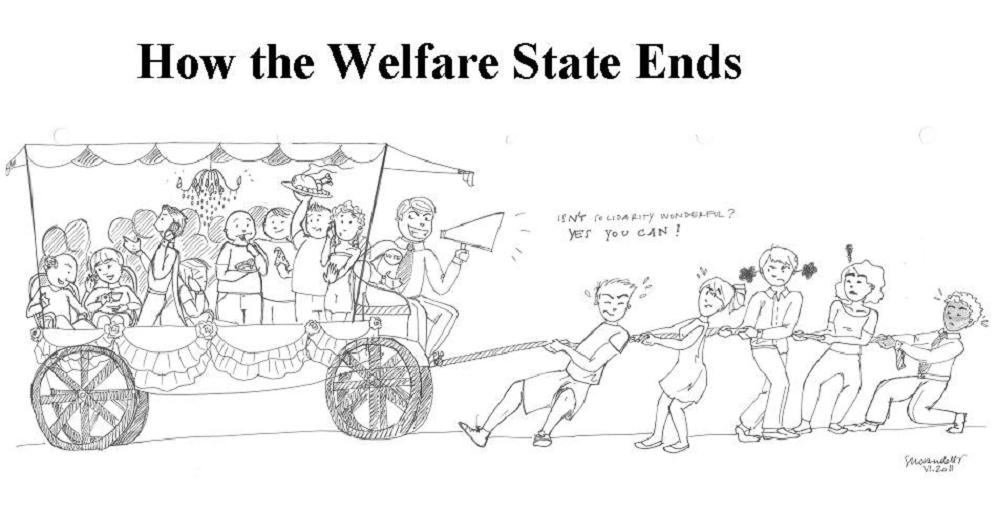
I have written about the tremendous increase in the food stamp program the last 9 years before and that means that both President Obama and Bush were guilty of not trying to slow down it’s growth. Furthermore, Republicans have been some of the biggest supporters of the food stamp program. Milton Friedman had a good solution to help end the welfare state and wish more people would pay attention to it.   Growing government also encourages waste and hurt growth but more importantly it causes people to become dependent on the government as this article and cartoon below show.

My great fear is that the “social capital” of self reliance in America will slowly disappear and that the United States will turn into a European-style welfare state.

That’s the message in the famous “riding in the wagon” cartoons that went viral and became the most-viewed post on this blog.

Well, this Glenn McCoy cartoon has a similar theme.

Obama Voter Cartoon

The only thing I would change is that the rat would become a “pro-government voter” or “left-wing voter” instead of an “Obama voter.” Just like I wasn’t satisfied with an otherwise very good Chuck Asay cartoon showing the struggle between producers and moochers.

That’s for two reasons. First, I’m not partisan. My goal is to spread a message of liberty, not encourage people to vote for or against any candidate.

Second, I’ve been very critical of Obama, but I was also very critical of Bush. Indeed, Bush was a bigger spender than Obama! And Clinton was quite good, so party labels often don’t matter.

But I’m getting wonky. Enjoy the cartoon and feel free to share it widely.

Eight Reasons Why Big Government Hurts Economic Growth

Uploaded on Aug 17, 2009

This Center for Freedom and Prosperity Foundation video analyzes how excessive government spending undermines economic performance. While acknowledging that a very modest level of government spending on things such as “public goods” can facilitate growth, the video outlines eight different ways that that big government hinders prosperity. This video focuses on theory and will be augmented by a second video looking at the empirical evidence favoring smaller government.

Related posts:

If increase in food stamps was just because of recession then why spending go from $19.8 billion in 2000 to $37.9 billion in 2007?

If the increase in food stamps was just because of the recession then why did the spending go from $19.8 billion in 2000 to $37.9 billion in 2007? The Facts about Food Stamps Everyone Should Hear Rachel Sheffield and T. Elliot Gaiser May 27, 2013 at 12:00 pm (7) Newscom A recent US News & […]

Tell the 48 million food stamps users to eat more broccoli!!!!

Welfare Can And Must Be Reformed             Uploaded on Jun 29, 2010 If America does not get welfare reform under control, it will bankrupt America. But the Heritage Foundation’s Robert Rector has a five-step plan to reform welfare while protecting our most vulnerable. __________________________ We got to slow down the growth of Food Stamps. One […]

Republicans for more food stamps?

Eight Reasons Why Big Government Hurts Economic Growth __________________ We got to cut spending and we must first start with food stamp program and we need some Senators that are willing to make the tough cuts. Food Stamp Republicans Posted by Chris Edwards Newt Gingrich had fun calling President Obama the “food stamp president,” but […]

Obama promotes food stamps but Milton Friedman had a better suggestion

Milton Friedman’s negative income tax explained by Friedman in 1968: We need to cut back on the Food Stamp program and not try to increase it. What really upsets me is that when the government gets involved in welfare there is a welfare trap created for those who become dependent on the program. Once they […]

400% increase in food stamps since 2000

Welfare Can And Must Be Reformed Uploaded by HeritageFoundation on Jun 29, 2010 If America does not get welfare reform under control, it will bankrupt America. But the Heritage Foundation’s Robert Rector has a five-step plan to reform welfare while protecting our most vulnerable. __________________________ If welfare increases as much as it has in the […]

Food stamp spending has doubled under the Obama Administration

The sad fact is that Food stamp spending has doubled under the Obama Administration. A Bumper Crop of Food Stamps Amy Payne May 21, 2013 at 7:01 am Tweet this Where do food stamps come from? They come from taxpayers—certainly not from family farms. Yet the “farm” bill, a recurring subsidy-fest in Congress, is actually […]

Which states are the leaders in food stamp consumption?

I am glad that my state of Arkansas is not the leader in food stamps!!! Mirror, Mirror, on the Wall, Which State Has the Highest Food Stamp Usage of All? March 19, 2013 by Dan Mitchell The food stamp program seems to be a breeding ground of waste, fraud, and abuse. Some of the horror stories […]

Why not cancel the foodstamp program and let the churches step in?

Government Must Cut Spending Uploaded by HeritageFoundation on Dec 2, 2010 The government can cut roughly $343 billion from the federal budget and they can do so immediately. __________ We are becoming a country filled with people that dependent on the federal government when we should be growing our economy by lowering taxes and putting […]

Food Stamp Program is constantly ripped off and should be discontinued

Uploaded by oversightandreform on Mar 6, 2012 Learn More at http://oversight.house.gov The Oversight Committee is examining reports of food stamp merchants previously disqualified who continue to defraud the program. According to a Scripps Howard News Service report, food stamp fraud costs taxpayers hundreds of millions every year. Watch the Oversight hearing live tomorrow at 930 […]
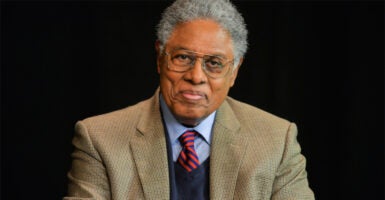
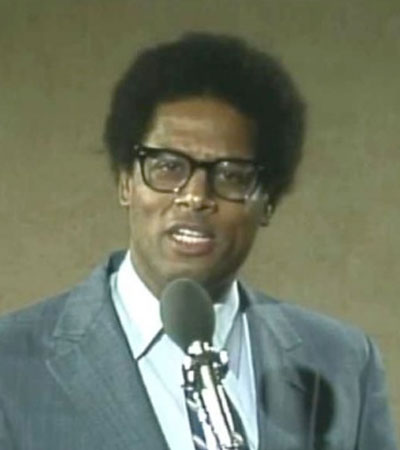
 

A New Look at Thomas Sowell, ‘Great Black Intellectual’ Ignored by Left

The new documentary “Thomas Sowell: Common Sense in a Senseless World” tells the story of Sowell’s life and how his penetrating intellect has influenced society. (Photo: Rod Searcy)

Thomas Sowell is considered by many to be one of the most influential and brilliant minds of the past half-century. He is most famous for his work as an economist, but is also a bestselling author, syndicated columnist, historian, and academic.

Yet he hasn’t received much recognition. “When people talk about the great black intellectuals today, you hear names like Henry Louis Gates at Harvard or Cornel West … or today you hear Ta-Nehisi Coates and Ibram X. Kendi,” says Jason Riley, a journalist, scholar, and member of The Wall Street Journal’s editorial board.

“But in my view, Tom has written circles around those guys and is much broader in subjects that he’s covered as well as much deeper and his analysis is much more rigorous than those guys’,” Riley says.

A new documentary, “Thomas Sowell: Common Sense in a Senseless World,” tells the story of Sowell’s life and how his logic and intellect have impacted society.

The Left has declared war on our culture, but we should never back down, nor compromise our principles. Learn more now >>

Riley, who narrates the film, joins the show to discuss the documentary and the personal impact Sowell has had on his own life.

https://youtu.be/WFxtJNK0HH8

—-

You can watch the full-length documentary hereor by visiting SowellFilm.com.

Plus, John Cooper, associate director of institute communications at The Heritage Foundation and a big football fan, joins us to talk about what we can expect to see during Super Bowl LV this weekend.

We also cover these stories:

  • Democrats urge President Joe Biden to cancel up to $50,000 in debt for student loan borrowers.
  • Biden addresses the National Prayer Breakfast.
  • Former Vice President Mike Pence is joining The Heritage Foundation as a distinguished fellow.

Listen to the podcast below or read the lightly edited transcript.

The Daily Signal Podcast” is available on Ricochet, Apple PodcastsPippaGoogle Play, and Stitcher. All of our podcasts can be found at DailySignal.com/podcasts. If you like what you hear, please leave a review. You also can write to us at letters@dailysignal.com.

Virginia Allen: Many consider Thomas Sowell to be one of the greatest minds of our day. Sowell is most well-known for his groundbreaking work as an economist, but is also a bestselling author, a photographer, syndicated columnist, historian, and academic. He is a man in pursuit of truth, and when he finds it, he stands by it, even when that truth may not be popular.

Free To Choose Media has just produced a one-hour documentary on the life and work of Thomas Sowell. The film is called “Thomas Sowell: Common Sense in a Senseless World.” …

“Thomas Sowell, one of the greatest minds of the past half-century,” says Jason Riley. And Mr. Riley, who narrated the film, is here with us today to discuss the documentary. Mr. Riley, welcome to the show.

Jason Riley: Thank you for having me.

Allen: You narrated this one-hour documentary on Thomas Sowell. I watched it last week and was just completely captivated by the film. I’ve known a little bit about Thomas Sowell, but I learned so much watching this documentary.

What you’ve really done here in this film is essentially take viewers through the life of Thomas Sowell and really show the impact that he has had on people and across so many areas of our world.

So I want to begin by asking you just to share a little bit of your own personal story of how Thomas Sowell—his writings, his rhetoric, his logic, and his honesty—has really impacted you personally.

Riley: Well, I discovered Tom Sowell in college in the early 1990s. I was working on the school paper and having a conversation with my fellow students about affirmative action one day and someone piped in and said, “Jason, you sound like Tom Sowell.” And I said, “Tom, who?”

And the person wrote down the name of a book on a piece of paper and I went to the school library that evening and checked it out and read it in one sitting that evening and went back to school the next morning and checked out everything else they had by Tom Sowell and was pretty much hooked on him by then.

While I was working at The Wall Street Journal on the editorial board in the mid-’90s is when I first got to meet Tom Sowell.

He was at the Hoover Institution at Stanford University then, still is, and he would travel through New York on book tours and meet with various editorial boards. So that’s when I first got to meet him.

I later went out to Stanford to write a profile of him for the newspaper, that would have been in the mid-2000s. And that’s when we sort of struck up a friendship that has sort of endured since then.

Allen: So when you learned, “OK, there’s this film project,” I mean, yourself being a journalist, a scholar, a member of The Wall Street Journal editorial board, what made you say, “This is a film project that is something that I have to be a part of”?

Riley: Well, they came to me, the Free To Choose folks came to me. I had been working on a biography of Sowell—that’ll be out in May—and when they found out that I was working on this biography, they approached me and said, “We want to do a film, a documentary about Tom’s life. Would you care to narrate it?” And I did not hesitate.

Allen: Share a little bit about your book that’s coming out. And what did give you kind of that passion and drive to say, “You know what? I appreciate his work so much that I am going to take on this challenge and not only be a part of this film, but also write this book”?

Riley: Sure. Well, the book is titled “Maverick: A Biography of Thomas Sowell.” It’s available for pre-order on Amazon now. It will be out on May 25.

And it is the first ever biography of Tom. He has no other biographer. He’s written a memoir himself and he’s written about his personal life in his many columns over the years, but this was the first a biography of Tom.

It’s primarily an intellectual biography. I don’t focus much on his personal life, although there is a bit of that in there, but I do focus on his ideas, the scholarship, how he’s distinguished himself as an intellectual over the past half-century and sort of what his legacy will be, how he’ll be remembered.

I was sort of trying to get him to cooperate with the biography. He’s a very private person for a while, for more than a decade, actually, and I think he’s 90 years old now, so maybe I just wore him down. But he did cooperate, he sat for a bunch of long interviews for the book.

I also interviewed a bunch of colleagues of his, acquaintances, and people who are familiar with his work over the years. So it was a lot of fun. It was a lot of fun to write.

He’s meant a lot to me in terms of my own intellectual development over the decades. And so I wanted to introduce him and his work to a new generation. And I don’t think that Tom has gotten the exposure that he sort of deserves.

When people talk about the great black intellectuals today, you hear names like Henry Louis Gates at Harvard or Cornel West and people like that, or today you hear Ta-Nehisi Coates and Ibram X. Kendi. But in my view, Tom has written circles around those guys and is much broader in subjects that he’s covered as well as much deeper and his analysis is much more rigorous than those guys.

I don’t think that Thomas would have gotten the attention and the exposure he deserves. So I’m hoping the film will wet people’s appetite and get them to pick up some books by Tom, as well as the biography I hope does the same thing, gets more people interested in Tom and his scholarship.

Allen: You mentioned Thomas Sowell’s legacy, and I think that the film does a great job of really explaining what that legacy is, and I’m sure your book does the same, but could you just give us a little bit of a teaser of, in your opinion, what is the legacy that Thomas Sowell has already left and will leave?

Riley: I think in a number of areas he’s really made his mark.

Very broadly speaking though, he’s made his mark as a sort of honest intellectual, someone who is much more interested in being right than in being popular, and following the facts where they lead and reporting his findings, even if they happen to be politically incorrect.

And he feels that is the real duty of a scholar, to follow the facts and not fall for trendy thinking or fashionable thinking. … This isn’t a popularity contest. That’s not what true scholarship calls for. So I think that is one of his legacies.

Another is … I think he modeled himself after Milton Friedman, one of his mentors at the University of Chicago, where he earned his Ph.D. in the early 1960s.

Friedman was someone who felt that intellectuals shouldn’t spend all their time simply talking to one another, that they should seek a wider audience and speak to non-experts, explain themselves and their work to the general public.

And after Friedman left teaching in the 1970s, that’s what he did. In fact, one of the things he did was a television program that was produced by the same company that produced this one, the Free To Choose Network. And that was Friedman’s way of speaking to the general public about economics.

So when Sowell left teaching in the 1970s, I think he set about a type of public intellectualism that was very similar to Friedman’s. He wrote his popular column for general interest readers. Most of Tom’s books are written for non-academics and he takes great pride in explaining economics and these ideas to non-experts.

He’s most known for his writings on race, but his bestselling book is “Basic Economics,” which is essentially an economics textbook without any graphs or equations in it. And I think Tom, although he left the campus teaching, he still sort of continued to teach through these books and columns over the decades.

Allen: One of the things that I was most fascinated to learn about in the film is that Thomas Sowell, he actually used to be a Marxist. But what really cured him, he says of that, was working for the government, when he realized these Marxist ideas, they would never actually work.

Could you just share a little bit about Thomas Sowell’s journey out of Marxism, because I really find that so fascinating?

Riley: Yes. Well, it’s not that uncommon. If you look at a lot of leading conservatives in the 20th century, many of them started on the left.

Milton Friedman started on the left. George Stigler started on the left. Walter Williams, the late Walter Williams, who passed away last year and was a friend of Tom’s for more than 50 years, started out on the left. Clarence Thomas started out on the left. So it’s not that uncommon.

But yes, Tom was a Marxist through his 20s. And then it was working in the government and seeing how some of these ideas he had about how the capitalist system works, seeing that in practice and seeing incentives in place and the intentions of some of these policies versus the actual results, that all had an effect on Tom changing his mind about free markets and their power in shaping people’s lives for the better.

So that’s what it was, it was real-life experience and just less reliance on theories and what’s supposed to happen and paying more attention to what actually comes to pass.

Allen: You did interview Walter Williams for the documentary, which, as you mentioned, Mr. Williams did pass away this past December. So it really is a treasure to have these recorded conversations of him sharing about the work of Thomas Sowell, his relationship with Thomas Sowell.

But one of the things that Walter Williams said is that the media really, they stopped covering Thomas Sowell a long time ago because they knew that they couldn’t debate him. And this is just a sad commentary, in my mind, on really the state of our media.

Why do you think the media has chosen to so often ignore Sowell’s work?

Riley: Well, I think they’ve taken the side of the black left, broadly speaking, and the black left has ignored Tom for a long time. And the media continues to run to black intellectuals, academics, civil rights organizations, and so forth to speak on behalf of black people.

They tell the media, “Don’t pay attention to Tom. Anyone who thinks like that or says those things is a sellout or an Uncle Tom or someone who should not be taken seriously. They’re simply doing the bidding of white people.”

So they’ve responded with these sort of ad hominem attacks on Tom and the media has largely bought that argument.

And the types of people that give out economics awards and those types of things are controlled by the left, generally. And so that has worked against Tom and his exposure over the decades—one of the things I’m hoping that the book and the film will help correct.

Allen: One of the things that I was also really fascinated [by] in the film was just how far-reaching Thomas Sowell’s work really is. That despite the media not giving him the attention that he so deserves, he has impacted so many individuals in so many different areas of our world.

You all interviewed a rap musician for the film who says that Thomas Sowell has inspired many of his lyrics. What did you learn in those conversations with individuals who have been so impacted by Thomas Sowell’s work?

Riley: Well, a lot of them speak about the clarity of his writing. He breaks things down in a way that’s very understandable and digestible and witty and people admire that.

Tom, in the early part of his career, did write more academic books speaking to his peers in the academy, but he could also write for a wider audience.

And editors at newspapers love this because they had this serious rigorous thinker who could write 800-word pieces on the topics of the day for their general interest readers to understand.

So they were getting the depth, this depth of knowledge, in sort of more easily digestible bites. And they really appreciated that and fans of Sowell all seemed to come back to the clarity of his writing and his thinking, how he puts things. He’s a wonderful storyteller.

Also, one of the things he’s known for is his international perspectives. And so he likes to talk about trends, not only within the United States, but in other countries, and what’s going on over there.

I think … sometimes in America, you have people who live in a bit of a bubble, an American bubble, a U.S. bubble. And Tom says, “A lot of these policies that are being pushed here have been tried in other places at other times, and here’s what’s happened over there. And we should keep that in mind when we think about how those policies might affect life here in this country.”

So those international perspectives, which is something he specialized in in many of his books, is something people also appreciate.

Allen: Making a documentary is no small undertaking. It’s a complicated process. A lot of time, a lot of work. What, for you, was the greatest challenge of working so closely with the team of individuals who were producing this film?

Riley: I just wanted to make sure we were doing justice to Sowell. I really see him as this towering intellectual figure. I’m a journalist by training. I’m not an intellectual, I’m not an academic. I spent a life as a print journalist, basically. And I really wanted to make sure both in the book and in the documentary that we were just doing him justice.

I said before that no one else has written a biography of Tom, but I hope someone else does come along, a real scholar comes along, someone who can really grapple with Tom’s ideas at his level and lay them out for people. I hope someone comes and does that.

I hope my book can be a little placeholder until that comes along and do what I intended it to do, which is, again, wet people’s appetite about Tom.

But that’s my biggest concern. I just want to do him justice because I think he is one of the great social theorists of the 20th century of any color and his writings on political philosophy, his writings on social theory, his writings on education and law and history and culture, they are quite broad. And I think that Tom is someone people will be reading for generations to come.

Allen: I know that you said that Thomas Sowell is quite a private man, but you did have the privilege of speaking with him a little bit throughout the course of making the film. Do you know if he has seen the documentary yet and what his thoughts are on it?

Riley: I don’t know. I haven’t had any contact with Tom since it’s been out so I don’t know if he’s seen it yet. He is at Hoover, the Hoover Institution at Stanford, and I know that Hoover’s aware of the film, so perhaps they’ve reached out to him. But no, I can’t say for certain whether he’s seen it.

Allen: Well, I have no doubt that he’ll feel incredibly honored by it. It really is a beautiful documentary and so informative. Would you just tell our listeners both where they can find and watch the documentary, and then also again, share with us when and where your book will be out?

Riley: Sure. The documentary information can be found at SowellFilm.com. … And it was made for public television so there you can find where it will appear on your local public television station. In addition to that, it’s being streamed on Vimeo and Amazon and YouTube, and you can find links to stream it as well at SowellFilm.com.

In terms of my book, again, it’ll be out in May, May 25 to be exact, and it can be pre-ordered on Amazon right now.

Allen: Great. We will be sure to leave links for both the documentary and to pre-order your book in the show notes today. Mr. Riley, thank you so much for your time.

Riley: Thank you.

Thomas Sowell: Common Sense in a Senseless World – Full Video

Explore Economist Thomas Sowell’s Remarkable Life In New Documentary

Despite writing more than 50 books on economics, race, and history, there’s a good chance Thomas Sowell is the national treasure you’ve never heard of.

The past ten months have proved we live in a senseless world. There are large groups of people on both sides of the aisle who have no regard for reality, or what were once considered the normal and expected rules of polite society. One man, however, has never been swayed by the prevailing winds of the political moment over his illustrious 50-year career, keeping himself grounded in empiricism, fact, and logic: economist Thomas Sowell.

While he has published more than 50 books on subjects such as economics, race, and history, there is still a good chance that Sowell is the national treasure you’ve never heard of. The recently released documentary, “Thomas Sowell: Common Sense in a Senseless World,” successfully introduces Sowell both to those who’ve never heard of him and dives deep into the lesser-known aspects of his life for those who are already avid fans.

Narrated by Wall Street Journal columnist Jason Riley, the documentary takes the audience through Sowell’s life from his birth in North Carolina to his time as a senior fellow at the Hoover Institution, where he still works today. For the most underappreciated public intellectual of our time, this film is a well-deserved tribute to a magnificent career.

Sowell and Education

“Thomas Sowell: Common Sense in a Senseless World” appropriately begins with Sowell’s childhood. He was born in Gastonia, North Carolina, in 1930, and both of his parents died by the time he was only a few years old. He was adopted by his great aunt and raised by her, as well as her two adult daughters. When Sowell was eight, they moved to Harlem to gain access to greater opportunities than were available in the Jim Crow South.

While none of the women who raised Sowell ever graduated high school, he says they were “interested in education and they were interested in me.” He did not grow up with any semblance of material wealth — his family did not have a telephone in the house until he was well into his teen years, and they never had a television — but Sowell did grow up with the cultural value of education: something that was able to eventually propel him to great heights.

Education has long been a road to success in America. It is for this reason the two highest-earning religious groups in America — Hindus and Jews — also happen to have the most education out of all religious groups. Today, the tragic reality is that, for many low-income students, the chance to acquire a quality education is significantly diminished by the conditions of the failing public schools they are required to attend.

Having benefited from the option to transfer to a better school when he was young, Sowell now advocates the same policy for the disadvantaged families of today. While Sowell has been writing about education for decades, arguably his deepest dive into the subject came just last year when he wrote “Charter Schools and Their Enemies,” a book that deserves to be remembered as one of his finest works.

The film spends a commendable amount of time emphasizing the role and importance of education, as well as introducing the audience to the various alternatives to the traditional public school monopoly, such as charter schools.

Eva Moskowitz, founder of Success Academy Charter School, correctly points out that the benefits of school choice are concentrated within the most vulnerable communities, despite the fact people with Sowell’s political persuasion are so often maligned as “uncaring” and “unempathetic” towards those who are disadvantaged. By correctly framing the issue in a way that highlights the communities the policy is helping, it allows conservatives and libertarians to begin reclaiming the moral high ground.

Sowell’s Intellectual Influences

Sowell was drafted into the military in 1951. Afterward, he attended Howard University as an undergraduate, then transferred to Harvard University, where he procured a degree in economics. He earned his master’s at the University of Columbia, then went on to the University of Chicago for his Ph.D.

During his college years, Sowell was a Marxist, and he remained so even after taking a class taught by Milton Friedman. Yet all it took was one summer interning in the federal government for him to be exposed to government’s inefficiencies and perverse incentives.

In detailing Sowell’s journey from Marxism to capitalism, the film strikes a chord with those paying attention to the current condition of higher education. Many college students today have a similar disposition to Sowell when he was in college. They believe capitalism has proved to be corrupt at its core, as evidenced by things like climate change, increasing income inequality, and decreasing income mobility.

While people can debate about the merits of these various concerns for hours on end, the real thing these students miss is the efficacy (or lack thereof) of government control of the economy. Sowell’s personal experience in the government opened his eyes to the truth about capitalism, but that should leave all of us wondering what the wake-up call to many in my generation will be.

Sowell credits the Chicago School of Economics with teaching him the importance of gathering hard data. That lesson has stuck with him throughout the years, as his data gathering and usage remains one of his strong suits. Although empiricism and objective truth have largely been replaced by intuition among today’s college students, Sowell never argues based on feelings, but backs up his assertions with facts — and a lot of them at that.

Sowell Today

In 1980, Sowell became a fellow at the Hoover Institution at Stanford University, where they essentially offered to “pay him to be Tom Sowell” by allowing him to choose what and when he writes. Riley explains, “thousands of students would miss out on having Professor Sowell as a teacher, but millions of intellectually curious readers would benefit from Thomas Sowell’s work here [at the Hoover Institution].”

Among the best aspects of “Thomas Sowell: Common Sense in a Senseless World” is the extent it explains Sowell’s enduring popularity. Arguably the key reason Sowell is so beloved is that he fearlessly makes his argument no matter the fashionable sentiment at the time. Whether it be on the perverse incentives attached to the welfare state, his critique of the idea that every disparity signals discrimination, or the idea of human capital as the chief necessity for group advancement, Sowell takes on the intellectual establishment.

At a time people are increasingly afraid to speak their minds for fear of being “canceled,” Sowell is a refreshing presence — a presence that lets people know that there are other people who approach the questions of the day with simple common sense. As Riley describes him, “[Sowell is] that rarest of species: an honest intellectual. He spent a career putting truth over popularity. He’s explored the answers to questions others were afraid to even ask.”

Bringing Sowell to the Next Generation

One would not be blamed for believing that a 90-year-old economist would not be particularly popular among a younger audience. Yet, make no mistake, Sowell’s work has proved to be timeless, and he’s gaining a large following among the next generation. On Instagram, the unofficial Thomas Sowell account has more than 150,000 followers, while on Twitter, Sowell’s followers number more than 650,000, and his reach continues to grow.

A documentary such as “Thomas Sowell: Common Sense in a Senseless World helps widen that reach. Garnering more than 2.1 million views on YouTube in the first week since its release, there is no doubt that it has done its part in keeping the work of Sowell alive and in the minds of the next generation of students, thinkers, and leaders.

Without a doubt, the world has been lucky to benefit from Sowell’s insights. We can only hope that with the help of films like this, we can adequately extend those insights to those who will be next in line to influence our world.

Jack Elbaum is a freshman at George Washington University. His writing has been featured in the Wall Street Journal, Newsweek, and the Washington Examiner. You can contact him at jackelbaum16@gmail.com and follow him on Twitter @Jack_Elbaum.


Bob Chitester Discusses Milton Friedman and ‘Free to Choose’

Published on Jul 30, 2012 by

“There are very few people over the generations who have ideas that are sufficiently original to materially alter the direction of civilization. Milton is one of those very few people.”

That is how former Federal Reserve Chairman Alan Greenspan described the Nobel laureate economist Milton Friedman. But it is not for his technical work in monetary economics that Friedman is best known. Like mathematician Jacob Bronowski and astronomer Carl Sagan, Friedman had a gift for communicating complex ideas to a general audience.

It was this gift that brought him to the attention of filmmaker Bob Chitester. At Chitester’s urging, Friedman agreed to make a 10 part documentary series explaining the power of economic freedom. It was called “Free to Choose,” and became one of the most watched documentaries in history.

The series not only reached audiences in liberal democracies, but was smuggled behind the iron curtain where it played, in secret, to large audiences. Reflecting on its impact, Czech president Vaclav Klaus has said: “For us, who lived in the communist world, Milton Friedman was the greatest champion of freedom, of limited and unobtrusive government and of free markets. Because of him I became a true believer in the unrestricted market economy.”

July 31st, 2012 is the 100th anniversary of Friedman’s birth. To commemorate that occasion, we’d like to share an interview with “Free to Choose” producer Bob Chitester. Like this interview, the entire series can now be viewed on-line at no cost at http://www.freetochoose.tv/, thanks to the incredible technological progress brought about by the economic freedom that Milton Friedman celebrated.

Produced by Andrew Coulson, Caleb O. Brown, Austin Bragg, and Lou Richards, with help from the Free to Choose Network.

_____________

April 4, 2021

President Biden  c/o The White House
1600 Pennsylvania Avenue NW
Washington, DC 20500

Dear Mr. President,

We got to stop spending so much money on the federal level. It will bankrupt us. I remember back in 1980 when I really started getting into the material of Milton Friedman as a result of reading his articles in Newsweek and reading his book “Free to Choose,” I really did get facts and figures to back on the view that we need more freedom giving back to us and the government needs to spend less.

As a result of Friedman’s writings I was able to discuss these issues with my fellow students at the university and by the time the 1980 election came around I had been attending political rallies and went out and worked hard for Ronald Reagan’s election. In this article below Dr. Thomas Sowell (who was featured twice in the film “Free to Choose”) notes how much influence Milton Friedman had on the election outcome in 1980:

Milton Friedman at 90

by Thomas Sowell

Thomas Sowell is a senior fellow at the Hoover Institute in Stanford, California.

Added to cato.org on July 25, 2002

This article originally appeared on TownHall.com, July 25, 2002.

Milton Friedman’s 90th birthday on July 31st provides an occasion to think back on his role as the pre-eminent economist of the 20th century. To those of us who were privileged to be his students, he also stands out as a great teacher.

When I was a graduate student at the University of Chicago, back in 1959, one day I was waiting outside Professor Friedman’s office when another graduate student passed by. He noticed my exam paper on my lap and exclaimed: “You got a B?”

“Yes,” I said. “Is that bad?”

Thomas Sowell is a senior fellow at the Hoover Institute in Stanford, California.

“There were only two B’s in the whole class,” he replied.

“How many A’s?” I asked.

“There were no A’s!”

Today, this kind of grading might be considered to represent a “tough love” philosophy of teaching. I don’t know about love, but it was certainly tough.

Professor Friedman also did not let students arrive late at his lectures and distract the class by their entrance. Once I arrived a couple of minutes late for class and had to turn around and go back to the dormitory.

All the way back, I thought about the fact that I would be held responsible for what was said in that lecture, even though I never heard it. Thereafter, I was always in my seat when Milton Friedman walked in to give his lecture.

On a term paper, I wrote that either (a) this would happen or (b) that would happen. Professor Friedman wrote in the margin: “Or (c) your analysis is wrong.”

“Where was my analysis wrong?” I asked him.

“I didn’t say your analysis was wrong,” he replied. “I just wanted you to keep that possibility in mind.”

Perhaps the best way to summarize all this is to say that Milton Friedman is a wonderful human being — especially outside the classroom. It has been a much greater pleasure to listen to his lectures in later years, after I was no longer going to be quizzed on them, and a special pleasure to appear on a couple of television programs with him and to meet him on social occasions.

Milton Friedman’s enduring legacy will long outlast the memories of his students and extends beyond the field of economics. John Maynard Keynes was the reigning demi-god among economists when Friedman’s career began, and Friedman himself was at first a follower of Keynesian doctrines and liberal politics.

Yet no one did more to dismantle both Keynesian economics and liberal welfare-state thinking. As late as the 1950s, those with the prevailing Keynesian orthodoxy were still able to depict Milton Friedman as a fringe figure, clinging to an outmoded way of thinking. But the intellectual power of his ideas, the fortitude with which he persevered, and the ever more apparent failures of Keynesian analyses and policies, began to change all that, even before Professor Friedman was awarded the Nobel Prize in economics in 1976.

A towering intellect seldom goes together with practical wisdom, or perhaps even common sense. However, Milton Friedman not only excelled in the scholarly journals but also on the television screen, presenting the basics of economics in a way that the general public could understand.

His mini-series “Free to Choose” was a classic that made economic principles clear to all with living examples. His good nature and good humor also came through in a way that attracted and held an audience.

Although Friedrich Hayek launched the first major challenge to the prevailing thinking behind the welfare state and socialism with his 1944 book “The Road to Serfdom,” Milton Friedman became the dominant intellectual force among those who turned back the leftward tide in what had seemed to be the wave of the future.

Without Milton Friedman’s role in changing the minds of so many Americans, it is hard to imagine how Ronald Reagan could have been elected president.

Nor was Friedman’s influence confined to the United States. His ideas reached around the world, not only among economists, but also in political circles which began to understand why left-wing ideas that sounded so good produced results that were so bad.

Milton Friedman rates a 21-gun salute on his birthday. Or perhaps a 90-gun salute would be more appropriate.

________

Thank you so much for your time. I know how valuable it is. I also appreciate the fine family that you have and your commitment as a father and a husband.

Sincerely,

Everette Hatcher III, 13900 Cottontail Lane, Alexander, AR 72002, ph 501-920-5733

Williams with Sowell – Minimum Wage

Thomas Sowell

Thomas Sowell – Reducing Black Unemployment

By WALTER WILLIAMS

—-

Ronald Reagan with Milton Friedman
Milton Friedman The Power of the Market 2-5

Explore Economist Thomas Sowell’s Remarkable Life In New Documentary

Thomas Sowell: Common Sense in a Senseless World – Full Video

Explore Economist Thomas Sowell’s Remarkable Life In New Documentary

Despite writing more than 50 books on economics, race, and history, there’s a good chance Thomas Sowell is the national treasure you’ve never heard of.

The past ten months have proved we live in a senseless world. There are large groups of people on both sides of the aisle who have no regard for reality, or what were once considered the normal and expected rules of polite society. One man, however, has never been swayed by the prevailing winds of the political moment over his illustrious 50-year career, keeping himself grounded in empiricism, fact, and logic: economist Thomas Sowell.

While he has published more than 50 books on subjects such as economics, race, and history, there is still a good chance that Sowell is the national treasure you’ve never heard of. The recently released documentary, “Thomas Sowell: Common Sense in a Senseless World,” successfully introduces Sowell both to those who’ve never heard of him and dives deep into the lesser-known aspects of his life for those who are already avid fans.

Narrated by Wall Street Journal columnist Jason Riley, the documentary takes the audience through Sowell’s life from his birth in North Carolina to his time as a senior fellow at the Hoover Institution, where he still works today. For the most underappreciated public intellectual of our time, this film is a well-deserved tribute to a magnificent career.

Sowell and Education

“Thomas Sowell: Common Sense in a Senseless World” appropriately begins with Sowell’s childhood. He was born in Gastonia, North Carolina, in 1930, and both of his parents died by the time he was only a few years old. He was adopted by his great aunt and raised by her, as well as her two adult daughters. When Sowell was eight, they moved to Harlem to gain access to greater opportunities than were available in the Jim Crow South.

While none of the women who raised Sowell ever graduated high school, he says they were “interested in education and they were interested in me.” He did not grow up with any semblance of material wealth — his family did not have a telephone in the house until he was well into his teen years, and they never had a television — but Sowell did grow up with the cultural value of education: something that was able to eventually propel him to great heights.

Education has long been a road to success in America. It is for this reason the two highest-earning religious groups in America — Hindus and Jews — also happen to have the most education out of all religious groups. Today, the tragic reality is that, for many low-income students, the chance to acquire a quality education is significantly diminished by the conditions of the failing public schools they are required to attend.

Having benefited from the option to transfer to a better school when he was young, Sowell now advocates the same policy for the disadvantaged families of today. While Sowell has been writing about education for decades, arguably his deepest dive into the subject came just last year when he wrote “Charter Schools and Their Enemies,” a book that deserves to be remembered as one of his finest works.

The film spends a commendable amount of time emphasizing the role and importance of education, as well as introducing the audience to the various alternatives to the traditional public school monopoly, such as charter schools.

Eva Moskowitz, founder of Success Academy Charter School, correctly points out that the benefits of school choice are concentrated within the most vulnerable communities, despite the fact people with Sowell’s political persuasion are so often maligned as “uncaring” and “unempathetic” towards those who are disadvantaged. By correctly framing the issue in a way that highlights the communities the policy is helping, it allows conservatives and libertarians to begin reclaiming the moral high ground.

Sowell’s Intellectual Influences

Sowell was drafted into the military in 1951. Afterward, he attended Howard University as an undergraduate, then transferred to Harvard University, where he procured a degree in economics. He earned his master’s at the University of Columbia, then went on to the University of Chicago for his Ph.D.

During his college years, Sowell was a Marxist, and he remained so even after taking a class taught by Milton Friedman. Yet all it took was one summer interning in the federal government for him to be exposed to government’s inefficiencies and perverse incentives.

In detailing Sowell’s journey from Marxism to capitalism, the film strikes a chord with those paying attention to the current condition of higher education. Many college students today have a similar disposition to Sowell when he was in college. They believe capitalism has proved to be corrupt at its core, as evidenced by things like climate change, increasing income inequality, and decreasing income mobility.

While people can debate about the merits of these various concerns for hours on end, the real thing these students miss is the efficacy (or lack thereof) of government control of the economy. Sowell’s personal experience in the government opened his eyes to the truth about capitalism, but that should leave all of us wondering what the wake-up call to many in my generation will be.

Sowell credits the Chicago School of Economics with teaching him the importance of gathering hard data. That lesson has stuck with him throughout the years, as his data gathering and usage remains one of his strong suits. Although empiricism and objective truth have largely been replaced by intuition among today’s college students, Sowell never argues based on feelings, but backs up his assertions with facts — and a lot of them at that.

Sowell Today

In 1980, Sowell became a fellow at the Hoover Institution at Stanford University, where they essentially offered to “pay him to be Tom Sowell” by allowing him to choose what and when he writes. Riley explains, “thousands of students would miss out on having Professor Sowell as a teacher, but millions of intellectually curious readers would benefit from Thomas Sowell’s work here [at the Hoover Institution].”

Among the best aspects of “Thomas Sowell: Common Sense in a Senseless World” is the extent it explains Sowell’s enduring popularity. Arguably the key reason Sowell is so beloved is that he fearlessly makes his argument no matter the fashionable sentiment at the time. Whether it be on the perverse incentives attached to the welfare state, his critique of the idea that every disparity signals discrimination, or the idea of human capital as the chief necessity for group advancement, Sowell takes on the intellectual establishment.

At a time people are increasingly afraid to speak their minds for fear of being “canceled,” Sowell is a refreshing presence — a presence that lets people know that there are other people who approach the questions of the day with simple common sense. As Riley describes him, “[Sowell is] that rarest of species: an honest intellectual. He spent a career putting truth over popularity. He’s explored the answers to questions others were afraid to even ask.”

Bringing Sowell to the Next Generation

One would not be blamed for believing that a 90-year-old economist would not be particularly popular among a younger audience. Yet, make no mistake, Sowell’s work has proved to be timeless, and he’s gaining a large following among the next generation. On Instagram, the unofficial Thomas Sowell account has more than 150,000 followers, while on Twitter, Sowell’s followers number more than 650,000, and his reach continues to grow.

A documentary such as “Thomas Sowell: Common Sense in a Senseless World helps widen that reach. Garnering more than 2.1 million views on YouTube in the first week since its release, there is no doubt that it has done its part in keeping the work of Sowell alive and in the minds of the next generation of students, thinkers, and leaders.

Without a doubt, the world has been lucky to benefit from Sowell’s insights. We can only hope that with the help of films like this, we can adequately extend those insights to those who will be next in line to influence our world.

Jack Elbaum is a freshman at George Washington University. His writing has been featured in the Wall Street Journal, Newsweek, and the Washington Examiner. You can contact him at jackelbaum16@gmail.com and follow him on Twitter @Jack_Elbaum.


Bob Chitester Discusses Milton Friedman and ‘Free to Choose’

Published on Jul 30, 2012 by

“There are very few people over the generations who have ideas that are sufficiently original to materially alter the direction of civilization. Milton is one of those very few people.”

That is how former Federal Reserve Chairman Alan Greenspan described the Nobel laureate economist Milton Friedman. But it is not for his technical work in monetary economics that Friedman is best known. Like mathematician Jacob Bronowski and astronomer Carl Sagan, Friedman had a gift for communicating complex ideas to a general audience.

It was this gift that brought him to the attention of filmmaker Bob Chitester. At Chitester’s urging, Friedman agreed to make a 10 part documentary series explaining the power of economic freedom. It was called “Free to Choose,” and became one of the most watched documentaries in history.

The series not only reached audiences in liberal democracies, but was smuggled behind the iron curtain where it played, in secret, to large audiences. Reflecting on its impact, Czech president Vaclav Klaus has said: “For us, who lived in the communist world, Milton Friedman was the greatest champion of freedom, of limited and unobtrusive government and of free markets. Because of him I became a true believer in the unrestricted market economy.”

July 31st, 2012 is the 100th anniversary of Friedman’s birth. To commemorate that occasion, we’d like to share an interview with “Free to Choose” producer Bob Chitester. Like this interview, the entire series can now be viewed on-line at no cost at http://www.freetochoose.tv/, thanks to the incredible technological progress brought about by the economic freedom that Milton Friedman celebrated.

Produced by Andrew Coulson, Caleb O. Brown, Austin Bragg, and Lou Richards, with help from the Free to Choose Network.

_____________

April 4, 2021

President Biden  c/o The White House
1600 Pennsylvania Avenue NW
Washington, DC 20500

Dear Mr. President,

We got to stop spending so much money on the federal level. It will bankrupt us. I remember back in 1980 when I really started getting into the material of Milton Friedman as a result of reading his articles in Newsweek and reading his book “Free to Choose,” I really did get facts and figures to back on the view that we need more freedom giving back to us and the government needs to spend less.

As a result of Friedman’s writings I was able to discuss these issues with my fellow students at the university and by the time the 1980 election came around I had been attending political rallies and went out and worked hard for Ronald Reagan’s election. In this article below Dr. Thomas Sowell (who was featured twice in the film “Free to Choose”) notes how much influence Milton Friedman had on the election outcome in 1980:

Milton Friedman at 90

by Thomas Sowell

Thomas Sowell is a senior fellow at the Hoover Institute in Stanford, California.

Added to cato.org on July 25, 2002

This article originally appeared on TownHall.com, July 25, 2002.

Milton Friedman’s 90th birthday on July 31st provides an occasion to think back on his role as the pre-eminent economist of the 20th century. To those of us who were privileged to be his students, he also stands out as a great teacher.

When I was a graduate student at the University of Chicago, back in 1959, one day I was waiting outside Professor Friedman’s office when another graduate student passed by. He noticed my exam paper on my lap and exclaimed: “You got a B?”

“Yes,” I said. “Is that bad?”

Thomas Sowell is a senior fellow at the Hoover Institute in Stanford, California.

“There were only two B’s in the whole class,” he replied.

“How many A’s?” I asked.

“There were no A’s!”

Today, this kind of grading might be considered to represent a “tough love” philosophy of teaching. I don’t know about love, but it was certainly tough.

Professor Friedman also did not let students arrive late at his lectures and distract the class by their entrance. Once I arrived a couple of minutes late for class and had to turn around and go back to the dormitory.

All the way back, I thought about the fact that I would be held responsible for what was said in that lecture, even though I never heard it. Thereafter, I was always in my seat when Milton Friedman walked in to give his lecture.

On a term paper, I wrote that either (a) this would happen or (b) that would happen. Professor Friedman wrote in the margin: “Or (c) your analysis is wrong.”

“Where was my analysis wrong?” I asked him.

“I didn’t say your analysis was wrong,” he replied. “I just wanted you to keep that possibility in mind.”

Perhaps the best way to summarize all this is to say that Milton Friedman is a wonderful human being — especially outside the classroom. It has been a much greater pleasure to listen to his lectures in later years, after I was no longer going to be quizzed on them, and a special pleasure to appear on a couple of television programs with him and to meet him on social occasions.

Milton Friedman’s enduring legacy will long outlast the memories of his students and extends beyond the field of economics. John Maynard Keynes was the reigning demi-god among economists when Friedman’s career began, and Friedman himself was at first a follower of Keynesian doctrines and liberal politics.

Yet no one did more to dismantle both Keynesian economics and liberal welfare-state thinking. As late as the 1950s, those with the prevailing Keynesian orthodoxy were still able to depict Milton Friedman as a fringe figure, clinging to an outmoded way of thinking. But the intellectual power of his ideas, the fortitude with which he persevered, and the ever more apparent failures of Keynesian analyses and policies, began to change all that, even before Professor Friedman was awarded the Nobel Prize in economics in 1976.

A towering intellect seldom goes together with practical wisdom, or perhaps even common sense. However, Milton Friedman not only excelled in the scholarly journals but also on the television screen, presenting the basics of economics in a way that the general public could understand.

His mini-series “Free to Choose” was a classic that made economic principles clear to all with living examples. His good nature and good humor also came through in a way that attracted and held an audience.

Although Friedrich Hayek launched the first major challenge to the prevailing thinking behind the welfare state and socialism with his 1944 book “The Road to Serfdom,” Milton Friedman became the dominant intellectual force among those who turned back the leftward tide in what had seemed to be the wave of the future.

Without Milton Friedman’s role in changing the minds of so many Americans, it is hard to imagine how Ronald Reagan could have been elected president.

Nor was Friedman’s influence confined to the United States. His ideas reached around the world, not only among economists, but also in political circles which began to understand why left-wing ideas that sounded so good produced results that were so bad.

Milton Friedman rates a 21-gun salute on his birthday. Or perhaps a 90-gun salute would be more appropriate.

________

Thank you so much for your time. I know how valuable it is. I also appreciate the fine family that you have and your commitment as a father and a husband.

Sincerely,

Everette Hatcher III, 13900 Cottontail Lane, Alexander, AR 72002, ph 501-920-5733

Williams with Sowell – Minimum Wage

Thomas Sowell

Thomas Sowell – Reducing Black Unemployment

By WALTER WILLIAMS

—-

Ronald Reagan with Milton Friedman
Milton Friedman The Power of the Market 2-5

Time Is Ours to Win War on Government Waste

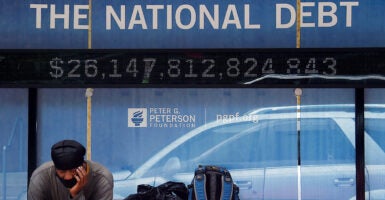
A man waits at a bus stop in Washington, D.C., that displays the national debt of the United States, June 19, 2020. (Photo: Olivier Douliery/AFP/Getty Images)

In the last 20 years, our country’s national debt has exploded.

In 2001, when George W. Bush took office, the national debt was $5.8 trillion. It took around 225 years—booms, busts, depressions, wars, etc.—to amass that much national debt. In just eight years, Bush and a compliant Congress doubled the number to $11.7 trillion. In Barack Obama’s two terms, another $8.6 trillion was added.

During the past four years, Donald Trump and Congress fought many battles, but not over this: In that time, America’s future was mortgaged to the tune of another $6.7 trillion.

Today, the national debt is around $27 trillion, a fourfold increase in the last two decades. That doesn’t count unfunded mandates. And there is no end in sight.

The Left has declared war on our culture, but we should never back down, nor compromise our principles. Learn more now >>

Whenever human beings gather to accomplish a task, any task, without strong and effective oversight, a natural evolution takes place. Whether it be in business, academia, philanthropy, or government, every activity morphs from the original goal to self-aggrandizement.

In government, this process is particularly toxic. There are no profits, let alone a profit motive. No concern with productivity. No incentive to turn off the proverbial lights. No measure of success. No motivation to end counterproductive activities.

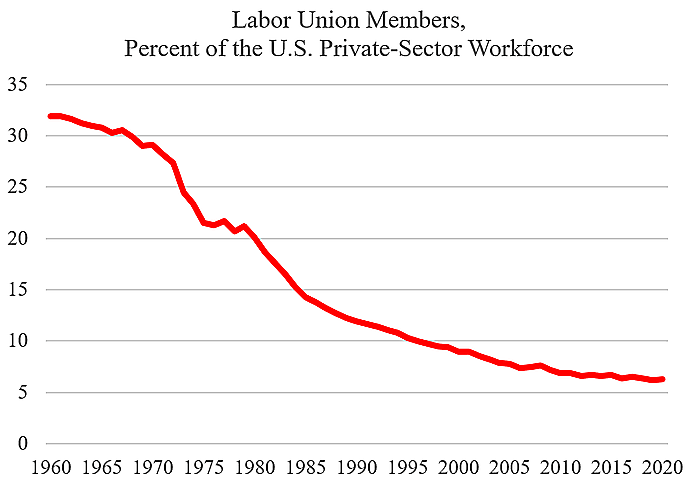
Add to this mix the influence of public employee unions. Franklin Delano Roosevelt and Harry Truman were opposed to them for reasons that long ago became apparent. The goal of all unions is self-preservation—just as management’s is to maximize profits.

But public employee unions add two other noxious elements to the mix: (1) defending job incompetence and (2) heavy-handed involvement in the electoral process in a search for pliant politicians who can help them achieve their objectives by spending ever more of the public’s money.

Now, out of the blue, the experts-for-hire have a new scheme to justify continued fiscal irresponsibility: modern monetary theory. It holds that so long as interest rates are lower than inflation rates, politicians can spend away. That is not a theory. It is idle wordplay, and the victim of such sophistry is the American taxpayer—and future generations of American taxpayers.

Never in our history has fiscal soundness been more important. The exploding annual deficits of the last 20 years have produced a national debt as a percentage of the gross domestic product that is as high as it was during World War II even though our nation is at peace.

Moreover, many severely underfunded programs such as Social Security and Medicaid are not included in today’s debt calculations, although they should be.

The passage of a 5,593-page must-pass-quickly bill in December was indisputable evidence that the national debt will never be addressed from the top down. That legislation was sent to the Senate two hours before the vote. Who can read 2,800 pages per hour, 47 pages per minute? How can responsible lawmakers vote on bills they have not read?

While our political leaders have repeatedly told us how important this bill was to the survival of so many Americans, they delayed the bill for months for political reasons.

A crucial-to-the-survival-of-so-many-Americans pork-filled bill? Some $10 million to Pakistan for “gender programs”? Another $700 million to Sudan for Lord knows what? And on and on and on.

History has a clear and repeated message: If we do not address this exploding debt, it will bring to life all-knowing leaders, leaders who Friedrich Hayek said possessed the “fatal conceit.” They think they know more than is knowable. Leaders who have all the answers for everything they define as a problem: more regulations, more government control, more taxes.

This is a noxious cure that has never succeeded, one that has left country after country in economic tatters.

Fortunately, the world in changing. Today, we have the means to address this financial irresponsibility, this threat to our country, as our Founders envisioned it. We are immersed in the Information Age, the Big Data world, the Cloud world, the Bitcoin world.

The cost of communications is close to zero. Smartphones, iPads, and computers are a crucial part of everyday life. With the touch of a finger, one click, information on every topic is available 24 hours a day.

Buy anything. Sell anything. Today, instant access to information is embedded in our culture. Why should government expenditures be exempt?

Transparency has always been the best antidote to rein in profligate government spending. Having instant information at our fingertips gives fiscally responsible Americans a powerful new weapon in the War on Waste.

Today, there is no reason why every local, state, and federal government expenditure is not online, in real time, available to every citizen. Taxpayers should be able to attend a school board meeting and pull up school expenses on their phones.

Open the Books has a formidable weapon to unleash the voting public’s ability to address this exploding national debt, this lack of transparency, this threat to our democracy—the Open the Books Government Expenditure Library, which contains over 5 billion (and growing) local, state, and federal government expenditures.

Last year, we filed 41,500 Freedom of Information Act requests. We sued several government entities to encourage them to provide us the same information we collect from other states.

The Open the Books Government Expenditure Library is open to everyone: citizens, politicians, students, academics, scholars, journalists, think tanks—everyone, 24-hours a day, seven days a week.

Transparency can be as revolutionary as the internet has been for the economic well-being of the world. Transparency cannot only enhance the odds of the survival of this, the greatest country in the history of the world, but, over time, it will contribute to our prosperity, our health, and our happiness.

Wasted taxpayer dollars are not just nonproductive. Waste allowed to exist encourages more waste. Fraud allowed to exist encourages more fraud. A financially sound economy, one that works to remove waste, fraud, duplication, and incompetence, will increase respect for government, for the rule of law.

Open the Books places the future of this great country more firmly in the hands of the voters. To ensure our elected officials realize this, we have to communicate continuously with them what we expect and how we will vote.

I suggest we begin with one clear public statement: “I will never vote for anyone who has voted for a bill they have not read.” Register that statement at OpenTheBooks.com/READTHEBILL.

Obviously, our elected officials are unwilling to address this explosive, increasingly crucial national debt problem. Fortunately, we the taxpaying voters today have a weapon at our fingertips to successfully wage a War on Waste. Successful because our political leaders will quickly recognize that if they want to be reelected, they will have to respond accordingly.

The Daily Signal publishes a variety of perspectives. Nothing written here is to be construed as representing the views of The Heritage Foundation.

Have an opinion about this article? To sound off, please email letters@DailySignal.com and we will consider publishing your remarks in our regular “We Hear You” feature.

Originally published by RealClearPolitics

March 31, 2021

President Biden  c/o The White House
1600 Pennsylvania Avenue NW
Washington, DC 20500

Dear Mr. President,

Please explain to me if you ever do plan to balance the budget while you are President? I have written these things below about you and I really do think that you don’t want to cut spending in order to balance the budget. It seems you ever are daring the Congress to stop you from spending more.

President Barack Obama speaks about the debt limit in the East Room of the White House in Washington. | AP Photo

“The credit of the United States ‘is not a bargaining chip,’ Obama said on 1-14-13. However, President Obama keeps getting our country’s credit rating downgraded as he raises the debt ceiling higher and higher!!!!

Washington Could Learn a Lot from a Drug Addict

Just spend more, don’t know how to cut!!! Really!!! That is not living in the real world is it?

Making more dependent on government is not the way to go!!

Why is our government in over 16 trillion dollars in debt? There are many reasons for this but the biggest reason is people say “Let’s spend someone else’s money to solve our problems.” Liberals like Max Brantley have talked this way for years. Brantley will say that conservatives are being harsh when they don’t want the government out encouraging people to be dependent on the government. The Obama adminstration has even promoted a plan for young people to follow like Julia the Moocher.  

David Ramsey demonstrates in his Arkansas Times Blog post of 1-14-13 that very point:

Arkansas Politics / Health Care Arkansas’s share of Medicaid expansion and the national debt

Posted by on Mon, Jan 14, 2013 at 1:02 PM

Baby carrot Arkansas Medicaid expansion image

Imagine standing a baby carrot up next to the 25-story Stephens building in Little Rock. That gives you a picture of the impact on the national debt that federal spending in Arkansas on Medicaid expansion would have, while here at home expansion would give coverage to more than 200,000 of our neediest citizens, create jobs, and save money for the state.

Here’s the thing: while more than a billion dollars a year in federal spending would represent a big-time stimulus for Arkansas, it’s not even a drop in the bucket when it comes to the national debt.

Currently, the national debt is around $16.4 trillion. In fiscal year 2015, the federal government would spend somewhere in the neighborhood of $1.2 billion to fund Medicaid expansion in Arkansas if we say yes. That’s about 1/13,700th of the debt.

It’s hard to get a handle on numbers that big, so to put that in perspective, let’s get back to the baby carrot. Imagine that the height of the Stephens building (365 feet) is the $16 trillion national debt. That $1.2 billion would be the length of a ladybug. Of course, we’re not just talking about one year if we expand. Between now and 2021, the federal government projects to contribute around $10 billion. The federal debt is projected to be around $25 trillion by then, so we’re talking about 1/2,500th of the debt. Compared to the Stephens building? That’s a baby carrot.

______________

Here is how it will all end if everyone feels they should be allowed to have their “baby carrot.”

How sad it is that liberals just don’t get this reality.

Here is what the Founding Fathers had to say about welfare. David Weinberger noted:

While living in Europe in the 1760s, Franklin observed: “in different countries … the more public provisions were made for the poor, the less they provided for themselves, and of course became poorer. And, on the contrary, the less was done for them, the more they did for themselves, and became richer.”

Alexander Fraser Tytler, Lord Woodhouselee (15 October 1747 – 5 January 1813) was a Scottish lawyer, writer, and professor. Tytler was also a historian, and he noted, “A democracy cannot exist as a permanent form of government. It can only exist until the majority discovers it can vote itself largess out of the public treasury. After that, the majority always votes for the candidate promising the most benefits with the result the democracy collapses because of the loose fiscal policy ensuing, always to be followed by a dictatorship, then a monarchy.”

Thomas Jefferson to Joseph Milligan

April 6, 1816

[Jefferson affirms that the main purpose of society is to enable human beings to keep the fruits of their labor. — TGW]

To take from one, because it is thought that his own industry and that of his fathers has acquired too much, in order to spare to others, who, or whose fathers have not exercised equal industry and skill, is to violate arbitrarily the first principle of association, “the guarantee to every one of a free exercise of his industry, and the fruits acquired by it.” If the overgrown wealth of an individual be deemed dangerous to the State, the best corrective is the law of equal inheritance to all in equal degree; and the better, as this enforces a law of nature, while extra taxation violates it.

[From Writings of Thomas Jefferson, ed. Albert E. Bergh (Washington: Thomas Jefferson Memorial Association, 1904), 14:466.]

_______

Jefferson pointed out that to take from the rich and give to the poor through government is just wrong. Franklin knew the poor would have a better path upward without government welfare coming their way. Milton Friedman’s negative income tax is the best method for doing that and by taking away all welfare programs and letting them go to the churches for charity.

_____________

_________

Thank you so much for your time. I know how valuable it is. I also appreciate the fine family that you have and your commitment as a father and a husband.

Sincerely,

Everette Hatcher III, 13900 Cottontail Lane, Alexander, AR 72002, ph 501-920-5733

Williams with Sowell – Minimum Wage

Thomas Sowell

Thomas Sowell – Reducing Black Unemployment

By WALTER WILLIAMS

—-

Ronald Reagan with Milton Friedman
Milton Friedman The Power of the Market 2-5

Related posts:

Welfare Spending Shattering All-Time Highs

  We got to act fast and get off this path of socialism. Morning Bell: Welfare Spending Shattering All-Time Highs Robert Rector and Amy Payne October 18, 2012 at 9:03 am It’s been a pretty big year for welfare—and a new report shows welfare is bigger than ever. The Obama Administration turned a giant spotlight […]

We need more brave souls that will vote against Washington welfare programs

We need to cut Food Stamp program and not extend it. However, it seems that people tell the taxpayers back home they are going to Washington and cut government spending but once they get up there they just fall in line with  everyone else that keeps spending our money. I am glad that at least […]

Welfare programs are not the answer for the poor

Government Must Cut Spending Uploaded by HeritageFoundation on Dec 2, 2010 The government can cut roughly $343 billion from the federal budget and they can do so immediately. __________ Liberals argue that the poor need more welfare programs, but I have always argued that these programs enslave the poor to the government. Food Stamps Growth […]

Private charities are best solution and not government welfare

Milton Friedman – The Negative Income Tax Published on May 11, 2012 by LibertyPen In this 1968 interview, Milton Friedman explained the negative income tax, a proposal that at minimum would save taxpayers the 72 percent of our current welfare budget spent on administration. http://www.LibertyPen.com Source: Firing Line with William F Buckley Jr. ________________ Milton […]

The book “After the Welfare State”

Dan Mitchell Commenting on Obama’s Failure to Propose a Fiscal Plan Published on Aug 16, 2012 by danmitchellcato No description available. ___________ After the Welfare State Posted by David Boaz Cato senior fellow Tom G. Palmer, who is lecturing about freedom in Slovenia and Tbilisi this week, asked me to post this announcement of his […]

President Obama responds to Heritage Foundation critics on welfare reform waivers

Is President Obama gutting the welfare reform that Bill Clinton signed into law? Morning Bell: Obama Denies Gutting Welfare Reform Amy Payne August 8, 2012 at 9:15 am The Obama Administration came out swinging against its critics on welfare reform yesterday, with Press Secretary Jay Carney saying the charge that the Administration gutted the successful […]

Welfare reform part 3

Thomas Sowell – Welfare Welfare reform was working so good. Why did we have to abandon it? Look at this article from 2003. The Continuing Good News About Welfare Reform By Robert Rector and Patrick Fagan, Ph.D. February 6, 2003 Six years ago, President Bill Clinton signed legislation overhauling part of the nation’s welfare system. […]

Welfare reform part 2

Uploaded by ForaTv on May 29, 2009 Complete video at: http://fora.tv/2009/05/18/James_Bartholomew_The_Welfare_State_Were_In Author James Bartholomew argues that welfare benefits actually increase government handouts by ‘ruining’ ambition. He compares welfare to a humane mousetrap. —– Welfare reform was working so good. Why did we have to abandon it? Look at this article from 2003. In the controversial […]

Why did Obama stop the Welfare Reform that Clinton put in?

Thomas Sowell If the welfare reform law was successful then why change it? Wasn’t Bill Clinton the president that signed into law? Obama Guts Welfare Reform Robert Rector and Kiki Bradley July 12, 2012 at 4:10 pm Today, the Obama Department of Health and Human Services (HHS) released an official policy directive rewriting the welfare […]

“Feedback Friday” Letter to White House generated form letter response July 10,2012 on welfare, etc (part 14)

I have been writing President Obama letters and have not received a personal response yet.  (He reads 10 letters a day personally and responds to each of them.) However, I did receive a form letter in the form of an email on July 10, 2012. I don’t know which letter of mine generated this response so I have […]

Montana Lawmaker Outlines Troubling Implications of Biden’s Executive Actions

-—-

Rep. Matt Rosendale, R-Mont., seen here speaking at a campaign rally at the Bozeman Yellowstone International Airport in Belgrade, Montana, Nov. 3, 2018, joins “The Daily Signal Podcast” to explain his top policy priorities. (Photo: William Campbell/Corbis/Getty Images)

Freshman Rep. Matt Rosendale, R-Mont., has entered the House with a bold plan to develop America’s natural resources and push back on the agenda of the far left.

Rosendale joined “The Daily Signal Podcast” during a recent trip to the U.S.- Mexico border to discuss why he ran for Congress, his former service in the Montana Legislature, the divisive moment the country finds itself in, and much more.

We also cover these stores:

  • House Democrats put forward their case against former President Donald Trump in the impeachment trial slated to begin next week in the Senate.
  • Two lawyers representing Trump in the impeachment trial lay out their defense.
  • Florida Gov. Ron DeSantis says his state is committed to taking action against censorship by big tech companies.

Listen to the podcast below or read the lightly edited transcript.

The Daily Signal Podcast” is available on Ricochet, Apple PodcastsPippaGoogle Play, and Stitcher. All of our podcasts can be found at DailySignal.com/podcasts. If you like what you hear, please leave a review. You also can write to us at letters@dailysignal.com.

Rachel del Guidice: Hi, everyone. This is Rachel del Guidice with The Daily Signal Podcast. I am here joined by Congressman Matt Rosendale of Montana. He is a new congressmen in this new Congress. And I’m just so happy to have you with us today.

Rep. Matt Rosendale: Good to be here. Thank you for having me, Rachel.

Del Guidice: Well, it’s great to have you with us. I want to start off talking about your service in Montana before running for Congress, so tell us a little bit about that and then also what led you to run for Congress.

Rosendale: Actually, 10 years ago, I was riding my horse four or five days a week and chasing cows around the ranch, and I really didn’t expect that I would be in this position right now.

I’ve been very engaged in politics my entire life, but I was building a business, I’m raising a family, and so I never really had the time that was necessary, what I felt, to dedicate to public service.

Once my boys were out of college and the community really came to me, and I found myself as chairman of the local AG association and president of the parish council at the Catholic church.

I’m very active in the church and they said, “Look, we are not getting proper representation in Eastern Montana in the Legislature,” and so folks recruited me to run for the Legislature, and I entered in 2010. I was elected to the [state] House. In 2012, I was elected to the [state] Senate. And in 2014, my colleagues elected me as the Senate majority leader.

It just really happened very quickly. And I’ve always said that I just want to serve where I can be the most effective for my community, and my community means my county, my state, or my nation.

Then the folks encouraged me to run for the open U.S. House seat because Greg Gianforte had disclosed that he was not seeking reelection. He was going to run for governor. And I obviously ran for the House seat and was able to win it.

Del Guidice: Well, congratulations. Before talking about going into Congress, what are some of the issues that you worked on in the Montana State House that you really saw [are] important to Montanans and really affected what you did on day to day there?

Rosendale: Sure. Really, the things that I focused on [were] trying to really lower the regulatory and tax burden on our businesses and put people in a better position to either start or expand businesses and grow job opportunities.

Then the last four years, I have been serving as the state auditor, which in Montana means I was the commissioner of securities and insurance. I’ve really focused the bulk of my efforts on trying to do something about the cost and the access to health care.

It has not been addressed. We still are dealing with these problems, but I was able to make some great strides to reduce the calls, to expand access, to guarantee coverage for preexisting conditions, and actually, in many cases, improve the quality of health care that people were receiving and start beginning to bend the cost curve down. Health care is a really big deal.

I sat on the state land board. We were responsible for managing 5.2 million acres of state school trust lands. Any agricultural lease, any mineral lease, any pipeline easement that protects harvesting of timber, all of those agreements were run through the state land board, and we would approve those.

We were generating somewhere between $40 and $45 million a year to put toward the K-12 education system for the state of Montana.

Del Guidice: Before we get to Congress, I have to ask you, you have a ranch out in Montana. Tell us about the ranch and what you do there.

Rosendale: I miss it a lot is what I do. People often ask me, “Do you get back to the ranch that often?” I said, “Yes, every night, just as soon as I close my eyes.”

It’s a wonderful place. It is about 20 miles north of a little town by the name of Glendive. It is on the Yellowstone River. By the time the Yellowstone River gets to me and my property, it’s been flowing about 600 miles, so it’s a big river. It’s not just a little trout stream.

And I’m very blessed, my wife Jean and I are very blessed to have the ranch and our sons. I have three sons. We have enjoyed every moment that we’ve been there.

Del Guidice: That’s awesome. I want to switch talking a little bit about Congress. You’re a new member there. What have been your reflections, before we get started talking about what you want to do? What have your reflections been on starting off at such a turbulent time in history right now?

Rosendale: It is and I will tell you my initial thought was that I was disappointed on swearing-in day. I have to tell you.

After going through swearing-in at the state Legislature, where we convene every other year, and you haven’t seen your colleagues from across the aisle. Your colleagues that are of the same party, you haven’t seen each other regularly for quite some time. We would come together and people would embrace, and they would greet each other.

The speaker, regardless of who they were, gave a very, very positive message to try to set the tone on trying to get work done.

Complete opposite, Day One, United States Congress, and I was disappointed. I thought that [House Speaker Nancy] Pelosi delivered a very divisive message, and it was just not the same tone and tenor that I had hoped that we were going to start off with.

You deal with that, and you can’t let that one unfortunate day affect the work that you want to accomplish as you go forward.

Then, obviously, we’ve had a tumultuous time over the last three weeks, and we have gotten through that. We are beyond that and now, finally, I was told what committees I’m going to serve on.

I’m going to be on [the] Natural Resources and Veterans’ Affairs [committees], two committees that are going to be extremely important to the state of Montana. I’m looking forward to getting to work, quite frankly. I mean, this is what the people elected me for, and this is what I want to do.

Del Guidice: You talk about getting to work. What are some of the things that are top-line on your heart and mind as issues that you want to work on in Congress as you go forward?

Rosendale: Sure. On natural resources, there are so many natural resources that are located within our state that I want to make sure that they can be developed and utilized in a safe and environmentally sound method, and we can do that.

We’ve seen the practices have changed over the last several years and whether we’re talking about the new copper mine that has been permitted near White Sulphur Spring or whether we’re talking about a better management of our public lands where our national forests are located, so that we don’t have to watch them burn thousands and thousands of acres in the summer, we can actually harvest that timber and put it to good use.

Certainly, we want to make sure that our oil and gas resources are developed. That is a place where we’re going to have conflict with the new administration.

President [Joe] Biden has demonstrated by revoking the permit for the Keystone XL pipeline and revoking, at least for a stated period of time, any leases or drilling on public lands, that’s a problem. …

We have four refineries located in our state and in addition to having four refineries located in our state, we have a lot of people that work for those refineries and the ancillary businesses that feed them. The development of those energy resources not only drives a pretty good segment of our economy, but it also contributes dramatically to our national security.

This is something that we’ve seen over the last just four years under the previous administration, where we were able to go from being dependent upon other countries that were not friendly to the United States, to actually being not only energy independent, but energy dominant, so that we can start looking to our allies and helping them with their energy needs, so that they’re not dependent on some of these unfriendly nations either.

Del Guidice: Let’s talk a little bit too about the state of play where things are at. As you mentioned, we have a Democrat in the White House. President Biden is there. Now the House and Senate are both in Democrat control.

As you look forward into the coming weeks and months and years, we’ve heard talk of possibly Democrats voting to make D.C. and Puerto Rico a state; different policies like the Green New Deal—talk of that being implemented—the Equality Act.

In your perspective, where do you think and how do you think conservatives should work so that that type of policy is responded to in an adequate way?

Rosendale: That is [a] very good question. Obviously, in the House, the majority rules anything and so that is all it takes.

I hope that all my friends that are out there listening right now recognize when they were calling for the end to the filibuster, maybe that wasn’t such a good idea because, obviously, we’re going to end up being in the minority sometime or another, which is right now, where that could work against us.

Quite frankly, thank goodness there is still a filibuster in place because what I’m hoping is that the most damaging of those agenda items will be able to be stopped in the Senate, because they won’t have a 60-vote majority to be able to start pushing any of those issues forward onto the floor.

However, the Democrats do have control over the reconciliation process through budget, and it’s my understanding that they have not only this year’s budget, but they have ’21, ’22, and ’23 fiscal years that they’re able to utilize for reconciliation.

I also understand that right now, none of those most damaging agenda items can be attached to reconciliation to be pushed through.

I’m thinking that the Biden administration is going to try to use their executive powers to implement some of these things and fortunately then, it’s going to fall to our attorneys general across the country to be able to file lawsuits and keep these things from being implemented upon the states.

I have a very good relationship with my state attorney general. We came into the state Legislature as freshmen together in 2010. We’re very good friends. And I’ve already had a meeting, sat down and talked with him, and said, “We need to make sure that we are working together to push back on some of these most damaging issues.”

Del Guidice: Well, we were just on a trip to the border, got to see a bunch of different things.

One of the things that stood out to me was in different areas, since President Biden’s administration has stopped construction on the border wall, there’s these big areas of border wall that had been completed, but there’s so many different spots where they still need to finish and all of that’s being halted.

Congressman, can you tell me a little bit about your reflections from what you’ve seen and also just your thoughts on what else needs to happen here?

Rosendale: A couple of points that I took away from the border trip were, No. 1, as you said, to have just an immediate halt to all that construction was unfortunate.

On Day One, President Biden started killing jobs. And this isn’t rhetoric. These are just plain, simple facts—whether we’re talking about the closure of the Keystone pipeline, whether we’re talking about the halting of oil and gas permits on public properties. I mean, all of this started killing jobs immediately.

What we also saw was it was killing jobs immediately as we went down to the border, and we saw equipment parked and, like you say, construction on the wall halted and construction sites that were not complete. They hadn’t even finished the work that they were doing.

In the conversations with the different law enforcement people, the Border Patrol security and the local residents, they have major, major concerns about how this is going to impact the area going forward.

It was interesting to hear them say that the populations of people that are coming across the border on different areas are different types of people that they’re dealing with.

You have more of a criminal element in the mountainous, more isolated areas, as opposed to more of people that are just trying to seek an improvement in their life that are closer to the urban areas, as they are trying to come across the border.

I think one of the takeaways that everybody in our country needs to understand is that the people that I spoke to down at the border—whether we were talking about Border Patrol, whether we were talking about the local ranchers or the local authorities, the sheriff’s departments, and things like that—were very compassionate and cognizant of what was going on with these people that were coming in illegally to enter our country, and they felt bad for the ones that were being so harshly treated by this criminal element that was helping get them into our country.

They want to see the suffering, the human suffering stop. And the best way for us to keep that human suffering from taking place is to stop providing an incentive and a free pass for people to enter into our country.

Once they’ve recognize that they cannot just walk in and the deterrent is there, you won’t have this wall of humanity that’s trying to attack the border.

Del Guidice: Well, as we wrap up, we talked a little bit about how divisive everything is right now and as a man of faith, also as a leader in your community, and now in your country, what are some parting words you’d like to leave, not only to your constituents in Montana, … but the rest of the country, and what our outlook should be as we just try to move on and move up?

Rosendale: I think that, again, as a man of faith, I do place my faith in God and I pray daily that we can improve what is taking place here.

My hope is that I will be able to connect with enough other like-minded individuals in Congress, regardless of what side of the aisle that they’re sitting on, that we can basically take personalities and set them aside and look at what has proven to work to benefit our country in the past.

Because, look, you can talk about personalities all day long, but if we are really focused on improving the economy, expanding jobs, trying to make sure that we do something about health care, then let’s talk about those things and get everything else off of the table. And that’s what’s going to put our country in a better position, which means that the lives will be better for the people that we serve.

Del Guidice: Congressman Rosendale, thank you so much for joining us on “The Daily Signal Podcast.” It’s been great having you with us.

Rosendale: Thank you so much, Rachel. Good to see you.

President Biden and Labor Unions

Joe Biden is old. He has been in politics since 1970 and holds antiquated views. On the campaign trail, he used expressions such as “malarkey” and said that kids should listen to the “record player.”

President Biden’s views on labor unions are similarly archaic. Unions appear to be central to his view of the economy, yet few private‐​sector workers are in unions today. This Biden campaign statement, which is ostensibly about clean energy, promotes labor unions 32 times. Biden wants to “create millions of good, union jobs rebuilding America’s crumbling infrastructure,” wants to “ensure these investments create good, union jobs that expand the middle class,” and so on. Spending on cars, energy, manufacturing, railroads, airports, broadband, and everything else in Biden’s plan is about union jobs, over and over ad nauseam.

The focus is pathological. I say that because union members account for just 6 percent of private‐​sector employment today, yet Biden’s statement reads as if unions dominate the workforce, are the bulwark of the middle class, and are central to the economy. They are not and will not be going forward. The economy is too dynamic and competitive, and Americans have increasingly rejected unions in the private sector, as shown in the chart below.

The Biden statement repeatedly stresses “choice.” Biden wants to “provide workers with the choice to join a union and bargain collectively.” But “collective bargaining” is a euphemism for monopoly unionism and the denial of choice. It violates freedom of association, as Charles Baird explains here. The frequent use of the word “choice” is an attempt to mask the reality of coercive labor unionism under current federal law.

Even if collective bargaining was reasonable in theory, frequent corruption scandals reveal that labor union leaders abuse their special privileges. Most recently, the

Justice Department reached a civil settlement with the United Auto Workers union, marking a major turning point in a multiyear corruption investigation that has sent several former labor leaders to prison. The sprawling probe, led by the U.S. attorney’s office in Detroit, has penetrated the UAW’s top ranks and exposed what federal prosecutors described as a culture of corruption among its leadership built around kickback schemes, embezzlement and other illicit activities.

Why would any policymaker want to strengthen such organizations? Yet that is the direction of President Biden. His proposals would move backwards by reinforcing the coercive nature of federal labor union law, which is incompatible with personal freedom and the modern economy.

The chart shows that private‐​sector union membership has fallen from 32 percent of the workforce in 1960 to just 6 percent today.

graph of union share

Note: Chart data from unionstats, Barry Hirsch, and BLS.

With a $15 federal minimum wage, any jobs that don’t produce at least $36,000 per year in goods and services will eventually be eliminated—either because businesses close their doors, outsource their labor, or automate low-skilled jobs. (Photo: Moyo Studio/Getty Images)

President Joe Biden has proposed a nationwide $15 minimum wage as part of his so-called “American Rescue Plan.” Talk about bad timing: Raising labor prices on businesses that are struggling to stay afloat is like throwing them a load of bricks instead of a life preserver.

State and local governments raising their minimum wages is one thing, but to more than double the federal minimum, from $7.25 to $15 per hour?

Nearly one in every five restaurants permanently closed their doors in 2020 as 30 large retail and restaurant companies filed for bankruptcy.

Meanwhile, employment in food services (restaurants and bars) fell 19% in 2020 as retail clothing jobs dropped 24% and accommodations (hotels) jobs plummeted 32%.

The Left has declared war on our culture, but we should never back down, nor compromise our principles. Learn more now >>

Although very few people—only about 1% of all workers and 0.1% of single parents—make the $7.25 minimum wage, a good portion of restaurant, retail, and hotel jobs pay less than $15 per hour.

No one would suggest raising the rent on households who are months behind on their payments, so how could raising labor prices help businesses?

For a restaurant with five full-time workers making minimum wage, a doubling of the federal minimum wage would mean an extra $85,800 in wages and employment taxes. With restaurant profit margins of about 5%, that could require an extra $1.7 million in food sales ($4,700 more per day)—a seemingly impossible feat in normal times, let alone in the middle of a global pandemic.

Higher wages are a great thing—especially when the gains accrue to lower-income workers. But the only way to achieve actual wage increases—that is, lasting wage increases that don’t take jobs and incomes from others—is for workers to become more productive.

To that end, government mandates are powerless. A $15 minimum wage won’t help workers gain education and experience or provide them with technology that will enable them to produce more value and earn larger incomes. In fact, it could cause the opposite, by shifting employers’ resources away from training and investments to wages instead.

Moreover, raising wages by government fiat hurts many workers in the short and long run by cutting off the bottom rungs of the career ladder.

A $15 federal minimum wage translates into over $36,000 per year in wages and mandated taxes and benefits paid by employers. That means that any jobs that don’t produce at least $36,000 per year in goods and services will eventually be eliminated—either because businesses close their doors, outsource their labor, or automate low-skilled jobs.

That’s why even liberal economists and the nonpartisan Congressional Budget Office caution that a $15 federal minimum wage would lead to a survival-of-the-fittest labor market, reduce future incomes, and disproportionately harm African Americans and women.

The former chair of President Barack Obama’s White House Council of Economic Advisers, Alan Krueger, warned in 2015, “Research suggests that a minimum wage set as high as $12 an hour will do more good than harm for low-wage workers, but a $15-an-hour national minimum wage would put us in uncharted waters, and risk undesirable and unintended consequences.”

Those consequences would be unequal across the country. Large cities with high costs of living—many of which already have or are on the path to a $15 minimum wage—may not experience huge consequences. But non-urban areas and places with lower costs of living could be devastated.

Imagine if policymakers were proposing a minimum wage hike to nearly $36—ensuring that all full-time workers earned at least $74,000 per year.

Most people would say that’s too much, realizing that such a high minimum wage would have massive consequences in terms of lost jobs, increased prices, and a complete and utter disruption of the American labor market and economy.

Yet, $15 per hour in Mississippi would be equivalent to $35.74 per hour in D.C., where federal lawmakers seek to impose a national standard across the U.S.

Minimum wages are best left to local governments, where decisions can be made based on economic conditions and the cost of living.

If a local government sets its minimum wage above the market wage, at least workers and business owners who lose their jobs and businesses can move to places where it’s still possible for them to earn a living.

But if policymakers impose an excessively high nationwide minimum wage across 50 very diverse states and more than 3,000 counties, there will be nowhere else for the harmed to go.

Instead of mandating policies that irrefutably harm some people to the benefit of others, policymakers should focus on opening doors to income opportunities for all workers.

Reducing barriers to jobs and income gains is what helped contribute to the 14.6% increase in wages for workers at the 10th percentile of earners (those earning about $10 per hour) between 2016 and 2019.

Lawmakers at all levels should be seeking to help Americans recover and gain new opportunities instead of permanently wiping out existing ones.

©2021 Tribune Content Agency, LLC.

Have an opinion about this article? To sound off, please email letters@DailySignal.com and we will consider publishing your remarks in our regular “We Hear You” feature.

Ep. 4 – From Cradle to Grave [6/7]. Milton Friedman’s Free to Choose (1980)

February 9, 2021

President Biden c/o The White House
1600 Pennsylvania Avenue NW
Washington, DC 20500

Dear Mr. President,

Thank you for taking time to have your office try and get a pulse on what is going on out here in the country.

I read this article on January 15, 2021 about your announcement the previous night concerning your first proposal to Congress. Biden’s $1.9 Trillion COVID Relief Package Includes More Stimulus Checks, State Government Bailout, $15 Federal Minimum Wage

I wanted to let you know what I think about the minimum wage increase you have proposed for the whole country and I wanted to quote Milton Friedman who you are familiar with and you made it clear in July that you didn’t care for his views! Let me challenge you to take a closer look at what he had to say!

Milton Friedman on the minimum wage

All too often, the policy debates of today are simply refights of the battles of yesteryear. As a result, old arguments often retain a striking relevance.

In February 1973, economist Milton Friedman gave an interview to Playboy magazine. It was a wide ranging interview, covering topics from monetary policy to political philosophy. Friedman was an economist with a rare gift for translating technical arguments into clear prose (as you will find in his books Capitalism and Freedom and Free to Choose). His remarks on the minimum wage, as given in that interview, are startlingly contemporary.

PLAYBOY: But you prefer the laissez-faire—free-enterprise—approach.
FRIEDMAN: Generally. Because I think the government solution to a problem is usually as bad as the problem and very often makes the problem worse. Take, for example, the minimum wage, which has the effect of making the poor people at the bottom of the wage scale—those it was designed to help—worse off than before.

PLAYBOY: How so?
FRIEDMAN: If you really want to get a feeling about the minimum wage, there’s nothing more instructive than going to the Congressional documents to read the proposals to raise the minimum wage and see who testifies. You very seldom find poor people testifying in favor of the minimum wage. The people who do are those who receive or pay wages much higher than the minimum. Frequently Northern textile manufacturers. John F. Kennedy, when he was in Congress, said explicitly that he was testifying in favor of a rise in the minimum wage because he wanted protection for the New England textile industry against competition from the so-called cheap labor of the South. But now look at it from the point of that cheap labor. If a high minimum wage makes unfeasible an otherwise feasible venture in the South, are people in the South benefited or harmed? Clearly harmed, because jobs otherwise available for them are no longer available. A minimum-wage law is, in reality, a law that makes it illegal for an employer to hire a person with limited skills.

PLAYBOY: Isn’t it, rather, a law that requires employers to pay a fair and livable wage?
FRIEDMAN: How is a person better off unemployed at a dollar sixty an hour than employed at a dollar fifty? No hours a week at a dollar sixty comes to nothing. Let’s suppose there’s a teenager whom you as an employer would be perfectly willing to hire for a dollar fifty an hour. But the law says, no, it’s illegal for you to hire him at a dollar fifty an hour. You must hire him at a dollar sixty. Now, if you hire him at a dollar sixty, you’re really engaging in an act of charity. You’re paying a dollar fifty for his services and you’re giving him a gift of 10 cents. That’s something few employers, quite naturally, are willing to do or can afford to do without being put out of business by less generous competitors. As a result, the effect of a minimum-wage law is to produce unemployment among people with low skills. And who are the people with low skills? In the main, they tend to be teenagers and blacks, and women who have no special skills or have been out of the labor force and are coming back. This is why there are abnormally high unemployment rates among these groups.

_____________

Thank you so much for your time. I know how valuable it is. I also appreciate the fine family that you have and your commitment as a father and a husband.

Sincerely,

Everette Hatcher III, 13900 Cottontail Lane, Alexander, AR 72002, ph 501-920-5733

Williams with Sowell – Minimum Wage

Thomas Sowell

Thomas Sowell – Reducing Black Unemployment

By WALTER WILLIAMS

—-

Ronald Reagan with Milton Friedman
Milton Friedman The Power of the Market 2-5

President Biden and Labor Unions

President Biden and Labor Unions

Joe Biden is old. He has been in politics since 1970 and holds antiquated views. On the campaign trail, he used expressions such as “malarkey” and said that kids should listen to the “record player.”

President Biden’s views on labor unions are similarly archaic. Unions appear to be central to his view of the economy, yet few private‐​sector workers are in unions today. This Biden campaign statement, which is ostensibly about clean energy, promotes labor unions 32 times. Biden wants to “create millions of good, union jobs rebuilding America’s crumbling infrastructure,” wants to “ensure these investments create good, union jobs that expand the middle class,” and so on. Spending on cars, energy, manufacturing, railroads, airports, broadband, and everything else in Biden’s plan is about union jobs, over and over ad nauseam.

The focus is pathological. I say that because union members account for just 6 percent of private‐​sector employment today, yet Biden’s statement reads as if unions dominate the workforce, are the bulwark of the middle class, and are central to the economy. They are not and will not be going forward. The economy is too dynamic and competitive, and Americans have increasingly rejected unions in the private sector, as shown in the chart below.

The Biden statement repeatedly stresses “choice.” Biden wants to “provide workers with the choice to join a union and bargain collectively.” But “collective bargaining” is a euphemism for monopoly unionism and the denial of choice. It violates freedom of association, as Charles Baird explains here. The frequent use of the word “choice” is an attempt to mask the reality of coercive labor unionism under current federal law.

Even if collective bargaining was reasonable in theory, frequent corruption scandals reveal that labor union leaders abuse their special privileges. Most recently, the

Justice Department reached a civil settlement with the United Auto Workers union, marking a major turning point in a multiyear corruption investigation that has sent several former labor leaders to prison. The sprawling probe, led by the U.S. attorney’s office in Detroit, has penetrated the UAW’s top ranks and exposed what federal prosecutors described as a culture of corruption among its leadership built around kickback schemes, embezzlement and other illicit activities.

Why would any policymaker want to strengthen such organizations? Yet that is the direction of President Biden. His proposals would move backwards by reinforcing the coercive nature of federal labor union law, which is incompatible with personal freedom and the modern economy.

The chart shows that private‐​sector union membership has fallen from 32 percent of the workforce in 1960 to just 6 percent today.

graph of union share

Note: Chart data from unionstats, Barry Hirsch, and BLS.

With a $15 federal minimum wage, any jobs that don’t produce at least $36,000 per year in goods and services will eventually be eliminated—either because businesses close their doors, outsource their labor, or automate low-skilled jobs. (Photo: Moyo Studio/Getty Images)

President Joe Biden has proposed a nationwide $15 minimum wage as part of his so-called “American Rescue Plan.” Talk about bad timing: Raising labor prices on businesses that are struggling to stay afloat is like throwing them a load of bricks instead of a life preserver.

State and local governments raising their minimum wages is one thing, but to more than double the federal minimum, from $7.25 to $15 per hour?

Nearly one in every five restaurants permanently closed their doors in 2020 as 30 large retail and restaurant companies filed for bankruptcy.

Meanwhile, employment in food services (restaurants and bars) fell 19% in 2020 as retail clothing jobs dropped 24% and accommodations (hotels) jobs plummeted 32%.

The Left has declared war on our culture, but we should never back down, nor compromise our principles. Learn more now >>

Although very few people—only about 1% of all workers and 0.1% of single parents—make the $7.25 minimum wage, a good portion of restaurant, retail, and hotel jobs pay less than $15 per hour.

No one would suggest raising the rent on households who are months behind on their payments, so how could raising labor prices help businesses?

For a restaurant with five full-time workers making minimum wage, a doubling of the federal minimum wage would mean an extra $85,800 in wages and employment taxes. With restaurant profit margins of about 5%, that could require an extra $1.7 million in food sales ($4,700 more per day)—a seemingly impossible feat in normal times, let alone in the middle of a global pandemic.

Higher wages are a great thing—especially when the gains accrue to lower-income workers. But the only way to achieve actual wage increases—that is, lasting wage increases that don’t take jobs and incomes from others—is for workers to become more productive.

To that end, government mandates are powerless. A $15 minimum wage won’t help workers gain education and experience or provide them with technology that will enable them to produce more value and earn larger incomes. In fact, it could cause the opposite, by shifting employers’ resources away from training and investments to wages instead.

Moreover, raising wages by government fiat hurts many workers in the short and long run by cutting off the bottom rungs of the career ladder.

A $15 federal minimum wage translates into over $36,000 per year in wages and mandated taxes and benefits paid by employers. That means that any jobs that don’t produce at least $36,000 per year in goods and services will eventually be eliminated—either because businesses close their doors, outsource their labor, or automate low-skilled jobs.

That’s why even liberal economists and the nonpartisan Congressional Budget Office caution that a $15 federal minimum wage would lead to a survival-of-the-fittest labor market, reduce future incomes, and disproportionately harm African Americans and women.

The former chair of President Barack Obama’s White House Council of Economic Advisers, Alan Krueger, warned in 2015, “Research suggests that a minimum wage set as high as $12 an hour will do more good than harm for low-wage workers, but a $15-an-hour national minimum wage would put us in uncharted waters, and risk undesirable and unintended consequences.”

Those consequences would be unequal across the country. Large cities with high costs of living—many of which already have or are on the path to a $15 minimum wage—may not experience huge consequences. But non-urban areas and places with lower costs of living could be devastated.

Imagine if policymakers were proposing a minimum wage hike to nearly $36—ensuring that all full-time workers earned at least $74,000 per year.

Most people would say that’s too much, realizing that such a high minimum wage would have massive consequences in terms of lost jobs, increased prices, and a complete and utter disruption of the American labor market and economy.

Yet, $15 per hour in Mississippi would be equivalent to $35.74 per hour in D.C., where federal lawmakers seek to impose a national standard across the U.S.

Minimum wages are best left to local governments, where decisions can be made based on economic conditions and the cost of living.

If a local government sets its minimum wage above the market wage, at least workers and business owners who lose their jobs and businesses can move to places where it’s still possible for them to earn a living.

But if policymakers impose an excessively high nationwide minimum wage across 50 very diverse states and more than 3,000 counties, there will be nowhere else for the harmed to go.

Instead of mandating policies that irrefutably harm some people to the benefit of others, policymakers should focus on opening doors to income opportunities for all workers.

Reducing barriers to jobs and income gains is what helped contribute to the 14.6% increase in wages for workers at the 10th percentile of earners (those earning about $10 per hour) between 2016 and 2019.

Lawmakers at all levels should be seeking to help Americans recover and gain new opportunities instead of permanently wiping out existing ones.

©2021 Tribune Content Agency, LLC.

Have an opinion about this article? To sound off, please email letters@DailySignal.com and we will consider publishing your remarks in our regular “We Hear You” feature.

Ep. 4 – From Cradle to Grave [6/7]. Milton Friedman’s Free to Choose (1980)

February 9, 2021

President Biden c/o The White House
1600 Pennsylvania Avenue NW
Washington, DC 20500

Dear Mr. President,

Thank you for taking time to have your office try and get a pulse on what is going on out here in the country.

I read this article on January 15, 2021 about your announcement the previous night concerning your first proposal to Congress. Biden’s $1.9 Trillion COVID Relief Package Includes More Stimulus Checks, State Government Bailout, $15 Federal Minimum Wage

I wanted to let you know what I think about the minimum wage increase you have proposed for the whole country and I wanted to quote Milton Friedman who you are familiar with and you made it clear in July that you didn’t care for his views! Let me challenge you to take a closer look at what he had to say!

Milton Friedman on the minimum wage

All too often, the policy debates of today are simply refights of the battles of yesteryear. As a result, old arguments often retain a striking relevance.

In February 1973, economist Milton Friedman gave an interview to Playboy magazine. It was a wide ranging interview, covering topics from monetary policy to political philosophy. Friedman was an economist with a rare gift for translating technical arguments into clear prose (as you will find in his books Capitalism and Freedom and Free to Choose). His remarks on the minimum wage, as given in that interview, are startlingly contemporary.

PLAYBOY: But you prefer the laissez-faire—free-enterprise—approach.
FRIEDMAN: Generally. Because I think the government solution to a problem is usually as bad as the problem and very often makes the problem worse. Take, for example, the minimum wage, which has the effect of making the poor people at the bottom of the wage scale—those it was designed to help—worse off than before.

PLAYBOY: How so?
FRIEDMAN: If you really want to get a feeling about the minimum wage, there’s nothing more instructive than going to the Congressional documents to read the proposals to raise the minimum wage and see who testifies. You very seldom find poor people testifying in favor of the minimum wage. The people who do are those who receive or pay wages much higher than the minimum. Frequently Northern textile manufacturers. John F. Kennedy, when he was in Congress, said explicitly that he was testifying in favor of a rise in the minimum wage because he wanted protection for the New England textile industry against competition from the so-called cheap labor of the South. But now look at it from the point of that cheap labor. If a high minimum wage makes unfeasible an otherwise feasible venture in the South, are people in the South benefited or harmed? Clearly harmed, because jobs otherwise available for them are no longer available. A minimum-wage law is, in reality, a law that makes it illegal for an employer to hire a person with limited skills.

PLAYBOY: Isn’t it, rather, a law that requires employers to pay a fair and livable wage?
FRIEDMAN: How is a person better off unemployed at a dollar sixty an hour than employed at a dollar fifty? No hours a week at a dollar sixty comes to nothing. Let’s suppose there’s a teenager whom you as an employer would be perfectly willing to hire for a dollar fifty an hour. But the law says, no, it’s illegal for you to hire him at a dollar fifty an hour. You must hire him at a dollar sixty. Now, if you hire him at a dollar sixty, you’re really engaging in an act of charity. You’re paying a dollar fifty for his services and you’re giving him a gift of 10 cents. That’s something few employers, quite naturally, are willing to do or can afford to do without being put out of business by less generous competitors. As a result, the effect of a minimum-wage law is to produce unemployment among people with low skills. And who are the people with low skills? In the main, they tend to be teenagers and blacks, and women who have no special skills or have been out of the labor force and are coming back. This is why there are abnormally high unemployment rates among these groups.

_____________

Thank you so much for your time. I know how valuable it is. I also appreciate the fine family that you have and your commitment as a father and a husband.

Sincerely,

Everette Hatcher III, 13900 Cottontail Lane, Alexander, AR 72002, ph 501-920-5733

Williams with Sowell – Minimum Wage

Thomas Sowell

Thomas Sowell – Reducing Black Unemployment

By WALTER WILLIAMS

—-

Ronald Reagan with Milton Friedman
Milton Friedman The Power of the Market 2-5

Schumer Is Wrong About Debt. Congress Must Take Debt Danger Seriously, Not Spend Recklessly

Debt

Calling for stimulus spending in response to COVID-19, Majority Leader Charles Schumer, D-N.Y., stated on Jan. 28, “The dangers of undershooting our response are far greater than overshooting it.” (Photo: Tom Williams/CQ-Roll Call, Inc./Getty Images)

The combination of unified control of the federal government along with the COVID-19 pandemic has seemingly caused some elected officials to think there are no consequences to new spending proposals. However, they must wake up to the dangers posed by recklessly adding to the national debt.

On Thursday, Majority Leader Charles Schumer, D-N.Y., exemplified this mindset by saying, “The dangers of undershooting our response are far greater than overshooting it. We should have learned the lesson, from 2008 and 2009, when Congress was too timid and constrained in its response to the global financial crisis.”

>>> What’s the best way for America to reopen and return to business? The National Coronavirus Recovery Commission, a project of The Heritage Foundation, assembled America’s top thinkers to figure that out. So far, it has made more than 260 recommendations. Learn more here.

This is wrong on several fronts.

The Left has declared war on our culture, but we should never back down, nor compromise our principles. Learn more now >>

First, the stimulus spending that took place in the wake of the Great Recession was ineffective at creating jobs, and in some ways slowed the economy by creating perverse incentives and crowding out private activity.

Second, despite the difficulties associated with the pandemic, the economy is currently in much better shape than it was during the last recession.

The national unemployment rate hit 10% in October 2009 and stayed above 8% through August 2012. In contrast, the COVID-19 recession caused unemployment to spike to 14.8% in April 2020, but it fell below 7% by October.

Third, Congress has already approved over $4 trillion in response to the pandemic, much of which is still available or in the process of being distributed. The idea that Congress has been “undershooting” the response is ridiculous.

Most importantly, Schumer and other leftists in Congress are ignoring the very real danger posed by adding to the $27.8 trillion federal debt, which is over $210,000 for every U.S. household.

Even after the pandemic is over and the economy returns to normal, we will face serious problems as a result of the federal government’s broken finances.

Over $21 trillion worth of federal debt obligations are traded on the open market. While interest rates are low today, Congress has no control over what those rates will be as the debt turns over and requires refinancing.

Credit rating agencies are growing concernedabout the sustainability of America’s finances. If demand for our debt goes down, that will force the Treasury to offer higher interest rates.

Higher interest rates on so much debt would add up very quickly, which makes this a serious risk to economic growth and future prosperity. That means we need to put an end to massive deficits and eventually shrink the debt, either in absolute terms or in relation to the size of the economy, to reduce the risk to current and future generations.

This will be impossible unless legislators address the driving force behind long-term debt and deficits: unsustainable benefit programs such as Social Security and Medicare.

Major trust funds will run dry all too soon. Medicare Part A (hospital insurance) goes broke in 2024, Social Security Disability Insurance in 2026, and the Social Security retirement fund in 2031. These are programs that tens of millions of people rely on, and trust fund insolvency would cause serious upheaval, especially for Social Security.

Annual deficits for the federal government and these major benefit programs are too large to close overnight. Deficits were already high during the years of strong economic growth prior to the pandemic, and then exploded in 2020.

Reforms aiming to slow the growth of spending on Social Security and Medicare can have a significant effect, but only if those reforms are in place several years before the trust funds run out. The longer we wait, the more drastic the necessary changes become.

Besides reforming large benefit programs, there are many other ways for Congress to improve the nation’s financial health. These include refocusing the federal government on core priorities, eliminating wasteful spending, returning to a regular budget process, and strengthening economic growth.

What would not help this massive and growing problem is spending trillions of dollars we don’t have on more “relief” legislation that would do little to help the economy. Hopefully Congress will come to its senses and recognize that it has a responsibility to use taxpayer dollars wisely.

Have an opinion about this article? To sound off, please email letters@DailySignal.com and we will consider publishing your remarks in our regular “We Hear You” feature.

—-

March 31, 2021

President Biden  c/o The White House
1600 Pennsylvania Avenue NW
Washington, DC 20500

Dear Mr. President,

Please explain to me if you ever do plan to balance the budget while you are President? I have written these things below about you and I really do think that you don’t want to cut spending in order to balance the budget. It seems you ever are daring the Congress to stop you from spending more.

President Barack Obama speaks about the debt limit in the East Room of the White House in Washington. | AP Photo

“The credit of the United States ‘is not a bargaining chip,’ Obama said on 1-14-13. However, President Obama keeps getting our country’s credit rating downgraded as he raises the debt ceiling higher and higher!!!!

Washington Could Learn a Lot from a Drug Addict

Just spend more, don’t know how to cut!!! Really!!! That is not living in the real world is it?

Making more dependent on government is not the way to go!!

Why is our government in over 16 trillion dollars in debt? There are many reasons for this but the biggest reason is people say “Let’s spend someone else’s money to solve our problems.” Liberals like Max Brantley have talked this way for years. Brantley will say that conservatives are being harsh when they don’t want the government out encouraging people to be dependent on the government. The Obama adminstration has even promoted a plan for young people to follow like Julia the Moocher.  

David Ramsey demonstrates in his Arkansas Times Blog post of 1-14-13 that very point:

Arkansas Politics / Health Care Arkansas’s share of Medicaid expansion and the national debt

Posted by on Mon, Jan 14, 2013 at 1:02 PM

Baby carrot Arkansas Medicaid expansion image

Imagine standing a baby carrot up next to the 25-story Stephens building in Little Rock. That gives you a picture of the impact on the national debt that federal spending in Arkansas on Medicaid expansion would have, while here at home expansion would give coverage to more than 200,000 of our neediest citizens, create jobs, and save money for the state.

Here’s the thing: while more than a billion dollars a year in federal spending would represent a big-time stimulus for Arkansas, it’s not even a drop in the bucket when it comes to the national debt.

Currently, the national debt is around $16.4 trillion. In fiscal year 2015, the federal government would spend somewhere in the neighborhood of $1.2 billion to fund Medicaid expansion in Arkansas if we say yes. That’s about 1/13,700th of the debt.

It’s hard to get a handle on numbers that big, so to put that in perspective, let’s get back to the baby carrot. Imagine that the height of the Stephens building (365 feet) is the $16 trillion national debt. That $1.2 billion would be the length of a ladybug. Of course, we’re not just talking about one year if we expand. Between now and 2021, the federal government projects to contribute around $10 billion. The federal debt is projected to be around $25 trillion by then, so we’re talking about 1/2,500th of the debt. Compared to the Stephens building? That’s a baby carrot.

______________

Here is how it will all end if everyone feels they should be allowed to have their “baby carrot.”

How sad it is that liberals just don’t get this reality.

Here is what the Founding Fathers had to say about welfare. David Weinberger noted:

While living in Europe in the 1760s, Franklin observed: “in different countries … the more public provisions were made for the poor, the less they provided for themselves, and of course became poorer. And, on the contrary, the less was done for them, the more they did for themselves, and became richer.”

Alexander Fraser Tytler, Lord Woodhouselee (15 October 1747 – 5 January 1813) was a Scottish lawyer, writer, and professor. Tytler was also a historian, and he noted, “A democracy cannot exist as a permanent form of government. It can only exist until the majority discovers it can vote itself largess out of the public treasury. After that, the majority always votes for the candidate promising the most benefits with the result the democracy collapses because of the loose fiscal policy ensuing, always to be followed by a dictatorship, then a monarchy.”

Thomas Jefferson to Joseph Milligan

April 6, 1816

[Jefferson affirms that the main purpose of society is to enable human beings to keep the fruits of their labor. — TGW]

To take from one, because it is thought that his own industry and that of his fathers has acquired too much, in order to spare to others, who, or whose fathers have not exercised equal industry and skill, is to violate arbitrarily the first principle of association, “the guarantee to every one of a free exercise of his industry, and the fruits acquired by it.” If the overgrown wealth of an individual be deemed dangerous to the State, the best corrective is the law of equal inheritance to all in equal degree; and the better, as this enforces a law of nature, while extra taxation violates it.

[From Writings of Thomas Jefferson, ed. Albert E. Bergh (Washington: Thomas Jefferson Memorial Association, 1904), 14:466.]

_______

Jefferson pointed out that to take from the rich and give to the poor through government is just wrong. Franklin knew the poor would have a better path upward without government welfare coming their way. Milton Friedman’s negative income tax is the best method for doing that and by taking away all welfare programs and letting them go to the churches for charity.

_____________

_________

Thank you so much for your time. I know how valuable it is. I also appreciate the fine family that you have and your commitment as a father and a husband.

Sincerely,

Everette Hatcher III, 13900 Cottontail Lane, Alexander, AR 72002, ph 501-920-5733

Williams with Sowell – Minimum Wage

Thomas Sowell

Thomas Sowell – Reducing Black Unemployment

By WALTER WILLIAMS

—-

Ronald Reagan with Milton Friedman
Milton Friedman The Power of the Market 2-5

Related posts:

Welfare Spending Shattering All-Time Highs

  We got to act fast and get off this path of socialism. Morning Bell: Welfare Spending Shattering All-Time Highs Robert Rector and Amy Payne October 18, 2012 at 9:03 am It’s been a pretty big year for welfare—and a new report shows welfare is bigger than ever. The Obama Administration turned a giant spotlight […]

We need more brave souls that will vote against Washington welfare programs

We need to cut Food Stamp program and not extend it. However, it seems that people tell the taxpayers back home they are going to Washington and cut government spending but once they get up there they just fall in line with  everyone else that keeps spending our money. I am glad that at least […]

Welfare programs are not the answer for the poor

Government Must Cut Spending Uploaded by HeritageFoundation on Dec 2, 2010 The government can cut roughly $343 billion from the federal budget and they can do so immediately. __________ Liberals argue that the poor need more welfare programs, but I have always argued that these programs enslave the poor to the government. Food Stamps Growth […]

Private charities are best solution and not government welfare

Milton Friedman – The Negative Income Tax Published on May 11, 2012 by LibertyPen In this 1968 interview, Milton Friedman explained the negative income tax, a proposal that at minimum would save taxpayers the 72 percent of our current welfare budget spent on administration. http://www.LibertyPen.com Source: Firing Line with William F Buckley Jr. ________________ Milton […]

The book “After the Welfare State”

Dan Mitchell Commenting on Obama’s Failure to Propose a Fiscal Plan Published on Aug 16, 2012 by danmitchellcato No description available. ___________ After the Welfare State Posted by David Boaz Cato senior fellow Tom G. Palmer, who is lecturing about freedom in Slovenia and Tbilisi this week, asked me to post this announcement of his […]

President Obama responds to Heritage Foundation critics on welfare reform waivers

Is President Obama gutting the welfare reform that Bill Clinton signed into law? Morning Bell: Obama Denies Gutting Welfare Reform Amy Payne August 8, 2012 at 9:15 am The Obama Administration came out swinging against its critics on welfare reform yesterday, with Press Secretary Jay Carney saying the charge that the Administration gutted the successful […]

Welfare reform part 3

Thomas Sowell – Welfare Welfare reform was working so good. Why did we have to abandon it? Look at this article from 2003. The Continuing Good News About Welfare Reform By Robert Rector and Patrick Fagan, Ph.D. February 6, 2003 Six years ago, President Bill Clinton signed legislation overhauling part of the nation’s welfare system. […]

Welfare reform part 2

Uploaded by ForaTv on May 29, 2009 Complete video at: http://fora.tv/2009/05/18/James_Bartholomew_The_Welfare_State_Were_In Author James Bartholomew argues that welfare benefits actually increase government handouts by ‘ruining’ ambition. He compares welfare to a humane mousetrap. —– Welfare reform was working so good. Why did we have to abandon it? Look at this article from 2003. In the controversial […]

Why did Obama stop the Welfare Reform that Clinton put in?

Thomas Sowell If the welfare reform law was successful then why change it? Wasn’t Bill Clinton the president that signed into law? Obama Guts Welfare Reform Robert Rector and Kiki Bradley July 12, 2012 at 4:10 pm Today, the Obama Department of Health and Human Services (HHS) released an official policy directive rewriting the welfare […]

“Feedback Friday” Letter to White House generated form letter response July 10,2012 on welfare, etc (part 14)

I have been writing President Obama letters and have not received a personal response yet.  (He reads 10 letters a day personally and responds to each of them.) However, I did receive a form letter in the form of an email on July 10, 2012. I don’t know which letter of mine generated this response so I have […]

Twitter silent as AOC accuses Ted Cruz of attempted ‘murder’ on its platform

Twitter silent as AOC accuses Ted Cruz of attempted ‘murder’ on its platform

The Dem ‘Squad’ member accused the GOP senator of trying to have her murdered

Twitter appears to be steering clear of the serious accusations leveled by Rep. Alexandria Ocasio-Cortez, D-N.Y. against Sen. Ted Cruz, R-Texas, on its platform Thursday.

Ocasio-Cortez, who has repeatedly called on Cruz to resign over his challenge to part of the Electoral College certification of President Biden’s victory, rejected the GOP lawmaker’s olive branch after the two of them agreed to conduct congressional hearings into the stock trading app Robinhood’s decision to block purchases of stock in companies like GameStop amid Wall Street chaos caused by amateur traders.

AOC SAYS GOP CAUCUS MADE UP OF ‘WHITE SUPREMACIST SYMPATHIZERS,’ SUGGESTS MCCARTHY ‘ANSWERS’ TO QANON 

“I am happy to work with Republicans on this issue where there’s common ground, but you almost had me murdered 3 weeks ago so you can sit this one out,” Ocasio-Cortez told Cruz. “Happy to work w/ almost any other GOP that aren’t trying to get me killed. In the meantime if you want to help, you can resign.”

Critics blasted the Democratic “Squad” member’s rhetoric. The conservative Media Research Center (MRC) challenged Twitter to take action against her tweet and suggested hypocrisy by the tech giant after former President Donald Trump was permanently suspended from the platform earlier this month.

AOC SAYS SHE SKIPPED INAUGURATION, IN PART, BECAUSE SHE DIDN’T ‘FEEL SAFE AROUND OTHER MEMBERS OF CONGRESS

“A deranged Member of Congress accusing a US Senator of attempted murder? If Trump had lied like this, you would have shut him down,” MRC reacted. “@birdwatch @TwitterSafety – SUSPEND @AOC or prove your leftist bias. #SUSPENDAOC”

Conservative commentator Stephen Miller tested out Twitter’s new community fact-checking initiative “Birdwatch” by filing a report on the congresswoman’s “Misleading or potentially misleading” tweet.

AOC TWEETS ‘ABOLISH ICE’ AFTER AGENCY COMMEMORATES MLK DAY

“Ted Cruz did not attempt to have Congresswoman Ocasio-Cortez murdered,” Miller asserted.

Others suggested that Ocasio-Cortez’s tweet amounts to “libel” and incitement of violence against the senator.

“Louder with Crowder” host Steve Crowder wrote, “I’m not saying this tweet is an attempt to incite violence against a sitting Senator. But a claim like that requires proof or it’s verifiable libel. You clearly see yourself as above the law.”

“@TwitterSafety I’d like to report this tweet. @AOC accusing a sitting senator of attempted murder…can we at least get a fact check? This type of accusation is not only subject to libel, it makes a lot of ppl feel unsafe. What if she’s inciting retaliation against @SenTedCruz?” RedState editor-at-large Kira Davis asked.

“I support @tedcruz filing a lawsuit for this libel. I support Representative Alexandria Ocasio-Cortez to be investigated for incitement against Senator Cruz and irresponsibly spreading conspiracy and hateful rhetoric. This behavior should not be tolerated in Congress,” author Chad Felix Greene tweeted.

A spokesperson for Twitter told Fox News, “We’ve no comment on this.”

Ocasio-Cortez has heightened the rhetoric toward her GOP colleagues in recent weeks. On Wednesday, the congresswoman claimed that the House Republican caucus was made up of “White supremacist sympathizers” and that House Minority Leader Kevin McCarthy, R-Calif., “answers to these QAnon members of Congress.”

CLICK HERE TO GET THE FOX NEWS APP

“There are no consequences in the Republican caucus for violence, there’s no consequences for racism, no consequences for misogyny, no consequences for insurrection, and no consequences mean that they condone it,” Ocasio-Cortez told MSNBC. “It means that silence is acceptance and they want it because they know that it is a core, animating energy for them and this is extremely dangerous.”

Phillip Stucky from The Daily Caller reports, Award-winning economist Thomas Sowell asserted, in a Tuesday interview on Fox Business, that Democratic New York Rep. Alexandria Ocasio-Cortez is “a rising star” when it comes to picking rhetoric over facts.

I was impacted in 1980 by the film series “Free to Choose” and I was very impressed by the performance by Thomas Sowell. Today he remembers his former teacher Milton Friedman.

Friedman could be a help today

    By  Thomas Sowell Creators Syndicate Tuesday July 31, 2012 7:00 AM

    If Milton Friedman were alive today — and there was never a time when he was more needed — he would be 100 years old. He was born on July 31, 1912. But professor Friedman’s death at age 94 deprived the nation of one of those rare thinkers who had both genius and common sense.

    Most people would not be able to understand the complex economic analysis that won him a Nobel Prize, but people with no knowledge of economics had no trouble understanding his books such as Free to Choose or the TV series of the same name.

    In being able to express himself at the highest level of his profession but also at a level that the average person could readily understand, Milton Friedman was like the economist whose theories and persona were most different from his own — John Maynard Keynes.

    Like many, if not most, people who became prominent as opponents of the left, professor Friedman began on the left. Decades later, looking back at a statement of his own from his early years, he said, “The most striking feature of this statement is how thoroughly Keynesian it is.”

    No one converted Milton Friedman, either in economics or in his views on social policy. His own research, analysis and experience converted him.

    As a professor, he did not attempt to convert students to his political views. I made no secret of the fact that I was a Marxist when I was a student in professor Friedman’s course, but he made no effort to change my views. He once said that anybody who was easily converted was not worth converting.

    I was still a Marxist after taking professor Friedman’s class. Working as an economist in the government converted me.

    What Milton Friedman is best known for as an economist was his opposition to Keynesian economics, which had largely swept the economics profession on both sides of the Atlantic, with the notable exception of the University of Chicago, where Friedman was trained as a student and later taught.

    In the heyday of Keynesian economics, many economists believed that inflationary government policies could reduce unemployment, and early empirical data seemed to support that view. The inference was that the government could make careful trade-offs between inflation and unemployment, and thus “fine-tune” the economy.

    Milton Friedman challenged this view with both facts and analysis. He showed that the relationship between inflation and unemployment held only in the short run, when the inflation was unexpected. But, after everyone got used to inflation, unemployment could be just as high with high inflation as it had been with low inflation.

    When both unemployment and inflation rose at the same time in the 1970s — “stagflation,” as it was called — the idea of the government “fine-tuning” the economy faded away. There still are some die-hard Keynesians today who keep insisting that the government’s stimulus spending would have worked, if only it was bigger and lasted longer.

    This is one of those heads-I-win-and-tails-you-lose arguments. Even if the government spends itself into bankruptcy and the economy still does not recover, Keynesians can always say that it would have worked if only the government had spent more.

    Although Milton Friedman became a conservative icon, he considered himself a liberal in the original sense of the word — someone who believes in the liberty of the individual, free of government intrusions. Far from trying to conserve things as they are, he wrote a book titled Tyranny of the Status Quo.

    Milton Friedman proposed radical changes in policies and institutions ranging from the public schools to the Federal Reserve. It is liberals who want to conserve and expand the welfare state.

    As a student of Friedman back in 1960, I was struck by two things — his tough grading standards and the fact that he had a black secretary. This was years before affirmative action. People on the left exhibit blacks as mascots. But I never heard Milton Friedman say that he had a black secretary, though she was with him for decades. Both his grading standards and his refusal to try to be politically correct increased my respect for him.

    Thomas Sowell is a senior fellow at Stanford University’s Hoover Institution

    The Distorted Minimum Wage Debate

    The Distorted Minimum Wage Debate

    It sometimes feels as if advocates and opponents of minimum wage hikes are talking in different universes. In large part, that stems from completely opposite interpretations of the balance of the academic literature on the subject.

    Research on the minimum wage in the U.S. has been extensive, yet one can read Paul Krugman claiming “There’s just no evidence that raising the minimum wage costs jobs, at least when the starting point is as low as it is in modern America,” right through to other academics concluding “There is considerable support for the competitive market hypothesis that an effective minimum wage would result in lower employment.”

    Which view better reflects our understanding? In a new working paper, economists David Neumark and Peter Shirley assemble the entire set of published papers that examine the impact of minimum wage hikes on employment outcomes at the state and local level in the U.S. since 1992. Contacting the researchers who wrote the papers, they identify those researchers’ “core” or preferred results in each case whenever possible, using the gathered estimates to summarize the last three decades of research.

    Their conclusions, contrary to what you might read in the rest of the media, are clear:

    • The overwhelming majority of papers analyzing the U.S. estimate a negative effect on employment of minimum wage hikes (79.3 percent of them). In fact more than half of all papers have a negative impact that is statistically significant at the 10% level or more.
    • The negative impact is stronger for teens, young adults, and less‐​educated workers, and especially strong for directly affected workers (those who see their wage rate increase automatically through the policy.)
    • There is no evidence of these impacts becoming less negative in studies from more recent years.
    • Studies that look at the impact of minimum wage hikes on low‐​wage industries (rather than population groups) are less likely to find a negative impact on employment. But these are less good at identifying the impact of a wage floor hike on low‐​wage workers as a group, because the proportion of workers directly affected is obviously smaller, and the employment results may reflect employers substituting low‐​skilled labor for higher‐​skilled labor.

    Neumark and Shirley summarize their findings by saying: “our evidence indicates that concluding that the body of research evidence fails to find disemployment effects of minimum wages requires discarding or ignoring most of the evidence.”

    Next time someone says “there’s no evidence the minimum wage costs jobs or hours,” point them in the direction of this paper, or indeed the Cato Policy Analysis of University of California, San Diego economist Jeffrey Clemens, who concluded that the “new conventional wisdom misreads the totality of recent evidence for the negative effects of minimum wages. Several strands of research arrive regularly at the conclusion that high minimum wages reduce opportunities for disadvantaged individuals.”

    Cato scholars have also written on the economic arguments used to justify a $15 federal minimum wage, the particular risks of hiking minimum wages during this pandemic, and why there is no free lunch where minimum wage hikes are concerned (even if employment does not fall).

    Ep. 4 – From Cradle to Grave [6/7]. Milton Friedman’s Free to Choose (1980)

    February 9, 2021

    President Biden c/o The White House
    1600 Pennsylvania Avenue NW
    Washington, DC 20500

    Dear Mr. President,

    Thank you for taking time to have your office try and get a pulse on what is going on out here in the country.

    I read this article on January 15, 2021 about your announcement the previous night concerning your first proposal to Congress. Biden’s $1.9 Trillion COVID Relief Package Includes More Stimulus Checks, State Government Bailout, $15 Federal Minimum Wage

    I wanted to let you know what I think about the minimum wage increase you have proposed for the whole country and I wanted to quote Milton Friedman who you are familiar with and you made it clear in July that you didn’t care for his views! Let me challenge you to take a closer look at what he had to say!

    Milton Friedman on the minimum wage

    All too often, the policy debates of today are simply refights of the battles of yesteryear. As a result, old arguments often retain a striking relevance.

    In February 1973, economist Milton Friedman gave an interview to Playboy magazine. It was a wide ranging interview, covering topics from monetary policy to political philosophy. Friedman was an economist with a rare gift for translating technical arguments into clear prose (as you will find in his books Capitalism and Freedom and Free to Choose). His remarks on the minimum wage, as given in that interview, are startlingly contemporary.

    PLAYBOY: But you prefer the laissez-faire—free-enterprise—approach.
    FRIEDMAN: Generally. Because I think the government solution to a problem is usually as bad as the problem and very often makes the problem worse. Take, for example, the minimum wage, which has the effect of making the poor people at the bottom of the wage scale—those it was designed to help—worse off than before.

    PLAYBOY: How so?
    FRIEDMAN: If you really want to get a feeling about the minimum wage, there’s nothing more instructive than going to the Congressional documents to read the proposals to raise the minimum wage and see who testifies. You very seldom find poor people testifying in favor of the minimum wage. The people who do are those who receive or pay wages much higher than the minimum. Frequently Northern textile manufacturers. John F. Kennedy, when he was in Congress, said explicitly that he was testifying in favor of a rise in the minimum wage because he wanted protection for the New England textile industry against competition from the so-called cheap labor of the South. But now look at it from the point of that cheap labor. If a high minimum wage makes unfeasible an otherwise feasible venture in the South, are people in the South benefited or harmed? Clearly harmed, because jobs otherwise available for them are no longer available. A minimum-wage law is, in reality, a law that makes it illegal for an employer to hire a person with limited skills.

    PLAYBOY: Isn’t it, rather, a law that requires employers to pay a fair and livable wage?
    FRIEDMAN: How is a person better off unemployed at a dollar sixty an hour than employed at a dollar fifty? No hours a week at a dollar sixty comes to nothing. Let’s suppose there’s a teenager whom you as an employer would be perfectly willing to hire for a dollar fifty an hour. But the law says, no, it’s illegal for you to hire him at a dollar fifty an hour. You must hire him at a dollar sixty. Now, if you hire him at a dollar sixty, you’re really engaging in an act of charity. You’re paying a dollar fifty for his services and you’re giving him a gift of 10 cents. That’s something few employers, quite naturally, are willing to do or can afford to do without being put out of business by less generous competitors. As a result, the effect of a minimum-wage law is to produce unemployment among people with low skills. And who are the people with low skills? In the main, they tend to be teenagers and blacks, and women who have no special skills or have been out of the labor force and are coming back. This is why there are abnormally high unemployment rates among these groups.

    _____________

    Thank you so much for your time. I know how valuable it is. I also appreciate the fine family that you have and your commitment as a father and a husband.

    Sincerely,

    Everette Hatcher III, 13900 Cottontail Lane, Alexander, AR 72002, ph 501-920-5733

    Williams with Sowell – Minimum Wage

    Thomas Sowell

    Thomas Sowell – Reducing Black Unemployment

    By WALTER WILLIAMS

    —-

    Ronald Reagan with Milton Friedman
    Milton Friedman The Power of the Market 2-5

    Will Biden’s Policies Lead to Job Losses? Here Are Possible Economic Impacts of 4 of Them.

    President Joe Biden signed two executive orders Friday in the State Dining Room of the White House. One would raise the minimum wage for federal contractors to $15 per hour. (Photo: Alex Wong/Getty Images)

    President Joe Biden’s policies, announced in the first days of his administration, potentially could kill millions of jobs, according to estimates from both government and private studies.

    Since taking office Jan. 20, Biden has announced a slew of policies, including executive actions to immediately take effect and legislative proposals.

    By his third day in office, Biden took three major actions that “will devastate our economy at a time when we’re already on the brink of recession,” said Alfredo Ortiz, president of the Job Creators Network, a small-business advocacy group.

    Ortiz was referring to Biden’s canceling of the Keystone XL pipeline, rejoining the Paris climate accord, and an executive order requiring a $15 an hour minimum wage for federal contractors.

    The Left has declared war on our culture, but we should never back down, nor compromise our principles. Learn more now >>

    “America’s job creators can lead America’s recovery, but we can’t afford the Biden administration’s left-wing agenda,” Ortiz told The Daily Signal in a statement. “The American people want pro-growth policies and a return to prosperity, not socialism and a deep, long-lasting recession.”

    Here’s a look at the impact four of Biden’s policies could have on jobs and the economy.

    1. The Keystone XL Pipeline and 11,000 Jobs

    In October, TC Energy announced that in 2021, the Keystone XL pipeline would mean 11,000 American jobs.

    But, on his first day in office, Biden signed an executive order to block further construction of the pipeline.

    The $8 billion pipeline was set to transport hundreds of thousands of barrels of crude oil per day from western Canada to the U.S. Midwest and Gulf Coast. President Barack Obama blocked the project in 2015, but in 2017, President Donald Trump approved it. However, it has been delayed after environmental groups sued.

    For Biden, the decision was a clash between two major constituencies, organized labor and the environmental lobby.

    “The six contractors will be directly responsible for hiring more than 7,000 union workers in 2021, with special emphasis placed on hiring locally first and giving priority to qualified local and Indigenous-owned businesses,” the Keystone XL press release from October said. “When combined with additional 2021 contracts to be announced later, the total number of American union workers constructing Keystone XL in 2021 will exceed 8,000 and $900 million in gross wages. In total, Keystone XL is expected to employ more than 11,000 Americans in 2021, creating more than $1.6 billion in gross wages.”

    In August, the United Association of Union Plumbers and Pipefitters endorsed Biden in the 2020 presidential race. However, just days before Biden’s inauguration, the union expressed disappointment.

    “In revoking this permit, the Biden administration has chosen to listen to the voices of fringe activists instead of union members and the American consumer on Day 1,” union President Mark McManus said in a statement. He added:

    Let me be very clear: When built with union labor by the men and women of the United Association, pipelines like Keystone XL remain the safest and most efficient modes of energy transportation in the world.

    Sadly, the Biden Administration has now put thousands of union workers out of work. For the average American family, it means energy costs will go up and communities will no longer see the local investments that come with pipeline construction.

    A Keystone XL spokesman could not be reached Friday after a phone inquiry for this report.

    But “green” jobs can fill the void, White House press secretary Jen Psaki insisted on Thursday.

    “The message of the president and the White House would be that he is committed. His record will show, shows the American people that he’s committed to clean-energy jobs—to jobs that are not only good, high-paying jobs, union jobs, but ones that are also good for our environment,” Psaki said of Biden. “He thinks it’s possible to do both.”

    2. $15 Minimum Wage and 3.7 Million Jobs

    Biden supports legislation to increase the federal minimum wage from $7.25 per hour to $15 per hour. Biden can—and intends to—take executive action during his first 100 days to require federal contractors to pay $15 per hour and also bring more federal employees up to that rate.

    “President Biden is today directing his administration to start the work that would allow him to issue an Executive Order within the first 100 days that requires federal contractors to pay a $15 minimum wage and provide emergency paid leave to workers,” a White House statement on Friday said.

    The statement adds, “The Executive Order directs the Office of Personnel Management to develop recommendations to pay more federal employees at least $15 per hour.”

    It would require an act of Congress for such an increase to affect all employers and employees across the country.

    One problem is that wages vary across the country, said Rachel Greszler, a research fellow in economics, the budget, and entitlements at The Heritage Foundation.

    “Fifteen dollars per hour is not the same in D.C. as in other parts of the country,” Greszler told The Daily Signal.

    For instance, Greszler said, $15 per hour is median income in Mississippi now, though the median income is much higher in Washington, D.C., or New York.

    More than doubling the minimum wage would mark an unprecedented increase in the federally mandated wage floor, she said.

    A July 2019 Congressional Budget Office analysis estimated millions of job losses if the federal minimum wage were hiked to $15 per hour over a five-year period. That estimate came at a time when the U.S. economy was much stronger.

    “According to CBO’s median estimate, under the $15 option, 1.3 million workers who would otherwise be employed would be jobless in an average week in 2025. (That would equal a 0.8 percent reduction in the number of employed workers),” the CBO’s 2019 estimate said. “CBO estimates that there is about a two-thirds chance that the change in employment would lie between about zero and a reduction of 3.7 million workers.”

    The CBO analysis went onto say a $15 wage would, “Boost workers’ earnings through higher wages, though some of those higher earnings would be offset by higher rates of joblessness.”

    The CBO also says it would:

    • “Reduce business income and raise prices as higher labor costs were absorbed by business owners and then passed on to consumers.”
    • “Reduce the nation’s output slightly through the reduction in employment and a corresponding decline in the nation’s stock of capital.”

    “On the basis of those effects and CBO’s estimate of the median effect on employment, the $15 option would reduce total real (inflation-adjusted) family income in 2025 by $9 billion, or 0.1 percent,” the CBO says.

    However, the economic impact isn’t limited to jobs, said Ryan Young, a senior fellow at the Washington, D.C.-based Competitive Enterprise Institute.

    “The biggest trade-off and negative effect would not be job loss, but non-wage pay decrease,” Young told The Daily Signal. “Employers would cut tuition payments, benefits, and it would mean more work for the employees if positions aren’t filled.”

    Young added that the economic impact could be harsh, but noted that the average for state minimum-wage laws nationally is “in the neighborhood” of $12 per hour. So, the proposed increase itself for many states would not be more than double.

    3. Paris Climate Accord and 3.1 Million Jobs

    On his first day in office, Biden rejoined the Paris climate accord that Obama entered into in 2015. In 2017, Trump withdrew from the pact, which includes 174 countries.

    According to a report from The Heritage Foundation, the energy regulations accepted by the Obama administration as part of the accord could kill 400,000 American jobs by 2035.

    “Based on regulations and emissions-reduction targets set by the Obama administration, Heritage economists estimate that by 2035 there will be: an annual average loss of nearly 400,000 jobs, a total income loss of more than $20,000 for a family of four, and an aggregate [gross domestic product]  loss of over $2.5 trillion—all for a few tenths of a degree Celsius in abated warming,” the April 2016 Heritage report said.

    A May 2017 report estimated the terms of the climate agreement could cause 440,000 jobs lost by 2025 and 3.1 million by 2040. The study done by the National Economic Research Associates Economic Consulting was funded by the U.S. Chamber of Commerce and the American Council for Capital Formation.

    “A restriction in carbon emissions means that the total cost of fossil fuel increases, leading to higher costs of production. This cost increase leads to the closing of facilities that cannot compete on a cost basis. The increasing stringency of the [greenhouse gas] policy leads to more closure of manufacturing sectors over time, leading to fewer manufacturing jobs,” the report says.

    It continues:

    In 2025, the manufacturing sector alone could potentially lose 440,000 job-equivalents relative to the baseline jobs and about 3.1 million in 2040. Taking into account the loss in employment in other non-manufacturing sectors, the job-equivalents impact for the overall industrial sector could be about 1.1 million job-equivalents in 2025 and 6.5 million in 2040.

    A large share of this job loss occurs in the construction sector, which employs a significant portion of the overall industrial labor force. Total economy-wide employment losses amount to about 2.7 million jobs in 2025.

    4. Eliminating Freelance Employment

    Biden also backs the Protecting the Right to Organize Act, or PRO Act, which organized labor also supports, prohibiting contract or freelance work—as well as part-time work. Organized labor strongly backs the legislation as a means of increasing union membership.

    A similar law in California left many freelancers unemployed. It’s difficult to pinpoint how many jobs would be lost if this law were passed at a federal level.

    The Freelancers Union estimates that 1 in 3 workers in the United States participates in independent work. Furthermore, about 10% of workers perform independent work, such as contracting, freelancing, and consulting as their primary job. Fewer than 1 in 10 independent contractors would prefer a traditional work arrangement, according to the Bureau of Labor Statistics.

    “It would not just kill jobs, but it would force people into a certain type of job,” Greszler said.

    Single parents and disabled people who benefit from flexible jobs would likely be harmed the most, she said. She added the federal proposal is more strict than the California law.

    Biden backed the federal legislation as a candidate.

    “Biden strongly supports the Protecting the Right to Organize Act’s (PRO Act) provisions instituting financial penalties on companies that interfere with workers’ organizing efforts, including firing or otherwise retaliating against workers,” the Biden campaign website said. “Biden will go beyond the PRO Act by enacting legislation to impose even stiffer penalties on corporations and to hold company executives personally liable when they interfere with organizing efforts, including criminally liable when their interference is intentional.”

    Specifically, the federal legislation would broaden the definition of “employee” under the National Labor Relations Act. The new definition would be that an individual performing any service shall be considered—with some exceptions—an employee and not an independent contractor.

    The proposal also raises concerns about workers’ privacy, the right to secret ballots in union elections, and invalidating 27 state right-to-work laws against compulsory union membership

    With a $15 federal minimum wage, any jobs that don’t produce at least $36,000 per year in goods and services will eventually be eliminated—either because businesses close their doors, outsource their labor, or automate low-skilled jobs. (Photo: Moyo Studio/Getty Images)

    President Joe Biden has proposed a nationwide $15 minimum wage as part of his so-called “American Rescue Plan.” Talk about bad timing: Raising labor prices on businesses that are struggling to stay afloat is like throwing them a load of bricks instead of a life preserver.

    State and local governments raising their minimum wages is one thing, but to more than double the federal minimum, from $7.25 to $15 per hour?

    Nearly one in every five restaurants permanently closed their doors in 2020 as 30 large retail and restaurant companies filed for bankruptcy.

    Meanwhile, employment in food services (restaurants and bars) fell 19% in 2020 as retail clothing jobs dropped 24% and accommodations (hotels) jobs plummeted 32%.

    The Left has declared war on our culture, but we should never back down, nor compromise our principles. Learn more now >>

    Although very few people—only about 1% of all workers and 0.1% of single parents—make the $7.25 minimum wage, a good portion of restaurant, retail, and hotel jobs pay less than $15 per hour.

    No one would suggest raising the rent on households who are months behind on their payments, so how could raising labor prices help businesses?

    For a restaurant with five full-time workers making minimum wage, a doubling of the federal minimum wage would mean an extra $85,800 in wages and employment taxes. With restaurant profit margins of about 5%, that could require an extra $1.7 million in food sales ($4,700 more per day)—a seemingly impossible feat in normal times, let alone in the middle of a global pandemic.

    Higher wages are a great thing—especially when the gains accrue to lower-income workers. But the only way to achieve actual wage increases—that is, lasting wage increases that don’t take jobs and incomes from others—is for workers to become more productive.

    To that end, government mandates are powerless. A $15 minimum wage won’t help workers gain education and experience or provide them with technology that will enable them to produce more value and earn larger incomes. In fact, it could cause the opposite, by shifting employers’ resources away from training and investments to wages instead.

    Moreover, raising wages by government fiat hurts many workers in the short and long run by cutting off the bottom rungs of the career ladder.

    A $15 federal minimum wage translates into over $36,000 per year in wages and mandated taxes and benefits paid by employers. That means that any jobs that don’t produce at least $36,000 per year in goods and services will eventually be eliminated—either because businesses close their doors, outsource their labor, or automate low-skilled jobs.

    That’s why even liberal economists and the nonpartisan Congressional Budget Office caution that a $15 federal minimum wage would lead to a survival-of-the-fittest labor market, reduce future incomes, and disproportionately harm African Americans and women.

    The former chair of President Barack Obama’s White House Council of Economic Advisers, Alan Krueger, warned in 2015, “Research suggests that a minimum wage set as high as $12 an hour will do more good than harm for low-wage workers, but a $15-an-hour national minimum wage would put us in uncharted waters, and risk undesirable and unintended consequences.”

    Those consequences would be unequal across the country. Large cities with high costs of living—many of which already have or are on the path to a $15 minimum wage—may not experience huge consequences. But non-urban areas and places with lower costs of living could be devastated.

    Imagine if policymakers were proposing a minimum wage hike to nearly $36—ensuring that all full-time workers earned at least $74,000 per year.

    Most people would say that’s too much, realizing that such a high minimum wage would have massive consequences in terms of lost jobs, increased prices, and a complete and utter disruption of the American labor market and economy.

    Yet, $15 per hour in Mississippi would be equivalent to $35.74 per hour in D.C., where federal lawmakers seek to impose a national standard across the U.S.

    Minimum wages are best left to local governments, where decisions can be made based on economic conditions and the cost of living.

    If a local government sets its minimum wage above the market wage, at least workers and business owners who lose their jobs and businesses can move to places where it’s still possible for them to earn a living.

    But if policymakers impose an excessively high nationwide minimum wage across 50 very diverse states and more than 3,000 counties, there will be nowhere else for the harmed to go.

    Instead of mandating policies that irrefutably harm some people to the benefit of others, policymakers should focus on opening doors to income opportunities for all workers.

    Reducing barriers to jobs and income gains is what helped contribute to the 14.6% increase in wages for workers at the 10th percentile of earners (those earning about $10 per hour) between 2016 and 2019.

    Lawmakers at all levels should be seeking to help Americans recover and gain new opportunities instead of permanently wiping out existing ones.

    ©2021 Tribune Content Agency, LLC.

    Have an opinion about this article? To sound off, please email letters@DailySignal.com and we will consider publishing your remarks in our regular “We Hear You” feature.

    Ep. 4 – From Cradle to Grave [6/7]. Milton Friedman’s Free to Choose (1980)

    February 9, 2021

    President Biden c/o The White House
    1600 Pennsylvania Avenue NW
    Washington, DC 20500

    Dear Mr. President,

    Thank you for taking time to have your office try and get a pulse on what is going on out here in the country.

    I read this article on January 15, 2021 about your announcement the previous night concerning your first proposal to Congress. Biden’s $1.9 Trillion COVID Relief Package Includes More Stimulus Checks, State Government Bailout, $15 Federal Minimum Wage

    I wanted to let you know what I think about the minimum wage increase you have proposed for the whole country and I wanted to quote Milton Friedman who you are familiar with and you made it clear in July that you didn’t care for his views! Let me challenge you to take a closer look at what he had to say!

    Milton Friedman on the minimum wage

    All too often, the policy debates of today are simply refights of the battles of yesteryear. As a result, old arguments often retain a striking relevance.

    In February 1973, economist Milton Friedman gave an interview to Playboy magazine. It was a wide ranging interview, covering topics from monetary policy to political philosophy. Friedman was an economist with a rare gift for translating technical arguments into clear prose (as you will find in his books Capitalism and Freedom and Free to Choose). His remarks on the minimum wage, as given in that interview, are startlingly contemporary.

    PLAYBOY: But you prefer the laissez-faire—free-enterprise—approach.
    FRIEDMAN: Generally. Because I think the government solution to a problem is usually as bad as the problem and very often makes the problem worse. Take, for example, the minimum wage, which has the effect of making the poor people at the bottom of the wage scale—those it was designed to help—worse off than before.

    PLAYBOY: How so?
    FRIEDMAN: If you really want to get a feeling about the minimum wage, there’s nothing more instructive than going to the Congressional documents to read the proposals to raise the minimum wage and see who testifies. You very seldom find poor people testifying in favor of the minimum wage. The people who do are those who receive or pay wages much higher than the minimum. Frequently Northern textile manufacturers. John F. Kennedy, when he was in Congress, said explicitly that he was testifying in favor of a rise in the minimum wage because he wanted protection for the New England textile industry against competition from the so-called cheap labor of the South. But now look at it from the point of that cheap labor. If a high minimum wage makes unfeasible an otherwise feasible venture in the South, are people in the South benefited or harmed? Clearly harmed, because jobs otherwise available for them are no longer available. A minimum-wage law is, in reality, a law that makes it illegal for an employer to hire a person with limited skills.

    PLAYBOY: Isn’t it, rather, a law that requires employers to pay a fair and livable wage?
    FRIEDMAN: How is a person better off unemployed at a dollar sixty an hour than employed at a dollar fifty? No hours a week at a dollar sixty comes to nothing. Let’s suppose there’s a teenager whom you as an employer would be perfectly willing to hire for a dollar fifty an hour. But the law says, no, it’s illegal for you to hire him at a dollar fifty an hour. You must hire him at a dollar sixty. Now, if you hire him at a dollar sixty, you’re really engaging in an act of charity. You’re paying a dollar fifty for his services and you’re giving him a gift of 10 cents. That’s something few employers, quite naturally, are willing to do or can afford to do without being put out of business by less generous competitors. As a result, the effect of a minimum-wage law is to produce unemployment among people with low skills. And who are the people with low skills? In the main, they tend to be teenagers and blacks, and women who have no special skills or have been out of the labor force and are coming back. This is why there are abnormally high unemployment rates among these groups.

    _____________

    Thank you so much for your time. I know how valuable it is. I also appreciate the fine family that you have and your commitment as a father and a husband.

    Sincerely,

    Everette Hatcher III, 13900 Cottontail Lane, Alexander, AR 72002, ph 501-920-5733

    Williams with Sowell – Minimum Wage

    Thomas Sowell

    Thomas Sowell – Reducing Black Unemployment

    By WALTER WILLIAMS

    —-

    Ronald Reagan with Milton Friedman
    Milton Friedman The Power of the Market 2-5