Category Archives: Francis Schaeffer

Truth Tuesday: Why Schaeffer? by J.E. Schaitel

How Should We Then Live? Episode 5: The Revolutionary Age

I love the works of Francis Schaeffer and I have been on the internet reading several blogs that talk about Schaeffer’s work and the work below was really helpful. Schaeffer’s film series “How should we then live?  Wikipedia notes, “According to Schaeffer, How Should We Then Live traces Western history from Ancient Rome until the time of writing (1976) along three lines: the philosophic, scientific, and religious.[3] He also makes extensive references to art and architecture as a means of showing how these movements reflected changing patterns of thought through time. Schaeffer’s central premise is: when we base society on the Bible, on the infinite-personal God who is there and has spoken,[4] this provides an absolute by which we can conduct our lives and by which we can judge society.  Here are some posts I have done on this series: Francis Schaeffer’s “How should we then live?” Video and outline of episode 10 “Final Choices” , episode 9 “The Age of Personal Peace and Affluence”, episode 8 “The Age of Fragmentation”, episode 7 “The Age of Non-Reason” , episode 6 “The Scientific Age”  episode 5 “The Revolutionary Age” , episode 4 “The Reformation” episode 3 “The Renaissance”, episode 2 “The Middle Ages,”, and  episode 1 “The Roman Age,” .

In the film series “WHATEVER HAPPENED TO THE HUMAN RACE?” the arguments are presented  against abortion (Episode 1),  infanticide (Episode 2),   euthanasia (Episode 3), and then there is a discussion of the Christian versus Humanist worldview concerning the issue of “the basis for human dignity” in Episode 4 and then in the last episode a close look at the truth claims of the Bible.

Francis Schaeffer

01/27/2011

Why Schaeffer?

image from francis-schaeffer.ns01.us

Why study the works of Francis Schaeffer?

That is a question Dan Guinn (founder of FSS) and I have discussed alot over the last year or so. I think it is definitely a fair question. With great contemporary teachers like R.C. Sproul and John MacArthur; and former teachers like C. H. Spurgeon, James Montgomery Boice, and Martin Lloyd-Jones, why Francis Schaeffer?

Each member of our team at www.francisschaefferstudies.org will have a different answer to that question. I can only speak for myself here when I answer that key question “why Schaeffer?”.

I am drawn to Schaeffer because he is unapologetically orthodox, comprehensive, caring and transparent. Sure, there are more reasons I could come up with other than these four, but these are what I guess you would call my top four. I believe Schaeffer had a unique combination of these qualities.

A Little Background

Before I elaborate on those four points I should first recount how I ever became aware of Francis Schaeffer. I was raised in the Evangelical Free denomination and since 19 years old have been a Baptist. Francis Schaeffer was a Presbyterian, and people like him were so far off my radar that they never even registered, until recently of course.

I became aware of Francis Schaeffer around the middle of 2008. At the time, I was reading widely, trying to sort out alot of questions I had about life and Christianity. I kept noticing time and again the name of Francis Schaeffer pop-up. I would see quotes by him or references to him (or L’Abri) in various magazine articles, internet blogs and books I was reading. No matter where I turned, whether fundamentalist or evangelical, whether Reformed or non-Reformed, whether contemporary or decades old material, all these sources I valued and trusted were using the ideas and example of Schaeffer. Eventually I became aware of the DVD How Should We Then Live and I purchased it and watched it with my wife Karey.  The rest is history, as they say.

Unapologetically Orthodox

I was raised in a sound evangelical church from birth through high-school, but for whatever reason, I came out of 18 years as a Christian knowing alot of Bible stories and biblical morality, but little doctrine. I knew the basics of the gospel, that we are sinners without hope of saving ourselves and Christ’s death on the cross was a sacrifice that would cover my sins and restore me to God so that I could be with God in heaven if I trusted Christ’s work and accepted his gracious gift by faith. Beyond that I was clueless. I had heard the word “Trinity” and knew that is what our church believed and was important, but never heard about Modalism. I had no idea about Christ’s nature, the hypostatic union or any of the heresies concerning the nature of Christ. I did accept the virgin birth, even though I was sketchy on why that was necessary. Mostly I believed orthodox Nicene Christianity because that is what everyone at our church believed. I couldn’t necessarily explain why I believed everything I believed.

To make a long story short I soon became wrapped up in a cult. I knew I was biblically illiterate and was trying to study the Bible and found this late night TV preacher and got sucked in. This isn’t the place to go into all the details, but needless to say, once I got out of that I was terribly embarrassed, totally confused and knew then that I was not only biblically illiterate but extremely gullible. On top of all that, several years later I found out my friend and pastor was a total fraud. He was having an affair and left Christianity to become a Wiccan Priest. This was a good friend who introduced us to Doug Wilson books, did our marriage counselling when Karey and I were engaged, officiated our wedding, signed our marriage certificate and baptized my daughter. I could not believe the rumors about his affair and defended him thinking everyone was being ridiculous. Once again I had been duped.

I am extremely sensitive about orthodox Christian doctrine to this day. I have wasted too many years believing things that turned out to be false. I have spent alot of time wondering “what is true?”, “what is real and what is a sham?”. Life is short, I don’t have time to believe fairy tales. Francis Schaeffer knew alot of young people like me and he wrote alot about Truth, Reality and how all those philosophical questions apply to day to day living. Schaeffer said “There is only one good reason to be a Christian. Because it is true.”I get that. If Christianity is not true then forget it, it is a waste of time! Schaeffer also would talk about “True Truth”. In our Post-Modern culture where people talk about personal truth, it is refreshing to hear someone else talk about True Truth, that Truth that is universal for all time and for all people, a truth that describes reality. My generation plays too many games, especially when it comes to authority, morality and truth.

Schaeffer took people like me seriously, he took questions like mine seriously. He wrote many of his books for people just like me. He went through alot of the same struggles I have gone through.

Schaeffer knew what it was to mark out, stand up for, and defend orthodox historic Christianity. He lived through the famous Modernist-Fundamentalist Controversy of the first half of the twentieth century. Schaeffer expended much ink in writing against theological liberalism, Neo-Orthodoxy and Existentialism. He was courteous with his opponents but he would not compromise truth. Francis Schaeffer unapologetically held to the doctrine of the Protestant Reformers, the Westminster Confession of Faith and the historic creeds such as the Apostles Creed and Nicene Creed. While at Westminster Theological Seminary he studied under great men such as J. Gresham Machen and Cornelius Van Til.

Comprehensive

When I went to college I arrived with a love of history. I wanted to be a history professor. I took a year of World History, a year of History of Western Music, a course on the history of languages and linguistics, a year of Church History, a semester of History of Western Art, and a semester of Constitutional Law (which was alot of US History). I loved these classes, even 17 years later I still have my text books and class notes. Back then I wanted to understand how history fit together.

If you have every seen or read Schaeffer’s How Should We Then Liveyou will understand how much of a treat it was for me to encounter an unapologetically orthodox Christian who valued all aspects of life and culture. He not only talks about the Classical, Medieval, Renaissance, Reformation, Enlightenment and Modern periods, and the literature, music, art and architecture of these periods, but also what the philosophical and theological developments of these periods have to do with us here and now in our post-modern society. He engages these topics as well as environmentalism, law, ethics, government, technology, and commerce.

Schaeffer was the first person I had ever encountered who demonstrated that Christianity was not just a religion that dealt with the afterlife (and morality), but that Christianity also had the answers for every aspect of life on earth here and now. Up until this time I had seen Christianity as a religion that dealt in the realm of relationships, morality, sin and redemption. Never before had I seen that Christianity not only had something to contribute in the area of science, art, law, commerce, government and philosophy, but that it was the only worldview or religious or philosophical system that had answers in every area of human existence. Only Christianity has a coherent, comprehensive and consistent worldview that answers all of the big questions mankind asks. Only Christianity can account for personality, purpose, beauty, sin, evil, charity, laws of logic, laws of nature, science and language.

Other authors, philosophers and historians can certainly go deeper than Schaeffer in their respective field, but no one I know of has the breadth and command of all these subjects or has written over thirty books covering these varied topics.

Caring

I found Jerram Barrs  iTunes University classes on Francis and Edith Schaeffer back in 2009. Karey and I both listened to the MP3 lectures and we were struck by how caring these two people were. Both Francis and Edith opened their home for over 30 years to anyone who wanted to come live with them. This was not a conference center with an apartment attached or a dorm with a dorm master apartment. This was their home. Strangers from all over the world slept in their living-room, their hallway, used their bathroom, ate at their table. They raised their kids around all this. Example after example demonstrates that the Schaeffers were normal people like me and cared about people like me. Sure Schaeffer had been to seminary and been a pastor, but he didn’t think of himself as above anyone. He was the one who preached the sermons and later wrote the book No Little People. Schaeffer believed that all men and women were made in the image of God, deserved respect and would give attention to them whether they were the cleaning staff at a hotel, a university student, or a drugged out hippie. Schaeffer genuinely, actually, consistently cared about people.He didn’t pay attention to people as a tactic for growing a ministry or as an evangelistic technique. No, he actually cared about people.

All truly great Christians have a gentleness and tenderness about them, a gentleness and tenderness that is manifest in the delight they take in spending time with little children and the energy they gladly expend on “little people”… The Lord has time for every one of his people – no matter how insignificant they may seem to the Christian leader who has his own big agenda in mind.

Schaeffer, True Spirituality pg xxi

I never met Schaeffer, he died when I was 11 years old, but I honestly believe had I met him he would have treated me just how Larry Snyder treats me when I visit Rochester – genuinely interested in me and how I am doing. In our day and in our culture we know that we are very disconnected. Social media sites like Facebook would be nothing if we all felt satisfied with our relationships and if our local communities were satisfying our longing for sincere relationships. Our families are many times spread out across states or across the country. Everyone is busy and our typical communication is truncated, superficial and at times trite. We aren’t dummies, we know that most people don’t really care about us. When we do find a few people who genuinely care about us we feel like we have discovered buried treasure.

We are naturally cynical because our pop-culture is all about selling us stuff. Advertising is everywhere. We have to constantly be on guard for people who are trying to sneak around the back door to our wallets through seeming friendly and seeming to care. Multi-level marketing is notorious for this. Need I even mention televangelists?

In an age of bait and switch, slick talking hustlers it is rare to find people who actually care about a stranger simply because they are fellow humans who God cares about. I have been inspired by both Edith and Francis Schaeffer in how they demonstrated compassion and love for ordinary people. Karey and I have become foster parents as means of trying to follow the example of the Schaeffers.

Transparent

As a person who has gone through a few times where I have had periods of crisis, I appreciate Schaeffer for sharing his struggles and doubts. He was very real, very authentic in his life. He didn’t try to put himself off as having it all together, he knew he had faults. He was very candid about his crisis of faith in 1951 and I believe because he had been through that experience he was able to empathize with those who came to L’Abri with the same struggles and the same questions. Like I was saying above, we live in a culture fully of phony people who tailor their image to what they want to project, regardless of whether that image reflects reality. We are hungry for authentic people, especially in our teachers and leaders.

Conclusion

Francis Schaeffer wasn’t a great larger than life Christian celebrity. He was an ordinary person who simply dedicated his life to the service of his Lord and his fellow man. He wasn’t a guru, he wasn’t a prophet, he wasn’t some sort of upper-tier Christian; he was simply a man that God in His providence chose to use.

I believe my generation can benefit and learn from both Francis and Edith Schaeffer. We can learn not only from their numerous books, but also from their lives and their work in L’Abri.  Schaeffer put decades of time and effort into talking to people, listening, debating, reading, and writing. The fruits of his labor are readily available to us. There is no sense in recreating the wheel.

These are some of the reasons why I believe we should study Schaeffer.

Posted at 02:27 AM in Francis Schaeffer | Permalink

Related posts:

Francis Schaeffer’s wife Edith passes away on Easter weekend 2013 Part 7 (includes pro-life editorial cartoon)

The Francis and Edith Schaeffer Story Pt.1 – Today’s Christian Videos The Francis and Edith Schaeffer Story – Part 3 of 3 Francis Schaeffer: “Whatever Happened to the Human Race” (Episode 1) ABORTION OF THE HUMAN RACE Published on Oct 6, 2012 by AdamMetropolis ________________ Picture of Francis Schaeffer and his wife Edith from the […]

The Mark of the Christian by Francis Schaeffer Part 1

  THE MARK OF A CHRISTIAN – CLASS 1 – Introduction Published on Mar 7, 2012 This is the introductory class on “The Mark Of A Christian” by Francis Schaeffer. The class was originally taught at Redeemer Presbyterian Church in Overland Park, KS by Dan Guinn from FrancisSchaefferStudies.org as part of the adult Sunday School hour […]

Francis Schaeffer’s wife Edith passes away on Easter weekend 2013 Part 6 (includes pro-life editorial cartoon and tribute from son-in-law Ranald Macaulay)

The Francis and Edith Schaeffer Story Pt.1 – Today’s Christian Videos The Francis and Edith Schaeffer Story – Part 3 of 3 Francis Schaeffer: “Whatever Happened to the Human Race” (Episode 1) ABORTION OF THE HUMAN RACE Published on Oct 6, 2012 by AdamMetropolis ________________ Picture of Francis Schaeffer and his wife Edith from the […]

Francis Schaeffer’s wife Edith passes away on Easter weekend 2013 Part 5 (includes pro-life editorial cartoon)

The Francis and Edith Schaeffer Story Pt.1 – Today’s Christian Videos The Francis and Edith Schaeffer Story – Part 3 of 3 Francis Schaeffer: “Whatever Happened to the Human Race” (Episode 1) ABORTION OF THE HUMAN RACE Published on Oct 6, 2012 by AdamMetropolis ________________ Picture of Francis Schaeffer and his wife Edith from the […]

Francis Schaeffer’s wife Edith passes away on Easter weekend 2013 Part 4 (includes pro-life editorial cartoon)

The Francis and Edith Schaeffer Story Pt.1 – Today’s Christian Videos The Francis and Edith Schaeffer Story – Part 3 of 3 Francis Schaeffer: “Whatever Happened to the Human Race” (Episode 1) ABORTION OF THE HUMAN RACE Published on Oct 6, 2012 by AdamMetropolis ________________ Picture of Francis Schaeffer and his wife Edith from the […]

Francis Schaeffer’s wife Edith passes away on Easter weekend 2013 Part 3 (includes pro-life editorial cartoon)

The Francis and Edith Schaeffer Story Pt.1 – Today’s Christian Videos The Francis and Edith Schaeffer Story – Part 3 of 3 Francis Schaeffer: “Whatever Happened to the Human Race” (Episode 1) ABORTION OF THE HUMAN RACE Published on Oct 6, 2012 by AdamMetropolis ________________ Picture of Francis Schaeffer and his wife Edith from the […]

“Schaeffer Sundays” Francis Schaeffer’s own words concerning humanist dominated public schools in USA even though country was founded on a Christian base

Francis Schaeffer: “Whatever Happened to the Human Race?” (Episode 2) SLAUGHTER OF THE INNOCENTS Published on Oct 6, 2012 by AdamMetropolis The 45 minute video above is from the film series created from Francis Schaeffer’s book “Whatever Happened to the Human Race?” with Dr. C. Everett Koop. This book  really helped develop my political views concerning […]

“Schaeffer Sundays” Francis Schaeffer’s own words concerning where the Bible-believing Christians been the last few decades

Francis Schaeffer: “Whatever Happened to the Human Race” (Episode 1) ABORTION OF THE HUMAN RACE Published on Oct 6, 2012 by AdamMetropolis The 45 minute video above is from the film series created from Francis Schaeffer’s book “Whatever Happened to the Human Race?” with Dr. C. Everett Koop. This book  really helped develop my political views […]

Taking on Ark Times Bloggers on various issues Part E “Moral absolutes and abortion” Francis Schaeffer Quotes part 5(includes the film SLAUGHTER OF THE INNOCENTS) (editorial cartoon)

I have gone back and forth and back and forth with many liberals on the Arkansas Times Blog on many issues such as abortion, human rights, welfare, poverty, gun control  and issues dealing with popular culture. Here is another exchange I had with them a while back. My username at the Ark Times Blog is Saline […]

“Schaeffer Sundays” Francis Schaeffer’s own words concerning religious liberals and humanists

Francis Schaeffer: “Whatever Happened to the Human Race” (Episode 5) TRUTH AND HISTORY Published on Oct 7, 2012 by AdamMetropolis The 45 minute video above is from the film series created from Francis Schaeffer’s book “Whatever Happened to the Human Race?” with Dr. C. Everett Koop. This book  really helped develop my political views concerning abortion, […]

Francis Schaeffer’s wife Edith passes away on Easter weekend 2013 Part 13 (includes pro-life editorial cartoon)

The Francis and Edith Schaeffer Story Pt.1 – Today’s Christian Videos

The Francis and Edith Schaeffer Story – Part 3 of 3

Francis Schaeffer: “Whatever Happened to the Human Race” (Episode 1) ABORTION OF THE HUMAN RACE

Published on Oct 6, 2012 by

________________

Picture of Francis Schaeffer and his wife Edith from the 1930′s above. I was sad to read about Edith passing away on Easter weekend in 2013. I wanted to pass along this fine article below.

From Daniel Silliman’s blog.

Edith Schaeffer, 1914 – 2013

Edith Schaeffer has died at the age of 98.
Schaeffer co-founded L’Abri with her husband Francis, and was a monumental figure in late twentieth century American evangelicalism. She taught that homemaking and hospitality were important Christian ministries, and that art and beauty should have a cherished place in contemporary Christian life. According to Schaeffer, God was creative and brought beauty into the world and Christian women, through feminine service to their families, could do the same.
Tim Challies, pastor of a Baptist Church in Toronto, writes a brief history of L’Abri, and Schaeffer’s role in that work:

In 1948 the Independent Board for Presbyterian Foreign Missions sent the Schaeffers to Switzerland as missionaries. In 1955, after identifying significant disagreements with IBPFM and subsequently withdrawing from that organization, they decided to simply open up their home and make it available as a place to demonstrate God’s love and provide a forum for discussing God and the meaning of life. They called it L’Abri after the French word for “shelter.” By the mid-1950’s up to 30 people each week were visiting.

Edith had an integral role in maintaining the home and mentoring those who visited. She wrote or co-wrote twenty books, including Affliction, a book on suffering, and the autobiographical The Tapestry: the Life and Times of Francis and Edith Schaeffer, each of which received the Gold Medallion Award from the Evangelical Christian Publishers Association (in 1979 and 1982 respectively).

Os Guinness once called Schaeffer “the secret of L’Abri.”

World Magazine explains that for Schaeffer, Christianity could be expressed through hospitality, since “hospitality meant a real love for strangers, and having time for them when she didn’t have time for them: ‘Sit at our dinner table, have a meal with us, sleep in our beds, under our roof.'”

Schaeffer’s son, Frank, who has been very critical of his parents, notably in a book titled, Sex, Mom and God, writes that his mother was a paradox, embodying both the best and worst of Christian fundamentalism:

I trust my mother’s hope-filled view of death because of the way Mom lived her life. Mom first introduced me to a non-retributive loving Lord who did not come to “die for us” to “satisfy” an angry God but came as a friend who ended all cycles of retribution and violence. Mom made this introduction to Jesus through her life example.

Mom was a wonderful paradox: an evangelical conservative fundamentalist who treated people as if she was an all-forgiving progressive liberal of the most tolerant variety.

Mom’s daily life was a rebuke and contradiction to people who see everything as black and white. Liberals and secularists alike who make smug disparaging declarations about “all those evangelicals” would see their fondest prejudices founder upon the reality of my mother’s compassion, cultural literacy and loving energy.

For a sense of Schaeffer’s impact on evangelical women, one only has to look at the many reader reviews of her work on Goodreads and Amazon.com.

Of her book, The Hidden Art of Homemaking, for example:

  • I read this book when I was a young wife 26 years ago and it still inspires me today. All of Edith Schaeffer’s books have had a huge impact on my life. Expressing beauty everyday where ever you are is one of her ideas that I think about all the time.
  • it’s light, but inspiring, and makes you feel like cleaning up at home, baking a loaf of bread, and inviting friends over for coffee and conversation.
  • My pastor’s wife gave this book to me when I graduated from high school, w-a-y back in 1974. I’ve read quite a few books about homemaking since then, but this one is timeless. It remains, hands-down, the best book on home arts that I’ve ever read. Filling a home with beauty does not require a lot of money, it requires a lot of love. Edith knows how to stimulate creativity by sharing examples from her own life such as creating makeshift furniture, feeding people, filling a home with music, welcoming guests, incorporating art in the home, caring for a sick family member.
  • When I first picked up this book, I wasn’t to excited to begin reading… But as soon as I cracked the cover, I was hooked. And not only that, but I found myself being inspired to use my talents to enrich myself and others. Even though I’m not really ‘artistic’ I was encouraged to use whatever talents I have to their fullest extent and enjoy the process.
  • She was my mentor by books…. If your husband brings someone home unexpectedly for dinner and all you can do is dump tuna on a plate in the shape of a can, she has help for you.
At the end of her life, Schaeffer lived with her daughter and son-in-law in a small southern Swiss village called Gryon.

Here is another great pro-life editorial cartoon:

(Francis did a great job in his film series “How Should we then live?” in looking at how humanism has affected art and culture in the Western World in the last 2000 years. My favorite episodes include his study of the Renaissance, the Revolutionary age, the age of Nonreason, and the age of Fragmentation.)

Related posts:

Francis Schaeffer’s “How should we then live?” Video and outline of episode 10 “Final Choices” (Schaeffer Sundays)

E P I S O D E 1 0   Dr. Francis Schaeffer – Episode X – Final Choices 27 min FINAL CHOICES I. Authoritarianism the Only Humanistic Social Option One man or an elite giving authoritative arbitrary absolutes. A. Society is sole absolute in absence of other absolutes. B. But society has to be […]

Francis Schaeffer’s “How should we then live?” Video and outline of episode 9 “The Age of Personal Peace and Affluence” (Schaeffer Sundays)

E P I S O D E 9 Dr. Francis Schaeffer – Episode IX – The Age of Personal Peace and Affluence 27 min T h e Age of Personal Peace and Afflunce I. By the Early 1960s People Were Bombarded From Every Side by Modern Man’s Humanistic Thought II. Modern Form of Humanistic Thought Leads […]

Francis Schaeffer’s “How should we then live?” Video and outline of episode 8 “The Age of Fragmentation” (Schaeffer Sundays)

E P I S O D E 8 Dr. Francis Schaeffer – Episode VIII – The Age of Fragmentation 27 min I saw this film series in 1979 and it had a major impact on me. T h e Age of FRAGMENTATION I. Art As a Vehicle Of Modern Thought A. Impressionism (Monet, Renoir, Pissarro, Sisley, […]

Francis Schaeffer’s “How should we then live?” Video and outline of episode 7 “The Age of Non-Reason” (Schaeffer Sundays)

E P I S O D E 7 Dr. Francis Schaeffer – Episode VII – The Age of Non Reason I am thrilled to get this film series with you. I saw it first in 1979 and it had such a big impact on me. Today’s episode is where we see modern humanist man act […]

Francis Schaeffer’s “How should we then live?” Video and outline of episode 6 “The Scientific Age” (Schaeffer Sundays)

E P I S O D E 6 How Should We Then Live 6#1 Uploaded by NoMirrorHDDHrorriMoN on Oct 3, 2011 How Should We Then Live? Episode 6 of 12 ________ I am sharing with you a film series that I saw in 1979. In this film Francis Schaeffer asserted that was a shift in […]

Francis Schaeffer’s “How should we then live?” Video and outline of episode 5 “The Revolutionary Age” (Schaeffer Sundays)

E P I S O D E 5 How Should We Then Live? Episode 5: The Revolutionary Age I was impacted by this film series by Francis Schaeffer back in the 1970′s and I wanted to share it with you. Francis Schaeffer noted, “Reformation Did Not Bring Perfection. But gradually on basis of biblical teaching there […]

Francis Schaeffer’s “How should we then live?” Video and outline of episode 4 “The Reformation” (Schaeffer Sundays)

Dr. Francis Schaeffer – Episode IV – The Reformation 27 min I was impacted by this film series by Francis Schaeffer back in the 1970′s and I wanted to share it with you. Schaeffer makes three key points concerning the Reformation: “1. Erasmian Christian humanism rejected by Farel. 2. Bible gives needed answers not only as to […]

“Schaeffer Sundays” Francis Schaeffer’s “How should we then live?” Video and outline of episode 3 “The Renaissance”

Francis Schaeffer’s “How should we then live?” Video and outline of episode 3 “The Renaissance” Francis Schaeffer: “How Should We Then Live?” (Episode 3) THE RENAISSANCE I was impacted by this film series by Francis Schaeffer back in the 1970′s and I wanted to share it with you. Schaeffer really shows why we have so […]

Francis Schaeffer’s “How should we then live?” Video and outline of episode 2 “The Middle Ages” (Schaeffer Sundays)

  Francis Schaeffer: “How Should We Then Live?” (Episode 2) THE MIDDLE AGES I was impacted by this film series by Francis Schaeffer back in the 1970′s and I wanted to share it with you. Schaeffer points out that during this time period unfortunately we have the “Church’s deviation from early church’s teaching in regard […]

Francis Schaeffer’s “How should we then live?” Video and outline of episode 1 “The Roman Age” (Schaeffer Sundays)

Francis Schaeffer: “How Should We Then Live?” (Episode 1) THE ROMAN AGE   Today I am starting a series that really had a big impact on my life back in the 1970′s when I first saw it. There are ten parts and today is the first. Francis Schaeffer takes a look at Rome and why […]

Francis Schaeffer Life and Thought Overview by Michael Donahue

Francis Schaeffer Life and Thought Overview by Michael Donahue

How Should We Then Live? Episode 5: The Revolutionary Age

Episode VII – The Age of Non Reason

____________________

Episode 8: The Age Of Fragmentation

Published on Jul 24, 2012

Dr. Schaeffer’s sweeping epic on the rise and decline of Western thought and Culture

_______________________

I love the works of Francis Schaeffer and I have been on the internet reading several blogs that talk about Schaeffer’s work and the work below by Michael Donahue  was really helpful. Schaeffer’s film series “How should we then live?  Wikipedia notes, “According to Schaeffer, How Should We Then Live traces Western history from Ancient Rome until the time of writing (1976) along three lines: the philosophic, scientific, and religious.[3] He also makes extensive references to art and architecture as a means of showing how these movements reflected changing patterns of thought through time. Schaeffer’s central premise is: when we base society on the Bible, on the infinite-personal God who is there and has spoken,[4] this provides an absolute by which we can conduct our lives and by which we can judge society.  Here are some posts I have done on this series: Francis Schaeffer’s “How should we then live?” Video and outline of episode 10 “Final Choices” episode 9 “The Age of Personal Peace and Affluence”episode 8 “The Age of Fragmentation”episode 7 “The Age of Non-Reason” episode 6 “The Scientific Age”  episode 5 “The Revolutionary Age” episode 4 “The Reformation” episode 3 “The Renaissance”episode 2 “The Middle Ages,”, and  episode 1 “The Roman Age,” .

In the film series “WHATEVER HAPPENED TO THE HUMAN RACE?” the arguments are presented  against abortion (Episode 1),  infanticide (Episode 2),   euthanasia (Episode 3), and then there is a discussion of the Christian versus Humanist worldview concerning the issue of “the basis for human dignity” in Episode 4 and then in the last episode a close look at the truth claims of the Bible.

Francis Schaeffer

Saturday, March 17, 2012

Francis Schaeffer Life and Thought Overview


His Life
Looking at the impassioned yet tongue tied young man in the early 1930’s at a Presbyterian youth group, it would be hard to tell that he was going to be one of the most influential Evangelicals of the 20th century. He was Francis Schaeffer. At the youth group meeting Shaeffer had risen to his feet to dispute the claims of a minister who was giving a talk entitled, “Why I Know Jesus is Not the Son of God, and How I Know the Bible is Not the Word of God” (Burson and Walls 37). Although not able to come up with many sound arguments, he felt the urge to confront falsehood. This burning desire would drive him to investigate and find answers to the problems that plagued humanity and Christianity, especially issues relating to the moral decay of western civilization.Francis August Schaeffer was born in 1912 into a blue collar, hard-working family in Germantown Pennsylvania. His parents were not intellectuals by any means, His father worked with his hands and had hopes of Francis becoming an engineer (Burson and Walls 35). His family was not very religious, but did attend a Presbyterian Church that had slipped off into liberalism. Francis was later to discover that liberal theology was one of the greatest maladies of the western world. Francis started reading the Bible around the age of 17 and believed it, he soon realized that he was alone at his church in his conviction, but the Lord quickly lead him to the Ashmead Place church, which held to the authority of God’s word (Burson and Walls 36).Sensing the call of God on his life, Francis enrolled in college in order to get on a trajectory to seminary, which was against his parents wishes. After getting his bachelors he enrolled in Westminister Theological Seminary, where he learned from J. Greshom Machen and Cornelious Van Til. Both of these men had a profound effect on Schaeffer’s understanding of the world. After graduating he became a minister and lived in Missouri for 10 years, then moved his family to Switzerland in 1948 (Burson and Walls 39).

This move came about after the American Council of Church’s had asked him to tour Europe in 1947 to asses the need of the church’s in war torn areas. Schaeffer had developed a taste for art and used this trip to visit many of the famous cathedrals and museums. What startled him the most was the amazing beauty of human accomplishment put in contrast with the devastation of human depravity (Burson and Walls 40).
The Schaeffer’s started a ministry in Switzerland called L’Abri, a Christian commune which was like a christian youth hostel and college. He began giving lectures that gave orthodox Christian answers to the problems students were facing. In 1968 he published two books which are still widely influential today, Escape from Reason and The God Who Is There (Morris 12). Over the course of the next 16 years, until his death in 1984, he wrote 21 books in total and many other booklets and articles (Schaeffer, The Great 12).

His Thought
Dr. Schaeffer divided his work into three categories, “My earlier books dealt especially with the intellectual questions of philosophy and matters in the area of culture. Then there were the books dealing with the Christian life and the church. More recently my books have dealt especially with the area of civil needs and the need of law and government” (The Great 11). In a summary of Schaeffers work, Thomas Morris divided his apologetic’s up into metaphysics, morality and epistemology (23). This paper is a look at Francis Schaeffer’s views on morality, which will take into perspective books in each of the categories Schaeffer mentioned.
Schaeffer’s book How Should We Then Live; A Study of the Rise and Fall of Western Civilization, explains his view of the origin of the western world and its moral decline. He took the classical view that Western thought originated with the Greek philosophers Socrates, Plato and Aristotle, their ideas influencing Roman culture which in turn spread them over Europe by military conquest. What made his view unique was that he saw the transition in thought to modernism starting with Aquinas, rather than Descartes (Schaeffer, Escape 11).

Thomas Aquinas introduced the concept of nature and grace, which Schaeffer saw as the beginning of a long series of divisions between the metaphysical and the actual (Escape 9). Whatever is metaphysical is placed above in what he called the “upper story” and whatever could be known by the senses was placed below. These divisions moved from nature versus grace to universals versus particulars by the neo-platonists of the late 15th century (Schaeffer, Escape 17). Kant brought this division to freedom versus nature (Schaeffer, Escape 33), then Hegel and Kierkegaard brought the division to faith versus rationality (Schaeffer, Escape 42).

Schaeffer saw all these divisions as an attempt to make humanity autonomous. As seen from these divisions, without God, man becomes an irrational nonentity. With the autonomous world view man died “as far as rationality and logic are concerned” (Schaeffer, Escape 53). He realized that man cannot live like this, he has to have meaning; “man made in the image of God cannot live as though he is nothing and thus he places in the upper story all sorts of desperate things” (Schaeffer, Escape 53).
This autonomous view of humanity led to the death of values (Schaeffer, How Should 205). The western world had once been led by a Christian consensus which came out of a long history dating back to the Roman Empire. This consensus had waned at times, but had experienced a re-birth in the reformation and the great awakening, but with the enlightenment and the industrial revolution this consensus began to die. Enlightenment rationalism took control of the arts, music, higher education and eventually theology. The Higher critics of the 18th and 19th century were just the theological out workings of the enlightenment, they excluded God and built their own world view (Schaeffer, The Great 35).

Schaeffer saw human thought working in progressively downward steps, starting with philosophy then art and music, then out to general culture and lastly landing on theology (Escape 43). Once the line of dispair reached theology it was not long before the mainline denominations began to crumble. Splits over Biblical authority and foundational doctrines left the 20th century church in ruins. Schaeffer saw this as the precursor to the moral breakdown of the 1960’s (The Great 35).

After the denominational collapse people were left without any moral foundation. “As the more Christian-dominated consensus weakened, the majority of people adopted two impoverished values: personal peace and affluence” (Schaeffer, How Should 205). The next generation quickly realized that there was no meaning to what their parents believed about life “because the only hope of meaning had been placed in the area of non-reason, drugs were brought into the picture” (Schaeffer, How Should 206).
Drug abuse had been around for a long time, but the existential philosophers promoted it as an ideology; Timothy Leary even went so far as to say that drugs were the sacraments of a new religion (Schaeffer, How Should 206). The other ideology that arose was the “New-Left”, encompassing all types of political ideas that are often classed as “liberal” (Schaeffer, How Should 208). These new left political ideas ranged from feminism to abortion, free speech to nudity. Schaeffer saw all this as a rebellion against the values of their parents generation. “The young people wanted more to life than personal peace and affluence. They were right in their analysis of the problem, but they were mistaken in their solutions” (How Should 208).

Schaeffer showed that the humanistic view of man fails. “It fails to explain man. It fails to explain the universe and its form. It fails to stand up in the area of epistemology” (Schaeffer, He Is There 64).
“Christianity offers an entirely different set of presuppositions. The other presuppositions simply do not meet the need” (Schaeffer, He Is There 65). A presupposition, as defined by Shaeffer is “a belief or theory which is assumed before the next step in the logical development. Such a prior postulate often consciously or unconsciously affects the way a person subsequently responds” (Morris 18). The presuppositions that Schaeffer was advocating have been summed up into two major assumptions by Morris. First, people have to accept belief in the personal God of the Bible. Second, they need to accept orthodox faith as providing the only answer to their inner and outer experience (Morris 19-21).

These presuppositions are needed as a foundation for the only view of ourselves and the world that matches our experience and gives meaning to humanity. This gives Christianity the authority to stand against those that would either distort the facts of history in order to return to a golden age of Christian dominance, or accommodate to the spirit of the age, distorting the facts of history and orthodox Christian doctrine (Schaeffer, The Great 118).

Works Cited

Burson, Scott R., and Jerry L. Walls. C.S. Lewis & Francis Schaeffer: Lessons for a New Century from the Most Influential Apologists of Our Time. Downers Grove, IL: InterVarsity, 1998. Print.

Morris, Thomas V. Francis Schaeffer’s Apologetics: a Critique. Chicago: Moody, 1976. Print.

Schaeffer, Francis A. Escape from Reason. London: Inter-Varsity Fellowship, 1968. Print.

—. He Is There and He Is Not Silent. Wheaton, IL: Tyndale House, 1972. Print.

—. How Should We Then Live?: the Rise and Decline of Western Thought and Culture. Old Tappan, NJ: F. H. Revell, 1976. Print.

—. The Great Evangelical Disaster. Westchester, IL: Crossway, 1984. Print.

Schaeffer, Francis A., and C. Everett Koop. Whatever Happened to the Human Race? Old

Tappan, NJ: F.H. Revell, 1979. Print.

The New King James Bible: New Testament. Nashville: T. Nelson, 1979. Print

Related posts:

Francis Schaeffer’s wife Edith passes away on Easter weekend 2013 Part 7 (includes pro-life editorial cartoon)

The Francis and Edith Schaeffer Story Pt.1 – Today’s Christian Videos The Francis and Edith Schaeffer Story – Part 3 of 3 Francis Schaeffer: “Whatever Happened to the Human Race” (Episode 1) ABORTION OF THE HUMAN RACE Published on Oct 6, 2012 by AdamMetropolis ________________ Picture of Francis Schaeffer and his wife Edith from the […]

The Mark of the Christian by Francis Schaeffer Part 1

  THE MARK OF A CHRISTIAN – CLASS 1 – Introduction Published on Mar 7, 2012 This is the introductory class on “The Mark Of A Christian” by Francis Schaeffer. The class was originally taught at Redeemer Presbyterian Church in Overland Park, KS by Dan Guinn from FrancisSchaefferStudies.org as part of the adult Sunday School hour […]

Francis Schaeffer’s wife Edith passes away on Easter weekend 2013 Part 6 (includes pro-life editorial cartoon and tribute from son-in-law Ranald Macaulay)

The Francis and Edith Schaeffer Story Pt.1 – Today’s Christian Videos The Francis and Edith Schaeffer Story – Part 3 of 3 Francis Schaeffer: “Whatever Happened to the Human Race” (Episode 1) ABORTION OF THE HUMAN RACE Published on Oct 6, 2012 by AdamMetropolis ________________ Picture of Francis Schaeffer and his wife Edith from the […]

Francis Schaeffer’s wife Edith passes away on Easter weekend 2013 Part 5 (includes pro-life editorial cartoon)

The Francis and Edith Schaeffer Story Pt.1 – Today’s Christian Videos The Francis and Edith Schaeffer Story – Part 3 of 3 Francis Schaeffer: “Whatever Happened to the Human Race” (Episode 1) ABORTION OF THE HUMAN RACE Published on Oct 6, 2012 by AdamMetropolis ________________ Picture of Francis Schaeffer and his wife Edith from the […]

Francis Schaeffer’s wife Edith passes away on Easter weekend 2013 Part 4 (includes pro-life editorial cartoon)

The Francis and Edith Schaeffer Story Pt.1 – Today’s Christian Videos The Francis and Edith Schaeffer Story – Part 3 of 3 Francis Schaeffer: “Whatever Happened to the Human Race” (Episode 1) ABORTION OF THE HUMAN RACE Published on Oct 6, 2012 by AdamMetropolis ________________ Picture of Francis Schaeffer and his wife Edith from the […]

Francis Schaeffer’s wife Edith passes away on Easter weekend 2013 Part 3 (includes pro-life editorial cartoon)

The Francis and Edith Schaeffer Story Pt.1 – Today’s Christian Videos The Francis and Edith Schaeffer Story – Part 3 of 3 Francis Schaeffer: “Whatever Happened to the Human Race” (Episode 1) ABORTION OF THE HUMAN RACE Published on Oct 6, 2012 by AdamMetropolis ________________ Picture of Francis Schaeffer and his wife Edith from the […]

“Schaeffer Sundays” Francis Schaeffer’s own words concerning humanist dominated public schools in USA even though country was founded on a Christian base

Francis Schaeffer: “Whatever Happened to the Human Race?” (Episode 2) SLAUGHTER OF THE INNOCENTS Published on Oct 6, 2012 by AdamMetropolis The 45 minute video above is from the film series created from Francis Schaeffer’s book “Whatever Happened to the Human Race?” with Dr. C. Everett Koop. This book  really helped develop my political views concerning […]

“Schaeffer Sundays” Francis Schaeffer’s own words concerning where the Bible-believing Christians been the last few decades

Francis Schaeffer: “Whatever Happened to the Human Race” (Episode 1) ABORTION OF THE HUMAN RACE Published on Oct 6, 2012 by AdamMetropolis The 45 minute video above is from the film series created from Francis Schaeffer’s book “Whatever Happened to the Human Race?” with Dr. C. Everett Koop. This book  really helped develop my political views […]

Taking on Ark Times Bloggers on various issues Part E “Moral absolutes and abortion” Francis Schaeffer Quotes part 5(includes the film SLAUGHTER OF THE INNOCENTS) (editorial cartoon)

I have gone back and forth and back and forth with many liberals on the Arkansas Times Blog on many issues such as abortion, human rights, welfare, poverty, gun control  and issues dealing with popular culture. Here is another exchange I had with them a while back. My username at the Ark Times Blog is Saline […]

“Schaeffer Sundays” Francis Schaeffer’s own words concerning religious liberals and humanists

Francis Schaeffer: “Whatever Happened to the Human Race” (Episode 5) TRUTH AND HISTORY Published on Oct 7, 2012 by AdamMetropolis The 45 minute video above is from the film series created from Francis Schaeffer’s book “Whatever Happened to the Human Race?” with Dr. C. Everett Koop. This book  really helped develop my political views concerning abortion, […]

“Schaeffer Sunday” Francis Schaeffer still helps people understand what they believe and why they believe it

I love reading about Francis Schaeffer’s life.

Book Review of Francis Schaeffer: An Authentic Life

Duriez, Colin.  Francis Schaeffer:  An Authentic Life.  Wheaton:  Crossway Books, 2008.  221pp.  $24.99. Buy From Westminster Bookstore

Introduction

Colin Duriez was fortunate enough to not only have studied under Schaeffer when he was younger, but he was also able to interview him about his life when Schaeffer was near the end of his time here on earth.  In this authoritative biography of one the great philosophical minds of the 20th century, Duriez writes from much oral history from many around the world who knew Francis Schaeffer.  He also used the archives found in the Presbyterian Church of America as well as the many other writings by Francis Schaeffer and other family members.  Needless to say, the subject of this book was studied and researched exhaustively before pen was put to paper.

Colin Duriez has written numerous other books ranging from literary works (six books) to biographies (three if you include this one) and a history book entitled AD 33:  The Year that Changed the World. When Duriez writes a biography, you get the feeling that he attempted his best to walk a mile in that man’s shoes.

Summary of Francis Schaeffer:  An Authentic Life

The book is a bit different in that it approaches the earlier life and “career” of Francis Schaeffer with much more detail than most other biographies.  The chapters are broken down chronologically into eight sections.  The first six sections comprise the first forty-eight years of his life (before L’Abri) while the final two chapters blitz one through the last twenty-four years of his pilgrimage.

Colin spends a chapter detailing his childhood leading up to Schaeffer’s role as a pastor and denominationalist in what would later come to be known as the PCA (Presbyterian Church of America).  Of interest to some readers may be learning how much J. Gresham Machen influenced the young Schaeffer in his ministry.  During this time in his life, he resided in St. Louis, Missouri.

The middle chapters detail the travels of the Schaeffer family from Holland to Switzerland and stops in between.  By the end of the book, we wind up in L’Abri where Schaeffer set up a school of sorts to teach people how to wrestle with the culture and to look at situations from another’s point of view.

Perhaps the most poignant part of the book is at the very end where Duriez shares his interview with Schaeffer from 10 September 1980.  In this interview, Schaeffer takes a very introspective look back at his life.  This conversation is an interesting peek into the person we know as Francis Schaeffer.  What is most amazing is to see how Schaeffer lived what he believed and how what he believed impacted his worldview thus changing his life forever.

Critique of Francis Schaeffer:  An Authentic Life

I thought Duriez did a wonderful job of showing the early life of Francis Schaeffer to an audience that may not be aware of how the man came to be the man we know.  What I would have liked to have seen is a bit more detail on the final twenty-four years of his life.  I realize there is quite a bit of writings regarding this time frame in Schaeffer’s life, but I believe we all would have been blessed all the more to have read it from the detailed mind of Colin Duriez.

The writing style was extremely engaging.  I could tell that much of what was written down came through oral history and conversation.  Rarely was there a dry paragraph in the book.  What I mean by “dry” is that most biographers feel the need to quote extensively from the works of the person about whom they are writing.  While Duriez does quote extensively from Schaeffer, he does so strategically and with great care.

Conclusion

This is a must read for anyone who wants to know what made this prophet of the 20thcentury tick.  Not only is this book a quick read, but it could easily serve as a devotional of sorts.  Many Christian college students would do themselves a favor if they were to pick this book up and read it from cover to cover and plumb the depths of one of the greatest minds (not limited to just Christianity) in the 20th century.

Francis Schaeffer still helps people understand what they believe and why they believe it even 25 years after his death.  We would all do well to sit at his feet and learn how God used this man to reach so many people.

This entry was posted in Book ReviewsWeb Links and tagged . Bookmark thepermalink.

“Sanctity of Life Saturday” Remembering Dr. C. Everett Koop with pictures and quotes Part 4 (funny editorial cartoon too)

Newsmaker Interview with Surgeon General C. Everett Koop

Published on Feb 25, 2013

The PBS NewsHour interviewed former Surgeon General, Dr. C. Everett Koop, on the anniversary of the first surgeon general’s report on smoking. Jim Lehrer interviewed Koop for a newsmaker conversation for the The MacNeil/Lehrer NewsHour from the surgeon general’s office in Washington on Jan. 11, 1989. Koop died Monday at the age of 96.

Dr. Koop

Gary Brookings of the Richmond Times Dispatch did a very funny editorial cartoon about the time in 1988 when Dr. C. Everett Koop sent the unapproved mail  piece out to millions of homes about AIDS. There were many such cartoons at the time since everyone knew Dr. Koop got the mail piece out the door before anyone in the Reagan Administration had a chance to stop it. I have shared some cartoons of Dr. Koop before and some are funnier than others.

On 2-25-13 we lost a great man when we lost Dr. C. Everett Koop. I have written over and over the last few years quoting Dr. C. Everett Koop and his good friend Francis Schaeffer. They both came together for the first time in 1973 when Dr. Koop operated on Schaeffer’s daughter and as a result they became close friends. That led to their involvement together in the book and film series “WHATEVER HAPPENED TO THE HUMAN RACE?” in 1979.

In the film series “WHATEVER HAPPENED TO THE HUMAN RACE?” the arguments are presented  against abortion (Episode 1),  infanticide (Episode 2),   euthenasia (Episode 3), and then there is a discussion of the Christian versus Humanist worldview concerning the issue of “the basis for human dignity” in Episode 4 and then in the last episode a close look at the truth claims of the Bible.

In this 1979 film series they dealt with the big social issues and predicted what social problems we have in the future because of humanism. For instance, they knew that the Jack Kevorkians of the world would be coming down the pike. They predicted that there was a slippery slope from abortion to infanticide to youth euthanasia brought on by the materialistic worldview.

Dr. C Everett Koop on Babies Born Alive after Abortions

Posted on September 1, 2012 by Tech

From the book Whatever Happened to the Human Race? by Francis Shaeffer and Doctor C. Everett Koop (former U.S. Surgeon General) Crossway Books, Westchester, Illinois.

“Of 607 second trimester abortions done at Mt. Sinai Hospital in Hartford, Connecticut, 45 resulted in live births. Although a fetus may live only a few hours, it must be pronounced dead by a physician, must receive both a birth and death certificate, and is sent to a funeral director for burial or cremation. A more expedient solution is offered in the publication of The International Correspondence Society of Obstetrics and Gynecologists (Nov 1974)

“At the time of delivery it has been our policy to wrap the fetus in a towel. The fetus is then moved into another room while our attention is turned to the care of the gravida (the mother) … Once we are sure her condition is stable, the fetus is evaluated. Almost invariably, all signs of life have ceased.”

“Hysterotomy gives the fetus the best chance for survival, but it is allowed to die through neglect or sometimes killed by direct act. In 1977 a Boston jury found Dr. Kenneth Edelin guilty of manslaughter for killing the fetus of this type of abortion. Dr. William J. Waddill, Jr., an obstetrician in California, was indicted and tried in 1977 for allegedly strangling to death a baby born alive following a saline abortion. The trial resulted in a hung jury when the judge introduced new thoughts on the California definition of death. The former mother-to-be sued for $17 million on grounds that she was not adequately informed of the possible outcome of the abortion.

“In 1977 the medical staff at Hollywood’s Memorial Hospital (Florida) protested, “We’ve had preemies that have lived that were less developed than some of the abortions were.”

(normal size jpg)(high resolution jpg) High resolution version (7,145,028 Bytes)

Description:
Item is a photocopy.
Number of Image Pages:
1 (268,583 Bytes)
Date:
1988
Creator:
Brookings, Gary
Richmond Times Dispatch
Publisher:
Richmond Times Dispatch
Rights:
Reproduced with permission of Gary Brookings, Richmond Times Dispatch.
Exhibit Category:
AIDS, the Surgeon General, and the Politics of Public Health
Unique Identifier:
QQBBPJ
Document Type:
Cartoons (humorous images)
Language:
English
Format:
image/jpeg
image/tif
Physical Condition:
Good
Metadata Last Modified Date:
2003-05-15

Dr. C. Everett Koop is pictured above.

Francis Schaeffer: “Whatever Happened to the Human Race” (Episode 1) ABORTION OF THE HUMAN RACE

Published on Oct 6, 2012 by

Dr. C. Everett Koop with Ronald Reagan. Dr. Koop was delayed in his confirmation by Ted Kennedy because of his film Whatever Happened to the Human Race?

Related posts:

Open letter to President Obama (Part 232 B) Dr. C. Everett Koop and Reagan pictured together

Dr. C. Everett Koop with Ronald Reagan. Dr. Koop was delayed in his confirmation by Ted Kennedy because of his film Whatever Happened to the Human Race? President Obama c/o The White House 1600 Pennsylvania Avenue NW Washington, DC 20500 Dear Mr. President, I know that you receive 20,000 letters a day and that you […]

“Sanctity of Life Saturday” Francis Schaeffer and Dr. C. Everett Koop asked Reagan to issue pro-life proclamation in 1983 (includes video ABORTION OF THE HUMAN RACE)

In the film series “WHATEVER HAPPENED TO THE HUMAN RACE?” the arguments are presented  against abortion (Episode 1),  infanticide (Episode 2),   euthenasia (Episode 3), and then there is a discussion of the Christian versus Humanist worldview concerning the issue of “the basis for human dignity” in Episode 4 and then in the last episode a close […]

Dr. C. Everett Koop on abortion’s 1973 Roe v. Wade impact on child abuse

Dr. C. Everett Koop with Ronald Reagan. Dr. Koop was delayed in his confirmation by Ted Kennedy because of his film Whatever Happened to the Human Race? Watch the film below starting at the 19 minute mark and that will lead into a powerful question from Dr. C. Everett Koop. This 1979 film is WHATEVER […]

Open letter to President Obama (Part 221 B) Dr. C. Everett Koop and Francis Schaeffer rightly called abortion “the watershed issue of our era”

 Dr. Koop was delayed in his confirmation by Ted Kennedy because of his film Whatever Happened to the Human Race? Francis Schaeffer February 21, 1982 (Part 1) Uploaded by DeBunker7 on Feb 21, 2008 READ THIS FIRST: In decline of all civilizations we first see a war against the freedom of ideas. Discussion is limited […]

Francis Schaeffer and C. Everette Koop on the Hippocratic oath (March for Life January 20, 2013)

Dr. C. Everett Koop was appointed to the Reagan administration but was held up in the Senate in his confirmation hearings by Ted Kennedy because of his work in pro-life causes. I was thinking about the March for Life that is coming up on Jan 20, 2013  and that is why I posted this today […]

Ronald Wilson Reagan pictured with Dr. C. Everett Koop

High resolution version (11,426,583 Bytes) Description: The photograph is signed by President Ronald Reagan with the inscription “To Chick Koop, With Best Wishes.” Chick, from chicken coop, was the nickname Koop gained will attending Dartmouth College in the mid-1930s. Koop maintained a cordial relationship with President Reagan, despite his disappointment over Reagan’s refusal to address […]

Francis Schaeffer and C. Everett Koop were prophetic (jh29)

Francis Schaeffer and C. Everett Koop were prophetic (jh29) What Ever Happened to the Human Race? I recently heard this Breakpoint Commentary by Chuck Colson and it just reminded me of how prophetic Francis Schaeffer and C. Everett Koop were in the late 1970′s with their book and film series “Whatever happened to the human […]

Should Michele Bachmann be punished for taking pro-life views from Schaeffer and Koop? (March for Life January 20, 2013)

  Dr. C. Everett Koop I was thinking about the March for Life that is coming up on Jan 20, 2013  and that is why I posted this today Secular leaps of faith 39 Comments Written by Janie B. Cheaney August 15, 2011, 2:17 PM I’m willing to cut Ryan Lizza some slack. His profile […]

“Schaeffer Sundays” Francis Schaeffer’s own words concerning humanism and its bad results

Francis Schaeffer: “Whatever Happened to the Human Race?” (Episode 2) SLAUGHTER OF THE INNOCENTS Published on Oct 6, 2012 by AdamMetropolis The 45 minute video above is from the film series created from Francis Schaeffer’s book “Whatever Happened to the Human Race?” with Dr. C. Everett Koop. This book  really helped develop my political views concerning […]

“Sanctity of Life Saturday”:Derek Melleby’s review of the book “Francis Schaeffer: An Authentic Life” (includes film THE BASIS FOR HUMAN DIGNITY)

  I truly believe that many of the problems we have today in the USA are due to the advancement of humanism in the last few decades in our society. Ronald Reagan appointed the evangelical Dr. C. Everett Koop to the position of Surgeon General in his administration. He partnered with Dr. Francis Schaeffer in making […]

Taking on Ark Times bloggers about abortion on the 40th anniversary date of Roe v. Wade (Part 5) “Slavery issue compared to rights of unborn child”

The best pro-life film I have ever seen below by Francis Schaeffer and Dr. C. Everett Koop “Whatever happened to the human race?” Over the years I have taken on the Ark Times liberal bloggers over and over and over concerning the issue of abortion. I asked over and over again for one liberal blogger […]

Taking on Ark Times bloggers about abortion on the 40th anniversary date of Roe v. Wade (Part 4) “How do pro-lifers react to the movie THE CIDER HOUSE RULES?”

Francis Schaeffer pictured above._________ The best pro-life film I have ever seen below by Francis Schaeffer and Dr. C. Everett Koop “Whatever happened to the human race?” Over the years I have taken on the Ark Times liberal bloggers over and over and over concerning the issue of abortion. I asked over and over again […]

Taking on Ark Times bloggers about abortion on the 40th anniversary date of Roe v. Wade (Part 3) “What should be the punishment for abortion doctors?”

The best pro-life film I have ever seen below by Francis Schaeffer and Dr. C. Everett Koop “Whatever happened to the human race?” On 1-24-13 I took on the child abuse argument put forth by Ark Times Blogger “Deathbyinches,” and the day before I pointed out that because the unborn baby has all the genetic code […]

Taking on Ark Times bloggers about abortion on the 40th anniversary date of Roe v. Wade (Part 2) “The pro-abortion child abuse argument destroyed here”

PHOTO BY STATON BREIDENTHAL from Pro-life march in Little Rock on 1-20-13. Tim Tebow on pro-life super bowl commercial. Over the years I have taken on the Ark Times liberal bloggers over and over and over concerning the issue of abortion. Here is another encounter below. On January 22, 2013 (on the 40th anniversary of the […]

Taking on Ark Times bloggers about abortion on the 40th anniversary date of Roe v. Wade (Part 6) For many pro-abortionists ” …the problem is not determining when actual human life begins, but when the value of that life begins to out weigh other considerations”

The best pro-life film I have ever seen below by Francis Schaeffer and Dr. C. Everett Koop “Whatever happened to the human race?” Francis Schaeffer pictured above._________ The 45 minute video above is from the film series created from Francis Schaeffer’s book “Whatever Happened to the Human Race?” with Dr. C. Everett Koop. This book  really […]

Taking on Ark Times bloggers about abortion on the 40th anniversary date of Roe v. Wade (Part 7) “Poverty not good reason for abortion, why not give up for adoption?”

Dr Richard Land discusses abortion and slavery – 10/14/2004 – part 3 The best pro-life film I have ever seen below by Francis Schaeffer and Dr. C. Everett Koop “Whatever happened to the human race?” Over the years I have taken on the Ark Times liberal bloggers over and over and over concerning the issue […]

Taking on Ark Times bloggers about abortion on the 40th anniversary date of Roe v. Wade (Part 1)

Dr Richard Land discusses abortion and slavery – 10/14/2004 – part 3 The best pro-life film I have ever seen below by Francis Schaeffer and Dr. C. Everett Koop “Whatever happened to the human race?” Over the years I have taken on the Ark Times liberal bloggers over and over and over concerning the issue […]

Paul Greenberg became pro-life because we are all “endowed with certain unalienable rights”

On January 20, 2013 I heard Paul Greenberg talk about the words of Thomas Jefferson that we are all “endowed with certain unalienable rights” and the most important one is the right to life. He mentioned this also in this speech below from 2011: Paul Greenberg Dinner Speech 2011 Fall 2011 Issue Some of you […]

How Pulitzer Prize-winning Paul Greenberg, one of the most respected and honored commentators in America, changed his mind about abortion and endorses now the pro-life view

It is not possible to know where the pro-life evangelicals are coming from unless you look at the work of the person who inspired them the most. That person was Francis Schaeffer.  I do care about economic issues but the pro-life issue is the most important to me. Several years ago Adrian Rogers (past president of […]

Francis Schaeffer’s wife Edith passes away on Easter weekend 2013 Part 12 (includes pro-life editorial cartoon)

The Francis and Edith Schaeffer Story Pt.1 – Today’s Christian Videos

The Francis and Edith Schaeffer Story – Part 3 of 3

Francis Schaeffer: “Whatever Happened to the Human Race” (Episode 1) ABORTION OF THE HUMAN RACE

Published on Oct 6, 2012 by

________________

Picture of Francis Schaeffer and his wife Edith from the 1930′s above. I was sad to read about Edith passing away on Easter weekend in 2013. I wanted to pass along this fine article below.

The Legacy of Edith and Francis Schaeffer

30 Saturday Mar 2013

Posted by in News

1 Comment

20130330-170740.jpg

By Mark Tooley @markdtooley

Edith Schaeffer, widow of the late great evangelical thinker Francis Schaeffer, and herself an intellect and formidable writer, has died, just short of age 99. Francis, who died in 1984, intellectually fathered modern conservative evangelical cultural and political activism. She was the daughter of missionaries in China, her mother having survived the Boxer Rebellion.

Francis and Edith met in 1932 at a liberal Presbyterian church outside Philadelphia, where a Unitarian was lecturing against Christ’s deity and the Bible’s authority. At that time, much of Mainline Protestantism had liberalized. At age 18, Edith was braced for debate in defense of the faith. But Francis, two years older, rose first, explaining his own transformative faith in Jesus Christ. They launched a more than 50 year partnership and marriage that was globally influential, much of it from Switzerland, where they founded l’Abri fellowship, and where she died.

In a column that was atypically moving while also more typically snide, the Schaeffer’s chronically peeved son, Franky, who has publicly excoriated his parents and their beliefs for years, honored his mother’s unfailing love while pronouncing her marriage “disastrous.” She likely disagreed.

The Schaeffers first contended against Presbyterian liberalism. After World War II, he rallied evangelicals, then very much on the cultural sidelines, against the seductively ascendant neo-orthodoxy of Karl Barth. Later the Schaeffers set themselves toward creating an alternative evangelical theological framework for renewing Western culture. Many of the Religious Right’s early leaders were deeply influenced by his call to combative yet loving advocacy for what came to be called family values. Abortion was a chief cause for the Schaeffers.

Ten years ago it was widely popular among liberal elites to warn against impending theocracy, with Schaeffer having been the original godfather. Now it’s trendy to declare religious conservatism dead and almost gone, with supposedly everybody and their grandmother anxious to bless same sex marriage and all of postmodernism’s moral ambiguity and underlying intolerance.

Interestingly our new era no longer so much requires vigorous defense of Christian doctrine like Christ’s deity, which brought the Schaeffers together. The sterile certitudes of liberal Protestantism have intellectually and demographically collapsed. Postmodernism embraces transcendence and the supernatural. But it rejects absolute truth claims (except incoherently in defense of a faux “diversity”).

So the Schaeffers won some battles and momentarily lost some others. But she no doubt was pleased by the explosive growth of Christianity in China, where as an old woman she visited the old mission station of her childhood, and throughout the global south. He would be saddened but unsurprised by the West’s current cultural malaise, yet no less delighted by global Christianity’s surge, to which he contributed at least indirectly by his long, unfashionable defense of orthodox faith. I myself, like many others, read their books appreciatively and impressionably as a young man, when their themes were provocative and bracing. May God bless their memory.

thought on “The Legacy of Edith and Francis Schaeffer”

  1. Seeing that cover reminded me of what an icon Schaeffer was to our generation of evangelicals. Something about that balding head, his bulbous nose, and his famous knickers, just seemed like the spiritual mentor we all needed, the wise old uncle whose face showed both serenity and a sorrow at the fallen state of the world God created good, also the courage to fight back against the evil in that world. I hope Schaeffer is already home with God and not aware of what his scapegrace son has done to trash his parents’ memory and all they stood for. We need more Francis Schaeffers, deep thinkers, people who know that ideas have consequences, that Christian thought and Christian feeling are both essential to the life of faith. Maybe the “communion of saints” will give us an opportunity to fellowship with Schaeffer in a deeper way.

    ______________

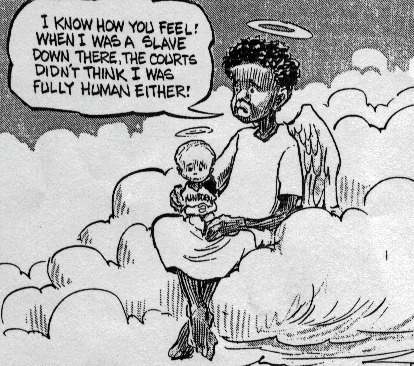
The film “Whatever happened to the human race?” did a great job of comparing the dehumanizing efforts of the slave owners and those of today’s abortion advocates. Here is  a great cartoon that makes the same comparison:

(Francis did a great job in his film series “How Should we then live?” in looking at how humanism has affected art and culture in the Western World in the last 2000 years. My favorite episodes include his study of the Renaissance, the Revolutionary age, the age of Nonreason, and the age of Fragmentation.)

Related posts:

Francis Schaeffer’s “How should we then live?” Video and outline of episode 10 “Final Choices” (Schaeffer Sundays)

E P I S O D E 1 0   Dr. Francis Schaeffer – Episode X – Final Choices 27 min FINAL CHOICES I. Authoritarianism the Only Humanistic Social Option One man or an elite giving authoritative arbitrary absolutes. A. Society is sole absolute in absence of other absolutes. B. But society has to be […]

Francis Schaeffer’s “How should we then live?” Video and outline of episode 9 “The Age of Personal Peace and Affluence” (Schaeffer Sundays)

E P I S O D E 9 Dr. Francis Schaeffer – Episode IX – The Age of Personal Peace and Affluence 27 min T h e Age of Personal Peace and Afflunce I. By the Early 1960s People Were Bombarded From Every Side by Modern Man’s Humanistic Thought II. Modern Form of Humanistic Thought Leads […]

Francis Schaeffer’s “How should we then live?” Video and outline of episode 8 “The Age of Fragmentation” (Schaeffer Sundays)

E P I S O D E 8 Dr. Francis Schaeffer – Episode VIII – The Age of Fragmentation 27 min I saw this film series in 1979 and it had a major impact on me. T h e Age of FRAGMENTATION I. Art As a Vehicle Of Modern Thought A. Impressionism (Monet, Renoir, Pissarro, Sisley, […]

Francis Schaeffer’s “How should we then live?” Video and outline of episode 7 “The Age of Non-Reason” (Schaeffer Sundays)

E P I S O D E 7 Dr. Francis Schaeffer – Episode VII – The Age of Non Reason I am thrilled to get this film series with you. I saw it first in 1979 and it had such a big impact on me. Today’s episode is where we see modern humanist man act […]

Francis Schaeffer’s “How should we then live?” Video and outline of episode 6 “The Scientific Age” (Schaeffer Sundays)

E P I S O D E 6 How Should We Then Live 6#1 Uploaded by NoMirrorHDDHrorriMoN on Oct 3, 2011 How Should We Then Live? Episode 6 of 12 ________ I am sharing with you a film series that I saw in 1979. In this film Francis Schaeffer asserted that was a shift in […]

Francis Schaeffer’s “How should we then live?” Video and outline of episode 5 “The Revolutionary Age” (Schaeffer Sundays)

E P I S O D E 5 How Should We Then Live? Episode 5: The Revolutionary Age I was impacted by this film series by Francis Schaeffer back in the 1970′s and I wanted to share it with you. Francis Schaeffer noted, “Reformation Did Not Bring Perfection. But gradually on basis of biblical teaching there […]

Francis Schaeffer’s “How should we then live?” Video and outline of episode 4 “The Reformation” (Schaeffer Sundays)

Dr. Francis Schaeffer – Episode IV – The Reformation 27 min I was impacted by this film series by Francis Schaeffer back in the 1970′s and I wanted to share it with you. Schaeffer makes three key points concerning the Reformation: “1. Erasmian Christian humanism rejected by Farel. 2. Bible gives needed answers not only as to […]

“Schaeffer Sundays” Francis Schaeffer’s “How should we then live?” Video and outline of episode 3 “The Renaissance”

Francis Schaeffer’s “How should we then live?” Video and outline of episode 3 “The Renaissance” Francis Schaeffer: “How Should We Then Live?” (Episode 3) THE RENAISSANCE I was impacted by this film series by Francis Schaeffer back in the 1970′s and I wanted to share it with you. Schaeffer really shows why we have so […]

Francis Schaeffer’s “How should we then live?” Video and outline of episode 2 “The Middle Ages” (Schaeffer Sundays)

  Francis Schaeffer: “How Should We Then Live?” (Episode 2) THE MIDDLE AGES I was impacted by this film series by Francis Schaeffer back in the 1970′s and I wanted to share it with you. Schaeffer points out that during this time period unfortunately we have the “Church’s deviation from early church’s teaching in regard […]

Francis Schaeffer’s “How should we then live?” Video and outline of episode 1 “The Roman Age” (Schaeffer Sundays)

Francis Schaeffer: “How Should We Then Live?” (Episode 1) THE ROMAN AGE   Today I am starting a series that really had a big impact on my life back in the 1970′s when I first saw it. There are ten parts and today is the first. Francis Schaeffer takes a look at Rome and why […]

What is existentialism?

_______________

How Should We then Live Episode 7 small (Age of Nonreason)

#02 How Should We Then Live? (Promo Clip) Dr. Francis Schaeffer

The clip above is from episode 9 THE AGE OF PERSONAL PEACE AND AFFLUENCE

10 Worldview and Truth

In above clip Schaeffer quotes Paul’s speech in Greece from Romans 1 (from Episode FINAL CHOICES)

Two Minute Warning: How Then Should We Live?: Francis Schaeffer at 100

A Christian Manifesto Francis Schaeffer

Francis Schaeffer “BASIS FOR HUMAN DIGNITY” Whatever…HTTHR

_______________________

So many people are living lives with an existentialism worldview even though they don’t know what the word existentialism means. I love the works of Francis Schaeffer and I have been on the internet reading several blogs that talk about Schaeffer’s work and the work below  on what existentialism is thought to be was really helpful. Schaeffer’s film series “How should we then live?  Wikipedia notes, “According to Schaeffer, How Should We Then Live traces Western history from Ancient Rome until the time of writing (1976) along three lines: the philosophic, scientific, and religious.[3] He also makes extensive references to art and architecture as a means of showing how these movements reflected changing patterns of thought through time. Schaeffer’s central premise is: when we base society on the Bible, on the infinite-personal God who is there and has spoken,[4] this provides an absolute by which we can conduct our lives and by which we can judge society.  Here are some posts I have done on this series: Francis Schaeffer’s “How should we then live?” Video and outline of episode 10 “Final Choices” episode 9 “The Age of Personal Peace and Affluence”episode 8 “The Age of Fragmentation”episode 7 “The Age of Non-Reason” episode 6 “The Scientific Age”  episode 5 “The Revolutionary Age” episode 4 “The Reformation” episode 3 “The Renaissance”episode 2 “The Middle Ages,”, and  episode 1 “The Roman Age,” .

In the film series “WHATEVER HAPPENED TO THE HUMAN RACE?” the arguments are presented  against abortion (Episode 1),  infanticide (Episode 2),   euthanasia (Episode 3), and then there is a discussion of the Christian versus Humanist worldview concerning the issue of “the basis for human dignity” in Episode 4 and then in the last episode a close look at the truth claims of the Bible.

Francis Schaeffer

Best answer chosen by readers is this:

Existentialism is more a worldview than a society or group. It is too broad a philosophical perspective to be talked about as having a membership. In other words there are probably wide disagreements between people holding existentialist views.”At the heart of existentialism is the belief that existence has precedence over essence. All existentialists hold this view in some form. They differ in other respects, but most existentialists, especially atheists, tend to accept certain other propositions…. Meaning and value are found in being, living, willing, and acting. Form essence, and structure are irrelevant and valueless. Meaning and values are created not discovered.” (Geisler, 1999)My take on modern existentialism – it has become a worldview attempting to reconcile what cannot be reconciled. Existentialism is trapped between a Darwinian materialist conviction that matter is all that is real, yet having a very real experiential belief that life must have meaning and purpose. Modern existentialism tries to have its cake and eat it too.I say this cannot be reconciled because it is mutually exclusive. Life is either what materialist conclude it to be (a random collection of atoms bouncing around the universe) or an existence with a purpose we must discover. But this purpose if it is real must transcend or be objective to existence. For the Theist this is no problem because we believe the evidence supports the very real existence of a transcendent creator who imparts meaning to creation.A good book you can find in the local library that speaks to this subject is “He is There and He is Not Silent” by Francis Schaeffer

Source(s):

Baker Encyclopedia of Christian Apologetics – 1999 Baker Books Grand Rapids

Related posts:

Taking on Ark Times Bloggers on various issues Part A “The Pro-life Issue” (Francis Schaeffer Quotes Part 1 includes the film SLAUGHTER OF THE INNOCENTS) (editorial cartoon)

I have gone back and forth and back and forth with many liberals on the Arkansas Times Blog on many issues such as abortion, human rights, welfare, poverty, gun control  and issues dealing with popular culture. Here is another exchange I had with them a while back. My username at the Ark Times Blog is Saline […]

“Schaeffer Sunday” Francis Schaeffer: “Whatever Happened to the Human Race” (Episode 1) ABORTION OF THE HUMAN RACE

It is not possible to know where the pro-life evangelicals are coming from unless you look at the work of the person who inspired them the most. That person was Francis Schaeffer.  I do care about economic issues but the pro-life issue is the most important to me. Several years ago Adrian Rogers (past president of […]

The movie “Les Miserables” and Francis Schaeffer

I got this off a Christian blog spot. This person makes some good points and quotes my favorite Christian philosopher Francis Schaeffer too. Prostitution, Chaos, and Christian Art The newest theatrical release of Victor Hugo’s 1862 novel “Les Miserables” was released on Christmas, but many Christians are refusing to see the movie. The reason simple — […]

“Schaeffer Sunday” Francis Schaeffer is one of the great evangelical theologians of our modern day

Francis Schaeffer was truly a great man and I enjoyed reading his books. A theologian #2: Rev. Francis Schaeffer Duriez, Colin. Francis Schaeffer: An Authentic Life. Wheaton, IL: Crossway Books, 2008. Pp. 240. Francis Schaeffer is one of the great evangelical theologians of our modern day. I was already familiar with some of his books and his […]

“Schaeffer Sundays” Francis Schaeffer’s own words concerning infanticide and youth enthansia

Francis Schaeffer: “Whatever Happened to the Human Race?” (Episode 2) SLAUGHTER OF THE INNOCENTS Published on Oct 6, 2012 by AdamMetropolis ___________ The 45 minute video above is from the film series created from Francis Schaeffer’s book “Whatever Happened to the Human Race?” with Dr. C. Everett Koop. This book  really helped develop my political views […]

Francis Schaeffer’s wife Edith passes away on Easter weekend 2013 Part 7 (includes pro-life editorial cartoon)

The Francis and Edith Schaeffer Story Pt.1 – Today’s Christian Videos The Francis and Edith Schaeffer Story – Part 3 of 3 Francis Schaeffer: “Whatever Happened to the Human Race” (Episode 1) ABORTION OF THE HUMAN RACE Published on Oct 6, 2012 by AdamMetropolis ________________ Picture of Francis Schaeffer and his wife Edith from the […]

The Mark of the Christian by Francis Schaeffer Part 1

  THE MARK OF A CHRISTIAN – CLASS 1 – Introduction Published on Mar 7, 2012 This is the introductory class on “The Mark Of A Christian” by Francis Schaeffer. The class was originally taught at Redeemer Presbyterian Church in Overland Park, KS by Dan Guinn from FrancisSchaefferStudies.org as part of the adult Sunday School hour […]

“Schaeffer Sundays” Francis Schaeffer’s own words concerning humanist dominated public schools in USA even though country was founded on a Christian base

Francis Schaeffer: “Whatever Happened to the Human Race?” (Episode 2) SLAUGHTER OF THE INNOCENTS Published on Oct 6, 2012 by AdamMetropolis The 45 minute video above is from the film series created from Francis Schaeffer’s book “Whatever Happened to the Human Race?” with Dr. C. Everett Koop. This book  really helped develop my political views concerning […]

“Schaeffer Sundays” Francis Schaeffer’s own words concerning where the Bible-believing Christians been the last few decades

Francis Schaeffer: “Whatever Happened to the Human Race” (Episode 1) ABORTION OF THE HUMAN RACE Published on Oct 6, 2012 by AdamMetropolis The 45 minute video above is from the film series created from Francis Schaeffer’s book “Whatever Happened to the Human Race?” with Dr. C. Everett Koop. This book  really helped develop my political views […]

Taking on Ark Times Bloggers on various issues Part E “Moral absolutes and abortion” Francis Schaeffer Quotes part 5(includes the film SLAUGHTER OF THE INNOCENTS) (editorial cartoon)

I have gone back and forth and back and forth with many liberals on the Arkansas Times Blog on many issues such as abortion, human rights, welfare, poverty, gun control  and issues dealing with popular culture. Here is another exchange I had with them a while back. My username at the Ark Times Blog is Saline […]

“Schaeffer Sundays” Francis Schaeffer’s own words concerning religious liberals and humanists

Francis Schaeffer: “Whatever Happened to the Human Race” (Episode 5) TRUTH AND HISTORY Published on Oct 7, 2012 by AdamMetropolis The 45 minute video above is from the film series created from Francis Schaeffer’s book “Whatever Happened to the Human Race?” with Dr. C. Everett Koop. This book  really helped develop my political views concerning abortion, […]

Taking on Ark Times Bloggers on various issues Part R “What’s wrong with Roe v. Wade decision?” (includes video “Truth and History” and editorial cartoon)

I have gone back and forth and back and forth with many liberals on the Arkansas Times Blog on many issues such as abortion, human rights, welfare, poverty, gun control  and issues dealing with popular culture. Here is another exchange I had with them a while back. My username at the Ark Times Blog is Saline Republican.

On 3-4-13 on the Ark Times Blog the person using the username Blake Rutherford’s Pink Bowtie was pleased that Governor Beebe of Arkansas vetoed a pro-life bill. He noted, “Proud of our Governor today. Will our next governor show such courage?”

I responded:

Bill Muehlenberg rightly noted concerning Francis Schaeffer’s view of Roe v Wade:

In his earlier 1976 volume, How Should We Then Live (and the 10-part film series that went with it), he looked at the 1973 ruling in some detail. He talked about the decline of absolutes in American law, and how this decision was completely arbitrary. First, it was medically arbitrary, denying the clear understanding of biology and science.

Second, it was legally arbitrary, “disregarding the intent of the Thirteenth and Fourteenth Amendments of the Constitution.” And third, it was at “complete variance with the past Christian consensus. In the pagan Roman Empire, abortion was freely practiced, but Christians took a stand against it. In 314 the Council of Ancyra barred from the taking of the Lord’s Supper for ten years all who procured abortions or made drugs to further abortions.”

If this arbitrary law is accepted by “most modern people, bred with the concept of no absolutes but rather relativity, why wouldn’t arbitrary absolutes in regard to such matters as authoritarian limitations on freedom be equally accepted as long as they were thought to be sociologically helpful? We are left to sociological law without any certainty of limitation.”

Yes he certainly got that right. It was a prophetic insight into where things would lead, and we have certainly arrived, with euthanasia legalised in various places, and academics arguing for the acceptability of infanticide. Indeed, he made the warning quite clear back then: “The door is open. In regard to the fetus, the courts have arbitrarily separated ‘aliveness’ from ‘personhood,’ and if this is so, why not arbitrarily do the same with the aged? So the steps move along, and euthanasia may well become increasingly acceptable.”

In 1979 his book and film series, Whatever Happened to the Human Race?, co-authored with C. Everett Koop, appeared. It looked at the issues of abortion, infanticide, and euthanasia, and sounded a clear alarm for evangelicals to wake up to their social responsibilities. It also argued that abortion rights logically lead to euthanasia and infanticide rights.

_______________________

In the film series “WHATEVER HAPPENED TO THE HUMAN RACE?” the arguments are presented  against abortion (Episode 1),  infanticide (Episode 2),   euthenasia (Episode 3), and then there is a discussion of the Christian versus Humanist worldview concerning the issue of “the basis for human dignity” in Episode 4 and then in the last episode a close look at the truth claims of the Bible.

I truly believe that many of the problems we have today in the USA are due to the advancement of humanism in the last few decades in our society. Ronald Reagan appointed the evangelical Dr. C. Everett Koop to the position of Surgeon General in his administration. He partnered with Dr. Francis Schaeffer in making the video below. It is very valuable information for Christians to have.  Actually I have included a video below that includes comments from him on this subject.

___________

Francis Schaeffer: “Whatever Happened to the Human Race” (Episode 5) TRUTH AND HISTORY

Published on Oct 7, 2012 by

Compassionate Engagement, Part 5: Schaeffer’s Political Activism

By Derek Brown on January 12, 2012

Part 1    Part 2    Part 3    Part 4

Up to this point in his life, Schaeffer had remained aloof to political activity.  He would become convinced, however, that political involvement was the only logical step given his theory that the decline of Western thought and morality was due to departure from biblical presuppositions (Hankins, 175).  Schaeffer was especially alarmed by the legalizing of abortion, stating that such legalization was arbitrary, both legally and medically; further governmental authoritarianism would be the consequence if Christians did not resist the trend represented by Roe v. Wade.

All of this effort against abortion aimed directly at secular humanism.  Secular humanism, Schaeffer was convinced, was antithetically opposed to biblical Christianity, and, if allowed to take root, could usher in a situation where a few elite policy writers would fill the vacuum left by the disappearance of transcendent absolutes with arbitrary rules and regulations (Hankins, 177-180),  Against this very real threat of authoritarianism Christians had to fight.

Schaeffer’s effort against abortion expressed itself in another film and book, co-authored with C. Everett Koop, entitled, What Ever Happened to the Human Race.  In both the book and the film, Schaeffer argued that the disappearance of a Christian base in the West had led the adoption of a humanist foundation; the remedy was the reestablishment of the Christian base that had been lost in the twentieth century as a result of the ideas of the Enlightenment that had spread throughout the culture (Hankins, 188).  As the book and the film graphically describe the process of abortion, Schaeffer observed that clear phrases like “ending a pregnancy” were only a disguise for what was actually occurring; namely the killing of a human being (Hankins, 181).

Schaeffer and Koop’s endeavor to startle sleeping evangelicals into action apparently worked.  Prior to 1980, very few Protestant denominations sought involvement in the abortion problem, considering it a problem with which the Roman Catholic Church had taken issue.  In 1980 the Southern Baptist Convention (SBC), for example, established pro-life resolutions aimed at stopping abortions.  Key leaders within the SBC had read Schaeffer and testified to Schaeffer’s influence on this vital issue.  According to Hankins, “[Schaeffer’s] push against abortion certainly helped fuel the evangelical pro-life movement” (Hankins, 182).

Schaeffer followed What Ever Happened to the Human Race with A Christian Manifesto.  Schaeffer’s burden in the latter book was to help Christians understand their relationship to the government, law, and civil disobedience.  Like the books that had come before, Manifesto was a book of worldviews.  In introducing his plea for Christians to stand against secular humanism, Schaeffer began his argument by noting how pietism—that form of Christianity that emphasizes the experiential component of the faith—had served to divorce facts and ideas from the realm of experience and thus relegated Christianity to the sphere of the private and subjective.  This unfortunate consequence of pietism, Schaeffer argued, allowed secular humanism to develop a strong foothold; Christians were to stand against development by seeing Christianity not merely as an experience, but as a worldview that makes sense of all reality (Hankins, 196-197).

In regards to the question of civil disobedience, Schaeffer believed it was the responsibility of Christians to resist the state when officeholders became tyrannical, although the general demeanor of Christians should be one of submission.  Schaeffer was also reluctant to advocate the use of force—even on the issue of abortion.  Legislative action, sit-ins, political pressure, and quiet demonstrations should be the primary way in which Christians should seek to influence the government and the change of laws (Hankins, 208).

Schaeffer wielded significant influence in the political realm, just as he had previously in the area of Christian apologetics and evangelical engagement with culture—the latter area undoubtedly related to his political involvement as well.  According to Colin Duriez, Schaeffer’s three books, How Shall We Then Live, Whatever Happened to the Human Race, and A Christian Manifesto,

…substantially helped created a new Evangelical Right in America.  Certainly, joining the pro-life lobby identified Schaeffer with America’s Religious Right, which was able to exercise considerable political clout during the Reagan era (Duriez, 191).

Schaeffer would continue his labors despite the fact that two years earlier (in 1978) he had been diagnosed with cancer.  With treatment, Schaeffer’s cancer retreated into remission for a season, while he continued to write and speak at various venues around the United States and spend time at L’Abri.  On May 15, 1984, however, only two years after publishing a five volume set of his complete works, Francis Schaeffer died at his home in Rochester, Minnesota.

Next: Conclusion: Schaeffer’s Lasting Influrence

____________

Here is a editorial cartoon that looks at the issue of abortion in light of President Obama’s popular political campaign slogan:

________________

Related posts:

The Mark of the Christian by Francis Schaeffer Part 2

The Mark of the Christian by Francis Schaeffer Part 2

THE MARK OF A CHRISTIAN – CLASS 2 – Men & Brothers/A Delicate Balance

Published on Mar 15, 2012

The class was originally taught at Redeemer Presbyterian Church in Overland Park, KS by Dan Guinn from FrancisSchaefferStudies.org as part of the adult Sunday School hour on Mar. 11th, 2012. 

This class covers (section headings by Schaeffer)
Section 2 – “Men & Brothers” 
Section 3 – “A Delicate Balance”

_______________________________

I have several spiritual heroes in my life and Francis Schaeffer was one of those. In the film series “WHATEVER HAPPENED TO THE HUMAN RACE?” the arguments are presented  against abortion (Episode 1),  infanticide (Episode 2),   euthenasia (Episode 3), and then there is a discussion of the Christian versus Humanist worldview concerning the issue of “the basis for human dignity” in Episode 4 and then in the last episode a close look at the truth claims of the Bible.
Christians should present the truth in love and that is what Francis Schaeffer’s book “The Mark of the Christian” is about. I have a portion of that book below:
Christians have not always presented a pretty picture to the world.
Loving our brothers and sisters

If Jesus had commanded so strongly that we love all people as our neighbors, then how important it is especially to love our fellow Christians.

If we are told to love all people as our neighbors then surely we can understand how overwhelmingly important it is that all men and women be able to see an observable love for those with whom we have these special ties.

The apostle Paul makes the double obligation clear in Galatians 6:10:

Therefore, as we have opportunity, let us do good to all people, especially to those who belong to the family of believers.

He does not negate the command to do good to all people. But it is still not meaningless to add, especially to those who belong to the family of believers.

This dual goal should be our Christian mentality, the set of our minds; we should be consciously thinking about it and what it means in our one-moment-at-a-time lives. It should be the attitude that governs our outward observable actions.

A delicate balance

Very often the true Bible-believing Christian, in emphasizing two humanities –

one lost, one saved,
one still standing in rebellion against God,
the other having returned to God through Christ –

has given a picture of exclusiveness which is ugly.

There are two humanities. That is true.

Some men and women made in the image of God still stand in rebellion against him;

some, by the grace of God, have cast themselves upon God’s solution.

Nonetheless, there is in another very important sense only one humanity.

All men and women derive from one origin.
By creation, all bear the image of God.
In this sense, all people are of one flesh, one blood.

Hence, the exclusiveness of the two humanities is undergirded by the unity of all men and women. And Christians are not to love their believing brothers and sisters to the exclusion of their non-believing fellows. That is ugly. We are to have the example of the good Samaritan consciously in mind at all times.

The first commandment is to love the Lord our God with all our heart, soul, and mind. The second commandment bears the universal command to love people. Notice that the second commandment is not just to love Christians. It is far wider than this. We are to love our neighbor as ourselves.

First Thessalonians 3:12 carries the same double emphasis:

May the Lord make your love increase and overflow for each other and for everyone else, just as ours does for you.

Here the order is reversed. First of all, we are to have love one toward another and then toward everyone else, but that does not change the double emphasis. Rather, it points up the delicate balance – a balance that is not in practice automatically maintained.

For true christians only

If we look again at the command in John 13, we will notice some important things.

First of all, this is a command to have a special love to all true Christians, all born-again Christians.

From the scriptural viewpoint,
not all who call themselves Christians are Christians,
and that is especially true in our generation.

The meaning of the word Christian has been reduced to practically nothing. Surely, there is no word that has been so devalued unless it is the Word of God itself. Central to semantics is the idea that a word as a symbol has no meaning until content is put into it. This is quite correct. Because the word Christian as a symbol has been made to mean so little, it has come to mean everything and nothing.

Jesus, however, is talking about loving all true Christians. And this is a command that has two cutting edges, for it means that we must both distinguish true Christians from all pretenders and be sure that we leave no true Christians outside of our consideration.

But we must be careful of the opposite error.

We must include everyone who stands
in the historic-biblical faith
whether or not he or she is a member
of our own party or our own group.

But even if a person is not among the true Christians, we still have the responsibility to love that one as our neighbor. So we cannot say,

“Now here’s somebody that, as far as I can tell, does not stand among the group of true Christians, and therefore I don’t have to think of him any more; I can just slough him off.”

Not at all. That one is covered by the second commandment.

The quality of our love

The second thing to notice in these verses in John 13 is the quality of the love that is to be our standard. We are to love all Christians

As I have loved you. [Jesus says]

The love he exhibited is to be our standard.
We are to love all true Christians as Christ has loved us.

When we consider this, either of two things can happen:

We can just say, “I see! I see!” and we can make a little banner and write on it, “We Love All Christians!” and show it off when anyone looks at us.

How ugly.

Or we can find something exceedingly more profound – something that will take a great deal of time to cultivate; a great deal of thinking and praying about it.

The church is to be a loving church in a dying culture. How, then, is the dying culture going to consider us? Jesus says

by this shall all people know
that you are my disciples,
if you have love one to another.

In the midst of the world, in the midst of our present culture, Jesus is giving a right to the world. Upon his authority he gives the world the right to judge whether you and I are born-again Christians, on the basis of our observable love toward all Christians.

That’s pretty frightening. Jesus turns to the world and says, “I’ve something to say to you. On the basis of my authority, I give you a right: you may judge whether or not an individual is a Christian on the basis of the love they show to all true Christians.”

In other words, if people come up to us and cast in our teeth the judgment that we are not Christians because we have not shown love toward other Christians, we must understand that they are only exercising a prerogative which Jesus gave them.

And must must not get angry.

If people say, “You don’t love other Christians,” we must go home, get down on our knees, and ask God whether or not what they say is true. And if it is, then they have a right to have said it.

Dealing with failure in love

We must be very careful at this point, however.

We may be true Christians, really born-again Christians, and yet fail in our love toward other Christians. As a matter of fact, to be completely realistic, it is stronger than this.

There will be times
(and let us say it with tears),
when we will fail in our love
toward each other as Christians.

In a fallen world, where there is no such thing as perfection
( until Jesus comes), we know this will be the case.

And, of course, when we fail, we must ask God’s forgiveness.

But, Jesus is not here saying that our failure to love all Christians proves that we are not Christians. What Jesus is saying, however, is that, if I do not have the love I should have toward all other Christians, the world has the right to make the judgment that I am not a Christian.

This distinction is a vital one. If we fail in our love toward all Christians, we must not tear our heart out as though it were proof that we are lost. No one except Christ Himself has ever lived and not failed. If success in love toward our brothers in Christ were to be the standard of whether or not a man is a Christian, then there would be no Christians, because all men have failed. But Jesus gives the world a piece of litmus paper, a reasonable thermometer.

There is a mark which,
if the world does not see,
allows them to conclude,
“This person is not a Christian.”

Of course, the world may be making a wrong judgment because if the man is truly a Christian, as far as the reality goes, they made a mistake.

The final apologetic

But there is something even more sober. And to understand it we must look at John 17:21, a verse out of the midst of Christ’s high priestly prayer. Jesus prays,

That all of them may be one, Father, just as you are in me and I am in you. May they also be in us so that the world may believe that you have sent me.

In this, his high priestly prayer, Jesus is praying for the oneness of the church, the oneness that should be found specifically among true Christians. Jesus is not praying for a humanistic, romantic oneness among people in general. Verse 9 makes this clear:

I pray for them. I am not praying for the world, but for those you have given me, for they are yours.

Jesus here makes a very careful distinction between those who have cast themselves upon him in faith and those who still stand in rebellion. Hence, in the twenty-first verse, when he prays for oneness, the “they” he is referring to are the true Christians.

Notice, however, that verse 21 says, That all of them may be one…
The emphasis, interestingly enough, is exactly the same as in John 13

not for a part of true Christians,
but for all Christians

not that those in certain parties
in the church should be one,
but that all born-again Christians should be one.

Now comes the sobering part:
Jesus goes on in this twenty-first verse to say something that always causes me to cringe. If, as Christians, we do not cringe, it seems to me we are not very sensitive or very honest, because Jesus here gives us the final apologetic.

What is the final apologetic?

That all of them may be one, Father, just as you are in me and I am in you. May they also be in us so that the world may believe that you have sent me.

This is the final apologetic. [our ultimate defense]

In John 13 the point was that, if an individual Christian does not show love toward other true Christians, the world has a right to judge that he or she is not a Christian. Here Jesus is stating something else that is much more cutting, much more profound:

The Mark of the Christian by Francis Schaeffer © 1970 by L’Abri Fellowship. Used by permission of Norfolk Press, London. All rights reserved. No portion of this online edition of the book may be reproduced in any form or by any means, except for brief quotations for the purpose of review, comment, or scholarship, without written permission from the copyright holder.
Francis A. Schaeffer Institute of Church Leadership Development http://www.truespirituality.org/

I truly believe that many of the problems we have today in the USA are due to the advancement of humanism in the last few decades in our society. Ronald Reagan appointed the evangelical Dr. C. Everett Koop to the position of Surgeon General in his administration. He partnered with Dr. Francis Schaeffer in making the video below. It is very valuable information for Christians to have.  Actually I have included a video below that includes comments from him on this subject.

Many liberals actually truly do argue for abortion rights over human rights. Prochoice advocate Elizabeth Williams came out and said that on 1-23-13 in her article on Salon. We hear reasons for abortion such as poverty,and  child abuse,  but why not consider adoption? Instead, the political left will stop at nothing to push the pro-abortion agenda. Why not stop and take an honest look at when life begins for the unborn child and when she begins to feel pain?

Francis Schaeffer

Francis Schaeffer: “Whatever Happened to the Human Race” (Episode 1) ABORTION OF THE HUMAN RACE

Published on Oct 6, 2012 by

Related posts:

Francis Schaeffer’s prayer for us in USA

 Francis Schaeffer: “Whatever Happened to the Human Race” (Episode 1) ABORTION OF THE HUMAN RACE Published on Oct 6, 2012 by AdamMetropolis The 45 minute video above is from the film series created from Francis Schaeffer’s book “Whatever Happened to the Human Race?” with Dr. C. Everett Koop. This book  really helped develop my political views […]

Francis Schaeffer’s “How should we then live?” Video and outline of episode 10 “Final Choices” (Schaeffer Sundays)

E P I S O D E 1 0   Dr. Francis Schaeffer – Episode X – Final Choices 27 min FINAL CHOICES I. Authoritarianism the Only Humanistic Social Option One man or an elite giving authoritative arbitrary absolutes. A. Society is sole absolute in absence of other absolutes. B. But society has to be […]

Francis Schaeffer’s “How should we then live?” Video and outline of episode 9 “The Age of Personal Peace and Affluence” (Schaeffer Sundays)

E P I S O D E 9 Dr. Francis Schaeffer – Episode IX – The Age of Personal Peace and Affluence 27 min T h e Age of Personal Peace and Afflunce I. By the Early 1960s People Were Bombarded From Every Side by Modern Man’s Humanistic Thought II. Modern Form of Humanistic Thought Leads […]

Francis Schaeffer’s “How should we then live?” Video and outline of episode 8 “The Age of Fragmentation” (Schaeffer Sundays)

E P I S O D E 8 Dr. Francis Schaeffer – Episode VIII – The Age of Fragmentation 27 min I saw this film series in 1979 and it had a major impact on me. T h e Age of FRAGMENTATION I. Art As a Vehicle Of Modern Thought A. Impressionism (Monet, Renoir, Pissarro, Sisley, […]

Francis Schaeffer’s “How should we then live?” Video and outline of episode 7 “The Age of Non-Reason” (Schaeffer Sundays)

E P I S O D E 7 Dr. Francis Schaeffer – Episode VII – The Age of Non Reason I am thrilled to get this film series with you. I saw it first in 1979 and it had such a big impact on me. Today’s episode is where we see modern humanist man act […]

Francis Schaeffer’s “How should we then live?” Video and outline of episode 6 “The Scientific Age” (Schaeffer Sundays)

E P I S O D E 6 How Should We Then Live 6#1 Uploaded by NoMirrorHDDHrorriMoN on Oct 3, 2011 How Should We Then Live? Episode 6 of 12 ________ I am sharing with you a film series that I saw in 1979. In this film Francis Schaeffer asserted that was a shift in […]

Francis Schaeffer’s “How should we then live?” Video and outline of episode 5 “The Revolutionary Age” (Schaeffer Sundays)

E P I S O D E 5 How Should We Then Live? Episode 5: The Revolutionary Age I was impacted by this film series by Francis Schaeffer back in the 1970′s and I wanted to share it with you. Francis Schaeffer noted, “Reformation Did Not Bring Perfection. But gradually on basis of biblical teaching there […]

Francis Schaeffer’s “How should we then live?” Video and outline of episode 4 “The Reformation” (Schaeffer Sundays)

Dr. Francis Schaeffer – Episode IV – The Reformation 27 min I was impacted by this film series by Francis Schaeffer back in the 1970′s and I wanted to share it with you. Schaeffer makes three key points concerning the Reformation: “1. Erasmian Christian humanism rejected by Farel. 2. Bible gives needed answers not only as to […]

“Schaeffer Sundays” Francis Schaeffer’s “How should we then live?” Video and outline of episode 3 “The Renaissance”

Francis Schaeffer’s “How should we then live?” Video and outline of episode 3 “The Renaissance” Francis Schaeffer: “How Should We Then Live?” (Episode 3) THE RENAISSANCE I was impacted by this film series by Francis Schaeffer back in the 1970′s and I wanted to share it with you. Schaeffer really shows why we have so […]

Francis Schaeffer’s “How should we then live?” Video and outline of episode 2 “The Middle Ages” (Schaeffer Sundays)

  Francis Schaeffer: “How Should We Then Live?” (Episode 2) THE MIDDLE AGES I was impacted by this film series by Francis Schaeffer back in the 1970′s and I wanted to share it with you. Schaeffer points out that during this time period unfortunately we have the “Church’s deviation from early church’s teaching in regard […]

Francis Schaeffer’s “How should we then live?” Video and outline of episode 1 “The Roman Age” (Schaeffer Sundays)

Francis Schaeffer: “How Should We Then Live?” (Episode 1) THE ROMAN AGE   Today I am starting a series that really had a big impact on my life back in the 1970′s when I first saw it. There are ten parts and today is the first. Francis Schaeffer takes a look at Rome and why […]

Francis Schaeffer: “Whatever Happened to the Human Race” (Episode 5) TRUTH AND HISTORY

Francis Schaeffer: “Whatever Happened to the Human Race” (Episode 5) TRUTH AND HISTORY Published on Oct 7, 2012 by AdamMetropolis This crucial series is narrated by the late Dr. Francis Schaeffer and former Surgeon General Dr. C. Everett Koop. Today, choices are being made that undermine human rights at their most basic level. Practices once […]

Francis Schaeffer: “Whatever Happened to the Human Race” (Episode 4) THE BASIS FOR HUMAN DIGNITY

The opening song at the beginning of this episode is very insightful. Francis Schaeffer: “Whatever Happened to the Human Race” (Episode 4) THE BASIS FOR HUMAN DIGNITY Published on Oct 7, 2012 by AdamMetropolis This crucial series is narrated by the late Dr. Francis Schaeffer and former Surgeon General Dr. C. Everett Koop. Today, choices […]

Francis Schaeffer: “Whatever Happened to the Human Race” (Episode 3) DEATH BY SOMEONE’S CHOICE

Francis Schaeffer: “Whatever Happened to the Human Race” (Episode 3) DEATH BY SOMEONE’S CHOICE Published on Oct 6, 2012 by AdamMetropolis This crucial series is narrated by the late Dr. Francis Schaeffer and former Surgeon General Dr. C. Everett Koop. Today, choices are being made that undermine human rights at their most basic level. Practices […]

Francis Schaeffer: “Whatever Happened to the Human Race?” (Episode 2) SLAUGHTER OF THE INNOCENTS

Francis Schaeffer: “Whatever Happened to the Human Race?” (Episode 2) SLAUGHTER OF THE INNOCENTS Published on Oct 6, 2012 by AdamMetropolis This crucial series is narrated by the late Dr. Francis Schaeffer and former Surgeon General Dr. C. Everett Koop. Today, choices are being made that undermine human rights at their most basic level. Practices […]

Francis Schaeffer: “Whatever Happened to the Human Race” (Episode 1) ABORTION OF THE HUMAN RACE

It is not possible to know where the pro-life evangelicals are coming from unless you look at the work of the person who inspired them the most. That person was Francis Schaeffer.  I do care about economic issues but the pro-life issue is the most important to me. Several years ago Adrian Rogers (past president of […]

The following essay explores the role that Francis Schaeffer played in the rise of the pro-life movement. It examines the place of How Should We Then Live?, Whatever Happened to the Human Race?, and A Christian Manifesto in that process.

This essay below is worth the read. Schaeffer, Francis – “Francis Schaeffer and the Pro-Life Movement” [How Should We Then Live?, Whatever Happened to the Human Race?, A Christian Manifesto] Editor note: <p> </p> [The following essay explores the role that Francis Schaeffer played in the rise of the pro-life movement.  It examines the place of […]

Who was Francis Schaeffer? by Udo Middelmann

Great article on Schaeffer. Who was Dr. Francis A. Schaeffer? By Francis Schaeffer The unique contribution of Dr. Francis Schaeffer on a whole generation was the ability to communicate the truth of historic Biblical Christianity in a way that combined intellectual integrity with practical, loving care. This grew out of his extensive understanding of the Bible […]

By Everette Hatcher III | Posted in Francis Schaeffer | Edit | Comments (0)

Francis Schaeffer’s wife Edith passes away on Easter weekend 2013 Part 11 (includes pro-life editorial cartoon)

The Francis and Edith Schaeffer Story Pt.1 – Today’s Christian Videos

The Francis and Edith Schaeffer Story – Part 3 of 3

Francis Schaeffer: “Whatever Happened to the Human Race” (Episode 1) ABORTION OF THE HUMAN RACE

Published on Oct 6, 2012 by

________________

Picture of Francis Schaeffer and his wife Edith from the 1930′s above. I was sad to read about Edith passing away on Easter weekend in 2013. I wanted to pass along this fine article below.

Below is a blog post by a professor of Philosophy:

Saturday, March 30, 2013

Edith Schaeffer, RIP


Edith Schaeffer, wife of the late Evangelical apologist Francis A. Schaeffer and co-founder of L’Abri Fellowship in Switzerland, died today (Holy Saturday) at the age of 98. A prolific author in her own right, she was also a beloved matriarch of L’Abri Fellowship and leader of various Bible study groups, as well as a conference speaker around the world.During her last years, she had been cared for reportedly by her daughter Debbie and her son-in-law Udo Middelmann, in whose home I had the honor of spending a year between my sophomore and junior years of college long ago.

Together with her late husband Francis, Edith influenced many lives through L’Abri Fellowship, including those of Dr. Eduardo Echeverria and my own at Sacred Heart Major Seminary whose years at L’Abri nearly overlapped back in the 1970s.

Born in Wenzhou, China as the daughter of missionaries to China, like yours truly, she had an international vision of the task of the church in the world.

She will be buried in Rochester, MN, where, sometime later, a public memorial service will be held.

A message from the L’Abri Staff on the passing of Edith Schaeffer may be found HERE on The Aquila Report on the website of the Reformed Theological Seminary (March 30, 2013).

Her son, Franky A. Schaeffer has written “A Tribute to My Evangelical Leader Mom– Edith Schaeffer RIP” (The Huffington Post [There’s a backstory on that], March 30, 2013). Franky includes a bibliography of his mother’s works.

2 comments:

  1. I never thought anything new by Franky would move me. I was wrong. For me any my generation, Edith Schaeffer was one among those “Last of the Giants.” Godspeed to her soul.

    ReplyDelete

  2. Franky Schaeffer:

    “Mom’s daily life was a rebuke and contradiction to people who see everything as black and white. Liberals and secularists alike who make smug disparaging declarations about ‘all those evangelicals’ would see their fondest prejudices founder upon the reality of my mother’s compassion, cultural literacy and loving energy.”

    In recent years it’s been hard to distinguish Franky from the “liberals and secularists” who disparage evangelical Christianity. But that was a touching tribute to his mother, and perhaps one day he’ll come around with regards to his father as well.

    RIP Edith.

    ReplyDelete

Dr. Koop with Francis Schaeffer in their film WHATEVER HAPPENED TO THE HUMAN RACE? made it clear that unborn babies have the right to life. That point is made well in this political cartoon about abortion:

(Francis did a great job in his film series “How Should we then live?” in looking at how humanism has affected art and culture in the Western World in the last 2000 years. My favorite episodes include his study of the Renaissance, the Revolutionary age, the age of Nonreason, and the age of Fragmentation.)

Related posts:

Francis Schaeffer’s “How should we then live?” Video and outline of episode 10 “Final Choices” (Schaeffer Sundays)

E P I S O D E 1 0   Dr. Francis Schaeffer – Episode X – Final Choices 27 min FINAL CHOICES I. Authoritarianism the Only Humanistic Social Option One man or an elite giving authoritative arbitrary absolutes. A. Society is sole absolute in absence of other absolutes. B. But society has to be […]

Francis Schaeffer’s “How should we then live?” Video and outline of episode 9 “The Age of Personal Peace and Affluence” (Schaeffer Sundays)

E P I S O D E 9 Dr. Francis Schaeffer – Episode IX – The Age of Personal Peace and Affluence 27 min T h e Age of Personal Peace and Afflunce I. By the Early 1960s People Were Bombarded From Every Side by Modern Man’s Humanistic Thought II. Modern Form of Humanistic Thought Leads […]

Francis Schaeffer’s “How should we then live?” Video and outline of episode 8 “The Age of Fragmentation” (Schaeffer Sundays)

E P I S O D E 8 Dr. Francis Schaeffer – Episode VIII – The Age of Fragmentation 27 min I saw this film series in 1979 and it had a major impact on me. T h e Age of FRAGMENTATION I. Art As a Vehicle Of Modern Thought A. Impressionism (Monet, Renoir, Pissarro, Sisley, […]

Francis Schaeffer’s “How should we then live?” Video and outline of episode 7 “The Age of Non-Reason” (Schaeffer Sundays)

E P I S O D E 7 Dr. Francis Schaeffer – Episode VII – The Age of Non Reason I am thrilled to get this film series with you. I saw it first in 1979 and it had such a big impact on me. Today’s episode is where we see modern humanist man act […]

Francis Schaeffer’s “How should we then live?” Video and outline of episode 6 “The Scientific Age” (Schaeffer Sundays)

E P I S O D E 6 How Should We Then Live 6#1 Uploaded by NoMirrorHDDHrorriMoN on Oct 3, 2011 How Should We Then Live? Episode 6 of 12 ________ I am sharing with you a film series that I saw in 1979. In this film Francis Schaeffer asserted that was a shift in […]

Francis Schaeffer’s “How should we then live?” Video and outline of episode 5 “The Revolutionary Age” (Schaeffer Sundays)

E P I S O D E 5 How Should We Then Live? Episode 5: The Revolutionary Age I was impacted by this film series by Francis Schaeffer back in the 1970′s and I wanted to share it with you. Francis Schaeffer noted, “Reformation Did Not Bring Perfection. But gradually on basis of biblical teaching there […]

Francis Schaeffer’s “How should we then live?” Video and outline of episode 4 “The Reformation” (Schaeffer Sundays)

Dr. Francis Schaeffer – Episode IV – The Reformation 27 min I was impacted by this film series by Francis Schaeffer back in the 1970′s and I wanted to share it with you. Schaeffer makes three key points concerning the Reformation: “1. Erasmian Christian humanism rejected by Farel. 2. Bible gives needed answers not only as to […]

“Schaeffer Sundays” Francis Schaeffer’s “How should we then live?” Video and outline of episode 3 “The Renaissance”

Francis Schaeffer’s “How should we then live?” Video and outline of episode 3 “The Renaissance” Francis Schaeffer: “How Should We Then Live?” (Episode 3) THE RENAISSANCE I was impacted by this film series by Francis Schaeffer back in the 1970′s and I wanted to share it with you. Schaeffer really shows why we have so […]

Francis Schaeffer’s “How should we then live?” Video and outline of episode 2 “The Middle Ages” (Schaeffer Sundays)

  Francis Schaeffer: “How Should We Then Live?” (Episode 2) THE MIDDLE AGES I was impacted by this film series by Francis Schaeffer back in the 1970′s and I wanted to share it with you. Schaeffer points out that during this time period unfortunately we have the “Church’s deviation from early church’s teaching in regard […]

Francis Schaeffer’s “How should we then live?” Video and outline of episode 1 “The Roman Age” (Schaeffer Sundays)

Francis Schaeffer: “How Should We Then Live?” (Episode 1) THE ROMAN AGE   Today I am starting a series that really had a big impact on my life back in the 1970′s when I first saw it. There are ten parts and today is the first. Francis Schaeffer takes a look at Rome and why […]