Category Archives: Economist Dan Mitchell

Dan Mitchell: Joe Biden is pushing for a massive tax increase, for instance, but his proposed spending increase is far larger.

The Case Against Higher Taxes

I’ve identified seven reasons to oppose tax increases, but explain in this interview that the biggest reason is that it would be a mistake to give politicians more money to finance an ever-larger burden of government spending.

I had two goals when responding this question (part of a longer interview).

First, I wanted to help viewers understand that America’s fiscal problem is too much government spending and that red ink is simply a symptom of that problem.

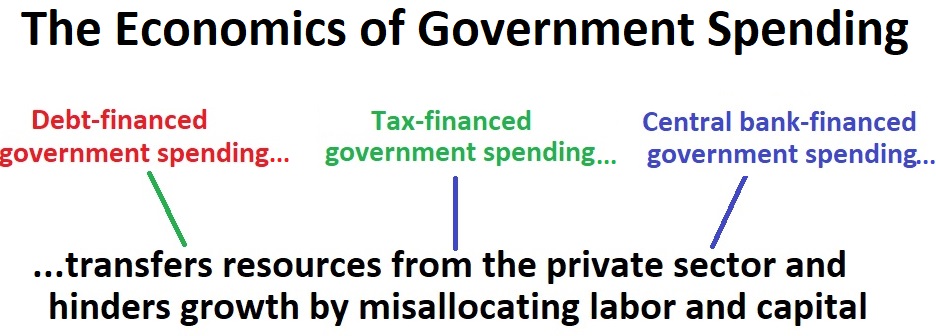
Over the years, I’ve concocted all sorts of visuals to make this point. Like this one.
And this one.

And this one.

Second, I wanted viewers to understand that higher taxes will simply make a bad situation even worse.

From my perspective, the biggest problem with tax increases is that they will enable a bigger burden of government spending.

But even the folks who fixate on red ink should adopt a no-tax increase position.

Why? Because politicians who want big tax increases want even bigger spending increases.

Joe Biden is pushing for a massive tax increase, for instance, but his proposed spending increase is far larger.

We also have decades of evidence from Europe. There’s been a huge increase in the tax burden in Western Europe since the 1960s (largely enabled by the enactment of value-added taxes).

Did that massive increase in revenue lead to less red ink?

Nope, just the opposite, as I showed in both 2012 and 2016.

If you don’t agree with me on this issue, maybe you should heed the words of these four former presidents.

P.S. Some people warn that endlessly increasing debt is a recipe for an eventual crisis. They’re probably right. Which is why it is important to oppose tax-increase deals that wind up saddling us with more red ink. Besides, the long-run damage of tax-financed spending is very similar to the long-run damage of debt-financed spending.

P.P.S. As I mention in the interview, the only real solution is spending restraint. And a spending cap is the best way of enforcing that approach.

Biden’s Boondoggle(s) and the Burden of Government Spending

First we got Biden’s $1.9 trillion so-called stimulus.

Then we got his $1 trillion-plus infrastructure boondoggle.

Now Congress may be on the verge of approving the President’s budget, which (if we use honest numbers) is a $5 trillion plan to expand the welfare state.

And…
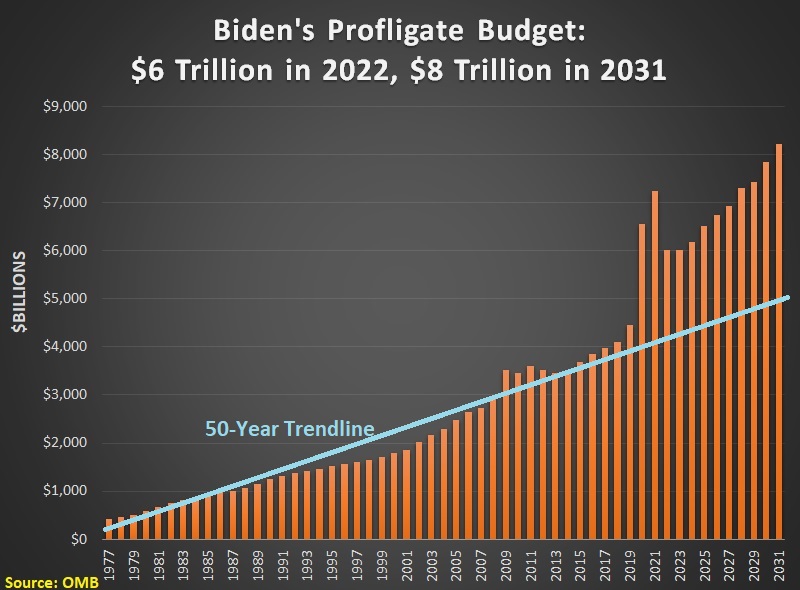
So it’s hardly a surprise that recent changes will lead to a much-larger burden of government spending.

This is bad news for our economy, as measured by my recent study (with similar findings from a wide range of academics – as well as normally left-leaning bureaucracies such as the IMF, World Bank, and OECD).

For purposes of today’s column, let’s put America’s fiscal decline in global context.

Here are some excerpts from a very depressing article in the Economist, starting with some discussion of how Biden’s spending binge is similar to the mistakes made by other nations.

President Joe Biden is building on what started as emergency pandemic-related policy, expanding the child-tax credit, creating a universal federally funded child-care system, subsidising paid family leave and expanding Obamacare. America’s government spending remains somewhat below the developed-world average. But this change is not just a matter of catching up; the target is moving. Government spending as a share of gdp in the oecd as a whole has consistently inched higher in the six decades since the club was formed in 1961.

There’s then some discussion about how a few nations – most notably Sweden and New Zealand – enjoyed period of genuine spending restraint, but accompanied by depressing observations about how fiscal responsibility is very rare.

Examples of genuine state retrenchment in developed countries are few and far between. Sweden managed it in the 1980s. In the early 1990s Ruth Richardson, then New Zealand’s finance minister, cut the size of the state drastically. …State spending is now six percentage points lower as a share of gdp than it was in 1990. But this is a rare achievement, and perhaps one doomed to pass. …This is a sorry state of affairs if you believe that low taxes and small government are the right, and possibly the only, conditions for reliable, enduring economic growth. …an argument made by Friedrich Hayek, an Austrian philosopher, Milton Friedman, an American economist, and others in the mid-20th century.

There’s also some historical analysis showing how the burden of government used to be relatively minor.

From 1274 to 1691 the English government raised less than 2% of gdp in tax. …In the 1870s the governments of rich countries were spending about 10% of gdp. In 1920 it was nearer 20%. It has been growing ever since (see chart 2).

Here’s the aforementioned chart 2, and there are a lot of depressing numbers, though notice how Switzerland does better than other nations.
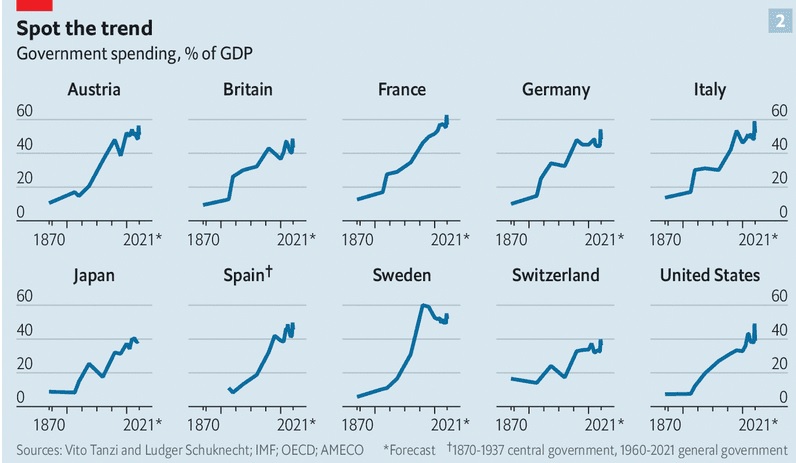
I’ve previously shared a version of this data, calling it the “world’s most depressing chart” – all of which was made possible by the imposition of income taxes.

But there is some good news. The ever-rising fiscal burden of government has been somewhat offset by reductions in other bad policies.

Governments have not grown more powerful by all measures. Bureaucrats no longer, as a rule, set wages or prices, nor impose strict currency controls, as many did in the 1960s or 1970s. In recent decades the public sector has raised hundreds of billions of dollars from privatisations of state assets such as mines and telecoms networks. If you find it faintly amusing to hear that, from 1948 to 1984, the British state ran its own chain of hotels, that is because the “neoliberal” outlook on the proper place of government has triumphed.

Last but not least, there’s some discussion of “public choice,” which explains why politicians and bureaucrats have incentives to expand the size and scope of government.

Governments and bureaucrats are at least partly self-interested: “public-choice theory” says that unrestrained bureaucracies will defend their turf and seek to expand it. …Politicians have their own incentives to expand the state. It is generally more rewarding for a politician to introduce a new programme than it is to close an old one down; costs are spread across all taxpayers while benefits tend to be concentrated, thus eliciting gratitude from interest groups

I’ll close by reiterating my warning that ever-rising spending burdens not only lead to less growth, but they also will lead to Greek-style fiscal crises.

Europe will get hit first, but it’s just a matter of time before the United States suffers a similar fate.

P.S. There is a simple solution to avoid such crises, and a specific policy to achieve that solution. But don’t hold your breath waiting for politicians to tie their own hands.

Biden’s Economic Alchemy: $3.5 Trillion = Zero

Last week, I wrote about a new study which estimates that Biden’s fiscal agenda of bigger government and higher taxeswould reduce economic output by about $3 trillion over the next decade.
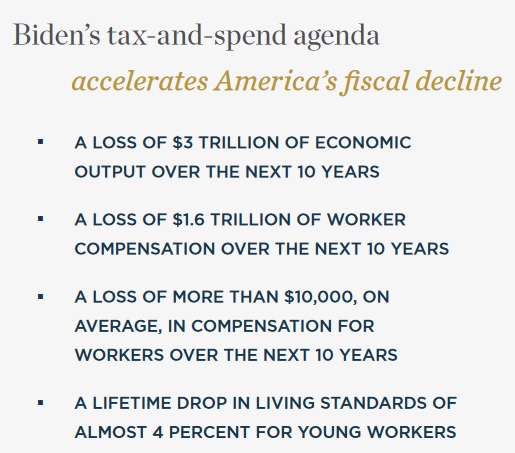
Perhaps more relevant, that foregone economic growth would translate into more than $10,000 of lost compensation per job. And a lifetime drop in living standards of more than 4 percent for younger people.

And these numbers are based on research by the Congressional Budget Office, which is hardly a bastion of libertarian analysis.

The Biden White House has a different perspective.

How different? Well, the President actually claims that expanding the burden of government won’t cost anything.

I’m not joking. Here are some excerpts from an article in the Washington Post by Seung Min Kim and Tony Romm.

President Biden promised Friday that his sweeping domestic agenda package will cost “nothing” because Democrats will pay for it through tax hikes on the wealthy and corporations… The remarks were an attempt by Bidento assuage some of the cost concerns pointedly expressed by the moderate Democrats about the size of the legislation… The total spending outlined in the plan is $3.5 trillion… “It is zero price tag on the debt we’re paying. We’re going to pay for everything we spend,” Biden said in remarks from the State Dining Room at the White House.

Biden’s strange analysis has generated some amusing responses.

For instance, Gerard Baker opined in the Wall Street Journalabout Biden’s magical approach.

…this is a novel way of estimating the cost of something. That eye-wateringly expensive dinner you had last week didn’t really cost you anything because you paid for it. …You could have used the money to investin your children’s college fund. You could have paid off some of your credit card bill, the debt on which has quadrupled in the last year. But you chose instead to blow it on a few morsels of raw fish and a couple of bottles of 1982 Château Lafite Rothschild. Don’t worry, It didn’t cost you anything.

Biden and his team definitely deserve to be mocked for their silly argument.

For all intents and purposes, they want us to believe that there’s no downside if you combine anti-growth spending increases with anti-growth tax increases – so long as there’s no increase in red ink.

But there’s actually a fiscal theory that sort of supports what the White House is saying.

  • Capital (saving and investment) is a key driver of productivity and long-run growth.
  • Budget deficits divert capital from the economy’s productive sector to government.
  • Budget deficits raise interest rates, reducing incentives for investment.
  • Therefore, budget deficits are bad for prosperity.

For what it’s worth, all four of those statements are correct.

But the theory is nonetheless wrong because it elevates one variable – fiscal balance – while ignoring other variables that have a much bigger impact on economic performance.

For instance, the Congressional Budget Office at one point embraced this approach – even though it led to absurd implications such as growth being maximized with tax rates of 100 percent.

For further background, here’s a table I prepared back in 2012.

The White House today is basically embracing the IMF’s “austerity” argument that deficits/surpluses are the variable that has the biggest impact on growth.

P.S. Folks on the left must get whiplash because some days they embrace the Keynesian argument that deficits are good for growth and other days they argue that a big expansion of government will have zero cost because there is no increase in the deficit.

P.P.S. The folks on the right who focus solely on tax cuts also are guilty of elevating one variable while ignoring others (humorously depicted in this cartoon strip).

Two (Humorous) Images to Understand Biden’s Fiscal Policy

Yesterday’s column was a completely serious look at five graphs and tables that show why Biden’s tax plan is misguided.

Today, we’re going to make the same point with satire. And we’ll only need two images.

First, here’s a look at what happens when politicians create never-ending handouts financed by ever-higher taxes on an ever-smaller group of rich taxpayers.
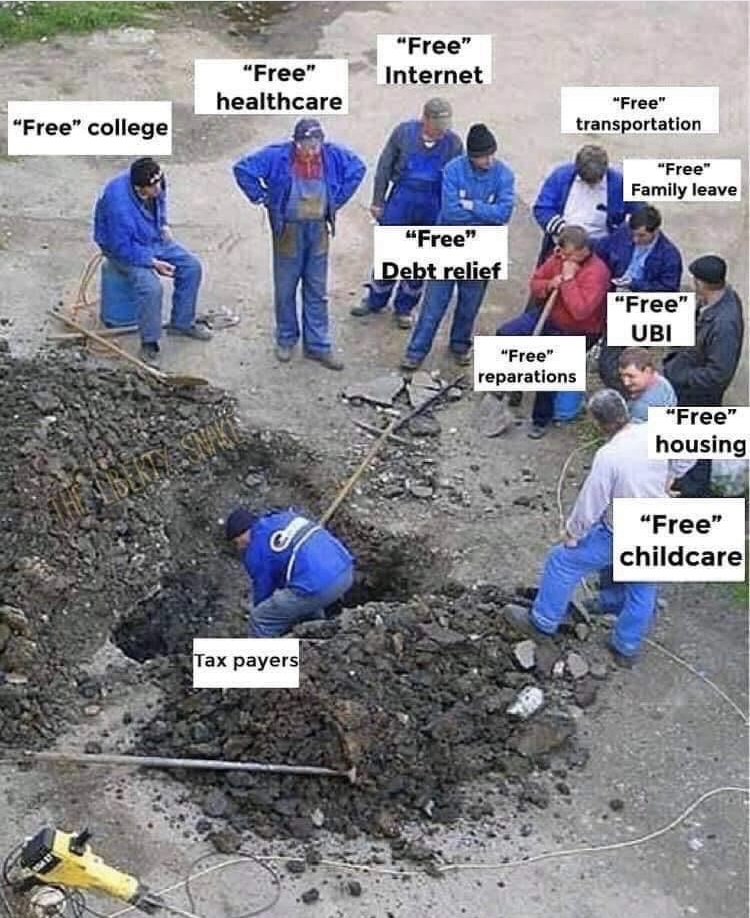
In the past, I’ve referred to this as “Greece-ification” and Biden’s fiscal plan definitely qualifies.

It’s also a different way of looking at the second cartoon from this depiction of how a welfare state evolves over time.

This Chuck Asay cartoon makes the same point.

Second, here’s a cartoon that nicely captures why I think Biden’s agenda will erode the nation’s societal capital.
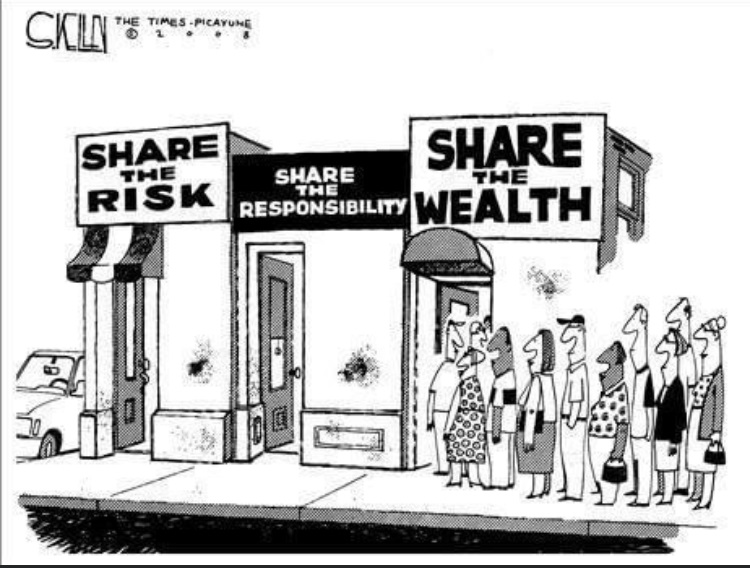
The same theme as this excellent cartoon.

While amusing, there’s a very serious point to be made. Politicians already have created a system that rewards people for doing nothing while punishing them for creating wealth.

Those policies hinder American prosperity (as honest folks on the left acknowledge), but we can survive with slower growth. What really worries me is that we may eventually reach a tipping point of too many people riding in the wagon (and out-voting the people who pull the wagon).

Simply stated, we don’t want America to become another Greece.

I have put up lots of cartoons from Dan Mitchell’s blog before and they have got lots of hits before. Many of them have dealt with the economy, eternal unemployment benefits, socialism,  Greece,  welfare state or on gun control.

My Cato colleague, Mark Calabria, recently explained how the minimum wage destroys jobs, and I’ve written on several occasions why government-mandated wages can create unemployment by making it unprofitable to hire people with low work skills and/or poor work histories. And I’ve attacked Republicans for going along with these job-killing policies, and also pointed out the racist impact of such intervention.

But this cartoon may be a more effective argument for getting government out of the business of interfering with market forces. It’s simple, direct, and gets the point across. I’m not sure that always happens with my writing.
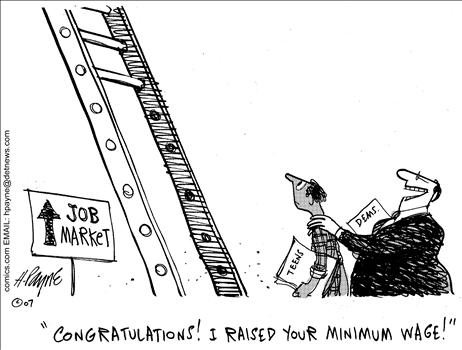
My former intern, Orphe Divougny, also did a very good job in explaining why politicians shouldn’t interfere with the right of workers and employers to enter into labor contracts.

Related posts:

Cartoons from Dan Mitchell’s blog that demonstrate what Obama is doing to our economy Part 2

Max Brantley is wrong about Tom Cotton’s accusation concerning the rise of welfare spending under President Obama. Actually welfare spending has been increasing for the last 12 years and Obama did nothing during his first four years to slow down the rate of increase of welfare spending. Rachel Sheffield of the Heritage Foundation has noted: […]

Cartoons from Dan Mitchell’s blog that demonstrate what Obama is doing to our economy Part 1

  I have put up lots of cartoons from Dan Mitchell’s blog before and they have got lots of hits before. Many of them have dealt with the economy, eternal unemployment benefits, socialism,  Greece,  welfare state or on gun control. I think Max Brantley of the Arkansas Times Blog was right to point out on 2-6-13 that Hillary […]

Great cartoon from Dan Mitchell’s blog on government moochers

I thought it was great when the Republican Congress and Bill Clinton put in welfare reform but now that has been done away with and no one has to work anymore it seems. In fact, over 40% of the USA is now on the government dole. What is going to happen when that figure gets over […]

Gun Control cartoon hits the internet

Again we have another shooting and the gun control bloggers are out again calling for more laws. I have written about this subject below  and on May 23, 2012, I even got a letter back from President Obama on the subject. Now some very interesting statistics below and a cartoon follows. (Since this just hit the […]

“You-Didn’t-Build-That” comment pictured in cartoons!!!

watch?v=llQUrko0Gqw] The federal government spends about 10% on roads and public goods but with the other money in the budget a lot of harm is done including excessive regulations on business. That makes Obama’s comment the other day look very silly. A Funny Look at Obama’s You-Didn’t-Build-That Comment July 28, 2012 by Dan Mitchell I made […]

Cartoons about Obama’s class warfare

I have written a lot about this in the past and sometimes you just have to sit back and laugh. Laughing at Obama’s Bumbling Class Warfare Agenda July 13, 2012 by Dan Mitchell We know that President Obama’s class-warfare agenda is bad economic policy. We know high tax rates undermine competitiveness. And we know tax increases […]

Cartoons on Obama’s budget math

Dan Mitchell Discussing Dishonest Budget Numbers with John Stossel Uploaded by danmitchellcato on Feb 11, 2012 No description available. ______________ Dan Mitchell of the Cato Institute has shown before how excessive spending at the federal level has increased in recent years. A Humorous Look at Obama’s Screwy Budget Math May 31, 2012 by Dan Mitchell I’ve […]

Funny cartoon from Dan Mitchell’s blog on Greece

Sometimes it is so crazy that you just have to laugh a little. The European Mess, Captured by a Cartoon June 22, 2012 by Dan Mitchell The self-inflicted economic crisis in Europe has generated some good humor, as you can see from these cartoons by Michael Ramirez and Chuck Asay. But for pure laughter, I don’t […]

Obama on creating jobs!!!!(Funny Cartoon)

Another great cartoon on President Obama’s efforts to create jobs!!! A Simple Lesson about Job Creation for Barack Obama December 7, 2011 by Dan Mitchell Even though leftist economists such as Paul Krugman and Larry Summers have admitted that unemployment insurance benefits are a recipe for more joblessness, the White House is arguing that Congress should […]

Get people off of government support and get them in the private market place!!!!(great cartoon too)

Dan Mitchell hits the nail on the head and sometimes it gets so sad that you just have to laugh at it like Conan does. In order to correct this mess we got to get people off of government support and get them in the private market place!!!! Chuck Asay’s New Cartoon Nicely Captures Mentality […]

2 cartoons illustrate the fate of socialism from the Cato Institute

Cato Institute scholar Dan Mitchell is right about Greece and the fate of socialism: Two Pictures that Perfectly Capture the Rise and Fall of the Welfare State July 15, 2011 by Dan Mitchell In my speeches, especially when talking about the fiscal crisis in Europe (or the future fiscal crisis in America), I often warn that […]

Cartoon demonstrates that guns deter criminals

John Stossel report “Myth: Gun Control Reduces Crime Sheriff Tommy Robinson tried what he called “Robinson roulette” from 1980 to 1984 in Central Arkansas where he would put some of his men in some stores in the back room with guns and the number of robberies in stores sank. I got this from Dan Mitchell’s […]

Gun control posters from Dan Mitchell’s blog Part 2

I have put up lots of cartons and posters from Dan Mitchell’s blog before and they have got lots of hits before. Many of them have dealt with the economy, eternal unemployment benefits, socialism,  Greece,  welfare state or on gun control. Amusing Gun Control Picture – Circa 1999 April 3, 2010 by Dan Mitchell Dug this gem out […]

We got to cut spending and stop raising the debt ceiling!!!

  We got to cut spending and stop raising the debt ceiling!!! When Governments Cut Spending Uploaded on Sep 28, 2011 Do governments ever cut spending? According to Dr. Stephen Davies, there are historical examples of government spending cuts in Canada, New Zealand, Sweden, and America. In these cases, despite popular belief, the government spending […]

Gun control posters from Dan Mitchell’s blog Part 1

I have put up lots of cartons and posters from Dan Mitchell’s blog before and they have got lots of hits before. Many of them have dealt with the economy, eternal unemployment benefits, socialism,  Greece,  welfare state or on gun control. On 2-6-13 the Arkansas Times Blogger “Sound Policy” suggested,  “All churches that wish to allow concealed […]

Taking on Ark Times bloggers on the issue of “gun control” (Part 3) “Did Hitler advocate gun control?”

Gun Free Zones???? Stalin and gun control On 1-31-13 ”Arkie” on the Arkansas Times Blog the following: “Remember that the biggest gun control advocate was Hitler and every other tyrant that every lived.” Except that under Hitler, Germany liberalized its gun control laws. __________ After reading the link  from Wikipedia that Arkie provided then I responded: […]

Taking on Ark Times bloggers on the issue of “gun control” (Part 2) “Did Hitler advocate gun control?”

On 1-31-13 I posted on the Arkansas Times Blog the following: I like the poster of the lady holding the rifle and next to her are these words: I am compensating for being smaller and weaker than more violent criminals. __________ Then I gave a link to this poster below: On 1-31-13 also I posted […]
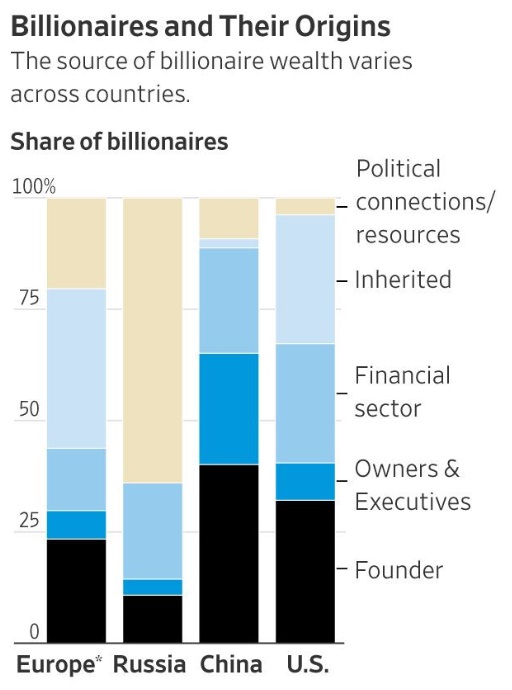
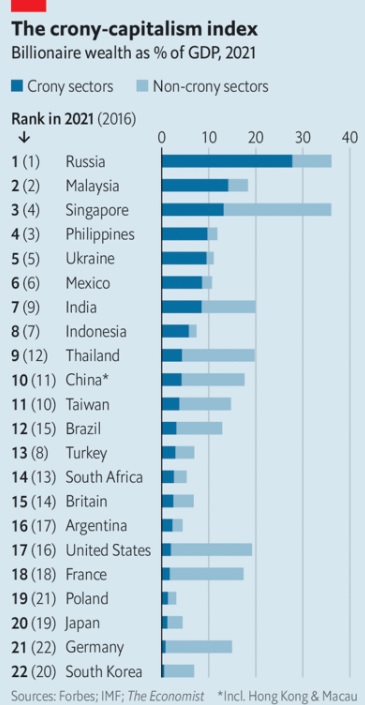
Dan Mitchell “Greg Ip of the Wall Street Journal wrote about this issue a couple of years ago and included this chart showing that cronyism is a small problem in the United States but a big problem in Russia!”

Very Little Sympathy for Russian Oligarchs

I enjoy defending rich people. In part, that’s because I appreciatehow rich entrepreneurs make life better for me and everybody else.

But I also defend rich people because of my deep disdain for the policy agenda of empty-suit politicians and envy-wracked demagogues.

If we want outcomes that are better for society and the economy, I’m 100-percent confident that Jeff Bezos and Elon Musk can spend their wealth better than the hacks and clownsin Washington.

But what if rich people get money from government cronyism? What if they became wealthy because of special favors from politicians?

Greg Ip of the Wall Street Journal wrote about this issue a couple of years ago and included this chart showing that cronyism is a small problem in the United States but a big problem in Russia.

Here’s some of what Mr. Ip wrote about Russia’s cronyism.

How a billionaire earns his or her fortune matters, of course. Some are “rent seekers,” meaning they skim off the productive efforts of others via corruption, royal prerogative or control of some valuable market or resource. That’s why Russia is an outlier in Ms. Freund’s research: lots of oligarchs, with not much economic benefit to show for it.

Since he wrote that article well before Russia’s invasion of Ukraine, he wasn’t focused on the geopolitical considerations that are dominating the discussion today.

So now let’s look at a very recent report from the U.K.-based Economist. Here are some key excerpts.

…the sanctions levied at Russian oligarchs have intensified scrutiny on the origins of tycoons’ wealth. …Rent-seeking entrepreneurs tend to use their relationships with the state to maximise profits. …Our index uses 25 years of data from Forbes’s annual stock-take of the world’s billionaires. …We have classified the main source of each billionaire’s wealth into crony and non-crony sectors. …Russia’s crony economy sticks out like a blinged-up Muscovite… Some 70% of the 120 Russian billionaires, who together hold 80% of its billionaire wealth, fall within our crony-capitalist definition. Wealth equivalent to 28% of Russia’s gdp in 2021 came from crony sectors, up from 18% in 2016.

The bottom line is that Russia’s “oligarchs” are not like the self-made billionaires that we’re fortunate to have in the United States.

Here’s the accompanying chart from the article. Russia does stand out…in a very bad way. If the numbers are accurate, getting in bed with politicians is the way to get rich.

Now that we’ve established that Russian billionaires generally don’t earn their money, this leads us to the more challenging issue of whether nations such as the United States should freeze and/or expropriate the wealth of the oligarchs in response to Putin’s invasion of Ukraine?

Since I’m not a lawyer or an expert on foreign and defense issues, I don’t pretend to know the best approach. I want Putin and his cronies to suffer, but I also have some qualms about the current approach.

  • Is the “rule of law” being overlooked and “due process” getting trampled in the rush to go after the assets of wealthy Russians, some of whom may have emigrated because of their opposition to Putin?
  • Are people being targeted simply because of their Russian ethnicity, just as an awful president targeted Americans of Japanese descent during World War II?
  • If getting rich through cronyism is a sufficient pretext to confiscate wealth, does that mean it’s okay to seize the assets of ethanol producers and stockholders of Fannie Mae and Freddie Mac?

P.S. For what it’s worth, my gut instinct is that cronyism is a much bigger problem in China’s economy that we see in the data from the WSJ and the Economist.

P.P.S. Click here to learn more about “rent seeking.”

“Is Capitalism “Pro-Business?”

Published on Aug 7, 2012

Find LearnLiberty on Facebook: http://on.fb.me/X9qijG

In this video, Professor Steve Horwitz advocates for free market economic policy. He refutes the often recited claim that “What is good for General Motors is good for America” by explaining that pro-business legislation encourages behavior that is not beneficial to society or the business itself. He suggests that, in a free market, factors such as profit and competition encourage behavior that ultimately benefits society. Professor Horwitz illustrates that pro-business legislation restricts progress and therefore caters to the interests of industry rather than to consumers, whereas “supporters of free markets are ultimately pro-human and pro-people because it is through markets that we get the most innovation and we get the most goods and the cheapest prices.”

Find LearnLiberty on…
Twitter: http://bit.ly/RBl3Wv
Facebook: http://on.fb.me/X9qijG
Our Website: http://bit.ly/RBl3FH

____________________________

Big Government cronyism lines the pockets of dishonest companies!!!!

A bunch of well-connected rich people and government officials are descending upon Switzerland for the annual World Economic Forum meeting in Davos.

This upsets many people, and perhaps with some justification. After all, bad things often happen when big business and big government intersect.

But some folks reflexively think that wealth is bad and they would like us to believe that the economy is a fixed pie, meaning that the rich have more money because the poor have less money.

If you think I’m exaggerating, check out a new report from Oxfam, a UK-based group that was created to alleviate poverty but has largely morphed into a left-wing pressure group.

The folks at Oxfam complain about the supposed “capture of opportunities by the rich at the expense of the poor and middle classes” and that “tax rates for the richest have fallen in 29 of the 30 countries.”

Here are some excerpts from a report in the EU Observer.

As the world’s richest and most powerful men and women prepare to meet in the Swiss resort of Davos for the annual World Economic Forum on Wednesday (22 January), the British development charity, Oxfam, has issued a new report on global inequality. According to its findings, the wealth of the world’s 85 richest people – €81.2 trillion – amounts to that of the poorest half of the world population, or 3.5 billion people. …”In Europe, austerity has been imposed on the poor and middle classes under huge pressure from financial markets whose wealthy investors have benefited from state bailouts of financial institutions,” the charity said. Financial deregulation in the US has contributed to the situation, in which the richest one percent of the population has more money than ever since 1933.  …The charity said Davos participants should reverse the trend and pledge to support higher taxes for the rich, while refraining from using their wealth to seek political favours.

There are several parts of this excerpt that deserve attention, including passages that are correct (such as bailouts giving undeserved money to the rich) and passages that are nonsensical (the financial crisis was caused by intervention, not deregulation).

But I want to focus solely on the inequality issue. Let’s assume Oxfam is right and that the world’s 85 richest people have $81.2 trillion of wealth. The group obviously wants us to think this accumulation of wealth is bad and that it somehow comes at the expense of the rest of us.

Tim Carney of the Washington Examiner hits the nail on the head, explaining that there’s a big difference between honest wealth and riches obtained through government coercion.

…is it a bad thing for a country to have some really rich people? Again, it depends on how they got rich. Sutirtha Bagchi of the University of Michigan’s business school and Jan Svejnar of Columbia’s School of International and Public Affairs studied how inequality correlates with economic growth. In general, more inequality meant slower growth, and less inequality meant faster growth. But in many countries, over various time periods, growing inequality had no effect on economic growth. The new study suggests that an increase in inequality hurt the economy when the rich were getting rich through political connections. That is, inequality hurts the economy when “a large share of the national wealth is held by a small number of politically connected families,” as the authors put it. …Bagchi and Svenjar took pains to classify political billionaires as narrowly as possible. …The political billionaires were only people who “would not have become a billionaire in the absence of political connections that resulted in favoritism and/or explicit government support.”

The oft-missed lesson here is that undeserving wealth generally is obtained because of big government.

Which reminds me of a very astute observation by a former Cato colleague, who wrote that, “…the more power the government has to pick winners and losers, the more power rich people will have relative to poor people.”

Carney continues, pointing out that wealth obtained through markets is good. Such success creates a bigger pie and helps boost living standards for everyone.

But wealth achieved via government is cronyism, and that contributes to economic stagnation.

When a country’s wealthiest got wealthy through market means, the resulting inequality has no negative effect on economic growth. This jibes with what we know about free markets. If people can get rich by providing valuable things at good prices, then society will get more valuable things at good prices—and people across the income spectrum benefit. But if people get rich by pocketing subsidies and using the state to crush competitors, then they gained their wealth at the expense of everyone else. Bill Gates became a billionaire by making and selling something that makes regular people more productive and more connected. Buffett got rich largely by providing capital to underfunded but well-run businesses. If Bagchi’s and Svejnar’s findings are correct, then the bottom line is this: Inequality itself doesn’t hurt the economy. Cronyism hurts the economy.

I fully agree with Tim’s analysis, though I would have drawn a distinction between the younger Warren Buffett, who was a savvy investor and the older Buffett, who has climbed into bed with the political elite.

The bottom line is that the poor aren’t poor because of honest rich people. The poor are suffering because of big government, including the cronyism that lines the pockets of dishonest companies and individuals that feed at the public trough.

Unfortunately, many insider leftists are perfectly content with those policies and they use inequality to distract voters from the real problem.

There are honest leftists, of course, and they presumably would be outraged by the sleaze in national capitals. Their problem is that they genuinely think the economic is fixed pie. Or they think that inequality is such a bad thing that they would be willing to reduce incomes for the poor if it meant the rich suffered even more.

If you don’t believe me, watch this marvelous video of Margaret Thatcher debunking the left.

And my old grad school colleague Steve Horwitz also has some very sage observations on income inequality and class warfare.

P.S. In its report on inequality, Oxfam also went after tax havens and said more revenue for government would help reduce poverty.

Oxfam also estimated that €15.5 trillion of the wealth is hidden from the taxman in offshore accounts, at a time when governments are cutting public spending. …tax avoidance by EU and US corporations in Africa is depriving its governments from resources which could be use to fight poverty.

I wrote a study years ago exposing Oxfam’s sloppy methodology on tax competition issues. No wonder they’ve been labeled as being part of the “tax taliban.”

But what really irks me about that passage is the assumption that bigger government reduces poverty. That’s nonsense. The data shows that growth is the best way of helping the poor.

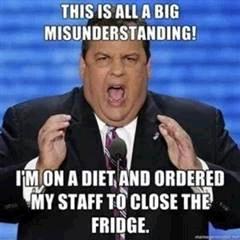
Christie JokeP.S. I wrote yesterday about Chris Christie’s problems in New Jersey. I said his real challenge was the need to reduce the burden of government, not the bridge scandal.

But I’m a sucker for good political humor, so enjoy this image that appeared in my inbox.

P.P.S. Since Oxfam criticized tax havens, I can’t resist calling your attention to my video tutorial on tax competition and tax haven.

Simply stated, we need some external check on the greed of the political class.

Related posts:

Dan Mitchell is right and we must reduce the size and power of Government!!!!

________ Dan Mitchell is right and we must reduce the size and power of Government!!!! Thanks to Obamacare and the IRS, You’re at Risk of Having Your Identity Stolen and Your Bank Account Emptied December 3, 2013 by Dan Mitchell There are many reason I don’t like Obamacare, including its punitive impact on taxpayers and the […]

Dan Mitchell of the Cato Institute has noted, “I’m all in favor of bringing federal government spending back down to about 18 percent of GDP, which is where it was when Bill Clinton left office.”

________ Dan Mitchell of the Cato Institute has noted, “I’m all in favor of bringing federal government spending back down to about 18 percent of GDP, which is where it was when Bill Clinton left office.” The Rise (and Upcoming Fall) of the Welfare State in the Western World November 12, 2013 by Dan Mitchell I […]

Cartoons from Dan Mitchell’s blog that demonstrate what overspending will do

I have put up lots of cartoons from Dan Mitchell’s blog before and they have got lots of hits before. Many of them have dealt with the economy, eternal unemployment benefits, socialism,  Greece,  welfare state or on gun control. It is sad to see our federal government spend away our children’s future but when some of the states are doing that […]

Cartoons from Dan Mitchell’s blog that demonstrate how stupid government can be

I have put up lots of cartoons from Dan Mitchell’s blog before and they have got lots of hits before. Many of them have dealt with the economy, eternal unemployment benefits, socialism,  Greece,  welfare state or on gun control. Government Stupidity Defies Satire When a $50 Light Bulb Wins an Affordability Prize March 16, 2012 by Dan Mitchell I’ve written about the […]

Cartoons from Dan Mitchell’s blog that demonstrate what Obama is doing to our economy

I have put up lots of cartoons from Dan Mitchell’s blog before and they have got lots of hits before. Many of them have dealt with the economy, eternal unemployment benefits, socialism,  Greece,  welfare state or on gun control. Two More Excellent Political Cartoons April 26, 2011 by Dan Mitchell I praised Michael Ramirez a few days ago for his clever political cartoons, […]

Cartoons from Dan Mitchell’s blog that demonstrate what Obama is doing to our economy (A Humorous Look at Obama’s Green-Energy Boondoggle)

I have put up lots of cartoons from Dan Mitchell’s blog before and they have got lots of hits before. Many of them have dealt with the economy, eternal unemployment benefits, socialism,  Greece,  welfare state or on gun control. A Humorous Look at Obama’s Green-Energy Boondoggle March 12, 2012 by Dan Mitchell Actually, I’m not sure this is humorous. Whether we’re looking […]

Cartoons from Dan Mitchell’s blog that demonstrate what Obama is doing to our economy (What Happens When Looters and Moochers Outnumber Workers and Producers?)

I have put up lots of cartoons from Dan Mitchell’s blog before and they have got lots of hits before. Many of them have dealt with the economy, eternal unemployment benefits, socialism,  Greece,  welfare state or on gun control. I thought it was great when the Republican Congress and Bill Clinton put in welfare reform but now that has been done […]

Cartoons from Dan Mitchell’s blog that demonstrate what Obama is doing to our economy (“You didn’t build that”)

I have put up lots of cartoons from Dan Mitchell’s blog before and they have got lots of hits before. Many of them have dealt with the economy, eternal unemployment benefits, socialism,  Greece,  welfare state or on gun control. When I think of President Obama’s “you didn’t build that” comment it makes me think of this cartoon below. Sure enough he […]

Cartoons from Dan Mitchell’s blog that demonstrate what Obama is doing to our economy

I have put up lots of cartoons from Dan Mitchell’s blog before and they have got lots of hits before. Many of them have dealt with the economy, eternal unemployment benefits, socialism,  Greece,  welfare state or on gun control. Concerning the French overspending problem Dan Mitchell states, “There are obvious lessons from Europe for the United States. If politicians don’t reform […]

Cartoons from Dan Mitchell’s blog that demonstrate what Obama is doing to our economy (When Government Replaces Santa Claus)

I have put up lots of cartoons from Dan Mitchell’s blog before and they have got lots of hits before. Many of them have dealt with the economy, eternal unemployment benefits, socialism,  Greece,  welfare state or on gun control. When Government Replaces Santa Claus December 25, 2011 by Dan Mitchell Chuck Asay is a superb cartoonist, and he produced one of my […]

Dan Mitchell article Tax Policy, Tax Reform, and State Competitiveness

Tax Policy, Tax Reform, and State Competitiveness

I wrote two months ago about Iowa lawmakers voting for a simple and fair flat tax.

I explained how this reform would make the state more competitive, but I want to build upon that argument with some of the Tax Foundation’s data.

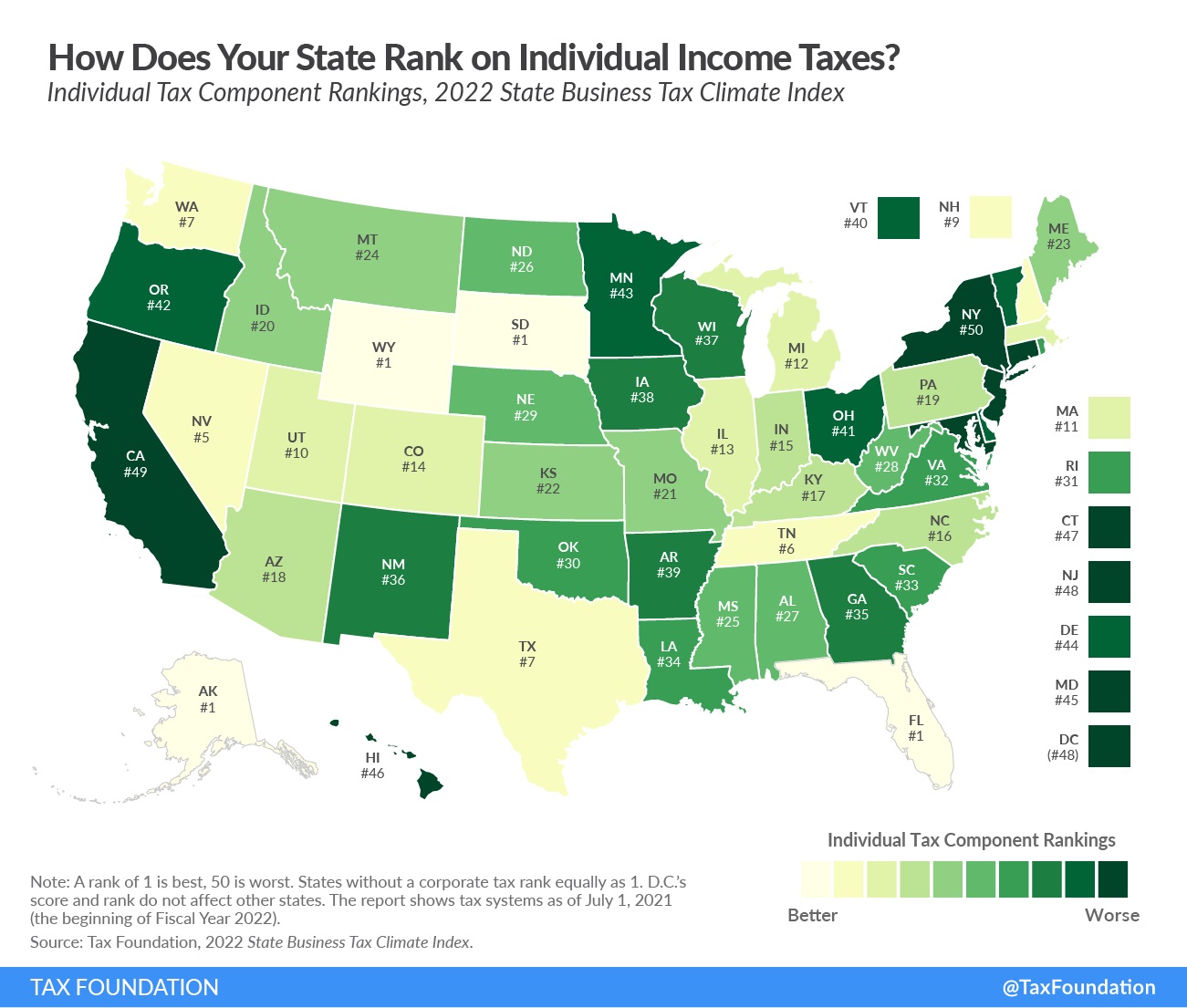
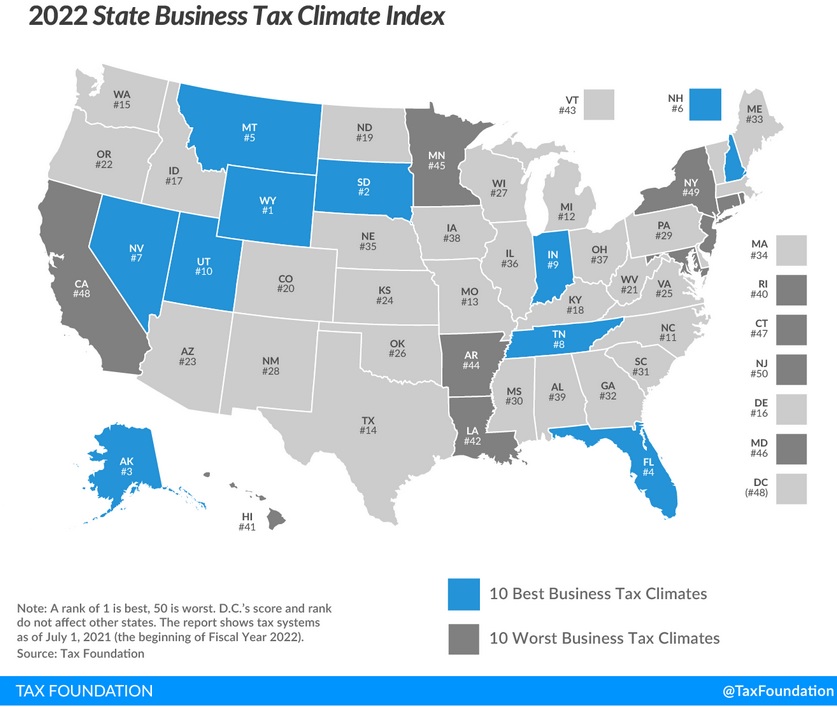
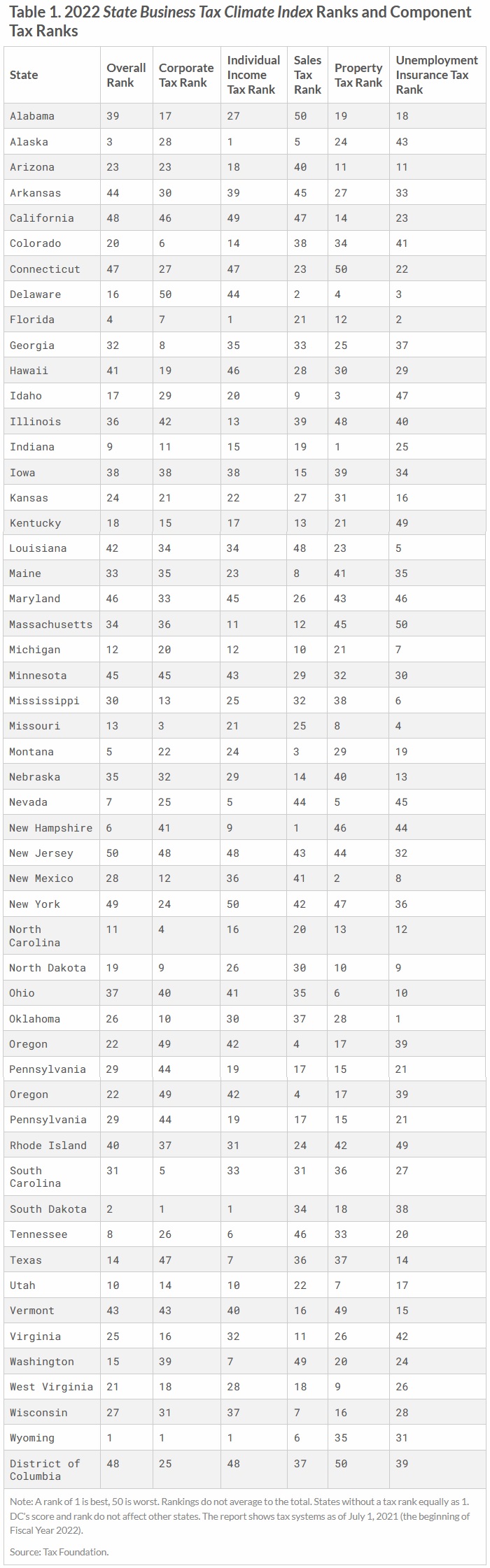
Starting with this map from the State Business Tax Climate Index, which shows Iowa in 38th place for individual income taxes.

That low ranking is where the state’s tax code was as of July 1, 2021, so it obviously doesn’t reflect the reforms enacted earlier this year.

So where will the state rank with the new flat tax?

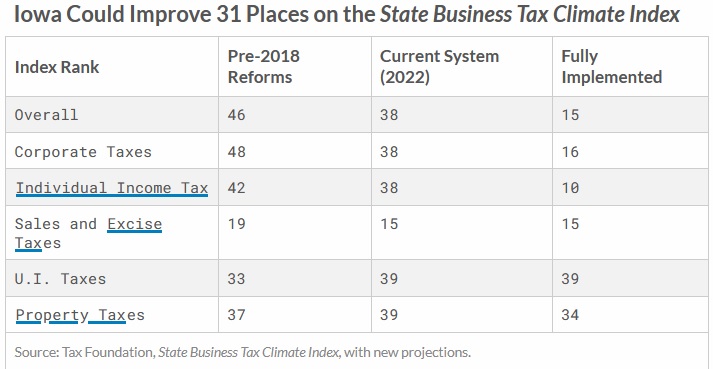
The Tax Foundation crunched the data and shows the state will jump to #15 in the rankings.

The above table shows that the jump is even more impressive when you factor in some modest pro-growth changes that took place a few years ago.

What a huge improvement over just a few years. The only state that may beat Iowa for fastest and biggest increase in tax competitiveness is North Carolina, which jumped 30 spots in just one year.

P.S. Politicians in New York must be upset that there’s no way for them to drop lower than #50. But at least they can take comfort in the fact that they are worse than California.

We should lower federal taxes because jobs are going to states like Texas that have low taxes. (We should lower state taxes too!!)

One of the great things about federalism, above and beyond the fact that it both constrains the power of governments and is faithful to the Constitution, is that is turns every state into an experiment.

We can learn what works best (though the President seems incapable of learning the right lesson).

We know, for instance, that people are leaving high-tax states and migrating to low-tax states.

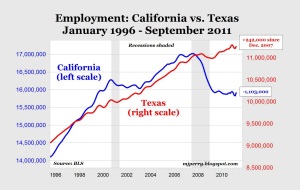
We also know that low-tax states grow faster and create more jobs.

I particularly enjoy comparisons between Texas and California. Michael Barone, for instance, documented how the Lone Star State is kicking the you-know-what out of the Golden State in terms of overall economic performance.

I also shared a specific example of high-quality jobs moving from San Francisco to Houston. And I was also greatly amused by this story (and accompanying cartoons) about Texas “poaching” jobs from California.

In this discussion with Stuart Varney of Fox News, we discuss how Texas is leading the nation in job creation.

But there’s another part of this discussion that is very much worth highlighting.

As illustrated by the chart, we are enduring the worst overall job performance in any business cycle since the end of World War II.

I note in the interview that Obama inherited a bad economy and that Bush got us in the ditch in the first place with all his wasteful spending and misguided intervention.

But Obama also deserves criticism for doubling down on those failed policies.

His so-called stimulus was a flop. Dodd-Frank is a regulatory nightmare. Obamacare is looking worse and worse every day.

No wonder job creation is so anemic.

The real moral of the story, though, is that the poor are the biggest victims of Obama’s statism. They’re the ones who have been most likely to lose jobs. They’ve been the ones to suffer because of stagnant incomes.

Sort of brings to mind the old joke that leftists must really like poor people because they create more of them whenever they’re in charge.

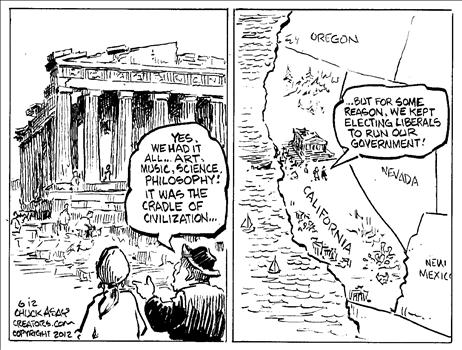
P.S. Speaking of jokes, here’s an amusing comparison of Texas and California. If you want some California-specific humor, this Chuck Asay cartoon is great. And to maintain balance, here’s a Texas-specific joke on how to respond to an attacker.

P.P.S. To close on a serious point, California would be deteriorating even faster if it wasn’t for the fact that the state and local tax deduction basically means that the rest of the country is subsidizing the high tax rates in the not-so-Golden State. Another good argument for the flat tax.

P.P.P.S. At the bottom of this post, you’ll find a great Kevin Williamson column dismantling some sloppy anti-Texas analysis by Paul Krugman.

________________

Even though Chuck Asay is one of my favorite cartoonists (see herehereherehere, and here), I was not a big fan of one of his recent two-frame cartoons.

But he has more than made up for that slight transgression with this new gem.

I’m biased, of course, since I’ve already written about California being the Greece of America, but there’s plenty of evidence to justify Asay’s cartoon.

Dan Mitchell “The United States needs a constitutional spending cap, sort of like the “debt brake” that has been producing positive results in Switzerland for the past two decades!”

Another Reason for Spending Caps

The United States needs a constitutional spending cap, sort of like the “debt brake” that has been producing positive results in Switzerland for the past two decades.

Imposing a limit on annual spending increases would be a much-needed way of stopping politicians from saddling the nation with “Goldfish Government.”

The best-case scenario is that a spending cap is very stringent (say, limiting annual spending increases to 2 percent annually). This level of fiscal restraint reduces the burden of government spending compared to the private sector (i.e., it fulfills fiscal policy’s Golden Rule).

The avoid-harm scenario is that a spending cap prevents government from becoming a bigger burden. Given dismal long-run fiscal forecasts (a consequence of demographic change and poorly designed entitlement programs), this actually would be an impressive achievement.

There are also some auxiliary benefits of a spending cap.

A new working paper from Italy’s central bank, authored by Anna Laura Mancini and Pietro Tommasino, considers whether spending caps can mitigate the problem of dishonest budgeting by politicians.

…policy-makers have an incentive to “plan to cheat”. That is, they promise an amount of expenditures higher than what they will actually deliver, because this allows them to cater to the demands of the various groups of voters, and at the same time they present overoptimistic revenue forecasts, in order to preserve the appearance of fiscal discipline. Once the extra revenues hoped for by the government fail to materialize, budgeted investment expenditures are downsized or abandoned altogether. In this context, caps on realized spending can contribute to more realistic ex ante spending plans. Indeed, politicians have less room to inflate planned expenditures, once there is a legal ceiling in place.

The authors crunch the numbers and conclude that spending caps result in a greater level of fiscal honesty.

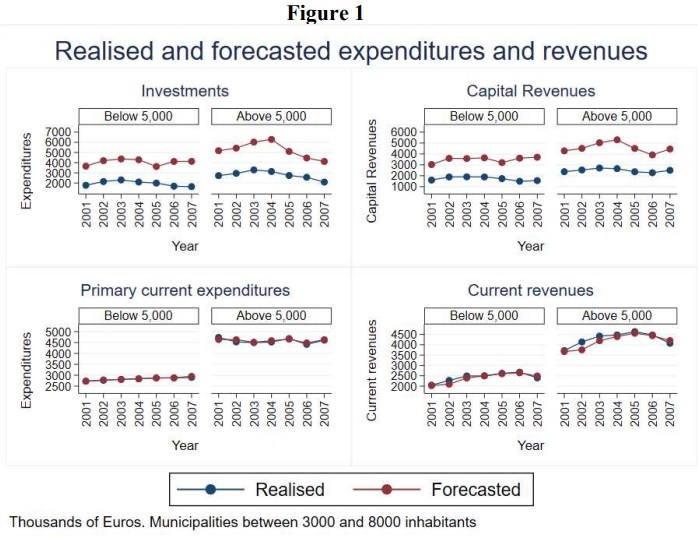
In this paper, we provide evidence in favour of this theoretical intuition, exploiting a unique dataset including the ex-ante budget plans as well as ex-post budget outcomes of…a rule that constrains capital expenditures in municipalities with more than 5,000 residents. …Our analysis show that the municipalities subject to the new capital-spending rule significantly reduced their over-optimism in expenditure projections… Furthermore, in the new regime revenue projections are also more accurate (less over-optimistic). …The reform reduced the forecast error concerning capital expenditures… The effects is significant both statistically and in economic terms. …the introduction of the cap on investment reduced the forecast error on investment expenditures by almost €1 mln, or 35% of the pre-reform average error.

For wonky readers, Figure 1 shows some of relevant data.

For what it’s worth, we seem to have a different problem in the United States.

Rather than exaggerate potential spending on so-called public investment, as seems to have been the case in Italy, American politicians generally low-ball cost estimates for infrastructure projects.

And then, once the projects get started, we get absurd cost overruns (with the high-speed rail project in California being an especially absurd example).

The good news is that a spending cap solves both the Italian version of the problem and the American version of the problem.

As the authors found in their research, it removes the incentive for dishonest budgeting in Italy. And, if adopted in the United States, politicians would learn that it doesn’t help to produce laughably low cost estimates if a spending cap means there is no way of financing cost overruns in the future.

P.S. There is a spending limit in Hong Kong’s constitution, and it has generated very positive results. Given China’s increasing control, it’s unclear how effective it will be in the future.

P.P.S. There’s also a spending limit in Colorado’s constitution, known as the Taxpayers Bill of Rights. It has been very successful.

P.P.P.S. Last month, I wrote about research from both the IMF and the ECB about the benefits of spending caps.

Steve Forbes is 100 percent correct, as was Milton Friedman. Bloated and wasteful government spending is the problem, not inadequate revenue. Deficits are merely a symptom of over-spending:

The late Nobel Prize-winning economist Milton Friedman once famously observed that he would prefer a federal government budget of $1 trillion (this was when a trillion bucks was real money) with a big deficit to a federal budget of $2 trillion that was balanced. His obvious point was that the bigger Washington is, the more of a burden it puts on the economy, whether it finances its spending via taxation, borrowing or printing money. So it’s not President Obama’s mind-numbing, from-here-to-eternity deficits that we should be worrying about but the increasing deadweight put on the rest of us by Washington’s burgeoning budget bloat. Senate Republicans were right to put the kibosh on the formation of a formal bipartisan deficit-fighting commission. Those things always end up increasing taxes while doing little to reduce spending. …One of the biggest economic myths since the Great Depression is that governments can ameliorate or counteract the ebbs and flows of free markets. Government spending has never worked as a trigger for sustained and vibrant economic growth. Ever. Scholarship has demonstrated that the New Deal perpetuated the Depression rather than cured it. On the eve of the Depression the U.S. had the lowest unemployment rate among developed nations. But a decade later, despite six years of FDR’s New Deal, our unemployment rate was one of the highest among developed economies. Japan’s serial stimulus programs over the past two decades have repeatedly underscored this truth. The more the government takes as a proportion of the economy, the worse equity markets do and the higher the unemployment rate.

Everything You Need to Know about the National Debt

The title of this column is an exaggeration. What we’re really going to do today is explain the main things you need to knowabout government debt.

We’ll start with this video from Kite and Key Media, which correctly observes that entitlement programs are the main cause of red ink.

I like that the video pointed out how tax-the-rich schemeswouldn’t work, though it would have been nice if they added some information on how genuine entitlement reform could solve the problem  (as you can see here and here, I’ve also nit-picked other debt-themed videos).

Which is why I humbly think this is the best video ever produced on the topic.

As you can see, I’m not an anti-debt fanatic. It was perfectly okay, for instance, to incur debt to win World War II.

But I’m very skeptical of running up the nation’s credit card for routine pork and fake stimulus.

But my main message, which I’ve shared over and over again, is that deficits and debt are merely a symptom. The underlying disease is excessive government spending.

And that spending hurts our economy whether it is financed by taxing or borrowing (or, heaven forbid, by printing money).

Now let’s look at some recent articles on the topic.

We’ll start with Eric Boehm’s column for Reason, which explains how red ink has exploded in recent years.

America’s national debt exceeded $10 trillion for the first time ever in October 2008. By mid-September 2017 the national debt had doubled to $20 trillion. …data released by the U.S. Treasury confirmed that the national debt reached a new milestone: $30 trillion.…Entitlements like Social Security and Medicare are in dire fiscal straits and will become even more costly as the average American gets older. Even without another unexpected crisis, deficits will exceed $1 trillion annually, which means the debt will continue growing, both in real terms and as a percentage of the economy. The Congressional Budget Office estimates that the federal government will add another $12.2 trillion to the debt by 2031.

As already stated, I think the real problem is the spending and the debt is the symptom.

But it is possible, of course, that debt rises so high that investors (the people who buy government bonds) begin to lose faith that they will get repaid.

At that point, governments have to pay higher interest rates to compensate for perceived risk of default, which exacerbates the fiscal burden.

And if there’s not a credible plan to fix the problem, a country can go into a downward spiral. In other words, a debt crisis.

This is what happened to Greece. And I think it’s just a matter of time before it happens to Italy.

Heck, many European nations are vulnerable to a debt crisis. As are many developing countries. And don’t forget Japan.

Could the United States also be hit by a debt crisis? Will we reach a “tipping point” that leads to the aforementioned loss of faith?

That’s one of the possibilities mentioned in the New York Timescolumn by Peter Coy.

It’s hard to know how much to worry about the federal debt of the United States. …Either the United States can continue to run big deficits and skate along with no harm done or it’s at risk of losing investors’ confidence and having to pay higher interest rates on its debt, which would suppress economic growth. …the huge increase in federal debt incurred during and after the past two recessions — those of 2007-09 and 2020 — has used upa lot of the “fiscal space” the United States once had. In other words, the federal government is closer to the tipping point where big increases in debt finally start to become a real problem. …any given amount of debt becomes easier to sustain as long as the growth rate of the economy (and thus the growth rate of tax revenue) is higher than the interest rate on the debt. In that scenario, interest payments gradually shrink relative to tax revenue. …but it doesn’t explain how much more the debt can grow. …Past a certain point, there’s a double whammy of more dollars of debt plus higher interest costs on each dollar. …sovereign debt crises tend to be self-fulfilling prophecies: Investors get nervous about a government’s ability to pay, so they demand higher interest rates, which raise borrowing costs and produce the bad outcome they feared. It’s a dynamic that Argentines are familiar with — and that Americans had better hope they never experience.

For what it’s worth, I think other major nations will suffer fiscal crisis before the problem becomes acute in the United States.

I really this will make me sound uncharacteristically optimistic, but I’m keeping my fingers crossed that this will finally lead politicians to adopt a spending cap so we don’t become Argentina.

P.S. The Wall Street Journal recently editorialized on the issue of government debt and made a very important point about the difference between the $30 trillion “gross debt” and the “debt held by the public,” which is about $6 trillion lower.

…the debt really isn’t $30 trillion. About $6 trillion of that is debt the government owes to itself in Social Security and other IOUs. …The debt held by the public is some $24 trillion, which is bad enough.

As I’ve noted when writing about Social Security, the IOUs in government trust funds are not real.

They’re just bookkeeping entries, as even Bill Clinton’s budget freely admitted.

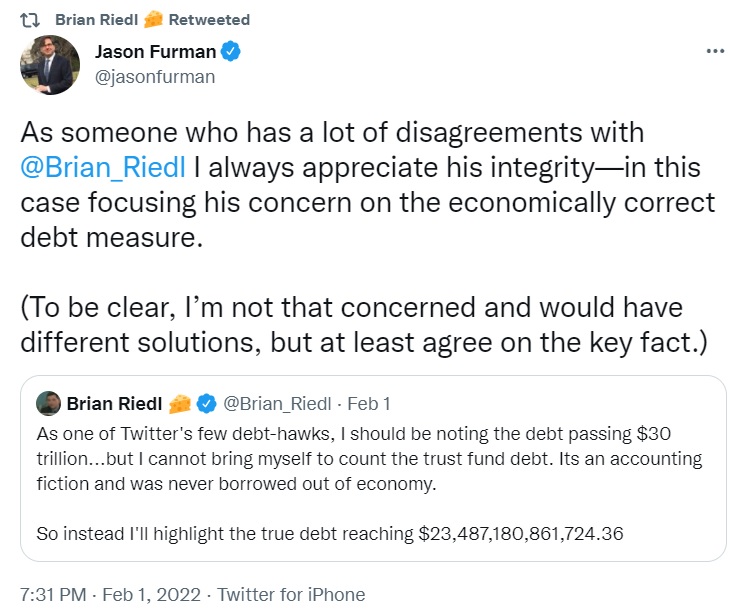
Indeed, if you want to know whether some is both honest and knowledgeable about budget matters, ask them which measure of the national debt really matters.

As you can see from this exchange of tweets, competent and careful budget people (regardless of whether they favor big government or small government) focus on “debt held by the public,” which is the term for the money government actually borrows from credit markets.

If you want to know the difference between the various types of government debt – including “unfunded liabilities” – watch this video.

P.P.S. This column explains how and when debt matters. If you’re interested in how to reduce the debt, there’s very good evidence that spending restraint is the only effective approach. Even in cases where debt is enormous.

P.P.P.S. By contrast, the evidence is very clear that higher taxesactually make debt problems worse.

Yes, Starve the Beast

As part of a recent discussion with Gene Tunny in Australia, I explained why I support “Starve the Beast,” which means keeping taxes as low as possible to help achieve the goal of spending restraint.

The premise of Starve the Beast is very simple.

Politicians like to spend money and they don’t particularly care whether that spending is financed by taxes or financed by borrowing (both bad options).

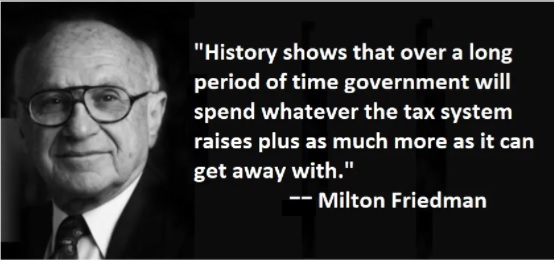
As Milton Friedman sagely observed, that means they will spend every penny they collect in taxes plus as much additional spending financed by borrowing that the political system will allow.

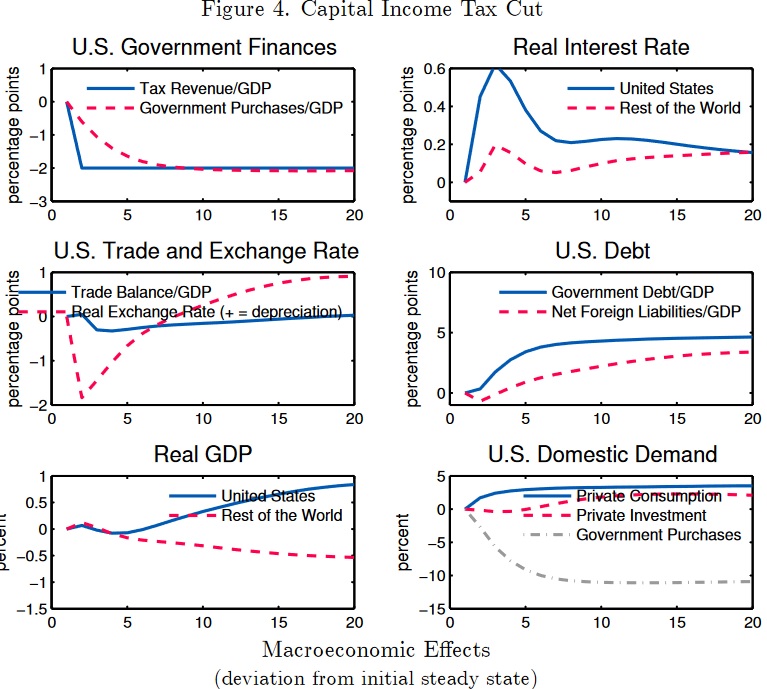
The IMF published a study on this issue about 10 years ago. The authors (Michael Kumhof, Douglas Laxton, and Daniel Leigh) assert that there’s no way of knowing whether Starve the Beast will lead to good or bad results.

…there is no consensus regarding the macroeconomic and welfare consequences of implementing a starve-the-beast approach, henceforth referred to as STB. …it could be beneficial in the ideal case in which it results in cuts in entirely wasteful government spending. In particular, lower spending frees up resources for private consumption, and the associated lower tax rates reduce distortions in the economy. On the other hand, …lower government spending may itself entail welfare losses…if it augments the productivity of private factors of production. …the paper examines whether the principal macroeconomic variables such as GDP and consumption, both in the United States and in the rest of the world, respond positively to this policy. …In addition, the paper assesses how the welfare effects depend on the degree to which government spending directly contributes to household welfare or to productivity.

The authors don’t really push any particular conclusion. Instead, they show various economic outcomes depending on with assumptions one adopts.

Since plenty of research shows that government spending is not a net plus for the economy (even IMF economists agree on that point), and because I think a less-punitive tax system is possible (and desirable) if there’s a smaller burden of government spending, I think the findings shown in Figure 4 make the most sense.

Now let’s shift from academic analysis to policy analysis.

In a piece for National Review back in July 2020, Jim Geraghty notes that Starve the Beast has an impact on government finances at the state level.

…we’re probably not going to see a massive expansion of government at the state level in the coming year or two. …Thanks to the pandemic lockdown bringing vast swaths of the economy to a halt, state tax revenues are plummeting.…So states will have much less tax revenue, constitutional balanced-budget requirements that are not easily repealed, and a limited amount of budgetary tricks to work around it. State governments could attempt to raise taxes, but that’s going to be unpopular and hurt state economies when they’re already struggling. Add it all up and it’s a tough set of circumstances for a dramatic expansion of government, no matter how ardently progressive the governor and state legislatures are.

For what it’s worth, Geraghty warned in the article that fiscal restraint by state governments wouldn’t happen if the federal government turned on the spending spigot.

And that, of course, is exactly what happened.

Now let’s look at the most unintentional endorsement of Stave the Beast.

A couple of years ago, Paul Krugman sort of admitted that cutting taxes was a potentially effective strategy for spending restraint.

…the same Republicans now wringing their hands over budget deficits…blew up that same deficit by enacting a huge tax cut for corporations and the wealthy. …this has been the G.O.P.’s budget strategy for decades. First, cut taxes. Then, bemoan the deficit created by those tax cuts and demand cuts in social spending.Lather, rinse, repeat. This strategy, known as “starve the beast,” has been around since the 1970s, when Republican economists like Alan Greenspan and Milton Friedman began declaring that the role of tax cuts in worsening budget deficits was a feature, not a bug. As Greenspan openly put it in 1978, the goal was to rein in spending with tax cuts that reduce revenue, then “trust that there is a political limit to deficit spending.” …voters should realize that the threat to programs… Social Security and Medicare as we know them will be very much in danger.

In other words, Krugman doesn’t like Starve the Beast because he fears it is effective (just like he also acknowledges the Laffer Curve, even though he’s opposed to tax cuts).

Let’s close by looking at some very powerful real-world evidence. Over the past 50 years, there’s been a massive increase in the tax burden in Western Europe.

Did all that additional tax revenue lead to lower deficits and less debt?

Nope, the opposite happened. European politicians spent every penny of the new tax revenue (much of it from value-added taxes). And then they added even more spending financed by additional borrowing.

To be fair, one could argue that this was an argument for the view of “Don’t Feed the Beast” rather than “Starve the Beast,” but it nonetheless shows that more money in the hands of politicians simply means more spending. And more red ink.

P.S. I had a discussion last year with Gene Tunny about the issue of “state capacity libertarianism.”


Friedman & Sowell: Should Our School System Be Privatized?

Regular readers know that the two things that get me most excited are the Georgia Bulldogs and the fight against a bloated public sector that is ineffective in the best of circumstances and more often than not is a threat to our freedoms.

So you will not be surprised to know that I am delighted that former Georgia Bulldog star Fran Tarkenton (who also happened to play in the NFL) has a superb piece in the Wall Street Journal ripping apart the inherent inefficiency of government-run monopoly schools.

Here is the key passage.

Imagine the National Football League in an alternate reality. Each player’s salary is based on how long he’s been in the league. It’s about tenure, not talent. The same scale is used for every player, no matter whether he’s an All-Pro quarterback or the last man on the roster. For every year a player’s been in this NFL, he gets a bump in pay. The only difference between Tom Brady and the worst player in the league is a few years of step increases. And if a player makes it through his third season, he can never be cut from the roster until he chooses to retire, except in the most extreme cases of misconduct. Let’s face the truth about this alternate reality: The on-field product would steadily decline. Why bother playing harder or better and risk getting hurt? No matter how much money was poured into the league, it wouldn’t get better. In fact, in many ways the disincentive to play harder or to try to stand out would be even stronger with more money. Of course, a few wild-eyed reformers might suggest the whole system was broken and needed revamping to reward better results, but the players union would refuse to budge and then demonize the reform advocates: “They hate football. They hate the players. They hate the fans.” The only thing that might get done would be building bigger, more expensive stadiums and installing more state-of-the-art technology. But that just wouldn’t help.

This sounds absurd, of course, but Mr. Tarkenton goes on to explain that this is precisely how government schools operate.

If you haven’t figured it out yet, the NFL in this alternate reality is the real-life American public education system. Teachers’ salaries have no relation to whether teachers are actually good at their job—excellence isn’t rewarded, and neither is extra effort. Pay is almost solely determined by how many years they’ve been teaching. That’s it. After a teacher earns tenure, which is often essentially automatic, firing him or her becomes almost impossible, no matter how bad the performance might be. And if you criticize the system, you’re demonized for hating teachers and not believing in our nation’s children. Inflation-adjusted spending per student in the United States has nearly tripled since 1970. According to the Organization for Economic Cooperation and Development, we spend more per student than any nation except Switzerland, with only middling results to show for it.

Actually, I will disagree with the last sentence of this excerpt. We’re not even getting “middling results.” Here’s a chart from an earlier post showing that we’ve gotten more bureaucracy and more spending but no improvement over the past 40 years.

So what’s the solution to this mess? Well, since government is the problem, it stands to reason that competition and markets are the answer.

Sweden, Chile, and the Netherlands are just some of the countries that have seen good results after breaking up state-run education monopolies.

Watch this video to get more details.

Economics 101: School Choice Example Shows Why Government Monopolies Are Bad

Related posts:

FRIEDMAN FRIDAY Milton Friedman’s FREE TO CHOOSE “The Tyranny of Control” Transcript and Video (60 Minutes)

Milton Friedman’s FREE TO CHOOSE “The Tyranny of Control” Transcript and Video (60 Minutes) In 1980 I read the book FREE TO CHOOSE by Milton Friedman and it really enlightened me a tremendous amount.  I suggest checking out these episodes and transcripts of Milton Friedman’s film series FREE TO CHOOSE: “The Failure of Socialism” and […]

FRIEDMAN FRIDAY “The Tyranny of Control” in Milton Friedman’s FREE TO CHOOSE Part 7 of 7 (Transcript and Video) “I’m not pro business, I’m pro free enterprise, which is a very different thing, and the reason I’m pro free enterprise”

In 1980 I read the book FREE TO CHOOSE by Milton Friedman and it really enlightened me a tremendous amount.  I suggest checking out these episodes and transcripts of Milton Friedman’s film series FREE TO CHOOSE: “The Failure of Socialism” and “What is wrong with our schools?”  and “Created Equal”  and  From Cradle to Grave, […]

FRIEDMAN FRIDAY “The Tyranny of Control” in Milton Friedman’s FREE TO CHOOSE Part 6 of 7 (Transcript and Video) “We are the ones who promote freedom, and free enterprise, and individual initiative, And what do we do? We force puny little Hong Kong to impose limits, restrictions on its exports at tariffs, in order to protect our textile workers”

In 1980 I read the book FREE TO CHOOSE by Milton Friedman and it really enlightened me a tremendous amount.  I suggest checking out these episodes and transcripts of Milton Friedman’s film series FREE TO CHOOSE: “The Failure of Socialism” and “What is wrong with our schools?”  and “Created Equal”  and  From Cradle to Grave, […]

FRIEDMAN FRIDAY “The Tyranny of Control” in Milton Friedman’s FREE TO CHOOSE Part 5 of 7 (Transcript and Video) “There is no measure whatsoever that would do more to prevent private monopoly development than complete free trade”

In 1980 I read the book FREE TO CHOOSE by Milton Friedman and it really enlightened me a tremendous amount.  I suggest checking out these episodes and transcripts of Milton Friedman’s film series FREE TO CHOOSE: “The Failure of Socialism” and “What is wrong with our schools?”  and “Created Equal”  and  From Cradle to Grave, […]

FRIEDMAN FRIDAY “The Tyranny of Control” in Milton Friedman’s FREE TO CHOOSE Part 4 of 7 (Transcript and Video) ” What we need are constitutional restraints on the power of government to interfere with free markets in foreign exchange, in foreign trade, and in many other aspects of our lives.”

In 1980 I read the book FREE TO CHOOSE by Milton Friedman and it really enlightened me a tremendous amount.  I suggest checking out these episodes and transcripts of Milton Friedman’s film series FREE TO CHOOSE: “The Failure of Socialism” and “What is wrong with our schools?”  and “Created Equal”  and  From Cradle to Grave, […]

FRIEDMAN FRIDAY “The Tyranny of Control” in Milton Friedman’s FREE TO CHOOSE Part 3 of 7 (Transcript and Video) “When anyone complains about unfair competition, consumers beware, That is really a cry for special privilege always at the expense of the consumer”

In 1980 I read the book FREE TO CHOOSE by Milton Friedman and it really enlightened me a tremendous amount.  I suggest checking out these episodes and transcripts of Milton Friedman’s film series FREE TO CHOOSE: “The Failure of Socialism” and “What is wrong with our schools?”  and “Created Equal”  and  From Cradle to Grave, […]

FRIEDMAN FRIDAY “The Tyranny of Control” in Milton Friedman’s FREE TO CHOOSE Part 2 of 7 (Transcript and Video) “As always, economic freedom promotes human freedom”

In 1980 I read the book FREE TO CHOOSE by Milton Friedman and it really enlightened me a tremendous amount.  I suggest checking out these episodes and transcripts of Milton Friedman’s film series FREE TO CHOOSE: “The Failure of Socialism” and “What is wrong with our schools?”  and “Created Equal”  and  From Cradle to Grave, […]

FRIEDMAN FRIDAY “The Tyranny of Control” Milton Friedman’s FREE TO CHOOSE Part 1 of 7 (Transcript and Video) “Adam Smith’s… key idea was that self-interest could produce an orderly society benefiting everybody, It was as though there were an invisible hand at work”

In 1980 I read the book FREE TO CHOOSE by Milton Friedman and it really enlightened me a tremendous amount.  I suggest checking out these episodes and transcripts of Milton Friedman’s film series FREE TO CHOOSE: “The Failure of Socialism” and “What is wrong with our schools?”  and “Created Equal”  and  From Cradle to Grave, […]

Open letter to President Obama (Part 654) “The Tyranny of Control” in Milton Friedman’s FREE TO CHOOSE Part 7 of 7 (Transcript and Video) “I’m not pro business, I’m pro free enterprise, which is a very different thing, and the reason I’m pro free enterprise”

Open letter to President Obama (Part 654) (Emailed to White House on July 22, 2013) President Obama c/o The White House 1600 Pennsylvania Avenue NW Washington, DC 20500 Dear Mr. President, I know that you receive 20,000 letters a day and that you actually read 10 of them every day. I really do respect you […]

Open letter to President Obama (Part 650) “The Tyranny of Control” in Milton Friedman’s FREE TO CHOOSE Part 6 of 7 (Transcript and Video) “We are the ones who promote freedom, and free enterprise, and individual initiative, And what do we do? We force puny little Hong Kong to impose limits, restrictions on its exports at tariffs, in order to protect our textile workers”

Open letter to President Obama (Part 650) (Emailed to White House on July 22, 2013) President Obama c/o The White House 1600 Pennsylvania Avenue NW Washington, DC 20500 Dear Mr. President, I know that you receive 20,000 letters a day and that you actually read 10 of them every day. I really do respect you […]

_________

The late Nobel Prize-winning economist Milton Friedman once famously observed that he would prefer a federal government budget of $1 trillion (this was when a trillion bucks was real money) with a big deficit to a federal budget of $2 trillion that was balanced. His obvious point was that the bigger Washington is, the more of a burden it puts on the economy, whether it finances its spending via taxation, borrowing or printing money!

Steve Forbes is 100 percent correct, as was Milton Friedman. Bloated and wasteful government spending is the problem, not inadequate revenue. Deficits are merely a symptom of over-spending:

The late Nobel Prize-winning economist Milton Friedman once famously observed that he would prefer a federal government budget of $1 trillion (this was when a trillion bucks was real money) with a big deficit to a federal budget of $2 trillion that was balanced. His obvious point was that the bigger Washington is, the more of a burden it puts on the economy, whether it finances its spending via taxation, borrowing or printing money. So it’s not President Obama’s mind-numbing, from-here-to-eternity deficits that we should be worrying about but the increasing deadweight put on the rest of us by Washington’s burgeoning budget bloat. Senate Republicans were right to put the kibosh on the formation of a formal bipartisan deficit-fighting commission. Those things always end up increasing taxes while doing little to reduce spending. …One of the biggest economic myths since the Great Depression is that governments can ameliorate or counteract the ebbs and flows of free markets. Government spending has never worked as a trigger for sustained and vibrant economic growth. Ever. Scholarship has demonstrated that the New Deal perpetuated the Depression rather than cured it. On the eve of the Depression the U.S. had the lowest unemployment rate among developed nations. But a decade later, despite six years of FDR’s New Deal, our unemployment rate was one of the highest among developed economies. Japan’s serial stimulus programs over the past two decades have repeatedly underscored this truth. The more the government takes as a proportion of the economy, the worse equity markets do and the higher the unemployment rate.

Everything You Need to Know about the National Debt

The title of this column is an exaggeration. What we’re really going to do today is explain the main things you need to knowabout government debt.

We’ll start with this video from Kite and Key Media, which correctly observes that entitlement programs are the main cause of red ink.

I like that the video pointed out how tax-the-rich schemeswouldn’t work, though it would have been nice if they added some information on how genuine entitlement reform could solve the problem  (as you can see here and here, I’ve also nit-picked other debt-themed videos).

Which is why I humbly think this is the best video ever produced on the topic.

As you can see, I’m not an anti-debt fanatic. It was perfectly okay, for instance, to incur debt to win World War II.

But I’m very skeptical of running up the nation’s credit card for routine pork and fake stimulus.

But my main message, which I’ve shared over and over again, is that deficits and debt are merely a symptom. The underlying disease is excessive government spending.

And that spending hurts our economy whether it is financed by taxing or borrowing (or, heaven forbid, by printing money).

Now let’s look at some recent articles on the topic.

We’ll start with Eric Boehm’s column for Reason, which explains how red ink has exploded in recent years.

America’s national debt exceeded $10 trillion for the first time ever in October 2008. By mid-September 2017 the national debt had doubled to $20 trillion. …data released by the U.S. Treasury confirmed that the national debt reached a new milestone: $30 trillion.…Entitlements like Social Security and Medicare are in dire fiscal straits and will become even more costly as the average American gets older. Even without another unexpected crisis, deficits will exceed $1 trillion annually, which means the debt will continue growing, both in real terms and as a percentage of the economy. The Congressional Budget Office estimates that the federal government will add another $12.2 trillion to the debt by 2031.

As already stated, I think the real problem is the spending and the debt is the symptom.

But it is possible, of course, that debt rises so high that investors (the people who buy government bonds) begin to lose faith that they will get repaid.

At that point, governments have to pay higher interest rates to compensate for perceived risk of default, which exacerbates the fiscal burden.

And if there’s not a credible plan to fix the problem, a country can go into a downward spiral. In other words, a debt crisis.

This is what happened to Greece. And I think it’s just a matter of time before it happens to Italy.

Heck, many European nations are vulnerable to a debt crisis. As are many developing countries. And don’t forget Japan.

Could the United States also be hit by a debt crisis? Will we reach a “tipping point” that leads to the aforementioned loss of faith?

That’s one of the possibilities mentioned in the New York Timescolumn by Peter Coy.

It’s hard to know how much to worry about the federal debt of the United States. …Either the United States can continue to run big deficits and skate along with no harm done or it’s at risk of losing investors’ confidence and having to pay higher interest rates on its debt, which would suppress economic growth. …the huge increase in federal debt incurred during and after the past two recessions — those of 2007-09 and 2020 — has used upa lot of the “fiscal space” the United States once had. In other words, the federal government is closer to the tipping point where big increases in debt finally start to become a real problem. …any given amount of debt becomes easier to sustain as long as the growth rate of the economy (and thus the growth rate of tax revenue) is higher than the interest rate on the debt. In that scenario, interest payments gradually shrink relative to tax revenue. …but it doesn’t explain how much more the debt can grow. …Past a certain point, there’s a double whammy of more dollars of debt plus higher interest costs on each dollar. …sovereign debt crises tend to be self-fulfilling prophecies: Investors get nervous about a government’s ability to pay, so they demand higher interest rates, which raise borrowing costs and produce the bad outcome they feared. It’s a dynamic that Argentines are familiar with — and that Americans had better hope they never experience.

For what it’s worth, I think other major nations will suffer fiscal crisis before the problem becomes acute in the United States.

I really this will make me sound uncharacteristically optimistic, but I’m keeping my fingers crossed that this will finally lead politicians to adopt a spending cap so we don’t become Argentina.

P.S. The Wall Street Journal recently editorialized on the issue of government debt and made a very important point about the difference between the $30 trillion “gross debt” and the “debt held by the public,” which is about $6 trillion lower.

…the debt really isn’t $30 trillion. About $6 trillion of that is debt the government owes to itself in Social Security and other IOUs. …The debt held by the public is some $24 trillion, which is bad enough.

As I’ve noted when writing about Social Security, the IOUs in government trust funds are not real.

They’re just bookkeeping entries, as even Bill Clinton’s budget freely admitted.

Indeed, if you want to know whether some is both honest and knowledgeable about budget matters, ask them which measure of the national debt really matters.

As you can see from this exchange of tweets, competent and careful budget people (regardless of whether they favor big government or small government) focus on “debt held by the public,” which is the term for the money government actually borrows from credit markets.

If you want to know the difference between the various types of government debt – including “unfunded liabilities” – watch this video.

P.P.S. This column explains how and when debt matters. If you’re interested in how to reduce the debt, there’s very good evidence that spending restraint is the only effective approach. Even in cases where debt is enormous.

P.P.P.S. By contrast, the evidence is very clear that higher taxesactually make debt problems worse.

Yes, Starve the Beast

As part of a recent discussion with Gene Tunny in Australia, I explained why I support “Starve the Beast,” which means keeping taxes as low as possible to help achieve the goal of spending restraint.

The premise of Starve the Beast is very simple.

Politicians like to spend money and they don’t particularly care whether that spending is financed by taxes or financed by borrowing (both bad options).

As Milton Friedman sagely observed, that means they will spend every penny they collect in taxes plus as much additional spending financed by borrowing that the political system will allow.

The IMF published a study on this issue about 10 years ago. The authors (Michael Kumhof, Douglas Laxton, and Daniel Leigh) assert that there’s no way of knowing whether Starve the Beast will lead to good or bad results.

…there is no consensus regarding the macroeconomic and welfare consequences of implementing a starve-the-beast approach, henceforth referred to as STB. …it could be beneficial in the ideal case in which it results in cuts in entirely wasteful government spending. In particular, lower spending frees up resources for private consumption, and the associated lower tax rates reduce distortions in the economy. On the other hand, …lower government spending may itself entail welfare losses…if it augments the productivity of private factors of production. …the paper examines whether the principal macroeconomic variables such as GDP and consumption, both in the United States and in the rest of the world, respond positively to this policy. …In addition, the paper assesses how the welfare effects depend on the degree to which government spending directly contributes to household welfare or to productivity.

The authors don’t really push any particular conclusion. Instead, they show various economic outcomes depending on with assumptions one adopts.

Since plenty of research shows that government spending is not a net plus for the economy (even IMF economists agree on that point), and because I think a less-punitive tax system is possible (and desirable) if there’s a smaller burden of government spending, I think the findings shown in Figure 4 make the most sense.

Now let’s shift from academic analysis to policy analysis.

In a piece for National Review back in July 2020, Jim Geraghty notes that Starve the Beast has an impact on government finances at the state level.

…we’re probably not going to see a massive expansion of government at the state level in the coming year or two. …Thanks to the pandemic lockdown bringing vast swaths of the economy to a halt, state tax revenues are plummeting.…So states will have much less tax revenue, constitutional balanced-budget requirements that are not easily repealed, and a limited amount of budgetary tricks to work around it. State governments could attempt to raise taxes, but that’s going to be unpopular and hurt state economies when they’re already struggling. Add it all up and it’s a tough set of circumstances for a dramatic expansion of government, no matter how ardently progressive the governor and state legislatures are.

For what it’s worth, Geraghty warned in the article that fiscal restraint by state governments wouldn’t happen if the federal government turned on the spending spigot.

And that, of course, is exactly what happened.

Now let’s look at the most unintentional endorsement of Stave the Beast.

A couple of years ago, Paul Krugman sort of admitted that cutting taxes was a potentially effective strategy for spending restraint.

…the same Republicans now wringing their hands over budget deficits…blew up that same deficit by enacting a huge tax cut for corporations and the wealthy. …this has been the G.O.P.’s budget strategy for decades. First, cut taxes. Then, bemoan the deficit created by those tax cuts and demand cuts in social spending.Lather, rinse, repeat. This strategy, known as “starve the beast,” has been around since the 1970s, when Republican economists like Alan Greenspan and Milton Friedman began declaring that the role of tax cuts in worsening budget deficits was a feature, not a bug. As Greenspan openly put it in 1978, the goal was to rein in spending with tax cuts that reduce revenue, then “trust that there is a political limit to deficit spending.” …voters should realize that the threat to programs… Social Security and Medicare as we know them will be very much in danger.

In other words, Krugman doesn’t like Starve the Beast because he fears it is effective (just like he also acknowledges the Laffer Curve, even though he’s opposed to tax cuts).

Let’s close by looking at some very powerful real-world evidence. Over the past 50 years, there’s been a massive increase in the tax burden in Western Europe.

Did all that additional tax revenue lead to lower deficits and less debt?

Nope, the opposite happened. European politicians spent every penny of the new tax revenue (much of it from value-added taxes). And then they added even more spending financed by additional borrowing.

To be fair, one could argue that this was an argument for the view of “Don’t Feed the Beast” rather than “Starve the Beast,” but it nonetheless shows that more money in the hands of politicians simply means more spending. And more red ink.

P.S. I had a discussion last year with Gene Tunny about the issue of “state capacity libertarianism.”


Friedman & Sowell: Should Our School System Be Privatized?

Regular readers know that the two things that get me most excited are the Georgia Bulldogs and the fight against a bloated public sector that is ineffective in the best of circumstances and more often than not is a threat to our freedoms.

So you will not be surprised to know that I am delighted that former Georgia Bulldog star Fran Tarkenton (who also happened to play in the NFL) has a superb piece in the Wall Street Journal ripping apart the inherent inefficiency of government-run monopoly schools.

Here is the key passage.

Imagine the National Football League in an alternate reality. Each player’s salary is based on how long he’s been in the league. It’s about tenure, not talent. The same scale is used for every player, no matter whether he’s an All-Pro quarterback or the last man on the roster. For every year a player’s been in this NFL, he gets a bump in pay. The only difference between Tom Brady and the worst player in the league is a few years of step increases. And if a player makes it through his third season, he can never be cut from the roster until he chooses to retire, except in the most extreme cases of misconduct. Let’s face the truth about this alternate reality: The on-field product would steadily decline. Why bother playing harder or better and risk getting hurt? No matter how much money was poured into the league, it wouldn’t get better. In fact, in many ways the disincentive to play harder or to try to stand out would be even stronger with more money. Of course, a few wild-eyed reformers might suggest the whole system was broken and needed revamping to reward better results, but the players union would refuse to budge and then demonize the reform advocates: “They hate football. They hate the players. They hate the fans.” The only thing that might get done would be building bigger, more expensive stadiums and installing more state-of-the-art technology. But that just wouldn’t help.

This sounds absurd, of course, but Mr. Tarkenton goes on to explain that this is precisely how government schools operate.

If you haven’t figured it out yet, the NFL in this alternate reality is the real-life American public education system. Teachers’ salaries have no relation to whether teachers are actually good at their job—excellence isn’t rewarded, and neither is extra effort. Pay is almost solely determined by how many years they’ve been teaching. That’s it. After a teacher earns tenure, which is often essentially automatic, firing him or her becomes almost impossible, no matter how bad the performance might be. And if you criticize the system, you’re demonized for hating teachers and not believing in our nation’s children. Inflation-adjusted spending per student in the United States has nearly tripled since 1970. According to the Organization for Economic Cooperation and Development, we spend more per student than any nation except Switzerland, with only middling results to show for it.

Actually, I will disagree with the last sentence of this excerpt. We’re not even getting “middling results.” Here’s a chart from an earlier post showing that we’ve gotten more bureaucracy and more spending but no improvement over the past 40 years.

So what’s the solution to this mess? Well, since government is the problem, it stands to reason that competition and markets are the answer.

Sweden, Chile, and the Netherlands are just some of the countries that have seen good results after breaking up state-run education monopolies.

Watch this video to get more details.

Economics 101: School Choice Example Shows Why Government Monopolies Are Bad

Related posts:

FRIEDMAN FRIDAY Milton Friedman’s FREE TO CHOOSE “The Tyranny of Control” Transcript and Video (60 Minutes)

Milton Friedman’s FREE TO CHOOSE “The Tyranny of Control” Transcript and Video (60 Minutes) In 1980 I read the book FREE TO CHOOSE by Milton Friedman and it really enlightened me a tremendous amount.  I suggest checking out these episodes and transcripts of Milton Friedman’s film series FREE TO CHOOSE: “The Failure of Socialism” and […]

FRIEDMAN FRIDAY “The Tyranny of Control” in Milton Friedman’s FREE TO CHOOSE Part 7 of 7 (Transcript and Video) “I’m not pro business, I’m pro free enterprise, which is a very different thing, and the reason I’m pro free enterprise”

In 1980 I read the book FREE TO CHOOSE by Milton Friedman and it really enlightened me a tremendous amount.  I suggest checking out these episodes and transcripts of Milton Friedman’s film series FREE TO CHOOSE: “The Failure of Socialism” and “What is wrong with our schools?”  and “Created Equal”  and  From Cradle to Grave, […]

FRIEDMAN FRIDAY “The Tyranny of Control” in Milton Friedman’s FREE TO CHOOSE Part 6 of 7 (Transcript and Video) “We are the ones who promote freedom, and free enterprise, and individual initiative, And what do we do? We force puny little Hong Kong to impose limits, restrictions on its exports at tariffs, in order to protect our textile workers”

In 1980 I read the book FREE TO CHOOSE by Milton Friedman and it really enlightened me a tremendous amount.  I suggest checking out these episodes and transcripts of Milton Friedman’s film series FREE TO CHOOSE: “The Failure of Socialism” and “What is wrong with our schools?”  and “Created Equal”  and  From Cradle to Grave, […]

FRIEDMAN FRIDAY “The Tyranny of Control” in Milton Friedman’s FREE TO CHOOSE Part 5 of 7 (Transcript and Video) “There is no measure whatsoever that would do more to prevent private monopoly development than complete free trade”

In 1980 I read the book FREE TO CHOOSE by Milton Friedman and it really enlightened me a tremendous amount.  I suggest checking out these episodes and transcripts of Milton Friedman’s film series FREE TO CHOOSE: “The Failure of Socialism” and “What is wrong with our schools?”  and “Created Equal”  and  From Cradle to Grave, […]

FRIEDMAN FRIDAY “The Tyranny of Control” in Milton Friedman’s FREE TO CHOOSE Part 4 of 7 (Transcript and Video) ” What we need are constitutional restraints on the power of government to interfere with free markets in foreign exchange, in foreign trade, and in many other aspects of our lives.”

In 1980 I read the book FREE TO CHOOSE by Milton Friedman and it really enlightened me a tremendous amount.  I suggest checking out these episodes and transcripts of Milton Friedman’s film series FREE TO CHOOSE: “The Failure of Socialism” and “What is wrong with our schools?”  and “Created Equal”  and  From Cradle to Grave, […]

FRIEDMAN FRIDAY “The Tyranny of Control” in Milton Friedman’s FREE TO CHOOSE Part 3 of 7 (Transcript and Video) “When anyone complains about unfair competition, consumers beware, That is really a cry for special privilege always at the expense of the consumer”

In 1980 I read the book FREE TO CHOOSE by Milton Friedman and it really enlightened me a tremendous amount.  I suggest checking out these episodes and transcripts of Milton Friedman’s film series FREE TO CHOOSE: “The Failure of Socialism” and “What is wrong with our schools?”  and “Created Equal”  and  From Cradle to Grave, […]

FRIEDMAN FRIDAY “The Tyranny of Control” in Milton Friedman’s FREE TO CHOOSE Part 2 of 7 (Transcript and Video) “As always, economic freedom promotes human freedom”

In 1980 I read the book FREE TO CHOOSE by Milton Friedman and it really enlightened me a tremendous amount.  I suggest checking out these episodes and transcripts of Milton Friedman’s film series FREE TO CHOOSE: “The Failure of Socialism” and “What is wrong with our schools?”  and “Created Equal”  and  From Cradle to Grave, […]

FRIEDMAN FRIDAY “The Tyranny of Control” Milton Friedman’s FREE TO CHOOSE Part 1 of 7 (Transcript and Video) “Adam Smith’s… key idea was that self-interest could produce an orderly society benefiting everybody, It was as though there were an invisible hand at work”

In 1980 I read the book FREE TO CHOOSE by Milton Friedman and it really enlightened me a tremendous amount.  I suggest checking out these episodes and transcripts of Milton Friedman’s film series FREE TO CHOOSE: “The Failure of Socialism” and “What is wrong with our schools?”  and “Created Equal”  and  From Cradle to Grave, […]

Open letter to President Obama (Part 654) “The Tyranny of Control” in Milton Friedman’s FREE TO CHOOSE Part 7 of 7 (Transcript and Video) “I’m not pro business, I’m pro free enterprise, which is a very different thing, and the reason I’m pro free enterprise”

Open letter to President Obama (Part 654) (Emailed to White House on July 22, 2013) President Obama c/o The White House 1600 Pennsylvania Avenue NW Washington, DC 20500 Dear Mr. President, I know that you receive 20,000 letters a day and that you actually read 10 of them every day. I really do respect you […]

Open letter to President Obama (Part 650) “The Tyranny of Control” in Milton Friedman’s FREE TO CHOOSE Part 6 of 7 (Transcript and Video) “We are the ones who promote freedom, and free enterprise, and individual initiative, And what do we do? We force puny little Hong Kong to impose limits, restrictions on its exports at tariffs, in order to protect our textile workers”

Open letter to President Obama (Part 650) (Emailed to White House on July 22, 2013) President Obama c/o The White House 1600 Pennsylvania Avenue NW Washington, DC 20500 Dear Mr. President, I know that you receive 20,000 letters a day and that you actually read 10 of them every day. I really do respect you […]

_________

MILTON FRIEDMAN ON SPENDING 

Milton Friedman on Spending

MILTON FRIEDMAN ON SPENDING

I identified four heroes from the “Battle of Ideas” video I shared in late August – Friedrich Hayek, Milton Friedman, Ronald Reagan, and Margaret Thatcher. Here’s one of those heroes, Milton Friedman, explaining what’s needed to control big government.

Friedman Fundamentals: How To Control Big Government

For all intents and purposes, Friedman is pointing out that there’s a “public choice” incentive for government to expand.

To counteract that disturbing trend, he explains that we need a high level of “societal capital.” In other words, we need a self-reliant and ethical populace – i.e., people who realize it’s wrong to use the coercive power of government to take from others.

Sadly, I don’t think that’s an accurate description of today’s United States.

So how, then, can we get control of government?

Since politicians are unlikely to control spending in the short run (their time horizon is always the next election), our best hope is to get them to agree to a rule that constrains what can happen in the future.

I’ve repeatedly argued in favor of a spending cap. Such a policy has a proven track record, and is far more effective than a balanced budget requirement.

That’s what should happen.

Now let’s focus on what shouldn’t happen. As Milton Friedman famously observed in 2001, tax increases are never the solution because politicians will simply spend any additional revenue (and the tax increases also will hurt the economy and cause Laffer-Curve feedback effects).

P.S. You can enjoy more wisdom from Friedman on issues such as the role of the firmspending other people’s money, and so-called Robber Barons.

P.P.S. On the issue of spending other people’s money, here’s an example of Jay Leno channeling Friedman.

ECB and IMF Studies Show Spending Caps Are the Ideal Fiscal Rule

Back in 2017, the Center for Freedom and Prosperity released this video to help explain why spending caps are the most sensible and sustainable fiscal rule.

Switzerland actually has a spending cap in its constitution, and similar fiscal rules also exist in Hong Kong and the state of Colorado.

These policies have produced very good results.

There are many reasons to support a spending cap, including the obvious observation that an expenditure limit (as it is sometimes called) directly addresses the actual problem of excessive government.

And addressing the underlying disease works better than rules that focus on symptoms, such as balanced budget requirements or anti-deficit mandates.

You’ll notice toward the end of the video that the narrator cites pro-spending cap research from international bureaucracies, which is remarkable since those institutions normally have a biasfor bigger government.

I’ve also written about that research, citing studies by the International Monetary Fund (here and here), the Organization for Economic Cooperation and Development (here and here) and the European Central Bank (here).

Today, let’s look at more evidence from these bureaucracies.

We’ll start with a new study from the European Central Bank. Here’s some of what the authors (Nicholai Benalal, Maximilian Freier, Wim Melyn, Stefan Van Parys, and Lukas Reiss) found when comparing spending limits and anti-deficit rules.

this paper provides an in-depth assessment of two alternative measures of fiscal consolidation and expansion: the change in the structural balance (dSB) and the expenditure benchmark (EB). Both the dSB and the EB are currently used to assess compliance with the fiscal rules under the Stability and Growth Pact (SGP).The EB was introduced as an indicator in 2011, and has gained in importance relative to the dSB since the European Commission began to put more emphasis on it in 2016.A comparison of the fiscal performance of euro area countries reveals significant differences depending on whether the assessment is based on the dSB or the EB. this paper finds that the EB has advantages over the dSB as a fiscal performance indicator. …expenditure rules…provide more predictability in fiscal requirements. …Even more importantly, the EB can be shown to be less procyclical as a fiscal rule than the dSB. 

Let’s also review some 2019 research from the International Monetary Fund.

This study (authored by Kodjovi Eklou and Marcelin Joanis) looks at whether fiscal rules can constrain vote-buying politicians.

In order to increase their chances of reelection, politicians are known to undertake fiscal manipulations, especially in election years. These fiscal manipulations typically take the form of increased public expenditure… Many countries, both developed and developing, have adopted fiscal rules in recent decades as an attempt to enforce fiscal discipline. …In this paper, we employ a cross-country panel dataset in order to test whether fiscal rules adopted in developing countries have been effective in constraining political budget cycles. The dataset covers 67 developing countries over the period 1985-2007. …Our dependent variable is the general government’s final consumption expenditure as a share of GDP.

Here’s what the authors concluded about the effectiveness of spending caps.

Our empirical evidence in a sample of 67 developing countries over the period 1985-2007, shows that fiscal rules cause fiscal discipline over the electoral cycle. More specifically, in election years with fiscal rules in place, public consumption is reduced by 1.65% point of GDP as compared to election years without these rules. Furthermore, the effectiveness of these rules depends on their type… In particular, expenditure rules, rules covering the general government and rules characterized by a monitoring body outside the government dampen political budget cycles in government consumption.

Indeed, footnote 12 of the paper specifically notes the superiority of expenditure limits.

…the results show that public consumption is reduced by 2.44% points during election years with expenditure rules in place. The findings on expenditure rules are consistent with Cordes et al. (2015) who show that the compliance rate for these rules are high.

Last but not least, the fiscal experts at the Office of Management and Budget included in Trump’s final budget some very encouraging language at the end of Chapter 10 of the Analytical Perspectives.

…additional efforts to control spending are needed. Several budget process reforms should be considered, including setting spending caps… Outlay caps that are consistent with the historical average as a share of gross domestic product (GDP),post-World War II levels could be enforced with sequestration across programs similar to other budget enforcement regimes. An outlay cap on mandatory spending would complement discretionary caps, which have been in place since 2013. The Budget proposes to continue discretionary caps through 2025 at declining levels and declining levels through 2030.

Trump was a big spender, of course, but at least there were people in his administration who realized there was a problem.

And they recognized the right solution.

P.S. It’s also interesting that the authors of the IMF study found that fiscal rules work better in democracies.

…estimates focusing on the subsample of democratic elections. The effect of fiscal rules on the political budget cycle is larger… More specifically, public consumption is reduced by 2.46% point of GDP (while it is 1.65% point in the baseline).

This may not bode well for the durability of Hong Kong’s spending cap.

The authors also found that foreign aid makes it less likely that a government will follow sensible policy.

Foreign aid, which relaxes the budget constraint of the government, is negatively correlated with the probability of having fiscal rules.

Needless to say, nobody should be surprised to learn that foreign aid undermines good policy.

Yes, Starve the Beast

As part of a recent discussion with Gene Tunny in Australia, I explained why I support “Starve the Beast,” which means keeping taxes as low as possible to help achieve the goal of spending restraint.

The premise of Starve the Beast is very simple.

Politicians like to spend money and they don’t particularly care whether that spending is financed by taxes or financed by borrowing (both bad options).

As Milton Friedman sagely observed, that means they will spend every penny they collect in taxes plus as much additional spending financed by borrowing that the political system will allow.

The IMF published a study on this issue about 10 years ago. The authors (Michael Kumhof, Douglas Laxton, and Daniel Leigh) assert that there’s no way of knowing whether Starve the Beast will lead to good or bad results.

…there is no consensus regarding the macroeconomic and welfare consequences of implementing a starve-the-beast approach, henceforth referred to as STB. …it could be beneficial in the ideal case in which it results in cuts in entirely wasteful government spending. In particular, lower spending frees up resources for private consumption, and the associated lower tax rates reduce distortions in the economy. On the other hand, …lower government spending may itself entail welfare losses…if it augments the productivity of private factors of production. …the paper examines whether the principal macroeconomic variables such as GDP and consumption, both in the United States and in the rest of the world, respond positively to this policy. …In addition, the paper assesses how the welfare effects depend on the degree to which government spending directly contributes to household welfare or to productivity.

The authors don’t really push any particular conclusion. Instead, they show various economic outcomes depending on with assumptions one adopts.

Since plenty of research shows that government spending is not a net plus for the economy (even IMF economists agree on that point), and because I think a less-punitive tax system is possible (and desirable) if there’s a smaller burden of government spending, I think the findings shown in Figure 4 make the most sense.

Now let’s shift from academic analysis to policy analysis.

In a piece for National Review back in July 2020, Jim Geraghty notes that Starve the Beast has an impact on government finances at the state level.

…we’re probably not going to see a massive expansion of government at the state level in the coming year or two. …Thanks to the pandemic lockdown bringing vast swaths of the economy to a halt, state tax revenues are plummeting.…So states will have much less tax revenue, constitutional balanced-budget requirements that are not easily repealed, and a limited amount of budgetary tricks to work around it. State governments could attempt to raise taxes, but that’s going to be unpopular and hurt state economies when they’re already struggling. Add it all up and it’s a tough set of circumstances for a dramatic expansion of government, no matter how ardently progressive the governor and state legislatures are.

For what it’s worth, Geraghty warned in the article that fiscal restraint by state governments wouldn’t happen if the federal government turned on the spending spigot.

And that, of course, is exactly what happened.

Now let’s look at the most unintentional endorsement of Stave the Beast.

A couple of years ago, Paul Krugman sort of admitted that cutting taxes was a potentially effective strategy for spending restraint.

…the same Republicans now wringing their hands over budget deficits…blew up that same deficit by enacting a huge tax cut for corporations and the wealthy. …this has been the G.O.P.’s budget strategy for decades. First, cut taxes. Then, bemoan the deficit created by those tax cuts and demand cuts in social spending.Lather, rinse, repeat. This strategy, known as “starve the beast,” has been around since the 1970s, when Republican economists like Alan Greenspan and Milton Friedman began declaring that the role of tax cuts in worsening budget deficits was a feature, not a bug. As Greenspan openly put it in 1978, the goal was to rein in spending with tax cuts that reduce revenue, then “trust that there is a political limit to deficit spending.” …voters should realize that the threat to programs… Social Security and Medicare as we know them will be very much in danger.

In other words, Krugman doesn’t like Starve the Beast because he fears it is effective (just like he also acknowledges the Laffer Curve, even though he’s opposed to tax cuts).

Let’s close by looking at some very powerful real-world evidence. Over the past 50 years, there’s been a massive increase in the tax burden in Western Europe.

Did all that additional tax revenue lead to lower deficits and less debt?

Nope, the opposite happened. European politicians spent every penny of the new tax revenue (much of it from value-added taxes). And then they added even more spending financed by additional borrowing.

To be fair, one could argue that this was an argument for the view of “Don’t Feed the Beast” rather than “Starve the Beast,” but it nonetheless shows that more money in the hands of politicians simply means more spending. And more red ink.

P.S. I had a discussion last year with Gene Tunny about the issue of “state capacity libertarianism.”


Friedman & Sowell: Should Our School System Be Privatized?

Regular readers know that the two things that get me most excited are the Georgia Bulldogs and the fight against a bloated public sector that is ineffective in the best of circumstances and more often than not is a threat to our freedoms.

So you will not be surprised to know that I am delighted that former Georgia Bulldog star Fran Tarkenton (who also happened to play in the NFL) has a superb piece in the Wall Street Journal ripping apart the inherent inefficiency of government-run monopoly schools.

Here is the key passage.

Imagine the National Football League in an alternate reality. Each player’s salary is based on how long he’s been in the league. It’s about tenure, not talent. The same scale is used for every player, no matter whether he’s an All-Pro quarterback or the last man on the roster. For every year a player’s been in this NFL, he gets a bump in pay. The only difference between Tom Brady and the worst player in the league is a few years of step increases. And if a player makes it through his third season, he can never be cut from the roster until he chooses to retire, except in the most extreme cases of misconduct. Let’s face the truth about this alternate reality: The on-field product would steadily decline. Why bother playing harder or better and risk getting hurt? No matter how much money was poured into the league, it wouldn’t get better. In fact, in many ways the disincentive to play harder or to try to stand out would be even stronger with more money. Of course, a few wild-eyed reformers might suggest the whole system was broken and needed revamping to reward better results, but the players union would refuse to budge and then demonize the reform advocates: “They hate football. They hate the players. They hate the fans.” The only thing that might get done would be building bigger, more expensive stadiums and installing more state-of-the-art technology. But that just wouldn’t help.

This sounds absurd, of course, but Mr. Tarkenton goes on to explain that this is precisely how government schools operate.

If you haven’t figured it out yet, the NFL in this alternate reality is the real-life American public education system. Teachers’ salaries have no relation to whether teachers are actually good at their job—excellence isn’t rewarded, and neither is extra effort. Pay is almost solely determined by how many years they’ve been teaching. That’s it. After a teacher earns tenure, which is often essentially automatic, firing him or her becomes almost impossible, no matter how bad the performance might be. And if you criticize the system, you’re demonized for hating teachers and not believing in our nation’s children. Inflation-adjusted spending per student in the United States has nearly tripled since 1970. According to the Organization for Economic Cooperation and Development, we spend more per student than any nation except Switzerland, with only middling results to show for it.

Actually, I will disagree with the last sentence of this excerpt. We’re not even getting “middling results.” Here’s a chart from an earlier post showing that we’ve gotten more bureaucracy and more spending but no improvement over the past 40 years.

So what’s the solution to this mess? Well, since government is the problem, it stands to reason that competition and markets are the answer.

Sweden, Chile, and the Netherlands are just some of the countries that have seen good results after breaking up state-run education monopolies.

Watch this video to get more details.

Economics 101: School Choice Example Shows Why Government Monopolies Are Bad

Related posts:

FRIEDMAN FRIDAY Milton Friedman’s FREE TO CHOOSE “The Tyranny of Control” Transcript and Video (60 Minutes)

Milton Friedman’s FREE TO CHOOSE “The Tyranny of Control” Transcript and Video (60 Minutes) In 1980 I read the book FREE TO CHOOSE by Milton Friedman and it really enlightened me a tremendous amount.  I suggest checking out these episodes and transcripts of Milton Friedman’s film series FREE TO CHOOSE: “The Failure of Socialism” and […]

FRIEDMAN FRIDAY “The Tyranny of Control” in Milton Friedman’s FREE TO CHOOSE Part 7 of 7 (Transcript and Video) “I’m not pro business, I’m pro free enterprise, which is a very different thing, and the reason I’m pro free enterprise”

In 1980 I read the book FREE TO CHOOSE by Milton Friedman and it really enlightened me a tremendous amount.  I suggest checking out these episodes and transcripts of Milton Friedman’s film series FREE TO CHOOSE: “The Failure of Socialism” and “What is wrong with our schools?”  and “Created Equal”  and  From Cradle to Grave, […]

FRIEDMAN FRIDAY “The Tyranny of Control” in Milton Friedman’s FREE TO CHOOSE Part 6 of 7 (Transcript and Video) “We are the ones who promote freedom, and free enterprise, and individual initiative, And what do we do? We force puny little Hong Kong to impose limits, restrictions on its exports at tariffs, in order to protect our textile workers”

In 1980 I read the book FREE TO CHOOSE by Milton Friedman and it really enlightened me a tremendous amount.  I suggest checking out these episodes and transcripts of Milton Friedman’s film series FREE TO CHOOSE: “The Failure of Socialism” and “What is wrong with our schools?”  and “Created Equal”  and  From Cradle to Grave, […]

FRIEDMAN FRIDAY “The Tyranny of Control” in Milton Friedman’s FREE TO CHOOSE Part 5 of 7 (Transcript and Video) “There is no measure whatsoever that would do more to prevent private monopoly development than complete free trade”

In 1980 I read the book FREE TO CHOOSE by Milton Friedman and it really enlightened me a tremendous amount.  I suggest checking out these episodes and transcripts of Milton Friedman’s film series FREE TO CHOOSE: “The Failure of Socialism” and “What is wrong with our schools?”  and “Created Equal”  and  From Cradle to Grave, […]

FRIEDMAN FRIDAY “The Tyranny of Control” in Milton Friedman’s FREE TO CHOOSE Part 4 of 7 (Transcript and Video) ” What we need are constitutional restraints on the power of government to interfere with free markets in foreign exchange, in foreign trade, and in many other aspects of our lives.”

In 1980 I read the book FREE TO CHOOSE by Milton Friedman and it really enlightened me a tremendous amount.  I suggest checking out these episodes and transcripts of Milton Friedman’s film series FREE TO CHOOSE: “The Failure of Socialism” and “What is wrong with our schools?”  and “Created Equal”  and  From Cradle to Grave, […]

FRIEDMAN FRIDAY “The Tyranny of Control” in Milton Friedman’s FREE TO CHOOSE Part 3 of 7 (Transcript and Video) “When anyone complains about unfair competition, consumers beware, That is really a cry for special privilege always at the expense of the consumer”

In 1980 I read the book FREE TO CHOOSE by Milton Friedman and it really enlightened me a tremendous amount.  I suggest checking out these episodes and transcripts of Milton Friedman’s film series FREE TO CHOOSE: “The Failure of Socialism” and “What is wrong with our schools?”  and “Created Equal”  and  From Cradle to Grave, […]

FRIEDMAN FRIDAY “The Tyranny of Control” in Milton Friedman’s FREE TO CHOOSE Part 2 of 7 (Transcript and Video) “As always, economic freedom promotes human freedom”

In 1980 I read the book FREE TO CHOOSE by Milton Friedman and it really enlightened me a tremendous amount.  I suggest checking out these episodes and transcripts of Milton Friedman’s film series FREE TO CHOOSE: “The Failure of Socialism” and “What is wrong with our schools?”  and “Created Equal”  and  From Cradle to Grave, […]

FRIEDMAN FRIDAY “The Tyranny of Control” Milton Friedman’s FREE TO CHOOSE Part 1 of 7 (Transcript and Video) “Adam Smith’s… key idea was that self-interest could produce an orderly society benefiting everybody, It was as though there were an invisible hand at work”

In 1980 I read the book FREE TO CHOOSE by Milton Friedman and it really enlightened me a tremendous amount.  I suggest checking out these episodes and transcripts of Milton Friedman’s film series FREE TO CHOOSE: “The Failure of Socialism” and “What is wrong with our schools?”  and “Created Equal”  and  From Cradle to Grave, […]

Open letter to President Obama (Part 654) “The Tyranny of Control” in Milton Friedman’s FREE TO CHOOSE Part 7 of 7 (Transcript and Video) “I’m not pro business, I’m pro free enterprise, which is a very different thing, and the reason I’m pro free enterprise”

Open letter to President Obama (Part 654) (Emailed to White House on July 22, 2013) President Obama c/o The White House 1600 Pennsylvania Avenue NW Washington, DC 20500 Dear Mr. President, I know that you receive 20,000 letters a day and that you actually read 10 of them every day. I really do respect you […]

Open letter to President Obama (Part 650) “The Tyranny of Control” in Milton Friedman’s FREE TO CHOOSE Part 6 of 7 (Transcript and Video) “We are the ones who promote freedom, and free enterprise, and individual initiative, And what do we do? We force puny little Hong Kong to impose limits, restrictions on its exports at tariffs, in order to protect our textile workers”

Open letter to President Obama (Part 650) (Emailed to White House on July 22, 2013) President Obama c/o The White House 1600 Pennsylvania Avenue NW Washington, DC 20500 Dear Mr. President, I know that you receive 20,000 letters a day and that you actually read 10 of them every day. I really do respect you […]

_________

Dan Mitchell: “Milton Friedman noted History shows that over a long period of time government will spend whatever the tax system raises plus as much more as it can get away with” (with video from Milton Friedman)

Yes, Starve the Beast

As part of a recent discussion with Gene Tunny in Australia, I explained why I support “Starve the Beast,” which means keeping taxes as low as possible to help achieve the goal of spending restraint.

The premise of Starve the Beast is very simple.

Politicians like to spend money and they don’t particularly care whether that spending is financed by taxes or financed by borrowing (both bad options).

As Milton Friedman sagely observed, that means they will spend every penny they collect in taxes plus as much additional spending financed by borrowing that the political system will allow.

The IMF published a study on this issue about 10 years ago. The authors (Michael Kumhof, Douglas Laxton, and Daniel Leigh) assert that there’s no way of knowing whether Starve the Beast will lead to good or bad results.

…there is no consensus regarding the macroeconomic and welfare consequences of implementing a starve-the-beast approach, henceforth referred to as STB. …it could be beneficial in the ideal case in which it results in cuts in entirely wasteful government spending. In particular, lower spending frees up resources for private consumption, and the associated lower tax rates reduce distortions in the economy. On the other hand, …lower government spending may itself entail welfare losses…if it augments the productivity of private factors of production. …the paper examines whether the principal macroeconomic variables such as GDP and consumption, both in the United States and in the rest of the world, respond positively to this policy. …In addition, the paper assesses how the welfare effects depend on the degree to which government spending directly contributes to household welfare or to productivity.

The authors don’t really push any particular conclusion. Instead, they show various economic outcomes depending on with assumptions one adopts.

Since plenty of research shows that government spending is not a net plus for the economy (even IMF economists agree on that point), and because I think a less-punitive tax system is possible (and desirable) if there’s a smaller burden of government spending, I think the findings shown in Figure 4 make the most sense.

Now let’s shift from academic analysis to policy analysis.

In a piece for National Review back in July 2020, Jim Geraghty notes that Starve the Beast has an impact on government finances at the state level.

…we’re probably not going to see a massive expansion of government at the state level in the coming year or two. …Thanks to the pandemic lockdown bringing vast swaths of the economy to a halt, state tax revenues are plummeting.…So states will have much less tax revenue, constitutional balanced-budget requirements that are not easily repealed, and a limited amount of budgetary tricks to work around it. State governments could attempt to raise taxes, but that’s going to be unpopular and hurt state economies when they’re already struggling. Add it all up and it’s a tough set of circumstances for a dramatic expansion of government, no matter how ardently progressive the governor and state legislatures are.

For what it’s worth, Geraghty warned in the article that fiscal restraint by state governments wouldn’t happen if the federal government turned on the spending spigot.

And that, of course, is exactly what happened.

Now let’s look at the most unintentional endorsement of Stave the Beast.

A couple of years ago, Paul Krugman sort of admitted that cutting taxes was a potentially effective strategy for spending restraint.

…the same Republicans now wringing their hands over budget deficits…blew up that same deficit by enacting a huge tax cut for corporations and the wealthy. …this has been the G.O.P.’s budget strategy for decades. First, cut taxes. Then, bemoan the deficit created by those tax cuts and demand cuts in social spending.Lather, rinse, repeat. This strategy, known as “starve the beast,” has been around since the 1970s, when Republican economists like Alan Greenspan and Milton Friedman began declaring that the role of tax cuts in worsening budget deficits was a feature, not a bug. As Greenspan openly put it in 1978, the goal was to rein in spending with tax cuts that reduce revenue, then “trust that there is a political limit to deficit spending.” …voters should realize that the threat to programs… Social Security and Medicare as we know them will be very much in danger.

In other words, Krugman doesn’t like Starve the Beast because he fears it is effective (just like he also acknowledges the Laffer Curve, even though he’s opposed to tax cuts).

Let’s close by looking at some very powerful real-world evidence. Over the past 50 years, there’s been a massive increase in the tax burden in Western Europe.

Did all that additional tax revenue lead to lower deficits and less debt?

Nope, the opposite happened. European politicians spent every penny of the new tax revenue (much of it from value-added taxes). And then they added even more spending financed by additional borrowing.

To be fair, one could argue that this was an argument for the view of “Don’t Feed the Beast” rather than “Starve the Beast,” but it nonetheless shows that more money in the hands of politicians simply means more spending. And more red ink.

P.S. I had a discussion last year with Gene Tunny about the issue of “state capacity libertarianism.”


Friedman & Sowell: Should Our School System Be Privatized?

Regular readers know that the two things that get me most excited are the Georgia Bulldogs and the fight against a bloated public sector that is ineffective in the best of circumstances and more often than not is a threat to our freedoms.

So you will not be surprised to know that I am delighted that former Georgia Bulldog star Fran Tarkenton (who also happened to play in the NFL) has a superb piece in the Wall Street Journal ripping apart the inherent inefficiency of government-run monopoly schools.

Here is the key passage.

Imagine the National Football League in an alternate reality. Each player’s salary is based on how long he’s been in the league. It’s about tenure, not talent. The same scale is used for every player, no matter whether he’s an All-Pro quarterback or the last man on the roster. For every year a player’s been in this NFL, he gets a bump in pay. The only difference between Tom Brady and the worst player in the league is a few years of step increases. And if a player makes it through his third season, he can never be cut from the roster until he chooses to retire, except in the most extreme cases of misconduct. Let’s face the truth about this alternate reality: The on-field product would steadily decline. Why bother playing harder or better and risk getting hurt? No matter how much money was poured into the league, it wouldn’t get better. In fact, in many ways the disincentive to play harder or to try to stand out would be even stronger with more money. Of course, a few wild-eyed reformers might suggest the whole system was broken and needed revamping to reward better results, but the players union would refuse to budge and then demonize the reform advocates: “They hate football. They hate the players. They hate the fans.” The only thing that might get done would be building bigger, more expensive stadiums and installing more state-of-the-art technology. But that just wouldn’t help.

This sounds absurd, of course, but Mr. Tarkenton goes on to explain that this is precisely how government schools operate.

If you haven’t figured it out yet, the NFL in this alternate reality is the real-life American public education system. Teachers’ salaries have no relation to whether teachers are actually good at their job—excellence isn’t rewarded, and neither is extra effort. Pay is almost solely determined by how many years they’ve been teaching. That’s it. After a teacher earns tenure, which is often essentially automatic, firing him or her becomes almost impossible, no matter how bad the performance might be. And if you criticize the system, you’re demonized for hating teachers and not believing in our nation’s children. Inflation-adjusted spending per student in the United States has nearly tripled since 1970. According to the Organization for Economic Cooperation and Development, we spend more per student than any nation except Switzerland, with only middling results to show for it.

Actually, I will disagree with the last sentence of this excerpt. We’re not even getting “middling results.” Here’s a chart from an earlier post showing that we’ve gotten more bureaucracy and more spending but no improvement over the past 40 years.

So what’s the solution to this mess? Well, since government is the problem, it stands to reason that competition and markets are the answer.

Sweden, Chile, and the Netherlands are just some of the countries that have seen good results after breaking up state-run education monopolies.

Watch this video to get more details.

Economics 101: School Choice Example Shows Why Government Monopolies Are Bad

Related posts:

FRIEDMAN FRIDAY Milton Friedman’s FREE TO CHOOSE “The Tyranny of Control” Transcript and Video (60 Minutes)

Milton Friedman’s FREE TO CHOOSE “The Tyranny of Control” Transcript and Video (60 Minutes) In 1980 I read the book FREE TO CHOOSE by Milton Friedman and it really enlightened me a tremendous amount.  I suggest checking out these episodes and transcripts of Milton Friedman’s film series FREE TO CHOOSE: “The Failure of Socialism” and […]

FRIEDMAN FRIDAY “The Tyranny of Control” in Milton Friedman’s FREE TO CHOOSE Part 7 of 7 (Transcript and Video) “I’m not pro business, I’m pro free enterprise, which is a very different thing, and the reason I’m pro free enterprise”

In 1980 I read the book FREE TO CHOOSE by Milton Friedman and it really enlightened me a tremendous amount.  I suggest checking out these episodes and transcripts of Milton Friedman’s film series FREE TO CHOOSE: “The Failure of Socialism” and “What is wrong with our schools?”  and “Created Equal”  and  From Cradle to Grave, […]

FRIEDMAN FRIDAY “The Tyranny of Control” in Milton Friedman’s FREE TO CHOOSE Part 6 of 7 (Transcript and Video) “We are the ones who promote freedom, and free enterprise, and individual initiative, And what do we do? We force puny little Hong Kong to impose limits, restrictions on its exports at tariffs, in order to protect our textile workers”

In 1980 I read the book FREE TO CHOOSE by Milton Friedman and it really enlightened me a tremendous amount.  I suggest checking out these episodes and transcripts of Milton Friedman’s film series FREE TO CHOOSE: “The Failure of Socialism” and “What is wrong with our schools?”  and “Created Equal”  and  From Cradle to Grave, […]

FRIEDMAN FRIDAY “The Tyranny of Control” in Milton Friedman’s FREE TO CHOOSE Part 5 of 7 (Transcript and Video) “There is no measure whatsoever that would do more to prevent private monopoly development than complete free trade”

In 1980 I read the book FREE TO CHOOSE by Milton Friedman and it really enlightened me a tremendous amount.  I suggest checking out these episodes and transcripts of Milton Friedman’s film series FREE TO CHOOSE: “The Failure of Socialism” and “What is wrong with our schools?”  and “Created Equal”  and  From Cradle to Grave, […]

FRIEDMAN FRIDAY “The Tyranny of Control” in Milton Friedman’s FREE TO CHOOSE Part 4 of 7 (Transcript and Video) ” What we need are constitutional restraints on the power of government to interfere with free markets in foreign exchange, in foreign trade, and in many other aspects of our lives.”

In 1980 I read the book FREE TO CHOOSE by Milton Friedman and it really enlightened me a tremendous amount.  I suggest checking out these episodes and transcripts of Milton Friedman’s film series FREE TO CHOOSE: “The Failure of Socialism” and “What is wrong with our schools?”  and “Created Equal”  and  From Cradle to Grave, […]

FRIEDMAN FRIDAY “The Tyranny of Control” in Milton Friedman’s FREE TO CHOOSE Part 3 of 7 (Transcript and Video) “When anyone complains about unfair competition, consumers beware, That is really a cry for special privilege always at the expense of the consumer”

In 1980 I read the book FREE TO CHOOSE by Milton Friedman and it really enlightened me a tremendous amount.  I suggest checking out these episodes and transcripts of Milton Friedman’s film series FREE TO CHOOSE: “The Failure of Socialism” and “What is wrong with our schools?”  and “Created Equal”  and  From Cradle to Grave, […]

FRIEDMAN FRIDAY “The Tyranny of Control” in Milton Friedman’s FREE TO CHOOSE Part 2 of 7 (Transcript and Video) “As always, economic freedom promotes human freedom”

In 1980 I read the book FREE TO CHOOSE by Milton Friedman and it really enlightened me a tremendous amount.  I suggest checking out these episodes and transcripts of Milton Friedman’s film series FREE TO CHOOSE: “The Failure of Socialism” and “What is wrong with our schools?”  and “Created Equal”  and  From Cradle to Grave, […]

FRIEDMAN FRIDAY “The Tyranny of Control” Milton Friedman’s FREE TO CHOOSE Part 1 of 7 (Transcript and Video) “Adam Smith’s… key idea was that self-interest could produce an orderly society benefiting everybody, It was as though there were an invisible hand at work”

In 1980 I read the book FREE TO CHOOSE by Milton Friedman and it really enlightened me a tremendous amount.  I suggest checking out these episodes and transcripts of Milton Friedman’s film series FREE TO CHOOSE: “The Failure of Socialism” and “What is wrong with our schools?”  and “Created Equal”  and  From Cradle to Grave, […]

Open letter to President Obama (Part 654) “The Tyranny of Control” in Milton Friedman’s FREE TO CHOOSE Part 7 of 7 (Transcript and Video) “I’m not pro business, I’m pro free enterprise, which is a very different thing, and the reason I’m pro free enterprise”

Open letter to President Obama (Part 654) (Emailed to White House on July 22, 2013) President Obama c/o The White House 1600 Pennsylvania Avenue NW Washington, DC 20500 Dear Mr. President, I know that you receive 20,000 letters a day and that you actually read 10 of them every day. I really do respect you […]

Open letter to President Obama (Part 650) “The Tyranny of Control” in Milton Friedman’s FREE TO CHOOSE Part 6 of 7 (Transcript and Video) “We are the ones who promote freedom, and free enterprise, and individual initiative, And what do we do? We force puny little Hong Kong to impose limits, restrictions on its exports at tariffs, in order to protect our textile workers”

Open letter to President Obama (Part 650) (Emailed to White House on July 22, 2013) President Obama c/o The White House 1600 Pennsylvania Avenue NW Washington, DC 20500 Dear Mr. President, I know that you receive 20,000 letters a day and that you actually read 10 of them every day. I really do respect you […]

_________

Dan Mitchell: The failure of Obama’s stimulus should have been a learning moment for Washington politicians. But Joe Biden must have slept through that lesson because his first big move after taking office was to saddle the nation with a $1.9 trillion “stimulus” package!

Biden’s “Stimulus” Failure

At the risk of understatement, economists are not good forecasters.

And they are especially incompetent when they make forecasts based on bad policy, such as when the Obama White House projected that his so-called stimulus would quickly lead to falling unemployment.

In reality, the jobless rate immediately increased and then remained much higher than projected for the remainder of the five-year forecast.

The failure of Obama’s stimulus should have been a learning moment for Washington politicians.

But Joe Biden must have slept through that lesson because his first big move after taking office was to saddle the nation with a $1.9 trillion “stimulus” package.

The White House claimed this orgy of new spending would lead to four million additional jobs in 2021, on top of the six million new jobs that already were expected.

So what happened? Matt Weidinger of the American Enterprise Institute looked at the final numbers for 2021 and discovered that employment actually fell compared to pre-stimulus baseline projection.

The nonpartisan Congressional Budget Office projected on February 1, 2021…a gain of 6.252 million jobs over…2021…we now know payroll employment in the fourth quarter of 2021 averaged 148.735 million — an increase of 6.116 million compared with the average of 142.619 million in the fourth quarter of 2020. That means the job growth the President praised this week has fallen 136,000 jobs short of what was expected under the policies he inherited. …President Biden and congressional Democrats promised their $1.9 trillion American Rescue Plan would create millions of additional new jobs this year — on top of what White House economists called the “dire” baseline of 6.252 million new jobs reflected in CBO’s projection without that enormous legislation. …House Speaker Nancy Pelosi (D-CA) repeated that claim, stating that “if we do not enact this package, the results could be catastrophic,” including “4 million fewer jobs.” Yet…not one of those four million additional jobs supposedly resulting from that $1.9 trillion spending plan has appeared, as job creation in 2021 did not even match CBO’s projection without that legislation.

Below you’ll see the chart that accompanied the article.

As you can see, the White House projected more than 10 million new jobs (right bar).

Yet we would up with 6.1 million new jobs (left bar), about 140,000 less than we were projected to get (center bar) without wasting $1.9 trillion.

If pressed, I’m sure the Biden Administration would use the same excuse that we got from the Obama White House (and from the Congressional Budget Office), which is that the initial forecast was wrong and that the so-called stimulus did create jobs.

In other words, the Biden economists now would say they should have projected 2 million new jobs, which means that the $1.9 trillion spending spree added 4 million jobs, for a net increase of 6 million.

You may think I’m joking, but that is exactly how the Keynesian economists tried to justify Obama’s stimulus failure.

The moral of the story is that the best way to really create jobs is to get government out of the way rather than adding new burdens.


Emailed to White House on 3-20-13.)

President Obama c/o The White House
1600 Pennsylvania Avenue NW
Washington, DC 20500

Dear Mr. President,

I know that you receive 20,000 letters a day and that you actually read 10 of them every day. I really do respect you for trying to get a pulse on what is going on out here.

Stimulus spending back in 2009 did not help at all.

Does Stimulus Spending Work?

After the housing bubble burst, the Bush and Obama administrations turned to stimulus in an effort to “create jobs.” Does such spending lead to economic improvement? Prof. Antony Davies examines the data to see how increases in federal spending relate to economic growth from 1955 to the present. The evidence shows that there is no connection between federal spending and economic improvement; instead, stimulus money only increases government debt. After three years of stimulus spending, the unemployment rate remains at 9 percent. “One thing that has changed,” Davies says, “is that our government is now $4.6 trillion further in debt than it was before the stimulus efforts.”

______________

We have tried it over and over and it never works!!!

People often ask why I put so much political humor on this site. The easy answer is that I like a good joke.

But I also find that some cartoons and jokes do a very good job of helping people understand economics. I’ve always liked this cartoon, for instance, because it cleverly illustrates the impact of government handouts on the labor market. And looking at that cartoon is a lot quicker than taking a class about labor economics.

Well, you can also skip the class about public finance. Here’s a cartoon that shows the economic burden of government “stimulus” spending.

Very funny and very intellectually sound. Indeed, the only thing that would have made the cartoon even better would have been showing that the jockey became bloated by eating the horse’s food. But I reckon it’s not easy making multiple points with one picture.

Anyhow, I’m disappointed that I didn’t notice it at Reason.com a couple of years ago when the debate on the faux stimulus was taking place. It probably would have helped more people understand that you don’t boost economic performance by draining resources from the productive sector of the economy to finance a larger government.

By the way, if you want to understand in greater detail why the cartoon is accurate, this video on Keynesian economics is helpful, as is this video explaining the failure of Obama’s $1 trillion boondoggle.

____________

___________

Thank you so much for your time. I know how valuable it is. I also appreciate the fine family that you have and your commitment as a father and a husband.

Sincerely,

Everette Hatcher III, 13900 Cottontail Lane, Alexander, AR 72002, ph 501-920-5733, lowcostsqueegees@yahoo.com

Musk invokes Milton Friedman in condemnation of Biden spending bill ‘trickery’ Milton Friedman: “Nothing is so permanent as a temporary government program”

______________________________________

Musk invokes Milton Friedman in condemnation of Biden spending bill ‘trickery’

Loading video

Tesla founder Elon Musk blasted the “trickery” of President Joe Biden’s spending bill, channeling preeminent free-market economist Milton Friedman.

Musk, the world’s wealthiest person, posted an analysis of the Democratic spending legislation that found that by 2050, the national debt would increase by nearly 25%and gross domestic product would fall by nearly 3% should the plan be implemented with certain temporary provisions made permanent.

“There is a lot of accounting trickery in this bill that isn’t being disclosed to the public,” Musk told his 66 million Twitter followers on Wednesday.

“Nothing is more permanent than a ‘temporary’ government program,” the billionaire added, which is an almost exact word-for-word quote from Friedman, who is known for being a major proponent of free-market capitalism and one of the leaders of the Chicago school of economics.

MUSK SLAMS FEDERAL SUBSIDIES FOR ELECTRIC VEHICLES

The Democratic bill, which many in the party claim is fully paid for, is chock-full of spending provisions that have early sunsets and drive down the headline price of the agenda, a tactic that Republicans and certain outside groups have characterized as gimmickry. Should the legislation pass, Democrats would likely seek to make those early sunsets permanent, thus increasing the bill’s actual cost by a large margin.

“In an alternative, illustrative scenario in which all temporary provisions in [the package] are made permanent, spending would instead total $4.6 trillion over the 10-year budget window,” the report reads. “In this scenario, by 2050 federal debt increase by 24.4 percent and GDP would fall by 2.9 percent relative to current law.”

This week, Musk also addressed the Democratic spending legislation during an interview with the Wall Street Journal. Musk said he thinks it might be better if the legislation doesn’t end up getting passed and cited the ballooning federal deficit.

During the interview, Musk said he is not an “extreme libertarian” but does think that the United States should minimize the role of the government. Musk also bucked the notion of federal subsidies, even for the electric vehicles that his company is known for.

CLICK HERE TO READ MORE FROM THE WASHINGTON EXAMINER

“It does not make sense to take the job of capital allocation away from people who have demonstrated great skill at capital allocation and give it to an entity that has demonstrated very poor skill in capital allocation, which is the government,” Musk said, invoking libertarian ideals.

“The government is simply the biggest corporation, with a monopoly on violence, and where you have no recourse,” he said, referencing renowned sociologist Max Weber.

Milton Friedman On Charlie Rose (Part One)

The late Milton Friedman discusses economics and otherwise with Charlie Rose.

_________________________________________

Milton Friedman: Life and ideas – Part 01

Milton Friedman: Life and ideas

A brief biography of Milton Friedman

_____________________________________

Stossel – “Free to Choose” (Milton Friedman) 1/6

6-10-10. pt.1 of 6. Stossel discusses Milton Friedman’s 1980 book, “Free to Choose”, which was smuggled in and read widely in Eastern Europe during the Cold War by many countries under Soviet rule. Read and admired the world over by the likes of Margaret Thatcher and Ronald Reagan, this book served as the inspiration for many of the Soviet sattellite countries’ economies once they achieved freedom after the fall of the Soviet Union.

_________________________________________

Milton Friedman on Medical Care [1/6]

Milton Friedman and Ronald Reagan  were two of my heroes and I know that you can learn a great deal from their lives and their economic philosophies.  I suggest checking out these episodes of Milton Friedman’s film series FREE TO CHOOSE: “The Failure of Socialism” and “What is wrong with our schools?”  and “Created Equal”  and  From Cradle to Grave, and – Power of the Market.

What’s the Half-Life of a “Temporary” Tax Increase?

July 1, 2013 by Dan Mitchell

Milton Friedman famously noted that, “Nothing is so permanent as a temporary government program”and Ronald Reagan sagely observed that “a government bureau is the nearest thing to eternal life we’ll ever see on this earth.”

Two great Americans

They’re both right, but they should have included the other half of the fiscal equation. Repealing a tax, even a “temporary tax,” is just as difficult as getting rid of wasteful spending.

Simply stated, once politicians get access to a source of additional revenue, it’s feeding time at the zoo and good luck getting them to give the money back. Here’s a sobering example from Philadelphia.

Skeptics say there’s no such thing as a “temporary” tax. Like the two-year property tax increase City Council passed in 2010 that, lo and behold, is still with us. Or another dreaded levy: the wage tax. It was passed in 1939 as a short-term fix for the city’s finances, but succeeding generations have nonetheless been forced to accept its bite in their paychecks. The latest tax under consideration for immortality is the 1 percent sales-tax increase the state allowed Philadelphia to impose in 2009 as a bridge through the recession.The increase – which raised the tax on most goods and services in Philadelphia from 7 percent to 8 percent – is slated to expire next June. City and state leaders are now talking about making the increase permanent, with the extra money being put toward one or both of the city’s greatest needs: the struggling School District and the vastly underfunded public employee pension fund.

The bulk of that excerpt is a straightforward recitation of how temporary tax hikes become permanent tax hikes, but I have to object to the final sentence. The “city’s greatest needs” are replacing the failed government education monopoly with school choice and reducing the excessive pensions for over-compensated government bureaucrats – such as the city’s former “managing director” (whatever that is), Camille Cates Barnett.

I also can’t resist commenting on the craven behavior of the city’s Chamber of Commerce. I though the national Chamber of Commerce was bad when it endorsed TARP and the faux stimulus, but the local Chamber may be even worse.

Joe Grace, director of public policy at the Greater Philadelphia Chamber of Commerce, said, “We have not seen any evidence that extending the 1 percent is going to have any negative impact on the local businesses.” The chamber is also backing a $2-a-pack cigarette tax dedicated to the schools. “Our belief is the School District needs resources,” Grace said. “We’re working, along with many others, to close the school-funding gap, really by any means necessary.”

So Mr. Grace thinks more funding for a failed education bureaucracy should be achieved by “any means necessary.” Well, I think a 100 percent tax rate on Mr. Grace should be at the top of the list.

Heck, if France can tax at 100 percent, then so can the City of Philadelphia, and Mr. Grace is a deserving recipient of such a levy.

But there are some opponents of the tax, though they’re not exactly libertarian heroes.

…members of the nearly all-Democratic Philadelphia delegation have raised concerns about using the 1 percent to help fund the schools because it lets the state off the hook for its share of education funding. Danilo Burgos, president of the Dominican Grocers Association, argued that giving sales-tax revenue to the schools was “a Band-Aid.” The state, which has control of the city’s schools, should be responsible for devising “a real solution for our schools.”

In other words, they want more money to waste, but they want to take it from people in the rest of the state.

Sort of reminds me of what the great Frederic Bastiat wrote more than 150 years ago, “The state is that great fiction by which everyone tries to live at the expense of everyone else.”

But if enough people act as if that fiction is reality, then you get too many people riding in the wagon and not enough people pulling the wagon. That’s a good description of what’s happening in places such as Philadelphia and Greece.

Related posts:Milton Friedman’s “Free to Choose” film transcripts and videos here on http://www.thedailyhatch.org

I have many posts on my blog that include both the transcript and videos of Milton Friedman’s film series “Free to Choose” and here are the episodes that I have posted.

_____________

Here are the posts and you can find the links in order below this.

The Power of the Market from 1990

The Failure of Socialism from 1990

The Anatomy of a Crisis from 1980

What is wrong with our schools?  from 1980

Created Equal from 1980

From Cradle to Grave from 1980

The Power of the Market 1980

Debate on Inflation from 1980

Milton Friedman is the short one!!!

Milton Friedman’s Free to Choose (1980), episode 3 – Anatomy of a Crisis. part 1

“The Power of the Market” episode of Free to Choose in 1990 by Milton Friedman (Part 5)

Milton Friedman The Power of the Market 5-5 How can we have personal freedom without economic freedom? That is why I don’t understand why socialists who value individual freedoms want to take away our economic freedoms.  I wanted to share this info below with you from Milton Friedman who has influenced me greatly over the […]

“The Power of the Market” episode of Free to Choose in 1990 by Milton Friedman (Part 4)

Milton Friedman The Power of the Market 4-5 How can we have personal freedom without economic freedom? That is why I don’t understand why socialists who value individual freedoms want to take away our economic freedoms.  I wanted to share this info below with you from Milton Friedman who has influenced me greatly over the […]

“The Power of the Market” episode of Free to Choose in 1990 by Milton Friedman (Part 3)

Milton Friedman The Power of the Market 3-5 How can we have personal freedom without economic freedom? That is why I don’t understand why socialists who value individual freedoms want to take away our economic freedoms.  I wanted to share this info below with you from Milton Friedman who has influenced me greatly over the […]

“The Power of the Market” episode of Free to Choose in 1990 by Milton Friedman (Part 2)

Milton Friedman The Power of the Market 2-5 How can we have personal freedom without economic freedom? That is why I don’t understand why socialists who value individual freedoms want to take away our economic freedoms.  I wanted to share this info below with you from Milton Friedman who has influenced me greatly over the […]

“The Power of the Market” episode of Free to Choose in 1990 by Milton Friedman (Part 1)

Milton Friedman The Power of the Market 1-5 How can we have personal freedom without economic freedom? That is why I don’t understand why socialists who value individual freedoms want to take away our economic freedoms.  I wanted to share this info below with you from Milton Friedman who has influenced me greatly over the […]

Milton Friedman’s Free to Choose (1980), episode 3 – Anatomy of a Crisis. part 1

“Friedman Friday” EPISODE “The Failure of Socialism” of Free to Choose in 1990 by Milton Friedman (Part 5)

Milton Friedman: Free To Choose – The Failure Of Socialism With Ronald Reagan (Full) Published on Mar 19, 2012 by NoNationalityNeeded Milton Friedman’s writings affected me greatly when I first discovered them and I wanted to share with you. Abstract: Ronald Reagan introduces this program, and traces a line from Adam Smith’s “The Wealth of […]

“Friedman Friday” EPISODE “The Failure of Socialism” of Free to Choose in 1990 by Milton Friedman (Part 4)

Milton Friedman: Free To Choose – The Failure Of Socialism With Ronald Reagan (Full) Published on Mar 19, 2012 by NoNationalityNeeded Milton Friedman’s writings affected me greatly when I first discovered them and I wanted to share with you. Abstract: Ronald Reagan introduces this program, and traces a line from Adam Smith’s “The Wealth of […]

“Friedman Friday” EPISODE “The Failure of Socialism” of Free to Choose in 1990 by Milton Friedman (Part 3)

Milton Friedman: Free To Choose – The Failure Of Socialism With Ronald Reagan (Full) Published on Mar 19, 2012 by NoNationalityNeeded Milton Friedman’s writings affected me greatly when I first discovered them and I wanted to share with you. Abstract: Ronald Reagan introduces this program, and traces a line from Adam Smith’s “The Wealth of […]

“Friedman Friday” EPISODE “The Failure of Socialism” of Free to Choose in 1990 by Milton Friedman (Part 2)

Milton Friedman: Free To Choose – The Failure Of Socialism With Ronald Reagan (Full) Published on Mar 19, 2012 by NoNationalityNeeded Milton Friedman’s writings affected me greatly when I first discovered them and I wanted to share with you. Abstract: Ronald Reagan introduces this program, and traces a line from Adam Smith’s “The Wealth of […]

“Friedman Friday,” EPISODE “The Failure of Socialism” of Free to Choose in 1990 by Milton Friedman (Part 1)

Milton Friedman: Free To Choose – The Failure Of Socialism With Ronald Reagan (Full) Published on Mar 19, 2012 by NoNationalityNeeded Milton Friedman’s writings affected me greatly when I first discovered them and I wanted to share with you. We must not head down the path of socialism like Greece has done. Abstract: Ronald Reagan […]

________________

“Friedman Friday” (“Free to Choose” episode 3 – Anatomy of a Crisis. part 7of 7)

TEMIN: We don’t think the big capital arose before the government did? VON HOFFMAN: Listen, what are we doing here? I mean __ defending big government is like defending death and taxes. When was the last time you met anybody that was in favor of big government? FRIEDMAN: Today, today I met Bob Lekachman, I […]

By Everette Hatcher III | Also posted in Current Events | Edit | Comments (0)

“Friedman Friday” (“Free to Choose” episode 3 – Anatomy of a Crisis. part 6of 7)

worked pretty well for a whole generation. Now anything that works well for a whole generation isn’t entirely bad. From the fact __ from that fact, and the undeniable fact that things are working poorly now, are we to conclude that the Keynesian sort of mixed regulation was wrong __ FRIEDMAN: Yes. LEKACHMAN: __ or […]

By Everette Hatcher III | Also posted in Current Events | Edit | Comments (0)

“Friedman Friday” (“Free to Choose” episode 3 – Anatomy of a Crisis. part 5 of 7)

MCKENZIE: Ah, well, that’s not on our agenda actually. (Laughter) VOICE OFF SCREEN: Why not? MCKENZIE: I boldly repeat the question, though, the expectation having been __ having been raised in the public mind, can you reverse this process where government is expected to produce the happy result? LEKACHMAN: Oh, no way. And it would […]

By Everette Hatcher III | Also posted in Current Events | Edit | Comments (0)

“Friedman Friday” (“Free to Choose” episode 3 – Anatomy of a Crisis. part 4 of 7)

The massive growth of central government that started after the depression has continued ever since. If anything, it has even speeded up in recent years. Each year there are more buildings in Washington occupied by more bureaucrats administering more laws. The Great Depression persuaded the public that private enterprise was a fundamentally unstable system. That […]

By Everette Hatcher III | Also posted in Current Events | Edit | Comments (0)

“Friedman Friday” (“Free to Choose” episode 3 – Anatomy of a Crisis. part 3 of 7)

Worse still, America’s depression was to become worldwide because of what lies behind these doors. This is the vault of the Federal Reserve Bank of New York. Inside is the largest horde of gold in the world. Because the world was on a gold standard in 1929, these vaults, where the U.S. gold was stored, […]

By Everette Hatcher III | Also posted in Current Events | Edit | Comments (0)

“Friedman Friday” (Part 16) (“Free to Choose” episode 3 – Anatomy of a Crisis. part 2 of 7)

  George Eccles: Well, then we called all our employees together. And we told them to be at the bank at their place at 8:00 a.m. and just act as if nothing was happening, just have a smile on their face, if they could, and me too. And we have four savings windows and we […]

By Everette Hatcher III | Also posted in Current Events | Edit | Comments (0)

“Friedman Friday” (“Free to Choose” episode 3 – Anatomy of a Crisis. part 1of 7)

Milton Friedman’s Free to Choose (1980), episode 3 – Anatomy of a Crisis. part 1 FREE TO CHOOSE: Anatomy of Crisis Friedman Delancy Street in New York’s lower east side, hardly one of the city’s best known sites, yet what happened in this street nearly 50 years ago continues to effect all of us today. […]

By Everette Hatcher III | Also posted in Current Events | Edit | Comments (0)

____________________________

_____________


________________________________________________

_____________________________________________

Friedman Friday” Free to Choose by Milton Friedman: Episode “What is wrong with our schools?” (Part 6 of transcript and video)

Here is the video clip and transcript of the film series FREE TO CHOOSE episode “What is wrong with our schools?” Part 6 of 6.   Volume 6 – What’s Wrong with our Schools Transcript: FRIEDMAN: But I personally think it’s a good thing. But I don’t see that any reason whatsoever why I shouldn’t have been required […]
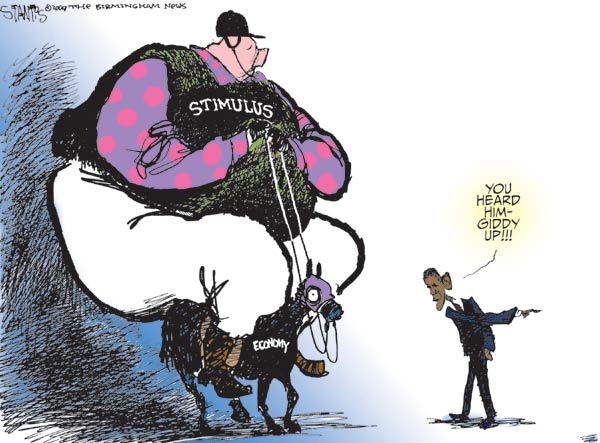
By Everette Hatcher III | Also posted in Vouchers | Edit | Comments (0)

Friedman Friday” Free to Choose by Milton Friedman: Episode “What is wrong with our schools?” (Part 5 of transcript and video)

Here is the video clip and transcript of the film series FREE TO CHOOSE episode “What is wrong with our schools?” Part 5 of 6.   Volume 6 – What’s Wrong with our Schools Transcript: Are your voucher schools  going to accept these tough children? COONS: You bet they are. (Several talking at once.) COONS: May I answer […]

By Everette Hatcher III | Also posted in Vouchers | Edit | Comments (0)

Free to Choose by Milton Friedman: Episode “What is wrong with our schools?” (Part 4 of transcript and video)

Here is the video clip and transcript of the film series FREE TO CHOOSE episode “What is wrong with our schools?” Part 4 of 6.   Volume 6 – What’s Wrong with our Schools Transcript: It seems to me that if one is truly interested in liberty, which I think is the ultimate value that Milton Friedman talks […]

By Everette Hatcher III | Also posted in Vouchers | Edit | Comments (0)

Friedman Friday” Free to Choose by Milton Friedman: Episode “What is wrong with our schools?” (Part 3 of transcript and video)

Friedman Friday” Free to Choose by Milton Friedman: Episode “What is wrong with our schools?” (Part 3 of transcript and video) Here is the video clip and transcript of the film series FREE TO CHOOSE episode “What is wrong with our schools?” Part 3 of 6.   Volume 6 – What’s Wrong with our Schools Transcript: If it […]

Friedman Friday” Free to Choose by Milton Friedman: Episode “What is wrong with our schools?” (Part 2 of transcript and video)

Here is the video clip and transcript of the film series FREE TO CHOOSE episode “What is wrong with our schools?” Part 2 of 6.   Volume 6 – What’s Wrong with our Schools Transcript: Groups of concerned parents and teachers decided to do something about it. They used private funds to take over empty stores and they […]

By Everette Hatcher III | Also posted in Vouchers | Edit | Comments (1)

Friedman Friday” Free to Choose by Milton Friedman: Episode “What is wrong with our schools?” (Part 1 of transcript and video)

Here is the video clip and transcript of the film series FREE TO CHOOSE episode “What is wrong with our schools?” Part 1 of 6.   Volume 6 – What’s Wrong with our Schools Transcript: Friedman: These youngsters are beginning another day at one of America’s public schools, Hyde Park High School in Boston. What happens when […]

By Everette Hatcher III | Also posted in Vouchers | Tagged  | Edit | Comments (0)

Free to Choose by Milton Friedman: Episode “Created Equal” (Part 7 of transcript and video)

Liberals like President Obama want to shoot for an equality of outcome. That system does not work. In fact, our free society allows for the closest gap between the wealthy and the poor. Unlike other countries where free enterprise and other freedoms are not present.  This is a seven part series. Created Equal [7/7]. Milton Friedman’s Free to Choose […]

Free to Choose by Milton Friedman: Episode “Created Equal” (Part 6 of transcript and video)

Liberals like President Obama want to shoot for an equality of outcome. That system does not work. In fact, our free society allows for the closest gap between the wealthy and the poor. Unlike other countries where free enterprise and other freedoms are not present.  This is a seven part series. Created Equal [6/7]. Milton Friedman’s Free to Choose […]

“Friedman Friday” Free to Choose by Milton Friedman: Episode “Created Equal” (Part 5 of transcript and video)

Liberals like President Obama want to shoot for an equality of outcome. That system does not work. In fact, our free society allows for the closest gap between the wealthy and the poor. Unlike other countries where free enterprise and other freedoms are not present.  This is a seven part series. Created Equal [5/7]. Milton Friedman’s Free to Choose […]

Free to Choose by Milton Friedman: Episode “Created Equal” (Part 4 of transcript and video)

Liberals like President Obama want to shoot for an equality of outcome. That system does not work. In fact, our free society allows for the closest gap between the wealthy and the poor. Unlike other countries where free enterprise and other freedoms are not present.  This is a seven part series. Created Equal [4/7]. Milton Friedman’s Free to Choose […]

Friedman Friday” Free to Choose by Milton Friedman: Episode “Created Equal” (Part 3 of transcript and video)

Friedman Friday” Free to Choose by Milton Friedman: Episode “Created Equal” (Part 3 of transcript and video) Liberals like President Obama want to shoot for an equality of outcome. That system does not work. In fact, our free society allows for the closest gap between the wealthy and the poor. Unlike other countries where free enterprise and other […]

Free to Choose by Milton Friedman: Episode “Created Equal” (Part 2 of transcript and video)

Free to Choose by Milton Friedman: Episode “Created Equal” (Part 2 of transcript and video) Liberals like President Obama want to shoot for an equality of outcome. That system does not work. In fact, our free society allows for the closest gap between the wealthy and the poor. Unlike other countries where free enterprise and other freedoms are […]

Free to Choose by Milton Friedman: Episode “Created Equal” (Part 1 of transcript and video)

 Milton Friedman and Ronald Reagan Liberals like President Obama (and John Brummett) want to shoot for an equality of outcome. That system does not work. In fact, our free society allows for the closest gap between the wealthy and the poor. Unlike other countries where free enterprise and other freedoms are not present.  This is a seven part series. […]

Milton Friedman The Power of the Market 2-5

Milton Friedman Friday:(“Free to Choose” episode 4 – From Cradle to Grave, Part 7 of 7)

I am currently going through his film series “Free to Choose” which is one the most powerful film series I have ever seen. TEMIN: We don’t think the big capital arose before the government did? VON HOFFMAN: Listen, what are we doing here? I mean __ defending big government is like defending death and taxes. […]

Milton Friedman Friday:(“Free to Choose” episode 4 – From Cradle to Grave, Part 6 of 7)

I am currently going through his film series “Free to Choose” which is one the most powerful film series I have ever seen worked pretty well for a whole generation. Now anything that works well for a whole generation isn’t entirely bad. From the fact __ from that fact, and the undeniable fact that things […]

Milton Friedman Friday:(“Free to Choose” episode 4 – From Cradle to Grave, Part 5 of 7)

 I am currently going through his film series “Free to Choose” which is one the most powerful film series I have ever seen. PART 5 of 7 MCKENZIE: Ah, well, that’s not on our agenda actually. (Laughter) VOICE OFF SCREEN: Why not? MCKENZIE: I boldly repeat the question, though, the expectation having been __ having […]

Milton Friedman Friday: (“Free to Choose” episode 4 – From Cradle to Grave, Part 4 of 7)

 I am currently going through his film series “Free to Choose” which is one the most powerful film series I have ever seen. PART 4 of 7 The massive growth of central government that started after the depression has continued ever since. If anything, it has even speeded up in recent years. Each year there […]

By Everette Hatcher III | Edit | Comments (0)

Milton Friedman Friday: (“Free to Choose” episode 4 – From Cradle to Grave, Part 3 of 7)

 I am currently going through his film series “Free to Choose” which is one the most powerful film series I have ever seen. PART 3 OF 7 Worse still, America’s depression was to become worldwide because of what lies behind these doors. This is the vault of the Federal Reserve Bank of New York. Inside […]

By Everette Hatcher III | Edit | Comments (0)

Milton Friedman Friday:(“Free to Choose” episode 4 – From Cradle to Grave, Part 2 of 7)

 I am currently going through his film series “Free to Choose” which is one the most powerful film series I have ever seen. For the past 7 years Maureen Ramsey has had to buy food and clothes for her family out of a government handout. For the whole of that time, her husband, Steve, hasn’t […]

Friedman Friday:(“Free to Choose” episode 4 – From Cradle to Grave, Part 1 of 7)

Friedman Friday:(“Free to Choose” episode 4 – From Cradle to Grave, Part 1 of 7) Volume 4 – From Cradle to Grave Abstract: Since the Depression years of the 1930s, there has been almost continuous expansion of governmental efforts to provide for people’s welfare. First, there was a tremendous expansion of public works. The Social Security Act […]

By Everette Hatcher III | Edit | Comments (0)

“Friedman Friday” (“Free to Choose” episode 1 – Power of the Market. part 7 of 7)

  Michael Harrington:  If you don’t have the expertise, the knowledge technology today, you’re out of the debate. And I think that we have to democratize information and government as well as the economy and society. FRIEDMAN: I am sorry to say Michael Harrington’s solution is not a solution to it. He wants minority rule, I […]

“Friedman Friday” (“Free to Choose” episode 1 – Power of the Market. part 6 of 7)

PETERSON: Well, let me ask you how you would cope with this problem, Dr. Friedman. The people decided that they wanted cool air, and there was tremendous need, and so we built a huge industry, the air conditioning industry, hundreds of thousands of jobs, tremendous earnings opportunities and nearly all of us now have air […]

“Friedman Friday” (“Free to Choose” episode 1 – Power of the Market. part 5 of 7)

Part 5 Milton Friedman: I do not believe it’s proper to put the situation in terms of industrialist versus government. On the contrary, one of the reasons why I am in favor of less government is because when you have more government industrialists take it over, and the two together form a coalition against the ordinary […]

“Friedman Friday” (“Free to Choose” episode 1 – Power of the Market. part 4 of 7)

The fundamental principal of the free society is voluntary cooperation. The economic market, buying and selling, is one example. But it’s only one example. Voluntary cooperation is far broader than that. To take an example that at first sight seems about as far away as you can get __ the language we speak; the words […]

“Friedman Friday” (“Free to Choose” episode 1 – Power of the Market. part 3 of 7)

  _________________________   Pt3  Nowadays there’s a considerable amount of traffic at this border. People cross a little more freely than they use to. Many people from Hong Kong trade in China and the market has helped bring the two countries closer together, but the barriers between them are still very real. On this side […]

“Friedman Friday” (“Free to Choose” episode 1 – Power of the Market. part 2 of 7)

  Aside from its harbor, the only other important resource of Hong Kong is people __ over 4_ million of them. Like America a century ago, Hong Kong in the past few decades has been a haven for people who sought the freedom to make the most of their own abilities. Many of them are […]

“Friedman Friday” (“Free to Choose” episode 1 – Power of the Market. part 1of 7)

“FREE TO CHOOSE” 1: The Power of the Market (Milton Friedman) Free to Choose ^ | 1980 | Milton Friedman Posted on Monday, July 17, 2006 4:20:46 PM by Choose Ye This Day FREE TO CHOOSE: The Power of the Market Friedman: Once all of this was a swamp, covered with forest. The Canarce Indians […]

By Everette Hatcher III | Posted in Current EventsMilton Friedman | Edit | Comments (0)

Milton Friedman The Power of the Market 1-5

Debate on Milton Friedman’s cure for inflation

If you would like to see the first three episodes on inflation in Milton Friedman’s film series “Free to Choose” then go to a previous post I did. Ep. 9 – How to Cure Inflation [4/7]. Milton Friedman’s Free to Choose (1980) Uploaded by investbligurucom on Jun 16, 2010 While many people have a fairly […]

By Everette Hatcher III | Also posted in Current Events | Tagged  | Edit | Comments (0)

“Friedman Friday” Milton Friedman believed in liberty (Interview by Charlie Rose of Milton Friedman part 1)

Charlie Rose interview of Milton Friedman My favorite economist: Milton Friedman : A Great Champion of Liberty  by V. Sundaram   Milton Friedman, the Nobel Prize-winning economist who advocated an unfettered free market and had the ear of three US Presidents – Nixon, Ford and Reagan – died last Thursday (16 November, 2006 ) in San Francisco […]

What were the main proposals of Milton Friedman?

Stearns Speaks on House Floor in Support of Balanced Budget Amendment Uploaded by RepCliffStearns on Nov 18, 2011 Speaking on House floor in support of Balanced Budget Resolution, 11/18/2011 ___________ Below are some of the main proposals of Milton Friedman. I highly respected his work. David J. Theroux said this about Milton Friedman’s view concerning […]

“Friedman Friday,” EPISODE “The Failure of Socialism” of Free to Choose in 1990 by Milton Friedman (Part 1)

Milton Friedman: Free To Choose – The Failure Of Socialism With Ronald Reagan (Full) Published on Mar 19, 2012 by NoNationalityNeeded Milton Friedman’s writings affected me greatly when I first discovered them and I wanted to share with you. We must not head down the path of socialism like Greece has done. Abstract: Ronald Reagan […]

Defending Milton Friedman

What a great defense of Milton Friedman!!!!   Defaming Milton Friedman by Johan Norberg This article appeared in Reason Online on September 26, 2008  PRINT PAGE  CITE THIS      Sans Serif      Serif Share with your friends: ShareThis In the future, if you tell a student or a journalist that you favor free markets and limited government, there is […]

Milton and Rose Friedman “Two Lucky People”

Milton Friedman on Hayek’s “Road to Serfdom” 1994 Interview 2 of 2 Uploaded by PenguinProseMedia on Oct 26, 2011 2nd half of 1994 interview. ________________ I have a lot of respect for the Friedmans.Two Lucky People by Milton and Rose Friedman reviewed by David Frum — October 1998. However, I liked this review below better. It […]

Video clip:Milton Friedman discusses his view of numerous political figures and policy issues in (Part 2)

Milton Friedman on Hayek’s “Road to Serfdom” 1994 Interview 1 of 2 Uploaded by PenguinProseMedia on Oct 25, 2011 Says Federal Reserve should be abolished, criticizes Keynes. One of Friedman’s best interviews, discussion spans Friedman’s career and his view of numerous political figures and public policy issues. ___________________ Here is a review of “Two Lucky People.” […]

Milton Friedman believed in liberty (Interview by Charlie Rose of Milton Friedman part 1)

Charlie Rose interview of Milton Friedman My favorite economist: Milton Friedman : A Great Champion of Liberty  by V. Sundaram   Milton Friedman, the Nobel Prize-winning economist who advocated an unfettered free market and had the ear of three US Presidents – Nixon, Ford and Reagan – died last Thursday (16 November, 2006 ) in San Francisco […]

“The Failure of Socialism” episode of Free to Choose in 1990 by Milton Friedman (Part 1)

Milton Friedman: Free To Choose – The Failure Of Socialism With Ronald Reagan (Full) Published on Mar 19, 2012 by NoNationalityNeeded Milton Friedman’s writings affected me greatly when I first discovered them and I wanted to share with you. We must not head down the path of socialism like Greece has done. Abstract: Ronald Reagan […]

Volume 1: Power of the Market Volume 2: The Tyranny of Control
Volume 3: Anatomy of a Crisis 
Volume 4: From Cradle to Grave
Volume 5: Created Equal
Volume 6: What’s Wrong With Our Schools?
Volume 7: Who Protects the Consumer?
Volume 8: Who Protects the Worker?
Volume 9: How to Cure Inflation
Volume 10: How to Stay Free

Updated 1990 Series:
Volume 1: The Power of the Market
Volume 2: The Tyranny of Control
Volume 3: Freedom & Prosperity
Volume 4: The Failure of Socialism
Volume 5: Created Equal


“Friedman Friday” Milton Friedman – Power of Choice (Biography) Part 3

Milton Friedman – Power of Choice (Biography) Part 3 Published on May 21, 2012 by BasicEconomics Tribute to Milton Friedman English Pages, 8. 9. 2008 Dear colleagues, dear friends, (1) It is a great honor for me to be asked to say a few words to this distinguished and very knowledgeable audience about one of our greatest […]

“Friedman Friday” Milton Friedman – Power of Choice (Biography) Part 2

Milton Friedman – Power of Choice (Biography) Part 2 Published on May 21, 2012 by BasicEconomics My Tribute to Milton Friedman: The Little Giant of Free Market Economics By: admin- 11/17/2006 09:49 AM RESIZE: AAA  Milton Friedman, the intellectual architect of the free-market reforms of the post-World War II era, was a dear friend. I […]

“Friedman Friday” Milton Friedman – Power of Choice – Biography (Part 1)

Milton Friedman – Power of Choice – Biography (Part 1) Published on May 20, 2012 by BasicEconomics   David R. Henderson The Pursuit of Happiness ~ Milton Friedman: A Personal Tribute May 2007 • Volume: 57 • Issue: 4 David Henderson (davidrhenderson1950@gmail.com) is a research fellow with the Hoover Institution and an economics professor at […]

Milton Friedman’s Chicago Boys started the Chilean Miracle and it is still helping ordinary people today!!!

Milton Friedman and Chile – The Power of Choice Uploaded on May 13, 2011 In this excerpt from Free To Choose Network’s “The Power of Choice (2006)”, we set the record straight on Milton Friedman’s dealings with Chile — including training the Chicago Boys and his meeting with Augusto Pinochet. Was the tremendous prosperity unleashed […]

Margaret Thatcher admired Milton Friedman

RARE Friedman Footage – On Keys to Reagan and Thatcher’s Success Margaret Thatcher and Milton Friedman were two of my heroes. Thatcher praises Friedman, her freedom fighter By George Jones, Political Editor 12:01AM GMT 17 Nov 2006 A tireless champion of the free market Let’s not get misty eyed over the Friedman legacy Milton Friedman, […]

Milton Friedman and Chile an update

Milton Friedman was a great economist and a fine speaker. ___________________ I have written before about Milton Friedman’s influence on the economy of Chile. Now I saw this fine article below fromhttp://www.heritage.org  and below that article I have included an article from the Wall Street Journal that talks about Milton Friedman’s influence on Chile. I […]

“Friedman Friday” Milton Friedman explains negative income tax to William F. Buckley in 1968

December 06, 2011 03:54 PM Milton Friedman Explains The Negative Income Tax – 1968 0 comments By Gordonskene enlarge Milton Friedman and friends.DOWNLOADS: 36 PLAYS: 35 Embed   The age-old question of Taxes. In the early 1960′s Economist Milton Friedman adopted an idea hatched in England in the 1950′s regarding a Negative Income Tax, to […]

Milton Friedman admired Margaret Thatcher

RARE Friedman Footage – On Keys to Reagan and Thatcher’s Success Margaret Thatcher and Milton Friedman were two of my heroes. Milton Friedman on How Francois Mitterrand (and Failed Lefty Economics) Helped Re-elect Margaret Thatcher Matt Welch|Apr. 10, 2013 9:37 am Yesterday I wrote a column about how Margaret Thatcher liberated Western Europe from the […]

Milton Friedman had a solution to today’s welfare mentality!!!

  I have written about the tremendous increase in the food stamp program the last 9 years before and that means that both President Obama and Bush were guilty of not trying to slow down it’s growth. Furthermore, Republicans have been some of the biggest supporters of the food stamp program. Milton Friedman had a […]

“Friedman Friday” Milton Friedman on “Firing Line” in 1968

Milton Friedman, Ronald Reagan And William F. Buckley Jr. Peter Robinson, 12.12.08, 12:01 AM EST In a time of crisis, don’t forget what they had to say. As the federal deficit surpasses $1 trillion, Congress debates a bailout for the Detroit automakers and President-elect Barack Obama draws up plans for a vast new stimulus package, […]

Dan Mitchell: “I share this map from the Tax Foundation’s annual State Business Tax Climate Index, showing Wyoming, South Dakota, Alaska, and Florida with the best scores and Connecticut, California, New York, and New Jersey with the worst scores!”

The Best and Worst States for Tax Policy

Yesterday’s column included a map showing which states gained and lost the most population over the past year.

I speculated that some of America’s internal migration was driven by differences in tax policy.

So it’s appropriate today that I share this map from the Tax Foundation’s annual State Business Tax Climate Index, showing Wyoming, South Dakota, Alaska, and Florida with the best scores and Connecticut, California, New York, and New Jersey with the worst scores.

Comparing today’s map with yesterday’s map, I immediately noticed that two states losing a lot of people – New York and California – also are states that have very bad tax systems.

And if you examine other states, you’ll confirm that there’s a relationship between tax policy and people “voting with their feet.”

Does that mean taxes are the only thing that matters? Of course not.

But as Janelle Cammenga and Jared Walczak explain in their report, they definitely have an effect on where money gets invested and where jobs get created.

Taxation is inevitable, but the specifics of a state’s tax structure matter greatly. The measure of total taxes paid is relevant, but other elements of a state tax system can also enhance or harm the competitiveness of a state’s business environment. …all types of businesses, small and large,tending to locate where they have the greatest competitive advantage. The evidence shows that states with the best tax systems will be the most competitive at attracting new businesses and most effective at generating economic and employment growth. …State lawmakers are right to be concerned about how their states rank in the global competition for jobs and capital, but they need to be more concerned with companies moving from Detroit, Michigan, to Dayton, Ohio, than from Detroit to New Delhi, India. …Tax competition is an unpleasant reality for state revenue and budget officials, but it is an effective restraint on state and local taxes.

One of the more interesting parts of the report is that you get to see where states rank when considering different types of taxes.

Here’s Table 1, which has the overall ranking in the first column, followed by the rankings for the main revenue sources for states.

If you read the report’s methodology, you’ll notice that there are different weights.

The worst tax (assuming a state wants a competitive system) is the personal income tax, followed by the sales tax and corporate income tax.

No state ranks in the top 10 for all five categories, though Florida, North Carolina, and Utah have relatively good scores across the board.

P.S. One important caveat is that the report does not list energy severance taxes, which are major sources of revenue for states such as Alaska and Wyoming. To be sure, those taxes that largely are borne by out-of-state consumers, so there’s a reason for the omission. Nonetheless, those taxes enable excessive government spending, which is why I think South Dakota and Florida actually have the nation’s best fiscal systems.

Biden’s Boondoggle(s) and the Burden of Government Spending

First we got Biden’s $1.9 trillion so-called stimulus.

Then we got his $1 trillion-plus infrastructure boondoggle.

Now Congress may be on the verge of approving the President’s budget, which (if we use honest numbers) is a $5 trillion plan to expand the welfare state.

And…

So it’s hardly a surprise that recent changes will lead to a much-larger burden of government spending.

This is bad news for our economy, as measured by my recent study (with similar findings from a wide range of academics – as well as normally left-leaning bureaucracies such as the IMF, World Bank, and OECD).

For purposes of today’s column, let’s put America’s fiscal decline in global context.

Here are some excerpts from a very depressing article in the Economist, starting with some discussion of how Biden’s spending binge is similar to the mistakes made by other nations.

President Joe Biden is building on what started as emergency pandemic-related policy, expanding the child-tax credit, creating a universal federally funded child-care system, subsidising paid family leave and expanding Obamacare. America’s government spending remains somewhat below the developed-world average. But this change is not just a matter of catching up; the target is moving. Government spending as a share of gdp in the oecd as a whole has consistently inched higher in the six decades since the club was formed in 1961.

There’s then some discussion about how a few nations – most notably Sweden and New Zealand – enjoyed period of genuine spending restraint, but accompanied by depressing observations about how fiscal responsibility is very rare.

Examples of genuine state retrenchment in developed countries are few and far between. Sweden managed it in the 1980s. In the early 1990s Ruth Richardson, then New Zealand’s finance minister, cut the size of the state drastically. …State spending is now six percentage points lower as a share of gdp than it was in 1990. But this is a rare achievement, and perhaps one doomed to pass. …This is a sorry state of affairs if you believe that low taxes and small government are the right, and possibly the only, conditions for reliable, enduring economic growth. …an argument made by Friedrich Hayek, an Austrian philosopher, Milton Friedman, an American economist, and others in the mid-20th century.

There’s also some historical analysis showing how the burden of government used to be relatively minor.

From 1274 to 1691 the English government raised less than 2% of gdp in tax. …In the 1870s the governments of rich countries were spending about 10% of gdp. In 1920 it was nearer 20%. It has been growing ever since (see chart 2).

Here’s the aforementioned chart 2, and there are a lot of depressing numbers, though notice how Switzerland does better than other nations.

I’ve previously shared a version of this data, calling it the “world’s most depressing chart” – all of which was made possible by the imposition of income taxes.

But there is some good news. The ever-rising fiscal burden of government has been somewhat offset by reductions in other bad policies.

Governments have not grown more powerful by all measures. Bureaucrats no longer, as a rule, set wages or prices, nor impose strict currency controls, as many did in the 1960s or 1970s. In recent decades the public sector has raised hundreds of billions of dollars from privatisations of state assets such as mines and telecoms networks. If you find it faintly amusing to hear that, from 1948 to 1984, the British state ran its own chain of hotels, that is because the “neoliberal” outlook on the proper place of government has triumphed.

Last but not least, there’s some discussion of “public choice,” which explains why politicians and bureaucrats have incentives to expand the size and scope of government.

Governments and bureaucrats are at least partly self-interested: “public-choice theory” says that unrestrained bureaucracies will defend their turf and seek to expand it. …Politicians have their own incentives to expand the state. It is generally more rewarding for a politician to introduce a new programme than it is to close an old one down; costs are spread across all taxpayers while benefits tend to be concentrated, thus eliciting gratitude from interest groups

I’ll close by reiterating my warning that ever-rising spending burdens not only lead to less growth, but they also will lead to Greek-style fiscal crises.

Europe will get hit first, but it’s just a matter of time before the United States suffers a similar fate.

P.S. There is a simple solution to avoid such crises, and a specific policy to achieve that solution. But don’t hold your breath waiting for politicians to tie their own hands.

Biden’s Economic Alchemy: $3.5 Trillion = Zero

Last week, I wrote about a new study which estimates that Biden’s fiscal agenda of bigger government and higher taxeswould reduce economic output by about $3 trillion over the next decade.

Perhaps more relevant, that foregone economic growth would translate into more than $10,000 of lost compensation per job. And a lifetime drop in living standards of more than 4 percent for younger people.

And these numbers are based on research by the Congressional Budget Office, which is hardly a bastion of libertarian analysis.

The Biden White House has a different perspective.

How different? Well, the President actually claims that expanding the burden of government won’t cost anything.

I’m not joking. Here are some excerpts from an article in the Washington Post by Seung Min Kim and Tony Romm.

President Biden promised Friday that his sweeping domestic agenda package will cost “nothing” because Democrats will pay for it through tax hikes on the wealthy and corporations… The remarks were an attempt by Bidento assuage some of the cost concerns pointedly expressed by the moderate Democrats about the size of the legislation… The total spending outlined in the plan is $3.5 trillion… “It is zero price tag on the debt we’re paying. We’re going to pay for everything we spend,” Biden said in remarks from the State Dining Room at the White House.

Biden’s strange analysis has generated some amusing responses.

For instance, Gerard Baker opined in the Wall Street Journalabout Biden’s magical approach.

…this is a novel way of estimating the cost of something. That eye-wateringly expensive dinner you had last week didn’t really cost you anything because you paid for it. …You could have used the money to investin your children’s college fund. You could have paid off some of your credit card bill, the debt on which has quadrupled in the last year. But you chose instead to blow it on a few morsels of raw fish and a couple of bottles of 1982 Château Lafite Rothschild. Don’t worry, It didn’t cost you anything.

Biden and his team definitely deserve to be mocked for their silly argument.

For all intents and purposes, they want us to believe that there’s no downside if you combine anti-growth spending increases with anti-growth tax increases – so long as there’s no increase in red ink.

But there’s actually a fiscal theory that sort of supports what the White House is saying.

  • Capital (saving and investment) is a key driver of productivity and long-run growth.
  • Budget deficits divert capital from the economy’s productive sector to government.
  • Budget deficits raise interest rates, reducing incentives for investment.
  • Therefore, budget deficits are bad for prosperity.

For what it’s worth, all four of those statements are correct.

But the theory is nonetheless wrong because it elevates one variable – fiscal balance – while ignoring other variables that have a much bigger impact on economic performance.

For instance, the Congressional Budget Office at one point embraced this approach – even though it led to absurd implications such as growth being maximized with tax rates of 100 percent.

For further background, here’s a table I prepared back in 2012.

The White House today is basically embracing the IMF’s “austerity” argument that deficits/surpluses are the variable that has the biggest impact on growth.

P.S. Folks on the left must get whiplash because some days they embrace the Keynesian argument that deficits are good for growth and other days they argue that a big expansion of government will have zero cost because there is no increase in the deficit.

P.P.S. The folks on the right who focus solely on tax cuts also are guilty of elevating one variable while ignoring others (humorously depicted in this cartoon strip).

Two (Humorous) Images to Understand Biden’s Fiscal Policy

Yesterday’s column was a completely serious look at five graphs and tables that show why Biden’s tax plan is misguided.

Today, we’re going to make the same point with satire. And we’ll only need two images.

First, here’s a look at what happens when politicians create never-ending handouts financed by ever-higher taxes on an ever-smaller group of rich taxpayers.

In the past, I’ve referred to this as “Greece-ification” and Biden’s fiscal plan definitely qualifies.

It’s also a different way of looking at the second cartoon from this depiction of how a welfare state evolves over time.

This Chuck Asay cartoon makes the same point.

Second, here’s a cartoon that nicely captures why I think Biden’s agenda will erode the nation’s societal capital.

The same theme as this excellent cartoon.

While amusing, there’s a very serious point to be made. Politicians already have created a system that rewards people for doing nothing while punishing them for creating wealth.

Those policies hinder American prosperity (as honest folks on the left acknowledge), but we can survive with slower growth. What really worries me is that we may eventually reach a tipping point of too many people riding in the wagon (and out-voting the people who pull the wagon).

Simply stated, we don’t want America to become another Greece.

I have put up lots of cartoons from Dan Mitchell’s blog before and they have got lots of hits before. Many of them have dealt with the economy, eternal unemployment benefits, socialism,  Greece,  welfare state or on gun control.

My Cato colleague, Mark Calabria, recently explained how the minimum wage destroys jobs, and I’ve written on several occasions why government-mandated wages can create unemployment by making it unprofitable to hire people with low work skills and/or poor work histories. And I’ve attacked Republicans for going along with these job-killing policies, and also pointed out the racist impact of such intervention.

But this cartoon may be a more effective argument for getting government out of the business of interfering with market forces. It’s simple, direct, and gets the point across. I’m not sure that always happens with my writing.

My former intern, Orphe Divougny, also did a very good job in explaining why politicians shouldn’t interfere with the right of workers and employers to enter into labor contracts.

Related posts:

Cartoons from Dan Mitchell’s blog that demonstrate what Obama is doing to our economy Part 2

Max Brantley is wrong about Tom Cotton’s accusation concerning the rise of welfare spending under President Obama. Actually welfare spending has been increasing for the last 12 years and Obama did nothing during his first four years to slow down the rate of increase of welfare spending. Rachel Sheffield of the Heritage Foundation has noted: […]

Cartoons from Dan Mitchell’s blog that demonstrate what Obama is doing to our economy Part 1

  I have put up lots of cartoons from Dan Mitchell’s blog before and they have got lots of hits before. Many of them have dealt with the economy, eternal unemployment benefits, socialism,  Greece,  welfare state or on gun control. I think Max Brantley of the Arkansas Times Blog was right to point out on 2-6-13 that Hillary […]

Great cartoon from Dan Mitchell’s blog on government moochers

I thought it was great when the Republican Congress and Bill Clinton put in welfare reform but now that has been done away with and no one has to work anymore it seems. In fact, over 40% of the USA is now on the government dole. What is going to happen when that figure gets over […]

Gun Control cartoon hits the internet

Again we have another shooting and the gun control bloggers are out again calling for more laws. I have written about this subject below  and on May 23, 2012, I even got a letter back from President Obama on the subject. Now some very interesting statistics below and a cartoon follows. (Since this just hit the […]

“You-Didn’t-Build-That” comment pictured in cartoons!!!

watch?v=llQUrko0Gqw] The federal government spends about 10% on roads and public goods but with the other money in the budget a lot of harm is done including excessive regulations on business. That makes Obama’s comment the other day look very silly. A Funny Look at Obama’s You-Didn’t-Build-That Comment July 28, 2012 by Dan Mitchell I made […]

Cartoons about Obama’s class warfare

I have written a lot about this in the past and sometimes you just have to sit back and laugh. Laughing at Obama’s Bumbling Class Warfare Agenda July 13, 2012 by Dan Mitchell We know that President Obama’s class-warfare agenda is bad economic policy. We know high tax rates undermine competitiveness. And we know tax increases […]

Cartoons on Obama’s budget math

Dan Mitchell Discussing Dishonest Budget Numbers with John Stossel Uploaded by danmitchellcato on Feb 11, 2012 No description available. ______________ Dan Mitchell of the Cato Institute has shown before how excessive spending at the federal level has increased in recent years. A Humorous Look at Obama’s Screwy Budget Math May 31, 2012 by Dan Mitchell I’ve […]

Funny cartoon from Dan Mitchell’s blog on Greece

Sometimes it is so crazy that you just have to laugh a little. The European Mess, Captured by a Cartoon June 22, 2012 by Dan Mitchell The self-inflicted economic crisis in Europe has generated some good humor, as you can see from these cartoons by Michael Ramirez and Chuck Asay. But for pure laughter, I don’t […]

Obama on creating jobs!!!!(Funny Cartoon)

Another great cartoon on President Obama’s efforts to create jobs!!! A Simple Lesson about Job Creation for Barack Obama December 7, 2011 by Dan Mitchell Even though leftist economists such as Paul Krugman and Larry Summers have admitted that unemployment insurance benefits are a recipe for more joblessness, the White House is arguing that Congress should […]

Get people off of government support and get them in the private market place!!!!(great cartoon too)

Dan Mitchell hits the nail on the head and sometimes it gets so sad that you just have to laugh at it like Conan does. In order to correct this mess we got to get people off of government support and get them in the private market place!!!! Chuck Asay’s New Cartoon Nicely Captures Mentality […]

2 cartoons illustrate the fate of socialism from the Cato Institute

Cato Institute scholar Dan Mitchell is right about Greece and the fate of socialism: Two Pictures that Perfectly Capture the Rise and Fall of the Welfare State July 15, 2011 by Dan Mitchell In my speeches, especially when talking about the fiscal crisis in Europe (or the future fiscal crisis in America), I often warn that […]

Cartoon demonstrates that guns deter criminals

John Stossel report “Myth: Gun Control Reduces Crime Sheriff Tommy Robinson tried what he called “Robinson roulette” from 1980 to 1984 in Central Arkansas where he would put some of his men in some stores in the back room with guns and the number of robberies in stores sank. I got this from Dan Mitchell’s […]

Gun control posters from Dan Mitchell’s blog Part 2

I have put up lots of cartons and posters from Dan Mitchell’s blog before and they have got lots of hits before. Many of them have dealt with the economy, eternal unemployment benefits, socialism,  Greece,  welfare state or on gun control. Amusing Gun Control Picture – Circa 1999 April 3, 2010 by Dan Mitchell Dug this gem out […]

We got to cut spending and stop raising the debt ceiling!!!

  We got to cut spending and stop raising the debt ceiling!!! When Governments Cut Spending Uploaded on Sep 28, 2011 Do governments ever cut spending? According to Dr. Stephen Davies, there are historical examples of government spending cuts in Canada, New Zealand, Sweden, and America. In these cases, despite popular belief, the government spending […]

Gun control posters from Dan Mitchell’s blog Part 1

I have put up lots of cartons and posters from Dan Mitchell’s blog before and they have got lots of hits before. Many of them have dealt with the economy, eternal unemployment benefits, socialism,  Greece,  welfare state or on gun control. On 2-6-13 the Arkansas Times Blogger “Sound Policy” suggested,  “All churches that wish to allow concealed […]

Taking on Ark Times bloggers on the issue of “gun control” (Part 3) “Did Hitler advocate gun control?”

Gun Free Zones???? Stalin and gun control On 1-31-13 ”Arkie” on the Arkansas Times Blog the following: “Remember that the biggest gun control advocate was Hitler and every other tyrant that every lived.” Except that under Hitler, Germany liberalized its gun control laws. __________ After reading the link  from Wikipedia that Arkie provided then I responded: […]

Taking on Ark Times bloggers on the issue of “gun control” (Part 2) “Did Hitler advocate gun control?”

On 1-31-13 I posted on the Arkansas Times Blog the following: I like the poster of the lady holding the rifle and next to her are these words: I am compensating for being smaller and weaker than more violent criminals. __________ Then I gave a link to this poster below: On 1-31-13 also I posted […]