Monthly Archives: July 2014

Open letter to President Obama (Part 635) Does President Obama care about Kermit Gosnell verdict?

Open letter to President Obama (Part 635)

(Emailed to White House on 5-17-13.)

President Obama c/o The White House 1600 Pennsylvania Avenue NW Washington, DC 20500

Dear Mr. President,

I know that you receive 20,000 letters a day and that you actually read 10 of them every day. I really do respect you for trying to get a pulse on what is going on out here. I know that you don’t agree with my pro-life views but I wanted to challenge you as a fellow Christian to re-examine your pro-choice view.

___________________

Francis Schaeffer Whatever Happened to the Human Race (Episode 1) ABORTION

_____________________________________


Francis Schaeffer “BASIS FOR HUMAN DIGNITY” Whatever…HTTHR

Dr. Francis schaeffer – The flow of Materialism(from Part 4 of Whatever happened to human race?)

Dr. Francis Schaeffer – The Biblical flow of Truth & History (intro)

Francis Schaeffer – The Biblical Flow of History & Truth (1)

Dr. Francis Schaeffer – The Biblical Flow of Truth & History (part 2)

________________

Thursday, May 9, 2013 – By Jill Stanek

Although President Obama had no trouble commenting on the ongoing Trayvon Martin case, White House spokesperson Jay Carney said [last month] Obama wouldn’t be commenting on the Kermit Gosnell mass murder case because he “cannot take a position on an ongoing trial” or “comment further on an ongoing legal proceeding.”

Of course the White House wants to avoid this topic. What a disaster Gosnell is for Obama.

Gosnell first brings to Obama’s door the uncomfortable topic of infanticide. Obama is well known to have votedfour times against the Illinois Born Alive Infants Protection Act as state senator, which sought to protect abortion survivors.

But Obama also opposed two companion bills to BAIPA, one of which brings him zero degrees of separation from Gosnell. I was impressed with Fox’s Ed Henry, who went there in his questions to Carney [last month].

On April 4, 2002, Obama testified against Senate Bill 1663, which required abortionists to provide “reasonable measures consistent with good medical practice” to abortion survivors and to plan to have a second physician present if there was a “reasonable likelihood” that the abortion would result “in a live born child.”

You can read the entire transcript here, but the gist of Obama’s opposition was that he had full faith in abortionists:

The only plausible rationale, to my mind, of this legislation would be if you had a suspicion that a doctor . . . (a) is going to make the wrong assessment, and (b) if the physician discovered, after the labor had been induced, that, in fact, he made an error . . . and . . . would not try to exercise the sort of medical measures and practices that would be involved in saving that child.

Now, if you think that there are possibilities that doctors would not do that, then maybe this bill make sense, but I . . . feel . . . an additional doctor who then has to be called in an emergency situation to come in and make these assessments is really designed to burden the original decision of the woman and the physician.

[I]f these are children who are being born alive, I, at least, have confidence that a doctor who is in that room is going to make sure that they’re looked after.

Obama could not fathom that an abortionist who had been paid to kill a baby wouldn’t turn around and try to save a viable baby’s life in the event of a botch.

Kermit Gosnell would have been one of the abortionists in which Obama had “confidence.” Most know by now Gosnell is on trial for murdering seven abortion survivors and one mother.

Gosnell was committing abortions in Pennsylvania at the very time this bill was being debated in Illinois. Who knows, perhaps Gosnell was “snipping” the spinal cord of an abortion survivor at the moment Obama testified to his sterling character. After all, the grand jury report stated Gosnell likely killed “hundreds” of abortion survivors during the three decades he was in business.

Barack Obama has stated on record that he stands with the Kermit Gosnells of America. He can’t walk that back without opening the door to regulations such as he rejected as state senator. So he’s stuck.

Jill Stanek’s commitment to Christ led her to risk her job, reputation, and friendships to stop the terrible practices of abortion and infanticide. Jill was a registered nurse at Christ Hospital in Illinois when she made the shocking discovery that babies were being aborted alive and allowed to die without medical care. Jill went public and has since become a national figure in the effort to protect both born and preborn infants. In January 2003, Jill was named by World Magazine as one of the 30 most prominent pro-life leaders in the movement over the past 30 years.

This article has been reprinted with permission and can be found at http://www.lifenews.com/2013/04/16/obama-cant-comment-on-gosnell-because-obama-stands-with-him/.

Political Cartoons by Gary Varvel

By Gary Varvel – April 29, 2013
______________________

Thank you so much for your time. I know how valuable it is. I also appreciate the fine family that you have and your commitment as a father and a husband. I also respect you for putting your faith in Christ for your eternal life. I am pleading to you on the basis of the Bible to please review your religious views concerning abortion. It was the Bible that caused the abolition movement of the 1800’s and it also was the basis for Martin Luther King’s movement for civil rights and it also is the basis for recognizing the unborn children.

Sincerely,

Everette Hatcher III, 13900 Cottontail Lane, Alexander, AR 72002, ph 501-920-5733, lowcostsqueegees@yahoo.com

Related posts:

Francis Schaeffer’s “How should we then live?” Video and outline of episode 10 “Final Choices” (Schaeffer Sundays)

E P I S O D E 1 0   Dr. Francis Schaeffer – Episode X – Final Choices 27 min FINAL CHOICES I. Authoritarianism the Only Humanistic Social Option One man or an elite giving authoritative arbitrary absolutes. A. Society is sole absolute in absence of other absolutes. B. But society has to be […]

Francis Schaeffer’s “How should we then live?” Video and outline of episode 9 “The Age of Personal Peace and Affluence” (Schaeffer Sundays)

E P I S O D E 9 Dr. Francis Schaeffer – Episode IX – The Age of Personal Peace and Affluence 27 min T h e Age of Personal Peace and Afflunce I. By the Early 1960s People Were Bombarded From Every Side by Modern Man’s Humanistic Thought II. Modern Form of Humanistic Thought Leads […]

Francis Schaeffer’s “How should we then live?” Video and outline of episode 8 “The Age of Fragmentation” (Schaeffer Sundays)

E P I S O D E 8 Dr. Francis Schaeffer – Episode VIII – The Age of Fragmentation 27 min I saw this film series in 1979 and it had a major impact on me. T h e Age of FRAGMENTATION I. Art As a Vehicle Of Modern Thought A. Impressionism (Monet, Renoir, Pissarro, Sisley, […]

Francis Schaeffer’s “How should we then live?” Video and outline of episode 7 “The Age of Non-Reason” (Schaeffer Sundays)

E P I S O D E 7 Dr. Francis Schaeffer – Episode VII – The Age of Non Reason I am thrilled to get this film series with you. I saw it first in 1979 and it had such a big impact on me. Today’s episode is where we see modern humanist man act […]

Francis Schaeffer’s “How should we then live?” Video and outline of episode 6 “The Scientific Age” (Schaeffer Sundays)

E P I S O D E 6 How Should We Then Live 6#1 Uploaded by NoMirrorHDDHrorriMoN on Oct 3, 2011 How Should We Then Live? Episode 6 of 12 ________ I am sharing with you a film series that I saw in 1979. In this film Francis Schaeffer asserted that was a shift in […]

Francis Schaeffer’s “How should we then live?” Video and outline of episode 5 “The Revolutionary Age” (Schaeffer Sundays)

E P I S O D E 5 How Should We Then Live? Episode 5: The Revolutionary Age I was impacted by this film series by Francis Schaeffer back in the 1970′s and I wanted to share it with you. Francis Schaeffer noted, “Reformation Did Not Bring Perfection. But gradually on basis of biblical teaching there […]

Francis Schaeffer’s “How should we then live?” Video and outline of episode 4 “The Reformation” (Schaeffer Sundays)

Dr. Francis Schaeffer – Episode IV – The Reformation 27 min I was impacted by this film series by Francis Schaeffer back in the 1970′s and I wanted to share it with you. Schaeffer makes three key points concerning the Reformation: “1. Erasmian Christian humanism rejected by Farel. 2. Bible gives needed answers not only as to […]

“Schaeffer Sundays” Francis Schaeffer’s “How should we then live?” Video and outline of episode 3 “The Renaissance”

Francis Schaeffer’s “How should we then live?” Video and outline of episode 3 “The Renaissance” Francis Schaeffer: “How Should We Then Live?” (Episode 3) THE RENAISSANCE I was impacted by this film series by Francis Schaeffer back in the 1970′s and I wanted to share it with you. Schaeffer really shows why we have so […]

Francis Schaeffer’s “How should we then live?” Video and outline of episode 2 “The Middle Ages” (Schaeffer Sundays)

  Francis Schaeffer: “How Should We Then Live?” (Episode 2) THE MIDDLE AGES I was impacted by this film series by Francis Schaeffer back in the 1970′s and I wanted to share it with you. Schaeffer points out that during this time period unfortunately we have the “Church’s deviation from early church’s teaching in regard […]

Francis Schaeffer’s “How should we then live?” Video and outline of episode 1 “The Roman Age” (Schaeffer Sundays)

Francis Schaeffer: “How Should We Then Live?” (Episode 1) THE ROMAN AGE   Today I am starting a series that really had a big impact on my life back in the 1970′s when I first saw it. There are ten parts and today is the first. Francis Schaeffer takes a look at Rome and why […]

By Everette Hatcher III | Posted in Francis Schaeffer | Edit | Comments (0)

MUSIC MONDAY Little Rock native David Hodges co-wrote Avril Lavigne song “Hush Hush”

Little Rock native David Hodges co-wrote Avril Lavigne song “Hush Hush”

Avril Lavigne – Hush Hush (Official Video)

Avril Lavigne, ‘Avril Lavigne’: Track-By-Track Review

By , New York | November 04, 2013 4:33 PM EST

“A first taste like honey, you were so yum/Can’t wait for a second, cause it’s so fun,” is a line from the song “You Ain’t Seen Nothin’ Yet,” off Avril Lavigne’s self-titled fifth studio album. It’s a line that’s cutesy and cloying, but look, if you can, beyond it, and soak in the beautifully crafted pop song that houses it. From “Sk8er Boi” to “Girlfriend” to the underrated “What The Hell,” Lavigne has always released pop music that defies dissection, ruffling the feathers of scholars with cries of “Hey, hey! You, you! I don’t like your girlfriend,” and disregarding high art for a meaty chorus. The thing is, Lavigne has always been highly skilled at this practice — ever since she began spitting the polysyllabic pile-up of the “Complicated” chorus, Lavigne has stayed in her lane, cranked out an album’s worth of enjoyable pop-rock every three years or so, and kept her image and integrity intact. For someone who often focuses on the irresponsibilities of youth, Lavigne has proven herself as one of mainstream music’s most reliable personalities; her commitment to bestowing us with impudent anthems is almost workmanlike.

There are new faces on “Avril Lavigne” — notably her husband, Nickelback’s Chad Kroeger, who co-wrote most of the album and sings with Lavigne on “Let Me Go.” There is a new label, Epic Records, which reunites Lavigne with Antonio “L.A.” Reid, who helped bring her music to the masses. But for the most part, Lavigne’s fifth full-length encapsulates everything worth loving about the 29-year-old’s long-running artistry. There are zero attempts at growing up, but instead there is “Here’s To Never Growing Up,” the album’s marvelous lead single, as well as a kick in the groin called “Bad Girl,” featuring Marilyn Manson; “Bitchin’ Summer,” about how awesome the summer is going to be; and “Falling Fast,” a love song that could soundtrack a flurry of proms come springtime. In spite of the subject matter, the songwriting has never been sharper, and unlike 2011’s “Goodbye Lullaby,” which featured moments in which Lavigne sounded unsure of herself, the singer is fully in control here. When she concludes that line from “You Ain’t Seen Nothin’ Yet” with “Third base, I’m headed for a home run/Don’t stop baby, don’t stop baby now,” she tries to sell her words with the most charming of poses. Needless to say, she succeeds.

Which songs on “Avril Lavigne” are worth adding to your hottest playlist? Check out our track-by-track breakdown of Avril Lavigne’s new album.

_______________

7. Bad Girl feat. Marilyn Manson – The high-profile collaboration with Marilyn Manson is salacious, sloppy, muddied rock music  — as it damn well should be. As Lavigne writhes in the spotlight, Manson shrieks his encouragement, and the rubber-necking audience is treated to a spitballing session that turned into glorious chaos.

8. Hello Kitty – As compelling of a car-crash “Bad Girl” was, “Hello Kitty” has the opposite effect: it’s a bold stab at a genre outside of Lavigne’s oeuvre (here, dark-edged techno-pop), but it never comes together. By the 20th time “Hello Kitty, you’re so pretty” is declared, the listener’s attention is already on the next track.

9. You Ain’t Seen Nothin’ Yet – Lavigne travels back to her well-worn pop-rock path and spins a tale of quickly forged romance that could have easily fit in on “The Best Damn Thing.” “You Ain’t Seen Nothin’ Yet” is not quite as solid as “Avril Lavigne’s” uptempo singles, but it’s almost there, and the unabashedly joyful bridge is worth a listen on its own.

10. Sippin’ on Sunshine – The first song on the album to shove the bass to the forefront, “Sippin’ on Sunshine” is a light, surprisingly funky hoedown that translates the echoing chorus of “Here’s To Never Growing Up” to a lyrics sheet that could play well on adult contemporary radio.

11. Hello Heartache – “I was champagne/You were Jameson,” Lavigne laments on this straightforward breakup track. The ghouls crowing “la-la-la” in the background amplify Lavigne’s pain, and although the sentiment at the heart of “Hello Heartache” is a simple one, it’s no less impactful.

12. Falling Fast – There are moments on “Avril Lavigne” that the singer seems primed for a country-pop makeover, and “Falling Fast” is the clearest, and best, example of Lavigne’s subtle shift toward Nashville’s biggest genre. The song’s breathy delivery, hushed rock elements and crystallized melody would all be at home on a Taylor Swift album.

13. Hush Hush – The great thing about the songwriting on “Avril Lavigne” is that it always conveys a deeper meaning without overreaching or busting out the thesaurus. The piano-driven “Hush Hush” emits a rush of feelings — regret, anger, desperation, nakedness, and finally, faint hopefulness — and unpacks them tidily while presenting Lavigne as a pop artist one can still trust to handle the job.

Related posts:

Little Rock native David Hodges co-wrote the Avril Lavigne song “Give you what you like”

Little Rock native David Hodges co-wrote the Avril Lavigne song “Give you what you like” Give You What You Like – Avril Lavigne (Sub. English-Español) Here are the lyrics: If you give me what I want Then Ill give you what you like When you turn off the lights I get stars in my eyes […]

Little Rock native David Hodges co-wrote Avril Lavigne song “Let Me Go”

Little Rock native David Hodges co-wrote Avril Lavigne song “Let Me Go” Avril Lavigne – Let Me Go ft. Chad Kroeger Let Me Go (Avril Lavigne song) From Wikipedia, the free encyclopedia Jump to: navigation, search “Let Me Go” Single by Avril Lavigne featuring Chad Kroeger from the album Avril Lavigne Released 15 October 2013 Format Digital download […]

Little Rock native David Hodges co-wrote many of the songs on Avril Lavigne’s new album

Little Rock native David Hodges co-wrote many of the songs on Avril Lavigne’s new album Preview “Avril Lavigne” iTunes 30 Second Snippets According to Wikipedia: Avril Lavigne (album) From Wikipedia, the free encyclopedia Jump to: navigation, search Avril Lavigne Studio album by Avril Lavigne Released 1 November 2013 Recorded 2011–2013 Length 46:07 Label Epic Producer Rickard B. […]

Little Rock native David Hodges co-wrote the hit song “Crush” sung by David Archuleta

David Archuleta – Crush Crush (David Archuleta song) From Wikipedia, the free encyclopedia “Crush” Single by David Archuleta from the album David Archuleta Released August 12, 2008 (See release history) Format CD single, digital download Recorded 2008 Genre Pop Length 3:33 Label Jive Writer(s) Jess Cates, David Hodges, Emanuel Kiriakou Producer Emanuel Kiriakou David Archuleta singles chronology “Crush“ (2008) “A Little Too Not Over You“ […]

Little Rock native David Hodges co-wrote the hit song “What about now” for Daughtry

Uploaded on May 11, 2011 “What About Now” is the seventh single from American rock band Daughtry’s eponymous debut album. The song is a ballad, that was written by Ben Moody, David Hodges (both former members of Evanescence), and Josh Hartzler, who is married to Amy Lee (the lead singer of Evanescence) It is one of […]

Little Rock Native David Hodges co-wrote the top 10 hit Evanescence song “Bring me to Life”

Evanescence – Bring Me To Life From David Hodges website: David Hodges is a Grammy award-winning writer/producer/artist hailing from Little Rock, AR. As the former writer and keyboardist of the band Evanescence, he and his band mates took home Best New Artist as well as the Best Hard Rock Performance trophy for their hit “Bring […]

Little Rock native David Hodges co-wrote the hit song “There’s a Place for Us” sung by Carrie Underwood for the movie “The Chronicles of Narnia”

Carrie Underwood | There’s A Place For Us | Music Video Uploaded on Dec 27, 2010 Music Video of Carrie Underwood – There’s A Place For Us – The Chronicles Of Narnia – Voyage Of The Dawn Treader Soundtrack This video is created using various trailers from the film The Chronicles Of Narnia – Voyage Of The […]

Little Rock Native David Hodges co-wrote the hit Evanescence song “My Immortal”

Evanescence – My Immortal From David Hodges website: David Hodges is a Grammy award-winning writer/producer/artist hailing from Little Rock, AR. As the former writer and keyboardist of the band Evanescence, he and his band mates took home Best New Artist as well as the Best Hard Rock Performance trophy for their hit “Bring Me To […]

Little Rock native David Hodges co-wrote the song “The Lonely” sung by Christina Perri and the theme music of the TV Show “Revenge”

Christina Perri- The Lonely (official music video) Distance (Christina Perri song) From Wikipedia, the free encyclopedia “Distance” Single by Christina Perri featuring Jason Mraz from the album lovestrong. Released March 20, 2012 Format Digital download Recorded 2011 Genre Pop Length 3:55 Label Atlantic Writer(s) Christina Perri, David Hodges Christina Perri singles chronology “A Thousand Years“ (2011) “Distance“ (2012) Jason Mraz singles chronology “I […]

Little Rock Native David Hodges co-wrote the hit Evanescence song “Going Under”

Evanescence – Going Under From David Hodges website: David Hodges is a Grammy award-winning writer/producer/artist hailing from Little Rock, AR. As the former writer and keyboardist of the band Evanescence, he and his band mates took home Best New Artist as well as the Best Hard Rock Performance trophy for their hit “Bring Me To […]

Little Rock Native David Hodges co-wrote top ten hit song “Because of You” sung by Kelly Clarkson

Kelly Clarkson – Because Of You From David Hodges website: David Hodges is a Grammy award-winning writer/producer/artist hailing from Little Rock, AR. As the former writer and keyboardist of the band Evanescence, he and his band mates took home Best New Artist as well as the Best Hard Rock Performance trophy for their hit “Bring […]

Little Rock native David Hodges writes another #1 hit for Carrie Underwood

On June 28, 2013 Underwood was back on top with a song that Little Rock native David Hodges who graduated at Arkansas Baptist High School help write. Carrie Underwood “Sees” No. 1 Again onTop 20 By Sarah Wyland | Leave a Comment Carrie Underwood photo courtesy of Sony Music Nashville. Carrie Underwood current single title is prophetic. She makes […]

Little Rock native David Hodges has song used in “Safe Haven” trailer

Christina Perri ‘Safe Haven’ Interview- New Album Coming! Published on Feb 6, 2013 http://bit.ly/ClevverMusic – Subscribe to ClevverMusic! We caught up with “Jar of Hearts” singer Christina Perri at the Safe Haven movie premiere where her song “Arms” is featured on the soundtrack. We chatted with her on the red carpet about the song, and […]

Little Rock native David Hodges wrote song for “Breaking Dawn Part 2″

David Hodges is a graduate of Arkansas Baptist High School in Little Rock and he co-wrote the song “A Thousand Years,”with Christina Perri. It was featured in the movie “Breaking Dawn Part 2.” David is one of the three founding members of Evanescence and he has written for Kelly Clarkson,  Celine Dion, Reba McEntire, Carrie Underwood, […]

Katharine McPhee’s hit song co-wrote by Little Rock native David Hodges

The “American Idol” contestant-turned-actress is getting positive reviews for her role in “Smash.” The singer plays an actress who is competing for the part of Marilyn Monroe in a Broadway show. The Hollywood Reporter calls it “‘Glee’ for grownups” and Entertainment Weekly calls McPhee “mediocre” but “very likable.” Great song: Uploaded by KatharineMcPheeVEVO on Nov […]

Little Rock native David Hodges co-wrote song for “Breaking Dawn” movie

Little Rock native and Arkansas Baptist High School graduate David Hodges co-wrote a song for the blockbuster movie “Breaking Dawn” that comes out this Friday. Interview: Breaking Dawn’s Christina Perri Twi’s Hard, Dreams Big       By Leah Collins, Dose.ca Nov 1, 2011   More Images »   OMG. Christina Perri went from a […]


“Schaeffer Sunday” Abortion debating with Ark Times Bloggers Part 12 “Is there a biological reason to be pro-life?” and the article “How Francis Schaeffer shaped Michele Bachman’s pro-life views” (includes the film TRUTH AND HISTORY and editorial cartoon)

I have debated with Ark Times Bloggers many times in the past on many different subjects. Abortion is probably the most often debated subject and I have noticed that many pro-life individuals are now surfacing on the Arkansas Times Blog.  Here are some examples. Arhogfan501 asserted: This is the beginning of the end for recreational abortion in Arkansas. Songbird777 noted: Babies have a right to live and not be chopped up for someone else’s convenience. The person using the username “baker” commented: Planned Parenthood (PPA) does not nor cannot provide mammograms, indeed no affiliate has the necessary license. PPA is an abortion provider and at some 900 plus killings a day rather prolific.

Here is another debate I got into recently on the Arkansas Times Blog and I go by the username “Saline Republican”:

____________

The person going by the username “Steven E” asserted:

Not snarky and unsubstantiated lunacy as stating that it is not life, or whatever nonsense you spouted.

It is fine to go after those that spout only from faith, but what about biology?

I replied:

Steven E asks, “It is fine to go after those that spout only from faith, but what about biology?”
______
How about the secular man Dr. Bernard Nathanson who left the abortion movement in the 1970’s because he was convinced the unborn baby could experience pain? Is that an argument from biology? (Dr. Nathanson later converted to become a Catholic from agnosticism.)

At the time of Dr. Nathanson’s death in 2011 I read this article by Dr. George. Robert P. George is McCormick Professor of Jurisprudence and Director of the James Madison Program in American Ideals and Institutions at Princeton University. He is a member of the President’s Council on Bioethics and previously served on the United States Commission on Civil Rights.
“Bernard Nathanson: A Life Transformed by the Truth about Abortion.” (Feb 11, 2011)

(Here is a portion of that article.)

Nathanson later in his life became a pro-life advocate.In 1985, Nathanson employed the new fetal imaging technology to produce a documentary film, “The Silent Scream,” which energized the pro-life movement and threw the pro-choice side onto the defensive by showing in graphic detail the killing of a twelve-week-old fetus in a suction abortion. Nathanson used the footage to describe the facts of fetal development and to make the case for the humanity and dignity of the child in the womb. At one point, viewers see the child draw back from the surgical instrument and open his mouth: “This,” Nathanson says in the narration, “is the silent scream of a child threatened imminently with extinction.”

______________

In the film series “WHATEVER HAPPENED TO THE HUMAN RACE?” the arguments are presented  against abortion (Episode 1),  infanticide (Episode 2),   euthenasia (Episode 3), and then there is a discussion of the Christian versus Humanist worldview concerning the issue of “the basis for human dignity” in Episode 4 and then in the last episode a close look at the truth claims of the Bible.

I truly believe that many of the problems we have today in the USA are due to the advancement of humanism in the last few decades in our society. Ronald Reagan appointed the evangelical Dr. C. Everett Koop to the position of Surgeon General in his administration. He partnered with Dr. Francis Schaeffer in making the video below. It is very valuable information for Christians to have.  Actually I have included a video below that includes comments from him on this subject.

___________

Francis Schaeffer Whatever Happened to the Human Race (Episode 1) ABORTION

_____________________________________


Francis Schaeffer “BASIS FOR HUMAN DIGNITY” Whatever…HTTHR

Dr. Francis schaeffer – The flow of Materialism(from Part 4 of Whatever happened to human race?)

Dr. Francis Schaeffer – The Biblical flow of Truth & History (intro)

Francis Schaeffer – The Biblical Flow of History & Truth (1)

Dr. Francis Schaeffer – The Biblical Flow of Truth & History (part 2)

________________

I read a very good article back during the middle of the Republican Presidential Primary about Michele Bachman and how her pro-life views evolved after reading the works of Francis Schaeffer and Dr. C. Everett Koop. Here it is:

Bachmann: Christian Writer Francis Schaeffer Shaped Pro-Life Views

by Steven Ertelt | Des Moines, IA | LifeNews.com | 7/26/11 12:06 PM

Congresswoman Michele Bachmann is one of the several pro-life advocates seeking the Republican nomination to face pro-abortion President Barack Obama and she cites Christian writer Francis Schaeffer as an influence on her pro-life views.

In a campaign stop to speak to local residents at a church in Cedar Rapids, Iowa, Bachmann shared her testimony and talked about the Christian faith she and her husband share. That faith, which has matured thanks to the writings of Schaeffer, has led Bachman to a pro-life view that has seen her compile a 100% pro-life voting record in Congress and adopt dozens of foster children.

“One thing that Dr. Schaeffer said is that [God is] not just the God of theology. He’s not just the God of the Bible,” Bachmann said, according to the Des Moines Register. “Since he is the Creator God, he’s the father of biology, sociology, of political science, of you name the subject. … And that altered our way of thinking, that God had something to say about our career.”

“Francis Schaeffer also said that life is the watershed issue of our time, and how we come down on how we view human life will impact all other issues,” she said. “And so Marcus and I decided we didn’t want to be pro-life only, just as speaking… We wanted to live a life of being about pro-life.”

The Register indicates Bachmann told the audience that, upon the encouragement to put her pro-life views into action, she and her husband began counseling and praying with single mothers and helping them get to pregnancy and adoption centers to provide further practical support instead of abortion.

“This is not to condemn any woman who here has ever had an abortion or participated in one,” she said, according to the newspaper. “Because God is there also with grace and mercy in that situation, but to say that he is the life-giving only God who has answers in the midst of our trying times.”

Dave Andrusko, of the National Right to Life Committee, says he is not surprised Schaeffer helped shaped Bachmann’s faith and pro-life views.

“There are a couple of reasons it’s useful to talk about Congresswoman Bachmann’s talk—her testimony. Like almost all the GOP candidates current running, and most of the few who may still jump in, she is staunchly pro-life,” he says. “Schaeffer is perhaps best known to pro-life veterans for co-authoring with Dr. C. Everett Koop (later Surgeon General) the hugely influential “Whatever Happened to the Human Race?” Both as a book and a video series, the impact of “Whatever Happened to the Human Race” cannot be exaggerated. It awakened and mobilized Evangelical Protestants as nothing before had ever done.”

He called the Bachmanns “loving pro-lifers” who have expressed their Christian faith and pro-life views “through the hands and feet” of action.

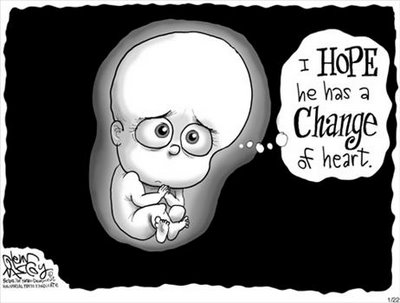
President Obama talks a lot about hope and change but how does that apply to unborn babies? This editorial cartoon touches on this issue.

Related posts:

Jerry Brown raised taxes in California and a rise in the minimum wage, but it won’t work like Krugman thinks!!!

___________


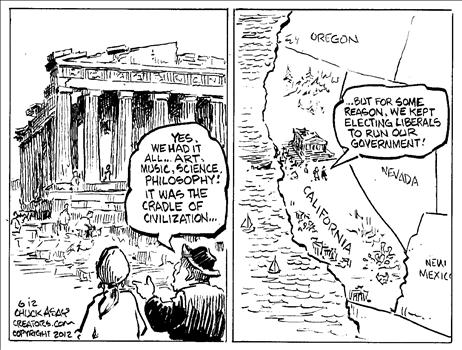
Jerry Brown raised taxes in California and a rise in the minimum wage, but it won’t work like Krugman thinks!!!! This cartoon below shows what will eventually happen to California and any other state that keeps raising taxes higher and higher.


I’ve had some fun over the years by pointing out that Paul Krugman has butchered numbers when writing about fiscal policy in nations such as France, Estonia, Germany, and the United Kingdom.

So I shouldn’t be surprised that he wants to catch me making an error. But I’m not sure his “gotcha” moment is very persuasive. Here’s some of what he wrote for today’s New York Times.

Gov. Jerry Brown was able to push through a modestly liberal agenda of higher taxes, spending increases and a rise in the minimum wage. California also moved enthusiastically to implement Obamacare. …Needless to say, conservatives predicted doom. …Daniel J. Mitchell of the Cato Institute declared that by voting for Proposition 30, which authorized those tax increases, “the looters and moochers of the Golden State” (yes, they really do think they’re living in an Ayn Rand novel) were committing “economic suicide.”

Kudos to Krugman for having read Atlas Shrugged, or for at least knowing that Rand sometimes referred to to “looters and moochers.” Though I have to subtract points because he thinks I’m a conservative rather than a libertarian.

But what about his characterization of my position? Well, he’s right, though I’m predicting slow-motion suicide. Voting for a tax hike isn’t akin to jumping off the Golden Gate bridge. Instead, by further penalizing success and expanding the burden of government, California is engaging in the economic equivalent of smoking four packs of cigarettes every day instead of three and one-half packs.

Here’s some of what I wrote.

I’m generally reluctant to make predictions, but I feel safe in stating that this measure is going to accelerate California’s economic decline. Some successful taxpayers are going to tunnel under the proverbial Berlin Wall and escape to states with better (or less worse) fiscal policy. And that will mean fewer jobs and lower wages than otherwise would be the case.

Anyhow, Krugman wants readers to think that California is a success rather than a failure because the state now has a budget surplus and there’s been an uptick in job creation.

Here’s more of what he wrote.

There is, I’m sorry to say, no sign of the promised catastrophe. If tax increases are causing a major flight of jobs from California, you can’t see it in the job numbers. Employment is up 3.6 percent in the past 18 months, compared with a national average of 2.8 percent; at this point, California’s share of national employment, which was hit hard by the bursting of the state’s enormous housing bubble, is back to pre-recession levels. …And, yes, the budget is back in surplus. …So what do we learn from the California comeback? Mainly, that you should take anti-government propaganda with large helpings of salt. Tax increases aren’t economic suicide; sometimes they’re a useful way to pay for things we need.

I’m not persuaded, and I definitely don’t think this counts as a “gotcha” moment.

First, I’m a bit surprised that he wants to brag about California’s employment numbers. The Golden State has one of the highest joblessness rates in the nation. Indeed, only four states rank below California.

Second, I don’t particularly care whether the state has a budget surplus. I care about the size of government.

Krugman might respond by saying that the tax hike generated revenues, thus disproving the Laffer Curve, which is something that does matter to supporters of small government.

But the Laffer Curve doesn’t say that all tax hikes lose revenue. Instead, it says that tax rate increases will have a negative impact on taxable income. It’s then an empirical question to figure out if revenues go up a lot, go up a little, stay flat, or decline.

And what matters most of all is the long-run impact. You can rape and pillage upper-income taxpayers in the short run, particularly if a tax hike is retroactive. In the long run, though, people can move, re-organize their finances, and take other steps to reduce their exposure to the greed of the political class.

In other words, people can vote with their feet…and with their money.

And that’s what seems to be happening in California. Take a look at how much income has emigrated from the state since 1992.

Next we have a map showing which states, over time, are gaining taxable income and which states are losing income (and I invite you to look at how zero-income tax states tend to be very green).

The data isn’t population adjusted, so populous states are over-represented, but you’ll still see that California is losing while Texas is winning.

And here is similar data from the Tax Foundation.

So what’s all of this mean?

Well, it means I’m standing by my prediction of slow-motion economic suicide. The state is going to become the France of America…at least if Illinois doesn’t get there first.

California has some natural advantages that make it very desirable. And I suspect that the state’s politicians could get away with above-average taxes simply because certain people will pay some sort of premium to enjoy the climate and geography.

But the number of people willing to pay will shrink as the premium rises.

In other words, this Chuck Asay cartoon may be the most accurate depiction of California’s future. And this Lisa Benson cartoon shows what will happen between now and then.

But I won’t hold my breath waiting for a mea culpa from Krugman.

Related posts:

California is the Greece of the USA, but Texas is not perfect either!!!

California is the Greece of the USA, but Texas is not perfect either!!! Just Because California Is Terrible, that Doesn’t Mean Texas Is Perfect January 21, 2013 by Dan Mitchell Texas is in much better shape than California. Taxes are lower, in part because Texas has no state income tax. No wonder the Lone Star State […]

Dan Mitchell on Texas v. California (includes editorial cartoon)

We should lower federal taxes because jobs are going to states like Texas that have low taxes. (We should lower state taxes too!!) What Can We Learn by Comparing the Employment Situation in Texas vs. California? April 3, 2013 by Dan Mitchell One of the great things about federalism, above and beyond the fact that it […]

Ark Times blogger claims California is better than Texas but facts don’t bear that out (3 great political cartoons)

I got on the Arkansas Times Blog and noticed that a person on there was bragging about the high minimum wage law in San Francisco and how everything was going so well there. On 2-15-13 on the Arkansas Times Blog I posted: Couldn’t be better (the person using the username “Couldn’t be better)  is bragging […]

California burdensome government causing some of business community to leave for Texas

Does Government Have a Revenue or Spending Problem? People say the government has a debt problem. Debt is caused by deficits, which is the difference between what the government collects in tax revenue and the amount of government spending. Every time the government runs a deficit, the government debt increases. So what’s to blame: too […]

Arkansas Times blogger picks California business environment over Texas, proves liberals don’t live in real world(Part 2)

       Former California Governor Arnold Schwarzenegger with his family   I posted a portion of an article by John Fund of the Wall Street Journal that pointed out that many businesses are leaving California because of all of their government red tape and moving to Texas. My username is SalineRepublican and this is […]

John Fund’s talk in Little Rock 4-27-11(Part 4):Responding to liberals who criticize states like Texas that don’t have the red tape that California has

John Fund at Chamber Day, Part 1 Last week I got to attend the first ever “Conservative Lunch Series” presented by  KARN and Americans for Prosperity Foundation at the Little Rock Hilton on University Avenue. This monthly luncheon will be held the fourth Wednesday of every month. The speaker for today’s luncheon was John Fund. John […]

Open letter to President Obama (Part 573) Are the states of Illinois and California going to join Detroit in Bankruptcy one day?

Open letter to President Obama (Part 573) (Emailed to White House on 7-29-13.) President Obama c/o The White House 1600 Pennsylvania Avenue NW Washington, DC 20500 Dear Mr. President, I know that you receive 20,000 letters a day and that you actually read 10 of them every day. I really do respect you for trying to get […]

Open letter to President Obama (Part 561) We should lower federal taxes because jobs are going to states like Texas that have low taxes

Open letter to President Obama (Part 561) (Emailed to White House on 6-25-13.) President Obama c/o The White House 1600 Pennsylvania Avenue NW Washington, DC 20500 Dear Mr. President, I know that you receive 20,000 letters a day and that you actually read 10 of them every day. I really do respect you for trying to get […]

Editorial cartoon from Dan Mitchell’s blog on California’s sorry state of affairs

I have put up lots of cartoons from Dan Mitchell’s blog before and they have got lots of hits before. Many of them have dealt with the sequester, economy, eternal unemployment benefits, socialism,  minimum wage laws, tax increases, social security, high taxes in California, Obamacare,  Greece,  welfare state or on gun control. President Obama’s favorite state must be California because […]

Are the states of Illinois and California going to join Detroit in Bankruptcy one day?

Dan Mitchell Commenting on Detroit’s Bankruptcy __________________________ Are the states of Illinois and California going to join Detroit in Bankruptcy one day?   One of the funniest cartoons I have see is one below about the states of Illinois, and California joining Detroit in bankruptcy some day. Should Detroit’s Bankruptcy Be an Early-Warning Sign for Washington? […]

Nihilist Kerry Livgren wrote the song DUST IN THE WIND then came to Christ & here is his story

Nihilist Kerry Livgren wrote the song DUST IN THE WIND then came to Christ & here is his story

Kerry Livgren’s testimony and Proto-Kaw at Schoal Creek Church KC 11/06

Related posts:

A GOOD FIRST STEP:Like Solomon in Ecclesiastes the person on Twitter using the name “God Free World” embraces NIHILISM without God in the picture!

I have written on the Book of Ecclesiastes and the subject of the meaning of our lives on several occasions on this blog. In this post on Ecclesiastes I hope to show how secular humanist man can not hope to find a lasting meaning to his life in a closed system without bringing God back […]

How Richard Dawkins’ favorite book of the Bible (Ecclesiastes) and it’s message of Nihilism can be seen in the lives of Comedian Doug Stanhope, Dave Hope of Kansas and King Solomon!

_____ Doug Stanhope on John Stossel Uploaded on Oct 1, 2011 No description available. ______________________ I have so much respect for the hard work that goes into stand up comedy because I have a son named Hunter who has been involved with a local comedy club and even presented several full length shows himself. He is […]

Steve Jobs, Death, Woody Allen, Ecclesiastes and the band Coldplay

_________________________ (If you want to check out other posts I have done about about Steve Jobs:Some say Steve Jobs was an atheist , Steve Jobs and Adoption , What is the eternal impact of Steve Jobs’ life? ,Steve Jobs versus President Obama: Who created more jobs? ,Steve Jobs’ view of death and what the Bible has to say about it ,8 things you might not know about […]

Taking on Ark Times Bloggers on the “Absurdity of Life without God!!” Part 17 (Kerry Livgren of rock band Kansas wrote the song “Carry On Wayward Son” in his journey to finding peace)

The Bible and Science (Part 05) Why Can’t Morals Be Grounded In Society? Published on Aug 31, 2012 Dr William Lane Craig was invited by the School of Oriental and African Studies (SOAS) Christian Union, London to give a lecture titled “Can we be good without God?” In this video Dr Craig answers a question about […]

Taking on Ark Times Bloggers on the “Absurdity of Life without God!!” Part 12 (Kerry Livgren’s song “Dust in the Wind” and what it meant)

The Fruits of Atheism (Part 2) Uploaded on Apr 10, 2009 Examining the Creation/Evolution Controversy in Light of Reason and Revelation The Bible and Science (Part 04) Eastwooding Richard Dawkins’ Moral Argument Objections Published on Oct 20, 2012 For more information and resources visit:http://www.reasonablefaith.org On September 29th, 2012, William Lane Craig participated in the Contending […]

The Humanist takes on Solomon and the Book of Ecclesiastes (includes poem by humanist Frank S. Robinson)

Ecclesiastes 8-10 | Still Searching After All These Years Published on Oct 9, 2012 Calvary Chapel Spring Valley | Sunday Evening | October 7, 2012 | Pastor Derek Neider _______________________ Ecclesiastes 11-12 | Solomon Finds His Way Published on Oct 30, 2012 Calvary Chapel Spring Valley | Sunday Evening | October 28, 2012 | Pastor Derek Neider […]

Dave Hope and Kerry Livgren of Kansas: Their story of deliverance from drugs jh16c

The recent events in Little Rock concerning KARK TV’s top weatherman Brett Cummins and his experience of drinking alcohol and snorting coke has left a lot of people asking questions. Since the evening ended in the tragic death of one of Brett’s friends, Dexter Williams, many questions have centered on the use of illegal drugs. […]

Transcript and video of Francis Schaeffer speech in 1983 on the word “Evangelical”

    Transcript and Video of Francis Schaeffer speech in 1983 on the word “Evangelical” _____________   SOUNDWORD LABRI CONFERENCE VIDEO – Names and Issues – Francis A. Schaeffer Published on Apr 20, 2014 This video is from the 1983 L’Abri Conference in Atlanta. The full lecture with Q&A time has been included. The lecture […]

Review and Pictures and Video Clips of Woody Allen’s movie “MAGIC IN THE MOONLIGHT” Part 4

Woody Allen Interview – ‘Magic in the Moonlight’ Red Carpet in Chicago Review and Pictures and Video Clips of Woody Allen’s movie “MAGIC IN THE MOONLIGHT” Part 4   Emma Stone and Colin Firth in Woody Allen’s Magic in the Moonlight. [PHOTO: SONY PICTURES CLASSICS] Magic in the Moonlight  BY DAVID LEE DALLAS ON JULY 21, 2014 GO TO COMMENTS (0) There’s […]

Review and Pictures and Video Clips of Woody Allen’s movie “MAGIC IN THE MOONLIGHT” Part 3

Colin Firth, Emma Stone on Working With Woody Allen Published on Jul 16, 2014 The “Magic in the Moonlight” co-stars answer your social media questions. Review and Pictures and Video Clips of Woody Allen’s movie “MAGIC IN THE MOONLIGHT” Part 3 Movie review: ‘Magic in the Moonlight’ casts a vibrant romantic comedy spell   See […]


(BP)–Antony Flew, a legendary British philosopher and atheist, has changed his mind about the existence of God in light of recent scientific evidence.Flew —

_____________

NASHVILLE, Tenn. (BP)–Antony Flew, a legendary British philosopher and atheist, has changed his mind about the existence of God in light of recent scientific evidence.Flew — a prolific author who has argued against the existence of God and the claims of Christianity for more than 50 years — first revealed his change of mind in a video of a discussion with several others at New York University organized by the Institute for Metascientific Research. The video, released in December, is titled, “Has Science Discovered God?”Flew said he is now best described as a deist — a person who believes God created the universe but is not actively involved in people’s lives today.”I don’t believe in the God of any revelatory system, although I am open to that,” Flew said in an interview for the winter 2005 edition of Philosophia Christi, the journal of the Evangelical Philosophical Society. “But it seems to me that the case for … [a] God who has the characteristics of power and also intelligence is now much stronger than it ever was before.”Flew, 81, regularly attended the Socratic Club, a weekly religious forum led by famed Christian apologist C.S. Lewis while he attended college at Oxford. Flew proclaimed the lack of evidence for God while teaching at Oxford, Aberdeen, Keele and Reading universities in Britain. He also published numerous books and articles denouncing belief in God.Flew credits his newfound belief in God to arguments from design such as those espoused by the “intelligent design” (ID) movement. ID argues that the universe operates in such a way that it points to the existence of an intelligent creator.”I think that the most impressive arguments for God’s existence are those that are supported by recent scientific discoveries,” Flew said. “… I think the argument to Intelligent Design is enormously stronger than it was when I first met it.”Although many atheists appeal to naturalistic evolution as a method by which the world could have come into existence apart from God, Charles Darwin himself acknowledged that the process of evolution requires a creator to start the process, Flew said.”Darwin himself, in the fourteenth chapter of The Origin of Species, pointed out that his whole argument began with a being which already possessed reproductive powers,” Flew said. “This is the creature the evolution of which a truly comprehensive theory of evolution must give some account. Darwin himself was well aware that he had not produced such an account.”While Flew said he does not believe in a God who is active in the lives of humans, he is “open to” the possibility of divine revelation. He also believes that Christians are intellectually justified in holding to their religion and that the resurrection of Jesus has more evidential support than any other reported miracle in history.”The evidence for the resurrection is better than for claimed miracles in any other religion,” Flew said. “It’s outstandingly different in quality and quantity, I think, from the evidence offered for the occurrence of most other supposedly miraculous events.”Gary Habermas, chairman of the department of philosophy and theology at Liberty University in Lynchburg, Va., told Baptist Press that Flew’s decision to believe in God points to the strength of theistic arguments.”His conversion is a testimony to the many, especially scientific figures, who are coming by way of intelligent design,” said Habermas, who conducted the interview with Flew in Philosophia Christi. “… The fact that he has become a theist is a testimony to the type of evidence we have for God’s existence today.”Flew’s status as a world-famous atheist makes his conversion to belief in God particularly significant, Habermas said in an interview with Baptist Press.”His conversion to theism is very valuable because of his stature,” Habermas said. “The reason this story is going around the world is that he, not just anybody, but he, has converted to theism. I think that’s very significant.”Despite his belief in the existence of God, Flew said it is unlikely that he will ever become a Christian. The major evidence against the God of Christianity is the problem of evil, Flew said.The problem of evil refers to the apparent tension between the existence of a good God and the presence of evil in the world.”The problem of evil is a problem … for Christians,” Flew said. “The thesis that the universe was created and is sustained by a Being of infinite power and goodness is flatly incompatible with the occurrence of massive undeniable and undenied evils in that universe.”Flew also argues that God does not have “any preferences … about or any intentions concerning human behavior or about the eternal destinies of human beings.”Although he does not accept Christianity, Flew emphatically denies the possibility that he would ever become a follower of Islam, citing Islam’s commitment to conquer all of its opponents.”I would never regard Islam with anything but horror and fear because it is fundamentally committed to conquering the world for Islam,” Flew said.Flew will present a more fully developed explanation of his conversion to belief in God in a forthcoming edition of his book, “God & Philosophy.”

Earlier works by Flew include “Atheistic Humanism,” “Darwinian Evolution,” “A Dictionary of Philosophy,” “Introduction to Western Philosophy” and “How to Think Straight: An Introduction to Critical Reasoning.


____________

Guest Blogger Dan Meyer Writes on Antony Flew and Problem of Evil Posted: November 8, 2007 by Rick Hogaboam in Ethics, Philosophy, Theology

_______________

Guest Blogger Dan Meyer Writes on Antony Flew and Problem of Evil

Posted: November 8, 2007 by Rick Hogaboam in EthicsPhilosophyTheology
Tags: 

Antony Flew

There are two articles in the NY Times this morning that make me sick. They are both about Antony Flew (http://www.nytimes.com/2007/11/04/magazine/04Flew-t.html?_r=1&oref=slogin), the famous British philosopher who seems to have moved from atheism (he wrote a very influential book on the subject many years ago) to a belief in the Aristotelian god, a prime mover, a being who is itself unmoved, but which moves everything else. Flew is quite old now, and possibly suffering from Alzheimer’s, but Christians and atheists are fighting over him, each side trying to manipulate him for its own advantage. So one moment Flew says this, another moment he says that. Both sides bully him intellectually and then come away with what appears to them convincing proof for their side. It’s disgraceful.
Clearly, Flew is not the intellectual giant he used to be. He is unable to keep up with current trends, and he seems to be easily persuaded – or misled.

I’m so tired of evangelical Christians doing immoral things, and being so arrogant and stupid. The Christian faith does not depend upon airtight proofs for the existence of God. Jesus didn’t commission his disciples to go into all the world and devise scientific arguments re: the origin of the universe. He told them to go and preach the gospel – and also to embody
the gospel in their lives. The gospel doesn’t need sophisticated philosophical or scientific arguments; Billy Graham has proved that for over half a century. He doesn’t argue; he proclaims. He tells the story, tells people that God loves them, that Christ died for them, that they can be forgiven and empowered to live a new life and face the challenges and crises of living with courage and strength and hope.

One of the articles is by Stanley Fish (http://fish.blogs.nytimes.com/2007/11/04/suffering-evil-and-the-existence-of-god/index.html), dealing with the problem of evil. He reviews a new book by Bart Ehrman, of Princeton, who gave a couple of lectures at Yale Divinity School a couple of years ago, is the son of a minister who went to Wheaton College and became a minister, but is now a convinced atheist. He looks at all the evil, the suffering and pain in the world and concludes that God could not possibly exist.

It’s a strong argument, one that any minister, myself included, has to face. Ministers, of all people, are constantly confronted by suffering and tragedy, not only in the lives of parishioners, but in their own lives as well. I’ve left hospital rooms seething with anger at what I’ve seen, saying to God through clenched teeth, “I wouldn’t do this to my worst enemy, but you say you love these people!” There’s no use denying that there is a massive amount of evil and pain in the world. The question is, “Can it be explained?”

I don’t think it can, but that doesn’t mean there isn’t help. The help comes from the cross. The Christian faith has always believed that Jesus was God incarnate, the Word who, as John says, was in the beginning with God and was God. In Jesus God stooped to share our human condition, with all its pain and suffering. And at the cross he endured the worst that ugly men could hurl at him; more than that, the Christian faith insists that he died for our sins, that in his death he triumphed over the power of evil, as his resurrection on the third day demonstrated.

In other words, God knows the power of evil and the agony of suffering because in Jesus he experienced it firsthand. He knows what men and women go through, so the author of Hebrews can say, “Because he himself suffered when he was tempted, he is able to help those who are being tempted.” And again,”We do not have a high priest who is unable to sympathize with our weaknesses, but we have one who has been tempted in every way, just as we are – yet without sin.” So suffering men and women are now able to “approach the throne of grace with confidence, so that we may receive
mercy and find grace to help us in our time of need.”

This, of course, does not solve the problem of evil and suffering. Karl Barth called it ‘the impossible possibility.’ But it assures us that we are not alone. God knows – not just intellectually, but experientially; and he cares.

Part of the problem is that we are continually underestimating the power of evil. The Christian faith says that in order to overcome it, it was necessary for God himself, in the person of his Son, to become human and suffer the indignities and agonies of the cross. Shouldn’t that be a clue as to the strength of evil? Jesus himself prayed in the Garden, “If it be possible, let this cup pass from me.” But there was no other way; that was the only solution available. My suspicion is that when we see God, we will know that he has been in the fight of his life. He could not overcome evil with his left hand while doing something more important with his right. He had to muster all his strength to overcome it. This is why Jesus taught us to pray, “Lead us not into temptation, but deliver us from evil.” A more accurate rendering might be, “Do not bring us to the test (we are far too weak for that), but deliver us from the Evil One.”

Instead of fighting intellectual battles that can never be won, shouldn’t we be pointing to Christ and to the cross as the key to understanding our world and our lives? Then we wouldn’t be tempted to manipulate tired, confused old men to prove the existence of God, and who knows? We ourselves might be led to abandon our arrogance and kneel before the cross, “lost in wonder, love and praise.”


_____________

Popular but False Ideas

_____________

Popular but False Ideas


Welcome fellow Yahooligan! If you find this page useful, you might want to subscribe to the RSS feed for updates on this topic.

 In our dialogue about the existence of God this morning (Newstalk 93, Jamaica) my friend Lloyd D’Aguilar a professing atheist repeated some notions that are downright false even though propounded by reputable scientists. I am summarizing the essence of the false ideas and not necessarily quoting Lloyd or any scientist (unless otherwise indicated).


False Idea #1– Given millions or billions of years matter can generate almost anything.

The flaw here is that time is treated as having causative powers. Time, like chance, has no causative powers at all so no matter how much time you invoke you still need a cause to get the end product under discussion. Time may be necessary but not sufficient for anything to come or be brought about.

I raised the multi-pronged problem for a non-God thesis providing an explanation for; something being in the world as opposed to nothing at all, the origin of life from non-life, the origin of reproductive capacity in animals, the origin of the genetic code or of the information-rich nature of all life forms (à la Antony Flew), the origin of rationality/conceptual thought, the origin of the self (the entity that understands and intends, etc.) and the origin of consciousness/self-consciousness (à la Roy Varghese). All of these phenomena, either presuppose the existence of an infinite, eternal Mind or Self (God) or are best explained by invoking God=the inference to the best explanation.

Varghese suggests a cute but deadly thought experiment for the atheist. He urges “Think for a minute of a marble table in front of you. Do you think that, given a trillion years or infinite time, this table could suddenly or gradually become conscious, aware of its surroundings, aware of its identity the way you are? It is simply inconceivable that this would or could happen. And the same goes for any kind of matter…But the atheist position is that, at some point in the history of the universe, the impossible and the inconceivable took place. Undifferentiated matter (here we include energy), at some point, became ‘alive’, then conscious, then conceptually proficient, then an ‘I’…this is simply laughable.” (Appendix A, p.163 of Antony Flew’s 2007 book There is a God.

Ponder the fact that Nobel Prize-winning physiologist George Wald said concerning the origin of life “We choose to believe the impossible: that life arose spontaneously by chance.” (cited in Flew, 131)


False Idea #2 Matter has always been there, matter is eternal.

This notion has been thoroughly debunked since the early twentieth century and has been further buried by the discoveries of the Cosmic Background Explorer COBE satellite. Agnostic Robert Jastrow summarizes thus, “Five independent lines of evidence—the motion of the galaxies, the discovery of the primordial fireball, the law of thermodynamics, the abundance of helium in the universe and the life story of the stars—point to one conclusion; all indicate that the Universe had a beginning.” (in hisGod and the Astronomers, 2nd edition, 1992, 103) The universe properly understood is the sum total of the things that constitute it, essentially matter. So then since matter is not eternal it is proper to ask about its origin.

The world and life as we know it cry out for an explanation and the God thesis is the inference to the best explanation. The God thesis has greater explanatory power and explanatory scope than any of its competitors.


_____________

Biological Proof of God’s Existence by Rev. Clinton Chisholm

______________

Biological Proof of God’s Existence

There is arguably no greater ‘beyond reasonable doubt’ evidence for the existence of apersonal intelligent God than the presence and pervasiveness of biologicalinformation in all living things.


Ponder the testimony of atheistic Biologist Richard Dawkins on the nature of biologicalinformation.

“…at the molecular genetic level, every single one of more than a trillion cells in the body contains about a thousand times as much precisely-coded digital informationas my entire computer…” (The Blind Watchmaker, 1986, xiii).

What Dawkins is getting at here is the stubborn fact that DNA, the molecule of heredity, isinformation rich.

“In order for any organism to be whatever it is, its genetic program (DNA) must specify what sort of organism it will be and, within surprisingly narrow limits, what specific characteristics it will assume…The DNA must be faithfully copied to every single cell of an organism that will eventually consist of billions of cells if the organism is to remain viable…” (John W. Oller Jr. et al in The Creation Hypothesis,1994, edited by J.P. Moreland, 252, 253.)


Each of us began as a tiny entity about the size of a full stop. Yet all of our physical characteristics were spelled out in our DNA and this coded information guided our development into adulthood.  Modern scientists with their advanced technology and superior intelligence still can’t store so much information in so small a container as one cell of the human body (probe Dawkins’ words again).  What would any rational person conclude about the origin of a computer (a mechanical information-storing facility)? By chance, natural cause or by intelligent cause? What is the inference to the best explanation here?

Bear in mind too that information is a non-material (mental) entity and cannot at all originate from matter though it can be stored in matter.  It follows inexorably then that once we detect genuine information we must conclude that intelligence is behind its origin.  This has been the scientific basis for the SETI program, the Search for Extra Terrestrial Intelligence. SETI scientists scan the millions of radio signals produced in outer space in search of a specified, complex pattern distinguishable from the normal noise (unspecified or specified but simple signal patterns) of outer space (cf. the movie Contact).


It is understandable to me then why the late British Atheist and Philosopher Antony Flew surrendered atheism and gave one of three reasons for his change as the formidable challenge of finding a naturalistic [non-God] explanation for

“…the origin of the coding and information processing that is central to all life-forms…” (in his There is a God, 2007, 126).

In the field of origin of life studies leading researchers bluntly admit their ignorance of the origin of genetic information. Carl Woese, an internationally recognized leader in origin of life studies laments

“The origins of translation, that is before it became a true decoding mechanism, are for now lost in the dimness of the past, and I don’t wish to engage here in hand-waving speculations as to what polymerization processes might have preceded and given rise to it, or to speculate on the origins of tRNA, tRNA charging systems or the genetic code.” (in RNA, 2001, 1064 cited in Flew, 128).

Antonio Lazcano, who served for two terms as President of the International Society for the Study of the Origin of Life, said..

“Life could not have evolved without a genetic mechanism—one able to store, replicate, and transmit to its progeny information that can change with time…Precisely how the first genetic machinery evolved also persists as an unresolved issue…The exact pathway for life’s origin may never be known.” (in Natural History, February, 2006, cited in Flew, 130).

Yet ponder the strange words of the Nobel Prize-winning physiologist George Wald concerning the origin of life.

“We choose to believe the impossible: that life arose spontaneously by chance.” -George Wald

If this were a court of law and I had called Wald as a reluctant scientific witness in defense of the existence of God I would simply say “The defense rests your honor.”

_______________

About Rev. Clinton Chisholm

My name is Rev. Clinton Chisholm, I am an Author and Apologist, I’ve produced 25 educational audio recordings, the latest being, “The Church’s Impact on Western Civilization”. I’m the author of the books, “A Matter of Principle” and “Revelations on Ras Tafari”. Get these resources atTheChisholmSource.com


_____________


______________

Book Review By David P. Stevens

_________________

Book Review
By
David P. Stevens

There is a God: How the world’s most notorious atheist changed his mind. By Anthony
Flew; with Roy Abraham Varghese. New York: HarperOne Publisher, 2007, 222 pp. $24.95.
ISBN: 978-0-06-133529-7.

Anthony Flew, one of the world’s most renown atheists, relates his personal journey from
atheism to theism in this revealing book.
Flew makes the journey to theism from the vantage point of natural theology not special
revelation though he seems open to more investigation of the divine origin of the Bible.
Anthony Flew was arguably the best known atheist in the English speaking world prior to
his announcement in 2004 that he now accepts the existence of God.
The basic design of the book includes a Preface written by Roy Abraham Varghese
consisting of twenty-four pages. An introduction follows the preface. Then, the book is divided
into two parts. In Part One, Flew gives the details of the personal background of his life and his
denial of the divine. Part Two develops the logical journey Flew takes to belief in God. The
book concludes with two appendices. Appendix A explores the “New Atheism” and is written
by Roy Abraham Varghese. Appendix B explores the self-revelation of God in Human History
and is written by N.T. Wright. The last section of the book contains notes on the various
chapters.
In Chapter one, Flew reveals how he became an atheist. Flew was not always an atheist.
He was born and raised in a home that believed in Jesus Christ. His father was a Methodist
minister. He grew up in England. He was influenced by the travels of his family that brought
him into contact with the twin evils of anti-Semitism and totalitarianism (p. 14). In the face of
such evils, he had a difficult time believing in an all-good, all-powerful God. He had a
disconnect from his father in respect to his father’s religious views. He never connected with
Cambridge. By the time he was in the twelfth grade, he was arguing against the idea of a God
who is both omnipotent and perfectly good. By the time he reached his fifteenth birthday, he
rejected the thesis that the universe was created by an all-good, all-powerful God (p. 15). Flew
admits that he never felt a strong attachment to the faith of his fathers (including his own father).
Perhaps this is a clue as to why he rejected faith in God. The disconnect in father-son
relationships can result in rebellion against the faith and values of the father. Flew remarks, “For
the sake of domestic peace and, in particular, in order to spare my father, I tried for as long as I
could to conceal from everyone at home my irreligious conversion. I succeeded in this, as far as
I know, for a good many years” (p. 16). By the age of twenty-three, Flew was both an atheist
and a mortalist (disbeliever in life after death).
Flew reveals that his studies at Oxford University had a profound impact on his early
thought. He was a graduate student under Gilbert Ryle. Ryle had the practice of responding
directly, person to person, to any objection made to any of his philosophical contentions. Flew
believed that Ryle was following the Socratic principle, “We must follow the argument wherever
it leads.” Flew also embraced this principle and attempted to follow it through his entire life.
This principle guided the Socratic Club at Oxford which formed a forum for lively
debates between Christians and atheists. C. S. Lewis was president of the Socratic Club from
1942 to 1954

__________________

The first and only paper that Flew wrote for the Socratic Club was “Theology and
Falsification,” a refutation of the Ayerian heresy of logical positivism—the contention that all
religious propositions are without cognitive significance (p. 24). Flew would go on to publish 35
volumes on a variety of philosophical topics (p. 32).
Flew met Annis Donnison at Oxford and later married her.
Chapter two, “Where The Evidence Leads,” focuses on Flew’s intellectual development.
As a young man, Flew was a professing Communist and remained a left-wing socialist until the
early 1950’s. He developed an interest in parapsychology through the influence of the writings
of C. E. M. Joad. His first book was on parapsychology written in 1953.
At Oxford, Flew continued to gain philosophical insights that would guide his thinking
for the rest of his life. One of the most important was in the area of linguistics. Flew states,
“…we must become constantly and crisply conscious of how all philosophy (insofar as
philosophy is a conceptual inquiry) must be concerned with correct verbal usage” (p. 38). He
recognized that “we can have no access to concepts except through the study of linguistic usage
and, hence, the use of those words through which these concepts are expressed” (p. 38).
Flew continues to show the progress of his atheistic thought by reviewing the purposes
for which he wrote, Theology and Falsification, God and Philosophy, and The Presumption of
Atheism. In the latter part of this chapter, Flew indicates two areas in which he made significant
changes in his views. The first is the awareness that Hume was utterly wrong to maintain that
we have no experience, and hence no genuine ideas, of making things happen and of preventing
things from happening, of physical necessity and of physical impossibility. Hume was wrong to
reject causation. The second change of mind regards human free will. Flew now believes that
people make free choices and that these choices are not physically caused (p. 59-60). His notion
of compatibilism was false. He defines compatibilism on page 59. Flew’s defection from
compatibilism is “fully as radical as my change on the question of God” (p. 64).
Chapter three is titled, “Atheism Calmly Considered.” Flew defended and debated the
atheistic position. The only two debates in which Flew appeared as one of two protagonists were
held in 1976 and 1998. In 1976, Flew met Thomas Warren of Denton, Texas. The debate drew
crowds of five to seven thousand. In 1998, Flew met William Lane Craig in Madison,
Wisconsin which drew a crowd of about four thousand. The debate with Warren ended in a
stalemate according to Flew. The debate with Craig was notable. Flew thought that an
important part of the debate was Craig’s rejection of traditional predestinarian ideas and his
defense of libertarian free will (p. 73). The last of Flew’s public debates was held at New York
University in 2004. At the outset of this debate, Flew announced that he accepted the existence
of a God. Flew admits to being influenced by the work and reasoning of Gerald Schroeder who
completely annihilated the monkey theorem. Schroeder demonstrated that you will never get a
Shakespearean sonnet by chance. If a single sonnet cannot be produced by chance, then the
more elaborate feat of the origin of life could not have been achieved by chance (p. 75-78).
Flew not only did battle with theists, he also did battle with other atheists. Flew criticized
Richard Dawkins for his selfish-gene theory. He wrote in Darwinian Evolution and pointed out
that natural selection does not positively produce anything (p. 78). Flew declares, “Genes, as we
have seen, do not and cannot necessitate our conduct” (p. 80). He continues, “Nor are they
capable of the calculation and understanding required to plot a course of either ruthless
selfishness or sacrificial compassion” (p. 80).
In Part II of the book, Flew describes his discovery of the divine. Chapter four is titled,
“A Pilgrimage of Reason.” Flew warns against allowing preconceived theories to shape the way

______________________

view evidence. He denounces “dogmatic atheism” expressed in the following sentiments,
“We should not ask for an explanation of how it is that the world exits; it is here and that’s all”
or “Since we cannot accept a transcendent source of life, we choose to believe the impossible;
that life arose spontaneously by chance from matter” or “the laws of physics are ‘lawless laws’
that arise from the void—end of discussion.” (pp. 86-87). Flew does not abandon reason. He
concludes this chapter by stating, “…my discovery of the Divine has proceeded on a purely
natural level, without any reference to supernatural phenomena. It has been an exercise in what
is traditionally called natural theology” (p. 93).
In chapter five, Flew reveals how the laws of nature reveal an intelligent mind. The
chapter is titled, “Who Wrote The Laws of Nature?” Flew states, “Although I was once sharply
critical of the argument to design, I have since come to see that, when correctly formulated, this
argument constitutes a persuasive case for the existence of God” (p. 95). He pursues two areas
of study: (1) the question of the origin of the laws of nature; and (2) the question of the origin of
life and reproduction (p. 95). He concludes that the observable order in nature argues for design
and design argues for the Mind of God.
The sixth chapter is titled, “Did the Universe Know We Were Coming?” Flew opens the
chapter with an imaginary experience in a hotel room where every detail of the room fits you
perfectly. Your favorite beverages and snacks, your favorite books, your favorite grooming
products, your favorite television channel, are all present–a room perfectly fitted for you. With
each new discovery, you would believe that the room was designed for you and not a mere
coincidence. Flew applies that analogy to our finely tuned universe. The world is a perfect
habitat made for man. Every detail provides evidence that someone knew we were coming. In
addition, Flew destroys the multiverse view in this chapter

________________

Chapter seven takes up the question of the origin of life. Flew asks, “How Did Life Go
Live?” More probing questions are raised. “How can a universe of mindless matter produce
beings with intrinsic ends, self-replication capabilities, and “coded chemistry” ? (p. 124). Flew
quotes George Wald regarding the origin of life. At one time Wald said, “we choose to believe
the impossible: that life arose spontaneously by chance.” Then, Wald, in his later years
concluded that a preexisting mind composed a physical universe that breeds life (p. 131). Flew
agrees with Wald’s conclusion.

___________

Flew addresses the important question, “Did Something Come From Nothing?” in
chapter eight. Flew takes up the cosmological argument for the existence of God. At one time,
he rejected this argument. However, since the 1980’s he admits that cosmologists have proven
that the universe had a beginning. Now, we must ascertain how it began. Flew concludes by
stating his belief that Richard Swinburne’s explanation of the cosmological argument, a C-

inductive argument for the existence of God, is right (p. 145).

Chapter nine is simply titled, “Finding Space For God.” Flew takes up the important
question of whether or not an incorporeal omnipresent Spirit could exist. He uses the works of
two thinkers, Thomas Tracy and Brian Leftow, to show that such a being could exist.
The final chapter in Part II provides some of the conclusions drawn by Flew and his own
definition of God. The chapter is titled, “Open To Omnipotence.”
Flew states that he has followed three items of evidence in this book, “the laws of nature, life with its teleological
organization, and the existence of the universe.” His rational response to this line of argument
leads him to accept, “the existence of a self-
existent, immutable, immaterial, omnipotent, and
omniscient Being” (p. 155). While he has not fully accepted Christianity, Fle
w believes that Christianity is the front runner among all of the religions (157).
This intriguing book concludes with two Appendices. In Appendix A, Roy Abraham
Varghese writes concerning the New Atheism. In it he states that there are five phenomena
that are evident in our immediate experience that can be explained only by the existence of God.
They are: (1) the rationality implicit in all our experience of the physical world, (2) life, the
capacity to act autonomously, (3) consciousness, the abili
ty to be aware; (4) conceptual thought;
the power of articulating and understanding meaningful symbols such as are embedded in
language; and (5) the human self, the “center” of consciousness, thought, and action (161-
162).
Appendix B, written by N.T. Wright, deals with the reality of the existence of Jesus
Christ. Wright develops arguments that show the truthfulness of the resurrection of Jesus from
the dead. Flew state’s that Wright’s arguments are, “wonderful, absolutely radical, and very
powerful” (213).
The final part of the book includes the notes for each chapter.
Anthony Flew’s lifetime pursuit of the knowledge of God is an interesting and intriguing
read. For most of his life he denied the existence of God. Later in his life, he reasons his way to
accepting God’s existence. As he states, once you accept the exi
stence of God, then the possibility of God revealing Himself through Jesus Christ and special revelation is open for
further inquiry.


_______________