Monthly Archives: May 2013

Francis Schaeffer’s wife Edith passes away on Easter weekend 2013 Part 12 (includes pro-life editorial cartoon)

The Francis and Edith Schaeffer Story Pt.1 – Today’s Christian Videos

The Francis and Edith Schaeffer Story – Part 3 of 3

Francis Schaeffer: “Whatever Happened to the Human Race” (Episode 1) ABORTION OF THE HUMAN RACE

Published on Oct 6, 2012 by

________________

Picture of Francis Schaeffer and his wife Edith from the 1930′s above. I was sad to read about Edith passing away on Easter weekend in 2013. I wanted to pass along this fine article below.

The Legacy of Edith and Francis Schaeffer

30 Saturday Mar 2013

Posted by in News

1 Comment

20130330-170740.jpg

By Mark Tooley @markdtooley

Edith Schaeffer, widow of the late great evangelical thinker Francis Schaeffer, and herself an intellect and formidable writer, has died, just short of age 99. Francis, who died in 1984, intellectually fathered modern conservative evangelical cultural and political activism. She was the daughter of missionaries in China, her mother having survived the Boxer Rebellion.

Francis and Edith met in 1932 at a liberal Presbyterian church outside Philadelphia, where a Unitarian was lecturing against Christ’s deity and the Bible’s authority. At that time, much of Mainline Protestantism had liberalized. At age 18, Edith was braced for debate in defense of the faith. But Francis, two years older, rose first, explaining his own transformative faith in Jesus Christ. They launched a more than 50 year partnership and marriage that was globally influential, much of it from Switzerland, where they founded l’Abri fellowship, and where she died.

In a column that was atypically moving while also more typically snide, the Schaeffer’s chronically peeved son, Franky, who has publicly excoriated his parents and their beliefs for years, honored his mother’s unfailing love while pronouncing her marriage “disastrous.” She likely disagreed.

The Schaeffers first contended against Presbyterian liberalism. After World War II, he rallied evangelicals, then very much on the cultural sidelines, against the seductively ascendant neo-orthodoxy of Karl Barth. Later the Schaeffers set themselves toward creating an alternative evangelical theological framework for renewing Western culture. Many of the Religious Right’s early leaders were deeply influenced by his call to combative yet loving advocacy for what came to be called family values. Abortion was a chief cause for the Schaeffers.

Ten years ago it was widely popular among liberal elites to warn against impending theocracy, with Schaeffer having been the original godfather. Now it’s trendy to declare religious conservatism dead and almost gone, with supposedly everybody and their grandmother anxious to bless same sex marriage and all of postmodernism’s moral ambiguity and underlying intolerance.

Interestingly our new era no longer so much requires vigorous defense of Christian doctrine like Christ’s deity, which brought the Schaeffers together. The sterile certitudes of liberal Protestantism have intellectually and demographically collapsed. Postmodernism embraces transcendence and the supernatural. But it rejects absolute truth claims (except incoherently in defense of a faux “diversity”).

So the Schaeffers won some battles and momentarily lost some others. But she no doubt was pleased by the explosive growth of Christianity in China, where as an old woman she visited the old mission station of her childhood, and throughout the global south. He would be saddened but unsurprised by the West’s current cultural malaise, yet no less delighted by global Christianity’s surge, to which he contributed at least indirectly by his long, unfashionable defense of orthodox faith. I myself, like many others, read their books appreciatively and impressionably as a young man, when their themes were provocative and bracing. May God bless their memory.

thought on “The Legacy of Edith and Francis Schaeffer”

  1. Seeing that cover reminded me of what an icon Schaeffer was to our generation of evangelicals. Something about that balding head, his bulbous nose, and his famous knickers, just seemed like the spiritual mentor we all needed, the wise old uncle whose face showed both serenity and a sorrow at the fallen state of the world God created good, also the courage to fight back against the evil in that world. I hope Schaeffer is already home with God and not aware of what his scapegrace son has done to trash his parents’ memory and all they stood for. We need more Francis Schaeffers, deep thinkers, people who know that ideas have consequences, that Christian thought and Christian feeling are both essential to the life of faith. Maybe the “communion of saints” will give us an opportunity to fellowship with Schaeffer in a deeper way.

    ______________

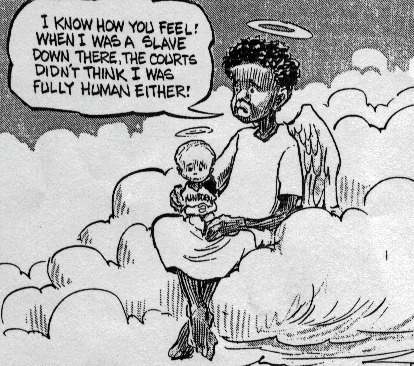
The film “Whatever happened to the human race?” did a great job of comparing the dehumanizing efforts of the slave owners and those of today’s abortion advocates. Here is  a great cartoon that makes the same comparison:

(Francis did a great job in his film series “How Should we then live?” in looking at how humanism has affected art and culture in the Western World in the last 2000 years. My favorite episodes include his study of the Renaissance, the Revolutionary age, the age of Nonreason, and the age of Fragmentation.)

Related posts:

Francis Schaeffer’s “How should we then live?” Video and outline of episode 10 “Final Choices” (Schaeffer Sundays)

E P I S O D E 1 0   Dr. Francis Schaeffer – Episode X – Final Choices 27 min FINAL CHOICES I. Authoritarianism the Only Humanistic Social Option One man or an elite giving authoritative arbitrary absolutes. A. Society is sole absolute in absence of other absolutes. B. But society has to be […]

Francis Schaeffer’s “How should we then live?” Video and outline of episode 9 “The Age of Personal Peace and Affluence” (Schaeffer Sundays)

E P I S O D E 9 Dr. Francis Schaeffer – Episode IX – The Age of Personal Peace and Affluence 27 min T h e Age of Personal Peace and Afflunce I. By the Early 1960s People Were Bombarded From Every Side by Modern Man’s Humanistic Thought II. Modern Form of Humanistic Thought Leads […]

Francis Schaeffer’s “How should we then live?” Video and outline of episode 8 “The Age of Fragmentation” (Schaeffer Sundays)

E P I S O D E 8 Dr. Francis Schaeffer – Episode VIII – The Age of Fragmentation 27 min I saw this film series in 1979 and it had a major impact on me. T h e Age of FRAGMENTATION I. Art As a Vehicle Of Modern Thought A. Impressionism (Monet, Renoir, Pissarro, Sisley, […]

Francis Schaeffer’s “How should we then live?” Video and outline of episode 7 “The Age of Non-Reason” (Schaeffer Sundays)

E P I S O D E 7 Dr. Francis Schaeffer – Episode VII – The Age of Non Reason I am thrilled to get this film series with you. I saw it first in 1979 and it had such a big impact on me. Today’s episode is where we see modern humanist man act […]

Francis Schaeffer’s “How should we then live?” Video and outline of episode 6 “The Scientific Age” (Schaeffer Sundays)

E P I S O D E 6 How Should We Then Live 6#1 Uploaded by NoMirrorHDDHrorriMoN on Oct 3, 2011 How Should We Then Live? Episode 6 of 12 ________ I am sharing with you a film series that I saw in 1979. In this film Francis Schaeffer asserted that was a shift in […]

Francis Schaeffer’s “How should we then live?” Video and outline of episode 5 “The Revolutionary Age” (Schaeffer Sundays)

E P I S O D E 5 How Should We Then Live? Episode 5: The Revolutionary Age I was impacted by this film series by Francis Schaeffer back in the 1970′s and I wanted to share it with you. Francis Schaeffer noted, “Reformation Did Not Bring Perfection. But gradually on basis of biblical teaching there […]

Francis Schaeffer’s “How should we then live?” Video and outline of episode 4 “The Reformation” (Schaeffer Sundays)

Dr. Francis Schaeffer – Episode IV – The Reformation 27 min I was impacted by this film series by Francis Schaeffer back in the 1970′s and I wanted to share it with you. Schaeffer makes three key points concerning the Reformation: “1. Erasmian Christian humanism rejected by Farel. 2. Bible gives needed answers not only as to […]

“Schaeffer Sundays” Francis Schaeffer’s “How should we then live?” Video and outline of episode 3 “The Renaissance”

Francis Schaeffer’s “How should we then live?” Video and outline of episode 3 “The Renaissance” Francis Schaeffer: “How Should We Then Live?” (Episode 3) THE RENAISSANCE I was impacted by this film series by Francis Schaeffer back in the 1970′s and I wanted to share it with you. Schaeffer really shows why we have so […]

Francis Schaeffer’s “How should we then live?” Video and outline of episode 2 “The Middle Ages” (Schaeffer Sundays)

  Francis Schaeffer: “How Should We Then Live?” (Episode 2) THE MIDDLE AGES I was impacted by this film series by Francis Schaeffer back in the 1970′s and I wanted to share it with you. Schaeffer points out that during this time period unfortunately we have the “Church’s deviation from early church’s teaching in regard […]

Francis Schaeffer’s “How should we then live?” Video and outline of episode 1 “The Roman Age” (Schaeffer Sundays)

Francis Schaeffer: “How Should We Then Live?” (Episode 1) THE ROMAN AGE   Today I am starting a series that really had a big impact on my life back in the 1970′s when I first saw it. There are ten parts and today is the first. Francis Schaeffer takes a look at Rome and why […]

A suggestion to cut some wasteful spending out of the government Part 6 (includes editorial cartoon)

Funding Government by the Minute

Published on Mar 28, 2012

At the rate the federal government spends, it runs out of money on July 31. What programs should be cut to balance the budget and fund the government for the remaining five months of the year? Cutting NASA might buy two days; cutting the Navy could buy fifteen. It seems that balancing the budget may require more than just cutting government programs. What should be done?

____________________

We got to cut wasteful spending out of the government and here is another fine suggestion from the Heritage Foundation.

Todd Thurman

March 12, 2013 at 5:40 pm

Newscom

The massive spending bill, or continuing resolution, released by the Senate this week continues spending on programs which are inappropriate or wasteful and fails to adopt good policies in many areas. Here’s a rundown of some of the worst offenders in the Senate bill:

Postal Service Saturday delivery: $2 billion. The Senate CR continues—by omission—the prior year’s ban on using the Postal Service’s small appropriation to reduce service levels, effectively mandating Saturday service. This, along with other such congressional restriction, limits the Postal Service’s ability to reduce costs and increases the risk of massive federal subsidies in the near future.

—James Gattuso, Senior Research Fellow in Regulatory Policy

NASA Manned Spacecraft: $1.2 billion. The Orion Multi-Purpose Crew Vehicle is the new manned spacecraft NASA is developing for exploration of the Moon and Mars and for other purposes. Manned space flight is vastly more expensive than robotic exploration and is largely a public relations showcase for NASA to market itself to the American people. NASA’s budget should be pared back to a tight focus on cost-effective projects to advance its core missions.

—J. D. Foster, Norman B. Ture Senior Fellow in the Economics of Fiscal Policy

Regular readers know that I get very excited when I see signs that more and more people are realizing that the real fiscal problem is big government. Even if the sound analysis comes from foreigners or international bureaucracies.

Deficits and debt are bad, to be sure, but they are best understood as symptoms of the underlying disease of excessive spending.

With that in mind, we have two cartoons that correctly identify the real threat to America’s future.

Here’s Lisa Benson showing the President enjoying a dance with his first love at the inaugural.

Big Government Dance Cartoon

And here’s a Jerry Holbert cartoon capturing the rapacious appetite of a bloated public sector and the impact on society.

Big Government Child Cartoon

As you can see here and here, it’s quite similar to the theme used with great effectiveness by Eric Allie.

Except Holbert seems to emphasize deliberate destructiveness, rather than the blundering incompetence in the Allie cartoons.

But the net effect is still the same. Big government is counter-productive government.

What is existentialism?

_______________

How Should We then Live Episode 7 small (Age of Nonreason)

#02 How Should We Then Live? (Promo Clip) Dr. Francis Schaeffer

The clip above is from episode 9 THE AGE OF PERSONAL PEACE AND AFFLUENCE

10 Worldview and Truth

In above clip Schaeffer quotes Paul’s speech in Greece from Romans 1 (from Episode FINAL CHOICES)

Two Minute Warning: How Then Should We Live?: Francis Schaeffer at 100

A Christian Manifesto Francis Schaeffer

Francis Schaeffer “BASIS FOR HUMAN DIGNITY” Whatever…HTTHR

_______________________

So many people are living lives with an existentialism worldview even though they don’t know what the word existentialism means. I love the works of Francis Schaeffer and I have been on the internet reading several blogs that talk about Schaeffer’s work and the work below  on what existentialism is thought to be was really helpful. Schaeffer’s film series “How should we then live?  Wikipedia notes, “According to Schaeffer, How Should We Then Live traces Western history from Ancient Rome until the time of writing (1976) along three lines: the philosophic, scientific, and religious.[3] He also makes extensive references to art and architecture as a means of showing how these movements reflected changing patterns of thought through time. Schaeffer’s central premise is: when we base society on the Bible, on the infinite-personal God who is there and has spoken,[4] this provides an absolute by which we can conduct our lives and by which we can judge society.  Here are some posts I have done on this series: Francis Schaeffer’s “How should we then live?” Video and outline of episode 10 “Final Choices” episode 9 “The Age of Personal Peace and Affluence”episode 8 “The Age of Fragmentation”episode 7 “The Age of Non-Reason” episode 6 “The Scientific Age”  episode 5 “The Revolutionary Age” episode 4 “The Reformation” episode 3 “The Renaissance”episode 2 “The Middle Ages,”, and  episode 1 “The Roman Age,” .

In the film series “WHATEVER HAPPENED TO THE HUMAN RACE?” the arguments are presented  against abortion (Episode 1),  infanticide (Episode 2),   euthanasia (Episode 3), and then there is a discussion of the Christian versus Humanist worldview concerning the issue of “the basis for human dignity” in Episode 4 and then in the last episode a close look at the truth claims of the Bible.

Francis Schaeffer

Best answer chosen by readers is this:

Existentialism is more a worldview than a society or group. It is too broad a philosophical perspective to be talked about as having a membership. In other words there are probably wide disagreements between people holding existentialist views.”At the heart of existentialism is the belief that existence has precedence over essence. All existentialists hold this view in some form. They differ in other respects, but most existentialists, especially atheists, tend to accept certain other propositions…. Meaning and value are found in being, living, willing, and acting. Form essence, and structure are irrelevant and valueless. Meaning and values are created not discovered.” (Geisler, 1999)My take on modern existentialism – it has become a worldview attempting to reconcile what cannot be reconciled. Existentialism is trapped between a Darwinian materialist conviction that matter is all that is real, yet having a very real experiential belief that life must have meaning and purpose. Modern existentialism tries to have its cake and eat it too.I say this cannot be reconciled because it is mutually exclusive. Life is either what materialist conclude it to be (a random collection of atoms bouncing around the universe) or an existence with a purpose we must discover. But this purpose if it is real must transcend or be objective to existence. For the Theist this is no problem because we believe the evidence supports the very real existence of a transcendent creator who imparts meaning to creation.A good book you can find in the local library that speaks to this subject is “He is There and He is Not Silent” by Francis Schaeffer

Source(s):

Baker Encyclopedia of Christian Apologetics – 1999 Baker Books Grand Rapids

Related posts:

Taking on Ark Times Bloggers on various issues Part A “The Pro-life Issue” (Francis Schaeffer Quotes Part 1 includes the film SLAUGHTER OF THE INNOCENTS) (editorial cartoon)

I have gone back and forth and back and forth with many liberals on the Arkansas Times Blog on many issues such as abortion, human rights, welfare, poverty, gun control  and issues dealing with popular culture. Here is another exchange I had with them a while back. My username at the Ark Times Blog is Saline […]

“Schaeffer Sunday” Francis Schaeffer: “Whatever Happened to the Human Race” (Episode 1) ABORTION OF THE HUMAN RACE

It is not possible to know where the pro-life evangelicals are coming from unless you look at the work of the person who inspired them the most. That person was Francis Schaeffer.  I do care about economic issues but the pro-life issue is the most important to me. Several years ago Adrian Rogers (past president of […]

The movie “Les Miserables” and Francis Schaeffer

I got this off a Christian blog spot. This person makes some good points and quotes my favorite Christian philosopher Francis Schaeffer too. Prostitution, Chaos, and Christian Art The newest theatrical release of Victor Hugo’s 1862 novel “Les Miserables” was released on Christmas, but many Christians are refusing to see the movie. The reason simple — […]

“Schaeffer Sunday” Francis Schaeffer is one of the great evangelical theologians of our modern day

Francis Schaeffer was truly a great man and I enjoyed reading his books. A theologian #2: Rev. Francis Schaeffer Duriez, Colin. Francis Schaeffer: An Authentic Life. Wheaton, IL: Crossway Books, 2008. Pp. 240. Francis Schaeffer is one of the great evangelical theologians of our modern day. I was already familiar with some of his books and his […]

“Schaeffer Sundays” Francis Schaeffer’s own words concerning infanticide and youth enthansia

Francis Schaeffer: “Whatever Happened to the Human Race?” (Episode 2) SLAUGHTER OF THE INNOCENTS Published on Oct 6, 2012 by AdamMetropolis ___________ The 45 minute video above is from the film series created from Francis Schaeffer’s book “Whatever Happened to the Human Race?” with Dr. C. Everett Koop. This book  really helped develop my political views […]

Francis Schaeffer’s wife Edith passes away on Easter weekend 2013 Part 7 (includes pro-life editorial cartoon)

The Francis and Edith Schaeffer Story Pt.1 – Today’s Christian Videos The Francis and Edith Schaeffer Story – Part 3 of 3 Francis Schaeffer: “Whatever Happened to the Human Race” (Episode 1) ABORTION OF THE HUMAN RACE Published on Oct 6, 2012 by AdamMetropolis ________________ Picture of Francis Schaeffer and his wife Edith from the […]

The Mark of the Christian by Francis Schaeffer Part 1

  THE MARK OF A CHRISTIAN – CLASS 1 – Introduction Published on Mar 7, 2012 This is the introductory class on “The Mark Of A Christian” by Francis Schaeffer. The class was originally taught at Redeemer Presbyterian Church in Overland Park, KS by Dan Guinn from FrancisSchaefferStudies.org as part of the adult Sunday School hour […]

“Schaeffer Sundays” Francis Schaeffer’s own words concerning humanist dominated public schools in USA even though country was founded on a Christian base

Francis Schaeffer: “Whatever Happened to the Human Race?” (Episode 2) SLAUGHTER OF THE INNOCENTS Published on Oct 6, 2012 by AdamMetropolis The 45 minute video above is from the film series created from Francis Schaeffer’s book “Whatever Happened to the Human Race?” with Dr. C. Everett Koop. This book  really helped develop my political views concerning […]

“Schaeffer Sundays” Francis Schaeffer’s own words concerning where the Bible-believing Christians been the last few decades

Francis Schaeffer: “Whatever Happened to the Human Race” (Episode 1) ABORTION OF THE HUMAN RACE Published on Oct 6, 2012 by AdamMetropolis The 45 minute video above is from the film series created from Francis Schaeffer’s book “Whatever Happened to the Human Race?” with Dr. C. Everett Koop. This book  really helped develop my political views […]

Taking on Ark Times Bloggers on various issues Part E “Moral absolutes and abortion” Francis Schaeffer Quotes part 5(includes the film SLAUGHTER OF THE INNOCENTS) (editorial cartoon)

I have gone back and forth and back and forth with many liberals on the Arkansas Times Blog on many issues such as abortion, human rights, welfare, poverty, gun control  and issues dealing with popular culture. Here is another exchange I had with them a while back. My username at the Ark Times Blog is Saline […]

“Schaeffer Sundays” Francis Schaeffer’s own words concerning religious liberals and humanists

Francis Schaeffer: “Whatever Happened to the Human Race” (Episode 5) TRUTH AND HISTORY Published on Oct 7, 2012 by AdamMetropolis The 45 minute video above is from the film series created from Francis Schaeffer’s book “Whatever Happened to the Human Race?” with Dr. C. Everett Koop. This book  really helped develop my political views concerning abortion, […]

4 spiritual laws

Our views below (this material is from Campus Crusade for Christ) concerning how to go to heaven.

Just as there are physical laws that govern

the physical universe, so are there spiritual laws
that govern your relationship with God.

Law 1

God loves you and offers a wonderful plan for your life.

God’s Love
“God so loved the world that He gave His one and only Son, that whoever
believes in Him shall not perish but have eternal life” (John 3:16, NIV).

God’s Plan
[Christ speaking] “I came that they might have life, and might have it abundantly”
[that it might be full and meaningful] (John 10:10).

Why is it that most people are not experiencing that abundant life?

Because…

Law 2

Man is sinful and separated from God.
Therefore, he cannot know and experience
God’s love and plan for his life.

Man is Sinful
“All have sinned and fall short of the glory of God” (Romans 3:23).

Man was created to have fellowship with God; but, because of his own stubborn
self-will, he chose to go his own independent way and fellowship with God was broken.
This self-will, characterized by an attitude of active rebellion or passive indifference,
is an evidence of what the Bible calls sin.

Man Is Separated
“The wages of sin is death” [spiritual separation from God] (Romans 6:23).

Separation This diagram illustrates that God isholy and man is sinful. A great gulf separates the two. The arrows illustrate that man is continually trying to reach God and the abundant life through his own efforts, such as a good life, philosophy, or religion
-but he inevitably fails.The third law explains the only way to bridge this gulf…

Law 3

Jesus Christ is God’s only provision for man’s sin.
Through Him you can know and experience
God’s love and plan for your life.

He Died In Our Place
“God demonstrates His own love toward us, in that while we were yet sinners,
Christ died for us” (Romans 5:8).

He Rose from the Dead
“Christ died for our sins… He was buried… He was raised on the third day,
according to the Scriptures… He appeared to Peter, then to the twelve.
After that He appeared to more than five hundred…” (1 Corinthians 15:3-6).

He Is the Only Way to God
“Jesus said to him, ‘I am the way, and the truth, and the life, no one comes to
the Father but through Me’” (John 14:6).

Bridge The Gulf This diagram illustrates that God has bridged the gulf that separates us from Him by sending His Son, Jesus Christ, to die on the cross in our place to pay the penalty for our sins.It is not enough just to know these three laws…

Law 4

We must individually receive Jesus Christ as Savior and Lord;
then we can know and experience God’s love and plan for our lives.

We Must Receive Christ
“As many as received Him, to them He gave the right to become children
of God, even to those who believe in His name” (John 1:12).

We Receive Christ Through Faith
“By grace you have been saved through faith; and that not of yourselves,
it is the gift of God; not as result of works that no one should boast” (Ephesians 2:8,9).

When We Receive Christ, We Experience a New Birth
(Read John 3:1-8.)

We Receive Christ Through Personal Invitation
[Christ speaking] “Behold, I stand at the door and knock;
if any one hears My voice and opens the door, I will come in to him” (Revelation 3:20).

Receiving Christ involves turning to God from self (repentance) and trusting
Christ to come into our lives to forgive our sins and to make us what He wants us to be.
Just to agree intellectually that Jesus Christ is the Son of God and that He died on the cross
for our sins is not enough. Nor is it enough to have an emotional experience.
We receive Jesus Christ by faith, as an act of the will.

These two circles represent two kinds of lives:

Circles

Self-Directed Life
S-Self is on the throne
wpe463.jpg (790 bytes)-Christ is outside the life
wpe464.jpg (719 bytes)-Interests are directed by self, often
resulting in discord and frustration
Christ-Directed Life
wpe463.jpg (790 bytes)-Christ is in the life and on the throne
S-Self is yielding to Christ,
resulting in harmony with God’s plan
wpe464.jpg (719 bytes)-Interests are directed by Christ,
resulting in harmony with God’s plan

Which circle best represents your life?
Which circle would you like to have represent your life?


The following explains how you can receive Christ:

You Can Receive Christ Right Now by Faith Through Prayer
(Prayer is talking with God)

God knows your heart and is not so concerned with your words as He is with the attitude
of your heart. The following is a suggested prayer:

Lord Jesus, I need You. Thank You for dying on the cross for my sins. I open the door of my life and receive You as my Savior and Lord. Thank You for forgiving my sins and giving me eternal life.
Take control of the throne of my life. Make me the kind of person You want me to be.

Does this prayer express the desire of your heart? If it does, I invite you to pray this
prayer right now, and Christ will come into your life, as He promised.

Now that you have received Christ

On this web site:
Copyrighted 2007 by Bright Media Foundation and Campus Crusade for Christ.
All rights reserved. Used by permission.
Permission for use from the publishe

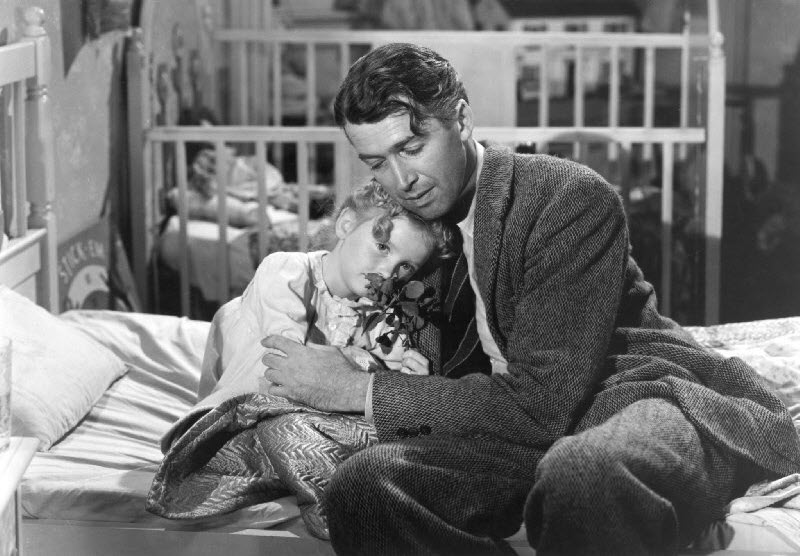
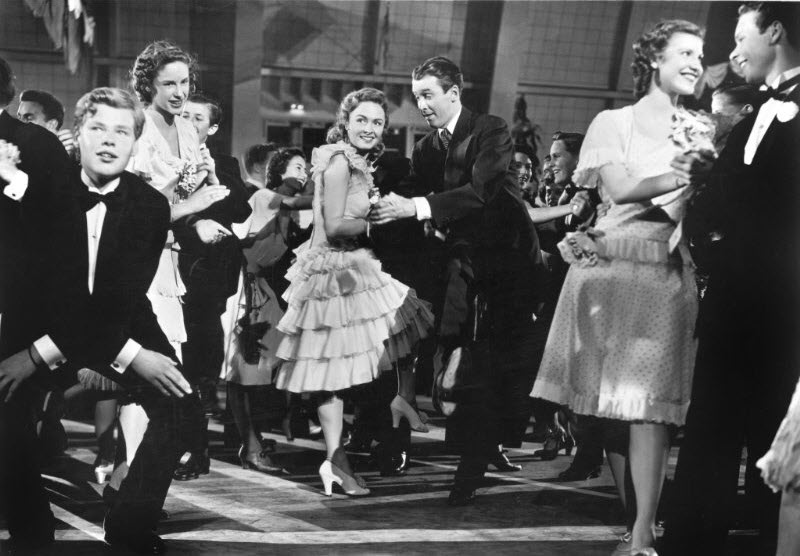
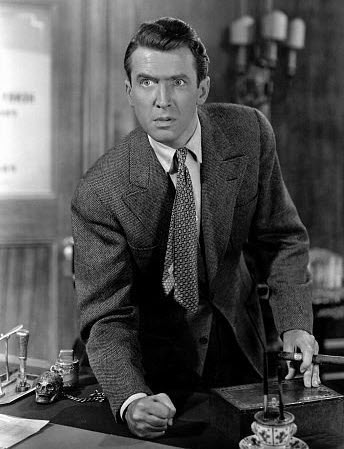
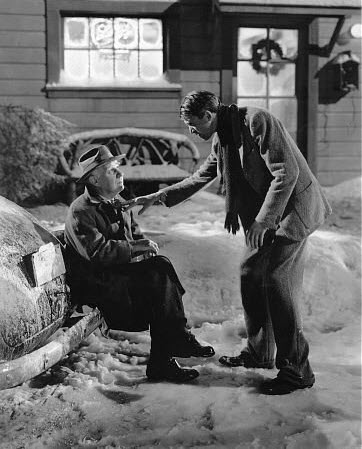
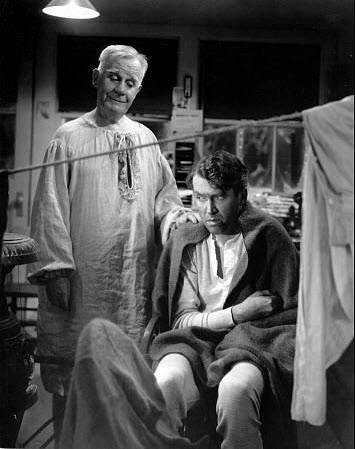
Christian themes in the movie “It’s a wonderful life”

Have you ever taken a close look at the movie “It’s a wonderful life.”

George Bailey prayed. “I want to live again. Please God let me live again.”

Take a look at this article below:

It’s a Wonderful Life …review 

It’s a Wonderful Lifealso known as “Frank Capra’s It’s a Wonderful Life,”

MPAA Rating: Not Rated

Reviewed by: Ben McMaster
CONTRIBUTOR

Better than Average
 Add to your list?
View your list
Tell a friend
Moviemaking Quality:
Primary Audience:
All Ages
Genre:
Drama
Length:
2 hr. 10 min.
Year of Release:
1946
USA Release:
December 20, 2946 (NYC)
January 7, 1947 (wider)

Copyright, Republic Studios

Copyright, Republic Studios

Copyright, Republic Studios

Copyright, Republic Studios

Copyright, Republic Studios

Copyright, Republic Studios

Copyright, Republic Studios

Copyright, Republic Studios

Relevant Issues
Box art for “It’s a Wonderful Life” “Christmas” movies
Featuring: James Stewart (George Bailey), Donna Reed (Mary Hatch Bailey), Lionel Barrymore (Henry F. Potter), Thomas Mitchell (Uncle Billy), Henry Travers (Clarence Oddbody), Beulah Bondi (Mrs. Bailey), Frank Faylen (Ernie Bishop), Ward Bond (Bert the Cop), Gloria Grahame (Violet Bick), H.B. Warner (Mr. Gower), Frank Albertson (Sam Wainwright – a friend of George’s), Todd Karns (Harry Bailey), Samuel S. Hinds (Peter ‘Pa’ Bailey),more »
Director: Frank Capra—“Mr. Smith Goes to Washington,” “It Happened One Night”
Producer: Liberty Films, Frank Capra
Distributor: Republic Studios

“It’s a wonderful laugh! It’s a wonderful love!”

This film was a failure at the box office and at the time marked the beginning of the decline for Christian scientist-turned-director Frank Capra. Because of its failure in every sense of the term, it was discarded by its distributer, RKO (which would soon go bankrupt and pack it in), and fell out of distribution, allowing it to wander the mean streets of television’s extra time slots. It then was aired on Christmas night and built up a cult following and pidgeonholed as a “Christmas movie”. I think this is for good reason.

I first saw this film on a Christmasnight and saw it again a few months later. It has played a very strong part in my being born again with its easily relatable themes of ambition versus obligation. Everything in this film seems to be a struggle.

The story focuses around George Bailey, a man who has a worldly vision for his future that is constantly put aside because of his selfless devotion to the town he lives in and the people in it. The favour of God is upon his life, yet he does not realise it until he almost commits suicide. It is how he is saved from suicide that the film gets into the heavy and involved aspects of the themes portrayed.

I cannot convey enough how Christian this populist piece is. If ever there was a moment in cinema history where the hand of God and the magic of film combined to form a work of art, this is it. Frank Capra made films based primarily on democratic, American ideals. With this film, he explored even deeper ideals and pulled everything off masterfully. He deliberately included scenes involving mild family abuse, drunken behavior and prideto allow for a subjective insight into the workings of George Bailey. The dark side is there to contradict the light—not at the expense of.

This film is purely for the family, but parents may want to block their childrens’ eyes during the later scenes. There seems to be such a strong timelessness about it that may mean the kids once older will be able to make educated opinions on these scenes, in particular. I get the distinct impression that God wants this film as a Christmas movie as a way for our present culture to celebrate Jesus Christ. Would that there could be more like this one. It could very well be the greatest film ever made.

Keith Richards’ wife is a bible believing christian

Keith Richards daughter Alexandra Richards by Benjamin Kanarek for Harper’s BAZAAR

PLEASE MENTION ORIGINAL SOURCE LINK BELOW WHEN YOU EMBED OUR VIDEOS: Original Source: http://www.benjaminkanarekblog.com/e6yq Model and DJ Alexandra Richards

I found these articles below interesting:

Here is the first link:

jeudi, octobre 07, 2004

Patti Hansen

Ca date d’il y a déjà quelques années. Patti donc. Passionnant ? On a jamais dit ça.
Patti Hansen in “Health for Women” magazine
Patti Hansen was the subject of a cover story in the April issue of American Health for Women magazine.
Thanks to Alyson Sadofsky from Undercover for this article!
Curled up on the couch in a friend’s home wearing a floppy gray sweater and slacks sprinkled with dog hair, Patti Hansen – supernova of models in the ’80s and wife of Rolling Stones guitarist Keith Richards – wears almost no makeup. Her only adornment is a delicate gold cross lined with tiny garnets. Her beauty is classic and profound. It’s hard to connect this shy woman with the model who photographer Francesco Scavullo describes in his recent book: “She was completely uninhibited, always running around naked on location shots…nothing fazed her.”
But something does faze Hansen the mother, something that never concerned Hansen the model. For years she has been a stay-at-home mom in Connecticut with her two daughters, Alexandra, 11, and Theodora, 13. Now modeling again at 42, Hansen is disturbed by what she sees as the industry norm of uber-thinness. “Recently, I went to a fashion show where it was awful to see the shape of some girls,” Hansen says. “One girl looked frighteningly thin.”
[snip]Certainly Hansen was not as voluptuous as Monroe, but everything about her photos in the 70’s and 80’s radiated sexuality. As Polly Mellen, creative director of Allure, puts it, “Patti just has that animal thing.” Hansen clearly has always had something. She was discovered at 16, selling hot dogs at a stand on Staten Island. A Wilhemina scout brought her to a party at the famed modeling agency; three months later she was on the cover of Seventeen.
When Hansen met Keith Richards in 1979 at Studio 54, she swears she didn’t exactly know who he was. She was 23 and he was 36. “I knew who the Rolling Stones were,” she says, “but I didn’t listen to that music. I loved the Supremes, Smokey Robinson – soul.” Hansen was smitten. “I just loved this man,” she says. “I loved the way he looked, his eyes, his strength – everything about him.”
Four years later, Hansen and Richards wed. He has two children from a previous marriage; their daughters were born in 1985 and 1986. By all accounts theirs is one of the most solid marriages in the entertainment industry. But now that the Stones are back on tour, and she’s over 40, doesn’t she worry a bit about the temptations of the road? After all, she’s married to the guy who co-wrote “Let’s Spend the Night Together.”
“Last time he was on tour, I took the kids out of school for a year and we traveled with a tutor,” she says. “This time they don’t want to do that. So I’m trying to fly wherever he is and see him at least every two weeks. But he’s good. At least,” she laughs, “I don’t read about anything.”
Considering her wild past, Hansen is surprisingly conservative now, both politically (she voted for Bob Dole) and temperamentally. A born-again Christian who attends a Bible study group (religion is one area where she and Richards agree to disagree), Hansen doesn’t let her daughters see most movies purported to be for kids their age; she forbids cursing and she preaches abstinence before marriage.
As for drugs, Hansen says, “I tell them about the things I’ve done, because I don’t want them to read about me later and be shocked. So I say, ‘When I was drinking a lot, I was dancing on top of bars, acting like a fool. I drank so I could be the life of the party.’ I tell them, ‘You don’t need the crutches.’ People said I was a free spirit. Well, I was out of my mind. In control [professionally], but out of my mind.”
Hansen is very much in control of her life now. At 5’9 1/2″, her weight fluctuates between 135 and 145, up from her modeling weight of 121 to 130. Now that her daughters are older, Hansen is returning to the modeling scene, and she knows that while a wild child in her 20s is still an employable model, a 42-year old party girl is not: “I’m not eating pizza in the middle of the night anymore. You can only do that for so long.” Aside from the occasional evening when she shares a steak at midnight with her nocturnal, meat-and-potatoes husband, most days she eats a lot of fruit and salad and drinks plenty of water.
[snip]Hansen worked out with a trainer until last March, when much of her energy was turned to focus on the eldest of her seven siblings, who was diagnosed with esophageal and lung cancer. Hansen was devastated when her sister died in September. She is just now gearing up to go back to her workout routine.
If Hansen is a role model for staying sensible about food and exercise in an industry that’s overly focused on the superficial, she’s also a poster woman for aging gracefully. “I’m fighting surgery big time,” she says. “I’d like to be natural.” Not that she ruled out the possibility of the surgeon’s arts. “I tell people that when Keith goes for a face lift, I’ll go for a face lift,” she says.
[snip]While Hansen is grateful for her looks, she also genuinely believes that her perfect face and slender body – those sublime accidents of birth – have played no real part in her happiness. She says her greatest joys come from the parts of her life that are available to most women. “My marriage, my children – they’ve changed my life for the better,” she says. “I mean, I had fun times; it’s been an awesome life. And I’m thankful I survived it.”
Sidebar “Patti’s Vitals”
· Age: 42
· Occupation: Supermodel
· Family life: Married for 15 years to Rolling Stones guitarist Keith Richards; mother of Alexandra, 11, and Theodora, 13
· Biggest sins in the 70’s: Sex, drugs and rock’n roll
· Biggest sin in the 90’s: Pizza
· What she worries about: Teens’ adulation and emulation of models
· How she de-stresses: Takes a “hard, hot shower”
· Biggest beauty secret: Drink lots of water
· Her heaven on earth: Noelle Spa for Beauty and Wellness, Stamford, CT
· Advice to her children: “Do as I say, not as I did.”

Publié par à jeudi, octobre 07, 2004

Libellés : ,

Keith’s angels: Rolling Stone wife Patti Hansen poses with daughters Theodora and Alexandra on Town & Country cover

By Daily Mail Reporter

Last updated at 1:41 PM on 14th November 2011

Given that she has fought and recovered from bladder cancer over the past few years, one would imagine stress to have taken its toll on Patti Hansen’s looks.

But the former supermodel, 55, who is wife of Rolling Stone Keith Richards, looks as stunning as ever pictured alongside her two daughters on the cover of Town & Country magazine.

The trio of blondes posed in cashmere and faux fur on the beach outside their California home.

Blonde beauties: Keith Richard's Wife and Daughters on the cover of Town & Country. They reveal how hard Patti's fight with cancer has been for the familyBlonde beauties: Keith Richard’s Wife and Daughters on the cover of Town & Country. They reveal how hard Patti’s fight with cancer has been for the family

But though the shoot paints a picture of familial bliss, they reveal in the accompanying interview how Patti’s cancer took its toll on every single one of them.

Theodora, 26, who is a model like her mother and sister, admitted: ‘It was absolutely terrifying. Really, mum is the glue that holds us all together.’

Patti was more matter-of-fact: ‘It was depressing. But it wasn’t a shock that I had cancer,’ she told the magazine.

‘I wasn’t like, “Oh woe is me.” You know? I just felt “Ok, well that’s my number.”‘

Hellraisers: Despite a party-girl reputation of her own, Patti is credited with bringing stability to Keith's rock'n'roll waysHellraisers: Despite a party-girl reputation of her own, Patti is credited with bringing stability to Keith’s rock’n’roll ways

In fact, Alexandra, 25, revealed, it was her father, 67, who struggled most with the diagnosis.

‘Dad did not take it well. We all wanted to stay strong for him.’

The couple met in 1979 at Studio 54, Patti’s reputation preceding her.

‘She was known for stepping off a plane in transparent shorts with no underwear’

Known for taking acid during a photo shoot, she had infamously ‘knock[ed] a photographer senseless after he got too fresh,’ and once ‘stepp[ed] off a plane in transparent shorts with no underwear.’

They married after fittingly rock’n’roll beginnings and a ‘Keef-style courtship’ that saw Keith smashing his guitar on a table the first time he met Patti’s parents, ‘before breaking down in remorseful tears.’

But as much as her past had its wild side, the ‘Bible-believing Christian’ has brought ‘stability’ to her erratic husband’s life.

Beauties: Theodora and Alexandra with their mother Patti at an Ungaro show in Paris. The sisters say they are the very best of friendsBeauties: Theodora and Alexandra with their mother Patti at an Ungaro show in Paris. The sisters say they are the very best of friends

Patti, now fully recovered from her ordeal, has recently launched a range of bags with her best friend, taking them jetsetting around the world.

‘Keith’s very amused by it,’ she said. ‘He’s like “Oooh, you can be the breadwinner.”‘

The Richards’ daughters, who are nicknamed T&A after the Stones song. Little T&A, on album Tattoo You, told how they are ‘best friends’.

Theodora even has Alexandra’s initials tattooed on the back of her neck.

Alexandra echoed the sentiment, adding: ‘My sister was born to be my best friend.’

___________
Related posts:

“Music Monday” Katy Perry and the Rolling Stones

News/ Katy Perry Sings With Mick Jagger at Rolling Stones Concert—Watch Now by Rebecca Macatee Today 5:45 AM PDT The Rolling Stones & Katy Perry – Beast Of Burden – Live – By Request Published on May 12, 2013 The Rolling Stones and special guest Katy Perry perform ‘Beast Of Burden’ at the Las Vegas […]

Katy Perry performs song “Beast of Burden” with Rolling Stones

News/ Katy Perry Sings With Mick Jagger at Rolling Stones Concert—Watch Now by Rebecca Macatee Today 5:45 AM PDT The Rolling Stones & Katy Perry – Beast Of Burden – Live – By Request Published on May 12, 2013 The Rolling Stones and special guest Katy Perry perform ‘Beast Of Burden’ at the Las Vegas […]

RESPONDING TO HARRY KROTO’S BRILLIANT RENOWNED ACADEMICS!! PART 20 (Carolyn Porco, director of CICLOPS, Like Darwin she gave up her Christianity because of Evolution & is obsessed both with the Beatles & the thought that the human race may end!!)

_________________________________ Beyond Belief: Carolyn Porco On Science & Religion, Part 1 Uploaded on Dec 4, 2006 At the Beyond Belief conference, astronomer Carolyn Porco describes the spirituality inherent in the scientific view of the Universe. ________________ Dr. Carolyn Porco is the leader of the Cassini Imaging Science team and the Director of the Cassini Imaging […]

RESPONDING TO HARRY KROTO’S BRILLIANT RENOWNED ACADEMICS!! PART 19 ( Sir John Walker, Nobel Prize Winner in Chemistry, Like Darwin he gave up his Christianity with great difficulty )

_________________________ John E. Walker —– Nobel Prize Winner John Walker pictured below: On November 21, 2014 I received a letter from Nobel Laureate Harry Kroto and it said: …Please click on this URLhttp://vimeo.com/26991975 and you will hear what far smarter people than I have to say on this matter. I agree with them. Harry Kroto […]

RESPONDING TO HARRY KROTO’S BRILLIANT RENOWNED ACADEMICS!! PART 18 (Brian Harrison, Historian, Oxford University, Charles Darwin also wrestled with the issue of Biblical Archaeology and the accuracy of the Bible)

_____________ Brian Harrison (historian) Emeritus Fellow of Corpus Christi College On November 21, 2014 I received a letter from Nobel Laureate Harry Kroto and it said: …Please click on this URL http://vimeo.com/26991975 and you will hear what far smarter people than I have to say on this matter. I agree with them. Harry Kroto __________________________ There […]

MUSIC MONDAY Wikipedia’s top 18 songs of the Velvet Underground and Nico

Wikipedia’s top 18 songs of the Velvet Underground and Nico _____________ Nico – My Heart is Empty Uploaded on Feb 25, 2010 Nico – Camera Obscura [1985] Nico Icon (Documentary)part 5 The Very Best of The Velvet Underground From Wikipedia, the free encyclopedia Jump to: navigation, search There are Velvet Underground compilation albums with similar […]

FRANCIS SCHAEFFER ANALYZES ART AND CULTURE Part 52 THE BEATLES (Part D, There is evidence that the Beatles may have been exposed to Francis Schaeffer!!!) (Feature on artist Anna Margaret Rose Freeman )

______________ I have dedicated several posts to this series on the Beatles and I don’t know when this series will end because Francis Schaeffer spent a lot of time talking and writing about them and their impact on the culture of the 1960’s.   Lucy in the Sky with Diamonds- The Beatles The Beatles: The […]

FRANCIS SCHAEFFER ANALYZES ART AND CULTURE Part 51 THE BEATLES (Part C, List of those on cover of Stg.Pepper’s ) (Feature on artist Raqib Shaw )

________________ I have dedicated several posts to this series on the Beatles and I don’t know when this series will end because Francis Schaeffer spent a lot of time talking and writing about them and their impact on the culture of the 1960’s. The Beatles: The Beatles and their album St. Pepper’s Lonely Hearts Club […]

RESPONDING TO HARRY KROTO’S BRILLIANT RENOWNED ACADEMICS!! PART 17 ( Steve Jones, biologist, University College London, Charles Darwin’s Implicit Faith in his own theory!!! )

_____________ Steve Jones (biologist) From Wikipedia, the free encyclopedia Professor Steve Jones FRS Steve Jones (2012) On November 21, 2014 I received a letter from Nobel Laureate Harry Kroto and it said: …Please click on this URLhttp://vimeo.com/26991975 and you will hear what far smarter people than I have to say on this matter. I agree […]

MUSIC MONDAY All Tomorrow’s Parties” and “Sunday Morning” are two of the best songs by the Velvet Underground and Nico!!!

All Tomorrow’s Parties” and “Sunday Morning” are two of the best songs by the Velvet Underground and Nico!!! Nico Icon (Documentary) part6. _________________ The Velvet Underground-Sunday Morning _______________ Velvet Underground-All Tomorrow’s Parties Sunday Morning (The Velvet Underground song) From Wikipedia, the free encyclopedia Jump to: navigation, search “Sunday Morning” Single by The Velvet Underground from the […]

_______

The Scopes Trial

THE SCOPES TRIAL by Don Nardo. San Diego, CA: Lucent Books, 1997. 96 pages, bibliography, illustrations, index. Hardcover; $16.95.
Nardo has written over seventy books; his works include biographies of Charles Darwin, Thomas Jefferson, and H. G. Wells. The Scopes Trial gives the reader a glance at the overall trial and it includes annotated bibliographies, a thorough list of works consulted, and a comprehensive index. Moreover, the purpose of this book is to give the big picture of the trial and to provide sources for further research.
Even though The Scopes Trial is only 96 pages in length, it gives many of the little known details of the trial. For instance, the prosecution team included a local attorney named Sue Hicks (the original Boy named Sue of the Johnny Cash hit song) who had been named for his mother (p. 29). The trial was the first to be broadcast on radio, and Judge Raulston declared, My gavel will be heard around the world (p. 43). Loudspeakers were set up on the courthouse lawn Afor the crowds who were unable to squeeze into the courtroom (p. 46). Ironically, when the jurors were asked to step out of the courthouse, they still heard the testimony (p. 46). Just before William Jennings Bryan took the stand, cracks appeared in the ceiling of the courthouse; as a result, court reconvened on the front lawn (pp. 66-7).
After reading The Scopes Trial, I felt like I had actually been there in Dayton in 1925. This was due in part to Nardo’s excellent choice of over 40 pictures and his discussion of the events of the trial. Nardo writes:
Under Darrow’s relentless and skillful stream of questions, Bryan had revealed his nearly complete ignorance of world history. After more than an hour on the stand, Bryan showed not only that he was ignorant of history, but that he knew practically nothing of the established and universally accepted facts of archaeology, geology, astronomy, and other scholarly disciplines. The man who had so vigorously advocated limiting the teaching of science in the schools had just demonstrated that he had not the foggiest notion of what science was all about (p. 74).
The Scopes Trial does have a weakness though. Nardo fails to mention that much of the evidence presented by the scientists at the trial was later proven faulty. Judge Raulston ruled that all testimony bearing on the meaning of evolution or its truth or falsity had nothing to do with whether John Scopes had broken the law and should therefore be excluded from the trial (p. 59). But the Judge did allow the defense to read some of the expert testimony into the record while the jury was excused (p. 66). Part of that testimony read into the record included the two popular biological arguments for evolution embryonic recapitulation and vestigial structures. Medical science has since disproved both of these views. Furthermore, the evolution of the horse was called conclusive and the Piltdown fossils were said to be supporting evidence for evolution. Needless to say, these two pieces of evolution are no longer presented by evolutionists. In fact, evidence surfaced recently that indicates who the Piltdown hoaxer was (Henry Gee, Box of Bones `Clinches’ Identity of Piltdown Paleontology Hoaxer, Nature, 381 [1996]: 261-2).
On the other hand, creationists too have been guilty Of mistakes. John George, the author of They Never Said It!, pointed out that many creationists have mistakenly attributed these words to Clarence Darrow: “For God’s sake, let the children have their minds kept open! Close no doors to their knowledge; shut no door to them. Let them have both evolution and creation! The truth will win out in the end.” Actually it was Darrow’s co-counsel, Dudley Field Malone, who was the speaker. And what Malone said was rather different: “Make the distinction between theology and science. Let them both be taught.” Nardo states, The speech was so eloquent and passionate that the audience, even including many of the fundamentalists who supported Bryan, gave Malone a long and respectful ovation (p. 63).
In sum, The Scopes Trial is well researched and well written. I highly recommend it to the readers of PSCF.
Reviewed by Everette Hatcher III, P.O. Box 23416, Little Rock, AR 72221.
From PSCF 49 (December 1997): 269.

Open letter to President Obama (Part 311)

4 Of 5 / The Bible’s Influence In America / American Heritage Series / David Barton


President Obama c/o The White House
1600 Pennsylvania Avenue NW
Washington, DC 20500

Dear Mr. President,

I know that you receive 20,000 letters a day and that you actually read 10 of them every day. I really do respect you for trying to get a pulse on what is going on out here.

Evangelical leader Ken Ham rightly has noted, “Most of the founding fathers of this nation … built the worldview of this nation on the authority of the Word of God.” I strongly agree with this statement by Ham.

Dr. Michael Davis of California has asserted that he has no doubts that our President is a professing Christian, but his policies are those of a secular humanist. I share these same views. However, our founding fathers were anything but secular humanists in their views. John Adams actually wrote in a letter, “There is no authority, civil or religious – there can be no legitimate government – but that which is administered by this Holy Ghost.”

In June of 2011 David Barton of Wallbuilders wrote the article, “John Adams: Was He Really an Enemy of Christians?Addressing Modern Academic Shallowness,” and I wanted to share portions of that article with you.


 At WallBuilders, we are truly blessed by God, owning tens of thousands of original documents from the American Founding – documents clearly demonstrating the Christian and Biblical foundations both of America and of so many of her Founding Fathers and early statesmen. We frequently postoriginal documents on our website so that others may enjoy them and learn more about many important aspects of America’s rich moral, religious, and constitutional heritage that are widely unknown or misportrayed today.

_______________________________


Period I includes the three centuries of Christianity immediately following the life of Christ. According to Wise, this was “the most refined and purest time, both as to faith and manners, that the Christian church has been honored with.” 15 Period I is the “Period of Purity,” and Jesus’ followers throughout that time largely did just what He had taught them to do.

Period II spans the next twelve centuries, and according to Wise, it was a period that “openly proclaimed itself to the scandal of the Christian religion.”16 The State took control of the Church, with the State decreeing Christianity to be the official religion of the State and all other religions illegal. 17 This was a time of “the secularization of the Church and the depravation of Christianity” 18 – a time when the State seized and corrupted the Church and its doctrines, wrongly asserting “that one of the chief duties of an imperial ruler was to place his sword at the service of the Church and orthodoxy.” 19 Christianity became coercive through brutal civil laws attempting to enforce theological orthodoxy.

This age was characterized by autocratic leaders in both State and Church, with monarchies and theocracies (usually oppressive ones) as the primary forms of governance. The Founders frequently described Period II as a time of “kingcraft” and “priestcraft” – a time when kings and priests joined together against the people, using selfish ambition to gain personal wealth and power. 20

Period II is called the “Period of Apostasy” or “Period of Corruption,” and during this time, the Church was no longer a collection of individuals joined together in a voluntary association; instead it became a civil hierarchy overseeing a massive organization and numerous facilities. The individual follower of Christ was no longer of consequence; the common man was forbidden access to the Scriptures and education; tyrannical leaders became the pinnacle of consideration. The emphasis shifted from the personal to the structural, from the individual to the institutional – an anti-Biblical paradigm that prevailed for the next twelve centuries. Nearly all the negative incidents in world history associated with Christianity (e.g., the Inquisition, wholesale murder of Jews, tortures, etc.) are almost exclusively from this period of Christian corruption.

Period III, according to Wise, is that which “began a glorious reformation.” Wise explains: “Many famous persons, memorable in ecclesiastical history, being moved by the Spirit of God and according to Holy Writ, led the way in the face of all danger . . . for the good of Christendom.” 21 Early seeds of this change began with the efforts of numerous Christian leaders, including John Wycliffe (1320-1384), called the “Morning Star of the Reformation.” Nearly two dozen other Christian leaders also worked to spread Bible teachings across their respective countries, including Englishmen such as Thomas Cranmer, William Tyndale, John Rogers, and Miles Coverdale; Czechs such as John Huss and Jerome of Prague; Germans Martin Luther, Thomas Münzer, Andreas Carlstadt, and Kaspar von Schwenkfeld; Swiss Ulrich Zwingli;Frenchmen William Farel and John Calvin; Scotsmen John Knox and George Wishart; Dutchmen Jacobus Arminius, Desiderius Erasmus, and Menno Simons; and others.

This third era, called the “Period of Reformation,” emphasized a return to the Bible as the guidebook for all aspects of life and living. It therefore rekindled many of Christianity’s original teachings, including the Priesthood of the Believer (emphasizing that the individual had direct access to God without need of assistance from any official in Church or State) and Justification by Faith (emphasizing the importance of personal faith and an individual’s personal relationship with the Savior). The renewed Period III Biblical emphasis on the individual altered the way that both Church and State were viewed, thus resulting in new demands and expectations being placed upon each. Self-government and freedom of conscience were advocated for both institutions.

But such Bible teachings were not embraced by all, for they threatened the previously uncontested power of tyrants. Consequently, ruthless leaders in both State and Church initiated bloody purges, utilizing the most cruel tortures and barbaric persecutions to suppress the followers of the renewed Biblical teachings. For example, French leaders conducted the famous St. Bartholomew’s Day Massacre of September 17, 1585, eventually killing 110,000 French Reformation followers (i.e., Huguenots). Some 400,000 others fled France to avoid death and persecution, with many coming to America, especially South Carolina and New York.

Similarly, English leaders such as King Henry VIII attempted to suppress the Reformation’s individualistic teachings by public executions and burnings at the stake; and Edward VI, Mary, Elizabeth I, and subsequent monarchs continued those efforts. In fact, King James I even concocted two revolutionary new government-church “doctrines” to help him suppress the growing influence of Reformation teachings in England: the Divine Right of Kings, and Complete Submission and Non-Resistance to Authority.

Not surprisingly, Reformation followers (often known as “Dissenters” for opposing, or dissenting against, the autocratic and tyrannical practices of both State and Church) openly opposed James’ “irrational and unscriptural doctrines,” 22 thus prompting him to level additional brutal persecutions against them, including mutilation, hanging, and disemboweling. The Pilgrims came to Massachusetts in 1620 to escape the hounding persecution of King James, and a decade later, 20,000 Puritans also fled England after many received life sentences (or had their noses slit, ears cut off, or a brand placed on their foreheads) for adhering to Reformation teachings.

Despite the brutal worldwide persecution, the Reformation eventually prevailed, resulting in massive changes in both State and Church, finally bringing to an end the corrupt practices of Period II Christianity. The impact of Reformation Christianity upon nations during this period was almost exclusively positive, especially in America, where Reformation teachings took root and grew more quickly than in the rest of the world, having been planted in virgin soil completely uncontaminated by the apostasy of the previous twelve centuries.

American Founding Fathers and leaders (including John Adams) made a clear distinction between America’s Period III Christianity and Europe’s Period II Christianity. For example, Noah Webster emphatically declared:

The ecclesiastical establishments of Europe which serve to support tyrannical governments are not the Christian religion, but abuses and corruptions of it. 23

______________________________________-

15. John Wise, A Vindication of the Government of New-England Churches (Boston: John Boyles, 1772), p. 3. (Return)

16. John Wise, A Vindication of the Government of New-England Churches (Boston: John Boyles, 1772), p. 5. (Return)

17. Fordham University, “Medieval Sourcebook: Banning of Other Religions, Theodosian Code XVI.1.2” (at:http://www.fordham.edu/halsall/source/theodcodeXVI.html). (Return)

18. Samuel Smith Harris, The Relation of Christianity to Civil Society (New York: Thomas Whittaker, 1883), p. 62. (Return)

19. Joseph Blötzer, transcribed by Matt Dean. “Inquisition” The Catholic Encyclopedia, Volume VIII. Published 1910. New York: Robert Appleton Company. Nihil Obstat, October 1, 1910. Remy Lafort, S.T.D., Censor. Imprimatur. +John Cardinal Farley, Archbishop of New York (at:http://www.newadvent.org/cathen/08026a.htm). (Return)

20. Noah Webster, An American Dictionary of the English Language (New Haven, 1828), s.v., “kingcraft” and “priestcraft.” (Return)

Thank you so much for your time. I know how valuable it is. I also appreciate the fine family that you have and your commitment as a father and a husband.

Sincerely,

Everette Hatcher III, 13900 Cottontail Lane, Alexander, AR 72002, ph 501-920-5733, lowcostsqueegees@yahoo.com

5 Of 5 / The Bible’s Influence In America / American Heritage Series / David Barton

“Friedman Friday” Milton Friedman’s biography (Part 2)(Interview by Charlie Rose of Milton Friedman part 3)

Biography Part 2

In 1977, when I reached the age of 65, I retired from teaching at the University of Chicago. At the invitation of Glenn Campbell, Director of the Hoover Institution at Stanford University, I shifted my scholarly work to Hoover where I remain a Senior Research Fellow. We moved to San Francisco, purchasing an apartment in a high-rise apartment building in which we still reside. The transition of my scholarly activities from Chicago to California was greatly eased by the willingness of Gloria Valentine, my assistant at Chicago, to accompany us west. She remains my indispensable assistant.

Hoover has provided excellent facilities for scholarly work. It enabled me to remain productive and an active member of a lively scholarly community.

Initially we continued to spend spring and summer quarters at Capitaf, our second home in Vermont. However, we soon came to appreciate the inconvenience of maintaining homes a continent apart and began to look in California for a replacement for Capitaf. In 1979, we purchased a house on the ocean in Sea Ranch, a lovely community 110 miles north of San Francisco. In 1981, we disposed of Capitaf and began to spend about half the year at Sea Ranch at intervals of a week or so, spread throughout the year, rather than in one solid block. It proved a fine locale for scholarly work. The Internet plus an assistant at Hoover more than made up for the absence of a library near at hand.

After more than two wonderful decades at Sea Ranch, we sold our house to simplify our lives. We now have one home, our apartment in San Francisco.

To return to the 1970s, not long after we arrived in California, Bob Chitester persuaded us to join him in producing a major television program presenting my economic and social philosophy. The resulting effort, spread over three years, proved the most exciting adventure of our lives. The end result was Free to Choose, ten one-hour programs, each consisting of a half-hour documentary and a half-hour discussion. The first of the ten programs appeared on PBS (Public Broadcasting System) in January 1980. Since then, the series has been shown in many foreign countries.

When we agreed to undertake the project, little did Rose and I realize what was involved in producing a major TV series. As a first step, I gave a series of fifteen lectures over a period of nine months at a wide variety of locations. The lectures and question-and-answer sessions were all videotaped to provide the producers with a basis for planning the programs.

The filming began in March 1978 and continued for the next eight months at locations in the United States and around the world, including Hong Kong, Japan, India, Greece, Germany, and the United Kingdom – in the process generating more than six miles of video and audiotape.

Three months after the end of filming, we returned to London to view the documentaries that Michael Latham, our wonderful producer, and his associates had created from that tape and to dub the voice-overs. Another six months passed before we gathered again in Chicago where we filmed the discussion sessions – one of the most stressful weeks I have ever experienced.

One distinguishing feature of the series was that there was no written script. I talked extemporaneously from notes. When we returned to Capitaf from London with the transcripts of the final documentaries, we set to work to convert them to a book to appear simultaneously with the TV program. The book, Free to Choose (Harcourt Brace Jovanovich, 1980) was the bestseller nonfiction book of 1980 and continues to sell well. It has been translated into more than fourteen foreign languages.

As Rose wrote in our memoirs, “As we look back at the events chronicled in this chapter, it all seems like something of a fairy tale. Who would have dreamed that after retiring from teaching, Milton would be able to preach the doctrine of human freedom to many millions of people in countries around the globe through television, millions more through our book based on the television program, and countless others through videocassettes” (p. 503).

Monetary Trends in the United States and the United Kingdom, published in 1982, was the final major product of a collaboration with Anna J. Schwartz under the auspices of the National Bureau of Economic Research that lasted more than three decades. Money Mischief (Harcourt Brace Jovanovich, 1992) collects assorted pieces of monetary history, some of which I had published elsewhere, some of which appear first in this book.

I have continued to be active in public policy since 1977. I continued my tri-weekly column in Newsweek until it was terminated in 1983. Since then, I have published numerous op-eds in major newspapers. I served as an unofficial adviser to Ronald Reagan during his candidacy for the presidency in 1980, and as a member of the President’s Economic Policy Advisory Board during his presidency. In 1988, President Reagan awarded me the Presidential Medal of Freedom and in the same year I was awarded the National Medal of Science.

We have traveled extensively since 1977, including a trip through Eastern Europe in 1990, where we filmed a documentary on former Soviet satellites. The documentary was included in a shortened reissue of Free to Choose.

Perhaps the most notable foreign travel consisted of three trips to China: one in 1980 when I gave a series of lectures under the auspices of the Chinese government; one in 1988 when I attended a conference in Shanghai on Chinese economic development and had a fascinating session in Beijing with Zhao Ziyang, at the time, the General Secretary of the Communist Party, deposed a few months later for his unwillingness to approve the use of force on Tiananmen Square; and one in 1993 when I traveled with a group of Chinese friends from Hong Kong throughout the country. The three visits covered a period of revolutionary economic growth and development, the first stage of a shift from an authoritarian, centrally planned economy to a largely free market economy.

Ever since the 1950s, Rose and I have been interested in the promotion of parental choice in schooling through the use of vouchers. Finally, in 1996, when it became clear that our personal involvement would have to be limited, we established a foundation, The Milton and Rose D. Friedman Foundation devoted to promoting parental choice in schooling. We were fortunate in being able to persuade Gordon St. Angelo to serve as president. He has done an outstanding job. Progress toward our objective of universal vouchers has been distressingly slow, but there has been progress. The pace of progress shows every sign of speeding up, and our foundation has made a significant contribution to that progress.

In 1998, the University of Chicago Press published our memoirs, Milton and Rose D. Friedman, Two Lucky People.

Milton Friedman died on November 16, 2006.

Taking on Ark Times Bloggers on various issues Part R “What’s wrong with Roe v. Wade decision?” (includes video “Truth and History” and editorial cartoon)

I have gone back and forth and back and forth with many liberals on the Arkansas Times Blog on many issues such as abortion, human rights, welfare, poverty, gun control  and issues dealing with popular culture. Here is another exchange I had with them a while back. My username at the Ark Times Blog is Saline Republican.

On 3-4-13 on the Ark Times Blog the person using the username Blake Rutherford’s Pink Bowtie was pleased that Governor Beebe of Arkansas vetoed a pro-life bill. He noted, “Proud of our Governor today. Will our next governor show such courage?”

I responded:

Bill Muehlenberg rightly noted concerning Francis Schaeffer’s view of Roe v Wade:

In his earlier 1976 volume, How Should We Then Live (and the 10-part film series that went with it), he looked at the 1973 ruling in some detail. He talked about the decline of absolutes in American law, and how this decision was completely arbitrary. First, it was medically arbitrary, denying the clear understanding of biology and science.

Second, it was legally arbitrary, “disregarding the intent of the Thirteenth and Fourteenth Amendments of the Constitution.” And third, it was at “complete variance with the past Christian consensus. In the pagan Roman Empire, abortion was freely practiced, but Christians took a stand against it. In 314 the Council of Ancyra barred from the taking of the Lord’s Supper for ten years all who procured abortions or made drugs to further abortions.”

If this arbitrary law is accepted by “most modern people, bred with the concept of no absolutes but rather relativity, why wouldn’t arbitrary absolutes in regard to such matters as authoritarian limitations on freedom be equally accepted as long as they were thought to be sociologically helpful? We are left to sociological law without any certainty of limitation.”

Yes he certainly got that right. It was a prophetic insight into where things would lead, and we have certainly arrived, with euthanasia legalised in various places, and academics arguing for the acceptability of infanticide. Indeed, he made the warning quite clear back then: “The door is open. In regard to the fetus, the courts have arbitrarily separated ‘aliveness’ from ‘personhood,’ and if this is so, why not arbitrarily do the same with the aged? So the steps move along, and euthanasia may well become increasingly acceptable.”

In 1979 his book and film series, Whatever Happened to the Human Race?, co-authored with C. Everett Koop, appeared. It looked at the issues of abortion, infanticide, and euthanasia, and sounded a clear alarm for evangelicals to wake up to their social responsibilities. It also argued that abortion rights logically lead to euthanasia and infanticide rights.

_______________________

In the film series “WHATEVER HAPPENED TO THE HUMAN RACE?” the arguments are presented  against abortion (Episode 1),  infanticide (Episode 2),   euthenasia (Episode 3), and then there is a discussion of the Christian versus Humanist worldview concerning the issue of “the basis for human dignity” in Episode 4 and then in the last episode a close look at the truth claims of the Bible.

I truly believe that many of the problems we have today in the USA are due to the advancement of humanism in the last few decades in our society. Ronald Reagan appointed the evangelical Dr. C. Everett Koop to the position of Surgeon General in his administration. He partnered with Dr. Francis Schaeffer in making the video below. It is very valuable information for Christians to have.  Actually I have included a video below that includes comments from him on this subject.

___________

Francis Schaeffer: “Whatever Happened to the Human Race” (Episode 5) TRUTH AND HISTORY

Published on Oct 7, 2012 by

Compassionate Engagement, Part 5: Schaeffer’s Political Activism

By Derek Brown on January 12, 2012

Part 1    Part 2    Part 3    Part 4

Up to this point in his life, Schaeffer had remained aloof to political activity.  He would become convinced, however, that political involvement was the only logical step given his theory that the decline of Western thought and morality was due to departure from biblical presuppositions (Hankins, 175).  Schaeffer was especially alarmed by the legalizing of abortion, stating that such legalization was arbitrary, both legally and medically; further governmental authoritarianism would be the consequence if Christians did not resist the trend represented by Roe v. Wade.

All of this effort against abortion aimed directly at secular humanism.  Secular humanism, Schaeffer was convinced, was antithetically opposed to biblical Christianity, and, if allowed to take root, could usher in a situation where a few elite policy writers would fill the vacuum left by the disappearance of transcendent absolutes with arbitrary rules and regulations (Hankins, 177-180),  Against this very real threat of authoritarianism Christians had to fight.

Schaeffer’s effort against abortion expressed itself in another film and book, co-authored with C. Everett Koop, entitled, What Ever Happened to the Human Race.  In both the book and the film, Schaeffer argued that the disappearance of a Christian base in the West had led the adoption of a humanist foundation; the remedy was the reestablishment of the Christian base that had been lost in the twentieth century as a result of the ideas of the Enlightenment that had spread throughout the culture (Hankins, 188).  As the book and the film graphically describe the process of abortion, Schaeffer observed that clear phrases like “ending a pregnancy” were only a disguise for what was actually occurring; namely the killing of a human being (Hankins, 181).

Schaeffer and Koop’s endeavor to startle sleeping evangelicals into action apparently worked.  Prior to 1980, very few Protestant denominations sought involvement in the abortion problem, considering it a problem with which the Roman Catholic Church had taken issue.  In 1980 the Southern Baptist Convention (SBC), for example, established pro-life resolutions aimed at stopping abortions.  Key leaders within the SBC had read Schaeffer and testified to Schaeffer’s influence on this vital issue.  According to Hankins, “[Schaeffer’s] push against abortion certainly helped fuel the evangelical pro-life movement” (Hankins, 182).

Schaeffer followed What Ever Happened to the Human Race with A Christian Manifesto.  Schaeffer’s burden in the latter book was to help Christians understand their relationship to the government, law, and civil disobedience.  Like the books that had come before, Manifesto was a book of worldviews.  In introducing his plea for Christians to stand against secular humanism, Schaeffer began his argument by noting how pietism—that form of Christianity that emphasizes the experiential component of the faith—had served to divorce facts and ideas from the realm of experience and thus relegated Christianity to the sphere of the private and subjective.  This unfortunate consequence of pietism, Schaeffer argued, allowed secular humanism to develop a strong foothold; Christians were to stand against development by seeing Christianity not merely as an experience, but as a worldview that makes sense of all reality (Hankins, 196-197).

In regards to the question of civil disobedience, Schaeffer believed it was the responsibility of Christians to resist the state when officeholders became tyrannical, although the general demeanor of Christians should be one of submission.  Schaeffer was also reluctant to advocate the use of force—even on the issue of abortion.  Legislative action, sit-ins, political pressure, and quiet demonstrations should be the primary way in which Christians should seek to influence the government and the change of laws (Hankins, 208).

Schaeffer wielded significant influence in the political realm, just as he had previously in the area of Christian apologetics and evangelical engagement with culture—the latter area undoubtedly related to his political involvement as well.  According to Colin Duriez, Schaeffer’s three books, How Shall We Then Live, Whatever Happened to the Human Race, and A Christian Manifesto,

…substantially helped created a new Evangelical Right in America.  Certainly, joining the pro-life lobby identified Schaeffer with America’s Religious Right, which was able to exercise considerable political clout during the Reagan era (Duriez, 191).

Schaeffer would continue his labors despite the fact that two years earlier (in 1978) he had been diagnosed with cancer.  With treatment, Schaeffer’s cancer retreated into remission for a season, while he continued to write and speak at various venues around the United States and spend time at L’Abri.  On May 15, 1984, however, only two years after publishing a five volume set of his complete works, Francis Schaeffer died at his home in Rochester, Minnesota.

Next: Conclusion: Schaeffer’s Lasting Influrence

____________

Here is a editorial cartoon that looks at the issue of abortion in light of President Obama’s popular political campaign slogan:

________________

Related posts: