Monthly Archives: April 2013

Book of Daniel written in 6th century B.C.? (Part 3)

The Bible and Archaeology (3/5)

I have been amazed at the prophecies in the Bible that have been fulfilled in history, and also many of the historical details in the Bible have been confirmed by archaeology too. ( I have put a list below of several posts I have made in the past about this.) One of the most amazing is the prediction that the Jews would be brought back and settle in Jerusalem again. Another prophecy in Psalms 22 describes messiah dying on a cross  almost 1000 years before the Romans came up with this type of punishment.  One of the top 10 posts on this concerns the city of Tyre.  John MacArthur went through every detail of the prophecy concerning Tyre and how history shows the Bible prophecy was correct.

Evidences Relating to the Date of the Book of Danielby David Conklin© (3/13/2004)

Table of ContentsIntroduction

Historical Issues

Antiochus IV Epiphanes

Belshazzar

Nebuchadnezzar

Babylonian Detail

Maccabean Context

Summary

Language Difficulties

Hebrew

Greek

Aramaic

Qumran

Persian (Aryan)

General Comments

Summary

Acceptance into the Canon

Daniel: Is it in the Prophets or the Writings?

Is Daniel a Pseudonym?

Are Daniel’s Prophecies ex eventu?

Is the Book of Daniel a Unified Whole?

Theological Issues

“Problems”

Daniel’s Spelling of Nebuchadnezzar

Daniel And Jeremiah

Daniel and the book Wisdom of Sirach

Daniel and Darius the Mede

Daniel and the Prayer of Nabonidus

Daniel of Ugarit

Daniel’s Prophecies of the Kingdoms

Other Factors

CONCLUSION

Bibliography

INTRODUCTION      Since certain prophecies in the book of Daniel seem to have their fulfillment in Antiochus IV Epiphanes and since some people have a presuppositional bias against predictive prophecy [Eissfeldt, 520] they believe that the book of Daniel must have been written at the time of the Antiochus, roughly 164 B.C. to 169/7 B.C.. [DiLella, 134; for the last date see Meyers and Rogerson, 278–they say that the tribulations that caused the Book of Daniel to be written [was] Antiochus’ assault on the temple and Jerusalem. However, Collins (1984): 36 puts the date “between the profanation of the temple in 167 and the end of 164 BC.”] That, in short, is the Maccabean thesis; for more of a description see Ferch (1986): 6-11. Anthony Collins, in 1727, expressed the modern critical arguments for the 2nd century dating of Daniel when he revived Porphyry’s arguments. Anthony Collins noted the following features: “the historical problems, the Greek words, the prophecies relating to the second century …, the book’s location among the Writings, [and] the late Aramaic.” [Goldingay, xxxvi] We will examine each of these features in this study. To use a suggestion made by Goldingay we will determine the truth “from actual study of the text of Scripture”. We will also note where Goldingay and others have failed to do the same. We will not deal with the claims made by “some radical critics [who] have overreached themselves in finding ‘absurdities’ throughout the [book].” [Montgomery, 72 note 17]

We will find that there are a more than a few problems with the view of a Maccabean date for Daniel. Simply put, there is no evidence whatsoever that the book was written in 164/5 B. C.. It is only a theory and it needs to be called into question for the reasons I will show below. The usual claims in regards to the date of the book of Daniel are “examples of how much has been built on so little yet constantly reiterated by commentators till their weaknesses were exposed”. [Robinson, 342] Yet one should take note of how old some of the sources are (in some cases from the late 1800’s to early 1900’s; and in one case from 1771!) which refute the commonly made claims.

As you will see it seems apparent that what has happened is that most writers have typically superimposed an a priori pattern upon the book and have then attempted to force the pieces to fit that pattern–and they have done this mostly by ignoring the evidence. In a review of Baldwin’s commentary on Daniel the writer noted that she “gently chides advocates of the second-century date of the book [have] failed to change significantly their standard presentation since Driver [S. R. Driver, The Book of Daniel. (Cambridge, 1900)] — and this despite recent discoveries.” [Gammie (1980): 453]

Daniel J. Boorstin has said: “The greatest obstacle to discovery is not ignorance–it is the illusion of knowledge.”  It is hoped that this study will lead the reader to re-consider and re-evaluate what they have read and heard in the past. My personal experience is that I was not aware of the level of, kinds of, and the sheer amount of detail in regards to the date of Daniel until I undertook this study.  I really have to thank Farrel Till for publishing in his Skeptical Review an article by William Sierichs, Jr. about the book of Daniel (“Daniel in the Historians’ Den”).  This gave me the impetus to conduct this research; for I would not have had even the desire to study this topic without Sierichs comments against the book in general and specifically about the date.

Readily available sources (i.e., through inter-library loan), that I have examined are given in the bibliography at the end; more sources (in most cases these are more specialized or in a foreign language) are given in the text itself. If you engage in the method of compare/contrast (for instance, in terms of sources: the quantity and quality of these sources) you will note the sheer number and wide diversity of sources that I am providing as compared to that given by the critics, especially those of critics of the more “popular” variety.

One of the interesting lessons I learned in conducting this study was to see which objections and rationales used to be used against the book but have subsequently ceased to be used. See Farrar, 47-54 for some examples.

The points made in this paper are numbered sequentially so we can see how many points of evidence there really are about the date of the book of Daniel. There are 84 factors to consider as of May 19, 2000.

CONCLUSION      The combined effect of the above evidence points us very strongly away from the Maccabean thesis–“the arguments for the Maccabean dating of Daniel can hardly be said to be convincing.” [Harrison (1969): 1126] From the above we have learned that Daniel records details about 6th century Babylon that were subsequently lost shortly after its fall. We have seen that the language of the book requires a very early date–with the best fit being during the times it describes in detail. As Baldwin put it: “When all the relevant factors are taken into account … a late sixth- or early fifth-century date of writing for the whole best suits the evidence.” [Baldwin (1978a): 46] This also means that there is no evidence for the claim that Daniel was a forgery as Sierichs and Till have claimed.

“It can only be concluded that the critical case against the historicity of Daniel has survived to the present because its adherents have failed to take a second and more critical look at the arguments that have been propounded so unimaginatively and with such tedious repetition in recent times.” [Harrison (1969): 1122] He further argued that: “Objections to the historicity of Daniel were copied uncritically from book to book, and by the second decade of the twentieth century no scholar of general liberal background who wished to preserve his academic reputation either dared or desired to challenge the [then] current critical trend.” [Harrison (1969): 1111; quoted by Waltke (1976): 320] “When new information becomes available, it is Daniel, not the critics, who proves to be correct.” [Richards, 210]

In the words of Rowley: the continued presence of the Maccabean hypothesis is an example of “ruthless propaganda for a theory, rather than a scientific study of the evidence.” [Rowley (1952): 267] Harrison noted that: “Traditional Jewish and early Christian views were opposed by the Neoplatonist Porphyry (third century A.D.), who denied the possibility of predictive elements in prophecy and [who] assigned the work to the Maccabean period, maintaining that its purpose had been to sustain persecuted Jews in their adversities. This general position was [then] adopted by European rationalists, and became “one of the assured results” of the literary-critical movement, even though it was consistently challenged by conservative scholars and was entirely lacking in objective proof.” [Harrison (1979): 246; see also Waltke (1976): 319-20.]

One must also note that the conservative position is typically given a very cursory notice (note that the critics typically cover very few of the above points) with no interaction with them if they are acknowledged at all. For a stunning contrast look at the treatment that men like Hasel, Shea, Ferch, Harrison, and McDowell give to the liberal/critical views. This bias against the conservative view can be seen especially in the absence of any conservative sources in the bibliographies given in the dictionaries and encyclopedia articles that the masses would typically be exposed to.

We can see by the quote above from Harrison that the reason for the continued claim for a late date for the book of Daniel is that by doing so its credibility can be destroyed and thus eliminates any idea of a genuine prophecy coming true. Which is why Pusey has pointed out: “The book of Daniel is especially fitted to be a battle-ground between faith and unbelief. It admits of no halfway measures. It is either Divine or an imposture.” Miller has pointed out that “although the miraculous handwriting and Daniel’s interpretation of it are matters of faith, the historical circumstances surrounding those events are established by objective data” as the above study has shown. [page 150] Bringing up the miraculous elements of the book is another favorite, and diversionary, tactic of the critics. This is especially true when they have been presented with concrete evidence that their “facts” about the book are wrong.

Given the sum of all the evidence presented here we can only conclude that the prophecies in the book of Daniel were written about 530 B.C. which is long before the actual events unfolded. Thus, there is no case of these prophecies being written after the event (vaticinia ex eventu).

“But the question naturally arises, If the evidence for a sixth century date of composition is so certain, why do scholars reject it in favor of an
unsupportable Maccabean hypothesis? The reason is that most scholars embrace a liberal, naturalistic, and rationalistic philosophy. Naturalism
and rationalism are ultimately based on faith rather than upon evidence; therefore this faith will not allow them to accept the supernatural predictions.”

Archer states this point well: “The committed antisupernaturalist, who can only explain the successful predictions of Daniel as prophecies after the
fulfillment, … is not likely to be swayed by any amount of objective evidence whatever.” [Waltke (1976): 329; Archer quote is from: “Old Testament
History and Recent Archaeology from the Exile to Malachi,” Bibliotheca Sacra 127 (October-December 1970): 297; see also Hill and Walton, 350]

One can only hope that Waltke and Archer are unduly pessimistic. However, pessimistic one may be about skeptics changing their minds there are some grounds for hope. For instance, the “extremely skeptical” German OT scholar Martin Noth changed his mind over time as a result of the archaeological evidence. [Yamauchi (1974): 70] But, we shouldn’t get our hopes too high.

Mounce points out that “the excessive skepticism of many liberal theologians stems not from a careful evaluation of the available data, but from an enormous predisposition against the supernatural.” [Robert H. Mounce, “Is the New Testament Historically Accurate?” in Can I Trust the Bible? ed. Howard F. Vos, p. 176, emphasis mine; quote found in Both/And: A Balanced Apologetic. by Ronald B. Mayers (Moody, 1984); for another example see Allis, 248] This perception of the nature of the bias against the Bible is reinforced by noting that previous opinions in regards to secular history have been overturned when archaeology had proven them to be in error. [Yamauchi (1974): 54-70] And yet when it comes to the Bible the “old” views which can now be known to be wrong continue to be broadcast to an overly-trusting and unsuspecting audience.

BibliographyAbbreviations used:

ANE = Ancient Near East
ANET = Ancient Near Eastern Texts
AUSS = Andrews University Seminary Studies
BAR = Biblical Archaeological Review
BASOR = Bulletin of the American Schools of Oriental Research
CBQ = Catholic Biblical Quarterly
EBD = Eerdmans Bible Dictionary
HUCA = Hebrew Union College Annual
ICC = International Critical Commentary
IDB = Interpreter’s Dictionary of the Bible
ISBE = International Standard Bible Encyclopedia ITQ = Irish Theological Quarterly
JAOS = Journal of the American Oriental Society
JBL = Journal of Biblical Literature
JETS = Journal of the Evangelical Theological Society
JSOT = Journal for the Study of the Old Testament
JTS = Journal of Theological Studies
JTS NS = Journal of Theological Studies (New Series)
NEB = New English Bible
NIV = New International Version
RSV = Revised Standard Version
VT = Vetus Testamentum
ZAW = Zeitschrift fur die alttestamentaliche Wissenschaft

  1. Acquistapace, Fred Miracles That Never Were: Natural Explanations of the Bible’s Supernatural Stories. (Eye-Opener Books, 1991)
  2. Albright, W. F. “The Nebuchadnezzar and Neriglissar Chronicles,” BASOR 143 (October 1956): 28-33.
  3. Allis, Oswald T. The Old Testament: Its Claims and Its Critics. (Baker, 1972)
  4. Allison, Lodowick The Bible. Arranged and Edited by Ernest Sutherland Bates. With Updated Scholarship & a New Introduction by Lodowick Allison. (Simon and Schuster, 1993)
  5. Archer, Gleason L. “Daniel,” Expositor’s. Vol. 7 (Zondervan, 1985)
  6. _______ “Modern Rationalism and the Book of Daniel,” Bibliotheca Sacra 136 (April-June 1979): 129-47.
  7. _______ “The Hebrew of Daniel Compared with the Qumran Sectarian Documents,” The Law and the Prophets. Edited by J. Skilton (1974): 470-486.
  8. Audet, Jean Paul “A Hebrew-Aramaic List of Books of the Old Testament in Greek Transcription,” JTS NS 1 (1950): 135-54.
  9. Barnes, Albert Barnes’ Notes on the Old Testament. (Baker Book reprint, 1953)
  10. Barry, Phillips “Daniel 3:5, sumponyah,” JBL 27 (1908): 99-127.
  11. Barton, George A. “The Composition of the Book of Daniel,” JBL 17 (1898): 62-86.
  12. Baldwin, Joyce G. “Daniel, Book of,” New Bible Dictionary. 3rd edition (IVP, 1996): 255-7.
  13. _______ “Some Literary Affinities of the Book of Daniel,” Tyndale Bulletin 30 (1979): 77-99.
  14. _______ Daniel: An Introduction and Commentary. Tyndale Old Testament Commentaries, D. J. Wiseman, General Editor (IVP, 1978a)
  15. _______ “Is there Pseudonymity in the Old Testament?” Themelios 8 (1978b): 6-12.
  16. Bewer, Julius A. The Literature of the Old Testament. (Columbia, 1938)
  17. Boutflower, Charles In and Around the Book of Daniel. (Society for Promoting Religious Knowledge, 1923)
  18. _______ “The Historical Value of Daniel V and VI,” JTS 17 (1915-6): 43-60.
  19. Brock, S. P. “Ancient Languages,” Oxford Companion to the Bible. (Oxford, 1993): 752-4.
  20. Burtchaell, James T. “Daniel, Book of,” Encyclopedia Americana. Vol. 8 (Grolier, 1997; the article appears to have been recycled in full from the 1993 issue): 482. (In private correspondence, in 1998, he stated that he wrote the original article 30 years before, based on what he had been told by people he trusted.)
  21. Casey, [P.] Maurice “Porphyry and the Origin of the Book of Daniel,” Journal of Theological Studies 27 (1976): 15-33.
  22. Clifford, Richard J. “History and Myth in Daniel 10-12,” BASOR 220 (1975): 23-6.
  23. Clines, David J. A. “Belshazzar,” ISBE. Vol. 1, G. W. Bromiley, General Editor (Eerdmans, 1979): 455-6.
  24. Collins, John J. Daniel. Hermenia series (Fortress, 1993)
  25. _______ “Daniel, book of,” Anchor Bible Dictionary. David Noel Freedman, Editor-in-Chief. Vol. 2 (Doubleday, 1992): 29-37.
  26. _______ Daniel, with an Introduction to Apocalyptic Literature. The Forms of the Old Testament Literature, Vol. 20. Rolf Knierman & Gene M. Tucker, editors (Eerdmans, 1984)
  27. _______ The Apocalyptic Vision of the Book of Daniel. Harvard Semitic Monographs, Edited by Frank Moore Cross, Jr., # 16 (Scholars Press, 1977)
  28. _______ “The Court Tales in Daniel and the Development of Apocalyptic,” Journal of Biblical Literature 94 (1975): 218-234.
  29. Coogan, Michael D. “Septuagint,” Oxford Companion to the Bible. (Oxford, 1993): 686-7.
  30. Coxon, P. W. “A Philological Note on [‘stew, “to drink”] Dan. 5:3f,” ZAW 89:2 (1977): 295-6.
  31. _______ “The Syntax of the Aramaic of Daniel: A Dialectal Study,” HUCA 48 (1977): 107-22.
  32. Crafer, T. W. “The Work of Porphyry Against the Christians and its Reconstruction,” JTS15 (1913-4): 360-95; 481-512.
  33. Craven, Toni “Daniel,” Collegeville Bible Commentary. (Liturgical Press, 1989)
  34. Davies, P. R. Daniel. Old Testament Guides, R. N. Whybray, General Editor (JSOT, 1988)
  35. _______ “Eschatology in the Book of Daniel,” JSOT 17 (1980): 33-53.
  36. _______ “Daniel Chapter Two,” JTS NS 27:2 (October 1976): 392-401.
  37. Day, John “The Daniel of Ugarit and Ezekiel and the Hero of the Book of Daniel,” VT 30:2 (1980): 174-84.
  38. Di Lella, Alexander A. The New Jerome Bible Handbook. Based on The New Jerome Biblical Commentary. Edited by Raymond E. Brown, Joseph A. Fitzmyer, and Roland E. Murphy (Liturgical Press, 1992)
  39. _______ The Wisdom of Ben Sira. Anchor Bible, Vol. 39 (Doubleday, 1987)
  40. Dressler, Harold H. P. “The Identification of the Ugaritic DNIL with the Daniel of Ezekial,” VT 29 (1979): 152-61.
  41. Dummelow, J. R. A Commentary on the Holy Bible. (Macmillan, 1908)
  42. Eissfeldt, Otto The Old Testament. Translated by Peter R. Ackroyd. (Harper & Row, 1965)
  43. Emery, D. L. Daniel: Who Wrote the Book? (Stockwell, 1978)
  44. Farrar, F. W. The Book of Daniel. (George H. Doran, 1895)
  45. Ferch, Arthur J. “Authorship, Theology, and Purpose of Daniel,” Symposium on Daniel. Edited by Frank B. Holbrook (Biblical Research Institute, 1986)
  46. _______ book review of Daniel: With an Introduction to Apocalyptic Literature. The Forms of the Old Testament Literature, Vol. 20 (Eerdmans, 1984) AUSS 24:1 (Spr. 1986): 56-62.
  47. _______ “The Book of Daniel and the “Maccabean Thesis”,” AUSS 21:2 (Summer 1983): 129-141.
  48. _______ “Daniel 7 and Ugarit: A Reconsideration,” JBL 99:1 (1980): 75-86.
  49. Ferguson, Sinclair B. “Daniel,” New Bible Commentary. 21st Century Edition, Edited by D.A. Carson, R. T. France, J. A. Motyer, and G. J. Wenham, 4th Edition (IVP, 1994)
  50. _______ “Daniel,” The Communicator’s Commentary. Lloyd J. Ogilvie, General Editor. (Word, 1988)
  51. Fish, T. “Texts Relating to Nabonidus,” Documents from Old Testament Times. Edited by D. Winton Thomas (Harper Torchbooks, 1958)
  52. Fishbane, Michael “Daniel,” Encyclopedia of Religion. Vol. 4 (Macmillan, 1987): 237-8.
  53. Fox, Douglas E. “Ben Sira on OT Canon Again: The Date of Daniel,” Westminster Theological Journal 49 (1987): 335-350.
  54. Free, Joseph P. “Archaeology and Higher Criticism,” Bibliotheca Sacra 114 (Jan. 1957): 23-39.
  55. Freedman, David Noel “The Prayer of Nabonidus,” BASOR 145 (Feb. 1957): 31-2.
  56. Gammie, John G. book review of Daniel: Introduction and Commentary by Joyce G. Baldwin, Journal of Biblical Literature 99 (1980): 453.
  57. _______ “The Classification, Stages of Growth, and Changing Intentions in the Book of Daniel,” Journal of Biblical Literature 95 (1976): 191-204.
  58. Ginsberg, H. L. “The Composition of the Book of Daniel,” Vetus Testamentum 4 (1954): 246-75.
  59. Goldingay, John E. “Daniel,” Word Biblical Commentary. Vol. 30 (Word, 1989)
  60. Gooding, D. W. “The Literary Structure of the Book of Daniel and Its Implications,” Tyndale Bulletin 32 (1981): 43-79.
  61. Gordon, Cyrus H. “Higher Critics and Forbidden Fruit,” Christianity Today 4 (Nov. 23, 1959): 131-4.
  62. Grabbe, Lester L. “The Belshazzar of Daniel and the Belshazzar of History,” AUSS 26:1 (Spring 1988): 59-66.
  63. Grant, Michael The History of Ancient Israel. (Scribner’s, 1984)
  64. Graubart, David “Daniel, The Book of,” Collier’s Encyclopedia. Vol. 6 (P. F. Collier & Son, 1957): 269.
  65. Gruenthaner, Michael J. “The Four Empires of Daniel,” CBQ 8 (1946): 72-82, 201-212.
  66. Gurney, Robert J. M. “The Four Kingdoms of Daniel 2 and 7,” Themelios 2:2 (Jan. 1977): 39-45.
  67. Hammer, Raymond Daniel. Cambridge Bible Commentary, General editors: P. R. Ackroyd, A. R. C. Leaney, and J. W. Packer (Cambridge University Press, 1976)
  68. Harrison, R. K. “Historical and Literary Criticism of the Old Testament,” Expositor’s. Vol. 1 (Zondervan, 1979): 231-50.
  69. _______ “Daniel, Book of,” International Standard Bible Encyclopedia. Vol. 1, G. W. Bromiley, General editor (Eerdmans, 1979): 859-866.
  70. _______ Introduction to the Old Testament. (Tyndale, 1969)
  71. Hartman, Louis F. and Alexander A. DiLella “Daniel,” The New Jerome Biblical Commentary. Edited by Raymond E. Brown, Joseph A. Fitzmyer, and Raymond E. Murphy (Prentice Hall, 1990)
  72. Hasel, Gerhard “Establishing a Date for the Book of Daniel,” Symposium on Daniel. Edited by Frank B. Holbrook (Biblical Research Institute, 1986): 84-164.
  73. _______ “The Book of Daniel and Matters of Language: Evidences Relating to Names, Words, and the Aramaic language,” AUSS 19:3 (Autumn 1981): 211-25.
  74. _______ “The Book of Daniel: Evidences Relating to Persons and Chronology,” AUSS 19:1 (Spring 1981): 37-49.
  75. _______ Understanding the Living Word of God. Vol. 1 (Pacific Press, 1980)
  76. _______ “The First and Third Years of Belshazzar (Dan 7:1; 8:1),” AUSS 15 (1977): 153-68.
  77. Heuvel, Curt van der “Revealing Daniel,” www.primenet.com/~heuvelc/bible/comment/Daniel.htm
  78. Hill, Andrew E. and John H. Walton “Daniel,” article by John H. Walton, A Survey of the Old Testament. (Zondervan, 1991)
  79. Humphreys, W. Lee “A Life-Style for Diaspora: A Study of the Tales of Esther and Daniel,” JBL 92 (1973): 211-23.
  80. Keller, Werner The Bible as History. Translated by William Neil. 2nd revised edition (William Morrow, 1980)
  81. Kitchen, K. A. Ancient Orient and Old Testament. (Tyndale (IVP), 1966)
  82. _______ “The Aramaic of Daniel,” Notes on Some Problems in the Book of Daniel. Edited by D. J. Wiseman, et al (Tyndale, 1965): 31-79.
  83. Koch, Klaus “Is Daniel Also Among the Prophets?” Interpretation 39 (1985): 117-30.
  84. Kutscher, Eduard Yechezkel “Aramaic,” Current Trends in Linguistics. Vol. 6, T. A. Seboek, editor (The Hague, 1970): 347-412; see esp. 399-403.
  85. Lacocque, Andre “The Liturgical Prayer in Daniel 9,” HUCA 47 (1976): 119-142.
  86. _______ The Book of Daniel. Translated by David Pellauer (John Knox Press, 1979)
  87. Larue, Gerald A. Old Testament Life and Literature. (Allyn and Bacon, 1968)
  88. LaSor, W. S. “Nebuchadnezzar,” International Standard Bible Encyclopedia. Vol. 3, G. W. Bromiley, General Editor (Eerdmans, 1979): 506-8.
  89. McCabe, Joseph The Story of Religious Controversy. file:///C:/WINDOWS/TEMP/www.infidels.org/library/historical/joseph_mccabe/religious_controversy/chapter_07.html#4
  90. McDowell, Josh Daniel in the Critics’ Den. (Campus Crusade, 1973)
  91. McNamara, Martin “Nabonidus and the Book of Daniel,” ITQ 37 (1970): 131-49.
  92. _______ “Daniel, Book of,” New Catholic Encyclopedia. Vol. 4 (McGraw-Hill, 1967): 633-6.
  93. Metzger, Bruce M. “The Book of Daniel,” Christian Faith and Life 40:3 (July 1934): 218-220.
  94. Meyers, Eric M. and John W. Rogerson “The Old Testament World,” The Cambridge Companion to the Bible. (Cambridge, 1997)
  95. Millard, Alan R. “Daniel and Belshazzar in History,” BAR (May/June 1985): 72-78.
  96. _______ “Daniel 1-6 and History,” Evangelical Quarterly 49:2 (Apr-June 1977): 69-73.
  97. Miller, Stephen R. “Daniel,” New American Commentary. Vol. 18 (1994)
  98. Miller, Madeleine S. and J. Lane Miller Harper’s Bible Dictionary. (Harper & Row, 1973)
  99. Mitchell, T. C. and R. Joyce “The Musical Instruments in Nebuchadnezzar’s Orchestra,” Notes on Some Problems in the Book of Daniel. Edited by D. J. Wiseman, et al (Tyndale, 1965): 19-27.
  100. Montgomery, James A. The Book of Daniel. ICC (T. & T. Clark, 1927)
  101. Moore, Carey, A. “Toward the Dating of the Book of Baruch,” CBQ 36 (1974): 312-20.
  102. Muller, Bernard D. http://www.concentric.net/
  103. Mueller [2] . www.concentric.net/~MullerB/Daniel.shtml
  104. Myers, Allen C. Revision editor, The Eerdmans Bible Dictionary. From the Bijbelse Encyclopedie. Revised Edition 1975 (Eerdmans, 1987)
  105. Oates, Joan Babylon. Revised Edition (Thames and Hudson, 1986)
  106. Oppenheim, A. Leo Ancient Mesopotamia. (University of Chicago, 1964)
  107. Peters, Melvin K. H. “Septuagint,” Anchor Bible Dictionary. David Noel Freedman, Editor-in-Chief. Vol. 15 (Doubleday, 1992): 1093-1104.
  108. Porteus, Norman W. Daniel: A Commentary. Old Testament Library (Westminster, 1965)
  109. Pusey, E. B. Daniel the Prophet. (Klock & Klock 1978 reprint, originally 1885)
  110. Rennie, B. www.wlu.ca/~wwwaar/syllabi/renni/rel151/Daniel.html
  111. Richards, Larry 735 Baffling Bible Questions Answered. (Revell, 1993)
  112. Robinson, John A. T. Redating the New Testament. (SCM, 1969)
  113. Roux, George Ancient Iraq. (World, 1964)
  114. Rowley, H. H. “The Unity of the Book of Daniel,” The Servant of the Lord and Other Essays on the Old Testament. (Lutterworth, 1952); previously published as a journal article in HUCA 23 (1950-1): 233-73.
  115. _______ The Growth of the Old Testament. (Harper, 1950)
  116. _______ “Some Problems in the Book of Daniel,” Expository Times 47 (1935/6): 216-20.
  117. _______ “The Historicity of the Fifth Chapter of Daniel,” JTS Old Series, 32 (1931): 12-31.
  118. Russell, D. S. Daniel. Daily Study Bible. John C. L. Gibson, General Editor. (Westminster, 1981)
  119. Sack, Ronald H. “Belshazzar,” Anchor Bible Dictionary. David Noel Freedman, Editor-in-Chief. Vol. 1 (Doubleday, 1992): 661.
  120. _______ “Nabonidus,” Anchor Bible Dictionary. David Noel Freedman, Editor-in-Chief. Vol. 4 (Doubleday, 1992): 973-6.
  121. Shea, William H. “Darius the Mede,” AUSS 29:3 (Autumn 1991): 235-57.
  122. _______ “Bel(te)shazzar Meets Belshazzar,” AUSS 26/1 (Spring 1988): 67-81.
  123. _______ “The Neo-Babylonian Historical Setting for Daniel 7,” AUSS 24:1 (Spring 1986): 31-36.
  124. _______ “Wrestling with the Prince of Persia: A Study on Daniel 10,” AUSS 21:3 (Autumn 1983): 225-50.
  125. _______ “Nabonidus, Belshazzar, and the Book of Daniel: An Update,” AUSS 20:2 (Summer 1982): 133-149.
  126. _______ “Daniel 3: Extra-Biblical Texts and the Convocation on the Plain of Dura,” AUSS 20:1 (Spr. 1982): 29-52.
  127. _______ Selected Studies on Prophetic Interpretation. (College View, 1982)
  128. _______ “An Unrecognized Vassal King of Babylon in the Early Achaemenid Period, IV” AUSS 10 (1972): 147-78.
  129. _______ “An Unrecognized Vassal King of Babylon in the Early Achaemenid Period, III” AUSS 10 (1972): 88-117.
  130. _______ “An Unrecognized Vassal King of Babylon in the Early Achaemenid Period, II” AUSS 9 (1971): 99-128.
  131. _______ “An Unrecognized Vassal King of Babylon in the Early Achaemenid Period, I” AUSS 9 (1971): 51-7.
  132. Sierichs, Jr., William “Daniel in the Historians’ Den,” The Skeptical Review 7:4 (July/August 1996): 8. Also found at: file:///C:/WINDOWS/TEMP/www.infidels.org/library/magazines/tsr/1996/4/4danie96.html
  133. Smith-Christopher, Daniel T. “Daniel,” New Interpreter’s Bible. (Abingdon, 1996)
  134. Soderlund, S. K. “Septuagint,” ISBE. Vol. 4, G. W. Bromiley, General editor (Eerdmans, 1979): 400-9.
  135. Soggin, J. Alberto Introduction to the Old Testament. Translated from the Italian by John Bowden (Westminster, 1976)
  136. Talbot, H. Fox “Illustrations of the Prophet Daniel from the Assyrian Writings,” Transactions of the Society of Biblical Archaeology 2:2 (Dec. 1873): 360-4;
  137. Taylor, Larry A. “Dating Daniel,” http://www.infidels.org/; also found at humanities.net/~ltaylor/bible-notes/daniel-dating.html
  138. Taylor, [2] “Daniel: An outline of the dating issues,” http://www.infidels.org/
  139. Taylor, [3] “Daniel: Darius the Mede and Messing up World Empires,” http://www.infidels.org/
  140. Taylor, [4] “Whitcomb’s Darius the Mede,” file:///C:/WINDOWS/TEMP/www.infidels.org/~ltaylor/bible-notes/Whitcomb-darius.html
  141. Taylor, [5] “Bruce Metzger and the Book of Daniel,” www.infidels.org/~ltaylor/bible-notes/Metzger-Daniel.html
  142. Towner, W. Sibley Daniel. Interpretation (John Knox Press, 1984)
  143. _______ “Daniel, The Book of,” Oxford Companion to the Bible. (Oxford, 1993): 149-52.
  144. Tucker, Gene M. “Esther, The Book of,” Oxford Companion to the Bible. (Oxford, 1993): 198-201.
  145. Trever, John C. “The Book of Daniel and the Origin of the Qumran Community,” Biblical Archaeologist 48 (1985): 89-102.
  146. _______ “I Q Dana: The Latest of the Qumran Manuscripts,” Revue de Qumran 7 (1969-70): 277-86.
  147. Vasholz, R. I. “Qumran and the Dating of Daniel,” JETS 21:4 (Dec 1978): 315-321.
  148. Wallace, Ronald S. The Lord is King: The Message of Daniel. (IVP, 1979)
  149. Waltke, Bruce K. “The Textual Criticism of the Old Testament,” Expositor’s. Vol. 1 (Zondervan, 1979): 211-228.
  150. _______ “The Date of the Book of Daniel,” Bibliotheca Sacra 134 (1976): 319-29.
  151. Wegner, Walter “The Book of Daniel and the Dead Sea Scrolls,” Quartalschrift-Theological Quarterly 455 (1958): 103-16.
  152. Wenham, Gordon J. “Daniel: The Basic Issues,” Themelios 2:2 (1977): 49-52.
  153. Whitcomb, John C. Darius the Mede: A Study in Historical Identification. (Eerdmans, 1959)
  154. Wilson, R. D. Studies in the Book of Daniel. (G. P. Putnam’s Sons, 1917)
  155. _______ “The Book of Daniel and the Canon,” Princeton Theological Review 13 (1915): 352-408.
  156. Winckler, Hugo The History of Babylonia and Assyria. Translated and Edited by James Alexander Craig (Scribner’s, 1907)
  157. Wiseman, Donald J. “Belshazzar,” Oxford Companion to the Bible. (Oxford, 1993): 77-8.
  158. _______ “Nebuchadnezzar,” Oxford Companion to the Bible. (Oxford, 1993): 552-3.
  159. Yamauchi, Edwin M. “The Archaeological Background of Daniel,” Bibliotheca Sacra 137 (1980): 3-16.
  160. _______ “Hermeneutical Issues in the Book of Daniel,” JETS 23:1 (March 1980): 13-21.
  161. _______ “The Archaeological Confirmation of Suspect Elements in the Classical and Biblical Traditions,” The Law and the Prophets. Edited by J. Skilton (1974): 54-70.
  162. Young, Edward J. “The Canon of the Old Testament,” Revelation and the Bible: Contemporary Evangelical Thought. Edited by Carl F. H. Henry (Baker, 1969)
  163. _______ An Introduction to the Old Testament. (Eerdmans, 1964)
  164. Related posts:

    Robert Dick Wilson’s talk “Is the Higher Criticism Scholarly?” (part 3 of transcript) (Wilson looks at the Book of Daniel)

    The Bible and Archaeology (4/5) For many more archaeological evidences in support of the Bible, see Archaeology and the Bible . (There are some great posts on this too at the bottom of this post.)   Robert Dick Wilson at the Grove City Bible Conference in 1909. IS THE HIGHER CRITICISM SCHOLARLY?Clearly attested facts showing that […]

    Hanukkah celebrates Maccabean Revolt: Was the Book of Daniel written then or when the Bible claims?

    Bible Prophecy vs. History (Daniel 11:1-19) _____________________________ Wikipedia notes: Hanukkah (Hebrew: חֲנֻכָּה‎, Tiberian: Ḥănukkāh, usually spelled חנוכה pronounced [χanuˈka] in Modern Hebrew, also romanized as Chanukah, Chanukkah, or Chanuka), also known as the Festival of Lights, is an eight-day Jewish holiday commemorating the rededication of the Holy Temple (the Second Temple) in Jerusalem at the time […]

    Was Daniel an Eyewitness of 6th-Century B.C. Events? (part 2) (Plus Six Pieces of Archaeological Evidence that Support the 6th Century View and video of John MacArthur on Daniel 4)

    The Bible and Archaeology (3/5) For many more archaeological evidences in support of the Bible, see Archaeology and the Bible . (There are some great posts on this too at the bottom of this post.) I believe the evidence points to Daniel writing the Book of Daniel in the 6th century B.C. Below is a sermon […]

    Was Daniel an Eyewitness of 6th-Century B.C.Events? (part 1)

    The Bible and Archaeology (2/5) There is evidence pointing to the accuracy of the Bible. Here is some below. For many more archaeological evidences in support of the Bible, see Archaeology and the Bible . (There are some great posts on this too at the bottom of this post.) Was Daniel an Eyewitness of 6th-Century B. […]

    The Critics’ Admissions Concerning Daniel

    The Bible and Archaeology (1/5) I have been amazed at the prophecies in the Bible that have been fulfilled in history. John MacArthur went through every detail of the prophecy concerning Tyre and how history shows the Bible prophecy was correct.   I love the Book of Daniel and I am starting a series today […]

    Is the Bible historically accurate? Here are some of the posts I have done in the past on the subject:


    1. 
    The Babylonian Chronicle
    of Nebuchadnezzars Siege of Jerusalem

    This clay tablet is a Babylonian chronicle recording events from 605-594BC. It was first translated in 1956 and is now in the British Museum. The cuneiform text on this clay tablet tells, among other things, 3 main events: 1. The Battle of Carchemish (famous battle for world supremacy where Nebuchadnezzar of Babylon defeated Pharoah Necho of Egypt, 605 BC.), 2. The accession to the throne of Nebuchadnezzar II, the Chaldean, and 3. The capture of Jerusalem on the 16th of March, 598 BC.

    2. Hezekiah’s Siloam Tunnel Inscription.

    King Hezekiah of Judah ruled from 721 to 686 BC. Fearing a siege by the Assyrian king, Sennacherib, Hezekiah preserved Jerusalem’s water supply by cutting a tunnel through 1,750 feet of solid rock from the Gihon Spring to the Pool of Siloam inside the city walls (2 Kings 20; 2 Chron. 32). At the Siloam end of the tunnel, an inscription, presently in the archaeological museum at Istanbul, Turkey, celebrates this remarkable accomplishment.

    3. Taylor Prism (Sennacherib Hexagonal Prism)

    It contains the victories of Sennacherib himself, the Assyrian king who had besieged Jerusalem in 701 BC during the reign of king Hezekiah, it never mentions any defeats. On the prism Sennacherib boasts that he shut up “Hezekiah the Judahite” within Jerusalem his own royal city “like a caged bird.” This prism is among the three accounts discovered so far which have been left by the Assyrian king Sennacherib of his campaign against Israel and Judah.

    4. Biblical Cities Attested Archaeologically.

    In addition to Jericho, places such as Haran, Hazor, Dan, Megiddo, Shechem, Samaria, Shiloh, Gezer, Gibeah, Beth Shemesh, Beth Shean, Beersheba, Lachish, and many other urban sites have been excavated, quite apart from such larger and obvious locations as Jerusalem or Babylon. Such geographical markers are extremely significant in demonstrating that fact, not fantasy, is intended in the Old Testament historical narratives;

    5. The Discovery of the Hittites

    Most doubting scholars back then said that the Hittites were just a “mythical people that are only mentioned in the Bible.” Some skeptics pointed to the fact that the Bible pictures the Hittites as a very big nation that was worthy of being coalition partners with Egypt (II Kings 7:6), and these bible critics would assert that surely we would have found records of this great nation of Hittites.  The ironic thing is that when the Hittite nation was discovered, a vast amount of Hittite documents were found. Among those documents was the treaty between Ramesses II and the Hittite King.

    6.Shishak Smiting His Captives

    The Bible mentions that Shishak marched his troops into the land of Judah and plundered a host of cities including Jerusalem,  this has been confirmed by archaeologists. Shishak’s own record of his campaign is inscribed on the south wall of the Great Temple of Amon at Karnak in Egypt. In his campaign he presents 156 cities of Judea to his god Amon.

    7. Moabite Stone

    The Moabite Stone also known as the Mesha Stele is an interesting story. The Bible says in 2 Kings 3:5 that Mesha the king of Moab stopped paying tribute to Israel and rebelled and fought against Israel and later he recorded this event. This record from Mesha has been discovered.

    8Black Obelisk of Shalmaneser III

    The tribute of Jehu, son of Omri, silver, gold, bowls of gold, chalices of gold, cups of gold, vases of gold, lead, a sceptre for the king, and spear-shafts, I have received.”

    View from the dome of the Capitol!9A Verification of places in Gospel of John and Book of Acts.

    Sir William Ramsay, famed archaeologist, began a study of Asia Minor with little regard for the book of Acts. He later wrote:

    I found myself brought into contact with the Book of Acts as an authority for the topography, antiquities and society of Asia Minor. It was gradually borne upon me that in various details the narrative showed marvelous truth.

    9B Discovery of Ebla TabletsWhen I think of discoveries like the Ebla Tablets that verify  names like Adam, Eve, Ishmael, David and Saul were in common usage when the Bible said they were, it makes me think of what amazing confirmation that is of the historical accuracy of the Bible.

    10. Cyrus Cylinder

    There is a well preserved cylinder seal in the Yale University Library from Cyrus which contains his commands to resettle the captive nations.

    11. Puru “The lot of Yahali” 9th Century B.C.E.

    This cube is inscribed with the name and titles of Yahali and a prayer: “In his year assigned to him by lot (puru) may the harvest of the land of Assyria prosper and thrive, in front of the gods Assur and Adad may his lot (puru) fall.”  It provides a prototype (the only one ever recovered) for the lots (purim) cast by Haman to fix a date for the destruction of the Jews of the Persian Empire, ostensibly in the fifth century B.C.E. (Esther 3:7; cf. 9:26).

    12. The Uzziah Tablet Inscription

    The Bible mentions Uzziah or Azariah as the king of the southern kingdom of Judah in 2 Kings 15. The Uzziah Tablet Inscription is a stone tablet (35 cm high x 34 cm wide x 6 cm deep) with letters inscribed in ancient Hebrew text with an Aramaic style of writing, which dates to around 30-70 AD. The text reveals the burial site of Uzziah of Judah, who died in 747 BC.

    13. The Pilate Inscription

    The Pilate Inscription is the only known occurrence of the name Pontius Pilate in any ancient inscription. Visitors to the Caesarea theater today see a replica, the original is in the Israel Museum in Jerusalem. There have been a few bronze coins found that were struck form 29-32 AD by Pontius Pilate

    14. Caiaphas Ossuary

    This beautifully decorated ossuary found in the ruins of Jerusalem, contained the bones of Caiaphas, the first century AD. high priest during the time of Jesus.

    14 B Pontius Pilate Part 2      

    In June 1961 Italian archaeologists led by Dr. Frova were excavating an ancient Roman amphitheatre near Caesarea-on-the-Sea (Maritima) and uncovered this interesting limestone block. On the face is a monumental inscription which is part of a larger dedication to Tiberius Caesar which clearly says that it was from “Pontius Pilate, Prefect of Judea.”

    14c. Three greatest American Archaeologists moved to accept Bible’s accuracy through archaeology.

    Despite their liberal training, it was archaeological research that bolstered their confidence in the biblical text:Albright said of himself, “I must admit that I tried to be rational and empirical in my approach [but] we all have presuppositions of a philosophical order.” The same statement could be applied as easily to Gleuck and Wright, for all three were deeply imbued with the theological perceptions which infused their work.

Dan Mitchell’s tribute to Margaret Thatcher

Very well said by Dan Mitchell.

The woman who saved the United Kingdom has died.

A Great Woman

I got to meet Margaret Thatcher a couple of times and felt lucky each time that I was in the presence of someone who put her nation’s interests first and was not guided by political expediency.

Such a rare trait for someone in public life.

The best tribute I can offer is to share some of her remarks that capture both her strong principles and her effective communication skills.

Here’s a clip from her famous speech stating that there’s “no such thing as public money.”

Can you imagine today’s spineless Tory politicians making such statements. Hardly, they’re too busy criticizing taxpayers for not voluntarily paying extra tax!

And here’s her powerful performance in the House of Commons exposing the left for being willing to impoverish the poor if it meant those with higher incomes suffered even more.

________

I’ve said the same thing in some of my interviews, but she obviously said it much more effectively.

P.S. If you weren’t sufficiently inspired by Thatcher’s words, here’s Reagan’s tribute to Coolidge and also a memorable passage from his inaugural address.

P.P.S. Let’s not forget that Thatcher was an indispensable ally with Reagan in the fight against the barbarity of communism.

Related posts:

Margaret Thatcher defines socialism

  Great speech by Margaret Thatcher on socialism. It was not helpful to the people of eastern europe and it will not be helpful to us today. Defining Socialism Marion Smith December 10, 2012 at 5:25 pm   Margaret Thatcher on Socialism For those who failed to recognize the ideological stakes of the recent election, […]

Margaret Thatcher exposed the real liberal agenda

Uploaded by mynameiswhatever on Jan 18, 2009 Margaret Thatcher’s last House of Commons Speech on November 22, 1990. ________________ Prime Minister Margaret Thatcher: People on all levels of income are better off than they were in 1979. The hon. Gentleman is saying that he would rather that the poor were poorer, provided that the rich […]

Does the movie “Iron Lady” do Margaret Thatcher justice?

Unfortunately Hollywood has their own agenda many times. Great article from the Heritage Foundation. Morning Bell: The Real ‘Iron Lady’ Theodore Bromund January 11, 2012 at 9:24 am Streep referred to the challenge of portraying Lady Thatcher as “daunting and exciting,” and as requiring “as much zeal, fervour and attention to detail as the real […]

Margaret Thatcher (Part 5)

Margaret Thatcher is one of my heroes and I have a three part series on her I am posting. “What We Can Learn from Margaret Thatcher,”By Sir Rhodes Boyson and Antonio Martino, Heritage Foundation, November 24, 1999, is an excellent article and here is a portion of it below: What Can We Learn from Thatcher? […]

Margaret Thatcher (Part 4)

  Margaret Thatcher is one of my heroes and I have a three part series on her I am posting. “What We Can Learn from Margaret Thatcher,”By Sir Rhodes Boyson and Antonio Martino, Heritage Foundation, November 24, 1999, is an excellent article and here is a portion of it below: Thatcher This was the background […]

Margaret Thatcher (Part 3)

Margaret Thatcher is one of my heroes and I have a three part series on her I am posting. “What We Can Learn from Margaret Thatcher,”By Sir Rhodes Boyson and Antonio Martino, Heritage Foundation, November 24, 1999, is an excellent article and here is a portion of it below: The Role of Ideas 6 The […]

Margaret Thatcher (Part 2)

Margaret Thatcher (Part 2) Margaret Thatcher is one of my heroes and I have a three part series on her I am posting. “What We Can Learn from Margaret Thatcher,”By Sir Rhodes Boyson and Antonio Martino, Heritage Foundation, November 24, 1999, is an excellent article and here is a portion of it below: Foreign Policy […]

Margaret Thatcher (Part 1)

Margaret Thatcher (Part 1) Margaret Thatcher is one of my heroes and I have a three part series on her I am posting. “What We Can Learn from Margaret Thatcher,”By Sir Rhodes Boyson and Antonio Martino, Heritage Foundation, November 24, 1999, is an excellent article and here is a portion of it below: Margaret Thatcher […]


Margaret Thatcher was a great lady


Margaret Thatcher was a great lady.

April 8, 2013 at 9:05 am

Heritage has lost one of her greatest friends, and the world has lost one of its greatest champions of freedom.

Margaret Thatcher led Great Britain courageously for more than a decade. During that time, she rolled back the suffocating blanket of Big Government, sparking an economic revival. And she implemented a foreign policy based on the principle that British sovereignty and the freedom of all those under the protection of Great Britain shall not be violated.

But it is her partnership with Ronald Reagan that we Americans think of first. It was characterized by loyalty, commitment and a jauntiness that proclaimed success was inevitable. As, indeed, it proved to be—both in domestic policy and in bringing down the Evil Empire of the Soviets without firing a shot.

Mrs. Thatcher spoke constantly of freedom, and the absolute need for America to exert international leadership in the cause of freedom. Her conviction that liberty could spread globally only with strong American leadership led her to become the Patron of Heritage and inspired the founding of our Margaret Thatcher Center for Freedom.

The Center is just a small part of this remarkable woman’s legacy. We are grateful for it, just as we are grateful for her leadership, her inspiration and her “special relationship” with Heritage.

Related posts:

Margaret Thatcher defines socialism

  Great speech by Margaret Thatcher on socialism. It was not helpful to the people of eastern europe and it will not be helpful to us today. Defining Socialism Marion Smith December 10, 2012 at 5:25 pm   Margaret Thatcher on Socialism For those who failed to recognize the ideological stakes of the recent election, […]

Margaret Thatcher exposed the real liberal agenda

Uploaded by mynameiswhatever on Jan 18, 2009 Margaret Thatcher’s last House of Commons Speech on November 22, 1990. ________________ Prime Minister Margaret Thatcher: People on all levels of income are better off than they were in 1979. The hon. Gentleman is saying that he would rather that the poor were poorer, provided that the rich […]

Does the movie “Iron Lady” do Margaret Thatcher justice?

Unfortunately Hollywood has their own agenda many times. Great article from the Heritage Foundation. Morning Bell: The Real ‘Iron Lady’ Theodore Bromund January 11, 2012 at 9:24 am Streep referred to the challenge of portraying Lady Thatcher as “daunting and exciting,” and as requiring “as much zeal, fervour and attention to detail as the real […]

Margaret Thatcher (Part 5)

Margaret Thatcher is one of my heroes and I have a three part series on her I am posting. “What We Can Learn from Margaret Thatcher,”By Sir Rhodes Boyson and Antonio Martino, Heritage Foundation, November 24, 1999, is an excellent article and here is a portion of it below: What Can We Learn from Thatcher? […]

Margaret Thatcher (Part 4)

  Margaret Thatcher is one of my heroes and I have a three part series on her I am posting. “What We Can Learn from Margaret Thatcher,”By Sir Rhodes Boyson and Antonio Martino, Heritage Foundation, November 24, 1999, is an excellent article and here is a portion of it below: Thatcher This was the background […]

Margaret Thatcher (Part 3)

Margaret Thatcher is one of my heroes and I have a three part series on her I am posting. “What We Can Learn from Margaret Thatcher,”By Sir Rhodes Boyson and Antonio Martino, Heritage Foundation, November 24, 1999, is an excellent article and here is a portion of it below: The Role of Ideas 6 The […]

Margaret Thatcher (Part 2)

Margaret Thatcher (Part 2) Margaret Thatcher is one of my heroes and I have a three part series on her I am posting. “What We Can Learn from Margaret Thatcher,”By Sir Rhodes Boyson and Antonio Martino, Heritage Foundation, November 24, 1999, is an excellent article and here is a portion of it below: Foreign Policy […]

Margaret Thatcher (Part 1)

Margaret Thatcher (Part 1) Margaret Thatcher is one of my heroes and I have a three part series on her I am posting. “What We Can Learn from Margaret Thatcher,”By Sir Rhodes Boyson and Antonio Martino, Heritage Foundation, November 24, 1999, is an excellent article and here is a portion of it below: Margaret Thatcher […]


Dan Mitchell, Ron Paul, and Milton Friedman on Immigration Debate (includes editorial cartoon)

I like Milton Friedman’s comments on this issue of immigration   and Ron Paul and Dan Mitchell do well on the issue too.

A reader from overseas wonders about my views on immigration, particularly amnesty.

I confess that this is one of those issues where I’m conflicted.

On the general topic of immigration, I think the United States has benefited in the past – and can benefit in the future – from newcomers. And I express that position in this interview for Fox Business News.

But the real issue, which isn’t addressed in the interview, is magnitude. I assume almost nobody wants zero immigration. On the other hand, I also assume that very few people favor totally open borders.

So where do we draw the line? I think we should welcome lots of immigration, particularly people with skills, education, and money. This is the approach that is used to varying degrees by nations such as Australia, Canada, and Switzerland, and I wrote favorably about a similar proposal by Congressman Jared Polis, a Democrat from Colorado.

And I think substantial numbers of low-skilled people who want to work also should be welcome, but I don’t think everybody in the world who wants to come to America should have that right. I haven’t met more than a tiny handful of folks who disagree with Walter Williams’ assertion that, “not…everyone on the planet had a right to live in the U.S.”

Particularly since politicians have redistribution systems that can lure people into a life of dependency. Which is presumably why Milton Friedman warned, to the dismay of some other libertarians, “You cannot simultaneously have free immigration and a welfare state.”

Even the Wall Street Journal, which is a leading voice for both increased immigration and amnesty for existing illegals, also is concerned that a growing welfare state could attract immigrants for the wrong reasons.

Speaking of amnesty, I suppose I should answer the question of how I would deal with people who are in the country illegally? And my response probably depends whether I answer with my heart or my head.

My heart tells me to give these people the benefit of the doubt. Every illegal I’ve met seems to be a good person. And I know if I lived someplace like Mexico, Somalia, or Honduras, I almost certainly would want to improve my family’s position by getting to America, legally or illegally.

On the other hand, I believe in the rule of law and I’m a bit uncomfortable rewarding those who jumped the line at the expense of those who followed the rules.

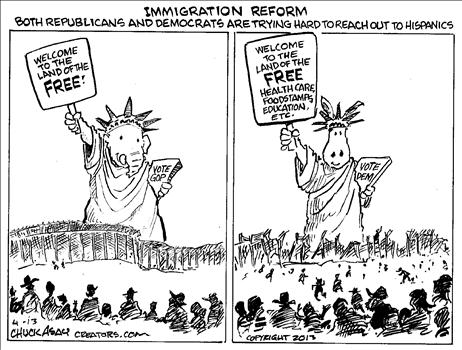
And to be perfectly honest, I also worry about the political implications of any policy that increases the number of people who – on net – will vote for redistribution. I could do without the partisan implications, but this Chuck Asay cartoon captures my concerns.

Immigration Cartoon

I also think that people respond to incentives. Another round of amnesty almost surely will encourage further illegal immigration. Putting myself in the position of a poor person in the developing world, I would logically conclude that it would just be a matter of time, so I would sneak across the border in order to take advantage of that future amnesty.

That doesn’t strike me as a good approach. Far better to figure out how to genuinely reform the system.

By the way, a senior staffer on Capitol Hill floated to me the idea of a new status that enables illegals to stay in the country, but bars them from citizenship unless they get in line and follow the rules. I’m definitely not familiar with the fault lines on these issues, but perhaps that could be a good compromise.

And it goes without saying that I want the strictest possible limits on access to welfare programs and other government handouts for immigrants, regardless of their status.

So, like everybody else, I want border security and some form of legalization as part of a new system that brings people to America for the right reason. See, I’m the epitome of reasonableness.

P.S. If you want to enjoy some immigration-related humor, we have a video about Americans migrating to Peru and a story about American leftists escaping to Canada.

P.P.S. On the issue of birthright citizenship, I’ve shared some interesting analysis from Will Wilkinson and George Will.

Two very wise men below:

View Image

Milton Friedman – Illegal Immigration – PT 1

(1 of 2) Professor Friedman looks at the dynamics of illegal immigration. See part two: http://www.youtube.com/watch?v=NfU9Fqah-f4 http://Libertypen.com

_______________________________________

Back in 1980 I read the book “Free to Choose” by Milton and Rose Friedman. I noticed that Milton made it clear both in the book and in the film series of the same name that immigration was good for America in the past. However, since the USA changed to a welfare state, we could no longer have a tremendous amount of legal immigration because it was overload the welfare state!!!!

Milton Friedman in a lecture at Stanford asserted:

 “I’ve always been amused by a kind of a paradox. Suppose you go around and ask people: ‘The United States before 1914, as you know, had completely free immigration. Anybody could get in a boat and come to these shores and if landed at Ellis Island he was an immigrant. Was that a good thing or a bad thing?”

You will find that hardly a soul who will say that it was a bad thing. Almost everybody will say it was a good thing. ‘But what about today? Do you think we should have free immigration?’ ‘Oh, no,’ they’ll say, ‘We couldn’t possibly have free immigration today. Why, that would flood us with immigrants from India, and God knows where. We’d be driven down to a bare subsistence level.’

What’s the difference? How can people be so inconsistent? Why is it that free immigration was a good thing before 1914 and free immigration is a bad thing today? Well, there is a sense in which that answer is right. There’s a sense in which free immigration, in the same sense as we had it before 1914 is not possible today. Why not?

Because it is one thing to have free immigration to jobs. It is another thing to have free immigration to welfare. And you cannot have both. If you have a welfare state, if you have a state in which every resident is promises a certain minimal level of income, or a minimum level of subsistence, regardless of whether he works or not, produces it or not. Then it really is an impossible thing.

(For a more full discussion check this out)

I was perplexed at the time that Friedman’s ideology had to take a backseat to the real world that liberals had taken over!!! That is exactly the case here.

Milton Friedman – Illegal Immigration – PT 2

(2 of 2) Professor Friedman fields a question on the dynamics of illegal immigration. http://LibertyPen.com

According to Wikipedia here are Ron Paul’s views on Borders and immigration:

Paul considers it a “boondoggle” for the U.S. to spend much money policing other countries’ borders (such as the IraqSyria border) while leaving its own borders porous and unpatrolled;[32] he argues the U.S.–Mexico border can be crossed by anyone, including potential terrorists.[52] During the Cold War, he supported Reagan’s Strategic Defense Initiative,[53] intended to replace the “strategic offense” doctrine of mutual assured destruction with strategic defense.

Paul believes illegal aliens take a toll on welfare and Social Security and would end such benefits, concerned that uncontrolled immigration makes the U.S. a magnet for illegal aliens, increases welfare payments, and exacerbates the strain on an already highly unbalanced federal budget.[54]

Paul believes that illegal immigrants should not be given an “unfair advantage” under law.[55] He has advocated for a “coherent immigration policy”, and has spoken strongly against amnesty for illegal aliens because he believes it undermines the rule of law, grants pardons to lawbreakers,[56] and subsidizes more illegal immigration.[57] Paul voted for the Secure Fence Act of 2006, authorizing an additional 700 miles (1100 kilometers) of double-layered fencing between the U.S. and Mexico mainly because he wanted enforcement of the law and opposed amnesty, not because he supported the construction of a border fence.[58]

Paul believes that mandated hospital emergency treatment for illegal aliens should be ceased and that assistance from charities should instead be sought because there should be no federal mandates on providing health care for illegal aliens.[58]

Paul also believes children born in the U.S. to illegal aliens should not be granted automatic birthright citizenship.[59] He has called for a new Constitutional amendment to revise fourteenth amendment principles and “end automatic birthright citizenship”,[60] and believes that welfare issues are directly tied to the illegal immigration problem.[61]

Related posts:

Dan Mitchell on Texas v. California (includes editorial cartoon)

We should lower federal taxes because jobs are going to states like Texas that have low taxes. What Can We Learn by Comparing the Employment Situation in Texas vs. California? April 3, 2013 by Dan Mitchell One of the great things about federalism, above and beyond the fact that it both constrains the power of governments […]

Cartoons from Dan Mitchell’s blog on Obamacare

Third-Party Payer is the Biggest Economic Problem With America’s Health Care System Published on Jul 10, 2012 This mini-documentary from the Center for Freedom and Prosperity Foundation explains that “third-party payer” is the main problem with America’s health care system. This is why undoing Obamacare, while desirable, is just a small first step if we […]

Obamacare cartoons from Dan Mitchell’s blog

I have put up lots of cartoons from Dan Mitchell’s blog before and they have got lots of hits before. Many of them have dealt with the economy, eternal unemployment benefits, socialism,  Greece,  welfare state or on gun control. The funniest cartoon is the one with “Nurse Sebelius” stuffing the huge capsule down the kid’s throat!!! Obamacare […]

Editorial cartoon from Dan Mitchell’s blog on California’s sorry state of affairs

I have put up lots of cartoons from Dan Mitchell’s blog before and they have got lots of hits before. Many of them have dealt with the sequester, economy, eternal unemployment benefits, socialism,  minimum wage laws, tax increases, social security, high taxes in California, Obamacare,  Greece,  welfare state or on gun control. President Obama’s favorite state must be California because […]

Dan Mitchell of the Cato Institute:HUD has to go!!!! (includes political cartoon)

You want a suggestion on how to cut the government then start at HUD. I would prefer to eliminate all of it. Here are Dan Mitchell’s thoughts below: Sequestration’s Impact on HUD: Just 358 More Days and Mission Accomplished March 12, 2013 by Dan Mitchell As part of my “Question of the Week” series, I had […]

Dan Mitchell: Cartoonists React to the Senate Democratic Budget

I read that President Obama in his meetings with the Republicans would not even say that a balanced budget was a goal. According to the budget presented by the Democratic Senate he is in agreement with their approach. Cartoonists have taken the opportunity to poke fun at that below. I  have put up lots of cartoons […]

Cartoons from Dan Mitchell’s blog that demonstrate what Obama is doing to our economy Part 6

  I have put up lots of cartoons from Dan Mitchell’s blog before and they have got lots of hits before. Many of them have dealt with the sequester, economy, eternal unemployment benefits, socialism,  minimum wage laws, tax increases, social security, high taxes in California, Obamacare,  Greece,  welfare state or on gun control. Here is another one. This Cartoon Does […]

Cartoons from Dan Mitchell’s blog that demonstrate what Obama is doing to our economy Part 3.3 (Unemployment laws)

I have put up lots of cartoons from Dan Mitchell’s blog before and they have got lots of hits before. Many of them have dealt with the economy, eternal unemployment benefits, socialism,  Greece,  welfare state or on gun control. The Perverse Unintended Consequences of Anti-Discrimination Laws February 23, 2013 by Dan Mitchell I recently wrote about the pinheads […]

Another funny gun poster from Dan Mitchell’s blog

  I have taken the time to write President Obama on this issue of gun control several times and have even got a letter back from the White House on it. Plus a friend of mine by the name of Charlie Collins has even put forth bills in the Arkansas State House of Representatives concerning […]

Another funny sequester cartoon from Dan Mitchell’s blog

I have put up lots of cartoons from Dan Mitchell’s blog before and they have got lots of hits before. Many of them have dealt with the economy, eternal unemployment benefits, socialism,  Greece,  welfare state or on gun control. As Humorously Explained by Henry Payne, the World Amazingly Didn’t End When Uncle Sam Got Put on a […]

Will President give up any control of Medicaid program to the states?

CATO Institute Michael Cannon on the OReilly Factor

Published on Mar 19, 2013

The CATO Institute’s Michael Cannon spoke at the Arkansas Conservative Caucus on Tuesday March 19th. Several conservatives were present. Cannon talked about how to defeat Obamacare in Arkansas & how the states can stop Obamacare on a national level.

Max Brantley of the Arkansas Times Blog linked an article that I read this morning. Republicans in Arkansas are cited in a very interesting article in politico on 4-7-13 called, “Obamacare foes using it for Medicaid control.” Let me share with you the last few sentences from that article and then ask you a question: 

Some experts are convinced that the wave of Republican governors willing to deal could be short-lived, particularly if the Obama administration’s promised flexibility turns out to be a facade.

Smith, the D.C.-based Republican health care consultant, said the White House’s concept of state flexibility may have narrowed. HHS issued a memo late last month reminding states that even if they buy private insurance with Medicaid money, the beneficiaries will still be considered part of Medicaid. That means they’re entitled to the same benefits as traditional Medicaid recipients — with little room for tinkering by the states.

“The governors are looking for ways to fix Medicaid, and they’re getting mixed signals out of the administration, and I think that is kind of frustrating to governors,” Smith said. “They’re trying to figure out whether there’s going to be any real flexibility.”

Having the talks come to a crashing halt would be just fine with some on the right, who don’t want Medicaid expansion on anyone’s terms and who see any HHS promise of flexibility as a mirage. “Medicaid expansion of any kind is anti-free market,” Americans for Prosperity President Tim Phillips said recently. Rather than any hybrid Obamacare solutions, he said, “We should be taking on comprehensive, free-market Medicaid reform that can improve the health of patients while controlling costs in the long term.”

CAN YOU TRUST PRESIDENT OBAMA TO KEEP HIS WORD AND DO YOU THINK HE WILL GIVE UP ANY CONTROL OF MEDICAID?

Related posts:

Michael Cannon of Cato Institute speaks to Arkansas Senators (Part 3 includes editorial cartoon)

Jacque Martin asks CATO Institute Michael Cannon about Obamacare Published on Mar 19, 2013 The CATO Institute’s Michael Cannon spoke at the Arkansas Conservative Caucus on Tuesday March 19th. Several conservatives were present. Cannon talked about how to defeat Obamacare in Arkansas & how the states can stop Obamacare on a national level. Jacque Martin […]

After visit to Arkansas Cato’s Michael Cannon puts out new article

  After a visit to Arkansas on March 19, 2013 the Cato Institute’s Michael Cannon published another article claiming that “To date, 34 states, accounting for roughly two-thirds of the U.S. population, have refused to create Exchanges. Under the statute, this shields employers in those states from a $2,000 per worker tax that will apply […]

Michael Cannon of Cato Institute speaks to Arkansas Senators (Part 2 includes editorial cartoon)

Representative Doug House asks CATO Institute Michael Cannon about Obamacare Published on Mar 19, 2013 The CATO Institute’s Michael Cannon spoke at the Arkansas Conservative Caucus on Tuesday March 19th. Several conservatives were present. Cannon talked about how to defeat Obamacare in Arkansas & how the states can stop Obamacare on a national level. Representative […]

Michael Cannon on Obamacare (editorial cartoons on Judge Roberts and Obamacare)

Representative Bollinger asks CATO Institute Michael Cannon about Obamacare Published on Mar 19, 2013 The CATO Institute’s Michael Cannon spoke at the Arkansas Conservative Caucus on Tuesday March 19th. Several conservatives were present. Cannon talked about how to defeat Obamacare in Arkansas & how the states can stop Obamacare on a national level. Representative Bollinger […]

Michael Cannon of Cato Institute speaks to Arkansas Senators (Part 1, includes editorial cartoon)

An ObamaCare Debate Challenge (Michael F. Cannon) CATO Institute Michael Cannon at the Arkansas Conservative Caucus Published on Mar 19, 2013 The CATO Institute’s Michael Cannon spoke at the Arkansas Conservative Caucus on Tuesday March 19th. Several conservatives were present. Cannon talked about how to defeat Obamacare in Arkansas & how the states can stop […]

Max Brantley of the Ark Times takes on Michael Cannon of the Cato Institute today concerning Obamacare

Max Brantley of the Ark Times takes on Michael Cannon of the Cato Institute today concerning Obamacare. I have posted many links to Cannon’s articles in the past on my blog and on the Arkansas Times liberal blog. The finest article written in my estimation was written on Nov 20, 2012 and here is a […]

Is Michael Cannon of the Cato Institute right about states blocking Obamacare, factchecker says he is wrong.

Cato’s Michael F. Cannon Discusses ObamaCare’s Individual Mandate Is Michael Cannon of the Cato Institute right about states blocking Obamacare, factchecker says he is wrong. I Have Been False* Posted by Michael F. Cannon *According to PolitiFact. In an unconscious parody of everything that’s wrong with the “fact-checker” movement in journalism, PolitiFact Georgia (a project of […]

An ObamaCare Debate Challenge by Michael F. Cannon (editorial cartoon)

Obamacare is a poorly written and because of that the majority of states may never have to put into practice.   February 28, 2013 2:13PM ObamaCare Debate Challenge: Lawrence Wasden Edition By Michael F. Cannon Share Tweet Like Google+1 Congress empowered states to block major provisions of ObamaCare, including its subsidies and employer mandate. All […]


Open letter to President Obama (Part 291)


President Obama c/o The White House
1600 Pennsylvania Avenue NW
Washington, DC 20500

Dear Mr. President,

I know that you receive 20,000 letters a day and that you actually read 10 of them every day. I really do respect you for trying to get a pulse on what is going on out here. 

There have been many articles written by evangelicals like me who fear that our founding fathers would not recognize our country today because secular humanism has rid our nation of spiritual roots. I am deeply troubled by the secular agenda of those who are at war with religion in our public life.

Lillian Kwon quoted somebody that I respect a lot  in her article, “Christianity losing out to Secular Humanism?” :

“Most of the founding fathers of this nation … built the worldview of this nation on the authority of the Word of God,” Ken Ham said. “Because of that, there have been reminders in this culture concerning God’s Word, the God of creation.”

At the time I started this series I was in Boston, MA which was the home of John Adams. I have toured his home and found it very interesting. SO MANY FOUNDING FATHERS ARE FROM MASSACHUSETTS!!!

David Barton, 05-2008

A Few Declarations of Founding Fathers and  early Statesmen on Jesus Christianity and the Bible

Today we look at Samuel Adams

Samuel Adams 

SIGNER OF THE DECLARATION OF INDEPENDENCE; “FATHER OF THE AMERICAN REVOLUTION”; RATIFIER OF THE U. S. CONSTITUTION; GOVERNOR OF MASSACHUSETTS 

I . . . [rely] upon the merits of Jesus Christ for a pardon of all my sins.10

The name of the Lord (says the Scripture) is a strong tower; thither the righteous flee and are safe [Proverbs 18:10]. Let us secure His favor and He will lead us through the journey of this life and at length receive us to a better.11

I conceive we cannot better express ourselves than by humbly supplicating the Supreme Ruler of the world . . . that the confusions that are and have been among the nations may be overruled by the promoting and speedily bringing in the holy and happy period when the kingdoms of our Lord and Savior Jesus Christ may be everywhere established, and the people willingly bow to the scepter of Him who is the Prince of Peace.12

He also called on the State of Massachusetts to pray that . . .

  • the peaceful and glorious reign of our Divine Redeemer may be known and enjoyed throughout the whole family of mankind.13
  • we may with one heart and voice humbly implore His gracious and free pardon through Jesus Christ, supplicating His Divine aid . . . [and] above all to cause the religion of Jesus Christ, in its true spirit, to spread far and wide till the whole earth shall be filled with His glory.14
  • with true contrition of heart to confess their sins to God and implore forgiveness through the merits and mediation of Jesus Christ our Savior.15
  • ____________
  • Thank you so much for your time. I know how valuable it is. I also appreciate the fine family that you have and your commitment as a father and a husband.

    Sincerely,

    Everette Hatcher III, 13900 Cottontail Lane, Alexander, AR 72002, ph 501-920-5733, lowcostsqueegees@yahoo.com

“Music Monday” All-American Rejects Part 4 (Leadsingers Tyson Ritter and Gene Simmons have something in common)

In-Studio Interviews – Tyson Ritter ‘The All American Rejects’ Interview: Kids In The Street

I enjoyed the concert in Little Rock on 12-13-12, and lead singer Tyson Ritter wrote a song on his latest cd that we should all pay attention to because it covers an issue that both him and many other lead singers in rock bands have dealt with.

Beekeeper’s Daughter is about a guy who uses women and has lost sight of what it means to treat women with respect. It reminds me of what I saw a while back on the weekly show “Gene Simmons Family Jewels.”

Here Gene Simmons the lead singer of KISS experiences the same type of life that Tyson Ritter, the lead singer of All-American Rejects the two years in LA when he slept with every woman that he could.

The only difference is that Gene is actually married. However, many of the consequences are the same. Below is a picture of Gene’s wife.

Gene-Simmons-tvae-21.jpg

On the show Gene Simmons Family Jewels, Shannon Tweed, 54 yrs old, is the mother of Gene’s two kids and she has been with Gene for 28 yrs but now she is looking for more committment from Gene. She wants him to stop cheating on her.

In the July 19th episode  Nick said to his father “You were a great father but not a good spouse.” Sophie went even farther and said that Gene “was not a good dad.” Both of these clips were repeated in this week’s episode on July 26th.

The pain of finding out that her father had lied to her about being faithful to their mother really must have hurt Sophie  in a tremendous way.

In the message that Brandon Barnard brought to Fellowship Bible Church on July 24th he made a big point at the beginning of the message that many people don’t like to talk about this topic of sexual purity. The battle for purity is raging all around us. Brandon is very correct on this point because I turn on the show “Gene Simmons Family Jewels” every week and that is exactly what I see.

Brandon mentioned that when ever you go to the doctor if you have a broken bone, then he will press against it until you react. They catch that tender spot and press against it until you say, yes that is exactly where it is. It identifies where it is broken and there is a lot of pain. That is the same way that Proverbs will treat us on the subject of sexual purity in chapters 5, 6 and 7.

In the show “Gene Simmons Family Jewels,” Gene wants his kids included in the counseling session, but all of sudden his kids say that their father has the problem. Then faced with both his counselor, his wife (Shannon is his wife practically speaking) and now his kids all saying that he has the problem, then he responds that he thought this was going to be a fun day.

ADVICE FOR GENE SIMMONS: READ PROVERBS 5, 6, 7, AND SEE WHAT THE BIBLE SAYS ABOUT BEING COMMITTED TO THE WIFE OF YOUR YOUTH?

Brandon Barnard  started off the sermon on July 24th at Fellowship Bible Church by reading three chapters from Proverbs. Here are the verses:

Proverbs 5:1-23

English Standard Version (ESV)

Proverbs 5

Warning Against Adultery

1 My son, be attentive to my wisdom;
incline your ear to my understanding,
2that you may keep discretion,
and your lips may guard knowledge.
3For the lips of a forbidden[a] woman drip honey,
and her speech[b] is smoother than oil,
4but in the end she is bitter as wormwood,
sharp as a two-edged sword.
5Her feet go down to death;
her steps follow the path to[c] Sheol;
6she does not ponder the path of life;
her ways wander, and she does not know it. 7And now, O sons, listen to me,
and do not depart from the words of my mouth.
8Keep your way far from her,
and do not go near the door of her house,
9lest you give your honor to others
and your years to the merciless,
10lest strangers take their fill of your strength,
and your labors go to the house of a foreigner,
11and at the end of your life you groan,
when your flesh and body are consumed,
12and you say, “How I hated discipline,
and my heart despised reproof!
13I did not listen to the voice of my teachers
or incline my ear to my instructors.
14 I am at the brink of utter ruin
in the assembled congregation.”

15Drink water from your own cistern,
flowing water from your own well.
16Should your springs be scattered abroad,
streams of water in the streets?
17 Let them be for yourself alone,
and not for strangers with you.
18Let your fountain be blessed,
and rejoice in the wife of your youth,

19a lovely deer, a graceful doe.
Let her breasts fill you at all times with delight;
be intoxicated[d] always in her love.
20Why should you be intoxicated, my son, with a forbidden woman
and embrace the bosom of an adulteress?[e]
21For a man’s ways are before the eyes of the LORD,
and he ponders[f] all his paths.
22The iniquities of the wicked ensnare him,
and he is held fast in the cords of his sin.
23 He dies for lack of discipline,
and because of his great folly he is led astray.

Proverbs 6:20-35

English Standard Version (ESV)

Warnings Against Adultery

20 My son, keep your father’s commandment,
and forsake not your mother’s teaching.
21 Bind them on your heart always;
tie them around your neck.
22 When you walk, they[a] will lead you;
when you lie down, they will watch over you;
and when you awake, they will talk with you.
23For the commandment is a lamp and the teaching a light,
and the reproofs of discipline are the way of life,
24to preserve you from the evil woman,[b]
from the smooth tongue of the adulteress.[c]
25 Do not desire her beauty in your heart,
and do not let her capture you with her eyelashes;
26for the price of a prostitute is only a loaf of bread,[d]
but a married woman[e] hunts down a precious life.
27Can a man carry fire next to his chest
and his clothes not be burned?
28Or can one walk on hot coals
and his feet not be scorched?
29So is he who goes in to his neighbor’s wife;
none who touches her will go unpunished.
30People do not despise a thief if he steals
to satisfy his appetite when he is hungry,
31but if he is caught, he will pay sevenfold;
he will give all the goods of his house.
32He who commits adultery lacks sense;
he who does it destroys himself.
33He will get wounds and dishonor,
and his disgrace will not be wiped away.
34For jealousy makes a man furious,
and he will not spare when he takes revenge.
35He will accept no compensation;
he will refuse though you multiply gifts.

Proverbs 7:6-27

English Standard Version (ESV)

 6For at the window of my house
I have looked out through my lattice,
7and I have seen among the simple,
I have perceived among the youths,
a young man lacking sense,
8passing along the street near her corner,
taking the road to her house
9in the twilight, in the evening,
at the time of night and darkness.

10And behold, the woman meets him,
dressed as a prostitute, wily of heart.[a]
11She is loud and wayward;
her feet do not stay at home;
12now in the street, now in the market,
and at every corner she lies in wait.
13She seizes him and kisses him,
and with bold face she says to him,
14“I had to offer sacrifices,[b]
and today I have paid my vows;
15so now I have come out to meet you,
to seek you eagerly, and I have found you.
16I have spread my couch with coverings,
colored linens from Egyptian linen;
17I have perfumed my bed with myrrh,
aloes, and cinnamon.
18Come, let us take our fill of love till morning;
let us delight ourselves with love.
19For my husband is not at home;
he has gone on a long journey;
20he took a bag of money with him;
at full moon he will come home.”

21With much seductive speech she persuades him;
with her smooth talk she compels him.
22All at once he follows her,
as an ox goes to the slaughter,
or as a stag is caught fast[c]
23till an arrow pierces its liver;
as a bird rushes into a snare;
he does not know that it will cost him his life.

24And now, O sons, listen to me,
and be attentive to the words of my mouth.
25Let not your heart turn aside to her ways;
do not stray into her paths,
26for many a victim has she laid low,
and all her slain are a mighty throng.
27Her house is the way to Sheol,
going down to the chambers of death.

The All-American Rejects – Beekeeper’s Daughter

Beekeeper’s Daughter

From Wikipedia, the free encyclopedia


Jump to: navigation, search

“Beekeeper’s Daughter”
Single by The All-American Rejects
from the album Kids in the Street
Released January 31, 2012
(see release history)
Format Digital download
Recorded 2011
Genre Alternative rock, power pop
Length 3:33
Label Interscope, DGC
Writer(s) Nick Wheeler, Tyson Ritter
Producer Greg Wells
The All-American Rejects singles chronology
I Wanna
(2009)
Beekeeper’s Daughter
(2012)
Kids in the Street
(2012)

Beekeeper’s Daughter” is a song by American rock band The All-American Rejects, released as the lead single from their fourth studio album Kids in the Street on January 31, 2012.

Contents

 [hide

[edit] Background and composition

“Beekeeper’s Daughter” was written by Tyson Ritter and Nick Wheeler, the song captures a tumultuous time while Ritter was living in Los Angeles after wrapping two years of touring behind the band’s 2008 album When the World Comes Down.

“‘Beekeeper’s Daughter’ is a story about a guy who thinks he can get away with anything and always have a girl there waiting for him,” Ritter says. “He never backs down from that opinion. At the end of it, he’s even stronger and more snide and thinks he’s invincible no matter what. He’s an asshole, but at that point in my life, I was kind of an asshole. As we were making Kids in the Street, I went from that to being a completely humbled guy who’s looking at his reflection saying, ‘Wow, what have I done?’ It may make me not seem very likeable, but it was important that I be truthful and really open up on this album about what I’ve been through.”

The song is a mid-tempo track blending pop and rock sounds in an infectious hook. Tyson sings expressively, backed up by a fun melody and an upbeat chorus “that gets stuck in your head.” Ritter explained, “Music, somewhat ‘festive atmosphere’, fits well with the meaning of lyrics. The ending of the song is funny and original too!” Wheeler added how got to use a talk box on the track, “I’m surprised anybody let me do that,” he notes, “but I got a talk box back on the radio, which is cool.”

[edit] Reception

The song has received mixed reviews from music critics. Billboard stated “Although the lyrics fall in line with the Rejects’ usual emotional sensitivities, the band’s sound has moved from earlier, more driving tracks like “Swing, Swing” and “Move Along” to a glossier power-pop sound here. Ritter finds himself confused, facing a common “leave or stay” dilemma with his lover. But while the lyrics have Ritter searching for answers, the melodies confidently amble through the song’s sugary hook. “Beekeeper’s Daughter” may lack the raw, earnest energy of earlier Rejects work, but it’s a fun and memorable romp that brings out the best of their pop side.” [1]

Stitched Sound was, however, slightly more positive, stating ““Beekeeper’s Daughter” has a feel-good vibe to it that has Tyson Ritter’s unique, well crafted voice wonderfully meshed into the song. The lyrics “You’re a pretty little flower/ I’m a busy little bee” basically scream out adorable. Not to mention that the more orchestrated bridge leading into the chorus is extremely catchy and something we haven’t heard from The All-American Rejects in the past.” [2] Clark Chronicle were also positive, saying “‘Beekeeper’s Daughter’ is one of [the band’s] most enjoyable and successful songs in comparison to their more serious songs from previous albums. The All-American Rejects have once again fulfilled their expectations with an upbeat, fun song that anyone can listen to.” [3]

[edit] Music video

A music video for “Beekeeper’s Daughter”, directed by Isaac Rentz, was shot in late January 2012 [4] and released on February 2 onto Vevo.[4] It evolves around the band’s front-man Tyson Ritter acting carefree while walking through a city after just being rejected by his girlfriend while various pedestrians – some dressed distinctively – take part in dance routines along his way. The video also features a cameo appearance from American singer and entertainer Wayne Newton.

Critically, Promo News said “Isaac Rentz delivers a touch of old Hollywood magic in his song-and-dance promo for All-American Rejects’ Beekeeper’s Daughter. With dancing construction workers, street muggers and camp cops, it’s about as theatrical as you can get”,[5] while MTV described the video as “A big, buzzy clip, brimming with dancing she-devils, cheerleaders, cops, ticker tape, a mariachi band and Mr. Newton (to name just a few). And while everything in the video elicits a thrill, it’s Newton’s cameo that takes the cake.”

“This was the first video where, when we got [the treatment], everyone said ‘yes’ and I said ‘yes … but could we please have some of this?’ And I proceeded to sort of expel every fantastic idea I could think of,” frontman Tyson Ritter explained. “From, like, a hipster fight – beards versus mustaches, a lot of plaid, had to be like ‘West Side Story’ – to some she-devils. Everything we could ever sort of think of for a video that was impractical is in this one. And the whole thing is floating on a through-line of a man walking through his day, experiencing every random encounter from every random walk of life,” he continued. “And at the very end, there’s a big parade with Wayne Newton.” [6]

[edit] Appearances in popular culture

“Beekeeper’s Daughter” first premiered in the plenitude episode of the fourth season of American teen drama 90210 featuring an appearance from the band as themselves playing the song.[7]

[edit] Track listing

Digital download
  • “Beekeeper’s Daughter” – 3:33

[edit] Charts

Chart (2012) Peak
position
UK Singles Chart[8] 132
US Billboard Bubbling Under Hot 100 Singles 24
US Billboard Pop Songs 38
US Billboard Adult Pop Songs 30

[edit] Release history

Country Date Format
United States January 31, 2012 Digital download
Worldwide February 14, 2012 [4]
United Kingdom March 26, 2012 [9]

_________________________

Related posts:

“Tip Tuesday” Advice to Gene Simmons (Part 18)

Below is an article on the show: (This came out several months ago) Gene Simmons gets ‘whipped’ on ‘Family Jewels’ Amanda Edwards / Getty Images Contributor Gene Simmons took his son Nick to Israel, where the KISS frontman was born. By Randee Dawn, TODAY.com contributor It seemed that “Gene Simmons Family Jewels” might end prematurely: After Simmons’ […]

“Tip Tuesday” Advice to Gene Simmons part 17

I really hope that Gene Simmons and his wife Shannon Tweed really do have a successful marriage that lasts forever. However, when people live together statistics show it is usually an uphill battle to have a marriage that lasts. Take Kim Kardashian for instance. Here is an article that I found helpful below: Cohabitation Confusion: […]

“Tip Tuesday” Advice to Gene Simmons (Part 16)

  Gene, 61, and Shannon, 54, have been together for 27 years and have two children, Nicholas, 22, and Sophie, 19. I READ THIS ARTICLE BELOW A FEW MONTHS AGO. MAYBE THINGS HAVE CHANGED SINCE THEN. Fans of Gene Simmons’ Family Jewels may be asking themselves “Are Gene Simmons and Shannon Tweed engaged or what?” This […]

“Tip Tuesday” Advice to Gene Simmons (Part 15)

(On last night’s episode on Oct 17, 2011, Gene Simmons admitted that he did not have a problem with his head or his heart but with his sexual desires that have been allowed to get what they want anytime they want it with whomever they desired. ) Gene Simmons and Shannon Tweed Shannon Tweed and […]

“Tip Tuesday” Advice to Gene Simmons (Part 14)

Gene Simmons and Shannon Tweed   People Magazine reported: You can’t always believe what you see on reality TV. Case in point: KISS bassist Gene Simmons finally proposed to longtime girlfriend Shannon Tweed. Turns out, the proposal scene in Tuesday night’s finale of A&E’s reality show Gene Simmons Family Jewels was taped “several months ago,” […]

“Tip Tuesday” Advice to Gene Simmons (Part 13)

Gene Simmons and Shannon Tweed Gene, 61, and Shannon, 54, have been together for 27 years and have two children, Nicholas, 22, and Sophie, 19. The ‘Rock and Roll All Nite’ hitmaker has previously made his views on marriage very clear, saying in 2007: “The problem with marriage is somebody else has a right to […]

“Tip Tuesday” Advice to Gene Simmons (Part 12)

Gene, 61, and Shannon, 54, have been together for 27 years and have two children, Nicholas, 22, and Sophie, 19. The ‘Rock and Roll All Nite’ hitmaker has previously made his views on marriage very clear, saying in 2007: “I don’t believe man is designed to be married. Marriage means nothing to me. Happiness means […]

“Tip Tuesday” Advice for Gene Simmons (Part 11) Fellowship Bible Church July 24th

Gene Simmons and his son Nick (Refer to end of post for more on Nick and Gene) 28 July 2011 Gene Simmons has proposed to long-term girlfriend Shannon Tweed. The Kiss bassist – who claims to have slept with over 2,000 women and has for a long time vowed never to marry – popped the question […]

“Tip Tuesday” Advice for Gene Simmons (Part 10),

Nick is Gene and Shannon’s son and he appears often on Gene Simmons Family Jewels show. Gene Simmons has been guilty of having affairs while on tour for years. On July 19th episode of Gene Simmons Family Jewels he told his tour manager that he was not going to the after party. Then he said […]

“Tip Tuesday,” Advice to Gene Simmons Part 9, Fellowship Bible Church July 24th

Gene Simmons and Shannon Tweed John McArthur The Truth About Divorce, #2 (Mark 10:1-12) On the show Gene Simmons has been arguing the point that he admits that he is selfish, but he still feels he has the right to be selfish. In the conclusion of the final episode of the year on July 24th […]

“Tip Tuesday” Advice to Gene Simmons (Part 19) Fellowship Bible Church Service July 24th

On the show Gene Simmons Family Jewels, Shannon Tweed, 54 yrs old, is the mother of Gene’s two kids and she has been with Gene for 28 yrs but now she is looking for more committment from Gene. She wants him to stop cheating on her. In the July 19th episode  Nick said to his […]


Advice to Gene Simmons Part 8, (“Tip Tuesday” Part D)

Gene Simmons and Shannon Tweed The series I have been doing on “Advice to Gene Simmons” that I am starting what I am calling “Tip Tuesday.” For the next few months we will be looking at the Simmons family. In the July 19th episode  Nick said to his father “You were a great father but […]

Advice to Gene Simmons Part 7, (“Tip Tuesday Part C)jh17a

__________________________________ Gene Simmons Family Jewels The series I have been doing on “Advice to Gene Simmons” that I am starting what I am calling “Tip Tuesday.” For the next few months we will be looking at the Simmons family. In the July 19th episode  Nick said to his father “You were a great father but […]

Advice to Gene Simmons Part 6, (“Tip Tuesday” Part B)jh16a

Gene Simmons Family Jewels, Shannon Tweed, 54 yrs old, has been with Gene Simmons 27 years and raised two children with him. The series I have been doing on “Advice to Gene Simmons” that I am starting what I am calling “Tip Tuesday.” For the next few months we will be looking at the Simmons […]

Advice to Gene Simmons Part 5, (“Tip Tuesday” Part A) jh15a

Gene Simmons Family Jewels Adrian Rogers – [2/3] How to Cultivate a Marriage The series I have been doing on “Advice to Gene Simmons” that I am starting what I am calling “Tip Tuesday.” For the next few months we will be looking at the Simmons family. On July 19th on Gene Simmons Jewels, in a […]


Taking on Ark Times Bloggers on various issues Part F “Carl Sagan’s views on how God should try and contact us” includes film “The Basis for Human Dignity”

I have gone back and forth and back and forth with many liberals on the Arkansas Times Blog on many issues such as abortion, human rights, welfare, poverty, gun control  and issues dealing with popular culture. Here is another exchange I had with them a while back. My username at the Ark Times Blog is Saline Republican.

On 2-21-13 on the Arkansas Times Blog  the person using the username “Olphart” asserted: 

” then there is no final appeal to judge between individuals and groups whose moral judgements conflict.”

Then why don’t you appeal “Roe vs Wade” to God? Obviously, that is WHOM you mean. Sounds OK to me, appeal all decisions by SCOTUS to God. While you’re at it, appeal all the officials’ decisions in the NFL, and the NCAA to God as well. Tim Tebow would certainly benefit from this if they ever actually let him play again. And don’t even suggest that this is silly because if God notes the falling of every sparrow then this won’t be any problem for the AllMighty. One thing, the decisions must come in writing, direct from Heaven and not from some self-appointed earthly representative such as yourself.

On 2-21-13 on the Arkansas Times Blog  I responded: 

Olphart you suggest that the Almighty hand down written decisions to us if he wants us to follow him. That reminds me of what Carl Sagan suggested.

I have read lots of Carl Sagan’s books and written several reviews and papers on his views. I will just leave you with this thought.

Sagan observed,”Plainly, there’s something within me that’s ready to believe in life after death…If some good evidence for life after death was announced, I’d be eager to examine it; but it would have to be real scientific data, not mere antedote”(pp 203-204, The DemonHaunted World, 1995). 

Sagan said he had taken a look at Old Testament prophecy and it did not impress him because it was too vague. He had taken a look at Christ’s life in the gospels, but said it was unrealistic for God to send a man to communicate for God. Instead, Sagan suggested that God could have written a mathematical formula in the Bible or put a cross in the sky.However, what happens at the conclusion of the movie Contact?  This is Sagan’s last message to the world in the form of the movie that appeared shortly after his death. Dr Arroway (Jodie Foster) who is a young atheistic scientist who meets with an alien and this alien takes the form of Dr. Arroway’s father. The alien tells her that they thought this would make it easier for her. In fact, he meets her on a beach that resembles a beach that she grew up near so she would also be comfortable with the surroundings. Carl Sagan when writing this script chose to put the alien in human form so Dr. Arroway could relate to the alien. Christ chose to take our form and come into our world too and still many make up excuses for not believing.

Olphart you have a head knowledge of the Bible and you say you would accept written decisions from God but you would not. Just like Sagan you set out stipulations for God but He has given you sufficient evidence through Old Testiment prophecies such as the one on the destruction of Tyre and also Psalms 22 and Isaiah 53.You do not accept them because of intellectual problems but you want your independence. Very smart people are believers and some dummies too. It has nothing to do with how smart a person is.

__________

In the film series “WHATEVER HAPPENED TO THE HUMAN RACE?” the arguments are presented  against abortion (Episode 1),  infanticide (Episode 2),   euthenasia (Episode 3), and then there is a discussion of the Christian versus Humanist worldview concerning the issue of “the basis for human dignity” in Episode 4 and then in the last episode a close look at the truth claims of the Bible

I truly believe that many of the problems we have today in the USA are due to the advancement of humanism in the last few decades in our society. The  Ronald Reagan appointed the evangelical Dr. C. Everett Koop to the position of Surgeon General in his administration. He partnered with Dr. Francis Schaeffer in making the video below. It is very valuable information for Christians to have.  Actually I have included a video below that includes comments from him on this subject.

___________

Francis Schaeffer and his wife Edith pictured above.

Francis Schaeffer: “Whatever Happened to the Human Race” (Episode 4) THE BASIS FOR HUMAN DIGNITY

Published on Oct 7, 2012 by

________

A great article on the sad case of Roe v Wade:

Blood Guilt…Roe v Wade
http://billrandles.wordpress.com/2011/01/23/blood-guilt-roe-v-wade/ ^ | 1-23-11 | Bill Randles

Posted on Sunday, January 23, 2011 9:32:47 AM by pastorbillrandles

And he said, What hast thou done? the voice of thy brother’s blood crieth unto me from the ground. (Genesis 4:10)

America has recently passed a gruesome milestone, we have had the fifty millionth abortion. It is staggering isn’t it? Fifty million boys and girls since 1973. They would range in age from 1 to 38 years old, had they been allowed to live.

Fifty million people! By now they would have been husbands and wives, mothers and fathers, skilled and unskilled laborers , professionals, scientists, ministers, leaders, who knows what we have forfeited ?

Fifty million human lives snuffed out, for what? Convenience? Liberation? Liberation from what? Liberation from Love? From the beauty of womanhood? Liberated from marriage? In truth we have liberated ourselves from decency, commitment, and innocence.

Let us not forget that every abortion not only kills the precious baby in the womb, but also the mother who either willingly or is subjected or pressured into the barbaric procedure. She too is unalterably deadened to true femininity, tenderness and the natural affection God puts into all female hearts.

Thus we have the specter of the tough, steely, masculine woman, out to prove she can do it better than any man, she is liberated from the feminine, she “can have it all”! Abortion was to be the sacrament that would liberate women everywhere, “You’ve come a long way baby!”.What a cruel, cruel hoax.

The greatest suffering would be borne by women (After the baby of course). How many spiritually and emotionally scarred women there are, bearing the guilt and shame, all because they believed in the feminist propaganda. In allowing the murder of their own child, they have killed something in themselves.

How many young girls have been put under pressure by immoral “boyfriends”, or by cruel parents and even husbands to abort the life God has vouchsafed in their own womb? Shattered and ruined, many of these are on tranquilizers, many more are in some form of fruitless counseling, others have hardened themselves , seeking solace in the ever increasingly shrill and overly defensive feminist movement.

The plague of homosexuality comes out of the ethic that gave us abortion. Abortion was supposed to equalize the genders, women were going to throw off the shackles of pregnancy, and be just as free as any man to be promiscuous. Women have become more like men, because our perverted generation despises the God assigned role of a woman as supporter, nurturer and life bearer.

They have broken the link between sex and fruitful marriage, but the unforseen consequences have proven that they have also broken the link between sex and love. The abortion culture has cheapened sex, marriage, women, human life,commitment,tenderness, and everything that makes human life noble and honorable.

By now we have begun to reap the consequences of the sexual liberation movement, and its ugly, misshapen offspring, abortion on demand. The explosion of sexually transmitted diseases, the millions of shattered families, the debasement of motherhood, and of womanhood in general, were all made much more likely by the tragedy of Jan 22, 1973.

On top of that the loss of 53 million Americans. Who knows how rich, how secure, how robust our nation would be if we had an ethic of life and not death? We certainly wouldn’t have a Social Security problem, nor would we have an illegal immigrant problem. Death is never the answer, Life is. We need more of the Image of God not less.

God is an avenger, especially of the fatherless and most helpless. That is why I believe we are already experiencing God’s righteous judgment. Blood spilt on the ground cries out to Him, and we should not imagine He doesn’t regard. A sparrow cannot fall out of a tree somewhere without God’s attention, a baby is worth much, much more than a sparrow.

On this anniversary of Roe v Wade, 53 million innocent lives and 38 years later, I tremble when I remember that A Holy God knows still, what a millstone is, and which people and nations deserve to wear one and be thrown into the sea.

We have in Kermit Gosnell a perfect and fitting poster child for the monsters the culture of death has made us into. This Philadelphia “health provider”,(Don’t you just love the Orwellian Newspeak), running a squalid abortion mill in Philadelphia, actually delivered eight full term babies and killed them with scissors. He would often use those scissors to break the infant spines in their mother’s wombs. He was only brought up on murder charges when a young patient of his died in a botched abortion.

Behold the human face of Roe v Wade! Full sanctioned and licensed by the Government, running a clinic so squalid they found a collection of thirty aborted bodies in it, yet it passed all health inspections until the “botched” abortion killed a young woman.

This bloody and deceitful monster is a sign to us that God’s judgment is coming on this evil generation. We have sold out our christian heritage for a mess of pottage, and the monsters are beginning to emerge. God just thrust a mirror into the face of pro-choice America, the Image is doctor Gosnell.

Francis Schaeffer warned us that rejecting the Christian absolute that was the bedrock of our culture would have unthinkable consequences,

If man is not made in the image of God, nothing then stands in the way of inhumanity. There is no good reason why mankind should be perceived as special. Human life is cheapened. We can see this in many of the major issues being debated in our society today: abortion, infanticide, euthanasia, the increase of child abuse and violence of all kinds, pornography (and its particular kinds of violence as evidenced in sadomasochism), the routine torture of political prisoners in many parts of the world, the crime explosion, and the random violence which surrounds us. (Francis A. Schaeffer and C. Everette Koop, Whatever Happened to the Human Race?, Ch. 1)

We need to mourn our nation and preach the gospel while there is time.


Related posts:

Francis Schaeffer’s prayer for us in USA

 Francis Schaeffer: “Whatever Happened to the Human Race” (Episode 1) ABORTION OF THE HUMAN RACE Published on Oct 6, 2012 by AdamMetropolis The 45 minute video above is from the film series created from Francis Schaeffer’s book “Whatever Happened to the Human Race?” with Dr. C. Everett Koop. This book  really helped develop my political views […]


Francis Schaeffer’s “How should we then live?” Video and outline of episode 10 “Final Choices” (Schaeffer Sundays)

E P I S O D E 1 0   Dr. Francis Schaeffer – Episode X – Final Choices 27 min FINAL CHOICES I. Authoritarianism the Only Humanistic Social Option One man or an elite giving authoritative arbitrary absolutes. A. Society is sole absolute in absence of other absolutes. B. But society has to be […]

Francis Schaeffer’s “How should we then live?” Video and outline of episode 9 “The Age of Personal Peace and Affluence” (Schaeffer Sundays)

E P I S O D E 9 Dr. Francis Schaeffer – Episode IX – The Age of Personal Peace and Affluence 27 min T h e Age of Personal Peace and Afflunce I. By the Early 1960s People Were Bombarded From Every Side by Modern Man’s Humanistic Thought II. Modern Form of Humanistic Thought Leads […]

Francis Schaeffer’s “How should we then live?” Video and outline of episode 8 “The Age of Fragmentation” (Schaeffer Sundays)

E P I S O D E 8 Dr. Francis Schaeffer – Episode VIII – The Age of Fragmentation 27 min I saw this film series in 1979 and it had a major impact on me. T h e Age of FRAGMENTATION I. Art As a Vehicle Of Modern Thought A. Impressionism (Monet, Renoir, Pissarro, Sisley, […]

Francis Schaeffer’s “How should we then live?” Video and outline of episode 7 “The Age of Non-Reason” (Schaeffer Sundays)

E P I S O D E 7 Dr. Francis Schaeffer – Episode VII – The Age of Non Reason I am thrilled to get this film series with you. I saw it first in 1979 and it had such a big impact on me. Today’s episode is where we see modern humanist man act […]

Francis Schaeffer’s “How should we then live?” Video and outline of episode 6 “The Scientific Age” (Schaeffer Sundays)

E P I S O D E 6 How Should We Then Live 6#1 Uploaded by NoMirrorHDDHrorriMoN on Oct 3, 2011 How Should We Then Live? Episode 6 of 12 ________ I am sharing with you a film series that I saw in 1979. In this film Francis Schaeffer asserted that was a shift in […]

Francis Schaeffer’s “How should we then live?” Video and outline of episode 5 “The Revolutionary Age” (Schaeffer Sundays)

E P I S O D E 5 How Should We Then Live? Episode 5: The Revolutionary Age I was impacted by this film series by Francis Schaeffer back in the 1970′s and I wanted to share it with you. Francis Schaeffer noted, “Reformation Did Not Bring Perfection. But gradually on basis of biblical teaching there […]

Francis Schaeffer’s “How should we then live?” Video and outline of episode 4 “The Reformation” (Schaeffer Sundays)

Dr. Francis Schaeffer – Episode IV – The Reformation 27 min I was impacted by this film series by Francis Schaeffer back in the 1970′s and I wanted to share it with you. Schaeffer makes three key points concerning the Reformation: “1. Erasmian Christian humanism rejected by Farel. 2. Bible gives needed answers not only as to […]

“Schaeffer Sundays” Francis Schaeffer’s “How should we then live?” Video and outline of episode 3 “The Renaissance”

Francis Schaeffer’s “How should we then live?” Video and outline of episode 3 “The Renaissance” Francis Schaeffer: “How Should We Then Live?” (Episode 3) THE RENAISSANCE I was impacted by this film series by Francis Schaeffer back in the 1970′s and I wanted to share it with you. Schaeffer really shows why we have so […]

Francis Schaeffer’s “How should we then live?” Video and outline of episode 2 “The Middle Ages” (Schaeffer Sundays)

  Francis Schaeffer: “How Should We Then Live?” (Episode 2) THE MIDDLE AGES I was impacted by this film series by Francis Schaeffer back in the 1970′s and I wanted to share it with you. Schaeffer points out that during this time period unfortunately we have the “Church’s deviation from early church’s teaching in regard […]

Francis Schaeffer’s “How should we then live?” Video and outline of episode 1 “The Roman Age” (Schaeffer Sundays)

Francis Schaeffer: “How Should We Then Live?” (Episode 1) THE ROMAN AGE   Today I am starting a series that really had a big impact on my life back in the 1970′s when I first saw it. There are ten parts and today is the first. Francis Schaeffer takes a look at Rome and why […]

Francis Schaeffer: “Whatever Happened to the Human Race” (Episode 5) TRUTH AND HISTORY

Francis Schaeffer: “Whatever Happened to the Human Race” (Episode 5) TRUTH AND HISTORY Published on Oct 7, 2012 by AdamMetropolis This crucial series is narrated by the late Dr. Francis Schaeffer and former Surgeon General Dr. C. Everett Koop. Today, choices are being made that undermine human rights at their most basic level. Practices once […]

Francis Schaeffer: “Whatever Happened to the Human Race” (Episode 4) THE BASIS FOR HUMAN DIGNITY

The opening song at the beginning of this episode is very insightful. Francis Schaeffer: “Whatever Happened to the Human Race” (Episode 4) THE BASIS FOR HUMAN DIGNITY Published on Oct 7, 2012 by AdamMetropolis This crucial series is narrated by the late Dr. Francis Schaeffer and former Surgeon General Dr. C. Everett Koop. Today, choices […]

Francis Schaeffer: “Whatever Happened to the Human Race” (Episode 3) DEATH BY SOMEONE’S CHOICE

Francis Schaeffer: “Whatever Happened to the Human Race” (Episode 3) DEATH BY SOMEONE’S CHOICE Published on Oct 6, 2012 by AdamMetropolis This crucial series is narrated by the late Dr. Francis Schaeffer and former Surgeon General Dr. C. Everett Koop. Today, choices are being made that undermine human rights at their most basic level. Practices […]

Francis Schaeffer: “Whatever Happened to the Human Race?” (Episode 2) SLAUGHTER OF THE INNOCENTS

Francis Schaeffer: “Whatever Happened to the Human Race?” (Episode 2) SLAUGHTER OF THE INNOCENTS Published on Oct 6, 2012 by AdamMetropolis This crucial series is narrated by the late Dr. Francis Schaeffer and former Surgeon General Dr. C. Everett Koop. Today, choices are being made that undermine human rights at their most basic level. Practices […]


Francis Schaeffer: “Whatever Happened to the Human Race” (Episode 1) ABORTION OF THE HUMAN RACE

It is not possible to know where the pro-life evangelicals are coming from unless you look at the work of the person who inspired them the most. That person was Francis Schaeffer.  I do care about economic issues but the pro-life issue is the most important to me. Several years ago Adrian Rogers (past president of […]

The following essay explores the role that Francis Schaeffer played in the rise of the pro-life movement. It examines the place of How Should We Then Live?, Whatever Happened to the Human Race?, and A Christian Manifesto in that process.

This essay below is worth the read. Schaeffer, Francis – “Francis Schaeffer and the Pro-Life Movement” [How Should We Then Live?, Whatever Happened to the Human Race?, A Christian Manifesto] Editor note: <p> </p> [The following essay explores the role that Francis Schaeffer played in the rise of the pro-life movement.  It examines the place of […]

Who was Francis Schaeffer? by Udo Middelmann

Great article on Schaeffer. Who was Dr. Francis A. Schaeffer? By Francis Schaeffer The unique contribution of Dr. Francis Schaeffer on a whole generation was the ability to communicate the truth of historic Biblical Christianity in a way that combined intellectual integrity with practical, loving care. This grew out of his extensive understanding of the Bible […]

Remembering Dr. C. Everett Koop with pictures and quotes Part 30 (includes editorial cartoon)

MemFormer Surgeon General C.Everett Koop © A Genuine G-Shot.wmv

Pictured with Ronald Reagan above.

Dr. Koop

This is a picture of Dr. C. Everett Koop with Joycelyn Elders from Little Rock.

On 2-25-13 we lost a great man when we lost Dr. C. Everett Koop. I have written over and over the last few years quoting Dr. C. Everett Koop and his good friend Francis Schaeffer. They both came together for the first time in 1973 when Dr. Koop operated on Schaeffer’s daughter and as a result they became close friends. That led to their involvement together in the book and film series “WHATEVER HAPPENED TO THE HUMAN RACE?” in 1979. Take a look at this article from AFA that was influenced by Dr. Koop’s film with Schaeffer:

By Rusty Benson | AFA Journal Associate EditorWhen does life begin? That thorny question has been at the center of our national debate about abortion for over 30 years. Even for skeptics, advances in medical imaging have pushed the answer earlier and earlier.

On the other end of the life-death continuum, the ability of modern medicine to sustain life has brought its own set of difficult ethical and moral questions: When does life end? Or perhaps more practically, how should life end?

For a country in which life expectancy is approaching 80 years, and for whom 20% of the population will be between the ages of 66 and 84 by 2030, these questions are more than theoretical. Now and in the near future, millions of American families will deal with issues of long-term care of aging or chronically ill loved ones. Many will face troubling end-of-life decisions, such as when to administer or withhold measures that could sustain life.

In the midst of such confusing and emotional issues, powerful social and cultural factors threaten to convince families that “quality of life” supercedes “sanctity of life.” These factors, according to Dr. Kenneth Simcic, include:

A culture in which God is respected less and less as the only giver and taker of life;

A lack of accepted moral absolutes;

The popularity of radical personal autonomy (“my body, my right”);

Families with fewer children to care for aging parents;

Pressure to reduce the cost of health care.

And perhaps most significantly, families will be making life and death decisions against a cultural background of over three decades of killing the most defenseless members of our human community. Is there any doubt that the deaths of 50 million babies since the 1972 Roe v. Wade decision that legalized abortion on demand, have softened many in our society to the notion that underlies the euthanasia movement: some lives are not worth living.

For these reasons and others, euthanasia — also known by such euphemisms as “mercy killing,” “death with dignity” and “the right to die” — is an issue that is certain to come center stage in the near future — or so it would logically seem.

According to Burke J. Balch, director of the Robert Powell Center for Medical Ethics in Washington, D.C., and affiliated with the National Right to Life Committee (NRLC), proponents of euthanasia are achieving their goal without public debate, court decisions or legislation. Balch says that the practice of euthanasia is already quietly but quickly spreading to hospitals across the nation, not in the form of active killing, but through “futile care” policies.

Recognized and argued in prestigious publications such as The Journal of the American Medical Association and The New England Journal of Medicine, the theory of futile care empowers doctors and hospitals to refuse service to patients they deem unworthy of treatment. Practically, that means patients can be killed by withholding nourishment or treatment, even over the objections of the family.

“Unfortunately, many doctors and hospital ethics committees are now arguing they should have a veto over a patient’s request to be allowed to live if the doctor, in disagreement with the patient or the patient’s family, thinks the patient’s ‘quality of life’ is so poor her or his life is not worth living,” Balch wrote in a paper for the NRLC. “They consider ‘medically inappropriate’ not just treatment that will not save a patient’s life, but also treatment that would save life if the life’s quality is deemed poor.”

It’s a “bombshell story” that has largely been ignored by the popular media, according to Wesley Smith, a senior fellow at the Discovery Institute and author of Culture of Death: The Assault on Medical Ethics in America. Smith writes in an article at National Review Online (www.nationalreview.com/comment/comment-smith010603.asp): “The first time most patients and their families become aware that doctors are being given the right to say ‘no’ to wanted medical treatment (other than comfort care) is during a medical crisis when they are at their most defenseless and vulnerable.”

In the crucible
Surrounded by powerful social forces and a modern bioethic that does not believe that all human life is of intrinsic and equal value, how are Christian families to prepare for making decisions that uphold the “sanctity of life” and reject the “quality of life” ethic?

In a recent speech, NRLC Senior Congressional Liaison Lori Kehoe said that although treatment decisions may be complex in their circumstances, the ethics are not difficult for ethical people. “It’s not hard to wrap your mind around when you get down to the basics,” she said.

The difficult part even for mature Christians, however, is practicing those basic principles. To demonstrate the proper application of the “sanctity of life” ethic, Kehoe said, “It is just as wrong for you to fail to preserve your own life as it is for you to shoot yourself in the head. The ethics are simple. If something will work to preserve your own life and you would quickly do it for someone who is young and otherwise healthy, you must do it for your grandmother or yourself.”

Biblical principles
Below is a selection of biblical principles summarized from the teachings of orthodox Christian authors, theologians and ethicists. For a more complete treatment of these and related issues, see the suggested resources above.

1. All human beings are created in the image of God (Gen. 1:26) and therefore have unique dignity and value. This principle is the foundation of the belief that life is sacred from the moment of conception until natural birth.

This view is rejected by many because the values of our society have shifted from a Judeo-Christian foundation to a humanistic and utilitarian one, according to the late Christian thinker Francis Schaeffer. In his 1972 book, Whatever Happened to the Human Race? Schaeffer said that having rejected the Creator God, humanists have convinced our society that all reality, including humans, is simply “one big machine.”

This worldview, in which all things have come into being by chance, drastically reduces the value of human beings, Schaeffer argued, and naturally leads to the practices of abortion and euthanasia.

2. God is sovereign over life and death and we cannot always know His purposes. (Job 1:21; Job 14:5; Acts 17:28; Ps. 139:16)

“Not even the gods of medicine can keep us alive when we are supposed to be dead,” says Kehoe. “We cannot live past our time.” She says this is not only a great comfort when making difficult treatment decisions, but a warning against presuming on God through advanced directives or living wills that could give permission to end a life prematurely.

In applying the principle of God’s sovereignty over all things, Balch observes that by cutting short the dying process, Christians may miss profound opportunities for service, witness and personal growth. “Death is one thing that shows that we are not self-sufficient,” he said.

3. The Bible condemns murder. Kirby Anderson of Probe Ministries writes in an article at www.leadership.com that this includes hastening death in a patient by any means and certainly includes suicide.

“It is not ethical to die simply because you want to,” Kehoe said. Christians must remember that according to 1 Cor. 6:19-20, our bodies are not our own, but belong to Christ, she explained.

On the other hand, Anderson writes that death, being part of the fallen nature of man, is inevitable. Therefore, Christians must reject the notion that everything must be done to save life at all costs. For example, when the time comes that death is imminent, treatments that will only preserve life momentarily need not be administered.

Quality vs. sanctity of life
The practice of euthanasia is under way in many American hospitals, according to Balch, Smith and others. And the stage has been set for the downward slide toward “euthanasia by action,” in which lethal injections are administered by a third party.

“The progression was inevitable,” Anderson writes. “Once society begins to devalue the life of the unborn child, it is but a small step to begin to do the same with a child who has been born. Abortion slides naturally into infanticide and eventually euthanasia.”

If Christians would resist further erosion of the value of life, we must start by clarifying in our own lives — and be willing to publicly declare — the difference in quality of life and sanctity of life.

RESOURCES TO HELP FORM A CHRISTIAN VIEW OF EUTHANASIA
Whatever Happened To The Human Race? By Francis Schaeffer and C. Everett Koop. Crossway Books. Available in paperback and audio cassette from local and online booksellers. Online adaptation available at www.antithesis.
com/features/dignity.html

www.nrlc.org/euthanasia/index.html — Web site of National Right To Life Committee

Culture of Death: The Assault on Medical Ethics in America by Wesley J. Smith. Encounter Books.

www.wesleyjsmith.com — Web site of Wesley J. Smith. For an excellect selection of on-line euthanasia resources, click on “Links.”

www.leaderu.com/orgs/probe/docs/euthan.htmland www.leaderu.com/orgs/tul/ott-euthanasia.html — Two excellent overviews of the euthanasia issue from a Christian perspective

www.lifenews.com — An independent news agency specifically devoted to reporting news that affects the pro-life community.

In the film series “WHATEVER HAPPENED TO THE HUMAN RACE?” the arguments are presented  against abortion (Episode 1),  infanticide (Episode 2),   euthenasia (Episode 3), and then there is a discussion of the Christian versus Humanist worldview concerning the issue of “the basis for human dignity” in Episode 4 and then in the last episode a close look at the truth claims of the Bible.

In this 1979 film series they dealt with the big social issues and predicted what social problems we have in the future because of humanism. For instance, they knew that the Jack Kevorkians of the world would be coming down the pike. They predicted that there was a slippery slope from abortion to infanticide to youth euthanasia brought on by the materialistic worldview.

Dr. C. Everett Koop is pictured above.

Francis Schaeffer Whatever Happened to the Human Race (Episode 1) ABORTION

_____________________________________

Francis Schaeffer “BASIS FOR HUMAN DIGNITY” Whatever…HTTHR

Dr. Francis schaeffer – The flow of Materialism(from Part 4 of Whatever happened to human race?)

Dr. Francis Schaeffer – The Biblical flow of Truth & History (intro)

Francis Schaeffer – The Biblical Flow of History & Truth (1)

Dr. Francis Schaeffer – The Biblical Flow of Truth & History (part 2)

__________

Sometimes our values in the world get turned upside down as this editorial cartoon clearly shows:

C. Everett Koop

Related posts:

Remembering Dr. C. Everett Koop with pictures and quotes Part 12 (with editorial cartoon)

Dr. C. Everett Koop on Baby Doe, euthanasia, abortion Uploaded on Nov 3, 2008 Dr. Koop answers questions on Baby Doe, euthanasia and abortion during interview at Wheaton College, Wheaton, IL http://www.christianethics.org Dr. Koop   On 2-25-13 we lost a great man when we lost Dr. C. Everett Koop. I have written over and over […]

Remembering Dr. C. Everett Koop with pictures and quotes Part 11 (including editorial cartoon on abortion)

Dr. Koop Memorial Tribute Former Surgeon General C.Everett Koop © A Genuine G-Shot.wmv On 2-25-13 we lost a great man when we lost Dr. C. Everett Koop. I have written over and over the last few years quoting Dr. C. Everett Koop and his good friend Francis Schaeffer. They both came together for the first […]

Remembering Dr. C. Everett Koop with pictures and quotes Part 10 (includes editorial cartoon about abortion)

Newsmaker Interview with Surgeon General C. Everett Koop Published on Feb 25, 2013 The PBS NewsHour interviewed former Surgeon General, Dr. C. Everett Koop, on the anniversary of the first surgeon general’s report on smoking. Jim Lehrer interviewed Koop for a newsmaker conversation for the The MacNeil/Lehrer NewsHour from the surgeon general’s office in Washington […]

Remembering Dr. C. Everett Koop with pictures and quotes Part 9 (Picture of Joycelyn Elders with Koop)

Dr. C. Everett Koop on Baby Doe, euthanasia, abortion Uploaded on Nov 3, 2008 Dr. Koop answers questions on Baby Doe, euthanasia and abortion during interview at Wheaton College, Wheaton, IL http://www.christianethics.org Dr. Koop   Joycelyn Elders was the first black Surgeon General of the USA and I have a picture of her with Dr. C. […]

Remembering Dr. C. Everett Koop with pictures and quotes Part 8 (editorial picture about Surgeon General)

Memorial Tribute Former Surgeon General C.Everett Koop © A Genuine G-Shot.wmv Dr. Koop. C. Everett Koop Before Dr. C. Everett Koop arrived in 1981 as Surgeon General could anybody ever name who the Surgeon General was? Koop also caused lots of editorial cartoons to be drawn about him because of his positions he took on […]

Remembering Dr. C. Everett Koop with pictures and quotes Part 7 (Public Health poster)

Newsmaker Interview with Surgeon General C. Everett Koop Published on Feb 25, 2013 The PBS NewsHour interviewed former Surgeon General, Dr. C. Everett Koop, on the anniversary of the first surgeon general’s report on smoking. Jim Lehrer interviewed Koop for a newsmaker conversation for the The MacNeil/Lehrer NewsHour from the surgeon general’s office in Washington […]

Remembering Dr. C. Everett Koop with pictures and quotes Part 6 (includes funniest cartoon ever during Koop’s tenure)

Dr. C. Everett Koop on Baby Doe, euthanasia, abortion Uploaded on Nov 3, 2008 Dr. Koop answers questions on Baby Doe, euthanasia and abortion during interview at Wheaton College, Wheaton, IL http://www.christianethics.org Dr. Koop. C. Everett Koop On June 8, 1988 Ralph Dunagin of the LA Times came out with the funniest editorial cartoon I […]

Remembering Dr. C. Everett Koop with pictures and quotes Part 5 (Public Health poster developed under Koop)

Memorial Tribute Former Surgeon General C.Everett Koop © A Genuine G-Shot.wmv Dr. C. Everett Koop was active on getting the word out about how people could catch AIDS. Public Health officials during the second half of the 1980s became concerned about the spread of AIDS particularly among minorities, a disproportionate number of whom were intravenous […]

Remembering Dr. C. Everett Koop with pictures and quotes Part 4 (funny editorial cartoon too)

Dr. Koop Gary Brookings of the Richmond Times Dispatch did a very funny editorial cartoon about the time in 1988 when Dr. C. Everett Koop sent the unapproved mail  piece out to millions of homes about AIDS. There were many such cartoons at the time since everyone knew Dr. Koop got the mail piece out […]

Remembering Dr. C. Everett Koop with pictures and quotes Part 3 ( three more editorial cartoons too)

Dr. Koop with Hillary Clinton In 1980 I really was influenced at my highschool by a teacher of mine named Mark Brink. He introduced me to the film series “Whatever happened to the human race?” by Francis Schaeffer and Dr. C. Everett Koop. In this  film series that came out in 1979 they dealt with […]

Remembering Dr. C. Everett Koop with pictures and quotes Part 2 (Doonesbury cartoon by Gary Trudeau included)

Dr. Koop On 2-25-13 we lost a great man when we lost Dr. C. Everett Koop. I have written over and over the last few years quoting Dr. C. Everett Koop and his good friend Francis Schaeffer. They both came together for the first time in 1973 when Dr. Koop operated on Schaeffer’s daughter and […]

Remembering Dr. C. Everett Koop with pictures and quotes Part 1

Dr. C. Everett Koop is pictured above. Francis Schaeffer: “Whatever Happened to the Human Race” (Episode 1) ABORTION OF THE HUMAN RACE Published on Oct 6, 2012 by AdamMetropolis Dr. Koop On 2-25-13 we lost a great man when we lost Dr. C. Everett Koop. I have written over and over the last few years […]

Open letter to President Obama (Part 232 B) Dr. C. Everett Koop and Reagan pictured together

Dr. C. Everett Koop with Ronald Reagan. Dr. Koop was delayed in his confirmation by Ted Kennedy because of his film Whatever Happened to the Human Race? President Obama c/o The White House 1600 Pennsylvania Avenue NW Washington, DC 20500 Dear Mr. President, I know that you receive 20,000 letters a day and that you […]

“Sanctity of Life Saturday” Francis Schaeffer and Dr. C. Everett Koop asked Reagan to issue pro-life proclamation in 1983 (includes video ABORTION OF THE HUMAN RACE)

In the film series “WHATEVER HAPPENED TO THE HUMAN RACE?” the arguments are presented  against abortion (Episode 1),  infanticide (Episode 2),   euthenasia (Episode 3), and then there is a discussion of the Christian versus Humanist worldview concerning the issue of “the basis for human dignity” in Episode 4 and then in the last episode a close […]

Dr. C. Everett Koop on abortion’s 1973 Roe v. Wade impact on child abuse

Dr. C. Everett Koop with Ronald Reagan. Dr. Koop was delayed in his confirmation by Ted Kennedy because of his film Whatever Happened to the Human Race? Watch the film below starting at the 19 minute mark and that will lead into a powerful question from Dr. C. Everett Koop. This 1979 film is WHATEVER […]

Open letter to President Obama (Part 221 B) Dr. C. Everett Koop and Francis Schaeffer rightly called abortion “the watershed issue of our era”

 Dr. Koop was delayed in his confirmation by Ted Kennedy because of his film Whatever Happened to the Human Race? Francis Schaeffer February 21, 1982 (Part 1) Uploaded by DeBunker7 on Feb 21, 2008 READ THIS FIRST: In decline of all civilizations we first see a war against the freedom of ideas. Discussion is limited […]

Francis Schaeffer and C. Everette Koop on the Hippocratic oath (March for Life January 20, 2013)

Dr. C. Everett Koop was appointed to the Reagan administration but was held up in the Senate in his confirmation hearings by Ted Kennedy because of his work in pro-life causes. I was thinking about the March for Life that is coming up on Jan 20, 2013  and that is why I posted this today […]

Ronald Wilson Reagan pictured with Dr. C. Everett Koop

High resolution version (11,426,583 Bytes) Description: The photograph is signed by President Ronald Reagan with the inscription “To Chick Koop, With Best Wishes.” Chick, from chicken coop, was the nickname Koop gained will attending Dartmouth College in the mid-1930s. Koop maintained a cordial relationship with President Reagan, despite his disappointment over Reagan’s refusal to address […]

Francis Schaeffer and C. Everett Koop were prophetic (jh29)

Francis Schaeffer and C. Everett Koop were prophetic (jh29) What Ever Happened to the Human Race? I recently heard this Breakpoint Commentary by Chuck Colson and it just reminded me of how prophetic Francis Schaeffer and C. Everett Koop were in the late 1970′s with their book and film series “Whatever happened to the human […]

Should Michele Bachmann be punished for taking pro-life views from Schaeffer and Koop? (March for Life January 20, 2013)

  Dr. C. Everett Koop I was thinking about the March for Life that is coming up on Jan 20, 2013  and that is why I posted this today Secular leaps of faith 39 Comments Written by Janie B. Cheaney August 15, 2011, 2:17 PM I’m willing to cut Ryan Lizza some slack. His profile […]

“Schaeffer Sundays” Francis Schaeffer’s own words concerning humanism and its bad results

Francis Schaeffer: “Whatever Happened to the Human Race?” (Episode 2) SLAUGHTER OF THE INNOCENTS Published on Oct 6, 2012 by AdamMetropolis The 45 minute video above is from the film series created from Francis Schaeffer’s book “Whatever Happened to the Human Race?” with Dr. C. Everett Koop. This book  really helped develop my political views concerning […]

“Sanctity of Life Saturday”:Derek Melleby’s review of the book “Francis Schaeffer: An Authentic Life” (includes film THE BASIS FOR HUMAN DIGNITY)

  I truly believe that many of the problems we have today in the USA are due to the advancement of humanism in the last few decades in our society. Ronald Reagan appointed the evangelical Dr. C. Everett Koop to the position of Surgeon General in his administration. He partnered with Dr. Francis Schaeffer in making […]

Taking on Ark Times bloggers about abortion on the 40th anniversary date of Roe v. Wade (Part 5) “Slavery issue compared to rights of unborn child”

The best pro-life film I have ever seen below by Francis Schaeffer and Dr. C. Everett Koop “Whatever happened to the human race?” Over the years I have taken on the Ark Times liberal bloggers over and over and over concerning the issue of abortion. I asked over and over again for one liberal blogger […]

Taking on Ark Times bloggers about abortion on the 40th anniversary date of Roe v. Wade (Part 4) “How do pro-lifers react to the movie THE CIDER HOUSE RULES?”

Francis Schaeffer pictured above._________ The best pro-life film I have ever seen below by Francis Schaeffer and Dr. C. Everett Koop “Whatever happened to the human race?” Over the years I have taken on the Ark Times liberal bloggers over and over and over concerning the issue of abortion. I asked over and over again […]

Taking on Ark Times bloggers about abortion on the 40th anniversary date of Roe v. Wade (Part 3) “What should be the punishment for abortion doctors?”

The best pro-life film I have ever seen below by Francis Schaeffer and Dr. C. Everett Koop “Whatever happened to the human race?” On 1-24-13 I took on the child abuse argument put forth by Ark Times Blogger “Deathbyinches,” and the day before I pointed out that because the unborn baby has all the genetic code […]

Taking on Ark Times bloggers about abortion on the 40th anniversary date of Roe v. Wade (Part 2) “The pro-abortion child abuse argument destroyed here”

PHOTO BY STATON BREIDENTHAL from Pro-life march in Little Rock on 1-20-13. Tim Tebow on pro-life super bowl commercial. Over the years I have taken on the Ark Times liberal bloggers over and over and over concerning the issue of abortion. Here is another encounter below. On January 22, 2013 (on the 40th anniversary of the […]

Taking on Ark Times bloggers about abortion on the 40th anniversary date of Roe v. Wade (Part 6) For many pro-abortionists ” …the problem is not determining when actual human life begins, but when the value of that life begins to out weigh other considerations”

The best pro-life film I have ever seen below by Francis Schaeffer and Dr. C. Everett Koop “Whatever happened to the human race?” Francis Schaeffer pictured above._________ The 45 minute video above is from the film series created from Francis Schaeffer’s book “Whatever Happened to the Human Race?” with Dr. C. Everett Koop. This book  really […]

Taking on Ark Times bloggers about abortion on the 40th anniversary date of Roe v. Wade (Part 7) “Poverty not good reason for abortion, why not give up for adoption?”

Dr Richard Land discusses abortion and slavery – 10/14/2004 – part 3 The best pro-life film I have ever seen below by Francis Schaeffer and Dr. C. Everett Koop “Whatever happened to the human race?” Over the years I have taken on the Ark Times liberal bloggers over and over and over concerning the issue […]

Taking on Ark Times bloggers about abortion on the 40th anniversary date of Roe v. Wade (Part 1)

Dr Richard Land discusses abortion and slavery – 10/14/2004 – part 3 The best pro-life film I have ever seen below by Francis Schaeffer and Dr. C. Everett Koop “Whatever happened to the human race?” Over the years I have taken on the Ark Times liberal bloggers over and over and over concerning the issue […]

Paul Greenberg became pro-life because we are all “endowed with certain unalienable rights”

On January 20, 2013 I heard Paul Greenberg talk about the words of Thomas Jefferson that we are all “endowed with certain unalienable rights” and the most important one is the right to life. He mentioned this also in this speech below from 2011: Paul Greenberg Dinner Speech 2011 Fall 2011 Issue Some of you […]

How Pulitzer Prize-winning Paul Greenberg, one of the most respected and honored commentators in America, changed his mind about abortion and endorses now the pro-life view

It is not possible to know where the pro-life evangelicals are coming from unless you look at the work of the person who inspired them the most. That person was Francis Schaeffer.  I do care about economic issues but the pro-life issue is the most important to me. Several years ago Adrian Rogers (past president of […]

Johnny Cash (Part 4)

I got to hear Johnny Cash sing in person back in 1978.  Here is a portion of an article about his Christian Testimony.


“Being a Christian isn’t for sissies,” Cash said once. “It takes a real man to live for God—a lot more man than to live for the devil, you know? If you really want to live right these days, you gotta be tough.”

What’s more, he was intimately aware of the hard truths about living God’s way: “If you’re going to be a Christian, you’re going to change. You’re going to lose some old friends, not because you want to, but because you need to.”

“I Don’t Give Up”
Especially since June’s death in May 2003, many wondered how much longer Cash could hang on to life—it’s not uncommon, after all, for longtime spouses to die in close succession to each other. And that’s exactly what happened.

But you have to admit those were fightin’ words to Cash. In fact, shortly after June’s death, Cash headed back into the studio to begin work on more songs with fellow rebel and producer of nearly a decade, Rick Rubin. (Truth to tell, Cash’s last two albums, American III: Solitary Man and American IV: The Man Comes Around, were both reckoned as his farewell offerings.)

“He kind of made a decision,” Rubin told Billboard. “He called me a couple of days after June passed and said that he really has dedicated his life to work and wants to be busy all the time and focused on songs. That’s what he wants to do, so that’s what we’re going to do [and] that’s what we’ve been doing.”

And in his final days, despite moment-by-moment battles with diabetes, glaucoma (which cost him well over half of his vision), asthma, and a progressive, debilitating case of autonomic neuropathy (which deadened his nerve endings, complicated his other ailments, and pretty much confined Cash to a wheelchair during his waking hours), the Man in Black was anything but in a black mood. In fact, he was celebrating life—sopping up every second he could, while he could.

“I’m thrilled to death with life,” he told Larry King during a recent interview. “Life is—the way God has given it to me—was just a platter. A golden platter of life laid out there for me. It’s been beautiful.”

Observers were continually amazed with the grace Cash exuded despite the legion of forces working against him. “He looks more frail than imposing, propped up in his black leather recliner,” one writer noted. “Yet … it’s remarkable just how vital, even unassailable, Cash and his craggy baritone remain … and while Cash’s stentorian vocals may sound tattered, they still convey an almost biblical authority, a reverberant mix of judgment, hope, and, above all, steadfastness.”

“I don’t give up,” he told Larry King. “I don’t give up … and it’s not out of frustration and desperation that I say ‘I don’t give up.’ I don’t give up because I don’t give up. I don’t believe in it.”

Amen to that.