Yearly Archives: 2012

Francis Schaeffer affected pro-life movement (Part 1) “Schaeffer Sunday”

Francis Schaeffer February 21, 1982 (Part 1)

Uploaded by on Feb 21, 2008

READ THIS FIRST: In decline of all civilizations we first see a war against the freedom of ideas. Discussion is limited or prohibited. Speakers at universities are shouted down. Corruption takes over city governments and towns as dishonesty and corruption expands. Small stores have to shut down because none are honest enough to run a cash register. The stock of stores is looted by employees and pilfered and shop owners flee. Stock markets are rife with manipulation and the plague of dishonesty. We have learned that sound and lasting civilized ideas are built upon very rare and special foundations. Frances Schaeffer is one guy who has sparked my own thinking and study. He has influenced my writing and prison ministry greatly. Humans must be convinced intellectually, historically and reasonably as well as through the Biblical teachings. Francis Shaeffer has helped all of us wade through this vast propaganda sewer to approach fundamental questions, one of which is: “Why do nations and empires decline?”

_______________

Francis Schaeffer February 21, 1982 (Part 2)

______________

Francis Schaeffer rightly identified abortion as the key issue. If you want to understand the evangelical pro-life movement then you have to read the works of Schaeffer and then you will see how much he affected the pro-life movement.

Have We Given Up on the Issue of Abortion?

By: Hank Hanegraaff

Imagine living in a country in which members of Congress would mandate researchers ‘either destroy embryos or risk imprisonment.’ Imagine a nation that not only permits the killing of the most vulnerable among us but mandates such mayhem for the purposes of research. Imagine no further—the day has arrived. As the former Supreme Court nominee Robert Bork has well said, we have began inexorably “slouching toward Gomorrah.”[1]I’ll never forgot the words of George Will, when he said, “we are experiencing the slow motion barbarization of America.”

The founders of our Republic could only in their darkest nightmares have imagined relativism trumping objective moral standards in a free society. The rise of technology and the fall of ethical consensus have brought us to a society full of moral dilemmas. This stark reality was born out in 1973 when Christians quietly passed in a battle in the war against abortion.

The far reaching impact of that abdication is felt in the raging battle over embryonic stem cell research. In the wake of the current moral and ethical tsunami, it is incumbent upon Christians to not only provide relief but bring the rebuilding process. Nothing less than Western Civilization is at stake.

I’ll never forget what Christian philosopher Francis Schaeffer said many years ago: abortion would be the watershed issue of our era. “Of all the subjects related to the erosion of the sanctity of human life abortion is the keystone.”[2] Of course, his warning tragically fell on deaf ears.

Consider the statements of some of the leading spiritual and secular leaders of our age. Beverly Harrison, a professor of Christian Ethics at Union Theological Seminary, “Infanticide is not a great wrong. I do not want to be construed as condemning women who under certain circumstances quietly put their infants to death.”[3]Esther Langston, Professor of Social Work at the University of Nevada, “What we are saying is that abortion becomes one of the choices and the person has the right to choose whatever it is that is… best for them in the situation in which they find themselves: be it abortion, keep the baby, adopt the baby, sell the baby, leave the baby in a dumpster, put it on your porch, whatever. It’s the person’s right to choose.”[4] Margaret Sanger, the founder of Planned Parenthood, who famously remarked “that the most merciful thing a large family can do for one of its infant members is to kill it.”[5]

Where does this slippery slope lead? Think only to the words of James Watson, the Nobel prize winner and the co-discover of the structure of DNA, “Because of the limitations of present detection methods most birth defects are not discovered until birth; however, if a child was not declared alive until three days after birth the doctor would allow the child to die if the parents so chose and save a lot of misery and suffering.”[6]

This is the epoch in which we find ourselves. In view of this reality, we should go back to the words of Scripture. “For you created my inmost being; you knit me together in my mother’s womb I praise you because I am fearfully and wonderfully made” (Ps. 139:13). A song was written with those words in mind. It was haunting, not only to hear the music but to see the images. It was the first pro-life song by Cindee Martin Morgan, who is the daughter of the late Dr. Walter Martin, the founder and former president of CRI. It was recorded by her daughter Sharon at the tender age of seven. We featured that song on the Bible Answer Man broadcast and we lauded the fact that Cindee Martin Morgan and her husband Rick Morgan were vigilant in the battle against abortion.

The reason we did that is because the reality is today there are very few Christians who will put their lives on the line for this issue. Christians have become apathetic. There was a recent Pew Research Poll that found that among all respondents to the poll concern about the abortion issues has dropped. Only 15% of respondents said that abortion was a critical issue.[7] It’s an issue to which we have been anesthetized to. This does not mean that we shouldn’t be involved in the debate or the discussion. It’s a watershed issue of our era; we should be involved.

So Cindee and Rick have continued the battle, recognizing it’s not about whether we win or lose. It’s about being faithful with the platform that God gives us. They have now come out with a new pro-life song called, “Who will Save the Little Ones?” It’s a call to lawful action on behalf of the unborn. You can hear this at our Website (http://www.equip.org/site/savethelittleones). I also did an hour long interview with Cindee and Rick on October 6, 2009; this can be heard also at our Website (http://www.equip.org/broadcasts/who-will-save-the-little-ones-20090610). To visit their Website go to (http://www.MtMoriahMusic.com) Also to equip you in defending the Pro-Life position we recommend the book Whose Ethics? Whose Morals? available at our Website or by calling 1-888-7000-0274.

Videos by Cato Institute on failed stimulus plans

In this post I have gathered several videos from the Cato Institute concerning the subject of failed stimulus plans.

_____

Government Spending Doesn’t Create Jobs

Uploaded by on Sep 7, 2011

Share this on Facebook: http://on.fb.me/qnjkn9 Tweet it: http://tiny.cc/o9v9t

In the debate of job creation and how best to pursue it as a policy goal, one point is forgotten: Government doesn’t create jobs. Government only diverts resources from one use to another, which doesn’t create new employment.

Video produced by Caleb Brown and Austin Bragg.

___________________________

Keynesian Catastrophe: Big Money, Big Government & Big Lies

Uploaded by on Jan 19, 2012

The Cato Institute’s Dan Mitchell explains why Obama’s stimulus was a flop! With Glenn Reynolds.

See more at http://www.pjtv.com and http://www.cato.org

___________________

Keynesian Economics Is Wrong: Bigger Gov’t Is Not Stimulus

Uploaded by on Dec 15, 2008

Based on a theory known as Keynesianism, politicians are resuscitating the notion that more government spending can stimulate an economy. This mini-documentary produced by the Center for Freedom and Prosperity Foundation examines both theory and evidence and finds that allowing politicians to spend more money is not a recipe for better economic performance.

___________________

Obama’s So-Called Stimulus: Good For Government, Bad For the Economy

Uploaded by on Jan 26, 2009

President Obama wants Congress to dramatically expand the burden of government spending. This CF&P Foundation mini-documentary explains why such a policy, based on the discredited Keynesian theory of economics, will not be successful. Indeed, the video demonstrates that Obama is proposing – for all intents and purposes – to repeat Bush’s mistakes. Government will be bigger, even though global evidence shows that nations with small governments are more prosperous.

____________

Big Government Is Not Stimulus: Why Keynes Was Wrong (The Condensed Version)

Uploaded by on Jan 13, 2009

The CF&P Foundation has released a condensed version of our successful mini-documentary explaining why so-called stimulus schemes do not work. Based on a theory known as Keynesianism, politicians are resuscitating the notion that more government spending can stimulate an economy. This mini-documentary produced by the Center for Freedom and Prosperity Foundation examines both theory and evidence and finds that allowing politicians to spend more money is not a recipe for better economic performance.

_________________

Eight Reasons Why Big Government Hurts Economic Growth

Uploaded by on Aug 17, 2009

This Center for Freedom and Prosperity Foundation video analyzes how excessive government spending undermines economic performance. While acknowledging that a very modest level of government spending on things such as “public goods” can facilitate growth, the video outlines eight different ways that that big government hinders prosperity. This video focuses on theory and will be augmented by a second video looking at the empirical evidence favoring smaller government.

___________________

Keynesian Economics Is Wrong: Economic Growth Causes Consumer Spending, Not the Other Way

Uploaded by on Nov 29, 2010

Politicians and journalists who fixate on consumer spending are putting the cart before the horse. Consumer spending generally is a consequence of growth, not the cause of growth. This Center for Freedom and Prosperity video helps explain how to achieve more prosperity by looking at the differences between gross domestic product and gross domestic income. www.freedomandprosperity.org

_____________

Deficits, Debts and Unfunded Liabilities: The Consequences of Excessive Government Spending

Uploaded by on May 10, 2010

Huge budget deficits and record levels of national debt are getting a lot of attention, but this video explains that unfunded liabilities for entitlement programs are Americas real red-ink challenge. More important, this CF&P mini-documentary reveals that deficits and debt are symptoms of the real problem of an excessive burden of government spending. www.freedomandprosperity.org

___________

Now that I have been critical of the Democrat President, I wanted to show that I am not concerned about taking up for Republicans but looking at the facts. President Clinton did increase government spending at a slower rate than many other presidents. Here are two  videos that praise both Reagan and Clinton for both accomplished this feat.

Spending Restraint, Part I: Lessons from Ronald Reagan and Bill Clinton

Uploaded by on Feb 14, 2011

Ronald Reagan and Bill Clinton both reduced the relative burden of government, largely because they were able to restrain the growth of domestic spending. The mini-documentary from the Center for Freedom and Prosperity uses data from the Historical Tables of the Budget to show how Reagan and Clinton succeeded and compares their record to the fiscal profligacy of the Bush-Obama years.

______________

Spending Restraint, Part II: Lessons from Canada, Ireland, Slovakia, and New Zealand

Uploaded by on Feb 22, 2011

Nations can make remarkable fiscal progress if policy makers simply limit the growth of government spending. This video, which is Part II of a series, uses examples from recent history in Canada, Ireland, Slovakia, and New Zealand to demonstrate how it is possible to achieve rapid improvements in fiscal policy by restraining the burden of government spending. Part I of the series examined how Ronald Reagan and Bill Clinton were successful in controlling government outlays — particularly the burden of domestic spending programs. www.freedomandprosperity.org

______________

It seems that liberals will never wake up. On 3-8-12 a Arkansas Times blogger pointed out that Obama’s stimulus in 2009 was not made up of just increased but also tax cuts. That is true but the real truth is that there have been about 1/2 dozen stimulus efforts by President Obama and all of them have failed.  Over and over they have tried stimulus plans but they don’t work. Take a look at this excellent article from the Cato Institute:

Keynesian Policies Have Failed

by Chris Edwards

Chris Edwards is the director of tax policy studies at the Cato Institute and the editor of Downsizing Government.org.

Added to cato.org on December 2, 2011

This article appeared on U.S. News & World Report Online on December 2, 2011

Lawmakers are considering extending temporary payroll tax cuts. But the policy is based on faulty Keynesian theories and misplaced confidence in the government’s ability to micromanage short-run growth.

In textbook Keynesian terms, federal deficits stimulate growth by goosing “aggregate demand,” or consumer spending. Since the recession began, we’ve had a lot of goosing — deficits were $459 billion in 2008, $1.4 trillion in 2009, $1.3 trillion in 2010, and $1.3 trillion in 2011. Despite that huge supposed stimulus, unemployment remains remarkably high and the recovery has been the slowest since World War II.

Policymakers should ignore the Keynesians and their faulty models, and instead focus on reforms to aid long-run growth…

Yet supporters of extending payroll tax cuts think that adding another $265 billion to the deficit next year will somehow spur growth. That “stimulus” would be on top of the $1 trillion in deficit spending that is already expected in 2012. Far from helping the economy, all this deficit spending is destabilizing financial markets, scaring businesses away from investing, and imposing crushing debt burdens on young people.

For three years, policymakers have tried to manipulate short-run economic growth, and they have failed. They have put too much trust in macroeconomists, who are frankly lousy at modeling the complex workings of the short-run economy. In early 2008, the Congressional Budget Office projected that economic growth would strengthen in subsequent years, and thus completely missed the deep recession that had already begun. And then there was the infamously bad projection by Obama’s macroeconomists that unemployment would peak at 8 percent and then fall steadily if the 2009 stimulus plan was passed.

Chris Edwards is the director of tax policy studies at the Cato Institute and the editor of Downsizing Government.org.


More by Chris Edwards

Some of the same Keynesian macroeconomists who got it wrong on the recession and stimulus are now claiming that a temporary payroll tax break would boost growth. But as Stanford University economist John Taylor has argued, the supposed benefits of government stimulus have been “built in” or predetermined by the underlying assumptions of the Keynesian models.

Policymakers should ignore the Keynesians and their faulty models, and instead focus on reforms to aid long-run growth, which economists know a lot more about. Cutting the corporate tax rate, for example, is an overdue reform with bipartisan support that would enhance America’s long-run productivity and competitiveness.

If Congress is intent on cutting payroll taxes, it should do so within the context of long-run fiscal reforms. One idea is to allow workers to steer a portion of their payroll taxes into personal retirement accounts, as Chile and other nations have done. That reform would feel like a tax cut to workers because they would retain ownership of the funds, and it would begin solving the long-term budget crisis that looms over the economy.

Related posts:

Stimulus plans do not work (part 2)

Dan Mitchell discusses the effectiveness of the stimulus Uploaded by catoinstitutevideo on Nov 3, 2009 11-2-09 When I think of all our hard earned money that has been wasted on stimulus programs it makes me sad. It has never worked and will not in the future too. Take a look at a few thoughts from […]

Stimulus plans do not work (Part 1)

Government Spending Doesn’t Create Jobs Uploaded by catoinstitutevideo on Sep 7, 2011 Share this on Facebook: http://on.fb.me/qnjkn9 Tweet it: http://tiny.cc/o9v9t In the debate of job creation and how best to pursue it as a policy goal, one point is forgotten: Government doesn’t create jobs. Government only diverts resources from one use to another, which doesn’t […]

Dumas thinks we don’t need Balanced Budget Amendment but should balance it on our own

In his recent article Ernie Dumas sticks to his guns that we should balance the budget without being forced to with a “Balanced Budget Amendment,” but I wonder how well that has worked so far? I have made this a key issue for this blog in the past as you can tell below: Dear Senator […]

Maybe the “Occupy Wall Street” crowd should be angry at Obama

(Picture from Arkansas Times Blog) When I think about all the anger and hate coming from the Occupy Wall Street crowd, I wonder if they have read this story below? Solyndra: Crooked Politics or Just Bad Economics? Posted by David Boaz Amy Harder has a good take on the Solyndra issue in National Journal Daily […]

Dear Senator Pryor, why not pass the Balanced Budget Amendment? (Part 13 Thirsty Thursday, Open letter to Senator Pryor)

Dear Senator Pryor, why not pass the Balanced Budget Amendment? (Part 13 Thirsty Thursday, Open letter to Senator Pryor) Office of the Majority Whip | Balanced Budget Amendment Video In 1995, Congress nearly passed a constitutional amendment mandating a balanced budget. The Balanced Budget Amendment would have forced the federal government to live within its […]

Mark Pryor not for President’s job bill even though he voted for it

Andrew Demillo pointed this out  and also Jason Tolbert noted: PRYOR OPPOSES THE OBAMA JOBS BILL THAT HE VOTED TO ADVANCE  Sen. Mark Pryor has been traveling around the state touting a six-part jobs plan that he says “includes a number of bipartisan initiatives, is aimed at creating jobs by setting the table for growth, encouraging new […]

Is a lack of money the problem for our public schools?

Is a lack of money the problem for our public schools? Everything You Need to Know About Public School Spending in Less Than 2½ Minutes Posted by Adam Schaeffer Neal McCluskey gutted the President’s new “Save the Teachers” American Jobs Act sales pitch a good while back, as did Andrew Coulson here. Thankfully, it seems […]

T. Kurt Jaros book review of Free to Choose (Part 1)

Johan Norberg on the Impact of Milton Friedman

Uploaded by on Jun 14, 2010

6/10/10

I have enjoyed reading this series of reviews by T. Kurt Jaros on Milton and Rose Friedman’s book “Free to Choose.” I hope you enjoy it as much as I did.

I have posted several transcripts and videos of the FREE TO CHOOSE film series on my blog. My favorite episodes are the “Failure of Socialism” and  “Power of the Market.” (This is the 1990 version but the 1980 version is good too.) Today with the increase of the welfare state maybe people should take a long look again at the episode “From Cradle to Grave.” 

Milton Friedman’s  view on vouchers for the schools needs to be heeded now more than ever too. “Created Equal” is probably the episode that I want  President Obama to see the most and I wrote several letters to him suggesting that.

T. Kurt Jaros is currently a Master’s student studying Systematic Theology at King’s College in London.  He holds a B.A. in Philosophy and Political Science cum laude and an M.A. in Christian Apologetics high honors from Biola University, an evangelical Christian university outside of Los Angeles.

He enjoys learning and thinking about theology, specifically historical theology, philosophical theology and philosophy of religion, and issues pertaining to monergism and synergism.  Additionally, he enjoys learning and thinking about political philosophy, economics, American political history, and campaigns.

Cradle to Grave

T. Kurt Jaros on Economics

This is part of a series on Milton Friedman’s “Free to Choose.”

In my previous post, I summarized Friedman’s beliefs about the Federal Reserve, its proper role, and how its failure is what leads us to economic problems (not capitalism). In his following chapter, “Cradle to Grave,” Friedman explains how the welfare state began to take off during the FDR administration.

FDR’s first election “marked a major change in both the public’s perception of the role of government and the actual role assigned to government.” This is clearly seen in the amount of national income spent by the government (national, state and local). For the federal government, FDR’s administration and Congress began to fundamentally change the way our economy had worked. They passed into law a nationwide minimum wage, the Securities and Exchange Commission, the National Labor Relations Board and more. Some of his damage to our economy (such as the National Recovery Administration and the Agricultural Adjustment Administration) was, thankfully, ruled unconstitutional by the Supreme Court.

WWII led to massive budgets and power within the federal government, and because the government was able to employ lots of people for the single purpose, unemployment shrunk and people began to believe in Keynesian principles. However, Friedman explains the problem with this thinking, which is worthy to quote at length:

It is one thing for government to exercise great control temporarily for a single overriding purpose shared by almost all citizens and for which almost all citizens are willing to make heavy sacrifices; it is a very different thing for government to control the economy permanently to promote a vaguely defined ‘public interest’ shaped by the enormously varied and diverse objectives of its citizens.

He thinks it mistaken to believe that Keynesian economics works for something broad and diverse like an economy. WWII had a specific objective for which people could be unified to join together in (which led to people’s willingness to make sacrifices). Yet the public perception was that the government should begin to take care of us. This perception led to the welfare state being inflated by LBJ and his supposed “War on Poverty” (creation of Medicare and Medicaid). Examples such as Jimmy Carter’s Department of Education and Barack Obama’s Patient Protection and Affordable Care Act (better known as “Obamacare”) provide us epitomes of socialism.

The present day examples of central economic planning are not the perfect description of socialism, which is best described as the means of production being planned by the government. But rather, it is a masked version of socialism because it transfers the results of production. And this masking of socialism still has the same consequences, albeit ones that take longer to witness (and perhaps easier to hide or to deceive people into thinking that such results are good). Consider this recent news article which seeks to show that Mitt Romney’s budget would mean guns over butter.

What seems to be more necessary and helpful to a person, a gun or butter? The deception is in the unsaid assumption: “Government should provide butter.” It tugs at our heartstrings that people should have butter (or food), but it duplicitously avoids the truth about how wealth is created or what the role of government ought to be.

In my next post, I’ll provide some examples of how the welfare state is uncontrollable and what Friedman thinks we should do to solve the problems.

Open letter to President Obama (Part 133)

President Obama c/o The White House
1600 Pennsylvania Avenue NW
Washington, DC 20500

Dear Mr. President,

I know that you receive 20,000 letters a day and that you actually read 10 of them every day. I really do respect you for trying to get a pulse on what is going on out here.

I wish the federal government would go back to spending less than 5% of GDP like they did the first 150 years of our country’s history. We could cut down on a lot of wasteful spending if we did that.

Mike Brownfield

April 19, 2012 at 8:57 am

In a speech yesterday in Elyria, Ohio — a small town just outside Cleveland sitting at the forks of the Black River — President Barack Obama delivered a politically charged speech in which he hearkened back to the country’s roots, saying that his opponents “don’t seem to remember how America was built.” In his view, taxpayers want their money spent in ways that will help further “the larger project we call America.” In other words, more spending and bigger government paid for with higher taxes.

In a city quite unlike Elyria, thousands of miles west, sprawling forth from the desert just east of Death Valley, officials from this federal government provided the latest example of what happens when the president’s philosophy succeeds — when layer upon layer of government grows so big that it begins to serve the interests of a ruling class, rather than the people from whom it derives its power. Two years ago in Las Vegas, the General Services Administration (GSA) — a little-known federal agency that helps manage other federal agencies — blew through $820,000 in taxpayer funds for a lavish, booze-fueled conference for 300 employees, complete with magic shows, margaritas, and a self-produced rap video making fun of the spending. (It’s worth mentioning that in 2009, Senate Majority Leader Harry Reid (D-NV) asked White House Chief of Staff Rahm Emanuel for help in encouraging government meetings to be held in Nevada.)

That’s just the giant tip of the iceberg for this wasteful behemoth, as reports have emerged of other taxpayer-financed “business trips,” including junkets to Hawaii, South Pacific islands, California’s Napa Valley and Palm Springs. A hotline has been set up for employee tips on wrongdoing, and this week the House is conducting hearings on the GSA’s gross abuse of taxpayer funds.

Sadly, government waste, fraud and abuse isn’t limited to just one agency. Look no further than the Department of Energy (DOE) whose inspector general said yesterday that he’s overseeing 250 to 300 open criminal investigations into the “entire spectrum of DOE activities,” including 100 reviews involving more than $35 billion in stimulus dollars, according to Politico. In addition, it was reported that the investigators are looking into the “use of thousands of outside contractors, federal money being diverted for personal use, false data in grant and loan applications, conflicts of interest and incomplete and inferior work from DOE weatherization grant winners.” To date, those investigations have led to eight criminal prosecutions and the recovery of $2.3 million.

How commonplace is this waste? Given the sheer size and scope of the government — which is set to spend $6.3 trillion this year — it’s impossible to say. But just as pernicious as the countless billions that have been squandered is the cancerous attitude that has taken hold in Washington and that is metastasizing across the land. It’s one of thoughtless entitlement in which individuals who live off the bureaucratic beast reflexively take and spend more all while doing less, giving no consideration to those who fuel their appetites.

Of course, that mindset is not exclusive to the federal level, and examples abound of government employees taking from the public coffers. Just this week in our nation’s capital, 90 city employees were suspended for receiving unemployment benefits while still holding city jobs, and 40 former city workers cashed unemployment checks that they weren’t entitled to. All told, the city paid out some $800,000 in illegitimate benefits. But it’s not just about outright theft. It’s also about out-of-whack expectations that one is entitled to receive without doing. In Michigan, for example, a public school teacher is advising her students not to become teachers because under a new state law, she won’t be able to retire at age 47 as she hoped.

Contrary to what those on the left might believe, this swollen government is not what was intended.

Flowing from the  Declaration of Independence and embodied in the Constitution, the federal government was designed on the principle that the ultimate authority of a legitimate government depends on the consent of a free people. As Former Attorney General Edwin Meese III writes in The Heritage Guide to the Constitution, “Nature does not single out who is to govern and who is to be governed; there is no divine right of kings. Nor are rights a matter of legal privilege or the benevolence of some ruling class.” Yet in this government, a privileged few are acting outside those bounds with the expectation that they have the right to do as they please, unfettered by any obligation to the people.

Under the Obama Administration, the situation has gotten worse. The president turns to bigger government and higher taxes as a solution to every problem. On health care, unemployment, education and energy, Obama has reflexively pursued a policy of more is more — more spending paid for with more taxes. This week served up another prime example when the president called for increased regulations and $52 million in spending to combat high gas prices — even though he admitted that the measures wouldn’t have any immediate impact on the price at the pump.

As the people lose control over this unrestrained government, those with the most cash are the ones with a voice. In an interview last week with The New York Times, former Democratic congressman Patrick Kennedy revealed that access to the Obama White House is a “quid pro quo” based on how much money one contributes to the president’s campaign. That news, though, likely is not a shock to an American people who have come to expect the worst, not the best, from Washington. However, that is not how America was built, it’s not the government we must have, nor is it the one that the Founders envisioned.

_____________

Thank you so much for your time. I know how valuable it is. I also appreciate the fine family that you have and your commitment as a father and a husband.

Sincerely,

Everette Hatcher III, 13900 Cottontail Lane, Alexander, AR 72002, ph 501-920-5733, lowcostsqueegees@yahoo.com

USC’s John Robinson speaks at Little Rock Touchdown Club Part 6

1972 USC Football Highlights vs. Notre Dame

Uploaded by on Jun 14, 2011

No description available.

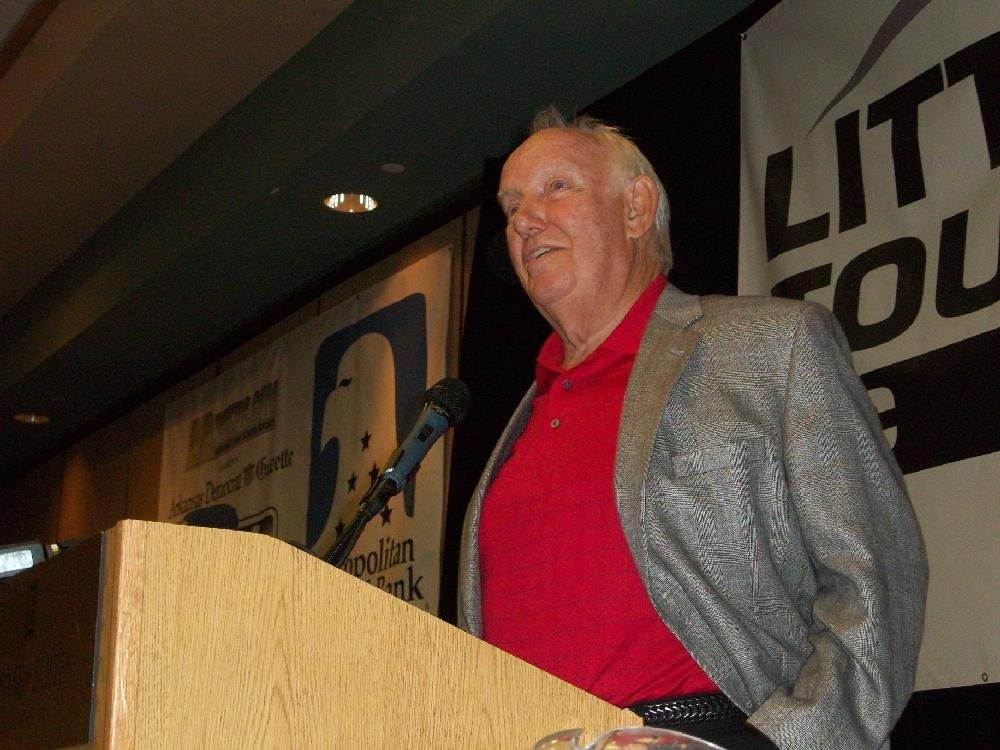
I got to hear Coach Robinson speak in Little Rock on August 27, 2012.

Little Rock Touchdown Club Week 2: Hall Of Fame Coach John Robinson

021_tiny by Zack Veddern on Aug 28, 2012 9:07 AM CDT

When former USC, LA Rams, and UNLV coach John Robinson took the stage before the Little Rock Touchdown Club, he was greeted with a standing ovation and many laughs followed as he joked about college football, John Madden, and recalled adventures of old times with different teams. His reception at Monday’s luncheon was a far cry from that of his last visit to Little Rock. In 2001, he coached the UNLV Runnin’ Rebels against Arkansas in a defensive slugfest that wouldn’t be decided until the very last drive. Arkansas, coached by Houston Nutt, had amassed an abysmal 100 total yards of offense, and faced a 10-7 defecit as they forced a 4th down punting situation.

“I made one of the worst coaching errors I’ve ever made,” Robinson explained, after benching the starting punter, he put in a freshman to punt from the 50. “We just punt the ball down, and we win the game!”. Much to the dismay of Coach Robinson, the snap went through the young punter’s hands and off his facemask on to the ground where the Arkansas defense recovered, and the offense would score to win the game 14-10. “If I’d had a gun, I’d have committed suicide.”

Star-divide

The Hall of Fame coach received many laughs from the misfortunes he recalled, yet the crowd admired the legendary figure that stood before them. Robinson coached at USC from 1976-1982 and again from 1993-1997, where he won 4 Rose Bowls, shared a National Title and finished with a record of 104-35-4. He went on to coach the L.A. Rams, leading them to two NFC Championship appearances, both of which resulted in losses to eventual Super Bowl champions. After failing to recruit the highly touted Eric Dickerson to USC, apparenlty having not paid enough for his services, Robinson drafted him with the Ram’s first pick in 1983

Coach Robinson also coached USC against the Hogs, going 1-1 in Little Rock as the Trojan’s offensive coordinator under coach John McKay. Robinson expressed his admiration for former Arkansas coach and athletic director, Frank Broyles, referring to him as “legendary” and his slant defense “revolutionary”. When discussing the Hogs, he said that he’d hoped to go to Miami and watch USC play Arkansas. “I’m already wearing red, so depending on the outcome, I can pretend to be one of you guys!” Joking aside, Robinson predicted that the SEC would once again be represented in the BCS National Title game, against USC or Oregon, his alma mater.

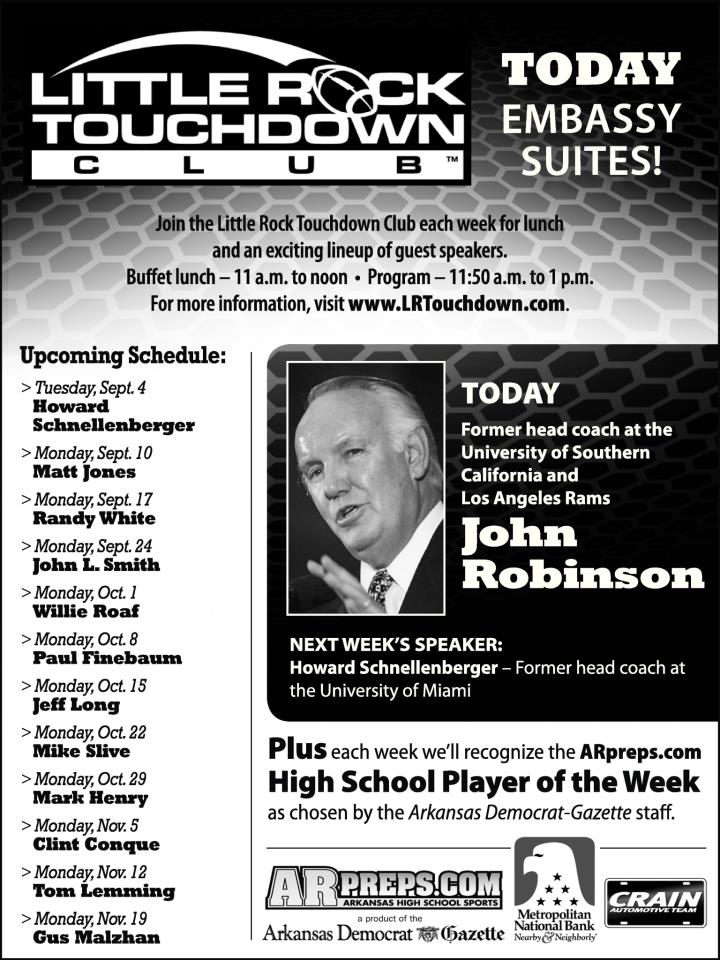
This week’s guest was an absolute delight to hear, and next week’s should be no different as Howard Schnellenberger, another Hall of Fame coach joins the club. Schnellenberger is responsible for establishing the system that ascended the University of Miami into the college football elite. He coached the Baltimore Colts, served as offensive coordinator for the Miami Dolphins, as well as coaching Miami, Louisville, Oklahoma and FAU during a career that lasted over 50 years. Dont miss the opportunity to hear a legend speak next Tuesday at 11:00 for lunch at the Embassy Suites in Little Rock. Lunch is $15.00 for members and $25.00 for non-members, however a one time fee of $50.00 will earn you an annual membership. For more details, visit http://www.LRTouchdown.com.

There's nothing like the Rose Bowl on New Year's Day.
 

John Robinson did not have much success at UNLV. Here are the results against Tennessee in 2004:

By ELIZABETH A. DAVIS
AP Sports Writer

KNOXVILLE, Tenn. (AP)Brent Schaeffer was a little nervous making history in his collegiate debut before more than 108,000 fans.

After a fumble early in the game, Tennessee’s quarterback settled down and ran for one touchdown and threw for another in the 14th-ranked Volunteers’ 42-17 win over UNLV on Sunday night.

Schaeffer was the first true freshman to start an opener in the Southeastern Conference since Georgia’s John Rauch in 1945.

Fellow freshman Erik Ainge, bracketed with Schaeffer at No. 1 on the depth chart, passed for two touchdowns.

“I had a couple of butterflies, but after those first couple of plays, I felt good,” Schaeffer said.

Both showed off their special skills: Schaeffer’s elusive running, and Ainge’s strong arm.

Tennessee coach Phillip Fulmer was pleased by all of it.

“That’s really about as good as you could hope for,” Fulmer said. “I think the team around them lifted them up. … I don’t think there was pressure for them to win the game.”

Schaeffer fumbled to end his first series, but he ran for a 1-yard touchdown in his second series.

On third-and-1, Schaeffer got past a defender in the backfield, rolled right, dodged more defenders and ran into the end zone to give Tennessee a 7-3 lead.

After the fumble, Schaeffer got some advice from offensive coordinator Randy Sanders.

“He told me to forget it and play like it never happened,” Schaeffer said.

Schaeffer went 7-of-10 for 123 yards and ran seven times for 29 yards.

Ainge came in for the Volunteers’ third possession and capped an 80-yard drive with a 42-yard touchdown pass to C.J. Fayton.

Ainge’s best effort came in the second half, when he completed a 3-yard pass to Tony Brown for a touchdown at the end of a 13-play, 82-yard drive.

Ainge was 7-of-9 for 69 yards in the drive and finished 10-of-17 for 118 yards. He said he didn’t mind splitting time with Schaeffer.

“I’m not worried about how many passes I have as long as we get the win,” he said.

The freshmen fared better in their debuts than Tennessee’s defense, which, at times, had trouble stopping UNLV’s tailbacks. The Rebels, who have lost four of six openers under coach John Robinson, rolled up 164 yards on the ground.

Dominique Dorsey had 18 carries for 121 yards and a 17-yard touchdown run in the fourth quarter. He went over 100 yards for the sixth time in his career.

Dyante Perkins ran 3 yards for another score in the third quarter.

Tennessee lost starting tailback Cedric Houston to a right ankle injury in the third quarter. He rushed for 97 yards. Gerald Riggs filled in and finished with 79 yards on 13 carries, including a 3-yard touchdown run. Corey Larkins added a 23-yard touchdown run in the fourth quarter.

UNLV led 3-0 early in the first quarter, but the Vols responded with 28 straight points to put the game out of reach. The Rebels avoided a rout similar to the 62-3 thrashing they took in their only other meeting with Tennessee, in 1996 in Knoxville.

UNLV dropped to 3-13 against ranked opponents after winning their last two games against then No. 14 Wisconsin and then-No. 13 Colorado State last season.

__________

Related posts:

Steve Sullivan, Wally Hall and Jim Harris talk at Little Rock Touchdown Club on 11-28-11

I enjoyed the Little Rock Touchdown Club and have posted a lot about it all fall. I have links below to earlier posts. Yesterday Wally Hall and Steve Sullivan had some good insights. Below are some of the thoughts of Jim Harris that he shared at the lunch. BUILDING THE DEFENSE: How nice it would […]

ESPN’s Mark Schlabach at Little Rock Touchdown Club (Part 3)

Earlier I wrote about where I think Arkansas could win a national championship with just two more wins. Below is a portion of an article by Jim Harris of the website Arkansas 360: AND ON BOBBY: Schlabach, on Arkansas’ coach: “I said when he was hired that Bobby Petrino would make Arkansas a contender for […]

The most significant game in Arkansas razorback football history? (Part 2)

A few days ago it looked like we would not have the opportunity to play into the national championship game, but now all that has changed. Life is funny that way sometimes. The Arkansas News Bureau reported: “I think we’ll have the opportunity,” Bequette said. “That’s what I believe.” All we got to do is […]

ESPN’s Mark Schlabach at Little Rock Touchdown Club (Part 2)

Earlier I wrote about where I think Arkansas could win a national championship with just two more wins. Below is a portion of an article by Jim Harris of the website Arkansas 360: STILL THERE’S LES AT LSU: Schlabach, in saying that LSU and Alabama are the two best teams in the country, had high […]

The most significant game in Arkansas razorback football history?

Wally Hall actually said on his radio program on Nov 22, 2011 that the Arkansas v. LSU game on Nov 25, 2011 is the most significant game in razorback history. I have to respectfully disagree. I will agree that it is in the top 5, but I will start a  list today of other games […]

After blowout at Arkansas, Vols coach Dooley felt like celebration after Vandy win was warrented

I saw the end of the Tennessee/Vandy game on tv and my brother-in-law went to the game (pictures from him below). I have written about the game earlier on this blog so I will not go into that again. I just wanted to comment on the video clip above. I think it is fine that […]


ESPN’s Mark Schlabach at Little Rock Touchdown Club (Part 1)

Earlier I wrote about where I think Arkansas could win a national championship with just two more wins. Below is a portion of an article by Jim Harris of the website Arkansas 360: What kind of college football polling world do we live in now that a No. 3 Arkansas could win Friday at No. […]

Mangino speaks at Little Rock Touchdown Club (Part 3)

Mangino at a 2007 KU basketball game Eric Mangino is a fine coach. Here is a portion of an article by Jim Harris: Jim Harris’ Notebook: Mangino Ready To Return; Big Week For Central Arkansas by Jim Harris STRANGE YEAR: Mark Mangino noted the unusual college football season, from six more more teams being in […]

Mangino speaks at Little Rock Touchdown Club (Part 2)

Mangino at a 2007 KU basketball game Eric Mangino is a very good speaker. Here is a portion of an article by Jim Harris: Jim Harris’ Notebook: Mangino Ready To Return; Big Week For Central Arkansas by Jim Harris 11/14/2011 at 3:37pm It’s easy for fans who don’t follow Kansas football closely to forget just […]

Johnny Majors speaks at Little Rock Touchdown Club (Part 12)jh80

Uploaded by TheMemphisSlim on Sep 3, 2010 Johnny Majors from Huntland, TN tried out for the UT Football team weighing 150 pounds. His Father, Shirley Majors his HS Coach,encourage him and then 4 younger brothers all to be Vols. Johnny Majors was the runner-up in 1956 for the Heisman Trophy to Paul Horning, on a loosing Notre Dame […]

Johnny Majors speaks at Little Rock Touchdown Club (Part 11)jh79

Interview with Johnny Majors after 1982 Kentucky game Below is a picture of Lane Kiffin with Johnny Majors. I enjoyed hearing Johnny Majors speak at the Little Rock Touchdown Club on 11-7-11. He talked a lot about the connection between the Arkansas and Tennessee football programs. It reminded me of what Frank Broyles had said […]

Will Dooley be given enough time to turn Vols around? Arkansas loss energizes foes of Dooley jh84

Photo by Amy Smotherman Burgess, ©KNS/2011 Tennessee head coach Derek Dooley reacts as Arkansas scores their seventh touchdown of the night at Donald W. Reynolds Razorback Stadium in Fayetteville on Nov. 12, 2011. (AMY SMOTHERMAN BURGESS/NEWS SENTINEL)

Johnny Majors speaks at Little Rock Touchdown Club (Part 10)jh78

FB: The Best of Johnny Majors at Iowa St I got to hear Johnny Majors talk on 11-7-11 and he talked about the connection that Arkansas and Tennessee had with their football programs. Two years ago I got to hear Frank Broyles speak at the Little Rock Touchdown Club and he said that too. As […]

Like this:

Be the first to like this.
By Everette Hatcher III, on August 9, 2012 at 2:49 pm, under Current Events. No Comments

“Friedman Friday” : Jewish tradition is so akin to capitalism but many Jews are socialists, what a paradox (Part 5)

Milton Friedman on the American Economy (5 of 6)

Uploaded by on Aug 9, 2009

THE OPEN MIND
Host: Richard D. Heffner
Guest: Milton Friedman
Title: A Nobel Laureate on the American Economy VTR: 5/31/77

__________________

Below is a part of the series on an article by Milton Friedman called “Capitalism and the Jews” published in 1972. 

Capitalism and the Jews

October 1988 • Volume: 38 • Issue: 10 • Print This Post11 comments

Milton Friedman, recipient of the 1976 Nobel Memorial Prize in Economic Science, is a Senior Research Fellow at the Hoover Institution. This article is reprinted with the permission of Encounter and The Fraser Institute.

“Capitalism and the Jews” was originally presented as a lecture before the Mont Pelerin Society in 1972. It subsequently was published in England and Canada and appears here without significant revision.

IV. Why the Anti-capitalist Mentality?

How can we reconcile my two propositions? Why is it that despite the historical record of the benefits of competitive capitalism to the Jews, despite the intellectual explanation of this phenomenon that is implicit or explicit in all liberal literature from at least Adam Smith on, the Jews have been disproportionately anti-cap- italist? 

We may start by considering some simple yet inadequate answers. Lawrence Fuchs, in a highly superficial analysis of The Political Be-havior of American Jews, argues that the anticapitalism of the Jews is a direct reflection of values derived from the Jewish religion and culture. He goes so far as to say, “if the communist movement is in a sense a Christian heresy, it is also Jewish orthodoxy—not the totalitarian or revolutionary aspects of world communism, but the quest for social justice through social action.”[7] Needless to say—a point I shall return to later in a different con-nection—Fuchs himself is a liberal in the American sense. He regards the political liberalism of the Jews in this sense as a virtue, and hence is quick to regard such liberalism as a legitimate offspring of the Jewish values of learning, charity, and concern with the pleasures of this world. He never even recognizes, let alone discusses, the key question whether the ethical end of “social justice through social action” is consistent with the political means of centralized government. 

Werner Sombart 

This explanation can be dismissed out-of-hand. Jewish religion and culture date back over two millennia; the Jewish opposition to capitalism and attachment to socialism, at the most, less than two centuries. Only after the Enlightenment, and then primarily among the Jews who were breaking away from the Jewish religion, did this political stance emerge. Werner Sombart, in his important and controversial book, The Jews and Modern Capitalism, first published in 1911, makes a far stronger case that Jewish religion and culture implied a capitalist outlook than Fuchs does that it implied a socialist outlook. Wrote Som-bart, “throughout the centuries, the Jews championed the cause of individual liberty in economic activity against the dominating view of the time. The individual was not to be hampered by regulations of any sort. I think that the Jewish religion has the same leading ideas as capitalism . . . . The whole religious system is in reality nothing but a contract between Jehovah and his chosen people . . . . God promises something and gives something, and the righteous must give Him something in return. Indeed, there was no community of interest between God and man which could not be expressed in these terms—that man performs some duty enjoined by the Torch and receives from God a quid pro quo.”[8] 

Sombart goes on to discuss the attitude toward riches and poverty in the Old and the New Testament. “You will find,” he writes, “a few passages [in the Old Testament and the Talmud] wherein poverty is lauded as something nobler and higher than riches. But on the other hand you will come across hundreds of passages in which riches are called the blessing of the Lord, and only their misuse or their dangers warned against.” By contrast, Sombart refers to the famous passage in the New Testament that “it is easier for a Camel to go through a needle’s eye than for a rich man to enter into the Kingdom of God” and remarks, “as often as riches are lauded in the Old Testament, they are damned in the New . . . . The religion of the Christians stands in the way of their economic activities . . . . The Jews were never faced with this hindrance.” He concludes, “Free trade and industrial freedom were in accordance with Jewish law, and therefore in accordance with God’s will.”[9] 

Sombart’s book, I may say, has in general had a highly unfavorable reception among both economic historians in general and Jewish intellectuals in particular, and indeed, something of an aura of anti-Semitism has come to be attributed to it. Much of the criticism seems valid but there is nothing in the book itself to justify any charge of anti-Semitism though there certainly is in Sombart’s behavior and writings several decades later, indeed, if anything I interpret the book as philo-Semitic. I regard the violence of the reaction of Jewish intellectuals to the book as itself a manifestation of the Jewish anti-capitalist mentality. I shall return to this point later. 

A more balanced judgment than either Fuchs’ or Sombart’s with which I am in full accord is rendered by Nathan Glazer, who writes, “It is hard to see direct links with Jewish tradition in these attitudes; . . . One thing is sure: it is an enormous oversimplification to say Jews in Eastern Europe became socialists and anarchists because the Hebrew prophets had denounced injustice twenty-five hundred years ago . . . . The Jewish religious tradition probably does dispose Jews, in some subtle way, toward liberalism and radicalism, but it is not easy to see in present-day Jewish social attitudes the heritage of the Jewish religion.”[10] 

Open letter to President Obama (Part 132 B)

Rep. Quayle on Fox News with Neil Cavuto

__________________

President Obama c/o The White House
1600 Pennsylvania Avenue NW
Washington, DC 20500

Dear Mr. President,

I know that you receive 20,000 letters a day and that you actually read 10 of them every day. I really do respect you for trying to get a pulse on what is going on out here.

We have to get people to realize that the most important issue is the debt!!! Recently I read a comment by Congressman Ben Quayle (R-AZ) made  after voting against the amended Budget Control Act on August 1, 2011. He said it was important to compel “Congressional Democrats and the Obama Administration to finally recognize how central America’s debt problem truly is.”

I can not agree more. I am glad that Rep. Quayle was brave enough to vote against this bill and I wish more were brave like him.

Michael Tanner of the Cato Institute in his article, “Hitting the Ceiling,” National Review Online, March 7, 2012 noted:

After all, despite all the sturm und drang about spending cuts as part of last year’s debt-ceiling deal, federal spending not only increased from 2011 to 2012, it rose faster than inflation and population growth combined.

We need some national statesmen (and ladies) who are willing to stop running up the nation’s credit card.

Ted DeHaven noted his his article, “Freshman Republicans switch from Tea to Kool-Aid,”  Cato Institute Blog, May 17, 2012:

This week the Club for Growth released a study of votes cast in 2011 by the 87 Republicans elected to the House in November 2010. The Club found that “In many cases, the rhetoric of the so-called “Tea Party” freshmen simply didn’t match their records.” Particularly disconcerting is the fact that so many GOP newcomers cast votes against spending cuts.

The study comes on the heels of three telling votes taken last week in the House that should have been slam-dunks for members who possess the slightest regard for limited government and free markets. Alas, only 26 of the 87 members of the “Tea Party class” voted to defund both the Economic Development Administration and the president’s new Advanced Manufacturing Technology Consortia program (see my previous discussion of these votes here) and against reauthorizing the Export-Import Bank (see my colleague Sallie James’s excoriation of that vote here).

One of those Tea Party heroes was Congressman Ben Quayle of Arizona. Last year I posted this below concerning his conservative views and his willingness to vote against the debt ceiling increase:

Rep. Quayle Votes No on Final Debt Ceiling Deal

Monday August 01, 2011

FOR IMMEDIATE RELEASE

Contact: Richard Cullen

202-225-3361

WASHINGTON (DC) Congressman Ben Quayle (R-AZ) released the following statement Monday after voting against the amended Budget Control Act:  

 “Last week I voted for the Boehner plan because— while imperfect—it made adequate strides to get our fiscal House in order. The final debt-ceiling bill, however, goes in a direction that I cannot support. Due to the design of the bill’s trigger mechanism, I am concerned that President Obama will be able to use the threat of tax hikes and drastic defense cuts to continue to amass record levels of spending.

 “Though I didn’t support today’s bill, I want to commend Speaker Boehner and the House Republican Leadership for changing the culture in Washington and compelling Congressional Democrats and the Obama Administration to finally recognize how central America’s debt problem truly is.

 “On another note, it was a very special moment seeing Congresswoman Gabby Giffords cast her vote on the House Floor tonight. Both sides of the aisle greeted her with a loud standing ovation. It was a nice way to end what has been a very tense few days in the House.”

_________________

Thank you so much for your time. I know how valuable it is. I also appreciate the fine family that you have and your commitment as a father and a husband.

Sincerely,

Everette Hatcher III, 13900 Cottontail Lane, Alexander, AR 72002, ph 501-920-5733, lowcostsqueegees@yahoo.com


Dan Mitchell of the Cato Institute takes on entitlement reform

It is the elephant in the room that nobody wants to talk about. Here Dan Mitchell takes it on.

Most people have a vague understanding that America has a huge long-run fiscal problem.

They’re right, though they probably don’t realize the seriousness of that looming crisis.

Here’s what you need to know: America’s fiscal crisis is actually a spending crisis, and that spending crisis is driven by entitlements.

More specifically, the vast majority of the problem is the result of Medicaid, Medicare, and Social Security, programs that are poorly designed and unsustainable.

America needs to fix these programs…or eventually become another Greece.

Fortunately, all of the problems can be solved, as these three videos demonstrate.

The first video explains how to fix Medicaid.

Promote Federalism and Replicate the Success of Welfare Reform with Medicaid Block Grants

Uploaded by on Jun 26, 2011

The Medicaid program imposes high costs while generating poor results. This Center for Freedom and Prosperity Foundation video explains how block grants, such as the one proposed by Congressman Paul Ryan, will save money and improve healthcare by giving states the freedom to innovate and compete.

The second video shows how to fix Medicare.

Saving Medicare: Free Market Reforms Are Better than Bureaucratic Rationing

Uploaded by on May 17, 2011

This Center for Freedom and Prosperity Foundation video explains how a “premium-support” plan would solve Medicare’s fiscal crisis and improve the overall healthcare system. This voucher-based system also would protect seniors from bureaucratic rationing. http://www.freedomandprosperity.org

And the final video shows how to fix Social Security.

Saving Social Security with Personal Retirement Accounts

Uploaded by on Jan 10, 2011

There are two crises facing Social Security. First the program has a gigantic unfunded liability, largely thanks to demographics. Second, the program is a very bad deal for younger workers, making them pay record amounts of tax in exchange for comparatively meager benefits. This video explains how personal accounts can solve both problems, and also notes that nations as varied as Australia, Chile, Sweden, and Hong Kong have implemented this pro-growth reform. www.freedomandprosperity.org

_______________________

Regular readers know I’m fairly gloomy about the future of liberty, but this is one area where there is a glimmer of hope.

The Chairman of the House Budget Committee actually put together a plan that addresses the two biggest problems (Medicare and Medicaid) and the House of Representatives actually adopted the proposal.

The Senate didn’t act, of course, and Obama would veto any good legislation anyhow, so I don’t want to be crazy optimistic. Depending on how things play out politically in the next six years, I’ll say there’s actually a 20 percent chance to save America.

USC’s John Robinson speaks at Little Rock Touchdown Club Part 5

1972 USC Football Highlights vs. Notre Dame

Uploaded by on Jun 14, 2011

No description available.

________-

Hearing John Robinson at the Little Rock Touchdown Club was very enjoyable. Earlier I posted about asking him the question: “Do you remember John McKay’s halftime speech at the 1974 Notre Dame at USC game?” Did you know that John Robinson was the offensive coordinator in 1974 when the Hogs beat USC 22-7 in Little Rock?

Robinson also told a funny story about sending in an young inexperienced player who helped UNLV lose the game against the Hogs in Little Rock. I have put links below to several of the earlier posts I did on John Robinson’s speech in Little Rock.

The LA Times reported:

Former USC Coach John Robinson a College Football Hall of Famer

April 30, 2009 | 12:56 pm

USC coach John Robinson being carried of the field in 1979. Thirty years later, he will enter the College Football Hall of Fame. John Robinson, who guided USC’s football team to a national title in 1978, has been selected to the College Football Hall of Fame. This was his second year on the ballot.

Robinson compiled a record of 104-35-4 in 12 seasons during two coaching stints with the Trojans. He won five Pac-10 Conference titles and led his teams to eight bowl games, including three Rose Bowl victories.

He also coached the Los Angeles Rams and completed his coaching career at the University of Nevada Las Vegas, where he was 28-42 in six seasons.

Random fact: Robinson went to elementary school, coached on the same sideline and worked in the broadcast booth with recently retired John Madden.

Other members of the 2009 Hall of Fame class:

Players:

PERVIS ATKINS — HB, New Mexico State (1958-60)
TIM BROWN —WR,Notre Dame (1984-87)
CHUCK CECIL — DB, Arizona (1984-87)
ED DYAS — FB, Auburn (1958-60)
MAJOR HARRIS — QB, West Virginia (1987-89)
GORDON HUDSON — TE, Brigham Young (1980- 83)
WILLIAM LEWIS* — C, Harvard (1892-93)
WOODROW LOWE — LB, Alabama (1972-75)
KEN MARGERUM — WR, Stanford (1977-80)
STEVE McMICHAEL — DT, Texas (1976-79)
CHRIS SPIELMAN — LB, Ohio State (1984-87)
LARRY STATION — LB, Iowa (1982-85)
PAT SWILLING — DE, Georgia Tech (1982-85)
GINO TORRETTA — QB, Miami (Fla.) (1989-92)
CURT WARNER — RB, Penn State (1979-82)
GRANT WISTROM — DE, Nebraska (1994-97)
* Selection from the FBS Veterans Committee, deceased

COACHES:

DICK MacPHERSON — 111-73-5 (.601) — Massachusetts (1971-77), Syracuse (1981-90) 

— Gary Klein and Adam Rose

Photo: USC Coach John Robinson being carried of the field in 1979. Credit: Joe Kennedy / Los Angeles Times

There's nothing like the Rose Bowl on New Year's Day.
 

John Robinson did not have much success at UNLV. Here are the results against Tennessee in 2004:

By ELIZABETH A. DAVIS
AP Sports Writer

KNOXVILLE, Tenn. (AP)Brent Schaeffer was a little nervous making history in his collegiate debut before more than 108,000 fans.

After a fumble early in the game, Tennessee’s quarterback settled down and ran for one touchdown and threw for another in the 14th-ranked Volunteers’ 42-17 win over UNLV on Sunday night.

Schaeffer was the first true freshman to start an opener in the Southeastern Conference since Georgia’s John Rauch in 1945.

Fellow freshman Erik Ainge, bracketed with Schaeffer at No. 1 on the depth chart, passed for two touchdowns.

“I had a couple of butterflies, but after those first couple of plays, I felt good,” Schaeffer said.

Both showed off their special skills: Schaeffer’s elusive running, and Ainge’s strong arm.

Tennessee coach Phillip Fulmer was pleased by all of it.

“That’s really about as good as you could hope for,” Fulmer said. “I think the team around them lifted them up. … I don’t think there was pressure for them to win the game.”

Schaeffer fumbled to end his first series, but he ran for a 1-yard touchdown in his second series.

On third-and-1, Schaeffer got past a defender in the backfield, rolled right, dodged more defenders and ran into the end zone to give Tennessee a 7-3 lead.

After the fumble, Schaeffer got some advice from offensive coordinator Randy Sanders.

“He told me to forget it and play like it never happened,” Schaeffer said.

Schaeffer went 7-of-10 for 123 yards and ran seven times for 29 yards.

Ainge came in for the Volunteers’ third possession and capped an 80-yard drive with a 42-yard touchdown pass to C.J. Fayton.

Ainge’s best effort came in the second half, when he completed a 3-yard pass to Tony Brown for a touchdown at the end of a 13-play, 82-yard drive.

Ainge was 7-of-9 for 69 yards in the drive and finished 10-of-17 for 118 yards. He said he didn’t mind splitting time with Schaeffer.

“I’m not worried about how many passes I have as long as we get the win,” he said.

The freshmen fared better in their debuts than Tennessee’s defense, which, at times, had trouble stopping UNLV’s tailbacks. The Rebels, who have lost four of six openers under coach John Robinson, rolled up 164 yards on the ground.

Dominique Dorsey had 18 carries for 121 yards and a 17-yard touchdown run in the fourth quarter. He went over 100 yards for the sixth time in his career.

Dyante Perkins ran 3 yards for another score in the third quarter.

Tennessee lost starting tailback Cedric Houston to a right ankle injury in the third quarter. He rushed for 97 yards. Gerald Riggs filled in and finished with 79 yards on 13 carries, including a 3-yard touchdown run. Corey Larkins added a 23-yard touchdown run in the fourth quarter.

UNLV led 3-0 early in the first quarter, but the Vols responded with 28 straight points to put the game out of reach. The Rebels avoided a rout similar to the 62-3 thrashing they took in their only other meeting with Tennessee, in 1996 in Knoxville.

UNLV dropped to 3-13 against ranked opponents after winning their last two games against then No. 14 Wisconsin and then-No. 13 Colorado State last season.

__________

Related posts:

Who deserved the 1978 national championship: USC or Bama?

John Robinson of USC should have an opinion, but no one asked him on August 27, 2012 when he spoke to the Little Rock Touchdown Club.  Wikipedia reports USC’s results that year: The 1978 USC Trojans football team represented the University of Southern California in the 1978 NCAA Division I-A football season. Following the season, the […]

USC’s John Robinson speaks at Little Rock Touchdown Club Part 4

USC vs. Tennessee 1980 Uploaded by yankeefanintenn on Jan 5, 2011 Hate that we lost, but I love watching games from this era. Fans were really into the games and it was a great game. All video footage is copyright of the University of Tennessee, but legally reproduced here in conjunction with Fair Use laws. […]

USC’s John Robinson speaks at Little Rock Touchdown Club Part 3

2005 USC Trojans vs Arkansas Part 1 (Rewind) Uploaded by NHBI007 on Oct 13, 2008 2005 USC Trojans vs Arkansas __________ I really enjoyed Robinson talk on 8-27-12. Robinson talks past UA, USC matchups JEFF HALPERN Former football coach John Robinson was 3-2 in his career at Southern California and UNLV against the Arkansas Razorbacks. […]

USC’s John Robinson speaks at Little Rock Touchdown Club Part 2

On August 27, 2012 I got to hear John Robinson speak at the the Little Rock Touchdown Club and he was a great speaker. Jim Harris: Former Southern Cal Coach John Robinson Wins In Little Rock <!– 23 –> by Jim Harris 8/27/2012 at 1:59pm College Football Hall of Fame coach John Robinson recalled some […]

John Robinson was offensive coordinator for USC when Hogs beat them 22-7 in 1974

    2006 USC Trojans vs Arkansas Part 1 Uploaded by NHBI007 on Mar 29, 2009 2006 USC Trojans vs Arkansas Today John Robinson told some funny stories at the Little Rock Touchdown Club and some interesting trivia facts. Did you know that USC won several national titles under John McKay with Frank Broyles defensive […]

USC’s John Robinson speaks at Little Rock Touchdown Club Part 1

USC-ND ’74 – The Anthony Davis Game Uploaded by sckego on Aug 6, 2006 Notre Dame was killing USC 24-0 with a minute left in first half of the 1974 game in Los Angeles. Anthony Davis caught a TD pass to close out the half, then returned the 2nd half kickoff for a touchdown, and […]


Steve Sullivan, Wally Hall and Jim Harris talk at Little Rock Touchdown Club on 11-28-11

I enjoyed the Little Rock Touchdown Club and have posted a lot about it all fall. I have links below to earlier posts. Yesterday Wally Hall and Steve Sullivan had some good insights. Below are some of the thoughts of Jim Harris that he shared at the lunch. BUILDING THE DEFENSE: How nice it would […]

ESPN’s Mark Schlabach at Little Rock Touchdown Club (Part 3)

Earlier I wrote about where I think Arkansas could win a national championship with just two more wins. Below is a portion of an article by Jim Harris of the website Arkansas 360: AND ON BOBBY: Schlabach, on Arkansas’ coach: “I said when he was hired that Bobby Petrino would make Arkansas a contender for […]

The most significant game in Arkansas razorback football history? (Part 2)

A few days ago it looked like we would not have the opportunity to play into the national championship game, but now all that has changed. Life is funny that way sometimes. The Arkansas News Bureau reported: “I think we’ll have the opportunity,” Bequette said. “That’s what I believe.” All we got to do is […]

ESPN’s Mark Schlabach at Little Rock Touchdown Club (Part 2)

Earlier I wrote about where I think Arkansas could win a national championship with just two more wins. Below is a portion of an article by Jim Harris of the website Arkansas 360: STILL THERE’S LES AT LSU: Schlabach, in saying that LSU and Alabama are the two best teams in the country, had high […]

The most significant game in Arkansas razorback football history?

Wally Hall actually said on his radio program on Nov 22, 2011 that the Arkansas v. LSU game on Nov 25, 2011 is the most significant game in razorback history. I have to respectfully disagree. I will agree that it is in the top 5, but I will start a  list today of other games […]

After blowout at Arkansas, Vols coach Dooley felt like celebration after Vandy win was warrented

I saw the end of the Tennessee/Vandy game on tv and my brother-in-law went to the game (pictures from him below). I have written about the game earlier on this blog so I will not go into that again. I just wanted to comment on the video clip above. I think it is fine that […]


ESPN’s Mark Schlabach at Little Rock Touchdown Club (Part 1)

Earlier I wrote about where I think Arkansas could win a national championship with just two more wins. Below is a portion of an article by Jim Harris of the website Arkansas 360: What kind of college football polling world do we live in now that a No. 3 Arkansas could win Friday at No. […]

Mangino speaks at Little Rock Touchdown Club (Part 3)

Mangino at a 2007 KU basketball game Eric Mangino is a fine coach. Here is a portion of an article by Jim Harris: Jim Harris’ Notebook: Mangino Ready To Return; Big Week For Central Arkansas by Jim Harris STRANGE YEAR: Mark Mangino noted the unusual college football season, from six more more teams being in […]

Mangino speaks at Little Rock Touchdown Club (Part 2)

Mangino at a 2007 KU basketball game Eric Mangino is a very good speaker. Here is a portion of an article by Jim Harris: Jim Harris’ Notebook: Mangino Ready To Return; Big Week For Central Arkansas by Jim Harris 11/14/2011 at 3:37pm It’s easy for fans who don’t follow Kansas football closely to forget just […]

Johnny Majors speaks at Little Rock Touchdown Club (Part 12)jh80

Uploaded by TheMemphisSlim on Sep 3, 2010 Johnny Majors from Huntland, TN tried out for the UT Football team weighing 150 pounds. His Father, Shirley Majors his HS Coach,encourage him and then 4 younger brothers all to be Vols. Johnny Majors was the runner-up in 1956 for the Heisman Trophy to Paul Horning, on a loosing Notre Dame […]

Johnny Majors speaks at Little Rock Touchdown Club (Part 11)jh79

Interview with Johnny Majors after 1982 Kentucky game Below is a picture of Lane Kiffin with Johnny Majors. I enjoyed hearing Johnny Majors speak at the Little Rock Touchdown Club on 11-7-11. He talked a lot about the connection between the Arkansas and Tennessee football programs. It reminded me of what Frank Broyles had said […]

Will Dooley be given enough time to turn Vols around? Arkansas loss energizes foes of Dooley jh84

Photo by Amy Smotherman Burgess, ©KNS/2011 Tennessee head coach Derek Dooley reacts as Arkansas scores their seventh touchdown of the night at Donald W. Reynolds Razorback Stadium in Fayetteville on Nov. 12, 2011. (AMY SMOTHERMAN BURGESS/NEWS SENTINEL)

Johnny Majors speaks at Little Rock Touchdown Club (Part 10)jh78

FB: The Best of Johnny Majors at Iowa St I got to hear Johnny Majors talk on 11-7-11 and he talked about the connection that Arkansas and Tennessee had with their football programs. Two years ago I got to hear Frank Broyles speak at the Little Rock Touchdown Club and he said that too. As […]

Like this:

Be the first to like this.
By Everette Hatcher III, on August 9, 2012 at 2:49 pm, under Current Events. No Comments

Videos by Dan Mitchell of the Cato Institute found here on www.thedailyhatch.org

Dan Mitchell of the Cato Institute has some great videos and I have posted lots of them on my blog. I like to go to Dan’s blog too. Take a look at some of them below and then the links to my blog.

It’s Simple to Balance The Budget Without Higher Taxes

Uploaded by on Oct 4, 2010

Politicians and interest groups claim higher taxes are necessary because it would be impossible to cut spending by enough to get rid of red ink. This Center for Freedom and Prosperity video shows that these assertions are nonsense. The budget can be balanced very quickly by simply limiting the annual growth of federal spending.

_______

Six Reasons Why the Capital Gains Tax Should Be Abolished

Uploaded by on May 3, 2010

The correct capital gains tax rate is zero because there should be no double taxation of income that is saved and invested. This is why all pro-growth tax reform plans, such as the flat tax and national sales tax, eliminate the capital gains tax. Unfortunately, the President wants to boost the official capital gains tax rate to 20 percent, and that is in addition to the higher tax rate on capital gains included in the government-run healthcare legislation. http://www.freedomandprosperity.org


______________

Keynesian Economics Is Wrong: Bigger Gov’t Is Not Stimulus

Uploaded by on Dec 15, 2008

Based on a theory known as Keynesianism, politicians are resuscitating the notion that more government spending can stimulate an economy. This mini-documentary produced by the Center for Freedom and Prosperity Foundation examines both theory and evidence and finds that allowing politicians to spend more money is not a recipe for better economic performance.

___________________

Obama’s So-Called Stimulus: Good For Government, Bad For the Economy

Uploaded by on Jan 26, 2009

President Obama wants Congress to dramatically expand the burden of government spending. This CF&P Foundation mini-documentary explains why such a policy, based on the discredited Keynesian theory of economics, will not be successful. Indeed, the video demonstrates that Obama is proposing – for all intents and purposes – to repeat Bush’s mistakes. Government will be bigger, even though global evidence shows that nations with small governments are more prosperous.

____________

Big Government Is Not Stimulus: Why Keynes Was Wrong (The Condensed Version)

Uploaded by on Jan 13, 2009

The CF&P Foundation has released a condensed version of our successful mini-documentary explaining why so-called stimulus schemes do not work. Based on a theory known as Keynesianism, politicians are resuscitating the notion that more government spending can stimulate an economy. This mini-documentary produced by the Center for Freedom and Prosperity Foundation examines both theory and evidence and finds that allowing politicians to spend more money is not a recipe for better economic performance.

_________________

Eight Reasons Why Big Government Hurts Economic Growth

Uploaded by on Aug 17, 2009

This Center for Freedom and Prosperity Foundation video analyzes how excessive government spending undermines economic performance. While acknowledging that a very modest level of government spending on things such as “public goods” can facilitate growth, the video outlines eight different ways that that big government hinders prosperity. This video focuses on theory and will be augmented by a second video looking at the empirical evidence favoring smaller government.

___________________

Now that I have been critical of the Democrat President, I wanted to show that I am not concerned about taking up for Republicans but looking at the facts. President Clinton did increase government spending at a slower rate than many other presidents. Here are two  videos that praise both Reagan and Clinton for both accomplished this feat.

Spending Restraint, Part I: Lessons from Ronald Reagan and Bill Clinton

Uploaded by on Feb 14, 2011

Ronald Reagan and Bill Clinton both reduced the relative burden of government, largely because they were able to restrain the growth of domestic spending. The mini-documentary from the Center for Freedom and Prosperity uses data from the Historical Tables of the Budget to show how Reagan and Clinton succeeded and compares their record to the fiscal profligacy of the Bush-Obama years.

______________

Spending Restraint, Part II: Lessons from Canada, Ireland, Slovakia, and New Zealand

Uploaded by on Feb 22, 2011

Nations can make remarkable fiscal progress if policy makers simply limit the growth of government spending. This video, which is Part II of a series, uses examples from recent history in Canada, Ireland, Slovakia, and New Zealand to demonstrate how it is possible to achieve rapid improvements in fiscal policy by restraining the burden of government spending. Part I of the series examined how Ronald Reagan and Bill Clinton were successful in controlling government outlays — particularly the burden of domestic spending programs. www.freedomandprosperity.org

Here are some posts that include videos from Dan Mitchell:

Videos by Cato Institute on failed stimulus plans

In this post I have gathered several videos from the Cato Institute concerning the subject of failed stimulus plans. _____ Government Spending Doesn’t Create Jobs Uploaded by catoinstitutevideo on Sep 7, 2011 Share this on Facebook: http://on.fb.me/qnjkn9 Tweet it: http://tiny.cc/o9v9t In the debate of job creation and how best to pursue it as a policy […]

Balanced Budget Amendment the answer? Boozman says yes, Pryor no, Part 28 (Input from Norm Coleman, former Republican Senator from MN)

  It’s Simple to Balance The Budget Without Higher Taxes Steve Brawner in his article “Safer roads and balanced budgets,” Arkansas News Bureau, April 13, 2011, noted: The disagreement is over the solutions — on what spending to cut; what taxes to raise (basically none ever, according to Boozman); whether or not to enact a […]

Obama’s plan is not too smart on taxes

Dan Mitchell did a great article concerning the affect of raising taxes in these two areas and horrible results: How Can Obama Look at these Two Charts and Conclude that America Should Have Higher Double Taxation of Dividends and Capital Gains? Posted by Daniel J. Mitchell As discussed yesterday, the most important number in Obama’s […]

______________