A satirical short film taking a look at the national debt and how it applies to just one family. Watch the guy from the Ferris Bueller Superbowl Spot! Produced by Seth William Meier, DP/Edited by Craig Evans, 1st AC Brian Andrews, Sound Mixer Gus Salazar, Written and Directed by Brian Stepanek. Help us spread the word by clicking ads or at www.debtlimitusa.org
_________________
I read some wise words by Rep. Justin Amash (R-MI) and I wanted to pass them on. He sees how dangerous it is to keep kicking the can down the street: “The Budget Control Act trades $21 billion in cuts next year for a debt ceiling increase of $2.1 trillion. That’s one penny in cuts for each dollar of new debt. The bill does not seriously address the drivers of the federal government’s fiscal crisis. It does not improve entitlement programs. It does not include a balanced budget amendment to the Constitution.”
After all, despite all the sturm und drang about spending cuts as part of last year’s debt-ceiling deal, federal spending not only increased from 2011 to 2012, it rose faster than inflation and population growth combined.
We need some national statesmen (and ladies) who are willing to stop running up the nation’s credit card.
This week the Club for Growth released a study of votes cast in 2011 by the 87 Republicans elected to the House in November 2010. The Club found that “In many cases, the rhetoric of the so-called “Tea Party” freshmen simply didn’t match their records.” Particularly disconcerting is the fact that so many GOP newcomers cast votes against spending cuts.
The study comes on the heels of three telling votes taken last week in the House that should have been slam-dunks for members who possess the slightest regard for limited government and free markets. Alas, only 26 of the 87 members of the “Tea Party class” voted to defund both the Economic Development Administration and the president’s new Advanced Manufacturing Technology Consortia program (see my previous discussion of these votes here) and against reauthorizing the Export-Import Bank (see my colleague Sallie James’s excoriation of that vote here).
One of those Tea Party heroes was Justin Amash of Michigan. Last year I posted this below concerning his conservative views and his willingness to vote against the debt ceiling increase:
Washington, D.C. – Rep. Justin Amash (R-MI) issued the following statement after the vote on the Budget Control Act of 2011:
“The Budget Control Act trades $21 billion in cuts next year for a debt ceiling increase of $2.1 trillion. That’s one penny in cuts for each dollar of new debt. The bill does not seriously address the drivers of the federal government’s fiscal crisis. It does not improve entitlement programs. It does not include a balanced budget amendment to the Constitution. I cannot in good conscience vote for so little reform when so much is at stake.
“I had hoped that Democrats and Republicans would work together to develop a reasonable compromise that is fiscally responsible. I would favor a package that combines eliminating special tax breaks and subsidies with a well-structured balanced budget amendment. I believe that type of package would have broad-based support from the American people. Instead, Congress continues to kick the can down the road.
“We can do better. I look forward to working with my colleagues on both sides of the aisle over the next several months to adopt structural reforms that will put the government back on a sustainable path.”
Bobby Petrino always had plans to live in Fayetteville the rest of his life. Why else would he have committed to the 18 million dollar buyout in his contract. He also showed that he had longterm plans to stay in Arkansas because he invested 2.5 million in a home here. However, he let his eyes stray and everything went down the tubes.
Former Arkansas head football coach Bobby Petrino has sold his home on Beaver Lake for $600,000.
According to a warranty deed filed Tuesday at the Benton County Courthouse, Duncan MacNaughton, chief merchandising officer for Wal-Mart U.S., and his wife, Cynthia, are the new owners of the lakefront property in eastern Benton County.
Petrino and his wife, Becky, bought the 2,532-SF home and 2.91 acres on Cedar Forest Drive in Garfield for $600,000 in June 2008, the summer before his first season coaching the Razorbacks.
The sellers were William and Lisa McCullough. That purchase was tied to a 30-year mortgage worth $480,000 held by Signature Bank of Arkansas.
The home sits on a 1.07-acre lot and includes two extra lots as well as a private boat dock with four slips.
It didn’t take long for the former coach to get out from under the property. Petrino coached the Razorbacks for four seasons before being fired April 10.
Athletics director Jeff Long cited Petrino’s misleading and deceptive behavior in an attempt to cover up an affair with a female member of his football staff. The revelations came in the wake of a motorcycle crash April 1 in rural Madison County that sent Petrino to the hospital.
Four days later, the accident report released by the Arkansas State Police revealed Petrino had a passenger, Jessica Dorrell, who the coach previously did not mention while recalling the events of the accident.
It was later revealed Petrino, 51, and Dorrell, 25, were having an inappropriate relationship for several months.
Petrino hired the former UA volleyball player in March to serve as student-athlete development coordinator. She had previously worked as a fundraiser for the Razorback Foundation. Dorrell has since resigned from her job with the football staff.
Because he was fired for cause, Petrino forfeited his salary of roughly $3.5 million per year through 2017. The football coach was given a seven-year contract extension at the end of the 2010 regular season, just before coaching the Razorbacks against Ohio State University in the 2011 Sugar Bowl in New Orleans.
Petrino is finding the market significantly tougher to unload his primary residence. The Petrino home at 4518 E. Bridgewater Lane in east Fayetteville, bought in March 2008 for $2.5 million, is still on the market.
It’s been listed for almost two years as the family had hoped to downsize.
The two-story, 8,741-SF home has six bedrooms and is currently listed with Kendall Riggins with Lindsey & Associates in Fayetteville for a reduced price of $1.99 million
If Bobby thinks he is bruised now, then he needs to read about the guy in Proverbs 7:10-27 and what happened to him. I really am hoping that Bobby Petrino can put his marriage back together. He has a clear choice between two paths. In the sermon at Fellowship Bible Church at July 24, 2011, […]
Highlights of North Carolina’s win over Tennessee in the 2010 Music City Bowl. Tennessee had the home-field advantage with the game being played at LP Field in Nashville, and the Volunteers thought they had won a dramatic victory when the officials told them to return to the sideline giving the Tar Heels one last chance to tie it at the end of the fourth quarter.
When it comes to college football stadiums, for some teams, it is simply not fair. Home-field advantage is a big thing in college football, and some teams have it way more than others.
There are 124 FBS college football teams, and when it comes to the stadiums they play in, they are obviously not all created equal.
There is a monumental difference from the top teams on the list to the bottom teams on the list. Either way, here it is: a complete ranking of the college football stadiums 1-124.
_________________
Arkansas native Butch Davis coached at North Carolina and Miami and did a great job. However, I don’t think he will get the Arkansas job because he got in trouble with the NCAA. He had an unbelievable win over the Tennessee Vols in the Music City Bowl. I have never heard of a team winning two games at the buzzer and having to go back on the field and play more and then losing both games, but that is what happened to Tennessee in 2010 (LSU and North Carolina).
94. Doyt Perry Stadium: Bowling Green Falcons
Doyt Perry Stadium is actually one of the better stadiums as far as MAC schools are concerned.
It is medium-sized for a MAC school, but slightly on the lower end with a seating capacity of 23,724.
Originally built in 1966, this stadium is in a great area with fans who will come out and support their team. It has a wide open feel to it, making it a little more unique than many others.
93. FAU Stadium: Florida Atlantic Owls
FAU Stadium is the newest stadium in college football. This helped propel it so high on the list.
Like many other new stadiums that are built at non BCS schools, the seating capacity here is 30,000.
It opened last season in 2011, and there is a decent-sized fanbase here to support the team that now has their own stadium.
Not a bad place to watch a football game. The weather here is nice too.
92. Kenan Memorial Stadium: North Carolina Tar Heels
Similar to Duke and Kansas, North Carolina will always be a basketball school.
Kenan Memorial Stadium is relatively large with a capacity of 60,000, and it was originally built in 1927, making it one of the oldest stadiums in the country.
Everything here is just average, and although the Tar Heels have had some good football teams over the years, they will always be basketball first.
91. Veterans Memorial Stadium: Troy Trojans
This stadium opened in 1950 and is located in quite a small town.
It has a seating capacity of 30,000 and is actually one of the better stadiums for any team in the Sun Belt Conference.
The locals in the city support this team, as they have had some relative success on the field. The crowd seemingly sits closer to the field here, making this one of the more unique stadiums in the Sun Belt.
It has greatly troubled me for sometime that the federal government spends so much over their budget every year. That is probably the number one reason I started my blog (www.theDailyHatch.org ) a little over a year ago. The results have been overwhelming. I have had over 170,000 hits and have even been quoted in a national magazine.
Back in the summer of 2011, 66 brave souls in the Republican party voted against the debt ceiling compromise in the House of Representatives and I actually took time to put up 48 different posts praising those 66 tea-party type conservatives. One of them was Cliff Stearns. Representative Stearns actually went on C-Span and mentioned your March 2006 vote against raising the debt ceiling and he quoted you directly. The funny thing is I agreed totally with every word of his your speech.
Why do we have to keep spending money like this? Here is an excellent article from the Cato Institute that reflects my views:
Michael Tanner is a senior fellow at the Cato Institute and author of Leviathan on the Right: How Big-Government Conservatism Brought Down the Republican Revolution.
If you liked last year’s battle over raising the debt ceiling, just get ready for the fight to come.
Last summer’s agreement, you will recall, raised the federal government’s debt limit from $15.194 trillion to $16.394 trillion in exchange for promised future reductions in spending. Until recently, the consensus has been that federal borrowing will bump up against the new limit sometime between late November of this year and early January 2013.
But buried in President Obama’s 2013 budget was the news that the national debt will hit $16.334 trillion by the end of fiscal year 2012, or September 30, 2012. This is just $60 billion below the current debt limit. Since the federal government is continuing to borrow at a rate of over $130 billion a month, we will likely reach the debt ceiling by mid-October — before Election Day.
From a budgeting perspective, there will not be an immediate crisis. The Treasury Department could, if it chooses, employ “extraordinary measures” to enable the government to keep paying its bills until well after the elections. Despite their name, these measures are not all that “extraordinary,” involving such things as delaying contributions to the civil-service pension fund or suspending sales of certain nonessential securities. In fact, the Treasury used such measures last year from May until the final debt agreement in August, and no one really noticed.
Can Republicans really be trusted to fight for spending cuts just weeks before the election?
But as a political matter, it will be a very different matter.
Suppose that instead of using such measures to push off the day of reckoning until after the election, President Obama threatens default. Suppose he insists on a tax increase as part of any deal to raise the debt ceiling, and threatens international economic chaos and a collapsing stock market if Republicans fail to go along. Can Republicans really be trusted to fight for spending cuts instead, just weeks before the election?
And regardless of what happens before the election, another fight over the debt ceiling will be coming shortly thereafter. Every Republican candidate will have to go on record about whether or not they would raise the debt ceiling and what concessions they would demand.
Republicans, of course, will have a good argument to make about how the president’s spending has driven up the debt. The fact that a $1.2 trillion increase in the debt ceiling barely lasted a year could be powerful. But Republicans would have a better time making this argument if they were actually doing something to reduce spending. After all, despite all the sturm und drang about spending cuts as part of last year’s debt-ceiling deal, federal spending not only increased from 2011 to 2012, it rose faster than inflation and population growth combined.
And Republicans continue to talk about undoing the sequester that is responsible for more than half the projected savings to come out of the 2011 deal. In particular, Republicans want to undo cuts to the defense budget, and may be willing to give up domestic-spending cuts in exchange.
Meanwhile, what of Mitt Romney, the presumptive Republican nominee after last night’s primaries? Can anyone think of a single major spending program that Romney would eliminate? (Cutting funding to Planned Parenthood doesn’t count, especially given the way Republicans mishandled the contraceptive-mandate debate).
President Obama’s reckless spending could be a godsend to Republicans. It was, after all, debt and spending that energized the Tea Party and led to the 2010 election wave. Not only is it an issue that unites all factions of the Republican base, it is also of importance to independents and suburbanites, including those suburban women who have been turned off by the Republican-primary debate.
But if Republicans don’t want to be blindsided by President Obama come October, they need to start preparing for this debate now.
___________
We got to cut spending now!!!
Thank you so much for your time. I know how valuable it is. I also appreciate the fine family that you have and your commitment as a father and a husband.
Sincerely,
Everette Hatcher III, 13900 Cottontail Lane, Alexander, AR 72002, ph 501-920-5733, lowcostsqueegees@yahoo.com
Related posts (these posts show how much study I have down on this issue before, frankly all 66 of these representatives are my heroes!!):
Sixty Six who resisted “Sugar-coated Satan Sandwich” Debt Deal (Part 49) This post today is a part of a series I am doing on the 66 Republican Tea Party favorites that resisted eating the “Sugar-coated Satan Sandwich” Debt Deal. Actually that name did not originate from a representative who agrees with the Tea Party, but […]
Sixty Six who resisted “Sugar-coated Satan Sandwich” Debt Deal (Part 48) This post today is a part of a series I am doing on the 66 Republican Tea Party favorites that resisted eating the “Sugar-coated Satan Sandwich” Debt Deal. Actually that name did not originate from a representative who agrees with the Tea Party, but […]
Congressmen Tim Huelskamp on the debt ceiling Sixty Six who resisted “Sugar-coated Satan Sandwich” Debt Deal (Part 31) This post today is a part of a series I am doing on the 66 Republican Tea Party favorites that resisted eating the “Sugar-coated Satan Sandwich” Debt Deal. Actually that name did not originate from a representative […]
Uploaded by RepJoeWalsh on Jun 14, 2011 Our country’s debt continues to grow — it’s eating away at the American Dream. We need to make real cuts now. We need Cut, Cap, and Balance. The Sixty Six who resisted “Sugar-coated Satan Sandwich” Debt Deal (Part 25) This post today is a part of a series […]
Sen Obama in 2006 Against Raising Debt Ceiling The Sixty Six who resisted “Sugar-coated Satan Sandwich” Debt Deal (Part 15) This post today is a part of a series I am doing on the 66 Republican Tea Party favorites that resisted eating the “Sugar-coated Satan Sandwich” Debt Deal. Actually that name did not originate from […]
Today I read a post by Max Brantley on the Arkansas Times Blog concerning the falling poll numbers for the Tea Party. Wednesday, August 17, 2011 – 06:54:18 The Tea Party: is the fun over An interesting New York Times op-ed reviews the plunging poll approval numbers for the Tea Party and delves into the […]
Duncan Hunter at San Diego Eagle Forum.MP4 The Sixty Six who resisted “Sugar-coated Satan Sandwich” Debt Deal (Part 7) This post today is a part of a series I am doing on the 66 Republican Tea Party favorites that resisted eating the “Sugar-coated Satan Sandwich” Debt Deal. Actually that name did not originate from a […]
Rep Himes and Rep Schweikert Discuss the Debt and Budget Deal The Sixty Six who resisted “Sugar-coated Satan Sandwich” Debt Deal (Part 6) This post today is a part of a series I am doing on the 66 Republican Tea Party favorites that resisted eating the “Sugar-coated Satan Sandwich” Debt Deal. Actually that name did […]
Rep. Quayle on Fox News with Neil Cavuto The Sixty Six who resisted “Sugar-coated Satan Sandwich” Debt Deal (Part 5) This post today is a part of a series I am doing on the 66 Republican Tea Party favorites that resisted eating the “Sugar-coated Satan Sandwich” Debt Deal. Actually that name did not originate […]
“What good is a debt limit that is always increased?” The Sixty Six who resisted “Sugar-coated Satan Sandwich” Debt Deal (Part 2) This post today is a part of a series I am doing on the 66 Republican Tea Party favorites that resisted eating the “Sugar-coated Satan Sandwich” Debt Deal. Actually that name did not […]
This post today is a part of a series I am doing on the 66 Republican Tea Party favorites that resisted eating the “Sugar-coated Satan Sandwich” Debt Deal. Actually that name did not originate from a representative who agrees with the Tea Party, but from a liberal. Rep. Emanuel Clever (D-Mo.) called the newly agreed-upon […]
Bachmann Explains “No” Vote on Raising the Debt Ceiling Uploaded by RepMicheleBachmann on Aug 2, 2011 On Monday, August 1, 2011, Congresswoman Michele Bachmann appeared on “Hannity” to explain why she voted “no” on the plan to raise the debt ceiling. _______________________________________ Full House roll call By: Associated Press August 1, 2011 08:46 PM EDT […]
A video by CF&P Foundation that builds on the discussion of theory in Part I and evidence in Part II, this concluding video in the series on the Laffer Curve explains how the Joint Committee on Taxation’s revenue-estimating process is based on the absurd theory that changes in tax policy – even dramatic reforms such as a flat tax – do not effect economic growth. In other words, the current system assumes the Laffer Curve does not exist. Because of congressional budget rules, this leads to a bias for tax increases and against tax cuts. The video explains that “static scoring” should be replaced with “dynamic scoring” so that lawmakers will have more accurate information when making decisions about tax policy. For more information please visit the Center for Freedom and Prosperity’s web site: http://www.freedomandprosperity.org
_____________________________
Bush tax cuts work? This is a series of posts aimed at answering that question.
Abstract:Despite evidence to the contrary, President Obama and his supporters insist that a tax increase will not impede economic recovery. They claim that the Clinton tax hikes spurred the boom of the 1990s and that the subsequent Bush tax cuts hurt the economy. Members of Congress must reject this faulty notion—and reject the President’s call for burdening Americans with higher taxes and an even slower economy.
President Barack Obama and his allies in Congress and elsewhere continue to press for tax increases, whether as part of a deal to raise the government’s debt ceiling, or for any other reason. Even though common sense would dictate not raising taxes in the face of a badly weakened economy and almost non-existent job growth, the President and his supporters argue that tax hikes will not imperil the still-nascent recovery because the economy grew during the 1990s after President Bill Clinton raised taxes. The inference being that today’s economy could also absorb the blow of tax hikes and grow despite them. They also argue the converse: that the tax cuts passed during President George W. Bush’s tenure slowed growth and cost jobs.
This cursory and errant analysis of recent history has serious implications for policymaking today. If Congress raises taxes based on the faulty notion that tax hikes have no ill effects on economic growth, it will impede the still-struggling recovery and keep millions of Americans on the unemployment rolls far too long.
Lessons for Today
It is vitally important for the millions of Americans looking for work today that Congress and President Obama learn and accept what really happened when President Clinton raised taxes and President Bush lowered them. The evidence is clear that the Clinton tax hikes stifled what should have been remarkable economic growth and the Bush tax cuts cleared the way for the economy to grow despite growing obstacles in its way.
President Obama insists that tax hikes must be part of a “balanced” approach to reducing the deficit. He defends his tax hike desires by pointing to the Clinton tax hikes as evidence that the economy can withstand higher taxes.
But if the Clinton tax hikes were powerful enough to slow an economy that had everything going in its favor, what would tax hikes today do to an economy that has everything working against it? The unemployment rate remains stuck over 9 percent and there appears to be little hope for it to fall in the near future.[10] The President should not be looking for policies the economy can withstand, but for policies that will encourage it to grow.
At best, tax increases would slow the already stalled recovery, and at worst, would reverse it altogether. A slowed recovery or double-dip recession would further reduce the chances that the more than 14 million Americans currently looking for work would find a job in the near future.[11]
The best way to grow revenues is to promote faster economic growth, which will increase the number of taxpayers and taxable income more rapidly. Tax hikes—whether through higher tax rates or slashing credits, deductions, and exemptions without offsetting reductions elsewhere—will not do the job. Under President Obama’s current policies, spending will continue to grow at a faster rate than can be paid for by tax hikes—even assuming the huge tax increases the President insists upon. To add insult to injury, as history has shown, tax hikes would slow economic growth and make it even harder for unemployed Americans to find a job.
—Curtis S. Dubay is a Senior Analyst in Tax Policy in the Thomas A. Roe Institute for Economic Policy Studies at The Heritage Foundation.
Most people know that Ronald Reagan was an actor before he became a great President.
So I guess it makes sense for Barack Obama to do the same thing, but in reverse. He’s starting as a bad President, but then will become a Hollywood star.
Some clever person already has put together some potential starring roles. Let’s start with the Wizard of Oz, with some updated dialogue that captures the President’s approach to tax policy.
Bonnie and Clyde is another option, though this one is unfair. Obama supports TARP, which means he wants to rob taxpayers to subsidize banks.
Last but not least, we have a new version of “It’s a Wonderful Life.” Though, to be fair, the President seems to want entitlement checks for everybody.
If I was clever enough to manipulate pictures, I would do one from the scene in Braveheart where Mel Gibson is on horseback, motivating the Scots to fight against the English. But instead of Mel Gibson talking about freedom, we could have the President urging “dependency.”
John Brummett (10-26-11, Arkansas Democrat-Gazette online edition) does not want charter schools to put public schools out of business but he wants them to show public schools how to do it. (Paywall)
I seek in these matters a kind of Clintonian third-way finesse: I support charter schools only to the extent that they should be given the opportunity—availed by the KIPP schools, for example—to display effective methods that regular public schools should not resent and resist, but be compelled to emulate.
Yes, I understand that emulation would require that politicians give public educators more money. I’m for that. Longer school days and Saturday classes and summer classes aren’t free. KIPP has corporate backing for those kinds of things.
I don’t want charter schools to last forever and undermine public schools. I want their successful methods to be embraced by the public schools and for regular public schools to succeed to the point that alternatives are no longer so compelling. Charter schools should exist in temporary and ever-changing forms, not to show up public schools, but to show them how—not on everything, but on the latest thing.
That sounds good, but if you want the public school system to improve, it will take giving their captive audience an alternative. Many inner city parents would love to be given vouchers and get the same quality education that private schools are giving parents that have lots of money. How can you get around that logic. Meanwhile our inner city schools are becoming filled with violence.
Here is the video clip and transcript of the film series FREE TO CHOOSE episode “What is wrong with our schools?” Part 1 of 6.
Volume 6 – What’s Wrong with our Schools
Transcript:
Friedman: These youngsters are beginning another day at one of America’s public schools, Hyde Park High School in Boston. What happens when they pass through those doors is a vivid illustration of some of the problems facing America’s schools.
They have to pass through metal detectors. They are faced by security guards looking for hidden weapons. They are watched over by armed police. Isn’t that awful. What a way for kids to have to go to school, through metal detectors and to be searched. What can they conceivably learn under such circumstances. Nobody is happy with this kind of education. The taxpayers surely aren’t. This isn’t cheap education. After all, those uniformed policemen, those metal detectors have to be paid for.
What about the broken windows, the torn school books, and the smashed school equipment. The teachers who teach here don’t like this kind of situation. The students don’t like to come here to go to school, and most of all, the parents __ they are the ones who get the worst deal __ they pay taxes like the rest of us and they are just as concerned about the kind of education that their kids get as the rest of us are. They know their kids are getting a bad education but they feel trapped. Many of them can see no alternative but to continue sending their kids to schools like this.
To go back to the beginning, it all started with the fine idea that every child should have a chance to learn his three R’s. Sometimes in June when it gets hot, the kids come out in the yard to do their lessons, all 15 of them, ages 5 to 13, along with their teacher. This is the last one-room schoolhouse still operating in the state of Vermont. That is the way it used to be. Parental control, parents choosing the teacher, parents monitoring the schooling, parents even getting together and chipping in to paint the schoolhouse as they did here just a few weeks ago. Parental concern is still here as much in the slums of the big cities as in Bucolic, Vermont. But control by parents over the schooling of their children is today the exception, not the rule.
Increasingly, schools have come under the control of centralized administration, professional educators deciding what shall be taught, who shall do the teaching, and even what children shall go to what school. The people who lose most from this system are the poor and the disadvantaged in the large cities. They are simply stuck. They have no alternative.
Of course, if you are well off you do have a choice. You can send your child to a private school or you can move to an area where the public schools are excellent, as the parents of many of these students have done. These students are graduating from Weston High School in one of Boston’s wealthier suburbs. Their parents pay taxes instead of tuition and they certainly get better value for their money than do the parents in Hyde Park. That is partly because they have kept a good deal of control over the local schools, and in the process, they have managed to retain many of the virtues of the one-room schoolhouse.
Students here, like Barbara King, get the equivalent of a private education. They have excellent recreational facilities. They have a teaching staff that is dedicated and responsive to parents and students. There is an atmosphere which encourages learning, yet the cost per pupil here is no higher than in many of our inner city schools. The difference is that at Weston, it all goes for education that the parents still retain a good deal of control.
Unfortunately, most parents have lost control over how their tax money in spent. Avabelle goes to Hyde Park High. Her parents too want her to have a good education, but many of the students here are not interested in schooling, and the teachers, however dedicated, soon lose heart in an atmosphere like this. Avabelle’s parents are certainly not getting value for their tax money.
Caroline Bell, Parent: I think it is a shame, really, that parents are being ripped off like we are. I am talking about parents like me that work every day, scuffle to try to make ends meet. We send our kids to school hoping that they will receive something that will benefit them in the future for when they go out here and compete in the job market. Unfortunately, none of that is taking place at Hyde Park.
Friedman: Children like Ava are being shortchanged by a system that was designed to help. But there are ways to help give parents more say over their children’s schooling.
This is a fundraising evening for a school supported by a voluntary organization, New York’s Inner City Scholarship Fund. The prints that have brought people here have been loaned by wealthy Japanese industrialist. Events like this have helped raise two million dollars to finance Catholic parochial schools in New York. The people here are part of a long American tradition. The results of their private voluntary activities have been remarkable.
This is one of the poorest neighborhoods in New York City: the Bronx. Yet this parochial school, supported by the fund, is a joy to visit. The youngsters here from poor families are at Saint John Christians because their parents have picked this school and their parents are paying some of the costs from their own pockets. The children are well behaved, eager to learn, the teachers are dedicated. The cost per pupil here is far less than in the public schools, yet on the average the children are two grades ahead. That is because teachers and parents are free to choose how the children shall be taught. Private money has replaced the tax money and so control has been taken away from the bureaucrats and put back where it belongs.
This doesn’t work just for younger children. In the 60’s, Harlem was devastated by riots. It was a hot bed of trouble. Many teenagers dropped out of school.
Here is the video clip and transcript of the film series FREE TO CHOOSE episode “What is wrong with our schools?” Part 1 of 6. Volume 6 – What’s Wrong with our Schools Transcript: Friedman: These youngsters are beginning another day at one of America’s public schools, Hyde Park High School in Boston. What happens when […]
Free to Choose by Milton Friedman: Episode “What is wrong with our schools?” (Part 4 of transcript and video) Here is the video clip and transcript of the film series FREE TO CHOOSE episode “What is wrong with our schools?” Part 4 of 6. Volume 6 – What’s Wrong with our Schools Transcript: It seems to me […]
Free to Choose by Milton Friedman: Episode “What is wrong with our schools?” (Part 3 of transcript and video) Here is the video clip and transcript of the film series FREE TO CHOOSE episode “What is wrong with our schools?” Part 3 of 6. Volume 6 – What’s Wrong with our Schools Transcript: If it doesn’t, they […]
Free to Choose by Milton Friedman: Episode “What is wrong with our schools?” (Part 2 of transcript and video) Here is the video clip and transcript of the film series FREE TO CHOOSE episode “What is wrong with our schools?” Part 2 of 6. Volume 6 – What’s Wrong with our Schools Transcript: Groups of concerned parents […]
Here is the video clip and transcript of the film series FREE TO CHOOSE episode “What is wrong with our schools?” Part 6 of 6. Volume 6 – What’s Wrong with our Schools Transcript: FRIEDMAN: But I personally think it’s a good thing. But I don’t see that any reason whatsoever why I shouldn’t have been required […]
Here is the video clip and transcript of the film series FREE TO CHOOSE episode “What is wrong with our schools?” Part 5 of 6. Volume 6 – What’s Wrong with our Schools Transcript: Are your voucher schools going to accept these tough children? COONS: You bet they are. (Several talking at once.) COONS: May I answer […]
Ep. 4 – From Cradle to Grave [5/7]. Milton Friedman’s Free to Choose (1980)
With the national debt increasing faster than ever we must make the hard decisions to balance the budget now. If we wait another decade to balance the budget then we will surely risk our economic collapse.
The first step is to remove all welfare programs and replace them with the negative income tax program that Milton Friedman first suggested.
Milton Friedman points out that though many government welfare programs are well intentioned, they tend to have pernicious side effects. In Dr. Friedman’s view, perhaps the most serious shortcoming of governmental welfare activities is their tendency to strip away individual independence and dignity. This is because bureaucrats in welfare agencies are placed in positions of tremendous power over welfare recipients, exercising great influence over their lives. In addition, welfare programs tend to be self-perpetuating because they destroy work incentives. Dr. Friedman suggests a negative income tax as a way of helping the poor. The government would pay money to people falling below a certain income level. As they obtained jobs and earned money, they would continue to receive some payments from the government until their outside income reached a certain ceiling. This system would make people better off who sought work and earned income.
Participants: Robert McKenzie, Moderator; Milton Friedman; James R. Dumpson, Chief Administrator, Human Resources Admin., NYC; Thomas Sowell, Professor of Economics, UCLA; Robert Lampman, Professor of Economics, Institute of Poverty; Helen Bohen O’Bannon, Secretary of Welfare, State of Pennsylvania
O’BANNON: I think the other __ we have a program in Pennsylvania for essentially all of those who are not taken care of by the AFDC program. It’s called the General Assistance Program. And there less than 15 percent are on more than eighteen months. So we have a great turnover. We have essentially young males moving into the welfare system after unemployment compensation, and then moving out when a job opportunity comes along. This, you know, I think the notion of generations of people on welfare is a very small minority in the whole system. That doesn’t mean that the system as presently defined and as the set of programs that we have put together don’t often contradict each other and I’m the first to agree with Dr. Friedman that some of the programs are conflicting. However, I think it is overly broad to say that we turn people into helpless children.
SOWELL: I don’t remember talking to anyone who’s ever been on welfare who didn’t think they were being treated like children while they were on it.
DUMPSON: Of course, I think, you know, you __ one must make a difference, a distinction between a system that was set up to help people and the people who are employed in that system. Look at any public welfare system around the country and we have no, practically few trained people who to work with people. We employ them ill-trained, people who are not equipped to be helping people. We say they’re social workers. They’re not social workers, they have neither the skills, the attitudes, and some of them not even the concerns; so I think one has to separate how a conceptual framework of a system designed to help people and what the country and community puts into that system to implement those programs.
SOWELL: You mean to separate the hopes from the reality.
DUMPSON: I separate the skills that are available in order to implement what the objectives of the program are. I think we have to separate whether we are talking about program objectives, or we’re talking about how it operates. I would be the first to say that the system that I administered had ill-prepared people to do the job that we were set up to do, and I would not say that the system that we set up __
SOWELL: I talked to some social welfare people who think that in fact they were so hamstrung by the system that there was very little they could do to help people to get off welfare; that is to build up skills at jobs, do whatever was necessary to get off welfare. They felt it was the system.
MCKENZIE: Bob Lampman, your comment.
LAMPMAN: The system that we’re stereotyping is one of a great deal of paternalistic interference in individual family’s lives and in fact isn’t it true, Mr. Dumpson, that case load is so high for an individual welfare worker that they can’t do a lot of interfering in individual family lives. Moreover, in the last decade there’s been a real attempt to ease this welfare trap in AFDC by changing the take-back rate and by administering work expenses and child care expenses in such a way as to facilitate work by those who may want to do it; so it’s not quite as harsh a picture as we sometimes get that there is this omniscient welfare worker who’s right there in the living room with the family making all their decisions for them.
FRIEDMAN: I’ve never heard of a government program which was defective in which the people who ran it didn’t say, “If only we had more money to spend on what we’re not being able to accomplish with the amount we’re spending now.”
MCKENZIE: Milton, we’re going to move along now to some of your prescriptions in that film because I think it’s good ground for discussion. The most drastic one was when you said, speaking of an unemployed man, “Supposing you were cruel and took away welfare from this man, he would find a job at some wage, there’d always be a job he could get; he might need some charity on route, private charity, but he would get a job.” Now, I want you to react, those of you, before we come back to Milton on that. Is that a picture that seems plausible to you?
DUMPSON: He may get a job, and he may get a job in what we refer to as the underground economy, and that’s where a number of our youth are now going to get their jobs. Those activities that are illegal, the only opportunities they have for earning their part of a livelihood.
O’BANNON: I think the other issue is that you have a whole group of people who are the single, female head of the household; and yes, cut off welfare tomorrow: What will they do? What will be their immediate response? At what price to their small children and to their middle-aged children? Yes, they’ll get a job, in fact the statistics show that women, in fact, are the most successful through the employment program. But what has to supplement that typically is the provision of some kind of day care arrangement. Either the individual woman has to earn enough money to be able to pay privately for her day care, or in fact, she is quote “subsidized” through this insidious, corrupting program, set of programs, run by the federal government which, in fact, makes her employable and a taxpayer. It’s an interesting notion of trying to get people in a productive mode.
MCKENZIE: Tom Sowell.
SOWELL: It’s incredible the way you start the story in the middle as if there’s a predestined amount of poverty, a predestined amount of unemployment and that the welfare system is not itself in any way responsible for that __
O’BANNON: There is a predestined 20 percent of the bottom half of the population.
SOWELL: I have never __ well, that’s always been true __
(Everyone speaking at once)
O’BANNON: There’s going to be 20 percent at the bottom.
SOWELL: It’s also true that 20 percent of the bottom population doesn’t have to be living on the government and ruled by the government. You mentioned, for example, a female head of household. Many of those, in addition to the grown woman who has all the kids, are teenage pregnancies. There’s not a predestined amount of teenaged pregnancies. I grew up in an era when people, and particularly blacks, were a lot poorer than today, faced a lot more discrimination than today, and in which teenage pregnancy rate was a lot lower than today. I don’t believe there is a predestined amount of teenage pregnancy. A predestined amount of husband desertion. Gutman has done a study of a black family showing that this whole notion that the black family has always been disintegrating, that is nonsense. His studies go up to 1925, the great bulk of black families were intact two-parent families up to 1925 and going all the way back through the era of slavery, so it is now, only within our own time, that we suddenly see this inevitable tragedy which the welfare system says it’s going to rush in to solve.
O’BANNON: We’re talking to Tom about __
SOWELL: To which it is itself a point __
O’BANNON: We’re talking about a very small group. We’re talking about twelve percent of the families are not intact. Are not two-parent families at any one period __
SOWELL: Do you mean __ among welfare recipients __
O’BANNON: No.
SOWELL: __ or the public at large?
O’BANNON: Among the public at large. We’re talking about twelve percent of the families; twelve percent.
SOWELL: That’s right.
O’BANNON: That’s a small number. But __
SOWELL: We’ve got to build on welfare.
O’BANNON: We’re still talking about a significant component of the bottom twenty percent that are the bottom twenty percent. Whether they are above the poverty line or below the poverty line; they are still the bottom twenty percent. And the issue is: What is the responsibility of the other eighty percent; if any, towards those others?
SOWELL: There’s no program plan to eliminate there being a bottom twenty percent?
O’BANNON: No. But it intends to raise the bottom twenty percent so __
SOWELL: We’re raising them by having more __ by having more illegitimacy, more unemployment, by having __
O’BANNON: I’m not making them be __ have illegitimate children. I hope that’s clear.
SOWELL: Oh, I_I__ you don’t have to do that. You simply subsidize it.
FRIEDMAN: We, as human beings, don’t have a responsibility; but I hope we have a compassion and an interest in the bottom twenty percent. And I only want to say to you that the capitalist system, the private enterprise system in the 19th century did a far better job of expressing that sense of compassion than the governmental welfare programs are today. The 19th century, the period which people denigrate as the high tide of capitalism was the period of the greatest outpouring of Ella Mosner in charitable activity that the world has ever known. And one of the things I hold against the welfare system, most seriously, is that it has destroyed private charitable arrangements which are far more effective, far more compassionate, far more person-to-person in helping people who are really, for no fault of their own, in disadvantaged situations.
O’BANNON: I have to disagree with you though, because I think that the whole notion of private property was excluded, whole segments of society were excluded from the notion of private property in the 19th century; namely, women, idiots and imbeciles. And so, I don’t go back to the 19th century and hold it up as any paragon that we would want to replicate today.
MCKENZIE: Anyway. I want Milton now to come to your major prescription, which I know you don’t say is on the agenda for tomorrow, but it lies ahead; that is, the negative income tax. And I’m not sure people fully understand how it would work. We can’t, I think, go to the details of it, but I’d like to get a reaction around the panel first of all, is this a viable approach to the enduring problems of poverty? Negative income tax.
Q: York County was recently in the news for a lawsuit involving the teaching of intelligent design. What’s your attitude regarding the teaching of evolution in public schools?
A: “I’m a Christian, and I believe in parents being able to provide children with religious instruction without interference from the state. But I also believe our schools are there to teach worldly knowledge and science. I believe in evolution, and I believe there’s a difference between science and faith. That doesn’t make faith any less important than science. It just means they’re two different things. And I think it’s a mistake to try to cloud the teaching of science with theories that frankly don’t hold up to scientific inquiry.”
“O Timothy, keep that which is committed to thy trust, avoiding profane and vain babblings, and oppositions of science falsely so called: which some professing have erred concerning the faith. Grace be with thee. Amen” (1 Tim. 6:20-21).
One of the most important questions to face our generation is this: “Are human beings simply the product of millions of years of mindless, evolutionary mutations and adaptations, or are we the creation of an infinitely wise, powerful, and loving God?”
The answer to that question is critical. Why? Because it determines your attitude toward God in heaven and mankind on earth. The debate over human origin is one of the most critical issues of our times.
THE DAMAGE OF EVOLTION
It’s hard to measure the enormous damage inflicted by Darwinian evolution, the teaching that life arose from a spontaneous spark in a pond of primordial ooze. The amazing thing is that influential scientists themselves are now denying Darwin’s theory as impossible. Yet its destructive effects remain.
For instance, if man is an accident of nature, then there is no fixed standard of right and wrong. So what the Bible calls sexual perversion is now a “lifestyle.” And a human life can be readily destroyed, whether in the womb or partially delivered.
Worst of all, evolution has helped destroy belief in God for millions. Denying biblical creation, evolutionists have “changed the truth of God into a lie” (Romans 1:25).
Should we be surprised that euthanasia is gaining widespread acceptance in our society or that the tide of abortion cannot be turned? Is it any wonder that sexual perversion is received as a valid alternative lifestyle? We have taught our children that they are just another species of animal – and they are finally beginning to act like animals! And our children and grandchildren are still being fed this lie today.
THE DECEIT OF EVOLUTION
What is behind this whole idea of evolution? Why is it such an emotional issue? Why can’t the world simply agree that there is no creation without a Creator, and out of nothing, nothing comes?
Humanist Aldous Huxley expressed the answer to those questions in his book, Ends and Means. Huxley said he and his contemporaries did not want government or morality. So they chose evolution in order to shut the mouths of those who believe in special creation.
For more than 100 years, the evolutionists have succeeded in convincing people that evolution is the only logical, scientific, and intelligent theory of human origin.
But this campaign has been carried out amid deceit and slight of hand on the part of many evolutionists. We’ve all seen the creative drawings of supposed ancestors of mankind, built on a few teeth or a piece of a skull. And the fossil hoaxes perpetrated over the last century are well known.
No wonder in his book Darwinism: The Refutation of a Myth, the Swedish embryologist, Soren Lovtrup, suggests that he believes that some day Darwinism “will be ranked the greatest deceit in the history of science.”
THE DEFEAT OF EVOLUTION
Despite its lack of credible evidence, evolution holds sway in our schools, the courts, and the public mind. What can we do?
We can preach, teach and defend the truth! We can set our children free from the devil’s lies by giving them the Truth of God’s Word (John 8:32) And we can point lost, confused and dying souls to Him who is the Way, the Truth and the Life!
With the steadfast support of friends like you, Love Worth Finding will continue to hold high the banner of Jesus Christ.
THREE TELLING ARGUMENTS AGAINST EVOLUTION
1. The fossil record. Not only is the so-called missing link still missing, all of the transitional life forms so crucial to evolutionary theory are missing from the fossil record. There are thousands of missing links, not one!
2. The second law of thermodynamics. This law states that energy is winding down and that matter left to itself tends toward chaos and randomness, not greater organization and complexity. Evolution demands exactly the opposite process, which is observed nowhere in nature.
3. The origin of life. Evolution offers no answers to the origin of life. It simply pushes the question farther back in time, back to some primordial event in space or an act of spontaneous generation in which life simply sprang from nothing.
But most people don’t seem to care about having the law apply the same to all people, so I make a strictly utilitarian case for low tax rates in today’s New York Post. Here some of what I wrote.
Whether it’s through the Buffett Rule, higher income-tax rates or double taxation of dividends and capital gains, President Obama often demands that “rich” taxpayers and big corporations send more money to Washington. But…trying to get more money from upper-income taxpayers is like playing whack-a-mole. So long as tax rates are high, rich people will figure out ways to protect their income.It doesn’t take a tax genius; any rich person can make a phone call or hit a few computer keys and shift his or her investments to tax-free municipal bonds. It’s not good for the economy when capital gets diverted to help finance the excess spending of Detroit or California, but it’s an effective way of stiff-arming the IRS. Or the rich can play the green-energy scam, getting all sorts of credits to offset their tax liabilities. …Even if lawmakers abolished the various tax-code distortions, they might still be disappointed. The one sure way for rich people to lower their tax bills is by generating less income. …This isn’t some sort of modern-day revelation. Andrew Mellon, a Treasury secretary during the 1920s, noted that “the history of taxation shows that taxes which are inherently excessive are not paid. The high rates inevitably put pressure upon the taxpayer to withdraw his capital from productive business.”
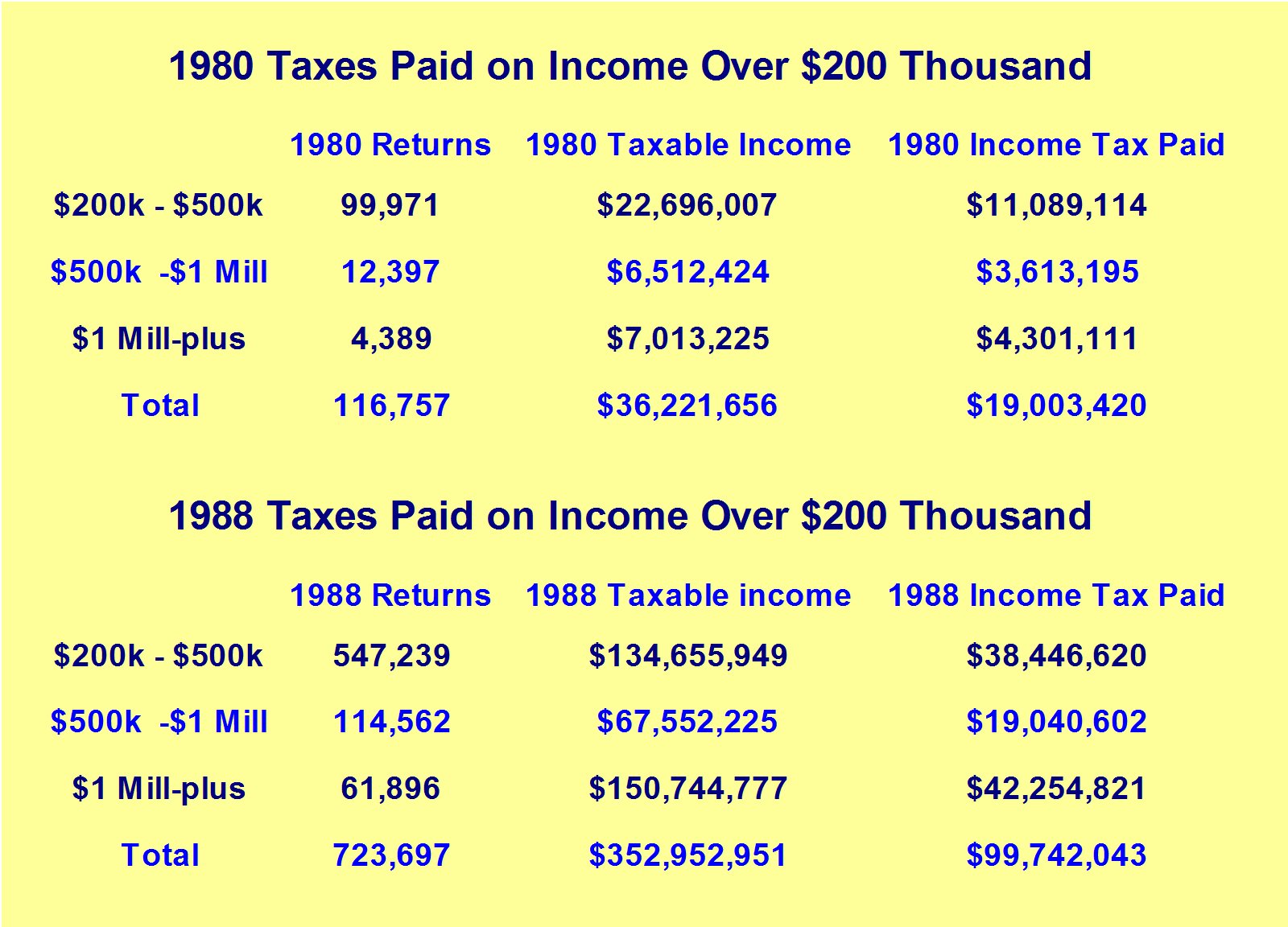
Unlike the rest of us, the rich have a great ability to alter the timing, amount and composition of their income. That’s because, according to IRS data, those with more than $1 million of adjusted gross income get only 33 percent of it from wages and salaries. The super-rich (those with income above $10 million) rely on wages and salaries for only 19 percent of their income. In 1980, when the top tax rate was 70 percent, rich people (those with incomes of more than $200,000) reported about $36 billion of income; the IRS collected about $19 billion of that amount. So what happened when President Ronald Reagan lowered the top tax rate to 28 percent by 1988? Did revenue fall proportionately, to about $8 billion? Folks on the left thought that would happen, complaining that Reagan’s “tax cuts for the rich” would starve the government of revenue and give upper-income taxpayers a free ride. But if we look at the 1988 IRS data, rich people paid more than $99 billion to Uncle Sam. That is, because rich taxpayers were willing to earn and report much more income, the government collected five times as much revenue with a lower rate.
I also included above, for readers of this blog, a table with the raw numbers from the IRS. Feel free to click for a larger image and see how the “rich” responded to better tax policy.
Obama wants to run the experiment in reverse. He hasn’t proposed to push the top tax rate up to 70 percent, thank goodness, but the combined effect of his class-warfare policies would mean a big increase in marginal tax rates. That might be good for workers in China, India or Ireland, because American jobs and investment would migrate to those places. But it’s not the right policy for the United States.
In other words, even if you’re a leftist and your main goal is giving the government more revenue, higher tax rates are a bad idea. The rich will simply figure out ways to protect their earnings while the rest of us suffer because the economy loses some of its dynamism.




 The Daily Hatch