Senator Mark Pryor wants our ideas on how to cut federal spending. Take a look at this video clip below:
Senator Pryor has asked us to send our ideas to him at cutspending@pryor.senate.gov and I have done so in the past and will continue to do so in the future.
On May 11, 2011, I emailed to this above address and I got this email back from Senator Pryor’s office:
Please note, this is not a monitored email account. Due to the sheer volume of correspondence I receive, I ask that constituents please contact me via my website with any responses or additional concerns. If you would like a specific reply to your message, please visit http://pryor.senate.gov/contact. This system ensures that I will continue to keep Arkansas First by allowing me to better organize the thousands of emails I get from Arkansans each week and ensuring that I have all the information I need to respond to your particular communication in timely manner. I appreciate you writing. I always welcome your input and suggestions. Please do not hesitate to contact me on any issue of concern to you in the future.
Government auditors spent the past five years examining all federal programs and found that 22 percent of them—costing taxpayers a total of $123 billion annually—fail to show any positive impact on the populations they serve.
Examples from multiple Government Accountability Office (GAO) reports of wasteful duplication include 342 economic development programs; 130 programs serving the disabled; 130 programs serving at-risk youth; 90 early childhood development programs; 75 programs funding international education, cultural, and training exchange activities; and 72safe water programs.
A GAO audit classified nearly half of all purchases on government credit cards as improper, fraudulent, or embezzled. Examples include gambling, mortgage payments, liquor, lingerie, iPods, Xboxes, jewelry, Internet dating services, and Hawaiian vacations. In one extraordinary example, the Postal Service spent $13,500on one dinner at a Ruth’s Chris Steakhouse, including “over 200 appetizers and over $3,000 of alcohol, including more than 40 bottles of wine costing more than $50 each and brand-name liquor such as Courvoisier, Belvedere and Johnny Walker Gold.” The 81 guests consumed an average of $167 worth of food and drink apiece.
We got to start cutting now or the government will control everything and there will be no incentive to work anymore. They are trying to get more federal intervention in local schools even now.
Budget Further Grows Bureaucracy at Department of Education– Lindsey Burke
The President’s budget request includes a 3.5 percent increase (over 2012 levels) for the Department of Education – the largest increase of any domestic agency. The Department of Education, a 4,200-person agency, has enjoyed dramatic funding increases year after year in the past three decades since its creation. Unfortunately, schools and families have not enjoyed commensurate increases in student achievement. The bloated bureaucracy has layered red tape on states and school districts, and served as little more than a filing cabinet for the reams of paperwork local schools must complete to demonstrate compliance with the Department’s 151 education programs. With the release of his 2013 budget request, President Obama is proposing to further grow this “bureaucratic boondoggle” at a time when American taxpayers are calling for fiscal restraint in Washington, including restraint at the Department of Education. The budget includes a $1.7 billion increase over 2012 levels, increasing spending on programs such as Race to the Top ($850 million in new grants), and providing $80 million in federal funding for STEM (Science, Technology, Engineering, and Mathematics) teacher training. On the higher education front, the proposal includes $8 billion in new spending for the Community College Career Fund, a program designed to expand certification programs and job training at community colleges. The spending will be divided among the Education and Labor Departments over the next three years. Consistent with the Obama administration’s disdain for the sector, for-profit colleges will be prohibited from receiving any of the new grant money. The President’s proposal also increases the maximum Pell Grant award, and includes a significant increase in the Perkins loan program (from $1 billion to $8 billion) if the loans are reauthorized. It includes a $1 billion higher education “Race to the Top” grant to provide more federal money to traditional universities that keep costs low – a proposal outlined in the President’s State of the Union address. The move, however, will provide zero incentive for colleges to reduce costs in the long-run since, on net, federal spending on college subsidies, grants, and loans will continue to increase. In all, President Obama’s budget request increases spending at the Department of Education to $69.8 billion. It’s a continuation of the failed policies of the past, and a perennial liberal agenda that claims spending more taxpayer dollars through more and more federal programs will improve education. It hasn’t and it won’t, and this latest increase once again puts taxpayers on the hook for profligate Washington spending that grows bureaucracy while further removing parents from the education decision-making process.
________________
Getting parents more control in schooling involves getting Washington out of the way. Voucher programs give the parents the ultimate control and would cause public schools to put up or shut up. Instead of giving parents more control it appears this next year’s budget proposal would increase the Dept of Education in Washington and give more control to Washington. In a time that we need massive cuts in our budget at the federal budget, I can think of no other place better to cut than eliminating the Dept of Education. That is almost 70 billion dollars saved at one time!!!!
Thank you so much for your time. I know how valuable it is. I also appreciate the fine family that you have and your committment as a father and a husband.
Sincerely,
Everette Hatcher III, 13900 Cottontail Lane, Alexander, AR 72002, ph 501-920-5733, lowcostsqueegees@yahoo.com
Ep. 4 – From Cradle to Grave [6/7]. Milton Friedman’s Free to Choose (1980)
With the national debt increasing faster than ever we must make the hard decisions to balance the budget now. If we wait another decade to balance the budget then we will surely risk our economic collapse.
The first step is to remove all welfare programs and replace them with the negative income tax program that Milton Friedman first suggested.
Milton Friedman points out that though many government welfare programs are well intentioned, they tend to have pernicious side effects. In Dr. Friedman’s view, perhaps the most serious shortcoming of governmental welfare activities is their tendency to strip away individual independence and dignity. This is because bureaucrats in welfare agencies are placed in positions of tremendous power over welfare recipients, exercising great influence over their lives. In addition, welfare programs tend to be self-perpetuating because they destroy work incentives. Dr. Friedman suggests a negative income tax as a way of helping the poor. The government would pay money to people falling below a certain income level. As they obtained jobs and earned money, they would continue to receive some payments from the government until their outside income reached a certain ceiling. This system would make people better off who sought work and earned income.
Participants: Robert McKenzie, Moderator; Milton Friedman; James R. Dumpson, Chief Administrator, Human Resources Admin., NYC; Thomas Sowell, Professor of Economics, UCLA; Robert Lampman, Professor of Economics, Institute of Poverty; Helen Bohen O’Bannon, Secretary of Welfare, State of Pennsylvania
LAMPMAN: I think it’s a viable approach to some part of the problems of poverty. It involves, first of all, cash payments rather than in kind payments as I understand it? It involves payments on a non-categorical basis.
MCKENZIE: What do you mean non-categorical?
LAMPMAN: That is to say, it doesn’t matter whether you’re a female-headed family or a male-headed family or whether you’re young or old, you’re sick or well.
MCKENZIE: If your income falls below a certain level you __
LAMPMAN: Pay some guaranteed income level for people based on family size and then it has a take-back rate which is modest, I suppose, by definition. Now, the question is: How many things you want to use that program to replace? How many things you want to replace with such a negative income tax program.
MCKENZIE: Would you replace everything with it __ just __ we clear that point up. Would you virtually wipe out the remaining forms of welfare if you got this program going?
FRIEDMAN: Yes, I would not __ I think its purpose is precisely to provide a transition between where we are now and where we would like to go because while __ because I agree with you, that given that we’ve corrupted the people on welfare and gotten them on there. We do have an obligation not to throw them out in the street and put them in the difficult adjustment you’ve made. We’ve got to ease the __
MCKENZIE: Yeah. Okay. Right.
FRIEDMAN: __ ease it off __
MCKENZIE: Sure. Yeah.
FRIEDMAN: __ and so __ but I would want to replace all __
MCKENZIE: Yeah. Okay.
FRIEDMAN: __ present welfare programs.
MCKENZIE: Let’s get reactions to this and then we’ll come back to you.
SOWELL: Well, I saw some figures recently which said that if you took all the money spent on poverty in the United States and divided it by all the poverty families you’d come out with a figure of $32,000 per family. Now, the average poverty family is apparently not getting the $32,000 and so clearly someone in between the treasury and those families is getting an awful lot of that money and I think if you simply eliminated the middle man, as they say in the commercials, that there’d be an awful lot of benefit both to the poor and to the taxpayers.
DUMPSON: I’m supportive of the negative income tax concept and the objective of it. I’d like to point out, however, that administratively we have another bureaucracy set up. Somebody has to take into account earnings. Someone has to decide when to pay back that which they’re entitled to. There’s a time lag between the paying back __ the earning and the paying back. There are a variety of problems in there that I will be prepared to accept but I want you to know that government intervention is not going to be eliminated.
O’BANNON: The issue that I have is: Where do children come in? What are their rights under a negative income tax? And are we, by building in a negative income tax, in fact subsidizing the illegitimacy that Tom Sowell is so concerned about?
FRIEDMAN: The major reason it is not feasible today to have a negative income tax is because the present welfare bureaucracy would be out of work. They are the major objectors and as Senator Pat __ he’s now a senator, Pat Moynihan demonstrated in his book on the Nixon program, the chief obstacle to getting it enacted was the welfare bureaucracy. So that I don’t believe these administrative problems, if you got it enacted, would be at all serious.
O’BANNON: I think the other assumption under the negative income tax, and it’s one that I’m not sure I can buy, is that everybody has a minimum level of understanding about how to spend money. In other words, how to use the marketplace to satisfy wishes. And I, as an economist, would say, yes, we do. We __ everybody from age four to a hundred knows how to use money to satisfy wants and that’s the __
FRIEDMAN: But they don’t. They don’t. There are all sorts of problems of people who are not going to be able to. But that’s a minority problem. That’s a problem for private activity and private charity. One thing is sure: They’re spending __ they would be spending their own money and that however knowledgeable you are about money __
O’BANNON: They would be spending my money.
FRIEDMAN: They would be spending my money, but it would be one stage less then. Right now, the welfare worker is spending Mr. A’s money to help Mr. C. And there’s a big takeoff in the middle as Tom Sowell said.
SOWELL: The question is not whether the people on welfare or low incomes can all spend their money effectively; the question is: How effectively do they spend it as compared to how effectively the bureaucrats spend it for them. Comparing anything to perfection or to some arbitrary standard settles nothing. The same thing is true in the education area. They’re saying “Would families be able to spend their __ select schools for their kids under a voucher system,” for example. Well, the question is: Could they possibly do much worse than the current bureaucrats are doing in the public school system.
O’BANNON: Oh __
MCKENZIE: We’ve run on education on another program. Bob Lampman.
(Laughing)
LAMPMAN: I want to quibble with something you said, Tom, about half of the money not going to the poor or something. That doesn’t __ shouldn’t leave the viewer to think that all the money is going to the administrators of programs. A lot of what you are talking about goes to non-poor recipients. For example, social security, as a program, pays a roughly half of its benefits to people who otherwise would not be poor. Unemployment insurance pays about two-thirds of its benefits or so to non-poor persons. And those are, in some definitions, welfare or anti-poverty programs and that’s how statisticians come up with this horrendous sounding discrepancy between the total amount of money spent and the total cash benefits that go to the poor.
SOWELL: Well, I think, I think it’s a perfectly valid point though, because supposedly we were not setting up unemployment benefits and social security in order to keep the affluent.
LAMPMAN: Well, this goes back to its big philosophy, debate we might have. I think that it’s easy to oversimplify things and say that all these programs, including the public schools are there to be a help to the poor and poor only.
FRIEDMAN: Yeah, but I was saying __
LAMPMAN: But let me mention that the negative income tax has some of its impetus in that it would be a way of confining benefit payments to people who are __
SOWELL: Yes. Yes.
LAMPMAN: __ and it would cut out benefits for an awful lot of people who now have expectations that they’re going to get them, not in the form of public assistance, but in the form of social insurance as we use the term.
SOWELL: Well, in order to be made for not disappointing the expectations on which people have built their lives for one generation, but not of continuing for eternity in order to avoid one generation of transition.
MCKENZIE: What are the other hurdles toward getting underway. Now, you said, I don’t know how seriously, the biggest almost the only hurdle is the welfare bureaucracy.
FRIEDMAN: No. Now, there’d be the biggest immediate group of lobbyists that will lobby against it.
MCKENZIE: Yep.
FRIEDMAN: The biggest hurdle in getting it over at the moment is that there is no way of constructing a sensible negative income tax system that will not hurt some people. There will be some people who will get less money than they are now getting under __ particularly those in the upper income groups. Particularly the affluent who are now being subsidized by the welfare and they, will make it politically difficult for the people to put it into effect. The attempt is to put a negative income tax in effect which costs less money, is easier to administer, and yet which doesn’t pay anybody in the society one dollar less than he’s now getting. There’s no way in which you can construct such a program. But, although it’s not politically feasible now, the force of history is on its side, it’s going to become political __
MCKENZIE: Dr. James Dumpson.
DUMPSON: Let’s not say that the __ give the impression that welfare administrators were against negative income tax, the fat program for example, as Moynihan says, because they would lose their jobs, for example. Many of us were opposed to it because of certain features in that program: A $24 __ $2,400 level for a family of four. We were opposed to that. And if one goes down the Congressional record, those who testified, will be shown to be saying, “Yes, we’re for it conceptually. But we’re against this piece and this piece, if you change that you’ll have our support.”
FRIEDMAN: I was in the same position. I first proposed the negative income tax twenty-five years ago but I testified against the final version of the Nixon plan. Why? Because the welfare bureaucrats had led them to introduce changes in it which converted it from a decent satisfactory negative income tax to one which would have been just as bad as what you have now. Would have been added on top of everything else.
Q: York County was recently in the news for a lawsuit involving the teaching of intelligent design. What’s your attitude regarding the teaching of evolution in public schools?
A: “I’m a Christian, and I believe in parents being able to provide children with religious instruction without interference from the state. But I also believe our schools are there to teach worldly knowledge and science. I believe in evolution, and I believe there’s a difference between science and faith. That doesn’t make faith any less important than science. It just means they’re two different things. And I think it’s a mistake to try to cloud the teaching of science with theories that frankly don’t hold up to scientific inquiry.”
Is there any purpose in life? Evolution is clear on this point. I have included the first portion of the article by Dr. Jerry Bergman who I have corresponded with in the past.
Humans have always wondered about the meaning of life…life has no higher purpose than to perpetuate the survival of DNA…life has no design, no purpose, no evil and no good, nothing but blind pitiless indifference.1–Richard Dawkins
Evolution is “deceptively simple yet utterly profound in its implications,”2 the first of which is that living creatures “differ from one another, and those variations arise at random, without a plan or purpose.”3 Evolution must be without plan or purpose because its core tenet is the natural selection of the fittest, produced by random copying errors called mutations. Darwin “was keenly aware that admitting any purposefulness whatsoever to the question of the origin of species would put his theory of natural selection on a very slippery slope.”4 Pulitzer Prize author Edward Humes wrote that the fact of evolution was obvious but “few could see it, so trapped were they by the human…desire to find design and purpose in the world.” He concluded:
Darwin’s brilliance was in seeing beyond the appearance of design, and understanding the purposeless, merciless process of natural selection, of life and death in the wild, and how it culled all but the most successful organisms from the tree of life, thereby creating the illusion that a master intellect had designed the world. But close inspection of the watchlike “perfection” of honeybees’ combs or ant trails…reveals that they are a product of random, repetitive, unconscious behaviors, not conscious design.5
The fact that evolution teaches that life has no purpose beyond perpetuating its own survival is not lost on teachers. One testified that teaching evolution “impacted their consciences” because it moved teachers away from the “idea that they were born for a purpose… something completely counter to their mindset and beliefs.”6
In a study on why children resist accepting evolution, Yale psychologists Bloom and Weisberg concluded that the evolutionary way of viewing the world, which the authors call “promiscuous teleology,” makes it difficult for them to accept evolution. Children “naturally see the world in terms of design and purpose.”7 The ultimate purposelessness of evolution, and thus of the life that it produces, was eloquently expressed by Professor Lawrence Krauss as follows: “We’re just a bit of pollution…. If you got rid of us…the universe would be largely the same. We’re completely irrelevant.”8
The Textbooks
To determine what schools are teaching about religious questions such as the purpose of life, I surveyed current science textbooks and found that they tend to teach the view that evolution is both nihilistic and atheistic. One of today’s most widely-used textbooks stated that “evolution works without either plan or purpose…. Evolution is random and undirected.”9 Another text by the same authors added that Darwin knew his theory “required believing in philosophical materialism, the conviction that matter is the stuff of all existence and that all mental and spiritual phenomena are its byproducts.” The authors continued:
Darwinian evolution was not only purposeless but also heartless–a process in which…nature ruthlessly eliminates the unfit. Suddenly, humanity was reduced to just one more species in a world that cared nothing for us. The great human mind was no more than a mass of evolving neurons. Worst of all, there was no divine plan to guide us.10
Another text taught that humans are just “a tiny, largely fortuitous, and late-arising twig on the enormously arborescent bush of life” and the belief that a “progressive, guiding force, consistently pushing evolution to move in a single direction” is now known to be “misguided.”11 Many texts teach that evolution is purposeless and has no goal except to achieve brute survival: the “idea that evolution is not directed towards a final goal or state has been more difficult for many people to accept than the process of evolution itself.”12 One major text openly teaches that humans were created by a blind, deaf, and dumb watchmaker–namely natural selection, which is “totally blind to the future.”
Humans…came from the same evolutionary source as every other species. It is natural selection of selfish genes that has given us our bodies and our brains…. Natural selection…explains…the whole of life, the diversity of life, the complexity of life, |and| the apparent design in life.”13
The Implications
Many texts are very open about the implications of Darwinism for theism. One teaches that Darwin’s immeasurably important contribution to science was to show that, despite life’s apparent evidence of design and purpose, mechanistic causes explain all biological phenomena. The text adds that by coupling “undirected, purposeless variation to the blind, uncaring process of natural selection, Darwin made theological or spiritual explanations of the life processes superfluous.”14 The author concludes by noting that “it was Darwin’s theory of Evolution that provided a crucial plank to the platform of mechanisms and materialism…that has been the stage of most western thought.”15 Another text even stated directly that humans were created by a random process, not a loving, purposeful God, and:
The real difficulty in accepting Darwin’s theory has always been that it seems to diminish our significance…. |Evolution| asked us to accept the proposition that, like all other organisms, we too are the products of a random process that, as far as science can show, we are not created for any special purpose or as part of any universal design.16
These texts are all clearly teaching religious ideas, not science. An excellent example is a text that openly ruled out not only theistic evolution, but any role for God in nature, and demonstrated that Darwinism threatened theism by showing that humans and all life “could be explained by natural selection without the intervention of a god.” Evolutionary “randomness and uncertainty had replaced a deity having conscious, purposeful, human characteristics.”
The Darwinian view that… present-type organisms were not created spontaneously but formed in a succession of selective events that occurred in the past, contradicted the common religious view that there could be no design, biological or otherwise, without an intelligent designer…. In this scheme a god of design and purpose is not necessary…. Religion has been bolstered by… the comforting idea that humanity was created in the image of a god to rule over the world and its creatures. Religion provided emotional solace, a set of ethical and moral values…. Nevertheless, faith in religious dogma has been eroded by natural explanations of its mysteries…. The positions of the creationists and the scientific world appear irreconcilable.”17
Darwin himself taught a totally atheistic, naturalistic view of origins. He even once said, “I would give nothing for the theory of natural selection if it requires miraculous additions at any one stage of descent.”18 John Alcock, an evolutionary biologist, therefore concluded that “we exist solely to propagate the genes within us.”19
Leading Darwin scholar Janet Browne makes it very clear that Darwin’s goal was the “arduous task of reorienting the way Victorians looked at nature.” To do this Darwin had to convince the world that “ideas about a benevolent, nearly perfect natural world” and those that believe “beauty was given to things for a purpose, were wrong–that the idea of a loving God who created all living things and brought men and women into existence was…a fable.”
The world…steeped in moral meaning which helped mankind seek out higher goals in life, was not Darwin’s. Darwin’s view of nature was dark–black…. Where most men and women generally believed in some kind of design in nature–some kind of plan and order–and felt a deep-seated, mostly inexpressible belief that their existence had meaning, Darwin wanted them to see all life as empty of any divine purpose.20
Darwin knew how difficult it was to abandon such a view, but realized that for evolution to work, nature must ultimately be “governed entirely by chance.” Browne concludes:
The pleasant outward face of nature was precisely that–only an outward face. Underneath was perpetual struggle, species against species, individual against individual. Life was ruled by death…destruction was the key to reproductive success. All the theological meaning was thus stripped out by Darwin and replaced by the concept of competition. All the telos, the purpose, on which natural theologians based their ideas of perfect adaptation was redirected into Malthusian–Darwinian–struggle. What most people saw as God-given design he saw as mere adaptations to circumstance, adaptations that were meaningless except for the way in which they helped an animal or plant to survive.21
Neo-Darwinist Richard Dawkins recognized the purposelessness of such a system:
In a universe of blind physical forces and genetic replication some people are going to get hurt, other people are going to get lucky, and you won’t find any rhyme or reason in it, nor any justice. The universe we observe has precisely the properties we should expect if there is, at bottom, no design, no purpose, no evil and no good, nothing but blind, pitiless indifference.22
How widely is this view held by scientists? One study of 149 leading biologists found that 89.9 percent believed that evolution has no ultimate purpose or goal except survival, and we are just a cosmic accident existing at the whim of time and chance. A mere six percent believed that evolution has a purpose.23 Almost all of those who believed that evolution had no purpose were atheists. This is only one example that Sommers and Rosenberg call the “destructive power of Darwinian theory.”24
References
Scheff, Liam. 2007. The Dawkins Delusion. Salvo, 2:94.
Humes, Edward. 2007. Monkey Girl: Evolution, Education, Religion, and the Battle for America’s Soul. New York: Ecco, 119.
Ibid, 119.
Turner, J. Scott. 2007. The Tinkerer’s Accomplice: How Design Emerges from Life Itself. Cambridge, MA: Harvard University Press, 206.
Humes, Monkey Girl, 119.
Ibid, 172.
Bloom, Paul and Deena Skolnick Weisberg. 2007. Childhood Origins to Adult Resistance to Science. Science, 316:996.
Panek, Richard. 2007. Out There. New York Times Magazine, 56.
Miller, Kenneth R. and Joseph S. Levine. Biology. 1998. Fourth Edition, Englewood Cliffs, NJ: Prentice Hall, 658, emphasis in original.
Levine, Joseph S. and Kenneth R. Miller 1994. Biology: Discovering Life. Second Edition, Lexington, MA: D.C. Heath, 161, emphasis in original.
Raven, Peter H. and George B. Johnson. 2002. Biology. Sixth Edition, Boston, MA: McGraw Hill, 16, 443.
Purves, William K., David Sadava, Gordon H. Orians, and H. Craig Keller. 2001. Life: The Science of Biology. Sixth Edition, Sunderland, MA: Sinauer Associates; W.H. Freeman, 3.
Interview with Richard Dawkins in Campbell, Neil A., Jane B. Reece, and Lawrence G. Mitchell. 1999. Biology. Fifth Edition, Menlo Park, CA: Addison Wesley Longman, 412-413.
Futuyma, Douglas J. 1998. Evolutionary Biology. Third Edition, Sunderland, MA: Sinauer Associates, 5.
Ibid, 5.
Curtis, Helena and N. Sue Barnes. 1981. Invitation to Biology. Third Edition, New York, NY: Worth, 475.
Strickberger, Monroe. 2000. Evolution. Third Edition, Sudbury, MA: Jones & Bartlett, 70-71.
Darwin, Francis (editor). 1888. The Life and Letters of Charles Darwin. London: John Murray, 210.
It is apparent from this statement below that Senator Mark Pryor is against the Balanced Budget Amendment. He has voted against it over and over like his father did and now I will give reasons in this series why Senator Pryor will be defeated in his re-election bid in 2014. However, first I wanted to quote the statement Senator Pryor gave on December 14, 2011. This information below is from the Arkansas Times Blog on 12-14-11 and Max Brantley:
THREE CHEERS FOR MARK PRYOR: Our senator voted not once, but twice, today against one of the hoariest (and whoriest) of Republican gimmicks, a balanced budget amendment. Let’s quote him:
As H.L. Mencken once said, “For every complex problem there is a solution which is simple, clean, and wrong.” This quote describes the balanced budget amendment. While a balanced budget amendment makes for an easy talking point, it is an empty solution. Moreover, it’s a reckless choice that handcuffs our ability to respond to an economic downturn or national emergencies without massive tax increases or throwing everyone off Medicare, Social Security, or veteran’s care.There is a more responsible alternative to balance the budget. President Clinton led the way in turning deficits into record surpluses. We have that same opportunity today, using the blueprint provided by the debt commission as a starting point. We need to responsibly cut spending, reform our tax code and create job growth. This course requires hard choices over a number of years. However, it offers a more balanced approach over jeopardizing safety net programs and opportunity for robust economic growth.
____________________
Senator Mark Pryor will lose his bid for re-election in 2014 BECAUSE HE IS AFRAID TO TELL THE TRUTH ABOUT ENTITLEMENTS AND THEN TO DO SOMETHING ABOUT THEIR FUTURE WHICH WILL BANKRUPT THIS NATION IF LEFT ALONE ANY LONGER.
Two key principles should govern congressional consideration of an amendment to the U.S. Constitution that requires the federal government to balance its budget:
First Principle: A Balanced Budget Amendment (BBA) is important to help bring long-term fiscal responsibility to America’s future when the BBA takes effect after ratification by three-quarters of the state legislatures; it is equally important for Congress to cut spending nowto address the current overspending crisis.
Second Principle: An effective BBA will include three elements to: (a) control spending, taxation, and borrowing, (b) ensure the defense of America, and (c) enforce the requirement to balance the budget.
Cuts for the Future, Cuts for the Present
Federal spending is out of control—both obligations for the future and spending right now.
Congress must get spending under control in the long term. America cannot raise taxes to continue overspending, because tax hikes shrink our economy and grow our government. America cannot borrow more to continue overspending, because borrowing puts an enormous financial burden on the American children of tomorrow. A BBA will help address this long-term problem because, after the multi-year process for securing ratification of the BBA by three-quarters of the states, the BBA will keep federal spending under control in subsequent years.
Congress also must get spending under control in theshort term. Federal overspending is not simply about the future, but also about the present. Under the President’s Fiscal Year 2012 Budget Submission, measured by the Congressional Budget Office, the federal government will spend $1.2 trillion more than it will take in, a gargantuan burden of additional debt forced on future generations to pay current bills.
Thus, America needs both a Balanced Budget Amendment for the long term and deep cuts in federal spending starting right now, without waiting for a BBA to take effect. As Congress considers budget resolutions, appropriations bills, appropriations continuing resolutions, and debt limit bills, Congress should take every opportunity now to cut federal spending, including for the biggest overspending problem: the ever-growing entitlement programs.
Congress should recognize that the best way to encourage state legislatures to ratify a BBA is to demonstrate, through consistent congressional cuts in spending, that the American people have the will to accept spending cuts to balance the budget.
Elements of a Successful Balanced Budget Amendment
A successful BBA will:
Control spending, taxing, and borrowing through a requirement to balance the budget.The BBA should cap annual spending at a level not exceeding either: (a) a specified percentage of the value of goods and services the economy produces in a year (known as gross domestic product, or GDP), or (b) the level of revenues. To ensure that Congress cannot simply balance the budget by continually raising taxes instead of cutting overspending, the BBA should require Congress to act by supermajority votes if Members wish to raise taxes. Any authority the BBA grants Congress to deal with economic slowdowns, by waiving temporarily the requirement that spending not exceed the GDP percentage or revenue level, should specify the amount of above-revenue spending allowed and require supermajority votes.
Defend America. The BBA should allow Congress by supermajority votes to waive temporarily compliance with the balanced budget requirement when waiver is essential to pay for the defense of Americans from attack.
Enforce the balanced budget requirement. The BBA should provide for its own enforcement, but must specifically exclude courts from any enforcement of the BBA, so unelected judges do not make policy decisions such as determining the appropriate level of funding for federal programs. A government that spends money in excess of its revenues must borrow to cover the difference. Therefore, to enforce the requirement to balance the budget, the BBA should prohibit government issuance of debt, except when necessary to finance a temporary deficit resulting from congressional supermajority votes discussed above.
America is in a fiscal crisis. Our government spends too much. Overspending must stop immediately. Overspending will stop only if Congress cuts spending now, including with respect to the ever-expanding entitlement programs. For the future, Congress and three-quarters of state legislatures can adopt and ratify a Balanced Budget Amendment to the U.S. Constitution to anchor the American willingness to live within a balanced budget.
David S. Addington is Vice President for Domestic and Economic Policy, and J. D. Foster, Ph.D., is Norman B. Ture Senior Fellow in the Economics of Fiscal Policy, at The Heritage Foundation.
Under Francis Schaeffer’s tutelage, Evangelicals like Chuck Colson learned to see life through the lens of a Christian worldview. Join Chuck as he celebrates a life well lived.
_______________________
This year Francis Schaeffer would have turned 100 on Jan 30, 2012. I remember like yesterday when I first was introduced to his books. I was even more amazed when I first saw his films. I was so influenced by them that I bought every one of his 30 something books and his two film series. Chuck Colson’s website www.breakpoint.org and I was directed from there to Probe’s website where I found this great article below. I will share it in 4 parts. Todd Kappelman is the author and here is some info on him and Probe.
Todd A. Kappelman is a field associate with Probe Ministries. He is a graduate of Dallas Baptist University (B.A. and M.A.B.S., religion and Greek), and the University of Dallas (M.A., philosophy/humanities). Currently he is pursuing a Ph.D. in philosophy at the University of Dallas. He has served as assistant director of the Trinity Institute, a study center devoted to Christian thought and inquiry. He has been the managing editor of The Antithesis, a bi-monthly publication devoted to the critique of foreign and independent film. His central area of expertise is Continental philosophy (especially nineteenth and twentieth century) and postmodern thought.
What is Probe?
Probe Ministries is a non-profit ministry whose mission is to assist the church in renewing the minds of believers with a Christian worldview and to equip the church to engage the world for Christ. Probe fulfills this mission through our Mind Games conferences for youth and adults, our 3-minute daily radio program, and our extensive Web site at www.probe.org.
Further information about Probe’s materials and ministry may be obtained by contacting us at:
The Need to Read series began several months ago with a program on C.S. Lewis . The rationale for this series is that many of the great writers who have helped many Christians mature are now either unknown or neglected by many who could use these authors insights into the faith.
This installment focuses on Francis Schaeffer (1912-1984), one of the most recognized and respected Christian authors of the twentieth century.
He saw so much more in what he was looking at and agonized over it much more that the rest of us. He was one of the truly great Christians of our time.{1} If this is the case, and I and many others believe that it is, then this question follows: What was Schaeffer looking at? The remarkable answer to this question is all of human history and the long chain of events which have led to modern man as we see him today.
In a time when true scholarship is often equated with specialization in a particular period, people, or subject, Schaeffer was a grand generalist. He was a true Renaissance man who knew something about everything, as opposed to everything about something. In addition to his remarkable and encyclopedic knowledge of human history, he was able to connect important events together such that Christians can see what has happened in human history, what is happening now, and what will happen if man continues on his present course. Schaeffer was a visionary who had an uncanny understanding of the times we live in and what mankind can expect in the near future.
Schaeffers greatest gift, like that of C.S. Lewis, was his concern for the average Christian. He believed philosophy, theology, and ethics should not be reserved for the conversation of learned academics; rather they should be the daily concern of the man on the street. The price for ignorance of the subjects could be our life, or more importantly, our very souls. The Scriptures are very clear concerning the price of ignorance. The prophet Hosea said that Gods people perish for lack of knowledge.{2} In light of this observation, Schaeffers genius was his ability to communicate extremely difficult philosophical and theological issues on a non- technical level. His writings provide Christians with access to some of the most pressing concerns of our times.
Several aspects of Schaeffers style and sweeping concerns will be discussed in this essay. First, he perceived the wholeness of the created order. There is a basic need in all human beings to know the answers to the great questions of life, and Schaeffer believed that God has given man the answers in the form of natural and specific revelation.
Second, Schaeffer believed that man has a natural inclination to desire the reasonable. Schaeffer argued that the Christian faith is not only true, but that it is the most plausible account for the existence of man and his place in the universe. He contended that an irrational faith is not what God intended to communicate to man.
Third, Schaeffer was one of the original cultural critics of the twentieth century. He believed that mankind, both Christians and non-Christians, was adrift on a sea of irrationality. He further believed that this drift was intensifying to the point that true, orthodox Christianity was being lost.
Dr. Francis Schaeffer – Extra – Interview – Part 2 Francis Schaeffer had a big impact on me in the late 1970′s and I have been enjoying his books and films ever since. Here is great video clip of an interview and below is a fine article about him. Francis Schaeffer 1912-1984 Christian Theologian, Philosopher, […]
E P I S O D E 1 0 How Should We Then Live 10#1 FINAL CHOICES I. Authoritarianism the Only Humanistic Social Option One man or an elite giving authoritative arbitrary absolutes. A. Society is sole absolute in absence of other absolutes. B. But society has to be led by an elite: John Kenneth […]
What Ever Happened to the Human Race? Bachmann was a student of the works of Francis Schaeffer like I am and I know she was pro-life because of it. (Observe video clip above and picture of Schaeffer.) I hated to see her go. DES MOINES, Iowa — Last night, Minnesota Rep. Michele Bachmann vowed to […]
E P I S O D E 9 How Should We Then Live 9#1 T h e Age of Personal Peace and Afflunce I. By the Early 1960s People Were Bombarded From Every Side by Modern Man’s Humanistic Thought II. Modern Form of Humanistic Thought Leads to Pessimism Regarding a Meaning for Life and for Fixed […]
E P I S O D E 8 How Should We Then Live 8#1 I saw this film series in 1979 and it had a major impact on me. T h e Age of FRAGMENTATION I. Art As a Vehicle Of Modern Thought A. Impressionism (Monet, Renoir, Pissarro, Sisley, Degas) and Post-Impressionism (Cézanne, Van Gogh, Gauguin, […]
E P I S O D E 7 How Should We Then Live 7#1 I am thrilled to get this film series with you. I saw it first in 1979 and it had such a big impact on me. Today’s episode is where we see modern humanist man act on his belief that we live […]
Dr. Francis Schaeffer – Extra – Interview – Part 2 Francis Schaeffer had a big impact on me in the late 1970′s and I have been enjoying his books and films ever since. Here is great video clip of an interview and below is a fine article about him. Francis Schaeffer 1912-1984 Christian Theologian, Philosopher, […]
E P I S O D E 6 How Should We Then Live 6#1 I am sharing with you a film series that I saw in 1979. In this film Francis Schaeffer asserted that was a shift in Modern Science. A. Change in conviction from earlier modern scientists.B. From an open to a closed natural system: […]
E P I S O D E 5 How Should We Then Live 5-1 I was impacted by this film series by Francis Schaeffer back in the 1970′s and I wanted to share it with you. Francis Schaeffer noted, “Reformation Did Not Bring Perfection. But gradually on basis of biblical teaching there was a unique improvement. A. […]
How Should We Then Live 4-1 I was impacted by this film series by Francis Schaeffer back in the 1970′s and I wanted to share it with you. Schaeffer makes three key points concerning the Reformation: “1. Erasmian Christian humanism rejected by Farel. 2. Bible gives needed answers not only as to how to be right with […]
How Should We Then Live 3-1 I was impacted by this film series by Francis Schaeffer back in the 1970′s and I wanted to share it with you. Schaeffer really shows why we have so many problems today with this excellent episode. He noted, “Could have gone either way—with emphasis on real people living in […]
How Should We Then Live 2-1 I was impacted by this film series by Francis Schaeffer back in the 1970′s and I wanted to share it with you. Schaeffer points out that during this time period unfortunately we have the “Church’s deviation from early church’s teaching in regard to authority and the approach to God.” […]
How Should We Then Live 1-1 Today I am starting a series that really had a big impact on my life back in the 1970′s when I first saw it. There are ten parts and today is the first. Francis Schaeffer takes a look at Rome and why it fell. It fell because of inward […]
MANCHESTER, England — Manchester City won the English title for the first time in 44 years, surging past Queens Park Rangers 3-2 on Sunday with Sergio Aguero scoring his team’s second goal late in stoppage time.
Aguero, the son-in-law of Argentine great Diego Maradona, scored during the fourth minute of injury time, two minutes after substitute Edin Dzeko made it 2-2. The winning goal snatched the trophy from defending champion Manchester United on goal difference. Without Aguero’s startling goal, United would have won the title after its 1-0 victory over Sunderland moments earlier on the final day of the season.
More From ESPN.com
It’s fitting that the wildest Premier League season saw possibly the most dramatic ending in its history, Ravi Ubha writes. Story
“I don’t think I’ve ever seen a finale like this,” City manager Roberto Mancini said. “We didn’t deserve to lose. We had a lot of chances and we deserved to win the game and championship. It’s fantastic for the club and the supporters after 44 years. It’s been a crazy season and a crazy last minute.”
It was the first time the English title was decided in such dramatic circumstances since 1989, when Arsenal and Liverpool finished even on points and had the same goal difference. Arsenal won the title on total goals.
“It’s a cruel way (to lose the title),” United manager Sir Alex Ferguson said. “We’ve experienced many ups and downs in the 25 years I’ve been here, most of them have been great, we’ve won the title three times on the last day, today we nearly did it.
“I’d like to say on behalf of Manchester United, congratulations to our neighbors — a fantastic achievement to win the Premier League.”
City won the title for the first time since 1968 after overturning the eight-point lead United held five weeks ago. The two Manchester rivals have traded places atop the standings all season, and continued to do so until the final minutes of the final day.
City took a 1-0 lead into halftime, but then went down 2-1 after the break despite QPR captain Joey Barton being sent off in the 55th, leaving his team with 10 men the rest of the way.
“I never stopped believing,” City captain Vincent Kompany said. “When Edin scored that goal, it reminded me of so many other moments during the season when we’ve done this before. There was no reason not to believe.
Paul Ellis/AFP/Getty ImagesSergio Aguero is mobbed by his Manchester City teammates after scoring the eventual winning goal.
“It’s not sunk in yet. I don’t know what happened at the end, it was just a huge mess.”
Pablo Zabaleta put City in front in the 39th minute, but Djibril Cisse tied it for QPR three minutes into the second half after a misplay by Joleon Lescott. Lescott went to make a simple headed clearance but instead knocked the ball backward, and Cisse seized on the defender’s mistake by driving a shot past Joe Hart.
Barton was then sent off for elbowing Carlos Tevez, but Jamie Mackie managed to head the visitors in front in the 66th.
City’s expensively assembled squad had been facing its first loss at home since December 2010, but Dzeko sparked the recovery by heading in a corner kick in the second minute of stoppage time.
There was still time for one final moment of drama in an unpredictable season when Aguero drove home the winner. As the final whistle blew, thousands of City fans poured onto the field and blue smoke wafted around the stadium.
Winning the title is the result of more than a $1 billion of investment by Abu Dhabi’s Sheikh Mansour, who rescued a financially stricken club from ousted Thai Prime Minister Thaksin Shinawatra in 2008.
“It was really important to start winning this championship,” Mancini said. “Manchester City can have a big future now.”
The field was covered in confetti from the start and all the action was in QPR’s half, although the hosts couldn’t find the goal against a relegation-threatened club.
Yaya Toure fired over and David Silva struck tamely at goalkeeper Paddy Kenny before news filtered through of Wayne Rooney putting 19-time champion United ahead at Sunderland and top of the standings.
QPR hasn’t won on the road since December, but it wasn’t all bad news for the London club — it avoided relegation after Bolton was held to a 2-2 draw at Stoke.
Information from The Associated Press was used in this report.
It is apparent from this statement below that Senator Mark Pryor is against the Balanced Budget Amendment. He has voted against it over and over like his father did and now I will give reasons in this series why Senator Pryor will be defeated in his re-election bid in 2014. However, first I wanted to quote the statement Senator Pryor gave on December 14, 2011. This information below is from the Arkansas Times Blog on 12-14-11 and Max Brantley:
THREE CHEERS FOR MARK PRYOR: Our senator voted not once, but twice, today against one of the hoariest (and whoriest) of Republican gimmicks, a balanced budget amendment. Let’s quote him:
As H.L. Mencken once said, “For every complex problem there is a solution which is simple, clean, and wrong.” This quote describes the balanced budget amendment. While a balanced budget amendment makes for an easy talking point, it is an empty solution. Moreover, it’s a reckless choice that handcuffs our ability to respond to an economic downturn or national emergencies without massive tax increases or throwing everyone off Medicare, Social Security, or veteran’s care.There is a more responsible alternative to balance the budget. President Clinton led the way in turning deficits into record surpluses. We have that same opportunity today, using the blueprint provided by the debt commission as a starting point. We need to responsibly cut spending, reform our tax code and create job growth. This course requires hard choices over a number of years. However, it offers a more balanced approach over jeopardizing safety net programs and opportunity for robust economic growth.
____________________
Mark Pryor will be defeated for his re-election because he is involved constantly in cover votes!!! Take a look at the video below and the discussion of a cover vote concerning the Balanced Budget Amendment. Look at the excellent article below concerning the history of the Balanced Budget Amendment votes of the past. OVER AND OVER POLITICIANS HAVE TRIED TO COVER THEMSELVES WHEN WHAT THEY REALLY WANT TO DO IS TO SPEND LOTS OF OUR KIDS’ MONEY THAT THEY WILL HAVE TO PAY BACK.
Abstract:Attempts at passing a balanced budget amendment (BBA) date back to the 1930s, and all have been unsuccessful. Both parties carry some of the blame: The GOP too often has been neglectful of the issue, and the Democratic Left, recognizing a threat to big government, has stalled and obfuscated, attempting to water down any proposals to mandate balanced budgets. On the occasion of the July 2011 vote on a new proposed BBA, former Representative from Oklahoma Ernest Istook presents lessons from history.
A proposed balanced budget amendment (BBA) to the Constitution is set to be considered by Congress this July—the first such vote since 1997.
The BBA is a powerful proposal that attracts great vitriol from the American Left, which recognizes it as an enormous threat to its big-government ways—perhaps the greatest threat. For that reason, the history of Congress’s work on a BBA is full of frustrations, high-profile defections, reversals, and betrayals.
This paper discusses that history. It also describes some of the milktoast versions and amendments that have been offered to gut the BBA while providing political cover for those who are unwilling to support a robust version.
Brief History
Thomas Jefferson wrote in 1798, “I wish it were possible to obtain a single amendment to our Constitution. I would be willing to depend on that alone for the reduction of the administration of our government; I mean an additional article taking from the Federal Government the power of borrowing.”[1] Yet according to the Congressional Research Service,[2] the first balanced budget amendment was not proposed until 1936, when Representative Harold Knutson (R–MN) introduced House Joint Resolution 579, proposing a per capita limit on federal debt.
No BBA measure passed either body of Congress until 1982, when the Senate took 11 days to consider it and mustered the necessary two-thirds majority on the version crafted by Senator Strom Thurmond (R–SC).[3] A companion measure received a vote of 236 to 187 in the House—short of the required two-thirds. Despite opposition from Speaker Thomas “Tip” O’Neill (D–MA), the floor vote was obtained by means of a discharge petition led by Representatives Barber Conable (R–NY) and Ed Jenkins (D–GA).[4]
Subsequently, continuing opposition from Speaker O’Neill and his successor, Jim Wright (D–TX), prompted creative use of discharge petitions to circumvent leadership opposition. Several House votes were held in the early 1990s, when Representative Charles Stenholm (D–TX) led bipartisan coalitions to force Democratic leaders to permit (unsuccessful) floor votes. At the time, even prominent Democrats such as Representative Joseph Kennedy (MA) openly supported the BBA and voted for it. There were multiple House and Senate votes, but all were unsuccessful.[5]
The first and only time the House gave two-thirds approval to a balanced budget amendment was in 1995, when Members voted for the “Contract with America” that helped Republicans win major congressional majorities. That was the last time the House held a floor or committee vote. Since then, the Senate has failed twice—each time by a single vote—to gather the two-thirds needed.[6]
Defections Block BBA Approval
Three Senators were the key defectors who prevented Congress from approving a balanced budget amendment in the 1990s. One actually had never supported it and bucked his party to oppose it. The other two flip-flopped in order to go along with their party in opposing the BBA.
First, in 1995, Senator Mark Hatfield (R–OR) took the heat when he would not join his party in support of a BBA. But Hatfield’s vote would have been unnecessary had Senator Tom Daschle (D–SD) not reversed years of prior support to oppose the BBA at President Bill Clinton’s urging.
Then, in 1997, the measure again failed by a single vote in the Senate when newly elected Senator Robert Torricelli (D–NJ) broke his campaign pledge and refused to support the same BBA that he had supported as a House member.[7]
More recently, many House Democrats who voted for the BBA in 1995 are now saying they will vote no in 2011. Most notable among these is House Democratic Whip Steny Hoyer (D–MD).
Senate Defections
Senator Hatfield called the BBA a “political gimmick,” and his high-profile defection broke GOP party unity. Less noticed was that his opposition could have been a moot point. Then-Senate Majority Leader Bob Dole (R–KS) told The New York Times that Hatfield offered to resign before the vote—a resignation that would have produced a 66-to-33 victory for the BBA—but Dole refused to accept the resignation offer.[8]
Still, with or without Hatfield’s vote or resignation, the BBA would have prevailed in the 1995 Senate vote were it not for Senator Daschle’s reversal. That flip-flop is described in a book about his later ousting from office by the voters:
Although the balanced budget amendment had not been a major issue nationally for several years, it provided a striking contrast between Daschle’s first campaign in 1978 and his early career in Congress, when he consistently promoted the amendment, and his later years in the Senate. During his last competitive Senate bid in 1986, Daschle ran a television ad saying that “in 1979, Tom Daschle saw the damage these deficits could do to our country. His first official act was to sponsor a Constitutional amendment to balance the budget.” In 1992, Daschle’s campaign literature touted the “Daschle Plan,” which included the balanced budget amendment: “In 1979, before it became popular, I was pushing a balanced budget amendment to the Constitution. It was my first official action, and I’ve authored or coauthored one every year.” In 1995, the amendment had the support of sixty-six of the sixty-seven senators needed for passage, but Daschle voted against it because of opposition from the Clinton administration…. When pressed on the amendment in the last [2004] television debate, Daschle said that he had opposed the bill in the 1990s because there were no provisions in the amendment allowing for emergencies such as war. But the record showed that there wasan emergency clause.[9]
In 2011, Daschle has penned several articles denouncing the BBA, complaining that it would make the country’s fiscal crisis even worse and would tie lawmakers’ hands.[10]
The 1997 effort to approve the BBA failed in the Senate by a single vote, just as it had in 1995. This time it was Senator Torricelli doing the political acrobatics. As the New York Daily News described it:
Sen. Robert Torricelli (D–N.J.) yesterday announced he will vote against the balanced budget amendment to the Constitution giving Democrats the one-vote margin they need to kill it. The freshman senator flipped on his campaign pledge to support the amendment and on his own past voting record in the House in favor of similar proposals. “I have struggled with this decision more than any I have ever made in my life,” Torricelli said…
Torricelli acknowledged that he had campaigned in support of the amendment to win his Senate seat last year and had voted three times in favor of similar amendments as a House member. But he said President Clinton’s efforts in bringing down annual budget deficits from $300 billion to $100 billion, and the President’s commitment to a balanced budget by 2002, had relieved the pressure for a constitutional amendment.[11]
Trying to give himself political cover, Torricelli tried but failed to get the Senate to support a loophole-riddled version.
House Reversals
Chief among Representatives who supported a BBA in 1995 but say they will actively oppose it in 2011 is Representative Hoyer. In 1995, he even helped to garner votes for the BBA. As the Baltimore Sun reported at the time, “‘The issue of a balanced budget is not a conservative one or a liberal one, and it is not an easy one,’ said Mr. Hoyer, who said he fears the consequences of a national debt that is headed toward $5 trillion. ‘But it is an essential one.’”[12] Arguing for the BBA on the House floor in 1995, Hoyer said:
[T]his country confronts a critical threat caused by the continuation of large annual deficits…. I am absolutely convinced that the long term consequences of refusing to come to grips with the necessity to balance our budget will be catastrophic…. [T]hose who will pay the highest price for our fiscal irresponsibility, should we fail, will be those least able to protect themselves, and the children of today and the generations of tomorrow.[13]
Hoyer reversed course after rising to high leadership within his party, as did Daschle. Daschle did a turnaround against the same language he previously had supported. Hoyer, however, argued that the latest 2011 version (with tax limitation and size-of-government limits) had gone beyond what he originally supported in 1995:
It would require drastic and harmful cuts to programs like Medicare, Medicaid, and Social Security, programs that form the heart of America’s social compact…. Unlike previous balanced budget amendments, this amendment would mean great pain for ordinary Americans, even as it shielded the most privileged from any comparable sacrifice. It is not a solution to our nation’s pressing fiscal challenges.[14]
It is an open question how other Democrats who supported the 1995 version of the BBA will vote on the tougher 2011 version.[15] They include another member of the current Democratic House leadership, James Clyburn (SC).
The GOP was also guilty of abandoning the BBA—by neglect. The BBA had been the number one item on its Contract with America legislative agenda in 1994, but after the single (and successful) 1995 House vote, House GOP leaders refused all entreaties to bring it up again. No House or Senate vote has been held since Torricelli’s dramatic about-face in 1997.
For part of the time while Republican leaders were dormant on a BBA, the budget was balanced. Rather than spotting an opportunity to cement that condition into a permanent requirement, however, some saw it as proving that a BBA is not needed.
During that time when the federal budget was balanced without a BBA requirement (fiscal years 1998–2001),[16] Congress had political incentives to maintain that balance. However, after 9/11, Washington not only ramped up national security spending, but also let other spending rise significantly. The prevailing notion seemed to be that if the budget was not balanced, then it mattered little just how far out of balance it was.
That experience illustrates not only the need for a proper BBA, but also the need for any national security exceptions to be drafted narrowly, to permit deficits only to the extent necessary to provide for non-routine defense circumstances and not to justify unrelated deficit spending.
Watering Down the BBA
The versions of the BBA to be voted on in 2011 are improvements over the Contract with America. Because of this strengthening, the current versions are described herein as “BBA-plus.”[17]
Simply put, the additional features require a supermajority to raise taxes; create limits on the level of federal spending (as a percentage of the national economy); tighten the permitted and limited exceptions to a balanced budget; and limit the potential for judicially imposed tax increases as a means of enforcement.
According to their strictness, different variations in proposed texts could be considered good, better, and best, with a full-featured BBA-plus being the best. But the greater the strictures, the more difficult passage becomes. Many pro-BBA lawmakers have therefore introduced and supported versions that were not as strong as they prefer but have greater likelihood of adoption.
These variations also create potential for mischief. Because they recognize the huge popular support for the BBA, many opponents have attempted to offer amendments and variations that would water down or emasculate the provisions of the BBA so that they could posture as supporters while justifying their “no” votes. The following is a historical synopsis of those tactics.
Taking Social Security Off-Budget. The most prominently advanced effort to weaken a BBA is a provision to separate Social Security payments and receipts from the requirements for a balanced budget. Amendments to do so were offered in both the House and Senate from 1995 to 1997. Senator Harry Reid (D–NV) was a principal leader of that effort in 1997.
Reid and others argued that removing Social Security from a BBA would protect the program from spending cuts. They argued that its funds do not actually constitute government spending since the program involves a trust fund. This ignored the fact that the entirety of the trust fund has been invested in federal bonds and that all of the borrowed money has been spent. Furthermore, during the 1990s, the Social Security program was producing annual surpluses ranging from $60 billion to $65 billion, which disguised deficit spending elsewhere. Today, Social Security runs an annual deficit.
If Social Security were removed from a BBA’s requirements, Congress would be approving major deficit spending while not counting it as a deficit. Politicians would only be pretending to have balanced the budget. As the Congressional Budget Office reported this past January, “Excluding interest, surpluses for Social Security become deficits of $45 billion in 2011 and $547 billion over the 2012–2021 period.”[18]
The Torricelli Ploy. As previously mentioned, the most transparent ploy to create an excuse for opposing the BBA came in 1997 from newly elected Senator Robert Torricelli. As a House member, he had voted for a substitute version and also voted “yea” on final passage of the Contract with America BBA in 1995. He campaigned for the Senate in 1996 as a BBA supporter.
As heads were counted for the 1997 Senate vote, it was apparent that Torricelli and Senator Mary Landrieu (D–LA), both previous BBA supporters, were the swing votes. If both voted “yea,” the necessary two-thirds would be achieved in the Senate. President Clinton lobbied both Senators to vote “nay.” Landrieu announced that she would vote yes, and Torricelli announced that he would vote no. Reporters openly asked him whether “he drew the short straw.”
In a move that was publicly derided, Torricelli offered an amendment to the BBA on the Senate floor and then announced he would vote no because the amendment failed. Then, minutes later in a news conference, he undercut his own explanation by stating that in the future, he would vote no on all Republican versions of a BBA and yes on all Democratic versions.
Torricelli’s unsuccessful amendment would have waived the balanced budget requirement whenever a simple majority in Congress declared “an imminent and serious military threat” or “a period of economic recession or significant economic hardship” or when Congress chose to approve deficit spending for “investments in major public physical capital that provides long-term economic benefits.”[19] The three-pronged nature of Torricelli’s effort was a lumping together of provisions that were also offered separately in both the House and Senate by others.
Other Diluting Amendments. The following is a sampling of other proposals offered on the House or Senate floors during the 1995–1997 considerations:[20]
Representative Robert Wise (D–WV) offered a multifaceted substitute that would have provided for separate federal capital and operating budgets; would have required that only the operating budget be balanced; would have exempted Social Security from balanced budget calculations; and would have permitted Congress to waive the balanced budget provisions in times of war, military conflict, or recession.
Senator Richard Durbin (D–IL) tried to insert the following languageinto the BBA: “The provisions of this article may be waived for any fiscal year in which there is an economic recession or serious economic emergency in the United States as declared by a joint resolution, adopted by a majority of the whole number of each House, which becomes law.”
Senator Barbara Boxer (D–CA) proposed, “The provisions of this article may be waived for any fiscal year in which there is a declaration made by the President (and a designation by the Congress) that a major disaster or emergency exists, adopted by a majority vote in each House of those present and voting.”
Representative Major Owens (D–NY) wanted “to allow a majority of Congress to waive the balanced budget provisions contained in the joint resolution in any fiscal year that the national unemployment rate exceeds 4 percent.”
Representative John Conyers (D–MI) wanted to require a detailed plan of spending cuts before balance could be required, proposing “to exempt Social Security from balanced budget calculations; and provide that before the constitutional amendment could take effect, Congress would be required to pass legislation showing what the budget will be for the fiscal years 1996 through 2002, containing aggregate levels of new budget authority, outlays, reserves, and the deficit and surplus, as well as new budget authority and outlays on an account-by-account basis.”
Representative David Bonior (D–MI) tried not only to exempt Social Security from the calculations, but also to require only a simple constitutional majority vote (218 in the House, 51 in the Senate) to allow deficit spending.
Additional amendments were more straightforward, such as whether a supermajority would or would not be required to raise taxes under the BBA. The House Rules Committee screened out 38 proposed floor amendments; only six were permitted.
Conclusion
History shows that the potency of a balanced budget amendment attracts fervent efforts to confuse the issues, especially by creating counterfeit versions and exceptions to provide political cover. Proponents of a BBA should prepare accordingly.
If not for high-profile political defections in the mid-1990s, the BBA would have been approved by Congress. Had it then been ratified by the requisite three-fourths of the states, today’s debates over borrowing limits, entitlements, and spending levels would be greatly different, if not absent.
However, the versions considered in the ’90s were notably weaker than both the House and Senate versions of the BBA-plus now being considered. Had an earlier version been adopted, today’s debate might be about efforts by Congress to evade the spirit of the BBA by exploiting loopholes in that earlier version. This is why vigilance is necessary to prevent the insertion of loopholes into the language of a BBA-plus.
Those who do not learn from the failures of history are doomed to repeat them.
—The Honorable Ernest J. Istook, Jr., a former Member of Congress, is Distinguished Fellow in Government Studies in the Department of Government Studies at The Heritage Foundation.
The USPS is proposing to close 3,700 post office locations across the country, as mail volume falls and the agency is losing billions of dollars.
Kudos to Postmaster Patrick Donahoe for cutting costs, but he missed at least one location. He should add to his list one of the two offices in my neighborhood, which are only a mile apart.
For its story today, the Washington Post went looking for citizens who would complain about the reform, and they found some. One lady in Chevy Chase, Maryland, groused that the post office near her is “part of the culture of the town.” Boy, does that town’s culture ever need help if a sterile government office plays a key role!
Anyway, my neighborhood lost its “culture” when the Borders book store closed last weekend. But that’s life; things change. Maybe a cool new café will open up in the Chevy Chase post office location. I don’t know why people take for granted the huge dynamism we have in arts, society, and the business world, yet they want the government to be a fossilized dinosaur.
Donahoe is trying to cut post office costs, but he does need to expand his horizons to consider more fundamental reforms. On Larry Kudlow’s TV show last night, I pointed to privatized European post offices and expanding postal competition as a good model for the United States, but Donahoe was dismissive. Meanwhile, Susan Collins, who oversees the USPS in the Senate, is even grumbling about Donahoe’s limited reforms.
Will we have to wait until mail volume plummets another 20 percent for U.S. policymakers to get serious about postal reforms?


 Todd A. Kappelman


 It’s fitting that the wildest Premier League season saw possibly the most dramatic ending in its history, Ravi Ubha writes.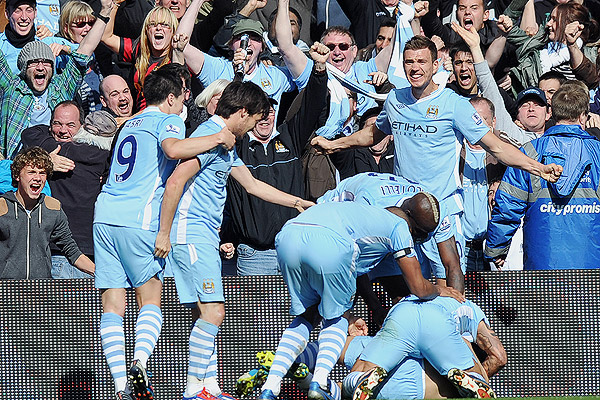


 The Daily Hatch