This video reviews real-world evidence showing that changes in marginal tax rates can have a significant impact on taxable income, thus leading to substantial amounts of revenue feedback. In a few cases, tax-rate reductions even “pay for themselves,” though the key lesson is the more modest point that pro-growth changes in tax policy will have a positive impact on economic performance and that good tax cuts therefore do not “cost” the government much in terms of foregone tax revenue.
This video is second installment of a three-part series. Part I reviews theoretical relationship between tax rates, taxable income, and tax revenue. Part III discusses how the revenue-estimating process in Washington can be improved. For more information please visit the Center for Freedom and Prosperity’s web site: www.freedomandprosperity.org.
_________________
On the Arkansas Times Blog the person using the username “Couldn’t be better” commented on what I said by responding, “Saline, where are all the jobs that Bush promised in 2001 and 2003. Still waiting for the trinkle down…”
Bush tax cuts work? This is a series of posts aimed at answering that question.
Abstract:Despite evidence to the contrary, President Obama and his supporters insist that a tax increase will not impede economic recovery. They claim that the Clinton tax hikes spurred the boom of the 1990s and that the subsequent Bush tax cuts hurt the economy. Members of Congress must reject this faulty notion—and reject the President’s call for burdening Americans with higher taxes and an even slower economy.
President Barack Obama and his allies in Congress and elsewhere continue to press for tax increases, whether as part of a deal to raise the government’s debt ceiling, or for any other reason. Even though common sense would dictate not raising taxes in the face of a badly weakened economy and almost non-existent job growth, the President and his supporters argue that tax hikes will not imperil the still-nascent recovery because the economy grew during the 1990s after President Bill Clinton raised taxes. The inference being that today’s economy could also absorb the blow of tax hikes and grow despite them. They also argue the converse: that the tax cuts passed during President George W. Bush’s tenure slowed growth and cost jobs.
This cursory and errant analysis of recent history has serious implications for policymaking today. If Congress raises taxes based on the faulty notion that tax hikes have no ill effects on economic growth, it will impede the still-struggling recovery and keep millions of Americans on the unemployment rolls far too long.
Bush Tax Cuts Promoted Strong Growth
Liberals also like to argue that the Bush tax relief hurt the economy and cost jobs. Again, the evidence runs to the contrary.
Unlike President Clinton, who entered office with a strong economic wind at his back, President Bush came into office on the precipice of a recession caused by the bursting of the “dot-com” bubble. President Bush entered office in January 2001; the recession began in March.
In addition to the recession, the peaceful conditions President Clinton enjoyed reversed course. The terrorist attacks of 9/11 brought on the beginning of the war on terrorism. There was no growth-enhancing advancement comparable to the tech boom to further boost the economy; energy prices were creeping up. Instead of swimming with the current, the economy was now fighting squarely against it to achieve even modest growth.
Faced with this new reality, President Bush pushed for tax cuts to revive the economy and set it on a stronger foundation for economic growth.
In June 2001, President Bush signed into law the first wave of tax cuts. The relief included reductions of marginal income tax rates and tax relief for families, for example, doubling the child tax credit from $500 to $1,000. To reduce the budgetary impact, Congress phased in the tax cuts over several years.
Since the tax cuts were slow to go into effect, they were slow to help the economy. In fact, the economy continued to lose jobs after the tax cuts even though the recession officially ended in November 2001.
Realizing the error of its ways, in May 2003 Congress accelerated the tax cuts to make them effective immediately. In addition to reducing marginal income tax rates, Congress also lowered the tax rates on capital gains and dividends.
It was at this point that economic growth took off. From May 2003 until December 2007 (when the recession caused by the global financial meltdown occurred) the economy created 8.1 million jobs, or 145,000 a month. By comparison, after the beginning of the 2001 recession and before the 2003 tax cuts, the economy was losing 103,000 jobs a month.[7]
Those opposed to the tax relief argue that it blew a hole in the budget and dramatically increased deficits. Again, a look at the numbers disproves that argument. While receipts were below the historical level of 18 percent of GDP in 2003 as a result of the sluggish economy, they rebounded to above their historical norm by 2006 and grew further above their historical level in 2007.[8] They clearly would have continued growing thereafter had it not been for the housing bust and global recession.
Tax revenue rebounded quickly because the tax cuts encouraged economic growth by increasing the incentives to work, save, invest, and take on new risk. These are the basic elements of economic growth. When those activities increase, tax revenues increase because more Americans work and earn more money. From 2003 to 2007, the number of tax filers rose by 9.6 percent, and taxable income, by 44 percent. By contrast, in the last four years of the previous expansion, from 1997 to 2001, these numbers grew by 6.4 percent and 23.6 percent, respectively.[9] With income and taxpayers growing at such a fast clip it is not hard to see why tax revenue did not suffer from the tax cuts.
To be clear: The Bush tax cuts did not pay for themselves. Revenues, on balance, are lower as a result of the Bush tax relief. However, the Bush tax cuts did accelerate the recovery markedly, and they did, and still do, create the possibility of a permanently stronger economy which, in turn, means the net revenue cost of the Bush tax cuts is far less than the traditional static score implies.
In 2008, the last full year of the Bush presidency, the economy entered a severe recession brought on by the global financial meltdown. The 2001 and 2003 tax relief packages had made the economy more resilient against economic shocks, but no tax policy can protect an economy against the storm that struck that year. The tax cuts certainly did not contribute in any way to recession, nor can anyone credibly claim that these policies had something to do with the financial implosion that was global in origin and impact.
Even with a recession at the beginning of his presidency and another severe recession at the end, the economy still created more than 1 million net jobs during President Bush’s tenure. The tax cuts he pushed Congress to pass are a major reason for that job growth.
—Curtis S. Dubay is a Senior Analyst in Tax Policy in the Thomas A. Roe Institute for Economic Policy Studies at The Heritage Foundation.
Last weekend, the people of France took a sharp turn to the left, and the rest of Europe may be on the brink of rebuking its recent tack toward fiscal responsibility. With Sunday’s election of French Socialist leader Francois Hollande, France has leapt backward toward the policies that have helped sink the continent in a sovereign debt crisis. Disturbingly, the big government platform Hollande campaigned on is all too familiar to the American people, and if the United States is not careful, it could suffer the same fate as its European allies.
Hollande sailed to victory by appealing to an electorate dissatisfied with having to face necessary cutbacks, proclaiming that he is “proud to have been capable of giving people hope again.” That brand of hope called for a change from President Nicolas Sarkozy’s relatively conservative policies — in his first term, Sarkozy worked to reduce the number of public sector employees, eliminate the 35-hour work week, reform the university system and cut taxes.
Hollande, by contrast, promised to raise taxes on big corporations and wealthy individuals, implement a top rate tax of 75 percent, increase public spending by 20 billion euros, raise the minimum wage, hire 60,000 more teachers, and lower the retirement age from 62 to 60 for some workers. He says he is “president of the youth of France” and believes that government stimulus, not cutting spending, is the right way to achieve economic growth.
If you’ve been a student of President Obama’s presidency, much of this should sound familiar. President Obama came into office on a promise of hope and change, appealed to young Americans and promised renewed prosperity. His solution was more government spending to the tune of a near-trillion-dollar stimulus, a government-run health care plan, a bailout of government unions, and a call for higher taxes on wealthy Americans and corporations.
The difference between the United States and France is that the latter is much further down the path of a social welfare state. Hollande’s proposals are not a new direction, they’re merely a return to form. France is notoriously emblematic of the European way of life. As Daniel Hannan, a member of the European Parliament, describes in Why America Must Not Follow Europe, “Long vacations, paternity leave, a higher minimum wage, a short working week: What’s not to like? The trouble is that eventually the money runs out.”
In France, the money has indeed run out. The country’s public debt now stands at more than 80 percent of GDP, government spending is at 55 percent of GDP, the tax burden is equivalent to 42 percent of total domestic income, and it hasn’t balanced its budget since 1974.
The United States, unfortunately, is headed in much the same direction. As Heritage’s Federal Budget in Pictures shows, U.S. debt stood at 67 percent of GDP in 2011, but unless the United States controls its spending, its debt will surpass that of France, Italy and even Greece, hitting 187 percent of GDP by 2035. Spending on Medicare, Medicaid, the Obamacare subsidies, and Social Security will devour all revenues by 2045, and taxes are soaring past their highest levels ever. And as for the budget, the U.S. Senate hasn’t passed one in three years — let alone brought it to balance.
The world has seen what lies at the end of this road to perdition. Though France is a prime example of a country that is spending itself into crisis, Greece has already gone beyond that tipping point. The country’s debt has exploded, 21.8 percent of its people are unemployed, and among the youth, more are out of work than have jobs. In the face of belt-tightening measures that came as a condition of an EU/IMF bailout — which include public sector pay cuts and pension reductions — the country turned to open political revolt with violent riots in the streets. In elections this week, Greek voters rejected the political parties that support fiscal responsibility and instead turned toward the Radical Left.
If there is any bright spot in Europe’s far left turn, it came Friday in the re-election of Boris Johnson, the Conservative mayor of London. Johnson campaigned for tax cuts and eliminating public sector waste in the hopes of spurring job growth. But alas, France’s return to the deeply entrenched socialist policies could signal an end to the fiscally responsible measures that German Chancellor Angela Merkel has championed, leading to economic disaster.
Though Europe is an ocean away, the policies that are sinking the continent could have the same impact in the United States if replicated here. Endless spending has dire consequences, and if America is not careful, it could follow Europe’s path to economic ruin.
The Laffer Curve, Part I: Understanding the Theory
The Laffer Curve charts a relationship between tax rates and tax revenue. While the theory behind the Laffer Curve is widely accepted, the concept has become very controversial because politicians on both sides of the debate exaggerate. This video shows the middle ground between those who claim “all tax cuts pay for themselves” and those who claim tax policy has no impact on economic performance. This video, focusing on the theory of the Laffer Curve, is Part I of a three-part series. Part II reviews evidence of Laffer-Curve responses. Part III discusses how the revenue-estimating process in Washington can be improved. For more information please visit the Center for Freedom and Prosperity’s web site:www.freedomandprosperity.org
Abstract:Despite evidence to the contrary, President Obama and his supporters insist that a tax increase will not impede economic recovery. They claim that the Clinton tax hikes spurred the boom of the 1990s and that the subsequent Bush tax cuts hurt the economy. Members of Congress must reject this faulty notion—and reject the President’s call for burdening Americans with higher taxes and an even slower economy.
President Barack Obama and his allies in Congress and elsewhere continue to press for tax increases, whether as part of a deal to raise the government’s debt ceiling, or for any other reason. Even though common sense would dictate not raising taxes in the face of a badly weakened economy and almost non-existent job growth, the President and his supporters argue that tax hikes will not imperil the still-nascent recovery because the economy grew during the 1990s after President Bill Clinton raised taxes. The inference being that today’s economy could also absorb the blow of tax hikes and grow despite them. They also argue the converse: that the tax cuts passed during President George W. Bush’s tenure slowed growth and cost jobs.
This cursory and errant analysis of recent history has serious implications for policymaking today. If Congress raises taxes based on the faulty notion that tax hikes have no ill effects on economic growth, it will impede the still-struggling recovery and keep millions of Americans on the unemployment rolls far too long.
Clinton Tax Hikes Slowed Growth
A favorite liberal argument is to attribute the economy’s strong performance during the 1990s to President Clinton’s economic policies, chief among which was a huge tax increase. Clinton signed his tax hike into law in September 1993, the same year he took office. It included an increase of the top marginal tax rate from 31 percent to 39.6 percent; repeal of the cap on the 2.9 percent Medicare tax, applying it to every dollar of income instead of being capped to levels of income like the Social Security tax; a 4.3-cent increase in the gas tax; an increase in the taxable portion of Social Security benefits; and a hike of the corporate income tax rate from 34 percent to 35 percent, among other tax increases.[1]
The economic defense of the Clinton tax hikes does not hold up against the historical facts. The economy did exhibit strong economic growth during the 1990s, but rapid growth did not occur soon after the tax hike—it came much later in the decade, when Congress cut taxes. After the 1993 tax hike, the economy actually slowed to a point below what one would expect, considering the once-in-a-generation favorable economic climate that existed at the time.
As for the overall economic recovery—that started well before President Clinton took office. In January 1993, the economy was in the 22nd month of expansion following the recession from July 1990 to March 1991.
In addition to coming into office in the midst of an economic expansion, Clinton also benefited from a very unusual confluence of events that created a remarkably favorable environment for rapid economic growth:
The end of the Cold War brought a sigh of relief to the world and a powerful dose of growth-enhancing certainty to the global economy.
The price of energy was astoundingly low, with oil prices dropping below $11 per barrel and averaging under $20 per barrel, versus $100 per barrel today.[2]
The Federal Reserve had tamed inflation to an extent previously thought impossible, with inflation averaging 2 percent during the Clinton Administration.[3]
The biggest wind at the economy’s back was, of course, a tremendous set of new productivity-enhancing information technologies and the explosion of the Internet as a powerful tool for commerce and communication, further increasing productivity.
With these factors clearing the way, the economy should have displayed spectacular and accelerating growth in the years immediately after Clinton entered the White House, but growth of that magnitude did not materialize until later in the decade.
From 1993 until 1997, the economy grew at a pedestrian 3.3 percent per year.[4] While solid, this growth was certainly not exceptional. During that same time, real wages declined, despite the perception that the 1990s were an era of unmitigated abundance.[5]
It was not until after a 1997 tax cut, passed by the Republican-led Congress—a tax cut President Clinton resisted but ultimately signed—that the spectacular growth kicked in. While small in revenue impact, the 1997 cuts included a reduction of the capital gains rate from 28 percent to 20 percent. This opened the capital floodgates necessary for entrepreneurs to develop, harness, and bring to market the wonders of the new information technologies.
Business investment skyrocketed after the tax cut,[6] and the economy grew at an annualized rate of 4.4 percent (33 percent faster than after the Clinton tax hike) from 1997 through the end of the Clinton presidency. Real wages reversed their downward trend and grew 1.7 percent per year during the same time.
Altogether, how much worse did the economy perform because of the Clinton tax hike? The data from the period do not provide a clear answer. What is clear is that the economy performed well below reasonable expectations given the favorable conditions existing in the years after the tax hike—and took off after the often-forgotten tax cut.
—Curtis S. Dubay is a Senior Analyst in Tax Policy in the Thomas A. Roe Institute for Economic Policy Studies at The Heritage Foundation.
When it comes to college football stadiums, for some teams, it is simply not fair. Home-field advantage is a big thing in college football, and some teams have it way more than others.
There are 124 FBS college football teams, and when it comes to the stadiums they play in, they are obviously not all created equal.
There is a monumental difference from the top teams on the list to the bottom teams on the list. Either way, here it is: a complete ranking of the college football stadiums 1-124.
_________________
I got to hear Kenny Hatfield speak at First Baptist in Little Rock and he did a great job. His teams at Rice were very good. Here a portion from that earlier post:
Coach Hatfield said so many inspiring things in his talk that I am starting a new series of posts that will go through many of the points he made in his talk.
In a quiet chapel where no one could see, Don kneeled and asked the Lord into his heart. In Don’s words, “that was the conversion of this cantankerous soul.”
Over the years, Don collected articles that mentioned sports personalities willing to talk about their faith. These courageous athletes were his heroes. One by one, Don wrote to each of them. He never gave up. He wanted the inspiration and strength of hearing their stories, personally and professionally. A new dream was nudging him.
Finally he got a response from Pittsburgh Pirate General Manager, Branch Rickey. Don was told that he could have a five minute appointment. The five minutes stretched into five hours. Together they imagined Don’s dream, “The Fellowship of Christian Athletes.” Rickey found some start-up funds, and Don did the footwork. Don made the contacts, shared the vision, and did more fund-raising and organizing. It took so much time that Don had to leave his coaching job. He and his wife and (by then) three children lived on very little. But step-by-step the dream became a reality.
The Fellowship of Christian Athletes is over fifty years old now, and is the largest inter-denominational, school-based, Christian organization in America. It even reaches athletes internationally. The FCA encourages coaches and athletes on the professional, college, high school, middle school, and youth levels to use athletics to “impact the world through their faith and example.”
The Fellowship of Christian Athletes was his first big dream. It joined his hungry spirit with his love of sports. Step by step, his vision grew, far beyond where he ever dreamed. But he was still bothered by racial differences, and the uneven distribution of wealth.
His longtime questions about money and race and faith have led him all over the globe. After he created the FCA, Don founded Washington Lift, Inc. (an inner-city youth ministry), the Ministry of Money, Inc., and Harvest Time, Inc. When I asked him why he started these organizations, Don’s words were simple. “I thought somebody else would take it and run with it. When no one did, I did.”
Although Don doesn’t play sports anymore (except golf), he still dreams dreams and works to make them come true. Don’s playing field has changed, but at 81 years old, he’s still in the action. Like the mower that splash-landed in the mayor’s pond, Don’s dreams have rippled out all around the world. He hopes that by one strategy or another, he has helped kids around the world to climb mountains.
That story is very inspiring, but I just want you to know that the things you do today may continue to have influence on others many years later.
Let me give you one example. Recently I talked to Melvin Pickens who has been selling brooms in Little Rock for over 60 years. I have known Melvin for almost 30 years and I have always known that he is a big Los Angeles Dodgers fan. Then just the other day I asked him how he came around to pulling for the Dodgers. He told me that in 1947 when he was at Henry Clay Yerger High School in Hope, Arkansas, Branch Rickey (the general manager of the Brooklyn Dodgers) stood up for Jackie Robinson and made him the first black baseball player to play professional baseball with the whites.
Every person he knew at Henry Clay Yerger High School became a Dodger fan that year, and he has been a faithful fan ever since!!!
In the history of Razorback football, few figures loom larger than Ken Hatfield. Not only does he have the highest winning percentage of any head coach in the program’s history, he also was a star punt returner and defensive back for the Razorbacks’ one and only national championship team. After a six-year coaching tenure in Fayetteville, he left for Clemson in 1990 and was later the head coach at Rice for 12 seasons.
Now retired from football, Hatfield lives in northwest Arkansas, where he serves on the board of the local chapter of the Fellowship of Christian Athletes; is involved with Horses for Healing, non-profit therapeutic horseback riding center for individuals with special needs; and is state director for Arkansas Drug Card.com, which provides free discount prescription cards to uninsured and underinsured residents of Arkansas.
In the first part of a three-part Q&A, Hatfield discusses his unforgettable 81-yard punt return for a touchdown in an upset of Texas in 1964 and the start of his coaching career. (And before we started, a quick note of thanks to the invaluable Hogdb.com for several of the photos in today’s installment.)
A touching story about when Adrian Rogers accepted Jesus Christ as his Savior
104. Superdome: Tulane Green Wave
The New Orleans Superdome is great, but for a college team like Tulane playing there, it can seem relatively empty when the game is going on.
Even if it is New Orleans, the atmosphere here is not good when the Green Wave are on the field.
Built in 1975 with a seating capacity of 72,968, this stadium is great for big games, but just not for Tulane football.
Tulane is in the process of building a 30,000-seat stadium on campus right now.
103. Qualcomm Stadium: San Diego State Aztecs
Qualcomm Stadium plays host to a number of different sporting events, including the San Diego Chargers as well as the San Diego State Aztecs.
Like a lot of the other larger stadiums that are used for professional sports, this stadium does not have that college atmosphere.
Built in 1967, this stadium has a seating capacity of 71,294.
102. Alumni Stadium: Boston College Eagles
Boston College has a beautiful campus and an excellent atmosphere. That atmosphere, however, does not translate over to the football field.
Built in 1957, Alumni Stadium has a seating capacity of 44,500 people and has a decent following.
Lack of success on the football field in recent years has probably not helped, but either way, this stadium leaves something to be desired.
101. Rynearson Stadium: Eastern Michigan Eagles
Rynearson Stadium is one of the larger stadiums when it comes to the MAC.
Built in 1969, it has a seating capacity of 30,200 and is home to the Eastern Michigan Eagles.
This stadium is strictly average across the board, but that is good enough to be in the middle of the pack as far as the MAC is concerned.
100. Lincoln Financial Field: Temple Owls
Most people know Lincoln Financial Field as the home of the Philadelphia Eagles. Well, it also plays host to the Temple Owls.
Built in 2003, this stadium is brand new as far as college fields are concerned.
It seats 68,532, but obviously does not have that college feel that many of the other stadiums have.
99. Scott Stadium: Virginia Cavaliers
The ACC seemingly lags behind other major college conferences when it comes to football stadiums.
Virginia is no different. The stadium seats 61,500 people and is a little old. It was built in 1931, and the neighborhood around it is great.
The fans are not bad, but the stadium leaves something to be desired.
98. War Memorial Stadium: Wyoming Cowboys
War Memorial Stadium is actually not a bad place to watch a college football game.
Laramie, Wyoming is a nice college town, and although the stadium is over 60 years old, having been built in 1950, it is not bad scenery on a nice day.
The seating capacity here is 32,580, and it makes for a small, compact crowd in this wide open stadium.
97. Sam Boyd Stadium: UNLV Rebels
Sam Boyd Stadium actually looks a little bigger than it really is.
It was built in 1971 and seats 36,800. It is completely enclosed with the exception of one end zone being open.
Las Vegas is not a city known to support their teams too much, but the Rebels do get what support they have to offer, making this a decent place to watch a college football game.
96. Rice-Eccles Stadium: Utah Utes
Utah is the first Pac-12 team on the list with a stadium that is almost completely enclosed.
Rice-Eccles Stadium was built in 1998, making it one of the newest college football stadiums in the country.
It holds 45,017, meaning it is on the larger side when it comes to stadiums.
Everything here is middle of the line, but not up to the standards of other Pac-12 schools.
95. Rice Stadium: Rice Owls
This stadium was built in 1950 and has been the home of the Rice Owls ever since.
It seats 47,000 people, but can be expanded to 70,000 when necessary and is one of the larger venues in Conference USA.
The stadium overall is a nice place to watch a college football game, although they are usually never near capacity and the extra seats seem unnecessary.
Debating whether the United States has gone too far in accumulating debt, with Dan Mitchell, Cato Institute; Christian Weller, Center for American Progress; and CNBC’s Erin Burnett.
_______________
Does anyone care about growing the economy anymore?
Economists often do a crummy job of teaching people about the impact of fiscal policy on the labor force, largely because we put people to sleep with boring discussions about “labor supply” decisions (my blog post from last year perhaps being an example of this tendency).
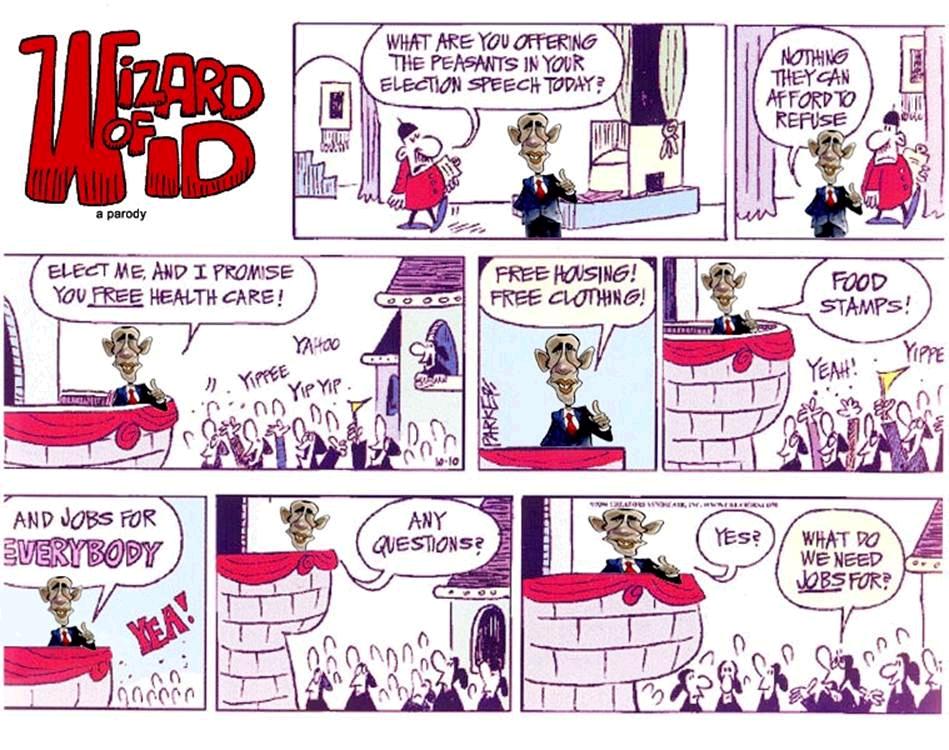
From now on, I will try to remember to use this cartoon. It’s a parody of Obama’s policies, but the last slide (or is it a panel?) is a great teaching tool about what happens when politicians turn the safety net into a hammock.
The fact that we are here today to debate raising America’s debt limit is a sign of leadership failure. It is a sign that the U.S. Government can’t pay its own bills. It is a sign that we now depend on ongoing financial assistance from foreign countries to finance our Government’s reckless fiscal policies.
And the cost of our debt is one of the fastest growing expenses in the Federal budget. This rising debt is a hidden domestic enemy, robbing our cities and States of critical investments in infrastructure like bridges, ports, and levees; robbing our families and our children of critical investments in education and health care reform; robbing our seniors of the retirement and health security they have counted on.
Every dollar we pay in interest is a dollar that is not going to investment in America’s priorities. Instead, interest payments are a significant tax on all Americans–a debt tax that Washington doesn’t want to talk about. If Washington were serious about honest tax relief in this country, we would see an effort to reduce our national debt by returning to responsible fiscal policies.
Increasing America’s debt weakens us domestically and internationally. Leadership means that “the buck stops here.” Instead, Washington is shifting the burden of bad choices today onto the backs of our children and grandchildren. America has a debt problem and a failure of leadership. Americans deserve better.
I therefore intend to oppose the effort to increase America’s debt limit.
Sen. Barack Hussein Obama, Jr., (Senate – March 16, 2006)
_______________
3 Reasons Why The Debt-Ceiling Debate is Full of Malarkey
All anybody in Washington can talk about these days is the debt limit or debt ceiling — the total amount of money the federal government is authorized to borrow at any given time. After a decade in which spending increased by more than 60 percent in inflation-adjusted dollars and the debt limit was raised no fewer than 10 times, the government is about to max out its $14.3 trillion credit line, leading to fears that Washington is going to default on its bonds, stop cutting Social Security checks, and destroy the economy more than it already has.
But the current debate over the debt ceiling is full of malarkey for at least three reasons.
1. August 2 is a phony deadline. Treasury Secretary Timothy Geithner has pushed back the drop-dead date when the U.S. finally reaches its limit a bunch of times already: March 31, April 15, May 31 were all cited as deadlines before August 2 was inked in as Armageddon. But this time, he means it, man, really.
2. Reaching the debt limit is not the same as defaulting on our debt — which would indeed be catastrophic.
Think about it: You can max out your credit cards but as long as you keep paying the minimum amount due each month, your creditors don’t go crazy. Interest on the debt is a small fraction of total outlays and the government has a series of tools — from using cash on hand to selling assets to scrimping on nonessential payments — to make sure interest payments are made and seniors aren’t put on an all cat-food diet.
3. Legislating-by-Panic is no way to run a country. The reason we’re in this mess is because government can’t stop spending. And the government can’t even pass a budget on a year’s notice. But we’re expecting them to come up with a good plan for the country’s borrowing in a couple of weeks? Trying to force through an expansion of the country’s credit line by promising cuts in spending down the road is exactly why we’re in this situation to begin with.
It makes far more sense to do something like sell some TARP assets — the government is sitting on $320 billion in outstanding direct loans and equities investments — to cover interest payments through the end of the fiscal year then force Congress and the president to come up with a budget that cuts spending — and borrowing — for real, next year, not is some distant future.
Produced by Nick Gillespie and Meredith Bragg, edited by Joshua Swain.
Go to Reason.tv for downloadable versions, and subscribe to Reason.tv’s YouTube Channel to receive automatic notifications when new material goes live.
_________________
It seems silly to keep spending like we are when we can clearly see what our future holds by seeing the problems that Greece is now having because of their socialism.
Thank you so much for your time. I know how valuable it is. I also appreciate the fine family that you have and your commitment as a father and a husband.
Sincerely,
Everette Hatcher III, 13900 Cottontail Lane, Alexander, AR 72002, ph 501-920-5733, lowcostsqueegees@yahoo.com
Why not pass the Balanced Budget Amendment? As you know that federal deficit is at all time high (1.6 trillion deficit with revenues of 2.2 trillion and spending at 3.8 trillion).
On my blog www.HaltingArkansasLiberalswithTruth.com I took you at your word and sent you over 100 emails with specific spending cut ideas. However, I did not see any of them in the recent debt deal that Congress adopted. Now I am trying another approach. Every week from now on I will send you an email explaining different reasons why we need the Balanced Budget Amendment. It will appear on my blog on “Thirsty Thursday” because the government is always thirsty for more money to spend.
In the immediate term, Congress should address this problem by pursuing a reform path that drives down federal spending and borrowing and gets to a balanced budget. Saving the American Dream is Heritage’s plan to do just that: balancing the federal budget in 10 years and keeping it balanced in the future—without raising taxes or neglecting our national defense. Starting immediately, Congress should take every opportunity to cut and cap federal spending, and that includes addressing the unsustainable costs of America’s entitlement programs.
A part of the long-term agenda to rein in government is an appropriate and sound amendment to the Constitution that would keep federal spending under control in subsequent years. Indeed, the principal reason for adopting a balanced budget constitutional amendment is to limit the size and scope of the federal government by limiting its spending.
Proponents have long advocated this extraordinary step because other methods of controlling spending—by rule or statute—have broken down. What was once considered part of the nation’s “unwritten” constitution—that as a rule the government should not spend beyond its means—has been lost. A constitutional rule, if properly written and enforced, would have more power than any legislative mechanism for maintaining a limit on spending.
As Heritage’s David Addington has previously stated, a BBA should do three core things.
First, it should control spending, taxation, and borrowing by capping annual spending and requiring Congress to act by supermajority votes if Members wish to raise taxes. These requirements are especially necessary under current circumstances—prior to having seriously reduced spending and reformed entitlement programs, the main drivers of the country’s debt.
Second, it should allow Congress by supermajority votes to waive temporarily compliance with the balanced budget requirement when it is essential to national security—the one core function that is the federal government’s exclusive constitutional responsibility.
Third, it should provide for its own enforcement, specifically excluding courts from any enforcement and preventing government from just borrowing more money to meet the BBA requirement.
A BBA without these provisions doesn’t address the underlying spending problem, puts pressure on Congress to increase taxes or issue more debt rather than cut spending or reform entitlements, and invites unelected judges to insert themselves even more in the policymaking process. Which is to say that, rather than simplifying matters, a weak BBA would likely make the situation much worse.
Notwithstanding the many admirable features of Sweden, I never thought they would be moving in the right direction on fiscal policy while the United States was heading in the opposite direction.
When Europe’s finance ministers meet for a group photo, it’s easy to spot the rebel — Anders Borg has a ponytail and earring. What actually marks him out, though, is how he responded to the crash. While most countries in Europe borrowed massively, Borg did not. Since becoming Sweden’s finance minister, his mission has been to pare back government. His ‘stimulus’ was a permanent tax cut. …Three years on, it’s pretty clear who was right. ‘Look at Spain, Portugal or the UK, whose governments were arguing for large temporary stimulus,’ he says. ‘Well, we can see that very little of the stimulus went to the economy. But they are stuck with the debt.’ Tax-cutting Sweden, by contrast, had the fastest growth in Europe last year, when it also celebrated the abolition of its deficit. …‘Everybody was told “stimulus, stimulus, stimulus”,’ he says — referring to the EU, IMF and the alphabet soup of agencies urging a global, debt-fuelled spending splurge. Borg, an economist, couldn’t work out how this would help. ‘It was surprising that Europe, given what we experienced in the 1970s and 80s with structural unemployment, believed that short-term Keynesianism could solve the problem.’ …He continued to cut taxes and cut welfare-spending to pay for it; he even cut property taxes for the rich to lure entrepreneurs back to Sweden. The last bit was the most unpopular, but for Borg, economic recovery starts with entrepreneurs. If cutting taxes for the rich encouraged risk-taking, then it had to be done.
The article notes that government is still far too large in Sweden, but it’s also clear that moving in the right direction generates immediate benefits.
I posted a video back in 2010, narrated by a Swedish economics student, and asked a rhetorical question of why Obama wants to make America more like Sweden when the Swedes are moving in the other direction.
Unfortunately, there was no good answer then and there’s no good answer now.
Let’s close with some irony. Last year, I cited a study showing how large public sectors undermine economic performance. The study was written by two Swedish economists. In addition to trading Geithner for Borg, perhaps we can ship Krugman to Stockholm and bring those economists to America.
Ep. 4 – From Cradle to Grave [4/7]. Milton Friedman’s Free to Choose (1980)
With the national debt increasing faster than ever we must make the hard decisions to balance the budget now. If we wait another decade to balance the budget then we will surely risk our economic collapse.
The first step is to remove all welfare programs and replace them with the negative income tax program that Milton Friedman first suggested.
Milton Friedman points out that though many government welfare programs are well intentioned, they tend to have pernicious side effects. In Dr. Friedman’s view, perhaps the most serious shortcoming of governmental welfare activities is their tendency to strip away individual independence and dignity. This is because bureaucrats in welfare agencies are placed in positions of tremendous power over welfare recipients, exercising great influence over their lives. In addition, welfare programs tend to be self-perpetuating because they destroy work incentives. Dr. Friedman suggests a negative income tax as a way of helping the poor. The government would pay money to people falling below a certain income level. As they obtained jobs and earned money, they would continue to receive some payments from the government until their outside income reached a certain ceiling. This system would make people better off who sought work and earned income.
Participants: Robert McKenzie, Moderator; Milton Friedman; James R. Dumpson, Chief Administrator, Human Resources Admin., NYC; Thomas Sowell, Professor of Economics, UCLA; Robert Lampman, Professor of Economics, Institute of Poverty; Helen Bohen O’Bannon, Secretary of Welfare, State of Pennsylvania
MCKENZIE: The discussion’s already underway here at the University of Chicago, so let’s join it.
DUMPSON: As I looked at the film, I had a growing sense of anger. Anger that that position failed to recognize that the system that was being attacked was necessary in our capitalistic, free enterprise system that by its own failure produces poverty, and therefore requires governmental intervention in the interest of those people caught in the traps of poverty. So, as I sat and looked at the film, and as I hear Dr. Friedman’s statement, I was aroused to the point, as I said, of anger because only half the story is told. We are really blaming again a victim, this time a system, the welfare system, for the failure of other systems to operate in the interest of people.
MCKENZIE: Let’s get other reactions now to that statement: “Trying to do good with other people’s money simply has not worked, the welfare system is rotting away the very fabric of society.” Tom Sowell.
SOWELL: My reaction was just the opposite from __ my anger was at what had been created in the city where I grew up, under very different conditions, during the period of capitalistic failure, during the period when there wasn’t this humanitarianism, and when it was possible for people to live better and to get out of that poverty. Now, I think someone who lived in the very same place where I lived would find it much harder to escape from that poverty because of all these things. Buildings were not abandoned like the buildings that we saw in that film when I lived in Harlem. The crime rate __ they’re all things that are blamed upon the failures of the previous method did not exist. I slept out on the fire escapes in Harlem. I would defy anybody to do that in any part of New York City today.
LAMPMAN: Traditionally in the United States we have tried to avoid some of the welfare trap that was referred to by denying eligibility to people who are able-bodied and not aged and so on. And we’ve therefore tried to close the welfare door to a good number of categories within the poor population. The second point that was emphasized and I think needs to be put in some perspective is that some, but not all, of what we might call welfare programs broadly, have this very strong take-back of benefits as you earn some more money and that I guess is what I would like to single out as the principal problem identified in the film but it is not common to any and all welfare programs that one might think of.
O’BANNON: When the family fails, when the private sector fails to create jobs at a fast enough rate you find that people are unemployed and drift into needing help in order to exist and the welfare system was created in the ’30’s to do exactly that. When the private sector, essentially, failed we have the development of a welfare system, and it’s not corrupting society, it is taking what society _ institutions have left behind: The family breaking up, the economy not expanding fast enough, the health system failing, the educational system not doing its job. We have untrained, unskilled people looking for jobs in a highly technical society or jobs that pay so low that people cannot in fact live at a decent level of humanity. I see the welfare system not corrupting, but in fact taking the remains and attempting to help people live in dignity.
MCKENZIE: So rotting away the fabric of society is not supported __ except perhaps by you, would you back that phrase or so.
SOWELL: Absolutely. You’re saying __ you’re talking about the failures of the other parts of society. What the welfare system and other kinds of governmental programs are doing is paying people to fail insofar as they fail they receive the money; insofar as they succeed, even to a moderate extent, the money is taken away. This is even extended into the school systems where they will give money to schools with low scores; insofar as the school improves its education the money is taken away, so that you are subsidizing people to fail in their own private lives and become more dependent upon the handouts.
O’BANNON: We have expectations built in today about the quality of life, the quality of jobs, the level if income for which one expects in return. Why? Because we look at the level around us that it takes us to have __
SOWELL: No, that’s not why. That’s not why. I may have all sorts of expectations, the question is: What can I do? If someone else is subsidizing my expectations, my expectations would be far higher. But insofar as the Center for Advanced Study was subsidizing my expectations a few years ago, I refused to work at UCLA for the normal full professor’s salary. Why should I when I can get the same money for being at the Center for Advanced Study with no hours, no duties and no classes.
MCKENZIE: Let’s look at another proposition in Milton’s case. The insidious effect on those who receive welfare. They lose their independence and dignity, are treated like children, and so on. Now, Dr. Dumpson, as a former Administrator of a major program, is that a great hazard?
DUMPSON: That is not a great hazard. As a matter of fact, that presumes that people get on welfare, stay on welfare, and therefore have the result that Dr. Friedman’s statement issues. The fact of the matter is that in our AFDC program throughout the country and particularly was this true in New York, there is a graduate __ a turnover of the welfare AFDC roles _ about a third of them go off each year. Now, if these people were so destroyed by the system, when they go off they wouldn’t go into employment, they wouldn’t hold employment, they wouldn’t stay off the roles for six months, eighteen months, twenty-four months, as long as they are able to stay off. So, there’s something wrong with that argument when one looks at people and what they do. People, you know, who are poor are no different from those of us who are not poor and their motivation for self-dependency, self-support and mobility in the economic scale is no different that those of __ than the motives we have, so that they will not let the system __ you remember, Dr. Friedman, the welfare rights organization who refused to let the system squash them down as it was attempting to do. We turned the policies around.
FRIEDMAN: You and I agree completely, that the people who are poor and are on welfare roles are no different from the rest of us. Of course not. They are human beings and they deserve every sympathy and every possibility of making their own way, but the welfare system makes them different.
DUMPSON: But you give them __
FRIEDMAN: It makes it in their interest to be different.
MCKENZIE: How do you account for them going off the roles, Milton?
FRIEDMAN: Oh, but figures are figures and you’ve got to be careful with figures. The fact that a third, there’s a turnover of a third does not mean that there aren’t half who are on all the time. People come on, go off; come on, go off. We’ve got to have the other figures __
DUMPSON: The latest statistic, Dr. Friedman, is that __
FRIEDMAN: __ fraction __
DUMPSON: __ 34 percent of the people on AFDC are on for five years or longer and when one thinks of the purpose of the AFDC program, which was the rearing and support of children, dependent children, minor children, I would submit to you that five years is not a terribly long time for a mother and children to have to be dependent if there’s no other source of income.
3 Of 5 / The Bible’s Influence In America / American
Heritage Series / David Barton
Evangelical leader Ken Ham rightly has noted, “Most of the founding fathers of this nation … built the worldview of this nation on the authority of the Word of God.” I strongly agree with this statement by Ham.
Dr. Michael Davis of California has asserted that he has no doubts that our President is a professing Christian, but his policies are those of a secular humanist. I share these same views. However, our founding fathers were anything but secular humanists in their views. John Adams actually wrote in a letter, “There is no authority, civil or religious – there can be no legitimate government – but that which is administered by this Holy Ghost.”
In June of 2011 David Barton of Wallbuilders wrote the article, “John Adams: Was He Really an Enemy of Christians?Addressing Modern Academic Shallowness,” and I wanted to share portions of that article with you.
At WallBuilders, we are truly blessed by God, owning tens of thousands of original documents from the American Founding – documents clearly demonstrating the Christian and Biblical foundations both of America and of so many of her Founding Fathers and early statesmen. We frequently postoriginal documents on our website so that others may enjoy them and learn more about many important aspects of America’s rich moral, religious, and constitutional heritage that are widely unknown or misportrayed today.
This is a very respectful reference to the dream Rush believed that God had given him. There is nothing derogatory or scornful in Adams’ reference to “prophecy” – a direct and positive product of the Holy Spirit (2 Peter 1:21).
______________________
Chris Pinto, in his analysis of Adams letter, has managed to ignore more than a millennia of church and world history in his unreasonable attempt to brand John Adams a heretic and blasphemer of the Holy Spirit. And adding insult to his malpractice injury, he also ignored more than thirty volumes of Adams’ published writings, containing hundreds of positive letters and repeated favorable references to religion and Christianity. Thus, Pinto’s claim about Adams’ irreligion is directly refuted not only by the context of the letter itself but also by the powerful evidence of the lifelong proven faith and character of John Adams.
In fact, in the very next letter Adams wrote Rush following letter that Pinto attacks, Adams vigorously defended Christianity against the attack made upon it by Thomas Paine, telling Rush:
He [Thomas Paine] understood neither government nor religion. . . . His billingsgate [vile and vulgar attack] . . . will never discredit Christianity, which will hold its ground in some degree as long as human nature shall have anything moral or intellectual left in it. The Christian religion. . . . will last as long as the world. Neither savage nor civilized man without a revelation could ever have discovered or invented it. Ask me not, then, whether I am a Catholic or Protestant, Calvinist or Arminian. As far as they are Christians, I wish to be a fellow-disciple with them all. 34
This letter certainly does not reflect either the tone or the attitude of an heretic who would attack and blaspheme the Holy Spirit. Consider some of the scores of other quotes by John Adams, and contrast them with the anti-religious image that Pinto wrongly attempts to draw of Adams:
Suppose a nation in some distant region should take the Bible for their only law book and every member should regulate his conduct by the precepts there exhibited. . . . What a Eutopia – what a Paradise would this region be! 35 1756
I sat next to John Adams in Congress, and upon my whispering to him and asking him if he thought we should succeed in our struggle with Great Britain, he answered me, “Yes – if we fear God and repent of our sins.” This anecdote will, I hope, teach my boys that it is not necessary to disbelieve Christianity or to renounce morality in order to arrive at the highest political usefulness or fame. 36 1777, Benjamin Rush, Reporting His Conversation with Adams
The idea of infidelity [a disbelief in the inspiration of the Scriptures or the Divine origin of Christianity 37 ] cannot be treated with too much resentment or too much horror. The man who can think of it with patience is a traitor in his heart and ought to be execrated [denounced] as one who adds the deepest hypocrisy to the blackest treason. 38 1778
[All persons elected must] make and subscribe the following declaration, viz. “I do declare that I believe the Christian religion and have firm persuasion of its truth.” 39 1780, Constitution of Massachusetts (Adams wan an Author of this Clause)
On motion of the Hon. Mr. [John] Adams, Voted, That the Convention will attend morning prayers daily, and that the gentlemen of the clergy of every denomination be requested to officiate in turn. 40 1788, Massachusetts Convention to Ratify the U. S. Constitution
The Christian religion is, above all the religions that ever prevailed or existed in ancient or modern times, the religion of wisdom, virtue, equity and humanity, let the blackguard [scoundrel, rogue] Paine say what he will. 41 1796
As the safety and prosperity of nations ultimately and essentially depend on the protection and the blessing of Almighty God, and the national acknowledgment of this truth is not only an indispensable duty which the people owe to Him. . . . I have therefore thought fit to recommend . . . a day of solemn humiliation, fasting, and prayer that the citizens of these States . . . offer their devout addresses to the Father of Mercies. 421798
[W]e have no government armed with power capable of contending with human passions unbridled by morality and religion. . . . Our Constitution was made only for a moral and religious people. It is wholly inadequate to the government of any other. 43 1798
The Bible contains the most profound philosophy, the most perfect morality, and the most refined policy that ever was conceived upon earth. . . .The curses against fornication and adultery, and the prohibition of every wanton glance or libidinous ogle at a woman, I believe to be the only system that ever did or ever will preserve a republic in the world. . . . I say then that national morality never was and never can be preserved without the utmost purity and chastity in women; and without national morality a republican government cannot be maintained. 44 1807
I think there is nothing upon this earth more sublime and affecting than the idea of a great nation all on their knees at once before their God, acknowledging their faults and imploring His blessing and protection. 45 1809
[I]t is notorious enough that I have been a church-going animal for seventy-six years from the cradle. 46 1811
The general principles on which the fathers achieved independence were . . . . the general principles of Christianity. . . . I will avow that I then believed (and now believe) that those general principles of Christianity are as eternal and immutable as the existence and attributes of God. 47 1813
I have examined all [religions], . . . and the result is that the Bible is the best book in the world. 48 1813
Without religion, this world would be something not fit to be mentioned in polite company: I mean hell. 49 1817
There are numerous similar quotes by Adams. This certainly is not the profile of an individual who would blaspheme the Holy Spirit, Christianity, or religion.
One other point that illustrates the absurd results which occur under Modernism is John Adams’ request that Rush burn the letter after he reads it:
This letter is so much in the tone of my friend the Abbe Raynal [a French writer] and the grumblers of the last age, that I pray you to burn it. 50
Critics also point to this phrase as yet another proof that Adams was blaspheming Christians – that he did not want his true sacrilegious opinions to be known, so he asked Rush to burn the letter. But just as Pinto apparently had no idea what Adams meant when he referenced the oil at Reims or in the Tower of London, apparently critics did not know that a request to burn letters was a common practice in that era (especially for former presidents), regardless of the topic covered in the letter.
For example, after the death of George Washington in 1799, Martha burned all of the letters that had passed between them (only three remain today).51 George also asked friends to burn letters he sent them. 52
It was the same with Thomas Jefferson. Even with individuals whom he completely trusted, he would often ask his friends to return the letter after they read it, 53 or else burn, destroy, or keep its contents private. 54
James Madison also destroyed much of his correspondence, and Dolly Madison did the same with hers. In fact, in much of her correspondence that did survive, she often asked her recipients to burn her letter after reading it.55 Even individuals who wrote to Madison asked that he burn their letter. 56
Pinto’s preposterous analysis of Adams’ letter is based on the flawed practices of Modernism and Minimalism. Unfortunately, he repeats these same practices throughout his other videos, frequently taking deep multi-faceted issues, failing to recognize or acknowledge crucial references to historical events or practices, and presenting an especially negative view of history. It is for this reason that Pinto is also a Deconstructionist.
34. John Adams, The Works of John Adams, Second President of the United States, Charles Francis Adams, editor (Boston: Little, Brown and Company, 1854), Volume IX, pp. 626- 267, to Benjamin Rush, January 21,1810. (Return)
35. John Adams, The Works of John Adams, Second President of the United States, Charles Francis Adams, editor (Boston: Charles C. Little and James Brown, 1850), Vol. II, pp. 6-7, diary entry for February 22, 1756. (Return)
36. Benjamin Rush, Letters of Benjamin Rush, L. H. Butterfield, editor (NJ: American Philosophical Society, 1951), Vol. I, p. 534, to John Adams on February 24, 1790. (Return)
37. Noah Webster, An American Dictionary of the English Language (1828), s.v. “infidelity.” (Return)
38. John Adams, Papers of John Adams, Robert J. Taylor, editor (Cambridge: The Belknap Press, 1983),Vol. 6, p. 348, to James Warren on August 4, 1778.(Return)
39. A Constitution or Frame of Government Agreed Upon by the Delegates of the People of the State of Massachusetts-Bay (Boston: Benjamin Edes & Sons, 1780), p. 44, Chapter VI, Article I. (Return)
40. The Debates in the Several Conventions, on the Adoption of the Federal Constitution, Jonathan Elliot, editor (Washington: Printed for the Editor, 1836), Vol. II, p. 2, Massachusetts Convention, January 9, 1788. (Return)
41. John Adams, The Works of John Adams, Second President of the United States, Charles Francis Adams, editor (Boston: Little, Brown and Company, 1856), Vol. III, p. 421, diary entry for July 26, 1796. (Return)
42. John Adams, The Works of John Adams, Second President of the United States, Charles Francis Adams, editor (Boston: Little, Brown and Company, 1854), Vol. IX, p. 169, “Proclamation for a National Fast on March 23, 1798.”(Return)
43. John Adams, The Works of John Adams, Second President of the United States, Charles Francis Adams, editor (Boston: Little, Brown and Company, 1854), Vol. IX, p. 229, to the Officers of the First Brigade of the Third Division of the Militia of Massachusetts on October 11, 1798. (Return)
44. John Adams, Old Family Letters, Alexander Biddle, editor (Philadelphia: J. B. Lippincott Company, 1892), pp. 127-128, to Benjamin Rush on February 2, 1807. (Return)
45. John Adams, The Works of John Adams, Charles Francis Adams, editor (Boston: Little, Brown & Company, 1854), Vol. IX, p. 291, correspondence originally published in the Boston Patriot, 1809, Letter XIII. (Return)
46. John Adams, The Works of John Adams, Second President of the United States, Charles Francis Adams, editor (Boston: Little, Brown and Company, 1854), Vol. IX, p. 637, to Benjamin Rush on August 28, 1811.(Return)
47. Thomas Jefferson, The Writings of Thomas Jefferson, Andrew A. Lipscomb, editor (Washington, D. C.: The Thomas Jefferson Memorial Association, 1904), Vol. XIII, p. 293, from John Adams on June 28, 1813.(Return)
48. John Adams, The Works of John Adams, Second President of the United States, Charles Francis Adams, editor (Boston: Little, Brown and Company, 1856), Vol. X, p. 85, to Thomas Jefferson on December 25, 1813.(Return)
49. John Adams, The Works of John Adams, Second President of the United States, Charles Francis Adams, editor (Boston: Little, Brown and Company, 1856), Vol. X, p. 254, to Thomas Jefferson on April 19, 1817.(Return)
52. See, for example, George Washington, Letters from His Excellency General Washington to Arthur Young (London: B. McMillan, 1801), p. 159, to Arthur Young on December 12, 1793; George Washington, The Writings of George Washington, Worthington Chauncey Ford, editor (New York: G. P. Putnam’s Sons, 1891), Vol. XI, p. 490, to Clement Biddle on July 20, 1790; George Washington, The Writings of George Washington, Jared Sparks, editor (Boston: Russell, Odiorne, and Metcalf, and Hilliard, Gray, and Co., 1835), Vol. IX, p. 175, to George William Fairfax on June 25, 1786. (Return)
53. Thomas Jefferson, Memoir, Correspondence, and Miscellanies, Thomas Jefferson Randolph, editor (Charlottesville: F. Carr, and Co., 1829), Vol. IV, p. 206, to John Adams on August 22, 1813; Thomas Jefferson, The Writings of Thomas Jefferson, Andrew A. Lipscomb, editor (Washington, D. C., Thomas Jefferson Memorial Association, 1903), Vol. XV, p. 1, to F. A. Van Der Kemp on April 25, 1816. (Return)
54. See, for example, Thomas Jefferson, The Works of Thomas Jefferson, Paul Leicester Ford, editor (New York: G. P. Putnam’s Sons, 1905), Vol. IX, p. 459, note. See also Thomas Jefferson, Memoir, Correspondence, and Miscellanies, Thomas Jefferson Randolph, editor (Boston: Gray and Bowen, 1830), Vol. IV, p. 320, to William Short on April 13, 1820; Benjamin Rush, Letters of Benjamin Rush, L. H. Butterfield, editor (Princeton: Princeton University Press, 1951), Vol. II, pp. 863-864, to Thomas Jefferson on May 5, 1803; Thomas Jefferson, The Works of Thomas Jefferson, Paul Leicester Ford, editor (New York: G. P. Putnam’s Sons, 1904), Vol. 4, p. 413, to James Madison on May 11, 1785;Thomas Jefferson, The Works of Thomas Jefferson, Paul Leicester Ford, editor (New York: G. P. Putnam’s Sons, 1905), Vol. IX, to Elbridge Gerry on January 26, 1799; Thomas Jefferson, The Works of Thomas Jefferson, Paul Leicester Ford, editor (New York: G.P. Putnam’s Sons, 1905), Vol. XI, to Horatio Gates Spafford on January 10, 1816; Thomas Jefferson, The Works of Thomas Jefferson, Paul Leicester Ford, editor (New York: G.P. Putnam’s Sons, 1905). Vol. IX, to James Cheetham on January 17, 1802. (Return)
56. See, for example, James Madison, The Writings of James Madison, Comprising His Public Papers and His Private Correspondence, Including His Numerous Letters and Documents now for the First Time Printed, Gaillard Hunt, editor (New York: G.P. Putnam’s Sons, 1900), Vol. IX, to Joseph C. Cabell on September 7, 1829. (Return)
57. See, for example, John Adams, The Works of John Adams, Second President of the United States, Charles Francis Adams, editor (Boston: Little, Brown and Co., 1856), Vol. IX, to John Tudor on July 23, 1774. (Return)







 The Daily Hatch