Monthly Archives: August 2012

Open letter to President Obama (Part 129)

Milton Friedman – The Welfare Establishment

Uploaded by on Apr 22, 2011

Professor Friedman looks at the dynamics of the welfare state.
http://www.LibertyPen.com

Source: Milton Friedman Speaks
Buy it: http://www.freetochoose.net/store/product_info.php?products_id=152

_______________

President Obama c/o The White House
1600 Pennsylvania Avenue NW
Washington, DC 20500

Dear Mr. President,

I know that you receive 20,000 letters a day and that you actually read 10 of them every day. I really do respect you for trying to get a pulse on what is going on out here.

Are we heading to Greece? It seems that a lot of people in Greece just sit around and wait for their government check to come in.

Christie the Prophet

by Michael D. Tanner

Michael Tanner is a senior fellow at the Cato Institute and author of Leviathan on the Right: How Big-Government Conservatism Brought Down the Republican Revolution.

Added to cato.org on April 18, 2012

This article appeared in National Review (Online) on April 18, 2012.

New Jersey governor Chris Christie recently warned that America is in danger of becoming a country of “people sitting on the couch waiting for their next government check.” Predictably, the Left was outraged, but Governor Christie wasn’t far off the mark.

During the 2011 debate over raising the debt ceiling, President Obama reminded Americans that the federal government sends out 70 million checks every month. That is probably an underestimate. According to the Washington Post, the president’s number included Social Security, veterans’ benefits, and spending on non-defense contractors and vendors, but not reimbursements to Medicare providers and vendors or electronic transfers to the 21 million households receiving food stamps. (Nor did he include most spending by the Defense Department, which has a payroll of 6.4 million active and retired employees and, on average, cuts checks for nearly 1 million invoices and 660,000 travel-expense claims per month.) The actual number might be closer to 200 million checks every month.

Of course it would be unfair to lump everyone who receives a check from the government in with the people Governor Christie was talking about (though it does say something about the size of government) but, nonetheless, we are becoming a society that relies on government to care for us.

[T]oday, every problem in society prompts calls for government action, response, or funding.

In 1965, just 22 percent of all federal spending was transfer payments. Today it has doubled to 44 percent. That means that nearly half of all federal spending is simply government taking money from one person and giving it to another.

Or look at it another way: In 1965, transfer payments from the federal government made up less than 10 percent of wages and salaries. As recently as 2000, that percentage was just 21 percent. Today, transfer payments are more than a third of salary and wages. Worse, if one includes salaries from government employment, more than half of Americans receive a substantial portion of their income from the government.

Conservatives often criticize transfer payments to the poor, and for good reason. At the federal and state levels combined, we spend nearly $1 trillion per year on anti-poverty or means-tested programs that do more to promote a permanent underclass than to eliminate poverty. But the modern welfare state is much more than programs for the poor. It includes middle-class welfare, such as Social Security and Medicare, which are the real drivers of our future national insolvency. We think of Medicaid as health care for the poor, but as much as two-thirds of Medicaid spending goes to pay for long-term care such as nursing homes for the elderly, much of it for middle-class people sheltering assets. And the modern welfare state also includes corporate welfare, the military-industrial complex, and others living off the taxpayer’s dime. The Export-Import Bank is as much welfare as TANF.

This is the road we are now on. The welfare state started with small programs targeted toward a small number of genuinely needy people. But as politicians figured out the electoral benefits of expanding programs and people realized they could let others work on their behalf, those programs grew until the point at which, today, every problem in society prompts calls for government action, response, or funding.

At the same time, as Governor Christie also noted, this implicitly tells people, “stop dreaming, stop striving.” We demonize those who do succeed, damning them as part of the evil “1 percent.”

This is the real danger of the welfare state. It’s not that it will bankrupt us — though it will. It is that it slowly and insidiously destroys our national character, saps our will to be great, and makes us content with the way things are rather than how they could be. We have seen where this road ends. As Governor Christie warns, it “will not just bankrupt us financially, it will bankrupt us morally.”

Biblical exegesis tells us that the Israelites needed to wander for 40 years in the desert after being released from bondage in Egypt because they couldn’t begin to build a new nation until a new generation grew up that hadn’t been raised in bondage. Those raised in slavery were not trained to think for themselves; they had become dependent on their masters to provide for them. Indeed, when they encountered hardships, many cried for a return to bondage.

Just look to Europe today. The welfare states of Europe are imploding, collapsing under the weight of promises that can no longer be met. Their citizens riot in the streets at the prospect that their government benefits might be reduced.

If anyone wants to know what this next election is really about, Governor Christie just told us.

_____________

Thank you so much for your time. I know how valuable it is. I also appreciate the fine family that you have and your commitment as a father and a husband.

Sincerely,

Everette Hatcher III, 13900 Cottontail Lane, Alexander, AR 72002, ph 501-920-5733, lowcostsqueegees@yahoo.com

Questionable calls between Arkansas and SEC opponents

In the last 5 minutes of this video you can see some key plays from the 1971 Liberty Bowl and it shows Tom Reed recovering the ball for the hogs.

There are lots of questionable calls in the past and at the bottom of this post you will find a fine article from Arkansas Sports 360 on them. The biggest mistake in the past in my view is from the 1971 Liberty Bowl between Arkansas and Tennessee when clearly Tom Reed can be seen recovering the fumbe for Arkansas but the ball was given to the Vols. Here are some more details on the game below:

Ferguson lofted a screen to Jon Richardson, who was hit hard by Graham and fumbled, resulting in a broken wrist for the Hog tailback. Just where and under whom the fumble went is a mystery only to be solved by the most instant of instant replays. Some stories had the ball going out of bounds, others said Tom Reed recovered. Tennessee claimed it was sub-tackle Carl Witherspoon, and the scoreboard later agreed, though half the stadium didn’t.  Arkansas did not like the call, to say the least, and it gave the Vols momentum. This was momentum leading to a 17-yard scoring romp by previously injured fullback Curt Watson. He eluded all red shirts around his own right end, and deadlocked the game at 13-13. Hunt put on the clincher at the 1:56 mark (video).


Arkansas tried a last-ditch effort, driving 20 yards before Ferguson’s second-down bomb intended for Hodge found its way into the hands of UT defender, Eddie Brown, and the Liberty Howl was over. And so was the 1971 football season for 51,110 fans in Memphis Memorial Stadium


George Silvey (far right) carries for Tennessee


Jim Hodge catches TD from Joe Ferguson (above) then celebrates with teammate (below)


Tennessee’s Curt Watson on winning TD run

 
 Attendance– 51,110 

Scoring Summary


First Quarter

UT- Rudder 2 run (Hunt kick)


Second Quarter

UA- Hodge 36 yard pass from Ferguson (McClard kick)


Fourth Quarter

UA- FG McClard 19

UA- FG McClard 30

UT- Watson 17 run (Hunt kick)


Individual Statistics

Rushing

UA- Saint 17-71, Richardson 13-38, Hodge 1-12, Morton 11-48

UT- Chancey 12-34, Rudder 5-18, Silvey 2-3, Watson 11-39

Passing

UA- Ferguson 18-28-200

UT- Maxwell 10-20-120, Rudder 1-1-22

Receiving-

UA- Hodge 6-75, Ettinger 5-53, Richardson 6-48, Nichols 1-24

UT- Rudder 2-10, Love 3-37, Thompson 2-16, Theiler 3-53, Silvey 1-26

<!–

23

–>

8/22/2012 at 1:00pm

Questionable calls at Florida in 2009 cost the Razorbacks a win and drew the ire of then coach Bobby Petrino.
Image by Mark Wagner

Questionable calls at Florida in 2009 cost the Razorbacks a win and drew the ire of then coach Bobby Petrino.

This football season marks the 21st for the Razorbacks as members of the SEC. Having completed two decades in the league it seemed worth reflecting on how far the program has come. Which victories over the last 20 years were the sweetest? Were there losses that hurt more than others? What coaching decisions still have folks scratching their heads? ArkansasSports360.com assembled a panel aimed at answering these questions. We have our list and we’d love to hear yours.

No. 8 on our moments you would love to forget …

Shady Stripes In Florida
When it happened:
Oct. 17, 2009
Who we remember: Referee Marc Curles, Coaches Bobby Petrino and Urban Meyer, Tim Tebow, Ryan Mallett, Malcolm Sheppard, CBS announcers Verne Lundquist and Gary Danielson.
Why we’d like to forget: A few games in Arkansas history (Ole Miss in 1960, SMU in 1982) seemed known more for the officiating that appeared to determine the outcome than for the play on the field. Arkansas seemed on the verge of knocking off No. 1 Florida in Gainesville in 2009 if not for some odd officiating by a crew led by Marc Curles. That the SEC league office would suspend the crew for three weeks following the game indicated that if it wasn’t an outright “hosing,” at least the SEC believed the bad officiating deserved more than a reprimand.

Countless plays — late hits out of bounds that weren’t flagged, unusual spotting of the football that appeared favorable toward the home team, etc. — had the small Arkansas contingent in The Swamp, not to mention head coach Bobby Petrino, upset. The Hogs seized the momentum in the second quarter and constantly frustrated Gators’ Heisman Trophy quarterback Tim Tebow. However, it was one play in the fourth quarter that even the CBS announcing crew found outlandish, and they harped on it even after the game was over.

Arkansas defensive lineman Malcolm Sheppard was whistled for a personal foul by the officials, though video replay showed that he appeared to be legally taking on a Florida offensive lineman blocking 20 yards away from the play. The call kept alive a tying fourth-quarter drive by the Gators, and Florida would then win on a late march, also aided by questionable spotting leading to a short field goal, 23-20.

Arkansas had the sympathy of the nation after that loss — maybe for the first time when Hog fans had screamed foul — because it allowed Florida to remain unbeaten on its collision course with the unbeaten Alabama Crimson Tide in the SEC Championship Game. There, Tebow’s magic ran out. Marc Curles’ crew was nowhere to be seen that weekend.

Related posts:

Questionable calls between Arkansas and SEC opponents

In the last 5 minutes of this video you can see some key plays from the 1971 Liberty Bowl and it shows Tom Reed recovering the ball for the hogs. There are lots of questionable calls in the past and at the bottom of this post you will find a fine article from Arkansas Sports […]

Houston Nutt went 6-1 in overtime games at Arkansas

You got to respect a lot of the results that Houston Nutt got while he was the Hog football coach. He won or tied for the SEC West 3 out of 10 years and he had us in the national title conversation in 1998 and 2006 as late as Novemeber. (Petrino did the same last […]

Mark May at Little Rock Touchdown Club Part 3

I went to hear Mark May speak at the Little Rock Touchdown Club on August 20, 2012 and he did a great job of giving some insights into the Penn St case and he also looked into the SEC race this year. I do think that May has some good insights and I think his […]

Mark May at Little Rock Touchdown Club Part 2

Wally Hall wrote a fine article on the Little Rock Touchdown Club meeting yesterday that I got to attend. It was moving when Mark May got choked up responding to a question about the Penn St scandal. Wally refers to that. LIKE IT IS: ESPN analyst starts LRTC talks with bang Tuesday, August 21, 2012 […]

SEC football championship game history

I have been hoping that Arkansas could win the SEC Championship game but after 20 years we still haven’t done so. Wikipedia reports that four times have appeared at least five times. They are Florida (10), Alabama (7), LSU (5) and Tennessee (5). Arkansas does have 3 appearances but no wins. Florida has the most wins […]

Mark May at Little Rock Touchdown Club Part 1

Reggie Herring is featured in this video above about the 1980 Florida St victory over Pitt. Mark May did a great job at the first Little Rock Touchdown Club meeting of the year. Jim Harris of Arkansas Sports 360 did a good article on it and I agree with what Wally Hall wrote on his […]

10 most hated men in SEC football

Got this off the internet: Nutt makes the top 10 for one of the few times in his SEC Coaching Career 10 Most Hated Men in the SEC There is no doubt that the college football conference with the most emotion is the SEC.  One of those emotions is hate and this is the list […]

Past Little Rock Touchdown Club meetings (Part 3)

This year’s Little Rock Touchdown Club speakers are very exciting and I am really excited about the first one being Mark May. Below that are some of the posts about past speakers. Here is an article from Arkansas Sports 360 on the lineup of speakers: ESPN’s Mark May Kicks Off Little Rock Touchdown Club Aug. 20 <!– 23 […]

Top 25 football teams for 2012

Photo by Erin Nelson Alabama head coach Nick Saban signs autographs for fans at the Southeastern Conference NCAA college football media days in Hoover, Ala. on Thursday, July 19, 2012. (AP Photo/The Tuscaloosa News, Erin Nelson) Photo by Butch Dill LSU coach Les Miles speaks to reporters at the Southeastern Conference NCAA college football media […]

Past Little Rock Touchdown Club meetings (Part 2)

This year’s Little Rock Touchdown Club speakers are very exciting and I am really excited about the first one being Mark May. Below that are some of the posts about past speakers. Here is more about Mark May from Wikipedia: Mark Eric May (born November 2, 1959) is a former American college and professional football player who was […]

Houston Nutt went 6-1 in overtime games at Arkansas

You got to respect a lot of the results that Houston Nutt got while he was the Hog football coach. He won or tied for the SEC West 3 out of 10 years and he had us in the national title conversation in 1998 and 2006 as late as Novemeber. (Petrino did the same last year.)

However, one of the most impressive things Nutt did is go 6-1 in overtime games. The only loss being to Tennessee. I was driving from Little Rock to Orlando that night and I caught it on the radio in the fourth quarter. Little did I realize that I would get to see the last two overtime periods on tv at the hotel with my relatives about 1 hour later. What was amazing to me was the horrible field goal kick that Tennessee made in the second overtime. It cleared the goal post about 3 inches. Then our kicker had a chance to win it in the 3rd overtime with a 38 yard kick and he missed that!!! Here are some of the details of the game from Sports Illustrated:

Working overtime

No. 10 Tennessee takes out Arkansas 41-38 in six OTs

Posted: Sunday October 06, 2002 12:35 AM
Updated: Sunday October 06, 2002 1:56 AM

Rashad Moore, Omari Hand Tennessee’s Rashad Moore (58) and Omari Hand (91) rest during a timeout in the sixth OT of the Vols’ 41-38 win. AP

KNOXVILLE, Tenn. (AP) — Tennessee coach Phillip Fulmer said a lack of discipline and youthful mistakes were keeping the No. 10 Volunteers from playing their best. He had nothing to complain about Saturday night.

Jason Witten caught a 25-yard touchdown pass from Casey Clausen in the sixth overtime to give Tennessee (4-1, 1-1 SEC) an exhausting 41-38 win over Arkansas.

“This is the type of game that jells a football team. I am excited about the way we played,” he said. “We had the heart and the guts to take it to them.”

For the Razorbacks (2-2, 0-2), who beat Mississippi 58-57 in a record-setting seven-overtime game last season, it was a heart-wrenching loss.

They pushed into the final overtime but had to settle for a 47-yard field goal by David Carlton in the sixth OT before the Vols got their last chance.

“When it went into overtime, I said, ‘This is our game. We’re ready,”‘ Arkansas coach Houston Nutt said. “This was bitter, bitter. There were a lot of times we outplayed them.”

The teams kicked field goals in the first two overtimes and were held scoreless in the third.

Arkansas finally scored a touchdown in the next OT, on Matt Jones’ run, but the Razorbacks couldn’t get the 2-point conversion. Under NCAA rules, teams must go for 2 points after touchdowns starting with the third overtime.

Tennessee scored a touchdown on Clausen’s 25-yard pass to Tony Brown, but the Vols also failed on the 2-point conversion.

Jabari Davis, who scored two TDs in regulation, ran from 12 yards out to start the fifth overtime. He fumbled, but the ball was recovered in the end zone by Troy Fleming. Clausen was then stopped on the conversion attempt. De’Arrius Howard scored a TD for Arkansas, whose pass attempt was intercepted by Tennessee’s Julian Battle at the goal line.

Arkansas scored two touchdowns in a 41/2-minute span of regulation to tie the game at 17 with 3:30 to go.

The Razorbacks trailed 17-3 after Davis scored on a 58-yard touchdown run a minute into the fourth quarter. Arkansas got the ball back, drove 60 yards and scored when Howard ran 10 yards.

The Vols were pushed back, penalized and had to punt on fourth-and-17.

Standing at his own 8, Jones passed to Richard Smith at the 40, and Smith ran down the sideline untouched to the end zone for a 92-yard touchdown to tie it.

“The coaches have told us never to quit, and we were down seven at our own 8, I kept thinking about that,” Jones said.

Clausen completed 19 of 28 passes for 291 yards and two touchdowns.

Jones, who couldn’t find many open receivers, ran 21 times for 66 yards. Arkansas’ leading rusher, Cedric Cobbs, left the game in the third quarter with a twisted left ankle.

The Razorbacks, who have lost five straight games in Knoxville since 1992, continued to rely heavily on the run but couldn’t score a touchdown until Howard’s 10-yard run cut Tennessee’s lead to 17-10 with 6:56 remaining.

Tennessee came into the game averaging 129.5 yards on the ground — 10th out of 12 SEC teams — and was determined to improve despite its leading rusher, Cedric Houston, sitting out with a torn ligament in his left thumb.

The Vols pounded away at Arkansas’ defense with Davis, starting in place of Houston, carrying 25 times for 135 yards. Tennessee finished with 162 yards on 47 attempts.

<!–

23

–>

8/22/2012 at 1:00pm

Arkansas quarterback Matt Jones appeared too laid-back to some fans, but his stamina during septuple overtime games was hard to deny.
Image by University of Arkansas Athletics
Arkansas quarterback Matt Jones appeared too laid-back to some fans, but his stamina during septuple overtime games was hard to deny.

This football season marks the 21st for the Razorbacks as members of the SEC. Having completed two decades in the league it seemed worth reflecting on how far the program has come. Which victories over the last 20 years were the sweetest? Were there losses that hurt more than others? What coaching decisions still have folks scratching their heads? ArkansasSports360.com assembled a panel aimed at answering these questions. We have our list and we’d love to hear yours.

No. 8 on our moments you love to remember…

Going Overtime
When It Happened:
Nov. 3, 2001
Who We Remember: Matt Jones, Eli Manning, Jermaine Petty, Jason Peters, Houston Nutt and David Cutcliffe.
Why We Remember: An NCAA game had never before gone seven overtimes, and by the fifth one the fans for both sides in Vaught-Hemingway Stadium (and maybe those watching on ESPN2) were wishing for someone, anyone, to win this Arkansas-Ole Miss matchup. Ole Miss was favored behind future Super Bowl-winning quarterback Eli Manning, but regulation play ended 17-all, and then it really got wild.

The night proved to be Matt Jones’ coming out party, with unbelievable runs and throws during the extra periods. Jones looked like former Ole Miss superstar Archie Manning in running around the Rebels for a 25-yard scoring run, and later he scrambled and somehow found tight end Jason Peters (now an NFL All-Pro tackle) for a key two-point conversion pass.

It was as if Jones was drawing up plays in the dirt, and Ole Miss’ defense had no answer. Of course, Arkansas’ defense was having its own difficult time keeping Eli Manning from reaching the end zone too.

Finally, Hog linebacker Jermaine Petty stopped a tying 2-point play and Arkansas had a 58-56 win, spurring them on to a 7-4 regular-season finish.

The game became an “Instant” ESPN Classic, and KATV, Channel 7, produced videos of the game that were in huge demand.

The game would spark Arkansas to a berth in the Cotton Bowl against Oklahoma.

Jones and Arkansas would lose a six-OT game at Tennessee the next year and would win another seven-overtime game in 2003 over Kentucky and Jared Lorenzen, 71-63, but by then these games were old hat to Hog fans.

But maybe better than going seven overtimes was Nutt, fittingly, watching his Hogs use three OTs in dispatching eventual national champion LSU 50-48 in 2007 in the coach’s last game as Razorback coach. Darren McFadden and Peyton Hillis were especially dominant that day in Baton Rouge.

Nutt was an amazing 6-1 in overtime games as UA coach.

Open letter to Republican Presidential Candidate Mitt Romney on our pro-life views (Part 4)

Part 1

Part 2

To Mitt Romney, Box 149756, Boston, MA 02114-9756  From Everette Hatcher of www.thedailyhatch.org 13900 Cottontail Lane, Alexander, AR 72002

Did we forgive George Bush in 1988 for being pro-choice originally in 1980? We sure did. In fact, my former pastor, Adrian Rogers, had a chance to visit with Bush several times. He told him that the Religious Right did not have enough votes to get him elected on their own, but if he ever went against the pro-life view then they could definately derail his election bid.

Today I am writing you to remind you of the same thing. We in the pro-life movement are firmly behind you but we want to know some of the reasons are passionately pro-life.

Below is a summary of “A Christian Manifesto” which is a very important book written by Francis Schaeffer just a couple of years before his death in 1984.

A Christian Manifesto
by Dr. Francis A. Schaeffer

This address was delivered by the late Dr. Schaeffer in 1982 at the Coral Ridge Presbyterian Church, Fort Lauderdale, Florida. It is based on one of his books, which bears the same title.

The January 11 Newsweek has an article about the baby in the womb. The first 5 or 6 pages are marvelous. If you haven’t seen it, you should see if you can get that issue. It’s January 11 and about the first 5 or 6 pages show conclusively what every biologist has known all along, and that is that human life begins at conception. There is no other time for human life to begin, except at conception. Monkey life begins at conception. Donkey life begins at conception. And human life begins at conception. Biologically, there is no discussion — never should have been — from a scientific viewpoint. I am not speaking of religion now. And this 5 or 6 pages very carefully goes into the fact that human life begins at conception. But you flip the page and there is this big black headline, “But is it a person?” And I’ll read the last sentence, “The problem is not determining when actual human life begins, but when the value of that life begins to out weigh other considerations, such as the health or even the happiness of the mother.”

We are not just talking about the health of the mother (it’s a propaganda line), or even the happiness of the mother. Listen! Spell that out! It means that the mother, for her own hedonistic happiness — selfish happiness — can take human life by her choice, by law. Do you understand what I have said? By law, on the basis of her individual choice of what makes her happy. She can take what has been declared to be, in the first five pages [of the article], without any question, human life. In other words, they acknowledge that human life is there, but it is an open question as to whether it is not right to kill that human life if it makes the mother happy.

And basically that is no different than Stalin, Mao, or Hitler, killing who they killed for what they conceived to be the good of society. There is absolutely no line between the two statements — no absolute line, whatsoever. One follows along: Once that it is acknowledged that it is human life that is involved (and as I said, this issue of Newsweek shows conclusively that it is) the acceptance of death of human life in babies born or unborn, opens the door to the arbitrary taking of any human life. From then on, it’s purely arbitrary.

It was this view that opened the door to all that followed in Germany prior to Hitler. It’s an interesting fact here that the only Supreme Court in the Western World that has ruled against easy abortion is the West German Court. The reason they did it is because they knew, and it’s clear history, that this view of human life in the medical profession and the legal profession combined, before Hitler came on the scene, is what opened the way for everything that happened in Hitler’s Germany. And so, the German Supreme Court has voted against easy abortion because they know — they know very well where it leads.

I want to say something tonight. Not many of you are black in this audience. I can’t tell if you are Puerto Rican. But if I were in the minority group in this country, tonight, I would be afraid. I’ve had big gorgeous blacks stand up in our seminars and ask, “Sir, do you think there is a racial twist to all this?” And I have to say, “Right on! You’ve hit it right on the head!” Once this door is opened, there is something to be afraid of. Christians should be deeply concerned, and I cannot understand why the liberal lawyer of the Civil Liberties Union is not scared to death by this open door towards human life. Everyone ought to be frightened who knows anything about history — anything about the history of law, anything about the history of medicine. This is a terrifying door that is open.

Abortion itself would be worth spending much of our lifetimes to fight against, because it is the killing of human life, but it’s only a symptom of the total. What we are facing is Humanism: Man, the measure of all things — viewing final reality being only material or energy shaped by chance — therefore, human life having no intrinsic value — therefore, the keeping of any individual life or any groups of human life, being purely an arbitrary choice by society at the given moment.

The flood doors are wide open. I fear both they, and too often the Christians, do not have just relativistic values (because, unhappily, Christians can live with relativistic values) but, I fear, that often such people as the liberal lawyers of the Civil Liberties Union and Christians, are just plain stupid in regard to the lessons of history. Nobody who knows his history could fail to be shaken at the corner we have turned in our culture. Remember why: because of the shift in the concept of the basic reality!

Now, we cannot be at all surprised when the liberal theologians support these things, because liberal theology is only Humanism using theological terms, and that’s all it ever was, all the way back into Germany right after the Enlightenment. So when they come down on the side of easy abortion and infanticide, as some of these liberal denominations as well as theologians are doing, we shouldn’t be surprised. It follows as night after day.

I have a question to ask you, and that is: Where have the Bible-believing Christians been in the last 40 years? All of this that I am talking about has only come in the last 80 years (I’m 70… I just had my birthday, so just 10 years older than I am). None of this was true in the United States. None of it! And the climax has all come within the last 40 years, which falls within the intelligent scope of many of you sitting in this room. Where have the Bible-believing Christians been? We shouldn’t be surprised the liberal theologians have been no help — but where have we been as we have changed to this other consensus and all the horrors and stupidity of the present moment has come down on out culture? We must recognize that this country is close to being lost. Not, first of all , because of the Humanist conspiracy — I believe that there are those who conspire, but that is not the reason this country is almost lost. This country is almost lost because the Bible-believing Christians, in the last 40 years, who have said that they know that the final reality is this infinite-personal God who is the Creator and all the rest, have done nothing about it as the consensus has changed. There has been a vast silence!

Christians of this country have simply been silent. Much of the Evangelical leadership has not raised a voice. As a matter of fact, it was almost like sticking pins into the Evangelical constituency in most places to get them interested in the issue of human life while Dr. Koop and Franky and I worked on Whatever Happened to the Human Race, a vast, vast silence.

I wonder what God has to say to us? All these freedoms we have. All the secondary blessings we’ve had out of the preaching of the Gospel and we have let it slip through our fingers in the lifetime of most of you here. Not a hundred years ago — it has been in our lifetime in the last 40 years that these things have happened.

It’s not only the Christian leaders. Where have the Christian lawyers been? Why haven’t they been challenging this change in the view of what the First Amendment means, which I’ll deal with in a second. Where have the Christian doctors been — speaking out against the rise of the abortion clinics and all the other things? Where have the Christian businessmen been — to put their lives and their work on the line concerning these things which they would say as Christians are central to them? Where have the Christian educators been — as we have lost our educational system? Where have we been? Where have each of you been? What’s happened in the last 40 years?

Mark May at Little Rock Touchdown Club Part 3

I went to hear Mark May speak at the Little Rock Touchdown Club on August 20, 2012 and he did a great job of giving some insights into the Penn St case and he also looked into the SEC race this year.

I do think that May has some good insights and I think his observation to watch out for Tennessee is a good insight into was is going on in the SEC. The Vols do have very good receivers and they have a very good quarterback in Tyler Bray. I think Arkansas has a better quarterback but I don’t think our receivers are as good as the Vols’ crew. (Losing Wade in off season was a blog to the Hogs.) As far as our chances of reaching Atlanta goes, it may come down to the Alabama, LSU and SC games for the Hogs. For Tennessee it comes down to Alabama, LSU, SC, Florida and Georgia. The real wild cards are Georgia and Florida. We know Alabama, LSU and SC are going to be really good, but how about Florida ad Georgia. I just don’t know yet.

<!–

23

–>

8/20/2012 at 3:18pm

ESPN's Mark May was the speaker at Monday's Little Rock Touchdown Club meeting.
Image by DeWaine Duncan
ESPN’s Mark May was the speaker at Monday’s Little Rock Touchdown Club meeting.

ESPN college football analyst Mark May covered more subjects in 30 minutes for the Little Rock Touchdown Club on Monday than most football banquet speakers would manage in a week. With his rapid-fire delivery and his ability to change directions in mid-thought, May touched on everything the Arkansas football fan would have wanted to know as the Touchdown Club opened its eighth season with a one-off at the Peabody Hotel.

May, a former NFL star offensive tackle with the Washington Redskins and a College Football Hall of Fame inductee, described himself Monday as “blunt, truthful and honest.”

That’s why he commands such a prominent position for ESPN analyzing college football alongside “Doctor” Lou Holtz and host Rece Davis on Saturdays. Their workday, which last year ran from 10:30 a.m. Saturday to 2 a.m. Sunday (that’s Eastern Time) just expanded to probably 4 a.m. thanks to ESPN now broadcasting a late Pac-12 game on Saturday nights.

That change might have Holtz grousing, if not going ballistic, May joked, but it doesn’t appear to faze a guy who still can’t believe he’s paid to watch and talk about college football.

His matter-of-fact style drew a full house Monday to the Peabody Ballroom.

The crowd also momentarily saw a 6-foot-4 man — who at peak playing weight in the NFL carried 305 pounds (320 in the off-season, he said) but now is a svelte 240 thanks to regularly working out — appear to tear up when the subject of the Penn State child molestation scandal come up during a Q&A with the audience.

May called it the biggest story in college football since the tragic Marshall University plane crash in 1970.

The image of the Nittany Lions program, built up behind the do-good reputation of Joe Paterno for nearly a half-century, “came down like a house of cards,” he said.

“How could a man [Paterno] not do everything in his means to stop a child molester,” May said, referring to Paterno and Penn State allowing former defensive coordinator Jerry Sandusky to have access to Penn State’s facilities, where alleged sexual molestation occurred, from 1998 on.

“I don’t understand how a person with the chance could not stop it,” May said haltingly. “It’s about as bad as it gets in college football. Hopefully everyone involved will get their just dues.”

Paterno, who died in January, has seen his reputation ruined, his campus statue taken down. Sandusky will spend the rest of his life in jail. Other Penn State officials await trial for their roles in the coverup.

The NCAA then came down hard on Penn State, whose followers will no doubt point out that May played for rival Pittsburgh in is college days. But May has long since shown on ESPN that he’s as unbiased an analyst as there is. Later, after addressing the Touchdown Club, May added about the NCAA’s penalties:

“After the Freeh report I think [NCAA President] Mark Emmert and the NCAA did a terrific job in how they handled it. The Penn State president signed off on it. I think it was a brutal agreement for Penn State but it was something that had to be done.

“It’s just a situation … I’ve got two daughters. As a father, if anything like that ever happened to one of my kids, they wouldn’t be able to restrain me. So, I’ve got a personal feeling about that and what was done there, it’s just a personal feeling of mine, I’ll go down saying it that I totally disagree with the policy they had, what had happened there, and the way they protected people there was just atrocious.”

May loves getting the better of his broadcast partner Holtz and says the 73-year-old former Arkansas coach once threatened to whip May’s backside during a break in one of their ESPN segments. May says he knows how to push Holtz’s buttons, but that the pair have a “great” relationship. At least it makes for interesting TV, especially at the end of a long college football day.

For a guy who has to know the college game from coast to coast, May seemed well-versed about the goings on in Arkansas. When an audience member suggested “Arkansas State” when May was making an analogy about Arkansas and a possible non-conference opponent, May said, “No, you’re not going to get me going there.”

May placed Tyler Wilson among the top 10 quarterbacks in the country, and said that Arkansas appears third behind Alabama and LSU but has both at home and, should the Hogs win those games, they could have a open road to the national title game.

“Bobby Petrino left a team with the cupboard full,” he said, adding however that he’d like to see running back Knile Davis hit in practice before he plays to have a better indication of his prospects. The Cotton Bowl defensive performance under new coordinator Paul Haynes was promising for this year’s team, he said.

May gave kudos to Jeff Long for landing Petrino to build the program and that Petrino had rival defensive coordinators “shaking in their boots.” He termed Petrino’s successor, John L. Smith, as a CEO “who won’t tinker with anything where there’s not a problem already there.”

Southern Cal is the preseason No. 1 in a variety of polls, but May says “that’s hard to fathom” other than the Trojans have an easy schedule. Tyrann Mathieu’s dismissal at LSU is a game-changer for the Tigers, he said. May says the SEC’s dominance and run of national titlists shouldn’t change this season, and he’d give the nod to Alabama again.

May expects South Carolina to win the SEC East if running back Marcus Lattimore is fully healthy again, but he also warned to watch for Tennessee, which will have a healthy Tyler Bray back at quarterback and a corps of talented receivers, plus new defensive coordinator Sal Sunseri off the Alabama staff.”

As for the first, late ESPN game from the Pac-12 on Sept. 1, May says Arkansas State will have it’s work cut out for it against Oregon, as well as a road trip at Nebraska on Sept. 15.

“Rest your starters, and save them for the conference games,” is May’s advice to new Red Wolves Coach Gus Malzahn. “Those are big-check [money] games. If they asked me, I’d play those games like an NFL exhibition game, where you play your starters for a quarter and then turn it over to the reserves.”

May’s blunt, truthful and honest commentary will be a weekly feature on Thursday mornings on KABZ-FM, 103.7 The Buzz and “The Show With No Name,” which is co-hosted by Touchdown Club president David Bazzel. Next Monday, the Touchdown Club welcomes former Southern Cal and UNLV coach John Robinson to the Embassy Suites in west Little Rock, where the remainder of the luncheon schedule will the held.

Email: jharris@abpg.com. Also follow Jim on Twitter @jimharris360

Related posts:

Open letter to President Obama (Part 128 B)

President Obama c/o The White House
1600 Pennsylvania Avenue NW
Washington, DC 20500

Dear Mr. President,

I know that you receive 20,000 letters a day and that you actually read 10 of them every day. I really do respect you for trying to get a pulse on what is going on out here.

Have you tried to balance your personal financial budget in the past? Why shouldn’t the federal government balance their budget?

I read some wise comments by Idaho First District Congressman Raúl R. Labrador concerning the passage of the Budget Control Act on August 1, 2011 and I wanted to point them out: “The legislation  lacks a rock solid commitment to passage of a balanced budget amendment, which I believe is necessary to saving our nation.”

I just don’t understand why we don’t have a Balanced Budget Amendment in this country. In Arkansas we have balanced our budget every year because we have a Balanced Budget Law!!!

Michael Tanner of the Cato Institute in his article, “Hitting the Ceiling,” National Review Online, March 7, 2012 noted:

After all, despite all the sturm und drang about spending cuts as part of last year’s debt-ceiling deal, federal spending not only increased from 2011 to 2012, it rose faster than inflation and population growth combined.

We need some national statesmen (and ladies) who are willing to stop running up the nation’s credit card.

Ted DeHaven noted his his article, “Freshman Republicans switch from Tea to Kool-Aid,”  Cato Institute Blog, May 17, 2012:

This week the Club for Growth released a study of votes cast in 2011 by the 87 Republicans elected to the House in November 2010. The Club found that “In many cases, the rhetoric of the so-called “Tea Party” freshmen simply didn’t match their records.” Particularly disconcerting is the fact that so many GOP newcomers cast votes against spending cuts.

The study comes on the heels of three telling votes taken last week in the House that should have been slam-dunks for members who possess the slightest regard for limited government and free markets. Alas, only 26 of the 87 members of the “Tea Party class” voted to defund both the Economic Development Administration and the president’s new Advanced Manufacturing Technology Consortia program (see my previous discussion of these votes here) and against reauthorizing the Export-Import Bank (see my colleague Sallie James’s excoriation of that vote here).

One of those Tea Party heroes was Congressman Labrodor of Idaho. Last year I posted this below concerning his conservative views and his willingness to vote against the debt ceiling increase:

Labrador Statement on Budget Control Act

Aug 1, 2011 Issues: Budget and Spending


Washington, D.C.—Idaho First District Congressman Raúl R. Labrador today issued the following statement following the passage of the Budget Control Act of 2011.

“The debt ceiling agreement that was considered by Congress today represents a good plan to resolve the uncertainty surrounding the debt ceiling debate.  It immediately cuts federal spending and implements new spending caps to prevent government expansion when our economy begins to recover.  While this bill has the potential to reduce the size of our budget and the trajectory of government spending, this bill doesn’t go far enough to make the changes necessary to get us out of our fiscal mess.

“I promised my constituents that I would come to Congress to fundamentally change the way the federal government operates. While this legislation is a good first step towards that goal, it also relies on the time honored Washington tradition of delegating problems to commissions instead of solving them ourselves. It places more confidence in its Super Commission than is warranted.  The legislation also lacks a rock solid commitment to passage of a balanced budget amendment, which I believe is necessary to saving our nation. With the help of the new members of Congress, the standard operating procedure in Washington has begun to change from spending recklessly to cutting spending sensibly, but there is a lot more that needs to change.  ”

____________

Thank you so much for your time. I know how valuable it is. I also appreciate the fine family that you have and your commitment as a father and a husband.

Sincerely,

Everette Hatcher III, 13900 Cottontail Lane, Alexander, AR 72002, ph 501-920-5733, lowcostsqueegees@yahoo.com

Dear Senator Pryor, why not pass the Balanced Budget Amendment? (“Thirsty Thursday”, Open letter to Senator Pryor)

Dear Senator Pryor,

Why not pass the Balanced  Budget Amendment? As you know that federal deficit is at all time high (1.6 trillion deficit with revenues of 2.2 trillion and spending at 3.8 trillion).

On my blog www.HaltingArkansasLiberalswithTruth.com I took you at your word and sent you over 100 emails with specific spending cut ideas. However, I did not see any of them in the recent debt deal that Congress adopted. Now I am trying another approach. Every week from now on I will send you an email explaining different reasons why we need the Balanced Budget Amendment. It will appear on my blog on “Thirsty Thursday” because the government is always thirsty for more money to spend.

Balanced Budget Suddenly Looks More Appealing: Edward Glaeser


By Edward Glaeser Aug 1, 2011 7:00 PM CT 8 Comments

Q
 

About Edward Glaeser

Edward Glaeser, a professor of economics at Harvard, is the author of “Triumph of the City: How Our Greatest Invention Makes Us Richer, Smarter, Greener, Healthier and Happier.”

More about Edward Glaeser

U.S. Debt Plan and Debt-to-GDP Ratio


Aug. 1 (Bloomberg) — Under the current political compromise the U.S. debt ceiling will eventually be raised by $2.1 to $2.4 trillion dollars says Bloomberg Government analyst Scott Anchin. The cuts will only lower the nation’s debt to GDP ratio to 76.2% by 2020 says Bloomberg Government analyst Christopher Payne. (Source: Bloomberg)

We have stared hard into the abyss of a national default, and the close call with financial Armageddon is starting to make a balanced-budget amendment look good.

A stringent restriction on public borrowing, if properly crafted, offers the hope for more fiscal responsibility, less wasteful spending and a slightly less terrifying budgetary process. Yet while a well-crafted amendment looks a little better, there are enormous challenges in creating a sensible measure that balances fiscal restraint with the ability to adapt to new circumstances.

Balanced-budget amendments have been in circulation for decades; Minnesota Representative Harold Knutson proposed a constitutional limit on borrowing back in 1936. In 1982, the Senate approved an amendment requiring that “prior to each fiscal year, the Congress shall adopt a statement of receipts and outlays for that year in which total outlays are no greater than total receipts,” but that proposal died in the House. In 1995, the House passed an amendment requiring that “total outlays for any fiscal year shall not exceed total receipts for that fiscal year;” it failed in the Senate.

The possibility of a balanced-budget amendment is back, and the case today seems a lot stronger than it did in the 1980s and 1990s. I rarely favor changing the Constitution, which can lead to fits of folly like the 18th Amendment that brought about prohibition. Moreover, Congress can run a balanced budget any time it wants simply by cutting spending and raising taxes.

Broken Process

Throughout most of my life, the debt has seemed manageable and the budgetary process seemed to work, more or less. The robust deficits of the Reagan era were reduced with a bipartisan deal signed by President George H.W. Bush. During the Clinton years, the combination of a centrist Democrat who cared about bond markets and an empowered Republican House led to budget surpluses.

During those years, it seemed clear that deficits were rarely the real enemy. The big social costs from big government came from wasteful spending, not from financing that spending with taxes today or tomorrow. If you spend $100 million on a bridge to nowhere, it doesn’t much matter if that bridge is paid for with taxes or debt.

The best argument for balanced budgets is that forcing governments to pay for their spending with current taxes will produce less wasteful spending. The past decade has done much to illustrate the allure of spending without taxation in Washington. The rotation of the parties was supposed to cycle gently back and forth between Democratic generosity and Republican thrift, but that model disappeared in the 1980s. Instead, Democratic taxing and spending is succeeded by Republican spending and not taxing.

Political Pandering

And it’s hard to give any government much credit for cutting taxes without cutting spending. That’s not political courage; it’s pandering.

If we were confident that federal spending was delivering great bang for the buck and that the U.S. was going to be much richer in the future, then perhaps high interest payments could be accepted as the cost of a better tomorrow. But there is plenty of federal spending that could be cut, such as agricultural subsidies, new highway construction and subsidies for homebuilding inTexas. Surely, not every dollar of defense procurement is absolutely necessary.

State Beneficiaries

Another reason to favor more federal fiscal restraint is that we could use a better balance between state and federal spending. Over the past 50 years, the federal government has become heavily involved in financing infrastructure, even when those projects overwhelmingly serve in-state users and could be funded with user fees. Why is it so obvious that the federal government has a role in funding rail between Tampa and Orlando, or a big tunnel in Boston?

Washington’s prominence is explained primarily by the federal government’s ability to borrow, and not by any inherent edge it has in infrastructure development. Federalizing expenditures breaks the connection between the projects’ funders and the projects’ users. Any instance when we’re spending other people’s money is an invitation for waste.

States and localities saddled with balanced-budget rules are relatively parsimonious and spend a fair amount of time debating even relatively modest public investments. That’s far more desirable than the federal government’s freedom to distribute billions without imposing taxes on voters.

Responding to Downturns

The current system’s pathologies should leave us open to the possibility of a new budgeting procedure, but the literature on state balanced-budget rules teaches us that the devil is in the details. In many cases, the state rules have weak teeth, and do little. When they do work, they can seriously constrain a state’s ability to respond to downturns.

During the recent collapse, the federal ability to borrow has thrown a lifeline to local governments, leading to greater preservation of important local services, such as education. Although the federal government could benefit from a little less budgetary freedom, the states either need more ability to borrow during downturns or more investment in rainy-day funds.

Any federal balanced-budget amendment should allow the government to spend more than it collects in taxes during wars and recessions, with the understanding that it will spend less during peaceful times of plenty. If the budget is to be balanced, it should be balanced over the business cycle, not year by year.

State of Emergency

But the crafting of such an amendment won’t be easy. The most natural out, perhaps, is to allow Congress to declare an economic emergency, which would temporarily eliminate the budgetary straightjacket. But then what’s to prevent lawmakers from declaring a perpetual state of emergency?

Another worry is that freezing the federal ability to borrow will create more pseudo-borrowing through semi-public entities, such as the mortgage lenders Fannie Mae and Freddie Mac.

I dreaded the prospect of default and would love to see a system that ensures the books are regularly balanced except during extreme times. A balanced-budget amendment might make that happen, but it would have to be done right. It would be far better if we could just count on Congress to live within its means, but the fiscal experience of the last decade has made such optimism untenable.

(Edward Glaeser, an economics professor at Harvard University, is a Bloomberg View columnist. He is the author of “Triumph of the City.” The opinions expressed are his own.)

To contact the writer of this article: Edward L. Glaeser at eglaeser@harvard.edu.

To contact the editor responsible for this article: Max Berley at mberley@bloomberg.net.

Mark May at Little Rock Touchdown Club Part 2

Wally Hall wrote a fine article on the Little Rock Touchdown Club meeting yesterday that I got to attend. It was moving when Mark May got choked up responding to a question about the Penn St scandal. Wally refers to that.

LIKE IT IS:

ESPN analyst starts LRTC talks with bang

Tuesday, August 21, 2012

LITTLE ROCK — Mark May was funny, entertaining, educational and thought-provoking.

About what you would expect from one of ESPN’s most respected studio analysts for college football.

What surprised, though, was when he choked up with emotion over what Penn State allowed to happen to innocent victims.

May attracted almost 300 to the season’s first meeting of the Little Rock Touchdown Club on Monday.

Usually two or three weeks before the Monday kickoff of the LRTC, David Bazzell meets with the founding members and business is discussed but not the speakers.

Baz teases the founding members until the yearly news conference at Metropolitan Bank.

At that news conference, the press packets with the list of speakers is not passed out until after it is announced to the crowd.

What is amazing is that going into its ninth year this nonprofit football-loving organization has been treated to some great speakers, and this year will be no different.

Baz was able to kick off this season of Monday lunches with the always honest May, who is outspoken, critical, funny at times and always willing to call out Lou Holtz.

Holtz is the former college coach, including a great run at Arkansas, who won a national championship at Notre Dame in 1988, but May has a long football resume, too, as a great player.

After earning first-team All-America honors and winning the Outland Trophy as the nation’s best interior lineman, he was the 20th pick in the first round by the Washington Redskins, with whom he earned two Super Bowl rings as part of the “Hogs,” the highly respected offensive line.

“He sees things as a coach, I see them as a player,” he said. “And I know how to push his buttons.”

May said he made a remark about Notre Dame that upset Holtz so much that he told the 6-6 May: “You are going to get your a++ kicked in the parking lot by a 152-pound old man.”

May was exceptionally polite and friendly, smiling and taking time to sign the multitude of things he was asked to autograph.

He couldn’t have fit in better if he had been wearing a Razorbacks golf shirt.

Of course, he talked about the Razorbacks, quarterback Tyler Wilson and how this could be a “very special season.”

Before the lunch, he also addressed the Hogs’ tough schedule and said they won’t be favored against Alabama, South Carolina or LSU, and those games could define the season.

He also said he thought Arkansas State Coach Gus Malzahn was a great offensive co-ordinator, but when asked about the Red Wolves’ chances against Oregon, he rolled his eyes and groaned.

After May retired from the NFL, he planned to take a year off, but his agent called him and said he had him a job as the radio analyst for Pitt football games.

“I told him I didn’t know anything about radio, and he told me I better start learning,” May said with a laugh.

That led to two years on TNT as an NFL studio analyst on Sunday nights and then a game analyst before TNT lost the television rights. Then CBS grabbed him for three years of NFL coverage.

Then he joined ESPN and found his passion: college football.

In 2001, he and Holtz, who are the only on-air talents at ESPN who do not rehearse, started their public debates.

They go at it hard and heavy with honesty and discerning ideas and opinions.

Just like Mark May did Monday.

Sports, Pages 15 on 08/21/2012


Related posts:

Open letter to Republican Presidential Candidate Mitt Romney on our pro-life views (Part 3)

To Mitt Romney, Box 96994, Washington, DC 20077-7556  From Everette Hatcher of www.thedailyhatch.org 13900 Cottontail Lane, Alexander, AR 72002

Did we forgive George Bush in 1988 for being pro-choice originally in 1980? We sure did. In fact, my former pastor, Adrian Rogers, had a chance to visit with Bush several times. He told him that the Religious Right did not have enough votes to get him elected on their own, but if he ever went against the pro-life view then they could definately derail his election bid.

Today I am writing you to remind you of the same thing. We in the pro-life movement are firmly behind you but we want to know some of the reasons are passionately pro-life.

On the Arkansas Times blog in the comment section the person using username “Hackett” asserted:

Life begins when the fetus is viable outside the womb, prior to that it is parasitical and lives at the discretion of the host.

I responded with this post:

It seems to me the real argument lies in the personhood of the unborn baby. (The best evidence pointing to unborn baby being human was given by my atheist friend Dr. Kevin Henke.) If it is just a piece of material that is lifeless then the pro-life crowd has no argument. However, if it is a person then the pro-choice crowd has no argument. (A great article on the Biblical passages against abortion are found in this link.)

My pro-life evidence lies in the lives of two of the most abortion supporters of the 1970’s. Why did they change to the pro-life view? Check out the links below for the answers.

“Jane Roe” or Roe v Wade is now a prolife Christian. She’s recently has done a commercial about it.

_______________________________

I have often wondered why we got to this point in our country’s life and we allow abortion. The answer is found in the words of Schaffer.
Philosopher and Theologian, Francis A. Schaeffer has argued, “If there are no absolutes by which to judge society, then society is absolute.” Francis Schaeffer, How Shall We Then Live? (Old Tappan NJ: Fleming H Revell Company, 1976), p. 224.

Below is a clip from the film series “How Then Shall We Live?”

The Hand of God-Selected Quotes from Bernard N. Nathanson, M.D.,

Reasoned Audacity

Bernard Nathanson, M.D.

Silent Scream, The Hand of God is “semi-autobiographical…for the study of…the…demise of one system of morality…and the painful acquisition of another more coherent, more reliable [morality]…[with] the backdrop …of abortion. p. 3.

“We live in an age of fulsome nihilism; an age of death; an age in which, as author Walker Percy (a fellow physician, a pathologist who specializes in autopsying Western civilization) argued, “compassion leads to the gas chamber,” or the abortion clinic, or the euthanist’s office.” p. 4.

“I worked hard to make abortion legal, affordable, and available on demand. In 1968, I was one of the three founders of the National Abortion Rights Action League. I ran the largest abortion clinic …and oversaw tens of thousands of abortions. I have performed thousands myself.” p. 5.

“The Hippocratic Oath states the following,

I will give no deadly medicine to anyone if asked, nor suggest any such counsel; and in like manner, I will not give to a woman a pessary [a device inserted in the vagina, thought erroneously to initiate an abortion] to produce an abortion.

The oath is unambiguous on these matters.” p. 48.

“The World Medical Association meeting at Geneva, in 1948, in the aftermath of the revelations of the Nazi medical experiments, revised the oath marginally to include the pledge, “I will retain the utmost respect for Human Life from conception.”…in 1964 restated the theme : “The health of my patient will be my first consideration.” p.50. The unborn baby in an abortion procedure is not considered a patient.

A Ronald Reagan radio address from 1975 addresses the topics of abortion and adoption. This comes from a collection of audio commentaries titled “Reagan in His Own Voice.”

I just wanted to share with you one of the finest prolife papers I have ever read, and it is by President Ronald Wilson Reagan.

I have a son named Wilson Daniel Hatcher and he is named after two of the most respected men I have ever read about : Daniel from the Old Testament and Ronald Wilson Reagan. I have studied that book of Daniel for years and have come to respect that author who was a saint who worked in two pagan governments but he never compromised. My favorite record was the album “No Compromise” by Keith Green and on the cover was a picture from the Book of Daniel.

One of the thrills of my life was getting to hear President Reagan speak in the beginning of November of 1984 at the State House Convention Center in Little Rock.  Immediately after that program I was standing outside on Markham with my girlfriend Jill Sawyer (now wife of 25 years) and we were alone on a corner and President was driven by and he waved at us and we waved back.

My former pastor from Memphis, Adrian Rogers, got the opportunity to visit with President Ronald Reagan on several occasions and my St Senator Jeremy Hutchinson got to meet him too. I am very jealous.

Take time to read this below and comment below and let me know what you thought of his words.

June 10, 2004, 10:30 a.m.
Abortion and the Conscience of the Nation
Ronald Reagan’s pro-life tract.

EDITOR’S NOTE: While president, Ronald Reagan penned this article for The Human Life Review, unsolicited. It ran in the Review‘s Spring 1983, issue and is reprinted here with permission.

The 10th anniversary of the Supreme Court decision in Roe v. Wade. Our nationwide policy of abortion-on-demand through all nine months of pregnancy was neither voted for by our people nor enacted by our legislators — not a single state had such unrestricted abortion before the Supreme Court decreed it to be national policy in 1973 is a good time for us to pause and reflect. But the consequences of this judicial decision are now obvious: since 1973, more than 15 million unborn children have had their lives snuffed out by legalized abortions. That is over ten times the number of Americans lost in all our nation’s wars.

Make no mistake, abortion-on-demand is not a right granted by the Constitution. No serious scholar, including one disposed to agree with the Court’s result, has argued that the framers of the Constitution intended to create such a right. Shortly after the Roe v. Wade decision, Professor John Hart Ely, now Dean of Stanford Law School, wrote that the opinion “is not constitutional law and gives almost no sense of an obligation to try to be.” Nowhere do the plain words of the Constitution even hint at a “right” so sweeping as to permit abortion up to the time the child is ready to be born. Yet that is what the Court ruled.

As an act of “raw judicial power” (to use Justice White’s biting phrase), the decision by the seven-man majority inRoe v. Wade has so far been made to stick. But the Court’s decision has by no means settled the debate. Instead,Roe v. Wade has become a continuing prod to the conscience of the nation.

Abortion concerns not just the unborn child, it concerns every one of us. The English poet, John Donne, wrote: “. . . any man’s death diminishes me, because I am involved in mankind; and therefore never send to know for whom the bell tolls; it tolls for thee.”

We cannot diminish the value of one category of human life — the unborn — without diminishing the value of all human life. We saw tragic proof of this truism last year when the Indiana courts allowed the starvation death of “Baby Doe” in Bloomington because the child had Down’s Syndrome.

Many of our fellow citizens grieve over the loss of life that has followed Roe v. Wade. Margaret Heckler, soon after being nominated to head the largest department of our government, Health and Human Services, told an audience that she believed abortion to be the greatest moral crisis facing our country today. And the revered Mother Teresa, who works in the streets of Calcutta ministering to dying people in her world-famous mission of mercy, has said that “the greatest misery of our time is the generalized abortion of children.”

Over the first two years of my Administration I have closely followed and assisted efforts in Congress to reverse the tide of abortion — efforts of Congressmen, Senators and citizens responding to an urgent moral crisis. Regrettably, I have also seen the massive efforts of those who, under the banner of “freedom of choice,” have so far blocked every effort to reverse nationwide abortion-on-demand.

Despite the formidable obstacles before us, we must not lose heart. This is not the first time our country has been divided by a Supreme Court decision that denied the value of certain human lives. The Dred Scott decision of 1857 was not overturned in a day, or a year, or even a decade. At first, only a minority of Americans recognized and deplored the moral crisis brought about by denying the full humanity of our black brothers and sisters; but that minority persisted in their vision and finally prevailed. They did it by appealing to the hearts and minds of their countrymen, to the truth of human dignity under God. From their example, we know that respect for the sacred value of human life is too deeply engrained in the hearts of our people to remain forever suppressed. But the great majority of the American people have not yet made their voices heard, and we cannot expect them to — any more than the public voice arose against slavery — until the issue is clearly framed and presented.

What, then, is the real issue? I have often said that when we talk about abortion, we are talking about two lives — the life of the mother and the life of the unborn child. Why else do we call a pregnant woman a mother? I have also said that anyone who doesn’t feel sure whether we are talking about a second human life should clearly give life the benefit of the doubt. If you don’t know whether a body is alive or dead, you would never bury it. I think this consideration itself should be enough for all of us to insist on protecting the unborn.

________________________________________________

I remember when President Carter and candidate Reagan debated in 1980 and the subject of abortion came up. Reagan said that if you were on a dusty area and you found someone laying down would you bury him without knowing for sure if he is alive or not? It is the same with the case of abortion.

Related Posts:

Abortionist Bernard Nathanson turned pro-life activist (part 11)

ABORTION – THE SILENT SCREAM 1 / Extended, High-Resolution Version (with permission from APF). Republished with Permission from Roy Tidwell of American Portrait Films as long as the following credits are shown: VHS/DVDs Available American Portrait Films Call 1-800-736-4567 http://www.amport.com The Hand of God-Selected Quotes from Bernard N. Nathanson, M.D., Unjust laws exist. Shall we […]

Abortionist Bernard Nathanson turned pro-life activist (part 10)

Dr. Bernard N. Nathanson, a leading pro-life advocate and convert to Catholicism, died at the age of 84 on Monday a week ago in his New York home, after a long struggle with cancer. The Hand of God-Selected Quotes from Bernard N. Nathanson, M.D., Chapter 12 is titled To The Thanatoriums, an allusion the Walker […]

On eve of Shutdown Republicans cave on demand concerning eliminating Planned Parenthood Funding

The pro-life position is very important to a great many of the freshmen members of the House of Representatives. As you can see above in the clip from the film series Whatever Happened to the Human Race? by Francis Schaeffer and C. Everett Koop, the unborn baby is a child, but we are treating many […]

Abortionist Bernard Nathanson turned pro-life activist (part 9)(Donald Trump changes to pro-life view)

When I think of the things that make me sad concerning this country, the first thing that pops into my mind is our treatment of unborn children. Donald Trump is probably going to run for president of the United States. Tony Perkins of the Family Research Council recently had a conversation with him concerning the […]

Open letter to President Obama (Part 128)

Daniel J. Mitchell – USA: Drowning In Debt?

Uploaded by on Jun 1, 2009

Debating whether the United States has gone too far in accumulating debt, with Dan Mitchell, Cato Institute; Christian Weller, Center for American Progress; and CNBC’s Erin Burnett.

_______________

President Obama c/o The White House
1600 Pennsylvania Avenue NW
Washington, DC 20500

Dear Mr. President,

I know that you receive 20,000 letters a day and that you actually read 10 of them every day. I really do respect you for trying to get a pulse on what is going on out here.

Does anyone care about growing the economy anymore?

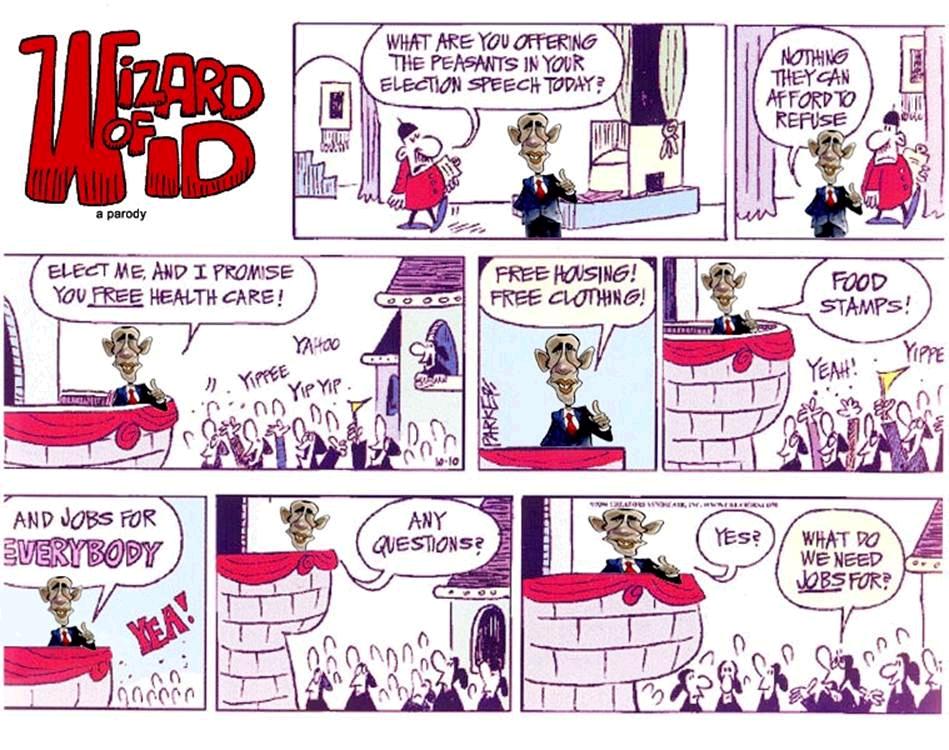
Economists often do a crummy job of teaching people about the impact of fiscal policy on the labor force, largely because we put people to sleep with boring discussions about “labor supply” decisions (my blog post from last year perhaps being an example of this tendency).

From now on, I will try to remember to use this cartoon. It’s a parody of Obama’s policies, but the last slide (or is it a panel?) is a great teaching tool about what happens when politicians turn the safety net into a hammock.

Thank you so much for your time. I know how valuable it is. I also appreciate the fine family that you have and your commitment as a father and a husband.

Sincerely,

Everette Hatcher III, 13900 Cottontail Lane, Alexander, AR 72002, ph 501-920-5733, lowcostsqueegees@yahoo.com