But this progress didn’t last long. Thanks to George Bush’s reckless spending policies, the federal budget grew about twice as fast as the economy, jumping by nearly 90 percent in just eight years This pushed federal spending up to about 25 percent of GDP.
President Obama promised hope and change, but he has kept spending at this high level rather than undoing the mistakes of his predecessor.
This new video from the Center for Freedom and Prosperity Foundation uses examples of waste, fraud, and abuse to highlight President Obama’s failed fiscal policy.
This mini-documentary from the Center for Freedom and Prosperity Foundation highlights egregious examples of wasteful spending from the so-called stimulus legislation and explains why government spending hurts economic performance.
____________________
Good stuff, though the video actually understates the indictment against Obama. There is no mention, for instance, about all the new spending for Obamacare that will begin to take effect over the next few years.
But not everything can be covered in a 5-minute video. And I suspect the video is more effective because it closes instead with some discussion of the corrupt insider dealing of Obama’s so-called green energy programs.
In 1980 economist and Nobel laureate Milton Friedman inspired market reform in the West and revolutions in the East with his celebrated television series “Free To Choose.”
Thirty years later, in this one-hour documentary, the young Swedish writer, analyst and Cato Institute Fellow Johan Norberg travels in Friedman’s footsteps to see what has
actually happened in the places Friedman’s ideas helped transform. In location after location Norberg examines the contemporary relevance of Friedman’s ideas in the 2011 world of globalization and financial crisis. Central to his examination are the perennial questions concerning power and prosperity, and the trade-offs between individual liberty and income equality.
___________
I have enjoyed reading this series of reviews by T. Kurt Jaros on Milton and Rose Friedman’s book “Free to Choose.” I hope you enjoy it as much as I did.
T. Kurt Jaros is currently a Master’s student studying Systematic Theology at King’s College in London. He holds a B.A. in Philosophy and Political Science cum laude and an M.A. in Christian Apologetics high honors from Biola University, an evangelical Christian university outside of Los Angeles.
He enjoys learning and thinking about theology, specifically historical theology, philosophical theology and philosophy of religion, and issues pertaining to monergism and synergism. Additionally, he enjoys learning and thinking about political philosophy, economics, American political history, and campaigns.
This is part of a series on Milton Friedman’s “Free to Choose.”
In my previous post I explained the role of government in the marketplace. This is part four of a book series on Free to Choose by Milton Friedman.
In the second chapter, Friedman writes on the role of government as it relates to trade. He makes a strong case for free trade, and specifically focuses on international trade. However, the same principles ought to be applied to domestic trade.
Friedman believes that the restrictions on economic freedom have “also affected our freedom of speech, of press, and of religion.” This is evident through the examples he uses throughout the chapter and even in instances we can think of right now. Consider the hated Stamp Act that the British imposed upon the American colonies. This was a tax placed upon legal documents, contracts, newspapers and even play cards. Also consider the more recent example of how economic regulations have affected our freedom of religion (in four words): Sandra Fluke, birth control.
Bureaucrats like to think that economic regulations are helpful to the American people. But in reality, protectionism exploits consumers. Friedman even sites consumers as “major victims of such measures.” In the attempt to secure American jobs, bureaucrats hold off consumers from saving money because the nation is, as Adam Smith pointed out, unable to get the largest volume of imports as possible for as little as it can pay.
Friedman recognizes that without tariffs, workers may be harmed through a cut in wages or even laid off, if a foreign nation can produce products more cheaply. But this happens anyway in the domestic marketplace. Yet this would allow workers to look for work in industries where there might be a need for innovation. Put another way: why do we want to support inefficient businesses when we can save consumers money? Without the tariffs, we “might very well produce a stronger and more efficient” industry.
There are four arguments in favor of tariffs that Friedman rejects (two of which are explained here). First, the government should protect against foreign trade because of national security. Consider the steel industry. Friedman thinks this is foolish because we could just stockpile steel. And even still, the U.S. steel industry would not be completely destroyed because of the low transportation costs. Second, the “infant industry” argument is used to defend baby companies who would fail unless otherwise protected. But this happens anyway; “most firms experience losses in their early years.” In reality, this is just a smokescreen for more government regulation and serving the special interests. This argument is hardly ever used to support companies that have yet to come into existence. After all, such hypothetical companies have no spokesmen or lobbyists.
We need to follow the suggestions of Friedman and take certain measures to promote freedom. Instead of giving foreign aid and then imposing restrictions on trade,
“We could say to the rest of the world: we believe in freedom and intend to practice it. We cannot force you to be free. But we can offer full cooperation on equal terms to all. Our market is open to you without tariffs or other restrictions. Sell here what you can and wish to. Buy whatever you can and wish to. In that way cooperation among individuals can be worldwide and free.”
I must say that I have lots of respect for Reason Magazine and for their admiration of Milton Friedman. However, I do disagree with one phrase below. At the end of this post I will tell you what sentence it is. Uploaded by ReasonTV on Jul 28, 2011 There’s no way to appreciate fully the […]
Milton Friedman on Hayek’s “Road to Serfdom” 1994 Interview 1 of 2 Uploaded by PenguinProseMedia on Oct 25, 2011 Says Federal Reserve should be abolished, criticizes Keynes. One of Friedman’s best interviews, discussion spans Friedman’s career and his view of numerous political figures and public policy issues. ___________________ Two Lucky People by Milton and Rose Friedman […]
What a great man Milton Friedman was. The Legacy of Milton Friedman November 18, 2006 Alexander Tabarrok Great economist by day and crusading public intellectual by night, Milton Friedman was my hero. Friedman’s contributions to economics are profound, the permanent income hypothesis, the resurrection of the quantity theory of money, and his magnum opus with […]
Milton Friedman videos and transcripts Part 7 On my blog http://www.thedailyhatch.org I have an extensive list of posts that have both videos and transcripts of MiltonFriedman’s interviews and speeches. Here below is just small list of those and more can be accessed by clicking on “Milton Friedman” on the side of this page or searching […]
Milton Friedman at Hillsdale College 2006 July 2006 Free to Choose: A Conversation with Milton Friedman Milton Friedman Economist Milton Friedman is a senior research fellow at the Hoover Institution at Stanford University and a professor emeritus of economics at the University of Chicago, where he taught from 1946-1976. Dr. Friedman received the Nobel Memorial […]
Milton Friedman said that getting George Bush I to be his vice president was his biggest mistake because he knew that Bush was not a true conservative and sure enough George Bush did raise taxes when he later became President. Below is a speech by George W. Bush honoring Milton Friedman: Milton Friedman Honored for […]
Below is a discussion from Milton Friedman on Bill Clinton and Ronald Reagan. February 10, 1999 | Recorded on February 10, 1999 audio, video, and blogs » uncommon knowledge PRESIDENTIAL REPORT CARD: Milton Friedman on the State of the Union with guest Milton Friedman Milton Friedman, Senior Research Fellow, Hoover Institution and Nobel Laureate in […]
Milton Friedman and Chile – The Power of Choice Uploaded by FreeToChooseNetwork on May 13, 2011 In this excerpt from Free To Choose Network’s “The Power of Choice (2006)”, we set the record straight on Milton Friedman’s dealings with Chile — including training the Chicago Boys and his meeting with Augusto Pinochet. Was the tremendous […]
Milton Friedman’s negative income tax explained by Friedman in 1968: President Obama c/o The White House 1600 Pennsylvania Avenue NW Washington, DC 20500 Dear Mr. President, I know that you receive 20,000 letters a day and that you actually read 10 of them every day. I really do respect you for trying to get a […]
Milton Friedman on the American Economy (5 of 6) Uploaded by donotswallow on Aug 9, 2009 THE OPEN MIND Host: Richard D. Heffner Guest: Milton Friedman Title: A Nobel Laureate on the American Economy VTR: 5/31/77 _____________________________________ Below is a transcipt from a portion of an interview that Milton Friedman gave on 5-31-77: Friedman: […]
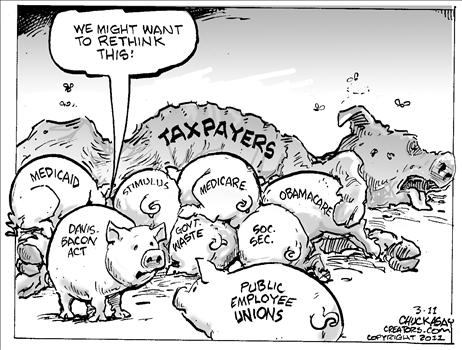
More than two years ago, I explained in a TV interview that the looters and moochers should be careful that they don’t kill the geese that lay the golden eggs. After all, parasites need a healthy host.
The collapse of Europe’s welfare states should be a wake-up call for these people, but that hasn’t stopped the demands for more redistribution in Washington. As Michael Barone noted, the folks on the left assume that there will always be someone to plunder.
But at least the piglets in this Chuck Asay cartoon are finally waking up to reality.
Thank you so much for your time. I know how valuable it is. I also appreciate the fine family that you have and your commitment as a father and a husband.
Sincerely,
Everette Hatcher III, 13900 Cottontail Lane, Alexander, AR 72002, ph 501-920-5733, lowcostsqueegees@yahoo.com
In this short clip below you will hear that Rand Paul read several books by Ayn Rand and later read several books that she liked. Take a look below as Ayn Rand answers a religious question about meaning in life. I have written on Milton Friedman’s religious views earlier too.
In response to the critics of capitalism, many conservative Christians turn to philosopher Ayn Rand for ammunition. Rand was a staunch defender of capitalism, but also an anti-Christian atheist who argued that capitalism was based on greed. Greed, for Rand, is good. But if Rand is right, then Christians can’t be capitalists, because greed is a sin. Fortunately, Rand was wrong. She missed the subtleties of capitalism. First, we should distinguish self-interest from selfishness. Adam Smith, the father of capitalism, famously wrote, “It is not from the benevolence of the butcher, the brewer, or the baker, that we expect our dinner, but from their regard to their own interest.” True enough; but that alone isn’t a problem. Every time you wash your hands or look both ways before you cross the street, you’re pursuing your self-interest—but neither activity is selfish. Second, Smith never argued that the more selfish we are, the better a market works. His point, rather, is that in a free market, each of us can pursue ends within our narrow sphere of competence and concern—our “self-interest”—and yet an order will emerge that vastly exceeds anyone’s deliberations. Finally, Smith argued that capitalism channels greed, which is a good thing. The point is that even if the butcher is selfish, he can’t make you buy his meat. He has to offer you meat at a price you’ll willingly buy. So capitalism doesn’t need greed. What it does need is rule of law, freedom, and human creativity and initiative. And we can point that out without any help from Ayn Rand.
_________
THE GIFT GIVERS
Think of a stereotypical miser like Ebenezer Scrooge (as opposed to the ordinary greedy person). Misers hoard their wealth. They hole up in their bedrooms, counting their gold bullion and hiding it in their mattresses. “Do not store up for yourselves treasures on earth, where moth and rust destroy, and where thieves break in and steal,” Jesus commanded His disciples, “but store up for yourselves treasures in heaven….For where your treasure is, there your heart will be also.” Jesus is talking about the person who hoards, who trusts his possessions rather than God. “You cannot serve both God and money” (Matt. 6:19–21, 24 NIV). The Apostle Paul said that greed is idolatry (Eph. 5:5). If religion involves our “ultimate concern,” as Paul Tillich said, then the miser is an idolater. He worships his money. That’s because you can only have one ultimate concern.
Many of the biblical warnings seem to apply to misers, but how many misers have you met? Do you know anyone who keeps a bag of money in his mattress, where he can count it? Probably not. We see misers on TV, read about them in children’s books and in Dickens. In capitalist societies, however, misers are in very short supply. That’s because capitalism discourages miserliness, and encourages its near-opposite: enterprise.
“The grasping or hoarding rich man is the antithesis of capitalism, not its epitome,” writes George Gilder, “more a feudal figure than a bourgeois one.”20 The miser prefers the certainty and security of his booty. Entrepreneurs, in contrast, assume risk. They cast their bread on the waters of uncertainty, hoping that the bread will return with fish. They delay whatever gratification their wealth might provide now for the hope of future gain. The miser treats his bullion as an end in itself. The entrepreneur, whatever his motives—including the desire for more money—uses money as a tool. The carpenter uses hammer and saw; the doctor, scalpel and stethoscope; the entrepreneur, cash and credit.
Only by the constant din of stereotype could we come to mistake the entrepreneur for the miser. In his modern classic, Wealth and Poverty, George Gilder explores a surprising feature of enterprise: supply precedes demand. After all, before you can exchange, you must first have something to exchange. I must have a good or service, a coconut or a potholder or an iPod that someone wants in order for trade to ever get started. Right off the bat, if I’m an entrepreneur, I have to think about the wants and needs of others. In a free economy, great entrepreneurs, including greedy ones, succeed by anticipating and meeting the desires of others. In that sense, Gilder argues, they are altruistic—alter in Latin means “other.” Entrepreneurial investments, he argues, are like gifts, since they are made without a predetermined return.21 Competition between entrepreneurs in a free economy thus becomes an altruistic competition, not because the entrepreneurs have warm fuzzies in their hearts, or are unconcerned with personal wealth, but because they seek to meet the desires of others better than their competitors do.22
Not for nothing did Ayn Rand dedicate her final lecture to a tirade against Gilder. But her view of the capitalist, in the end, was skewed by the Marxist stereotype she had officially rejected. Gilder’s view captures much better the nature and subtlety of entrepreneurial capitalism.
Far from requiring vice, entrepreneurial capitalism requires a whole host of virtues. Before entrepreneurs can invest capital, for instance, they must first accumulate it. So unlike gluttons and hedonists, entrepreneurs set aside rather than consume much of their wealth. Unlike misers and cowards, they risk rather than hoard what they have saved, providing stability for those employed by their endeavors. Unlike skeptics, they have faith in their neighbors, their partners, their society, their employees, “in the compensatory logic of the cosmos.”23 Unlike the self-absorbed, they anticipate the needs of others, even needs that no one else may have imagined. Unlike the impetuous, they make disciplined choices. Unlike the automaton, they freely discover new ways of creating and combining resources to meet the needs of others. This cluster of virtues, not the vice of greed, is the essence of what Rev. Robert Sirico calls the “entrepreneurial vocation.”24
I’m convinced that Ayn Rand continues to be popular, in part, because she dared to make entrepreneurs the heroes of her novels. Whatever her other failings, this was a keen insight. Without entrepreneurs, very little of what we take for granted in our economy and our everyday lives would exist. Here in my office, the concrete forms of entrepreneurial imagination are everywhere: paper, scissors, pens, highlighters, ink, CDs, an empty Tupperware container that held the pork loin I ate for lunch, a flat-screen monitor, fonts, lamps, light bulbs, Post-it notes, windows, sheet rock, speakers, a laptop computer, and an optical mouse. Behind all these visible objects lay real but less visible innovations in finance, manufacturing, and transport that I scarcely comprehend. All of these things are gifts of entrepreneurs. Only the most miserly moralizer could look at this mysterious efflorescence of cooperation, competition, and creativity—of entrepreneurial capitalism—and see only the dead hand of greed.
Does this mean that if you’re a Christian, you must embrace capitalism? No. But it does mean that Christians don’t need to adopt Ayn Rand’s anti-Christian philosophy to defend the morality of capitalism. Once we comprehend the nature of entrepreneurial capitalism, we see that it has fit within the Christian worldview all along.
Jay W. Richards is the author of Money, Greed, and God: Why Capitalism Is the Solution and Not the Problem (HarperOne, 2009). He has held leadership positions at Discovery Institute and the Acton Institute for the Study of Religion & Liberty, and is currently a Visiting Fellow at the Heritage Foundation and a Senior Fellow at Discovery Institute.
notes:
20 George Gilder, Wealth and Poverty (San Francisco: ICS Press, 1993), 30.
21 Ibid., 27.
22 Ibid., 20–24.
23 Ibid., 37.
24 Robert A. Sirico, The Entrepreneurial Vocation (Grand Rapids: Acton Institute, 2001).
Ayn Rand on the Purpose of Life Uploaded by prosumption on Apr 27, 2010 Ayn Rand on the Purpose of Life _________________ I ran across a fine article that takes a look at Ayn Rand’s view of capitalism and selfishness and compares it to the Christian view found in the Bible. I have decided to […]
Nonbelievers like Rand really do not have an answer to the question “What is the meaning of life?” Ayn Rand on the Purpose of Life Christians are commanded to help others by Christ. However, many Christians do believe in the free market and think that system best suits the ideas that flow from Christianity. (Doug […]
Uploaded by MetrazolElectricity on Oct 30, 2010 Talking to Rose, patron-saint of the conservative movement , Bill buckley chats about ayn and her magnum opus atlas shrugged. On atlas shrugged, WFB:”I had to flog myself to read it.” On ayn, WFB : “Her scorn for charity,for altruism was such as to build up an unfeeling […]
Uploaded by LibertyPen on Jul 17, 2009 Questioned by Mike Wallace, Ayn Rand explains her philosophy of objective reality and contrasts it with altruism. _________________ I ran across a fine article that takes a look at Ayn Rand’s view of capitalism and selfishness and compares it to the Christian view found in the Bible. I […]
Uploaded by LibertyPen on Oct 26, 2009 Ayn Rand makes the case that altruism is evil. ___________________ I ran across a fine article that takes a look at Ayn Rand’s view of capitalism and selfishness and compares it to the Christian view found in the Bible. I have decided to start a series on this […]
McEnroe won a total of 148 ATP titles (a record for a male professional) during his career — 77 in singles, 71 in men’s doubles, and 1 in mixed doubles (not counted as ATP title).He won seven Grand Slam singles titles. He also won a record eight year end championship titles overall, the Masters championships three times, and the WCT Finals,a record five times.His career singles match record was 875–198 (81.55%_. He posted the best single season match record (for a male player) in the Open Era with win-loss record: 82–3 (96.5%) set in 1984 and has the best Carpet Court career match winning percentage: 84.18% (411–346) of any player.
McEnroe, however, played in numerous events, including invitational tournaments, that are not covered by the ATP website. McEnroe won eight of those events and had wins and losses against the players listed in the preceding paragraph that are not reflected on the ATP website.
Over the past several years, President Barack Obama has repeatedly claimed that America is not a Christian nation. He asserted that while a U. S. Senator, 1 repeated it as a presidential candidate, 2 and on a recent presidential trip to Turkey announced to the world that Americans “do not consider ourselves a Christian nation.” 3 (He made that announcement in Turkey because he said it was “a location he said he chose to send a clear message.” 4 ) Then preceding a subsequent trip to Egypt, he declared that America was “one of the largest Muslim countries in the world” 5 (even though the federal government’s own statistics show that less than one-percent of Americans are Muslims. 6
The President’s statements were publicized across the world but received little attention in the American media. Had they been carried here, the President might have been surprised to learn that nearly two-thirds of Americans currently consider America to be a Christian nation 7 and therefore certainly might have taken exception with his remarks. But regardless of what today’s Americans might think, it is unquestionable that four previous centuries of American leaders would definitely take umbrage with the President’s statements.
Modern claims that America is not a Christian nation are rarely noticed or refuted today because of the nation’s widespread lack of knowledge about America’s history and foundation. To help provide the missing historical knowledge necessary to combat today’s post-modern revisionism, presented below will be some statements by previous presidents, legislatures, and courts (as well as by current national Jewish spokesmen) about America being a Christian nation. These declarations from all three branches of government are representative of scores of others and therefore comprise only the proverbial “tip of the iceberg.”
The U. S. Congress Affirms that America is a Christian Nation
Declarations from the Legislative Branch affirming America as a Christian nation are abundant. For example, in 1852-1853 when some citizens sought a complete secularization of the public square and a cessation of all religious activities by the government, Congress responded with unambiguous declarations about America as a Christian nation:
HOUSE JUDICIARY COMMITTEE: Had the people, during the Revolution, had a suspicion of any attempt to war against Christianity, that Revolution would have been strangled in its cradle. At the time of the adoption of the Constitution and the amendments, the universal sentiment was that Christianity should be encouraged, not any one sect [denomination]. Any attempt to level and discard all religion would have been viewed with universal indignation. . . . In this age there can be no substitute for Christianity; that, in its general principles, is the great conservative element on which we must rely for the purity and permanence of free institutions. 24
SENATE JUDICIARY COMMITTEE: We are Christians, not because the law demands it, not to gain exclusive benefits or to avoid legal disabilities, but from choice and education; and in a land thus universally Christian, what is to be expected, what desired, but that we shall pay a due regard to Christianity? 25
In 1856, the House of Representatives also declared:
[T]he great vital and conservative element in our system is the belief of our people in the pure doctrines and divine truths of the Gospel of Jesus Christ. 26
On March 3, 1863 while in the midst of the Civil War, the U. S. Senate requested President Abraham Lincoln to “designate and set apart a day for national prayer and humiliation” 27 because:
[S]incerely believing that no people, however great in numbers and resources or however strong in the justice of their cause, can prosper without His favor; and at the same time deploring the national offences which have provoked His righteous judgment, yet encouraged in this day of trouble by the assurances of His word to seek Him for succor according to His appointed way through Jesus Christ, the Senate of the United States do hereby request the President of the United States, by his proclamation, to designate and set apart a day for national prayer and humiliation. 28(emphasis added)
President Lincoln quickly complied with that request, 29 and issued what today has become one of the most famous and quoted proclamations in America’s history. 30
Across the generations, our national reliance on God, the Bible, and Christianity has been repeatedly reaffirmed. In fact, consider five representative images produced by the U. S. Government. The first three are from World War II: one shows the Nazis as the enemy because they want to attack the Bible, and the other two encourage Americans to buy War Bonds by pointing to Christian images. The fourth and fifth images are from the Department of Agriculture in the 1960s, using the Bible and even Smokey Bear in prayer as symbols to encourage Americans to be conscious of fire safety and to help preserve and conserve nature.
There are scores of other official actions by the U. S. Congress over the past two centuries affirming that America is a Christian nation
24. Reports of Committees of the House of Representatives Made During the First Session of the Thirty-Third Congress (Washington: A. O. P. Nicholson, 1854), pp. 6, 8. (Return)
25. The Reports of Committees of the Senate of the United States for the Second Session of the Thirty-Second Congress, 1852-53 (Washington: Robert Armstrong, 1853), p. 3. (Return)
26. Journal of the House of Representatives of the United States: Being the First Session of the Thirty-Fourth Congress (Washington: Cornelius Wendell, 1855), p. 354, January 23, 1856. See also Lorenzo D. Johnson, Chaplains of the General Government With Objections to their Employment Considered (New York: Sheldon, Blakeman & Co., 1856), p. 35. (Return)
27. Journal of the Senate of the United States of America Being the Third Session of the Thirty-Seventh Congress (Washington, D.C.: Government Printing Office, 1863), p. 379, March 2, 1863. (Return)
28. Journal of the Senate of the United States of America, Being the Third Session of the Thirty-Seventh Congress (Washington, D.C.: Government Printing Office, 1863), pp. 378-379, March 2, 1863. (Return)
29. Abraham Lincoln, The Collected Works of Abraham Lincoln, Roy P. Basler, editor (New Jersey: Rutgers University Press, 1953), Vol. VI, pp. 155-157, “Proclamation Appointing a National Fast Day,” March 30, 1863.(Return)
30. A May 2009 Google search for this proclamation resulted in 18,000+ hits.(Return)
READ THIS FIRST: In decline of all civilizations we first see a war against the freedom of ideas. Discussion is limited or prohibited. Speakers at universities are shouted down. Corruption takes over city governments and towns as dishonesty and corruption expands. Small stores have to shut down because none are honest enough to run a cash register. The stock of stores is looted by employees and pilfered and shop owners flee. Stock markets are rife with manipulation and the plague of dishonesty. We have learned that sound and lasting civilized ideas are built upon very rare and special foundations. Frances Schaeffer is one guy who has sparked my own thinking and study. He has influenced my writing and prison ministry greatly. Humans must be convinced intellectually, historically and reasonably as well as through the Biblical teachings. Francis Shaeffer has helped all of us wade through this vast propaganda sewer to approach fundamental questions, one of which is: “Why do nations and empires decline?”
_______________
Francis Schaeffer February 21, 1982 (Part 2)
______________
To Mitt Romney, Box 149756, Boston, MA 02114-9756 From Everette Hatcher of www.thedailyhatch.org 13900 Cottontail Lane, Alexander, AR 72002
Did we forgive George Bush in 1988 for being pro-choice originally in 1980? We sure did. In fact, my former pastor, Adrian Rogers, had a chance to visit with Bush several times. He told him that the Religious Right did not have enough votes to get him elected on their own, but if he ever went against the pro-life view then they could definitely derail his election bid.
Today I am writing you to remind you of the same thing. We in the pro-life movement are firmly behind you but we want to know some of the reasons are passionately pro-life.
________
Francis Schaeffer rightly identified abortion as the key issue. If you want to understand the evangelical pro-life movement then you have to read the works of Schaeffer and then you will see how much he affected the pro-life movement.
Imagine living in a country in which members of Congress would mandate researchers ‘either destroy embryos or risk imprisonment.’ Imagine a nation that not only permits the killing of the most vulnerable among us but mandates such mayhem for the purposes of research. Imagine no further—the day has arrived. As the former Supreme Court nominee Robert Bork has well said, we have began inexorably “slouching toward Gomorrah.”[1]I’ll never forgot the words of George Will, when he said, “we are experiencing the slow motion barbarization of America.”
The founders of our Republic could only in their darkest nightmares have imagined relativism trumping objective moral standards in a free society. The rise of technology and the fall of ethical consensus have brought us to a society full of moral dilemmas. This stark reality was born out in 1973 when Christians quietly passed in a battle in the war against abortion.
The far reaching impact of that abdication is felt in the raging battle over embryonic stem cell research. In the wake of the current moral and ethical tsunami, it is incumbent upon Christians to not only provide relief but bring the rebuilding process. Nothing less than Western Civilization is at stake.
I’ll never forget what Christian philosopher Francis Schaeffer said many years ago: abortion would be the watershed issue of our era. “Of all the subjects related to the erosion of the sanctity of human life abortion is the keystone.”[2] Of course, his warning tragically fell on deaf ears.
Consider the statements of some of the leading spiritual and secular leaders of our age. Beverly Harrison, a professor of Christian Ethics at Union Theological Seminary, “Infanticide is not a great wrong. I do not want to be construed as condemning women who under certain circumstances quietly put their infants to death.”[3]Esther Langston, Professor of Social Work at the University of Nevada, “What we are saying is that abortion becomes one of the choices and the person has the right to choose whatever it is that is… best for them in the situation in which they find themselves: be it abortion, keep the baby, adopt the baby, sell the baby, leave the baby in a dumpster, put it on your porch, whatever. It’s the person’s right to choose.”[4] Margaret Sanger, the founder of Planned Parenthood, who famously remarked “that the most merciful thing a large family can do for one of its infant members is to kill it.”[5]
Where does this slippery slope lead? Think only to the words of James Watson, the Nobel prize winner and the co-discover of the structure of DNA, “Because of the limitations of present detection methods most birth defects are not discovered until birth; however, if a child was not declared alive until three days after birth the doctor would allow the child to die if the parents so chose and save a lot of misery and suffering.”[6]
This is the epoch in which we find ourselves. In view of this reality, we should go back to the words of Scripture. “For you created my inmost being; you knit me together in my mother’s womb I praise you because I am fearfully and wonderfully made” (Ps. 139:13). A song was written with those words in mind. It was haunting, not only to hear the music but to see the images. It was the first pro-life song by Cindee Martin Morgan, who is the daughter of the late Dr. Walter Martin, the founder and former president of CRI. It was recorded by her daughter Sharon at the tender age of seven. We featured that song on the Bible Answer Man broadcast and we lauded the fact that Cindee Martin Morgan and her husband Rick Morgan were vigilant in the battle against abortion.
The reason we did that is because the reality is today there are very few Christians who will put their lives on the line for this issue. Christians have become apathetic. There was a recent Pew Research Poll that found that among all respondents to the poll concern about the abortion issues has dropped. Only 15% of respondents said that abortion was a critical issue.[7] It’s an issue to which we have been anesthetized to. This does not mean that we shouldn’t be involved in the debate or the discussion. It’s a watershed issue of our era; we should be involved.
So Cindee and Rick have continued the battle, recognizing it’s not about whether we win or lose. It’s about being faithful with the platform that God gives us. They have now come out with a new pro-life song called, “Who will Save the Little Ones?” It’s a call to lawful action on behalf of the unborn. You can hear this at our Website (http://www.equip.org/site/savethelittleones). I also did an hour long interview with Cindee and Rick on October 6, 2009; this can be heard also at our Website (http://www.equip.org/broadcasts/who-will-save-the-little-ones-20090610). To visit their Website go to (http://www.MtMoriahMusic.com) Also to equip you in defending the Pro-Life position we recommend the book Whose Ethics? Whose Morals? available at our Website or by calling 1-888-7000-0274.
Ayn Rand was born in 1905 in St. Petersburg, Russia, but defected from the U.S.S.R. in 1926 and came to the the U.S., where her writings formed the intellectual basis for the philosophy she called Objectivism. She was the author of The Fountainhead (1943) and Atlas Shrugged (1957).
Rand appears as a guest on The Tonight Show Starring Johnny Carson in this interview from 1967. She introduces her philosophy and talks with Carson about various topics including the draft, the war in Vietnam, children, theology, and the nature of rights.
In response to the critics of capitalism, many conservative Christians turn to philosopher Ayn Rand for ammunition. Rand was a staunch defender of capitalism, but also an anti-Christian atheist who argued that capitalism was based on greed. Greed, for Rand, is good. But if Rand is right, then Christians can’t be capitalists, because greed is a sin. Fortunately, Rand was wrong. She missed the subtleties of capitalism. First, we should distinguish self-interest from selfishness. Adam Smith, the father of capitalism, famously wrote, “It is not from the benevolence of the butcher, the brewer, or the baker, that we expect our dinner, but from their regard to their own interest.” True enough; but that alone isn’t a problem. Every time you wash your hands or look both ways before you cross the street, you’re pursuing your self-interest—but neither activity is selfish. Second, Smith never argued that the more selfish we are, the better a market works. His point, rather, is that in a free market, each of us can pursue ends within our narrow sphere of competence and concern—our “self-interest”—and yet an order will emerge that vastly exceeds anyone’s deliberations. Finally, Smith argued that capitalism channels greed, which is a good thing. The point is that even if the butcher is selfish, he can’t make you buy his meat. He has to offer you meat at a price you’ll willingly buy. So capitalism doesn’t need greed. What it does need is rule of law, freedom, and human creativity and initiative. And we can point that out without any help from Ayn Rand.
.
FALLING INTO CAPITALISM
So, contrary to Rand, capitalism doesn’t need greed. At the same time, it can channel greed, which is all to the good. We should want a social order that channels proper self-interest as well as selfishness into socially desirable outcomes. Any system that requires everyone always to act selflessly is doomed to failure because it’s utopian. That’s the problem with socialism: it doesn’t fit the human condition. It alienates people from their rightful self-interest and channels selfishness into socially destructive behavior such as stealing, hoarding, and getting the government to steal for you.
In contrast, capitalism is fit for real, fallen, limited human beings. “In spite of their natural selfishness and rapacity,” Adam Smith wrote, business people “are led by an invisible hand…and thus without intending it, without knowing it, advance the interest of the society.”17 Notice he says “in spite of.” His point isn’t that the butcher should be selfish, or even that his selfishness is particularly helpful. His point is rather that even if the butcher is selfish, even if the butcher would love nothing more than to sell you a spoiled chunk of grisly beef in exchange for your worldly goods and leave you homeless, the butcher can’t make you buy his meat in a free economy. He has to offer you meat you’ll freely buy. The cruel, greedy butcher, in other words, has to look for ways to set up win-win scenarios. Even to satisfy his greed, he has to meet your desires. The market makes this happen. That’s making the best of a bad situation, and of a bad butcher.
DOES CAPITALISM MAKE PEOPLE GREEDY?
Even if capitalism doesn’t need greed, doesn’t it feed greed? Many religious scholars don’t even distinguish capitalism and greed.18 Capitalism is just greed elevated to economics, or so they think. And if you happen to catch Donald Trump on The Apprentice, you might suspect they’re on to something.
To be sure, Rand and other champions of capitalism appeal to greed, even glory in it. There’s no evidence, however, that citizens of capitalist countries in general, or Americans in particular, are more greedy than average. In fact, the evidence suggests just the opposite.19
Of course Americans should be more generous, more loving, more thankful, more thoughtful, and less sinful. If you look, you can find greed all across the fruited plains and in every human heart. That’s because we’re fallen human beings, not because we’re Americans or capitalists. Every culture and walk of life has heaping helpings of greedy people. There are greedy doctors, greedy social workers, greedy teachers, politicians, park rangers, and youth pastors. That’s why greed can explain why capitalism works no better than it can explain the universal thirst for, say, well-synchronized traffic lights: greed is universal. Capitalism is not.
.
notes
17 Adam Smith, The Theory of Moral Sentiments, Part Four, chap. 1.
18 See, for instance, the edited collection by Paul Knitter and Chandra Musaffar, Subverting Greed: Religious Perspectives on the Global Economy (Maryknoll, NY: Orbis, 2002).
19 For statistical evidence, see International Comparisons of Charitable Giving (Kent, UK: Charities Aid Foundation, November, 2006), http://www.cafonline.org/research. See also Arthur C. Brookes, Who Really Cares: The Surprising Truth about Compassionate Conservatism (New York: Basic Books, 2006).
Ayn Rand on the Purpose of Life Uploaded by prosumption on Apr 27, 2010 Ayn Rand on the Purpose of Life _________________ I ran across a fine article that takes a look at Ayn Rand’s view of capitalism and selfishness and compares it to the Christian view found in the Bible. I have decided to […]
Nonbelievers like Rand really do not have an answer to the question “What is the meaning of life?” Ayn Rand on the Purpose of Life Christians are commanded to help others by Christ. However, many Christians do believe in the free market and think that system best suits the ideas that flow from Christianity. (Doug […]
Uploaded by MetrazolElectricity on Oct 30, 2010 Talking to Rose, patron-saint of the conservative movement , Bill buckley chats about ayn and her magnum opus atlas shrugged. On atlas shrugged, WFB:”I had to flog myself to read it.” On ayn, WFB : “Her scorn for charity,for altruism was such as to build up an unfeeling […]
Uploaded by LibertyPen on Jul 17, 2009 Questioned by Mike Wallace, Ayn Rand explains her philosophy of objective reality and contrasts it with altruism. _________________ I ran across a fine article that takes a look at Ayn Rand’s view of capitalism and selfishness and compares it to the Christian view found in the Bible. I […]
Uploaded by LibertyPen on Oct 26, 2009 Ayn Rand makes the case that altruism is evil. ___________________ I ran across a fine article that takes a look at Ayn Rand’s view of capitalism and selfishness and compares it to the Christian view found in the Bible. I have decided to start a series on this […]
“There are very few people over the generations who have ideas that are sufficiently original to materially alter the direction of civilization. Milton is one of those very few people.”
That is how former Federal Reserve Chairman Alan Greenspan described the Nobel laureate economist Milton Friedman. But it is not for his technical work in monetary economics that Friedman is best known. Like mathematician Jacob Bronowski and astronomer Carl Sagan, Friedman had a gift for communicating complex ideas to a general audience.
It was this gift that brought him to the attention of filmmaker Bob Chitester. At Chitester’s urging, Friedman agreed to make a 10 part documentary series explaining the power of economic freedom. It was called “Free to Choose,” and became one of the most watched documentaries in history.
The series not only reached audiences in liberal democracies, but was smuggled behind the iron curtain where it played, in secret, to large audiences. Reflecting on its impact, Czech president Vaclav Klaus has said: “For us, who lived in the communist world, Milton Friedman was the greatest champion of freedom, of limited and unobtrusive government and of free markets. Because of him I became a true believer in the unrestricted market economy.”
July 31st, 2012 is the 100th anniversary of Friedman’s birth. To commemorate that occasion, we’d like to share an interview with “Free to Choose” producer Bob Chitester. Like this interview, the entire series can now be viewed on-line at no cost at http://www.freetochoose.tv/, thanks to the incredible technological progress brought about by the economic freedom that Milton Friedman celebrated.
Produced by Andrew Coulson, Caleb O. Brown, Austin Bragg, and Lou Richards, with help from the Free to Choose Network.
_______________
This article below was also carried by the Arkansas Democrat-Gazette on August 12, 2012.
Don Boudreaux is an adjunct scholars at the Cato Institute, a professor of economics at George Mason University, and is author of Hypocrites & Half-Wits.
Added to cato.org on July 30, 2012
This article appeared in Newsday on July 30, 2012.
At the height of the Vietnam War, U.S. commander Gen. William Westmoreland testified before the President’s Commission on an All-Volunteer Force. The 15 members of that commission were charged with exploring the feasibility of ending the military draft.
Staunchly opposed to an all-volunteer military, which must pay its soldiers market wages, Gen. Westmoreland proclaimed that he did not want to command “an army of mercenaries.” One of the commission members immediately shot back with a question: “General, would you rather command an army of slaves?” That penetrating query was posed by Milton Friedman, a diminutive (he stood only 5 feet 3 inches tall) giant among 20th-century scholars. Were he still alive — he died in 2006 — Friedman would celebrate his 100th birthday on July 31.
Bald and bespectacled, Friedman looked every part the University of Chicago economics professor that he was. During his long tenure at that celebrated institution, he produced a stream of cutting-edge research on consumer behavior, on the role of money, and on the history of U.S. and British monetary policy. The impressive quantity, quality, and importance of this research without doubt places Friedman among the top two or three economists of the past century.
Don Boudreaux is an adjunct scholars at the Cato Institute, a professor of economics at George Mason University, and is author of Hypocrites & Half-Wits.
Friedman, indeed, is one of the few scholars whose receipt of the Nobel Prize in Economics — which he received in 1976 — did at least as much to bestow prestige on that award as that award did to bestow prestige on him. (The first Nobel Prize in Economics wasn’t awarded until 1969.) Friedman’s stupendous scholarly achievements alone justify commemoration of the centenary of his birth.
But at least as important as Friedman’s scholarship was his lucid and energetic public advocacy of limited government and free markets. He explained with unmatched clarity how a modern economy’s complexities, nuances, and dynamism almost always thwart even the best-intentioned efforts by government officials to intervene into markets.
In a scene from the opening episode of his successful 10-part 1980 PBS series “Free to Choose,” Friedman held in his hand an ordinary pencil. Looking into the camera, and speaking without a script, he explained that a pencil — so seemingly simple — requires for its production the knowledge and labors of millions of people from around the world.
Some workers cut down the trees; other workers make the chainsaws used to cut down the trees; yet other workers make the steel used to manufacture the chainsaws; and yet other workers specialize in mining the iron ore used to make the steel. Still other workers mine the graphite to make the “lead” for the pencil, while many others work in factories to make the yellow paint that commonly adorns pencils, while still other workers perform the many tasks required to produce the rubber for each pencil’s eraser.
Just to list the number of different, highly specialized jobs that must be performed to produce a commonplace pencil would take volumes. Few of these workers know each other, and none of them knows how to do any more than one or two of the countless jobs that must be done if we are to be well-supplied with pencils.
Friedman explained how free-market prices, along with the lure of profit and the fear of loss, guide entrepreneurs, firms, and workers from across the globe to produce just the right amounts of wood, graphite, paint, erasers, and the many other parts of pencils.
No government commissars are involved. There’s no central plan for the production of pencils. Yet we have high-quality pencils in abundance and for sale at low prices. What’s true for pencils, of course, is true also for more complex items such as automobiles, electric lighting, MRI machines, and on and on — that is, for nearly every good commonly found in modern industrial society.
No one equaled Friedman’s skill at explaining how free markets succeed at coordinating the activities of legions of individuals to produce the goods and services that we today take for granted. Likewise, no one equaled his skill at explaining how government regulators are typically oblivious to the complexity of the coordination achieved by markets. Being oblivious, regulators’ interventions too often obstruct this market coordination.
Note that Friedman would heartily agree with President Obama that no one prospers in today’s economy exclusively through his or her own individual efforts. Where Friedman would disagree — and disagree strongly — is with Obama‘s suggestion that the main source of help that each of us gets from others is government. While government might supply some necessary pieces, such as highways and law courts, the vast bulk of what society supplies for each person’s sustenance and success comes not from government but from the ongoing private efforts of millions of individuals acting in free markets.
Friedman’s brilliant use of the pencil, like his reply to Gen. Westmoreland, reveals the great talent Friedman had for cutting to the heart of the matter in ways easily understood by almost everyone.
Revealing the awesome complexity of the humble pencil makes clear that no government regulators can ever hope to know enough about the entire economy to regulate it as well as it is regulated by free-market forces. Calling the military’s seizure of years of labor from young men “slavery” reveals the fact that draftees — like plantation slaves of old — are forced against their will to work for others and on terms dictated by others.
Friedman’s response to Gen. Westmoreland is evidence also of Friedman’s lifelong commitment to the cause of human freedom. Not only was conscription economically inefficient (as Friedman showed in academic research), it was also an affront to the values of a free society.
In a free society government is kept as small and as constrained as possible, charged with doing only those few tasks that are widely believed to be doable only by government — tasks such as building roads and supplying national defense. All other tasks are left to the creative forces of the free market. And in doing those few tasks, Friedman maintained, the freedom and dignity of every individual must always be respected.
Americans of my generation likely first encountered Friedman through his regular column in Newsweek, which ran from 1966 through 1984. Each of these essays cogently made the case for reducing the reach of government. In making this case, Friedman consistently defied conventional stereotypes. He was, he always insisted, not a conservative but, rather, a liberal — a true liberal, in the original meaning of that term.
Being a classical liberal, Friedman vigorously championed not only economic freedoms but also freedoms emphasized by many folks on the political left, such as freedom of speech and of assembly. It speaks volumes of Friedman’s principles that he, the owlish and dedicated scholar so beloved by many establishment conservatives for his support of free enterprise, was among the most vocal and unwavering opponents of the “war on drugs.” He insisted, with characteristic wit, that “the government has no more right to tell me what goes into my mouth than it has to tell me what comes out of my mouth.” Truly great men and women are rare. What they all share is the courage of their convictions, the wisdom to distinguish cant from reality, and enormous energy and ability in working to make the world a better place. Milton Friedman was one such genuinely great man.
Milton Friedman’s 100th: Exploring His Wisdom for the Ages (Part I: Worldview) by Robert Bradley Jr. July 31, 2012 [Ed. note: Milton Friedman’s views will be further explored in Part II on energy and Part III on political capitalism.] “Our central theme in public advocacy has been the promotion of human freedom … [It] underlies […]
I was impacted in 1980 by the film series “Free to Choose” and I was very impressed by the performance by Thomas Sowell. Today he remembers his former teacher Milton Friedman. Friedman could be a help today By Thomas Sowell Creators Syndicate Tuesday July 31, 2012 7:00 AM If Milton Friedman were alive […]
In the video above Milton Friedman takes on some liberal students with their challenges to capitalism. Secretary of Defense Donald H. Rumsfeld speaking at Tribute to Milton Friedman (transcript) As Delivered by Secretary of Defense Donald H. Rumsfeld, White House, Washington, D.C., Thursday, May 09, 2002 Mr. President (George W. Bush), Rose and Milton […]
Every Friday you need to click on http://www.theDailyHatch.org if you would like to see a video clip of Milton Friedman as he shares his common sense conservative economic views. Many of his articles are posted too. I remember growing up and reading those great articles every week in Newsweek. They are just as relevant today as […]
Milton Friedman videos and transcripts Part 12 On my blog http://www.thedailyhatch.org I have an extensive list of posts that have both videos and transcripts of MiltonFriedman’s interviews and speeches. Here below is just small list of those and more can be accessed by clicking on “Milton Friedman” on the side of this page or searching […]
published Tuesday, July 31st, 2012 Chattanooga Times Free Press Milton Friedman at 100 Milton Friedman Photo by Associated Press /Chattanooga Times Free Press. enlarge photo One hundred years ago today, the most powerful defender of economic liberty in American history was born in Brooklyn to poor Jewish immigrants. Though he stood barely […]
No one did more to advance the cause of school vouchers than Milton and Rose Friedman. Friedman made it clear in his film series “Free to Choose” how sad he was that young people who live in the inner cities did not have good education opportunities available to them. Remembering Milton Friedman’s School Choice Legacy […]
Testing Milton Friedman – Preview Uploaded by FreeToChooseNetwork on Feb 21, 2012 2012 is the 100th anniversary of Milton Friedman’s birth. His work and ideas continue to make the world a better place. As part of Milton Friedman’s Century, a revival of the ideas featured in the landmark television series Free To Choose are being […]
What a great defense of Milton Friedman!!!! Defaming Milton Friedman by Johan Norberg This article appeared in Reason Online on September 26, 2008 PRINT PAGE CITE THIS Sans Serif Serif Share with your friends: ShareThis In the future, if you tell a student or a journalist that you favor free markets and limited government, there is […]
Milton Friedman on Hayek’s “Road to Serfdom” 1994 Interview 2 of 2 Uploaded by PenguinProseMedia on Oct 26, 2011 2nd half of 1994 interview. ________________ I have a lot of respect for the Friedmans.Two Lucky People by Milton and Rose Friedman reviewed by David Frum — October 1998. However, I liked this review below better. It […]
ESPN’s Mark May opens the 2012 Little Rock Touchdown Club speaker schedule on Monday, Aug. 20.
ESPN college football analyst Mark May will open the Little Rock Touchdown Club’s slate of speakers on Monday, Aug. 20, at the Peabody Hotel ballroom downtown.
Club president David Bazzel and Lunsford Bridges, president and CEO of Metropolitan National Bank, the 9-year-old club’s chief sponsor for the past 8 years, revealed the list of Touchdown Club speakers on Thursday afternoon.
While May’s appearance is set for the Peabody, the remainder off the schedule will be held weekly through the season at the Embassy Suites in west Little Rock, starting with former Southern Cal and Los Angeles Rams head coach John Robinson on Aug. 27, followed on Tuesday, Sept. 4, by Howard Schnellenberger, another former college and pro coach who led Miami to the 1983 national championship.
All other meetings other than Sept. 4 will be held on Mondays.
Arkansas head coach John L. Smith will speak on Sept. 24, and Arkansas State head coach Gus Malzahn is schedule for a Nov. 19 date. Veteran UCA coach Clint Conque returns on Nov. 5.
Other names highlighting the lineup are former Razorback quarterback Matt Jones (Sept. 10); recent NFL Hall of Fame inductee Willie Roaf on Oct. 1; former Razorback All-Southwest Conference lineman Mark Henry, father of UA commit Hunter Henry, on Oct. 29; and national recruiting expert Tom Lemming on Nov. 12.
Controversial Alabama media personality Paul Finebaum, whose radio show is carried daily on satellite radio, returns for a Touchdown Club visit on Oct. 8. Finebaum addressed the club in 2006 to a full house and lived up to his acerbic reputation with club members, particularly during the question-and-answer session.
SEC commissioner Mike Slive is set for an Oct. 22 visit.
Arkansas athletic director Jeff Long speaks on Oct. 15.
“The 2012 speaker lineup shows again why the Little Rock Touchdown Club is considered one of the top clubs in America,” Bazzel said. “Even though we don’t have a Division One FBS program in Little Rock, the amazing support of our sponsors and membership allow us to bring in some of the top names in football from across the country. Entertaining football talk on Mondays throughout the season has become a tradition for our club and central Arkansas and the diversity of speakers this year means the tradition will continue in a big way.”
Touchdown club membership is $50 per year for all returning and new members. Exclusive “50-Yard Line” membership, which allows priority banquet seating plus a photo taken with each week’s speaker, is $250. Weekly lunches are $15 for returning members and $25 for guests. The Touchdown Club is also introducing the “Business Membership,” a $1,800 membership for four people who will receive lunches and admission to all 14 meetings as well as priority seating, plus a photo with the weekly speaker. For $2,250, six individuals may receive all the same benefits of the Business Membership.
The LRTDC will continue to recognize a top high school player weekly.
Here’s a glance at some of the speakers:
* Mark May is an ESPN College Football Analyst teaming with Lou Holtz for the popular College Football Scoreboard program. Inducted into the College Football Hall of Fame in 2005, May was a first team All-American and Outland Trophy Winner at Pittsburgh and a 1st round draft choice of the Washington Redskins, and was part of two Super Bowls.
* John Robinson, inducted into the College Football Hall of Fame in 2009, led USC to four Rose Bowl wins, a national championship and two final season No. 2 rankings and took the Rams to two NFC Championship games. He also coached UNLV and handed the Razorbacks a 31-14 loss in the 2000 Las Vegas Bowl.
* Howard Schnellenberger laid the foundation for the successful Miami Hurricanes in the 1980s, worked for Bear Bryant in the 1960s and for Don Shula and the Miami Dolphins as offensive coordinator on the 1972 undefeated NFL champions.
* Tom Lemming is a national recruiting expert and host of the “Lemming Report” on CBS Sports Network. Lemming travels an estimated 50,000 miles per year evaluating the top high school talent in America and publishes the Tom Lemming Prep Football Report, considered by many to be the “bible” of college football recruiting.
Bobby Bowden was probably the best speaker I have ever heard at the Little Rock Touchdown Club. Here is an article about his Christian faith: Football and faith are big business for Bobby Bowden Tuesday, Jun 12, 2001 By Sandra Vidak TALLAHASSEE, Fla. (BP)–Whether it’s leading his team to a national championship on the gridiron, […]
2010 idllewild baptist church bobby bowden FSU head coach speaking sermon Uploaded by backflow3908 on Feb 7, 2010 2010 exciting Idlewild baptist church Bobby Bowden guest speaker FSU head coach speaking sermon pastor ken whiten talks about faith in Jesus Christ, God. small story about his mom. __________________________________ When I attended the Little Rock Touchdown […]
Yesterday I got to hear Lloyd Carr speak to the Little Rock Touchdown Club. Below is how the Arkansas Democrat Gazette covered it. LITTLE ROCK — Lloyd Carr coached Tom Brady at the beginning of his 13-year tenure as Michigan’s head coach and Ryan Mallett at the end. Now, Brady and Mallett are New England […]
I really enjoyed hearing Bobby Bowden speak at the Little Rock Touchdown Club on September 12th and I wanted to put one more post up about it. Below is an article by Harry King on the Bowden talk. Punch lines on cue from Bowden Posted on 13 September 2011 By Harry King LITTLE ROCK — […]
Former Florida State coach Bobby Bowden By Coley Harvey, Orlando Sentinel7:13 a.m. EDT, September 13, 2011 TALLAHASSEE – According to USA Today, former Florida State coach Bobby Bowden is expected to tell ABC’s “Good Morning America” Tuesday morning that he had prostate cancerwhile he was coaching in 2007, and that he kept his medical […]
I went to the Little Rock Touchdown Club and heard Bobby Bowden of Florida State speak. It was outstanding. Here is an article below on his visit from the Arkansas Democrat-Gazette: LITTLE ROCK — Former Florida State Coach Bobby Bowden is familiar with pressure brought on by high expectations. Two years ago, after the Seminoles […]
The Broyles Award Trophy, made out of solid bronze, depicts Broyles (kneeling) and longtime University of Arkansas assistant coach Wilson Matthews (standing), watching over a Razorback football game or practice. Matthews was the coach of Little Rock Central High School before joining Broyles on the Razorback’s staff. ______________ Today at the Little Rock […]
Gene Stallings used to interview the boys that dated his daughters. He asked his future son-in-laws if they played sports. He wanted to know if they had competed at something. Below is an article on what Stallings thinks about Texas A&M joining SEC. Stallings: SEC best fit for A&M By Troy Schulte Wednesday, September 7, […]
Gene Stallings was one of the best speakers ever at the Little Rock Touchdown Club when he spoke on September 6, 2011. Here is an article on it from Harry King: Stallings worth hearing Posted on 07 September 2011 By Harry King LITTLE ROCK — The preconceived notion that Gene Stallings had to provide the […]



 Modern claims that America is not a Christian nation are rarely noticed or refuted today because of the nation’s widespread lack of knowledge about America’s history and foundation. To help provide the missing historical knowledge necessary to combat today’s post-modern revisionism, presented below will be some statements by previous presidents, legislatures, and courts (as well as by current national Jewish spokesmen) about America being a Christian nation. These declarations from all three branches of government are representative of scores of others and therefore comprise only the proverbial “tip of the iceberg.”
 HOUSE JUDICIARY COMMITTEE: Had the people, during the Revolution, had a suspicion of any attempt to war against Christianity, that Revolution would have been strangled in its cradle. At the time of the adoption of the Constitution and the amendments, the universal sentiment was that Christianity should be encouraged, not any one sect [denomination]. Any attempt to level and discard all religion would have been viewed with universal indignation. . . . In this age there can be no substitute for Christianity; that, in its general principles, is the great conservative element on which we must rely for the purity and permanence of free institutions.


