Mark May at Little Rock Touchdown Club Part 3

I went to hear Mark May speak at the Little Rock Touchdown Club on August 20, 2012 and he did a great job of giving some insights into the Penn St case and he also looked into the SEC race this year.

I do think that May has some good insights and I think his observation to watch out for Tennessee is a good insight into was is going on in the SEC. The Vols do have very good receivers and they have a very good quarterback in Tyler Bray. I think Arkansas has a better quarterback but I don’t think our receivers are as good as the Vols’ crew. (Losing Wade in off season was a blog to the Hogs.) As far as our chances of reaching Atlanta goes, it may come down to the Alabama, LSU and SC games for the Hogs. For Tennessee it comes down to Alabama, LSU, SC, Florida and Georgia. The real wild cards are Georgia and Florida. We know Alabama, LSU and SC are going to be really good, but how about Florida ad Georgia. I just don’t know yet.

<!–

23

–>

8/20/2012 at 3:18pm

ESPN's Mark May was the speaker at Monday's Little Rock Touchdown Club meeting.
Image by DeWaine Duncan
ESPN’s Mark May was the speaker at Monday’s Little Rock Touchdown Club meeting.

ESPN college football analyst Mark May covered more subjects in 30 minutes for the Little Rock Touchdown Club on Monday than most football banquet speakers would manage in a week. With his rapid-fire delivery and his ability to change directions in mid-thought, May touched on everything the Arkansas football fan would have wanted to know as the Touchdown Club opened its eighth season with a one-off at the Peabody Hotel.

May, a former NFL star offensive tackle with the Washington Redskins and a College Football Hall of Fame inductee, described himself Monday as “blunt, truthful and honest.”

That’s why he commands such a prominent position for ESPN analyzing college football alongside “Doctor” Lou Holtz and host Rece Davis on Saturdays. Their workday, which last year ran from 10:30 a.m. Saturday to 2 a.m. Sunday (that’s Eastern Time) just expanded to probably 4 a.m. thanks to ESPN now broadcasting a late Pac-12 game on Saturday nights.

That change might have Holtz grousing, if not going ballistic, May joked, but it doesn’t appear to faze a guy who still can’t believe he’s paid to watch and talk about college football.

His matter-of-fact style drew a full house Monday to the Peabody Ballroom.

The crowd also momentarily saw a 6-foot-4 man — who at peak playing weight in the NFL carried 305 pounds (320 in the off-season, he said) but now is a svelte 240 thanks to regularly working out — appear to tear up when the subject of the Penn State child molestation scandal come up during a Q&A with the audience.

May called it the biggest story in college football since the tragic Marshall University plane crash in 1970.

The image of the Nittany Lions program, built up behind the do-good reputation of Joe Paterno for nearly a half-century, “came down like a house of cards,” he said.

“How could a man [Paterno] not do everything in his means to stop a child molester,” May said, referring to Paterno and Penn State allowing former defensive coordinator Jerry Sandusky to have access to Penn State’s facilities, where alleged sexual molestation occurred, from 1998 on.

“I don’t understand how a person with the chance could not stop it,” May said haltingly. “It’s about as bad as it gets in college football. Hopefully everyone involved will get their just dues.”

Paterno, who died in January, has seen his reputation ruined, his campus statue taken down. Sandusky will spend the rest of his life in jail. Other Penn State officials await trial for their roles in the coverup.

The NCAA then came down hard on Penn State, whose followers will no doubt point out that May played for rival Pittsburgh in is college days. But May has long since shown on ESPN that he’s as unbiased an analyst as there is. Later, after addressing the Touchdown Club, May added about the NCAA’s penalties:

“After the Freeh report I think [NCAA President] Mark Emmert and the NCAA did a terrific job in how they handled it. The Penn State president signed off on it. I think it was a brutal agreement for Penn State but it was something that had to be done.

“It’s just a situation … I’ve got two daughters. As a father, if anything like that ever happened to one of my kids, they wouldn’t be able to restrain me. So, I’ve got a personal feeling about that and what was done there, it’s just a personal feeling of mine, I’ll go down saying it that I totally disagree with the policy they had, what had happened there, and the way they protected people there was just atrocious.”

May loves getting the better of his broadcast partner Holtz and says the 73-year-old former Arkansas coach once threatened to whip May’s backside during a break in one of their ESPN segments. May says he knows how to push Holtz’s buttons, but that the pair have a “great” relationship. At least it makes for interesting TV, especially at the end of a long college football day.

For a guy who has to know the college game from coast to coast, May seemed well-versed about the goings on in Arkansas. When an audience member suggested “Arkansas State” when May was making an analogy about Arkansas and a possible non-conference opponent, May said, “No, you’re not going to get me going there.”

May placed Tyler Wilson among the top 10 quarterbacks in the country, and said that Arkansas appears third behind Alabama and LSU but has both at home and, should the Hogs win those games, they could have a open road to the national title game.

“Bobby Petrino left a team with the cupboard full,” he said, adding however that he’d like to see running back Knile Davis hit in practice before he plays to have a better indication of his prospects. The Cotton Bowl defensive performance under new coordinator Paul Haynes was promising for this year’s team, he said.

May gave kudos to Jeff Long for landing Petrino to build the program and that Petrino had rival defensive coordinators “shaking in their boots.” He termed Petrino’s successor, John L. Smith, as a CEO “who won’t tinker with anything where there’s not a problem already there.”

Southern Cal is the preseason No. 1 in a variety of polls, but May says “that’s hard to fathom” other than the Trojans have an easy schedule. Tyrann Mathieu’s dismissal at LSU is a game-changer for the Tigers, he said. May says the SEC’s dominance and run of national titlists shouldn’t change this season, and he’d give the nod to Alabama again.

May expects South Carolina to win the SEC East if running back Marcus Lattimore is fully healthy again, but he also warned to watch for Tennessee, which will have a healthy Tyler Bray back at quarterback and a corps of talented receivers, plus new defensive coordinator Sal Sunseri off the Alabama staff.”

As for the first, late ESPN game from the Pac-12 on Sept. 1, May says Arkansas State will have it’s work cut out for it against Oregon, as well as a road trip at Nebraska on Sept. 15.

“Rest your starters, and save them for the conference games,” is May’s advice to new Red Wolves Coach Gus Malzahn. “Those are big-check [money] games. If they asked me, I’d play those games like an NFL exhibition game, where you play your starters for a quarter and then turn it over to the reserves.”

May’s blunt, truthful and honest commentary will be a weekly feature on Thursday mornings on KABZ-FM, 103.7 The Buzz and “The Show With No Name,” which is co-hosted by Touchdown Club president David Bazzel. Next Monday, the Touchdown Club welcomes former Southern Cal and UNLV coach John Robinson to the Embassy Suites in west Little Rock, where the remainder of the luncheon schedule will the held.

Email: jharris@abpg.com. Also follow Jim on Twitter @jimharris360

Related posts:

Open letter to President Obama (Part 128 B)

President Obama c/o The White House
1600 Pennsylvania Avenue NW
Washington, DC 20500

Dear Mr. President,

I know that you receive 20,000 letters a day and that you actually read 10 of them every day. I really do respect you for trying to get a pulse on what is going on out here.

Have you tried to balance your personal financial budget in the past? Why shouldn’t the federal government balance their budget?

I read some wise comments by Idaho First District Congressman Raúl R. Labrador concerning the passage of the Budget Control Act on August 1, 2011 and I wanted to point them out: “The legislation  lacks a rock solid commitment to passage of a balanced budget amendment, which I believe is necessary to saving our nation.”

I just don’t understand why we don’t have a Balanced Budget Amendment in this country. In Arkansas we have balanced our budget every year because we have a Balanced Budget Law!!!

Michael Tanner of the Cato Institute in his article, “Hitting the Ceiling,” National Review Online, March 7, 2012 noted:

After all, despite all the sturm und drang about spending cuts as part of last year’s debt-ceiling deal, federal spending not only increased from 2011 to 2012, it rose faster than inflation and population growth combined.

We need some national statesmen (and ladies) who are willing to stop running up the nation’s credit card.

Ted DeHaven noted his his article, “Freshman Republicans switch from Tea to Kool-Aid,”  Cato Institute Blog, May 17, 2012:

This week the Club for Growth released a study of votes cast in 2011 by the 87 Republicans elected to the House in November 2010. The Club found that “In many cases, the rhetoric of the so-called “Tea Party” freshmen simply didn’t match their records.” Particularly disconcerting is the fact that so many GOP newcomers cast votes against spending cuts.

The study comes on the heels of three telling votes taken last week in the House that should have been slam-dunks for members who possess the slightest regard for limited government and free markets. Alas, only 26 of the 87 members of the “Tea Party class” voted to defund both the Economic Development Administration and the president’s new Advanced Manufacturing Technology Consortia program (see my previous discussion of these votes here) and against reauthorizing the Export-Import Bank (see my colleague Sallie James’s excoriation of that vote here).

One of those Tea Party heroes was Congressman Labrodor of Idaho. Last year I posted this below concerning his conservative views and his willingness to vote against the debt ceiling increase:

Labrador Statement on Budget Control Act

Aug 1, 2011 Issues: Budget and Spending


Washington, D.C.—Idaho First District Congressman Raúl R. Labrador today issued the following statement following the passage of the Budget Control Act of 2011.

“The debt ceiling agreement that was considered by Congress today represents a good plan to resolve the uncertainty surrounding the debt ceiling debate.  It immediately cuts federal spending and implements new spending caps to prevent government expansion when our economy begins to recover.  While this bill has the potential to reduce the size of our budget and the trajectory of government spending, this bill doesn’t go far enough to make the changes necessary to get us out of our fiscal mess.

“I promised my constituents that I would come to Congress to fundamentally change the way the federal government operates. While this legislation is a good first step towards that goal, it also relies on the time honored Washington tradition of delegating problems to commissions instead of solving them ourselves. It places more confidence in its Super Commission than is warranted.  The legislation also lacks a rock solid commitment to passage of a balanced budget amendment, which I believe is necessary to saving our nation. With the help of the new members of Congress, the standard operating procedure in Washington has begun to change from spending recklessly to cutting spending sensibly, but there is a lot more that needs to change.  ”

____________

Thank you so much for your time. I know how valuable it is. I also appreciate the fine family that you have and your commitment as a father and a husband.

Sincerely,

Everette Hatcher III, 13900 Cottontail Lane, Alexander, AR 72002, ph 501-920-5733, lowcostsqueegees@yahoo.com

Dear Senator Pryor, why not pass the Balanced Budget Amendment? (“Thirsty Thursday”, Open letter to Senator Pryor)

Dear Senator Pryor,

Why not pass the Balanced  Budget Amendment? As you know that federal deficit is at all time high (1.6 trillion deficit with revenues of 2.2 trillion and spending at 3.8 trillion).

On my blog www.HaltingArkansasLiberalswithTruth.com I took you at your word and sent you over 100 emails with specific spending cut ideas. However, I did not see any of them in the recent debt deal that Congress adopted. Now I am trying another approach. Every week from now on I will send you an email explaining different reasons why we need the Balanced Budget Amendment. It will appear on my blog on “Thirsty Thursday” because the government is always thirsty for more money to spend.

Balanced Budget Suddenly Looks More Appealing: Edward Glaeser


By Edward Glaeser Aug 1, 2011 7:00 PM CT 8 Comments

Q
 

About Edward Glaeser

Edward Glaeser, a professor of economics at Harvard, is the author of “Triumph of the City: How Our Greatest Invention Makes Us Richer, Smarter, Greener, Healthier and Happier.”

More about Edward Glaeser

U.S. Debt Plan and Debt-to-GDP Ratio


Aug. 1 (Bloomberg) — Under the current political compromise the U.S. debt ceiling will eventually be raised by $2.1 to $2.4 trillion dollars says Bloomberg Government analyst Scott Anchin. The cuts will only lower the nation’s debt to GDP ratio to 76.2% by 2020 says Bloomberg Government analyst Christopher Payne. (Source: Bloomberg)

We have stared hard into the abyss of a national default, and the close call with financial Armageddon is starting to make a balanced-budget amendment look good.

A stringent restriction on public borrowing, if properly crafted, offers the hope for more fiscal responsibility, less wasteful spending and a slightly less terrifying budgetary process. Yet while a well-crafted amendment looks a little better, there are enormous challenges in creating a sensible measure that balances fiscal restraint with the ability to adapt to new circumstances.

Balanced-budget amendments have been in circulation for decades; Minnesota Representative Harold Knutson proposed a constitutional limit on borrowing back in 1936. In 1982, the Senate approved an amendment requiring that “prior to each fiscal year, the Congress shall adopt a statement of receipts and outlays for that year in which total outlays are no greater than total receipts,” but that proposal died in the House. In 1995, the House passed an amendment requiring that “total outlays for any fiscal year shall not exceed total receipts for that fiscal year;” it failed in the Senate.

The possibility of a balanced-budget amendment is back, and the case today seems a lot stronger than it did in the 1980s and 1990s. I rarely favor changing the Constitution, which can lead to fits of folly like the 18th Amendment that brought about prohibition. Moreover, Congress can run a balanced budget any time it wants simply by cutting spending and raising taxes.

Broken Process

Throughout most of my life, the debt has seemed manageable and the budgetary process seemed to work, more or less. The robust deficits of the Reagan era were reduced with a bipartisan deal signed by President George H.W. Bush. During the Clinton years, the combination of a centrist Democrat who cared about bond markets and an empowered Republican House led to budget surpluses.

During those years, it seemed clear that deficits were rarely the real enemy. The big social costs from big government came from wasteful spending, not from financing that spending with taxes today or tomorrow. If you spend $100 million on a bridge to nowhere, it doesn’t much matter if that bridge is paid for with taxes or debt.

The best argument for balanced budgets is that forcing governments to pay for their spending with current taxes will produce less wasteful spending. The past decade has done much to illustrate the allure of spending without taxation in Washington. The rotation of the parties was supposed to cycle gently back and forth between Democratic generosity and Republican thrift, but that model disappeared in the 1980s. Instead, Democratic taxing and spending is succeeded by Republican spending and not taxing.

Political Pandering

And it’s hard to give any government much credit for cutting taxes without cutting spending. That’s not political courage; it’s pandering.

If we were confident that federal spending was delivering great bang for the buck and that the U.S. was going to be much richer in the future, then perhaps high interest payments could be accepted as the cost of a better tomorrow. But there is plenty of federal spending that could be cut, such as agricultural subsidies, new highway construction and subsidies for homebuilding inTexas. Surely, not every dollar of defense procurement is absolutely necessary.

State Beneficiaries

Another reason to favor more federal fiscal restraint is that we could use a better balance between state and federal spending. Over the past 50 years, the federal government has become heavily involved in financing infrastructure, even when those projects overwhelmingly serve in-state users and could be funded with user fees. Why is it so obvious that the federal government has a role in funding rail between Tampa and Orlando, or a big tunnel in Boston?

Washington’s prominence is explained primarily by the federal government’s ability to borrow, and not by any inherent edge it has in infrastructure development. Federalizing expenditures breaks the connection between the projects’ funders and the projects’ users. Any instance when we’re spending other people’s money is an invitation for waste.

States and localities saddled with balanced-budget rules are relatively parsimonious and spend a fair amount of time debating even relatively modest public investments. That’s far more desirable than the federal government’s freedom to distribute billions without imposing taxes on voters.

Responding to Downturns

The current system’s pathologies should leave us open to the possibility of a new budgeting procedure, but the literature on state balanced-budget rules teaches us that the devil is in the details. In many cases, the state rules have weak teeth, and do little. When they do work, they can seriously constrain a state’s ability to respond to downturns.

During the recent collapse, the federal ability to borrow has thrown a lifeline to local governments, leading to greater preservation of important local services, such as education. Although the federal government could benefit from a little less budgetary freedom, the states either need more ability to borrow during downturns or more investment in rainy-day funds.

Any federal balanced-budget amendment should allow the government to spend more than it collects in taxes during wars and recessions, with the understanding that it will spend less during peaceful times of plenty. If the budget is to be balanced, it should be balanced over the business cycle, not year by year.

State of Emergency

But the crafting of such an amendment won’t be easy. The most natural out, perhaps, is to allow Congress to declare an economic emergency, which would temporarily eliminate the budgetary straightjacket. But then what’s to prevent lawmakers from declaring a perpetual state of emergency?

Another worry is that freezing the federal ability to borrow will create more pseudo-borrowing through semi-public entities, such as the mortgage lenders Fannie Mae and Freddie Mac.

I dreaded the prospect of default and would love to see a system that ensures the books are regularly balanced except during extreme times. A balanced-budget amendment might make that happen, but it would have to be done right. It would be far better if we could just count on Congress to live within its means, but the fiscal experience of the last decade has made such optimism untenable.

(Edward Glaeser, an economics professor at Harvard University, is a Bloomberg View columnist. He is the author of “Triumph of the City.” The opinions expressed are his own.)

To contact the writer of this article: Edward L. Glaeser at eglaeser@harvard.edu.

To contact the editor responsible for this article: Max Berley at mberley@bloomberg.net.

Mark May at Little Rock Touchdown Club Part 2

Wally Hall wrote a fine article on the Little Rock Touchdown Club meeting yesterday that I got to attend. It was moving when Mark May got choked up responding to a question about the Penn St scandal. Wally refers to that.

LIKE IT IS:

ESPN analyst starts LRTC talks with bang

Tuesday, August 21, 2012

LITTLE ROCK — Mark May was funny, entertaining, educational and thought-provoking.

About what you would expect from one of ESPN’s most respected studio analysts for college football.

What surprised, though, was when he choked up with emotion over what Penn State allowed to happen to innocent victims.

May attracted almost 300 to the season’s first meeting of the Little Rock Touchdown Club on Monday.

Usually two or three weeks before the Monday kickoff of the LRTC, David Bazzell meets with the founding members and business is discussed but not the speakers.

Baz teases the founding members until the yearly news conference at Metropolitan Bank.

At that news conference, the press packets with the list of speakers is not passed out until after it is announced to the crowd.

What is amazing is that going into its ninth year this nonprofit football-loving organization has been treated to some great speakers, and this year will be no different.

Baz was able to kick off this season of Monday lunches with the always honest May, who is outspoken, critical, funny at times and always willing to call out Lou Holtz.

Holtz is the former college coach, including a great run at Arkansas, who won a national championship at Notre Dame in 1988, but May has a long football resume, too, as a great player.

After earning first-team All-America honors and winning the Outland Trophy as the nation’s best interior lineman, he was the 20th pick in the first round by the Washington Redskins, with whom he earned two Super Bowl rings as part of the “Hogs,” the highly respected offensive line.

“He sees things as a coach, I see them as a player,” he said. “And I know how to push his buttons.”

May said he made a remark about Notre Dame that upset Holtz so much that he told the 6-6 May: “You are going to get your a++ kicked in the parking lot by a 152-pound old man.”

May was exceptionally polite and friendly, smiling and taking time to sign the multitude of things he was asked to autograph.

He couldn’t have fit in better if he had been wearing a Razorbacks golf shirt.

Of course, he talked about the Razorbacks, quarterback Tyler Wilson and how this could be a “very special season.”

Before the lunch, he also addressed the Hogs’ tough schedule and said they won’t be favored against Alabama, South Carolina or LSU, and those games could define the season.

He also said he thought Arkansas State Coach Gus Malzahn was a great offensive co-ordinator, but when asked about the Red Wolves’ chances against Oregon, he rolled his eyes and groaned.

After May retired from the NFL, he planned to take a year off, but his agent called him and said he had him a job as the radio analyst for Pitt football games.

“I told him I didn’t know anything about radio, and he told me I better start learning,” May said with a laugh.

That led to two years on TNT as an NFL studio analyst on Sunday nights and then a game analyst before TNT lost the television rights. Then CBS grabbed him for three years of NFL coverage.

Then he joined ESPN and found his passion: college football.

In 2001, he and Holtz, who are the only on-air talents at ESPN who do not rehearse, started their public debates.

They go at it hard and heavy with honesty and discerning ideas and opinions.

Just like Mark May did Monday.

Sports, Pages 15 on 08/21/2012


Related posts:

Open letter to Republican Presidential Candidate Mitt Romney on our pro-life views (Part 3)

To Mitt Romney, Box 96994, Washington, DC 20077-7556  From Everette Hatcher of www.thedailyhatch.org 13900 Cottontail Lane, Alexander, AR 72002

Did we forgive George Bush in 1988 for being pro-choice originally in 1980? We sure did. In fact, my former pastor, Adrian Rogers, had a chance to visit with Bush several times. He told him that the Religious Right did not have enough votes to get him elected on their own, but if he ever went against the pro-life view then they could definately derail his election bid.

Today I am writing you to remind you of the same thing. We in the pro-life movement are firmly behind you but we want to know some of the reasons are passionately pro-life.

On the Arkansas Times blog in the comment section the person using username “Hackett” asserted:

Life begins when the fetus is viable outside the womb, prior to that it is parasitical and lives at the discretion of the host.

I responded with this post:

It seems to me the real argument lies in the personhood of the unborn baby. (The best evidence pointing to unborn baby being human was given by my atheist friend Dr. Kevin Henke.) If it is just a piece of material that is lifeless then the pro-life crowd has no argument. However, if it is a person then the pro-choice crowd has no argument. (A great article on the Biblical passages against abortion are found in this link.)

My pro-life evidence lies in the lives of two of the most abortion supporters of the 1970’s. Why did they change to the pro-life view? Check out the links below for the answers.

“Jane Roe” or Roe v Wade is now a prolife Christian. She’s recently has done a commercial about it.

_______________________________

I have often wondered why we got to this point in our country’s life and we allow abortion. The answer is found in the words of Schaffer.
Philosopher and Theologian, Francis A. Schaeffer has argued, “If there are no absolutes by which to judge society, then society is absolute.” Francis Schaeffer, How Shall We Then Live? (Old Tappan NJ: Fleming H Revell Company, 1976), p. 224.

Below is a clip from the film series “How Then Shall We Live?”

The Hand of God-Selected Quotes from Bernard N. Nathanson, M.D.,

Reasoned Audacity

Bernard Nathanson, M.D.

Silent Scream, The Hand of God is “semi-autobiographical…for the study of…the…demise of one system of morality…and the painful acquisition of another more coherent, more reliable [morality]…[with] the backdrop …of abortion. p. 3.

“We live in an age of fulsome nihilism; an age of death; an age in which, as author Walker Percy (a fellow physician, a pathologist who specializes in autopsying Western civilization) argued, “compassion leads to the gas chamber,” or the abortion clinic, or the euthanist’s office.” p. 4.

“I worked hard to make abortion legal, affordable, and available on demand. In 1968, I was one of the three founders of the National Abortion Rights Action League. I ran the largest abortion clinic …and oversaw tens of thousands of abortions. I have performed thousands myself.” p. 5.

“The Hippocratic Oath states the following,

I will give no deadly medicine to anyone if asked, nor suggest any such counsel; and in like manner, I will not give to a woman a pessary [a device inserted in the vagina, thought erroneously to initiate an abortion] to produce an abortion.

The oath is unambiguous on these matters.” p. 48.

“The World Medical Association meeting at Geneva, in 1948, in the aftermath of the revelations of the Nazi medical experiments, revised the oath marginally to include the pledge, “I will retain the utmost respect for Human Life from conception.”…in 1964 restated the theme : “The health of my patient will be my first consideration.” p.50. The unborn baby in an abortion procedure is not considered a patient.

A Ronald Reagan radio address from 1975 addresses the topics of abortion and adoption. This comes from a collection of audio commentaries titled “Reagan in His Own Voice.”

I just wanted to share with you one of the finest prolife papers I have ever read, and it is by President Ronald Wilson Reagan.

I have a son named Wilson Daniel Hatcher and he is named after two of the most respected men I have ever read about : Daniel from the Old Testament and Ronald Wilson Reagan. I have studied that book of Daniel for years and have come to respect that author who was a saint who worked in two pagan governments but he never compromised. My favorite record was the album “No Compromise” by Keith Green and on the cover was a picture from the Book of Daniel.

One of the thrills of my life was getting to hear President Reagan speak in the beginning of November of 1984 at the State House Convention Center in Little Rock.  Immediately after that program I was standing outside on Markham with my girlfriend Jill Sawyer (now wife of 25 years) and we were alone on a corner and President was driven by and he waved at us and we waved back.

My former pastor from Memphis, Adrian Rogers, got the opportunity to visit with President Ronald Reagan on several occasions and my St Senator Jeremy Hutchinson got to meet him too. I am very jealous.

Take time to read this below and comment below and let me know what you thought of his words.

June 10, 2004, 10:30 a.m.
Abortion and the Conscience of the Nation
Ronald Reagan’s pro-life tract.

EDITOR’S NOTE: While president, Ronald Reagan penned this article for The Human Life Review, unsolicited. It ran in the Review‘s Spring 1983, issue and is reprinted here with permission.

The 10th anniversary of the Supreme Court decision in Roe v. Wade. Our nationwide policy of abortion-on-demand through all nine months of pregnancy was neither voted for by our people nor enacted by our legislators — not a single state had such unrestricted abortion before the Supreme Court decreed it to be national policy in 1973 is a good time for us to pause and reflect. But the consequences of this judicial decision are now obvious: since 1973, more than 15 million unborn children have had their lives snuffed out by legalized abortions. That is over ten times the number of Americans lost in all our nation’s wars.

Make no mistake, abortion-on-demand is not a right granted by the Constitution. No serious scholar, including one disposed to agree with the Court’s result, has argued that the framers of the Constitution intended to create such a right. Shortly after the Roe v. Wade decision, Professor John Hart Ely, now Dean of Stanford Law School, wrote that the opinion “is not constitutional law and gives almost no sense of an obligation to try to be.” Nowhere do the plain words of the Constitution even hint at a “right” so sweeping as to permit abortion up to the time the child is ready to be born. Yet that is what the Court ruled.

As an act of “raw judicial power” (to use Justice White’s biting phrase), the decision by the seven-man majority inRoe v. Wade has so far been made to stick. But the Court’s decision has by no means settled the debate. Instead,Roe v. Wade has become a continuing prod to the conscience of the nation.

Abortion concerns not just the unborn child, it concerns every one of us. The English poet, John Donne, wrote: “. . . any man’s death diminishes me, because I am involved in mankind; and therefore never send to know for whom the bell tolls; it tolls for thee.”

We cannot diminish the value of one category of human life — the unborn — without diminishing the value of all human life. We saw tragic proof of this truism last year when the Indiana courts allowed the starvation death of “Baby Doe” in Bloomington because the child had Down’s Syndrome.

Many of our fellow citizens grieve over the loss of life that has followed Roe v. Wade. Margaret Heckler, soon after being nominated to head the largest department of our government, Health and Human Services, told an audience that she believed abortion to be the greatest moral crisis facing our country today. And the revered Mother Teresa, who works in the streets of Calcutta ministering to dying people in her world-famous mission of mercy, has said that “the greatest misery of our time is the generalized abortion of children.”

Over the first two years of my Administration I have closely followed and assisted efforts in Congress to reverse the tide of abortion — efforts of Congressmen, Senators and citizens responding to an urgent moral crisis. Regrettably, I have also seen the massive efforts of those who, under the banner of “freedom of choice,” have so far blocked every effort to reverse nationwide abortion-on-demand.

Despite the formidable obstacles before us, we must not lose heart. This is not the first time our country has been divided by a Supreme Court decision that denied the value of certain human lives. The Dred Scott decision of 1857 was not overturned in a day, or a year, or even a decade. At first, only a minority of Americans recognized and deplored the moral crisis brought about by denying the full humanity of our black brothers and sisters; but that minority persisted in their vision and finally prevailed. They did it by appealing to the hearts and minds of their countrymen, to the truth of human dignity under God. From their example, we know that respect for the sacred value of human life is too deeply engrained in the hearts of our people to remain forever suppressed. But the great majority of the American people have not yet made their voices heard, and we cannot expect them to — any more than the public voice arose against slavery — until the issue is clearly framed and presented.

What, then, is the real issue? I have often said that when we talk about abortion, we are talking about two lives — the life of the mother and the life of the unborn child. Why else do we call a pregnant woman a mother? I have also said that anyone who doesn’t feel sure whether we are talking about a second human life should clearly give life the benefit of the doubt. If you don’t know whether a body is alive or dead, you would never bury it. I think this consideration itself should be enough for all of us to insist on protecting the unborn.

________________________________________________

I remember when President Carter and candidate Reagan debated in 1980 and the subject of abortion came up. Reagan said that if you were on a dusty area and you found someone laying down would you bury him without knowing for sure if he is alive or not? It is the same with the case of abortion.

Related Posts:

Abortionist Bernard Nathanson turned pro-life activist (part 11)

ABORTION – THE SILENT SCREAM 1 / Extended, High-Resolution Version (with permission from APF). Republished with Permission from Roy Tidwell of American Portrait Films as long as the following credits are shown: VHS/DVDs Available American Portrait Films Call 1-800-736-4567 http://www.amport.com The Hand of God-Selected Quotes from Bernard N. Nathanson, M.D., Unjust laws exist. Shall we […]

Abortionist Bernard Nathanson turned pro-life activist (part 10)

Dr. Bernard N. Nathanson, a leading pro-life advocate and convert to Catholicism, died at the age of 84 on Monday a week ago in his New York home, after a long struggle with cancer. The Hand of God-Selected Quotes from Bernard N. Nathanson, M.D., Chapter 12 is titled To The Thanatoriums, an allusion the Walker […]

On eve of Shutdown Republicans cave on demand concerning eliminating Planned Parenthood Funding

The pro-life position is very important to a great many of the freshmen members of the House of Representatives. As you can see above in the clip from the film series Whatever Happened to the Human Race? by Francis Schaeffer and C. Everett Koop, the unborn baby is a child, but we are treating many […]

Abortionist Bernard Nathanson turned pro-life activist (part 9)(Donald Trump changes to pro-life view)

When I think of the things that make me sad concerning this country, the first thing that pops into my mind is our treatment of unborn children. Donald Trump is probably going to run for president of the United States. Tony Perkins of the Family Research Council recently had a conversation with him concerning the […]

Open letter to President Obama (Part 128)

Daniel J. Mitchell – USA: Drowning In Debt?

Uploaded by on Jun 1, 2009

Debating whether the United States has gone too far in accumulating debt, with Dan Mitchell, Cato Institute; Christian Weller, Center for American Progress; and CNBC’s Erin Burnett.

_______________

President Obama c/o The White House
1600 Pennsylvania Avenue NW
Washington, DC 20500

Dear Mr. President,

I know that you receive 20,000 letters a day and that you actually read 10 of them every day. I really do respect you for trying to get a pulse on what is going on out here.

Does anyone care about growing the economy anymore?

Economists often do a crummy job of teaching people about the impact of fiscal policy on the labor force, largely because we put people to sleep with boring discussions about “labor supply” decisions (my blog post from last year perhaps being an example of this tendency).

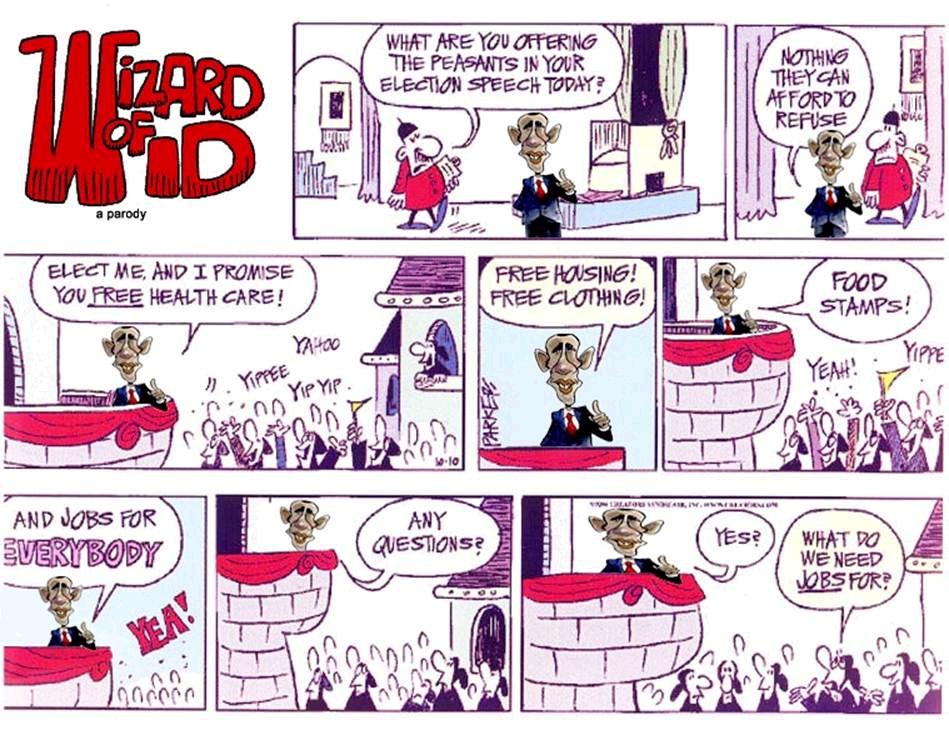
From now on, I will try to remember to use this cartoon. It’s a parody of Obama’s policies, but the last slide (or is it a panel?) is a great teaching tool about what happens when politicians turn the safety net into a hammock.

Thank you so much for your time. I know how valuable it is. I also appreciate the fine family that you have and your commitment as a father and a husband.

Sincerely,

Everette Hatcher III, 13900 Cottontail Lane, Alexander, AR 72002, ph 501-920-5733, lowcostsqueegees@yahoo.com

Daniel Mitchell on Paul Ryan’s budget

One thing that stands out about Dan Mitchell is that is not a Democrat or a Republican but a lover of freedom like Milton Friedman was. Take a look at this article of his below.

Posted by Ryan Minto on August 16, 2012

By DANIEL J. MITCHELL

Thanks to several years of fiscal restraint during the 1990s, the burden of federal spending dropped to 18.2% of gross domestic product by the time Bill Clinton left office. The federal budget today consumes more than 24% of economic output, a one-third increase since 2001 in the share of the U.S. economy allocated by politics rather than market forces. That makes the Republican House budget, which would reverse this trend, extremely important for the economic health of the country.

Both political parties deserve blame for the spending spree that’s put America in a fiscal ditch. President George W. Bush was a big spender and President Obama has compounded the damage with his stimulus spending and other programs.

But the era of bipartisan big government may have come to an end. Largely thanks to Rep. Paul Ryan and the fiscal blueprint he prepared as chairman of the House Budget Committee earlier this year, the GOP has begun climbing back on the wagon of fiscal sobriety and has shown at least some willingness to restrain the growth of government.

The Ryan budget has generated considerable controversy in Washington, and it will become even more of an issue now that Mr. Ryan is Mitt Romney’s running mate. So it’s an appropriate time to analyze the plan and consider what it would mean for America.

image

Chad Crowe

The most important headline about the Ryan budget is that it limits the growth rate of federal spending, with outlays increasing by an average of 3.1% annually over the next 10 years. If spending is left on autopilot, by contrast, it would grow by 4.3% (or nearly 39% faster). If President Obama is re-elected, the burden of spending presumably will climb more rapidly.

This comes as a surprise to many people since the press is filled with stories about the Ryan budget imposing trillions of dollars of “savage” and “draconian” spending cuts. All of these stories, however, are based on Washington’s misleading budget process that automatically assumes an ever-expanding government. The 4.3% “base line” increase is the benchmark for measuring “cuts”—even though spending is rising rather than falling, and it’s only the rate of spending growth that is being slowed.

Even limiting spending so it grows by 3.1% per year, as Mr. Ryan proposes, quickly leads to less red ink. This is because federal tax revenues are projected by the House Budget Committee to increase 6.6% annually over the next 10 years if the House budget is approved (and this assumes the Bush tax cuts are made permanent). Since revenues would climb more than twice as fast as spending, the deficit would drop to about 1% of gross domestic product by the end of the 10-year budget window.

To balance the budget within 10 years would require that outlays grow by about 2% each year. Spending in the Ryan budget means the federal budget reaches balance in 2040. There are many who would prefer that the deficit come down more quickly, but from a jobs and growth perspective, it isn’t the deficit that matters.

Rather, what matters for prosperity and living standards is the degree to which labor and capital are used productively. This is why policy makers should focus on reducing the burden of government spending as a share of GDP—leaving more resources in the private economy.

The simple way of making this happen is to follow what I’ve been calling the golden rule of good fiscal policy: The private sector should grow faster than the government. This is what happens with the Ryan budget. The Congressional Budget Office expects nominal economic output (before inflation) to grow about 5% each year over the next decade. So if federal spending grows 3.1% annually, the burden of federal spending slowly shrinks as a share of GDP.

According to the House Budget Committee, the federal budget would consume slightly less than 20% of economic output if the Ryan budget remained in place for 10 years. This would be remarkable progress considering that the federal government is now consuming 24% of GDP vs. Mr. Clinton’s 18.2% in 2001. If Paul Ryan’s policies are social Darwinism, as Mr. Obama and his allies allege, one can only speculate where Bill Clinton ranks in their estimation.

Spending restraint also creates more leeway for good tax policy. Regardless of what you think about deficits, the political reality is that it is difficult to lower tax rates if government borrowing remains at high or rising levels. If deficit spending continues at current levels, then higher tax rates are almost sure to follow. And higher tax rates can’t create an environment conducive to more investment and jobs.

The Ryan budget avoids this unpleasant outcome by addressing the problem of excessive government spending. This makes it possible to extend the 2001 and 2003 tax-rate reductions. It also clears the way for other pro-growth reforms, such as Gov. Romney’s proposed across-the-board 20% income tax cut, a more competitive 25% corporate tax rate, and less double-taxation of dividends and capital gains.

One of the best features of the Ryan budget is that he reforms the two big health entitlements instead of simply trying to save money. Medicaid gets block-granted to the states, building on the success of welfare reform in the 1990s. And Medicare is modernized by creating a premium-support option for people retiring in 2022 and beyond.

This is much better than the traditional Beltway approach of trying to save money with price controls on health-care providers and means testing on health-care consumers. Price controls are notoriously ineffective—because health-care providers adapt by ordering more tests and procedures—and politically unsustainable due to lobbying pressure. Means testing imposes an indirect penalty on people who save and invest during their working years. That should be a nonstarter for a political party that seeks to encourage productive behavior and discourage dependency.

But good entitlement policy also is a godsend for taxpayers, particularly in the long run. Without reform, the burden of federal spending will jump to 35% of GDP by 2040, compared to 18.75% of output under the Ryan budget.

Assuming the GOP ticket prevails in November, Mitt Romney will make the big decisions on fiscal policy. But there is no escaping the fiscal math. If Mr. Romney intends to keep his no-tax-hike promise, he has to restrain the growth of spending. This doesn’t mean he has to go with every detail of the Ryan budget—but it’s certainly a good place to start.

Mr. Mitchell is a senior fellow at the Cato Institute.

A version of this article appeared August 16, 2012, on page A11 in the U.S. edition of The Wall Street Journal, with the headline: What’s Really in the Ryan Budget.

“Woody Wednesday” Why am I obsessed with Woody Allen?

I guess the reason I have spent so much time on Woody Allen is because in so many films he discusses the big questions in life. His movie “Crimes and Misdemeanors” is a perfect example. Check out my earlier post Nihilism can be seen in Woody Allen’s  film “Midnight in Paris” .

September (1987)September (1987)

The director famously re-wrote, re-cast and re-shot this film after seeing his original finished product. The second go-round starred (from left) Jack Warden, Elaine Stritch and Mia Farrow (with Allen, second from right). “I usually reshoot tons of material,” he explained at the time. “The fact is, I’d like to shoot September a third time.”

__________________

It is my view that this next movie is Woody Allen’s best by far:

Crimes and Misdemeanors (1989) 
Crimes and Misdemeanors (1989)

Roger Ebert called this flick one of Allen’s best. The director, pictured with cinematographer Sven Nykvist on set, was nominated for three Academy Awards, including best director and writing. “Who else but Woody Allen could make a movie in which virtue is punished, evildoing is rewarded and there is a lot of laughter – even subversive laughter at the most shocking times?” wrote the famous reviewer. 

Mighty Aphrodite (1995) 
Mighty Aphrodite (1995)

Mira Sorvino won an Oscar for her portrayal of a hooker in this comedy. “Woody does not care if you say his lines,” she has said. “For our greatest comedic film writer, I think that’s incredible. I said them anyway, but I had the leeway, if I wanted, to ad lib.” 

From Wikipedia:

1980s

Woody Allen at the 2005 Cannes Film Festival

Allen’s 1980s films, even the comedies, have somber and philosophical undertones. Some are influenced by the works of European directors, notably Ingmar Bergman and Federico Fellini.[30][31] September resembles Bergman’s Autumn Sonata, and Allen uses many elements from Bergman’s Wild Strawberries[32] in Another Woman. Similarly, the Federico Fellini classic Amarcord strongly inspired Radio Days.[33]

Stardust Memories features Sandy Bates, a successful filmmaker played by Allen, who expresses resentment and scorn for his fans. Overcome by the recent death of a friend from illness, the character states, “I don’t want to make funny movies any more” and a running gag has various people (including a group of visiting space aliens) telling Bates that they appreciate his films, “especially the early, funny ones.”[34] Allen believes this to be one of his best films.[35]

Allen combined tragic and comic elements in such films as Hannah and Her Sisters and Crimes and Misdemeanors, in which he tells two stories that connect at the end. He also produced a vividly idiosyncratic tragi-comical parody of documentary, Zelig.

He made three films about show business: Broadway Danny Rose, in which he plays a New York show business agent, The Purple Rose of Cairo, a movie that shows the importance of the cinema during the Depression through the character of the naive Cecilia, and Radio Days, which is a film about his childhood in Brooklyn and the importance of the radio. Purple Rose was named by Time as one of the 100 best films of all time and Allen has described it as one of his three best films, along with Stardust Memories and Match Point.[36] (Allen defines them as “best” not in terms of quality but because they came out the closest to his original vision.)

In 1989, Allen teamed up with directors Francis Ford Coppola and Martin Scorsese to make New York Stories, an anthology film about New Yorkers. Allen’s short, Oedipus Wrecks, is about a neurotic lawyer and his critical mother. His short pleased critics, but New York Stories bombed at the box office.


Related posts:


(Part 32, Jean-Paul Sartre)July 10, 2011 – 5:53 am


 (Part 29, Pablo Picasso) July 7, 2011 – 4:33 am

(Part 28,Van Gogh) July 6, 2011 – 4:03 am

(Part 27, Man Ray) July 5, 2011 – 4:49 am

(Part 26,James Joyce) July 4, 2011 – 5:55 am

(Part 25, T.S.Elliot) July 3, 2011 – 4:46 am

(Part 24, Djuna Barnes) July 2, 2011 – 7:28 am

(Part 23,Adriana, fictional mistress of Picasso) July 1, 2011 – 12:28 am

(Part 22, Silvia Beach and the Shakespeare and Company Bookstore) June 30, 2011 – 12:58 am

(Part 21,Versailles and the French Revolution) June 29, 2011 – 5:34 am

(Part 16, Josephine Baker) June 24, 2011 – 5:18 am

(Part 15, Luis Bunuel) June 23, 2011 – 5:37 am

According to Woody Allen Life is meaningless (Woody Wednesday Part 2)

Woody Allen, the film writer, director, and actor, has consistently populated his scripts with characters who exchange dialogue concerning meaning and purpose. In Hannah and Her Sisters a character named Mickey says, “Do you realize what a thread were all hanging by? Can you understand how meaningless everything is? Everything. I gotta get some answers.”{7} […]

“Woody Wednesday” Part 1 starts today, Complete listing of all posts on the historical people mentioned in “Midnight in Paris”

I have gone to see Woody Allen’s latest movie “Midnight in Paris” three times and taken lots of notes during the films. I have attempted since June 12th when I first started posting to give a historical rundown on every person mentioned in the film. Below are the results of my study. I welcome any […]

What can we learn from Woody Allen Films?

Looking at the (sometimes skewed) morality of Woody Allen’s best films. In the late ’60s, Woody Allen left the world of stand-up comedy behind for the movies. Since then, he’s become one of American cinema’s most celebrated filmmakers. Sure, he’s had his stinkers and his private life hasn’t been without controversy. But he’s also crafted […]

Nihilism can be seen in Woody Allen’s latest film “Midnight in Paris”

In one of his philosophical and melancholy musings Woody Allen once drily observed: “More than any other time in history, mankind faces a crossroads. One path leads to despair and utter hopelessness. The other, to total extinction. Let us pray we have the wisdom to choose correctly.” Life tortures Woody Allen posted by Rod Dreher […]

Movie Review of “Midnight in Paris” lastest movie by Woody Allen

Midnight in Paris – a delightfully entertaining film of wit, wonder and love Have you ever thought that you were born in the wrong time? Since I was a child, I found my love for MGM musicals set me apart from my friends. Are we really out of place, or is a sense of nostalgia […]

“Midnight in Paris” movie review plus review of 5 Woody Allen classics (video clips from Annie Hall)

Five favorite Woody Allen classics Add a comment Sean Kernan , Davenport Classic Movies Examiner June 11, 2011 Woody Allen’s new film “Midnight in Paris” starring Owen Wilson, Rachel McAdams and Oscar winner Marion Cotillard opened Friday, June 10th at Rave Motion Pictures in Davenport, Iowa. “Midnight in Paris” stars Owen Wilson as a blocked […]

SEC football championship game history

I have been hoping that Arkansas could win the SEC Championship game but after 20 years we still haven’t done so. Wikipedia reports that four times have appeared at least five times. They are Florida (10), Alabama (7), LSU (5) and Tennessee (5). Arkansas does have 3 appearances but no wins. Florida has the most wins with 7, LSU has 4, Alabama has 3 and Tennessee has 2. Before Houston Nutt haters get cranked up you have to admit that Houston got us there on the dance floor twice and tied for the SEC West Championship in 1998 too. SEC West Champs 3 out of 10 aint so bad after all!!!!

History

The SEC was the first conference in the NCAA to hold a football championship game made possible when the conference expanded in 1991 to twelve members with the addition of the University of Arkansas and the University of South Carolina. The format has since been adopted by other conferences to decide their football champion (the first being the Big 12 in 1996).

The first two SEC Championship games were held at Legion Field in Birmingham, Alabama. However, since 1994, the game has been played at the Georgia Dome in Atlanta.[2]

In 2009, Alabama and Florida met in the SEC Championship Game for the seventh time in the eighteen year history of the game, the record for the most times any two teams have faced each other in the Championship game. The only other matchup in the SEC Championship played more than twice is Georgia and LSU, which has been played three times. Alabama has faced Florida in each of their seven SEC Championship game appearances. In addition, the 2009 game marked the second consecutive year that the number 1 (Florida) and number 2 (Alabama) ranked teams in the AP Poll met in the SEC Championship game. 2009 was the first time any conference championship game had featured two undefeated teams. Alabama won 32-13 and earned a berth in the 2010 BCS National Championship Game.

[edit] Results

Results from all SEC Championship games that have been played.[3] Rankings are from the AP Poll, winner in bold italics

Year Eastern Division Western Division Venue Attendance MVP
1992 #12 Florida[4] 21 #2 Alabama 28 Legion Field
Birmingham, Alabama
83,091 CB Antonio Langham, Alabama
1993 #9 Florida 28 #16 Alabama[5] 13 76,345 QB Terry Dean, Florida
1994 #6 Florida 24 #3 Alabama 23 Georgia Dome
Atlanta, Georgia
74,751 DT Ellis Johnson, Florida
1995 #2 Florida 34 #23 Arkansas 3 71,325 QB Danny Wuerffel, Florida
1996 #4 Florida 45 #11 Alabama[6] 30 74,132 QB Danny Wuerffel, Florida
1997 #3 Tennessee 30 #11 Auburn[7] 29 74,896 QB Peyton Manning, Tennessee
1998 #1 Tennessee 24 #23 Mississippi State[8] 14 74,795 WR Peerless Price, Tennessee
1999 #5 Florida 7 #7 Alabama 34 71,500 WR Freddie Milons, Alabama
2000 #7 Florida 28 #18 Auburn 6 73,427 QB Rex Grossman, Florida
2001 #2 Tennessee 20 #21 LSU[9] 31 74,843 QB Matt Mauck, LSU
2002 #4 Georgia 30 #22 Arkansas[10] 3 75,835 QB David Greene, Georgia
2003 #5 Georgia[11] 13 #3 LSU[12] 34 74,913 RB Justin Vincent, LSU
2004 #15 Tennessee 28 #3 Auburn 38 74,892 QB Jason Campbell, Auburn
2005 #13 Georgia 34 #3 LSU 14 73,717 QB D. J. Shockley, Georgia
2006 #4 Florida 38 #8 Arkansas[13] 28 73,374 WR Percy Harvin, Florida
2007 #14 Tennessee[14] 14 #5 LSU 21 73,832 QB Ryan Perrilloux, LSU
2008 #2 Florida 31  #1 Alabama 20  75,892 QB Tim Tebow, Florida
2009 #1 Florida 13  #2 Alabama 32 75,514 QB Greg McElroy, Alabama
2010 #19 South Carolina 17  #1 Auburn 56  75,802 QB Cam Newton, Auburn
2011 #12 Georgia 10  #1 LSU 42  74,515 CB Tyrann Mathieu, LSU
Totals 11 Wins 489[1] 9 Wins 499[1]   74,888 (avg)[15]  

[edit] Results by team

Appearances School Wins Losses Pct
10 Florida 7 3 .700
7 Alabama 3 4 .428
5 LSU 4 1 .800
5 Tennessee 2 3 .400
4 Auburn 2 2 .500
4 Georgia 2 2 .500
3 Arkansas 0 3 .000
1 Mississippi State 0 1 .000
1 South Carolina 0 1 .000
0 Kentucky 0 0 N/A
0 Ole Miss 0 0 N/A
0 Vanderbilt 0 0 N/A

Arkansas Sports 360 has a good article on those 3 appearances that Arkansas made in the championship game and it is a shame that we lost that game in 2006 with those turnovers to Florida.

<!–

42

–>

8/21/2012 at 1:00pm

For a second there, Florida head coach Urban Meyer almost looked worried in the 2006 SEC Championship Game. That feeling didn't last long, needless to say.
Image by CBS/SEC

For a second there, Florida head coach Urban Meyer almost looked worried in the 2006 SEC Championship Game. That feeling didn’t last long, needless to say.

This football season marks the 21st for the Razorbacks as members of the SEC. Having completed two decades in the league it seemed worth reflecting on how far the program has come. Which victories over the last 20 years were the sweetest? Were there losses that hurt more than others? What coaching decisions still have folks scratching their heads? ArkansasSports360.com assembled a panel aimed at answering these questions. We have our list and we’d love to hear yours.

No. 9 on our moments you would love to forget …

Razorbacks Make Three SEC Title Games, Can’t Win
When It Happened: 1995, 2002, 2006
Who To Remember: Danny Ford, Houston Nutt, Reggie Fish, Florida Gators, Georgia Bulldogs
Why You’d Like To Forget:
All Reggie Fish had to do was let the punt roll into the end zone.

Pretty simple, really. Don’t field the punt. Anything would have been better than fielding the punt. Instead, Fish tried to make a play inside the 10 — a huge no-no in the return game — and he mishandled it. Florida recovered, reclaimed momentum, won the game 38-28 and sent the Razorbacks to yet another loss in Atlanta.

Instead of a trip to the national title game (which Florida got) or the program’s first BCS bowl, the Razorbacks wound up playing Wisconsin in the Capital One Bowl. Deflated by the title game loss and decimated by internal strife the Razorbacks came out flat against the Badgers and lost 17-14.

Maybe it would have been easier to handle if the SEC title game loss had been lopsided as usual. Arkansas’ other trips to the SEC championship weren’t close losses and, quite honestly, were worse beatings than the final scores indicated.

Florida handled the Razorbacks with ease in 1995, winning 34-3. Georgia posted a closer, but no less convincing, 30-3 victory against Arkansas in 2002.

Each trip to the SEC championship began as cause for celebration, but ended with the program being reminded how much further there was to go.

Before a 10-game winning streak in 2006 came to an end in Atlanta, it looked like the UA might be ready to break through and join the league’s elite list of SEC champions.

Arkansas led 21-17 thanks to an interception returned for a touchdown and the defense held strong to force a punt. No more SEC West title rings, the Razorbacks were on their way to the real thing this time.

If only the return man had let the dang ball roll into the end zone.

Up Next: Questionable calls

Lester Mcclain, I saw him play vs. Ole Miss in 1968 in Jackson, MS

Former player Lester McClain, is honored as the Legend of the Game before the start of the Tennessee Akron game at Neyland Stadium on Saturday. McClain became the first African-American player to wear an orange jersey and first in the SEC to see significant playing time. 

 (AMY SMOTHERMAN BURGESS/NEWS SENTINEL)

Photo by Amy Smotherman Burgess, Knoxville News Sentinel

Former player Lester McClain, is honored as the Legend of the Game before the start of the Tennessee Akron game at Neyland Stadium on Saturday. McClain became the first African-American player to wear an orange jersey and first in the SEC to see significant playing time.

____________

Vols Highlight Video, assorted time periods

(This video clip above shows Lester Mcclain against Memphis St in 1969.)

Kenny Chesney and former Tennessee Volunteers’ Quarterback Condredge Holloway give you an exclusive look at their new ESPN Documentary – “The Color Orange: The Condredge Holloway Story”.

I got to see Lester Mcclain play in Jackson, MS in 1968 against Ole Miss. I went with my grandfather who was a big Ole Miss fan. My uncle Blythe was there too to see his #3 ranked Vols play.

Lester McClain, who is UT’s first black player (1968) also was a part of it. The quote he gave was very telling and I’ll paraphrase it because I’m not sure of it word for word but: “My daddy was 50 years old when I was born, and his daddy was 50 years old when he was born, my grandfather was born a slave. 50 years isn’t a long time.”

Moving the Chains

Last Word — 08 August 2012
Moving the Chains

By Dan Conaway

Reflections on a game-changing fall day in 1968

Georgia scored again while I was throwing up.

Georgia and I had already done these things several times in the preceding three hours, but like Tennessee, I didn’t think I had anything left to counter this time. Late — very late — in the fourth quarter, our offense had gone ice cold, we were down by 8, and my temperature was red hot, up by 2. The governor, the first Sen. Al Gore, a gaggle of congressmen and even the head tire kicker at Goodyear, whose blimp hovered above, were watching from various swell box seats. Millions were watching on TV, and even ABC’s saccharine Chris Schenkel (this guy makes Jim Nance sound like the grim reaper) thought Uga had this one all wrapped up.

I was watching from the couch in the ATO house tube room, alternating between teeth-rattling chills and wind sprints to the john, all wrapped up in a blanket.

It was the first and only home game I would miss in my four years at the University of Tennessee. It was the first and only home game UT wouldn’t win during those four magic years. It was our first game played on artificial turf, dubbed “Doug’s Rug” for Coach Dickey. It was the very first game and the very first catch for No. 85 in your Tennessee program, a shy sophomore from Nashville named Lester McClain.

It was a remarkable game.

Bubba Wyche (is that a good quarterback name, or what?) was staring at fourth down. Fans poured from Neyland Stadium, resigned to loss, and the clock ran faster than any of our backs had all day. He let the pass go, and Lester McClain pulled it in at the Georgia 48.

Lester McClainFirst and 10, Tennessee. First ever, SEC.

That pass gave us a chance, gave us hope. It changed the game and the way the game is played. Lester McClain is black. Two black players had gone before him at Kentucky, but neither had lettered, since you couldn’t play varsity as a freshman, and their careers were ended by injury and heartbreak. Lester’s roommate his freshman year, also black, didn’t come back his sophomore year. So, with that catch, Lester McClain broke through the varsity football color line in the SEC and moved the chains.

It was an amazing game.

Later in the drive and facing another fourth down, Bubba moved the Vols to the line quickly and fired a touchdown pass to Gary Kreis as the clock rolled up all zeros, and I knocked over a pitcher and fell off the couch. Bubba then hit Ken DeLong for the two-point conversion, and Tennessee tied Georgia as Chris Schenkel and I — and those loyal, hopeful fans still in the stadium — all went insane. I charged to the front porch, blanket flapping and heaves forgotten, and screamed at the throngs headed to their cars, completely unaware of the final result and staring unbelievably at the leaping, ragged frat boy specter before them bearing the improbable news in boxers and blanket.

It was a miraculous game.

From the east upper deck, student seats in my day, the world looks promising. On one side, sheer cliffs rise from a river dotted with boats in a moored parade, and distant blue-green mountains form the backdrop. On the other, the buildings that house the means to be any and everything stand watch over dreams on a hill. Below, a contest unfolds that is no more serious than a game but every bit as serious as things that have gone before and are yet to come.

For more people than any other sport, I think, the beginning of football season is about hope and renewal, a slate wiped clean for whatever’s next, shared in mass mutual anticipation on a huge stage or by just one sick kid on a couch.

1968 was the symbolic year of the tragedy of Martin Luther King in the spring, of Bobby Kennedy in the summer, and of the hope symbolized in one young man catching a ball in the fall.

When Lester McClain caught that fourth-down pass, he wasn’t black or white. He was orange. And he was red, white and blue.

– – –

Dan Conaway graduated from UT Knoxville in 1971 with a B.S. in communications, a major in advertising, a strong like of Smoky Mountain Market cheese dogs and a strong dislike of threedraw plays and a punt. He lives in Memphis and is a communication strategy consultant and freelance writer. Visit him at www.wakesomebodyup.com.

__

Archie who

I went to see Tennessee play Ole Miss in Jackson in 1968 and all my Mississippi relatives were coming up to me and saying “Archie Who!!” I didn’t know what they were talking about until the game started. Below is the rest of the story from Sports Illustrated.

November 24, 1969

Answer To A Foolish Question

All week Tennessee fans taunted Ole Miss with cries of ‘Who’s Archie?’ On Saturday Archie Manning showed them

You’d have thought those folks from Tennessee would have known better, being neighbors and all. Shoot, any 10-year-old kid who ever got his button nose past the cover of a history book can tell you it doesn’t take all that much to rile Mississippians. Remember when old Abe got up and started off his inaugural speech by saying cotton underwear itched? Bam: a civil war. And you know how easily upset the traffic cops there get when they see a rich Yankee tourist driving 38 miles an hour in a 45-mile-an-hour speed zone.

So what does Steve Kiner do? Steve Kiner, he’s one of Tennessee‘s All-America linebackers, and one day he’s sitting around jawing with some of the boys about the horses they got playing football at Ole Miss. “Hee-haw,” says Kiner, “them’s not horses, them’s mules.” You can guess how gracefully that was received in Oxford and Biloxi and Vicks-burg, where they hang pictures of Archie Manning, the Ole Miss junior quarterback, on the living room wall, right next to the ones of Robert E. Lee and, lately, of Spiro T. Agnew. “Mules, huh?” was the word. “Well, old Archie will show them who’s mules.” In Tennessee, where everybody was feeling good about being unbeaten in seven games and being ranked No. 3 in the nation, they laughed and started handing out ARCHIE WHO? buttons. And, baby, that really tore it.

All this, of course, was greeted with secret delight by Johnny Vaught, the Ole Miss coach and a man who would welcome a Greek bearing gifts, just as long as they could be used as psychological weapons. And should the gifts be less than needed, Vaught, it is suggested, is not opposed to fattening them a bit. Last Wednesday, three days before he would send his troops out to destroy Tennessee 38-0 at Jackson, Miss., the gnarly old oak of a coach never so much as glanced up as a small plane came roaring over his practice field spewing enemy leaflets. But the pilot turned out to be a strange breed of propagandist. On his third pass—after dropping such pleasantries as “Archie who? Archie Mud” and “Wreck the mules, the Vols are No. 1,” and all supposedly signed either by Kiner or Doug Dickey‘s Vols—the pilot cut his motor and yelled, “Go get them. Rebels! To hell with Tennessee!”

While the fires were raging in Mississippi, Vaught was making certain that no fuel was getting back to Tennessee. He closed off all players, most especially Manning, from interviews. Practices are always closed. Vaught once ran the president of the alumni association off the practice field. Another time, when a small plane circled the field, Vaught suspended the drill, called the FAA and had the plane grounded. When it turned out to be a member of the faculty showing off the campus to friends, Vaught told him to go fly someplace else. He did. “Once, just as a joke. I asked him if I could watch one of his redshirts take a shower,” said a veteran Mississippi reporter. “He figured I must be up to something, glared at me and said no I couldn’t, that the shower room was off limits.”

But then, Vaught has always been a suspicious man. When he arrived in 1947, his first move was to call in the state highway department and have them bulldoze a new practice field—eight feet deep. Deciding then that this wasn’t secluded enough, he called the bulldozers back and had them dig a second field, this one even deeper, and he had it surrounded by thick bushes and burly campus cops armed with walkie-talkies. One player suggested that if Vaught thought God was looking down on a practice, he’d put a roof over the field.

In the midst of all this tight seclusion was Archie Manning, big (6’3″ and 205 pounds) and redheaded and wondering why in hell he isn’t able to grow sideburns like everybody else. “But then,” he says, “I guess it’s because I only shave twice a week, sometimes.” He makes up for his lack of sideburns in other ways. Like throwing passes. In Ole Miss‘ first eight games—before walloping Tennessee—he completed 128 of 222 for 1,394 yards and six touchdowns. And like running: 100 carries for 363 yards and 11 touchdowns. Which makes it hard to understand how Mississippi managed to lose to Kentucky, Alabama and Houston, the first two by one point each. And after that they beat Georgia when the Bulldogs were 3-0 and ranked sixth, and after that they beat LSU when the Tigers were 6-0 and also ranked sixth.

“I guess it’s because all the games we won, we played in Mississippi in the daytime,” said Billy Gates, Ole Miss sports information director. “And the three games we lost were out of the state at night. Do you know of any bowls played in Mississippi in the daytime?” Against Kentucky, Ole Miss was looking to Alabama, which came the next week. Ole Miss‘ game plan was to run, mostly not to show off Manning’s passes to ‘Bama scouts. And so they ran, and Manning passed but 13 times for 84 yards and no touchdowns, and Kentucky won a shocker 10-9. And then against Alabama, Mississippi geared its defenses to stop a running attack—and Alabama came out throwing and won 33-32. “Those we should have won,” admits Vaught, holding up one finger. “Just one point each. But the kids knew we should have won and they didn’t get down. We have a thing here called matter-of-fact pride. We never lose it.”

Whatever it is they have at Ole Miss, they had it all against Tennessee, which came in favored anywhere from 11 to 6� points. Upstairs in the press box, Orange Bowl scouts were smiling and saying all they were afraid of was Tennessee losing in a rout—and you know that can’t happen. And downstairs the Ole Miss players were thinking that if they won, Vaught had given them the night to stay in Jackson—something he had done only once before in his career—and didn’t they already have the $5 traveling money to get back to Oxford the next day? Sure it could happen.

“Boys, what it’s going to take out there today is a great team effort, so let’s go,” said Vaught, knowing the boys were so high he didn’t have to say anything else.

And did it ever happen. After the opening kickoff, Manning took Ole Miss 82 yards in 11 plays, mostly on the running of Randy Reed and Bo Bowen, and then himself three times for the last three yards and the touchdown. Vaught had told him to open with a running game and then, when Tennessee stopped it, to go to the air. Tennessee never was to stop it.

On the second drive, after a short Tennessee punt, Ole Miss went 38 yards in eight plays, with Reed recovering Manning’s fumble in the end zone for the score.

The third drive was 16 yards in five plays after a 49-yard return of a punt by Bob Knight. Manning passed five yards to Riley Myers for that one. It was 21-0, and they were just moving into the second quarter, and Ole Miss players were saying things like “Where’s Kiner?” and “How do you like them mules?” and a few other things.

The rout was on. Upstairs one Orange Bowl scout said something about being sick and left. “They can’t do anything wrong,” another moaned. Just then, Ole Miss‘ Cloyce Hinton kicked a 42-yard field goal to make it 24-0. The kick sailed low, fluttering, swooping and, just as it was about to die, it struck the crossbar and bounced over. “Dang, I never saw such a gosh-awful lousy field goal in my life,” said Heywood Harris, Tennessee sports information director, “but, dang, I guess it counts.”

Early in the third quarter, all hope of a Tennessee recovery died when Reed went a yard for a touchdown, making it, after the kick, 31-0. That’s the same score the Vols beat Ole Miss by last year. No longer was anyone in orange clothing yelling “Archie who?” The last score, a one-yard dive by Bowen in the fourth quarter, just rubbed it in a bit.

When it was over and they added it all up, Manning had completed nine of 18 passes for 159 yards and one touchdown, and had run for another score. He and the rest of the team had earned a night on the town.

_____________________________________

This is part of a series that I call “Famous Arkansans.”

“I will wait for you.” (Song below)

Joe Nichols

Inducted in 2008

(b. 1976) – Rogers native, Joe Nichols, found his love for country music at a young age listening to his family pick on their guitars. He made his debut at age 20 with a self-titled album on the independent Intersound label. His 2002 single “The Impossible” gained him recognition and critical acclaim for his neotraditionalist country style. The single peaked at No. 3 on the Billboard Hot Country Songs chart and was followed by his No. 1 single “Brokenheartsville” from his platinum-certified second album, “Man With a Memory.” His albums include “Revelation” (2004), which included the Top 10 hit “If Nobody Believed in You,” “A Traditional Christmas,” “III” (2005) gold-certified that produced his biggest hit to date the No. 1 single “Tequila Makes Her Clothes Fall Off,” “Real Things” (2007) which produced the Top 20 hits “Another Side of You” and “It Ain’t No Crime.”