Wasting our money on Energy Subsidies is stupid!!!!

______

Wasting our money on Energy Subsidies is stupid!!!!

November 11, 2013 1:06PM

Energy Subsidies vs. Energy Progress

If we did a poll of free market economists about federal programs that are the most wasteful and ridiculous, energy subsidies would be near the top of the list. It’s not just that energy subsidies make no sense in economic theory, but also that there are so many news stories highlighting the folly that it’s hard to see why policymakers persist in wasting our money.

From the Washington Post on Friday:

The Department of Energy failed to disclose concerns about a green-technology company that won $135 million in federal funding but ended up filing for bankruptcy in September, according to a watchdog report released this week. DOE Inspector General Gregory Friedman noted that the firm, San Francisco-based Ecotality, is still due to receive $26 million from the agency for testing electric vehicles.

…

The Energy Department awarded the firm $100 million in 2009 Recovery Act funding for that initiative, in addition to a combined $35 million from a separate program to help pay for testing vehicles

…

Ecotality is among a number of failed firms that received stimulus funding through an Obama administration initiative to support green-technology companies during the recession. Solyndra, a Silicon Valley-based solar-panel maker, stands as perhaps the most high-profile example. The business collapsed after receiving more than a half-billion dollars in Recovery Act money. Other examples include Beacon Power , a Massachusetts-based company that received at least $39 million from the federal government, along with Michigan-based battery manufacturers LG Chem and A123, which landed grants worth $150 million and $249 million, respectively.

On Sunday, the Washington Post profiled the economic chaos, central planning, and wasteful lobbying generated by federal mandates for cellulosic ethanol:

Congress assumed that it could be phased in gradually, but not this gradually. This year refiners were supposed to mix about one billion gallons of it into motor fuel. So far, there has been hardly a drop. More than a dozen companies have tried and failed to find a profitable formula combining sophisticated enzymes and the mundane but costly and labor-intensive job of collecting biomass.

…

To reach the ethanol goals set by Congress, the government came up with a byzantine implementation plan. Each gallon of renewable fuel has its own 38-character number, called a “renewable identification number,” to track its use and monitor trading. There are different types of these RINs for different biofuels, including corn-based ethanol, cellulosic ethanol and biodiesel.

In February of each year, refiners who fail to provide enough renewable fuel to the blenders who mix ethanol and gasoline must buy extra RIN certificates. When companies have extra credits for renewable fuels, the RINs can be banked and sold in later years. If there are not enough renewable fuels overall, the price of RINs rises — and provides an incentive to produce more.

And in a related story on ethanol, the Post found:

Five years ago, about a dozen companies were racing to start up distilleries that would produce enough cellulosic ethanol to meet the congressionally mandated target of 16 billion gallons a year by 2022 … The Agriculture Department provided a $250 million loan guarantee for the Coskata plant. Today, most of the dozen contenders have gone out of business or shelved their plans.

Federal subsidies and mandates for ethanol and other energy activities are sadly causing the diversion of billions of dollars of capital to uneconomic uses. That’s the bad news.

But there is good news on the energy front, which comes from far outside of Washington. The Wall Street Journal last weekend profiled “the little guys,” the market entrepreneurs, who were behind the shale energy revolution:

The experts keep getting it wrong. And the oddballs keep getting it right. Over the past five years of business history, two events have shocked and transformed the nation. In 2007 and 2008, the housing market crumbled and the financial system collapsed, causing trillions of dollars of losses. Around the same time, a few little-known wildcatters began pumping meaningful amounts of oil and gas from U.S. shale formations. A country that once was running out of energy now is on track to become the world’s leading producer.

…

The resurgence in U.S. energy came from a group of brash wildcatters who discovered techniques to hydraulically fracture—or frack—and horizontally drill shale and other rock. Many of these men operated on the fringes of the oil industry, some without college degrees or much background in drilling, geology or engineering.

Thank goodness for the oddballs. And thank goodness for the market system that channels the brashness into creating growth for all of us, not just the favored few getting handouts from Washington.

Related posts:

Open letter to President Obama (Part 432) A suggestion to cut some wasteful spending out of the government Part 2 (includes editorial cartoon)

(Emailed to White House on 3-15-13.) President Obama c/o The White House 1600 Pennsylvania Avenue NW Washington, DC 20500 Dear Mr. President, I know that you receive 20,000 letters a day and that you actually read 10 of them every day. I really do respect you for trying to get a pulse on what is […]

Dear Senator Pryor, here are some spending cut suggestions (“Thirsty Thursday”, Open letter to Senator Pryor)

Senator Pryor pictured below:  Why do I keep writing and email Senator Pryor suggestions on how to cut our budget? I gave him hundreds of ideas about how to cut spending and as far as I can tell he has taken none of my suggestions. You can find some of my suggestions here, here, here, here, here, here, here, here, here, here, here, here, here, here, here, here, here, here, here,  here, and  here, and they […]

Open letter to President Obama (Part 430) A suggestion to cut some wasteful spending out of the government Part 1 (includes editorial cartoon)

(Emailed to White House on 3-15-13.) President Obama c/o The White House 1600 Pennsylvania Avenue NW Washington, DC 20500 Dear Mr. President, I know that you receive 20,000 letters a day and that you actually read 10 of them every day. I really do respect you for trying to get a pulse on what is […]

The Dysfunction in Washington is Republicans and Democrats that are unwilling to cut spending in order to vote for more programs (Democrats want more food stamps etc but Republicans vote for their pet programs and wars too like No Child Left Behind Act, the Iraq war, the prescription drug entitlement, and the TARP bailout).

The Dysfunction in Washington is Republicans and Democrats that are unwilling to cut spending in order to vote for more programs (Democrats want more food stamps etc but Republicans vote for their pet programs and wars too like No Child Left Behind Act, the Iraq war, the prescription drug entitlement, and the TARP bailout). If […]

Dear Senator Pryor, here are some spending cut suggestions (“Thirsty Thursday”, Open letter to Senator Pryor)

Senator Pryor pictured below:  Why do I keep writing and email Senator Pryor suggestions on how to cut our budget? I gave him hundreds of ideas about how to cut spending and as far as I can tell he has taken none of my suggestions. You can find some of my suggestions here, here, here, here, here, here, here, here, here, here, here, here, here, here, here, here, here, here, here,  here, and  here, and they […]

If you want to cut wasteful spending then the disability program must be reformed radically!!!

If you want to cut wasteful spending then the disability program must be reformed radically!!! October 7, 2013 1:19PM 60 Minutes Disability Investigation By Chris Edwards Share The abuse and overspending in government disability programs is so bad that even National Public Radio and 60 Minutes have taken notice. On the heels of this excellent […]

If you really want to cut wasteful spending then why not shut down Dept of Housing and Urban Development, Dept of Education and SBA?

If you really want to cut wasteful spending then why not shut down Dept of Housing and Urban Development, Dept of Education and SBA? There are many other areas that should be cut but these should be shut down!!!   October 7, 2013 4:57PM Close Washington to Dismantle the Welfare-Warfare State By Doug Bandow Share […]

Dear Senator Pryor, here are some spending cut suggestions (“Thirsty Thursday”, Open letter to Senator Pryor)

Senator Pryor pictured below:  Why do I keep writing and email Senator Pryor suggestions on how to cut our budget? I gave him hundreds of ideas about how to cut spending and as far as I can tell he has taken none of my suggestions. You can find some of my suggestions here, here, here, here, here, here, here, here, here, here, here, here, here, here, here, here, here, here, here,  here, and  here, and they […]

We need to stop wasteful government spending by privatizing the post office!!

We need to stop wasteful government spending by privatizing the post office!! Postal Service Won’t Shut Down but Will Default on Its Debt James Gattuso October 1, 2013 at 9:30 am Newscom The U.S. Postal Service (USPS) defaulted on its debt last night. No, it has nothing to do with the partial shutdown of the […]

We need to stop the stupid spending by Bureaucrats!!!

We need to stop the stupid spending by Bureaucrats!!!   Bureaucrats Gone Wild: Government Spends Recklessly as Fiscal Year Ends Rob Bluey September 29, 2013 at 1:55 pm Credit: Tetra Images/Newscom Washington’s reckless spending is driving America into debt — and yet federal bureaucrats continue their wasteful and frivolous ways. The latest example comes courtesy […]

By Everette Hatcher III | Posted in spending out of control | Edit | Comments (0)

Open letter to President Obama (Part 455) ( Pollution and the Death of Man by Francis Schaeffer)

Open letter to President Obama (Part 455)

(Emailed to White House on 5-3-13.)

President Obama c/o The White House 1600 Pennsylvania Avenue NW Washington, DC 20500

Dear Mr. President,

I know that you receive 20,000 letters a day and that you actually read 10 of them every day. I really do respect you for trying to get a pulse on what is going on out here. I have a pro-life point of view because I am a Christian and I base my views on an interpretation of the Bible. Francis Schaeffer’s teachings probably influenced more in this area than any other person. In 1979 he teamed up with Dr. C. Everett Koop and put together the film series WHATEVER HAPPENED TO THE HUMAN RACE? and here is the first episode with covers the issue of abortion. Since you are also a Christian Mr. President I thought would take a great interest in what they had to say.

Francis Schaeffer Whatever Happened to the Human Race (Episode 1) ABORTION

Francis Schaeffer: What Ever Happened to the Human Race? (Full-Length Documentary)


Part 1 on abortion runs from 00:00 to 39:50, Part 2 on Infanticide runs from 39:50 to 1:21:30, Part 3 on Youth Euthanasia runs from 1:21:30 to 1:45:40, Part 4 on the basis of human dignity runs from 1:45:40 to 2:24:45 and Part 5 on the basis of truth runs from 2:24:45 to 3:00:04

Francis Schaeffer “BASIS FOR HUMAN DIGNITY” Whatever…HTTHR

Below you will see more about my pro-life views and also the reason why Christians are against polution.

____________________

Francis Schaeffer — Review of “Polution and the Death of Man”

How Should We Then Live? Episode 5: The Revolutionary Age

Episode VII – The Age of Non Reason

Dr. Schaeffer’s sweeping epic on the rise and decline of Western thought and Culture

_______________________

I love the works of Francis Schaeffer and I have been on the internet reading several blogs that talk about Schaeffer’s work and the work below was really helpful. Schaeffer’s film series “How should we then live?  Wikipedia notes, “According to Schaeffer, How Should We Then Live traces Western history from Ancient Rome until the time of writing (1976) along three lines: the philosophic, scientific, and religious.[3] He also makes extensive references to art and architecture as a means of showing how these movements reflected changing patterns of thought through time. Schaeffer’s central premise is: when we base society on the Bible, on the infinite-personal God who is there and has spoken,[4] this provides an absolute by which we can conduct our lives and by which we can judge society.  Here are some posts I have done on this series: Francis Schaeffer’s “How should we then live?” Video and outline of episode 10 “Final Choices” , episode 9 “The Age of Personal Peace and Affluence”, episode 8 “The Age of Fragmentation”, episode 7 “The Age of Non-Reason” , episode 6 “The Scientific Age” ,  episode 5 “The Revolutionary Age” , episode 4 “The Reformation”,  episode 3 “The Renaissance”, episode 2 “The Middle Ages,”, and  episode 1 “The Roman Age,” .

In the film series “WHATEVER HAPPENED TO THE HUMAN RACE?” the arguments are presented  against abortion (Episode 1),  infanticide (Episode 2),   euthanasia (Episode 3), and then there is a discussion of the Christian versus Humanist worldview concerning the issue of “the basis for human dignity” in Episode 4 and then in the last episode a close look at the truth claims of the Bible.

Francis Schaeffer — 25th anniversary of his death

Today is the twenty-fifth anniversary of the death of Christian author, philosopher, and pastor Francis Schaeffer. Schaeffer is highly regarded in the Evangelical Christian world for his defense of the faith, his advocacy of pro-life political action, and leadership of the l’Abri community in Switzerland. Francis Schaeffer was also an advocate of environmental protection.HT: World Magazine blog: Remembering Francis Schaeffer, by Scott LambThe following item was originally posted in January 2008. I have added it to my blog recycling program. Because I have new readers of The GeoChristian, I will occasionally go back and re-use some of my favorite blog entries.

pollution.jpgI recently finished re-reading Pollution and the Death of Man by Francis Schaeffer. If you read only one book on why Christians should care about nature, this is the book. It is short, and fairly easy reading (by Schaeffer standards). It is not a book about “50 ways to be green;” rather it lays the Biblical and philosophical foundations for taking care of the Earth. Even though it was written almost forty years ago, it is still relevant to the environmental issues we face. Unlike many conservative Evangelical leaders, Schaeffer was willing to admit that we face an ecological crisis.

The book has seven chapters:

  1. “What Have They Done to Our Fair Sister?”
  2. Pantheism: Man Is No More Than the Grass
  3. Other Inadequate Answers
  4. The Christian View: Creation
  5. A Substantial Healing
  6. The Christian View: The “Pilot Plant.”
  7. Concluding Chapter by Udo Middelmann

The book also has two essays as appendices. “The Historical Roots of Our Ecologic Crisis” by Lynn White, Jr., and “Why Worry About Nature.” by Richard Means. These were two important essays of the late 1960s; the first was written to state the case that the environmental crisis is Christianity’s fault, and the second was written to present pantheism as the answer.

I gave a long quote a few weeks ago: “I looked at the Christian community and saw ugliness.”

Here are some more quotes:

Near the end of his life, Darwin acknowledged several times in his writing that two things had become dull to him as he got older. The first was his joy in the arts and the second his joy in nature…. The distressing thing about this is that orthodox Christians often really have no better sense about these things than unbelievers.

Our agreement with Means [an advocate of pantheism as the solution to the ecologic crisis] at this point centers on the fact that the hippies of the 1960s did understand something. They were right in fighting the plastic culture, and the church should have been fighting it too, a long, long time ago, before the counterculture ever came onto the scene.

Again, a pantheistic stand always brings man to an impersonal and low place rather than elevating him. This is an absolute rule…. Eventually nature does not become high, but man becomes low…. In the Eastern countries there is no real base for the dignity of man.

Far from raising nature to man’s height, pantheism must push both man and nature down into a bog.

A poor Christianity is not the answer either.

Much orthodoxy, much evangelical Christianity, is rooted in a Platonic concept. In this kind of Christianity there is only interest in the “upper story,” in the heavenly things—only in “saving the soul” and getting it to Heaven…. There is little or no interest in the proper pleasure of the body or the proper uses of the intellect…. Nature has become merely an academic proof of the existence of the Creator, with little value in itself. Christians of this outlook do not show an interest in nature itself.

We should treat each thing with integrity because it is the way God has made it.

The man who believes things are there only by chance cannot give things a real intrinsic value. But for the Christian, there is an intrinsic value. The value of a thing is not in itself autonomously, but because God made it.

But we should be looking now, on the basis of the work of Christ, for substantial healing in every area affected by the Fall.

But Christians who believe the Bible are not simply called to say that “one day” there will be healing, but that by God’s grace, upon the basis of the work of Christ, substantial healing can be a reality here and now.

Here the church—the orthodox, Bible-believing church—has been really poor. What have we done to heal sociological divisions? Often our churches are a scandal; they are cruel not only to the man “outside,” but also to the man “inside.”

The same thing is true psychologically. We load people with psychological problems by telling them that “Christians don’t have breakdowns,” and that is a kind of murder.

On the other hand, what we should have, individually and corporately, is a situation where, on the basis of the work of Christ, Christianity is seen to be not just “pie in the sky,” but something that has in it the possibility of substantial healings now in every area where there are divisions because of the Fall. First of all, my division from God is healed by justification, but then there must be the “existential reality” of this moment by moment. Second, there is the psychological division of man from himself. Third, the sociological divisions of man from other men. And last, the division of man from nature, and nature from nature.

One of the first fruits of that healing is a new sense of beauty.

We are to have dominion over it [nature], but we are not going to use it as fallen man uses it.

Man is not to be sacrificed…. And yet nature is to be honored.

Christians, of all people, should not be the destroyers. We should treat nature with an overwhelming respect.

Most Christians simply do not care about nature as such…. These are reasons why the church seems irrelevant and helpless in our generation. We are living in and practicing a sub-Christianity.

If we treat nature as having no intrinsic value, our own value is diminished.

To just list quotes does not do justice to the stream of reason that Schaeffer develops in this book. If environmental issues are important to you, this is a must-read.

Grace and Peace

Francis Schaeffer

__________________________

______________________

Thank you so much for your time. I know how valuable it is. I also appreciate the fine family that you have and your commitment as a father and a husband.

Sincerely,

Everette Hatcher III, 13900 Cottontail Lane, Alexander, AR 72002, ph 501-920-5733, lowcostsqueegees@yahoo.com

Related posts:

Taking on Ark Times Bloggers on various issues Part A “The Pro-life Issue” (Francis Schaeffer Quotes Part 1 includes the film SLAUGHTER OF THE INNOCENTS) (editorial cartoon)

I have gone back and forth and back and forth with many liberals on the Arkansas Times Blog on many issues such as abortion, human rights, welfare, poverty, gun control  and issues dealing with popular culture. Here is another exchange I had with them a while back. My username at the Ark Times Blog is Saline […]

“Schaeffer Sunday” Francis Schaeffer: “Whatever Happened to the Human Race” (Episode 1) ABORTION OF THE HUMAN RACE

It is not possible to know where the pro-life evangelicals are coming from unless you look at the work of the person who inspired them the most. That person was Francis Schaeffer.  I do care about economic issues but the pro-life issue is the most important to me. Several years ago Adrian Rogers (past president of […]

The movie “Les Miserables” and Francis Schaeffer

I got this off a Christian blog spot. This person makes some good points and quotes my favorite Christian philosopher Francis Schaeffer too. Prostitution, Chaos, and Christian Art The newest theatrical release of Victor Hugo’s 1862 novel “Les Miserables” was released on Christmas, but many Christians are refusing to see the movie. The reason simple — […]

“Schaeffer Sunday” Francis Schaeffer is one of the great evangelical theologians of our modern day

Francis Schaeffer was truly a great man and I enjoyed reading his books. A theologian #2: Rev. Francis Schaeffer Duriez, Colin. Francis Schaeffer: An Authentic Life. Wheaton, IL: Crossway Books, 2008. Pp. 240. Francis Schaeffer is one of the great evangelical theologians of our modern day. I was already familiar with some of his books and his […]

“Schaeffer Sundays” Francis Schaeffer’s own words concerning infanticide and youth enthansia

Francis Schaeffer: “Whatever Happened to the Human Race?” (Episode 2) SLAUGHTER OF THE INNOCENTS Published on Oct 6, 2012 by AdamMetropolis ___________ The 45 minute video above is from the film series created from Francis Schaeffer’s book “Whatever Happened to the Human Race?” with Dr. C. Everett Koop. This book  really helped develop my political views […]

Francis Schaeffer’s wife Edith passes away on Easter weekend 2013 Part 7 (includes pro-life editorial cartoon)

The Francis and Edith Schaeffer Story Pt.1 – Today’s Christian Videos The Francis and Edith Schaeffer Story – Part 3 of 3 Francis Schaeffer: “Whatever Happened to the Human Race” (Episode 1) ABORTION OF THE HUMAN RACE Published on Oct 6, 2012 by AdamMetropolis ________________ Picture of Francis Schaeffer and his wife Edith from the […]

The Mark of the Christian by Francis Schaeffer Part 1

  THE MARK OF A CHRISTIAN – CLASS 1 – Introduction Published on Mar 7, 2012 This is the introductory class on “The Mark Of A Christian” by Francis Schaeffer. The class was originally taught at Redeemer Presbyterian Church in Overland Park, KS by Dan Guinn from FrancisSchaefferStudies.org as part of the adult Sunday School hour […]

“Schaeffer Sundays” Francis Schaeffer’s own words concerning humanist dominated public schools in USA even though country was founded on a Christian base

Francis Schaeffer: “Whatever Happened to the Human Race?” (Episode 2) SLAUGHTER OF THE INNOCENTS Published on Oct 6, 2012 by AdamMetropolis The 45 minute video above is from the film series created from Francis Schaeffer’s book “Whatever Happened to the Human Race?” with Dr. C. Everett Koop. This book  really helped develop my political views concerning […]

“Schaeffer Sundays” Francis Schaeffer’s own words concerning where the Bible-believing Christians been the last few decades

Francis Schaeffer: “Whatever Happened to the Human Race” (Episode 1) ABORTION OF THE HUMAN RACE Published on Oct 6, 2012 by AdamMetropolis The 45 minute video above is from the film series created from Francis Schaeffer’s book “Whatever Happened to the Human Race?” with Dr. C. Everett Koop. This book  really helped develop my political views […]

Taking on Ark Times Bloggers on various issues Part E “Moral absolutes and abortion” Francis Schaeffer Quotes part 5(includes the film SLAUGHTER OF THE INNOCENTS) (editorial cartoon)

I have gone back and forth and back and forth with many liberals on the Arkansas Times Blog on many issues such as abortion, human rights, welfare, poverty, gun control  and issues dealing with popular culture. Here is another exchange I had with them a while back. My username at the Ark Times Blog is Saline […]

“Schaeffer Sundays” Francis Schaeffer’s own words concerning religious liberals and humanists

Francis Schaeffer: “Whatever Happened to the Human Race” (Episode 5) TRUTH AND HISTORY Published on Oct 7, 2012 by AdamMetropolis The 45 minute video above is from the film series created from Francis Schaeffer’s book “Whatever Happened to the Human Race?” with Dr. C. Everett Koop. This book  really helped develop my political views concerning abortion, […]

By Everette Hatcher III | Posted in Francis Schaeffer | Edit | Comments (0)

“Music Monday” Christian contemporary music from the 1970’s and 80’s

Keith Green – Asleep In The Light (live)

Uploaded on May 25, 2008

Keith Green performing “Asleep In The Light” live from Estes Park ’78

Russ Taff – Praise The Lord 1983 (Live)

For Those Tears I Died – Children of the Day

Uploaded on Apr 22, 2007

Children of the Day singing For Those Tears I Died written by Marsha Stevens on the Kathryn Kuhlman Show in 1971

_______________

2nd Chapter Of Acts Mansion Builder

_____________

Keith Green – Your Love Broke Through

Chuck Girard and Love Song sing “Sometimes Alleluia” CCCM, July11,2009

Uploaded on Sep 3, 2009

Chuck Girard and Love Song sing “Sometimes Alleluia”
Morning service, Calvary Chapel, Costa Mesa, CA July 11, 2009

_____________

Larry Norman 1980 “Closet Tapes”#5

Uploaded on Dec 11, 2011

Larry’s music set the tone for the lwgear.com videos I produced over the next 30+ years.

___________________

Abortion debating with Ark Times Bloggers Part 2 “What does the Bible have to say about abortion?” (includes the film TRUTH AND HISTORY and editorial cartoon)

I have debated with Ark Times Bloggers many times in the past on many different subjects. Abortion is probably the most often debated subject and I have noticed that many pro-life individuals are now surfacing on the Arkansas Times Blog.  Here are some examples. Arhogfan501 asserted: This is the beginning of the end for recreational abortion in Arkansas. Songbird777 noted: Babies have a right to live and not be chopped up for someone else’s convenience. The person using the username “baker” commented: Planned Parenthood (PPA) does not nor cannot provide mammograms, indeed no affiliate has the necessary license. PPA is an abortion provider and at some 900 plus killings a day rather prolific.

Here is another debate I got into recently on the Arkansas Times Blog:

The person using the username “DeathByInches” on the Arkansas Times Blog on 3-5-13 wrote:

Saline slips in partial birth abortion, not the subject we’re discussing and something that is very rare in the US. It’s something I never had to face, thank Allah and something I want to know NOTHING about.

You people feed on stories like you copy/pasted and stories about… plays about aborted children dropping from space to have a discussion with the parents who aborted them. Clearly you and I don’t think alike at all.

I also have to say based on evidence on this blog that Saline is unable to choose the right people to read or listen to. He pulls out the damnedest experts, most who are totally discredited by thinking beings on the Internet. I think this goes back to my Republican friends who still believe Obama is a Kenyan Socialist and GWB is a hero…..you get down to it and it’s obvious they don’t know the difference between a good President and a bad one.

I’ll admit I don’t know the difference between a good horse or a bad horse, a good table saw and a bad one or even a good bra from a bad one, but I try not to comment on such things in hopes of keeping my ignorance a secret from my blog family.

…..Saline, you must not really believe in the Bible that teaches many many lessons about the poor and nothing about abortion. I just checked my facts about the Bible and abortion and found nothing credible at all….at all! … This whole abortion debate at this late date of 2013 is sickening and a total waste of our time.

I responded:

DBI you say that the issue of abortion is not addressed in the Bible.
A Biblical argument for life beginning at conception from Psalms 139 from Kerby Anderson of Probe Ministries:

One of the key verses to understand in developing a biblical view of the sanctity of human life is Psalm 139. This psalm is the inspired record of David’s praise for God’s sovereignty in his life. He begins by acknowledging that God is omniscient and knows what David is doing at any given point in time. He goes on to acknowledge that God is aware of David’s thoughts before he expresses them. David adds that wherever he might go, he cannot escape from God, whether he travels to heaven or ventures into Sheol. God is in the remotest part of the sea and even in the darkness. Finally David contemplates the origin of his life and confesses that God was there forming him in the womb:

For you created my inmost being; you knit me together in my mother’s womb. I praise you because I am fearfully and wonderfully made; your works are wonderful, I know that full well. My frame was not hidden from you when I was made in the secret place. When I was woven together in the depths of the earth, your eyes saw my unformed body. All the days ordained for me were written in your book before one of them came to be (vv. 13-16).

Here David speaks of God’s relationship with him while he was growing and developing before birth. Notice that the Bible doesn’t speak of fetal life as mere biochemistry. The description here is not of a piece of protoplasm that becomes David: this is David already being cared for by God while in the womb.

In verse 13, we see that God is the Master Craftsman fashioning David into a living person. In verses 14 and 15, David reflects on the fact that he is a product of God’s creative work within his mother’s womb, and he praises God for how wonderfully God has woven him together.

David draws a parallel between his development in the womb and Adam’s creation from the earth. Using figurative language in verse 15, he refers to his life before birth when “I was made in secret, and skillfully wrought in the depths of the earth.” This poetic allusion harkens back to Genesis 2:7 which says that Adam was made from the dust of the earth.

David also notes that “Thine eyes have seen my unformed substance.” This shows that God knew David even before he was known to others. The term translated unformed substance is a noun derivative of a verb meaning “to roll up.” When David was just forming as a fetus, God’s care and compassion already extended to him. The reference to “God’s eyes” is an Old Testament term used to connotate divine oversight of God in the life of an individual or group of people.

In the film series “WHATEVER HAPPENED TO THE HUMAN RACE?” the arguments are presented  against abortion (Episode 1),  infanticide (Episode 2),   euthenasia (Episode 3), and then there is a discussion of the Christian versus Humanist worldview concerning the issue of “the basis for human dignity” in Episode 4 and then in the last episode a close look at the truth claims of the Bible.

I truly believe that many of the problems we have today in the USA are due to the advancement of humanism in the last few decades in our society. Ronald Reagan appointed the evangelical Dr. C. Everett Koop to the position of Surgeon General in his administration. He partnered with Dr. Francis Schaeffer in making the video below. It is very valuable information for Christians to have.  Actually I have included a video below that includes comments from him on this subject.

___________


Francis Schaeffer Whatever Happened to the Human Race (Episode 1) ABORTION

Francis Schaeffer: What Ever Happened to the Human Race? (Full-Length Documentary)


Part 1 on abortion runs from 00:00 to 39:50, Part 2 on Infanticide runs from 39:50 to 1:21:30, Part 3 on Youth Euthanasia runs from 1:21:30 to 1:45:40, Part 4 on the basis of human dignity runs from 1:45:40 to 2:24:45 and Part 5 on the basis of truth runs from 2:24:45 to 3:00:04

Francis Schaeffer “BASIS FOR HUMAN DIGNITY” Whatever…HTTHR

________________

Francis Schaeffer never backed down from his position that the Bible is the inerrant word of God. Dr. Gene Veith, Jr. says: “Schaeffer showed that orthodox Christianity, uncompromised and undiluted, is strong enough to challenge secularist thought in its own territory.” I love taking Schaeffer’s work and applying it to today’s social problems. He knew where humanism would take us. It is not a pretty sight.

Francis A. Schaeffer

In Philadelphia in the late 1920’s, a young teenage boy decided that he didn’t need God. He had tried church, and it didn’t give him the answers he was looking for.

After a time of living as a self-proclaimed agnostic, he decided to read the Bible, beginning with Genesis, and see for himself if God exists. Within six months, he was convinced that God is real and that the Bible is His revealed Word to mankind. In 1930, eighteen-year-old Francis August Schaeffer prayed to receive Christ as his Savior.

From that day, for more than fifty years, Schaeffer was passionately committed to the proclamation and rational defense of the Gospel. One of the foremost Christian thinkers and apologists of this century, he wrote twenty-four books, which have been translated into more than twenty languages. Schaeffer’s basic message is the same – God’s Word is the only guide man needs to interpret his past and solve contemporary problems.

When Schaeffer graduated from Faith Theological Seminary in 1938, the United States faced many perplexing new social and religious problems. The evangelical movement was threatened by encroaching liberal ideologies, which argued that the Bible is not a reliable source of truth. He and his wife Edith, whom he had met at a church theology debate, were both eager for opportunities to speak out in defense of conservative doctrine.

As a pastor of several churches throughout Pennsylvania and Missouri, Schaeffer was grieved at the compromise he saw in many mainline Protestant denominations. Then, in the late 1940’s, he toured Europe on behalf of the American Council of Christian Churches. To his astonishment, he saw even greater needs there and moved to Switzerland to work with youth.

The Schaeffers founded the Children for Christ ministry in 1948 in Lausanne. With three daughters himself already, Schaeffer was familiar with the challenges of teaching young people. In the meantime, he continued touring, lecturing, and studying history and philosophy.

In 1951, Schaeffer’s heart became troubled. He wasn’t sure where God was leading him, and he questioned his convictions. He remembers, “I felt a strong burden to stand for the historical Christian position, and for the purity of the visible church. As I rethought my reasons for being a Christian, I saw again that there were totally sufficient reasons to know that the infinite-personal God does exist and Christianity is true.”

But what was the best way to reach cultures so closed to God’s Word? Schaeffer was convicted to start right where he lived in Switzerland. In 1955, he formally opened his chalet in Huemoz as a “home” for solid Bible teaching, where anyone could come and listen to thought-provoking analysis of Scripture. This haven of spiritual rest and discovery was named L’Abri.

Throughout the remainder of the 1950’s, but especially in the 1960’s when authority and “the establishment” were most severely questioned, L’Abri drew thousands of visitors. How did it keep going? Edith Schaeffer explains: “We prayed that God would bring the people of His choice…send in the needed financial means to care for us all, and open His plan to us.”

Scholar and WJI teacher (2002) Dr. Harold O.J. Brown says, “L’Abri’s initial theological impact was not made institutionally…but indirectly, through individuals whom the Schaeffers came to know and whose lives they changed.”

In 1968, Schaeffer published his first two books – Escape From Reason and The God Who Is There. In these landmark works he explored ways in which other philosophies have failed to adequately come to terms with real-world problems. Gradually, the work that Schaeffer had been developing for years gained recognition, especially in the United States.

It was largely the U. S. Supreme Court’s 1973 Roe vs. Wade decision, which opened the door to legal abortions on demand, that drew Schaeffer’s interest back to America. In the book How Should We Then Live?, Schaeffer addressed the foundational problems which led to this devaluing of human life.

Such a breakdown of values can eventually lead to further violations of human life in the forms of euthanasia and infanticide. With former Surgeon General C. Everett Koop and his son Franky, Schaeffer published Whatever Happened To The Human Race?, which tackled these social issues specifically.

Schaeffer was frequently criticized by non-Christians, but more surprisingly by many Christians who were worried by the explicit stand he took for the bold and consistent application of the Bible.

However, Schaeffer continued to proclaim the message of the inerrant Bible. Dr. Gene Veith, Jr. says: “Schaeffer showed that orthodox Christianity, uncompromised and undiluted, is strong enough to challenge secularist thought in its own territory.”

When Schaeffer was diagnosed with cancer in 1981 and given only six months to live, he did not cease his labor. He had three more years of active teaching and exhorting. His illness, with its long and sometimes debilitating treatments, gave him fresh opportunities to address nationwide medical concerns.

Schaeffer died in his home on May 15, 1984. As President Ronald Reagan said: “It can rarely be said of an individual that his life touched many others and affected them for the better; it will be said of Dr. Francis Schaeffer that his life touched millions of souls and brought them to the truth of their Creator.

IN TOUCH® Copyright © 1995, 1996, 1997, 1998, 1999, 2000, 2001, 2002, 2003, 2004 IN TOUCH MINISTRIES®, ITM, Inc., Atlanta, Georgia, USA, used with permission. All rights reserved.

The Bible held someone responsible if they killed an unborn baby and this editorial cartoon makes a similar point:

Related posts:

“Friedman Friday” Milton Friedman, A Centennial Appreciation by Donald J. Boudreaux

Bob Chitester Discusses Milton Friedman and ‘Free to Choose’

Published on Jul 30, 2012 by

“There are very few people over the generations who have ideas that are sufficiently original to materially alter the direction of civilization. Milton is one of those very few people.”

That is how former Federal Reserve Chairman Alan Greenspan described the Nobel laureate economist Milton Friedman. But it is not for his technical work in monetary economics that Friedman is best known. Like mathematician Jacob Bronowski and astronomer Carl Sagan, Friedman had a gift for communicating complex ideas to a general audience.

It was this gift that brought him to the attention of filmmaker Bob Chitester. At Chitester’s urging, Friedman agreed to make a 10 part documentary series explaining the power of economic freedom. It was called “Free to Choose,” and became one of the most watched documentaries in history.

The series not only reached audiences in liberal democracies, but was smuggled behind the iron curtain where it played, in secret, to large audiences. Reflecting on its impact, Czech president Vaclav Klaus has said: “For us, who lived in the communist world, Milton Friedman was the greatest champion of freedom, of limited and unobtrusive government and of free markets. Because of him I became a true believer in the unrestricted market economy.”

July 31st, 2012 is the 100th anniversary of Friedman’s birth. To commemorate that occasion, we’d like to share an interview with “Free to Choose” producer Bob Chitester. Like this interview, the entire series can now be viewed on-line at no cost at http://www.freetochoose.tv/, thanks to the incredible technological progress brought about by the economic freedom that Milton Friedman celebrated.

Produced by Andrew Coulson, Caleb O. Brown, Austin Bragg, and Lou Richards, with help from the Free to Choose Network.

_______________

Milton Friedman, A Centennial Appreciation

by Donald J. Boudreaux

Don Boudreaux is an adjunct scholars at the Cato Institute, a professor of economics at George Mason University, and is author of Hypocrites & Half-Wits.

Added to cato.org on July 30, 2012

This article appeared in Newsday on July 30, 2012.

At the height of the Vietnam War, U.S. commander Gen. William Westmoreland testified before the President’s Commission on an All-Volunteer Force. The 15 members of that commission were charged with exploring the feasibility of ending the military draft.

Staunchly opposed to an all-volunteer military, which must pay its soldiers market wages, Gen. Westmoreland proclaimed that he did not want to command “an army of mercenaries.” One of the commission members immediately shot back with a question: “General, would you rather command an army of slaves?” That penetrating query was posed by Milton Friedman, a diminutive (he stood only 5 feet 3 inches tall) giant among 20th-century scholars. Were he still alive — he died in 2006 — Friedman would celebrate his 100th birthday on July 31.

Bald and bespectacled, Friedman looked every part the University of Chicago economics professor that he was. During his long tenure at that celebrated institution, he produced a stream of cutting-edge research on consumer behavior, on the role of money, and on the history of U.S. and British monetary policy. The impressive quantity, quality, and importance of this research without doubt places Friedman among the top two or three economists of the past century.

Don Boudreaux is an adjunct scholars at the Cato Institute, a professor of economics at George Mason University, and is author of Hypocrites & Half-Wits.


More by Donald J. Boudreaux

Friedman, indeed, is one of the few scholars whose receipt of the Nobel Prize in Economics — which he received in 1976 — did at least as much to bestow prestige on that award as that award did to bestow prestige on him. (The first Nobel Prize in Economics wasn’t awarded until 1969.) Friedman’s stupendous scholarly achievements alone justify commemoration of the centenary of his birth.

But at least as important as Friedman’s scholarship was his lucid and energetic public advocacy of limited government and free markets. He explained with unmatched clarity how a modern economy’s complexities, nuances, and dynamism almost always thwart even the best-intentioned efforts by government officials to intervene into markets.

In a scene from the opening episode of his successful 10-part 1980 PBS series “Free to Choose,” Friedman held in his hand an ordinary pencil. Looking into the camera, and speaking without a script, he explained that a pencil — so seemingly simple — requires for its production the knowledge and labors of millions of people from around the world.

Some workers cut down the trees; other workers make the chainsaws used to cut down the trees; yet other workers make the steel used to manufacture the chainsaws; and yet other workers specialize in mining the iron ore used to make the steel. Still other workers mine the graphite to make the “lead” for the pencil, while many others work in factories to make the yellow paint that commonly adorns pencils, while still other workers perform the many tasks required to produce the rubber for each pencil’s eraser.

Just to list the number of different, highly specialized jobs that must be performed to produce a commonplace pencil would take volumes. Few of these workers know each other, and none of them knows how to do any more than one or two of the countless jobs that must be done if we are to be well-supplied with pencils.

Friedman explained how free-market prices, along with the lure of profit and the fear of loss, guide entrepreneurs, firms, and workers from across the globe to produce just the right amounts of wood, graphite, paint, erasers, and the many other parts of pencils.

No government commissars are involved. There’s no central plan for the production of pencils. Yet we have high-quality pencils in abundance and for sale at low prices. What’s true for pencils, of course, is true also for more complex items such as automobiles, electric lighting, MRI machines, and on and on — that is, for nearly every good commonly found in modern industrial society.

No one equaled Friedman’s skill at explaining how free markets succeed at coordinating the activities of legions of individuals to produce the goods and services that we today take for granted. Likewise, no one equaled his skill at explaining how government regulators are typically oblivious to the complexity of the coordination achieved by markets. Being oblivious, regulators’ interventions too often obstruct this market coordination.

Note that Friedman would heartily agree with President Obama that no one prospers in today’s economy exclusively through his or her own individual efforts. Where Friedman would disagree — and disagree strongly — is with Obama‘s suggestion that the main source of help that each of us gets from others is government. While government might supply some necessary pieces, such as highways and law courts, the vast bulk of what society supplies for each person’s sustenance and success comes not from government but from the ongoing private efforts of millions of individuals acting in free markets.

Friedman’s brilliant use of the pencil, like his reply to Gen. Westmoreland, reveals the great talent Friedman had for cutting to the heart of the matter in ways easily understood by almost everyone.

Revealing the awesome complexity of the humble pencil makes clear that no government regulators can ever hope to know enough about the entire economy to regulate it as well as it is regulated by free-market forces. Calling the military’s seizure of years of labor from young men “slavery” reveals the fact that draftees — like plantation slaves of old — are forced against their will to work for others and on terms dictated by others.

Friedman’s response to Gen. Westmoreland is evidence also of Friedman’s lifelong commitment to the cause of human freedom. Not only was conscription economically inefficient (as Friedman showed in academic research), it was also an affront to the values of a free society.

In a free society government is kept as small and as constrained as possible, charged with doing only those few tasks that are widely believed to be doable only by government — tasks such as building roads and supplying national defense. All other tasks are left to the creative forces of the free market. And in doing those few tasks, Friedman maintained, the freedom and dignity of every individual must always be respected.

Americans of my generation likely first encountered Friedman through his regular column in Newsweek, which ran from 1966 through 1984. Each of these essays cogently made the case for reducing the reach of government. In making this case, Friedman consistently defied conventional stereotypes. He was, he always insisted, not a conservative but, rather, a liberal — a true liberal, in the original meaning of that term.

Being a classical liberal, Friedman vigorously championed not only economic freedoms but also freedoms emphasized by many folks on the political left, such as freedom of speech and of assembly. It speaks volumes of Friedman’s principles that he, the owlish and dedicated scholar so beloved by many establishment conservatives for his support of free enterprise, was among the most vocal and unwavering opponents of the “war on drugs.” He insisted, with characteristic wit, that “the government has no more right to tell me what goes into my mouth than it has to tell me what comes out of my mouth.” Truly great men and women are rare. What they all share is the courage of their convictions, the wisdom to distinguish cant from reality, and enormous energy and ability in working to make the world a better place. Milton Friedman was one such genuinely great man.

Related posts:

Quotes from Milton Friedman on his 100th birthday

Milton Friedman’s 100th: Exploring His Wisdom for the Ages (Part I: Worldview) by Robert Bradley Jr. July 31, 2012 [Ed. note: Milton Friedman’s views will be further explored in Part II on energy and Part III on political capitalism.] “Our central theme in public advocacy has been the promotion of human freedom … [It] underlies […]

Thomas Sowell remembers his former teacher Milton Friedman 100 years later

I was impacted in 1980 by the film series “Free to Choose” and I was very impressed by the performance by Thomas Sowell. Today he remembers his former teacher Milton Friedman.   Friedman could be a help today     By  Thomas Sowell Creators Syndicate Tuesday July 31, 2012 7:00 AM If Milton Friedman were alive […]

Milton Friedman destroys liberal student challenges

In the video above Milton Friedman takes on some liberal students with their challenges to capitalism.   Secretary of Defense Donald H. Rumsfeld speaking at Tribute to Milton Friedman (transcript) As Delivered by Secretary of Defense Donald H. Rumsfeld, White House, Washington, D.C., Thursday, May 09, 2002 Mr. President (George W. Bush), Rose and Milton […]

Every Friday you need to click on www.theDailyHatch.org for “Friedman Friday”

Every Friday you need to click on http://www.theDailyHatch.org if you would like to see a video clip of Milton Friedman as he shares his common sense conservative economic views. Many of his articles are posted too. I remember growing up and reading those great articles every week in Newsweek. They are just as relevant today as […]

Milton Friedman videos and transcripts Part 12

Milton Friedman videos and transcripts Part 12 On my blog http://www.thedailyhatch.org I have an extensive list of posts that have both videos and transcripts of MiltonFriedman’s interviews and speeches. Here below is just small list of those and more can be accessed by clicking on “Milton Friedman” on the side of this page or searching […]

Chattanooga Times Free Press comments on 100th year since Milton Friedman’s birth

published Tuesday, July 31st, 2012  Chattanooga Times Free Press Milton Friedman at 100   Milton Friedman Photo by Associated Press /Chattanooga Times Free Press.   enlarge photo   One hundred years ago today, the most powerful defender of economic liberty in American history was born in Brooklyn to poor Jewish immigrants. Though he stood barely […]

Milton Friedman’s passion was to make a difference in the lives of young people

No one did more to advance the cause of school vouchers than Milton and Rose Friedman. Friedman made it clear in his film series “Free to Choose” how sad he was that young people who live in the inner cities did not have good education opportunities available to them. Remembering Milton Friedman’s School Choice Legacy […]

Milton Friedman remembered at 100 years from his birth (Part 5)

Testing Milton Friedman – Preview Uploaded by FreeToChooseNetwork on Feb 21, 2012 2012 is the 100th anniversary of Milton Friedman’s birth. His work and ideas continue to make the world a better place. As part of Milton Friedman’s Century, a revival of the ideas featured in the landmark television series Free To Choose are being […]

Defending Milton Friedman

What a great defense of Milton Friedman!!!!   Defaming Milton Friedman by Johan Norberg This article appeared in Reason Online on September 26, 2008  PRINT PAGE  CITE THIS      Sans Serif      Serif Share with your friends: ShareThis In the future, if you tell a student or a journalist that you favor free markets and limited government, there is […]

Milton and Rose Friedman “Two Lucky People”

Milton Friedman on Hayek’s “Road to Serfdom” 1994 Interview 2 of 2 Uploaded by PenguinProseMedia on Oct 26, 2011 2nd half of 1994 interview. ________________ I have a lot of respect for the Friedmans.Two Lucky People by Milton and Rose Friedman reviewed by David Frum — October 1998. However, I liked this review below better. It […]

“Sanctity of Life Saturday” Francis Schaeffer’s wife Edith passes away on Easter weekend 2013 Part 4 (includes pro-life editorial cartoon)

Francis Schaeffer Whatever Happened to the Human Race (Episode 1) ABORTION

Francis Schaeffer: What Ever Happened to the Human Race? (Full-Length Documentary)


Part 1 on abortion runs from 00:00 to 39:50, Part 2 on Infanticide runs from 39:50 to 1:21:30, Part 3 on Youth Euthanasia runs from 1:21:30 to 1:45:40, Part 4 on the basis of human dignity runs from 1:45:40 to 2:24:45 and Part 5 on the basis of truth runs from 2:24:45 to 3:00:04

Francis Schaeffer “BASIS FOR HUMAN DIGNITY” Whatever…HTTHR

________________

Picture of Francis Schaeffer and his wife Edith from the 1930′s above. I was sad to read about Edith passing away on Easter weekend in 2013. I wanted to pass along this fine article below.

April 1, 2013

Died: Edith Schaeffer, Co-Founder of L’Abri with Husband Francis

After writing numerous books, 98-year-old ‘completed a dramatic life with a final flourish.’

Jeremy Weber

Edith Schaeffer, who along with her husband Francis founded the influential L’Abri Fellowship in Switzerland, died at home on Saturday. She was 98.

Her son, Frank Schaeffer, announced her passing on his Patheos blog. “Mom completed a dramatic life with a final flourish: she died on Easter Saturday, to join her risen Lord,” he wrote, later noting:

Mom was a wonderful paradox: an evangelical conservative fundamentalist who treated people as if she was an all-forgiving progressive liberal of the most tolerant variety. Mom’s daily life was a rebuke and contradiction to people who see everything as black and white. Liberals and secularists alike who make smug disparaging declarations about “all those evangelicals” would see their fondest prejudices founder upon the reality of my mother’s compassion, cultural literacy and loving energy.

CT featured Edith Schaeffer’s thoughts on the illusion or reality of heaven in a 2003 roundup of evangelical views on the afterlife. Reflecting on a visit to San Francisco, she wrote:

This is reality. Heaven is a place. There is a city we are going to see and walk in. Neither the place, nor the singing instead of sighing, nor the pleasure instead of pain, is an illusion. We await that which is real.

World magazine noted that “her hospitality complemented Francis’ anguish for the lost.” Francis Beckwith writes about his own encounter with Edith.

CT offers a special section on Francis Schaeffer, including a cover story on how his vision and frustrations continue to haunt evangelicalism long after his death. CT also visited L’Abri in 2008 and reported how today it caters to disaffected evangelicals more than philosophical skeptics.

CT noted this reflection by Edith Schaeffer in 1996:

IMAGING THE ARTISTA Christian, above all people, should live artistically, aesthetically, and creatively. We are supposed to be representing the Creator who is there, and whom we acknowledge to be there. It is true that all people are created in the image of God, but Christians are supposed to be conscious of that fact, and being conscious of it should recognize the importance of living artistically, aesthetically, and creatively, as creative creatures of the Creator. If we have been created in the image of an Artist, then we should look for expressions of artistry, and be sensitive to beauty, responsive to what has been created for our appreciaton.

Edith Schaeffer in “The Art of Life”

posted by Jeremy Weber

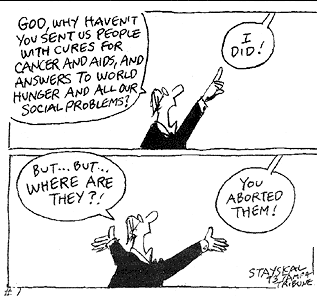
Have you ever thought about the possibility that when we get to heaven and get to ask God why he never sent us the cure for cancer that God may tell us that a person was sent to earth with the answer to cancer? Take a look at this editorial cartoon below:

(Francis did a great job in his film series “How Should we then live?” in looking at how humanism has affected art and culture in the Western World in the last 2000 years. My favorite episodes include his study of the Renaissance, the Revolutionary age, the age of Nonreason, and the age of Fragmentation.)

Related posts:

Francis Schaeffer’s “How should we then live?” Video and outline of episode 10 “Final Choices” (Schaeffer Sundays)

E P I S O D E 1 0   Dr. Francis Schaeffer – Episode X – Final Choices 27 min FINAL CHOICES I. Authoritarianism the Only Humanistic Social Option One man or an elite giving authoritative arbitrary absolutes. A. Society is sole absolute in absence of other absolutes. B. But society has to be […]

Francis Schaeffer’s “How should we then live?” Video and outline of episode 9 “The Age of Personal Peace and Affluence” (Schaeffer Sundays)

E P I S O D E 9 Dr. Francis Schaeffer – Episode IX – The Age of Personal Peace and Affluence 27 min T h e Age of Personal Peace and Afflunce I. By the Early 1960s People Were Bombarded From Every Side by Modern Man’s Humanistic Thought II. Modern Form of Humanistic Thought Leads […]

Francis Schaeffer’s “How should we then live?” Video and outline of episode 8 “The Age of Fragmentation” (Schaeffer Sundays)

E P I S O D E 8 Dr. Francis Schaeffer – Episode VIII – The Age of Fragmentation 27 min I saw this film series in 1979 and it had a major impact on me. T h e Age of FRAGMENTATION I. Art As a Vehicle Of Modern Thought A. Impressionism (Monet, Renoir, Pissarro, Sisley, […]

Francis Schaeffer’s “How should we then live?” Video and outline of episode 7 “The Age of Non-Reason” (Schaeffer Sundays)

E P I S O D E 7 Dr. Francis Schaeffer – Episode VII – The Age of Non Reason I am thrilled to get this film series with you. I saw it first in 1979 and it had such a big impact on me. Today’s episode is where we see modern humanist man act […]

Francis Schaeffer’s “How should we then live?” Video and outline of episode 6 “The Scientific Age” (Schaeffer Sundays)

E P I S O D E 6 How Should We Then Live 6#1 Uploaded by NoMirrorHDDHrorriMoN on Oct 3, 2011 How Should We Then Live? Episode 6 of 12 ________ I am sharing with you a film series that I saw in 1979. In this film Francis Schaeffer asserted that was a shift in […]

Francis Schaeffer’s “How should we then live?” Video and outline of episode 5 “The Revolutionary Age” (Schaeffer Sundays)

E P I S O D E 5 How Should We Then Live? Episode 5: The Revolutionary Age I was impacted by this film series by Francis Schaeffer back in the 1970′s and I wanted to share it with you. Francis Schaeffer noted, “Reformation Did Not Bring Perfection. But gradually on basis of biblical teaching there […]

Francis Schaeffer’s “How should we then live?” Video and outline of episode 4 “The Reformation” (Schaeffer Sundays)

Dr. Francis Schaeffer – Episode IV – The Reformation 27 min I was impacted by this film series by Francis Schaeffer back in the 1970′s and I wanted to share it with you. Schaeffer makes three key points concerning the Reformation: “1. Erasmian Christian humanism rejected by Farel. 2. Bible gives needed answers not only as to […]

“Schaeffer Sundays” Francis Schaeffer’s “How should we then live?” Video and outline of episode 3 “The Renaissance”

Francis Schaeffer’s “How should we then live?” Video and outline of episode 3 “The Renaissance” Francis Schaeffer: “How Should We Then Live?” (Episode 3) THE RENAISSANCE I was impacted by this film series by Francis Schaeffer back in the 1970′s and I wanted to share it with you. Schaeffer really shows why we have so […]

Francis Schaeffer’s “How should we then live?” Video and outline of episode 2 “The Middle Ages” (Schaeffer Sundays)

  Francis Schaeffer: “How Should We Then Live?” (Episode 2) THE MIDDLE AGES I was impacted by this film series by Francis Schaeffer back in the 1970′s and I wanted to share it with you. Schaeffer points out that during this time period unfortunately we have the “Church’s deviation from early church’s teaching in regard […]

Francis Schaeffer’s “How should we then live?” Video and outline of episode 1 “The Roman Age” (Schaeffer Sundays)

Francis Schaeffer: “How Should We Then Live?” (Episode 1) THE ROMAN AGE   Today I am starting a series that really had a big impact on my life back in the 1970′s when I first saw it. There are ten parts and today is the first. Francis Schaeffer takes a look at Rome and why […]

So many government programs have been misused and should be eliminated!!!!

___________

So many government programs have been misused and should be eliminated!!!!! Milton Friedman proposed eliminating all welfare programs and putting in the “Earned Income Tax Credit,” but instead of doing that the bureaucrats added it among all the other programs. What a mess!!!!

November 13, 2013 11:28AM

Congress Promotes Abuse and Corruption

One story after another emerges about dysfunctional federal programs plagued by waste, fraud, and abuse. The core problem is that the government has grown so large that trying to make it function with efficiency and soundness has become impossible.

But Congress compounds the problem by creating programs that are ideal targets for crooks and scammers, and they resist repealing them even after years of scandal. The Earned Income Tax Credit, for example, has long suffered from an “improper payment” rate of more than 20 percent, which translates into throwing $10 billion of our hard-earned money down the drain every year. Whatever the policy arguments in favor of the program, that level of waste is hugely unfair to taxpayers and the program ought to repealed on this basis alone.

The Washington Post discusses another long-abused activity today—contract set-asides for small businesses. The article profiles how a Virginia businessman hit the jackpot with $1 billion of federal contracts by posing as a “disadvantaged” and “small” business under the Small Business Administration’s 8(a) program. The Post found that this Mercedes-driving owner of a luxury home is certainly not “disadvantaged,” and his business empire is not “small.”

The whole thing is disgusting, and I suspect a congressional committee will hold an oversight hearing to pretend to be concerned about the case. But the SBA 8(a) program gets abused over and over, as do other federal preference activities, such as Alaska Native Corporations. All such preferences ought to be abolished, and the government should live up to the goal of “Equal Justice Under Law” engraved on the Supreme Court building.

Indeed the entire SBA ought to be abolished. The agency’s programs distort the economy and promote crony capitalism. Americans are sick of dysfunction in Washington, but if they want the government to operate with any degree of integrity and competence they should demand much less of it.

Related posts:

Open letter to President Obama (Part 432) A suggestion to cut some wasteful spending out of the government Part 2 (includes editorial cartoon)

(Emailed to White House on 3-15-13.) President Obama c/o The White House 1600 Pennsylvania Avenue NW Washington, DC 20500 Dear Mr. President, I know that you receive 20,000 letters a day and that you actually read 10 of them every day. I really do respect you for trying to get a pulse on what is […]

Dear Senator Pryor, here are some spending cut suggestions (“Thirsty Thursday”, Open letter to Senator Pryor)

Senator Pryor pictured below:  Why do I keep writing and email Senator Pryor suggestions on how to cut our budget? I gave him hundreds of ideas about how to cut spending and as far as I can tell he has taken none of my suggestions. You can find some of my suggestions here, here, here, here, here, here, here, here, here, here, here, here, here, here, here, here, here, here, here,  here, and  here, and they […]

Open letter to President Obama (Part 430) A suggestion to cut some wasteful spending out of the government Part 1 (includes editorial cartoon)

(Emailed to White House on 3-15-13.) President Obama c/o The White House 1600 Pennsylvania Avenue NW Washington, DC 20500 Dear Mr. President, I know that you receive 20,000 letters a day and that you actually read 10 of them every day. I really do respect you for trying to get a pulse on what is […]

The Dysfunction in Washington is Republicans and Democrats that are unwilling to cut spending in order to vote for more programs (Democrats want more food stamps etc but Republicans vote for their pet programs and wars too like No Child Left Behind Act, the Iraq war, the prescription drug entitlement, and the TARP bailout).

The Dysfunction in Washington is Republicans and Democrats that are unwilling to cut spending in order to vote for more programs (Democrats want more food stamps etc but Republicans vote for their pet programs and wars too like No Child Left Behind Act, the Iraq war, the prescription drug entitlement, and the TARP bailout). If […]

Dear Senator Pryor, here are some spending cut suggestions (“Thirsty Thursday”, Open letter to Senator Pryor)

Senator Pryor pictured below:  Why do I keep writing and email Senator Pryor suggestions on how to cut our budget? I gave him hundreds of ideas about how to cut spending and as far as I can tell he has taken none of my suggestions. You can find some of my suggestions here, here, here, here, here, here, here, here, here, here, here, here, here, here, here, here, here, here, here,  here, and  here, and they […]

If you want to cut wasteful spending then the disability program must be reformed radically!!!

If you want to cut wasteful spending then the disability program must be reformed radically!!! October 7, 2013 1:19PM 60 Minutes Disability Investigation By Chris Edwards Share The abuse and overspending in government disability programs is so bad that even National Public Radio and 60 Minutes have taken notice. On the heels of this excellent […]

If you really want to cut wasteful spending then why not shut down Dept of Housing and Urban Development, Dept of Education and SBA?

If you really want to cut wasteful spending then why not shut down Dept of Housing and Urban Development, Dept of Education and SBA? There are many other areas that should be cut but these should be shut down!!!   October 7, 2013 4:57PM Close Washington to Dismantle the Welfare-Warfare State By Doug Bandow Share […]

Dear Senator Pryor, here are some spending cut suggestions (“Thirsty Thursday”, Open letter to Senator Pryor)

Senator Pryor pictured below:  Why do I keep writing and email Senator Pryor suggestions on how to cut our budget? I gave him hundreds of ideas about how to cut spending and as far as I can tell he has taken none of my suggestions. You can find some of my suggestions here, here, here, here, here, here, here, here, here, here, here, here, here, here, here, here, here, here, here,  here, and  here, and they […]

We need to stop wasteful government spending by privatizing the post office!!

We need to stop wasteful government spending by privatizing the post office!! Postal Service Won’t Shut Down but Will Default on Its Debt James Gattuso October 1, 2013 at 9:30 am Newscom The U.S. Postal Service (USPS) defaulted on its debt last night. No, it has nothing to do with the partial shutdown of the […]

We need to stop the stupid spending by Bureaucrats!!!

We need to stop the stupid spending by Bureaucrats!!!   Bureaucrats Gone Wild: Government Spends Recklessly as Fiscal Year Ends Rob Bluey September 29, 2013 at 1:55 pm Credit: Tetra Images/Newscom Washington’s reckless spending is driving America into debt — and yet federal bureaucrats continue their wasteful and frivolous ways. The latest example comes courtesy […]

By Everette Hatcher III | Posted in spending out of control | Edit | Comments (0)

Simpson-Bowles commission plan wants to expand the federal government by raising taxes!!!

Dan Mitchell Commenting on Obama’s Failure to Propose a Fiscal Plan

Published on Aug 16, 2012 by

No description available.

________________

For the first 150 years our federal government lived on about 4% of our GDP  (except in wartime) but now federal spending has risen to over 24%. We need to lower spending now and not raise taxes. The problem isn’t that we don’t have enough taxes, but it is that we spend too much.

Many people want to believe in Unicorns, the Loch Ness Monster, and Bigfoot. I think those people are rational and reasonable compared to the folks in Washington that spend their days dreaming of “bipartisan” and “balanced” plans to fix the budget mess.

Here are the two things you should understand. First, you need to grab your Washingtonese-to-English dictionary so you can learn that “bipartisan” and “balanced” are almost always code words for “higher taxes.” Second, budget deals with higher taxes (as the New York Times accidentally admitted) don’t “fix” anything.

The Simpson-Bowles budget plan is a good example of why taxpayers should be quite skeptical. Put together by a former Republican Senator from Wyoming and Bill Clinton’s former Chief of Staff as part of President Obama’s Fiscal Commission, the Simpson-Bowles proposal is viewed by the inside-the-beltway crowd as fiscal Nirvana.

Unsurprisingly, Simpson and Bowles are quite fond of their plan. Here’s their key assertion from a column they recently wrote for USA Today.

The Simpson-Bowles commission offered a reasonable, responsible, comprehensive and bipartisan solution that won the support of a majority of Democrats and Republicans on the commission. Most importantly, it would reduce the deficit by $4 trillion over the next decade — enough to put the debt on a clear downward path relative to the economy.

Gee, sounds nice, but let’s look at the details, all of which can be seen by downloading their report.

A main problem is that Simpson and Bowles misdiagnose the problem. I think it’s fair to say that their focus, as they explicitly state in their report, is to “…stabilize and then reduce the national debt.” But as I explain in this video, the real problem is a federal government that is too big and spending too much. Red ink is just a symptom of that problem.

Moreover, the report even includes Keynesian policy, stating that “…budget cuts should start gradually so they don’t interfere with the ongoing economic recovery.”

But let’s set aside rhetorical sins and grade the plan.

Restraining Spending: C+

The plan does impose some restraint on the budget, but the plan – even after being in place for 10 years – assumes that the federal government should grow by about $1.5 trillion and consume nearly 22 percent of economic output. This is far above the 18.2 percent of GDP when Clinton left office, which should be the minimum target for policymakers.

But the components of the plan make me think they won’t even achieve the plan’s anemic targets.

Eliminating Departments and Programs: D

  • The Simpson-Bowles plan does not call for shutting down a single program, agency, or department. Not even cesspools of waste and inefficiency such as the Department of Education or Department of Housing and Urban Development.

Reforming Entitlements: C-

Reducing Bureaucratic Bloat: B

  • In terms of controlling spending, this is the part of the report that is most admirable. It calls for a three-year freeze on excessive compensation and urges reductions in bureaucratic bloat – albeit only through attrition.

Controlling the Tax Burden and Reforming the Tax Code: C-

The best policy, needless to say, is getting rid of the corrupt tax system and replacing it with a simple and fair flat tax. That obviously wasn’t what Simpson and Bowles decided to propose, but the flat tax is a benchmark that allows us to judge the components of their plan.

They basically get two policies right and two policies wrong. If they were major league baseball players, a .500 average would make them superstars. In Dan Mitchell’s policy world, they’re below average.

Lowering Tax Rates: A-

  • This is the best feature of all the revenue provisions. The Simpson-Bowles report proposes a top tax rate of between 23 percent-28 percent, significantly below the current top rate of 35 percent (and well below the 39.6 percent top rate that is part of President Obama’s class-warfare proposal). The corporate tax rate also would be reduced.

Reducing Double Taxation: D

  • The plan would increase the double taxation of dividends and capital gains. The U.S. already has a very anti-competitive system and this would be a step in the wrong direction (though ameliorated by a lower corporate tax rate).

Limiting the Tax Burden: D-

  • The plan assumes that laws should be changed to increase the federal tax burden to 21 percent of GDP from the long-run average of 18 percent of economic output. That’s unfortunate, but it’s even worse than it seems since the tax burden already is scheduled to rise to record levels because of what’s called “real bracket creep.” The Simpson-Bowles tax hikes would be an additional burden on taxpayers.

Eliminating Corrupt Loopholes: B

  • The good news is that some deductions are curtailed and a few are eliminated. The best components are the repeal of the deduction for state and local income and property taxes. So no more indirect preferences that reward profligate states such as California and Illinois. The healthcare exclusion also is capped, which would be a nice step on the long – but important – task of dealing with the third-party payer crisis in the healthcare sector.

I’m not a fan of the Simpson-Bowles plan, but I do give them credit. They decided to focus on the wrong variable and they have some bad policies, but at least it’s a real proposal.

It’s not anywhere close to the Ryan budget, but it’s a heck of a lot better than what the Senate Democrats have produced (nothing) and what the President has proposed (kicking the can down the road).

But doing a better job than the remedial students is damning with faint praise. Just in case you’re tempted to grade them on a curve, just remember that balancing the budget without tax increases doesn’t require any heavy lifting. All policymakers have to do is limit the growth of spending so it grows by an average of 2.5 percent annually over the next decade.

Other nations, such as New Zealand and Canada, got great results when imposing multi-year periods of fiscal restraint. Certainly it’s not asking too much to expect American lawmakers to exercise similar levels of prudence?

Open letter to President Obama (Part 454) Michael Cannon of Cato Institute speaks to Arkansas Senators (Part 3 includes editorial cartoon)


(Emailed to White House on 3-20-13.)

President Obama c/o The White House
1600 Pennsylvania Avenue NW
Washington, DC 20500

Dear Mr. President,

I know that you receive 20,000 letters a day and that you actually read 10 of them every day. I really do respect you for trying to get a pulse on what is going on out here.

I wanted to know if it was possible to avoid Obamacare if we don’t put in an exchange? That is what Michael Cannon told us.

Jacque Martin asks CATO Institute Michael Cannon about Obamacare

Published on Mar 19, 2013

The CATO Institute’s Michael Cannon spoke at the Arkansas Conservative Caucus on Tuesday March 19th. Several conservatives were present. Cannon talked about how to defeat Obamacare in Arkansas & how the states can stop Obamacare on a national level.

Jacque Martin of the Cleburne County Tea Party based in Heber Springs, Arkansas asked Michael Cannon about Obamacare.

__________________

The Arkansas Democrat Gazette story below:

Fight exchanges, lawmakers told

Cato Institute says state shouldn’t help run insurance markets

By Sarah D. Wire

This article was published today at 12:46 a.m.

Give up any control of online health-insurance markets required by federal law and refuse to help the federal government build them, the Health Policy Studies director of a Washington, D.C., think tank told Arkansas lawmakers Tuesday.

Michael Cannon with the Cato Institute told members of the Senate Insurance and Commerce Committee on Tuesday that states should challenge implementation of the 2010 Patient Protectionand Affordable Care Act, either through legislation or lawsuits.

“Refusing to create an exchange is going to force Congress to reopen this law,” Cannon said.

In January, Arkansas received the OK to partner with the federal government in running a health-insurance exchange.

Insurance exchanges are designed to be competitive marketplaces where mostly uninsured people can shop for coverage, either online or with the help of consumer guides.

States can choose to operate exchanges completely on their own, enter into a partnership or let the federal government operate the exchange on its own.

Gov. Mike Beebe initially pushed for a state-run exchange, but after resistance from Republican lawmakers, he ordered the state Insurance Department to apply for a partnership so Arkansas could have some say in how the exchange should be run.

Some members, including Committee Chairman Sen.

Jason Rapert, R-Bigelow, have questioned whether the state should choose to create and control its own exchange after the U.S. Supreme Court’s June decision to uphold the federal health-care law.

Under the federal Patient Protection and Affordable Care Act, companies with 50 employees or more face fines from the Internal Revenue Service ranging from $2,000 to $3,000 for most employees who gain coverage on the exchange either because their companies don’t offer insur-ance or it’s deemed too expensive by the law. Such employees would apply for a tax credit.

Cannon told lawmakers that his group’s understanding of the law is that if a state doesn’t create its own exchange, the federal government cannot assess the fines or award the tax credits.

“The law is actually very clear on this point,” Cannon said. “It wasn’t a glitch, Congress intended to do that. It was an incentive they created to encourage states to establish exchanges.”

He said Arkansas should wait to see whether a federal court finds that the Internal Revenue Service cannot fine businesses for not offering insurance or people for not having insurance in states where the federal government runs the insurance markets.

Oklahoma challenged the federal government over the fines in January 2011. U.S. District Judge Ronald White has not ruled whether Oklahoma even has standing to bring the case.

Annabelle Imber Tuck, co-chairman of the Plan Management Committee which is helping set up the state’s role inthe exchange, said it’s impossible to know how or when a court will rule. Tuck is a former state Supreme Court justice.

She said the law isn’t as clear about the tax subsidies and penalties as Cannon told lawmakers.

“This argument has been going on since last July between legal scholars. There is only one lawsuit on the table. How the court will rule is anyone’s guess,” she said. “So the question is, what do the people of the state of Arkansas do in the meanwhile?”

Rapert said he doesn’t know what Arkansas would gain from handing over all responsibility for the exchange to the federal government.

“At the end of the day, if no one stops the IRS from imposing the penalties, I don’t know what we gained from just opposing. At the end of the day, if the federal government is still going to impose penalties regardless of whether or not it was in the [Affordable Care Act] or not, you still have the same effect,” Rapert said. “His [Cannon’s] comments were crafted in order to help bring about opening up the legislation again by Congress, which literally we have no power to do. Only Congress can decide they are going to do that.”

Arkansas, Pages 9 on 03/20/2013

Print Headline: Fight exchanges, lawmakers told

<!–Arkansas 9

Michael Cannon said they opposed Romneycare at the Cato Institute and this article below proves it.


That’s a trick question, of course, as illustrated by this biting Henry Payne cartoon.

But let’s look at one of the commonalities of Romneycare and Obamacare – higher premiums, thanks to mandates and third-party payer.

Here’s a quick look at what’s been happening to premiums in Massachusetts.

Romneycare Premiums

The same thing is already happening with Obamacare, as explained in a Wall Street Journal column by Merrill Matthews and Mark Litow.

The congressional Democrats who crafted the legislation ignored virtually every actuarial principle governing rational insurance pricing. Premiums will soon reflect that disregard—indeed, premiums are already reflecting it. …Guaranteed issue incentivizes people to forgo buying a policy until they get sick and need coverage (and then drop the policy after they get well). While ObamaCare imposes a financial penalty—or is it a tax?—to discourage people from gaming the system, it is too low to be a real disincentive. The result will be insurance pools that are smaller and sicker, and therefore more expensive.

How bad will it be? Well…

Many actuaries, such as those in the international consulting firm Oliver Wyman, are now predicting an average increase of roughly 50% in premiums for some in the individual market for the same coverage. …Arizona, Arkansas, Georgia, Idaho, Iowa, Kentucky, Missouri, Ohio, Oklahoma, Tennessee, Utah, Wyoming and Virginia will likely see the largest increases—somewhere between 65% and 100%. Another 18 states, including Texas and Michigan, could see their rates rise between 35% and 65%.

Which is why 2014 is the “Year of the Snake” in more places than just China.

Obamacare Snake Cartoon

If you like Ramirez cartoons, you can see some of my favorites here, here, here, here, and here.

__________

__________

Thank you so much for your time. I know how valuable it is. I also appreciate the fine family that you have and your commitment as a father and a husband.

Sincerely,

Everette Hatcher III, 13900 Cottontail Lane, Alexander, AR 72002, ph 501-920-5733, lowcostsqueegees@yahoo.com

–>

Related posts:

Max Brantley of the Ark Times takes on Michael Cannon of the Cato Institute today concerning Obamacare

Max Brantley of the Ark Times takes on Michael Cannon of the Cato Institute today concerning Obamacare. I have posted many links to Cannon’s articles in the past on my blog and on the Arkansas Times liberal blog. The finest article written in my estimation was written on Nov 20, 2012 and here is a […]

Is Michael Cannon of the Cato Institute right about states blocking Obamacare, factchecker says he is wrong.

Cato’s Michael F. Cannon Discusses ObamaCare’s Individual Mandate Is Michael Cannon of the Cato Institute right about states blocking Obamacare, factchecker says he is wrong. I Have Been False* Posted by Michael F. Cannon *According to PolitiFact. In an unconscious parody of everything that’s wrong with the “fact-checker” movement in journalism, PolitiFact Georgia (a project of […]

An ObamaCare Debate Challenge by Michael F. Cannon (editorial cartoon)

Obamacare is a poorly written and because of that the majority of states may never have to put into practice.   February 28, 2013 2:13PM ObamaCare Debate Challenge: Lawrence Wasden Edition By Michael F. Cannon Share Tweet Like Google+1 Congress empowered states to block major provisions of ObamaCare, including its subsidies and employer mandate. All […]

Open letter to President Obama (Part 249)

Is Washington Bankrupting America? Uploaded by BankruptingAmerica on Apr 20, 2010 Be first to receive our videos and other timely info about economic policy. Subscribe at http://www.bankruptingamerica.org ————————- According to a recent poll, 74 percent of likely voters are extremely or very concerned about the current level of government spending. And 58 percent think the […]

The real truth about Obamacare can be seen on the www.thedailyhatch.org

Michael Cannon on Medicare and Healthcare You want to know the real truth about Obamacare then check out these videos and articles linked below: American people do not want Obamacare and the regulations that go with it March 7, 2012 – 8:02 am In this article below you will see that the American people do not […]

The primary cause of higher hospital care and education costs in the USA is?

Is Washington Bankrupting America? Uploaded by BankruptingAmerica on Apr 20, 2010 Be first to receive our videos and other timely info about economic policy. Subscribe at http://www.bankruptingamerica.org ————————- According to a recent poll, 74 percent of likely voters are extremely or very concerned about the current level of government spending. And 58 percent think the […]


Shouldn’t we eliminate welfare programs that deepen, prolong and institutionalize poverty?

___________

Shouldn’t we eliminate welfare programs that deepen, prolong and institutionalize poverty?


Senator Mike Lee: Time to Rethink the War on Poverty

Progressives sometimes accuse conservatives of not caring about the poor. But it’s liberal policies that deepen, prolong, and institutionalize poverty.

Senator Mike Lee (R-UT) made this important clarification at a Heritage Foundation forum on Capitol Hill today when he said, “1964 wasn’t the year Americans started fighting poverty; it was the year we started losing that fight.”

Lee went on to lay out the case that America from its birth built the best poverty-reduction machine ever created—which is why this country has attracted millions of immigrants from around the world.

“For more than 200 years, the United States—through trial and error, through good times and bad—has waged the most successful war on poverty in the history of the world,” he said.

Then Lee explained how Lyndon Johnson’s War on Poverty—which celebrates its 50th anniversary next year, if that is the correct term—has only made poverty worse:

Despite trillions of taxpayer dollars spent to eradicate poverty since the late 1960s, the poverty rate has hardly budged. And just last week, the Census Bureau reported that today, more than 49 million Americans still live below the poverty line.

Today, a boy born in the bottom 20% of our income scale has a 42% chance of staying there as an adult. According to the O.E.C.D. [Organisation for Economic Co-operation and Development], the United States is third from the bottom of advanced countries in terms of upward economic mobility.

A recent study in Oregon found that the Medicaid program – which provides health insurance to the poor – produces basically no health improvements for its beneficiaries. A study last December on the Head Start program, issued by the Obama Administration itself, found that what few academic benefits three- and four-year olds do gain from the program all but disappear by end of the first grade.

Then Lee ripped into President Obama’s ethos of tackling big problems such as poverty only under the leadership of government. For example, when Obama says, “Now, more than ever, we must do things together, as one nation and one people”—by “together,” Lee explained, the President means only “government.”

This discredited mindset—which insists collective action can only mean state action—is itself a kind of poverty. It rejects social solidarity in favor of political coercion, and voluntary communities for professional community organizers. It distrusts and denies the bonds of cooperation and service that represent the highest expression of our dignity.

Conservatives, said the Senator, must take the lead and show ways government can remove barriers to success for Americans.

The challenge to conservatives today is to rethink the war on poverty along these lines, to bring into our economy and society the individuals, families, and communities that have for five decades been unfairly locked out.

You can read the whole speech here.

Related posts:

Open letter to President Obama (Part 432) A suggestion to cut some wasteful spending out of the government Part 2 (includes editorial cartoon)

(Emailed to White House on 3-15-13.) President Obama c/o The White House 1600 Pennsylvania Avenue NW Washington, DC 20500 Dear Mr. President, I know that you receive 20,000 letters a day and that you actually read 10 of them every day. I really do respect you for trying to get a pulse on what is […]

Dear Senator Pryor, here are some spending cut suggestions (“Thirsty Thursday”, Open letter to Senator Pryor)

Senator Pryor pictured below:  Why do I keep writing and email Senator Pryor suggestions on how to cut our budget? I gave him hundreds of ideas about how to cut spending and as far as I can tell he has taken none of my suggestions. You can find some of my suggestions here, here, here, here, here, here, here, here, here, here, here, here, here, here, here, here, here, here, here,  here, and  here, and they […]

Open letter to President Obama (Part 430) A suggestion to cut some wasteful spending out of the government Part 1 (includes editorial cartoon)

(Emailed to White House on 3-15-13.) President Obama c/o The White House 1600 Pennsylvania Avenue NW Washington, DC 20500 Dear Mr. President, I know that you receive 20,000 letters a day and that you actually read 10 of them every day. I really do respect you for trying to get a pulse on what is […]

The Dysfunction in Washington is Republicans and Democrats that are unwilling to cut spending in order to vote for more programs (Democrats want more food stamps etc but Republicans vote for their pet programs and wars too like No Child Left Behind Act, the Iraq war, the prescription drug entitlement, and the TARP bailout).

The Dysfunction in Washington is Republicans and Democrats that are unwilling to cut spending in order to vote for more programs (Democrats want more food stamps etc but Republicans vote for their pet programs and wars too like No Child Left Behind Act, the Iraq war, the prescription drug entitlement, and the TARP bailout). If […]

Dear Senator Pryor, here are some spending cut suggestions (“Thirsty Thursday”, Open letter to Senator Pryor)

Senator Pryor pictured below:  Why do I keep writing and email Senator Pryor suggestions on how to cut our budget? I gave him hundreds of ideas about how to cut spending and as far as I can tell he has taken none of my suggestions. You can find some of my suggestions here, here, here, here, here, here, here, here, here, here, here, here, here, here, here, here, here, here, here,  here, and  here, and they […]

If you want to cut wasteful spending then the disability program must be reformed radically!!!

If you want to cut wasteful spending then the disability program must be reformed radically!!! October 7, 2013 1:19PM 60 Minutes Disability Investigation By Chris Edwards Share The abuse and overspending in government disability programs is so bad that even National Public Radio and 60 Minutes have taken notice. On the heels of this excellent […]

If you really want to cut wasteful spending then why not shut down Dept of Housing and Urban Development, Dept of Education and SBA?

If you really want to cut wasteful spending then why not shut down Dept of Housing and Urban Development, Dept of Education and SBA? There are many other areas that should be cut but these should be shut down!!!   October 7, 2013 4:57PM Close Washington to Dismantle the Welfare-Warfare State By Doug Bandow Share […]

Dear Senator Pryor, here are some spending cut suggestions (“Thirsty Thursday”, Open letter to Senator Pryor)

Senator Pryor pictured below:  Why do I keep writing and email Senator Pryor suggestions on how to cut our budget? I gave him hundreds of ideas about how to cut spending and as far as I can tell he has taken none of my suggestions. You can find some of my suggestions here, here, here, here, here, here, here, here, here, here, here, here, here, here, here, here, here, here, here,  here, and  here, and they […]

We need to stop wasteful government spending by privatizing the post office!!

We need to stop wasteful government spending by privatizing the post office!! Postal Service Won’t Shut Down but Will Default on Its Debt James Gattuso October 1, 2013 at 9:30 am Newscom The U.S. Postal Service (USPS) defaulted on its debt last night. No, it has nothing to do with the partial shutdown of the […]

We need to stop the stupid spending by Bureaucrats!!!

We need to stop the stupid spending by Bureaucrats!!!   Bureaucrats Gone Wild: Government Spends Recklessly as Fiscal Year Ends Rob Bluey September 29, 2013 at 1:55 pm Credit: Tetra Images/Newscom Washington’s reckless spending is driving America into debt — and yet federal bureaucrats continue their wasteful and frivolous ways. The latest example comes courtesy […]

By Everette Hatcher III | Posted in spending out of control | Edit | Comments (0)